
Welcome to Porsche’s ‘Greatest Hits’ 911, and just like The Beatles, The Rolling Stones or Elton John, it has quite a catalogue to choose from.
The 911 R cherry picks the juiciest bits from the entire 911 line-up as a last hurrah for the 991-series model before production switches completely to the new 991.2 range.
Just 991 will be built, with Australia guaranteed “an extremely limited number” starting at $404,700. The nameplate is a nod to the 1967 road racer of which just 18 were built to compete in events like the Targa Florio.
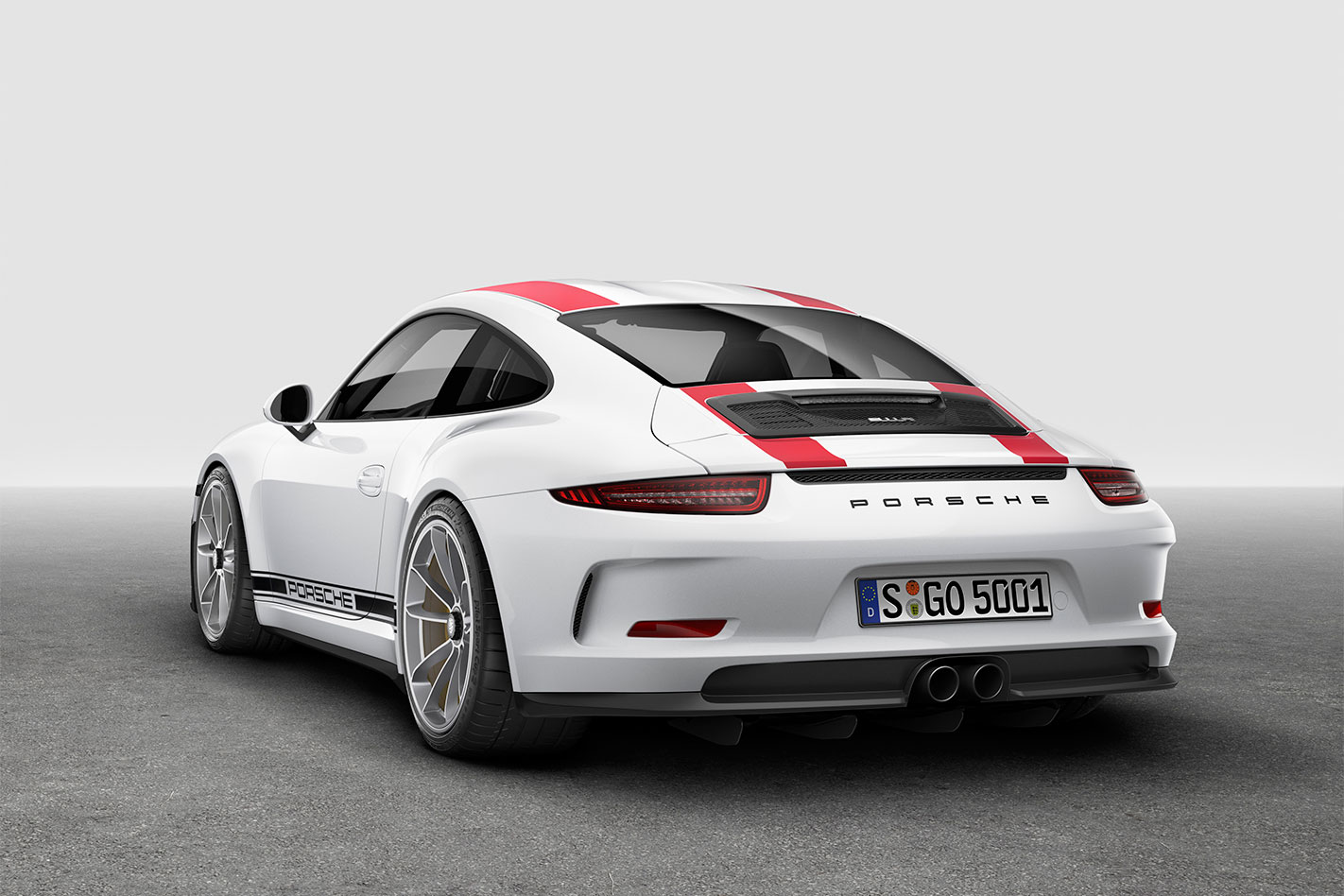
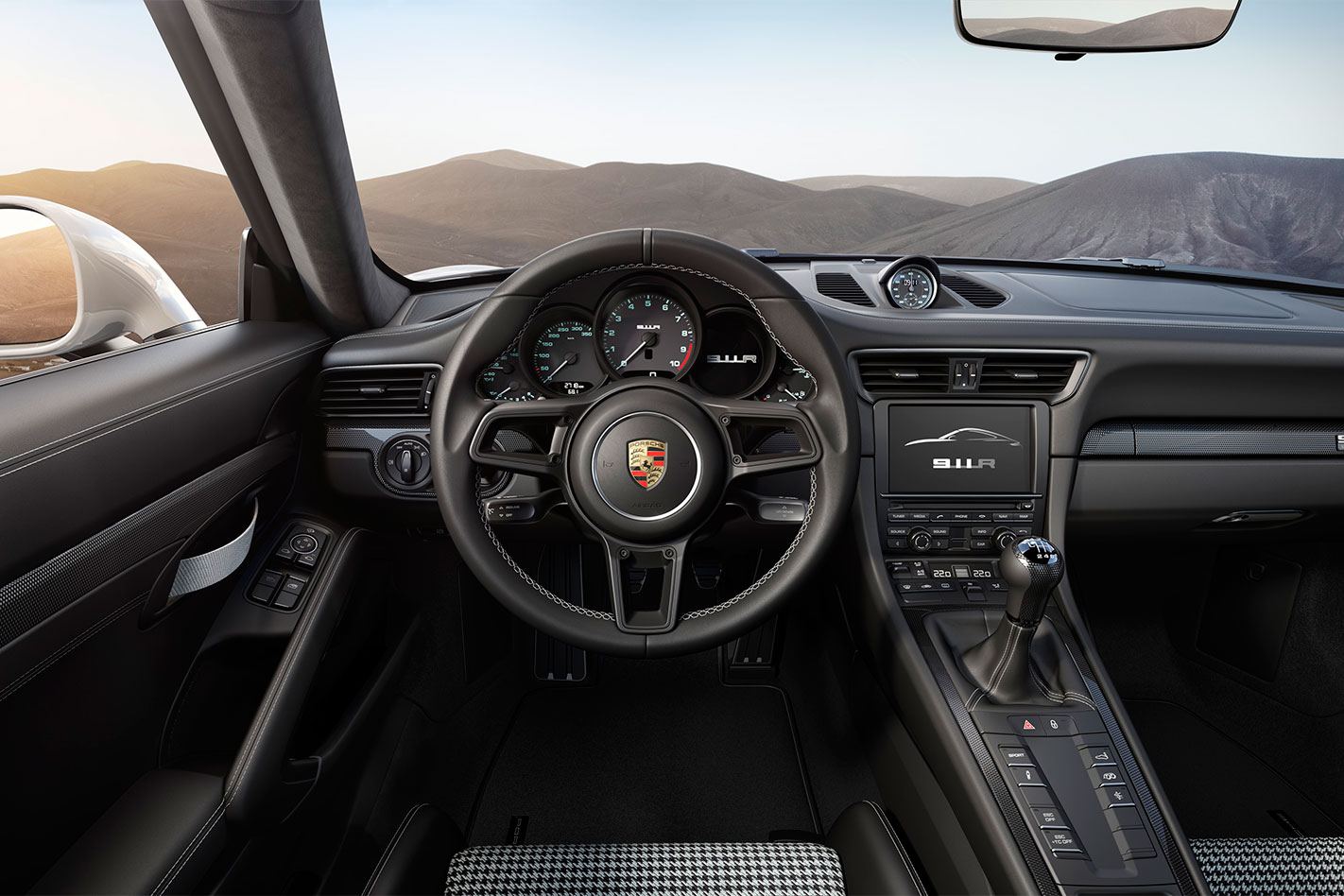
There is no rear seat, sound insulation has been reduced and air-con and even a radio have moved to the no-cost option list.
Combined with lightweight mechanical componentry like a titanium exhaust and standard-fit PCCB carbon-ceramic rotors (410mm front; 390mm rear) kerb weight is reduced to just 1370kg.
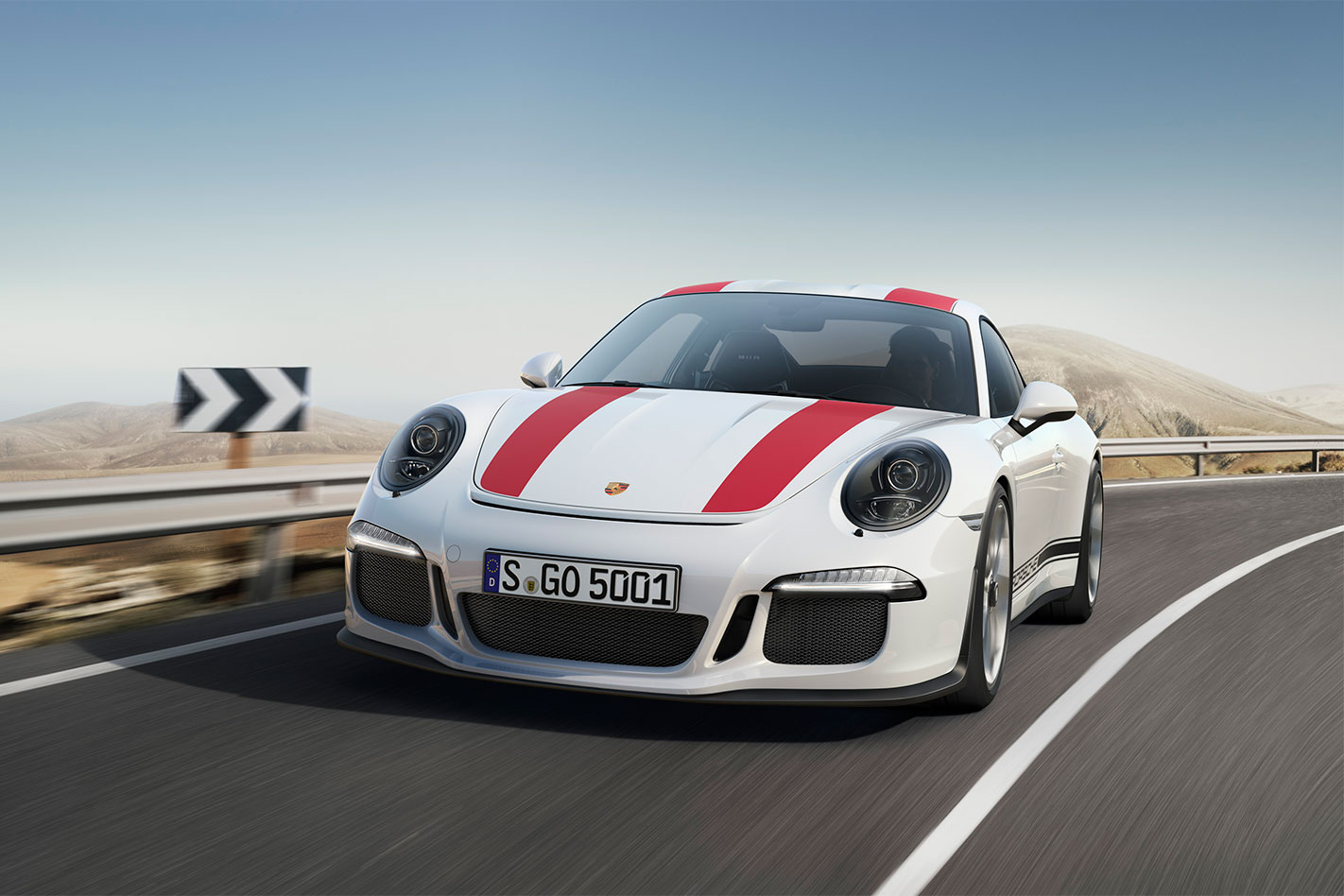
The GT3 also donates its suspension, rear-wheel steering system, 20-inch forged wheels and Michelin Pilot Sport Cup 2 tyres measuring 245/35 ZR20 front and 305/30 ZR20 rear.
At the back is where the real story is, however. Tucked in the tail of the 911 R is the searing 4.0-litre flat six from the GT3 RS producing 368kW at 8250rpm and 460Nm at 6250rpm.

Having to shift your own gears lifts the 0-100km/h time to 3.8sec (the GT3 RS claims 3.3sec) however top speed also increases to 323km/h thanks to the removal of those drag-inducing wings.
Three colours will be available (white, red and black) while the Porsche logos on the side and colour stripes (available in red or green) are a nod to its illustrious 1960s predecessor.
Australian deliveries of the 911 R are expected by the end of 2016, but you’d better get in quick as we expect the queue of potential buyers to be long for what promises to be a pretty spectacular car.
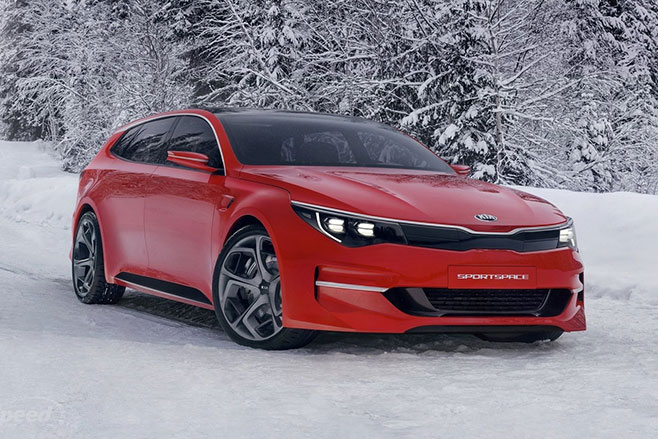
IT’S a classic case of what might have been: Kia has officially unveiled the production form of its swoopy, angular Sportspace Concept with electronically variable suspension system and more responsive rack-mounted steering.
Unfortunately, they’ve hosed down the best bits of the vision unveiled in Geneva last year (pictured, below) to blend the showroom model, dubbed the Kia Sportswagon, right into the background. Talk about a wardrobe malfunction.
In Europe, rack- rather than steering column-mounted electrically assisted steering will be standard on GT-badged cars fitted with Kia’s turbocharged 180kW/353Nm 2.0-litre four-cylinder petrol engine mated exclusively to a six-speed automatic transmission, and cars fitted with a 104kW/340Nm 1.6-litre turbo-diesel sending power to the front wheels via either a six-speed manual or seven speed dual-clutch automatic gearbox.
The Sportswagon keeps the same width (1860mm) and length (4855mm) as the Optima sedan, but grows 5mm in height (1470mm) to extend the roofline for the boot.
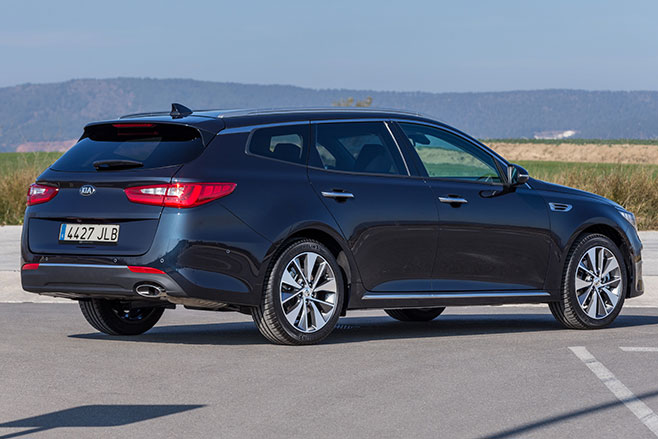
Down the rear, the accented twin trapezoidal exhausts and black diffuser of the concept are replaced with a single oval exhaust and features an integrated diffuser.
On the safety front, the European market version of the Sportswagon features a short- and long-range autonomous emergency braking system that works at closing speeds of up to 80km/h, radar cruise control, and even a forward-looking camera that reads speed signs and displays them to the driver.
I’ ve never particularly understood people who go to Greece to lie on a beach. You know we’ve got a few here that aren’t half bad? Of the 10,685 beaches in Australia (someone’s counted) surely there’s one that suits.
It’s a bit the same for roads. I’m sure the Stelvio Pass is not without its charms, but it’s worth poking around your own backyard first. Because there are gems. Three hundred million years of erosion has ground down the Great Dividing Range, one of the oldest mountain ranges in the world, to create a terrain ripe for corners of every variety.
Where Europe’s mountains ascend so dramatically the only way to climb them is with terraces of hairpins, Australian’s mountains (dramatic hills might be a more accurate description) undulate rather nicely. For great roads, the antipodeans have it pretty good.
And for Australia, combine a tiny population in an enormous country, but with enough riches to make decent roads (at least alpine ones) and you’ve a recipe for bendy stretches that are largely empty.
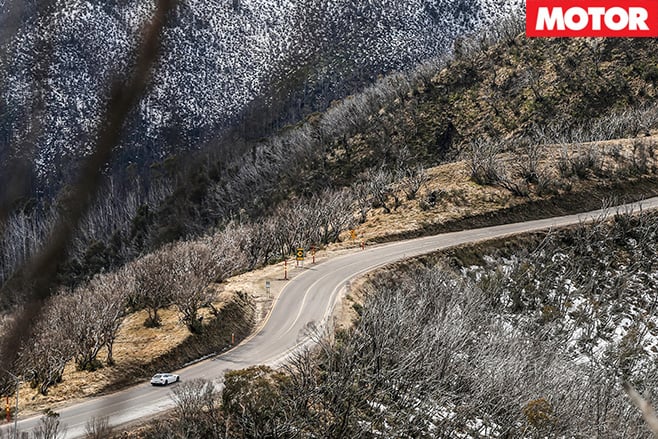
Not just by virtue of its altitude, the Great Alpine Road has a perilous sector unusually exposed to the elements. When surveyors mapped its route in the 1870s, they wound the road through country close to and above the tree-line at Mount St Bernard and Mount Blowhard. Still today this wayward sector closes often due to snowfall and occasionally its bypassing is debated, but still the snow ploughs man the road year after year.
In the right car it’s not a problem. And for our expedition across the top of Australia – still in the winter months – we could do worse than the storming V12, all-wheel drive Ferrari FF. True, it’s been around a few years now (five) and in fact this year, it’s due for a major overhaul.
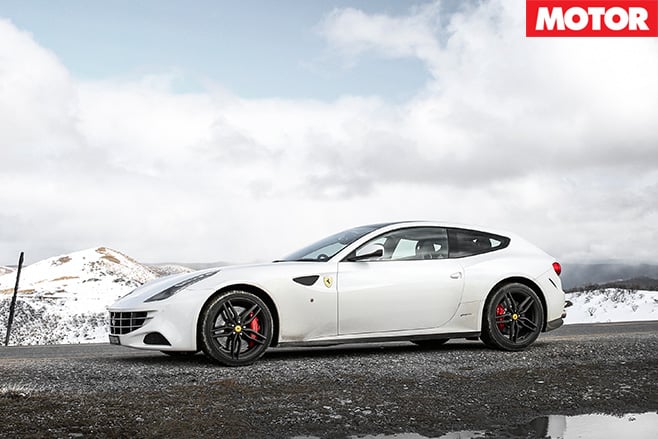
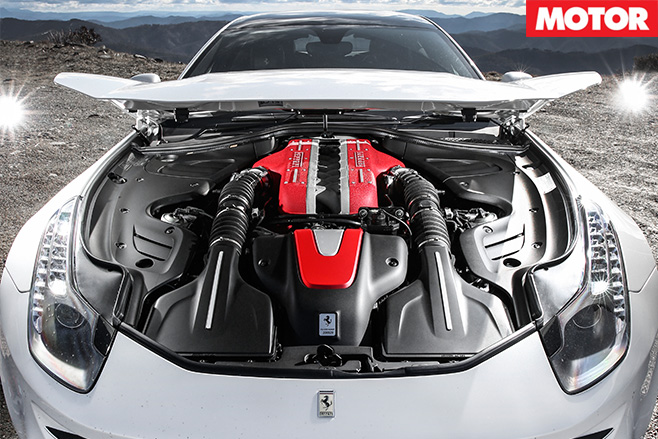
Fitting the 6.3-litre, naturally aspirated V12 helped from the outset to clear any confusion the FF was the accountants’ crack at a Ferrari Cayenne (and hopefully the FF is as close to an SUV Ferrari ever comes). You needn’t be a mathematician, either, to calculate what happens when you combine a 12.3:1 compression ratio and 8200rpm (the FF’s indicated redline): 486kW at a screaming 8000rpm and 683Nm at 6000rpm.
Perhaps on paper the FF hasn’t the glut of tacho-wide torque like its newly-turbocharged California T and 488 GTB siblings, but still, 500Nm at 1000rpm is nothing to sneeze at. From any engine speed you’re not going to be yawning. Trust us.

The diff itself can shunt thrust left or right using a pair of wet clutch packs depending on where there’s more grip. And once said rearward grip has expired, the computer, imperceptibly and in milliseconds, wakes up a very alternative all-wheel drive system indeed.
It’s easiest to think of the FF as a front-engine, rear-drive Ferrari in all situations – until more accelerative grip is required than the rear tyres can supply. There is no transfer case, centre diff or extra driveshaft sending torque back to the front axle; that would be heavy and gobble up precious interior space. Not on for a practical, four-seat grand tourer.
Wheel speeds are matched front to rear using super-accurate sensors and of course it all happens instantaneously and seamlessly. Beyond fourth gear, from fifth to seventh, the FF is rear-drive only.
So there is only a digital connection, not mechanical, between front and rear wheels. Ferrari calls its innovative all-wheel drive system 4RM – and promptly patented it. It also saves 50 per cent in mass over a traditional transfer case set-up. Why no other car manufacturers have thought of this, and persist otherwise, we’re unsure.
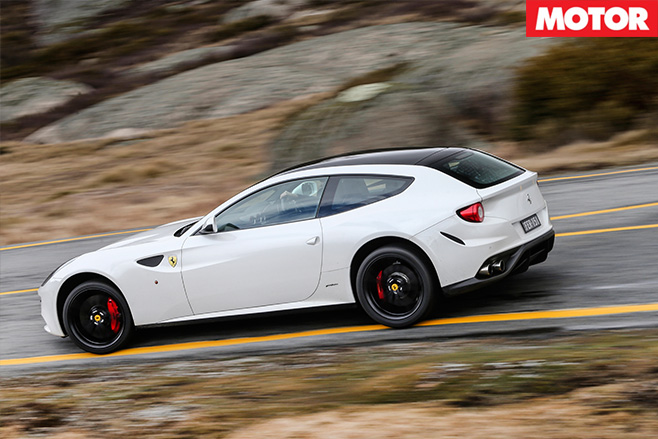
Beyond that point, it’s all traction – helpful for confidence on stretches like the Great Alpine Road at the end of winter. See, mid-winter, with every second corner under invisible ice, you can only drive one way. In summer, as snowfields pare back to meadows and the road dries out, you can only drive one way. But at the end of winter, spring knocking, the road is a lottery: one corner dry, the next wet, with an occasional patch of ice to keep you on your toes.
From Wangaratta in the north-west to Bairnsdale in the south-east, the Great Alpine Road is 307km up and over the alps. But the bit you care about begins after Bright, as snow-capped, blue-tinted mountains rise on the horizon and beckon.

Still below the tree-line and without a snowflake in sight, the road is tight and twisty and the FF, manettino switched from Comfort to Sport and the “Bumpy Road” adaptive damper setting engaged, feels big. It is a sizeable car, after all – 1880kg, as long as a Commodore but with the wheelbase of a Caprice (nearly three metres!) – you peer over what seems like an endless, sculpted bonnet. It feels Large.
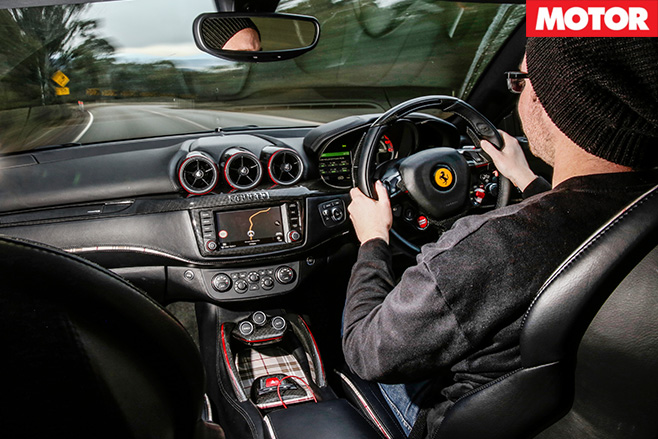
After about 16 kilometres climbing through the tight stuff you emerge through the tree-line to vistas and valleys. It’s spectacular (budget time for stopping; and a camera). Snow starts to appear, first in glugs by the roadside and as you climb further, it begins to blanket the landscape.
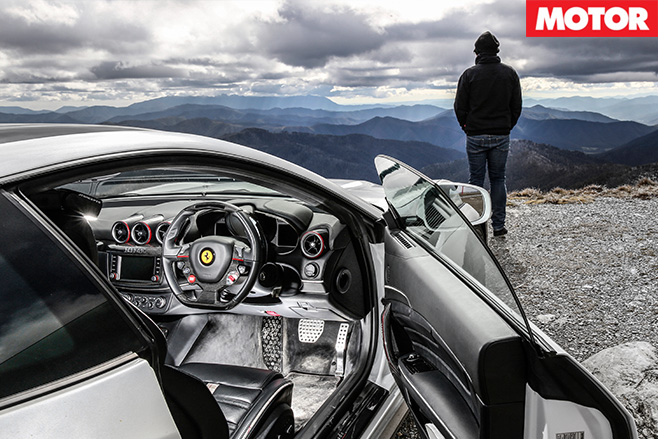
If the FF was a film the engine would be the big-name Hollywood superstar. At least once in your life, you need to work out some way of getting into a naturally-aspirated, V12 Ferrari, winding out second gear to just before 8000rpm, all LEDs atop the steering wheel alight, plucking third with a click of the carbon, scythe-like paddle (which clicks like a computer mouse) and feeling the uninterrupted, crisp and ferocious punch of a Ferrari V12.

And yet the FF still behaves like a rear-driver, up to the point you can feel the rear reacting, unhinging, but you can keep applying throttle and the effect is of claws sinking down into bitumen and launching you forward where a rear driver of comparable power would be slewing only further sideways.
It’s at 100km/h the FF feels, alarmingly, only to be just getting started. It does 0-200km/h in 11 seconds and we’ve absolutely no reason to doubt it. Around the 127km mark from Wangaratta, prepare to exhale involuntarily.
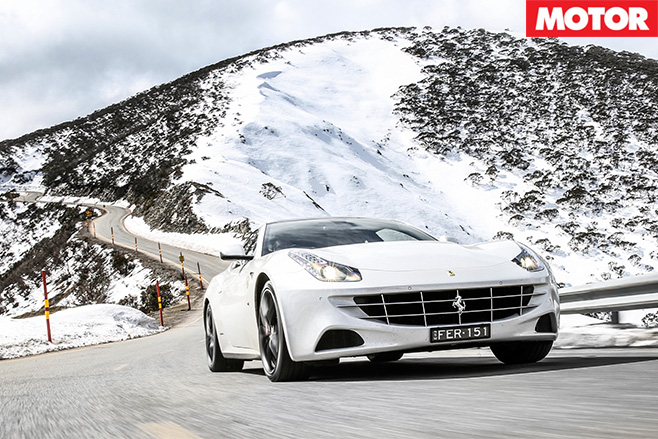
It’s the photo we’ve used on the opening spread – and arguably one of, if not the most spectacular bit of road in Australia. Slurped up like a gigantic bit of bitumen linguine in the FF. Shortly after we’re in the Mount Hotham village. As it’s still the ski season people are everywhere and yet the FF turns nary a head. It’s certainly the most unassuming Ferrari model. Being white doesn’t help.

Ferrari claims 15.4L/100km combined for the FF and that’s even after the engine’s been through efficiency boot camp (now with stop-start and more economic throttle and transmission maps for around town). We measured two fills, one was 26.5L/100km and the other, 14.4L. Average 20.45L/100km.
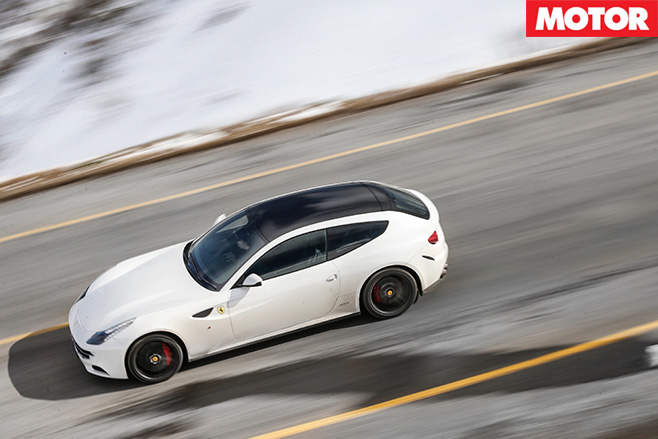
Standing around with the buzz you only get from a day of incredible driving, recalling beguiling sections of road saved to memory, we conclude two good things about Bairnsdale – the BP has Ultimate, and there’s plenty of space to turn around.
VOLKSWAGEN will use 2016 to rebuild itself and resolve the diesel emissions problems that brought the company to its knees in 2015 and resulted in a major management cleanout.
Speaking to 400 media the eve of the opening of the 2016 Geneva motor show overnight, newly appointed Volkswagen Group CEO Matthias Mueller said “this year we intend to solve the diesel issue for our customers”.
“2016 is the year in which we lay the foundations of a better Volkswagen,” he said. “I intend to make Volkswagen a company people trust and love.”
“VW is on the eve of a bright future,” said Mueller, adding that it would involve merging the modern, digital world into the automobile. “This group and its fans can and will leave this difficult stage stronger than we’ve entered it.”
But there is much pain to endure before Volkswagen is clear of the emissions scandal, including potentially billions of dollars in fines, finalising the fixes for 11 million affected cars globally, and coming up with an acceptable emissions fix for US authorities.
Volkswagen this week announced the recall action would start for almost 9000 Australian Amarok utes and that the Passat would be the next diesel-powered Volkswagen to have its software updated.
But the brand is already looking way into the future and sees the emissions scandal – whereby cars were found to have defeat device software to make them pass a test – as an opportunity to further engage with customers.
Mueller said electronics were key to Volkswagen moving beyond the emissions scandal that rolls on.
He promised to more than double the group’s electric car offerings to “more than 20” by 2020, adding some would have an electric range upwards of 500km and be able to be charged in the time it takes to have a cup of coffee.
He also said merging the consumer electronics world with the transport world was a key plank in the brand’s planned fightback, which could take years.
“The digital revolution will be a game changer for the automotive industry,” said Mueller.
Volkswagen said it would have fully autonomous vehicles – without a steering wheel or pedals – “within five years” and that the technology would be popular by 2025.
“By 2025 it will be commonplace to move from A to B in self-driving automobiles,” said Volkswagen’s chief digital officer Joann Jungwirth.
Sebastien Loeb has joined the World Rallycross grid for 2016, driving a 410kW Peugot 208 GTi for Team Peugeot Hansen.
Loeb joins a star-studded line-up, including Ken Block, Mattias Ekstrom and winner of the last two World Rallycross titles, fellow former World Rally Champion Petter Solberg.
Since his retirement from full time WRC competition in 2012, Loeb has kept busy competing (and winning) in a variety of disciplines, including French Porsche Carrera Cup, the World Touring Car Championship Pikes Peak and, this year, the Dakar rally.
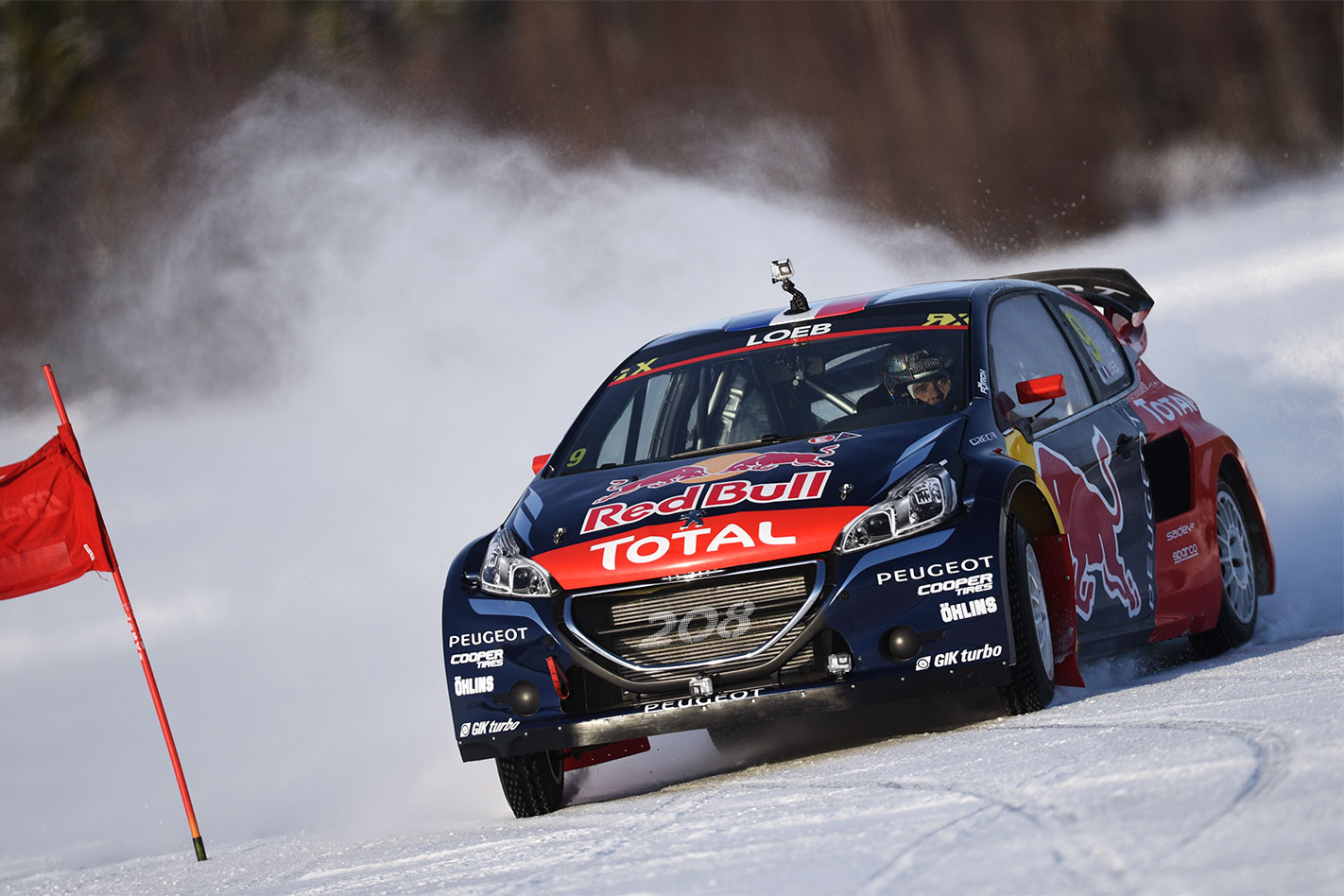
The 2016 World Rallycross championship kicks off in Portugal on April 15.
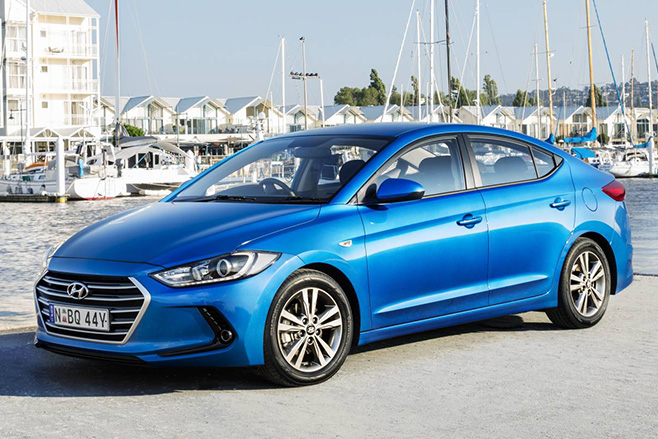
Hyundai has introduced its all-new Elantra, the small sedan that is big on value for money. It gets a boost in standard equipment, increased performance and sharp new looks.

Hyundai’s signature hexagonal grille, as seen across its model family, features prominently on the front of the restyled Hyundai Elantra. New slim projector headlights sit either side with standard fog lights below. A focus on aerodynamics should see the Elantra achieve better fuel economy than its predecessor. Features like the front wheel ‘air curtains’ have been pulled from the Sonata Hybrid to channel air airflow around the wheels and reduce wind resistance.
The new Elantra comes in two variants; Active (pictured top, below) and Elite (pictured above). All are powered exclusively by a new 2.0-litre four-cylinder petrol engine that produces 112kW and 192Nm with an emphasis on low-end torque delivery. Hyundai claims increased driveability and better real-world performance.
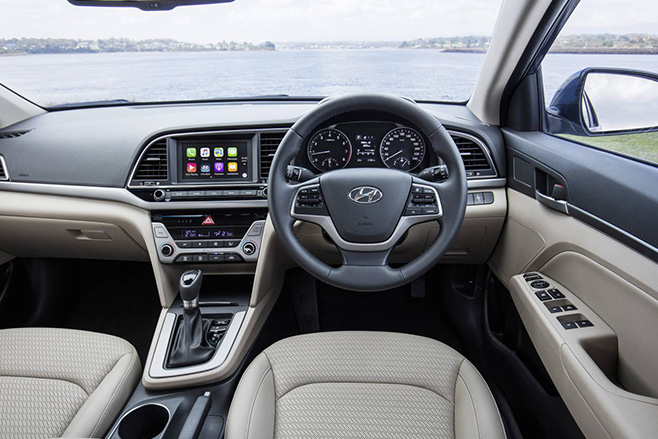
Active and Elite variants now feature a 7-inch touchscreen and Apple CarPlay for premium iPhone integration. A rear-view camera with park assist technology is standard, as is cruise control, LED daytime running lamps and automatic dusk-sensing headlights. Alloy wheels and a full size spare are included across all models.
Touted by Hyundai as the ‘best-ever Elantra’, the attractive sedan is completely redesigned inside and out. The new cabin offers more shoulder room front and back and increased rear head room. New construction methods and materials have resulted in a stronger body for the Elantra meaning better handling and safety.
Hyundai has spent significant time optimising the Elantra’s suspension tune for Australian conditions. 48 separate suspension configurations were tested before settling, including 15 different front damper units, 34 rear damper units, and multiple different springs, sway bars and bushes.
“We’re very happy with the new Elantra,” says Hyundai’s local product planning manager (and lead test driver), Andrew Tuitahi. “Apart from its refined new looks, advanced construction methods and significant value improvement, the new car is really enjoyable to drive.
MORE: Hyundai Elantra Range Review MORE: Hyundai Elantra Specs, Range & Price
Yesterday’s E400 Cab becomes today’s Mercedes-AMG C43 Cabriolet – but there is more to the change than just a swap of letters and numbers.
Curiously, the previous-generation E-Class Cabriolet was based on the C-Class platform, so the new-gen replacement returns to its rightful name. The new C43 uses a similar 3.0-litre twin-turbocharged petrol V6 as the old E400, but the AMG badging is not there for styling-package show.
As with the C43 sedan and Coupe already revealed, the Cabriolet packs 270kW and 520Nm, up a handy 25kW/40Nm on the old E400.
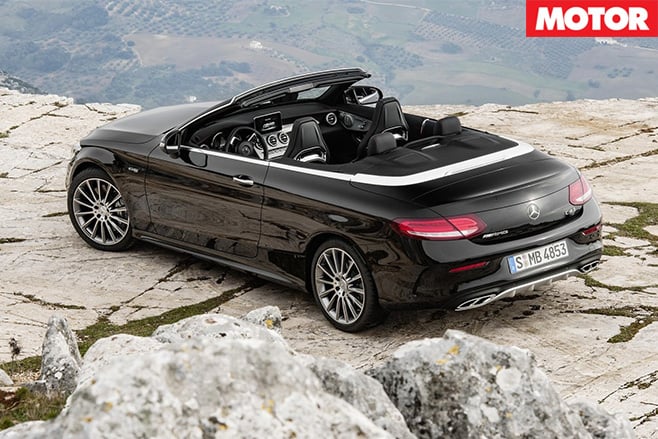
Halfway to that standing start benchmark the driver can opeate the electrically foldable soft-top roof that is claimed to be based on the mechanism in the S-Class Cabriolet, folding back and forth in less than 20 seconds.
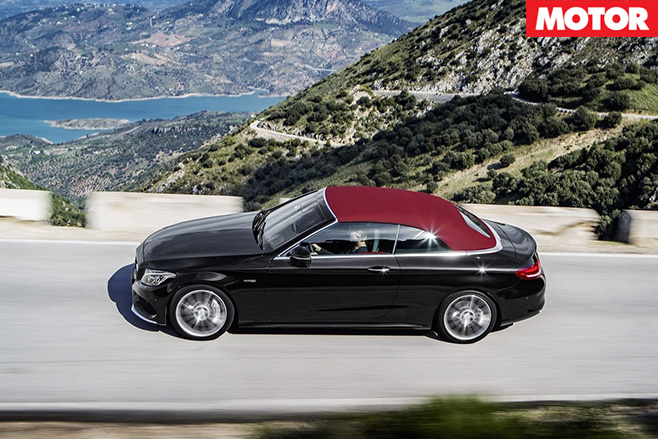
It also includes Eco, Comfort, Sport and Sport+ modes for the transmission and an Individual mode to independently mix-and-match steering, throttle/drivetrain and suspension responses from dull (we mean, efficient) to sporty.
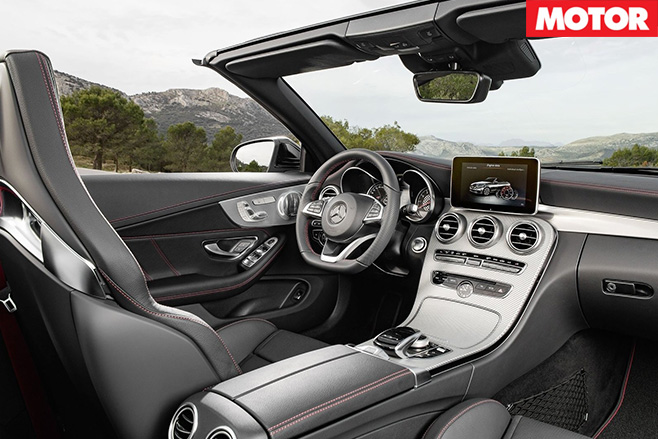
With the E400 retailing at $144,510 and the C43 Coupe likely to cost around $110,000, expect a figure of around $120,000 for the C43 Cabriolet when it lands here to rival the BMW 435i Convertible.
Here it is, the latest in Ken Block’s wild Gymkhana series, and this time he’s taken it to the Middle East.
It was always going to be tough to top Gymkhana Seven’s antics around the streets of Los Angeles in the wild Hoonicorn Mustang, but here Block flings his Ford Fiesta RX43 around the streets, deserts and, well, everything else of Dubai.
Anyway, we’ll let Block’s driving do the talking.
You want to know how not to take over a car company, look at Jaguar. In 1989 the Coventry cat was bought by Ford, an American company that had no experience with European luxury cars. Ford imposed its platforms, parts and planning, creating a fragmented model family and stifling development of models that were important to the Jaguar brand. It’s understood that Ford lost a couple of billion every year.
If you want to know how to take over a car company, look at Jaguar. In 2008 it was bought by Tata, an Indian company that had no experience with European luxury cars. Tata acknowledged as much and put its faith in Jaguar’s experienced and enthusiastic leaders, who began developing a cohesive family of desirable models. It’s enjoyed double-digit growth almost every year since.
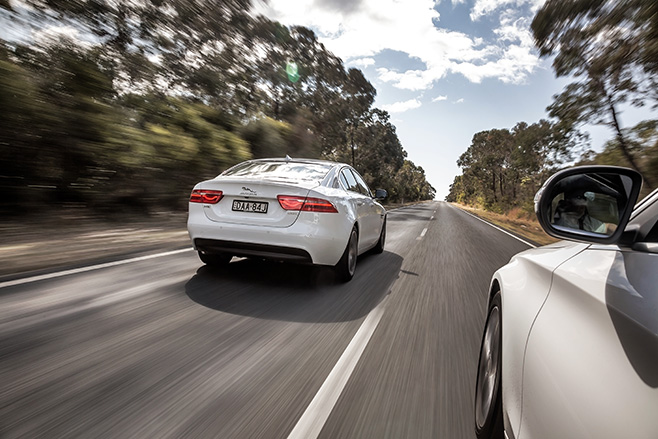
The Jaguar XE sedan is crucial to continuing that success. It’s the volume model that provides the stability for investment in new, niche-seeking models like the recent F-Pace SUV. Just look at the track records of its rivals: The BMW 3 Series still constitutes more than 26 percent of its maker’s volume; Mercedes-Benz’s C-Class more than 22 percent.
Jaguar hasn’t had a contender in the class since the Ford Mondeo-based X-Type of 2001-09 – and it hasn’t had a successful contender there, ever. Ironically, the all-new XE wears the same name as a landmark Ford Falcon, but this car’s mission is to shake off any whiff of Jag’s Ford past.
As an indication of how different today’s landscape is, consider that the once prolific Falcon is today comfortably outsold by the C-Class, and has been for more than two years. Prestige is the new mainstream.
It’s the Mercedes C-Class that we’ve pitted against the Jaguar, not least because of the car’s dominance in the class; in the first six months of this year it had pretty much outsold all its rivals combined. But there’s also the matter of BMW, Audi, Lexus et al being currently in the throes of replacing their rival models.
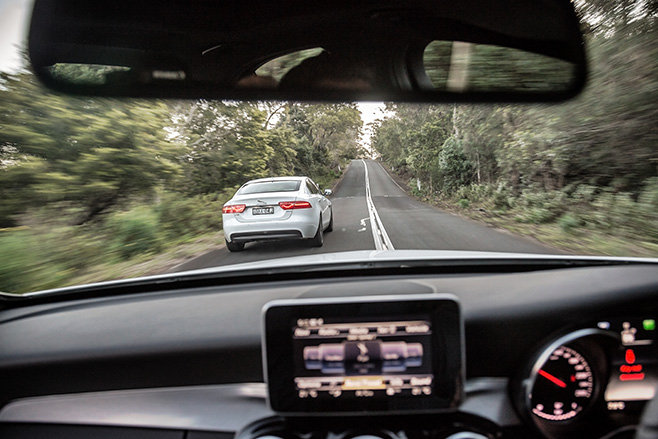
Let’s hope they’ve been diligent in throwing their drink cans into the recycling because these two cars suggest that if you ain’t into aluminium, you ain’t in the game. The body structure of this W205-series Mercedes comprises 48 percent aluminium; Jaguar beats that with a boast of 75 percent in the XE’s structure.
The XE arrives in four trim levels, with four engine choices – a new Ingenium 2.0-litre diesel and a supercharged 3.0-litre V6 framing a pair of old (Ford Ecoboost) 2.0-litre four-cylinder petrol turbos making 147kW/280Nm or 177kW/340Nm. All drive through an eight-speed automatic transmission, a cog count equalled in this class by the 3 Series and the Volvo S60.
Our test car is the base petrol Jaguar XE 20t Prestige, listing at $60,400 and including leather seating, keyless entry/start, ambient interior lighting, full electric seat adjustment, parking sensors, reversing camera and eight-inch touchscreen. Our Polaris White example is optioned with a sliding panoramic roof ($1860), park distance control and semi-automated parking ($1580), cold-climate pack including heated seats and wheel ($1050), and an optional design of alloy wheel ($600).
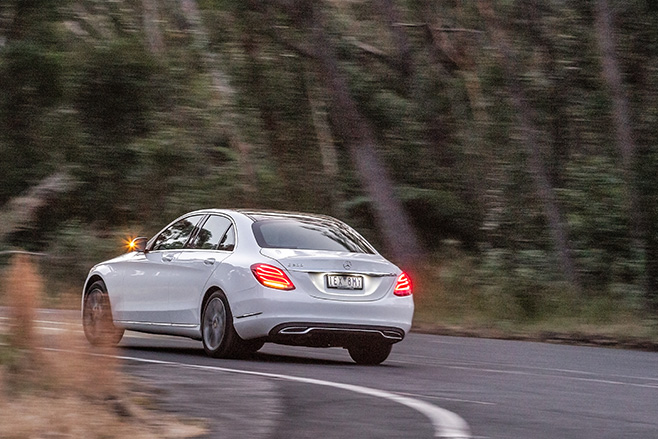
By no coincidence, the Mercedes-Benz C200 also has a 2.0-litre turbo four, making ballpark power and torque (135kW/300Nm) and listing at $60,900. Our Polar White C200 has the optional Vision Package ($3454), comprising the almost full-length panoramic sunroof (with electric blinds), head-up display and ‘intelligent’ LED lighting. So there’s little more than a grand between them as tested.
Ambient interior lighting is standard in the C200, though its upholstery is ‘Artico man-made leather’ rather than the bovine-made variety. The seats have full electric adjustment (including, as in the Jag, four-way lumbar), and there’s also keyless entry/start, the Audio 20 infotainment screen (controlled by touchpad/knob) and blind-spot warning.
Both cars offer cockpit adjustment for the suspension, steering, transmission and throttle mapping.
With similar dimensions, powerplants and equipment, surely the main thing that matters about all this lightweight aluminium construction is how much they end up weighing. And it all starts to look a bit silly because the abundantly alloy XE tips the scales at 1530kg, which is 65kg on the wrong side of the C200 and a whopping 135kg heavier than the now four-year-old BMW 320i.
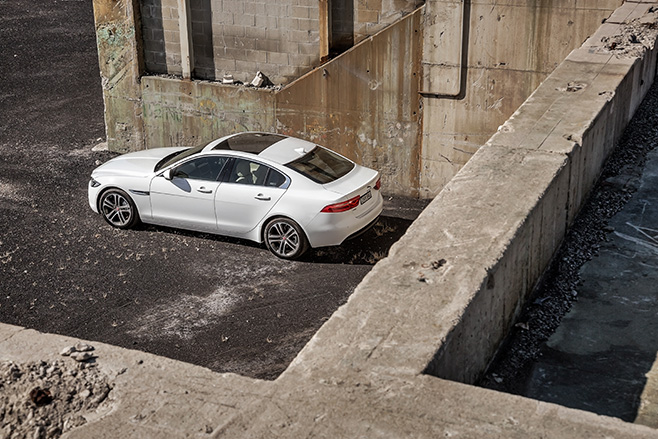
No question that the Jaguar has the latest and freshest look in the class (at least until the new Audi A4 hits the market next year). The exterior perfectly conveys the XE’s sporting intent, but it’s conventionally handsome. Details such as the LED tail-light signature (echoed in the dashboard lighting), the steering wheel and the instrumentation strongly evoke Jag’s hero F-Type sports car, but elements about the XE’s wedgy body hint at Tesla, Audi, BMW and even Honda.
The Mercedes’ styling is more likely to polarise people. To these eyes, its thrusting proportions, with a long bonnet and tightly tucked tail, have an elegance and distinctiveness that suggest traditional coachbuilding. This base-level C-Class is also quite jewelled, with brightwork in the front vents, front splitter and elsewhere about the body. Like the Jag, it runs 18-inch alloys, similarly shod with 225/45 front and 245/40 rear tyres.
You’d swear the Jaguar is shorter and stockier than the long, lithe Benz, and it is – but by less than a thumbnail between bumpers, and on a wheelbase that’s just 5mm shorter. The Jaguar is, however, 40mm wider and 26mm lower, on tracks that are 14mm and 33mm wider front and rear, these differences helping to account for the Benz’s narrower, tapered-tail appearance.
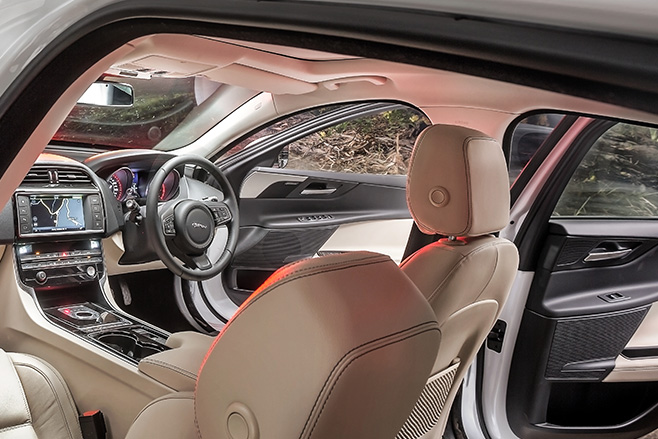
The themes naturally carry through to the interiors, where the Jaguar’s dashboard is architectural and tastefully edgy. The two-tone colour scheme (ours in Latte and Jet – ooh, ra-ther!) complements beautiful elements like the reverse-angled sweep across the dash and door trims, which are likewise endowed with interesting angles. An owner would not quickly tire of looking at this interior.
One thing that does get old quickly is the Jaguar’s pop-up rotary transmission selector (supplemented, as in the Merc, by steering wheel paddles). Along with its piano-black surround, it occupies exactly the same footprint in the centre console as would a conventional manual or automatic gate. The Mercedes’ column-stalk selector, meanwhile, does actually save space, resulting in a large and convenient stowage bin.
The Mercedes’ interior is more about ovoid forms, classic charcoals and real brushed aluminium, along with a share of piano-black plastic and fake chrome. The scalloped dash houses a row of metal-look toggles for its HVAC and other controls, an arrangement that’s easier to use (in daytime, especially) than the Jaguar’s flush buttons.
Instrumentation between the two cars is almost identical, with torpedo-tubed analogue speedos and tachos flanking nicely legible LED mini-screens.
Mercedes’ information screen is plonked atop the dash like an errant iPad (sorry, tablet). It’s straightforward to use, via the hand-pad and control knob on the centre console, but the Jaguar tablet’s touch-sensitivity makes more sense. One suspects this may be a precursor to BYO tablets.
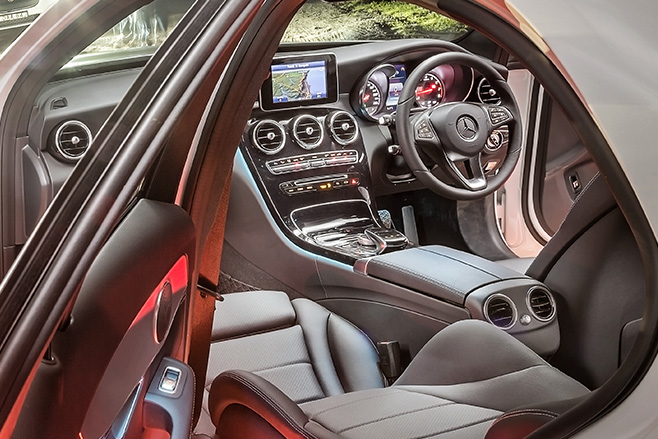
The front seats in both cars are comfortable and supporting, offering a huge range of adjustment. The XE’s are firmer and the leather actually a bit more slippery than the Benz’s slightly plusher pews. The Jaguar’s steering column adjustment is electric, the Merc’s manual.
In the rear, both offer adequate legroom and space to slot feet beneath the front seats. The Benz appears to be the roomiest, and it is, though this is partly a visual trick of its shorter, chamfered cushion that gives bugger-all support for thighs. The Jag’s bench is flatter, but egress and entry are more difficult. More annoyingly, the XE’s bench pushes its occupants towards the centreline of the car, making it marginal as a three-seater. It also has less headroom, though neither car is especially generous here.
Both feature split/folding backrests, giving access to the boot. The Merc’s has the larger volume, but the Jag’s is longer and perhaps more usefully shaped.
At standstill, it seems, the Jaguar offers a more sporting and edgy alternative to the more conservative, comfortably rounded Mercedes. Wonder if there’s a theme developing here?
Both these turbocharged four-cylinder engines are strong and sweet, and both feature idle-stop for an economy kick. Neither sounds especially sporting, but neither does their sound cheapen the ambience.
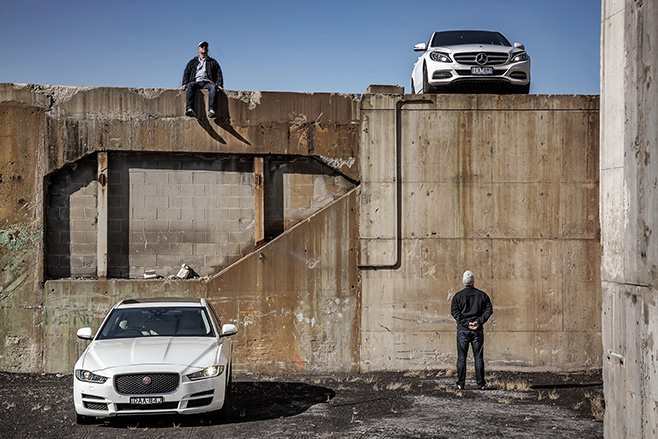
The Jaguar makes 12kW more, at a similar 5500rpm, but the Benz develops 20Nm more torque from a low 1200rpm. The XE needs 1750rpm on board to begin delivering its 280Nm maximum. The Mercedes proved the more frugal on our test, by a margin of 0.3L/100km.
You would pick the Jaguar as the quicker of the two cars. Its throttle response is sharper (whether in Normal or Dynamic), with a lively feel, a yearning to rev and generally quicker shifting through its fuller box of ratios. Only occasionally in normal driving does the Jag’s eight-speeder get indecisive, notably after you’ve been using the manual paddles.
The Mercedes is similarly linear in its power delivery – there’s no trace of lag in either – but its seven-speed transmission has a weird, momentary pause at each upshift, punctuating the perception of progress.
For all that, though, the C-Class emerges as the quicker of the two. We manage 7.7sec from 0-100km/h (three-tenths slower than Merc’s claim) and a standing 400m in 15.4sec. In the Jaguar, our identical 7.7sec sprint matches the manufacturer’s claim, and the 400m arrives in 15.6sec.
Tellingly, beyond 100km/h the Jaguar begins to hit its stride. It reaches 160km/h some two seconds before the Merc. More usefully, the XE’s 80-100km/h overtaking performance is more than half a second better.
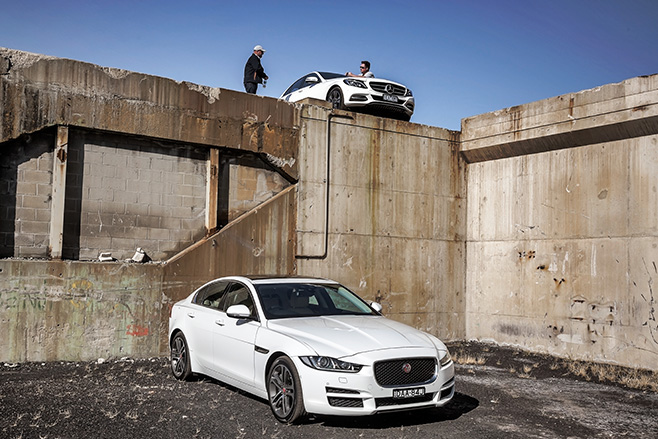
In braking, however, the roles are reversed – and somewhat alarmingly – the Mercedes scrambling from 100km/h to standstill in 35.6 metres, some 6.2m shorter.
That theme we’ve been alluding to plays out entirely on the open road, where even in their comfort-oriented modes (Normal in the Jag, Comfort in the Merc) the British car proves to be more tautly suspended, quick to respond and impeccably well controlled.
The XE’s quick turn-in is heightened (but not by much) in Dynamic mode, where a subtle response at the straight-ahead transitions quickly to a grab for the corner apex. The tail is also in on the act, the chassis pivoting into the corner with very little bodyroll. There’s bags of grip, until it begins to push into a firm, flat, predictable understeer. The Jag feels really quick and agile, though there’s some trade-off in the steering being a bit less directionally relaxed in motorway cruising. The ride manages that fabled British balancing act of being communicative yet comfortable.
Where the Jaguar dances through corners, the Mercedes flows. The steering is linear and (in Comfort) just short of lazy; the difference in weighting and turn-in with Sport or Sport Plus engaged is more pronounced, though turn-in is still less sudden than the Jaguar’s Normal setting. There’s more bodyroll, a softer ride (a bit floaty in Comfort), earlier and more obvious warnings when pushed clumsily fast into a corner, where the Merc’s chassis neutrality is almost eerie.
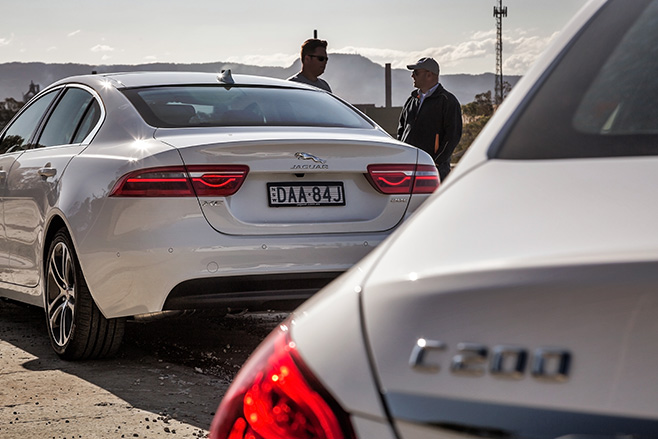
Where the Jaguar covers ground quickly and entertainingly, the Merc seems to mould itself to the road and flow with it. It’s the blob you won’t shake from the rear-view mirror.
This is one of those tests where ‘comparison’ is a lot easier than ‘conclusion’.
Jaguar has obviously positioned the XE as the sporty alternative in the class and they’ve absolutely nailed it. Against the 30 or 40 years of experience accumulated by Mercedes-Benz and BMW in this segment, Jaguar has pounced virtually out of nowhere and produced a car that’s immediately on the mark. It may have only a few months to enjoy the limelight, until the facelifted 3 Series and newcomer Alfa Romeo Giulia try to muscle into the same sporting niche.
Buyers in this segment are stepping up for the European experience. For some, that means overtly sporting character. For many others, it’s expressed in the Benz’s apparently idiot-proof dynamics, more comfortable ride, better rear cabin, outward impression of richness, and more confident expectation of retained value.
For the moment, the C-Class is the more accomplished of these two cars. But there’s only a whisker in it.
This article was originally published in Wheels October 2015.
THE 1120kW Koenigsegg Regera has arrived at Geneva wearing its showroom skin, with more than 3000 tweaks introduced since it was shown in concept form at last year’s event.
The plug-in hybrid-electric supercar – it uses a lightweight Formula One-rivaling battery system to deliver up to 525kW of electric power via three electric motors alone before the 800kW-plus mid-mounted twin-turbo 5.0L V8 kicks in to give a combined 2000Nm-plus shove in the back – weighs in at just 1470kg, or about the same as a high-end Holden Cruze SRi-V.
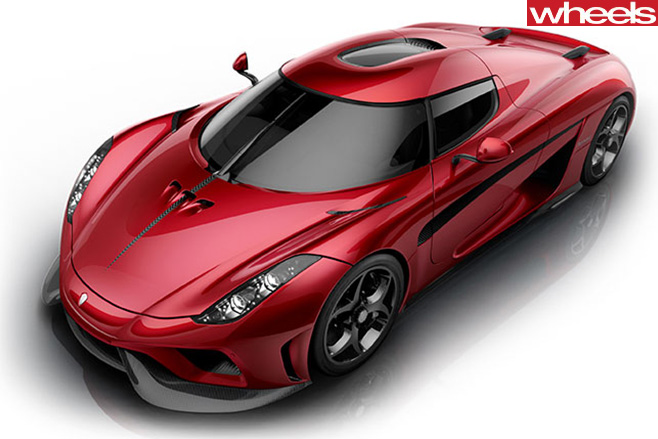
Once you’re rolling, accelerating from 150 to 250km/h takes only 3.9 seconds.
The secret to these staggering numbers is the Regera’s “Koenigsegg Direct Drive” system that sheds weight, complexity and driveline losses when compared with a conventional gearbox.
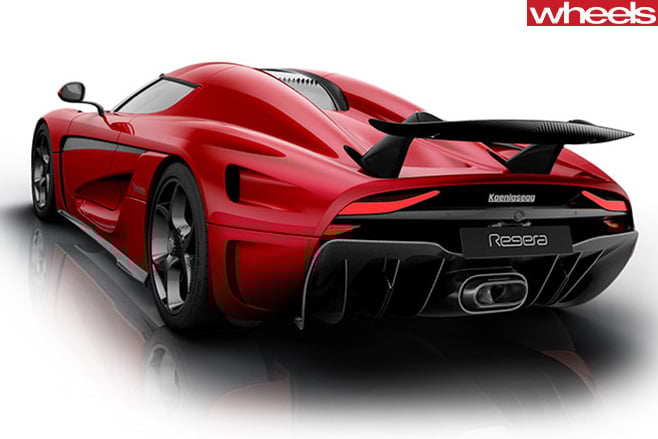
According to Koenigsegg, it has developed a “clutch-slip mechanism that uses the hydraulic coupling to convert torque at medium/high speeds during fast acceleration.
“This allows the combustion engine to gain revs and power, thereby giving the sensation of a traditional downshift with the associated aural enjoyment, even without the traditional gearbox,” it says.
“Shift paddles remain on either side of the steering wheel. The left paddle is used to enhance regenerative braking effect in recharging the battery pack. The right paddle is used to activate the hydraulic coupling’s ‘downshift’ operation.”
The torque converter alone looks like “a piece of artisan jewelry”, it says.
Luxury features include wing mirrors that fold in when the doors open “to further increase the practicality of the dihedral synchrohelix door actuation system”, sensors in the doors that stop them before they hit high curbs or low roofs, and a surround view system to help in tight parking spaces, and self-opening panels that reveal the guts of the supercar.
There’s now even room in the cabin to stash a wallet or mobile phone, Koenigsegg says.
