
What is it?
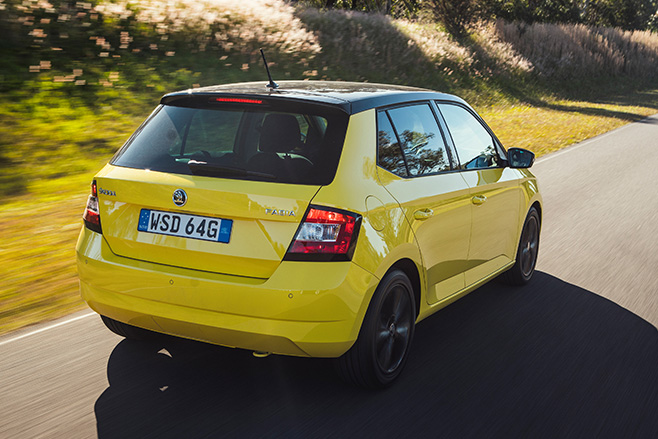
The new Skoda Fabia is the third-generation version of the Czech brand’s baby car, which has been available in Australia since 2011. It’s Skoda’s smallest and least expensive model, and it does battle in the crowded light class.
The Fabia fits in as a characterful alternative to the mechanically similar Volkswagen Polo, with selling points such as solid safety credentials, an appealing infotainment/audio system with seamless phone connectivity, clever design touches and fun colour combinations.
A hatchback is offered alongside an incredibly spacious wagon which is a unique proposition in a class dominated by hatches.
What’s new about it?
The big news is the departure of the hot vRS versions – they didn’t sell – which leaves the new 81TSI as the most powerful Fabia available.
The two drivetrains available in a re-jigged line up are a lower-output 66kW version of 1.2-litre turbo four-cylinder with either a five-speed manual or a seven speed dual-clutch auto, and the tuned up 81kW version with the dual-clutch ’box only. Both those engines and gearboxes are available in the hatch and wagon.
A standard city emergency braking system headlines an upgraded standard equipment package, which also includes tyre pressure monitors and rear parking sensors, a 6.5-inch colour touchscreen infotainment system and a leather multifunction wheel.
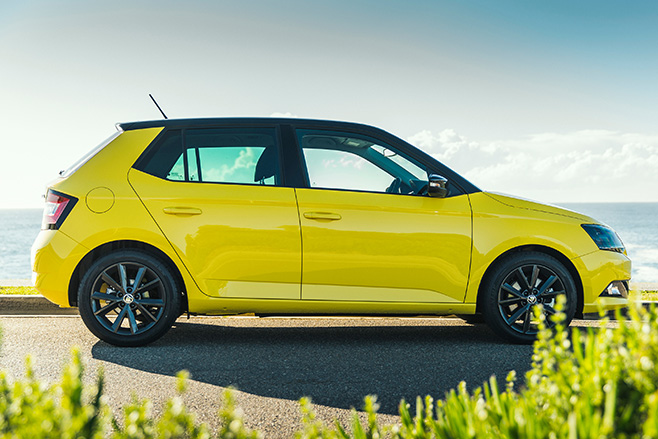
Both body styles look better than their predecessors, especially the wagon. Well-priced packs add appeal – the $1300 travel pack endows 66TSI versions with fatigue detection and cruise control among other upgrades, while a $1200 sports pack brings 17-inch alloys and 15mm-lowered sports suspension and other upgrades for the 81TSI.
What’s it like to drive fast?
Wind rushing through your hair, scenery blurring by… Oh, you mean in the Fabia? Well, driving fast isn’t done quickly – both engines take a while to wind up. But while the outright, foot-flat acceleration rate is modest, once up to speed, the Fabia can sustain it – and the driver’s interest – through the corners, thanks to its compact dimensions, benignly well-balanced chassis and precise steering.
What about the commute home?
The sweet base engine and more powerful top version are flexible enough that normal driving is pretty effortless. The 66kW version has a bit of character at low revs but the 81kW version ultimately has more urge.
The front seats are comfortable with good lateral support (they seem sportier than those in the VW Polo) and the cabin offers pleasing design and detailing, logical layout, great vision and good refinement. It’s pretty roomy in the back, with good head and leg room, and the wagon’s 505 litre cargo area is up there with medium SUVs and wagons. All versions use only 4.8L/100km on the official combined cycle.
What’s it worth? And is it worth the coin?
The Fabia range opens with the $15,990 66TSI manual hatch, or as a wagon for $1,150 more. The 81TSI brings its more powerful engine, extra equipment and dual-clutch auto for $20,290 as a hatch, and $1,150 more for the wagon. We reckon all versions are terrific value, especially the entry-level Fabia (though standard cruise control would be nice) and as a sweetener, hatchbacks come with free on-roads for the remainder of 2015 (on-roads cost $350 for the wagon).
Click here to find out more about the Skoda Fabia
Classy big Cat overwhelmingly popular in Wheels People’s Choice poll.
THE people have spoken! WheelsMag.com.au readers have taken part in an exhaustive six-stage poll to judge the People’s Choice Car of the Year for 2016.
In the end it wasn’t even close. One car grabbed an early lead in the deciding poll and was never headed, romping away with 60 percent of the vote.
That car was the Jaguar XE sports sedan, with which the Coventry maker hopes to take on competitors such as last year’s People’s Choice winner, the Mercedes C-Class.
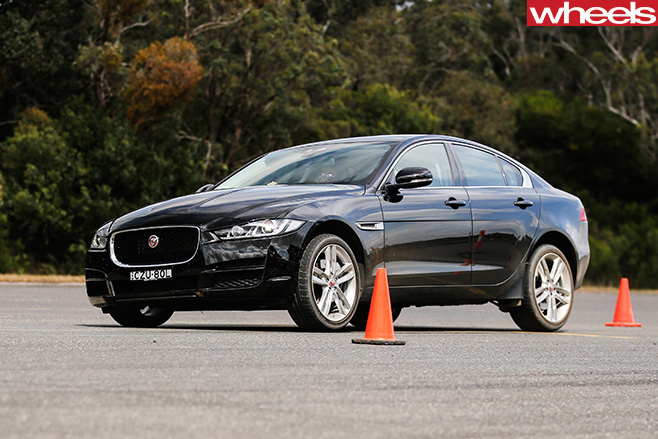
In fact, the Jag’s winning margin in the deciding poll, which closed about 2pm yesterday, was bigger than it had been last week where it dominated voting in the premium European car category.
In the deciding poll, Mazda’s lightweight MX-5 roadster captured second place with only 16 percent of the vote – even though it had won its group poll even more resoundingly than the Jaguar.
In third outright was the rugged Ford Everest SUV, with 14 percent, from fellow group-stage winners the Ford Mondeo and Honda HR-V.
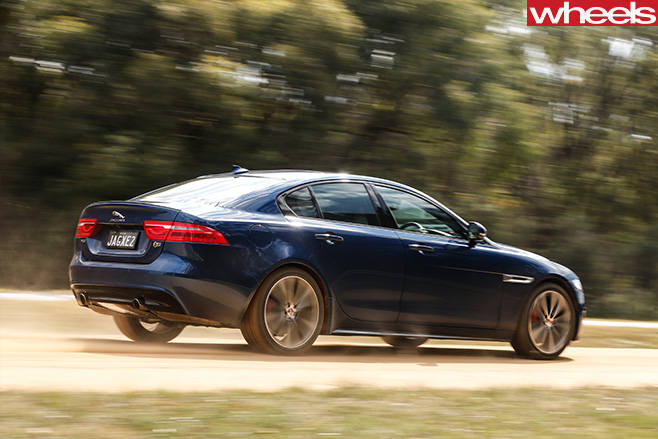
“After the largely forgotten X-Type of 15 years ago, Jaguar’s return to C-Class territory could have been another embarrassment,” contributor Byron Mathioudakis wrote in citing it among the 25 Car of the Year contenders for 2016.
“But the hunky XE grows real claws at last, smashing preconceptions about the British brand more effectively than any model since the 1968 XJ, and redefining luxury compact sports-sedan parameters with breathtaking confidence.”
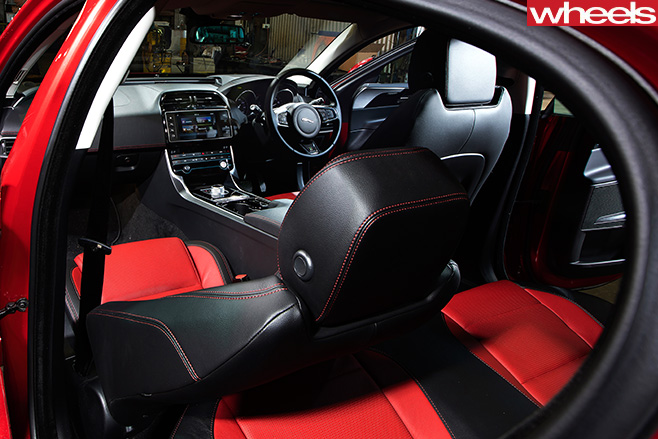
Function – how well a car does what it is intended to do. Efficiency – in all aspects. Use of resources in producing the car and in running it. Value – both against its rivals and against the wider new car market. Technology – does it offer a tangible advantage over its rivals? Safety – We’re talking passive and active.
But unlike the COTY judges, few readers voting will have driven all the contenders over at least several days.
Will the Wheels judging panel nevertheless endorse the same choice? Stay tuned as the 2016 Wheels Car of the Year will be named at 9.50pm on this website tonight.
THE next Mercedes-AMG E63 will be a 430kW-plus, all-wheel-drive only, drift monster when it lands in Australia early next year.
AMG chief executive Tobias Moers confirmed that the new E63 – shown above in an artist’s impression – would bring the biggest leap forward from any AMG model to date, with a stronger focus on driving dynamics.

Moers says it should surpass the current E63’s 430kW/800Nm 5.5-litre unit.
“We have a lot of room to grow [with the 4.0-litre],” said Moers.

“It’s the same crankshaft and the block is the same. The cylinder head is different and so is everything else around the engine like the intake, the manifold and intercooler.”
Moers also confirmed the new car, which has been snapped in development form during winter testing, was likely to be offered solely in all-wheel drive and using a new AMG-developed 4MATIC system. (Australian versions of the current E63 S are rear-drive only.)
“Nobody is looking for rear-drive in that segment,” said Moers.
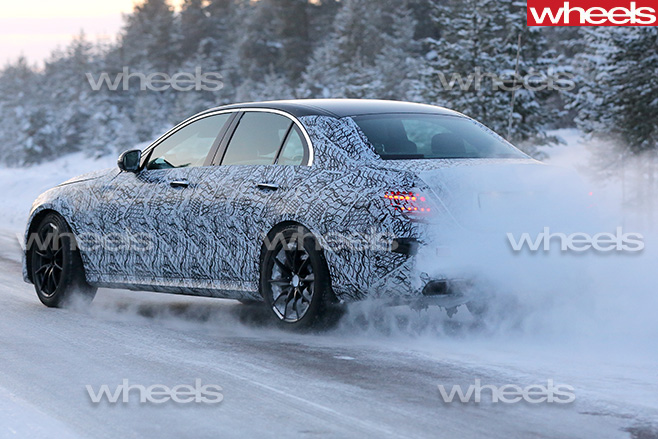
While the usual AMG character traits of big grunt and a lively rear-axle will remain, Moers said the new E63 would be much more precise when it came to handling.
“It’s not my task to make it the most power car,” said Moers. “The target is to be the best driving car in terms of dynamics. It will be the best package. We’re working on the new drivetrain and a new all-wheel drive approach, so it’s going to be very interesting.

And what about the suite of cutting-edge autonomous driving systems that will debut on the new E-Class sedan that debuted this month at the Detroit motor show?
“It depends on the segment – things like this aren’t very important on the GT for example. But in the E-Class we will have all of the same technology as the regular car. If the car drives itself, why not? Then once you reach the racetrack, push the button and drive yourself.”
AMG is expected to reveal the E63 in the last quarter of this year, with Aussie deliveries likely in early 2017.
He’s founded and sold a multi-million dollar internet company, sent rockets into space, and now wants to redesign the car. What makes Tesla’s CEO tick?
WHO IS THIS BLOKE? Born in South Africa, the 44-year-old Canadian-American entrepreneur-turned-tycoon famously sold the first fruits of his self-taught computer programming skills at age 12.
After first moving to Canada at 17, Musk would spearhead a US-based software start-up company, Zip2, at age 24. Its sale to Compaq in 1999, for $US341 million, helped bankroll the co-foundation of the leading Internet payment system, PayPal. After just three years, Musk sold PayPal to Ebay for a reported $US1.5 billion.
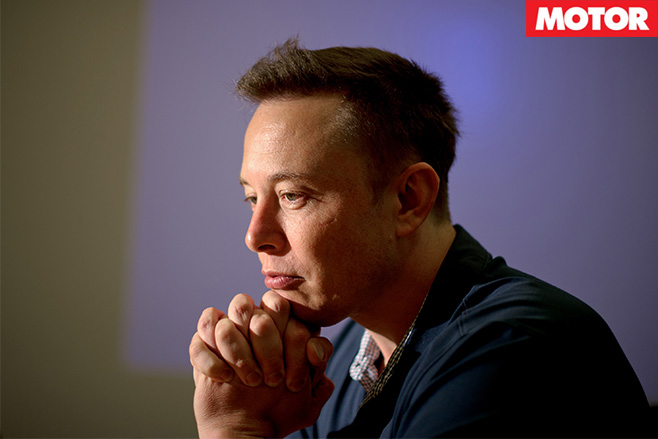
In 2003, Musk helped co-found Tesla Motors. Charged (no pun intended) with transforming Tesla’s electric car aspirations into a production reality in the throes of the global financial crisis, Musk took control of the fledgling carmaker in 2008, where he remains CEO and product chief.
Ever the industrialist, Musk’s gameplan within the Tesla framework reaches beyond global car marketing and into battery-swapping facilities, 480-volt ‘Supercharging’ charge station infrastructure – some 268 across North America, Europe and Asia – and licensing electric powertrain technology to other car companies.
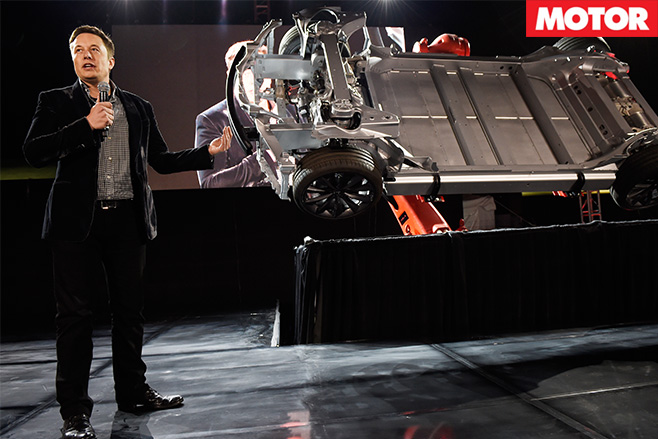
Tesla Motors, the first car company floated on the US stock exchange since 1956, is currently valued at US$26.84 billion while Musk’s current net worth, as majority shareholder, is said to be US$13 billion.
IS HE A CAR NUT OR JUST SOME MONEY-GRABBER? Elon Musk is certainly no petrolhead by any traditional or literal definition. You’re not likely to find anyone in the automotive industry more anti-hydrocarbon burning and pro-clean energy, or at least anyone matching such high levels of power and influence in motoring commercialisation.
Musk, like many of the car industry’s shrewder forward thinkers and planners, seems as keen to invest in the potentially lucrative infrastructure requirements for plug-in electric technology as he is in marketing cars that use it. For example, a key alignment between his Tesla Motors and SolarCity companies is for the latter to help relieve the stress on the North American power grid system as demand for plug-in EVs expands.
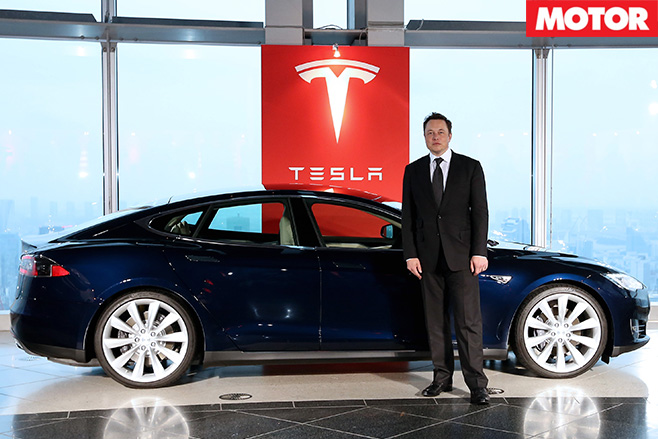
Musk came to cars through other core interests. Musk told GQ magazine in 2012 cars are the threat which unite everything he is working on, which is “sustainable energy, the Internet and space exploration.”
His early interest was computers, his tertiary study economics and physics, his early business windfalls an amalgamation of computer technology and e-commerce, and the backbone of his success is as much in spearheading engineering and design as it is in industrialisation and commercialising new technology.
Just 13 years young, Musk’s SpaceX company, after much initial failure, is already the first private company to return an orbited craft to Earth and send one to the International Space Station.
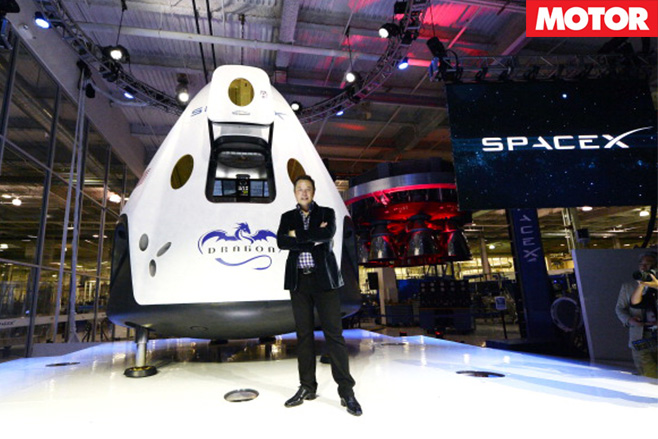
Just quietly, though, Musk is said to have a stash of collectible supercars. He did have a McLaren F1, but sold it because he didn’t like the environmental message it was presenting about him.
MUSK’S VISION FOR CARS Musk predicts there will be a dramatic shift towards electric-powered vehicles between the next decade and 20 years. He believes even without the growing environmental impact of increased CO2 emissions, the world faces economic instability without other “sustainable motor transport” solutions.
However, he knows that the electric car’s move towards affordability and widespread adoption – getting millions of them on the road – is the only way to significantly impact carbon dioxide reductions.
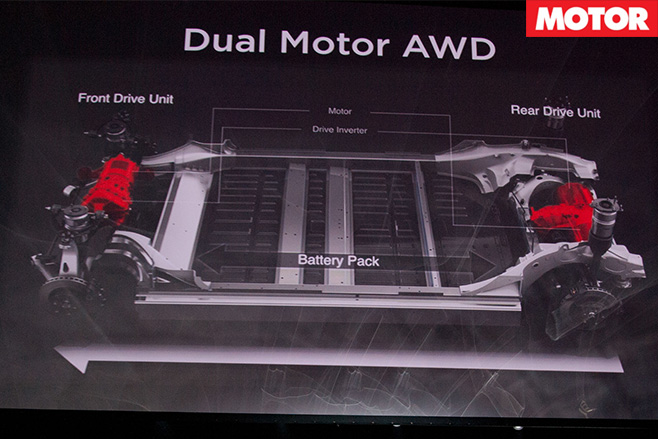
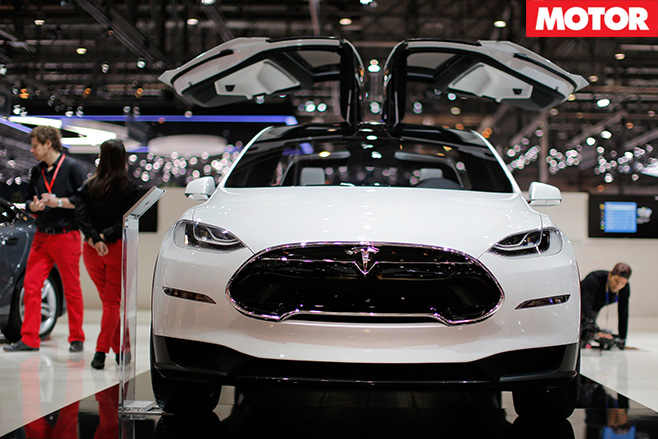
As for its own range, in October 2014, Tesla unveiled its Model S P85D (for Dual motor), a sedan that offers hypercar-matching 2.8sec 0-100km/h acceleration. Its predictable SUV follow-up, the Model X, is due to land sometime in 2016.
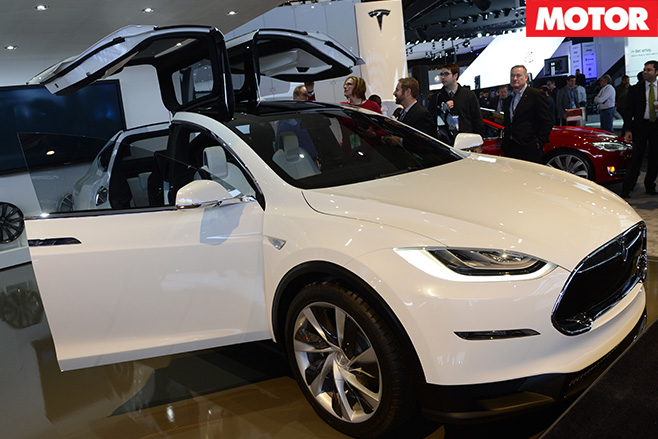
Fuel-cell technology? Forget it, says Musk. His take is that, compared with battery tech, hydrogen power is inefficient, expensive and even downright dangerous. Musk also believes it’s up to the car industry to push consumers towards electric power, not wait for Joe Public to come around to the idea.
IS TESLA IN FINANCIAL TROUBLE? With his companies’ pipedreams burgeoning with activity, and Tesla’s increased local profile through the Australian launch of the Model S, it’s easy to presume Tesla’s fortunes are booming in line with Musk’s aspirations. Not necessarily so.
According to Forbes, Tesla, whose employees number 5859, has $2.4 billion in assets and creates $2.1 billion in revenue but runs at a multi-million dollar loss annually. Its existence is propped up from government money thanks, in large part, to Tesla’s sustainable energy credentials.
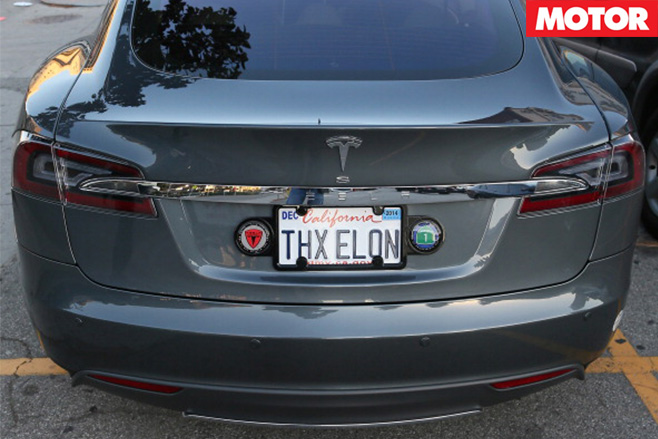
To expand his car business, Musk admits his company must move beyond its unorthodox direct-sales strategy that shuts out North America’s traditional dealership networks and even contravenes some US state legislation. At the time of writing there’s conjecture whether Tesla would be allowed to sell cars on Musk’s terms in Detroit.
Another current and continual pressure is the volatile swing of Tesla’s share price on the stock market which, at the time of writing, was in a slump low enough to grab business media headlines.
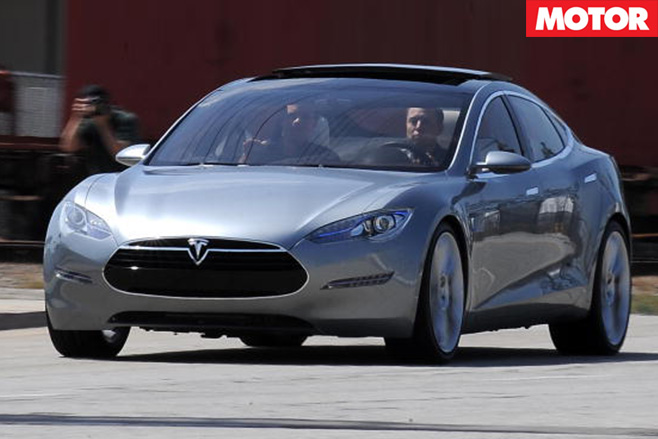
Quality control? The carmaker seems to have licked its early wounds that created, quite famously, a public spat between Musk and early Tesla adopter George Clooney.
Closer to home, Australia has a handful (but growing number) of supercharger stations suitable to fast charge the Model S and buyers are expected to put trust in Tesla’s promises of future improvement of EV-friendly infrastructure. Few suburban sub stations, let alone households, are equipped for a Model S to recharge at a rate that matches the Tesla’s claims.
TESLA V THE BIG BOYS If you are to believe its CEO’s claims, Tesla’s key and noble role is as an impetus to spur on the world’s car industry to widespread and increasingly affordable EV vehicles.
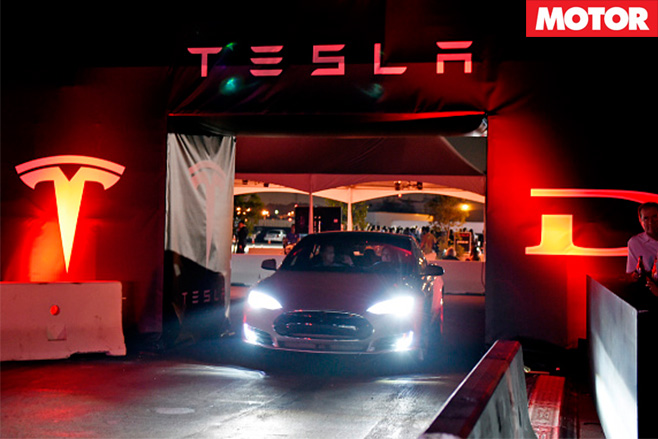
It was always Musk’s long game to hold the keys to EV technologies, particularly powertrain tech, commercialising Tesla through not just manufacturing but via patents and licensing agreements.
In June 2014, Tesla moved to allow its technology patents to be used by any concern on good faith (on the proviso Tesla retain rights and intellectual property) in a bold and unprecedented move to ignite widespread electric powertrain uptake in the car industry.
Mission to Mars
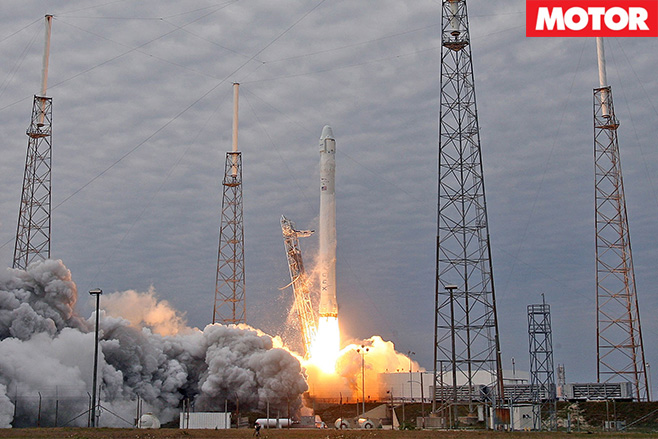
Importantly, funding-poor NASA can’t forge new frontiers alone. Musk believes that commercialising space travel is the only feasible way forward.
The biggest picture in Musk’s head is to make human life “multi-planetary”. And he certainly seems to be the key stakeholder audacious and driven enough to stitch a mission to Mars together.
Feeling naughty? A little indulgent? Maybe a bit adventurous? There’s a blooming branch on the fringes of the motoring tree that’s ripe for the picking.
It’s where compact hot hatches grow, but not of the pragmatic variety where smart sub-$30K money buys your cheap-and-cheerful Ford Fiesta STs and sensible Volkswagen Polo GTIs. Instead, you need the thick end of 40-large to swing on this hyper-hatch limb.
While that might seem like crazy money for a warmed-over small car, there’s a growing market for proper up-spec Euro luxury and properly heady performance in a shoebox-sized package. And if you’re flush enough for an interesting, flamboyant, full-frills-and-thrills toy car, then this trio of pint-sized top-shelfers is here to please.
The old new Mini, for lack of a better description, pretty much set the modern mould for the new school of premium, funky and fast compacts for High Street. And despite its best attempt to hide behind a familiar face, the completely revamped new-gen Mini attempts to raise the stakes in every area.
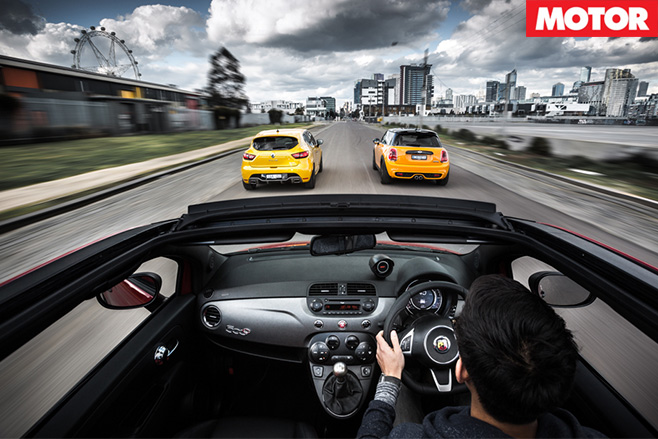
No such sweeping changes for the so-called “new” Abarth, here in the Enzo’s-on-speed-dial 595 Competizione convertible spec. Like its lesser Fiat 500-badged kin, the 2014 update is essentially a mild makeover of the old 1.4-litre turbo four-powered, dinky-sized device, the 595’s go-faster accoutrements blossoming the bottom line of the top-shelf rag-top to a whopping $39,000 in five-speed manual form (the Dualogic robotised manual adds $2000).
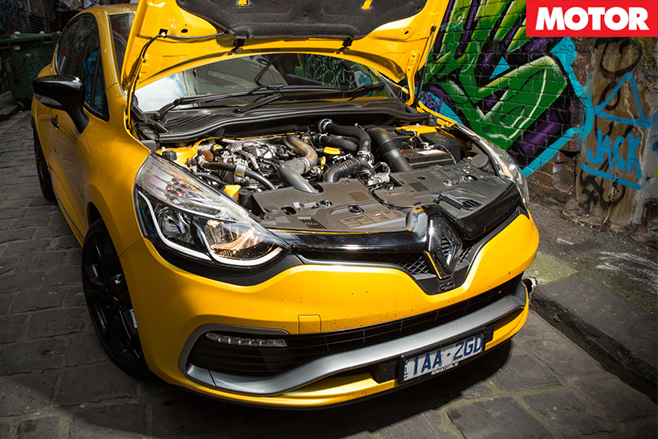
Our Renault Clio RS 200 EDC, in full-fat Cup Trophy form for $36,790, is vastly different to its predecessors, comes only six-speed dual-clutch-equipped and has five doors to its present rivals’ three apiece.
Inside, the Mini is clearly a car transformed. You sit lower, the far-set A-pillars add a newfound sense of roominess, and you really notice a lift in premium feel throughout a cabin that’s a little less kitschy and slightly more intuitive than its forebear.
It’s slicker than greased linoleum and the upsizing should please many buyers, though you sense that, somewhere, original Mini architect Sir Alec Issigonis is spinning in his grave.
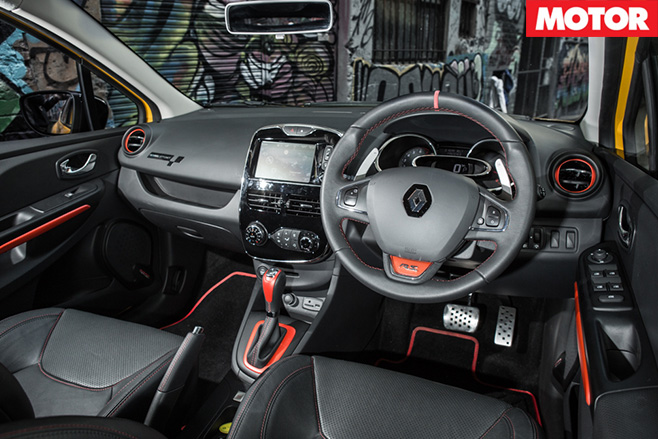
Then you climb in the Abarth…
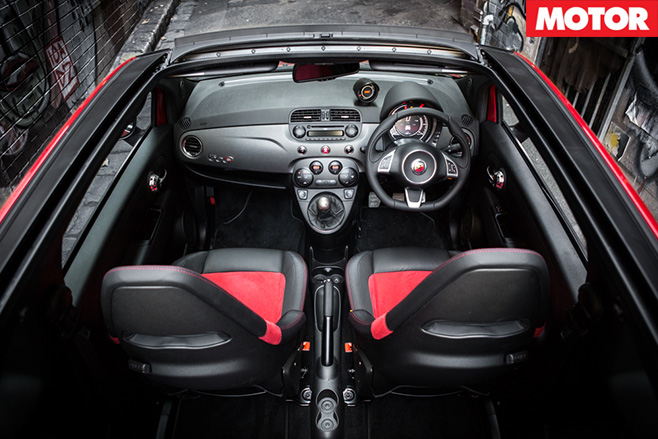
The big sweetener for the Competizione’s $3000 premium over the similarly potent Turismo version is the Corsa by Sabelt racing buckets, which look the duck’s gonads but are hard and flat-backed.
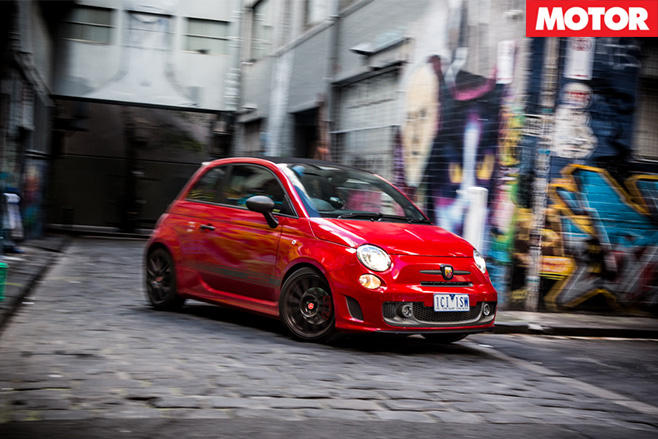
Seating-wise, you’re higher than a Keith Richards bender and the tiller, seat and pedal relationship seems sized for a small gorilla. The upside is that it permeates a strong sense of lighthearted fun that helps make every sprint to the shop for milk – or, perhaps, bananas – something of an event.
And that certainly seems the point of the Abarth experience. The dual-mode Record Monza exhaust will ring your bell as it howls, the taut Koni-enhanced suspension will scramble your brain and fuse your spine.
You’ll row furiously through the high-set gearstick trying to keep the little turbo four-pot in its useable 2500rpm sweet spot between peak torque (3000rpm) and Game Over (5500rpm). It’s a grin-pinning, though slightly masochistic, feel-good hoot.
Launch control? Paddle shifts? Drive modes? Synthesised engine notes? The Clio’s no compact hot hatch by traditional thought, nor is its handy 6.7sec 0-100km/h time. Peak torque arrives at just 1750rpm and pulls stridently through to a 6000rpm redline, and while a little recalcitrant at the low-speed stuff, the dual-clutch is a responsive ally on the hunt. It’s a shame, though, Renault don’t offer a conventional manual transmission.
What’s quite convincing is the Clio’s sense of thoroughly modern, finely honed potency. It feels less like a steroid-fed grocery-getter and more like a shrunken performance car. The Mini, at 6.7sec 0-100km/h, is not only equally as quick to march, it feels keener again when let off its chain.
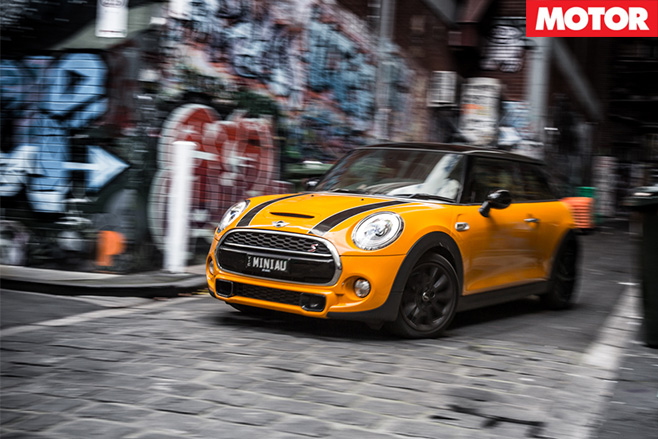
At a spirited, twisty back-road clip, the Mini and Abarth couldn’t feel more different. The former has lifted its game in blending bump compliance, chassis balance, agility and sharpness. It points confidently, is easy to place and rewards driver commitment with heady pace.
Meanwhile, the latter feels more agitated in character. The Abarth shimmies and shakes over road imperfections with more fuss and animation, its strident front-end grip tempered by noticeably slow steering to ease the tendency for the Italian, with its scant wheelbase, to throw itself off into the scenery. And all while you yell: “C’mon you bastard!” through silly grins and chattering teeth while the throttle’s pinned to the deck.
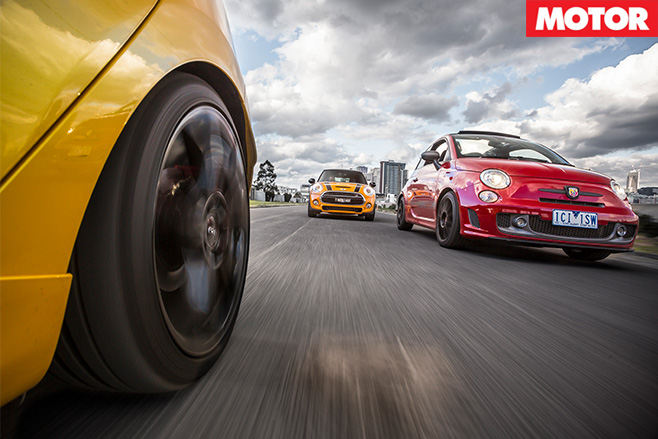
It’s a clear, accurate and quick corner-carving tool without histrionics or the need for manhandling. There’s a certain sweetness at play in the Clio – it’s both engaging and easily kept within its limits, which is a tough balance to strike.
Up to about eight-tenths pace – and for most driving below it – it’s the Mini’s game to lose. Its blend of refinement, premium feel, comfort, ride and on-demand pace is quite unprecedented for a car its size. This is a crucial point when considering the all-’round ownership experience.
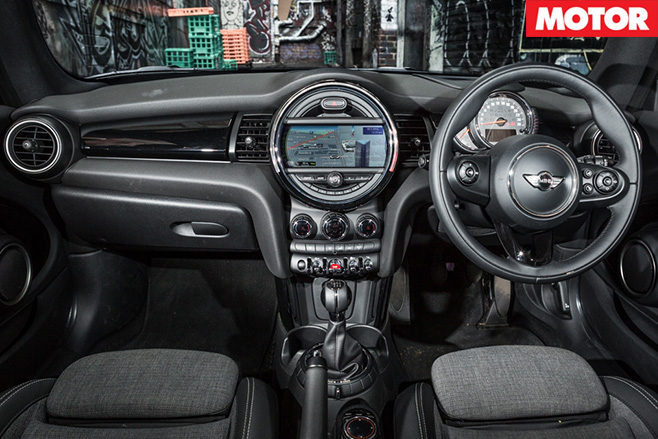
On a racetrack, that punchy 2.0-litre engine starts feeling flat in the top-end. But the major shortcoming is that the Mini seems to lose more of its sharpness and agility the closer it gets to its limits.
Lean hard into its 205mm 17-inch Hankooks and the Mini’s mass – a modest 1160 kilos, mind – takes over. It feels heavier and more ponderous than it ought to. That said, it’ll dance about playfully in the mid-corner provided you’re not grabbing its scruff too hard.
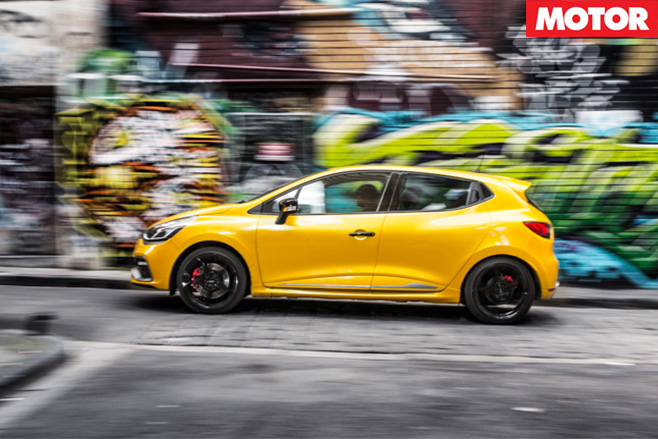
That the Clio offers the same rubber footprint as the Mini (albeit on 18-inch rims) makes us wonder how Renault Sport has managed to pry so much more talent from its steed once the red mist descends. Especially when, at 1218kg, the French car has the kerb-weight disadvantage.
Fire the featherweight (1035kg) Abarth as hard as you dare into a corner and that front end bites in fearlessly, its tail feels firmly planted and you need a big head of steam to get the chassis shimmying on a smooth circuit surface.
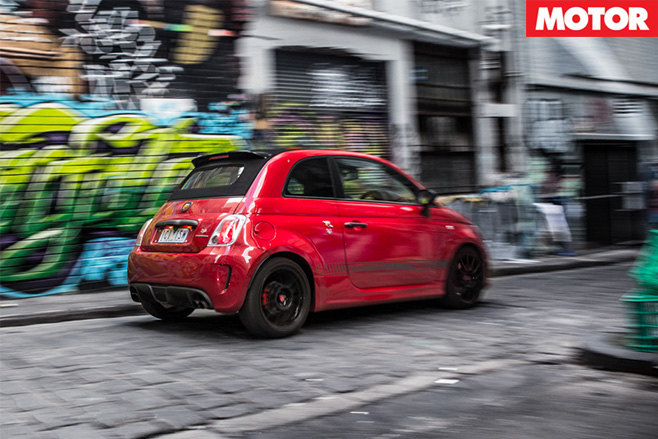
Even at its best, the Abarth is still the problem child: the gearshift is flaccid, the seats unsupportive laterally during hard cornering, and it requires a driving position that’ll have you booking a chiropractor after a handful of hot laps.
You could chalk up all of the Abarth’s shortcomings as ‘character’ if the 595 wasn’t so damn expensive. It’s a great third car, a weekend plaything, a pony with few tricks so impressive that you’d go there in a shot if the price tag wasn’t much beyond $20K. But anything the size of a shoebox asking nearly $40K should have a lot of all-’round talent, not just a few tricks up its sleeve during the occasional track day.
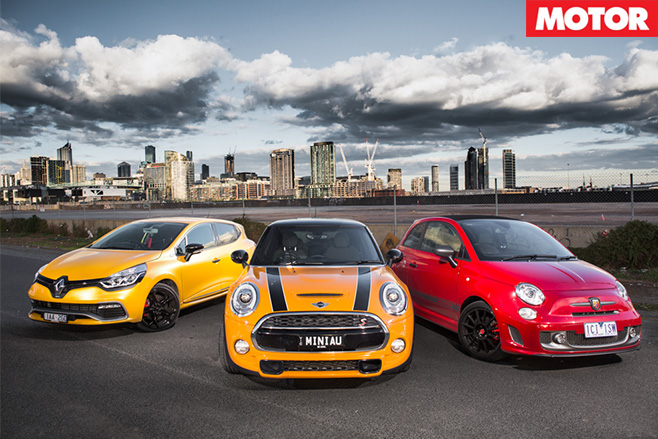
The Clio, though, has done much the same thing as its big brother Megane RS did to the regular (one size up) hatchback set; it’s introduced the soul and driving experience of a proper sports car into what would otherwise be a rather humdrum, predictable and sensible baby hatchback segment.
| u00a0 | u00a0 | Renault Clio RS 200 Cup Trophy | u00a0 | Mini Cooper S | u00a0 | Abarth 595C Competizione |
| u00a0 | u00a0 | u00a0 | u00a0 | u00a0 | u00a0 | u00a0 |
| Body | u00a0 | 5-door, 5-seat hatch | u00a0 | 3-door, 5-seat hatch | u00a0 | 3-door, 5-seat convertible hatch |
| Drive | u00a0 | front-wheel | u00a0 | front-wheel | u00a0 | front-wheel |
| Engine | u00a0 | 1618cc inline-4, DOHC, 16v, turbo | u00a0 | 1998cc inline-4, DOHC, 16v, turbo | u00a0 | 1368cc inline-4, DOHC, 16v, turbo |
| Bore/Stroke | u00a0 | 79.7 x 81.1mm | u00a0 | 82.0 x 94.6mm | u00a0 | 72.0 x 84.0mm |
| Compression | u00a0 | 9.5:1 | u00a0 | 11.0:1 | u00a0 | 9.8:1 |
| Power | u00a0 | 147kW @ 6000rpm | u00a0 | 141kW @ 6000rpm | u00a0 | 118kW @ 5500rpm |
| Torque | u00a0 | 240Nm @ 1750rpm | u00a0 | 280Nm (300Nm overboost) @ 1250rpm | u00a0 | 230Nm @ 3000rpm |
| Power/Weight | u00a0 | 121kW/tonne | u00a0 | 122kW/tonne | u00a0 | 114kW/tonne |
| Consumption | u00a0 | 6.3L/100km (claimed) | u00a0 | 5.9L/100km (claimed) | u00a0 | 6.5L/100km (claimed) |
| CO2 Emissions | u00a0 | 144g/km (claimed) | u00a0 | 138g/km (claimed) | u00a0 | 155g/km (claimed) |
| 0-100km/h | u00a0 | 6.7sec (tested) | u00a0 | 6.7sec (tested) | u00a0 | 8.6sec (tested) |
| Transmission | u00a0 | 6-speed dual-clutch | u00a0 | 6-speed manual | u00a0 | 5-speed manual |
| Weight | u00a0 | 1218kg | u00a0 | 1160kg | u00a0 | 1075kg |
| Suspension | u00a0 | struts, coil springs, anti-roll bar (f); torsion beam, coil springs, anti-roll bar (r) | u00a0 | struts, adjustable dampers, anti-roll bar (f); multi-links, adjustable dampers, anti-roll bar (r) | u00a0 | struts, coil springs, anti-roll bar (f); torsion beam, coil springs, anti-roll bar (r) |
| L/W/H | u00a0 | 4090/1732/1448mm | u00a0 | 3850/1727/1414mm | u00a0 | 3657/1627/1485mm |
| Wheelbase | u00a0 | 2589mm | u00a0 | 2495mm | u00a0 | 2300mm |
| Tracks | u00a0 | 1504/1500mm (f/r) | u00a0 | 1485/1485mm (f/r) | u00a0 | 1409/1402mm (f/r) |
| Steering | u00a0 | electrically-assisted rack-and-pinion | u00a0 | electrically-assisted rack-and-pinion | u00a0 | electrically-assisted rack-and-pinion |
| Brakes | u00a0 | 320mm ventialated discs, 2-piston calipers (f); 260mm discs, single-piston calipers | u00a0 | 295mm ventilated discs, single-piston calipers (f); 260mm solid discs, single-piston calipers (r) | u00a0 | 284mm ventilated discs, single-piston calipers (f); 240mm solid discs, single-piston calipers (r) |
| Wheels | u00a0 | 18 x 7.5-inch (f/r) | u00a0 | 17 x 7.0-inch (f/r) | u00a0 | 17 x 7.0-inch (f/r) |
| Tyres | u00a0 | 205/40 R18 Dunlop Sportmaxx RT (f/r) | u00a0 | 205/45 R17 Hankook Ventus S1 evo2 (f/r) | 205/40 R17 Michelin Pilot Exalto (f/r) | |
| Price | u00a0 | $36,790 | u00a0 | $36,950 | u00a0 | $39,000 |
| Price as tested | u00a0 | $37,540* | u00a0 | $42,160*u00a0 | u00a0 | $39,000 |
| u00a0 | u00a0 | *Renault Sport Signature colour ($750) | u00a0 | *DDC ($700); run-flat tyres ($260); reversing camera ($470); rear spoiler ($300); stripes ($200); anthracite roof lining $300); piano black interior ($250); LED headlights ($1200); sun protection ($400); HUD $700; DAB ($300); Nav Pro ($200); anti-dazzle mirror ($200) | u00a0 | u00a0 |
| Positives | u00a0 | Comes alive the harder you punt it; straight-line pace; looks | u00a0 | Bigger, classier and more useable than ever before; back-road ability | u00a0 | Likeable character; feisty engine; head-turning style |
| Negatives | u00a0 | Base RS is much better value; would be brilliant as a manual | u00a0 | Unsatisfying to drive really hard; traction issues | u00a0 | Awful ride; uncomfortable seats; handling difficulties; crazy priceu00a0 |
TOYOTA 86 2600 sales*
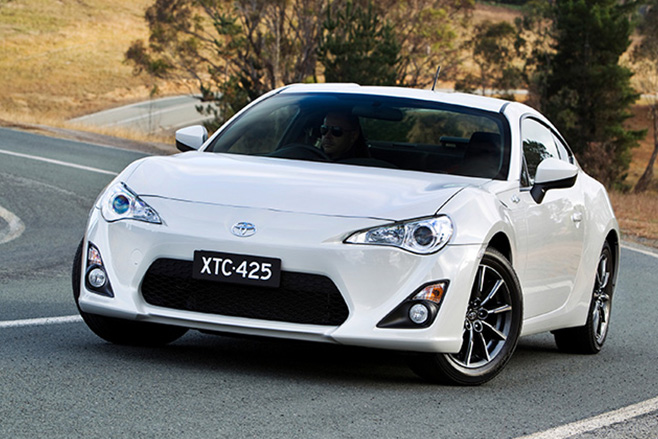
2012 COTY winner is still a favourite on-road, thanks to entertaining rear-drive dynamics. Subaru sells one-fifth as many of the near-identical BRZ.
HYUNDAI VELOSTER 2435 sales*
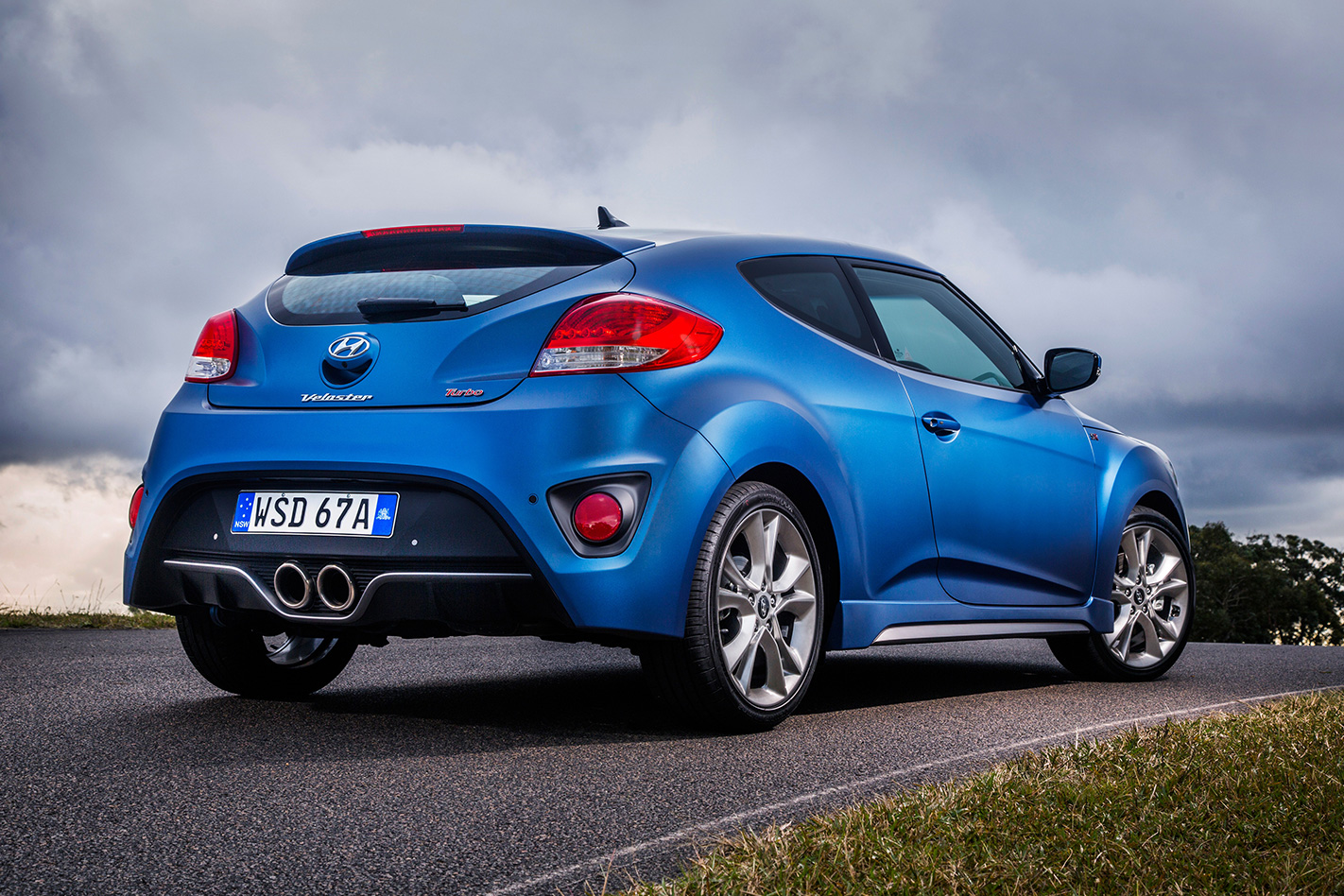
Base 1.6 is hardly sporty, but it has the looks to classify it as a sports car. Turbo adds more spark while maintaining the innovative three-and-a-half door body.
BMW 4 SERIES COUPE/CONVERTIBLE 1667 sales*
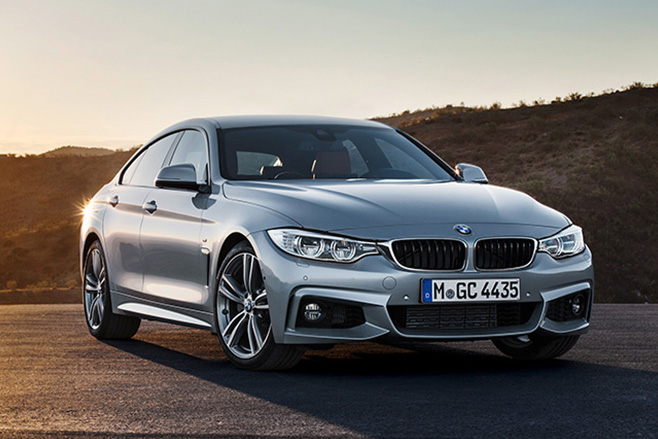
Fresh name hasn’t deterred buyers from what used to be known as the 3 Series Coupe/Convertible. Turbocharged four-pots suit rear-drive dynamics, too.
BMW 2 SERIES COUPE/CONVERTIBLE 1592 sales*
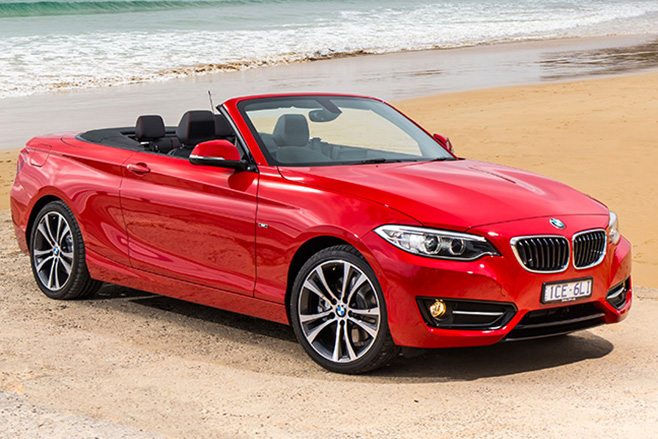
Last of the rear-drive 2s are also proving popular ahead of a shift to front-wheel drive. Get one while you can.
MERCEDES-BENZ E-CLASS COUPE/CONVERTIBLE 1401 sales*
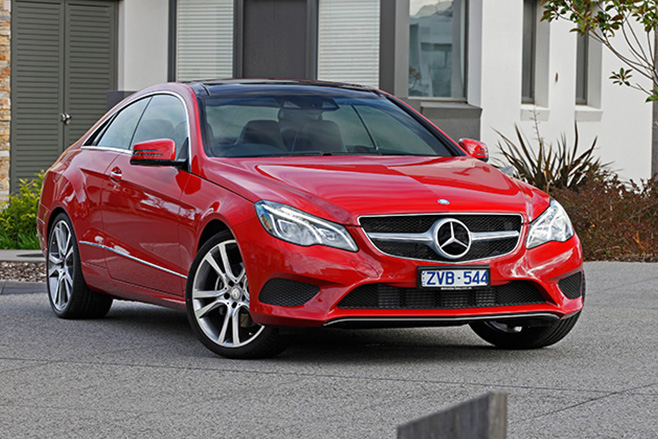
Spacious by two-door standards and with plenty of grace, especially from the punchy twin-turbo V6 in the E400.
*Source: FCAI, VFACTS. Sales figures January-October 2015.
Looking for something a little more sedate? We give you the low-down on Top five slow cars.
Drifting is not everyone’s cup of tea, but there’s no denying it takes immense skill to have a car endlessly teetering on the edge of control.
Add rain and massive horsepower to the mix and it gets even harder, then what about some fog? Oh and then do it in the dark as well. And did we mention the guard-rail lined public road?
Hence why Toyo Tyres enlisted the services of 2015 D1GP champion Masato Kawabata and his wild 745kW Nissan R35 GT-R. Kawabata is clearly a very brave man, wrestling this monster up Japan’s famous Hakone Turnpike road with near-zero visibility.
For a taste of what it looks like in daylight – and with fellow drifter Ken Gushi in tow in a turbo Toyota 86 check the video below.
Volkswagen has long ruled the small van market with a canny combination of good looks, smart spec, diesel autos and a car-like feel. Now a comprehensive update shifts the focus to petrol autos.
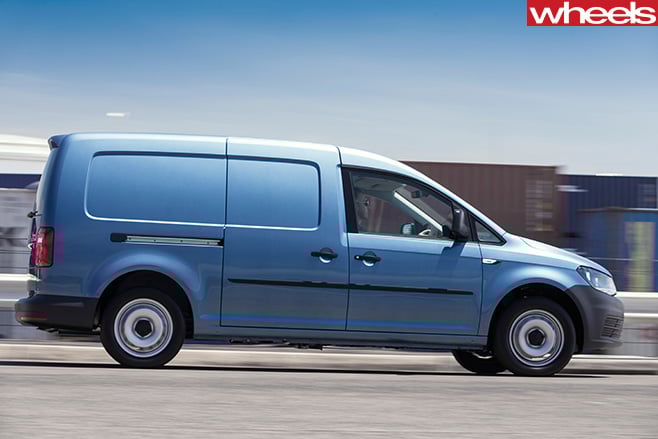
WHAT IS IT? A refresh of the top-selling small van, from Volkswagen. The front half of the C4 Caddy is loosely based on the fifth-generation Golf small car, but its commercial-vehicle rear (which includes leaf springs) can handle duty as a cargo van or – in Life guise – a five-seater wagon or seven-seater people mover.
WHY WE’RE TESTING IT The Volkswagen C4 Caddy has long ruled the small van roost, but an ageing design and very aggressive competition from the funkier Renault Kangoo has seen its lead erode alarmingly. The Germans are fighting back with a refresh that includes a petrol auto for the first time. Along with driver-assist safety and touchscreen connectivity, will it be enough to keep the Caddy on top?

THE WHEELS VERDICT: LIKE THE LARGER Volkswagen T6 Transporter range, the facelifted Caddy is just a comprehensive update of a decade-plus old design, bringing driver-assist safety tech, a more car-like dash, and visual tweaks front and rear. However, with diesels temporarily sidelined due to Volkswagen’s emissions scandal, the big news is the introduction of a 1.4-litre turbo petrol and DSG dual-clutch auto duo, opening the market and giving the increasingly successful Renault Kangoo rival something very serious to ponder. That said, while the changes improve things somewhat, the Wolfsburg workhorse is feeling its age in other areas.
PLUS: Strong 1.4 TSI, auto petrol availability, dash updates, safety and multimedia upgrades MINUS: Feeling old inside and out, firm ride, wagon/MPV versions still quite utilitarian
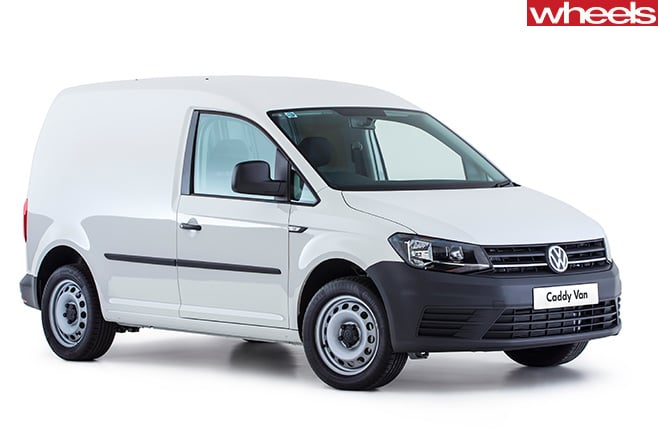
In the likely event of a breakdown, the rescuing white horse would often be wearing a Minor, Escort, Gemini, or Corolla badge. Likewise, these were the choices for budget minded surfers and tradies seeking an inexpensive dual-purpose recreation vehicle.
By the late ‘80s, however, smaller one-tonne utes with canopies, and light forward-control vans from Japan, obliterated the genre in Australia, until Holden released the Opel-made SB Barina supermini-based Combo.

As with the company’s T6 Transporter vans, it’s a revamp of the existing (third-generation) 2KN-series that debuted globally during 2004. Look for revised headlights, a different grille, reshaped bumpers, and altered tail-lights.
Interestingly, the recent diesel emissions scandal at Volkswagen has forced the temporary stop-sale of all TDI turbo-diesel variants – which traditionally account for 80 percent of sales. They are coming, but not until about the second quarter. Enter, then, the 1.4 TSI with DSG dual-clutch transmission.
The volume-selling short wheelbase Caddy Van TSI220 DSG kicks off from $28,990. Returning 6.0L100km (manual 6.2) with the assistance of stop-start, the new Bluemotion-badged 1.4 TSI petrol heart is said to be nearly as frugal as the previous diesel models.
On a short drive loop around inner Sydney in heavy traffic, the newly reengineered Volkswagen impressed us with its gutsy acceleration and quiet operation, helped out by one of the slickest and least laggy Volkswagen DSGs we’ve sampled. It is hard not to believe that the TSI220 will become the drivetrain of choice in the future, unless fuel prices skyrocket.
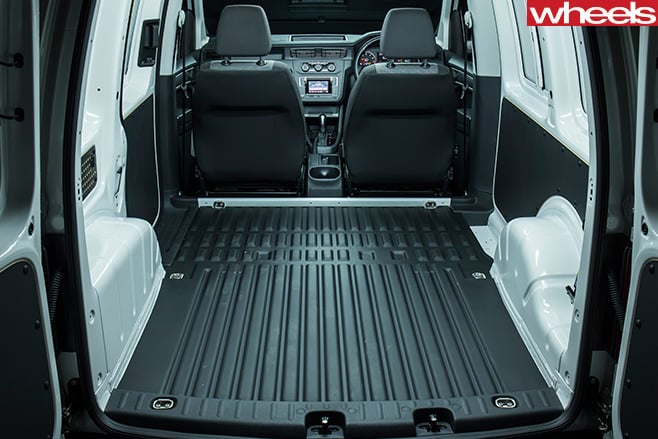
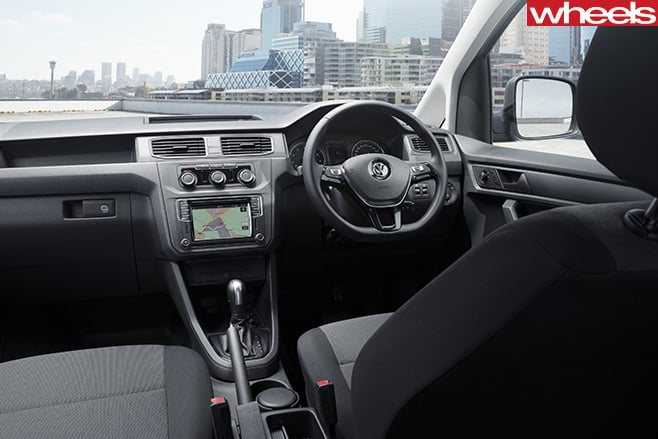
We also sampled the people mover variants, which – like the vans – have a comprehensively modified dashboard with (at long last) a lidded glovebox, better materials, and for the first time a touchscreen in the centre with app connectivity and an optional integrated reverse camera. Much of everything else is as per the Caddy’s MY10 facelift, with the same clear instruments and layout as before. And just as in the old passenger-carrying Caddy, the second row is roomy but remains quite utilitarian in presentation, serving as a constant reminder of the blue collar origins. Underlining the latter is the fair amount of road-noise intrusion as well.
Most will offer the option of advanced driver tech such as Multi Collision Braking (which applies secondary braking after a first impact to help prevent further damage), Fatigue Detection, AEB Autonomous Emergency Braking (known as City Emergency Braking), adaptive cruise control, and blind-spot monitoring. For safety at least, the Caddy is up to date.
As before, two wheelbases are offered, with the LWB bringing 4200 litres of cargo capacity, 1000 litres over the SWB version. As with the Transporter, a Maxi Crewvan is also available, with five seats and a configurable cargo capacity of up to 4130 litres, while the people mover variants can have the rear row(s) removed altogether. Payloads vary between 750kg and 850kg, depending on model specified.

The C4-series, then, is really just an extensive makeover of a 12 year old van, and it is showing its wrinkles despite the dash titivations and petrol engine transplant. While the Germans have done enough to keep the Caddy at the top of its class, you can bet Renault won’t be resting on its laurels. Far from facing extinction, the small van market is set to really hot up.
SPECS Model: Volkswagen C4 Caddy TSI220 DSG Engine: 1395cc 4cyl, dohc, 16v, turbo-petrol Max power: 92kW @ 4800rpm Max torque: 220Nm @ 1500-3500rpm Transmission: 7-speed dual clutch Weight: 1322kg 0-100km/h: N/A Fuel economy: 6.0L/100km Price: $28,990 On sale: Now
All Tasmania needs to come to life as a drivers’ nirvana is seven cracking performance cars and a bunch of primed pilots. That’s our cue…
BOATS AND cars usually don’t mix. When describing how a car handles, if you’re painting the picture using any references to water or nautical pursuits, there’s a strong chance that said vehicle is a wallowing, nauseating pile of sick. And therefore not suited to Tasmania’s magnificent roads.
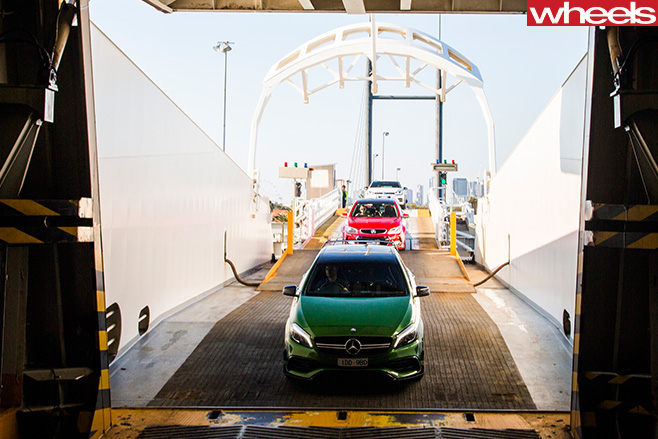
If you’re from mainland Australia, however, and want to traverse the Apple Isle in something other than a rented Camry, it’s across Bass Strait you’ll go by the only means possible, on board the ‘new’ Spirit of Tasmania, which apparently isn’t a boat at all. It’s a ship. A bloody huge one that also transports cars.
Well, how about the sub-$100,000 performance stars of 2015?
After burying six cars in the Spirit’s bowels for a surprisingly calm passage, the aforementioned Audi RS3 made its rendezvous at Devonport’s terrific Laneway cafe to square up against a mouth-watering cross-section of what $50-80K currently buys you.
The list reads like a ‘who’s who’ of semi-affordable performance. A now-iconic front-drive turbocharged manual coupe (the Renaultsport Megane 275 Cup Premium), an equally cult-ish rear-drive V8 manual sedan (Holden Commodore SS-V Redline), a small but very feisty hot hatch (Mini John Cooper Works), a larger and longer-tailed variation of the world’s favourite hot-hatch (VW Golf R Wolfsburg wagon), a purist-pleasing, traditional rear-drive turbo-six (the BMW M135i) and a most un-traditional, mega-boosted hot hatch in box-fresh 2016 form (Mercedes-AMG A45).
Almost unintentionally, our selection throws up a bunch of mini comparos. New 280kW A45 versus the 270kW RS3. Slightly cheaper 240kW M135i versus both those two and its smaller 170kW Mini family member. All-wheel-drive Golf R versus its pricier RS3 relative. Megane versus anything with four cylinders and a pulse. And SS-V Redline versus the lot, packing the greatest performance-metal-for-money quotient on the planet.
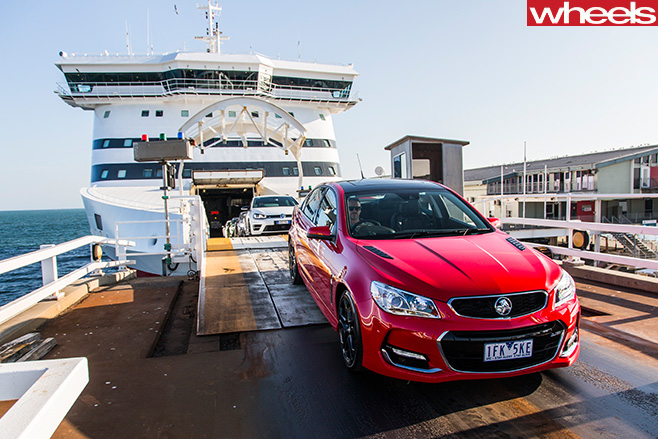
Day One: Devonport – Strahan
HOLDEN COMMODORE SS-V
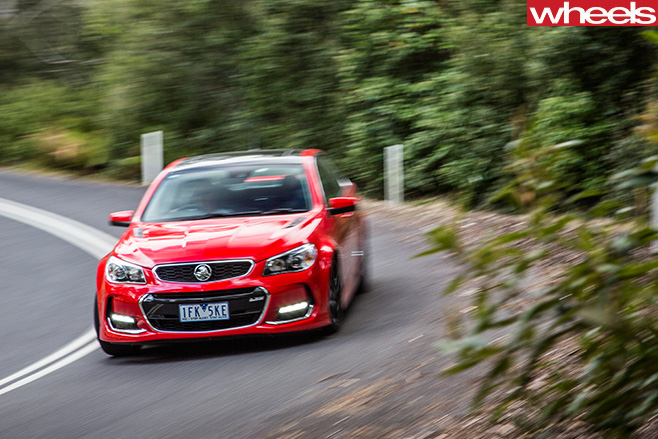
EVEN FOR those of us who’ve spent umpteen years behind the steering wheels of highly powered Holden Commodores, the VF Series II V8 feels and sounds like a breath of fresh air. Finally, there’s an exhaust note worthy of eight cylinders, while the meaty, sharper-geared 304kW 6.2-litre LS3 V8 is the perfect companion for the Redline version’s excellent FE3-tuned chassis.
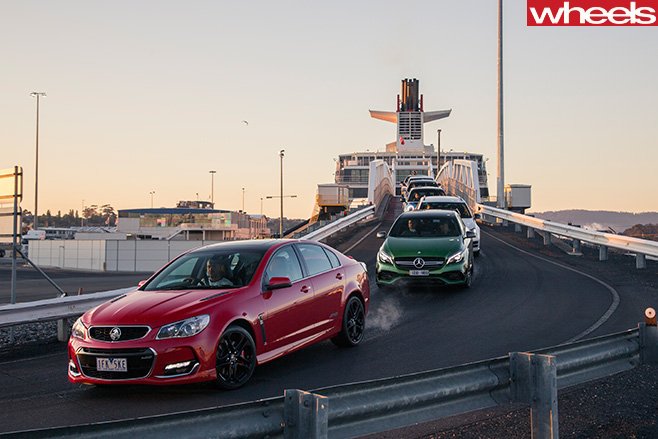
You’d think that Hellyer Gorge earned its name from the “hell yeah” challenge of its super-twisty 9km rainforest section, but it’s actually named after the first Pommy to survey the area (Henry Hellyer), who was also the first European to reach the summit of Cradle Mountain (in 1831).
Through the Gorge’s narrow, undulating twists and turns, I push hard in the SS-V Redline to maintain a lead over the Catalunya Red RS3 flashing in its rear-view mirror. The VE/VF Commodore has never had great pedal placement for heel-and-toeing, but delving deep into the brake travel of this car’s resilient Brembo-clamped discs, the big-boned Redline manages to thread the whole experience together with surprising deft.
I stick with the Commodore until lunch, a diversion away from the A10 into the former tin-mining hub of Waratah, the first town in Australia with electric street lighting (1886). Over burgers (but sadly not beer) at the Bischoff Hotel, we’re regaled with stories of the area, but the most valuable is the suggestion that we head via Reece Dam, half an hour south, rather than the main highway.
RENAULTSPORT MEGANE 275
Exiting Waratah in the only other manual of our group, the white Renaultsport Megane whooshes and crackles its way towards the Reece Dam turn-off on Pieman Road. Indeed, every time you lift off the throttle, the 201kW Megane’s Akrapovic exhaust pops on cue, to an almost certifiable degree because this thing is truly nuts. In the best way possible.
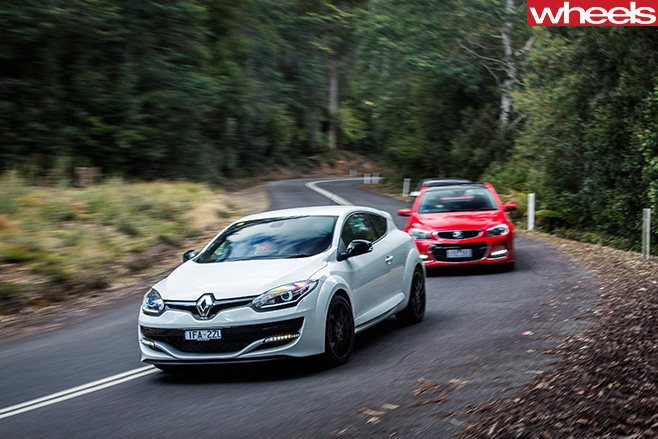
Hammering into the setting sun along Pieman Road, the ageing Renault is sensational. You point and it pivots, matching every driver input with a sublime level of poise that Renaultsport should bottle right now, just in case it forgets what constitutes handling greatness.
The next-gen RS Megane will be five-door-only, and possibly dual-clutch only, just like the Clio, so this is truly a moment to savour. As the road snakes left and right, peppered with the odd long-ish straight, I laugh out loud as the Megane blasts and cracks from its exhaust, edging its tail out with utter confidence on corner entry, adjusting its line almost instinctively via the throttle, and sucking itself towards each apex like a giant vacuum.
MERCEDES-AMG A45
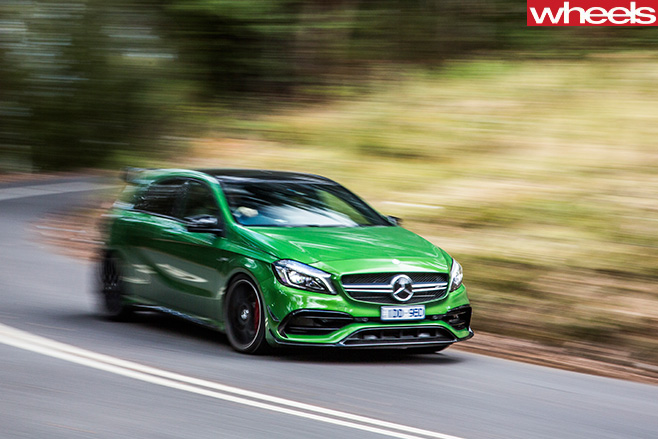
Twenty seconds in, the difference in character is blatantly obvious. Gone is the almost raucous, animalistic flavour of its exhaust, replaced by an entirely different sound. With its ‘loud’ exhaust button activated, the 280kW A45 produces a true high-fidelity sound – sharper, crisper and edgier than before – that’s more pure in its tone, but also a little more grown up.
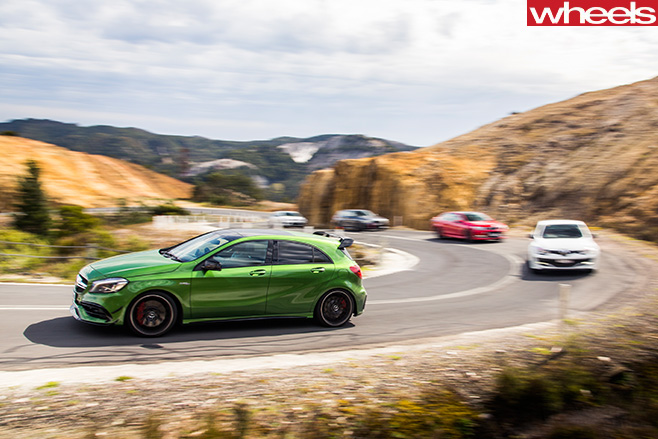
AUDI RS3
Flush with the sweeter taste of AMG’s little road rocket, I grab its nemesis – the instigator of this seven-strong epic, Audi’s RS3 quattro – for the final ’Roo-dodging 100 kays or so into Strahan.
The voracity of Tassie’s wildlife and the volume of its road kill is well-documented, yet the off-beat RS3 manages to bark its way through the Mount Dundas forest without messing up its pretty face.
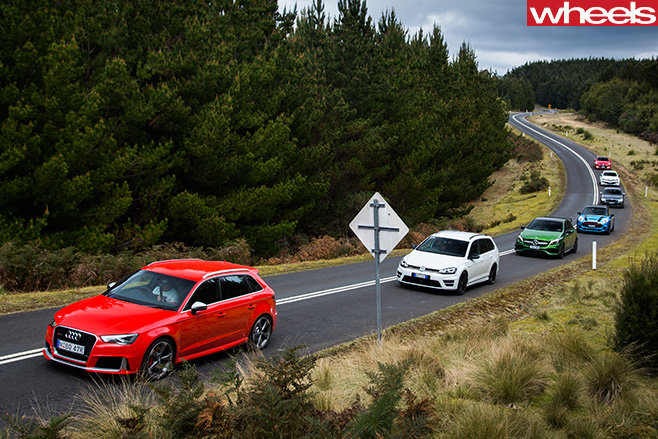
Unwilling to divert my eyes from the darkening road long enough to program its Individual mode, which separates the steering setting from damping, drivetrain, exhaust sound and ESC sensitivity, I push on with the RS3 in ‘Auto’, wishing at times that it had the adaptive cornering headlights of the Audi S3 I drove on these very same roads in the dark nearly a decade ago. But the RS3’s full-LED peepers throw plenty of white light forward, and somehow I don’t see a single glint of animal life.
Day Two: Strahan – Hobart
RS3 V A45 V GOLF R V MEGANE
DEPENDING on your viewpoint, the eastern exit out of Strahan is either the greatest stretch of main road in the country, or the worst. From virtually the moment the 100km/h zone begins, just on the high edge of town, the Lyell Highway draws a squirrelly and wonderfully indirect 40km route to the Zeehan Highway, just outside of Queenstown.
Trucks, school buses, scenic dawdlers and enthusiastic locals trace its length every day, yet it’s the perfect back-to-back location for our magnificent seven.
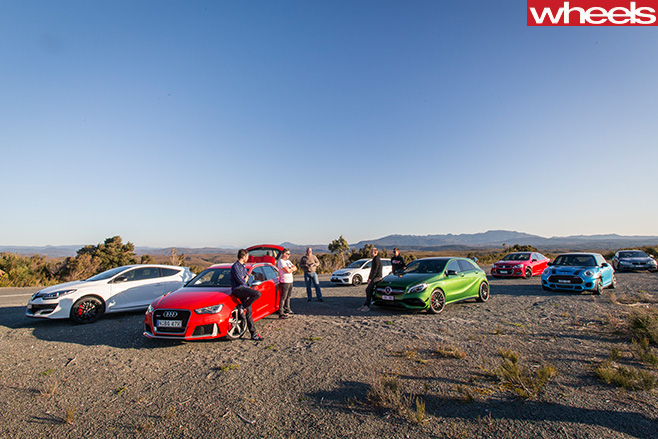
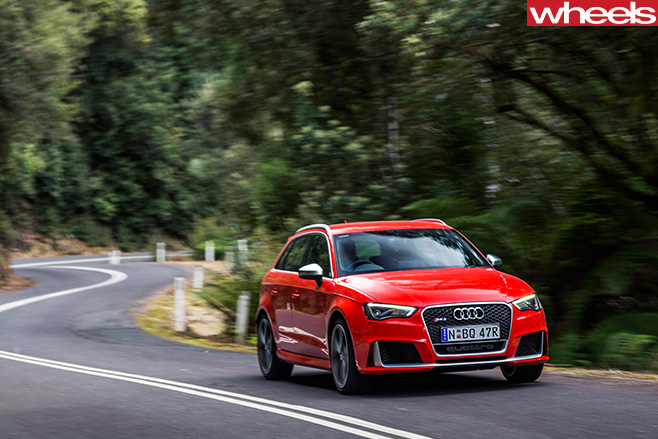
In Dynamic mode, with ESC Sport allowing some play time, the RS3’s steering (with just 2.1 turns lock-to-lock) improves immensely when it’s being thrown about. On a multi-faceted, challenging road like this, the five-pot Audi feels brilliantly chuckable, and far less nose-heavy than I’d expected. Perhaps that’s the genius of fitting narrower rear tyres (235/35R19s) than front (255s), allowing a small amount of tail slip in order to dissolve understeer. Yet there’s so much rear-end purchase to lean on that you simply keep building speed and confidence, while digging deep into provoking some rear-biased drive out of corners. Unless you’re being ham-fisted with it, the harder you push, the better the RS3 gets.
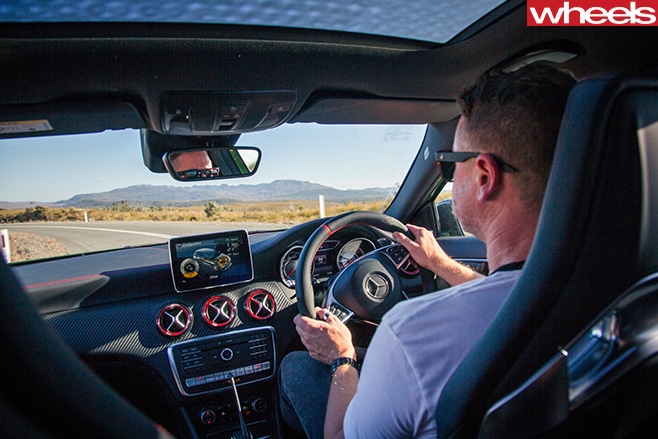
The A45 loves blurting its exhaust too, only it’s never been as sharp as this. Its 280kW 2.0-litre turbo four produces a more sporting note than the RS3’s velvety 2.5, and it delivers both outside and in. But it’s the new A45’s finessed handling ability that shines.
In Sport+ mode, it’s a more neutral handler than the RS3, with not as much emphasis on its back end if you trail-brake into a corner, but it’s surprisingly resistant to understeer and has better body control than the pre-facelift model.
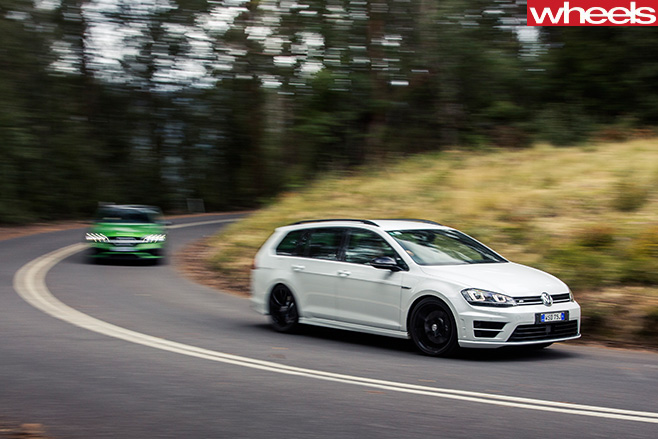
I’ve never been a huge fan of any Golf R generation, or even its R32 predecessor (rasping exhaust note aside), but the Mk7 Wolfsburg is really impressive on the Lyell Highway. Maybe it’s the extra weight out back but there’s something eminently likeable – and amazingly chuckable – about this Golf R for families.
In contrast, the front-drive Megane manual feels like it’s hard-wired to your nervous system. In the dry, there’s almost no corner-exit understeer and its power-down is as impressive as the RS3’s and A45’s, or perhaps even better given the way the Megane pulls itself tighter in a corner. Add throttle adjustability par excellence and a faithfully wagging tail and it’s no wonder everyone climbs from the Megane astonished at how great its chassis still is.
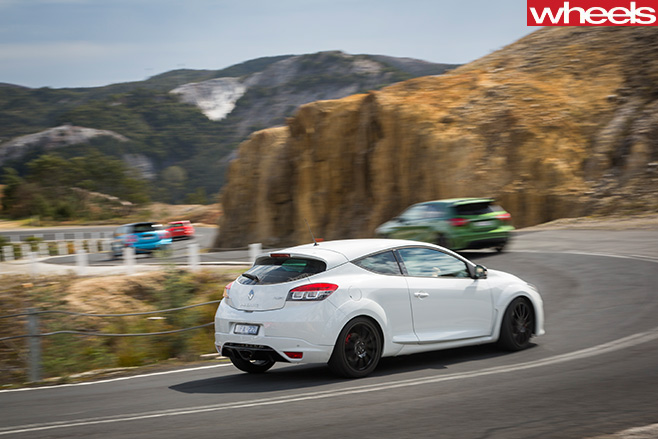
That’s all bad news for the Mini JCW though. Blasting away from our back-to-back base, the Mini’s muscular 170kW 2.0-litre turbo four makes all the right noises as it growls and blurts its way up through its ratio set, but you can already sense its relative lack of front-end grip. And, after a couple of corners, its lack of dynamic cohesion. There’s something a little synthetic about the JCW’s hot-hatch approach. Its steering feels overly reactive, and while its handling is fun to a point, its 205/40R18 low-friction tyres aren’t grippy enough to deliver what its balance and initial turn-in promise. Until you get used to it, you can’t really lean on the JCW in a corner with the confidence of its rivals, yet there’s no doubting its speed or accuracy.
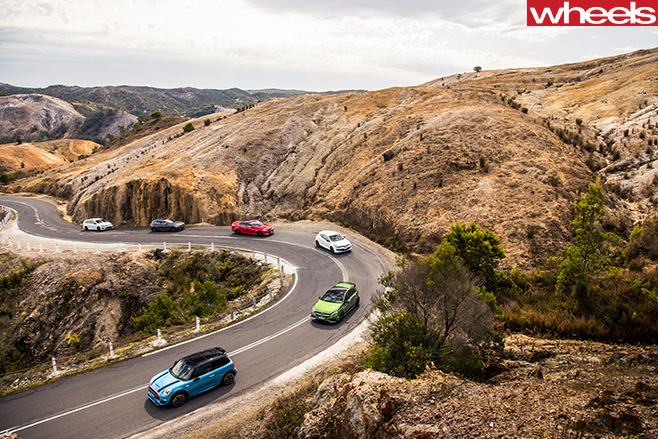
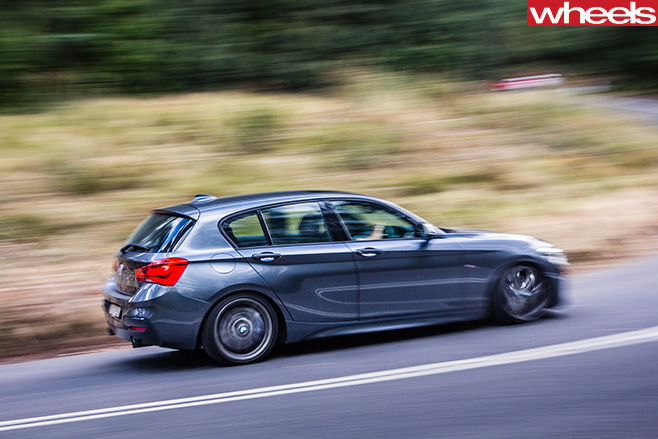
For a price that’s closer to Golf R territory than RS3 or A45, the turbo-six M135i hatch sits in its own little niche, underplaying its talents by looking very unassuming. But once you nail its loud pedal, prepare to see the whites of the driver’s eyes.
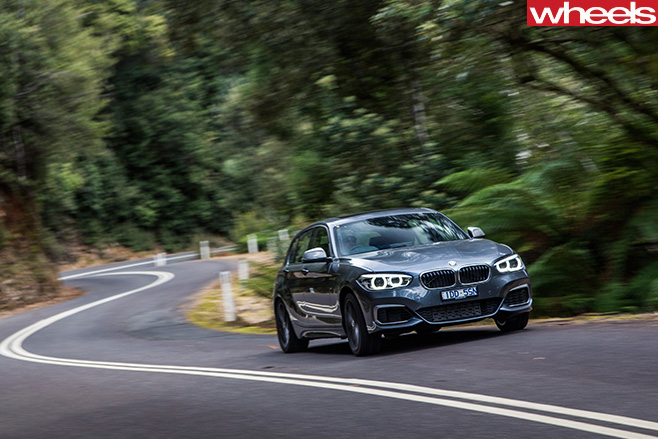
The M135i handles fluidly, and it’s great to have rear-wheel drive for balance adjustment and corner-exit drive, if not brakes that feel a bit mushy. What it ultimately lacks is the definable performance edge of its sportier M235i coupe brother. Given its understated ability, is the M135i a performance car mainly in name and acceleration?
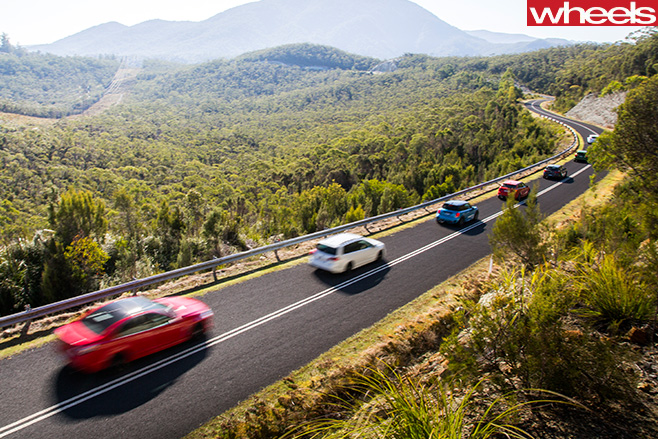
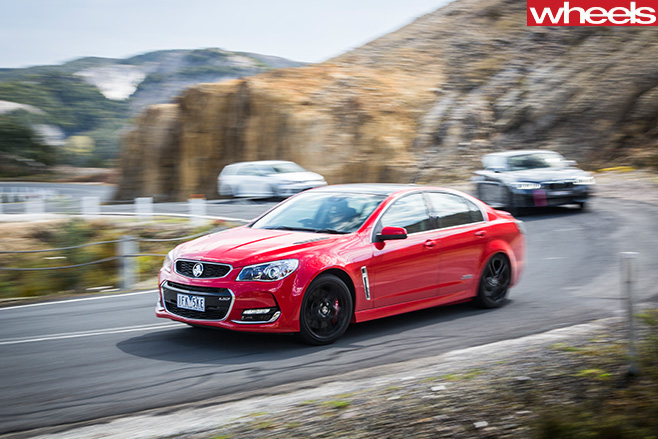
With its tireless brakes, tremendous V8 grunt and brilliant corner-exit thrust, the Redline again proves astoundingly adept at transferring its brawn into brio. Indeed, it’s punchier out of second-gear corners than Mundine at his best, supported by its exceptional mid-corner grip and balance. Sure, the SS-V Redline is a big and relatively heavy sedan, completing the journey alongside three-door hatches weighing up to 500kg less, but it ties everything together superbly. And it’s fun!
Even our hired gun, Carrera Cup-winning Matt Campbell, is surprised at how agile the Commodore is: “It held on a lot better than I thought; it’s really fun”.
MINI FINDS ITS FEET
IT’S AFTER lunch, and Hobart is still almost 300km away. With yesterday’s wildlife love-tap fresh in everyone’s minds, and the odd rain squall dumping on Tassie’s perpetually drenched West Coast, we swap cars at the lookout above Gormanston and hammer east.
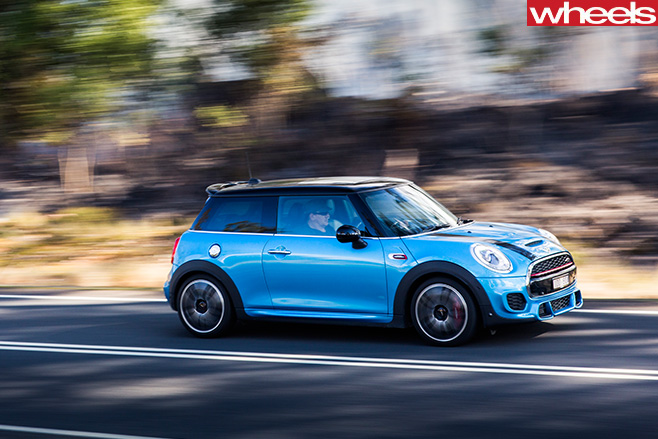
With its LED headlights blazing, and rain dampening some very slippery corners on the other side of Queenstown’s mountain range, I tread the fine line between keeping the grip-shy Mini pointing in the right direction, and keeping the hard-charging A45 behind me honest. It’s a challenge that grows into a pleasure.
As the shoddy weather retreats and Hobart’s 30-degree ‘heatwave’ beckons, I really start to bond with the Mini JCW. No, I don’t like its styling ‘add-ons’ and I wish someone had confiscated the crayons from the interior design team, but with its big sunroof wide open, its windows down, its cracking engine on song and its Harman/Kardon stereo cranking Tame Impala’s ‘Currents’ with distortion-free abandon, I’m having a seriously great time. And I’m being deafened by something other than its tyre noise.
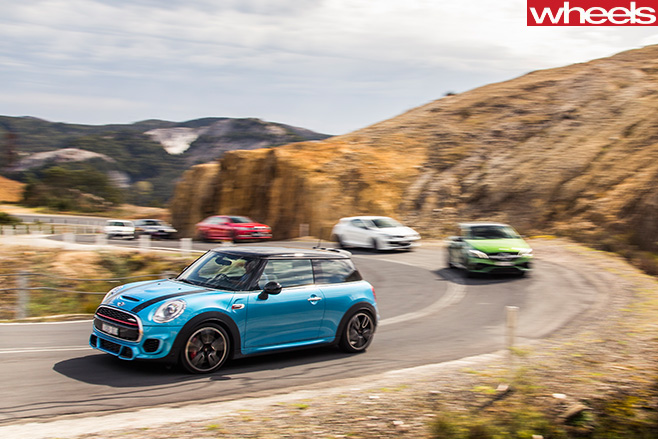
Hours later, we check into Hobart under the cloak of darkness, incident free. After dinner and a beer at the New Sydney Hotel, someone makes the call that fuel, a scrub, and track-spec tyre pressures might be a good idea before bed.
But it seems big-smoke Tassie isn’t quite sure what to make of our car line-up. With six hi-po Euros and just the one Aussie parked at the BP car wash, a long-haired local yells out “American Muscle!” with mosh-pit-like fervour, then gets into a VW New Beetle and dawdles away.
Day Three: Baskerville – Devonport
POISE ON THE EDGE
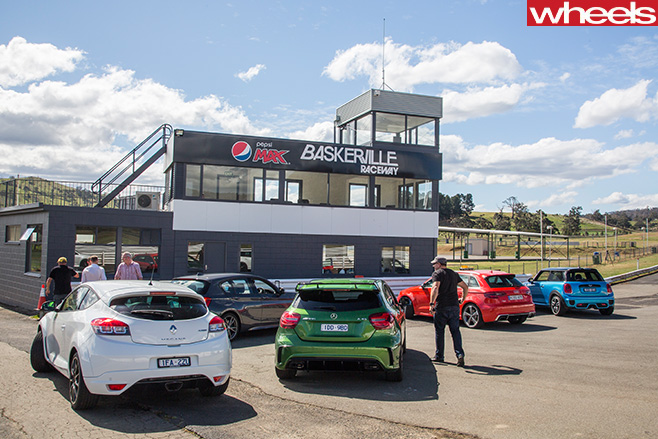
First car out is the Golf R wagon, clocking a decent 1.04:3 and some solid praise from Matt. But the excitement factor just isn’t there. While the black-wheeled VW is a foolproof track-day car, it isn’t particularly happy at ten-tenths. Dial your enthusiasm back to eight, and with a bit of provocation, it’s kinda sporty and fun. But the hottest Golf on sale is more about being a proficient road car, at least until the rumoured 295kW R400 sees the light of day.
The pointy Megane is next, and while it doesn’t have the AWD Golf’s off-the-line squirt, it definitely has what it takes on a racetrack, as shown in its 1:03.3 lap time. That said, while the front-drive Megane would be more suited to a fast circuit like Phillip Island than tight Baskerville, it’s still a blast to hear it popping, and feel it pivoting, around the Tassie circuit’s elevated goodness. Yet the Megane does share one quality with the Golf. Pushed too hard, it will scrabble for traction and can wash a bit wide in understeer, which is something you almost never feel on the road. Yet if you edge back a touch from the Renault’s slightly woolly extremities, it’s instantly back on line, chasing that dragon.
Next, the German big guns. And the Mini. The RS3 heads out first and clocks the best time so far – 1:02.6 – but it isn’t faultless. Matt has uncovered some braking quirks while setting a lap time and there’s ultimately some corner-exit understeer, though the RS3 is still a blast. As on the road, you can throw it around like a footy at the beach and it never goes out to sea. It’s just that it’s a bit too cultured to really go nuts.
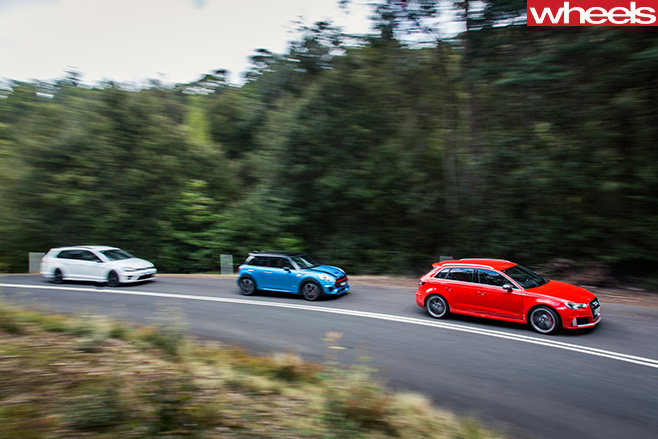
An even bigger surprise is the M135i. It sneaks under the radar to clock a 1:02.6 – exactly the same time as the RS3 – which says volumes about its balance and the strength of its drivetrain, battling against its lack of appropriate rear-end hardware to really channel all that relentless turbo-six drive to the ground.
Finally, the Mini. On Baskerville’s bumpy surface, with its damping in skatey Sport mode, the JCW is a bit unsettled, betrayed by its 1:06.3 laptime. There’s exhaust-blurting grunt aplenty and good chassis grip, but its underdone tyres and tail-wagging propensity when braking hard dissolve both confidence and speed.
HARD-EARNED THIRST
With the track hot-lappery over and a looming Devonport departure, we head to the nearest BP for gullet-loads of 98 octane and definitive proof of what you pay for the performance on offer.
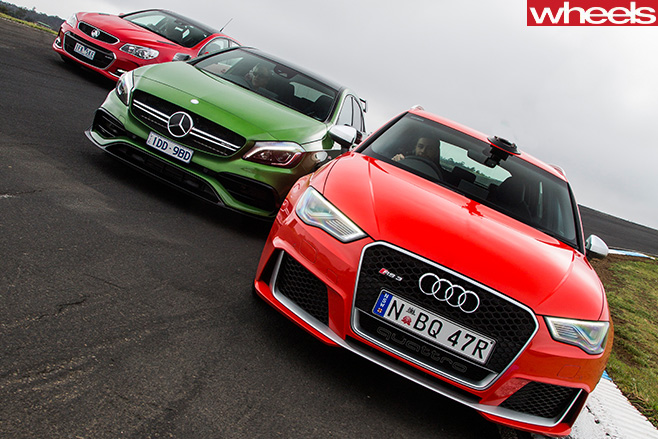
Unexpectedly, the rapid RS3 almost seems parsimonious at 16.1L/100km, whereas the A45 (17.4) and the big-capacity V8 Commodore (19.3) demonstrate not only their hard-driven thirst, but the enthusiasm of their drivers behind the wheel. Some cars were definitely pushed harder than others, and the SS-V Redline actually travelled the most distance (862km versus 808km in the Mini).
HOME STRETCH: THE WASH-UP
PRECONCEPTIONS are a funny thing. As decent humans, we’re meant to approach everything with an open mind – like transporting cars across notoriously rough stretches of ocean without getting sea-sick – but you can’t help pre-judging what may be.
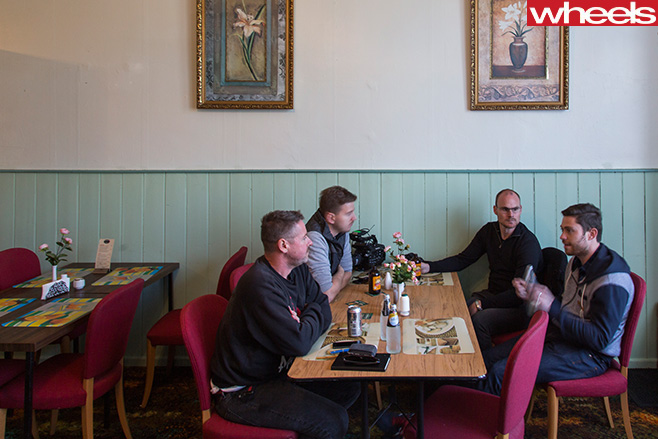
Yes, it would be great if the stealthily quick M135i toughened up a bit (and was manual), but that’s the job of the 235i coupe, and the forthcoming M2. And while the Mini JCW isn’t without its flaws, there’s a really good hot hatch in there waiting to be realised.
The Volkswagen Golf R wagon has its little niche all to itself (if you exclude Holden’s SS-V Redline Sportwagon) and we reckon it’s an excellent all-rounder, as well as a better car than the hatch that spawned it. But if the French offered us the Megane 275 Cup Premium in a carry-all version, that would be a wagon to covet. Instead, we’re left with an ageing but still amazing three-door coupe. If Porsche made a front-drive manual sports coupe, we reckon the Megane would be pretty close to what it came up with, both dynamically and mechanically.
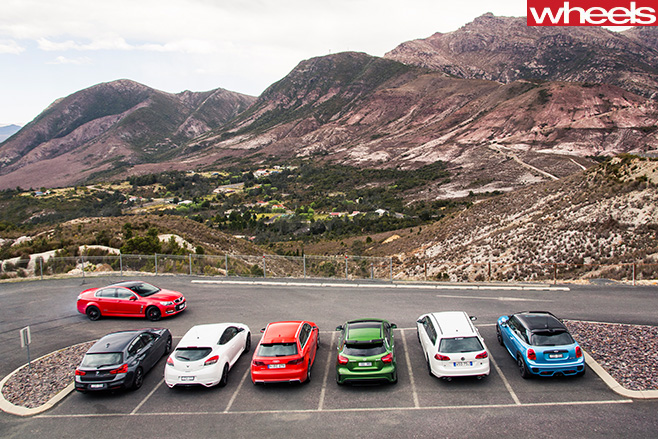
But you know what the real surprise was? The Commodore. For everyone. Without any hint of jingoism or #straya bullshit or nostalgia, the SS-V Redline manual sedan is a seriously fun, extremely accomplished and hugely likeable performance sedan. It requires no excuses, and it serves as a great reminder as to how much Tasmanian roads are gonna miss polished rear-drive muscle cars like this.
GOING STRAIT
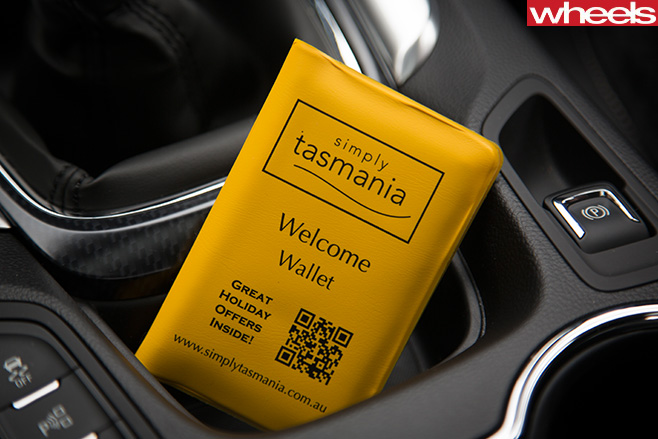
Overnighters can travel frugally by sleeping in a Recliner (think Economy class), or choose from 222 ensuite-equipped rooms – twin singles, four-person bunk beds, or a Delxue Cabin with a queen-sized bed. The day trip is 9am-6pm, the night version (always our choice) is 7.30pm-6am. Check out spiritoftasmania.com.au.
Matt Campbell: Acing It
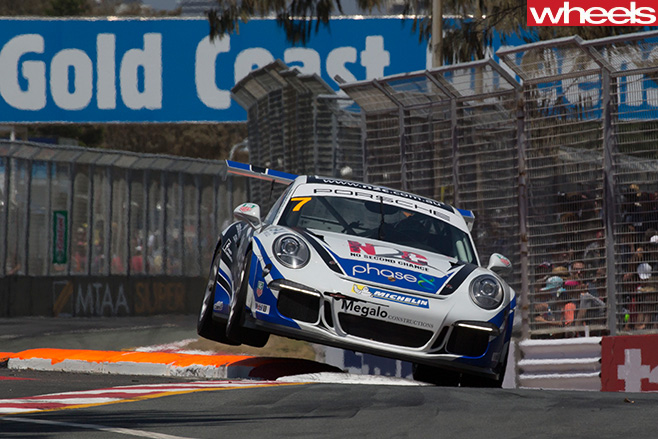
MATT’S VERDICT: HOLDEN
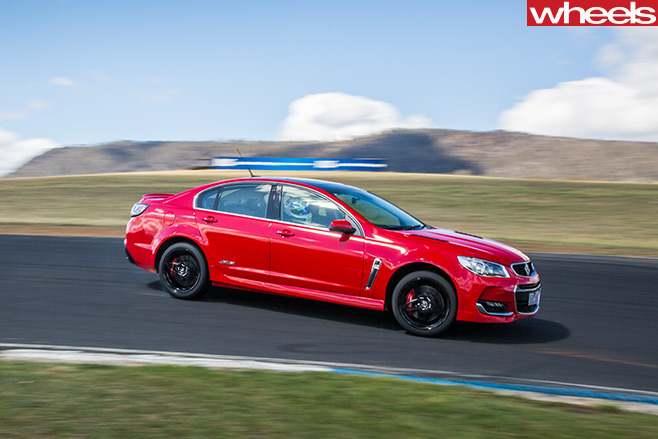
MATT’S VERDICT: RENAULT
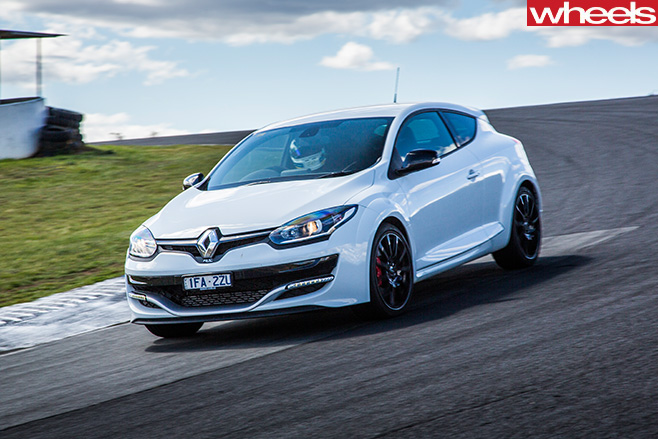
MATT’S VERDICT: MERCEDES-AMG
“Possibly the quickest car in a straight line, and also smashes the rest under brakes. It does squirm around a bit under really hard braking, but as long as you’re smooth, it pulls up really well. It also puts its power down so well compared to the other cars. Its corner-exit ability is brilliant; you can feel the new front diff really working. Coming off the turn, you can feed it loads of throttle, with heaps of lock still on, and it just gets it to the ground.”
MATT’S VERDICT: BMW
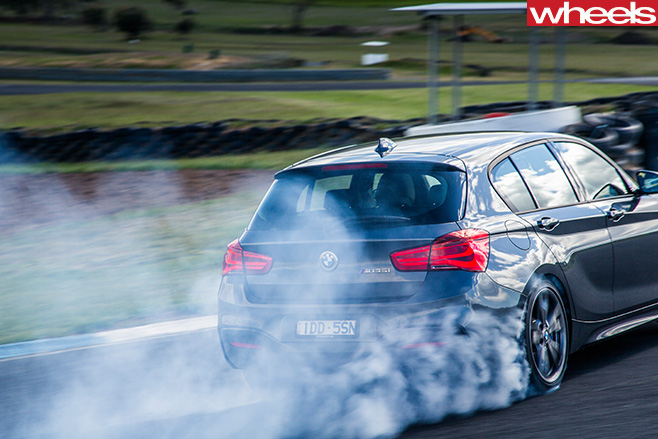
MATT’S VERDICT: MINI
“Doesn’t matter whether it’s high-speed or low-speed corners, initial turn-in sees it moving around quite a lot in the rear. You don’t want to hit a bump the wrong way, or have a little bit of attitude on it at the same time, otherwise it could actually turn you around. And it struggles up the hill; it doesn’t quite have the top-end power of the faster cars. It’s still fun, just not as complete as the others.”
MATT’S VERDICT: VOLKSWAGEN
“Really good in the mid-corner phase, and really good under brakes. It does understeer a bit under power out of corners, but I think for a wagon, it does really well. Obviously Baskerville is a pretty bumpy track, and it does make the Golf R bounce around a bit on entry, and it does push the nose a bit on the way into slower corners, but overall it hangs on really well.”
MATT’S VERDICT: AUDI
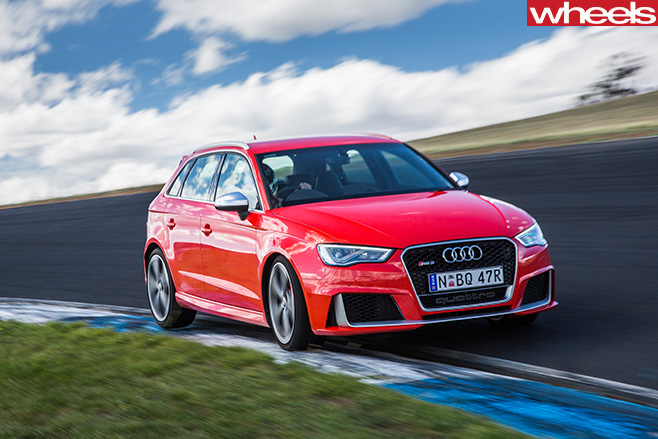
SPECS
Audi RS3 quattro Price as tested: $91,215 Engine: 2480cc 5cyl, dohc, 20v, turbo Max power: 270kW @ 5550-6800rpm Max torque: 465Nm @ 1625-5550rpm 0-100km/h: 4.3sec (claimed) Fuel economy: 16.1L/100km (tested)
Volkswagen Golf R Wagon Wolfsburg Edition Price as tested: $58,990 Engine: 1984cc 4cyl, dohc, 16v, turbo Max power: 206kW @ 5100-6500rpm Max torque: 380Nm @ 1800-5100rpm 0-100km/h: 5.2sec (claimed) Fuel economy: 15.5L/100km (tested)
BMW M135i Price as-tested: $70,344 Engine: 2979cc 6cyl, dohc, 24v, turbo Max power: 240kW @ 5800-6000rpm Max torque: 450Nm @ 1300-4500rpm 0-100km/h: 4.7sec (claimed) Fuel economy: 14.8L/100km (tested)
Mini John Cooper Works Price as tested: $55,450 Engine: 1998cc 4cyl, dohc, 16v, turbo Max power: 170kW @ 5200-6000rpm Max torque: 320Nm @ 1250-4800rpm 0-100km/h: 6.1sec (claimed) Fuel economy: 11.7L/100km (tested)
Mercedes-AMG A45 Price as tested: $82,370 Engine: 1991cc 4cyl, dohc, 16v, turbo Max power: 280kW @ 6000rpm Max torque: 475Nm @ 2250-5000rpm 0-100km/h: 4.2sec (claimed) Fuel economy: 17.4L/100km (tested)
Renaultsport Megane 275 Cup Premium Price as-tested: $52,990 Engine: 1998cc 4cyl, dohc, 16v, turbo Max power: 201kW @ 5500rpm Max torque: 360Nm @ 3000rpm 0-100km/h: 6.0sec (claimed) Fuel economy: 16.0L/100km (tested)
Holden Commodore SS-V Redline Price as tested: $54,540 Engine: 6162cc V8 (90°), ohv, 16v Max power: 304kW @ 6000rpm Max torque: 570Nm @ 4400rpm 0-100km/h: 4.9sec (claimed) Fuel economy: 19.3L/100km (tested)
It took a while to get there, but Mark Winterbottom finally snared the title that had long eluded him.
THE V8 Supercars Championship and the annual Bathurst 1000 are the two biggest targets of every driver in the series, so it’s certainly fitting that the two fastest and most consistent men of 2016 raced off with those prestige spoils.
After a fifth, five thirds and a runner-up slot in the championship standings, Mark Winterbottom could be excused for thinking he was destined never to earn the right to carry #1. Perish that silly thought. Rather than slip into cruise mode or self-doubt, he worked harder, urged his Prodrive Australia team to eliminate the stuff-ups, and never lost his focus. He elected to take his cues from the resilient John Howard – aka “Lazarus with a triple bypass”, rather than the combustible, self-destructive Mark Latham. Winterbottom never wanted to fall into the category of a “nearly man”.
It took 13 years and 383 V8 Supercar race starts, but Winterbottom finally realised his championship, dream, adding the 2015 title to the cherished 2013 Bathurst 1000 victory.
Winterbottom’s triumph came at the Sydney 500 at Homebush, not many kilometres from his old family home at Doonside.
A most worthy champion, Frosty accumulated nine wins in a rugged, tight 2015 title campaign. And no DNFs. Impressive stuff.
Winterbottom had a quiet start at the Clipsal 500, won by HRT’s James Courtney. But then the Frosty show cranked up in earnest, momentum gathering through the middle of the year.
The new Falcon FG X looked so strong and his teammate Chaz Mostert did his bit in keeping a strong Ford presence at the point end. Into the second half it became apparent that Mostert was posing a title threat.
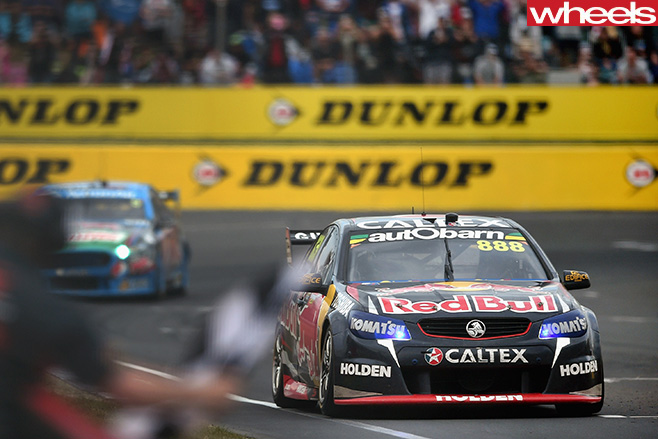
But on the less than perfect weekends, Winterbottom was solid, turning a couple of potential disasters into reasonable points hauls.
There is no better illustration than at Mount Panorama, where Lowndes (with Steve Richards) stormed to victory. But Winterbottom recovered from electrical issues to finish second (with Steve Owens).
Prodrive’s David Reynolds, who came of age with a stunning pole at Bathurst in appalling conditions, also came on strongly to charge into championship calculations, until he was victim to some outrageous Shane van Gisbergen aggression
He hung tough. In the past, Frosty’s head space could occasionally be given over to negative thoughts, and he has occasionally responded badly to fanciful beat-ups in the tabloid media.
But after so many years as a bridesmaid, watching Whincup collect six V8 Supercar championships, Winterbottom had done enough rehearsing.
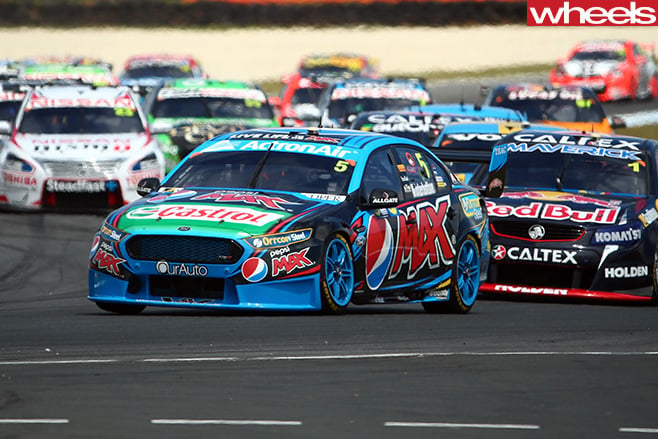
The 2015 championship was the first time since 2007 that a driver has won in a car not built by powerhouse Triple Eight. T8’s Whincup won six of those previous seven titles with James Courtney interrupting the swoop in 2010 at the wheel of a Triple Eight-built Falcon run by Dick Johnson Racing.
At the start of the year, Marcos Ambrose’s homecoming was the pre-season story of the year. His return to V8 Supercars with DJR Team Penske after nine years away in the US racing NASCAR was rightly viewed as a massive boost for the category.
But there was a bizarre denouement.
Ambrose declared from the start that he’d need time to get back into the groove. The team understood as much. And so, too, did the more knowledgeable fans. But Ambrose, never self-delusional and always a bloke who set the highest of standards on himself, called time on his local comeback after just two weekends, sending the Symmons Plains promoter (and V8 Supercars) into a right old tizz when he announced he would not be driving at his home event in Tasmania. Scott Pye was quickly called up to take over, and slowly, inexorably, the Falcon was turned into a top 10 car.
Ambrose reappeared for the enduros, where he was competitive. But he seems disinclined to do anything on a full-time basis. Speculation continues why the two-times champ, still only 39, no longer appears to want to race regularly. Having competed at the top level of NASCAR in the biggest tin-top series in the world, and driving almost every weekend, maybe he’s simply tired of dragging on the helmet. Perhaps he isn’t happy performing on a smaller stage. Or it could be his family is taking precedence. Not all race drivers are totally selfish.
Serious injuries to notable competitors were lowlights of 2015. HRT’s James Courtney was bizarrely hospitalised after the downdraft created by a low-flying navy helicopter flung team gear everywhere, hitting the unlucky driver in the torso. Courtney missed several races, including the Sandown 500 and the Bathurst 1000, before returning emphatically to win a leg of the Gold Coast round.
Mostert’s spectacular championship-lunging season came to a jolting, painful, premature end at Mount Panorama when he pin-balled his Prodrive Falcon into the wall, suffering a broken femur and fractured wrist. Mostert’s recovery extended into 2016 and his seat was warmed by subs at either end of the age spectrum – Russell Ingall (who managed to turn out for factory Ford and Holden teams in what was supposed to be his first year in retirement), the promising Cameron Waters and enduro driver Steve Owen.
Even with his early end to the season, Mostert was the 2015 qualifying master, banking 10 poles.
Gold Coast race winner Jack Perkins, who was HRT’s enduro driver, also had an unexpected return to the championship at Homebush, called up by Lucas Dumbrell to substitute for Nick Percat, who was struggling with an infected foot.
Off track, there was no shortage of loud-volume whingeing from long-time supporters peeved that only 10 rounds of the series were shown on free-to-air (Ten) television with a new deal with Fox Sports ladling out all practice, qualifying and races live. For a minimum of $50 per month. Suck it up people. It’s the way of the media new order. And it will be much the same in 2016…
Frosty hopes it will be the same in another way. He has the appetite for more wins, more titles, more Bathurst 1000s.
“I’m gonna turn up next year and give it a red-hot crack,’ said Winterbottom.
We never doubted it.
