
PLUS
- Practicality. You can choose to seat five with a cavernous boot, but even with seven on board there is some storage space.
- Value. Starting at $41,490 for the Active CRDi, there are few cheaper ways to seat seven.
- Strong diesel engine. It’s a little noisy when cold, but has plenty of grunt to lug the troops around and is very economical.
- It drives well. The Santa Fe is an impressive handler; not in a sports car sense but for what it is it’s pleasant to drive.
- Though it handles well, the Santa Fe’s steering could use improvement. It’s inconsistent in how heavy it is during corners which isn’t nice. There’s also a mode to manually change the steering weight, but this is a pointless gimmick.
- The Santa Fe’s soft suspension makes it quite comfy over big bumps, but average country roads make it jiggle about. On a long trip it could be quite tiresome.
- The plastics in the cargo bay are quite easily scratched by sharp objects. Something to be aware of if you’re lugging tools or the like around.
The idea isn’t entirely new to the automotive world, either; generations of mums and dads have woken to find their little darlings have flown the nest and taken to the roads on L- and P-plates. Often, this particular coming-of-age event sparks the realisation that the real estate afforded by the family sedan, wagon or SUV is no longer necessary, and something smaller and more sensible follows.
In our case, a downsize was recently imposed on the Bulmer brood by two extraneous factors: first, Mercedes-Benz wanted its ML350 BlueTec back after a not unreasonable 6000km loan; and second, Volvo had simultaneously (and serendipitously) suggested its V60 D4 wagon with new ‘Drive-E’ technology might make an interesting addition to the Wheels fleet.
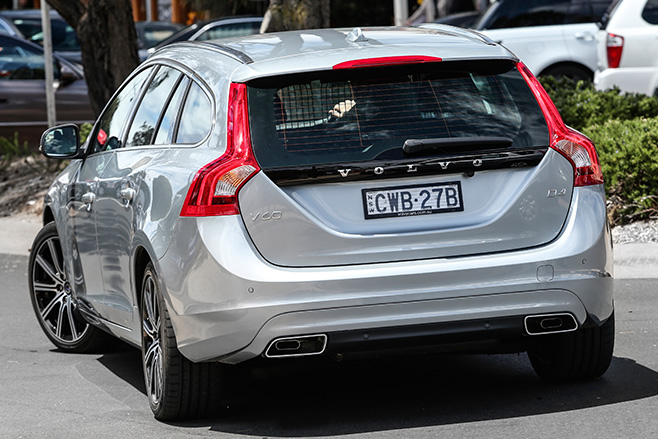
Trouble is, my little birds are still a long way from flying the coop, and my vertically challenged wife had grown enamoured of the burly Benz SUV’s commanding seating position, not to mention the inferred prestige of idling up to the school gates with a three-pointed star on the bonnet.
So it came to pass that for my sins I had to walk a mile in the shoes of a Volvo car salesman, convincing my wife and our offspring that the V60 D4 Luxury now inhabiting the driveway made so much sense on so many levels.
Cue affirmations about reduced fuel consumption, ease of parking, superior dynamics and even polar bears. That’s right, girls, it’s smaller, lighter, uses less materials to manufacture and sips less fuel; ipso facto, it’s kinder on the environment. Okay, so it’s rough science, but it seemed to do the trick.
Sensing a chink in their defences, I parried on with a dissertation on the Drive-E engine tech’s impressive fuel-efficiency improvements. Each and every time you engage the ECO+ switch (sited just below the air recirculation button, ladies), a penguin applauds you. Thus enabled, the V60’s 2.0-litre four-pot turbo-diesel switches to hyper-miler mode, shutting the engine down at 7km/h as you brake silently towards traffic lights, dodging servos and making oil barons weep.
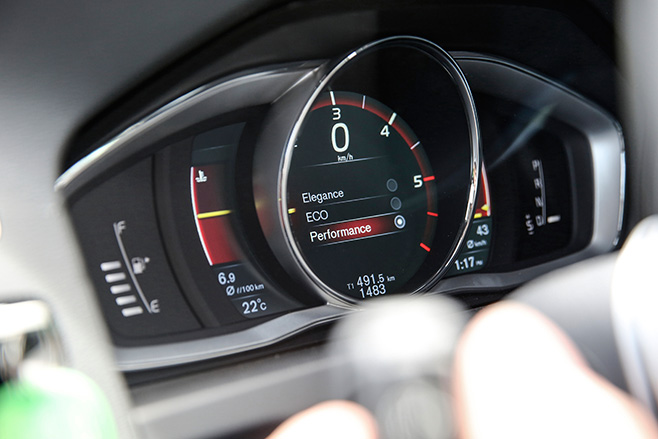
But wait, there’s more! (I’m really on a roll with this sales caper now). Drive-E also features Eco Coast mode that, contrary to what its name implies, doesn’t turn you into a bleach-haired, Hawaiian shirt-wearing long-boarder but instead helps maintain the car’s kinetic energy by deactivating engine braking and dropping engine revs to idle speed under certain conditions (ECO+ button activated; accelerator pedal fully released; auto transmission in D, not Sport; cruise control off; road not steeper than six percent gradient, etc).
I contemplated going on about the V60’s safety features – it’s a Volvo after all – the acronyms for which stretch around the block and back, but their eyes had glazed over a little. “To hell with the steak knives,” I thought, “I’m going in for the kill.”
“If you could just sign here, Mrs Bulmer, we’ll have your V60, with complimentary cushion for your derriere, ready to go in just a few minutes. Would you care for paint and fabric protection with that?”
What are my options?
The seven-variant V60 range starts at $57,890 for the D4 Kinetic, stretching all the way to the $102,990 Volvo V60 Polestar.
In this mid-spec ‘Luxury’ grade, the Swedish wagon comes laden with plenty of standard kit, but like all good press cars, this example is further enhanced with options that raise its list price from $62,890 to $70,015. The extra coin buys heated front seats ($375), metallic paint ($1750) and the Driver Support Pack ($5000). The latter comprises a bundle of useful features including (deep breath): Blind Spot Information System (BLIS) with Cross Traffic Alert; Driver Alert System (Lane Departure Warning, Lane Keeping Aid, Active High Beam Control, Forward Collision Warning and Road Sign Information); Adaptive Cruise Control with Full Autobrake; front and rear parking sensors; auto-dimming interior and side mirrors. This is in addition to the V60 Luxury’s navigation with voice control, cornering headlights with washers and 18-inch alloys.
Update 1
The art of boot-packing challenges Father Bulmer.
Think Volvo wagons and the image that springs to mind, at least for those of us born before Gen Y, is of fridge-swallowing bricks on wheels that were long on practicality but short on style. The Volvo 740 could house a Euro-pallet in its luggage bay, for Pete’s sake!
But the lumbering, underpowered and indestructible tanks of yesteryear have been replaced by modern machines that are more stylish affairs, thanks to Volvo’s determination to shake off its fusty image, with a focus on design that began with the hiring of talented crayon twirler Peter Horbury in 1991. The Brit has long since moved on, but his legacy lives on in a range of vehicles that boast a polished and distinctive design language.
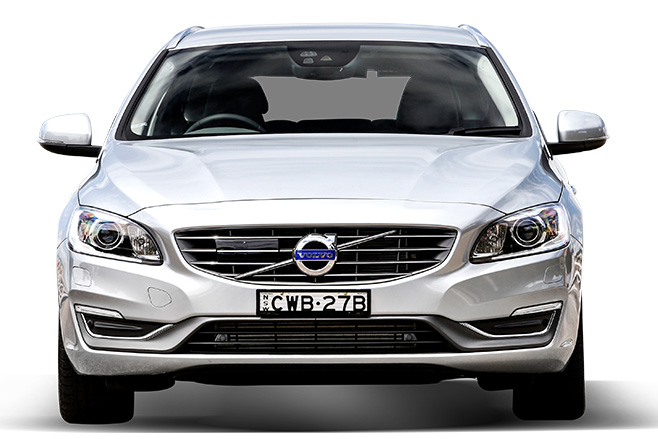
In the case of the V60, which is simply the handsome station wagon version of Volvo’s second-generation S60 sedan, this entails market positioning that’s more ‘sportwagon’ than load lugger.
In industry parlance, the V60 is a compact mid-size wagon and is pitted against fellow European estates such as the BMW 3 Series Touring and Audi A4 Avant. In practical terms, this positioning ensures a not overly large 430-litre boot and a fairly compact rear seat, so our first family trip away in the D4 long-termer was always going to be a test of carrying capacity, packing skills and patience.
We Bulmers aren’t known for travelling light – we’ll take the kitchen sink and the blender too, given the chance – so a simple long weekend away can take on the logistical look and feel of a minor military manoeuvre.
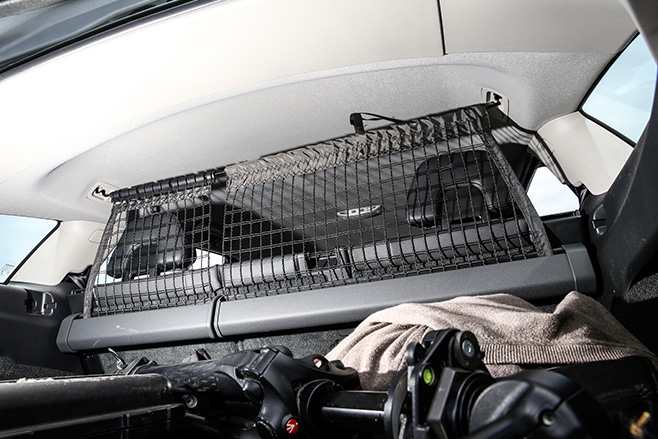
Hence why, halfway through jamming the intimidating pile of bags, scooters, skateboards and bazookas into the V60’s modestly proportioned derriere, I began to wonder if it was too late to add a roof pod to the options list. It was, so I unloaded and knuckled to the task of whittling down the load before repacking it.
In the process, I was pleasantly surprised to discover something missed in my haste to pack and go – those clever Swedes have thought of just such an eventuality and built a neatly integrated cargo net into the backs of the rear seats. The net pulls up out of a cartridge that runs the width of the cargo bay, clipping into mounts in the roof lining. It’s a handy feature as it enhances the amount of available space by enabling you to pack higher without fear the kids will cop a Samsonite tattoo under heavy braking. With the help of the magic net, both the bocce set and the budgie cage made the cut.
The Volvo V60 may not boast the pallet-swallowing ability of its box-like predecessors, but it has them well and truly covered in the style stakes, while also adding some neat practical touches.
Update 2
An unwelcome light show spoils an otherwise revealing ride.
The sale of my father-in-law’s vineyard (sob!), and the need to help with the pack-up and clean-out of a weekender steeped in 35 years of memories, has meant several hundred kilometres of country driving since our last update.
This new driving environment has thrown up some interesting observations. For one, the V60 Luxury’s ride. In my view, it’s too firm for its family and urban orientation. While those handsome, diamond-cut 18-inch alloys look the part, they pick up every lump, bump and ridge to be found when driving in town. But the discipline of the Euro-spec suspension suddenly makes sense on lumpy back roads, paying dividends in terms of roadholding and dynamics.
That’s not to say the V60 won’t still snot a sharp-edged pothole with all the gusto of an angry nightclub bouncer, but along the demanding, red-gum-fringed roads in question, it was pleasing to discover that ride comfort has at least been sacrificed for impressive grip and body control that keep things tidy when pressing on.
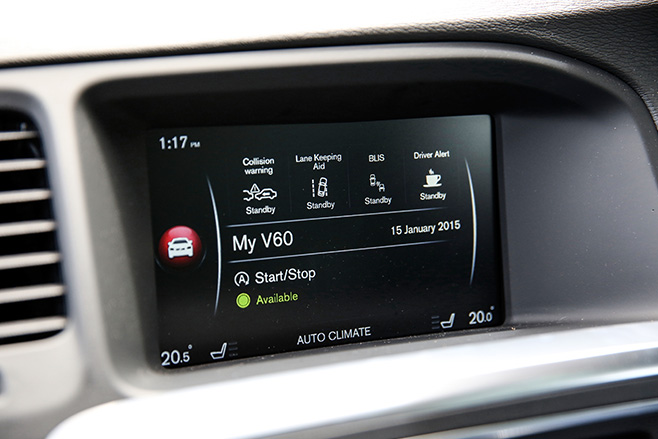
A not-so-positive revelation from the nocturnal component of these journeys is the distracting light show created by the V60’s clever headlights. For me, the jury is still out on the real driver benefits of what Volvo calls Active Bending Bi-Xenon Lights (ABL). Conceptually, active headlights make sense as they mean the driver doesn’t have to manually switch between high and low beam for oncoming traffic. Plus, the system compensates for load, braking and acceleration, all of which helps ensure fewer cranky drivers flashing you for blinding them with your dazzling peepers.
However, I’m yet to drive a car fitted with active headlights that gets beam selection right as often as you can manually. In the Volvo’s case, the system seems frustratingly hyper-inclined to dip to low beam more often than is absolutely necessary, while the active bending bit adds a motorised element that means the lamps follow the way you steer, turning up to 15 degrees in either direction.
As you might imagine, on ducking, diving and tree-lined country roads, with the ever-present threat of moving wildlife, the combination of headlights that dip automatically and follow your every steering move can be a tad distracting. In fact, downright bloody annoying might be more to the point.
In effect, the technology creates a shadowy, dancing light parade as the beams shift, shimmy and adjust to reflections from signage, oncoming traffic and what you’re doing with the steering wheel, meaning the headlights become a show unto themselves.
Fortunately, the Volvo’s driving position and seat comfort are both excellent, so while the dancing lights proved an unnecessary and unwelcome distraction, the overall comfort of the cockpit ensured it was a good space to spend a few night-time hours.
Update 3
Ged reaches the age when it’s the small things that matter.
Ever noticed the size of Toyota switchgear? Surely I’m not the only one to realise that Camry switches are apparently designed for the massive thumbs of Sissy Hankshaw, lead character in Tom Robbins’ novel Even Cowgirls Get the Blues.
But after years of deriding Toyota’s big, chunky buttons as being like the over-sized key-pad on a pensioner’s phone, it’s recently started to make sense to me.
You see, having stuttered past a milestone our test cricketers seem incapable of achieving – the half-century, not 16 – I’ve begun to notice the drop-off in my eyesight. My distance vision is still terrific, but the close-range performance of my previously 20-20 peepers is undoubtedly on the wane.
It happens to the best of us. In fact, medical science has a name for this visual degeneration, presbyopia, which a learned website tells me is Greek for ‘old man eyes’. Charming!
The talented Michael Stahl penned a wonderful column on this topic a few years ago, referencing the physiological drop-off in reaction time, vision and other skills that comes with ageing. At the time I felt for “poor old Stahly” – despite us being the same vintage – and assumed that his hard life versus my strict ‘the body is a temple’ (ahem!) approach must have been the difference. It wasn’t.
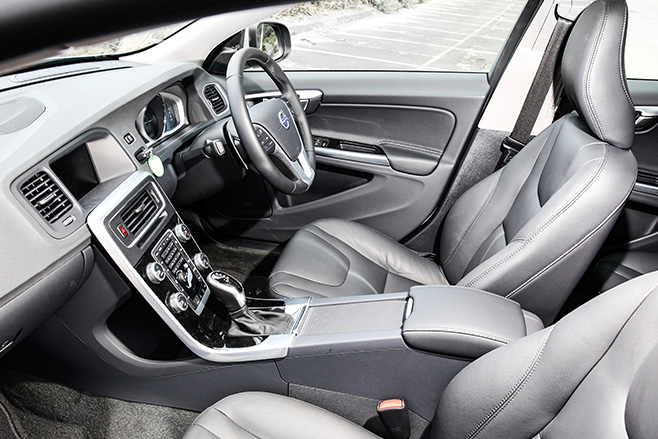
Joining the growing-long-arms department has led me to question the V60’s tiny switchgear. Seriously, you need to have the tactile skills of an eye surgeon to operate these things. Perhaps the Swedes are so genetically superior they don’t ‘do’ macular degeneration. After all, this is the blue-eyed, blonde-haired race that’s given us Anita Ekberg, Victoria Silvstedt and Agnetha from ABBA.
But I’m sorry Hjalmar, or Thorsten, or whatever the bloody interior designer’s name is, we middle-aged Aussies have fat little fingers and squinty-poor eyesight, so your close-clustered, near-invisible buttons do not please us.
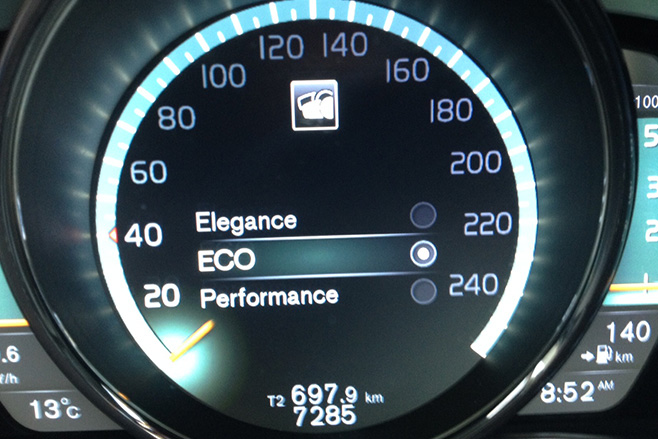
I’ve at least worked out how to switch the handsome and (thankfully) highly visible LED dash between its different themed displays. In fact, I’ve channelled my inner Sigmund Freud and started an experiment to see how the various colours affect mood, to kill time on my 45-minute commute.
The jury is still out on whether driving in ECO, with the dash glowing a gentle green, makes me any softer on the loud pedal, or if switching to Performance has me angrily flipping other drivers the bird and attracting speeding tickets.
But what I can say for certain is that, when running in vivid-red Performance mode, on a Monday morning, en route to work, I’m a right cranky old bastard.
UNLOCKING THE MYSTERY
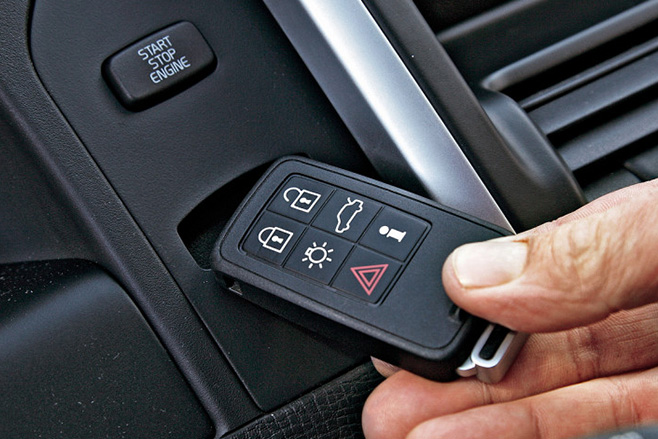
THE little battery in the V60’s key fob (pictured above) must be on its last legs because it now only works when I’m standing right next to the car and pointing the key directly at the interior. Makes you realise what a convenient feature keyless central locking is… and to ponder why the V60, which is otherwise so well appointed, lacks this increasingly popular (and increasingly standard) feature.
Update 4
We wanted the Volvo V60 to be a real turnip for the books, but was it really?
In automotive terms, we here at the Bulmer household pride ourselves on being an equal opportunity employer. By that I mean we hold no prejudice for automotive ethnicity. Germans, Japanese, Aussies (an endangered species, granted), Koreans, and obviously Scandinavians; we welcome them all. Vehicular biodiversity, if I can put it that way, is embraced.
So, back in 2010 , when plucky Saab, under the misguided stewardship of General Motors, finally sank through an automotive ice hole, it left Volvo as the sole flag-bearer for Sweden, under the protective wing of Chinese giant Geely. That ‘last-Swede-standing’ status makes me feel slightly protective towards Volvo, and Swedes in general, to the point I regularly give my old Roxette cassettes a good cranking and insist my young daughters master the art of assembling their own bedroom furniture.
I’d also hoped that a decent stint in Volvo’s mid-size sports wagon could shift my feelings from simple optimism for the company’s prosperity to genuine admiration for the product.
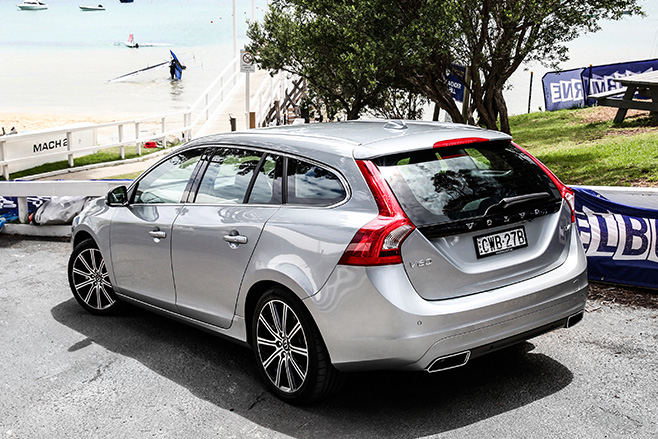
So where does that leave me after six months? I’d put the V60 at the upper end of a pass mark, but short of a distinction.
Let’s recap the car’s strengths and the elements in which it managed to endear itself. First up, I liked the exterior styling – its distinctive Volvo signatures, the bonnet line that falls away towards the nose to avoid being too blocky, the solid four-square stance and flared waistline. Inside, the soft, fragrant leather welcomed, and my daughters – who are always impeccably behaved, and quiet as church mice, provided, of course, they’re bound and gagged – appreciated the integrated booster seats. Up front there was a lot to like about the Swedish sense of design aesthetic, though this often didn’t translate into ergonomic or operational sensibility. At least the seat’s memory positions for two drivers was appreciated, given the height disparity between The Good Wife and myself. A one-button press to raise her to the prescribed height quickly allowed her optimum vision of the road ahead, and also helped the cabin acoustics better reflect her dulcet tones as she sang along sweetly to her Enya CDs.
But then there was the packaging issue. You’ll know by now that the Bulmer clan has yet to learn the art of travelling light – Sherpas have been known to see us coming and turn tail, shouting, “No boss! Load too big! Yak will break!” So as a family we often found the V60 – especially having transitioned from the capacious Mercedes ML wagon – a little on the tight side.
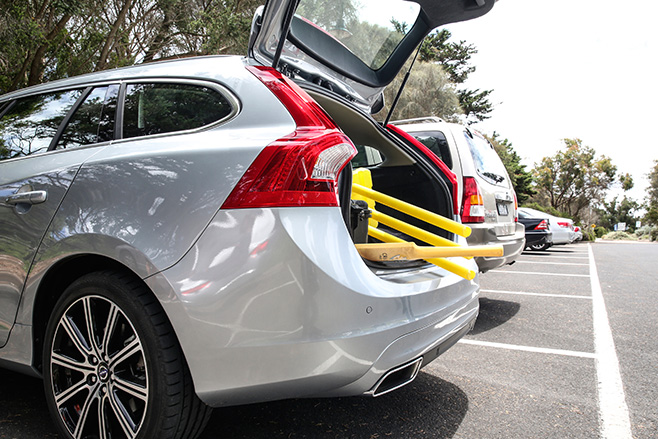
Once we were on the open road, the V60’s decent body control was always appreciated; it’s just a shame it came at a cost in terms of the car’s ride compliance around town. The thumping and jarring at urban speeds was not a compromise that I ever grew to willingly accept.
Then there’s the powertrain, promising diesel efficiency further improved by the ‘Drive-E’ technology suite of fuel-saving features. Good in theory, but four-cylinder diesels have made massive leaps in the last few years and Volvo’s 2.0-litre falls short by comparison. It sounds and feels a little old-school in its grumbly idle and gruff mid-range under full throttle, though the performance was never anything less than pleasing. Still, the new-generation twin-turbo 2.0-litre diesel (165kW/470Nm) fitted to the new XC90 is positively gagging for a home in the V60.
Speaking of the Volvo XC90, a recent quick spin in this all-new (and wholly developed under Geely’s control) model shows exactly what Volvo is now able to deliver. Rather than chase sporty dynamics, this large SUV features beautiful interior detailing, clever packaging and a relaxed driving experience. Our V60 was a loyal family friend, and the future is clearly bright for Volvo.
So, what is it?
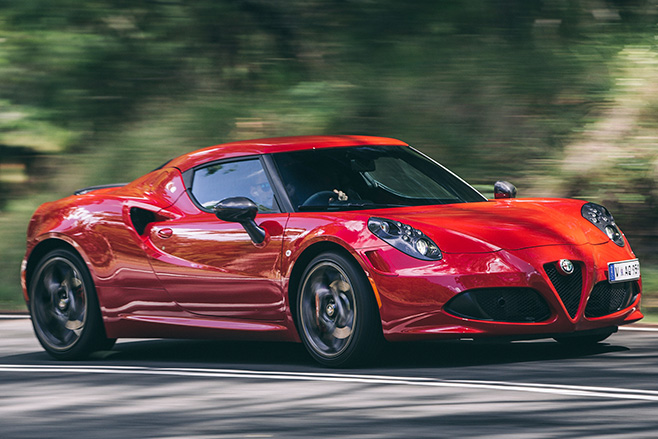
This is the Alfa we’ve been waiting for. Since the concept version exploded into the automotive world’s consciousness in early 2011, we’ve been waiting… impatiently. And finally, the Alfa Romeo 4C has landed on Aussie terra firma; arguably the most drop-dead gorgeous sports car to turn a wheel in the last decade.
As if anybody needed convincing, this perfectly proportioned gem confirms FCA (Fiat Chrysler Automobiles) design chief, Lorenzo Ramaciotti, as a genius. He and the team he assembled to create the 4C’s form in Alfa’s Centro Stile have produced an instant classic.
Thanks to its carbon fibre monocoque chassis (all 65kg of it), the use of aluminium for major hardware components, and lightweight SMC (sheet Moulding Compound) for the body, the car weighs in at just 1,025kg.
Powered by a transverse, mid-mounted, all-alloy, direct-injection, 1,742cc four cylinder turbo, producing 177kW/350Nm, driving the rear wheels through a six-speed dual clutch gearbox, the 4C is claimed to sprint from 0-100km/h in 4.5secs, and scream on to a maximum velocity of 258km/h.
Why should I care?
Alfa’s positioning the 4C as ‘The Affordable Dream.’ And even though 89 grand is no small chunk of change, it’s peanuts for a car with this kind of performance, dynamic ability, and stunning design. I mean, it’s built by Maserati in Modena for gawd’s sake.
What’s new about it?
This is a clean sheet design. The only shared element is the alloy turbo four, also found under the bonnet of the Giulietta QV. But the 4C had it first, so it really is new from-the-ground-up.
That’s all fine. What’s it like to drive fast?
Having driven the car at its global launch in Italy, main point of interest was whether it’s lively and nimble nature would translate to the local environment, and we’re happy to report it does, 100 per cent.
The Alfa Romeo 4C is a real sports car, with few compromises made in the name of superior dynamic performance. Alfa has historically used the name Veloce to describe its lightweight models, and there’s no direct English translation for that word. The closest is probably ‘fast’, but the meaning combines notions of agility and quick responses, as well as outright speed. The 4C is alive with Veloce to the max.
Feel from the unassisted rack and pinion steering is like shoving your hands through the dash and grabbing the front wheels. In constant radius corners your fingertips pick up every subtle nuance of the road surface, changes in camber, and grip levels. It’s unbelievably good.
The 4C is fast, and feels it. You’re sitting low, with an expansive view ahead thanks to a large, wrap-around screen (think Lancia Stratos). Stones and twigs thrown up by the wheels tick and bang into the floor, the turbo whooshes and whines behind your head, and the flappy paddle dual clutch is fast and satisfyingly positive.
We tried the (standard) launch control function, and with the system engaged the 4C steps off hard. Acceleration is genuinely rapid, as in, 911 Carrera S rapid, and the ripping engine noise, centimetres from your ear drums, is sensational.
Alfa claims a 50:50 front to rear weight distribution, and the way the car remains on track and throttle-steerable in fast corners is phenomenal. The standard Pirelli P Zero rubber does its bit for outright grip, but the car’s overall poise and balance, delivered via a wishbone front, strut rear suspension set-up, is obvious.
The brakes, perforated and ventilated discs front and rear, with four pot Brembo calipers up front are brilliant.
And driving from home to the office in the city?
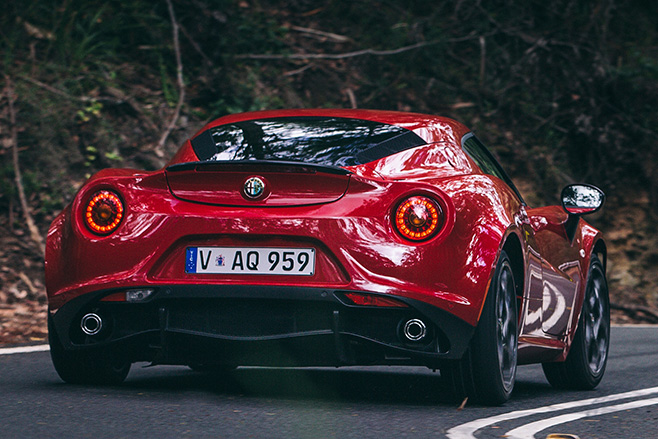
This is not, repeat not, a daily driver. But if you do decide to throttle-off and hit the commuter trail, the seats are as comfortable as they are supportive, the interior design is high-tech Italian cool, and concessions to comfort in the shape of climate-control air, cruise control, and rear parking sensors are in place. Having time to drink in the exposed carbon weave all over the interior is also extremely pleasant.
Is there anything bad about it?
There’s no doubt the 4C is fabulous but flawed. The price you pay for ultimate steering feel and response is the car’s tendency to follow dips and channels in the road, and prepare yourself for shocks and shudders from imperfections. But trust us, it’s totally worth it.
The combined engine and exhaust noise is bliss in the short term, but can do your hearing in after a while. Rear three-quarter vision for lane-changing is limited. And if you’re thinking about giving Anne Hathaway a lift, remind her to dress appropriately, because getting in and out can be an undignified process.
We’re also not fans of the carbon fibre headlight inserts which have replaced the pre-production car’s conventional glass bi-xenons. The latter is standard on the upcoming Spider version, and Alfa is making noises about eventually making them optional on the coupe, so all is not lost.
So, the 4C’s not perfect. But hey, even Cara Delevingne has Groucho Marx eyebrows.
How much would I have to pay for one? And is it worth the coin?
The ‘standard’ 4C is set at $89k, but FCA Australia has secured 75 examples of the 4C Launch Edition, which at $109,000 adds extra fruit to the standard equipment list in the shape of exclusive paint colours, bi-LED headlight, with illuminated daytime running lights, front fascia with side air intakes and carbon fibre rear spoiler and mirror caps, race suspension tune, special exhaust, staggered 18-inch (front) and 19-inch (rear) forged alloy rims (up from 17 and 18-inch), red brake calipers, sport seats, interior accent stitching, and carbon fibre used on the trim plates, instrument bezel, and gear shift surround. If you can get your hands on one it’s t-o-t-a-l-l-y worth it.
Would you take the Alfa 4C or Porsche Cayman 2.7?
Both great mid-engine two-seaters, but we’d take the Alfa in a heartbeat.
Click here to find out more about the Alfa Romeo 4C.
The fourth-generation Subaru WRX has finally lobbed into Oz. Hallelujah for that, and not just because of the two-year wait since the launch of the Impreza it’s built on.
Rather, Japan has been in desperate need of affordable and practical performance to put the nation back on the motoring map.
A rocket ship no 86/BRZ, ageing MX-5 or go-fast Nissan can substitute for. A mass-produced, hero car of turbocharged and all-paw persuasions Japan set the mould for in the ’90s – a mould it’s largely ignored for far too long.
Of course, it was 20 years ago when the first WRX lobbed into Oz, a bombshell that rattled local perceptions of what affordable performance meant: big, V8 rear-driven sedans. And it would take another decade – and two generations of WRX – before anything else on the local market could supplant Fuji’s feisty halo car as the buck banging cult car of Aussie choice. That’d be the Golf GTI, specifically the Mark V version of the mid-Noughties.
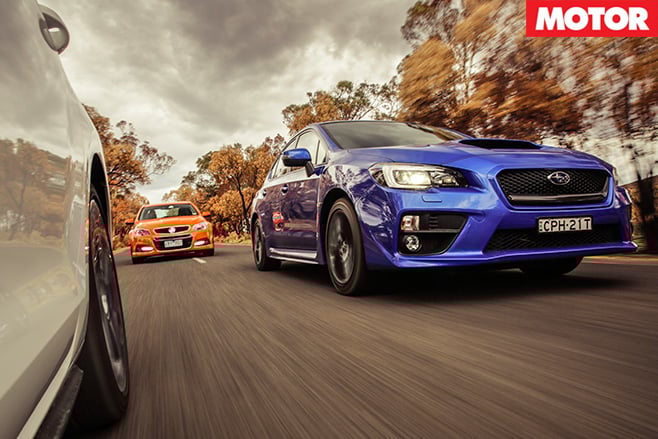
Now, in 2014, the Aussie Commodore SS-V, WRX and GTI nameplates remain the main performance protagonists at the thick end of the $50K price point.
The Holden, at $45,490 in manual form (our test car is the $47,690 auto), is perhaps the finest cut-priced sporting Aussie muscle car to date. It’s also, obviously, among the breed of Oz-spun V8 rear-drivers living on borrowed time. Fine. But that’s not to say the big Holden isn’t the best (big) banger for a reasonable buck.
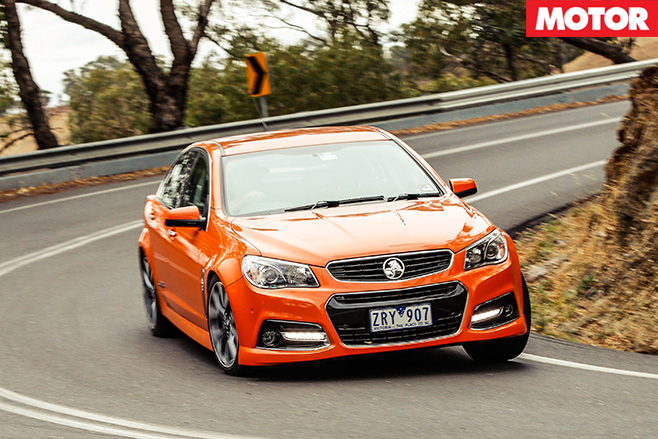
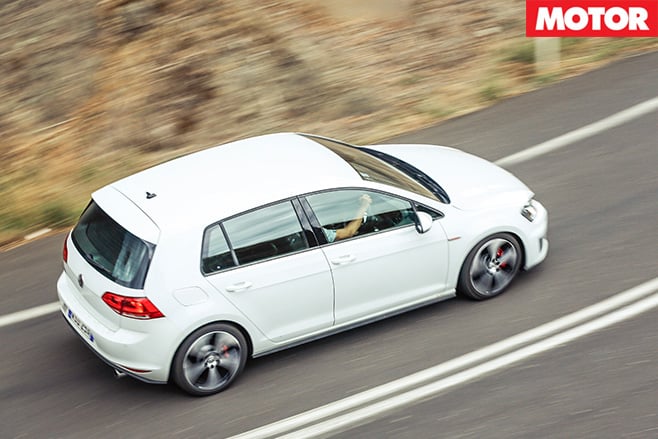
It undercuts the SS on price – $41,490 in as-tested manual form, $43,990 for the DSG version – and is, frankly, the car to beat. Which brings us to the completely revamped and largely unknown WRX.
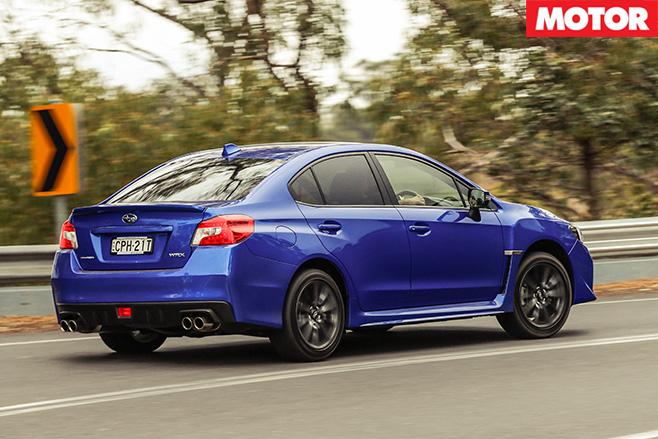
The basic manual lobs in at a super-sharp $38,990 – about a grand cheaper than its predecessor. Add two grand to to get the, erm, self-shifting version – more on that shortly. Subaru also offers a Premium spec, chock full of up-market niceties for $43,990 – say hello to our test car – or $45,990 version depending on transmission choice.
Gone is the EJ family engine and 2.5 litres of capacity, replaced with a new ‘FA20’ 2.0-litre boxer that shares its perfectly square bore-and-stroke ratio of 86 x 86mm with the BRZ and not the lethargic long-stroke (90mm) engine of the current Impreza.
It’s direct injected and boasts 197kW at 5600rpm and 350Nm between 2400 and 5200rpm, a lift of four kilowatts and five Newton metres over the old EJ, but with a vastly broader mid-range torque spread.
Transmissions? Subaru has ditched the ye-olde five-speed manual, replacing it with – hooray! – a proper six-speed. Gone, too, is the option of a conventional automatic. In its place is – shock, horror – a continually variable transmission (CVT), essentially an nfinite-speed device that engineers have bestowed with an “eight-speed manual mode” function in its most aggressive ‘Sport #’ setting, to sort of fake the feel of upshifts. The jury’s still out on that one.
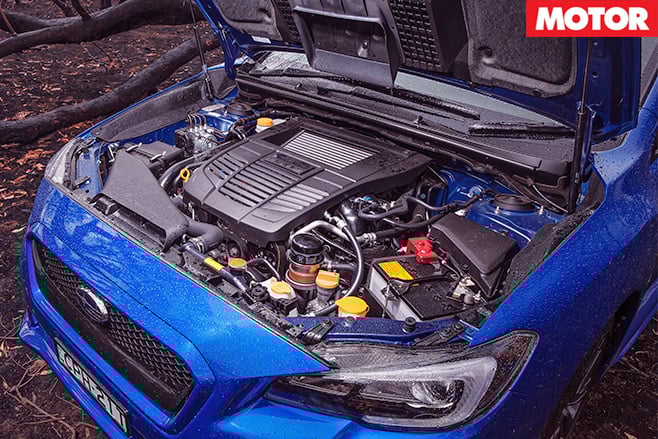
The brakes are bigger – purportedly offering 140 per cent of the old car’s stopping power. It’s also been completely redesigned inside the roomier cabin. All this and we haven’t even discussed looks.
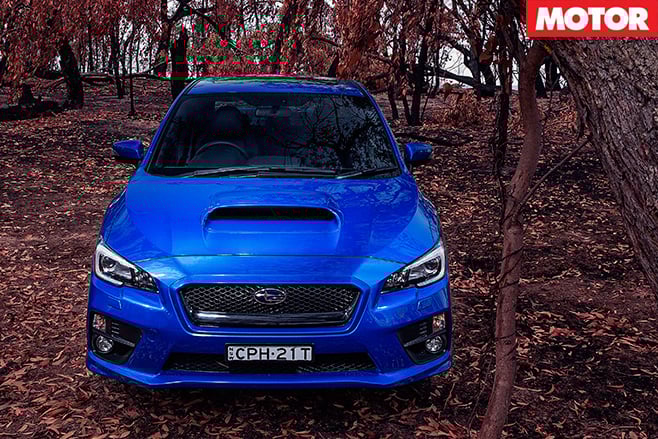
Opinions are subjective and divided among the MOTOR crew. If you think it looks arresting in pics, wait until you see it in the flesh. I guarantee you won’t miss it in a crowded car park.
My take is this. It looks good nose on – less so from behind. And it falls over from most other (disad)vantage points. Apparently only roof and boot panels are common with Impreza, and it retains the base car’s slab-sizedness and gaping greenhouse which, if anything, is accentuated by the pumped guards. And these guards make the 17-inch rims – a rim size WRX has been running for well over a decade – look puny. It also looks very fussy, like there was a sale on bodylines and Subaru grabbed them all.
Put it this way – Subaru proved it could create design brawn and beauty with great success in the WRX Concept (which sat on 20s). Why then settle for this?
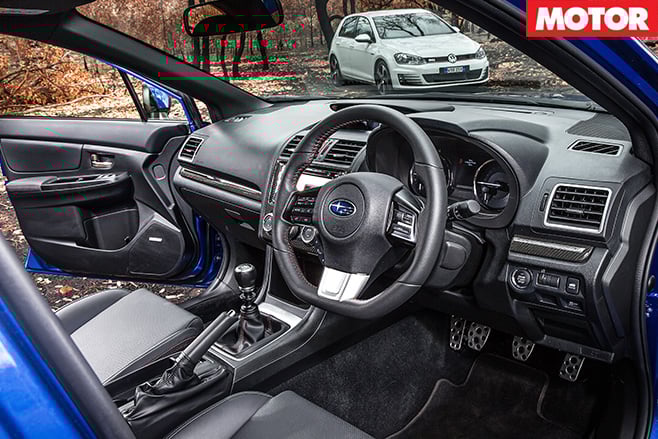
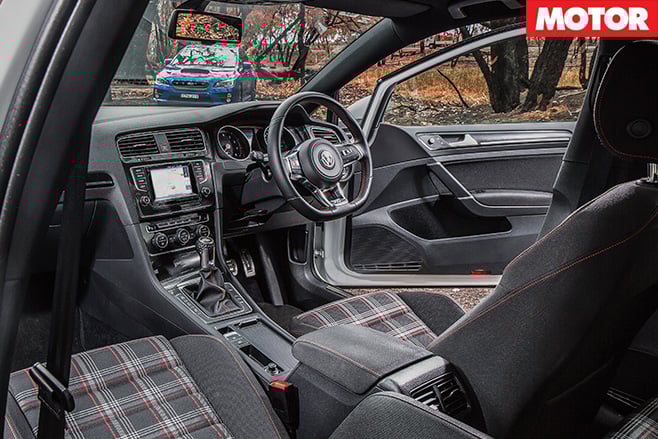
The good bits? The WRX’s new, small, multi-function wheel is neat, there’s a proper handbrake (unlike either the VW or Holden), and the digital displays in the instrument cluster and dash fascia are vast improvements over old. The seats, while offering noticeably firmer bolstering than the Holden, aren’t nearly as nicely sculpted to the torso as the GTI’s superb pews.
It piles on punch with an immediacy the GTI, with its more modest 162kW and 350Nm, can’t match. You notice the WRX’s thick swathe of torque – get some revs onboard and there’s that nice, boosty, old-school rush some punters wholly and solely buy into the turbo experience for.
Thing is, it’s not terribly linear in delivery. Engine delivery flattens out above 5500rpm despite the tacho suggesting another 1200rpm to play with, and below 3000rpm it needs a little bit of a wake-up call when you sink the boot in, particularly in the taller gears. By which time the Commodore, with its six litres of 260kW/517Nm shove and responsive auto trans kick-down, is marching off somewhere near the far horizon.
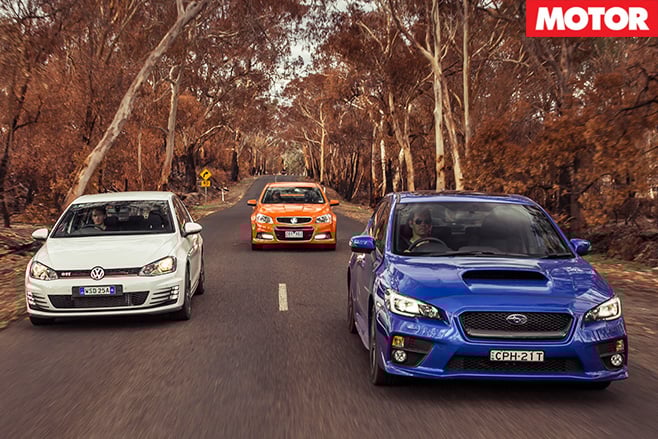
Thing is, the Rex should be a mid-five prospect for the 0-100km/h sprint, but it wants to bog its engine down on the sticky strip surface. The upshifts are slow through the notchy six-speeder’s gating, its ratios are so tightly stacked that an extra shift up to third is required to hit 100km/h and it’s tricky to find the bite point in the clutch pedal, leaving you little choice but to dump the thing off the line.
Tellingly, the terminal speeds for both cars are an identical 157km/h, despite the GTI lacking the advantages of power or all-paw traction.
The SS, meanwhile, rattles off a commanding 6.1sec to 100km/h and 14.2sec to 400m. And this is far from the quickest SS we’ve tested. The Commodore’s heft also factors into rolling acceleration, its 3.8sec 80-120km/h time just one-tenth quicker than the WRX and two-tenths up on the GTI.
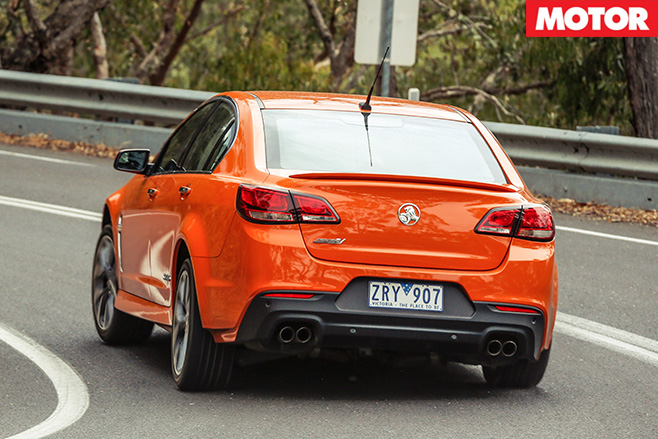
The Japanese car runs electric power steering, though it feels for all the world like a hydraulic system – honest and old-school, if a little cumbersome in low-speeds. Surprisingly, the Commodore’s steering is much lighter in weight and vaguer in feel.
Meanwhile, our GTI – which benefits from adaptive smarts in its electric set-up – transitions from light (Normal) to heaviest-of-the-pack (Sport) depending on which mode of its DCC system is selected. Frankly, the Golf’s steering is daylight ahead of its rivals: the clarity of feel, its linearity and the amount of genuine feedback amplified through the loaded-up front tyres.
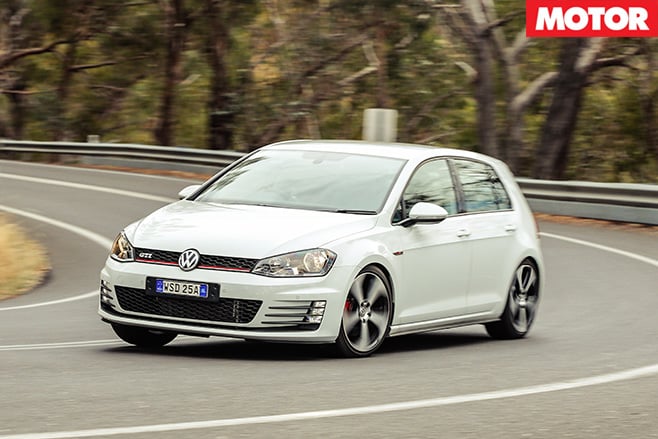
Nor does the Commodore present much in the way of front-end purchase or accuracy. It’s a big car, it demands guidance at turn-in and rolls around with the relative looseness you’d expect from a car two segments larger than its immediate rivals.
And yet it’s an absolute hoot, particularly exiting a corner under throttle. The SS really strikes a nice handling balance between its mass, its rubber footprint and the energy from its V8 heartbeat. Every squeeze of the loud pedal gets the tail cocked ever so slightly and it’s a doddle to steer the thing on the throttle while it digs in and channels its energy. On balance, it’s probably the most fun of the three… until you want to stop.
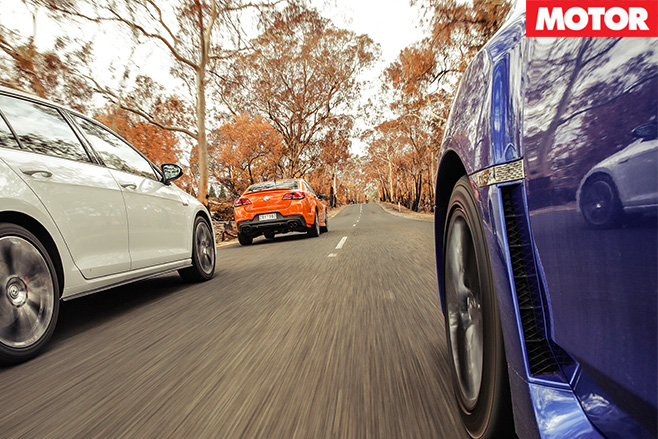
The Subaru is keener on turn-in and its shove exiting the corners palpable. Putting a decent set of rubber under the WRX has done the breed wonders, especially compared with recent forebears. This newfound accuracy in the chassis is most welcome. Balance the throttle and the Subaru shimmies around, or lift off and it will tuck its nose.
Give it stick, though, and it’s clear the tyres and suspension are doling out the talent. There’s not a lot of positive intervention from the all-paw system other than pulling the nose into power understeer and not a huge degree of proactive torque shuffling fore and aft to tug the chassis in the desired direction. The brakes, too, feel a little wooden underfoot.
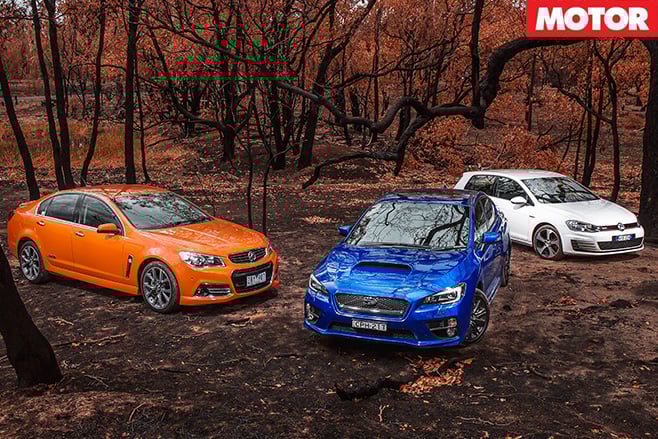
It grips up better and you can lean into it harder than either the WRX or SS and it stops pretty damn confidently. A-to-B, it’s the most engaging and satisfying driver’s car here.
Add the Golf’s pack-leading depth of quality, refinement, ride comfort and primo flair and the GTI proves you don’t have to be the quickest device on the block to be the best. And thus, the status quo remains unchanged.
| u00a0 | u00a0 | Subaru WRX | u00a0 | Commodore SS-V | u00a0 | Volkwagen Golf GTi |
| Body | u00a0 | 4-door, 5-seat sedan | u00a0 | 4-door, 5-seat sedan | u00a0 | 5-door, 5-seat hatch |
| Drive | u00a0 | all-wheel | u00a0 | rear-wheel | u00a0 | front-wheel |
| Engine | u00a0 | 1998cc flat-4, DOHC, 16v, turbo | u00a0 | 5967cc V8, OHC, 16v | u00a0 | 1984cc in-line 4, DOHC, 16v, turbo |
| Bore/Stroke | u00a0 | 86.0 x 86.0mm | u00a0 | 101.6 x 92.0mm | u00a0 | 82.5 x 92.8mm |
| Compression | u00a0 | 10.6:1 | u00a0 | 10.4:1 | u00a0 | 9.6:1 |
| Power | u00a0 | 197kW @ 5600rpm | u00a0 | 260kW @ 5700rpm | u00a0 | 162kW @ 4500-6200rpm |
| Torque | u00a0 | 350Nm @ 2400-5200rpm | u00a0 | 517Nm @ 4400rpm | u00a0 | 350Nm @ 1500-4400rpm |
| Redline/Cut | u00a0 | 6600rpm/NA | u00a0 | 6000rpm/NA | u00a0 | 6000-7200/7200rpm |
| Power-to-weight | u00a0 | 138kW/tonne | u00a0 | 148kW/tonne | u00a0 | 122kW/tonne |
| Consumption | u00a0 | 14.9L/100km (tested) | u00a0 | 18.1L/100km (tested) | u00a0 | 10.9L/100km (tested) |
| Emissions | u00a0 | 213g/km (claimed) | u00a0 | 274g/km (claimed) | u00a0 | 153g/km (claimed) |
| Transmission | u00a0 | 6-speed manual | u00a0 | 6-speed auto | u00a0 | 6-speed manual |
| Weight | u00a0 | 1424kg | u00a0 | 1754kg | u00a0 | 1324kg |
| Suspension | u00a0 | strut, coil springs, anti-roll bar (f); double-wishbone, coil springs, anti-roll bar (r) | u00a0 | struts, coil springs, anti-roll bar (f); multi links, coil springs, anti-roll bar (r) | u00a0 | A-arms, adaptive dampers, anti-roll bar (f); multi links, coil springs, adaptive dampers, anti-roll bar (r) |
| L/W/h | u00a0 | 4595/1795/1475mm | u00a0 | 4966/1898/1471mm | u00a0 | 4349/1799/1491mm |
| Wheelbase | u00a0 | 2650mm | u00a0 | 2915mm | u00a0 | 2620mm |
| Tracks | u00a0 | 1530/1540mm (f/r) | u00a0 | 1593/1608mm (f/r) | u00a0 | 1538/1516mm (f/r) |
| Steering | u00a0 | electrically-assisted rack and pinion | u00a0 | electrically-assisted rack and pinion | u00a0 | electrically-assisted rack and pinion |
| Lock-to-lock | u00a0 | 2.2 turns | u00a0 | 2.6 turns | u00a0 | 2.2 turns |
| Brakes | u00a0 | Brake data unavailable as we went to press | u00a0 | 321mm ventilated discs, 2-piston calipers (f); 324mm discs, single-piston calipers (r) | u00a0 | 312mm ventilated discs, 4-piston calipers (f); 300mm discs, single-piston calipers (r), |
| Wheels | u00a0 | 17 x 8.0-inch (f/r) | u00a0 | 19 x 8.5-inch (f/r) | u00a0 | 18 x 7.5-inch (f/r) |
| Tyres | u00a0 | 235/45 R17 Dunlop Sport Maxx RT (f/r) | u00a0 | 245/40 R19 Potenza REO50A (f/r)u00a0 | u00a0 | 225/40 R18 Bridgestone Potenza S001 (f/r) |
| Price | u00a0 | $43,990 | u00a0 | $47,690 | u00a0 | $41,490 |
| Positives | u00a0 | Old-school turbo rush; Rexu2019s harder edge has returned; base price | u00a0 | Handling balance; ride comfort; V8 thump; practicality | u00a0 | Refinement and ride; interior quality; engine flexibility |
| Negatives | u00a0 | Notchy gearshift; inconsistent power delivery; ride quality | u00a0 | Whereu2019s the engine noise? Brakes not up to task; thirsty | u00a0 | Traction difficulties; canu2019t switch ESP off; lacks a bit of soul |
FORMULA 1: Rosberg trumps Hamilton in Mexico
WITH the 2015 title won and Lewis Hamilton still in celebratory mode, the remaining races in the Formula One world championship would never match the tension or importance of the earlier races. But in Mexico, Nico Rosberg was determinedly on a mission to show the world – and himself – that he could beat his world champion team-mate.
For the first time in 23 years, F1 returned to the Autodromo Hermanos Rodriguez circuit in Mexico, a venue with a chequered history of drama and memories and now back as an F1 venue following circuit re-profiling by Hermann Tilke and new pit and paddock facilities.
Three long straights, broken up by a demanding esses section, gave the bumpy, skatey track its specific challenges. The thin air – 23 percent less dense at a lofty 2285 metres – also ensured that engines, aerodynamics and drivers would be sorely tested. Speeds around 365km/h were not uncommon.
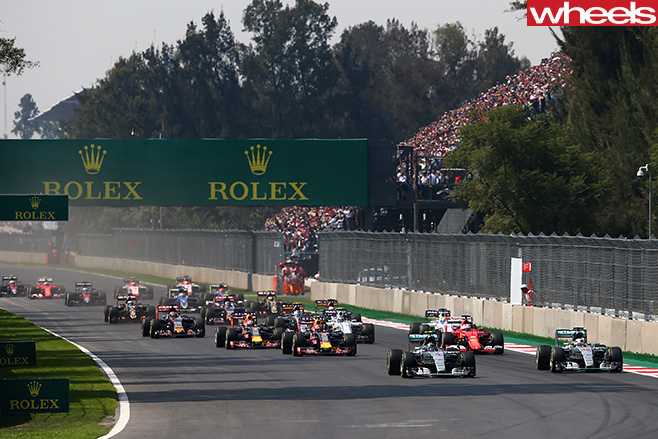
Hamilton thought the revised circuit more like a go-kart track in the slow areas. “It’s crazy how slippery it is. Because we’re so high up in terms of altitude, there’s even less grip than in Monza, so the car was just sliding around.”
And all were concerned about their brakes.
The grid assumed a familiar look at the front with another Mercedes shutout. Three ex world champions started at the rear – Kimi Raikkonen, Fernando Alonso and Jenson Button, the latter getting a ridiculous 70-grid spot penalty.
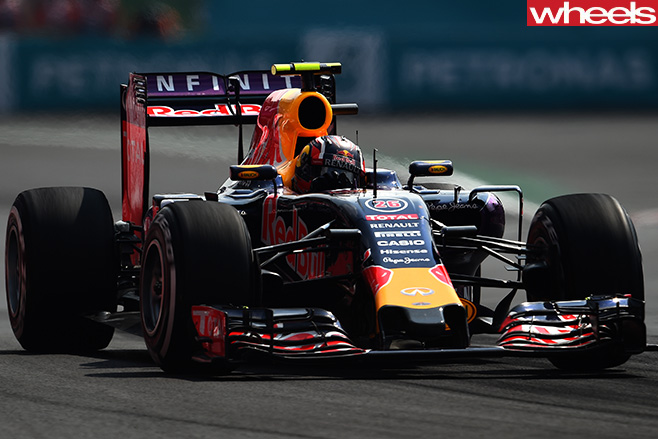
No-one was sent to the Finn bin either when Valtteri Bottas and Raikkonen thumped together in the esses on lap 23, with the impact breaking the Ferrari’s rear suspension.
Vettel’s wretched race ended with a crash, bringing out a safety car which helped the possibilities of rubber-hungry Williams, struggling on tyres.
The bunching put Hamilton back on Rosberg’s tail followed by Daniil Kvyat, Bottas, Ricciardo and Felipe Massa. It was a 14 lap sprint to the flag.
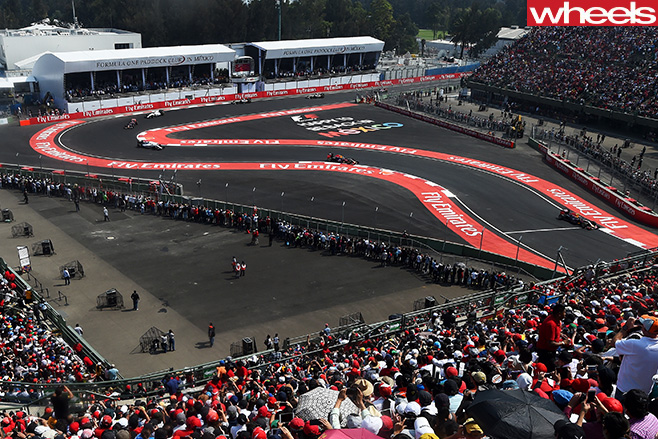
The Red Bull pair Kvyat and Ricciardo held fourth and fifth, still hoping and waiting for a firm engine deal for 2016.
It wasn’t a classic race but try telling that to the satisfied Rosberg, who beat Hamilton on equal terms, and the joyous Mexican masses watching.
WEC: Webber and mates take 6 Hours of Shanghai
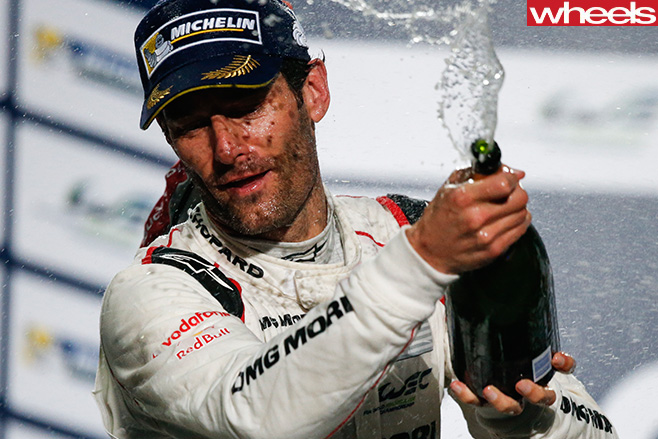
It was an edgy, dramatic and see-sawing fight between Porsche and Audi – VW Group stablemates but bitter rivals in the WEC – in a race held in murky, largely hostile weather.
Porsche prevailed, scoring another one-two with its 1000-plus horsepower 919 Hybrids, the win taken by Webber, Brendon Hartley and Timo Bernhard ahead of the sister car Romain Dumas, Neel Jani and Marc Lieb.
On Saturday, Hartley and Webber claimed pole for the #17 Porsche crew, ahead of the other 919, the Audis and Toyotas.
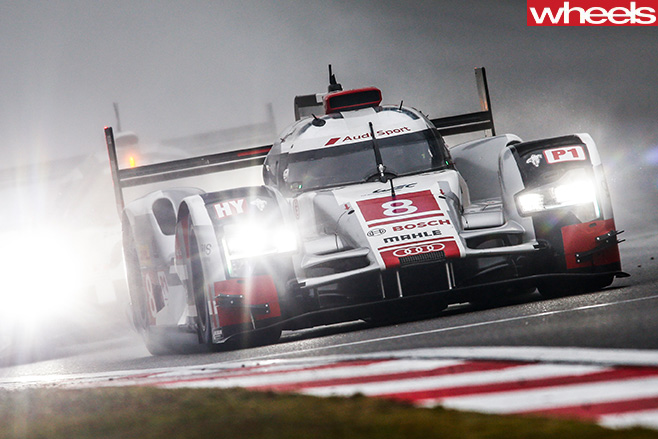
Over the ensuring stint, Lieb fought back to second behind the impressive Hartley. But in awful conditions the manic third hour fell to the Audis with the Webber #17 car back in fourth, its dry-weather dominance neutered by the heavy rain.
As the track dried though, the more powerful Porsches rebounded. Bernhard brought #17 back to the front before handing over to Webber for the two-hour gallop to the finish.
Webber went on to another win for #17, stretching that crew’s lead in the drivers’ title to 12 points. The Audis took third and fourth, the result securing the manufacturers’ championship for Porsche.
Can Webber win his first championship in a long and notable career? We’ll know in Bahrain.
GT3: Fierce rivals Lowndes and Tander join forces for the Bathurst 12 Hour
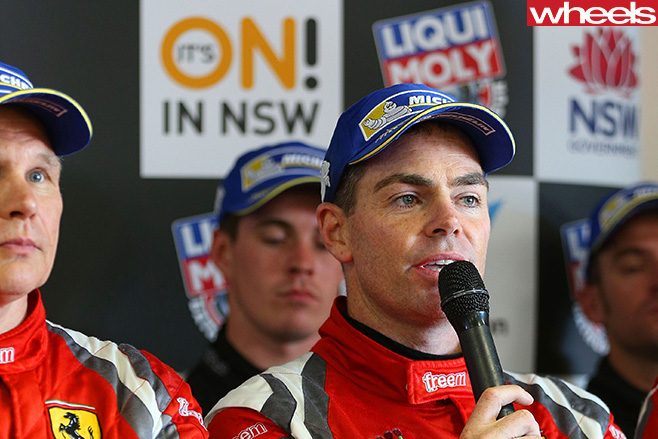
Lowndes, a great honorary advocate of the annual sports-car enduro, won the 12 Hour in 2014, when he teamed with John Bowe, Mika Salo and Peter Edwards in a Ferrari.
The return to Audi for Australia’s most popular race driver will be, for him, like pulling on a comfortable pair of runners. He contested the 12-hour with Audi between 2011 and 2013, finishing second the first year after having earlier qualified on pole. He failed to finish the race the following two years before a Ferrari 458 brought him victory.
Lowndes only missed the race this year due to the obduracy of V8 Supercars Australia, which quite deliberately scheduled a test day at Sydney Motorsport Park to block drivers from racing in the rival category. V8SA has since bought the promotional rights to the Bathurst 12 Hour – there will be no date clash next year.
The versatile Tander also has a great record in Mountain enduros, winning the 2002 Bathurst 24-Hour race and finishing second in 2003, along with three victories in the Bathurst 1000.
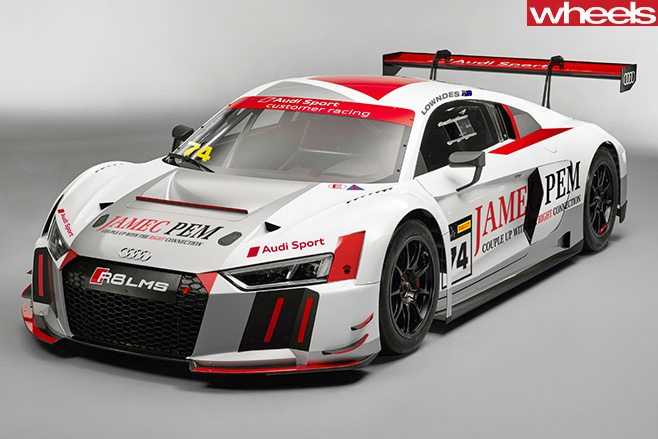
“Fairly reasonable machinery!” Tander suggested in his droll way.
Lowndes and Tander have been rivals for their long careers and this will be the first time they’ve shared a car.
Both are looking forward to that experience in a race they sense they can win.
The international part of the two-car Jamec-Pem assault will be threatening too.
Its second R8 LMS will be steered by two-time Bathurst 12-Hour winner Christopher Mies, fellow German ace Christopher Haase and Italian young gun Marco Mapelli.
V8 SUPERCARS: V8 boss has support for rugby league gig
RUMOURS have been churning in local motorsport circles that V8 Supercars’ CEO James Warburton has been canvassing a move to a senior administrative position in a major local sport.
The recent departure of NRL chief Dave Smith has accelerated the speculation.
Yesterday the rumour went mainstream with an item in Danny Weidler’s well-read Sun-Herald column, which suggested Warburton’s claims on the plum NRL job had support. “The way he runs V8s has attracted the attention of plenty,” wrote Weidler.
Approached for a remark on Weidler’s story, Warburton told Wheels, “I’ll make the same comment I made when the rumour first came around – it’s pure speculation, I am loving what I am doing at V8 Supercars and committed to the sport.”
From a television background, Warburton has done a solid job of steering the V8s through trying times, including penning a fresh TV deal and introducing more engine choices to the category. But he does appear to be afflicted by the same numeracy issues as a high-profile predecessor, on the touchy topic of race attendances and international TV figures.
MOTOGP: Rossi feels the criticism, but was he to blame?
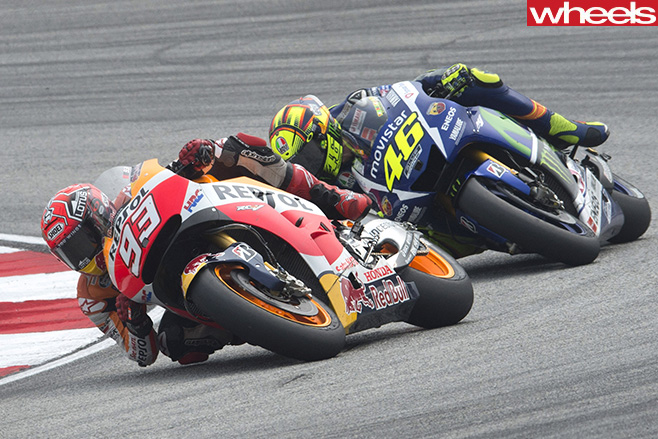
Rossi was duly given a penalty that – unless an appeal intervenes – will result in his starting the 2015 title decider at Valencia from the rear of the grid.
Certainly the original race footage from Sepang on that Sunday afternoon didn’t look good for Rossi. He had appeared to become unsettled and frustrated at the Spaniard’s aggravating overtaking moves, which hindered any pursuit of title rival Jorge Lorenzo ahead.
But further footage from different camera angles raise the question whether the early judgement came too quickly.
Before the racing began, Rossi had accused Marquez of helping his countryman Lorenzo in the fight for the championship. Insults flew.
Marquez and Honda were adamant that Rossi had kicked the Spaniard’s bike, sending him to the deck.
Rossi insisted that he didn’t kick Marquez, that his leg only moved after the contact.
Officials said the TV footage was inconclusive on the kick, but applied a penalty on the basis that Rossi’s actions in deliberately running Marquez wide had led to the crash.
Ignoring the fact that Rossi is his Yamaha team-mate, Lorenzo joined the hue and cry from those who wanted a harsher sanction – including Honda’s sponsor Repsol.
Of course, Rossi raced for Repsol Honda for two seasons in the early noughties, winning the title both times.
Rossi even hinted that perhaps he might not bother to turn up at Valencia, where coming from the back of the grid is a very tall order when Lorenzo, seven points behind in the title chase, will almost certainly start on the first or second row.
Rossi has appealed against the “unfair” penalty which he believes has ruined his chances of landing a 10th world title.
“We need to see if I will go [to the decider],” Rossi said to Italian media. “The sanction is almost definitive: to start last in Valencia equals not having any chance of making it.
“This way the championship is distorted. I gave everything to win this title.
“Losing it on track is one thing, this way hurts a lot more.”
But Rossi conceded it had not been smart to make his inflammatory comments about Marquez during a press conference before the Sepang contretemps.
“Maybe it was a mistake but I couldn’t keep quiet,” added Rossi. “When someone wants to screw you, you have to say so.”
The third generation Skoda Octavia line-up is now complete with the arrival of the RS.
The lowdown? It’s cheaper, quicker and, despite styling tweaks, still as plain looking as an Excel spreadsheet.
The new RS comes in a petrol and diesel variant. Both are direct-injected 2.0-litre turbocharged fours with the 162TSI petrol making 162kW and 350Nm, while the 135TDI diesel produces, you guessed it, 135kW and 380Nm.
You can choose between a six-speed manual and six-speed DSG but the diesel only comes matched to the automatic. Sedan prices start at $36,490 for the manual 162TSI and $38,790 for the DSG. The 135TDI is $39,790. The wagons cost an extra $1350.
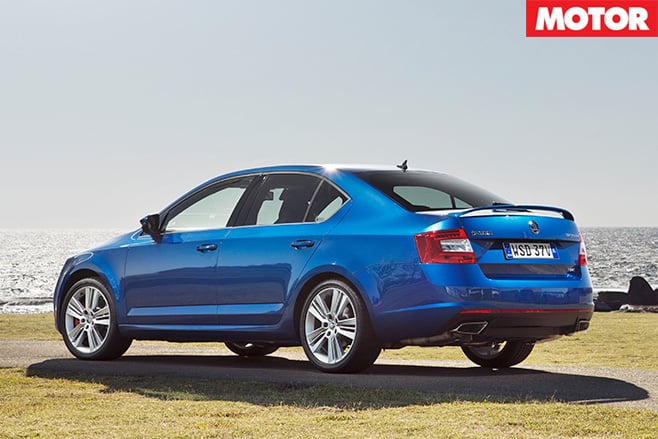
That shared technology is the RS’s strongest selling point. To the uninformed it’s a pricey medium-sized Euro car for Holden SV6 money, but to those in the know, it’s a hot hatch in a Euro trench coat at a discount rate. The MQB platform the RS shares with the GTI is brilliantly balanced, while under the bonnet both cars use the same engines. Yes, the RS is almost 100kg heavier and, at 4685mm, it’s 336mm longer than the GTI.
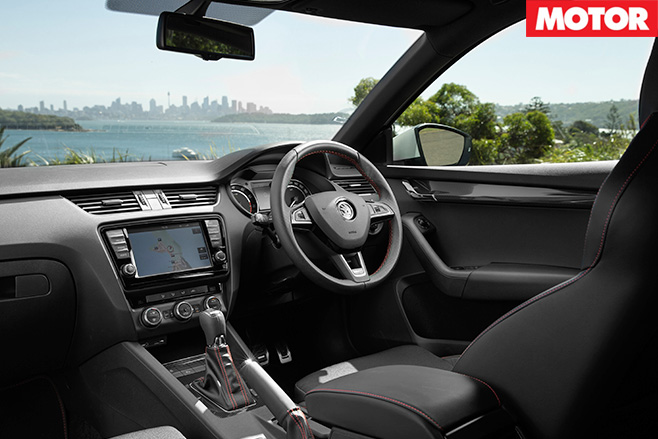
Even more impressive than the straight-line shove is the RS’s dynamics. We sampled the pure shifting fun of the manual petrol – with a dollop of torque steer; the diesel wagon, which seemed heavy over the front; and the pick of the bunch, the petrol sedan with DSG.
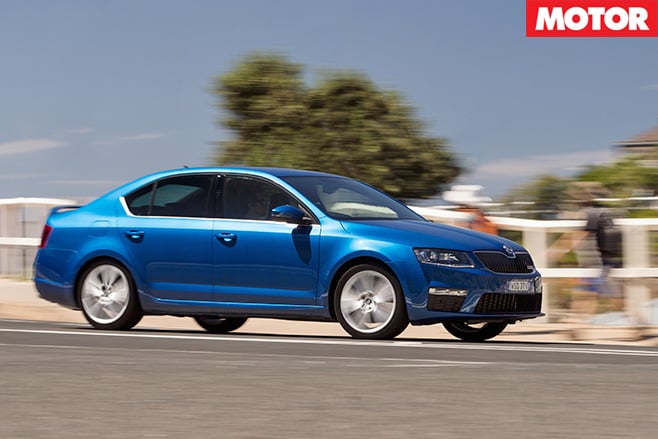
All very Golf GTI-like, as expected. Even the DSG performed beautifully, although there was no ‘blarp’ on the upshift like you get in the GTI.
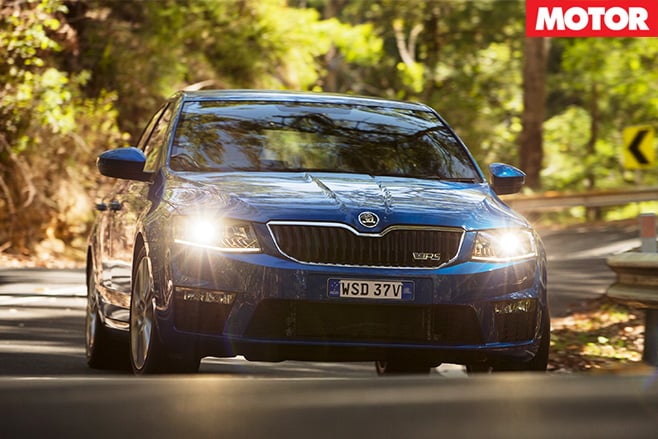
3.5/5
Specs Engine: 1984cc inline-4, DOHC, 16v, turbo Power: 162kW @ 6200rpm Torque: 350Nm @ 1500-4400rpm 0-100 km/h: 6.8sec (claimed) Weight: 1417kg Price: $38,790 (sedan, DSG)
Toyota brings us a seven-seat, off-road capable wagon that’s based on the Hilux dual-cab ute. Is the Fortuner really an enticing alternative to the Kluger and Prado?
WHAT IS IT? A Toyota Hilux with a wagon body and seven seats. The Fortuner becomes Toyota’s seventh SUV and offers an important diesel and hardy off-road alternative to the more premium, and petrol only, Kluger.
WHY ARE WE TESTING IT? Fortuner offers a new entry point for buyers looking for a large Toyota SUV but who can’t quite stretch to the more expensive Prado. It promises to be a sales juggernaut, with Toyota predicting it will sell every vehicle it can get its hands on.
MAIN RIVALS Ford Everest, Holden Colorado 7, Isuzu MU-X, Mitsubishi Challenger
VERDICT More affordable than Kluger and hugely capable off road, the Toyota Fortuner strikes a nice balance between genuine ruggedness and everyday comfort. Highlights include one of the quietest and most refined cabins in its class, but it’s hardly the last word in ride quality or diesel performance.
PLUS: Genuine off-road ability; interior space, comfort and refinement; cool black steel wheels MINUS: Better off-road than on; vague steering; choppy ride; sluggish six-speed auto; lacks interior equipment of rivals
THE WHEELS REVIEW IF EVER a recipe stunk of success, this is it. Take one of Australia’s most popular vehicles, the Toyota Hilux, bolt on a more comfortable and refined seven-seat SUV body that’s dripping with a huge dose of Aussie engineering knowhow, and watch it sell like hot cakes.
And so it is with the Toyota Fortuner, a ute-based SUV that Toyota predicts will be so popular it will sell every one of the 6000 it can get its hands on next year.
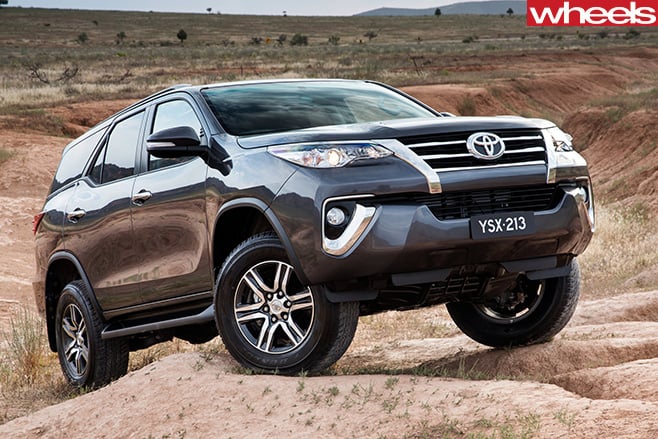
It shares the same body-on-frame construction, front suspension, steering hardware and rugged under-body protection, as well as the Hilux’s newly developed 2.8-litre 1GD common rail turbo diesel. Two transmissions are nicked from the Hilux as well; a new six-speed automatic and a six-speed manual, with the latter providing an extra point of difference to auto-only Kluger.
So there’s plenty of workhorse DNA underneath, but Toyota has worked hard to cloak the Fortuner’s tradie roots with passenger car comfort and refinement.
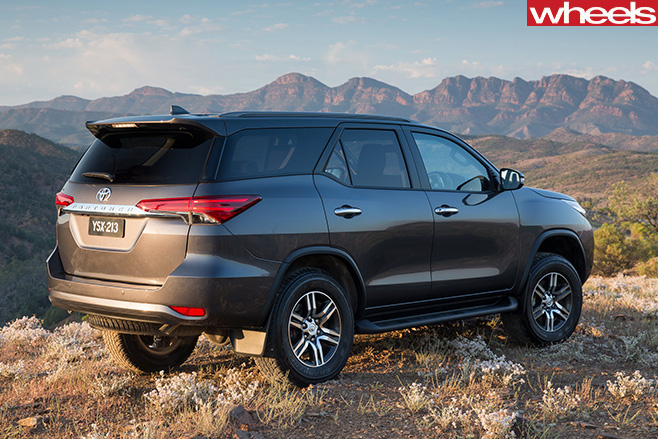
Three grades are offered – GX, GXL and range-topping Crusade – with Toyota tipping 55 percent of buyers to opt for the entry-spec $47,990 GX (auto adds $2000).
Stepping up to the $52,990 mid-spec GXL brings halogen headlights, 17-inch alloys (GX models ride on super cool, black steel 17s), sports front seats, keyless entry and rear parking sensors. If luxury’s your thing, the $59,990 Crusade has 18-inch alloys, LED headlights, sat-nav, leather trim and a power tailgate.
So the Fortuner is a balancing act between everyday suburban comfort and genuine off-road ruggedness, and for the most part it pulls it off.
The spacious interior is quiet and blends soft touch materials with hard, durable plastics. Third-row access is a breeze thanks to one-touch fold and tumble seats. The rearmost pews are no prison sentence either with enough space for occasional adult use, though headroom is compromised.
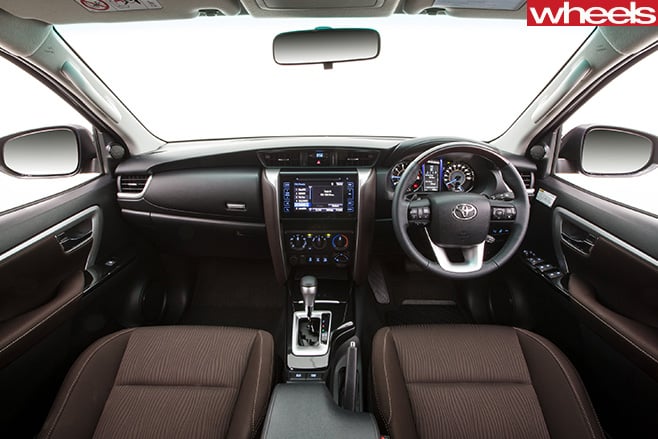
Throwing the Fortuner at a challenging off-road course at the national launch only crystallised the depth of its Aussie-tuned ability, where impressive wheel articulation and approach and departure angles sees it easily master obstacles.
Where the Fortuner is less impressive is on the black stuff. The ride is firm and overly busy and a stiff rear end skips and jiggles across lumpy surfaces. Vague steering is another letdown and feels disconnected from the front wheels at freeway speeds. The new 130kW/450Nm diesel is no tower of power either and while whisper quiet while cruising, can sound gruff under load. Its claimed 8.6L/100km fuel use claim in auto trim (7.6 for the manual) is hardly segment leading.
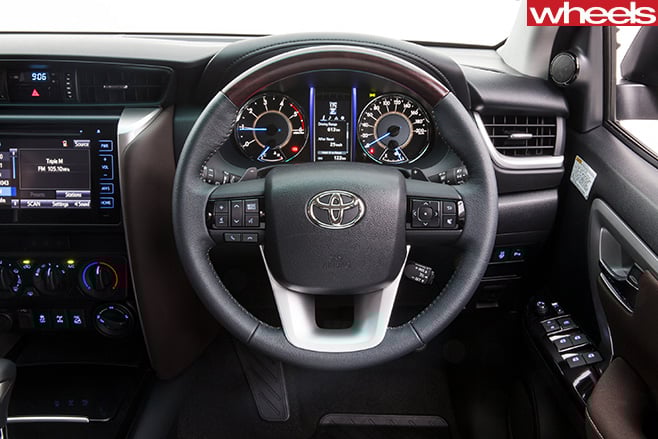
So the recipe isn’t perfect, with the Fortuner a family-sized SUV that feels more comfortable off-road than on it. Will the less-than-perfect road manners discourage potential buyers? With Toyota predicting 50 percent of the Fortuner’s life to be spent off-road, we doubt it.
SPECS Model: Toyota Fortuner GXL Engine: 2755cc 4cyl, dohc, 16v, turbo diesel Max power: 130kW @ 3400rpm Max torque: 450Nm @ 1600-2400rpm Transmission: 6-speed automatic Weight: 2110kg 0-100km/h: N/A Fuel economy: 8.6L/100km (claimed) Price: $54,990 On sale: Now
If you believe the advertising spin, the new 2-Series Coupe is ‘BMW to the power of 2’.
However, having spent three days in Tasmania fanging the M235i on road and track, we reckon BMW could be selling its hot new coupe a bit short. Until the new M3/M4 twins arrive in Australia later this year, the M235i might just be the best car Munich currently makes.
A bold claim? Perhaps, but what this modern day 2002 Turbo lacks in outright punch compared to the full-fat M models, it more than makes up for in accessibility and driver enjoyment.
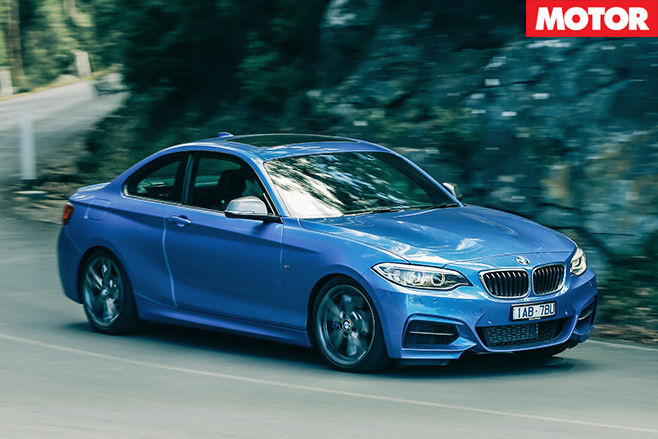
BMW says the target for these M Performance products is “30 per cent of a proper M car”. Based on our experience thus far, we’d say the engineers involved are rather over-delivering on their brief.
But before we get into the nitty gritty of what the M235i is like to drive, let’s deal with the name. BMW’s current naming system is a bit of a minefield, but the 2-Series essentially replaces the 1 Series Coupe, a car that’s found over 5000 homes in Australia since its introduction in 2008, the hi-po 135i taking the lion’s share of sales.
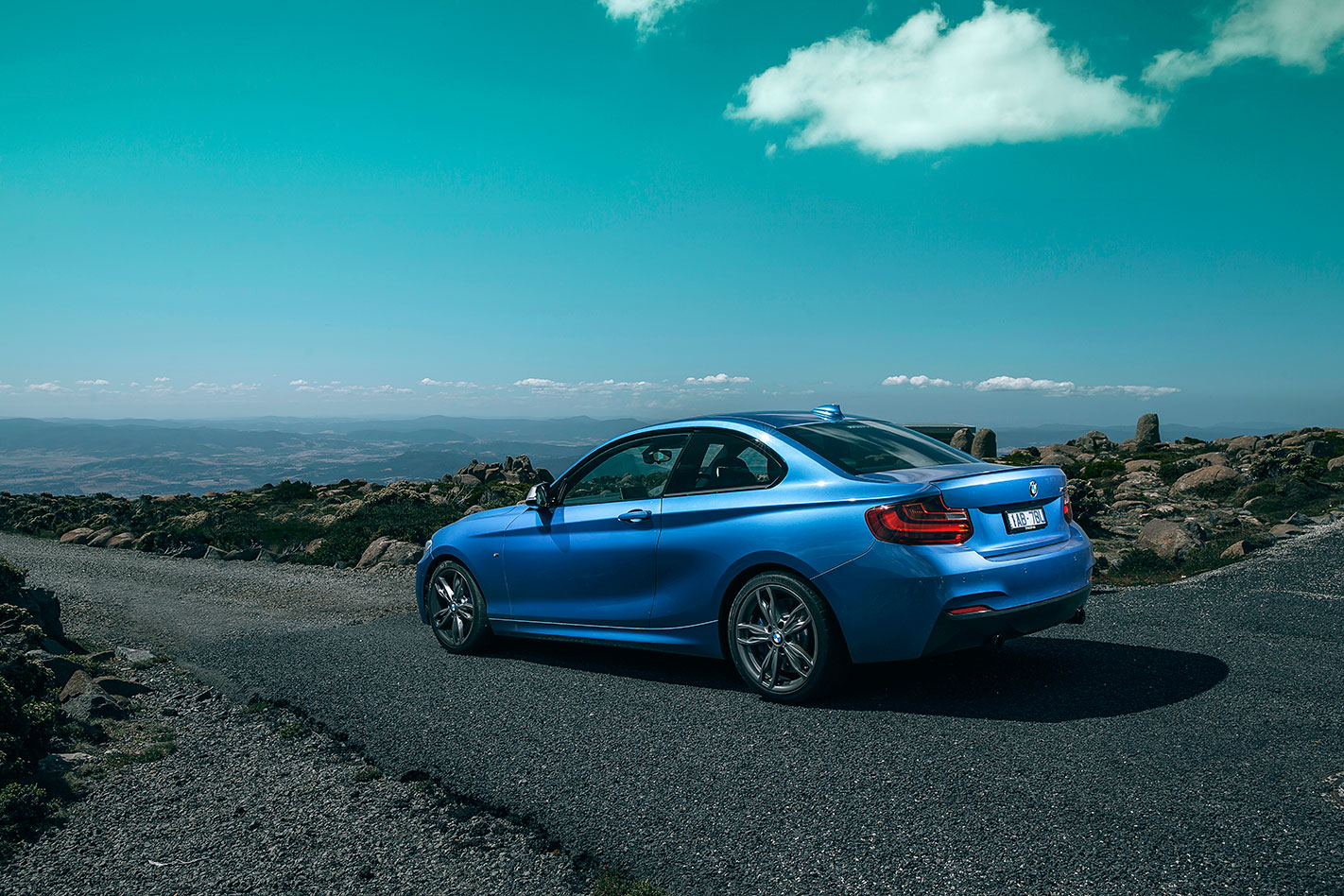
That said, despite wider tracks (41mm front, 43mm rear), it really needs the optional 19s to fill the arches and the overall shape, while attractive, is perhaps a little bland.
There’s nothing bland about the way it goes, though. Outputs of 240kW/450Nm feel, if anything, conservative, judging by the way the M235i hauls itself down the road. Claimed 0-100km/h is 4.8sec and from the seat of the pants there’s every chance the quarter mile time will dip into the 12s.
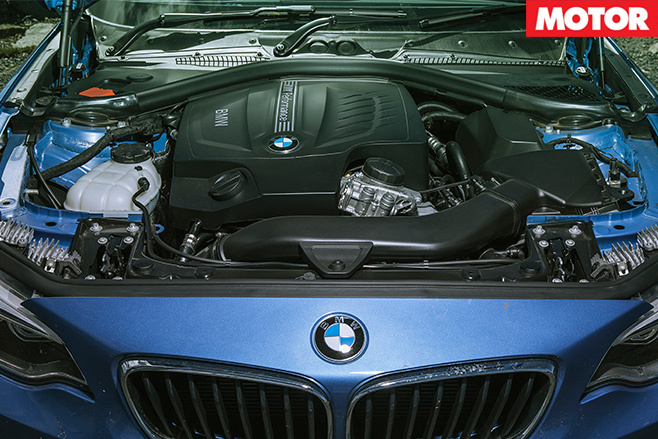
When combined with the standard eight-speed ZF automatic, the engine’s flexibility forces a complete rethink of which gear is appropriate for any specific corner. Tackling the tight, technical confines of Baskerville Raceway, fourth gear proves ideal for corners that would traditionally be borderline between second and third and even then, such is the engine’s urge, wheelspin and power oversteer are always available on request.
The gearbox itself is superb, smooth and swift in its responses, and having eight ratios to choose from means there’s a gear for every conceivable type of corner. But with such a wide power band, we suspect the longer gearing of the (no cost) optional six-speed manual would deliver a less frenetic, more rewarding drive.
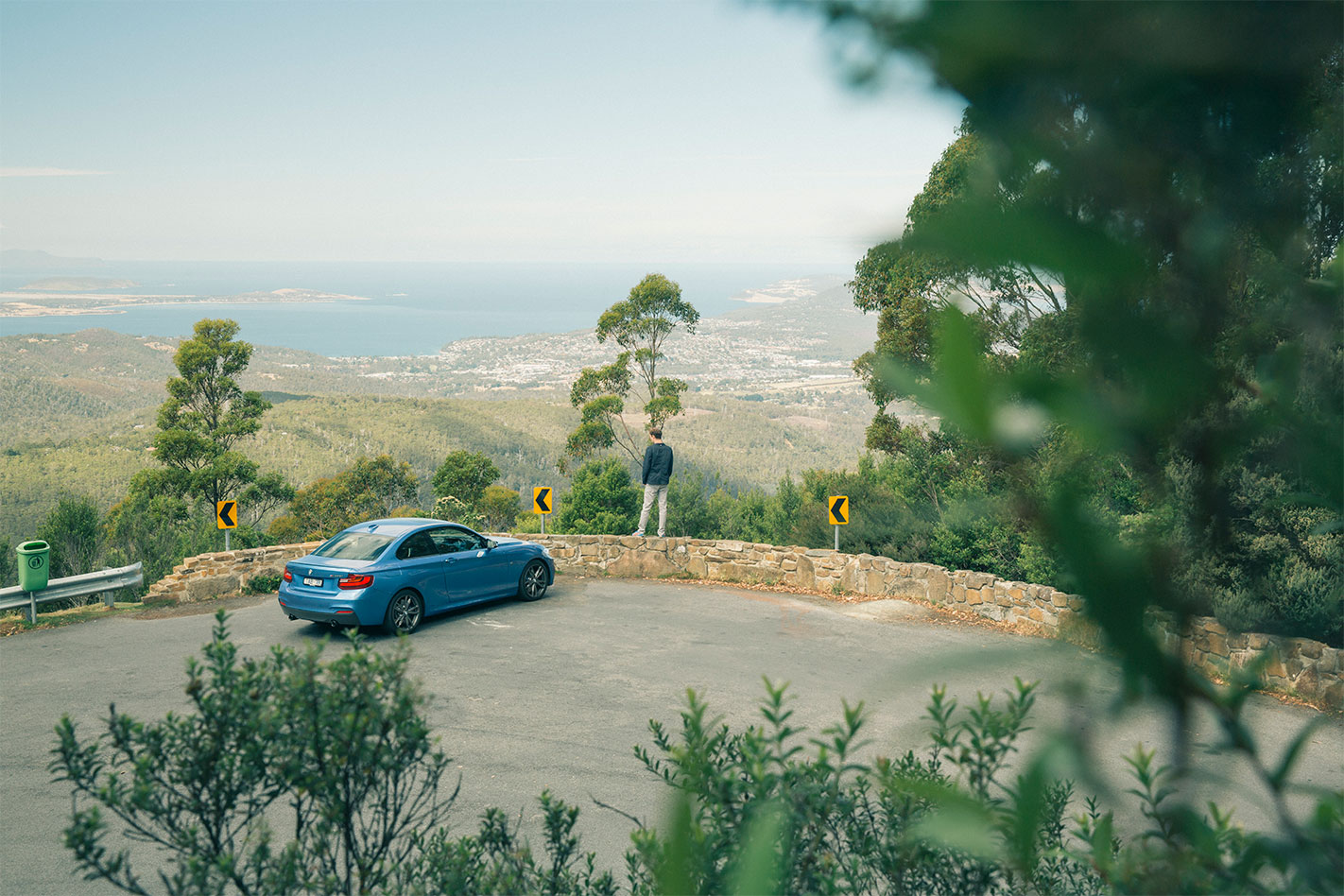
What can be confirmed is, for serious drivers, optioning the M Performance limited-slip differential is a must. Though it carries a seriously hefty price tag of “$7000+” (pricing to be confirmed), it has the potential to launch the M235i from very good into the pantheon of greats.
It’s not simply about making the car do enormous drifts (though that certainly wouldn’t hurt), it’s about giving it the traction to make the most of the engine’s power and giving it predictability when you approach and then step over the limit. Perversely, it’s less of an issue on track, the higher speeds and greater lateral load allowing the car to move around more progressively.
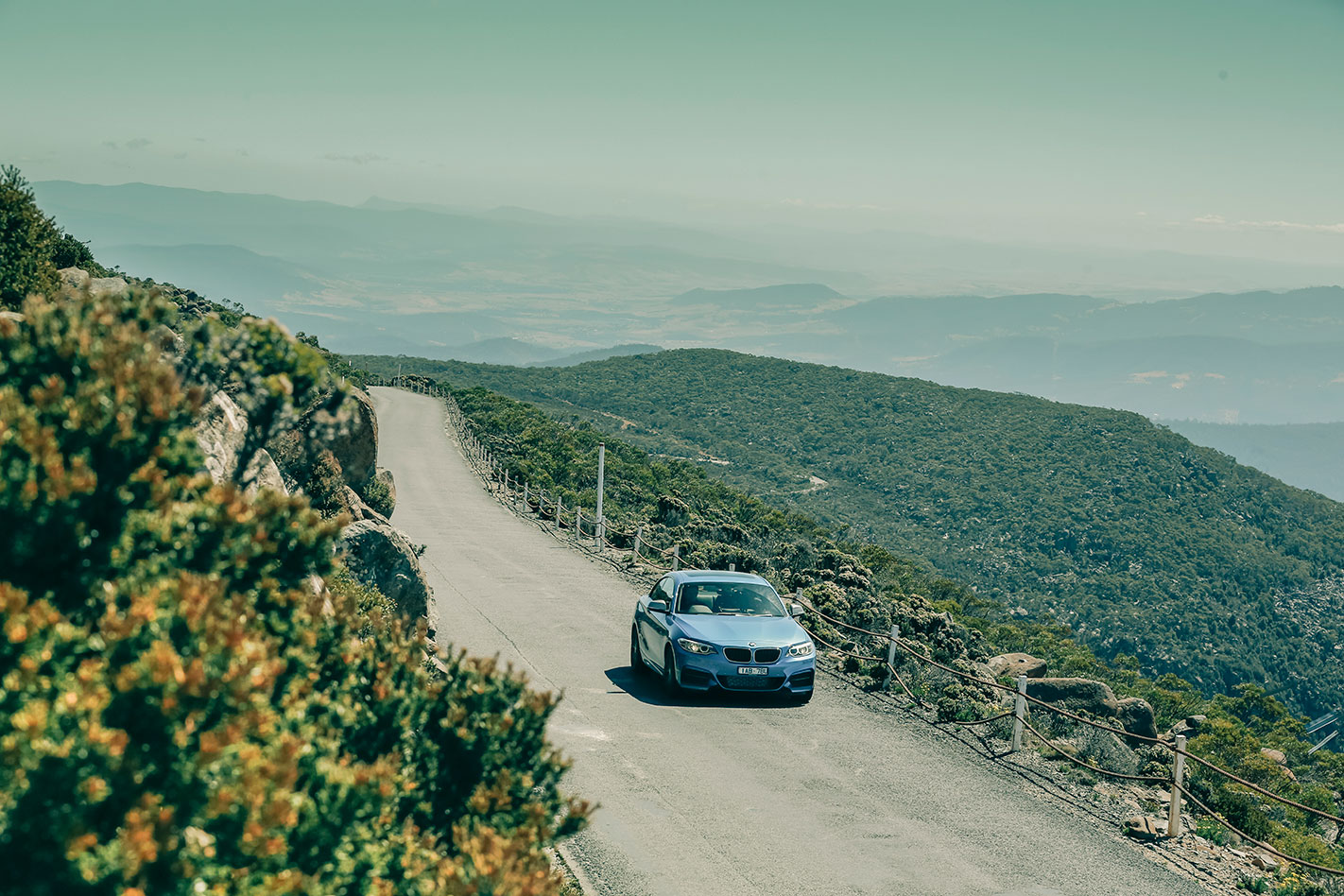
Like the Golf GTI, the M235i has a system that brakes the inside spinning wheel to transfer drive to the outer tyre and, like the Golf GTI, it doesn’t work. We’ll report back the moment we try an LSD-equipped M235i.
Whinge over, we can get onto the good stuff, of which there’s plenty. As mentioned, the engine is savage, with great response and a howling soundtrack (though it does drone a bit when cruising).
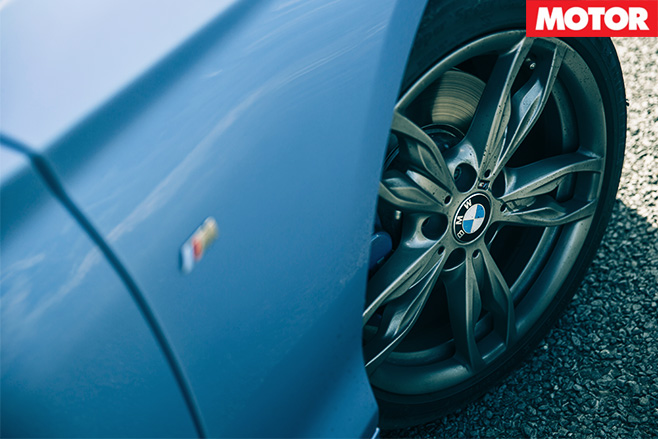
Adaptive dampers are a welcome standard feature on the M235i, allowing the driver to select from Comfort, Sports and Sports+ modes for the suspension as well as the throttle and steering. Even more welcome would be the ability to individually select each parameter (eg, Sports throttle with Comfort suspension), but that luxury is restricted to fully fledged M cars for the moment.
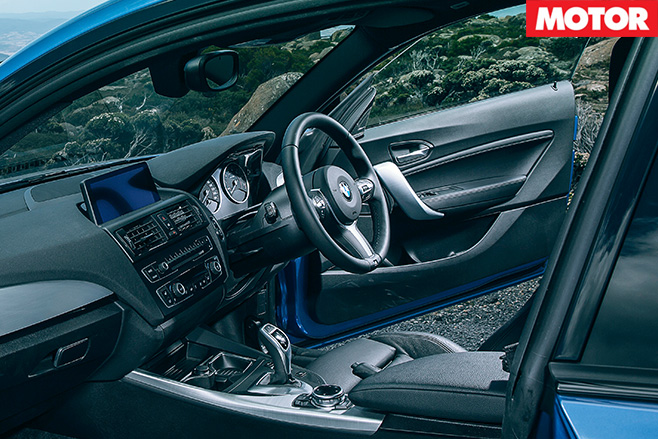
There’s not a whole lot of feel, but you never have issues placing the car where you want it and, thanks to a variable ratio rack, there’s just 2.1 turns lock-to-lock.
Where things get complicated for the M235i is when it comes to pricing. For some, the $15,000 premium over the more-or-less mechanically identical M135i hatch will be madness; for others, it’ll be a small price to pay to look like you’re driving a sports car not a shopping cart. Where it gets tricky is that $79,990 is really just the beginning.
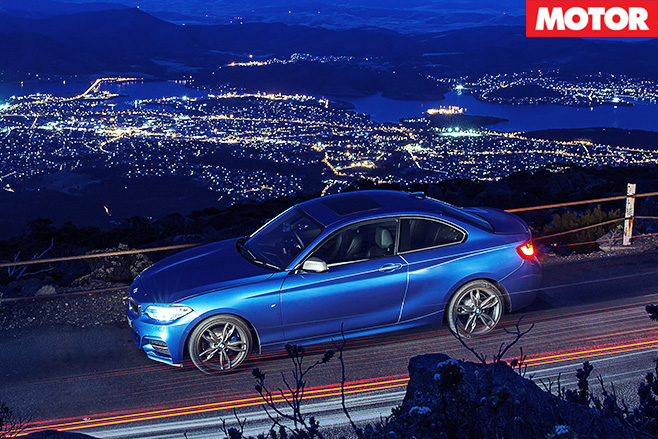
On the other hand, given it’ll match a V8 M3 in a straight line and probably give it a hurry up around a track, too, perhaps that price tag isn’t so steep after all.
BMW’s been making small, agile, rear-drive coupes for over 50 years, and when you drive the M235i you can tell it’s had plenty of practice. While it’s not perfect, the M235i proves some folk inside BMW still know how to make a car that delivers on its core values of driving excellence.
Specs Body: 2-door, 4-seat coupe Drive: rear-wheel Engine: 2979cc inline-6, DOHC, 24V, turbocharger Bore/Stroke: 89.6 X 84.0mm Compression: 10.2:1 Power: 240kW @ 5800-6000rpm Torque: 450Nm @ 1300-4500rpm Power/Weight: 163kW/tonne Consumption: 7.6L/100km (claimed) Emissions: 176g/km (claimed) Transmission: 8-speed auto Weight: 1470kg Suspension: A-Arms, struts, adaptive dampers, anti-roll bar (f); multi-links, coil springs, adaptive dampers, anti-roll bar (r) L/W/H: 4454/1774/1408mm Wheelbase: 2690mm Tracks: 1516/1532mm Steering: electrically-assisted rack and pinion Brakes: 340mm ventilated discs, 4-piston calipers (F); 345mm ventilated discs, 2-piston calipers (R) Wheels: 18 X 7.5-inch (f); 18 X 8.0-inch (r) Tyres: 225/40 ZR18 88Y (f); 245/35 ZR18 92 Y (r) Michelin Pilot Super Sports Price: $79,990 Price as tested: $91,315* *Advanced Parking Package $1300; Visibility Package $1560; Comfort Package $3120; Sunroof $2600; DAB radio $500; Harmon Kardon sound system $850; Metallic Paint $1485 Positives: Storming engine, slick auto, handling balance Negatives: Traction issues; not cheap
The next generation R36 Nissan GT-R is not the car that Mr GT-R, former chief engineer Kazutoshi Mizuno, would build.
The outspoken race engineer, who reported directly to Carlos Ghosn for over a decade, was a stickler for his chosen philosophy – to create a multi-purpose supercar that anyone could drive safely at half the cost of European rivals.
That philosophy has been hurled out the proverbial window. Nissan wants to utilise its absolute max potential and create a hypercar to rival the likes of McLaren’s P1 or Porsche’s 918 Spyder. It doesn’t want a vanilla-flavoured coupe anymore. It wants double chocolate with extra cocoa.
To achieve that goal, the company is using everything in its parts bin, both racing- and road-going.
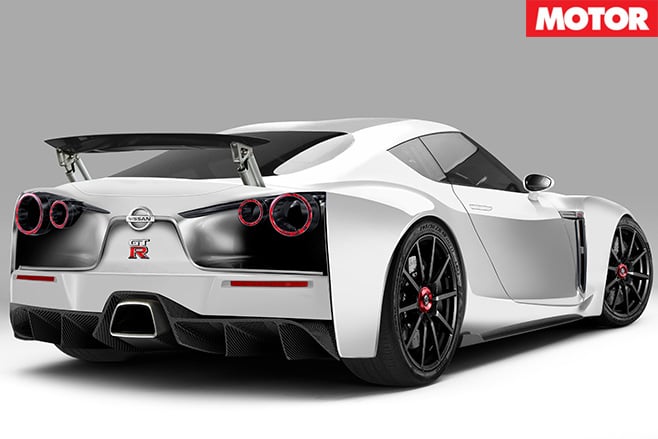
The new two-door will look a lot more stylish than the current edgy Transformer-ish GT-R, will lose around 250kg, corner like a race car, pack a new hybrid powertrain with over 578kW, and land in showrooms with a sticker price north of $200,000. Proper supercar territory.
According to a source close to Nissan, the car’s significant weight loss, which will result in a 1500kg weight figure, will come about through extensive use of carbonfibre body parts and a reconfiguration of the interior layout minus the two rear seats.
We are hearing that high carbonfibre production costs in Japan mean these lightweight parts will most likely be manufactured in the United Kingdom. Given it will be a low volume model, Nissan isn’t worried about shipping costs of getting such parts to Japan.
One thing the company does care about are the lines on the R36, which will evolve from the current car’s styling. We are told the new GT-R will not only employ a full Le Mans LMP-spec carbonfibre cowling, but incorporate hints from the Nissan Concept 2020 Vision Gran Turismo, unveiled at the
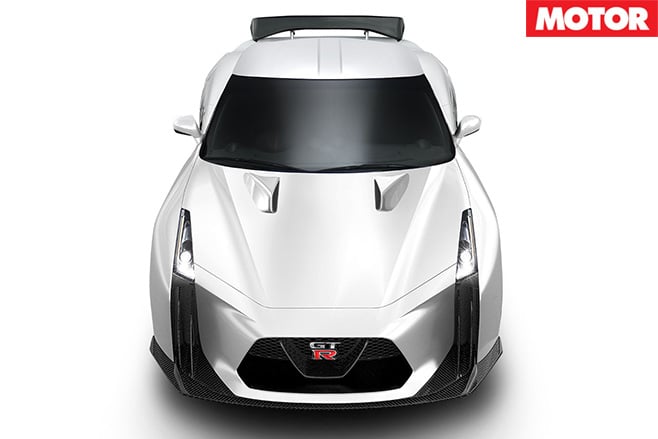
Nissan will enter a race version of this hybrid hypercar in the 2015 Le Mans 24 Hour. And much of the technology employed in the R36 will be a combination of technology from the current R35 and the GT-R LM Nismo.
In the same way Nissan has been using ‘pure drive’ to label its most efficient vehicles, the company will employ the ‘R Hybrid’ moniker for the high performance sports hybrid and others it creates.
Nissan is happy with the power delivery of its iconic twin-turbo 3.8-litre V6, transaxle layout and all-wheel drive powertrain, so that will remain. What’s different is the electric motor that will be bolted on just aft of the engine. Nissan wants to employ a hybrid system for one reason: to boost power. It wants maximum power hovering around 578kW and to get there, the GT-R needs a hybrid unit.
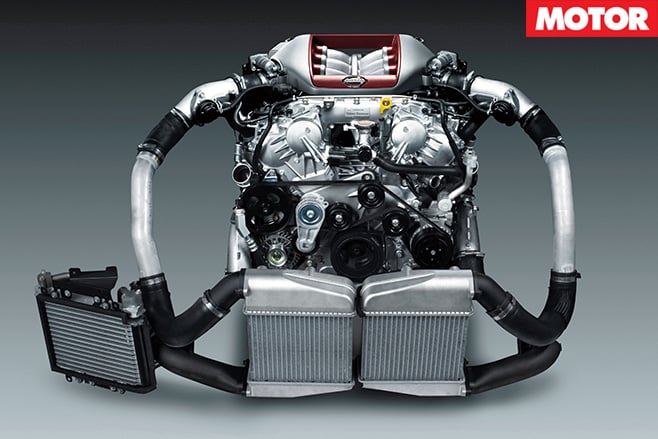
Adding an electric motor will boost maximum torque to around 1000Nm, requiring the total redesign of the transmission, which, by the way, will be eight-speed. This will give engineers a chance to rethink the current car’s gearbox.
One irritation plaguing engineers is the efficient cooling of batteries used in the new hybrid system.
This is where the Le Mans experiment should pay off as engineers find ways to deal with the huge amounts of regenerative brake energy and heat issues created under heavy braking, and thenthe sizable energy required when accelerating hard.
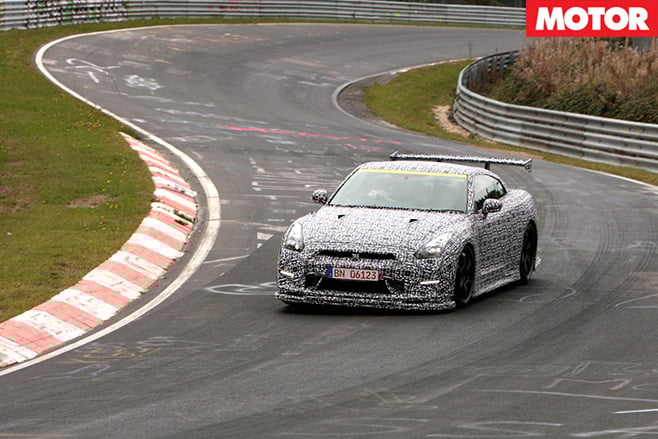
As our insider pointed out, “that is why the styling of the new GT-R will have to be so radically different. It’ll have to be penned to enable much more efficient cooling for the hybrid system as well as more efficient aerodynamics.” That’s where the company’s collaboration with Williams comes in handy.
While the F1 team is not adept at producing road cars, it does have state-of-the-art wind tunnel facilities to design the very best aeroparts (the outfit was consulted to develop the Nismo GT-R’s aero package) and it can offer development help for next-generation hybrid systems currently being used in F1.
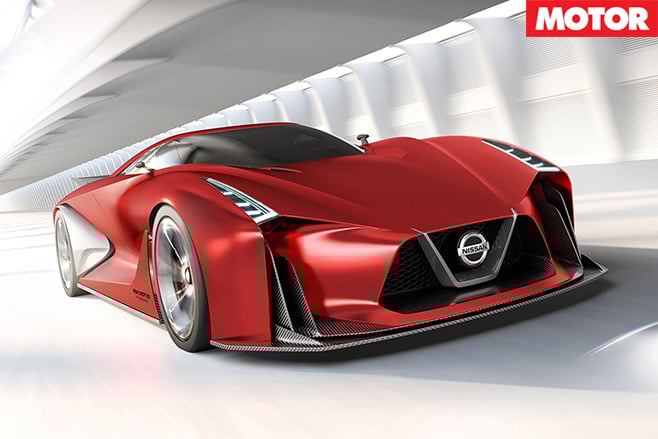
Our source also says that the VR37DETT engine being considered by Infiniti for a Porsche Panerama rival will not be used in the next GT-R.
All active
Nismo’s current ties with Williams F1 could see the UK firm have a significant influence on aerodynamics. A carbon adjustable wing with DRS-style activation could feature. This year’s Nismo GT-R Le Mans will debut solid hints to the production version.
New form
GT-R to become a strict two-seater in a bid to shrink dimensions and save weight. Target is an ambitious 1500kg, despite the added heft of various hybrid systems.
Gear solid
Nissan’s current drivetrain layout (front mounted V6, rear transaxle, all-wheel drive) will remain, but hybrid’s potential will call for a stronger version of the dual-clutch transmission that was built for the R35. Word is it will use eight gears.
To the max
Considering the GT-R’s VR38DETT was introduced in the current R35 it’s hard to imagine Nissan will develop a new unit. Good news is the engine still has plenty of potential left in it and the Nismo’s GT-R 441kW could be upped to 478kW.
And all up?
Even if the hybrid system is only able to add 100kW it would satisfy the projected target of 578kW. Torque is expect to rocket, though, with twist suggested to reach somewhere around 1000Nm.
Zap it good
It’s public knowledge Williams is working with Nissan on electrification products while at the same time Nissan has trademarked the ‘R Hybrid’ name for its performance hybrid models.
So, what is it?
If you’re often on the road early you’ll know all about it. Numerous sets of headlights ranging up in the mirrors, before flashes of PVC piping, multiple ladders and chequer-plate tool boxes blaze past on all sides. Welcome to the Tradie Grand Prix, where Australia’s hi-vis heroes let off a little pre-dawn steam.
Chariot of choice for this impromptu form of motorsport is Toyota’s all-conquering HiLux, with a new model recently hitting dealerships. In fact, after a lengthy fallow period, the light commercial market is suddenly exploding with fresh product. As well as the HiLux, Mitsubishi has coughed up with a new Triton, Ford’s updated the Ranger, and Nissan’s NP300 (D23) Navara has hit the TGP grid.
The Navara nameplate has been in the Aussie market for close to three decades, and this is the fourth distinct model to wear it. Representing around 30 per cent of Nissan’s local sales volume it’s a hugely important release, and like other recent arrivals, blurs the line between tool-of-trade and family truckster.
The Nissan Navara is offered across no less than 27 variants. Engine choice is between a 122kW/238Nm 2.5-litre petrol four (also used in X-Trail and Altima), and two versions of the same 2.3-litre diesel; one with a single turbo for 120kW/403Nm, and another with twin snails, delivering 140kW/450Nm.
Sadly, ever tightening global emissions regulations have put a stake through the heart of the out-going model’s Renault-sourced 170kW/550Nm 3.0-litre V6 turbodiesel.
After engine selection, specification grade (DX, RX, ST and ST-X), cab options (single, dual and king), body types (cab-chassis or ute), transmission choice (six-speed manual or seven-speed auto), and drive configuration (4×2 or 4×4) are the ingredients for the dizzying array of possible variations.

Why should I care?
The NP (Nissan Pick-Up) 300 Navara replaces a two-tier range, where the long-serving D22 model (introduced in 1997) covered the basic work truck end of the spectrum, and the D40 (launched in 2005) underpinned more premium offerings.
What’s new about it?
This time around the Navara has been designed to respond to increasing demand for a multi-purpose vehicle, retaining the strength and muscle of a pure commercial, and blending it with comfort and features more often found in a full-size SUV.
The boxed ladder chassis and front suspension set-up carry over from the D40, but the springs and dampers have been softened off, with dual cab pick-up models featuring a new five-link, coil spring rear end, in place of the standard leaf arrangement.

That’s all fine, what’s it like to drive fast?
Unfortunately, this is only half a review because the meat and potatoes leaf sprung dual cab-chassis, single cab, and king cab models hadn’t arrived in time for our road test. Add in the fact the petrol engine didn’t make it to the press launch and we’re a long way from getting to grips with the full line-up.
That said, the launch drive covered around 400km across open highway, dirt back-roads and rougher off-highway sections in the Gawler Ranges, around 600km north west of Adelaide on SA’s Eyre Peninsula. And we sampled manual and auto, rear and four-wheel drive, as well as both versions of the turbo diesel engine.
The single turbo diesel has plenty of grunt, and not surprisingly the twin-turbo has even more, with maximum torque on both units available from just 1,500rpm. Easy highway cruising and rapid overtaking are the norm, accompanied by a noticeable but acceptable amount of diesel clatter.
The manual ‘box demands long throws of its lengthy lever between ratios, but is smooth and positive overall. No surprise Nissan calls out the manual as the Navara customer’s preferred option. The auto is slick, with the extra ratio and a slightly higher final drive keeping the engine in its sweet spot for longer.
The ST runs on 16-inch alloys shod with 255/70 Toyo Open Country rubber, and coil springs at the rear deliver a closer to car quality ride, although bumps and thumps still make their presence felt. Body roll in even modestly enthusiastic cornering is pronounced, and steering quality isn’t great. With 3.7 turns from lock-to-lock, even gentle bends require a lot of steering input, road feel is lacking and precision is missing in action.
Younger readers may not know what we’re talking about in noting all Navara models run rear drum brakes, but stopping power is more than adequate none the less.

And driving home from the city?
The dual cab interior is impressive, with a clean and simple dash design including clearly calibrated instruments and a five-inch audio display screen on the ST, upgraded to a seven-inch infotainment touchscreen on the ST-X.
The front seats are supportive and comfortable over long distances, while those in the back are well catered for with generous leg room, acceptable headroom for lengthy adults, and civilised touches like individual air-con vents set into the rear of the front console, and fold-out cup-holders.
What about off-road?
The 4×4 Navara is a handy off-road performer, managing to efficiently iron out dirt road corrugations and potholes. And more serious crawling over genuinely rough terrain is helped by a wading depth of 450mm and a lateral tilt of 50 degrees. The shift-on-the-fly 4WD system also lets the driver switch between 2WD and 4WD (high range) with the twist of a dial, at speeds of up to 100km/h. Add in Active Brake Limited Slip (ABLS), Hill Start Assist (in ST-X 4×4) and Hill Descent Control and the work site obstacle course will be a breeze.
Anything bad about it?
The steering wheel doesn’t adjust for reach and the range for rake is limited, Annoying, and definitely not car-like. And storage around the cabin is passable rather than brilliant.

How much would I have to pay? And is it worth it?
Pricing for the dual cab range starts at $26,490 for the DX RWD petrol manual, and tops out at $54,490 for the ST-X 4WD diesel auto.
All models feature a lengthy list of standard features, the highlights for DX being electric door mirror adjustment, power windows with driver auto up/down, central door locking with anti-lock out, cruise control, multi-function trip computer, roof console with map lamp, sunglass holder, mood light and microphone, six speaker audio, Bluetooth, front & rear mud guards, and a full-size (steel) spare wheel.
The step up from DX to RX adds extra fruit including chrome door handles and mirrors, a rear power sliding window, remote keyless entry, carpet floors and an alarm system.
Then ST adds electric folding and heated door mirrors, auto dimming rear-view mirror, LED headlights and daytime running lights, front fog-lamps, premium steering wheel, gear shift and handbrake lever, ‘Advanced Drive-Assist Display, 5-inch audio display, NissanConnect smartphone connectivity, wide-body over fenders, side steps, diff lock, 16-inch alloys, a rear view camera and an alloy sports bar.
And the fruit-laden ST-X adds door mirror LED turning signals, ‘Intelligent Key’ (I-Key) and engine start button, leather-accented seats, power adjust driver seat with lumbar support, heated front seats, premium door trim, dual-zone auto climate-control, sat-nav with 7-inch touch screen display, Bluetooth audio streaming, tilt & slide electric sunroof, ‘Utili-Track’ load location system, 18-inch alloys, ‘Active Brake Limited Slip’ (4WD), ‘Hill Descent Control’ (4WD), ‘Hill Start Assist’ (4WD), rear parking sensors, a tub liner and carpet mats. Phew! Not bad.
Would you take the Nissan Navara ST or Ford Ranger XLS?
Ford has captured the work truck zeitgeist with its cool and capable Ranger. The new Toyota HiLux is making a strong case for itself as well…
Click here to read the full range review on the Nissan Navara.
