
This is far more interesting than any episode of The Block – Ken Block’s first ever rear-wheel drive Gymkhana weapon.
Rather than his usual pumped Fiesta models, Block has turned to a 1978 Ford Escort Mk2 that was his first Blue Oval rally car purchased in 2008, which has since been turned into a stars-and-stripes coupe purely designed to burn rubber on the ‘right’ wheels.
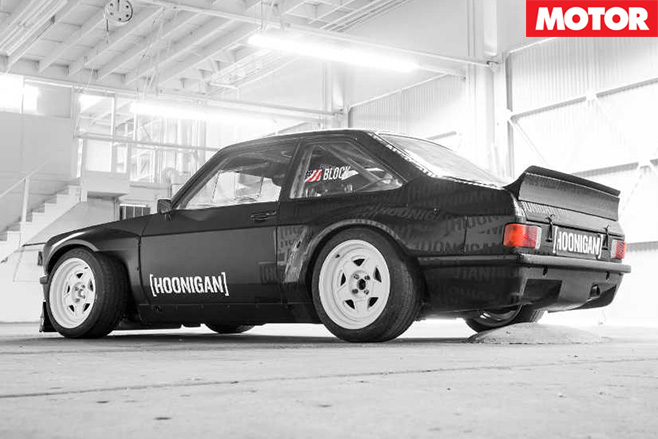
“But unfortunately those are quite lacking now stateside, so instead of converting it into a gravel machine, I had my team at Hoonigan Racing Division extend on its tarmac capabilities and develop it into the ultimate rear wheel-drive Gymkhana car.”
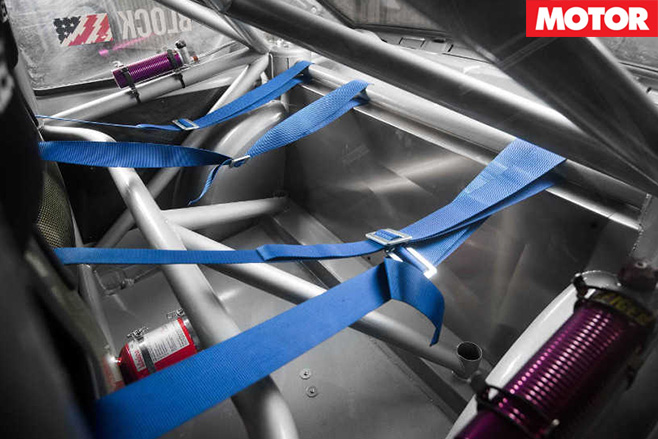
A 2.5-litre four-cylinder engine develops 245kW with a 9000rpm redline, and grunt is sent through a six-speed sequential transmission. Japanese wide-body specialists Rocket Bunny expanded the Escort’s petite frame.


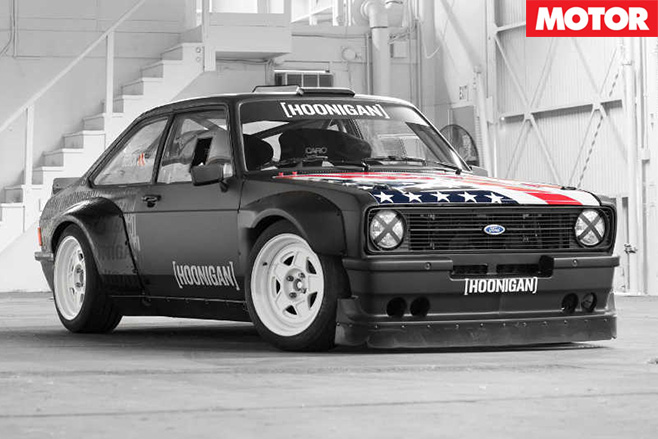
Like most rally drivers, Block’s affection for the Mk2 Escort is palpable; witness his antics with Aussie WRC driver back in 2009.
What is it?
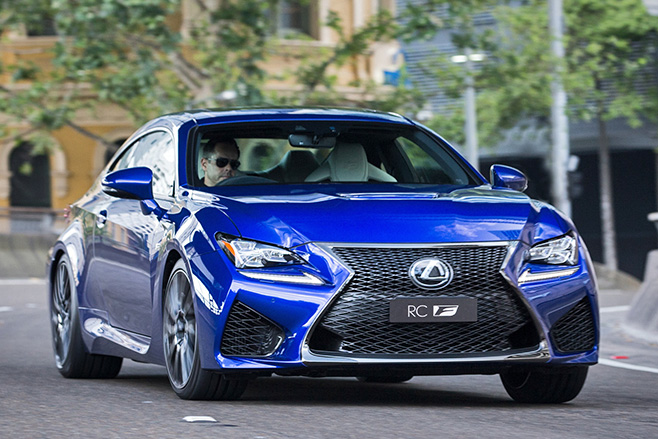
A front-engined, rear-driven, high-revving V8-powered Japanese coupe pegged squarely in the same arena as premium Euro luxo-performers such as the BMW M4, Mercedes-AMG C63 and Audi RS4.
And while it’s certainly got the outputs (351kW/530Nm) and acceleration (0-100km/h in 4.5sec) boasts to stand toe-to-toe with Germany’s finest, it’s still very much a Lexus in form and function.
How so? Lexus reckons the RC F is tuned more to suit the ‘amateur’ gentleman driver. It’s not as white-knuckled in its dynamic character, or willing to tip you into the scenery as, say, an M4. It’s loaded to the hilt with spec yet also undercuts the Germans with value on price: a real Lexus hallmark.
And it’s typically Japanese in playing the ‘soul’ and ‘spirit’ card loud and proud.
Why should I care?
Because in a world where even Ferrari has gone to forced-induction to pander to leaner and greener credentials, the Lexus F (for Fuji) performance brand remains steadfastly high-revving and naturally aspirated. When Aussie carmaking goes dodo, your choice of naturally aspirated V8 performers may well just be RC F and Ford’s Mustang GT.
On merit, the Lexus RC F looks great, goes hard, sounds visceral when you approach the lofty 7,300rpm rev limiter, and is laden with enough fancy bells and whistles to make some Euro rivals feel low rent. It’s also, on balance, a nicer day-to-day device to live with.
There’s also a heavy whiff of eau de LFA about the RC F’s styling, execution and vibe. And all the better for it.
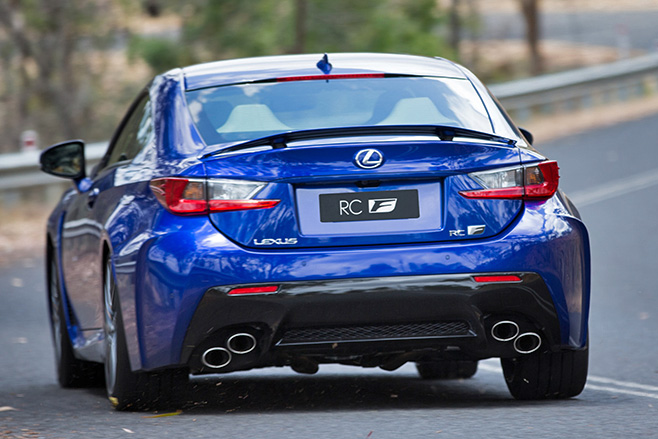
What’s new?
Well, it’s no IS F with a two-door bodyshell. Behind the 12-percent-boost in power claim is a 5.0-litre V8 that only really shares engine block with the IS F – the rest is almost entirely revised.
It’s tied to an eight-speed paddle-shifted auto that works a treat in sportier drive modes, while the rear axle features a clever torque vectoring system that uses clutch packs to distribute energy rather than the commonly used wheel-braking-type application.
From those aggressive rear haunches to the fancy PlayStation-like digital instrumentation – which redesigns the display in each different drive mode – there’s not much in common with the humbler RC 350 six-banger coupe. At over the twice the price ($133,500) for the base ‘F’ version, you’d bloody hope not either…
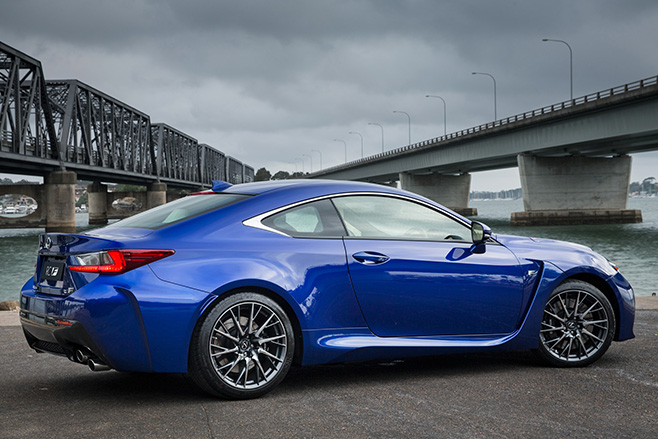
What’s it like to drive fast?
Uncork that bent eight and it screams like a spoilt toddler, though with a tone that’ll plaster a grin on your face. That shades-of-LFA effect is also how linear the power delivery is, though it’s not terribly toey in the mid-range. It doesn’t quite feel as quick as its 4.5sec 0-100km/h claim.
Perhaps it’s the portly 1,860kg kerb weight – a quarter-tonne more than BMW’s M4 – that dilutes the accelerative juices.
Lexus launched the RC F at the motorsport mecca of Mount Panorama, and that I’m still alive to write this review is testimony to the coupe’s high-speed handling abilities.
It’s a planted, grippy, well-balanced and sure-footed super grand tourer that allows modest skills to explore very high-speed fun.
Though it’s not as frisky as some German rivals, but that it took the kink on Conrod Straight at 250km/h like it was negotiating a backstreet roundabout is no bad thing at all.
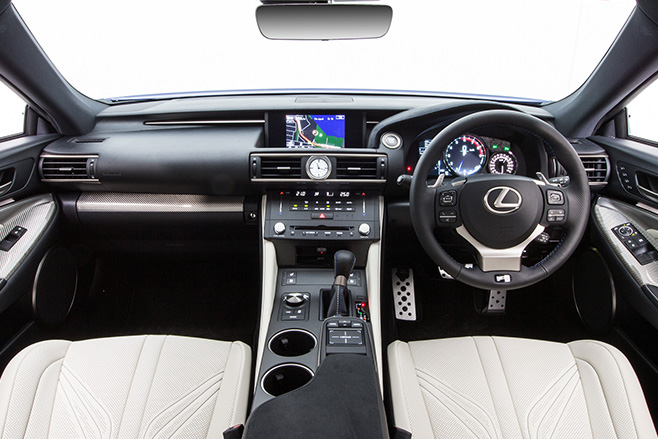
What’s it like around town?
The ride quality of its non-adaptive suspension, firm but not unpleasant on the move, gets a bit choppy under 60km/h. When dawdling around, it is very polite and quiet – perhaps a little too quiet. Must be those Lexus genes.
From the heated and cooled leather-dipped sports buckets to the nine-speaker 835w stereo, the RC F certainly boasts ample creature comforts. And the coupe does strike a nice balance between grand touring manners and sportscar purpose. But if you habitually attack urban peak-hour like an Ayrton Senna qualifier, there are many punchier V8s out there to choose from.
Anything bad?
The RC F delivers plenty in most key areas but its performance is sadly dulled a little too much by excessive weight. It’d just be a livelier and more engaging beast treated to a few more rounds at the engineering gym. And it’d allow that gem of a powertrain to shine tangibly brighter.
How much is it?
At $133,500, the RC F undercuts German rivals handsomely. Fork out another $14K and you can slip into the Carbon edition, which introduces clear-finished natural carbonfibre to the bonnet, boot lid and roof and adds an active rear wing and Alcantara interior trim. None of this stuff positively affects kerb weight by any meaningful measure, but it sure looks suitably cool and purposeful.
Would you take the Lexus RC F over a BMW M4?
I would. Lexus isn’t the first brand name you think of for ‘character’ and ‘soul’ but the RC F offers plenty. And it does feel like a special car. Ensuring there’s enough feel-good factor in the experience is something many German cars, particularly the M4, neglect for the sake of incremental gains in numbers.
The new Lexus F flagship mightn’t set go-fast benchmarks, but it’s interesting, evocative, easy to live with, bloody quick on properly fast and flowing roads/circuits and brings a fresh spin on the V8 rear-driven luxo-performance landscape.
Click here to find out more about the Lexus RC F.
Watch the video, just watch it in amazement.
This footage is taken from the second morning of last weekend’s Classic Adelaide tarmac rally, riding onboard with Stewart Reid in the awesome Audi S1 quattro Group B car.
Ok, to be perfectly honest it’s not a real Group B car, but as a replica it’s near-as-dammit identical to the wild machines raced in the 1980s by legends like Walter Rohrl, Hannu Mikkola and Stig Blomqvist.
MOTOR has been lucky enough to have a passenger ride in this car and we can confirm that the acceleration is every bit as brutal as it seems on film.
On gravel, Reid speaks of all four wheels spinning at 200km/h and even on tarmac it’ll shred its tyres in third.
It’s a fitting tribute to rallying’s wildest era and hopefully it will make many more outings in the future.
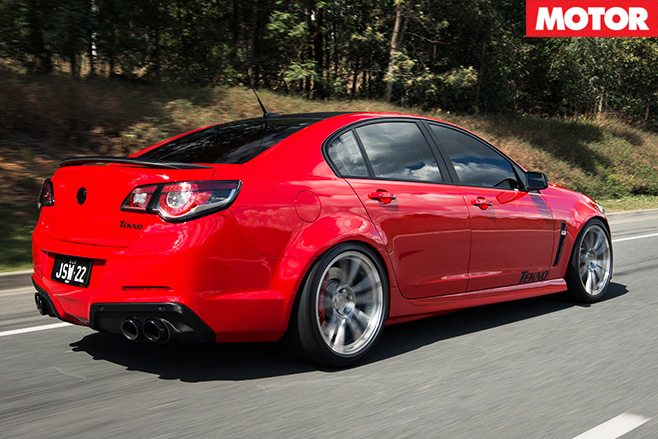
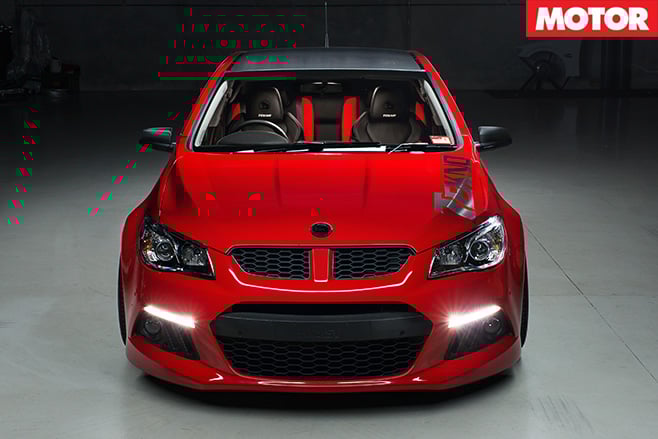
It’s bright red, lead-sled low and boasts more than 485kW at the treads.
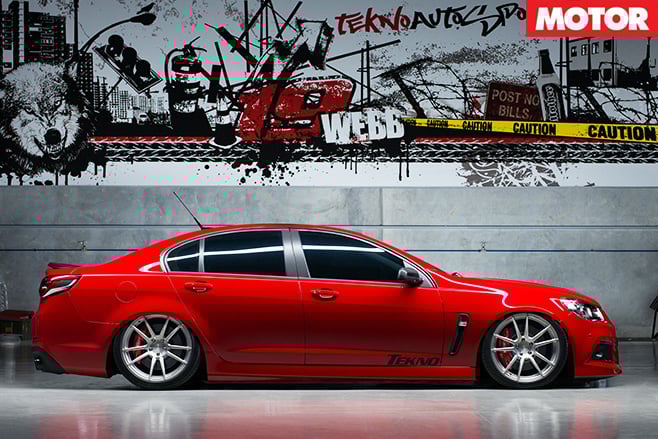
It’s also one of the more fastidiously modified late-model Aussie cars we’ve seen. But before we take a closer look at what’s under the bonnet, let’s learn more about its creator, Tekno Performance, what it offers and how it goes about making late-model performance cars go even faster.
Located close to the Gold Coast, the performance workshop sits alongside Jono Webb’s Tekno Autosports V8 Supercar crew so there’s a synergy between road and track, following in the footsteps of Ford in the 1970s, Brocky’s HDT and Nissan’s SVD in the 1980s, and of course HSV and HRT in modern times.
Keeping standards high is a foundation for this young and growing company. “Jono has always said to me, only the best products and do it right the first time,” says the company’s performance manager Greg Markham.
Tekno’s performance upgrade packages for Holdens and HSVs are marketed and installed as Stage One, Two and Three. The $3500 Stage One Tekno Power pack involves a free-flowing intake (with the standard air-filter and its box retained), a cat-back exhaust system and a bespoke tune for a bit of extra eagerness from the base car.
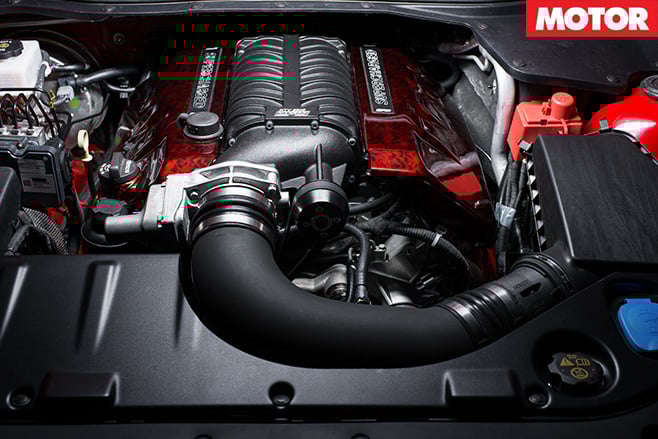
Tuning is performed on a car-by-car basis, with Tekno shunning load-and-go tuning. “That was one thing Jono and I determined early on,” says Markham. “No generic tunes. Regardless of manufacturing tolerances and the like, [the engines] are all different.
And if you’re putting the money and effort into building something like this, a dedicated tune gets the most from the hardware – it’s a shame not to. That extra hour and a half on the dyno, or some extra time spent on-road, can pay big dividends.”
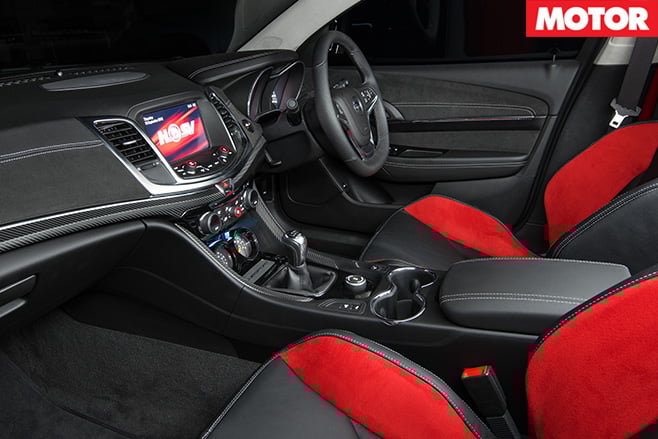
“We usually install Harrop brakes; a mono-block four-piston caliper over a 355mm front and rear rotor. Or the Ultimate kit, which has a six-piston front and a four-piston rear over a 381mm front and 356mm rear rotor. That takes braking performance right up.”
Tekno is particularly proud of its exhaust systems. Manufactured to specs that exceed original equipment, the system is integral to most of Tekno’s upgrades. “Exhaust systems can be difficult,” admits Markham. “You need to strike a balance between exhaust note and drone; one person may want it loud while another wants it quiet. There’s a considerable amount of trial and error to work out a package that suits our customers.
Which brings us to this scorching red HSV ClubSport. Straight after the launch of HSV’s Gen-F range in 2013, Tekno bought a white ClubSport and threw its whole catalogue at it as a demonstration vehicle. “Then a customer came along and fell in love with it,” laughs Markham. “We only owned it for a month or so! So we bought this red one and we’ve taken it to the next level.
To develop almost 500kW at the treads, this ClubSport is supercharged with an Eaton-tech Harrop supercharger with integral intercooling (the charge air is intercooled within the intake manifold).
The engine’s bottom end – everything below the head gaskets such as crank, rods and pistons – is standard which is Tekno’s usual path to performance.
“With a cam change and supercharger, 600 horses at the wheels is no problem,” says Markham. “But for this car we wanted to go that bit further, so we decided to do the heads. If you are going to that extra level with chasing power, as we wanted for this car, the heads are a definite advantage.”
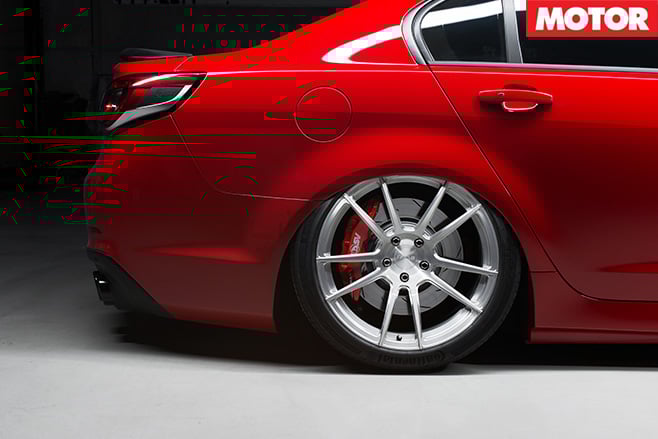
The wheels are Tekno’s own design. “They’re a fully forged wheel made in the US. When we get a car in, we’ll buy-in rims to suit a budget depending on what the customer wants but these rims are our premium wheels.” And they’d want to be – they’re around $1400. Each.
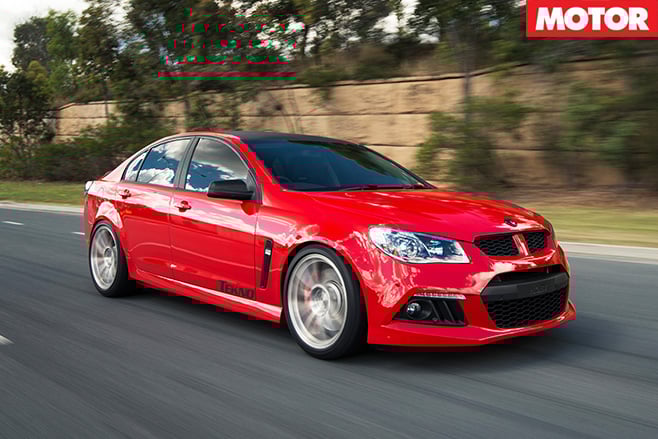
You want your Clubbie to look like this? It’ll cost $40K over the sticker price. Which doesn’t include the human-eyeball-magnet. That’s sort of included.
Though an entirely practical question, for many drivers it’s an emotional challenge. Do you become essentially a bus driver and sacrifice the pleasure of sporty driving, or divide and conquer, split the load and have a battle every time over who drives with whom?
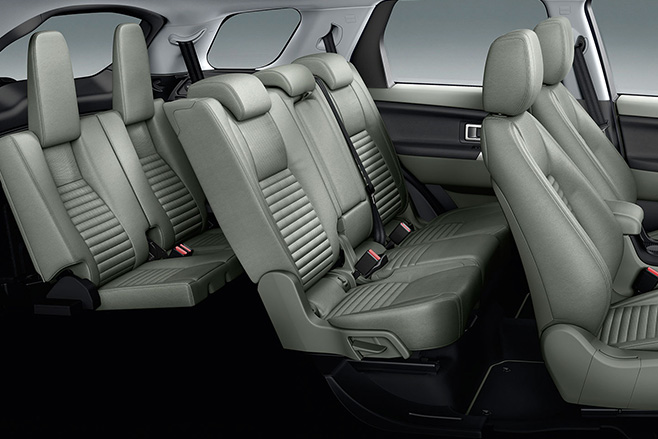
Once upon a time, accommodating more than four passengers meant transitioning from car to van, the improved headroom and seating offset by boat-like handling and a ferocious appetite for fuel. But today’s mass transit options are vastly improved, from classic minivans to sleek people movers and sporty yet fuel-economical SUVs – even some super-sporty SUVs you might think only offer five seats, for there’s a stealth movement to offer an extra row in conventional two-row models, making the perfect car for someone like my sister, a ‘weekend mum’ who gets three extra kids for two days a week.
Who knew, for instance, that the BMW X5 could squeeze two more seats in on demand? You don’t read that in the reviews, it’s not in the press car, but hidden in the multitude of options is that elusive but useful third row.
Third-row vehicles fall into three basic categories – the dedicated six to eight-passenger people mover is a minivan with more or less equal second and third row seating, decent headroom for all passengers and a driving position that’s pretty much bus. For families of three or more school-aged kids, this works as a home away from home and functions as the MPV (multi-purpose vehicle) for big families. The VW Caravelle is the classic minibus while the Honda Odyssey, Citroen Picasso and PriusV all deliver seven seats with a sportier edge and slightly compromised third row. These vehicles are more about the fit of people than luggage, so those larger third rows mean there’s not much room for bags when the car is fully loaded.
If you’re a weekend parent or regularly transport your kids and their friends, a third row that folds flat into decent storage will probably suit you best. True, with all three rows in use the luggage area is tiny, but flexible seat folding can deliver options including a legs-out third row seat for the growing teen, room for long skis, even a back area that two can sleep in. Cars such as the Ford Territory, AudiQ7, Holden Captiva7, Nissan Pathfinder, Volvo XC90 and Mitsubishi Outlander deliver a hunkered, streamlined shape, a sporty drive plus the flexibility to carry seven people when you have to and a variety of dog/human/luggage/sports gear when you don’t. If you have a family or are constantly hosting friends, if you enjoy a responsive drive with all the mod cons and you only want one car, a fold-down seven-seater SUV could well be the answer.
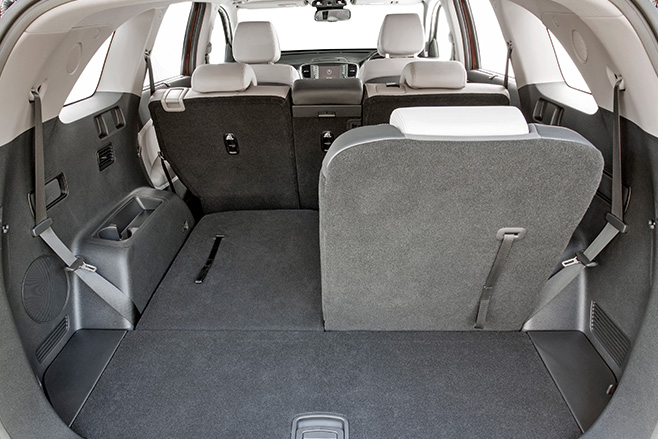
The last category of third-row vehicles is the stealth car. The X5 that manages to cram a third row into its rapidly diminishing rear headspace; the Hyundai Sante Fe and Kia Sorento give their passengers slightly more room. Slightly. But it’s still more convenient to have the extra seats than trying to track down a second driver.
People movers used to cop flack as the unsexy workhorses of the car world, but that’s changed. The middle seat in most cars except the Tesla is now almost intolerable for an adult in both width and general hardness, which means a classic five-seater only really fits four adults. Meanwhile, the traditional vans have grown sleeker and sportier, and SUVs have evolved to deliver more flexible seating arrangements. The result is an all-rounder that flips and folds to suit the ebb and flow of today’s family arrangements and the baggage they bring.
Oh dear, that’s not gone well at all.
A seemingly harmless dyno pull for this Ford Mustang goes very wrong when a tyre blowout at maximum revs in fifth gear causes significant damage to the left-hand side bodywork.
The video, filmed by 1320video, also shows the dangers of standing close to active dynos when there is no protection present.
With many mechanical components under significant stress, it pays to remember anything can happen and the camera man, dyno operator and spectators were perhaps fortunate to escape unharmed.
Spare a thought for the unfortunate car owner, too, who had only purchased the car a month prior.
Ford Australia has announced local pricing for the forthcoming Focus RS and it’s good news for enthusiasts, with the 257kW/440Nm all-wheel drive hatch starting at just $50,990.
This puts it in the same ballpark as front-drive rivals like the Renault Sport Megane RS275 Premium ($52,990) and Volkswagen Golf GTI Performance ($46,490), as well as all-paw rivals like the Volkswagen Golf R ($52,740) and Subaru WRX STI ($49,490).
The new Focus RS is also significantly cheaper than the previous front-drive model, which arrived locally in limited numbers wearing a $59,990 price tag.
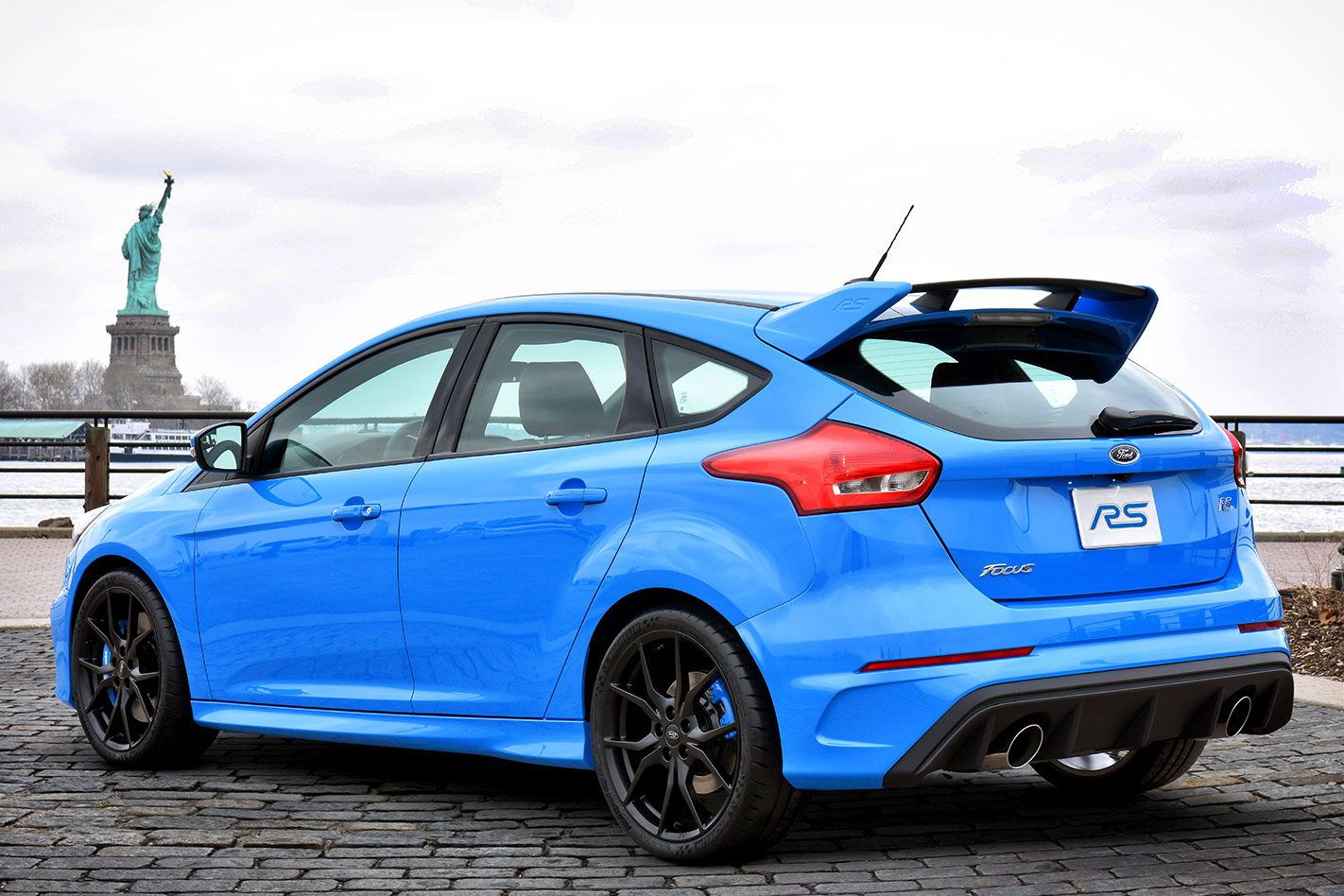
The only options will be prestige paint at $450 and $2500 for the Performance Wheel Pack, which replaces the regular 19-inch alloy wheels with lightweight forged units wrapped in 235/35 R19 Michelin Sport Cup 2 rubber, the same tyres you’ll find on the Porsche 911 GT3.
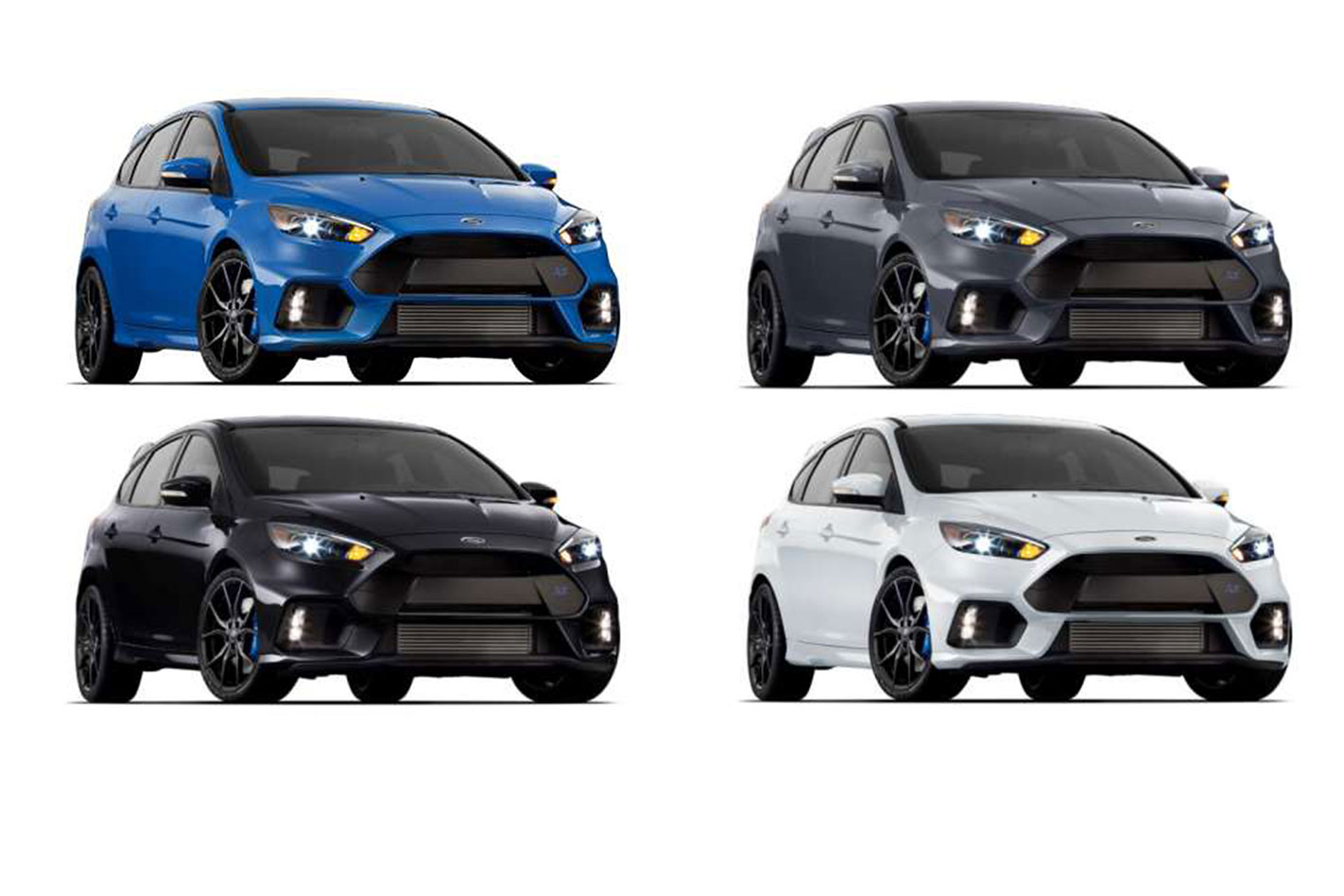
Otherwise, the Focus RS comes very well equipped, with bi-xenon headlights, Recaro sports seats, a nine-speaker stereo, dual-zone climate control and 8.0-inch colour infotainment screen.
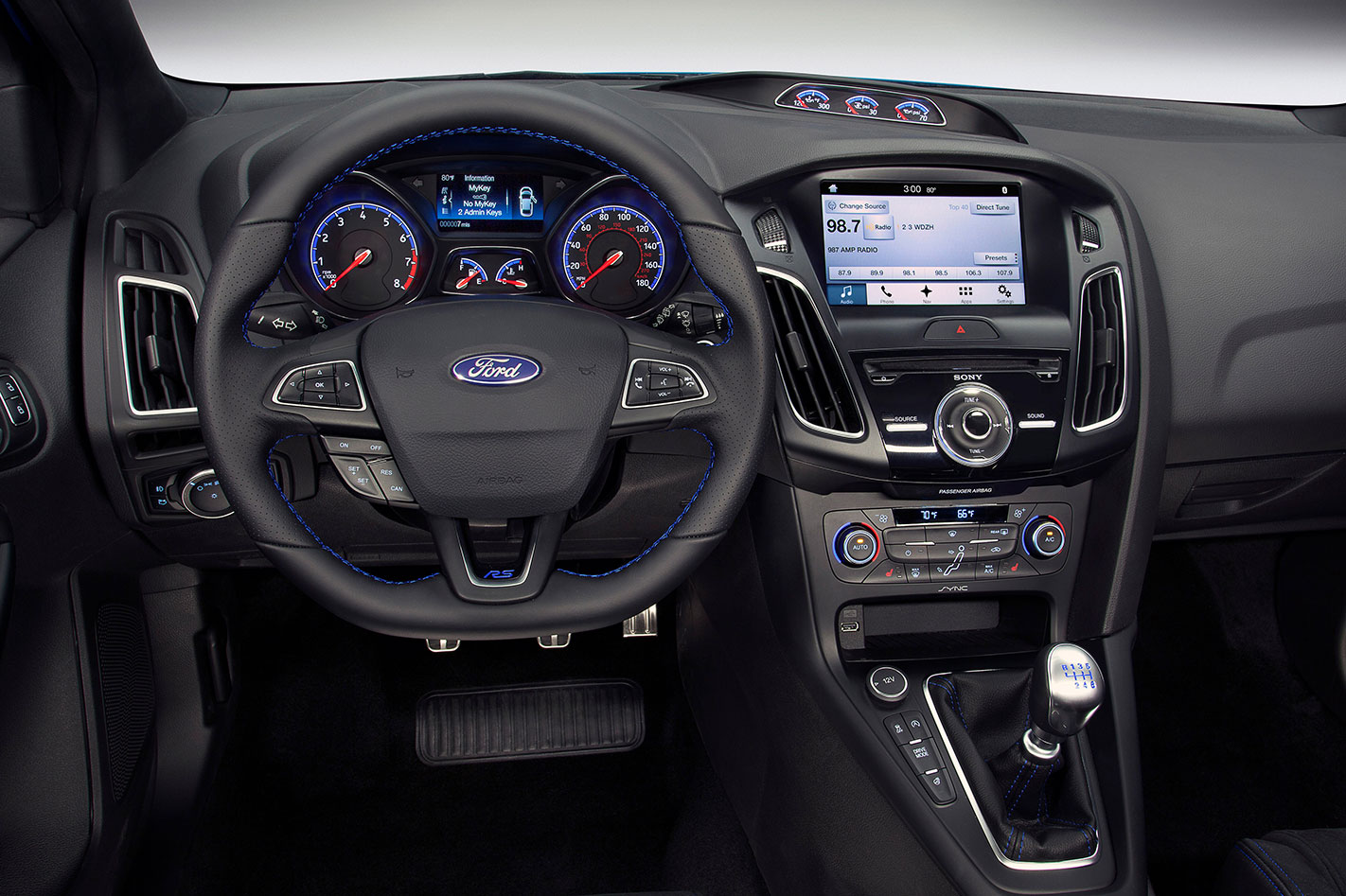
Now all that’s left is to drive it and see if the experience behind the wheel lives up to the tantalising on-paper specification. You’ll know as soon as we do.
MAZDA is believed to be working on a new targa-like electric roof for its upcoming ND MX-5 Roadster Coupe.
Wheels has learned that the second ‘closed’ version of the Japanese coupe icon will feature a sleeker silhouette than the previous version’s abrupt three-box shape.
It will be dominated by a thick fixed B-pillar and curved rear glass in a fashion said to be similar in concept to that of the current Porsche 911 Targa.
According to an insider, the single-piece window and boot compartment cover will lift electrically while the panel above the occupant’s heads can be stowed in one seamless electrically operated movement.
Crucially, the operation can be performed while the vehicle is in motion, unlike in the NC MX-5 Roadster Coupe sold in Australia from 2006-14.
It is believed that the shift to the new roof-folding system liberates more cabin space, and is thought to also save a few crucial kilos compared with the old layout.
Confirming that there will be a change of direction for the next-gen version at July’s launch of the ND convertible in Queensland, Mazda Australia boss Martin Benders told Wheels the aim was to broaden the Roadster Coupe’s audience considerably.
“I am sure if they do decide on another Roadster Coupe they will differentiate that as well,” he said. “They won’t just replicate what they had with the NC. It will have something new to extend the range, so that’s basically what they’re trying to do with this vehicle. [They want to] give it a more stable volume position within the Mazda range.”
ND Mazda MX-5 program manager Nobuhiro Yamamoto added that a new-generation Roadster Coupe is definitely on the agenda, saying it would serve to spike sales once the initial flurry of activity that comes with the introduction of a new model starts to wane.
“It is coming as a later addition,” he said. “The new MX-5 has a long life, so it may come later to keep the model fresh.”
LOW AND BEHOLD Mazda considered several proposals before settling on this targa-like design. Sleeker and lighter than before, the ND’s roof can also be operated on the move.
GROUND MX New MX-5 Roadster Coupe will have a lower centre of gravity compared to the previous version, due to an expected lighter roof structure and mechanism. Occupants also sit 20mm lower and 15mm closer to the centre of the vehicle.
Click here to read the full range review of the Mazda MX-5
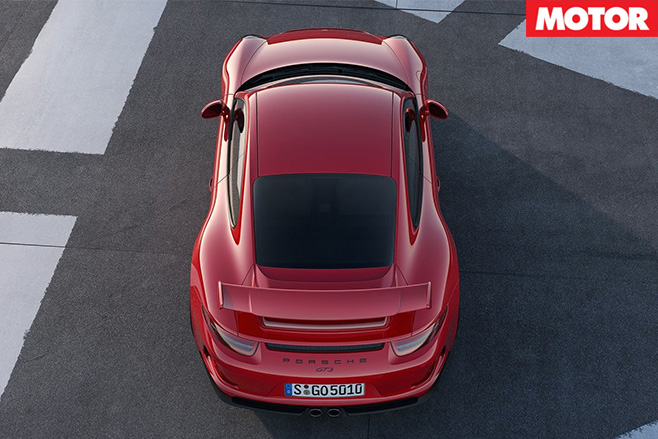
A manual transmission may soon return to the left hand of Porsche GT3 purists following strengthening rumours of an old-school 911 R spin-off.
The $293,200 GT3 and $387,300 GT3 RS are fantastic, blissful machines in 991-generation guise, but controversially they are seven-speed dual-clutch-only for the first time. No manual has irked the purists, if not restricted the sales volumes.
Enter the 911 R. US motoring outlet Car & Driver report that Porsche is preparing a manual transmission version of the GT3, complete with wide-body but smaller wheels and deleted spoiler.
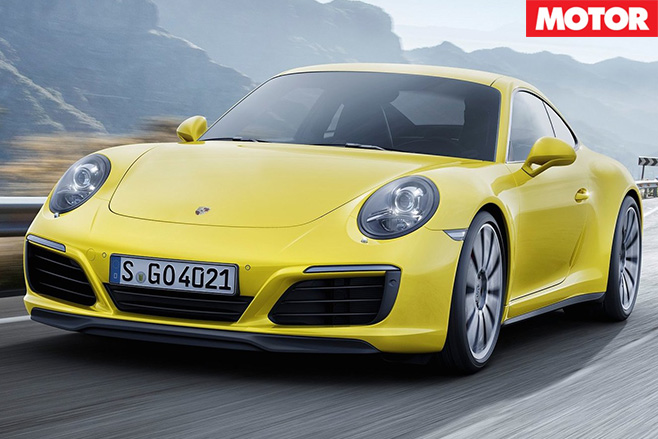
It is likely the 368kW/460Nm 4.0-litre flat six-cylinder engine of the GT3 RS will be used, which in auto guise claims a 3.3-second 0-100km/h – two-tenths faster than the considerably cheaper 350kW/440Nm 3.8-litre flat six in the regular GT3.
A source has confirmed to MOTOR that several Australian buyers have already placed interest in the 911 R, even though it hasn’t officially been announced. It is expected to retail at over $400,000, which makes it more expensive than either GT3 model.
With the 911 Carrera grades now turbo-only, it has ended the coupling of manual transmission with naturally aspirated engine. Porsche engineers are likely to be even more disappointed by that reality than 911 traditionalists – making a fix on the way rather more likely.
Look out for the 911 R at the Geneva motor show in March.
So, what is it?
First you saw it. Then you didn’t. Now you see it again. The Holden Astra nameplate has been bumping around the Holden universe for more than 30 years, but most recently sat alongside the Opel badge, disappearing without trace after the German GM brand’s spectacular failure to launch here in 2012/13. Now it’s back, filling a premium hot hatch niche in the Holden range.
Why should I care?
Holden believes the Astra’s reintroduction is critical in its transition to a more “stylish and sophisticated” brand. And it’s the first of no less than 25 major vehicle launches for Holden over the next five years, drawing on current and future General Motors product from Europe, Asia and North America.
Leveraging its larger overall sales volume, Holden has managed to deliver price reductions of $2,000 on the base 1.6-litre turbo four cylinder Holden Astra GTC (at $26,990), and a full five grand off the GTC Sport; now weighing in at $29,990 (compared to the 2013 Opel price of $34,990).
Individual options and package offers have been simplified, and the GTC now delivers bigger bang for the bucks.
What’s new about it?
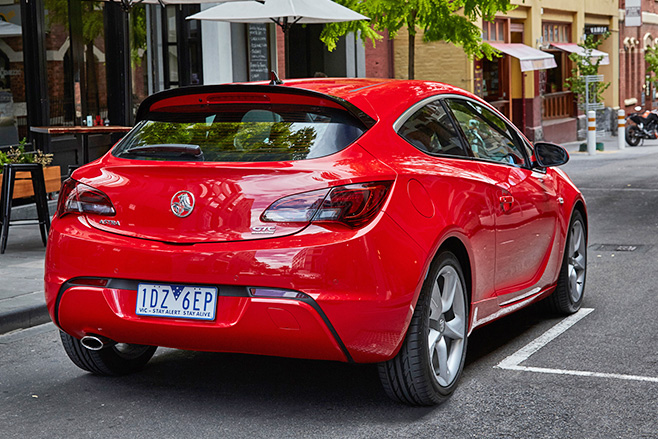
Most notable changes are a Holden badge on the grille, and another similar one on the rear hatch door. But aside from that the car is powered by the latest direct-injection version of the 1.6 turbo engine.
That’s all fine, what’s it like to drive fast?
A launch drive around the Gold Coast hinterland offered seat time in the GTC and GTC Sport, across six-speed manual and six speed auto variants. Sadly, the latter suffers a 22kW/20Nm drop to 125kW/260Nm.
The auto GTC benefits from a broad spread of torque, a flat maximum band running from 1650-4500rpm, with peak power taking over at 4750 and remaining on stream right up to 6000rpm. But while that neat dovetailing might look good on a dyno sheet, it doesn’t make up for a distinct lack of urgency overall.
The auto cries out for those missing watts and newtons, the car’s sluggish feel magnified by leisurely gear changes and a surprisingly coarse engine note.
Things get more interesting in the GTC Sport manual, the higher spec car waking up thanks to the extra power and torque, and copping a plus one step from 18 to 19 inch alloy rims (running the same 235 width rubber). For those who need to know, the brand and spec changes from Continental ContiSportContact to Bridgestone Potenza S001
Holden claims 0-100km/h in just under eight seconds, which feels about right. Not neck-snapping, but not a dawdle either.
Feel from the electrically-assisted steering is good, the substantially bolstered sports front seats are firm but grippy, and the manual transmission is agreeably positive. A pleasant, but distinctly non-hardcore drive.
And driving home from the city?
Ride comfort is good, and there’s a surprising amount of space in the back. While three adults is a recipe for discomfort, two full-size grown-ups can live back there, with plenty of headroom and marginal legroom. Cargo space is generous for a car of this size.
Anything bad about it?
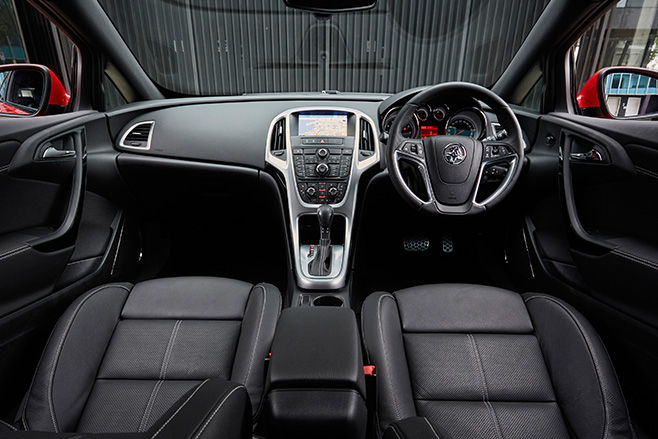
Interior design conforms to Cool Euro 101, and the quality of fit and finish is well up to scratch (the car’s built in Poland), although the plastics are universally dark, and the centre console is a full-on button-fest.
The multi-function trip computer is a telling sign of this fourth-gen Astra’s age (it was launched globally in 2009), using old-school orange/red LED graphics that are hard to read, and look out of place next to the 7-inch centre-dash screen running the MyLink infotainment system (including digital radio).
The A-pillars are also monstrous; despite inclusion of a small window near their base, they compromise forward vision, to the right particularly. And on the small annoying niggles register, although it wears a thin veneer of padding, the door armrest is as hard as granite.
How much would I have to pay? And is it worth it?
Pricing starts at $26,990 for the GTC manual, with another $2,200 dollars required to get less power and torque as well as an ordinary auto transmission.
Standard spec includes: Hill Start Assist, 18 inch alloy wheels, cloth trimmed sports seats, nav, air-con, front and rear Park Assist, rain sensing wipers, leather steering wheel, multi-function trip info, MyLink Infotainment System with 7 inch colour screen, single CD player with MP3 capability (plus USB and auxiliary input jacks), and Bluetooth for audio streaming and hands-free phone.
The GTC Sport rises to $29,990 for the manual and $32,190 for the auto, adding 19 inch alloys, LED tail lamps, perforated ‘Mondial’ leather trim, eight-way adjustable driver seat with power lumbar control, heated front seats, alloy faced pedals, dual-zone climate control, leather sports steering wheel, an electric park brake, as well as a body kit comprising deeper front and rear bumpers and fatter sills. As mentioned earlier, solid value.
Would you take the Holden Astra GTC or VW Polo GTI?
A grand dearer than the base car, but VW’s recently upgraded mini-me GTI takes it on performance and dynamics alone.
Click here to find out more about the Holden Astra GTC.
