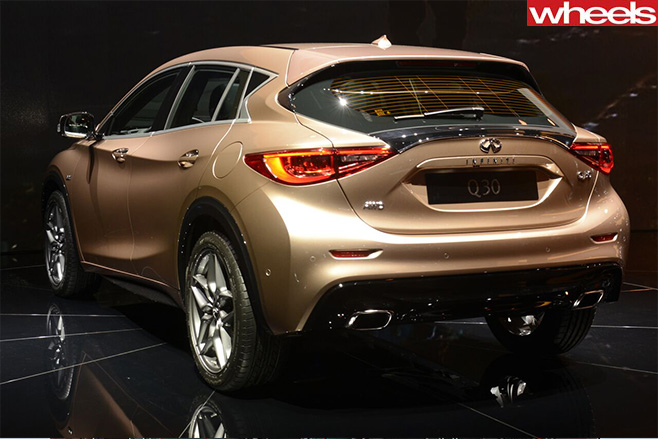
INFINITI is considering a petrol-electric version of the Q30 it unveiled last month at the 2015 Frankfurt motor show, as part of an expansion of its performance range.
The Q30 is based on the Mercedes-Benz MFA small car architecture that underpins cars such as the Mercedes A-Class, CLA and GLA. It will originally be offered with a range of four-cylinder petrol and diesel engines, but Infiniti president Roland Krueger said there was potential for more.
“As a premium brand we also offer performance cars,” Krueger said when asked about a Q30 with more performance than the Mercedes-sourced 2.0-litre engine that produces 155kW.
“Something we’ll emphasise a bit more in the future is we have performance hybrids.”
“If we would do any kind of performance version it would be developed by our engineers,” he said.
Infiniti is also planning more models based on the Q30, including a higher riding QX30 crossover.
Despite sluggish sales, Krueger said Infiniti was committed to the Australian market, where it has hopes of tapping into the established luxury class dominated by Mercedes-Benz, BMW and Audi.
In the first eight months of 2015 Infiniti sold just 358 cars, about one-eighth the number sold by sports car specialist Porsche – and a fraction of the 15,000-plus tallies of the luxury market leaders.
Krueger said he had just signed off on a “network expansion” on top of the three Infiniti dealers currently in Australia.
It could be one last shot for the rotary engine, with Mazda confirming a new sports coupe concept is bound for the Tokyo motor show.
If you’re a big fan of the Wankel single-piston unit, it’s exciting … but also be careful to not get too excited. The Japanese brand has previously stated that the rotary engine, last seen in 1.3-litre RX-8 guise, could never pass modern emissions standards (and thanks to a certain German brand, those tests may now be stricter than ever).
On the other hand, more recently a Mazda executive has confessed a team of engineers remains singularly dedicated to rotary development inside company engineering headquarters. Rest assured that engineers of Hiroshima adore this peculiar engine design as much as its fans.
Either way, the single teaser image released shows a two-door coupe that appears notably wide. Deeply recessed tail-lights appear on current Mazda trend, with a broad stretch of plastic in between and what could be a retractable rear spoiler.
A small rear window gets a notable Hofmeister kink over decently muscled rear wheel arch flares. The bonnet appears quite long, too, proportionally similar to a Mazda MX-6 (though hopefully this concept won’t share a Mazda 6 platform as that 1990s model did with the then-current 626).
What’s harder to gauge is the overall size – in the case of the new MX-5, it’s deceptively small in the metal, yet doesn’t look tiny in photos.
“The design of the sports car concept to be unveiled in Tokyo is modern but maintains a sense of lineage and authenticity, appearing almost to condense Mazda’s entire history of sports car development into a single model,” the brand announced in a statement.
Mazda has in the last few years reaped the rewards of building a great range of cars, having investing in its products in the post-GFC era where other Japanese rivals slashed development costs. The brand has always said it needed to sort its mainstream line-up first before it can get on with building more sports cars – and we get the feeling that time may have arrived.
VOLKSWAGEN has been warned it faces a potential fine of $1.1 million if the Dieselgate emissions scandal widens to include Australian customers.
The Australian Competition and Consumer Commission said today that while Volkswagen was yet to reveal whether Australian cars were affected by the use of “defeat devices” to reduce emissions, the penalty it faced if it had cheated Australian emissions rules was substantial.
“This enforcement investigation is a priority for the ACCC. We are very concerned about the potential consumer and competition detriment from this alleged conduct,” ACCC chairman Rod Sims said in a statement.
“First, using defeat devices is specifically prohibited under the Australian Design Rules, which are picked up as Australian consumer law mandatory safety standards,” Mr Sims said.
“As the enforcer of [consumer laws], the ACCC can take action against any corporation that has breached mandatory standards.
“Secondly, cars are a big purchasing decision and claims that relate to environmental benefits or fuel efficiency can influence consumer choice,” he said.
Volkswagen is yet to say whether the emissions cheats are effective in Australian cars with the EA189 diesel engine, so that the vehicles spew out much more of harmful pollutants in normal use than in official tests.
The ACCC has asked Volkswagen Group to stump up advertising material used to sell its cars here, saying it “will not hesitate to take action if consumers were exposed to false, misleading or deceptive representations”.
It said it was also “considering” comments made by Audi Australia on how its customers were affected.
The move by the consumer advocacy group comes as a Volkswagen Group director representing the German district of Saxony – an influential 20 percent stakeholder in the carmaker – said he believed VW staff responsible for the deception had acted criminally.
“Those people who allowed this to happen, or who made the decision to install this software, they acted criminally,” Lower Saxony economy minister Olaf Lies told the BBC overnight.
“They must take personal responsibility. It’s about finding out who was responsible, who knew about it and when they found out.”
According to Lies, Volkswagen’s global board found out about the defeat device, which allowed cars to recognise when the vehicle was being emissions tested and switch into a low-pollution mode, “shortly before the media did”.
He said the board had no idea how much the scandal would eventually cost the carmaker.
“We are surely going to have a lot of people suing for damages,” Lies said. “We have to recall lots of cars and it has to happen really fast.”
German prosecutors have opened an investigation into the VW emissions scandal, but have not announced conclusions on whether crimes were committed.
WHERE DOES IT FEEL AT HOME?
The Clio is a charming little car, suited to the fashion-savvy and those who, like me, enjoy a weekend drive. The entry-level models are especially fun around town if you’re prepared to shift gears yourself and get a manual transmission.
WHAT IT’S MADE FOR
Renault’s range of Clio models covers a lot of ground. If you’re after a small runabout take a look at the Authentique, Expression and Dynamique models. Above them is the GT and the RS for those who want to get even more out of the Clio driving experience. All models are impressively flexible, with even the highly-strung performance models proving very liveable day-to-day.
STAND OUT FEATURES
Fundamentally, the Clio platform is great to drive. The seating position is just right, the suspension is good and the steering is sharp. It’s practical too, with five doors, a roomy feel and good boot space for this segment. We like its hidden rear door handles and the Renault card key.
WE LOVE
The Clio’s classy, avant-garde interior is a plus. Its striking exterior makes the Clio a bit of a statement, and we like that too. The tiny turbocharged three-cylinder engine in the entry level models is incredibly fuel efficient, while the top-end Renaultsport models are up there with the most exciting hatches on the market.
THINGS WE’D LIKE TO CHANGE
On the downside, we find the Clio’s automatic gearbox to be slow to react off the line. That might not sound so bad, but it means you have to second-guess gaps in traffic quite a lot. One of the quirkiest features in the Clio is it’s ‘sound imitator’ which uses the car stereo to imitate the engine note of some classic Renault vehicles, a motorbike and even a Jetsons-esque spaceship.
WHO WILL IT SUIT?
The Clio is a great option for those who like to stray away from the typical choices. It’s full of European flair and genuinely impressive driving dynamics that make it an enjoyable car to drive as well as a practical one.
Click here to find out more about the Renault Clio.
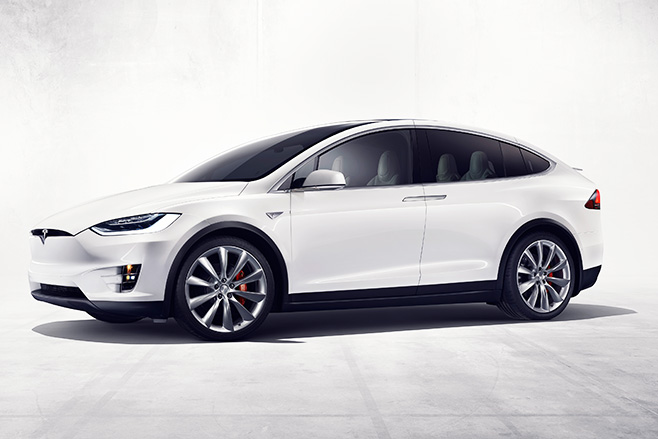
While an all-electric soft-roader sounds exciting as watching concrete set, Tesla’s new Model X promises to set fire to that sentiment.
Revealed yesterday to a global audience, the company’s follow up to the Models S debuts with the top-specification P90D model, which is said to dispose 0-97km/h in 3.2seconds when optioned with ‘ludicrous’ mode (for US$10,000), or 3.8sec if not.
The SUV’s quarter mile time is equally as impressive; Tesla claiming the Model X lunches the distance in 11.7 seconds.
Forget the Porsche Cayenne Turbo S, that’s faster than a Mercedes-AMG GT.
Tesla also offers a base model, the 90D, which is a second slower in the sprint to 97km/h than the performance model.
Top whack for all models is 249km/h, no doubt helped by a 0.24 drag coefficient which Tesla claims is the lowest for any SUV and makes the Model X slippery as Mercedes-Benz’s S-Class.
On a full charge you’ll be able to wring 402km from the Model X’s driving range, its 90kWh battery is borrowed from the Model S.
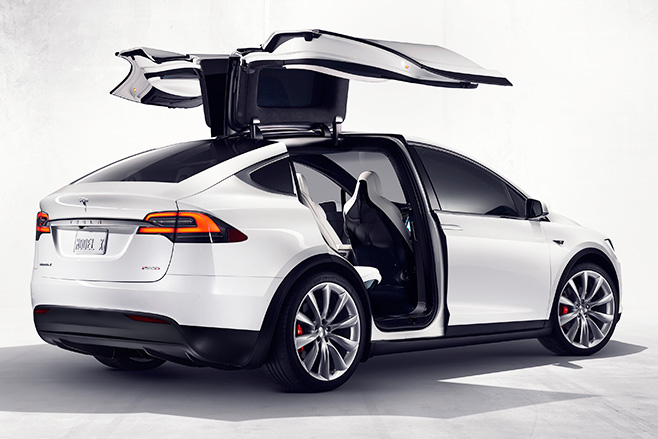
Double-hinged, and said to be a parent’s dream, the automatic ‘falcon wing’ doors open up and out to allow unobstructed access to the rear seats. Sonar sensors are said to help them manoeuvre tight car spaces.
Inside, the Model X also boasts a suite of high-tech features like a 17-inch touch screen, active safety systems, 17 speakers, and a climate control ‘bio-weapon’ defense mode should you drive through any clouds of mustard gas.
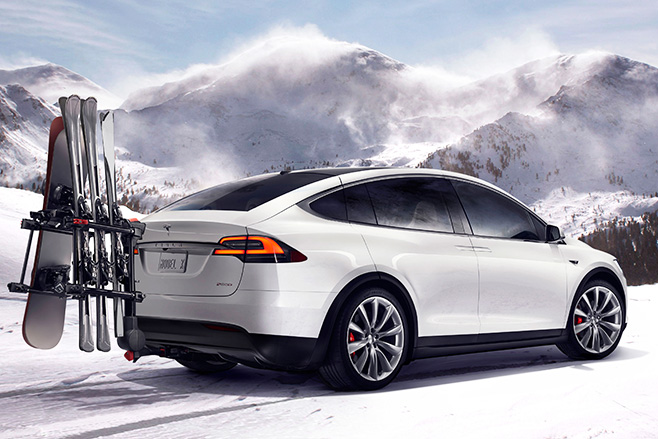
Meanwhile, US pricing for the launch-edition ‘Signature’ series has been announced at US$132,000 (AU$188,230) for the P90D.
The Volkswagen Group is one of the biggest collections of marques on Earth. As such, it has a duty to protect the planet – or reduce harm as far as fossil-fuel burning cars can – and it claimed to have met strict emissions standards for diesel engines, passing some particularly stringent tests in 2008, without having to use either ‘band-aid’ measures (systems to clean exhaust gases before they come out of the tailpipe) or sacrifice power and engine capacity as other manufacturers had.
But as it turns out, in one of its engines, this was a furphy.
For seven years, VW has lied about its 2.0-litre TDI engine meeting emissions standards. That lie could cost VW around US$18billion, not to mention the damage to its reputation, stock value and future sales. More than 11 million diesel cars worldwide – from VW and some of the group’s other brands, Audi and possibly Skoda – are affected.
HOW IT WENT DOWN
Stricter emissions testing came in circa 2008, significantly reducing the amount of pollution the tailpipe can let out into the atmosphere. These Euro V standards, which aimed to reduce emissions of nitrogen oxide (NOx), particulate matter, carbon monoxide and hydrocarbons, forced vehicle manufacturers to invest millions in R&D to bring their vehicles up to standard. In the case of diesels, many resorted to an additive called AdBlue, a urea solution that’s sprayed automatically into the exhaust to process and reduce NOx emissions.
While some of Volkswagen’s TDI-engined vehicles do use AdBlue to meet emissions standards, particularly since the introduction of even stricter Euro VI standards, many do not. VW claimed it didn’t need it for its 2.0-litre TDI diesel engine (codename Type EA 189 EU5), which is in models such as the Golf, Jetta, Passat, Beetle and Audi A3. But apparently, it actually did.
Rather than go through the rigours of bolting on an AdBlue system, particulate filters, or other exhaust-cleaning extras to its vehicles, the company cheated on the tests. It did this through a clever piece of software that could identify when a car was being tested in a lab on a rolling road, and reduce exhaust emissions so it looked like the car met requirements. This was done from the introduction of the 2008 standards and no-one discovered it for five years.
In 2013, the US-based International Council on Clean Transportation independently tested the cars, commissioning researchers at the University of West Virginia to put a 2012 VW Jetta and a 2013 VW Passat up against a BMW X5 in real-world conditions as well as in the laboratory. While the BMW met all the standards, the VWs exceeded the cap by as much as 35 times on the real road sections.
By early 2014, the California Air Resources Board (CARB) and the Environmental Protection Agency (EPA) had put the findings to VW, which claimed the findings were false or incorrect.
CARB and the EPA kept pushing and testing – and they eventually found the software patch. It turns out that there is a set of steering, throttle, timing and pressure triggers that are only ever displayed during an emissions test on a rolling road (or dyno) – the patch kicks into gear when all the boxes are ticked, allowing the car to fudge emissions test results. Of course, it doesn’t activate in real-world driving.
THE FALLOUT
The effects have already been monumental. VW’s CEO has resigned, other big heads have rolled, and the carmaker has promised a whopping €6.5bn to rectify the emissions issue, or at least to retrofit the right equipment to make it so. This comes on top of the possible US$18million in fines and any civil cases brought against it for its misleading product.
WHAT DOES IT ALL MEAN FOR OWNERS HERE IN OZ?
The cars with falsified emissions that VW has admitted to are in the USA; there is still no word on whether the software patch was installed in Australian vehicles. If you have one of the cars in question, you could contact your dealer and try to garner some information – but don’t expect any answers just yet.
NOT SURE IF YOU HAVE THE TYPE EA 189?
Check the index pages of your vehicle handbook for your engine information. Newer cars with the EU6 engine are apparently not affected, though their certificate of roadworthiness has also been withheld in the US while the case is investigated, essentially putting a halt to sales of the 2.0-litre cars across the country.
Basically, if our VWs do contain the patch, we can expect our solutions to mirror that of the US. There will likely be mass recall proceedings to bring the cars into line with current standards by retrofitting equipment and installing software at the dealership.
WhichCar will post an update when local information comes to hand – stay tuned.
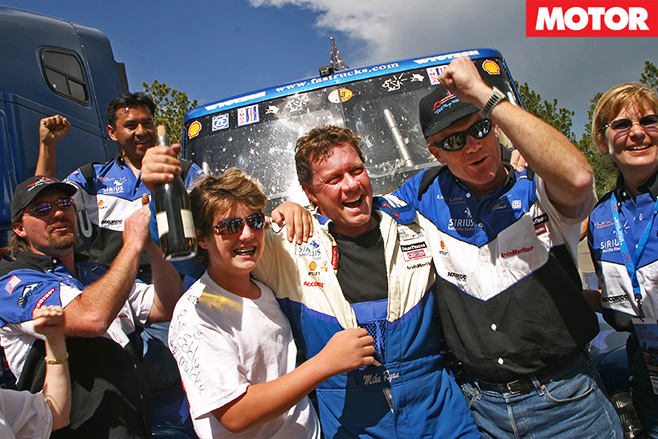
Mike Ryan is a happy-go-lucky 57-year-old Californian, always smiling and cracking jokes.
His jovial nature is infectious and, while he walks with a slight limp, you’d think he was a stand-up comedian. Personally, I see the limp and, given his career and recreational choices, I’m surprised he’s here talking to us at all and not pushing up daisies.
Plenty of people work demanding jobs during the week and wind down on weekends with a spot of motorsport, but Mike goes more bad-arse than anyone else – you’d think he’s from Texas (as everything’s bigger there, or so they say).
‘Size Matters’ is his weekend plaything: a full-size, 4.5-tonne Freightliner Cascadia prime mover packing a turbocharged and supercharged, methanol-sucking 14-litre Detroit Diesel in-line six and ‘lightweight’ carbonfibre and fibreglass bodywork. This monster has been specifically developed to dominate at the Pikes Peak Hill Climb, the 156-turn race to the sky that has included a truck class since the mid-’90s.

“I remember the first time I went to Pikes Peak, back in 1995. I was racing in the Open Amateur Motorcycle Class and I wasn’t very good, but I still came back and did it again in 1996,” the stunt legend laughs. Ryan’s day job as a Hollywood stunt man is just one of a few strings to his bow (he also recreates crash scenarios for the State of California). If you watch closely, you can see some of his handiwork in Terminator II.
“I did all the close-ups of the kid’s bike’s back tyre getting hit by the front bumper of the tow truck, and when Arnold grabs him off the bike I run over the dirt bike,” he explains. “Then I tossed it sideways up to the bridge, just before it blows up. I also did most of the later cryogenic container truck stuff in the dark, except the roll-over.”
For a split second I think I’ve found something so extreme he can’t even comprehend doing, a weak spot in Ryan’s invisible armour. But then he goes on.
“Rolling trucks is right up there on the danger level, but I’ve done a bunch,” he continues, nonchalantly. “I actually just rolled two buses, one in Captain America 2 and one for Fast & Furious 7. In Captain America 2, I get t-boned by a big utility truck while driving a city bus, while in Fast & Furious 7 I rolled a big, black Transformer-looking, bad-ass tour bus down a mountain into a quarry.”
It confirmed for me this guy is not only a super-talented driver – disarmingly charming and straight-talking – but he’s nuts in that awesome way we all want to be, fearless, in that man-child juvenile way. But how did a stunt man wind up racing a truck at the second oldest motorsport event in the world?
“I’ve always been into trucks,” he says. “At Pikes Peak in 1995 there was a guy there called Sid Compton who raced a circle-track truck and established the record with a 15min 48sec run. I figured, with my stunt work, truck racing would fit in well, so, in 1997, I bought a top tube-frame, custom-built circle-track truck that was from a series that ended in 1991.
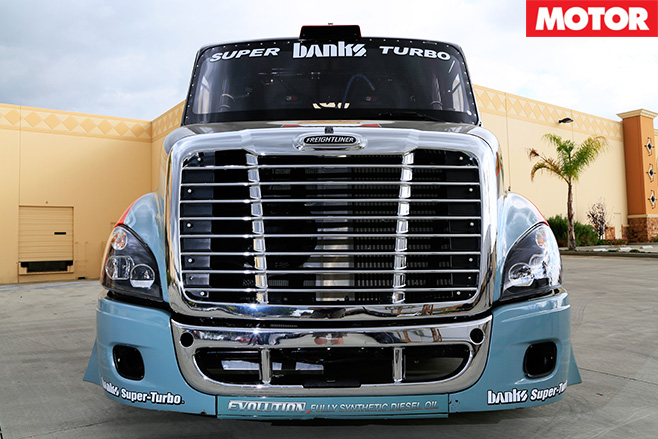
“By 2007, we’d dropped the class record by 3mins 5sec and then last year we dropped it another 5sec with this chassis and set-up. It’s not actually a brand new chassis as it was initially built by volunteers at Freightliner in 2000 and Shane Chapman drove it at Pikes Peak that year. Then it sat in a Freightliner warehouse, kind of unloved and just back in a corner.
“Back in the mid-2000s, Mercedes was trying to change American truckers over from the Detroit Diesel engines to Mercedes, but Americans didn’t go for it. So we had to go back to the Detroit Diesel engine but it was almost impossible to change the last truck back to one of them without destroying it, as the Mercedes engine is a V6 and the Detroit Diesel Series 60 is an in-line, so it was easier to take the Stirling chassis that had a Series 60 in it and put it all together.”

“That truck was only 3950kg, this truck is around 4500kg. This one last year just got as fast as the 2007 truck, purely because it has so much more horsepower.
“This truck has pretty much been specifically built for Pikes Peak – but back in the dirt days – so to turn it into a bitumen race truck has been quite a long process of development. These tyres are made specifically by Michelin for us, but I wish they were softer. These were made for when Pikes was still dirt.
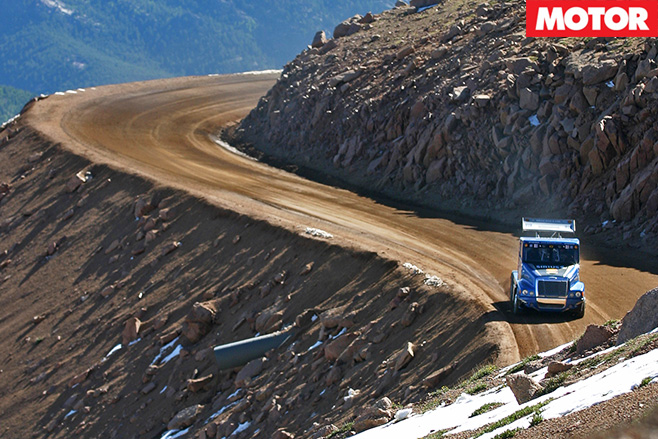
“I spun-out near the top and lost 40 seconds getting going again, plus the last third of the track I had almost no brakes, but I know we’ve got another minute in it if the weather is good and we don’t touch this engine set-up.”
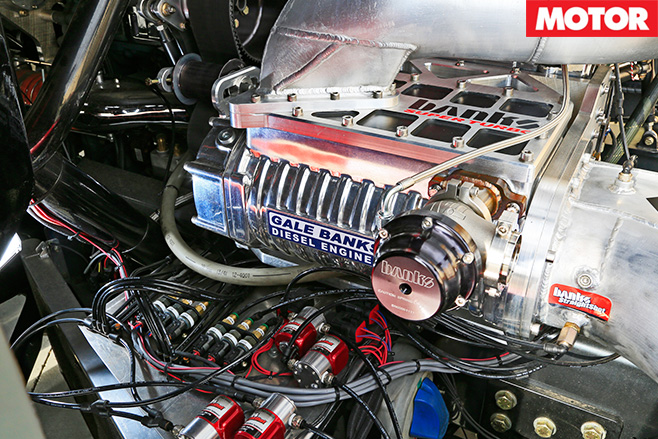
That engine set-up comes from Banks Power, the Californian diesel and turbocharging specialists who design and build custom engines and electronics for everyone, from the US military to Jay Leno’s tank-powered hot rod.
The Freightliner is hidden away in the far back corner of the complex in a new warehouse, but as soon as Mike fires it up everyone knows where it is, as it is by far the loudest race vehicle I’ve ever experienced. Forget Top Fuel dragsters or 9000rpm NASCAR engines, the wail from this truck is like a Metallica concert; it will leave your ears ringing for days.
Mike hooked up with aftermarket legend Gale Banks at Pikes Peak a couple of years back. Banks has been setting speed records and blowing turbocharging and diesel-fueled myths since 1958 and he approached Mike with the goal of increasing the formerly twin-turbocharged truck’s horsepower, improving response and eliminating black smoke from the diesel engine, which Banks sees as a lack of efficiency in the burn-rate and therefore wasted power.

The Freightliner needs the methanol given the gigantic Whipple 14-litre supercharger is overdriven, turning at 4:1 crank speed for around 25psi of boost pressure. This helps build huge boost low in the rpm range to help the big rig fire out of the many slow-speed corners and hairpins at Pikes Peak.
“It turns really well, sits flat and doesn’t really roll all that much,” says Mike. “The issue with Pikes Peak is that every time you go there you’re actually racing the mountain, the weather, the surface of the road, it makes a huge difference.”

As we wrapped up the photoshoot, Mike casually mentions he has to move the truck back to the main office and asks if I’d like to ride shotgun. Now, I’ve ridden in all manner of tuned and race-spec vehicles, from eight-second drag cars to 1120kW GT-Rs, but nothing prepared me for what Mike’s truck can do. Not only is it the loudest vehicle I’ve ever been in but it’s unbelievable how easily Mike can throw this monster around like it was an 1100kg drift car.

So after everything he’s achieved, surely there isn’t much left on Mike’s to-do list?
Freightliner Cascadia
Engine: ‘Detroit Diesel 60’ 14-litre inline-6, 12V, twincharged Power: 2087kW @ 2800rpm Torque: 6800Nm @ 1000rpm Power to Weight: 464kW/tonne Top Speed: 356km/h Transmission: 5-speed automatic Weight: 4500kg
Pay attention Australia: this could be the first of the ‘new’ traditional rear-wheel drive sedan stoushes for our post-Falcadore future.
First published in the December 2014 issue of Wheels magazine, Australia’s most experienced and most trusted car magazine since 1953.
Can’t wait to see the final scores? Jump to the verdict now.
WHEN the Falcon has flown and the Commodore has sailed into the sunset, will comparing the latest C-Class and 3 Series become the Holy Grail? Will Mercedes v BMW become the default shootout in the pages of Wheels, the results anticipated beforehand and debated in forensic detail afterwards?
These Benz and BMW sports sedans are already fierce rivals and their sharp, rear-wheel-drive involvement and three-box shapes connect with our automotive hearts and heritage. We understand and appreciate this stuff; it moves us in more ways than one.
Our interest in them is more than merely theoretical. On 2014 sales figures, the C-Class and 3 Series are the third- and fourth-most popular medium sedans bought in Australia, trampling over everything bar the fleet-fodder Toyota Camry and commendable Mazda 6.
Our appetite is also increasing for them and their ilk as part of a general hunger for all things prestige and luxury. That’s why there’s no shortage of direct rivals lusting after a share of the action in a segment where affordability is yet to become a distant memory and aspiration is at its height.
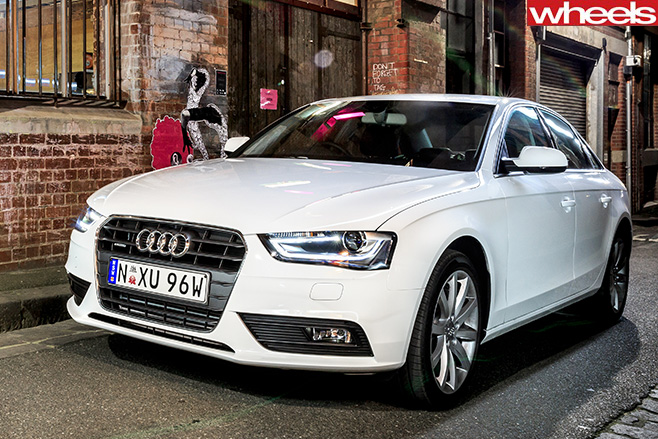
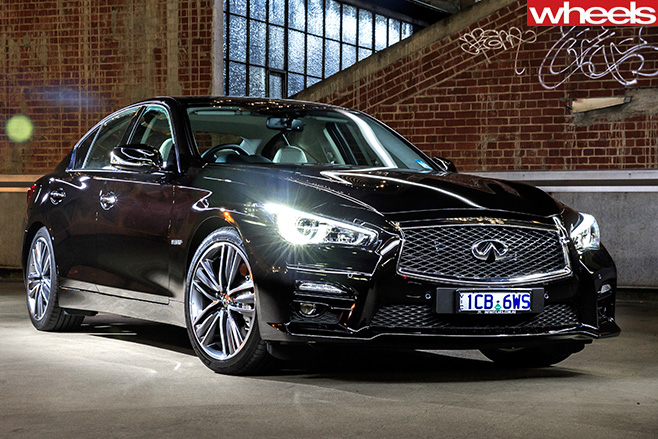
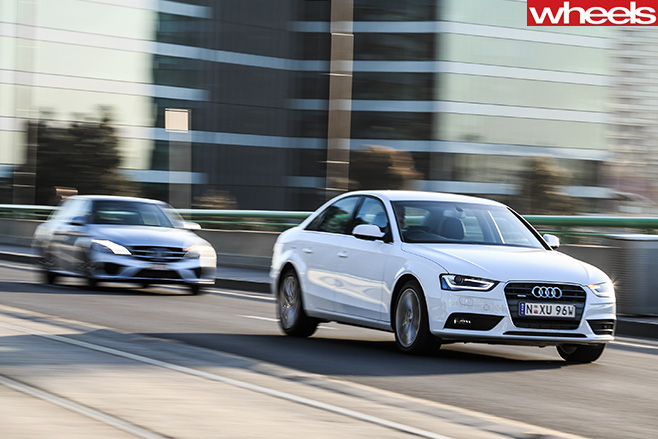
Which is why we’ve lined up Merc’s new W205 C250 and BMW’s two-year-old F30 328i with another long-established foe, the Audi A4 2.0 TFSI quattro. Facing off against the Germans are two recent Japanese arrivals, the Lexus IS300h F-Sport and Infiniti Q50 3.5 Hybrid S.
Five for the money
The arrival of the new C-Class is what led to this examination, and we’ve stepped up from entry-level to a place where there’s a little more creature comfort, performance and, of course, a bigger price tag.
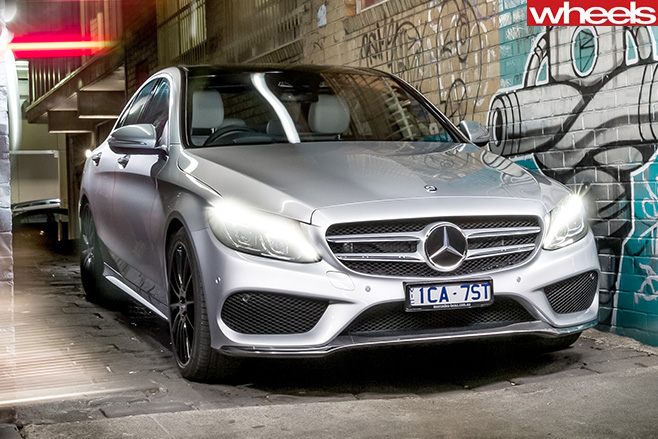
Superficially, these cars are similar. They’re all around 4.7-4.8m long, and all offer the expected equipment – a full suite of airbags, active and passive driver aids, sat-nav, leather trim, modern media and communication tools.
But look a little harder and you’ll find the key differences that distinguish their characters.
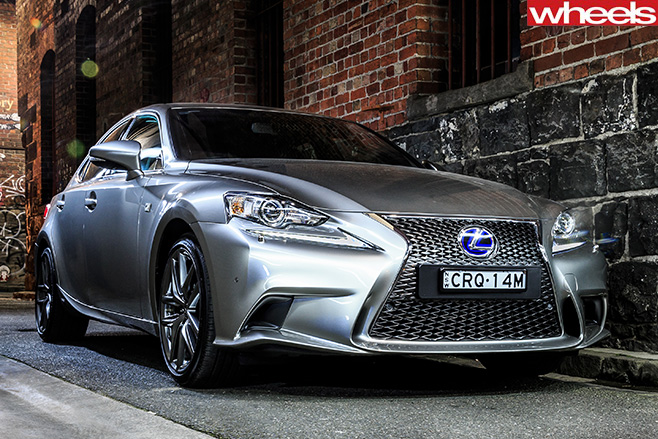
There’s even a global production first – steer-by-wire in the Q50.
All offer some form of driver tuneability for various aspects of the mechanical package. This varies from almost none in the Audi to the comprehensive individualisation offered via Benz’s Agility Select dial (see breakout).
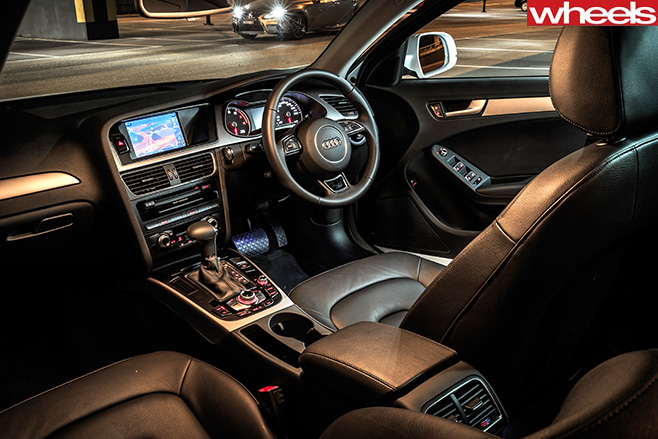
THE B8-series A4’s time is nearly up, yet yesterday’s car is generally pleasant, functionally earnest and very familiar. However, the front seats are flat, the vinyl backing is cheap, it has the noisiest cabin, and the lack of toeroom doesn’t help rear-seat passengers. Reflecting its age, this was the only car that came with a spare tyre, albeit a space-saver.
Not content, Benz has completely overhauled the C-Class cabin, and the drooping interior now walks a fine line between gauche and elegant.
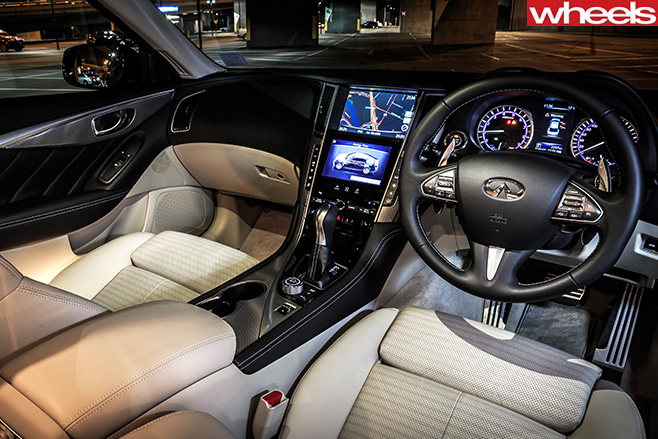
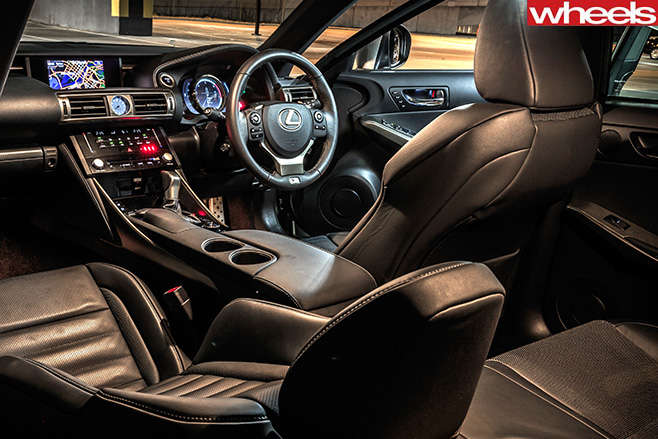
The aged Audi sits at the other end of the scale, conventional and forgettable, while BMW has been only a little more daring. The Lexus has good bits borrowed from the LFA – including a moving instrument meter – and bad bits that confuse. The Infiniti is by turns luxurious, complex and distracting.
Bliss, in its element
This is where the BMW makes its mark. The safe exterior styling and acres of interior plastic are forgotten once you snuggle in and go. No other car here has its sheer ‘Sunday morning drive for the hell of it’ appeal. The new-generation engine responds exultantly and disposes of everything here in a straight line – other than the he-man Infiniti – with a snarl.
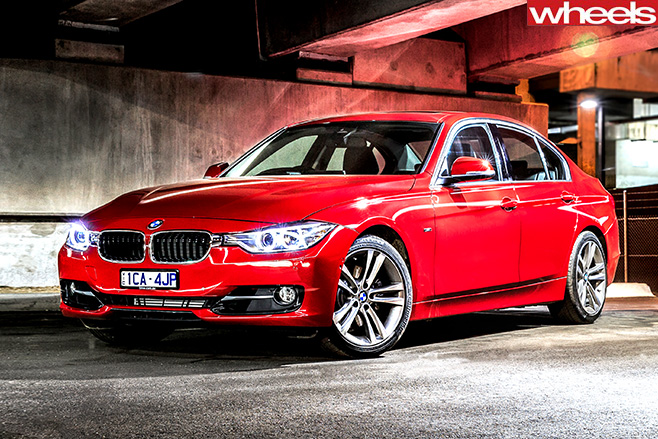
There’s a big ‘but’ looming, though. Our test car had the optional M adaptive suspension, which lifts ride and handling significantly above the standard passive set-up. The take-up rate among buyers has been low, but if you relish driving, tick that box. You shouldn’t have to; BMW should make M adaptive standard for this car, as it has for the 428i.
Punting the BMW along a challenging road is a real joy once you figure out the Driving Experience Control. It offers Eco Pro (freeway cruising only, please), Comfort (dampers too floaty, yet that’s the default), Sport (the best choice in our view) and Sport+, which raises the threshold of traction control intervention. Opt for Sport, flip through the lovely ZF eight-speed ’box manually and you wouldn’t want to be in any other car in this group.
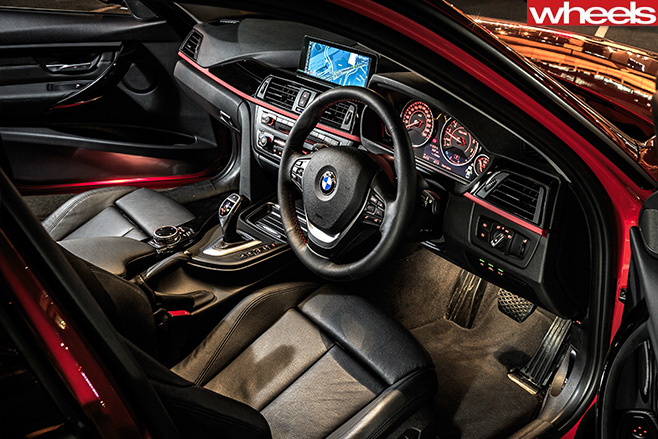
To pucker, push here
Push along in the Infiniti and puckering comes as standard. At best, the Q50 is benign; at worst, it’s downright dangerous. That’s in Sport mode, which makes the steering too heavy and too quick, so you are constantly turning in too deep on corner entry, then correcting. While you’re at it, the front-end grip is only passable and the rear is dancing around on corrugations, the brakes refuse to act progressively and the Active Trace Control – which brakes individual wheels – aggressively clamps and unclamps, unsettling the car. Apparently Sebastien Vettel tuned this car. Maybe Dan Ricciardo should do the next one.
Dialling back the aggression is the only way to manage the Q50. Set the steering gearing to Casual, effort to Light, Trace Control off and Active Lane Control minimised. Even then the Q50’s cruising ability is marred by the worst ride here, especially at low speeds. Rolling on low-profile 19-inch run-flat rubber can’t help, but the Benz rides on the same set-up and is a far better effort.
Getting on, but still good
The lack of digital chassis adjustment is no impediment to the Audi. Tap the brake for a bit of weight over the nose entering the corner to keep understeer at bay, then rely on the self-locking centre diff to push and pull you up the next straight. Meanwhile, that excellent engine and snappy gearbox do their zestful thing.
City winner, country grinner
The Lexus could use the A4’s drivetrain. The IS hybrid is by far the most economical. It’s the quietest and its ride at low speeds is a class above the rest. Its EV-aided tip-in acceleration is also outstanding. Around town, this car is a winner.
The F-Sport remains interesting beyond the ’burbs, when the pace builds and corners loom. Its nicely shaped sporty exterior indicates how it drives, with a playfulness to the steering and chassis that puts a grin on your face.
Fresh take on what’s possible
The new Benz demonstrates what’s possible, upgrading from the W204’s 1.8-litre turbo-petrol four to a quieter and more powerful, torquey and economical 2.0-litre. Allied with the lighter and stronger MRA platform, the C-Class continues to be an outstanding all-round drive.
Our test C250 came fitted with optional AMG sports suspension and Airmatic air springs, the latter being a first for the category. But, while there’s no doubt they round off sharp bumps and allow a choice between floatier Comfort and tauter Sport settings, their inclusion is not a deal-breaker in the way M adaptive is for the BMW.
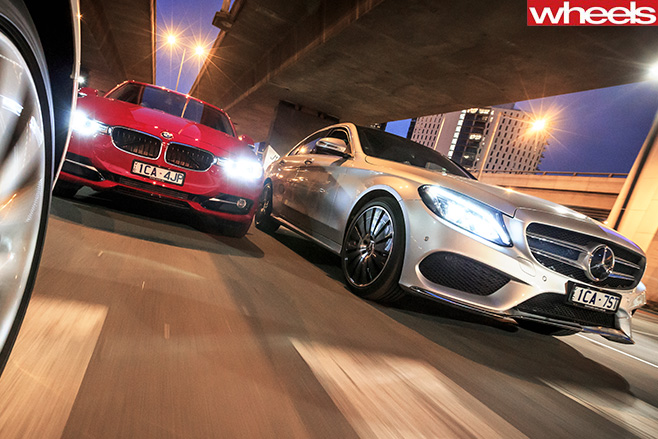
The C250 can’t communicate and involve like the BMW does on adaptive dampers. The engine doesn’t have the same verve, either. That margin comes into sharp focus on one challenging climb and descent section on our test loop, where a series of corrugated closing-radius off-camber turns flow into one another, a drop-off one side and a rock wall the other. The BMW settles onto its outside rear wheel and devours this stuff, delivering more confidence and demanding more commitment turning in, while driving hard and clean on the exit. There’s movement through the rear end and steering wheel, but it’s feedback, not oafishness.
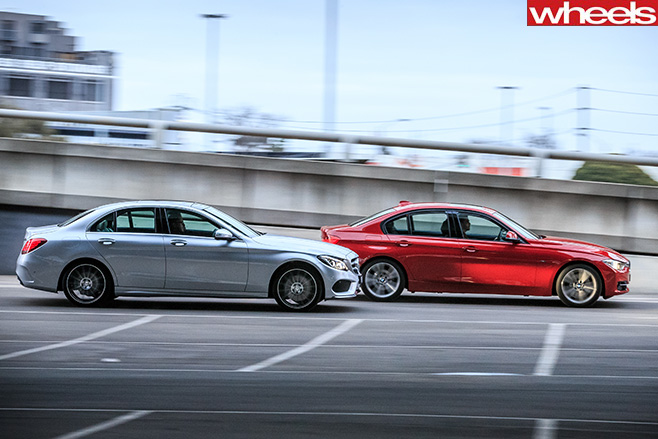
But remember, the BMW crests the climb with the Benz chasing hard; the rest are still coming behind. In the case of the Infiniti, far behind.
Refinement seals the deal
The C-Class more than redresses the balance when the pace is toned down and the driving reverts to everyday stuff. Then, the quietness and calm of the cabin is exceptional. At highway cruising speeds, the engine can barely be heard; the wind rustling off the exterior mirrors is more obvious. The C250’s ride is also a step ahead of the BMW, both clearly benefitting from how far run-flat tyres have come. It’s this refinement that helps seal the deal for the C-Class.
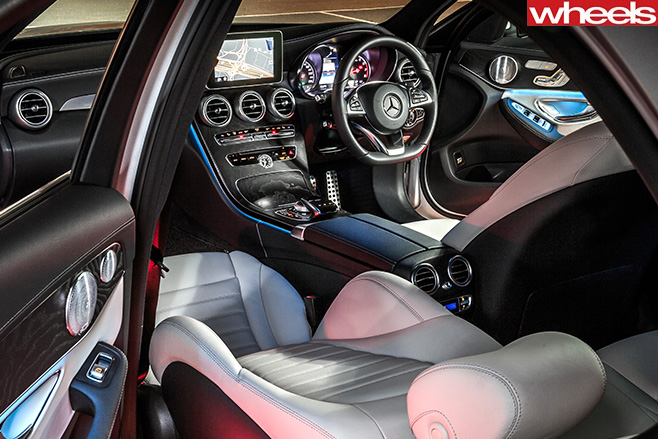
The Benz is not only the newest but also the most complete. That’s what makes it the most convincing. It has leapfrogged the BMW, as we’re used to seeing Falcons and Commodores do to each other in Wheels shootouts. The C250 claims the ascendancy, but only establishes enough gap to motivate, not deter, the lads in Munich.
This is a dimension the Falcon v Commodore fight rarely had. It’s why 3 v C v the rest is something special, and why we’re already looking forward to the next one. You should be, too.
Power play
DRIVING the C250 sharpens our anticipation for the hot Mercedes-AMG C63. There is real dynamic ability in the new MRA architecture for the team at Sindelfingen to tap. They’ll need to if the car is to cope with its new 375kW/700Nm 4.0-litre twin-turbo V8, a wet sump version of the GT AMG donk.That’s 25kW and 50Nm up on its glorious 6.2-litre naturally aspirated predecessor, and well ahead of the brilliant new M3/M4’s 317kW/555Nm twin-turbo six. The sedan and wagon, unveiled at the Paris show, go on sale in Australia around March. A coupe and maybe a convertible will follow in 2016.
Join the pack
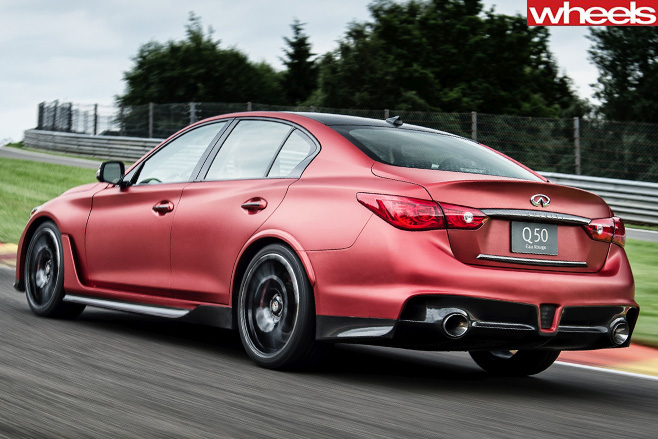
JUST as they target the mainstream C and 3, so the challengers are after a share of the high-performance market. Infiniti is weighing up whether to build its Q50 Eau Rouge, powered by a 418kW version of the Nissan GT-R’s twin-turbo V6 engine. Next year’s B9 Audi A4 will spawn an RS4 tipped to trade the atmo V8 for a return to a twin-turbo V6. A second-generation Lexus IS F using the naturally aspirated 5.0-litre V8 from the RC F is being considered. And then there’s the Jaguar XE SVR, developed by its Special Vehicle Operations. A huffed 5.0-litre V8 is likely.
Wiretapped
THE Infiniti Q50’s steer-by-wire Direct Adaptive Steering works by electronically transferring the driver’s input to the front wheels, where a high-response actuator drives the steering rack. Steering is adjusted via a touchscreen, with up to four pre-set modes and a personal setting that allows the driver to mix and match effort and response. The system comes with a triple-mode back-up (three separate electronic control units), 400,000km of real-world testing and the fail-safe fallback of a mechanical steering linkage.
Make a move
REMEMBER when dialling up the fun was just a matter of switching off the stability control? The new Benz’s Agility Select system adjusts the drivetrain through Eco, Comfort, Sport and Sport+ modes, while the steering has Comfort and Sport modes. Infiniti’s Drive Mode, BMW’s Driving Experience Controller and the Lexus Drive Mode Selector all do similar things, although the F Sport adds adaptive dampers.
The old-school A4 gearbox just has Drive, Sport and Manual modes.
Verdict
 MERCEDES-BENZ C250
Price as tested: $82,899 *Includes metallic paint ($1531), Comand package ($2300), Vision package ($3454), AMG Line package ($2685), Airmatic suspension ($1915), Air-Balance ($377)
NCAP rating: 5 stars (Euro)
Fuel economy: 11.3L/100km (test average)
Acceleration: 0-100km/h: 6.7sec (tested)
Plus: Interior quality; ride and handling balance; class-leading safety
Minus: Underdone rear seat; can’t match BMW’s driving thrills
Verdict: 8.5/10
BMW 328i HIGH-LINE SPORT
Price as tested: $77,520 *Includes metallic paint ($1800), adaptive M suspension ($2200), glass sunroof ($2920), Sport Line (no cost), ConnectedDrive Freedom ($1200)
NCAP rating: 5 stars (Euro)
Fuel economy: 11.5L/100km (test average)
Acceleration: 0-100km/h: 5.8sec (tested)
Plus: Excellent performance; decent refinement; great driver’s car…
Minus: …but only if you option adaptive dampers; underwhelming interior
Verdict: 8.0/10

LEXUS IS300h F-SPORT
Price as tested: $74,200 *Includes Enhancement Pack 1 ($4000), Premium Paint ($1500)
NCAP rating: 5 stars (Euro)
Fuel economy: 9.2L/100km (test average)
Acceleration: 0-100km/h: 8.5sec (tested)
Plus: Quiet; refined; economical; nicely finished; doesn’t mind a punt
Minus: Lacks the grunt to complement its chassis; deserves a turbo-petrol
Verdict: 7.5/10
AUDI A4 2.0 TFSI QUATTRO
Price as tested: $59,900
NCAP rating: 5 stars (Euro)
Fuel economy: 11.7L/100km (test average)
Acceleration: 0-100km/h: 6.1sec (tested)
Plus: Snappy drivetrain; surprisingly good dynamics; impressive finish
Minus: Noisy; interior now ageing; unsupportive front seats
Verdict: 7.0/10
INFINITI Q50 3.5h S
Price as tested: $67,900
NCAP rating: 5 stars (Euro)
Fuel economy: 11.4L/100km (test average)
Acceleration: 0-100km/h: 5.4sec (tested)
Plus: Big straight-line performer; lots of gear for the money; lush back seat
Minus: Steer-by-wire needs work; total dynamic package not good enough
Verdict: 5.0/10
The S8 nameplate mightn’t figure highly in the pantheon of go-fast greatness, but it takes just 4.1 seconds for Audi’s flagship sports limo to convince you otherwise.
That’s its 0-100km/h claim, and the S8 is quick enough to give BMW’s M5, AMG’s E63 S and C63 507 and HSV’s GTS a proper scare.
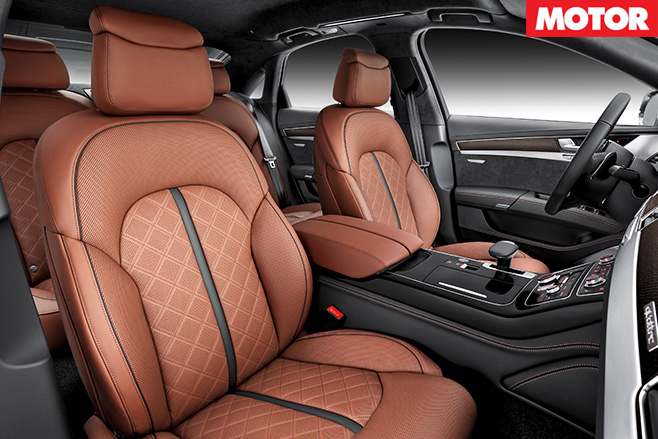
It certainly feels as quick as the claim. Load the 4.0-litre twin-turbo V8 up against the brake in the first of its eight S-tronic ratios, step off at 2400rpm and the S8 pins you mercilessly into its 22-way-adjustable Valcona leather seat.
And while the TFSI engine doesn’t boast kilowatt figures quite as glorious as the ‘400-plus’ of its fellow Germans, making do with just 382kW, its stunning acceleration is mostly thanks to a handy 650Nm peak on tap from just 1700rpm.
With quattro drive plying torque through optional 275mm-wide hoops, it’s a party trick of effortless consistency that rival manufacturers’ rear-drivers promise but so often fail to put into practice.
Equally fuss-free is the relentless shove to its 250km/h speed-limiter, as sampled on the autobahns around Dusseldorf, Germany, and the retardation of its formidable 1990kg heft at the first sign of a meandering Polish caravan, thanks to its 400mm/363mm carbon-ceramic brakes.
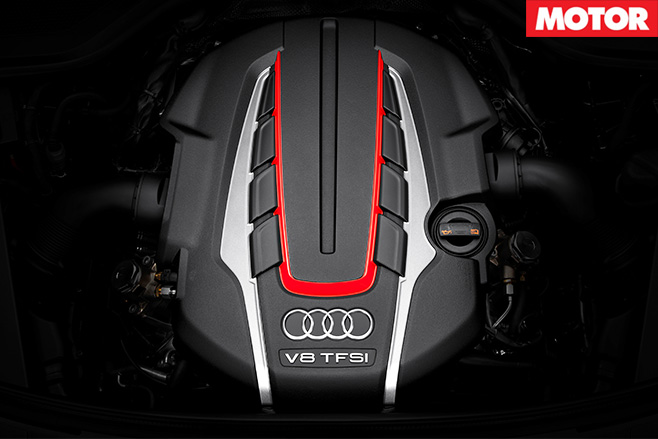
Despite aggressive front and rear styling, a low stance and brash 21-inch rolling stock, the first new-gen, newly face-lifted S8 to lob in Australia is first and foremost a limousine.
A particularly potent one, granted, but you quickly discover that it favours high-speed stability and iron-clad surety – plus its handy acceleration/deceleration talents – over dynamic agility and corner-carving flamboyance.
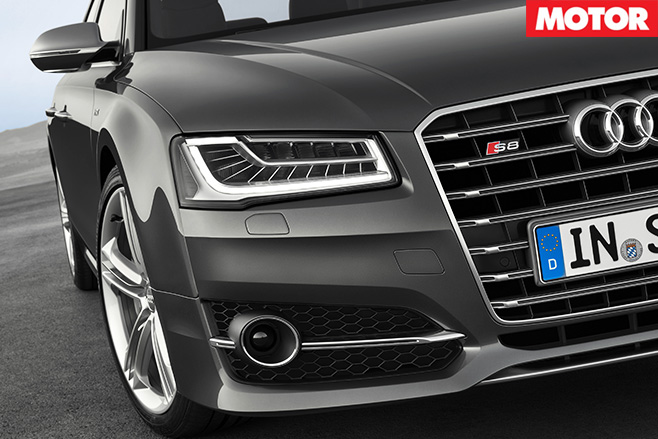
Above 200km/h, it feels more planted, composed and confidence inspiring than an A8. The S8 rides exceptionally smoothly on those 21s – at least on Germany’s generally smooth roads. Its beautiful blend of chassis control and ride comfort is definitely a strong suit.
The electro-mechanical steering that has replaced the old car’s hydraulic system is no pillar of fizzy communication, but the S8 certainly feels lighter and more direct in the front end than the regular A8s sampled in Dusseldorf. And the quattro’s natural rear-bias (40/60 front-to-rear) seems more attuned to guiding the nose at turn-in rather than tail-out antics.
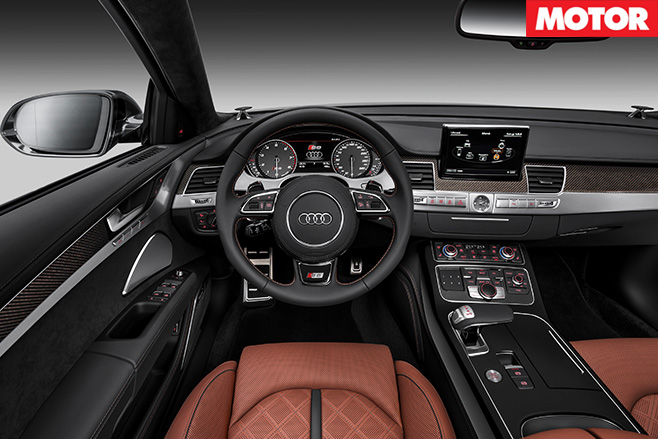
This extends to the cabin treatment, a smorgasbord of double-stitched leather, Alcantara, carbonfibre and brushed aluminium, more opulent than your usual Audi fare but undeniably pressed from Ingolstadt’s familiar, time-honoured mould. And from the four-zone climate control to in-car internet, it’s got the big bells and loud whistles covered.
It’s quiet and comfortable at a cruise, although switch the exhaust to Dynamic (read: loud) using Audi’s Drive Select system and it adds a nice bassy rumble to the exhaust.
But at $280,610 (exact pricing will be confirmed closer to its second quarter 2014 Australian release), it’s an RS in all but name.
4/5
Specs
Engine: 3993cc V8, DOHC, 32v, twin turbo Power: 382kW @ 5800rpm Torque: 650Nm @ 1700rpm Weight: 1990kg 0-100km/h: 4.1sec (claimed) Price: $280,610
IT MAY BE years before the full impact of the Volkswagen diesel emissions scandal can be accurately assessed, but this disgraceful deception clearly has the potential to deal diesel a severe blow.
Regulatory scrutiny of emissions testing procedures all around the world is sure to tighten, while consumers must now be justly suspicious of diesel’s claims to cleanliness. Both factors will combine to drive down diesel sales. The only question is, by how much?
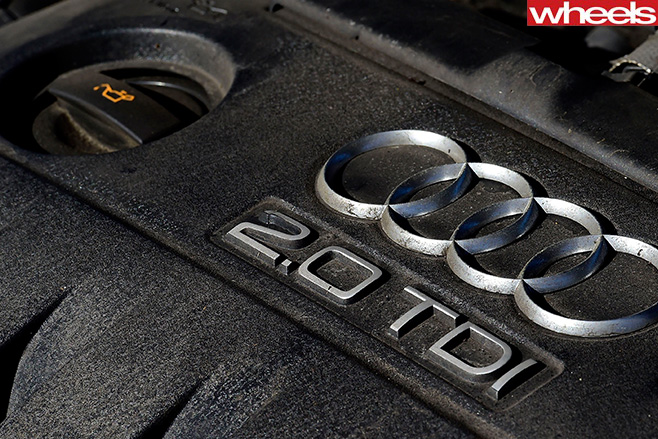
Ironically, pleasing customers was Volkswagen’s apparent motive for installing the sneaky software that sparked it all off. The company’s EA189 2.0-litre four-cylinder turbo-diesel apparently produces more power when running in its dirty daily driving mode than when in an emissions testing cell. Someone inside Volkswagen must have decided that disappointing diesel drivers was a greater risk for the company than breaking the law. They were wrong. Very wrong.
The specific pollutant Volkswagen was so concerned about is NOx, or oxides of nitrogen. Diesel combustion, for reasons there isn’t room to discuss here, produces more NOx than burning other fuels. And NOx is quite nasty stuff. Worst of them is nitrogen dioxide (NO2), a reddish-brown gas that is fatal in quite small concentrations, and a respiratory irritant in even lower doses. It’s been pinpointed as a cause of asthma and emphysema, as well as smog and acid rain. Even though it makes up only a tiny fraction of what comes out of a diesel engine’s exhaust pipe, regulators around the world demand very low – as in parts-per-million – emissions of the stuff. The US has some of the toughest legal limits in the world.
Petrol-electric hybrids, on the other hand, easily beat diesel for emissions of the big global-warming gas in a typical driving mix. And there’s no question they are cleaner when it comes to pollutants like NOx.
Most car buyers are not experts in combustion chemistry, exhaust gas treatment, emissions testing procedures or the environmental pros and cons of the various drivetrain types on offer. The Volkswagen episode will leave many with the simple impression that diesel is dirty. But what effect will this have on car purchase patterns?
It’s likely some already diesel-sceptic governments will act to effectively remove diesel from the passenger car menu. The list is headed by the world’s two biggest car markets, China and the US, so this would spell the end of plans by European manufacturers to extend diesel’s reach.
Tougher to predict is what lasting effect the scandal will have in Europe, until now diesel’s domain. To a large extent it will depend on government action. After all, diesel’s 53 percent share of the European passenger car market was the result of policies designed to make diesel fuel less expensive than petrol after the oil shocks of the 1970s. The idea was to reduce imports of oil by encouraging drivers to choose more fuel-efficient cars.
A change in policies to discourage diesel could be equally effective. The mayor of Paris, for example, earlier this year signalled her desire to rid the French capital of diesel cars by 2020. This might have seemed loopy before the Volkswagen scandal, but now sounds sensible.
Hybrid to shine