
Complaints about the flat sound of Formula One cars since their switch to turbo V6 hybrid powerplants should be directed to former Ferrari chief Luca di Montezemolo, but he was playing a long game.
THINK TODAY’S F1 cars sound rubbish? Blame former Ferrari boss Luca Montezemolo. It was Montezemolo who lobbied against an F1 technical committee recommendation that the hybrid powertrains for 2014 and beyond feature turbocharged four-cylinder engines.
“Ferrari wanted a V6,” says Ulrich Baretzky, Audi’s race engine development chief and a former member of the committee. “Montezemolo pushed, saying Ferrari cannot build a four-cylinder car. So F1 ended up with a V6 that is too heavy, too expensive and sounds bad.”
Baretzky knows a thing or two about turbocharged four-cylinder F1 engines. Back in the 1980s he worked for legendary BMW engine maestro Paul Rosche, the man behind the astonishing 1.5-litre turbocharged four that powered Nelson Piquet to his 1983 World Championship in the stylish Gordon Murray-designed Brabham BT52.
Built using carefully prepared production engine blocks (BMW’s M10 unit that debuted in the Neue Klasse sedan in 1962), Rosche’s M12/13 F1 powerplant produced about 630kW in qualifying trim and 480kW in race trim during the Piquet era. By 1986 it was said to be producing more than 1040kW using 5.6bar of boost pressure in qualifying trim, though Rosche could never be sure because BMW didn’t have a dyno capable of measuring it. I once asked Rosche how he knew he’d found that extraordinary engine’s limit. “When we started blowing crankshafts out the bottom of the block,” he replied with a grin.
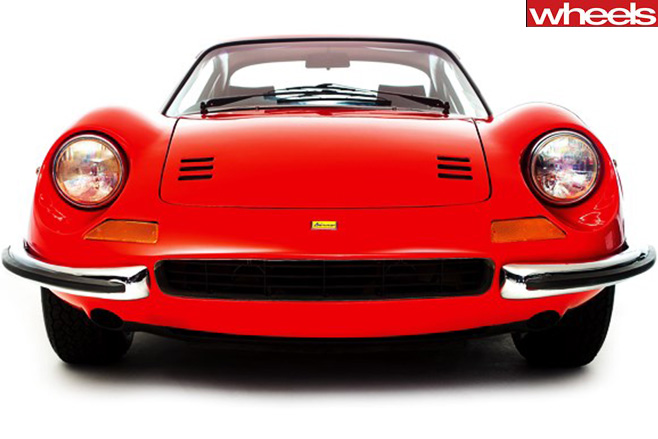
Groundwork… in insisting on V6 engines for Formula One, Ferrari may have been paving the way for a contemporary version of the Ferrari Dino sports car.
Baretzky is convinced that a four-cylinder would have been by far the better option for F1, and not just because of the reduced cost and complexity: “No one ever complained about the sound of that BMW engine,” he says emphatically. But what Ferrari wants in F1, Ferrari usually gets, and it appears Montezemolo was playing a long game with his insistence that F1 stick with V6 engines. He may have been laying the groundwork for the return of the Ferrari Dino, a mid-engined sports car powered by… a V6 engine.
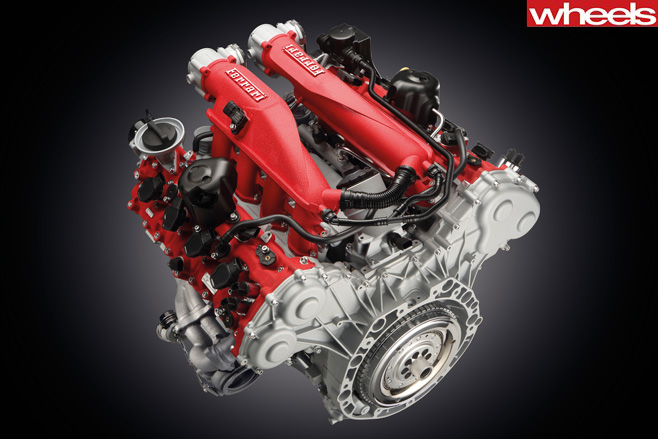
FCA boss Sergio Marchionne has since confirmed a new Dino is not a question of if, but when. He also says that, while the car may have less power than the new 488 GTB, it will not be a cheap Ferrari. And comments from Ferrari road car engineers confirm that the F1 engine program’s significance at Maranello extends beyond the racetrack. “The V6 is still young,” says one. “In five, six, seven years its status will be more important than now.” The important thing to note here is that the current F1 powertrain regulations are currently fixed only until 2020…
Turbocharging and electrification are the future for high-performance road car engines, a trend we already see with the current crop of hypercars like La Ferrari, Porsche 918 and McLaren P1. Ferrari engineers clearly believe F1 can be a laboratory for fast-tracking such technologies, despite stupidly restrictive bans on powertrain testing and development.
For the first time in decades, F1 has powertrains directly relevant to future road cars. And that’s arguably much more important than what they sound like.
C’mon, feel the noise
Last week – August 27, to be precise – marked Mark Webber’s 39th birthday.
To celebrate the passing of time, the nine-time F1 winner decided to treat himself to a new set of wheels, namely a Porsche 918 Spyder.
As you’d hope, the lightweight Weissach package was included, which strips a further 41kg from the car’s weight courtesy of a lightweight stereo system, magnesium wheels, ceramic wheel bearings and more.
Webber also opted for a retro ‘Salzburg’ paint scheme, inspired by the Porsche 917 that won Le Mans in 1970.

A 911 GT3 RS 4.0 is the centrepiece of his collection, though the fearsome GT2 RS is also apparently on the ‘never sell’ list. Following his collection of the latter, Webber took a few lucky competition winners for hot laps in the car, which you can see below.
Webber’s latest purchase clearly put him in a good mood, as along with team mates Brendon Hartley and Timo Bernhard, he took his first win in the World Endurance Championship at the weekend driving the Porsche 919 Hybrid.
Once bitten, twice sharp – that’s what Jaguar is trying to convey with its massively anticipated XE, the BMW 3 Series-baiting, rear-drive replacement for the unloved X-Type. Here we take a look at the mid-range 2.5t version.
WHAT IS IT Jaguar calls its new medium-size sedan a four-door F-Type – fanciful thinking after the innocuously nice X-Type that preceded it last decade. But even a brief drive will reveal a special chassis tuned to please the keenest driver, along with a gutsy 177kW 2.0-litre turbo in the 2.5t. Is all that enough?
WHY WE’RE TESTING IT When Jaguar abandoned the Ford Mondeo-based X-Type half a decade ago, nobody believed the firm would return so soon – or so promisingly – with an aluminium-intensive, rear-drive sports sedan with such close ties to the fabulous F-Type. But it has, the car is here, and we’re hungry to learn whether the BMW 3 Series and Mercedes C-Class should be running scared.
MAIN RIVALS Audi A4, BMW 3 Series, Infiniti Q50, Lexus IS, Mercedes-Benz C-Class, Volvo S60
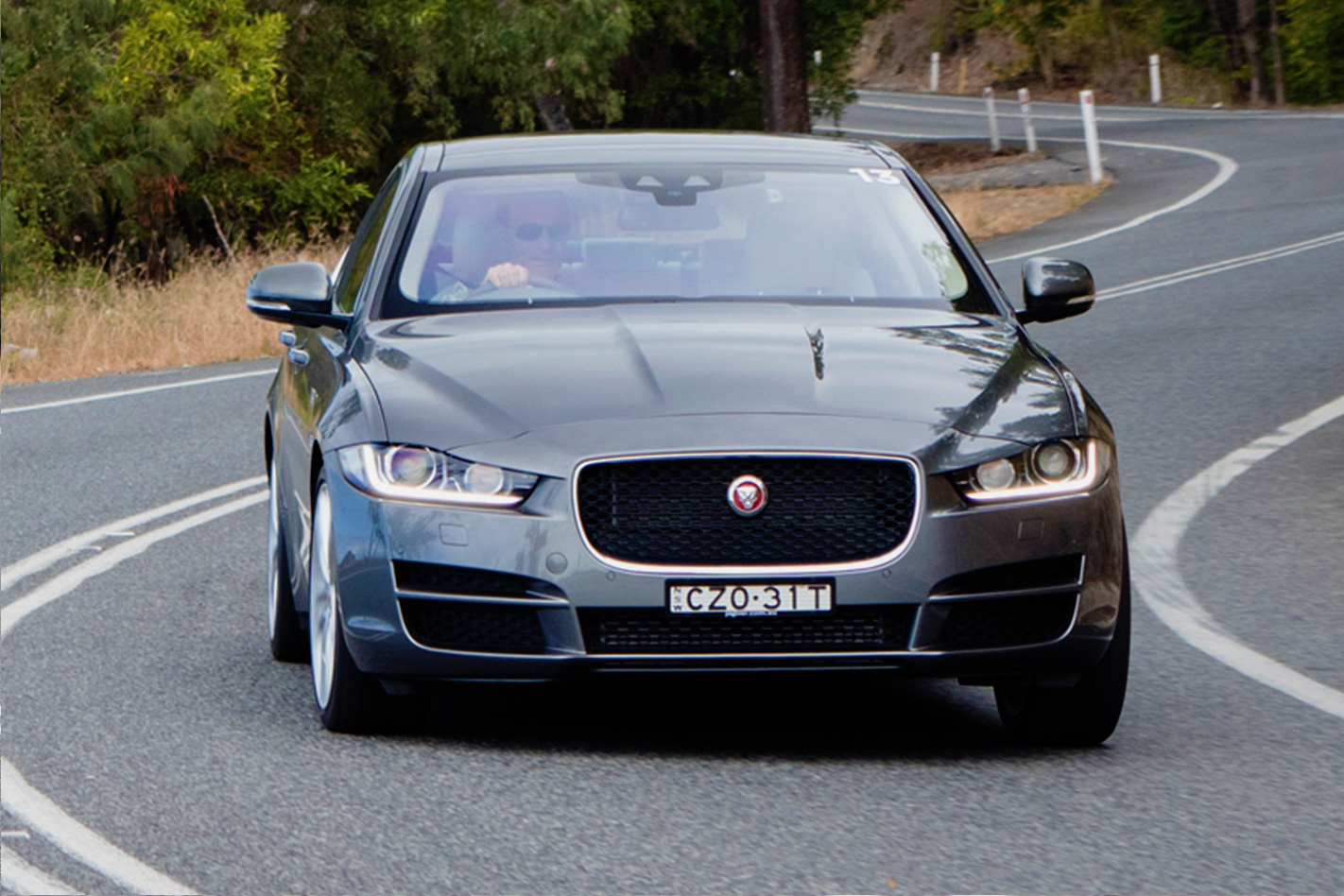
PLUS: On-brand dynamics with superb steering, handling and roadholding; presence MINUS: Off-brand dash quality; derivative design; no manual gearbox; expensive options
THE WHEELS REVIEW REMEMBER that famous Enzo Ferrari quote about buying the engine and getting the rest of the car thrown in for free? Well, there’s a bit of that going on with the new XE, but in this case you’re paying for a cracking chassis rather than the engine.
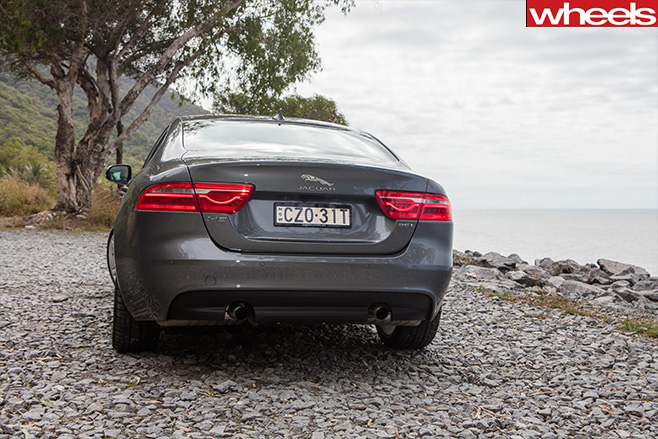
In 2.5t Prestige guise, the result is utterly invigorating, thanks to the sort of intimate and connected (yet electric!) steering feel you crave for but don’t experience from rivals today, backed up by agile and controlled handling and reassuringly planted roadholding (on Pirelli P7 225/45R18 rubber). You can slide the tail out progressively at will, and then tuck it back in with just the throttle and seat of your pants. This car shrinks around you. Attention BMW E36 328i owners, your long-overdue replacement is here at last.
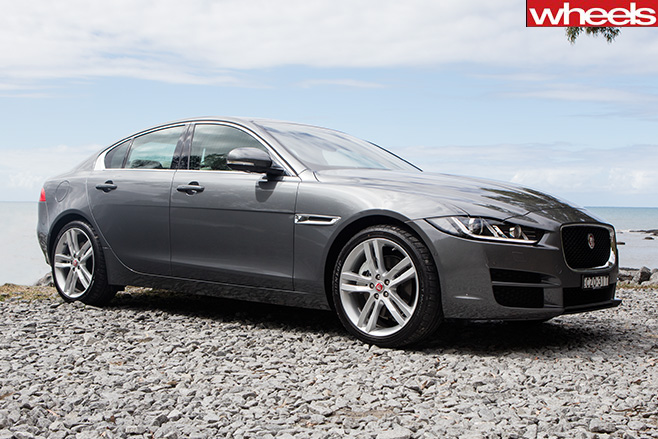
We can also thank Ford for supplying the 2.5t’s energetic 177kW 2.0-litre four-pot turbo-petrol, which is paired to ZF’s supernaturally seamless eight-speed auto. Masking any low-down torque shortfalls with the right ratio every time, the auto provides rapid off-the-mark throttle response, matched by muscular acceleration right up the rev range.
Putting aside the absence of a manual version and the dashboard’s dreary presentation, for Jaguar to have raided the Land Rover parts bin for the XE’s instrumentation (Disco Sport digital screen bookended by clashing traditional dials with a usefully easy but cheap-looking touchscreen display) is an own goal against Audi’s sophisticated A4. Slapdash fascia finishes combined with occasional rattles in a Lexus IS rival is sheer lunacy. Beware some depressingly high options pricing, too.
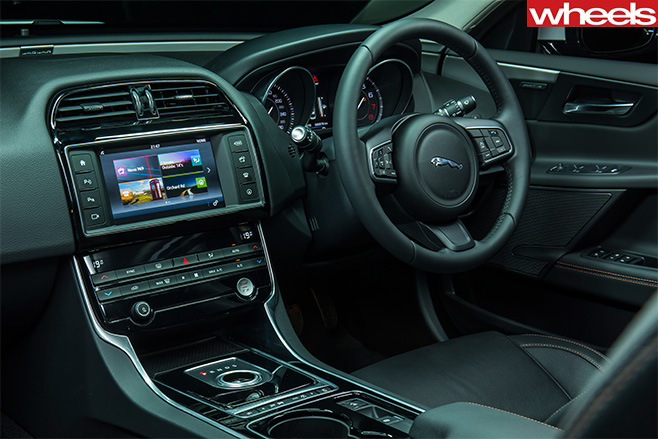
Don’t get us wrong. Solidly handsome, spacious, practical, powerful and well equipped, the XE 2.5t would have to make the final cut for every premium medium sedan shortlist. This segment stars no truer sports sedan. We just wish the interior detailing was better.
SPECS Model: Jaguar XE 2.5t Prestige Engine: 2.0L 4cyl, 16v turbo Max power: 177kW @ 5500rpm Max torque: 340Nm @ 1750-4000rpm Transmission: 8-speed auto Weight: 1535kg 0-100km/h: 6.9sec (claimed) Fuel economy: 7.5L/100km Price: $64,900 On sale: Now
BMW has launched three new M5 variants that have injected fresh value in to the variant’s line-up.
Most significant is BMW’s new bargain edition M5, called the Pure, which has set the entry-ticket in to the M5 range at an astonishing $185,000.
Much like the M3 Pure we saw in 2013, the new Pure relies on a back-to-basics approach to slash an M5’s RRP by $45,010, resulting in a under-$200K tag we haven’t seen attached to the Autobahn master since the E39.
That’s also $65,540 cheaper than its Daimler-Benz rival, the Mercedes-AMG E63 S.
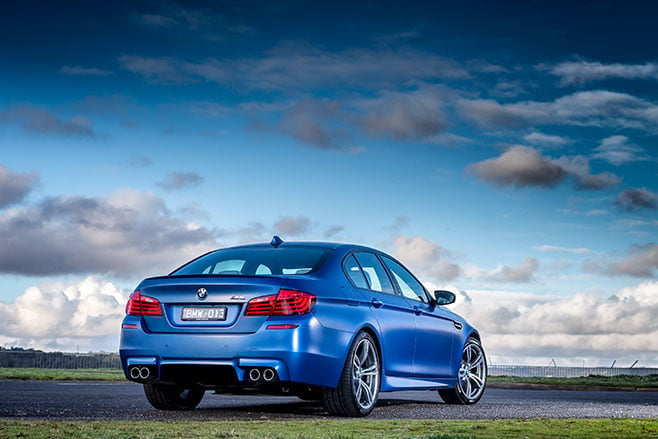
While Merino leather is still found on the seats, it’s been deleted from the doors and dash. The sunblinds too are gone, along with soft-close doors, TV functionality, and multi-function M seats.
Cloth-based Anthracite roof liner also replaces the suede-type Alcantara previously used.
Mechanically the Pure edition forgoes the Competition package made standard for M5s in 2013, which included an extra 11kW, stiffer roll bars, 10mm lower ride height, and 10 per cent quicker steering.
Joining the Pure on the other end of the price spectrum are the Nighthawk and White Shadow editions.
Like the Pure, the Nighthawk and White Shadow include ‘Frozen’ matte finishes on their respective black and white paint work.
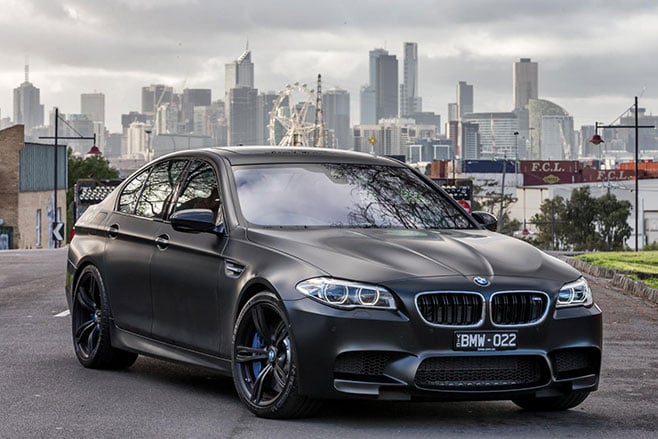
Available now, both the Nighthawk and White Shadow are limited to a run of 10 each, and ask for an extra $6390 than a standard M5.
Get your free weekly report from the world of fast cars – subscribe to the MOTOR newsletter!
MARK Webber has found that winning feeling again, for the first time since he left Formula One.
His Porsche team took a memorable one-two finish in the World Endurance Championship at the Nurburgring, where the #17 919 Hybrid car he shared with Timo Bernhard and Brendon Hartley downed the sister car of Neel Jani, Marc Lieb and Romain Dumas by more than a lap.
The #18 Porsche’s chances were ruined by a series of ‘excessive fuel use’ stop-go penalties totalling 1m 35s, which initially dropped it to fourth behind two works Audis.
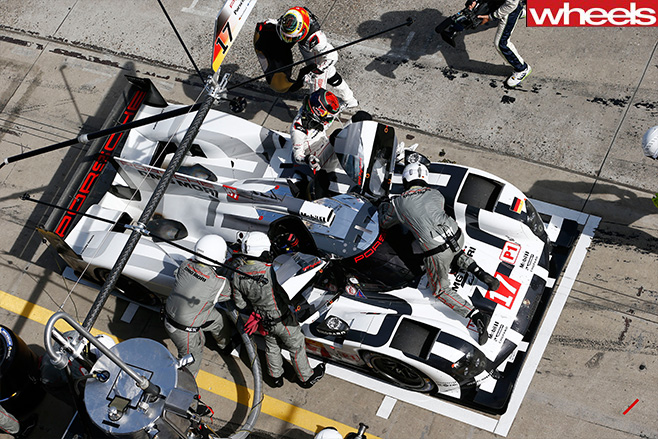
It was the second consecutive WEC win for Porsche, after its Le Mans triumph in June.
The latest high-downforce version of the 919 Hybrid exhibited a clear advantage around the ’Ring over the Audi R18 e-tron quattro and the Toyota TS040 Hybrid.
Audi took third with Andre Lotterer, Benoit Treluyer and Marcel Fassler.
Audi has homework to do before the next round in Austin, Texas.
INDYCAR: Dixon is champion in tiebreaker
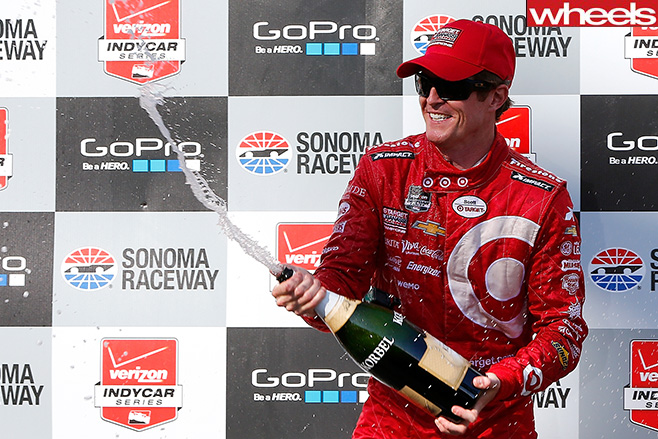
After a season of 16 IndyCar races, the championship came down to this. Scott Dixon and Juan Pablo Montoya were tied on points after the double-points decider.
And Dixon, the Brisbane-born kiwi, won the championship in a tiebreaker. He won more races this year than Montoya.
Dixon was in shock afterwards. He went into the finale third in the points and a long shot. “I can’t believe it,” he kept on saying, after his faultless drive to victory.
“There was still a chance and that’s what I was hoping for,” Dixon said of the double-points race. “I don’t know what to say. This season we had some big races, and this was the biggest. We were such a longshot.”
Six drivers were mathematical chances to win the title, but even with double points on the table in the finale, title leader Montoya was the driver in the box seat.
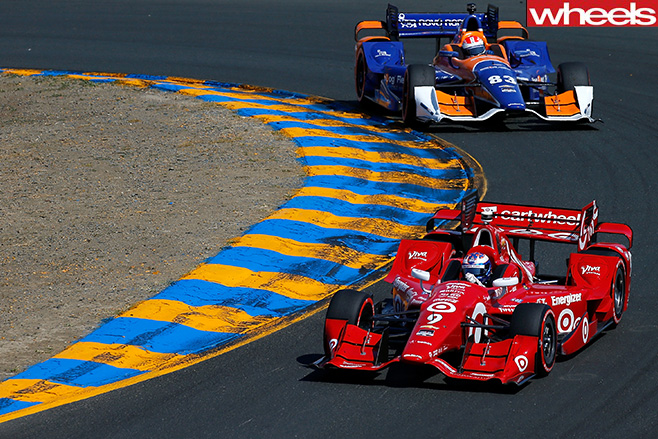
Will Power’s shot at successfully defending his IndyCar title ended before half distance when, after a messy restart, he was launched into a spin by his Penske team-mate and fellow contender Montoya.
Both were forced to pit but it was the Australian who was hurt most.
“We’ve gotta decide if we’re a sport or a casino,” said Power, reflecting on a season where races were so often decided by yellows.
Both charged back but the tricky, undulating Sonoma road course in sun-bleached northern California is the hardest track to overtake at on the calendar.
With five laps remaining, Montoya’s task was to make up 3.4 secs to Ryan Briscoe and take fifth…
He failed by one second, finishing sixth. Power was seventh, but took third in the standings.
As always, pit strategy was crucial to the outcome, as were some obvious team tactics with the four-car mega squads, Ganassi and Penske.
Controversy emerged at the first wave of stops when Penske’s Simon Pagenaud propped on pit road to allow team-mate Power an easy exit. But in so doing, Pagenaud’s car effectively inhibited rival title contender Josef Newgarden’s path away from his box.
Power led until the second round of stops, when he was jumped by Scott Dixon. Then the trouble started.
MOTOGP: Magical Rossi is Silverstone rain master
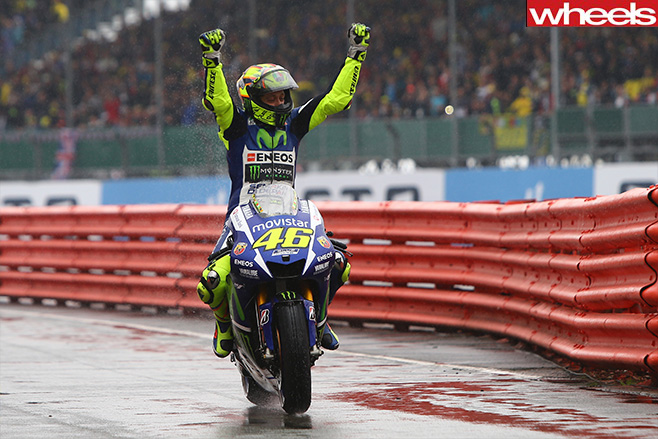
Lorenzo led early but dropped back as he battled with the simplest of issues – a helmet visor that misted up and hurt his vision. He finished fourth
Rossi, 36, showed his class to extend his streak of consecutive podiums finishes to 12 this season.
Lap 13 was certainly unlucky for Honda rival Marc Marquez, who crashed out as he battled to keep on terms with Rossi. The defending champ’s title chase ended there and then. He is simply too far behind Rossi and Lorenzo now to offer a threat, although he will continue to play a pivotal role in stealing valuable points from the contenders.
Rossi started from fourth but looked comfortable in the wet as he made his way to the front.
As the laps ran out, Pramac Ducati’s Danilo Petrucci started closing in, towing Andrea Dovizioso along with him. The gap dropped dramatically, but Rossi responded to maintain a 3.1 sec margin at the chequer.
“I‘m very happy and proud of this victory, it‘s a great feeling! I think that the last race in the wet that I won was 10 years ago,” Rossi said.
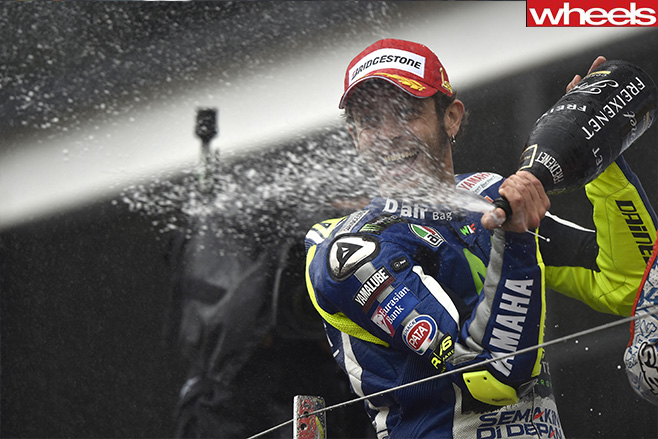
Aussie Jack Miller was left to rue what might have been.
The Queensland rookie made a stunning start from 16th to charge past rider after rider, and into a hectic battle with his LCR Honda team-mate Cal Crutchlow over fifth – in just two laps.
But exuberance got the better of Miller. He slid into the Brit, sending both down. And out. That garage would have been a tense place afterwards.
In Moto2, Frenchman Johann Zarco delivered a lesson in tyre management on a drying track, bolting away as smooth as you like to win from Spanish duo Alex Rins and Tito Rabat.
Most of the field stayed on the treaded wets on a track that offered a wide dry line from mid distance. The leaders finished on virtual slicks.
Aussie Ant West confirmed his wet weather abilities, making up 15 places to take an impressive seventh – one place behind home town hero and pole winner Sam Lowes.
MUSCLE CAR MASTERS: Crompton returns to the track in Mustang Sally
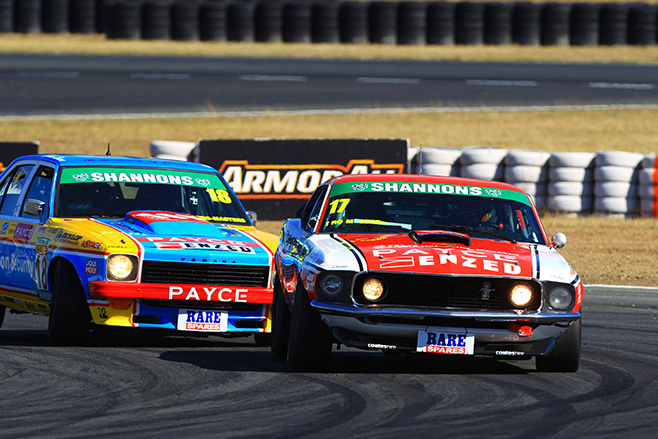
Crompton races only sporadically these days – enough to keep his CAMS licence – and has never tried a TCM (Touring Car Masters) beast.
But the madly popular Muscle Car Masters event seemed an appropriate occasion for Crompton to acquaint himself with the TCM Mustang driven to many victories by John Bowe and, more recently, Steve Johnson.
Bowe’s generosity with the Mustang has meant Johnson – winner of three rounds in as many starts in the American ’Stang – has been forced to switch to an Aussie-built Falcon GTHO as he attempts to continue his winning ways in the TCM competition.
Bowe has the luxury of a choice of a couple of competitive cars and will again wheel out his Torana V8 in search of more success on Father’s Day.
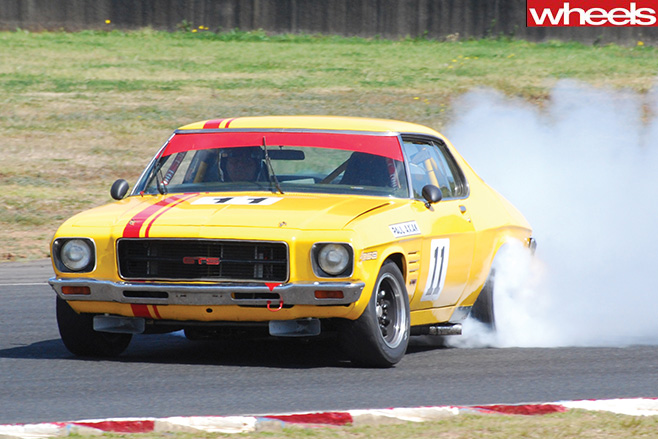
“You never lose the passion for race driving but as life changes the opportunities diminish,” said Crompton. “It’s not an easy thing to do well, especially when you’re low on mileage, so the best approach is be positive, relaxed and realistic.” Yeah… right. Heard that before.
The Muscle Car Masters – a celebration of great touring cars of the 1960s, ’70s and ’80s, and the men who raced them – is always a memorable family day at the track, with kids under 12 admitted free.
The cars many of us grew up watching will be there – Toranas, Monaros, Falcon GTs, Chargers, Mustangs, Camaros, Commodores, Nissan GTRs…
Fans get easy access to many of the legendary drivers of the era, with Kevin Bartlett, Colin Bond, Allan Grice, Barry Seton, John French, Fred Gibson, John Smith, Bill Buckle, Spencer Martin, Charlie O’Brien and Tony Longhurst all confirmed.
GERMAN F4: Aussie Mawson wins at Sachsenring
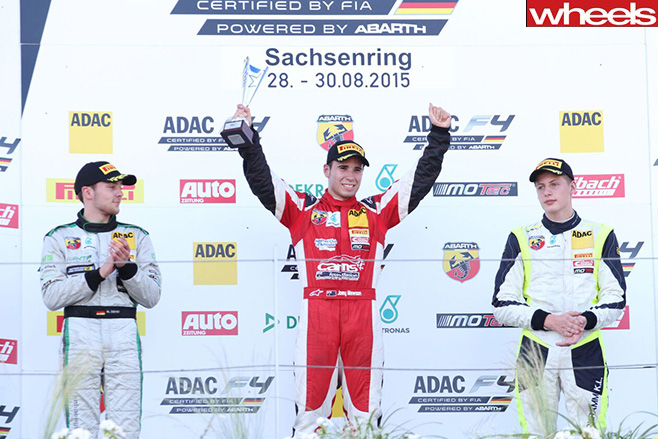
Earlier, Mawson (Van Amersfoort Racing) took a third and a fourth place in races on Saturday and sits a solid third in the standings.
The championship continues to be led by Marvin Dienst of the HTP Junior Team, who won both Saturday races and took second on Sunday.
“This victory is fantastic – probably the best of my career so far,” said Mawson after recording his third win of the season.
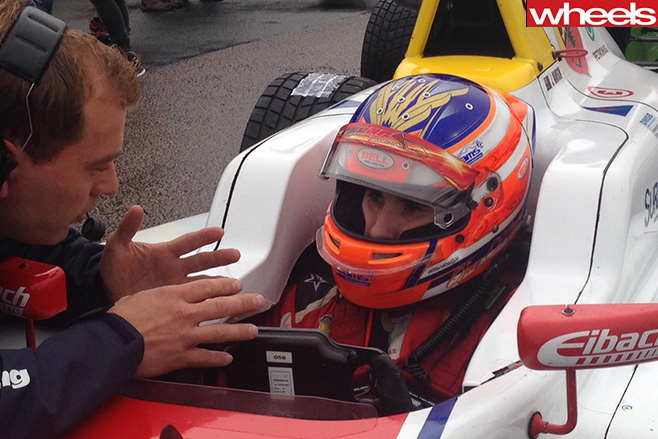
At a restart, Mawson seized the chance to overtake second-placed Mike Ortmann and then on the penultimate lap, he moved past Kim Luis Schramm to the lead.
The 19-year-old CAMS Foundation-backed driver has two rounds and a total of six races remaining in the championship to overhaul the two men ahead of him in the points.
Sign up here to receive the latest round-up of Wheels news, reviews and video highlights straight to your inbox each week.
PLUS
- The brand new 3.0-litre turbocharged six cylinder engine in the range topping 340i is muscular, smooth and sounds fantastic.
- Those chasing greater efficiency now have the option of a 1.5-litre three cylinder petrol in the entry level 318i.
- Greater ride comfort thanks to an overhauled suspension system.
- An even more efficient, 330e hybrid model arrives in 2016, if you can hang out for it.
- Design changes are small, meaning only BMW die hards will know you bought the new model.
- BMW’s boffins have changed the steering, in an attempt to make it sharper and more engaging. Sadly the result is the opposite, with a wheel that is vague and artificial.
- Newer, and potentially better, rivals from Mercedes, Audi, Jaguar and Alfa Romeo.
Audi’s first plug-in hybrid to go on sale in Australia, the A3 Sportback e-tron may be overdue but it’s brilliantly executed. And barely distinguishable from a petrol A3 from behind the wheel.
WHAT IS IT? The first of many e-tron models expected from Audi, the A3 Sportback e-tron is a plug-in hybrid. It begins with the 1.4-litre turbo-petrol car and adds a battery pack and an electric motor, to give a range of 920km and an official Euro fuel figure of 1.6L/100km. It’s the most efficient A3 on sale.
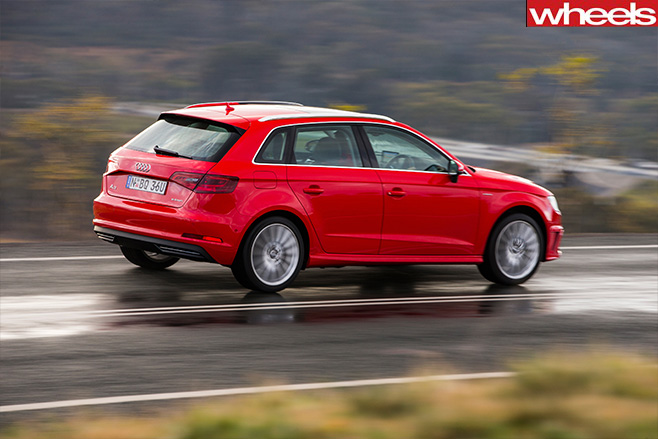
THE WHEELS VERDICT The A3 Sportback e-tron is a brilliantly executed plug-in hybrid. But given the pace at which electrification is progressing – even from Audi itself – it seems obsolete already. That’s not to take away from its excellent dynamics, miserly economy and superb fit and finish.
PLUS: Seamless transition between electric and petrol; loaded with equipment; drives almost identically to a non-hybrid A3; includes charger install MINUS: Price; lack of green fanfare; extra heft; quickly out-dated
THE WHEELS REVIEW AUDI is talking about electrified models with better batteries and Tesla-beating 500km-plus ranges. That’s serious progress from when this car, the Audi A3 Sportback e-tron, was rolled out at Geneva in 2012. So is the first e-tron still relevant when the EV is on the rise?
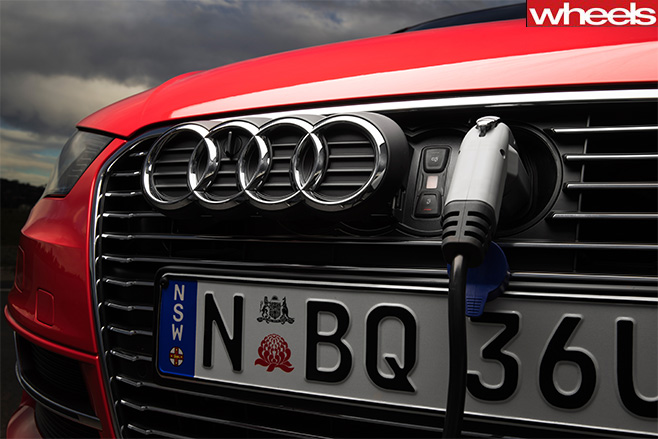
The fuel saving, on paper, is huge. The e-tron’s 1.6L/100km compares to the regular 1.4 TFSI CoD’s (Cylinder on Demand) 4.7L/100km. Even the most economical of A3s, the 1.6 TDI, manages only 3.9L/100km.
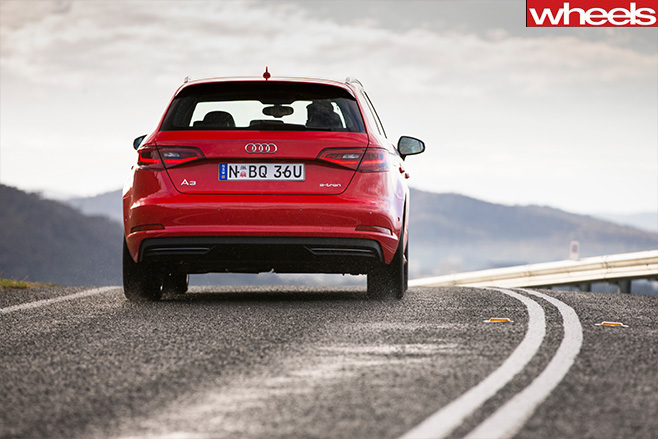
If you’re wondering why the e-tron’s claim doesn’t match the 1.5L/100km figure quoted for Euro models, that’s because the Aussie version runs one-inch bigger 17-inch alloys. These also reduce its range by 20km, but that’s still a capital-to-capital 920km. Those ‘Turbine’ alloys, chrome front grille and hidden exhaust tips are all that will tell your neighbours that you paid more than $60K for a C-segment hatch, $24K on top of the price of a 1.4 TFSI CoD A3 Sportback.
An EV Mode button allows you to choose pure electric propulsion for up to 50km and 130km/h, ‘hold’ to save what’s left in the battery, or Auto, which choses the most efficient mode. You’ll also gain range from the regenerative braking, offered in the Charge mode to top up the battery pack.
In EV, the cabin refinement is brilliant and the only qualm is road noise from those larger tyres. This is a genuine premium hatch, with the change to the petrol engine absolutely seamless, and that cabin remaining library quiet with a comfortable, if firm, ride.
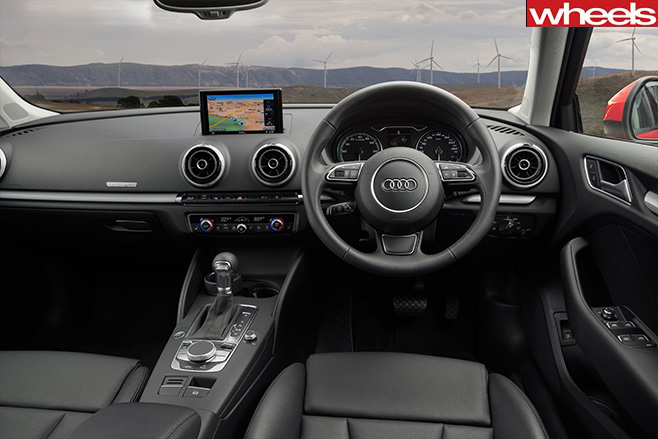
Charging takes around 2.5 hours with a fast charger, or up to five hours using a standard 10-amp household socket. Yet even here, Audi will cover the cost of the charger install in most circumstances, provided you use its mob to ensure a proper job.
In a world of pure EVs such as the BMW i3, and with 500km+ e-trons on the way, it’s hard to see the A3 making a serious impact, as the game it’s playing is moving rapidly. Yet, despite the fact that it’s expensive and somewhat overdue, the A3 e-tron is the most convincing plug-in hybrid yet.
SPECS Model: 2015 Audi A3 Sportback e-tron Engine: 1395cc 4cyl, dohc, 16v, turbo/electric motor Max power (total): 150kW @ 5000rpm Max torque (combined): 350Nm @ 1600-3500rpm Transmission: 6-speed dual-clutch Weight: 1533kg 0-100km/h: 7.6sec (claimed) Fuel Economy: 1.6L/100km Price: $62,490 (est.) On sale: Now
Click here to read the full range review of the Audi A3 and S3.
AFTER A YEAR of speculation, Lexus is expected to confirm it will go racing in Australia with its sleek, V8-powered RC F coupe.
An announcement on whether that will be with V8 Supercars or as a factory GT3 entry at the increasingly popular Bathurst 12 Hour is also expected within a month.
“It’s time for Lexus to reach out to a broader audience, and motorsport, to me, seems like an ideal place for Lexus to do that,” Lexus Australia boss Sean Hanley told Wheels this week at the international launch of the new RX SUV.
“It’s important for us to take the brand where it hasn’t been seen before.”
Lexus has been seriously considering a motorsport berth for its 5.0-litre V8 RC F over more than 12 months.
The Japanese brand would join V8 Supercars in 2017 under the sport’s new Gen2 rules, which will move away from the current four-door sedan, V8-power formula and permit new coupe body styles and different engine configurations.
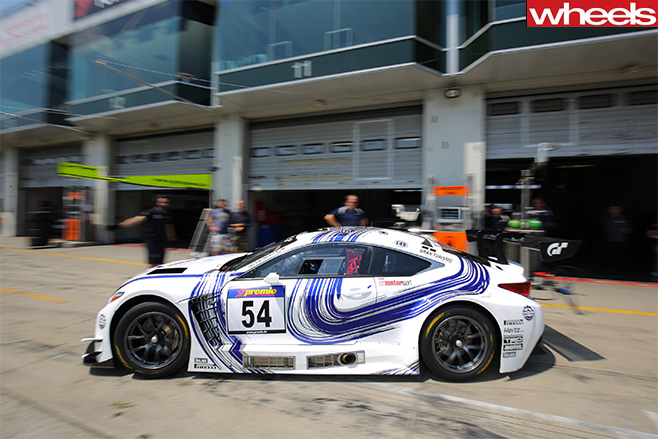
He said several V8 Supercars teams had approached him to run a car under the new rules.
“We’ve had a number of teams reach out to us, but we haven’t had any formal discussions,” he said. “But we’ve certainly had a number of teams express interest in our brand.”
Lexus already enjoys a close association with V8 Supercars, having signed a multi-year deal to provide an RC F road car as the category’s safety car.
Hanley said this had provided the ideal opportunity to evaluate the category without the major, multi-million dollar investment of running a team.
“I’ve got to tell you the safety car has been a good experience for Lexus,” said Hanley. “When the opportunity came up it wasn’t a huge investment, and it allowed us to get involved in the sport.
“We could be part of it, understand the business, meet the teams and meet the people who run V8 Supercars. And it’s been a great organisation to work with.”
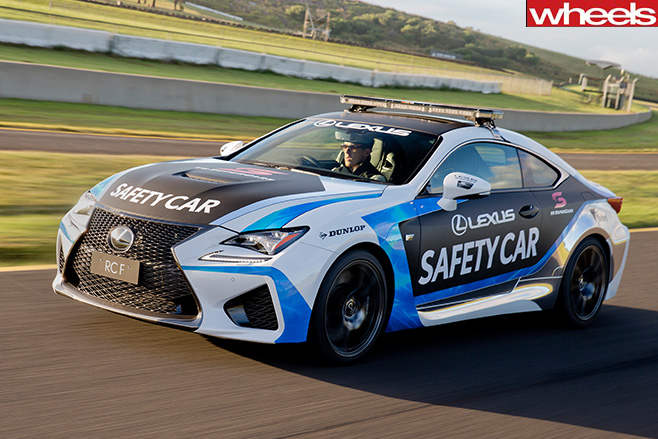
“Look it’s expensive whichever way we go, but we could get global support with GT3,” said Hanley. “V8 Supercars would be solely local and the global direction is clearly the development of a GT3 team. It’s certainly true to say the global development of a GT3 car has put a different view on our thinking.”
Hanley said the increasing popularity of GT3 racing worldwide was also appealing, as was the chance to race alongside other prestige brands on a GT3 grid.
“But that doesn’t mean we’re entering GT3 and not V8 Supercars,” clarified Hanley. “The appeal [of V8 Supercars] is the broad audience. It is still the most watched form of racing in Australia, on a more regular basis.
“We’re very much focused on reaching out to those buyers who are coming out of mainstream brands and stepping up to luxury, and we want Lexus to be on their consideration list.”
Sign up here to receive the latest round-up of Wheels news, reviews and video highlights straight to your inbox each week.
Most viewed features of the week from the Wheels Magazine website.
SO A WEBSITE purporting to connect lonely married men with naughty married women is looking more and more like a site that connected men with their fantasies – and just about nothing else – for a fee.
All of a sudden the Ashley Madison business model looks a lot less innovative. In fact, it might be argued that it follows the model Wheels adopted in 1953.
You could bolster that argument with the most popular story on wheelsmag.com.au this week, which revealed that HSV was developing a Commodore based road car with no fewer than 476kW. If they build it, they will make only 100 – which makes it a car that most people will drive only in daydreams.
But you could also point to key differences in the way Wheels goes about things. For one, we don’t do this stuff cynically. We are not just about titillating the vulnerable. The fantasies Wheels staff share are their own.
The second most viewed piece this week leaves no room for doubt about that. And it has picked up those views in just a couple of days. A turbocharged 2015 BMW M4 is compared with a naturally aspirated 2003 M3 CSL in an eight-minute video, shot on country roads, a race circuit and a car park or two.
Obviously, it was assumed that Wheels visitors would like the result. But from the first few seconds it is also clear that Road-test Editor Nathan Ponchard and News Editor Alex Inwood are deeply engaged in the story. “Awesome video,” responded one viewer on an online BMW forum. “You can tell they were having fun all throughout. Which is of course the whole point of M cars.”
Which raises a second key distinction for the Wheels business model: we will burst your balloon if we think it’s for your own good. Could a 12-year-old car possibly be more satisfying than its much quicker descendent? Ponchard and Inwood don’t shrink from providing an answer.
If that all sounds a bit airy, let’s come down to earth with a thud. The third most viewed post from the uploads this week is our review of the freshened Toyota Corolla. And our look at the new Mazda 2 Sedan is following hot on its heels. Both were penned by automotive almanac Byron Mathioudakis, who understands that it is models like this that make most car dreams come true.
Sign up here to receive the latest round-up of Wheels news, reviews and video highlights straight to your inbox each week.
HSV is reportedly working on a final limited edition to see Commodore local manufacturing out with a bang – and it could wear GTS-R badging.
According to MOTOR stablemate Wheels magazine, HSV has secured a limited number of supercharged LS9 V8 engines that power the Corvette ZR1.
The engine is more expensive to produce than the supercharged LSA V8 in the current Gen-F GTS, but it is also more powerful – with 476kW and 819Nm trumping the 430kW/740Nm of the $94,490 GTS.
There are some easy dots to be joined, such as faster acceleration times than the 4.55-second 0-100km/h we’ve achieved in a GTS; and a price tag beyond $100K but likely less than the $150K W427 limited edition from 2008 that didn’t bother buyers.

Rumours abound that HSV will revive the GTS-R tag to commemorate 20 years since the ‘XU3 Yellah’ VS-generation HSV flagship lobbed. As with the engine choice itself, HSV product and marketing manager Damon Paull is keeping tight-lipped about the speculation of a GTS-R return, neither ruling the possibility in or out.
Back in 1996 the GTS-R cost $86,000 for the high-power Blueprint version, making 226kW/507Nm from an Aussie-made and heavily tuned 5.7-litre V8 that permitted a 6.1sec 0-100km/h.

The possibility of a sound return is high when this LS9-powered HSV will likely be the fastest locally made Commodore of all time.
Get your free weekly report from the world of fast cars – subscribe to the MOTOR newsletter!
