
Packing enough prestige to pale a supercar rental company’s fleet, Floyd Mayweather Jr’s personal supercar collection reveals how the filthy-rich sometime satisfy their ludicrous spending habits.
While conjecture surrounds the exact worth and size of his garage – Mayweather’s personal driver says it’s US$9 million while ESPN revealed it stands closer to US$15 million – one thing is for certain: Mayweather likes showing off.
Three Bugatti Veyrons, three Rolls Royce phantoms and a Ferrari Enzo are only a handful of cars he owns, and are joined by the likes of McLaren’s 650S, a Ferrari 458 and Mercedes-Benz SLS AMG, usually optioned in a white hue.
His ostentatious tastes are little surprise, the five-division world champion was 2014’s highest paid athlete according to Forbes, earning more the US$100 million in that year alone.
With this Sunday’s much publicised bout with Philippine boxer Manny Pacquiao predicted to smash records for financial earnings from a fight, we’ve pilfered his Instagram account to bring you nine glimpses of Mayweather’s auto collection that may be about to get even bigger…
#1 Not one to be known for humility, Mayweather’s instagram has a picture of not one, but of the three 400km/h-plus Bugattis he owns, along with some other exotic chariots of his.
https://instagram.com/p/xeEV6pR3VT/
#2 The Mercedes-Benz SLS AMG’s gullwing doors along with the scissor items on the Mercedes-McLaren SLR and Lamborghini Aventador are typical of Mayweather’s taste.
https://instagram.com/p/VH91Gcx3Uy/
#3 There’s little to criticise about his choice for Ferrari’s Enzo, though, the V12-powered tribute to the company’s founder untouched and left in its red hue.
https://instagram.com/p/yKsxwOR3Zj/
#4 Expanding his ownership of Ferraris are a 458 Spider and 599 GTB Fiorano…
https://instagram.com/p/YDbDcjx3Vy/
#5 …and his spouse’s silver 458. Whom he also gifted a silver Bentley Flying Spur…
https://instagram.com/p/mjuQElx3Vl/
#6 …to match his white and black Mulsannes.
https://instagram.com/p/VNVsD1x3dO/
#7 Joining his three Rolls Royce Phantoms from Manchester is a 2014 Wraith coupe.
https://instagram.com/p/gM0UvRx3SG/
#8 Again for his partner, a red Ferrari 458 Spider to match his own in white.
https://instagram.com/p/iIuNN5x3Xs/
#9 In a change of colours, but not style, is a black Rolls Royce Ghost.
https://instagram.com/p/gkp7w1x3dK/
Get your free weekly report from the world of fast cars – subscribe to the MOTOR newsletter!
THE Holden Astra GTC and VXR mark the start of Holden’s five-year European product onslaught, and follows GM’s aborted attempt in 2012 to relaunch Opel in Oz. The small front-wheel-drive, three-door coupe range will sell alongside Holden’s Cruze as a niche sporty/hot hatch alternative.
WHAT IS IT Sold in Europe as the Opel Astra, the Holden-badged range is exclusively three-door.
It shares a platform that is fundamentally similar to the Holden Cruze, but with sportier front suspension, extra power (in manual transmission versions) sharper styling and a persuasive equipment versus cost equation.
A new-generation 1.6-litre turbo four-cylinder engine brings direct injection and 147kW in six-speed manual Holden Astra GTC and GTC Sport variants (it is down 22kW and 20Nm with the optional six-speed automatic).
The VXR hot hatch sits atop the Astra line-up. It has a 206kW 2.0-litre turbo, 20-inch forged alloys and Brembo brakes, and at $40K is a performance bargain.
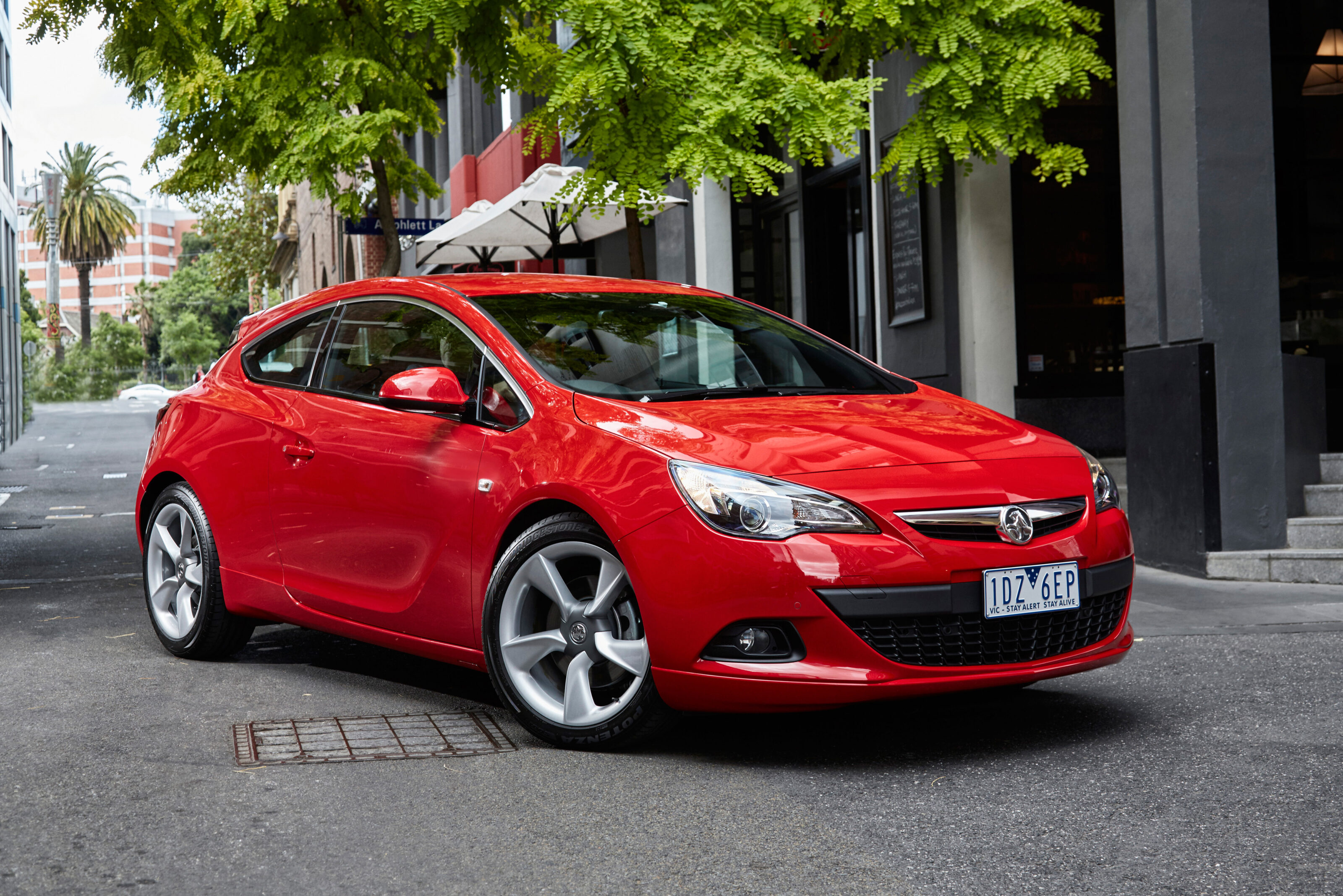
WHY WE’RE TESTING IT The 2015 Holden Astra was made available to Wheels, among other media, for a road and track drive only days ahead of its arrival in showrooms.
MAIN RIVALS Hyundai Veloster SR Turbo and Kia Cerato Koup T-GDi Turbo (Holden Astra GTC and GTC Sport) Volkswagen Golf GTI, Ford Focus ST and Renault Megane RS275 (Holden Astra VXR)
THE WHEELS VERDICT The direct-injected turbo 1.6 brings performance, flexibility and efficiency and allows the Holden Astra to exploit its well-sorted chassis and clever front suspension in a way the Opel-badged version couldn’t back in 2012. Value is healthier too, thanks to a boost in standard equipment, and price reductions. The VXR, meanwhile, is a weapon that will give the Volkswagen Golf GTI and Renault Megane RS plenty to think about, especially when you consider the $39,990 price tag.
PLUS: Cooler than a Cruze; better performance and value than the Opel versions that sold briefly in Oz a few years ago. MINUS: It’s not a brand-new model; interior ageing well, but it’s still ageing; no reversing camera
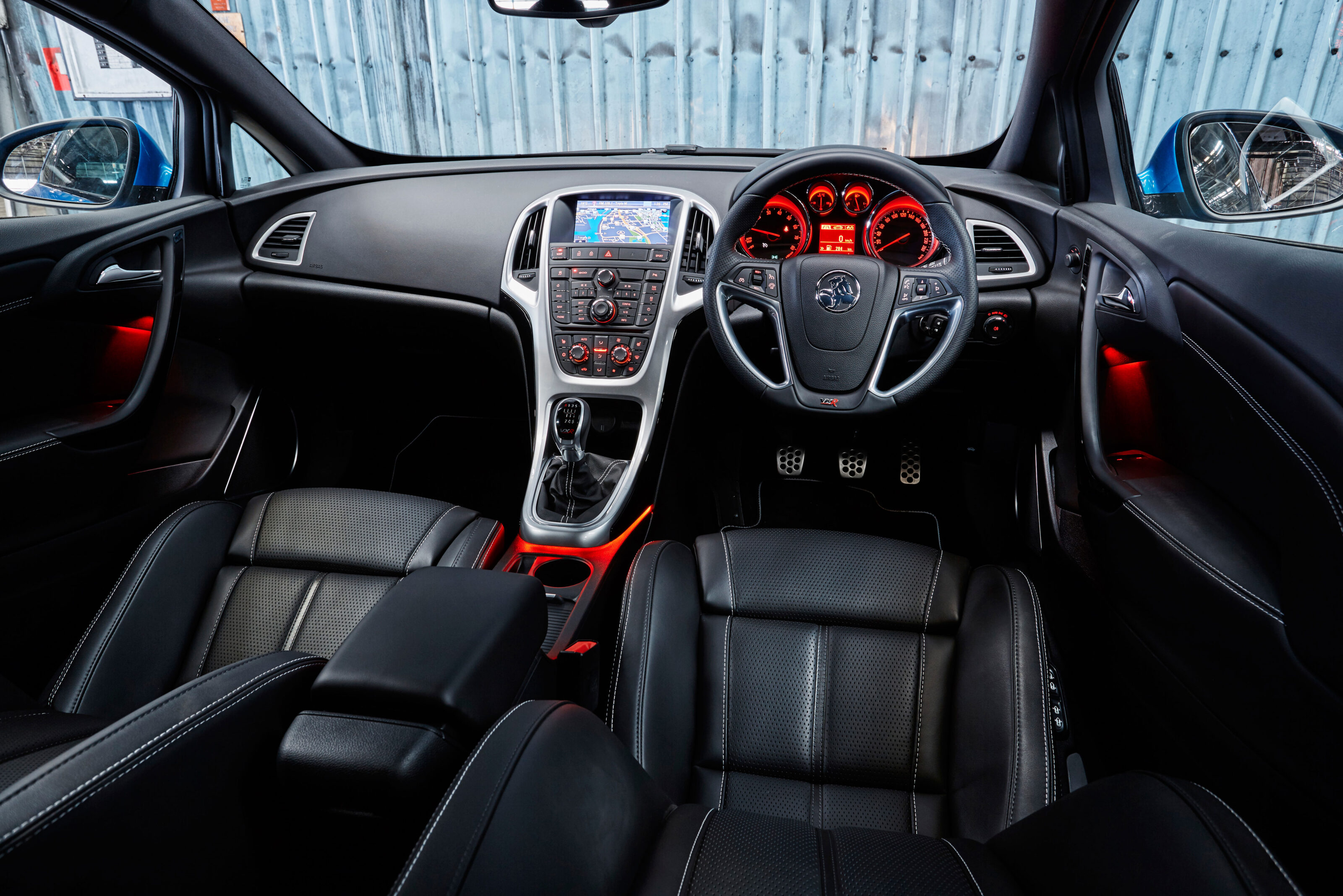
THE WHEELS REVIEW CUE déjà vu. The Astra is back, again, just like in 2012 when the Opel Astra spearheaded the short-lived revival of the European brand in Australia. Or the time before, in 1996, when the Opel-sourced Astra revived a nameplate last worn by various Holden badge-engineered Nissan Pulsars between 1984 and 89.
That feeling is heightened by the fact the new Holden Astra is an updated version of the same fourth-gen J Series Astra, which made its global debut in 2009, and arrived here in hatch, wagon and (in 2011) coupe form less than three years ago.
With the Astra’s arrival, Holden’s on-again-off-again relationship with GM’s European small and medium cars (and the Astra badge itself) looks set to end. Necessity dictates a return to GM’s Euro product line-up, while it seems there will be no looking back from an approach that will add 24 Opel models to Holden’s portfolio over the next five years.
For the time being, though, the three-door Astra GTC and GTC Sport, the hot-shot VXR and the Cascada slot into the sporty small car niche alongside the more pedestrian Aussie engineered and built Holden Cruze.
The Astra is built on the same GM Delta II platform as the Cruze, but in GTC form the chassis is sharpened with GM’s HiPerStrut front suspension, which is a similar dual-axis system to that found in front-drive firebrands the Renault Clio and Megane RS.
The system brings front-end keenness and steering reward, which is a whole lot more exploitable in the new-gen direct-injected 1.6-litre turbo Holden version than it was in the lower-powered 1.4 turbo and port-injected 1.6 turbo Opel-badged ones.
This engine powers both the GTC and the GTC Sport, but not all Astra engines are created equal – six-speed autos are down 22kW and 20Nm on the 147kW, 280Nm six-speed manual.
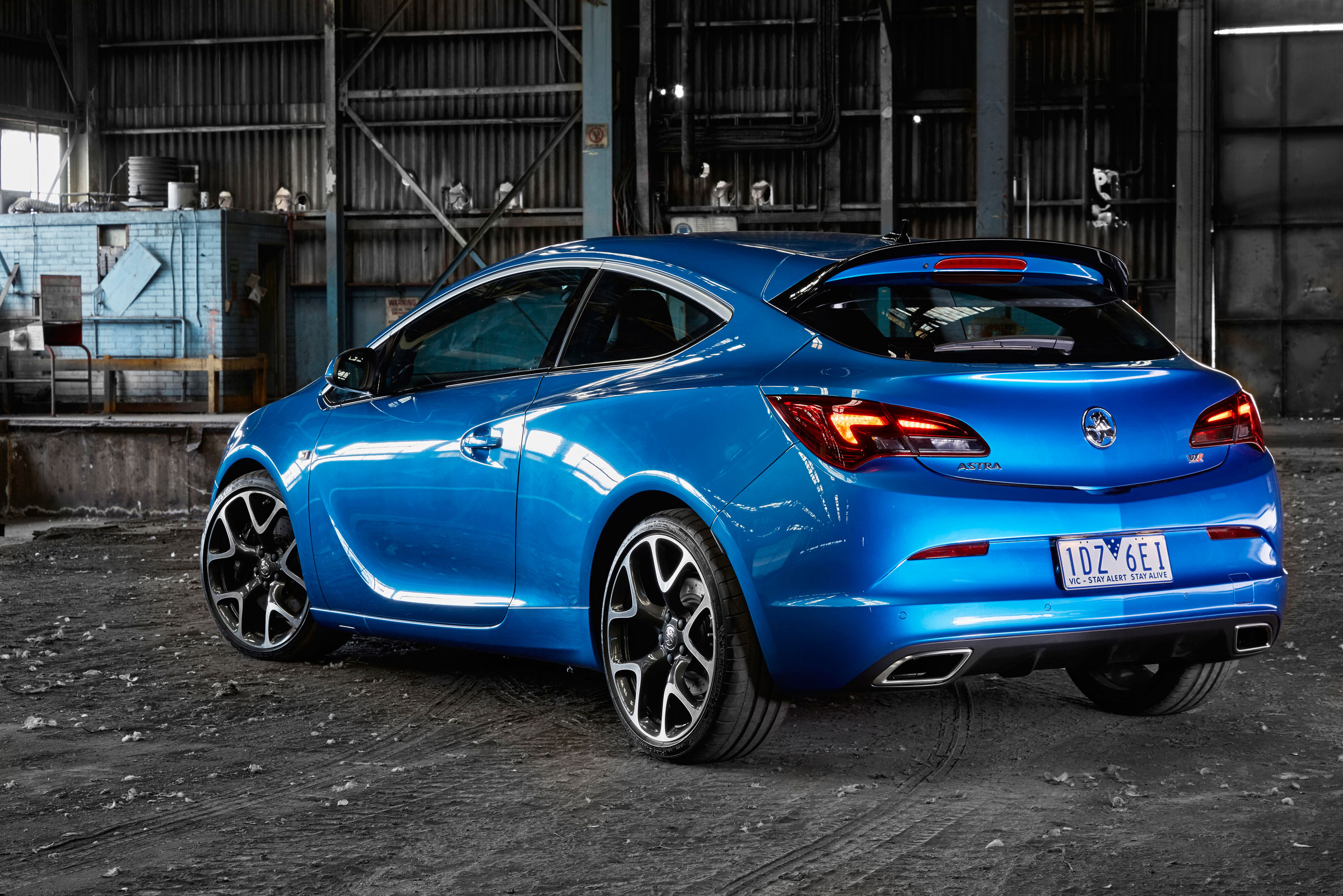
Despite decent figures, the Astra’s no shooting star – that’s the VXR. The GTC is flexible and 6.9L/100km-efficient (manual), but a workmanlike note ensures it’s no visceral thriller.
The lack of a reversing camera is a rare miss in a generous suite of standard kit, although it does have front and rear parking sensors. Meanwhile, prices are down compared with the outgone Opel, at $27K for the GTC and $30K for the Sport, which brings 19- rather than 18-inch alloys among the sports and luxo bits (the auto adds about $2K).
The stellar pick? A used Opel GTC Sport manual, which has just gone from undervalued orphan to Holden parts-backed bargain. Or, for new car buyers, the superior latest version of that same variant, wearing a Lion badge.
The Astra VXR, meanwhile, stacks up as sharper than a Golf GTI, but not as hardcore as a Megane RS.
It’s not an OPC, because the ‘O’ stood for Opel, but the VXR is the same car. Debut driving was limited to a trio of track laps, which limited our assessment of comfort on the standard Flexride adaptive dampers and 20-inch wheels and tyres.
A 206kW, 400Nm 2.0-litre turbo makes this the hottest hatch on sale in Oz, while a honing of the HiPerStrut-led chassis, and massive 355mm cross-drilled front rotors clamped by Brembo four-pot calipers ensure serious sharpness, adhesion and stopping.
It’s a bit of a bargain too, at $39,990.
SPECS Holden Astra GTC Sport Engine: 1598cc 4cyl, dohc, 16v, turbo Max power: 206kW @ 5300rpm Max torque: 400Nm @ 2400-4800rpm Transmission: 6-speed manual Weight: 1435kg (est) 0-100km/h: 7.9sec Fuel economy: 6.9L/100km Price: $29,990 On sale: NowHolden Astra VXR Engine: 1998cc 4cyl, dohc, 16v, turbo Max power: 147kW @ 5500rpm Max torque: 280Nm @ 1650-5000rpm Transmission: 6-speed manual Weight: 1494kg (est) 0-100km/h: N/a Fuel economy: 8.0L/100km Price: $39,990 On sale: Now
Today marks the 21st anniversary of Ayrton Senna’s death at Imola.
There is no need to go back over the story, it’s been told far too many times, but it is a good opportunity to remind ourselves why he was so revered by watching what he did best, drive cars faster than anyone else.
Even now, two decades after his death, those that worked with and raced against Senna continue to rank him as the greatest driver Formula One has ever seen.
So without further ado, here are five of Senna’s greatest moments.
1990 Spanish Grand Prix – Pole lap Jerez
This is Senna at his finest, absolutely flat-out during qualifying, a lap that would win him pole by almost half a second from Prost. The Jerez track is bumpy and fast, a real physical test, and listen to the scream as Ayrton gives it every possible rev on downshifts. Oh, and watch for the avoidance at 0:34.
1985 Australian Grand Prix – Pole lap Adelaide
The honour of pole position for the first Australian Grand Prix went to Senna, who wrestled his circa 900kW Renault-powered Lotus around the tight Adelaide circuit.
1991 Belgian Grand Prix – Pole lap Spa-Francorchamps
This is the video that best displays Senna’s unique style. The constant mid-corner throttle blips were a unique feature of his driving, used to devastating effect here by qualifying over a second ahead of second-placed Prost. And the noise of that V10 in the Ardennes hills…
Honda NSX test drive – Suzuka
Now for something a bit different. Many of you will be familiar with the video of Senna driving an NSX in loafers, and it’s worth a look for his heel-toe technique, but perhaps fewer have seen this video. It’s an incredibly display of driving a car on the absolute ragged edge.
Ayrton Senna goes rallying
And now for something really different. In 1986, 26-year-old Senna was invited to try a number of rally cars in the Welsh forests for a magazine article. You can read the full article here – and we recommend you do – but we’ll pull one quote from it: “In a matter of hours [Senna] would be a national class forest driver and I would say after a week in a car he would be taking on the World class drivers.” That’s talent.
The new ND generation Mazda MX-5 has received one of the lengthiest teaser campaigns in recent memory.
First Mazda told us it was taking the roadster back to its lightweight roots, then showed the bare chassis without its bodywork, and eventually the finished product around six months ago.
Then they let us drive the thing, but only the 1.5-litre version and they wouldn’t reveal how much power its little naturally aspirated engine actually produced or how quick it was (or wasn’t).
Today we have more details – they’re typically vague but give an insight into the new generation Mazda MX-5’s lightweight body structure.
The original MX-5 weighed around 940kg and as it evolved into the NB and NC generations it got bigger and flabbier with its curb weight swelling to over 1150kg.
The new car reverses the trend, weighing from 1009kg despite carrying considerably more safety and comfort features than previous MX-5s. In another turn of events, It’s also the smallest MX-5 ever.
Compared to the outgoing MX-5, the new 1.5-litre base car’s engine is 17kg lighter and the manual gearbox it’s connected to is 7kg leaner. The rear differential has also shedded 10kg compared to the current car.
Thanks to greater use of aluminium and high-tensile steel, the suspension is also 13kg lighter than before and the body around 20kg slimmer.
Overhanging body parts have also been reduced by 4kg, lowering the yaw inertia moment of the car and improving the car’s dynamic ability.
When the ND MX-5 goes on sale locally later this year it will be available with either a 1.5-litre or 2.0-litre four-cylinder engine.
Exact power outputs are still unconfirmed but tipped to be in the ballpark of 90kW and 120kW respectively.
The ND MX-5 is also expected to be much cheaper than the outgoing version which starts at $47,280. To be competitive with its nearest rival the Toyota 86, the MX-5 will likely be priced below $40,000 for the first time since 2005.
Car companies are killing the howling naturally-aspirated engine and turning turbo to save fuel and cut emissions. And while the good news is turbos are an easy way to more power, it’s come at the cost of some sizzle. Former free-breathing heroes like the BMW M3 and Renaultsport Clio are less exciting now they’re turbo.
But it doesn’t have to be this way.
The things that made early turbo-mobiles fun are being engineered-out in the name of refinement. Take the Subaru WRX STI. Once upon a time its devious all-wheel drivetrain and turbo tech was cutting-edge. But Subaru’s spent so little money on its R&D that these days, it feels old school, and in a good way.
That’s because its EJ25 engine has no clue that turbos can actually be used to reduce fuel consumption. It just wants to go fast and be loud.
There’s a bit of old fashioned turbo lag down low but once it kicks in at around 4000rpm it smacks you in the face like a back street brawler. The whole feeling of acceleration is dramatically amplified because you’re waiting, waiting and then suddenly it kicks you in the head. A pensioner would have no problem driving it provided they stayed below the boost threshold. Once it takes off though, they’re guaranteed to end up in a shop window.
The funny thing is, it’s not even that fast. It just feels like it because the power delivery is so violent.
Sure, we have a sook when we drive a turbo car that is laggy, but perhaps car companies could build this into a button? Sometimes you want your eyeballs to bulge from their sockets as your four-wheeled steed roars onto boost.
And why not build some theatrics into said button? Give us idiots the option of scrolling through actual blow-off valve noises, or a dial that winds up audible turbo hiss. Not legal, you say? Well, of course many car companies have made a loud button for exhausts and you should hear some of those.
If most new turbo performance cars were boosty and fun, the rule makers would even have a legitimate excuse to stop young people from driving them. But that’s an opinion for another time…
How do you think car companies could give new turbo performance cars some extra sizzle?
The Astra is back, and this time with a Holden badge installed on the nose.
Following Opel’s brief and ultimately ill-fated incursion into the Australian market, Holden has reintroduced the Astra, primarily to bolster its performance line up.
Wading into battle against the recently facelifted Focus ST and Renault Sport Megane is the Astra VXR, priced at $39,990, a $3000 cut from when the car was offered previously.
This is $1000 more than the new Focus ST, but undercuts the similarly focused Megane RS265 by a heft $4000.
The VXR features a formidable standard specification, including a 206kW/400Nm 2.0-litre turbocharged four, mechanical limited-slip diff, Brembo front brakes, clever HiPerStrut front suspension and three-way adjustable dampers.
Arguably even more impressive is the $26,990 ask for the base manual GTC, which now features a 147kW/280Nm 1.6-litre turbo four.
A six-speed automatic is also available for an extra $2200, but cuts outputs to 125kW/260Nm.
A $3000 Sport package adds 19s (18s standard), leather seats and a body kit.
Holden’s sharply-priced new twins are welcome additions to the local hatch segment, and we’ll be putting them to the test in the coming weeks.
Get your free weekly report from the world of fast cars – subscribe to the MOTOR newsletter!
The Volkswagen Golf R wagon will hit the Australian market as a unique performance proposition for buyers wanting extra cargo capacity with little or no compromise to speed, handling and control.
WHAT IS IT As the wagon version of the Golf R hatch flagship, the R wagon sits in a space all of its own, undercutting larger and far more expensive premium Euro performance equivalents without cutting corners on the stuff that attracts buyers to exciting cars such as this.
WHY WE’RE TESTING IT Though not as pure or involving as the GTI, the Golf R hatch is a compelling grand tourer alternative, adding more performance as well as the surety of AWD in a package that nothing can match for the price. Volkswagen is going one step further with a wagon version, making it an even more unique option for hot hatch-style buyers looking for something different… and practical.
MAIN RIVALS Mercedes-Benz GLA45 AMG, Renault Megane GT220 wagon, Volvo V60 Polestar
THE WHEELS VERDICT The Volkswagen Golf R wagon will hold a special place in the local affordable performance market when it lands in October, since no other car comes close to matching it on price, performance, space, features and all-wheel-drive security. The German-built uber-estate isn’t perfect, but it certainly is what its label claims: Piping hot family-friendly fun.
PLUS: Golf wagon practicality meets scorching AWD performance and security MINUS: No manual option, firm ride, some road noise, weight penalty
THE WHEELS REVIEW
QUIZ time: How many wagons can hit 100km/h in 5.1s or under? Answer: Just seven – Audi’s S4, RS4 and RS6 Avants, the Ferrari FF, HSV Clubsport Tourer, Mercedes CLS500 and Volvo V60 Polestar. Of those, only one – the HSV – is priced at less than $100K.
You can soon make that two. Volkswagen is living up to its People’s Car claim with the first-ever Golf R wagon, out in October for an almost proletarian sub-$60,000 ask.
Basically a 140kg-heavier R hatch with a tail stretched by 332mm and a 4mm wheelbase extension, which also happen to yield between 605 and 1620 litres of useful luggage capacity, the newcomer gains the R-specific alloys, a rear bumper with diffuser, four exhaust pipes, D-pillar ‘aero flaps’ and darker tail-lights.
Not to be confused with the Suzuki Wagon R, the R wagon is nevertheless extremely, ahem, swift, courtesy of a 206kW/380Nm 2.0-litre four-cylinder EA888-series direct-injection turbo petrol/six-speed DSG combo that’s speed-limited to 250km/h. In Europe it delivers 221kW, but hot-weather market precautions means ours is dialled back. Pity.
Still, given its head, the R is a beguiling all-weather grand tourer with a thrilling, shrilling edge. Calm and cultured for the comatose commute, the rev-hungry load-lugger roars off the line when prodded, the DSG switching ratios seamlessly, piling on speed with unassuming ease. The exhaust’s cackling off-throttle burps add to the sense of urgency.
Just like the R-badged hatch, all four wheels look after driving duties via a Haldex coupling that dishes almost 100 percent of torque to whichever end (using MacPherson struts up front and a multilink independent out back) needs maximum traction.
Electronic diff locks work in concert with mid-cornering braking tech, via electronic stability control system settings, to quell understeer and improve handling.
Dynamic chassis control (DCC) with five modes – Eco, Comfort, Normal, Race and driver-preferred Individual – will be standard on Australian-delivery Rs. Proving DCC’s worth, the Golf carved through the tight bends on a blast around Spain’s tricky Ascari race track with majestic composure, remaining flat and confident throughout. The progressive-ratio steering is nigh-on perfectly tuned, while the unique high-performance ESC threshold can be extinguished for more lairy shenanigans.
The inevitable, but expected, flipside to all this chassis enhancement is increased tyre drone and a punishing ride in all modes apart from the acceptably firm Comfort setting.
Considering you’ll need to spend another $45K to gain matching AWD performance via Sweden’s underrated V60 Polestar, the Golf R wagon is a seriously scintillating alternative. We’d even prefer it over some of those sub-5.1s super wagons.
SPECS Model: Volkswagen Golf R wagon Engine: 1984cc 4cyl, dohc, 16v turbo Max power: 206kW @ 5100-6500rpm Max torque: 380Nm @ 1800-5100rpm Transmission: 6-speed dual-clutch Weight: 1499kg 0-100km/h: 5.1s Fuel economy: 7.0L/100km Price: $58,000 (approx) On sale: October

Volkswagen Australia has confirmed that it will offer a wagon version of its Golf R hot hatch later this year.
Its introduction has been under consideration for a while, with VW Oz unsure if there was sufficient local demand to warrant its arrival.
Thankfully, it’s decided there is, though the initial batch will be limited to just a few hundred cars, with subsequent arrivals dependent on the success of those early cars.
Its mechanical specification will be identical to that of the hatch, with Australian cars detuned from a Euro-spec 221kW to 206kW, though torque remains at 380Nm for both models.
Only a six-speed DSG will be offered, resulting in a price in the high-$50K region.
The Golf R wagon’s higher kerb weight means it’s 0.1 slower from 0-100km/h than its hatch sibling, taking a claimed 5.1sec.
MOTOR’s European correspondent, Michael Taylor, recently drove the Golf R Wagon and was full of praise, saying the extra rear weight – the wagon is 300mm longer than hatch, all behind the rear axle – improved the car’s balance, especially in fast corners.
We’re massive fans of the hatch, so we can’t wait for the wagon to arrive!
Get your free weekly report from the world of fast cars – subscribe to the MOTOR newsletter!
The Volkswagen Golf Alltrack replicates the successful Outback-aping Passat Alltrack formula, although this time around it is in a more compact, and affordable, package.
WHAT IS IT Targeting the hot-selling Subaru Outback, the Golf Alltrack is the wagon version of the world’s most aspirational small car, with 20mm more ground clearance, a part-time Haldex all-wheel-drive system, a function that lets it walk down steep hills, and the usual soft-roader get-up to let the world know you’re into lifestyle adventure.
WHY WE’RE TESTING IT There isn’t a duff model in Volkswagen’s brilliant Mk7 Golf range, but by turning it into a taller and heavier crossover, there was a chance the Alltrack would dilute the brilliant dynamics, efficiency and refinement that helped the current hatch win the 2013 Wheels COTY.
MAIN RIVALS Subaru Outback, Skoda Octavia Scout, Nissan X-Trail, Peugeot 3008
THE WHEELS VERDICT Does raising a VW Golf and fitting all-wheel drive increase or decrease its appeal? After two days behind the wheel of one at the Golf Alltrack’s international launch in Spain, we’re inclined to think that the VW loses little in its transition from brilliant compact wagon to semi off-roader crossover, especially when compared with the many invariably inferior compact and medium SUV offerings out there. If the price can stay well south of $40,000, then the Germans deserve to have another big hit on their hands.
PLUS: Usual brilliant Golf wagon virtues remain, some off-road ability MINUS: No diesel option, firm ride on 18-inch wheels, some road noise
THE WHEELS REVIEW SOCIAL climbing is about to become cheaper and dirtier, thanks to a jacked-up, go-anywhere(ish) version of Germany’s aspirational hatchback, the Volkswagen Golf.
Come October, our 2013 COTY winner’s dumpier wagon sister will cross over into Subaru Outback territory like Fräulein Helga in hiking gear, wearing a 20mm ride-height lift (the limit before driveshaft and associated hardware changes are necessary), 4Motion all-wheel drive with hill-descent tech, butched-up body cladding, roof bars and a daft adventure-evoking suffix that, until the Passat version came along in 2012, was unheard of in the English lexicon: Alltrack.
Why not? The latter’s popularity has prompted a repeat performance in a smaller and more affordable package. Pricing ought to slip comfortably under $40,000.
Additionally, Alltrack is the only Golf with the TSI-badged 132kW/280Nm 1.8-litre four-cylinder petrol turbo zinger available in the Audi A3 as well as its conceptual fraternal twin, the Skoda Octavia Scout. All share Wolfsburg’s vaunted MQB architecture.
We’d love to tell you how impressive this usually strong and sweet-revving engine is, but unhelpfully VW didn’t bring any 132TSIs to the international launch in Spain. Our drive centres on the eager and effortless 135kW/380Nm 2.0 TDI turbo-diesel that – sadly – isn’t Oz bound. Boo!
Even with the searing Golf R wagon in convoy, the circa-250kg heftier Alltrack appears little compromised despite a higher centre of gravity. It flows through corners with much the same measured and weighted grace of regular Mk7 Golfs, with only a hint of extra body roll through faster turns betraying the added ground clearance.
Wearing 18-inch rubber and riding on adaptive dampers (both costing extra) over smooth European roads, the Alltrack 2.0 TDI’s lasting dynamic impression is how quiet and composed everything remains. If only Bruce Jenner’s transition could be this seamless.
Demonstrating the Alltrack’s off-road talents, VW threw us in a moderately demanding 4×4 course to test the hill descent control (effective up to 30km/h) and the Haldex coupling’s instant torque redistribution (99 percent either end is possible as required, aided by an electronic differential lock and retuned stability control).
Going down the path less travelled only needs a prod of an ‘Off Road’ button. Somewhat surprisingly, the Golf in gumboots walked it. Only later, when racing across mountain roads, did the VW’s ambitious driver-focussed duality truly crystallise. It’s a little beauty.
Brilliant engineering, swish cabin presentation, superb seating, family-friendly practicality, lavish refinement… the Golf-ification enhances the crossover breed. If only more were this aspirational.
SPECS Model: Volkswagen Golf Alltrack 132TSI Engine: 1798cc 4cyl, dohc, 16v turbo Max power: 132kW @ 4500rpm Max torque: 280Nm @ 1350rpm Transmission: 6-speed dual clutch Weight: 1509kg (approx) 0-100km/h: 7.8s Fuel economy: 6.6L/100km Price: $38,000 (approx) On sale: October
We hate to be the bearer of bad news, but a man with flamboyant taste in footwear wrecked his Ferrari LaFerrari in Shanghai Tuesday night.
According to Chinese media, the driver lost control of the 708kW limited edition hybrid supercar during a thunderstorm hitting the concrete barrier of the motorway he was driving on.
Fortunately the driver wasn’t hurt during the accident; sadly the same can’t be said for his million dollar machine.
The LaFerrari appears to have suffered pretty severe body damage and the rear suspension has been smashed to pieces.
Source: www.wreckedexotics.com
Get your free weekly report from the world of fast cars – subscribe to the MOTOR newsletter!
