
Formula One bursts back into action this time next week at Albert Park and Wheels goes behind the scenes with the world champions for this insight into a highly anticipated GP season
FOR Formula One, this is the real New Year’s Day.
I am standing in a pit garage at Silverstone, three days before the start of the first official test at Jerez, where the new Mercedes F1 W06 will be unveiled to the press.
The world champion team is here for a ‘filming day’. These days are tightly controlled by the FIA to limit how much the teams can learn about their cars outside the official, FIA-controlled testing in Spain. The cars can do no more than 100km, and on special tyres that would spit Lewis off if he tried more than quarter-throttle.
And this is England in winter, so the temperature is barely above freezing and there’s a fine fall of snow. Pirelli doesn’t offer a snow tyre option for F1 cars.
The atmosphere is pleasingly, surprisingly shambolic.
The engineers scoff steaming lunches of bad chicken curry in styrofoam boxes bought from the track canteen. There are abandoned coffee cups everywhere. A truck driver in his hi-vis jacket has wandered in and is watching.
But this is still an important and very private moment for the team. I’ve been told that I can’t take photos, or tweet about where I am.
Lewis and Nico might just be trundling around, but there are still a dozen engineers sitting behind laptops on fold-out trestle tables observing every detail of that trundle, each screen showing up to six traces from the car.
I’m talking to the team’s technical director, Paddy Lowe, when the clock strikes for the start of the new season.
Over Paddy’s shoulder – and the truck driver’s – I can see the still-secret car; on stands but otherwise ready to pull out, its engine a low, loud blare even at idle.
Lewis walks in from the back of the garage, his pale race suit like a halo among the greys and blacks of the team. He hops in, and surprisingly quickly the car drops down, he catches first gear and pulls out.
We’ve just seen him drive the very first metres towards what most expect will be a third World Championship.
Welcome to the weird world of F1 between seasons.
Since 2009, in an attempt to cut costs, the teams have been limited to 15,000ks of testing each year, most of it in the three, four-day official sessions in Spain which all the teams attend – or at least those teams that haven’t gone bankrupt and have their cars together in time.
With little to do between seasons, the drivers largely disappear, and the engineers retreat into their factories for the long, dark, northern European winter and pore over the regulations, trying to find the slightest edge over their rivals.
It’s astonishing how teams working in total isolation generally end up producing cars that are so close in performance at the first race. But not always. Last season saw Mercedes dominate, thanks largely to the talents of Lewis and Nico, and the estimated 40-80kW power advantage of their engine.
The team knows, but won’t tell me, the gain they’ve made over last year’s car in every area. But what they won’t know until the first race is whether they’ve done enough to maintain their advantage over the other teams.
The official test sessions don’t help. They’re the Formula One races you don’t see; they’re not televised, and the race is to shake out every problem in a hugely complex machine in a very short space of time.
Some teams disguise their true pace; mid-table teams often try to give their sponsors some value with a headline-grabbing, low fuel-load fastest time of the day, which they will never repeat in race conditions.
Lewis eats a Nando’s in the clubhouse after his drive, and I ask him how much attention he pays to the other teams in testing.
“It’s like one percent,” the world champion tells me. “You are so focused on your own car. It’s a serious job.
“You try to learn as much as you can because you only have six days each, and it’s not a lot of testing to really understand the car, to understand the tyres.
“Obviously at the end of the day you see some times, but it’s irrelevant because one car might be 10 kilos and the other car…
“It doesn’t actually mean anything. It’s not really till the first race, till Friday practice that you really, really know that, okay, you’re good.”
Does Paddy pay any attention to the other teams?
“It depends how much trouble you’re in,” he says. “I’ve been in winter testing where there was no time to look outside our own garage.
“But that’s the thing about the winter. You have no idea where your threat is going to come from. We won’t really know until the first race, because even as we go into testing, you can see cars that look strong or weak, but it’s only an impression. The data’s too noisy.
“The other threat this time of year is whether people bring in some significant innovation that you haven’t thought of. That’s another way of leap-frogging your way up the grid. So if I do get time to look at the cars in the next few days, I’ll be looking for something novel on there that we haven’t thought of. The trouble with big innovation is you don’t realise the opportunity was there until you’ve stumbled upon it.”
Andy Cowell is the team’s powertrain chief. I get the sense from the row of guys with laptops that the FIA’s efforts to stop the teams learning anything about the car on filming days aren’t entirely successful, and that the teams will exploit any opportunity to test.
“It’s a filming day, but in order to film the car running on the track, you’ve got to get the car running on the track. So you learn about the little things, like how does she pull away? Is it going to stall?
“We can simulate a lot in the factory, on the dyno, with the clutch and the transmission and the power unit, but until it actually goes, with no cables connected… you’ve still got that nagging doubt.”
But surely it doesn’t matter? Surely Mercedes’ lead can’t be overhauled in one season?
“It’s possible for Renault, Ferrari, or Honda to overtake us,” Cowell says.
But if you were five percent ahead, and you added another five percent, could they make a 10 percent increase?
“It’s completely possible. The technical regulations are the same for all of us. There’s no magic in that power unit over there.
“Have we made a big enough step? I don’t know. Is it possible to come up with a power unit that’s more powerful than what we’re going to start with in Melbourne? Yes, it is. Ferrari are restructuring and are hugely determined. Renault, Red Bull, exactly the same. Honda…”
Would it really be feasible for Honda to do it in their first season back in the sport?
“Yeah, completely. Nothing’s impossible. Think wide, but think clear, and then it’s a race. An engineering race. All have got the funding, the bandwidth, the skills to do it.”
This isn’t false modesty. Lowe and Cowell honestly don’t know if they’ve done enough, because the weird, secretive, dissembling nature of these winter months deny them any information.
I try Cowell once more. He just says he’ll tell me after the last race in Abu Dhabi.
“For me, the hardest bit is that assumption that we’ll be okay again,” says Lowe.
“You want people to believe that it’s tough out there, because it is. There is no room to relax. Many teams have lost it over a winter. You just want to make sure you’re not one of those.”
Lotus reveals a faster, more powerful version of its Evora sports car and says more hard-core models are on the way
LOTUS is promising renewed excitement from its model revisions and new models over coming years, kicked off by the new Lotus Evora 400 that rivals the Porsche Cayman in terms of size, performance and price.
The Evora 400 – named after its 400bhp (298kW) output – is the fastest Evora to date, with a 300km/h top speed and 4.2sec 0-100km/h time.
Yet it’s only the beginning of Lotus rebuilding following years of controversy and financial difficulties, with the current Elise and Exige models the foundation of its future line-up. Both cars will continue with the now 20-year-old aluminium chassis for some time yet.
“We’ve got more plans to do things around […] that chassis [Elise and Exige],” Lotus design chief Russell Carr said. “They have a very strong benchmark in the market.”
He said there would likely be a successor to the Exige-based track car, the 2-Eleven.
“We’ll have to wait and see what the other things are – there will be lots of exciting things,” he said, referring to yet-to-be-unveiled model derivatives.
According to Carr, there would be significant design tweaks to the Elise and Exige, and new or revised engines could be part of it.
Carr said the five future models – including a revised Esprit – that were unveiled at the 2010 Paris motor show would now not be used. The ambitious plan was proposed by then-Lotus CEO Dany Bahar, who was ousted from the company in controversial circumstances in 2012.
“We would do something quite significantly different,” Carr said.
The Evora 400 is the biggest indication so far of the Hethel, UK-based company’s approach.
It gets fresh styling front and rear, and various design touches including slimmer mirrors and a heavily revised engine bay that looks more technical and neater when peering through the rear bonnet cover. Weight is down by 22kg, too, to 1415kg.
Inside, the Evora gets some noticeably different styling, with new Sparco seats, fresh switchgear and revised door trims, designed to make it easier to get in and out – and feel more comfortable once you’re in.
The Lotus Evora 400 is expected to be on sale in Australia in early 2016, with prices to be confirmed closer to launch.
It came from the same womb as the Porsche 959, was able to hustle a Honda NSX and, to 50km/h, was quicker than a McLaren F1. Meet the 1994 Audi RS2 Avant – the angriest Audi 80 wagon ever and a worthy inclusion to MOTOR’s informal Hall of Fame.
For readers unfamiliar, the RS2 is the original RS Audi. The story goes, Audi was impressed by the success of the S2 coupe and original S4 sedan from 1991. Quattro GmbH, so named after Audi’s extraordinary rally exploits of the early ’80s, was more a vehicle accessory producer than a performance division. But it was decided the brand would expand and the corporate punch spiked – and so, in 1994, the RS, or RennSport (Racing Sport) sub-brand was born.

Later that year, its first car was the RS2 but, as history-savvy readers will be familiar, Porsche played as much a role in its birth as quattro did.
Look closely at the photos. Mirrors, front indicators and foglights look vaguely familiar? They’re all pinched off a 993 911. Those 17-inch wheels? 968 Clubsport. Wrapped around them, the 968’s tyres and, underneath, the Porsche’s big 322mm Brembo brakes.
Borrowing more philosophically from Porsche, the RS2 didn’t mess about, either. It was fast – 0-100km/h in 5.4 seconds – and back in 1994, the five-second bracket was equivalent to today’s fours (an original NSX did 5.1). But the RS2 would max out at 262km/h at 6600rpm, though according to lore, the engineers said 275km/h was possible if you unplugged the limiter.
Like Stuttgart’s products, the RS2 wasn’t exactly cheap, either. In the UK, at launch, it cost £39,500. Later you’ll read about the failed plan to bring the RS2 to Australia for $145,000. In today’s money, adjusted for inflation, that’s more like $240K. Add on modern-day taxes, and you’re staring down the barrel of around $300,000. So for a first product from a new brand, you needed the folding stuff, and a lot of it.

It had 20 valves but, of course, four valves per cylinder – and five of those, fed a not insignificant 1.4 bar of boost, or 20psi, by a KKK turbocharger that was 20 per cent larger than that of the Audi S2. While Porsche was at it, the five-cylinder mill copped bigger injectors and intercooler, angrier cams and revised intake and exhaust systems, as well as a retuned Bosch ECU.
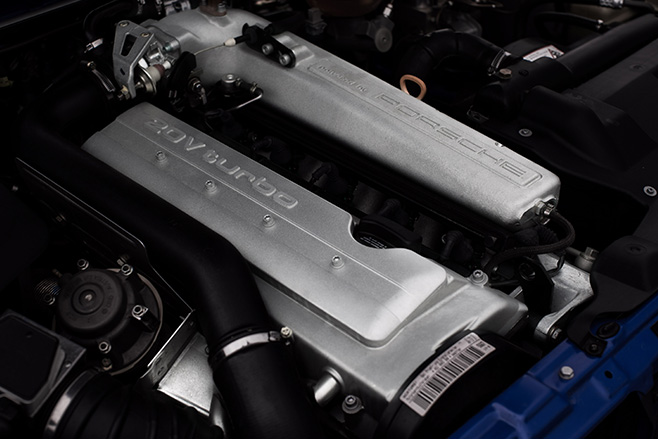
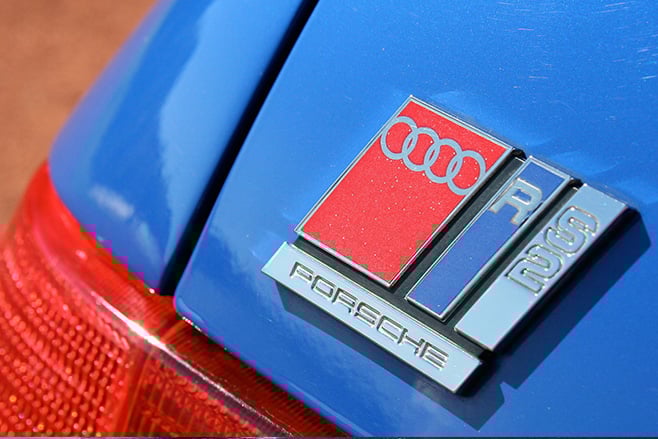
Built at VW’s Salzgitter plant, every RS2 engine was tested at full load for 90 minutes to guarantee full power. The cam cover read “powered by PORSCHE”. Porsche also fitted branded badges to its front and back, while the brake calipers, too, boasted “Porsche”.
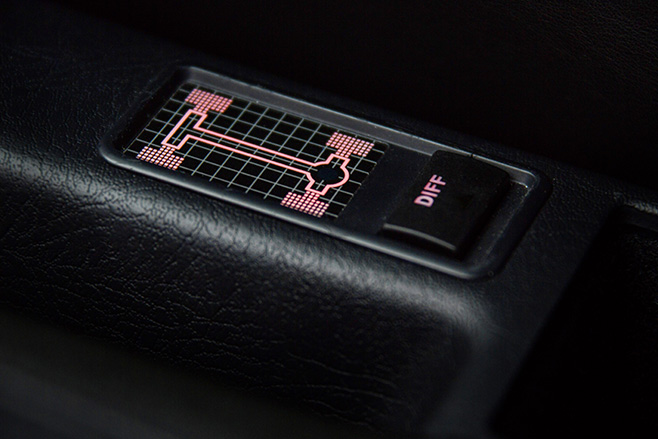
Meanwhile, a six-speed manual sent power to every wheel via a Torsen centre diff, able to send 75 per cent of thrust to one axle as needed. The RS2 even came with a manually-activated locking rear diff, although this function was disabled above 24km/h (15mph).
The end result was 232kW at 6500rpm and peak torque of 410Nm at 3000rpm, though 400Nm was available from 2400-4900rpm. Again, these were supercar outputs in 1994 and enough to shift the 1595kg RS2 to 100km/h in 5.4 seconds. Twenty one years ago, not many cars could catch it. And 0-50km/h in just 1.5 seconds was explosive at the time – indeed, famously quicker than the mighty McLaren F1.
You couldn’t put skis, a dog and three kids in the McLaren, blast down the autobahn then fang up an unsealed alpine pass. (Then again, maybe you could.)
A trade-off for this acceleration was, as we found recently, turbo lag. Lots of it.
Presented with an immaculate RS2, and its keys, in Germany recently, after driving modern cars you immediately notice the tinny, thin doors as you climb into the RS2’s not-quite-classic, not-quite-modern interior.
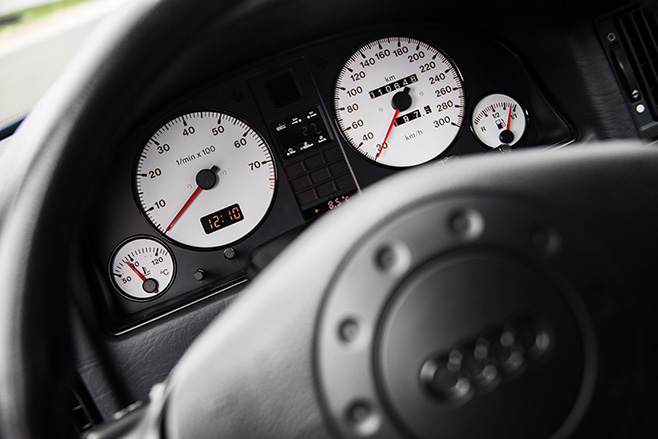
Common to ’90s interiors, black is the all-prevailing colour, broken up by white tacho and speedo, blue stitching and little touches like a carbon fibre dash insert with a blue weave through it. And the seats, oh yes, bright blue Alcantara not even a blind man could miss.
They are quite nice to sit in, however. Made by Recaro especially for the RS2, they’re softly padded and comfortable.

Crank the key clockwise and the slow-tempo starter motor fires the engine up. As you set off, the RS2 shows its age again in the clutch, gearshift and steering, which all feel from a different era. It’s a 21-year-old car, after all.
The RS2 rides well on springs which must be pretty soft. Porsche kept the S2’s cushy springs but fitted stiffer shocks and thick swaybars. Pitch the RS2 into your first corner and it feels like those 911 mirrors are going to grind off on the road. There’s a bit of body roll, yes.
We didn’t get the chance to test the RS2’s change-of-direction but from our brief drive, it’s probably not a bad thing we didn’t. We mightn’t have survived to tell you what it’s like, such is the RS2’s fairly springy suspension.
The steering is very light, slow in rack and feels sloppy and loose rather than tight and direct. With the pillowy suspension, aggressive steering inputs can upset the RS2.
Full throttle from 1500rpm is all nothing, nothing, nothing, then, at 3500rpm, wham! The bonnet lifts as the RS2 squats hard into its rear suspension, blasting anyone behind with five angry, burbling cylinders. It sounds awesome.
It takes you by surprise as the turbo comes on boost, almost violently, and hauls strongly to its 7200rpm rev-cut.
We drove the RS2 in the wet and first gear, full throttle, traction was immense. It’s just as well every one of the RS2’s tyres gets a share of the 232kW/410Nm, because in the wet, as the RS2 comes on boost, things would be seriously interesting with one driven axle.
The RS2’s cracking five-cylinder exhaust note is distinct – you need to hear it to know it. And there’s no doubting this thing has some oomph, even by today’s standards.
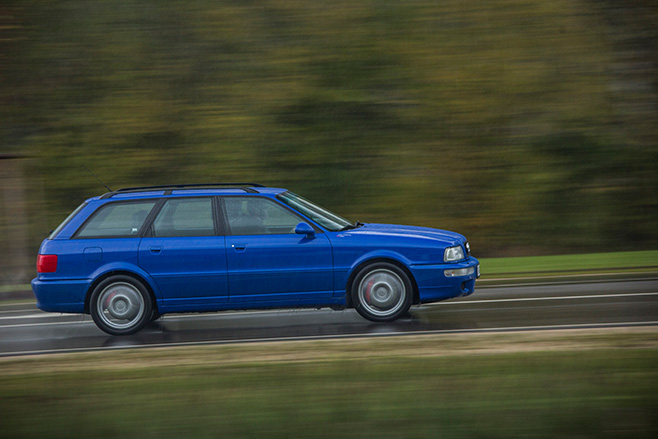
Audi originally planned to produce 2200 RS2s but it was so popular, it built a total of 2891 cars – 182 in right-hand-drive, mostly for the UK, but a handful reached New Zealand and South Africa. But not Australia, sadly.
Audi importer Inchcape plotted to bring 25 right-hand-drive RS2s to Australia, at $145,000 each, but the plan fell over. As far as MOTOR knows, there is just one RS2 in Australia, imported from New Zealand and registered in Victoria. It was last for sale in 2012.
As for the RS2’s balance of oversteer and understeer, MOTOR sadly can’t comment as our drive was really a brief few laps of a soaking wet German industrial estate.
But it was enough to get an appreciation of the machine – a highly likeable, McLaren F1-frightening 1990s supercar dressed up, hilariously, as an Audi 80 wagon. And to truly realise that cars like the RS4 and RS6 really do get it from their parents.
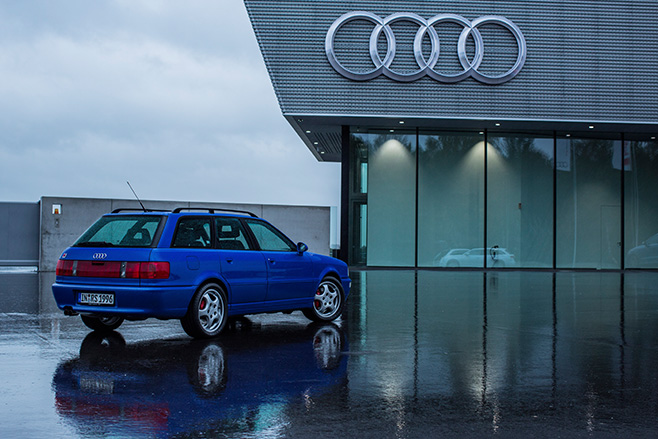
FAST FACTS 1994 Audi RS2 Avant BODY: 5-door, 5-seat wagon DRIVE: all-wheel ENGINE: 2226cc inline-5cyl, DOHC, 20v, turbocharger BORE/STROKE: 81.0 x 86.4mm COMPRESSION: 9.0:1 POWER: 232kW @ 6500rpm TORQUE: 410Nm @ 3000rpm WEIGHT: 1595kg POWER-TO- WEIGHT: 146kW/tonne TRANSMISSION: 6-speed manual SUSPENSION: struts, coil springs, anti-roll bar (f); multi-links, coil springs, anti-roll bar (r) L/W/h: 4510/1695/1386mm WHEELBASE: 2597mm TRACKS: 1448/1471mm (f/r) BRAKES: 304mm ventilated discs, 4-piston calipers
Senator Ricky Muir makes his maiden speech before the senate, saying he will fight unfair legislation targeting motoristsSENATE wildcard Ricky Muir has made his maiden speech to his peers, calling on government to focus its efforts on the idiots behind the wheel rather than legislate enthusiast drivers out of existence.
Looking a little uncomfortable and reading from notes, the Victorian Australian Motoring Enthusiast Party senator said he represented a number of voices wanting to make a stand against “unfair stereotyping and media sensationalism that motoring enthusiasts are all too often caught up in”.
“It is unfair to judge a whole community of people because of the actions of a few,” he told the chamber.
“The focus needs to move away from the vehicle and onto the behaviour. After all, cars do not hoon, it is the idiot behind the wheel.”
He said the motoring community was not made up of “environmental vandals tearing up the bitumen or destroying our bushland”.
“We are responsible, law-abiding citizens who loves our cars, our families and our culture, and it is offensive to a whole community of people to be tarred with the same brush as those who engage in antisocial behaviour on our roads or the minority who disrespect our national parks,” Senator Muir said.
“Most importantly, we came together to get a voice to stop unfair legislation being brought in with little or no consultation with our community — legislation that potentially could see our culture legislated out of existence.”
Senator Muir said it was no accident that the Australian Motoring Enthusiast Party was represented at “an important time in our history” as local car manufacturing winds down, highlighting an urgent need to rebuild the motoring industry.
“The Australian automotive aftermarket industry alone is an $11 billion industry that employs some 30,000 people,” he said.
“It is an industry that is responsible for things from wiper blades to four-wheel-drive accessories, suspension components, tyres, brakes and replacement brake components, parking sensors, reverse cameras, tools, coolants, lubricants, testing equipment and so much more.
“The primary manufacturing base of the aftermarket industry is four-wheel-drive parts and accessories, with four-wheel-drive parts and accessories being a $2 billion industry, comprising $1.25 billion in parts and accessories and $750 million in tyres.
“They export to over 100 countries and are recognized as global leaders in design and manufacturing of four-wheel-drive parts and accessories.
“That, Mike Willesee, is what the aftermarket industry is.”
The reference to media heavyweight Mike Willesee relates to a damaging interview with Senator Muir that made headlines Australia-wide when he failed to answer several questions about his role in government, aspects of the car industry he said he supported, and his plans for the next six years.
“Since winning my seat, I have been offered a wealth of advice—say this, do this, don’t do that and so on — but the most important thing I have learnt, and indeed have also had encouragement to do, is to simply be myself,” he said.
“Sure, I came up pretty bad in a debut interview with Mike Willesee, but I was never going to let that bring me down.
“It became a point of reference for me to look back to at later stages of my life. I knew they had the footage, and I presumed they would use it, so I would like to pass on a thank you to Mike Willesee because he contributed to teaching me a valuable lesson, and that was really just to be myself.”
Senator Muir also went in to bat for motor sport, and particularly its benefit for regional communities.
“Recently, Ernst & Young prepared a report for the Confederation of Australian Motor Sport that reported four-wheel motorsport contributes $2.7 billion to the economy and creates 16,181 jobs,” he said.
Senator Muir’s maiden speech is not the first time the self-confessed struggling father of five has voiced his opinion before the chamber.
Earlier this week, while speaking on road safety, he said the nation was better off training its drivers to avoid crashes than relying on “our punishment-based system of driver compliance”.
“A vehicle is generally not autonomous in its operation,” he said. “It does not move without a driver, yet little credibility is placed on the value of driver education as a way to improve road safety and reduce trauma.
“It has been disappointing to see whenever this subject of better driver education is raised, it is instantly dismissed by many in the road safety sector.
“It would appear this thinking has its roots in statements such as ‘even the most competent driver will still make mistakes’.
“So the focus has been on a lessening of driver-interaction, through the introduction of ever-smarter vehicles in an effort to reduce the risk.”
Senator Muir said that while all drivers could make mistakes, educated or aware drivers had the ability to manage and correct those mistakes, and often anticipate the mistakes of other drivers.
“Creating better drivers by implementing systems based on driver competence rather than on our punishment-based system of driver compliance will lead to a better road experience that is safer for us all,” he said.
“While vehicle technology, road design and road conditions have improved in leaps and bounds over the last 40 years, and speed limits have continued to be reduced, little has been achieved in promoting the concept of driver training to prevent crashes from occurring.”
Since joining parliament last year, Senator Muir has tagged onto a senate inquiry looking at road safety.
More RS variants, hybrid 911s and turbocharged Carreras are all on the cards for Porsche.
Porsche brass were forced to dodge a barrage of media inquiry during the launch of its GT3 RS and GT4 halo cars at the Geneva motor show, flaming speculation for widespread changes in the marque’s future line-up.
Despite refusing to be drawn into exactly which non-911 models will be treated to the RS transformation, global boss Mathias Mueller has stated that it “will be a surprise,” according to Drive.
That the just unveiled Cayman GT4 will inevitably be followed by an RS version is hardly surprising, suggesting models elsewhere in the range – or perhaps a new model range – will benefit from top-tier, hard-core enhancement.
Indeed, Porsche’s global sales success together with ever-tightening ‘green’ legislation allows new opportunities for RS-variants to happen in the huge shake-up the 911 range, in particular, is widely touted to undergo shortly.
It seems more that the positive reception to Porsche’s 918 – rather than the grounding established with Panamera and Cayenne hybrids – has strengthened the company’s attitude towards adopting hybrid technologies for its 911 sportscar figurehead.
“We will do it,” admitted Porsche head of R&D, Wolf Hatz. “In four to five years time.”
“We would be stupid for the next generation of our sports cars not to do it with [hybrid technology].”
It’s been strong-mooted, though yet unconfirmed officially, that the 991.2 update arriving later this year will offer turbocharged 3.0-litre flat sixes in Carrera and Carrera S variants.
As much as the move will belt the beehive of 911 purists, such a seachange in engine application will undoubted soften the transition to a future offering of 911 petrol-electric hybrid models.
And while Porsche seems steadfast in committing its GT3 breed to petrol natural aspiration, it’s feasible, if not logical, that an electric-boosted hyper-911 in the vein of the GT2 might surface in the not-too-distant future.
Get your free weekly report from the world of fast cars – subscribe to the MOTOR newsletter!
THE end of Smart in Australia is nigh. The introduction of an all-new third-generation ForTwo and closely related ForFour in Europe has forced Mercedes-Benz Australia to drop its slow-selling micro-car subsidiary brand after 12 years. No official announcement has been made, but Smart’s withdrawal is a certainty.
“I don’t think the [new] Smart will be launched in Australia,” Frank Zimmermann, Smart’s product marketing chief, told Wheels at the Geneva International Motor Show. “There’s no natural potential for these cars.”
Mercedes-Benz Australia Car Group managing director Horst von Sanden confirmed Smart would not import the new ForTwo and ForFour. “We have made the decision we will not go ahead,” he said. “I’m disappointed on a personal and professional level. The future of Smart is something I believe in.”
It is possible, he added, that the brand could be relaunched in the future. “I wouldn’t say Smart is gone forever, but we have to base this on a proper business concept,” von Sanden said.
According to Zimmermann, the brand needed a level of “street presence” to be viable. He doesn’t believe it is capable of reaching this threshold in Australia. Zimmermann insisted that the prices being asked by Smart for its new two- and four-seat models were not a factor. “Pricing is not the issue at the end of the day.”
The view from Australia is a little different. “Price leads to a certain volume,” von Sanden pointed out, affecting profitability for both importer and dealerships. And service costs, including spare parts inventory and specialist staff training, are reasonable only when shared among many customers.
The original Smart launched in Australia in 2003, five years after a purpose-built factory in France began producing the rear-engine and rear-drive two-seater. In the first years, the brand’s sales sometimes topped 100 per month, but last year only 108 Smarts (all ForTwos, the only model available) were sold in Australia. The brand’s local sales peak was in 2006, with 773 sales.
Various strategies have been tried to stimulate Smart’s sales rate. Most recently, in mid-2013, Mercedes-Benz Australia invested heavily in an online sales platform for the brand. This innovative measure delivered only a temporary lift in sales.
Early in Smart’s life in Australia, extra models were added to the line-up. But the ForTwo-based Roadster, a brave attempt to create a small, inexpensive sports car, was a failure. Only 43,000 were sold worldwide between 2003 and 2006. The first ForFour, based on the Colt and built in a Mitsubishi factory in Holland from 2004 to 2006, was likewise a sales flop everywhere.
In the wake of these attempts to diversify the Smart model line-up, the second-generation ForTwo reached in Australia in 2007. While an improvement over the original, the car’s key problems hadn’t been solved. It was relatively expensive and the jerky shifting of its robotised manual transmission made the car pitch uncomfortably.
Smart’s new models are the best yet. The third-generation ForTwo has a fine double-clutch auto that makes it much smoother to drive. And the ForTwo is a real Smart, not a rebodied Mitsubishi.
There’s bitter irony in the fact that the best Smarts ever will be the first not to make it to Australia.
VOLKSWAGEN doesn’t want you to buy a traditional sedan in the future. Instead, it wants you to buy this, the Sport Coupe Concept GTE.
Tipped as a premium replacement to the CC four-door coupe, but slotting into VW’s premium car line-up in between the Passat mid-size sedan and wagon and the ultra-expensive Phaeton limousine, the four-door coupe is said to use only 2.0L/100km.
The German premium carmaker says the secret is a petrol-fuelled V6 engine paired with two electric motors, delivering a combined 279kW – a figure that would pale most atmo V8s.
That cheesy-mouthed grin is a result of VW’s designers blending the headlights with the heavily chromed grille that dominates the concept car’s face.
From the A-pillar rearwards, the Sport Coupe Concept GTE looks like a fastback coupe, accentuated by a long bonnet.
According to VW, this design doesn’t compromise on headroom, and at 480 litres the boot is only 28 litres larger than the current CC’s.
VW says it is “certain” the Sport Coupe Concept GTE will work its way into production cars. The question is when.
THE Ford EcoSport has come in for a makeover, with the most significant change also its most visual – the old-school tailgate-mounted spare wheel has gone.
The repackaging has allowed Ford to make subtle styling changes to the compact SUV, which in Australia goes toe-to-toe with the Holden Trax, Peugeot 2008 and Nissan Juke in one of the fastest-growing parts of the Australian market.
However, the makeover has also allowed Ford to address one of the other shortcomings in the Indian-made EcoSport’s armoury – it’s rolley-poley on-road dynamics.
The revised soft-roader has dropped 10mm in ride height, beefed up its suspension with revised spring and damper rates, changed the rear twist beam, and had its electronic brain and electric power steering retuned to suit the new-found on-road prowess.
The drive experience is also changing, Ford says, with “reduced gearbox torque truncation in lower gears” for the turbo petrol models – in other words, the engine should feel as though it has more poke from a standing start.
The European version of the EcoSport will also be more richly equipped, adding a heated windscreen, mirrors and front seats – not so much of a want in hot-climate Australia – and more sound-deadening material in the doors, dash, and around the pedals.
Ford Europe has also flagged that satellite navigation and a reversing camera – two significant omissions from the Australian line-up from launch – will be available later in the year.
The car maker is talking up the omission of the spare wheel as a plus for owners, saying they can option for one if they feel the need, or else be happy with a “tyre mobility kit” – Ford-speak for a can of sealant goo and a 12-volt tyre pump that can at least allow you to limp to the nearest tyre shop.
Those who say no to the spare hanging off the back will also benefit from a tailgate that opens better in tight spaces.
Ford Australia says there will be no changes made to EcoSport locally.
THE 2015 Geneva motor show was the usual blur of sexy new models, immaculately robed show girls and carefully choreographed reveals.
Mostly.
Occasionally, things don’t always go to plan, such as the gleaming red Tata trying to stand out from the show crowds – something it achieved thanks to a flat front tyre.
Or the Sbarro Grand Prix concept that was designed to pay homage to older F1 cars.
Then there was Borgward.
No, it’s not the latest spicy sausage from your gourmet butcher but an “accessible premium” car maker (OK, not yet because it doesn’t actually produce cars) with grand ambitions.
The brand confidently boasts of a 2018 sales target of 800,000 cars.
To put that in perspective that’s about half what BMW and Audi sells. The world’s oldest car maker and a giant in the luxury space that’s spent untold trillions and more than a century building its brand and producing some of the world’s finest vehicles in 2013 sold almost 1.4 million cars.
There’s about as much chance of Borgward muscling in on the luxury elite within three years as there is of Tony Abbott becoming US president (or keeping his local job…).
For now Borgward refuses to outline exactly how or where it will produce its cars, what models it will sell and who is funding this comeback of comebacks.
International media have reported Chinese truck maker Foton is behind the bid; presumably there will be a production line in China capable of producing the flurry of game changing vehicles planned.
Former Saab and Mercedes-Benz designer Einar J Hareide said there will be a ready-to-sell family car shown at the 2015 Frankfurt motor show in September and, on average, two cars released every year.
Where will they be produced?
“Can’t talk about that,” Haraide told Wheels.
How many employees does this soon-to-be-born-again brand have?
“Don’t have a number in my head but it’s quite a substantial number.”
How big is your design team?
“It’s a big design team”.
For now the best Borgward could show at Geneva was a logo and a pristine example of its 50-something year-old Isabella Coupe.
Oh, and F1 legend Sir Stirling Moss was on the stand offering his support for the brand.
“We are going under the radar,” said Haraide. “It must be this way. We will reveal things bit after bit.”
FERRARI does fast, but it won’t do “stupid”, says CEO Amedeo Felisa, so the company’s embrace of turbo power for the V8 California T and new 488 GTB won’t extend to the company’s trademark V12.
“To move a 12-cylinder to a turbo is something we can do, but that means we are more than 1000 horsepower on the cars… that means stupid.”
As Felisa points out, turbocharging Ferrari’s existing 6.3-litre V12, which already produces 544kW (730 horsepower) in the fabulous F12 Berlinetta, would create a Bugatti-basher of an engine.
But “it does not make sense”, Felisa says.
Better instead to improve the technical efficiency of the V12, “which is what we are trying to do”.
Felisa believes that, despite tougher emission rules coming at the end of the decade for low-volume manufacturers like Ferrari, his engineers will be able to find ways to keep the V12 in production until at least that time.
“Twelve cylinders for me is one of the best Ferrari engines,” he says. “We have to defend that.
“2020 means six years. We have time to find new solutions.”
