
JOHN Bowe was looking smug. With a snappy 2:07.956 lap, he thought he had pole for the 2003 Great Race all sewn up. But what he hadn’t budgeted for was a hungry Kiwi in a Kmart Commodore.
As Greg Murphy roared up Mountain Straight it was clear his Walkinshaw-prepped VY Commodore was seriously healthy. And when he knocked four tenths out of Bowe’s lap in the first sector alone, Bowe was shaking his head as the rest of Australia watched on, stunned.
See why this one legendary lap scored Murph a standing ovation in pitlane – and earned his place in Bathurst lore…
For our third ‘Lap of the Gods’ episode we visit a pair that were a little less synonymous with Bathurst. In 1985, however, Tom Walkinshaw and his shrieking V12-powered Jaguar XJ-S etched themselves in to Bathurst history.
After having his race thwarted by a clutch failure the previous year, Walkinshaw returned to Mount Panorama with a steeled determination, and three potent Jaguar coupes, to take the victory.
Walkinshaw’s seriousness was clear after he tore a near-perfect lap out of Mount Panorama during qualifying, taking the Jaguar to its limits with absolute control.
Although it was a sister car driven by John Goss and Armin Hahne that capitalised on the Jaguar’s speed to win the race, Walkinshaw finished third and was rewarded with the Enduro he so much desired.
Time on your hands during the biggest week in Australian motor sport? Wheels compiles its list of the 50 most memorable moments of the great race.
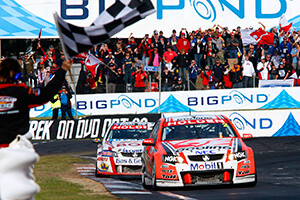 50 – GNAT’S NASTY
2009 – Safety cars cop the blame for ruining the racing, but the top 12 cars across the line are separated by just 13 seconds, all thanks to a SC intervention that bunches up the field for the run to the flag. And the winning Garth Tander/Will Davison HRT VE flashes across the finish line just 0.7599 seconds ahead of the Jason Richards/Cam McConville Team BOC car. It’s the closest non-staged finish in Bathurst history.
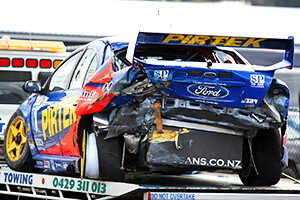 49 – AMBROSE & MURPHY GO AT IT
2005 – On lap 144, Marcos Ambrose and Greg Murphy tangle at The Cutting, briefly blocking the circuit and almost triggering a red flag. NASCAR-bound Ambrose is two-time defending series champion and this loss of points gifts Russell Ingall the title. Meanwhile, Murphy is two-time defending Bathurst champ. No wonder they continue the argy bargy out of the car. Skaife goes on to win his fifth Bathurst.
48 – ON A ROLL
1997 – As the fastest corner in Australian motorsport, The Chase has seen some huge accidents since its debut in 1987, but none funnier than Tomas Mezera’s rollover in the Bottle Magic Commodore. Nothing funny about the crash itself, but interviewed immediately afterwards, the uninjured and unintentionally hilarious Mezera states, “I was actually very happy when the car started to roll.”
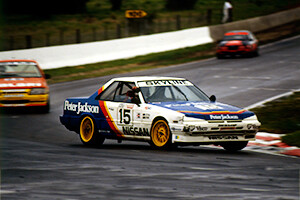 47 – WET-WEATHER REIGN MEN
1987 – Huge downpour catches plenty off guard and on slick tyres. Fire up YouTube and watch a still-baby-faced Glenn Seton give a Skyline master class in car control (it’s a Wheels office favourite). Some bloke named Brock also proves a dab hand behind the wheel of his slick-shod VL Commodore.
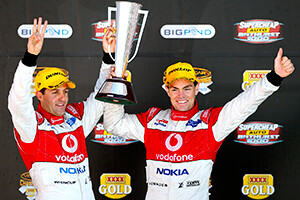 46 – BROCK FACTOR
2006 – Four weeks after Brock’s death, the heavy atmosphere descends farther when Mark Porter is killed in a support race. Lowndes’ win is emotion-charged, his voice breaking when he thanks his team as he takes the flag. It’s the start of a Brock-equalling three-year reign for Lowndes and Whincup (right, lifting the Peter Brock Trophy).
 45 – NINE OUT OF 10
1994 – Whether Brock had the pace to catch Lowndes and Bowe will never be known, but he was trying hard for a 10th win when, on his 138th lap, he lost the back of his VP at McPhillamy Park. It was only the second time Brock had crashed out of the Great Race (in 1988 his BMW M3 hit a stray wheel on Conrod Straight).
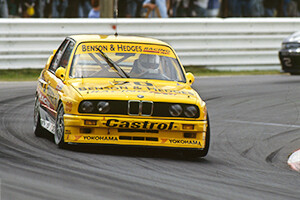 44 – BAD NEWS BEAR
1992 – 56-year-old Kiwi Denny Hulme complains to his pit of blurred vision shortly before bouncing gently along the Conrod Straight wall. Urban legend claims Hulme’s last words to the first marshall on the scene were, “Don’t stop the race.” But most believe the 1967 F1 World Champion has died of a massive heart attack before the M3 stops.
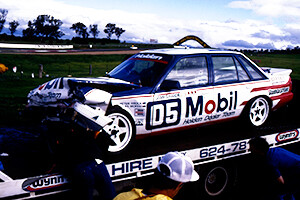 43 – DREAM TEAM NIGHTMARE
1986 – Plenty of punters do their dough on the ‘sure bet’ dream-teaming of Brock and Moffat. In Friday practice Moffat puts 05 into the McPhillamy Park wall, causing Brock to miss Saturday’s Hardies Heroes shoot-out. But from 11th on the grid, Brock charges into second place by lap three. However, on lap 77, Moffat’s shocker continues when he tears the oil-cooler off the car on the pit lane kerbs. Brock fumes in the car as a lap is lost. He finishes fifth.
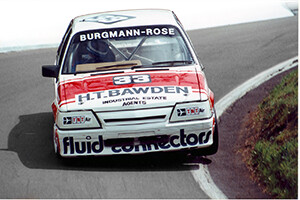 42 – MIKE BURGMANN
1986 – On lap six, Mike Burgmann’s VK Commodore passes Garry Willmington’s Jaguar XJS but the rear end gets light over Conrod’s second hump. Burgmann becomes the first fatality in the Great Race when his car slams into the base of the JPS bridge at over 200km/h. The Chase is added the following year, not because of this accident, but to gain FISA (now FIA) accreditation to host a round of the World Touring Car Championship.
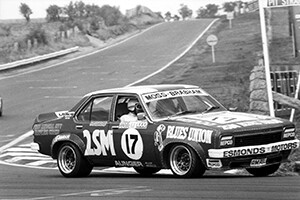 41 – STIRLING’S EFFORT
1976 – 47-year-old Stirling Moss, the greatest driver to never win a Formula One title, comes out of retirement to race with triple world champion Jack Brabham. Moss has to get clearance from his insurers but the challenge doesn’t amount to much when Brabham stalls on the grid and is rear-ended by the Triumph Dolomite Sprint of John Dellaca and Kerry Wade.
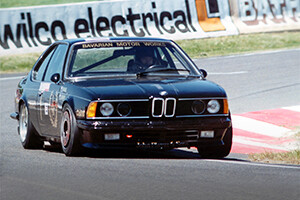 40 – LOOKS BUT NO LUCK
1980-87 – The Frank Gardner-led JPS team turns out some of the best-looking race cars of the era (and they won the ’85 and ’87 ATCC) but luck is never on their side at Bathurst. In 1982, Gardner claims sabotage when fuel problems strike the team but the 1985 debacle is all their own doing. Richards and George Fury manage to stick both JPS BMWs into the same sand trap at Hell Corner … at the same time.
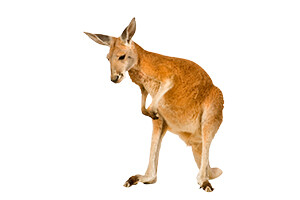 39 – ANIMAL INVASION
Over the years, horses, roos and dogs have all invaded the track. A dog is hit on Mountain Straight during practice for the 1987 race, but the only race fatality comes in 2004 when a roo destroys Jim Richards’ Commodore while the car is running seventh. A week before the 2009 race Bathurst City Council orders the culling of 140 roos.
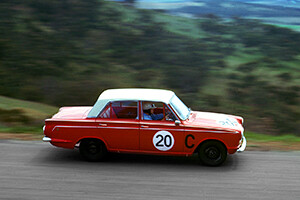 38 – HARRY FIRTH & BOB JANE
1963 – After three years at Victoria’s Phillip Island, the ’63 Armstrong 500 moves to Mount Panorama where it’s won in 7 hours 47 minutes by the Harry Firth/Bob Jane Ford Cortina GT. If you include Jane’s two wins at Phillip Island, he’s the only driver to have won four Great Races in a row; beating the three of Brock/Richards, Brock/Perkins and Lowndes/Whincup.
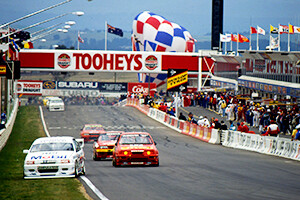 37 – TAIL SPIN
1992 – Brock enters an older VN Group A for Andrew Miedecke and Troy Dunstan, and the newer VP for himself and German Manuel Reuter. The newer car uses a two-piece tailshaft for fewer vibrations, but guess which part snaps when Brock launches from eighth on the grid? Urban legend has it that a road car in the car park donates its tailshaft to get Brock back into the race. He finishes 27th, 25 laps down. The VN finishes 7th.
 36 – UP IN SMOKE
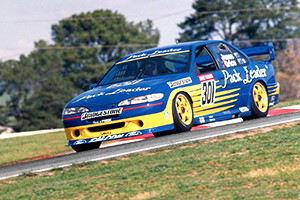
1996 – The end of big-dollar cigarette sponsorship sees the former Peter Jackson team cheekily wear ‘Pack Leader’ livery for the 1996 race. Irony gets the last laugh, however, when the race-leading Alan Jones car catches fire after a fuel line comes adrift. Though the fire happened on lap 25, Jones was the only driver to have passed eventual race winner Lowndes.
 35 – CATCHING HIS DRIFT
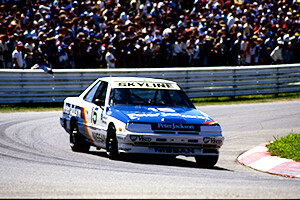
1986 – YouTube Gary Scott’s sensationally sideways lap as he puts his Skyline DR30 on pole. And as you watch, remember this model had v-a-g-u-e recirculating ball steering. The car finishes third the following day; the first time a Japanese or turbocharged car has run full race distance. Nissan will grab pole again in 1991, racking up wins in ’91 and ’92, along with three ATCC titles from 1990-’92.
 34 – CHANNEL 6 CAMARO
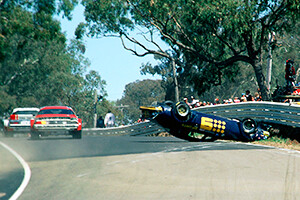
1982 – ‘Big Rev Kev’ Bartlett is a two-times Gold Star winner and shared John Goss’s 1974 Bathurst win, but he’s best-remembered for putting the Channel 9 Chev Camaro on its lid. The spectacular rollover is caused when the left rear tyre pops, a fact Bartlett makes clear when he extracts himself from the inverted ‘Channel 6 Camaro’. Though the Camaro failed to win Bathurst, it twice sat on pole.
 33 – SKAIFE & RICHO: LESS BUMMED
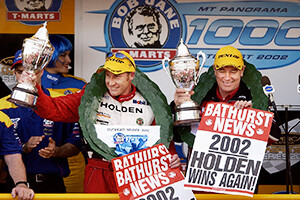
2002 – Ten years after being booed by the ‘pack of arseholes’, Skaife and Richards reunite in victory. This time the crowd cheers the HRT Commodore-driving pair. To their credit, some of the original pack did see the funny side of Richards’ 1992 comments; a popular T-shirt from 1993 proclaimed, ‘I’m an arsehole. Jim Richards told me’.
 32 – GREG’S GOTTA GO
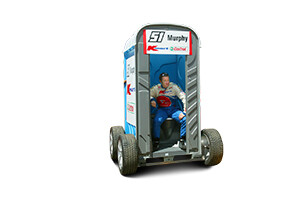
2002 – Greg Murphy’s leading VX Commodore gets dropped off the jacks while the fuel rig is still plugged in. Murphy fires out of the pit box and the resultant fuel spill earns the fiery Kiwi a five-minute stop/go penalty. When Murph takes his stop on lap 61 he unbuckles and unzips to make the most of his five minutes. YouTube it to see the poor pit crew trying to tell him to get back in the car. Murph finished 13th.
 31 – GREEN STUFFED
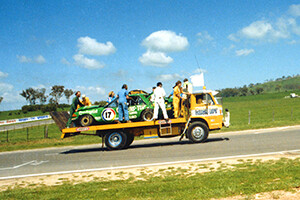
1983 – Along with Bill Brown’s 1971 rollover, Johnson’s effort in the Hardies Heroes shootout ranks as the worst non-fatal accident at The Mount. Johnson and co-driver Kevin Bartlett grid up the following day in a car borrowed from another competitor but stuffed with DJR running gear (above). It DNF’d.
 30 – FEEL LIKE A TOOHEYS
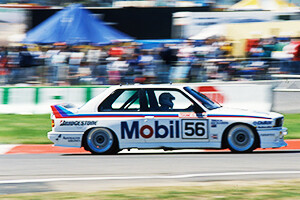
1988 – In response to the protest debacle of ’87 (see item 22), James Hardie withdraws its 20-year sponsorship; Tooheys jumps on board for the next eight years. It’s the one and only rolling start of the Great Race, with Tony Longhurst and Tomas Mezera taking a surprise win. After falling out with Holden, Brock reunites with Jim Richards in a BMW M3 but because of capacity regs/numbering system, Brock is forced to give up 05 and runs number 56.
 29 – WEIRD SPONSORS INC
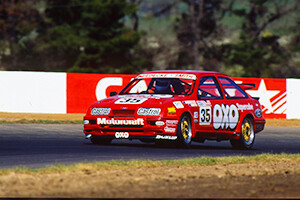
As touring car racing in Australia has become more professional, the variety and sheer weirdness of sponsors has disappeared from the grid. The 1980s was the high point, with such gems as the Wang Computers Jaguar XJS, OXO Supercube Sierra (right), Peanut Slab Sierra, Daily Planet VL Walkinshaw, Mistic Mould Destroyer VL and the Ray Ellis VK Commodore with an original Pro Hart painting on the bonnet.
28 – THE GREAT RACE
Larry Perkins won six times at The Mount but never troubled the engravers for a touring car title. In fact, he won only eight other ATCC/V8 Supercar non-enduro races. Brock won nine times at both Sandown and Bathurst, but only three ATCC crowns. A similar syndrome applied to the race cars; Commodore dominated Bathurst, winning seven times from 1980-’90, but only took the ATCC title once in the same period (with Brock, in 1980.)
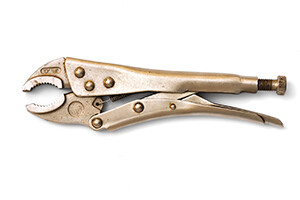 27 – SHIFTING SPANNER
1986 – Engineering brothers Graham and John Lusty get lateral when the shifter in their VK Commodore busts. The crafty crew fashions a gearlever from a set of vice-grips. Having started in 37th position, the brothers storm home in 15th, only one place behind their best-ever result. Nowadays the vice-grips are back in the brothers’ business building bulk haulage trailers.
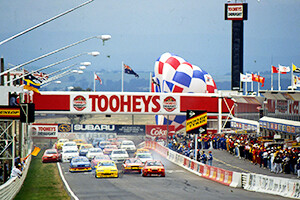 26 – OLD-SCHOOL LARRY
1992 – Larry Perkins puts a four-year-old Walkinshaw on the front row beside the pole-sitting Sierra of Johnson/Bowe and ahead of the winning GT-R. Tony Longhurst uses Perkins for a tow and qualifies his underpowered BMW M3 in fifth (dropping to ninth in the Top 10 shoot-out). In 1996, a year after winning in a VR Commodore, Perkins brings an older VP to The Mount and finishes sixth.
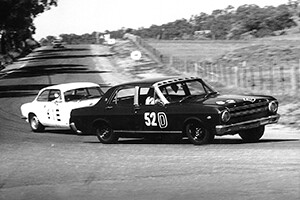 25 – V8S RULE
1967 & ’68 – The beginning of the Ford v Holden V8 rivalry. Harry Firth and Fred Gibson take the ’67 race in Australia’s first muscle car, Ford’s XR GT. Holden responds the following year, filling the podium with its Monaro GTS 327. Of the 47 Bathurst enduros, 37 have been won by V8 models, six by four-pots, three by sixes and one by a V12. V8s have powered all but one of Holden’s 26 wins, and 12 of Ford’s 17 victories.
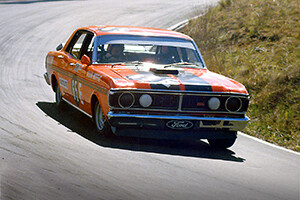 24 – PACING PHASE
1971 – Allan Moffat leads a Phase III whitewash of the podium, paying Holden back for its 1968 clean sweep. Moffat’s pole time is an incredible 10 seconds quicker than his effort the year before in the Phase II. The Ford-driving Canadian leads all day, but is forced to make an unscheduled stop to remove a beer carton from the radiator.
 23 – NKOTB
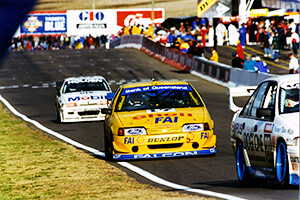
1994 – Twenty-year-old rookie Craig Lowndes carves the first notch on his Bathurst belt. Paired with Brad Jones, the Lowndes VP qualifies in seventh and circulates at the pointy end all day. On lap 148, in one of the greatest passes seen at The Mount, Lowndes takes the lead from John Bowe on the outside of Repco Bend. Bowe gets him back two laps later when Lowndes is baulked by the Fahey/Cribbin VL at Murray’s Corner, and goes on to win.
 22 – AND THE WINNDER IS…
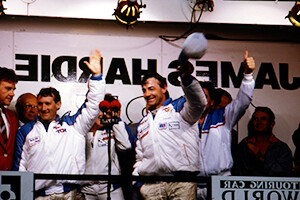
1987 – As a round of the World Touring Car Championship, Bathurst is dominated by the Swiss Texaco Sierras despite several protests about their legality. For the second time in his career, VL-driving Brock changes horses mid-race but finishes third, five laps down. The crowd believes Brock is the rightful winner, something confirmed on March 14, 1988 – 162 days after the Texaco cars crossed one-two. It’s Brock’s ninth and final win.
 21 – THE LONG AND SHORT OF IT
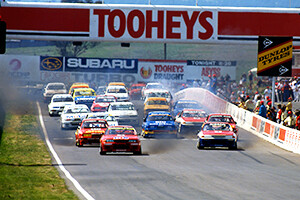
1991 – This is one Bathurst record likely to stand forever. The Nissan GT-R of Richards/Skaife becomes the first Japanese car to win outright – and in a record time of 6 hours 19 minutes. While there are safety cars in 1991, they are not deployed with the frequency of today. A modern V8 Supercar is around six seconds per lap faster than the GT-R, but the average race time of the last five years is 6 hours 38 minutes.
 20 – A LITTLE BIT FANCY
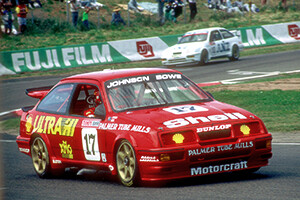
1989 – Brock switches camps to Ford and puts his Sierra on pole, but is later fined for unsportsmanlike conduct – he’d pointed the under-bonnet extinguisher at the intercooler during the Top 10 shoot-out. Johnson’s Sierra takes the lead from Brock on lap one and never relinquishes it. Greeting the flag, co-driver John Bowe exclaims with classic Tasmanian understatement, “Fancy doing that”.
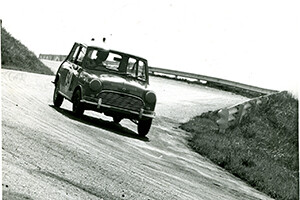 19 – CONQUERING COOPERS
1966 – In the most dominant display by a single model, Minis take the first nine places of the Gallaher 500, led by Bob Holden and Rauno Aaltonen. It will be 19 years before another British car (Jaguar XJS) wins Bathurst and 22 years before another four-cylinder is victorious (turbocharged Ford Sierra). Brock’s 1979 six-lap demolition led the second most dominant single-model run, with the first eight places filled by A9X Toranas.
 18 – FIRST GROUP A RACE
1985 – Led by Scot Tom Walkinshaw’s three-car Jaguar team, the foreigners show up in force for the first Group A race. Of the six drivers on the podium, only race winner John Goss (teamed with German Armin Hahne in one of the Jags) is Australian. Brock chases hard in the dying laps, stopping to have his rear window kicked out, but his VK expires three laps from the finish with a broken timing chain.
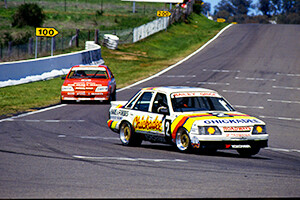 17 – GRICE GETS HIS WIN
1986 – Before Seton, Allan Grice was the unluckiest Bathurst driver, but he finally gets his win in the Chickadee VK with chicken farmer Graeme Bailey (Grice wins again in ’90). The win isn’t without drama as the Commodore suffers a major oil leak and Bailey has a spin. The bearded bloodnut achieves a unique double in practice, recording the first 100mph lap in a Group A car (something Grice did in his 1982 Group C VH).
16 – JOHN GOSS SPECIAL
1974 – If you’re unkind, you can say that privateer John Goss, co-driving with Kevin Bartlett, takes his first win by default. It’s true Moffat, in the Brut 33 Falcon hardtop, has a shocker in the race and Brock has it shot to bits, leading by six laps only for the engine oil pump to go bang. But the Goss/Bartlett Falcon fights atrocious conditions, even getting caught on slicks during a downpour, but is there when it counts.
15 – ROLLING THUNDER
1971 – In 1969 and ’71 Bill Brown makes a habit of rolling GT-HO Falcons. In ’69 Brown’s opening lap rollover triggers a pile-up that takes out a quarter of the field. Words cannot describe Brown’s 1971 roll along the fence at Skyline so fire up YouTube. The wooden fence cuts the Falcon in half just behind Brown’s head but he escapes with a black eye and mild concussion. The unknown flag marshal walks away without a scratch.

14 – JAMIE WHINCUP’S FUEL FAIL
The 2014 great race was shaping up to be a belter, as young Ford hopeful Chaz Mostert carved his way back to the front after a fraught day – but Holden’s Jamie Whincup was playing the fuel card strategy, saving like crazy to avoid a final fuel stop. Even though his Triple Eight team were virtually begging him to pit with a handful of laps to run, the seven-time champ ignored the calls, racing Mostert until his Commodore spluttered with a lap to go. Mostert would go on to win his first Bathurst with veteran Paul Morris.
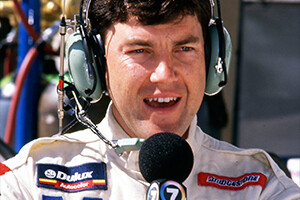 13 – CALL IT LIKE IT IS
Doug Mulray got plenty of mileage from the brothel-sponsored Daily Planet Commodore. It was a “cock-up” when it caught fire, but when it crashed, Mulray said on air, “The girls in Melbourne will be working hard tonight”. But you’ve got to feel for Neil Crompton, arguably the best motorsport commentator in the biz, when he threw to a break in 2008 with the classic YouTube line, “When the big c##ts, ah, big guns come out”.
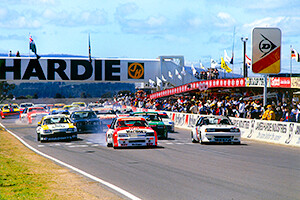 12 – START-STOP TECHNOLOGY
1984 – George Fury puts his Bluebird on pole in a time of 2:13.850 (a record for touring cars on the old circuit configuration). At the start Tom Walkinshaw tears the centre out of his Jaguar’s clutch and is freckle-punched by John Tesoriero’s Camaro who then biffs into Peter Williamson’s Supra, blocking the start line for the remaining 13 cars.
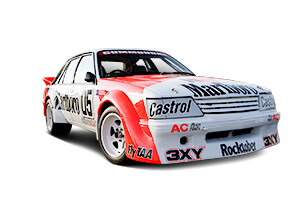 11 – BIG-BANG FINALE
1984 – For Bathurst’s last Group C race, Brock rolls out the best-looking Aussie race car of all time (arguments to the usual address). The day-glo VK qualifies second but gets the jump at the re-start (see below) and is never headed, giving Brock his sixth win in seven years. With the Harvey/Parsons car in second (two laps down) Holden finally gets its one-two to counter Ford’s from seven years earlier.
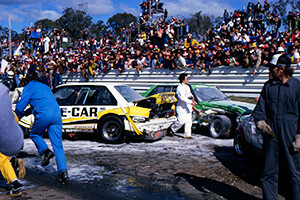 10 – THE JAMES HARDIE 740
1981 – The first of only two great races that don’t go the full distance, the ’81 race stops on lap 120 when Bob Morris and Christine Gibson trigger a multi-car pile-up, blocking the circuit at McPhillamy Park. It’s the first of Dick Johnson’s three wins and the start of a trend where he never takes the chequered flag at Bathurst (John Bowe is driving at the finish of both the ’89 and ’94 wins).
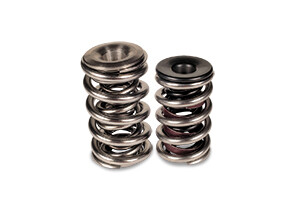 9 – SETON’S HEARTBREAK
1995 – On the 30th anniversary of his father’s win, Glenn Seton’s Bathurst dream ends nine laps from the end when a $5 valve spring fails while he’s in the lead. In the greatest comeback in Bathurst history, the race is won by Perkins/Ingall despite dropping a lap after a startline touch with Craig Lowndes. Channel Seven’s Mike Raymond suggests that Perkins’ “lights-ablaze” VR scared Seto’s Falcon to death.
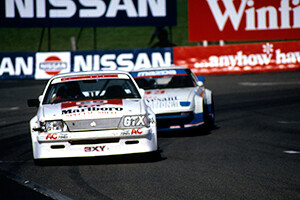 8 – BROCK SWITCHES
1983 – Brock switches mid-race from expired 05 into 25 sister car. In the process he kicks out brother Phil with history recording the victors as Peter Brock, Larry Perkins and John Harvey (Harvey’s only win at Bathurst). Second-place Mazda pilot Moffat (who started in 14th) famously moans, “it took two cars to beat me today.”
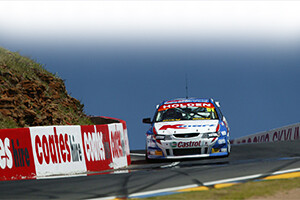 7 – LAP OF A GOD
2003 – Greg Murphy’s 2:06.8594 pole position lap breaks the 32-year-old circuit record (set on the shorter, Chase-less version of The Mount) by Neil Allen in a McLaren Formula 5000. And Murphy says it wasn’t a perfect lap, “I wrong-slotted a gear and went from second to first instead of third”.
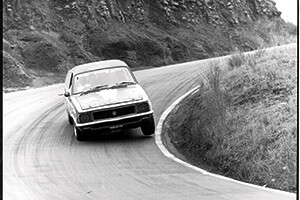 6 – DAVID V GOLIATH
1972 – Held in the shadow of the ‘Supercar Scare’, the ’72 race is the last over the imperial 500 miles and the last for solo drivers. Of course the race is remembered as the first of Peter Brock’s nine wins. Driving the second of Harry Firth’s Holden Dealer Team Torana XU-1s (Colin Bond is team leader), Brock’s cause is greatly helped by near-constant rain. The nimble six-cylinder Torana finishes a lap up on the John French GT-HO.
 5 – PUSH AND SHOVE
1973 – After his solo win the previous year, Brock teams up with veteran Doug Chivas. Following team orders to stretch the fuel economy advantage over the faster V8 Falcons, Chivas runs dry in the leading XU-1 on the approach to Murray’s Corner. After trying to drive the car on the starter motor, the diminutive Chivas is forced to push the Torana up pit lane. A frantic Brock and pit crew urge him on but the delay gifts Moffat the win.
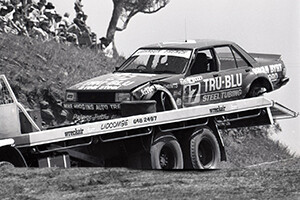 4 – ROCK BREAKS DICK
1980 – Dick Johnson’s Tru-Blu XD Falcon storms into the lead from second on the grid, pulling away each lap. But on lap 17 the XD hits a 50kg rock on the exit of The Cutting. The impact destroys both left-side wheels, tears the suspension apart, and fires the XD into the wall. The public donates $36,000 to a distraught Johnson, a figure matched by Ford Australia.
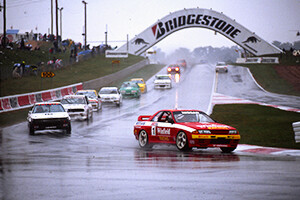 3 – PACK MENTALITY
1992 – Jim Richards makes one of the biggest calls in Australian sporting history when he labels the booing crowd “a pack of arseholes”. Emotions are high as the race is stopped on lap 143 after the Richards/Skaife Nissan GT-R has already crashed. Richards’ nerves are raw as he takes the podium because fellow Kiwi and mate Denny Hulme had suffered a fatal heart attack during the race.
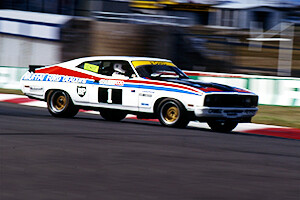 2 – FALCON ONE-TWO PUNCH
1977 – The footage is trotted out every year, but controversy surrounds the famous Moffat/Bond one-two win in Falcon hardtops. The lead car of Moffat and Le Mans legend Jacky Ickx develops brake problems and could fall prey to the sister car of Colin Bond and Alan Hamilton. But Moffat is lead driver and legendary American team boss Carroll Smith orders Bond to stay behind.
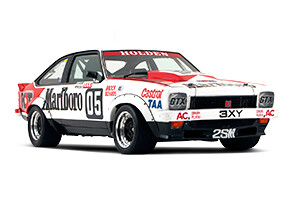 1 – BROCK STAR
1979 – Peter Brock was never more ‘perfect’ than in 1979. He puts his A9X on pole, despite fumbling with a pack of Marlboros that had popped out of his race suit. In the race, Brock leads the opening lap by three seconds and is never headed. By lap 130, the 05 A9X leads by four laps with Brock setting the lap record on the last lap, taking the flag six laps in front of the Perkins/Janson A9X.
RENAULT has at last overcome the myriad Australian Design Rule-related obstacles that have delayed the local release of the Captur crossover by almost a year.
Now due to touch down in January, local spec versions of the Holden Trax and Nissan Juke rival are finally rolling down Renault’s Spanish production line. It follows confirmation of the Citroen C4 Cactus for Australia.
According to Renault Australia boss Justin Hocevar, the Clio IV-based Captur will hit the market leaders like the Trax hard with “very competitive” pricing and a generous level of standard specification.
“I think it will be quite a success,” he told Wheels at the Paris motor show. “The Captur will be priced and specced against the segment leader, being the Trax.”
That means the Renault should kick off from less than $24,000 for the entry-level Authentique variant, powered by a variation of the base Clio’s 66kW/135Nm 0.9-litre three-cylinder TCe 90 petrol engine and a five-speed manual gearbox.
More expensive models will gain an 88kW/190Nm 1.2-litre four-cylinder TCe 120 unit mated exclusively with an EDC dual-clutch transmission. All Capturs will be front-wheel drive.
A diesel won’t be offered at launch, though it is understood that Renault is readying a 1.5-litre DCi powerplant should demand dictate it.
One of the Renault’s biggest hurdles for Australia concerned the fitment of rear child-seat restraint points, which – according to Hocevar – took much longer to homologate than usual.
“We were ready to go,” he said. “It was so frustrating … like being on plane waiting on the tarmac to take off while heavy fog clears”.
Additionally, once all the ADR issues had been sorted, Australia’s allocation of vehicles faced further delayed by the unexpectedly high demand for the Captur in Europe and South Korea, where it is sold as the Renault Samsung QM3. Currently it sits in third place on the French sales charts – an unheard of result for a compact SUV.
Our second episode of the ‘Lap of the Gods’ mini-series highlights the explosive pace of Mark Skaife and Nissan’s Group A Skyline GT-R around Mount Panorama in 1991.
The stage had been set the year before when Nissan Motorsport’s chances for victory were doused by mechanical problems.
In 1991, however, the GT-Rs were healthy and hungry for revenge, which Mark Skaife made very clear after an all-or-nothing qualifying lap.
With Mount Panorama clear of traffic Skaife instantly took the Skyline to ten tenths, showcasing heroic commitment as he wrestled the GT-R off Hell Corner’s exit curb.
The rest of the lap was close to surgical, and rewarded the 24-year-old with pole position and a time more than a second clear of Mark Gibbs. Skaife made it clear how fast he was going when he dismissed having more up his sleeve and said: “Nah, not really, I think that was about as quick as we could go.”
THE Holden VF Commodore range has received a modest makeover for the 2015 model year, with the changes focusing almost entirely on V8 models popular with private buyers.
The Holden Commodore secured close to 60 percent of the Australian large car market in 2013, and is running at a heady 72 percent so far in 2014. This incredible market dominance faces a fresh challenge once Ford’s FGX Falcon hits the streets in December, offering savings of up to $10,000 on the current model.
More than one-third of VF Commodores sold since its launch in May 2013 have V8s under the bonnet, which largely explains Holden’s top-end focus with the MY15 update.
Hero of the 2015 VF Commodore range is a limited-edition sedan named after five-time Bathurst 1000 winner Craig Lowndes. Just 233 examples of the Holden Commodore Craig Lowndes SS-V Special Edition will be built, 120 of which already have buyers’ names against them – including Lowndes himself.
“I was really excited when Holden approached me with the idea of what they wanted to do,” Lowndes told Wheels. “I jumped at it. For me, it’s a great honour to have 20 years in motor racing celebrated with a special edition.”
The Craig Lowndes Special is based on the Commodore SS-V Redline flagship performance sedan, and gains a number of embellishments intended to improve its dynamics and exclusivity. It’s available in red or white with a price tag of $57,990 in six-speed manual form, or $60,190 with the six speed automatic.
The Craig Lowndes Special gains suspension tweaks, uprated Brembo brakes and 20-inch black alloy wheels – now with slightly wider rear hoops to better put the 270kW 6.0-litre V8’s power to the road. Despite this broader contact patch, Holden is not claiming any improvement in the Redline’s 0-100km/h sprint.
Visual enhancements to the Lowndes Special include blacked-out roof and bonnet panels, and stripes down the side.
Other mechanical changes to the Holden VF Commodore MY15 range are minor. Automatic transmission versions of SS-V Redline and Craig Lowndes models add steering wheel-mounted paddle shifters – a first for an Australian-made car –developed initially for the US-spec, Commodore-based Chevrolet SS sedan.
SS-V Redline models also swap to black alloy wheels in place of the hard-to-clean mirror ball alloys on the previous model.
The only exterior design change is to SS models and above, a near black valance under the rear bumper.
The steering calibration has also been finessed to deliver more feedback on sports models.
Pricing remains unchanged on all carryover models into the 2015 model after an across-the-board hike of $500 in August.
HOLDEN has hotted up the SS Commodore for 2015 as customers flock to V8s like never before.
More than a third of VFs sold to date have been V8s with nearly one in four customers choosing an SS, SS-V or Redline.
For Holden’s mid-cycle MY15 update the SS has received the lion’s share of attention:
- Automatic models now come with shift paddles on the steering wheel. The paddles are directly off the Camaro (and are already standard fitment on the American Chevy SS). Aside from that required to accommodate the paddles, there is no software change to the gearbox so shift times are unchanged.
- The SS-V Redline now gets a new 19-inch wheel design with gloss black finish.
- The steering’s been improved. Holden has worked with its Korean steering supplier to update its electronic steering. Hardware and software changes make for better off-centre feel and a more linear build-up of steering load in corners.
- Two new colours: “Jungle Green”, a deep metallic green, replaces Fantale orange. Meanwhile Holden has added a new deep red called “Some Like it Hot”.
- The rear number plate valance on SS models is now finished in gloss black.
The VF has been on sale for 17 months and Holden’s Peter Keley says “at this stage in its lifecycle you wouldn’t be expecting revolution”, hence the basic upgrades.
Commodore sales are up 26 per cent on last year as it continues to dominate the large sedan segment.
Prices remain unchanged except for base Calais and SV6, up $300 due to the now standard fitment of a full-size spare as demanded by VF customers.
The MY15 Commodore goes on sale October 17 (next week).
Check back later today for MOTOR’s verdict on how the MY15’s shift paddles and steering upgrades have changed the SS Commodore driving experience.
HOLDEN’S PLAN to import high-performance VXR models from Europe is guaranteed to steal sales from HSV, according to Opel’s performance manager Wilfried Diehl.
Holden will reintroduce the Astra and Insignia VXR from early 2015 – cars previously sold here as Opels during the German company’s failed foray into Australia last year – with Diehl delivering a grave warning to HSV.
“We will be cutting their [HSV’s] grass, yes,” said Diehl. “If a new model comes into the market somebody is going to lose market share. And because HSV has the same attitude towards its cars as we do to our performance models, they will compete.
“Currently only HSV is in the market, so when we come in to the market then HSV will lose. This is for sure.”
Currently HSV sells around 3000 units a year, but Diehl says that unless the Australian performance market increases this will drop dramatically, particularly when Holden ceases local manufacturing in 2017.
“I know Australians will choose our cars so I hope we will create new customers and HSV isn’t affected, but it really is the same type of product,” said Diehl. “HSV does the same job that we do, so we will compete.
“If someone is looking to buy a performance car and likes a new car on the market he will buy it. Then HSV will lose volume, it’s simple. Somebody is going to lose when VXR comes to your market.”
While the Astra and Insignia are unlikely to immediately impact HSV sales given their different body styles, they do limit HSV’s future options.
It’s widely understood Holden will replace the Commodore with the next-gen front-wheel drive Insignia and all-wheel drive Insignia VXR post-2017, while Diehl revealed plans are already underway to introduce more VXR products – including the new Opel Corsa which was just revealed at the Paris motor show.
“You will get the planned Corsa VXR for sure,” he said. “We are currently working on this car and the development of its engine was actually done in Australia. The Australian powertrain team developed the entire engine which is 1.6-litres with 200-plus horsepower [147kW]. We are working hand in hand with them, so I think it will sell well in Australia.”
Holden refused to comment on whether an influx of VXR products would cannibalise HSV’s business.
“HSV can speak for itself about where its product is pitched,” said Holden corporate affairs director George Svigos. “But we’re looking forward to bringing the VXR product in.”
Despite the uncertainty, HSV insists its future remains bright. The company, which currently employs around 100 people at its engineering centre in Clayton, Victoria, produces six models – all based on the VF Commodore.
While HSV refuses to comment about its future line-up, there is speculation that General Motors has plans to import right-hand drive variants of the Chevrolet Camaro and the C7 Corvette.
Holden will relaunch and rebadge the current hard-core Astra VXR hot hatch, sold here during Opel’s failed foray last year, in early 2015, but Wheels can reveal work has already begun on a successor to hit the new Honda Civic Type R, Renaultsport Megane and Ford Focus ST where it hurts.
Smaller and up to 150kg lighter, the next-gen Astra VXR (or OPC, short for Opel Performance Centre, in Germany and several other European markets) will also be offered as a five-door only – meaning no more Astra GTC – and produce more grunt from a smaller 1.6-litre turbo four-cylinder.
The current Astra VXR churns out 206kW and a hefty 400Nm from Opel’s 2.0-litre turbo four.
“Work is well underway on the next Astra VXR,” said Wilfried Diehl, Opel’s performance manager and the brains behind the OPC/VXR brand. “And it’ll be five doors only, there won’t be a three-door available like the current car.”
Diehl said the decision to drop the three-door option reflects the market trend in Europe towards roomier, five-door models with easier rear access. It also points to Opel streamlining its product range to reduce costs.
“We won’t stick with the 2.0-litre turbo either,” Diehl said. “In Europe we have strict regulations for CO2 output and downsizing is one of the best measures to reduce your CO2 drastically.
“So for the new Astra, we will go with a 1.6-litre engine which will produce around 250hp m [184kW], but the main target is 300hp [221kW].”
Diehl confirmed torque from the smaller engine will match the current car’s 400Nm, meaning performance will increase.
“The car will be lighter, it will be a little bit smaller because the platform has been modified and the performance will be slightly better,” he said.
Based on the next-gen Astra, which is guaranteed to be a volume seller for Opel and a likely import for Holden, Diehl’s predictions of a 150kg drop in weight means the next VXR could hit the scales around 1325kg, around the same heft as a DSG-equipped five-door Golf GTI.
“The successor to the standard Astra will launch in August next year, but we will continue to produce the current three-door until the end of 2017,” said Diehl. “We will then launch the OPC/VXR version of the next five-door Astra in early 2018.”
The current-generation Opel Astra VXR last sold for $42,990 in Australia but Holden remains tight lipped as to whether the car will take a price cut when it returns as part of the local brand’s range in 2015.
The Great Race, Bathurst, 1987. Kicking off our ‘Lap of the Gods’ mini-series is this Peter Brock master class on car control.
At the end of lap 155, with the track barely dry, Brock takes a dramatic gamble: he opts for slicks with only five laps left in an attempt to chase down the leading Ford Sierras and claim his ninth win at the Enduro.
The consequences are immediately obvious as Brock has to tame the VL Commodore, twitching with oversteer, down the entire length of pit lane.
It only gets better once Brock’s out on track, where he’s met by a position-hungry Gary Brabham in a BMW M3. The ensuing dogfight is stuff of legend as Brock in the big-power Commodore, on barely warm tyres and a corridor-thin dry line, tries to manage the agile M3.
It’s a cracker. And we’ll be delivering more ‘Lap of the Gods’ goodness each day as we count down towards another Bathurst epic this weekend. Stay tuned.
