
Snapshot
- BMW M marks 50th year with ‘Edition 50 Jahre’ special editions
- M4 confirmed for Australia, limited to 25 units
- Local prices to start at $201,900
UPDATE: BMW Australia confirms local pricing and features for M4 Edition 50 Jahre
The Australian arm of BMW has locked in the M4 Edition 50 Jahre BMW M for a local launch, set to arrive in the fourth quarter of 2022.
Announced earlier this morning as a celebration model to mark 50 years of BMW’s M cars, the M4 ‘Edition 50 Jahre’ will be available to local buyers from $201,900 before on-road costs – however, just 25 units have been secured for Australia.
Finished in Brands Hatch grey, the M4 coupe rides on a set of style 826 M light alloy wheels – 19-inch up front, 20-inch at the back – finished in matte gold bronze, while a carbon diffuser and rear spoiler are added as standard features, capped off with “50 years of M” badges adorning the bonnet, boot and wheel centres.
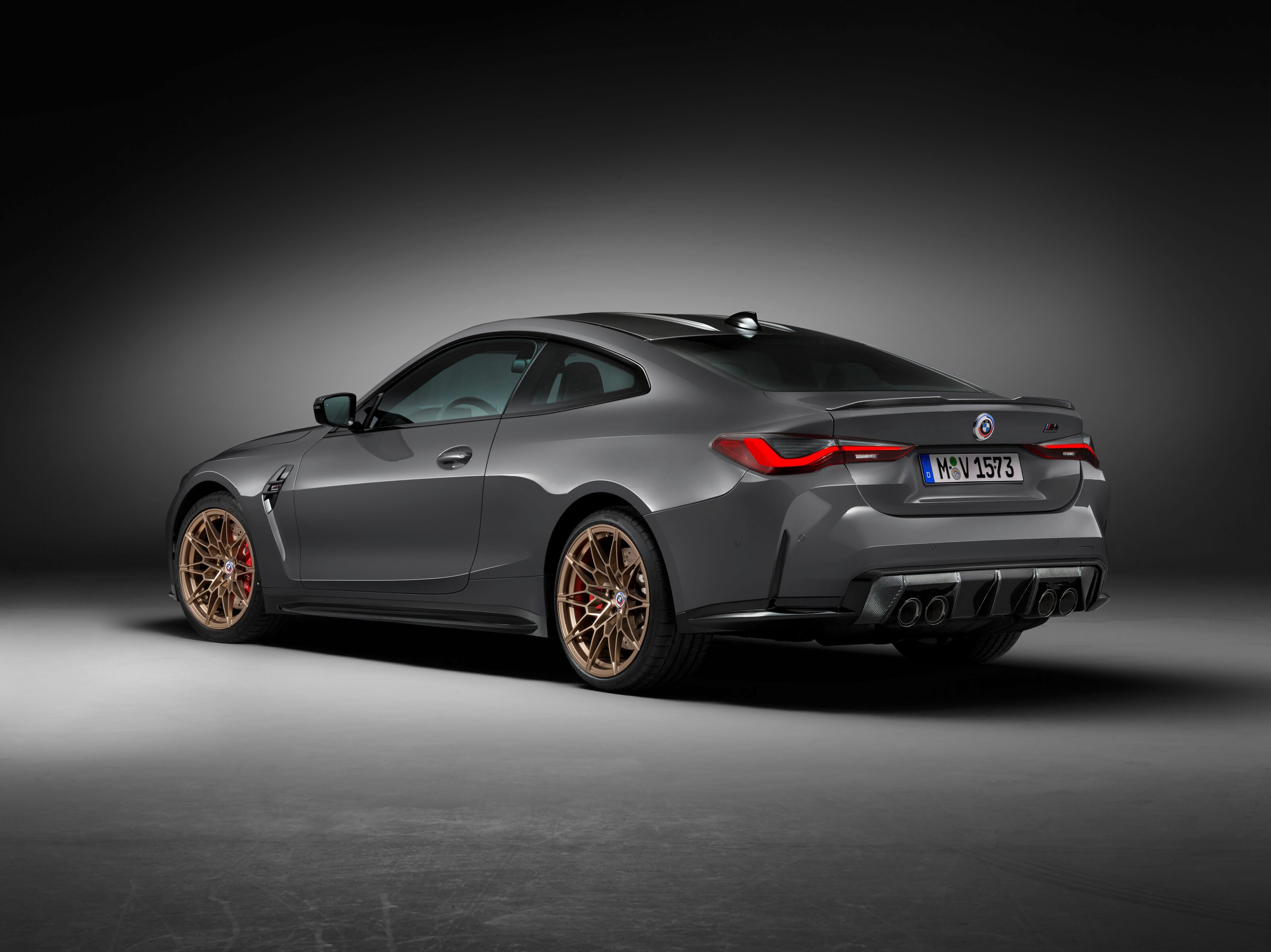
In addition to the exterior changes, a number of cosmetic tweaks have been made in the cabin, with ‘Edition 50 Jahre BMW M’ lettering on its door sills, head rest and a metal plaque on the centre console.
Based on the M4 Competition M xDrive, the 3.0-litre, twin-turbo straight-six engine continues to develop 375kW and 650Nm with power sent to the rear wheels through an eight-speed torque-converter automatic transmission.
BMW has also added a number of bonus pieces of equipment to the limited edition M4, including; M compound brakes with red high-gloss calipers, M carbon bucket seats and the M drivers package – increasing the speed limiter to 290km/h and providing complimentary access to a BMW M Driving Experience Advance 2 course.
Australia will miss out on the M3 version of the Edition 50 Jahre as well as the other colours offered to international markets on the M4 (read further below).
The story to here

BMW M3 and M4 ’50 Jahre’ celebrate half a century of M cars
BMW has gifted its customers the chance to buy two limited run-models to celebrate 50 years of its M division, launching the ‘M 50 Jahre’ M3 and M4.
Based on its popular M3 sedan and M4 coupe, BMW’s 50 Jahre pack is available internationally on both the six-speed manual and eight-speed automatic variants of each model, with the 3.0-litre, twin-turbo straight-six engine’s 375kW/650Nm outputs still sent to either the rear or all four wheels.
However, the cosmetic changes for each of its special edition offerings change depending on the market.

Europe and “other selected sales regions” are offered the M4, with the half-century celebration variant gaining ‘Edition 50 Jahre BMW M’ door sill panels, a metal plaque on the centre console and embossing on the seats.
Exterior finishes include carbon black, Macao blue, Brands Hatch grey, Imola red and San Marino blue, all of which can be paired with a set of M forged wheels – measuring up at 19-inches at the front and 20-inches at the back – in either orbit grey or gold bronze matte.
The 50 year anniversary coincides with the Chinese Year of the Tiger, inspiring the market to be given a choice of fire orange and stratus grey paint colours, exclusively matched to the orbit grey and gold bronze wheels respectively.

For North America, US and Canadian buyers are treated to the M3 sedan, limited to a total of 500 units with a range of colours which hark back to some classic BMW models – techno violet (E36), Interlagos blue (E92), fire orange (E92 M3 GTS) – and a number of M finishes such as vermilion red and lime rock grey.
All of these cars will feature the same interior treatment as the M4 as well as being available with orbit grey wheels, however the addition of a carbon front splitter, rear spoiler and carbon/titanium exhaust pipe trim sets it apart from the coupe.
BMW Australia hasn’t confirmed whether the limited edition models will make it to local shores, although it has locked in the hardcore M4 CSL for launch – going on sale from $303,900 before on-road costs.
Labor will not extend the temporary cut to the fuel excise beyond its September end date, the new Deputy Prime Minister has revealed today.
Acting Prime Minister Richard Marles MP said Labor has no plans to extend the cut, which was introduced by the outgoing Liberal-led coalition government in March.
Marles told Seven’s Sunrise it will “take time before Labor can fulfil its election promise to ease cost of living pressures”, but said the Party had “made clear [its] position in relation to the fuel excise cut…[and]…has no intention to change that, there are other ways to deal with the cost of living”.
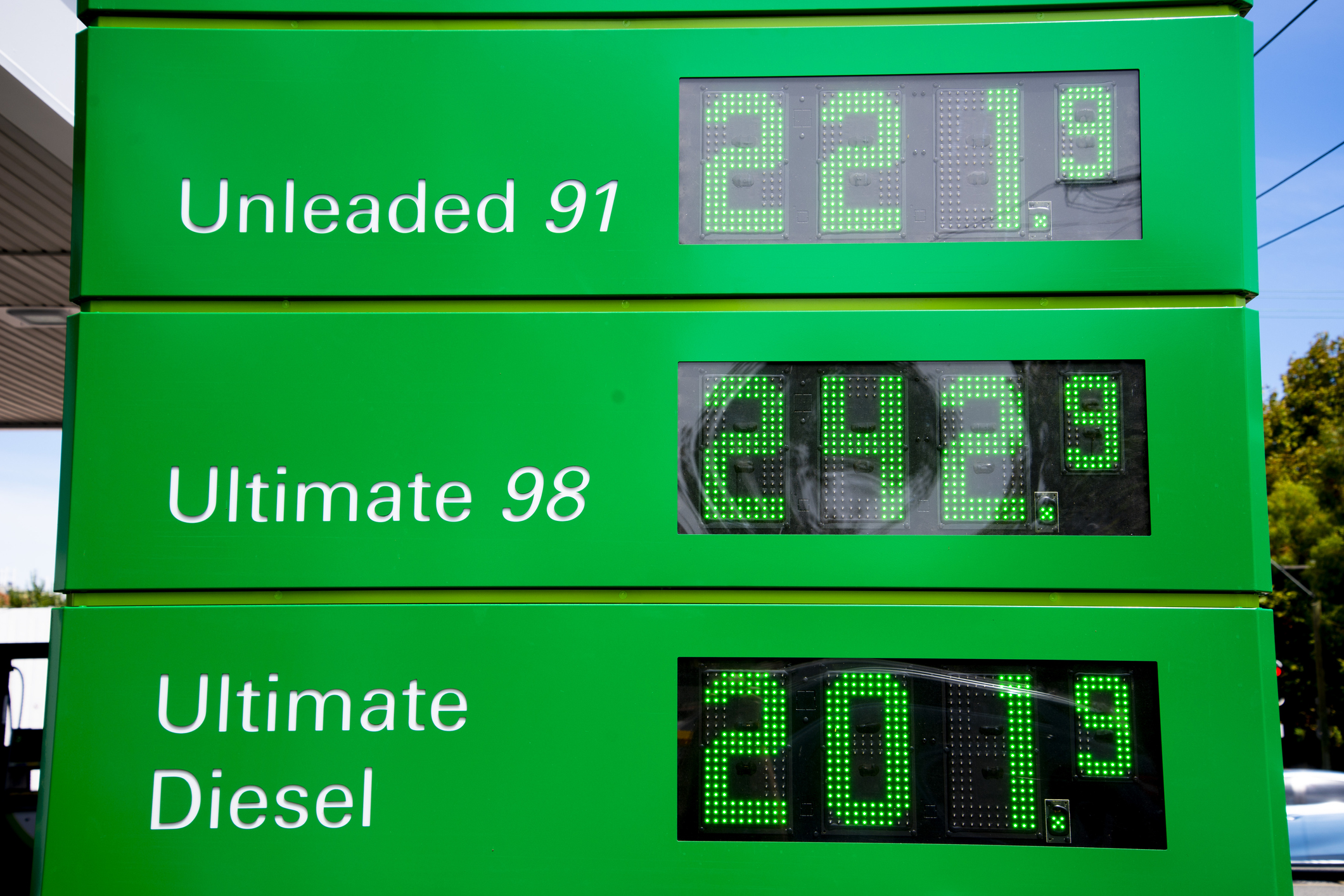
The previous Federal Government cut the fuel excise in Australia by 22 per cents a litre for six months as part of a bid to reduce the cost of living in the wake of rising prices at the bowser over the first half of the year. Prior to this motorists were paying 44.2 cents in tax for every litre of fuel they buy.
Former Treasurer Josh Frydenberg made the announcement as part of the coalition’s fourth budget, alongside a raft of other measures aimed at easing increasing financial pressures on Australian households.
It is understood the tax cut will come at a cost of $3 billion to Government coffers.
The Australian Competition and Consumer Commission (ACCC) previously said it would monitor local fuel prices more closely in the wake of the excise cut, with the consumer watchdog looking to ensure fuel companies weren’t pocketing the difference and making false or misleading statements about their intentions to hand down the tax cut to consumers.
Labor’s comments come as Australian fuel prices are again starting to climb, with fears of more record highs at the bowser arising just weeks after the national fuel excise was cut.
Prices hit an average peak of 212.5 cents per litre (cpl) on March 20 prior to the announcement, and although they then dropped to a low of 166.3cpl on April 17 – the lowest since the beginning of the year – the figure has continued to rise back up, now sitting at 185cpl according to the Australian Institute of Petroleum. It’s understood by next week motorists could be paying as much as 230cpl at the bowser.
Snapshot
- Cupra to reveal next plans on June 7
- Previously teased compact SUV
- Returns to Terramar for announcement
Spanish carmaker Cupra has teased a short video overnight, announcing it will be revealing more about its future model plans on June 7.
In the clip, which oddly features statues, robots, people kissing and a man screaming but not many cars, Cupra says it will be returning to Terramar for the reveal – the place “where it all began” when the brand launched there in 2018.
Few details are included, with the marque stating only that in two weeks it will reveal an “unstoppable pulse” with “new heroes for a new era”.
An additional statement released by the brand said: “On June 7, Cupra will return with a bold plan to go even further, announcing its ambitions as it builds towards 2025, where new vehicles will take the brand into a new era.”
In recent months Cupra has also teased an upcoming compact SUV, promising hybrid powertrains when the new model joins its line-up in 2024.
The carmaker says the vehicle will be available with a range of engines, including a mild-hybrid and a plug-in hybrid (PHEV) and will be built alongside the Audi Q3 – likely based on the Volkswagen Group’s MQB architecture, giving us some clues as to what we can expect under the bonnet.
The Spanish performance brand has not provided any details on the engines, but we could see the new Cupra model adopt something similar to the 1.4-litre turbocharged plug-in hybrid powertrain found in the recently-released Audi Q3 45 TFSI e, which uses a 13kWh battery to power an 85kW electric motor.
Earlier this month, Volkswagen Group CEO Herbert Diess revealed that its volume brands will all soon offer an affordable ultra-compact electric vehicle.
Volkswagen, Skoda, and Cupra are expected to each launch a cut-price EV hatch in 2025, all of which are to be built in Spain and based on a shortened version of the company’s MEB platform.
An outline sketch of the Volkswagen version, likely to be badged as the ID.1, shows a similar style to the ID.4, while the Skoda model offers an early look at the brand’s ‘Modern Solid’ design language. The Cupra model was previously shown with the UrbanRebel concept.
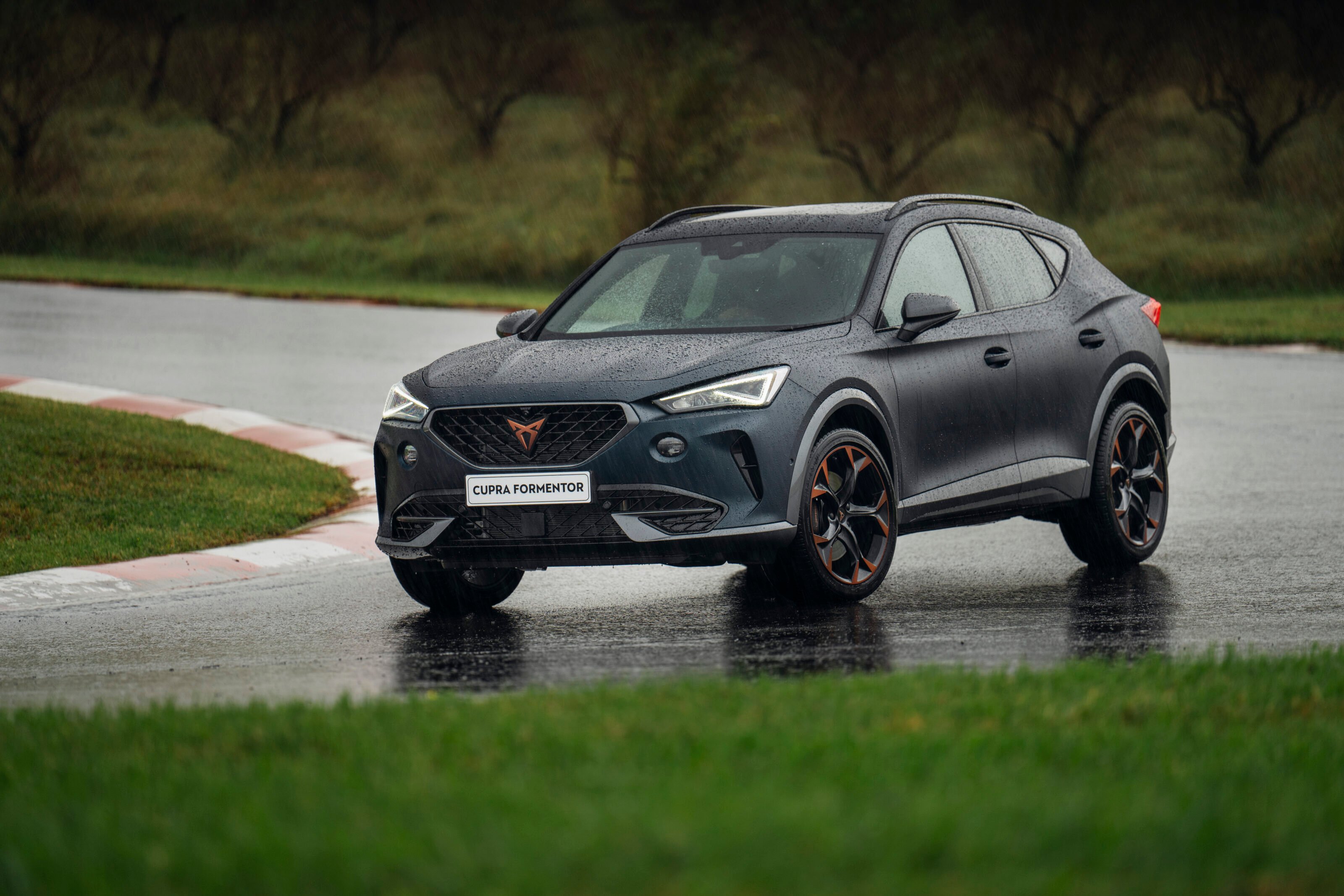
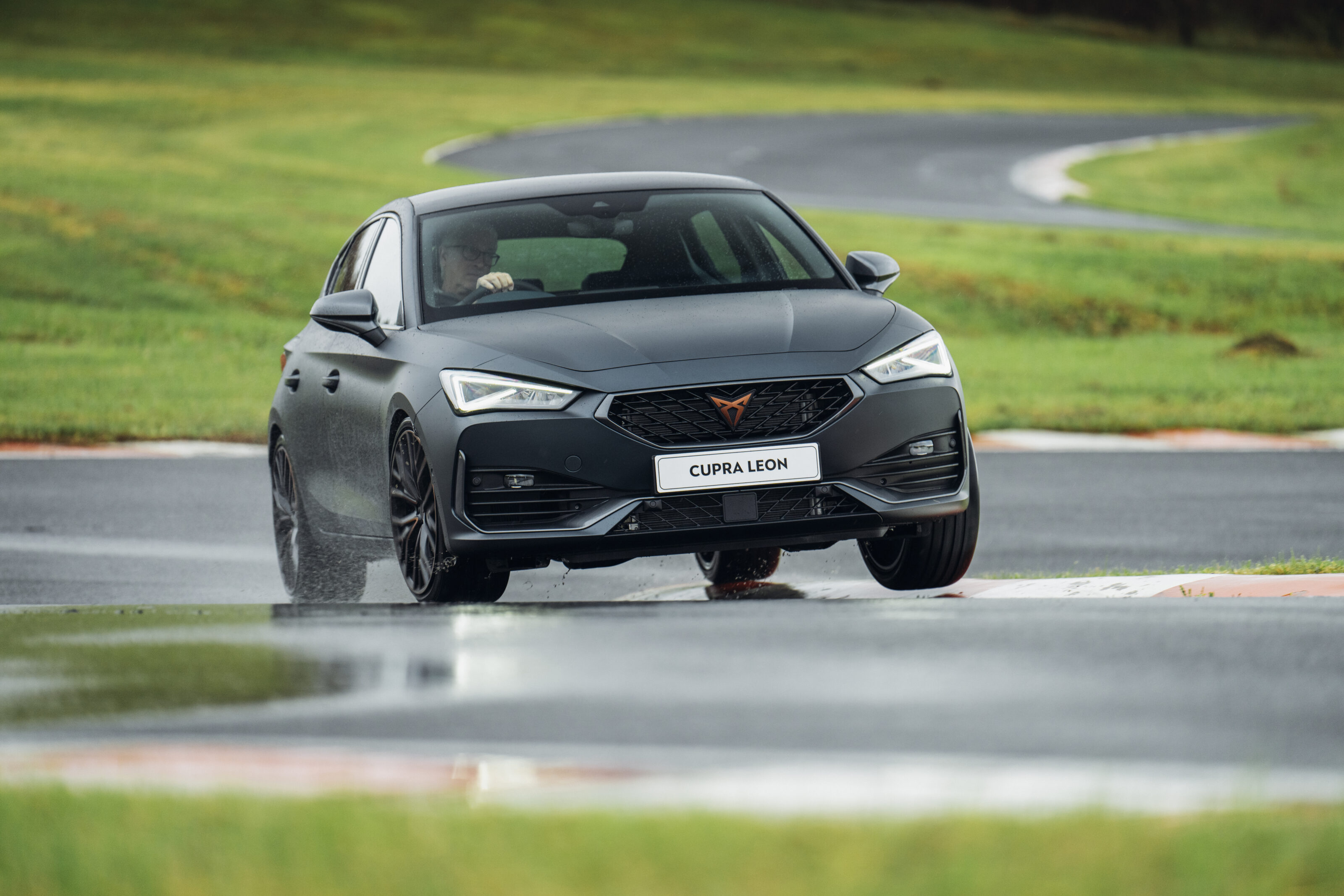
Locally, Cupra’s Leon, Ateca and Formentor models will go on sale in June, with the electric Born due early next year. The Formentor’s Launch Edition is, however, already sold out.
UPDATE, May 27: Australian details for the Genesis GV60 have now been confirmed. Get all the details at the link below.
The story to here
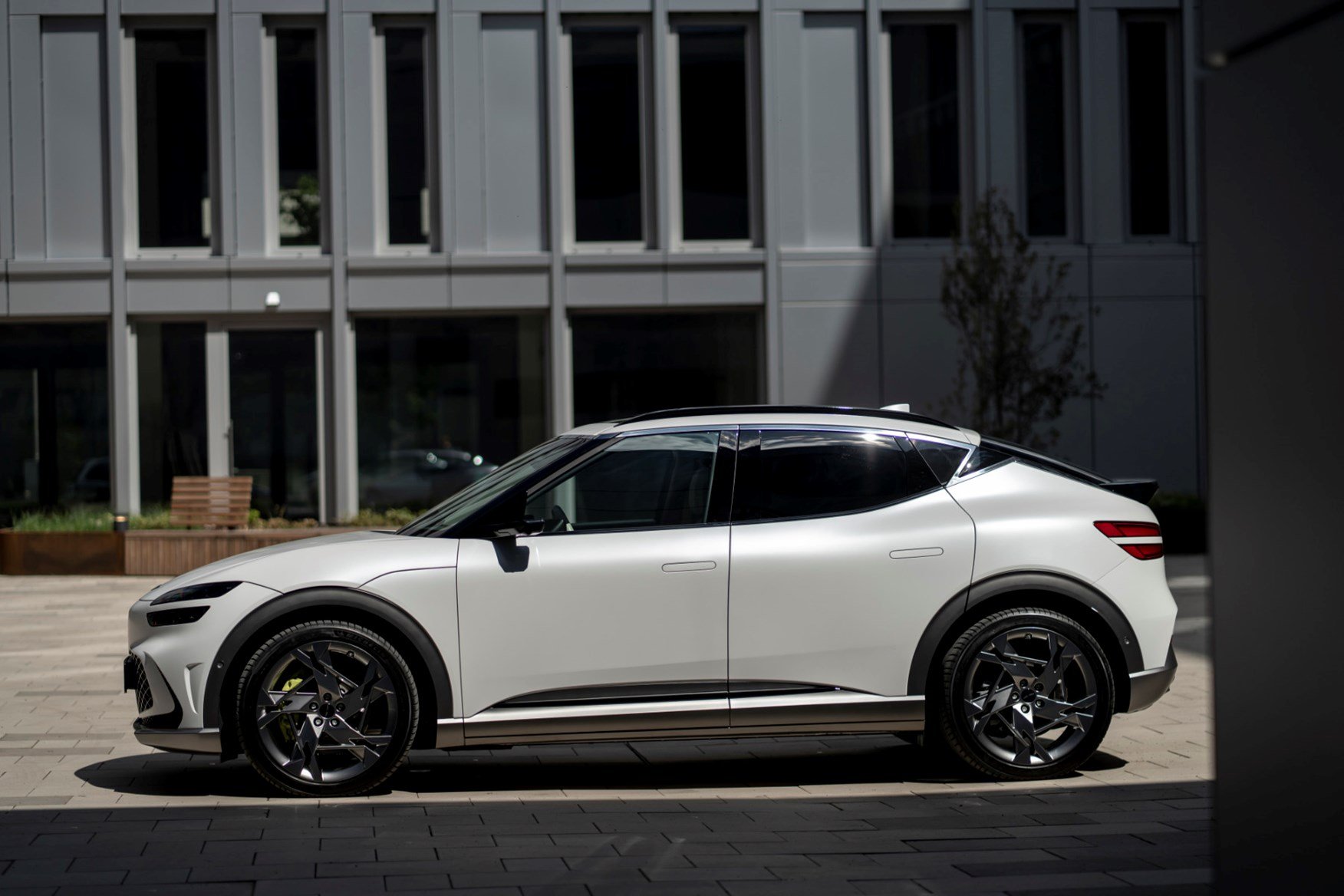
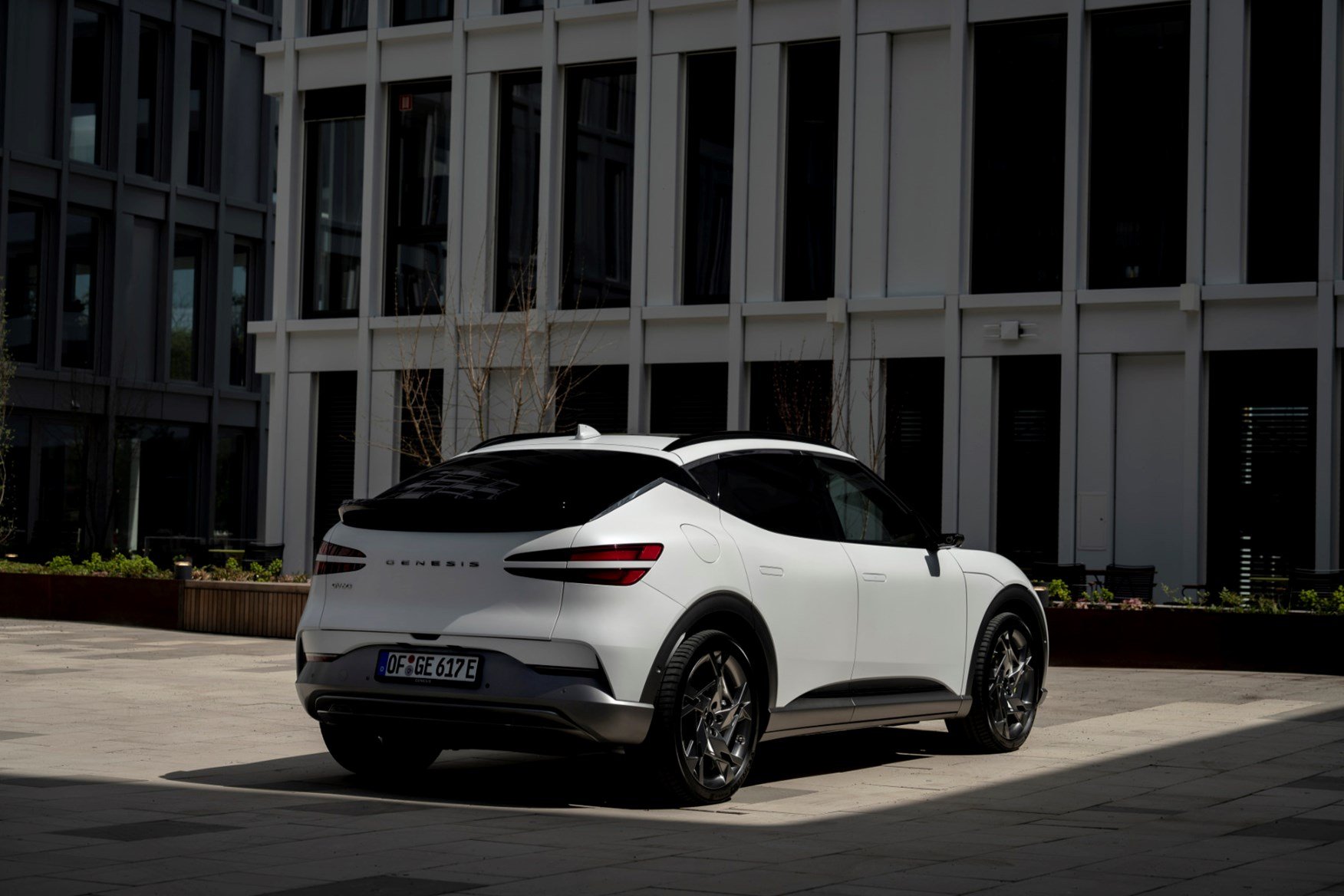
The Genesis GV60 delivers up to 360kW of power and five-star specs in a compact wrapper.
Please welcome the new brother in arms to the Hyundai Ioniq 5 and Kia EV6. Although all three cars share the same E-GMP architecture, they are quite different in character and appeal.
The Ioniq is the pragmatic choice – roomy, solid and comfortable, but it features the same 800V fast-charging system and long-range battery. The Kia is more of a drivers car, especially in 436kW GT form.
Genesis splits the pair with its GV60, but by trying to be exactly what? More prestigious for sure, notably better equipped, more stylish inside and out.
It also is rather more expensive (in Europe, with Australian pricing still to come), undercutting the base BMW i4 by a couple of shekels yet matching the 405kW i4 M50 xDrive when arriving fully loaded like our Uyuni White test car.
Similar money also buys a high-end Tesla Model 3 (again, in Europe) that is quicker and faster still, while promising more range per charge than all of the above.
Ordering a new car is a painful anti-climax these days. Prices keep increasing at a terrifying rate, delivery times are getting longer by the hour, and putting in a special order can only multiply problems and boost frustration.
Hyundai/Kia/Genesis are a notable exception to this experience. The waiting list for most Korean EVs is under nine months, and the GV60 may turn out to be an even quicker delivery since the brand’s personal assistants are currently selling batches of pre-specced vehicles en route to various ports around the world, which can be with customers before June 30.
In stark contrast, the quoted arrival time of a new Audi Q4 e-Tron for European customers is November 2023. We’re also talking 2023 with regard to EVs by BMW, Mercedes, Tesla, Polestar and even Volkswagen.
Genesis GV60 specifications breakdown
The GV60 is available as a 234kW/605Nm Sport version and as the 320kW/605Nm Sport Plus pictured here. The Sport Plus model also allows you to hit Boost mode for these figures to jump to 360kW/700Nm for 20-second bursts.
Both all-wheel-drive GV60 models share the same 77.4kWh battery and 800V charging system.
The two GV60 variants offer respective driving ranges of 470km and 465km and sport a claimed WLTP energy consumption of around 19kWh/100km.
(In Europe, but not planned for Australia, there’s a single-motor rear-drive entry model with 168kW/350Nm and a driving range of 516 kilometres. Seems the local Genesis arm will prioritise performance over range.)
The Kia EV6 GT throws in an extra 112kW and 40Nm over the GV60 Sport Plus, but it will be even more expensive and won’t launch for three more months at least.
Despite several price hikes, the 383kW Tesla Model 3 AWD Performance is still the segment’s undisputed value-for-money leader, performance king and range champion. A comparison of base prices confirms a €10K (AU$15K) advantage for the now German-built best-seller.
Double that when pitted against a fully loaded GV60 like our princess snow white, which featured massage seats, headlining and steering wheel all trimmed in white leather or suede. It was also equipped with a non-opening panoramic glass roof (is there a sillier extra?), digital door mirrors and a splendid B&O sound system.
Nail the pedal to the metal, and the GV60 Sport Plus will beam itself in four seconds flat from 0 to 100km/h. Although the maximum speed is a perfectly acceptable 235km/h, please hold the applause for a moment to check out the numbers fielded by the competition.
BMW quotes 3.9sec for the marginally quicker i4, Tesla claims a supersonic 3.3sec and 261km/h for the Model 3 Performance. Ranges? Over 465km for the Genesis, 521km for the i4, 547km for Elon’s baby. The consumption derby also ends in a photo finish. On paper, the Tesla (16.5kWh/100km) beats the BMW (18.0) and the GV60 (19.1).
Upon return from a two-hour loop around Frankfurt in the GV60, however, the onboard computer displayed a less impressive efficiency reading of 29.1kWh/100km that would have clipped more than 150 clicks off the nominal range. Say what you will, but as long as Germany does not enforce a speed limit on the autobahn, EVs are better off stretching their legs elsewhere.
The heat pump is standard on the Genesis, which should take the sting out of cold start winter driving with lights, bum warmers and heating running on full blast. A diligently preconditioned battery can be charged from ten to 80 per cent in only 18 minutes, but only when you are lucky enough to spot an available 350kW charging station.
Get a wallbox, and be prepared to wait over seven hours for the same result. Trouble is, the sat-nav is at this point not yet able to show charging stations, prices and eventual delays in sync with the selected route. This can lead to iffy situations when the car is running on empty.
What’s inside? Tech & luxury
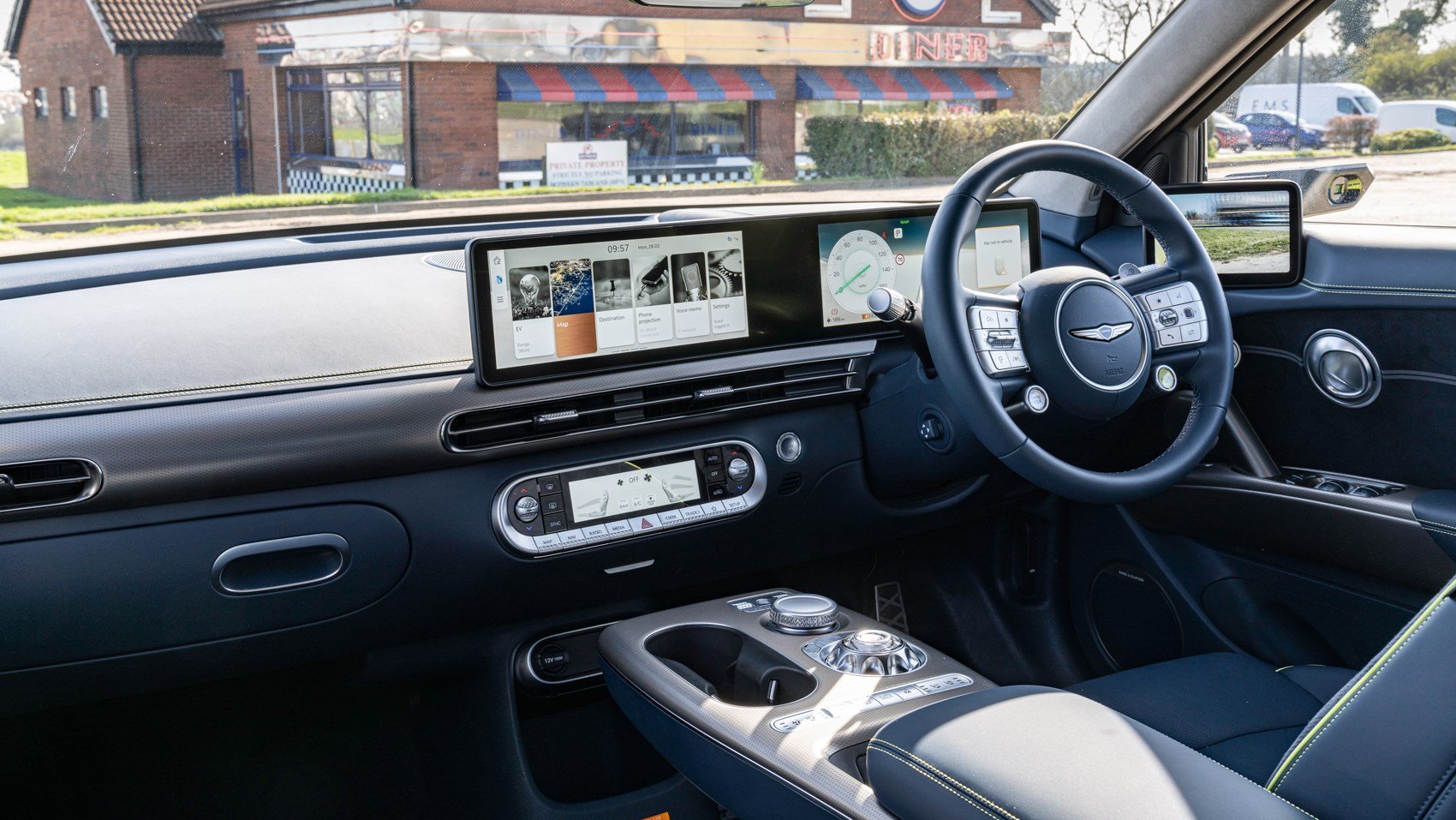
Having said that, the technicolour cockpit is of course stuffed with animated energy flow graphics, torque distribution readouts, actual and average consumption bar graphs, remaining range indices and whether your driving style is still that of an incorrigible petrolhead.
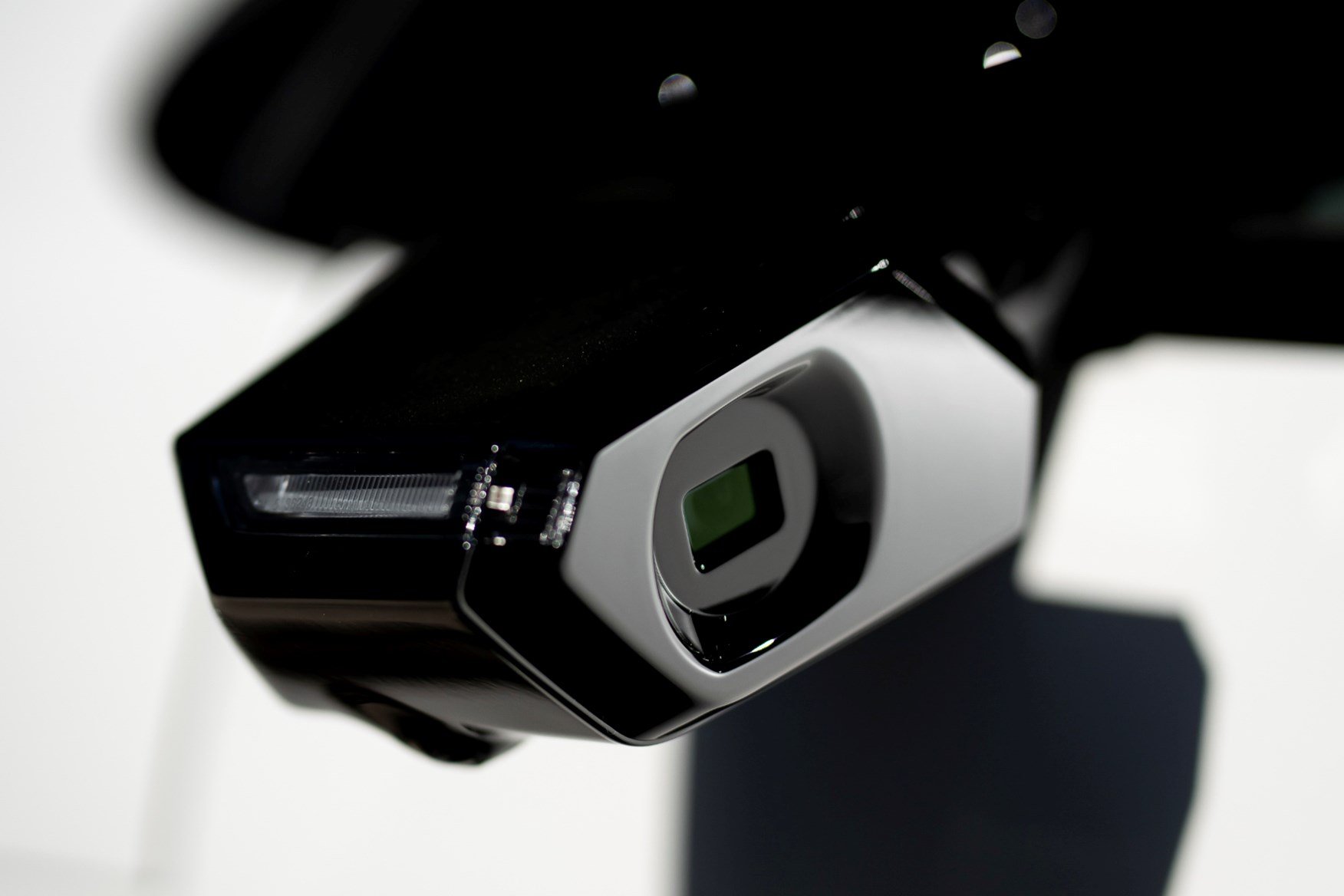
The digital world of Genesis runs a two-metre circle around the car. Enter it, and face recognition will via a tiny camera in the B-pillar pop open the flush-fitting door handle and unlock the vehicle. Simultaneously, the black box selects one of two memorised user profiles before adjusting seats, climate control, music and mirrors to your liking.
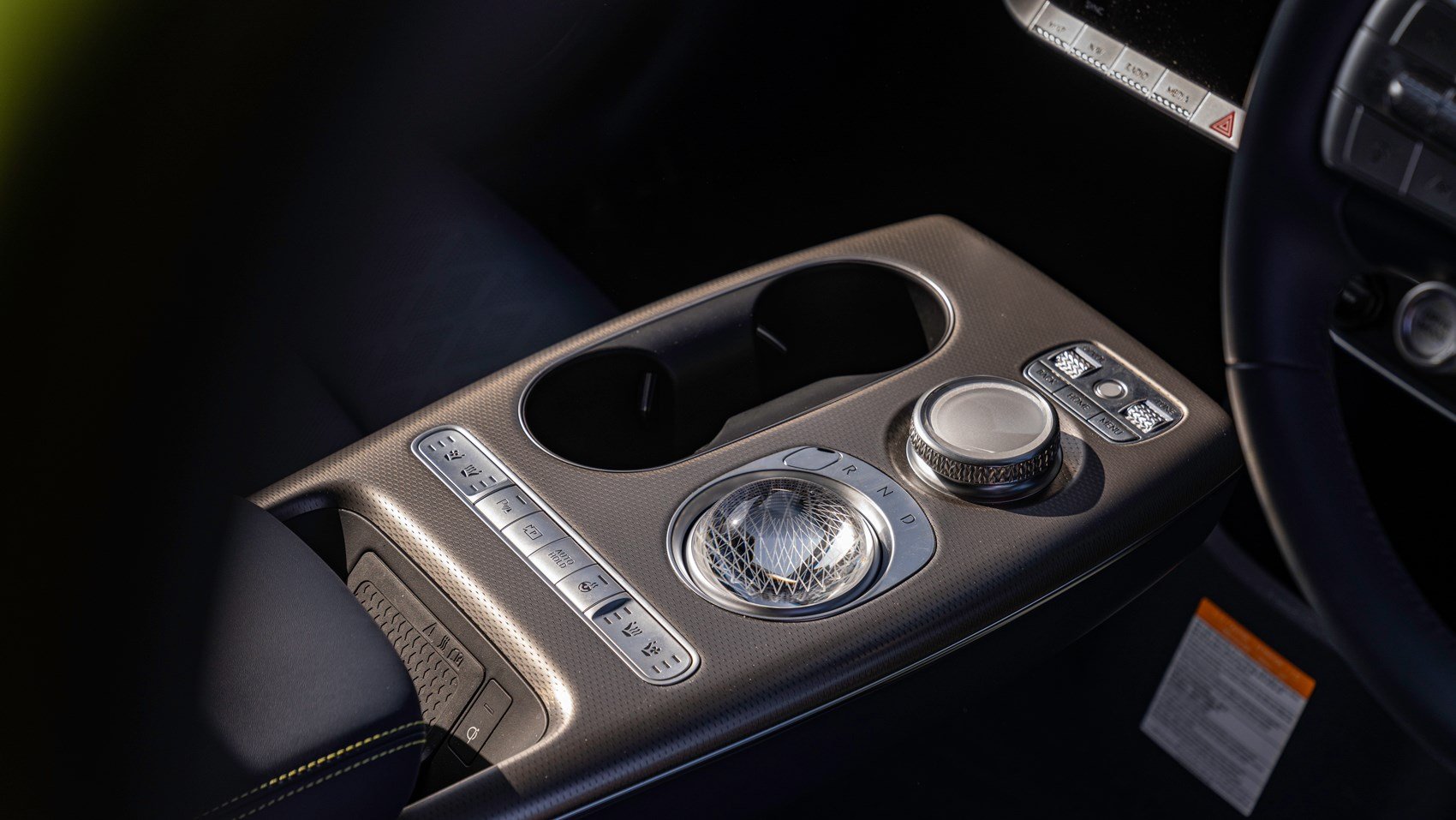
A fingerprint scanner integrated into the starter button activates the Go signal and reveals the gear selector. Sounds familiar? About 20 years ago, Audi introduced a similar system only to withdraw it again after several customers had been robbed of their index fingertips in a series of brutal carjackings. But back to the GV60, which has several new assistance systems in store for us.
Most useful is the autobahn assistant complete with automatic lane guidance, distance control and speed discipline monitor. Also worth mentioning are the easy entry/exit feature available for the driver and the front seat passenger as well as the eye-tracker that lets you access the 3D instruments.
Call us old-fashioned, but it’s a clear thumbs down for the miniature TV-like door mirrors. Why? Because the monitors sit on the inner door frames at the bottom of the A-pillars, where they are so totally out of sync with the visual axis we have become used to that reprogramming the brain really hurts.
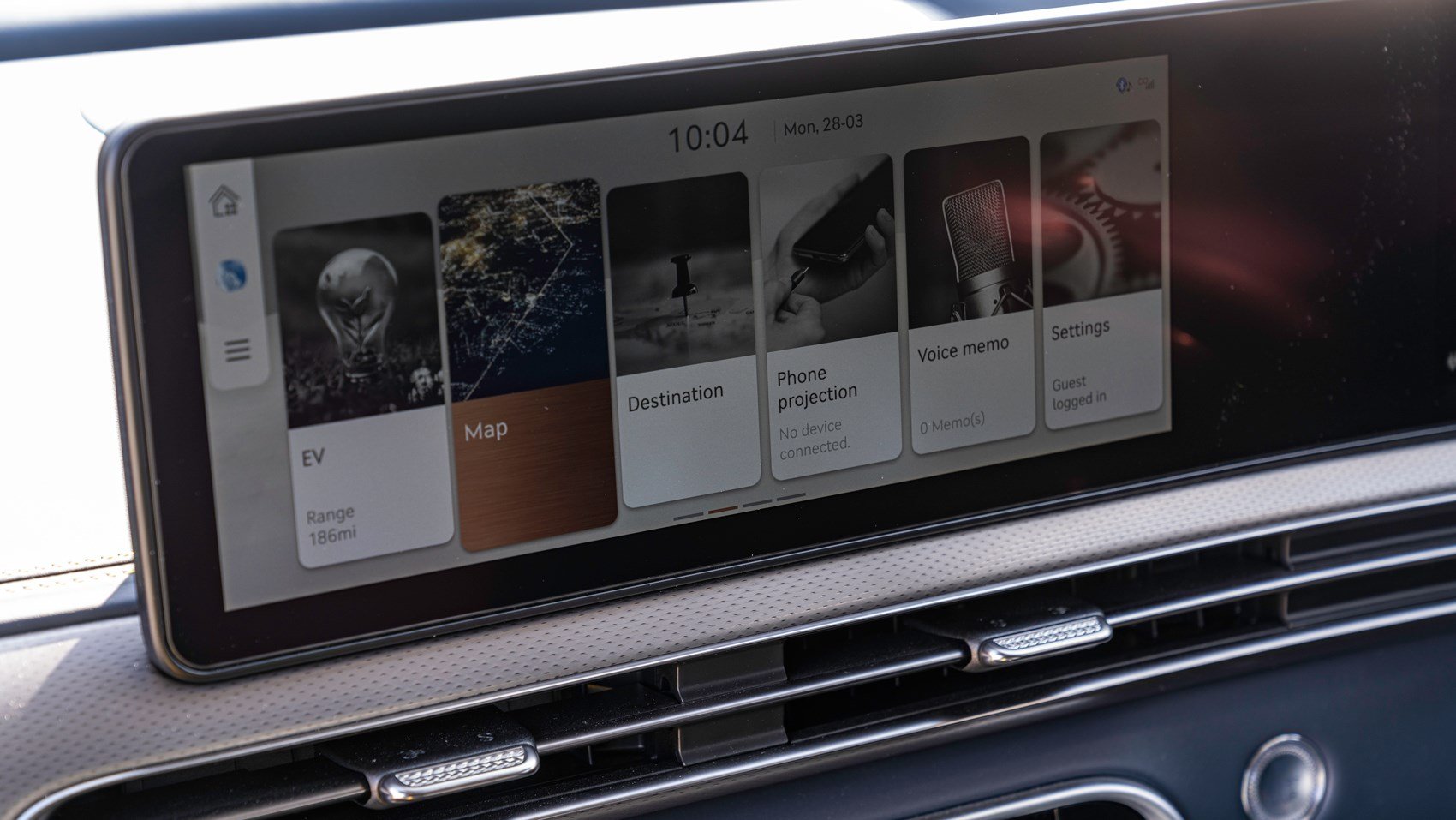
There is nothing at all wrong with the two large panorama monitors high up on the dashboard but things are getting messy lower down, where a second display and various shiny silver buttons enter the fray.
Add to this the exceedingly busy multi-functional steering wheel and you may agree that this cockpit was designed by the digital devil.
Embedded in the wide centre console is an alien object, lit at night and transparent during daytime. It is called many names, among them Crystal Sphere, orb, palm cuddler, glowball and Janus-faced double-header. When you enter the car, the globe shows only its lucent upper half.
Cabin and cargo space
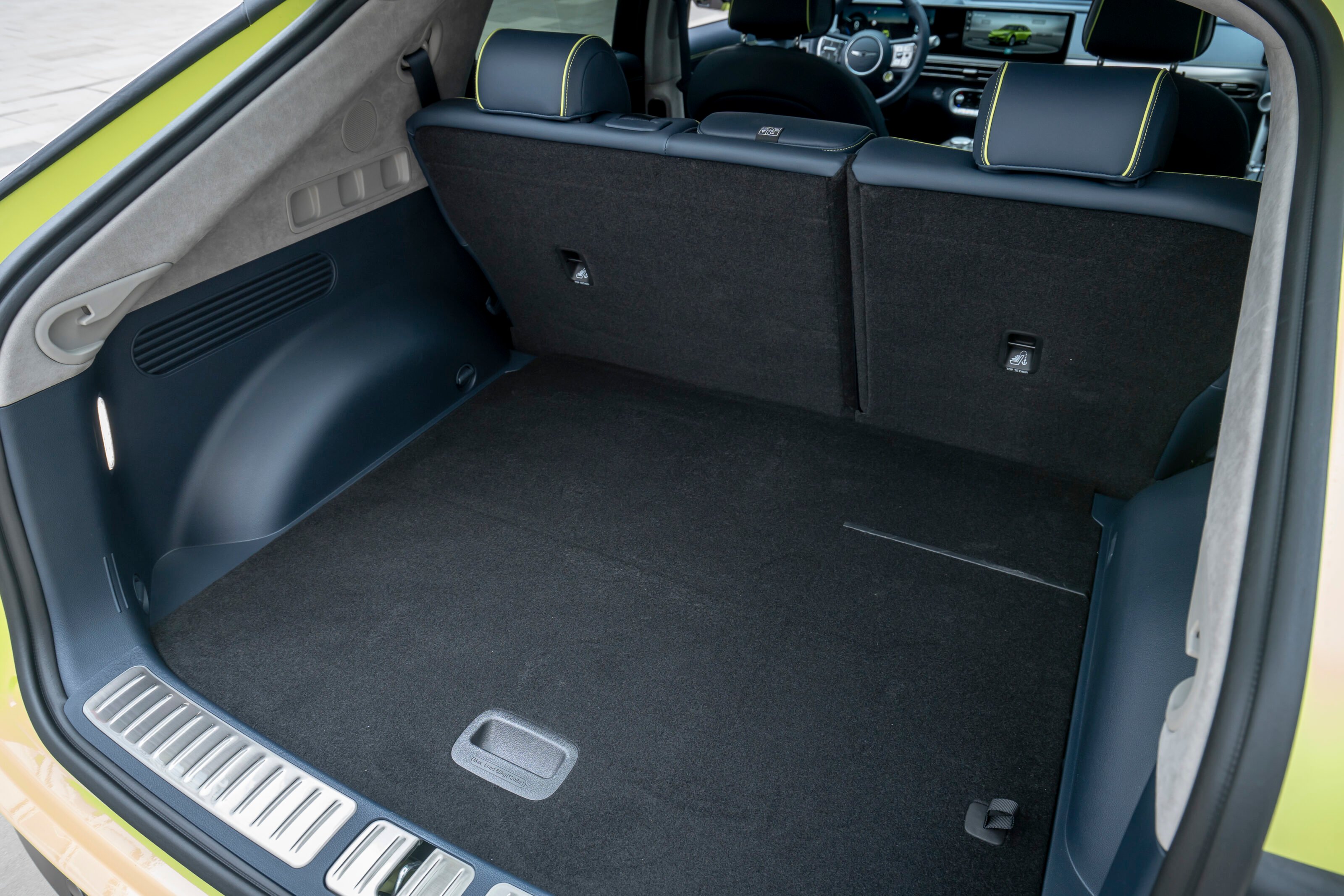
At 4510mm, the GV60 is 120mm shorter than the Ioniq 5, and it undercuts the EV6 by an even more substantial 170mm. This results in a certain shortage of rear legroom, not helped by the fact that the low-mounted front seats leave little space for needy toes.
Boot volume of 432 litres is not worth writing home about either, but the Genesis does have a token secondary 20-litre frunk where engines used to sit. While the seats look mega and are quite comfortable, dimensions and support are not their main strengths.
Driving the Genesis GV60
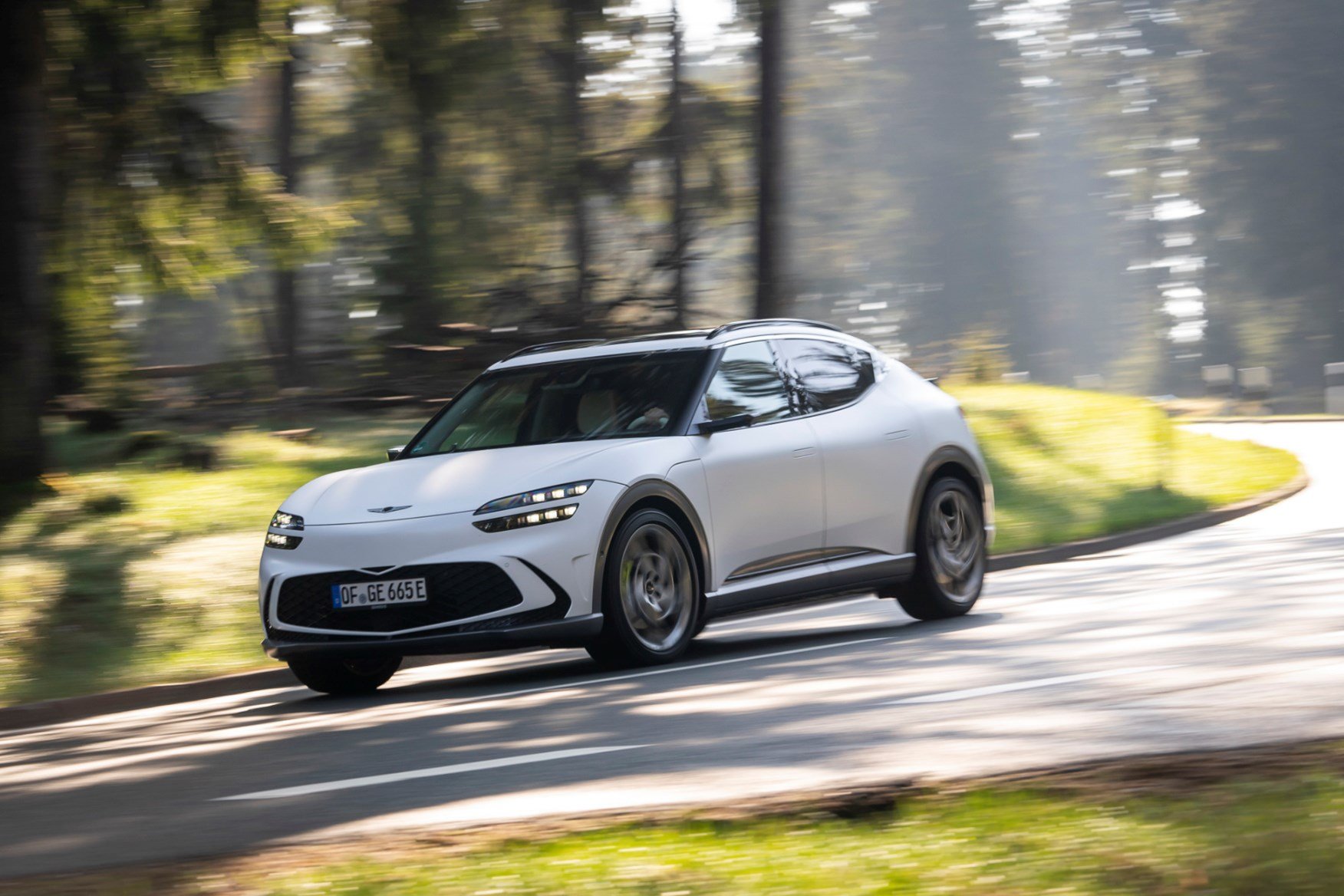
Now start the car and watch Janus spin along its longitudinal axis until its other face, a rotary aluminium gear selector, locks in place. A brief twist determines the direction of travel, a push activates the electric parking brake. The driving mode is selected by a button on the steering wheel.
We start in Sport mode to placate the nervous right thumb, which can’t wait until the boost feature finally unleashes the full 360kW for ten seconds. Since ESP will release the extra grunt only when grip and stability permit it, summoning overkill mode mid-corner delays the desired effect until the driver begins to unwind lock.
Handling and roadholding? We’re on thinner ice here than previous experience gained in the sister models would suggest. True, the GV60 takes off like greased lightning, willingly punches 700Nm of instant torque at the single-speed transmission 24/7 and energetically builds up momentum even at the other side of 160km/h.
But that’s only one side of the medal. Flip it and you may soon start arguing with the i-pedal, which is a real spoilsport because it keeps decelerating the car at lift-off even in the lowest regenerative braking setting.
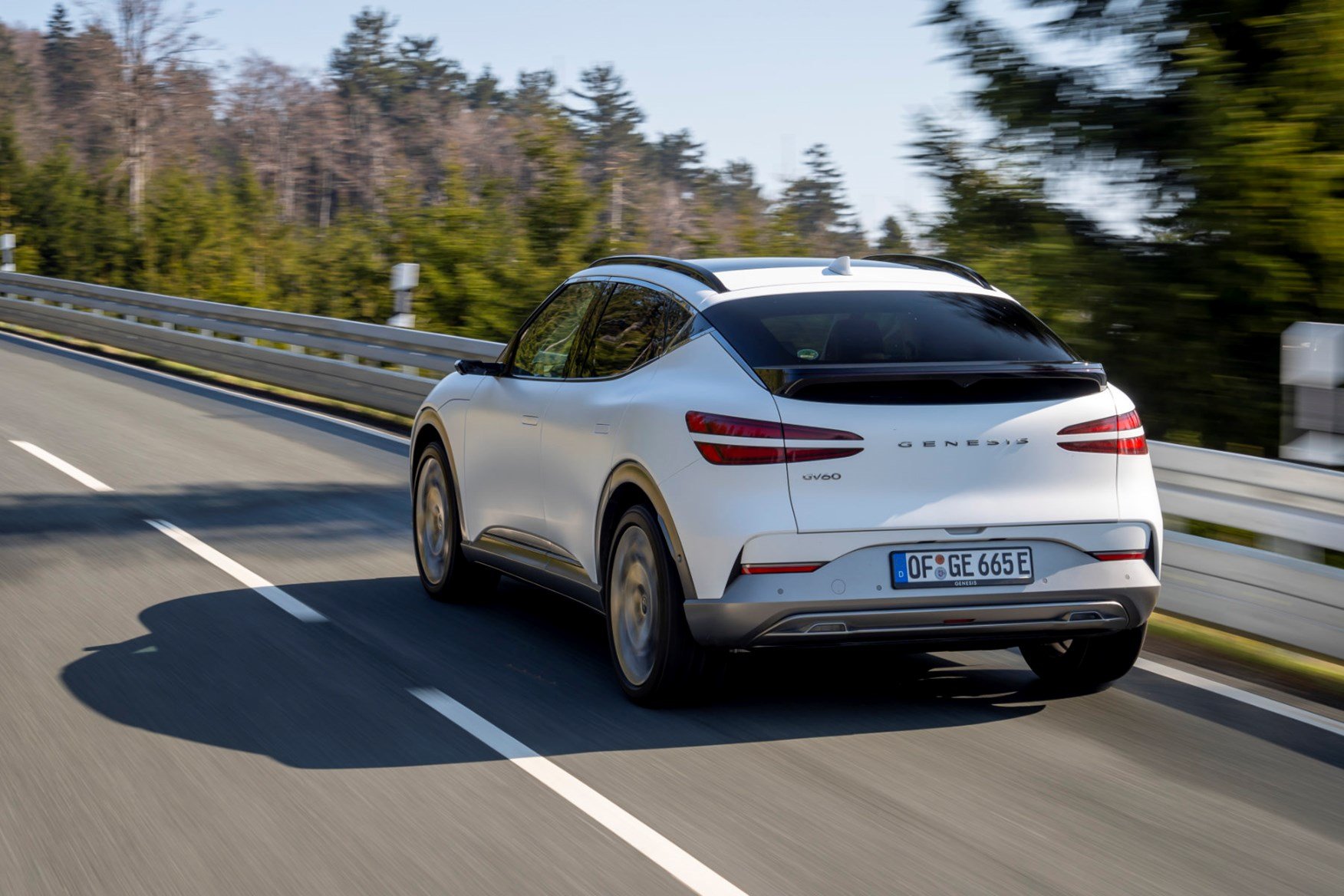
Since there is no way the driver can coax the system into on-demand coasting, fighting the current – which gets worse in one-pedal-feel antics – soon becomes tiresome second nature.
As expected, selecting Eco turns the GV60 into a toothless tiger. At the other end of the excitement scale awaits the Drift mode, but engaging it is a complicated four-step procedure that requires a more patient operator.
Thankfully, the 21-inch wheels and tyres refrain from destroying the low-speed ride. Supported by adjustable dampers and expertly tuned springs, they actually enable an unexpected degree of compliance. That’s the good news. The bad news starts with the car’s desire to tramline and leads straight to the ho-hum directional stability on bumpy roads when tackled with enthusiasm.
Neither AWD, mechanical rear diff lock or electronic watchdogs seem to be able to do much about this underlying vagary. Still on the suspicious side of things, the front end in particular displays a fair amount of brake dive, roll and pitch while also relaying the effect of full-throttle acceleration squat.
The steering is light and correctly geared, but it feels artificial throughout most of its motion range. Even through corners with a reasonably constant radius, repeated minor corrections are the rule, not the exception.
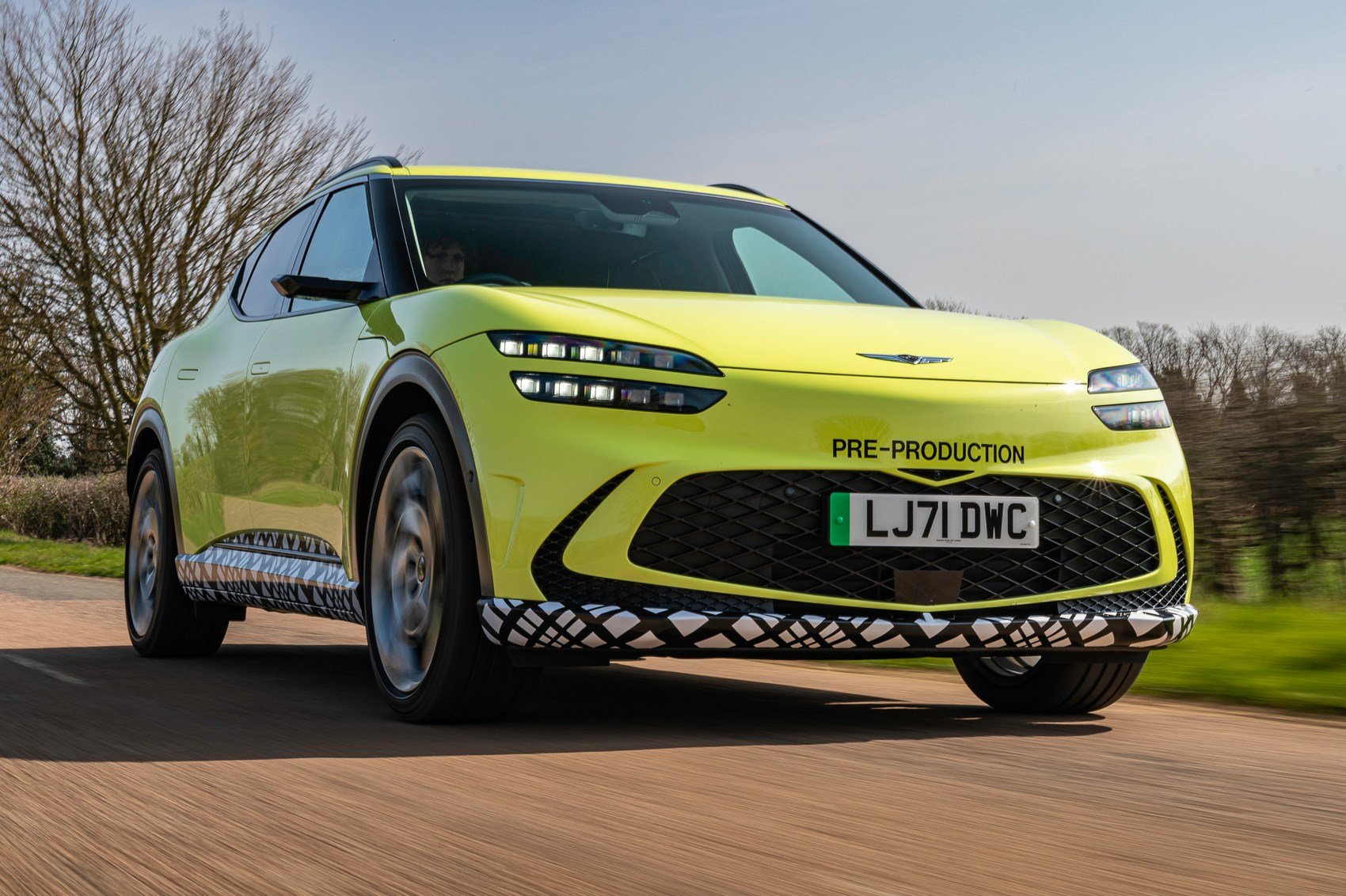
Although the brakes bite with vigour, the pressure increases under high loads and the modularity suffers as a result.
Unlike most carmakers, Genesis has few dealers and sells most cars online at fixed no-haggle prices. Customer benefits include a five-year warranty package complete with no-cost maintenance, automatic pick up and delivery, free courtesy car and a wide range of personalised mobility services.
In the wake of the GV60, the brand will later this year launch two more EVs, variants of the G80 and the GV70. Although they are still offering a selection of diesel and petrol models, PHEVs are considered an inefficient stop-gap solution.
From 2025, new Genesis models with combustion engines will be history, and by 2030 the entire fleet is to be CO2-neutral.
But for now, the all-electric Genesis offering is pricey, dynamically not as convincing as the numbers suggest, and puts bling above function.
2022 Genesis GV60 Sport Plus specifications
| Body | five-door, five-seater SUV |
|---|---|
| Drive | all-wheel drive |
| Engine | 160kW front motor; 160kW rear motor |
| Transmission | Single speed automatic transmission |
| Power | 320kW (360kW with Boost mode) |
| Torque | 700Nm |
| 0-100km/h | 4 sec |
| Battery | 77.4kWh |
| Energy consumption | 19kWh/100km (WLTP) |
| Weight | 2160kg (kerb) |
| L/W/h | 4515/1890/1580mm |
| Wheelbase | 2900mm |
| Tyres | 255/40 R21 Michelin (front & rear) |
| Wheels | 21-inch alloys |
Snapshot
- All-new platform to debut in 2024
- Will underpin Mercedes-Benz’s entry-level vehicles
- Designed with electrification in mind but can be used for combustion engine vehicles
Compact cars from Mercedes-Benz are set for a shake-up, with the manufacturer confirming its all-new architecture will launch in 2024.
Dubbed MMA – or Mercedes Modular Architecture – the platform will underpin Mercedes-Benz’s smaller class of cars such as the A-Class and C-Class models as it electrifies more of its range.
However, as opposed to the BMW Neue Klasse/New Class and Volkswagen/Audi MEB and SSP platforms, MMA will allow for internal combustion engine-powered models and fully-electric ones to ride on the same basic underpinnings.
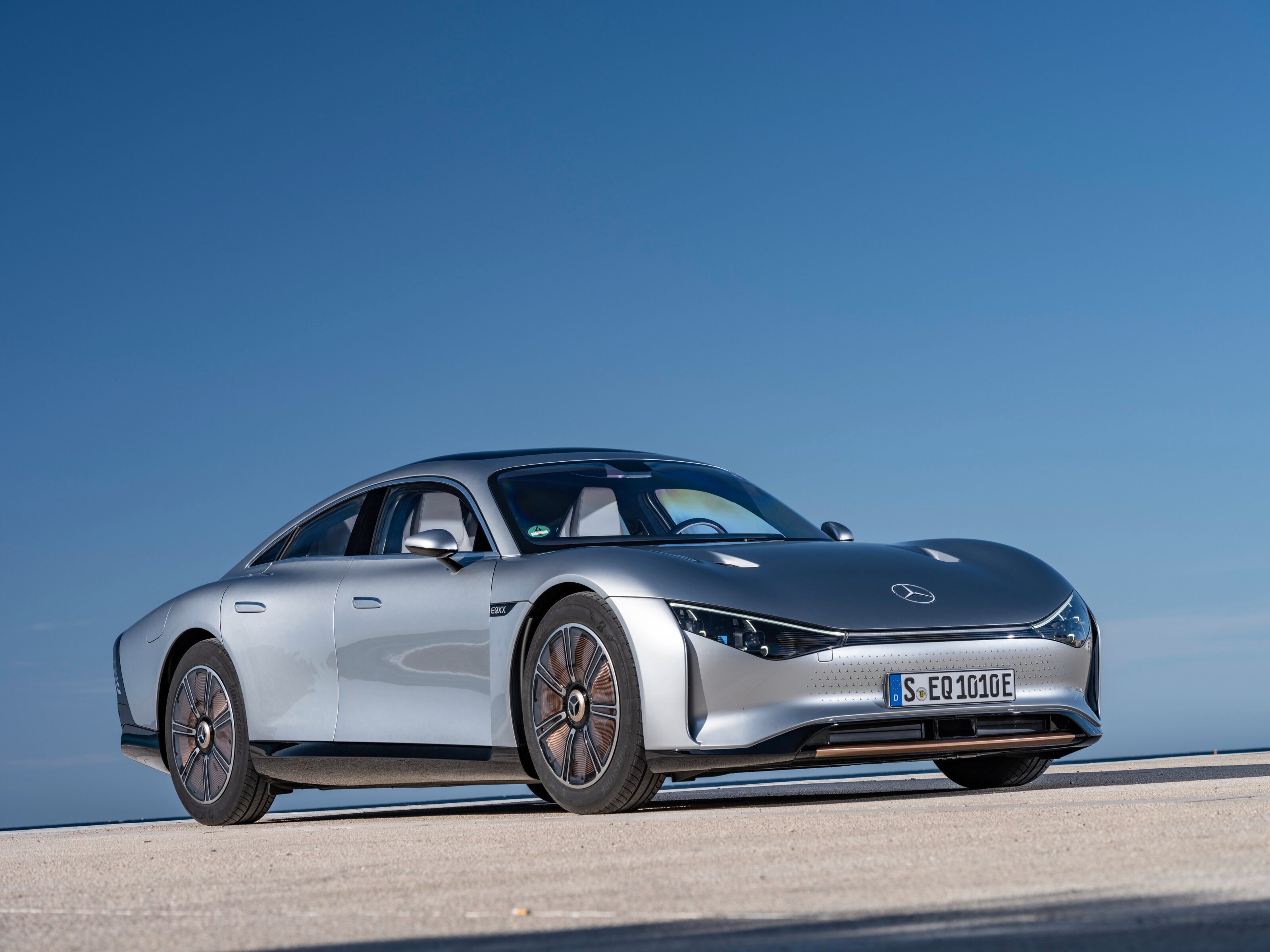
It’s one of the only examples of a manufacturer building its new architecture around electrification and fully-electric options, while still retaining the ability to use an internal combustion engine rather than the other way around – with the 800-volt layout able to package either a transversely-mounted four-cylinder engine or electric motors at the front and rear.
Mercedes-Benz says the ‘Entry Luxury’ segment will be reduced from seven to four models, all of which are to be based on MMA, with the recently-revealed EQXX concept previewing the architecture’s electric capabilities.
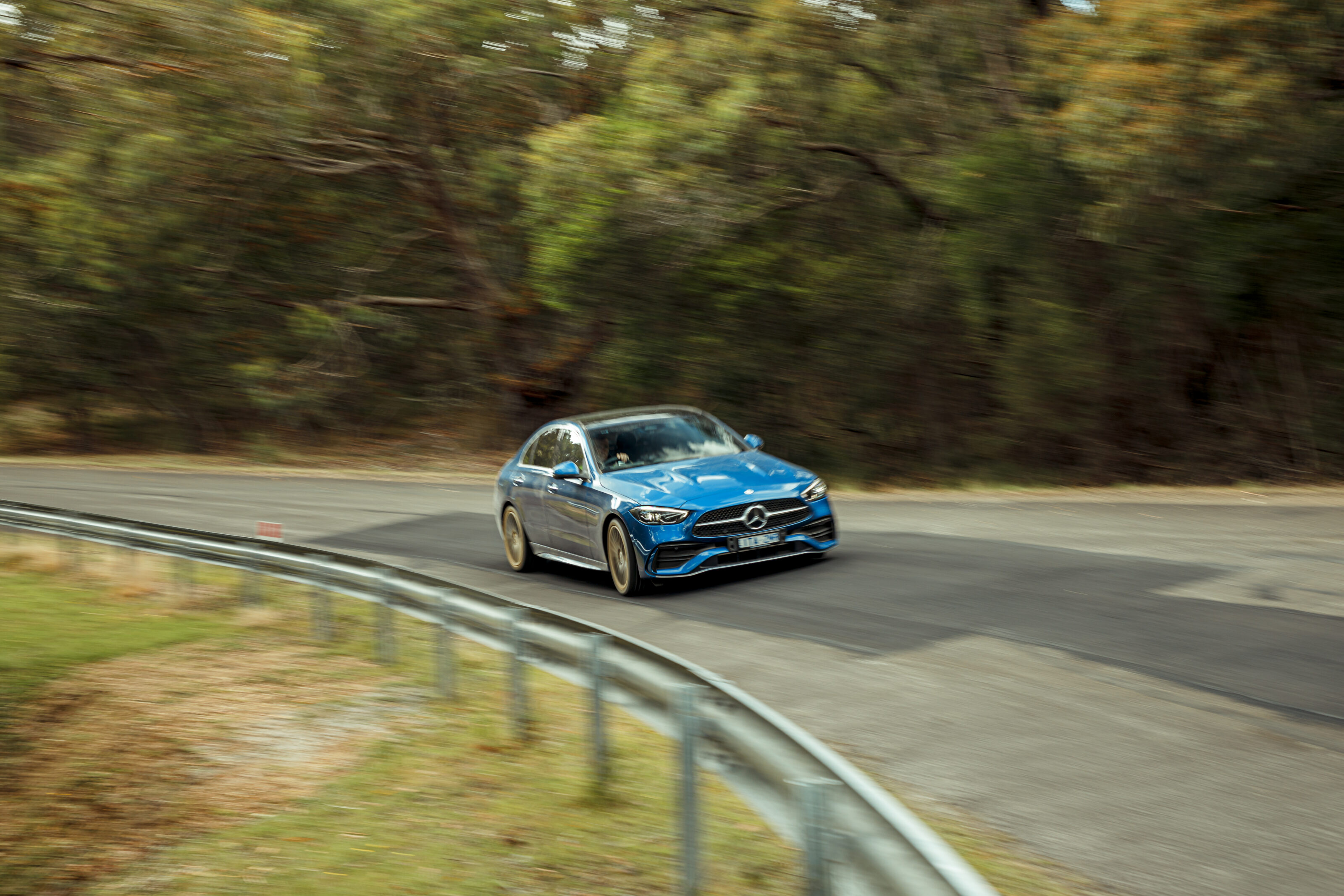
As reported by Automotive News Europe, Mercedes is aiming to make its entry-level models more of a premium offering, expecting sales to drop by 25 per cent from 2019 levels (680,000 units) by 2026.
The German manufacturer has previously announced its intentions to go fully-electric by 2030, but only in markets which support the move. As a transitional step, it will solely launch electrified models from 2025, a large chunk of which are likely to be running on MMA.
Mercedes-Maybach – the luxury off-shoot of Mercedes-Benz – could be planning its latest convertible model based on the AMG SL, with Daimler’s head of design teasing its next concept online.
Having been revived as a sub-brand to Mercedes-Benz from its standalone state in 2015, the attention of Mercedes-Maybach has mainly been on uber-luxurious variants of Merc’s S-Class in recent years, save for a few G-Wagen and GLS-based models.
However, Daimler’s chief design officer Gorden Wagener has taken to Instagram to show off what could be its next offering – a Maybach-built SL convertible.
Based on the recently-launched Mercedes-AMG SL – which returns this year as a bespoke model from Merc’s high-performance division – the Maybach model remains as nothing more than a concept for now, but Wagener’s caption hints at there being more to come.
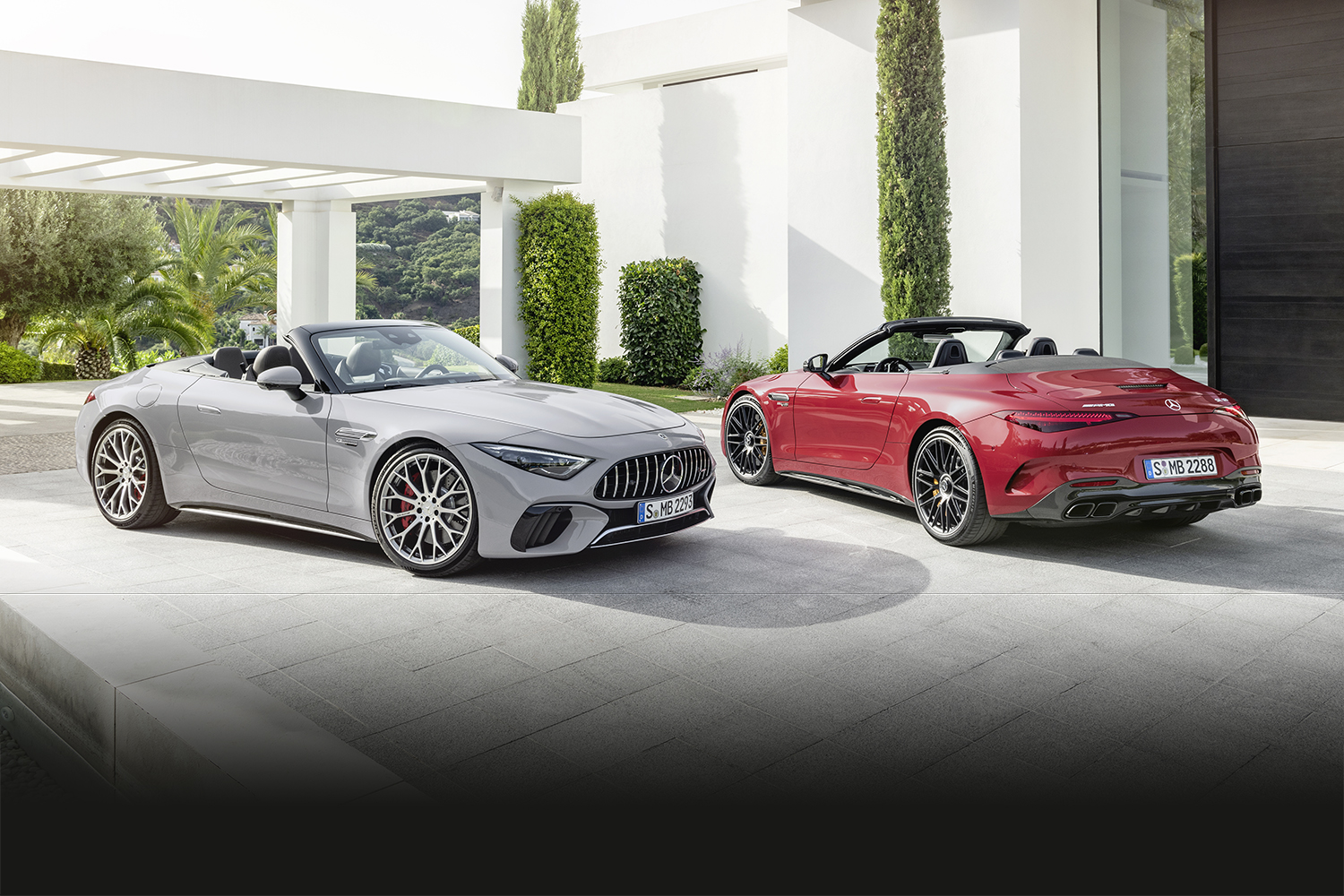
“A glimpse of the Concept Mercedes-Maybach SL – revealing more about future opportunities of our company’s most exclusive brand,” his post reads.
“For customers who desire for a sophisticated luxury driving and design experience.”
If it is launched as a production model, it won’t be Maybach’s first convertible, having revealed the 300 unit-run S650 Cabriolet at the 2016 Los Angeles Motor Show – 10 of which landed in Australia for roughly $600,000 each.
Snapshot
- Queensland drivers to be offered digital licences next year
- Two-stage trial has been completed on the Fraser Coast, moving to Townsville
- South Australia and New South Wales have already introduced the system
Queensland is set to be the next Australian state to introduce digital drivers licences, announcing it will be available to residents from 2023.
The Sunshine State follows the lead set by South Australia and New South Wales to implement a non-compulsory digital drivers licence for smartphones after a successful trial on the Fraser Coast in 2020.
Set to be delivered by Thales Australia and New Zealand, the Digital Licence App will be available to all Queensland residents starting next year, seemingly adopting a different approach to that of New South Wales, which utilises the Service NSW app – also housing an individual’s vaccination certificate, vehicle registrations, fines and demerits.

Queensland’s Transport and Main Roads Minister, Mark Bailey, said the success and feedback from the Fraser Coast trial showed now is the right time to implement the digital licence.
“Queensland is modernising its approach to licensing, as we progress with the development of a Digital Licence App that will hit Queensland phones next year,” said Bailey.
“The Fraser Coast trial was a resounding success, with users reporting a 94 per cent satisfaction rating during the testing.
“This gives us confidence that we’re on the right track to ensuring the smooth and successful roll out of the Digital Licence App across the state.
“What we’re doing here is creating a modern, innovative solution that adopts international best-practice solutions and has the privacy of data front of mind.”
A second stage of the trial is expected to take place in Townsville this year, with upgrades being applied to the new app.
“The app is being upgraded based on feedback from the Fraser Coast pilot, as well as adding new functionality and options to make sure we are meeting the needs of the people who use it,” said Bailey.
“It’s exciting for Townsville to be the first major town to trial this new technology, covering a larger area and more diverse population than previous testing.
“A new standard for mobile driving licences was published in 2021, and our app will comply with this standard, giving Queenslanders greater freedom and convenient options to use their Digital Licence when travelling.
“We have involved customers and user testing at every phase of the project, from the initial planning and development, through trials and testing, and on to the final roll-out.”
According to the New South Wales Department of Customer Service, over three million drivers in the state had adopted its own digital driver licence by May 2021, representing 53 per cent of all licence holders with an approval rating of just under 95 per cent.
Snapshot
- National fuel prices starting to creep up after settling from late-March peak
- Explosion at a Korean refiner further threatens supply
- Fuel excise set to be reinstated in September
Australian fuel prices are again starting to climb, with fears of more record highs at the bowser arising just weeks after the national fuel excise was cut.
After hitting an average peak of 212.5 cents per litre (cpl) on March 20, the previous Federal Government announced it would temporarily halve the national fuel excise from 44.2cpl to 22.1cpl as a part of its 2022-23 Budget on March 28.
Although prices dropped to a low of 166.3cpl on April 17 – the lowest since the beginning of the year – the figure has continued to climb back up, now sitting at 185cpl according to the Australian Institute of Petroleum.
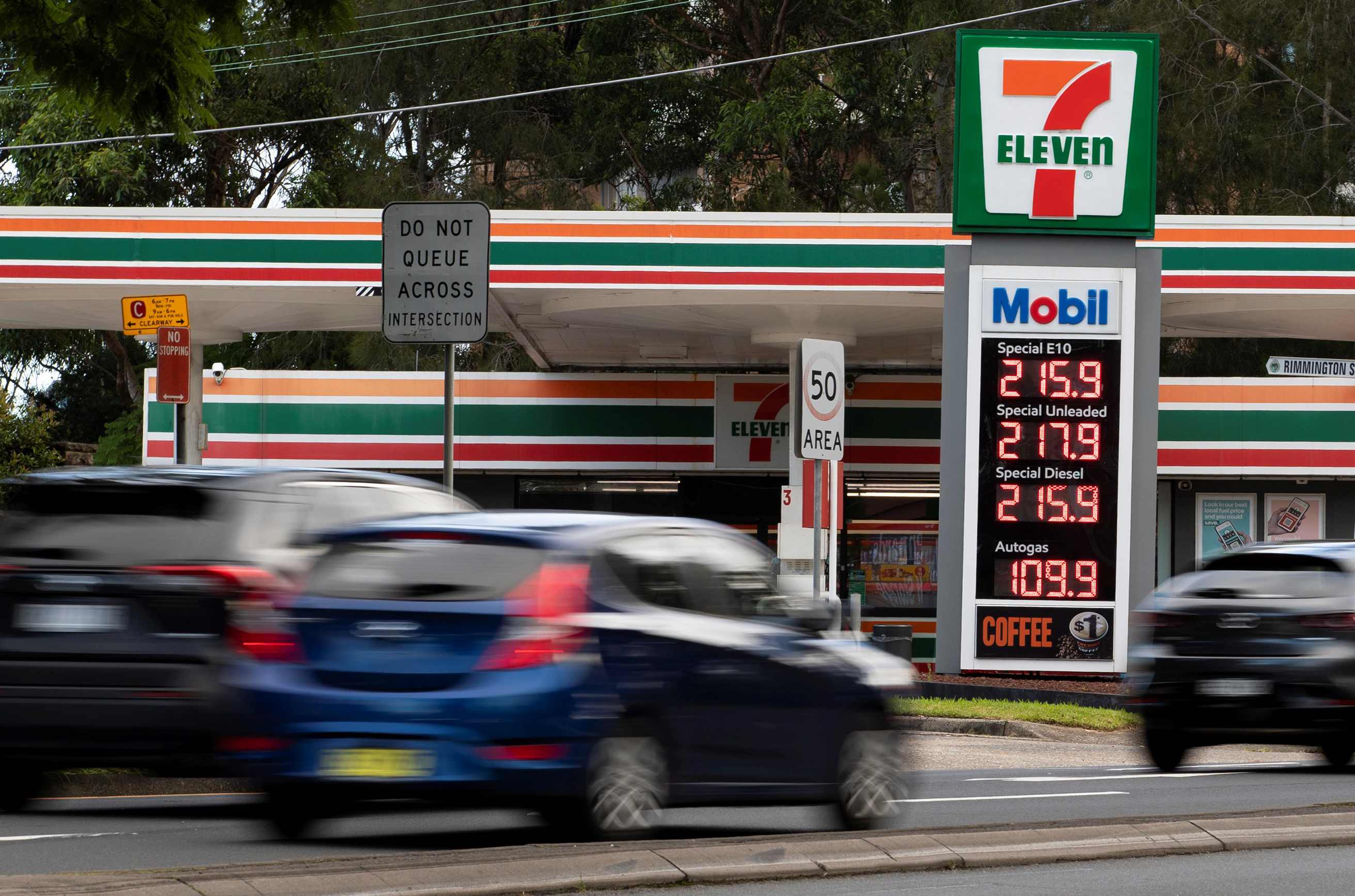
While the record-high prices at fuel stations across the country coincided with Brent Crude oil hitting all-time highs of US$127.98 a barrel, recent dips in the price of oil have proven to be temporary – with it bouncing back to just over US$113 at the time of writing.
The latest increase in fuel prices is understood to have been exacerbated by an explosion at the S-Oil refinery in Korea last week, with the Korea Herald reporting one worker died and eight more were injured in the blast.
As reported by OilPrice.com, the facility usually has a daily output of 580,000 barrels per day, placing further strain on the wider industry to fill the hole left as production pauses to investigate the incident.
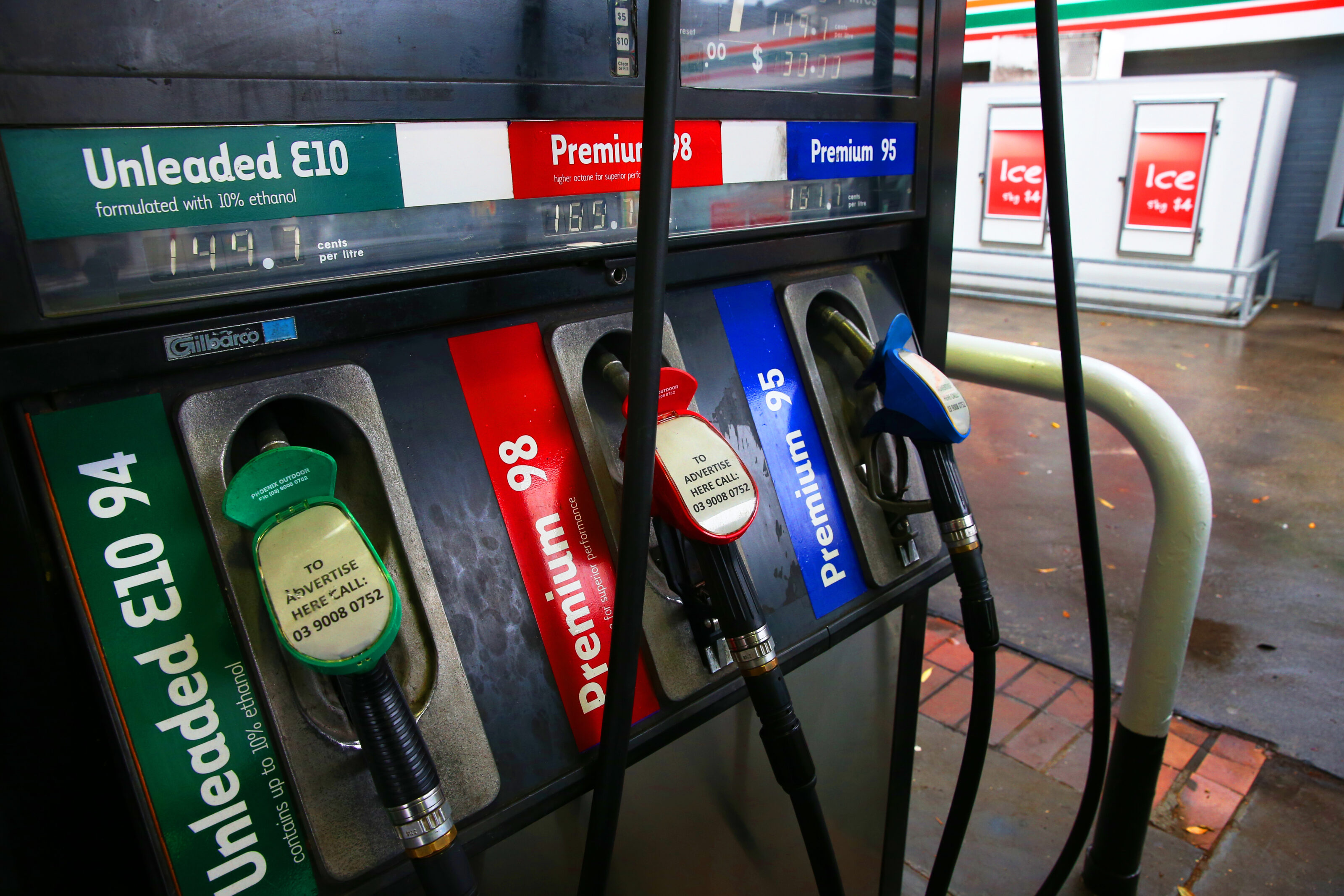
The Australian Competition and Consumer Commission (ACCC) previously said it would monitor local fuel prices more closely in the wake of the excise cut, with the consumer watchdog looking to ensure fuel companies weren’t pocketing the difference and making false or misleading statements about their intentions to hand down the tax cut to consumers.
Going off current prices, the cost of fuel per litre is sitting at 1.16 per cent of the cost of a barrel of oil, while at its peak it was roughly 1.18 per cent. However, had the excise not been halved in March the amount we could have been facing at the pumps now would have equated to around 1.3 per cent of an oil barrel’s price.
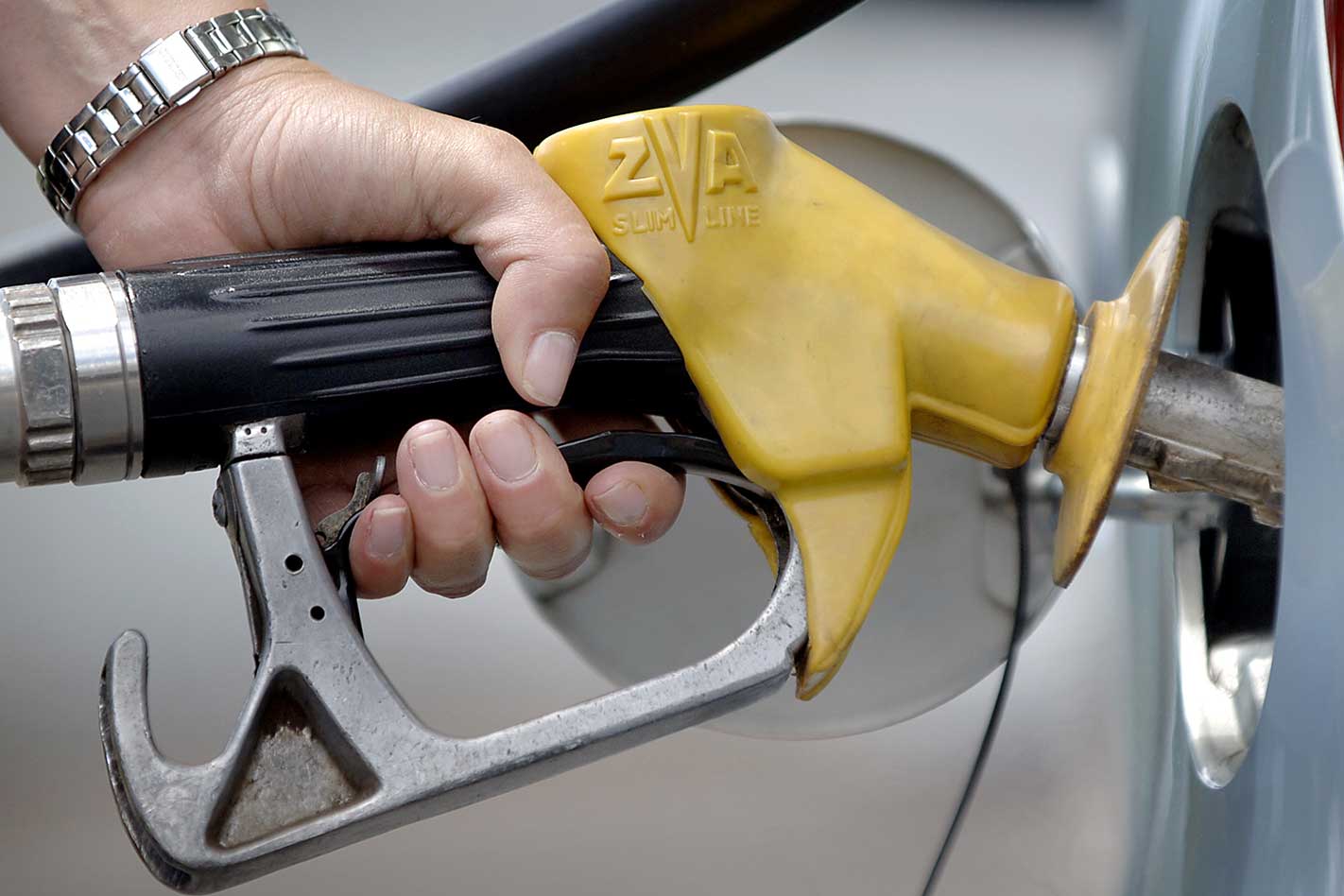
Given this disparity, it’s clear more than just the cost of oil is contributing to a bigger hit to the hip pocket at the bowser, although groups like the Royal Automotive Club of Queensland believe the weakening Australian dollar is also a contributing factor.
“This early price hike is definitely a surprise, as we had only just entered the cheap phase of the current price cycle, which is now only set to last a matter of days,” said RACQ spokesperson Nicky Haydon regarding recent increases in Greater Brisbane.
“Unfortunately, the fuel excise cut will not have an impact on global oil prices, so motorists need to be savvy about where they buy their fuel.”
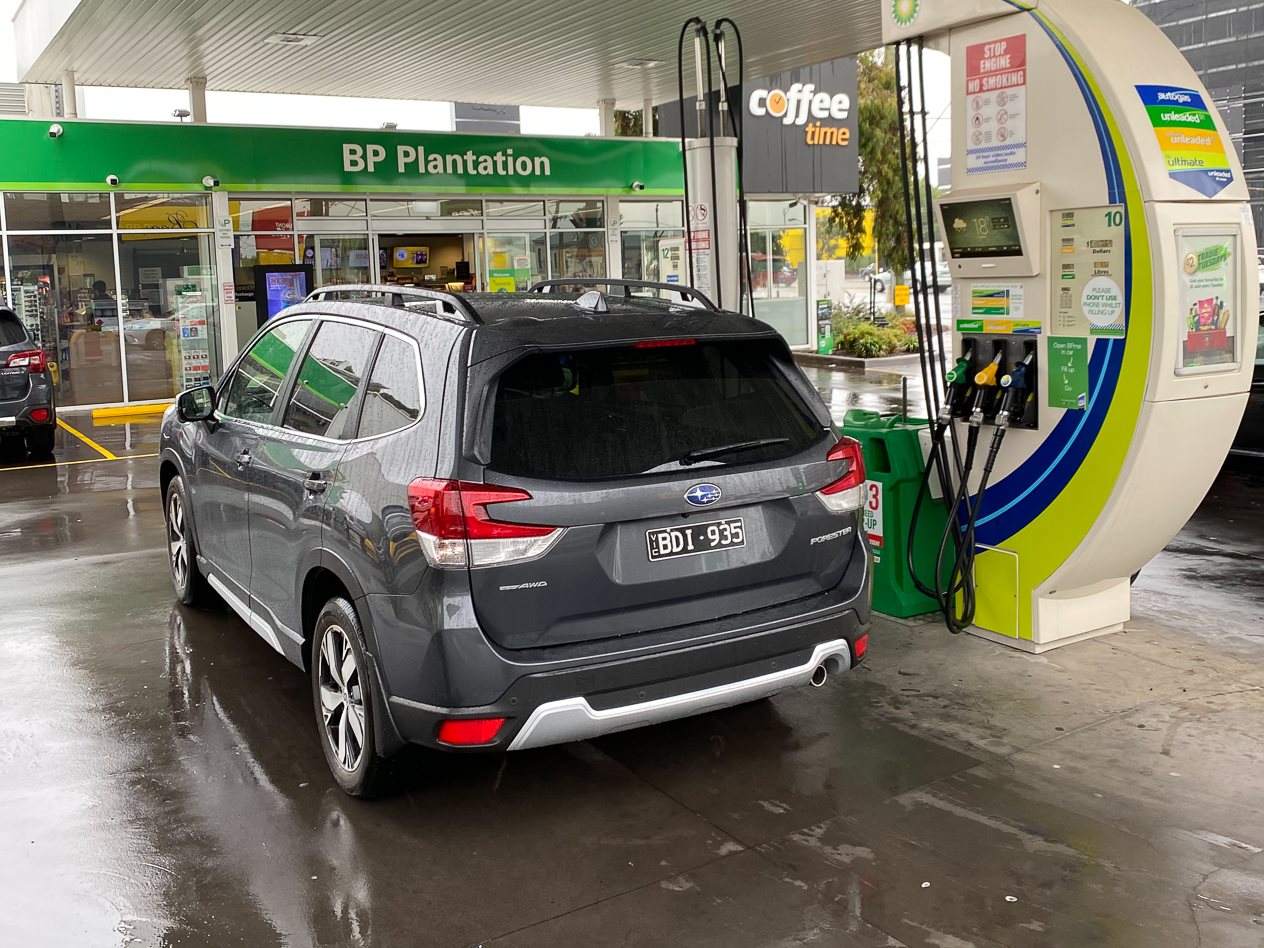
While the fuel excise in its entirety is understood to bring in close to $12 billion for the Government annually, calls throughout the industry to scrap it permanently and replace it with a road user charge have been growing louder.
“State and territory governments are beginning to adapt to the changing nature of mobility in Australia, including the rise of electric vehicles that do not pay fuel excise. Applying this more broadly and scrapping taxes like fuel excise and the Luxury Car Tax will ensure that all motorists are paying an equitable amount to use Australia’s road network,” Federal Chamber for Automotive Industries’ Chief Executive Tony Weber has previously said.
“Our view is that governments can take this further and apply a road user charge to all vehicles, regardless of their engine type.”
The newly-elected Labor Government will have until midnight on September 28 to determine whether it keeps the fuel excise in its half-strength state, reinstate it to 44.2cpl or scrap it entirely and look for another way to raise the lost revenue.
Snapshot
- Australian Labor Party elected as next Federal Government
- Prime Minister Anthony Albanese has previously made policy commitments to make EVs cheaper
- Infrastructure improvements would increase uptake
The Australian Labor Party made a number of motoring and climate-related policy announcements in the lead-up to its Federal Election victory on Saturday night – but what do they mean for local motorists?
Incoming Prime Minister Anthony Albanese led his party to its first election victory since 2010 with climate action as one of its key pillars and points of difference to the outgoing Coalition Government.
At its campaign launch earlier this month, the ALP announced it would introduce an ‘electric car discount’ by making new electric vehicles (EVs) exempt from import tariffs and fringe benefits tax – a $251 million investment which will impact EVs not already covered by Free Trade Agreements, such as the British-built Nissan Leaf and Mini Cooper SE.

According to the Party, this would result in roughly 3.8 million EVs ending up on Australian roads by 2030, coinciding with its broader plan to reduce carbon emissions by 43 per cent by the end of the decade.
While its EV target could be ambitious due to official figures showing just 17,243 examples of new fully-electric vehicles were sold last year, Labor plans to support the expected up-take with a number of key infrastructure upgrades.
A $39.3 million boost in Australia’s charging network will result in an additional 100,000 facilities for businesses, 3.8 million for households and 1800 publicly accessible fast chargers. Under the plans, points will be installed at an average interval of 150 kilometres on major roads around the country, effectively making the technology accessible to roughly 99 per cent of the population.
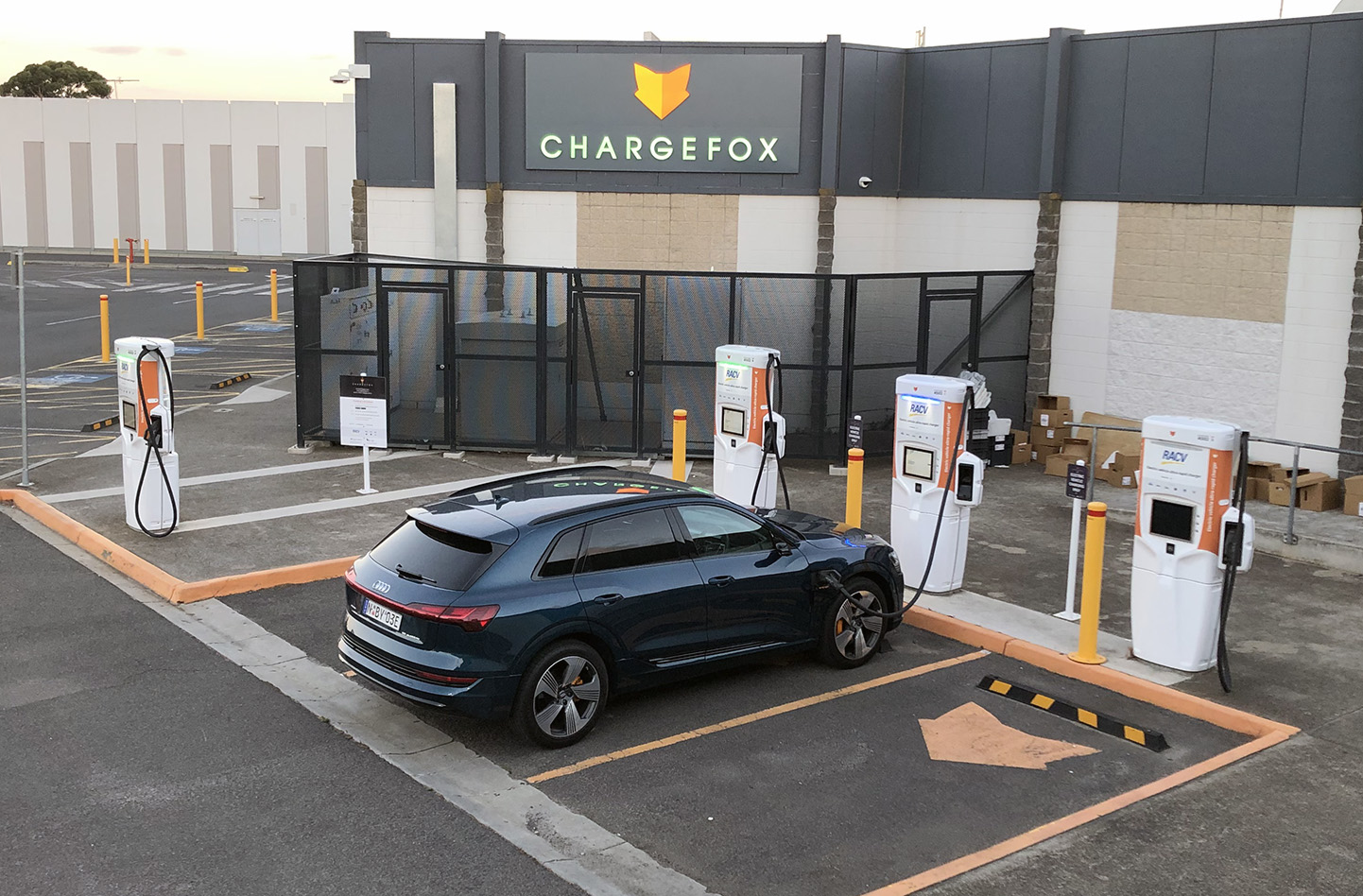
On top of this, Labor announced it would double the $250 million pledged by the Liberal National Government to the Future Fuels Fund, with a $500 million ‘Driving the Nation Fund’ to support renewable fuels.
At the last Federal Election in 2019, then-ALP leader Bill Shorten wanted half of Australia’s new-car sales in 2030 to come from EVs.
This might have been a lofty ambition at the time, given EVs accounted for just 1352 of Australia’s new car sales in 2018, and Labor’s electric dreams weren’t helped by now-former Prime Minister Scott Morrison saying that EVs would “end the weekend”.
However, a number of countries have already committed to similar targets, with the United Kingdom to ban the sale of new internal combustion engined-vehicles from 2030 and the European Union set to do the same by 2035.
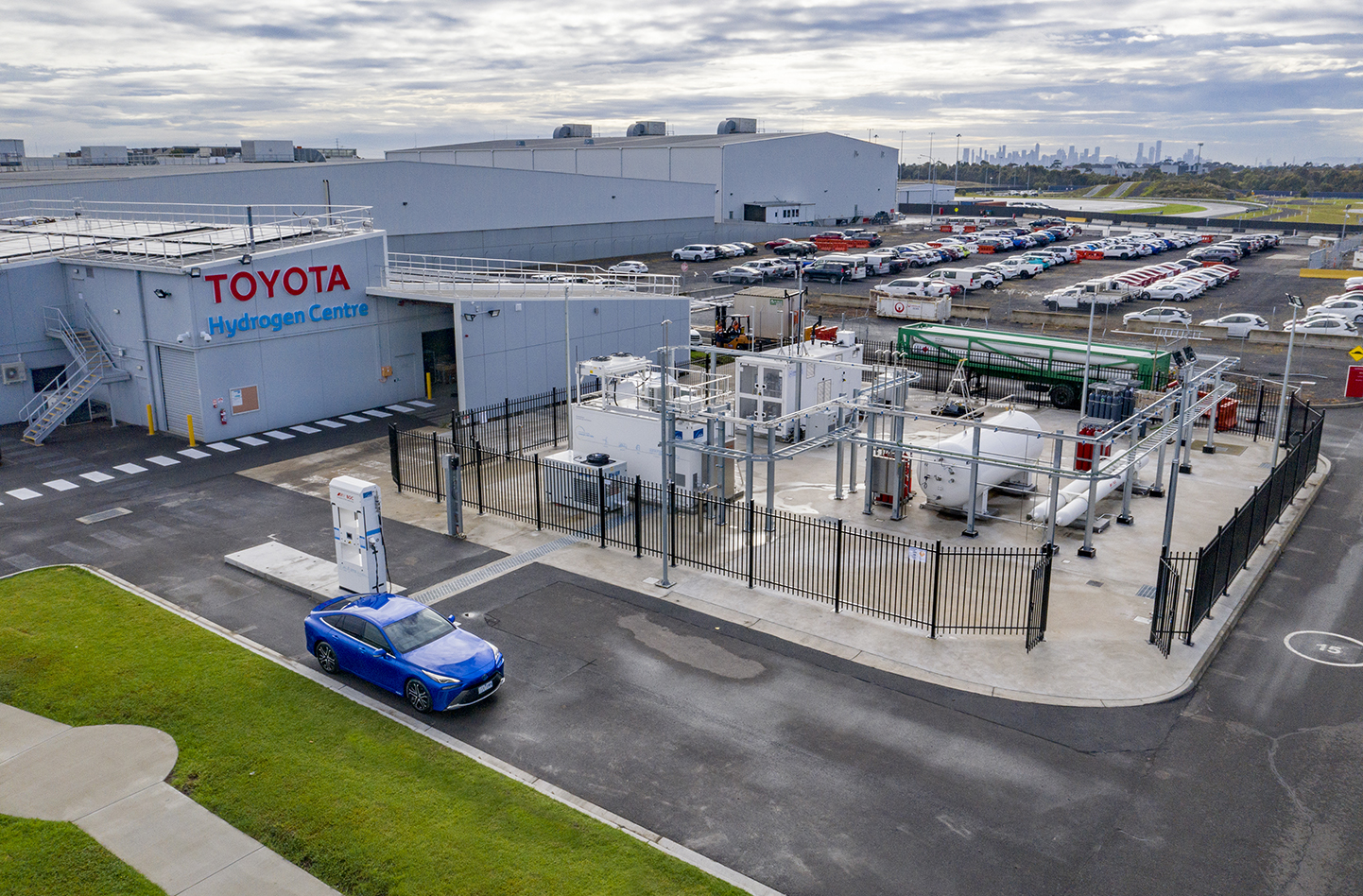
The Federal Chamber of Automotive Industries has long been a supporter of federally-mandated emissions reductions targets for vehicles, with CEO Tony Weber saying manufacturers will meet the targets set by Government to sell cleaner vehicles in Australia.
“The Australian public has made it clear that tackling climate change and reducing emissions is a primary concern,” said Weber on Monday.
“As an industry, we are ready to work with the new Federal Government to transition industry’s voluntary CO2 scheme to a federally-mandated one.
“Our members are bringing low emission technologies to market that –encompassing internal combustion, hydrogen, hybrid and full battery-electric systems. All of these technologies will play a role in our short-medium term journey towards zero emissions and full electrification.”
“Our message to Government is simple. Give us the target; we will give you the technology.”
A lack of a unified policy between Federal and State Governments on EVs has resulted in the states so far doing their own thing, each offering differing levels of subsidies and incentives – something Labor’s policies will hopefully change.
Snapshot
- 1000 Touaregs on their way here
- Due second half of the year
- Range-topping R plug-in hybrid deliveries coming 2023
Volkswagen Australia has managed to secure more than 1000 units of its 2022 Touareg flagship SUV, due to arrive locally later this year.
The coup marks a significant reversal of supply fortune for the German brand, which has suffered supply issues for the last 12 months.
The 1000-plus Touaregs are expected to arrive in the second half of the year, barring further unexpected circumstances, and to surpass the sales achieved in 2020 and 2021 combined.
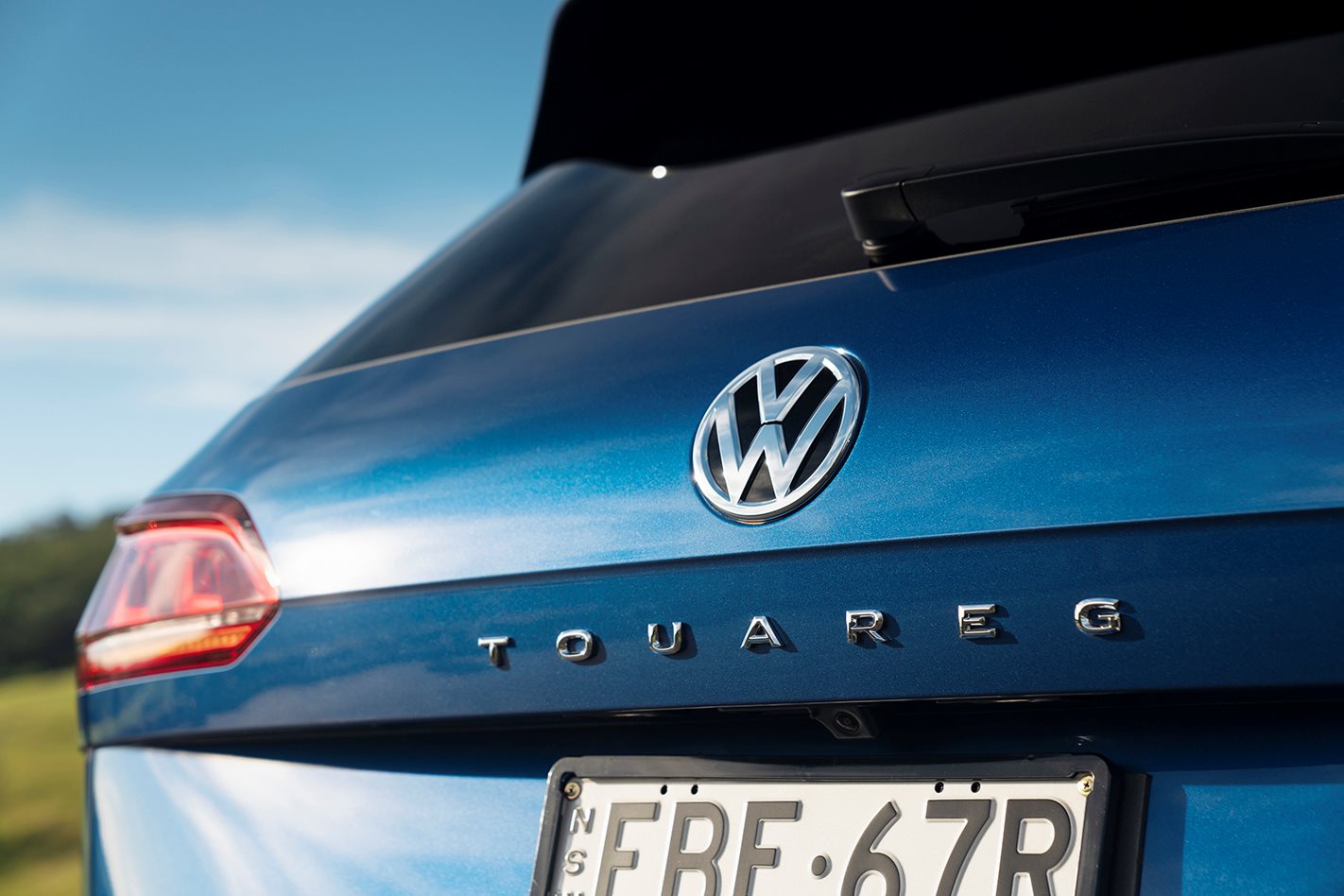
Brand Director of Volkswagen Passenger Vehicles Michal Szaniecki said: “The arrival of additional flagship SUV volume means that for the first time in this generation of Touareg we are forecasting supply that closes in on demand.
“These are the ‘green shoots’ our dealerships and customers have been looking for, and we are continuing to pursue additional volume for Australia with other model lines.
“We thank our customers for their patience as we navigate range-wide supply challenges, and can’t wait to welcome many happy new – and loyal – customers into their Touareg before the new year.”
The arrival of the new stock comes ahead of the hotly-anticipated Touareg R plug-in hybrid electric vehicle (PHEV), which will be available to order from late this year with first deliveries expected in 2023.
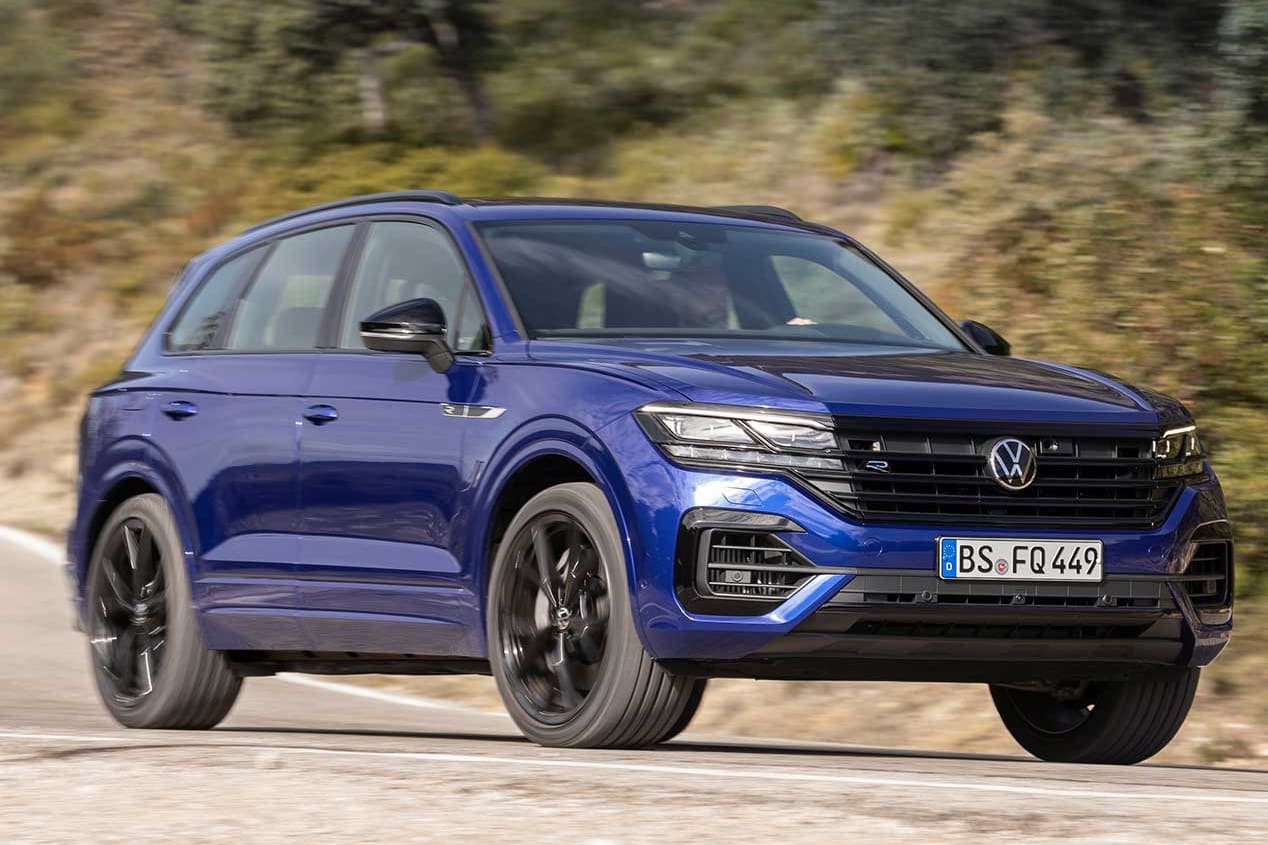
Combining a 47 kilometre electric driving range with 3500 kilogram towing capacity, the PHEV steps on to fill the whole left in the range by the now-discontinued V8 TDI R-Line – boasting a 340kW and 700Nm output coming from a turbocharged petrol V6/electric motor combination with a 0-100km/h sprint time rated at 5.1 seconds.
Meanwhile, the 170TDI boasts 170kW/500Nm, and the 210TDI upgrades to 210kW/600Nm from a 3.0-litre turbocharged diesel V6 and eight-speed automatic transmission, all with VW’s 4MOTION all-wheel drive.
The Touareg R will join the existing lineup, which currently consists of the 170TDI, 210TDI Elegance and 210TDI R-Line, priced from $87,990, $106,990 and $116,290 respectively before on-road costs.
This represents the third time in roughly nine months that VW has raised its prices across its model range due to inflation and increased production pressures – following hikes at the beginning of this year and in September 2021. The new figures will apply as of June 1, 2022, however the carmaker has said it will honour agreements where customers purchase a Touareg before then.
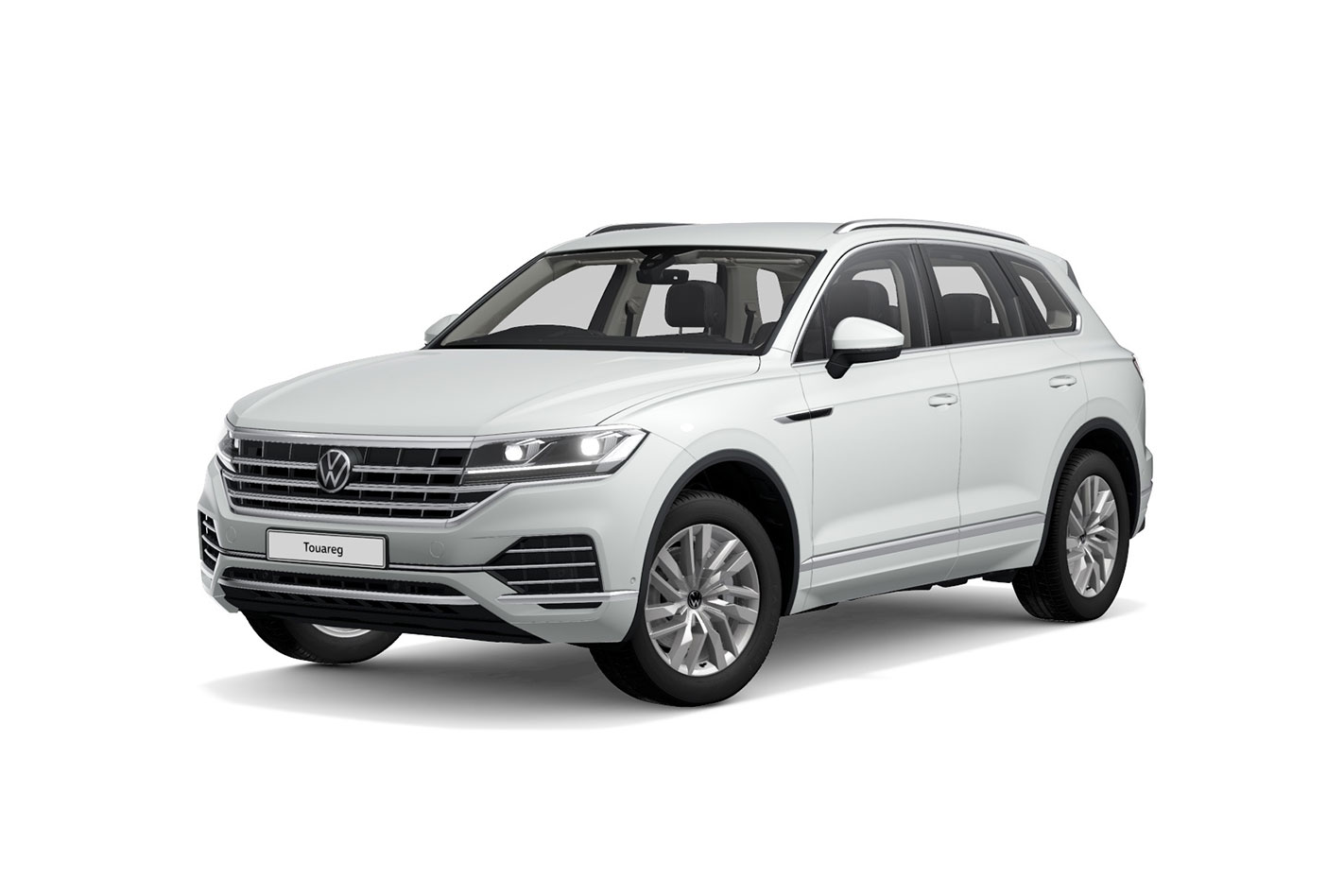
2022 Volkswagen Touareg Australian pricing
All prices are before on-road costs.
| Variant | September 2021 price | January 2022 price | June 2022 price | Increase $ |
| 170TDI | $82,990 | $84,990 | $87,990 | $3000 |
| 210TDI Elegance | $101,290 | $103,690 | $106,690 | $3000 |
| 210TDI R-Line | $110,290 | $112,690 | $116,290 | $3600 |
| R | N/A | N/A | TBC | N/A |
Features
170TDI
Includes, as standard, equipment such as:
| IQ.DRIVE including: |
| Front assist with pedestrian monitoring |
| Travel assist with adaptive lane guidance |
| Emergency assist |
| Lane assist |
| Adaptive cruise control |
| Side assist with front and rear cross-traffic assist |
| Park assist |
| Driver fatigue detection |
| 360u2070 proactive occupant protection |
| Front and rear parking sensors |
| Rear view camera |
| Electronic tailgate with easy open and close |
| Keyless access and start |
| LED automatic headlights |
| Auto dimming mirrors |
| Rain sensing wipers |
| 19-inch Osorno alloy wheels |
| 9.2-inch Discover Pro navigation system with App-Connect |
| 4x USB ports |
| Wireless phone charging |
| Vienna Leather appointed trim |
| Heated and electrically adjustable front seats |
| Air Care dual-zone climate control. |
210TDI Elegance
Adds features such as:
| IQ.LIGHT Matrix LED Headlights |
| Premium LED tail-lights with dynamic indicators |
| 20-inch Montero alloys wheels |
| Four corner air suspension |
| Savona appointed leather appointed trim in u2018soulu2019 black or u2018mistralu2019 two-tone |
| Heated and ventilated front seats |
| Eight massage programs |
| Innovision package with 15-inch Discover Premium screen |
| Digital DAB+ radio |
| 12.3-inch Digital Cockpit |
| Windshield projected head-up display. |
210TDI R-Line
Currently topping off the range, the R-Line gains:
| All-wheel steering |
| Active roll stabilisation |
| 20-inch Nevada alloy wheels |
| R-Line front and rear bumpers |
| Rear and side window tint |
| R-Line Savona leather appointed upholstery |
| Memory for front seats and mirrors |
| Brushed stainless steel foot pedals |
| R-Line multi-function steering wheel with heating and shifting paddles. |
R
Pricing and features for the 2023 Volkswagen Touareg R have yet to be confirmed.
