
Ahead of next month’s IAA Mobility Show in Munich, Porsche has teased its plans to unveil a concept study which will influence its future vehicles.
Announced on its Twitter account, the image shows the headlights of a vehicle which resembles the units on its Taycan EV, itself featuring a different design language from the rest of Porsche’s sportscar offerings.
Although it hasn’t explicitly said the concept study vehicle will be all-electric, by “looking to the future” it’s highly likely Porsche’s next model reveals will all be EVs as it, and its Volkswagen Group parent company, begins to wind back internal combustion engine production.
Porsche has already announced it will offer an EV variant for the next-generation Macan small SUV but hasn’t determined what path it will take with the Boxster and Cayman, previously speculating the nameplates could become electric-only.
The Volkswagen Group is on track to introduce its new Scalable Systems Platform in the next generation of electric models, providing a flexible architecture which can underpin a wider range of vehicles across its brands.
Snapshot
- E-Ray likely to use 484kW drivetrain
- RHD version spotted in US
- Australian release unconfirmed
New details of Chevrolet’s first hybrid Corvette have been revealed, with a 484kW all-wheel-drive powertrain expected to feature.
Muscle Cars and Trucks reports the new Corvette will be dubbed E-Ray, and will replace the prior Grand Sport’s position in the C8 line-up. Leaked reports previously indicated the hybrid C8 would use the Grand Sport name, but this now appears to be incorrect. GM has filed several trademarks for the E-Ray name, dating back as far as 2015.
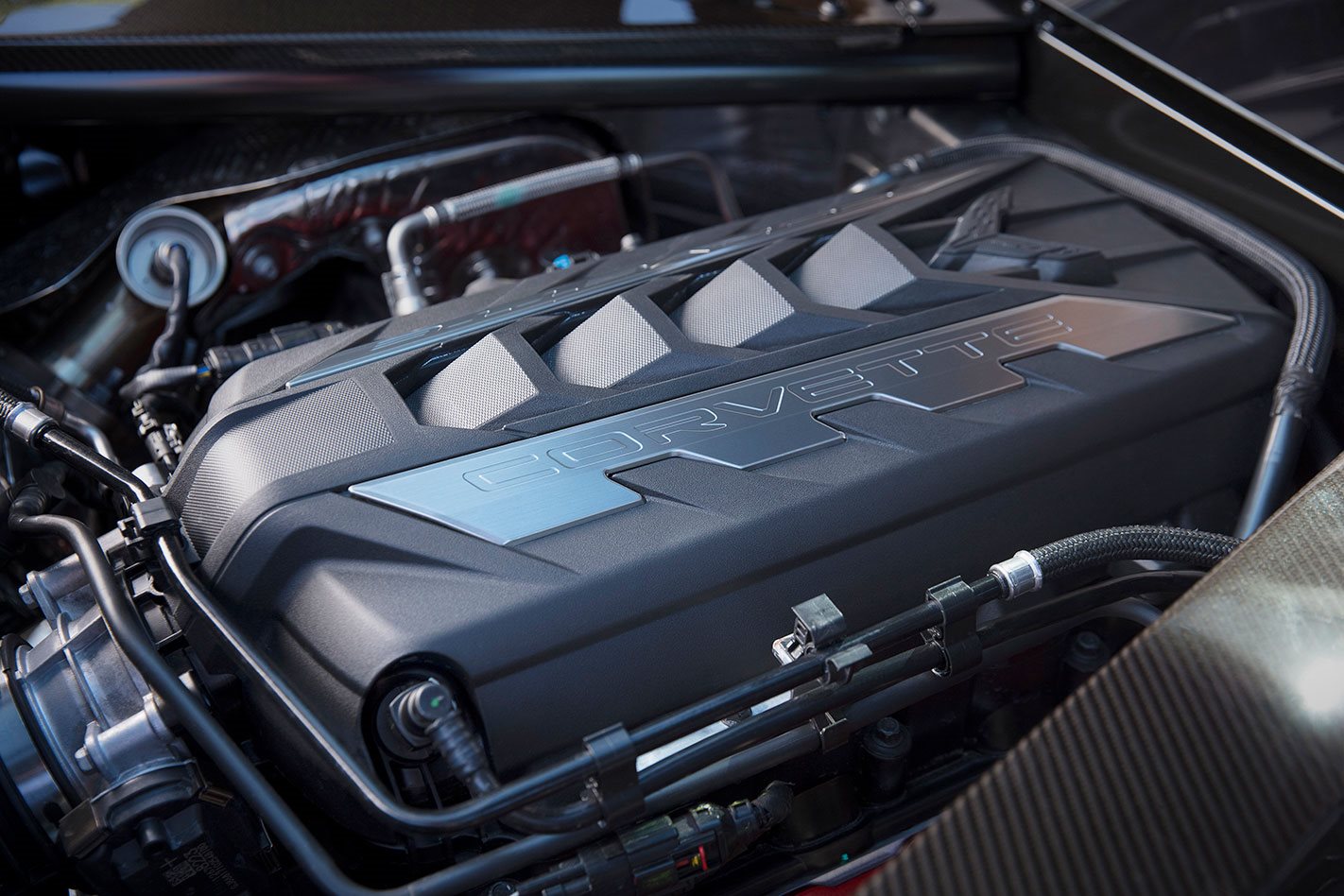
Unnamed sources cited by the publication say power will come from the same 6.2-litre V8 found in the current Stingray, paired to a front axle-mounted ‘booster’ motor.
The set-up bears clear similarity to Honda’s (now outgoing) NSX, which is apparently being used as a benchmarking vehicle for the E-Ray. Total output is said to be around 484kW, making for a 0-100km/h sprint of around 2.0 seconds. The eight-speed dual-clutch auto found in the Stingray is slated to remain.
Rumours indicate the E-Ray will offer silent, zero-emission driving at speeds below 40-50km/h. It’s so far unclear if the electric motor will use regenerative charging or a plug-in system.
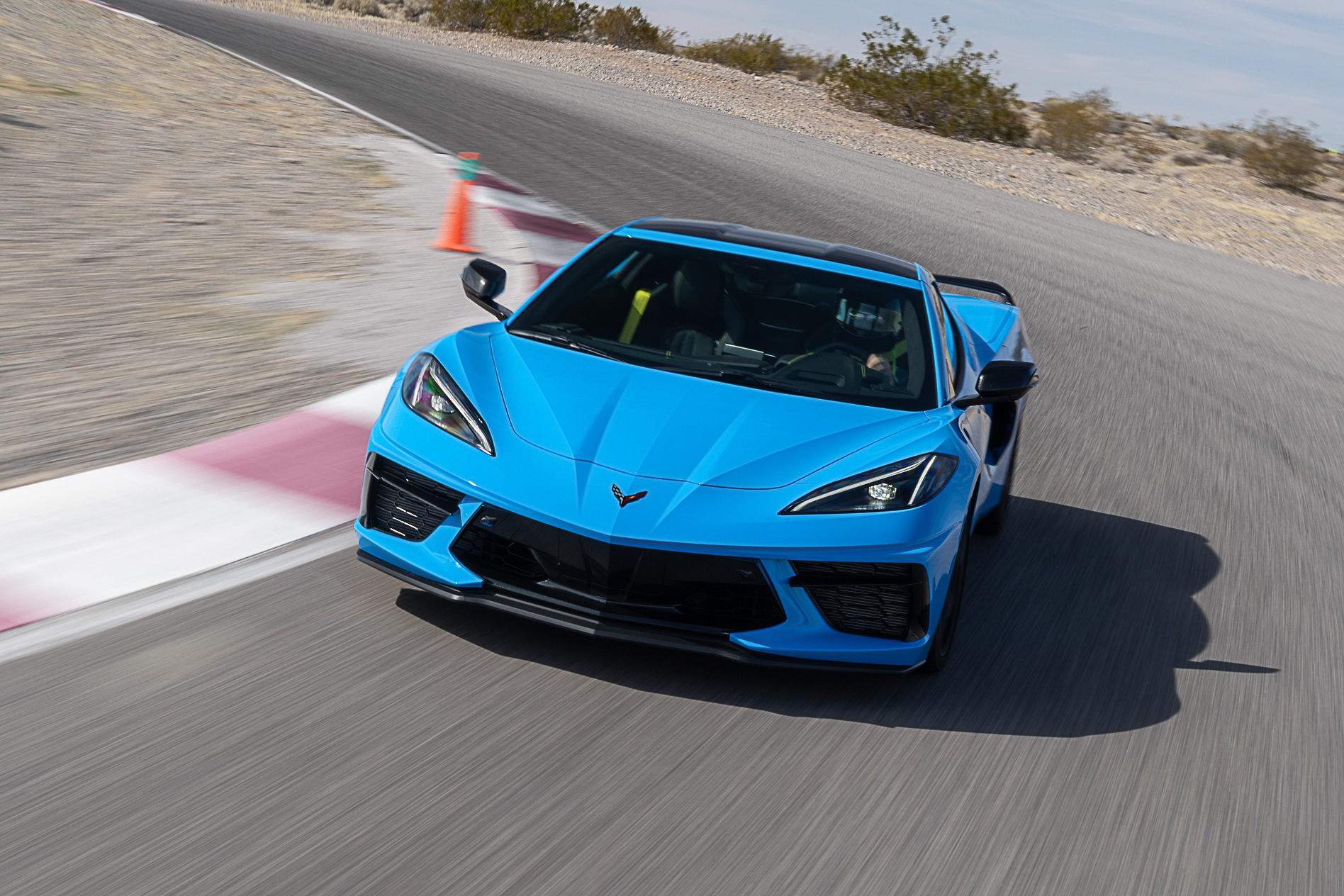
Muscle Cars and Trucks speculates the E-Ray could arrive in 2023 to celebrate the Corvette’s 70th birthday, though Covid-19 disruptions and the ongoing semi-conductor crisis have slowed GM’s production lines.
Recent spy shots have shown a disguised, right-hand drive hybrid C8 undergoing testing in the US, sparking hopes of an Australian launch sometime in the future. If the E-Ray does arrive here, it won’t be for some time – the first Australian Stingrays won’t land until the end of 2021 and the Z06 is yet to see an official reveal, let alone an Aussie release.
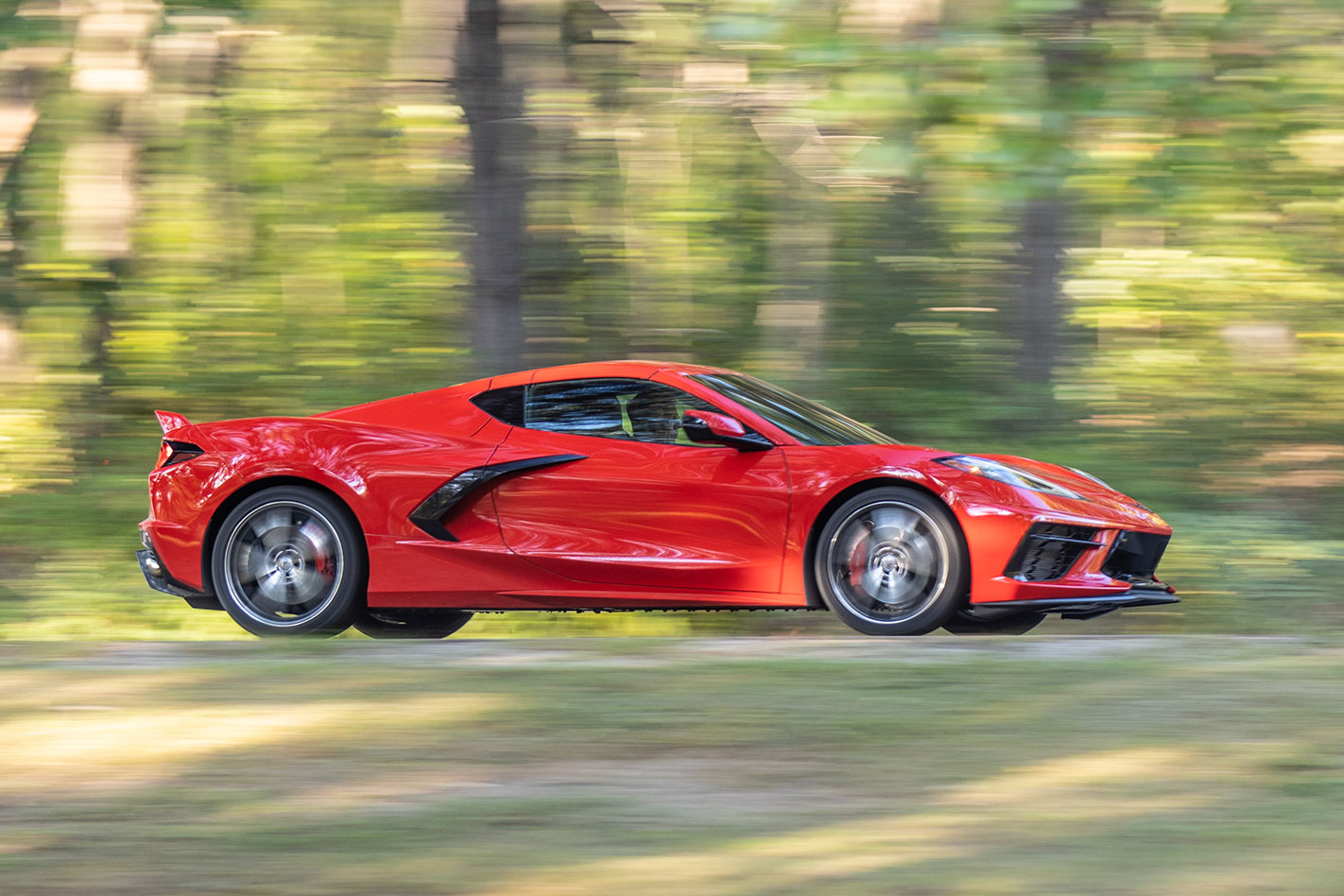
Chevrolet is expected to follow up the E-Ray with the hybrid flagship Zora, due to arrive around 2025. Named after Corvette designer and mid-engine advocate Zora Arkus-Duntov, the car is believed to use a twin-turbo version of the Z06’s flat-plane V8, paired to an electric booster motor for a 745kW output.
Snapshot
- 298kW/475Nm 3.0-litre twin-turbo VR30 V6
- Choice of six-speed manual or 9-speed auto
- Sport and Performance trim levels outlined
UPDATE, May 11, 2022: Australian pricing for the new 2023 Nissan Z has now been announced. Get all the details at the link below.
The story to here
Nissan certainly wasn’t kidding when it stated that the production 2023 Z would stay faithful the design of the Z Proto design study. It’s almost indistinguishable, and that is a very good thing.
Rather predictably, natural aspiration has been replaced by a 3.0-litre twin turbo setup, good for 298kW at 6400rpm, with a hefty torque bump to 475Nm between 1600 and 5600rpm. By way of comparison, the outgoing 370Z Nismo, with its 3.7-litre atmo powerplant manages 253kW and 371Nm.
Nissan hasn’t released performance figures yet for its rear-drive coupe, estimating a 15 per cent acceleration boost, but we’d conservatively expect mid-fours to 100km/h.
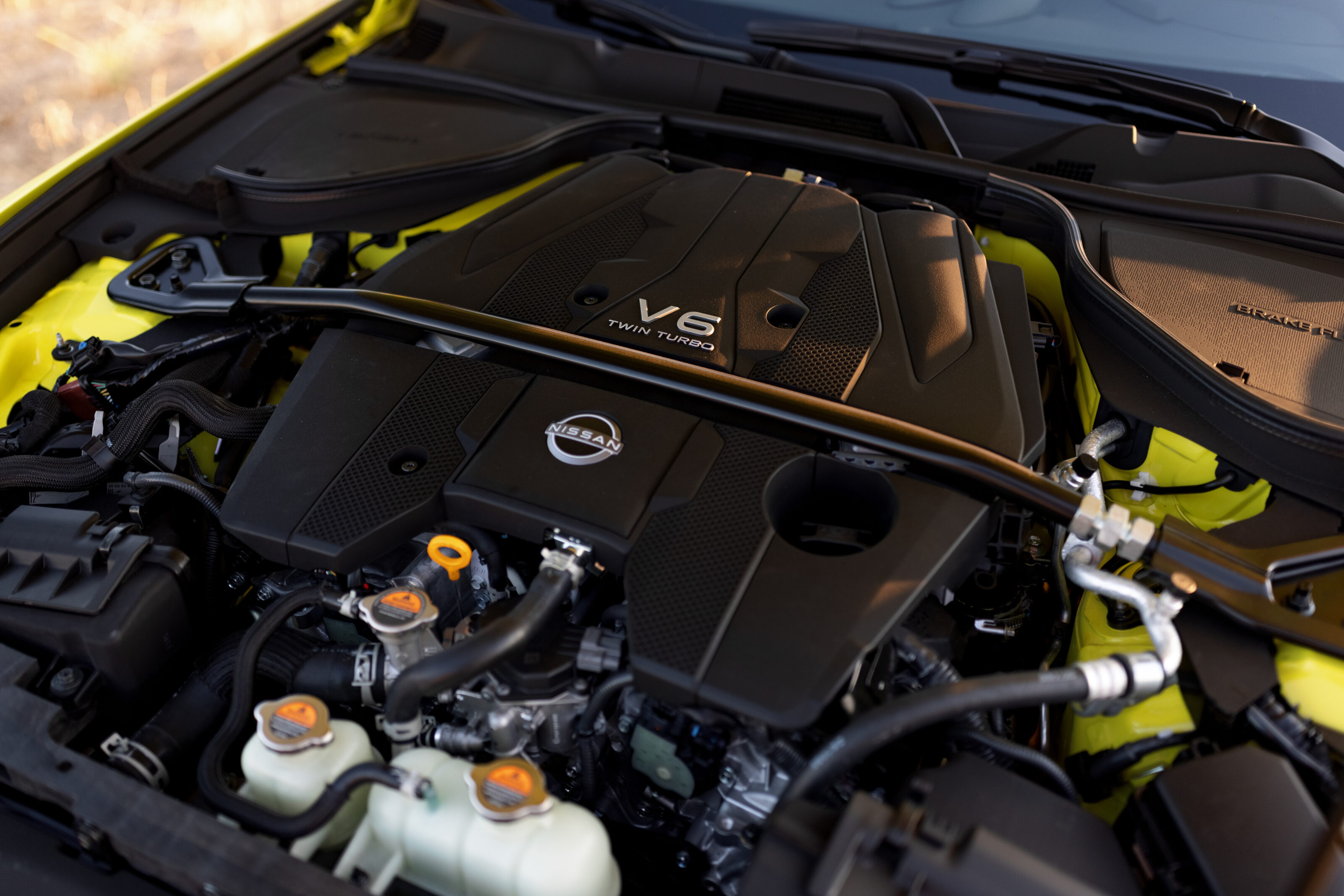
The engine features two small-diameter turbochargers to reduce lag, while an electronic variable valve timing (e-VVT) intake valve system also helps throttle response and fuel efficiency.
The 2997cc VR30DDTT powerplant is much the same as that used in the Infiniti Q50/Q60 twins, appearing on Wards’ 10 Best Engines list in 2017 and 2018.
“Simply put, our goal is to make this the best Z yet, period. With each generation, we raise the bar, pushing the limits of Z and continuing to tap into the human instinct for that next thrilling journey,” said Hiroshi Tamura, chief product specialist of the new Z.
Buyers get a choice between a six-speed manual and a nine-speed automatic transmission. The 6-speed close-ratio manual transmission features an Exedy high-performance clutch, a carbon fibre propshaft and launch control.
Go with the auto and launch control is also featured, alongside aluminium paddle shifters of the same design found on the GT-R.
The auto ‘box also features standard and Sport drive modes.
Nissan has beefed up body rigidity, fitted an electronically assisted power-steering set-up and widened the tyres on both the Sport and Performance trim levels announced for the US market. It’s likely that when the car comes to Australia, these trims will be rationalised to a single model, which will probably take its cue from the US-market Performance variant.
Larger passive dampers are fitted to the front double wishbone suspension, which features an increased caster angle for better stability. The rear is a multilink set-up, and the Performance trim gets a mechanical clutched LSD. Another feature unique to the Performance trim is a larger rear spoiler to increase downforce over the rear axle.
The Sport variant is fitted with dark-finished 18-inch aluminium-alloy wheels with Yokohama ADVAN Sport rubber, while the Performance sits on 19-inch RAYS forged aluminium-alloy rims with Bridgestone Potenza S007 hoops.
The new Z rides on a 2550mm wheelbase, exactly the same as the outgoing 370Z which suggests that the underpinnings are a carryover of the FM platform whose roots can be traced back to the 2001 V35-series Skyline.
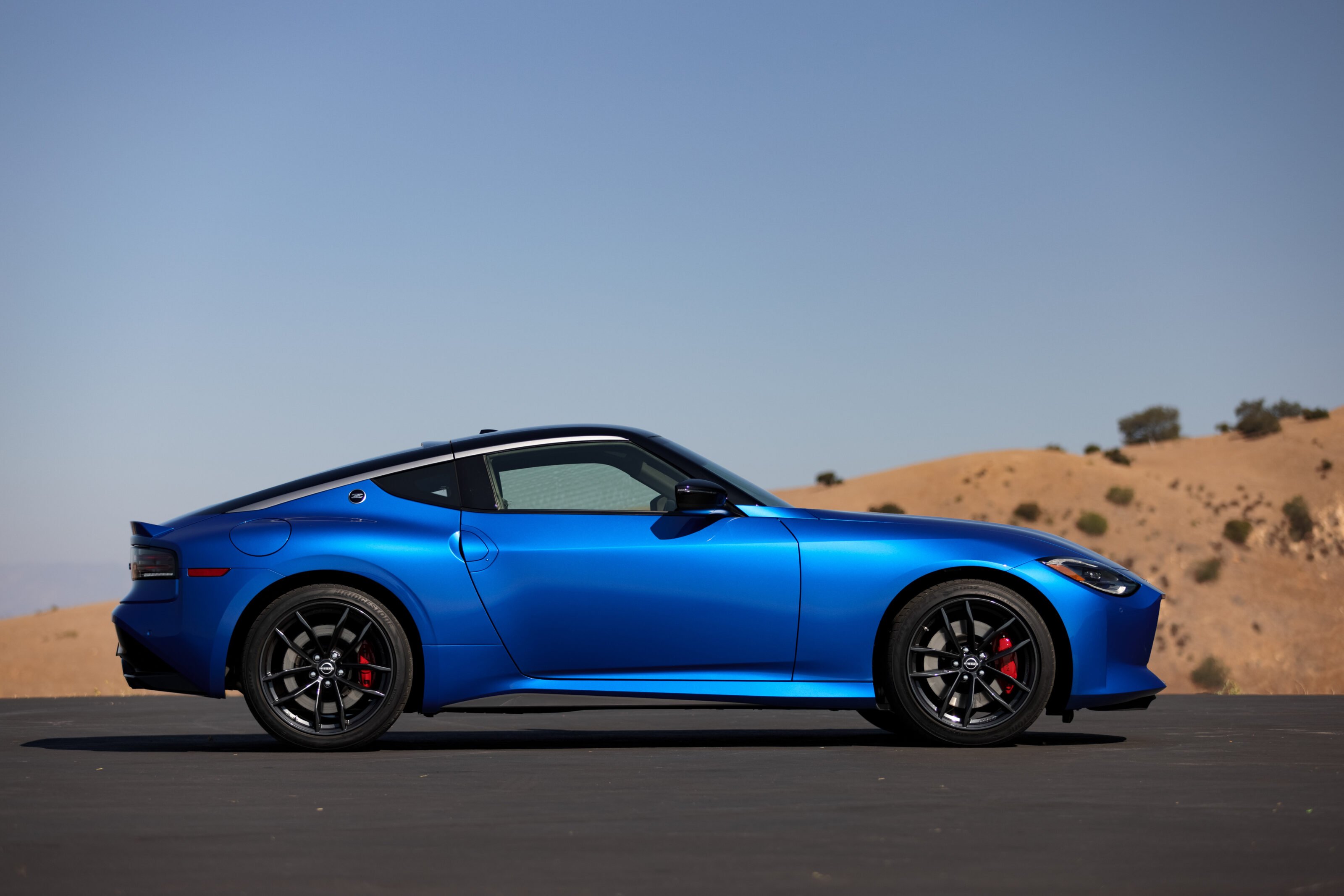
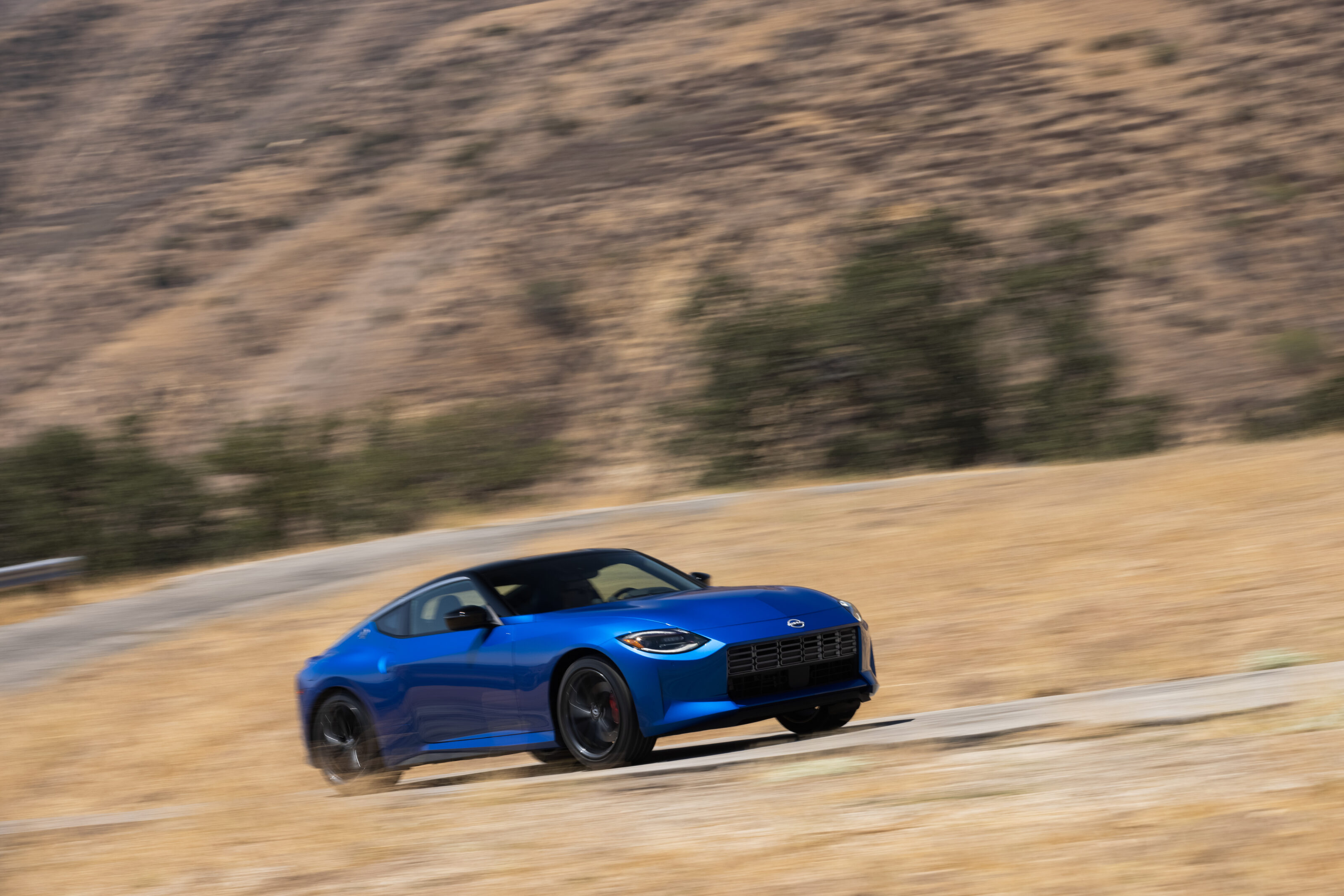
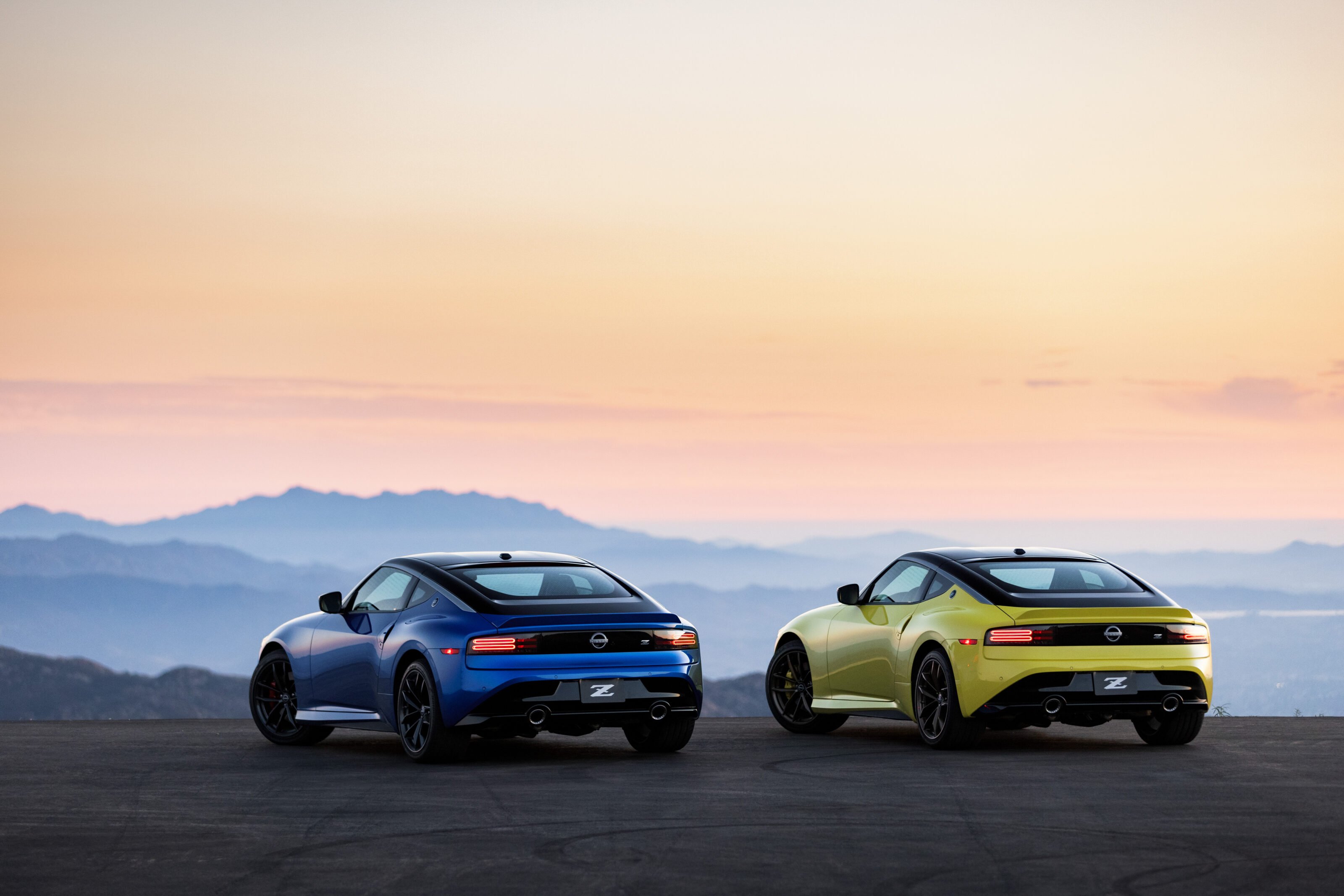
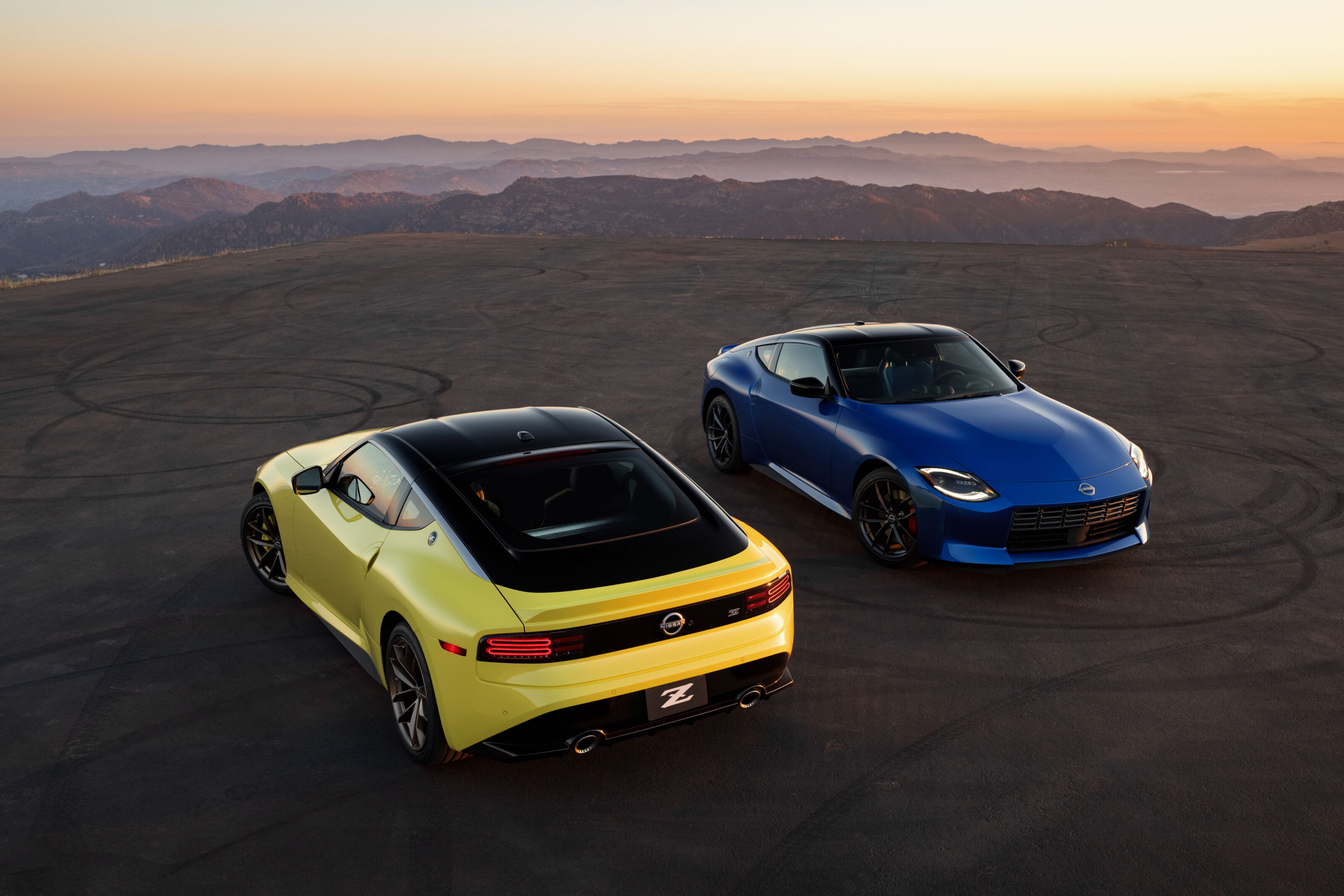
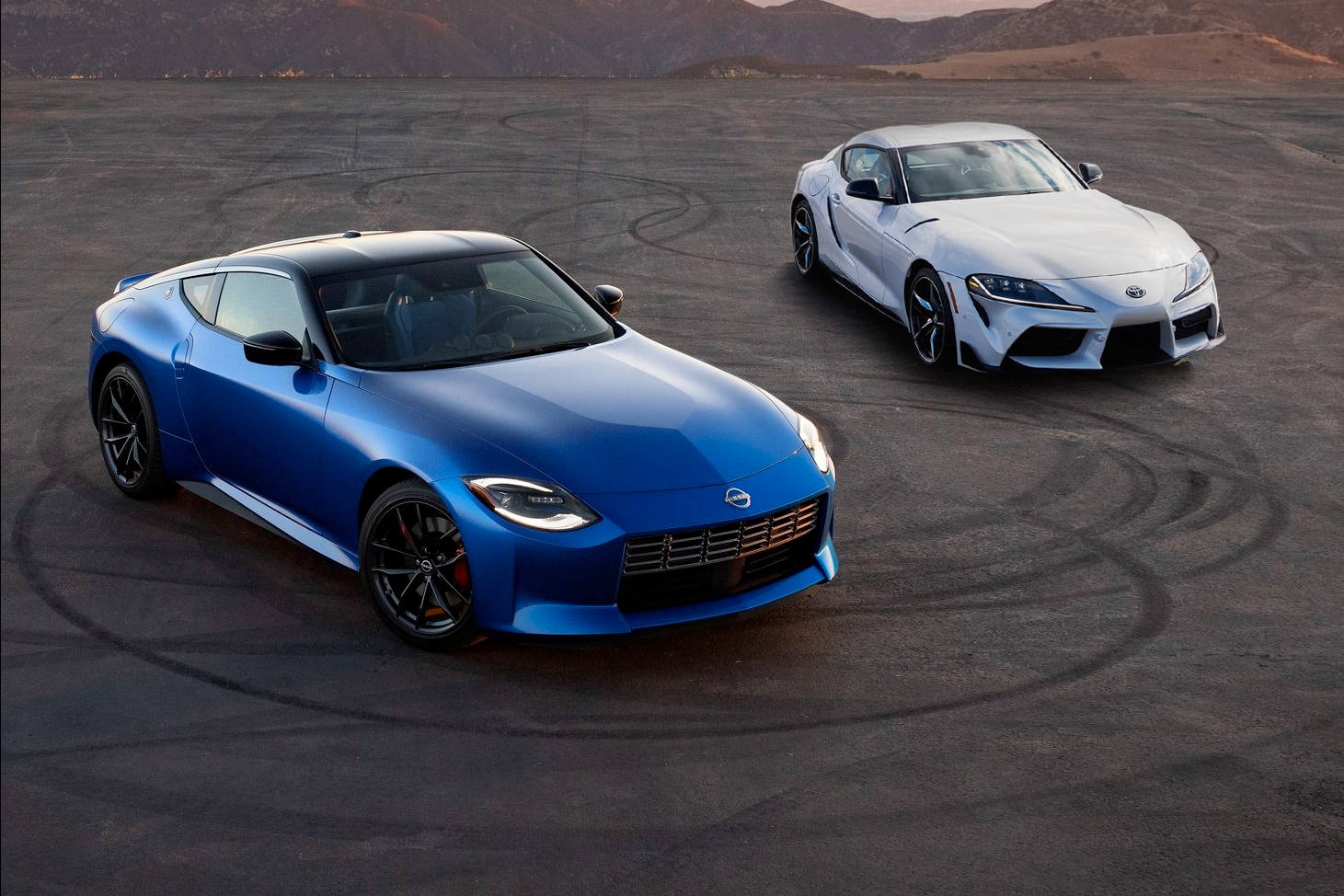
For many, the styling will be enough to sell them on the idea of the Z. The cab-back silhouette is faithful to its Z-car heritage, with a long bonnet, teardrop glasshouse and a squat rear stance.
The design team was headed up by the irrepressible Alfonso Albaisa, Nissan’s global head of design and a Z-car fanatic. “We found ourselves gravitating towards the sketches that touched the high points of certain decades while remaining true to our vision of the future,” said Albaisa.
“Ultimately, we created a Z that travels between the decades while being completely modern.” While not all of the car is what we’d describe as completely modern, maybe that’s not such a bad thing where the Z-car’s niche is concerned.
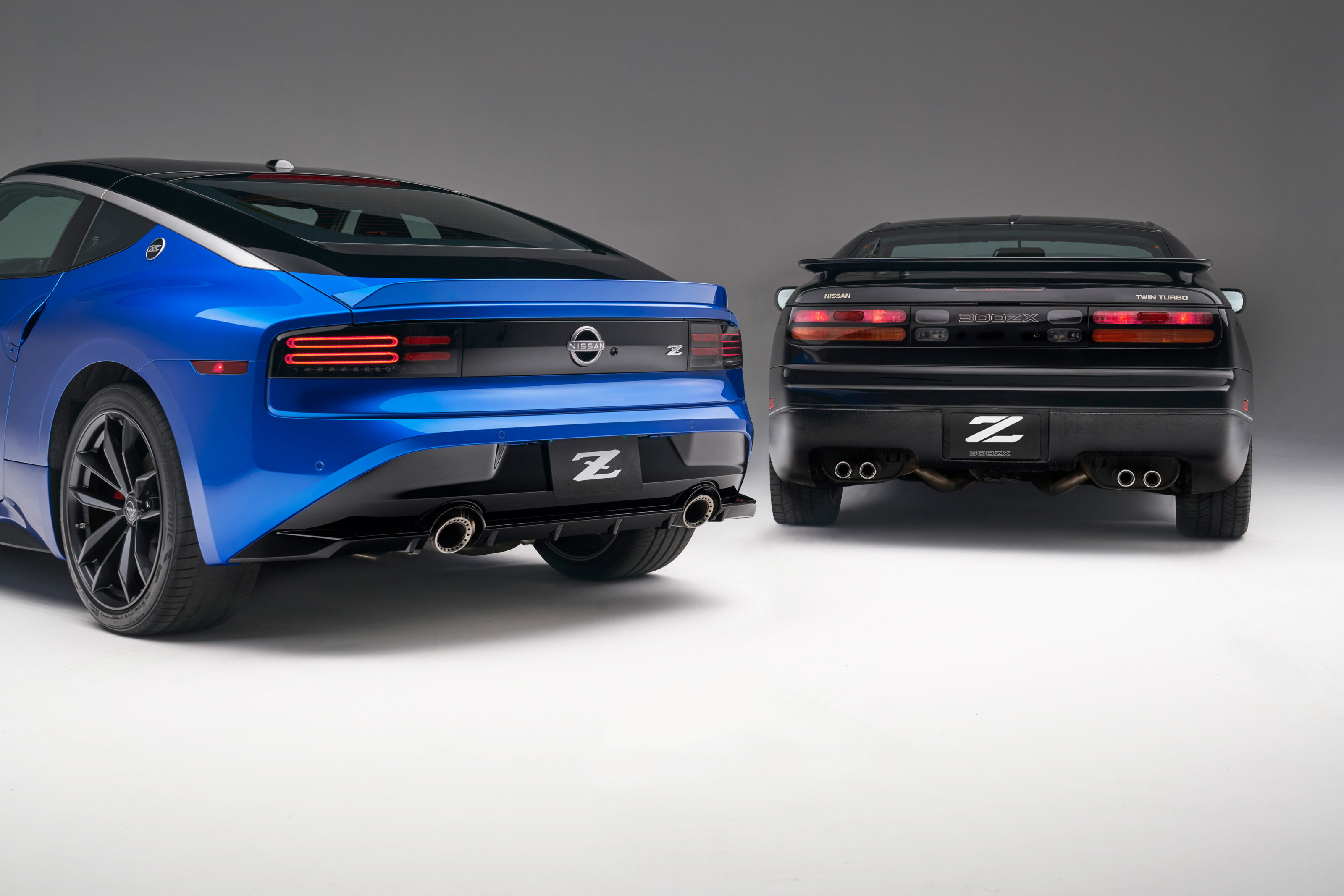
The bluff front end of the car retains the twin semi-circle LED lighting from the show car, which gives it a distinctive rear-view-mirror presence, that particular design cue coming from the Japanese market-only 240ZG longnose, while at the rear, the capsule graphic of the later Z32 300Z is reprised in 3D-effect LEDs, a shape also featured in the front grille.
Perhaps the most striking connection to the 240Z is in profile, where the roofline descends from the top of the windscreen, eventually meeting at the trailing edge of a belt line that’s lower than the front wheelarches.
The clever use of a chrome detail strip also gives the visual effect that the Z’s rear pillars are a good deal more delicate than they actually are.
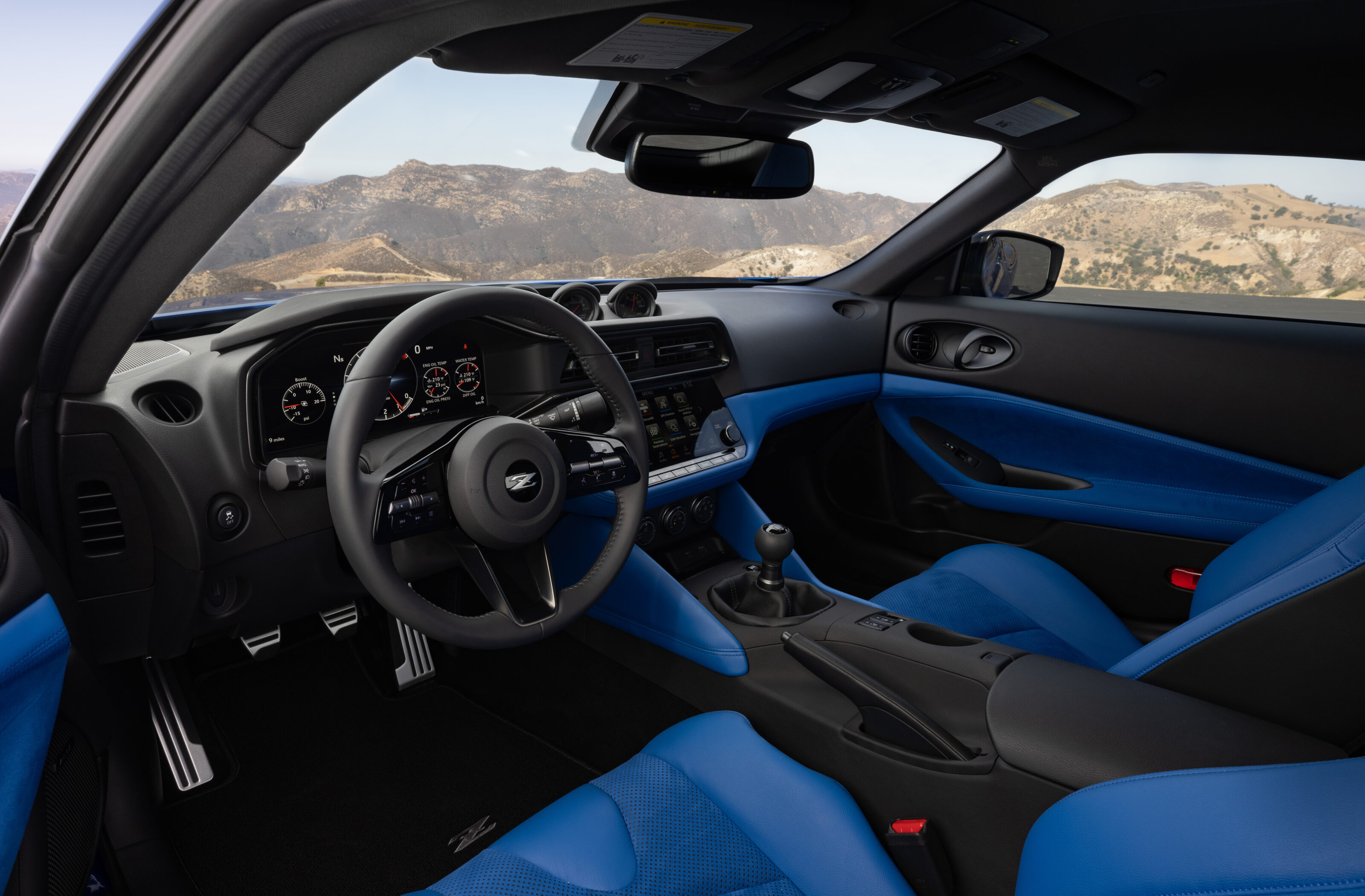
Inside, the cabin has come on a long way from the 370Z with a clean centre stack, three analogue gauges on the instrument binnacle, an 8.0-inch touchscreen, audio display in the centre and climate control switches behind the shift lever.
Nissan Super GT500 driver Tsugio Matsuda was employed to offer feedback on driver information settings for the 12.3-inch customisable digital meter.
This is a new fitment for the Z and can be shuttled through Normal, Enhanced and Sport settings, the latter prioritising the tacho and shift light, while also offering a boost gauge or G meter.
Nissan aimed for ‘a vintage aesthetic’ with the deeply dished steering wheel and suede on the backs of the bolstered sports seats, which will help keep the driver in position while exploiting cornering forces – claimed to be 13 per cent higher than the 370Z.
Nissan hasn’t overlooked convenience features in its quest for dynamics. The Z features refinements such as a push button start, adaptive cruise, rear view monitor, Type A and Type C USBs, Apple CarPlay and Android Auto mirroring – as well as front and rear sonar sensors.
The Performance model also adds a 9.0-inch touchscreen with navigation and – in some markets – a Wi-Fi hotspot. It also receives an eight-speaker Bose stereo with active noise cancellation tech.
The US market is being treated to a 240-car (get it?) run of the One special edition, celebrating the distinctive Z Proto first seen in 2020.
Snapshot
- All-Terrain Estate provides 40mm extra ground clearance over standard car
- Petrol and diesel engines available
- No plans for regular Estate or All-Terrain to be released in Australia
The new Mercedes-Benz C-Class will gain an All-Terrain variant in Europe – bringing with it four-wheel drive, jacked up ground clearance and unique body highlights.
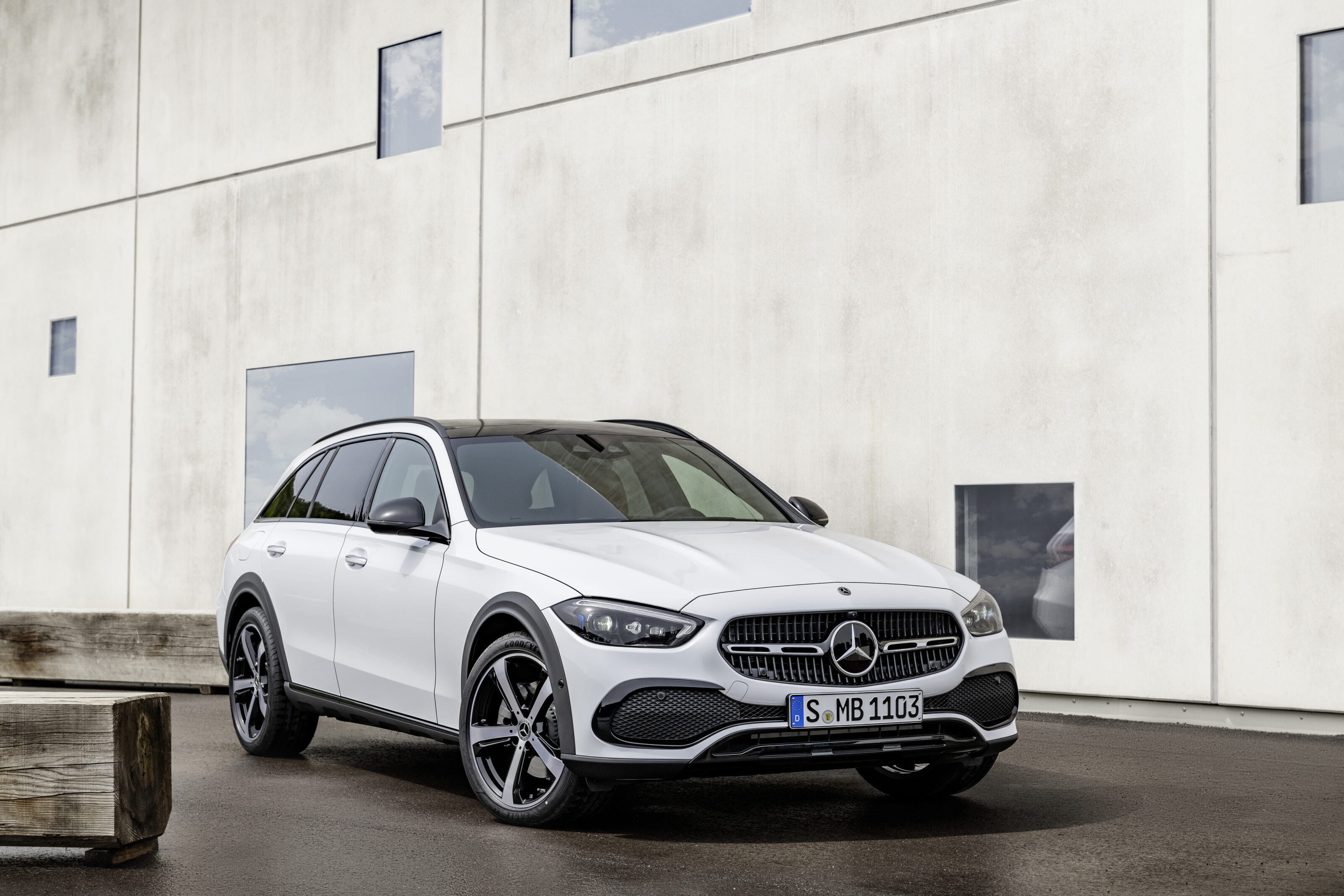
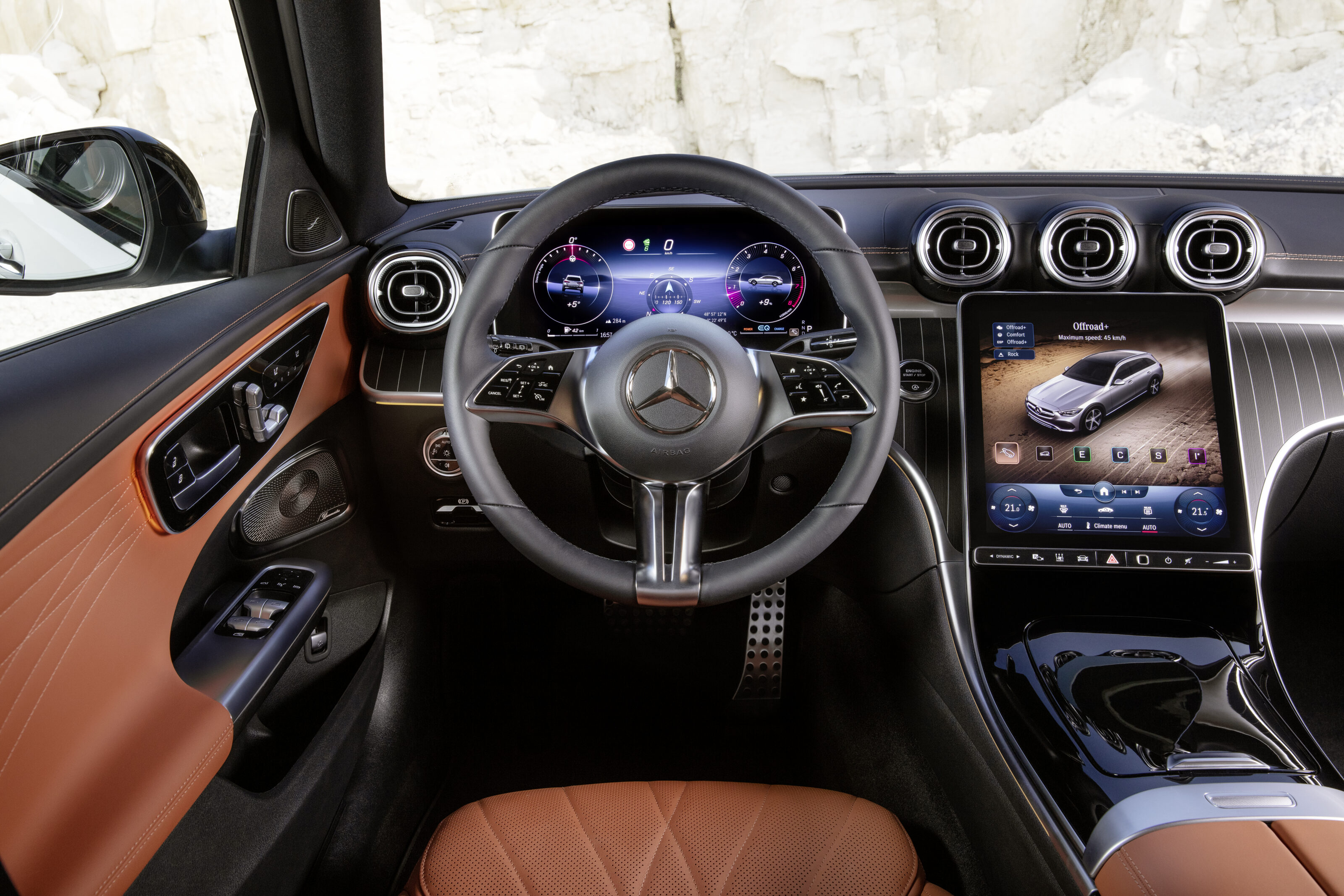
Released as the antidote to crossovers and SUVs, the All-Terrain’s ride height is 40mm taller than the standard C-Class Estate and features two additional driving modes, Offroad and Offroad+ – the latter of which includes downhill speed regulation.
A passive damping system keeps the ride under control, while Mercedes-Benz has equipped the car with larger steering knuckles on the front axle to add extra strength to the multi-link suspension system.
While performance figures haven’t been confirmed, the All-Terrain will be available with a choice of two 2.0-litre engines – one petrol and one diesel – and 48-volt mild-hybrid assistance as standard on both units.
Power is sent through a nine-speed torque-converter automatic transmission to all four wheels, via the 4Matic all-wheel drive system, distributing up to 45 per cent of the power to the front axle and up to 55 per cent to the rear.
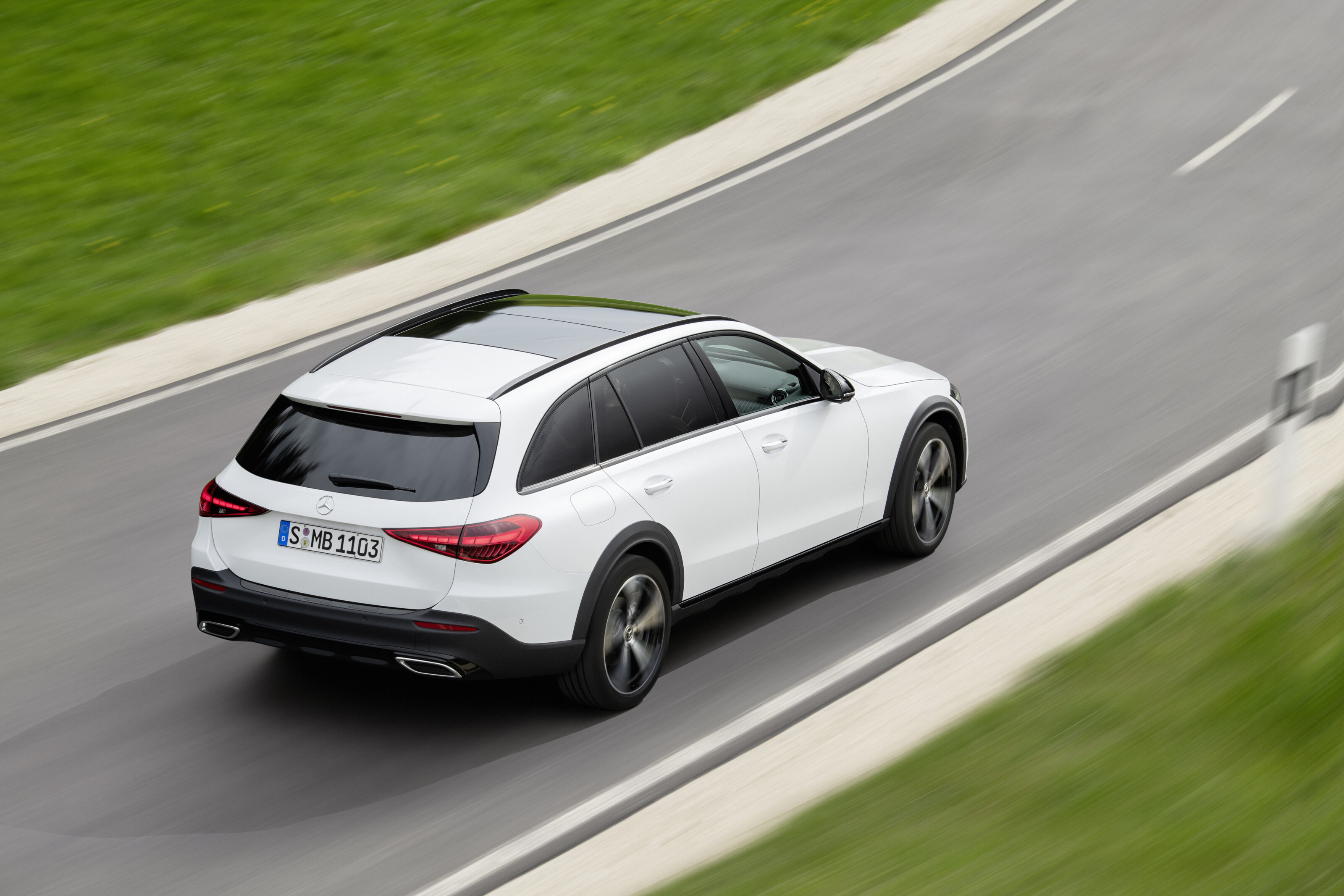
Exterior changes from the standard Estate include a unique grille, bumpers and black arch linings on the front and rear – all of which contributes to a 21mm wider stance than the base car, while buyers can either opt for the standard 17-inch wheels or upgrade to 19-inch alloys.
Inside the cabin, Mercedes-Benz’s Avantgarde interior is standard – offering a choice of three colour options and either a 10.25-inch or a 12.3-inch infotainment screen, each featuring incline, decline and steering angle data when in the Offroad modes.
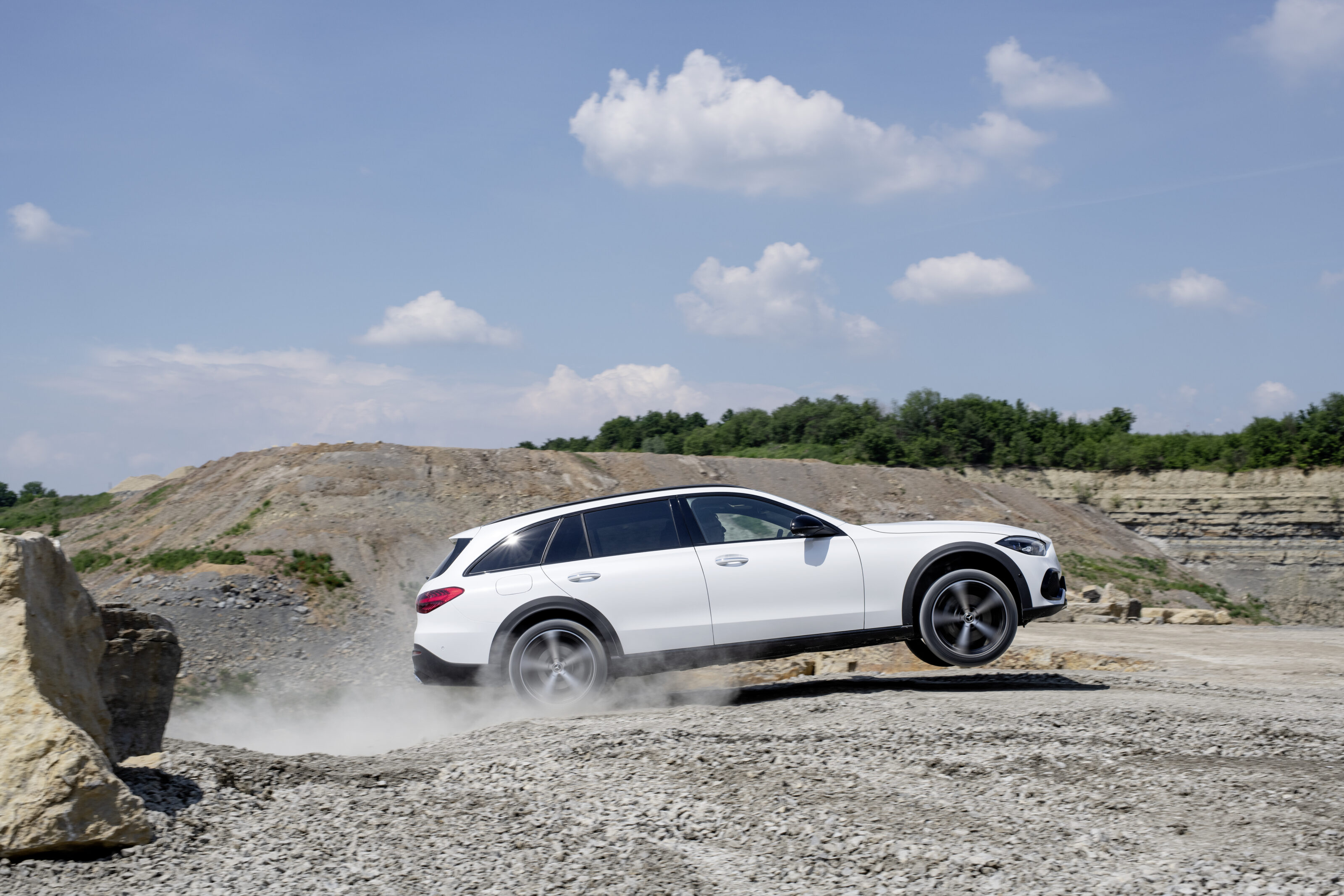
Unfortunately, if you want a C-Class All-Terrain in Australia, Mercedes-Benz has confirmed the variant (as well as the entire Estate range) will not be released locally due to increased SUV sales and declining interest in wagons.
European pricing has also not yet been released, although we imagine the All-Terrain will incur a premium over the car it is based on.
Though many of us never venture much further off-road than the Woolies carpark, we’re obsessed with SUVs. Then there are those who want these bulky, high-riding load-luggers to also perform and handle like sports cars. To please them, engineers at Porsche, Mercedes-Benz, BMW, Land Rover and Jaguar, among others, have spent countless hours on this Mission Impossible.
The Kona N is Hyundai’s attempt at rewriting the laws of physics, its first performance SUV.
Hyundai’s newest N model marries its strikingly-styled small SUV with go-fast hardware from the impressive i30N hot hatch, including the new 206kW and 392Nm iteration of the 2.0-litre turbocharged four banger and the N-spec version of the new eight-speed dual-clutch transmission.
The suspension features heavy-duty components such as redesigned steering knuckles, plus new springs and electronically controlled shocks.
The front-wheel-drive Kona N also gets the N-spec electronically-controlled limited-slip differential, a revised power-steering system with an e-motor mounted on the rack rather than the steering column to improve response and sensitivity, 19-inch forged alloy wheels wrapped in Pirelli P Zero 235/40 tyres developed specifically for the car, and bigger brakes – 360mm vented rotors up front and 314mm vented items at the rear.
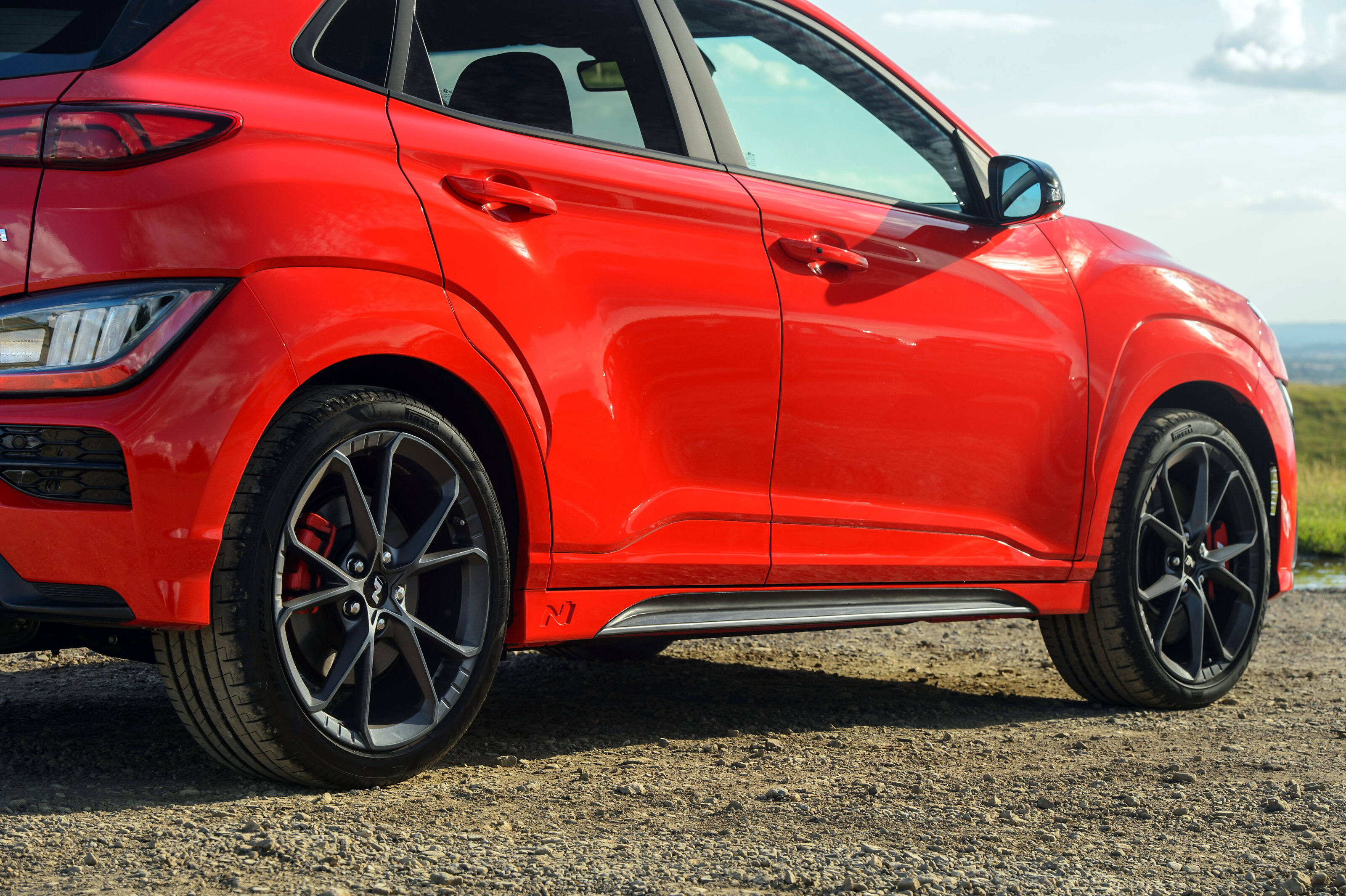
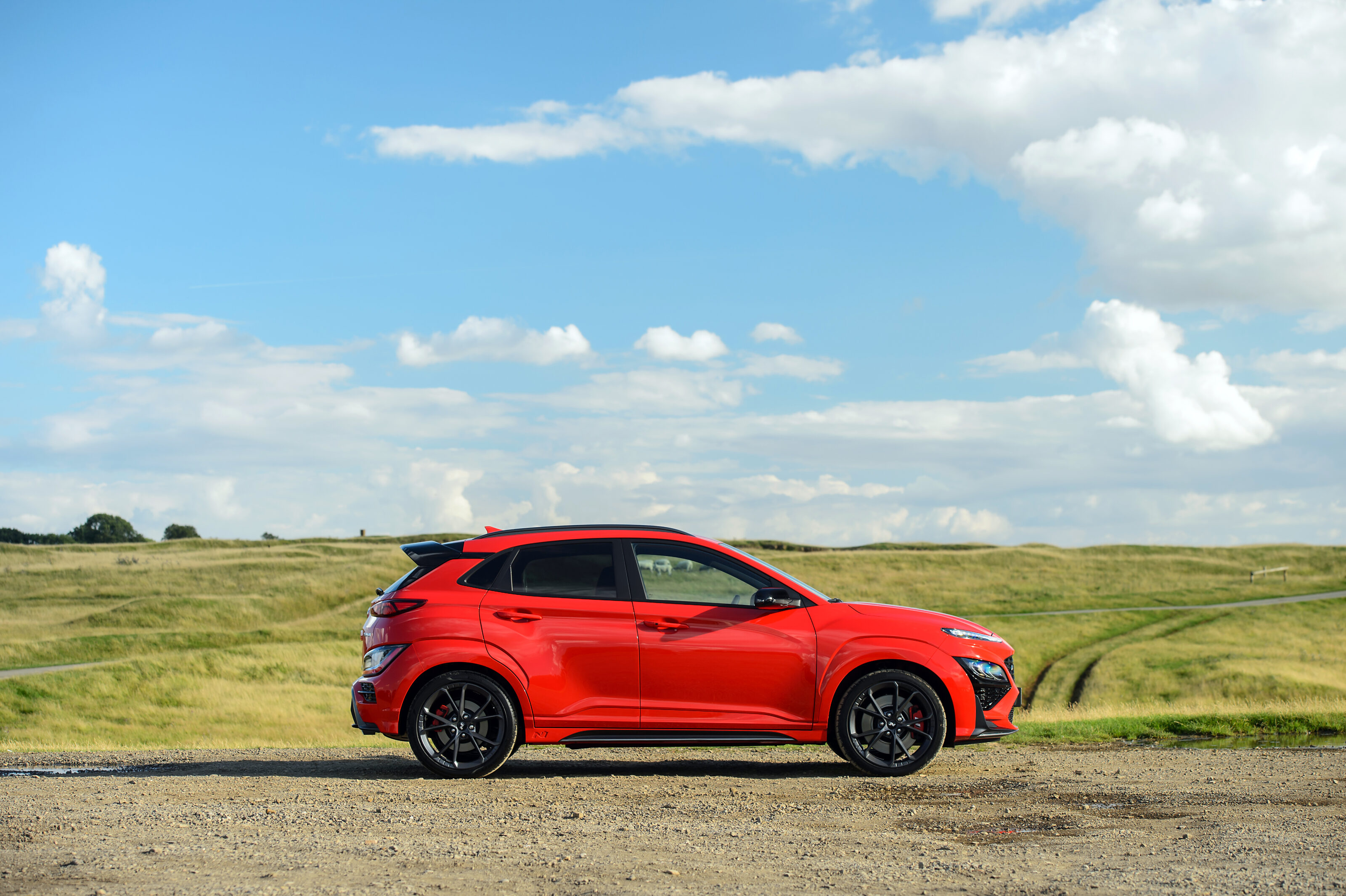
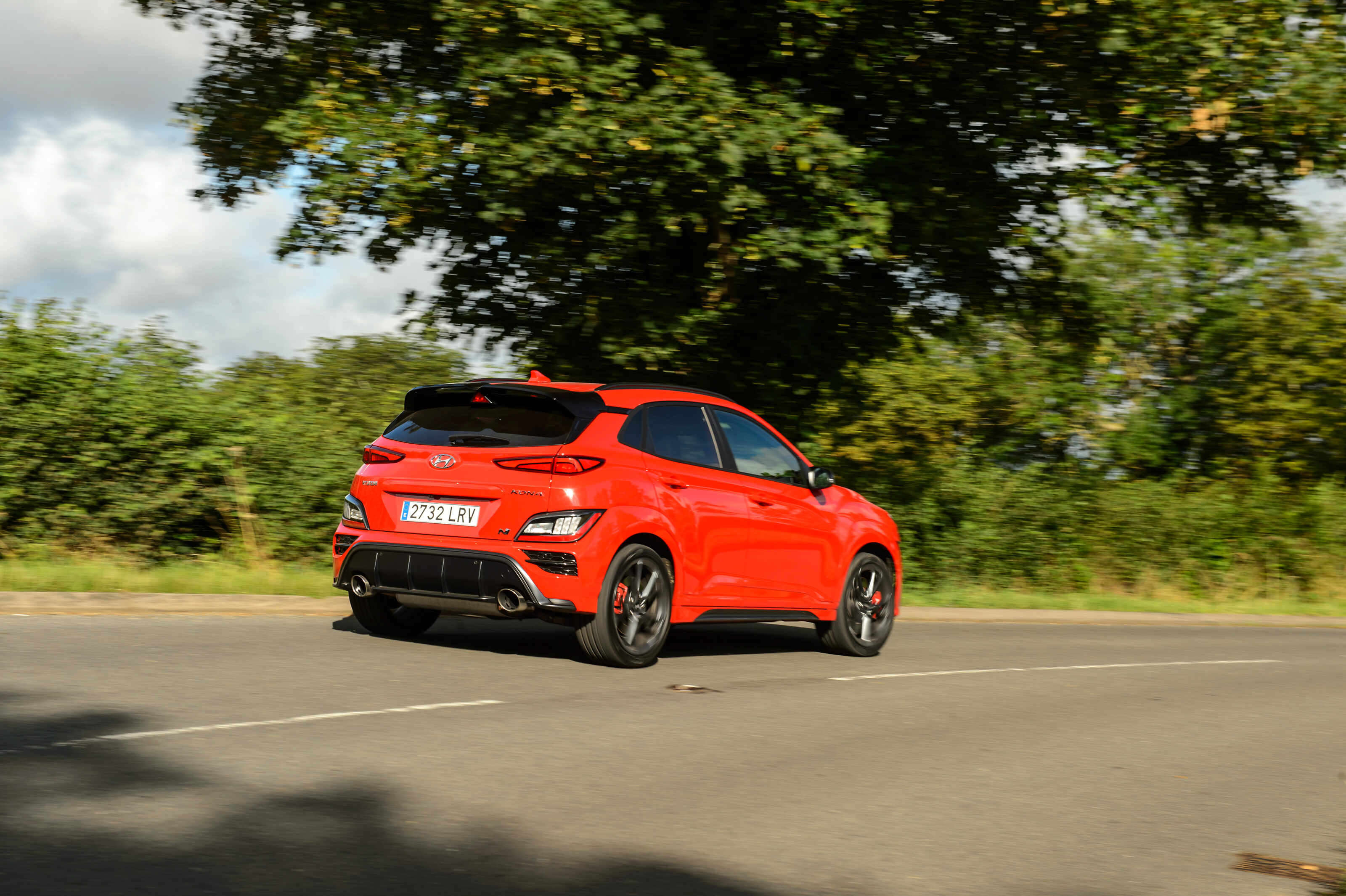
Outside, the front and rear bumper fascias are similarly architected to those of the Kona N Line, but the front splitter has been extended 10mm, while at the rear exhaust outlets the size of bazookas now frame the faux diffuser.
Other visual cues include a large, double-wing roof spoiler extending from the roof and splashes of red on the lower edges of the bodywork and on the brake calipers.
Inside are the N-spec steering wheel, shifter and heavily bolstered seats, all finished in the familiar N palette of black trim with blue accents.
Hyundai’s N division was established by former BMW M chief Albert Biermann. And though Biermann is now head of R&D for the entire Hyundai-Kia group, its enthusiast credentials remain rock solid.
Take this little gem, quoted verbatim from the official press kit: “N is one of few hot SUVs with a manual handbrake instead of an e-brake, allowing adventurous drivers to enjoy slides.”
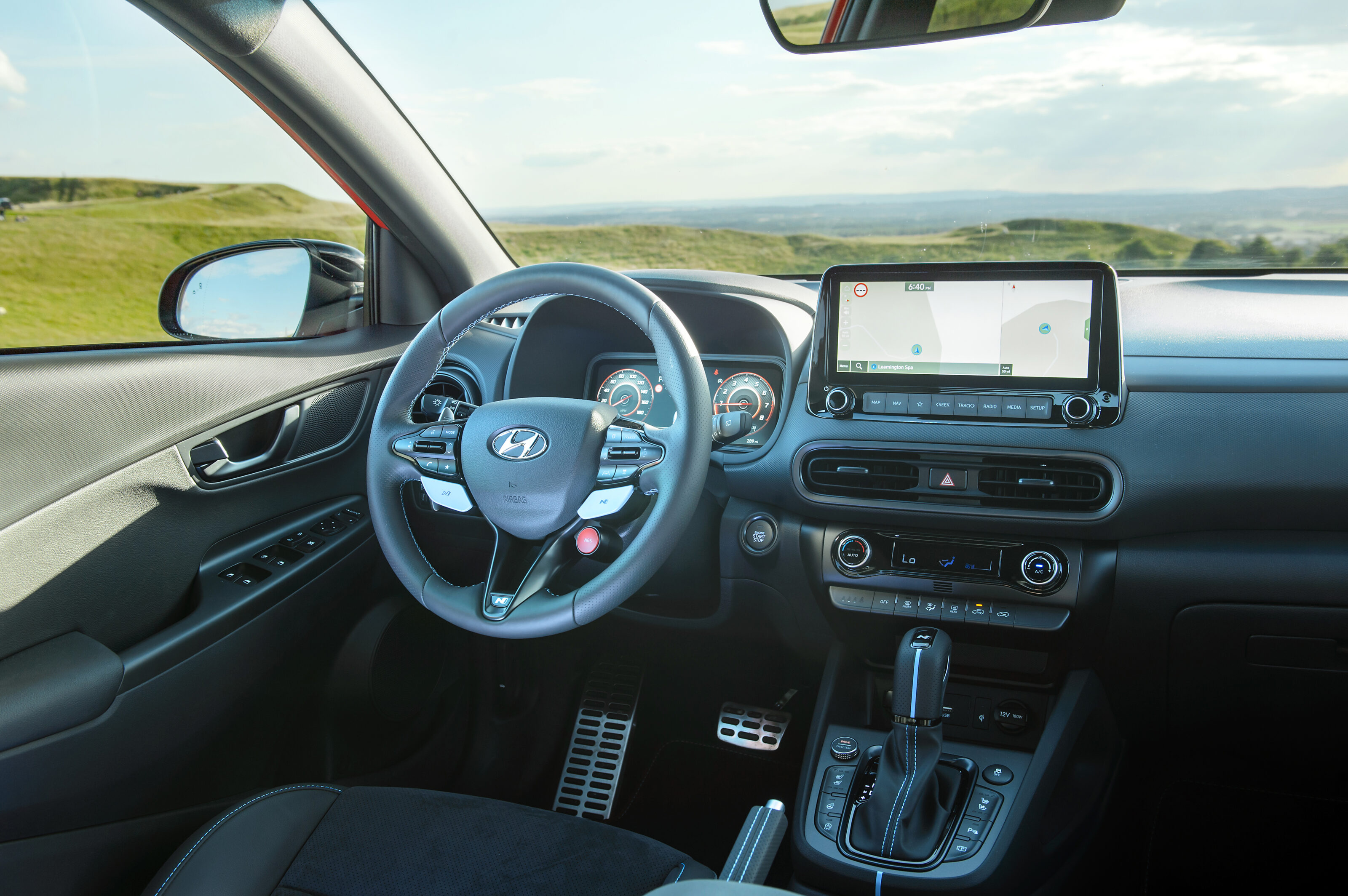
The front-wheel drive Kona N gets the N-spec electronically controlled limited slip differential, a revised power steering system with improved response and sensitivity
Alexander Eichler, a former Bosch engineer now working at the Hyundai-Kia tech center in Rüsselsheim to hone the dynamics of all the company’s cars and SUVs, sums up the Kona N’s mission statement this way: “The target was to make it drive like the i30N.”
Job done, at least in a straight line: By Hyundai’s own numbers the Kona N is only a tenth of a second slower than the i30N to 100km/h, taking 5.5 seconds with launch control, and 6.4 seconds without.
But Eichler readily concedes you can’t argue with Isaac Newton in the twisty bits. Boasting the same 173mm ground clearance as the regular Kona, the Kona N is 120mm taller than the i30N. It also weighs about 30kg more “The biggest challenge with the Kona N was its higher center of gravity and higher seating position,” he says, “so we had to make it quite stiff to be as sporty as the i30N.”
Now, when a German chassis engineer tells you a car has stiff suspension, hold on to your kidneys. And with the dampers set in anything other than Normal mode, the Kona N’s ride is indeed brutal, with heaves and humps instantly transformed into violent vertical body motions that can unsettle both car and driver.
Eichler admits Hyundai’s own hotshoes put the suspension in Sport mode rather than full commando N mode to nail a quick lap at the Nürburgring Nordschleife, a track whose endlessly undulating topography is the ultimate test of chassis composure.
“Generally, the philosophy of the N mode is to be optimized for a really flat racetrack,” he says. “We do not expect our vehicle to perform well in N mode on public roads.”
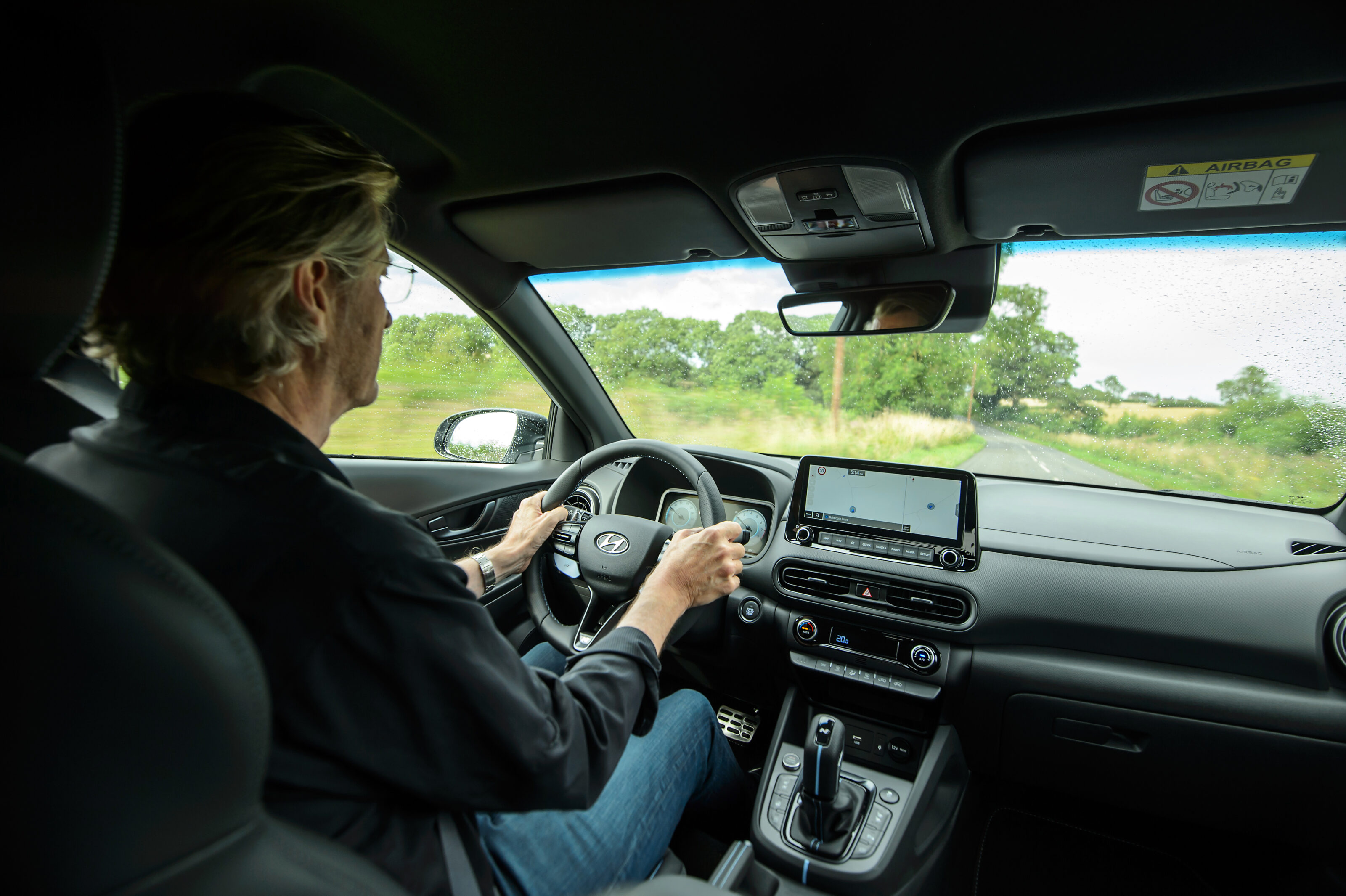
Leaving aside any discussion as to why anyone would want to take an SUV to a racetrack in the first place, we’ll give Eichler points for honesty. But, as we found on the back roads of leafy Warwickshire, the Kona N is not quite as one dimensional as you might think.
Despite 39Nm more torque and a flatter torque curve – all 392Nm is available from 2100rpm through to 4700rpm – the Kona N’s engine still feels a little dozy below 2500rpm. It’ll mooch around happily enough at low revs in Normal mode with the dual-clutch tranny shifting itself, but if you’re having a lash, using the paddles to shift manually, it’s happiest kept spinning between 3000rpm and 6000rpm.
It’s not a high-revving powerplant – everything’s pretty much done and dusted by 6200rpm – but it doesn’t need to be.
The new eight-speed dual-clutch transmission is quick and smooth and allows you to make the most of that broad swathe of mid-range grunt. Designed and built in-house by Hyundai, the DCT is a wet-clutch design, meaning it pumps oil on to the clutches to keep them cool, allowing them to handle more torque.
With the powertrain switched to N mode, the sophisticated control software allows for near seamless upshifts when it detects more than 90 per cent throttle being used.
The transmission’s neatest trick, though, is what Hyundai calls Track Sense Shift. In N mode, the Kona N can sense when it is being driven on a track and activates an adaptive shift protocol designed to automatically deliver both upshifts and downshifts at precisely the right moment.
We’ll wait until we get the car on a circuit we know before making a definitive call, but on the poky little test track Hyundai included in the drive program, it felt as brilliantly intuitive as Porsche’s PDK in Sport Plus, shuffling the ratios quicker, more authoritatively than could be managed by fanning the paddles on the steering wheel.
As with other N models, the Kona N comes standard with not only launch control, but also rev matching and the ability to completely switch off the stability control nannies.
N Grin Shift is a cartoonish moniker for a button on the steering wheel that does pretty much the same thing Porsche’s Sport Response button does in a Sport Chrono Pack-equipped 911, switching the engine and transmission to their highest response modes for 20 seconds, no matter what mode you’re driving in. Push to pass, in other words.
To get the best out of the Kona N on a good driving road, you’ll want to make sure you’ve pre-set the Custom tab in the N settings menu to allow the powertrain to stay in maximum attack mode while having the suspension and steering in their softer Normal settings. Configured this way, the Kona N does indeed drive like an i30N. On stilts.
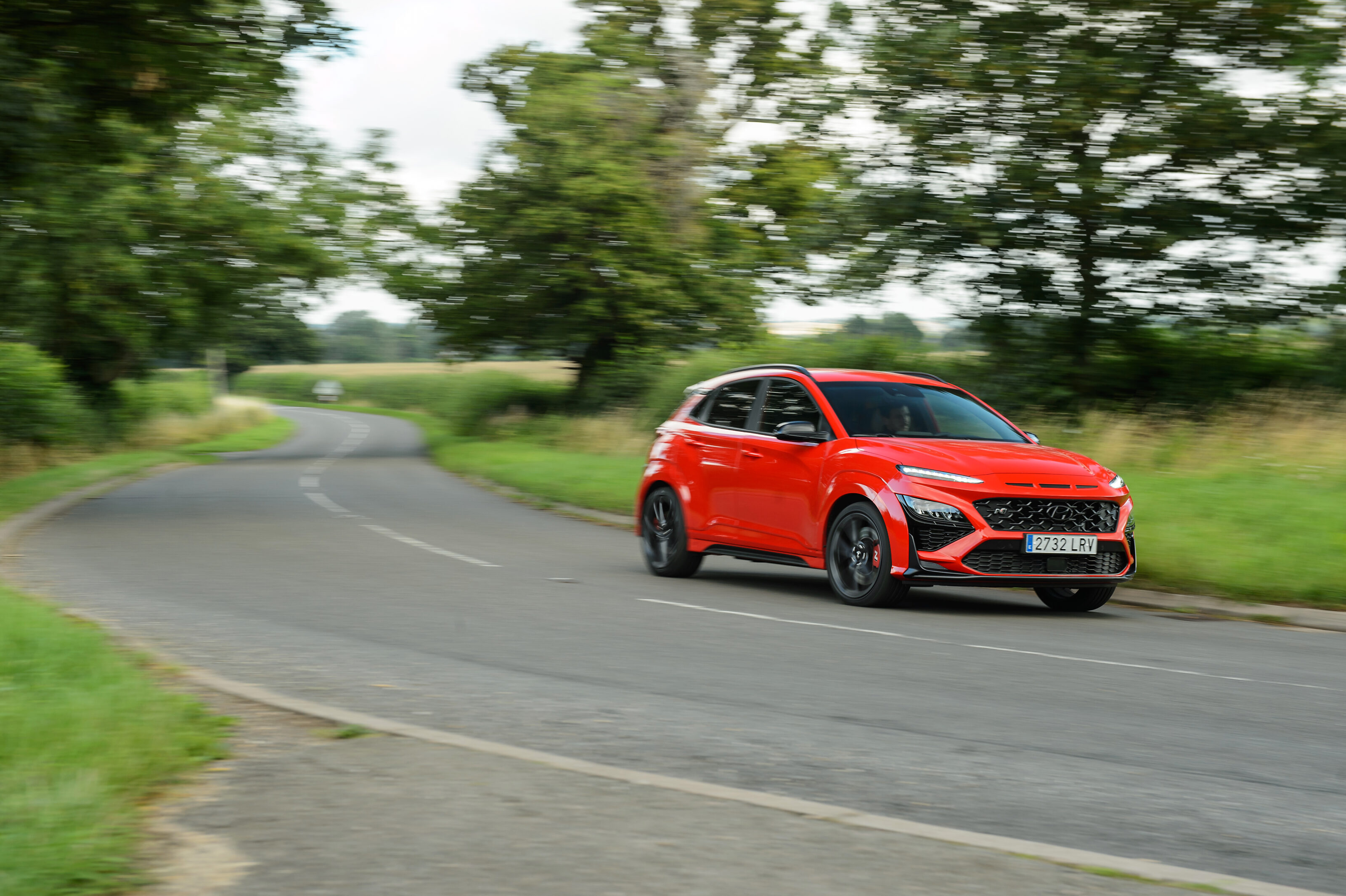
You’ll want to preset the Custom tab to keep the powertrain in maximum attack with the suspension and steering in Normal. Configured this way, the Kona N does indeed drive like an i30N. On stilts.
Even with the suspension in its softest setting, the ride is still very firm, but the more compliant damping allows the chassis to breathe over lumps and bumps, keeping the tyres in contact with the tarmac.
You’ll notice a slight latency on changes of direction when compared with the i30N, not the least because your bum and inner ear are further away from the tarmac. But once it’s worked through the transients, the Kona N grips with the same tenacity as its low-slung sibling.
As in the i30 N, the front end is astonishingly consistent, especially under load. That trick e-diff means you can get on the power almost as soon as you’ve rotated the Kona N towards the apex and stay on the power all the way through the corner.
You’ll notice some torque steer under full power in N mode, especially on uneven roads, as the e-diff vectors optimum torque to each front wheel, but the traction is deeply impressive. The front end will go exactly where you point it, the rear axle tracking it faithfully all the way.
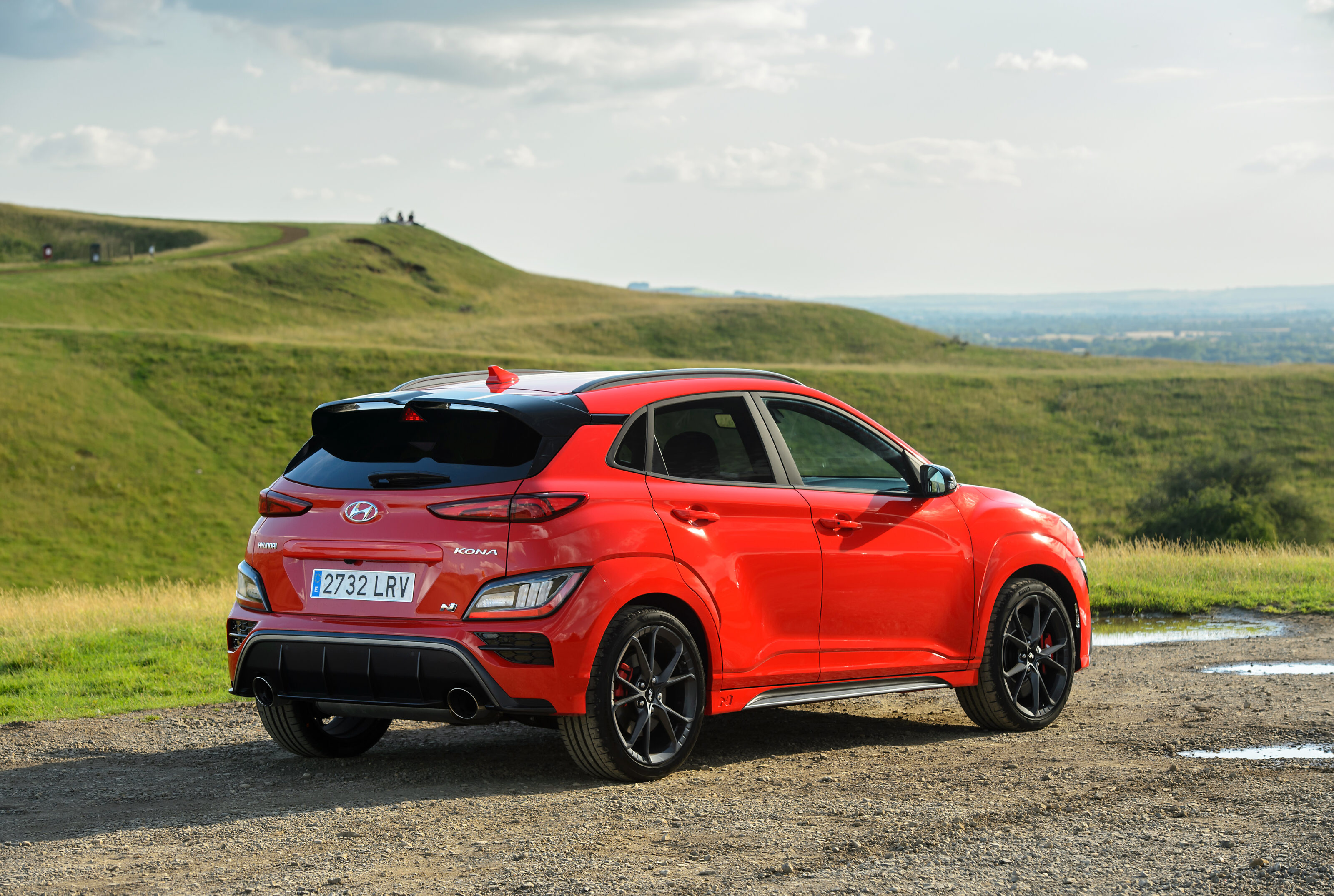
The laws of physics are immutable, however: No SUV can ever accelerate, stop, or steer as well as a lighter and lower car fitted with the same performance hardware.
If you want a proper Hyundai hot hatch buy the i30N, or wait for the i20N, a little zinger of a thing that puts the Fiesta ST on notice.
If you need a small SUV and want something that is genuinely quick and entertaining to drive, though, the Kona N is not only less compromised and more accomplished than you might expect, but also good value.
The Kona N will be available in two trim levels, each priced within a few grand of the i30 N manual and auto models. The entry level Kona N starts at $47,500, and the Kona N Premium, which adds suede and leather trim, heated and cooled power front seats, a glass sunroof, and a head-up display, among other things, starts at $50,500.
Exact timing is still to be confirmed, but the Kona N is due here in the third quarter of 2021.
2021 Hyundai Kona N specifications
| Body: | 5-door, 5-seat compact SUV |
|---|---|
| Drive: | front-wheel drive |
| Engine: | 1998cc turbo petrol four-cylinder, DOHC, 16V |
| Bore x Stroke: | 86 x 86mm |
| Compression: | 9.5 |
| Power: | 206kW @ 5500 rpm |
| Torque: | 392Nm @ 2100-4700 rpm |
| Power/Weight: | 136kW / tonne |
| Transmission: | 8-speed dual-clutch automatic |
| Weight: | 1510kg (kerb) |
| Suspension: | McPherson struts, coil springs, electronically controlled shocks (f), multi-link, coil springs, electronically controlled shocks (r) |
| L/W/H: | 4215/1800/1565mm |
| Wheelbase: | 2600mm |
| Tracks: | 1579mm front, 1575mm rear |
| Steering: | electrically assisted rack-and-pinion |
| Brakes: | Dual-Diagonal, Split-Circuit, Power Assisted + EBD. Ventilated discs u2013 360mm front, 314mm rear |
| Wheels: | 19 x 8.0-inch (front/rear) |
| Tyres: | 235/40 R19 (front/rear), Pirelli P Zero |
| Price: | $47,500 plus on-road costs |
The boss of BMW M, Markus Flasch, refers to them as ‘submarine projects’; namely the sort of after-hours labours of love that created cars like the Z3 M Coupe. That car, revered for its sheer left-field quirkiness was never going to be replaced like-for-like.
“I don’t think we can do entire models with this process,” Flasch accepts.
“The homologation process is just so formal.”
As a result, the Z3 M Coupe’s successor was a little more buttoned down, in appearance at least.
Like the Z3, the Z4 M was offered as both a coupe and a convertible, and carried over the later Z3 M’s S54 3.2-litre straight-six powerplant.
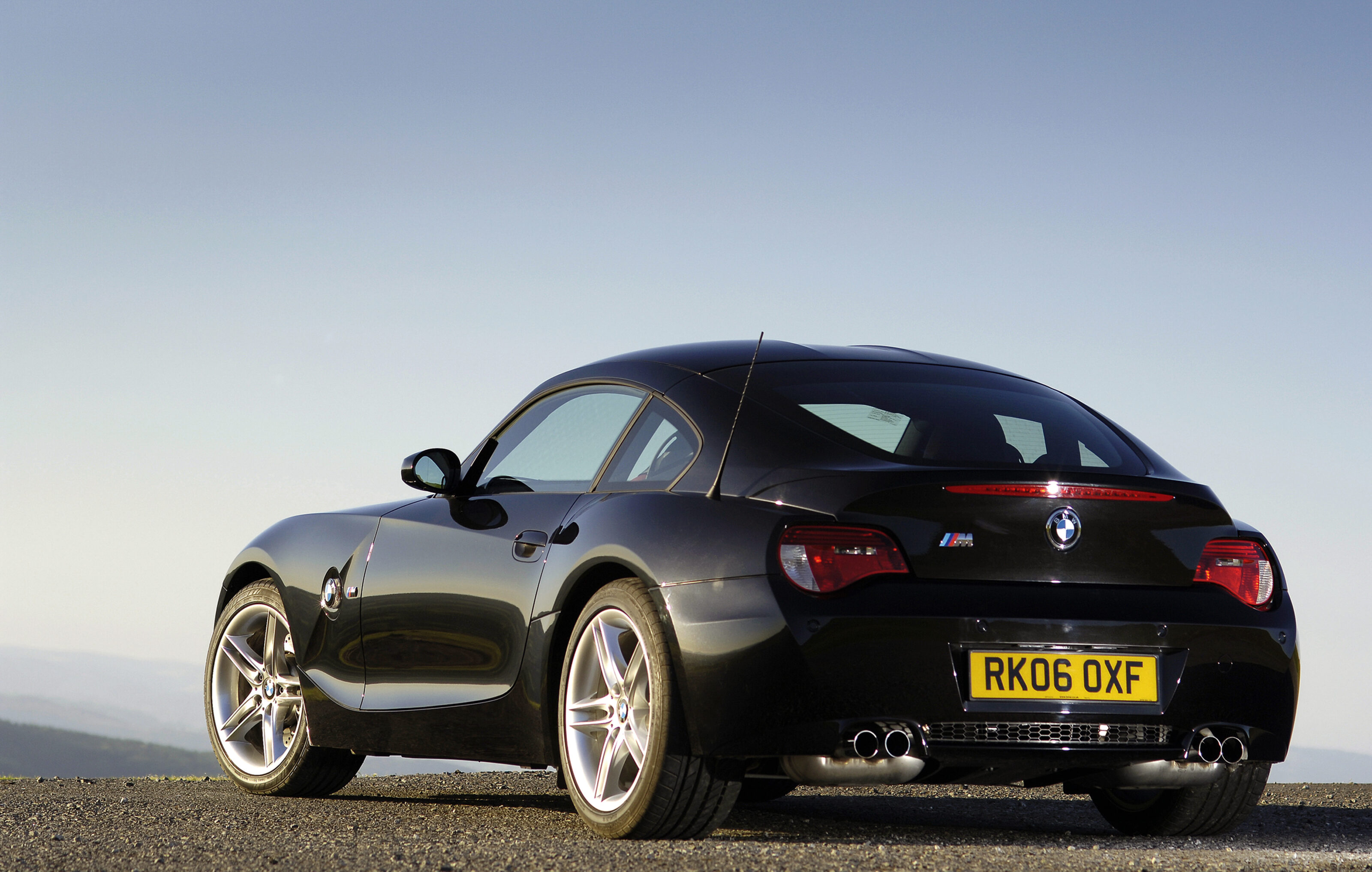
At the time, the car received a warmish review, but given that the wild proportions of the old Clown Shoe had been replaced by something more Munich corporate, and its cause wasn’t helped by the Porsche Cayman appearing a few months previously.
Still, the basic formula was shot through with promise. It got the best engine that BMW had, slotted into the stiffest chassis, driving the rear wheels via a six-speed ZF manual and a limited-slip diff. Hydraulic steering, a basic switchable stability control system and a proper handbrake mean the E86 Z4 M Coupe sits in that zone that many drivers today go a bit gooey-eyed over. It has all the elements you need to have fun without overegging the pudding.
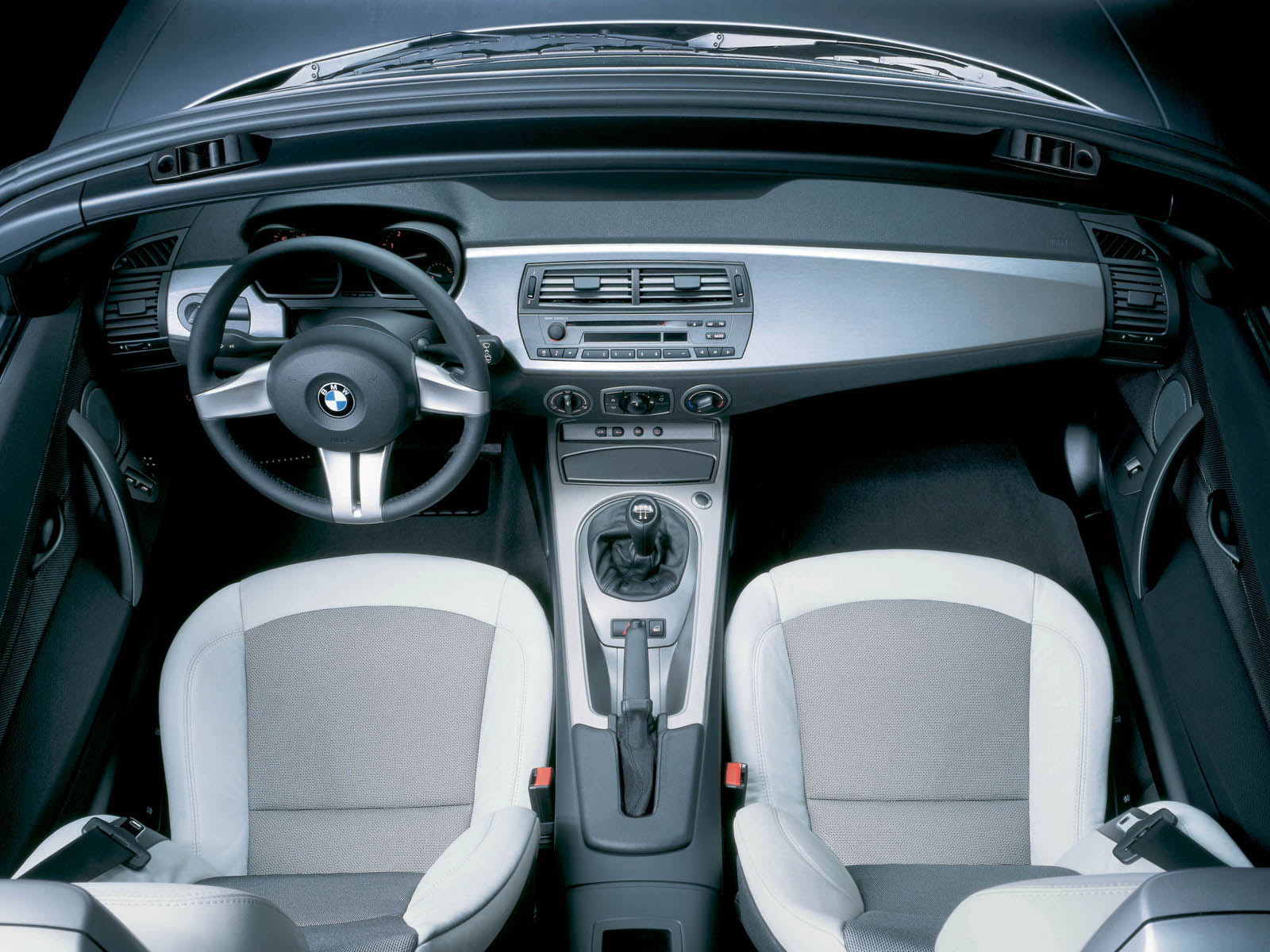
The brakes (from the E46 M3 CSL) are a little undercooked by today’s standards and the ride is distinctly firm, with spring and damper rates beefed up compared to its open-topped sibling. No twin-clutch transmission option was ever offered, largely because of physical packaging issues within the real estate available to the gearbox casing.
Neglected for some time by enthusiasts, values of the Z4 M Coupe have been marching steadily skywards of late, with the best cars nearing near six figures. It has quirks though. The early drive-by-wire throttle system can, somewhat strangely fall out of tune. Resetting it can improve throttle response and it’s easy to do. Just CTRL-ALT-DEL: turn the ignition on and wait for 10 seconds, then turn it off for 10 seconds, then turn it on again for 10, and start the engine. Reboot complete.
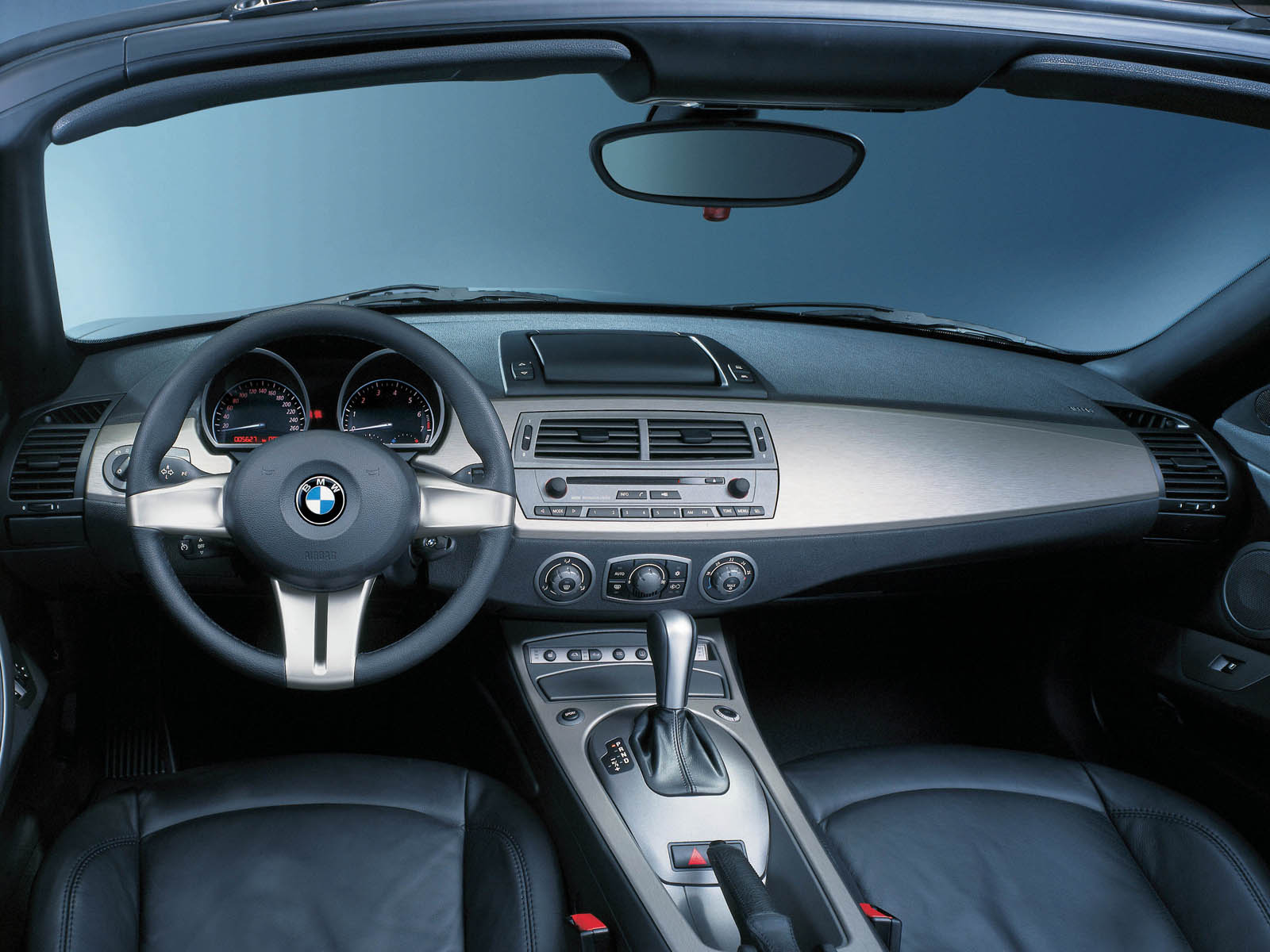
There are other odd anomalies. Whereas every other Z4 uses an E46-style front strut, the Z4M uses the older E36 style units. Why? Because the inherent design is a good deal stiffer.
The ride quality that many so disliked at launch was at least partly accounted for by the implacable sidewalls of the Z4 M’s tyres. Virtually all owners have subsequently ditched them and invested in a set of decent modern rubber to get a win-win in terms of ride and grip.
As a vehicle with one foot in the past and one tentatively tickling its toe into a bold new future, the Z4 M Coupe is a tantalising prospect and one that becomes ever more appealing every year. It had a hard act to follow but if you don’t fancy a Cayman and miss cars that can bare their teeth, try tracking one down.
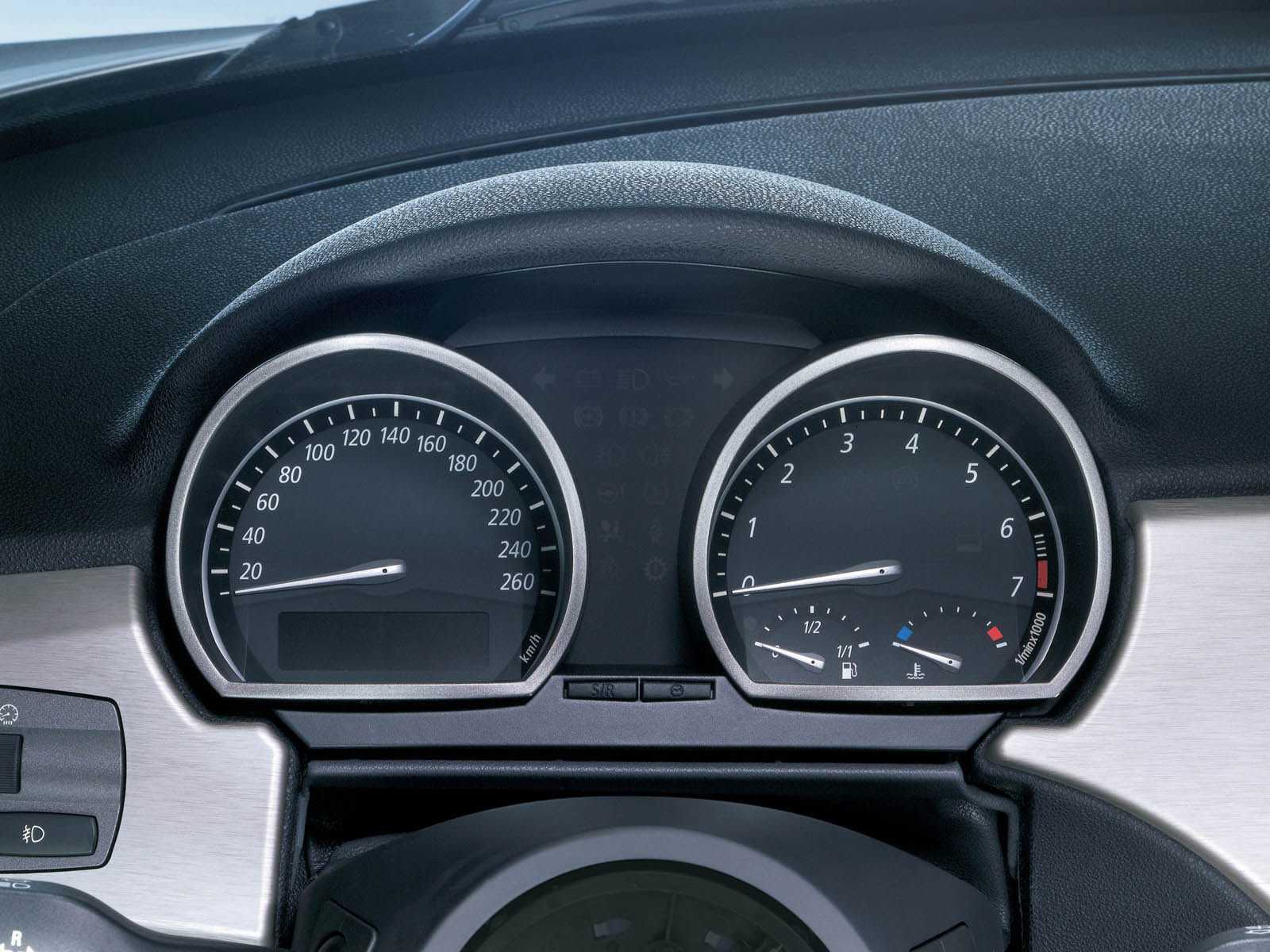
2006 BMW Z4 M specs
| Engine: | 3246cc inline-6, dohc, 24v |
|---|---|
| Power: | 252kW @ 7900rpm |
| Torque: | 365Mm @ 4900rpm |
| 0-100km/h: | 5.2s |
| Weight: | 1450kg |
Mercedes-Benz Australia is recalling 25 of its Vito and V Class vans due to a loose roof railing.
According to the Department for Infrastructure, the problem affects vehicles built in 2020.
The centre support for the external roof railing may become loose or detach while driving, which could result in any load it was holding being lost and the separated railing causing injury to occupants or other road users.
Owners are advised to make an appointment with their local authorised Mercedes-Benz dealership to fix the issue urgently. The roof railing will be checked and replaced if necessary.
A list of VINs for affected vehicles can be found here.
Mercedes-Benz can be contacted on 1300 300 896 or via the website at: www.mercedes-benz.com.au
Snapshot
- Prices start at $119,900
- Bi-turbo straight-six diesel produces 261kW/730Nm
- Deliveries expected to begin around December
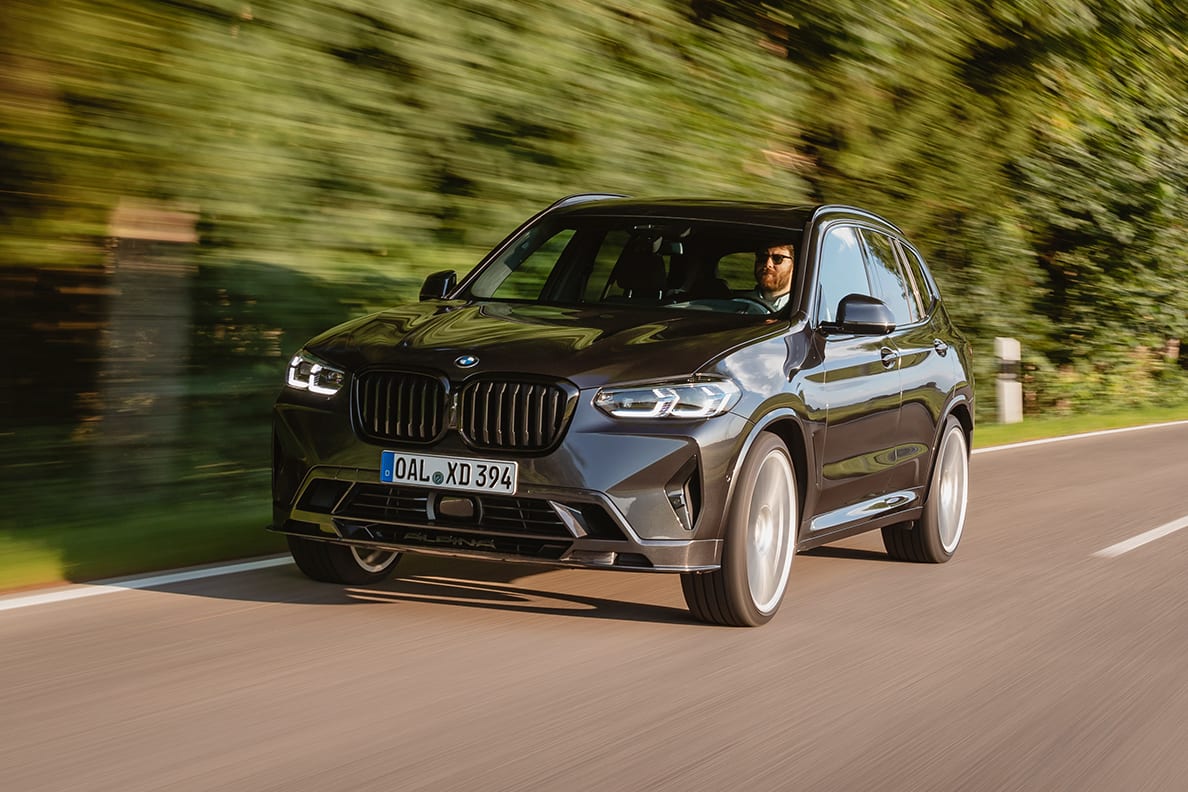
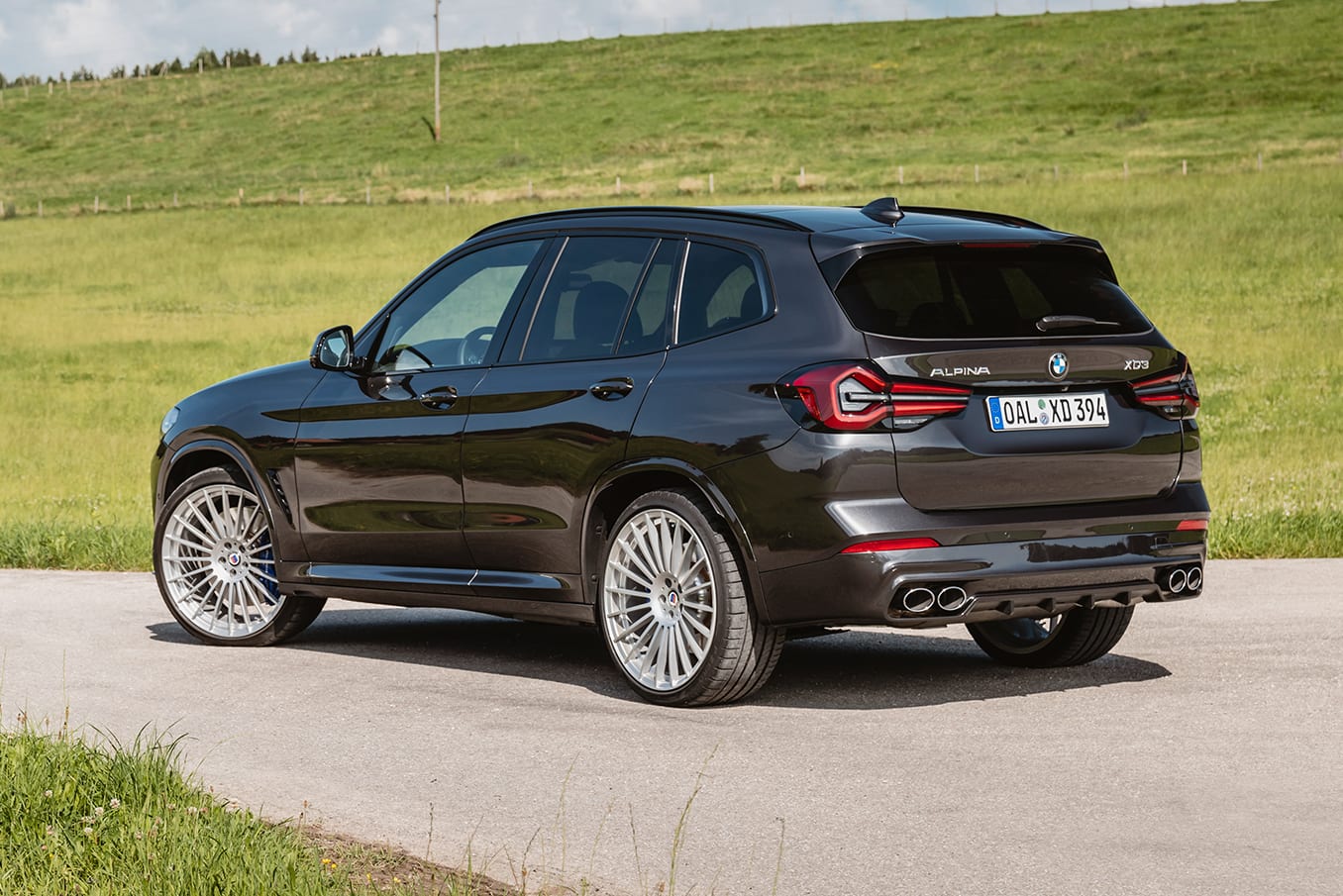
BMW Alpina has released the pricing and features of its updated XD3 ahead of the model’s arrival later this year.
Utilising the BMW X3 xDrive30d as a base, the XD3 gains 48-volt hybrid assistance and performance hardware to push power and torque up to 261kW and 730Nm – a 66kW/110Nm boost over its donor.
Starting at $119,900 before on-road costs, the 2021 XD3 is $10,900 more than its predecessor and an extra $25,000 on top of the X3 xDrive30d – a considerable jump which is justified with a more premium range of standard equipment.
Features
Available as in just one trim level, the XD3 comes with a long list of features as standard, including:
| 20-inch Alpina Classic alloy wheels |
| Alpina brake system |
| Active Air Stream kidney grille |
| Dual-zone climate control |
| Front, side and head airbags, passenger airbag deactivation |
| Alarm system |
| Ambient lighting |
| Apple CarPlay |
| BMW Icon adaptive LED headlights |
| Comfort access with smart-opener |
| Connected package professional |
| DAB tuner |
| Driving assistant professional |
| Enhanced bluetooth telephone preparation with USB audio interface and voice control |
| Alpina stainless steel exhaust system with double-ended tailpipes |
| Extended storage |
| Folding wing mirrors with auto-dimming |
| Alpina front spoiler |
| Galvanic embellisher for controls |
| Head-up display |
| Anthracite headlining |
| High-beam assistant |
| Instrument panel in Sensatec |
| Intelligent emergency calling |
| Interior rear-view mirror, automatically-dimming |
| Larger fuel tank (68 litres) |
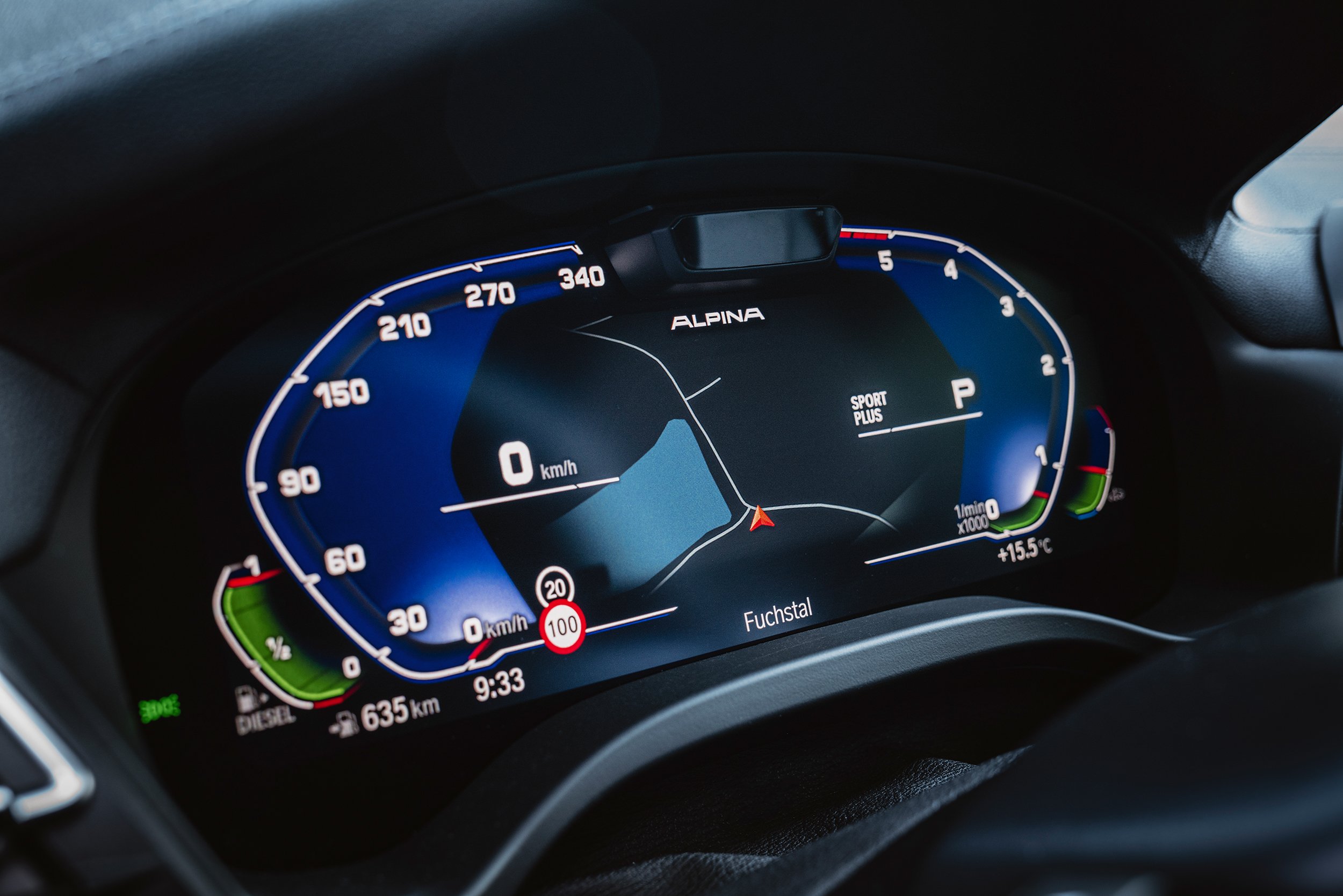
| Live cockpit professional in Alpina design |
| Loudspeaker system u2013 Harman Kardon with 16 speakers |
| Luggage compartment separating net |
| Panoramic glass sunroof |
| Parking assistant plus |
| Production plaque with production number |
| Rain sensor with automatic headlight activation |
| Alpina rear valance |
| Heated and electric front sports seats with memory |
| Sport rear differential |
| Sport suspension |
| Steering wheel heating |
| Through-loading system |
| Tyre pressure monitoring |
| Variable sport steering. |
Options
BMW Alpina also offers a range of optional extras for the XD3, such as:
| 22-inch forged Alpina Classic wheels |
| Merino leather upholstery |
| Lavalina leather upholstery |
| BMW drive recorder |
| BMW gesture control |
| Exterior in high-gloss shadowline with extended contents |
| BMW Individual Lights in shadowline |
| Alpina floor mats with leather piping |
| Alpina luggage compartment mat |
| Alpina luggage compartment mat with leather piping |
| Rear seat backrest adjustment |
| Front seats with active seat ventilation |
| Seat heating to front and rear seats |
| M Sport front seats with embossed Alpina logo |
| CNC-milled, all-aluminium gearshift paddles |
| BMW laserlights |
| Sun protection glass |
| Acoustic glazing |
| Sun-blinds to rear side windows |
| High-performance brake system. |
Paint finishes
| Black sapphire |
| Phytonic blue |
| Sophisto grey |
| BMW Individual tanzanite blue II |
| BMW Individual special paintwork (on request). |
Interior trims
| Black |
| Mocha |
| Oyster with black stitching |
| Black with blue stitching (with optional M Sport seats) |
| Cognac (with optional M Sport seats) |
| Aluminium fine-cutting (NCO) |
| Aluminium rhombicle (NCO) |
| Dark oak fine-wood |
| Ash trunkwood open pored fine-wood |
| Carbon fibre. |
Engine, drivetrain and fuel economy
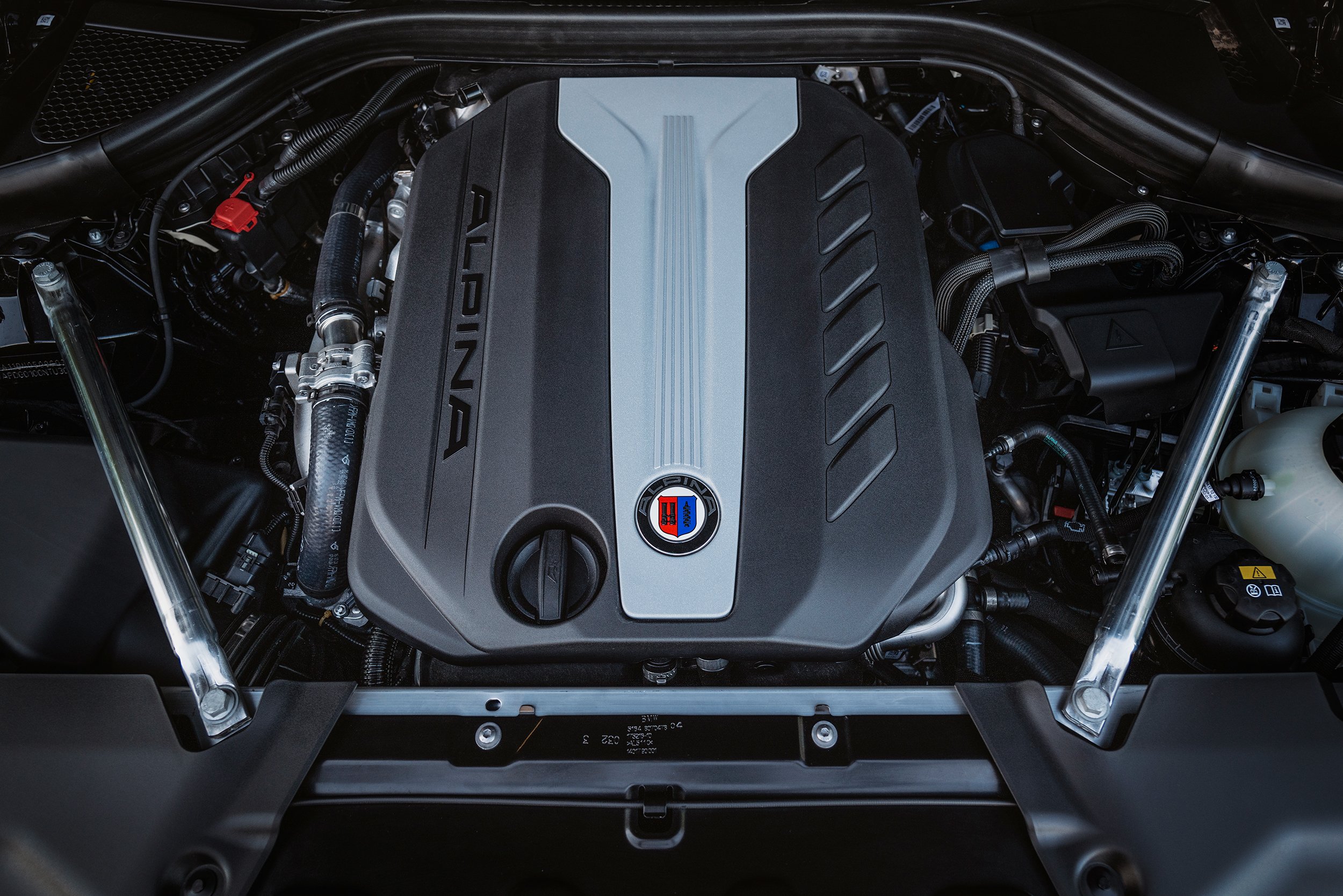
Utilising BMW’s 3.0-litre, straight-six bi-turbo diesel engine as its base, Alpina has installed a larger intercooler, transmission oil cooler and radiators to help support the XD3’s 261kW and 730Nm – which helps the car achieve a claimed 0-100km/h sprint time of 4.9 seconds.
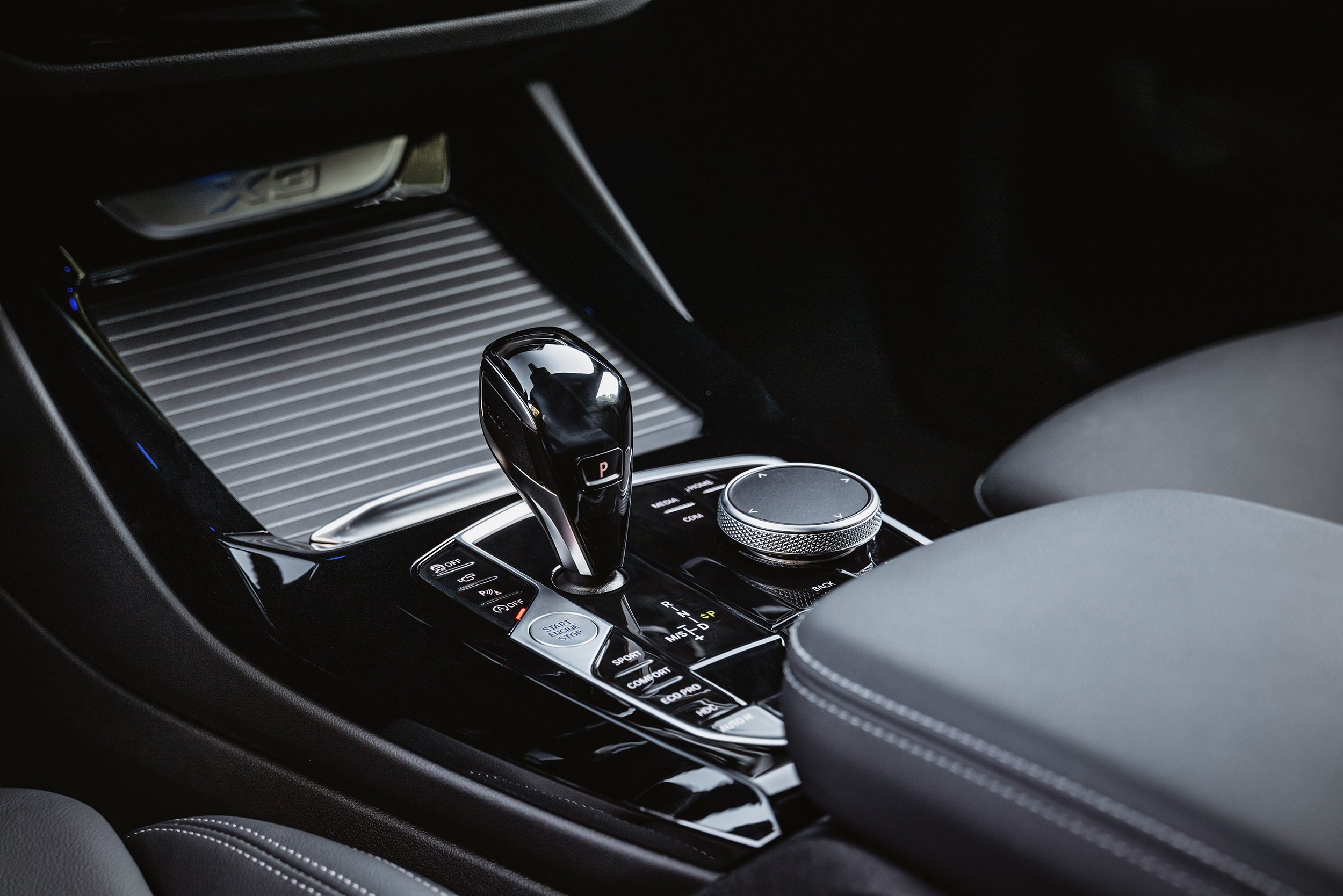
Power is sent to all four wheels through an eight-speed torque-converter automatic gearbox, controlled through either Alpina’s switch-tronic gearshift buttons or paddles behind the steering wheel.
A limited-slip differential can be found on the rear axle, helping control the power and torque, which is predominantly sent to the rear wheels.
With a rated combined fuel economy of 6.8L/100km, the XD3’s consumption is higher than the X3’s 6.0L/100km.
Warranty and servicing
BMW Alpina offers a three-year/unlimited-kilometre warranty for the XD3, providing complimentary roadside assistance for the same period.
The BMW Service Inclusive program is also available for the XD3, allowing buyers to include their future services in the purchase price.
Availability
The 2021 BMW Alpina XD3 is on sale now through select BMW premium dealers, with deliveries set to begin around December.
Snapshot
- Reports as-yet unsubstantiated
- Limited RX-8 and Premacy used dual-fuel rotary
- New ‘R’ logo and trademarks suggest future performance cars
Could Mazda be developing a hydrogen-powered rotary engine for a next-gen sports coupe?
If this report from Japan is anything to go by, it’s a distinct possibility.
According to publication Best Car, Mazda is exploring the idea of a new rotary that would burn hydrogen fuel in place of petrol.
While the reports are so far unsubstantiated, Mazda has dabbled with hydrogen in the past.
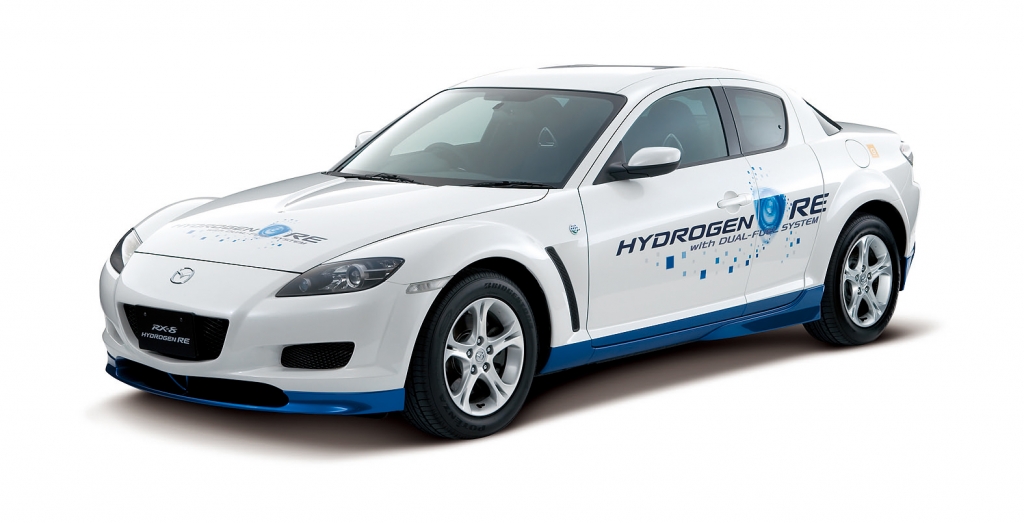
In 2003, the marque revealed a bi-fuel version of the RX-8 configured to run on either hydrogen or petrol. They followed with the Premacy Hydrogen RE Hybrid in 2005, several of which were eventually leased to Japanese businesses.
Best Car also points out that hydrogen is well-suited to rotary engine layouts. While the dense fuel is prone to severe pre-detonation from ‘hot spots’ common to piston engines, a rotary features more uniform heat distribution, and therefore less risk.
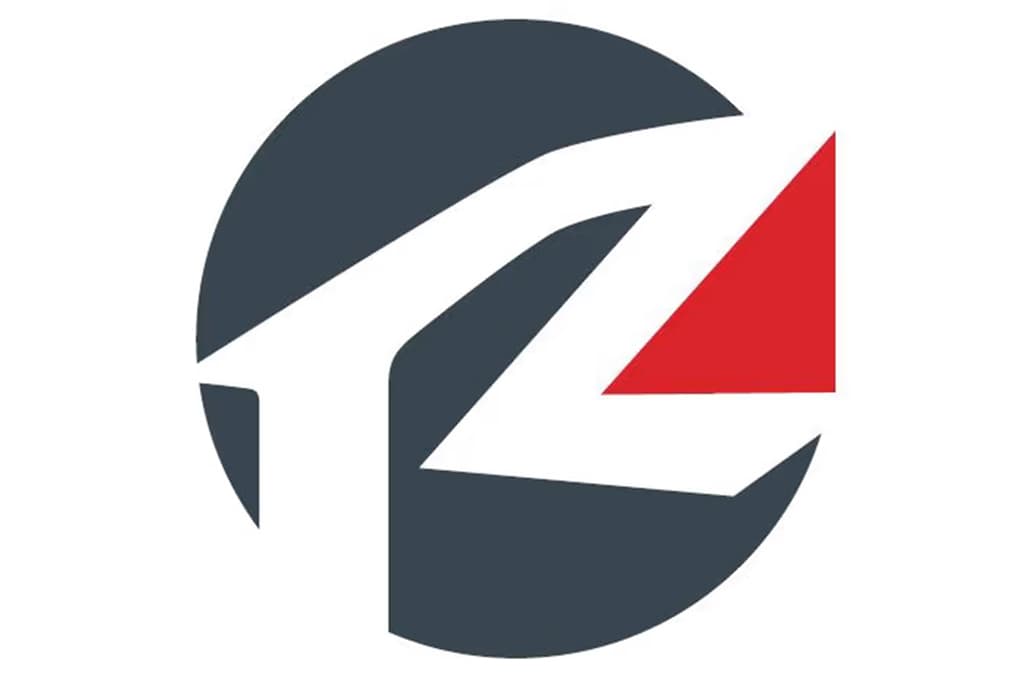
This new report follows Mazda’s recent trademark of a new, stylised ‘R’ logo.
Some commenters have pointed out a similarity between the new logo and the ‘R’ used on the RX-7 Spirit R and RX8, with others suggesting the triangle represents a rotary engine design. If this hydrogen rotary rumour proves true, it opens up a possibility for a long-requested Mazda RX-9 — one bolstered by Mazda patenting a coupe design last year.
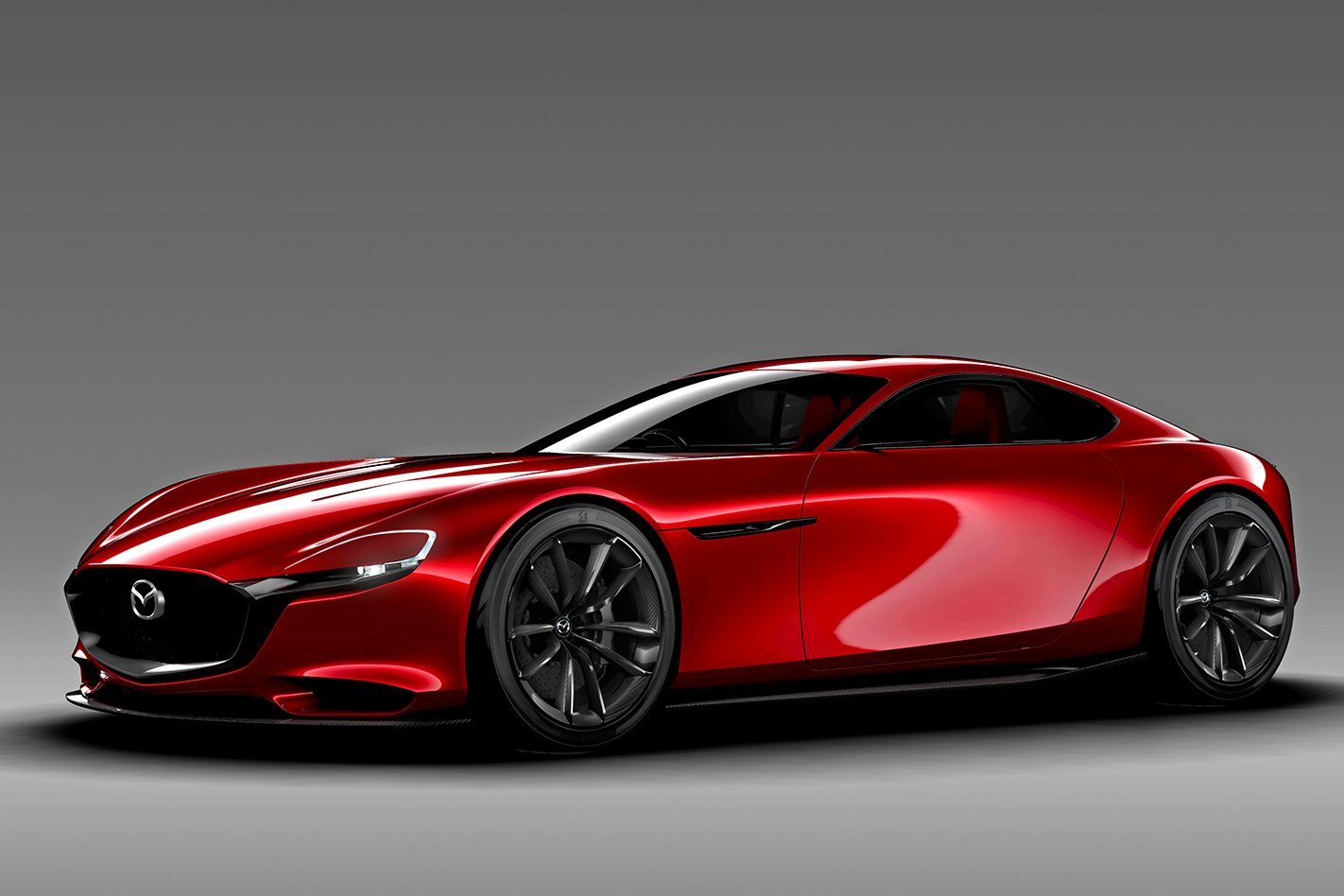
While this could simply be wishful thinking by sports car enthusiasts, Mazda’s RX-Vision concept teased rotary power back in 2015. Since then, the brand has confirmed it will build a new rotary powerplant – albeit as a compact range-extender for the electrified MX-30 crossover.
For now, speculation on any hydrogen ventures by Mazda is just that, but we’ll keep you updated as fresh information comes to light.
Snapshot
- Chassis #001 was sold at Mecum Auctions during Monterey Car Week
- Rick Hendrick purchased the first Type S available outside of Japan
- Final sale over six times higher than list price
The rights to the first car from the final run of Acura NSXs has been sold over the weekend.
With Acura and Honda announcing last week they would be wrapping up NSX production by introducing upgraded Type S, the allocation rights to the first of the 350 examples crossed the block at Mecum Auctions as a part of Monterey Car Week.
Normally on sale to the public at a list price of US$169,500 (AU$231,000), chassis #001 was sold for US$1.1million (AU$1.5m) to Rick Hendrick – owner of NASCAR’s most successful team, Hendrick Motorsports.

While the sale price is US$930,000 more than the sticker price of an NSX Type S, Acura announced it would be donating all proceeds to charity, with the money going towards the Center of Science and Industry (COSI) to support STEAM education (Science, Technology, Engineering, the Arts and Mathematics) in the United States.
Hendrick also owns the first production second-gen NSX, having purchased the MY2017 car at a Barrett-Jackson auction in 2016 – with the proceeds from the sale going towards the Pediatric Brain Tumor Foundation and Camp Southern Ground.
Limited to 350 units worldwide and with 300 allocated to the United States, the NSX Type S packs an upgraded 3.5-litre V6 twin-turbo engine, now making 447kW and 667Nm – while exterior changes have sharpened up its looks and lowered the overall weight, allowing the Type S to lap Suzuka two seconds faster than the standard car.

