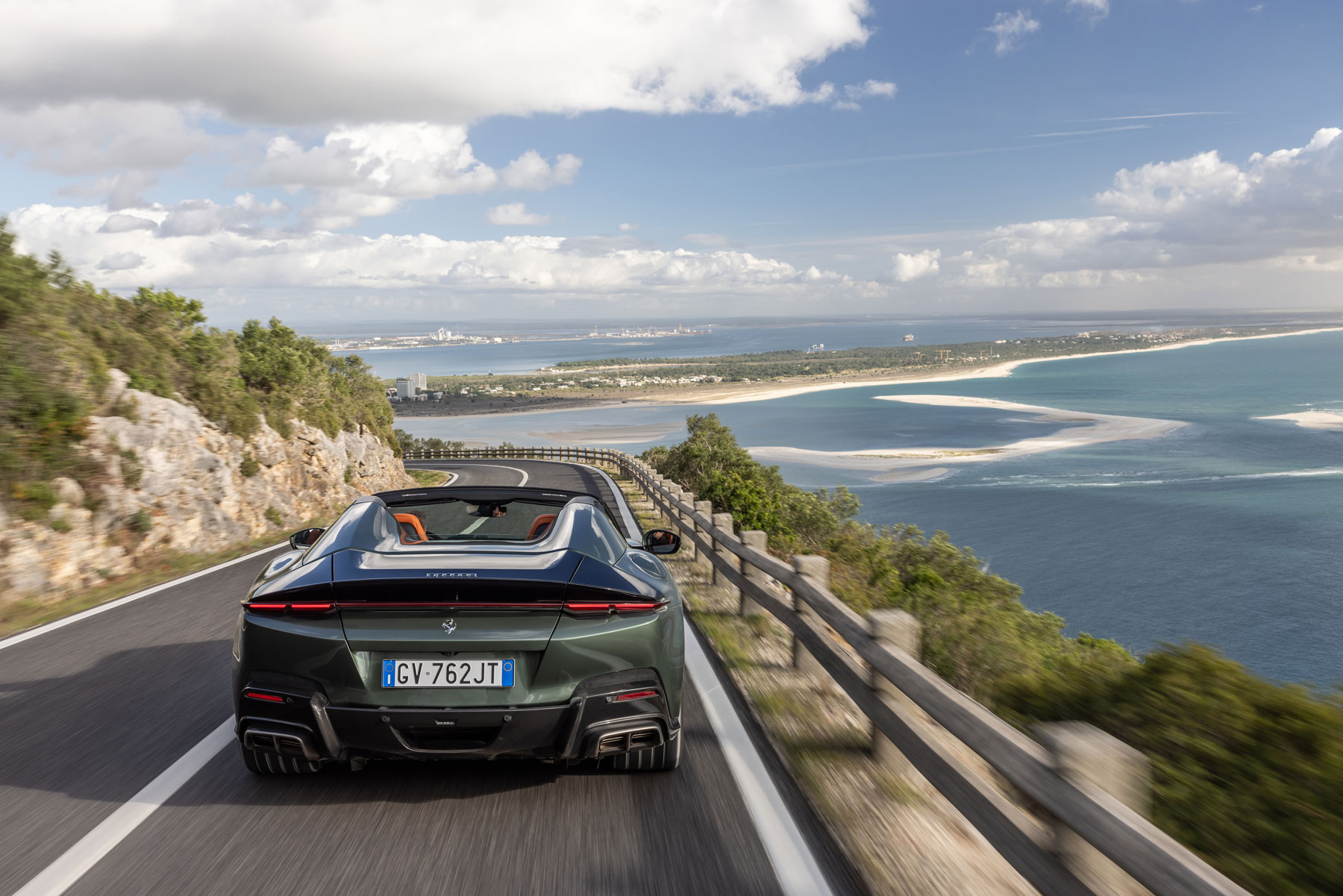
CABO DA ROCA is where the European mainland runs out of resolve. The westernmost point of the continent is assailed by over 5500km of North Atlantic fetch, great grey-green rollers lining up in perfect sets to beat upon the Portuguese granite. Keep heading due east and the next landfall would be a scruffy beach in Delaware, USA.
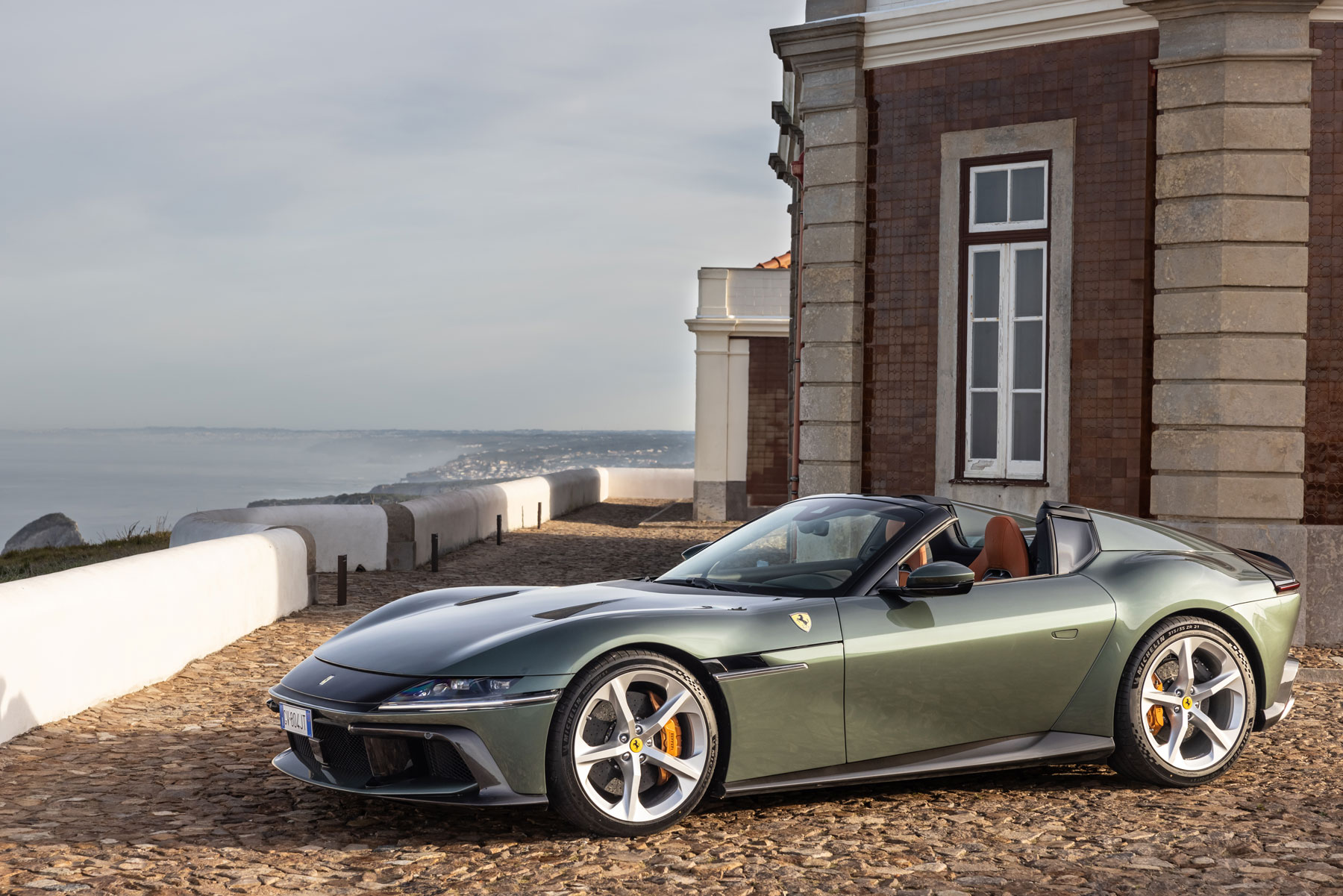
Today feels very Atlantic. It’s blustery and the wind is whistling through the flagpoles that stand by the lighthouse, the lanyards balefully clanging against the poles. It’s not really convertible weather, but if you have a box-fresh Ferrari 12Cilindri Spider at your disposal, you’re going to want to let a bit of that fresh salt tang in.
1
I’ve driven up from the fishing village of Cascais this afternoon, attempting to follow the coast north in order to get a feel for Ferrari’s 6.5-litre V12 GT. I’m not really sure quite what to make of it just yet. Its predecessor, the 812 GTS, could fox you like that. The classical front-engined form factor suggested GT car, but the driving experience was as hardcore as any mid-engined supercar. I still haven’t figured out quite what this car is trying to be. Time to point the nose north and put some miles under its belt.
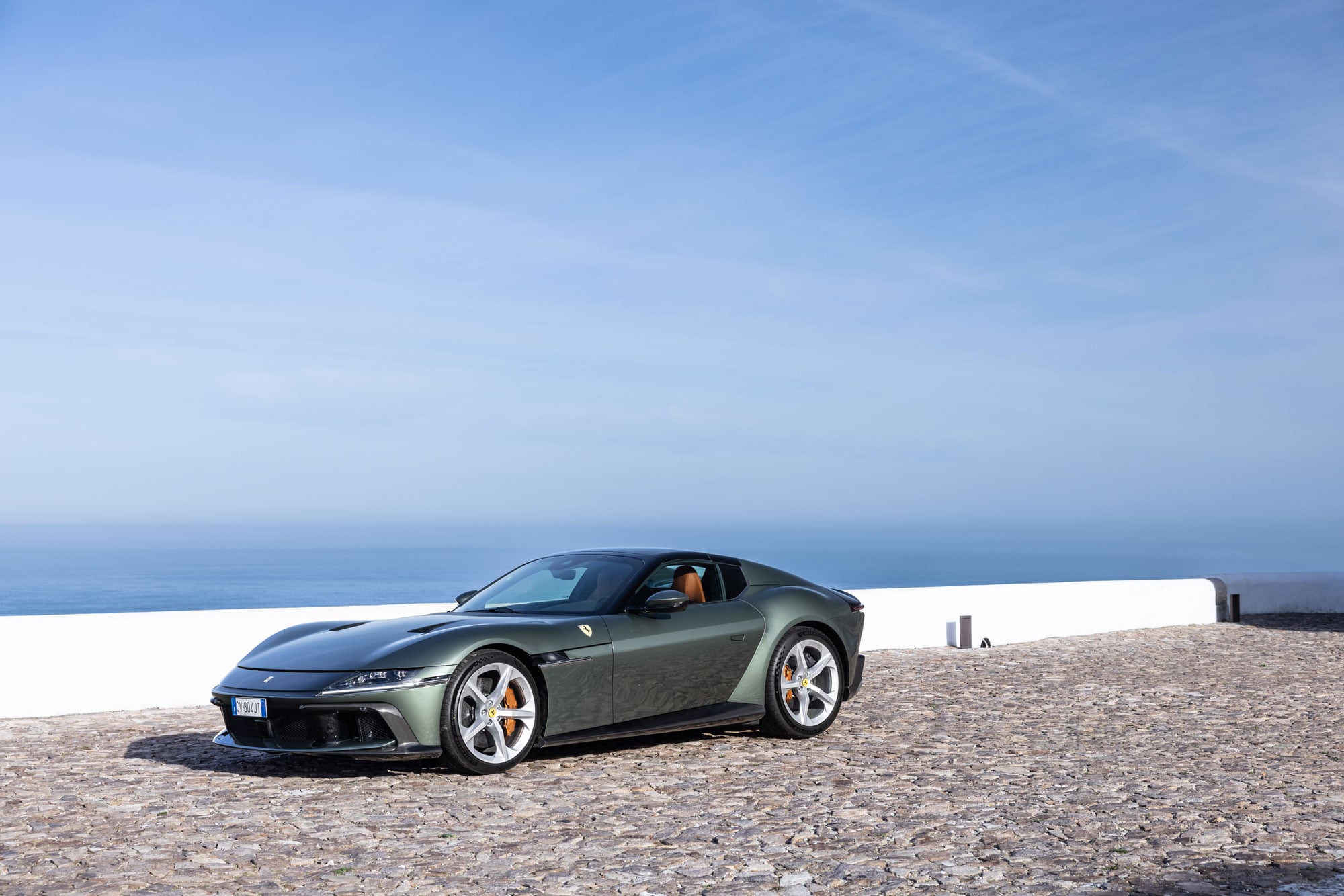
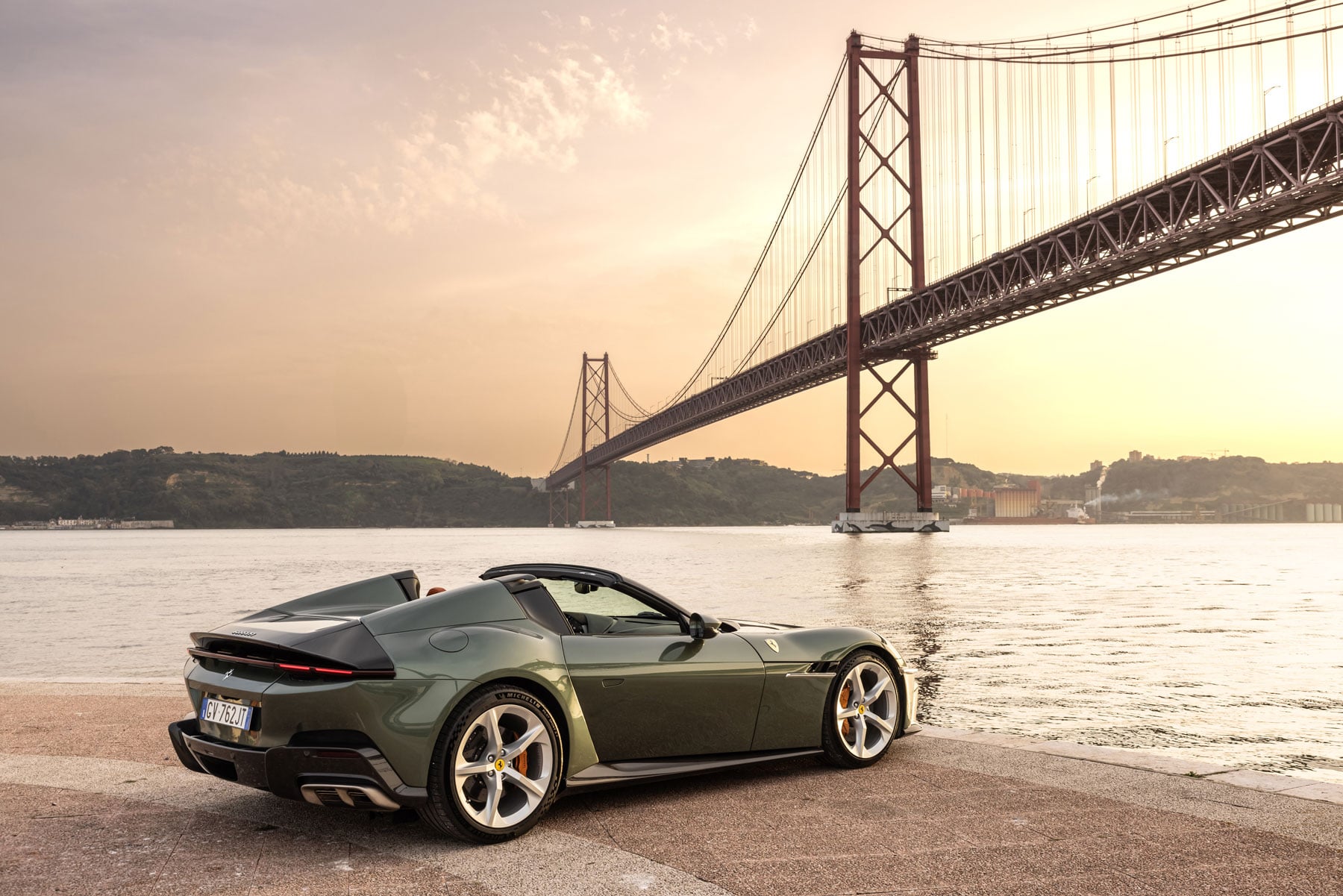
It feels big. Part of that comes from the sensation that you’re sitting right on the rear axle, with stacks of Verde Toscana bonnet reaching out ahead of you before diving down to that Daft Punk meets Daytona visor at the front. It’s wide too, and while that’s not a problem on the open coastal stretches, the road climbs inland over bluffs and palisades, throwing in enough tight and damp hairpins to keep things interesting.
The Spider adds another 60kg to the 1560kg kerb weight of the berlinetta version, which doesn’t seem excessive for a well insulated, four-hydraulic cylinder, rigid hard top assembly. In actual fact, the roof and its aluminium alloy structural roll bar totals 40kg, with the other 20kg being accounted for by additional structural reinforcements.
1
The design of this roof has had to walk a bit of a tightrope because Ferrari didn’t want to compromise on the 200-litre boot capacity and was also keen to retain the functionality of the active aero ‘winglets’ at each rear corner, the motorised tonneau cover’s aero design having to work hand-in-hand with these signature elements.
In creating the Spider and berlinetta at the same time, Flavio Manzoni’s team at Centro Stile has been able to overcome these issues in a cohesive way. Early orders here in Australia seem to back up the company’s claim that the sales split is almost a perfect 50:50 between the coupe and the convertible.
This is a very good convertible too. The local roads aren’t the smoothest, but there’s little in the way of obvious scuttle shake, something that has afflicted metal-chassised Ferrari drop-tops in the past. The company claims a torsional stiffness increase of eight percent over its predecessor but won’t quote hard numbers. The roof itself motors up or down in just 14 seconds and can be operated at speeds of up to 45km/h.
There’s little in the way of scuttle shake, something that has afflicted metal-chassised Ferrari drop-tops in the past
Despite the tasteful green over tan finish, I’m still feeling a little self-conscious in a car that costs over €625,000 (over $1m Aussie) in a country that’s being pummelled by a savage cost of living crisis. In Australia, we have to hand over $886,800 for one, an $83,300 premium over its fixed-head sibling.
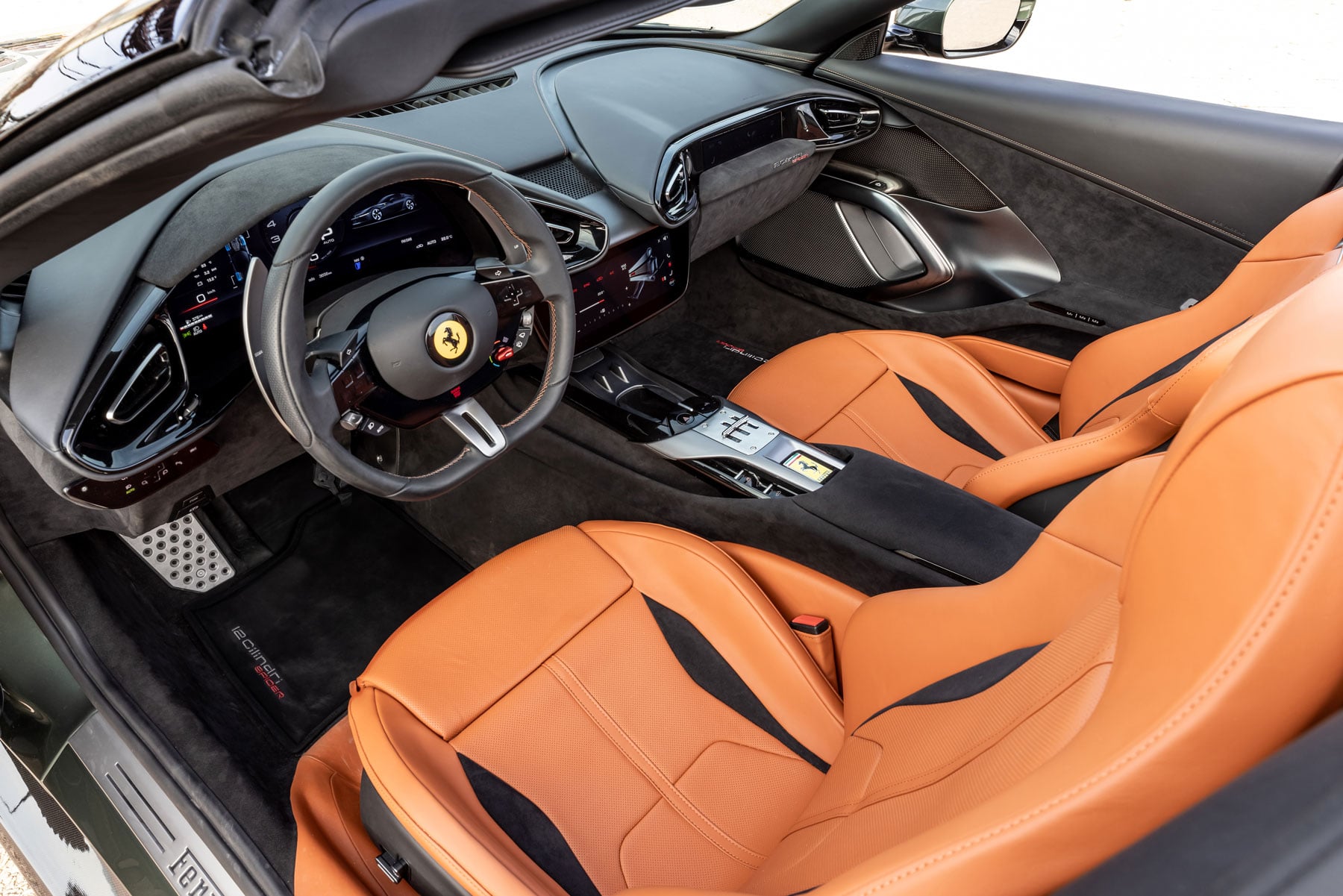
Like all modern Ferraris, the user interface takes some time to gel with. The car’s supplied with a nose lift, required to inch over many of the precipitous speed humps that act as village ramparts around here, but it’s a tab on the central touch screen. I’d prefer if it were a hard-keyed function on a physical button.
1
The steering wheel is festooned with touch sensitive controls, but Maranello has clearly listened to feedback on this, as these controls go dark and dead after a few seconds so that you’re less likely to activate them during a frantic bit of wheel-twirling. Not that there’s too much of that required with fourwheel steering making the ratio very quick at low speeds, working in concert with the e-diff.
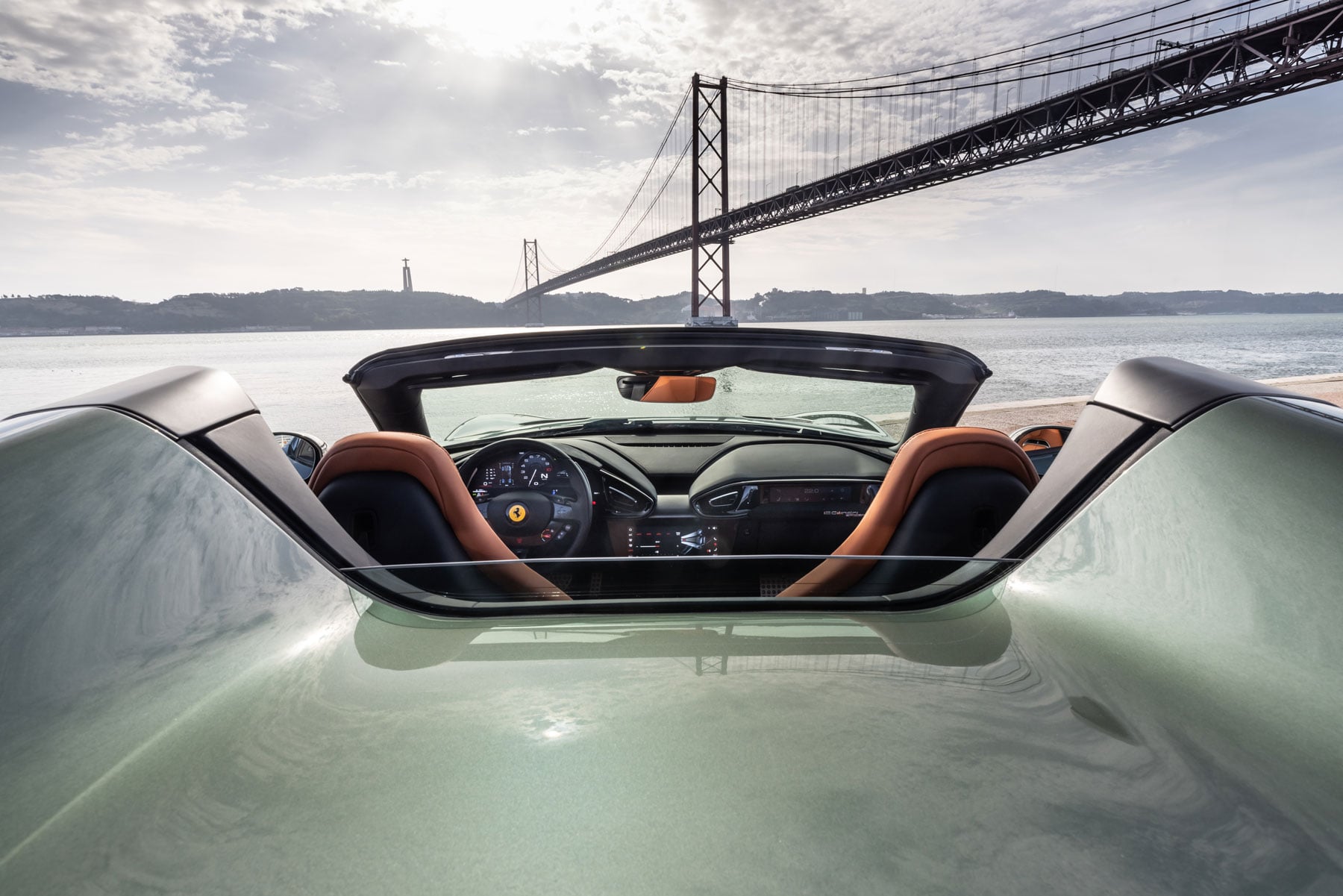
The cabin’s a bit of an odd fit. I expected that it’d be pinched for headroom for tall blokes like me, but it’s really well provisioned on that particular axis. Where it’s not quite so generously cut is in length, which means that you’ll tend to motor the seat quite close to the wheel to get adequate rake on the driver’s squab.
To operate the roof you pull at a toggle set a long way aft on the centre console. Like the 296 GTS, you can also just drop the vertical rear window if required, but it doesn’t serve to plug you into the aural theatrics as it does in the mid-engined car.
There’s a wheel-mounted ADAS button that allows you to toggle all the absolutely nonessentials off fairly easily. Ferrari claimed that it attempted to make the ADAS functionality as unobtrusive as possible and that stands up in practice. The HELE button on the panel outboard of the steering wheel cuts the idle stop, which can feel binary and incongruous in a car with such an overt engine.
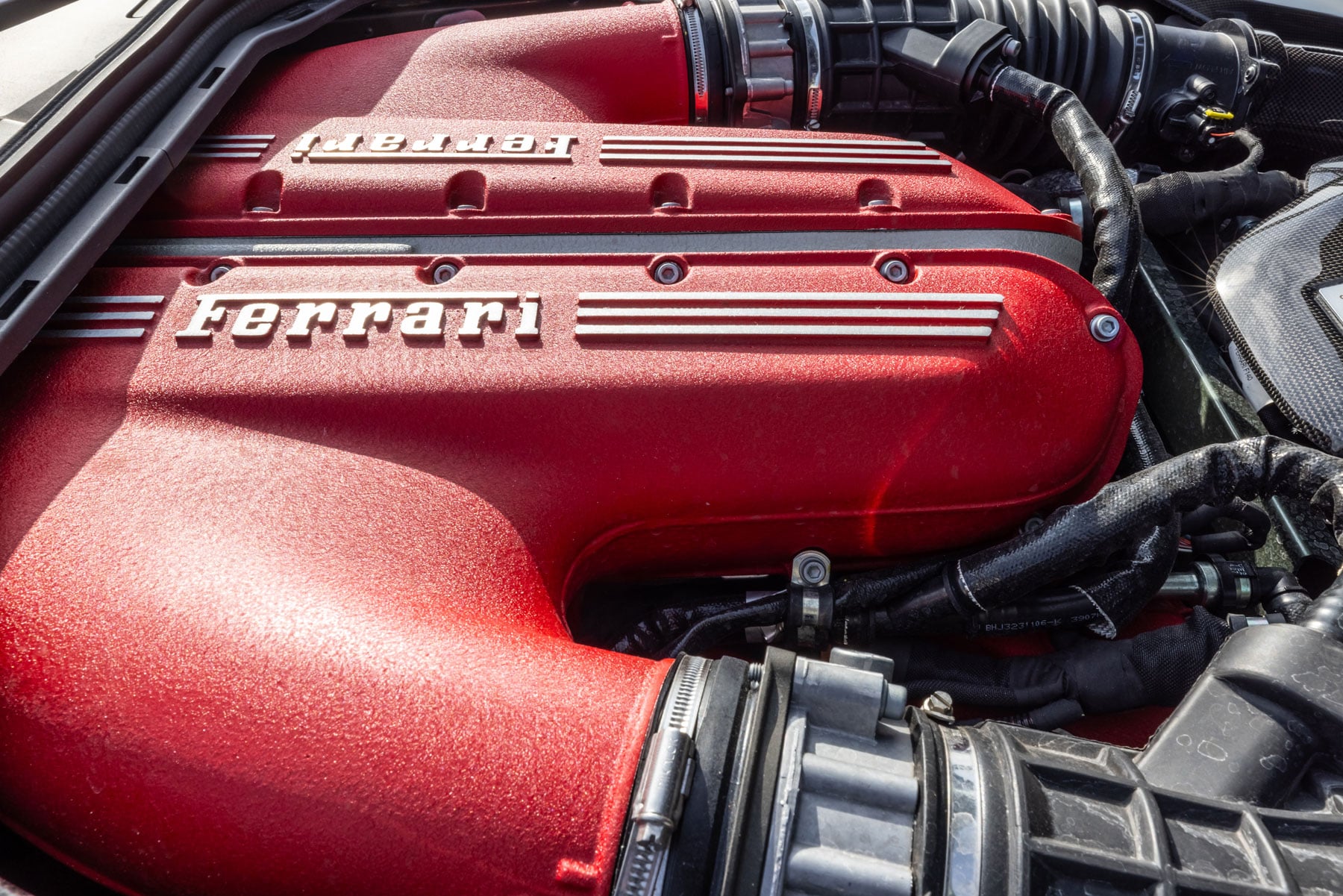
Ah yes, the sound. You want to know what a normally aspirated V12 that now has to pass a stack of drive-by noise regulations sounds like. From the outside, it’s quite mannered. Inside the car, Ferrari has positioned resonators ahead of the throttle body inlet that pipe sound into the cockpit. If you found the Purosangue somewhat mute, you’ll be happier with the 12Cilindri. It’s vocal but never seriously shouty.
1
The exhaust system features two six-into-one manifolds with equal length ducts, designed to generate the complex baritone high-end howl that V12 fans demand. Go chasing it and you’ll realise that in order to develop its full complement of 610kW, you’ll need to rev it to 9250rpm, just 250 shy of the redline. The way the needle races around to that peak means you’d never be able to eke out every last rev with a manual ’box, as evocative as it’d be to see a gated H-pattern in this car.
If you found the Purosangue somewhat mute, you’ll be happier with the 12Cilindri Spider
Instead there’s an eight-speed DCT gearbox, that features a five percent shorter final drive than you’d find in the rest of the Ferrari range, giving real accelerative punch in lower gears. It seems counterintuitive to lower the gearing in a car that needs to not only pass stringent noise and emissions tests but which also has been positioned as a less extreme option in the Ferrari line up.
When asked, an engineer shrugged and claimed that they did it because it wasn’t easy but seemed like the right thing to do for the character of the car. Not that I’m complaining. I hate cars that feel blunt due to ridiculously long gearing. The long eighth gear is great for motorway cruising and it’s here that the 12Cilindri affords far better efficiency than its predecessor.
If you’ve managed to keep the 12Cilindri Spider pointing in the right direction after a full bore blast through first and second, keep it pinned (on a closed course, etc) and you’ll discover Aspirated Torque Shaping. A version of this system has featured on turbocharged Ferraris since the California T back in 2016, but this is the first time it’s been utilised on an atmo engine. By managing the way the engine introduces torque through third and fourth gears, the ones that Ferrari deems the most important for everyday road driving, the feel is of linear acceleration and a vivid impression that the powerplant is in no way tailing off in its delivery.
While it’s more subtle with a naturally-aspirated engine, it certainly works. The engine dominates proceedings and you need to be disciplined in how and when you accelerate out of slower corners. Despite the lower final drive, you’ll find that the top of second is somewhere you’ll find yourself on any twisty section of road, and I’d advise that you combine flight to the boards throttle demand with any sort of steering angle very judiciously. This is still a car with 22kW more power and 20mm less wheelbase than the feral 812 Superfast.
1
Key to controlling cars is the now-familiar lozengeshaped manettino dial on the steering wheel. This can be clicked through Wet, Sport, Race, CT off and ESC Off modes, and each of these five settings has its own specific map for stability control, braking control, suspension control and Passo Corto Virtuale (in effect, the combined functions of the e-diff and the four-wheel steer). With the condition of the roads and traffic today, I limit the adventure primarily to Sport mode with the odd dip into Race on the better sighted sections.
Wheel control is good when the Bumpy Road mode is employed. The 12Cilindri rides on 21-inch alloy wheels, which have increased unsprung weight. Our car has the heavier fivespoke cast rims, but there’s also a fussier forged option with a machined throwing-star look. There’s an option of either Michelin Pilot Sport 5S or Goodyear Eagle F1 Supersport rubber, with the latter also offered as a run-flat option in Europe. I can’t say that I was going hard enough to feel any real benefit from the active aero, which offers a modest 50kg of downforce at 250km/h. Time and a place.
Whether it’s the Passo Corto Virtuale, the new brake-by-wire system or the fiendishly complex Side Slip Control 8.0, there’s a massive data integration task going on behind the scenes. For the most part, it works, but there are moments when the 12Cilindri Spider reminds you that for all its classic base formula, that veneer is one of artful software control. Much of this work started in 2018, and along the way things have iteratively improved, and fast.
1
I think it’s this, as much as anything, that gives the 12Cilindri Spider its slightly opaque personality. It feels like a car whose basic philosophy has been somewhat sacrificed at the altar of tech creep, discrete teams within the walls at Maranello doing things because they can. As I head back towards Cascais, I’m hugely impressed by this intriguing, elegant and capable car. If this is the last naturally aspirated V12 that Ferrari builds, it’ll be a worthy recipient.
It feels churlish to question whether Ferrari, a company that has realised record profits in the last financial year, fully understands its V12 customers. Yet it appears that the philosophy behind this car has been to extend its capability. I’d rather effort was devoted to extending the physical involvement and sensation of the 12Cilindri. I wouldn’t mind losing some trick chassis functionality for a pared back cabin and a more predictable feedback loop of input and output. I’d forgo the active aero frippery for that resource to be spent on making it sound more evocative.
Any of that would be arrant nonsense on something like a 296GTB, but these things matter to V12 GT buyers. Perhaps Ferrari needed to be braver and do less. Such a volte face would likely be philosophically unpalatable to Ferrari’s techie CEO Benedetto Vigna, but the profit margins would be greater, and that’s significant for this production-capped company.
It’s getting cool as the lights of Cascais appear over the sands of Praia do Guincho. I flip the roof up and crank the heater. The evening strollers nod appreciatively as the big coupe burbles along the coast road. It’s a lovely thing this Spider, and it seems a more rounded proposition than the coupe. Just sometimes, though, you wonder whether less is more.
1
“Aerodynamics are for people who can’t build engines”
EVEN ENZO FERRARI HAD A BAD TAKE ONCE IN A WHILE
The roof mechanism of the 12Cilindri Spider owes a lot to extensive wind tunnel and CFD work. The windscreen header rail has been sculpted such that the flow detachment point eliminates overpressure behind the occupants’ heads. Meanwhile, the front of the two flying buttresses features a trim that directs air inboard, recompressing the separation bubble atop the tonneau cover. This prevents air recirculating back to the cabin, while another element directs higher speed, lower pressure airfl ow outboard to the active rear winglets.
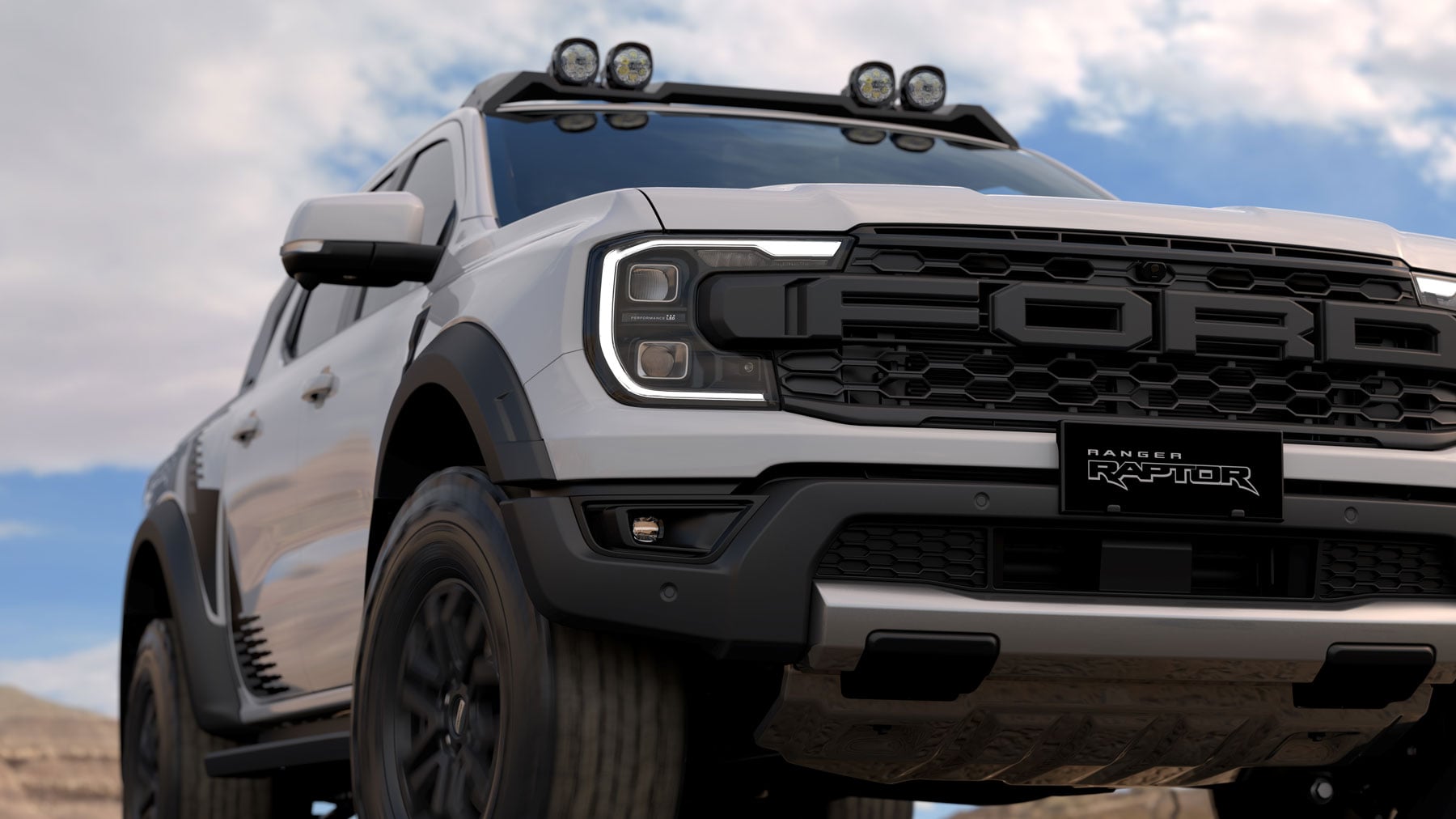
The Ford Ranger Raptor Desert Pack is an accessories package released to celebrate Ford’s hat-trick of ‘Stock Class’ victories at the Finke Desert Race.
Limited to 500 units and available to order on MY26 Ranger Raptors, the Desert Pack adds some motorsport-inspired visual upgrades to Ford’s performance truck, including an ARB sports bar, quartet of roof-mounted lights, decal pack and Ford Performance all-weather floor mats.
The pack costs $5990 including dealer fitting and the equipment will remain exclusive to the Desert Pack until all 500 examples have been sold, after which the sports car and roof lights will become available separately through Ford’s accessories catalogue.
Adding the Desert Pack means Ford’s factory roller shutter is no longer compatible, but the Real Truck Power Roller Shutter is available through Ford accessories.
MY26 Ranger Raptor production begins in October 2025 with deliveries to commence shortly after.
There’s power in the redemption arc. The human brain is one that is wired to recognise story patterns, and the familiar transformation of a flawed character into one of empathy or inspiration is something we intrinsically understand and respond to. But while a fictional character’s initial failings make the heroic payoff really hit you in the feels, we’re never quite as willing to give a consumer product a chance to make good.
Cars are a very specific case in point, because we get to see their evolution over time. Yet there exist a welter of vehicles that never got off to a great start in life but then came good without ever getting the recognition they deserved. Examples? The second-gen Toyota MR2 never got over the reputation of the early cars for wayward handling, despite that characteristic being fixed in the second of five iterative updates to that model. You could also file the Jaguar S-TYPE into that category alongside the big improver that is the Ford Mustang Mach-E. Poor initial impressions stick.
1
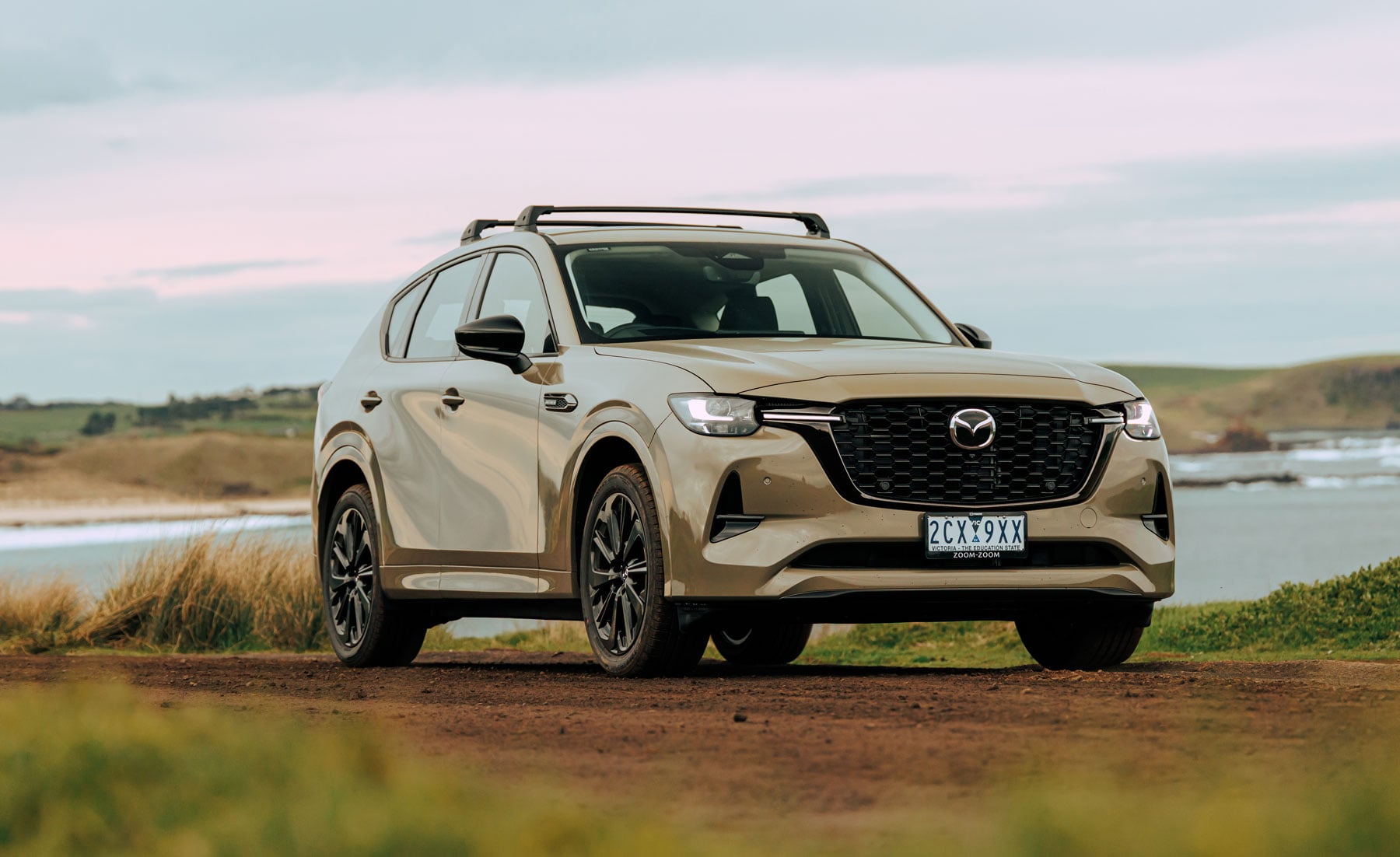
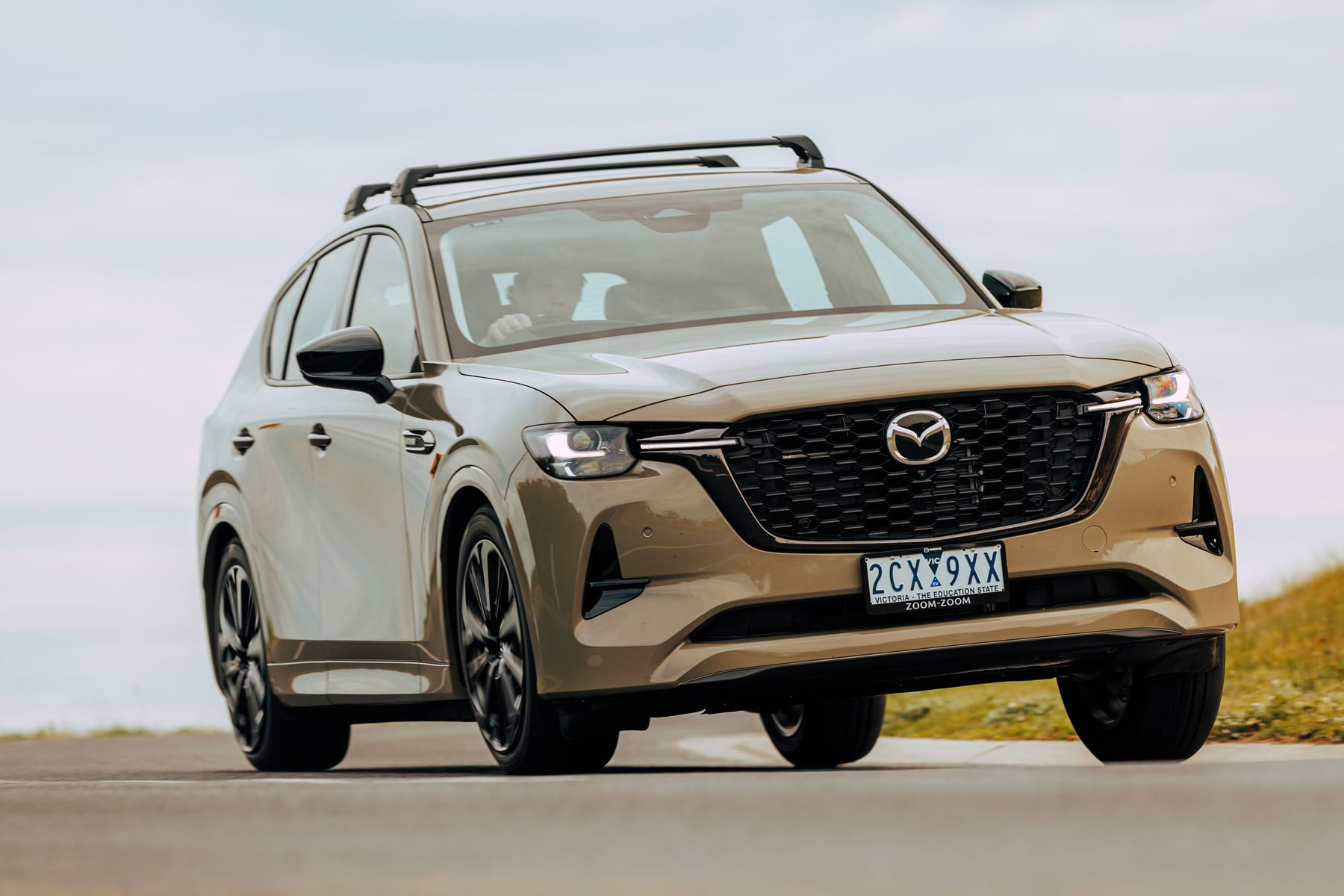
It’s not hard to guess at why the Mazda CX-60 is therefore sitting in front of us on a windswept boat ramp in South Gippsland. We first got to drive this car way back in 2022 at the international event in Portugal. It was clear even then that the drive route had been very carefully selected to provide as smooth a set of roads as you could ever reasonably expect, and that will always trip the spidey-senses of experienced road testers, who became a little suspicious of what exactly Mazda was trying to disguise. Indeed, on the few bits of gnarled bitumen in town that we drove, we noted shortcomings in the CX-60’s damping. Mazda shrugged the criticisms off, claiming that these were pre-production cars.
Be that as it may, the actual vehicles we received in Australia were no better. In fact, typical Australian B-roads only showed the ride quality to be a long way behind the eight-ball. Tony O’Kane attended the local launch drive and commented that “the CX-60 is possibly too sporty for its own good. It handles great but it rides poorly, with dampers that are far too sensitive to minor bumps and an overabundance of tyre and transmission noise. The suspension doesn’t exactly behave noticeably better on the 18-inch wheels of the Evolve [trim level] either, so this problem isn’t limited to the 20-inchers of the GT and Azami.”
Alex Inwood later ran one as a long-termer and concurred. “The ride quality is overly firm in everyday driving,” he noted. “It even verges on harsh over really rough roads, which is a shock given Mazda typically nails the compromise between sporty handling and everyday comfort. A bigger issue, however, is the transmission. The eight-speed unit was developed in-house by Mazda and it’s unpleasantly clunky and jerky at low speed. The shift logic feels at odds with the torquey diesel, too.” The handsome Mazda wasn’t exactly wowing us with its dynamics.
1
Car manufacturers are good at a lot of things. Listening to feedback isn’t always one of them. Put that down to a sunk costs fallacy, or an intrinsic confidence that they know best, but sometimes they really don’t want to hear bad news. Good development projects go bad for all sorts of reasons, even with talented teams and large budgets, and the CX-60 is a case in point. In short, I suspect that Mazda was trying to do too much, too quickly in launching new models with new engines and new transmissions on a new platform with an all-new suspension layout. The multiplication of development variables must have been dizzying and, one suspects, fundamentally unmanageable as a result.
Mazda’s response to this lukewarm critical response came in October 2023 when it recalled all existing CX-60s and retrofitted them with revised rear shock absorbers. It helped reduce the vertical movement at the back, but there were more fundamental issues that needed addressing. In May, we finally got to drive the revised and updated car and were impressed at the lengths Mazda had gone to in order to remedy the CX-60’s ride issues.
1
Toshiaki Aoki, the chief engineer behind the product, put a CX-60 up on ramps in order to show us all of the changes beneath the car. The most fundamental alteration was the deletion of the old car’s rear anti roll, and this radical alteration to the rear roll stiffness then required a number of follow-on changes. Spring and compression damping rates have been firmed at the front, with softer rear springs at the back teamed with firmer rear rebound damping. The bushes and steering knuckles were revised and the allwheel drive logic, the stability control and the kinetic posture control systems were recoded accordingly.
“I don’t think it was a good situation because the [old] vehicle moved too much before it could be balanced. The vehicle body moved not only up and down but also sideways. It moved a lot,” he concedes. “I believe we should have understood the customers’ driving scenes better and more accurately… we are considering what needs to be done to better understand the market. We are trying to figure out the ways that we can adapt in terms of accurately assessing and evaluating the local conditions.”
We got to try the new vehicle on a test route at Lang Lang proving ground and first impressions seemed promising. The new suspension no longer jarred and nibbled constantly, but after that first sample, we really needed a longer drive with the CX-60 on typical Aussie roads to see if it was now an SUV that was a more rounded prospect, more comfortable in its own skin. Equally importantly, would dialling back the ‘zoom-zoom’ factor merely relocate this Mazda into the morass of vanilla sub-premium SUVs?
1
PROOF, PUDDING
I’m still not completely convinced by Mazda’s eightspeed multi-clutch transmission. It has clearly improved in the way that it handles start/stop traffic, with part-throttle handling a good deal smoother and gear holds more decisive, but ask more of it and it can be found wanting. Take this scenario as an example. You’re on a main road, approaching a roundabout and you spot a car on the roundabout shaping to come across your intended path. You brake from, say, 100km/h to 20 or 30km/h, spot a gap behind the car and attempt to blend smoothly in. It’s in no way an outlier occurrence.
You would quite reasonably expect the gearbox to recognise that your speed has massively decreased, drop a few gears as you brake, and then deliver meaningful acceleration when you pick up the throttle, so as not to leave you stranded with no drive. But no. As your right foot requests acceleration, nothing happens. You realise that the ’box is still sitting in seventh gear. You notice the widening eyes of the oncoming driver as he sees the beautifully-surfaced flanks of the CX-60 going pretty much nowhere in his path.
1
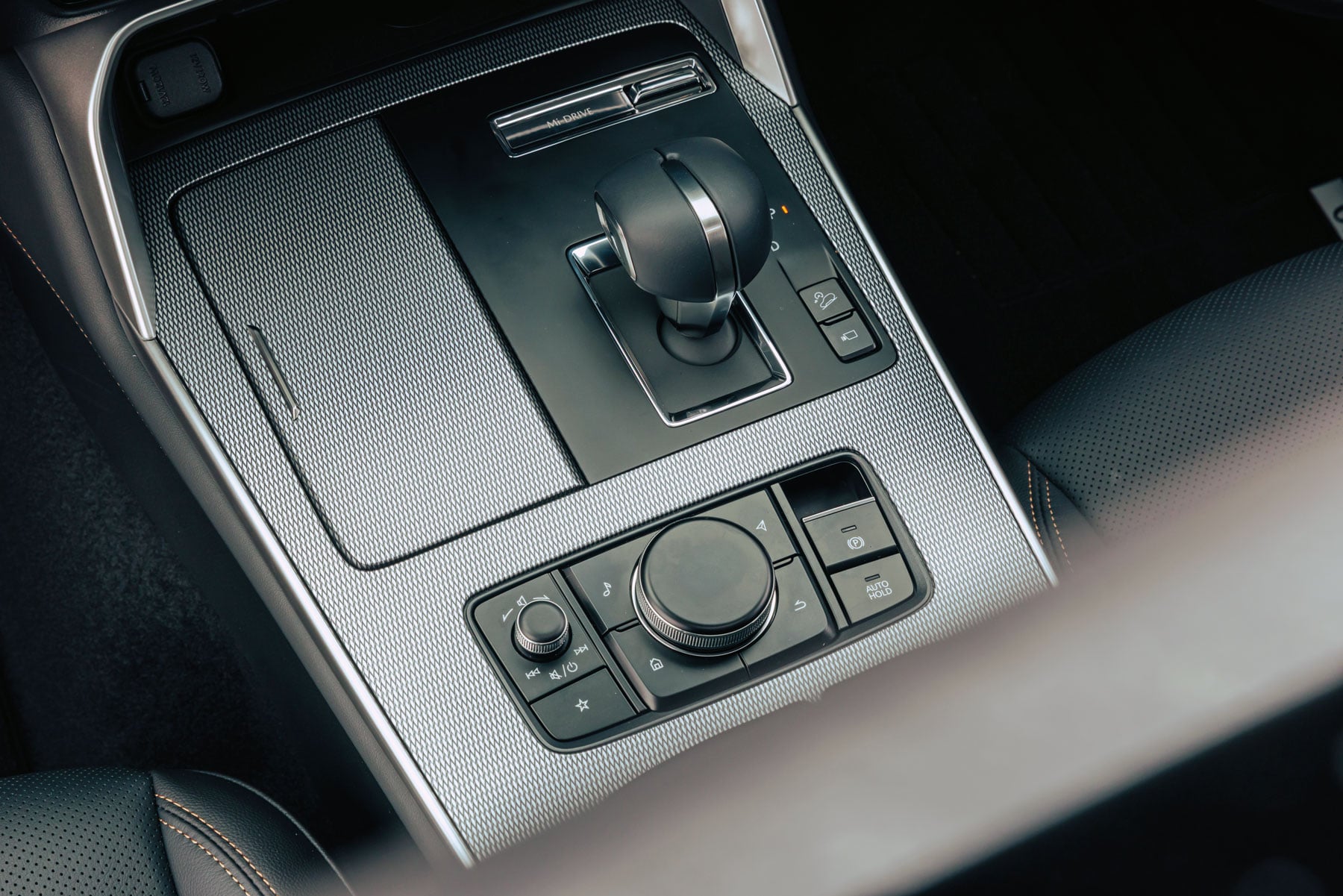
A full 1.5 seconds later, the transmission realises the error of its ways and block shifts to third. After some experimentation, switching the Mi-Drive mode from Normal to Sport only seems to make matters worse. We replicated this issue time and again, in a safe, traffic-free environment.
Of course, you can – and should – start plucking at the wheel-mounted paddles to ensure that you’re never caught out like this, but it’s a drive logic glitch that should never have been signed off. It’s a shame, as Mazda has done a lot right with the revised transmission. It just needs better coding to match road speed with likely acceleration demand. You’d think it would be an easy fix.
It’s now a good deal more serene and relaxing to drive
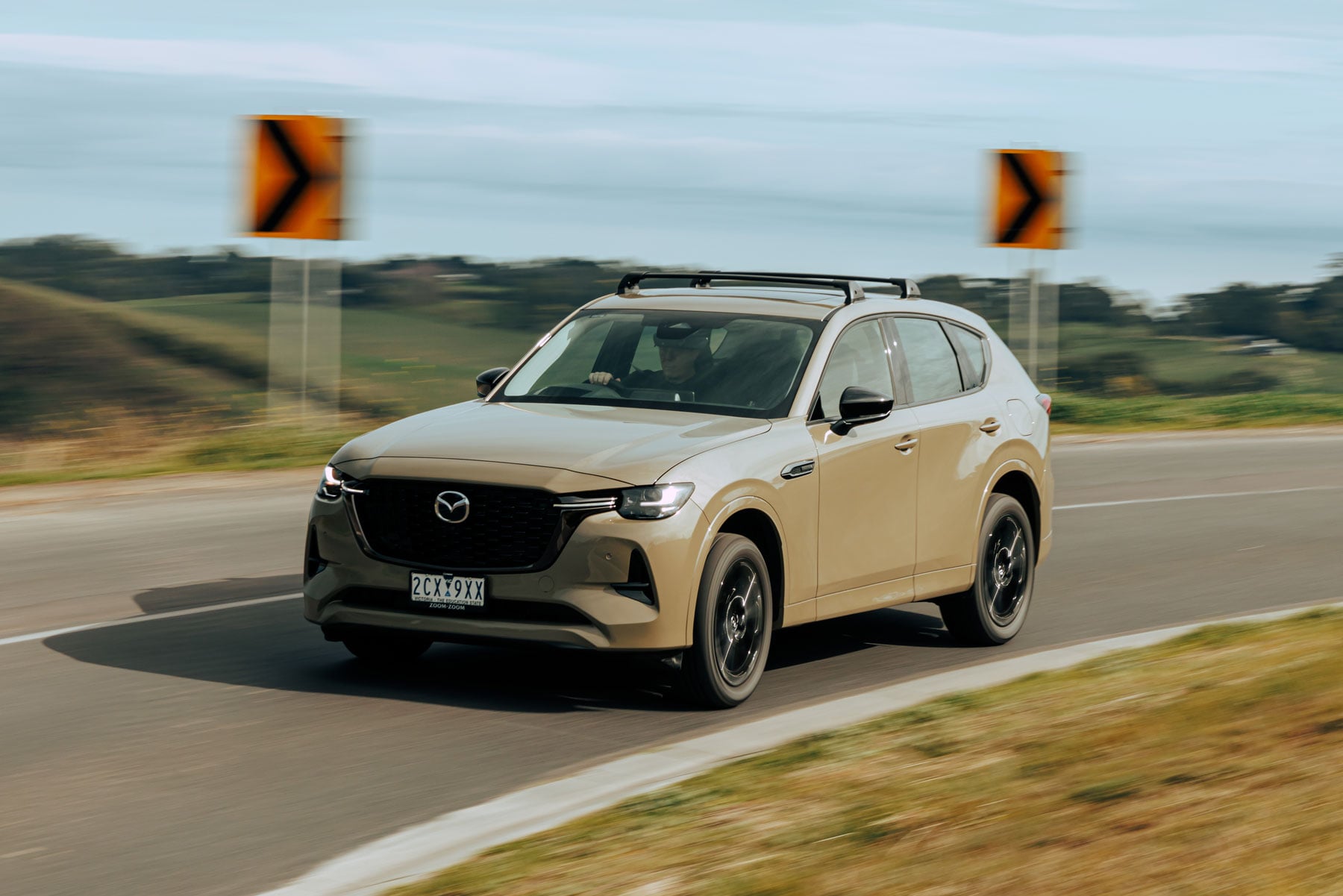
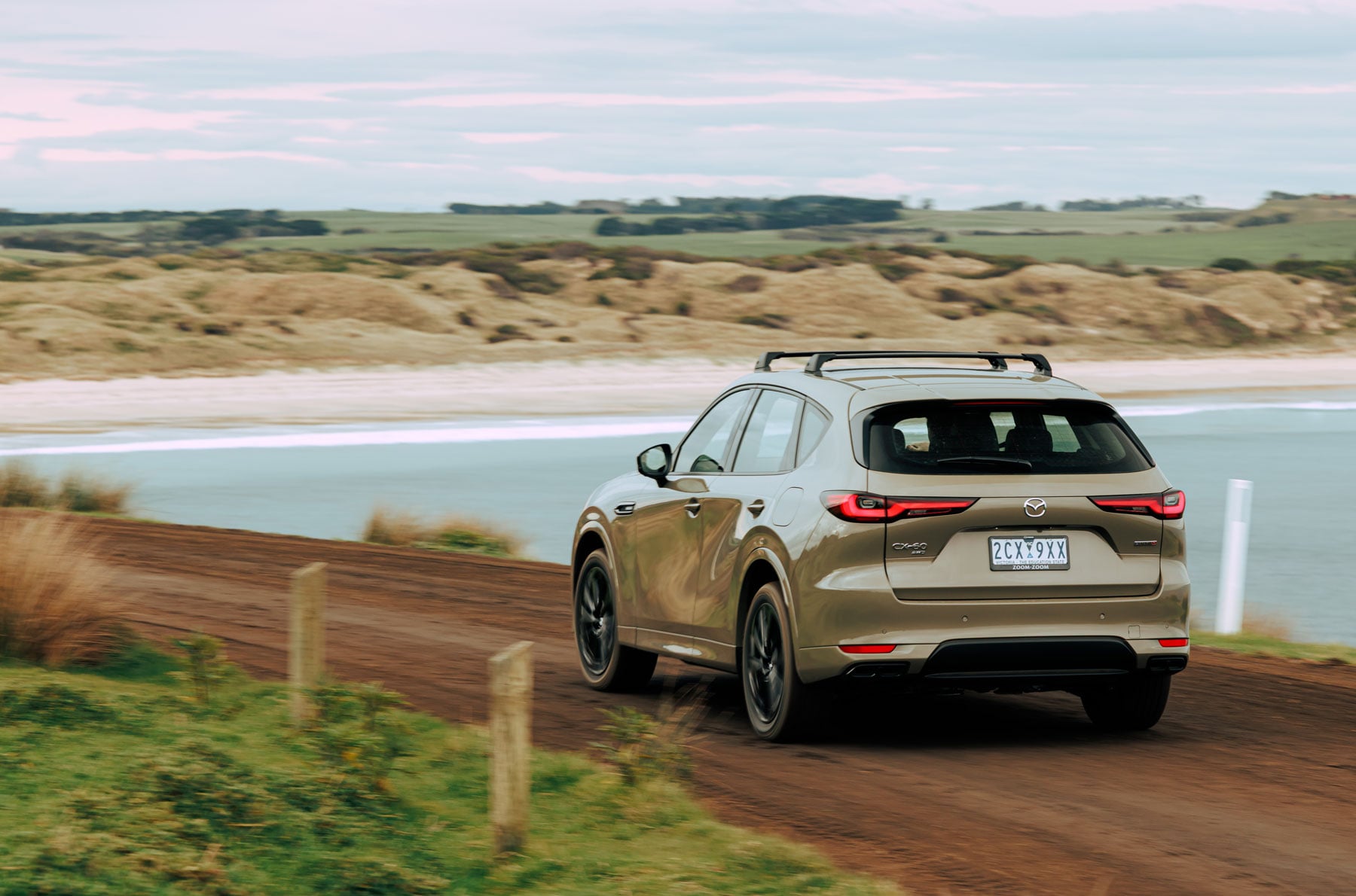
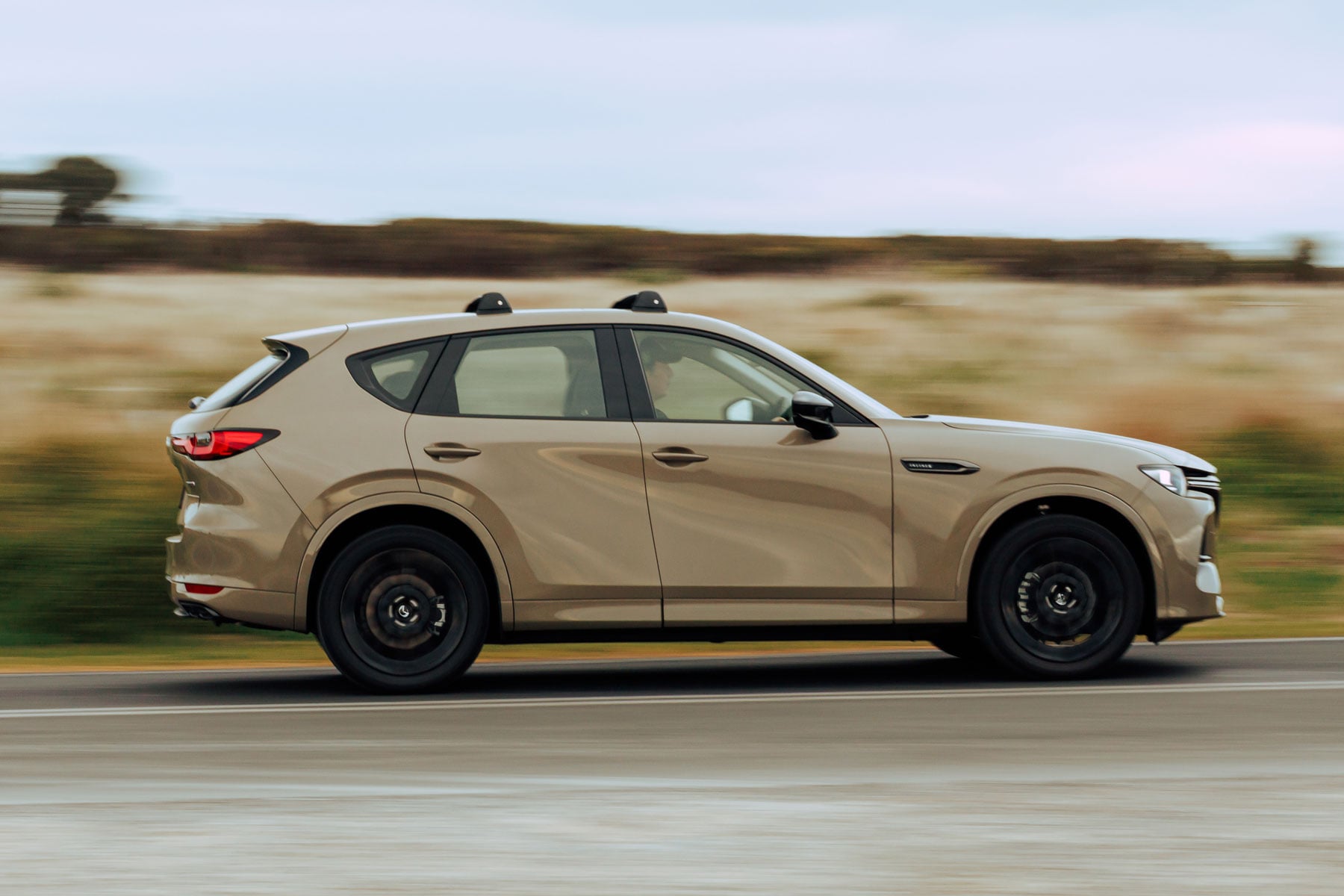
I’m more impressed by the newfound ride quality though. Yes, some secondary thuds still sneak through, but for the most part body control is very good and that feeling of brittle nervousness that would afflict the old car on an Aussie country road has been banished. It’s now a good deal more serene and relaxing to drive, even when dealing with the unsprung masses of this test car’s big wheels and Toyo Proxes Sport 225/50 R20 rubber.
1
Up the pace a bit and you start to feel the body rolling a little earlier than before. Despite the firmer front spring rates, there’s a decent amount of front end grip and the limits are very benignly expressed, with well-communicated understeer.
The softer rear end affords a decent amount of mechanical grip, but keeps things well controlled if you jump off the throttle mid-corner. It’s exactly the sort of handling bias a vehicle in this category ought to display: capable but safety focused.
The steering calibration is calm and accurate, if not exactly brimming with detailed feel. Again, right for the target market. It’s easy to get very roadtestery and sniffy at these changes but, in effect, Mazda had built a car in the old CX-60 that was probably too focused for its own good and had missed the typical use-case of the majority of its buyers. That now appears to have been rectified.
1
In terms of dynamics, the pendulum might just have swung back a little further beyond the sweet spot. A crisper throttle, steering and gearbox calibration in Sport mode could have given a more convincing impression of dynamic focus, leaving the default Normal mode for everyday schlepping.
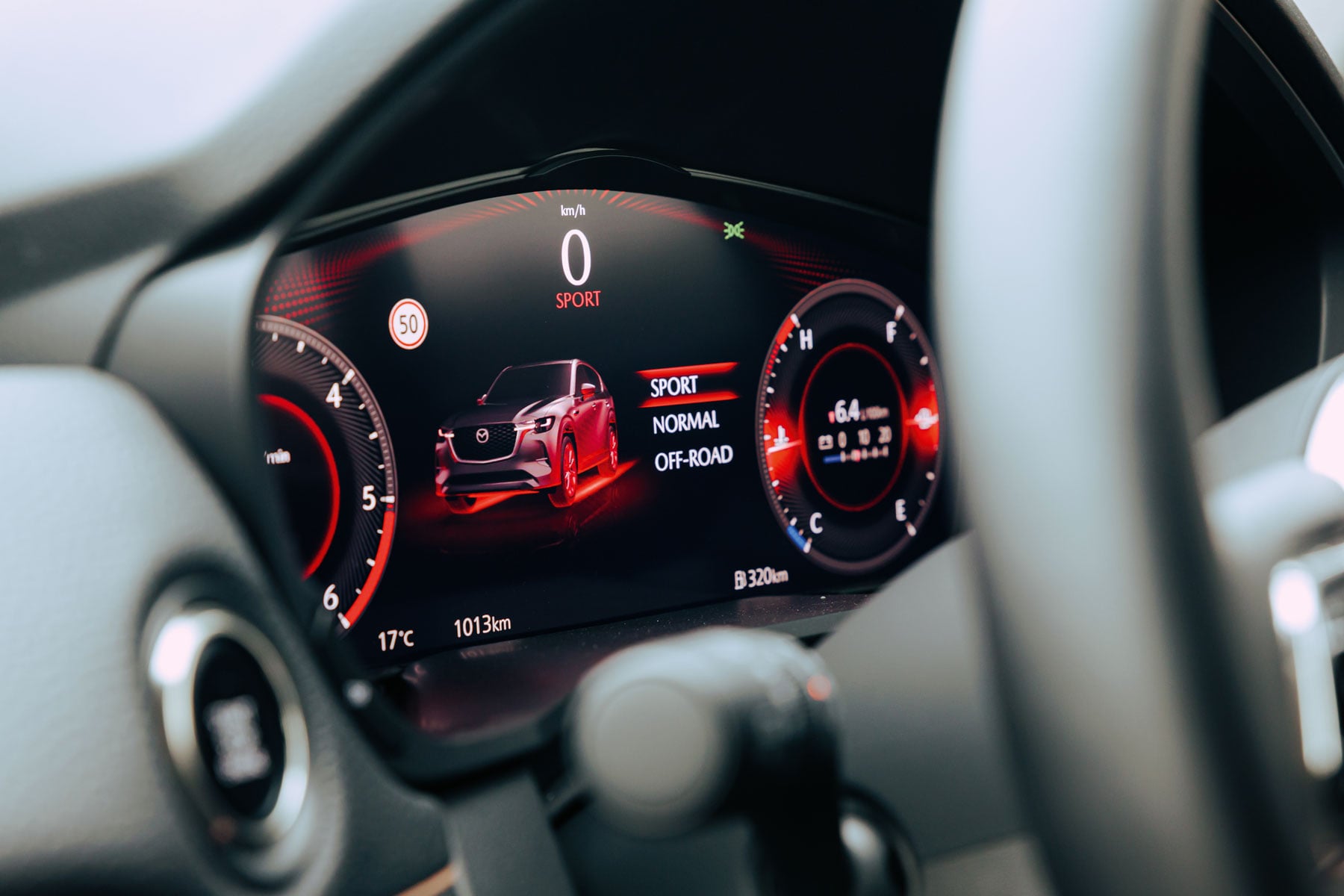
In practice, apart from the screen turning red when you engage Sport, the difference in those software maps is too subtle to make it really worthwhile, in our view.
WE GOT THERE IN THE END
Nevertheless, the CX-60 is a much improved vehicle. Sometimes it only takes small changes to turn a vehicle from fundamentally frustrating to one that just clicks, and Mazda has finally got there with the CX-60. Several Chinese manufacturers in the medium SUV class are in the process of learning this lesson with their driving assist technology and it’s always encouraging to see small changes net major positive effects.
In this instance, the CX-60 goes from a car where there was no respite from its underlying flaws to one that, like most Mazdas we’ve been used to buying in recent years, is one that has a certain quiet charm to it. I know diesels are about as fashionable as a MAGA hat in Byron right now, but there’s a lot to be said for this straight-six implementation, especially so when it’s in the correct gear. It’s refined for a big compression- ignition unit and its 5.2L/100km fuel economy figure is 32 per cent better than the 7.4L/100km showing of its petrol sibling.
1
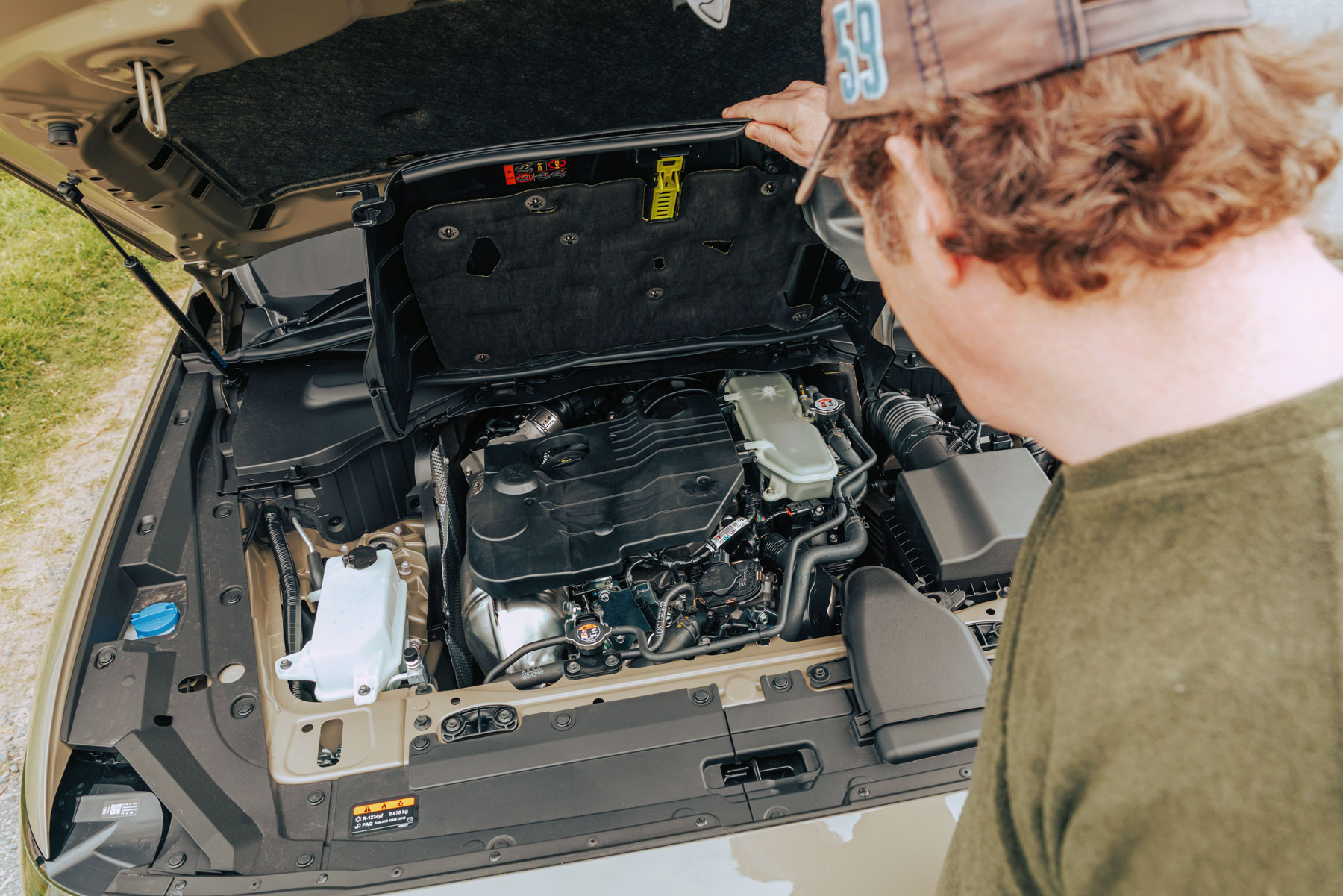
With 187kW and 550Nm at its elbow, it’s not notably overstressed. Quite the opposite in fact. The smaller 3.0-litre V6 diesel in a Ford Everest, which can trace its origins to shortly after an asteroid cleaned up the dinosaurs, manages 184kW and 600Nm. Compare the braked towing capacities of the two vehicles and the Ford fronts up with 3500kg whereas the Mazda’s pegged at just 2000kg. So the CX-60 with the highest torque can, quite counterintuitively, tow less than its petrol-powered counterparts. The reason? It’s a cooling issue that limits quite how hard you can work the 3.3-litre diesel. Were Mazda able to rectify that, such a large capacity straight-six would have the tuning potential for considerably more power and torque.
While there are patently many better options for towing caravans, boats or horse fl oats, the CX-60 diesel will happily work with the sort of trailers that might get wheeled out of the shed a handful of times a year for family long weekenders, garden centre visits or tip runs which, if we’re honest, likely covers the majority of instances.
Sometimes it only takes small changes to turn a vehicle from fundamentally frustrating to one that just clicks
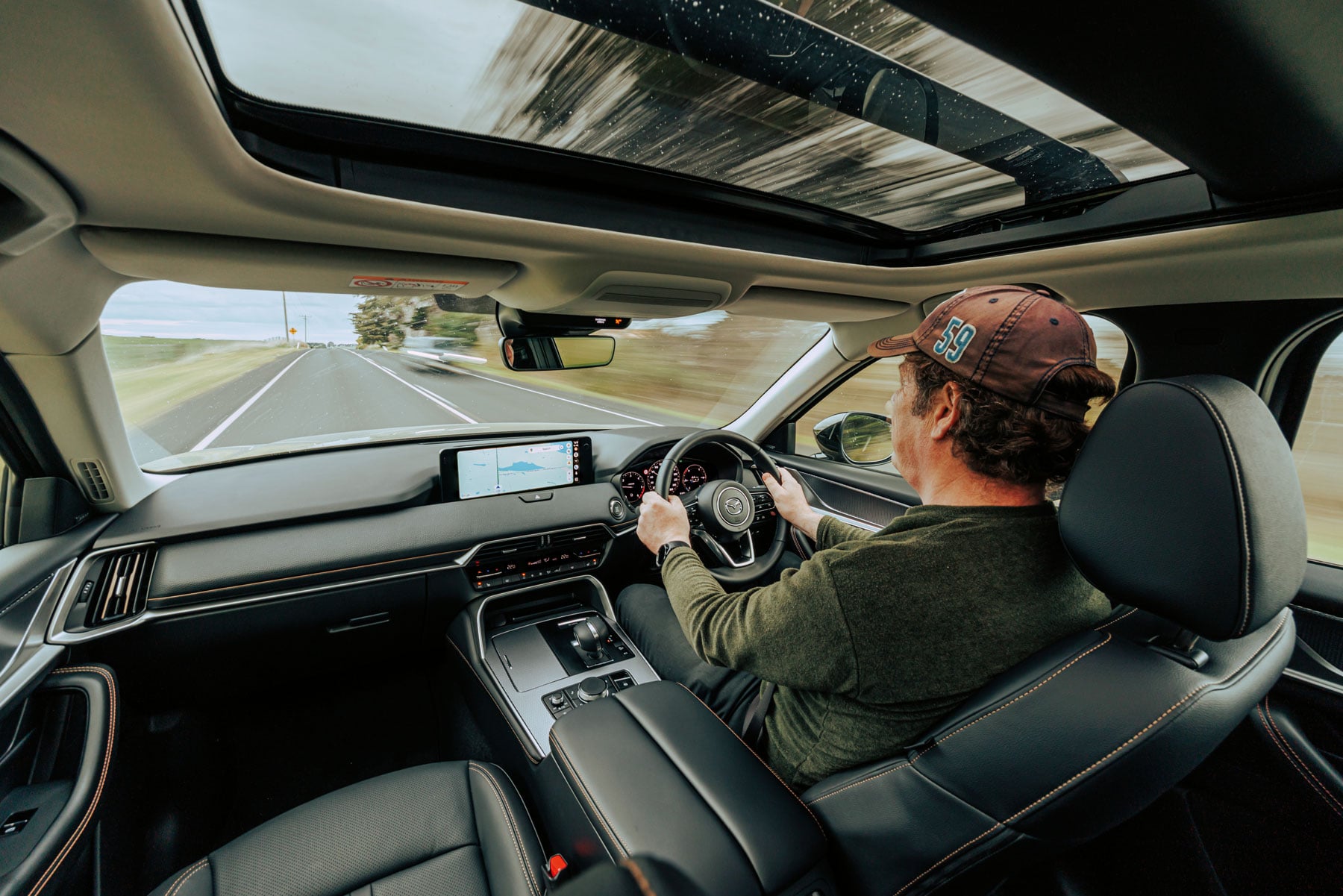
The cabin earns a solid report card too. The basic ergonomics are good, although I still prefer a proximate touch screen than one you manipulate with a controller. The front seats are wide and comfortable, with heating and an adjustable lumbar support. The steering wheel also features heating and, like the seats, is wrapped in high quality stitched leather. There’s a panoramic sunroof overhead, a wireless phone charger that can eject the device if you’re too eager with the loud pedal, and a pair of USB-Cs up front to charge other devices. The 12-speaker Bose stereo is bright and punchy.
1
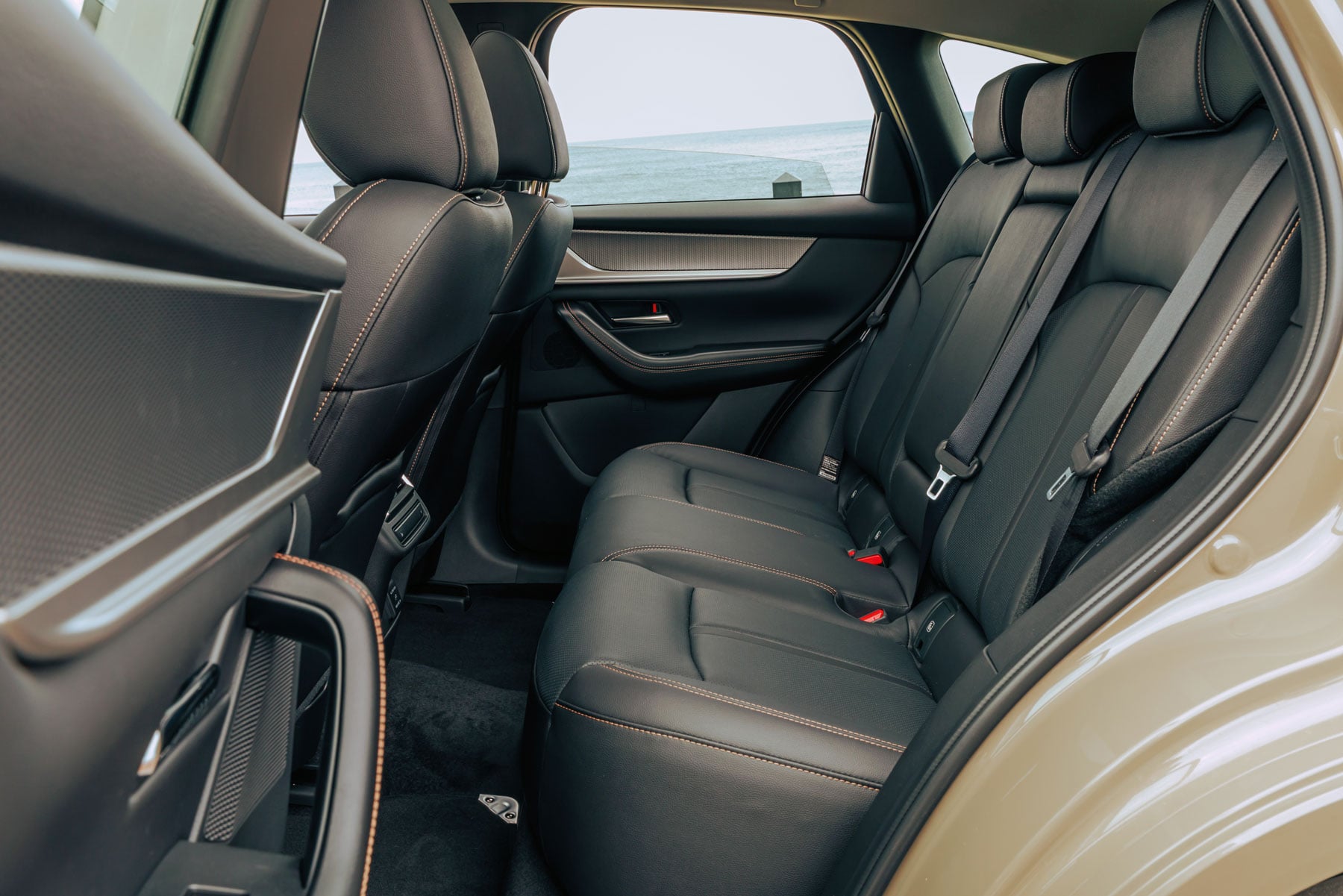
Jump into the back and there’s enough legroom to sit behind my driving position, although a few degrees of additional recline on the rear seat squab wouldn’t have gone amiss. Rear occupants also get seat heating in this GT model, along with two USB-Cs, shin-height air-con vents and the unusual fitment of a three-pin socket.
Activate the powered tailgate and you’ll find that the boot’s decently shaped with a low floor, beneath which resides a space saver spare. Bravo, Mazda. There are a pair of nested catches on the side of the boot that allows you to remotely drop the 40/20/40 split rear seats, increasing available space from a hefty 570 litres when all seats are in position to a cavernous 1726 when they’re all folded.
Mazda has improved the CX-60 with the latest suite of revisions, making it a more attractive car for the majority of its target market. We’ve been told that there are some rather disgruntled engineers who feel that the car has lost its verve and its spark as a result of these changes and we can understand that point of view too. Mazda has long distinguished itself by offering something to keen drivers, but as it pushes into new market sectors, a priority on sporty driving characteristics is rarely front of mind for buyers.
Of course, there’s an argument that Wheels should always advocate for drivers, and that to do otherwise is to reward a reversion to dynamic mediocrity. Yet the latest, more liveable CX-60 does more to reward its cadre of drivers more of the time than any trolleyjack suspension setting or neurotic steering map. It’s not expediency, its overdue pragmatism, and proof, if ever it were needed, that there’s a time and a place for Zoom-zoom.
With the light finally fading over Phillip Island, it’s time to head home. I’m warm, comfortable, the adaptive LED lights are behaving impeccably, the adaptive cruise is excellent and I’m not being constantly reminded of the orientation of every grain in the road surface. This is what the Mazda CX-60 always needed to feel like; to be, but never quite was. It took a while, but it’s finally getting to land its redemption arc.
1
Covering the bases
In order to respond to customer demand for a more attainable CX-60, Mazda Australia is importing a more wallet-friendly version to add to the existing range.
The rear-drive 2.5-litre petrol model makes 138kW and 250Nm, features an economy figure of 7.5L/km, and is priced at $44,240 for the entry-level G25 Pure, $49,240 for the mid-range G25 Evolve and $52,240 for the flagship G25 Touring.
For less than $45k, the Pure looks an incredibly tempting package. Mazda Australia certainly seems to think so too, with sales projections pointing to the fact that these G25 models will account for a third of total CX-60 sales.
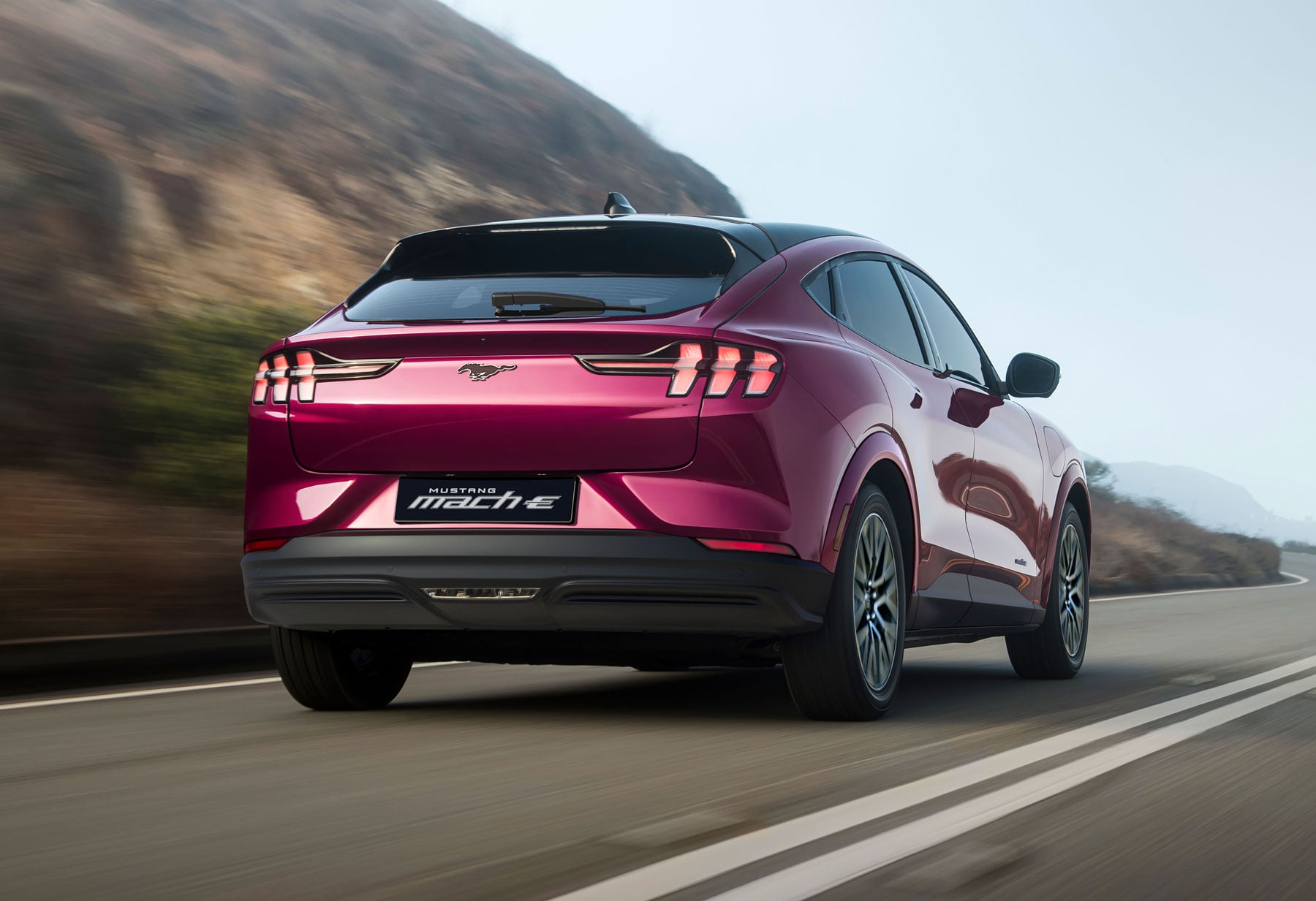
The Ford Mustang Mach-E has been heavily updated for Model Year 2025, with a host of improvements inside and out aimed at boosting sales beyond the 1038 Australians who have so far bought Ford’s first EV (as of August 2025).
A three-tier model range remains with prices having risen marginally.
Ford Mustang Mach-E
Pricing*
Select
$65,990 (+$1000)
Premium
$80,490 (+$500)
GT
$98,490 (+$500)
*plus on-road costs
Externally there are new wheel designs, body coloured wheelarch mouldings and matte black lower claddings while the GT also gets a new grille. Six new colours are available, including classic Mustang hues such as Grabber Yellow and Velocity Blue, though any colour other than black attracts a $700 surcharge.
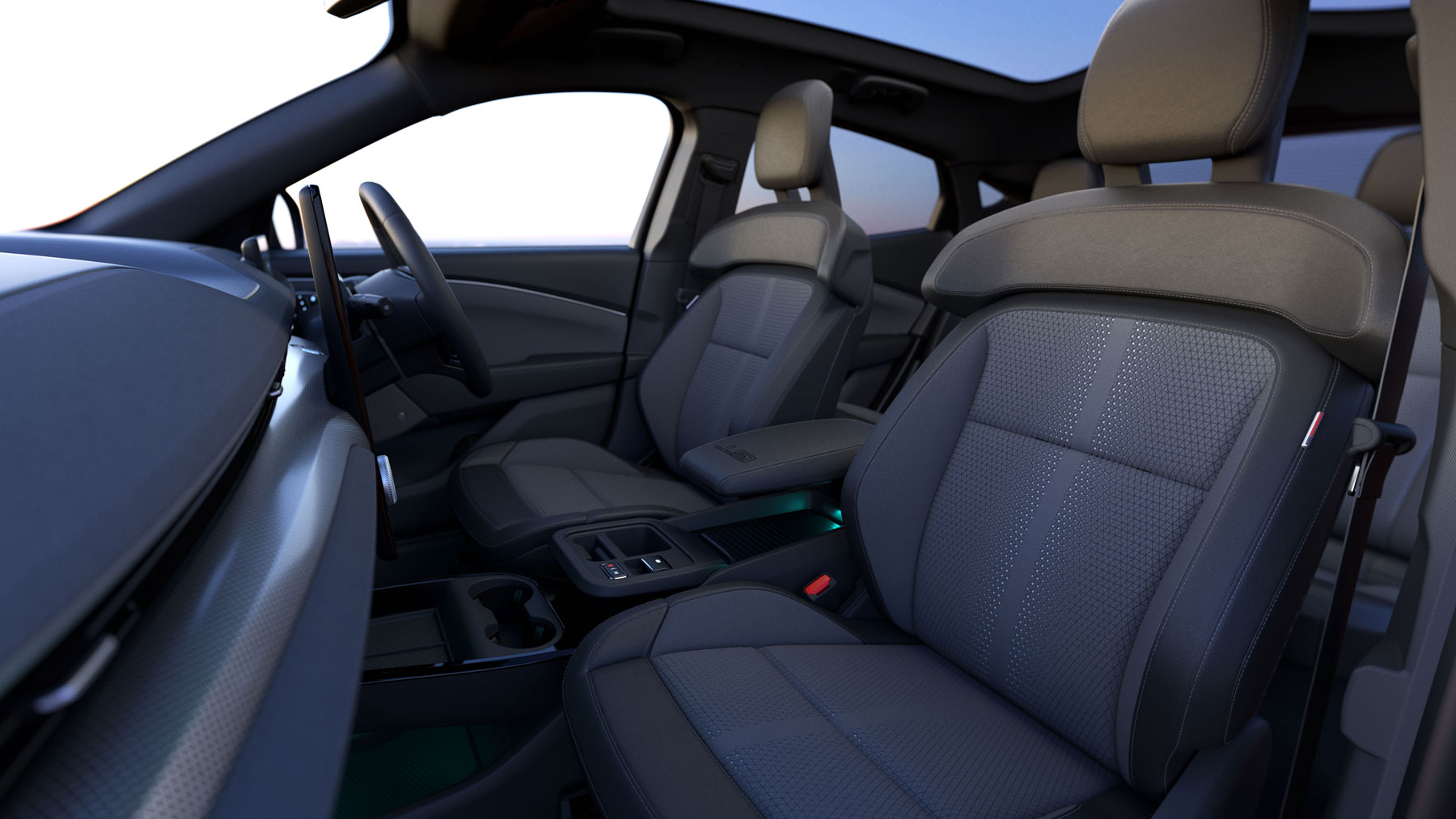
Inside, the major change is the relocation of the gear selector from a centre-mounted rotary dial to the steering column, allowing for the inclusion of more storage, while the front seats are now 10-way power adjustable instead of eight.
A new heat pump improves also improves efficiency when heating or cooling the cabin.
1
The Select and Premium variants have undergone suspension revisions consisting of new dampers, springs and sway bars, but the major mechanical changes concern the powertrains.
In layman’s terms, the entry Select now has more power and torque and the same range from a slightly larger battery, the premium has a little less power, more torque and the same range from a slightly smaller battery and the GT has a lot more power and torque and more range from the same size battery. The full changes are outlined in the table below
Ford Mustang Mach E
Select
Premium
GT
Battery
73kWh (+2kWh)
88kWh (-3kWh)
91kWh
Power
212kW (+14kW)
212kW (-4kW)
434kW (+76kW)
Torque
525Nm (+95Nm)
525Nm (+95Nm)
955Nm (+95Nm)
Range
470km
600km
515km (+25km)
Peak DC charging rate continues at 150kW but improved thermal management has cut the 10-80 per cent time from 45 minutes to 36 minutes. The maximum AC charge rate is 11kW on three-phase power.
Deliveries will commence in October 2025 and we’ll bring you a full review of the updated Mach-E range from its local launch.
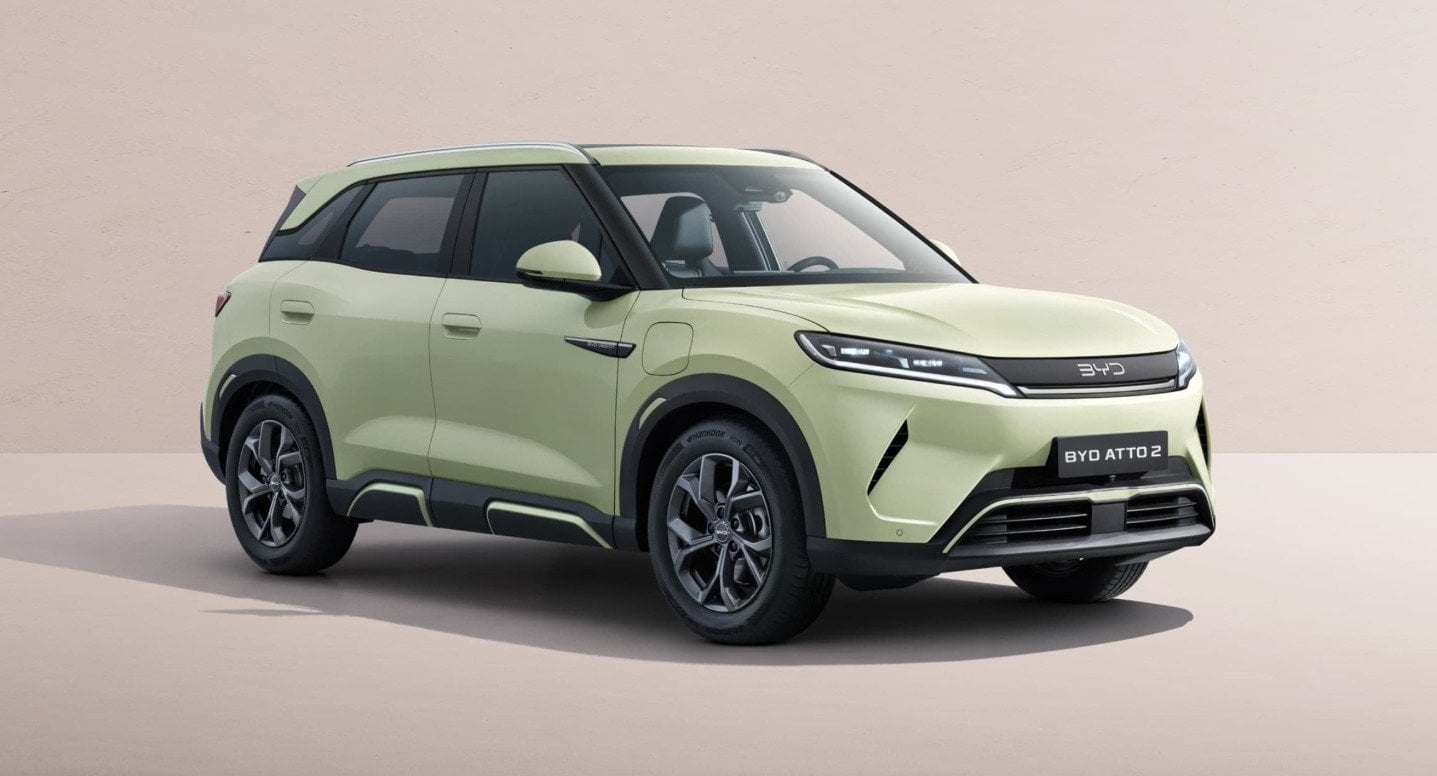
BYD is set to launch four new volume models locally over the next six months as it solidifies its position as one of Australia’s favourite brands.
The Atto 1 and Atto 2 will arrive in November and be joined by the Sealion 5 and Sealion 8 in early 2026, further expanding a range that has resulted in the Chinese giant firmly establishing itself in the sales top 10.
As of the end of August BYD has sold 37,923 cars in Australia so far this year putting it in eighth place overall, up an incredible 149.8 per cent over the same point last year.
According to BYD Australia Chief Operating Officer, Stephen Collins, “The Atto 1 will be Australia’s most affordable EV by some margin.” Collins can be confident about this as the BYD Dolphin is currently Australia’s cheapest EV at $29,990 plus on-road costs.
Known as the Seagull in its native China and the Dolphin Surf in Europe, it offers battery packs of between 30-43kWh for a range of 220-321km, though the local specification has not yet been confirmed.
1
It will be joined by the Atto 2 small SUV, which is expected to use a 45.1kWh battery offering 312km of driving range and a sub-$40,000 price tag.
The biggest boost to BYD’s bottom line will come courtesy of the Sealion 5 and 8, plug-in hybrid medium and large SUVs respectively, both featuring plenty of standard equipment, sharp price tags and up to 100km of electric-only driving range with the back-up of an internal combustion engine.
Further details will be revealed closer to the vehicles’ local launches.
Classic Lotus have been unfairly overlooked in the rush to restomod the great and the good of the automotive world, but with the Encor Series 1, that oversight is coming to an end.
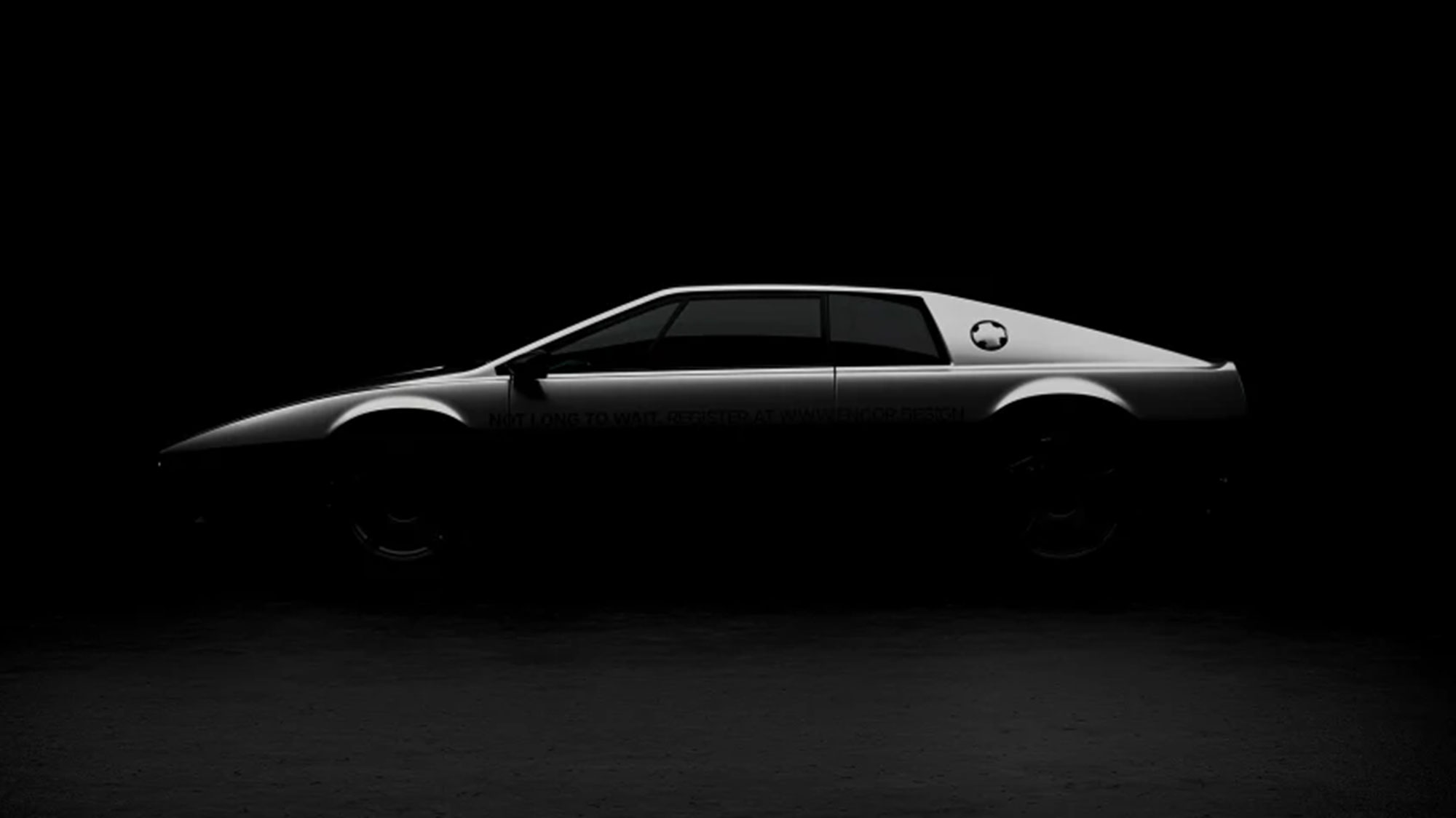
Taking the original series 1 Lotus Esprit as inspiration, and the later Esprit V8 as its basis, the Encor Series 1 is a carbon-bodied remastering of one of Lotus’s – arguably, one of motoring’s – most iconic shapes.
A team with experience in brands such as Porsche, Pagani, Aston Martin, Koenigsegg, and Lotus itself is behind the Encor Series 1, which retains the backbone chassis of the original but replaces the old fibreglass body with a lighter, stiffer, and much more precisely-constructed carbon fibre one.
Encor’s shadowy teaser images don’t reveal all, but it’s clear the Esprit’s Giugiaro-designed shape is still intact, especially that wedge-shaped profile, but the details have clearly been refined – the designer on the project is Daniel Durrant, formerly lead designer on the Lotus Emira.
The pop-up headlights remain, but Encor says these are now low-profile LED units, and where once there was a chunky front bumper there by necessity, there’s now a sunken panel housing auxiliary lights. Encor has reinterpreted the chin spoiler of the original too.
1
Most notable to us is that the new carbon body appears to have ditched the early Esprit’s distinctive dividing line – a necessity of the fibreglass construction that ended up being a defining feature, encircling the entire car. Also missing are the original’s Morris Marina-sourced door handles. They might have looked a little out of place in fairness, but as the Encor Series 1’s flanks appear unsullied by handles of any type, we’re guessing there’s another way of opening them.
The Encor creation uses the Esprit V8 as a donor. Its chassis, engine and gearbox allow the car to retain its identity, though naturally, Encor rebuilds the 3.5-litre, twin-turbo unit, which first arrived on the platform in 1996. The company promises higher performance and better driveability – no doubt modern engine management will be employed to help with that – though Encor hasn’t yet revealed full details.
There are no interior images as yet either, but the company says it has reinterpreted the cockpit with “leather, Alcantara, and machined aluminium”. It also says it has integrated Apple CarPlay, modern climate control, and 360-degree parking cameras in a discreet fashion – again enhancing usability without taking away from the car’s character.
Retaining the proper Esprit feel is something Encor founder Simon Lane (previously of Q by Aston Martin, and Lotus Advance Performance) is clearly keen on, saying “anyone can modify a car… what sets us apart is the way we treat the Esprit – not as a project, but as a responsibility. Progress should enhance, not replace.”
Full details will follow in November, but in the meantime, Encor says the Series 1 will cost the equivalent of AUD$875,000 excluding options, taxes, and the Esprit V8 donor vehicle – so budget somewhere north of a million if you want to put one of the 50 examples in your garage.
Do you ever wonder which year, as a car enthusiast, you’d most love to be teleported back to? Of course, there’s an argument that we’ve never had it as good as we’ve got it now, given that cars are quicker, more comfortable, more capable, more reliable and safer than ever, but I’d set the dial on our imaginary time machine back to 1994.
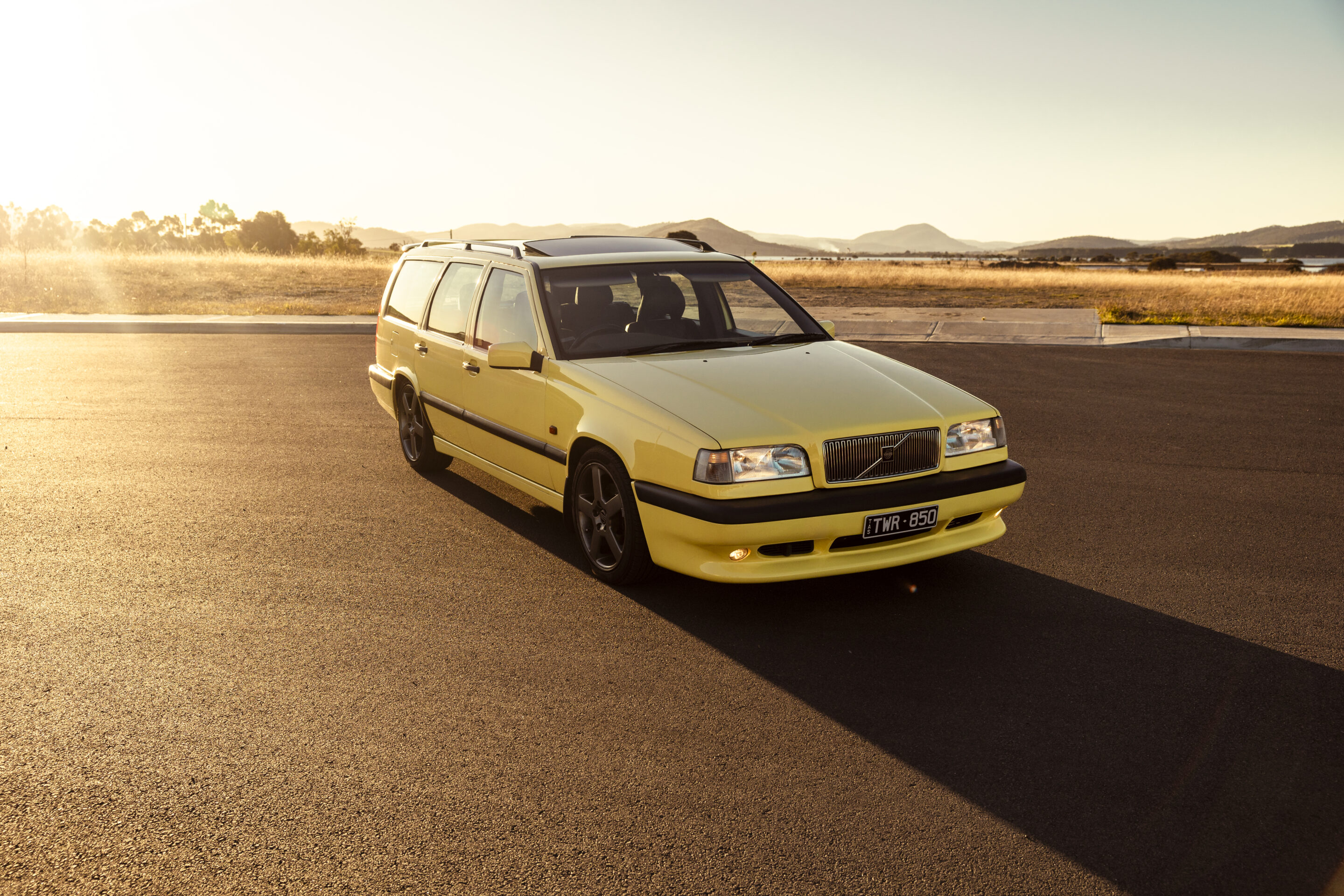
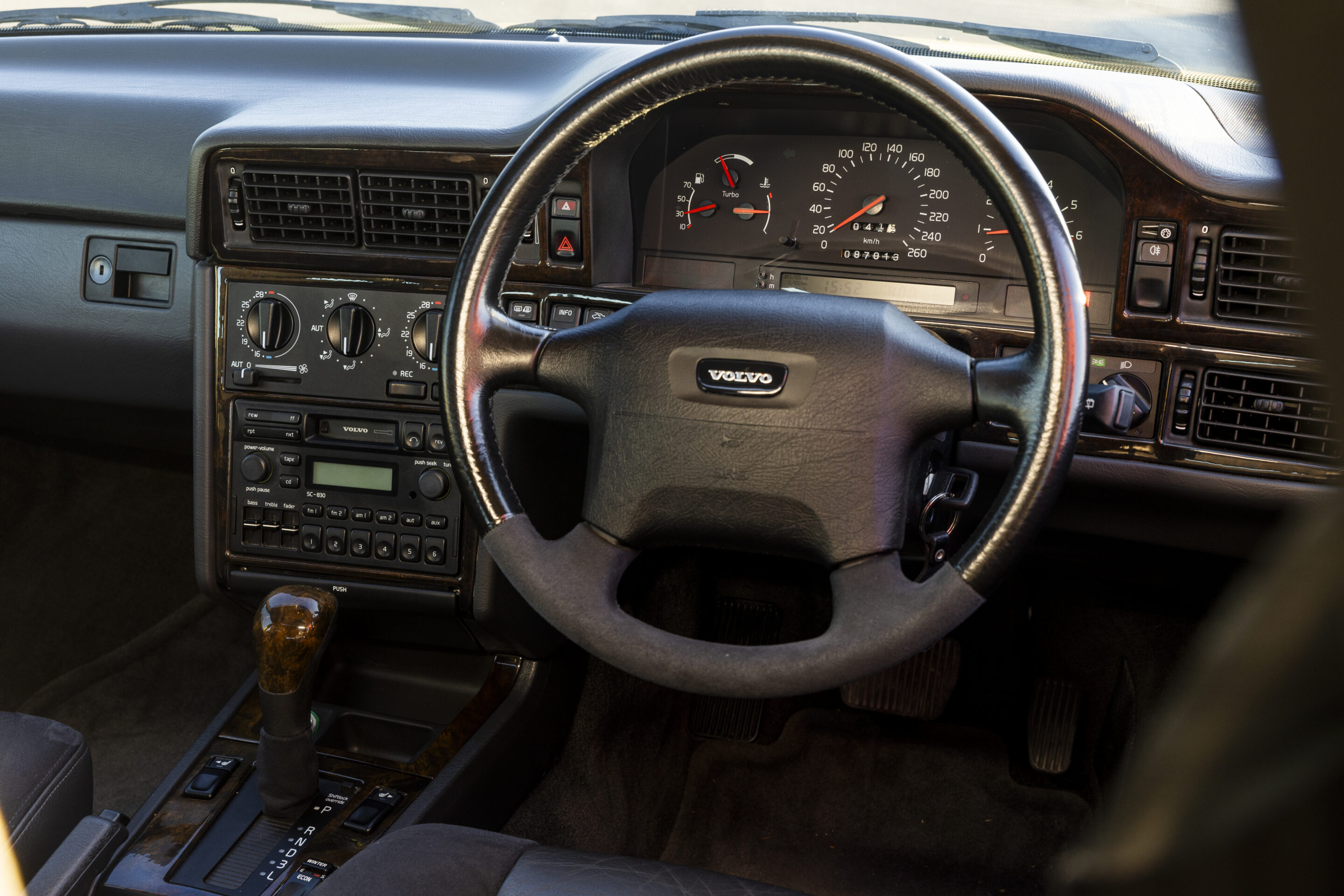
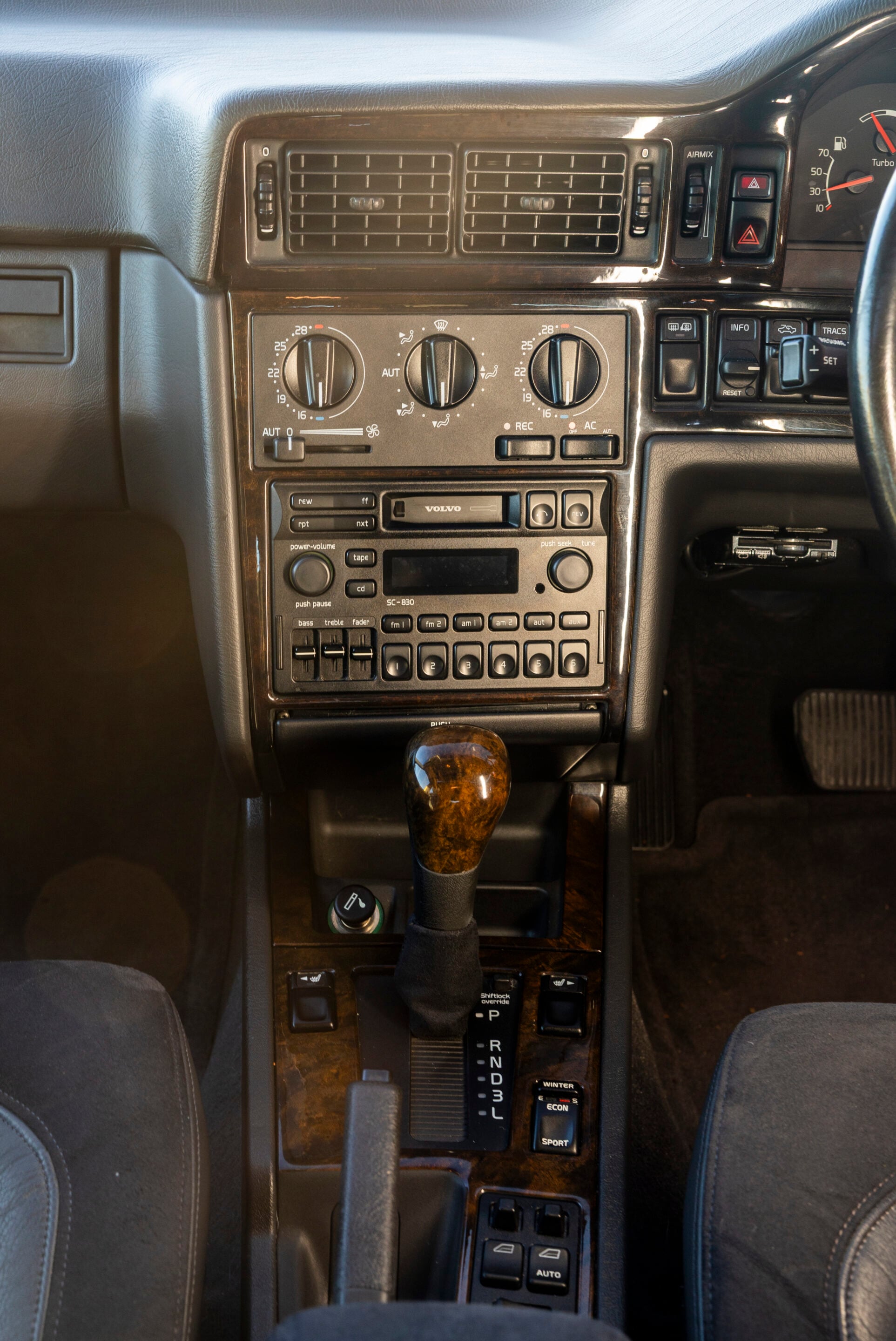
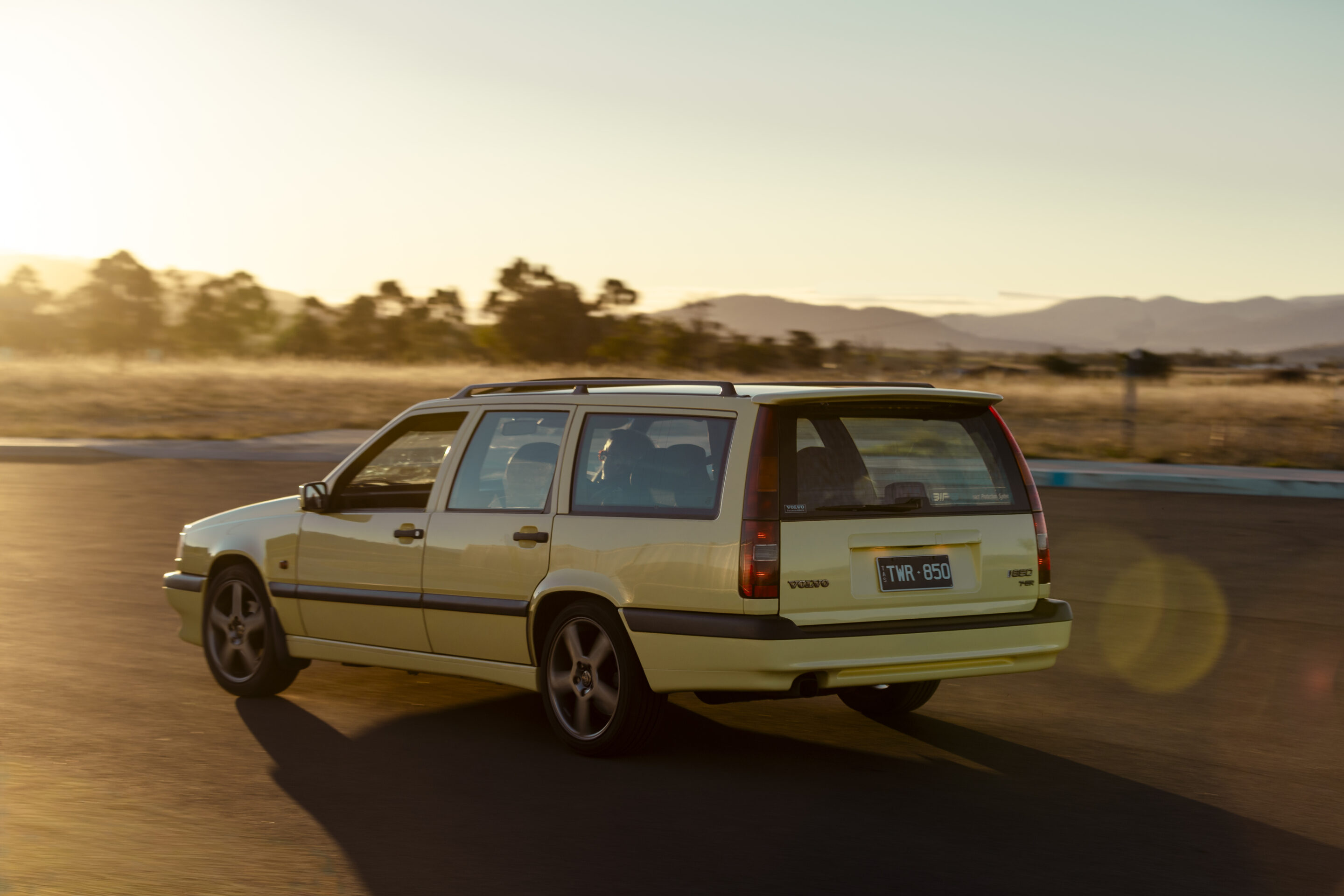
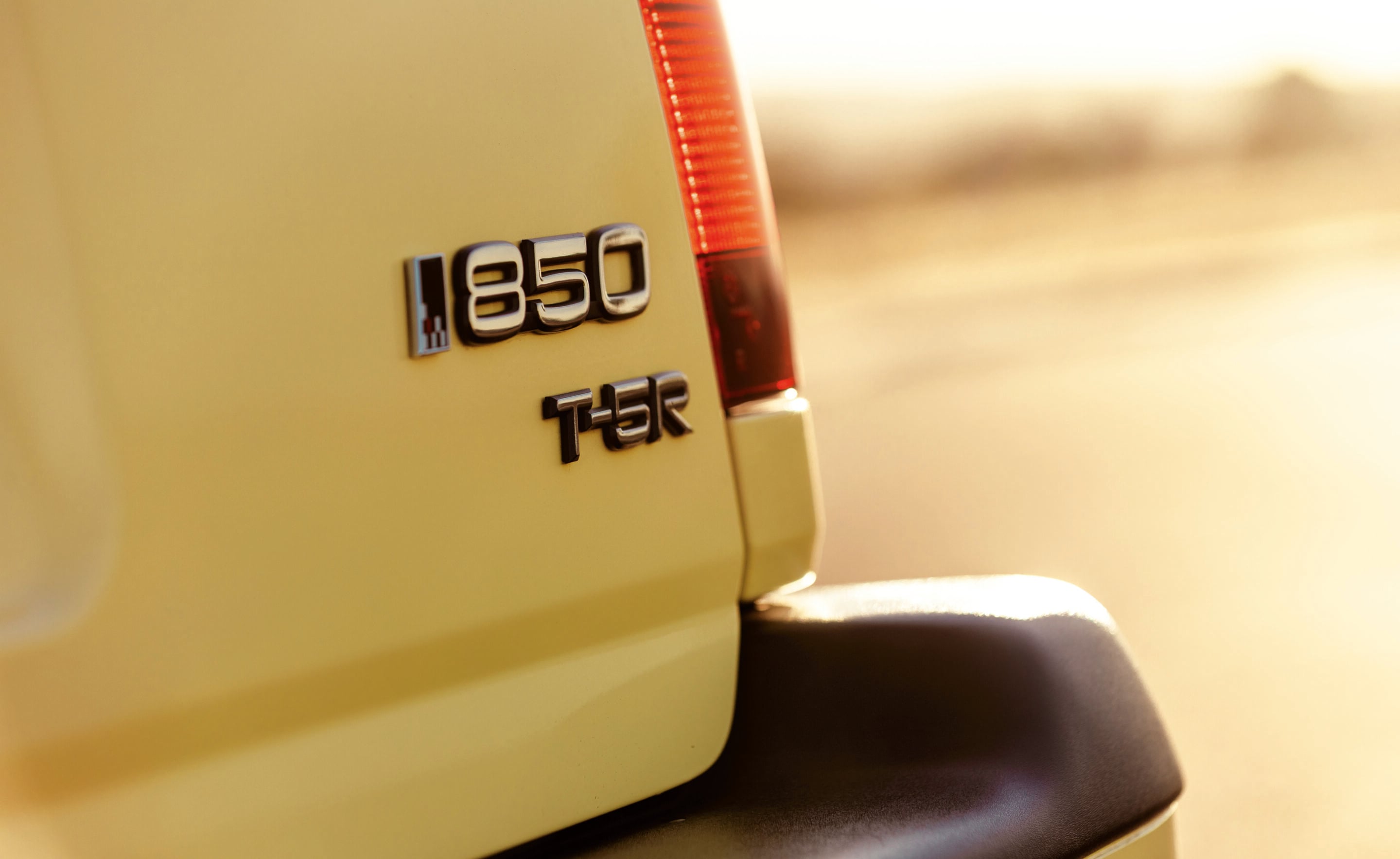
I’d watch Ayrton Senna set pole in front of his home fans at Interlagos and Michael Schumacher win the race, witness owners being presented with their box-fresh McLaren F1s and take a drive in the all-new Ferrari F355, the car that turned around Maranello’s fortunes. The daily driver? That’d be a car that Volvo first showed late that year: the astonishing 850 T-5R.
It was far from the fastest wagon launched in that particular era. In March 1994, Audi had comprehensively upped the ante with the 232kW RS2 wagon, a vehicle developed and assembled in conjunction with Porsche. Notwithstanding the Nogaro Blue missile from Rossle-Bau, the backstory behind the 850 T-5R is arguably even more interesting. There was certainly a good deal more consequence to it.
1
We talk a lot about ‘make or break’ cars and, in many instances, it’s a case of gentle journalistic hyperbole. The Volvo 850 was a genuine case and given Volvo wasn’t a company given to wild gambles, it had a very long and deliberate gestation, starting in 1978.
In April of that year, the newly appointed CEO of Volvo, Håkan Frisinger, called a meeting with his most trusted colleagues in Gothenburg. The backdrop was one of pure Scandi-noir bleakness. The global economy was dragging itself out of the second oil crisis, the proposed merger with Saab had failed, the Swedish government had turned down Volvo’s request for a billion-kronor line of credit and the government had doubled down by issuing a report claiming that Sweden’s car industry could only survive by producing smaller and more affordable cars, and in the USA.
Frisinger was unusually bellicose, exhorting his colleagues to ignore short term headwinds. “Now is the time to look at least 10 years ahead,” he urged. “Despite the difficult economic situation, we must prepare ourselves. We must assume that Volvo Cars will succeed. And by doing so, we will also ensure survival… Let’s use the 1980s to reverse the negative trend and instead make ourselves truly strong in terms of products, competence, quality, organisation, and industry.”
Slowly does it
Project Galaxy, as the development was codenamed, set out to spawn two new cars: the large 850 and the smaller 400 series. As is often the case, scope creep occurred and Volvo found itself not only commissioning a new modular engine series, but also a transmission and a whole host of new safety features. The budget for Project Galaxy blew out to such an extent that it became the most expensive capital project in the entire history of Sweden at 16 billion kronors. So no pressure then.
No panic either. After all, Volvo doesn’t do revolutions loudly. When it does turn the ship, it’s with the slow, deliberate motion of an aircraft carrier rather than the flick-spin of a speedboat. And yet, behind the conservative lines of the Volvo 850 lay a vehicle so fundamentally different from its predecessors that it might as well have been a moonshot.
1
There was no great rush. That 1978 meeting merely lit a slow-burning fuse. The official green light for Project Galaxy came in 1986. What followed was nothing short of a reinvention; from industrial tooling to mechanical architecture. Assembly would be split across Europe: Ghent, Belgium for the car itself, while the beating heart – the engine and transmission – would be born in Skövde, Sweden. This was no mere facelift. The 850 would break with Volvo orthodoxy in dramatic fashion. For the first time in a large Volvo, front-wheel drive would be the order of the day, and beneath the bonnet, a transversely mounted engine. Not just any engine, either, but a five-cylinder. An unusual configuration then, and even more so when mounted sideways, although a certain community of Ingolstadt engineers may well beg to differ.
At a time when most mainstream manufacturers were playing it safe with four-cylinder mills, and when they weren’t, defaulting to V6s, Volvo followed Mercedes-Benz, Volkswagen, Honda and Audi in taking the path less trodden. The 850’s engineers were targeting a smooth, torquey 2.5-litre powerplant, but pushing a four-pot beyond two litres without excessive noise, vibration and harshness meant paying Mitsubishi royalties for their ‘Silent Shaft’ balancer shaft design (as Porsche did with the 2.5-litre that went into the 924S and 944 models). Volvo thought it could do better.
The first engine from this modular family was the six-pot B6304F which debuted in August 1990 in the Volvo 960. The five-cylinder variant, dubbed the B5254F, was more characterful than a four, more compact than a six, and far more interesting than either. With 127kW on tap, it wasn’t going to set Nürburgring lap times, but that was never the point. The 850 was about intelligent compromise and engineering elegance.
Of course, shoving a five-pot across the engine bay meant space was tight. The packaging challenge was acute, especially when it came to the transmission. Volvo’s response? A three-shaft manual gearbox. Unorthodox, yes, but clever. Instead of the usual two-shaft arrangement, engineers added a second intermediate shaft, allowing them to shorten the gearbox to just 353mm in length. It weighed a paltry 46kg and needed so little upkeep, oil changes were almost an afterthought.
1
It wasn’t just a gearbox. It was proof that Volvo’s engineering team was thinking differently, holistically, and often well ahead of its time. Aisin was contracted for the four-speed automatic transmission, a key component if the 850 was to sell in significant numbers in the key US market.
The 850’s launch in June 1991 wasn’t just about resetting the company’s datum on drivelines. It also ushered in what would become a key Volvo safety innovation: the Side Impact Protection System, (SIPS). Unlike competitors’ bolted-on solutions, Volvo’s approach was integrated from the get-go. Energy from a side impact would be dispersed not just through the door structures, but into the B-pillars, seat frames, underfloor beams, and a central SIPS box nestled between the seats.
It was a complex choreography of materials and structure, all working in unison to do one thing: protect. The concept had been patented by none other than Nils Bohlin, the same safety savant responsible for the three-point seatbelt way back in 1974. With the 850, that vision was realised. And by 1995, seat-mounted side airbags took it a step further, long before rivals were offering anything comparable.
For all this under-the-skin innovation, the 850’s styling was, to the untrained eye, distinctly… familiar. That was by design. Jan Wilsgaard, Volvo’s head of design since 1950, was overseeing his final project for the brand, and his instinct was to let the engineering take centre stage. The shape, a gentle evolution of the 700 Series, was undeniably conservative in its proportioning and surfacing, assuring loyalists that while the car may be all-new underneath, it was still undeniably a Volvo.
Wilsgaard partnered once more with Turin-based coachbuilder Coggiola, softening the edges slightly, but resisting the temptation to follow design fads. True visual transformation would come later under Peter Horbury’s tenure, beginning with the S40 and culminating in the sleek and curvaceous C70 coupe of 1996.
The 850 sedan was launched in late 1991, with the wagon body following in 1993, with all versions getting a mild facelift in 1994. In August 1994, a 166kW turbocharged petrol sports model was launched, dubbed T-5 in some markets and, with typically Swedish pragmatism, badged Turbo in others. Demand for the T-5 outstripped Volvo’s ability to supply, the 850 chassis handling the additional power without a skerrick of torque steer. It rapidly became a favourite pursuit car for police forces around Europe.
1
Volvo is… cool?
The launch of the T-5 also kickstarted a new, more dynamic image for Volvo. The company’s Back on Track project was launched in April 1994, when two Volvo 850 wagons fronted up at Thruxton circuit for the opening round of the British Touring Car Championship (BTCC).
Tom Walkinshaw Racing, which had been Volvo’s main competitor in the European Championship series during the 1980s when the 240 Turbo was competing against the Rover SD1, had been contracted in 1991 to develop a tin-top race car. Richard Owen, the man who also designed the stunning Jaguar XJ220 body, was put in charge of designing the 850 racer. TWR would provide the hardware and Volvo would be responsible for technical support, marketing and PR.
The decision to enter the competition with two wagons was made several months before the start, but it was kept under wraps until the last possible moment. When the news broke, many assumed it was a joke. After all, a large wagon is far from ideal for the track, with extra weight behind the rear axle and the long roof creating a higher centre of gravity, it was certainly an unconventional choice, especially given a sedan option was available.
“But the aerodynamics of the estate were actually slightly better [than the sedan],” recalls driver Rickard Rydell. However, the real deciding factor was the attention the wagon would attract. Under FIA Class 2 regulations, race cars had to be based on production models. The body shape could not be altered, and to keep the races competitive, engine displacement was limited to two litres, maximum engine speed capped at 8500 rpm, and minimum weight set at 950kg for front-wheel-drive cars. Forced induction of any kind was strictly prohibited.
Volvo and TWR chose to base their car on the five-cylinder engine found in the 850 T-5, which originally had a 2.3-litre capacity and produced 166kW and 300Nm. The racing version, naturally aspirated and reduced to two litres, produced 216kW. The standard five-speed manual gearbox was replaced with a six-speed sequential transmission. Notably, Volvo was the first team to fit its cars with catalytic converters, which later became mandatory under class regulations.
“We didn’t have time to properly test the car on track before its debut at Thruxton on April 4,” says Rydell. “Jan Lammers and I had only managed a few hundred metres outside TWR’s development workshop – that was it. The 850 estate was by far the biggest car in the championship,” Rydell explains. “Most competitors, who were mainly there to enhance their sporting image, weren’t thrilled about going up against an estate car. There were a few jokes and jibes from other drivers – but that didn’t bother us. In fact, just to tease them, we drove with a large stuffed collie in the boot during the parade lap at one event.”
The wagon wasn’t the most successful race car, but you could be excused for not realising that, given the column inches it claimed. It was 14th in its first season, and was then switched out for the 850 sedan, which came third in its two campaigns.
2
Enter the hero
Cue the T-5R. Originally dubbed the 850+ and the 850 plus 5 (the name that appeared in the original press kit), this wicked-up version of the 850 T-5 also lived for but one year of production. By now you’ll have realised that the claim the T-5R was some sort of homologation car to allow Volvo to go racing is a furphy.
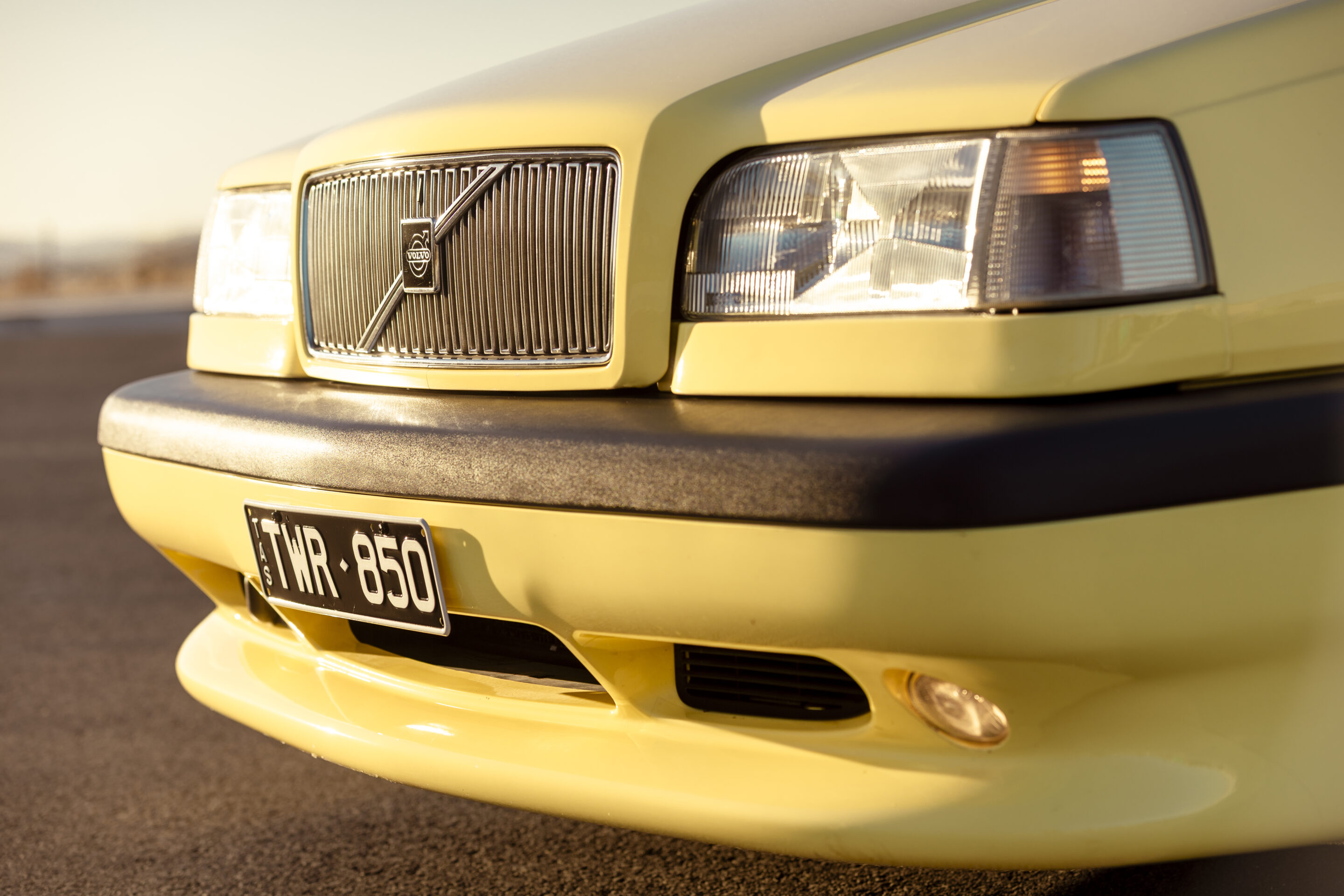
With power edged up to 177kW and torque to 330Nm, the T-5R featured an uprated ECU, which saw boost pressure cranked up from 9.6 to 10.9psi, allowing up to 7 seconds of full-bore grunt. The car sat on lower and stiffer springs and also featured a deeper front spoiler with inset fog lamps, and graphite grey alloy wheels shod with 205/45 ZR17 Pirelli P Zero tyres. Only two options were listed: An Alpine 6 CD autochanger and 16-inch wheels with Michelin MXM all-weather tyres. Supply was strictly limited, as Volvo’s hilariously terse press release accompanying the car’s launch outlined.
“It is not going to be a volume seller. Which explains why you are not going to see it that often. That is not the idea when it comes to the 850 T-5R. Only 2500 people will be given the privilege of owning this specially-prepared turbocharged model because only 2500 cars will be produced,” it stated. Of that initial production run, Germany and Italy were the biggest markets, with 876 going to the USA, 200 earmarked for the UK, and a mere 25, all manuals, and all in signature Cream Yellow, would come to Australia.
Our allocation was interesting. Volvo Cars Australia was keen for the T-5R to make its mark in Super Production racing and offered the T-5R sedan for $74,950 in race-stripped guise, or $75,950 for the roadgoing car with items such as air conditioning, a sunroof and rear seats present and correct. Volvo paint code 607 was also changed by VCA from the original Cream Yellow name to Faded Yellow for Aussie customers, with Volvo USA also changing the name of the paint finish to T-5R Yellow, apt as it’s the only Volvo it ever appeared on. Rather than worrying about what the paint was called, perhaps VCA should have been paying more attention to what BMW and Frank Gardner Racing were working on: the 235kW E36 M3R, a car so powerful and capable that Volvo’s domestic motorsport aspirations were summarily blown out of the water.
The tuning of the Bosch 628 ECU for the 850 T-5R endowed it with a peakier torque curve than the garden-variety T5. Whereas the T5 developed its 300Nm in a broad plateau from 2000 to 5250rpm, making it a very easy car to keep on the boil, the T-5R’s 330Nm arrived between 3000 and 4800rpm. It was enough to get it to 100km/h in a claimed 7.0 seconds, half a second quicker than the stock T5. The redoubtable Michael Stahl was our man on the spot for the T-5R road test, which ran in the January 1995 edition of Wheels. He seemed a little nonplussed at the brawny Swede, noting its doughy throttle response, remote steering and long-throw gearbox.
1
“Maybe that’s just our fault for expecting a Swedish BMW M3,” he wrote. “The T-5R is a textbook performance front-wheel drive handler: Neutral with eventual, usable understeer on fast exits and a tail that’s unfussed by desperate late braking and flick corner entries. Body roll is notably well controlled; so too is the body’s squat and dive under acceleration and braking.
“Heck, but the Volvo from Hell rides really well. Remarkably so, in fact, given its firm and confident handling and those low-profile Pirellis. It doesn’t rumble at all noisily or uncomfortably over patchy surfaces, nor does the steering tramline. If anything, its bump damping might be just a tad too firm and its rebound just a tad too soft, which allows a mild hopping motion over undulations. Generally, however, it’s a remarkable achievement.
“The standard 850 T-5 model is blessed with more brakes than it could ever need, a fact made evident to this punter during dozens of laps of Phillip Island a year ago. Volvo deemed the ventilated front, solid rear disc set-up (with four-piston calipers up front) sufficient for the R-car, and we’ve no complaints in terms of fade or feel.”
So, a solid report card for go, stop and steer. We had another crack in the T-5R couple of months later in the May 1995 edition, when the Volvo joined a host of other performance cars for the Wheels Speed Fest ’95 feature. We slotted Peter Brock behind the wheel of that year’s latest and greatest and set him loose on Lang Lang’s high-speed bowl. Lurid tales of 850 T-5R development drivers harassing Porsches on autobahns had been whispered about for years. Now it was time to put up or shut up.
Brock squeezed 258km/h out of a 993 Carrera 4 around the banked circle, and the all-wheel drive Porsche also stopped the clock at 14.2 seconds over 400m. The Volvo couldn’t get close to those figures, running into an aerodynamic brick wall at 231km/h and clocking 15.6 seconds over the quarter. The feature speculated that the Volvo suffered from the heat on the day: “The placement of the exhaust manifold, including turbocharger of course, on the rear side of the transverse five certainly looks like a recipe for heating the long and serpentine induction tract.”
A slight lack of apparent horses aside, Brock was impressed by the T-5R’s manner, noting that it was a more agreeable thing to pedal than the unruly Saab 9000 Aero also along for the event. “Turns in better than the Saab coming into the off-camber corners,” he noted. “Very chuckable car to drive. I’d say less understeer than the Saab. Unlike the Saab, the back end is doing a bit of work. It’s actually helping to unload the front. Yeah, a better job from a handling point of view.”
Brocky knew these hot Volvos well, having campaigned in a 2.5-litre T-5 sedan at the 1994 Bathurst 12-Hour (his race ending with transmission failure), and later went on to campaign a 2.0-litre 850 in the 1996 Australian Super Touring Championship. The car was an ex-Rickard Rydell BTCC sedan and Brock’s best result that year was a second at Lakeside, eventually finishing sixth in the title race. He missed the Bathurst 1000, concentrating on his Holden Racing Team commitments instead, with Jim Richards slotting into the seat and winning the wet final race prior to the 1000, giving Volvo its first victory in Aussie Super Touring.
By modern standards, the 850 T-5R is not a particularly quick car, but it’s one that handles neatly and has never quite lost its capacity to surprise, especially in wagon form. It stands as a milestone; not because it shouted, but because it didn’t need to. So successful was the T5-R that Volvo massively exceeded the projected 2500 car production run. In all, 5500 cars were built for world markets. Of these, 1975 units were Cream Yellow, 500 were Dark Olive Pearl and 3025 were finished in Black Stone.
Above all, the T-5R redefined what a Volvo could be: smart, safe, and just a little bit subversive. This element of nod and wink lends it enormous charisma and was perhaps the moment Gothenburg showed it could think like Stuttgart, but with a conscience. In doing so, it laid the groundwork for the brand’s modern era.
In effect, you’re looking at the moment that Volvo rediscovered its mojo.
1
The Porsche angle
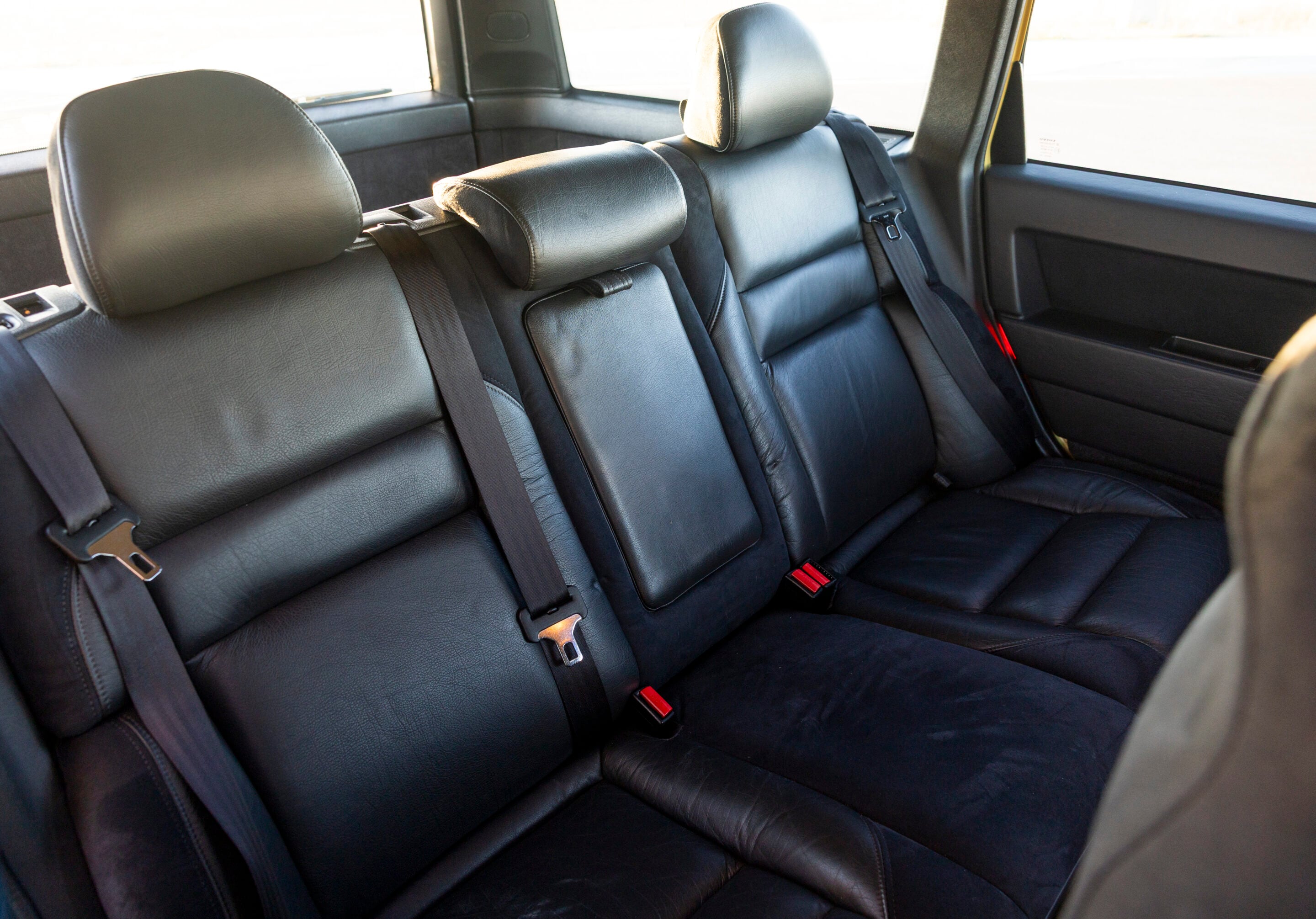
There’s some lively debate on exactly how much involvement Porsche had in the development of the T-5R. Some maintain that Zuffenhausen’s consulting engineers were involved in fine tuning the intake and exhaust manifolds, and there’s also some evidence that they worked on the ECU tuning. The suede-like Amaretta interior finish came straight off the reel that Porsche used on the 993 Turbo, which was also introduced in 1995. Oh, and the fold-out cup holder is a little bit of Porsche ingenuity too.
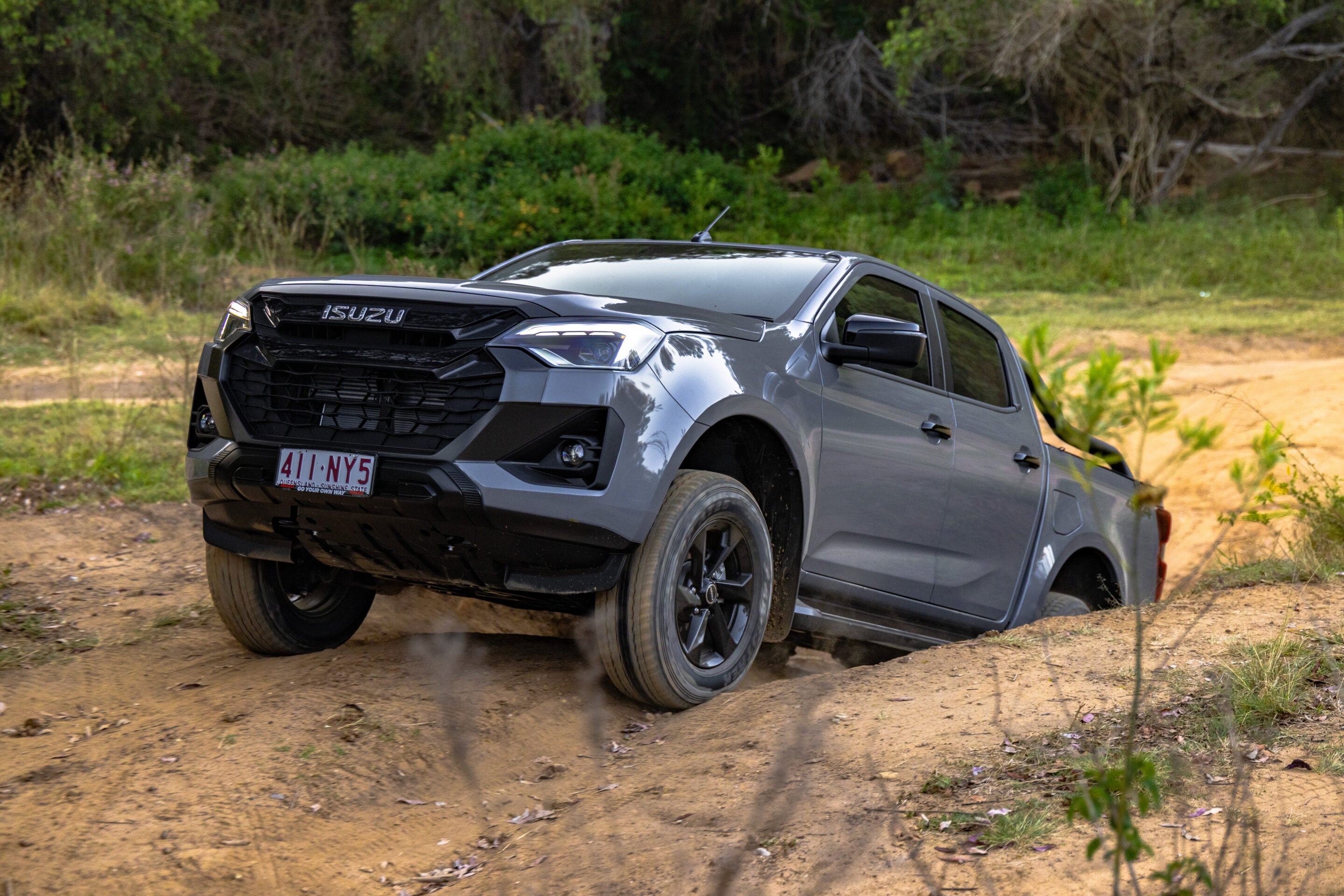
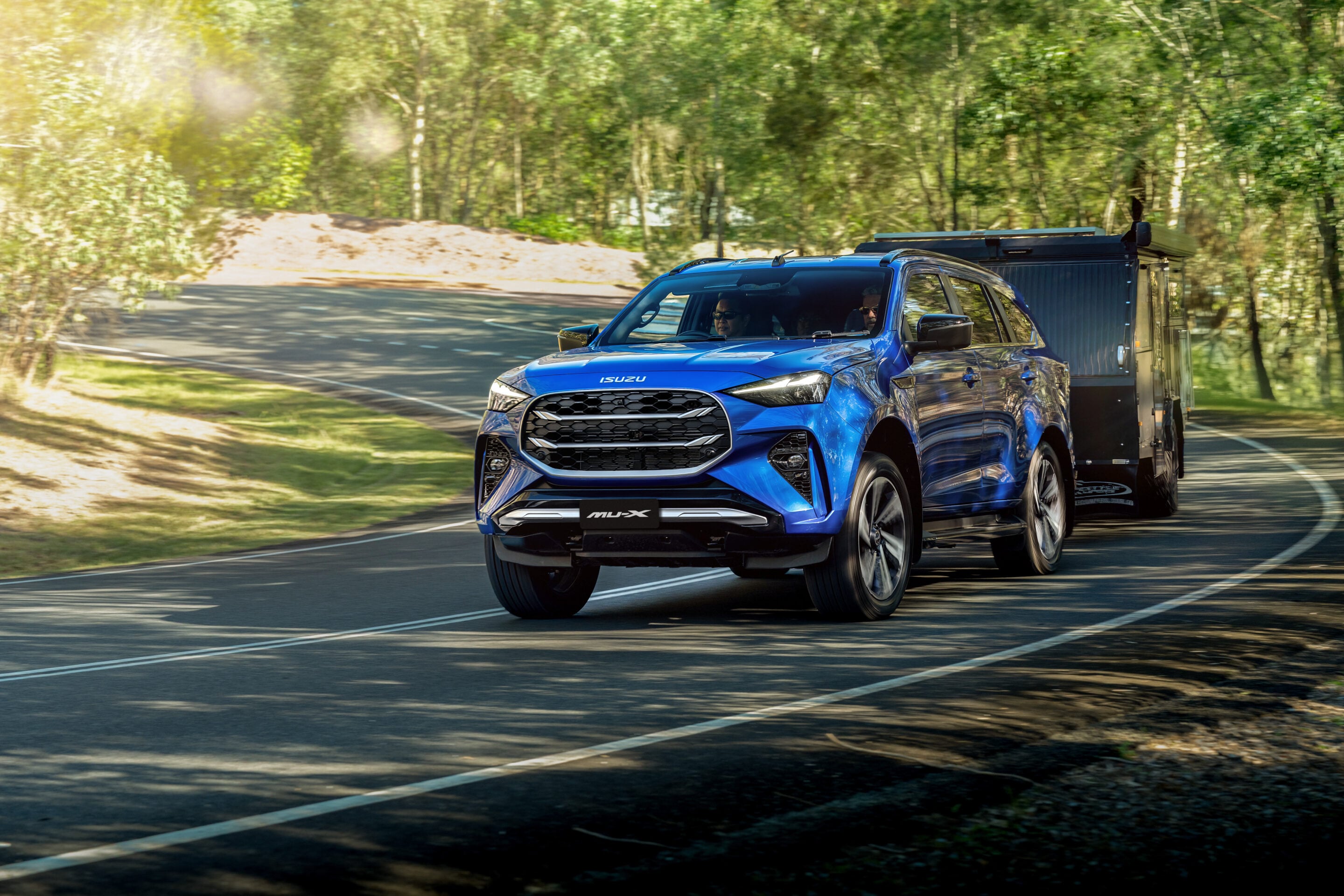
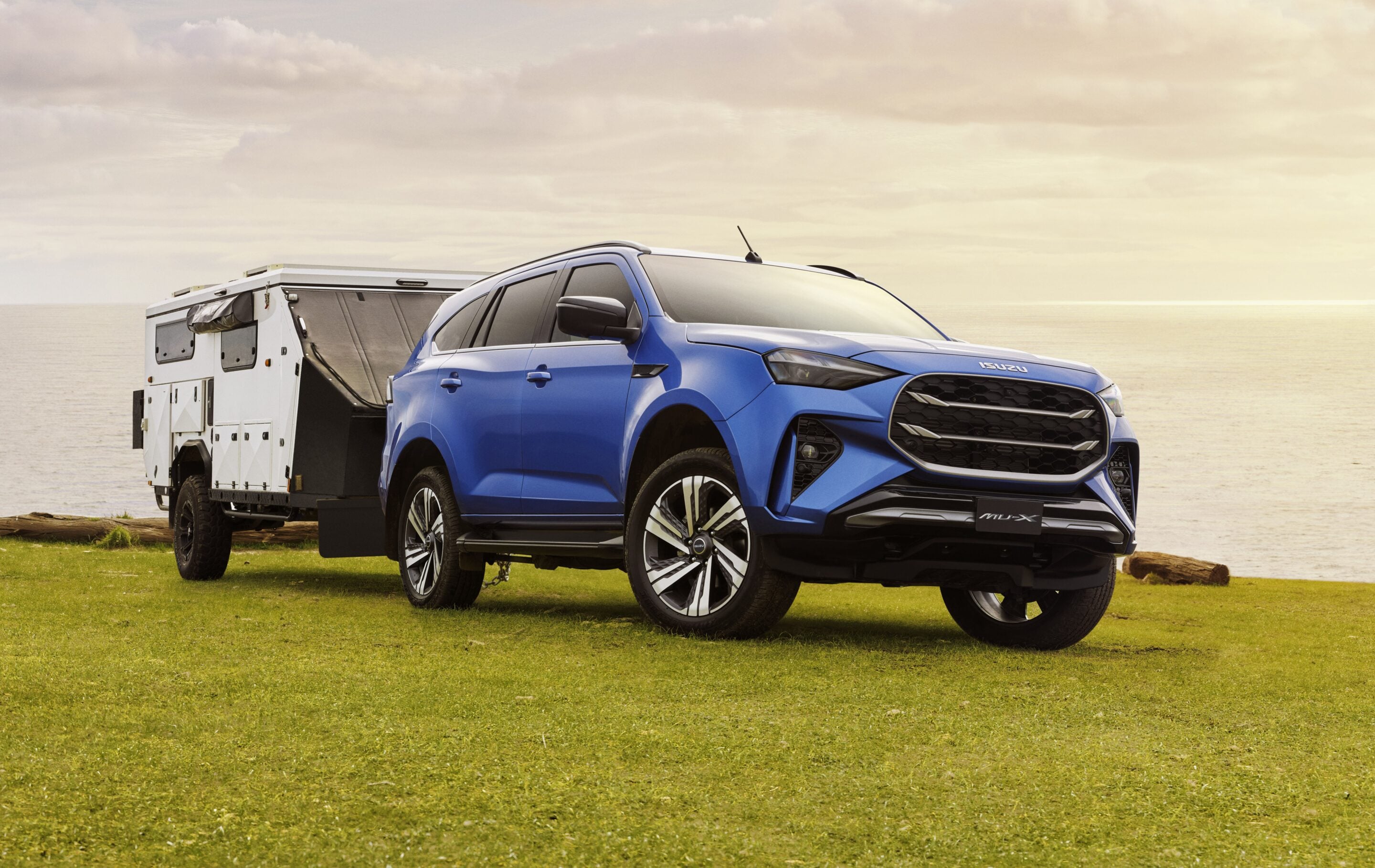
It’s fair to say that Isuzu’s 3.0-litre engine is the stuff of 4WD legend. Tough, reliable, with a long service life, and the ability to tackle heavy loads or difficult off-road work without issue, Isuzu’s big four-cylinder has been a favourite with Australian buyers for years now. Head into any remote town in the outback, and chances are you’ll see an Isuzu D-Max or MU-X rolling through – often with a caravan in tow.
If you’re wondering just how popular Isuzu’s two-model line up is, at the time of the launch of the new 2.2-litre engine, D-Max sat in third behind Ford Ranger and Toyota HiLux (in the 4X4 segment) for monthly sales, while MU-X also sat in third behind Toyota Prado and Ford Everest.
Heavy hitters indeed, and proof that Isuzu is right up there with the best of them. Speak to Isuzu owners, and many of them are repeat customers too, such is the robust quality of the product.
2
This new engine is an interesting move, and it’s not just the engine either with a new transmission backing it. In the 4×4 D-Max range, pricing starts from $50,700, for the SX dual-cab chassis model, before on-road costs. In the 4×4 MU-X range, pricing starts from $55,900 before on-road costs.
Reading the tea leaves, the new 2.2-litre engine is in line to replace the 3.0-litre at some point – probably not too far down the track. What’s most interesting right now though, is the relatively small – $2000 – price premium to step up to the 3.0-litre engine while it’s still available. The case for the new engine isn’t as strong as it might be with the 3.0-litre still available and still that affordable.
A quality eight-speed automatic comes with the new engine, promising to deliver efficiency and lower emissions while still retaining crucial performance ability such as a rated 3500kg towing capacity (up from the 1.9-litre’s 3000kg rating). The outgoing 1.9-litre generated 110kW and 340Nm, while the new 2.2-litre makes 120kW and 400Nm.
1
Isuzu claims better power from takeoff, and earlier delivery of peak torque as well, which means day-to-day drivability should be easier and better. The previously available manual transmission is no longer and crucially, the new engine drops fuel use down as low as 6.3L/100km and will assist in minimising the fines that the manufacturer has to cop under new CO2 emissions rules implemented by the Australian government.
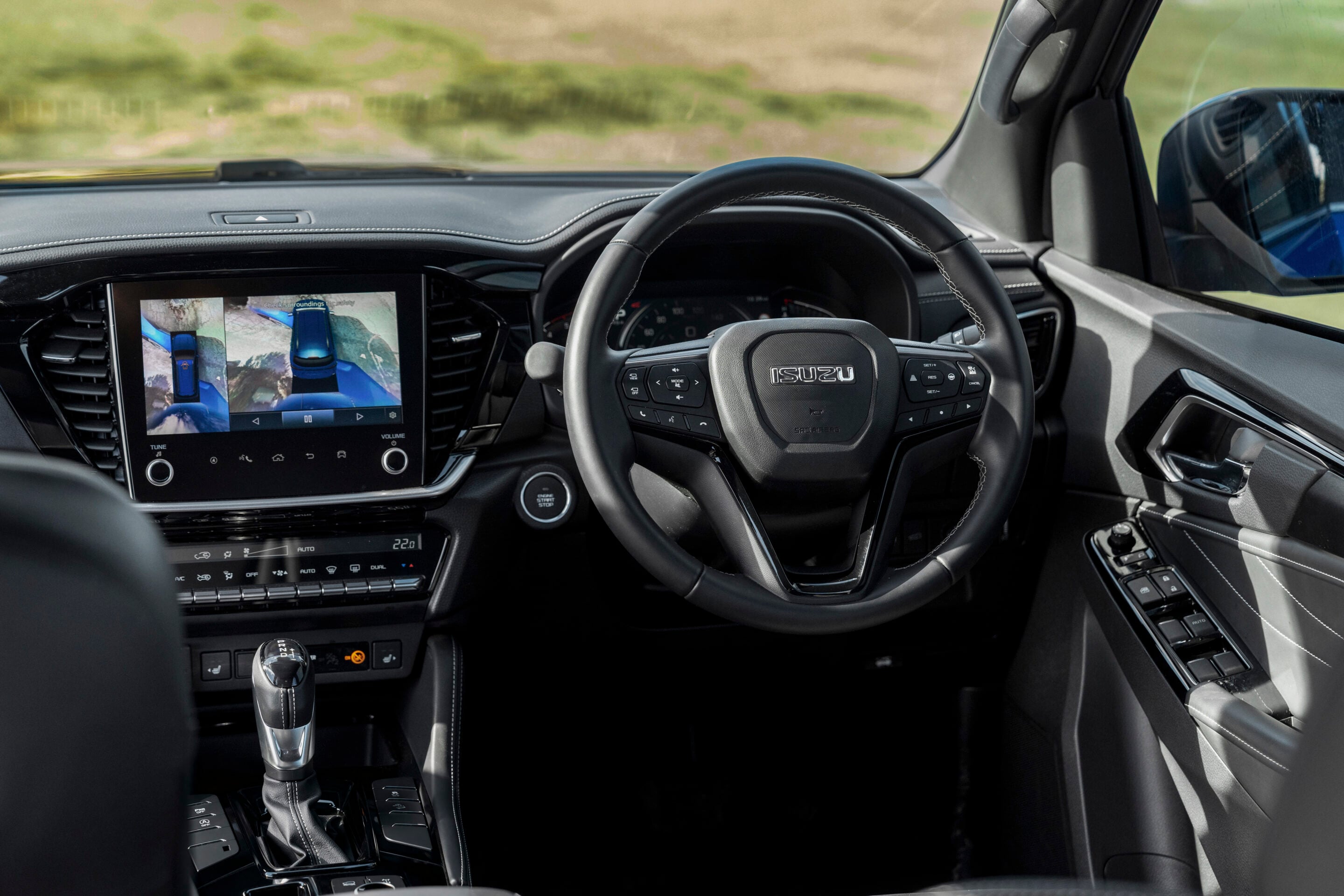
From the outside, and inside the cabin as well, both MU-X and D-Max are as you were. That means if you’re upgrading from an older model, this current generation will feel like your favourite hoodie, or if you test the 3.0-litre back-to-back with the 2.2-litre, the cabin, driving position and controls will remain the same. All the changes are under the skin and only evident when you get behind the wheel.
Our launch drive starts in city traffic, where the strengths of the new engine and gearbox come into play. Isuzu’s stop/start system isn’t as snappy as we would like, and there’s some shudder on start up when you lift off the brake. It won’t always activate, depending on factors like steering angle, and the needs of the powertrain for example, but we did notice the AC doing the thing that most of them do when the engine stops at the lights.
2
That is, it’s not as cold as it is when you’re on the move. You will get used to stop/start though, and if you’re not as picky as we are when it comes to assessment, it’s fair to say it probably won’t bother you.
The other factor you’ll notice in town is the engine noise. You will hear it working, especially when you need a decent hit of throttle to either get up to speed from a standstill or roll on to overtake. It’s not harsh, but it’s there, and we’d need to drive the new engine back-to-back with the existing 3.0-litre to tell you whether it is in fact, quieter. There’s certainly not a revolutionary shift in refinement with the 2.2-litre engine though.
The gearbox is excellent. Eight ratios is probably as many as you need in the real world, without ending up with a transmission that is constantly hunting for gears, and looking to maximise efficiency. There’s nothing wrong with six either, but a quality eight-speed is a really good thing to use in real-world driving scenarios. As such, progress in the new MU-X and D-Max is smooth, with shifts almost imperceptible unless you’re right up at redline.
Once you’re up to cruising speed on the highway, the new engine settles into the same relaxed lope as we’ve come to expect from any previous Isuzu.
We actually did more off-road driving at the launch, which is counter intuitive for most of you reading this, especially if you’re a potential MU-X buyer. Hardcore off-road work, still remains the domain of the minority in a market laden with 4WD alternatives across nearly every sector. As it was on-road though, the new engine is in its element in the rough stuff.
3
There are still 2WD MU-X variants available for those of you who don’t need 4WD. Key to the ability off-road is the quality of the low-range gearing, a rear diff-lock, off-road focused ground clearance, and Isuzu’s now-excellent ‘Rough Terrain Mode’ traction control tuning, which limits wheel slip, maximises grip at the right tyre, and ensures smooth, fuss-free progress. In practice, whenever you’re in a situation with wheels hanging in the air, and offset grip, hit the switch, and you can drive through with all the confidence in the world. It’s as much a safety feature for tough off-road driving as it is a clever electronic addition and it’s something that even experienced off-roaders will use.
The new engine and gearbox can crawl smoothly in low range either up or downhill, with excellent response to throttle inputs. There’s absolutely nothing jerky about the driving experience even in gnarly terrain off-road, which makes for easy progress on any surface.
We look forward to more on-road testing though, the environment that most of you will use the D-Max and MU-X in.
There’s no doubt the new 2.2-litre engine is a good one – it’s effortless, flexible, works well on and off-road and does what buyers will expect. The headline act, however, is probably the excellent eight-speed automatic, which makes the most of the new engine’s power and torque. In the real world, the 2.2-litre is all you need to do what most large SUV and dual-cab buyers use their vehicles for.
However, if you’re towing regularly or love a long distance road trip, the 3.0-litre still appeals. And, the pricing structure ensures the 2.2-litre isn’t significantly cheaper than the 3.0-litre either, meaning most buyers might opt to pay a little bit more to get a little bit more.
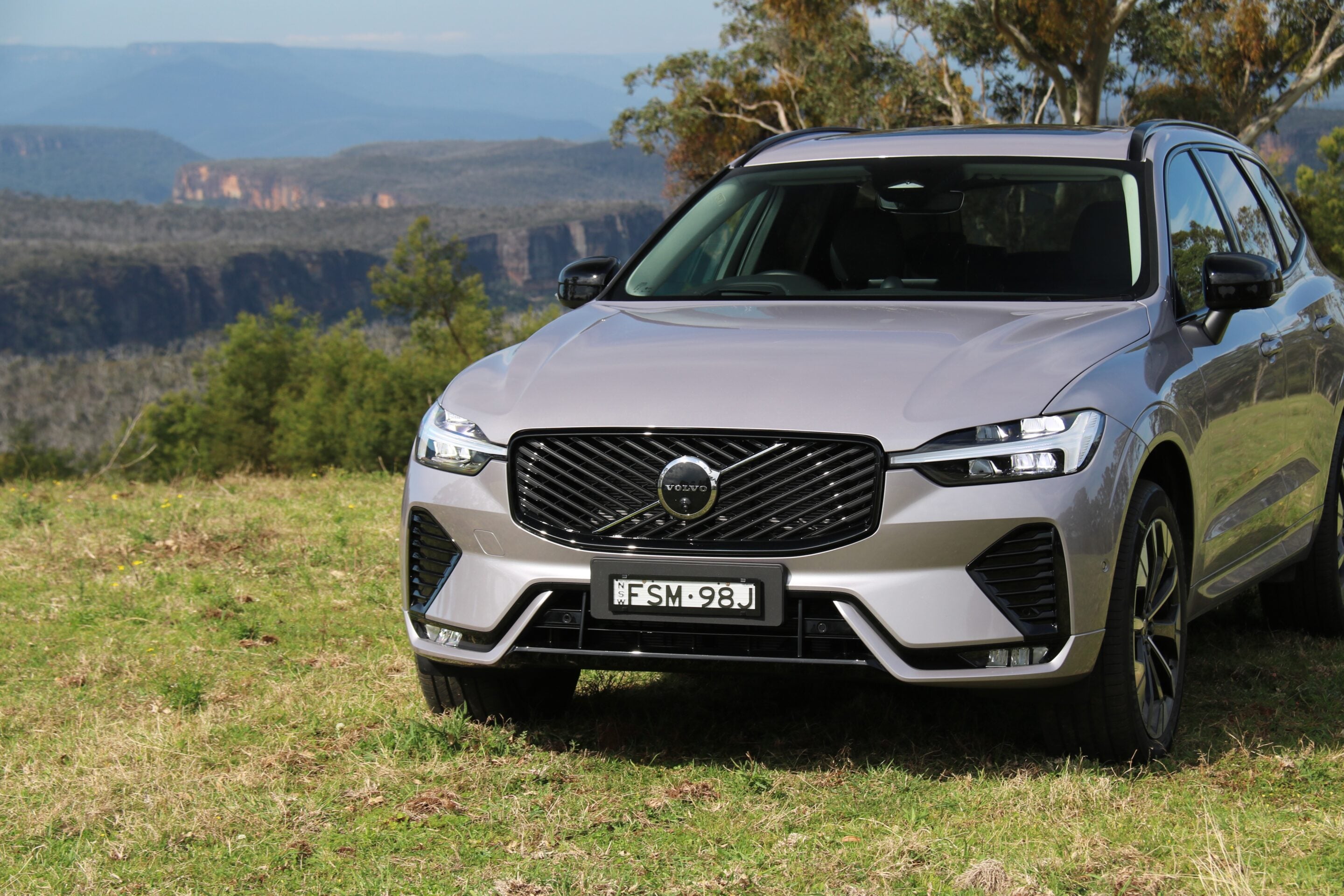
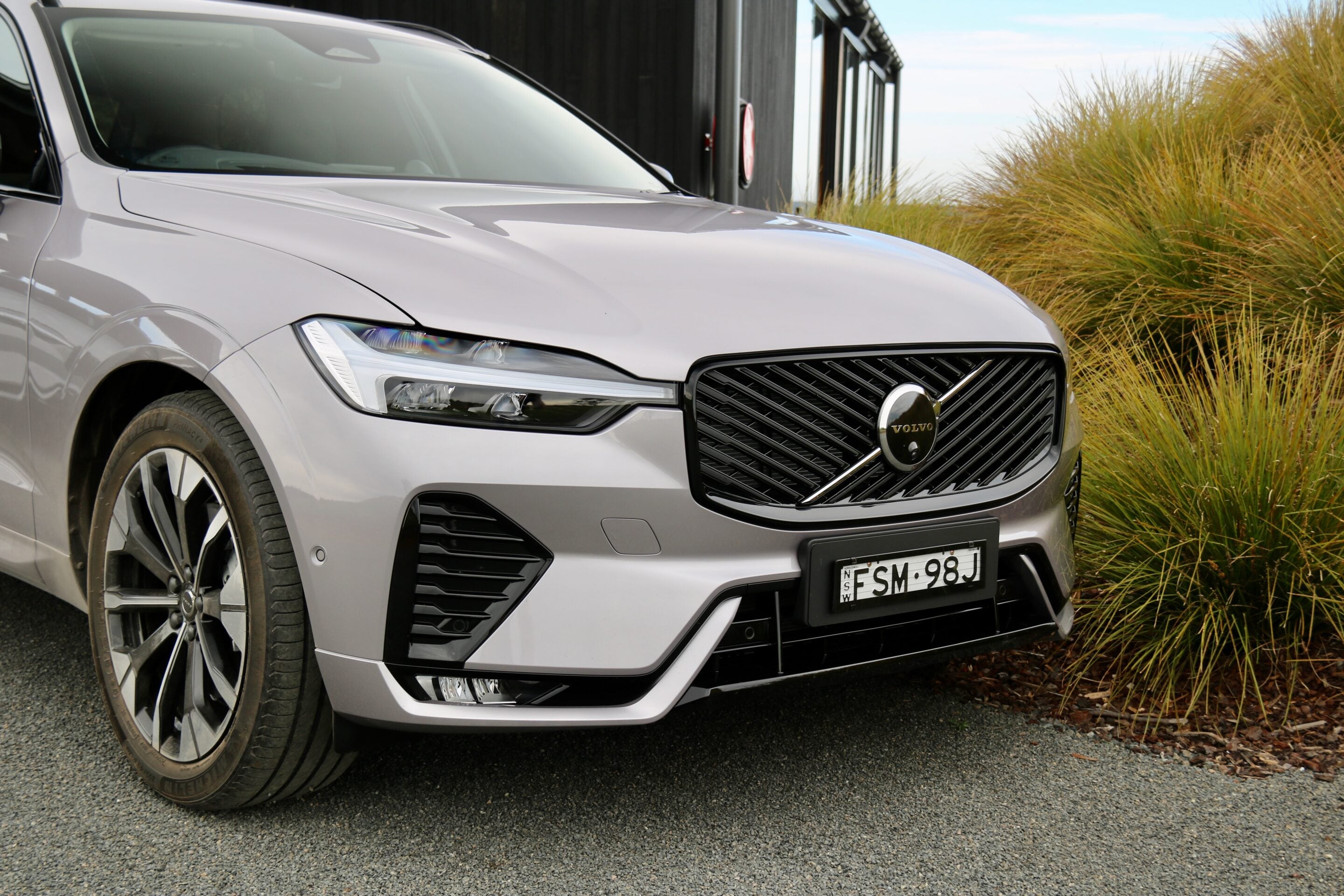
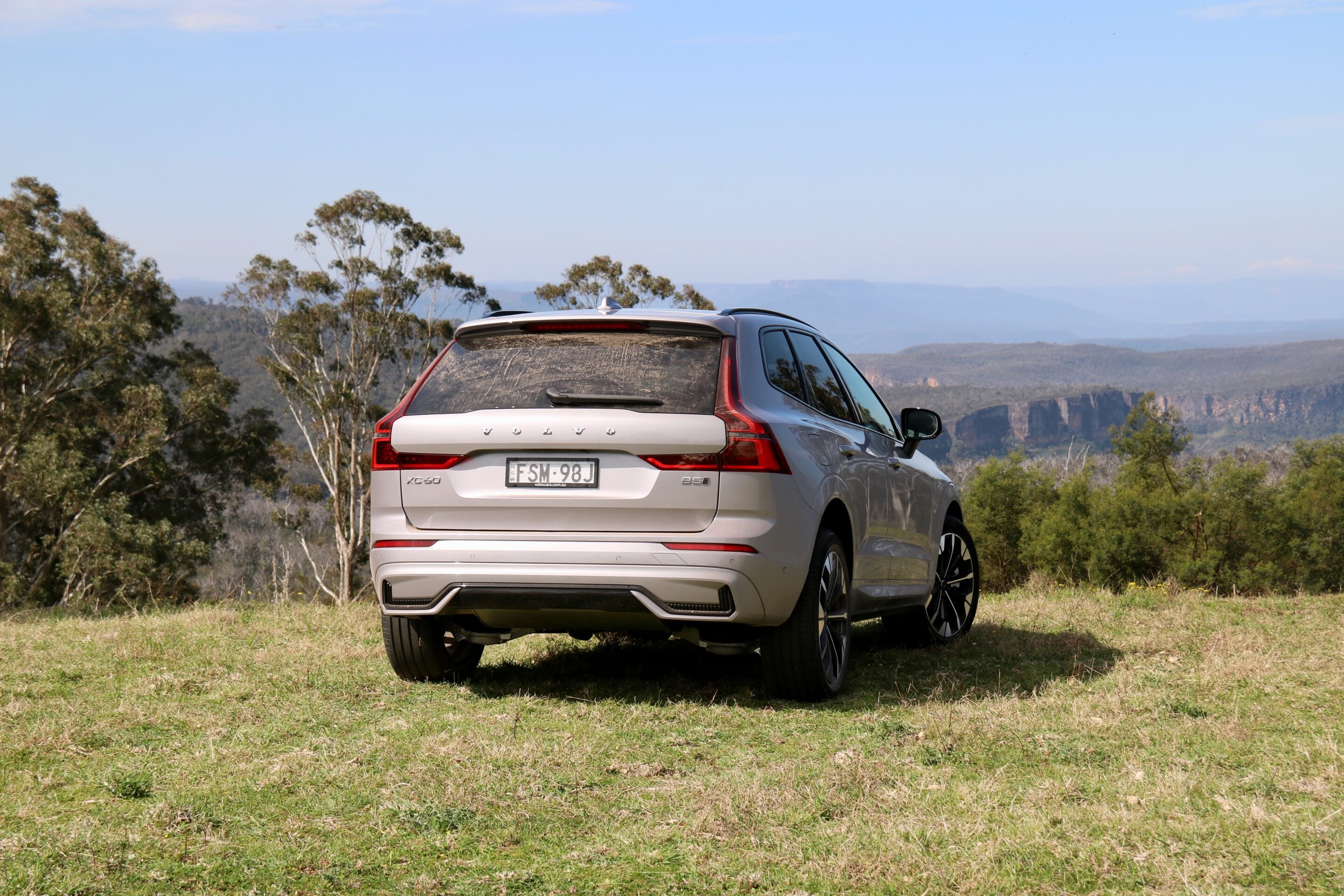
Recently, the Volvo XC60 overtook the iconic Volvo 240 as the company’s most popular product of all time. With 2.7 million units produced since the first XC60 left the production line in 2008, the XC60 has been a massive success for the Swedish car company and is still its most popular product both in Australia and globally.
Now in its eighth year for the second-generation model, the XC60 has just received an update to keep it fresh in the hugely popular and highly competitive mid-size SUV segment. Is the updated XC60 still one of the best luxury mid-size SUVs? Let’s find out.
3
Price and equipment:
2026 Volvo XC60 pricing (plus on-road costs):
Plus B5: $74,990
Ultra Dark B5: $81,990
Plus T8 PHEV: $92,990
Ultra Dark T8 PHEV: $101,990
XC60 Plus standard features:
19-inch alloy wheels with a spare-saver spare
Dusk-sensing automatic all-LED lighting
LED front and rear daytime running lights
Rain-sensing automatic wipers
Keyless entry with push button start
Hands-free electric tailgate
Aluminium roof rails
Heated and auto-folding mirrors
Leather steering wheel
Orrefors crystal gear selector
Synthetic ‘Nordico’ leather upholstery
Electric front seat adjustment with memory
Four-zone automatic climate control
12.3-inch digital driver’s display
11.2-inch touchscreen with live services
Inbuilt Google services including, Google Assistant Google Maps and Google Play Store access
Head-up display
Apple CarPlay
DAB+ digital radio
10-speaker sound system
Wireless phone charger
4x USB-C ports
Head-up display
Auto-dimming mirrors
10A home charging cable (T8 PHEV)
XC60 Plus safety features:
7x airbags
Autonomous emergency braking (AEB)
Adaptive cruise control with adaptive lane guidance
Lane keeping assistance
Blind-spot monitoring with cross-traffic alert (with braking)
Driver attention monitoring
Traffic sign recognition
Matrix adaptive high beam
Front and rear parking sensors
360-degree camera
Tyre pressure monitoring
Alarm
4
XC60 Ultra Dark adds:
20-inch alloy wheels
Dark exterior highlights such as the grille, window frame and roof rails
600W 14-speaker Harman Kardon sound system
Nappa leather upholstery
Heated steering wheel
Ventilated and heated front seats
Panoramic sunroof
Extra electric front seat adjustment
Tailored dashboard upholstery
XC60 colour range (all no cost extra):
Onyx Black
Forest Lake
Mulberry
Bright Dusk
Denim Blue
Vapour Grey
Aurora Silver
Crystal White
Interior, practicality and bootspace:
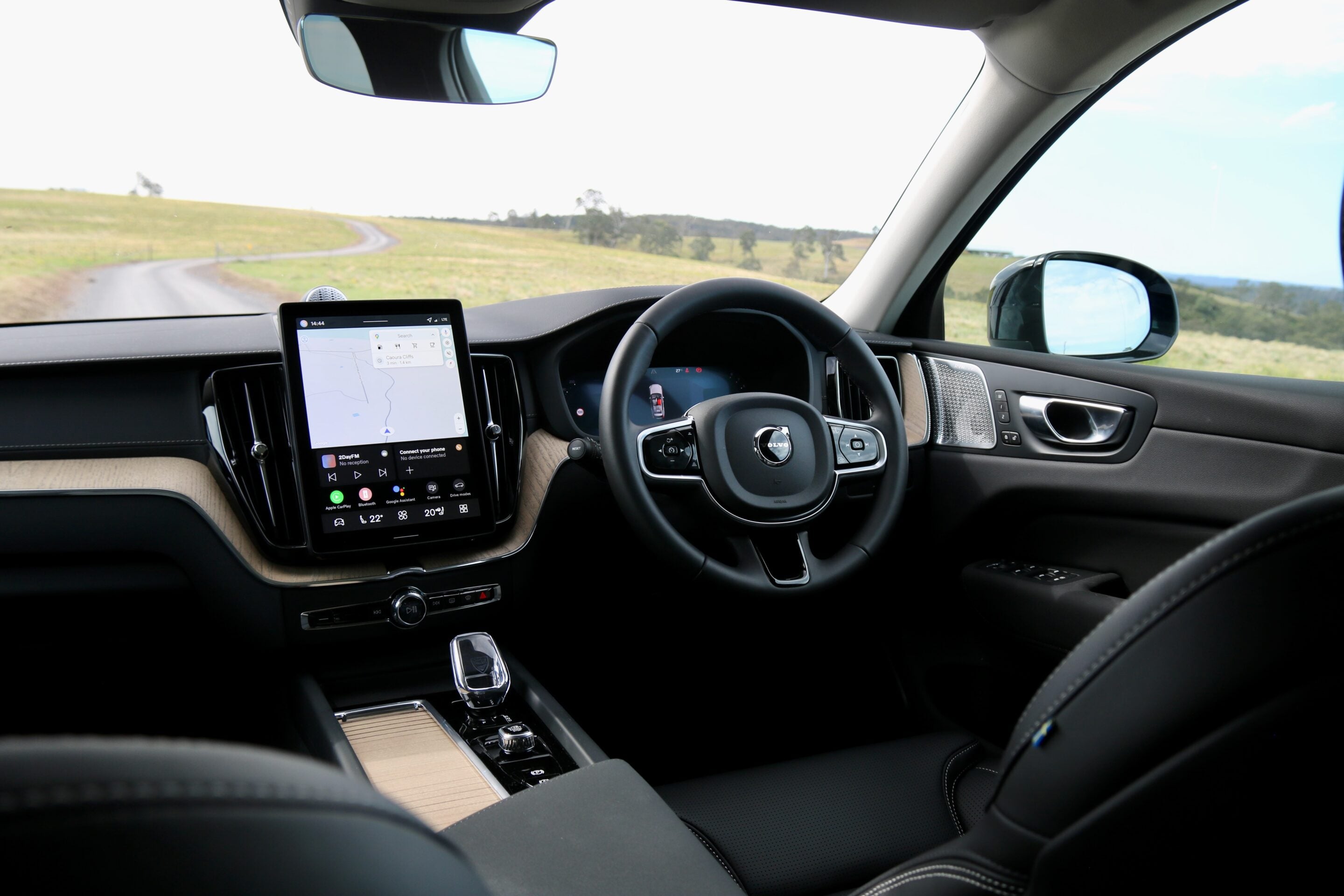
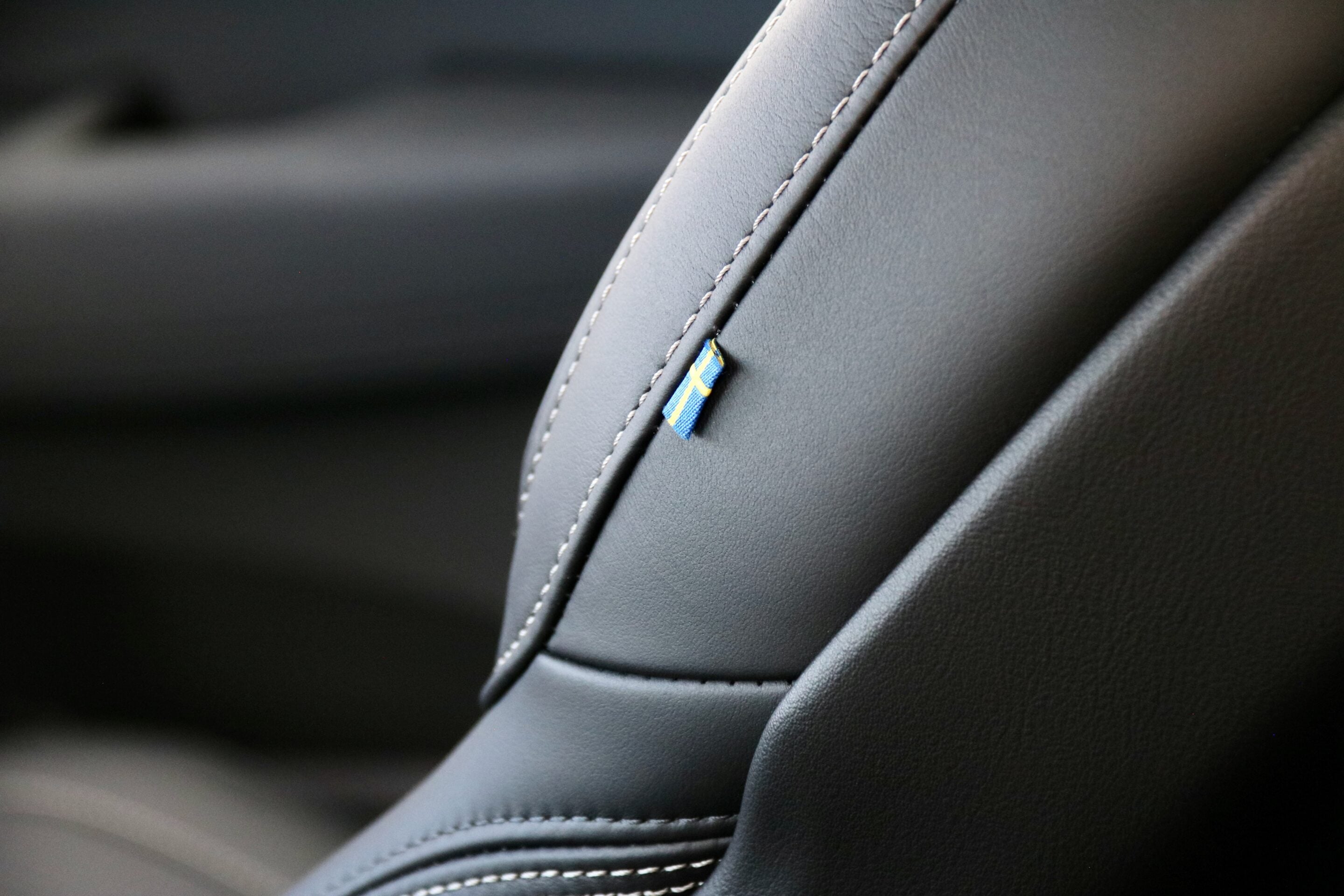
As we’ve come to expect from modern Volvo products, the interior of the XC60 is lovely, with a classy Nordic vibe throughout. The quality is excellent – even the lower plastics are soft to touch – and it feels tight as well with a solid thud when the doors close. The switchgear is high quality, especially the cool Orrefors gear selector, and the wood-like trim is nice to touch. Plus, there’s plenty of storage to put life’s trinkets.
The updated XC60 range uses a new 11.2-inch touchscreen running a new Android Automotive software that features Google in-built, so that the sat-nav uses Google Maps and the voice control is actually the Google Assistant. It does feature Apple CarPlay as well for Apple users, but if you already use Google Maps on your smartphone, all your destination searches then feature in the car.
3
The new screen looks tacked on compared to the smaller former 9.0-inch unit in the pre-updated XC60, but it is much quicker to use and brighter as well. The new layout isn’t massively different, but it is easier to use. The 600W Harman Kardon sound system in the Ultra Dark – optional on the Plus – is rich in aural quality too.
The rear seat isn’t as roomy as you’d expect for a Volvo, with only moderate legroom for six-footers, though headroom is excellent. Rear seat amenities include two separate zones of climate control, air vents, door and map pockets, a central armrest and charging outputs.
The XC60’s boot is perhaps not as large as you’d expect for a Volvo either at 483 litres with the rear seats up, but it’s very well finished and there are plenty of clever features such as side storage, remote releases for the rear seat folding, a 12V socket, hooks to hang bags off and a ski pass to the rear seat – plus, buttons to raise or lower the rear suspension height in models with air suspension.
4
Folding the rear seats unlocks 1543 litres of space and unlike many rivals, they actually fold flat. A space-saver spare wheel lies underneath the boot floor of the B5, but not the T8.
Performance and fuel economy:
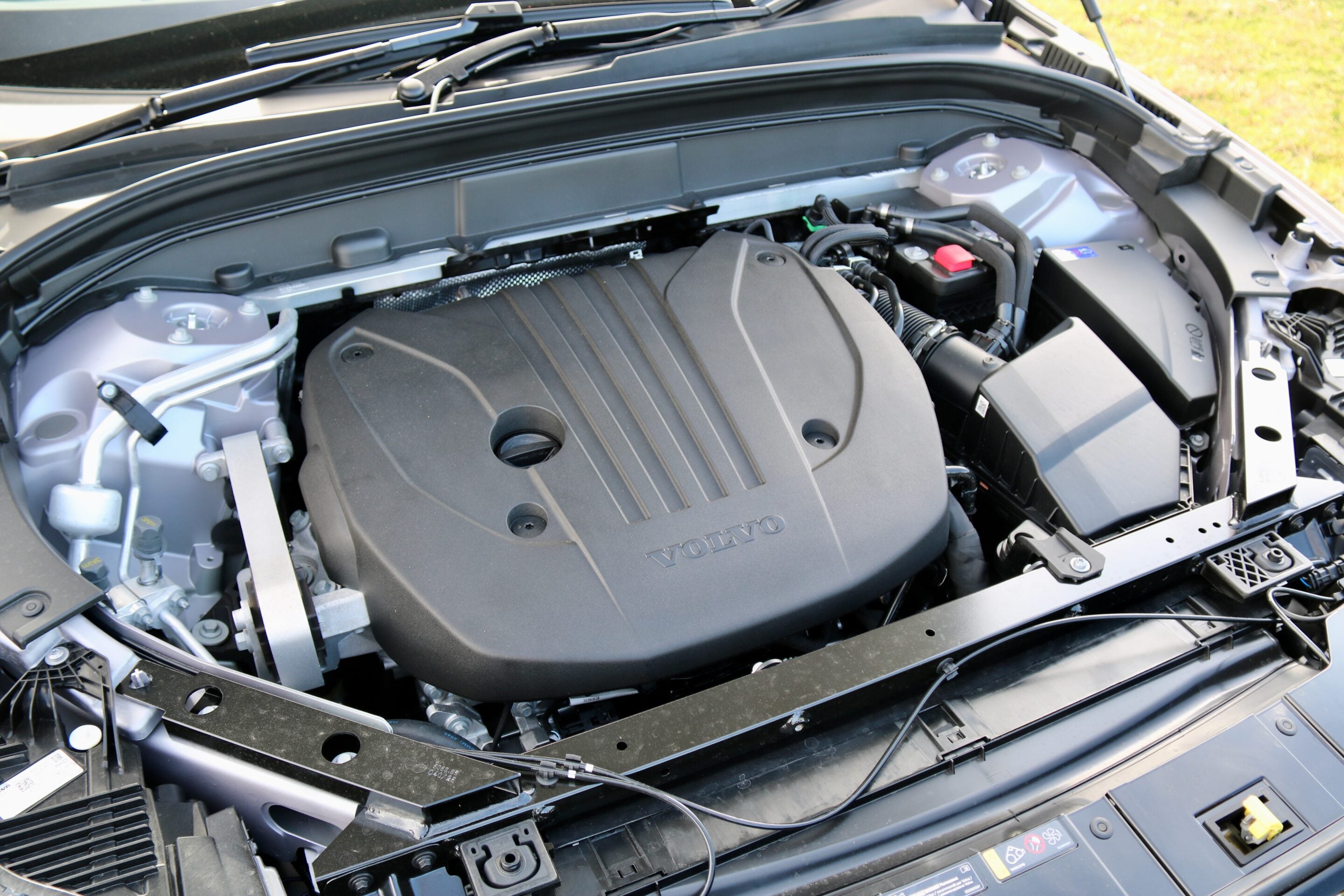
There are two available drivetrains in the Volvo XC60 range: a 183kW/350Nm 2.0-litre four-cylinder turbo-petrol in the B5 or that engine teamed with an electric motor for 340kW/709Nm outputs and a 19kWh battery for a claimed 89km electric range in the T8 plug-in hybrid. Both use an eight-speed torque converter automatic transmission and all-wheel drive is standard equipment. The B5 sprints to 100km/h in a respectable 6.9 seconds and the T8 reduces that to 4.8 seconds – both are limited to 180km/h at the top end.
We tested only the B5 and came across with the ‘entry’ engine in the XC60 range. It’s refined, sounds good and provides more than enough performance for the segment. The eight-speed automatic transmission is generally seamless too. Volvo claims combined fuel consumption of 7.6L/100km and CO2 emissions of 173g/km – we beat that in our testing that included a lot of highway running at 7.2L/100km. The XC60 runs on minimum 95RON premium unleaded fuel and features a large 71 litre fuel tank.
On the road:
On the road, the Volvo XC60 impresses with its refinement, comfortable ride quality and generally luxurious feel from behind the wheel. It doesn’t go down the sporty route, unlike a BMW X3, and we think it’s all the better for it. The XC60 still corners well and its chassis is well tuned as well, but it’s not interested in maximum cornering speeds. Instead, it majors on comfort – and we think it’s better suited in this regard to its target market than rivals.
3
The steering is light but well weighted, and the ride quality is quite comfortable with great body control. Also impressive are Volvo’s active safety features, especially the adaptive lane guidance as that the company dubs ‘Pilot Assist’ when in operating in tandem with the adaptive cruise control. It provides reliable and subtle lane corrections when activated, and is quite well tuned.
Service and warranty:
Volvo covers the XC60 with a five-year/unlimited km warranty with five years of roadside assistance that can be extended to eight years in total with dealer servicing.
The XC60’s service intervals are once-yearly/every 15,000km and a five-year service plan costs an expensive $3870 ($774 per year).
Verdict: Should I buy a Volvo XC60?
There are rivals to the Volvo XC60 that are sportier and more fun to drive, more modern-feeling and practical throughout, less expensive to service and with a wider range of powerplants. The new infotainment system looks tacked onto the dashboard as well, and the recently update could have gone further in keeping the XC60 fresh against newer and fresher-feeling rivals.
1
But we think that the Volvo XC60 is still one of the best premium mid-size SUVs to buy thanks to its lovely interior, good value for money, punchy drivetrains and updated in-car tech. It’s also very comfortable, its cabin is Nordic luxurious and its active safety features are intuitive to use, as you’d expect for a safety-focused company such as Volvo. Put simply, it’s still one of the better options in the segment and you’d be crazy not to consider it.
Roadside assistance: Five years (extendable to eight years through dealer servicing)
Service intervals: Annual/15,000km
Five-year service cost: $3870 ($774 per year)
On sale: Now
According to figures released by both the Federal Chamber of Automotive Industries (FCAI) and the Electric Vehicle Council, 106,891 new vehicle registrations were recorded in September 2025, marking an increase of 7.0 per cent on September 2024. It’s the second highest September on record after 2023’s 110,702 registrations result.
In total, 938,959 new vehicles have been registered in Australia to the end of September, which is up 0.3 per cent on this time in 2024.
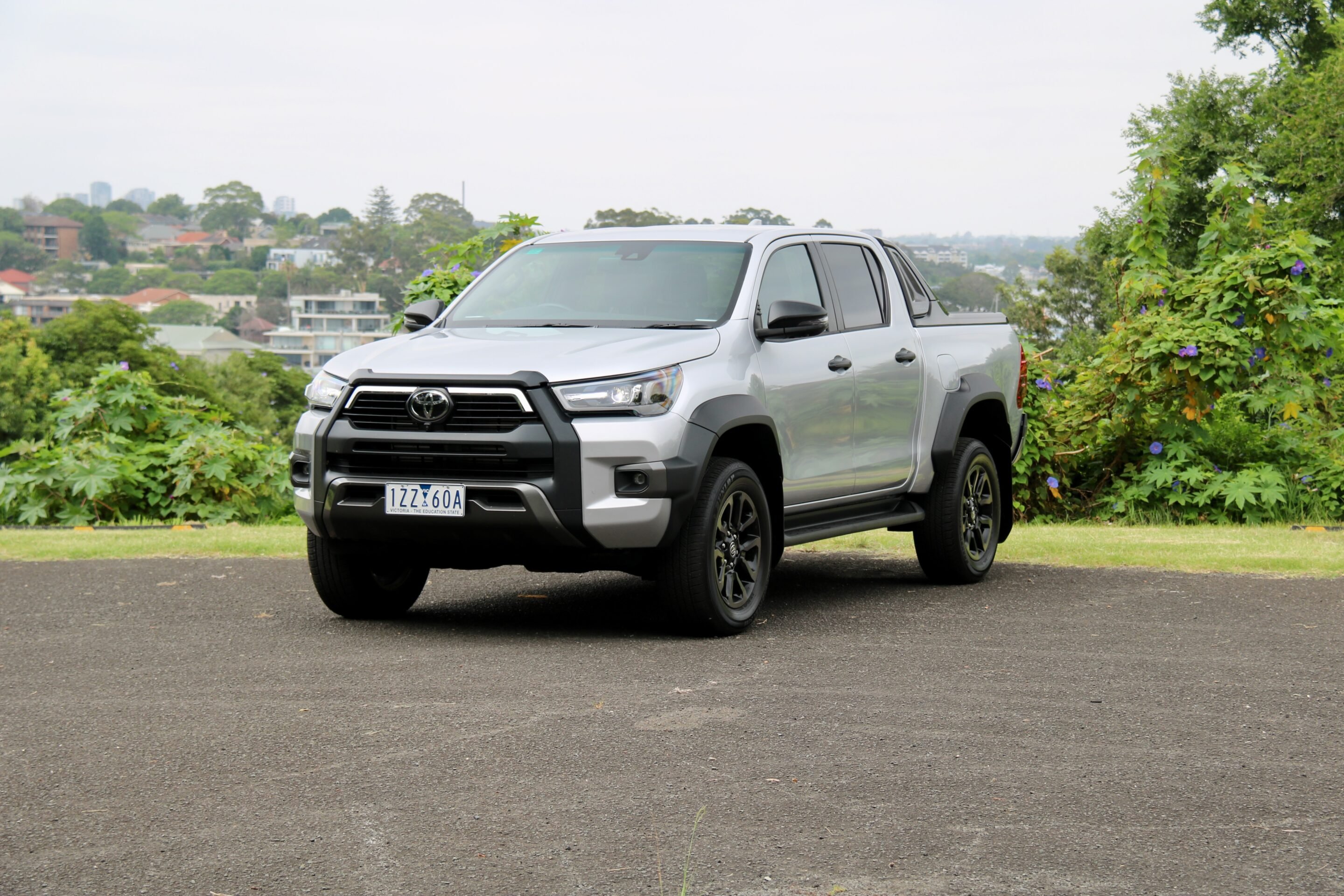
Toyota was the biggest-selling brand in September 2025 with 18,318 registrations recorded, including the HiLux ute’s pole position with 5047 registrations, ahead of second-placed Ford’s 8300 units and 4867 Rangers.
3
The Tesla Model Y was placed third at 3927 registrations, its best result since March 2024, while other noteworthy Chinese-built automotive results include the Chery Tiggo 4 on 2048 and the BYD Sealion 7 on 1887.
Chinese-built cars formed six of the top 20 registrations results in September 2025, and China is now the second-largest country of origin for new Australian vehicle registrations. Chinese production also accounts for 77.5 per cent of all electric vehicle registrations so far in 2025.
In total, electric vehicles represented 11.3 per cent of new car registrations in September 2025, which is behind hybrids (14.5 per cent) but ahead of plug-in hybrids (4.2 per cent).
3
Federal Chamber of Automotive Industries chief executive Tony Weber said the results showed encouraging signs from a low base for EV uptake, but further action is required to accelerate the transition.
“There is no shortage of battery electric vehicles on the market in Australia. With more than 100 BEVs and more than 50 PHEVs available, manufacturers have worked hard to provide Australians with high-quality electric vehicles. What is needed now is a stronger focus on encouraging demand, in particular public recharging infrastructure,” Mr Weber said.
Top 10 best-selling cars in Australia, September 2025:
Car
September 2025 Sales
September 2024 Sales
% difference
1. Toyota Hilux
5,047
4,313
17.0%
2. Ford Ranger
4,867
4,485
8.5%
3. Tesla Model Y
3,927
1,498
162.1%
4. Ford Everest
2,558
2,902
-11.9%
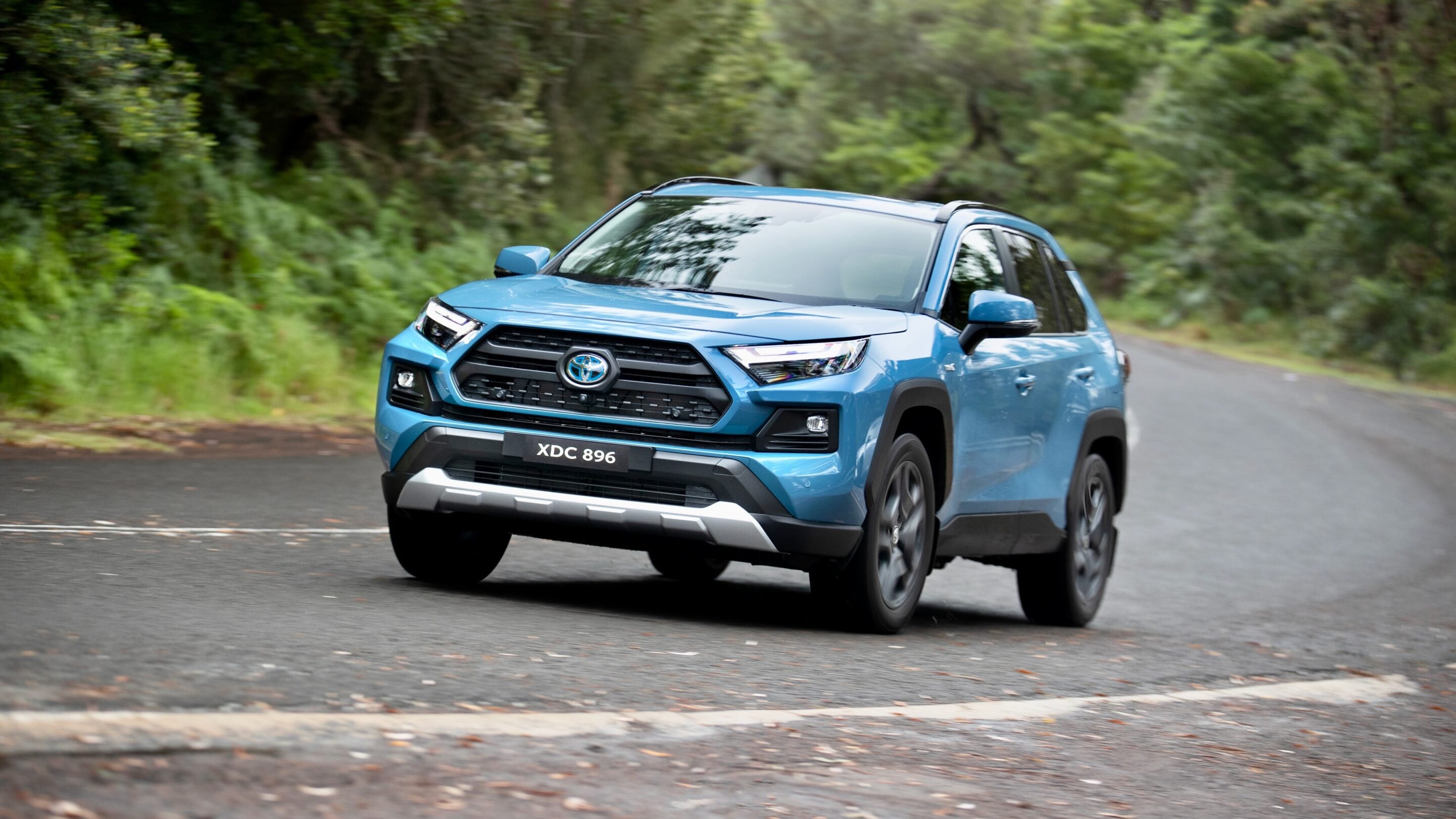
5. Toyota RAV4
2,554
5,182
-50.7%
6. Toyota LandCruiser
2,101
2,164
-2.9%
7. Chery Tiggo 4
2,048
0
(New model)
8. Isuzu D-Max
2,989
2,612
14.4%
9. BYD Sealion 7
1,887
0
(New model)
10. Toyota Prado
1,881
1,125
67.2%
Top 10 best-selling brands in Australia, September 2025: