
Reviews


Gallery 1
CABO DA ROCA is where the European mainland runs out of resolve. The westernmost point of the continent is assailed by over 5500km of North Atlantic fetch, great grey-green rollers lining up in perfect sets to beat upon the Portuguese granite. Keep heading due east and the next landfall would be a scruffy beach in Delaware, USA.
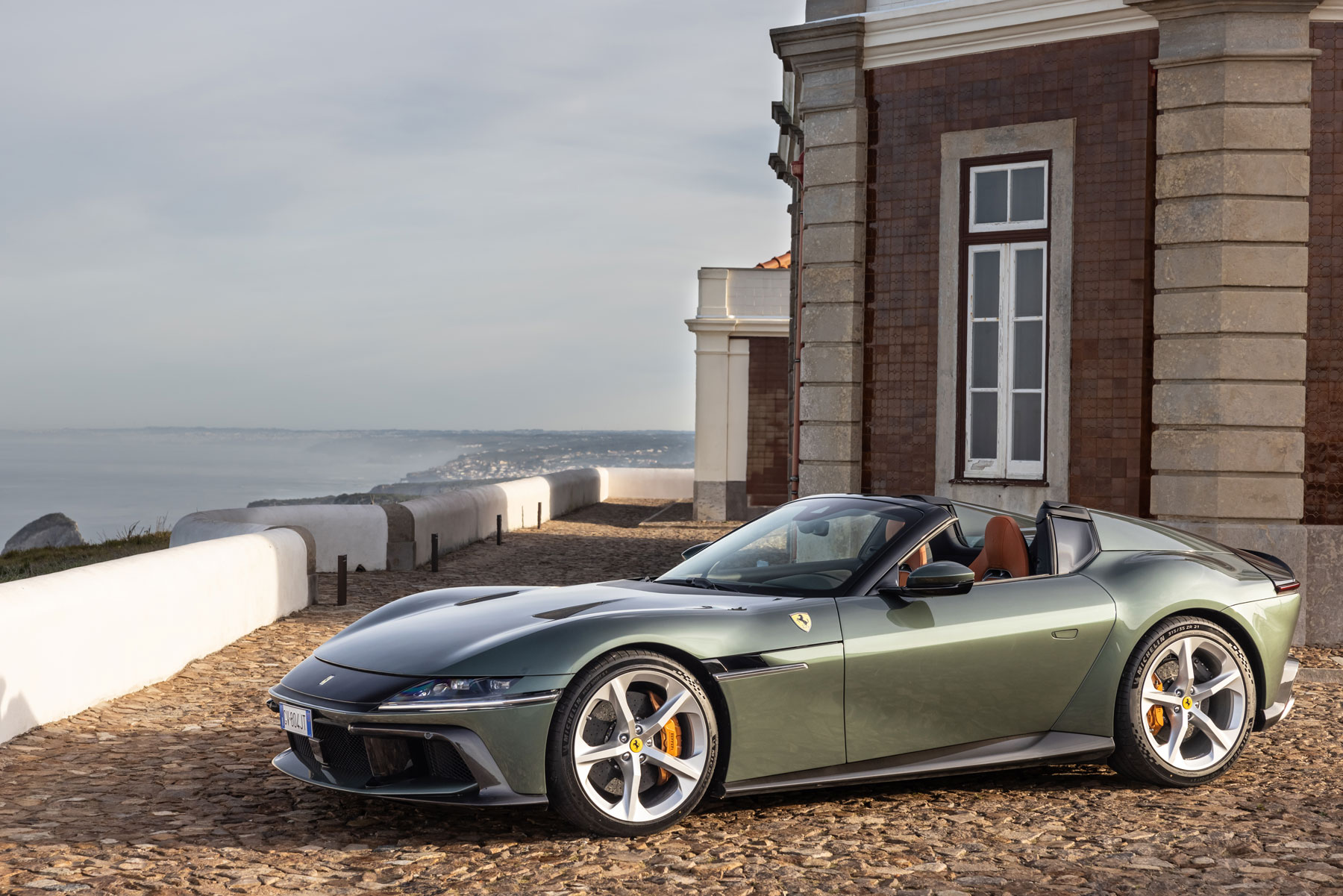
Today feels very Atlantic. It’s blustery and the wind is whistling through the flagpoles that stand by the lighthouse, the lanyards balefully clanging against the poles. It’s not really convertible weather, but if you have a box-fresh Ferrari 12Cilindri Spider at your disposal, you’re going to want to let a bit of that fresh salt tang in.
1
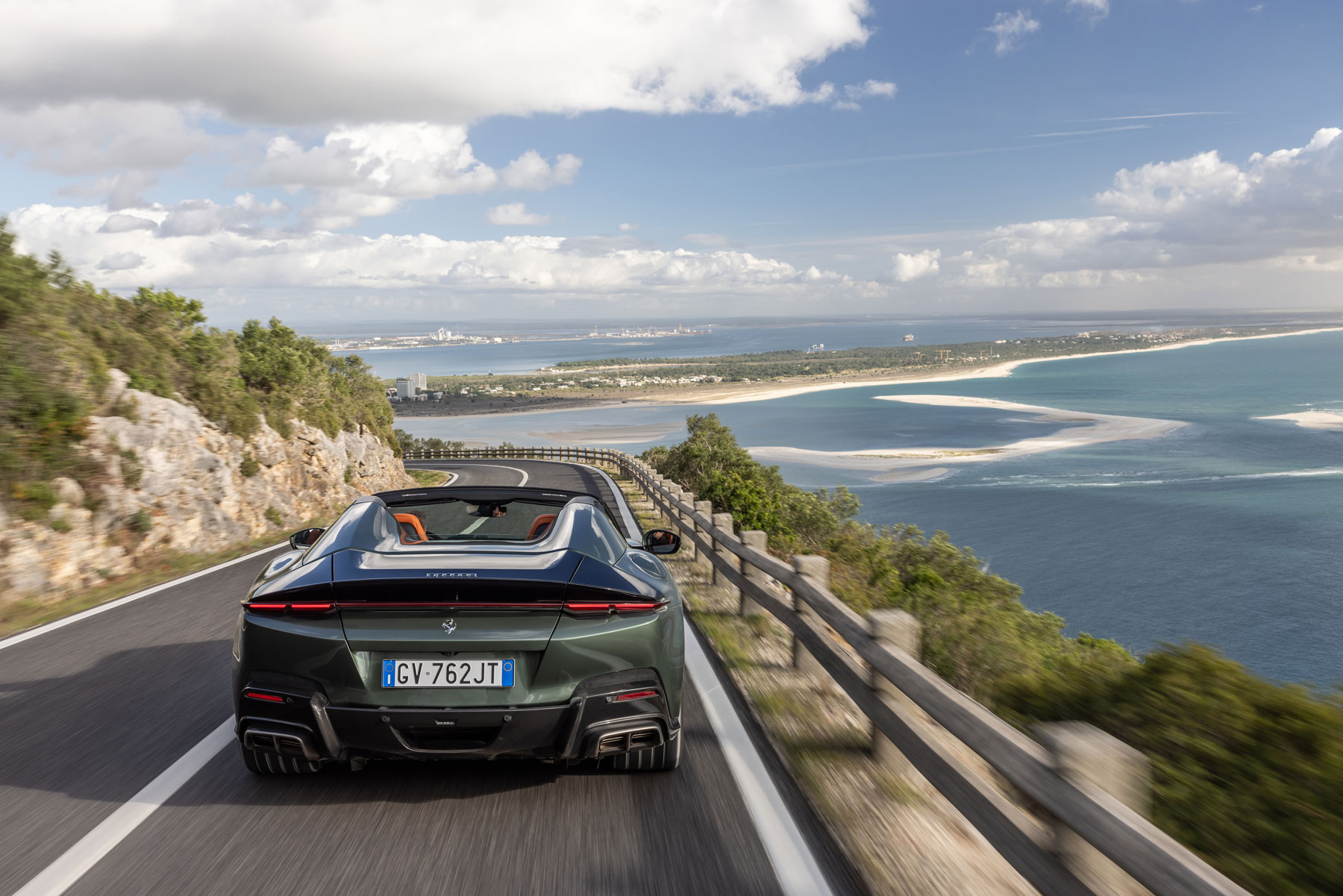
I’ve driven up from the fishing village of Cascais this afternoon, attempting to follow the coast north in order to get a feel for Ferrari’s 6.5-litre V12 GT. I’m not really sure quite what to make of it just yet. Its predecessor, the 812 GTS, could fox you like that. The classical front-engined form factor suggested GT car, but the driving experience was as hardcore as any mid-engined supercar. I still haven’t figured out quite what this car is trying to be. Time to point the nose north and put some miles under its belt.
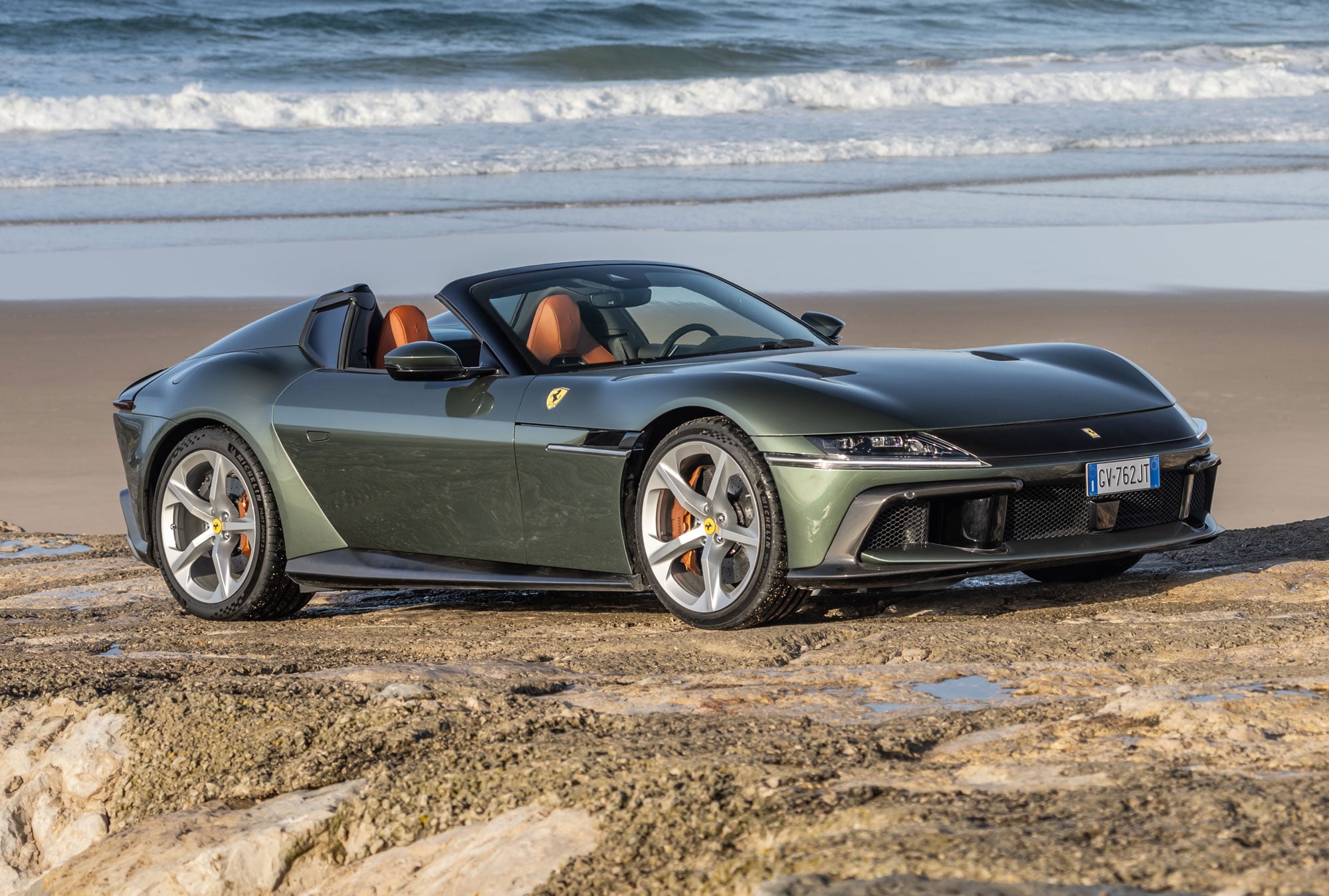
It feels big. Part of that comes from the sensation that you’re sitting right on the rear axle, with stacks of Verde Toscana bonnet reaching out ahead of you before diving down to that Daft Punk meets Daytona visor at the front. It’s wide too, and while that’s not a problem on the open coastal stretches, the road climbs inland over bluffs and palisades, throwing in enough tight and damp hairpins to keep things interesting.
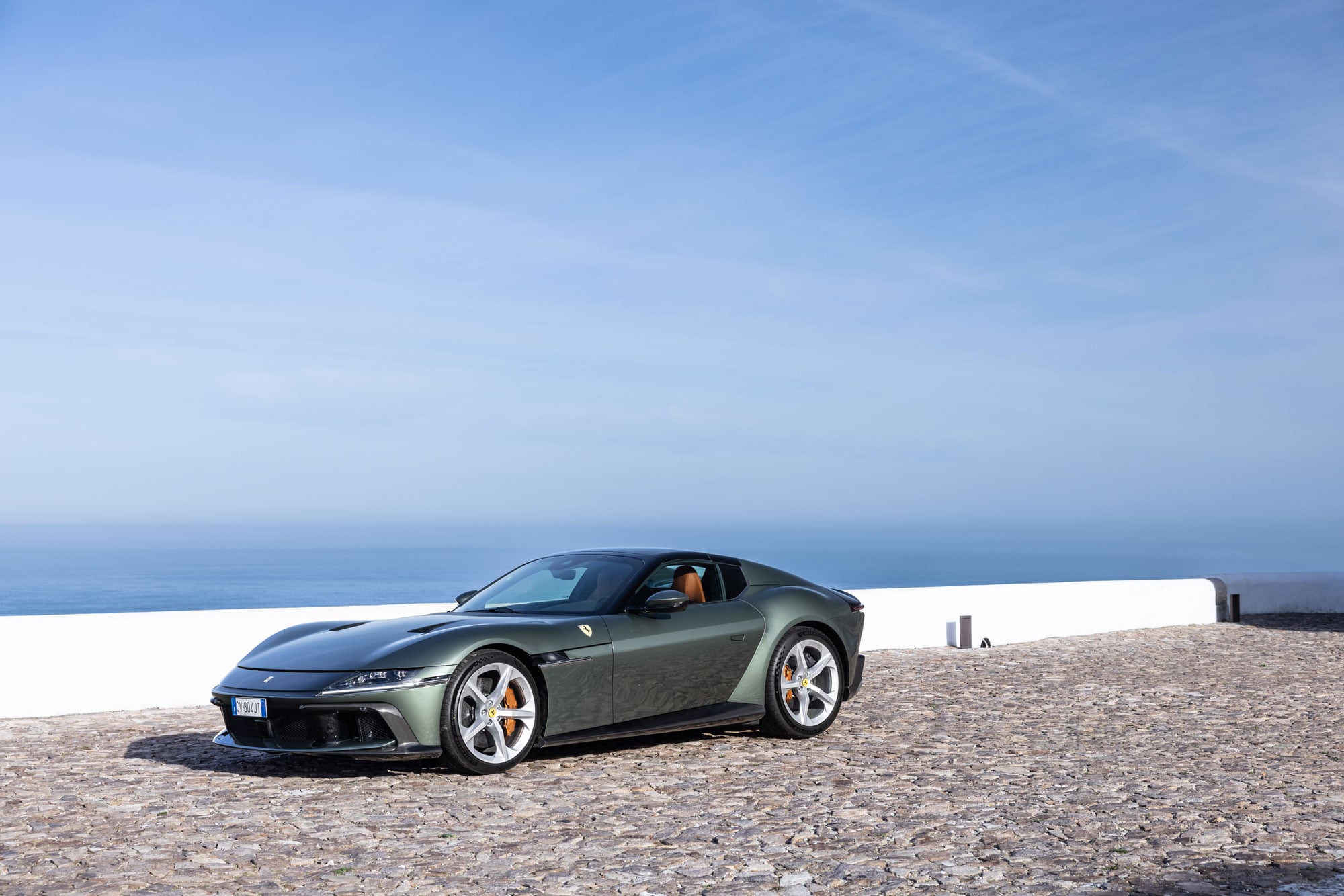
The Spider adds another 60kg to the 1560kg kerb weight of the berlinetta version, which doesn’t seem excessive for a well insulated, four-hydraulic cylinder, rigid hard top assembly. In actual fact, the roof and its aluminium alloy structural roll bar totals 40kg, with the other 20kg being accounted for by additional structural reinforcements.
1
The design of this roof has had to walk a bit of a tightrope because Ferrari didn’t want to compromise on the 200-litre boot capacity and was also keen to retain the functionality of the active aero ‘winglets’ at each rear corner, the motorised tonneau cover’s aero design having to work hand-in-hand with these signature elements.
In creating the Spider and berlinetta at the same time, Flavio Manzoni’s team at Centro Stile has been able to overcome these issues in a cohesive way. Early orders here in Australia seem to back up the company’s claim that the sales split is almost a perfect 50:50 between the coupe and the convertible.
This is a very good convertible too. The local roads aren’t the smoothest, but there’s little in the way of obvious scuttle shake, something that has afflicted metal-chassised Ferrari drop-tops in the past. The company claims a torsional stiffness increase of eight percent over its predecessor but won’t quote hard numbers. The roof itself motors up or down in just 14 seconds and can be operated at speeds of up to 45km/h.
There’s little in the way of scuttle shake, something that has afflicted metal-chassised Ferrari drop-tops in the past
Despite the tasteful green over tan finish, I’m still feeling a little self-conscious in a car that costs over €625,000 (over $1m Aussie) in a country that’s being pummelled by a savage cost of living crisis. In Australia, we have to hand over $886,800 for one, an $83,300 premium over its fixed-head sibling.
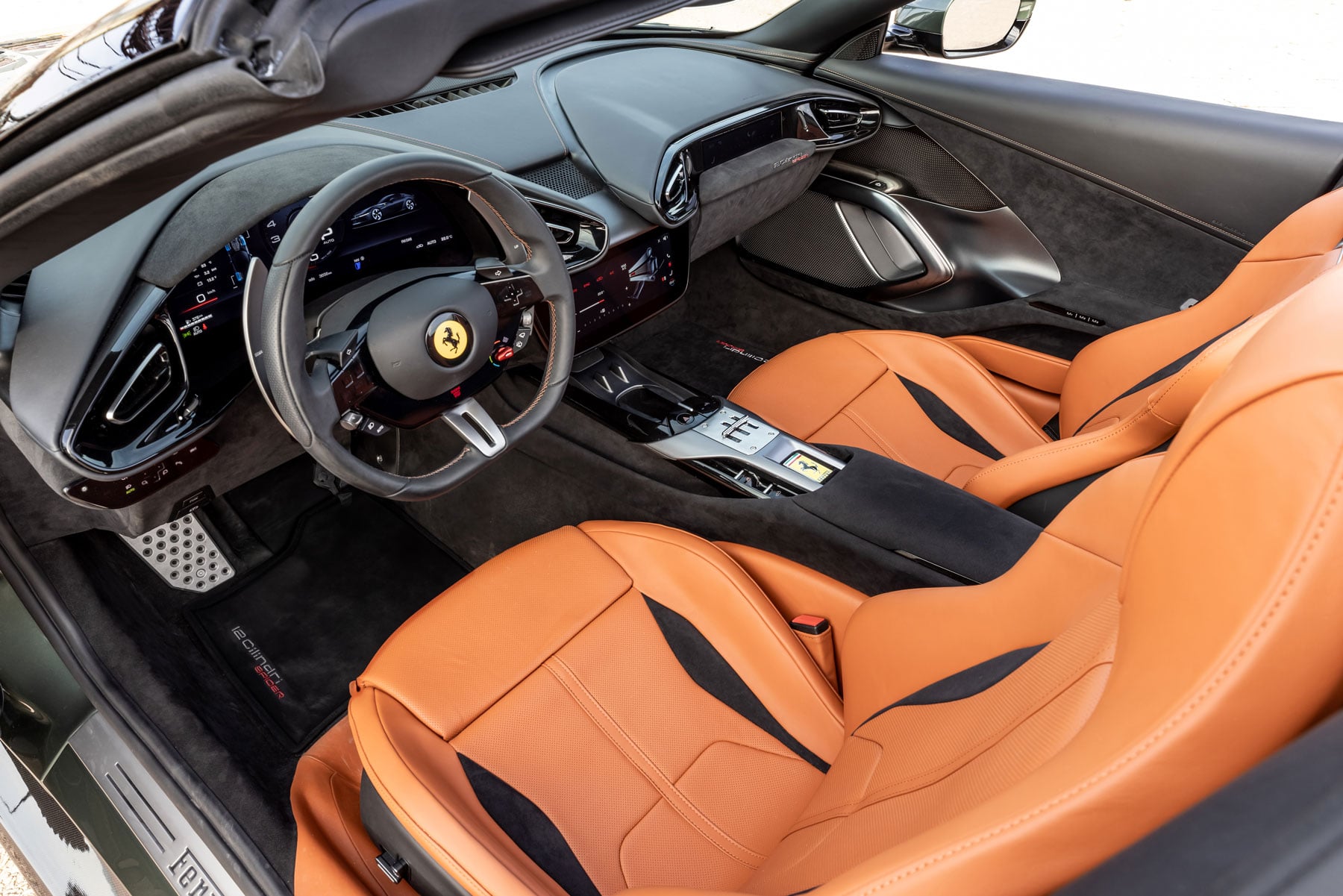
Like all modern Ferraris, the user interface takes some time to gel with. The car’s supplied with a nose lift, required to inch over many of the precipitous speed humps that act as village ramparts around here, but it’s a tab on the central touch screen. I’d prefer if it were a hard-keyed function on a physical button.
1
The steering wheel is festooned with touch sensitive controls, but Maranello has clearly listened to feedback on this, as these controls go dark and dead after a few seconds so that you’re less likely to activate them during a frantic bit of wheel-twirling. Not that there’s too much of that required with fourwheel steering making the ratio very quick at low speeds, working in concert with the e-diff.
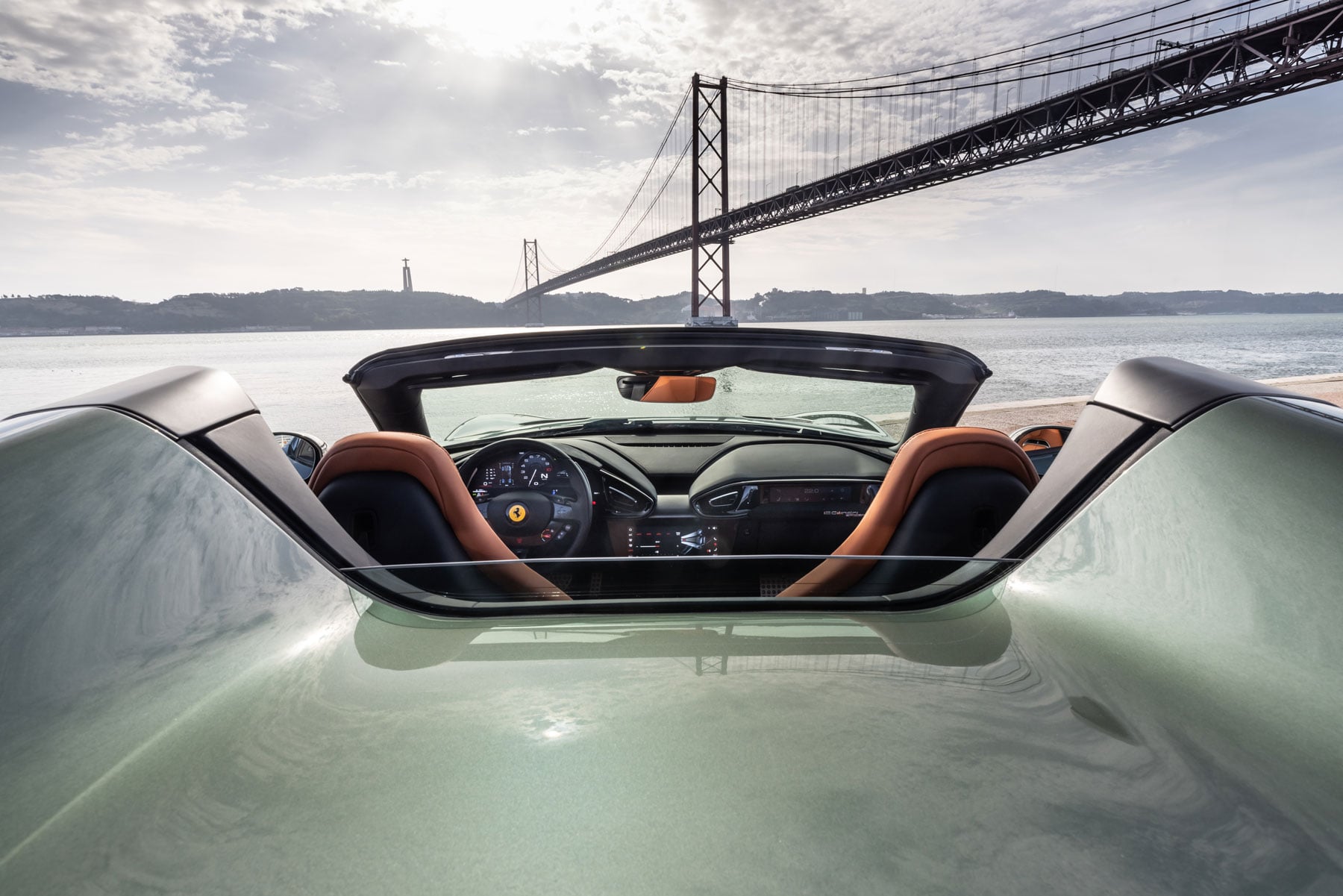
The cabin’s a bit of an odd fit. I expected that it’d be pinched for headroom for tall blokes like me, but it’s really well provisioned on that particular axis. Where it’s not quite so generously cut is in length, which means that you’ll tend to motor the seat quite close to the wheel to get adequate rake on the driver’s squab.
To operate the roof you pull at a toggle set a long way aft on the centre console. Like the 296 GTS, you can also just drop the vertical rear window if required, but it doesn’t serve to plug you into the aural theatrics as it does in the mid-engined car.
There’s a wheel-mounted ADAS button that allows you to toggle all the absolutely nonessentials off fairly easily. Ferrari claimed that it attempted to make the ADAS functionality as unobtrusive as possible and that stands up in practice. The HELE button on the panel outboard of the steering wheel cuts the idle stop, which can feel binary and incongruous in a car with such an overt engine.
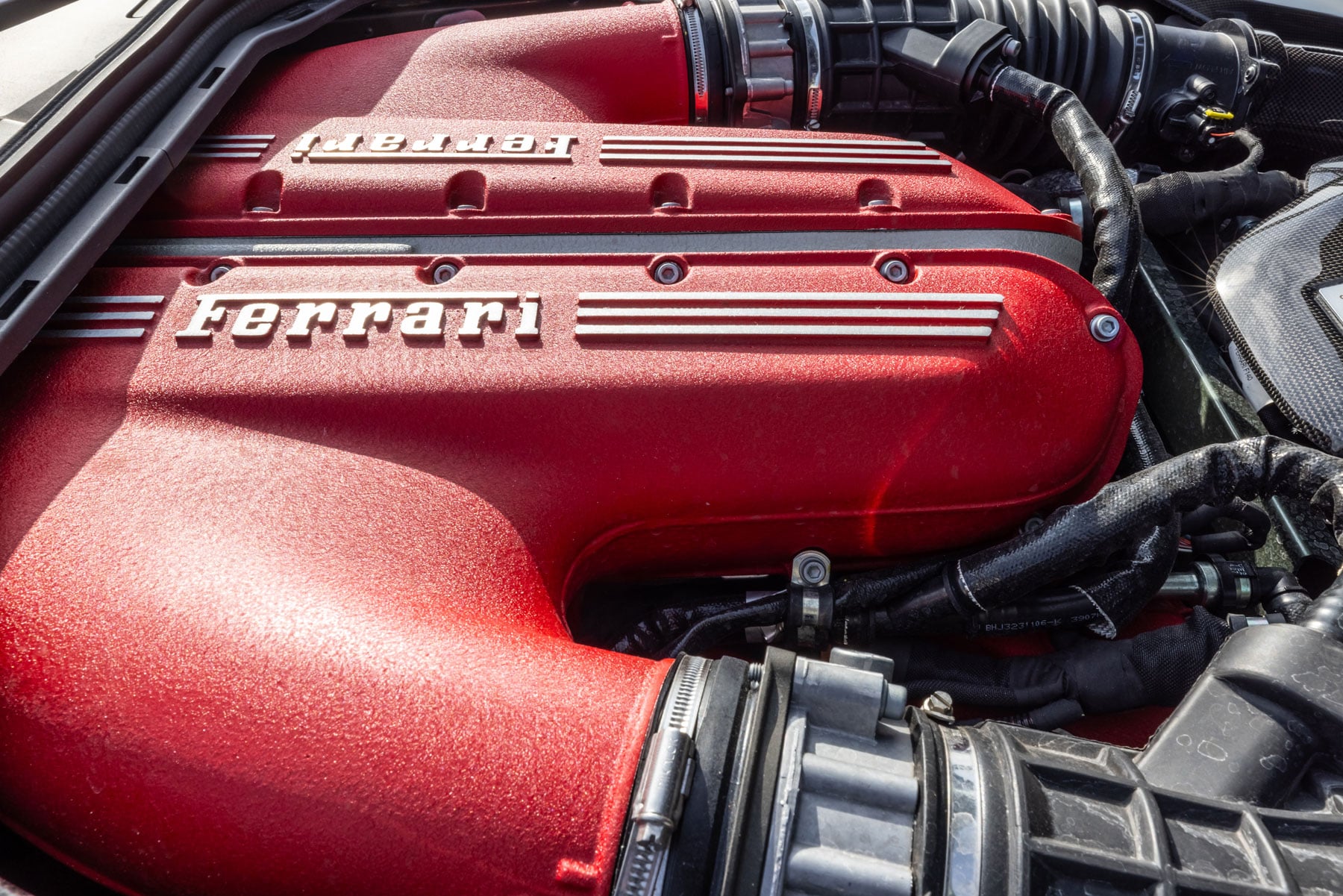
Ah yes, the sound. You want to know what a normally aspirated V12 that now has to pass a stack of drive-by noise regulations sounds like. From the outside, it’s quite mannered. Inside the car, Ferrari has positioned resonators ahead of the throttle body inlet that pipe sound into the cockpit. If you found the Purosangue somewhat mute, you’ll be happier with the 12Cilindri. It’s vocal but never seriously shouty.
1
The exhaust system features two six-into-one manifolds with equal length ducts, designed to generate the complex baritone high-end howl that V12 fans demand. Go chasing it and you’ll realise that in order to develop its full complement of 610kW, you’ll need to rev it to 9250rpm, just 250 shy of the redline. The way the needle races around to that peak means you’d never be able to eke out every last rev with a manual ’box, as evocative as it’d be to see a gated H-pattern in this car.
If you found the Purosangue somewhat mute, you’ll be happier with the 12Cilindri Spider
Instead there’s an eight-speed DCT gearbox, that features a five percent shorter final drive than you’d find in the rest of the Ferrari range, giving real accelerative punch in lower gears. It seems counterintuitive to lower the gearing in a car that needs to not only pass stringent noise and emissions tests but which also has been positioned as a less extreme option in the Ferrari line up.
When asked, an engineer shrugged and claimed that they did it because it wasn’t easy but seemed like the right thing to do for the character of the car. Not that I’m complaining. I hate cars that feel blunt due to ridiculously long gearing. The long eighth gear is great for motorway cruising and it’s here that the 12Cilindri affords far better efficiency than its predecessor.
If you’ve managed to keep the 12Cilindri Spider pointing in the right direction after a full bore blast through first and second, keep it pinned (on a closed course, etc) and you’ll discover Aspirated Torque Shaping. A version of this system has featured on turbocharged Ferraris since the California T back in 2016, but this is the first time it’s been utilised on an atmo engine. By managing the way the engine introduces torque through third and fourth gears, the ones that Ferrari deems the most important for everyday road driving, the feel is of linear acceleration and a vivid impression that the powerplant is in no way tailing off in its delivery.
While it’s more subtle with a naturally-aspirated engine, it certainly works. The engine dominates proceedings and you need to be disciplined in how and when you accelerate out of slower corners. Despite the lower final drive, you’ll find that the top of second is somewhere you’ll find yourself on any twisty section of road, and I’d advise that you combine flight to the boards throttle demand with any sort of steering angle very judiciously. This is still a car with 22kW more power and 20mm less wheelbase than the feral 812 Superfast.
1
Key to controlling cars is the now-familiar lozengeshaped manettino dial on the steering wheel. This can be clicked through Wet, Sport, Race, CT off and ESC Off modes, and each of these five settings has its own specific map for stability control, braking control, suspension control and Passo Corto Virtuale (in effect, the combined functions of the e-diff and the four-wheel steer). With the condition of the roads and traffic today, I limit the adventure primarily to Sport mode with the odd dip into Race on the better sighted sections.
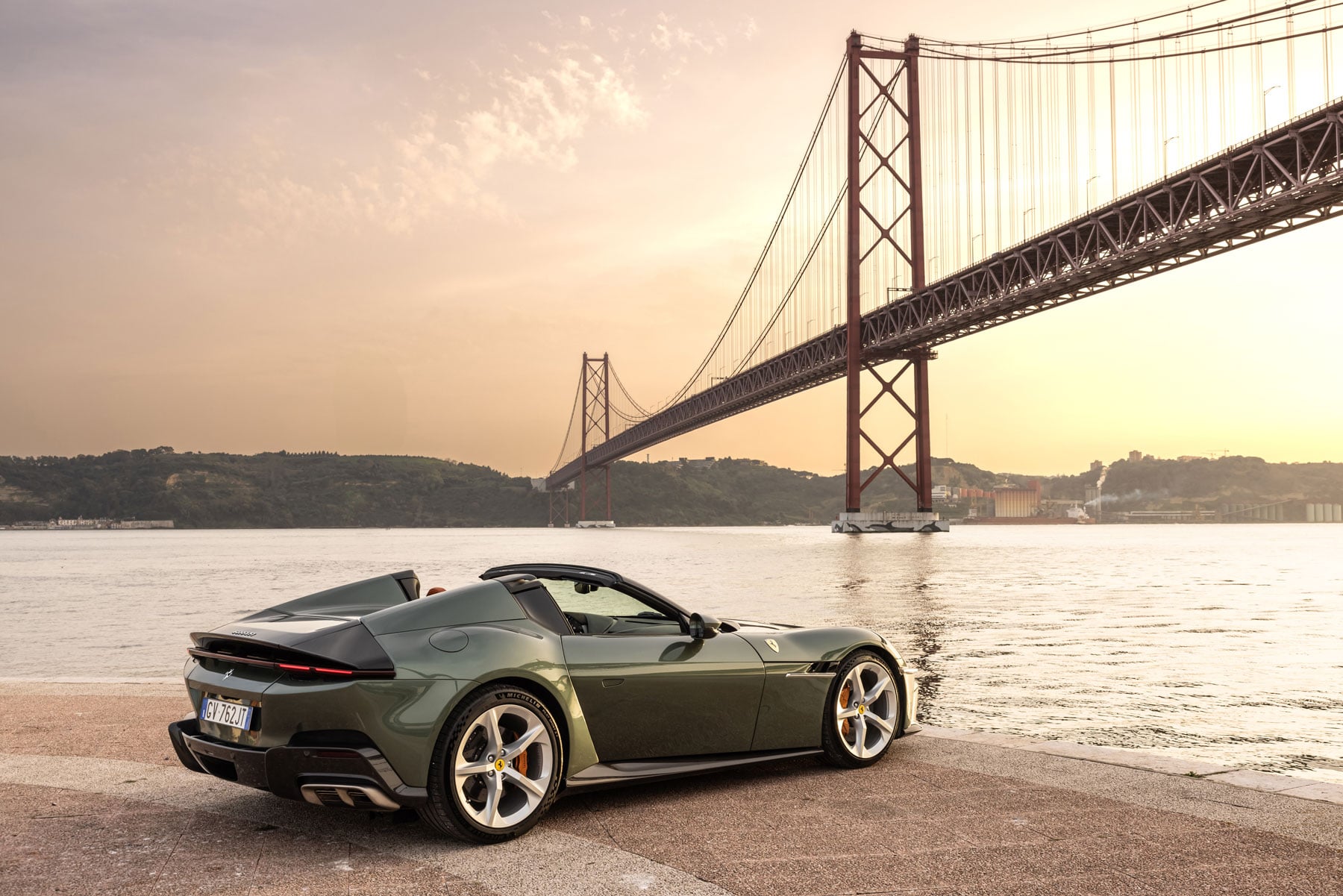
Wheel control is good when the Bumpy Road mode is employed. The 12Cilindri rides on 21-inch alloy wheels, which have increased unsprung weight. Our car has the heavier fivespoke cast rims, but there’s also a fussier forged option with a machined throwing-star look. There’s an option of either Michelin Pilot Sport 5S or Goodyear Eagle F1 Supersport rubber, with the latter also offered as a run-flat option in Europe. I can’t say that I was going hard enough to feel any real benefit from the active aero, which offers a modest 50kg of downforce at 250km/h. Time and a place.
Whether it’s the Passo Corto Virtuale, the new brake-by-wire system or the fiendishly complex Side Slip Control 8.0, there’s a massive data integration task going on behind the scenes. For the most part, it works, but there are moments when the 12Cilindri Spider reminds you that for all its classic base formula, that veneer is one of artful software control. Much of this work started in 2018, and along the way things have iteratively improved, and fast.
1
I think it’s this, as much as anything, that gives the 12Cilindri Spider its slightly opaque personality. It feels like a car whose basic philosophy has been somewhat sacrificed at the altar of tech creep, discrete teams within the walls at Maranello doing things because they can. As I head back towards Cascais, I’m hugely impressed by this intriguing, elegant and capable car. If this is the last naturally aspirated V12 that Ferrari builds, it’ll be a worthy recipient.
It feels churlish to question whether Ferrari, a company that has realised record profits in the last financial year, fully understands its V12 customers. Yet it appears that the philosophy behind this car has been to extend its capability. I’d rather effort was devoted to extending the physical involvement and sensation of the 12Cilindri. I wouldn’t mind losing some trick chassis functionality for a pared back cabin and a more predictable feedback loop of input and output. I’d forgo the active aero frippery for that resource to be spent on making it sound more evocative.
Any of that would be arrant nonsense on something like a 296GTB, but these things matter to V12 GT buyers. Perhaps Ferrari needed to be braver and do less. Such a volte face would likely be philosophically unpalatable to Ferrari’s techie CEO Benedetto Vigna, but the profit margins would be greater, and that’s significant for this production-capped company.
It’s getting cool as the lights of Cascais appear over the sands of Praia do Guincho. I flip the roof up and crank the heater. The evening strollers nod appreciatively as the big coupe burbles along the coast road. It’s a lovely thing this Spider, and it seems a more rounded proposition than the coupe. Just sometimes, though, you wonder whether less is more.
1
“Aerodynamics are for people who can’t build engines”
EVEN ENZO FERRARI HAD A BAD TAKE ONCE IN A WHILE
The roof mechanism of the 12Cilindri Spider owes a lot to extensive wind tunnel and CFD work. The windscreen header rail has been sculpted such that the flow detachment point eliminates overpressure behind the occupants’ heads. Meanwhile, the front of the two flying buttresses features a trim that directs air inboard, recompressing the separation bubble atop the tonneau cover. This prevents air recirculating back to the cabin, while another element directs higher speed, lower pressure airfl ow outboard to the active rear winglets.
Ferrari 12Cilindri Spider Specifications
- Model: Ferrari 12Cilindri Spider
- Engine: 6496cc V12, dohc, 48v
- Max power: 610kW @ 9250kW
- Max torque: 678Nm @ 7250rpm
- Transmission: 8-speed dual-clutch
- L/W/H/W-B: 4733/2176/1292/2700mm
- Weight: 1620kg
- 0-100km/h: 2.9sec
- Price: $886,800
MORE
Everything Ferrari
Follow WhichCar/Wheels on Google
Click the button below to make WhichCar by Wheels a preferred source for your news.

We recommend
-
 News
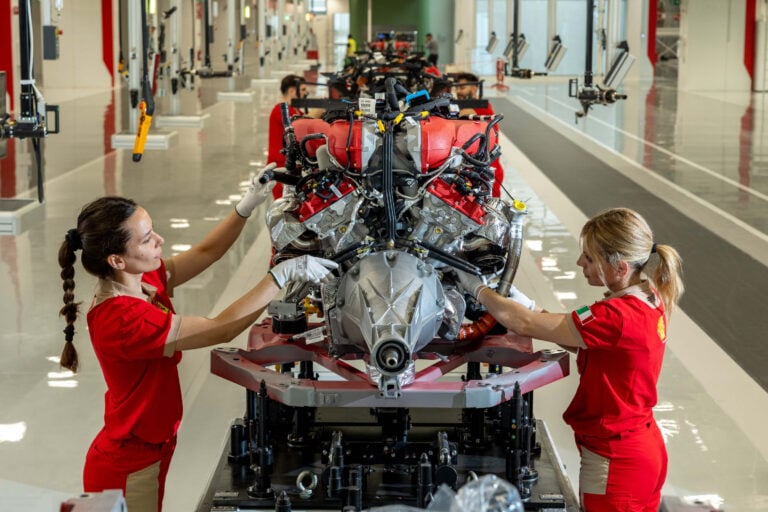
NewsInside Ferrari's new factory: What it will and won't be building
Ferrari calls it the “e-building” and if you thought that's because it's where it'll build its next generation of electric cars, well, you're only partially correct.
-
 News
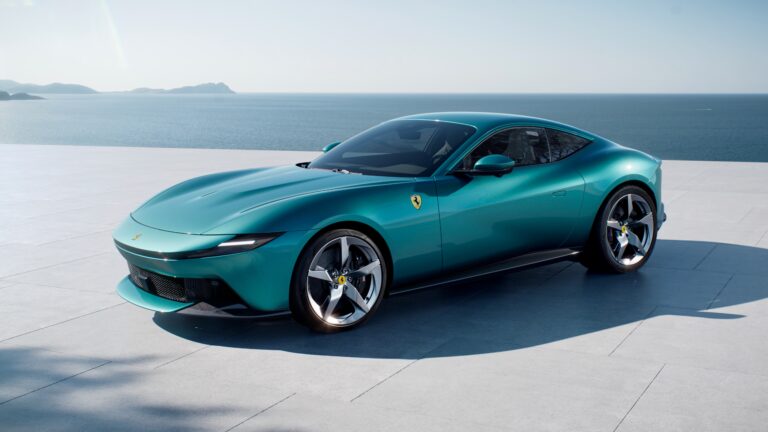
NewsFerrari Amalfi: Stunning sports coupe replaces Roma in brand's line-up
The Ferrari Amalfi has been revealed as the brand's new entry point with updated styling, a revised interior and even more performance.
-
 News
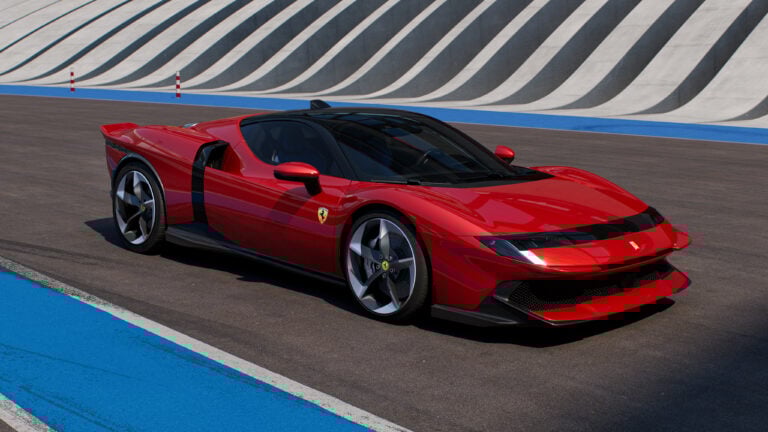
NewsFerrari revives Testarossa name with new 849 hybrid supercar
The hybrid plug-in flagship revives an iconic name with 1050 cv, cutting-edge aerodynamics, and design inspired by Ferrari’s racing heritage.
