Reviews


Gallery 1
It used to be simple.
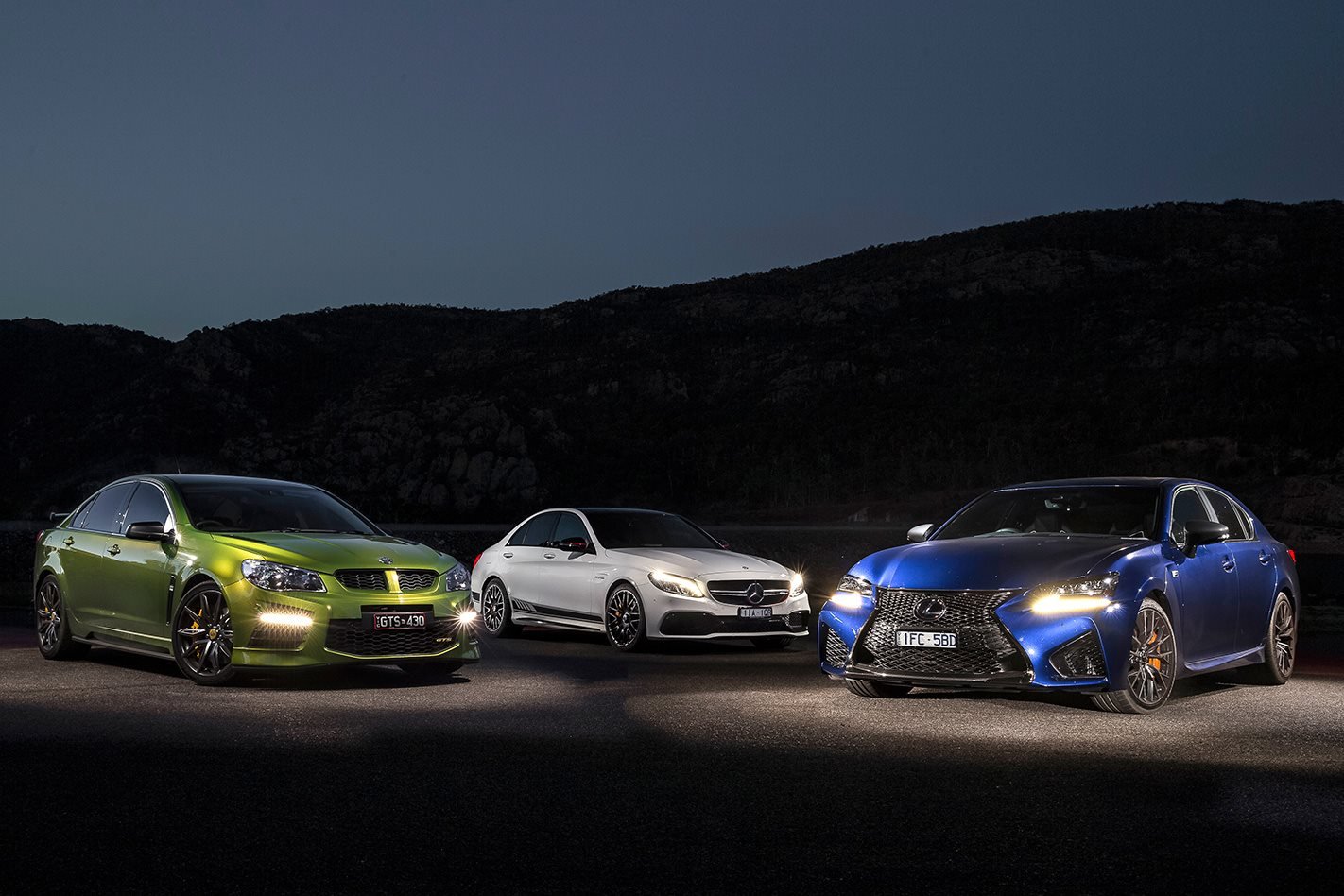
In your traditional triple-header V8 comparison you’d have three large four-door sedans, heralding from either Australia or the Fatherland, each with a fuel-guzzling lump in the front feeding tyre-frying torque to the rear wheels. There’d be a manual if it was designed for keen drivers, or a torque converter slushbox if it had luxo leanings.
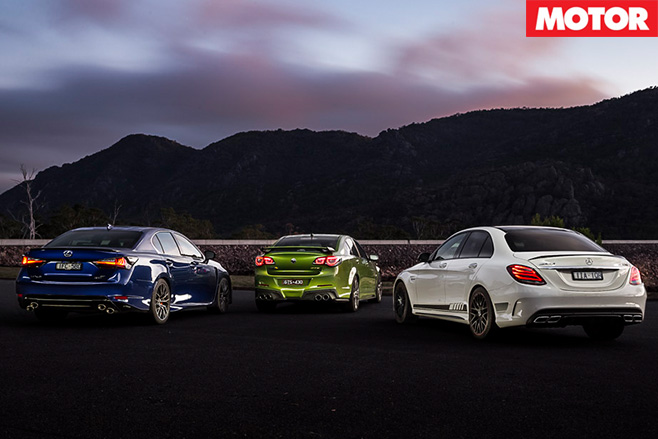
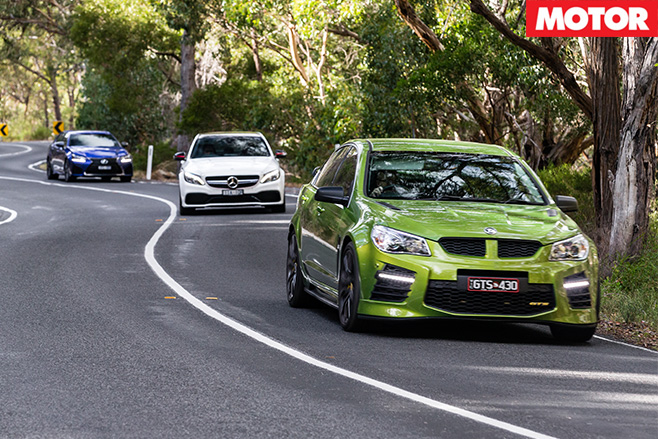
Things are very different in 2016. In today’s topsy-turvy world we have three different engine configurations (one of which claims to sip just 8.6L/100km), three different transmissions and two different body sizes. And the only contender that conforms to the traditional automatic gearbox, naturally-aspirated V8 stereotype is Japanese!
And it’s the Lexus GS F that’s the catalyst for this comparison. It impressed us at its local launch, but its pricing and performance leaves it in a bit of a no man’s land in terms of rivals. As a full-size V8 sedan its obvious competitors are the BMW M5 and Mercedes-AMG E63, but its price ($148,800) and performance (351kW/530Nm; 0-100km/h 4.6sec) neatly align with models the next rung down.
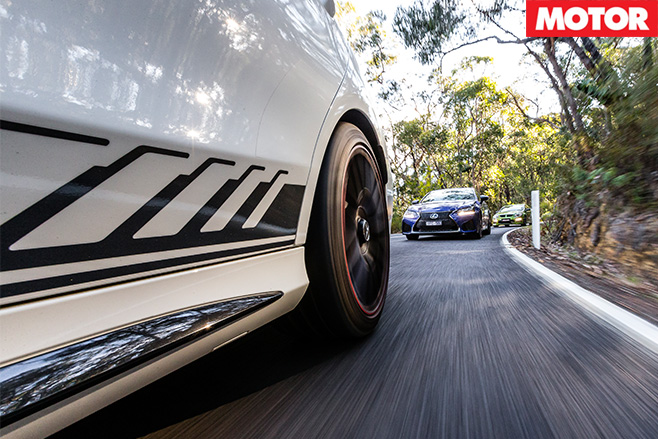
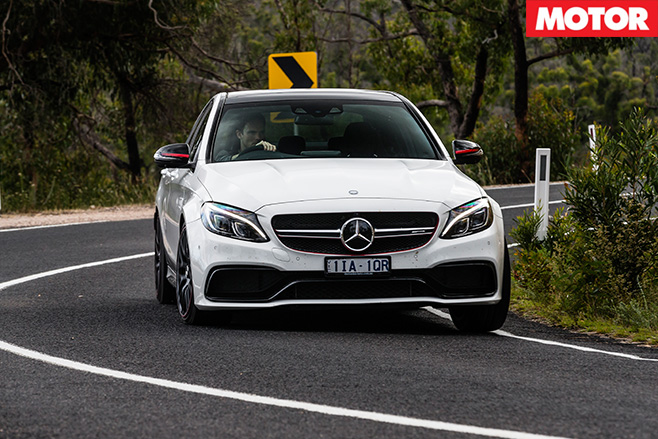
Key to the C63’s appeal is the 4.0-litre twin-turbo V8 under its heavily ridged bonnet. Producing 375kW/700Nm, it’s not so much an engine as a volcanic eruption, capable of turning the 265mm rear Michelin Pilot Super Sports into molten black lava at will. AMG’s Race Start launch control program is an easy way to reel off 4.4-4.5sec 0-100km/h times, but the furious struggle it sets off between electronics and wheelspin feels like The Hulk is trying to escape from the C63’s conservative Bruce Banner exterior.
Walking the car off the line oh-so-gently – not as easy as it sounds thanks to the wet-clutch auto’s hesitancy from a standstill – and feeding the power in smoothly proves more successful. There’s a fair amount of axle tramp in first gear, but drive through it and the C63 slithers its way to 100km/h in 4.16sec before storming across the quarter mile mark in 12.23sec at 192.50km/h.
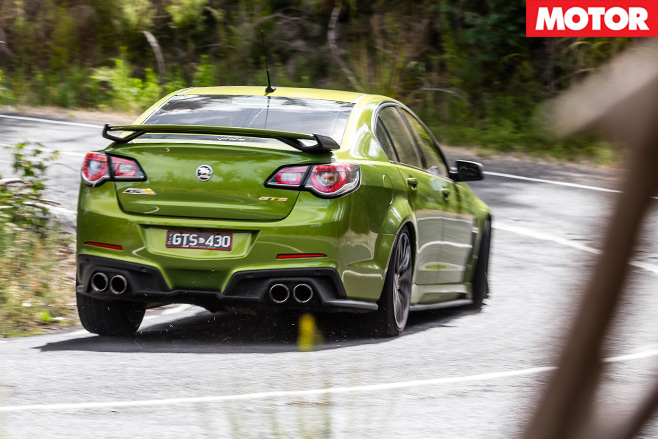
If anything, though, HSV’s 6.2-litre supercharged V8 sounds even better. The choof as the exhaust valves open is pretty naff, but it’s a dirty noise, full of aggression and pent-up rage. What exactly it’s angry about is unclear, because this manual GTS is the fastest standard Aussie car we’ve ever tested. After a number of 4.4sec 0-100km/h runs, a fluke of a launch and a crisp change into second nets 0-100km/h in 4.31sec and a 12.37sec quarter mile at 188.32km/h.
HSV’s range-topper hasn’t always felt its full 430kW, but with 7000 hard press kilometres under its Continentals, GTS-430 is a rocketship, hauling through the gears with ferocious enthusiasm. The Gen-F2 GTS is supposedly unchanged mechanically, but the gearbox in this car (and every other Gen-F2 or VF II product we try) feels particularly slick; quick changes are far less of a lottery now and, all other things being equal, saving a tenth or two on each shift would certainly explain the improvement in acceleration times.
The 5.0-litre V8 is a great engine, spinning easily to its 7300rpm cutout with a note that, while obviously synthetically enhanced, is a curiously pleasing mixture of smooth and raucous, like velvet sandpaper. Selecting Sport mode is a must, as Normal has the eight-speed auto clamouring for a higher gear and anaesthetises the throttle into the bargain.
The engine/gearbox combo is an effective one. The auto’s around town behaviour shames even the best dual-clutch, yet the shifts are quick and the eight tightly-stacked ratios make the most of the GS F’s relatively limited torque reserves. That may sound like an odd description for a 5.0-litre V8, but 530Nm (at a relatively high 4800rpm) just isn’t enough to trouble 275mm rear Michelin Pilot Super Sports.
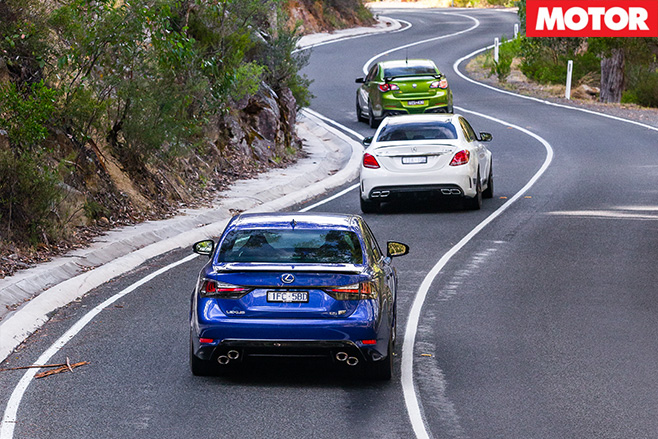
The electrically-assisted steering isn’t particularly fast, nor does it provide a whole lot of feel or feedback, but the weighting is about right and it feels nicely in tune with the rest of the car’s responses.
Despite being massively more powerful, the HSV feels equally all-of-a-piece. It’s too big to really shrink around you on a tight, twisty road, but the car’s inherent balance makes it a very friendly beast. Selecting ‘Performance’ on the Driver Preference Dial adds extra weight to the steering – though a little more response off-centre would be welcome – and firms the magnetorheological dampers, but the greatest strengths of the GTS are its brakes and ESP calibration.
The C63’s ESP isn’t quite as lenient, but then its potency is such that a tighter hold on the reins probably isn’t a bad idea. Traditionally, AMG’s sedans have been comfy grand tourers, but the first C63 took a big step in a sportier direction and the latest model has taken another stride again.
Handling response is now prioritised over ride comfort and with the chassis in its Sport mode the car feels taut and reactive. It skitters over small amplitude bumps and with less weight and stiffer suspension than the other two, body roll feels to be minimal. Reverting to Comfort increases compliance and gives the chassis a little more ‘feel’, but thankfully the ability to mix ’n’ match settings means the softer suspension can be teamed with the most aggressive engine map.
This means leaning hard on the awesome carbon-ceramic front brakes (a hefty $9900 option), rotating the car quickly mid-corner and then exiting as straight as possible to make the most of the available traction. It’s a different technique to the balls-out commitment allowed by the Lexus, but devastatingly effective.
With Sports ESP engaged the electronics will only step in if you’ve really made a hash of things, and it’s handy to have the safety net in place as while traction is strong once the tyres are up to temperature, with what feels like about 10,000Nm on tap it only takes a poorly timed bump, camber or patch of dirt to have the rear squirming. The transition to slip can be quite abrupt, too, a characteristic shared by virtually every car we drive on Michelin Pilot Super Sports.
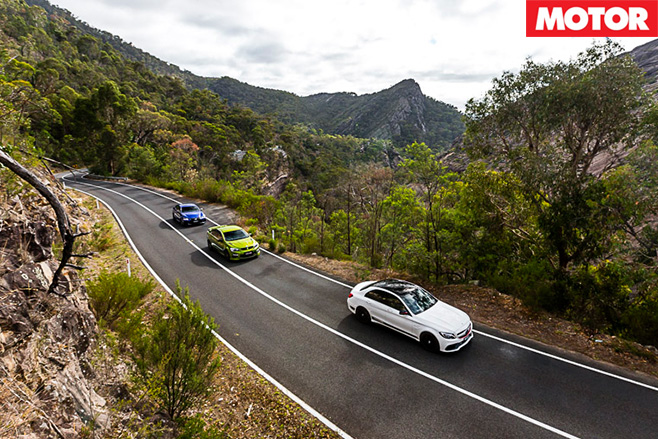
It’s a trait shared by the Lexus, though the GS F’s passive suspension setup can be quite abrupt at urban speeds. On the highway it’s still firm – your passengers are going to know you bought a sporty car – but not necessarily uncomfortably so. It’s roughly comparable to the Sport setting in the HSV, which just goes to show the value of adaptive dampers, as a twist of the Driver Preference Dial selects ‘Tour’ for the GTS’s clever suspension.
For outright comfort the HSV is the best here, absorbing all manner of road imperfections. Tour mode softens the dampers so much that the rear will actually bottom out over speed bumps, but on country roads it allows the GTS to lope along serenely, the steering also lightening to require less effort. Where the Australian loses points is low-speed refinement.
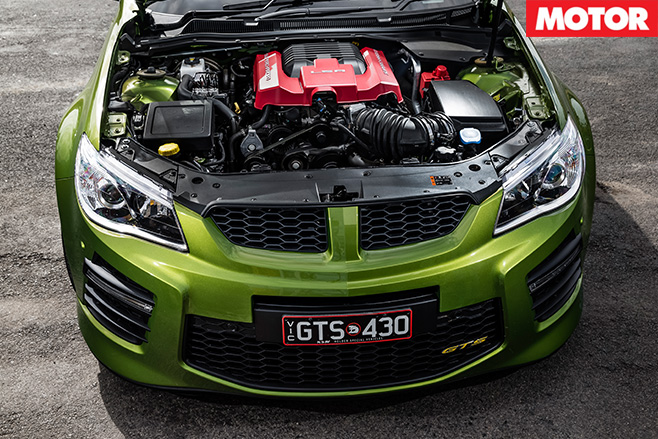
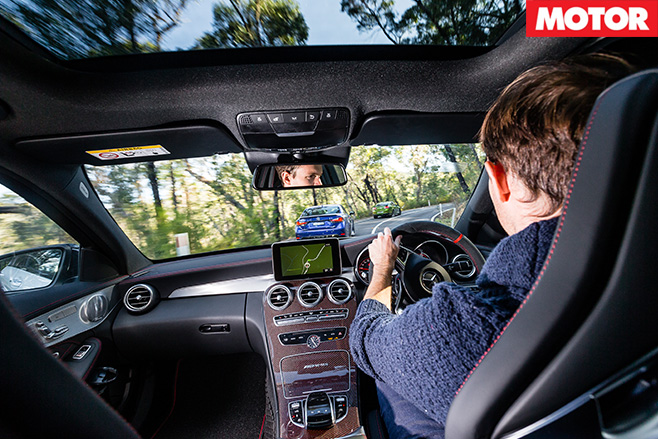
The greatest difference between these three can be found in the interiors. All three are up against it to varying degrees by being the range-topping variants and therefore sharing interior architecture with much cheaper models, but it’s in the HSV that this is most evident. Seats aside, there’s little to differentiate a $95K GTS from a $54K SS-V Redline, but then there’s not a lot to complain about either. The driving position is excellent, there’s plenty of equipment and masses of space front and rear for big, burly Aussie blokes.
Those same blokes would struggle in the back of the C63. Legroom is reasonable but the seat cushion is very short and simple physics denies it the head and shoulder room of its full-size rivals. Fine for kids, a squeeze for larger adults. Up front there’s plenty of alcantara, red-stitched leather and shiny chrome, though the ‘blood carbon’ effect on the centre console of our ‘Edition 1’ test car (see breakout) is an acquired taste. Only the odd hard plastic surface is a reminder the C63 shares its roots with a $60,000 C200.
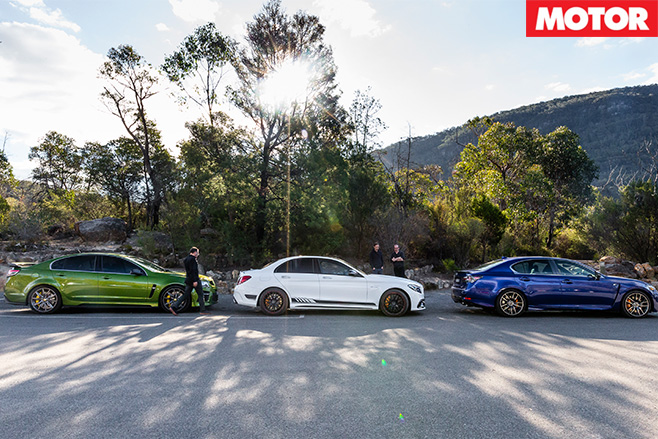
Which kind of sums up the GS F; it’s a really good car, without quite nailing that final few per cent. It has a great engine, awesome brakes, handles well and is loaded with kit. At around $150,000 it deserves to be successful, and not just as a left-field choice. Unfortunately for Lexus, the GS F is a very good car in the company of two outstanding ones.
If value for money took precedence, the HSV GTS would be an easy winner – how could it not? It’s unbelievably fast, the roomiest and most comfortable car here and more than holds its own on a twisty road, all for 60 per cent the cost of the others. It’s a phenomenal achievement for a small Aussie company, and it’s difficult to countenance that the GTS will cease to exist in a little over 12 months’ time. It has a huge appetite for fuel and tyres and has a couple of rough edges compared to other $100K rivals, but it’s undoubtedly the best performance car Australia has ever produced.
Specs
| u00a0 | HSV GTS | MERCEDES_AMG C63 S | LEXUS GS F |
| Body | 4-door, 5-seat sedan | 4-door, 5-seat sedan | 4-door, 5-seat sedan |
| Drive | rear wheel | rear wheel | rear wheel |
| Engine | 6162cc V8, OHV, 16v, supercharger | 3982cc V8, DOHC, 32v, twin-turbo | 4969cc V8, DOHC, 32v |
| Bore/stroke | 103.1 x 92.0mm | 83.0 x 92.0mm | 94.0 x 89.5mm |
| Compression | 9.1:1 | 10.5:1 | 12.3:1 |
| Power | 430kW @ 6150rpm | 375kW @ 5500-6250rpm | 351kW @ 7100rpm |
| Torque | 740Nm @ 3850rpm | 700Nm @ 1750-4500rpm | 530Nm @ 4800-5600rpm |
| Power/weight | 234kW/tonne | 227kW/tonne | 188kW/tonne |
| Transmission | 6-speed manual | 7-speed wet-clutch automatic | 8-speed automatic |
| Weight | 1841kg | 1655kg | 1865kg |
| L/W/H | 4988/1899/1457mm | 4756/1839/1426mm | 4915/1845/1440mm |
| Tracks | 1616/1590mm (f/r) | 1609/1546mm (f/r) | 1555/1560mm (f/r) |
| Steering | electrically-assisted rack-and-pinion | electrically-assisted rack-and-pinion | electrically-assisted rack-and-pinion |
| Brakes(F) | 390mm ventilated/drilled discs, 6-piston calipers | 402mm ventilated/drilled carbon-ceramic discs, 6-piston calipers | 380mm ventilated/drilled discs, 6-piston calipers |
| Brakes(R) | 372mm ventilated/drilled discs, 4-piston calipers | 360mm ventilated/drilled discs, 4-piston calipers | 345mm ventilated/drilled discs, 4-piston calipers |
| Wheels | 20.0 x 8.5-inch, 20.0 x 9.5-inch (f/r) | 19.0 x 8.5-inch, 19.0 x 9.5-inch (f/r) | 19.0 x 8.5-inch (f/r); 19.0 x 9.5-inch |
| Tyre sizes | 255/35 ZR20 (f); 275/35 ZR20(r) | 245/35 ZR19 (f); 265/35 ZR19 (r) | 255/35 ZR19 (f); 275/35 ZR19 (r) |
| Tyre | Continental ContiSportContact | Michelin Pilot Super Sport | Michelin Pilot Super Sport |
| Price as tested | $95,590 | $172,310 | $151,700 |
| Pros | Incredible value; hugely fast; practical | Crazy power; great handling; brilliant brakes | Great drivetrain; chassis balance; sharp pricing |
| Cons | Outrageous thirst; low-speed refinement | Traction issues; firm ride; very expensive | Rivals much faster; abrupt ride; divisive looks |
| Star Rating | 4.5/5 | 4.5/5 | 4/5 |
Follow WhichCar/Wheels on Google
Click the button below to make WhichCar by Wheels a preferred source for your news.