
Comparisons

Gallery 1
Medium and large sedans, once the bread-and-butter of Australia’s new car landscape, have ceded their dominance to SUVs and, increasingly, dual-cab utes. And it’s not just Australia where the seismic shift is happening, with sales of passenger cars dwindling globally.
But the reality is not everyone wants an SUV. Nor do they want – or need – the space and utility of a dual-cab.
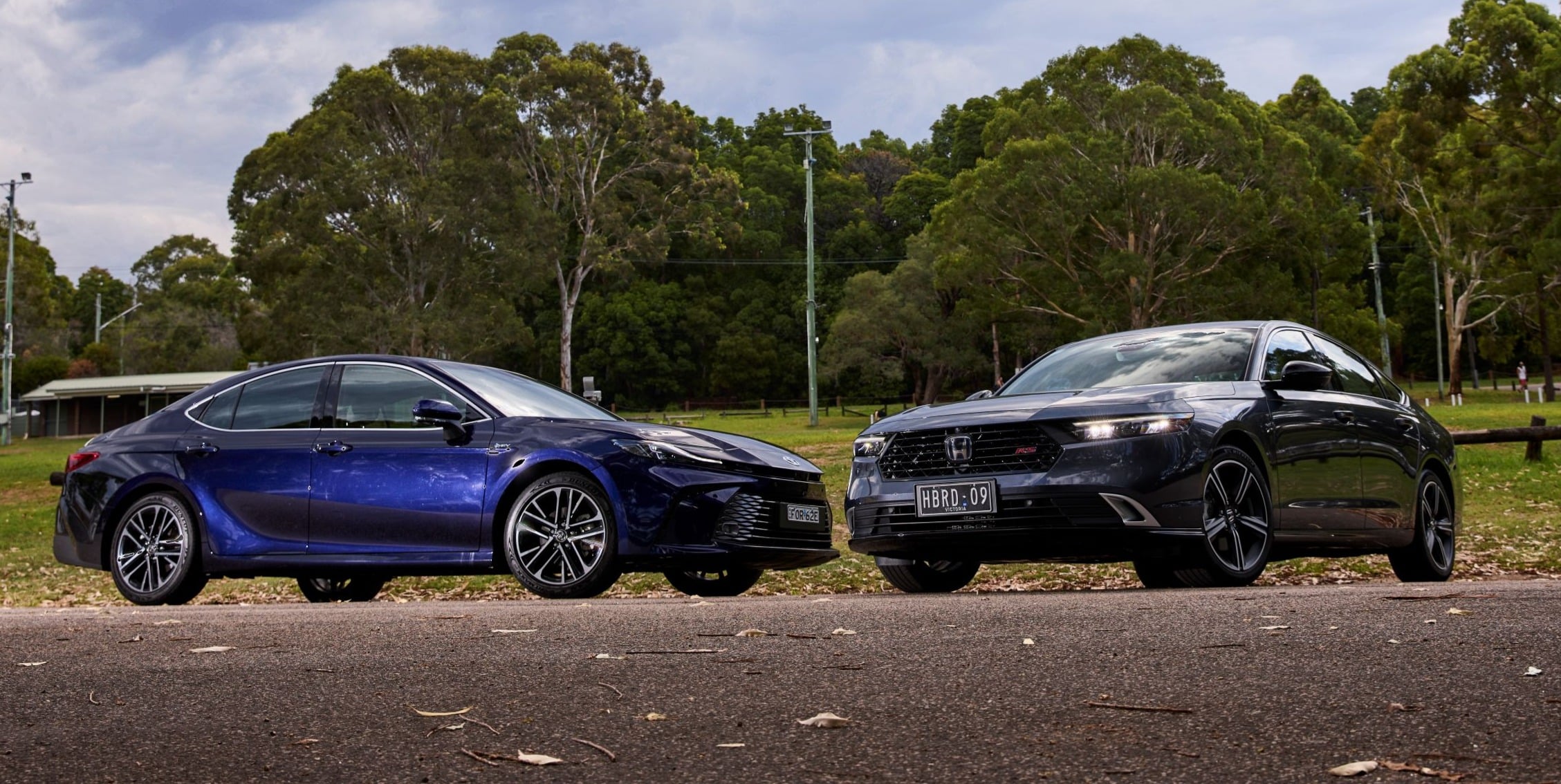
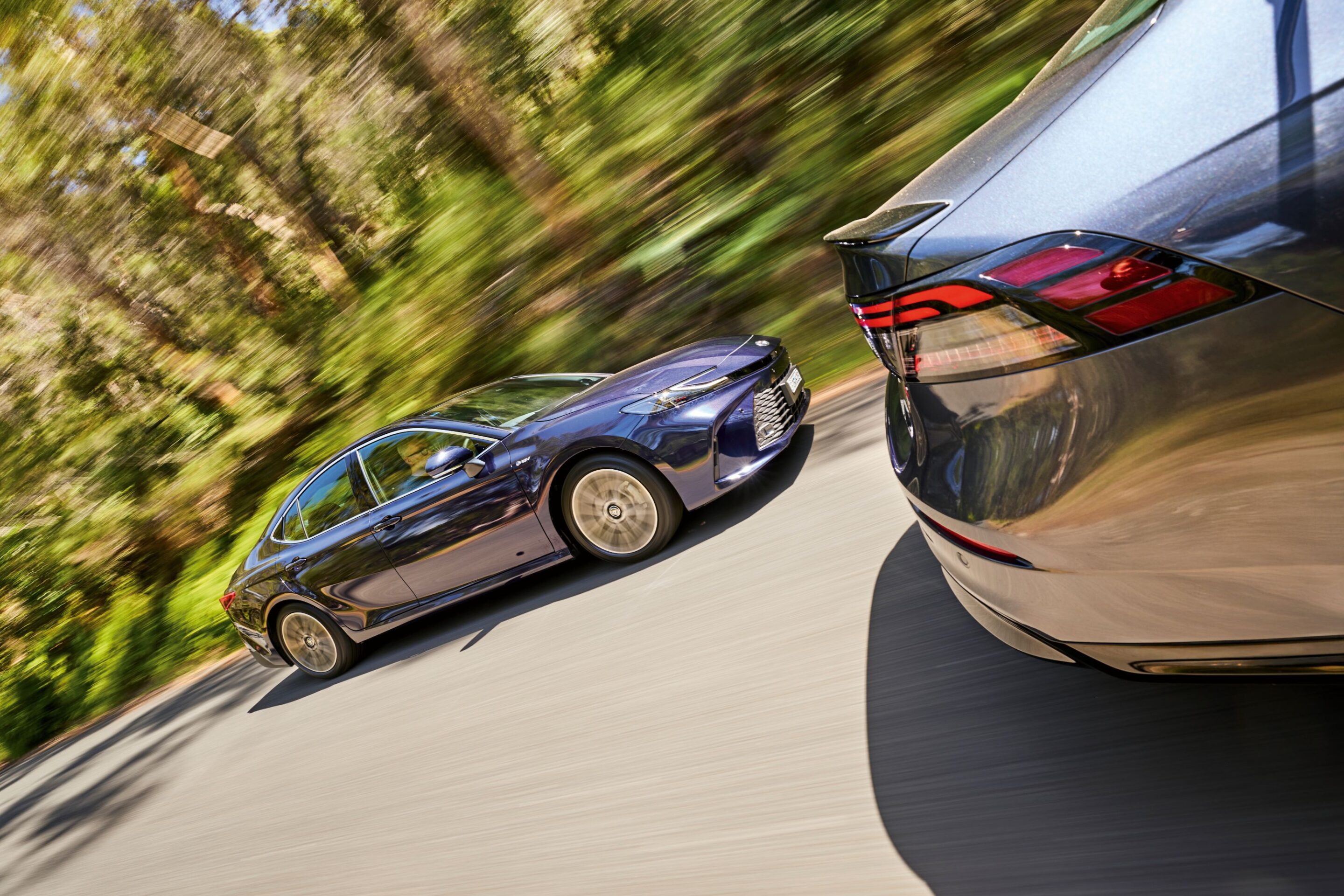
Thankfully, those buyers are still well-served by what were once humble sedans, three-box designs that have over the intervening years kept up with modern technology, drivetrains and buyer expectations. We’ve assembled two of the best currently available in Australia to see how they stack up as a family hauler, as a drivers’ car, and whether there’s life still left in a formula almost as old as the motor car itself.
The Toyota Camry and Honda Accord need little introduction. Mainstays of the Australian new car market, the Camry and Accord continue to fly the flag in defiance of the prevailing new car trends, not just here but around the world.
1
Both cars have been an unmitigated success for their respective brands around the world. Honda has sold in excess of 20 million Accords globally since launching in 1976, a number exceeded – just – by Toyota, which has racked up sales of 21 million since 1980.
It’s a different story in Australia where the Honda Accord never scaled the heights of its rival from Toyota. Sure, it had successful years, in the mid-90s and again in the mid-2000s, with its 15,498 sales in 2007 the high point for the nameplate. Symbiotically, the high point for Toyota Camry came that same year when Aussies bought over 48,000 units across Camry and the ‘larger’ Aurion models.
Today, neither Camry or Accord are sold in their home market of Japan but continue to be available in markets around the world. In Australia, they, along with four other models from four other brands, remain the frontline fighters in a segment that continues to thumb its nose at the SUV orthodoxy. In 2007, those numbers ran to 16 models from 18 different manufacturers. Oh, how times have changed.
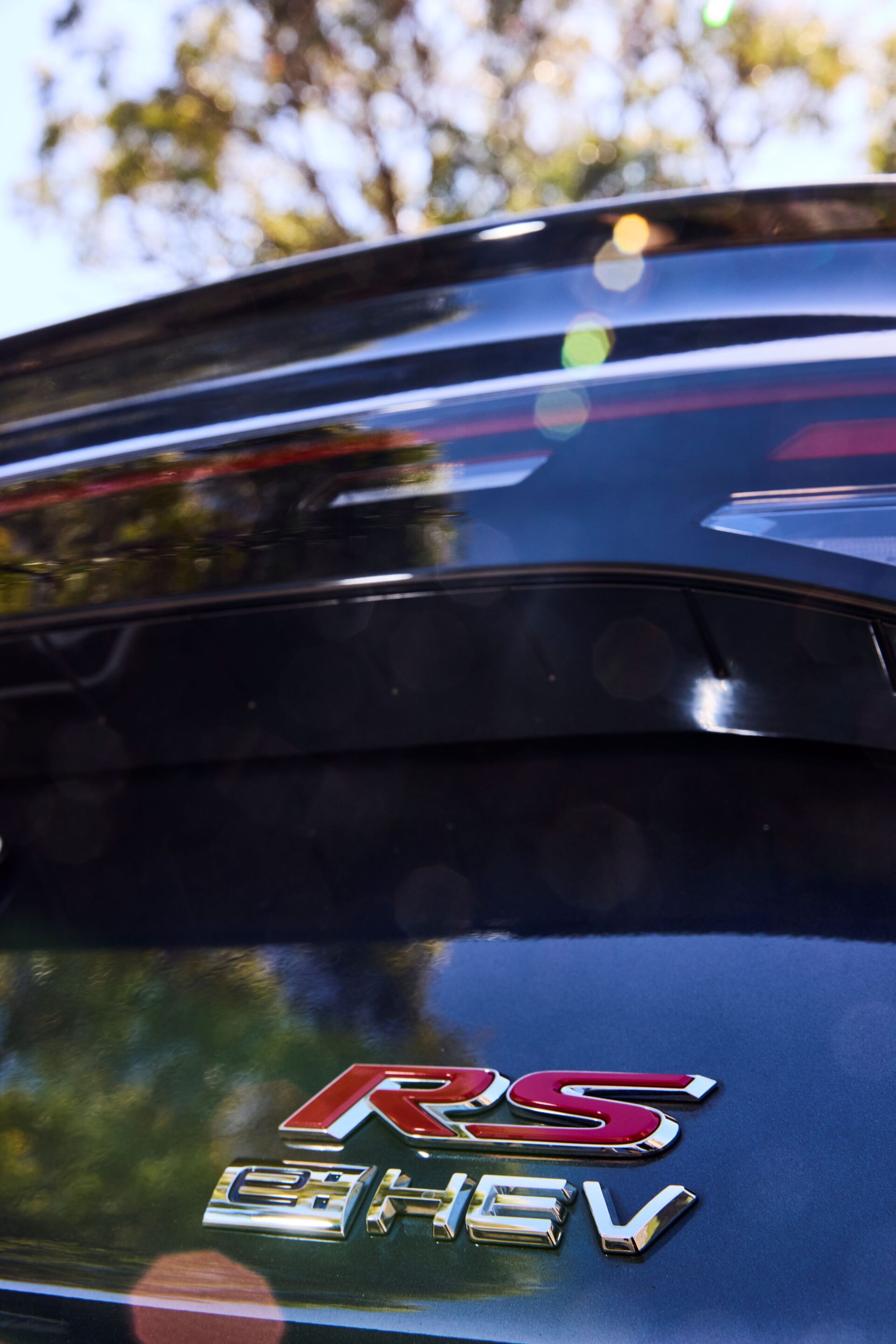
Toyota and Honda both launched new generations of their respective mid-sizers in 2024, a ninth for the Camry and 11th for Accord. Both are offered exclusively with hybrid powertrains, making them ripe for this comparison.
Honda has kept its Accord range delightfully simple. There’s just one highly-specified variant, the Honda Accord e:HEV RS. It’s priced at $64,900 drive-away, a firm price under Honda’s somewhat controversial fixed-price ‘agency’ sales model. No haggling for a deal here.
2
The Toyota Camry we have here is the range-topping SL, priced from $53,990 before on-road costs, translating to driveaway pricing between $57,844 (Queensland) and $60,419 (WA). NSW buyers can expect to pay $59,097 to get their minty-fresh new Camry on the road.
There are no options available for either car, other than paint colour. Here, the Accord claws back some ground, its four-colour palette – Crystal Black, Meteoroid Grey (the colour of our test car), Lunar Silver and Platinum White – a no-cost option.
Seven of the Camry’s colour swatch of eight hues command a $575 premium, the only no-cost shade the Uber-spec Glacier White. Our test car was finished in Saturn Blue metallic, bringing the as-tested price in NSW to $59,702.
On price alone then, it’s the Camry ahead by around five grand, leaving the Accord with plenty of work to do to make a fist of this contest.
On paper, there’s little between this pair. Both are medium-sized sedans, powered by four-cylinder
petrol-hybrid engines – 2.5 litres displacement in Camry’s case, 2.0-litre in the Honda corner.
On its own, the Accord’s 2.0-litre double overhead cam i-Vtec claims 108kW and 182Nm, hardly earth-shattering numbers. But, like the Camry, an electric motor driving the front wheels brings 135kW and 335Nm for a combined 152kW, although Honda doesn’t quote combined torque figures.
1
It’s a similar story for Toyota, where the Camry’s petrol mill brings 138KW and 221Nm to the output party, aided and abetted by an electric motor at the front wheels with quoted outputs of 100kW and 208Nm. All up, Toyota says there’s 170kW to play with while, like Honda, it doesn’t quote combined torque figures.
Science and engineering nerds will probably be able to figure out what that means on paper in terms of torque, but out in the real world, it’s the Accord that presents the more – thrilling is not exactly the word – engaging drive experience. More on that later.
There’s a degree of satisfaction when you first slide your bum into the Accord. The cabin itself is nicely presented, with enough flourishes and garnishes to feel a little bit special. Honda’s signature honeycomb mesh (it’s also found in Civic and CR-V) running the length of the dashboard is a case in point which, certainly to this reviewer’s eyes, looks way more expensive than the Accord’s $65k sticker price suggests.
The seats too, are comfortable, supporting you in all the right places including at the sides and under-thigh. They sit nice and low in the cabin which, while not exactly giving off touring car racing vibes, do offer a level of driver-centric design that feels just a smidgeon sporty.
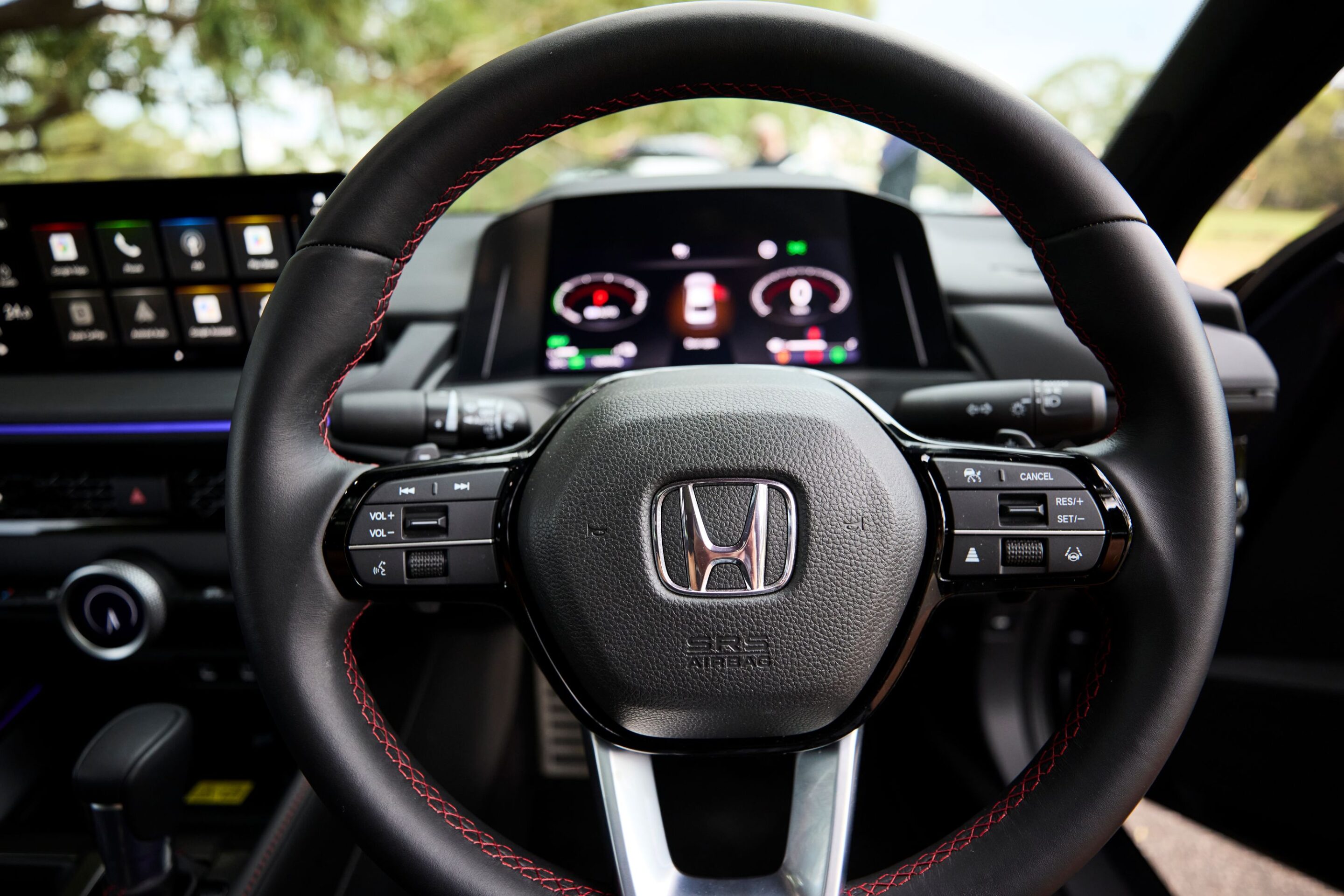
The Accord looks and feels purposeful from the driver’s seat, enhanced by plenty of racy red contrast stitching on the seats and the steering wheel. You immediately feel like this is a ‘driver’s car’.
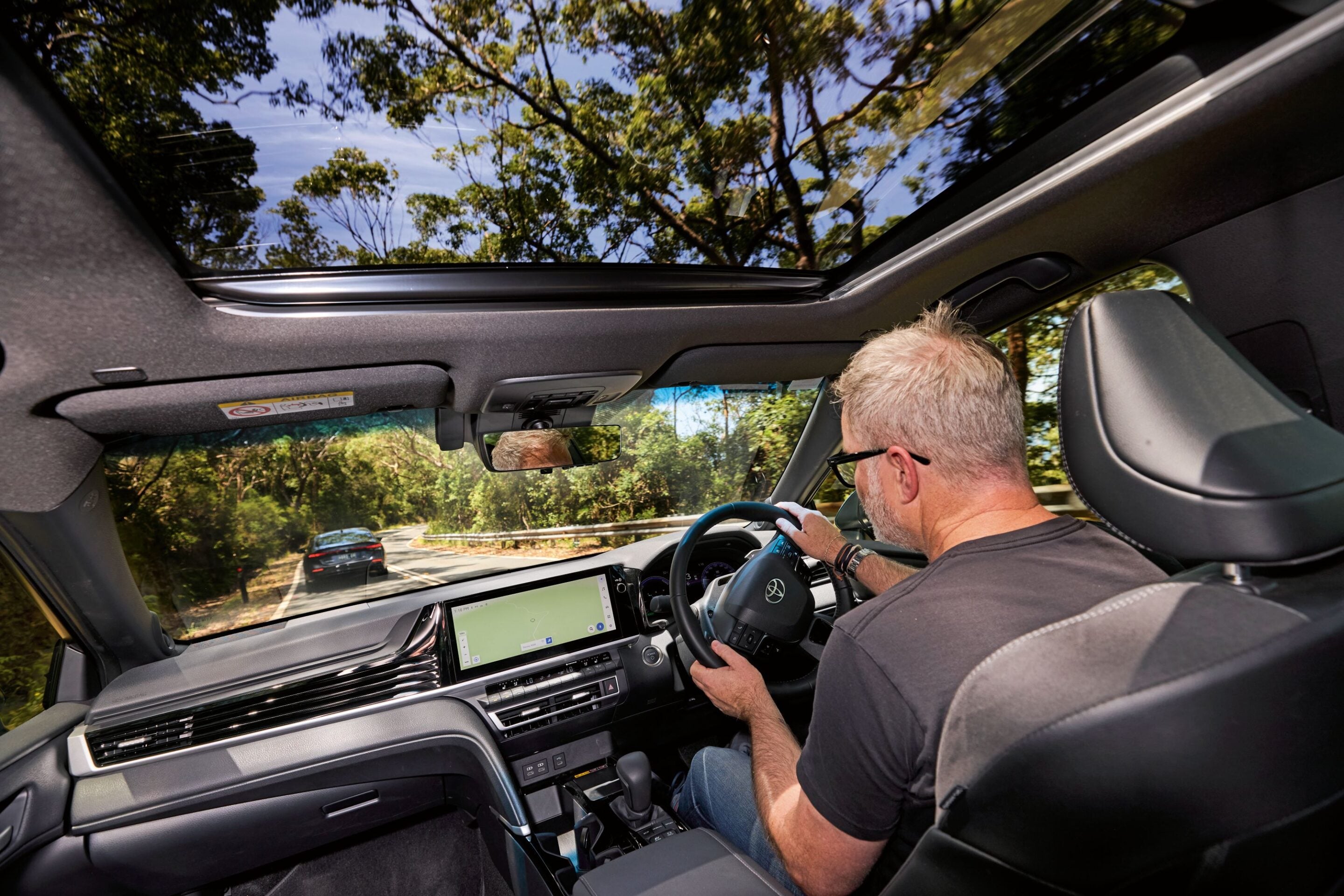
The Camry does its best to hide away from its siblings lower down the range with leather seats that look nice, but aren’t quite as well-bolstered or supportive as the Honda’s. But unlike the Accord, the Camry’s front pews offer seat heating and ventilation, something of a mis-step by Honda at this end of the family sedan price bracket.
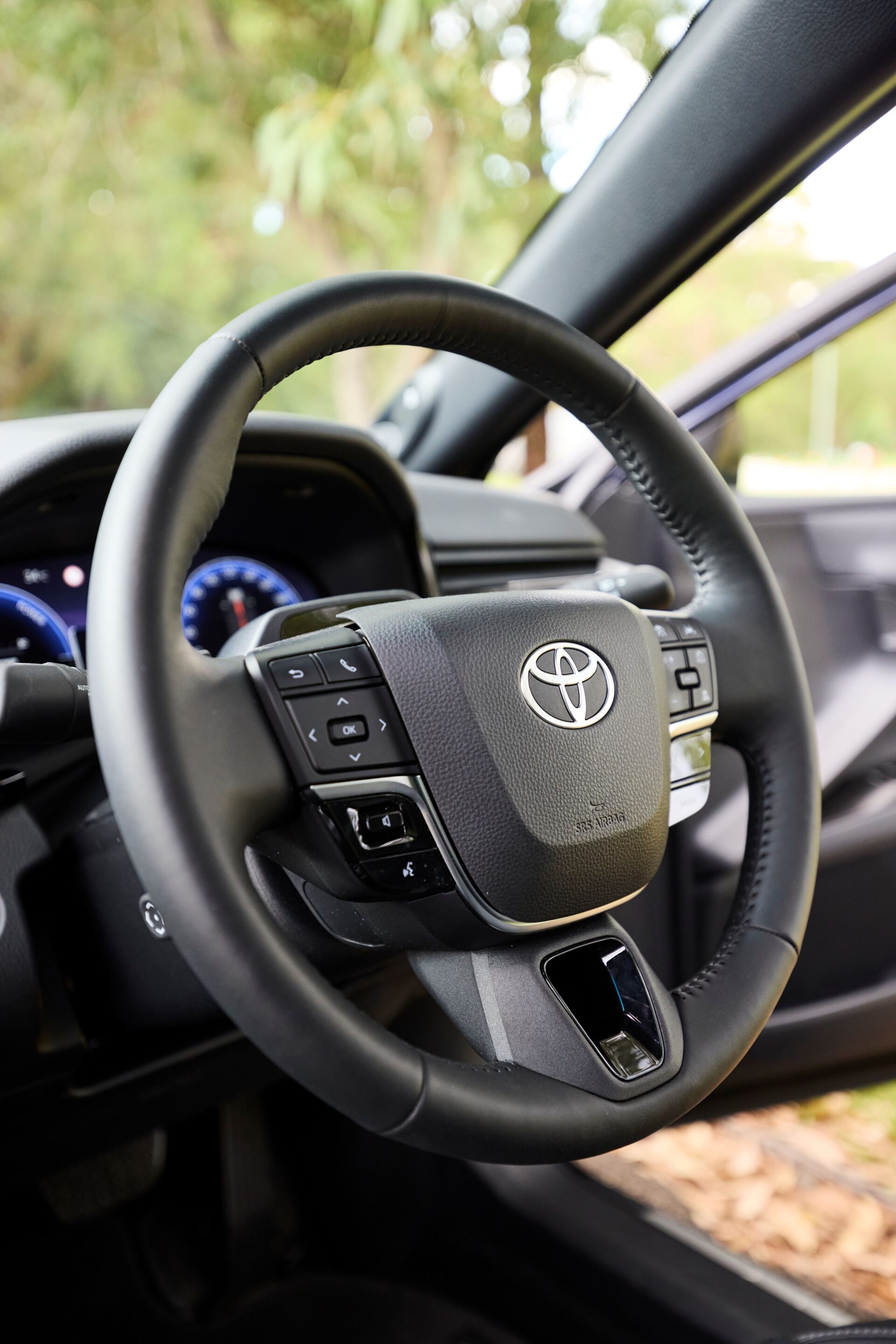
The Camry’s dash is a little busier in terms of its design, with multiple scalloped layers fashioned out of different materials feeling a touch overdone, especially the gloss piano black which might have looked high-rent a decade ago but now just seems like a designer’s cop-out.
2
And you don’t have to look too far to find the hard, scratchy plastics of its entry-level Ascent stablemate, clearly visible lower down on the dash and the door cards.
Toyota has upped its infotainment game, certainly in how the 12.3-inch touchscreen presents with a clear display and sharp graphics. Toyota has always felt a step behind in the in-car technology game, but the system in this top-spec Camry is in keeping with the times. Wireless smartphone mirroring is standard, no matter your flavour of operating system, as is a wireless charging pad. I used wireless CarPlay over my time with the Camry and experienced zero issues, the connection stable and quick to reconnect at start-up.
The Accord’s 12.3-inch touchscreen sprouts from the dashtop like a chrysalis, unlike the Toyota’s which is integrated into the design. It too offers wireless smartphone connectivity, which proved flawless over my time with the Accord, easy to initially connect, with rapid-fire reconnection on start-up, and then stable throughout.
The Accord’s 12-speaker Bose sound system clearly edges the Camry’s nine-speaker unit, with richer sound and a clarity the Toyota’s JBL unit simply can’t match. Some could argue sound quality isn’t front and centre in the decision making process when buying cars of this ilk, but I’d argue if you’re spending 60 grand and over, you should expect a decent audio set-up.
2
Second row comfort is also important in this segment. After all, is a family sedan really a family sedan if back seat passengers can’t enjoy even a modicum of comfort?
Both Camry and Accord offer plenty of space, certainly in terms of toe, knee and leg room. But the presence of panoramic sunroofs in both cars does impact on headroom, especially in the second row where taller passengers will find the tops of their heads nudging the ceiling. Similarly, both second rows feature a tall transmission tunnel, meaning anyone sent to middle-seat purgatory will find their feet straddling the divide.
There’s not much in it when it comes to luggage space, the Accord’s 570 litres edging the Camry’s 524 litres. Both offer unquoted increased cargo capacity thanks to seats that stow away. But where the Camry’s fold in the more common 60:40 fashion, allowing for greater flexibility in terms of luggage and passengers, the Honda’s back seat rest flips forward in a single piece. You can carry more luggage if you need to, but you’re limited to just two people on board. And an extra point to Toyota for equipping the Camry with a space-save spare wheel and tyre, not a given in these modern times and illustrated only too starkly by the Accord’s tyre repair kit.
Both cars tested here are brimming with modern safety tech, although only one has been assessed by Australia’s independent safety body, ANCAP. In short, the Camry wears a five-star safety score while the Accord remains untested. That doesn’t make the Accord an unsafe car, far from it, with this new-generation scoring a five-star JNCAP (Japanese New Car Assessment Program) rating at launch.
So far, so even, bar a smattering of minor differences amounting to not much more than splitting hairs. The real measure then, comes on the road.
And here the Accord takes some confident steps, with a driving experience that’s best described as exuberant. There’s no lack of shove under harder acceleration when the electric motor and petrol
engine work in tandem to move the circa 1609kg (kerb) sedan at a brisk pace, almost like it wants to be a performance car. Almost.
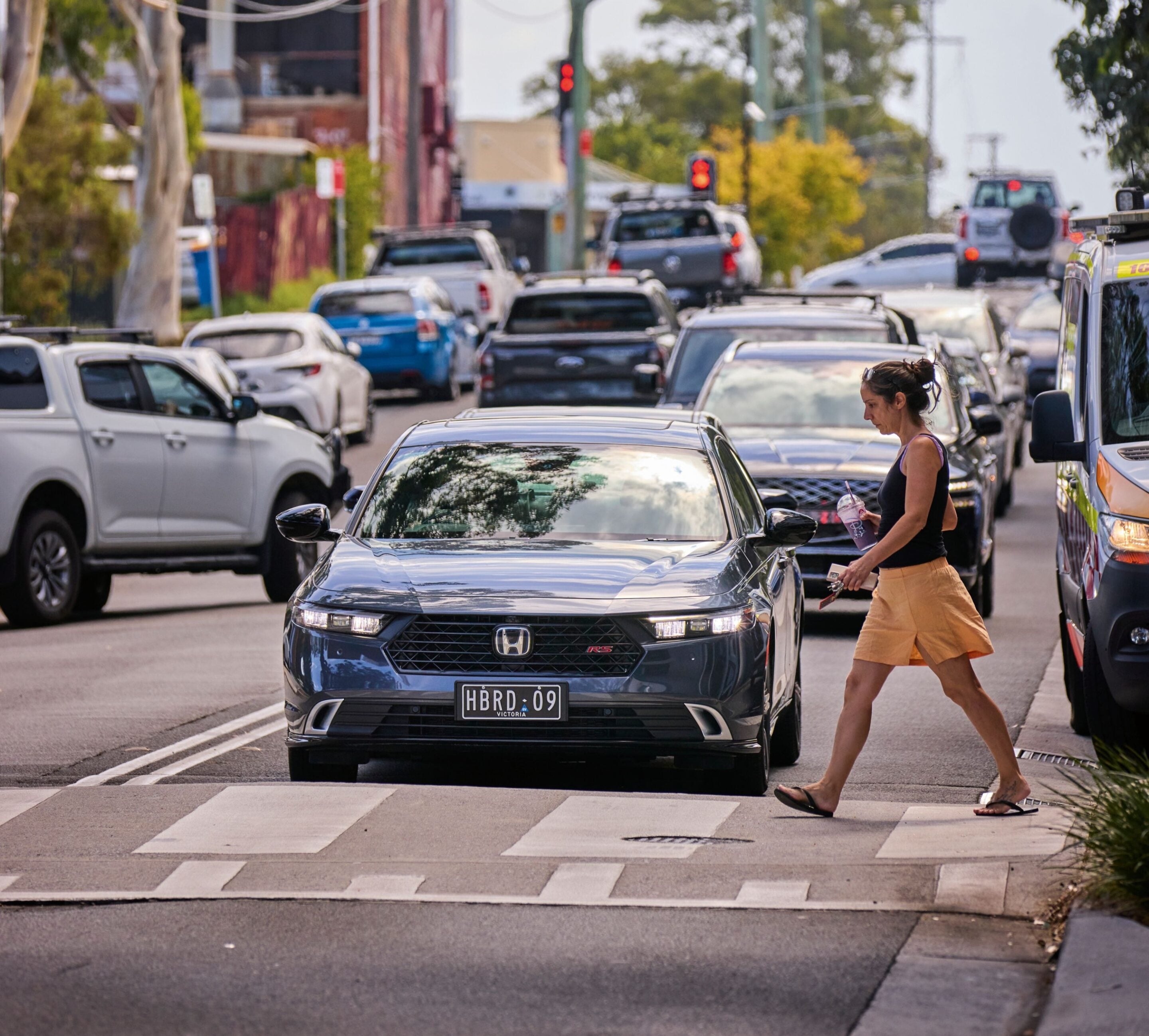
In urban environments, the Honda’s hybrid powertrain does what hybrids do, blending the near-silent – and emissions-free – running of the electric motor, assisted by the 2.0-litre petrol engine as needed.
Four drive modes – econ, normal, sport and individual – noticeably alter the characteristics of the petrol-hybrid system. Econ – for economy – dulls throttle response and turns climate control down a notch in the hunt for fuel savings while sport brings a sense of urgency to the Accord’s acceleration while also piping some muted, but artificial, engine sounds into the cabin. Needless to say, the middle ground, i.e. normal mode, is where you want to be, which brings a quietude and refinement to the driving experience.
1
The transition between the two sources of power is seamless, so seamless that it’s sometimes difficult to discern when the petrol engine is doing the hard yards. A small illuminated ‘EV’ on the digital driver display lets you know you’re driving on electrons alone.
The continuously variable transmission is excellent, not something I would have said not all that long ago. But technology and refinement moves at an astonishing pace and Honda’s latest CVT does a commendable job of rifling through the steps, especially under harder acceleration, mimicking a conventional torque converter auto. Don’t be fooled by the paddle shifters on the steering wheel – they’re for toggling through the various energy regeneration modes, six settings in all, that help keep a permanent state of charge in the battery to keep the electric motor humming as often as possible.
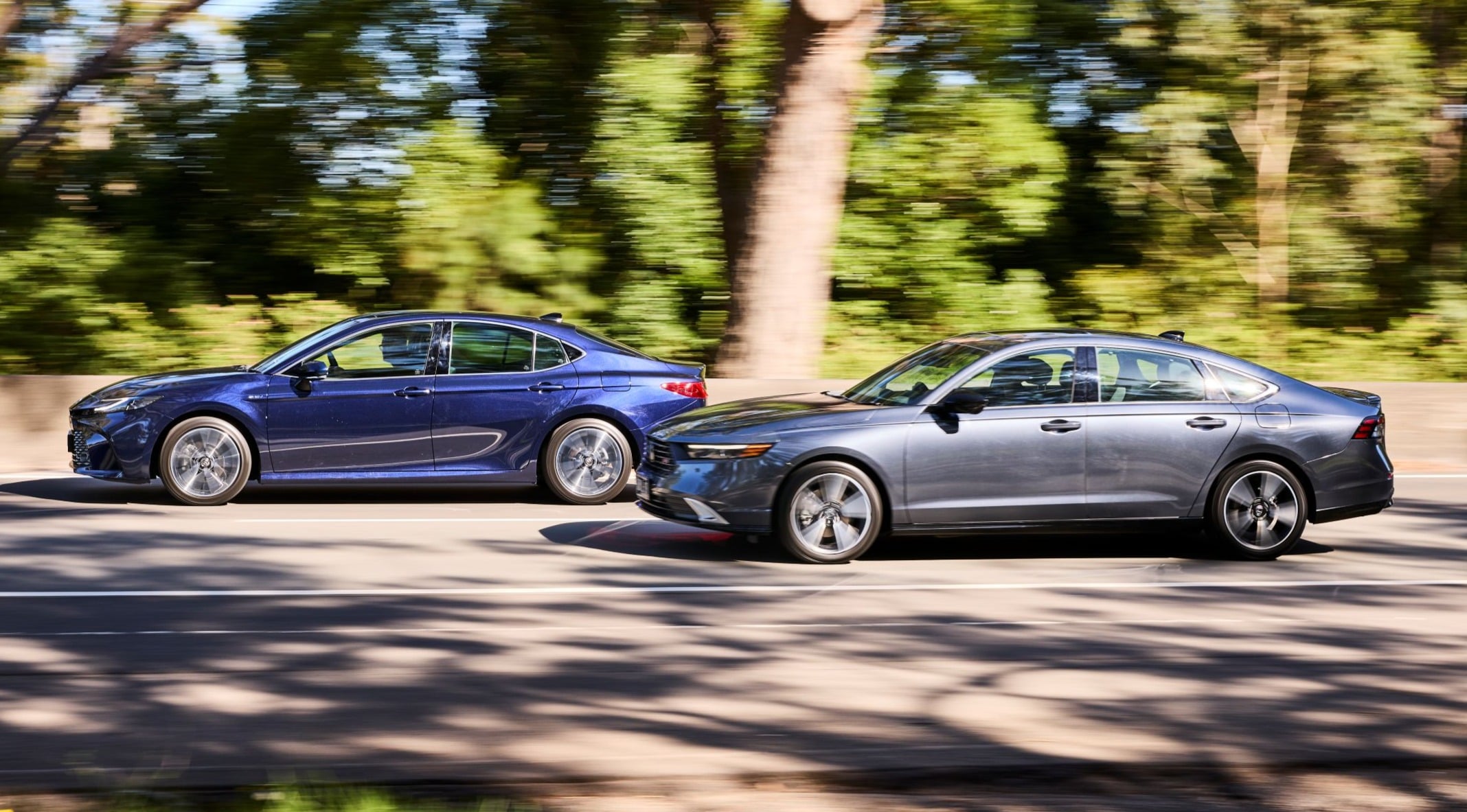
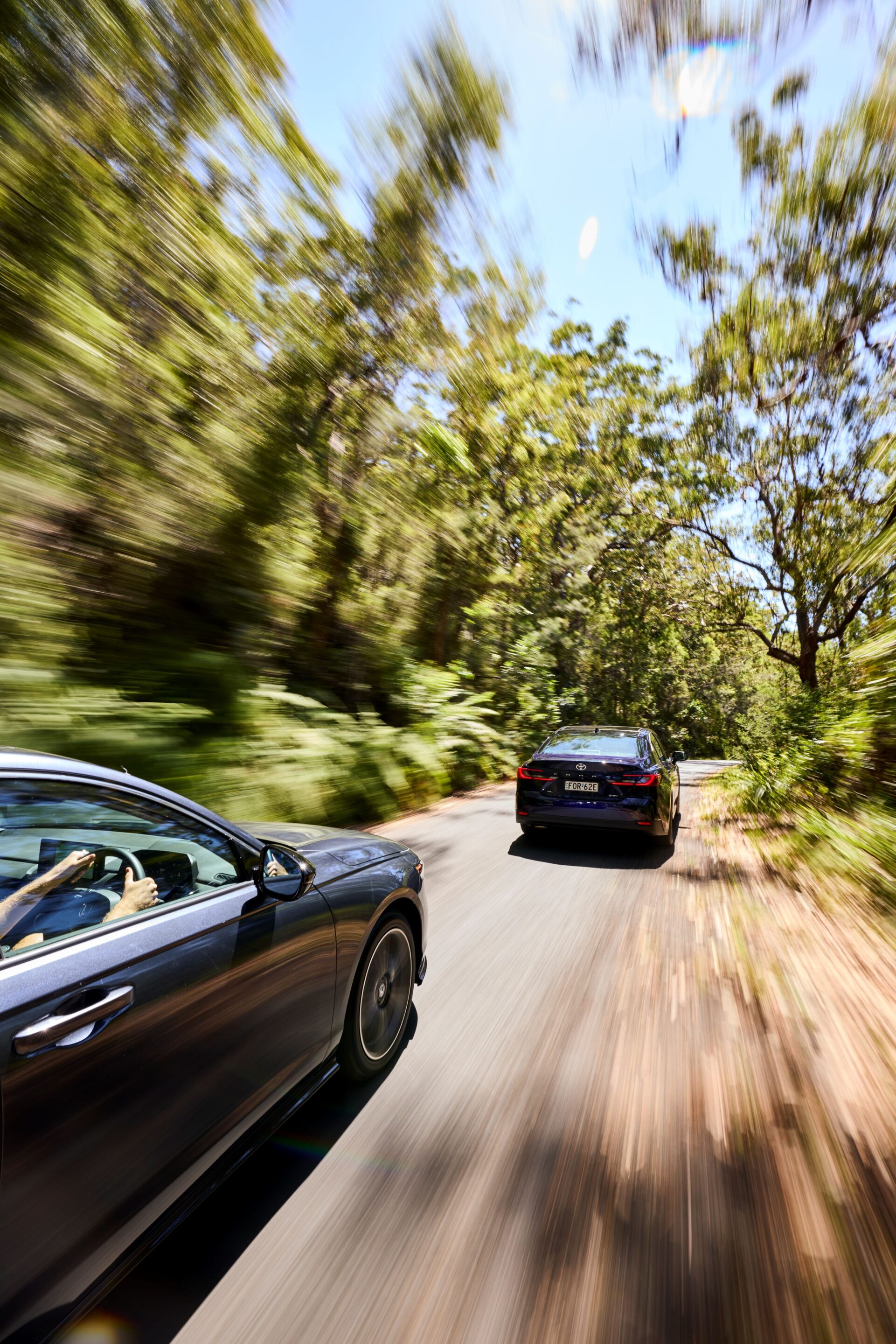
Being a Honda, and especially one wearing an ‘RS’ badge, brings with it some expectations. Honda has, over the years, built a solid reputation for engineering a modicum of driver enjoyment into its cars. The Accord doesn’t stray too far from that philosophy with a nicely balanced chassis that’s simply fun to drive. Sure, it won’t make you feel like Fernando Alonso (and in the current F1 pecking order, that’s no bad thing), but there’s an inherent solidity to the way the Accord comports itself on some twisting and winding roads.
That’s enhanced by nicely-weighted and accurate steering while brake pedal feel remains top-notch, as it has done in Hondas of all colours, both new and old.
Ride comfort is decent, although there can be moments of harshness and jitteriness while navigating larger road imperfections, but for the main part, the Accord offers a pleasing balance of just-enough dynamism with road comfort.
1
But if the Accord is a family sedan for families who love driving, then the Camry, even in this highly-specified top-of-the-range form, holds no such pretensions. Instead, think of the Camry as the sensible choice. That’s not a barb. The Japanese brand knows its customer, and knows what they want from a Toyota-built car. And the Camry delivers it in spades.
There’s not much to say about the Camry’s hybrid set-up other than after almost 30 years of development and innovation, Toyota’s ‘High Synergy Drive’ is still the standard bearer, seamlessly blending petrol propulsion and electric motivation in a way few have been able to replicate.
Like it is in the Honda, Toyota’s system prioritises fuel efficiency, with the Camry relying on the electric motor and battery as often as possible. This is keenly felt during urban driving where the 2.5-litre petrol rarely feels the need to interrupt the flow of electrons to the front wheels. And when it does, it does so seamlessly and quietly, and like in the Honda, leaving you wondering whether it’s doing any work at all.
With total system outputs of 170kW, the Camry can, and does, get up and hustle when it needs to, like merging onto a motorway or accelerating for an overtake. But as good as the Camry is, it lacks that last per cent of refinement that the Accord has in spades.
Toyota’s CVT isn’t as refined as Honda’s and that’s most noticeable when you put your foot down, with that tell-tale drone (for not much reward) that only a CVT under load can seem to muster.
Of course, that’s all mitigated by its exemplary demeanour during regular driving, where a quiet comfort comes to the fore.
Without any pretensions of the Camry being a driver’s car, Toyota has ensured the suspension leans towards comfort. That’s noticeable over obstacles such as speed humps which the Camry traverses with more finesse than the Accord. Its noise suppression is also just a fraction better than the Honda’s, the Camry in this spec isolating occupants from much of the outside world, with only minimal wind noise and road noise. It’s still there, of course (no car is completely silent), but it’s not as intrusive as it is in the Honda.
The trade-off comes on the same winding rural back road, where Camry falls just a little short of Honda’s ‘sporty’ DNA, its softer-sprung suspension setup feeling just a little ponderous compared with the Accord’s slightly firmer and more assured stance.
Still, there’s little to split the pair so far, with the Camry trumping the Accord on value, but the Accord besting its rival in cabin quality and the overall driving experience.
So how do they stack up as the one thing they’re both designed to do – fuel economy.
Here, the differences are again minimal. Toyota claims the Camry and its robust hybrid system will use 4.0L/100km no matter the driving conditions – urban, highway or combined.
Our week with the Camry flagship couldn’t get anywhere near that claim, settling on an indicated 5.6L/100km over the full smorgasbord of driving conditions – suburban school runs, extended highway kays and even some more adventurous driving on our favourite section of rural back roads.
That indicated fuel use stacks up against our many previous experiences with Camry where consumption figures from the low- to mid-5s is the norm. And it’s worth noting the Camry requires 95-octane premium unleaded for its 50-litre tank. Based on our real world numbers, expect a full tank to net you around 892km between refills.
Honda’s claims aren’t as ambitious, the Japanese manufacturer quoting 4.3L/100km on the combined cycle (a blend of urban and highway… everyday driving in other words); 5.4L/100km for pure highway driving and a miserly 2.4L/100km in urban traffic. Again, our week with the Accord, covering the exact same ground as we did in the Camry, didn’t match those claims, settling on 5.5L/100km. We did note an indicated 3.9L/100km after a long highway run, but that soon climbed into the 4s and then 5s before settling on 5.5L after a week.
1
The bonus here for the Accord is that it’s quite happy to sip 91-octane regular unleaded, saving you money at the bowser, something increasingly important in these fuel-starved times we currently find ourselves in. Based on our real world testing, expect to get around 872km of range from the Accord’s 48-litre tank.
So slightly cheaper running costs for the Accord, then, but what about servicing? Surely Toyota’s famously industry-leading capped-price servicing will put one over Honda? Let’s run the numbers.
Toyota asks that Camry return to the workshop every 12 months or 15,000km. That’s pretty standard in today’s automotive landscape. Each visit is capped at $275 a pop for the first five years or 75,000km, not only affordable in the scheme of things, but also loaded with peace of mind.
Honda’s switch to a fixed-price agency model for selling its cars has extended to ongoing maintenance where the Accord asks for just $199 per visit for the first five years or 50,000km of scheduled servicing, more affordable than Toyota, but with the caveat that if you regularly drive more than 10,000km annually, you’ll be visiting the workshop more often than you would in a Camry. Both the Honda and Toyota are covered by their respective manufacturer’s five-year/unlimited kilometre warranty.
So, on to the winner. There’s not much between this pair, other than the circa $5000 asking price in favour of the Toyota. That matters to family buyers, especially in these chastened times. But it’s also not as simple as that.
Sitting inside the Accord it’s easy to see where the extra five grand has been spent, with a classier, more refined cabin that sits above the Camry’s which, while nice, still has traces of its Uber-spec entry-level sibling on display.
The Accord’s slightly better fuel consumption and the fact it can drink regular unleaded against the Camry’s thirst for the pricier premium also works in its favour.
But the clincher comes in the driving where the Accord is quite simply, a more exciting car to drive. Sure, it’s no sports sedan, but there’s enough engineering built into the Honda to elevate it above the Toyota, satisfying those of us who enjoy a decent blast on occasions.
The reality is though, these are both fantastic family cars, generously equipped, with miserly fuel economy, spacious second rows, big boots and affordable ongoing maintenance costs. There really isn’t a loser here, but if I could have only one, it’s the Honda Accord for me.
Specs
1
| Model | Toyota Camry SL |
|---|---|
| Price | $53,990 plus on-road costs (circa $60k driveaway) |
| Engine | 2.5-litre naturally-aspirated four-cylinder petrol-hybrid, FWD |
| Peak power | 170kw @ 6000rpm |
| Peak torque | 221Nm @ 3600-5200rpm |
| Transmission | Continuously variable auto |
| L/W/H/WB | 4920/1840/1445/2825mm |
| Kerb weight | 1625kg (kerb) |
| Fuel consumption | 4.0L/100km (claimed) 5.6L/100km (tested) |
| Boot size | 524L |
| 0-100km/h | N/A |
| Warranty | 5 years/unlimited km |
| Servicing | 12 months/15,000km |
| Servicing costs | $1375 five years/75,000km |
| Overall rating | 7.9 |
1
| Model | Honda Accord e:HEV RS |
|---|---|
| Price | $64,990 driveaway |
| Engine | 2.0-litre naturally-aspirated four-cylinder petrol-hybrid, FWD |
| Peak power | 152kW @ 5000-8000rpm |
| Peak torque | 335Nm @ 2000rpm |
| Transmission | Continuously variable auto |
| L/W/H/WB | 4975/1862/1449/2830mm |
| Kerb weight | 1609kg |
| Fuel consumption | 4.3L/100km (claimed) 5.5L/100km (tested) |
| Boot size | 570L |
| 0-100km/h | N/A |
| Warranty | 5 years/unlimited km |
| Servicing | 12 months/10,000km |
| Servicing costs | $995 five years/50,000km |
| Overall rating | 8 |
This story first appeared in the April 2026 issue of Wheels magazine, now on sale. Subscribe here and gain access to 12 issues for $109 plus online access to every Wheels issue since 1953.
Follow WhichCar/Wheels on Google
Click the button below to make WhichCar by Wheels a preferred source for your news.

We recommend
-
 Comparisons
Hyundai Tucson Hybrid v GWM Haval H6 Ultra Hybrid: Front-wheel drive SUV showdown
Medium SUVs are Australia’s favourite way to move a family around, get to and from work, or head off on a road trip. That’s why every manufacturer wants a piece of the pie. If you want a medium SUV though, do you need AWD and all the extras? Wheels looks at two of the more affordable hybrid FWD models on the market.
-
 Comparisons
Toyota Corolla vs Hyundai i30 spec battle: Which hybrid small sedan is best?
They're some of the cheapest cars to run but which hybrid small sedan is the best buy? Let's find out.
