
If you suddenly have the need to borrow or hire a trailer or caravan these holidays, there are a few steps to take to ensure you do it safely. Different states have different rules for trailers and caravans, so check your local roads authority if you’re not familiar with trailers and tow vehicle regulations.
Check the trailer
- Trailers and caravans above certain sizes and weight need to be registered. If borrowing or hiring a registered trailer, make sure its registration and roadworthy are current. Most state and territory authorities allow you to check the status of a vehicle or trailer’s registration online
- Check that the trailer’s tyres are properly inflated. Trailers that have been stored for some time may be low on tyre pressure
- If possible jack up the trailer or caravan and spin the wheels to ensure the bearings work properly. Also test to see if you can move the wheel from side to side; if it does, there’s a good chance the bearings are worn and may fail
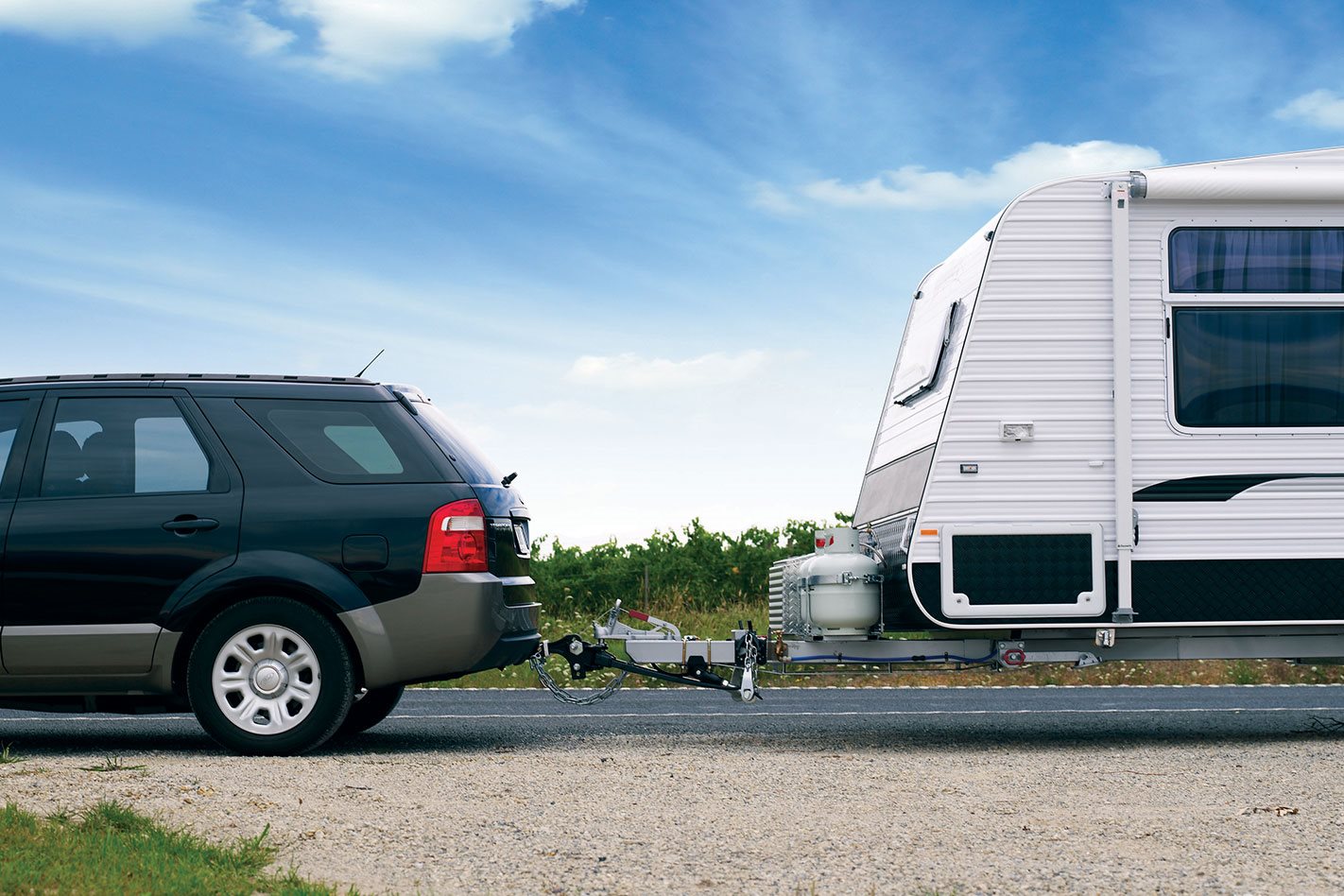
- Check the trailer’s suspension system and brakes if fitted. Small trailers won’t have brakes and generally won’t be able to carry more than about 750 kilograms. Larger trailers that can carry more weight may have either hydraulic or electric brakes; hydraulic ones work with any car, but electric ones need a special adapter wired into your car
- Check the trailer’s plug to see if it is either round or rectangular, and the same for your car. If the plugs are different you may need to buy a special adapter
- Connect the trailer’s plug to the car and ensure all the lights are working. If they’re not, wriggle the plug to make a better connection as a trailer that’s not used for a while may build up corrosion on the electrical connectors
- Make sure the trailer is in good condition and not weakened by rust or rotting wood. Also check welds at key joins and tie-down points
Loading the trailer
- Spread the load evenly across the floor or deck of the trailer and keep it as low as possible to contain the centre of gravity
- If the load is smaller than the trailer, move it as far to the front of the trailer as possible
- Avoid loads that stick out wider than the trailer and tow vehicle
- Avoid loads that are much longer than the trailer as this could impact your car’s handling. Long or high heavy loads could make the trailer sway uncontrollably
- Secure the load taking into account wind and forces caused by accelerating, braking and turning
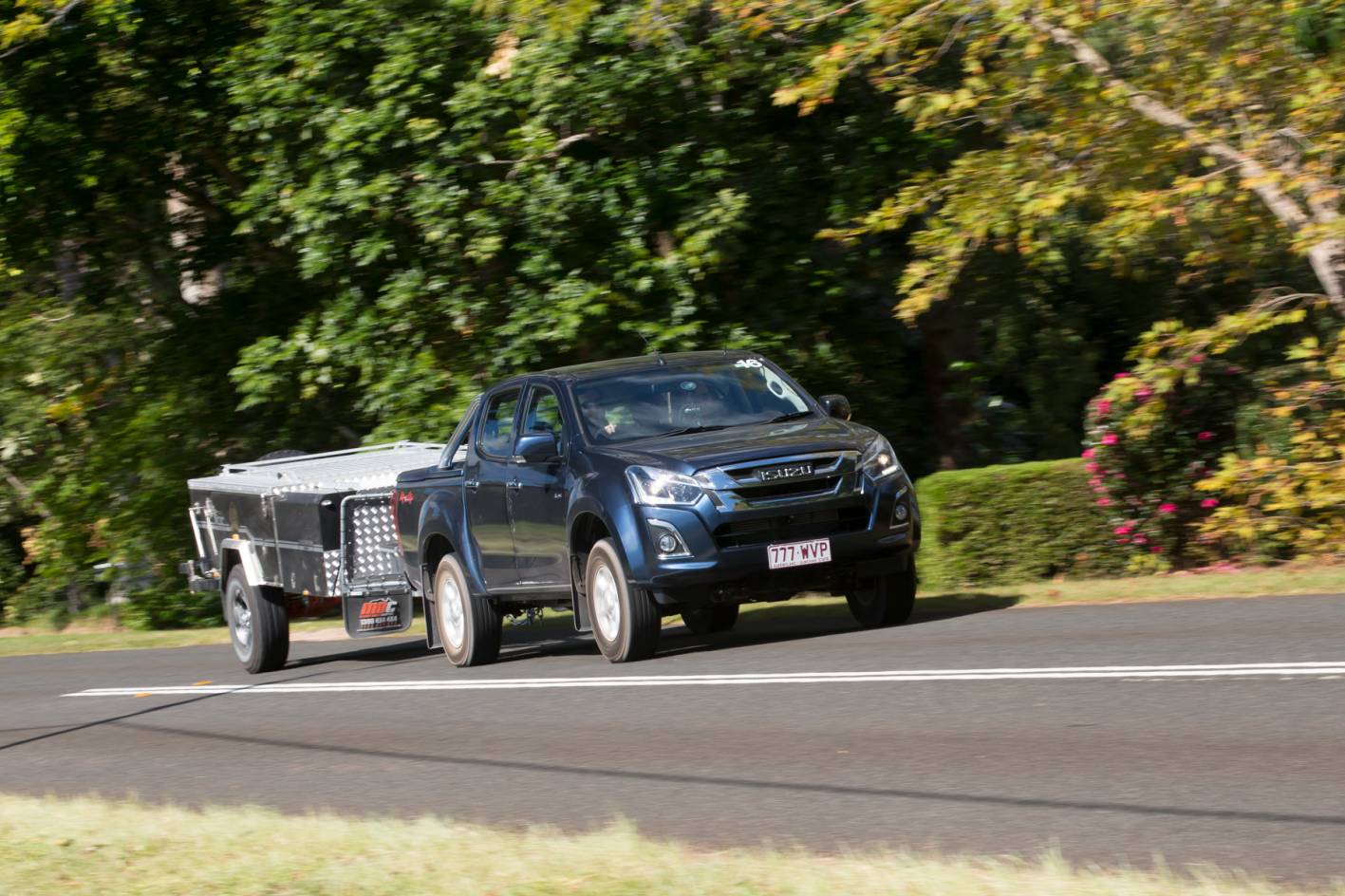
Driving with the trailer
- Make sure the trailer’s weight is within the tow limits of your car. This information can be found in your car’s user manual
- When driving, listen out for any noises from the trailer such as clunky or scraping wheels or a loose load
- Notice how the trailer affects your car’s handling and allow longer distances for braking, overtaking and joining a traffic stream and slow down before turning or entering curves
- If the trailer is bigger than normal, allow for its tendency to ‘cut-in’ on corners and curves
- Brake and accelerate smoothly and allow the trailer to move with your car rather than react to it
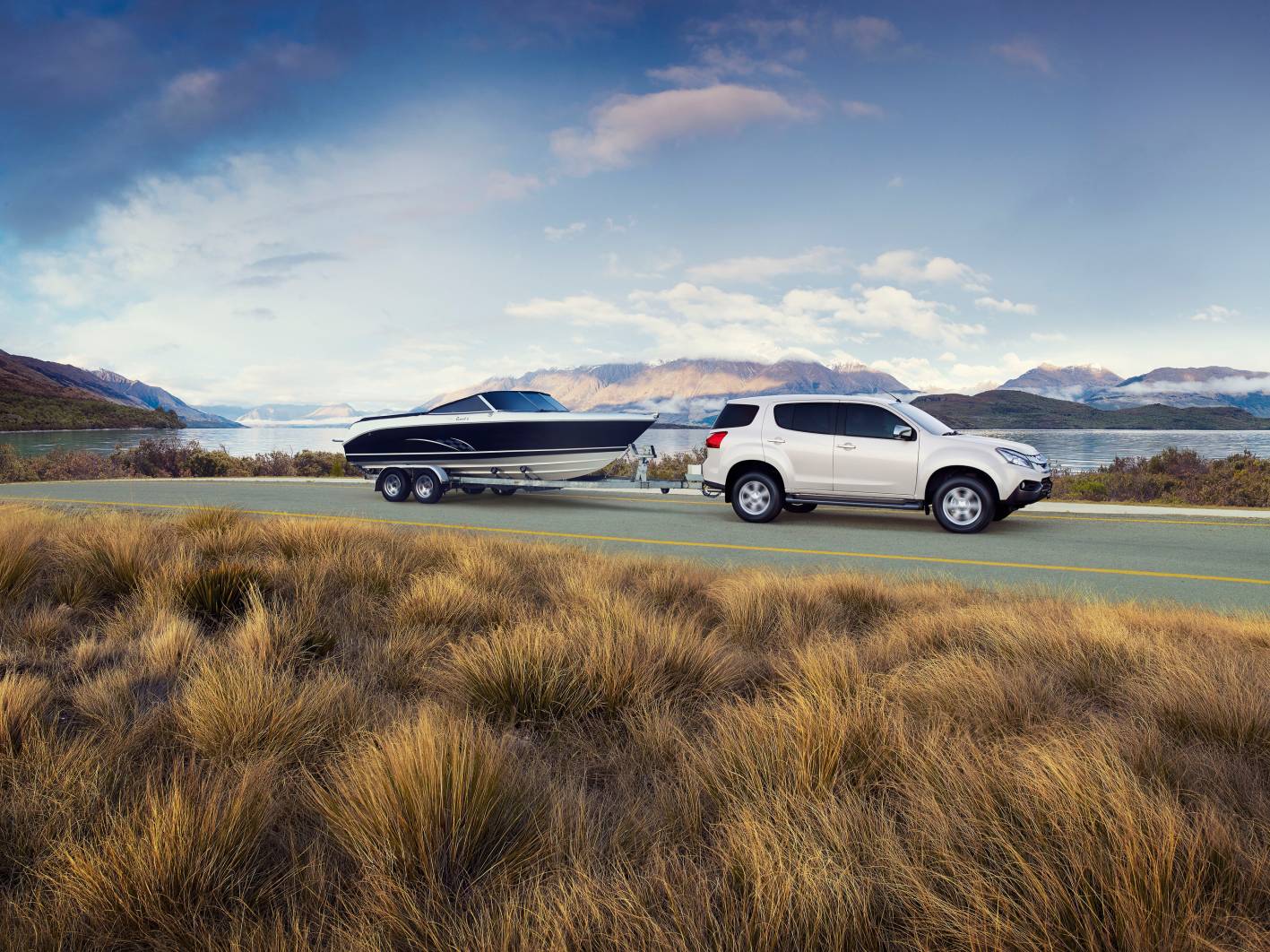
- Use a lower gear on downhill sections of road, even in an automatic, so you’re not sitting on the brakes under load
- If travelling long distances, stop from time to time to ensure the load is still secure and the trailer is coping. Check tyres, tie downs and couplings, and feel for heat in the wheel hubs that will tell you they’re about to fail. They should not be too hot to touch
- If reversing a trailer get someone to direct you wherever possible. If you keep having trouble reversing swallow pride and stop – you can get someone else to do it, unload from that spot or unhitch the trailer and push it into place. Alternatively, there will soon be a number of cars on the market that will be able to do the backing for you.
Trailer sway
If your trailer or caravan begins to sway or snake, the Caravan Industry Association of Australia recommends the following:
- Remain calm and avoid the urge to apply the towing vehicle’s brakes.
- Don’t try to steer out of the swaying / snaking. Alternatively hold the vehicle steady and try to stay in the lane.
- Gently apply the caravan’s electric brakes using the manual control in the tow vehicle. Otherwise, where conditions permit, continue at a steady speed or accelerate slightly until the sway stops.
- When a condition of sway has been corrected, slow down and pull off the road safely.
- Check that your load is correctly distributed within the trailer, making sure that heavier items are placed over the axles of the caravan.
- A caravan that doesn’t have the load distributed correctly, for example with too much weight behind the rear axle, may not handle well and may be the cause of swaying / snaking.
If you missed out on parking a Toyota Supra in your driveway this year you’ll have to wait until at least July 2020 to order a new one from a dealer.
Toyota Australia Vice President Sales and Marketing, Sean Hanley, said that the Supra has been a very positive model for the brand in Australia despite the limited supply.
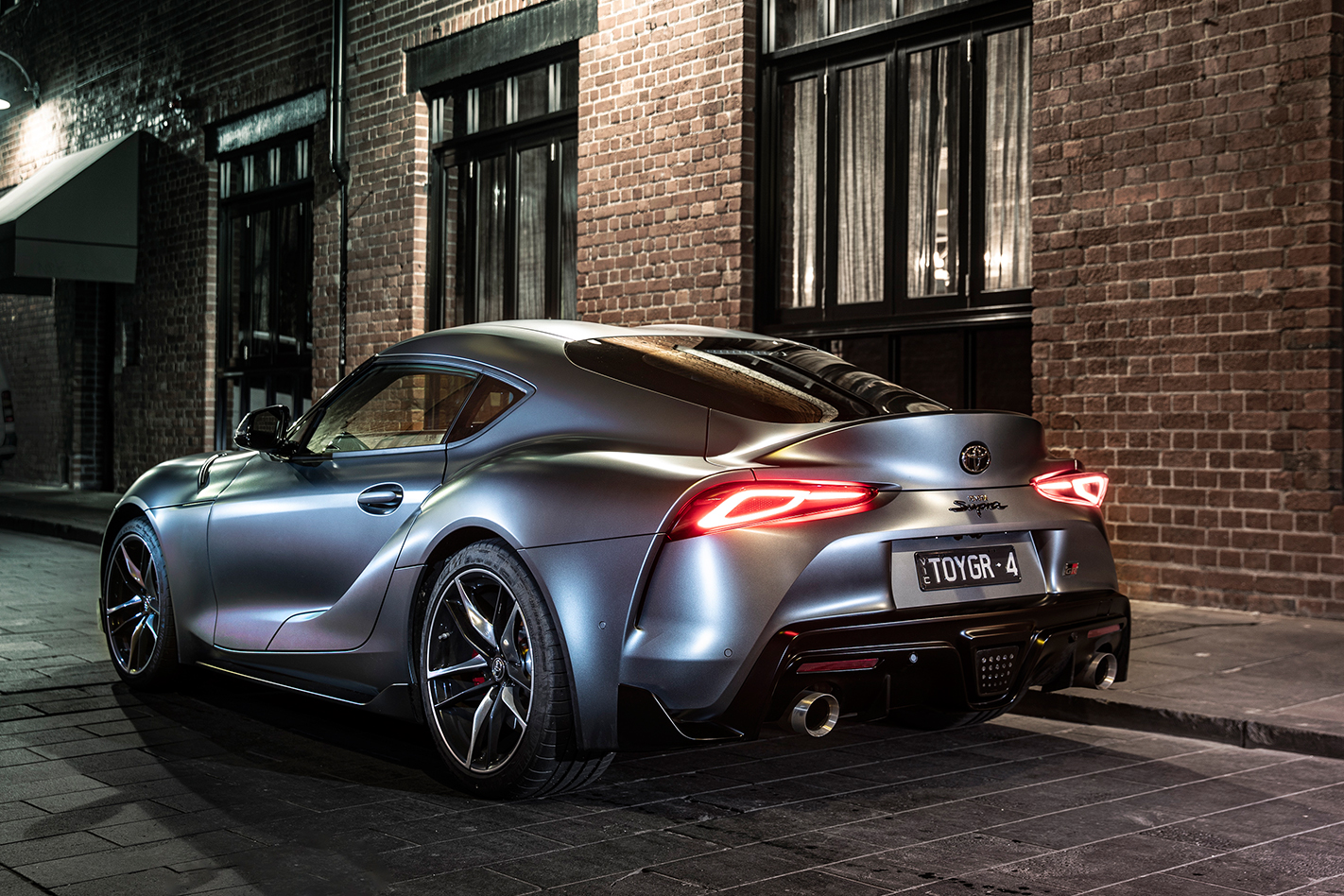
“We’ve sold that allocation, it’s gone. We don’t get anything until July next year,” Hanley said.
While the first allocation of Supras were only available to purchase online in three different batches, the next wave will be available through the traditional Toyota Australia dealer network, and is expected to be include a larger number of vehicles.
However, if you did miss out on the initial run of about 350 cars, Hanley believes there are still some examples floating around that are yet to be sold, you just won’t get to choose your own colour and spec.
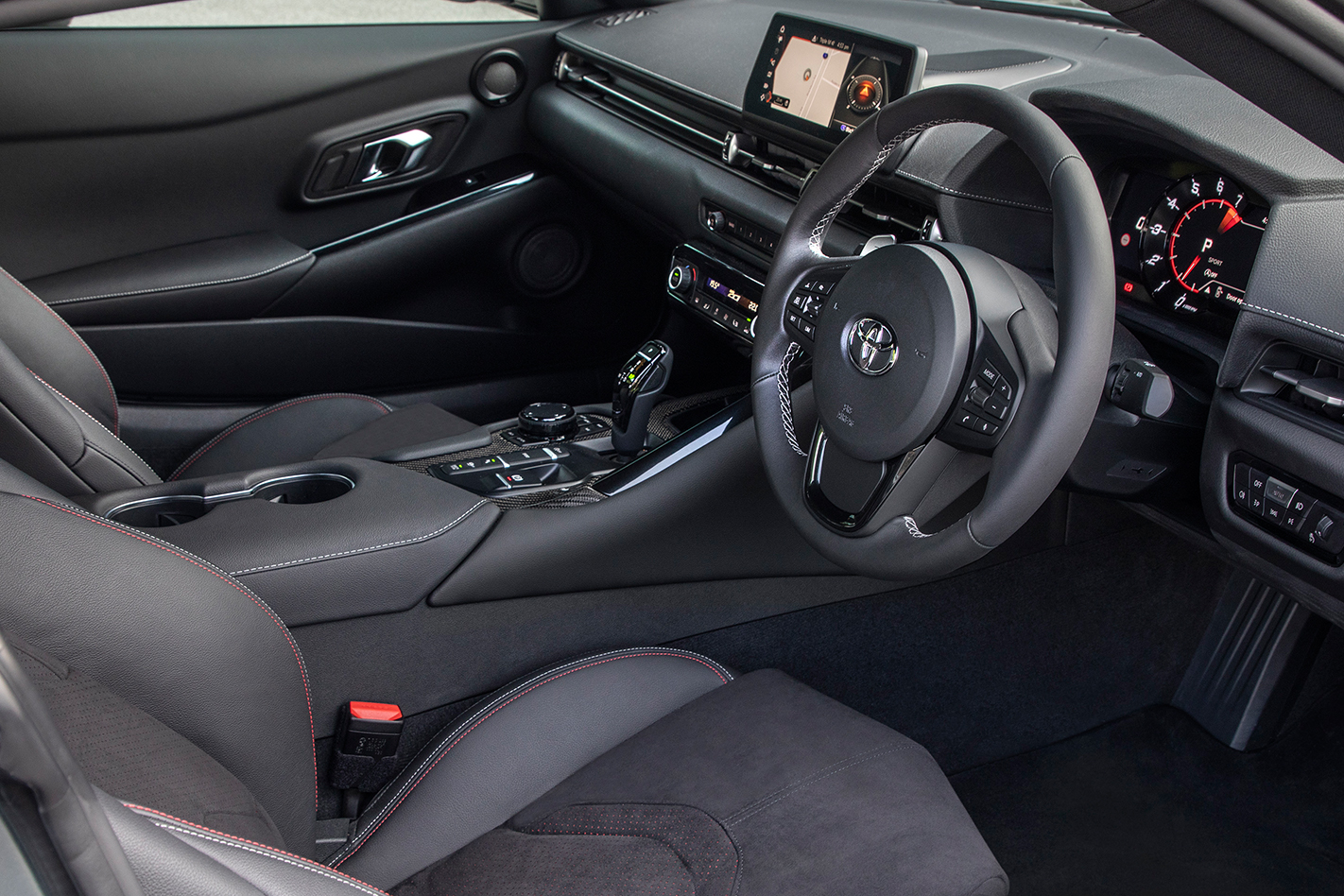
“We had a few orders that either fell over or were cancelled – there might be 15 available in dealers now, I think.
“But they’ll go pretty quick. I’m pretty confident that we’ll have sold out of that allocation by the end of the year,” Hanley said.
Hopefully it’s a sign of good things to come with the company pushing its Gazoo Racing products, something the local arm is keen to add to Aussie showrooms as soon as possible and to capitalise on the success of the Supra.
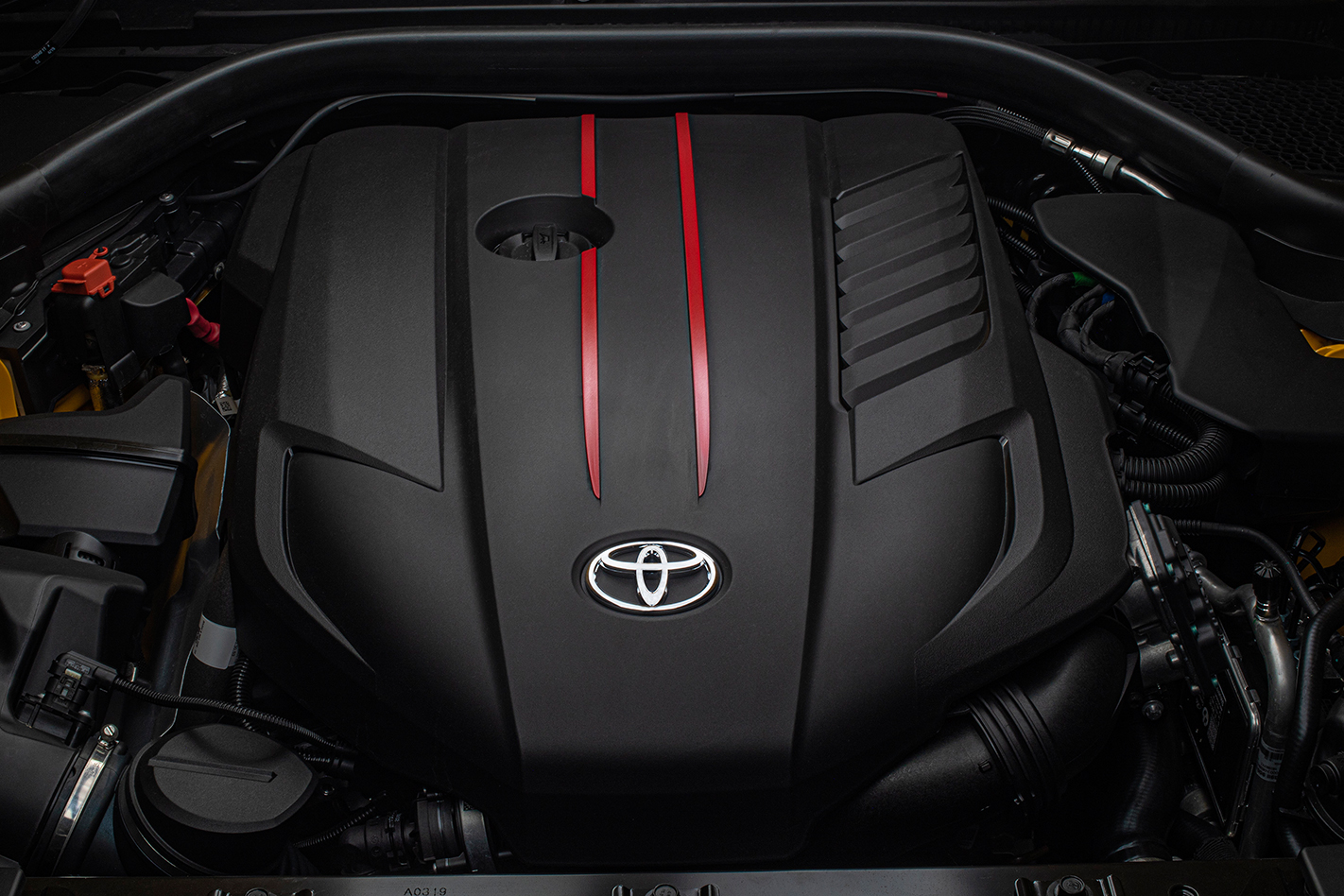
“That interest clearly demonstrated to us that there is an appetite for performance cars in Australia.
“I can assure you that we’ll be keeping a close eye on whatever product offerings arrive … Toyota Australia is keen to source any of those offerings in the future,” Hanley said.
One such product is the GR Yaris, which is destined to play on Toyota’s rally lineage and offer turbocharged, all-wheel-drive hot hatch goodness.
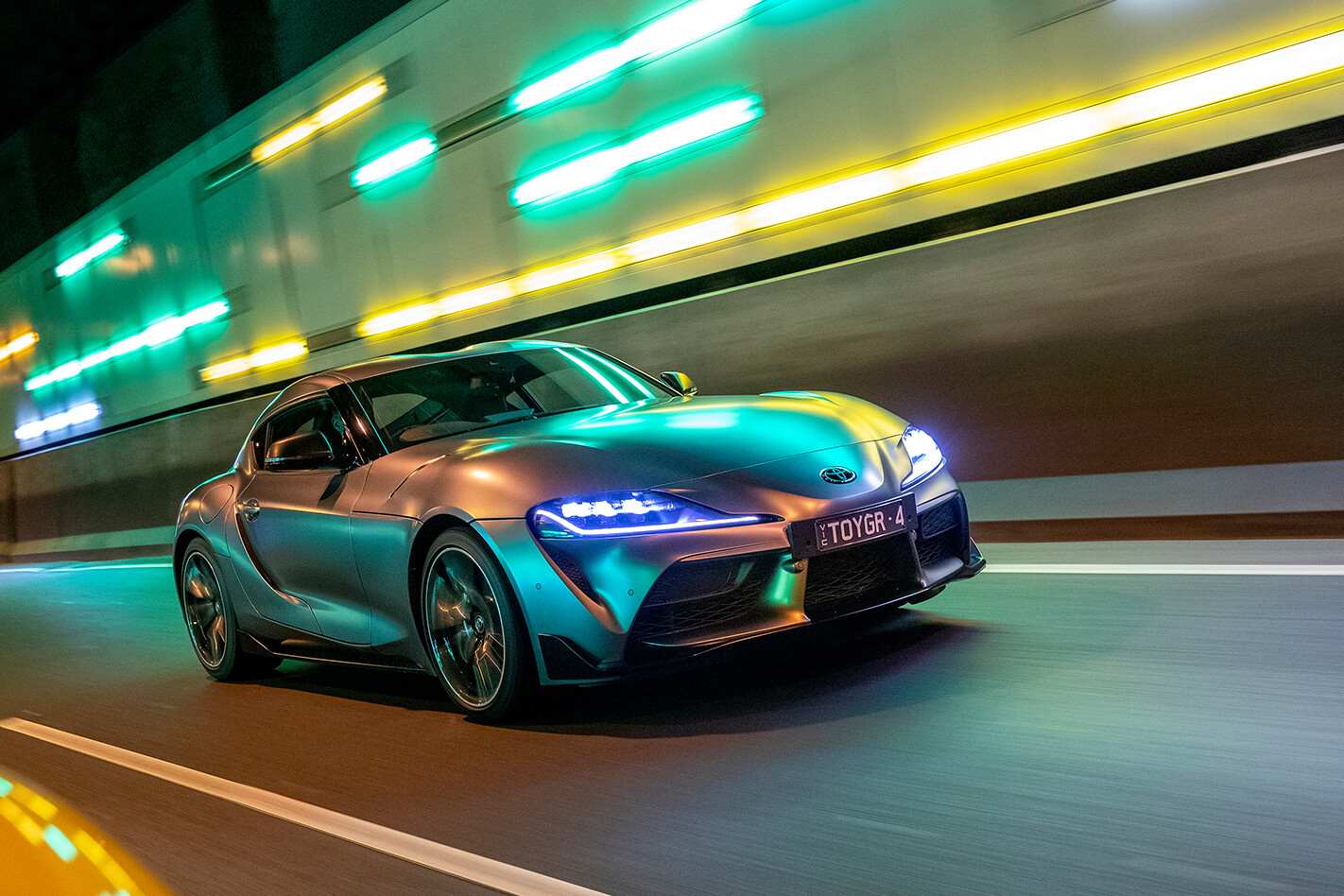
“I think it’s deeply important that we have the products to support that brand [GR] for credibility,” Hanley said.
We hope so, too. And if the Supra and Yaris are anything to go by, we seem to be in for a renaissance of Toyota performance products.
Mobile phones, kitchen knives, watches, clothing, luggage, buildings, and of course cars: Porsche, it seems, can turn its hand to designing just about anything. But now the famous German brand has created something that is quite literally out of this world.

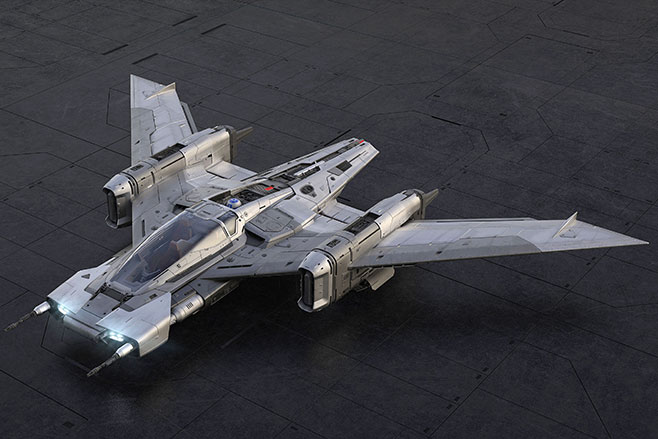
Due to make its debut in the latest instalment of Lucasfilms’ Star Wars franchise, the (take a deep breath) Porsche Tri-Wing S-91x Pegasus Starfighter breaks new ground even for the already prolific design house.
Such was the scale of the task, both the Porsche team in Weissach and Lucasfilms San Francisco studio were enlisted to complete the space battle machine, taking a full two months to pull together what you see here.
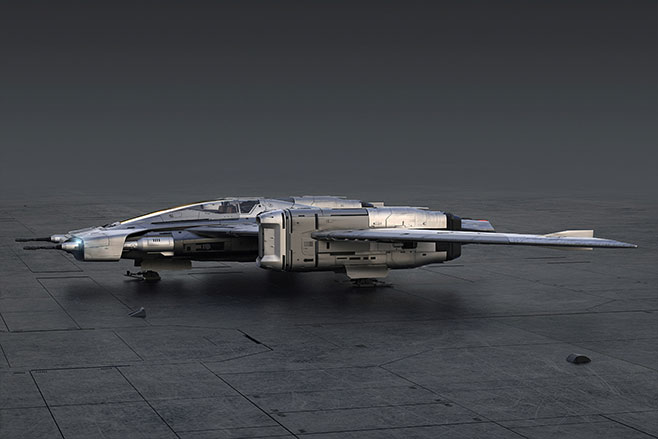
You’d have to be some kind of design savant to pick the Porsche calling cards but they are there, says the car maker.
Located in its nose, just inboard of some pretty offensive-looking weaponry, the Tri-Wing has the same distinctive four-point lighting found in many of its models that don’t fly, and the signature is repeated in the outlet of its engines.

Porsche does not provide any technical details regarding the propulsion system, although we suspect they are not part of the E-Hybrid series as they glow blue not Acid Green.
The Pegasus also has a grid located just behind companion robot R2-D2’s seat with anti-collision beacon and red bar lighting either side of the fuselage, which Porsche tenuously links to the 911’s grille and rear lights.
Finally, it says the “air curtains” on either side of the cockpit are reminiscent of a feature found on the front of the Taycan fully-electric Porsche. This particular example appears to have the ‘badge delete’ option as there is no branding to be seen anywhere on its exterior.

Inside the starship, Porsche has applied the same ergonomics it would to a car, with instrumentation positioned centrally for line-of-sight. We expect head-up display and night vision to be standard equipment.
Interestingly, for a fighter, the cabin accommodates up to three, implying technology still hasn’t replaced a navigator even in the distant future. Or perhaps pilots just like the option of taking a couple of mates into battle.
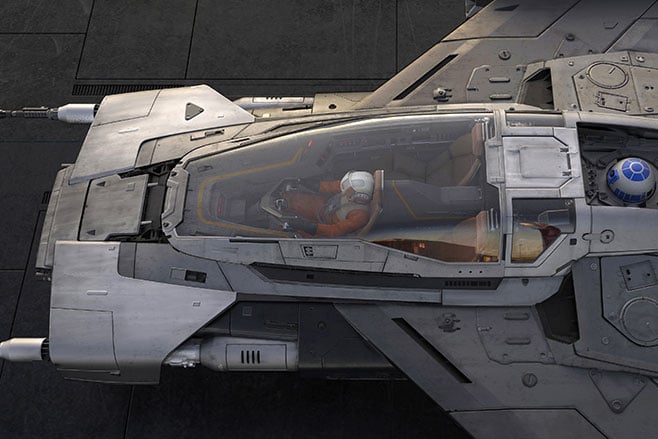
An undeniable common trait between the fantastical futuristic concept and its gravity-conforming road models, is that it looks absolutely stunning. Take a moment to browse the high-resolution shots in our gallery and enjoy the detail the design team has included.
And if that’s not close enough, you can appreciate the Tri-Wing in-person at The Rise of Skywalker premiere in Los Angeles, where a very real 1.5-metre model of the concept will be on display.
It has been 20 years since the Honda S2000 came into the automotive world, and the world has been pining for a replacement ever since its retirement in 2009. This isn’t it though.
Instead, Honda Access, the accessories arm of Honda, will be presenting a modified S2000 at next month’s Tokyo Auto Salon, to commemorate the 20th anniversary of the iconic roadster’s debut in 1999.
According to Honda Access, the S2000 20th Anniversary Prototype will feature mostly cosmetic changes in the form of a sharper front bumper that can be seen from the lone teaser image, new suspension, and a new audio system.
It is uncertain if these accessories will be made available to S2000 owners, or will merely be a commemorative one-off.
That being said, the S2000 isn’t the only icon getting a modern treatment for Tokyo Auto Salon, as Honda Access will also debut a customised EK9 Civic Type R.
The first-generation Civic Type R (more popularly known by its internal designation, the EK9), left an indelible mark on early-2000s car culture with its frantic 136kW/160Nm four-cylinder B16B screamer of an engine, lightweight ethos, and aftermarket tuning potential.
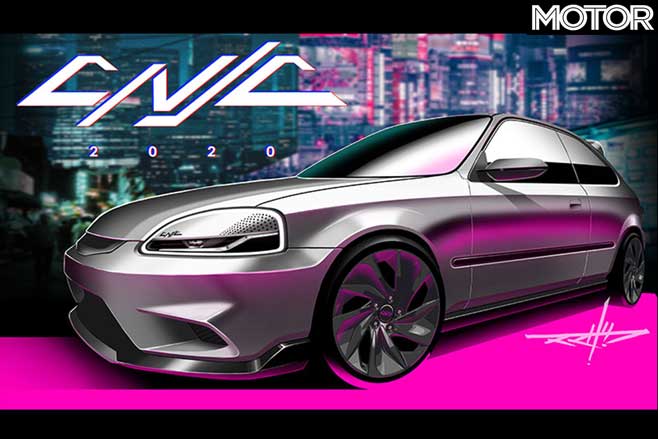
As a tribute to the EK9’s iconic status in car culture, Honda Access will debut an accessorised example known as the “Civic Cyber Night Japan Cruiser 2020”, which reimagines the EK9 for the “modern youth” that “reflects a neo-Japan where the near future and underground are disturbed”.
Not sure what that means exactly, but those who are familiar with the EK9’s popularity in the tuning scene will get the gist.
Tokyo Auto Salon 2020 will be held from January 10th to 12th at Chiba City’s Makuhari Messe.
The founding editor of Wheels, Athol Yeomans, has died at the age of 91.
Yeomans first suggested a new car magazine in 1950. He was 21 and working in the production department of K.G. Murray Publishing.
Fred Smith, Murray’s general manager, scoffed at the idea and, instead, started Man’s Life, Adventure Story and Master Detective. Predictably they soon disappeared, while Yeomans was fired for a practical joke on Smith that went spectacularly wrong. The motoring magazine didn’t happen.
Two years later, a freelancing (i.e. unemployed) Yeomans applied for a job at Hudson Publications. Only to be told by Norman Hudson that the advertised job had disappeared because he wanted to start a motoring magazine. Upon hearing this, Yeomans claimed “he almost passed out with desire” and persuaded Hudson that, with his editing experience on the short-lived monthly motoring journal Through The Windscreen, he should be employed on the new magazine. Hudson planned to call it Wheels.
In September, 1952 Yeomans found himself “in a musty smelling stationery storeroom sitting at a table looking at a bare sheet of paper.” With photographer Barrie Loudon, the only other full-time staffer, Yeomans spent months planning the first issue, writing most of it himself. That first Wheels – May 1953, price two shillings and sixpence (25 cents) – was a sensation. Success was immediate – the 30,000 copies printed sold out in a couple of days. A few months later Wheels was selling 60,000 copies a month.
View the very first issue of Wheels Magazine
Athol Butler Yeomans, who has died at the age of 91, was initially employed as News and Feature editor, but went on to become Wheels’ first editor with the March 1954 issue and remained in charge until November 1956 when he resigned to travel.
Yeomans, well aware there was an opening for a decent car magazine, set out to create “a magazine which will make you want to read it.” Before Wheels there was only Motor Manual, a cheap scissors and paste operation, and the short-lived Cars, mostly reprints of American stories, plus Australian Motor Sports that only covered motor racing.
The creative Yeomans was determined that Wheels should be a different sort of magazine. For the 25th anniversary issue in 1978, he wrote, “I wanted to produce a magazine with some entertainment in it, which captured some of the adventure of motoring and motor sport. And I felt we should write about the dozens and dozens of characters in the game, whose exploits were never covered in other publications. I believed that enthusiasts would welcome a balanced coverage of news from all over, plus technical stories, travel and the rest.”
Wheels was printed in the basement of the Hudson office near Sydney’s Central Railway station – on newsprint quality paper, using the old letterpress process and with limited print shop capacity. Colour printing, like quality paper, was fearsomely expensive, so the only colour in Wheels was the cover.
Years later, without a raft of freelancers to help, Athol admitted that “writing an issue a month was beyond me.” The June issue ran late and, because it was so far behind the deadline, July became the August magazine. The July 1953 magazine remains the only time in 1648 issues (and counting) that Wheels didn’t publish.
Page 64 of the first issue carried small report announcing plans for the first Redex trial, a 6000-mile “reliability trial”. The timing was perfect for Wheels – no other publication attempted to cover the entire event, which instantly became front page news on a daily basis across the country. Stage by stage, Yeomans and other Hudson staffers, including Hudson himself, managed to follow the trial with Yeomans writing as they went. When the newspapers realised Wheels was on the scene, Yeomans and the others also wrote for the dailies. Wheels October 1953 was essentially devoted to the Redex.
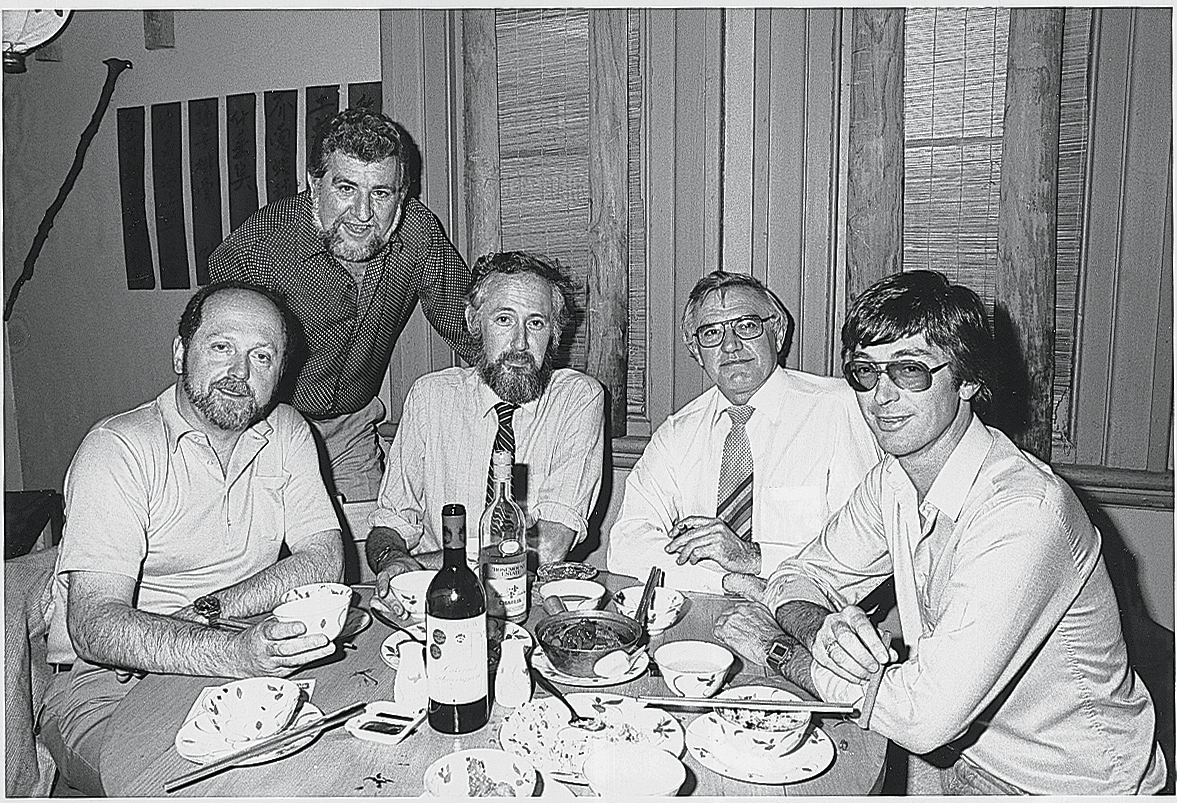
Yeomans had a knack for finding talent: Peter Burden, the magazine’s first unofficial road test editor, went on to become the iconoclastic motoring writer for The Financial Review; Ian Fraser moved from Cars, to eventually become Wheels’ third editor, before a move to the UK where he first edited Car magazine and later became joint owner of the title. In an era when specialist motoring writers were rare, Yeomans developed a smart team of freelancers: Pedr Davis first wrote for Wheels in 1954; Charles Cruickshank took photographs; Charles Vaughan compiled the Wheels Garage page; Malcolm Hilbery, a young barrister, wrote a column The Law and You. Yeomans also found Gordon Wilkins, a former staffer on The Motor, who quickly became Wheels’ main man in Europe.
From the first issue Yeomans was keen to introduce reliable road testing, rather than just driving impressions. He wanted standardised specifications and genuine independent performance figures. Rather than just relying on the speedo reading to determine a car’s top speed, Yeomans and Burden timed the test cars, in both directions, over a set distance to determine their maximum speed. Famously, the first road test car – a 1954 Renault 750 – reached 58mph (94km/h), when the distributor claimed the 70mph (113km/h) as per the speedo needle. In the dramas that followed Yeomans eventually prevailed and road tests, and later comparisons, quickly became a staple of Wheels and remain so to this day. This objective road testing meant that within a few months, Wheels became Australia’s recognised motoring authority.
When Wheels was launched Holden, almost alone among the major manufacturers, employed a public relations department. Except the new magazine was ignored by Holden. During Yeomans three and a half years as editor, General Motors-Holdens refused to provide a car for road testing: the new FJ test car came from a dealer. The story appeared in the May 1954 issue, six months after the FJ launch.
According to Yeomans, Holden’s excuses included, “No cars”, “Not our image” and “Against company policy”. Athol was not impressed. In stark contrast, Buckle Motors (then NSW distributors of Armstrong Siddeley, Borgward, Lloyd Hartnett, De Soto and Citroen) happily provided demonstrator cars. The most sensational car of the time was VW’s original Beetle. Yeomans had to have one and predicted that rather than sell the estimated 40 to 50 a month in NSW “I told Bill Buckle he’d sell 10 times that number”. The air-cooled, beautifully-built VW, far tougher and more reliable than the British small cars, went on to become the second best-selling car in Australia behind the Holden.
Despite Wheels’ success, financial clouds hovered over Hudson Publications. Christmas eve 1954 was also pay day. Yeomans remembers Norman Hudson called the staff in and told them, “Well fellas, there’s no money in the tin. Come back in the New Year and we’ll square you up then.”
June 1955 was Hudson’s last Wheels, the following month ownership passed to K.G. Murray Publishing. General Manager Fred Smith again became Athol’s boss. At a welcoming dinner for the new staff Athol couldn’t help himself. He told the diners, “Not content with firing me once, Smith has contrived to pay $80,000 so he could fire me again.” Except he didn’t.
However, every word, every heading and every photograph that appeared in Wheels had to be approved by Smith, who now thought he knew everything about cars, and began suggesting embarrassing stories: “Never wash your car again” and “Lifetime batteries.” When editor Jeff Carter left Outdoors and Fishing to go freelance, Yeomans was also given responsibility for that title, plus Seacraft magazine. It was too much and Athol resigned after finishing the November, 1956 Wheels. It was time to travel overseas, though he continued to contribute to the magazine – his last motoring story on Citroen’s 1980s revival appeared in the July, 1986 magazine – and he wrote ‘In the Beginning’ for the 50th anniversary issue, May 2003.
After returning from Europe, which included a spell living in Spain, Yeomans spent most of his career writing and managing print media – in his own business and working for others. There was also an unhappy year in the late 1960s as head of Ford Australia’s public relations department. In 1976 Athol became executive director of the Company Directors Association and co-founded the world’s first training course for company directors. He continued to find time to write the occasional piece for Wheels and to enrol in a BSc in Earth Science at Macquarie University, graduating in 1986.
My first contact with Yeomans came after Ford lent me an imported, soft-top Torino GT. I spent so much time sideways in the 6.4-litre V8 that I complained to a junior PR-operative about the lack of adhesion from the totally overwhelmed seven inch D70 rubber. I was eventually shown into the Big Boss’s office to discover an unhappy Yeomans. He insisted the car was on the wrong tyres and blamed the test car garage. By the time I became Wheels editor in early 1971, he’d forgotten the incident. We lunched on an irregular basis, but Athol always took a keen interest in ‘his’ magazine and its direction.
A decade later, having remarried, I discovered that my wife Erica and the Yeomans were close friends. The connection was cemented, even more so when Athol and Ayleen, his charming wife, with Ian Fraser (Wheels’ third editor), rented a wonderful house, built around a tiny chapel, overlooking Calino, a village in northern Italy. Learning that Erica and I planned to move to Italy in 1988 for me to work for Wheels and Autocar magazines, the Yeomans immediately suggested we stay at Santa Stefano while looking for a home. Through their landlady Contessa Camilla Maggi, whose husband was one of the founders of the Mille Miglia, we found a villa on the other side of Calino. It was our home for almost 10 years. Each year the Yeomans spent three months in Italy: we watched Grands Prix together on the TV, ate at Athol’s famous Australian Table at the magical Sensole restaurant on Mont Isola, the big island in Lake Iseo, and constantly talked cars and magazines.
Yeomans was immensely proud of his involvement with, and attachment to, Wheels and the progress that followed. Always curious, intensely intelligent and wonderfully generous, Athol Yeomans will be much missed by all who knew him.
Bread and butter medium SUVs might be one of the most popular segments in Australia right now, but more manufacturers are keen for a piece of the high-rider pie in whatever segment they can get a slice.
And that demand is paving the way for all kinds of niche and esoteric offerings, including ultra-luxurious versions that come with an equally astronomical price.
We’ve compiled a list of the most expensive SUVs you can buy in Australia now, what’s your pick of the bunch?
Rolls-Royce Cullinan – $695,000
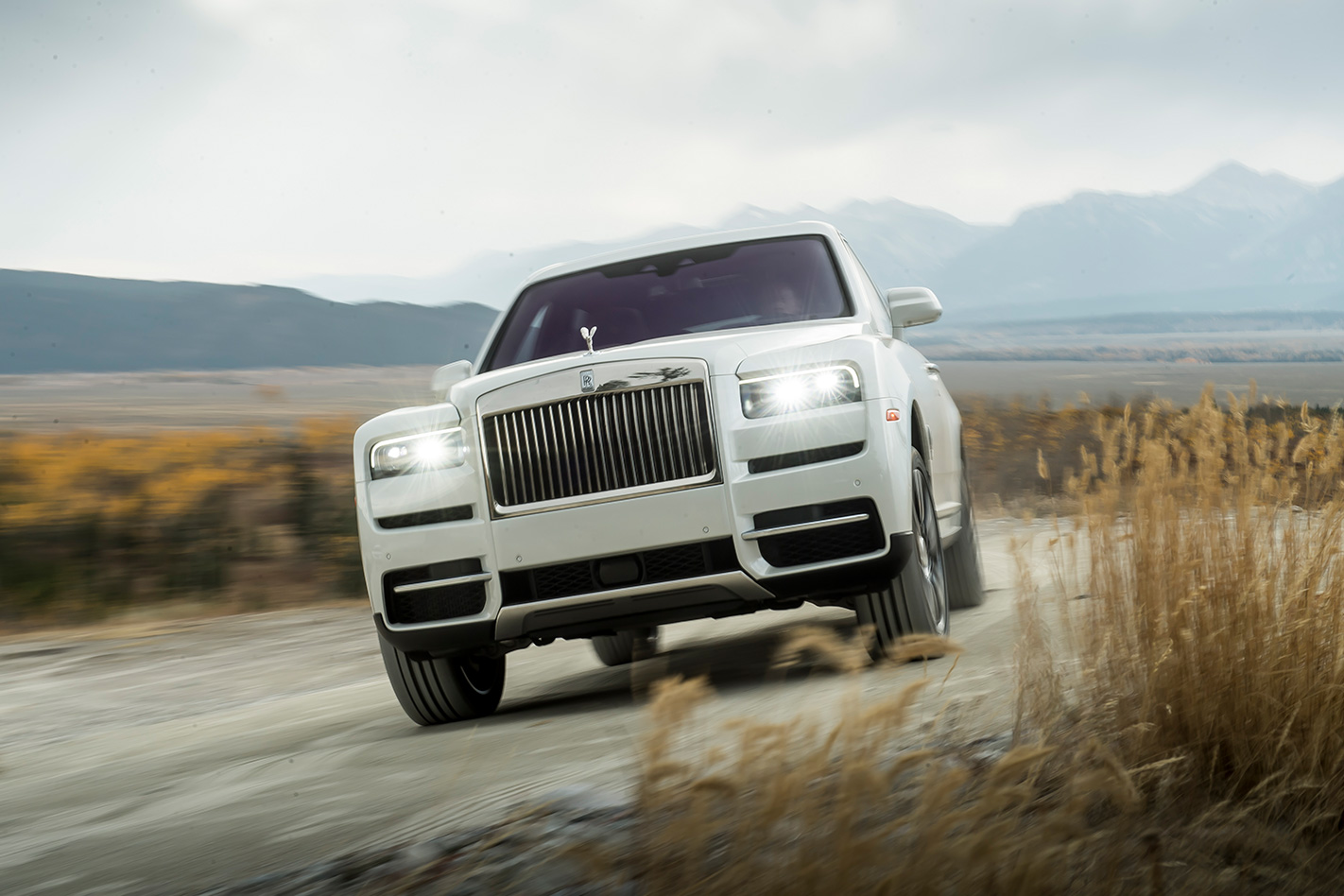
They say that the Rolls-Royce Cullinan is actually a decent effort off-road (we haven’t been given one to try yet), but let’s be real: the place you’re most likely to see one of these behemoths is in Melbourne’s Toorak and Sydney’s Double Bay.
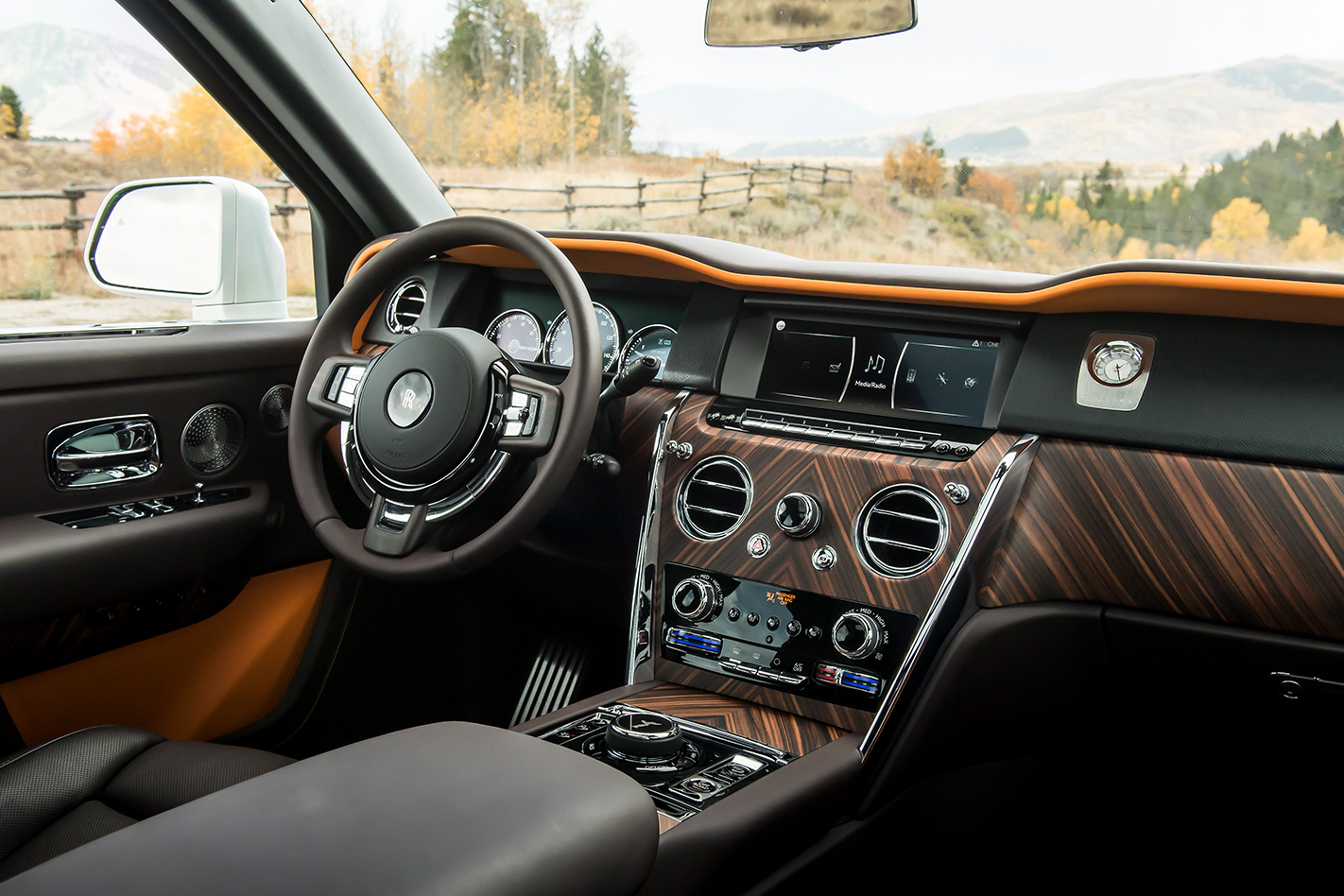
Think of all the best materials you can imagine in a car, and the Cullinan has them. Powered by a twin-turbocharged V12, it also goes faster than you thought a land-yacht of its size and heft ever could.
Bentley Bentayga – $481,400
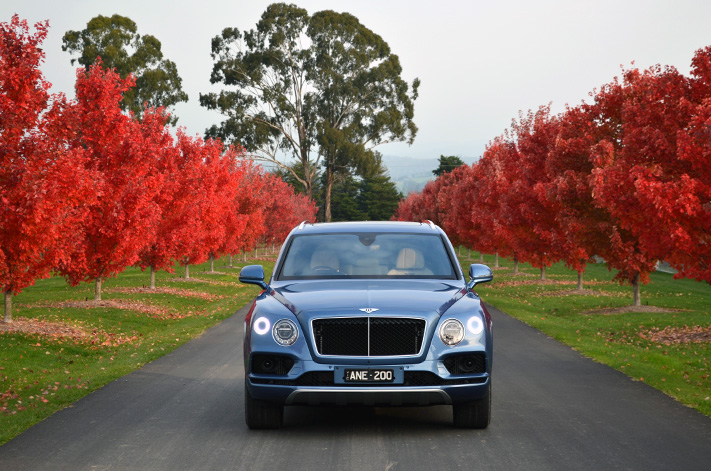
Bentley was arguably one of the first luxury upmarket automakers to dive into SUVs, and ever since introducing its Bentayga luxo-barge in 2016, it has become one of the best sellers of the segment.
It may share a fair chunk of its mechanicals with the Audi Q7, but the Bentayga forges a path of its own by tuning and turning almost every aspect into a bespoke Bentley product.
Range Rover SVAutobiography – up to $403,670
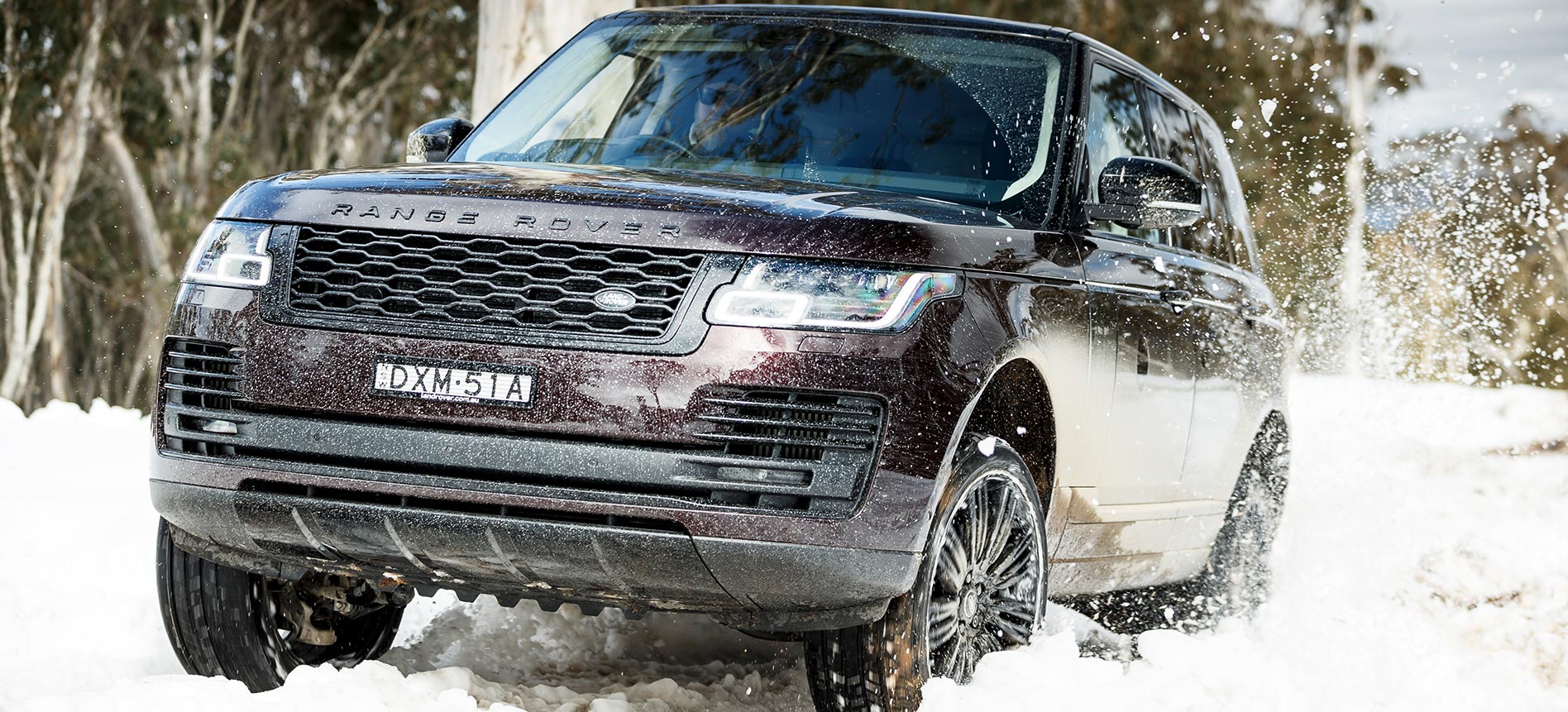
As the humble Range Rover virtually invented the entire SUV category, how could it not feature on this list – especially considering the British manufacturer now offers a version worth over $400,000?
It doesn’t stop there either. Care for a two-tone $23,150 paint scheme? Perhaps quilted leather seats at $11,930 makes more sense… Either way, you could easily option up this beast to nigh-on half a million dollars. Yikes.
Lamborghini Urus – $390,000
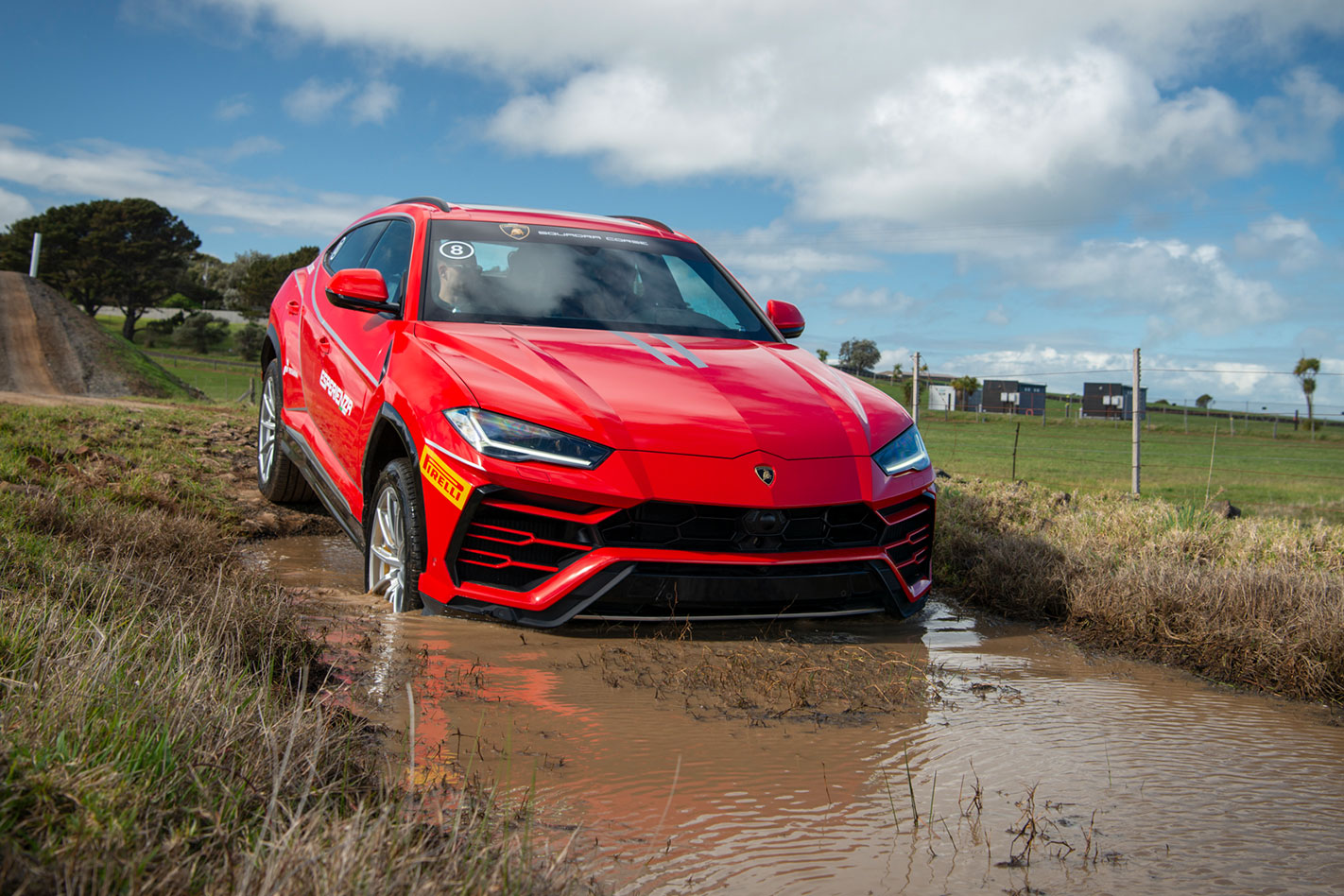
One of the first SUVs that could potentially lay a claim to the ‘Sports’ aspect of its name, the Lamborghini Urus features a twin-turbo V8 and can go from 0-100km/h in 3.6 seconds, or about the same as a Ferrari California.
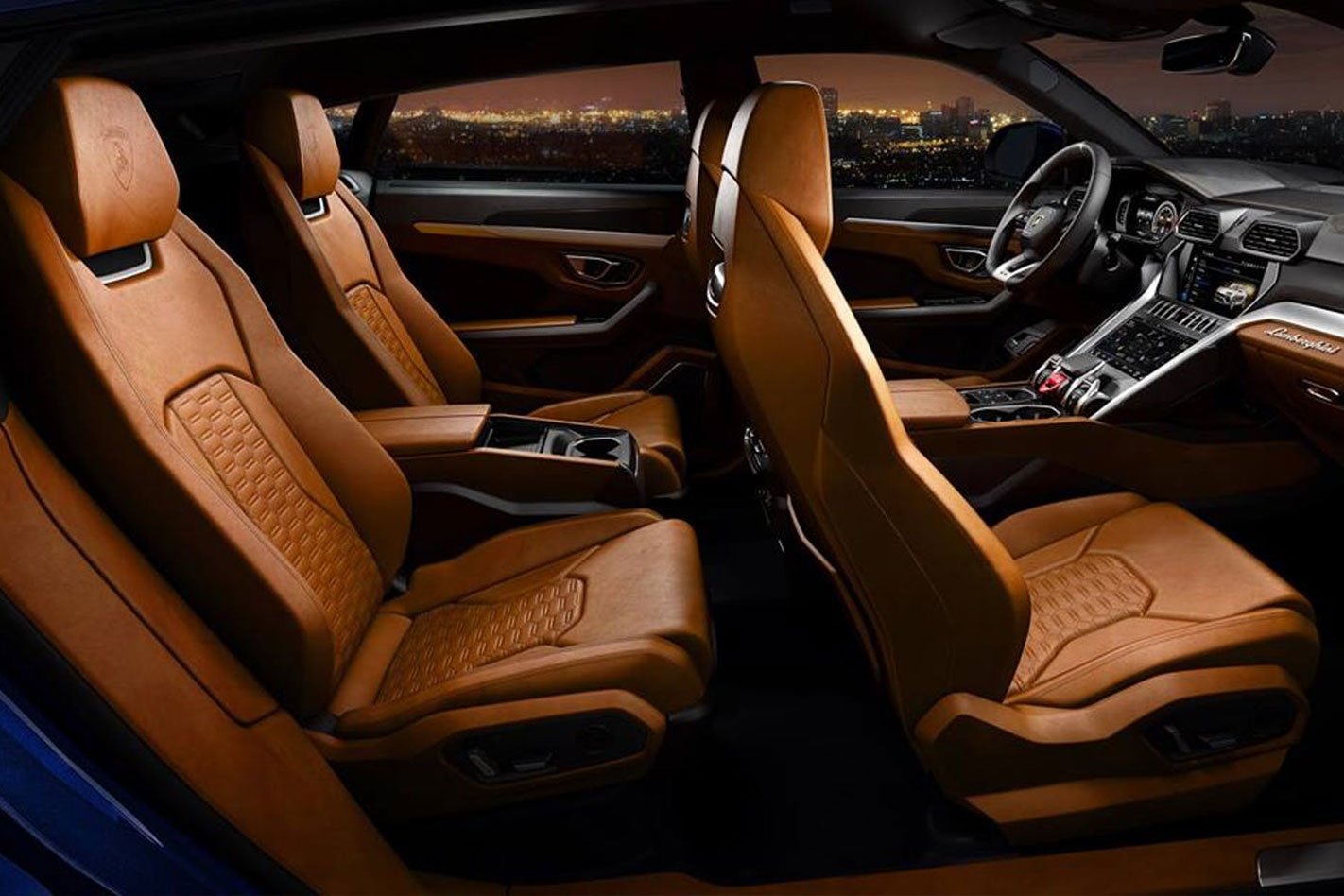
The fact that it’s incredibly fast, beautifully appointed and is insanely expensive doesn’t seem to matter. The fact that it’s a Lamborghini and can now carry your family is all buyers will want to hear before snapping one up.
Porsche Cayenne Turbo S Coupe – $292,700
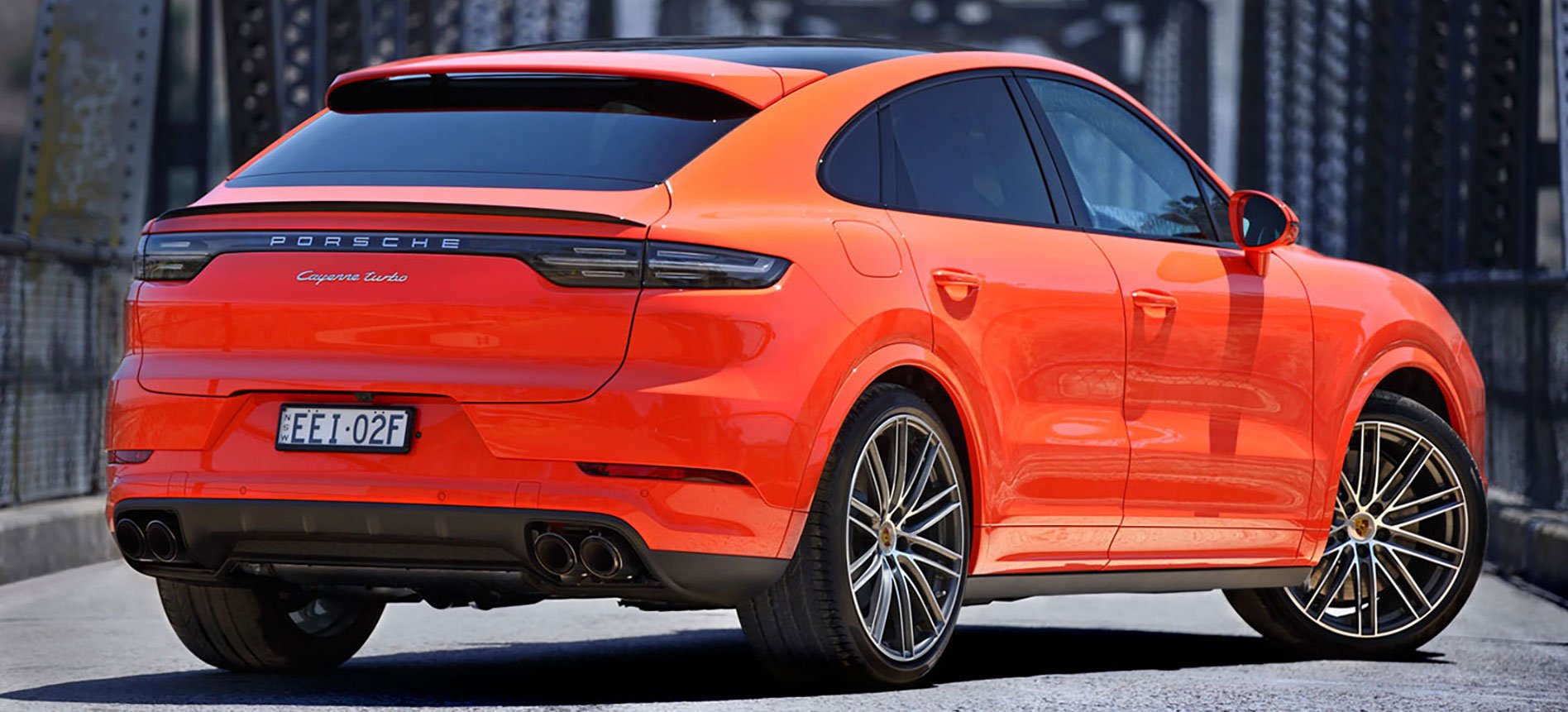
If you want an SUV that can still run rings around some sports cars, there’s few other options that do it more effectively than the Cayenne. This all-new Coupe version still packs the twin-turbo hybrid V8 of its wagon sibling that packs a bonkers 500kW/900Nm, all the while ushering you to your destination in utmost luxury.
Mercedes-Maybach GLS600 – expected $300,000

It was only a matter of time before Mercedes-Maybach turned its hand to fettling SUVs, and the GLS is the biggest, baddest high-rider in its catalogue – why wouldn’t you start there?
Mercedes-Maybach raises the luxe SUV stakes
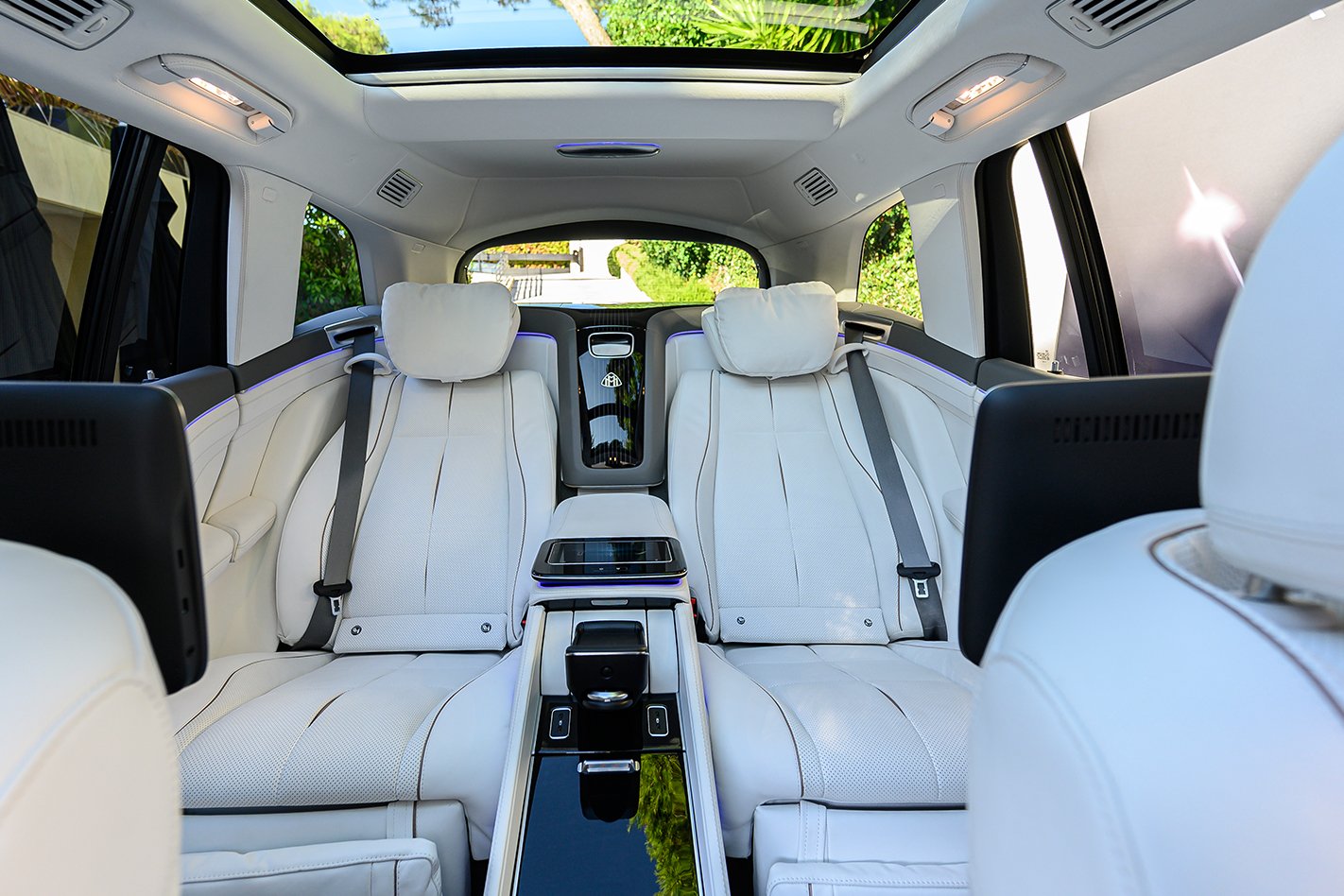
Maybach has transformed an already sumptuous interior into an opulent masterpiece using Nappa leather all-round, and real wood that has been aged for at least 10 years. We can’t wait to experience the S-Class ‘wafting’ ride in an SUV when it arrives Down Under.
What stands out?
The first-generation Veloster is a sporty-looking four-seat coupe that helped Hyundai shake off its dowdy image, arriving with some real dynamic ability and a big dose of visual attitude.It is remarkable for having a single door on the driver side and two doors on the passenger side – no, that is not a manufacturing glitch. All Velosters are well appointed inside, with seats trimmed partly in leather, Apple and Android phone integration, and a sunroof.
What might bug me?
Driving at 80km/h on the space-saver spare, until you can fix your full-size flat tyre.That your Veloster doesn’t feel as fast as it looks. The Veloster – the less costly of the two versions on offer – goes about as hard as a typical small hatchback such as a Toyota Corolla or Hyundai’s own i30. If you want sporty performance to go with the looks, you need the more expensive Veloster, the Veloster SR Turbo, which is a much quicker car.That you can’t play music from CDs. Velosters on sale from August 2016 treat the Compact Disc as obsolete technology, and (like a growing number of new vehicles) don’t have a player.Forcing rear passengers to use just the one door (if you plan on making frequent use of both rear seats).If you choose an auto Veloster, getting used to the dual-clutch auto gearbox design in city driving. It won’t match the very fluid, elastic response from a standing start that you get with conventional or CVT auto gearboxes, and may therefore require more attention in stop-start traffic or when parking.
What body styles are there?
There’s just the one body style, and that’s a four-door coupe (if you count the three passenger doors and the hatchback).The Veloster is front-wheel drive, and it is classed as a sports car, lower priced.
What features did all first-generation Velosters have?
Proximity key entry and start, which lets you unlock the car and drive away without removing the key from your pocket or bag. To start the Veloster, you push a button on the dashboard. Cruise control.A six-speaker audio system with iPod compatibility, AUX and USB inputs, and Bluetooth connectivity for phone calls and audio streaming. This is controlled from a 7.0-inch central touchscreen that supports Apple CarPlay and (for Android phones) Google Now. You can display apps (such as navigation) from compatible smartphones on the touchscreen, and control them from there or by voice.Tilt and reach adjustment for the steering wheel, and buttons on the wheel for operating the cruise control and the sound system.Seats trimmed in a mix of real and fake leather, with powered tilt and slide adjustment for the driver. Air-conditioning that maintains a set temperature.A reversing camera, and rear parking sensors.Headlamps that sense when the sun is setting and turn themselves on, and long-lived LED daytime running lamps. Power-folding and heated exterior mirrors. A long glass sunroof, with powered sunshade.Aluminium alloy wheels in an 18-inch size, and a space-saver spare wheel. A tyre-pressure monitor, which will warn you if a tyre has lost pressure – a major safety feature.Hill-start assist, which controls the brakes automatically to make take-offs on hills easier.There are six air-bags: two directly in front of the driver and front-seat passenger; two to protect the front occupants from side impacts; and full-length curtain air-bags to protect the heads of front and rear passengers from side-impacts.Electronic stability control, which can help avoid a skid occurring. This technology is mandatory on all new cars.All Velosters are covered by Hyundai’s five-year/unlimited-kilometre warranty.
Which engine uses least fuel, and why wouldn’t I choose it?
The most fuel efficient of two engines available powers the least costly model, called simply the Veloster. It’s a 1.6-litre petrol and while it does the job, it isn’t as fast as the car looks – a Veloster is about as quick as a Toyota Corolla. This engine consumes 6.4 litres/100km in the official test (urban and country combined).The alternative engine is a turbocharged version of the same unit that uses about 10 per cent more fuel but is much stronger, providing at least half again as much thrust in most driving conditions. This engine comes in the Veloster SR Turbo, and it matches the car’s ambitions with its abilities.Either Veloster is available with a six-speed manual gearbox. Either can also be had with a dual-clutch auto gearbox – a six-speeder on the Veloster, or a seven-speed on the Veloster SR Turbo.A dual-clutch auto works like a robot-controlled manual gearbox. It changes gears for you very swiftly and silently once on the move and reduces fuel use, but it won’t match the fluid, elastic take-up from rest offered by a conventional auto gearbox or a CVT.
What key features do I get if I spend more?
If you step past the Veloster and spend more for a Veloster SR Turbo, the main thing you get is the turbocharged and much more powerful engine, along with an extra ratio in the dual-clutch gearbox if you opt for an auto. In addition, the SR Turbo has bigger brakes, more effective headlights, very long-lasting LED taillights, and leather trim on the steering wheel. And it rides more firmly, on suspension that has been tuned for sportier driving.The SR Turbo also brings you sporty visual touches that include a body kit, different wheels, and interior highlights and contrasts.
Does any upgrade have a down side?
Not really. Going for the turbocharged car will cost you a bit more in fuel, and its body kit may demand you take more care on transitions to steep driveways.Standard colours on the Veloster and Veloster SR Turbo are white and yellow, respectively. All others cost extra.The Turbo is also available in a couple of matt-grey finishes. These might look cool now, but they require extra care and special cleaning techniques to avoid damaging them.
How comfortable is the Veloster?
The Veloster’s cabin is classy, with plenty of cossetting for the front seat occupants. There is a prominent centre console and a high-tech look and feel. The stereo is one of the better systems at this price point.The only catch is the low-slung seating, which makes getting in and out a little more athletic than you might have imagined. That can be tiring on a day-to-day basis but it does bring a sporty outlook and allows a little more headroom for taller people.The driving experience is solid, with a tight feel to the car and a steering wheel that has an intuitive relationship with the front wheels.The engines can become a little noisy when revved really hard.
What about safety in a Hyundai Veloster?
The Veloster comes with six airbags, and its side-curtain airbags extend to the rear compartment so that rear-seat passengers get some cushioning in a side impact. A reversing camera and rear parking sensors are standard, and LED daytime running lamps and auto-on headlamps make it more likely you will be seen in dim light.A tyre pressure monitor warns you if a tyre is going flat, meaning you are less likely to lose control from a puncture.The Veloster senses crash impacts and automatically unlocks all the doors, to allow occupants out and rescue teams in.However, no Veloster offers autonomous emergency braking, which would scan the road ahead for obstacles, warn you of impending collisions, and brake the car automatically if required.The Australian New Car Assessment Program (ANCAP) rated the first-generation Veloster at its maximum five stars for safety in May 2015.
I like driving – will I enjoy this car?
Keener drivers will gravitate towards the Veloster SR Turbo, mainly because of the extra performance from the turbocharged engine.It really makes a difference, too. While the base Veloster is only so-so as a driver’s car, the Turbo is a much more convincing package.That said, even the Turbo falls short of being a true modern hot hatch. But it’s pretty close.Both of the current, Series II, Velosters benefit from revised suspension settings that were developed in Australia to help the car feel better in turns. The SR Turbo also benefits from slightly firmer settings, and it steers and corners more enthusiastically.
How is life in the rear seats?
Not great, in a nutshell. As well as having a centre console in the rear, making the car a strict four-seater rather than five, rear leg room is pretty tight.Also, because of the sweep of the roofline, rear-seat passengers’ heads are covered by the glass of the hatchback, rather than being shaded by the roof itself.But that extra door on the kerb side does work, making it easier to enter the rear seat from that side. It also makes the Veloster much more child-restraint friendly.
How is it for carrying stuff?
Not bad, actually. Unlike a lot of coupes with their chopped-off tails, the Veloster has a decent space behind the rear seats which is quite deep and wide.The rear seatback 50/50 and folds reasonably flat for carrying longer loads.
Where did Hyundai make this Veloster?
The first-generation Veloster was made at Hyundai’s Ulsan plant in South Korea.
What might I miss that similar cars have?
Perhaps rear-wheel drive, which is offered in the Toyota 86 Coupe and its cousin the Subaru BRZ – both of which are a little more hard-edged and would appeal more to the purist.The Mazda MX-5 sports roadster is also rear-wheel drive and offers open-air motoring via a fold-away roof.If you are looking at the Veloster as an alternative small car and don’t necessarily want a coupe, it is worth noting that several small hatchbacks, among them Hyundai’s own i30 and the Mazda3, offer automatic emergency braking on all or some versions.The i30 and its sedan sibling the Hyundai Elantra are also available in SR Turbo trim, with fine handling and a revised version of the Veloster’s turbocharged engine.
When did Hyundai replace the first-generation Veloster?
The Veloster was facelifted in mid-2015, the resulting Series II car receiving wider tyres, retuned suspension, and the option of the twin-clutch automatic gearbox.In August 2016 the range was reduced from four models (base and better equipped ‘plus’ versions for each engine) to two, with the Veloster and Veloster SR Turbo gaining most of the features from their ‘plus’ former stablemates.Both cars’ multimedia systems received support for mirroring Apple and Android phones on their touchscreens, but gave up their CD players and the inbuilt satellite navigation that had been reserved for ‘plus’ variants. The SR Turbo did not receive the heated and ventilated front seats, and Flex Steer adjustable steering weight, from the SR plus. But its dual-clutch gearbox received an extra ratio, for a total of seven.The second-generation Veloster arrived in September 2019 featuring base-spec 2.0-litre version and punchy 1.6-litre turbo as found in the Hyundai i30 N-Line and Kia Cerato GT. It’s also well equipped in terms of active safety and creature comforts. It’s exterior design isn’t quite as bold as the first-generation model giving it more of a family resemblance with the i30 hatch.
I like this car, but I can’t choose which version. Can you help?
Without a doubt, the SR Turbo makes the best fist of being an entertaining car, thanks to its stiffer suspension and perkier engine.But if it’s mainly the equipment, value and look you want, then the cheaper version delivers, with either transmission.
What stands out?
The second-generation Veloster four-seat coupe brings all the elements of its striking predecessor, but in a more refined package. Like the previous model it comes with some real dynamic ability and is remarkable for having a single door on the driver side and two doors on the passenger side. All Velosters are well appointed, with seats trimmed partly in leather, Apple and Android phone integration, and autonomous emergency braking.While the original Veloster wasn’t a huge seller here by Hyundai standards, the company was happy enough with its place in the lower-priced sports car segment to produce a right-hand version solely for the Australian market.
What might bug me?
Driving at 80km/h on the space-saver spare, until you can fix your full-size flat tyre.That your Veloster doesn’t feel as fast as it looks. The base Veloster – the less costly of the three spec grades on offer – goes about as hard as a typical small hatchback such as a Toyota Corolla or Hyundai’s own i30. If you want sporty performance to go with the looks, you need the more expensive Veloster Turbo versions, which are much quicker.Forcing rear passengers to use just the one door (if you plan on making frequent use of both rear seats). Still, this is better than having to squeeze in via the front doors as with traditional coupes.If you choose an auto Veloster, getting used to the dual-clutch auto gearbox design in city driving. It won’t match the very fluid, elastic response from a standing start that you get with conventional or CVT auto gearboxes, and may therefore require more attention in stop-start traffic or when parking.
What body styles are there?
There’s just the one body style, and that’s a four-door coupe (if you count the three passenger doors and the hatchback).The Veloster is front-wheel drive, and it is classed as a sports car, lower priced.
What features does every Veloster have?
Proximity key entry and start, which lets you unlock the car and drive away without removing the key from your pocket or bag. To start the Veloster, you push a button on the dashboard.Cruise control, and ‘Hyundai SmartSense’ active safety technology including city-speed autonomous emergency braking, driver attention alert, and lane-keeping assist.A reversing camera, and rear parking sensors.An audio system with iPod compatibility, AUX and USB inputs, and Bluetooth connectivity for phone calls and audio streaming. This is controlled from a central touchscreen that supports Androd Auto and Apple CarPlay. You can display apps (such as navigation) from compatible smartphones on the touchscreen, and control them from there or by voice.Tilt and reach adjustment for the leather trimmed steering wheel, and buttons on the wheel for operating the cruise control and the sound system.Sports front seats with extended bolstered and powered tilt and slide driver’s seat adjustment. Air-conditioning that maintains a set temperature and filters the cabin air.Headlamps that sense when the sun is setting and turn themselves on, and long-lived LED daytime running lamps. Power-folding and heated exterior mirrors. A long glass sunroof, with powered sunshade.Aluminium alloy wheels in an 18-inch size, and a space-saver spare wheel. A tyre-pressure monitor, which will warn you if a tyre has lost pressure – a major safety feature.Hill-start assist, which controls the brakes automatically to make take-offs on hills easier.There are six air-bags: two directly in front of the driver and front-seat passenger; two to protect the front occupants from side impacts; and full-length curtain air-bags to protect the heads of front and rear passengers from side-impacts.Electronic stability control, which can help avoid a skid occurring. This technology is mandatory on all new cars.All Velosters are covered by Hyundai’s five-year/unlimited-kilometre warranty.
Which engine uses least fuel, and why wouldn’t I choose it?
There isn’t much of a difference when it comes to fuel economy across the different powertrains. The 1.6-turbocharged petrol engine with the dual-clutch automatic gearbox is the most efficient in paper with an official combined consumption of 6.9 litres/100km.With the manual gearbox that rises to 7.3 litres/100km, which is higher than the manual and six-speed automatic versions of the 2.0-litre non-turbo engine in the more affordable Velosters that consume 7.0 litres/100km and 7.3L/100km respectively.Price is main reason you wouldn’t choose the automatic turbocharged engine. It is a much stronger and responsive unit than the 2.0-litre, and is much more suited to the Veloster’s sporty ambitions.The 2.0-litre on the other hand isn’t as fast as the car looks – about as quick as a Toyota Corolla.The turbo’s dual-clutch auto works like a robot-controlled manual gearbox. It changes gears for you very swiftly and silently once on the move and reduces fuel use, but it won’t match the fluid, elastic take-up from rest offered by a conventional auto gearbox like the one coupled with the 2.0-litre engine.
What key features do I get if I spend more?
The base spec Veloster comes with the less-powerful 2.0-litre petrol engine and six-speed manual gearbox, with the six-speed auto costing $2300 extra. It also has cloth-trimmed sports seats, a 7.0-inch touchscreen and six-speaker audio system.Spending more on the Veloster Turbo brings the much more powerful turbocharged and and dual-clutch gearbox if you opt for an auto. In addition, it has bigger front brake discs, more effective headlights, very long-lasting LED taillights, and cloth/leather appointed seats. And it rides more firmly, on suspension that has been tuned for sportier driving.The infotainment system gains a bigger 8.0-inch screen, satellite navigation, digital radio (DAB+) and eight-speaker Infinity premium audio system.You also gain more Hyundai SmartSense features including higher-speed autonomous emergency braking with pedestrian and cyclist protection, high-beam assist, rear-cross traffic warning. The duel-clutch auto version also has adaptive cruise control.Other extras include paddle shifters on the steering wheel for the dual-clutch auto versions, digital performance gauges, auto-folding door mirrors, auto-dimming rear-view mirror.The Turbo also brings you sporty visual touches that include a body kit, different wheels, and interior highlights and contrasts.The most expensive Veloster, the Turbo Premium adds rain-sensing windscreen wipers, leather-appointed seats, heated and ventilate front seats, wireless phone charger, head-up display that shows your speed and other driving information in the windscreen, and electric sunroof.
Does any upgrade have a down side?
Not really. Going for the manual turbocharged car will cost you a bit more in fuel. The Turbo version’s body kit may demand you take more care on transitions to steep driveways.Ignite Flame (red) and Thunder Bolt (yellow) are the only standard colours, with the latter only available with the Turbo versions. All other colours cost about $620 extra.The Turbo Premium is also available with an optional black contrasting roof for about $1000.
How comfortable is the Veloster?
The Veloster is not a coupe and it’s not a hatch, and as a result picks up both good and bad traits from both.Up front, there’s next to no difference between sitting in the Veloster as an i30. The floating multimedia screen, twin-tube dash and simple button arrangement straight from the i30 playbook.It does out on some of the finer fit and finish items of the i30. There’s a lot more rigid plastic in key areas like the tops of the doors, for example, while even the auto models come with a manual handbrake.The seats – cloth on the entry-level Veloster, cloth/leather on the second-tier Turbo, and leather on the top-rung Turbo Premium – up front are comfortable and decently size, but it’s a different story out back where it can be tight fit for an adult not helped by having just the one door on the left-hand side.Headroom has been improved over the previous model, but it’s not sufficient for even moderately tall people, and there’s not a lot of room behind the front seats.Each engine can become a little noisy when revved really hard, and sunroof on the Turbo Premium lets in a bit more wind noise.The rear multi-link suspension is firm but seems to absorb bumps more comfortably than the Hyundai N-Line and Kia Cerato GT that feature the same multi-link suspension but with harder settings. Ride quality is firm but not brittle, with the Veloster’s stiff base allowing the suspension to do its work to soak up road imperfections.
What about safety in a Hyundai Veloster?
The Veloster comes with six airbags, and its side-curtain airbags extend to the rear compartment so that rear-seat passengers get some cushioning in a side impact. A reversing camera and rear parking sensors are standard, and LED daytime running lamps and auto-on headlamps make it more likely you will be seen in dim light.All variants come with lane-keeping assist, and autonomous emergency braking (AEB) that uses a camera to detect and prevent or mitigate a collision at speeds up to about 60km/h.The Turbo variants also have a more advanced radar-operated AEB that works at higher speeds and can also detect pedestrians and cyclists. The Turbos also have blind-spot collision warning, high-beam assist, rear cross-traffic alert, with the auto versions also coming with and adaptive cruise control.A tyre pressure monitor warns you if a tyre is going flat, meaning you are less likely to lose control from a puncture.The Veloster senses crash impacts and automatically unlocks all the doors, to allow occupants out and rescue teams in.The Australian New Car Assessment Program (ANCAP) is yet to rate the second-generation Veloster.
I like driving – will I enjoy this car?
The Veloster is based on the same underpinnings as the i30 hatchback family but is about 100kg lighter, which helps overall handling capabilities. The multi-link independent rear suspension arrangement also gives it a leg up in the ride quality and handling prowess stakes.The Veloster benefits from revised suspension settings that were developed in Australia to help the car feel better in turns. The Turbo versions benefit from slightly firmer settings, and it steers and corners more enthusiastically, while larger front brake discs help provide more stopping power.Performance wise, keener drivers will gravitate towards the Veloster Turbo, mainly because of the extra performance from the 1.6-litre turbocharged engine. It really makes a difference, too. While the base Veloster is only so-so as a driver’s car, the Turbo is a much more convincing package.
How is life in the rear seats?
Not great, in a nutshell. As well as having a centre console in the rear, making the car a strict four-seater rather than five, rear leg room is pretty tight.Also, because of the sweep of the roofline, rear-seat passengers’ heads are covered by the glass of the hatchback, rather than being shaded by the roof itself.But that extra door on the kerb side does work, making it easier to enter the rear seat from that side. It also makes the Veloster much more child-restraint friendly.
How is it for carrying stuff?
The 303-litre boot space is deep and wide and, while small for a hatch, is a decent size compared to other sports coupes with chopped off tails.The rear seatback splits 50:50 and folds reasonably flat for carrying longer loads.
Where did Hyundai make this Veloster?
The Veloster is made at Hyundai’s Ulsan plant in South Korea.
What might I miss that similar cars have?
Perhaps rear-wheel drive, which is offered in the Toyota 86 Coupe and its cousin the Subaru BRZ – both of which are a little more hard-edged and would appeal more to the purist.The Mazda MX-5 sports roadster is also rear-wheel drive and offers open-air motoring via a fold-away roof.If you are looking at the Veloster as an alternative small car and don’t necessarily want a coupe, it is worth noting Hyundai i30 N-Line and the closely related Kia Cerato GT also offer fine handling and a revised version of the Veloster’s turbocharged 1.6-litre turbocharged powertrain.
Are there plans to update the Veloster soon.
The second-generation Veloster arrived in September 2019 for the 2020 model year. Don’t expect an update until at least 2020.
I like this car, but I can’t choose which version. Can you help?
Without a doubt, the Veloster Turbo makes the best fist of being an entertaining car, thanks to its firmer suspension and perkier engine, while having additional active safety features.
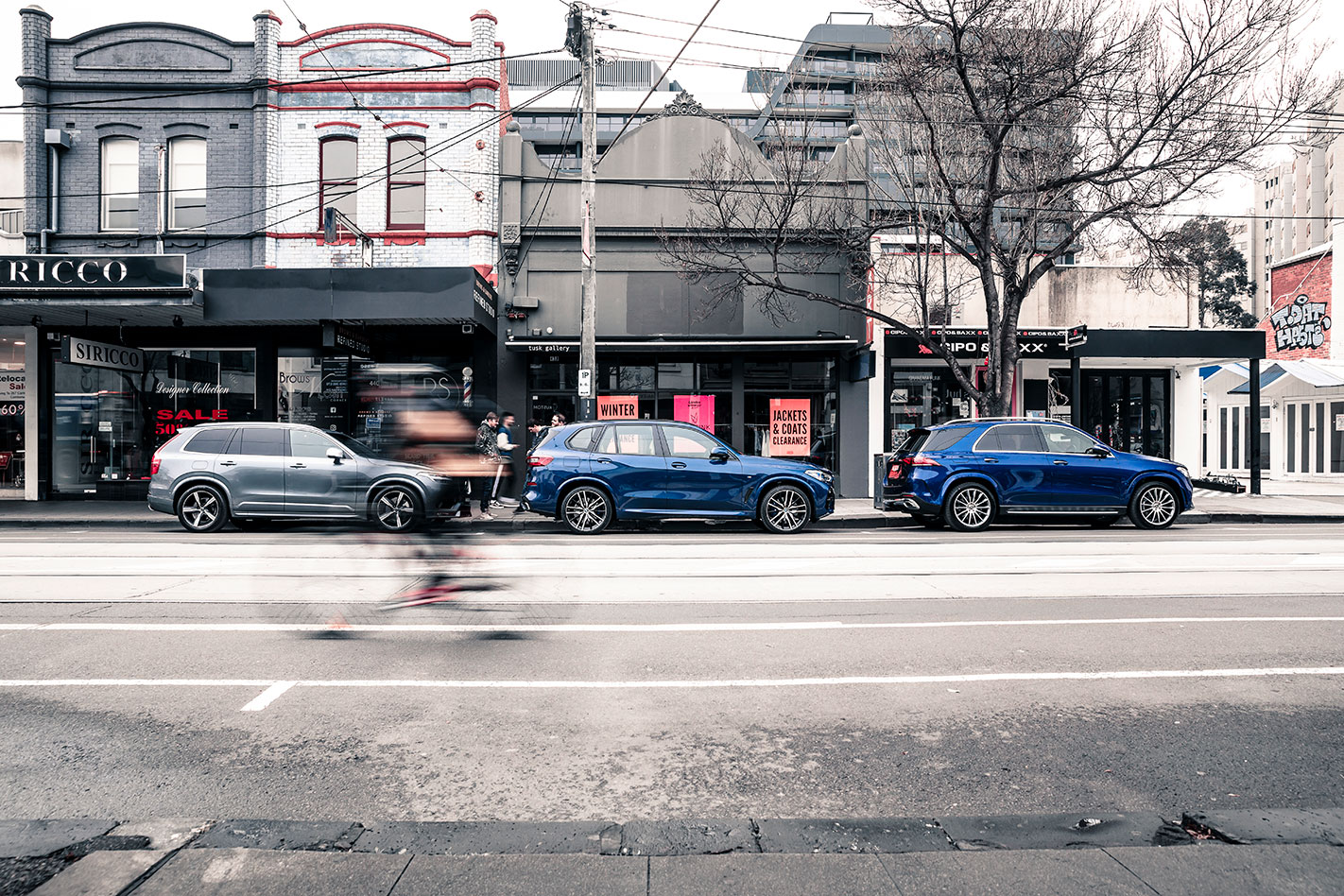
IT’S A cold, misty morning on Melbourne’s Chapel Street. Traditionally a location heralded as a hot-spot of fashionable excess, the famed strip’s gentrification has fostered an environment where expensive boutiques now mingle with commonplace stores filled with pragmatism. In a weird irony, the three luxury SUVs we’ve assembled reflect the street in which they’re parked. All are family-friendly, diesel-powered rivals that provide vast convenience and versatility. However, they also attract a circa $100K price tag, meaning the Mercedes GLE, Volvo XC90 and BMW X5 remain desirable, premium purchases. The well-heeled certainly are spoilt for choice.
Given the increasing prevalence of the luxury SUV segment, a marque like Mercedes-Benz can’t afford to flounder – yet its GLE has been barely treading water. For the first half of 2019 BMW managed to shift 1792 X5s, while Benz found driveways for just 349 GLEs. Rubbing salt into the wound is the fact that the Volvo XC90, which was released in 2015, found 632 buyers up until the end of June.
That’s why the new GLE is so important to the Three-Pointed Star. It’s the latest kid-carrier on the overtly trendy SUV block. To prove Mercedes means business, it has been armed with keen pricing. The box-fresh 300d enters this battle with the lowest base figure of the trio at $99,900, giving it a slight advantage over the $101,900 XC90 D5 R-Design and a massive head start on the $112,990 X5 30d.
However, early on a, ahem, bump in the road becomes glaringly obvious. The Mercedes is so new that, at the time of testing, it’s yet to be released locally. With few on the ground, we’re given an example of the 300d sans air suspension – it’s riding on steel springs and passive dampers, and running optional 21-inch AMG alloys (as part of the $9900 AMG Sport Package). Against competition sporting optional air suspension (Volvo) and adaptive dampers (BMW), it seems the Benz is entering this fight with one hand tied behind its back.
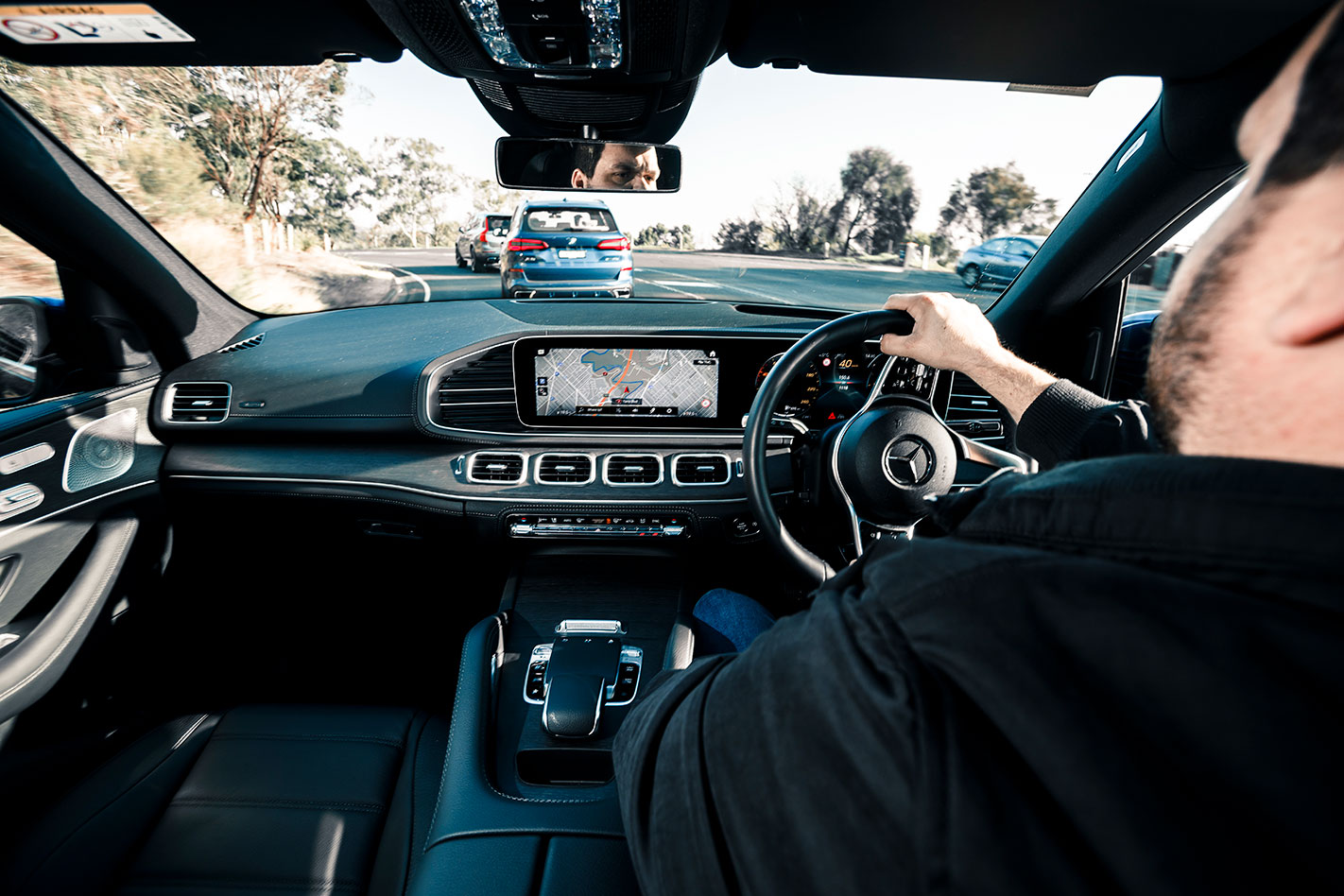
For a fairer comparison, you can option air on the GLE for $3800, or as part of the $4800 Night Package, which also adds black highlights and 22-inch wheels, and on past experience, Mercedes expects around half of owners to do so. Plus, if ride comfort is a top priority (and you have pockets deep enough) you can even spruik for Merc’s E-Active Body Control for $13K, though this is only available on six- and eight-cylinder GLEs, which taints the value proposition somewhat.
Talking of balooning sticker prices… the BMW X5 xDrive 30d is easily the most expensive of this trio. An entry-level, four-cylinder turbo-diesel 25d is on its way, but for now BMW offers the mechanically talented in-line six as its base model. The G05 X5 has grown in size, but hampering the 30d’s value equation is the fact that the price as optioned here is $131,090. Ouch.
That extra $18,100 is accounted for by an instrument panel finished in leather ($2700), metallic paint ($2000), M Sport Package ($4000), 22-inch M light alloys ($3900), four-zone climate control ($900), BMW Laserlight ($2400), Harman/Kardon audio ($1300) and wireless phone charging ($900). Strangely, for an SUV so highly specified, heated seats are a glaring omission, one duly noted in the frigid weather.
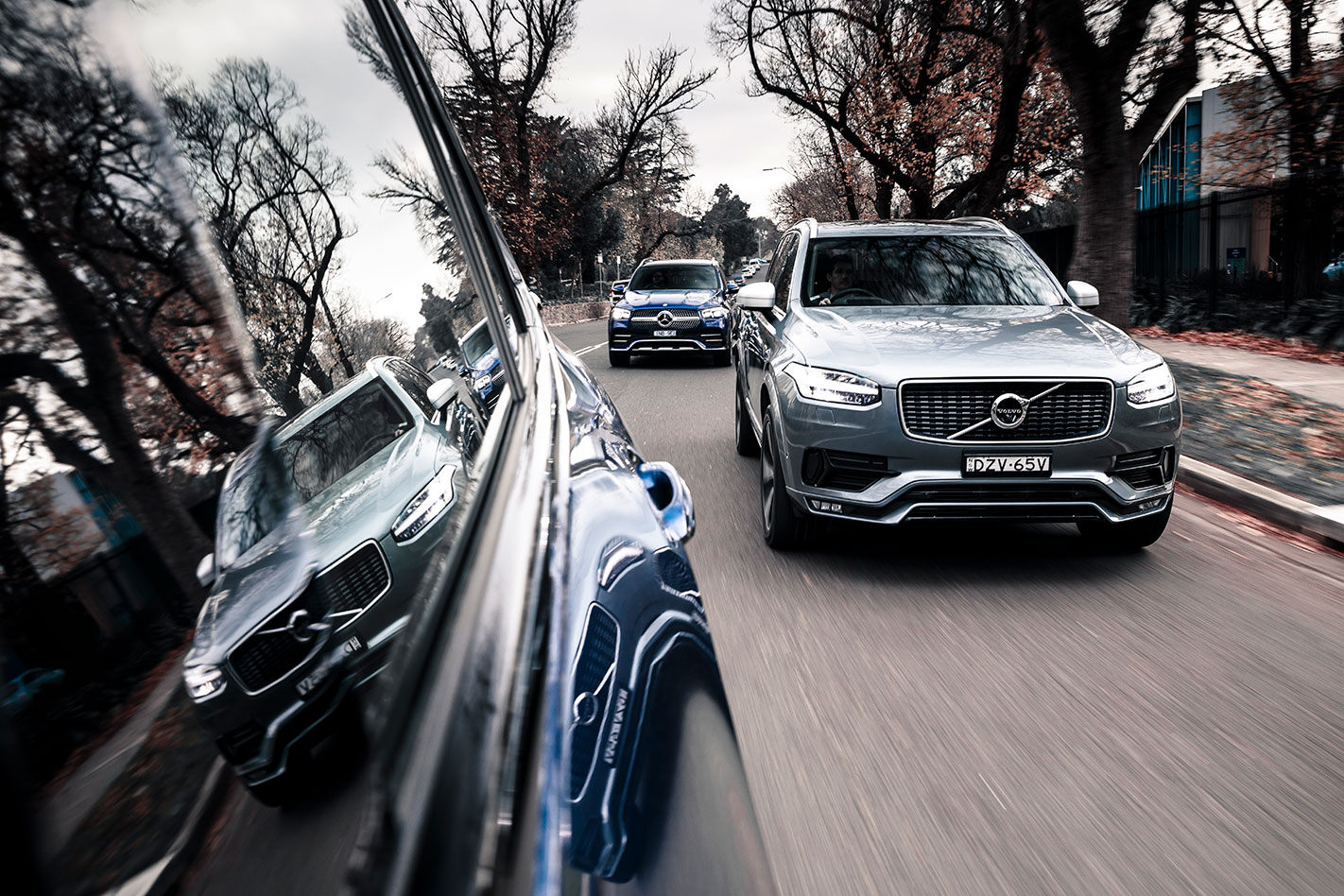
Warming to the visually appealing Merc is initially easy, but if it’s to gain market supremacy, the GLE has to beat not only the X5 but also the Volvo XC90. The big Swede is a Wheels favourite, so much so that it almost nabbed a podium place at COTY 2016 – an impressive feat. Lauded for its liveability and sophistication, the Volvo is still a high watermark to match, let alone beat.
Much like its big-wheeled counterparts, our XC90 also comes with a caveat. The optional air suspension (fitted to the rear axle) is a must. COTY testing proved that the steel-sprung set-up, in conjunction with large alloys, does not make for a compliant ride. Hence our tester has this option included as part of a Premium Pack, which also includes a load holder, Bowers & Wilkins sound system, heated rear seats and adaptive dampers – a $6500 hit to the hip pocket. Other added kit includes metallic paint ($1900), panoramic sunroof ($3000) and tinted rear glass ($950) for a grand total of $114,250 – the cheapest on test, as the GLE’s optioned price runs to $115,800.
Parked line astern, the GLE, XC90 and X5 cut a sizeable silhouette among Chapel Street’s latte-sipping brunch crew. Yet, even with the physical space each consumes in myriad shop windows, most people take no notice of their designer looks. Then, as if out of focus, two tradies approach with increasing clarity. Blurry hi-viz workware materialises into a vibrant orange hue atop faded blue short shorts – a bold choice in this climate.
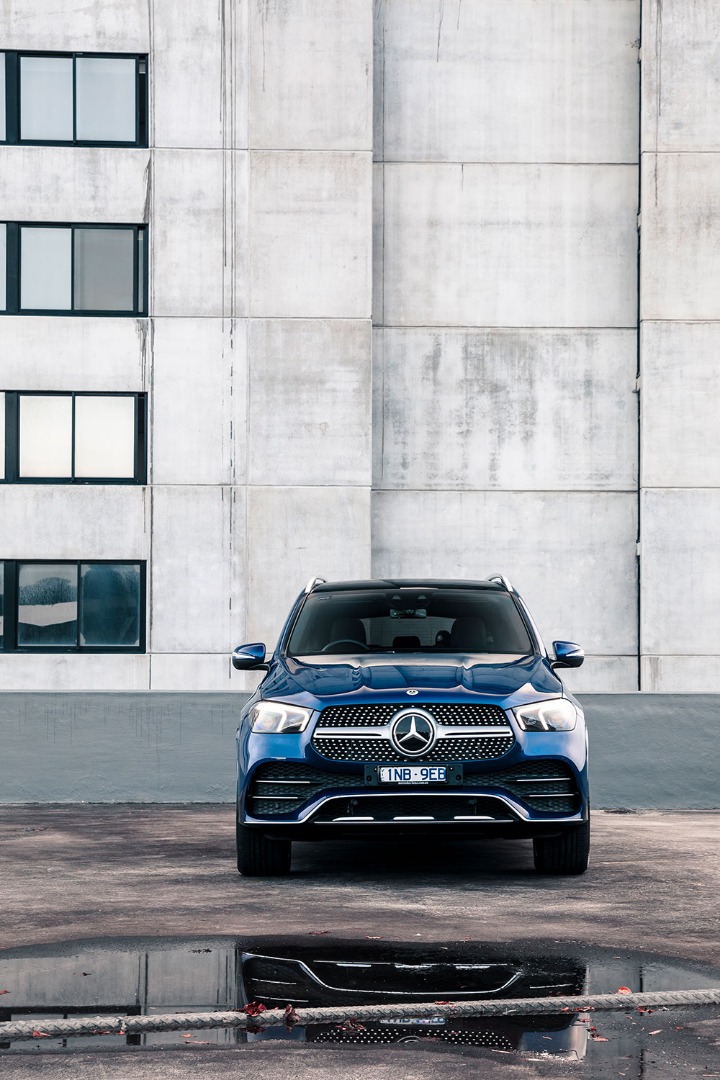
As they pass I hear a faint, “Is that the new GLE?” Admittedly the AMG styling pack fools many into thinking it’s the full-fat GLE63, but the fact two young, male tradies have pointed out an unreleased diesel SUV speaks volumes. In fact, all three SUVs are dressed in performance-oriented threads. Handsome is an adjective that falls easy to the Merc and Volvo, while the BMW, and its gargantuan kidney grille, proves a little more challenging.
We ask the tradies – still captivated by the GLE – if they want to sit inside, an opportunity grasped without hesitation. Keen to show off the capabilities of MBUX, we ask the tradies to say “Hey Mercedes”, to which the car responds, “How can I help?” Already clued-up with a line, they prompt MBUX with “open the sunroof”. A few attempts and pregnant pauses later, MBUX responds with, “I’m opening the roller sunblind”. The tradies alight the glitzy cabin suitably impressed. It would seem that the newest SUV on the family block has more appeal than simply being a kiddie-carrier consigned to a life of soccer-field car parks.
In terms of first impressions, the 300d does deliver the wow factor. In the dim melancholy of an overcast morning, the soft mood lighting warms the cabin while the seat heaters prime the soft leather of the front pews. There are layers of detail, too, with six striking air vents and genuine tactility to the climate controls – which also alter the colour of the lighting depending on temperature selection. Taking cues from the A-Class, the GLE’s twin 12.3-inch displays highlight the tech tour de force. All the button and dials are pleasing to use and convey a level of solidity, though there are a few scratchy plastics, especially the centre of the steering wheel. The latter is a shame, because the wheel itself is a special and intuitive thing to use.
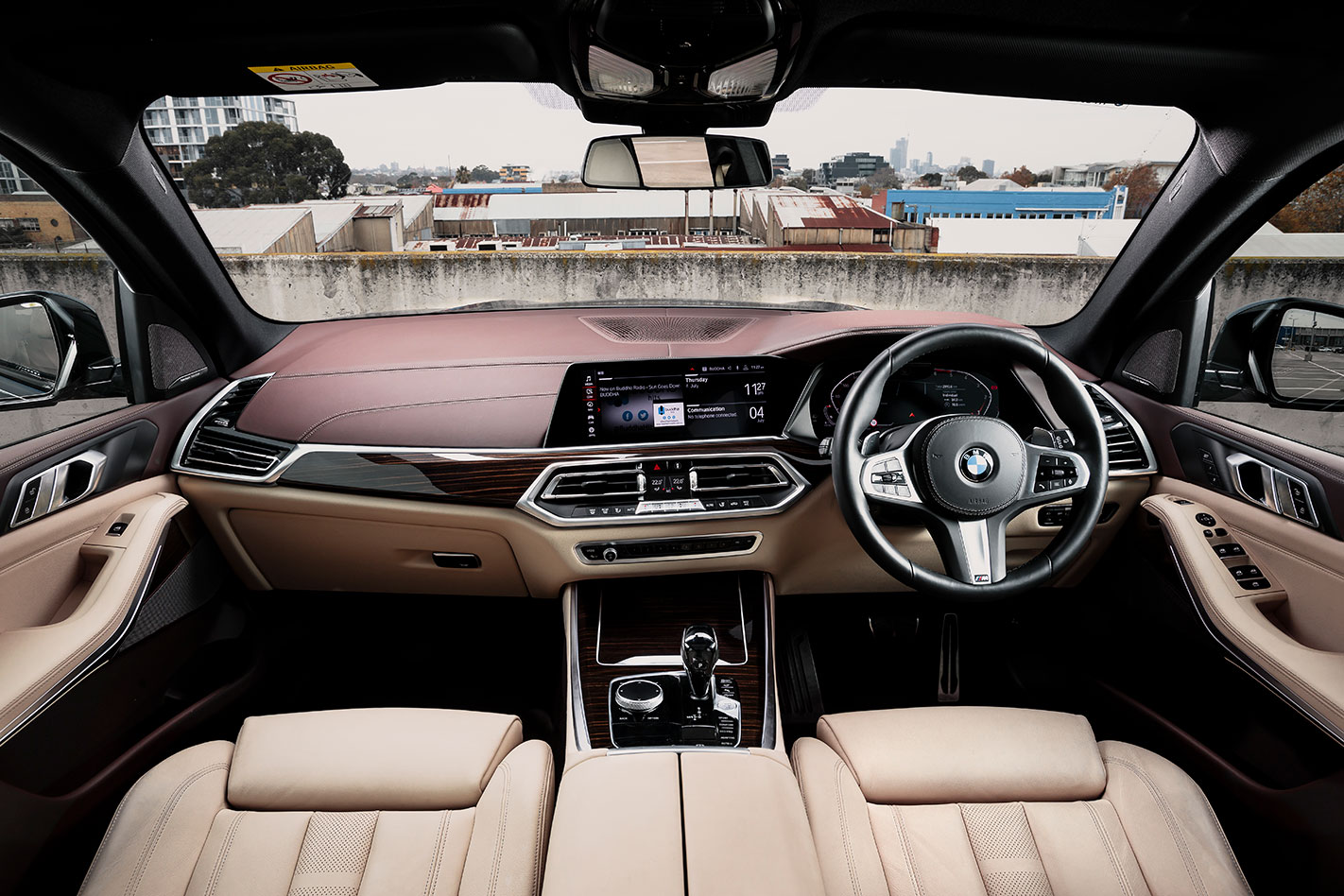
A revelation is an understatement when referencing the fourth-gen X5’s interior. BMW has finally given in to touchscreens, allowing you to dive into the high-res central 12.3-inch display as you access the brilliant iDrive 6 infotainment. The once-maligned control wheel is now virtually idiot-proof, proving easier to perfect for some over Benz’s new trackpad (although the latter is by far the best of its kind). Overall, the X5’s cabin feels the most premium, brimmingwith luxe appeal. Our test car benefited from soft pale leather, making the cabin feel light and airy, but the seats were already showing signs of discolouration from myriad bums in blue jeans.
While the GLE and X5 are fresh inside, the XC90 continues with its minimalist Scandi-chic ambience. Despite being four years old, the design remains contemporary, with the vertical, tablet-style
12.3-inch central display dominating the clutter-free dash. Ergonomically the touchscreen is excellent, and you can configure it like a smartphone, placing your icons in order of relevance. The only gripe concerns the climate controls, as changing the temperature is a two-touch affair and takes your eyes off the road. Still, the level of fit and finish, matched with body-hugging R-Design seats, means it’s a cabin standing the test of time.
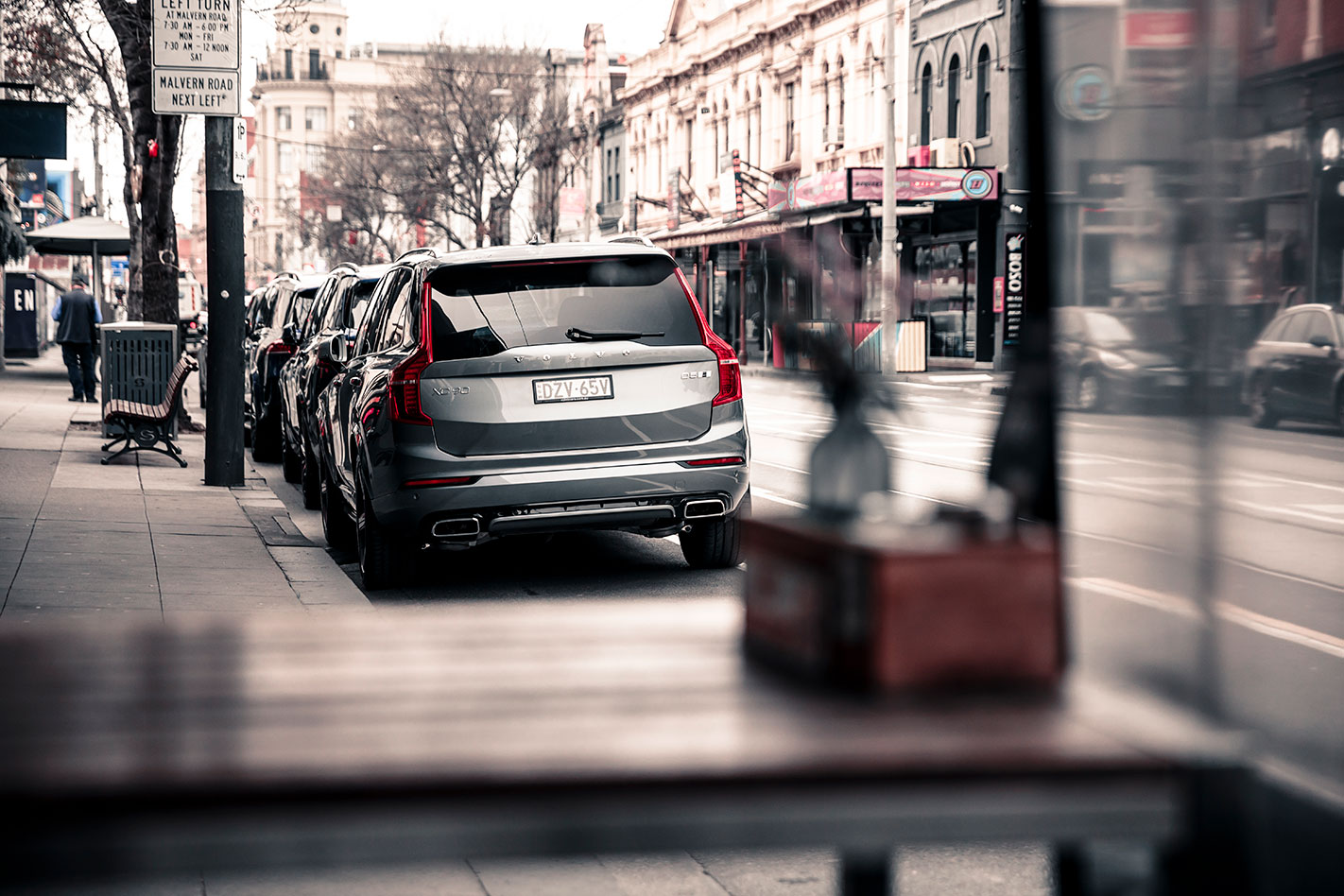
Thanks to an 80mm extension in wheelbase over the previous model, the GLE provides the most rear legroom of the bunch. In fact, despite an exterior that looks sleeker and smaller (the Merc boasts the lowest drag coefficient of any SUV at 0.29cd), the 300d is super spacious inside. Third-row seats are available for $3900, but accessing them is a tighter fit than the Volvo, which comes with three rows as standard. The Merc’s rear doors open wide, aiding the positioning of a child seat in the ISOFIX ports, while back-seat passengers gain their own controls for the climate and electric-seat operation. Boot space is the smallest here at 630 litres and the cabin’s a USB-C-only affair – there’s just one USB adapter.
Unique to the X5 is an electronically operated split tailgate to access its middle-of-the road 645-litre boot. Like the others, it has a flat floor and useful loading area. Rear-seat legroom is least opulent in the BMW, but it’s hardly squishy back there and, thanks to an airier glasshouse, the view out is better than the Merc. The rear climate controls and electric operation of the seats makes life easier and there’s a plethora of USB and USB-C ports. Seven-seater capacity is available for $3700.
While all three contenders prove practical, the XC90 takes it to another level. Predictably, the SUV from the land of flat-pack furniture has the biggest cargo capacity at 692 litres in five-seat mode. Getting into the third row is the easiest and when seated there’s decent headroom. Middle-row leg and headroom is spacious, with a higher seating position offering the best view out. However, the XC90’s cabin affords the least shoulder room, even though it’s the widest at 2008mm.
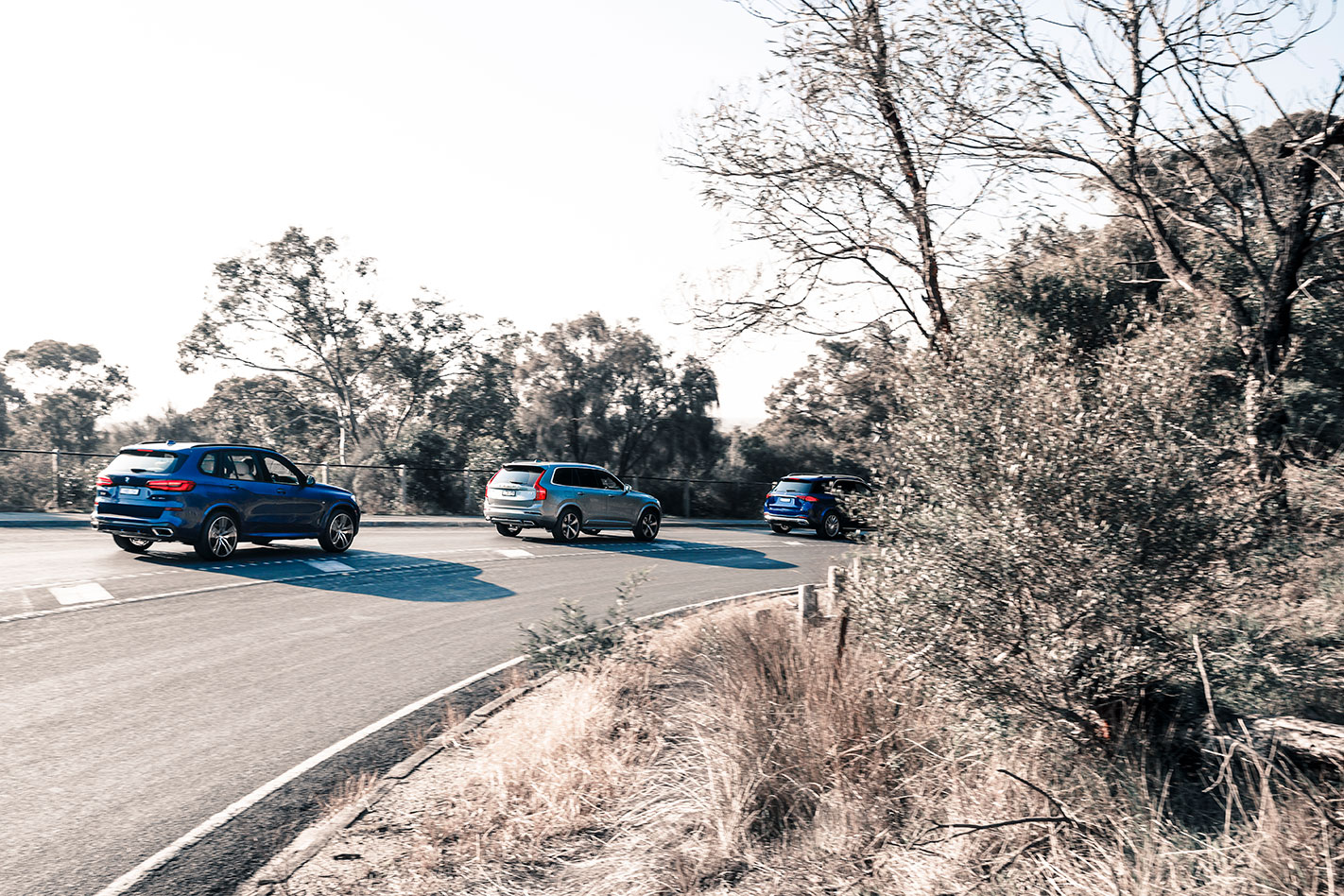
Leaving the confines of Melbourne, the drive loop encompasses a visit to the drag strip and various country roads. Off the mark is where the GLE feels its most brisk, with the 180kW 2.0-litre four-cylinder diesel producing its substantial 500Nm before 2400rpm. Although the twin-turbo OM654 utilises two-stage turbocharging, power tails off significantly around 4000rpm. This is backed up by the figures, with the Benz reaching 100km/h in 7.8 seconds, (0.4sec faster than the Volvo), but it records the slowest terminal speed down the quarter mile at 140.7km/h, 3.3km/h off the Volvo and 6.7km/h off the BMW.
In terms of refinement and performance, the X5 is peerless in this comparison. The twin-scroll, single-turbo straight-six diesel is a gem, producing 195kW and a stonking 620Nm. It nails 100km/h in 6.6sec and there’s a rich supply of torque seemingly wherever you need it. The 3.0-litre B57 makes the 30d feel under-stressed, especially when combined with the best gearbox of the bunch (ZF eight-speed) and the least diesel-esque acoustics. The only downside to the extra cubic capacity and grunt is fuel economy. During our testing, the Bavarian is thirstiest at 11.2L/100km. The GLE follows next with 10L/100km, while the XC90 proves the most frugal at 9.8L/100km.
Although, the Volvo’s engine isn’t consigned to just being efficient. The Polestar badge on its rump means that the Swedish tuning arm has fettled with the ECU, resulting in the D5 R-Design’s 2.0-litre oiler gaining an increase in power and torque to 177kW and 500Nm. While being the least nippy off the line (0-100km/h in 8.2sec), the PowerPulse system helps to eliminate turbo lag as an electric compressor forces air into the exhaust flow. You get a sense that the D5 is almost as strong as the BMW when overtaking (it’s the ‘light’ one at 1970kg, compared to the BMW at 2110kg and the GLE at 2165kg), meaning it scores highly in terms of open-road driving.
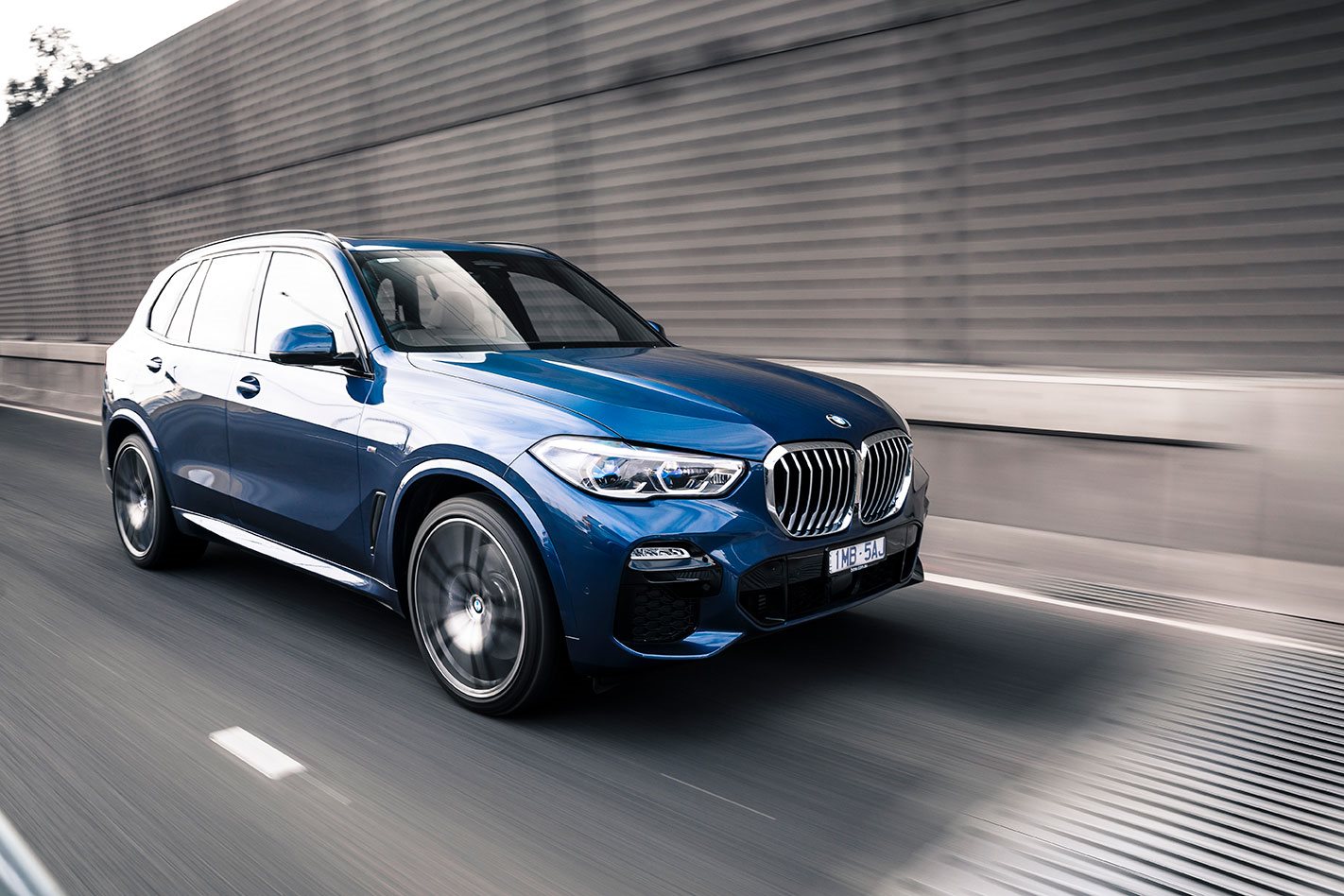
Which is where the GLE starts to fall down on its passive, steel-sprung set-up. It’s a shame, because the underlying dynamic ability of the Modular High Architecture (MHA) is left underutilised. Lightweight fibre-reinforced plastics have resulted in a 62kg weight cut over the old GLE, and the permanent 4Matic all-wheel drive offers plenty of traction with a constant 50:50 torque split. However, as the state of the tarmac deteriorates, so does the 300d’s capacity to adequately smooth the road underneath. There’s not enough finesse or suppleness to deal with sharp imperfections, with big hits felt inside the cabin. A lack of damper control on rebound means you tend to feel the vertical movements from a deep undulation long after you’ve cleared it.
The X5 also falls foul to poor optioning with its 22-inch alloys and low-profile Pirelli P Zeros providing little cushioning despite the adaptive dampers offering a Comfort mode. Yes, there’s more control than the GLE, but the adaptive two-axle air suspension, at $2300, is a worthwhile investment. With the rear-biased all-wheel-drive system sending grunt to the 315-section rear tyres, grip isn’t an issue. In terms of road holding and ‘fun’ factor, the X5 is the standout.
The D5 R-Design might not be as engaging dynamically, but the Volvo is certainly the most comfortable. With the air suspension adding a suppleness and compliance sorely lacking in the Merc (and to a lesser degree in the BMW), the D5 is the most comfortable. It deals with bumps with aplomb, the only blight being a slight increase in bodyroll and lean due to its tall body. Suppression of tyre roar and general NVH is the best here, too.
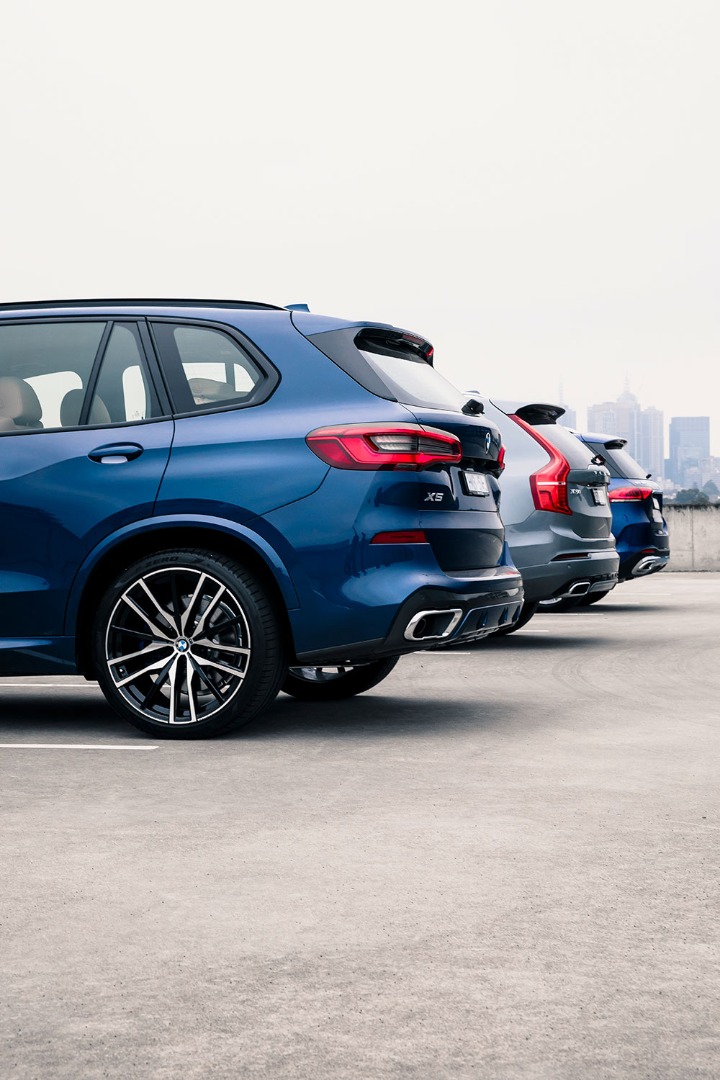
Ultimately, when it comes to the final assessment, there’s no question the GLE is a vast leap forward for Mercedes. The interior is comfortable, roomy for a family and bursting with equipment that’s headlined by MBUX. It’s luxurious and quiet with strong fuel economy and off-the-line performance. However, it feels as though we aren’t testing it in its strongest guise. The 300d simply can’t match the oomph of the more expensive BMW and it lacks the serene nature of the brilliantly executed Volvo.
What lets the Benz down in this company is ride quality. Had our tester been fitted with optional suspension like its rivals, the end result would be closer and the fight a little fairer. Take heed, then – air suspension is a must when speccing your GLE. And if you can, stretch to the gutsier six-pot petrol or diesel engines. As it is, however, our GLE finishes third. It’s a desirable proposition, but in this particular company, it’s outperformed.
The BMW finishes with the same eight-out-of-10 rating as the GLE, though its superb drivetrain, sharper dynamics and quieter cabin see it edge second place. What prevents the X5 from snaring the top spot is its heftier thirst, questionable ride quality and a significant price premium. Even at this affluent end of the $100K-plus market, monetary pain can’t be ignored.
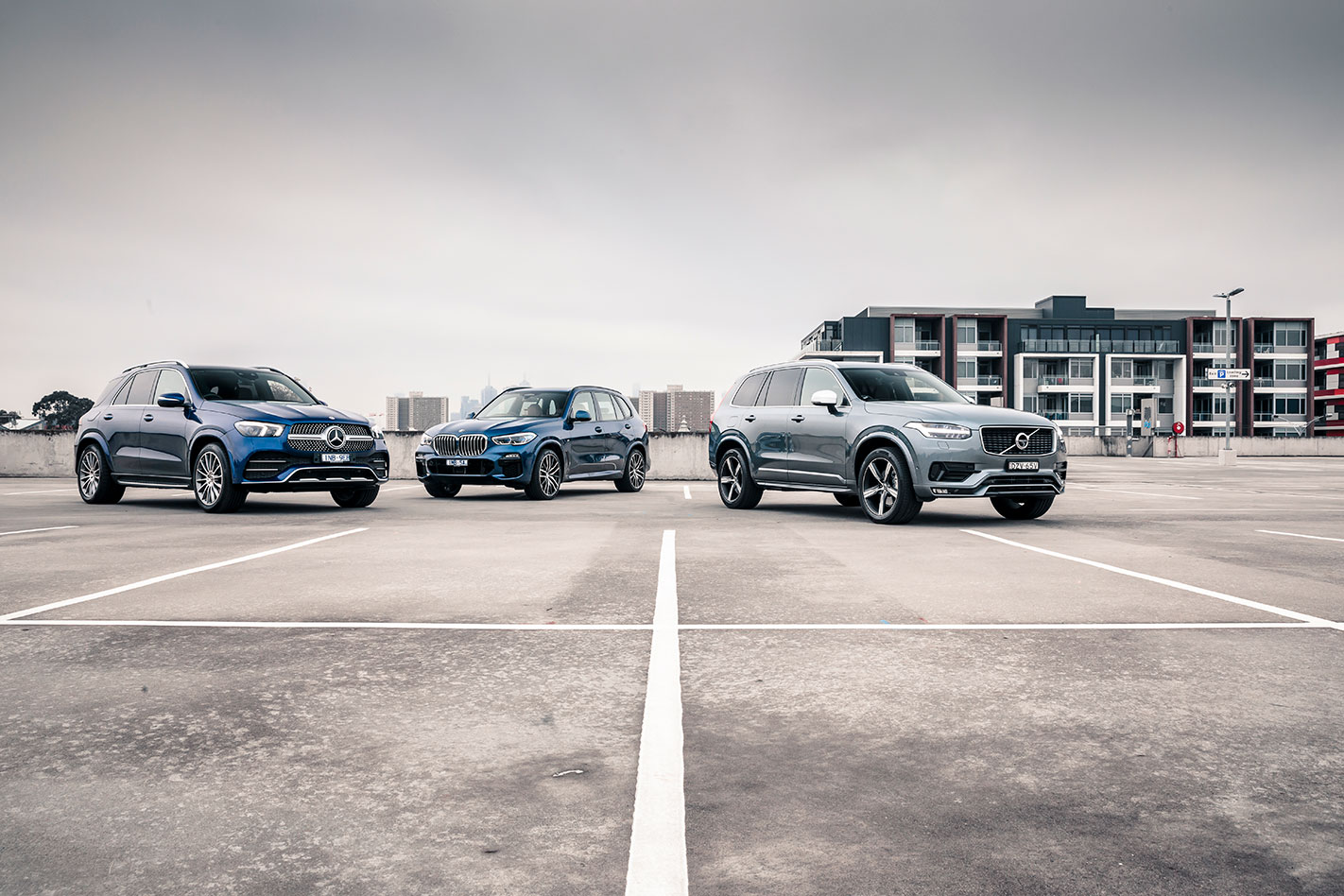
That leaves the XC90 as the somewhat unexpected winner despite being the oldest contender. It’s by no means perfect and the Volvo can’t match the sheer technological might you get in the cabins of the Merc and BMW. Yet, it represents the best value, it gains seven seats as standard and continues to set the class yardstick for refinement and overall quality.
As an indulgent family SUV that fulfils its brief, the suave Swede might not be streets ahead, but it’s the one you’ll want to buy. No receipt required.
Where’s the VW Touareg?
We asked for one, but a VW Touareg in Launch Edition guise wasn’t made available to Wheels for this SUV comparison. At $89,990 for the range-topping variant, the fully loaded flagship offers a powerful 190kW/600Nm V6 turbo-diesel with a claimed consumption of 7.4L/100km. Dominating the spacious interior is the 15-inch infotainment screen, however, it’s part of an $8K option pack. Still, it would have been interesting to see how the Vee-Dub fared against truly premium rivals.
Good marketing is the art of spotting an unfilled hole in the market and then producing the product to fill that hole. Pffft. Brilliant marketing involves stabbing the market in the chest to create a hole that wasn’t already there. And then filling that sucking, gurgling wound with whatever you had lying around.
Sounds cynical, I know, but this time around my great marketing scheme could just be the saviour for this fine country as a manufacturing force. See, ever since the car-makers turned off the lights for the last time, there’s been much hand-wringing about Australia becoming a post-industrial wasteland. But my latest grand idea would fix that, and it would do so by tapping into a couple of our greatest natural resources and manufacturing skill-sets.
I’ll start by pointing out that nobody makes a bull-bar like we do. Of course they should rightly be called roo-bars since far more marsupials than cattle have gone to their reward straddling a dual-cab ute at 100 kliks. And why are we so good at roo-bars? Because we have a metric shitload of roos; all half-witted and waiting for a chance to jump in front of anything that moves.
Of course, other countries don’t need roo-bars because they don’t have roos. And right there, my friends, is our opportunity to stick that knife in and create the all-important gaping puncture-wound of opportunity. We’ll start small. With New Zealand. We’ll take a 40-foot container of male roos and a similar number of fillies. We ship them to NZ and let the blokes loose on the north island and the ladies down south.
Hey, there’s plenty of precedents for this. Look how foxes, rabbits and cane toads have improved life Down Under. Besides, the Kiwis love marsupials. They named their most famous rally driver after an overgrown rat that eats electrical wiring and fills the roof cavity with crap until the ceiling caves in. Usually at 3am. Then, when the critter expires (often at the pointy end of a spear-gun), our Kiwi mates skin it and, in a scene from Millinery of the Macabre, turn it into an item of headwear. That’s love and respect right there. So they’ll dig our gift-roos.
Anyway, the released roos that are strong enough to swim across Cook Strait and make sweet, sweet love will surely spawn a race of super-kangas, capable of bounding over Kiwi fences and onto roads where they will – at first – be a novelty. That will change as our friends to the east discover that having 200 kilos of gristle and sex organs cannoning in through the windscreen at 100km/h is somewhat sub-choice. At which point somebody will figure that the country needs a steady supply of good quality roo-bars. And who they gonna call?

Yep, before you know it, every grey-import Nissan Elgrand or Toyota Previa full of smiling rugby fans will be considered incomplete without a silver-fern sticker on the back window and an Aussie-made roo-bar bolted to the front. And every ex-dairy in the country will soon be a roo-bar retail and fitting outlet.
There, I’ve just thrown the Aussie manufacturing industry a dead-set lifeline. And if it doesn’t work, imagine the hats those crafty Kiwis will be able to fashion while they wait for a tow truck. You’re welcome.
