
The Wheels Verdict: If visual impact is at the top of your ute-buying priority list, then it’s likely you’ll think the Navara N-Trek a roaring success. With its pumped-up and blacked-out bodywork additions, there’s no denying it adds a welcome dose of drama to the Navara range. We’re also fans of the updated and easy-to-navigate infotainment system which brings Apple CarPlay/Android Auto connectivity. If, however, you’re the type of buyer to prioritise on-road comfort and truly rugged off-road ability, then Nissan’s dual-cab remains class middling.
What is the Nissan Navara N-Trek?
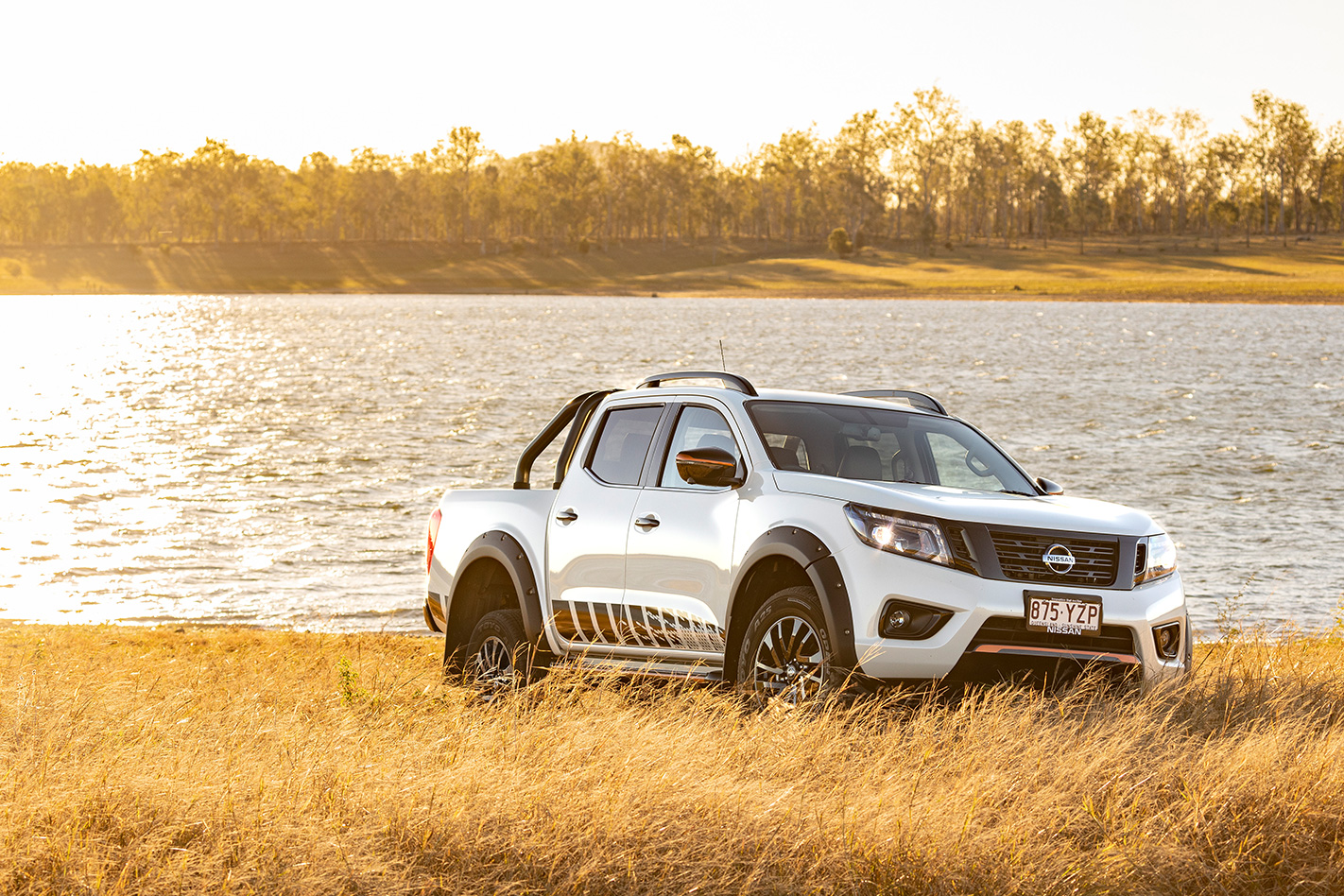
Officially, it’s the most expensive Navara you can buy. At $58,950 for the seven-speed auto (or $56,450 for the six-speed manual), the N-Trek joins the Navara range as an all-new flagship variant, positioned above the existing (and recently updated) RX, SL, ST and ST-X model grades. Mechanically it’s identical to the rest of the Navara range, with the N-Trek instead offering a host of visual enhancements for a tougher look and feel.
Why we’re testing it
To see if the N-Trek’s visual spice and improved infotainment can elevate the Navara’s fortunes. Despite being Nissan’s third best-seller (after X-Trail and Qashqai), it’s consistently outsold and outperformed by rivals like the Toyota Hilux, Mitsubishi Triton and Ford Ranger. And in our most recent ute megatest (August, 2018), the Navara could only manage a lowly eighth out of 10. No pressure, then…
Nissan Navara N-Trek review
THIS is familiar ground for Nissan. After the runaway success of its limited-run Navara N-Sport and Black Editions, the Japanese brand is back at it with a new special edition variant, this time dubbed ‘N-Trek’. Like the others, the N-Trek brings a host of visual and equipment enhancements, but unlike the others, which were built in limited numbers, this is a permanent addition to the range. Positioned as a new flagship, the N-Trek sits above the existing RX, SL, ST and ST-X model grades and is priced accordingly at $58,950 for the auto and $56,450 for the six-speed manual.
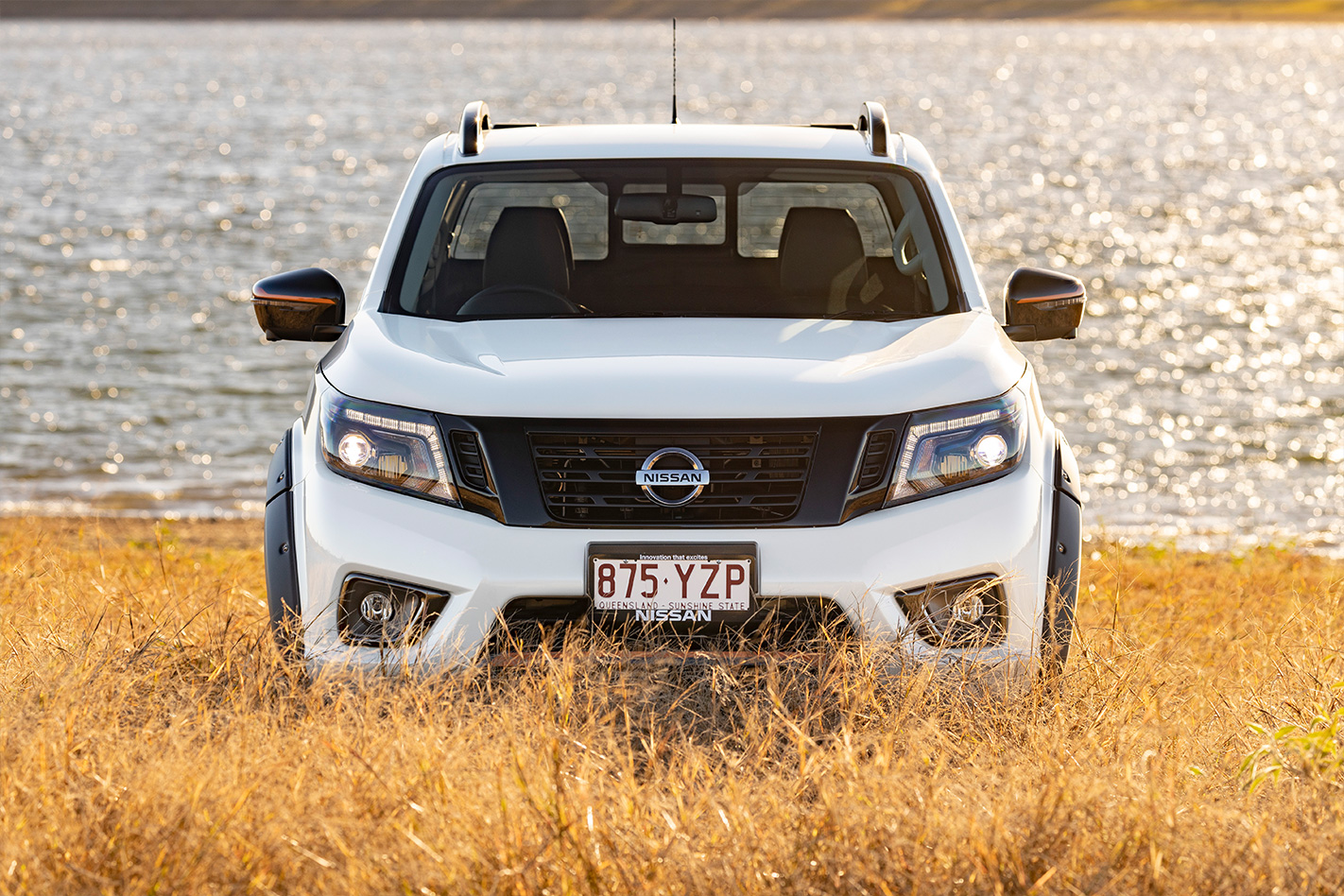
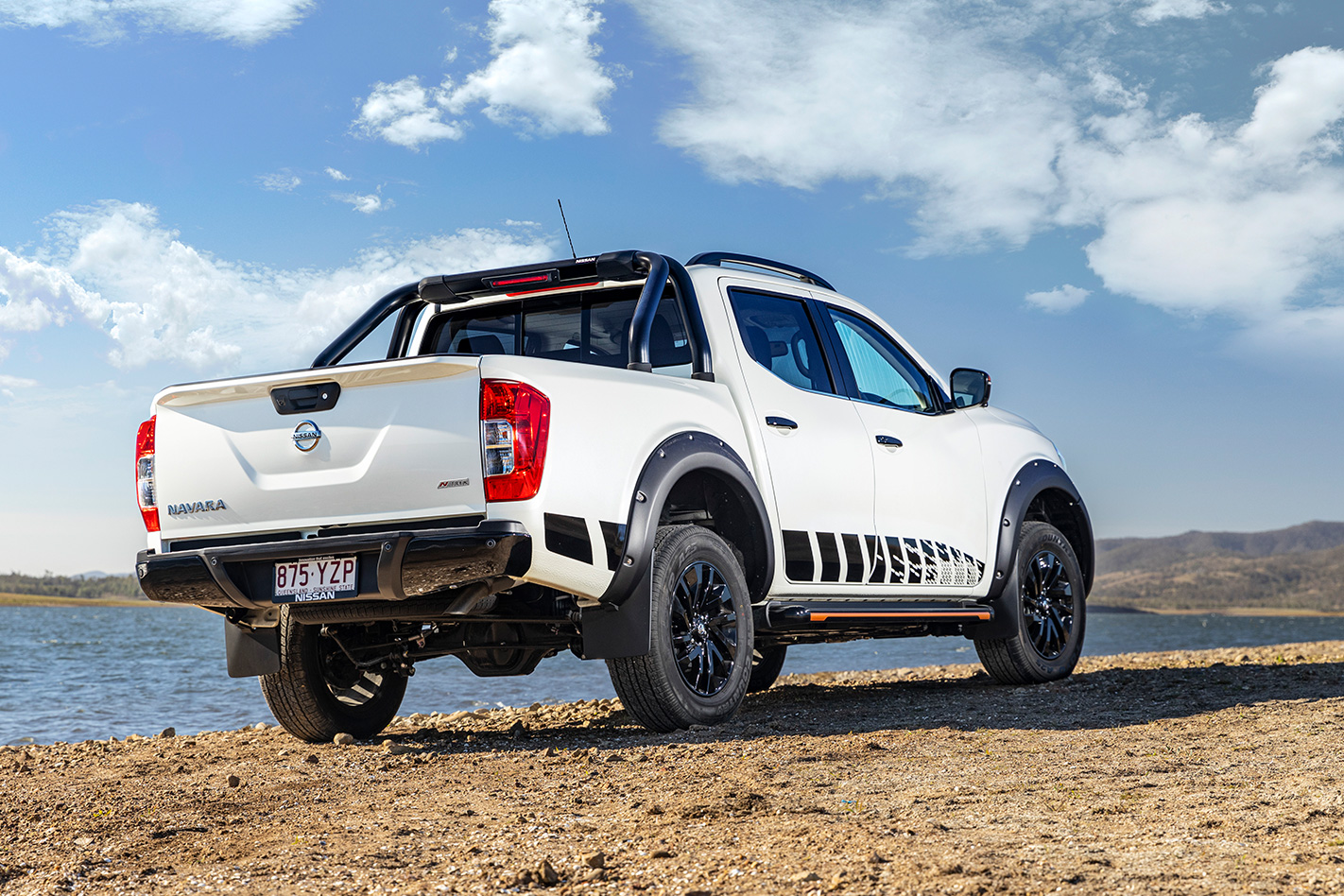
That’s $3700 more than an equivalent ST-X, so what are you getting for your additional outlay? Well, lots of black. N-Trek variants score black 18-inch alloys, black bolt-on wheel arches, black decals that adorn the doors like giant tribal tattoos, black mirrors, and a sportsbar finished in, you guessed it, black. There are three exterior colours to choose from: grey, white and… yeah.
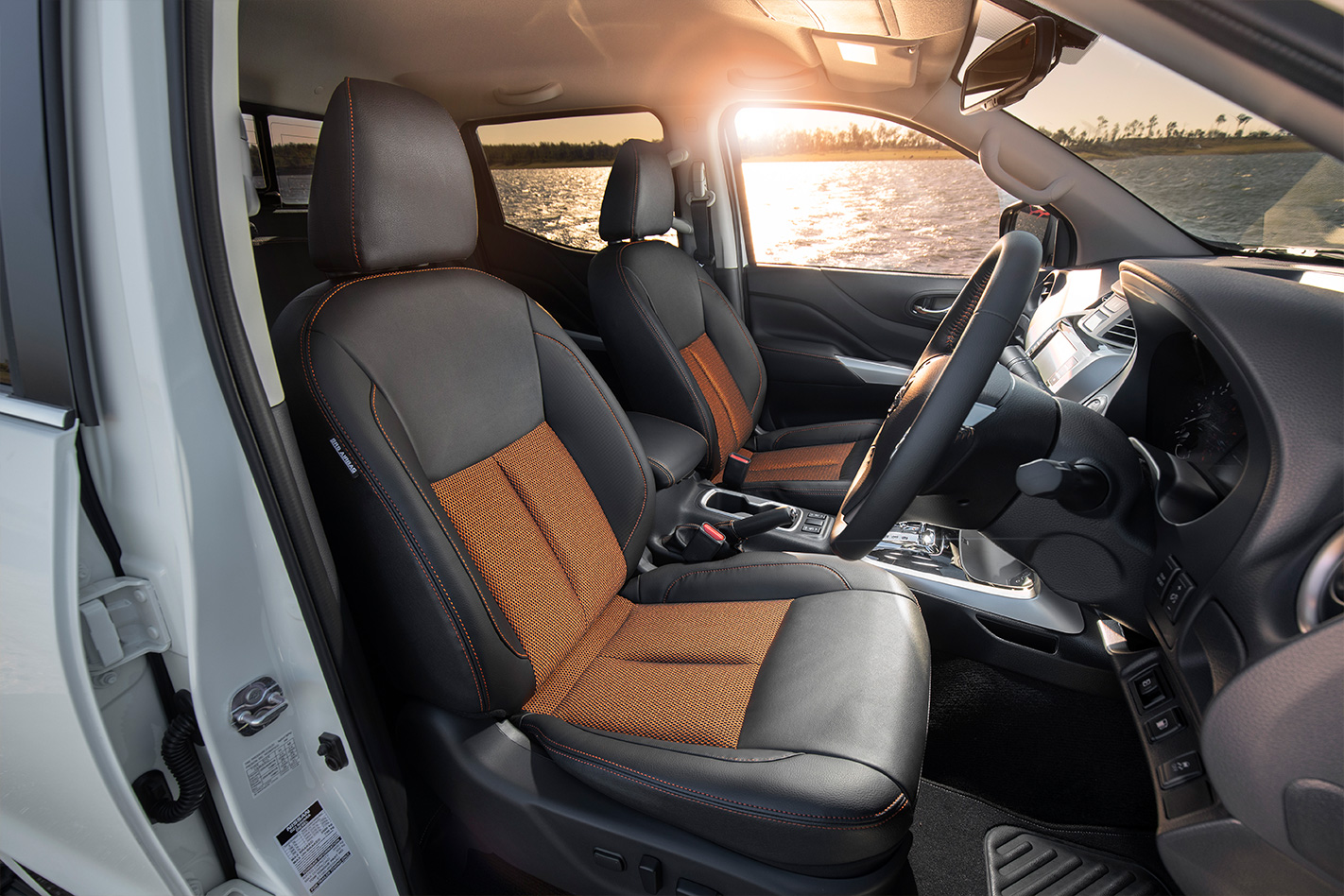
Inside, you get the regular Navara’s $1500 leather seat option as standard (which adds leather accented trim, eight-way power adjustment for the driver, and a heater function), plus the added bonus of orange cushion inserts and stitching. One notable exclusion, however, is the inability to fit your N-Trek with a sunroof, which is an option you can tick on an ST-X for $1000.
Like the rest of the recently updated Navara range, the N-Trek benefits from a much-needed infotainment upgrade which brings a larger 8.0-inch central touchscreen (ST grades and above) and Android Auto/Apple CarPlay connectivity. It’s a logical and easy-to-use system with clear graphics and a responsive touch-screen. The rest of the cabin is similarly fuss free. Plentiful storage, rear-seat air vents, twin 12V sockets, a powered sliding window in the rear screen, and a superb 360 degree camera are all positives, though no steering wheel reach adjustment and storage cubbies lined with hard, slippery plastics are notable niggles.
There are also some notable safety omissions. While every Navara scores a five star ANCAP rating and is equipped with seven airbags, there’s still no autonomous emergency braking or any of the additional active safety gear now available in some rivals like lane-keep assist and adaptive cruise control.
Mechanically, the N-Trek is identical to the rest of the Navara range, meaning power comes from Nissan’s venerable 2.3-litre twin-turbo diesel. It’s a gutsy (if slightly noisy) unit that revs freely and, when paired with the slick-shifting seven-speed auto, delivers strong off-the-line acceleration. Overtaking performance is also amongst the best in class, as is its efficiency, with our testing seeing a relatively frugal 9.0L/100km (the official claim for the combined cycle is 7.0L/100km).
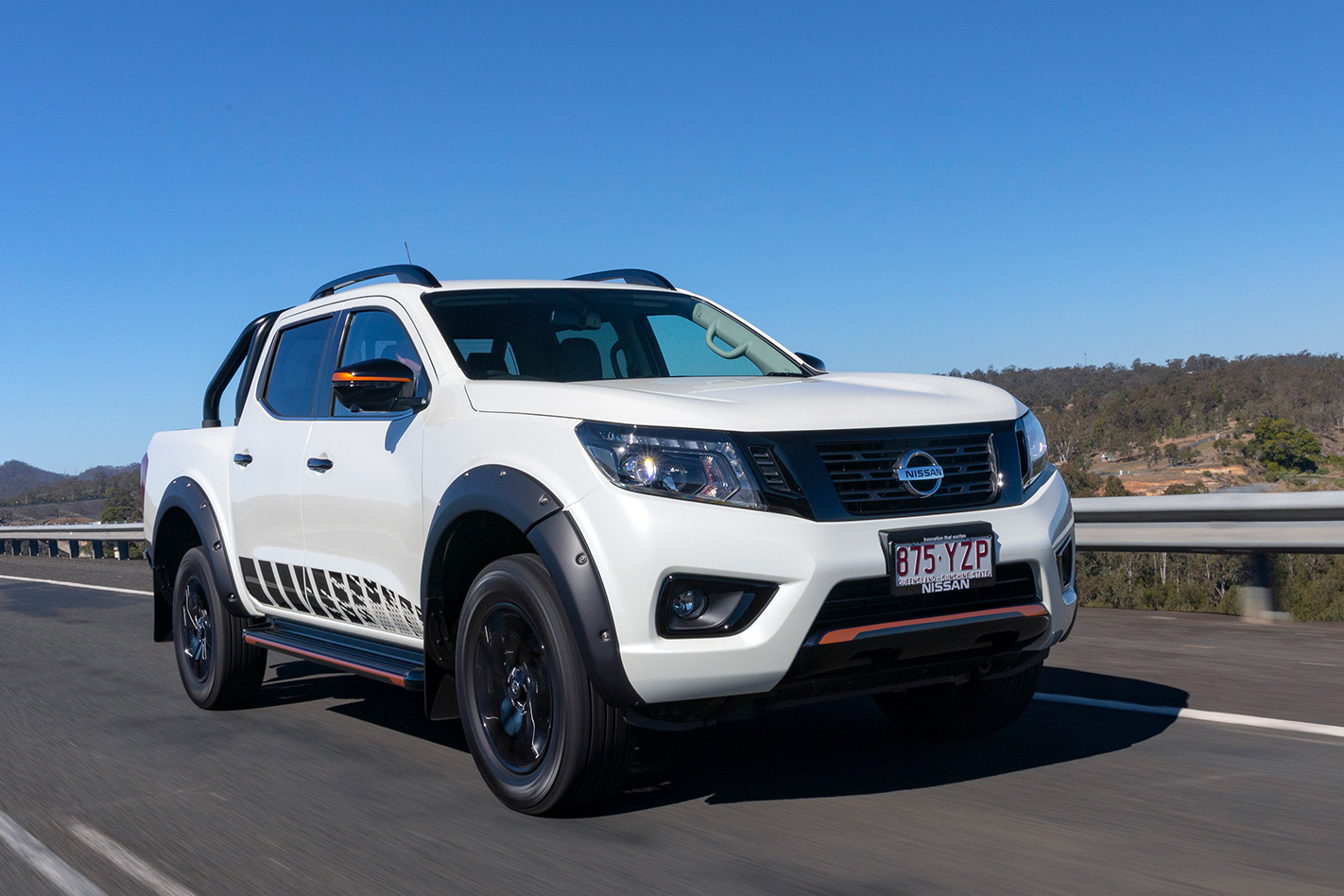
Where things start to unravel slightly, however, is when it comes to on-road dynamics and comfort. Like other Navaras, the N-Trek is fitted with Nissan’s unique coil-spring rear suspension which sees it stand alone in a sea of leaf-sprung rivals (except the Navara-based Mercedes-Benz X-Class, of course). Nissan has worked hard to refine the set-up through several revisions to the spring and damper rates, though it’s still something of an Achilles heel.
While pleasingly comfortable at low speed, the ride deteriorates on rough roads where bumps and thumps can jar inside the cabin. Some body roll and occasional chassis shimmying amplify the issue, which sadly, is something of a double-edged sword. Not only does the Navara fail to capitalise on the potential comfort benefits of its more sophisticated set-up, but as our sister title 4X4 Australia found, its multi-link rear end doesn’t have the same travel as leaf-sprung rivals, which can limit its ability off-road – though it remains capable on moderate four-wheel-drive tracks.
And it’s a dependable workhorse. Towing capacity is rated at 3500kg for trailers with brakes (750kg for trailer without) and the N-Trek’s tub is lined with durable plastic that extends to the top of the tailgate which is useful for carrying longer loads. There are also four tie-down points, another 12V socket, and four additional mounting points that can move along rails built into the side of the tray.
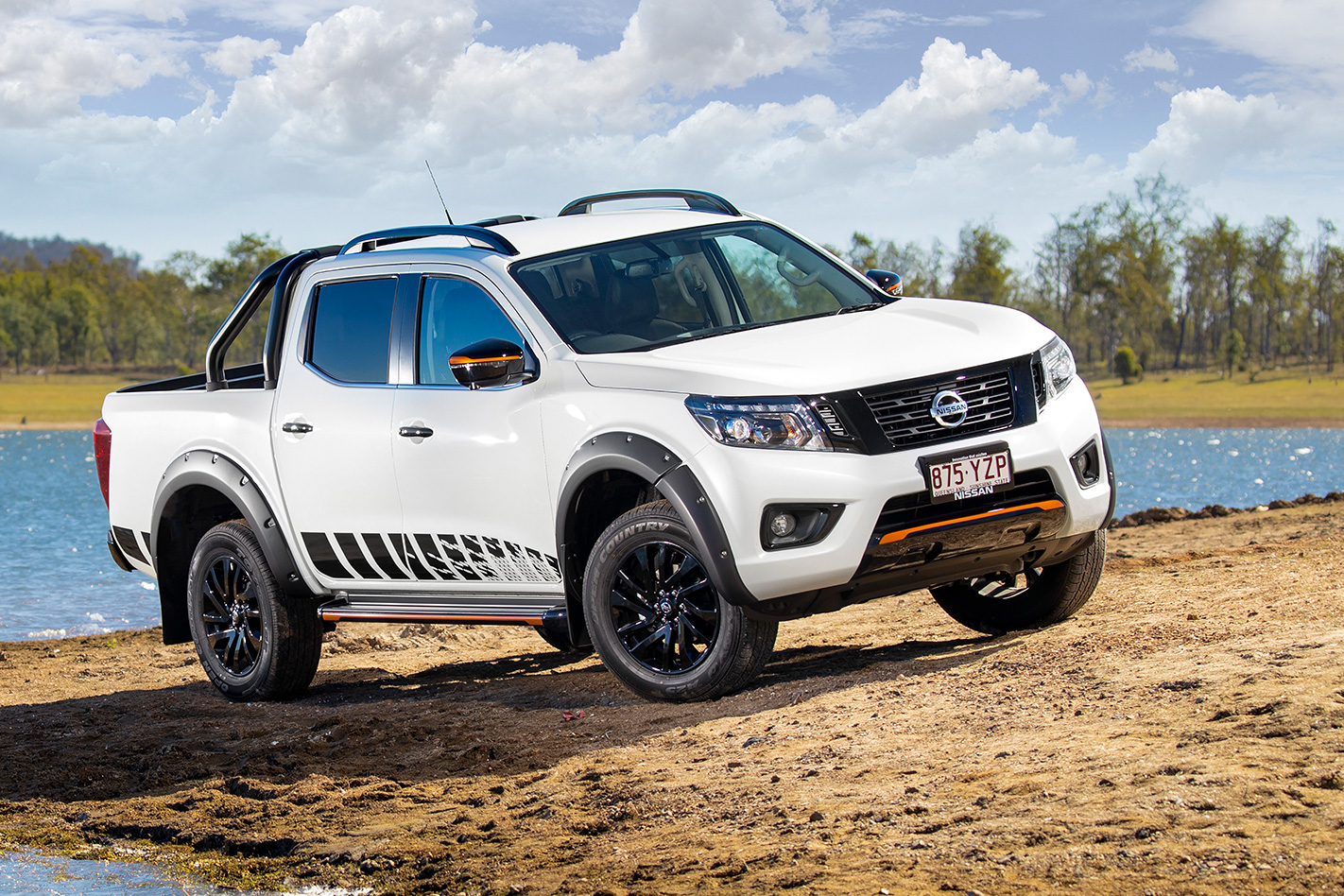
Which leaves us with something of a vexing conclusion. While the N-Trek delivers on its promise of adding some visual oomph to the Navara range, it can’t shake the recurring foibles that continue to plague Nissan’s dual-cab. There are also some question marks around value. If you can live without the flared guards and decals, a correctly specced ST-X can deliver a similar package for less, with change left over for a sunroof. But as Nissan will attest, visual spice and aggression carry great currency in the land of the dual-cab. However, if Nissan is serious about elevating the Navara from class-middling to stand out performer, then more is needed.
Nissan Navara N-Trek vs rivals
Ford Ranger, Holden Colorado, Isuzu D-Max, Mazda BT-50, Mitsubishi Triton, Toyota Hilux, Volkswagen Amarok
Nissan Navara N-Trek specification
- Model: Nissan Navara N-Trek
- Engine: 2298cc 4cyl, dohc, 16v, TTD
- Max power: 140kW @3750rpm
- Max torque: 450Nm @ 1500-2500rpm
- Transmission: 7-speed automatic
- Kerb weight: 1979kg
- 0-100km/h: 9.7sec (tested)
- Economy: 7.0L/100km
- Price: $58,950
- On sale: Now
Ford Performance has revealed another juicy morsel of information about the upcoming 2020 Ford Mustang Shelby GT500.
That would be its supercar-rivalling claimed 0-100-0mph time of 10.6 seconds
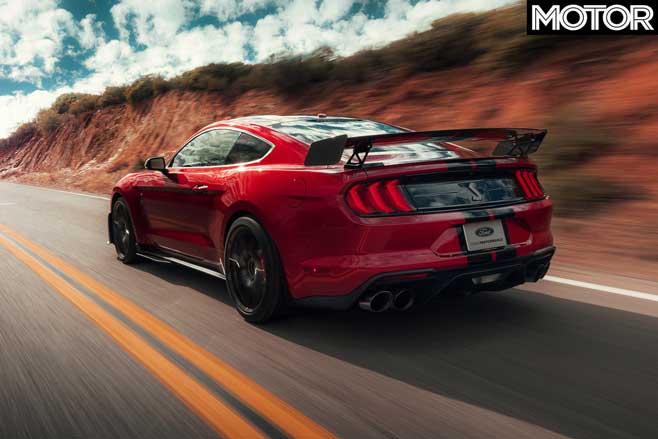
According to those behind the car, the impressive acceleration and braking power comes down to a combination of main points – its impressively fast gearbox, the massive 419mm front brake rotors, and its Michelin Pilot Sport Cup 2 tyres.
Oh, and a supercharged 5.2-litre V8 putting out 567kW and 847Nm.
Ford Performance chief program engineer Ed Krenz says the engineering behind the GT500 is beyond anything previously seen on a Mustang.
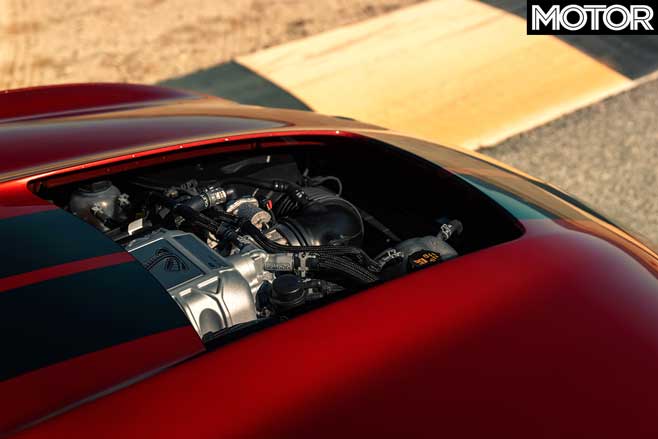
“The range of brute-force drag acceleration, seamless road shifts and amazingly smooth shifts on the track further highlights how the soul of the Shelby GT500 is elevated in our most advanced Mustang ever,” says Krenz.
“Effortlessly handling the 760 horsepower is our segment-first Tremec dual-clutch transmission, with an advanced control system that enhances GT500’s five drive modes to deliver a driving experience once reserved only for exotic supercars.”
The Tremec TR-9070 7-speed dual-clutch is not only capable of managing the engine’s 847Nm, but is also able to shift gears in as little as 80 milliseconds.
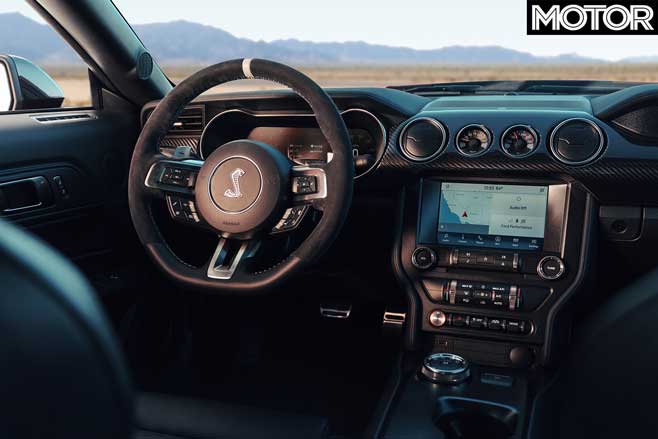
“In many ways, this is like having two transmissions in one,” says Ford Performance powertrain manager Pat Morgan.
“On one hand, it enables performance at the outer reaches of straight-line quickness with minimal torque interruption yet provides an incredible amount of finesse and control in track environments for maximum stability and predictability at the limits of lateral acceleration.”
But Morgan says faster shifts “do not always equate to better road performance.”
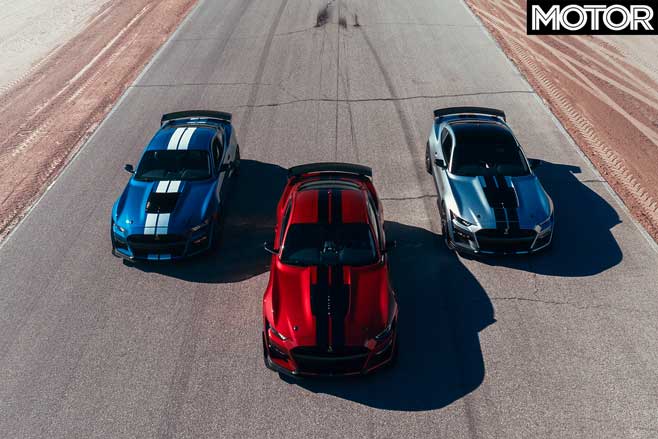
“In every driving situation, we emulated what professional drivers do, whether it’s a smooth, precise heel-and-toe shift of a professional track driver or a much more forceful powershift like drag racers. We’ve designed the perfect shift every time.”
Ford hasn’t yet confirmed a 0-60mph (or 0-100km/h) time for the GT500, or a quarter mile run, but has instead been rolling out details about the car slowly since its reveal many months ago.
Affalterbach’s 6.2-litre naturally aspirated V8 is one hell of an act to follow. Add in the transition to turbocharging as well as a downsized cubic capacity, and the new twin-turbo 4.0-litre had its back up against the wall in 2014. Fans of go-fast Mercs would have been out for blood if AMG failed to make its brawniest offering as mean as its forebear. Hindsight tells us we needn’t have worried.
To be totally faithful to the Mercedes lineage, the twin-turbo 5.5-litre M157 is more of a direct comparison. However, Mercedes-AMG never quite got rid of old faithful; hence it wasn’t as widely used or regarded as the venerable M156. Either way, it’s safe to say that the 3982cc eight had big shoes to fill.
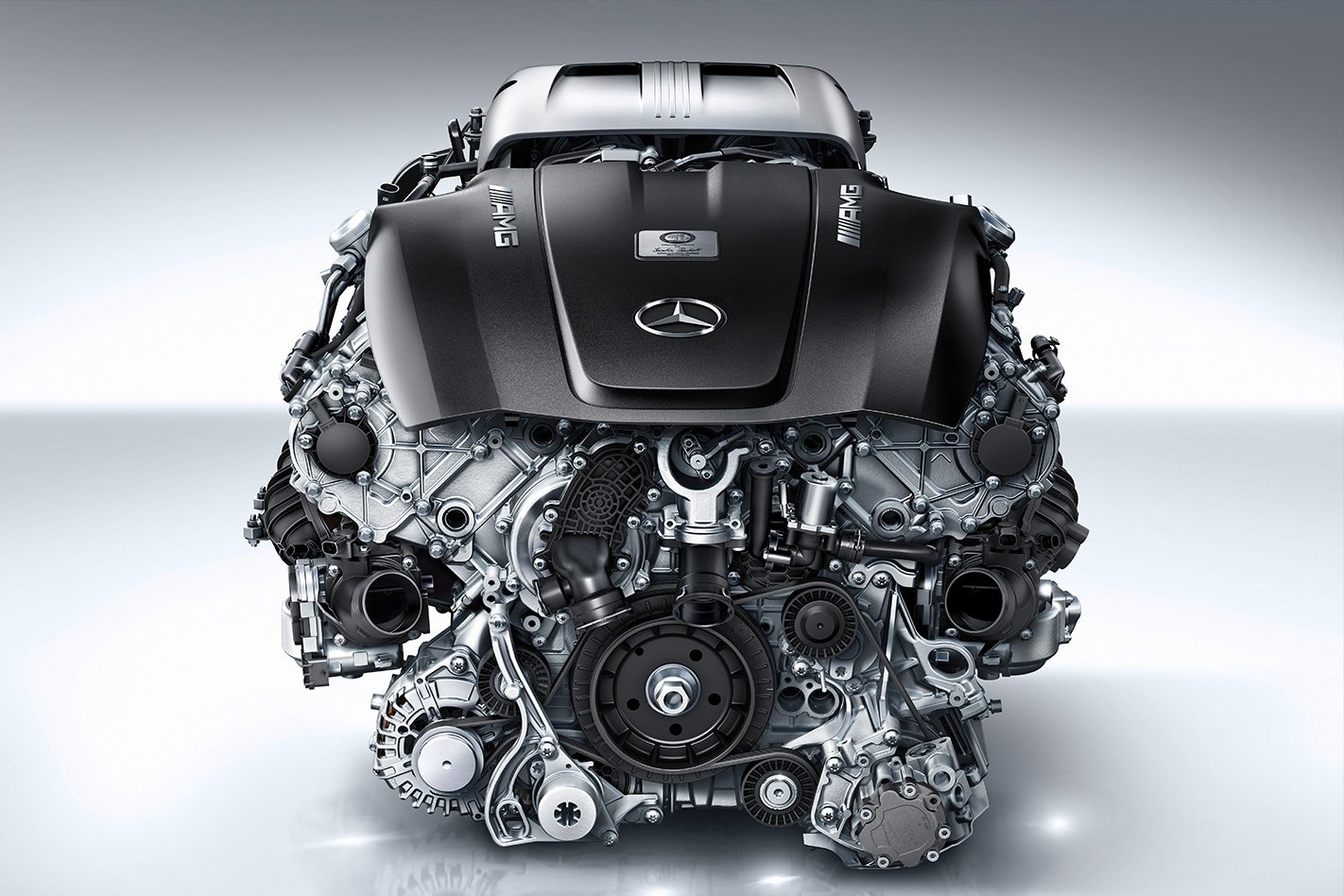
Codenamed M177 and M178 depending on its application, the tech-laden V8 was Merc’s answer to tightening emissions laws and the need for better fuel economy. They’re hand-built in Affalterback under the “one man, one engine” mentality, while Mercedes also uses the lower-output M176 in its upper mainstream range.
AMG’s 4.0-litre unit is essentially a development of the 2.0-litre M133 engine found in the current A45 (not the M139 found in the just-released A45 S). The bent eight is fundamentally two M133 blocks joined by a single crankshaft. Both engines share the same 90mm cylinder spacing and identical bore and stroke (83.0 x 92.0mm). The compression ratio has been increased to 10.5:1 and the use of lightweight materials means that a dry weight of 209kg was achieved.
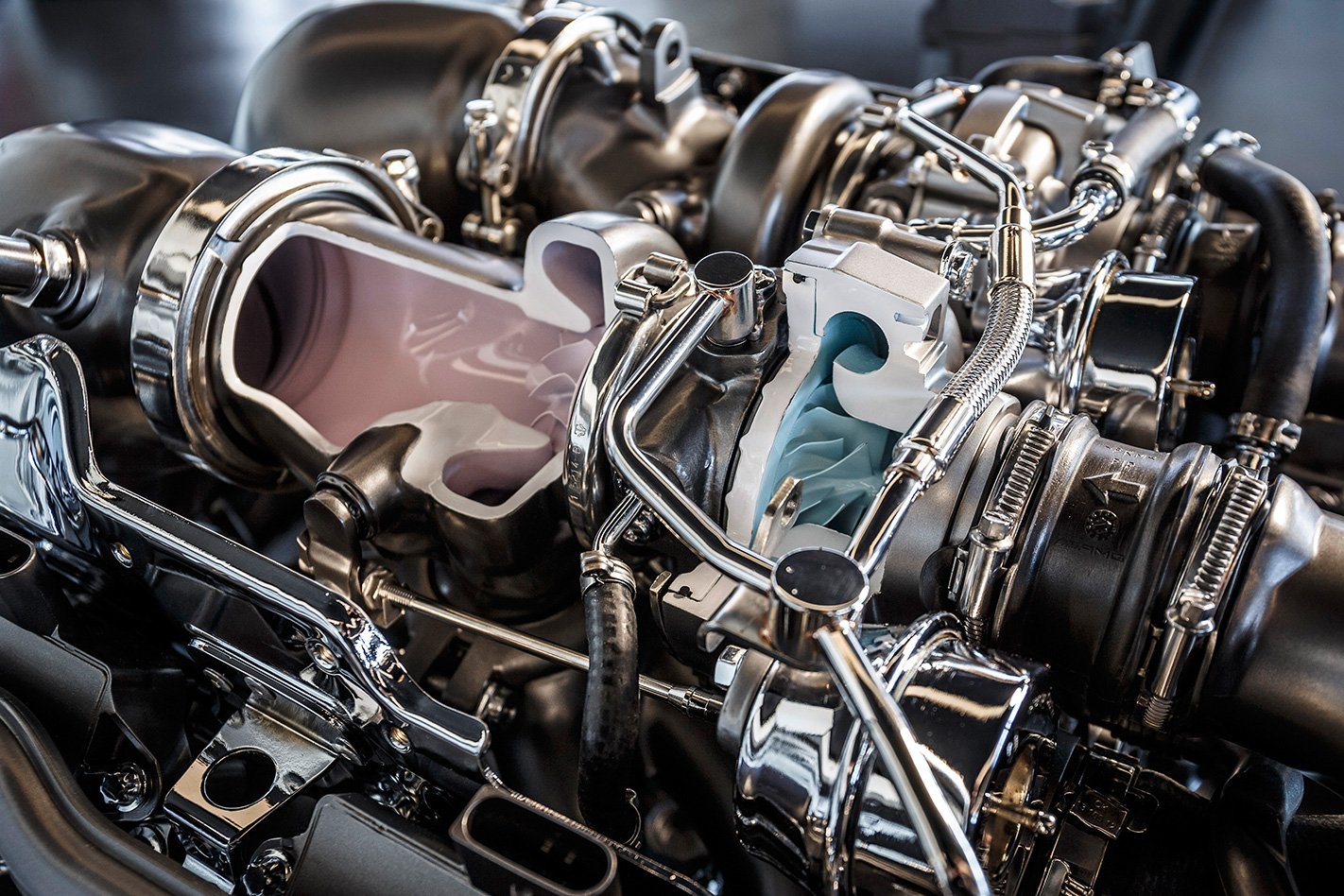
However, the biggest talking point upon its 2014 release was the ‘hot vee’ configuration for both the BorgWarner turbos (the M178 gains twin-scroll units and a different exhaust manifold). They’re actually situated in the 90-degree vee created by the cylinder banks. Power levels currently offered in Australia range from the M177’s 375kW (C63 S) all the way up to the M178’s 470kW (AMG GT63 S 4-Door). Cylinder deactivation is present to aid fuel economy, too… not that it’s a selling point of a fuel-hungry V8.
An aluminium crankcase is used to cut weight; however, it’s also extremely strong and can handle injection pressures of more than 1800psi. Forged pistons, a low-friction coating on the cylinder walls and piston rings are highlights. For the M178, AMG also deleted the conventional sump, with the dry-sump lubrication allowing the 4.0-litre to sit lower in the engine bay.
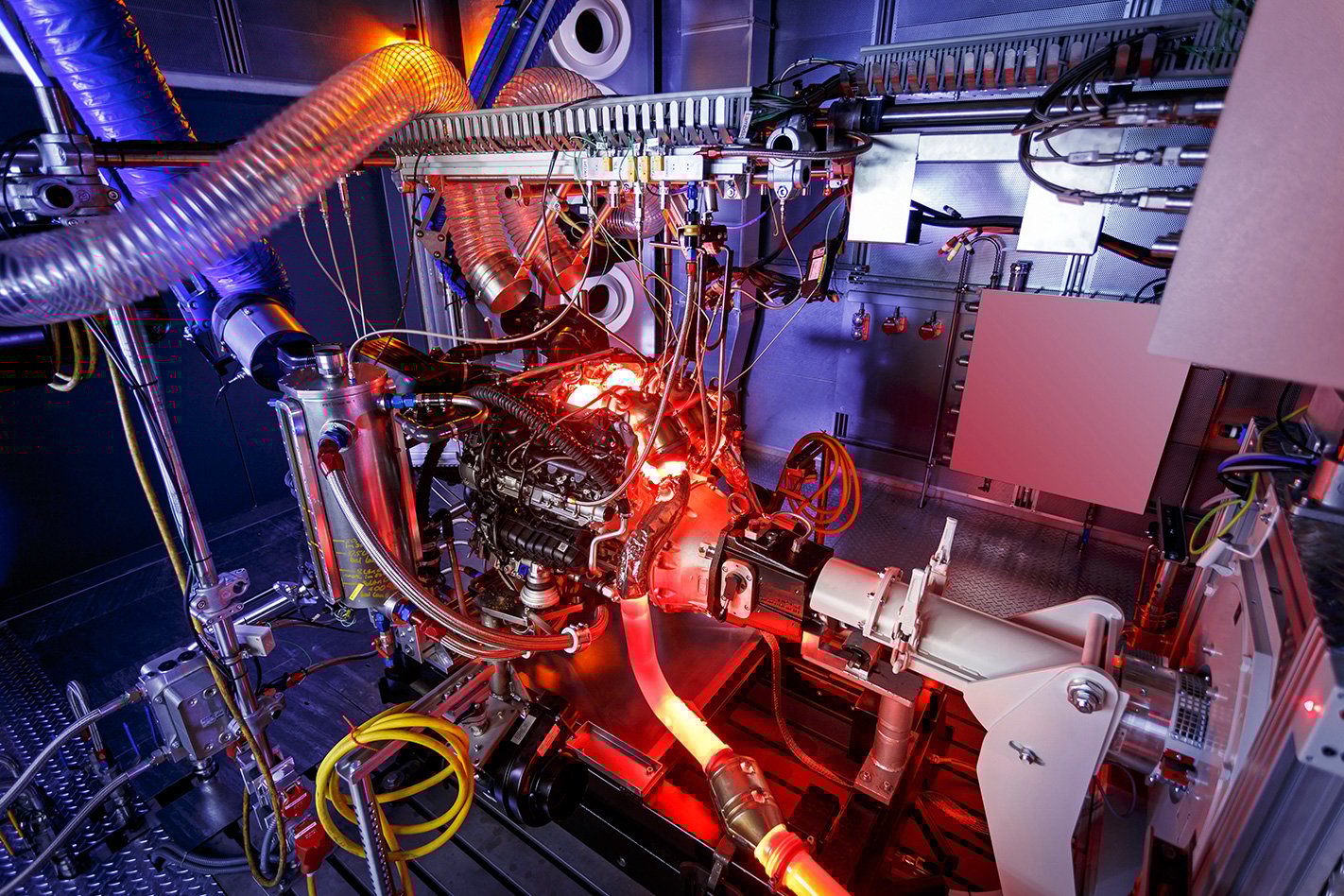
The one thing most fans were worried about is the sound. Yet, AMG proved its doubters wrong. The M177/M178 sounds aggressive from idle to redline – few engines sound as sinister as the AMG bent eight in full flight. Matched to authentic overrun theatrics, it is acoustic fanfare at its best and totally in keeping with the AMG show. Subtlety isn’t the aim of the game.
Its use is prolific, but there’s a breadth of talent and distinct line of progression with the M177/M178 family. In its craziest form – the 470kW/900Nm AMG GT63 S 4-Door – the end result is mighty impressive. History proves the German skunkworks didn’t fail to deliver. Actually, quite the opposite is true.
Manufacturer | Mercedes-AMGu00a0 |
Production | 2014-present |
Configuration | 90u00b0 V8 |
Bore x Stroke | 83.0 x 92.0mm |
Displacement | 3982cc |
Valvetrain | DOHC four valves per cylinder |
Power | 470kW (AMG GT63 S 4-Door) |
Torque | 900Nm (AMG GT63 S 4-Door)u00a0 |
Click here to read more Wheels features on Great V8s .
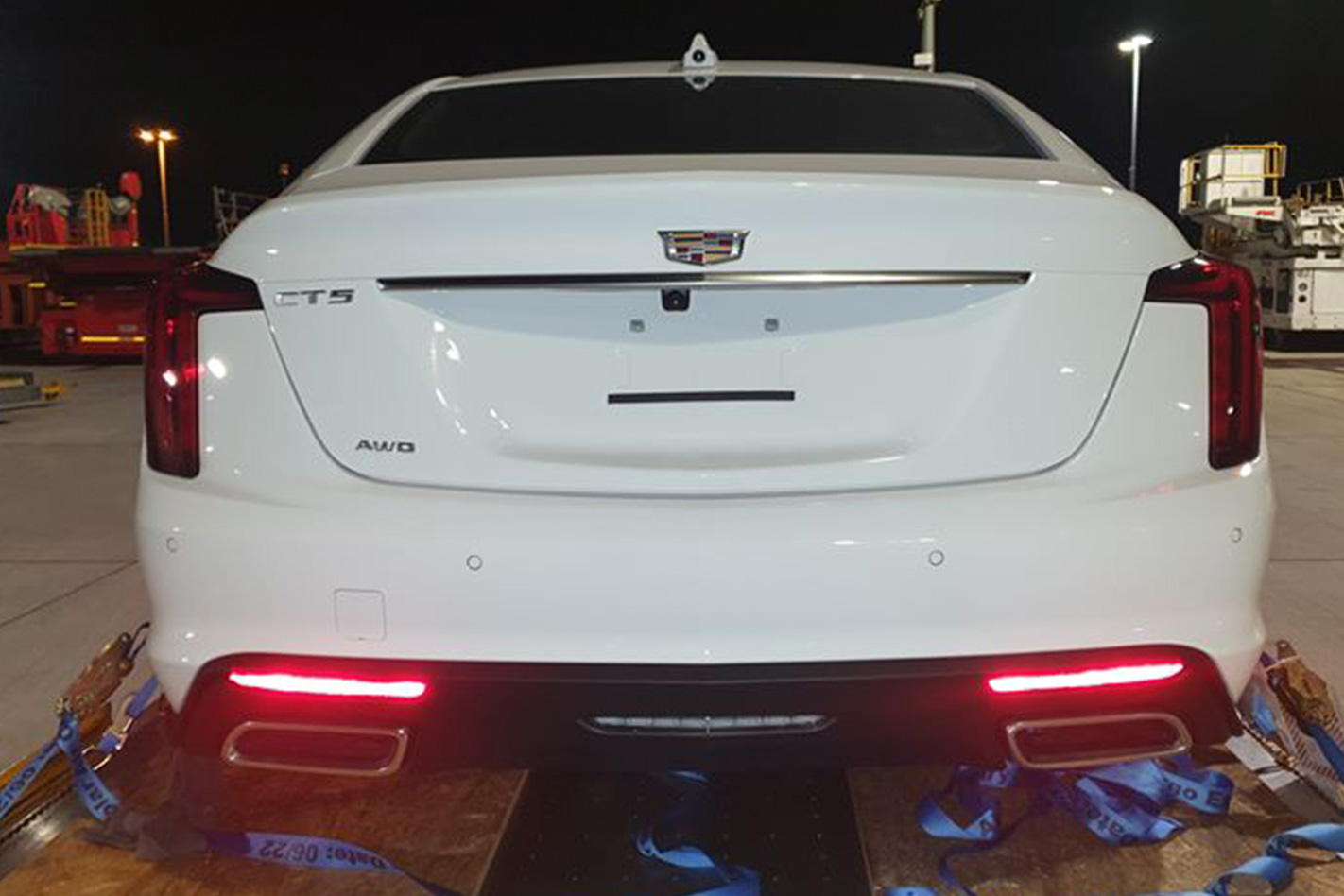
General Motors’ all-new Cadillac CT5 sedan has touched down in Australia in production trim, not wearing any camouflage and previewing a potential replacement for the Holden Commodore.
This particular model, spotted fresh off the plane from the US in Melbourne, is the CT5 Premium Luxury AWD, recently announced in General Motors’ home market to start at $41,690 USD and available in either a rear- or all-wheel-drive layout.
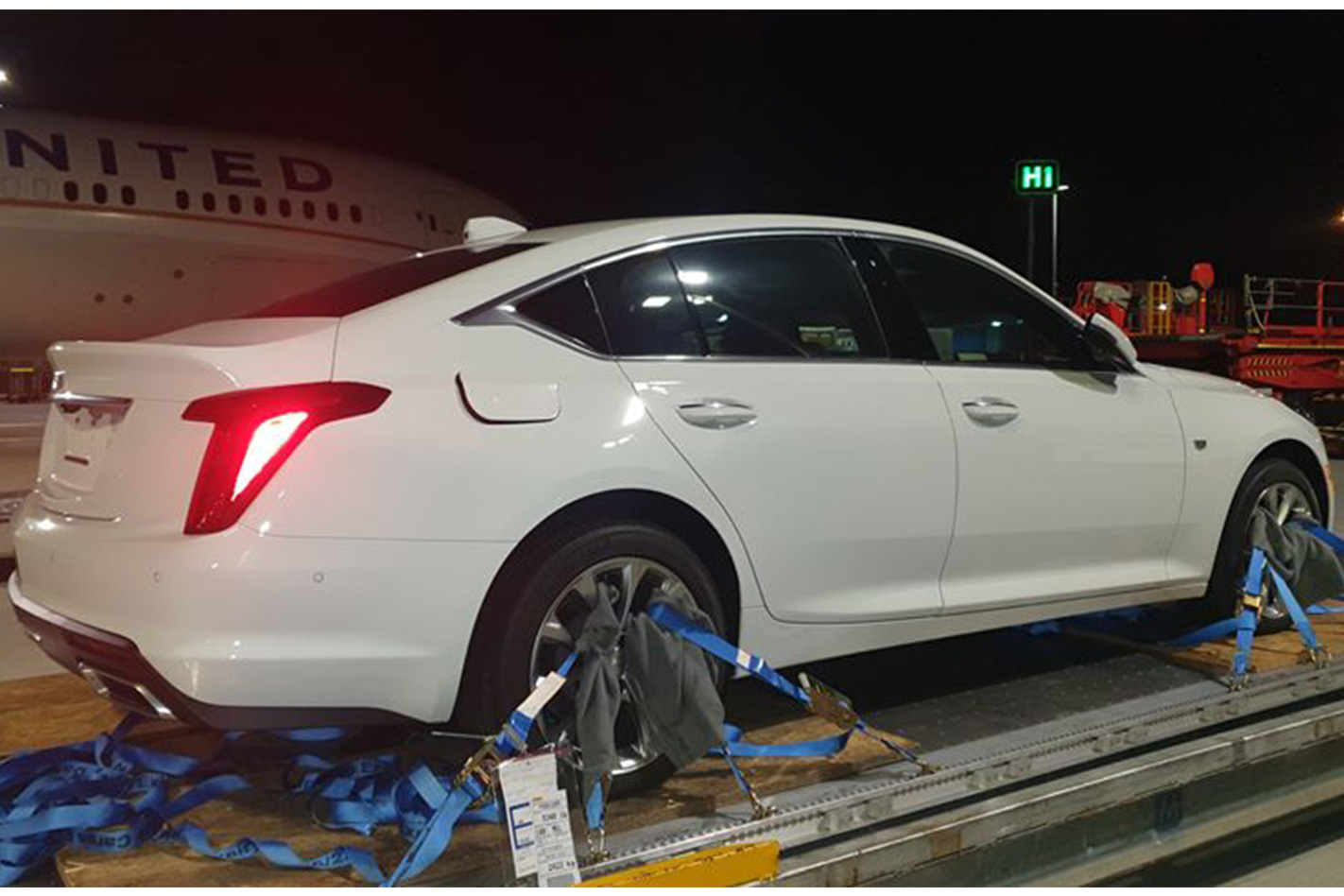
With Holden’s replacement for the German-sourced Commodore in question after PSA Group’s purchase of GM’s operations in Europe, Cadillac seems a logical replacement for the rebadged Opel Insignia. The US maker planned to introduce the marque here in 2008, but pulled out at the eleventh hour when the global financial crisis hit.
Holden has since been testing the mid-size Cadillac sedan near its Lang Lang proving ground in Victoria. This particular model is likely to join the test fleet for engineering purposes and was quickly whisked away to a garage after being spotted – we reached out to Holden for comment but a spokesperson could only add that, “Holden is regularly involved in emissions and transmission calibration work on a variety of models from the GM portfolio”.
Although GM has not confirmed if it will introduce Cadillac to the Australian market, executives have suggested to Wheels numerous times that it is a matter of when, not if.
“It’s up to Dave [Buttner, Holden Director] but we’re certainly capable of doing that [introducing Cadillac to Australia],” General Motors product development boss Mark Reuss told us late last year, adding: “It could be an opportunity for us.”
“Right-hand drive is a key requirement to be a high-profile brand in Europe and you simply cannot do that if you don’t enter the UK market,” Cadillac president Johan de Nysschen told us in 2017.
“Once you’ve entered the UK market, well obviously you’ve just unlocked the first big hurdle to entry into some of the right-hand-drive markets; Japan, Australia, South Africa,”
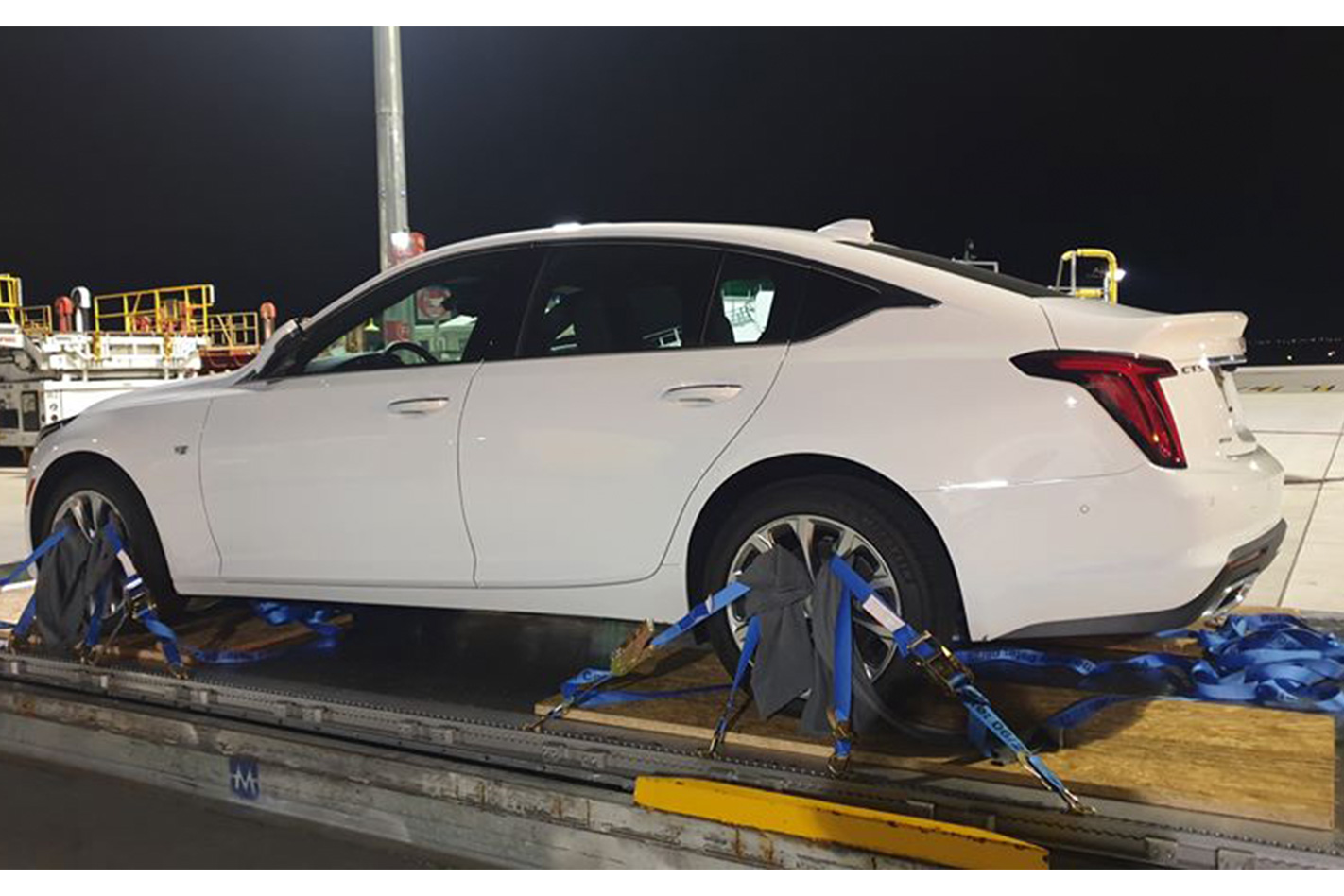
The CT5 is replacement for the previous CTS, available in a base grade Luxury trim starting at under $40,000 USD and equipped with a 177kW 2.0-litre four-cylinder turbo mated to a 10-speed automatic transmission driving the rear wheels. Pricing goes up to $41,690 for the rear-drive Premium Luxury and $44,780 with AWD.
Also on offer is a more powerful 3.0-litre twin-turbo V6 that develops 250kW or 265kW of power and 542Nm of torque in CT5-V guise, a ripe replacement for the Commodore’s sportiest atmo 3.6-litre V6 that makes 235kW and 381Nm.
Holden will likely have to find a replacement for the Commodore or face the end of the line for the nameplate after 2021, when PSA is tipped to move the Insignia onto its own platform.
It’s becoming more and more common for people to flash their smartphone to pay for items, but using a digital wallet at a drive-thru café or restaurant could cost you a lot more than the price of a latte and muffin.
Like carparks, drive-thrus are considered public thoroughfares where traffic rules apply, so handling a mobile phone to pay for goods while in control of a vehicle can be very expensive.
Responding to a question on its Facebook page about drive-thru digital payments, Victoria Police warned that drivers can be slugged $484 fine and four demerit points for using their phones at a food service window.
It advises anyone wanting to use their mobile phone to make a payment to “apply the hand brake, switch the engine off and then access your mobile phone”.

“In doing so, you are not considered driving.”
Victoria Police didn’t respond to the dozens of comments asking how holding your phone up to a drive-thru window is less safe than rummaging around for a purse or wallet and pulling out cash or a credit card.
Digital driver licence
News South Wales has similar laws pertaining to using mobile phones while driving that can cost fully licenced drivers $344 and five demerit points, with harsher penalties for L and P-plate drivers.
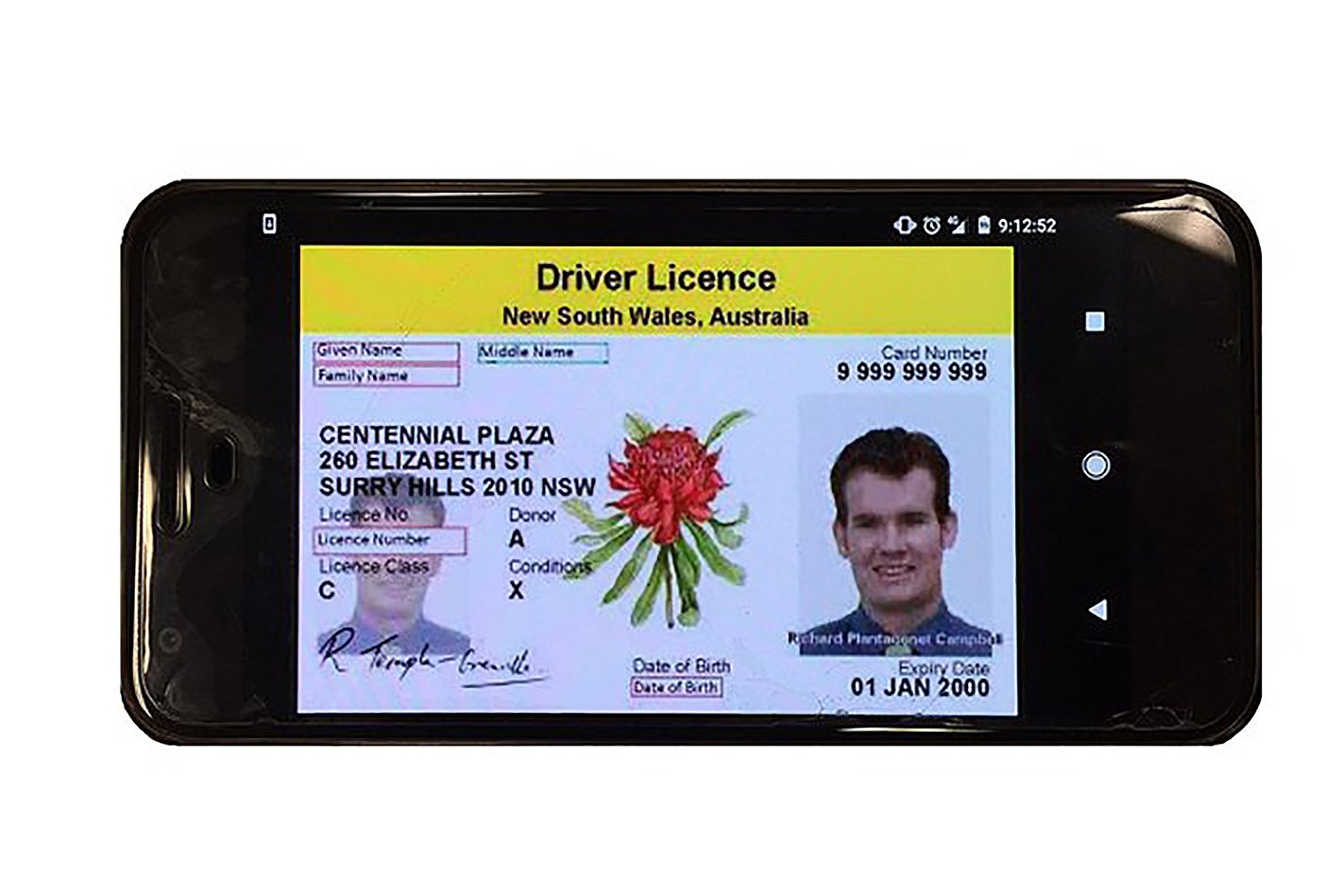
So what happens if you’re pulled over by a traffic cop and dutifully pull out the iPhone to show your licence?
Well, you could be liable for an additional fine on top of any infringement that led to the copper wanting to see your licence in the first place.
Section 61C of the the NSW Road Transport and other Legislation Amendment (Digital Driver Licences and Photo Cards) Bill 2018 states: “The holder of a digital driver licence does not commit an offence under this or any other Act or law arising from the holder’s use of a mobile phone or other electronic device for the purpose of displaying the holder’s digital driver licence in response to a request to do so by a police officer or other person authorised to require the production of a driver licence.”
In other words, you can only use your mobile phone to open your digital driver licence after being requested to do so by a police officer. It’s illegal to touch your phone before the police officer instructs you to do so.
South Australia Police offers a more cautious approach, with a spokesperson telling WhichCar: “Regardless of how you are using a mobile phone, of which holding one is considered use, you must have your vehicle in a condition in which it is not able to move by itself. SA Police recommend that the vehicle is out of gear with the handbrake on, and parked in a safe location and switched off before using the mobile device.”
On the the subject of digital wallet drive-thru payments, the South Australian and NSW approaches are in line with Victoria’s.
“Let’s make some damn Falcons,” is the call to arms decreed by the creator of a Facebook event called ‘Storm the Old Ford Factory and Restart AU Falcon Production.’
It started as a joke, but now it seems the event is set to become at least something, given it has more than 8600 people who have clicked ‘attend’, and over 20,000 who are ‘interested’.

Hosted by a meme page called Succulent Chinese Memes (after a viral video of the arrest of a man charged with not paying for a “succulent Chinese meal”), the event’s focus on the AU Falcon doesn’t seem to have come from nowhere.
Ford’s most divisive model features regularly on the page, and we’ve contacted the admin to see if there’s any real connection… or if it’s all just for laughs.
“To be honest when I first made the event, it was just a bit of a laugh,” the admin for the page (who goes by ‘Blake’) told us.
“I figured it might get a little bit of attention and be forgotten about. But before I knew it nearly 30k people responded to it.”
It also seems event ‘attendees’ are attempting to organise a meetup of AU Falcons on the day of the event – September 14 – at Ford’s Broadmeadows plant, though whether it will be able to go ahead is up to Ford’s policy for groups of public cars being parked outside its building.
“There seems to be a running theme in the comments of holding an ‘AU muster’ there on the day,” Blake says.
“So now I’m thinking seriously about heading down there on the day to hold said AU gathering. There seems to be a lot of interest in it.”
We’ve contacted Ford Australia to find out what might happen if a few dozen AU Falcons do actually show up on a Saturday and are awaiting an official response.
Plans to construct a second circuit at the famed Mount Panorama have moved a step closer with the Bathurst Regional Council (BRC) providing another look at the proposed track layout.
Fresh images show the anticipated new motorsport facility, located in a valley south-west of McPhillamy Park, which is set to be built on a 200-hectare site containing undulating topography.
UK firm Apex Circuit Design has been appointed to create and build a 4.5km track to FIA Grade 2 and FIM Grade A specification. The layout will also include two additional configurations including a National Circuit (around 3km) and a Club Circuit (around 2km).
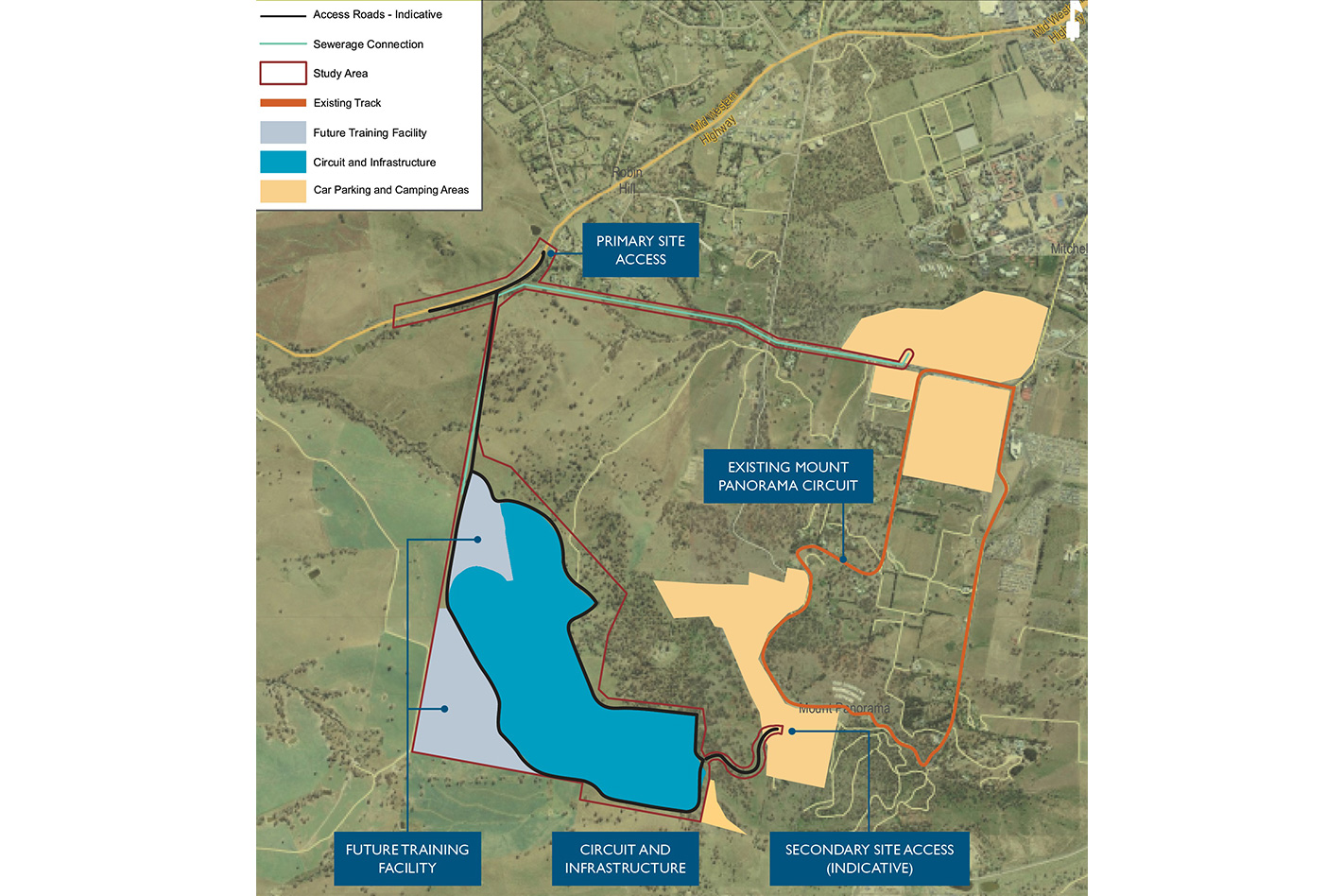
The facility will complement the existing 6.2km Bathurst track and, according to a BRC document, is being considered as a State Significant development. With only a limited number of full-track closures allowed each year, a second track would permit more events and could be used year-round.
The main straight of the main 4.5km track includes a non-competition drag strip down the front straight, while a 1.26km rallycross track capable of hosting FIA World Rallycross Championship is also planned for the site.
The motorsport complex will also include a primary pit building and paddock, track-safety structures, spectator zones, and a helipad. A hotel and driver training centre have also been proposed as future developments.
An Environmental Impact Statement (EIS) is being prepared to assess potential environmental impact and to provide mitigation measures. It is expected to be available for public viewing and feedback later in the year.
According to the BRC, construction of the site is likely start in early 2021 with a projected build time of 18 to 24 months. It’s believed that more than half the rumoured $52m needed for the facility has been raised via the state and federal government, with the BRC continuing negotiations to account for the current shortfall.
What do you think? Would you attend an event at Bathurst that isn’t held on the traditional Mount Panorama circuit?
Hi WhichCar,
My kid is finishing high school this year and they’ve done a really good job. My hubby says we should buy their first car but I wonder if it isn’t a better life lesson to get them to buy their own? He argues that less money means a less safe/suitable car – what does the WhichCar team think?
Leone,
Camden, NSW
Hi Leonie,
Great question! The next batch of Year 12 grads are very much nearing the end of the school year, and their minds are surely turning towards things like uni, jobs and gap years.
Minds are also turning towards first cars, and we should be helping them to find – above all else – the very safest set of wheels that it’s possible to get, whatever the size of the budget.
It’s a great time to actually assess what kind of car is going to suit your younger driver, too. Is it just for a short run between uni and home? Will it be parked at a station for long periods? Is there some country miles on the horizon with new jobs, friends and adventures?
It all needs to go into the decision pot, whoever is paying the bill.

The same discussion about who should fund it rages on here – and I’m on your side, even though the game has changed a lot when it comes to accessing cheap cars for new drivers.
Everyone’s parental styles differ, and I’d suggest that it’s probably easier for our generation to fund the purchase of a car for your kids.
Virtually every financial expert I polled about whether a parent should buy their kids a car, though, said the same thing – if you do, then you aren’t teaching him or her a thing about financial responsibility. “It’s financial abuse!” proclaimed one prominent (if slightly sensationalist) commentator.
Listen to Tim Robson’s radio interview on buying kids their first cars
While I wouldn’t go quite that far, the act of saving for and buying a car is a terrific life lesson in real-world economics, isn’t it? Budgeting to put money aside for rego and insurance, learning about preventative maintenance, dealing with things when funds are tight… it really gives youngsters a valuable snapshot into dealing with their finances in the real world.
Besides, handing over a brand new car to a debutant driver doesn’t sound particularly clever on a number of fronts. For starters, the inevitable parking dings and day-to-day scrapes are easier to bear on a $5000 beater than a $30,000 freshie.
And its new owner may – if the lounge, TV, bathrooms and kitchen appliances in our house are anything to go by – not be as discerning or careful about something he/she hasn’t paid for.
Encouraging our young ’uns to aim at a financial goal is a smart thing, and a lot of our friends have various schemes in place – dollar for dollar matching, for example, or guaranteed help with first-year expenses – to incentivise their young charges to keep up the good fight when it comes to saving for a set of wheels.
Of course, it’s still about having money to start with and, depending upon where you live, the car may need to come before the job in order to become mobile at all, so the Parental Credit Union might need to come to the rescue in the first instance.
As for the car itself, there is a FAR bigger pool of machinery to pick from now than there was we were younger, and they are, as a rule, a lot safer as well.
Buying a new car for your teenager will, of course, guarantee that your progeny is driving something that has stability and traction control at a minimum, a decent number of new airbags and more high-strength steel in its construction than something that’s older and cheaper.
Having said that, stability control (to look at one safety system) has been compulsory for Australian-delivered cars since 2013, and there is any number of examples of cheap machinery with more than basic safety on offer. Big caveat here, though; make sure the car has been cleared for any and all Takata airbag recalls.
One hurdle we had to climb over with our car-mad son was the fact he wasn’t going to find a mint Mazda MX-5 with $5000! Keeping expectations in check is not a terrible idea, lest they come home with something that will cost more than the car’s worth to repair.
Overall, our advice is to leave your kid to find the desire and the discipline to want to save for a car, and if you can incentivise and encourage, that’s a great thing.
The brand new compact SUV in the driveway with a giant bow on it might be a short-term joy, but it may not help your youngster learn the realities – and the responsibilities – of car ownership in the long run.
It’s dangerously misleading to refer to any electric vehicle as being “entry level” these days. Let’s face it: batteries are made of expensive raw materials, and putting a gigantic battery inside a car will result in a huge pricetag, regardless of whether the base vehicle itself was cheap to begin with.
So be prepared for some sticker shock when lining up any EV against a comparably-sized, comparably-equipped, combustion-engined equivalent. However, what if you’ve already got your sights set on something electric, along with the approval of your bank manager? We take a look at two of the more affordable EVs currently on the market – one each from the mainstream and premium segments – and see how they fare.
HOW AFFORDABLE ARE THEY?
Hyundai IONIQ Electric Premium
The Hyundai IONIQ Electric Premium retails for $48,990, making it one of the most expensive non-premium small cars on the market and more costly than many small cars from more luxurious marques. Like we said, that all-electric capability doesn’t come cheaply – even in a Hyundai.
Granted, there is a more affordable option – the $44,990 IONIQ Electric Elite – but we didn’t have one on hand to test against the i3. Even so, the extra spend for the Premium is at least balanced out by the addition of plenty of equipment, which we’ll detail in the next segment.
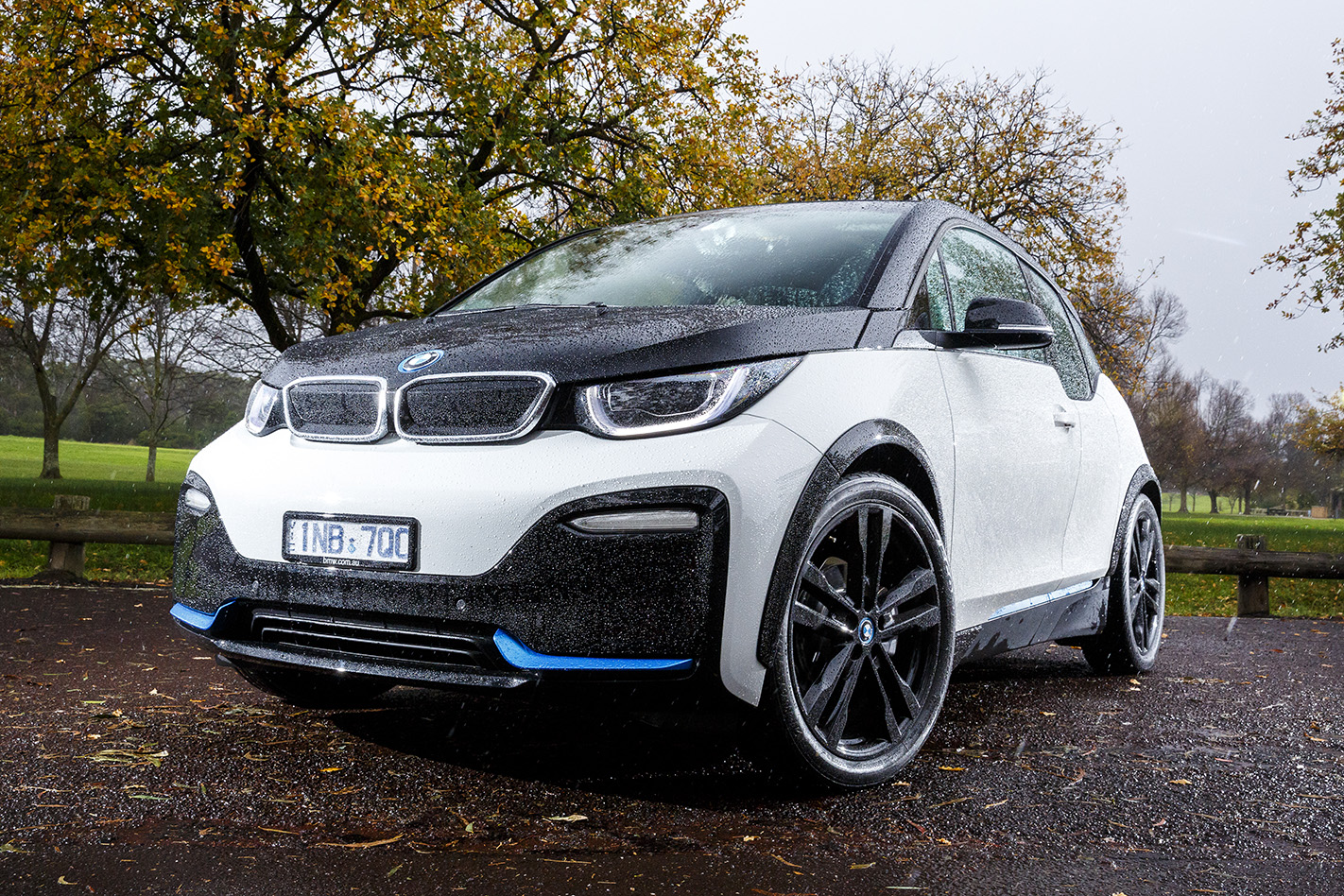
BMW i3s
As befits its more premium posture and German origins, the BMW i3s represents a significant step up on the IONIQ. Retailing at $69,900 (with our tester optioned up to a hefty $76,200), the i3s we have here is, like the IONIQ it faces, the more expensive variant in its range – though not by much. The slightly less powerful (by just 10kW and 20Nm) regular BMW i3 is only $1200 cheaper, meaning it’ll still require 3 Series money to put one in your driveway.
Significantly more expensive than the IONIQ, but you do gain plenty of badge cachet, attention-getting exterior and interior design, a bigger battery (more on that later), and a carbon-fibre chassis that’s a lot more advanced than what the IONIQ uses.
WHAT FEATURES DO THEY HAVE?
Hyundai IONIQ Electric Premium
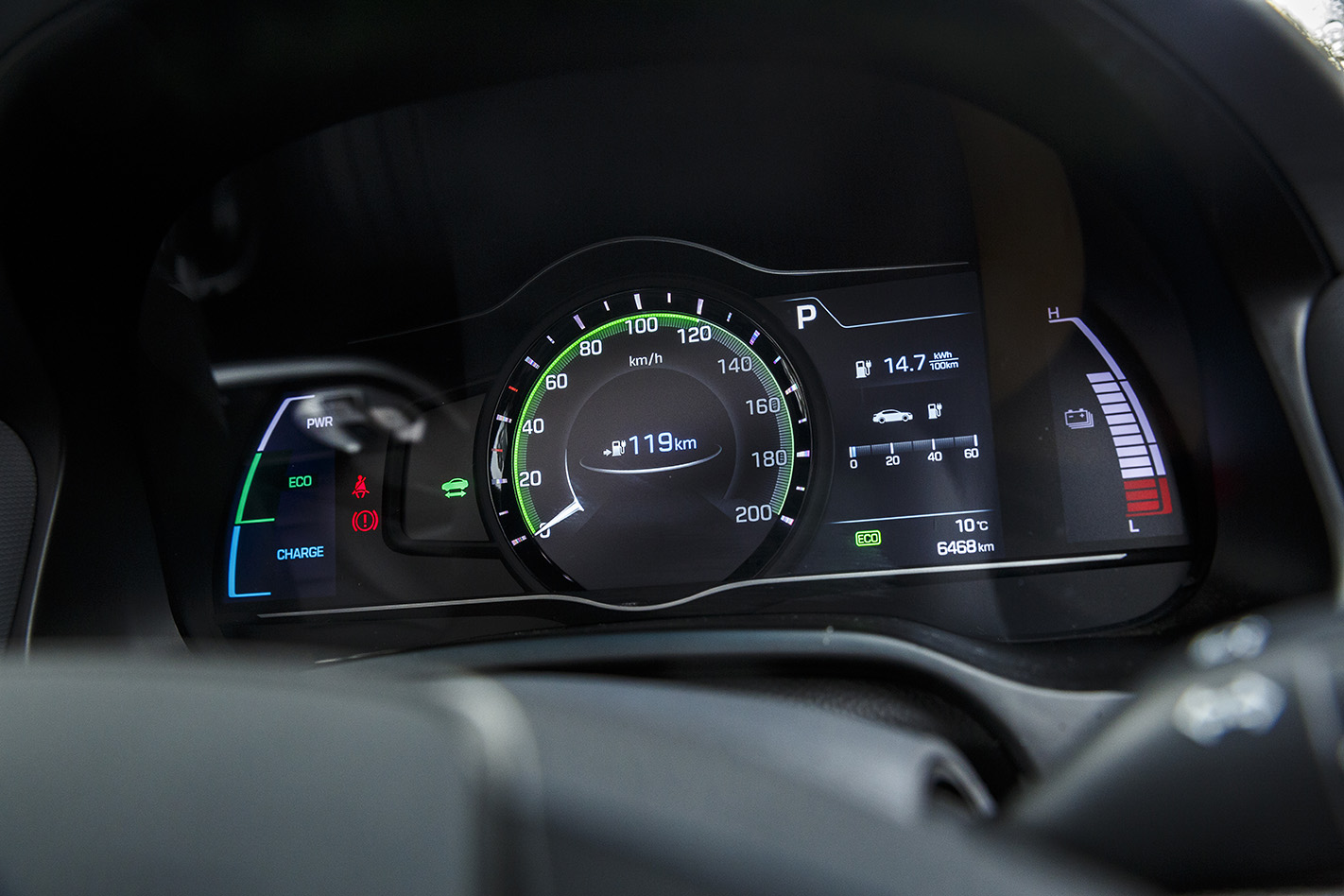
The IONIQ is certainly feature-rich, especially so in Electric Premium trim. Most should want for nothing, with the Premium scoring nice-to-haves like a wireless phone charger, heated and ventilated front seats, a power-adjustable driver’s seat, leather upholstery, glass sunroof, auto up/down windows, LED headlamps and a heated steering wheel.
The infotainment system does look dated, though standard provision of Android Auto and Apple CarPlay smartphone mirroring does get around that. A wireless phone charger in the centre console is also a nice touch, and there are plenty of easily-navigated buttons on the steering wheel to give you control.
BMW i3s
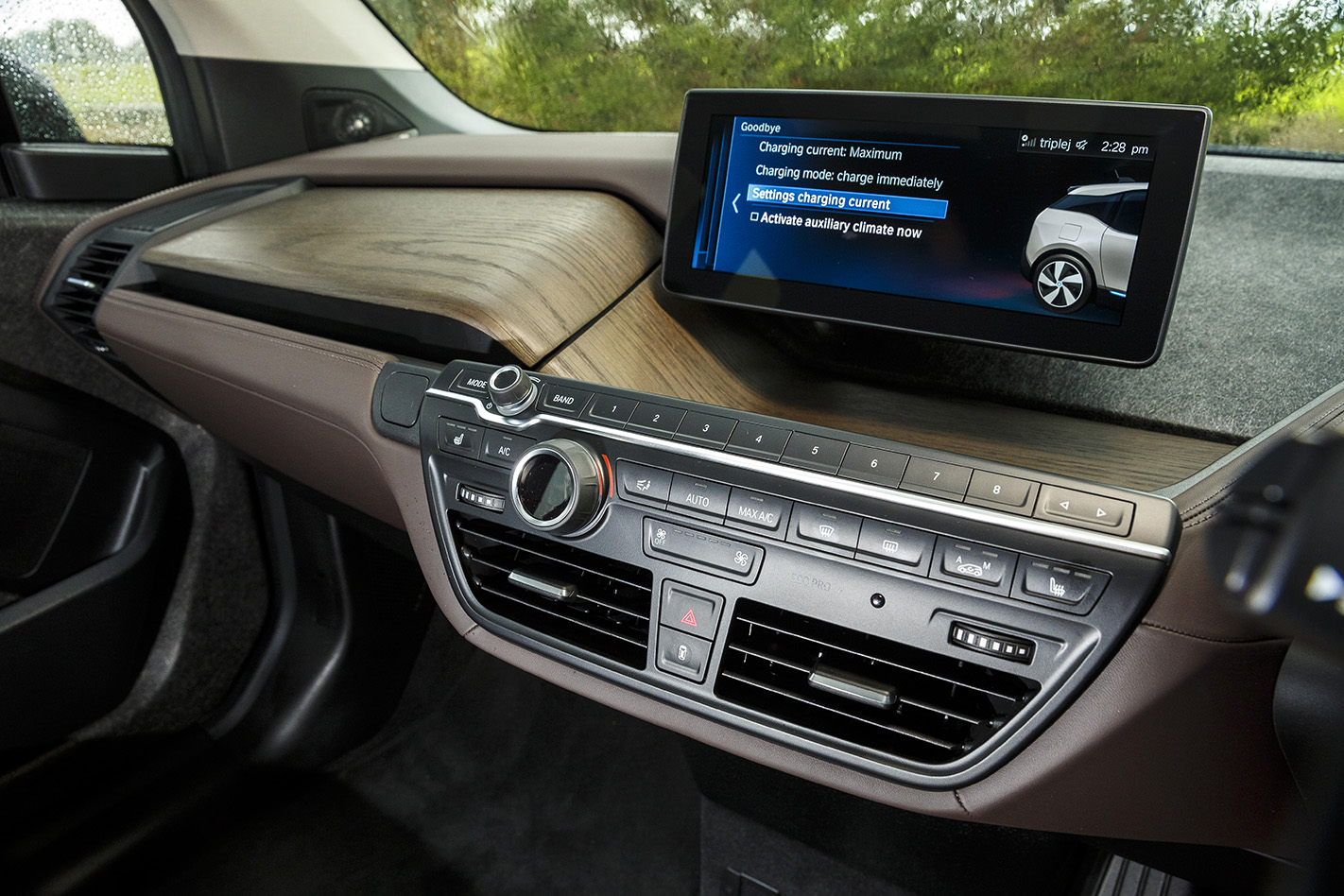
Being a premium car, the i3s naturally has a pretty fat standard equipment list. That said, there’s a lot of overlap in terms of what it offers versus the Hyundai IONIQ, with features like a wireless phone charger, digital radio, sat-nav infotainment (though we’ll readily admit the BMW’s big screen is far more impressive than the Hyundai’s system), LED headlamps and keyless entry/ignition being common between the two.
The BMW also only offers Apple CarPlay as a smartphone mirroring alternative, while the IONIQ provides both CarPlay and Android Auto. That said, there are more built-in connectivity options with the BMW, which brings its ConnectedDrive suite of internet-enabled services covering traffic updates, a remote concierge that can help you find places, and the ability to monitor your car remotely.
There are some shortfalls though. Heated seats are a cost option, as are a heat pump for the climate control and heat-rejecting coatings for the glass. With those items all able to help extend the range i3’s range, it seems counter-productive to leave them on the options list.
HOW PRACTICAL ARE THEY?
Hyundai IONIQ Electric Premium
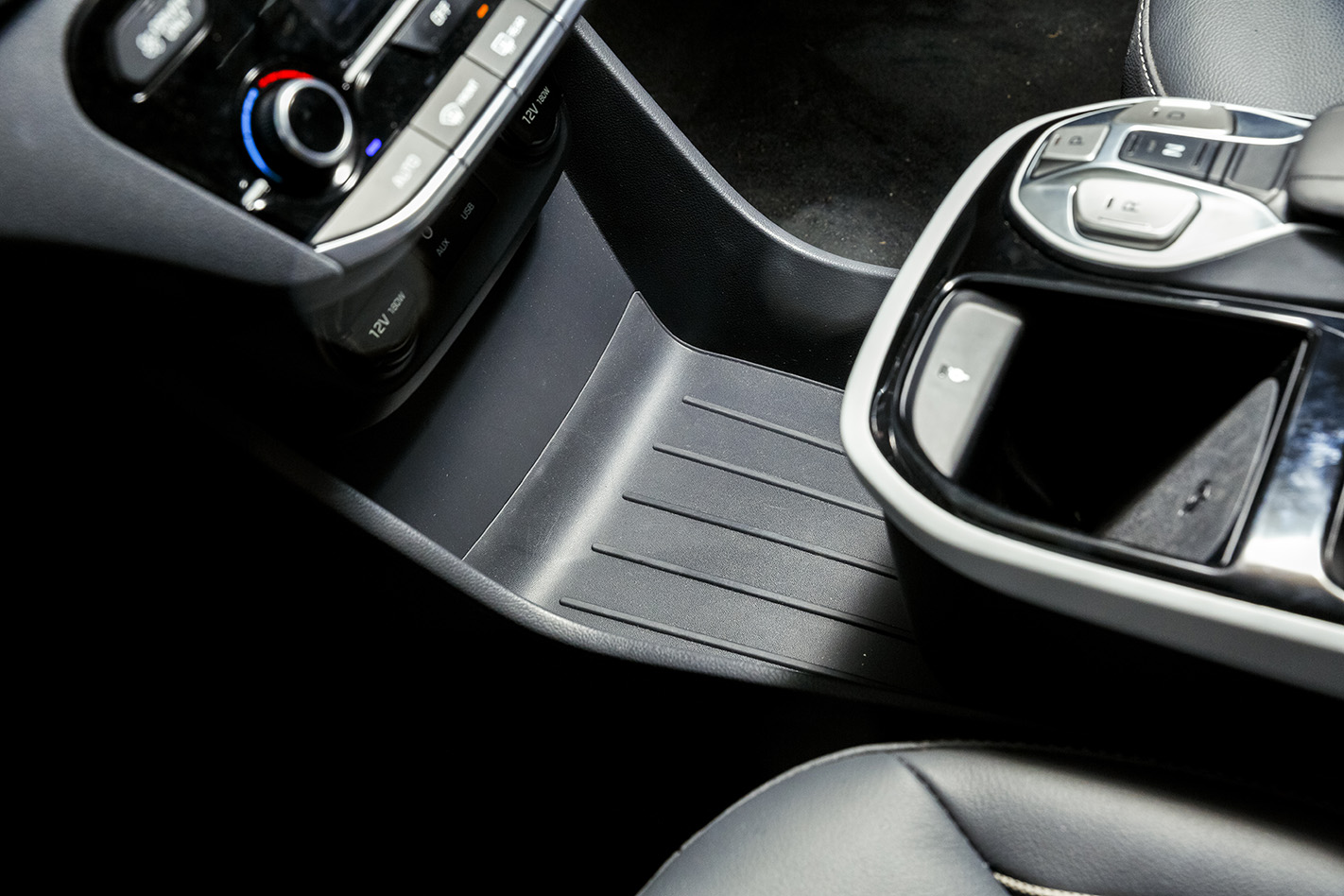
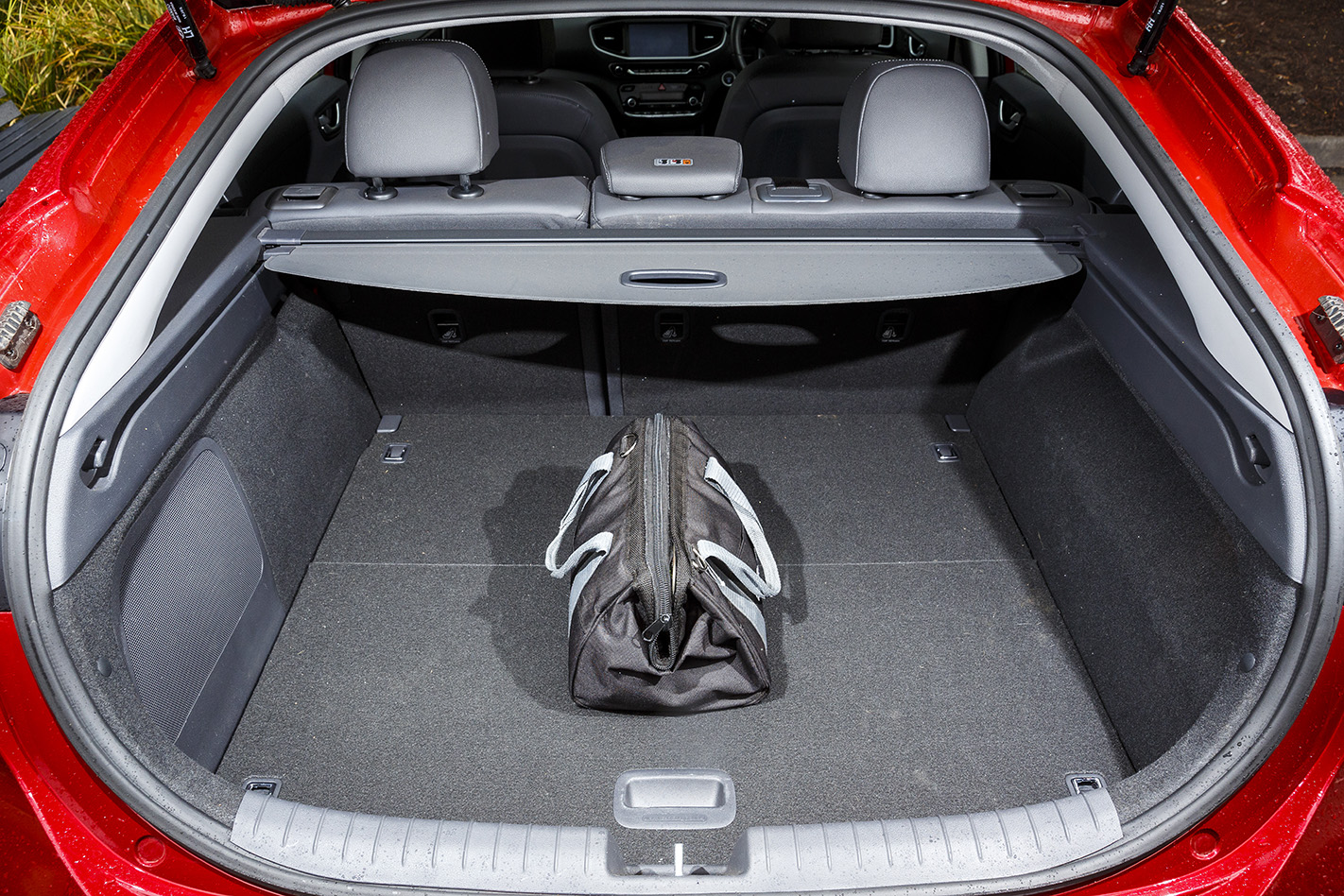
The IONIQ is, at its core, a fairly practical five-seat hatchback. The rear seats fold down to carry more cargo, the boot is more than big enough for a set of large suitcases, and its unique front console storage tray means you can just plonk small bags of groceries right next to your legs.
We had four adults sit quite comfortably in the IONIQ for a small road trip with no complaints about space, while behind them were an esky and plenty of food and outdoor gear for the day, with room to spare. There’s no additional storage under the bonnet, but the IONIQ does a great job with its more conventional packaging as it is.
BMW i3s
BMW’s battery-electric might have four doors and a hatchback, like the IONIQ, but it differs markedly in its size and packaging, with a tall cabin that promotes an upright posture but doesn’t work so well when it comes to carrying people and their things.
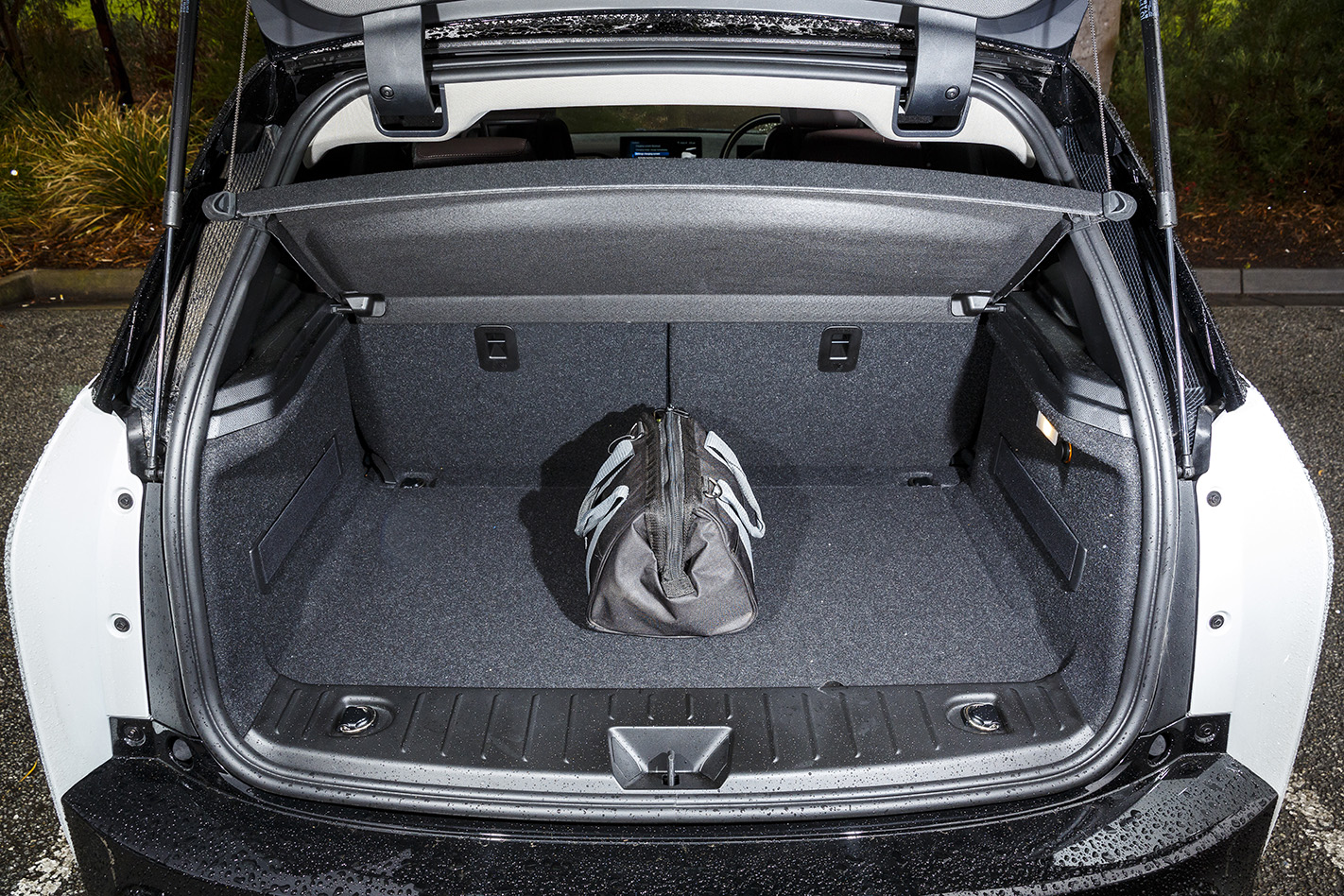
The boot is especially tiny, with a high floor thanks to the electric motor residing between the rear wheels. It’s made worse by the near-uselessness of the i3’s ‘frunk’, which is in reality a small plastic bucket under the bonnet that’s only really big enough to house the car’s charge cable, rather than the much larger and more useful area you’d find under the bonnet of a Tesla.
HOW SAFE ARE THEY?
Hyundai IONIQ Electric Premium
There’s a long list of safety equipment in the IONIQ Premium, and much of it is designed to help you avoid a crash in the first place. Things like active cruise control, autonomous emergency braking (AEB), collision warning, stability control, traction control, reversing camera, parking sensors and seven airbags are all standard, and the IONIQ earned a five-star ANCAP score in 2016.
BMW i3s
The safety fit-out in the i3 is just as healthy as that of the IONIQ, and incorporates AEB, active cruise control, pedestrian warning, collision warning, lane keep assist, a reversing camera, stability control, traction control and six airbags. Tested in 2014 by ANCAP, it earned a five-star crash safety rating.
HOW COMFORTABLE ARE THEY?
Hyundai IONIQ Electric Premium
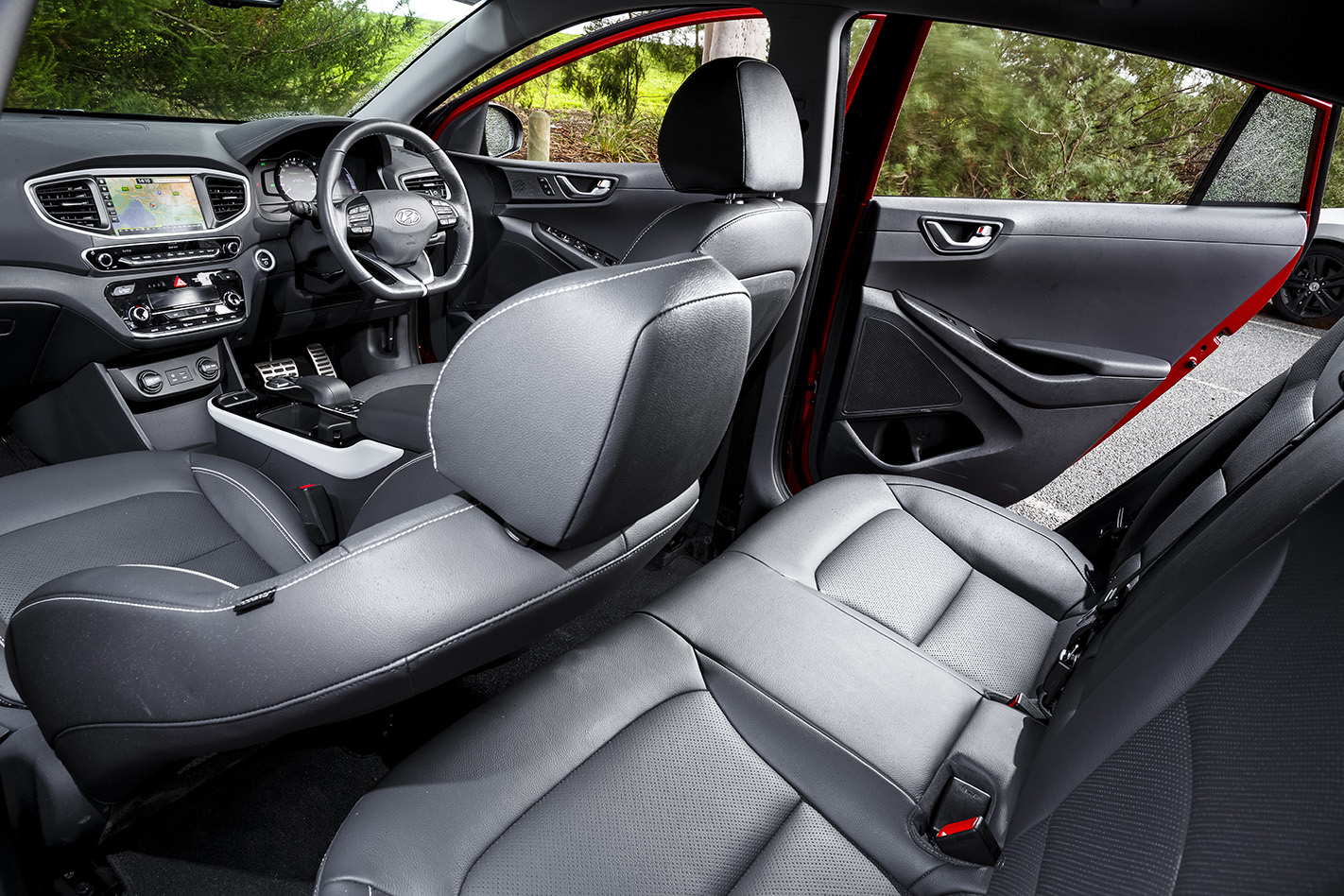
The IONIQ has a roomy cabin, with a clear, flat floor thanks to the battery being packaged entirely under the boot and rear seat. As such you sit at roughly the same height above the ground as you would in any other small sedan, and it all feels very, well, normal.
There’s room for five, but like most vehicles in its size class it’s really best enjoyed by four people at a time – or maybe two adults and three fairly compact kids. All of them, however, will find plenty of comfort and convenience to keep them happy, with rear face level air vents, plenty of 12V and USB charging ports, well-shaped and supportive seats and decent in-cabin storage for cups, bottles, maps, tablets and more.
BMW i3s
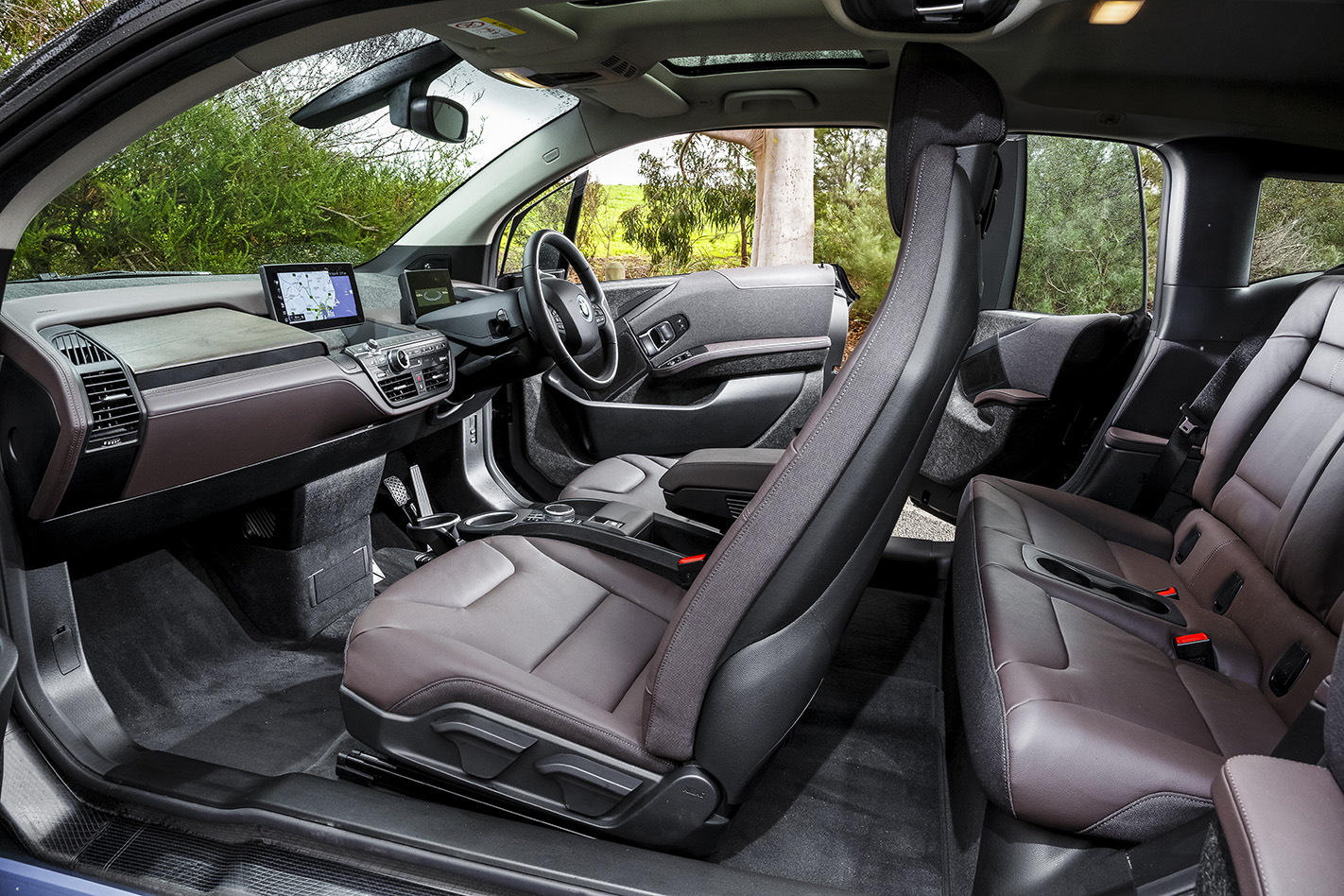
The i3 is haute couture to the IONIQ’s grey marle tracksuit in terms of design and desirability, but the analogy also stands true when it comes to comfort – the BMW sadly sacrifices practicality and convenience for head-turning visual impact.
It’s a four-seater, for starters, and the boot space is both incredibly high off the ground and incredibly small. Access to the rear seats can only be accomplished by opening the front doors first, thanks to the i3’s use of rear-hinged suicide doors, and stepping inside requires a big step up due to the very tall floor height, something necessitated by the car’s under-floor battery position.
You do, however, get a very commanding view of the road from the front seats, and the material quality and visual presentation of the i3 is easily several levels above the modest Hyundai’s dull cabin. It’s here where the i3 justifies its extra outlay, but does the sacrifice in usability cancel that out?
WHAT ARE THEY LIKE TO DRIVE?
Hyundai IONIQ Electric Premium
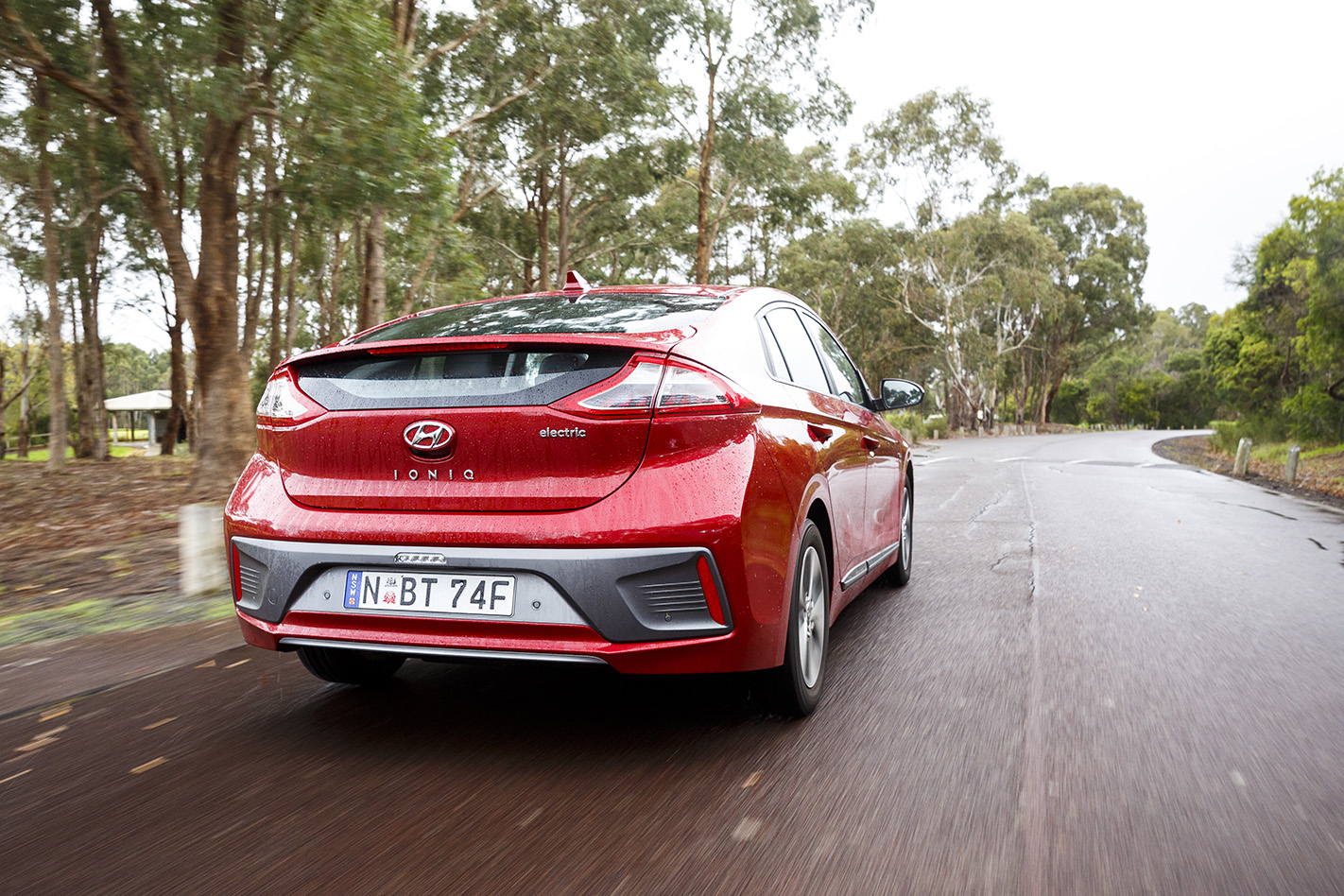
Perhaps the most intriguing aspect of the IONIQ Electric’s driving experience, is just how normal it feels. Sure, that push-button transmission selector does look a little alien, but prod ‘D’ and lift off the brake pedal and you’ll discover a car that isn’t all too dissimilar from combustion-engined small cars.
In fact, were it not for the near-silence and completely smooth nature of its electric motor, the IONIQ Electric feels very approachable and normal indeed. If anything, its huge low-end torque means it actually has a much livelier response to the driver’s foot when asked to accelerate, giving it a very brisk off-the-line step up.
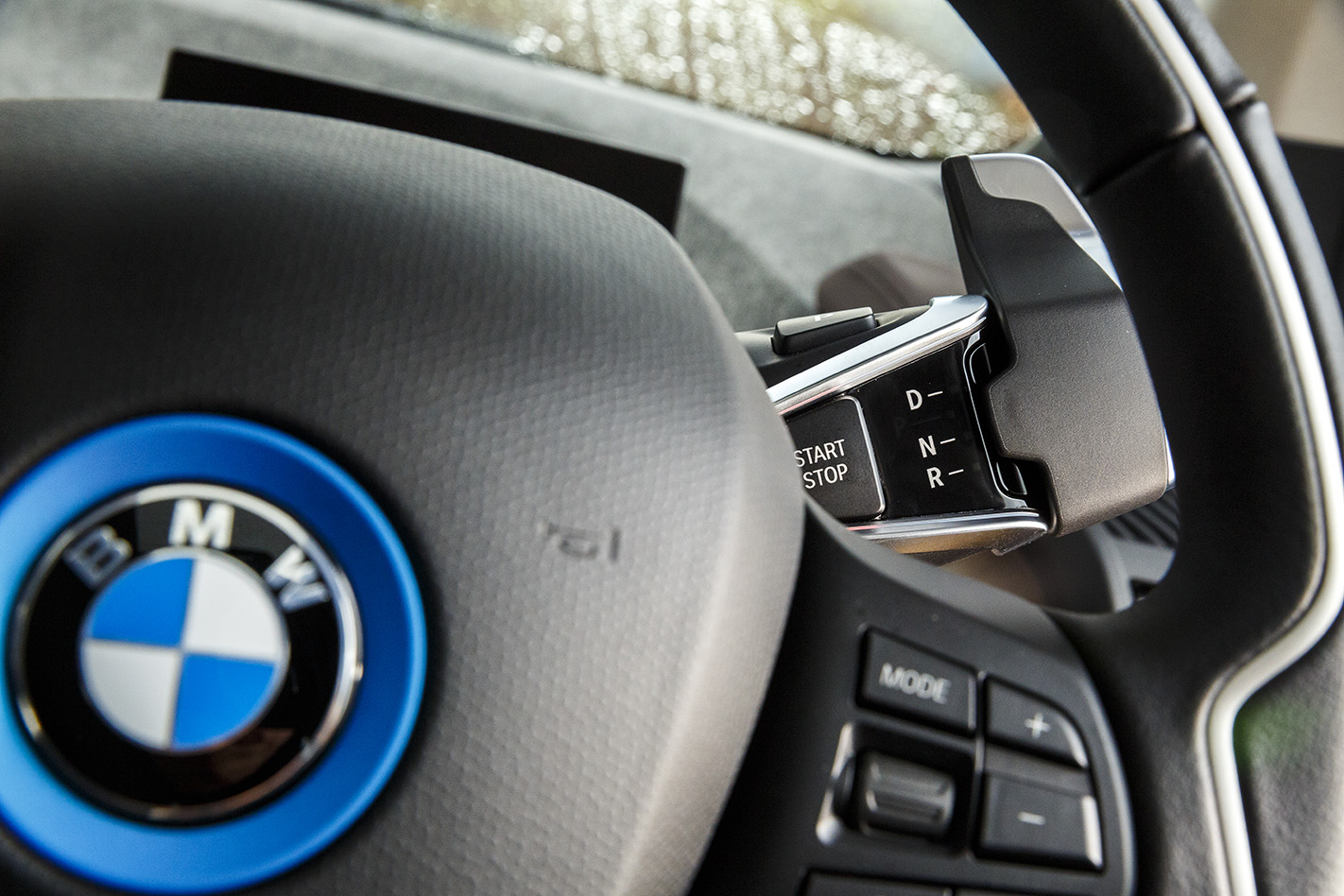
In Sport mode it’s almost too lively. The low-resistance tyres give up traction quickly, especially if the road is a little cold or damp, so take it easy with the power. The level of regenerative braking you feel when you lift off the accelerator can also be varied via the steering wheel paddles, though it can’t be driven entirely using just the accelerator pedal like the BMW i3 or Nissan Leaf can.
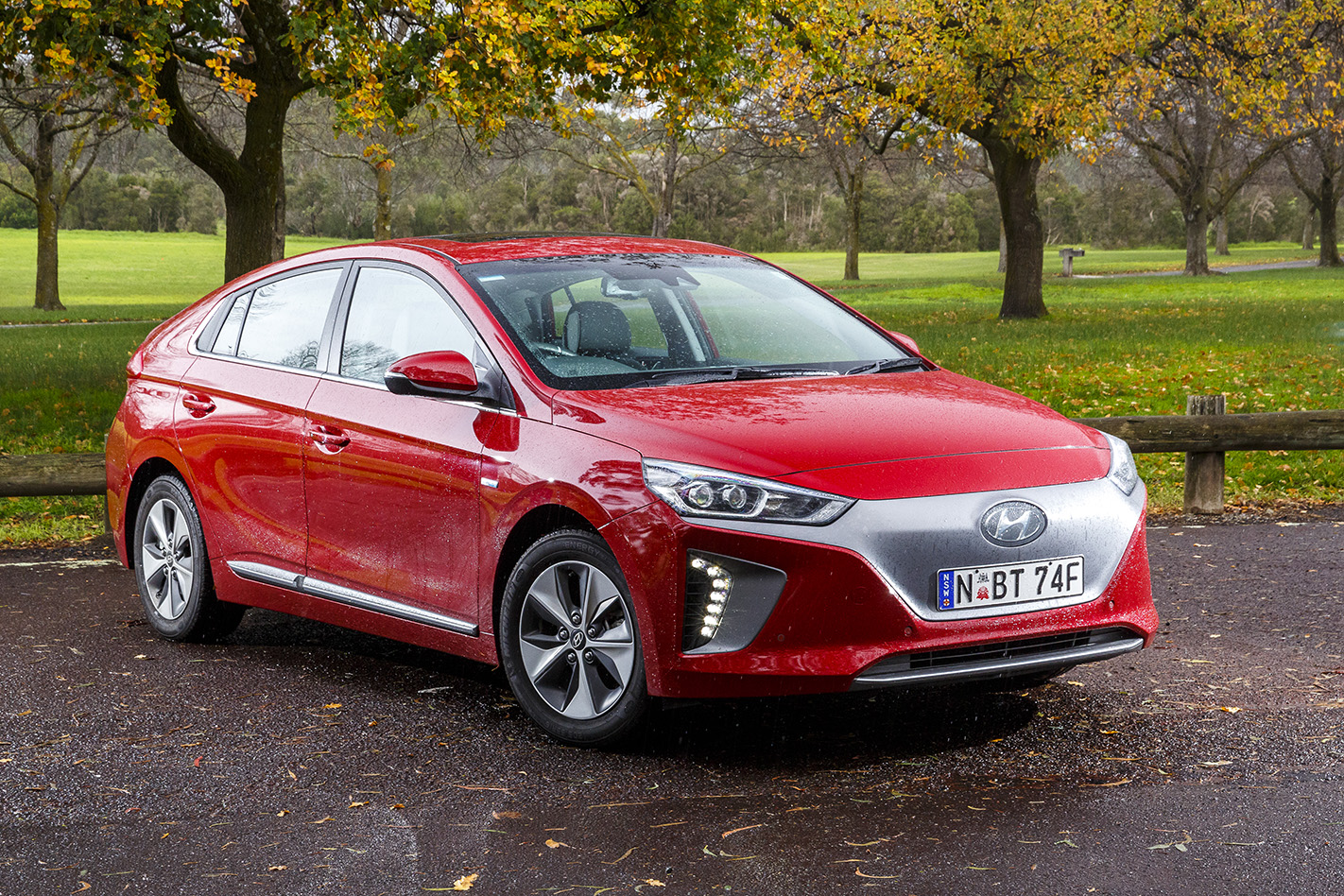
For us, we prefer the more conventional feel of reducing the regen force to zero, leaving the brake pedal as our means of varying the amount of energy that flows back into the battery. It also results in a smoother drive, especially if the driver is prone to ‘taxi foot’.
Ride comfort is superb, with supple damping soaking up urban lumps easily and the IONIQ generally feeling quite sure-footed. There’s some road noise at highway speed, but that’s largely noticeable given everything else is so quiet.
As for efficiency, the IONIQ Electric may only have a 28kWh battery pack, but in everyday driving it proves to be far more efficient and able to travel for nearly the same distance as the i3 without needing as much energy. Achieving an average consumption figure of 13-14kWh/100km is easily done, whereas the i3s consumed several kilowatt hours more in similar driving.
The practical range of the IONIQ Electric is around 230km on a full charge, which is definitely plenty for day-to-day commuting but not as generous as the i3 thanks to that car’s larger battery. It should be more than enough for most people to get by with charging up only once every two or three days, though.
BMW i3s
The i3s has the same power capacity as the regular i3, however with juiced-up control electronics that enable it to deliver more power to the rear wheels and thus zip to 100km/h in just 6.9 seconds it has a straight-line pace that approaches hot hatch territory.
That lowercase ‘s’ also signifies a sportier intent than the regular i3, with a 10mm lower sports suspension definitely feeling a lot more ‘athletic’. However it’s a stiff-legged ride and, coupled with the car’s short wheelbase, one that results in plenty of fore-and-aft pitching. Not the best thing for an easily upset stomach.
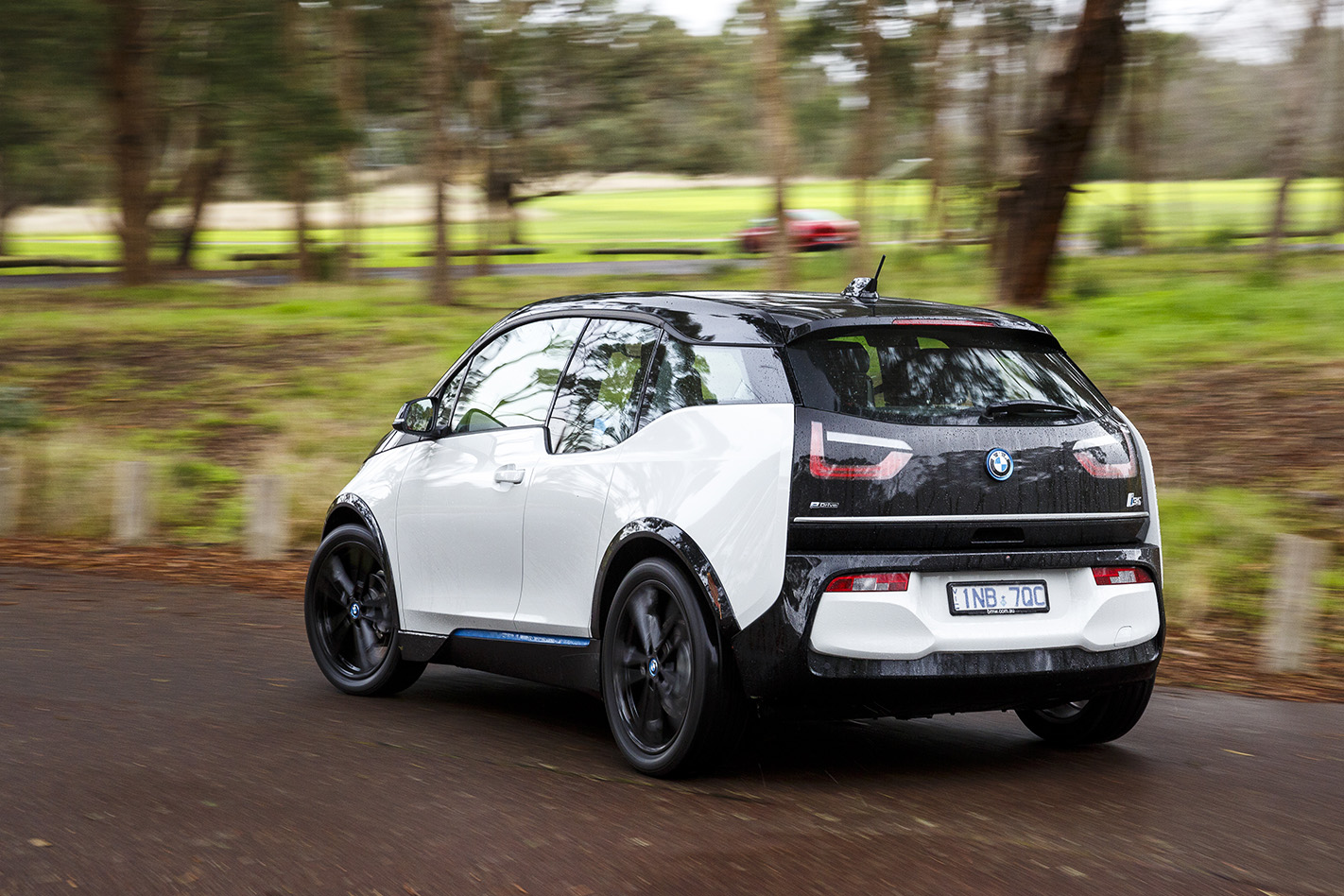
That tautness never really seems to go away either, and the merit of having sharp handling isn’t really something that makes a lot of sense in an electric hatch designed to spend most of its life in the city and suburbs. The more sensibly-sprung vanilla-flavour i3 might be a better choice in the long-term.
The steering is nice and light for easily twirling the wheel from lock-to-lock, and it’s a car that’s very much at home zipping through traffic and finding back routes through tight inner-urban backstreets. It’s also supremely easy to park, gives an SUV-like view over most other traffic, and feels much more nimble than the IONIQ around town.
It’s just a shame that it seems less efficient than it should be, recording average energy consumption figures approaching 20kW/h if driven with some vigour, and not a whole lot less if steered with more regard for economy. Its 260km range is definitely a useful one for the average commuter however, and one that means full recharges would only be needed once every three days or so.
OUR OPINION
Just as it is when comparing combustion-engined mainstream and premium cars, the main things separating a mainstream EV and a premium EV are design, material quality and badge cachet. The pricier option isn’t necessarily any better off when it comes to driving enjoyment, comfort or fitness for purpose.
The i3 definitely forms a more overt expression of the owner’s eco-minded intent, and we figure that will be part of its inherent appeal as well. The IONIQ Electric, with its faired-over grille, also goes in a similar direction, but from afar still appears to be very much conventional. For the average driver, we figure that will be appealing as well – not everyone wants an extroverted car, after all.
This isn’t really meant to be a direct comparison of the two cars, as they appeal to two quite different buyers. Even so, it’s hard to ignore the IONIQ’s better balance of capabilities, better around-town ride, lower power consumption and more spacious and practical interior. As an everyday car, it simply makes a lot more sense than BMW’s eco-statement-on-wheels.
Sports car sales have slowed during July, with each of the three pricing categories defined by the FCAI showing a decrease of at least 20 per cent.
In the most affordable sub-$80,000 bracket, sales have dropped by 27.1 per cent, with only 510 sports cars under that price having sold.
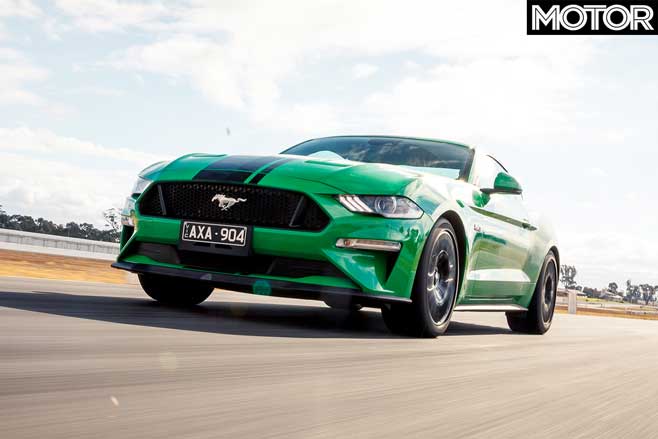
The Ford Mustang represents the majority hare in this category, and its sales reflect the whole. In June, 369 Mustangs were sold, down to just 262 in July. That’s a drop of 29 per cent.
Moving up the pricing ladder, and sports cars between $80k and $200k haven’t been hit quite as hard. A drop of 21.2 per cent between June and July means only 375 cars from this category were moved.
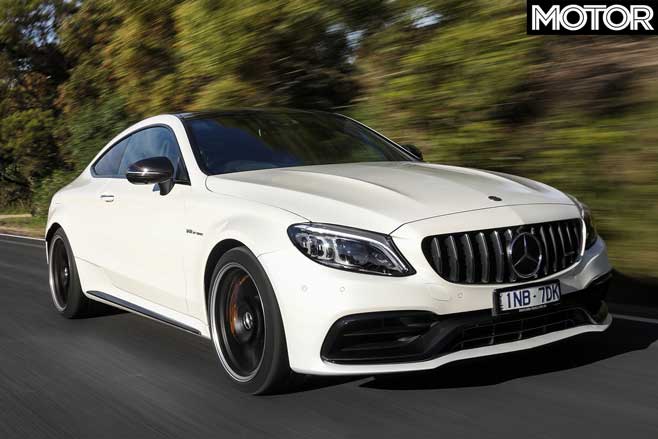
The dominant Mercedes C-Class (defined only as coupes and cabriolets by the FCAI) surpassed the average drop to lose 29.8 per cent of sales, from 238 down to 167.
Finally, in the $200k+ category, the Porsche 911 slumped to 23 sales from a strong 58 in June, representing a drop of 60.3 per cent. That’s almost twice as much as the category’s average loss of 30.6 per cent of sales.
Bucking the trend at the top end is Ferrari, which recorded 26 sales, up from 18 in June. It sits alone as the only significant increase in the category by numbers, excluding those which saw a massive percentage increase due to having zero sales in June.
For the record, Lamborghini recorded 15 sports car sales in June, but none in July. The Urus SUV did manage five sales, however that’s down from 10 during June when the brand also shifted 15 other cars.
FCAI chief executive Tony Weber says the ‘sensitive’ nature of the economy means July has been another rough month for new car sales overall.
“Tight financial lending, drought, increasing Luxury Car Tax imposts and the Federal election have all contributed to make the Australian car market one of the toughest in the world,” says Weber.
“But it is great news for the consumer who is spoiled for choice with attractive new car offers as automotive brands provide excellent deals to stimulate sales growth.”
