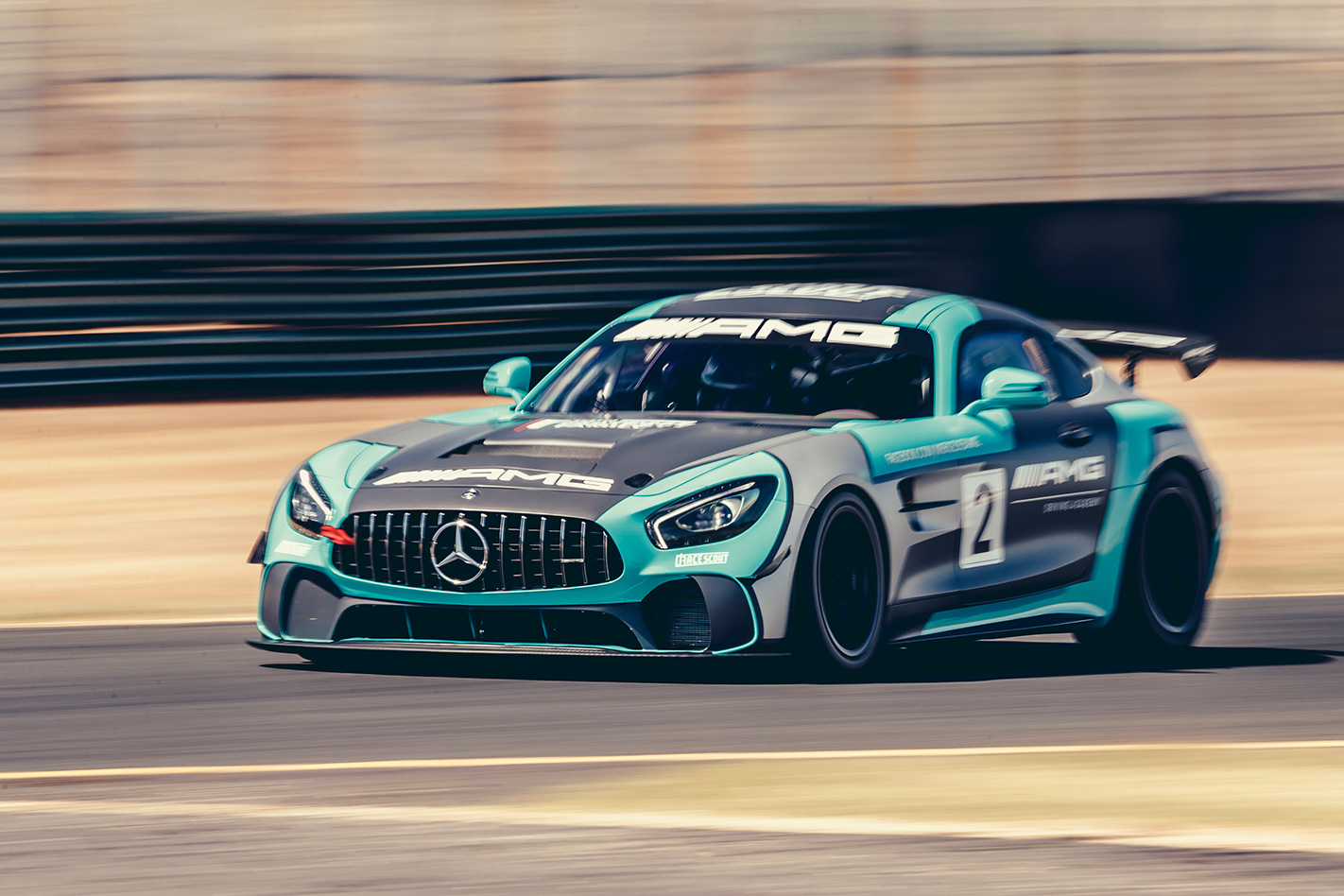
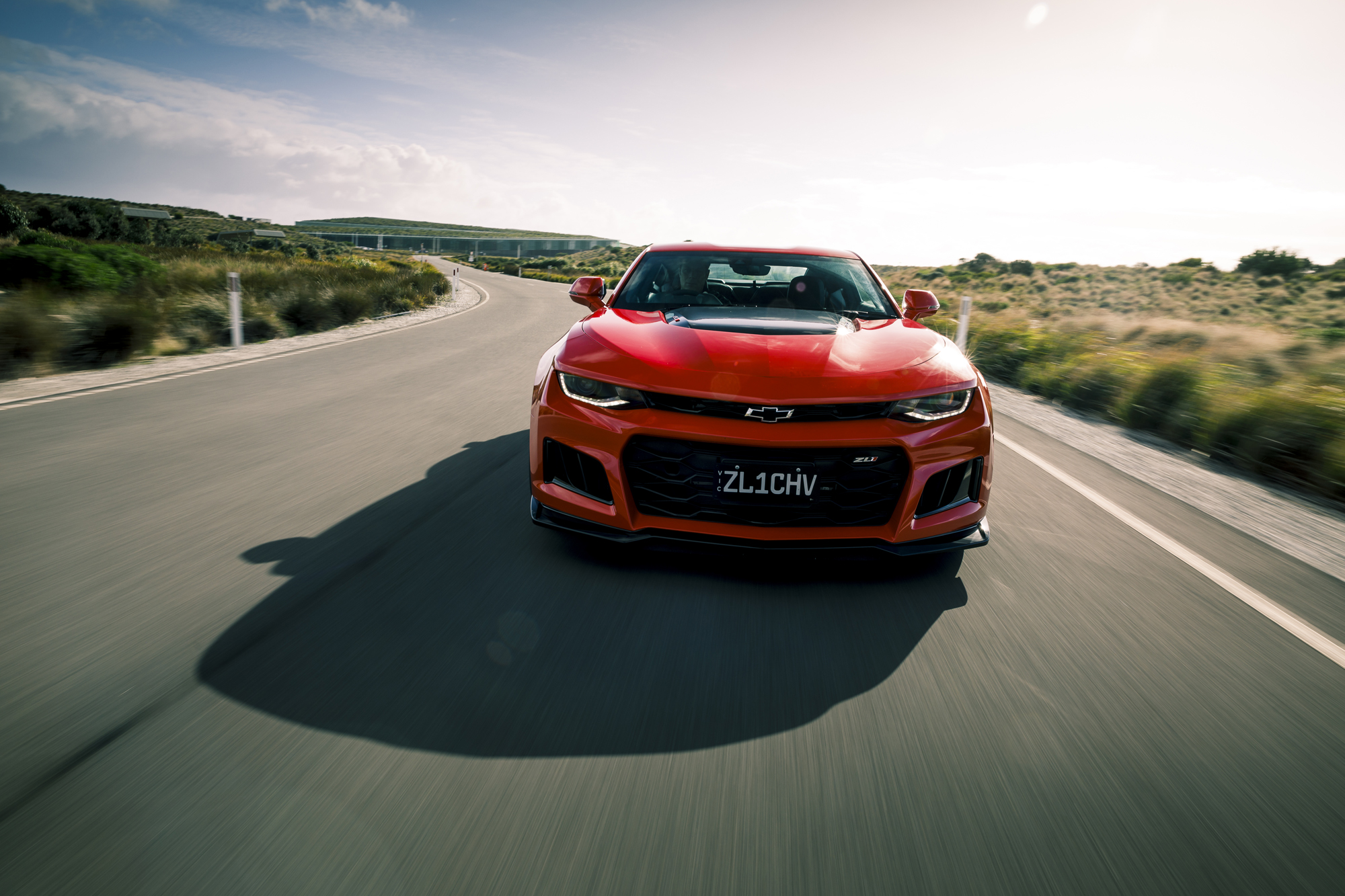
THE ONLY person I can see is wrestling with a reel of fencing wire, the wind attempting to tear his clothes from his back. The mercury’s hovering just somewhere north of zero and the wind’s ripping in off the Bass Strait. Grey sheets of rain queue up offshore, ready to begin their strafing runs. I look over to the farmer and he’s grinning from ear to ear. I crack the window of the Camaro ZL1 down a few centimetres. “Go on,” he yells, dropping the reel and rolling his fist in the universally acknowledged language of petrolheads everywhere, “punch it!”
Australia loves a good V8 and it’s easy to understand why. A bent-eight speaks of qualities many of us identify with; a rugged toughness, dependability, heritage, performance over parsimony and an irrepressibly larrikin ability to paint a smile on your face. We’ve gathered six of the very best of the current crop of V8s for a celebration of the engine, and we could easily have brought more, but we had to draw a line somewhere.
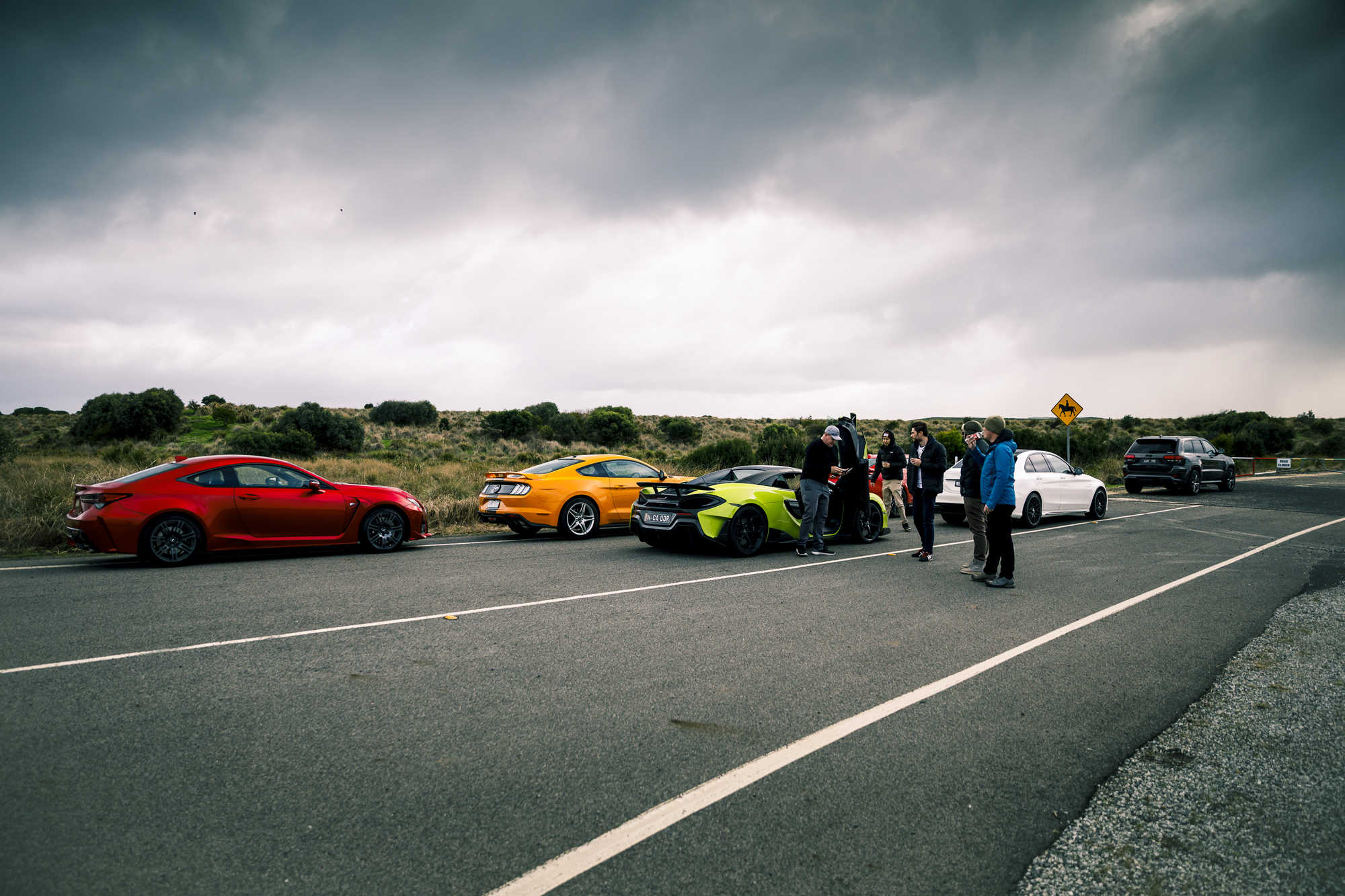
Chevrolet’s 477kW Camaro ZL1 by HSV ($162,100) is the catalyst for the great Gippsland gruntfest, but it isn’t even the most powerful vehicle here. That honour goes to the 522kW Jeep Grand Cherokee Trackhawk. Taking a radically divergent approach to the generation of its power-to-weight number is McLaren’s fierce and focused 600LT Spider. Pitch in a couple of 5.0-litre atmo heroes of very different persuasions – the Ford Mustang GT and the Lexus RC F – and then round out the gathering with the Mercedes-AMG C63 S.
The Camaro disappears up the road in a cacophony of 6.2-litre supercharged small-block and tortured treadblocks. I’m laughing, the farmer’s standing in the road behind, also cackling with pure joy. The ZL1 is that sort of car, up to a point. With 477kW and 881Nm under your clog, it’s clearly something that demands respect. The engine is a keening, bellowing block of drill-sergeant aggression anywhere from 3000 to 6500rpm.
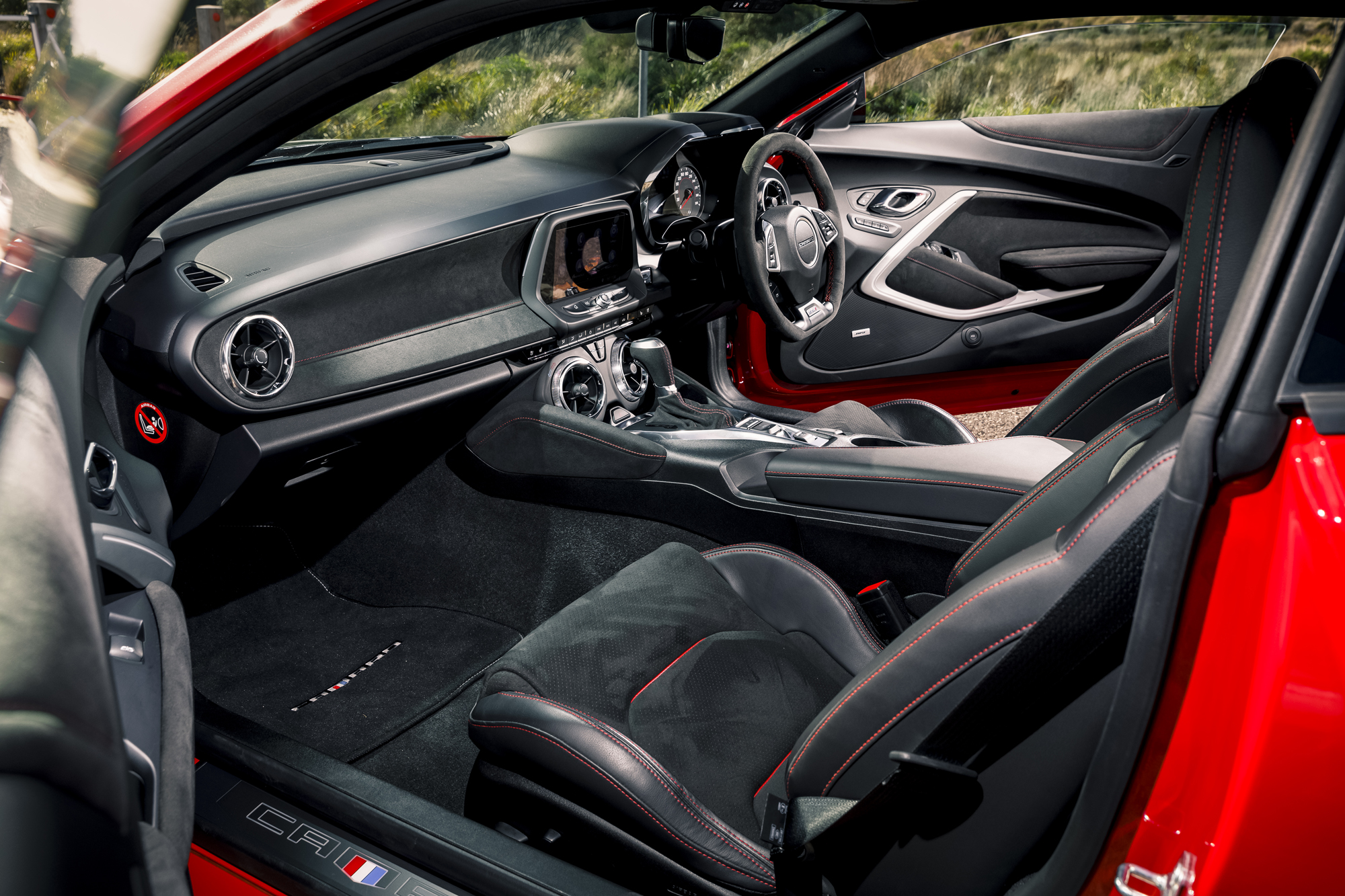
Our test car is the 10-speed auto that most Aussies will choose, but the manual car might just be the pick. With a stubby, ‘sueded microfibre’-clad lever, a real satisfying eight-ball break of a shift action and the most delightful rev-match function, it’s the perfect accompaniment for the tactility of the ZL1.
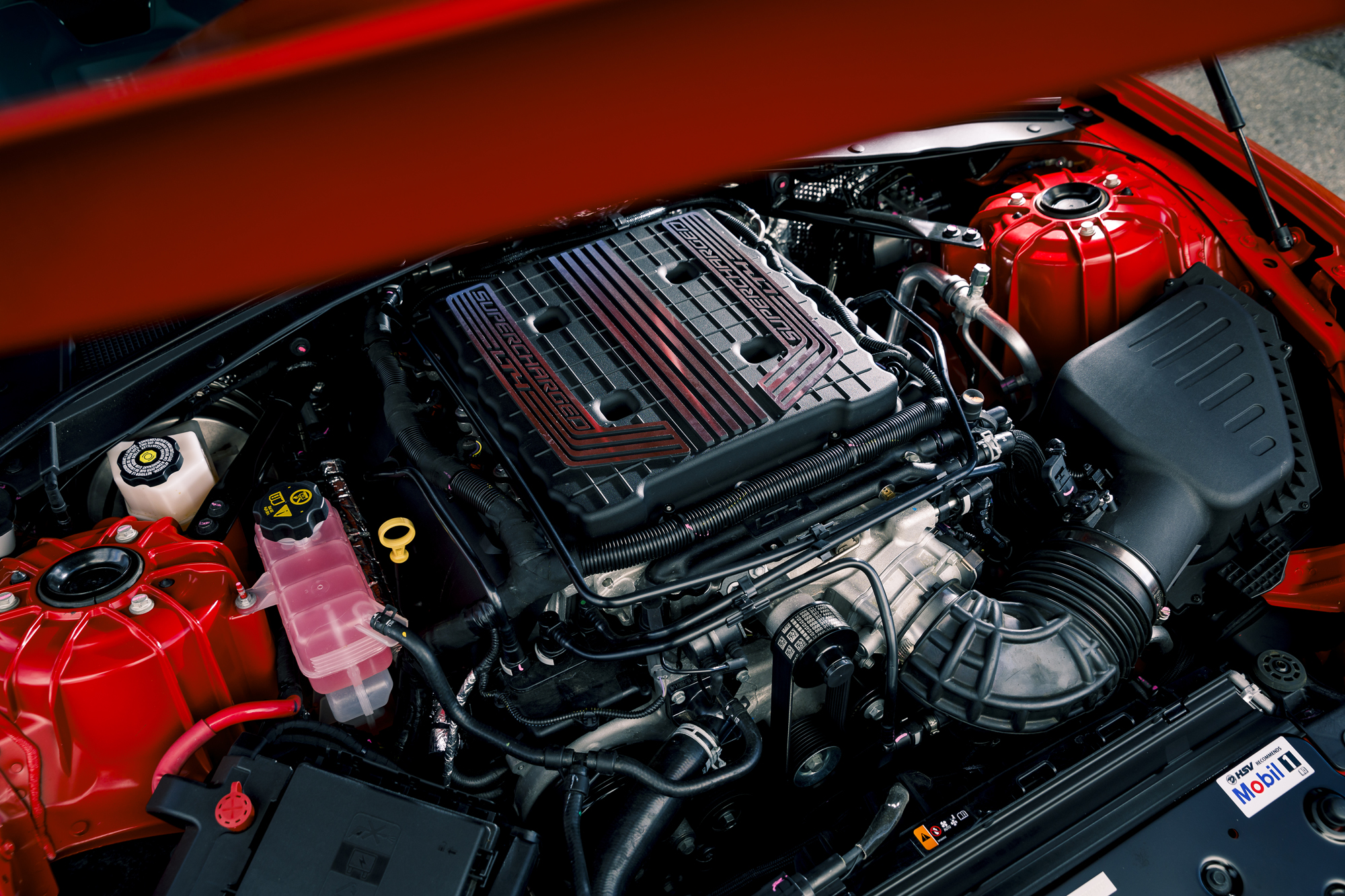
While the LT4 lump lacks the exotic materials and bespoke competition feel of the LS9 that powered the GTSR W1, it is objectively a better engine. With direct injection, dual-rate oil pump, cylinder-cut technology, better cooling and more effective breathing, not to mention a supercharger and intercooler that’s 9kg lighter than the LS9’s atop the motor, it feels even more blue-collar tough. The small-block has been around since 1955 and while a lot has clearly changed, it’s an engine that can still trace a clear bloodline: eight cylinders, 90-degree vee formation, single-cam pushrod valvetrain, and 4.4-inch bore spacing.
The power curve for the LT4 isn’t a curve as such. It’s just a constantly ascending line, the engine making peak power at 6400rpm, and even then it’s not really plateauing. That 881Nm of torque appears at 3600rpm, which means that the LT4 does like a few revs on the board. Not a lot happens below 2800rpm, but then the note firms and from 4000rpm you feel like you’re just hanging on for the ride. The manic, giddy surge from there to 6000rpm is never the same twice, largely due to the inadequacy of rear traction. This isn’t entirely HSV’s fault. The ZL1 was engineered for the super-sticky Goodyear Eagle F1 but these tyres couldn’t pass the ADR split-mu test without a revision to the car’s ECU. Clayton wasn’t permitted to start editing the ECU software so has instead resorted to fitting Continental ContiSport Contact 5Ps which do pass the test, and offering the Eagles as a $1000 ‘track tyre’ option. While the Contis work brilliantly on a four-cylinder Commodore, they’re not an ultra-high-performance tyre, so do compromise the ZL1’s ability to put down its power. Our acceleration tests show that the ZL1 on Contis is around half a second slower to 100km/h than a cooking $86K Camaro 2SS on Eagle F1s. In other words, you need to tack on a grand to get your Camaro back onto the more hardcore rubber.
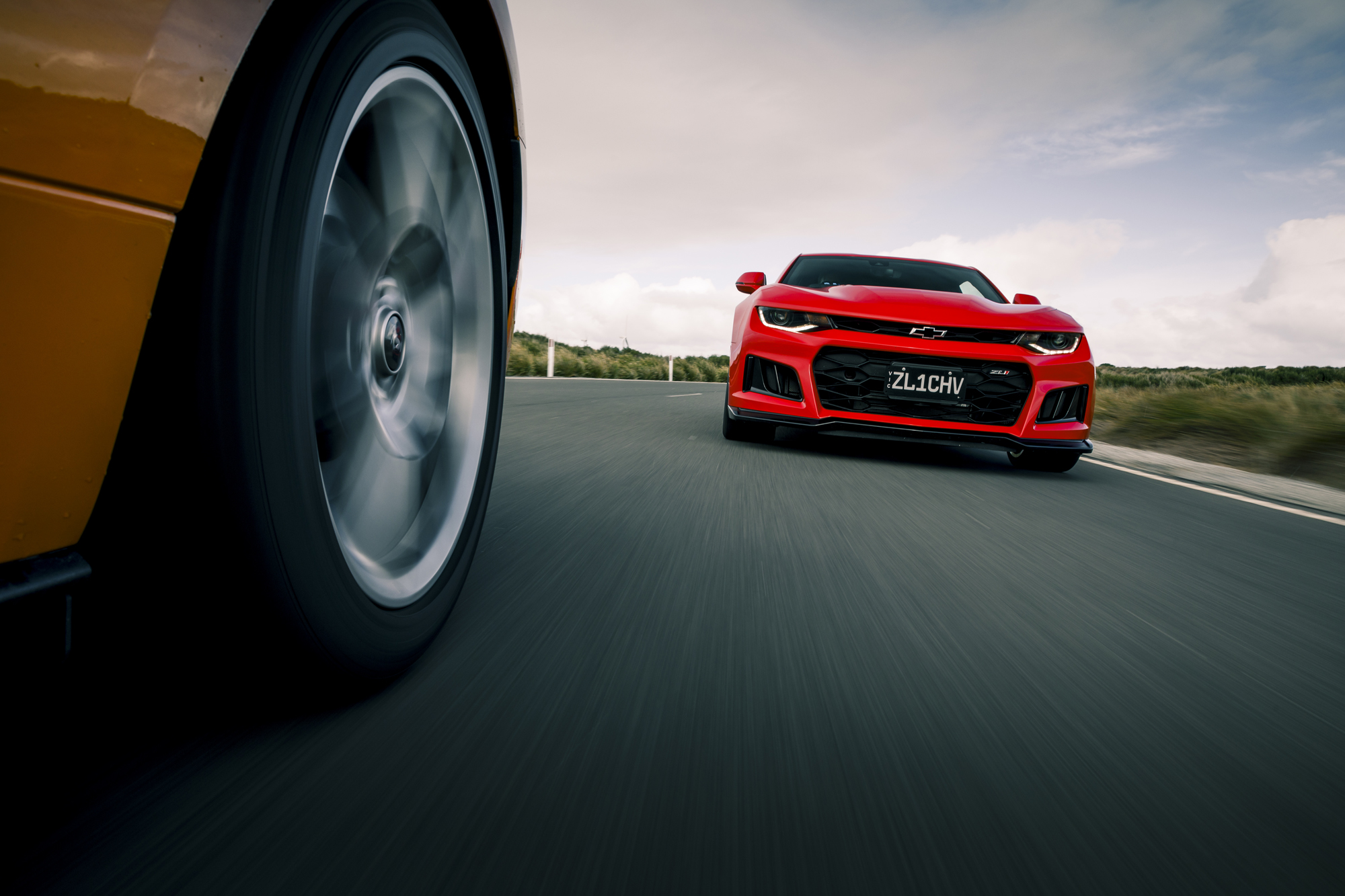
Tiptoe up through three gears and plant it in fourth and the ZL1 will rapidly disabuse you of any notion that modern production cars are uniformly sanitised and make going fast feel effortless. Three figures on the clock, five degrees of yaw apparent with all the driver aids switched on and the Gen V small-block sounding as if it’s about to fire its Eaton 1.7-litre supercharger into low earth orbit will always grab your attention. The thin-rimmed steering wheel wriggles and bucks, and you wonder when the maelstrom will subside. As good as the ZL1’s body control is, it’s often more sympathetic to tap out with a couple of rapid upshifts than lift off the gas.
The ZL1’s engine dominates proceedings given the grip levels available, but the rest of the package – tyre excepted – also benefits from a massive development budget. It’s hard today to reconcile the Camaro’s tenuous grasp of the bitumen with a sub-7m30s lap of the Nordschleife, but that’s what this car is capable of, and some of the detailed calibration speaks of a rare attention to detail. The Magnetic Ride Control adaptive damping offers a polished edge at odds with the aggressive image, while the throttle calibration and brake modulation is top-drawer stuff. The steering offers a lot of heft in Sport and Race modes but some testers felt that weight was arriving without a concomitant improvement in feel.
I’m left slightly bemused by the Camaro. There’s a fierce car in here but conditions and tyres are against it today. There’s certainly a great V8 under the bonnet, but is it the best V8 here? Is it even the best 6.2-litre supercharged V8? To answer that question, enter the heaviest hitter of the lot.
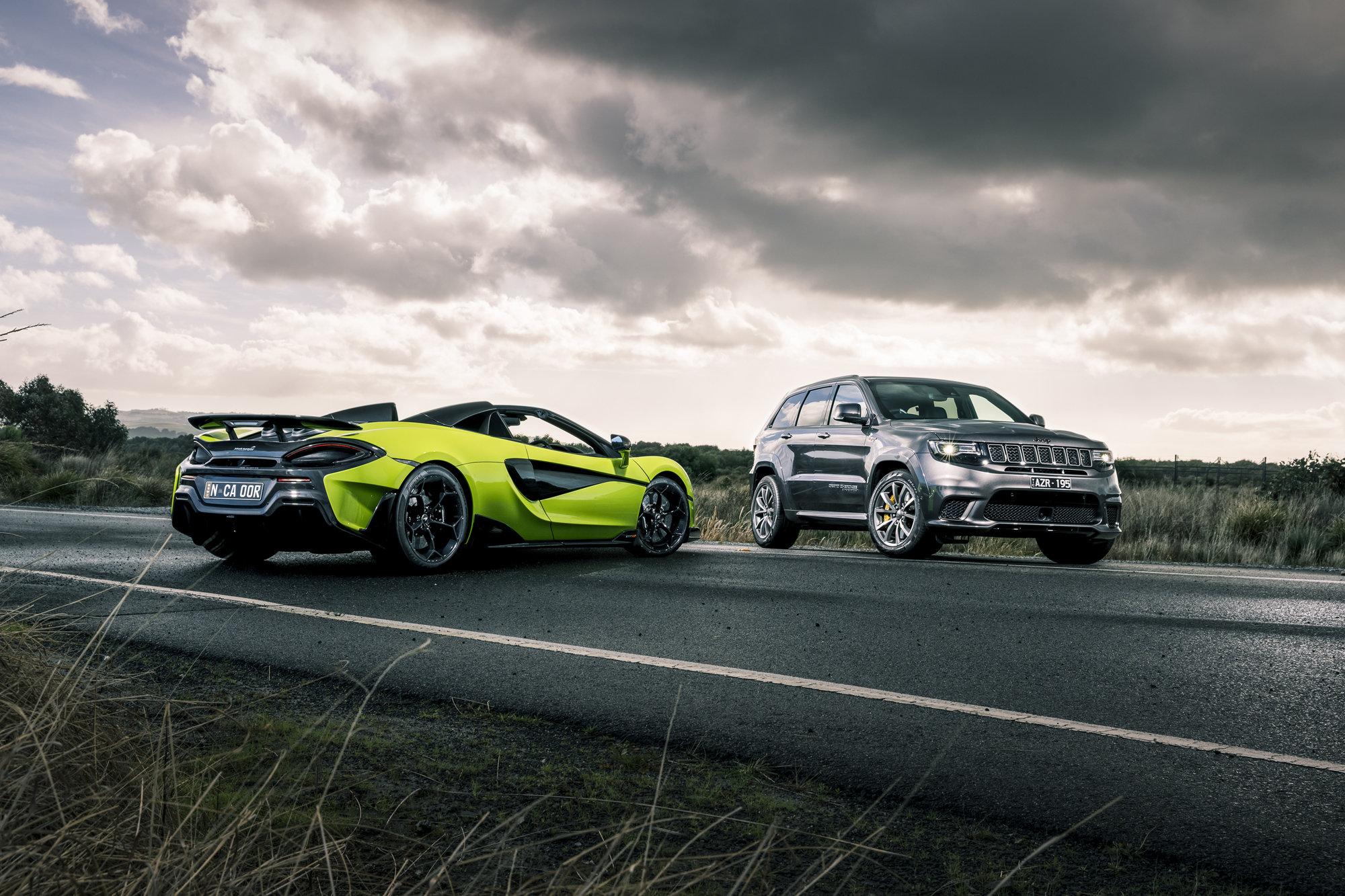
Westerman: Trackhawk swaggers in with the highest outputs of the group, but here’s the question: is stuffing what is essentially the engine from the 11.2-second quarter-mile Dodge Challenger Hellcat into a 2.4-tonne SUV an act of genius, or a moment of madness? All depends on your priorities and point of view. The 522kW/868Nm Trackhawk ($134,900) demands that you take ‘logic’ and file it in your dark recesses; that place where some of us park notions of ‘plausible religion’ and ‘slimming beer’.
Jeep’s flagship is irrational, excessive and unnecessary, but also, I’d contend, mostly lovable. The distant sound of blower whine is present from the moment you pull out from the kerb, but otherwise the low-speed powertrain manners are docile; the throttle tip-in relaxed yet precise. Helpfully, every individual parameter can be set to your preference of Street, Sport or Track.
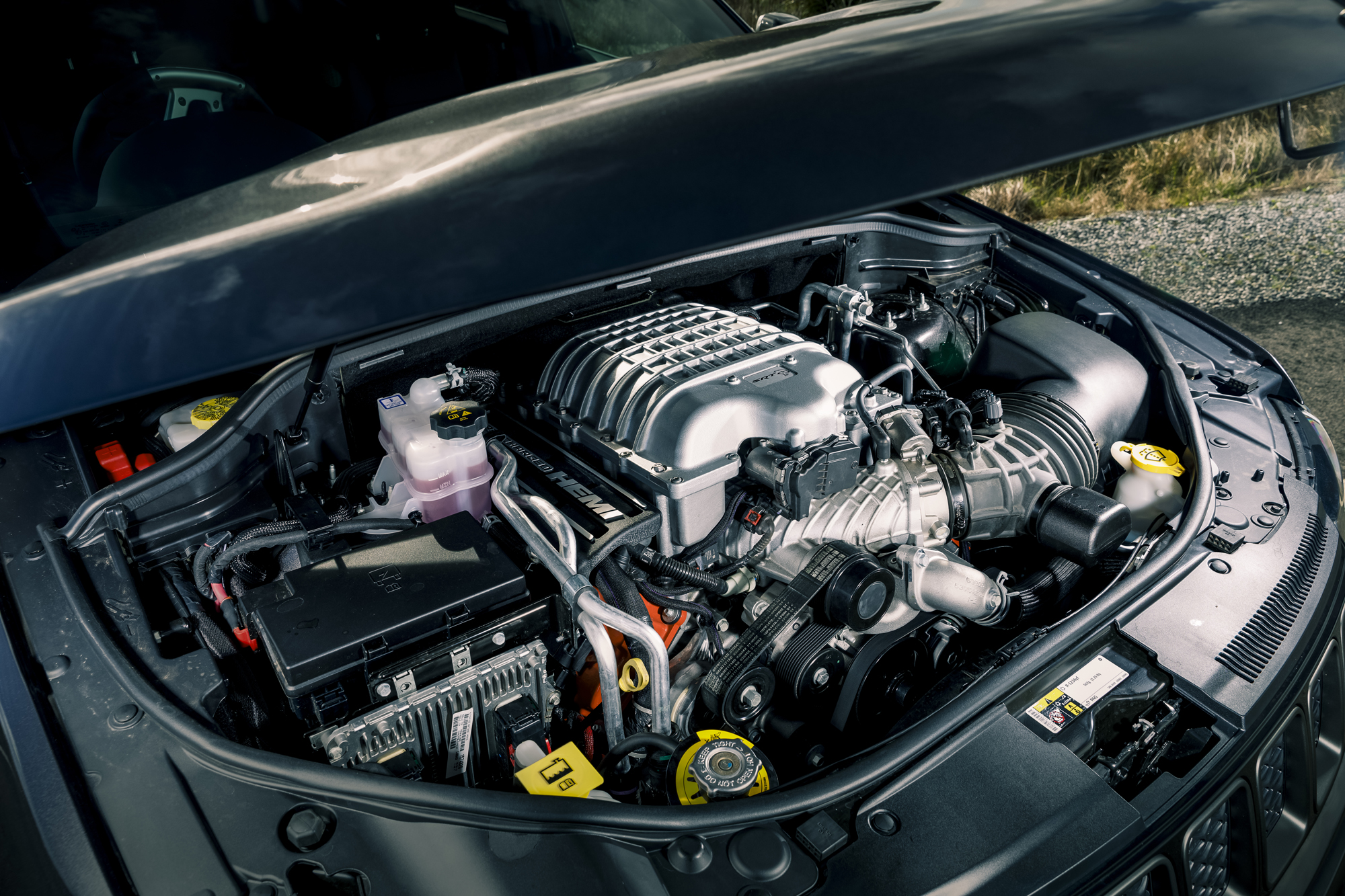
With everything set to ballistic, and launch control engaged, it bolts off the line like a rhino with an IED jammed up its clacker. The combination of bulk torque and monster traction mostly overcomes the huge weight to send it hurtling to 100km/h in just 3.7sec. On the move, only slightly dull-witted downshifts blunt the instantaneousness of its ferocity; take charge with the paddles and hang the hell on.
“From the outside, it sounds like a piston-engined bomber on approach,” says Kirby. Inwood was no denier of the epic engine performance, but a bit harder to convince as to Trackhawk’s broader merits: “A bit of a one-trick pony,” he says. “Even in track mode, the steering’s too remote and it just doesn’t have real handling cohesion.”
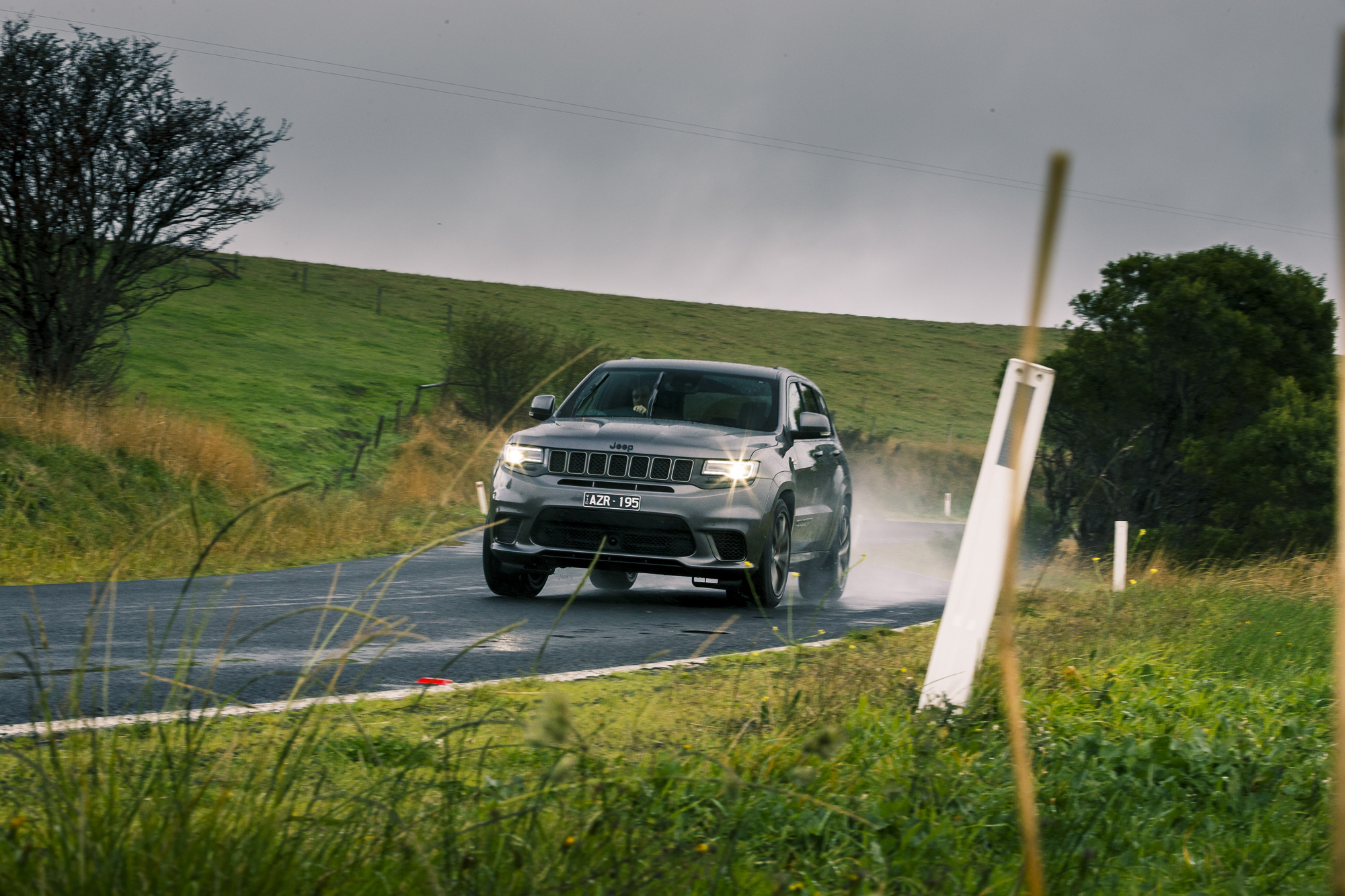
Okay, but what was unanimous was just how well-engineered and utterly bulletproof the driveline feels. And who, of the target market, is really going to take their Trackhawk to a trackway, or try and stay on the bumper of a Cayenne Turbo through their favourite twisty bits? No, the Trackhawk finds its following among those who’d really love to buy the Camaro, but need an SUV to cart kids and bikes and the chattels of family life. Think of it as a high-riding, family-friendly, blown muscle wagon; one that comes loaded with a level of standard kit for which the Euros would demand a kidney. Actually, just don’t think too hard about anything and the more persuasive the Jeep flagship becomes.
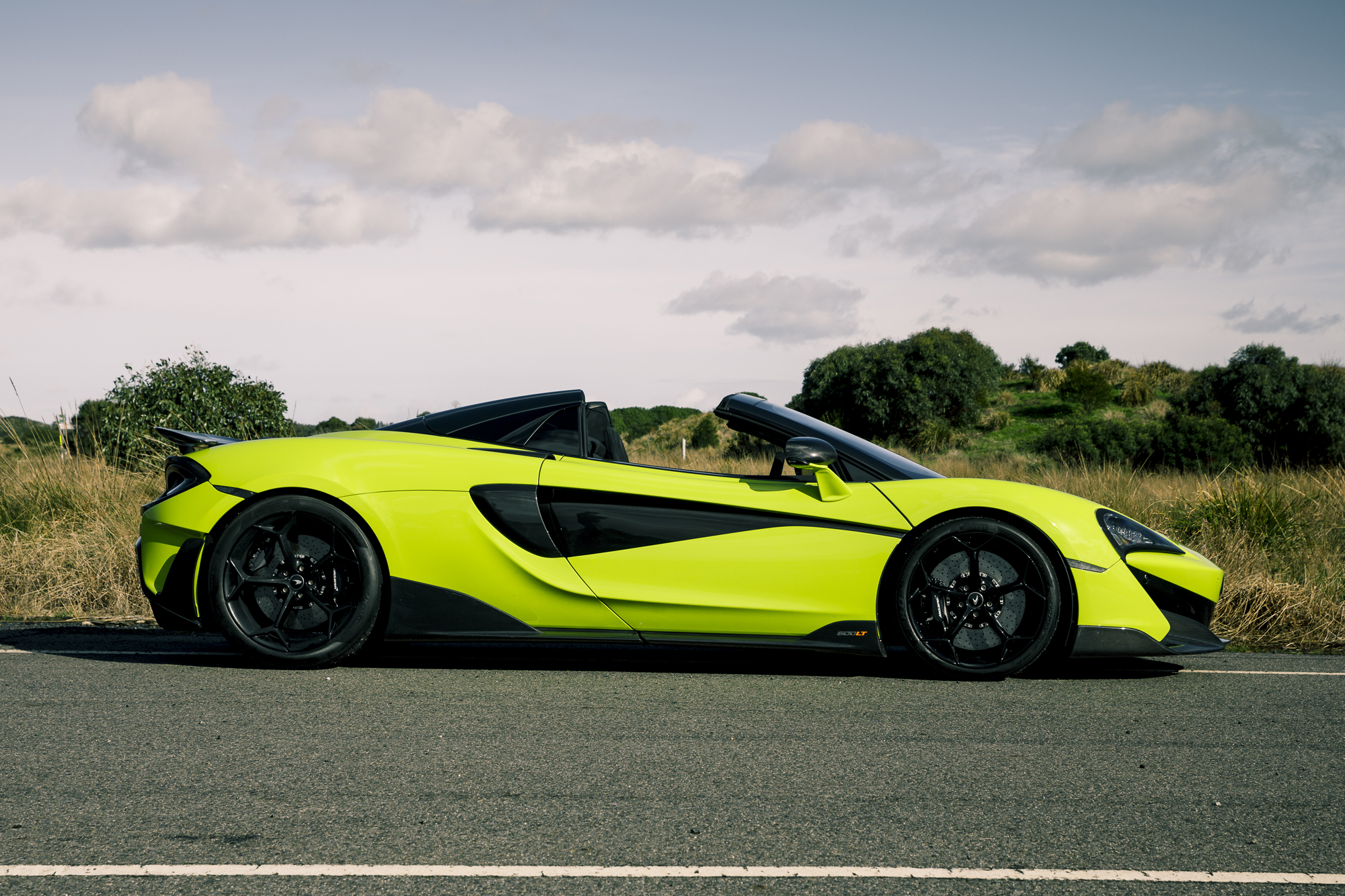
Jumping from the least dynamically adroit car here and into the most – the McLaren – is like stepping out of a bubbling jacuzzi and into a bobsled. The 600LT Spider ($496,000) runs the British company’s 3.8-litre version of its ubiquitous twin-turbo V8 in the highest output available: 441kW and 620Nm, which is a bump of 22kW and 20Nm over the 570S model below. The gains come from a change of cams and an ECU tweak, among other things, but in this installation, it’s the short-route, top-mount exhausts that arguably have more impact – viscerally and audibly – than the actual power gain. Some of us (okay, me) initially wondered if the engine as a drawcard may have been shaded by the chassis gains, given how focused this car is. It’s stripped of weight, runs suspension components lifted from the 720S (from the series above), has carbon-ceramic brakes and Pirelli Trofeo R tyres, so clearly not built to just ponce around in a tight T-shirt outside nightclubs. But despite all that, it’s still the engine that will – initially at least – blow your mind.
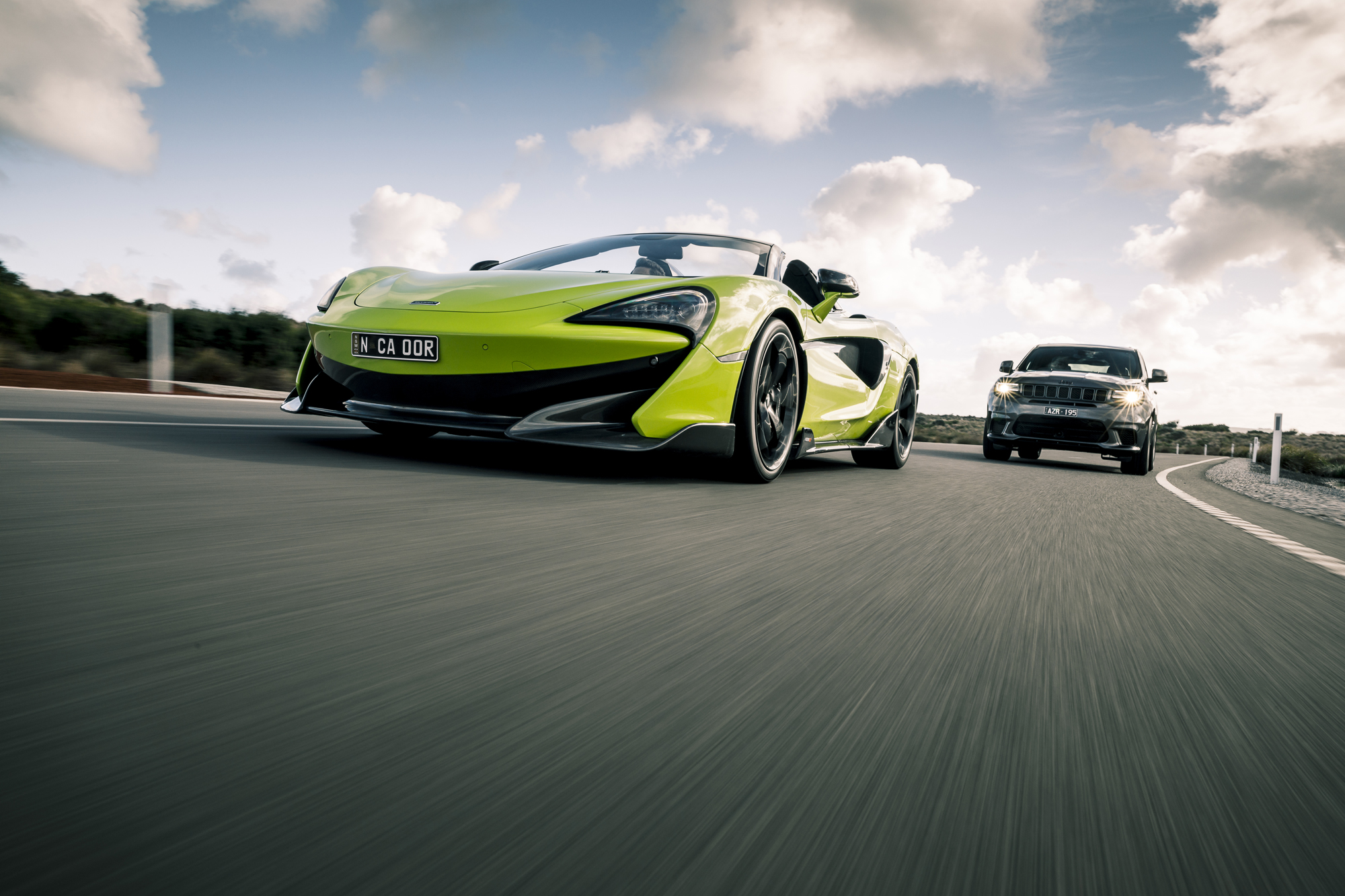
The motorsport roots (see sidebar, right) remain infused throughout, especially in the sound it makes during normal, law-abiding driving. It’s a nondescript, industrial-blender type of sound, like something in Soup Nazi’s kitchen, and devoid of that V8 burble that you may expect. Only once you start opening it up can the V8 start to really communicate with you, via induction snarl, turbo whistle and wastage chuffing. But push through that, keep it held wide open, and lord, prepare to be transported to somewhere special, both literally and figuratively. Don’t call it laggy, just be mindful that when full boost is pumping at around 5000rpm (peak torque is super high for a turbo at 5500-6500rpm), things are about to get properly feral. The Spider allows your ears unrestricted access to those exhausts just a metre or so behind your head, and the sheer sonic hatred they spew forth is breathtaking. In the wet, as much of our testing was, this engine just tries to tear the treads off while sending the ESC into apoplexy as the overworked electronics try to deal with the onslaught. It’s a startling, sensational mix of boosty turbo torque married with an almost atmo-style appetite for revs – cut-out is at 8500rpm – and culminates in a barrage of frenzied mechanical meshing and subsequent sensory overload that makes the 600LT part of a very elite breed. Fact: if you drive this car, and think, “Hmmm, wish it was quicker; I should have gone for the 4.0-litre in the 720S”, see a specialist, you have a serious disorder.
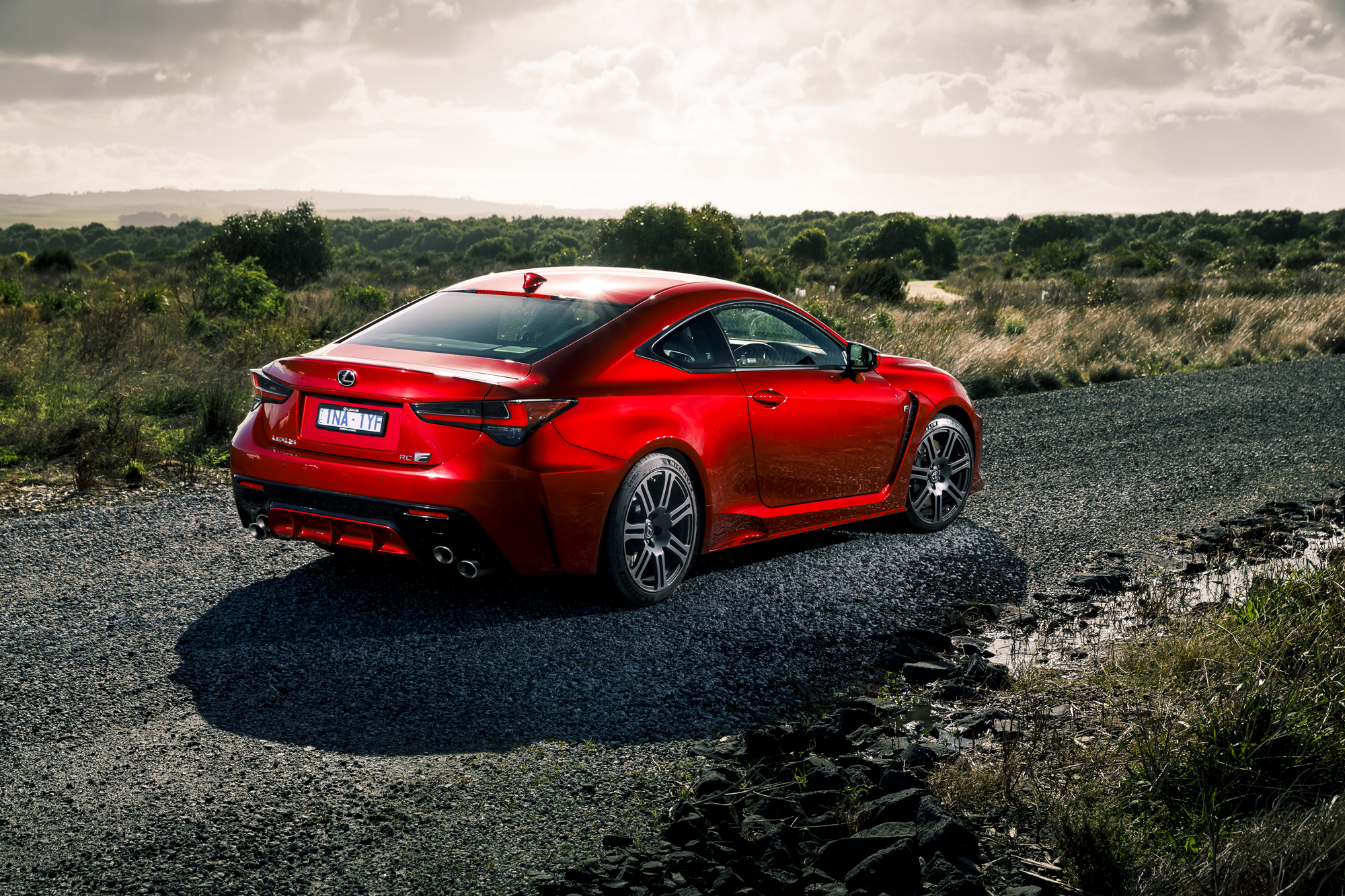
Inwood: We’re deep into day one of our celebration of bent-eight brilliance, each driver cycling through the six cars to better understand the magic of V8s. It’s quite a thing to watch them roar away from our roadside base. The Trackhawk is brutal, its rear axle squatting like a powerlifter before it launches, the sheer scale and force of the thing seeming to punch a hole in the laws of physics. The manual Mustang is less manic, its deep burble broken into musical bursts as the driver pauses to shift gears. The McLaren, however, is unhinged. Having set off fizzing with childish glee, the expression of a returning McLaren driver is a kind of stunned stupefaction. They emerge looking as though they’re in need of a nice lie-down, which invariably sees them drawn to the Lexus.
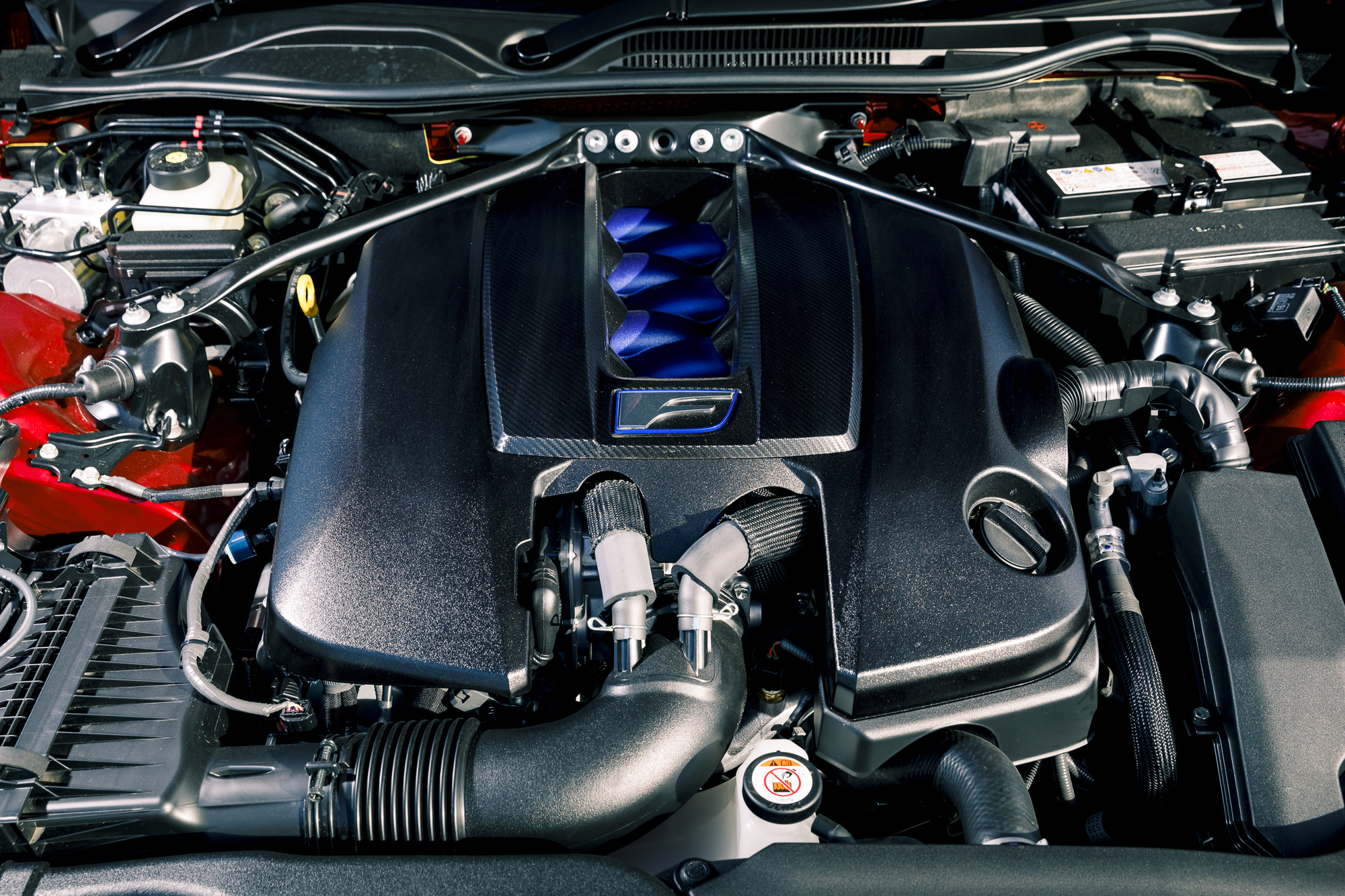
It’s odd to describe a car with a 351kW/530Nm 5.0-litre V8 as gentle, but in this company, the RC F ($137,729) is something of a soothing balm. Where the others flex their V8-ness with lumpy idles and ferocious potency low in the rev range, the Lexus favours subtlety. In fact, fire it up and you might be duped into thinking it’s powered by a V6 or even a turbo four.
“Its personality is so opaque,” quips Enright. “If you didn’t drive it hard, you might never know that it’s actually a V8. But it’s so turbine- smooth and polished, it’s actually quite lovely.”
The general agreement is that while the other cars might be more exciting, the Lexus is the one we’d all want to spend long periods of time in. Exquisitely crafted leather seats and a comfortable, well-judged ride have a lot to do with that. There’s a duality of character at play here, however. Twist the drive select dial from Normal to Sport S+ and the RC F responds as though it’s copped an EpiPen to the heart. Revs are at the core of the excitement. After the forced-induction savagery of the McLaren, the RC F’s bottom end can feel light on, but temper your need for instant gratification and the atmo V8 rewards in a way no turbo donk can. Nothing else here builds with such musicality or changes timbre so beautifully, and only the Mustang comes close for linearity of power delivery. The boffins inside Lexus’s F department don’t believe in turbos and today, on soaked roads that demand an intuitive understanding of grip and slip, I’m kind of grateful for that.
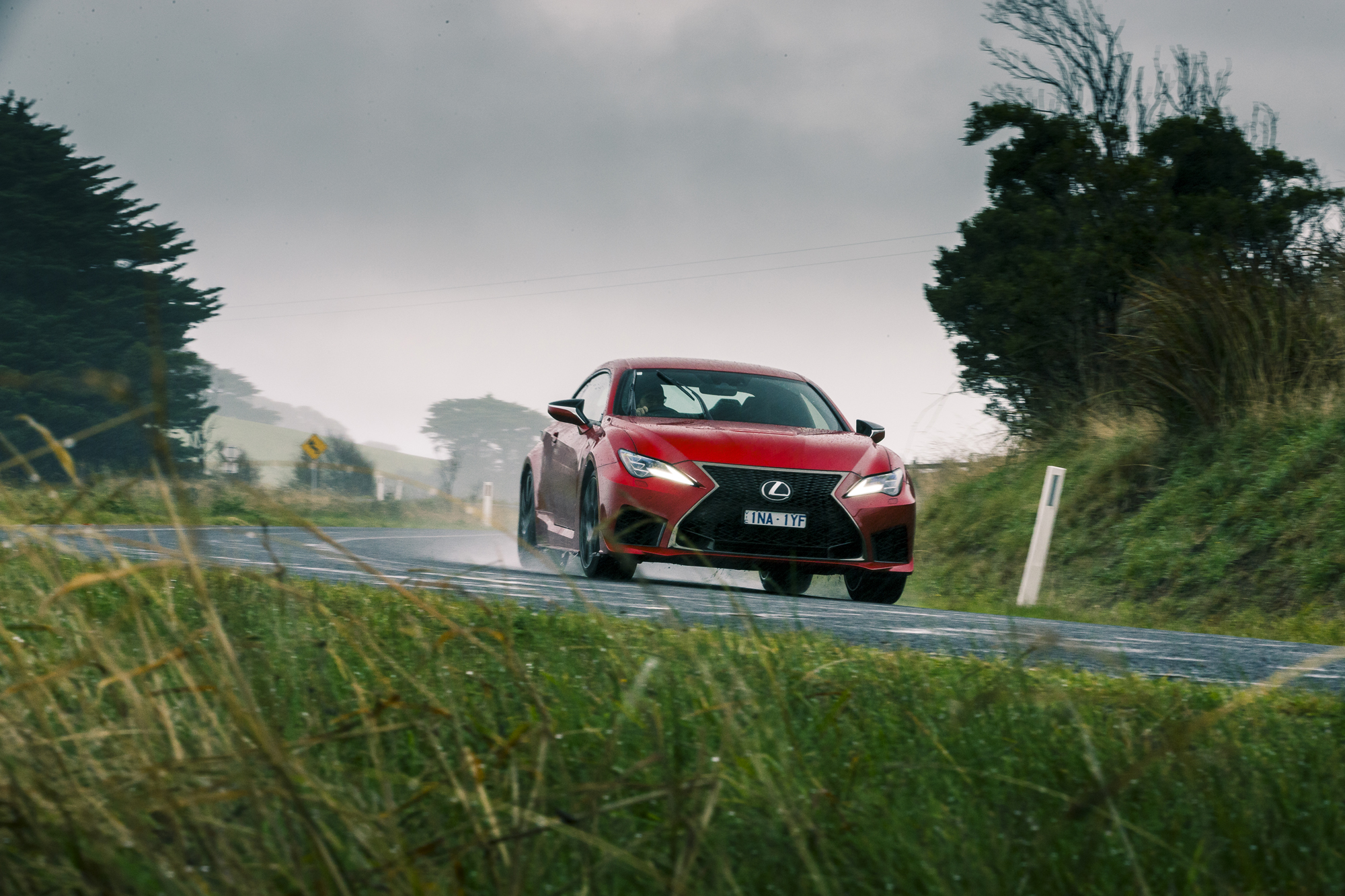
In fact, where the Continental-shod ZL1 looks a handful, the McLaren verges on being too focused and the Trackhawk is ponderous, the RC F feels almost ideal for these conditions.
You get a similar sense from inside the AMG. Technically the C63 S ($160,900) is a rival for the Lexus (we were hoping to drive the facelifted C63 coupe, but just missed its arrival in Oz), and like the RC F there’s something right-sized and confidence-inspiring about a C63 on a winding Aussie B-road.
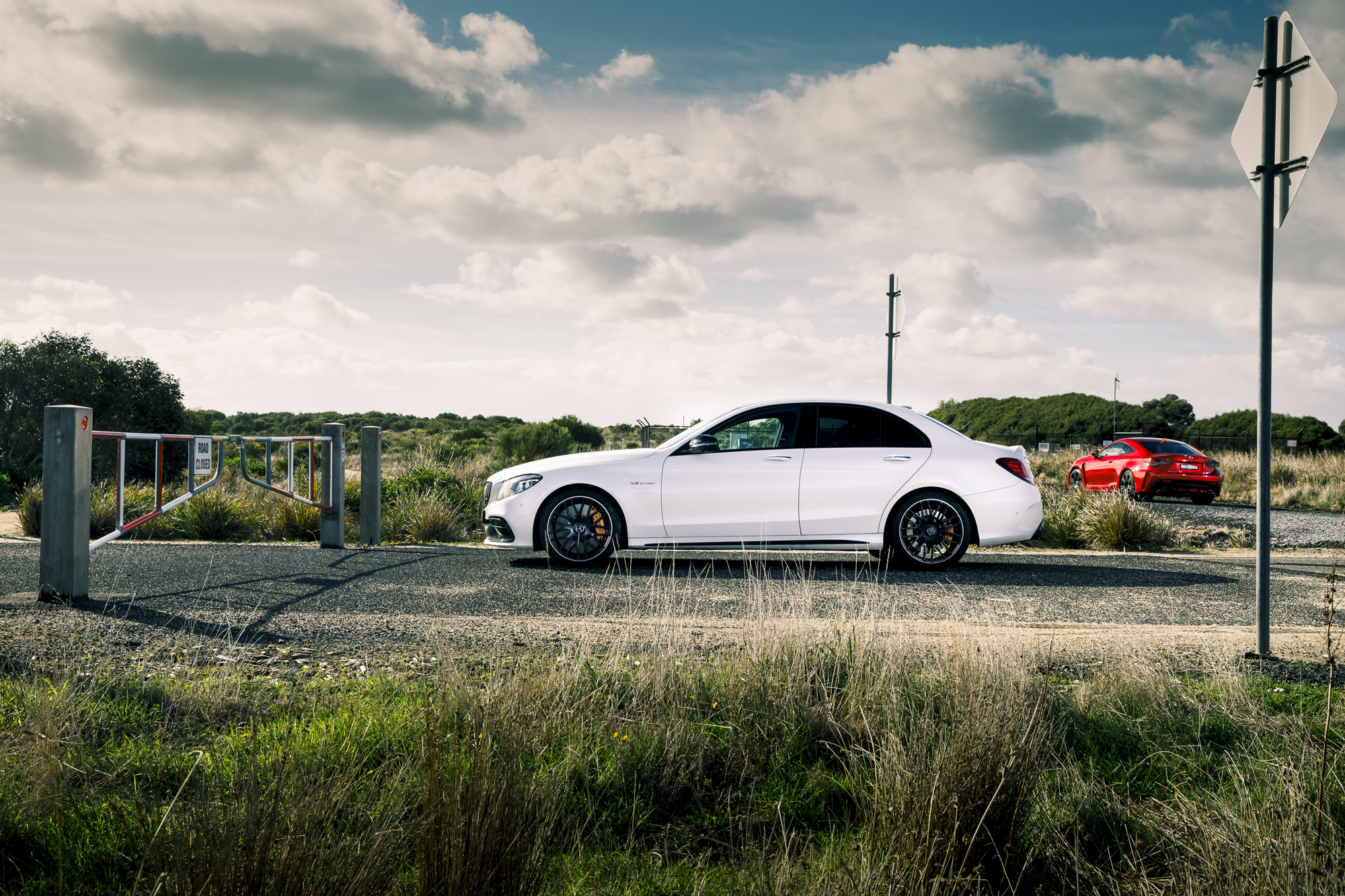
Unlike the Lexus, however, the AMG thrills in a vastly different, and significantly more visceral, way. Where the RC F is all about cultured refinement and delayed satisfaction, the AMG is instantly more aggressive. The 4.0-litre mill fires with a bark and the entire car trembles with an off-beat motion as the big brute settles into idle at 700rpm. It sounds wet, as though enormous fuel lines are dousing the combustion chambers with 98RON, and it’s the only car here with an active exhaust button. With the pipes open few cars sound this sinister, even sitting still.
Because it’s been with us since 2014, it’s easy to forget just how sophisticated AMG’s V8 actually is. Debuted in the pre-facelifted C63, much was made of its ‘hot vee’ design which brought packaging and performance benefits, but the heavy use of aluminium and exotic materials such as zirconium also mean it’s impressively light at 209kg dry. It’s also available in subtly different guises. In the C63, the BorgWarner turbos are single-scroll units, but step up to the E63, S63 and flagship GT and they’re twin-scrolled. These more aggressive iterations (dubbed M178, while the C63 uses M177) also score a different exhaust manifold, dry-sump lubrication, and fuel-saving cylinder deactivation tech.
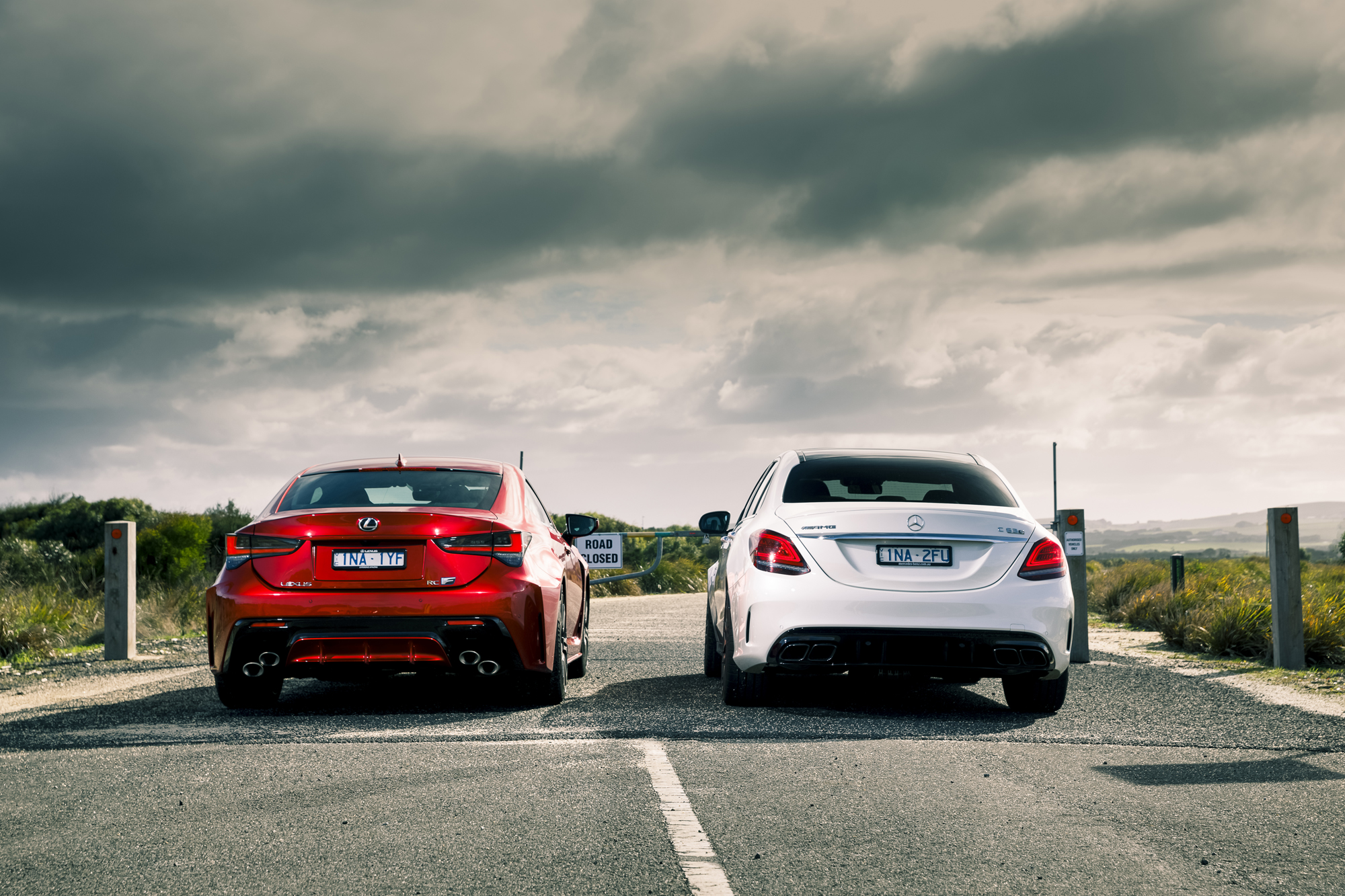
No matter the flavour, the result is a donk that feels positively unburstable. Strong, muscular and with a mighty mid-range, it’s also a pleasure to wring out to the 7000rpm rev cut.
Pair this with a chassis that’s now even more capable and, crucially, finally comfortable, thanks to a much-needed dose of compliance, and the C63 is a riot to pedal quickly. It’s also a car that’s easy to drive at the limit, and even beyond it. Engage Sport ESC, or switch it off altogether to activate the nine-stage traction control, and the C63 is equally capable of being fast and neat, or sideways and awesome as it allows you to choose your angle of attack on corner exit.
And for me, it’s that feeling of the rear axle just slipping, of your hands moving to apply a quarter turn of lock, and of the cabin filling with a crescendo of noise and bassy goodness, that encapsulates what sporty V8s are all about.
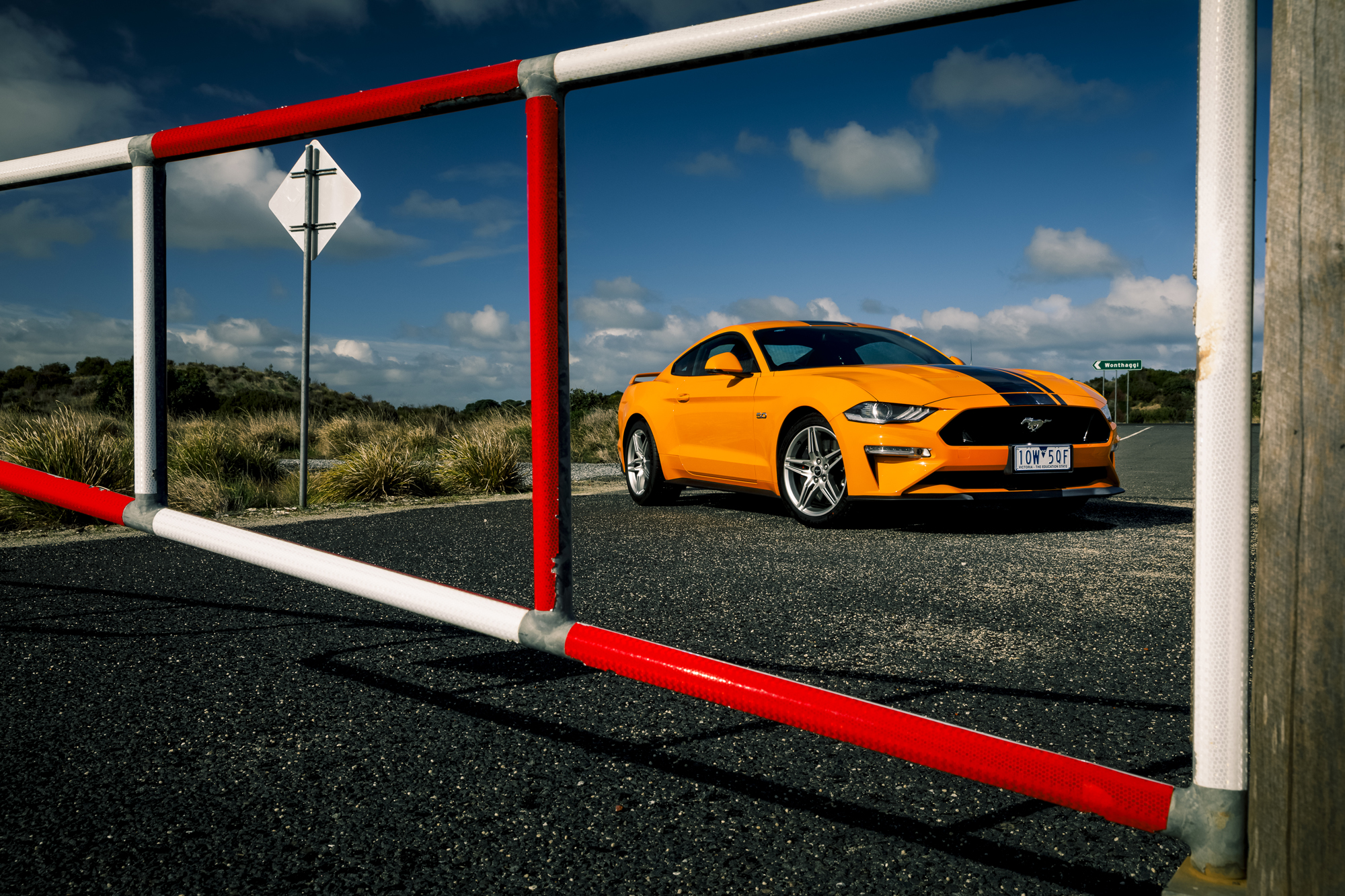
Kirby: While it’s easy to get swept up in the luxury and theatre of the more extreme cars present, for many Australians, the V8 will always wear a blue collar. The Mustang, here in manual GT guise ($62,990), sticks to those honest roots, and adds a distinctly working-class flavour to our two-day test.
The basic architecture of the Ford 5.0-litre ‘Coyote’ V8 in the Mustang has been around in one form or another since 1990 as part of the Blue Oval’s Modular family of engines. Aussies know and love it for powering the final-generation Falcons, but since the sixth-gen Mustang was introduced to Ford’s local line-up in 2015, the sales figures speak for themselves: offer a sub-$70K V8 and Australians will come.
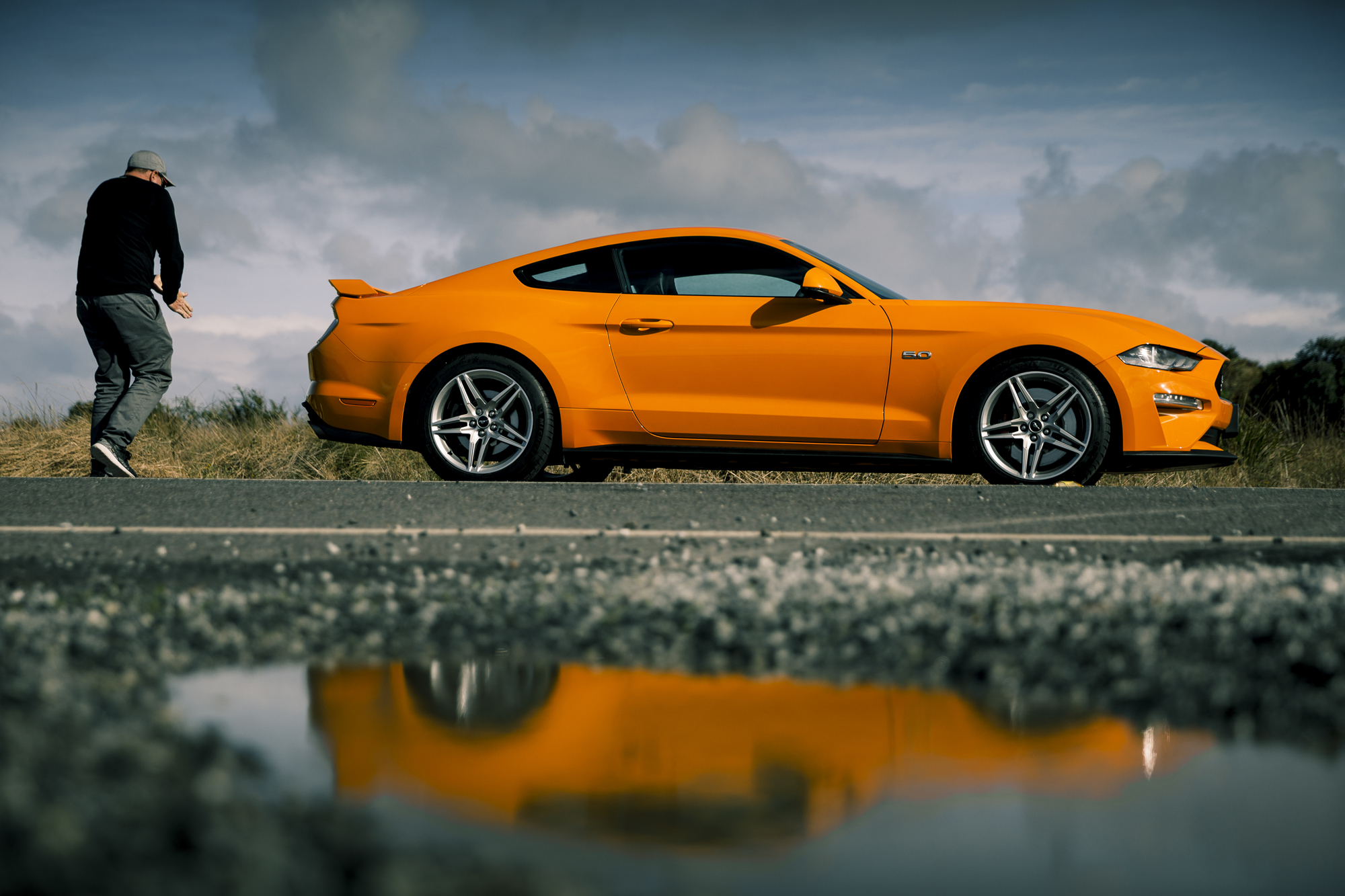
The core recipe for the 5.0-litre V8 is an aluminium, 90-degree block topped by double overhead cams with variable timing. But Ford snuck an extra 84cc onto the Coyote as part of the MY18 facelift, boosting capacity from 4951cc to 5035cc. Other changes, including enlarged intake and exhaust valves, doubling the number of injectors from eight to 16, increasing the compression ratio to 12.0:1, and a revised intake manifold, result in increased peak power figures of 339kW at 7000rpm and 556Nm at 4600rpm.
Our tester is fitted with the six-speed manual; the only stick present during our celebration. The Getrag gearbox was tweaked for 2018 with a twin-disc, dual-mass flywheel, similar to what is used on the track-terrorising GT350. Yet there’s an endearing simplicity about the Mustang. Westerman praises it for its analogue character in such ‘digital’ company (Trackhawk excepted), while Enright is especially enamoured by the shift action. Over-servo’d brakes and sub-optimal pedal placement are the only lowlights anyone seems able to conjure.
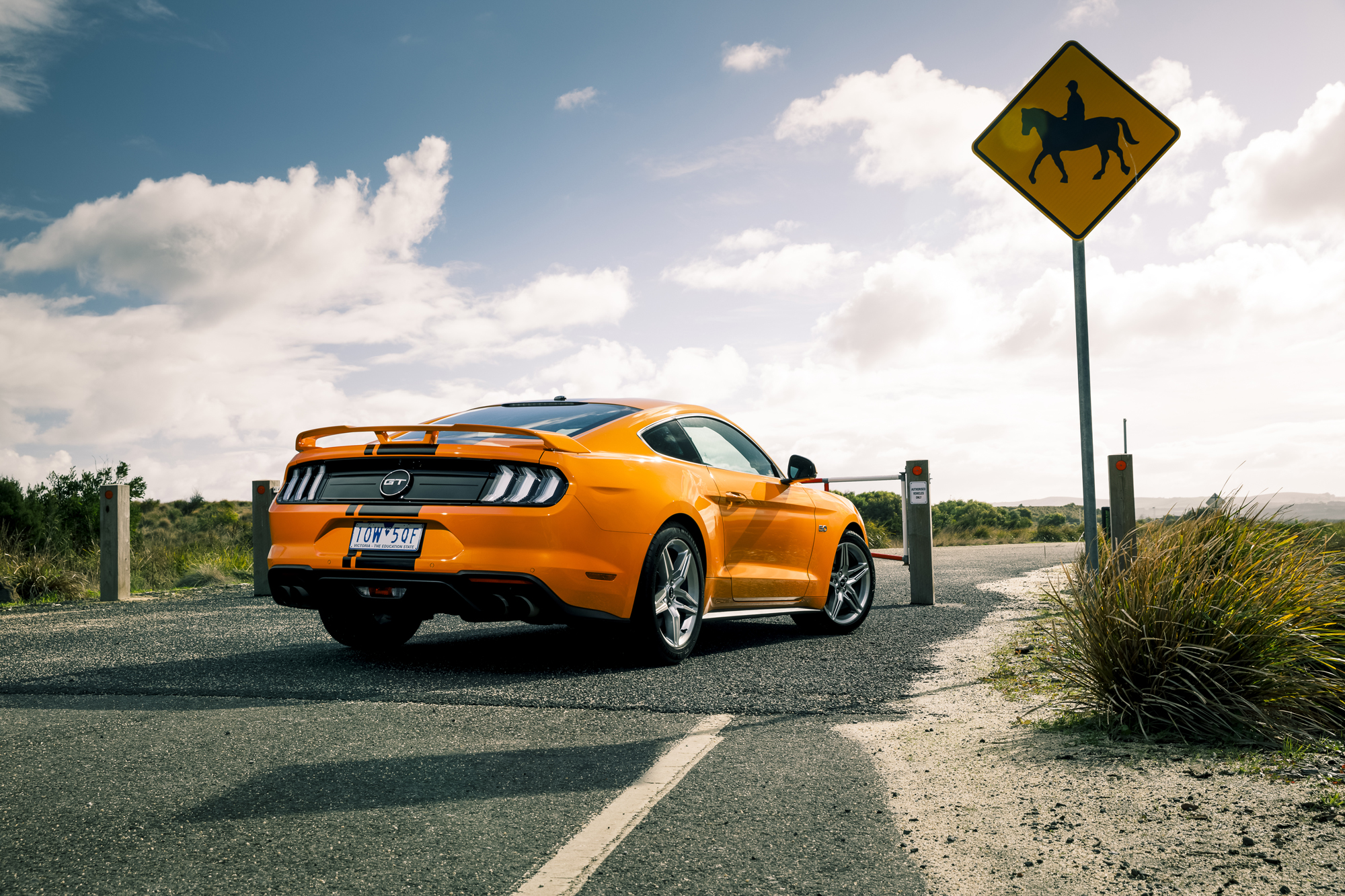
Ford has given the facelifted Mustang four exhaust modes, and when the loudest is selected, it delivers a quintessential bent-eight soundtrack that could headline a V8 Greatest Hits compilation album. Revving it out to the 7500rpm redline before slotting another gear, chirping the tyres, and sliding towards the sunset has surely got to be one of the purest delights in motoring.
While much can be said about the Mustang’s retro looks and comparatively affordable price fuelling its sales success, I’d wager that for many buyers, the real reason they chose to add the Blue Oval’s hero to their garage is the eight cylinders under the bonnet.
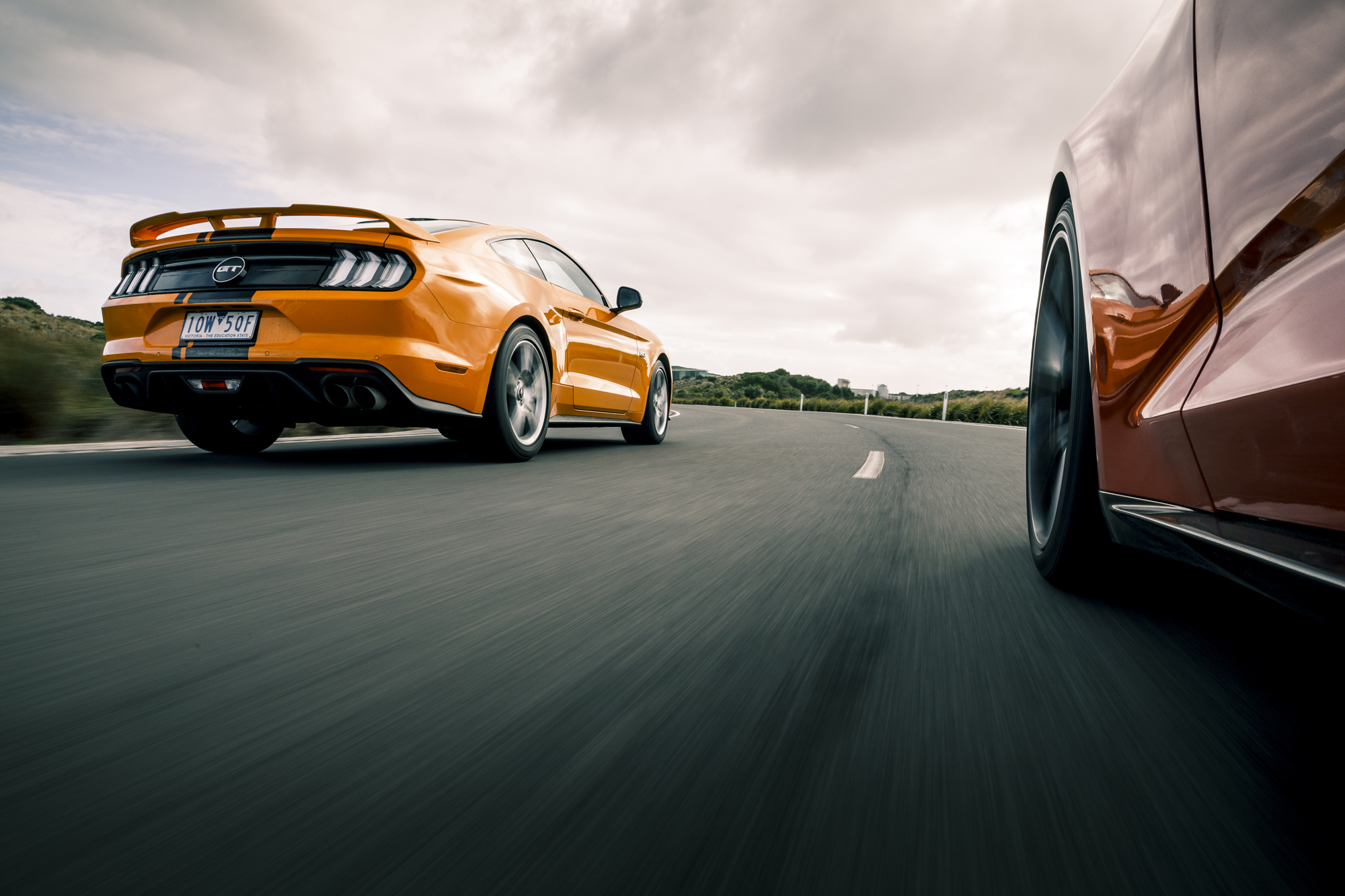
There’s an inexplicable X-factor about the V8 layout, no question. The disparate, brilliant V8s in all six of these cars are their beating hearts, and every opportunity to floor the throttle in each raised our pulses. Long may it continue.
They say there’s no replacement for displacement… except technology. Proof in point: the new 2019 G20 BMW 330i.
Beemer’s badge originally referred to the medium-size 3 Series, powered by a naturally aspirated 3.0-litre straight-six engine – the kind the Bavarian car maker is well known for. But all that sensical nomenclature was lost as tightening emissions forced mainstream cars to have smaller, more efficient turbocharged engines that could deliver equal performance. At least, most brands will tell you that the performance remains on par.
Interesting then is the new Genesis G70, available with an environmentally friendly 179kW/353Nm 2.0-litre turbo but also a larger 3.3-litre V6 twin-turbo punching out 272kW and 510Nm for equal money. True, the new South Korean premium brand offers a down-sized four-pot like all rivals, though the 3.3T is the largest and most powerful engine in the segment short of performance sedans such as the BMW M3 and Mercedes-Benz AMG C43.
Furthermore, the BMW 330i and Genesis G70 3.3T Sport are perfect price pairs, costing $72,900 apiece. BMW’s effort is polished with premium cabin but it gets a smaller 2.0-litre petrol turbo motor, producing 190kW and 400Nm through an eight-speed automatic transmission. Like the Genesis, it’s rear-wheel-drive.
The Genesis G70 is the first new generation model from Hyundai’s premium offshoot and the V6 turbo engine is muscular, firing grunt through an eight-speed automatic which gives it a claimed 0-100km/h in 4.7sec, one second faster than the 330i’s 5.8sec.
History shows it’s prudent not to trust what the manufacturer says though, so we took both down the strip for a good ol’ fashioned drag race.
First up is the BMW 330i, tested with cost-option electronically controlled locking differential and riding on 225/40/R19 front, 255/35/R19 rear Bridgestone Turanza T005 rubber.
Ambient temperature at Heathcote raceway was 9.5 degrees Celsius and the weather was clear, though it had been raining.
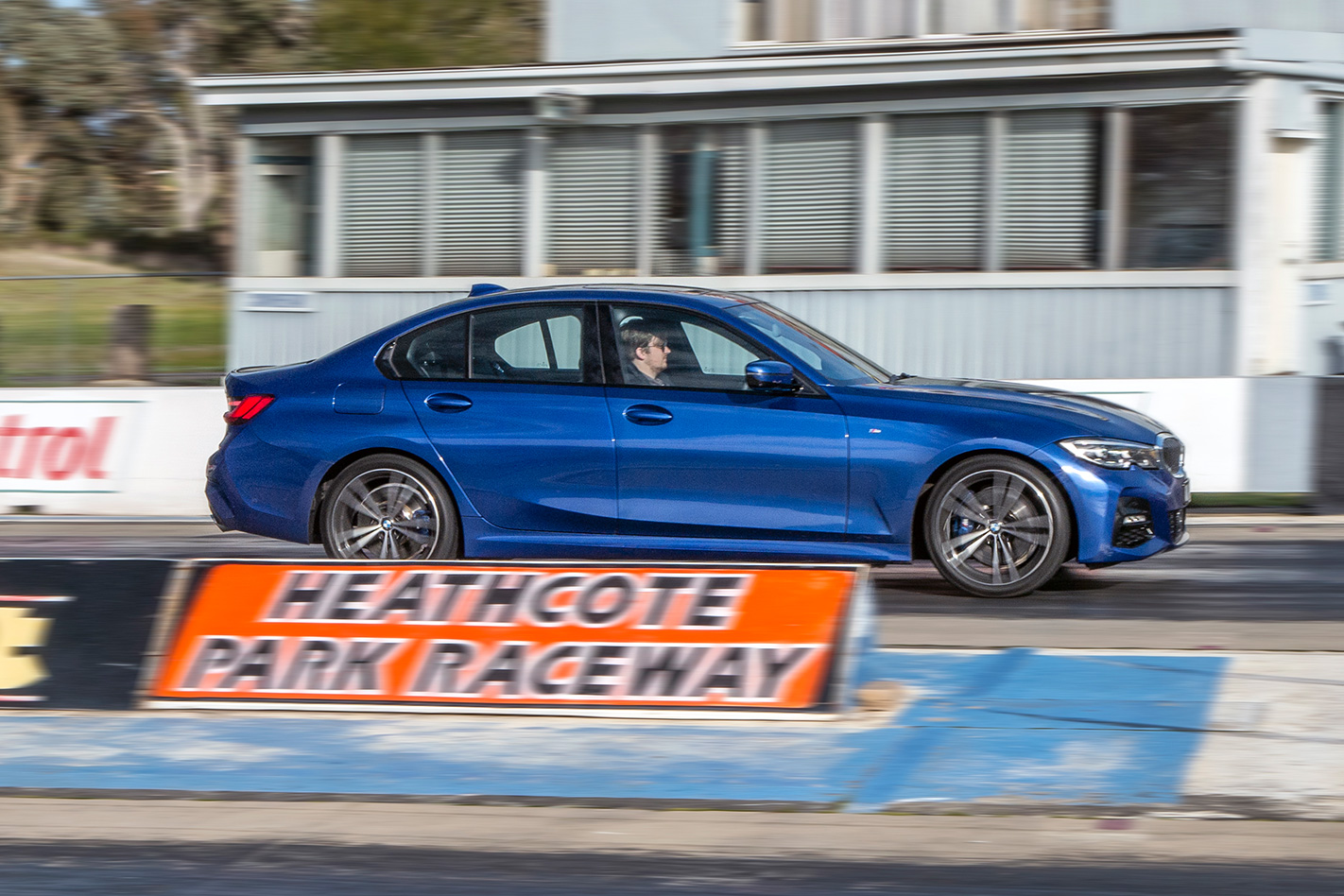
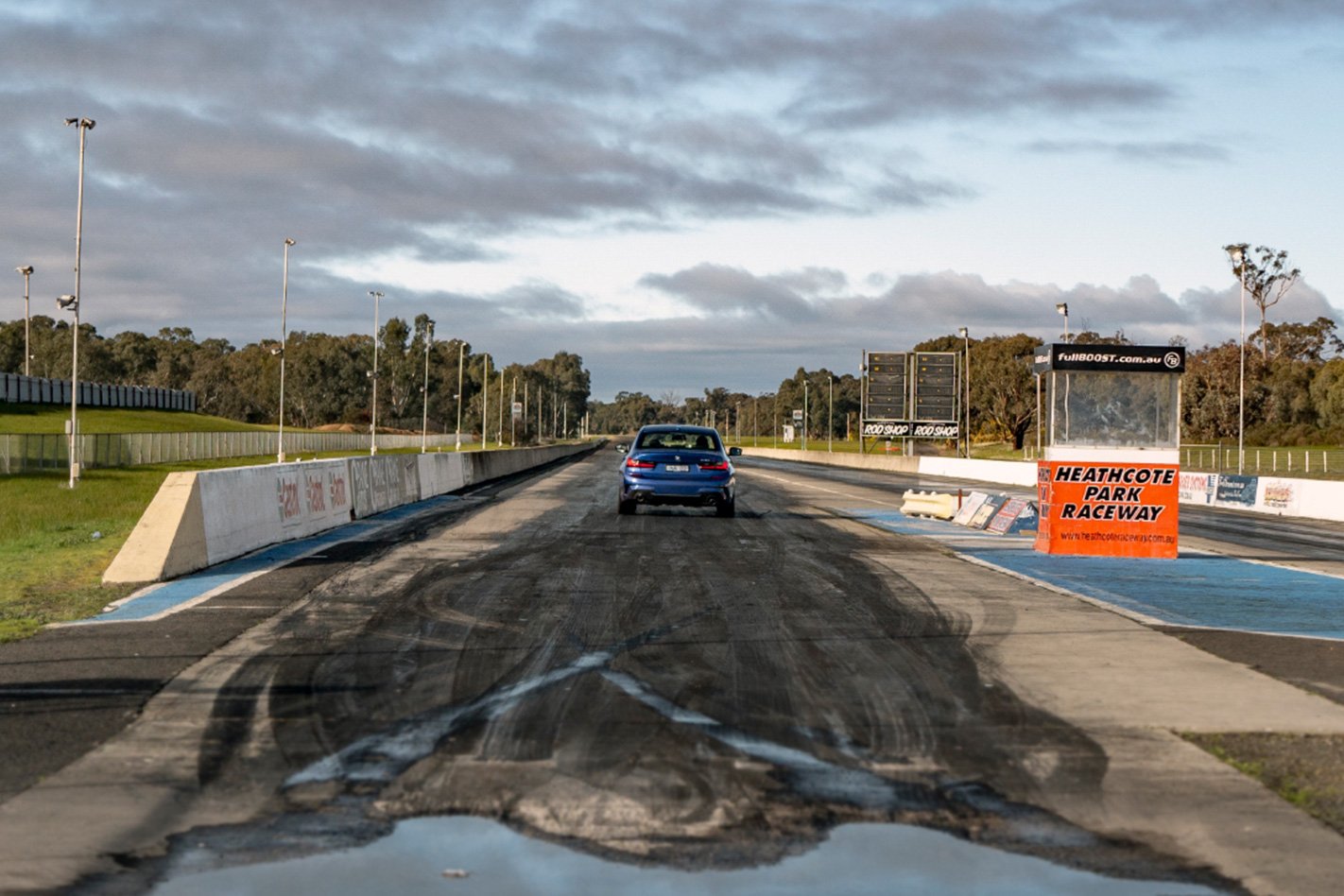
Without launch control, the 330i breaks a set of black lines quickly, so it’s hard to stall to the right revs. It also struggles for traction with the traction control off – our best result was with TRC on, Sport Plus mode selected and with the automatic shifter slid across into Sport mode. The result was a 0-100km/h in 5.8sec, matching the claim and finishing the quarter-mile sprint in 14.1s at 161.7km/h.
How did it fair against the Genesis, which couldn’t live up to its claim?
The South Korean gets an electronic diff as standard, with a mechanical limited slip diff in the higher-spec Premium Sport, and rides on the same size rubber as the 330i. However, this time it’s the performance-oriented Michelin Pilot Sport 4 tyres.
There is no launch control, but in Sport mode, even with traction control off, the automatic will stall at 1500rpm – ample revs for a good start given the huge torque on tap that spins the wheels even when changing gear at around 80km/h. The automatic transmission isn’t the brightest at getting the most from each cog, shifting a touch early, so overriding it via the paddle shifters is best for extracting maximum performance.
Down the strip it managed 0-100km/h in 4.9s – 0.2s short of the claim – completing the quarter mile in 13.2sec at 176.7km/h. An easy win for the more powerful engine, then.
Check out the full results below.
| u00a0 | BMW 330i | Genesis G70 3.3T |
| 0-10 | 0.5 | 0.6 |
| 0-20 | 0.7 | 1 |
| 0-30 | 1.1 | 1.4 |
| 0-40 | 1.5 | 1.8 |
| 0-50 | 2.1 | 2.2 |
| 0-60 | 2.7 | 2.7 |
| 0-70 | 3.4 | 3.1 |
| 0-80 | 4.1 | 3.7 |
| 0-90 | 4.9 | 4.3 |
| 0-100 | 5.8 | 4.9 |
| 0-110 | 6.8 | 5.7 |
| 0-120 | 7.9 | 6.5 |
| 0-130 | 9 | 7.4 |
| 0-140 | 10.5 | 8.4 |
| 0-150 | 12 | 9.6 |
| 0-160 | 13.8 | 10.8 |
| 0-170 | 15.8 | 12.2 |
| u00a0 | u00a0 | u00a0 |
| 80-120 | 3.7 | 2.8 |
| 400m | 14.1 | 13.2 |
| u00a0 | 161.7km/h | 176.7km/h |
| 100km/h indicated | 96km/h | 96km/h |
| 100-0 | 36.5m | 37.1m |
| u00a0 | 2.7s | 2.9s |
| u00a0 | u00a0 | u00a0 |
| u00a0 | Heathcote | Heathcote |
| u00a0 | 7.5c clear | 9c clear |
Alarm bells might be ringing if you own a diesel-powered car, with news of a class action lawsuit filed against Toyota raising concerns over a device called the diesel particulate filter (DPF). Here is the lowdown on what’s happened with the Toyota models involved and what you can do if you own any vehicle with a DPF.

All diesel cars have a DPF
Firstly, clogged DPFs aren’t an issue consigned just to Toyota. All diesel cars are fitted with a DPF and how you drive them greatly impacts their effectiveness. Low speeds and short trips are the major causes of blocked diesel particulate filters; long journeys with sustained higher speeds are required for regeneration – the process of hot exhaust gases burning off trapped soot inside the filter. So if your Hilux is going to be living a CBD life from one worksite to the next, it might be worth considering the petrol variant.
Poor servicing could also lead to issues sooner than if it’s well-maintained and it is important to use the right type of oil. Use the wrong one and it could actually clog the DPF further instead of cleaning it. Frequently running the gauntlet and driving on the low-fuel light may also cause cars fitted with DPFs to skip the regeneration faze to save fuel, so this should be avoided, too.
A clogged DPF could cost you money in the short term as it can increase fuel consumption, while in the long term it might lead to more expensive mechanical implications. Faulty parts or not, how a DPF-fitted car is driven and maintained goes a long way to determining its lifespan.
Toyota DPF class action
The class action filed against Toyota regarding the quality of a certain DPF concerns the Toyota Hilux, Prado and Fortuner fitted with the 1GD-FTV 2.8-litre turbo-diesel four-cylinder.
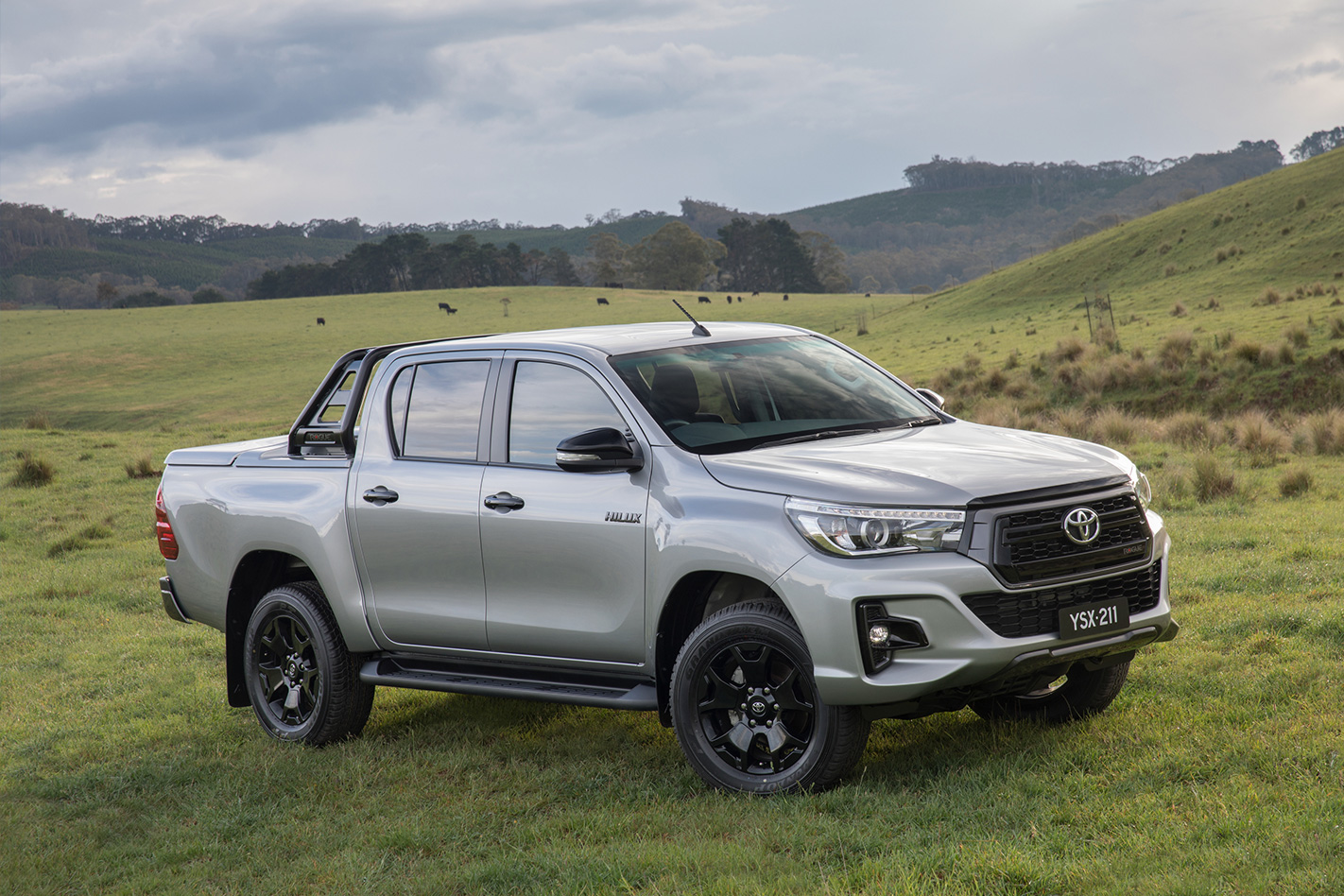
While a recall hasn’t been released by Toyota, it’s been announced that Hilux, Prado and Fortuner variants fitted with the 1GD-FTV built between October 1, 2015 and July 26, 2019 are affected. According to VFACTS sales records, the number of Toyotas sold with the 2.8-litre diesel is more than 250,000. The hardest hit is the Hilux with around 176,000 units sold in the time frame.
Toyota is aware of the faults and has previously issued a statement to owners: “Toyota dealers will reprogram the engine control module, ensure the DPF has been regenerated and conduct a smoke test. If the smoke test is negative, the DPF will be replaced. All inspection work and replacement will be completed free of charge to the customer.”
Toyota Australia says it’s “unable to comment as this matter is before the courts”, however, the lawsuit (instigated by legal firm Bannister Law) claims that the DPF fitted to the 2.8-litre diesel engine doesn’t periodically burn off particulates (soot) trapped in the system. The claim seeks compensation for things like loss of income, reduction in vehicle value and excess fuel consumption.
Sometimes it’s had to find a minute to yourself these days, but it seems that the Japanese feel it more than most.
Studies conducted by some of Japan’s biggest car rental and car-sharing firms have finally unlocked the reason why one in eight cars is returned with no extra kilometres on the clock – people simply want somewhere private to escape for a couple of hours.
Customers of car-sharing company Times24, for example, which has more than 230,000 accounts on its books, would often rent a car simply to catch up on a few hours’ sleep. Others would grab a share car – which costs as little as $5 for a half-hour and can be collected from one of 12,000 locations – to practice their karaoke, catch up on some overdue work or even brush up on language skills.

One survey respondent even told the company he rented a car for an hour just so he could eat a lunch that he’d just bought at a convenience store. “There was nowhere else to eat it,” he explained.
Other companies have conducted similar studies, where customers would use car rental time to talk on the phone with family or to simply catch up on TV.
One of Japan’s largest rental firms, Orix Auto, actually reminds customers that they should turn off car engines if they are not driving. “We do not recommend that our customers rent vehicles for purposes other than traveling,” an Orix official told Japanese newspaper Asahi Shimbun.

Perhaps, though, the humble powernap is the key reason that Japanese people turn to the relatively comfortable and secure environment of a car. Surveys routinely show that Japanese workers sleep, on average, just six hours and 35 minutes a night, almost an hour less than people in other developed countries.
BEYOND HIS undisputed success as an inventor and engineer, and his ability to grow one of the motoring world’s great moustaches, Colin Chapman’s legacy continues in the number of quotes spruiked by enthusiasts.
“Simplify, then add lightness” is arguably the most famous, though “adding power makes you faster on the straights. Subtracting weight makes you faster everywhere” runs a close second. My personal favourite is “any car which holds together for a whole race is too heavy.”
You may have spotted the common theme. Chapman was an avid proponent of lightweight cars, though for me, the penny regarding the benefits of weight reduction didn’t properly drop until recently. The trigger was a comment made by a McLaren engineer who told me: “…100kg less is more beneficial than an additional 44kW and offers a five percent improvement in overall grip.”
Think about that for a moment. It’s wonderfully quantifiable (as you’d expect from the famously fastidious McLaren), and proffers two things: first, it makes poor old Colin’s quotes seem a little wishy washy, and second, it highlights the performance cost of throwing a mate in the passenger seat.
There are other benefits to reducing weight, of course. Lighter cars can use lighter components, which spawns a virtuous circle of weight reduction. They’re also easier on consumables like brakes, suspension components and tyres.
And then there are the efficiency gains. Data from America’s Environmental Protection Agency (EPA) shows that on average, every 100 pounds (45.35kg) you can remove from a vehicle improves its fuel economy by one to two percent.
All of which paints a rather glum picture when you consider the obesity epidemic sweeping through the motoring world. Common wisdom tells us that with every successive generation, cars are getting fatter, larger and more bloated. They’re also, if you apply Chapman’s logic, less involving to drive as a consequence.
The weight gain is easy to understand. Buyers want more room, additional luxuries, the latest safety features, and cars built around stronger structures, all of which add weight. But are cars really getting heavier?
Well, there’s no arguing with the facts, and again the EPA is helpful here. Its data shows that in 2003 new cars hit a peak at 1823kg, which was the heftiest average weight since 1976 when the oil crisis forced manufacturers to slash weights by around 20 percent to improve efficiency.
From there, things headed north year after year, but more recently weights have plateaued. The same EPA data shows that since 2014 average vehicle mass has remained largely unchanged as companies adopt cutting-edge materials and look to meet ever tightening emissions regulations.
“See, Inwood!” I can hear you thinking. “It’s not all bad, and you’re forgetting about power-to-weight ratios. Modern cars might be heavy buggers but engine advances have far outpaced any gains in girth!” This is true. Today’s BMW M3 is 260kg heavier than an E30, but it has more than double the power (331kW vs 143kW). And while a modern Mini JCW weighs twice as much as the original, its 170kW is nearly seven times what a 1960s 850 could manage.
The thinking here is that the extra kilowatts cancel out the additional kilos, and that makes sense when you consider some Nurburgring lap times. An 1830kg Alfa Romeo Stelvio Q, for example, which has 375kW/600Nm, is quicker than a 302kW/550Nm BMW M2 Competition that weighs 255kg less. That same Alfa is only three seconds slower than a Porsche 997 GT3 RS, which is welterweight by comparison at 1370kg. Apply this thinking further and it’s possible to argue that two-tonne behemoths like the Jeep Grand Cherokee Trackhawk would be in the same ballpark too.
Incredible numbers, sure, but before we hoodwink ourselves with statistics, consider this: which of the above cars is more fun to drive? Not all power-to-weight ratios are created equal when it comes to enthusiast enjoyment, and, if given the choice, I’d take the lighter, less powerful car every time.
Another month, another set of new car sales figures sagging worryingly low, like my waistline in numerical form. There’s as many different explanations as there are cars, uh, not being sold. It’s because of housing prices. It’s because of the federal election. It’s because of Brexit. It’s because of ride-sharing apps. It’s because of emissions standards.
Allow me to clarify the real reason. It’s because the Big Banana has a mini-golf course.
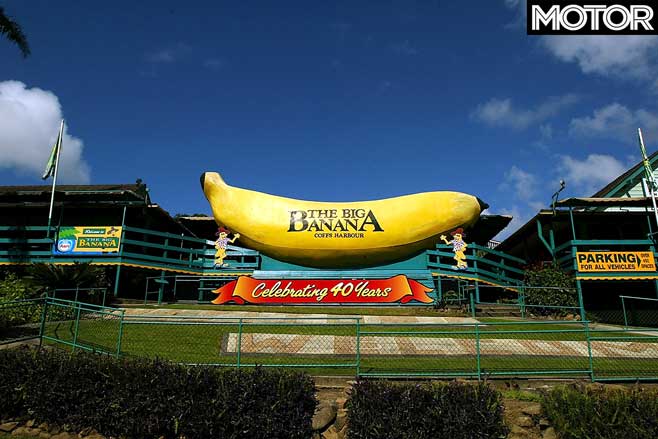
The Big Things – the Big Pineapple, the Big Prawn and dozens of Big Apples that all think they were the first – used to be things you saw on your way to somewhere, rather than an end point in themselves.
The Big Banana used to just be, well, a big banana. And it used to be that you had to drive through Coffs Harbour to get between Sydney and Brisbane – so you had a captive audience every school holidays, of heat-stressed kids and just plain stressed parents who wanted somewhere to pull over. And, hey, why not stop next to a big banana because, let’s face it, kids are idiots and will be amused by anything.
But now parents taking the kids for an interstate holiday are more likely to fly, bypassing Coffs Harbour by 30,000 feet or so. So the Big Banana had to become a destination in its own right, lest it end up like the Big Bull at Wauchope and get pulled down and turned into scrap. Hence the mini-golf.
Here’s the point: according to the Bureau of Statistics, Australians spend more on overseas holidays than we do on buying cars. And we spend more on eating out at restaurants than on petrol. The reason we’re not buying more cars isn’t because we don’t have the money, it’s because we’d rather spend that money on a holiday than a new car.

It used to be that family holidays meant family cars. No more. Air travel killed the road-trip holiday, or at least grievously wounded it (and forced the Big Banana to install a mini-golf course). And with that, the family car was relegated from being the passport to holiday fun to a device for driving to school, and driving to work, and traffic jams and chores and stress and drudgery. For the average family, cars don’t take them anywhere fun anymore. Planes do that. Family cars just go to boring places. Who wants to take out a loan to do that?
The trip – the actual travel part – has become the appendix of the holiday, a vestigial relic from the evolution of the vacation, now only noticeable when something goes wrong. It’s become something to get over and done with as soon as humanly possible – a notion reinforced by Big Airlines, who convinced the world that a quick and boring trip is better than a long and interesting one. Now, if you say “family holiday”, people think 787s, not seven-seaters.
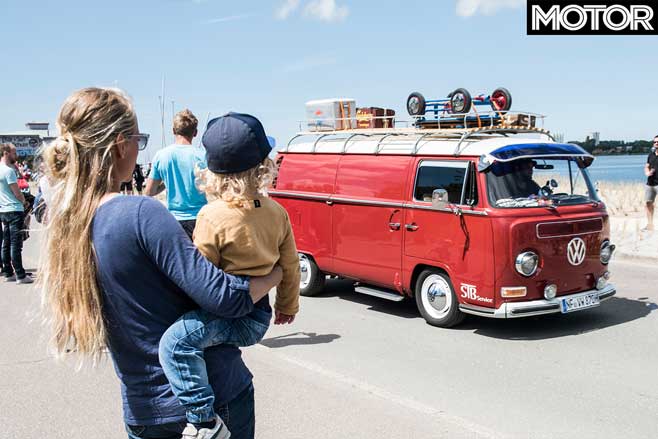
We’ve been drip-fed the notion that a holiday requires a Destination – specifically, a destination with an airport, a theme park and a celebrity restaurant. The family driving holiday to a middle-of-nowhere speck on the map was already quaint when The Castle came out two decades ago. The road-trip holiday has become an oxymoron instead of a tautology.
Tourism Australia has a close-knit partnership with a dozen airlines. Fair enough. But perhaps the auto industry ought to extend a hand to the tourism bodies, and fund a new campaign called ‘Just Drive There, And Stop Off At Any Big Fruit Statues You See Along The Way, Before They All Get Torn Down Or Turned Into Mini-Golf Courses.’ (It’s catchy, I know – you should hear the jingle.)
It’s not too late to reignite the emotional connection between the car and holiday-flavoured good times. And remind the general population that the journey isn’t wasted time – sometimes the journey is the holiday, and a big banana is all the reason you need to stay awhile.
- Introduction: Purity Test
- Update 1: Budget Bash
- Update 2: Track Twist
- Update 3: Dirty Dancing
- Update 4: Spin Class
- Update 5: Conclusion
Introduction: Purity Test
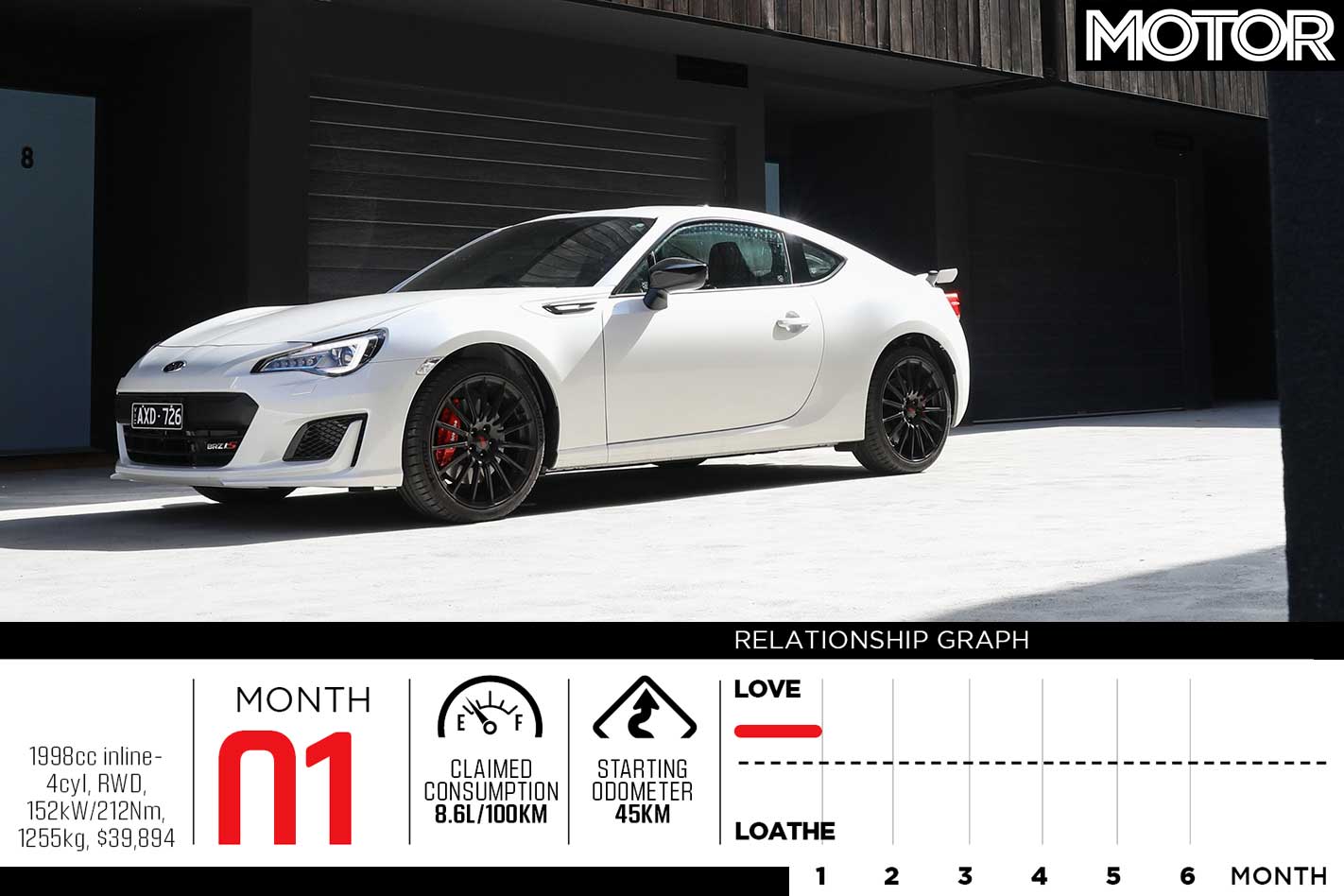
This isn’t your typical long-term test. We’ve dedicated enough words to the Toybaru twins in this magazine, including an 86 long-termer a couple of years back, that most readers should have a pretty good handle on what they’re like to drive. As such, this introduction will be the only time we’ll discuss the on-road behaviour and day-to-day liveability of our new 2019 Subaru BRZ tS.
The reason for this is that each successive update will cover a different motorsport discipline. It’s getting more and more difficult to enjoy performance cars – and driving in general – on the public road. Even a car like the BRZ, which definitely sits towards the more leisurely end of the performance spectrum, can easily find itself in contravention of the law when driven enthusiastically.
The easiest way to avoid any trouble with the constabulary is to take it off the streets. Every weekend around Australia there are dozens, if not hundreds, of club-level motorsport events catering to virtually every taste and budget. Over the next few months we’ll hopefully bring a few to your attention and assess their viability for those of you whose financial reserves struggle to match their enthusiasm.
But first, the BRZ. We chose the Subaru because it’s – hopefully – the perfect car to answer the question we’re asking: can you compete in a variety of weekend motorsport events with a stock-standard car without spending a massive amount of money? The tS variant could’ve been tailor-made for this test.
A standard BRZ or 86 is already a very enjoyable package, but the brakes can be a bit marginal on some tracks and the standard Michelin Primacy tyres are crap. In fact, in researching this assignment, we discovered some events ban the use of the standard low-grip Toybaru tyres due to the racket they make under hard use.
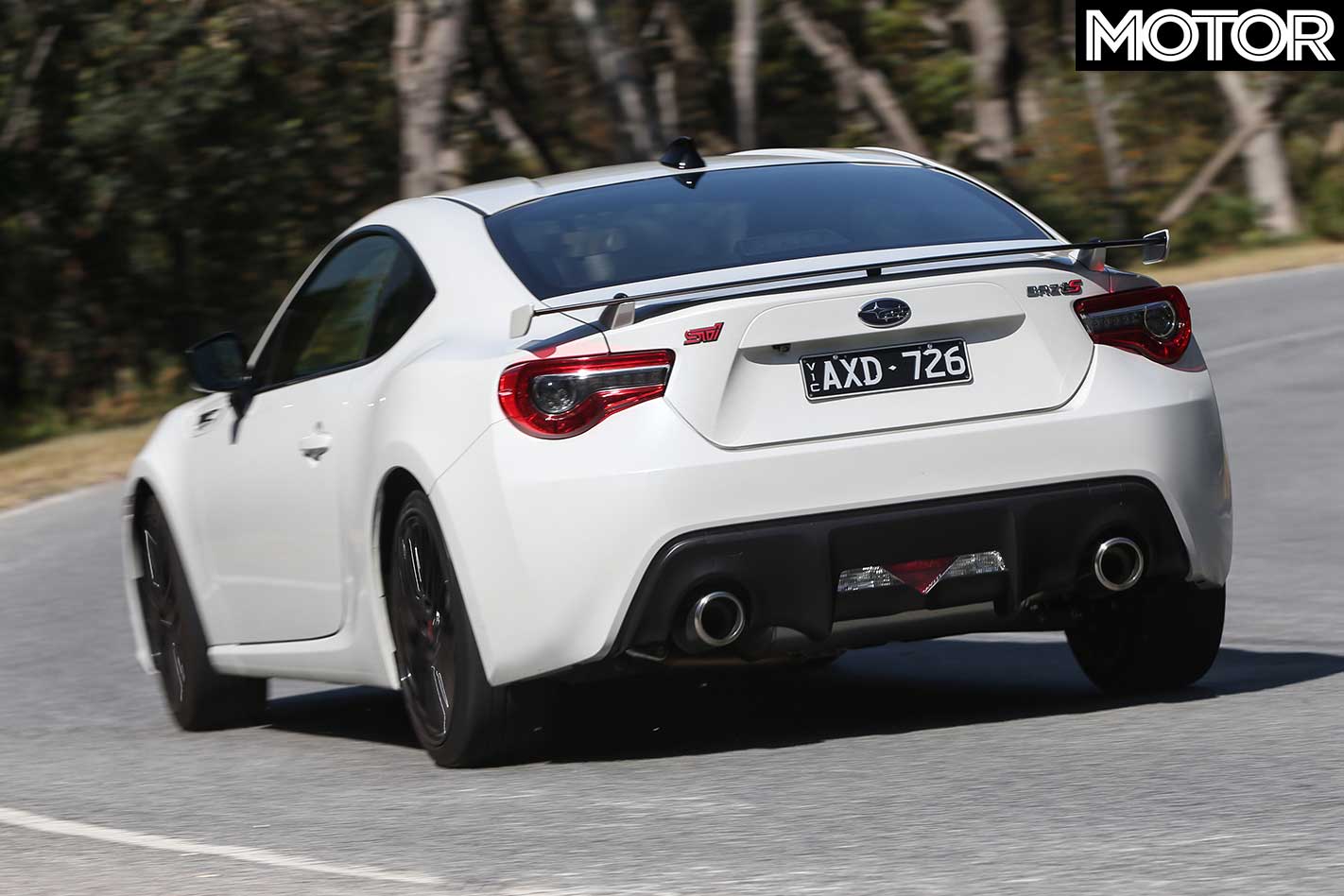
The tS overcomes this with Brembo brakes and Michelin Pilot Sport 4 tyres wrapped around 18-inch wheels, while adding Sachs dampers, STI springs, body bracing and plenty of cosmetic garnish like a rear spoiler, red seat belts and the like.
It costs $39,894 as a manual and $41,894 as an auto, $5904 and $4404 more than the standard and Premium grade BRZs respectively.
Testing duties have kept me out of the BRZ’s driver’s seat more than I’d like, which suits the other MOTOR-heads just fine – it’s never difficult to find a taker for the Subie’s keys at day’s end. This has actually been beneficial as the tS arrived with just 45km on the clock, not ideal for a car that’s going to be used enthusiastically over its life with us.
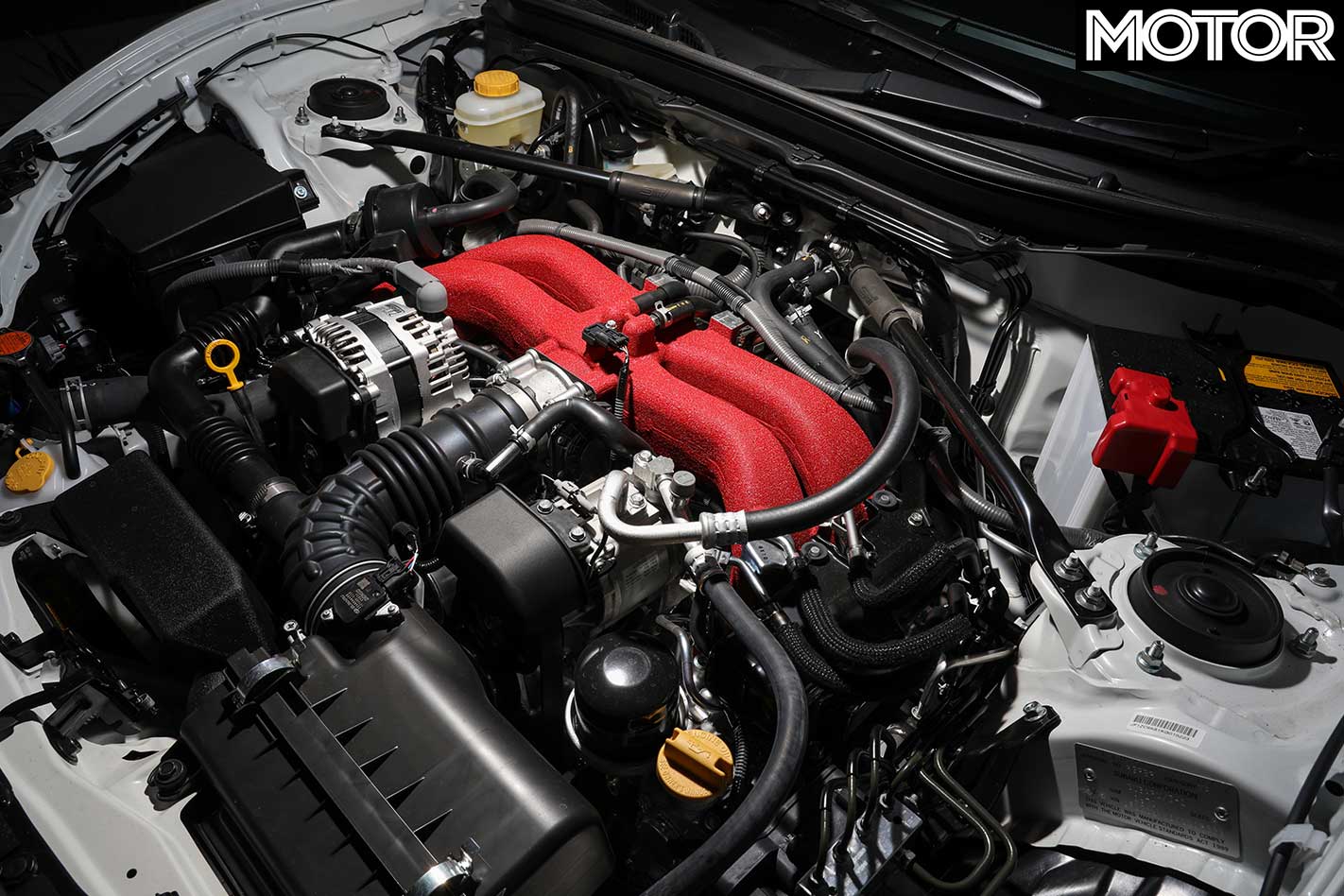
The BRZ makes driving fun. Any driving. The steering wheel is set lower than I remember but the driving position is otherwise excellent with pedals perfectly placed for heel-toe downshifts – just the thing to liven up a dull commute. The gearshift is a bit notchy, hopefully it frees up with time, the ride is firm but fine and the steering just superb. Seven years on, this is still one of the better EPAS systems around.You can easily notice the extra tyre grip, too.
The biggest downer is the engine. There’s a massive dip in the torque curve between 3500-5000rpm, just where you spend most of your time in day-to-day driving. Whether the BRZ’s relative lack of grunt – it’s not that slow, but it feels slower than it is – counts against it on track will probably depend on the track we choose, but more on that in a future update.
Still, the aim of this is to improve the bit behind the wheel, not the bit under the bonnet. See you next month, when we end up feeling a bit dusty.
2019 Subaru BRZ tS Pros & Cons
Three things that excite us: 1 – RWD! RWD! RWD! 2 – Durability 3 – Learning skills
Three potential concerns: 1 – Too slow? 2 – Too much grip? 3 – Others taking it
Update 1: Budget Bash
Who says motorsport has to break the bank?
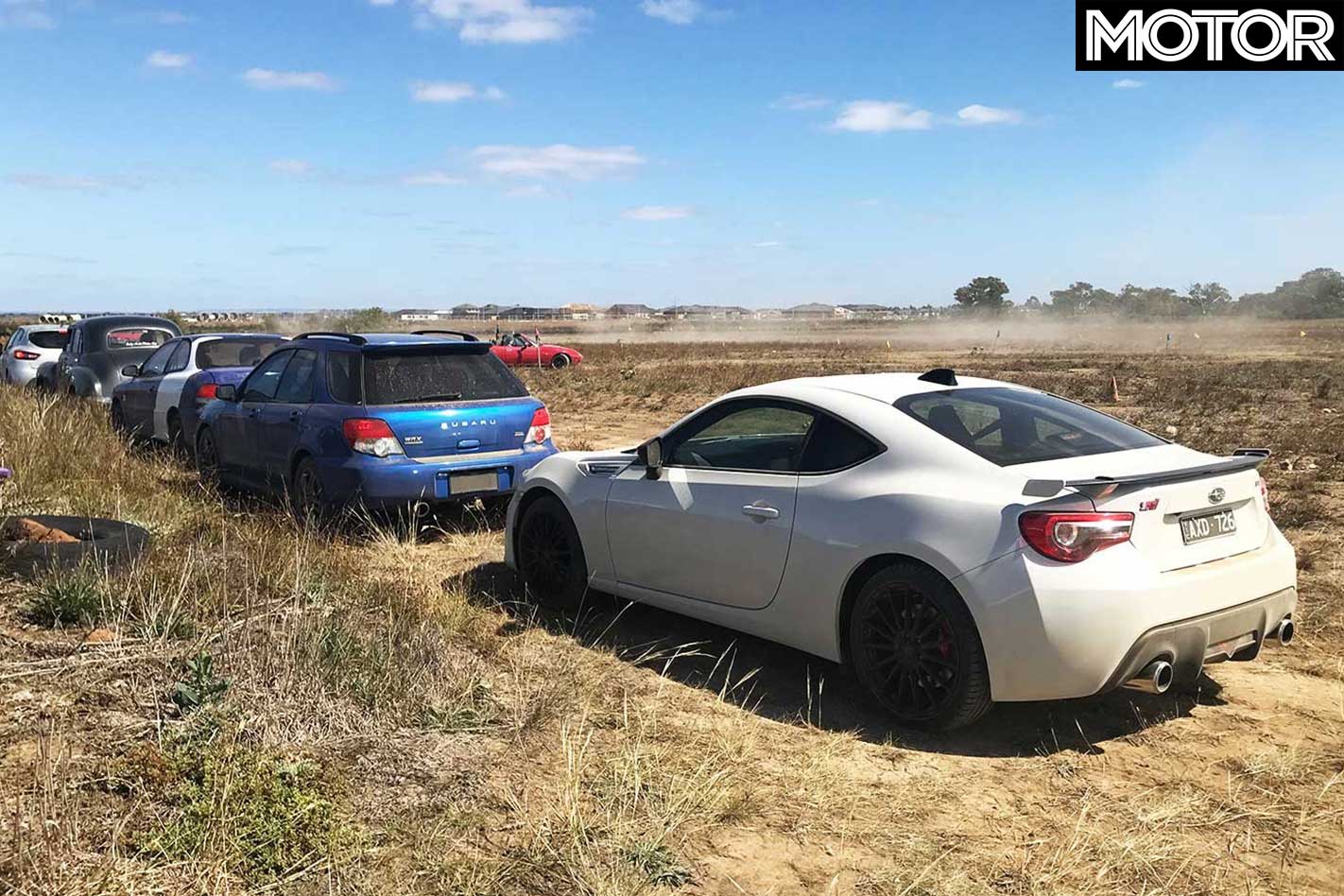
Motorsport is expensive. Everyone knows this, especially anyone who has attempted to take part. But it doesn’t have to be.
A quick recap for those who missed last month’s introduction, over the coming months we’ll be using our long-term 2019 Subaru BRZ tS to examine whether a completely standard car (as long as it’s the right one), a modest budget and hefty helping of enthusiasm is enough to enjoy a variety of motorsport events.
First up, motorkhana. In terms of cost and vehicle preparation, motorkhana is the simplest form of motorsport there is. Those who get serious about it invent all sorts of wacky specials, but any standard vehicle will be fine, though a well-adjusted handbrake is certainly an advantage.
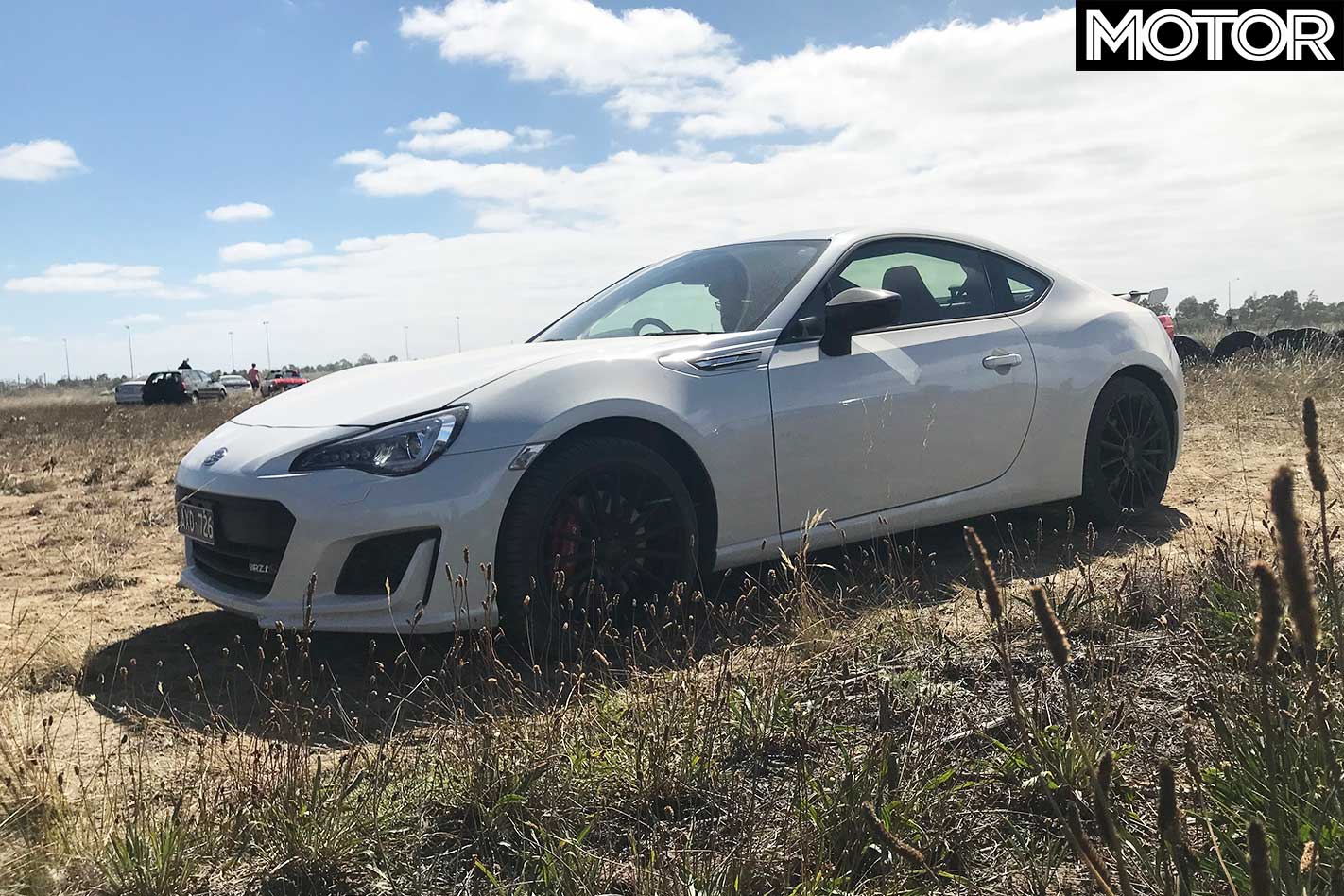
For the come-and-try event attended by myself and Dylan, the BRZ tS needed nothing but some fuel in the tank and some air in the tyres, not even a fire extinguisher. Just make sure the battery is clamped down nice and tight if you have an older car.
The variety of machinery on display was honestly astounding. As well as your usual array of beaten-up mid-1980s hatchbacks which make great motorkhana hacks, there was a Walkinshaw-tuned Holden VY SS, a bug-eye Subaru WRX hatch, a new base-model Renault Clio, a Mitsubishi Mirage Cyborg rally car, a Humpy Holden and even a pair of W126-series Mercedes-Benz S-Class Coupes.
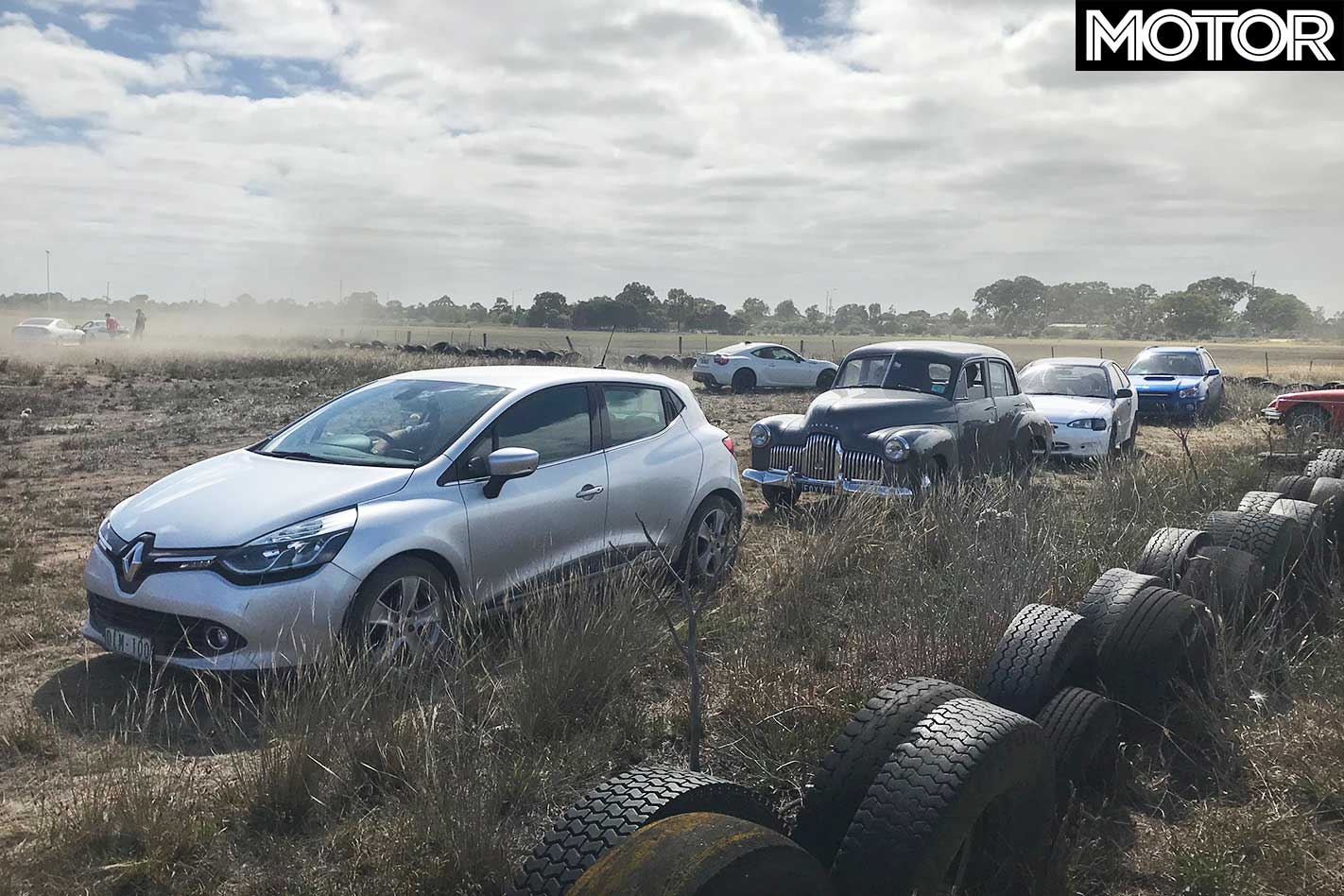
The event was held by the Ford Four Car Club of Victoria at the Werribee motorkhana track which is – there’s no polite way to say this – a scruffy paddock. It’s easy to miss, for the entrance was dominated by near-metre high grass and the paddock – sorry, track – was overgrown with a variety of small plants, weeds and clumps of dirt and looked about as much like a motorsport venue as Spa-Francorchamps does a dairy farm.
As it turns out, looks can be deceiving. This come-and-try day was the first event for the year, thus the rather unruly condition of the grounds. It didn’t take long on a hot summer’s day for the paddock to become a dust bowl as the surface was churned up by dozens of enthusiastically spinning wheels.
A tip for unsealed motorkhanas: wear old clothes and be prepared to spend plenty of time vacuuming dust out of crevices. The car’s, that is, not yours. Don’t use a vacuum for that.
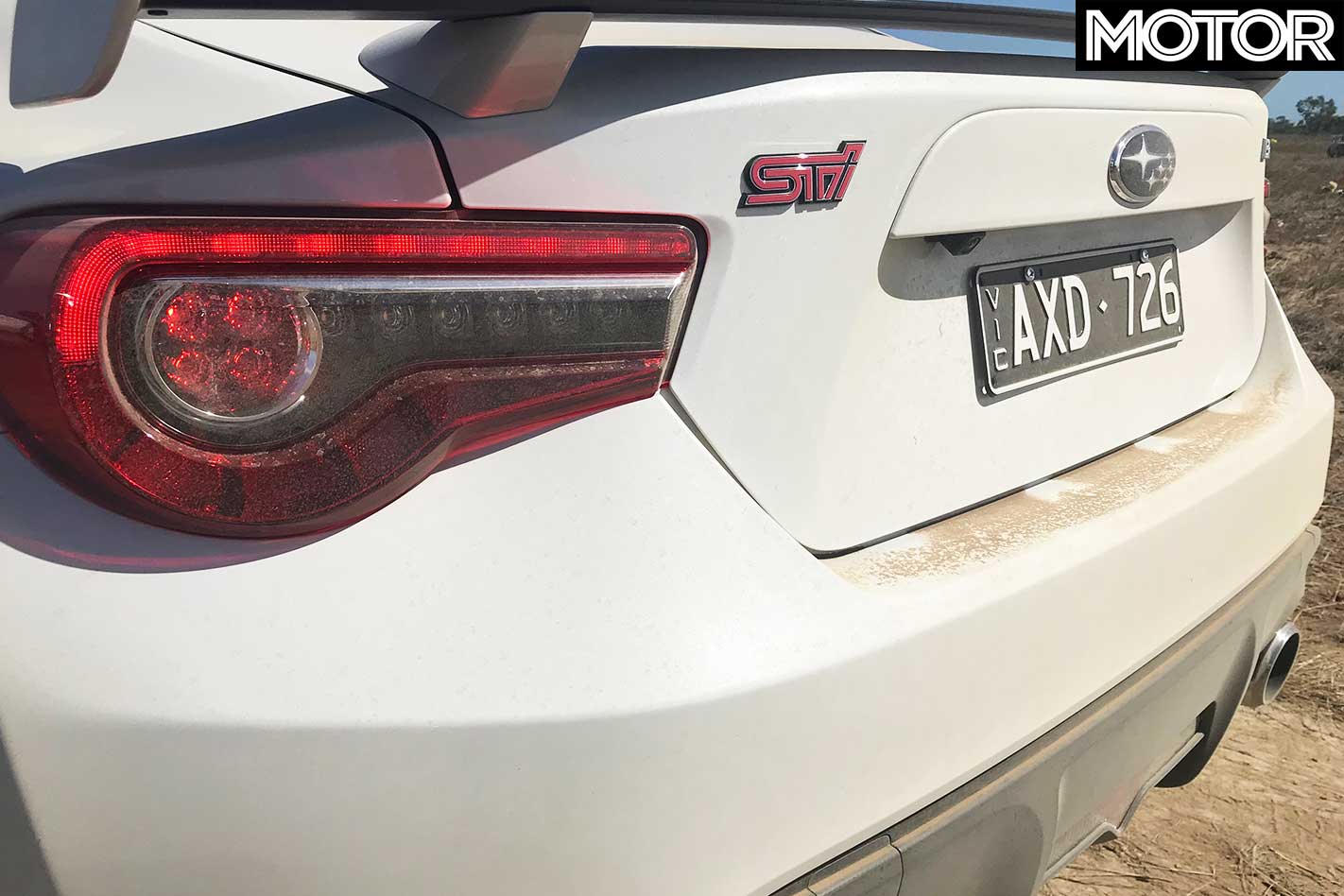
It’s easy for more seasoned motorsport campaigners to look down their noses at motorkhanas due to its low-speed nature. After all, most courses can be completed in first gear with short forays into second, but the courses themselves are often fiendishly tricky, requiring not only the ability to adjust a car’s direction quickly at low speeds but also to remember the course while driving as quickly as possible.
Thankfully, as a come-and-try day Editor Dylan and I were saved the humiliation of ‘flag hit’ and ‘wrong direction’ penalties, which would have scuppered any chance of success. There was no timing and no winners, although with an empty field and a rear-wheel drive sports car to play with we certainly felt like winners.
A number of courses were laid out, from a simple slalom to one that if you traced it correctly would look like the Toyota badge from above. Somewhat appropriately, given the origins of our vehicle, this faster test was our favourite, mainly because it involved doing two massive circles of an imaginary dusty roundabout.
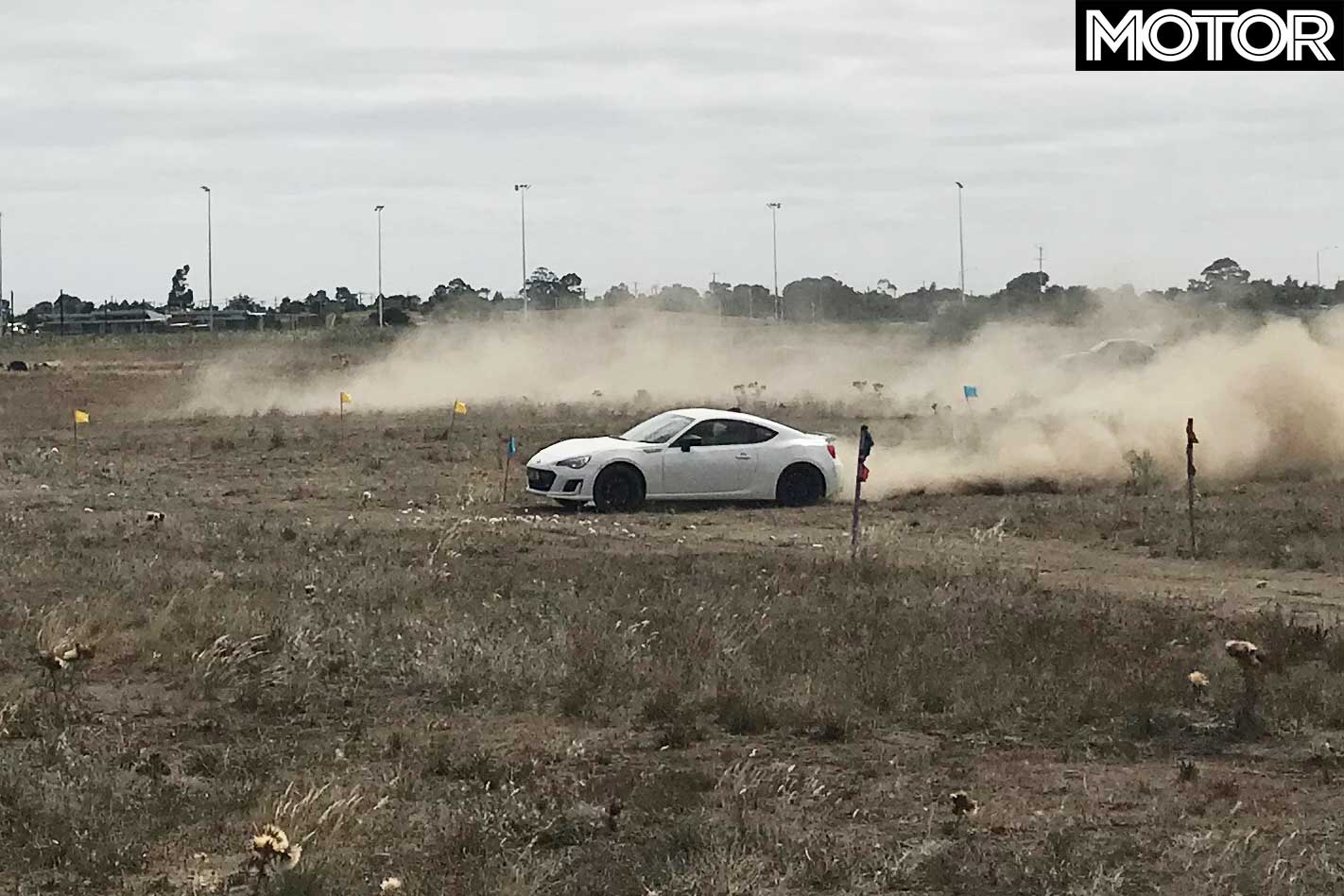
It was great fun, but also brilliant driver training. It’s a completely consequence-free environment, allowing you to try a Scandinavian flick or tweak of the handbrake to see what happens, actions that seem intimidating even on a racetrack due to the higher speeds involved and possibility of ‘falling off’ or inconveniencing other track users with a spin.
The good news is that motorkhanas are held all around Australia on most weekends and, if you’re allergic to dirt, they hold them on bitumen, too.
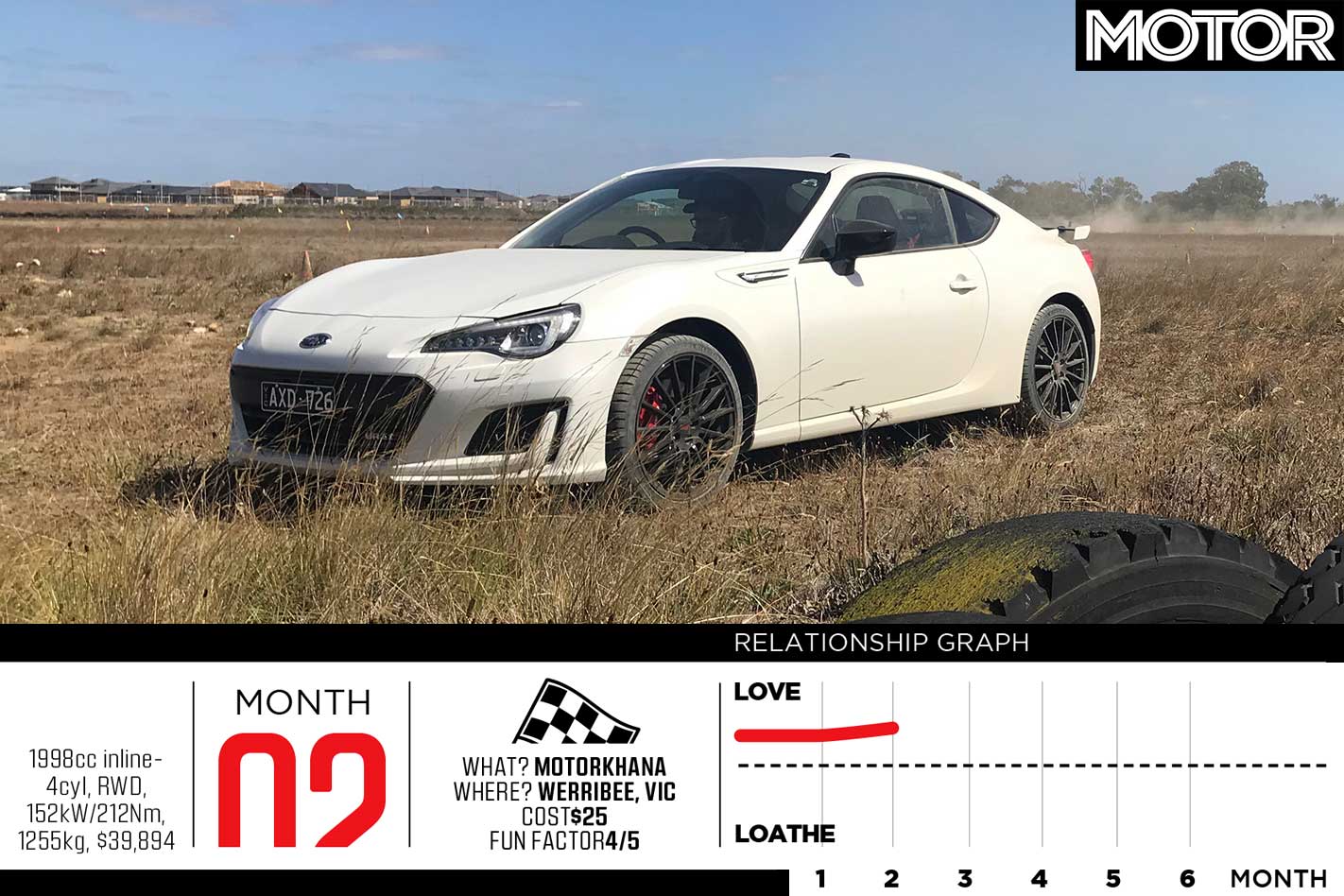
2019 Subaru BRZ tS Pros & Cons
Three motorkhana wins 1 – Cheap as chips 2 – Easy on the gear 3 – Endless skids
Three motorkhana sins 1 – Dust everywhere 2 – Waiting a turn 3 – Tests memory
Update 2: Track Twist
A visit to Australia’s finest racetrack with surprise results
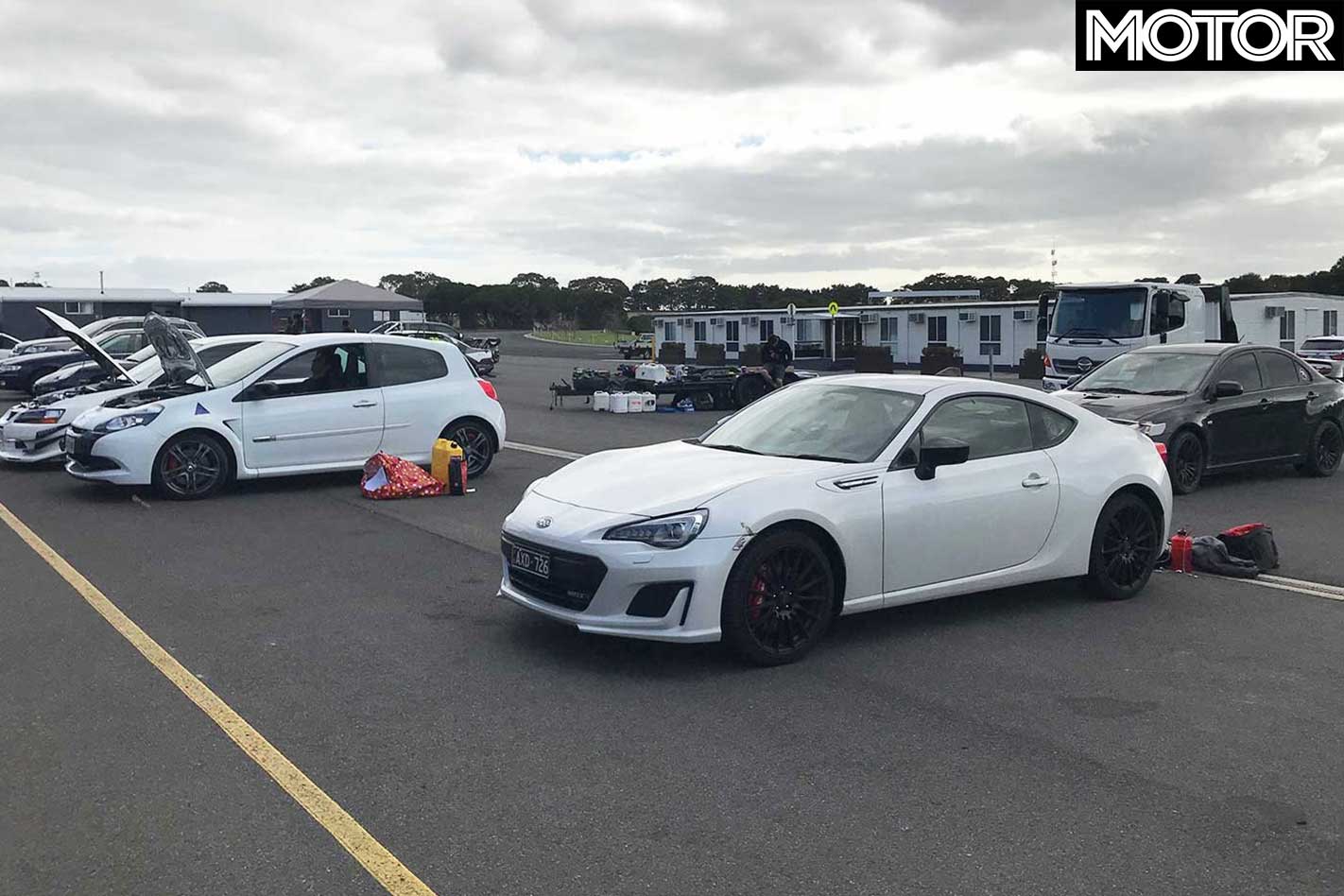
Track days are one of the most popular club-level motorsport activities. If you want to let your car off its leash and find out what it can do, the most obvious place to do so is a racetrack. There are many options and a quick Google search should result in a number of tracks to choose from.
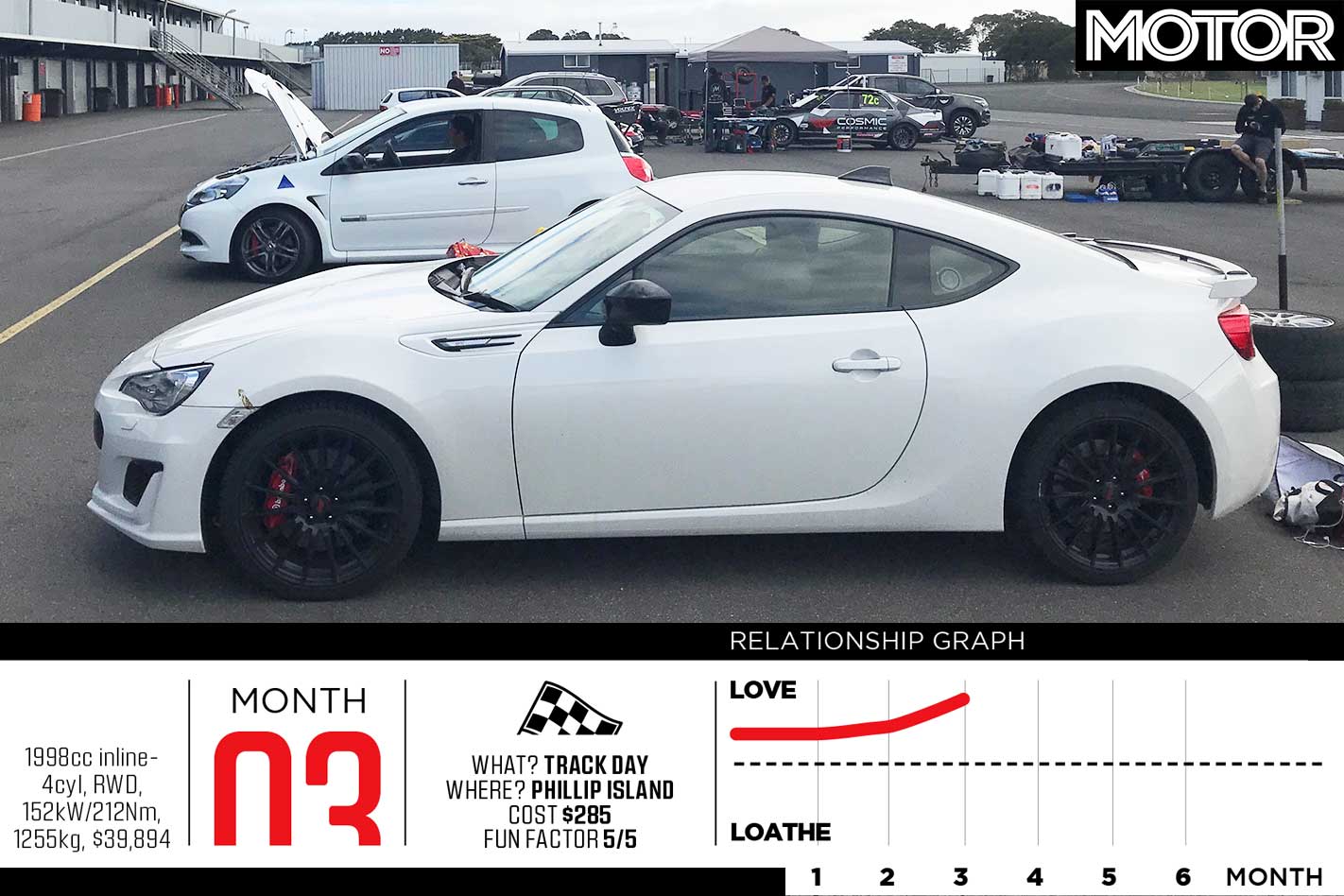
I tagged along to an Evolve Driver Training event at Phillip Island, which is usually one of the more expensive options due to the track hire fees, but Evolve’s ‘car club practice’ option was a very reasonable $285 and offered 15min of track time every hour. More than enough. Prices and track time can vary considerably depending on the circuit and the organiser, so give them a ring if you’re unsure.
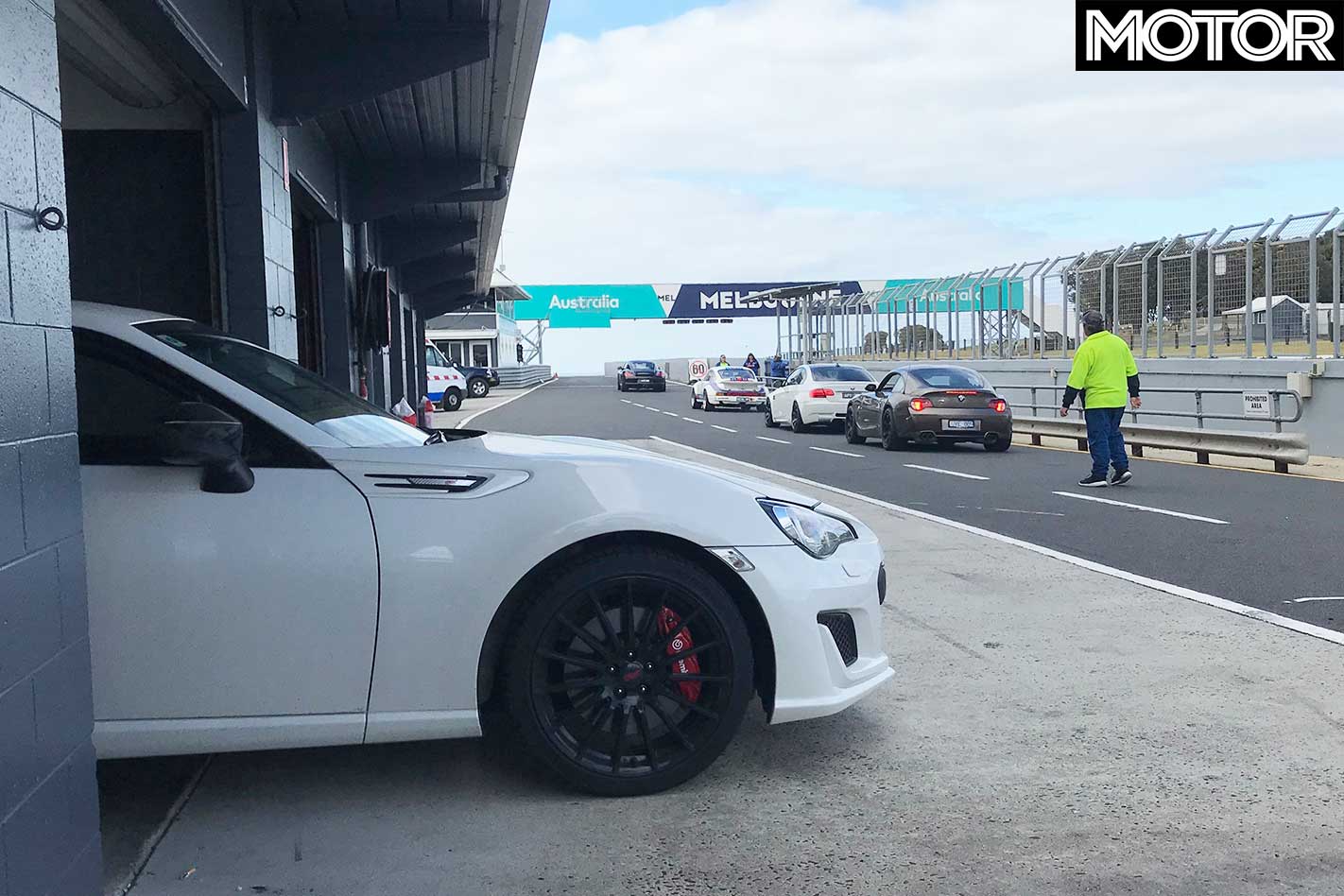
Phillip Island was chosen very deliberately. I know from previous experience that the Subaru BRZ is a blast at Winton, however, would it feel underdone and a bit, well, dull on PI’s fast, flowing layout? No, as it turns out, not even slightly. In fact, the day spent at Phillip Island was one of the best motoring experiences I’ve ever had, both in terms of enjoyment and education.
The Subaru BRZ is the perfect example of why outright speed and driving fun aren’t necessarily correlated. I’ve been lucky enough to drive at Phillip Island in everything from a Porsche Cayman GT4 to a BMW M5 to a Ford Focus RS and the little 151kW/212Nm Subie was as good as any of them (okay, maybe not the Cayman…).
Yes, it was slow in a straight line, hitting just over 200km/h down the long straight, but 165km/h through turn one, flat through Hayshed at 155km/h and 145km/h through the probably-flat-but-I’m-too-scared last corner is plenty fast enough for me, thank you very much.
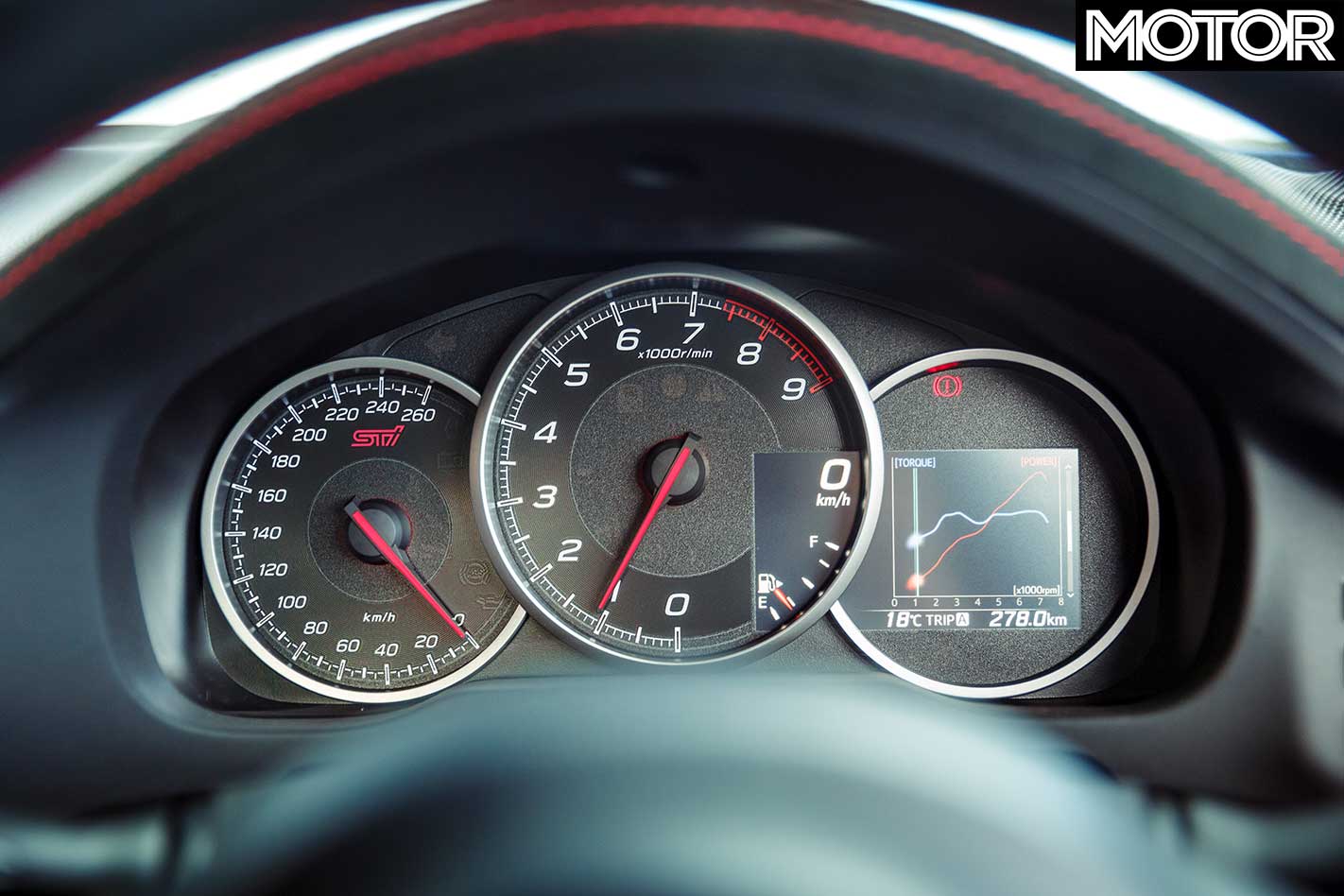
A best time of 1:57.3 was the result and to provide some context, I dug up some lap times from previous MOTOR tests at Phillip Island. With Sir W. Luff driving, a Mitsubishi Lancer Evo X clocked 1:55.1 at PCOTY 2008, while in 2011 a VW Golf R managed 1:55.3, a Renault Megane RS250 1:54.4 and a Ford Focus RS 1:54.3.
Go back even further to Bang For Your Bucks 1996 and not a single car could best two minutes, the Mercedes-Benz C36 AMG coming closest at 2:00.19, which itself was quickest by more than two seconds. Viewed thus, the little BRZ does alright.
The Michelin Pilot Sport 4 tyres that are part of the tS package provide support lacking in the standard eco-spec Primacys without robbing the car of its adjustability. Through Phillip Island’s long, long corners the challenge was to keep it balanced right on the edge of grip, attempting to correct understeer or oversteer before they reared their heads and robbed the car of precious momentum. If you’re just starting out, this process is made easier by the BRZ’s well-judged ‘Track’ ESP setting.
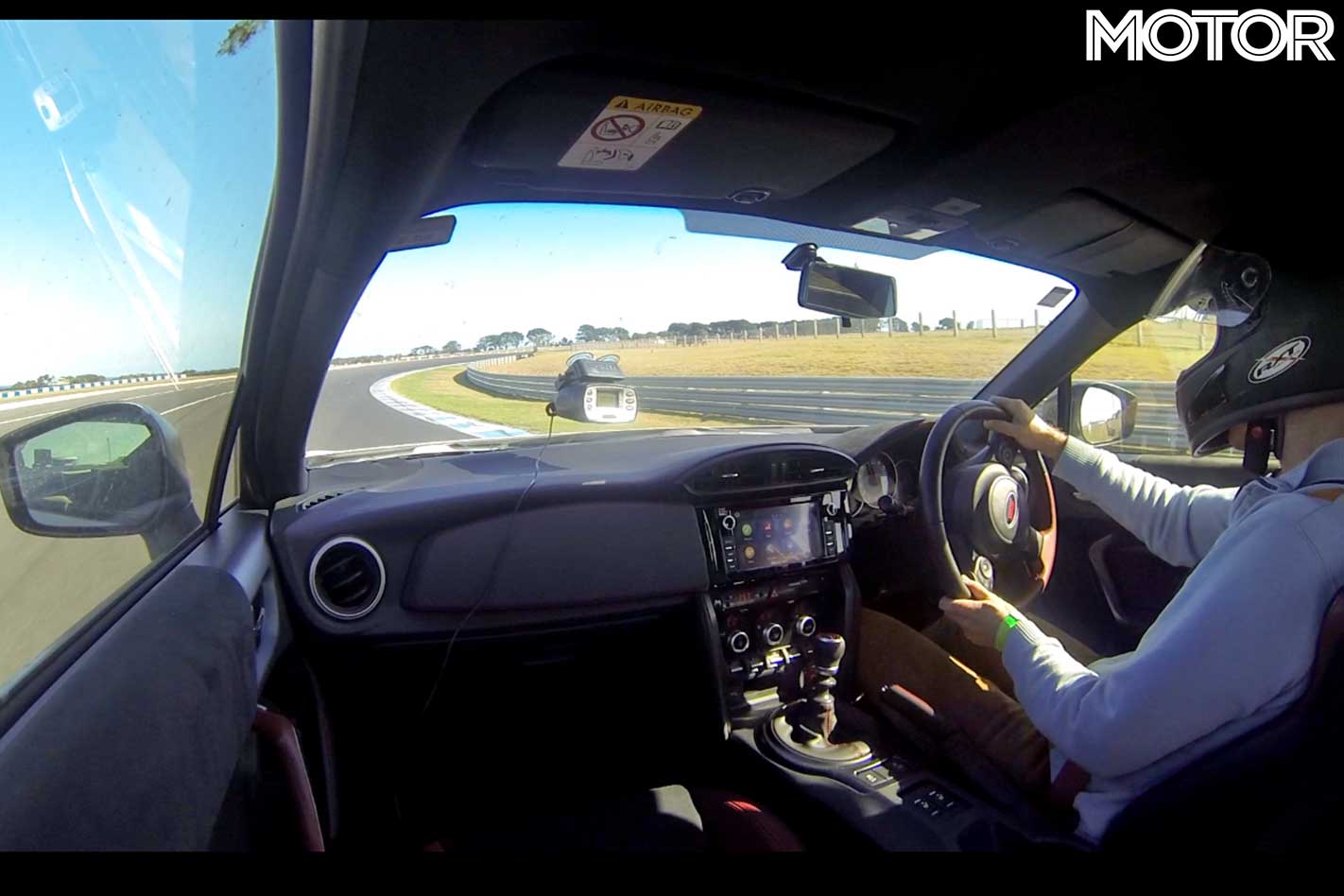
Warm weather and high speeds meant the Michelins worked hard, though a side-to-side swap at lunchtime at least kept the wear even. Phillip Island isn’t particularly hard on brakes (at least not in a BRZ) so the Brembos proved their worth, with no fade or groans all day. Or so it seemed. According to Subaru the BRZ needs new rotors and pads (partly due to the old pads not fitting snugly with brand new rotors).
The size of the hardware and the weight of the car makes this a bit disappointing, but it also serves as a valuable (if expensive) lesson. If you plan on using your BRZ on track in standard form, be sure to limit the number of laps as wear is clearly occurring even if all feels well. If we had to offer a hypothesis, we’d suggest the rotors are the weak link in the chain, given the lack of any signs of brake stress from behind the wheel (usually a soft or hard pedal).
If you want to track your BRZ regularly – and you should, because it’s fun – it’s clear a rotor upgrade (for tS models) or complete brake overhaul (for standard models) is in order. If that all sounds a bit too serious, next month we’re investigating a relatively little-known motorsport that’s cheap, loads of fun and results in virtually zero wear to any component.
2019 Subaru BRZ tS Pros & Cons
Three track day wins 1 – No speed limit 2 – Driving lessons 3 – Friendly folk
Three track day sins 1 – Component wear 2 – Fuel use 3 – Highly addictive
Update 3: Dirty Dancing
Long-termer goes for a spot of autocross, familiar territory for a Subaru, if not a BRZ
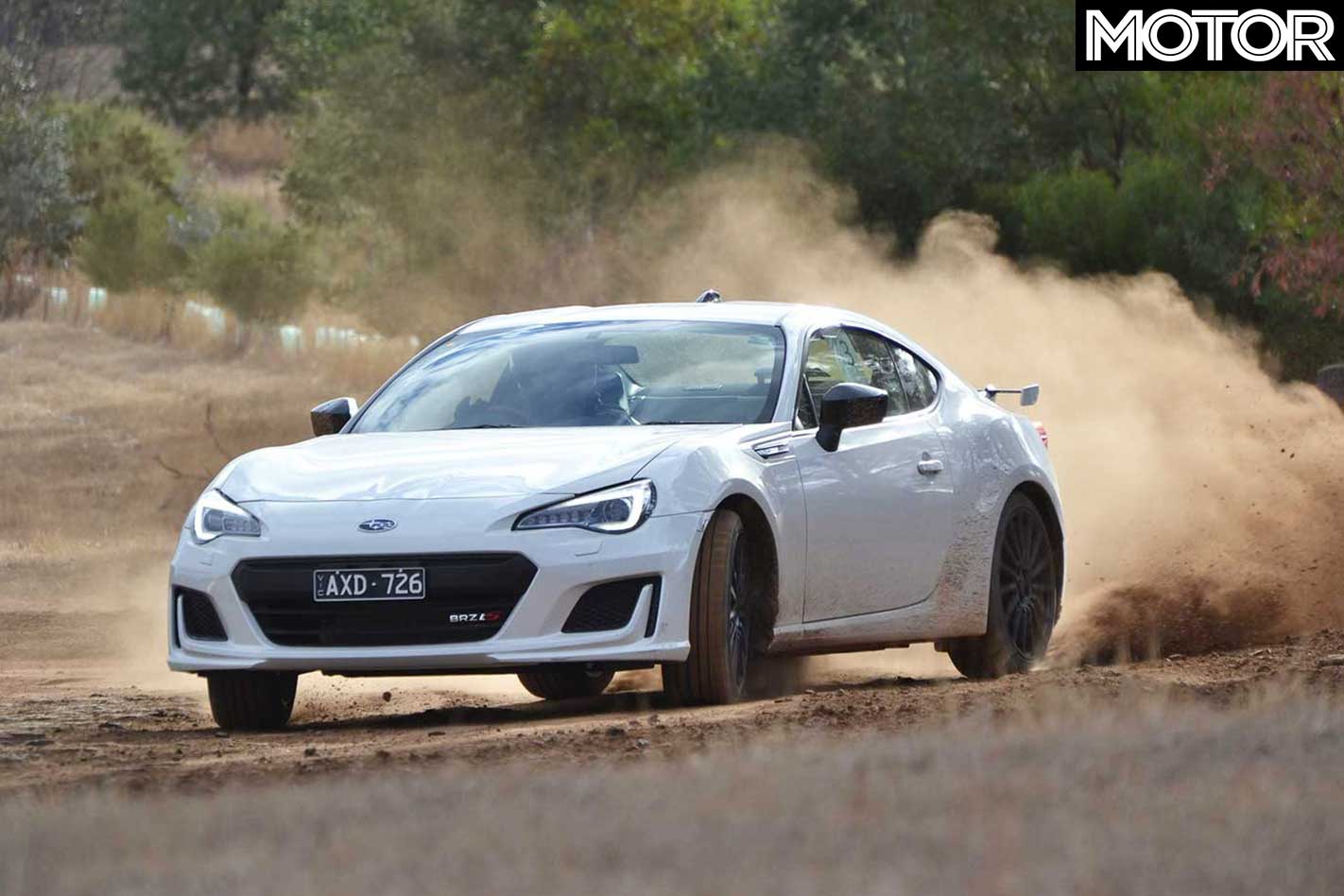
A LOT OF people are scared of dirt when it comes to their cars. I’m not sure why, but I’m here to tell you why there’s nothing to fear. Autocross has always been one of my favourite motorsport disciplines and the best way to describe it is basically driving around an unsealed go-kart track.
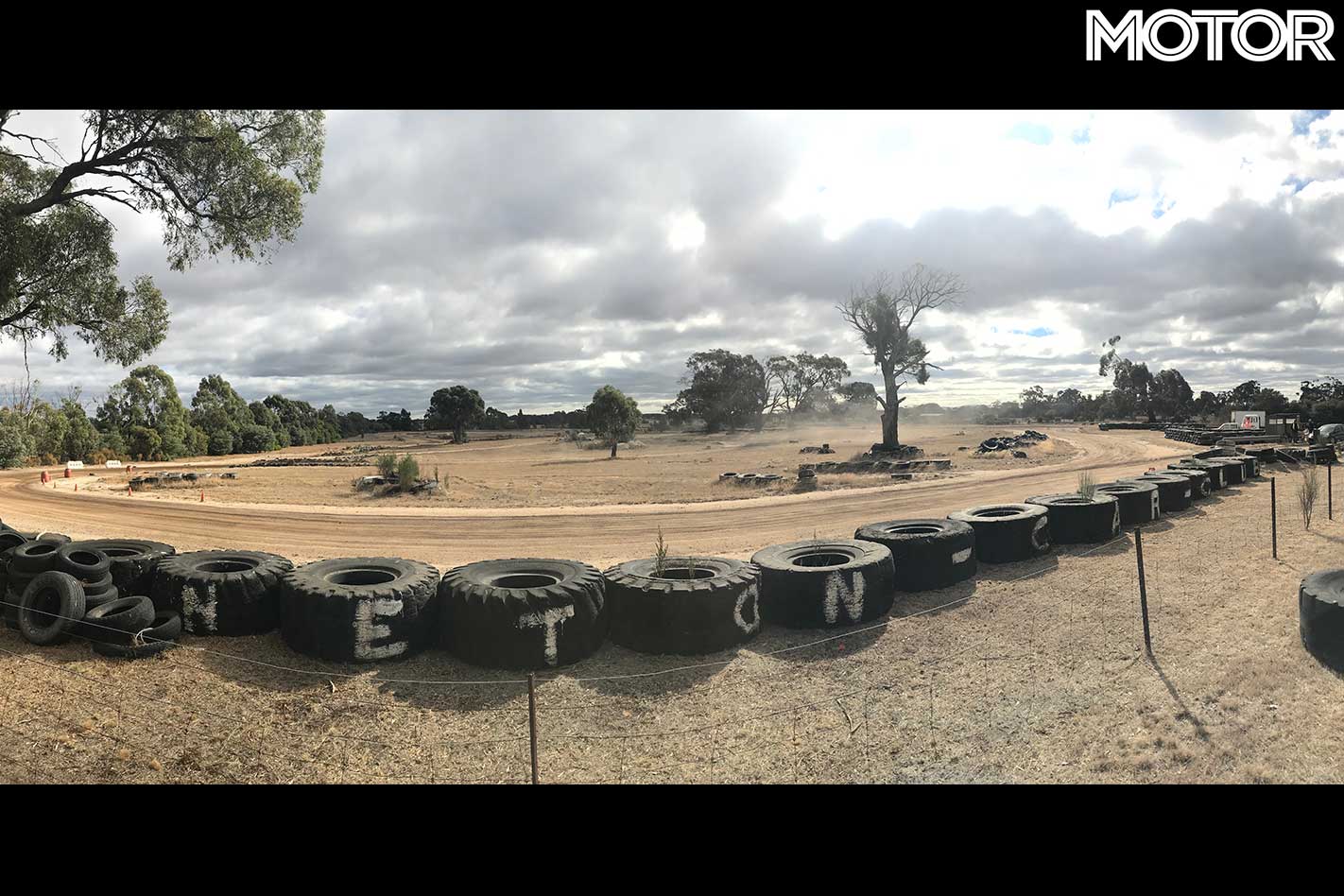
There are tracks dotted all over the country (there are more than half a dozen in Victoria alone) and they vary in length, speed and roughness. To be honest, the rougher tracks are fine for some road cars but probably not something low-slung like the BRZ. Thankfully, the Kyneton track, an hour north of Melbourne, is frequently graded, well-maintained and of a similar quality to a country driveway.
Essentially, autocross is a step up from the dirt motorkhana tackled in month one of this long-term test. It replaces a memory-testing flag arrangement with a defined circuit, Kyneton’s facility having the ability to offer many different course layouts to keep things fresh. None are particularly high-speed, mostly tackled in second gear, but 80-90km/h is plenty on a slippery surface.
It’s cheap entertainment, costing just $35 for the day, or $45 if you want to use rally tyres. I’d love to, but sadly none fit 18-inch rims. There is a Toyota 86 wearing the appropriate shoes wrapped around 15-inch Subaru wheels, which j-u-s-t clear the standard GT brakes and suspension.
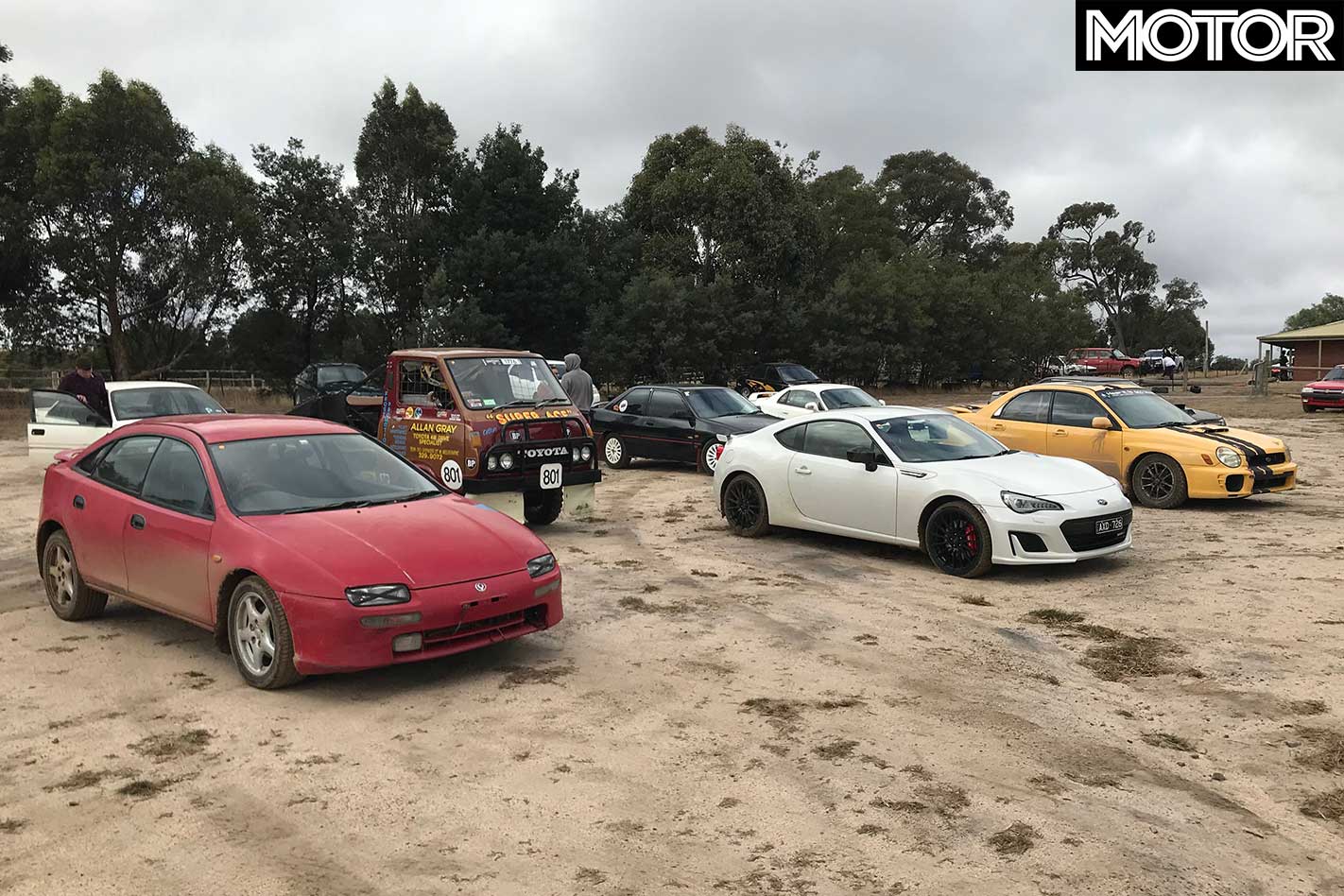
A common theme in club motorsport is the wide variety of machinery that takes part. There is a rally-spec MY05 Subaru WRX STI, a handful of standard Rexes, plenty of French hatchbacks, a group of BMW E36 3 Series, random old Japanese cars (Toyota Corollas of various vintage, Mitsubishi FTO, Mazda 323 Astina, Nissan Pulsar Q), a Renault Scenic and a truck with a rear-mounted Chevy V8.
What’s more, you don’t need to spend much to be competitive. The top placings are occupied by all-wheel drive turbos, but driven well, a decently-powered front driver (anything with 100kW or more) on rally tyres could easily finish in the top 15.
Each entrant receives eight runs, two attempts at four different courses, and to level the playing field and prevent a ’road-sweeping’ disadvantage – early runners being penalised by a thicker layer of loose gravel – the course is watered between each run and the running order shuffled.
The BRZ’s rear wheels begin spinning quicker than the fronts as soon as the light turns green and barely stop for the entire run. There’s very little grip on road tyres and it’s extremely easy to over-drive the car, which I spend most of the day doing. Small inputs are required; the BRZ may not have much grunt, but it has more than enough to fling the rear out very sideways if you’re greedy with the throttle.
It’s a tough thing to get your head around, but you can go very quickly without ever reaching full throttle – in slippery conditions, you’ll often go quicker if you avoid it. On run four, I win whatever the opposite of the jackpot is and run first on the course, directly after the water truck.
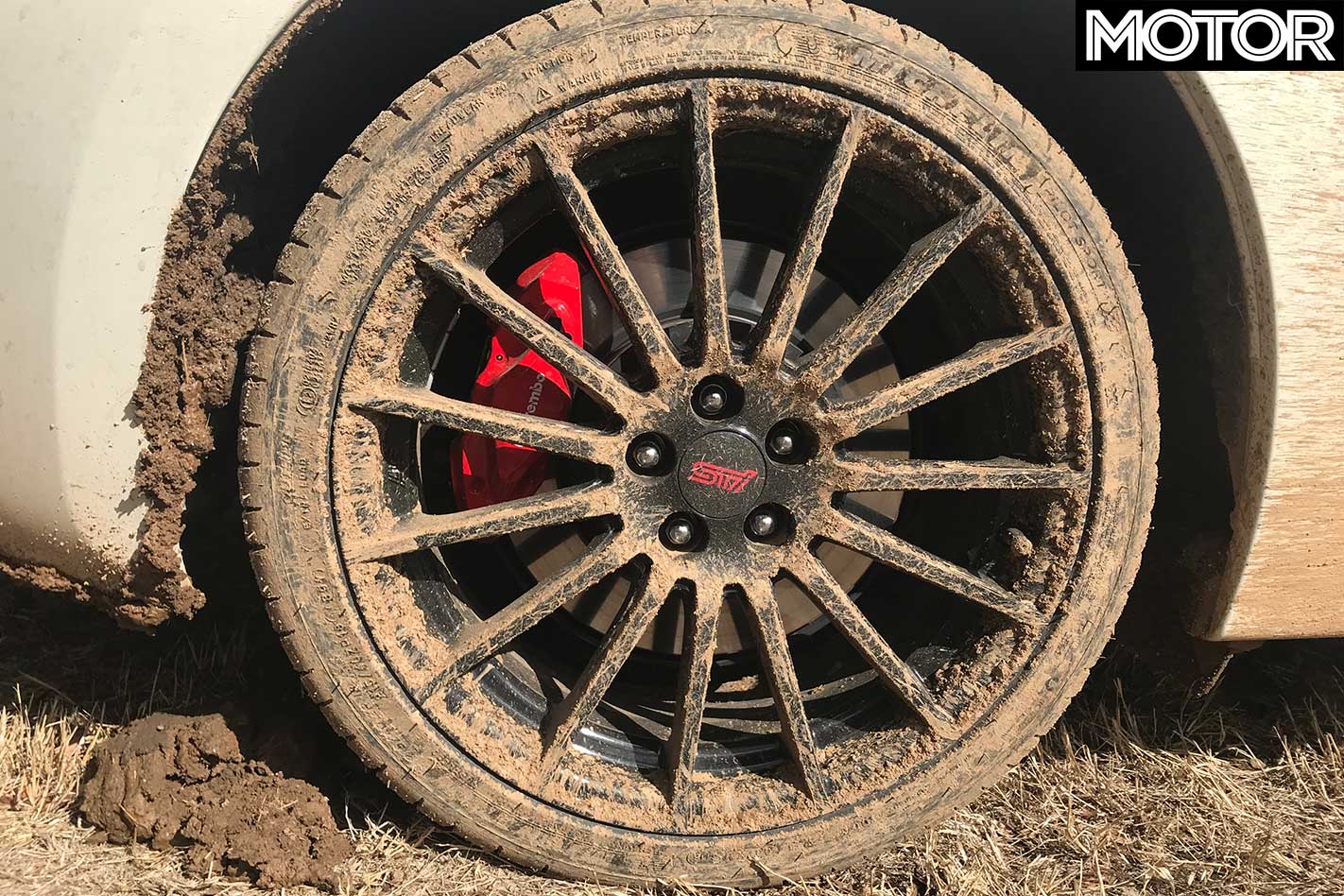
The Michelins work very well on the road but struggle on wet mud; still, it’s probably my best run of the day. I knew I was going to be relatively slow on this run so didn’t push too hard and it paid dividends.
There’s a healthy level of competition. No one is driving for sheep stations – if you care that much there are better motorsports to be involved in – but everyone still wants to do their best and the time gaps are usually very small.
Having driven for fun, not speed, and spent too much time sideways, I was surprised to see the BRZ finish 18th out of 48, but had I shaved another five seconds off (less than a second per run) the Subie would’ve finished 10th!
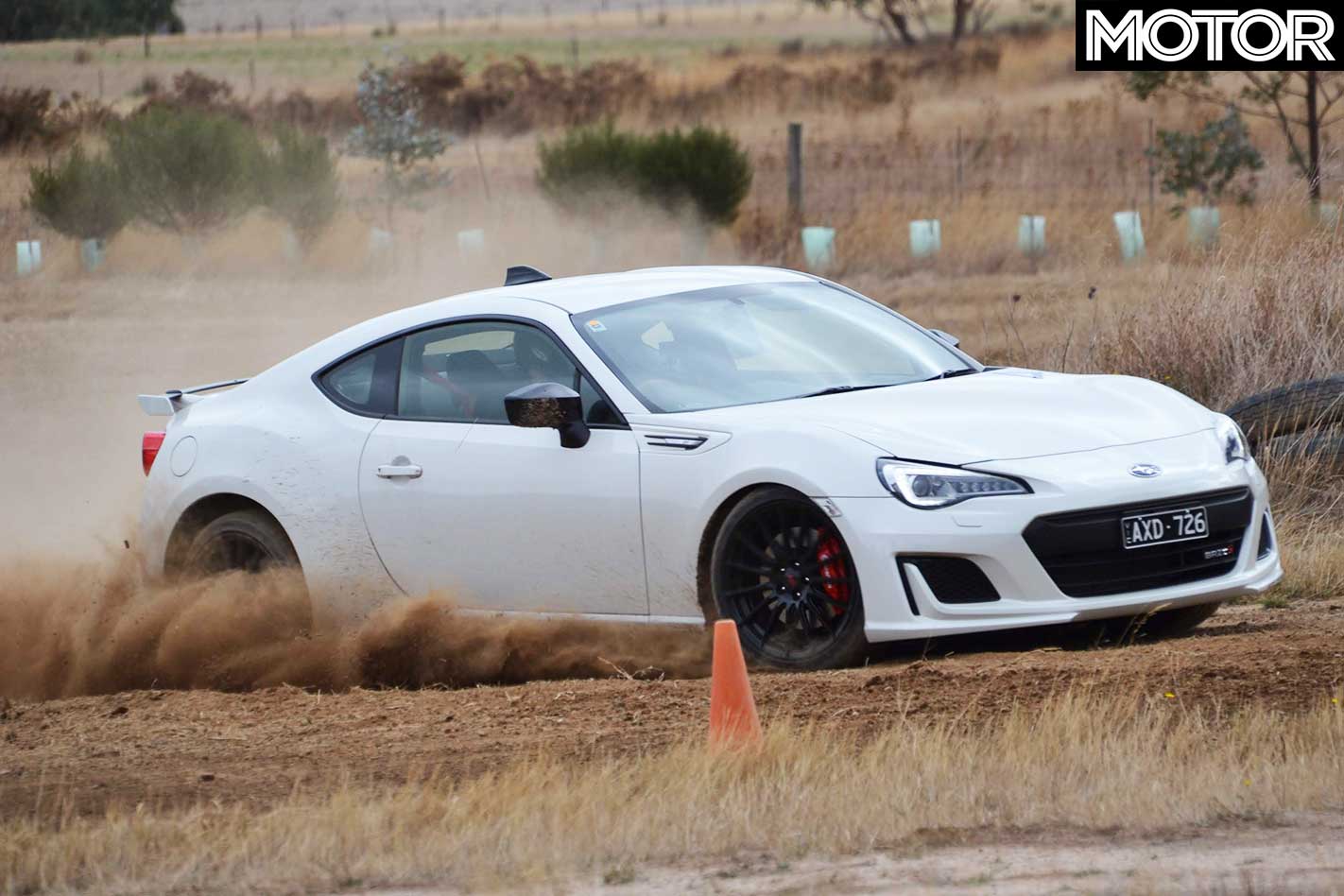
This is the beauty of autocross. Not only does the unsealed surface help car control, the brief nature of the runs means any mistakes are punished harshly on the scoreboards but the closeness of the competition means any hesitation will cost you places. It’s cheap, fantastic fun. The slippery conditions also result in virtually zero component wear: you barely touch the brakes, there’s little lateral load to wear out tyres, gear changes are few, etc.
Next month we’ll be using a similar set of skills, but in a very different environment.
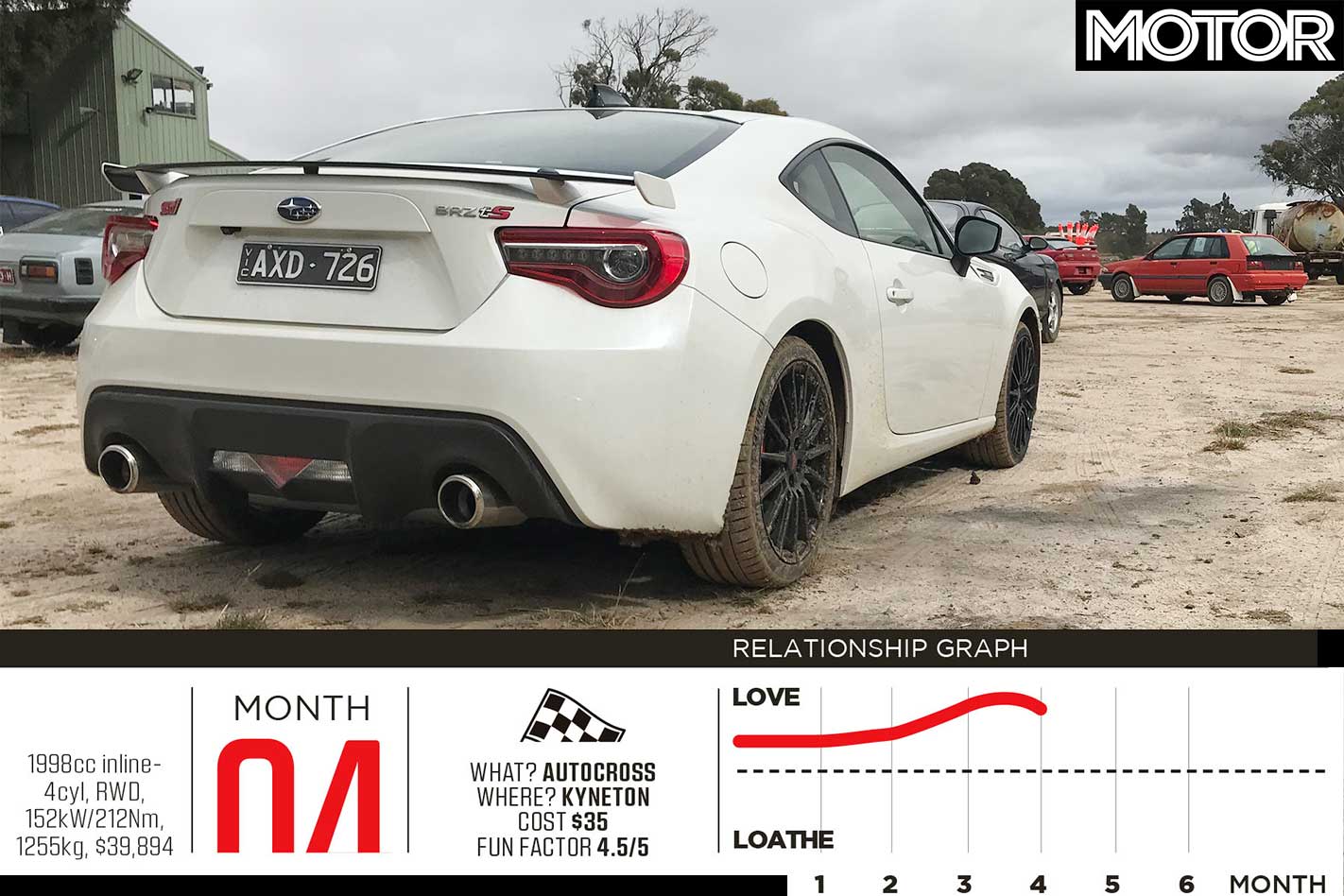
2019 Subaru BRZ tS Pros & Cons
Autocross wins 1 – Easy on the gear 2 – Slidey fun 3 – Value!
Autocross sins 1 – The clean up 2 – No rally tyres 3 – Not coming 10th
Update 4: Spin Class
A day at school where you’ll want to do homework
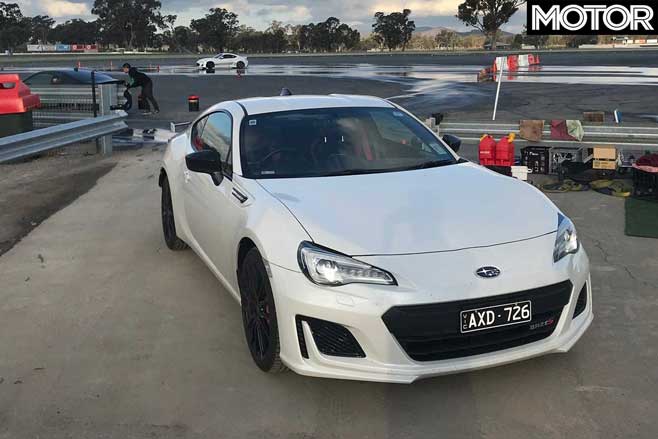
The Subaru BRZ is the black sheep of the Subaru family. For a brand built on the virtues of symmetrical all-wheel drive a rear-wheel drive sports car is like having a hamburger on the menu of a Chinese restaurant. This unusual scenario is the result of Subaru’s tie-up with Toyota to develop and build the 86, a car built in 10 times the numbers.
Toyota’s AE86 Sprinter, the car that inspired the Toybaru twins, became a cult classic thanks to its affinity to drifting. Car makers aren’t usually too keen to associate their products with such underground activities but Toyota Australia didn’t hesitate to leverage the appeal of the ‘Hachi Roku’ (eight-six in Japanese), creating an ad with the ‘Godfather of Drift’ Keiichi Tsuchiya.
As such, it seemed only appropriate that the final instalment in our grass-roots motorsport series should examine this often-misunderstood sport. Getting involved in drifting isn’t easy.
Skid pans are sadly extremely scarce (in Victoria at least) and even starting at a practice day level is difficult as it requires a decent investment in a suitable car and a reasonable level of proficiency to avoid embarrassment or accidents. Events like the motorkhanas or autocrosses we’ve tackled previously are a step in the right direction but still very different disciplines.
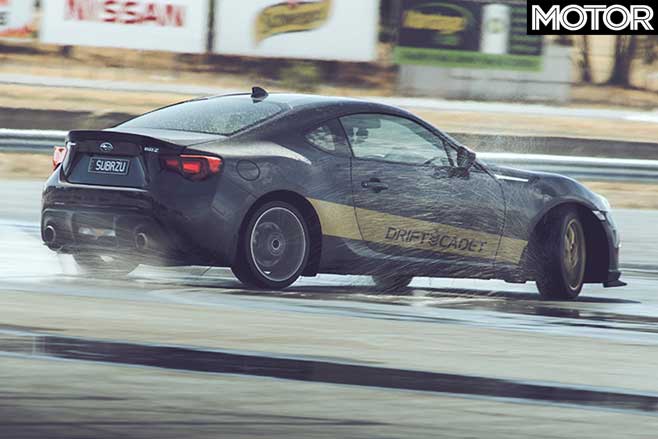
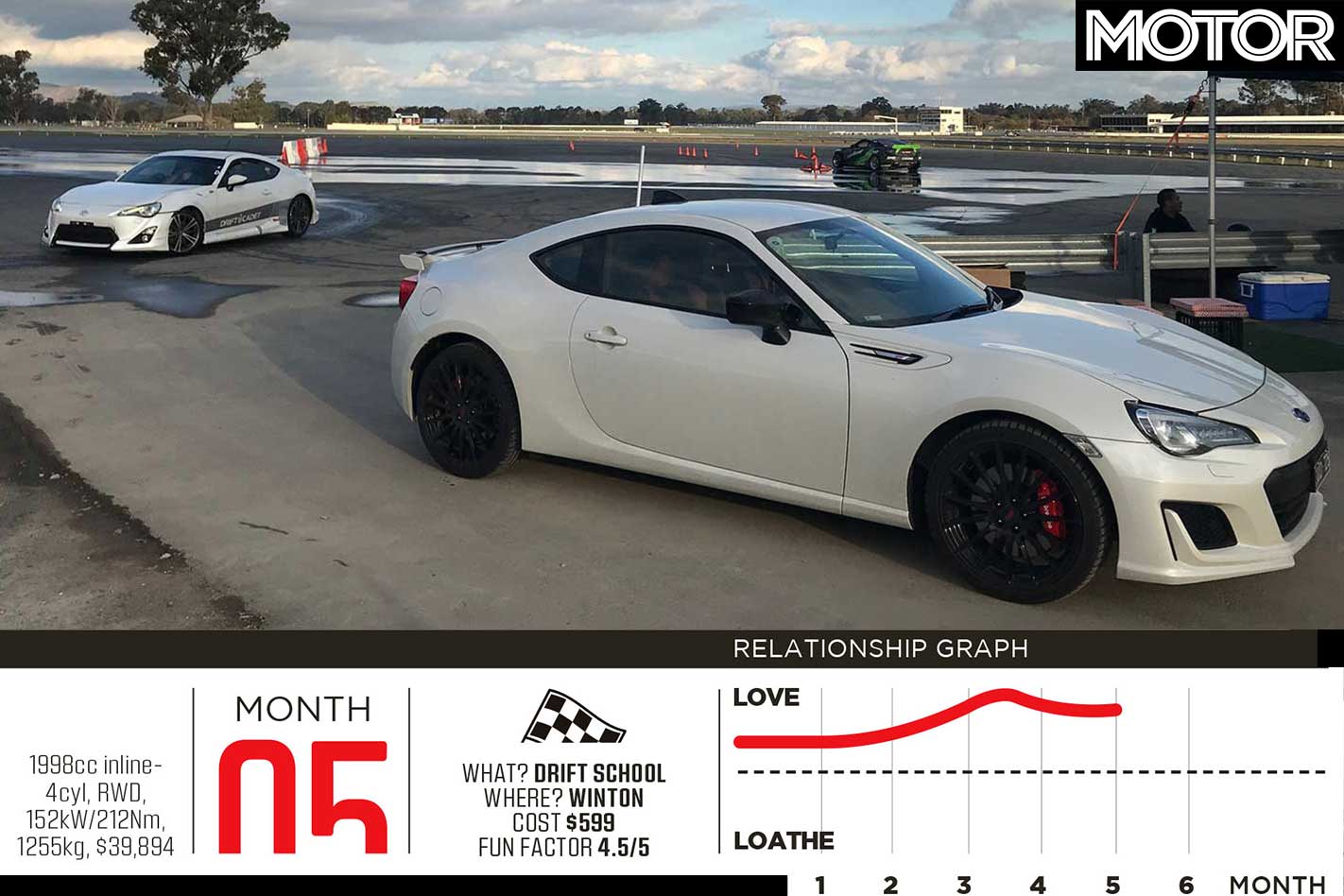
Thankfully, Victorian company Drift Cadet operates a drifting school on the Winton Raceway skid pan, offering curious punters the opportunity to learn the basics of car control in a risk-free environment.
Even better, it provides the machinery, a standard Toyota 86 and Subaru BRZ for Level 1 and a pair of supercharged beasts for the more advanced Level 2, giving the long-term BRZ tS some respite.
Completion of Level 1 is required before moving on to Level 2, so I find myself at Winton on a beautiful sunny day. The groups are small, just six drivers who each receive eight one-on-one instruction sessions of four minutes. The Level 1 setup couldn’t be simpler, just a pair of cones set about 10 metres apart on a sprinkler-soaked section of the skid pan.
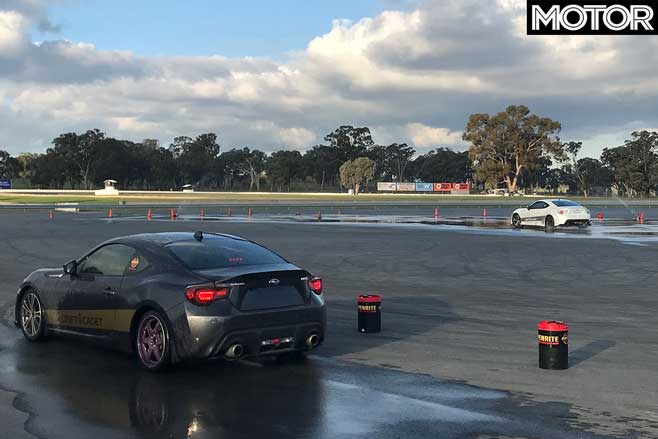
It’s difficult to know where to set expectations. Without sounding like an idiot, I have some experience with sliding cars, so I was unsure whether such a basic course would deliver value for money. After all, $599 is not cheap, though nor is it exorbitant when you consider the cars are provided and a 12-month CAMS licence is included.
My instructor for the day is John Dreyer, a 12-year drifting veteran who has competed in Australia and Japan. In our first session we start with a simple clutch-kick donut, which thankfully is mastered with little fuss. A satisfied John immediately starts throwing new exercises at me, including a moving clutch-kick entry, handbrake entry, a loop around both cones and the tricky figure-eight, which involves transitioning from a right-hand slide to a left-hand slide and managing the weight transfer accordingly.
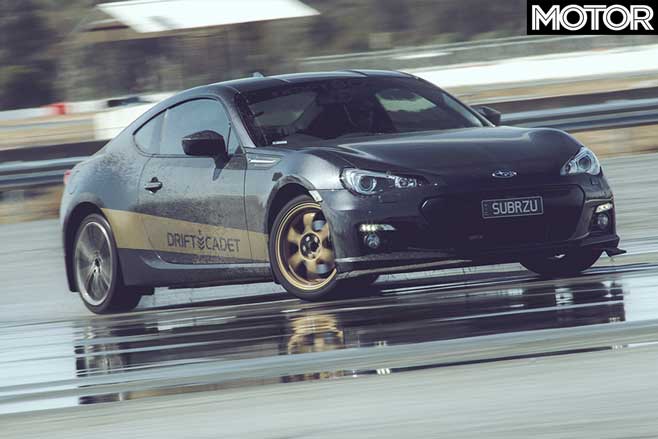
From there John starts chucking random combinations at me: tight donuts around one cone, then two figure eights, then a handbrake entry into a loop, followed by another figure eight and so on. Although the speed is low – first gear is all that’s used – the concentration required to keep the car in a constant state of oversteer while not knowing what’s required next quickly works up a sweat.
It’s hard work, yet slowly comes together, the movements becoming smoother and less frantic along with a feeling of being slightly ahead of the car rather than constantly reacting to it.
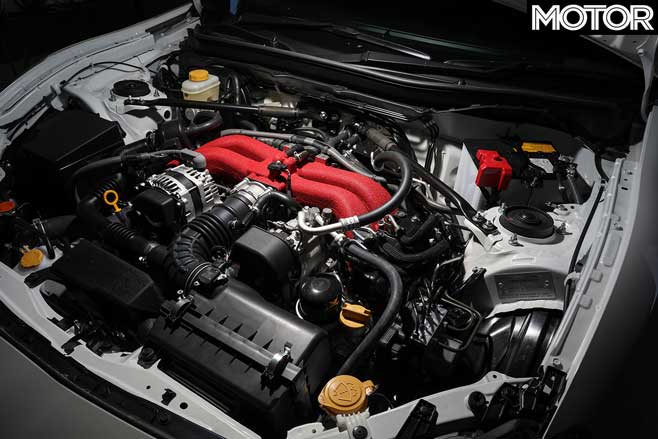
I said earlier the Level 1 cars are standard, which isn’t quite true. Under the bonnet it’s all factory, with the 147kW/205Nm of these series one models being deemed sufficient, but Drift Cadet installs steering rack spacers for extra lock, mechanical two-way LSDs, coilovers and the all-important duct tape over the handbrake button.
A quick run in the BRZ tS shows the value of the modifications. The fundamentals are similar, but my long-termer isn’t as keen to lose traction – which feels as much due to the grippier Michelin tyres as the chassis setup – and isn’t as predictable once the wheels are spinning due to the lack of a mechanical LSD.
But while a couple of choice mods enhance the Toybaru’s sliding capability, the base vehicle is capable as long as you’re on a slippery surface. Power isn’t everything in drifting, but a certain amount helps to avoid torching clutches trying to overcome the grip of dry tarmac. When it comes to oversteering fun, this black sheep provides three bags full.
2019 Subaru BRZ tS Pros & Cons
Drifting wins 1 – Feel like a hero 2 – Valuable lessons 3 – Looks
Drifting sins 1 – Tough on the car 2 – Expensive 3 – Few locations
Update 5: Conclusion
Reflecting on six months of fun in the BRZ tS
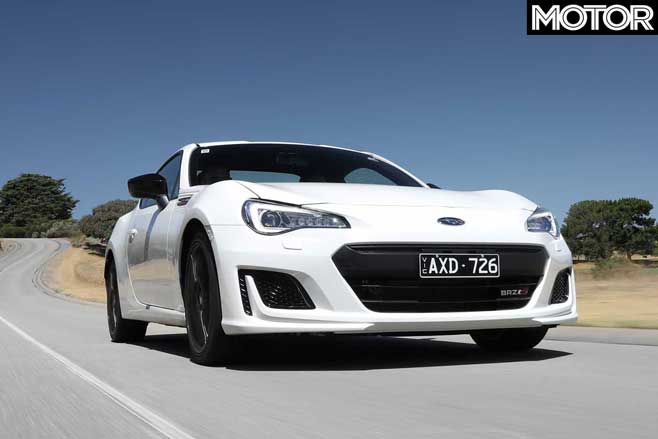
It’s farewell to our long-term Subaru BRZ tS. It’s been a tough gig. Not only has it had to work extremely hard, it hasn’t even been the star of the show, as this was a long-term test with a difference.
For once we weren’t focusing on the car but what you could do with it. As cars get faster but opportunities for enthusiastic driving become ever more limited, the only place to enjoy any performance car is in a closed environment.
As such, we wanted to discover whether you could take a dead-stock production car and compete in a number of different club motorsport disciplines. The BRZ tS was chosen for a number of reasons.
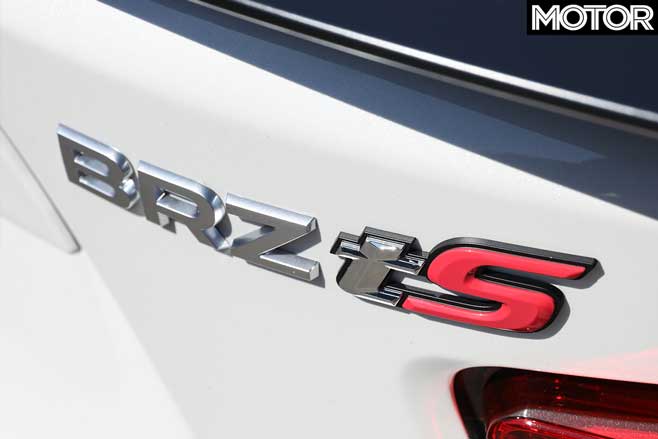
Firstly, it’s affordable – a 911 GT3 will lap all day long but few have access to the $300,000-plus entry ticket. Secondly, it comes standard with a number of upgrades, including extra bracing, revised suspension, bigger brakes and stickier tyres, that made it all the more suitable for our intended use.
Our journey started with dirt motorkhana; motorsport at its most basic. No safety gear is required, just $25 for entry and a willingness to get dirty. To most folk, the idea of driving around a paddock in circles might be madness, but it’s a lot of fun.
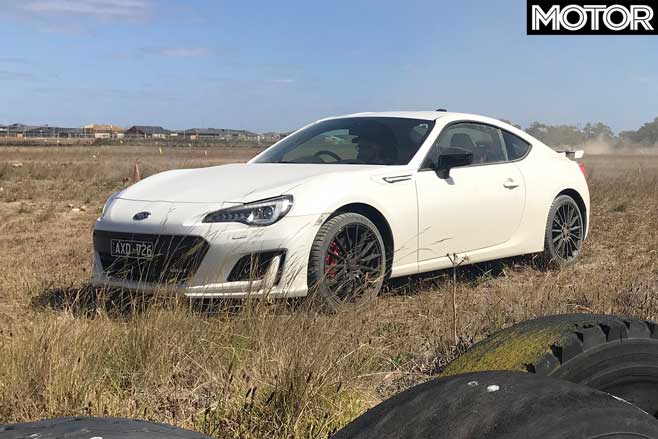
There are no consequences for making a mistake other than a time penalty, and the slippery surface and low-speed nature make it the perfect place to learn the basics of car control. If you want to take it seriously and shave tenths from each (often fiendishly tricky) course layout you can, or just enjoy throwing the car around without fear of breaking anything.
The next logical step from a dirt motorkhana is autocross. For this, some basic safety kit is needed, namely a helmet and a mounted fire extinguisher, and some of the rougher circuits may not be suitable for standard road cars.
But many will be and, while there are now consequences in the form of tyre walls and dirt banks, speeds are still quite low and if you really want to unleash your inner Ari Vatanen, simply pick a corner with plenty of run-off!
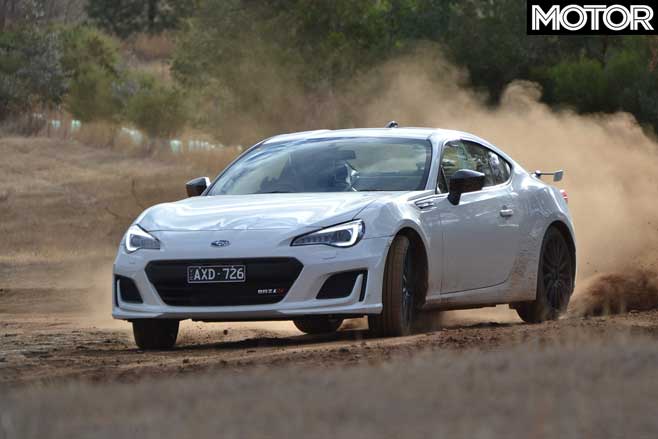
The best part about autocross is that it feels more like ‘real motorsport’ (which isn’t to denigrate motorkhana, but it’s a different art) yet component wear is virtually nil. Dirt doesn’t wear out tyres, you barely touch the brakes, and there’s very little stress on the driveline.
Sadly, the same can’t be said for our next test, the track day.
Phillip Island was the chosen venue; while we know the BRZ/86 are fantastic fun at slower tracks like Winton, would a fast circuit like PI expose its lack of grunt? Not at all, as it turns out. No, it wasn’t that quick, but demanded excellence from the driver to give its best and was happy to slide around even in third and fourth gears.
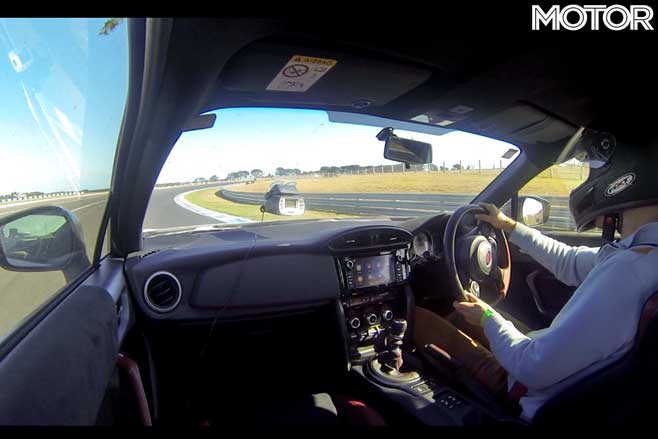
Unfortunately, during its post-track checkover, Subaru advised that the BRZ needed new brakes, a disappointing result given PI is not that hard on brakes, the car isn’t particularly quick or heavy, and the tS version comes with larger Brembos.
Subaru’s line is that customers wanting to drive on track should replace the brakes with aftermarket items; so what’s the point of the tS’s Brembos, then? We suspect there’s a degree of extreme caution in Subaru replacing the stoppers – and fair enough, it needs to present its car in the best possible condition to media – as there were no signs of distress felt through the brake pedal.
Nevertheless, it’s a lesson: if you’re going to hit the track regularly, it might be worth buying the base model and upgrading the brakes and tyres to suit your needs.
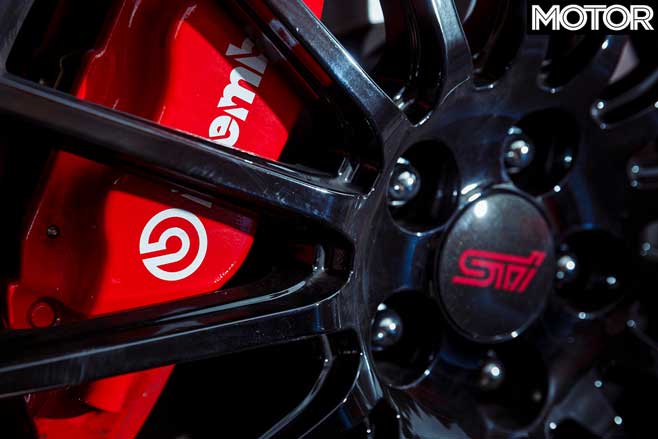
Our final chapter examined the motorsport arguably closest to the BRZ’s heart: drifting. For this, our long-suffering long-termer scored a brief respite, as we attended Drift Cadet’s Level 1 course on the Winton Raceway skidpan – though we snuck in a couple of cheeky laps for comparison’s sake.
The comparison was necessary, as Drift Cadet modifies its cars slightly. Not in terms of power like some might assume, but with steering rack spacers for extra lock, coilovers and, most importantly, mechanical two-way limited-slip diffs. The latter provided much more control when sliding than the standard car’s Torsen unit, though putting up with the chatter of a two-way every day would require patience.
To answer our original question: yes, you can take a standard performance car and compete in all manner of motorsport. You could do a combination of motorkhana, autocross and, say, hillclimb regularly without great drama or expense. Taking the next step into track days or drifting may require some small modifications, but whichever way you go, just get out there and do it.
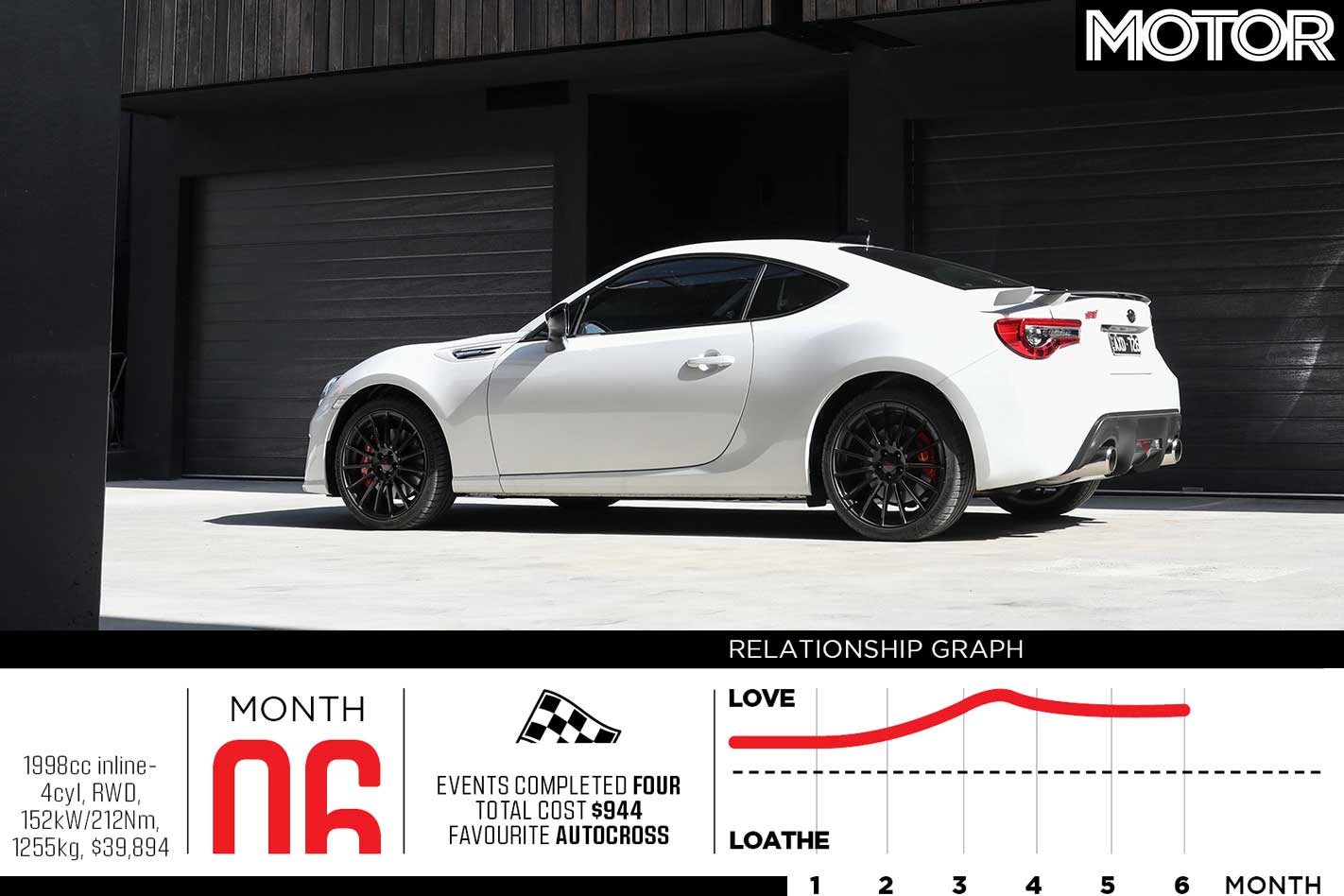
2019 Subaru BRZ tS Pros & Cons
Motorsport wins 1 – Incredible fun. 2 – Improved skills. 3 – Can be affordable.
Motorsport sins 1 – Maintenance. 2 – Highly addictive. 3 – Post-event blues.
The first rule of first aid is to never endanger yourself in the name of helping somebody else. One casualty is always better than two. Mercenary? Perhaps, but sensible just the same. And the same principle should apply to any situation that can be made worse by an act of intervention. Shouldn’t it?
Here’s where we’re at in Victoria right now. A few years ago, a new law was enacted that required traffic passing any emergency vehicle with blue, red or magenta flashing lights to slow down to 40km/h. Yep, even in a 110 zone. And now the rozzers have just announced that they’re about to get serious on cracking down on this law.
At the time it was announced, a few of us were taking bets on how long before it caused a major pile-up. We didn’t have to wait long. In fact, about 24 hours. The day after the legislation became law, the driver of a small car travelling near Bacchus Marsh spotted a police car in the breakdown lane of the Western Highway.
Being a model citizen, the driver slowed down to 40km/h, as per the new law. And was promptly freckle-punched by a dirty big truck. Nobody was injured, but the car was written off. Oh, and the cops weren’t even stopped for a kosher emergency; they’d stopped to help a broken-down motorist.
Even those models of conservatism, the motoring clubs, have expressed doubts over the brilliance of this new law, reasoning – like the rest of us – that it’s hard to expect traffic doing 110 to slow to 40 quickly and without incident. Oh, and clearly tow-truck drivers and roadside-assistance workers aren’t in the same danger, because the law doesn’t cover orange flashing lights. Mint.

Meantime, here’s where I struggle with the logic: If stopping a car on a 110km/h freeway to book its driver for doing 117km/h (and it happens, don’t worry) creates a situation as dangerous as a school crossing at 9am (because school zones also have a 40km/h limit), then surely the act of intervention is endangering others. In fact, if that school-crossing comparison is valid (and it must be if 40km/h is appropriate), then surely the only justifiable intervention must be to stop an even more dangerous event taking place.
Is that a modern car doing 117km/h on a freeway in light traffic on a sunny day? Where do you feel safer: In a car on a modern four-lane with the cruise set, or crawling along a line of parked SUVs, waiting for little Angus or Imogen to gallop out from nowhere?
If I’m right, then, the cops are endangering everybody (and themselves) on that stretch of road by trying to put an end to the reckless behaviour of somebody’s maiden aunt doing 117. And if I’m wrong, then this law is a crock and is designed to create revenue on top of revenue by booking the original speed-maniac as well as anybody else who comes around a blind corner on to the scene in question.

If pulling up a car on a freeway truly does create an environment as dangerous as a live school-zone, then surely the solution is to stop doing so. Ever heard the expression ‘always swim away from a sinking ship’? Okay, only an idiot would zoom past through a situation where there were people near the road, but to simply legislate for 40km/h and then get heavy about it smells of the usual sort of duck-shoving that has given us faulty roadside drug-testing and speed cameras hidden behind trees.
The really stupid thing is that the cops themselves already know that slowing passing traffic to arbitrarily low speeds is asking for trouble. They see it all the time when a prang on the inbound lanes of a freeway leads to rubberneckers and, you guessed it, a second shunt on the outbound side. Just sayin’…
It’s been a tumultuous week for Toyota, with the brand long associated with reliability, quality and trust now in the crosshairs of a class action. Irate owners have lodged a legal challenge to Toyota stemming from faulty diesel particulate filters, involving – among other Toyota models – Australia’s most popular vehicle, the Hilux. Will the lawyers win, or will Toyota make the right moves to keep it’s normally loyal customers on-side?
Speaking of embattled brands, Fiat Chrysler Automobiles Australia has seen a changing of the guard with old boss Steve Zanlunghi moving aside for new appointee Kevin Flynn, formerly of FCA India. Will fresh blood help the storied group of marques that includes two iconic and chronically-ill under performers in Alfa Romeo and Jeep turn around its disastrous 75 percent sales decline since 2014?
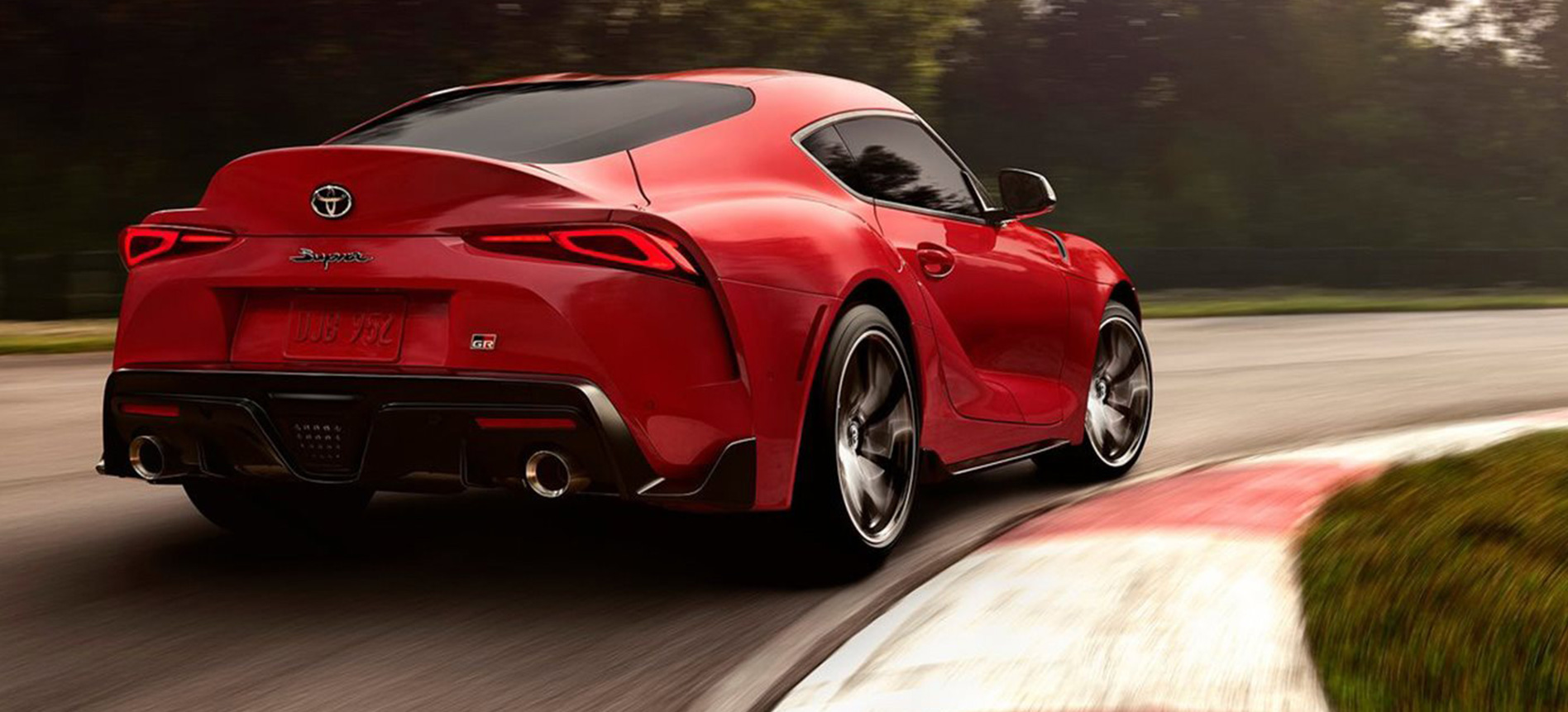
Perhaps a welcome distraction to Toyota’s DPF woes was the revelation that the fifth-generation Toyota Supra makes a lot more power than Toyota officially claims. The Japanese aren’t the only ones making a renewed sports car push either, and Wheels analysed the upcoming Chevrolet C8 Corvette to decode whether the mid-engined American will represent good value when it arrives on our shores in 2020.
Even so, the new ‘Vette certainly won’t be the most affordable mid-engined car on the market. That distinction goes to cars like the Alpine A110 and Alfa Romeo 4C, which went head-to-head this week to find out which was the worthiest entry-level Euro exotic: the alloy-framed Frenchman, or the carbon-chassis Italian?
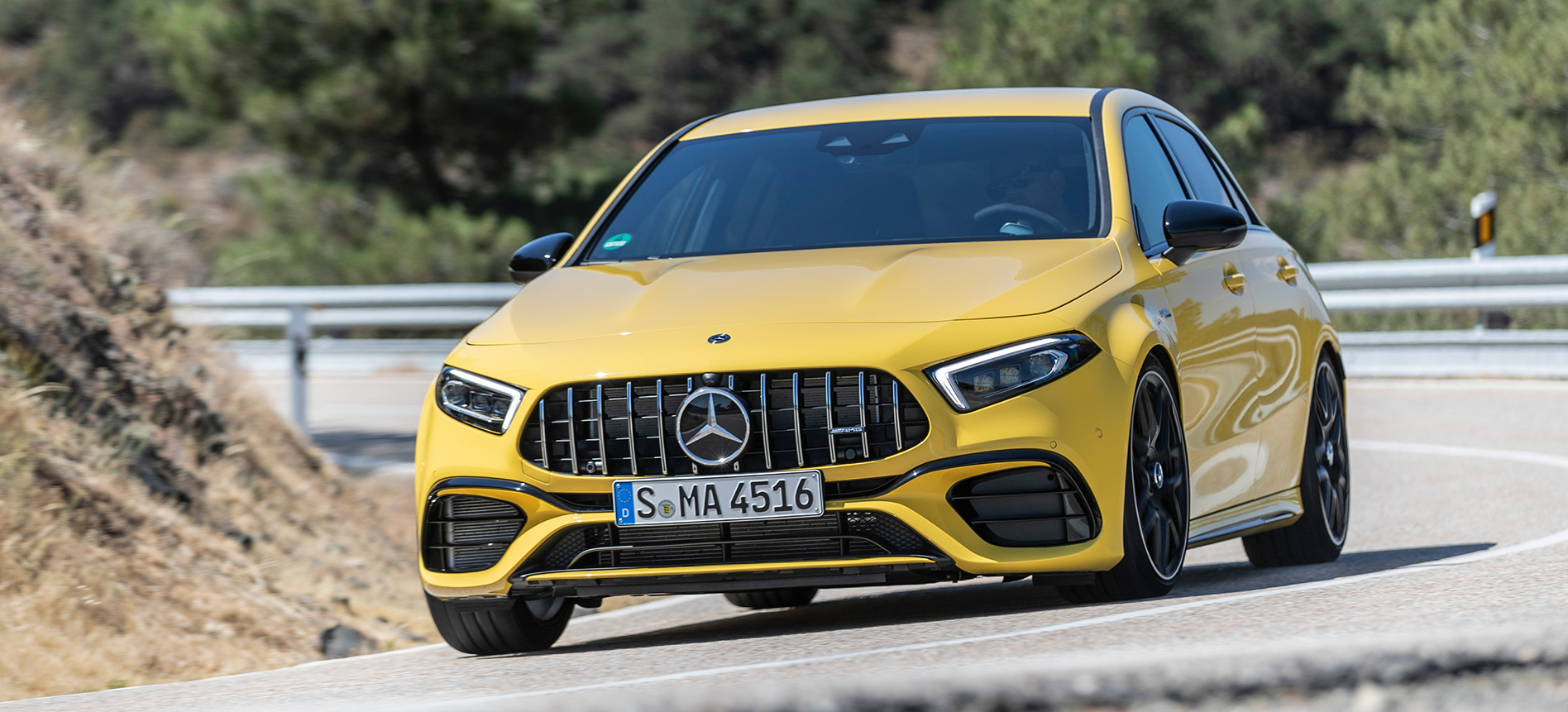
Another Euro performer got the WhichCar treatment this week too: the latest generation of Mercedes-AMG’s A45 hyper hatch. More powerful and with a chassis that can send more drive to the rear wheels, it wowed us with its massive speed potential. The term “pocket rocket” scarcely seems adequate.
The A45 isn’t the only four-cylinder performer that caught our eye this week either. Ford Australia announced the impending arrival of a juiced-up 236kW four-cylinder variant for the Mustang, with more torque and improved suspension hardware to close the gap between the turbo four-pot and its bent-eight big brother. Will buyers bite? Maybe not, given the stronger emotional appeal of the V8 – an engine format Wheels celebrated online this week with their series of features on Great V8s.
And while the ‘Stang prepares to upgrade its four the Golf R could be getting ready to graft an Audi-sourced five-cylinder between its front wheels, if our crystal ball is accurate. More crystal-ball-gazing was supplied by Volkswagen Australia, who posited that half of Australian new car sales could indeed be made up of electric cars by the end of the next decade – a forecast that will probably make Labour party policymakers feel somewhat vindicated, despite not being victorious.
On more prosaic matters, with the weather still locked into ‘frigid and frosty’ mode (at least in the nation’s south-east), WhichCar’s Dan Gardner travelled to New Zealand to discover a little more about winter tyres, how they work, and whether they’re a useful thing for the average Australian driver.
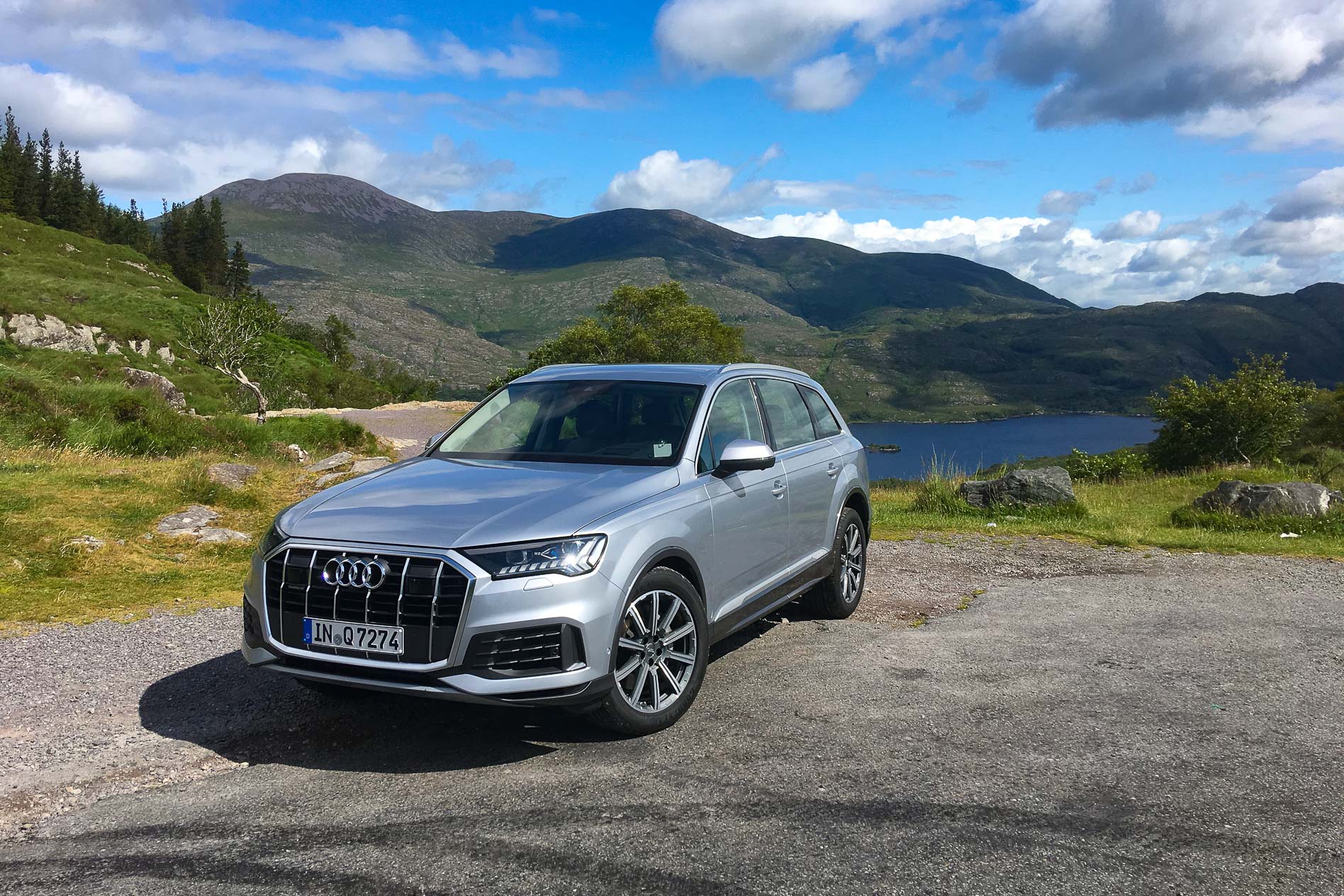
Even if you’ve got an all-paw SUV – such as the Audi Q7, whose facelifted 2020 model we reviewed this week – you may want to have a read, especially if you’re a rabid snow bunny.
Still on the subject of round, rubbery objects, the idea of the airless tyre is one that has so far failed to make the transition from niche applications to the automotive mainstream. But, while some say the pneumatic tyre will reign long into the future, there’s now some glimmer of hope that motorists may soon be able to buy tyres that are completely impervious to punctures.
Also peering into the not-too-distant future, visits to dealerships may become less onerous for owners if a new tech startup proves successful at streamlining the maintenance process, potentially bringing drive-through convenience to scheduled servicing. No more waiting room boredom? Sign us up.
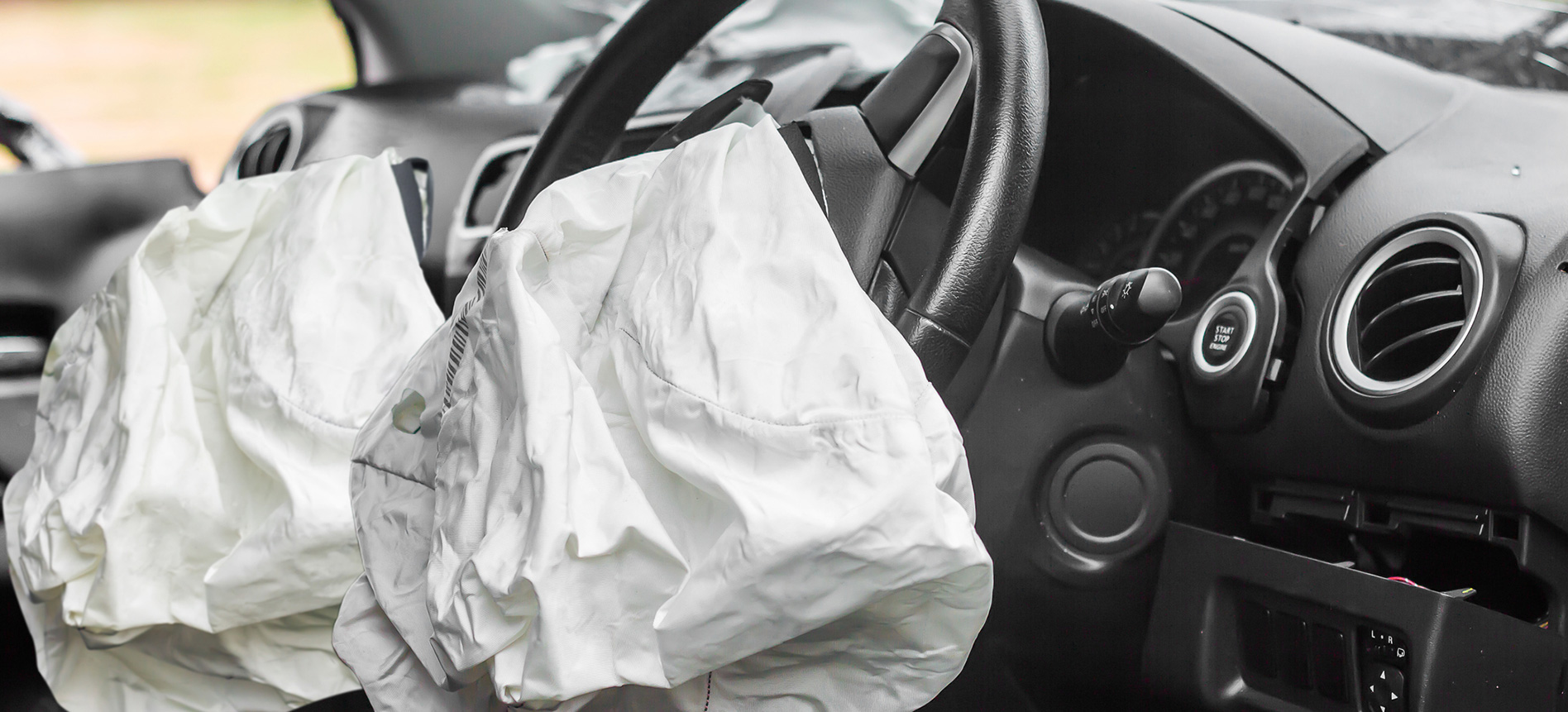
But it seems that coaxing car owners back to dealership still remains a challenge, with more than half a million cars still yet to have rectification work done as part of the on-going Takata airbag recall. If the dual carrots of both a free airbag replacement and a significant boost to peace of mind aren’t enough to get owners back in, then what is?
The crash safety message this week also threw a spotlight on Australia’s elderly motorists, who are potentially putting themselves at significant risk of injury – or worse – by using car seat accessories to improve comfort.
That’s all for this week. Stay safe!
IT’S NEVER nice to be caught off guard. Feeling that way as you’re strapped into a $380,000 racing car and stare with wide-eyed fascination as its slimline, button-infested steering wheel is snapped into place in front of you, however, is appreciably worse.
Bang! The mechanic who was tightening my five-point harness slams my door, only to reappear seconds later through the windscreen. He gives me a thumbs up; the signal to ignite the big V8.
This is all considerably more serious than I was expecting. When Mercedes asked if I’d like to drive its newest racing car – this rather ferocious-looking AMG GT4 – at Sandown, I’d mentally defined ‘GT4’ as meaning a slightly faster, track-focused version of the road-going GT R with slicks and a roll cage. Sounded fun.
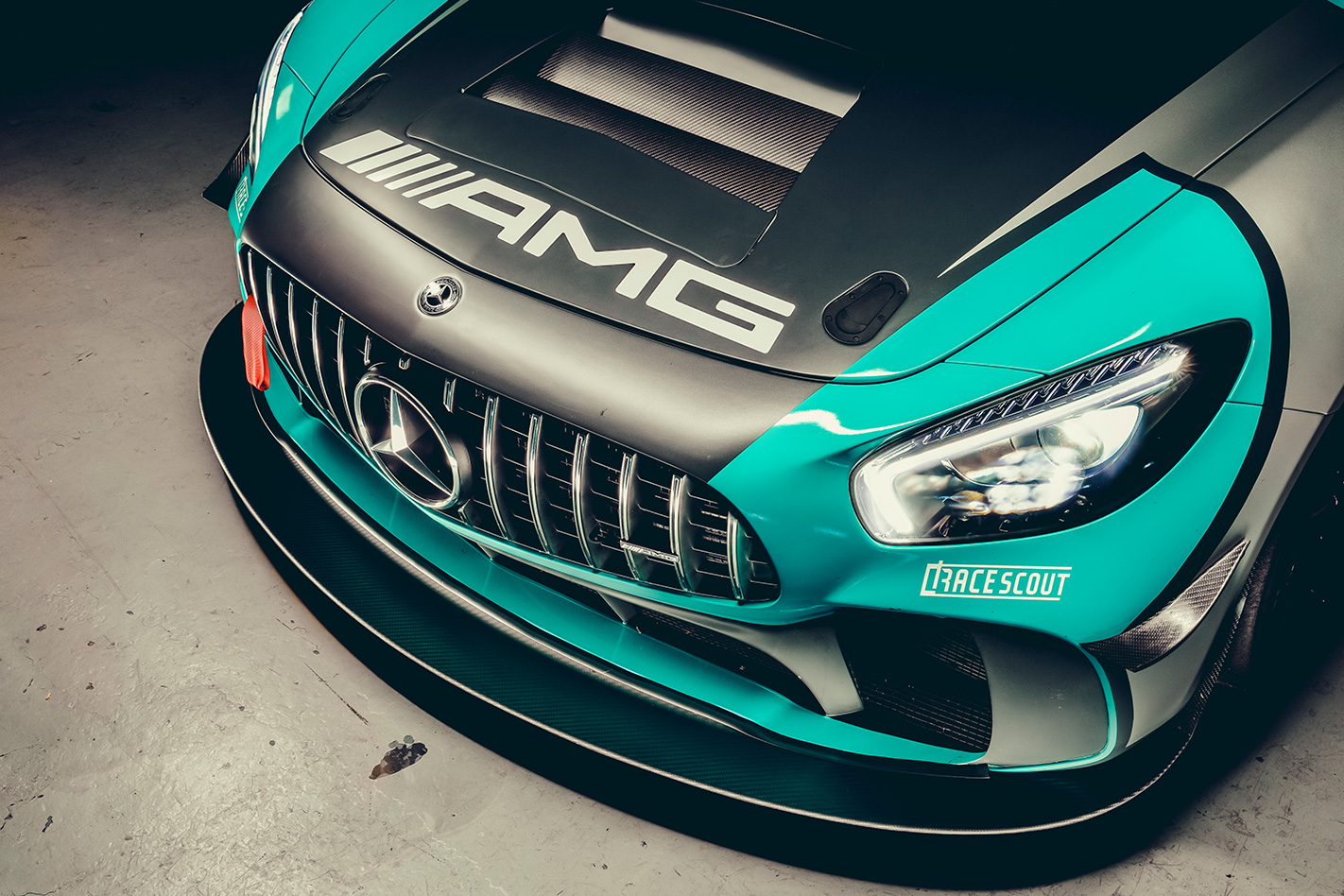
Now though, cocooned as I am within a carbonfibre safety cell, my gloved mitts only inches away from multi-stage dials for the ABS and traction control, I feel as though I’m ready to line up on the front row of the Bathurst 12 Hour. Time for a mental recalibration.
It’s true that the burgeoning GT4 category is designed to sit beneath GT3, both in terms of performance and cost. Created in 2007, it’s now recognised worldwide and sees drivers compete alongside GT3 cars in some of motorsport’s highest-profile events. There’s plenty of machinery to choose from, too, with manufacturers as wide-ranging as Ford, McLaren, Alpine, Chevrolet, Porsche and BMW all building factory-spec GT4 cars.
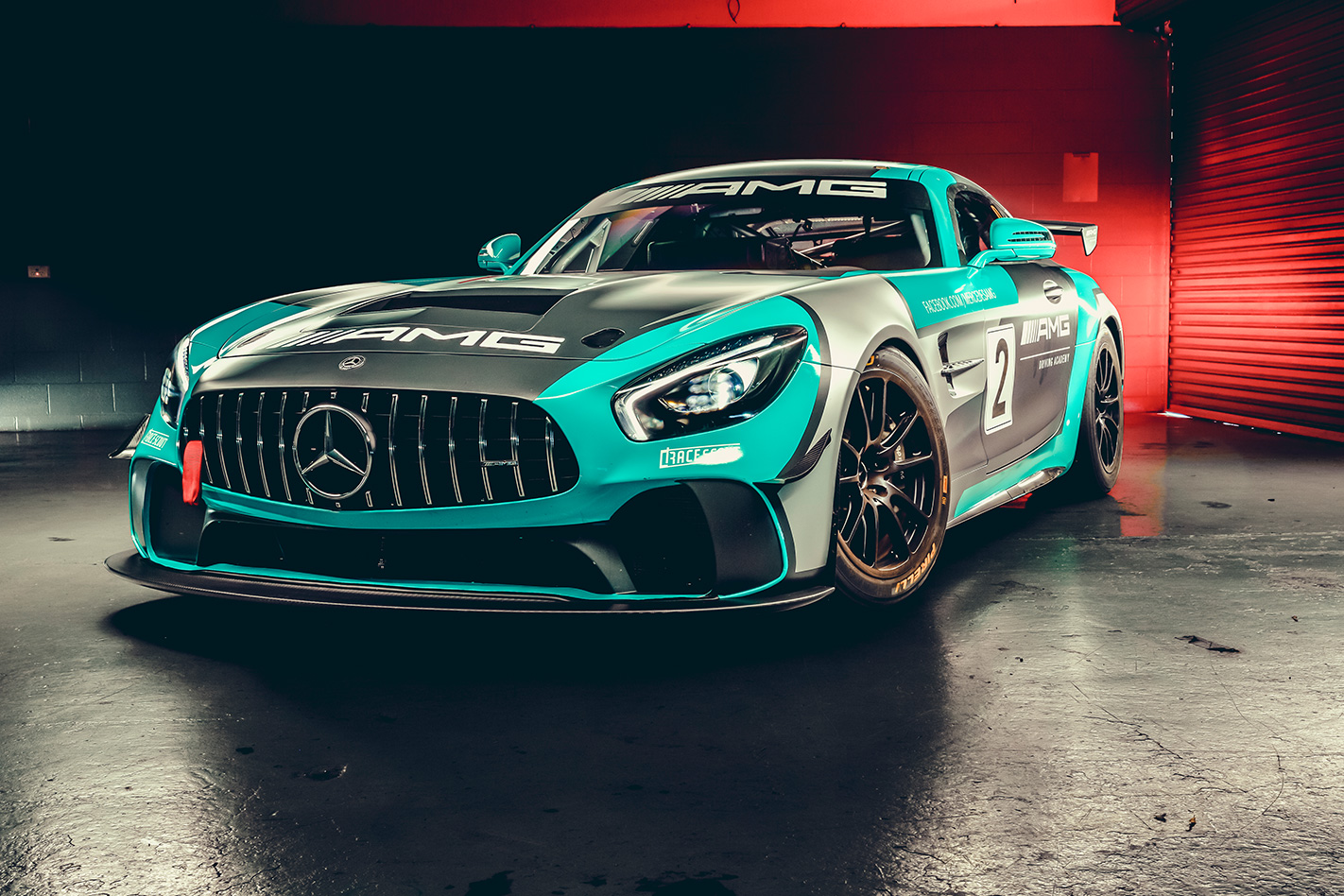
The appeal is obvious. At around half the outlay of a fully fledged GT3, and with lower running and maintenance costs to boot (see sidebar, p42), GT4 seems an ideal playground for well-heeled gentleman racers, and for eager youngsters looking to develop their confidence and ability on the way up to burlier tin-top racers. And as I’m learning, ‘GT3 lite’ doesn’t mean scrimping on the theatre of GT racing. Or, as it turns out, a degree of intimidation.
First, some numbers. Power comes from the same 4.0-litre twin-turbo ‘hot vee’ V8 as the regular GT R, though its outputs are different, and not in the direction you might expect. To comply with GT4’s stringent balance of performance regulations, the AMG’s V8 produces between 295-375kW, depending on boost. Today the donk is set to its maximum setting, though even so, 375kW is well below the road car’s 430kW. Offsetting this reduction in grunt is an even heftier drop in weight. Removing all of the road car’s creature comforts and liberally coating the cabin in carbonfibre has saved 300kg, meaning AMG’s GT4 hits the scales at a hot-hatch-rivalling 1390kg. Nice.
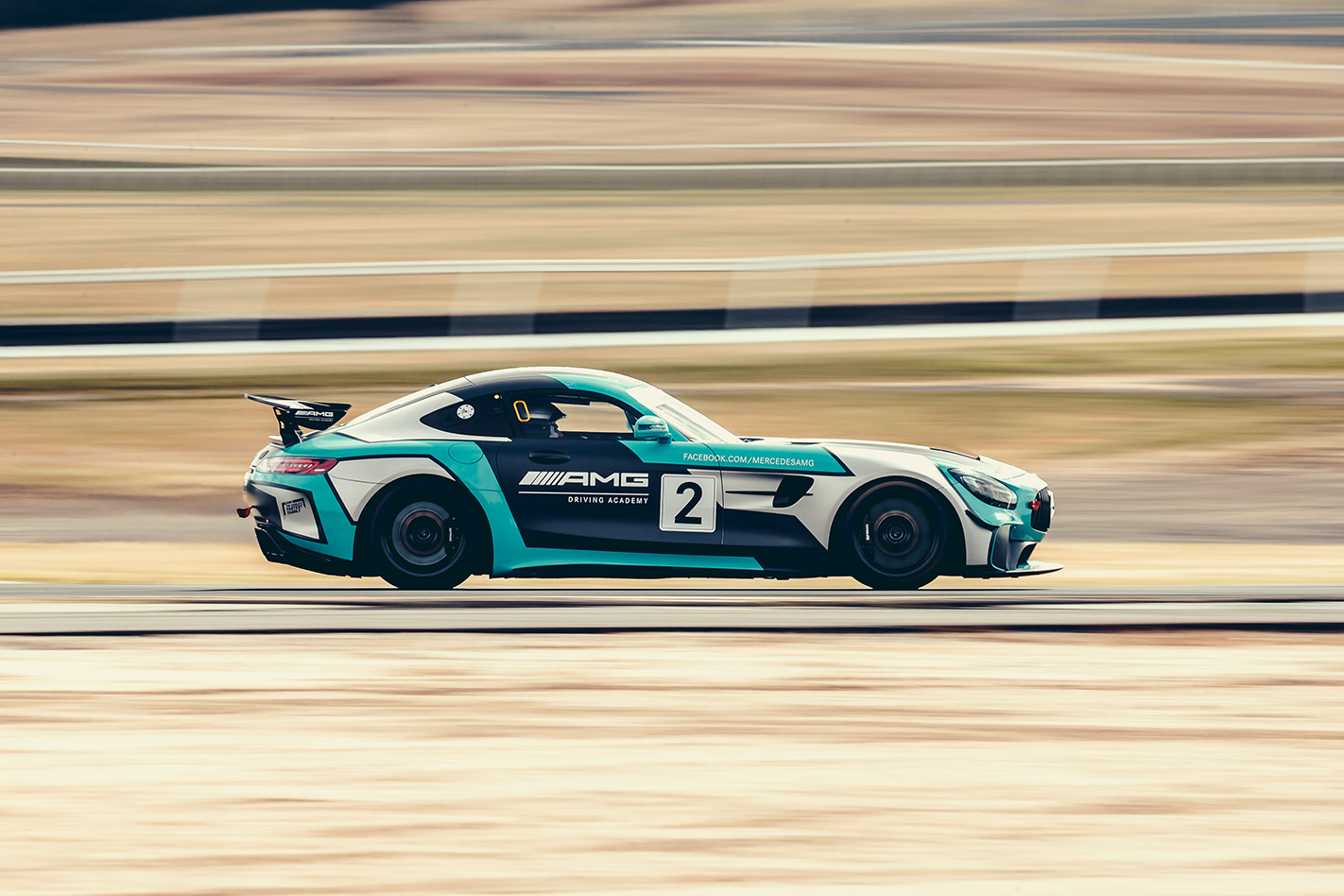
Now, the clutch. Racing clutches are notoriously malicious, yet pulling away is surprisingly simple. The pedal is light and the bite point easy to find; exactly the combination you want in a car pitched at less experienced racers. The following 100 metres or so, however, are decidedly less civilised. Clearly unhappy with my chosen speed and throttle position, the car jerks and strains, the cockpit a clumsy cacophony of diff chatter and transmission whine.
Much of this recalcitrance can be attributed to the gearbox. Unlike most GT4s, which use the same ’box as their production car donors, AMG removes the regular GT R’s seven-speed dual-clutch and replaces it with exactly the same six-speed sequential unit as its GT3 car. It’s a full racing ‘box with beefier internals and faster shift times, and combined with the noisy diff, it makes the AMG feel raw. Mechanical. As though it won’t suffer fools.
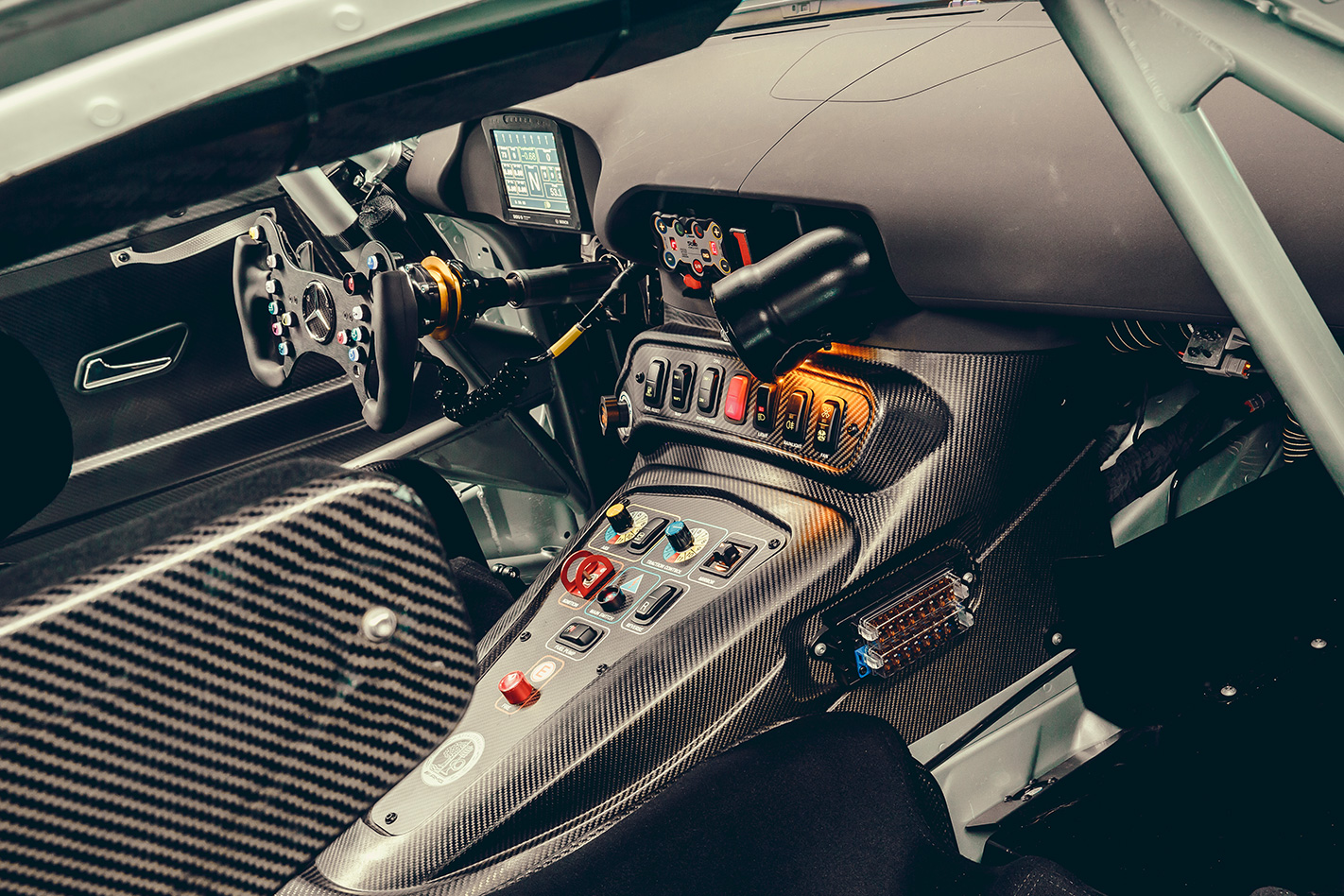
The opposite turns out to be true. Feeding in some revs sees the drivetrain mesh and I power through the first four gears towards Sandown’s first turn, each shift hammered home with a pleasing decisiveness. It’s wonderfully intuitive, this thing. The steering is sharp and naturally weighted, the massive slicks offer a surplus of grip, and the braking performance is intoxicating. Delve deep into the middle pedal’s travel and it’s a glutton for punishment that can be smashed without mercy or fear of locking a wheel.
The electronics help here, of course. Like the gearbox, the GT4’s wiring loom is lifted straight from the GT3 car and there are 11 stages for the ABS and traction control. I leave both in their middle setting, with the only sign that the ABS is working delivered by flashing purple lights on either end of the steering wheel.
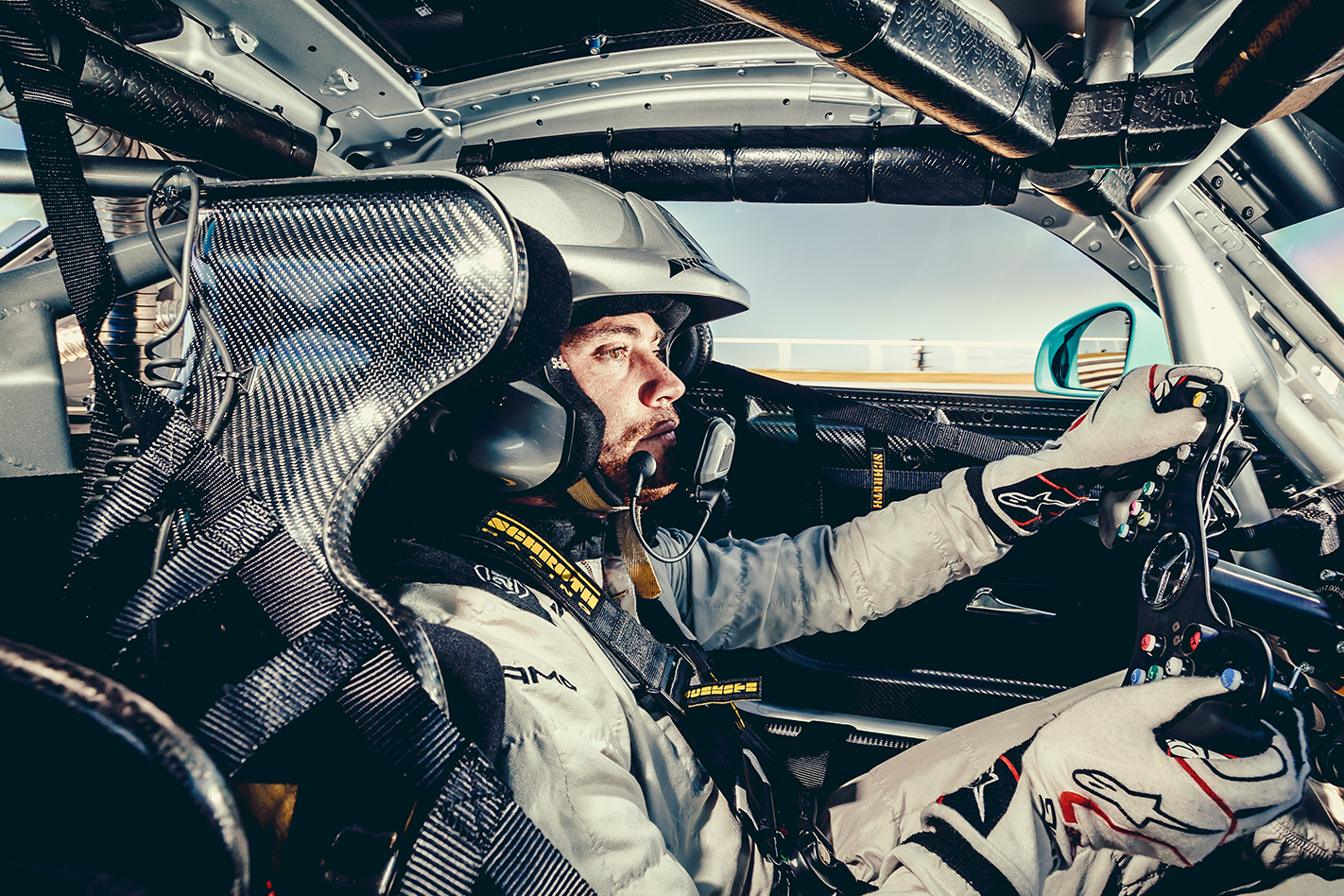
Set-up wise, there are the usual chassis parameters to tweak: rebound and compression for the dampers, ride height (and hence rake), and alignment alterations for camber, toe and castor. Today the car is configured to a ‘middle’ baseline, which also includes the angle of the adjustable rear wing. Retaining the sanctity of their competitive advantage means AMG’s mechanics won’t reveal how much downforce the GT4 generates, though it’s clearly well down on the figure produced by the GT3 car’s more aggro aero package. One advantage to that is less drag, meaning that on the straights, the GT4 is actually quicker.
Does the big V8 feel as vastly accelerative as it does in the regular GT R? Not quite, especially in the first few gears, though where the GT4 absolutely monsters the road car is through the corners. Pitch that long nose into a turn and it’ll ride kerbs with stunning control and surprising pliancy, but it’s the corner exit that’s most addictive. So high are the grip levels that the GT4 taunts you to feed in the throttle earlier and earlier, the rear diff reacting with confidence to drive the car out the other side.
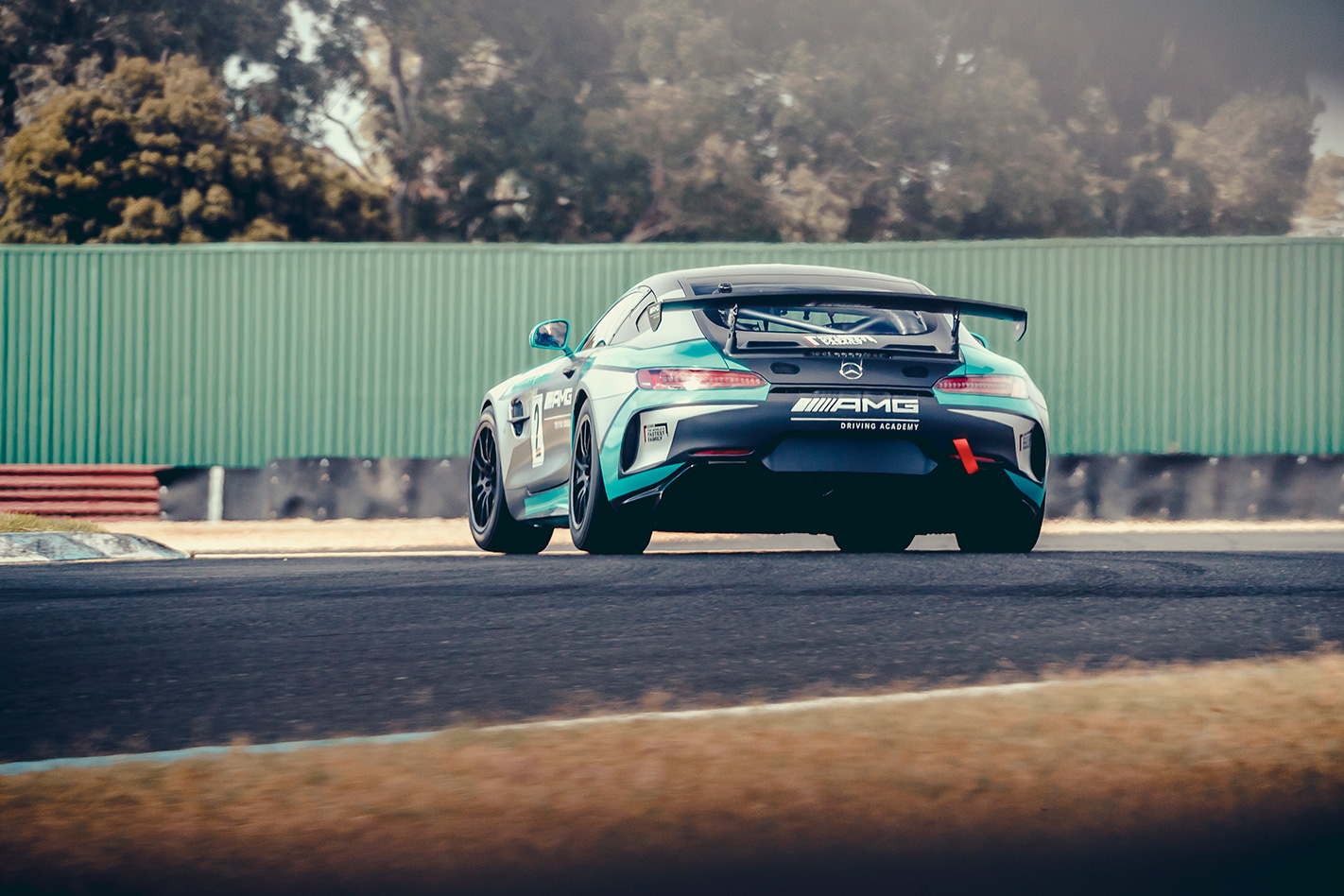
It all feels nicely predictable and balanced, which, of course, is precisely how it should be. What amateur racer is going to feel comfortable improving their ability in a snappy, mean-spirited machine? No, this needs to be a car capable of tolerating some degree of ineptitude. Which I duly give it.
With my commitment growing, I decide to accelerate between Sandown’s final right-left complex and try to make the second corner on a trailing throttle, where I’d previously been bleeding off the brake. Mistake. With no weight on the nose the GT4 delivers such a woeful armful of butt-puckering understeer that I fear I’m headed for the fence. My fault, not the GT4’s, though it’s a lesson in how sensitive cars like this are to weight transfer and, when the speeds increase, aero balance.
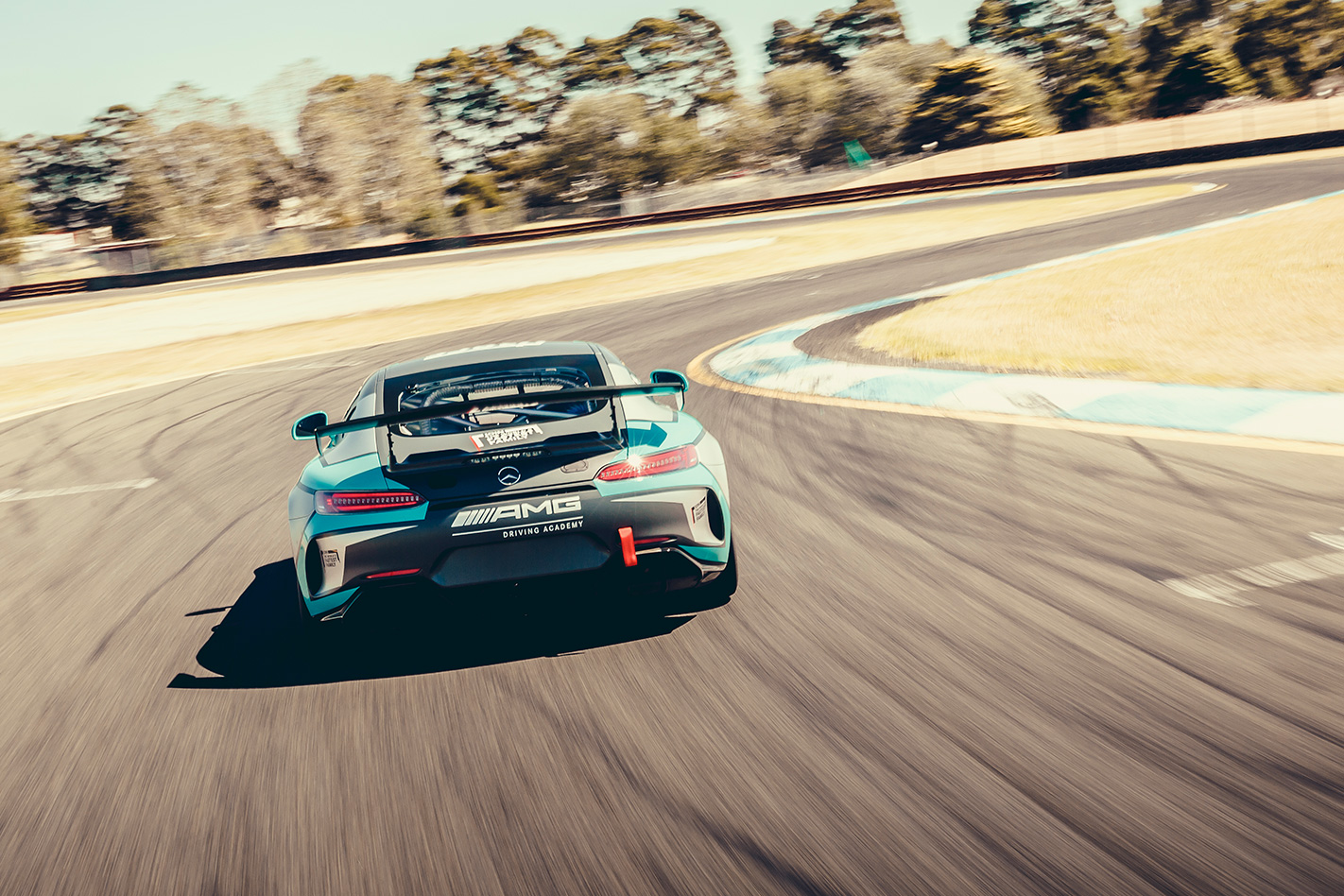
Be mindful of that and AMG’s GT4 is remarkably rewarding. There’s something thrilling about nailing a corner exit, revelling in the grip of a hot slick tyre and then watching as the shift lights glow green, then yellow and red as you wait to feed in another ratio to a hard-headed racing gearbox. It’s proper GT race car stuff and – interestingly – substantially more exciting than other GT4s on offer. I’ve since driven a McLaren 570S GT4 and it did feel like a road car with slick tyres. The AMG is more like a de-specced GT3 car.
Which brings us to the question of value, and the deeper conundrum of whether such a word can exist in the realm of motorsport. At €198,850, it’s feasible that at today’s exchange rate and allowing for tax and delivery charges, you could park an AMG GT4 in your garage for $380,000. That’s a big number, but consider that it’s only $30K more than a regular AMG GT R and suddenly it seems a justifiable and decidedly more captivating place to spend your money.