
What’s in the garage?
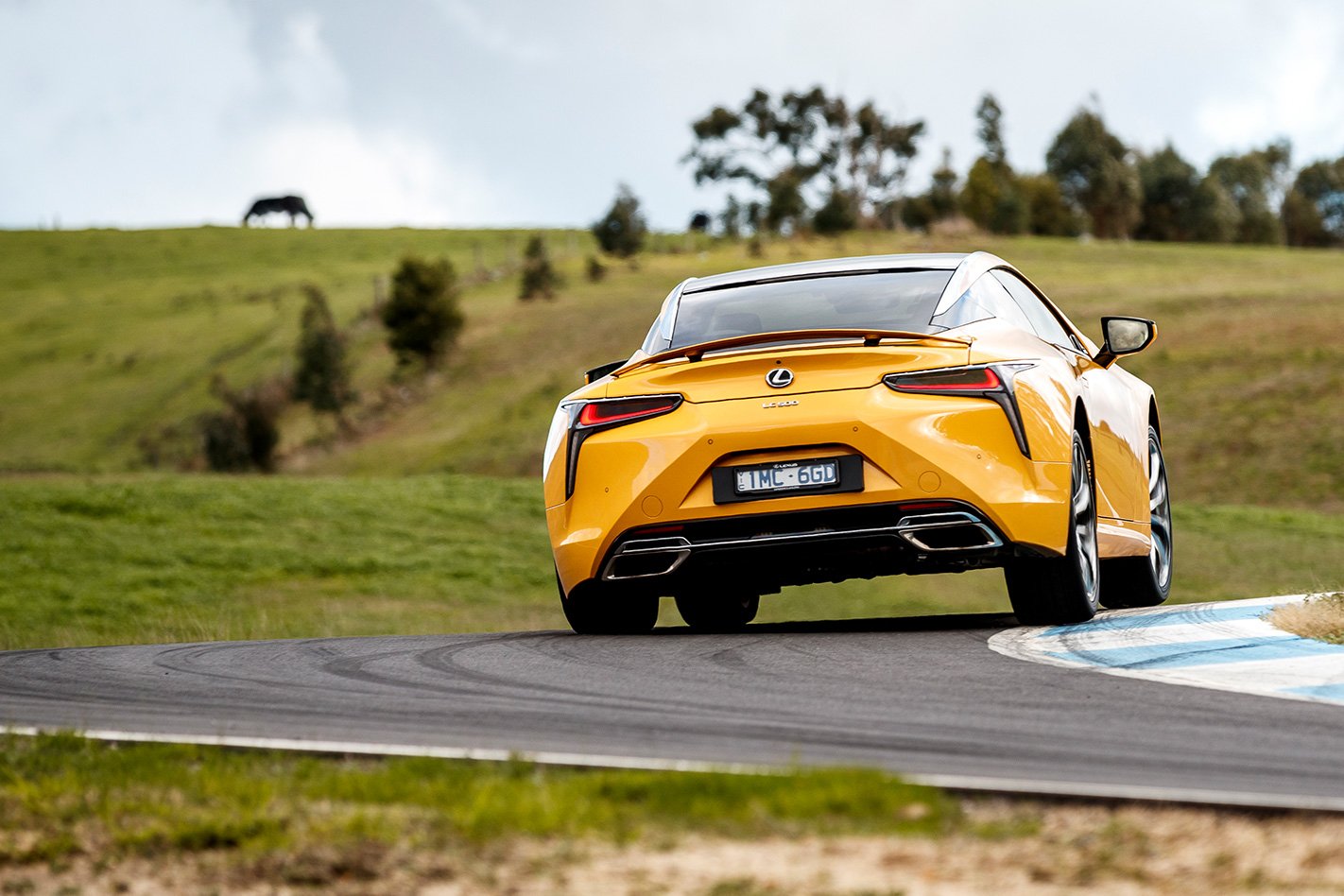
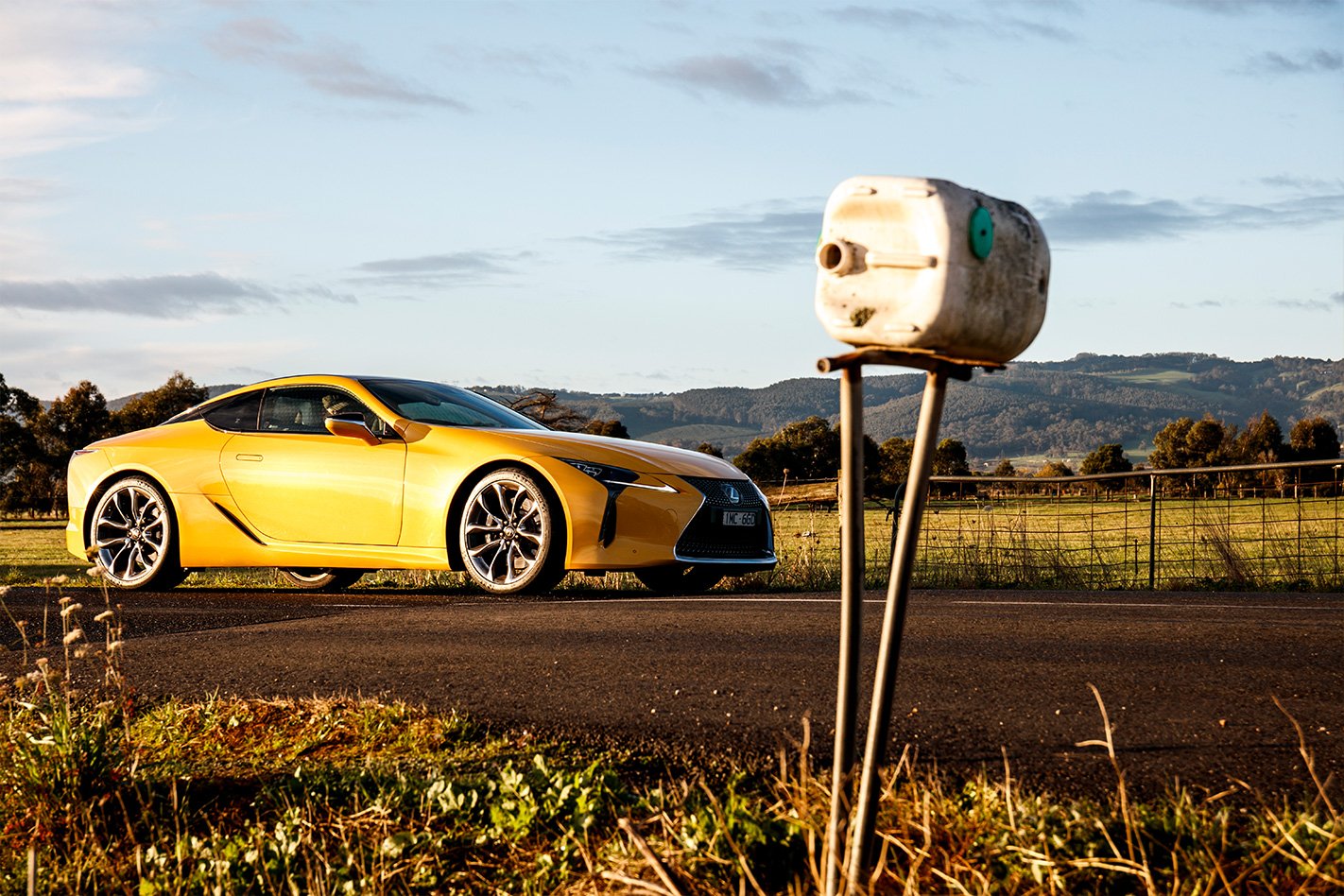
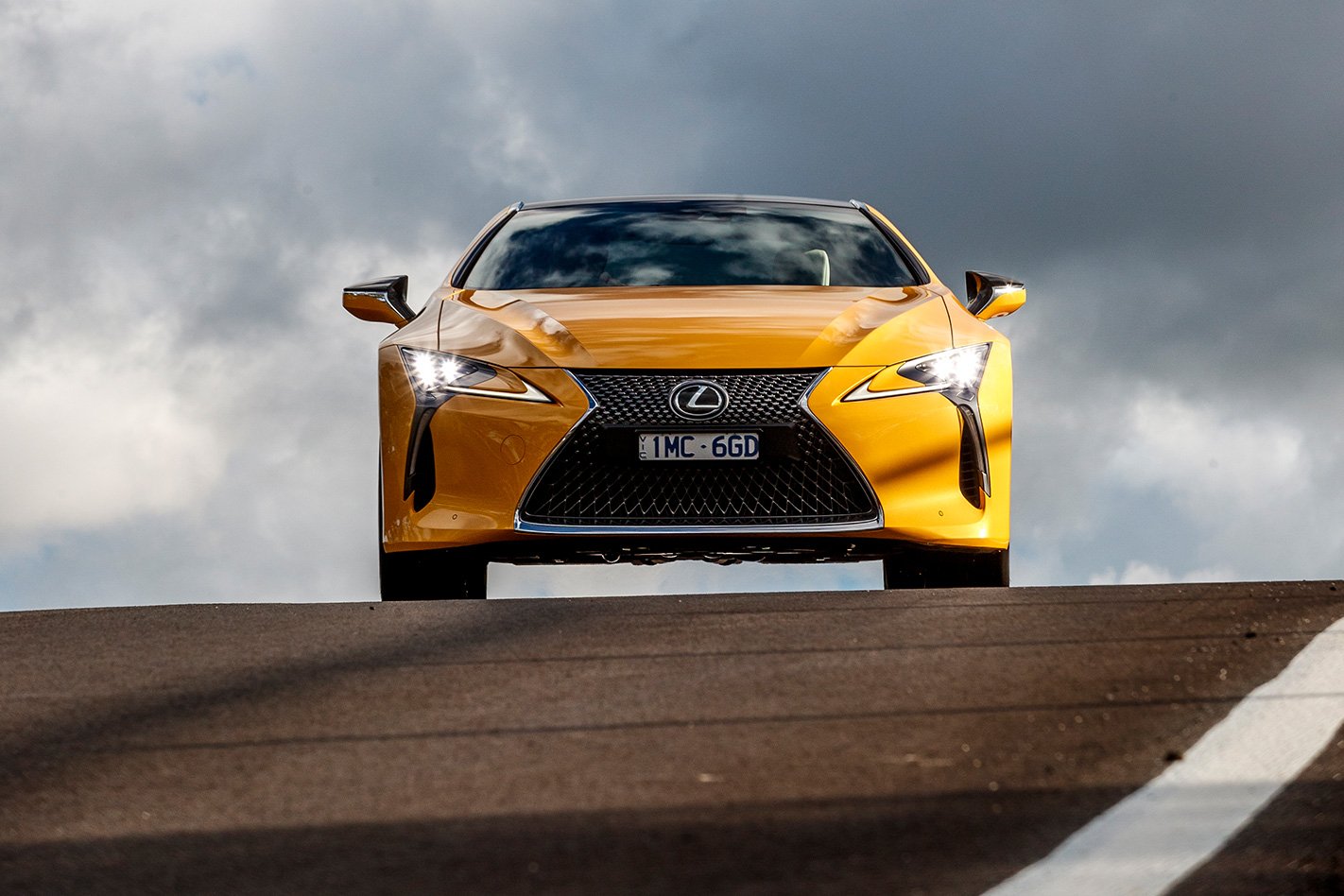
The LC500 is a jaw-dropping car. Despite a 2017 release, it still turns heads like little else. Add in a carbon-fibre roof and the look-at-me Zinnia Yellow body colour over chrome wheels, and you start to wonder if this $205,200 coupe is simply all for show. It’s not. This special edition injects more ‘style’ (beauty is in the eye of the beholder, after all) with the bright hue on the outside.
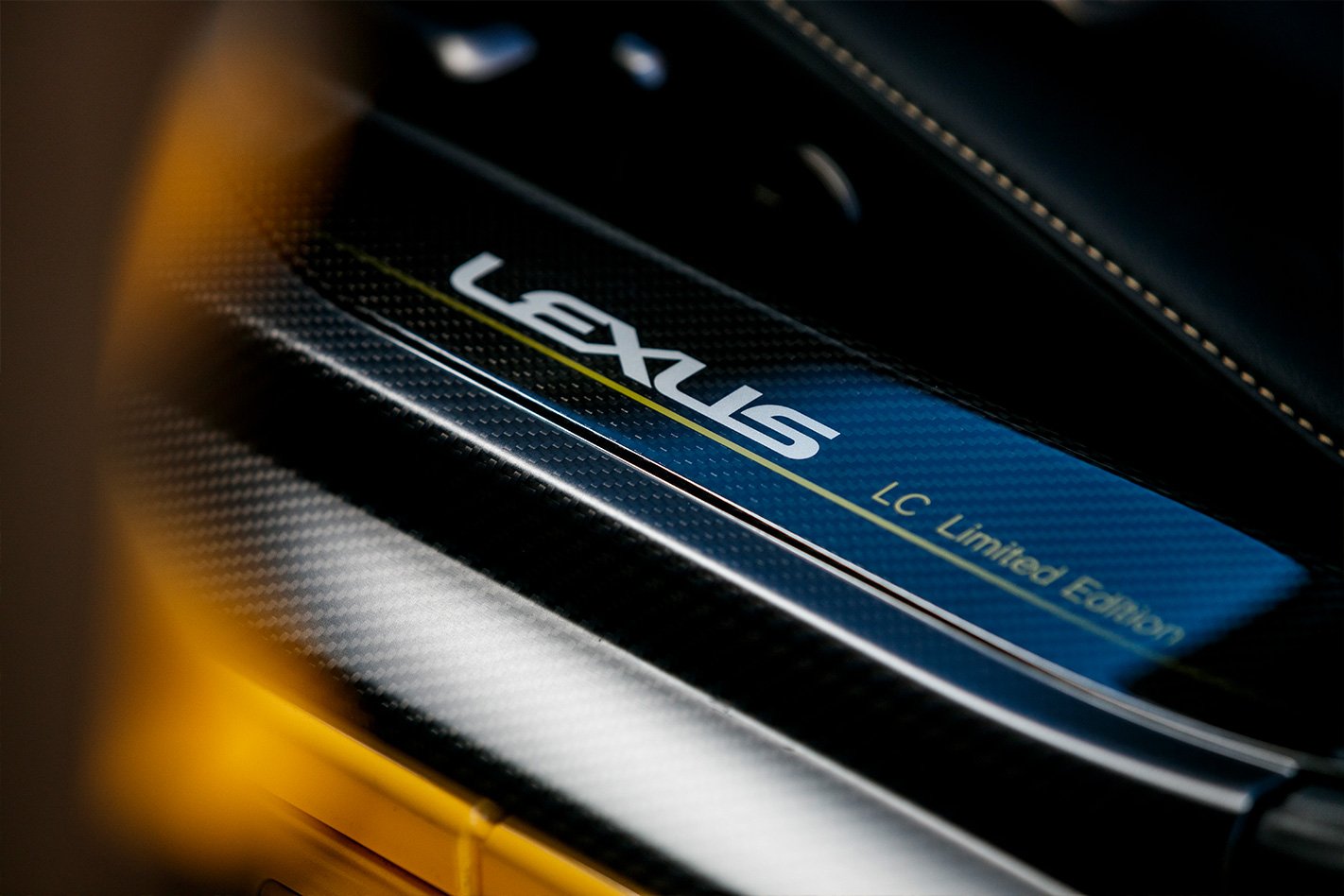
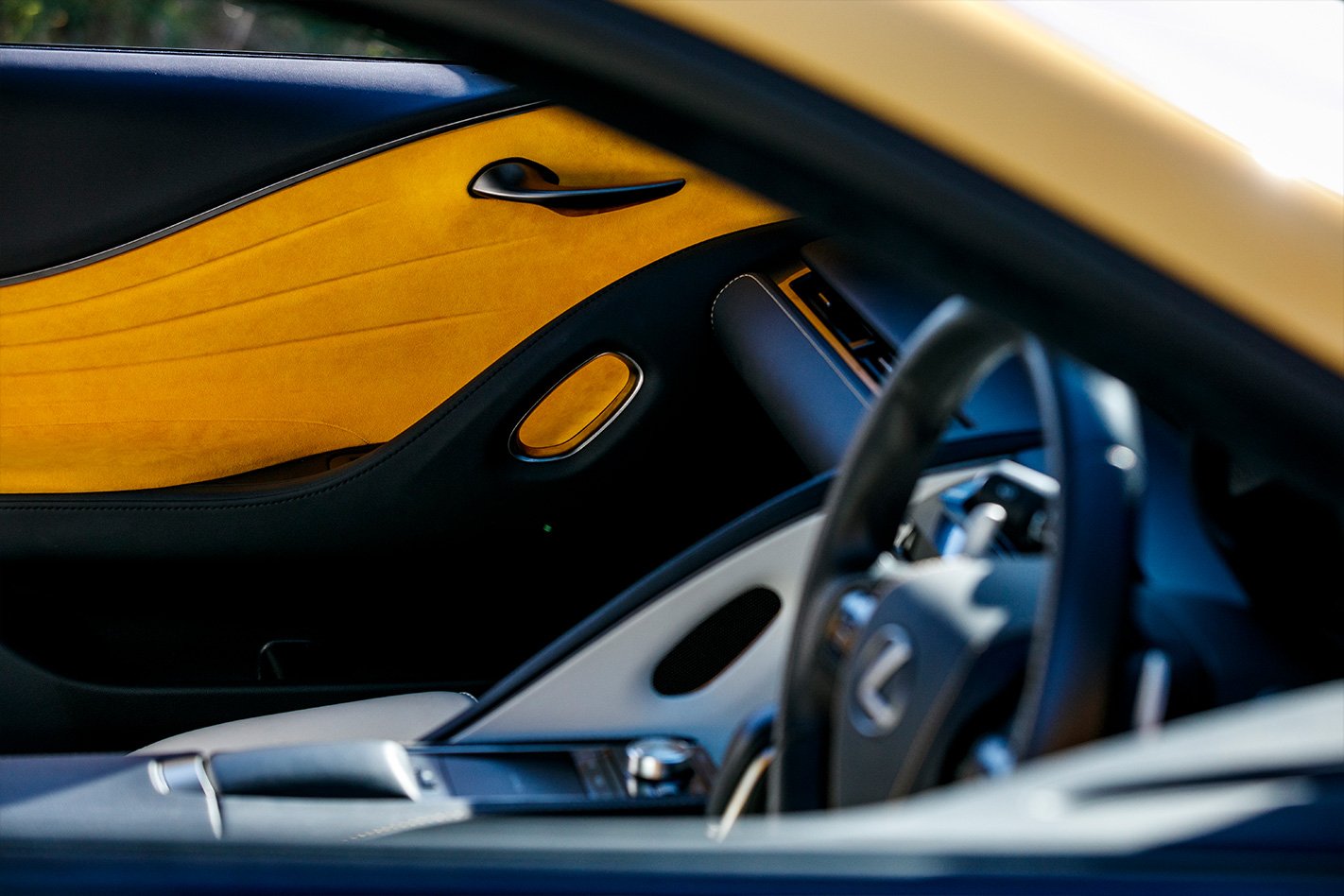
More yellow can be found inside, with Mikado Alcantara door inserts and contrasting yellow stitching, while the semi-aniline leather seats are white. Mechanically, the 351kW/540Nm 5.0-litre V8 remains, but the $15,000 enhancement pack is now standard. The limited-edition variant is available for both the V8 and V6 Hybrid powertrains.
What we reckon

Cameron Kirby
Staff Journalist
What a beautiful thing the LC500 is. Exquisitely designed inside and out, it feels properly luxurious, and the V8 sounds fantastic. It has a real NASCAR character, with heaps of grunt and whip-crack gearchanges from the 10-speed automatic transmission. Take it all the way to redline and you’ll discover an intoxicating hard-cut which sounds like heavy-artillery. Speccing the interior would require restraint to make the most of the design, but it’s a lovely place to spend time, and would make for a fantastic long-distance cruiser. You would have to learn to love the infotainment system, which makes an awful first impression, but the rest of the car more than makes up for it. If you choose the hybrid over the V8 you’ve made the wrong choice.

Trent Giunco
Staff Journalist
Usually, first impressions count. However, for me, my second experience with the V8-powered LC500 resulted in a transformed opinion. It’s easy to pass off the atmo Lexus as style over substance, but that’s doing it a massive disservice (just don’t buy the Hybrid). That engine, the 2UR-GSE, is an event. What’s more, the rapid-fire 10-speed auto jostles with it for the leading act. It sounds epic, both inside and out. And, when fitted with the slippy diff and rear-steer, the LC is far from outclassed in terms of dynamics. Its balance between GT-cruiser and performance couple is nicely straddled, too, and you could easily take it on a week-long jaunt. A sumptuous interior is the icing on the cake – and almost enough to make you forget about the horrid infotainment system… almost. In terms of a car fit for purpose and one you’d enjoy owning, the LC500 has to be right up there.

Andy Enright
Deputy Editor
The LC never stops surprising. Everything about it leads you to believe it’s going to be some suave GT cruiser that’s about as aggro as bridge night at the bowling club, but switch it into Sport+ mode and it really amps up. It’ll hold big slides, the engine sounds demented at the top end and the steering really comes to life when the Lexus gets up on its toes. There’s real talent in this chassis and the engine is one for the ages. It takes a bit of time to key into this car, but it’s time well invested. That V8 is so good, I think I’d even put up with the infotainment system from hell for it.
Review
Power and Performance
In a world where 400kW seems to be commonplace, the 351kW and 540Nm of the V8-powered LC500 could be viewed as being a bit meek. A kerb weight of 1970kg and a claimed 0-100km/h time of 4.7 seconds backs up suspicions further. However, this is a car that needs to be experienced to understand it. Because once you do, the quoted figures fade into insignificance. In terms of feel-good factor, the naturally aspirated Lexus rates highly.
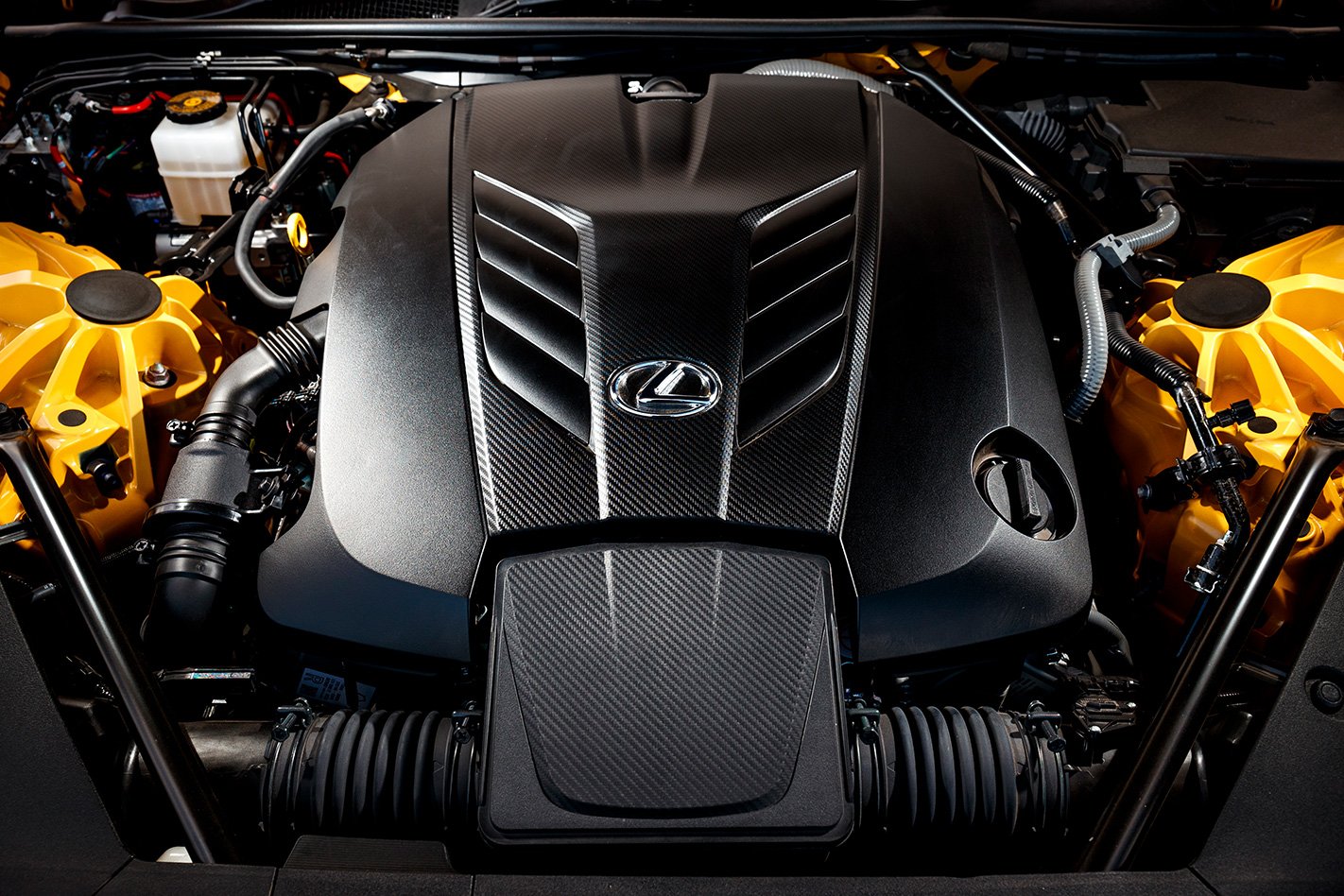
Yamaha-tuned high-flow cylinder heads, titanium inlet valves and dual-length intakes afford the rev-happy nature of the LC. A development on the RC and GS F power unit, the 2UR-GSE raises its compression ratio to 12.3:1 and it can operate on an Atkinson cycle for extra fuel economy. Using the intuitive 10-speed auto to keep revs high is the best course of action for spirited driving. The gearbox itself is a revelation. The torque-converter auto shifts when called upon and blips the throttle hard on down shifts. The aural sideshow is a welcome benefit.
The sound the 4969cc eight generates is nothing short of epic. Sophisticated and cultured, this is a soundtrack to please all kinds of tastes. In truth, it makes the LC500 feel much faster than it actually is. The V8 can be thirsty when pushed, but it’s by far the better choice over the soulless Hybrid.
Ride and handling:
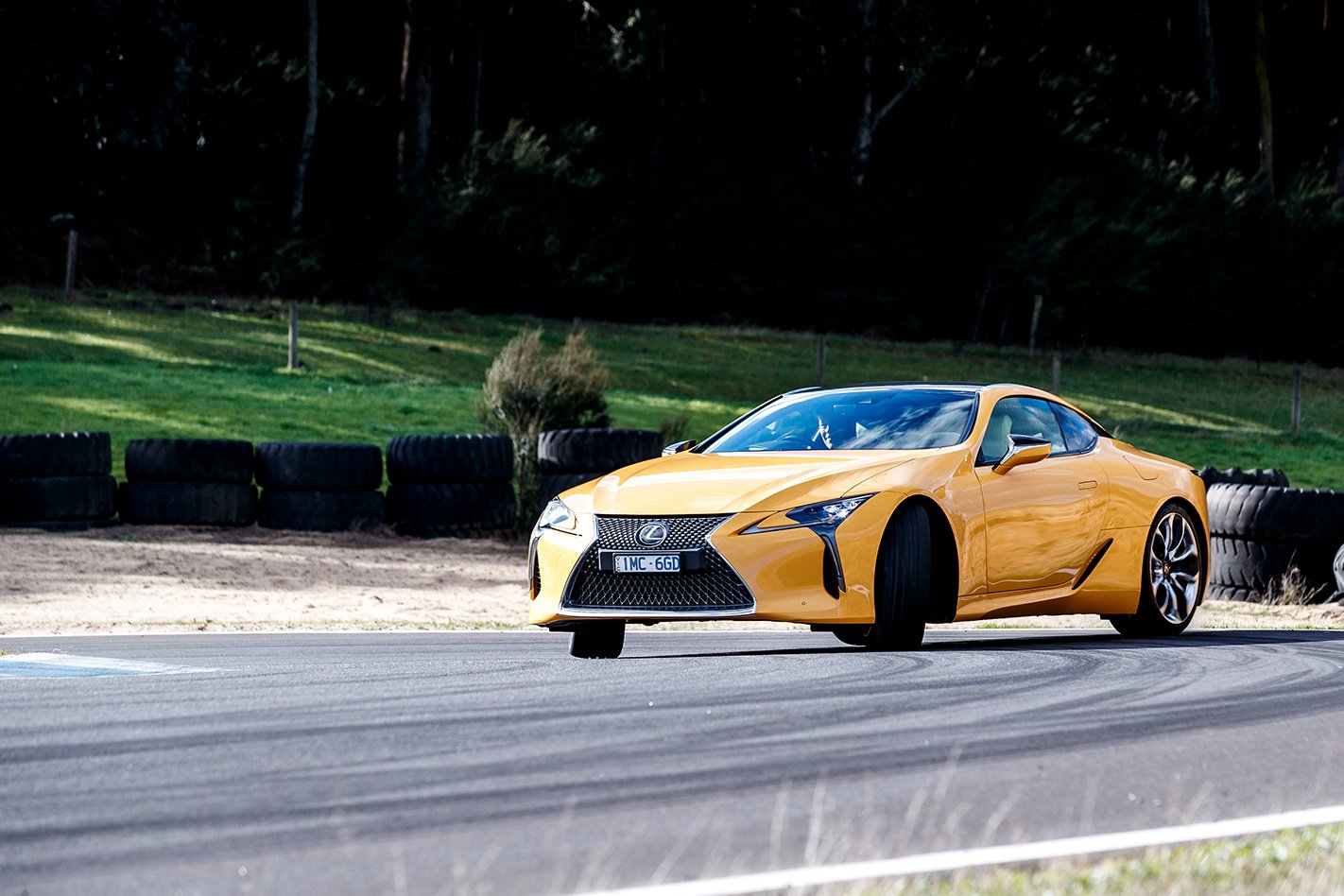
For a car verging on two tonnes and riding on 21-inch wheels with low-profile tyres, the LC500 is both dynamically impressive and comfortable in equally surprising measures. The special edition comes with a Torsen limited-slip differential and rear-wheel steering, both aiding agility and seemingly reducing the two-door coupe’s bulk. Impressive yaw angles are achievable with the progressive movements, while the traditional rear-drive behaviour increases the fun factor. The rear steering is more intrusive than other systems, rendering the coupe a little twitchy until you get used to it. The carbon-fibre roof does little in the way of weight saving or lowering the centre of gravity.
The suspension and damping is impressive, and updates provide a more supple and cohesive ride quality. Thanks also to adaptive dampers, there’s a duality of character that favours both the ‘cruiser’ vibe and performance intent. What’s more, despite rather wide 275-section Michelin Pilot Super Sport tyres (245 up front), tyre roar and NVH levels are sufficiently suppressed. Ultimately, the LC500 is more than a one-trick pony. Pass it off as a lumbering, floppy coupe at your own risk.
Interior and Comfort:
If you’re going to sign off on an exterior like the LC’s, you’d better hope the cabin is a match. And it is. Although, that’s not to say it’s without vices. Cue the infotainment spiel that accompanies most new products from Lexus. Still, the LFA-style instrument cluster is cool and the Shrek ear-like controls for the drive modes and traction controls are definitely unique. The 13-speaker Mark Levinson audio system is top notch, while the special edition adds yellow Alcantara and carbon-fibre kick plates.
Read the PR spin and you’ll know that the cabin has been inspired by ‘Takumi craftsmanship’, but the reality is that the luxurious design is a feast for the senses. The level of detailing is impeccable and the overt style is far from boring. The two back seats are for occasional use at best, but if you did use your LC500 as a weekend getaway chariot, there’s a 197-litre boot – which is actually more useful than its capacity would suggest. Overall, the interior ambience is uplifting. It makes you feel special in a way some grand tourers don’t for much more coin.
Verdict
Despite being overtly modern, the LC500 has an honest, old-school charm about it that’s hard not to love. The combination of the melodic bent eight, slick 10-speed auto, LSD and rear-steer renders the imposing LC more than just a concept car for the road. It is dynamically talented, and thanks to the suspension tweaks, the two-door coupe is even more comfortable and compliant. Matched with an exquisitely detailed interior and ultimate roadside appeal, the LC500 carves its own naturally aspirated niche in the sea of GT coupes.
LEXUS LC500 SPECIAL EDITION SPECS
Model: Lexus LC500 Special Edition Engine: 4969cc V8, dohc, 32v Max power: 351kW @ 7100rpm Max torque: 540Nm @ 4800rpm Transmission: 10-speed automatic Weight: 1970kg 0-100km/h: 4.7sec (claimed) Economy: 11.6L/100km Price: $205,200 On sale: Now
The new 2020 Renault Megane RS Trophy-R is making its way to Australia, having already gone on sale not long after its official reveal.
But most of the main performance figures and information about the Nürburgring’s FWD lap record holder haven’t been widely reported, somewhat overshadowed by Renault’s focus on its weight saving and the record itself.
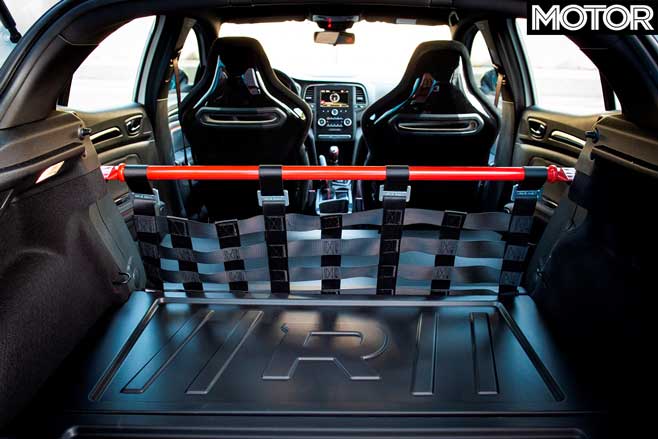
In fact, there’s a lot to be impressed about with the Trophy-R. Its engine can be summed up quickly, being the same as that of the Megane RS 300 Trophy.
It’s the 220kW version of the 1.8-litre turbo four unit fitted to all Megane RS models, and the Alpine A110, with 400Nm and a 6-speed manual putting its power to the front wheels.
The wheels are then given that power based on where a Torsen differential decides to send it.
With the LSD in the front helping keep the Bridgestone Potenza S007 tyres (sized 245/35 J19) firmly planted, the Trophy-R is able to achieve 0-100km/h in just 5.4 seconds, Renault claims. Honda’s Civic Type R, as context, arrived with a 5.7sec claim.
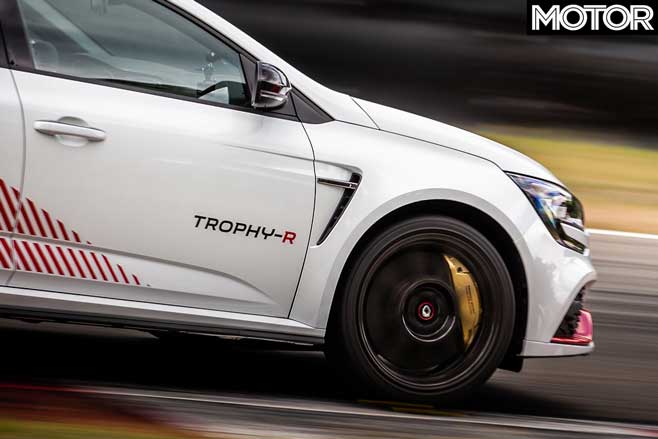
Renault, as previously mentioned, also took great pride in the lightweighting achieved with the Trophy-R, resulting in a 1306kg kerb weight. Its 168kW/tonne power-to-weight ratio also bests the Type R by a mere 3kW/tonne.
The specifications seen by MOTOR don’t clarify whether this kerb weight is measured with the Carbon Revolution-made wheels or carbon ceramic brakes, both of which are only available locally on the Megane RS Trophy-R Record Edition. Australia is only getting one unit of that car.
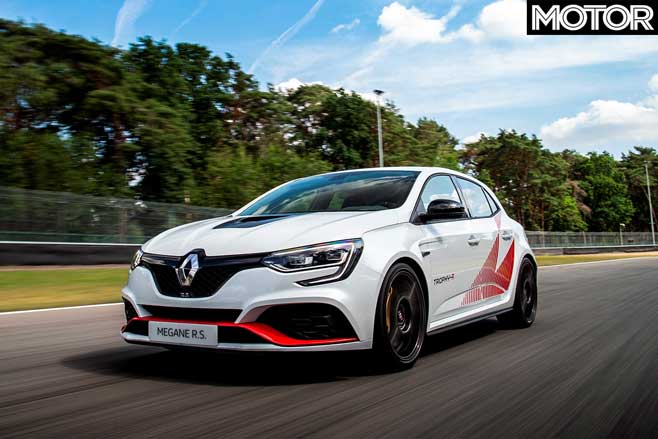
Otherwise, 20 Trophy-Rs were available to the public as of July 8, meaning chances of securing one are slimming by the hour.
Below is the full list of specifications available to MOTOR at the time of publish, but stay tuned for further examination of what allowed the Trophy-R to take the FWD Nürburgring record from the Honda Civic Type R.
2020 Renault Megane RS Trophy-R Performance Figures:
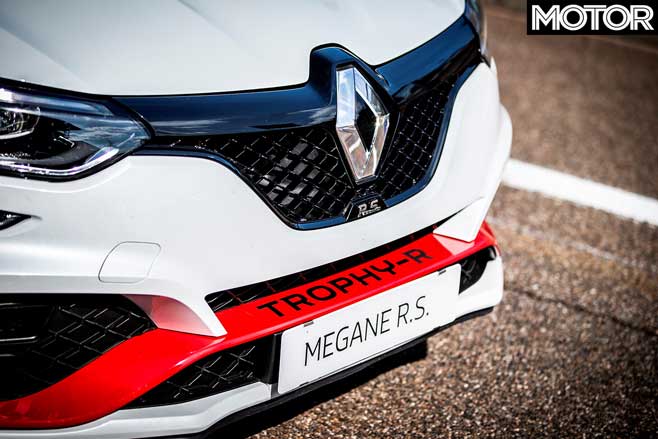
0-100km/h: 5.4 seconds TOP SPEED: 262km/h STANDING KILOMETRE: 24.5sec 80-100km/h IN 3RD GEAR: 2.9sec
2020 Renault Megane RS Trophy-R Specs:
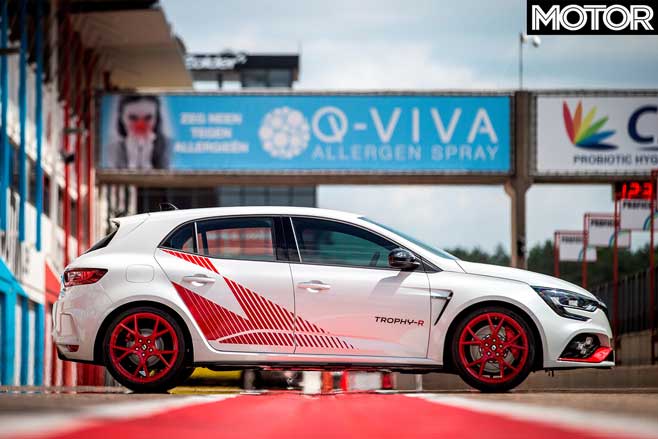
BODY: 5-door hatch DRIVE: front-wheel ENGINE: 1798cc I4, DOHC, 16v BORE/STROKE: 79.7 x 90.1mm POWER: 220kW @ 6000rpm TORQUE: 400Nm @ 3200rpm WEIGHT: 1306kg POWER-TO- WEIGHT: 168kW/tonne TRANSMISSION: 6-speed manual SUSPENSION: struts, dampers, coil springs, anti-roll bars (f); H-axle, dampers, coil springs, anti-roll bars (r) STEERING: electrically assisted rack-and-pinion BRAKES: 355mm ventilated discs, 4-piston calipers (f); 290mm ventilated discs, single-piston calipers (r) WHEELS: 19.0 x 8.5-inch TYRES: Bridgestone Potenza S007, 245/35 J19 PRICE: Approx. AUD$70,000
Imagine walking into a showroom in five years and the equivalent electric vehicle is cheaper than the 1.6-litre petrol banger. Sounds absurd by current standards, doesn’t it?
Well that’s what the near future looks like, according to Nissan.
Speaking at the launch of the second-generation Nissan Leaf electric car in Australia this week, Nic Thomas, global director of electric vehicles at Nissan, made his – and apparently most of the industry’s – bullish views on electric vehicle affordability clear.
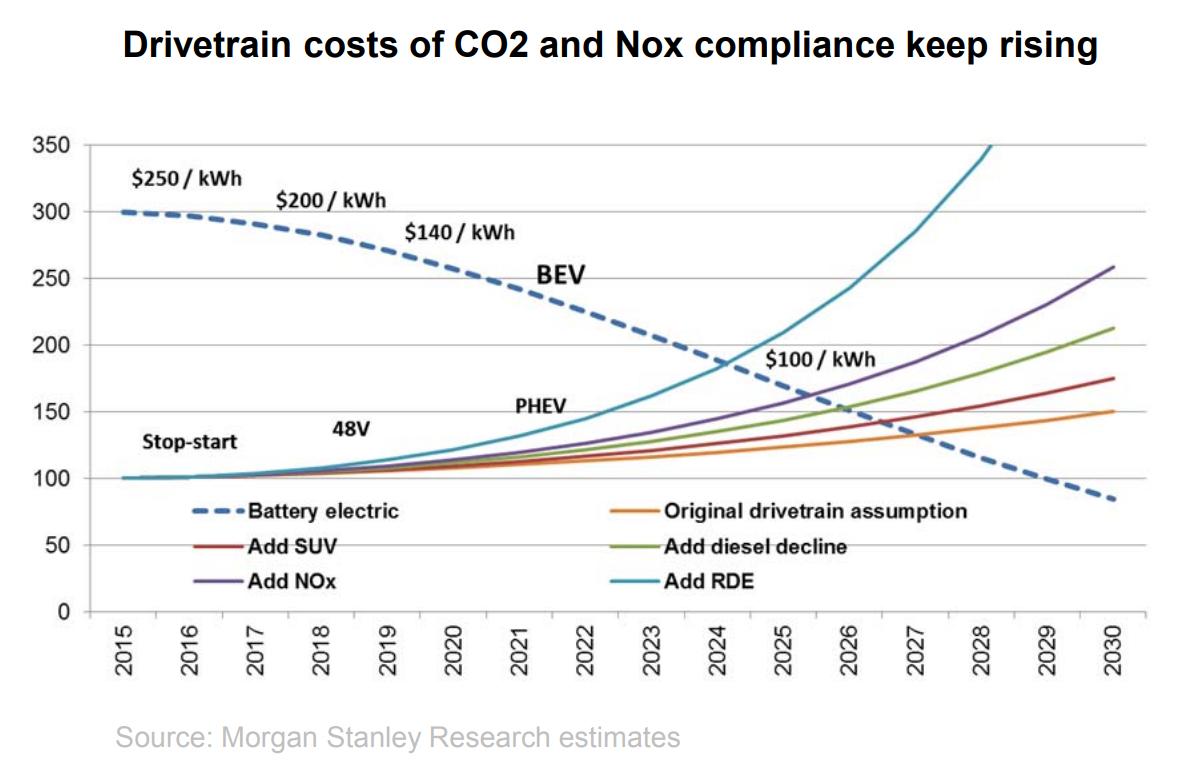
“This study was done by Morgan Stanley but I can assure you we have our own internal ones [at Nissan] that are very similar,” he said, referring to a chart in the background showing the price of EVs dropping below that of petrol and diesel-engined vehicles in just five years.
Retail, the top-spec Kona Highlander with a 1.6-litre turbo petrol four and front-wheel drive asks $35,500; the top-spec Kona Electric Highlander with its electric powertrain driving the front wheels cost $64,490.
It’s rather clear the costs of electrification are – for the time being at least – staggering.
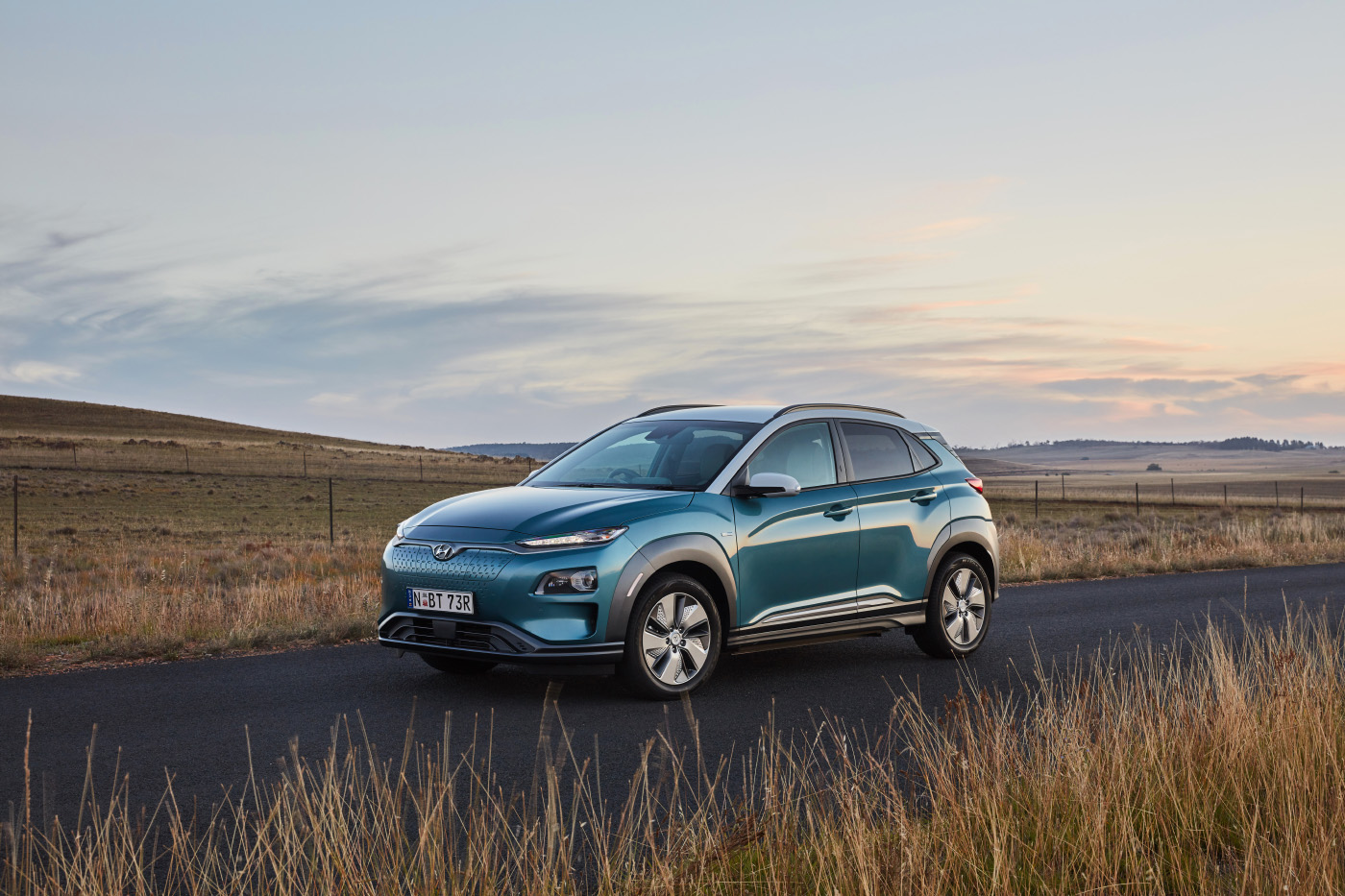
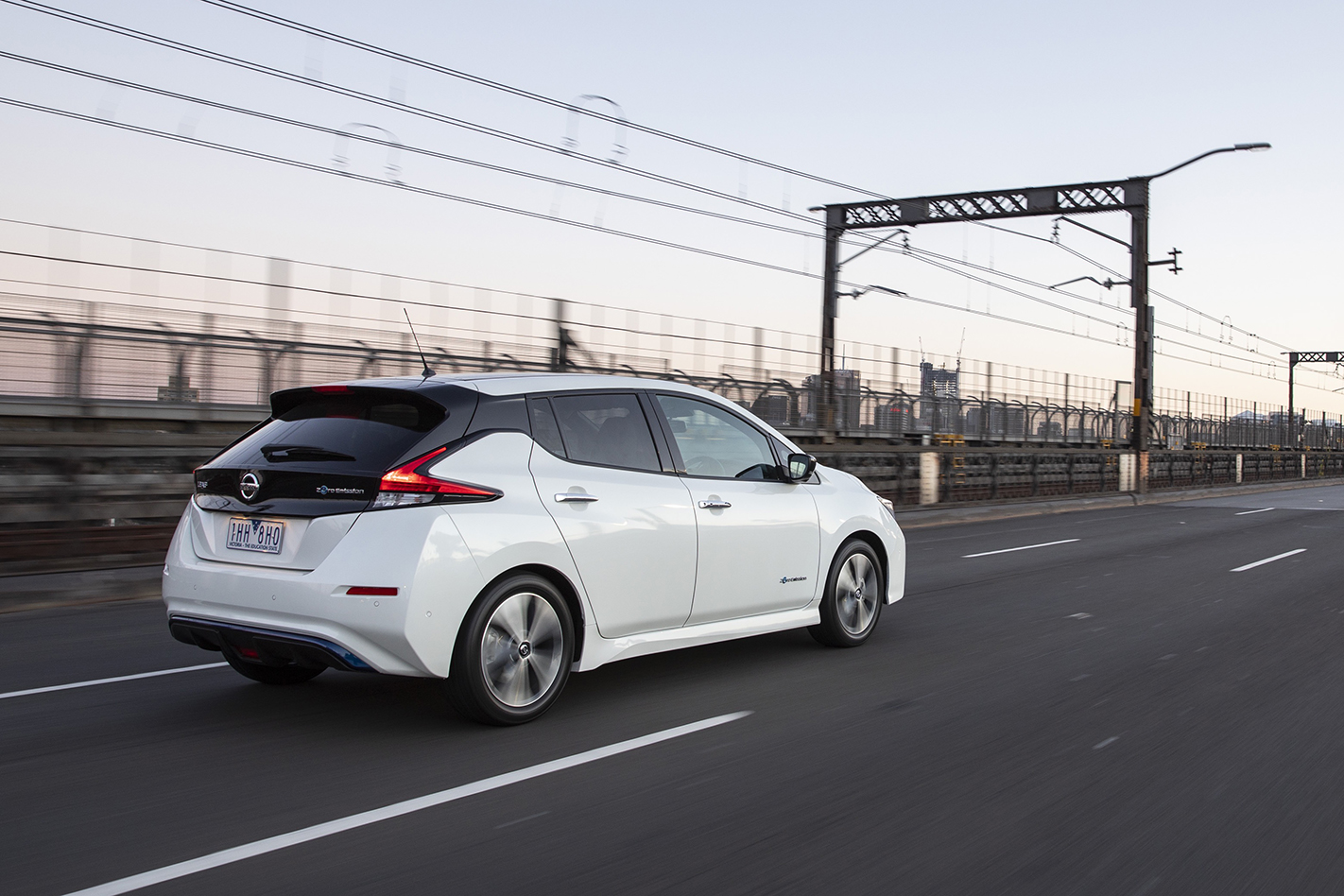
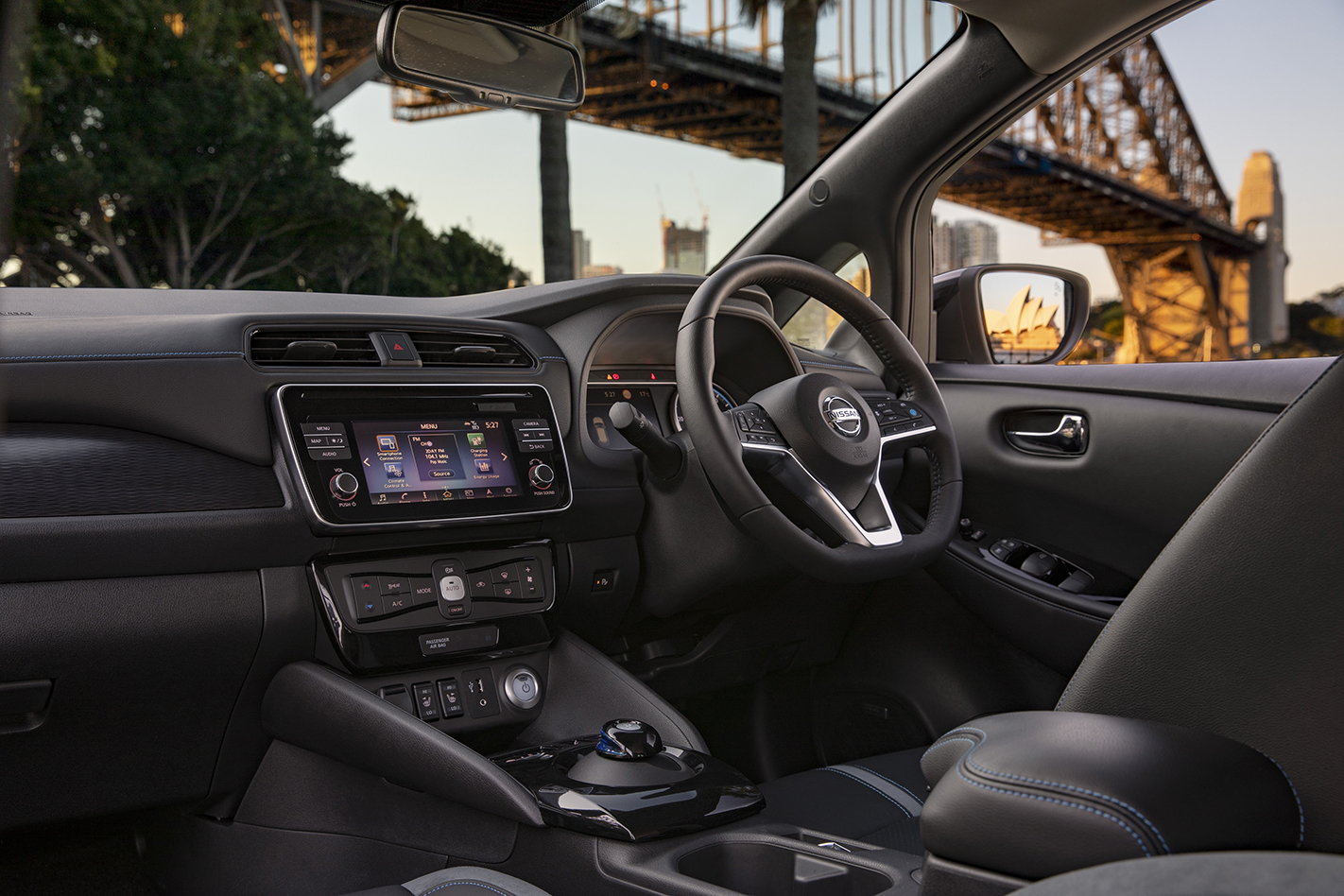
To Nissan’s credit, its new Leaf is priced at $49,990 and comes loaded with kit such as electrically adjustable and heated front seats, a heated steering wheel, and full leather-trimmed interior. But its battery is a measly 40kWh compared to the Kona’s 64kWh, which results in WLTP-rated driving range of 270km for the Leaf and 450km for the Kona.
But we needn’t have EV range and hip-pocket anxiety soon, according to Thomas. The need to lower emissions is having a hit on the bottom line for combustion engine development, and with the price of batteries falling, Nissan expects a crossover in price between the two by 2024.
“What you see here [on the graph] is the cost of traditional petrol and diesel powertrains and because of those [emissions] standards the cost of those things are going up very rapidly.
“So all those lines that start at the bottom at 100 and rise very rapidly are the costs to us as a car company of building traditional engines in the way that we always have and therefore, ultimately, we are going to have to pass on all those costs to the customer. Not just us but every other car company.”
Thomas further explains that we’re already experiencing the effect of better electric production efficiencies, with the new Leaf more affordable than ever before.
“So those costs are falling very rapidly and it allows us to launch this car [Nissan Leaf] with a 40kWh battery at the same price as the original model with a 24kWh battery. It’s because the cost of those batteries are coming down.
“What we are going to see very soon is a crossover – and this is not just my forecast this is Morgan Stanley’s, and many other people are in similar positions, and everyone is forecasting that very soon there will be this crossover where a battery car is going to cost less than a petrol or diesel one. So that’s a good argument for a customer why they should buy one.”
After eight decades, more than 23 million units, and countless derivatives, the final Volkswagen Beetle will roll off the production line in Mexico this week.
Very few, if any, other cars can claim a history as colourful, or a tapestry richer than the Beetle’s, and perhaps no other single vehicle eptimises the term ‘iconic’ more accurately or deservedly than the beloved Bug.
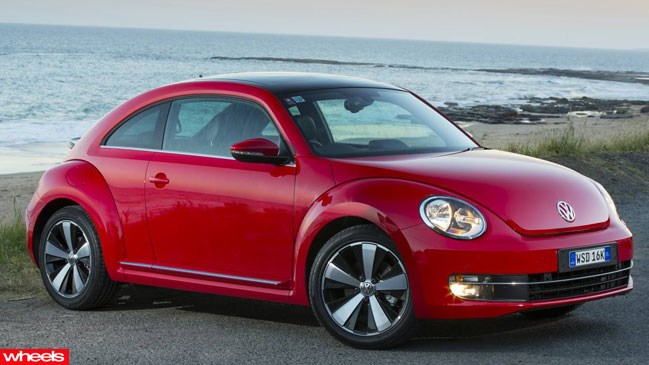
With slowing global sales, the writing had been on the Beetle’s garage wall for some time, particularly in Australia where sales of the model ceased in 2016. But its demise is equally as a result of funds reallocation following the diesel emissions scandal and a massive investment in clean electrification. Along with other low-volume nice-to-have models including the Scirocco, the Beetle had to go.
Production at the Puebla plant in Mexico has continued to supply regions with more significant volumes ahead of last orders, but its lines will now gear up for other models, while continuing with the current Golf, Jetta and Tiguan Allspace.
Over its octogenarian life, the Beetle has been built in six of Volkswagen’s factories around the world.
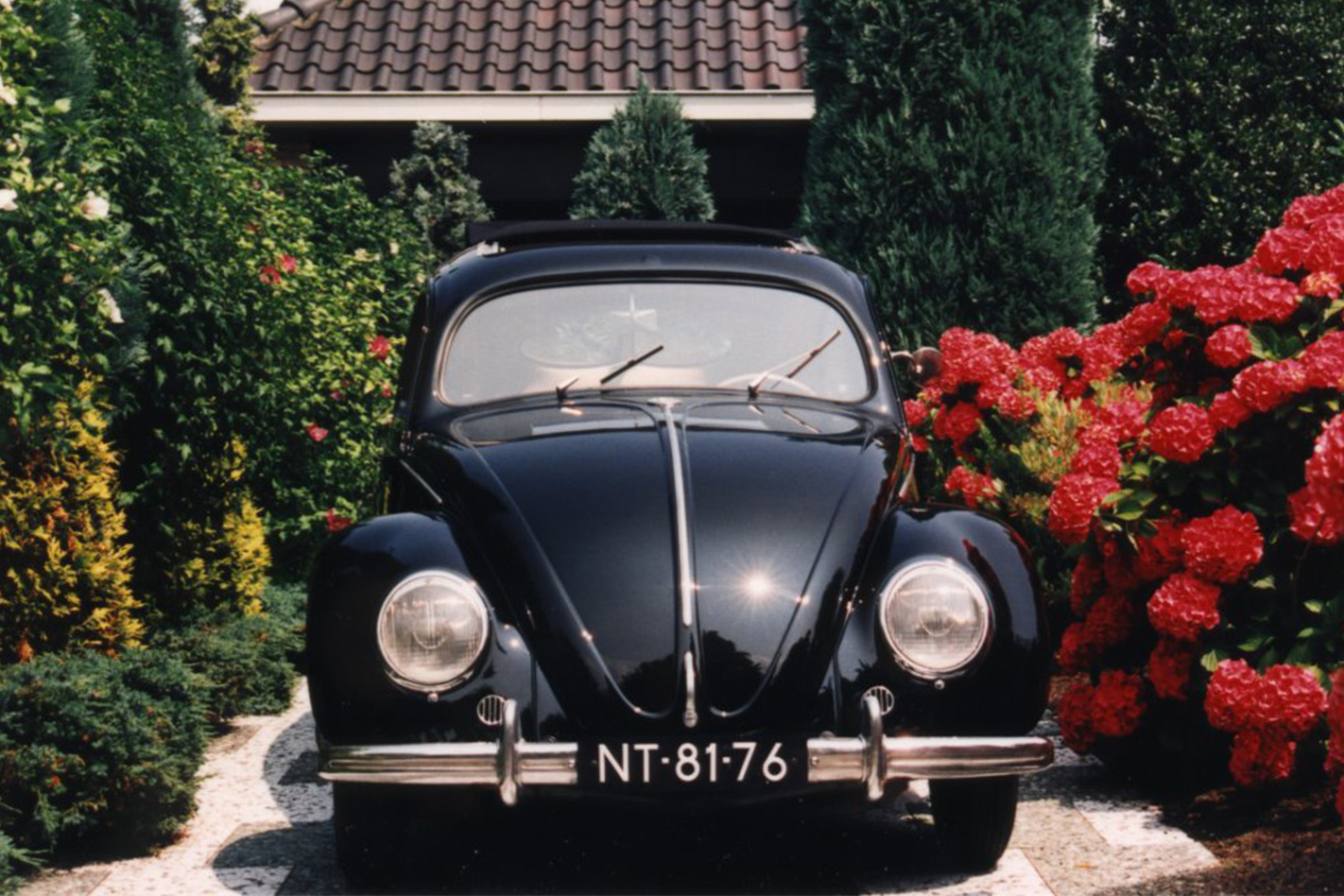
Born in 1938, the original Beetle, or Type 1 as it was officially known, was conceived by Adolf Hitler who dreamt of a car that everyone could own. Indeed, Volkswagen translates to ‘people’s car’ and his vision worked spectacularly well.
Such was the success of model thanks to an approachable price, reliable mechanics and unrivalled practicality for the time, it went on to sell more than 21.5 million units worldwide, and is symbolic of Germany’s post-war economic renaissance.
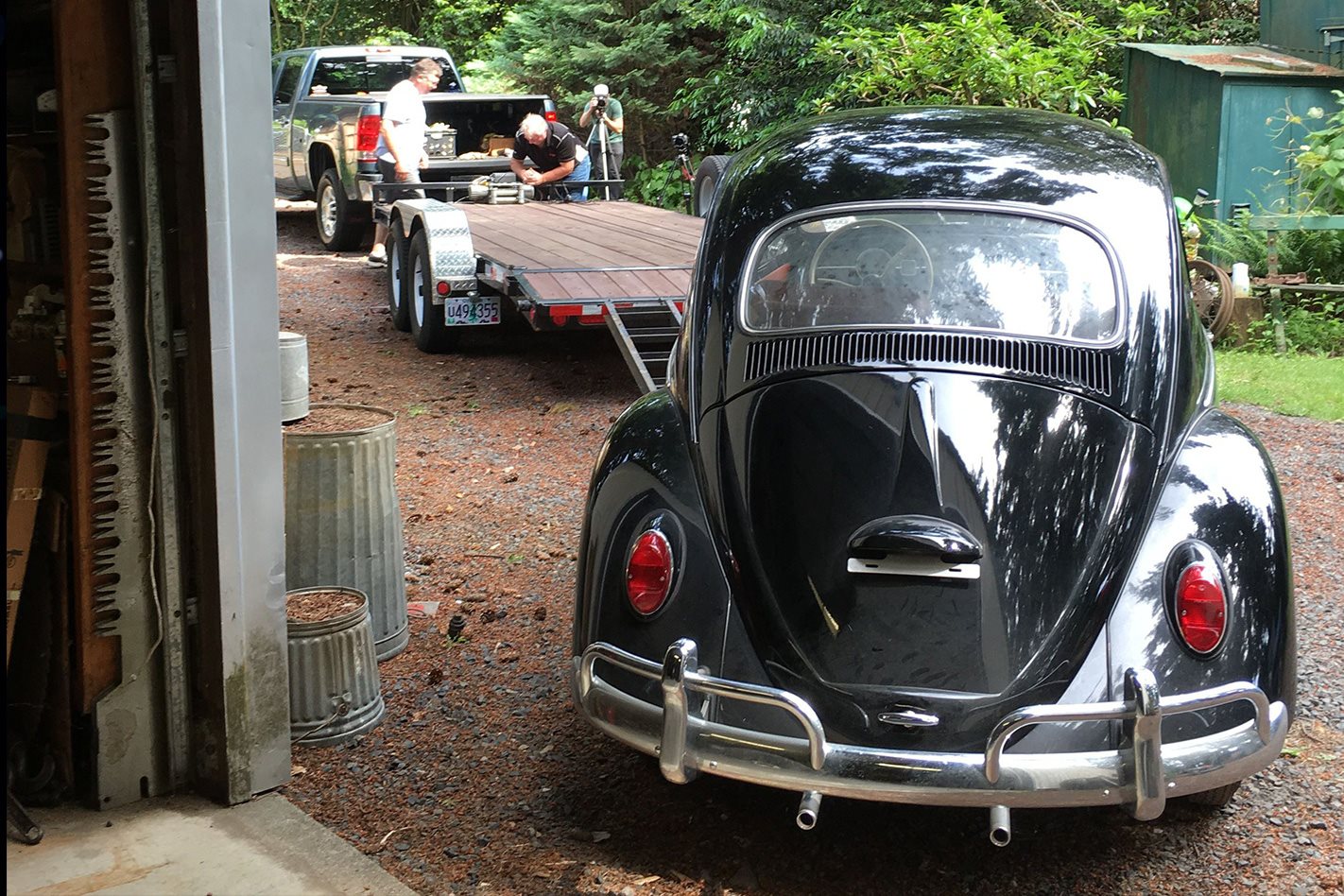
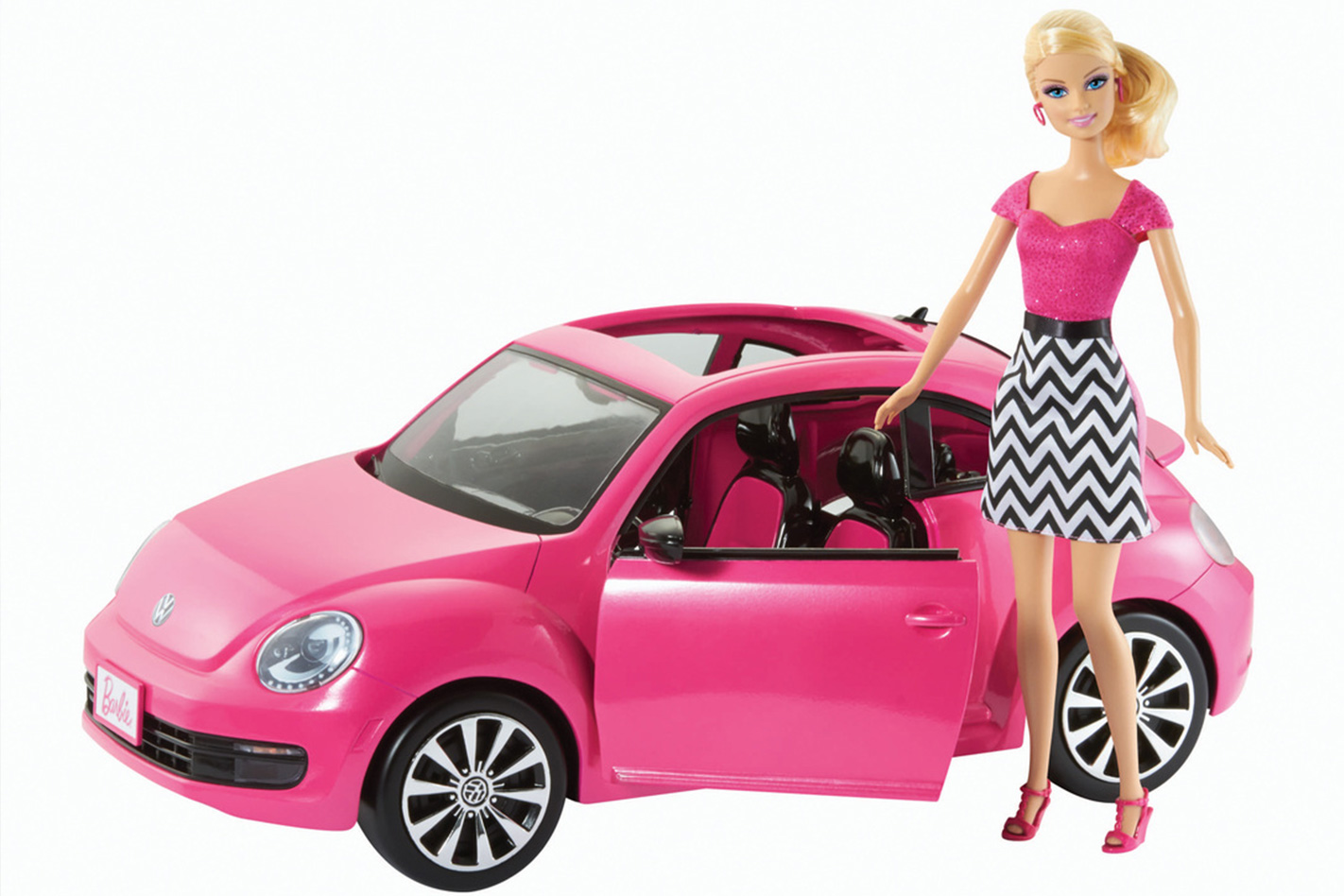
Over its life it developed a cult following winning notable favour with the hippie communities from the 1960s and the love affair continues to this day. The model was immortalised in the Walt Disney motion picture The Love Bug as Herbie, and featured in other blockbusters including Transformers and Austin Powers. Even Barbie had one.
A nitro funny car based in the UK that wears a Beetle shell claims to be the world’s fastest, cracking a maximum speed of 540km/h and geting there in just 6.0 seconds; a diesel-powered Beetle once entered the Dakar rally and one was even converted to be able to both float on water and underneath a hot-air balloon. The Beetle really has done it all.
In 1997, Volkswagen launched a retro ‘revival’ of the original – even though the traditional Beetle would still continue to be produced in some countries until 2003 – and the so-called New Beetle based on Mk4 Golf mechanicals went on to add another 1.7 million sales to the tally.
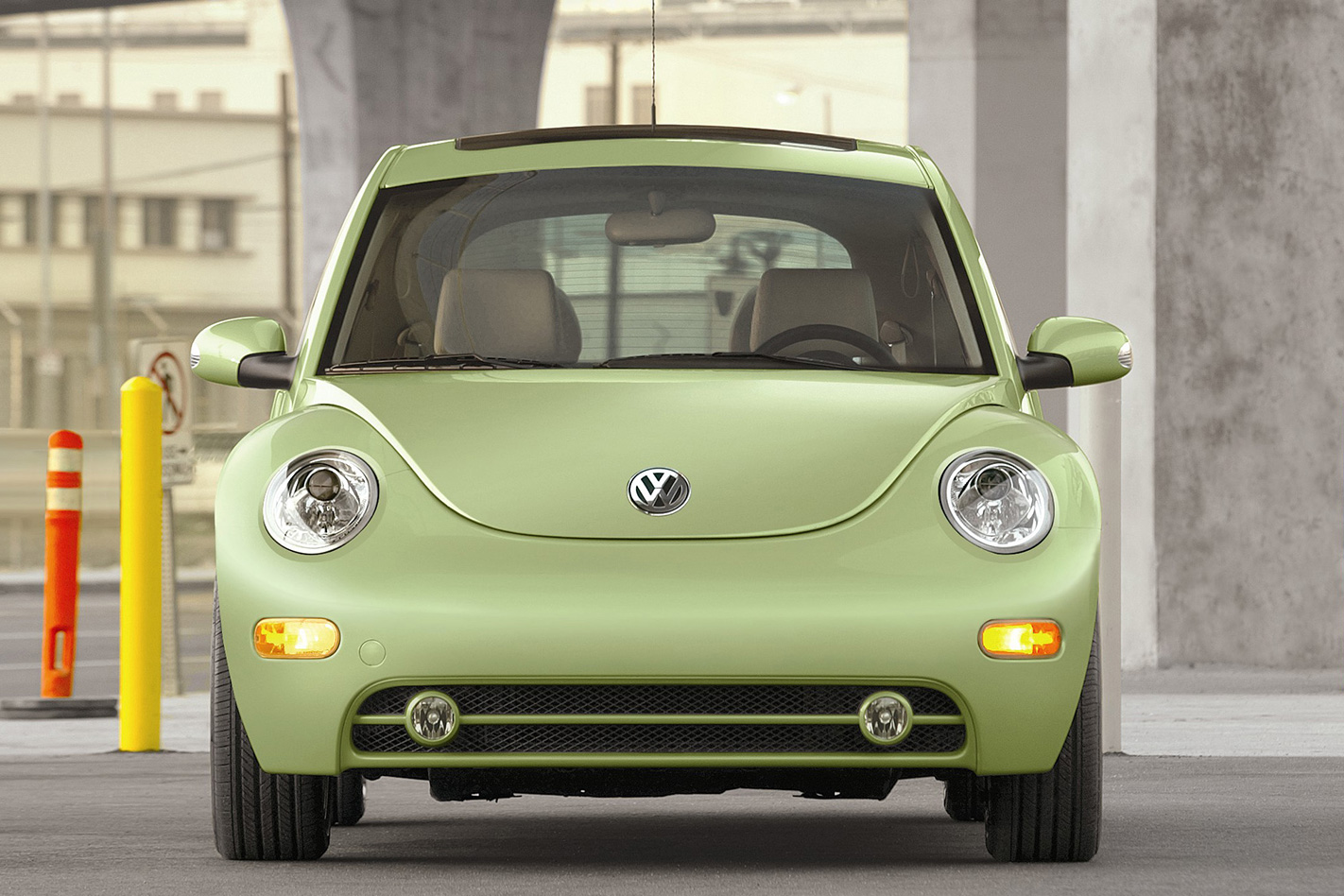
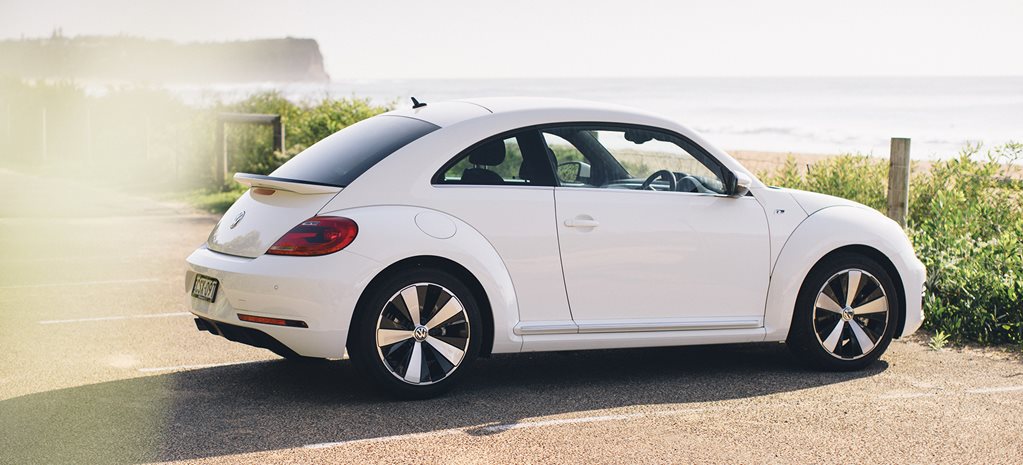
There was an update to the modern version in 2011 along with a number of special edition versions that ranged from sticker packs to more substantial versions including the sand-conquering Dune.
With the overlap in production from Type 1 to New Beetle, the model can claim the title as longest running continuous nameplate with more than 80 years under its belt, but despite its remarkable sales figures it is not the most popular car to date. That honour falls to the Toyota Corolla, which despite commencing manufacturing many years after the Beetle in the mid 1960s, has sold well over 45 million.
Sadly and ironically, the car that truly established Volkswagen as the peoples brand with mammoth sales is now being put out to pasture for dwindling interest, but it’s not the end of VWs with retro appeal.
As part of the company’s strategy to introduce electrified vehicles, a zero-emissions version of the I.D. Buzz concept is on the way, reviving the equally loved VW van and camper.
Amusingly, the Volkswagen Beetle is still used as a colloquial measurement of weight even though its mass has varied between 800kg and 1300kg over its lifespan. Whatever are we to use as a convenient illustration now?
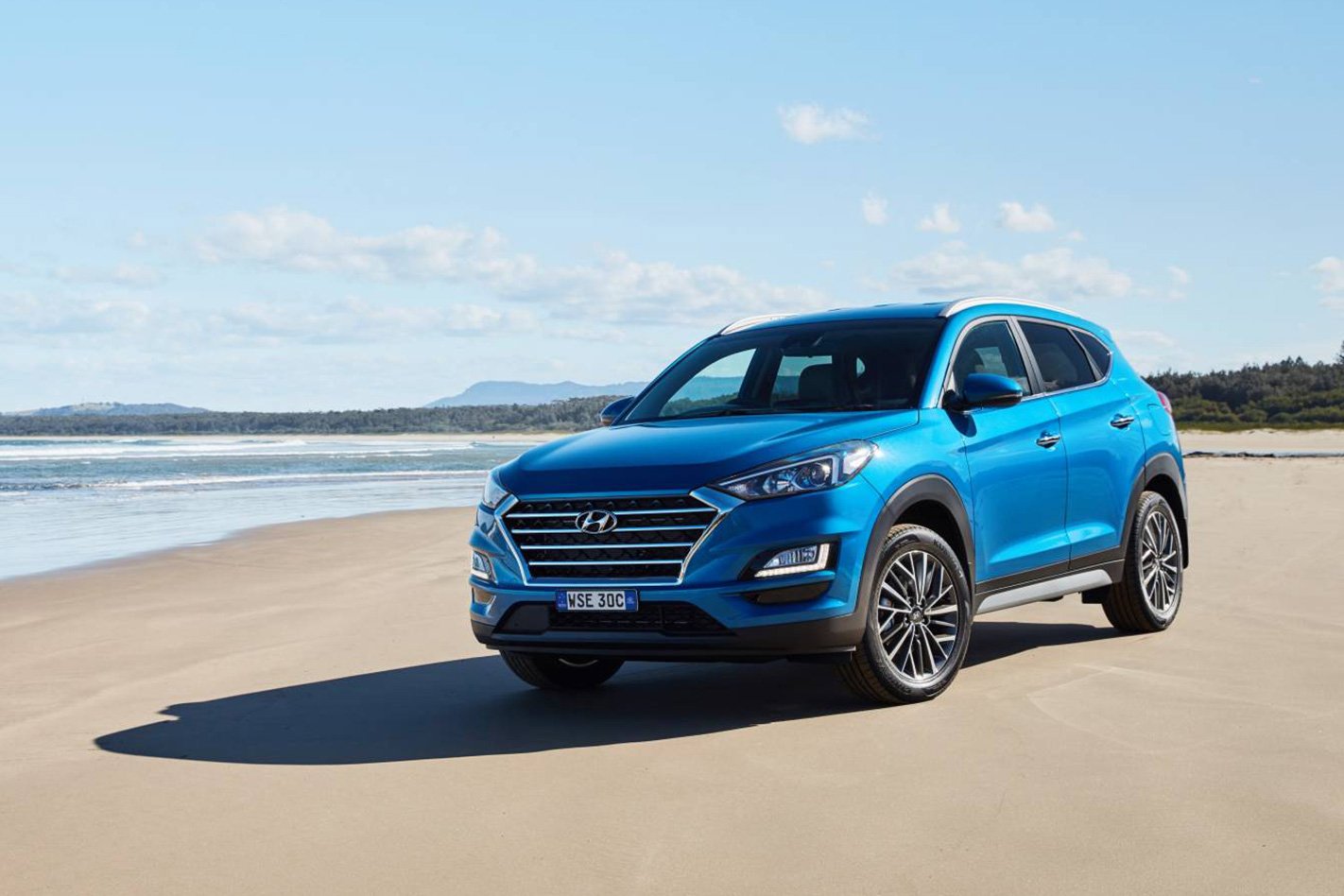
Hyundai has reshuffled its Tucson SUV range, introducing additional safety features while also sprucing up styling.
Now a four-grade model line-up, the Tucson Active (from $29,290) will replace the Tucson Go entry level car while retaining Active X (from $32,290), Elite (from $37,850) and Highlander (from $46,500) specifications.
The new entry level Active automatic introduces autonomous emergency braking, forward collision warning and a rear parking assistance system in terms of safety, but also receives 17-inch alloy wheels and a leather-trimmed steering wheel and gear shift.
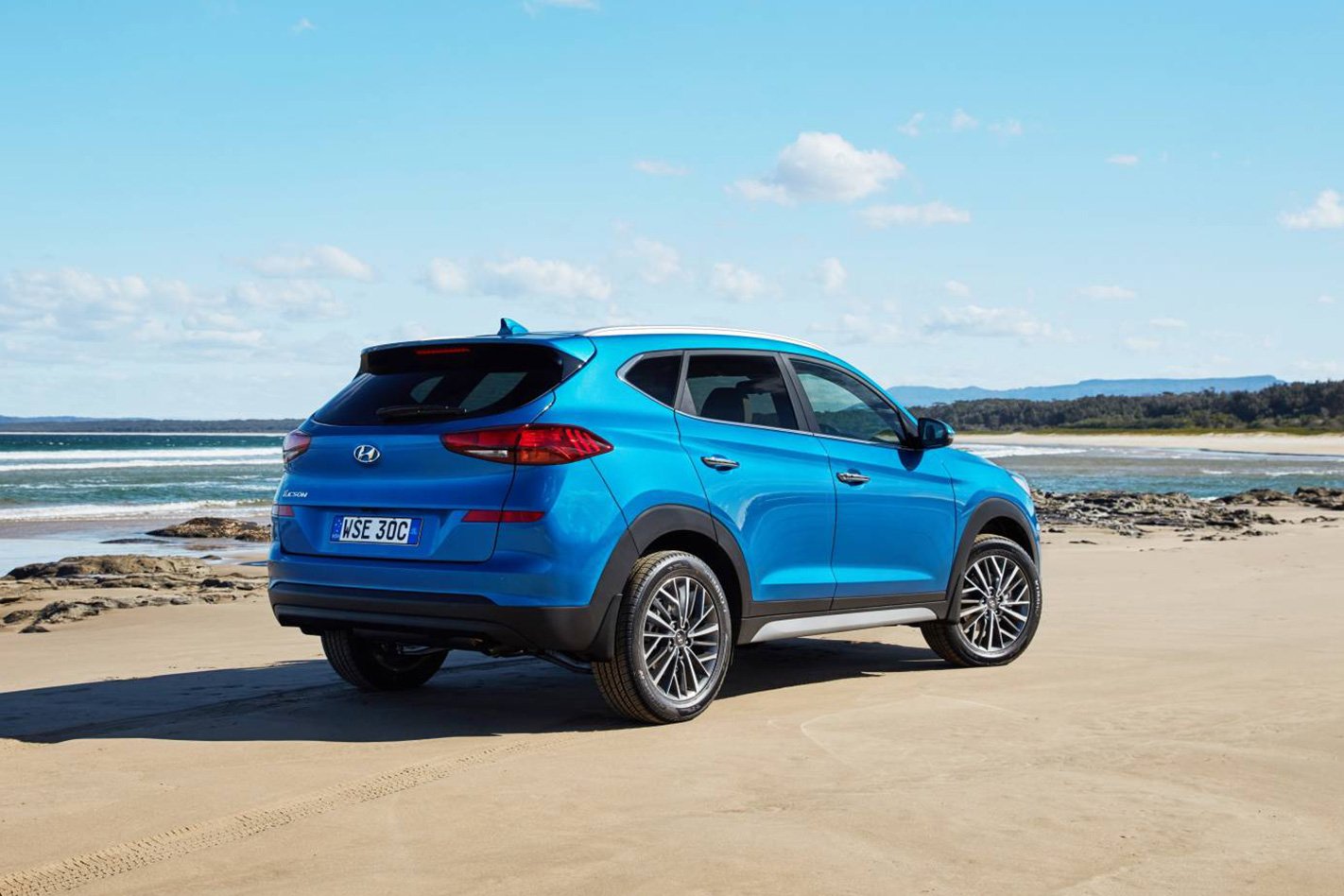
These safety systems work to alert the driver of a potential collision (forward collision warning), and will actively apply the brakes (AEB) if no driver intervention occurs. They join lane keeping assistance and driver attention warning to alert the driver to careless driving.
The Tucson Active and Active X are offered with a choice of manual or automatic transmissions with a 2.0-litre petrol (2WD) or 2.0-litre diesel engine (AWD), while moving up to the Elite there’s an additional choice of a 1.6-litre turbocharged petrol engine with dual-clutch transmission driving all wheels. The top-spec Highlander is offered with turbocharged diesel or petrol engines.
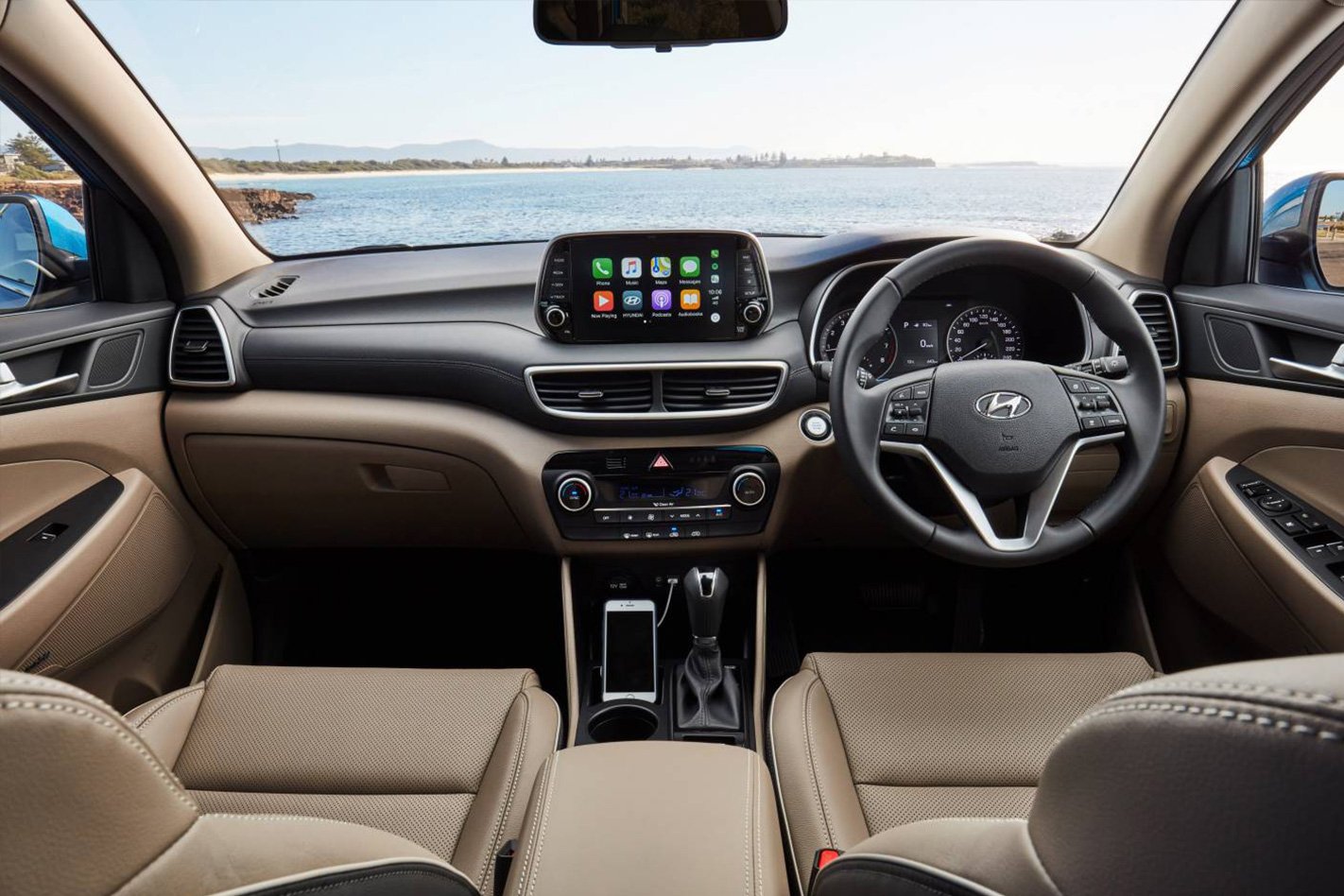
Key specification for each model grade is described below:
Tucson Active:
- Automatic Headlights
- 7-inch multimedia with Apple CarPlay and Android Auto
- Full size spare wheel
- Leather appointed steering wheel and gear shift
- Hyundai SmartSense safety equipment
- 17-inch alloy wheels
- 18-inch alloy wheels
- DAB Digital radio
- Leather appointed seats
- Power folding mirrors
- 8-inch infotainment
- 8-speaker premium audio
- Blind-sport collision warning
- Camera and radar based safety equipment
- Keyless entry and start
- Dual zone climate control
- Smart cruise control with stop & go
- Privacy glass
- 19-inch alloy wheels
- LED headlights
- Panoramic sunroof
- Power front seats incl. ventilation and heating
- Electric tailgate
- Wireless phone charging
- Heated steering wheel
- Twin exit exhaust
All models receive Hyundai’s Auto Link smartphone connect system that allows owners to stay connected to their car by allowing phone monitoring of trip data, vehicle health alerts, trip logging for record keeping and parked location on map, etc.
As well, the Tucson is covered by Hyundai’s five-year/unlimited kilometre warranty, complimentary 1500km first service and roadside assist for 12 months.
2020 Hyundai Tucson pricing (before on-road costs):
- Tucson Active manual – $29,290
- Tucson Active automatic – $31,790
- Tucson Active diesel – $37,090
- Tucson Active X manual – $32,290
- Tucson Active X automatic – $34,790
- Tucson Active X diesel – $40,090
- Tucson Elite 2.0 GDi 2WD – $37,850
- Tucson Elite 1.6 T-GDi AWD – $40,850
- Tucson Elite diesel – $43,150
- Tucson Highlander 1.6 T-GDi AWD – $46,500
- Tucson Highlander diesel – $48,800
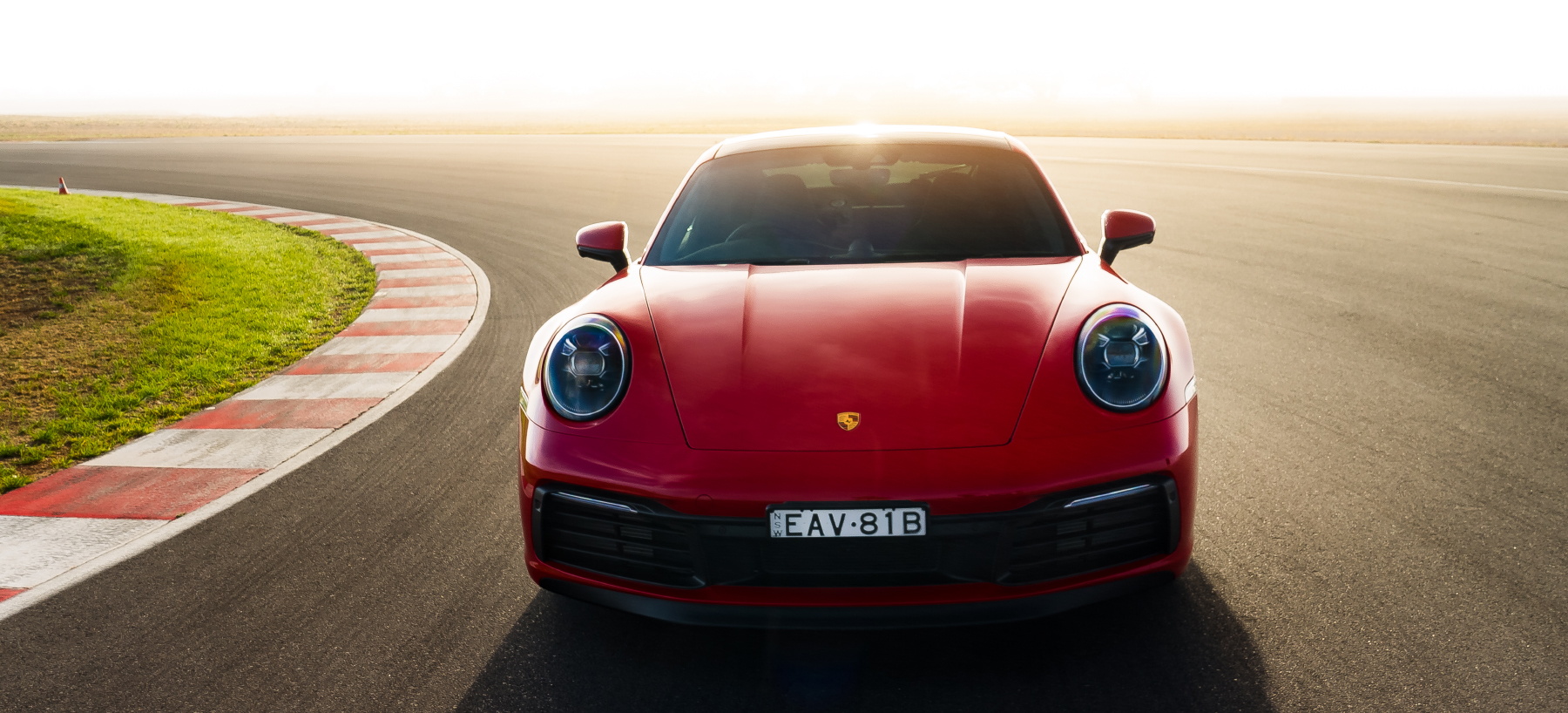
HERE’S some news sure to please sports car enthusiasts the world over: Porsche has no plans to build an all-electric 911.
That might sound a little obvious, given how sacrosanct the 911’s iconic recipe is, but nothing is a ‘sure thing’ in this modern, electrified age.
Audi, for example, has confirmed the next TT and R8 will both be fully electric. And Jaguar is rumoured to be going full EV with the next F-Type.
Plus, Porsche is something of an EV trailblazer in the performance car world. The company’s first EV, the Taycan, will be officially unveiled in a few months, and Porsche has already confirmed that it will hybridise the 911. In fact, the 992 is already ‘hybrid ready’.
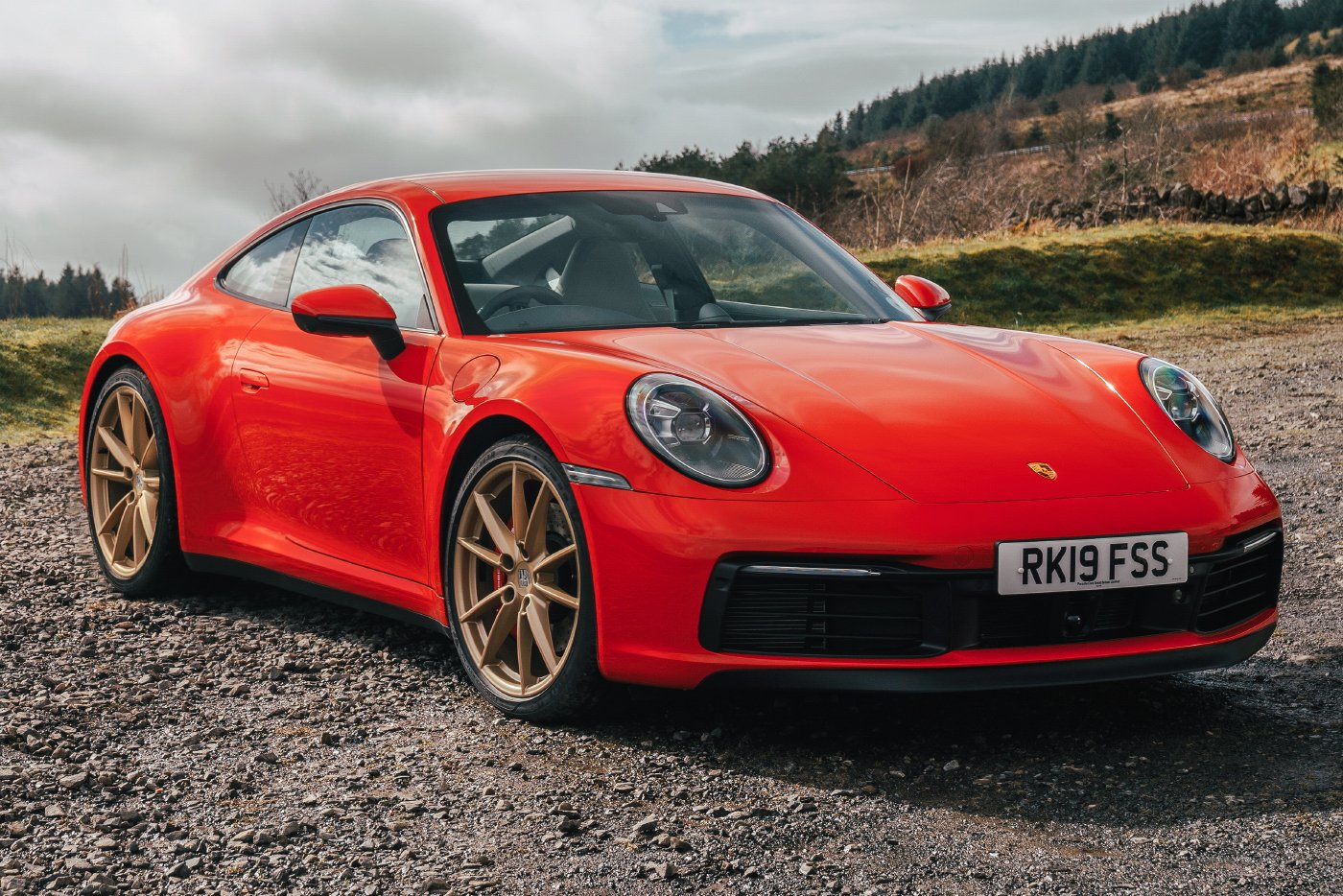
But speak to the man in charge of the 911 model line, Frank-Steffen Walliser, and you begin to understand just how far away a fully electric 911 actually is.
“I would say bringing good hybrid technology to a 911 is not a problem as long as the car gets better,” he told Wheels. “I don’t need a hybrid because it’s a hybrid, it must be better, it must fit for the character, the weight, the throttle response of a 911. Then I’m fine.
“I don’t see a fully electric 911. Really not. Or way in the future. But not short term. Not at all. There’s still a huge market and a huge demand of people that are looking for combustion engine cars and you cannot do everything with an electric car.
“For sure the world will be more different, we will see different propulsion technology, but maybe I’m joking, maybe I’m right when I say the 911 will be the last car that will be electrified. If I’m wrong or not, the future will tell.”
Frank has form when it comes to electrifying things. After a stint heading up Porsche’s motorsport division, he worked full time in the company’s electronics department before taking the lead on the 918 project. There, he helped set the blueprint most modern hybrid supercars are now following.
The more you speak to Frank, the harder it is the shake the feeling that the future of the 911 is in safe hands. He isn’t afraid of change though he’s equally aware of what makes a 911, a 911.
“It’s a period of transition for the industry,” Walliser added. “It’s very tricky to make the right decisions, about which technology and when, and so on. We are very, very careful what we change on a 911. Believe me this is the car we discuss most if we change something. But we have 55 years of experience of what to change.
“Of all the history of the car we’ve changed many, many things. Normally we got some bold feedback from the hardcore fans when we introduced power steering, water cooling and ABS, that they all destroyed the 911. It did not. The result was normally that we sell more cars. And this is what we are still looking for. We are aware of the subject but we are not afraid of changing things as long as the car keeps its character and stays the nimble sportscar that it still is.”
The last time Mercedes-Benz launched a new SL, Bob Hawke was calling the shots in Canberra and the Berlin Wall stood as a divider between east and west Germany. And the year? It was 1989.
This review was originally published in MOTOR’s December 2001 issue
The world has come a long way since, and with one quick glance at the new 2001 Mercedes-Benz SL and you’ll see that Mercedes-Benz has, too. The two seater, with its sleek new look, fairly oozes desirability.
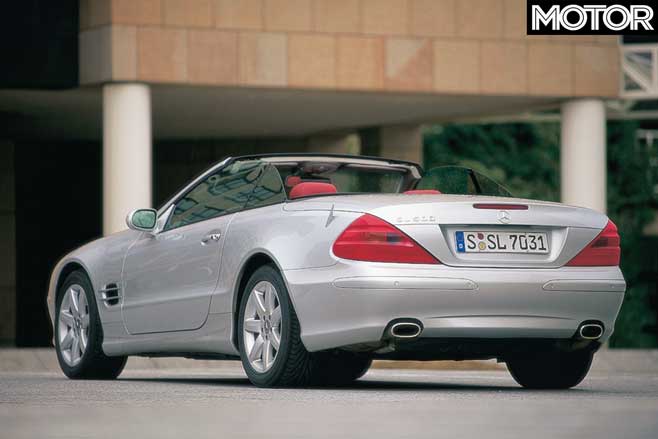
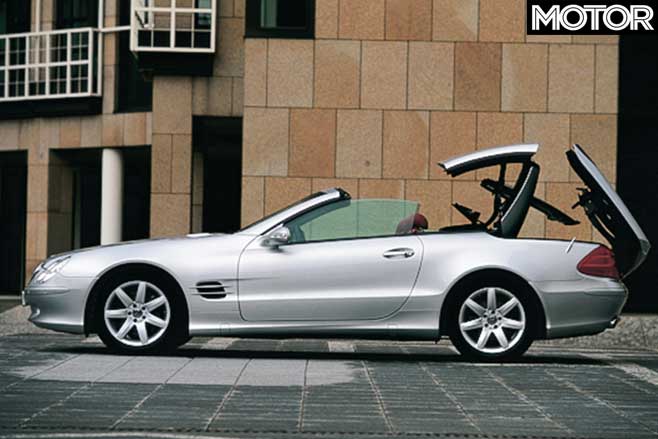
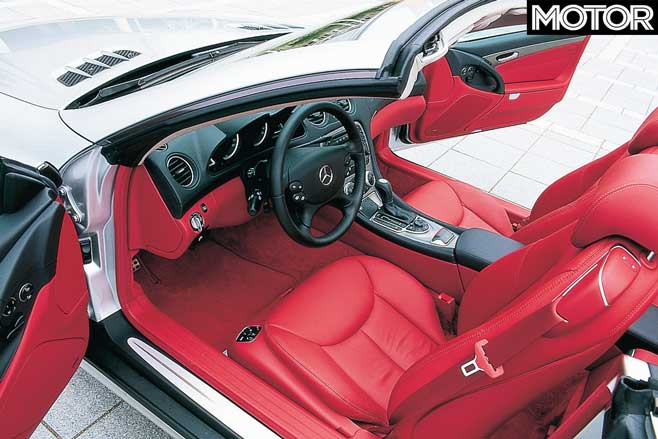
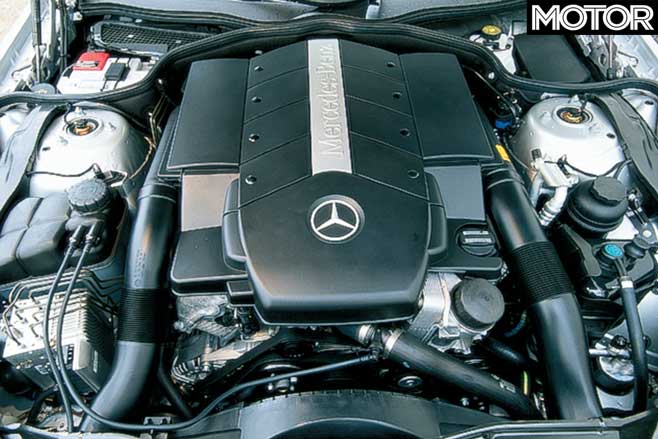
With 225kW at 5600rpm and a hefty 460Nm of pull between 2700 pm and 4200rpm, the 5.0-litre V8 is brilliant with sharp throttle response and creamy smooth power delivery across a wide rev range. Bury your right boot and the 1845kg SL bolts its way from zero to 60km/h in 6.3 seconds. More impressive still is the engine’s mid-range urge. Acceleration is relentless as the big roadster rushes to its 250km/h top speed.The five-speed auto downloads crisp, seamless changes. There’s a sequential mode, but the transmission is so intuitive that you’re better off leaving it in the set and forget auto mode.On the open road, the new SL is a good deal more responsive and agile than before. The suspension is new, with a four link set-up replacing the previous SL’s struts at the front and a refined version of Benz’s excellent five-link design at the rear. Tyres are 255/45 Z17 shod on new 8.5 inch alloys.
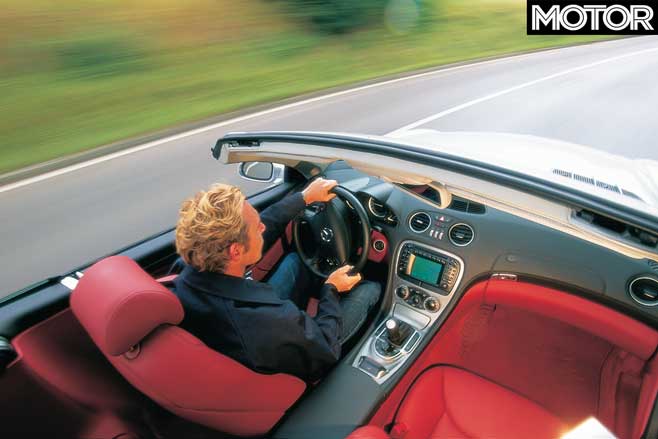
Handling is superb highly involving and failsafe, and the big roadster’s ride composure over badly rutted bitumen is exemplary. The rack-and-pinion steering, with 2.6 turns lock-to-lock, provides crisp turn-in and telegraphs information well.With the use of high strength steel and substantial stiffening in the floorplan, torsional rigidity is up by 20 per cent. Scuttle shake, so often the bane of open top cars, is kept to an absolute minimum. A wind deflector mounted behind the seats ensures occupants are kept well protected from any buffeting, even at high speeds.
Acting on large ventilated discs all-round, they provide plenty of initial bite, strong modulation and astonishing power once you really get on them. Significantly, the typical pulsating effect you get when the ABS is activated is a thing of the past with Sensotronic. You can now carry big speeds into corners, stand on the brakes and let the SL’s electronics do the rest.The SL comes packed with safety features: front airbags, head-thorax airbags, seat belt tensioners and belt force limiters. A roll over bar deploys when a sensor recognises an impending inversion. Bi-Xenon headlights are also standard.
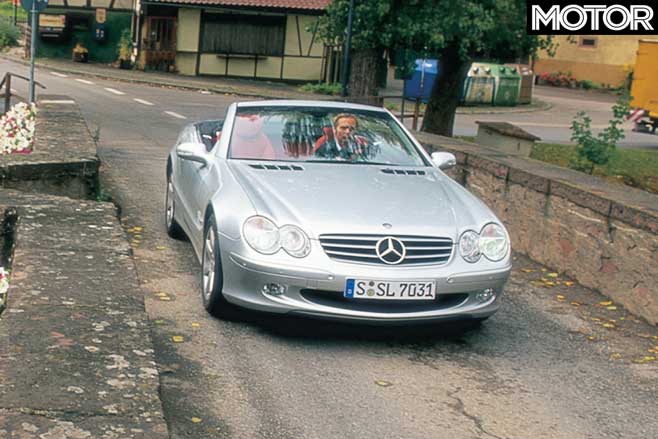
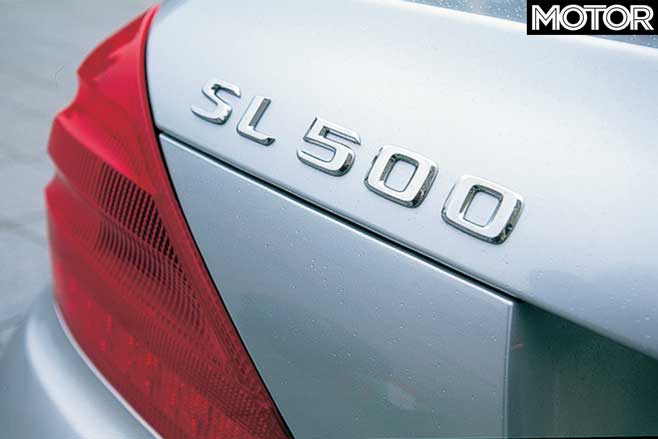
2001 MERCEDES-BENZ SL500 SPECS Engine: 5.0-litre V8 DOHC 24v Power: 225kW @ 5600rpm Torque: 460Nm @ 2700-4200rpm Price: $280,000 (est)
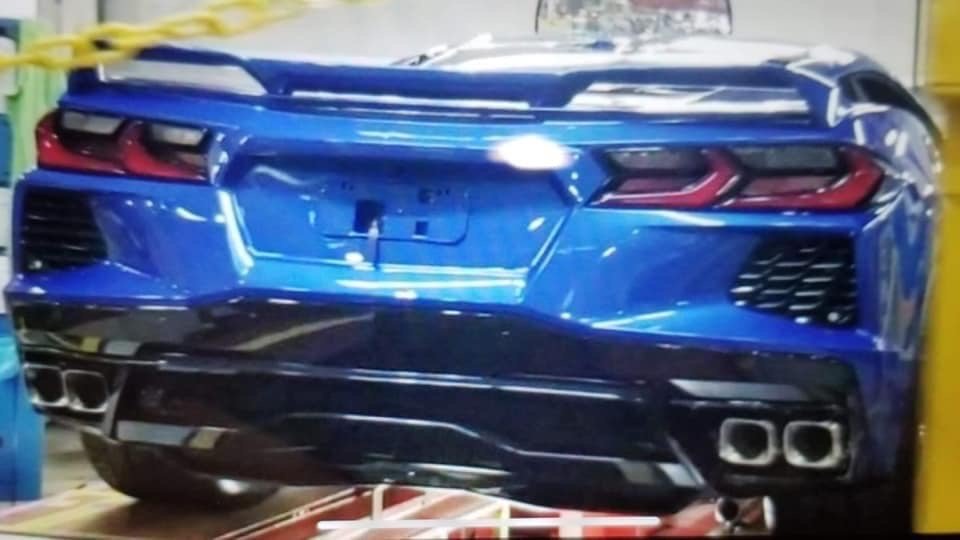
Is this a sneak peek at the new Chevrolet C8 Corvette? Likely. Do we love it? Let’s give it ten days.
An anonymous source has posted a picture on Instagram showing the supposed rear end of the next-gen Corvette, and it appears to closely resemble what we’ve seen (under the camo) in spy photos. But like the unfetching face of Predator, it may have a bum that only a mother could love.
https://www.instagram.com/p/BzovGZjHhpW/
The essence of the twin outer taillight cluster from Corvettes of old carries on, but now with a very angular pinch. Same goes for the lip on the coupe’s boot and… well, everything. There’s some previous-gen C7 design elsewhere too, and after recently having the Camaro ZL1 in the office for the week we can certainly see some similarities with its angry sibling.
The official debut of the new model will be on July 18, so this unofficial ‘teaser’ is ten days early, and might not be completely indicative of what we really see, though its official outing in New York three months ago is an indication it can’t be far off.
Chevrolet is yet to detail its new coupe but it is expected to land in a series of offerings, including a hybrid to rival supercars. Rumour is that the C8 Corvette might also be on the cards for Australia.
The petrol and diesel engines of today will become relics of the past by the middle of this century, according to the CEO of German tyre and technology giant Continental.
Speaking at the company’s biennial TechShow near its Hanover headquarters, Continental chairman Dr. Elmar Degenhart said the coming decades would see significant upheaval in the automotive industry, as the adoption of electrified powertrains rapidly gained pace, driven largely by regulation.
“We predict that combustion technology will phase out around 2045,” Dr. Degenhart said.
“Regulations will be so tough that combustion technology will no longer be affordable around 2040. That means around 2030 the last generation of combustion engines will go into production, and that means the technology that will hit the market at the beginning of 2030 will start to be developed around 2025.”
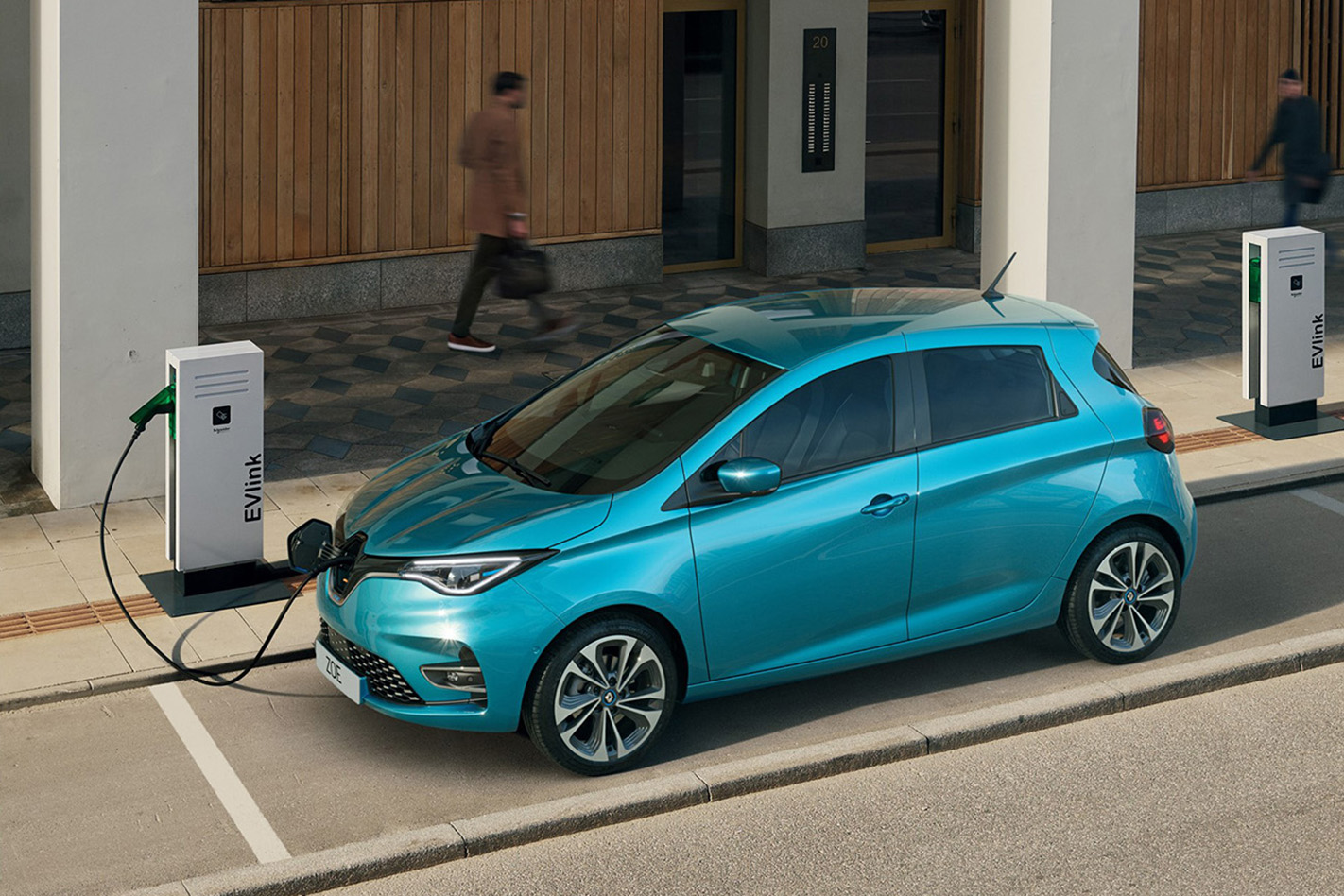
“That triggers the question: what will come after 2040? Ideally around 2050, mobility will be carbon-free – cars, trucks, buses,” he continued.
“Will the future be pure-electric? Yes, but not purely battery-electric. We believe battery-electric will be ideal for small vehicles which will be used in cities with a range of 250-300km would be enough. For long-range vehicles and premium-type vehicles, which are heavier, we believe [hydrogen] fuel-cell will be the technology.”
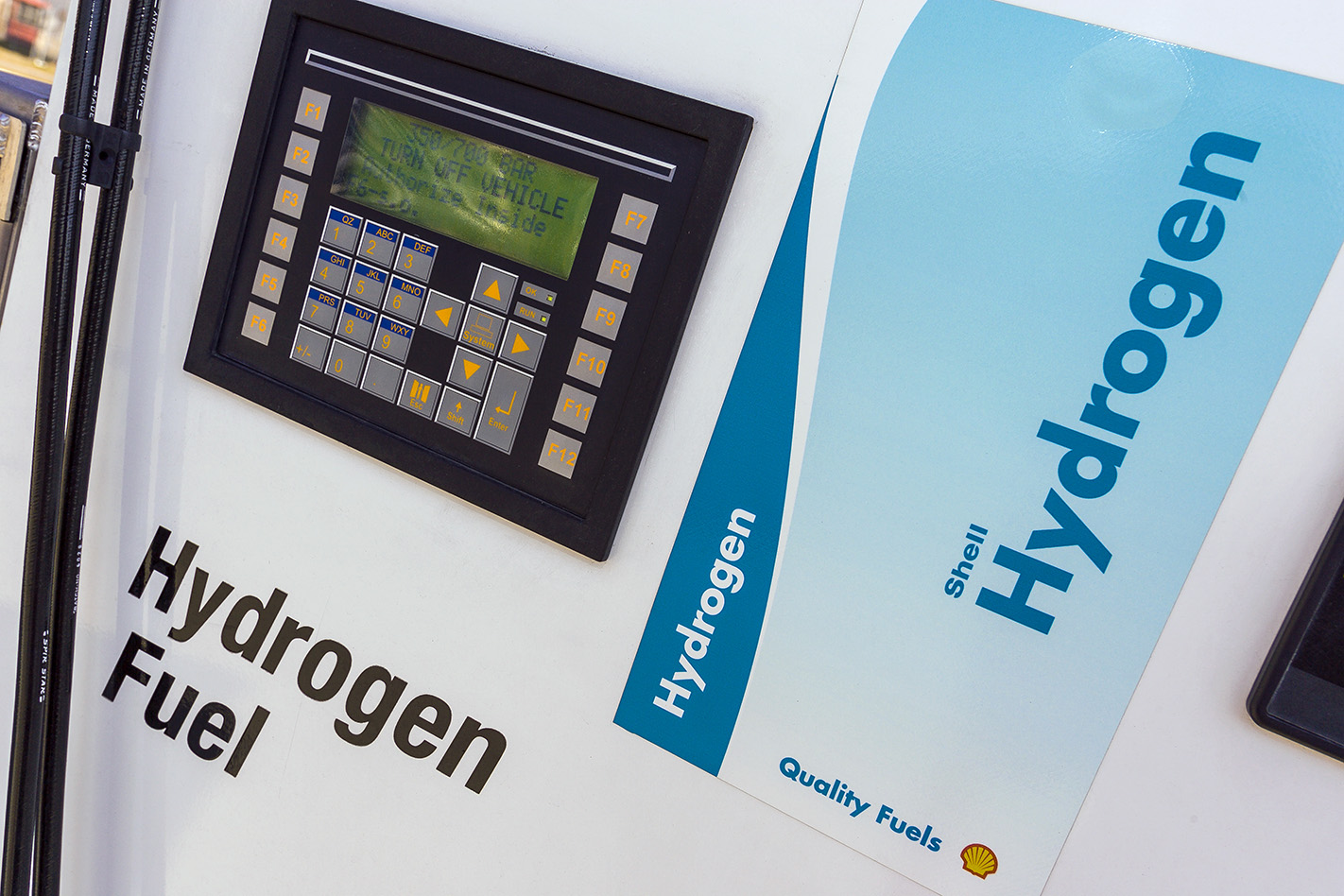
“China, Japan and Korea and now also German manufacturers are starting to re-invest into fuel cell technology intensively again. Continental is looking into this technology and we have a lot of products which we can contribute, but we believe we have to do – and can do – a lot more in the future.”
Dr Degenhart’s vision of a combustion-free future doesn’t entirely align with forecasts by the International Energy Agency, however, which only sees a similar EV and hydrogen-heavy vehicle mix in a scenario where governments and regulators universally make a concerted effort to limit emissions (the graph on the left, shown below).
Even then, the IEA still estimates that nearly a quarter of total car sales around the year 2050 will be for combustion-engined cars, whether they be purely petrol, diesel, or hybrid.
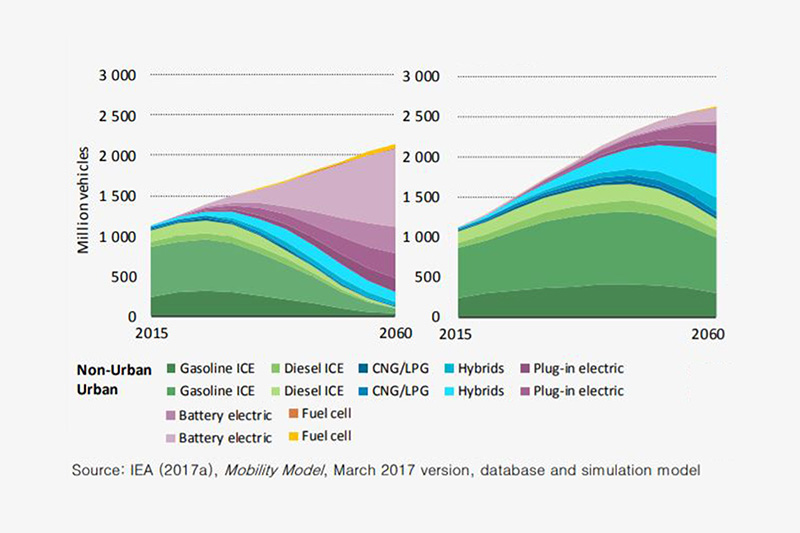
Under the least-optimistic forecast, where policy continues on its present trajectory (right graph, above), the IEA envisages the majority of cars and SUVs sold in the year 2050 will still be traditional petrol and diesel vehicles, with hybrids still eclipsing pure electric cars by a sizable margin. In either scenario, fuel cell vehicles are expected to be a bit player.
But that’s not to say that Continental is being unrealistic. The future has still yet to play out, and the company is aware that transitioning to a greener future will still incur an environmental cost through the need to build new cars and acquire the resources for their batteries -not to mention that its vision of zero transport-related carbon emissions also hinges on similar shifts in power generation infrastructure being made at the same time.
“You can’t bring CO2 emissions to zero, because you need to produce vehicles, and you will produce CO2 [in that process]. So the next step is starting today: the responsibility of manufacturers to get production to be CO2-neutral. Industry is working on such a scenario already.”
Oliver Solberg: shootout in Citroen DS3 WRX
The son of rally stalwart Petter Solberg, and now accomplished driver in his own right, Oliver Solberg seems to know his weapon of choice, a DS3 rallycross car, well enough to put on a display while also besting the previous best run time.
The Goodwood YouTube channel, perhaps with some hyperbole, describes it as “the most insane hillclimb we’ve ever seen at Goodwood Festival of Speed.”
James Deane’s BMW E92 M3 drifting up the Goodwood hill
Speaking of spectacle…
Reigning Formula D champion James Dean (though it looks like 2019 might not be his year) began his run up the hill by almost immediately turning his rear tyres into clouds.
He also throws (some) caution to the wind by sticking the tail out at two rather brutal sections of the track – Molecomb corner, and ‘the wall’.
Daniel Ricciardo’s Renault F1 Goodwood run
With perhaps some frustration at the way his car has been performing on track, ‘our Dan’ gives the his work whip a bit of a hard time up the Duke’s driveway. But it’s not the only car he gave a thrashing.
…and his handbrake hillclimb in a Renault Megane RS Trophy-R
Renault’s new Nürburgring record-holding hot hatch (for FWD cars) is, well, a front-wheel drive car. That didn’t stop Ricciardo from getting the rear to move as much as possible during a relatively wet run up the track with some liberal handbrake application.
Terry Grant’s two-wheeled Jaguar F-Type hillclimb
It’s not fast, but it’s damned impressive.
This year stunt driver Grant swaps Range Rover for Jag and again tips a car all the way up the hillclimb.
Best YouTube comment award goes to user Silveral_ who wrote: “Excellent recovery drive after catching that ramp on the start line, what a numpty whoever put that there.”
Kamaz Dakar Truck drift demonstration
If there’s one thing Red Bull does well, it’s anything extreme or ridiculous. This Russian drift truck is certainly the latter.
Lando Norris drives the McLaren M8D Can-Am in the wet
Lando Norris is a brave man. Not only is the McLaren M8D the car involved in the crash that killed its namesake, Bruce McLaren, but Norris is also driving the car within shouting distance of where that crash happened – the old Goodwood Circuit.
Instead, Norris induces wheelspin in the wet and gives the old Can-Am car a proper run up the hill.
Rolls-Royce Cullinan thrashed hard
There’s using the whole track to corner, then there’s… this.
Can you say ‘waft’?
Schumacher’s V10 F1 Ferrari F2004
If the sound of today’s F1 cars belting up the hill isn’t to your taste, try this quick clip of a legend’s 15-year-old V10 racer having a crack in the hands of Argentinian rally driver Luis Perez-Companc
Michael Schumacher’s 2004 ‘company car’ was the last to deliver him to a championship title.
Porsche 909 Bergspyder at Goodwood
Porsche’s lightest-ever racer looks and sounds classic and was even the inspiration for a modern recreation in the form of the Boxster Bergspyder.
The 909 Bergspyder weighs about 275kg, has a 205kW F1-based flat-eight engine, and was claimed to be able to hit 100km/h in 2.4 seconds.
