
Jaguar has thrilled attendees at the 2025 Goodwood Festival of Speed with the global unveiling of its bold new concept car, the Type 00 – a striking all-electric grand tourer that represents the luxury marque’s next chapter.
Positioned as the forerunner of Jaguar’s new electric model line, the Type 00 breaks sharply from past designs. It introduces what the brand calls ‘Exuberant Modernism’ – a design philosophy rooted in geometric purity, dramatic proportions and unapologetic flair.
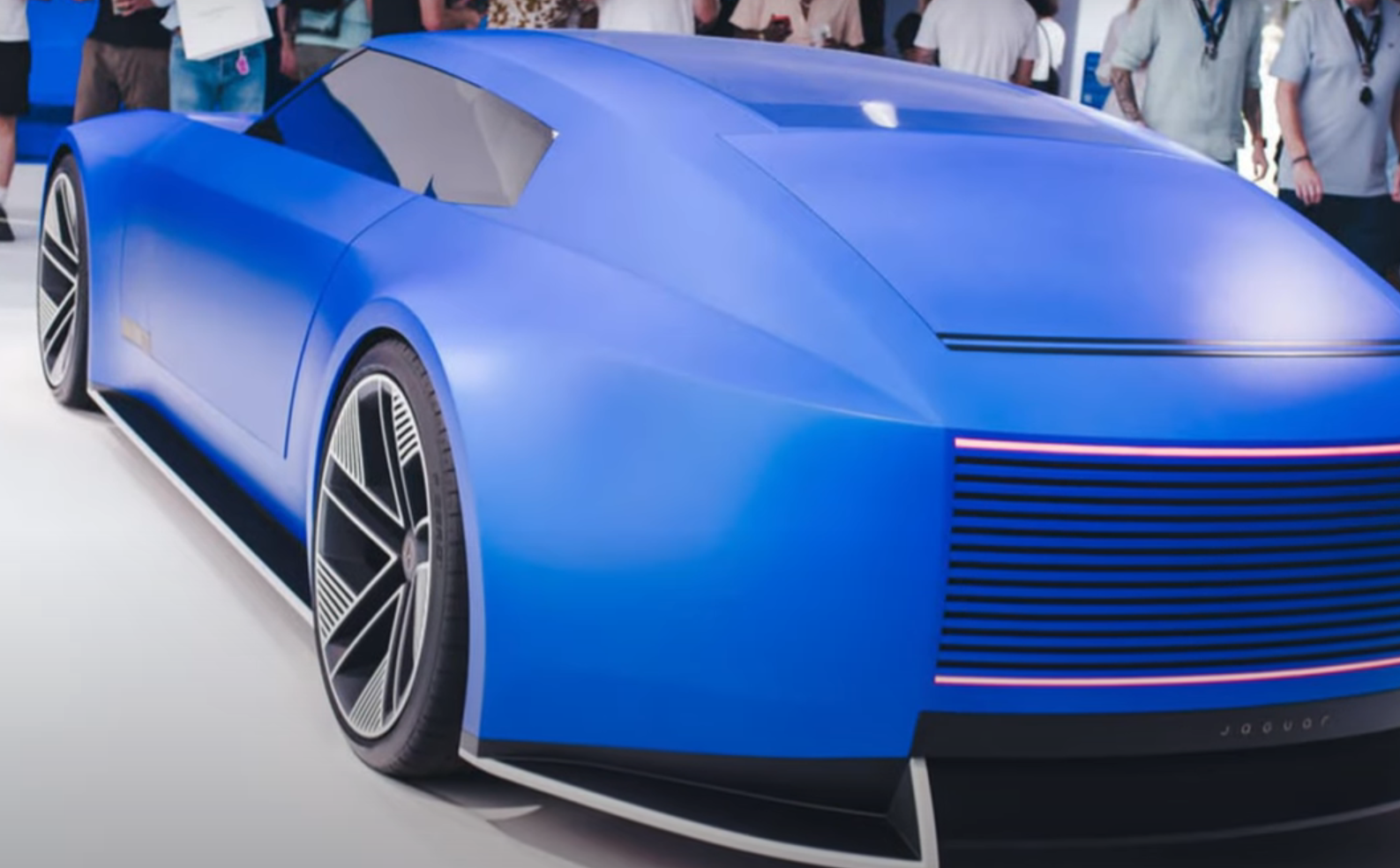
Gone are traditional Jaguar cues like rear windscreens and chrome grilles. Instead, the Type 00 wears a sweeping fastback silhouette, exaggerated rear overhang, and an uninterrupted brass-finished tail that conceals integrated rear-view cameras.
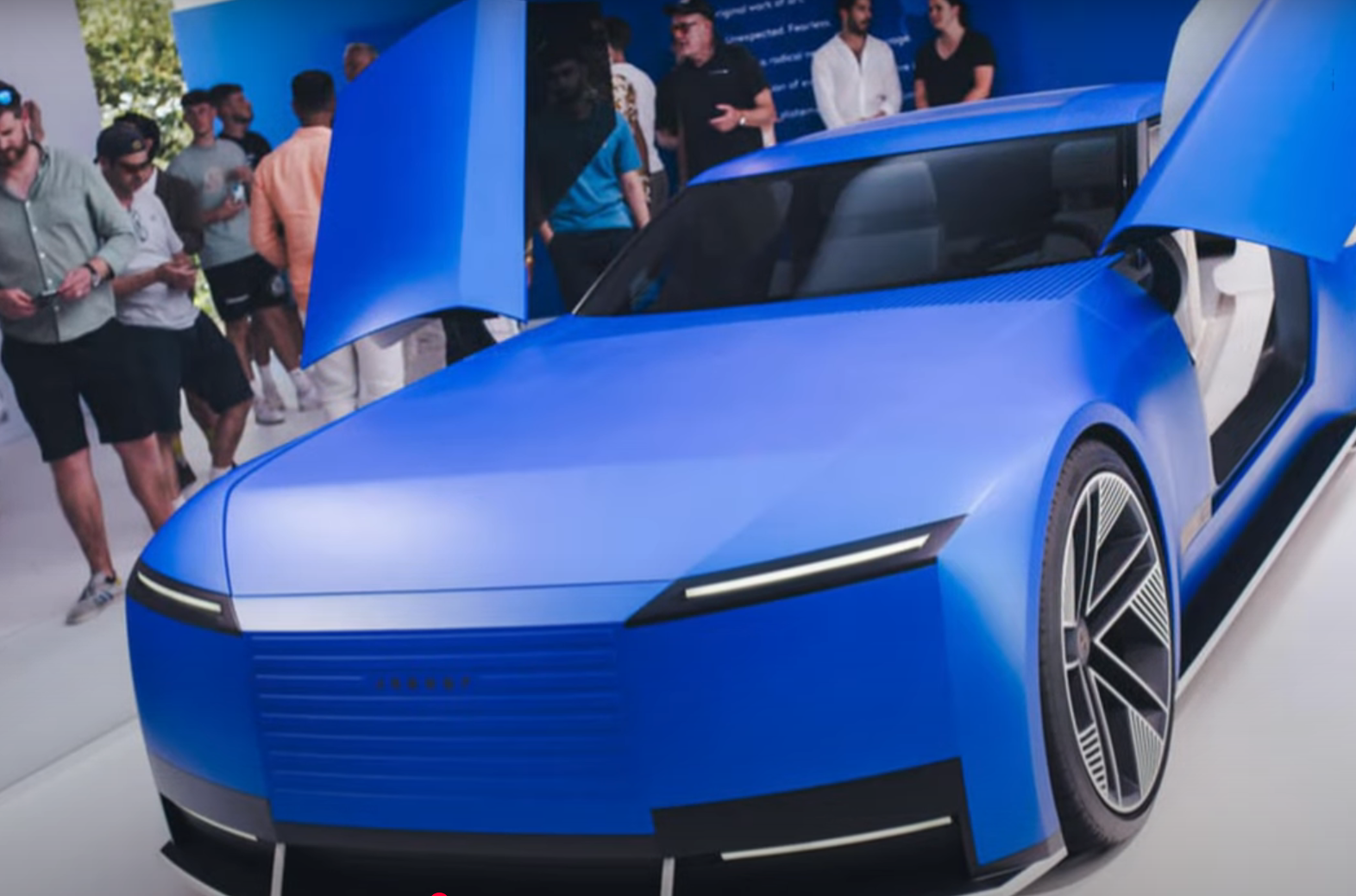
Built on the company’s forthcoming Jaguar Electric Architecture (JEA) platform, the four-door EV is a production-intent concept, previewing the flagship GT model expected in late 2025. This will be followed by two other ultra-luxury EVs as Jaguar shifts to a fully electric line-up by mid-decade.
Festivalgoers were treated to the concept’s striking 23-inch wheels, full-width “Strikethrough” lighting and a cabin design hidden from view – designed to enhance mystique. The model appeared in vibrant Miami Pink and rich London Blue paintwork, both celebrating Jaguar’s British heritage while embracing future-facing vibrancy.
“Type 00 is a statement of intent,” Jaguar CEO Thierry Bolloré told media. “It’s about making bold decisions that reshape the idea of modern luxury and what a British electric performance car can look like.”
Public reception was mixed but impassioned. Many praised the concept’s audacity and originality, while others lamented its departure from Jaguar’s traditionally elegant styling. Yet few could deny the Type 00’s impact – it dominated conversation and social media buzz throughout the Goodwood weekend.
As Jaguar prepares to re-enter the high-end electric space in earnest, the Type 00 signals more than a new model – it marks a transformation of brand identity. With exclusivity, visual drama and electric performance at its core, Jaguar is clearly steering toward a very different road ahead.
| Overall rating |
|---|
Things we like
- Sublime chassis and adjustable all-wheel drive system
- Incredible performance from just three cylinders
- New automatic gearbox adds even more appeal
Not so much
- Expensive to buy and service
- Smaller GR Yaris ultimately more thrilling
- No covered interior storage
Performance car fans have been dealt a difficult hand in 2025.
Thanks to global emissions regulations, the affordable performance car is a former shadow of its once-great self. Performance car options under $100,000 are becoming rarer, with many brands simply not playing in the space any longer.
Thankfully there are still some options available such as the Honda Civic Type R, Hyundai i20 N and i30 Ns, Volkswagen Golf GTI and R and Subaru WRX. Plus, two options from a brand more renowned for middle-of-the-road, mass appeal cars: Toyota.
The GR Yaris went on sale in 2020 and was joined by its larger GR Corolla sibling in 2022. Both have just had big upgrades, including a new automatic transmission option, so how does the GR Corolla automatic measure up in the world of performance cars?
Price and equipment
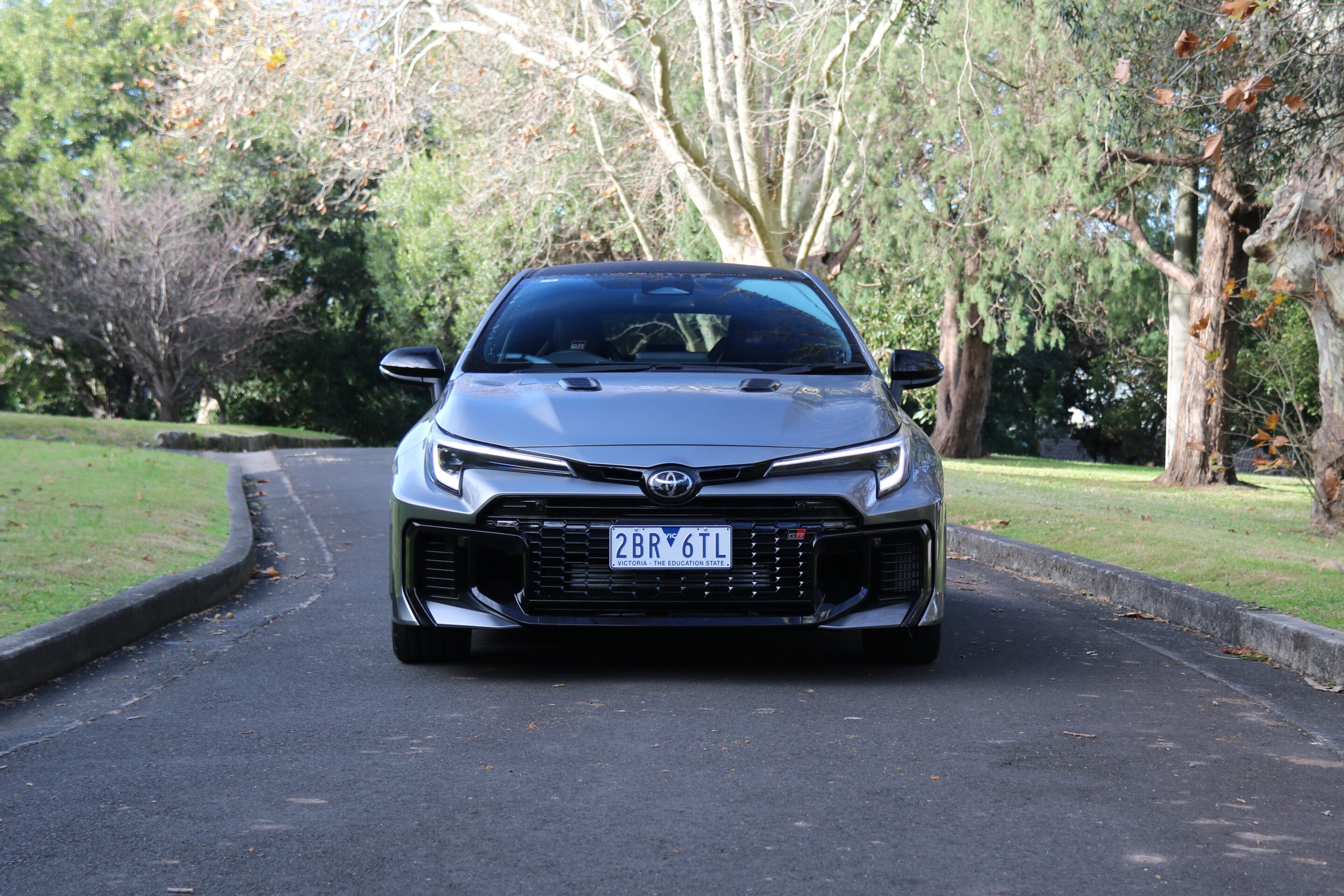
The Toyota GR Corolla is offered in one spec in Australia: the GTS, which is priced from $67,990 plus on-road costs for the manual and $70,490 +ORC for the automatic. That makes it $7,500 more expensive than the smaller and less practical GR Yaris and priced similarly to other hot hatches such as the $70,990 +ORC Golf R.
GR Corolla standard features
- 18-inch Enkei alloy wheels with Yokohama Advan Apex tyres
- Dusk-sensing automatic LED exterior lighting
- Intermittent manual wipers
- Rear privacy glass
- Carbon fibre roof
- Keyless entry with push button start
- Heated and auto-folding mirrors
- Synthetic leather steering wheel, gearknob and handbrake
- Leather and suede upholstery
- Heated front seats and steering wheel
- Dual-zone automatic climate control
- 12.3-inch digital driver’s display
- 8.0-inch touchscreen
- Satellite navigation with live traffic
- Wireless Apple CarPlay and wired Android Auto
- AM/FM/DAB+ digital radio
- Wireless phone charger
- 2x USB-C ports
- 8-speaker JBL sound system
- Head-up display
- Normal, eco, sport and track driving modes
- AWD power split setting select dial: 60:40, 30:70 or 50:50
- SOS emergency call, automatic collision notification and vehicle insights through the myToyota
- Connect smartphone app
- 12 month access to stolen vehicle tracking, status connect, remote connect and multimedia connect through the myToyota Connect smartphone app
GR Corolla safety features:
- 7x airbags
- Autonomous emergency braking (AEB) with pedestrian, cyclist and intersection assistance
- Adaptive cruise control (high-speed)
- Lane keeping assistance with lane departure warning
- Adaptive lane guidance
- Blind-spot monitoring with rear cross-traffic alert
- Auto high beam
- Speed sign recognition
- Front and rear parking sensors
- Reversing camera
- Tyre pressure monitoring
GR Corolla automatic adds:
- Paddle shifters
- Automatic low speed braking (forward and reverse)
- All-speed adaptive cruise control
- 12 month access to remote air-conditioning through the myToyota smartphone app
Interior, practicality and bootspace
The interior of the GR Corolla is much like the standard Corolla: good quality, well featured and comfortable, though it’s hardly the most practical car in the world. While the plastics used aren’t premium, there is more than enough soft touch trims throughout the cabin. The suede and synthetic leather upholstery is appropriately sporty as well, and the sports seats are quite supportive and comfortable, though electric adjustment would be a good addition.
Cabin practicality is not the GR Corolla’s strongest point, it must be said. There are small door pockets, a tray with a wireless phone charger located underneath the dashboard – beware of accidentally activating the heated seats when using it – and some shallow cupholders in the centre console. But thanks to the manual handbrake in the GR, the regular Corolla’s central armrest with covered storage no longer features – instead, it’s just a big open tray, with no covered storage.
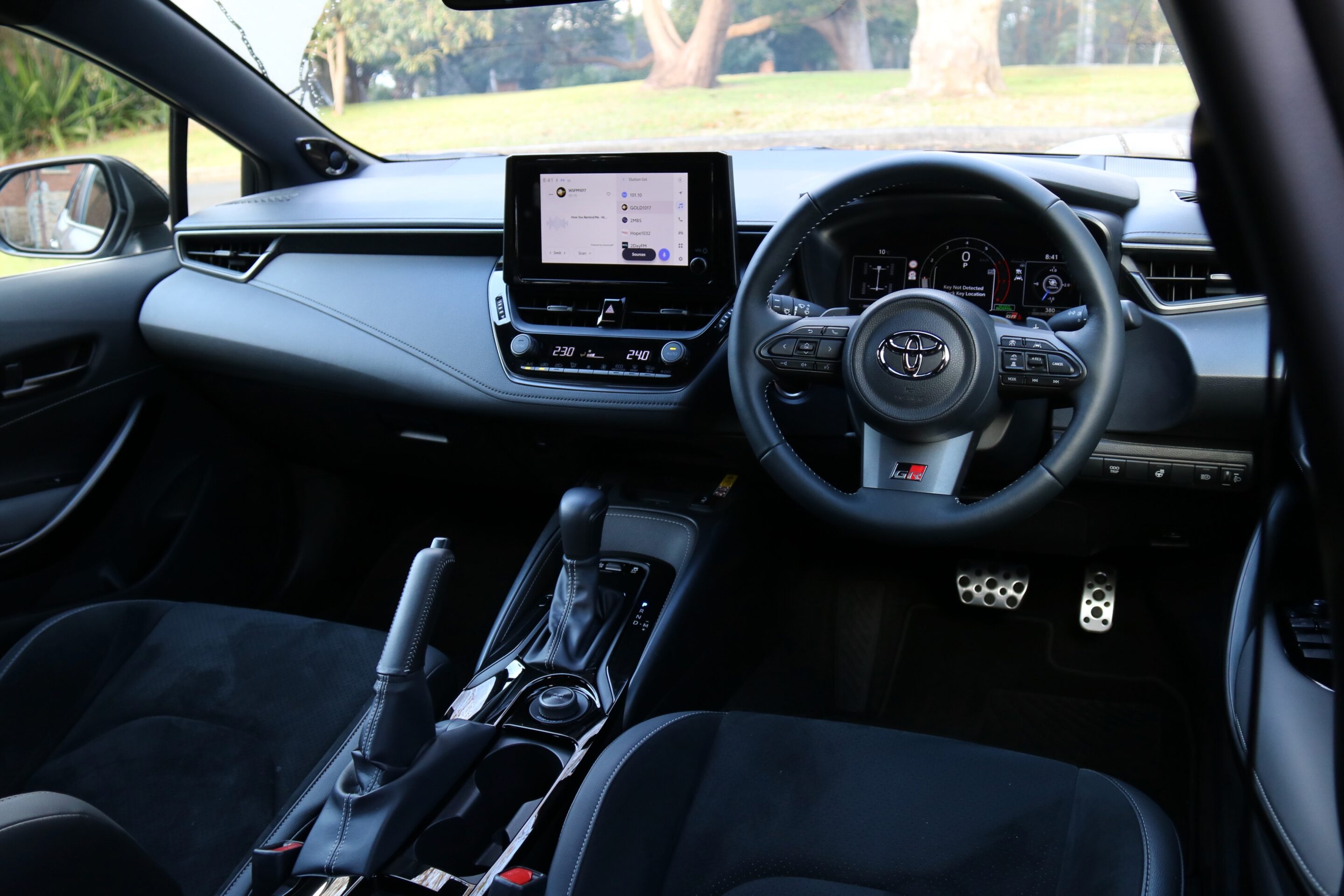
The small 8.0-inch touchscreen in the centre of the cabin is well featured with wireless Apple CarPlay, wired Android Auto, DAB+ digital radio and sat-nav with live traffic. It’s bright and quick, though the menus could be easier to use – for example, the sound settings are buried in the audio menu and not in the settings page. The eight-speaker JBL sound system also leaves a lot to be desired for aural quality, while the digital driver’s display could also be easier to use.
The rear seat of the GR Corolla is, like the front, not the most practical space but it is comfortable and at least it has rear doors, unlike the GR Yaris. Two six-foot adults will fit fine with just enough leg- and headroom, while the map pockets, and bottle holders in both the doors and central arm rest will cover their storage requirements. However, the air vents in the Corolla ZR don’t feature thanks to the aforementioned manual handbrake removing the centre console, though there is a USB-C port and 12V socket now available to rear passengers.
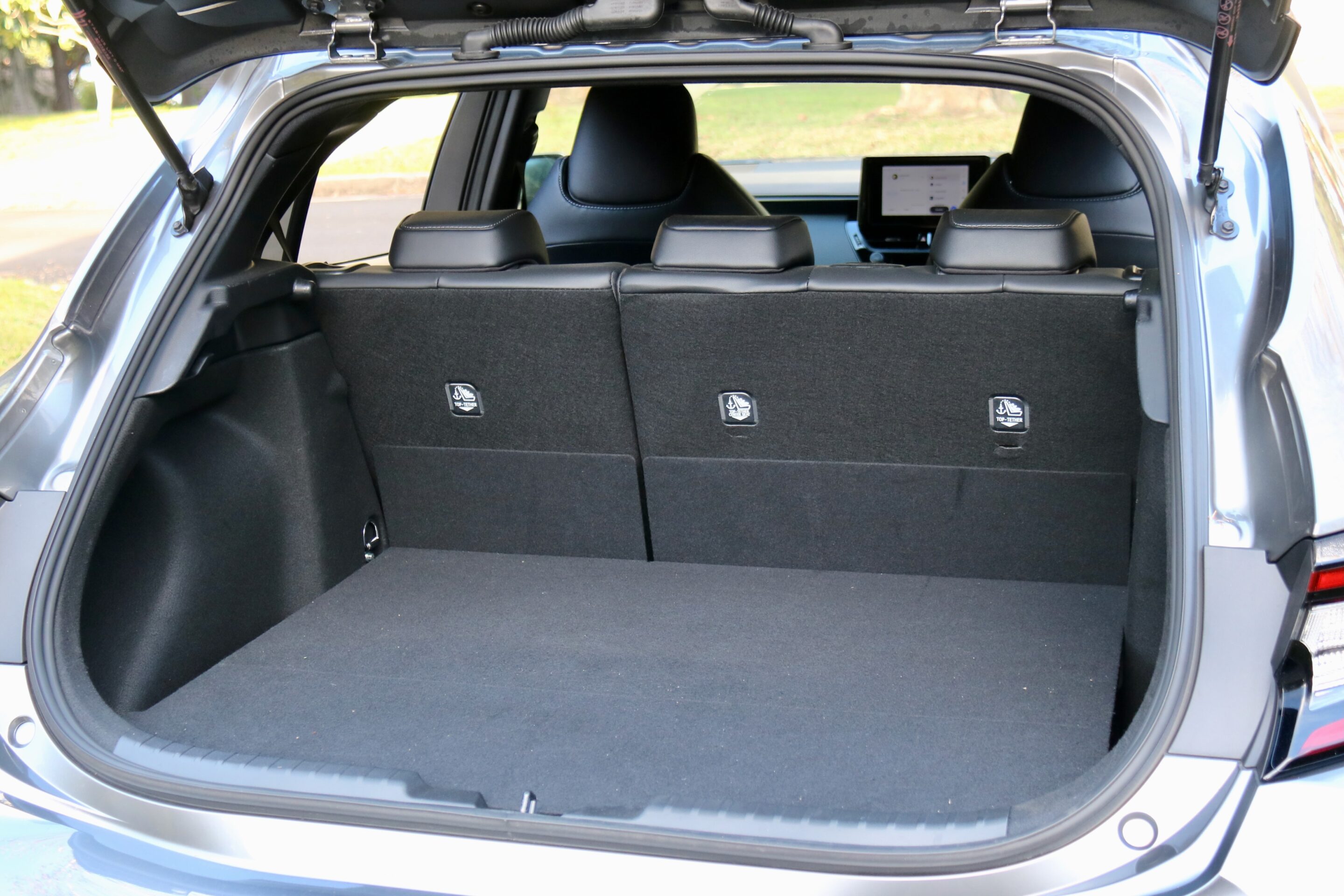
The boot of the GR Corolla measures just 213 litres with the seats up and 503 litres with them folded, and the boot floor is quite high thanks to the rear differential and battery located underneath. There’s also no spare wheel, but the seats do fold completely flat.
Performance and fuel economy
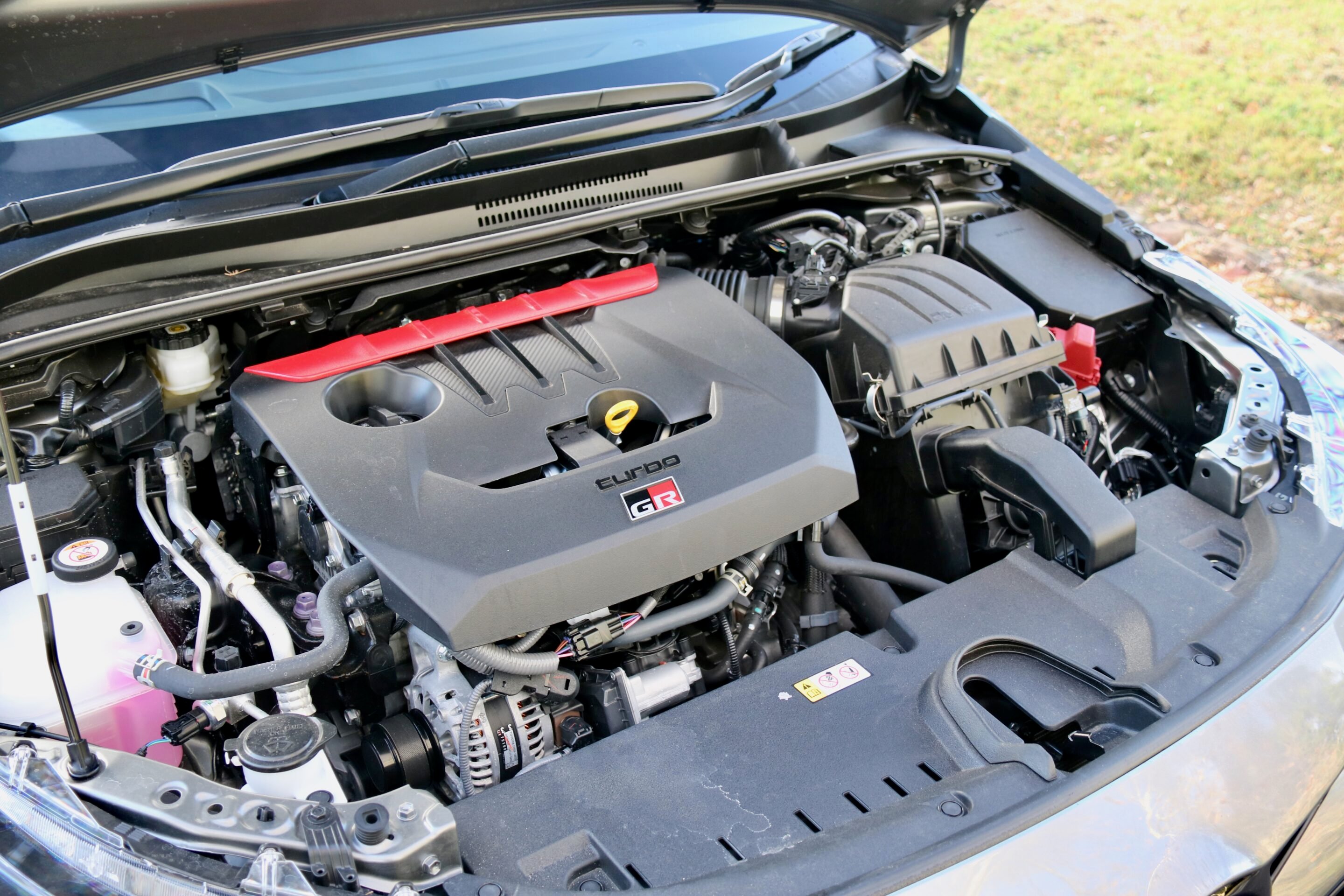
The GR Corolla uses Toyota’s ‘G16E-GTS’ 1.6-litre turbocharged three-cylinder petrol engine that debuted in the GR Yaris, though now it makes even more grunt: 221kW of power and 400Nm of torque, which is some way off the 235kW Civic Type R and 245kW/420Nm Golf R, though they both have more capacity. Previously, the GR Corolla was only available with a six-speed manual but with its recent update, Toyota added a new eight-speed torque converter automatic as an option.
Toyota claims that the auto will use 9.5L/100km of fuel, with claimed CO2 emissions of 215g/km – in our testing with urban, highway and spirited driving, we used 10.6L/100km. Its 50-litre tank must be filled with 98RON premium unleaded.
On the road
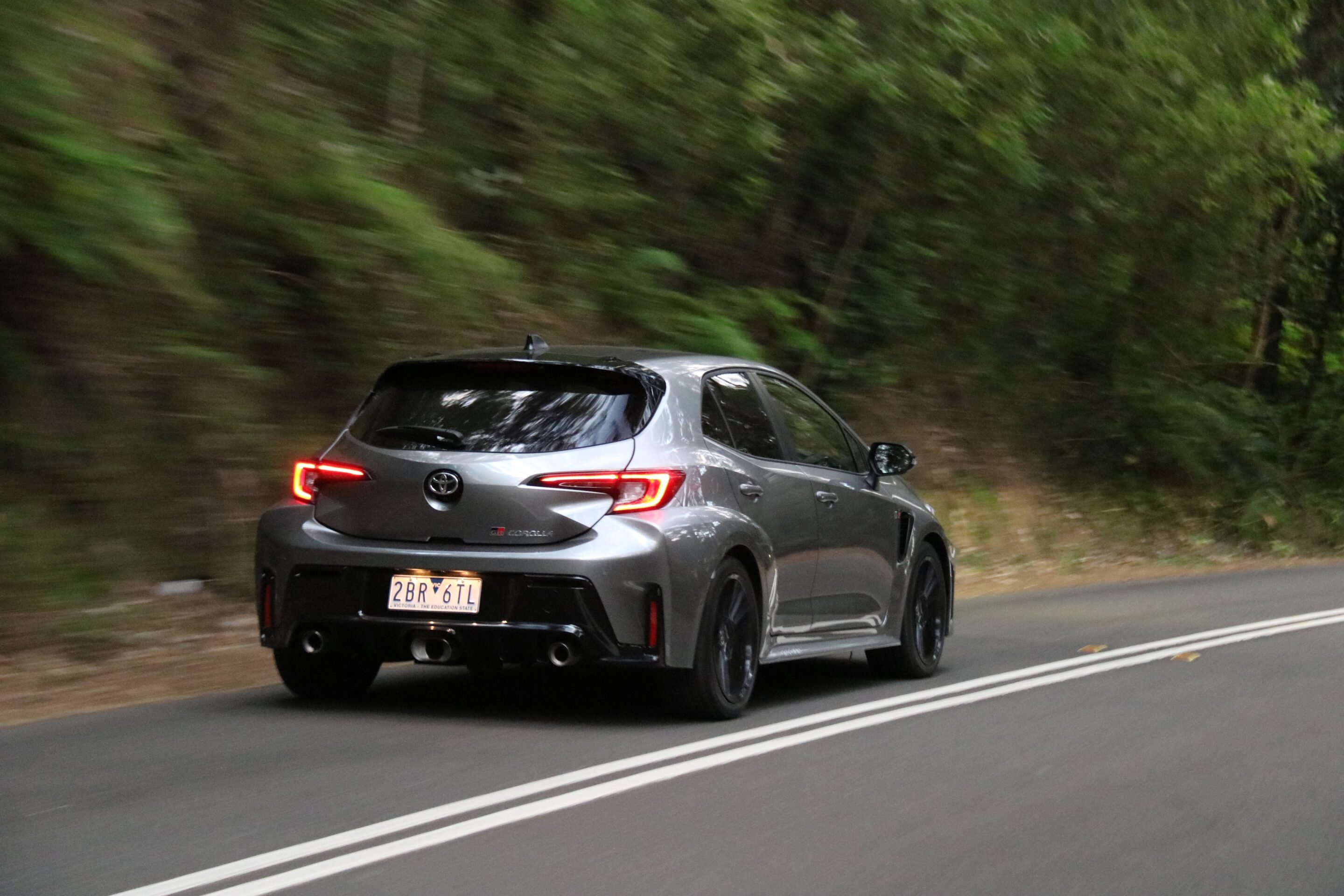
When it comes to the driving experience, the Toyota GR Corolla is outshone in some ways by its rivals: the GR Yaris is ultimately more thrilling thanks to its smaller size, the Civic Type R is more focused and the Golf R is more comfortable for everyday use. But the GR Corolla is still an excellent car to drive, with more than ample performance, driver engagement and – thanks to subtle suspension changes in the update – more comfort than before.
As before, the GR Corolla’s chassis is fabulous, with a darty and planted feel. And while the steering isn’t the last word in feel, it’s well weighted and direct. Like the suspension, the all-wheel drive system has also seen changes – the 60:40 front rear split in normal mode continues as before, but the previous sport (30:70) mode has been changed to gravel (50:50) and track (previously 50:50) is now a variable set up where between 40 and 70 per cent of torque can be sent rearwards at any one time.
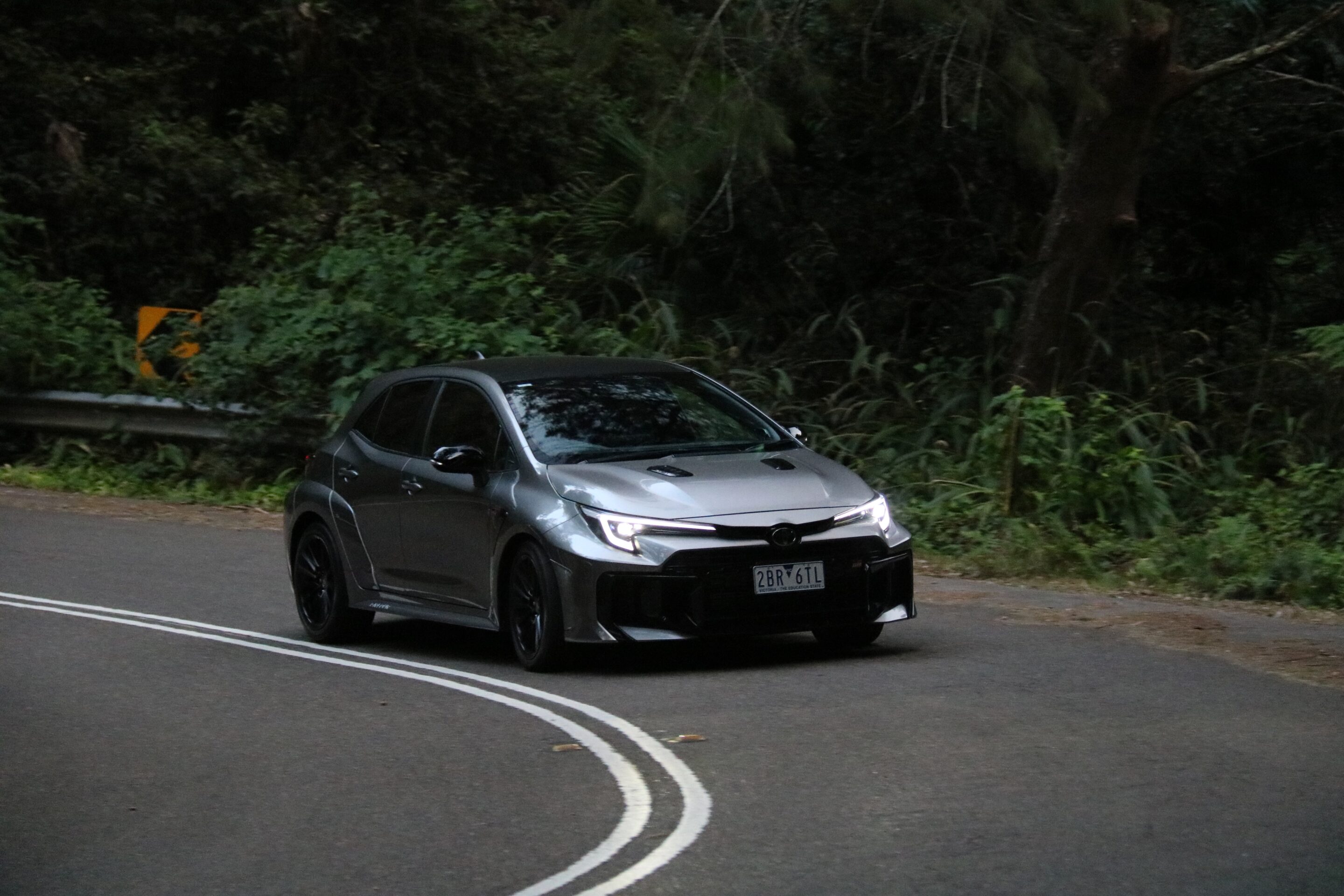
While it doesn’t punch quite as strongly as its main rivals, the GR Corolla’s engine is still a great unit that goes hard and sounds great too, with a meaty three-cylinder roar throughout the rev range. The peak 400Nm of torque hits at 3250rpm, while the 221kW of power then kicks in at 6500rpm, at which point you’re well and truly moving. Toyota doesn’t quote a 0-100km/h time, but we’ve seen overseas reports of a 5.2-second run for the automatic, which feels about right from the driver’s seat.
The new eight-speed automatic transmission has also added appeal to the GR Corolla, and more than just for those who can’t (or won’t) drive a manual. The auto has made it quicker thanks to its eight ratios that are spaced closer together than the six manual gears, while it feels even more like a rally car thanks to the paddle shifters. The transmission isn’t DSG fast and it can shunt a bit at lower speeds when it’s not yet warmed up, but it’s still quicker than expected for an in-house torque converter ‘box, and it’ll even rev to the limiter without shifting up in manual mode.
In its new track mode, you can feel the torque being variably split, making the GR Corolla feel more than sufficiently rear-biased sometimes and really helping it exit corners quickly. The 356mm four-piston front and 297mm two-piston rear brakes are impressively strong, even from higher-speed braking. On the track, the combination of the GR Corolla’s punchy engine, short ratios of the automatic, strong brakes, grippy tyres, fluid track mode and limited-slip front and rear differentials make it an absolute riot. Yet even on the road in a less focused driving mode, it’s still great fun, and thanks to the revised suspension, it’s more compliant and comfortable than before as well.
Service and warranty
The GR Corolla is covered by a five-year/unlimited km warranty with extended coverage for up to another two years for the drivetrain if serviced at a Toyota dealership. Roadside assistance is available at an extra fee of $99 annually or $139 annually for roadside assistance ‘plus’.
The GR Corolla must be serviced every six months or 10,000km, whichever comes first, and five years/100,000km of servicing costs an expensive $4206 ($841 per year).
Verdict: Should I buy a Toyota GR Corolla automatic?
Ultimately, while there are many less hot hatch options than there used to be, the Toyota GR Corolla provides a great option for those who want one. Certain rivals do some things better – the Civic Type R is faster and more focused, the Golf R is more comfortable day to day and its GR Yaris sibling is more involving. The GR Corolla is also expensive to buy and service, nor very practical, and it’s missing features such as automatic wipers and covered storage.
But the GR Corolla is still among the best hot hatches made this century thanks to its driver involvement, lovely dynamics, punchy three-cylinder engine and genuine everyday driver ability.
Plus, the new automatic transmission option has opened it up to more buyers, and more of these tenacious hot hatches on our roads is only a good thing. Those wanting a sub-$100,000 performance car be rest assured: Toyota isn’t resting on its laurels to deliver you one.
GR Corolla automatic rivals
Specs
| Model | Toyota GR Corolla GTS automatic |
|---|---|
| Price | $70,490 plus on-road costs |
| Engine | 1618cc turbo 3-cylinder |
| Peak power | 221kW (@ 6500rpm) |
| Peak torque | 400Nm (@ 3250rpm – 4600rpm) |
| 0-100km/h | 5.2 seconds (est.) |
| Top speed | 230km/h |
| Transmission | 8-speed automatic, all-wheel drive |
| Fuel consumption (claimed, as tested) | 9.5L/100km, 10.6L/100km |
| CO2 emissions | 215g/km |
| Fuel type/tank size | 98RON premium unleaded, 50-litres |
| Dimensions (length/width/height/wheelbase) | 4408/1851/1479/2640mm |
| Kerb weight | 1510kg |
| Boot size | 213 litres (seats up), 503 litres (seats folded) |
| On sale | Now |
As whole-life statements go, ‘I’ll never be old enough to play golf’ rates pretty high on my non-existent list of mantras to live by. In the same feeble breath, ‘I’ll never be decrepit enough to covet a Camry’ carries a similar degree of weight.
It must be psychological conditioning – playing golf always seemed like a pursuit best suited to the rich and/or elderly to me (unless Sega Megadrive is involved), while Camrys are the Toyota du jour once your turgid Corona has been crushed into a metal cube, and your care factor has withered to indiscernibility.
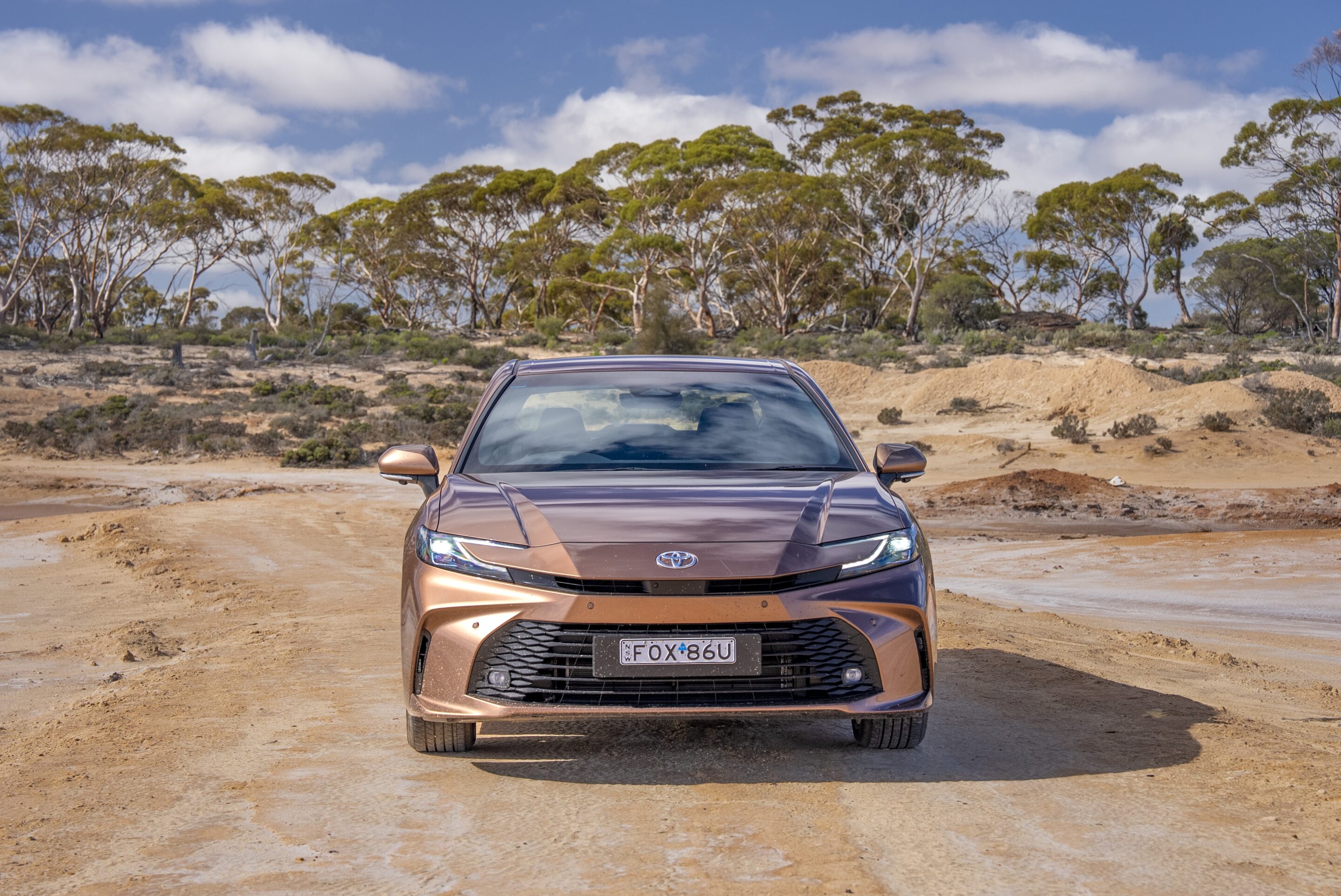
Yet here we are, clubs on standby, tracing the trail of the world’s longest ‘golf course’ while driving what is still the world’s favourite sedan – in this case a ninth-generation XV80 Camry Ascent Sport in desert-friendly Precious Bronze.
The desolate delights of Australia’s Nullarbor Plain are unfamiliar territory to me. Like most people, I’ve never been west of Port Augusta or east of Kalgoorlie – leaving 1850km of unexplored landscape, and about 1000km of Nullarbor Plain plonked somewhere in the middle, roughly spanning Ceduna in SA to Norseman in WA.
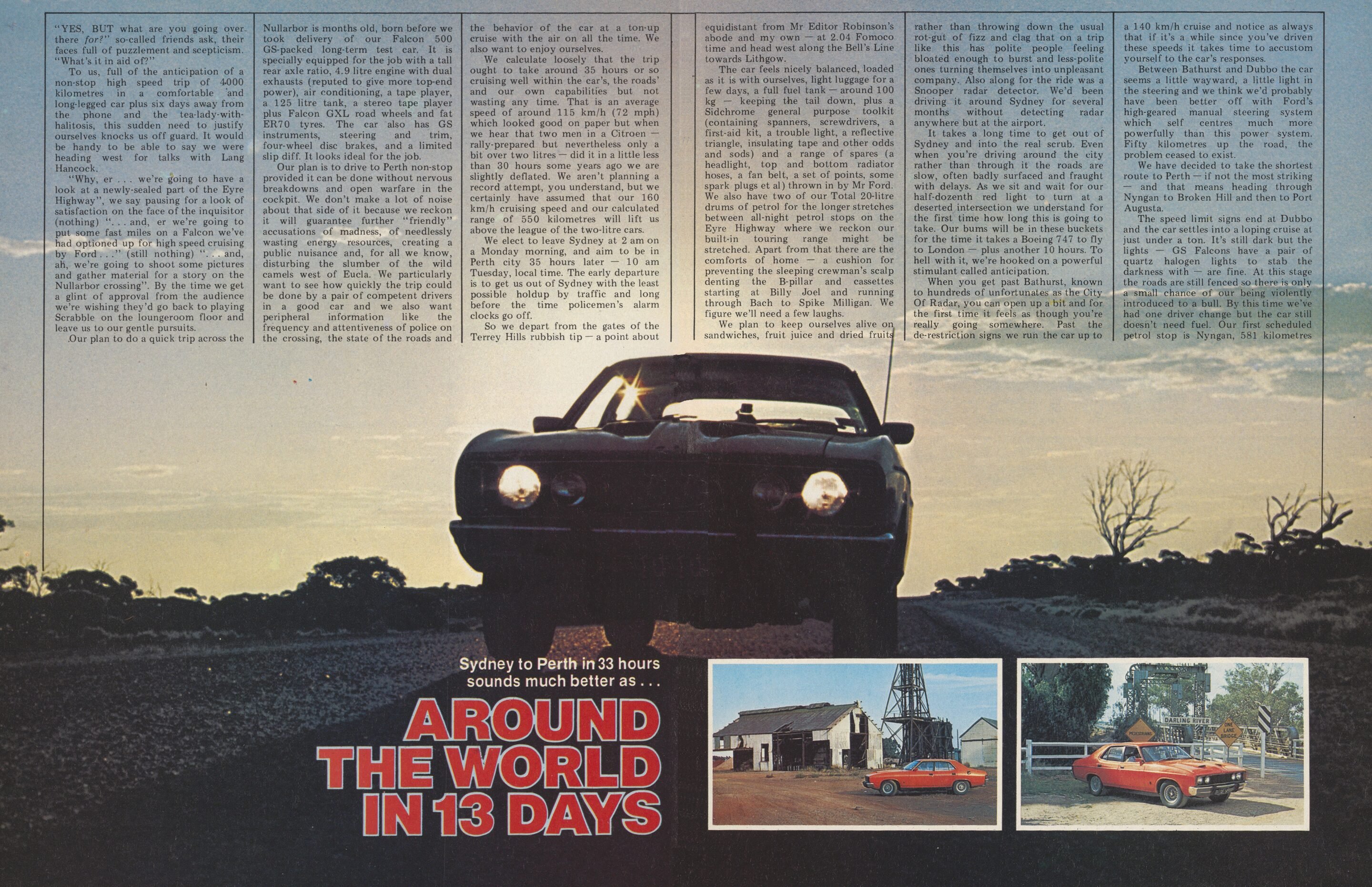
Wheels, however, and any long-time Wheels readers as a result, has traversed this iconic stretch of tarmac on two landmark occasions – once in July ’77 in a Ford XC Falcon 500 GS long-termer, and again in November ’80 in an Alfa Romeo Alfetta 2000. Each time also in a sedan, with each incredibly well-suited to tackling the huge drive all the way from Sydney to Perth (without stopping for sleep!), but in a radically different era.
Editorialised around the Eyre Highway being a freshly surfaced ‘new’ road with bitumen for the first time – yes, it had been a dirt goat track prior – the ’77 drive (below) enjoyed the freedom of no speed limits beyond populated areas, with the thirsty V8 Falcon averaging a scarcely believable 176km/h during one 400km stint. The 1980 rematch, however, was a highly organised, factory-backed affair that saw the twin-cam Alfa reach Norseman in WA having averaged almost 141km/h since leaving Sydney, then arriving in Perth after less than 30 hours of non-stop driving, aside from refuelling.
Our 2025 Nullarbor Plain crossing couldn’t be more different – and not just because we’re allowing four days to drive 1400km from Ceduna to Kalgoorlie. First, while we’re (refreshingly) piloting another four-door sedan, today’s Toyota Camry is a petrol-hybrid with official combined fuel consumption of 4.0L/100km, or 70.6mpg in old money – an impossible-to-comprehend figure 45 years ago. Given its modest 50-litre fuel tank, that calculates to a potential range of 1250km, which is enough to devour the entire signposted stretch on one tank if you drive delicately enough.
The other key difference is something that was hinted at in the ’77 adventure. It was only after becoming bitumen that signage began to pop up along the Nullarbor, suggesting photo locations for tourists and denoting available services such as petrol, motels and food, as well as water tanks, camping areas and emergency phones. Forty-eight years later, you can add solar-powered electric-vehicle charging stations and, if you’re game, the world’s longest, quirkiest 18-hole ‘golf course’.
After a crisp Indian Ocean swim in the netted pool off Ceduna wharf, we head to the Ceduna Golf Course to inspect the first two holes – Oyster Beds and Denial Bay. Each fairway consists of hard-packed dirt strewn with rubbly rocks, fronted by a raised astroturf platform for teeing off – the whole thing is both laughably ridiculous and quintessentially ’Strayan.
And unexpectedly popular. Two other cars pull up to tee off, though referring to a RAM ute towing a ginormous caravan as a “car” rivals the Ceduna “golf course” and “clubhouse” for bending the truth.
For me, it’s the actual driving, not flailing a frigging club, that is the real Nullarbor drawcard. And, perhaps unexpectedly, doing it in a Camry. Having known a multitude of familial sedans for most of my life (apart from an uncategorisable Mini-Moke Californian, and the odd air-cooled Beetle), it’s a bit like coming home for roast pork, crackling and lemon meringue pie.
Two things immediately hit home. The first is the Camry’s excellent ride and refinement. After suffering the continual compromise that is so many high-riding SUVs, not to mention the bafflingly rubbish ride quality of most EVs, being back in a regular passenger car – a leggy medium-to-large four-door riding on a generous 2825mm wheelbase – is an unbridled joy. Supple, sophisticated, relatively light (only 1565kg) and sweetly balanced, the latest Camry feels like a superb evolution of the traditional Aussie sedan … which I write with more than a tinge of sadness, and not just because we don’t build them anymore. It’s because I miss them.
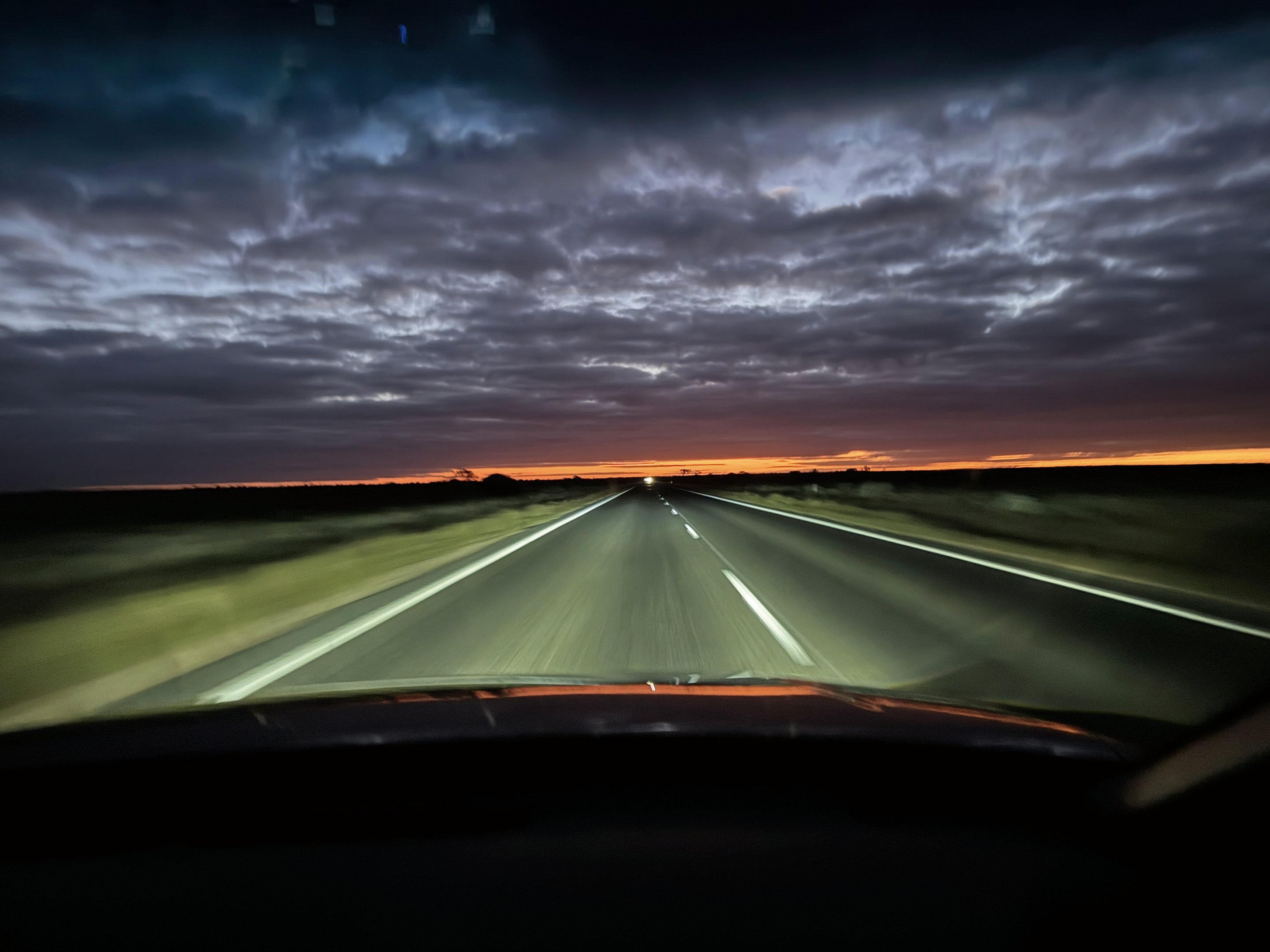
The second is the outstanding vision afforded the Camry’s front occupants. An expansively low cowl is one thing, but there’s an even lower beltline, relatively slim A-pillars and a panorama of riches around the pedestal door mirrors. Compared to a similarly sized SUV, the Camry is almost ’80s-Honda-esque in its visual generosity – providing a great foundation from which to take in the Nullarbor and its surrounds.
Our first stop is Comet Café in Penong which, according to the sign out the front, also happens to be the last proper shop for 1000km. As a warning for first-time tourists, it hits like a kindly administered sledgehammer.
Thankfully for my depressed self and my deeply un-Australian dietaries – no gluten and no eggs (not by choice) – Comet Café’s husband-and-wife team psychically knew I was coming because she’s also a coeliac and makes a great GF burger. The yellow food and meat pies that dominate Aussie roadhouse warmers are now fading memories, though the smell is still a great reminder about why a Chiko roll is never a good idea.
Beyond Penong, I get a chance to test the Camry’s overtaking stonk. Large utes and SUVs towing massive caravan-ish things mostly adhere to a 100km/h-ish cruise – presumably to save fuel though probably because they’re retired and wandering, nomad-like – so I mash the Camry’s right pedal time after time, sending engine revs quickly soaring as the Atkinson-cycle 2.5 makes a statement of intent. Our unassuming Ascent Sport gathers pace with newfound urgency. It feels as strong as any regular six-cylinder Aussie sedan ever did, but with added silkiness.
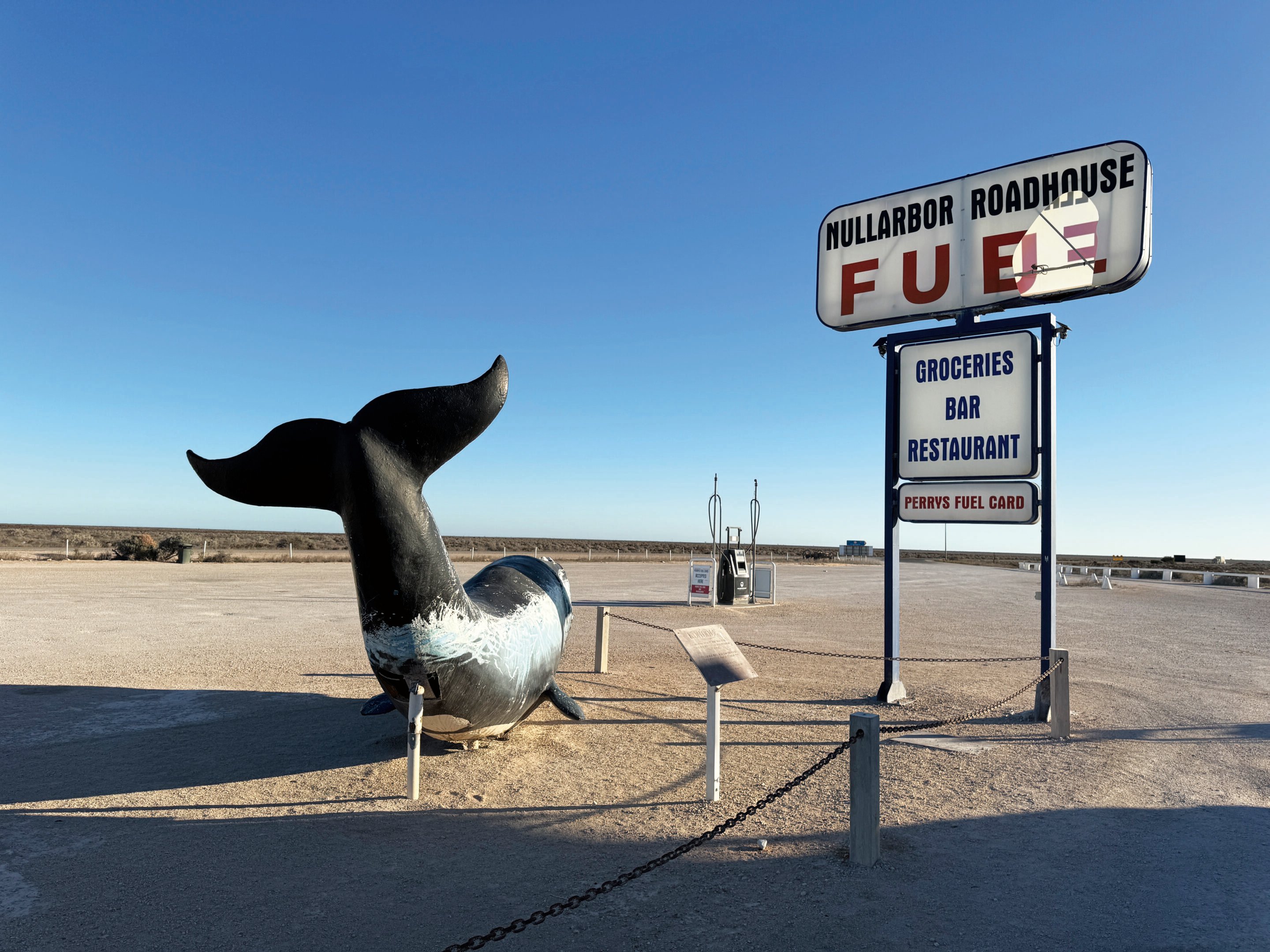
We overnight at Nullarbor Roadhouse, around 300km west of Ceduna – a multi-purpose servo with a bar, restaurant and fuel bowsers, plus a concrete whale out front, some light aircraft round back, a low-rise motel to the side and a broad camping ground adjacent to it.
The motel’s white-blonde bricks turn Besser-block grey inside, but the early-’80s bathroom adds some sparkle with its mustard-swirl vanity, sand-coloured wall tiles and mustard dunny. Nature follows suit with a soft pink sunset in a cloudless sky, graced by a full moon. It’s our entrée to nowhere.
And the gateway to the coast. A mere 50km drive from the roadhouse, the Great Australian Bight Marine Park offers an easy opportunity to gawk at the towering cliffs overlooking the edge of the Indian Ocean, if not the vaguely promised frolicking whales. It’s a breathtaking vista ringed by kilometres of cliffs to the west and fascinating wrinkled sandhills to the east that curve in an enormous arc towards Antarctica and gradually disappear into the sea mist.
Back on the Eyre Highway, the view is similarly mesmeric. Low-lying scrub frequently fills the view in all directions, yet the highway occasionally brushes the ocean – differentiating the unexpectedly lush Nullarbor National Park from the desolate landscapes of the Northern Territory and Western Queensland. Here, the greenery never fades and the road is rarely dead flat. Instead, it punches its way through the scrub – a rising and falling ribbon of two-lane blacktop, contrasted against sandy dirt edges, that fades into oblivion kilometres in the distance.
Wafting at a lazy, cruise-controlled 120km/h – even though 150km/h would be of minimal threat to humanity – our Camry covers the 184km to Border Village in less time than it would take Bob Irwin to start an OnlyFans page. As its name suggests, Border Village sits about 200 metres east of the SA/WA divide, and thus the WA quarantine station, but it’s the only South Australian town (plus four towns in WA) to operate in the Central Western Time Zone – 45 minutes ahead of the rest of WA and 45 minutes behind SA. Colloquially known as ‘Eucla time’, we have to manually select Eucla on our phones to stop them flicking forward and back in 45-minute jumps – not ideal when you need to set an alarm.
Beyond Eucla, the scenery delivers its first cinemascopic reveal. The first genuine hill of our Nullarbor sojourn feeds into a pair of tempting corners as the road drops and snakes off to the west, skirted by low-lying mountains to the right and inviting ocean to the left, though the British chap that inspected our Camry at the quarantine station said he’d been living in the area for four years and still hadn’t braved the water. “Full of sharks” was his literal warning, though his tone seemed to imply that a quick dip after sunrise might be okay. And so it proves.
Day Three’s casually meandering Eyre Highway provides some appreciation of the Camry’s crisply connected, expertly weighted electric steering tune – a considerable improvement over the previous model – as well as hours of lush electronica to provide a soundscape for the landscape, delivered via a 12.3-inch touchscreen (with wireless Apple CarPlay) that finally buries Toyota’s unenviable reputation for crap multimedia.
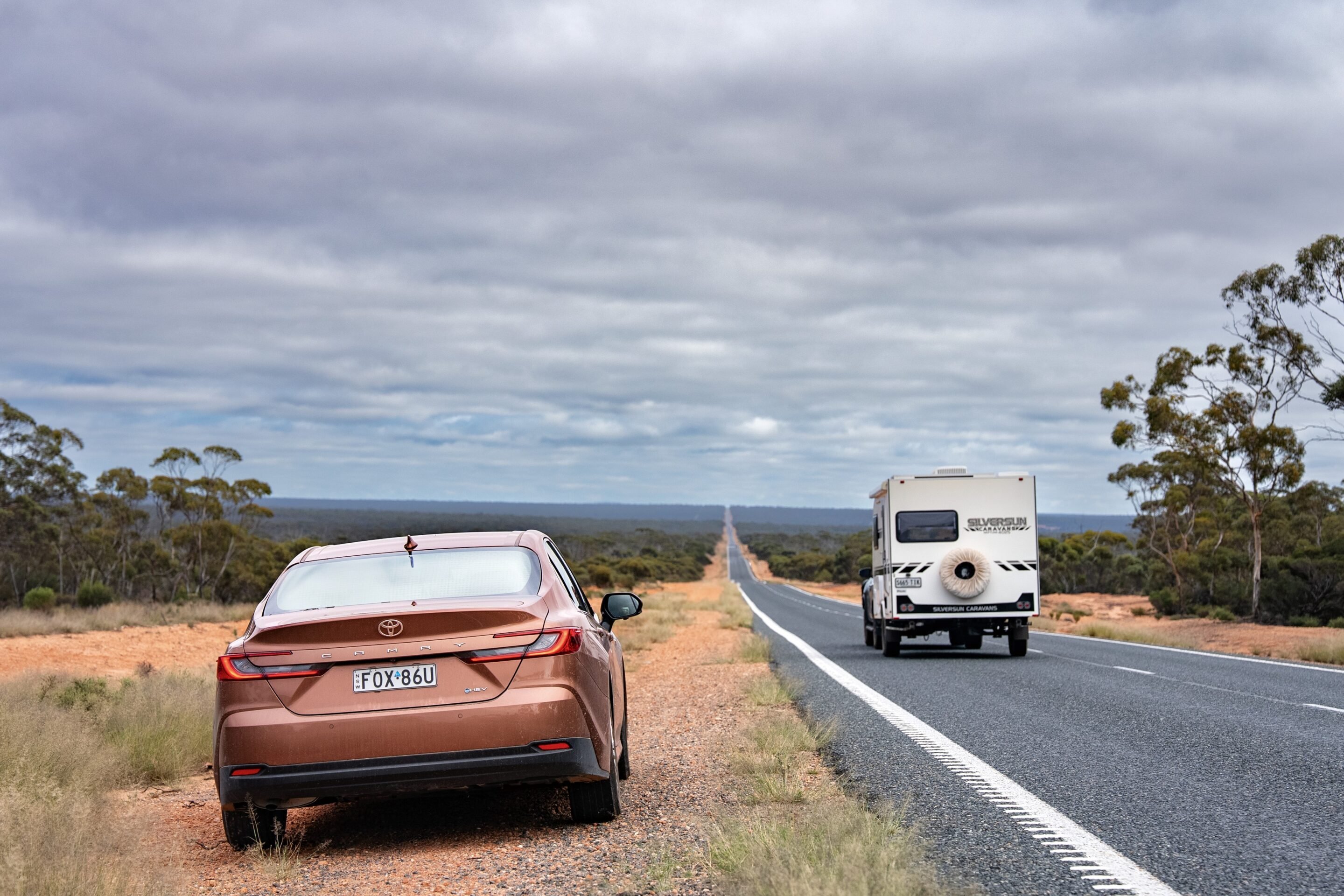
The Nullarbor’s western fringe also provides a cornucopia of interesting town names, including Mundrabilla for a coffee, Cocklebiddy for lunch (and a golf hole if you’re in need of a stretch), and Caiguna – plus the famous 90-mile straight (146km), the longest straight road in Australia, before reaching Balladonia for dinner and bed.
Belting towards Balladonia Hotel Motel, we’re greeted by a fluorescent orange-pink sunset lovingly framed by the Camry’s tremendous vision, piercing from beneath dappled clouds. I’m then treated to my third ‘special’ meal of the day – a non-menu chicken curry, orchestrated by our Argentinian barmaids and created by a Filipino chef – which follows a lovely ham salad made by a French lass at lunch. It’s a welcome reprieve from three meals of crispy bacon at the previous day’s roadhouses, as well as a pleasing reminder that the Nullarbor has international appeal.
Indeed, the golf hole at Balladonia is called ‘Skylab’ – honouring the large piece of space junk that crashed into the earth there at 12.38am on July 12, 1979. The day after, US President Jimmy Carter rang the Balladonia Roadhouse to apologise for his country’s satellite debris and offered to pay for any damages – something that would be unfathomable in 2025. Part of Skylab’s airlock door now sits in a small museum adjacent to the roadhouse café, alongside a restored Vauxhall Velox from the 1950s Redex trials that is displayed crashing through the roadhouse wall, perhaps in honour of Skylab and Balladonia’s brief flirtation with fame.
The final stretch of the Nullarbor is a 218km kink to the north-east, up through the Dundas Nature Reserve and Fraser Range before essentially ending at a T-intersection in Norseman. It’s a picturesque final leg, rising and falling between modest mountains and increasingly large trees. But it’s the moonscape-like rock and sand flats skirting the tendrils of Lake Cowan that piques my interest, not playing two holes at the Norseman Golf Club right next door.
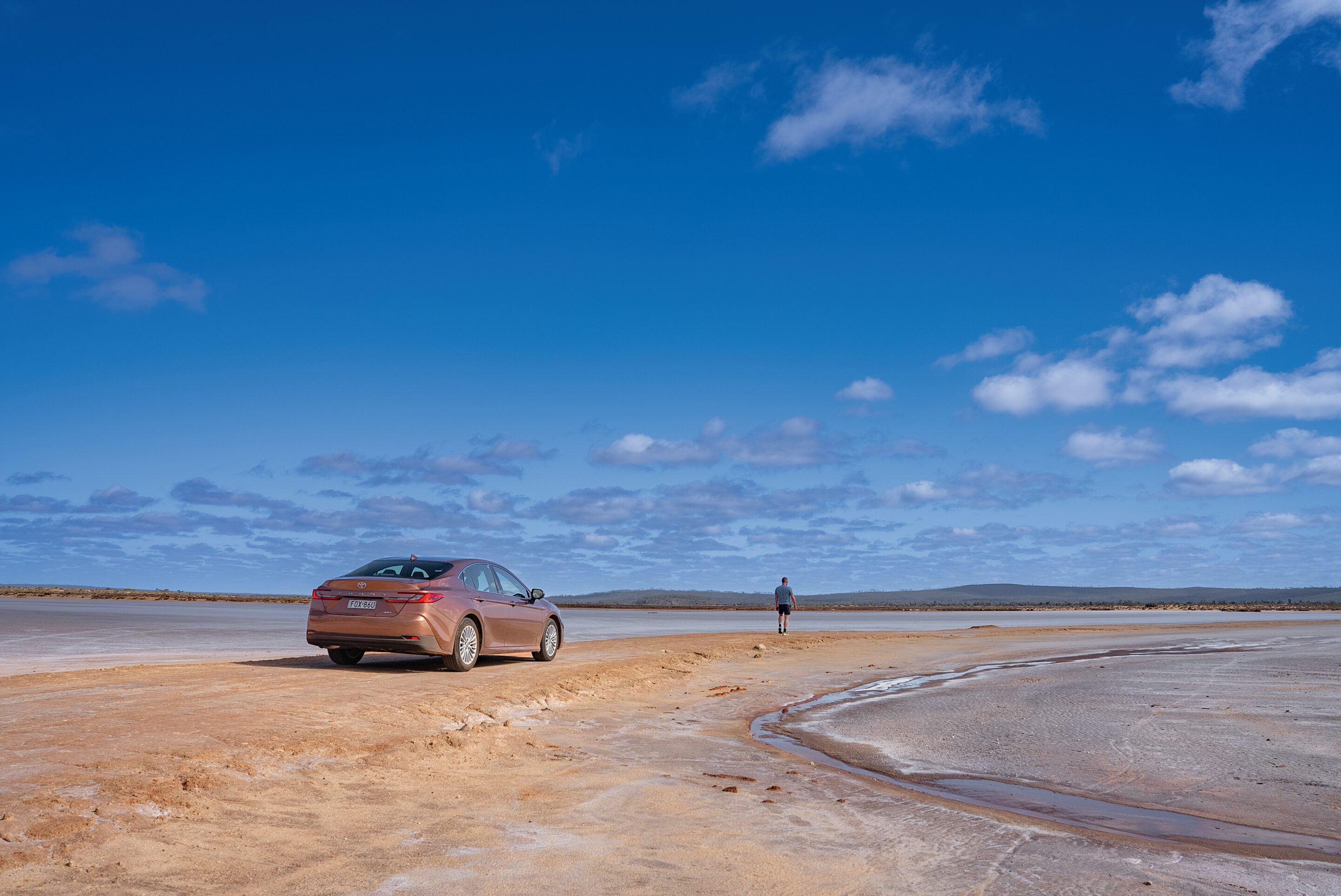
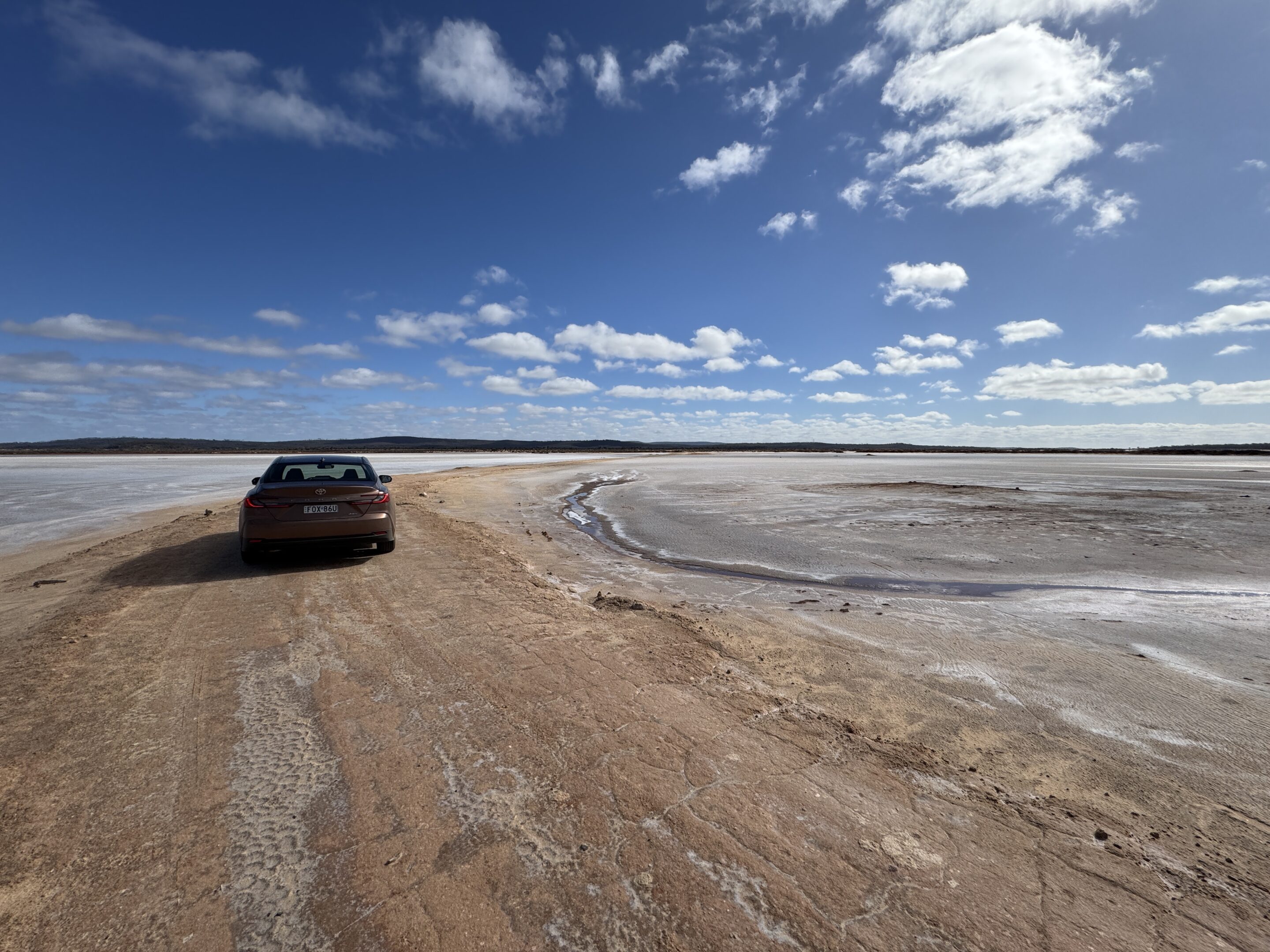
After physically inspecting the solidity of the surface, I meander the Camry out onto a rocky meniscus and drink in the vastness. It’s the kind of stuff we often used to enjoy on big Wheels road drives in big home-grown cars, and much like seeing Sydney Harbour Bridge up close, you never grow tired of its grandeur. Out here, the Camry seems almost small.
The immensity of the landscape provides a quiet opportunity to contemplate this car’s significance. As essentially the last remaining link to the large-sedan diet that once underpinned our existence, it deserves to be celebrated. Yet it also deserves the accolades that have been heaped on this latest generation.
This bronze Ascent Sport is essentially $48K driveaway in New South Wales, which is a truckload of Toyota for the money. It’s quietly handsome (though far sexier in range-topping, headroom-robbing SL trim) and immensely comfortable over long distances, yet it’s also eager in corners, light on its feet, and far more athletic than any Camry has ever been. As a handler, it’s a wolf wearing comfy Merino threads.
It has a golf-bag-friendly 524-litre boot and much easier rear-seat access than previous Camrys, though this dynamic surprise still can’t match a VE/VF Commodore for rear-seat comfort or three-person space, despite driving its front wheels. That said, the Camry Hybrid’s combination of 7.2sec-to-100km/h performance and supreme fuel efficiency remains other-worldly compared with what the lead-footed Wheels crew achieved on those epic Nullarbor crossings of the past.
By the time we reach Kalgoorlie Golf Course, the numbers that matter are in. Despite being chockers with luggage and camera gear, and always extended when overtaking, our Camry has averaged an effortless 5.7L/100km – calculating to 877km between gulps of 95RON premium unleaded.
That’s a statistic rooted at the heart of modern motoring, not challenging the limits of man and machine in a cross-continent blast, thrilling as that may sound. Yet there’s arguably never been an Australian-market car better suited to a coast-to-coast thrashing than this Camry – if such an endeavour were still legal. It’s the first covetable Camry, a titan among a non-existent sea of competitors. And perhaps the ideal car to break the monotony of mediocre SUVs.
The other big take-away is that I might actually enjoy perfecting my golf swing. On Nintendo Wii.
Photos by Leanne Wilson and Nathan Ponchard.
This article originally appeared in the June 2025 issue of Wheels magazine. To subscribe, click here.
| Overall rating |
|---|
Things we like
- A great all-rounder with practicality, efficiency and lots of equipment
- A good size – small on the outside but big on the inside
- Comfortable and refined to drive
Not so much
- Interior quality could be better
- Top-spec models aren’t cheap
- Not cheap to service
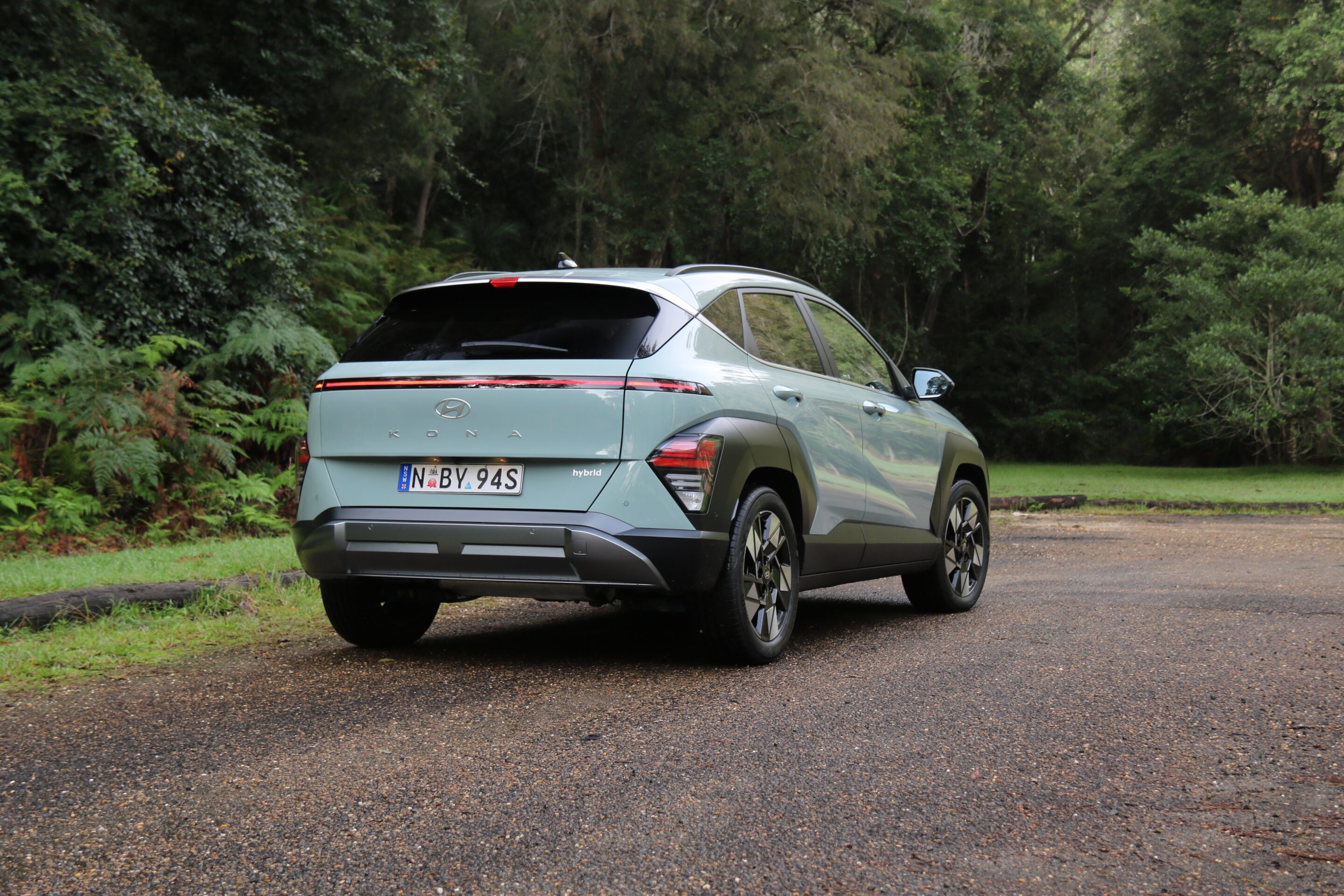
Hybrids are all the rage at the moment, with many car makers introducing new ones within the past year or so. Hyundai has come to the party, adding multiple hybrid models across its range including the Santa Fe large SUV, Tucson mid-size SUV and i30 Sedan small car. How about a small SUV? That’ll be the Hyundai Kona Hybrid then.
Price and equipment
The 2025 Hyundai Kona range offers a lot of choice to buyers, with petrol, turbo-petrol and hybrid drivetrains available, as well as standard, luxurious Premium and sporty N Line models available.
We tested the Kona Hybrid Premium, which is priced from $43,500 plus on-road costs.
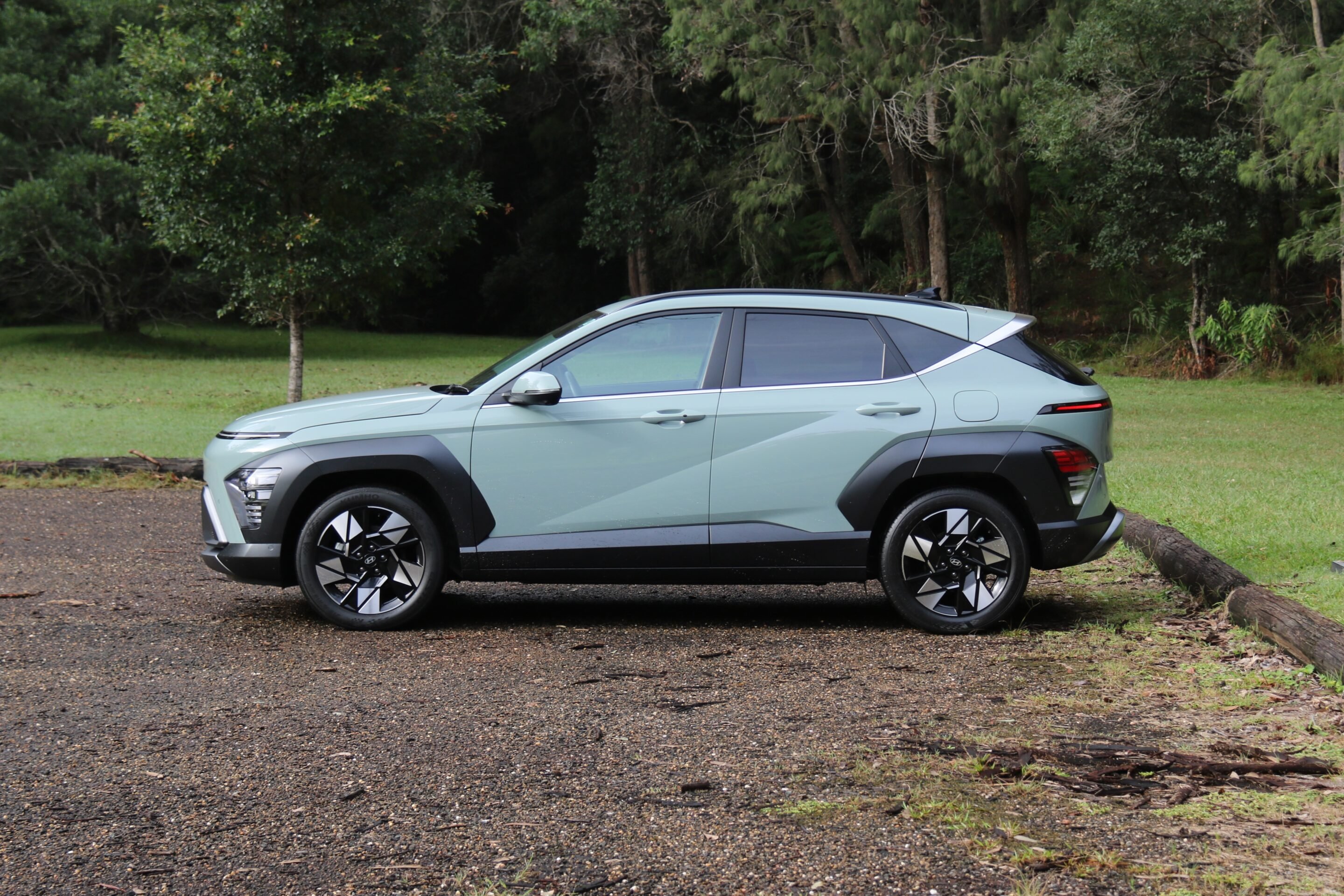
Kona Premium Hybrid standard equipment
- 18-inch alloy wheels
- Dusk-sensing automatic all-LED exterior lighting
- Rain-sensing automatic wipers
- Roof rails
- Keyless entry with push button start
- Remote start and remote smart parking functionality
- Rear privacy glass
- Hands-free electric tailgate
- Heated and electric-folding mirrors that drop automatically in reverse
- Dual-zone climate control with rear vents
- Leather upholstery
- Heated leather steering wheel with paddle shifters
- 10-way electric driver/8-way front passenger seats with ‘relaxation’ mode and driver’s memory functionality
- Heated and ventilated front seats
- Heated outboard rear seats
- 12.3-inch digital driver’s display
- 12.3-inch touchscreen with live services
- Satellite navigation with live traffic
- Wired and wireless Apple CarPlay and Android Auto
- AM/FM/DAB+ digital radio
- Eight-speaker Bose sound system
- Wireless phone charger
- 4x USB-C charging ports
- Auto-dimming rear mirror
- Customisable LED ambient cabin lighting
Kona Premium Hybrid standard safety equipment
- Seven airbags (2x front, 2x side and 2x curtain with 1x front centre unit)
- Auto emergency braking (AEB) with pedestrian, cyclist and intersection assistance
- Low-speed automatic rear braking
- Lane keep assist with lane departure warning
- Lane trace assist
- Adaptive cruise control with stop and go functionality
- Safe exit assist
- Blind-spot monitoring with rear cross-traffic alert (both with braking)
- Blind-spot camera
- Auto high beam
- Traffic sign recognition with warnings for speeding
- Driver attention monitoring
- 360-degree camera
- Front and rear parking sensors
- Burglar alarm
- Tyre pressure monitoring
The Kona range earned a four-star ANCAP rating in 2023 with scores of 80 per cent for adult protection, 84 per cent for child protection, 64 per cent for vulnerable road user protection and 62 per cent for safety assist.
Kona Hybrid Premium options
- N Line Package (rear spoiler, body kit, 18-inch wheels and sports seats): $3,000
- Panoramic sunroof: $1,500
- Alternate leather trim colour (light grey or green depending on exterior colour): $295
Interior, practicality and boot space
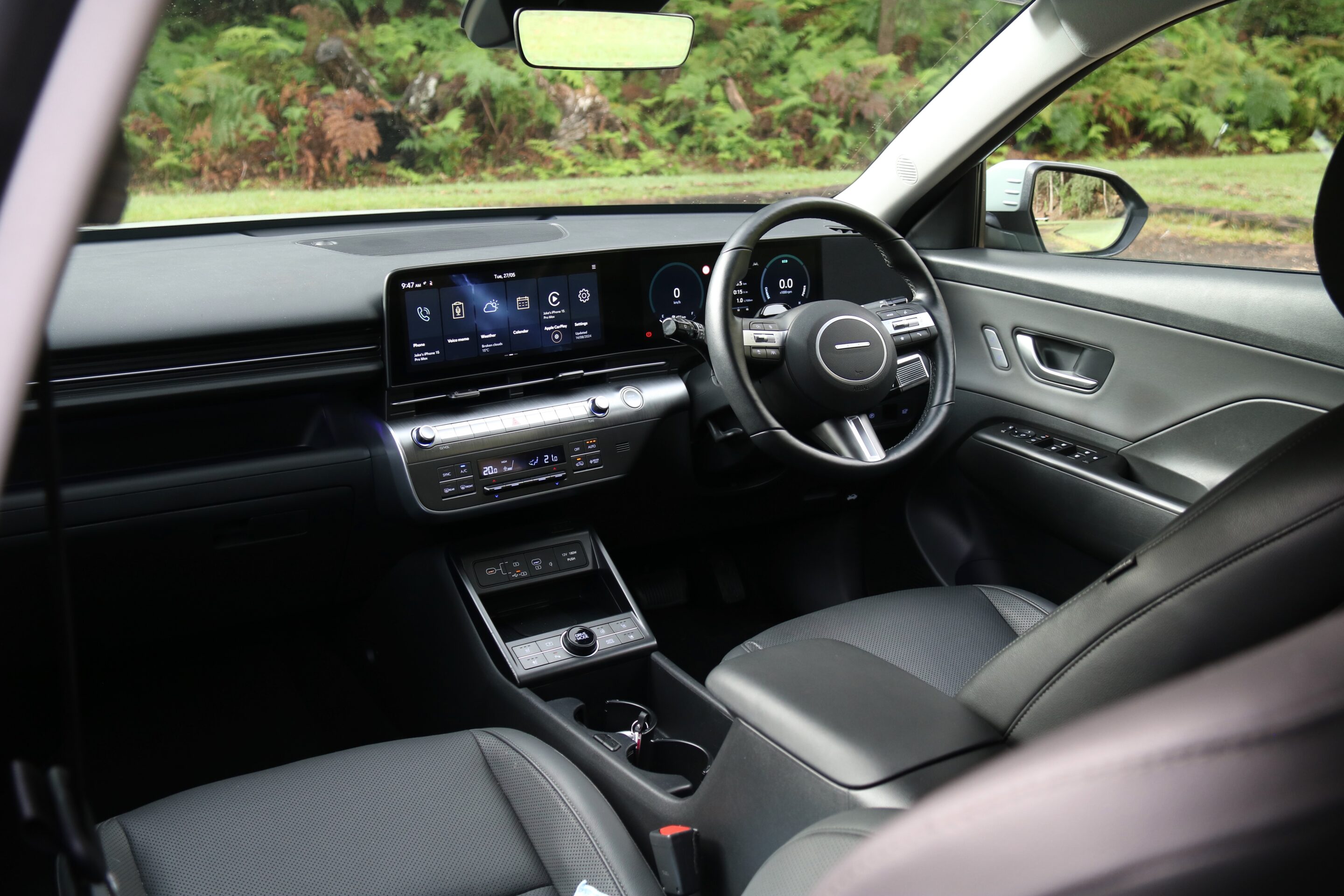
As with the regular Kona, the interior of the Hyundai Kona Hybrid Premium is quite practical thanks to its growth spurt versus the old model. It’s also more comfortable, features increased practicality and has better tech integration throughout the cabin. One area we still think needs improvement, however, is the quality of the materials used, which are still plasticky and the only bit of soft touch is on the door cards.
Centre of the Kona’s cabin is a 12.3-inch touchscreen with Hyundai’s new ‘ccNc’ infotainment software. It’s a fairly impressive system that improves on the already-solid system that’s used in the previous Kona. The Premium adds inbuilt satellite navigation to the base model and, thanks to a recent over-the-air software update, also now features wireless Apple CarPlay and Android Auto smartphone mirroring. The eight-speaker Bose sound system is also punchy.
Storage inside the new Kona is also a big improvement on the last model. We love the open centre console storage, big cup holders and the very effective wireless phone charger. Further back is a centre armrest with storage underneath it, while there are also reasonable door bins, a nicely-sized glovebox, an open tray above the glovebox and an open area where the wireless charger is – itself is excellent thanks to the raised island that accounts for large smartphone cameras. Also pleasingly, in a win for ease of use, the AC controls are separate from the touchscreen and are very simple to use.
The back seat is also a good improvement over the previous Kona, and is now one of the roomiest in the segment. Two six-footers will be more than comfortable thanks to good knee -and headroom, while the seatbacks recline for greater comfort, and there are also two USB-C ports, as well as air vents, heated outboard seats, a centre armrest with cup holders, two map pockets and reasonable door storage also feature. There are two ISOFIX points and three top-tether points for child seats.
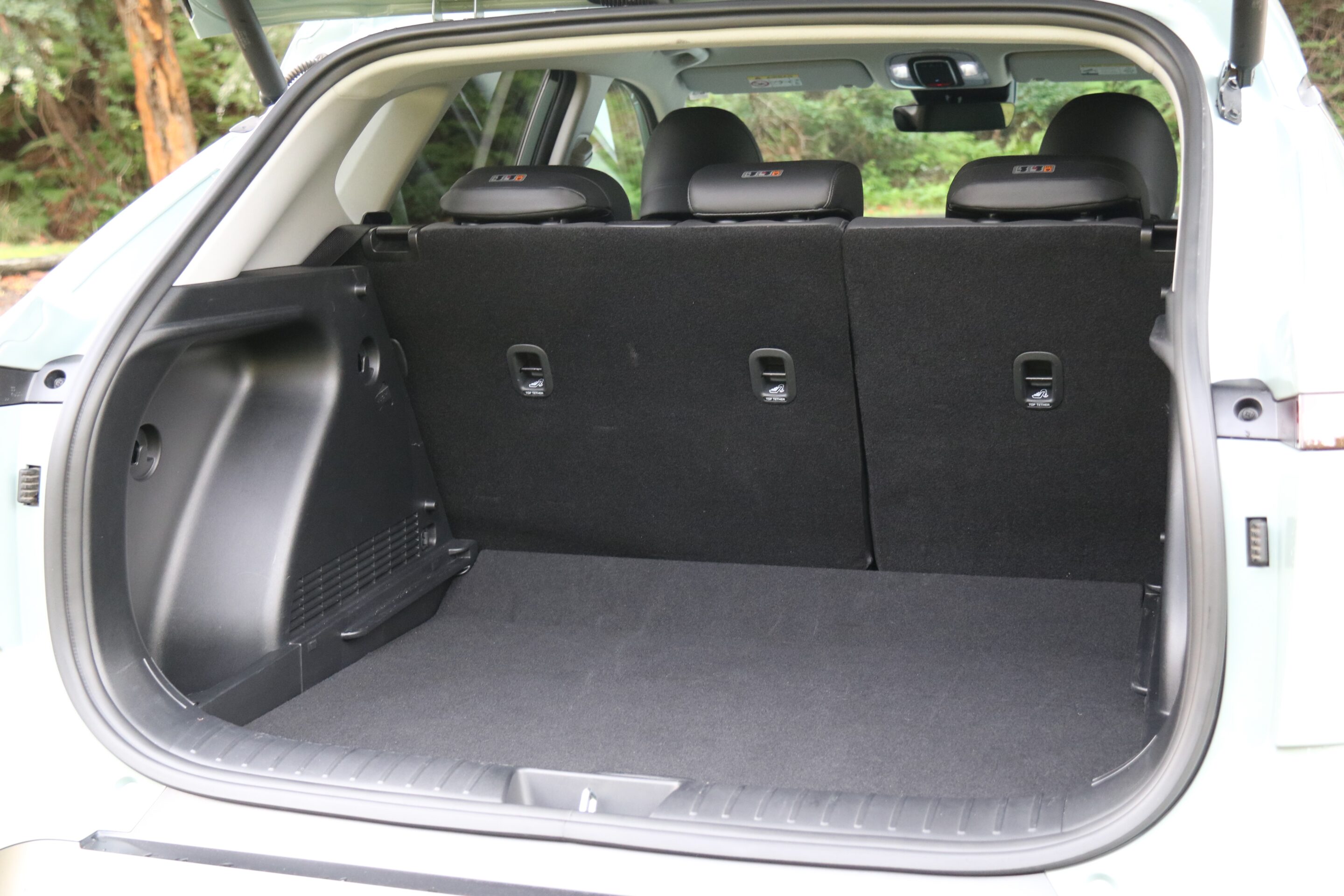
The boot of the Kona Hybrid Premium measures 407-litres with the seats up and 1,241L with them folded – exactly the same as the petrol Kona models, which are a healthy increase on the previous-generation model. There are also handy features like hooks, a boot net, an adjustable floor height and under floor storage. Plus, a space-saver spare wheel lies underneath the boot floor.
Performance and fuel economy
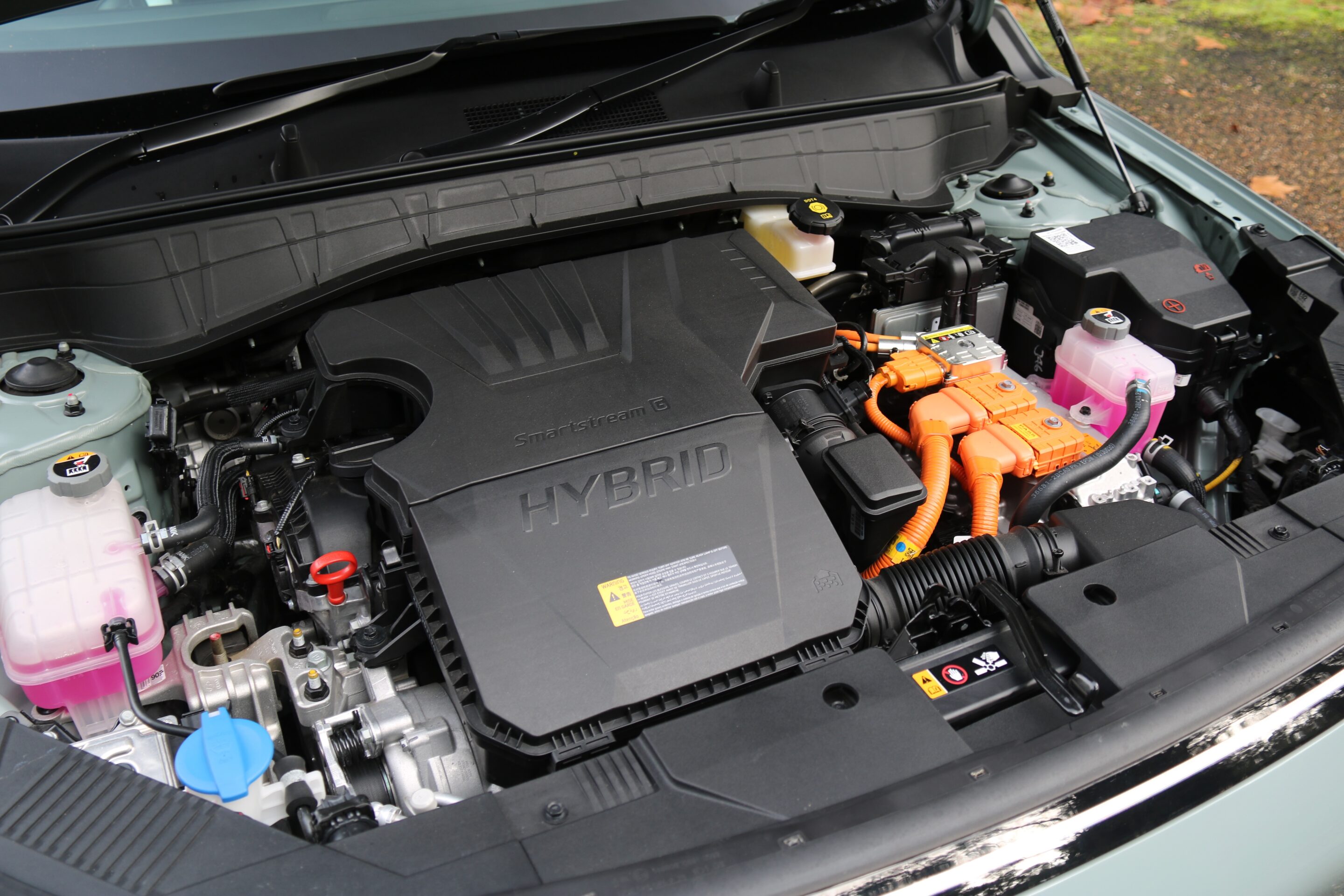
The powertrain that’s used in the Hyundai Kona Hybrid mates a 77kW/144Nm 1.6-litre naturally aspirated four-cylinder engine to a 32kW/170Nm electric motor driving the front wheels that draws power from a 1.32kWh battery. In total, the system makes 104kW of power and 265Nm of torque. It’s mated to a six-speed dual-clutch automatic transmission and sends power to the front wheels only.
The claimed combined fuel consumption for the Kona Hybrid Premium is just 3.9L/100km with CO2 emissions of 89g/km, healthy improvements of 2.7L/100km and 61g/km respectively over the 2.0-litre petrol Kona. In our combined testing, we achieved a positive 4.4L/100km result. The Kona can run on 91RON regular unleaded, while its 38-litre fuel tank is 9L less than the petrol Kona.
On the road
Hyundai’s hybrid systems are some of the best on the market thanks to their refinement and efficiency. The transition from petrol to electric power is sometimes not as smooth as Toyota’s hybrid systems, but that’s also because the dual-clutch transmission’s responses can be somewhat mixed at low speeds. But we think that enthusiasts will like the Kona’s hybrid system more than a Toyota because it feels more natural than the Toyota’s e-CVT gearbox.
Aside from low speeds when the electric motor does a lot of the propulsion heavy lifting and the regenerative braking and engine switching off when braking, the Kona Hybrid feels largely like a regular Kona to drive. The six-speed dual-clutch transmission can be a bit abrupt at lower speeds with an occasional pause moment, but it’s otherwise fine. It’s also more refined than a Toyota hybrid system thanks to the gearbox, which doesn’t send revs flaring when acceleration is called for.
Like the petrol Kona, the Kona Hybrid Premium offers a mature driving experience for the small SUV class, though there are definite differences between it and the petrol model thanks to the hybrid’s 70kg extra weight (1,525kg versus 1,455kg tare). Because of that, the Kona Hybrid’s ride quality isn’t quite as comfortable as the petrol model, despite the hybrid’s independent rear suspension set up (versus the petrol model’s less sophisticated torsion beam).
Like the petrol Kona, road noise levels in the hybrid are a bit louder than some competitors, but its visibility is expansive, and the safety systems are mostly well tuned. The much-publicised annoying active speed limit warnings are now quieter and less annoying than before, though they still annoy because they aren’t accurate. Otherwise, the lane keeping assistance is well tuned and the adaptive cruise control is very easy to set up.
Service and warranty
As with other new Hyundai products, the 2024 Hyundai Kona Hybrid Premium is covered by a five- year/unlimited-kilometre warranty with an eight-year/160,000km warranty for the battery and lifetime roadside assistance if serviced through a Hyundai dealer.
The first five services or up to 75,000km cost an expensive $2639 ($528 per visit) and the Kona has 15,000km/annual service intervals.
Verdict: Should I buy a Hyundai Kona Hybrid Premium?
There’s no doubt that the Hyundai Kona Hybrid Premium is a welcome addition to the small SUV market. New hybrid models are welcome for urban dwellers, where most small SUVs seem to be sold, because their around town efficiency can be so much better than regular petrol models. In addition to that, the new Kona’s newfound practicality, long list of standard equipment and fashionable styling make it worthy of consideration.
For negatives, it’s surprisingly expensive to service, it’s not cheap to buy in top-spec Hybrid Premium, the extra weight of the hybrid is noticeable on the road and the interior quality feels closer to $30,000. Those issues aside, we still think the new Kona is a wonderful product and the hybrid drivetrain only widens its already wide appeal further.
Kona Hybrid Premium competitors
Specs
| Model | Hyundai Kona Hybrid Premium |
|---|---|
| Price | $43,500 plus on-road costs |
| Engine | 1580cc 4-cylinder hybrid |
| Battery | 1.32kWh lithium-ion polymer |
| Engine outputs | 77kW/144Nm |
| Electric motor outputs | 32kW/170Nm |
| Combined outputs | 104kW/265Nm |
| 0-100km/h | 10 seconds (est.) |
| Transmission | 6-speed dual-clutch, front-wheel drive |
| Fuel consumption (claimed, as tested) | 3.9L/100km, 4.4L/100km |
| CO2 emissions | 89g/km |
| Fuel type/tank size | 91RON regular unleaded, 38-litres |
| Dimensions (length/width/height/wheelbase) | 4350/1825/1585/2660mm |
| Kerb weight | 1525kg |
| Boot size | 407 litres (seats up)/1241 litres (seats folded) |
| On sale: | Now |
Hyundai has pulled the wraps off the IONIQ 6 N at the 2025 Goodwood Festival of Speed in West Sussex, England, unveiling its most advanced high-performance EV to date.
Building on the critically acclaimed IONIQ 5 N – winner of the 2024-25 Wheels Car of the Year – the new IONIQ 6 N is said to embody Hyundai N’s three-pillar performance ethos – “Corner Rascal, Racetrack Capability, and Everyday Sportscar” – with an array of technical enhancements derived from the brand’s motorsport and “rolling lab” development programs.
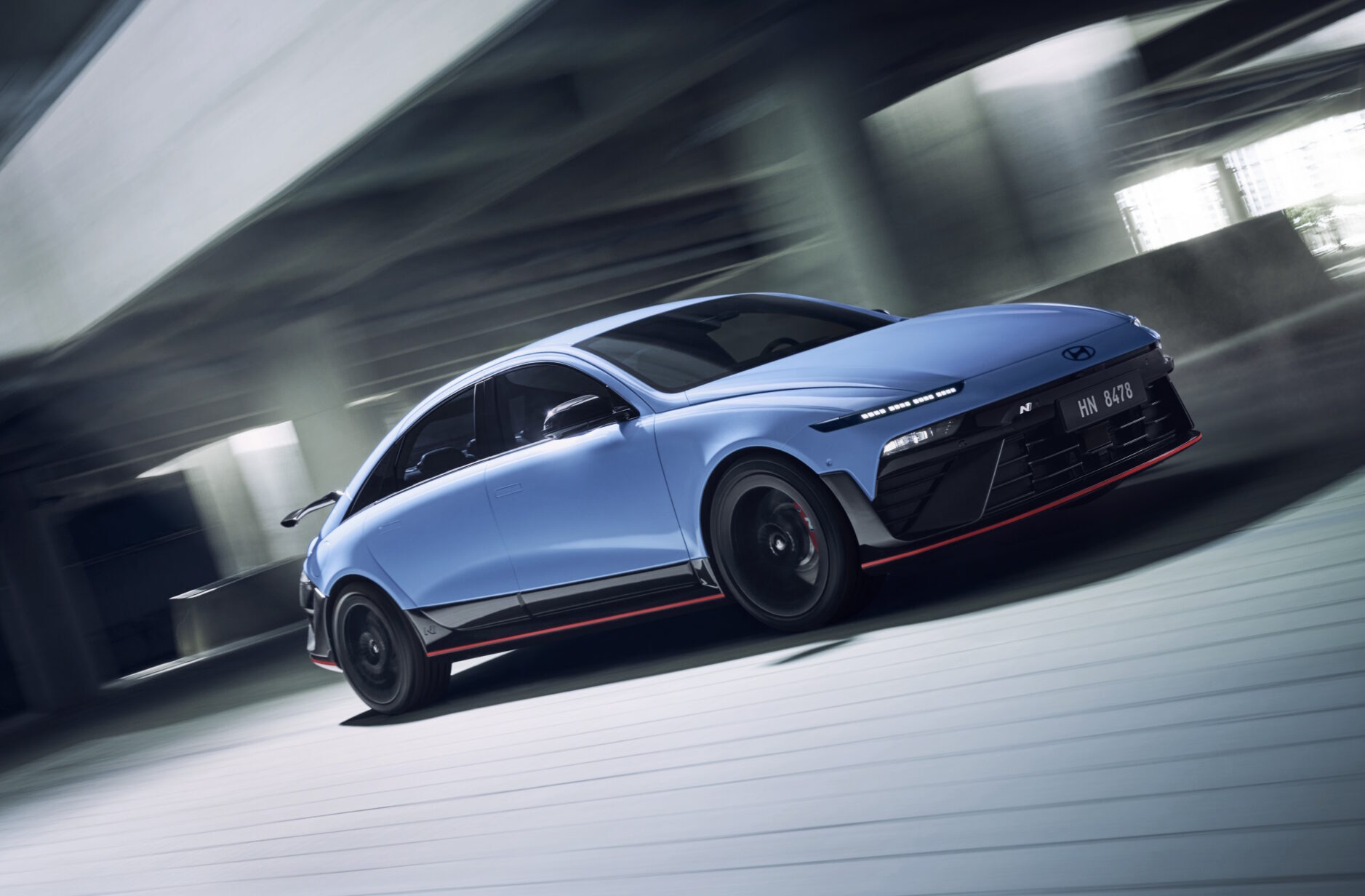
With up to 478kW of power and 770Nm of torque (when N Grin Boost is engaged), the IONIQ 6 N rockets from 0 to 100km/h in just 3.2 seconds and tops out at 257km/h. A revamped “N Battery” system, with improved thermal management and reduced conditioning time, ensures sustained performance for drag, sprint or endurance scenarios.
Beneath its aerodynamic shell lies a reengineered suspension system and lowered roll centre, providing sharper high-speed stability and improved grip. The new stroke-sensing ECS dampers allow tailored ride quality adjustments for varying conditions, balancing daily drivability with motorsport precision.
The IONIQ 6 N also introduces Hyundai’s advanced vehicle control software suite, including:
- N e-Shift: Simulates close-ratio gear changes with paddle shifters for a more visceral connection.
- N Active Sound+: Offers selectable drive sounds, including ‘Ignition’, ‘Evolution’, and ‘Lightspeed’.
- N Ambient Shift Light: A unique in-cabin light system providing visual cues for gear changes.
- N Track Manager: Enables real-time telemetry, ghost car comparisons and custom track layouts.
- N Drift Optimizer: Assists with controlled drift settings for performance driving.
Festival visitors will see the IONIQ 6 N in action during the ‘N Moment’ showcase where Hyundai’s high-performance models, including the new drift-spec IONIQ 6 N, will take on the Goodwood Hillclimb.
Also on display are the IONIQ 5 N, RN24, and rally-spec WRC cars, reflecting Hyundai’s deep motorsport lineage. The Hyundai N booth features interactive exhibits, a special viewing grandstand, and exclusive event merchandise, drawing enthusiasts deeper into the brand’s performance journey.
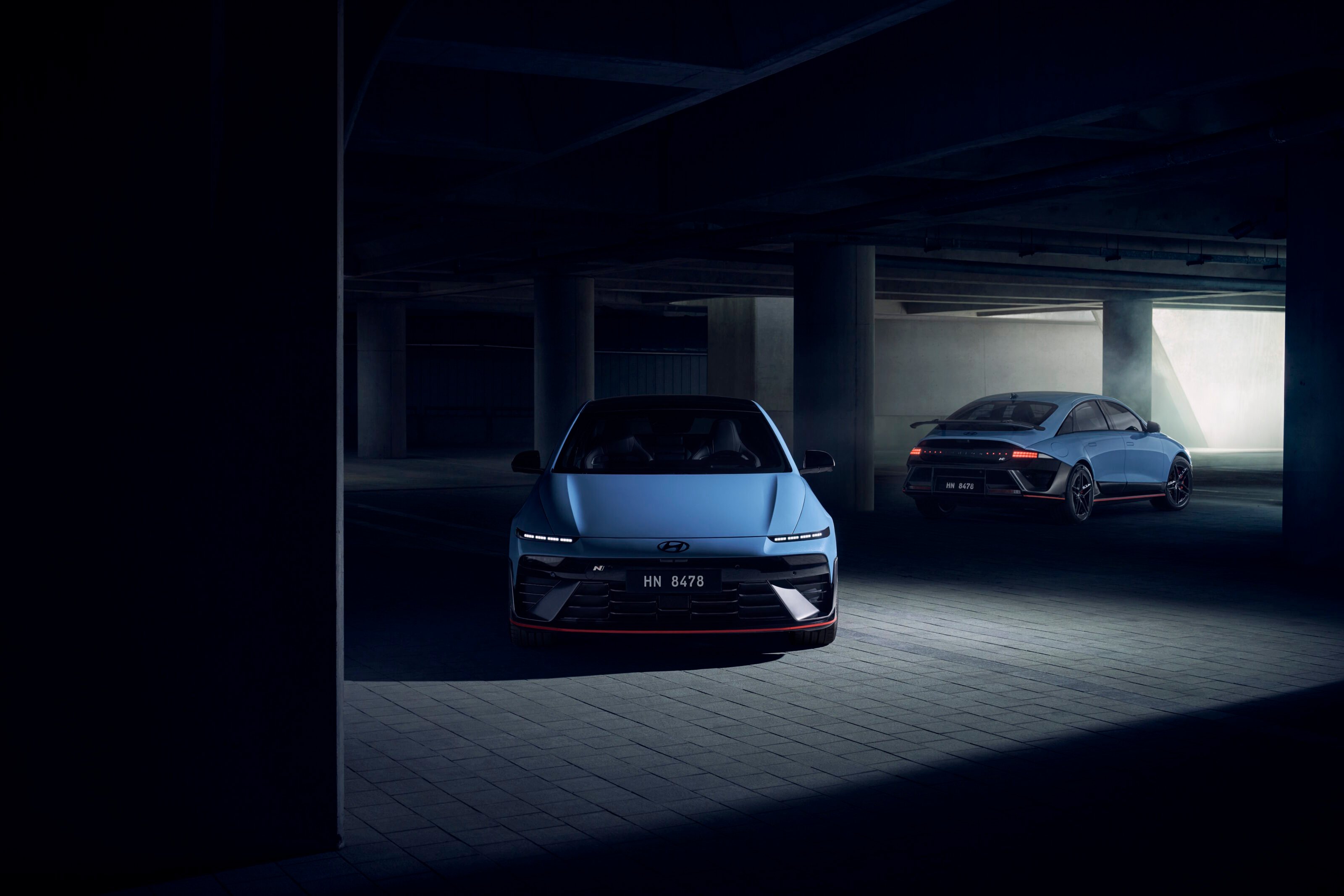
Finished in a striking new Performance Blue Pearl and available with bespoke N performance parts, the IONIQ 6 N is the next stage in Hyundai’s electrification program – offering an engaging EV experience just like the COTY winner.
Specs
Motor output
Front: 166 kW / 226 PS
Rear: 282 kW / 383 PS
Total output: 448 kW / 609 PS
Battery
Energy: 84.0 kWh
Charging time: With 350 kW, 10% to 80% in about 18 minutes (under optimal conditions)
Dimensions
Length: 4935 mm
Width 1940mm
Height: 1495mm
Wheelbase: 2965mm
0 – 100 kph
3.2 seconds (with N Launch Control)
Top speed
Up to 257 kph
The Rimac Nevera R electric hypercar has set yet another new performance record, this time completing the 0-400-0 km/h run in just 25.79 seconds. That’s not only faster than the previous title holder Koenigsegg Jesko Absolut by over two seconds, but over four seconds faster than the standard Nevera as well.
Building on the record-breaking legacy of the regular Nevera, which set 23 performance records in 2023, the Nevera R has now surpassed every single one of those records, including the famous 0-400-0 km/h title.
On the record-braking run, the Nevera R was set up in high-speed mode and independently verified by data company Dewesoft ahead of the first customer deliveries later this year.
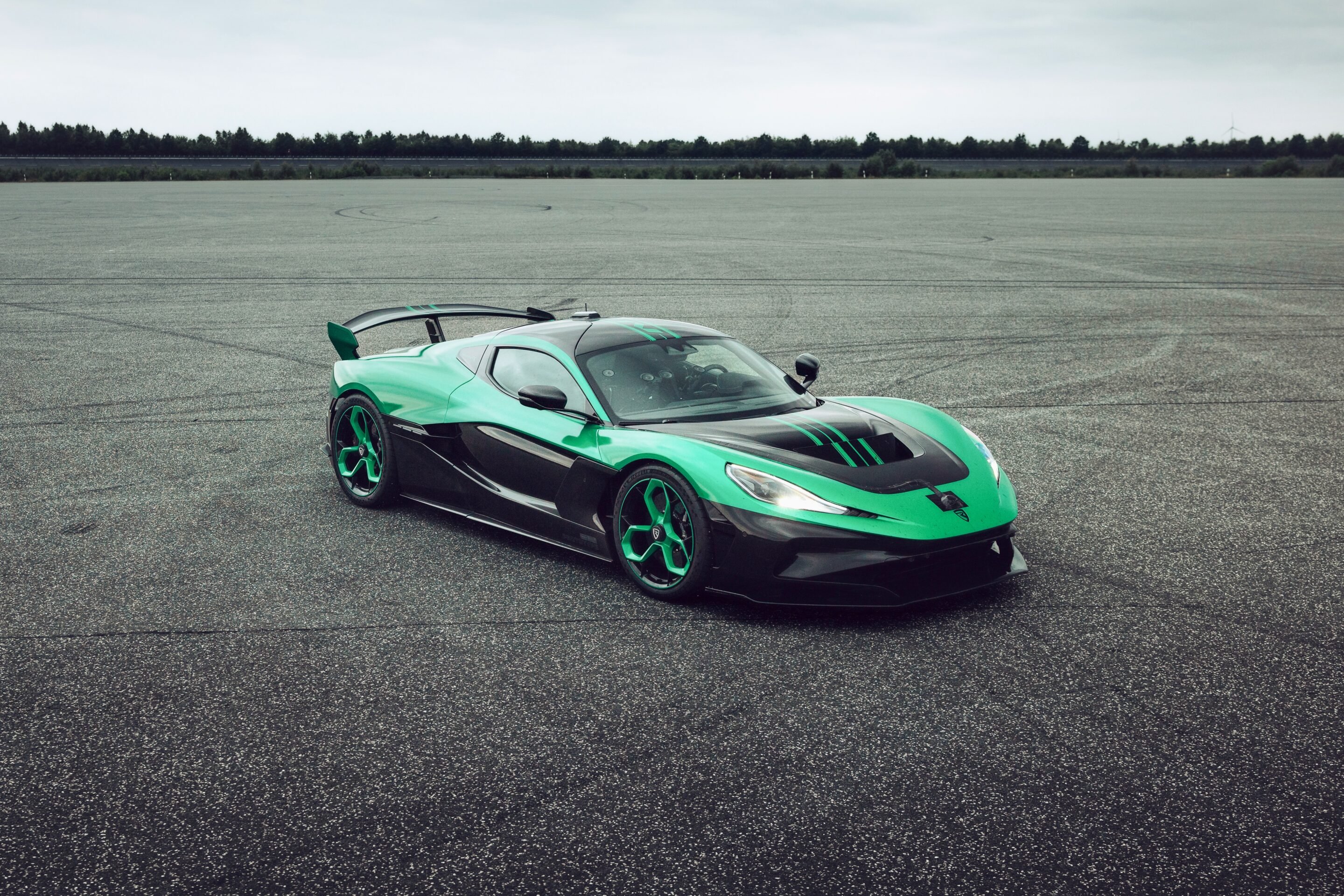
The Rimac Nevera R uses a quad-motor all-wheel drive system making 1571kW of power (or 2107 horsepower in the old money) and 2340Nm of torque. It features a 108kWh battery for a range of around 400km, and can charge at up to 500kW.
In addition to the added performance, the Rimac Nevera R’s enhancements compared to the regular Nevera include a new aerodynamic package with a fixed rear wing and enlarged diffuser for more downforce and aerodynamic improvements, new Michelin Cup 2 tyres to reduce raise grip and reduce understeer and a recalibrated all-wheel torque vectoring system.
According to Rimac, the torque vectoring system calculates and adjusts power delivery to each wheel 100 times per second, optimising traction and performance in real-time.
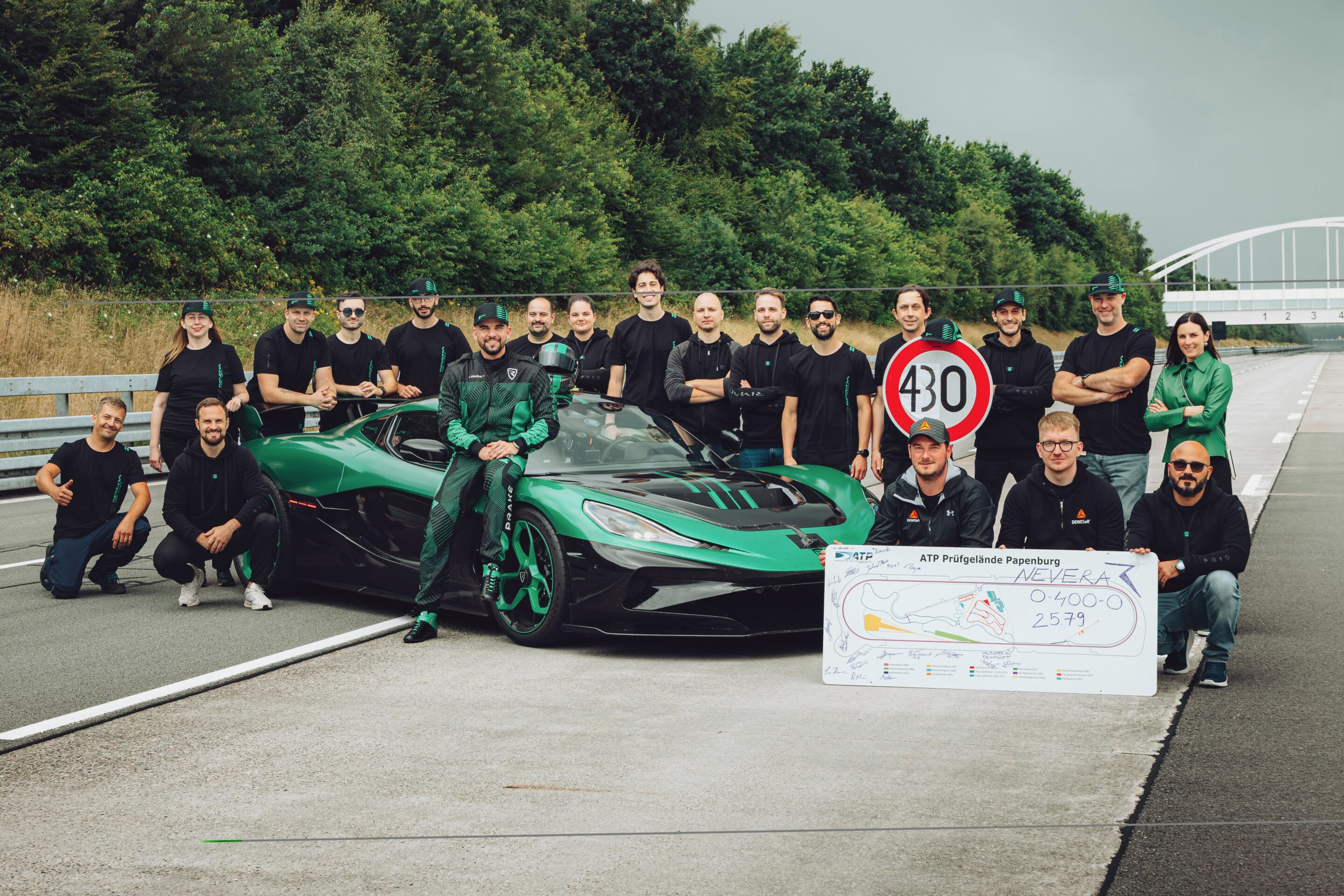
The Nevera R achieved a new 0-100 km/h time of just 1.72 seconds, compared to 1.81 seconds of the regular Nevera. At higher speeds, the improvements become even more pronounced, reaching 200 km/h in 3.95 seconds versus 4.42 seconds in Nevera, and to 300 km/h (186 mph) in just 7.89 seconds compared to the Nevera’s 9.22 seconds, while it covers the quarter mile sprint in just 7.90 seconds or 0.35s quicker.
Mate Rimac, Founder of the Rimac Group, said: “When we first introduced Nevera it almost seemed like the pinnacle of hypercar performance had been reached. In a single generation, we had created a performance jump that previously would have taken decades. But now, through relentless innovation, Nevera R goes even faster…”
Rimac is the CEO and majority shareholder of Bugatti Rimac, a joint venture between Rimac Group and Porsche.
Just 40 examples of the Rimac Nevera R are to be made and with no official sales outlet in Australia, it’s likely that none will ever reach our shores.
Following its recent teaser, the third-generation Mazda CX-5 mid-size SUV has been revealed, to launch in Australia in 2026.
Longer and wider than the previous CX-5, the new model looks more modern, while the new cabin design appears to be even higher quality than before. Surprisingly, however, there’s no hybrid drivetrain at launch, though the company has confirmed one for a future introduction.
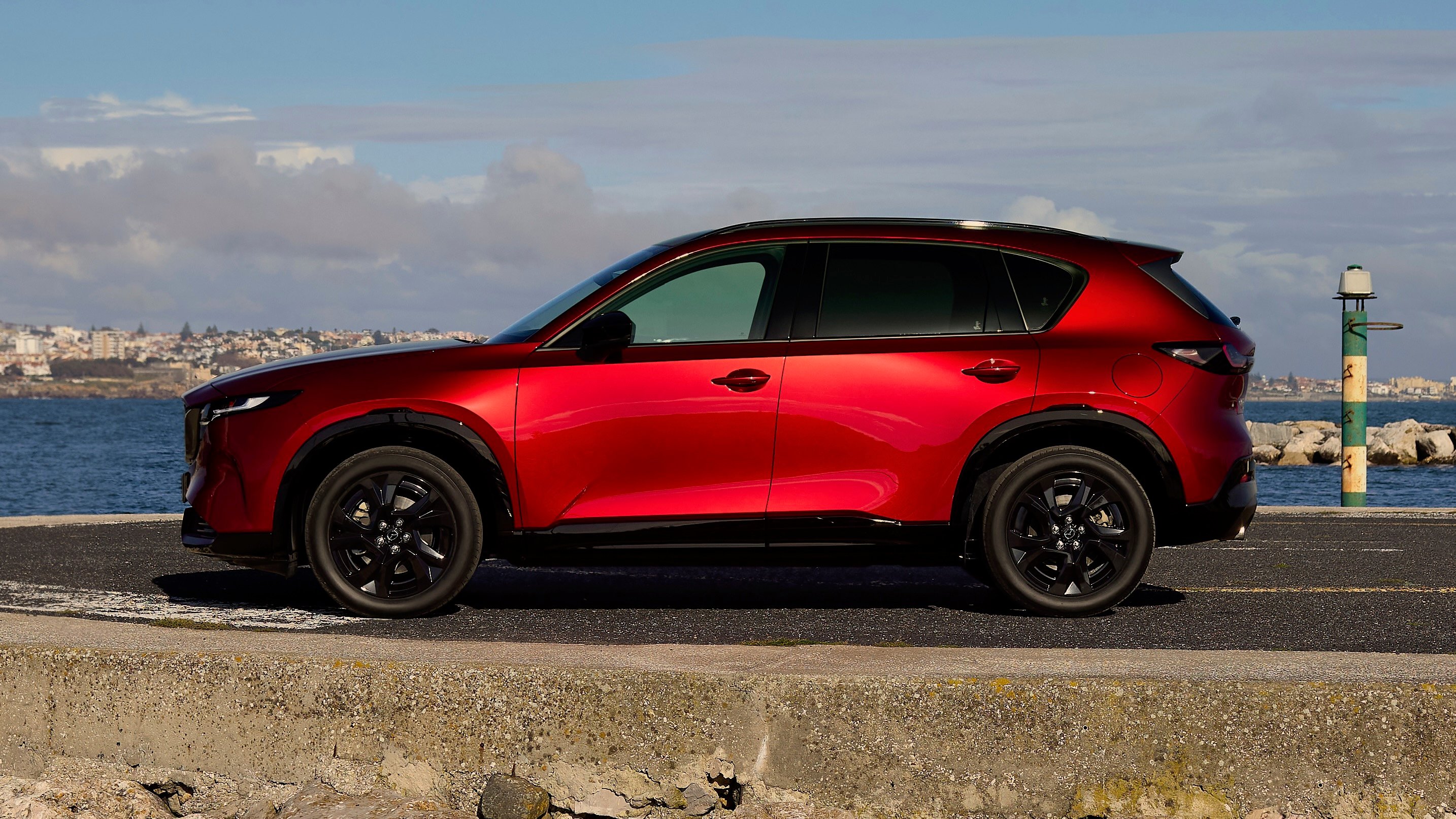
On the outside, the new Mazda CX-5 was developed around the company’s “Wearable Gear” concept, and uses the latest evolution of its ‘Kodo’ design that various Mazda products have been styled under.
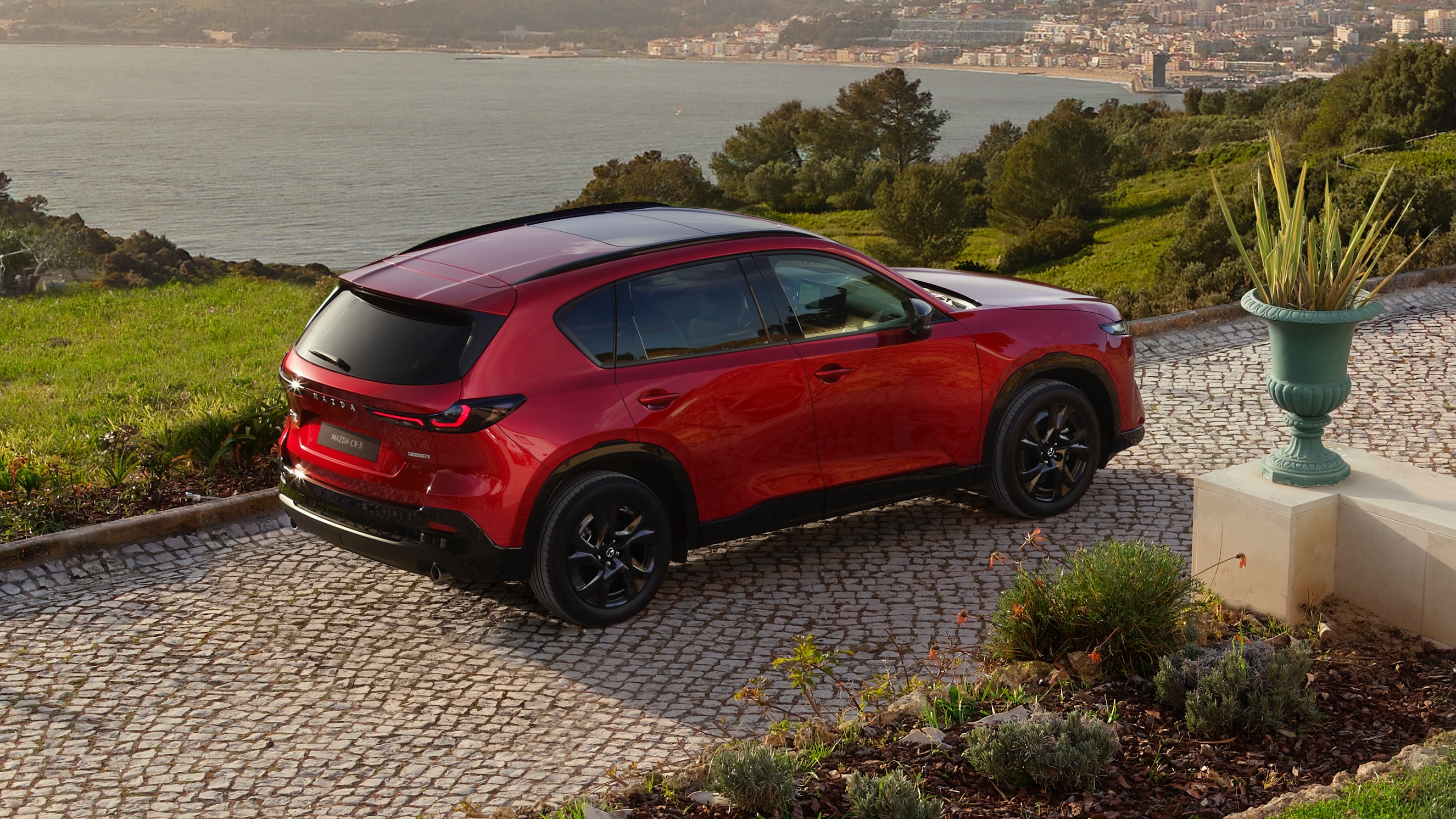
The front end is more chiselled and has a wider-set look, while the rear now features more angular lighting to tie it in better with larger Mazda products such as the CX-90. “Mazda” lettering has replaced the traditional Mazda badge at the rear as well.
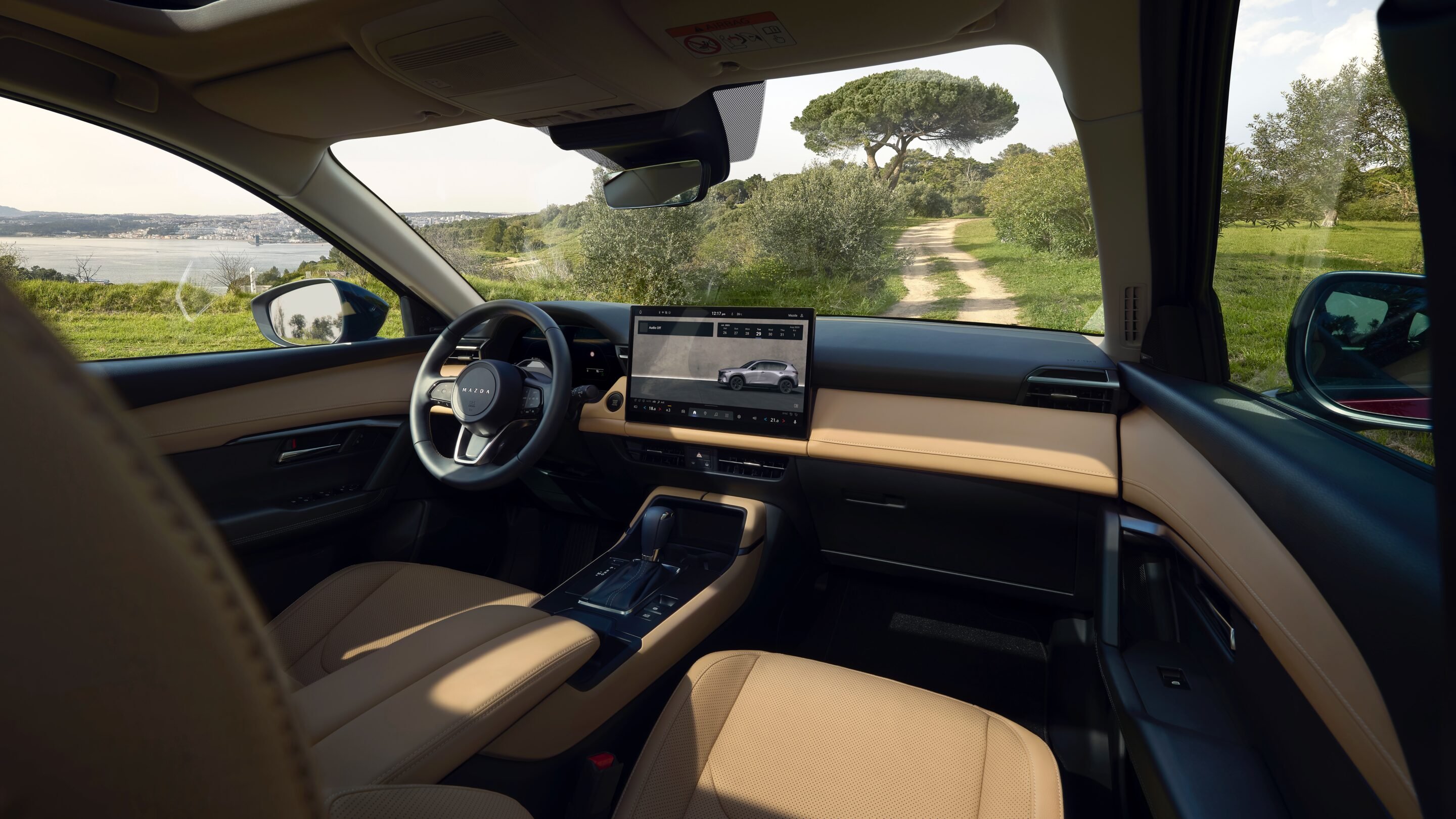
According to Mazda, the interior of the new CX-5 is more luxurious and practical than the current model. A 15.6-inch touchscreen sits in the centre of the cabin, which is the largest one ever fitted to a Mazda product. It runs new software, which appears to be powered by Android Automotive software as both Google Maps and Google Play Store integration can be seen. The Mazda Connect system and its controller wheel no longer feature.
Measuring 4690mm long, 1860mm wide, 1695mm tall and with a 2815mm long wheelbase, the new Mazda CX-5 is 115mm longer than the current model with all of that extra length going to the wheelbase. It’s 15mm wider than before as well, and while the company is yet to reveal the bootspace figures, the actual boot floor is almost 50mm longer than the current model – which should give a meaningful boost in practicality.
Thanks to the increase in wheelbase length, Mazda says that rear passengers can now stretch their legs out comfortably and the newly-available panoramic sunroof also reportedly enhances the rear seat’s space. A carry-on suitcase can now fit in the rear footwell behind the front seats too.
Under the bonnet of the Australian-spec 2026 Mazda CX-5 will be an updated version of the current model’s 2.5-litre four-cylinder petrol ‘SkyActiv-G’ engine making 132kW of power and 242Nm of torque paired with a six-speed automatic transmission and all-wheel drive as standard.
Overseas models will likely offer more powerplant options, with a mild-hybrid petrol engine featured in the European-spec model. Mazda’s new ‘SkyActiv-Z’ petrol engine will also debut in the CX-5 sometime in the future, as well as a new in-house hybrid drivetrain.
The 2026 Mazda CX-5 is due to go on sale in Australia sometime in 2026, with local pricing and specifications due to be confirmed before then.
Toyota is facing a class action in the Federal Court, as thousands of Australian Corolla owners allege the iconic small car is plagued by a defect that causes paint to peel when exposed to sunlight.
As reported by AAP, the lawsuit was filed on Wednesday and seeks compensation on behalf of customers who purchased or leased white Toyota Corollas – specifically those manufactured between July 12, 2010, and September 30, 2014 – and finished in factory colour code 040.
Lawyers from William Roberts, the firm representing the plaintiffs, argue the issue stems from a defect in the paintwork that breaches Australian Consumer Law. The suit alleges Toyota failed to disclose critical information about a flaw that makes affected vehicles more susceptible to paint delamination over time.
“Throughout the periods during which the affected vehicles were manufactured, Toyota did not disclose to the public that affected vehicles contained the paint peeling defect or … had the propensity to experience the … defect,” the firm stated.
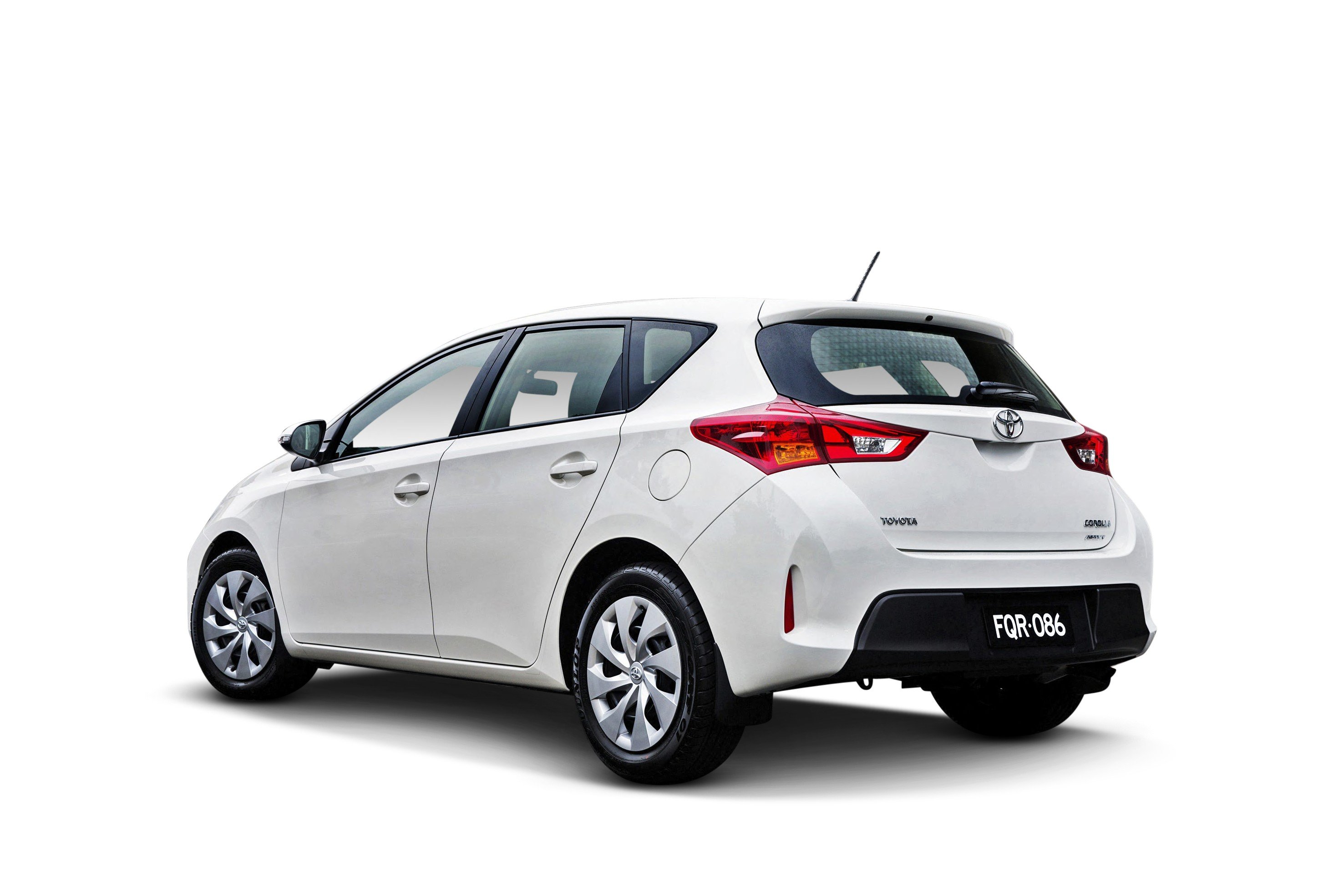
The claim rests on the consumer protection provisions of Australian Consumer Law, which require all vehicles sold from 2011 onwards to be of “acceptable quality.” If proven, Toyota could be held liable for losses incurred by thousands of owners impacted by the issue.
Toyota Australia has previously acknowledged the issue in a 2022 statement, explaining the defect could be linked to long-term UV exposure degrading the adhesion between the primer and base layers of paint. “Over time, [this exposure] degrades the adhesion between the factory-applied paint primer coat layer and the base metal electrodeposition layer, causing paint to peel from the metal body panel,” the company said.
While the company has not yet commented on the class action, a spokesperson confirmed that Toyota is aware of the filing and will respond in due course.
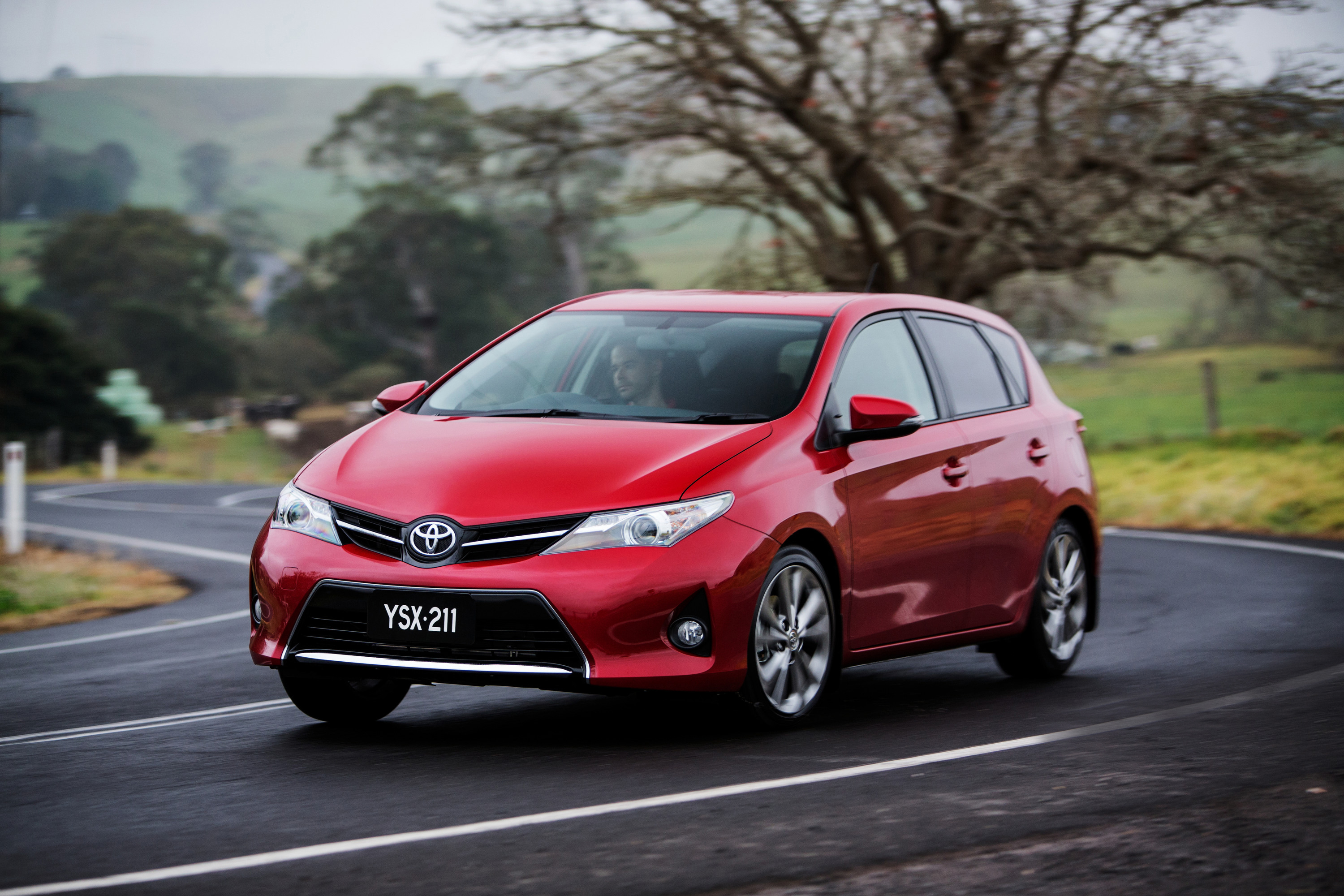
The lawsuit has struck a chord with many affected drivers. A Facebook group dedicated to the issue, which now boasts more than 7,000 members, has been flooded with posts from frustrated owners sharing images of large paint sections flaking off their cars. Many have expressed their intention to join the legal proceedings.
Under current consumer law guidelines, motorists are entitled to a free repair when a vehicle has a minor defect. Whether the court will agree that the paint issue qualifies remains to be seen.
Porsche has unveiled its new Black Edition range for the Taycan and Cayenne line-ups, combining sleek aesthetics with high-end features.
The new special-edition variants made their global debut at the Goodwood Festival of Speed in the UK (July 10–13) and are now available to order in Australia, with first deliveries expected later this year.
The Taycan Black Edition, available in sports sedan form, and the Cayenne Black Edition, offered as either a classic SUV or a coupé, feature distinctive black styling elements paired with generous standard specifications.

While the name hints at a dark theme, customers can choose from a wide palette of exterior colours –including Jet Black Metallic, Ice Grey Metallic and Carrara White – at no extra cost.
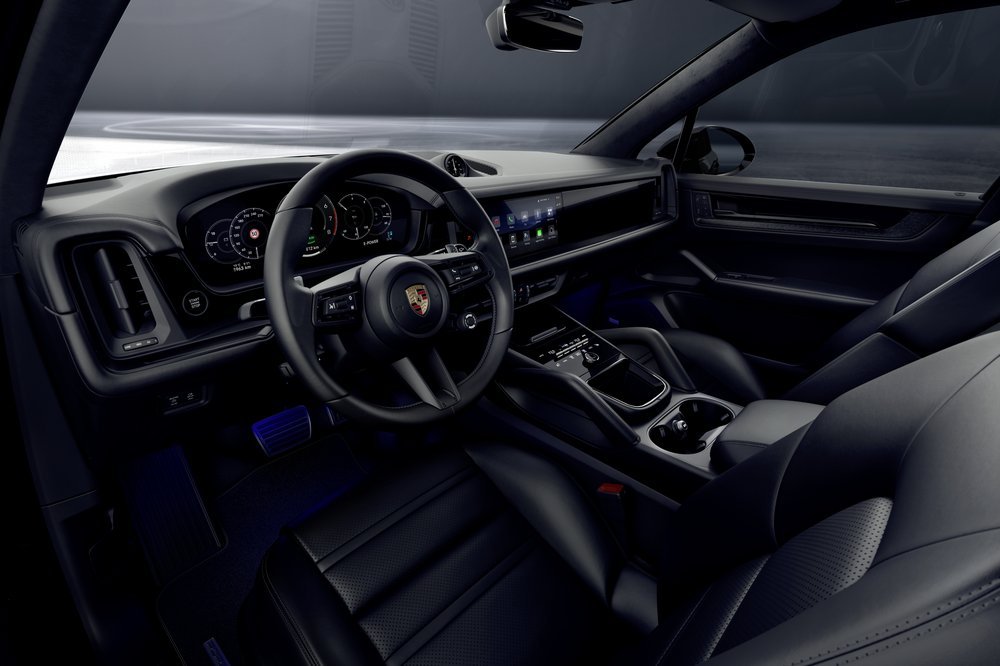
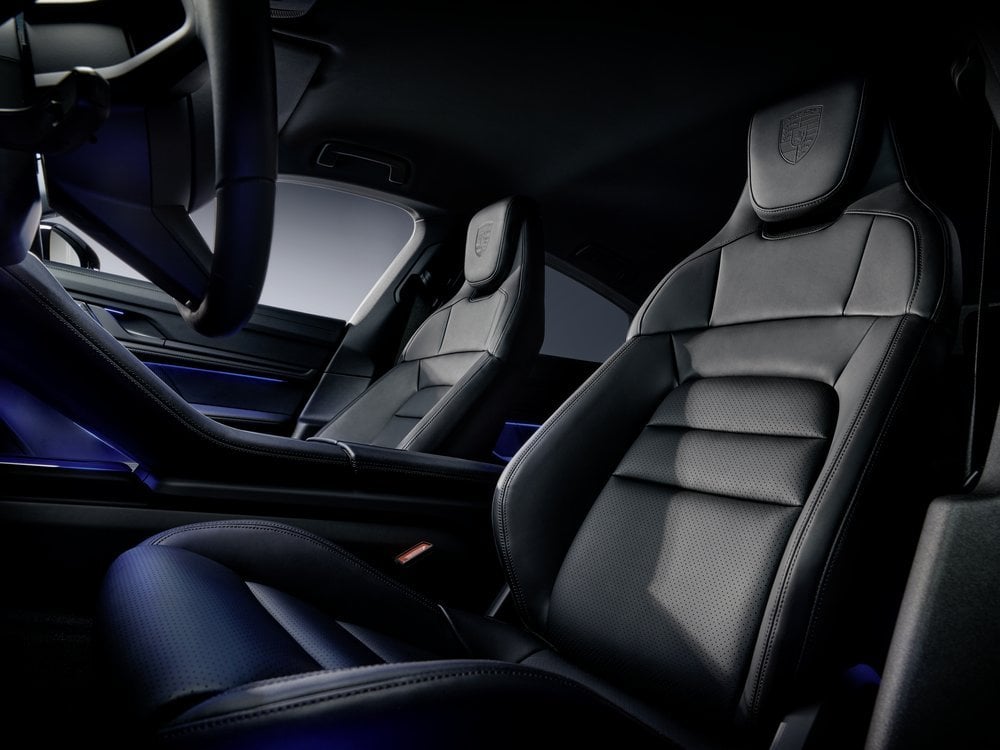
The Taycan Black Edition features gloss-black Sport Design elements, window trims, mirrors, and rear badging, complemented by a black light strip with an illuminated Porsche logo. Inside, customers will find black brushed-aluminium door sills, ambient lighting, and a unique Black Edition badge on the centre console.
Meanwhile, the Cayenne Black Edition carries similar exterior cues, including gloss-black highlights and model designations, HD Matrix LED headlights with a subtle tint, and 21-inch wheels with coloured Porsche crest centre caps. Inside, brushed black aluminium trim adds a premium feel.
Taycan Black Edition models come with the larger 105 kWh Performance Battery Plus as standard, offering increased range and enhanced driving dynamics. In the base variant, power peaks at 408 PS (300 kW), delivering improved electric performance across the board.
Australian Taycan models also receive added equipment such as Sport Chrono, Comfort Access, rear side airbags, parking assist features, and adaptive cruise systems. The Taycan 4S Black Edition gains four-zone climate control and soft-close doors.
Cayenne Black Editions come with added tech including InnoDrive with adaptive cruise control, a head-up display, digital radio, and front seat ventilation for hybrid variants. Petrol-powered models receive a collapsible spare tyre, while E-Hybrids include a tyre-sealing compound.
Porsche offers an extended Black Edition package featuring ‘Black Edition’ lettering on the doors, illuminated sill plates, and a coordinated key case. Customers can personalise their vehicles even further through Porsche Exclusive Manufaktur’s Sonderwunsch program, which allows detailed customisation of elements like key fobs, floor mats, and storage lids.
Australian Pricing
| Cayenne Black Edition | from $156,800 |
|---|---|
| Cayenne E-Hybrid Black Edition | $175,800 |
| Cayenne S E-Hybrid Black Edition | $195,500 |
| Cayenne S E-Hybrid Coupe Black Edition | $162,500 |
| Cayenne E-Hybrid Coupe Black Edition | $180,500 |
| Cayenne S E-Hybrid Coupe Black Edition | $197,600 |
| Taycan Black Edition | $203,300 |
| Taycan 4 Black Edition | $213,300 |
| Taycan 4S Black Edition | $229,700 |
With a mix of standout styling, advanced technology, and comprehensive standard features, Porsche’s Black Edition models offer a bold new entry point into the brand’s electrified and luxury SUV line-ups.
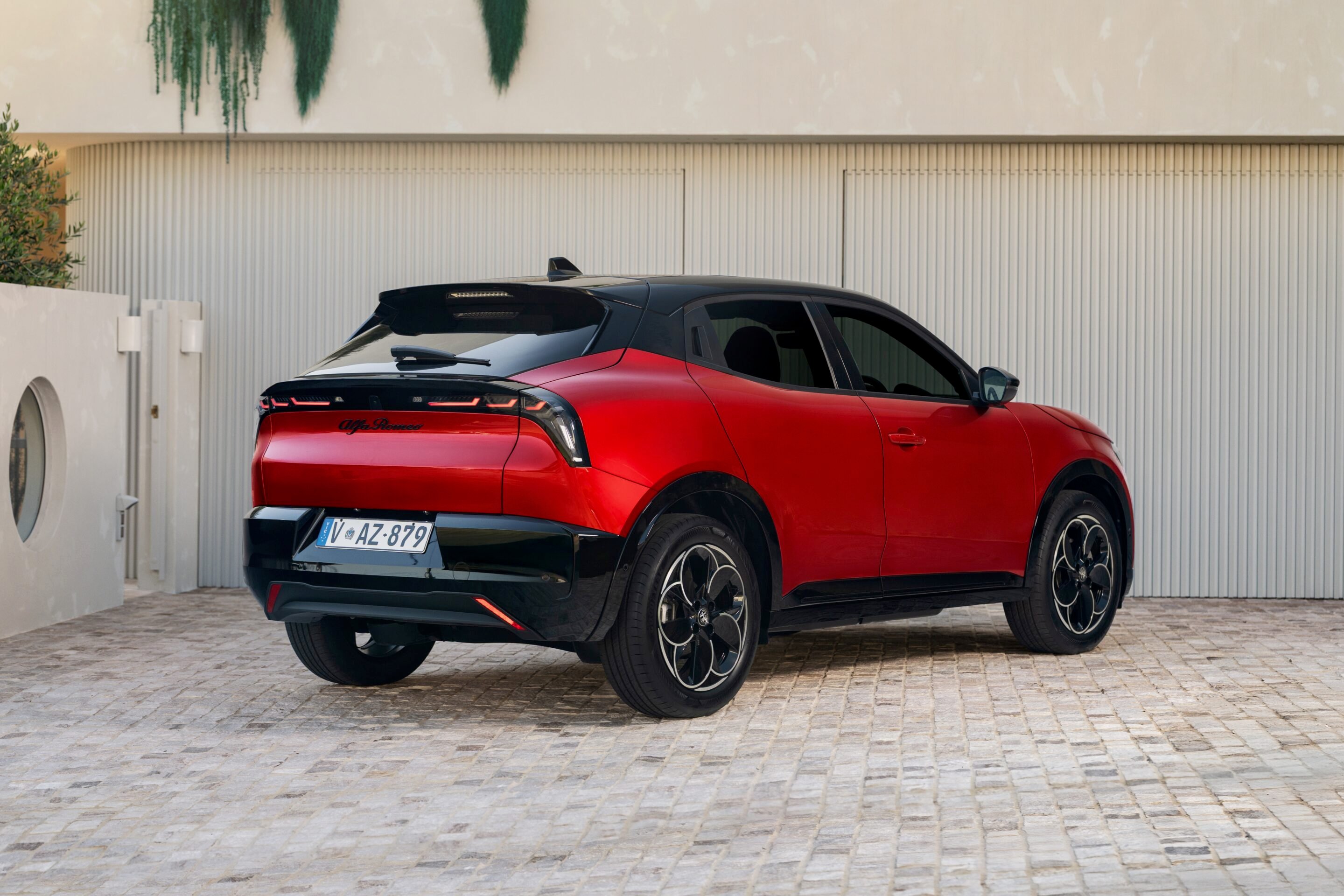
The Alfa Romeo Junior small SUV has launched in Australia priced from $45,900 plus on-road costs.
The Junior is available with either a 48-volt hybrid or fully-electric – Alfa’s first – drivetrain and a comprehensive list of standard features across the range.
The Alfa Romeo Junior Ibrida (hybrid in Italian) uses a 1.2-litre turbocharged three-cylinder 48-volt hybrid drivetrain, which incorporates a 21kW electric motor into its six-speed dual-clutch gearbox. Making a total of 107kW of power and 230Nm of torque, the Junior Ibrida hits 100km/h in 8.9 seconds and a top speed of 206km/h. On the combined fuel consumption cycle, it’s rated at 4.1L/100km.
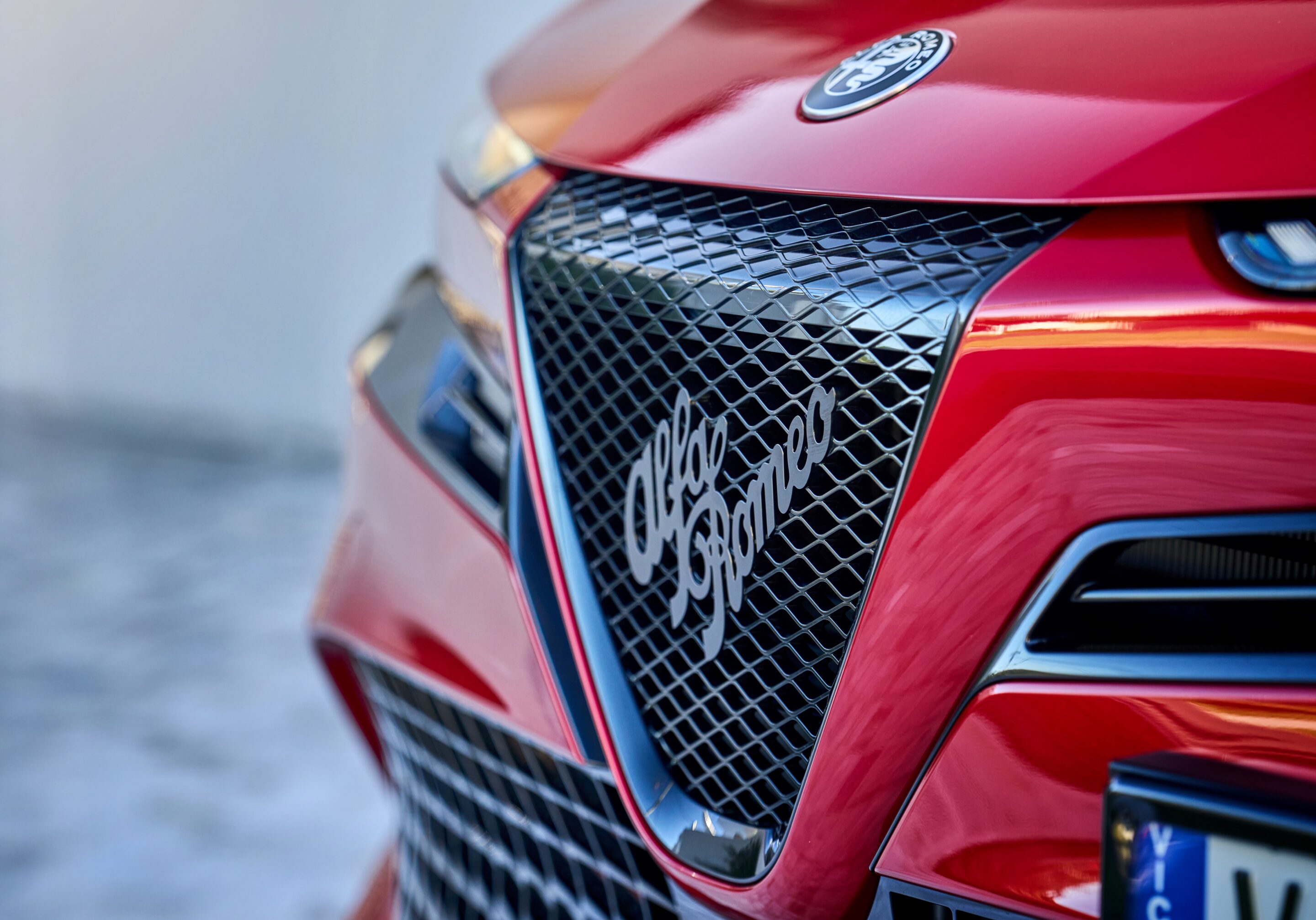
For those wanting an EV, the Junior Elettrica (electric in Italian) uses a 115kW/260Nm front-mounted electric motor that draws power from a 54kWh battery. It hits 100km/h in 9.0 seconds, and the company quotes a 407km range on the WLTP cycle.
The Junior Elettrica can be charged at up to 100kW on a DC charger, or 11kW on an AC charger, allowing for a 10 to 80 per cent charge in as little as 30 minutes.
Measuring 4170mm long, 1780mm wide, 1500mm tall and riding on a 2562mm long wheelbase, the Alfa Romeo Junior is 360mm shorter than its Tonale larger sibling and 63mm shorter than the Volvo EX30. Its 400-litre boot is 82L larger than the Volvo’s, however.
Alfa Romeo Junior pricing (plus on-road costs):
| Ibrida Hybrid | $45,900 |
|---|---|
| Elettrica Electric | $57,900 |
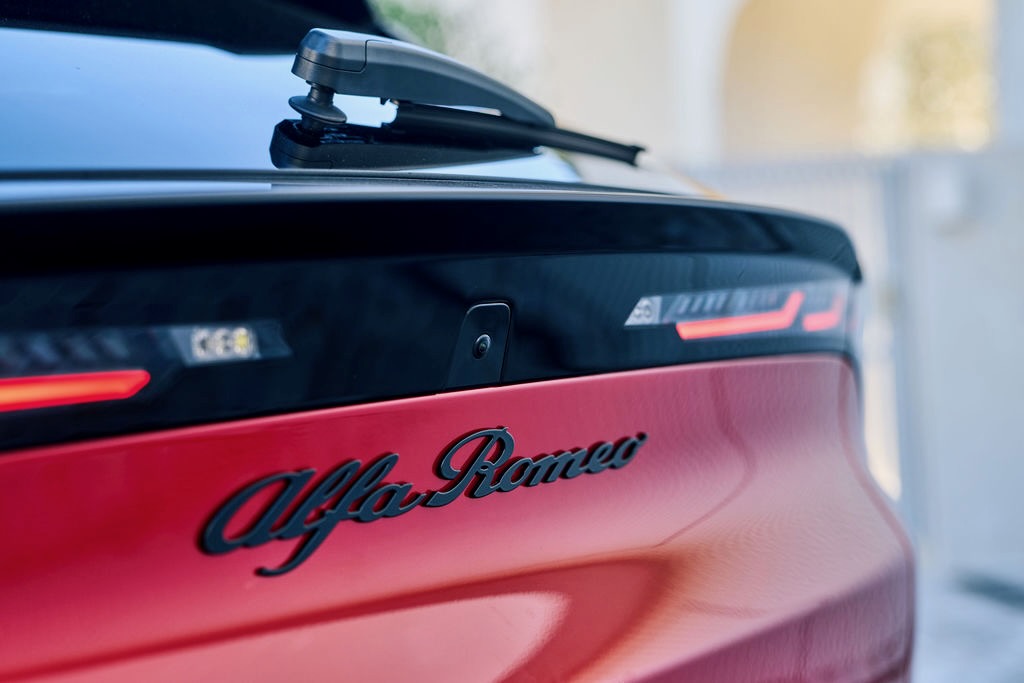
Alfa Romeo Junior standard features:
- 18-inch alloy wheels
- Automatic LED exterior lighting
- Automatic rain-sensing wipers
- Two-tone black roof
- Rear privacy glass
- Keyless entry and start
- Hands-free electric tailgate
- Leather steering wheel
- Cloth and leatherette upholstery
- 6-way electric driver’s seat with massaging
- Heated front seats
- 10.25-inch touchscreen with live services
- Navigation with live traffic
- Wireless Apple CarPlay and Android Auto
- DAB+ digital radio
- Six-speaker sound system
- Front and rear USB charging ports
- Wireless phone charger
- Single-zone automatic climate control
- 6x airbags
- Autonomous emergency braking (AEB) with pedestrian and cyclist detection
- Adaptive cruise control
- Level 2 autonomous driving capability
- Blind-spot monitoring
- Lane keeping assistance
- Traffic sign recognition with intelligent speed control
- Driver attention monitoring
- Matrix adaptive high beam
- Front, side and rear parking sensors
- Reversing camera
- Tyre pressure monitoring
- Automatic parking
Ibrida-specific features:
- Paddle shifters
- Dual tailpipes
Elettrica-specific features:
- Mode 3 charging cable
- 11kW AC onboard charger
Junior options:
- Sunroof: $1990
- Metallic paint (including a black roof): $1990
The Alfa Romeo Junior is now on sale in Australia with the first local deliveries due to commence soon.
