
Holden may have instructed its Australian dealerships to ban discounting the remaining V8-engined Commodore models, but the story is very different for Chevrolet in the US.
Order books closed for the Chevrolet SS last month, but it seems Stateside dealerships can’t quite shift the remaining stock of the 6.2-litre V8-engined sedan.
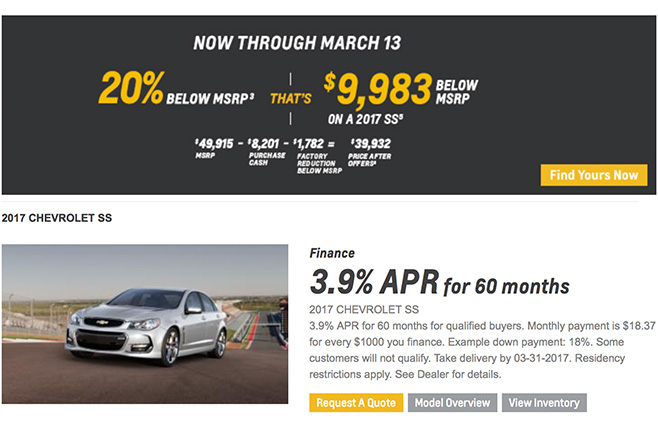
The same offers apply to the Chevrolet Impala, the Yank-born VF-sized front-wheel drive sedan that starts from US $32,200 (AU $42,554) once the 20 per cent discount is applied. The brand’s other sports cars, however, are not sliced to the same degree throughout March – the Chevrolet Camaro is discounted by US $4000 and the Corvette by US $2500.
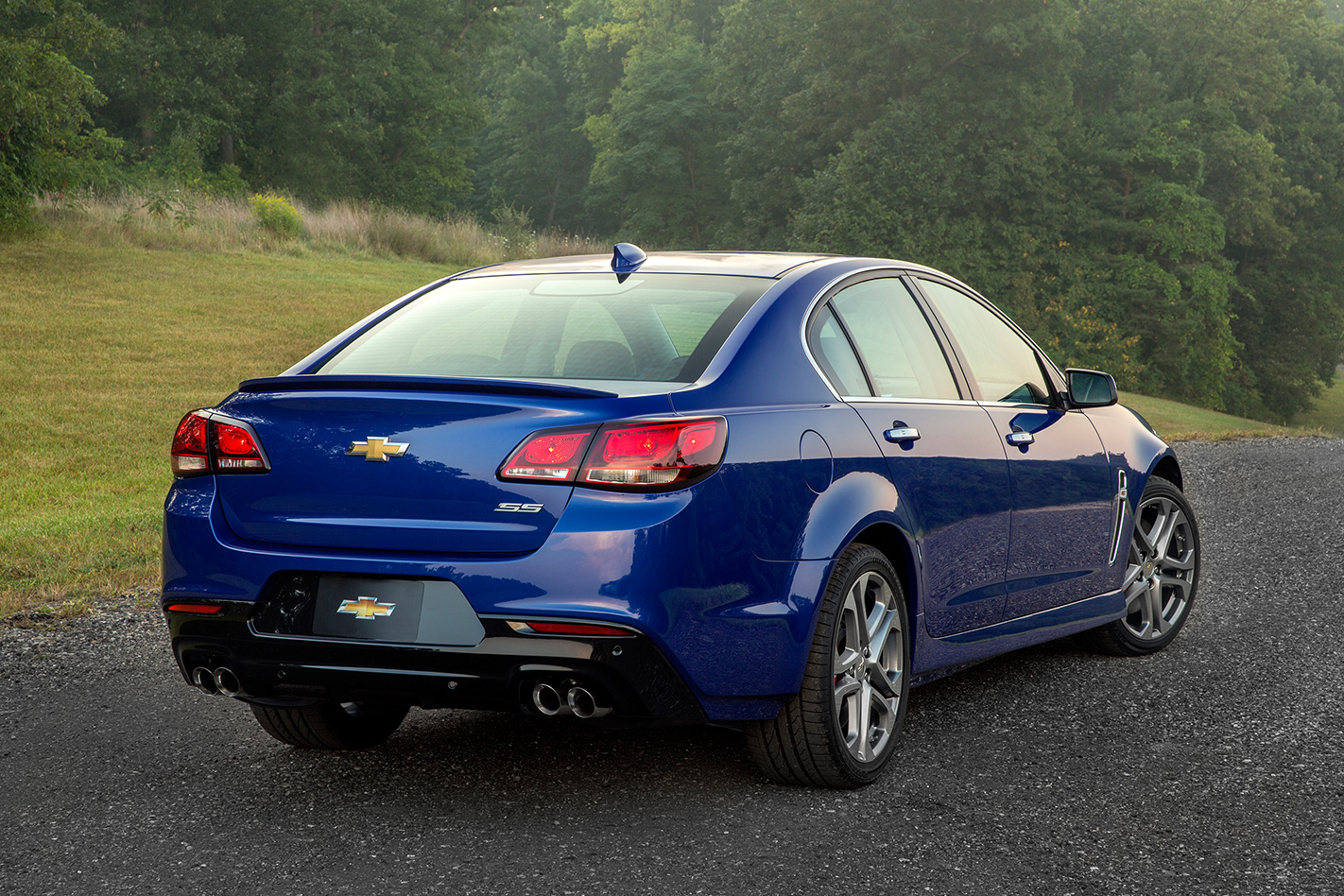
It rare status continues even in runout, with only a few final examples remaining in dealers. According to GM inventory numbers, there are just six SS models left in California.
Its price reduction positions the broad-shouldered Aussie below that of a turbo four-cylinder BMW 330i M Sport, which asks US $44,445 (AU $58,737) when buying over the Pacific. In Australia, it’s $54,990 SS V Redline versus $69,900 330i – although the Holden is substantially better equipped than local versions, while the BMW is almost stripped bare.
THE Mercedes-Benz E-Class Coupe will launch in Australia with a three-model line-up priced from $96,000 when it launches here in June.
The BMW 6 Series and Audi A7-fighting range will land here with the Mercedes-Benz E220d coupe as the entry-level model, which uses a 143kW/400Nm 2.0-litre four-cylinder diesel engine paired with a nine-speed automatic transmission, up two gears on the model it replaces.
Although it is about $14,000 more than the previous entry-level petrol-engined two-door E-Class’s starting price, the diesel is almost as powerful as the $2000 more expensive 2.1-litre diesel used under the bonnet of the previous-generation E-Class E250d.
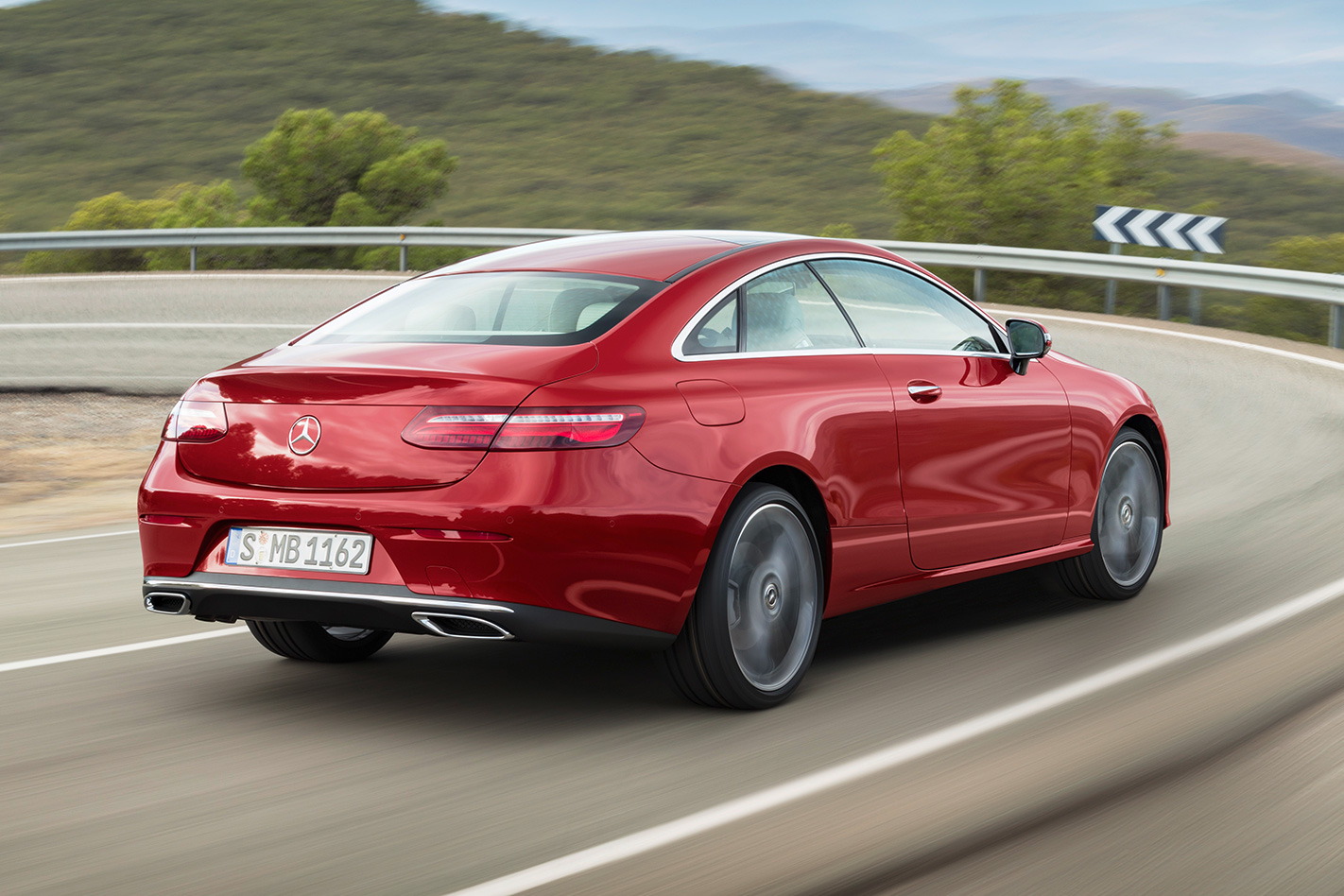
For the money, buyers get what Mercedes-Benz calls “a four-seater Gran Turismo with with state-of-the-art technology”.
That includes Mercedes-Benz’s Driver Assistance safety package including active cruise control and a lane-keeping assistant, an infotainment system compatible with either Android Auto or Apple CarPlay, a parking system that can recognise empty spaces and steer the E-Class Coupe in, and keyless entry and push-button engine starting.
Standard equipment on the E220d Coupe includes an AMG body kit, 19-inch alloy wheels, and leather seats.
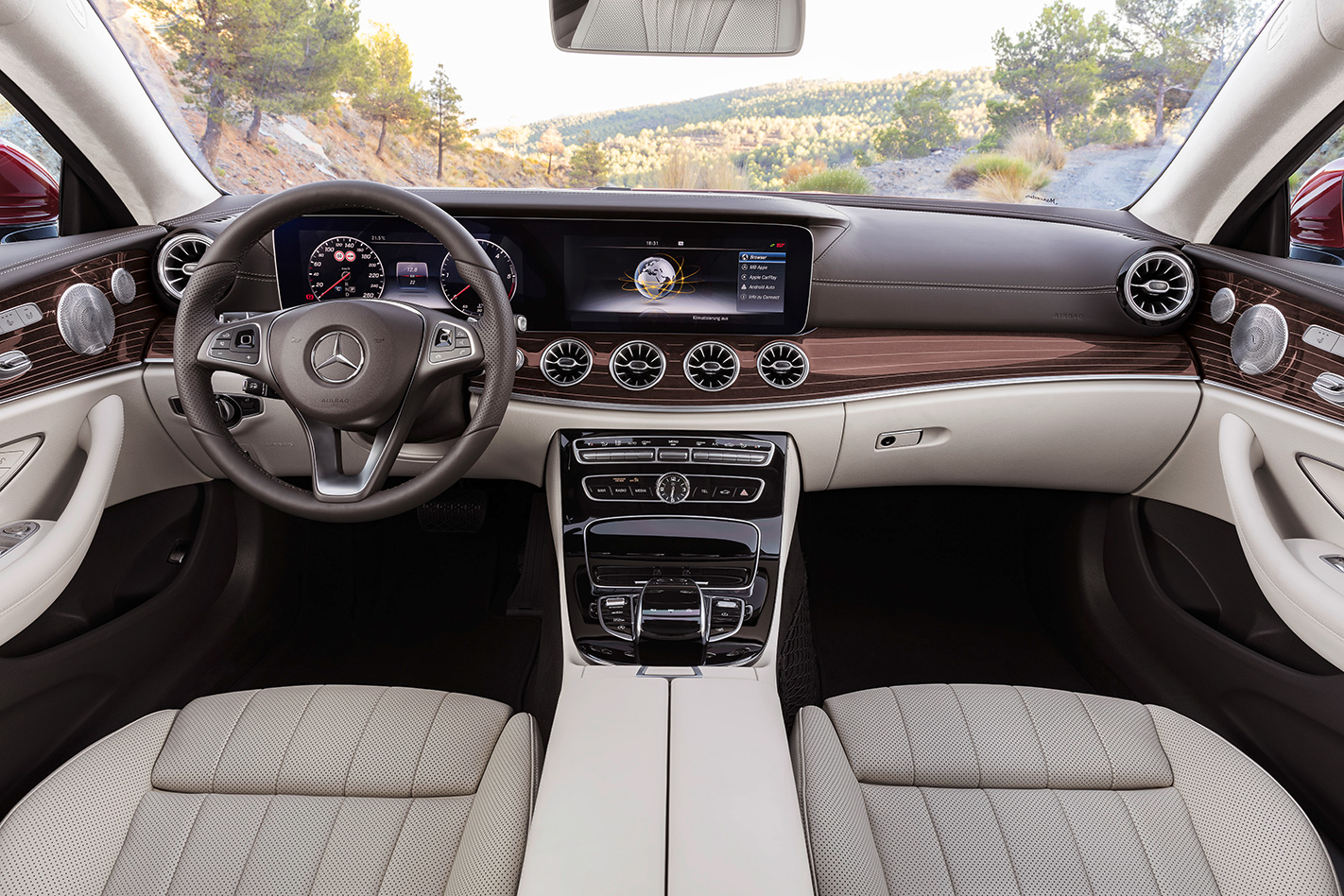
The entry-level petrol model will be the $110,900 E300 Coupe. It uses a turbocharged 2.0-litre four-cylinder engine producing 180kW/370Nm, also fitted to the nine-speed auto. Its equipment list runs to AMG-branded 20-inch alloy wheels, a sports exhaust, air suspension, heated front seats and headlights featuring 84 individually controllable LEDs.
The range-topping model for the meantime will be the Mercedes-Benz E400 4MATIC Coupe, priced from $145,900. It is fitted with a twin-turbo 3.0-litre V6 that makes 245kW/480Nm, with the nine-speed automatic feeding drive to all four wheels.
It also gains a 13-speaker, 590-watt Burmester surround sound system, a head-up display, panoramic sunroof, metallic paint and privacy glass.
As part of the global launch of the E-Class Coupe, Mercedes-Benz is offering a limited-run launch edition, called the “Edition 1”.
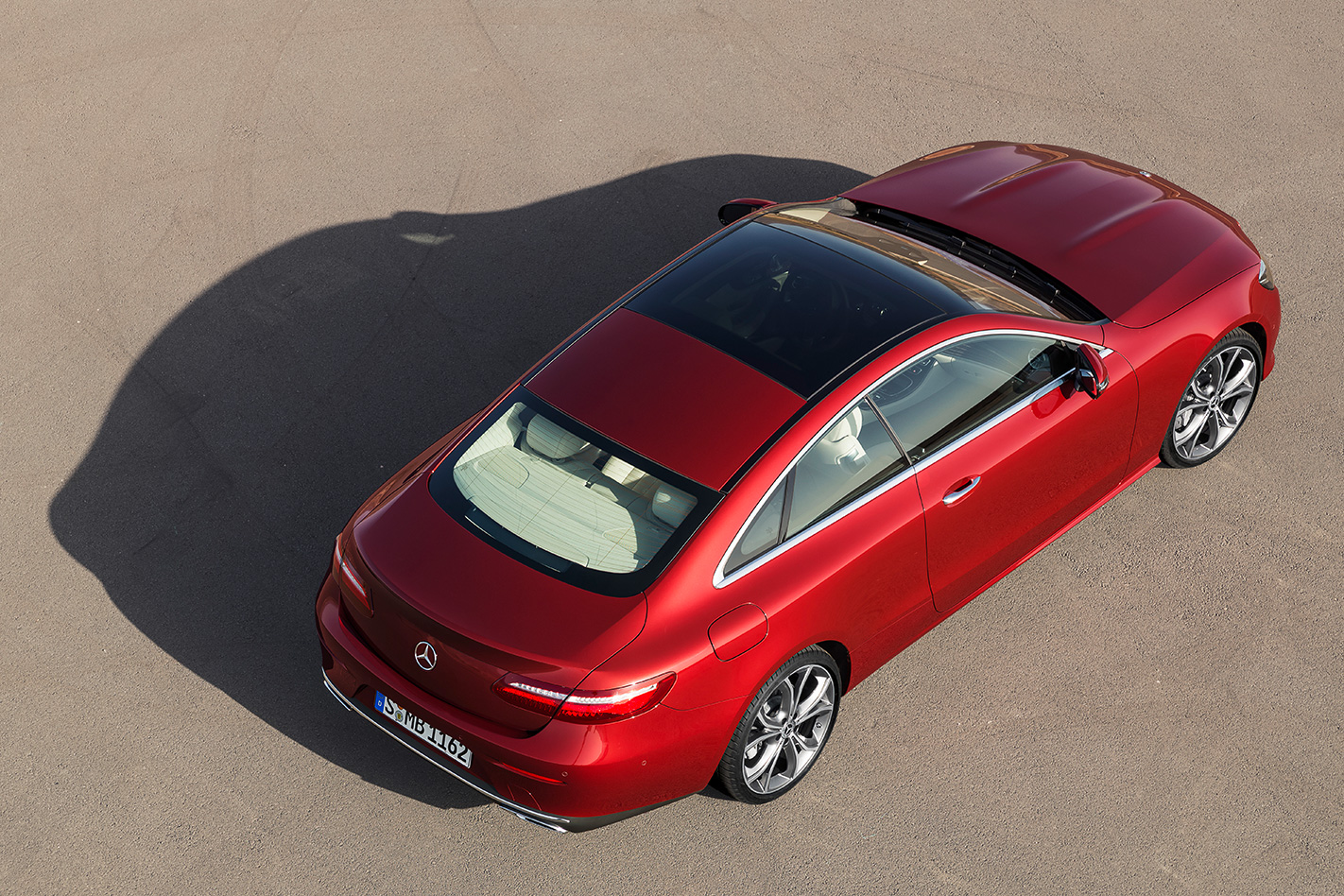
It will cost an extra $5900 on the E300 and $2420 on the E400 4Matic, but adds two-tone nappa upholstery and nappa/microfibre-wrapped sports steering wheel, a fragrance dispenser, designo cashmere white magno paintwork, bi-colour AMG-branded 20-inch alloys, and black exterior highlights.
The Edition 1 is limited to 555 cars worldwide; Mercedes-Benz Australia says it is “securing an allocation” of these cars for its customers.
MERCEDES-BENZ E-CLASS COUPE PRICING E220d Coupe $96,000 E300 Coupe $110,900 E400 4Matic Coupe $145,900
FROM feeble to fierce. Thatu2019s no mean feat for a car whose immediate predecessor was based on u2013 and ultimately limited by u2013 Ford Mondeo underpinnings, but the Jaguar XE has certainly wowed us since launching last August.Initial experiences flagged something unexpectedly special lurking in England’s woefully overdue response to the 3 Series, despite the overly familiar if undeniably handsome design (thematically too similar to the original XF of 2007), patchy dashboard presentation and four-cylinder petrol engines borrowed from Ford.
Our hunch was realised when the XE joined the Mazda MX-5 and Audi Q7 on the 2016 COTY podium, and further reinforced when a 25t beat a BMW 328i, Audi A4 2.0 TFSI quattro, Lexus IS200t and Mercedes C250 Sport in a comparison earlier this year.
Much of what makes the smallest Jag special is the engineering. Enzo Ferrari once said that people paid for the engine and the rest came for free. While not the case here, a brief overview reveals compelling chassis engineering.
Clearly the Brits have come prepared to fight established German and Japanese rivals.
However, the XE isn’t just about the handling. While clearly focused dynamically, it’s also comfortable, thus forging a link to the famously supple-riding XJs of the 1970s. And that’s without the adaptive damper tech others need to do similar.
Obviously we need to understand how all that translates into living with the car. But we also want to know if the design and dash deserve our criticism, and if reliability and build quality hold up over time.
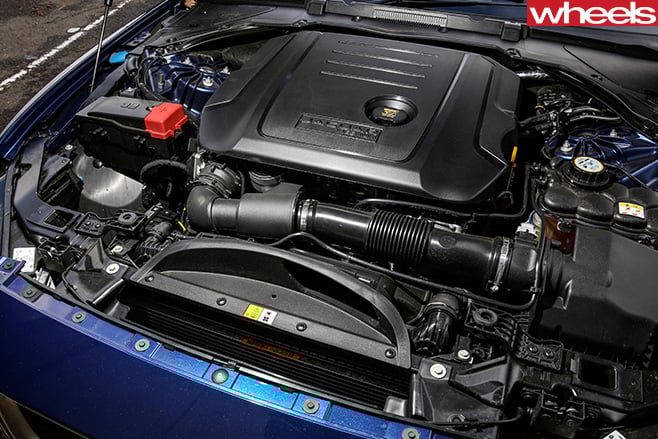
Initially, we requested and received the popular R-Sport 25t with the 177kW/340Nm Ford turbo-petrol, starting from $68,900. But as this engine is about to be usurped by an all-new Jaguar unit, the switch was kindly made for the hot-off-the-press (and identically priced) 132kW/430Nm 20d Ingenium four-pot turbo-diesel. Not only can the innocuous-sounding 20d manage a 7.8sec dash to 100km/h, it’s rated at a startling 4.2L/100km, though our green example returned (a still very credible) 6.3L/100km in the first month.
Finished in a beautiful Blue Fire hue, DCY-85W blows the options list out by $11,500 to a considerable $80,400, thanks to a sliding panoramic sunroof, black 19-inch alloys, head-up display and digital radio (appealing options all, at around $1800 a pop, except for the DAB at $540), as well as not-so-essentials such as self-parking ($1600), a powered bootlid ($850), illuminated sills ($770), configurable ambient cabin lighting ($540) and leather upholstery ($2160) instead of the standard R-Sport ‘Luxtec’ vinyl/mesh seat covering.
So our XE arrives with the prospect of being one of the best Jaguars ever. Let’s see what living with this feline is really like.
Petrol alternative
Far from disgraced, the Mondeo-hearted XE 25t petrol with 177kW is a likeably lusty yet sweet performer, and will take some beating when the Ingenium unit takes over next year. Pairing especially well to the eight-speed auto, it melds decent acceleration response with exceptional refinement, particularly at higher revs, backed up by reasonable fuel consumption (averaging 9.5L/100km), sweet handling and a cosseting ride on 18-inch alloys. Little wonder Jaguar pegged this combo as the range bestseller.
The ex-type
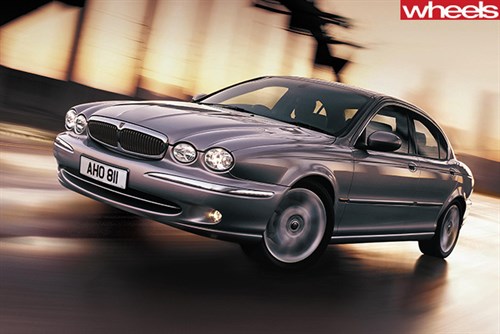
When Ford owned Jaguar, it hoped to crash the BMW 3 Series party with the 2001 X-Type, but miscalculated badly. Looking inside and out like an old-school XJ that had shrunk in the wash, it was dynamically inferior to the athletic (and roomier) Mk2 Mondeo lurking underneath, due to lifeless steering and breathless V6 engines. The base 2.1-litre model was front-drive, the rest AWD. Diesels arrived here from 2008, but Australia missed out on the wagon altogether. Sales stumbled on until 2010.
Update #2
REX or XE? Albury is 260km as the crow flies from Melbourne CBD, or about an hour with our largest regional airliner. The driving distance, though, is 326km, which should take around three and a half hours with one quick pitstop. Logic, therefore, suggests that making like a bird is better.
We’re willing to argue that choosing to fly Jaguar XEpress is best, though. Admittedly, it was my organisational dyslexia that dictated this, but the opportunity to assess the British-built BMW 3 Series-slayer (see Wheels April 2016) in a role it should sashay through proved irresistible. Road trip!
After the usual racket of a cold diesel engine in warm-up, the 2.0d quietens to a distant hum as it thrusts forward with effortless ease, while soaking up the rotten northern-suburban backstreet geography with impunity. Stealthy competence describes both the Jaguar XE’s torquey performance and lush ride quality – and on 19s without adaptive dampers no less.
Into the 110km/h zone, cruise control set at an indicated 116km/h to allow for the margin shortfall according to a free GPS-based speedo app, and everything’s progressing beautifully. This is a truly relaxing environment. Cocooned in the supportive driver’s seat and noticing the lack of wind and road rumble (except on the coarsest bits of bitumen) only enhances the experience. Barely bothering 2000rpm, the Jaguar lopes along.
However, about halfway up the Hume Freeway our XE’s very Ford Sync 2-esque touchscreen multimedia system (though we’re assured they’re totally unrelated)
simply stops streaming music from my smartphone, requiring a USB cable to restore the tunes. This happens again on the way back, but not since. Mark that up as the second fail after the loose boot-sited rear-seat backrest release lever coming loose, as reported last month.
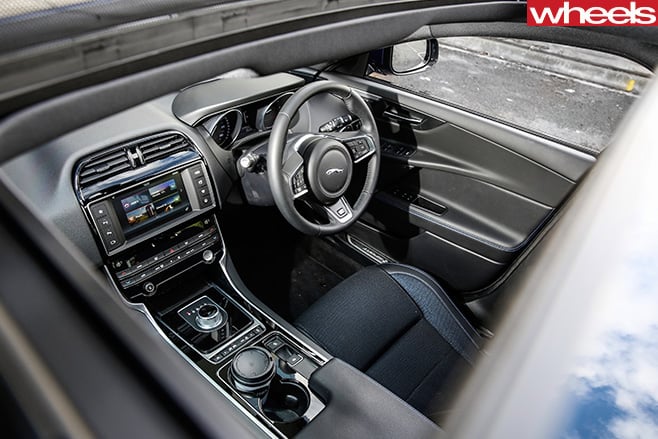
Here’s another irritation. While I’m starting to appreciate the finer details of the interior presentation, such as the racy low driving position, gorgeous steering wheel and stylish upper-fascia layering that integrates dashboard with door cards, the power window switches seem to be located outside your peripheral vision. I inevitably prod the electric door locks instead every single time.
Two months in, these are both minor hiccups in an otherwise commanding grand tourer. The Albury run was completed ahead of schedule, and reversing the journey a few hours later similarly resulted in no aches, pains or fatigue. Just a repeat of the outstanding sub-5L/100km average instant consumption readout.
So we finished well ahead of schedule, with no parking or having to wait at the airport. Travelling MEL to ABX by XE is AOK.
Update #3
THE big city. Is it any place for a loping Jaguar more naturally predisposed to prowling freeways and open highways?
This month there were no long runs to once again stretch our XE 20d’s legs (and fuel mileage), but instead a period of forced captivity within a 10km boundary of the CBD. Short trips only.
Home is within an inner-suburban labyrinth of cobblestone alleyways and sardine-tight backstreets, festooned with speed humps and potholes. Some are more like sinkholes. Great for short-cuts, these rat-runs are nowadays crucial in avoiding the many traffic snarls Melbourne’s long-promised Metro Tunnel and level-crossing removal programs have delivered. It’s commuter warfare out there. So is the Jag a catfish out of water, or is it merely water off the current segment dux’s back?
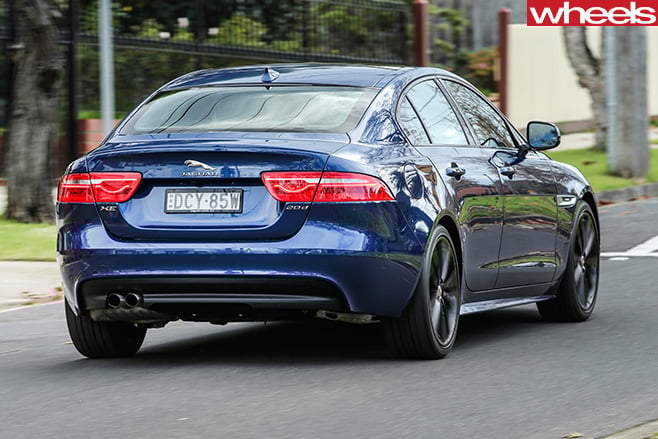
Sport kills the otherwise prompt idle-stop, but back in Drive we’re grateful for it since it brings some tranquillity in long queues. Not that the engine is noisy.
Furthermore, the XE’s alert steering expertly balances feedback and effort, the brakes are scalpel-sharp, and a taut chassis possesses an astounding ability to iron out the bumps – a feat highlighted by a visiting Mercedes C300 Coupe’s inability to match it despite being on similar rubber.
The ride is crucial in understanding why our R-Sport has clawed its way so high in our estimation. Every XE we’ve driven offers a suppleness that original XJ6 owners might recognise, infused with an athleticism drivers of previous Jaguar sedans wouldn’t. Though the suspension is hardly ground-breaking – double wishbones up front and an integral link at the back – the way the chassis gels is a work of genius.
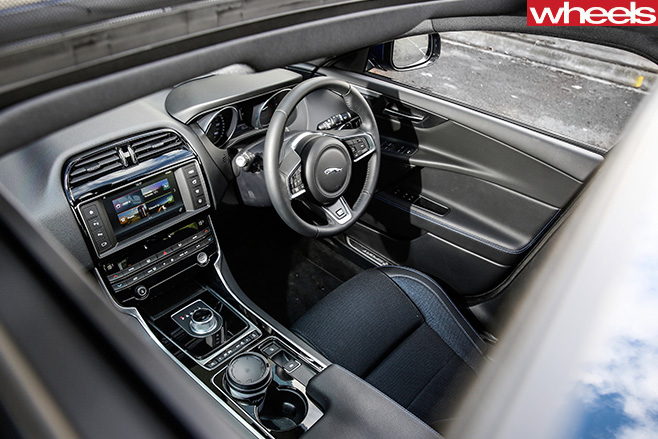
but weeks filled with many boring short trips just could not dull the XE’s lustre.
Completely unfazed by what the inner city can throw at it, there’s plenty of alley-cat guile in this multi-faceted Jag.
Ghost in this machine
British cars have a reputation for dodgy electrics, and having experience with Austin, Morris and Rover to draw on I’m constantly expecting something to stop working… or start of its own accord. This month, the XE finally showed its true heritage by doing just that. Inexplicably, one evening while driving, the sunroof whirred open. It was pretty creepy and a tad inconvenient, being winter and all, but luckily no rain got in. And it has never happened again since. Spooky.
Update #4
Is the Jaguar XE’s rear seat really too tight for two adults, as some critics claim?
The opportunity to find out presented itself recently after loading my Jaguar XE R-Sport 2.0d with three well-nourished mates (all firemen, as it happens) for a 90-minute drive from Melbourne to Airey’s Inlet on the famous Great Ocean Road. Only 10cm separated the shortest (me at 178cm) and the tallest (my bestie Dean).
Getting everyone inside required some calisthenics, but soon we were all snug. “I love the all-enveloping interior; it wraps you up like a Greek grandmother!” Dean quipped, angling for a laugh at my expense. Instinctively, I took that to mean overbearing and smelling of mothballs, but he actually meant that the Jaguar’s cabin is cocooning. Accommodating, comfy, quiet and not at all stuffy.
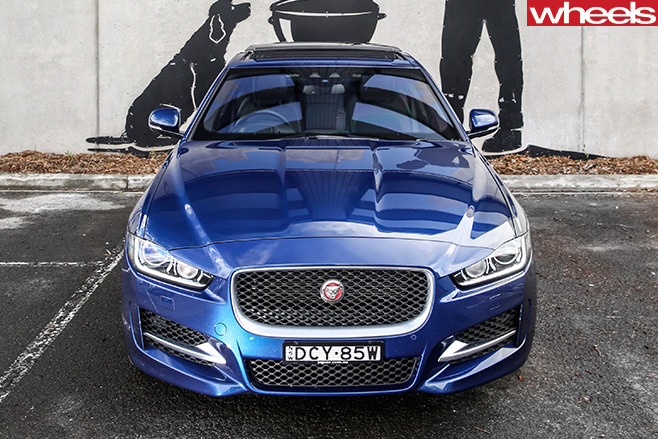
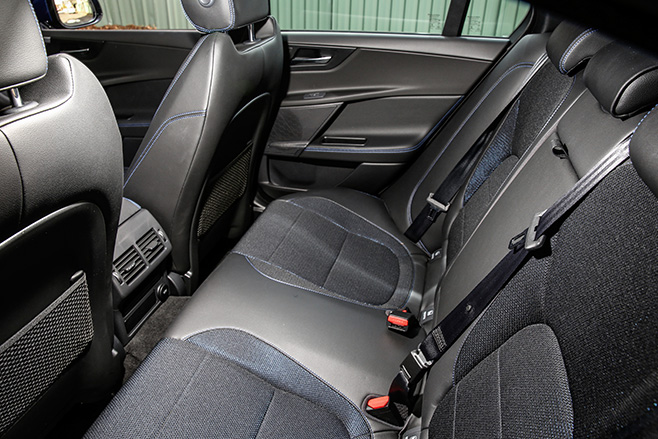
Interesting. Dynamically focussed, the XE clearly isn’t about transporting taller folk for long stints in the back seat, and that’s clear just by looking at it. The cabin is compact. But what we did find out is that, even after 122km, it’s cosy and calm back there, even on 19-inch wheels. That scalps may occasionally be gently caressed by the roof lining shouldn’t be a deal-breaker.
Heading homewards, with Dean at the wheel, I discovered that foot space in the back is limited with the front seat cranked down on its lowest setting – or maybe my mate was finally exacting revenge for something I did in seventh grade. As with his driving position, we go a long way back.
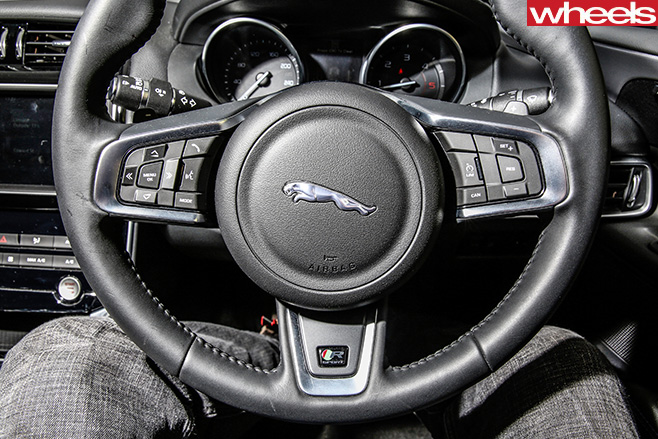
Crikey! He’s spot on. It seems anybody can review cars. I’d better watch my back. I wonder how I’d go handling a fireman’s hose…
Farewell
Those first hero shots of the sedan in the desert, finished in Italian Racing Red and propped on 20-inch Propeller 10-spoke alloys, looked for all the world like the lovechild of the original XF (Jaguar, not Falcon) and VE Commodore SS… which, though boldly macho yet beautifully proportioned, also seemed somewhat derivative. When your rivals include the BMW 3 Series, Mercedes C-Class and Audi A4, a striking first impression is non-negotiable.
Would the new Cat on the block have enough cut-through?

I needn’t have worried. Nearly 12 months later, at the Australian launch, the XE persuasively lured me in with its handsome presence, and then had me completely the moment I turned the first corner. Whether it was the base Mondeo-engined 147kW 20t or the supercharged S with its 250kW 3.0-litre V6, it was clear Jaguar had engineered something superlative. That the ride also possessed a supple lushness no rival still cannot match sealed the deal.
The XE’s inclusion in our long-termer fleet became a priority, particularly after scoring a 2016 Car of the Year award podium finish.
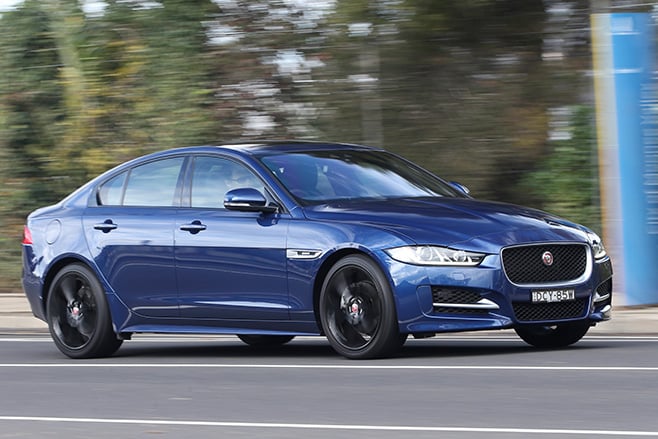
Six months and 6000km later, it’s time to bid farewell to DCY-85W, the Jet Blue 20d R-Sport with Jaguar Land Rover’s lauded all-new Ingenium 132kW/430Nm 2.0-litre four-cylinder turbo-diesel, driving the rear wheels via a ZF eight-speed auto, and sitting on hot 19-inch black alloys. If you’re buying one, make sure to tick the $1800 adaptive damper option to maintain that double-wishbone and multi-link suspension lushness.
Like a broken-hearted fool whose lover has left him, I’m going to spread smack about my XE experience first, starting with that stupid kneecap-cracking dashboard extremity, which necessitates a measured entry and exit strategy for long-legged types akin (apparently) to mounting a horse sidesaddle.
I grew to accept the cheapo instrument dials, which were clearly nicked from the Land Rover Discovery Sport parts bin, mainly because of the extortionately priced ($1770!) head-up display – though you would expect it to actually be visible through polarised sunnies. I became accustomed to peering over my frames like an unimpressed Meryl Streep in The Devil Wears Prada.
There was the odd mysterious electrical malady, too. Twice during the many otherwise effortless cross-country drives we undertook, the multimedia system refused to stream music and would eventually shut down; one time the sunroof opened and closed by itself; and the cruise control occasionally forgot to maintain the set speed, especially on declines where speed cameras would invariably lurk. Annoying.
Worst of all, though, was the Jaguar’s rear-seatback pull cables, which are held in by flimsy clips that break away all too easily, and also don’t release half the time. I’ve tugged harder than Steamboat Willie to get them to fold. A speedy solution is in order.
But I’m longing to have one last interstate blast in that XE R-Sport, and not just because of the effortless urge from its smooth and economical diesel powertrain, its fluent steering, athletic handling, soothing ride, brilliant seating, superb driving position or rock-solid build quality inside.
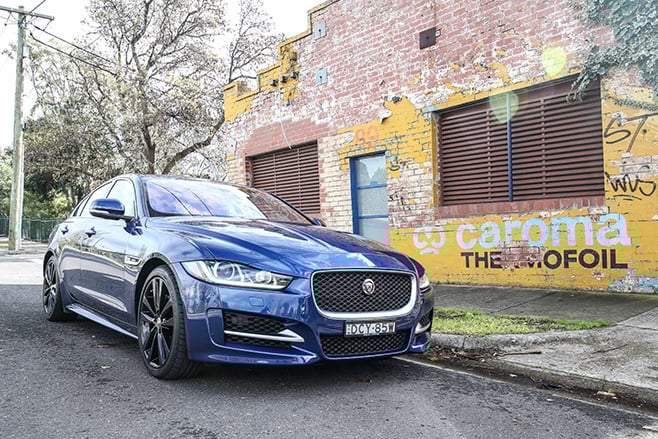
It dawned on me that the XE possesses an X factor that nothing else in its class can match. Is it the exclusivity that comes from going for days without seeing another? Or maybe the smugness knowing how tantalisingly close Jaguar has come to hitting the medium sports luxury sedan brief after only its second attempt.
Whatever it is, this 20d R-Sport deserves to be at the shortlist pointy end for every A4, 3 Series, Q50, IS or C-Class buyer. That 08/09/14 date marks the rebirth of Jaguar cool.
Carmakers don’t just make cars. Sometimes they develop other cool things like aircraft, bobsleds, houses and even bat homes (General Motors, we’re looking at you). But of all their attempts to stray from their core business, our favourite non-car creations are of the water-going variety.
Last week Bugatti announced the launch of its water-faring match to the Bugatti Chiron – the Bugatti Niniette 66 – so we decided to take a closer look at this and eight more of the coolest boats made by luxury-carmakers.
1. Bugatti Niniette 66 This is as close to a water-friendly Bugatti as you’re going to get – at least for now, until autonomous cars learn to drive, swim and fly. Teaming with super yacht designer and builder, Palmer Johnson, Bugatti has created what is, essentially, a floating Chiron. Following the same sweeping lines of any Bugatti, tailor made with near-endless materials, colours and finishes options, the Ninette is super-fast (44knots, which is about 81km/h) thanks to the use of carbon fibre and a V8 engine. And just in case you weren’t convinced it was worth its £2.1 million ($3.4 million) price tag, the yacht features a fire pit, Jacuzzi, gallery kitchen, bar, marble bathrooms and more colour combinations than we could count.

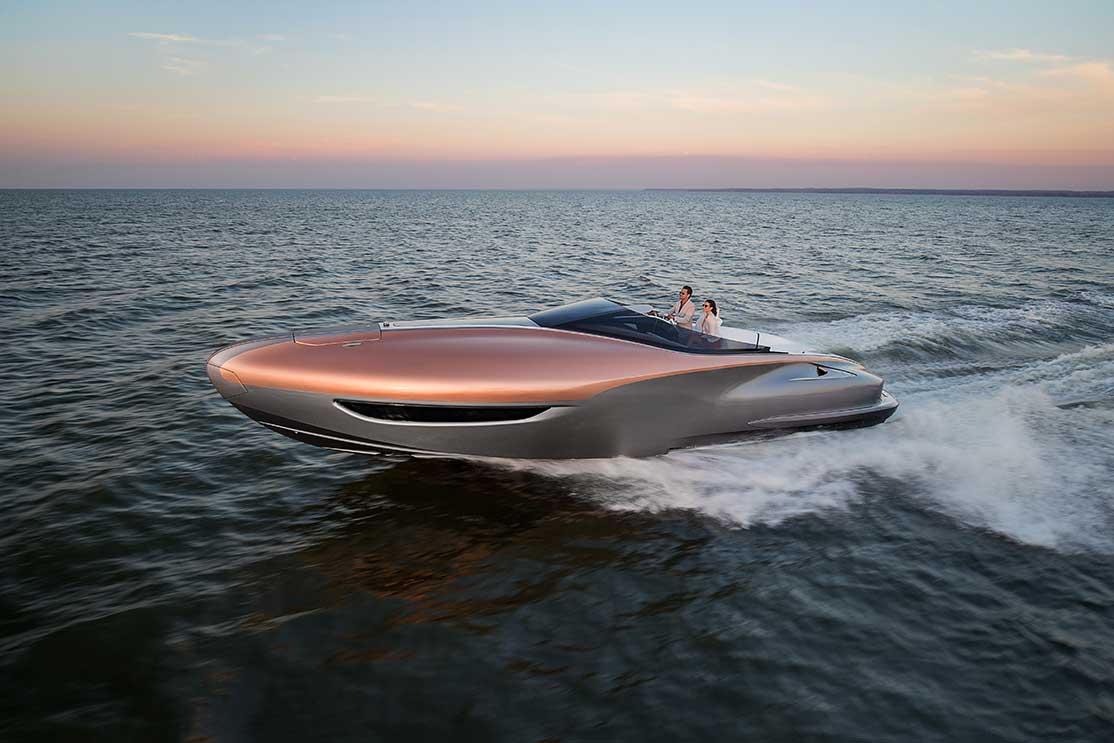
2. Lexus Sport Yacht Lexus get a headstart when it comes to boats, thanks to the marine department run by its parent company, Toyota. Two V8 engines, displayed by a clear compartment cover, manage to push the yacht to 43 knots. At 12.7 metres, it can carry up to eight people, who can enjoy a cabin embellished with leather, wood, and a six-person sofa. The Lexus Sport Yacht is, however, just a concept, so you can put your cheque book away for now.
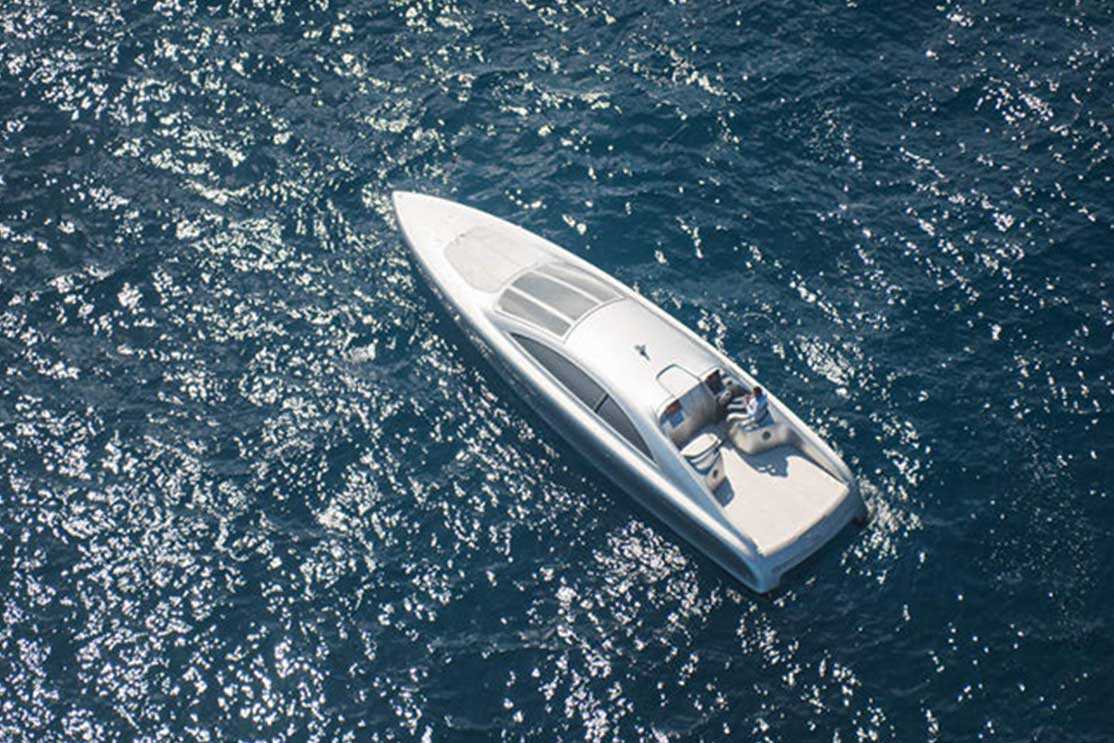
2. Mercedes-Benz Arrow 460 Granturismo Pushed by two Yanmar diesel engines, the Granturismoyacht can reach speeds up to 74km/h and accommodates up to 10 people. The modern-looking, silver Arrow 460 includes a high quality audio system, chilled wine cellar, extendable tables and beds, and it even comes with an ice-maker.
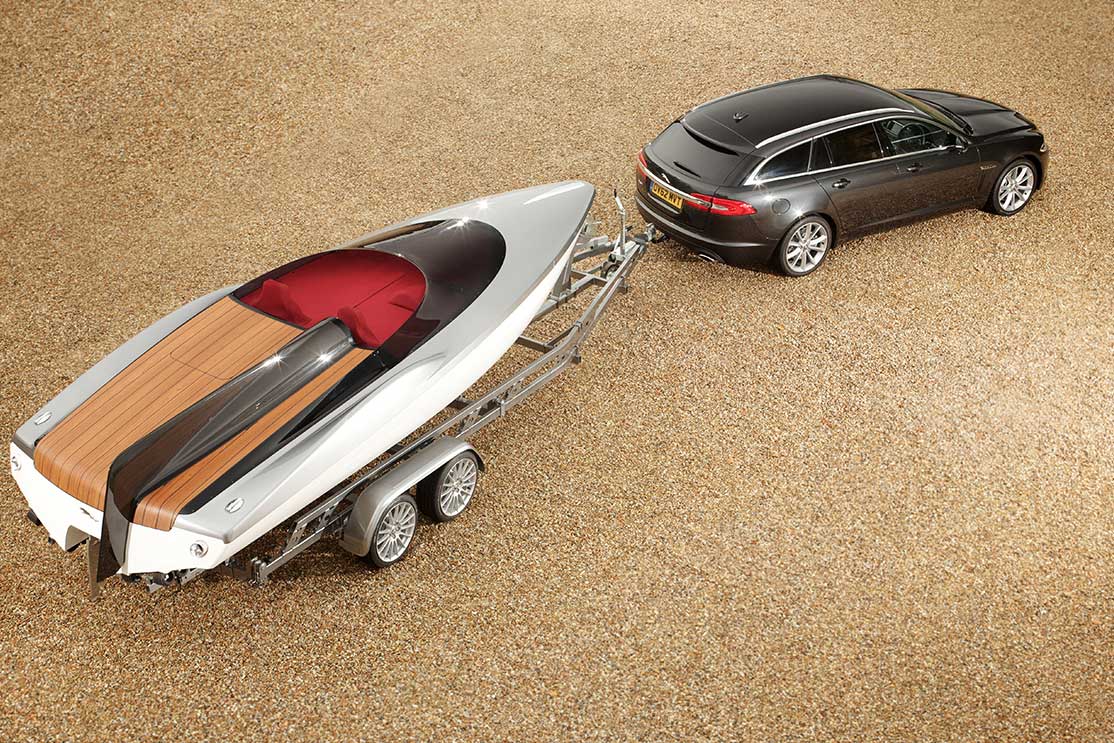
4. The Concept Speedboat by Jaguar Cars Another one for the ‘one day’ books, this concept by Jaguar was revealed at the launch of the Jaguar XF Sportbrake in 2012. Calling upon styling cues from Jaguar cars, its design uses the lines and surfaces customary of the brand, and pulls influences from Jags of old, like the 1950s D-type racer and the Jaguar XJ. Unlike the other boats on this list, this concept is a speedboat, measuring in at 6.1 metres and is a 2+1 seater. No hundred-people parties on this one.
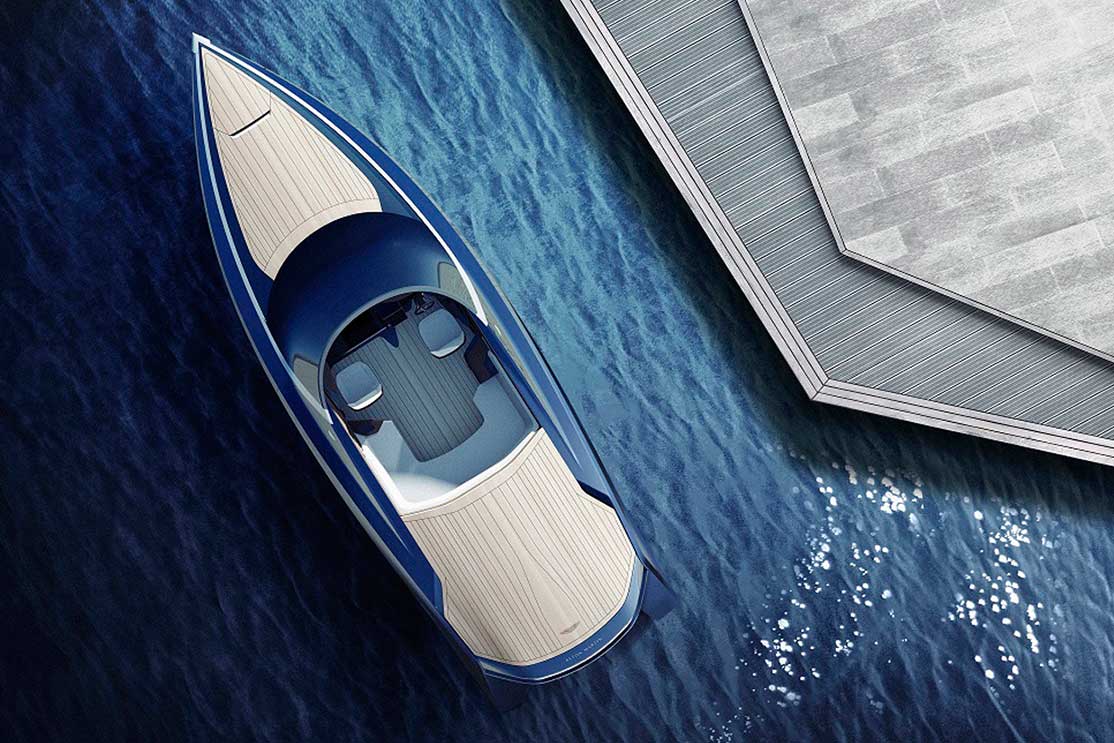
5. Aston Martin Quintessence AM37 The Quintessence AM37 is an autonomous, voice activated powerboat. It can travel up to 60knots (111km/h), and can be controlled via tablet apps for the owners who want to summon it from one side of their island to the other… not really, but it can control functions like heating and cooling or the coffee pot. Design wise, the AM37 is a slick wooden sight to behold, combining luxury and technical materials.
6. Benetti Fisker 50 This superyacht, which looks more like a ship, is the love-child of yacht-maker Benetti and Danish automotive designer Henrik Fisker. Measuring in at 50-metres, the Fisker has three-decks and encompasses sustainability in design through the use of reclaimed wood, solar panels and a hybrid engine. It comes with six bedrooms, floor-to-ceiling windows, a fireplace, minibar, library, walk-in robes, home theatre, spa, Jacuzzi, gym, and even a ceiling that mimics the sky. Its entertainment space can accommodate 100 guests! The yacht, which is designed in California and constructed in Italy, is said to cost a cool US$37 million.

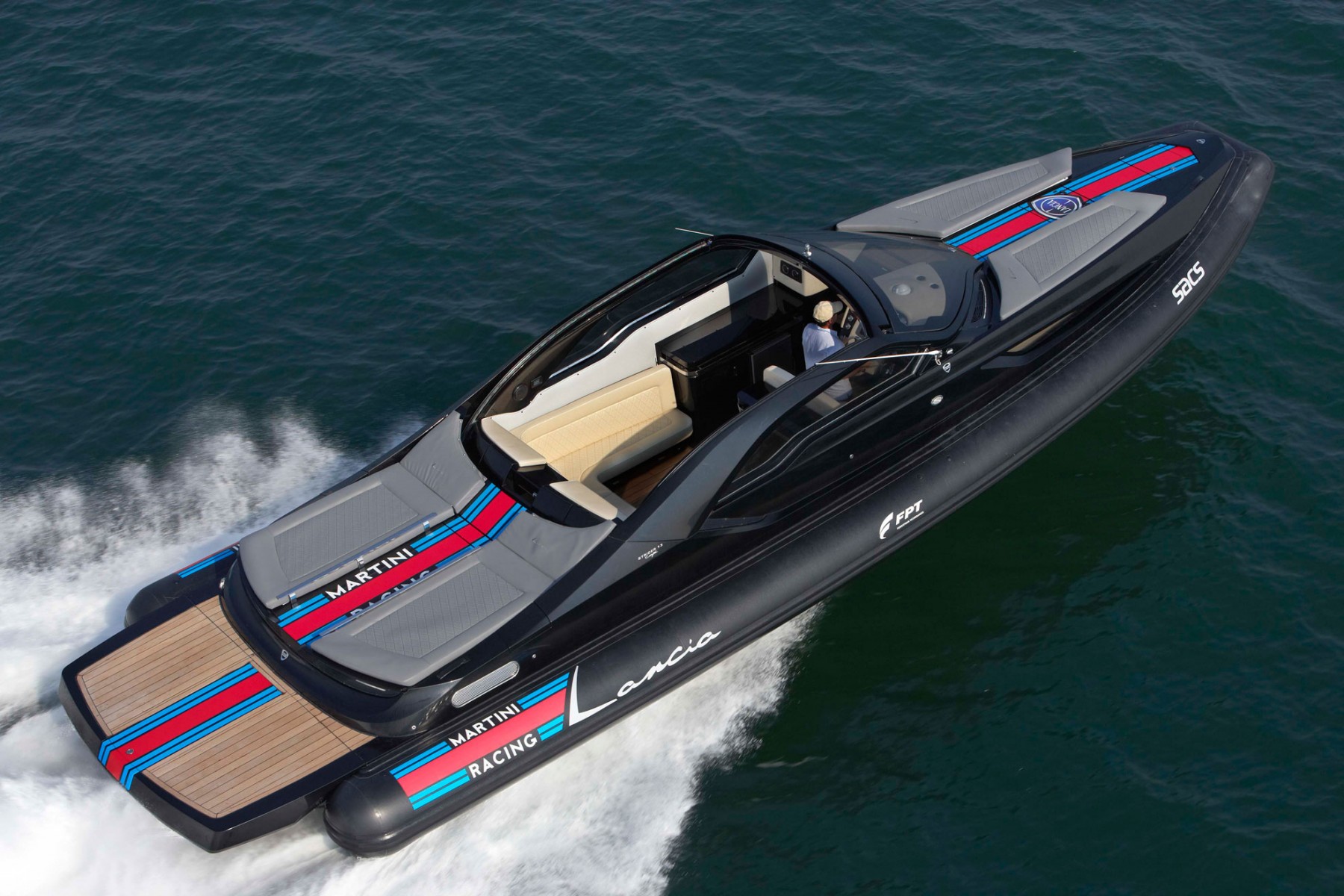
7. Fiat Lancia di Lancia While the Lancia di Lancia can only fit two people inside its air-conditioned cabin, externally it can carry up to 11 people on its 13.1 metre deck. It is powered by a 6.7-litre common rail turbo diesel Fiat engine that gives the boat a speed of 48 knots and can be customised to customer specifications. At the time of launching in 2009, it was the most powerful Lancia made, and also included retractable windscreens and a small dining area that converts to a bed.
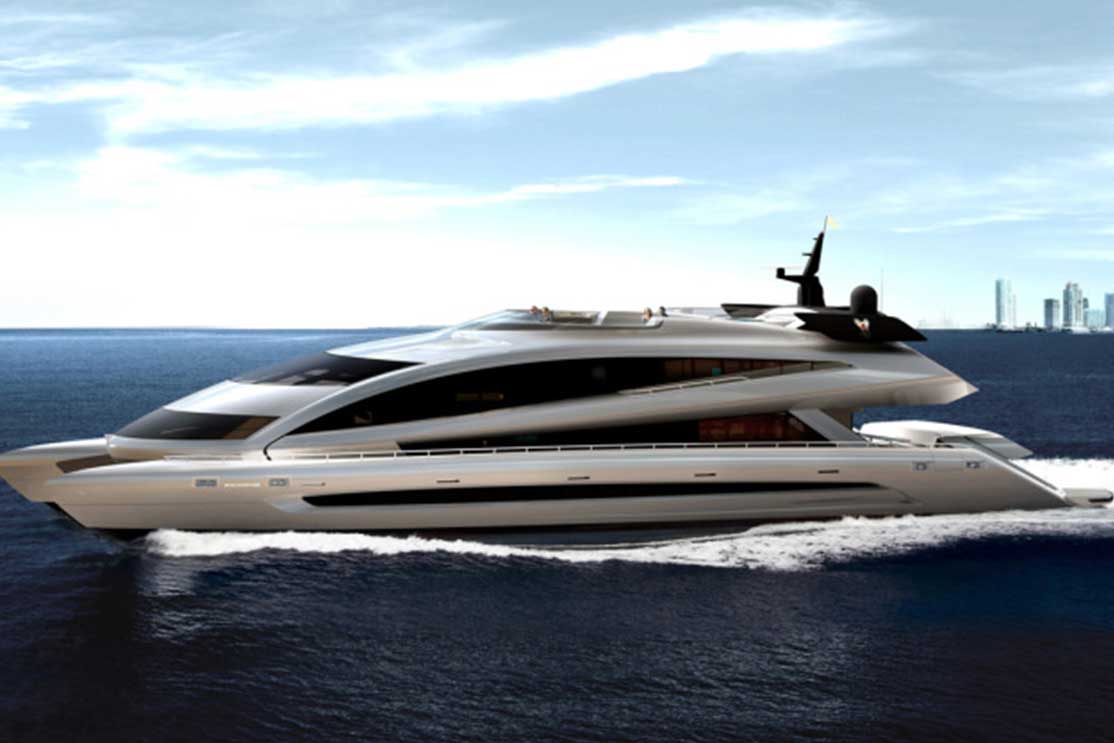
8. Porsche Royal Falcon Fleet 135 Now this is a boat. Actually, it’s a catamaran, and it measures 41.4 metres. Porsche Designs teamed up with Royal Falcon Fleet to create this aluminium catamaran. It size, while large, fits up to 20 people inside (10 passengers, 10 crew) and was designed “in keeping with the functional, timeless and puristic hand” of Porsche. Powered by a V16 turbodiesel engine, it produces 3430kW and can reach top speeds of around 35 knots.
9. Marauder AMG Mercedes-AMG and Cigarette Racing Team have built many special edition boats, but the one inspired by the GT R is one of our favourites. The 15-metre boat is called the Marauder AMG and uses carbon fibre with two V8 engines from Mercury Racing, which can push the skinny, lightweight boat to 1155kW. It even shares the GT R green and black colour scheme. And as far as price goes, let’s just say you’re more likely to afford the Mercedes-AMG GT R!

Toyota looks set to make further inroads towards brand excitement, with 86 mastermind Tetsuya Tada suggesting a light convertible will join the 86 and soon-to-launched all-new Supra, fleshing out its sports car line-up to three.
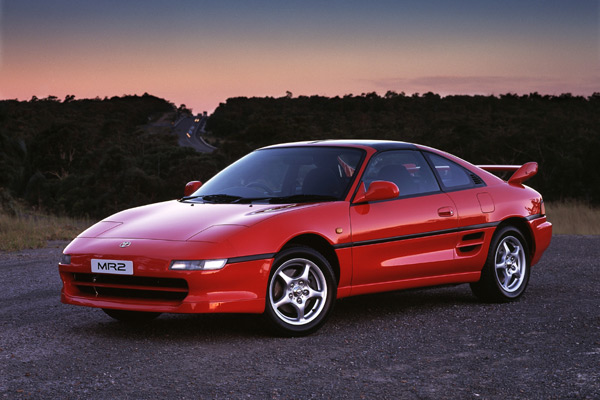
The new model would see Toyota revisit its ‘Three Bothers’ sports car range of the 1980-90s which included the Celica, Supra and MR2, according to Tada, who has taken up a role as boss of Toyota’s performance car division, Gazoo Racing.
“We hope to have the three brothers in place as soon as possible,” said Tada, speaking to Evo at the 2017 Geneva motor show.
The idea of a three-pronged approach has floated about since Toyota introduced its S-FR concept at the 2015 Tokyo motor show, with Tada then telling journalists that he stood by plans for three sports cars in the brand’s model mix.
While the new car would take the place of the MR2 as the junior brother of the trio, it’s unlikely to carry the same name or follow the mid-engined layout of previous versions.
That said, Tada has previously hinted at a ‘mid-ship’ hybrid powerplant for a future model.
“For a sports car, simple is best,” he told Evo. “But after 2020 there will be many environmental and noise regulations. It will be an era when it’ll be very difficult to create a simple sports car as you know it.
“When it comes to installing batteries, the mid-ship layout is an attractive one. We hope to come out with such a model one day.”
Want a Toyota that’s cheap to take care of? Amazingly, it’s the big T’s latest model – and one of its most technologically complex – that will cost you the least to maintain.
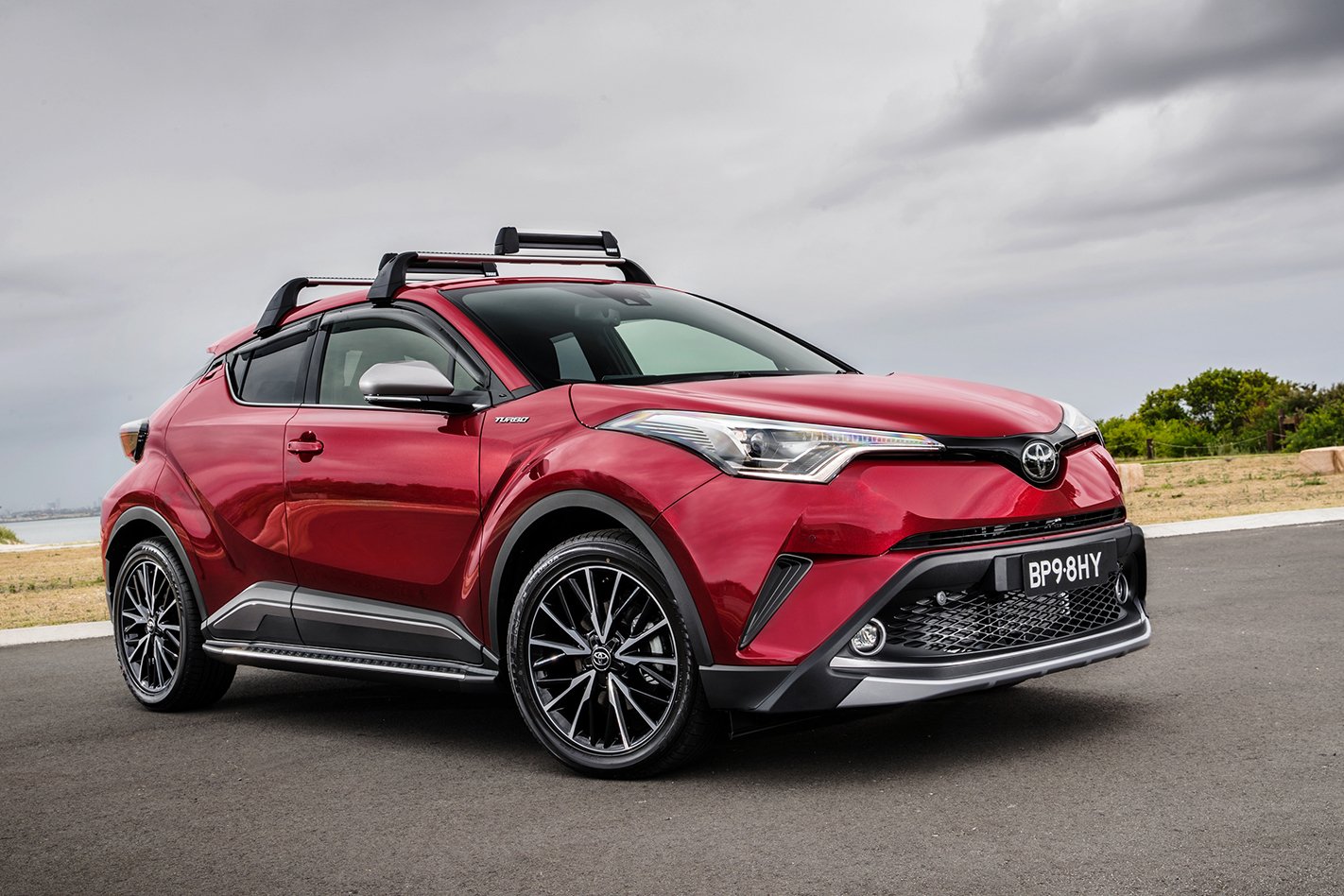
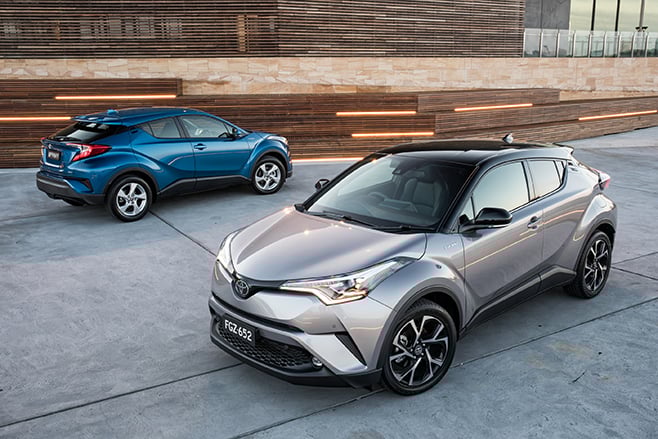
The Toyota C-HR may be the only vehicle in the local Toyota lineup to boast a sophisticated turbocharged petrol engine, but thanks to a generous 12-month/15,000km maintenance interval and a five-year fixed-price servicing scheme, the C-HR’s scheduled servicing plan works out to be cheaper than anything else in the Toyota stable if you’re the type who holds onto a car for five years.
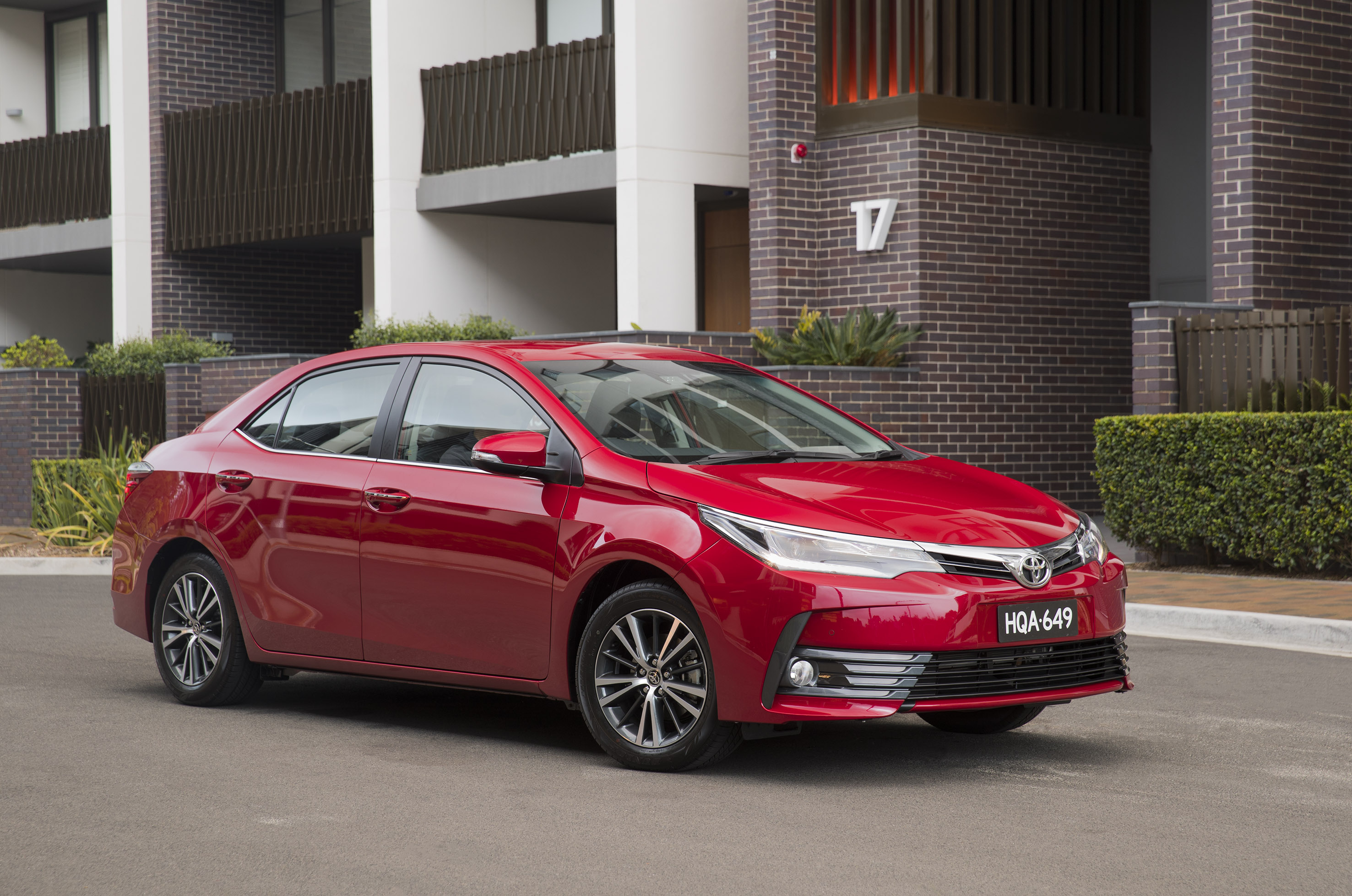
And that’s largely due to the more frequent servicing requirements of other Toyota models. The humble Corolla requires a mechanic’s touch every six months or 10,000km if you want to keep your warranty (at $140 a pop, no less), meaning that after three years the cost of merely keeping your Corolla running will set you back a sum of $840.
Under Toyota’s capped-price servicing scheme for the C-HR, each service costs $195, but the lower frequency of them means you pay much less over time. The C-HR will only need to make half the number of workshop visits over a three year period compared to the Corolla, and will cost $585 after three years/45,000km of motoring.
After three years, the C-HR – which, we should add, overlaps significantly with the Corolla on price and size – gains an even greater advantage. The Corolla’s capped price servicing program stops after the 36-month/60,000km mark, after which maintenance costs rise steeply.
At the 42 month/70,000km mark a Corolla owner will need to shell out $233, while the 48 month/80,000km service blows out to $311. Year four of Corolla ownership will set you back $544 in total, while the C-HR’s bill remains $195 for the same period of time.
After five years a Corolla will cost you $2023 in scheduled maintenance, while the C-HR’s bill amounts to a far more reasonable $975 in total.
The Australian-assembled Toyota Camry and Aurion require less attention than the Corolla and need to visit a service bay only once every nine months or 15,000km. That’s still more frequent than the C-HR, but with each service costing $140 the Camry and Aurion will cost $25 less to maintain than the C-HR by the three-year mark with a total bill of $560.
Once beyond that point, however, the balance tips in the C-HR’s favour. Capped-price servicing for Aurion and Camry runs out after the 45 month/75,000km point, and servicing costs rise sharply thereafter.
The 54 month/90,000km service costs $595 for the Camry and a huge $990 for the Aurion, with the 63-month/105,000km interval coming in at $236 and $251 respectively.
After 5-and-a-quarter years, the total scheduled maintenance spend for a Camry comes to $1531, or $1942 for an Aurion. Better than a Corolla, but still not as affordable as the C-HR.
However, if you tend to travel greater distances then the Camry and Aurion come out ahead – after 75,000km the maintenance bill for the two locally-built sedans will come to $700, against the C-HR’s $975.
That said, with census data showing the average Australian motorist travels roughly 13,800km every year it appears that the time interval is of greater relevance to the bulk of the population, not distance. Bear that in mind when you’re doing your own cost projections – as well as the fact the C-HR requires more expensive premium unleaded.
So, while the C-HR’s direct-injected, water-to-air intercooled and turbocharged 1.2-litre engine may be one of the more advanced powertrains in Toyota Australia’s showrooms, the edgy compact SUV is surprisingly cost-effective when it comes to keeping it in peak mechanical condition.
The fact that you only need to visit a dealership half as often as you would in, say, a Corolla or Prius is another big win as well – after all, your time has a value of its own, and who wants to spend unnecessary hours reading magazines in a service centre waiting room?
New figures from Victoria Police reveal more than half the drivers killed on Victorian roads in 2016 were either under the influence of alcohol or had illegal drugs in their system.
The numbers were released ahead of Victoria Police’s crackdown on drink and drug drivers over the Labour Day long weekend.
A total of 206 drivers were killed on the state’s roads in 2016, with 43 being affected by alcohol and 58 having illegal drugs in their systems.
During last year’s Labour Day long weekend Victoria Police drug-tested 1900 drivers, with 200 of those testing positive – a worrying 10.5 percent.
The police also revealed that of the 38 deaths in Victoria so far this year, 27 have been on rural roads. Populations may be higher in big cities, but it appears more risks are taken when driving outside of the big smoke.
Operation Arid, as the crackdown is being called, will target fatigue, speed, distraction and seat-belts, along with drug and drink drivers.
“We ask that their [deaths] not be in vain. Let that be a reminder of what happens if you drink or take drugs and drive,” Assistant Commissioner of Road Policing Doug Fryer said.
Despite the figures seemingly pouring cold water on the ‘Speed Kills’ message, Fryer also reiterated the state’s focus on the dangers of speed, while speaking to television crews.
“The default speed [on country roads] of 100km/h is not the recommended speed, it’s the maximum speed,” he told journalists.
“Whether it’s rain, brightness, dusk, dawn, roos on the road, you need to drive to the conditions, not to what the posted speed is.”
1. The previous E-Class Coupe used the underpinnings of the smaller C-Class. However, the new model picks up the larger platform of the latest E-Class sedan (with a codename of W213), which went on sale in Australia in 2016.
2. Mercedes-Benz has three four-seat coupes in its lineup. The C-Class is smaller and more affordable, whereas the S-Class is larger and (a lot) more expensive.
3. Three E-Class Coupes will initially be offered in Australia. The E220d diesel and E300 petrol drive only the rear wheels, whereas the E400 4Matic drives all four wheels. As with the sedans, all E-Class Coupes come with nine-speed automatic transmission.
4. Space is a big part of the sales pitch with the E-Class Coupe. Compared with the model it replaces it is 123mm longer and has 113mm more space between the front and rear wheels, which translates to more back seat legroom. Speaking of which, those in the rear get an additional 74mm of legroom and 34mm of should space.
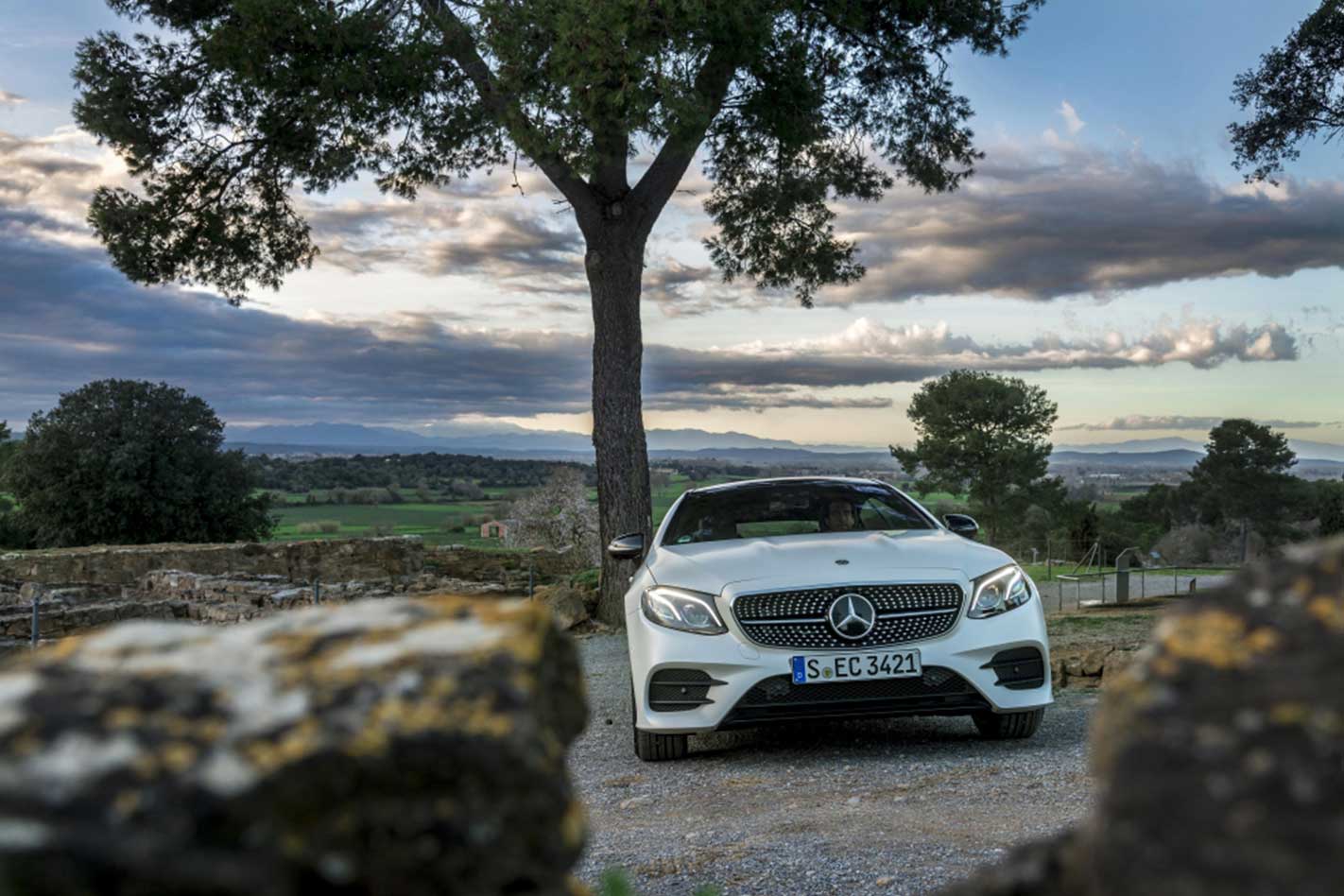
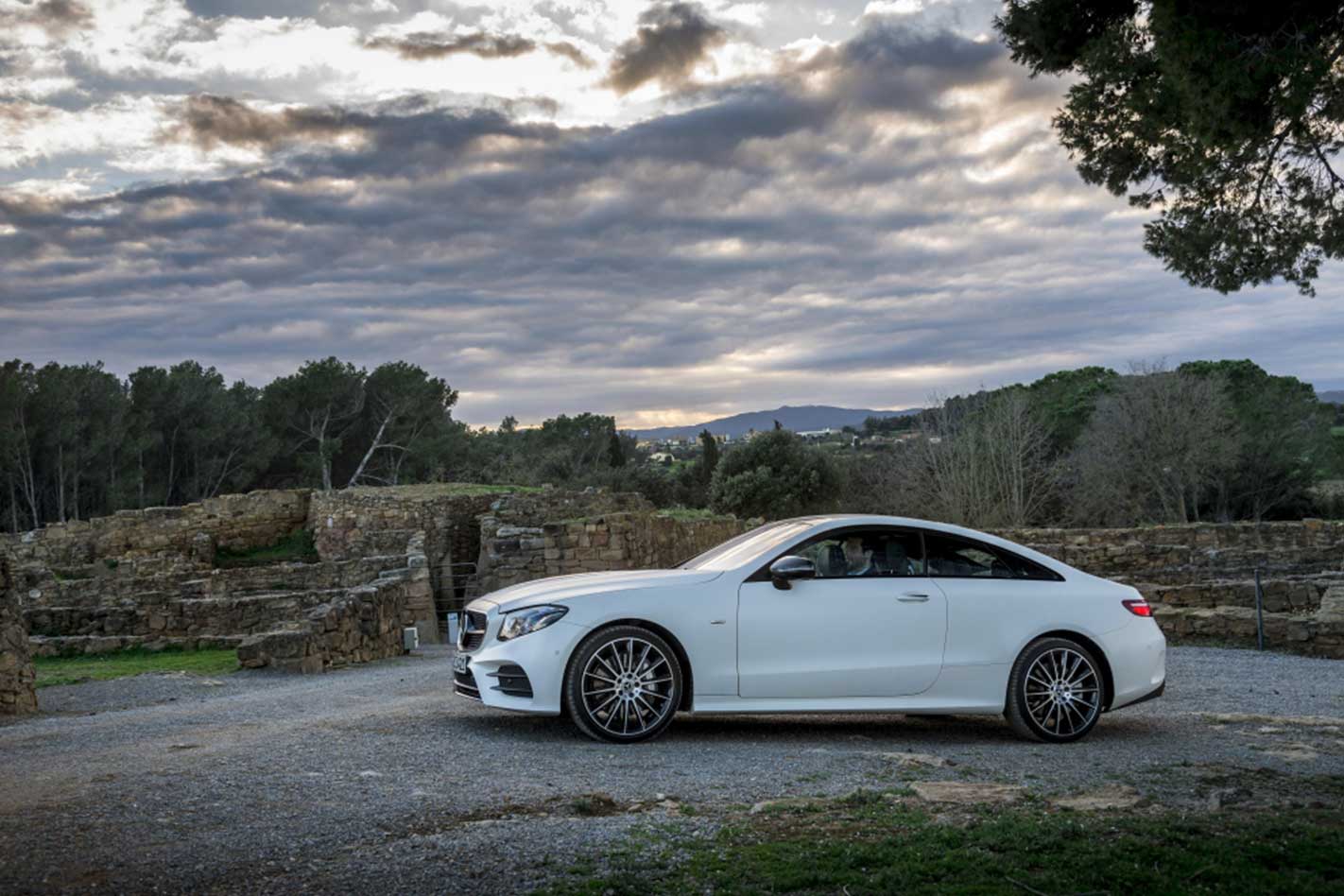
5. Despite being bigger than the old model, the E-Class Coupe is smaller than the sedan it’s based on. The wheelbase (distance between the front and rear wheels) is 66mm shorter and, at 4826mm long, it is 97mm shorter than the four-door version.
6. The most affordable E-Class Coupe, the E220d, rides on regular suspension with coil springs. However the E300 and E400 get a system called Air Body Control. As the name suggests, it replaces those coil springs with air chambers (two in each of the front suspension units and three in each of the rears) that can adapt to different driving conditions. The driver can also adjust the suspension between Comfort, Sport and the firmest Sport+ setting.
7. The E-Class Coupe gets a new set of wiper blades called Magic Vision Control. Like the Holden VE Commodore that arrived in 2006, they get dozens of holes in the wiper blade to spray water directly in front of the blade’s motion. The E-Class Coupe has about 60 holes, which provide a seamless spray of water to clean the screen. Whereas regular wiper sprayers spray the water on to the screen before the blades are there, the Magic Vision Control is more accurate in terms of where the water is sprayed.
8. The dash layout of the E-Class Coupe is identical to the sedan, right down to the two 12.3-inch screens that sit alongside each other, one for the customisable instrument cluster, the other for the central infotainment screen.
9. In an effort to change the look of the interior between the sedan and the coupe, Mercedes-Benz has changed the design of the circular air vents (four in the centre and a larger one on each outer extremity of the dash) for the E-Class Coupe. The Coupe has turbine-inspired centres for its air vents (rather than vertical slates within the circular outers), which look fantastic in the context of the modern layout with its classic lines and materials. However, while those turbine-like vents have a glossy finish, they have a plasticky feel.
10. The E-Class Coupe has an optional “yacht blue” dash and door trim colour. It’s a distinctive look but with an acquired taste.
11. Mercedes-AMG – the performance arm of Mercedes-Benz – has ruled out a top-shelf E63 AMG version of the E-Class Coupe. So don’t expect to see the 4.0-litre twin-turbo V8 beneath the bonnet of the two-door (those wanting that level of performance will either have to choose the C63 AMG Coupe or the E63 AMG sedan). Instead AMG will prepare a six-cylinder performance model. It will use a turbocharged version of the upcoming inline six-cylinder engine that will slowly spread across new Mercedes-Benzes.
12. The E300 and E400 models come with the new Multibeam LED headlight system. It uses 84 LEDs that can be individually illuminated to block out other road users, meaning the high beams can offer a broader spread more often.
I FOUND it lurking in a dark corner of our magazine production drive. An innocent looking folder labelled “Maloo GTS” that held photographic evidence of one of the best afternoons I’ve ever had at Wheels: the time I took an early example of the HSV GTS Maloo for a smokey mountain blast.
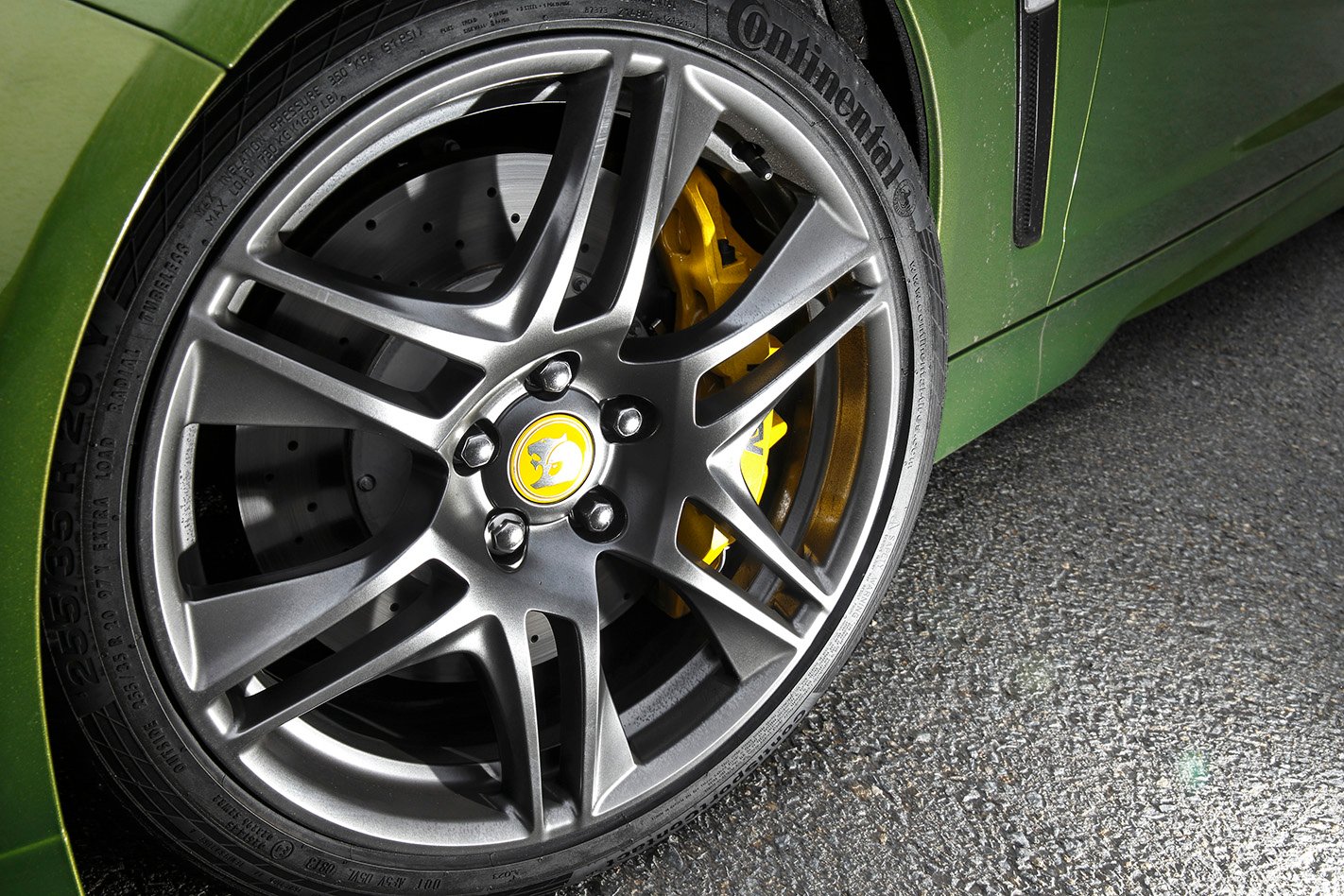
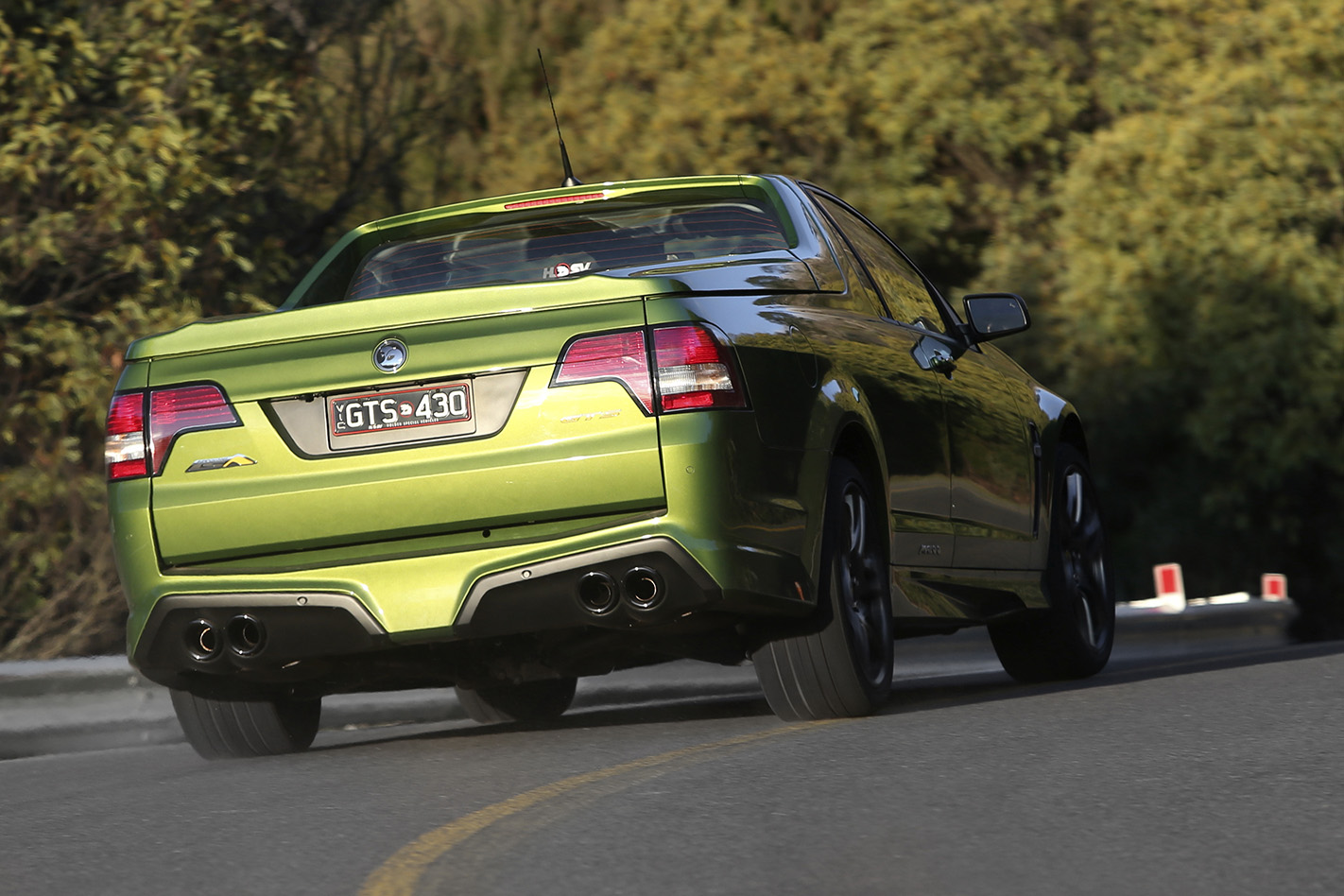
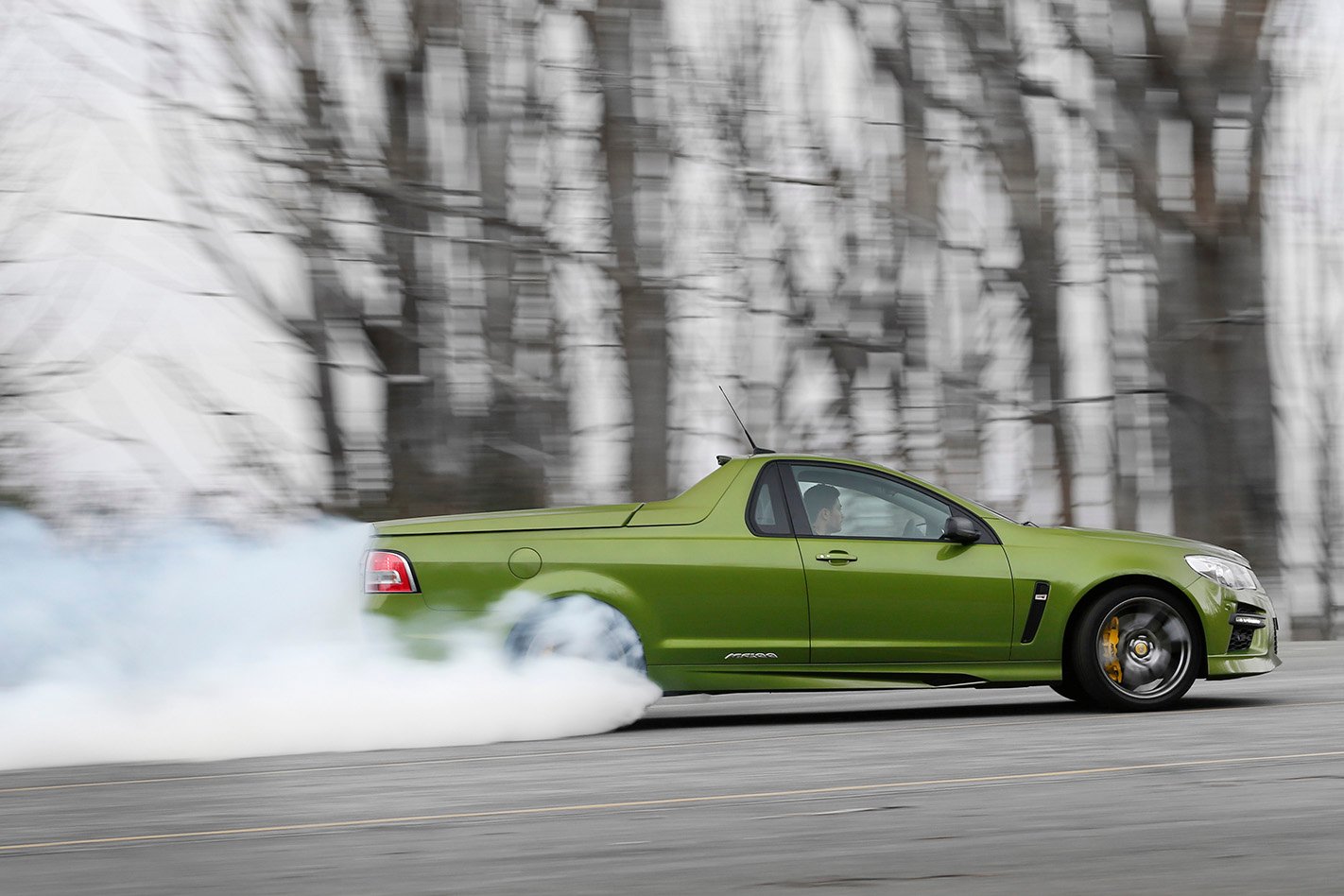
At the time it was Australia’s fastest and most powerful ute (it’s since been trumped by the 435kW/740Nm GTS-R Maloo) and as you can see from the images, shot by snapper Cristian Brunelli, the Maloo had no trouble turning its chunky 275/35R20 rear Continentals into fluffy white clouds of tyre smoke.
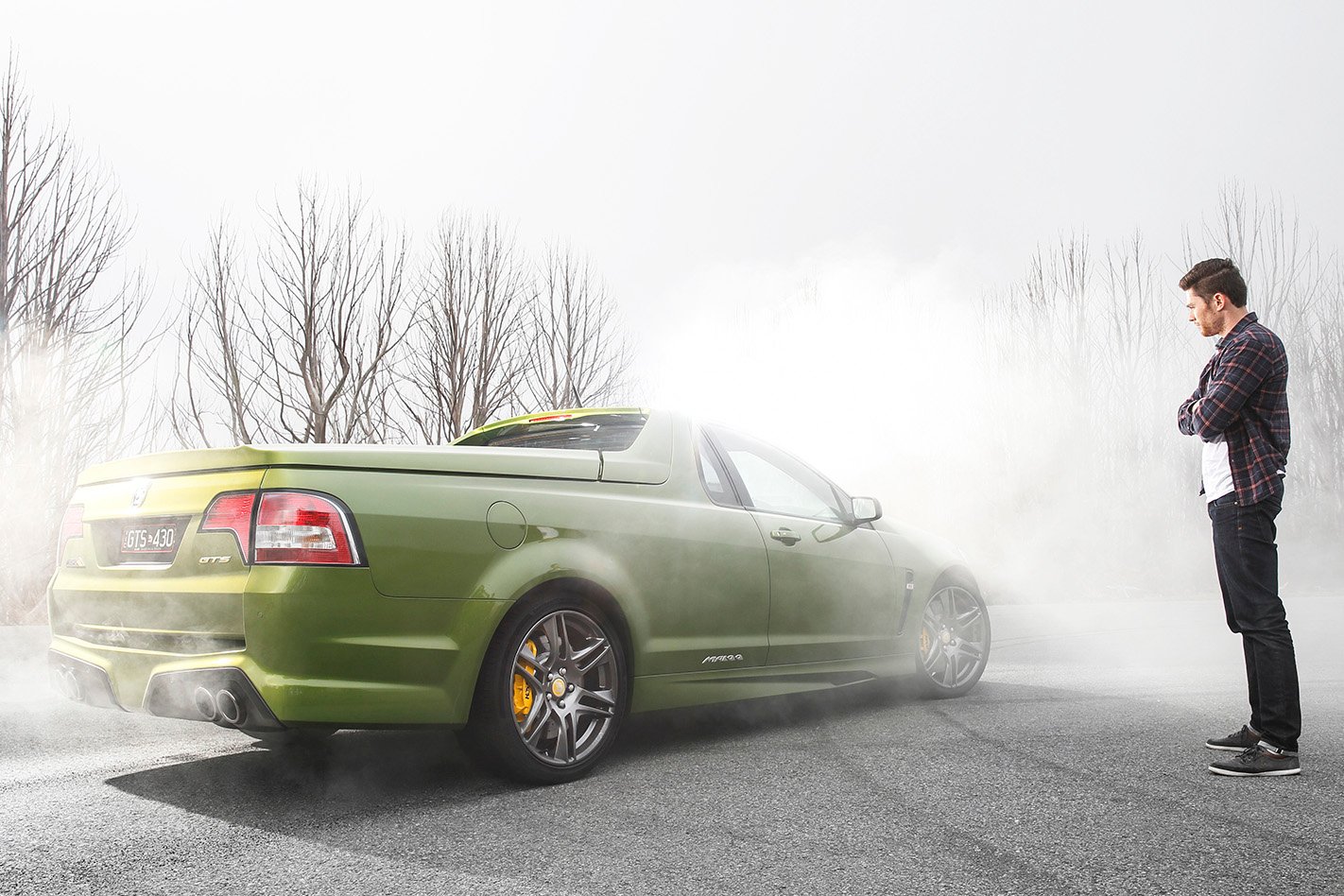
I’ve included my full review from November 2014 below, but this sideways jaunt wasn’t the only adventure I had in the Maloo GTS. A week later I grabbed it once again from HSV’s Clayton HQ for an overnight hike from Melbourne to Sydney where Top Gear host Chris Harris and an empty Sydney Motorsport Park were waiting. Luckily I’d thrown an extra set of rear boots in the tray.
Oh, and Harris’s opinion on the Maloo GTS? “This thing is hilarious! It’s just mental!”
Review originally published in Wheels November 2014
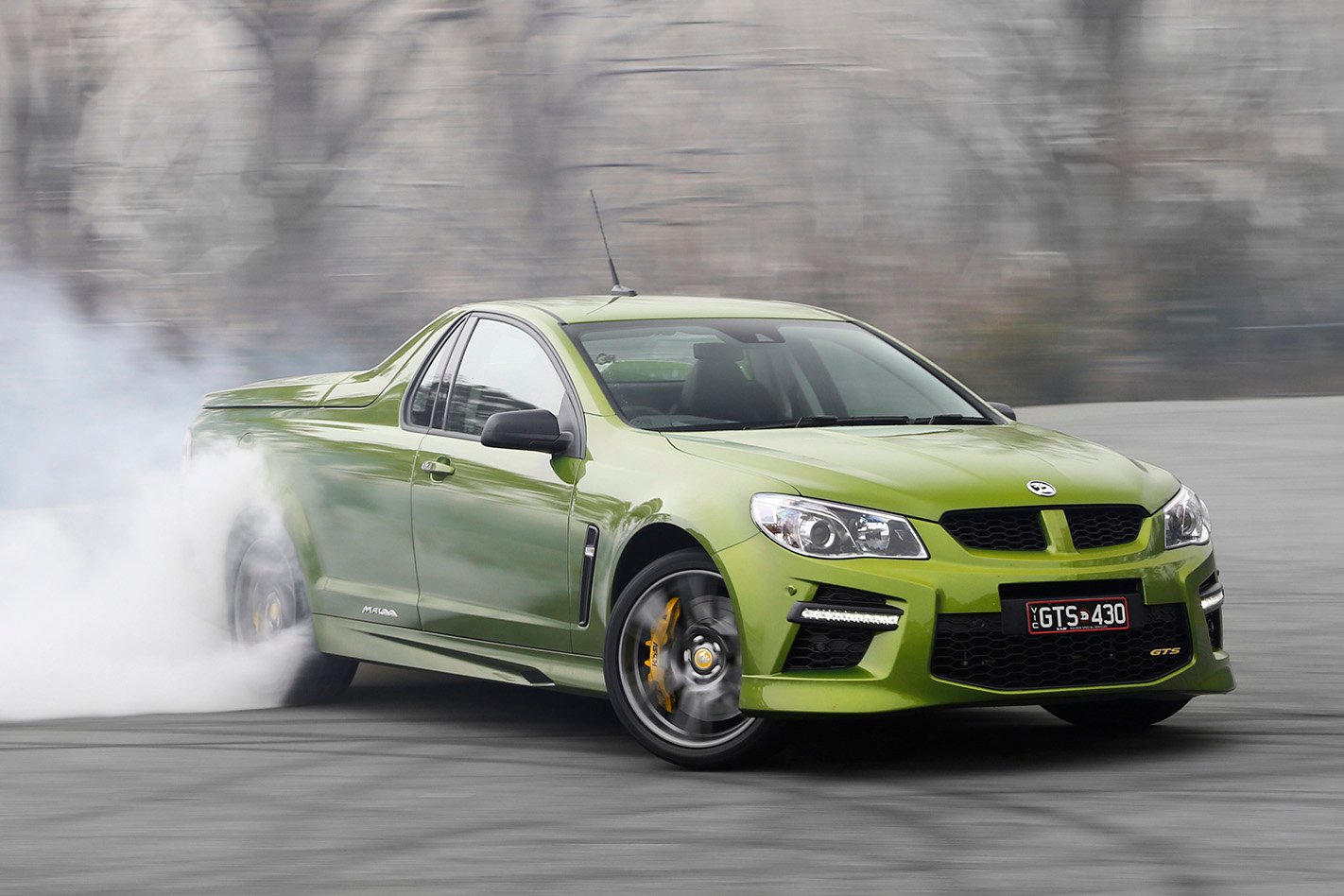
HSV GTS Maloo: World’s fastest ute, by Australians for Australians
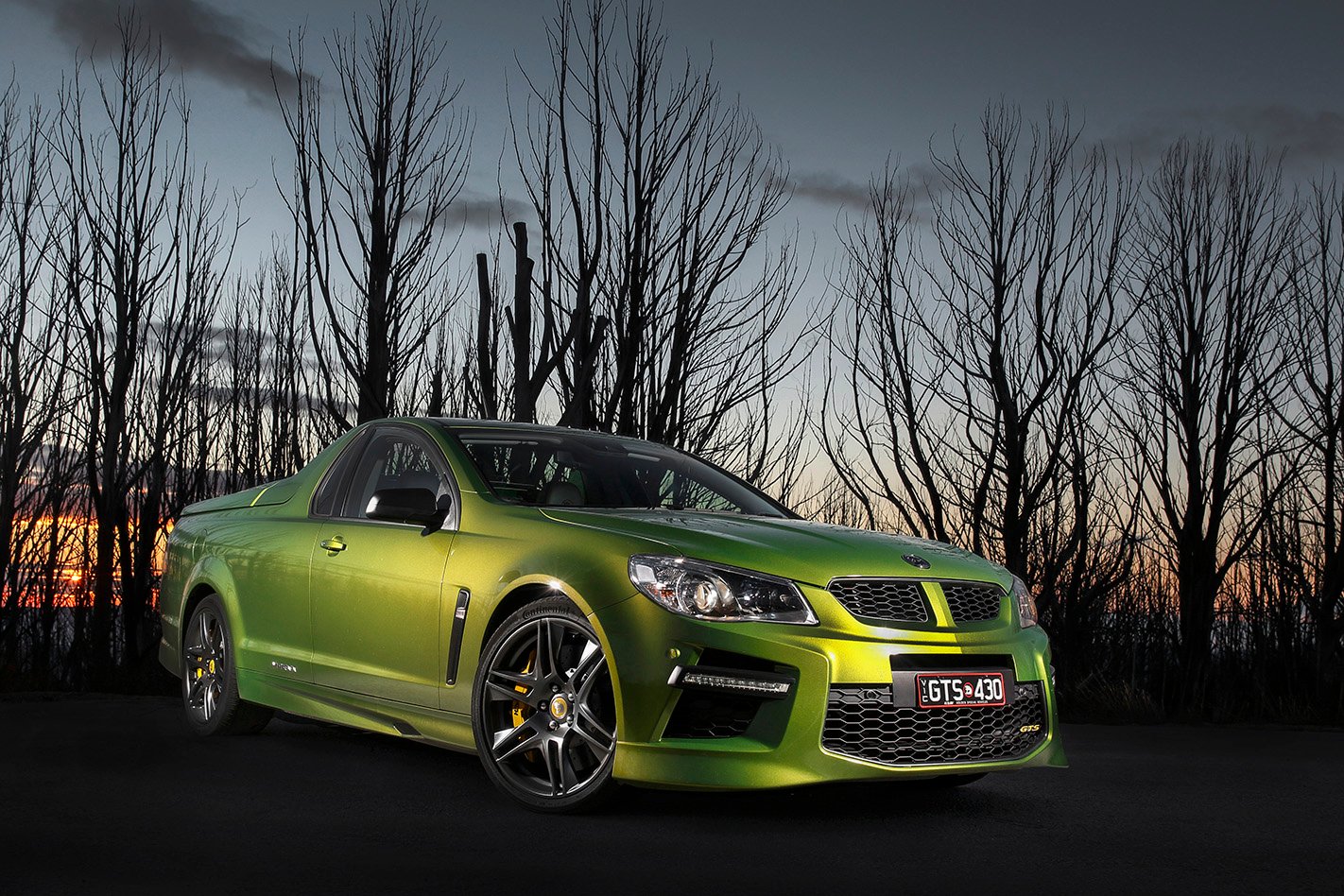
A STRANGE thing happens as I plonk my bum behind the GTS Maloo’s chunky steering wheel at HSV’s Clayton HQ. I start to feel more Australian. Maybe it’s the fact it’s vivid green with yellow badges, and firing that big supercharged V8 into life only intensifies the feeling – and my urge to get the Southern Cross tattooed on my face.
Cars don’t get more Aussie than this. Understated? Forget it. The GTS Maloo is a visual punch in the face. It’s big, thick and has the balls to back up its muscle. If the GTS badge didn’t clue you up, HSV has shoehorned the same LSA 6.2-litre supercharged V8 and running rear from the GTS sedan into the Maloo.
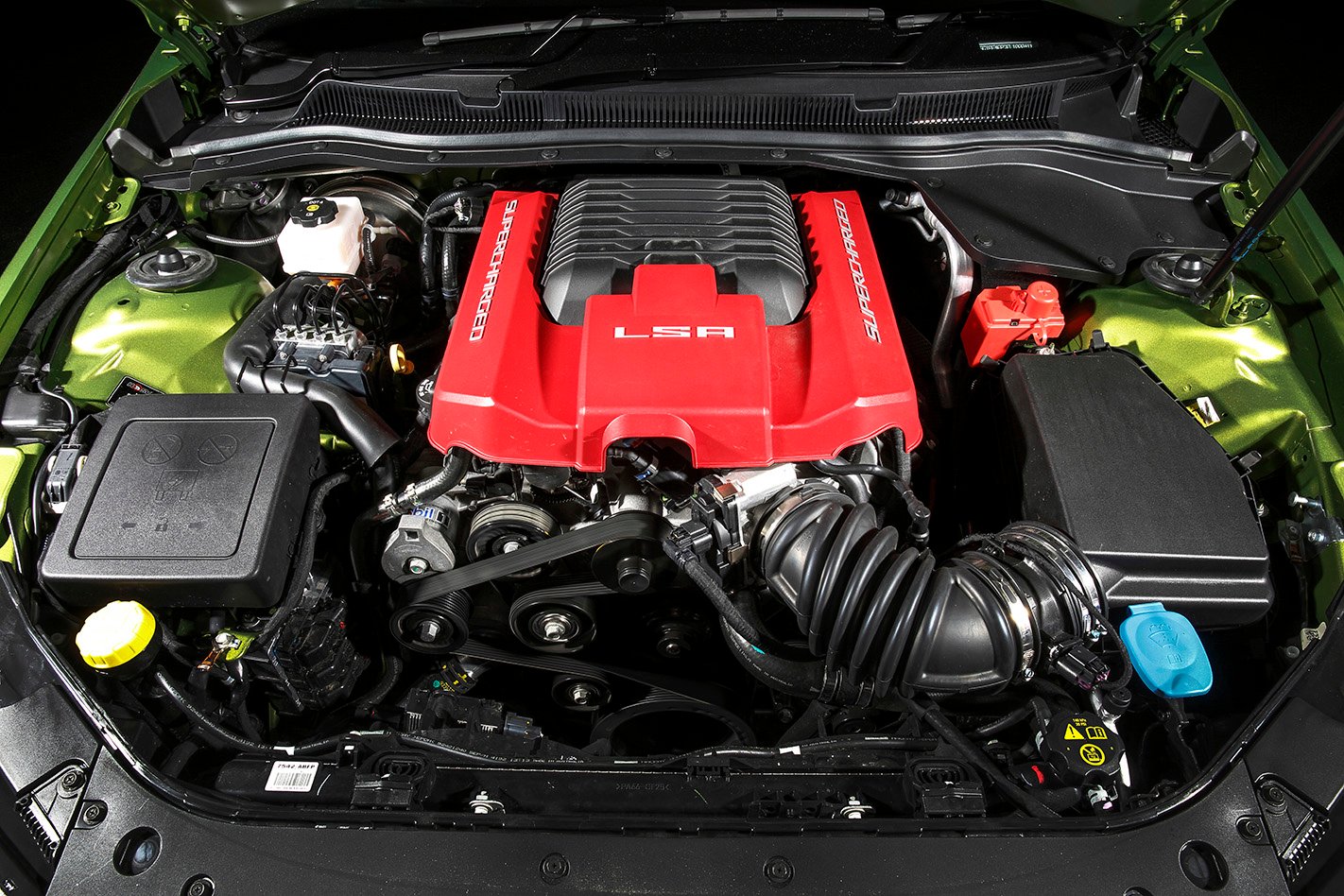
That means 430kW/740Nm, the choice of a six-speed manual or heavy duty six-speed auto, enormous brakes (390mm up front, 373mm at the back) and a 9.75-inch differential with torque vectoring to help transfer that colossal grunt to the road.
What you don’t get is HSV’s excellent Magnetic Ride Control given the cost of developing it for a small run of 250 utes. It’d be wrong to call the Maloo’s ride harsh, though. True, it’s firmer than the sedan, but the Maloo soaks up imperfections with aplomb.
But if it’s short on trick suspension (MacPherson strut front and multi-link rear), the Maloo does get something the GTS sedan doesn’t – paddle shifters. So tightly guarded was this feature that HSV demanded we cover the tiller when parked.
Plastic and cheap to the touch, the paddles nonetheless do their job without fuss and bring a performance car feel to the Maloo’s interior.
There’s no escaping the ute’s size, though. The steering wheel is big, the sports seats are big, and on the road the Maloo feels enormous, thanks in part to its terrible rear visibility.
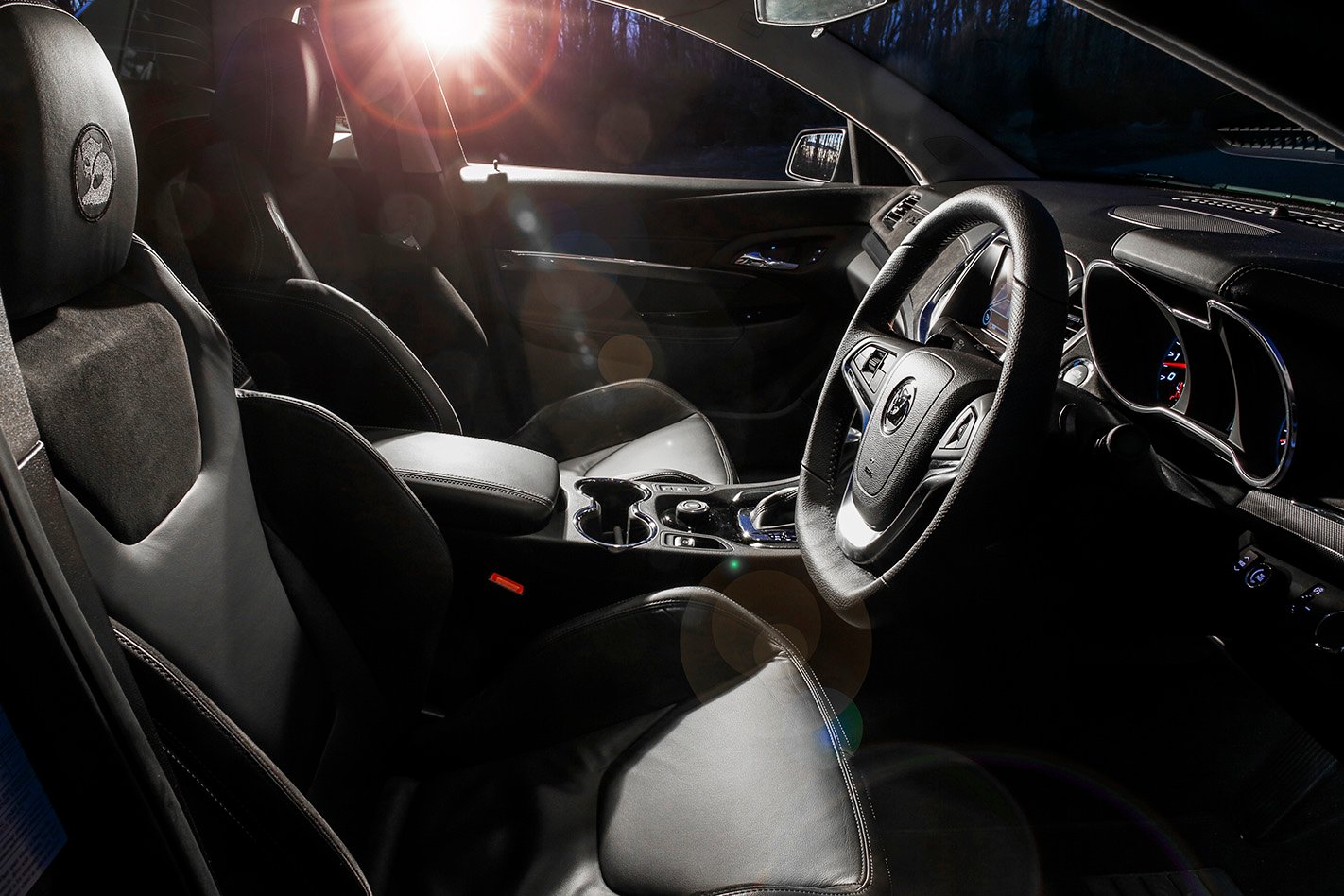
Combining the VF ute’s high tray and the Maloo’s thick fibreglass tonneau means that using the rear view mirror is like peering through a post box. Cars behind simply disappear behind. And forget about checking blind spots; you rely almost solely on the blind-spot detection system.
Big is the word to describe the Maloo’s handling, too. The steering is light and vague off centre, but weighs up and feels meaty once you apply more lock. It’s a reassuring heft on open roads, but is tiring around town. And, despite its torque-vectoring system, it feels nose-heavy and will understeer.
What it lacks in accuracy, the Maloo makes up for with brute force. With the ute’s longer 3009mm wheelbase (sedan is 2915mm), just turn off its electronic safety net and it is a drift machine, with big, tyre-shredding slides a flex of your right foot away. Keep the systems on and Performance mode allows a delicious amount of slip, but it still has your back.
The engine, we know, is a peach. Tractable, smooth and muscular, get it above 4000rpm and the bi-modal exhaust opens with a snap that echoes through the tray, while the quad pipes emit a deep, metallic howl.
So, does the Maloo lack subtlety, polish and poise at the limit? Absolutely. But that’s like criticising a meat pie for being too hot. Or a Jimmy Barnes concert for being too loud. The same applies to the Maloo’s prodigious thirst. Our weekend punt didn’t see consumption drop below 15L/100km, but economy isn’t what the Maloo is about. If you want efficiency, buy a Prius.
This ute is more than a car; it’s a statement. A final love letter to an Aussie icon birthed from the need to go to church on Sunday and take the sheep to market on Monday. And HSV has nailed it. It’s the best Aussie ute yet. Sadly it’s also the last.
John Surtees, the widely admired motor sporting hero and only person to win grand prix world titles riding motorcycles and driving Formula One cars, has died at 83.
Despite his accomplishments, Surtees missed out on the knighthood that so many in motorsport sensed he richly deserved.
Despite his imposing world titles in two sports, and six-pack of F1 grands prix wins, Surtees probably should have won more on four wheels.
A stubborn, unbending gent of unyielding principle who inevitably did things his way or no way at all, Surtees walked out on opportunities at Lotus and Ferrari that may have brought him more wins and perhaps more championships.
Brave, naturally quick and mechanically sympathetic, Surtees was a remarkable talent who dominated the premier 500cc motorcycle category for much of the late 1950s, when he won world championships in 1956 and then again in 1958, ’59 and ’60.
In 1958, 1959 and 1960, he won 32 out of 39 races and became the first man to win the Senior TT at the Isle of Man TT three years in succession
A dispute with MV Agusta encouraged Surtees to look at alternatives during the 1960 season. He was stunningly quick in a couple of tests in cars. In his first car race, for Formula Juniors, he beat Jim Clark to pole.
He was soon in F1. Second place second time out at home at Silverstone confirmed his versatile talent. He was on pole for his third F1 GP.
After claiming his fourth 500cc crown, Surtees switched to Formula One full time, proving immediately competitive in privateer cars. He was signed by Ferrari in 1963 and won the drivers’ championship for the Scuderia in 1964 after a tense battle with Jim Clark and Graham Hill.
Though Surtees continued to be one of the standout drivers of the mid-1960s – along with Clark, Hill, Jackie Stewart and Dan Gurney – that 1964 title was the only F1 championship he won.
In 1965, Clark and the Lotus was an unstoppable combo, but the following year, Ferrari was more competitive.
But Surtees perhaps cost himself a second title when he walked out on the Italians after a dispute with the team manager over his non selection for the squad’s Le Mans team.
Turning up at Cooper part-way through 1966, Surtees embarrassed the incumbent Jochen Rindt. In seven GPs together, Surtees out-qualified Rindt six to one and won the final race the year, in Mexico.
In 1967 Surtees landed at the new factory Honda team.
After winning a GP and taking fourth in the drivers’ points, he won for the Japanese marque in Italy and finished fourth in the championship, before Honda abandoned F1.
There was an unsuccessful time with BRM before his driving career stuttered to a halt after starting his own team in 1970. At first he took the twin roles of driving and running the outfit, before he called time on his racing career at the end of 1971.
Surtees Racing was not a resounding success, its best GP result being a third place in the 1973 US Grand Prix.
One of Surtees’ drivers was Alan Jones, in the 1976 season, but the car was not competitive and the two iron-willed personalities didn’t get along.
The team folded in 1978.
Surtees remained in motor sport, turning out with classic cars and bikes at historic events. In 2005-7 he was the figure-head chairman of the British entry in the A1 Grand Prix series.
But motor racing brought him tragedy in 2009 when his gifted teenage son Henry was killed by a loose wheel in a Formula Two race crash at Brands Hatch.
This inspired him to set up the Henry Surtees Foundation to assist people recovering from brain and other injuries.
In his retirement, Surtees was a delightfully charming and approachable man who in hindsight readily agreed he’d made some poor career moves.
Surtees passed away on March 10, 2017 following a short illness. He is survived by his wife Jane and daughters Leonora and Edwina.
Just retired 2016 F1 world champion Nico Rosberg was one of countless people who registered their appreciation of Surtees’ rare talent: “Very sad, can’t believe it John. You had been so supportive of me all along! My thoughts are with your family. REST IN PEACE #johnsurtees”
