
If this country adores anything as much as meat pies, sandy shores and public holidays, it’s large, fast four-door sedans. Yet the options are thinning.
We’ve sadly so-longed the Falcon and after the Commodore’s also bid us a tearful farewell, moving five with a V8 will only be done by The Very Expensive.
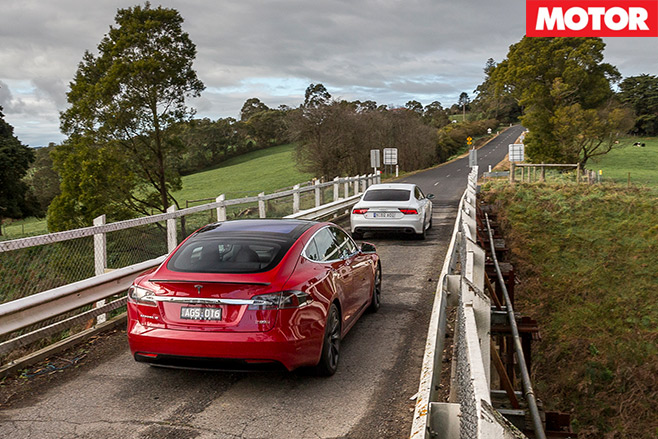
But even there, well into six figures, a dark cloud broods over the V8 sedan – or, more accurately, it crackles with electricity. Tesla’s Model S is everything oil companies hate and early adopters love – all electric.
We’ve met the silent assassin on local turf before as a P85+; Tesla’s since replaced its range-topper with an altogether much mightier weapon, the P90D.
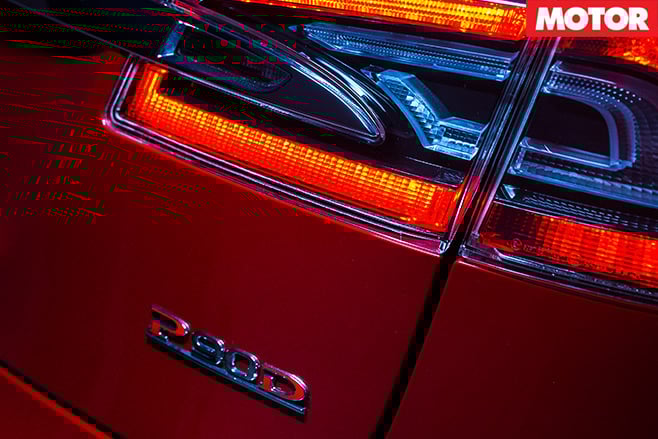
Better yet, the line underscoring its P90D badge denotes Ludicrous Mode, an option which allows the battery to flow more juice in peak conditions and cuts the 0-100km/h sprint to three seconds flat.
However it’s not the only supercar-fast four-door. Audi’s RS7 Performance is fresh from a mid-cycle update and now brandishes some serious grunt, too.
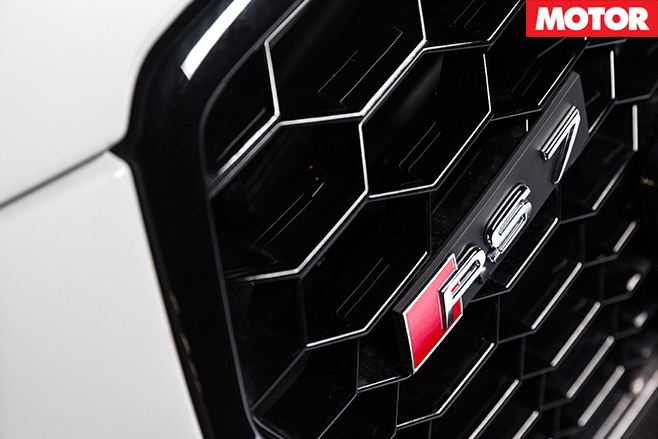
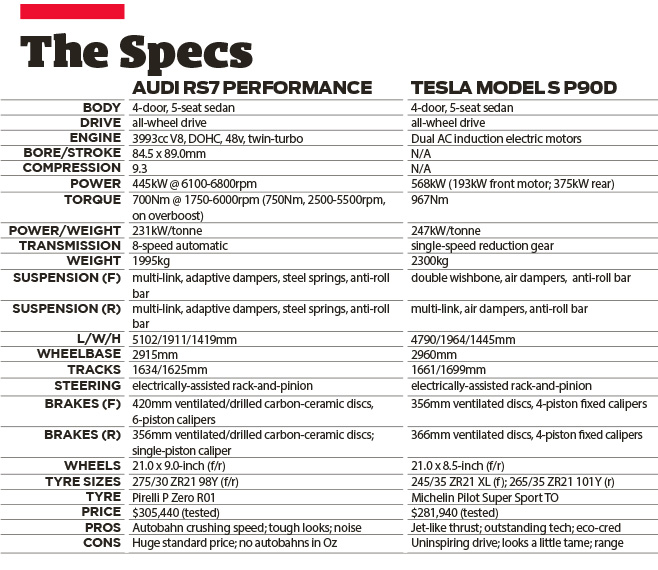
Audi engineers lifted the twin-turbo 4.0-litre V8’s rev ceiling by 200rpm and snuck in an overboost function to sniff out an extra 33kW. There’s also an extra 50Nm when in Dynamic mode. All up 445kW and 750Nm is squeezed through its quattro system, propelling it to 100km/h from rest in a claimed 3.7 seconds.
Not enough to deliver a right-hook to the Tesla on paper, but here it’s fossil fuel’s brightest-burning hope. Porsche has cleared the Panamera from dealers’ shelves until the new one arrives. BMW’s M5 would be outclassed for grip, and while Mercedes-AMG’s new E63 S claims 0-to-100km/h in 3.4sec, it’s not here until mid-2017.
However, while the Audi’s claimed to be slower off the line, it doesn’t feel so at Heathcote’s dragstrip. The only place where it fails to match Elon Musk’s rocket is traction. Two-stepping the torque converter from 2600rpm dumps huge grunt onto its Pirellis, and the rears especially struggle to soak it up.
It’ll wriggle and twitch before shuffling power forward to restore grip at both axles, proving much different to the all-wheel drive launch in the Tesla. Without the need to idle, or shift gear, the Tesla’s wheel speeds never have to play catch-up. So there’s no clutch or need for launch control, and you simply plunge the throttle to escape the line.
When you do, though, hold on and tell the kids to block their ears. Because the loudest sound they’ll hear in a full-throttle Tesla will be expletives – yours. The acceleration doesn’t smash you like launch control in a GT-R, rather it builds into a neck-straining thrust as the motors spin up under full power.
Once the race gets rolling, however, the Tesla’s ferocity wanes as the Audi surges ahead. The RS7 takes off like a Tomahawk missile with seatbelts, firing through three gearchanges to hit the traps in 11.29sec, three tenths sooner, and a whopping 17.4km/h faster.
Even though the P90D’s 3.36sec 0-100km/h run isn’t what Tesla claims (mind you, it was extracted with 52 per cent charge) barring a Porsche 911 Turbo, that’s faster than the last two fields at MOTOR‘s Performance Car of the Year.
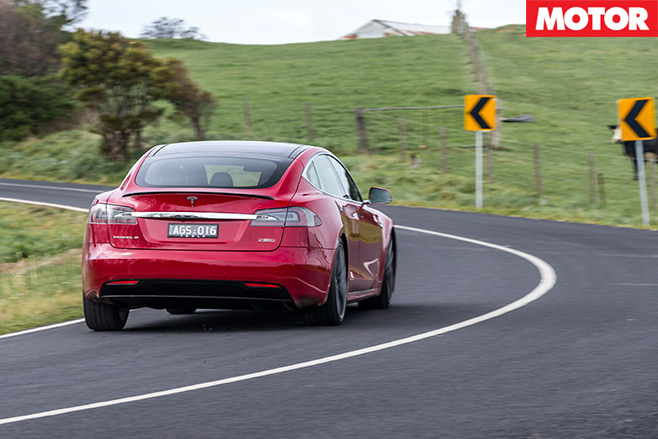
An obvious downside to this is the Tesla’s 2300kg kerb figure. When 80-120km/h disappears in just 2.12sec, there’s plenty of inertia to reign in, and while those relatively small four-pots are full of feedback, they aren’t the most powerful items. You’re thankful the motors chip in with regenerative braking.
With punch and grip in spades, the Tesla’s devastating as a point-and-shoot weapon, almost transporting itself from one corner to the next. The front-end does feel a touch inert and the optional air suspension, which delivers a great ride, could also be responsible for its lack of agility, but these points are a small blemish on the face of impressive dynamics.
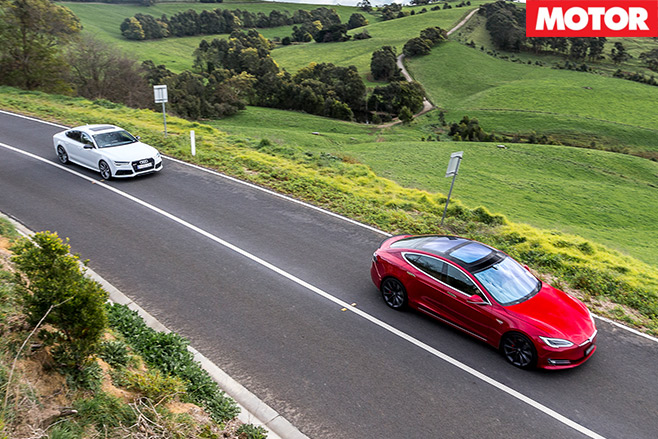
Meanwhile, with a more traditional centre of gravity, the Audi’s higher rates of roll, pitch, and dive make it easier to read. Weight transfers enliven, rather than inhibit, its fun, thanks to the optional ‘Dynamic Ride Control’ that bins its air suspension for a fluid-linked steel-spring setup. You still need be mindful it’s a big car, but keep the brakes squeezed into a corner and the rear will happily enliven. And boy, those brakes.
Peering from behind the RS7’s 10-spoke wheels are frisbee-sized carbon-ceramic discs. They don’t bite aggressively, preferring a solid squeeze of the middle pedal before digging in, and proved no more effective during emergency stops from 100km/h than the Tesla.

The thought of zipping down to Phillip Island in the RS7, plundering around for a day before arriving home for supper, is a given. It’ll slurp lots of fuel, but it’d be a riot – especially with its carbon-ceramic brakes, trick suspension and locking rear diff.
You can’t say the same for the Tesla. Sure, it’ll travel two hours from Melbourne, but there’s no certainty you’ll return that day. Because the only way to charge a Tesla ‘quickly’ is with a Tesla Supercharger, so trips must be planned with military precision.
With a special wall connector installed at your house you’ll get a full charge from nada in five hours. With the 240V lead in the boot at any powerpoint, 10 hours. Track day? Grab a good book. Or two.
As a result most time in the Tesla on rural drives is spent worrying whether you’ll make the next stop, or if you’re using too much fan. Strict urban trips between a connector at home and work wouldn’t be a problem, and the Model S is a brilliant stab at electric transport, but at $281K as-tested you would’ve hoped range is something you’d never have to think about. Alas, electric cars still have some way to go.
These things are taken for granted in the Audi. The blue stitched lever boot, steering wheel and seats, offset against carbon inlays, lift its premium vibe, while its 14-speaker Bose sound setup is up two speakers on the Tesla’s optional system. However, when the RS7 starts $50K dearer, it should be.
Back in the Tesla, Apple nerds will find the huge 17-inch touchscreen a cinch – and pinch – to use, far more intuitive than the Audi’s MMI, and the Tesla’s controversial Autopilot system ($3800) is more advanced than anything we’ve tried. It’ll change lanes for you, and the way it scribes an arc through bends is science fiction stuff.
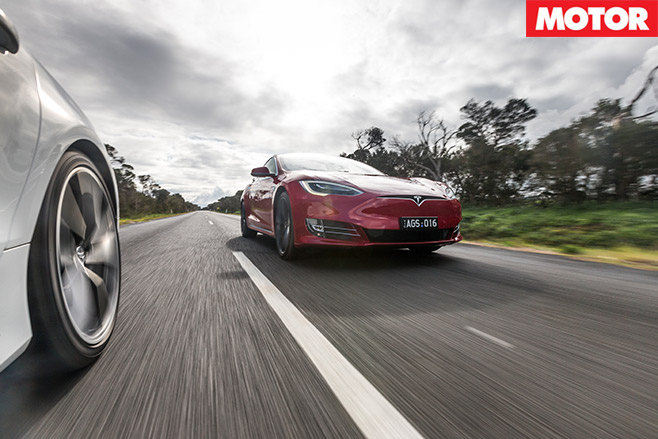
Sure, Tesla buyers aren’t the superficial kind, but a big part of a performance car is how it makes you feel. Even by Audi standards, the RS7’s looks alone will blip your pulse. Those 21-inchers, rear diffuser, Matrix LED headlights and scooped front bumper could part traffic like Highway Patrol under Code One.
On top of that, not only can the RS7 fling you and the in-laws to warp nine faster than any four-door on sale here, but there are more things to enjoy during the experience. The gruff burp on upshifts; or knowing hot gases flowing through turbos hidden a metre from you are responsible for its baritone growl.
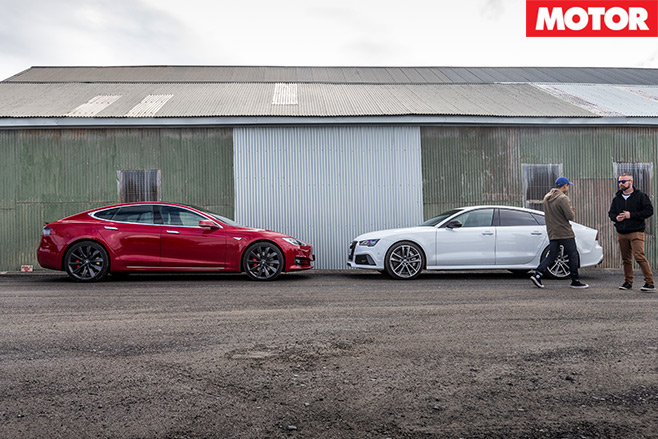
Don’t get us wrong, this mental Model S is seriously impressive. But the Audi even more so. Sharper, sexier, and more luxurious, it ripped three-tenths out of its claimed 0-100km/h time, virtually matching the Tesla to triple figures, before charging on to become the fastest production sedan we’ve ever tested.
Legislators the world over are looking to put the brakes on cars like the RS7 Performance; members of Germany’s own parliament have called for a ‘ban’ on new internal combustion engines by 2030. But while the Tesla Model S promises an accomplished alternative, for now we’ll take the Audi.
Hamilton to have a new team-mate, and Red Bull to again grow wings?Plus new regs to give cars more aero and fatter, grippier rubber.
So what’s in store for F1 in 2017?
We know the different technical regulations – perhaps the biggest upheaval seen in F1 in close to two decades – will translate into lap times around five seconds quicker. But will the racing be more unpredictable, tighter, more ferocious …?
Will the Mercedes-Benz dominance of the past three seasons be challenged by the new regs?
The Silver Arrows have now won all drivers’ and constructors’ titles contested from the start of the Hybrid Power Unit era in 2014.
Lewis Hamilton’s success in the 2016 finale in Abu Dhabi was the 150th Formula One victory for a racecar powered by Mercedes. The Silver Arrows has posted more than one-third of these wins, 51 in total, over the past three years.
Those are the stats to give rival designers and engineers sleepless nights, but also a determination to create a weapon to topple the Mercs.
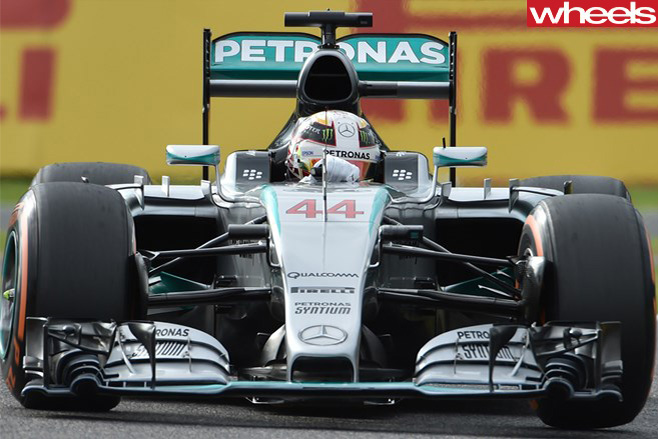
Tyres will be wider too, meaning more mechanical grip to accompany the increased aero.
More challenging for the drivers they may be, yet it’s hard to believe the car changes will trigger anything to relieve F1’s overtaking issues.
While many are placing a positive spin on 2017, some wise heads are counselling that modern F1’s familiar problem of cars struggling to follow each other closely won’t be going away.
More downforce inevitably means trouble with the wake of the car ahead.
Hamilton thinks the new formula is not right, suggesting strongly the cars need more mechanical grip and less aero (with a reduced turbulence coming off the back of the cars) so the drivers can get close for an overtake.
We can look forward to the 2017 cars being more difficult to drive, with the drivers being put through far higher G forces reminiscent of the past.
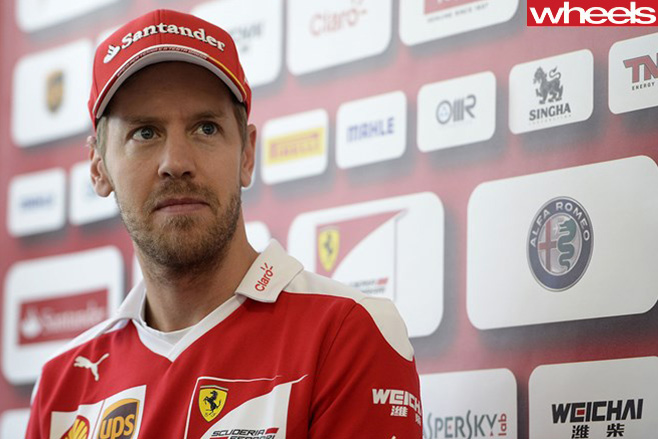
This should suit the likes of Fernando Alonso, Kimi Raikkonen and Sebastian Vettel, who want to again experience the thrills reminiscent of previous generation F1 cars.
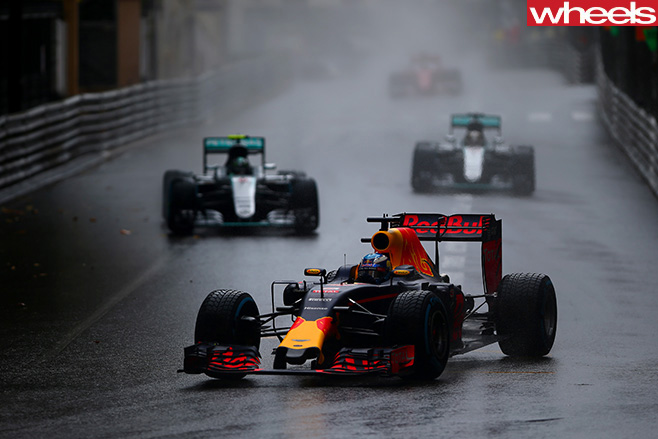
There’s also a wildly anticipated fight between the best two young bucks in F1, Daniel Ricciardo and Verstappen, in identical new Red Bulls.
Verstappen was untouchable in the wet in Brazil in 2016, but maybe his fan boys need reminding that Ricciardo out-qualified him 11 times to six, and comfortably outscored him 220 points to 191 during the period they were together at Red Bull. And how about Daniel’s quite magnificent pole at Monaco?
Ricciardo should have won both the Monaco and Spanish grands prix but for some clumsy mistakes by the team.
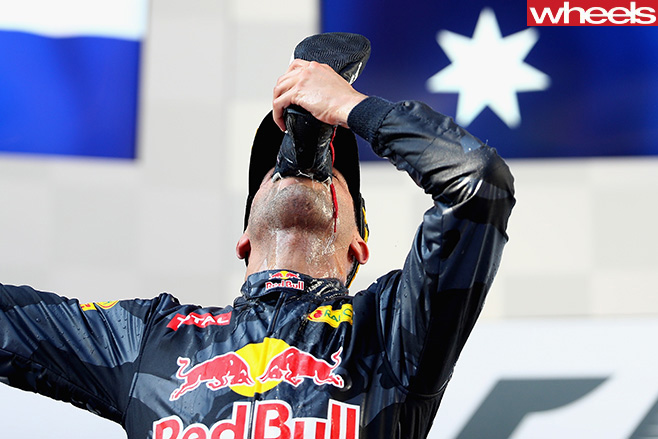
Verstappen is certainly a future star, but two of the world’s most influential publications, Autosport and MotorSport, named Ricciardo at #1, ahead of Rosberg, ahead of Hamilton, ahead of Verstappen.
Back at the Australian Grand Prix last March during an interview with Wheels, Fernando Alonso nominated Ricciardo as a future champion.
Jenson Button too is an admirer of Our Daniel, who he tips for future glory: “Max is an amazing talent, and he will, I’m sure, be fighting for the world championship one day. But I love the way that Ricciardo has upped his game this year. He’s the older driver, more experienced driver, but he hasn’t cracked under pressure, and I really like that about him. And he’s a good guy as well.”
So far, so good…
The magnitude of the rule changes for 2017, means so many uncertainties to consider when the lights go out at Albert Park to mark the start of the new-look championship.
Tyre conservation, such an essential in recent seasons, is unlikely to be as vital in 2017, with some drivers predicting the new Pirellis will allow them to go hard from start to finish without worrying about wear or graining.
The hybrid V6 turbos will remain at least until 2020 in the face of strident criticism from many from Bernie Ecclestone down. It may not be everyone’s technology to love, but it arguably has clear relevance to road cars.
To quieten the naysayers, off-season changes include cranking up the noise. Helping some of the strugglers from the back half of the field, the cost of the power unit supply to customer teams has also been reduced, by one million euros in 2017, and then by a further three million in 2018.
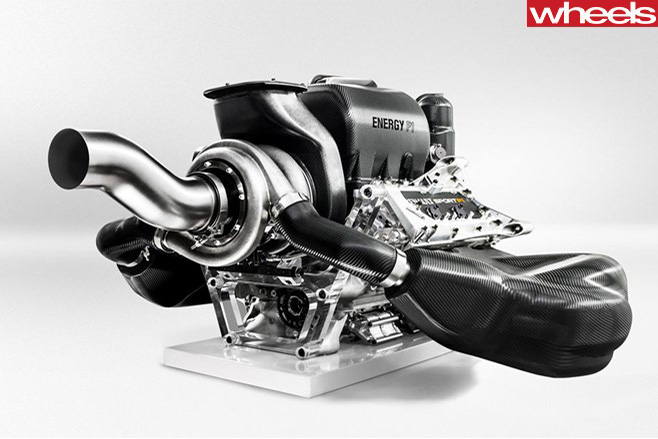
Widespread support for the idea came with the belief that standing rather than rolling restarts will improve the show. The start of a grand prix race is the most watched part of an F1 telecast.
A new procedure for wet weather starts was also accepted. From next season, if a safety car is deployed for the beginning of a race due to wet weather, a normal standing start will subsequently occur once the track conditions are acceptable for the race to begin. The safety car will return to the pit lane and the cars assembled on the grid for the start.
Common-sense has also prevailed on the matter of helmet livery rules. To help the recognition of drivers in the car, there is still an obligation to present helmets in substantially the same livery at every event of the world championship. But in future each driver will be allowed one GP a year to take a special livery.
To prevent the exploitation of the rules regarding power units (like Hamilton and Mercedes did in 2016) there will be no more stockpiling spare power units. So during any single GP weekend, if a driver introduces more than one of a power unit element that is subject to penalty, only the last element fitted may be used at subsequent events without further penalty.
Historically, Red Bull cars are aerodynamically the best out there and if design genius Adrian Newey produces a chassis to his usual standards, and the Renault engine (rebranded TAG-Heuer) has improved power and driveability, perhaps Verstappen and Ricciardo will be in a position to challenge Hamilton and his new offsider for the drivers’ championship.
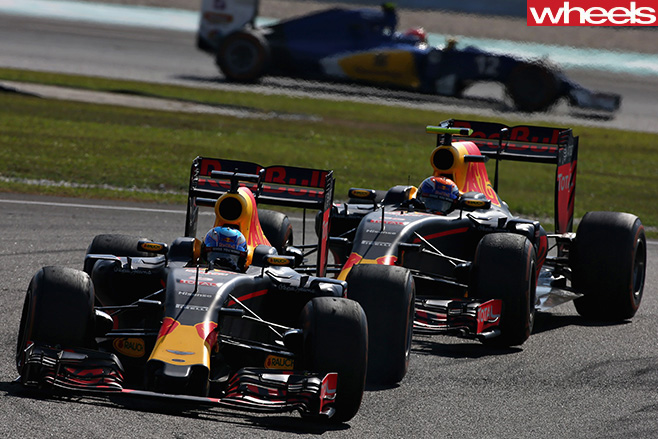
Force India retains Sergio Perez and has secured ex-Manor starlet Esteban Ocon to replace Nico Hulkenberg, who has defected to the works Renault squad alongside Jolyon Palmer.
The Hulk slides into the yellow car vacated by Kevin Magnussen, who is off to Haas to partner Romain Grosjean.
Valtteri Bottas is with Williams for another season, joined by Lance Stroll, a rookie with a good record in junior formulae and backed by his father’s massive war chest, amassed by flogging Tommy Hilfiger gear.
At McLaren Honda, Alonso (the most experienced driver on the grid now, with 272 race starts) has exciting prospect Stoffel Vandoorne in the opposite garage.
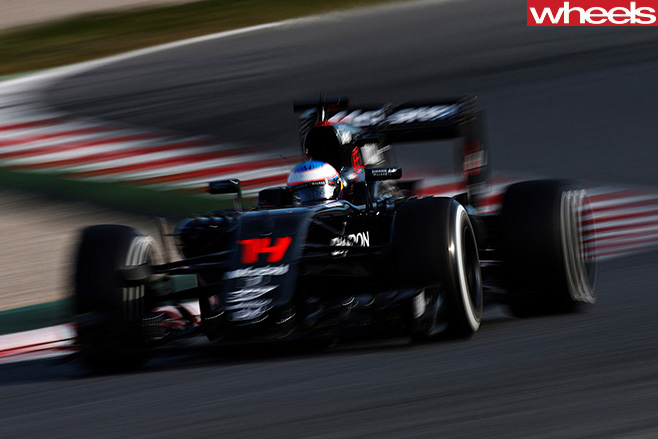
Merc-powered Manor, which has been up for sale for some months, is also looking for a mix of talent and dollars for its two race seats.
The FIA has confirmed its 20-race F1 calendar for 2017, again dropping Germany from the schedule, and leaving the champion constructor without a home race.
Brazil is listed as provisional, with Ecclestone advising the FIA that talks are ongoing and that Interlagos could not be confirmed until January.
More positively, Ecclestone has locked in the previously shaky Canadian Grand Prix in Montreal.
The eight-month season for the new-generation cars starts in Australia on March 26 and ends under lights in Abu Dhabi on November 26.
Changes from the provisional calendar issued in three months earlier are Malaysia and Singapore swapping places, and Baku moving a week earlier so avoiding a clash with the 24 Hours of Le Mans.
The 2017 F1 world championship calendar
March 26 – Australia (Melbourne) April 9 – China (Shanghai) April 16 – Bahrain (Bahrain) April 30 – Russia (Sochi) May 14 – Spain (Barcelona) May 28 – Monaco (Monte Carlo) June 11 – Canada (Montreal) June 25 – Azerbaijan (Baku) July 9 – Austria (Spielberg) July 16 – Great Britain (Silverstone) July 30 – Hungary (Budapest) August 27 – Belgium (Spa-Francorchamps) September 3 – Italy (Monza) September 17 – Singapore (Singapore) October 1 – Malaysia (Sepang) October 8 – Japan (Suzuka) October 22 – USA (Austin) October 29 – Mexico (Mexico City) November 12 – Brazil (Sao Paulo) November 26 – Abu Dhabi (Abu Dhabi)
There’s some rather classy luxury cars destined for Australia in 2017. Here’s WhichCar’s pick of the ones we’re most excited to see.
The 5 Series has been at the pointy end of the large luxury car class for decades, and 2017 heralds the arrival of the seventh generation. There’s a slightly bigger footprint from broadened dimensions, yet the use of more advanced materials for its construction has helped to lower weight by up to 100kg. The usual [range] suspects of the 520d, 530i, 540i and 530d will be joined by a plug-in variant, as well as a super-efficient 520d diesel capable of circa 3.9-litres-per-100km fuel consumption. A twin-turbo V8 M550i model, also confirmed, will offer 0-100km/h acceleration of around 4.0 seconds, though a new M5 will eventually materialise to reclaim its rightful position as the fastest 5 Series.
MERCEDES-BENZ E-CLASS VARIANTS

2017 Top 5 Luxury Cars
| BMW 5 Series | $82,255+ |
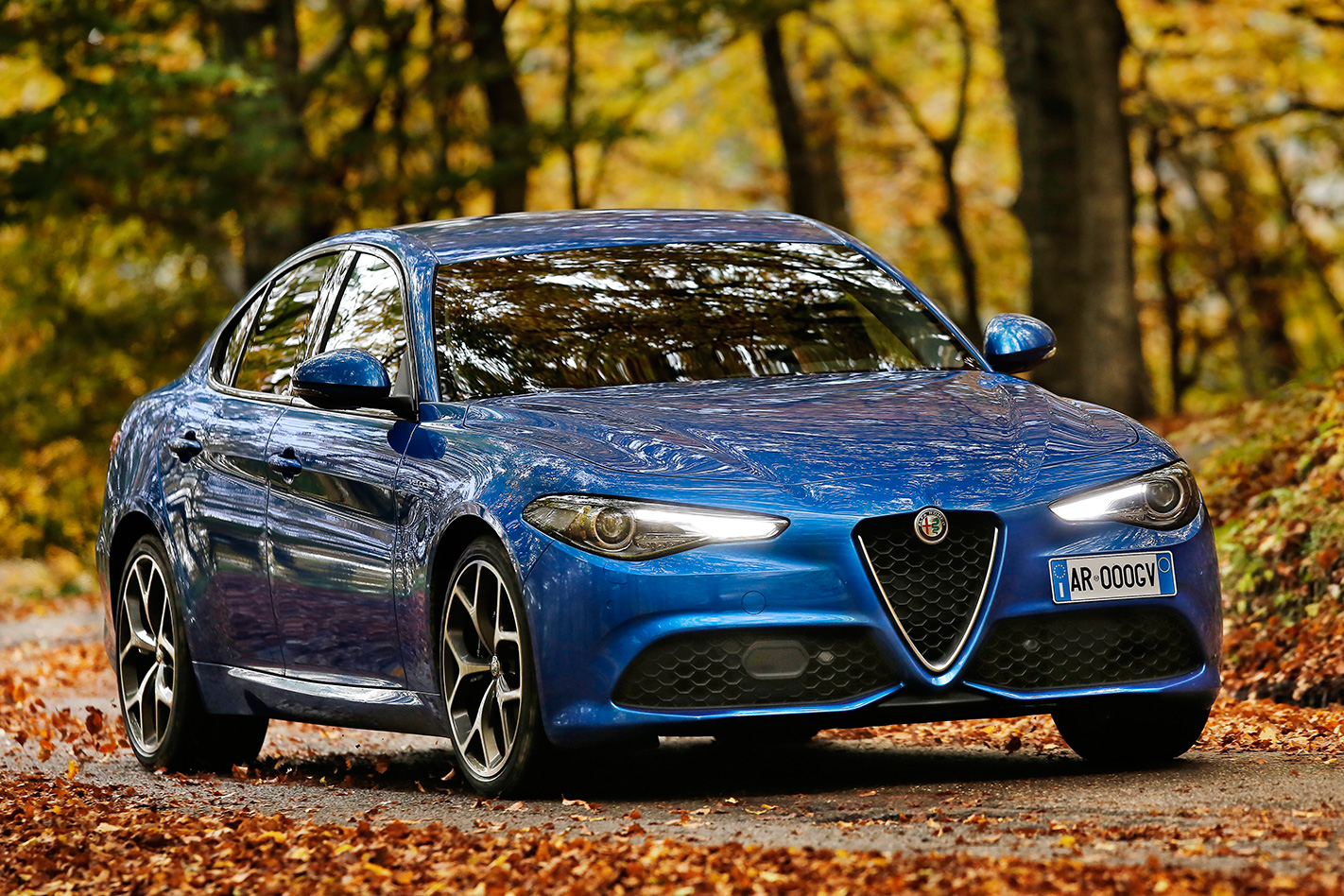
| Alfa Romeo Giulia | $143,900 (QV variant) |
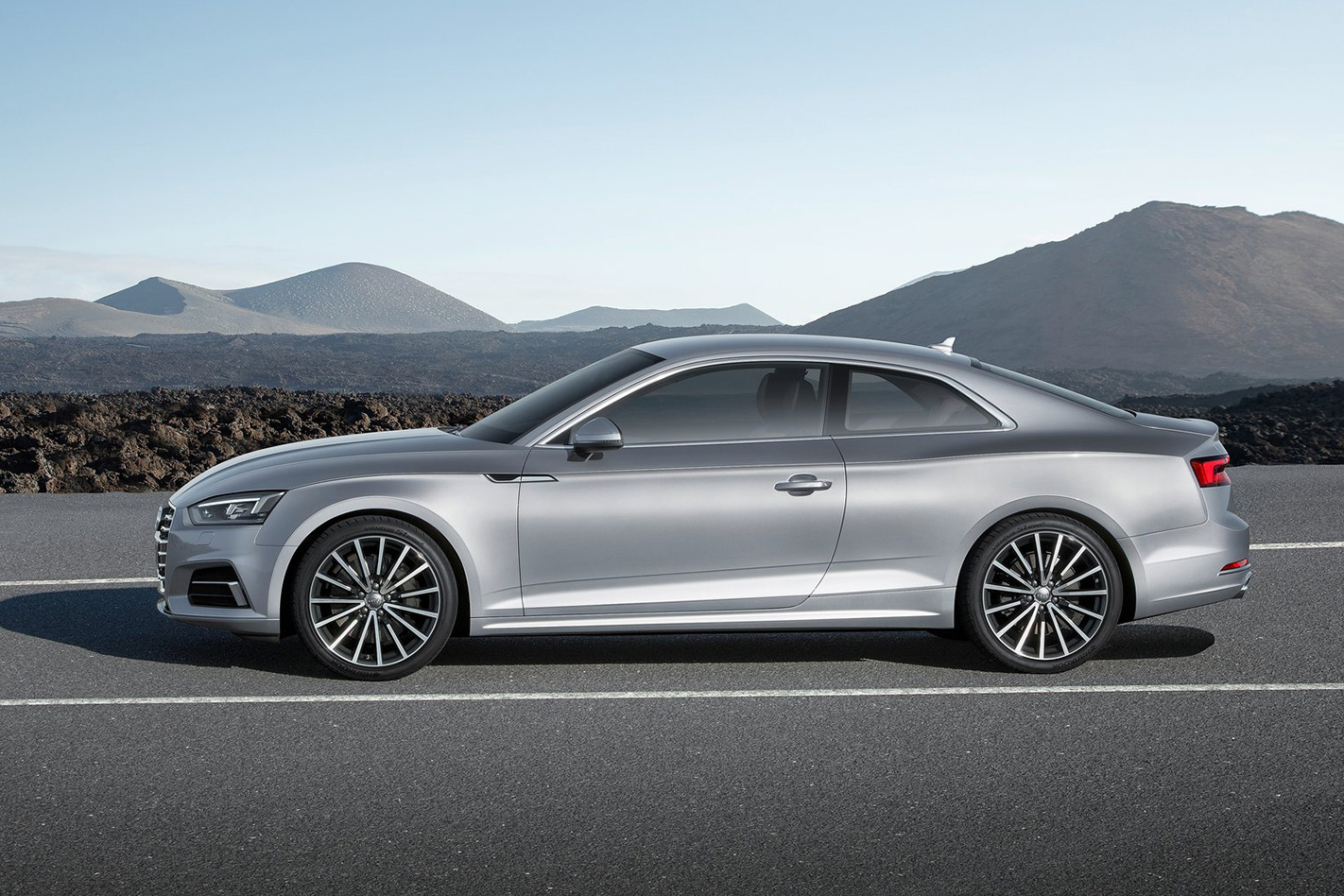
| Audi A5 | $68,900+ |
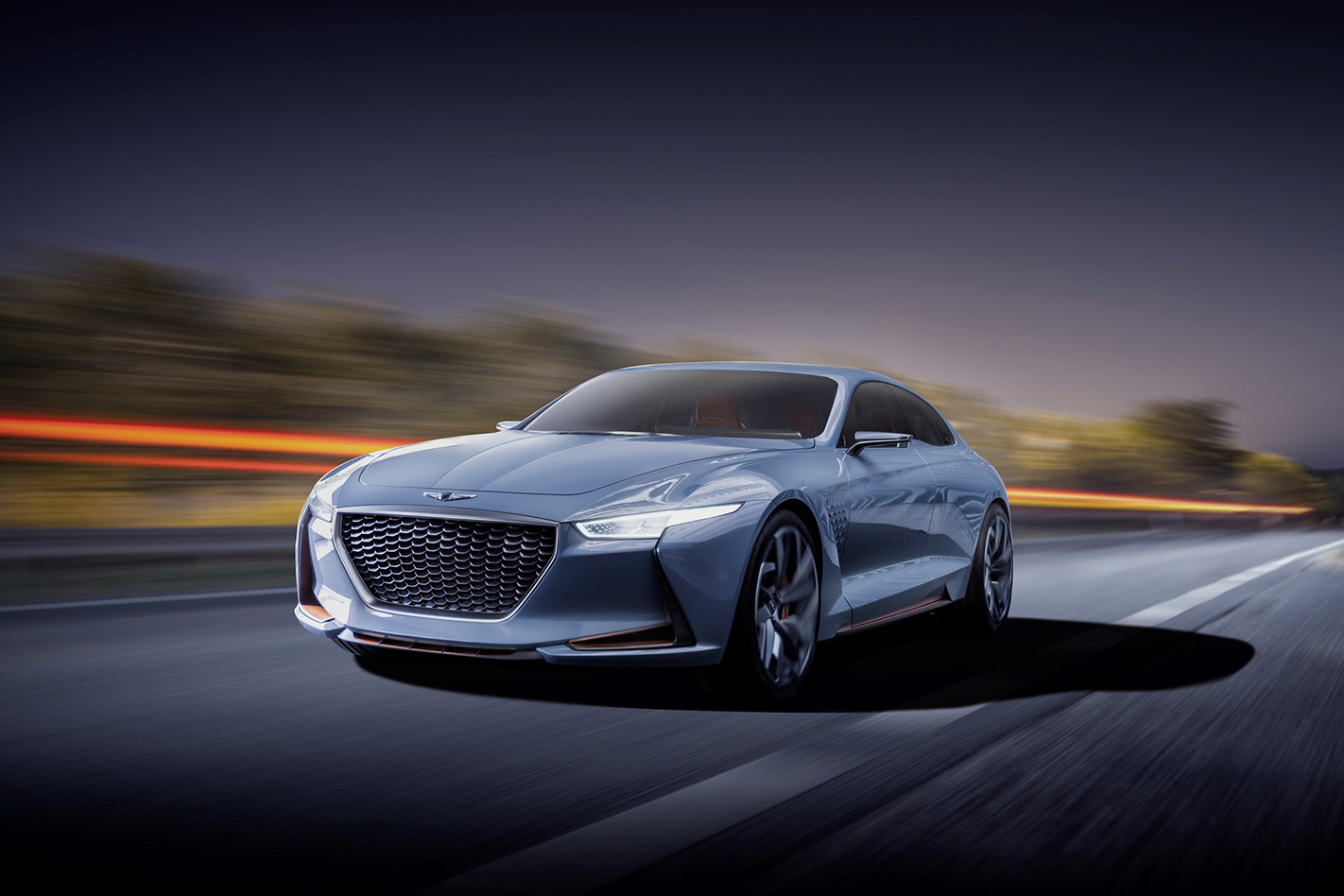
| Genesis G70 | $ TBC |
| Mercedes-Benz E-Class variants | $89,990+ |
This competition is now closed. Congratulations to the winner: Stefany T. from VIC.
Wheels readers are some of the most dedicated automotive enthusiasts around, so we wanted to give you a chance to get your voice heard regarding the 2017 Car of the Year. It’s simple. Just cast your vote for what you think deserves to win the 2017 COTY title for a chance to win $1,000.
Unlike our panel of expert judges, you may not have had the chance to drive all 28 cars. But we’re sure you’ve read the reviews, seen our videos and maybe even considered their pros and cons. To help you make your decision, we’ve linked each contending car to their review. Just hover over the images and click through. Voilà.
Our Wheels COTY panel judge the contenders under five strict criteria: function: efficiency: value: technology: and safety. Below are some handy hints to keep in mind when making your selection:
- Function – How well the car does what it is intended to do?
- Efficiency – The cars use of resources in manufacturing, design, and ownership.
- Value – How does it stack up against its rivals and against the wider new car market?
- Technology – Does it offer an advancement or advantage over its rivals?
- Safety – Both passive and active features that keep occupants and pedestrians safe
The Kia Picanto has only been in Australia for nine months, but the Korean automaker has already shown off its all-new third-generation replacement.
But that’s not a huge surprise, considering the second-gen Picanto was already over five years old by the time it hit our shores. A successor was never going to be far, but Kia Australia was keen to establish the nameplate here ahead of its arrival – albeit only in a singular specification level, with a 1.4-litre engine and automatic transmission.
However the payoff for shoppers who were happy to wait is this, the all-new Picanto. Set to launch overseas following its public debut at the Geneva Motor Show in March, WhichCar understands the third-generation Picanto will go on sale locally toward the end of May this year.
Sporting a great deal of athletic zing in its exterior design as well as an interior that’s significantly more posh, the new Picanto slots in neatly beside other box-fresh Kias such as the Optima and Sportage.
The design is more mature than the slightly cartoonish second-generation Picanto, with a 15mm stretch in wheelbase (from 2385mm to 2400mm) and a trimming of front and rear overhangs gifting it a more planted stance – as well as interior packaging benefits.
Kia claims the new Picanto boasts more cabin and cargo space than segment rivals, thanks to its new proportions.
Inside, the dash goes from being brutally basic to cutting-edge, with a floating infotainment screen the focal point of a dashboard that’s more visually exciting than the outgoing model. The steering wheel also gains a third spoke, and is now festooned with infotainment controls.
Integrated sat-nav appears to be available as well, though local specifications have yet to be confirmed.
Though Kia Australia credits the second-gen Picanto’s keen $14,990 drive away pricing, simplified range structure and attractive seven-year warranty as among its greatest virtues, its replacement is likely to feature an expanded lineup encompassing a manual-transmission base model and potentially a high-grade GT variant (pictured).
With the current model already proving popular in the cut-throat light hatch segment, a more well-rounded range structure should result in greater sales for Kia’s smallest offering. Expect more details of the Australian 2017 Kia Picanto range closer to launch.
A production prototype of the Audi Q8 Coupe has been spotted testing undergoing winter testing in Lapland ahead of its reveal in concept form at this weekend’s Detroit Motor Show.
The Q8 is based on the Q7 SUV platform but with a number of more aggressive and sporty touches.
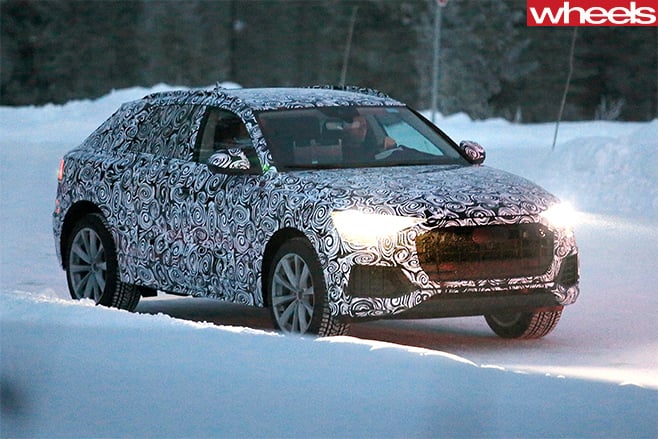
As expected it appears it will be a tamed down version of the concept, though it shares the sporty liftback roofline.
This will inevitably mean less headroom than the boxy Q7 though Audi is adamant it will still have a spacious interior with ‘four equally comfortable seats’.
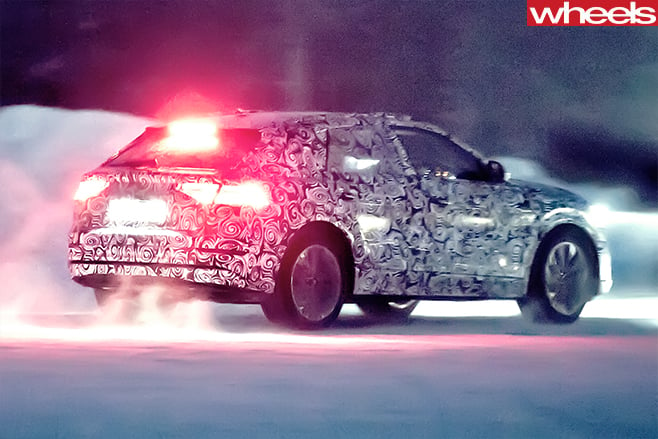
A broad hexagon grille and LED headlights and tail-lights can be also seen amongst the camouflage.
The Q8 is expected to come with the same e-tron hybrid drive system as the Q7, with a 3.0-litre V6 diesel engine producing more than 200kW mated to a 94kW electric motor.
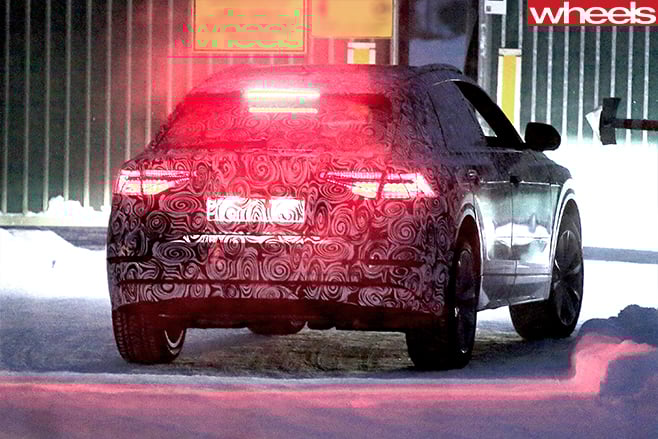
Other engine options include the SQ7’s 325kW-hp 4.0-litre V8 for a high-performance SQ8.
The Q8 is expected to cost around the same as its Mercedes GLE Coupe and BMW X6 rivals, with an entry level of around $100,000.
It will be part of Audi’s push to defend its market leading position for luxury soft-roaders by doubling its SUV range with a range of new vehicles including the Q8, the affordable Q2 crossover and the all-electric Q6 based on the e-tron quattro concept which debuted at the 2015 Frankfurt motor show.
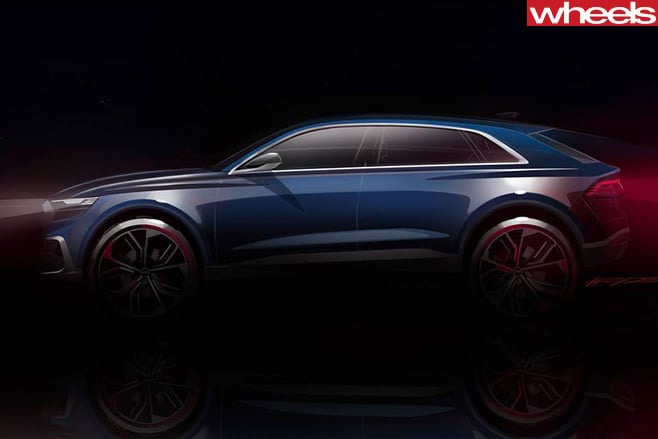
The Q8 isn’t expected to reach showrooms until 2018.
The highly-anticipated 2017 Alfa Romeo Giulia QV now has an official price tag.
Fiat Chrysler Automobiles (FCA) Australia has announced the range-topping QV will retail at $143,900 (plus on-road costs), with the high-performance sedan available in dealerships from February this year.
This places the QV above the BMW M3, its primary rival (139,615 plus on-roads) in terms of cost. However, Alfa Romeo believes its sedan beats the BMW in performance, safety, and equipment.
The QV is priced competitively when compared to its other German rivals the Mercedes-AMG C63 S and Audi RS4 Avant, which cost $155,615 and $170,626 plus on-roads respectively.
The Giulia QV, which is being launched here ahead of its sister variants, has a 2.9-litre twin-turbo V6, which produces 375kW and 600Nm, and currently holds the production sedan record at the Nurburgring.
The four-door will accelerate to 100km/h from a standstill in 3.9-seconds, which beats the M3 (4.1-seconds) and Audi RS4 (4.2-seconds), while equaling the Mercedes-AMG C63 S.
Steve Zanlunghi, President and CEO of FCA Australia, says the pricing places the Giulia QV well in the market.
“Heralding best-in-class performance, we believe the Giulia QV price represents a competitive and value driven proposition for Australian motoring enthusiasts looking for something different,” he said.
The Giulia is the halo model in Alfa Romeo’s current line-up, with the QV the flagship of the range.
Australia will receive four specifications of the sedan, starting with the entry-level Giulia, the Giulia Super, Giulia Veloce, and Giulia QV. Pricing for the rest of the range will be revealed later in the year.
The Ford Mustang will soon come with batteries included, with the Blue Oval announcing it will produce a hybrid version of its iconic pony car – and that it could come Down Under early in the next decade.
Speaking at the Deutsche Bank Global Auto Industry conference in Detroit, Ford CEO Mark Fields said the hybrid Mustang would “deliver V8 power and even more low-end torque”.
It will be primarily powered by an unspecified EcoBoost turbo engine – potentially a development of the 233kW/432Nm 2.3-litre donk in the current-gen Mustang Ecoboost – which should match its 306kW/520Nm V8 big-brother once augmented by an electric assistance motor.
The hybrid powertrain will feature in the all-new 2019 Ford Mustang and is expected to make its US debut in 2020 before going on sale in other markets.
Australia is likely to be one of those markets, with a Ford Australia spokesman telling Wheels a hybrid Mustang would be an opportunity to build on the Mustang’s success here and “to showcase the company’s technical expertise”.
While the thought of a hybrid Mustang won’t please the purists, who are still coming to terms with a four-cylinder version of the iconic muscle car, it will be the latest in a growing number of petrol-electric sports cars such as the BMW i8 and Honda NSX.
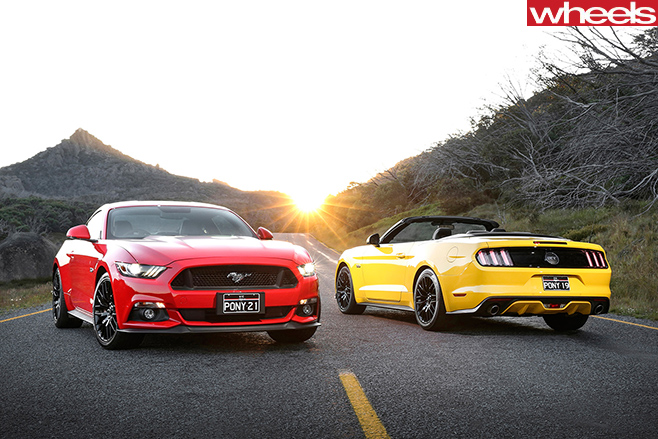
The hybrid Mustang will be one of 13 new Ford electrified models due in the next five years, including a hybrid version of the F-150 pickup, a plug-in hybrid Transit van, an all-electric SUV and new hybrid police pursuit vehicle likely to be based on the new Lincoln Continental.
Fields says the expanded EV line up is in line with the company’s belief that “electrified vehicles will exceed gasoline-powered within the next 15 years”.
Ford Australia has similar expectations to its parent company, despite the relatively slow uptake of electric vehicles here and a lack of green car incentives for manufacturers and buyers.
“While Australia may not have the infrastructure for widespread plug-in vehicle use right now, the industry is changing, and infrastructure will continue to grow,” a Ford spokesman said to Wheels.
“We anticipate significant growth in electrified vehicles in the next 15 years, including more electrified vehicle offerings than petrol/diesel engine-powered vehicle ones within that time frame.
“That will naturally envelop Australia – and we know that Australians are often early adopters of new technologies.”
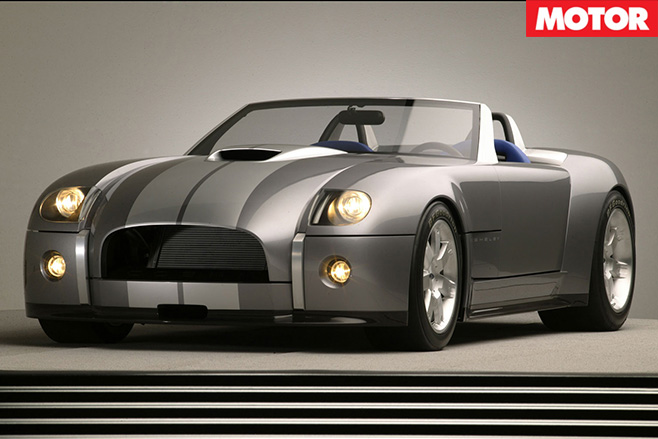
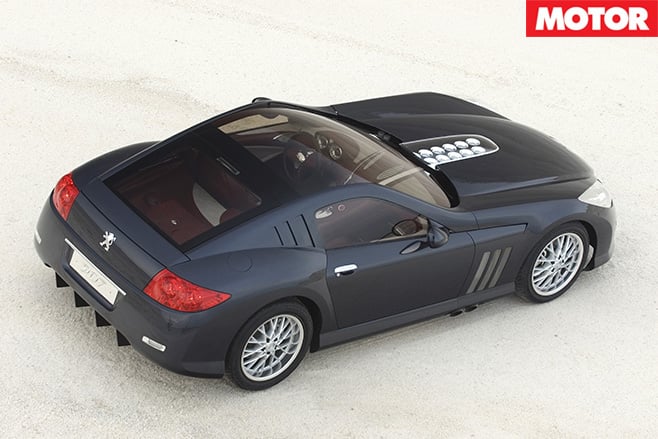
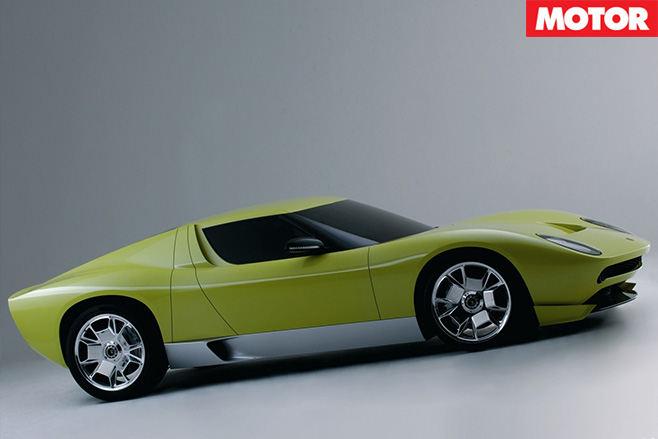
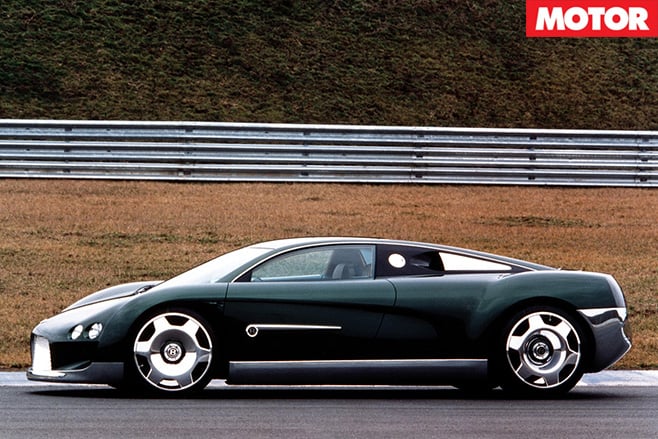
Motor show specials that deserved to make the jump to reality.
AUDI AVUS

BMW M1 HOMMAGE

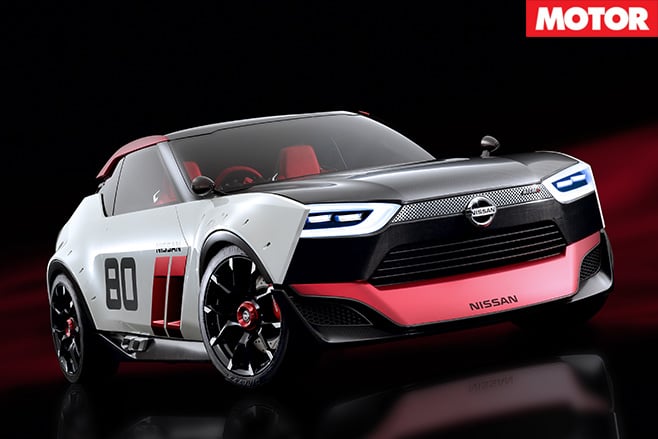
NISSAN IDX NISMO
SHELBY COBRA
PEUGEOT 907
AUDI QUATTRO

LAMBORGHINI MIURA
BENTLEY HUNAUDIERES
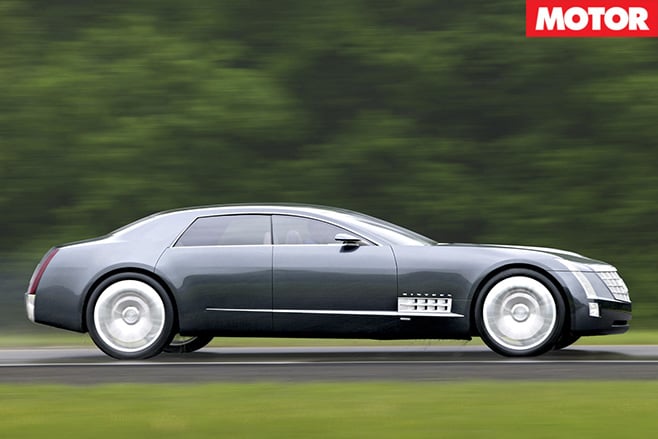
CADILLAC SIXTEEN
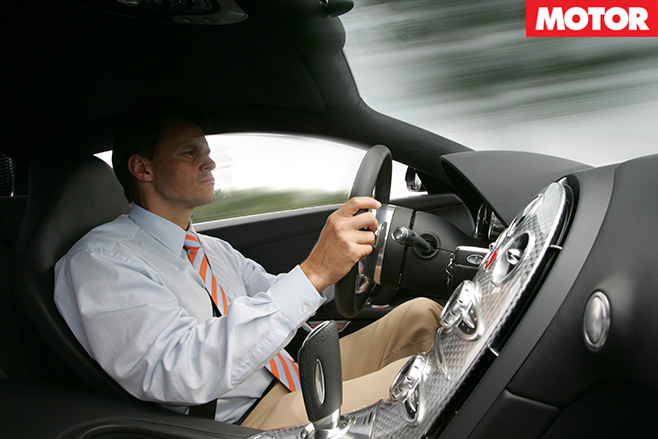
To the left of the instrument binnacle is a round dial, the likes of which I haven’t seen before.
This article was originally published in the October 2005 issue of MOTOR.
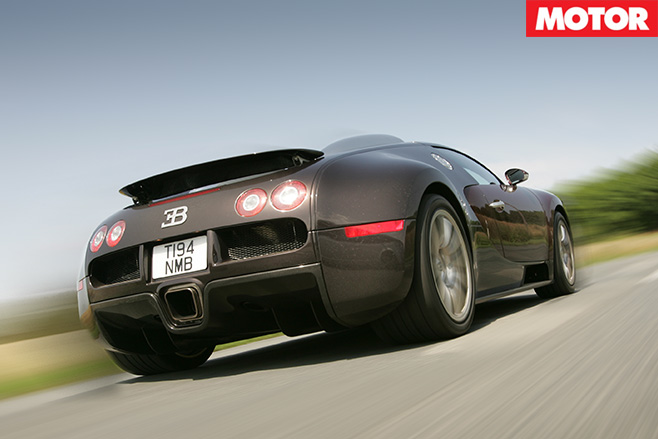
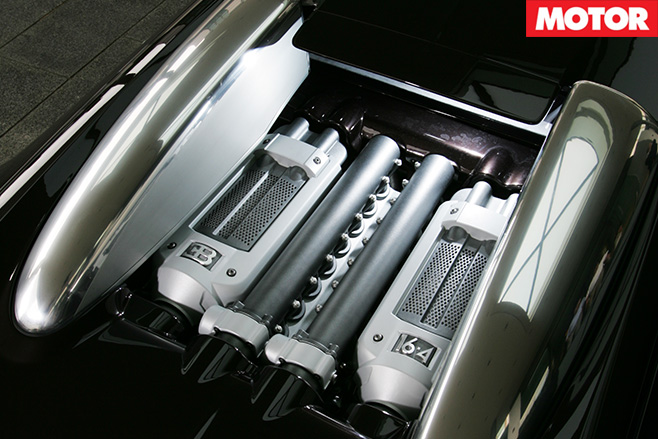
The needle starts at zero and whaps all the way around to the 1000bhp* mark. It’s a display of the enormous elemental force produced by the EB 16.4 Veyron’s awesome W16 quad-turbo engine.
To reach 250km/h, which is where most rivals throw in the electronic towel, no more than 200kW is required. So, what happens when you summon the remaining 536kW? “Then hell breaks loose,” says technical director at Bugatti Engineering, Wolfgang Schreiber. He is one of only three people who regularly whips the EB 16.4 all the way to the limit. The tests are conducted on racetracks, on VW’s own proving ground in Ehra-Lessien, and on German country roads and autobahns.
“The Veyron is a truly ground-breaking piece of kit,” declares the 47-year-old engineer. “And the maximum combustion energy does in fact add up to 3000bhp – 1000bhp is swallowed by the cooling system, 1000bhp go through the exhaust and 1000bhp are relayed to the four driven wheels.
it requires respect.”
I nod my ‘respect’ at Wolfgang as I image 200km/h speed differentials on the autobahn, but secretly I’m thinking, Respect? No shit, Sherlock.
Anything is possible…
The Bugatti Veyron was built to set a performance standard no other marque could match. And to get there VW boss Dr Ferdinand Piech had initially insisted on an 18-cylinder engine, he eventually settled for the W16 – two 4.0-litre W8 units mid-mounted and stuck together end-to-end. Compromising on the engine was one thing, he wouldn’t compromise on its output.
The maximum power output had to nudge 1000bhp, and the maximum speed had to be in excess of 400km/h.
How to beat wind resistance…
“At very high speed, a perfect balance between the drag coefficient and the downforce is essential,” declares Schreiber. “Before you can attempt to reach the maximum speed of 406km/h, the car’s aerodynamic profile needs to be adjusted.”
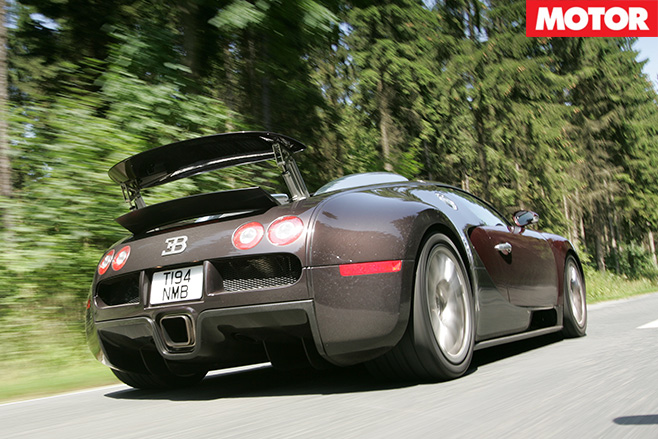
To do that, the driver turns the so-called ‘speed key’ located between the seat and the sill. In ‘top-speed’ mode, the rear wing and the tail spoiler above it retracts almost fully, the front diffuser panels close, the ride height drops to 65mm at the front and 70mm in the back, dropping the drag coefficient from 0.37 to 0.36.
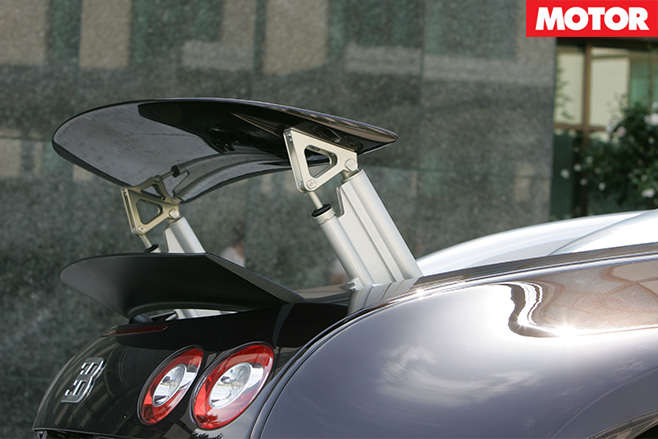
Like the Merc McLaren SLR, the Veyron is equipped with an air brake. Schreiber explains, “When you hit the pedal hard at 200km/h-plus, the air brake effects a deceleration of 0.6g. And downforce increases by almost 300kg. As a result, the rear wheels take a much larger share of the brake balance without approaching their lock-up limits.”
Staying cool under pressure…
“It’s impossible to completely cool down the energy freed by 736kW,” says Schreiber. “But you can increase the throughput by implementing stringent air-flow management. We are not just talking about the number and size of cooling apertures here, but also about important details like ducts, flaps and fins.”
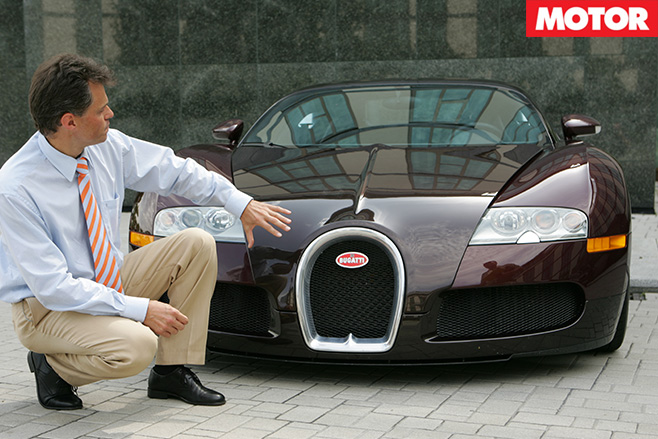
“It is extremely difficult to find a common denominator for the cooling and aero requirements,” acknowledges Schreiber. “With every extra cubic inch of air that flows through the car, the drag coefficient suffers and you lose a little speed.”
Building the foundation of speed…
The Veyron isn’t all just speed and show, Bugatti had to be realistic about the project and build a car that was as comfortable and safe pottering around town as it was blasting around a high-speed bowl.
As Schreider explains, “The Veyron covers a wider speed spectrum than any other sports car. Therefore, it must ride reasonably well at 40km/h, and at the same time it must be perfectly stable and confidence-inspiring at 400km/h. To meet these conflicting requirements, there are three suspension settings to choose from: standard, handling and top speed.
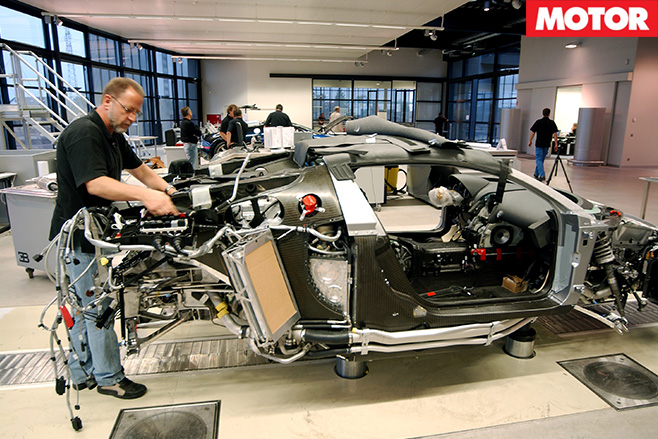
In standard mode, the Bugatti’s ground clearance is set at around 125mm front to back – enough to climb kerbs. And it runs on OZ wheels shod with run-flat tyres supplied by Michelin. The sizes read like credit card numbers: 265/680 ZR508A in the front, 365/710 ZR540A in the back.
The chassis incorporates an ambitious mix of high-tech elements. Carbon-fibre is the material of choice for the monocoque and the rails attached to it, while the tubular space frame which accommodates the front suspension and the rack-and-pinion steering is made of aluminium. The rear sub-frame and the transverse engine carrier are made from high-strength steel.
Fast with a capital F…
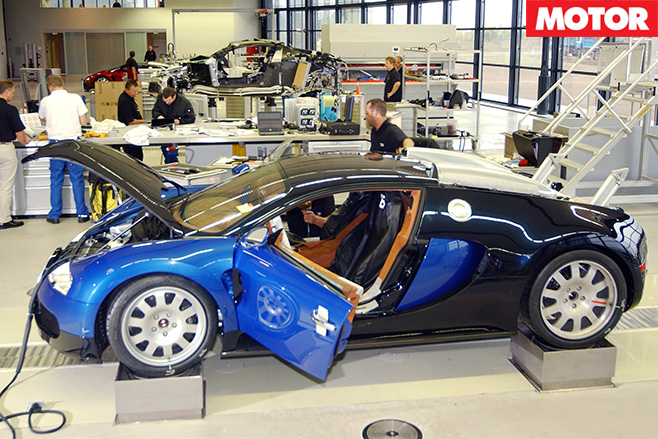
The performance figures recorded for this 1950kg two-seater are simply out of this world: 0-100km/h in 2.5sec (matching Valentino Rossi’s Yamaha), 0-200km/h in 7.3sec (eclipsing Schumi’s Ferrari F2005), and 0-300km/h in just 16.7sec. By way of comparison, a Ferrari 575M Maranello takes about a minute to get to 300km/h.
Getting from 380 to 400km/h…
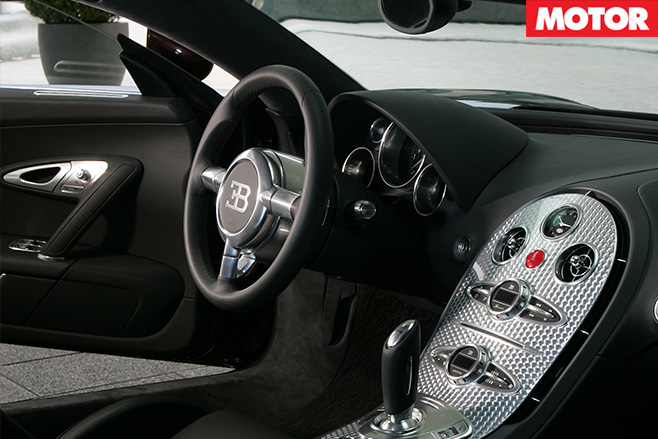
Grouped around the gearlever are three buttons labelled launch control, start engine and handling set-up. “The Veyron is a pure-blooded driving machine, not a showcase for electronic gadgets,” states Schreiber. “That’s why we left out everything that could distract the driver.
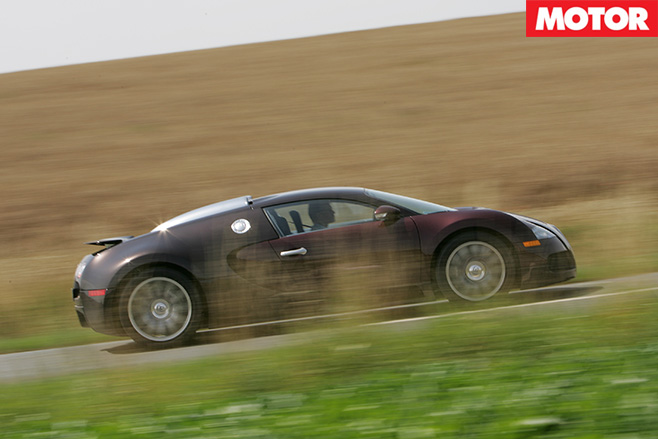
“What’s it like to drive at 400km/h or 250mph? It’s kind of a surreal experience, an excursion into a different world. It’s a big shot of adrenalin. After all, you are covering 111 metres per second. And at that speed the steering is totally devoid of any power assistance, the engine is approaching 6500rpm in seventh gear and tyre pressures climb from 3.0 to 3.5bar within 15 seconds.”
And this 400km/h-plus top speed is not a one-night only performance, never to be repeated in the ‘real’ world. During its test phase the Veyron cracked the magic 400 on a number of occasions and in early April this massive speed was officially recorded in a production-spec Veyron by the German homologation authority (TÜV – Süddeutschland).
One good idea and 1001 hurdles…
It wasn’t plain sailing, though. Getting the Veyron from concept to rolling stock stage took an eternity, says Bugatti boss Thomas Bscher.
“In the beginning, it was pure chaos,” he said. “We counted over 600 problems with the basic packaging requirements, the whole cooling issue was one big unsolved problem, and the promised power output existed only on paper.”
“Another sore point were the driveshafts which kept running dry. It turns out the rubber boots were being distorted by the extreme centrifugal forces so much so that they touched nearby deflector panels which cut them open, allowing the grease to escape. For safety and rigidity reasons, the monocoque and the entire front-end module of the car had to be redefined and reinforced.
Coming to a store near you?
Even optimists would struggle to say the Veyron was commercially viable. After all, no more than, ahem, 30 to 40 cars have been sold so far (but not built), depending on who you ask. And according to the Molsheim grapevine, there are still at least ten free slots in the contingency for 2006. Not surprisingly, the current plan is to stretch the production over eight years instead of six.
The car is being sold ex-factory via an exclusive distribution network which relies on no more than 20 main dealers worldwide. Where it makes sense, Bugatti intends to tap into the Bentley network. The required down payment is $482,000, the warranty is limited to two years and 50,000km.
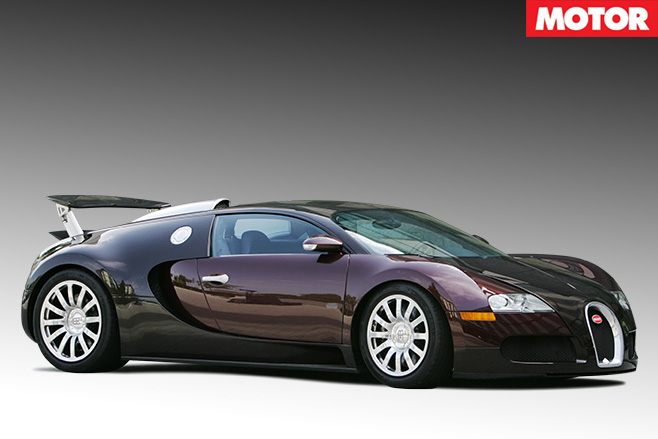
All this for 400km/h.
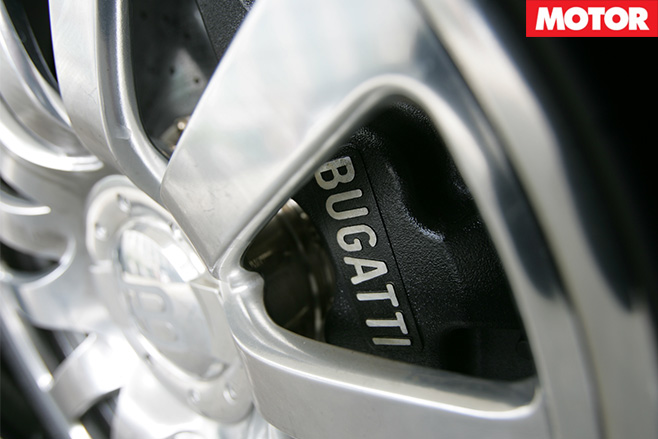
SPECS: BUGATTI VEYRON EB 16.4 Body: two-door coupe Drive: all-wheel Engine: mid-mounted 8.0-litre, 64-valve, DOHC, intercooled, quad-turbo W16 Power: 736kW @ 6000rpm Torque: 1250Nm @ 2200-5500rpm Weight: 1950kg Weight/Power: 2.65kg/kW Specific Power: 92.0kW/litre Transmission: seven-speed DSG Suspension: double wishbones, coil-over dampers with hydraulic actuation, anti-roll bar (f & r) Length/Width/Height: 4380/1994/1206mm Wheelbase: 2650mm Brakes: 400mm carbon-ceramic discs, eight-piston calipers (f); 380mm carbon-ceramic discs, six-piston calipers (r) ABS Wheels: 20 x 9.5-inch (f); 21 x 13.0-inch (r), alloy Tyres: Michelin PAX run flats, 265/680 ZR508A (f); 365/710 ZR540A (r) Price: $3,000,000 (approx)
