
BMW’s new 5-Series will be the first car on the market able to read – and decipher – Australian school zones.
Using stereo cameras built into the top of the windscreen, the new large sedan that arrives in March 2017 will be able to read what time the school zones are active, align them with the car’s in-built clock and alert the driver if a school zone is active.
This separates it from similar systems used by Mazda, Volvo, and Tesla, as it can determine what times the school zones are active, instead of warning you regardless of the time.
“It can pick it up and it can pick up you’ve got a school zone from, say, 8.30,” said Shawn Ticehurst, BMW Australia head of product and market planning. “We tested the feature out here; it’s got now an accuracy rate that’s quite high.”
However, Ticehurst admits the system will not be perfect, potentially reacting to 40km/h speed signs on the back of NSW buses and 100km/h limits on the back of trucks.
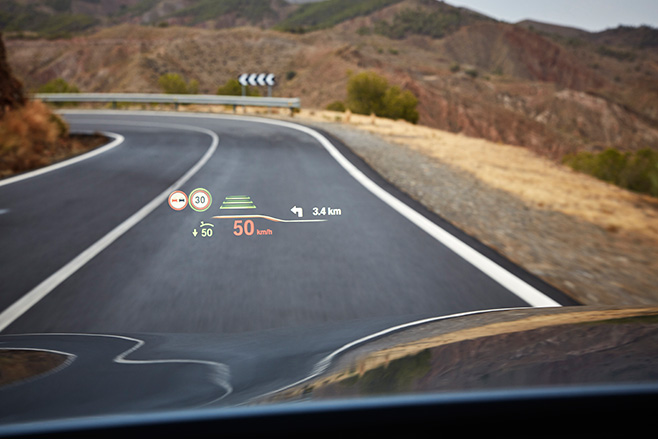
It is the first time BMW has offered speed limit recognition technology since 2011, when it was briefly fitted but later disconnected and pulled from sale – and owners refunded – following feedback of too many errors.
Other carmakers offer speed limit recognition in Australia but in each case the system isn’t 100 percent accurate.
The technology is one of a number aimed at cementing the 5-Series as a tech and connectivity leader.
The speed limit recognition can also be linked to the active cruise control, so the car automatically adjusts its speed in changing zones, potentially reducing the risk of a speeding fine.
It will also have remote parking functionality, allowing the car to be parked into tight spots from the keyfob.
The ConnectedDrive, too, has been updated to now include a feature that sends a photo from the four external cameras to the owner’s phone every three minutes, allowing them to see if there car has been blocked in or sustained any damage.
The touchscreen, too, picks up iPad-like pinch and swipe functionality, teaming with the gesture control features that allow mid-air swipes to cancel phone calls or adjust the audio volume.
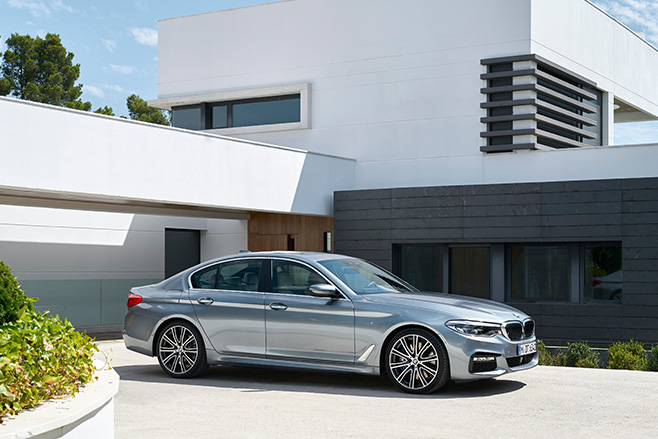
The head-up display on BMW’s new 5-Series now accounts for polarised sunglasses, for example, something most European cars don’t bother with (the Holden and Mazda systems do work with polarised lenses).
The new 5-Series will initially be offered in Australia with four turbocharged engines; a 2.0-litre four-cylinder petrol and diesel and a 3.0-litre inline six-cylinder petrol and diesel.
The 530e plug-in hybrid is due later in 2017 and a twin-turbocharged, V8-powered M5 is a given; expect it by 2018.
At this stage the 550i – which uses a twin-turbo V8 and all-wheel drive to reach 100km/h in 4.0 seconds – is not expected in Australia.
While the 5-Series outsells its two main rivals – Mercedes-Benz’s E-Class and Audi’s A6 – globally, in Australia the E-Class beats it.
BMW puts that partially down to the popularity of the X5, arguing some buyers at that end of the market have switched to the functionality of an SUV.
But the company is hoping the new 5 will draw more buyers to the model.
SUPERCARS Australia today announced a new category for 2017 – SuperUtes – which will replace the longstanding V8 Utes championship.
The series will be open to all manufacturers, and will feature dual-cab utes – or “trucks” as Ford and Holden now want to call them – and diesel engines.
A similar category exists in New Zealand, based off Ssangyong utes, and remains incredibly popular with competitors.
Supercars says the new category is designed to align with changes in consumer demands. Dual-cab utes now represent about one in five new-car sales in Australia.
Supercars took over control of the V8 Utes championship this year after the category’s previous manager folded.
“V8 Utes has been a popular and entertaining category but with the changing automotive market it’s important that the utes series becomes more market-relevant,” Supercars managing director Matt Braid said.
“Utilising production based turbo-diesel dual cab utes currently available for sale in the Australian market, SuperUtes will open the category to a variety of new manufacturers while still maintaining the spectacular and entertaining elements that make the category such a favourite with the fans.”
The category is a spin-off of the failed next-generation of V8 Utes, called EvolUTEion, which was designed to allow dual-cab body styles and turbo-diesel engines over a control chassis.
However, high costs, and slow pick-up by competitors killed off the idea.
It’s likely the new SuperUtes category will remain largely production-based, much like the current V8 Ute formula.
Supercars has confirmed the category will first race at the Townsville V8 Supercar round in July, followed by Queensland Raceway, Bathurst, the Gold Coast, and finally concluding at the planned Newcastle street race.
AFTER almost three years at the helm and 36 action-packed editions, Wheels editor Glenn Butler has called it a day.
Butler, who will enter the field of automotive PR, has steered Wheels through a digital transformation. He’s created the standalone WheelsMag.com.au website, and evolved the WhichCar.com.au website into a must-read reference site for new-car buyers.
He is the 13th editor to head up Wheels, appointed after the magazine’s nerve centre shifted from Sydney to Melbourne.
It was something of a baptism of fire. Even before the chair was warm Butler was thrown into the hot seat, with the axing of FPV and alarm bells ringing loudly over the future of Holden’s manufacturing – following in the wake of Ford announcing it would become a full-line importer from 2016 – shaking Australian car enthusiasts to the core.
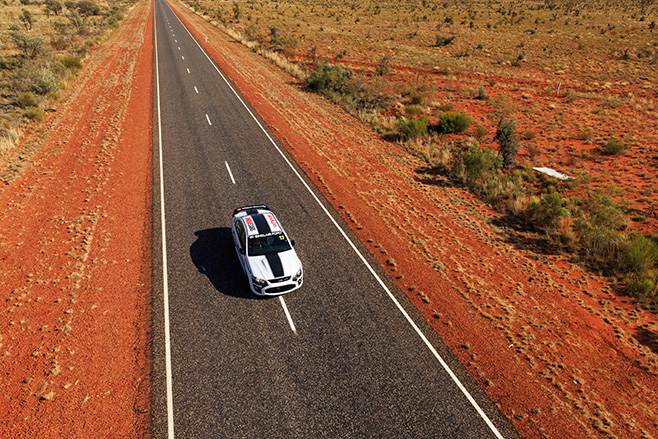
Butler’s tenure at Wheels hasn’t been without its controversy, either. Some readers reacted in horror when the BMW i3, a small, lightweight battery-powered hatchback, was named the 2014 Wheels Car of the Year. As with some of other controversial COTY decisions (did someone mention the Leyland P76?), only time will tell if that choice will come to be seen as far sighted or misguided.
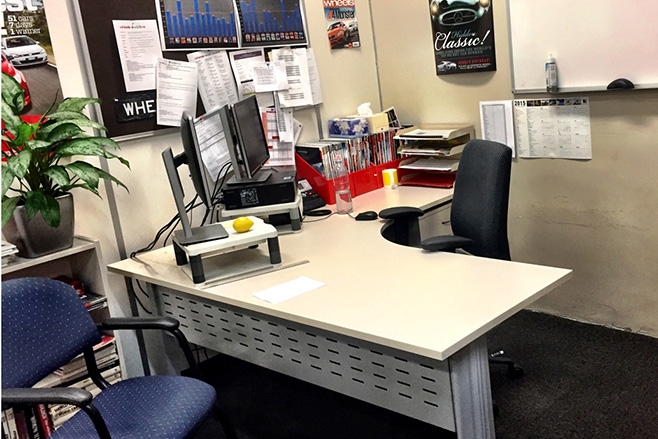
WHEELS EDITORS THROUGH THE AGES
- 1953-56 Athol Yeomans
- 1956-58 Ian Simpson
- 1958-63 Ian Fraser
- 1963-68 Bill Tuckey
- 1968-71 Rob Luck
- 1971-87 Peter Robinson
- 1987-94 Phil Scott
- 1994-99 Angus MacKenzie
- 1999-2002 Ewen Page
- 2002-10 Ged Bulmer
- 2010-12 Bill Thomas
- 2012-13 Stephen Corby
- 2013-16 Glenn Butler
- 2016-
When we start looking at BFYB contenders each year, we always try to shake out the version with all the pace but less price-tag.
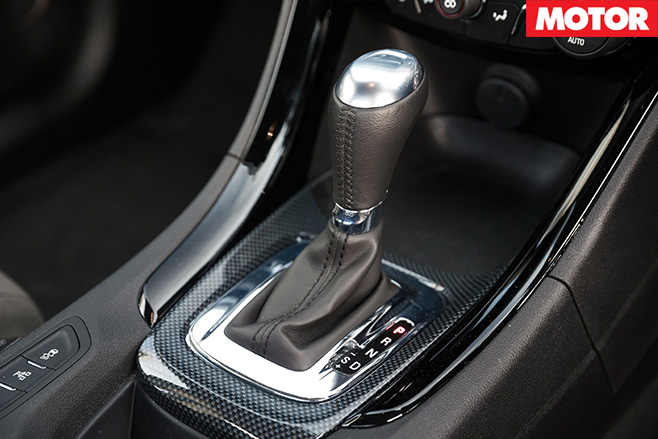
Hey, it’s the BFYB credo, right? But when we started talking to Holden about a VF II SS Ute, it just couldn’t come up with the cheaper, six-speed manual version. Best it could do was provide an automatic version which not only affects the fun factor (on paper) but also adds $2200 to the sticker. And boy, we bet it’s glad that’s how it panned out.
See, the auto ’box doesn’t detract from the experience one bit. In fact, it’s arguably easier to launch on the dragstrip and that meant quicker times. I personally ran those numbers and when I checked my score-sheet after three runs of the Winton hotmix, it occurred to me that the SS hay-hauler would be a very tough act to follow. Four-hundred metres in just over 13; 0-100km/h in just over five. Yep, those are sharp digits. It’s not the easiest thing to launch cleanly, but if you persevere, the rewards are there.
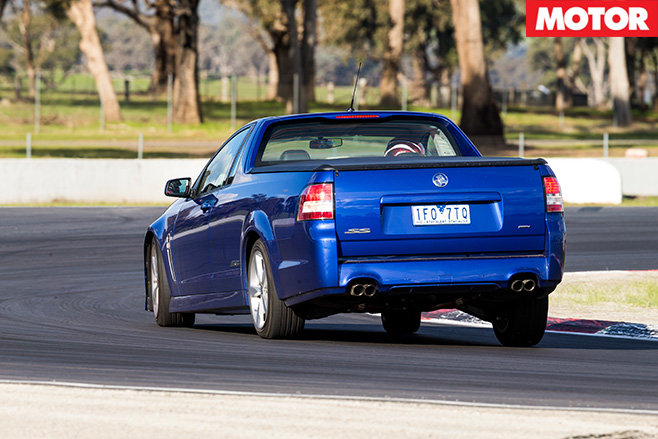
Thing is, of course, that even against those bald numbers, the SS Ute is about as much fun as you can have without hiring specialist help. Scotty, never one to hide his, er, emotions, stepped out of it proclaiming it to be the easiest car ever made in which to be silly. It’s hard to argue with that.
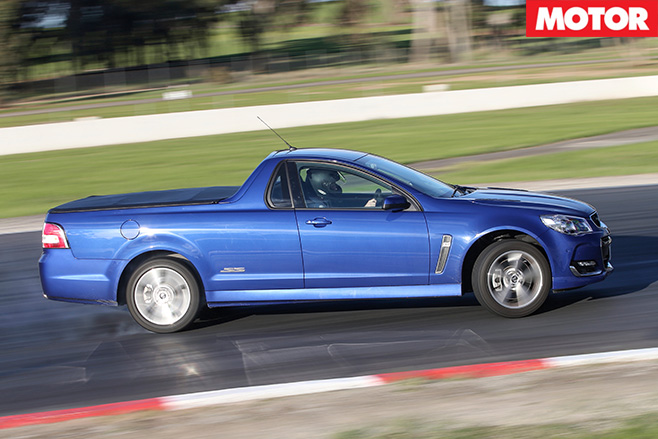
Fundamentally, the SS Ute is stable and with all that wheelbase, it’s also incredibly neutral. Not in a cornering sense, so much, where it trailed some of the other contenders in both the fast and the slower turns, but in a drifting-like-a-mad-bastard sense.
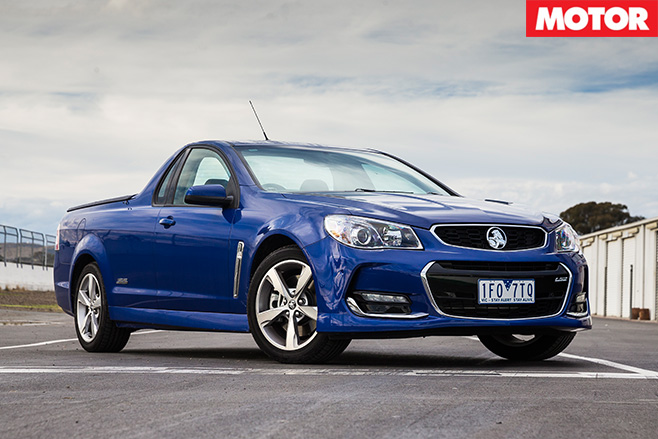
It’s true that it’s not the most responsive or tactile machine, and there are more playful cars out there on first acquaintance. But as you get to know the SS and learn where the limits of its tyres are (probably the limiting factor) then you can start to trust it and have the sort of fun that had Scotty gibbering in his helmet. Chances are it’ll also bring a smile to your dial even if you’re just going about your normal daily stuff.
There’s always huge grunt on tap and we’re not going to be called liars by saying that this is the best sounding local V8. Ever. The only thing you can hear over the SS’s zorsts is the exhaust aftermarket opening a vein.
But is it just me, or is there some kind of pleasure in knowing one of the most hilarious, good-value cars you can buy can also cart your dirt-bike and/or cement-mixer? Thought so.
JUDGES’ COMMENTS 07. David Morley “Practicality counts for squat at BFYB. Luckily for everything else ”
03. Dylan Campbell “Sounds great, goes hard, bucket-loads of drifty fun. Kinda want one”
02. Louis Cordony “Surprisingly chuckable. LS3’s stonk well overdue”
04. Scott Newman “It might just be the most entertaining car I’ve ever driven”
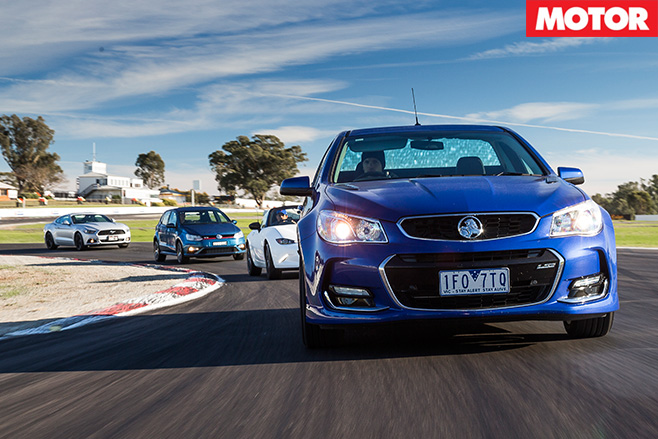
SCORES Price: $44,040 Bang Index: 159.2 Bucks Index: 89.1 BFYB Index: 189.7
WARREN LUFF SAYS 05. “It’s not the best handling thing, but it is certainly a lot of fun”
“It has a huge amount of character and sounds really good. I think the tyre is probably not capable of what the chassis is.
“Surprisingly the brakes held up better than I anticipated; in the past Aussie cars have been weak in this department. In the high-speed sweeper, where you’d expect a ute to feel light in the rear, it hangs on really well.
“It’s not the fastest car out there [from a 19-car, outright perspective – small hint] but it’s one of the cars that makes you want to go out and have some fun.”
Want more? Check out the rest of 2016 Bang For Your Bucks.
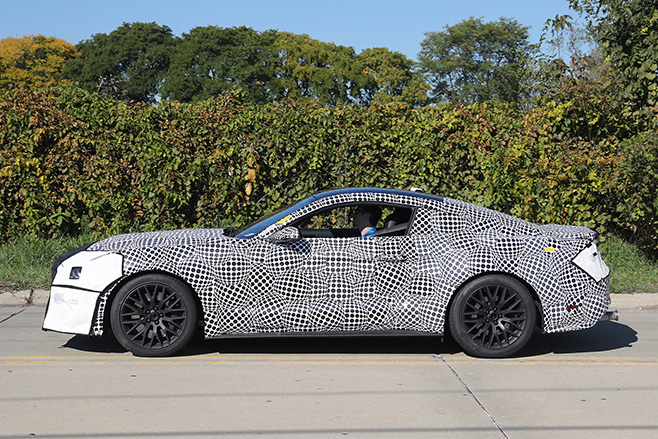
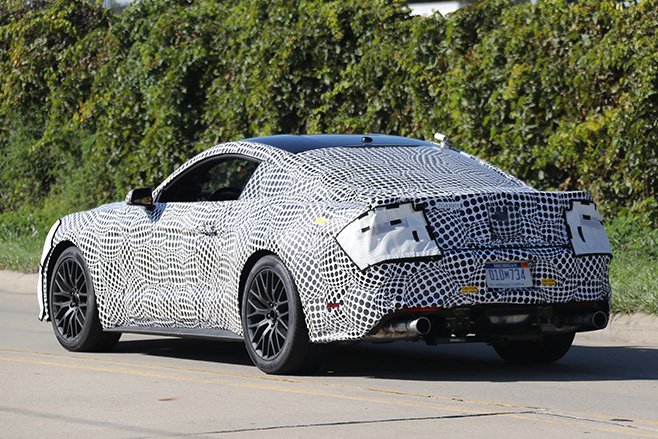
Spotted loitering around Detroit, Michigan, the facelifted 2017 Ford Mustang is likely to come with very minor detail changes.
Heavily camouflaged, with fabric covering the headlights, grille, front fascia, and tail-lights details of the new Mustang Coupe and Convertible are hard to spot, but we can expect detailing changes to the grille, air intakes, and a newish rear-styling.
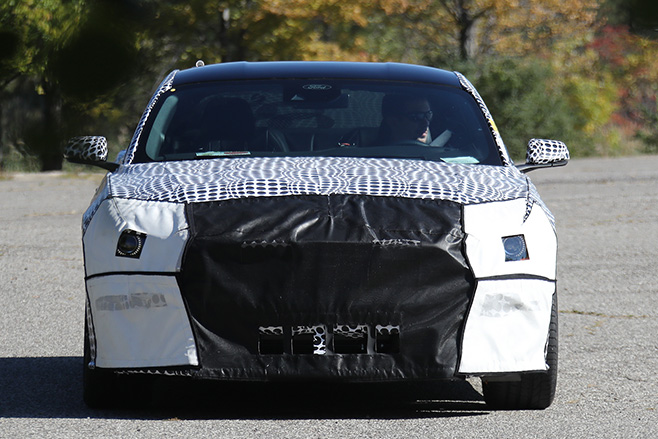
Other details about the MY17 Mustang are scarce. All we know is the new Mustang will feature a 10-speed automatic gearbox, according to details leaked earlier in the year, in addition to the existing models’ six-speed manual and auto ’boxes.
The Mustang has experienced strong sales here in Australia, with Ford securing an extra 2000 units for local customers, despite sales in the US dropping 32-percent from August to September.
The drop in US sales halted production for the Mustang, which was due to recommence this week, despite a significant waiting list on Mustangs for Australia.
So far this year, Ford has shifted 4621 example of the Ford Mustang, making it the fourth most popular car the manufacturer sells in Australia, behind the Ranger, Territory, and Focus.
Just in September alone, Ford sold 786 Mustangs, which was second only to the Ranger and Focus.
First published in the June 2016 issue of Wheels magazine, Australia’s best car mag since 1953.
It would be easy to assume that people don’t understand subtlety anymore. Instagram selfies, bigger muscles, fuller lips, more Facebook likes, more hype. And often inversely proportional to the size of someone’s intellect. Long gone are the days of the intelligentsia receiving rock-star reverence, and ditto the likelihood of slipping under the radar in an AMG.
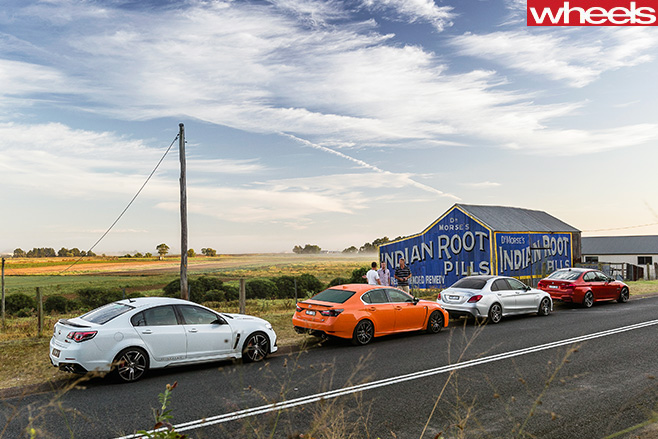
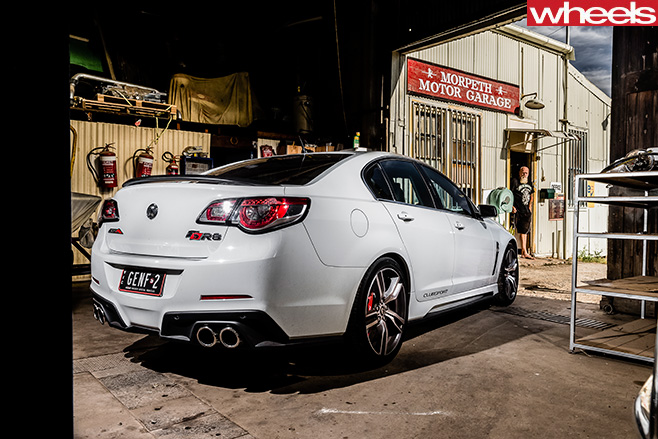
And while a size-for-size stoush says the HSV’s natural rivals are the BMW M5 and Mercedes-AMG E63, the $80-100K price point of the supercharged Gen-F2 line-up says BMW’s smaller yet still searing (and roomy) $139,900 M3 sedan is a better fit.
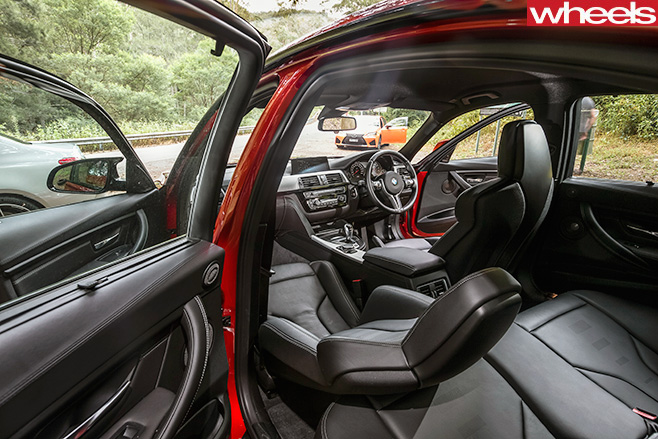
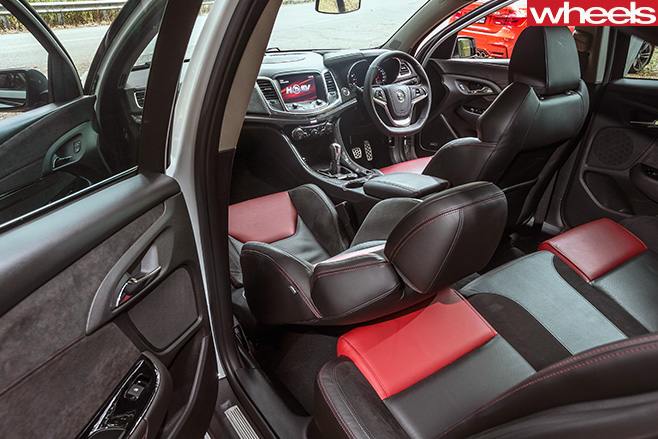
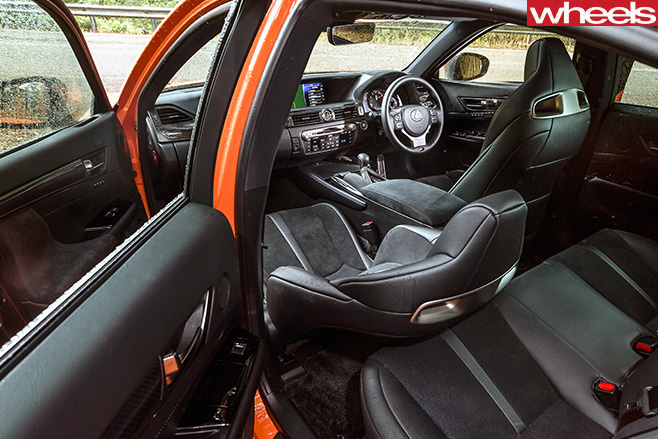
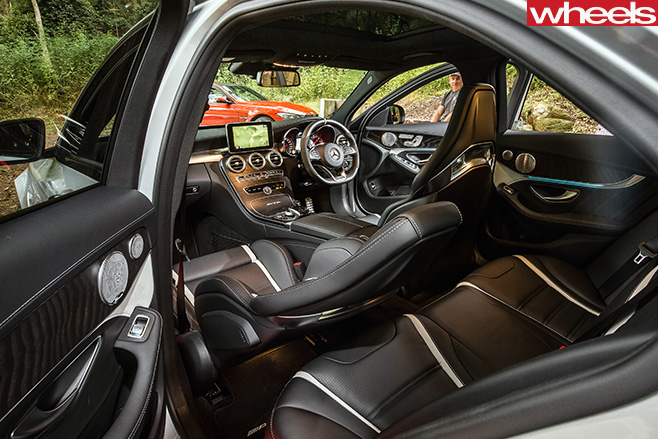
HSV’s true equivalent to the velvet-boxing-glove C63 S, M3 and GS-F would surely be the slightly more demure blown Senator with adaptive magnetic-damper suspension, but we really wanted to see whether the fixed-damper Clubby feels polished enough to transcend its massive price saving. And then there’s the attraction of its increasingly rare manual gearbox, which deserves to be celebrated.
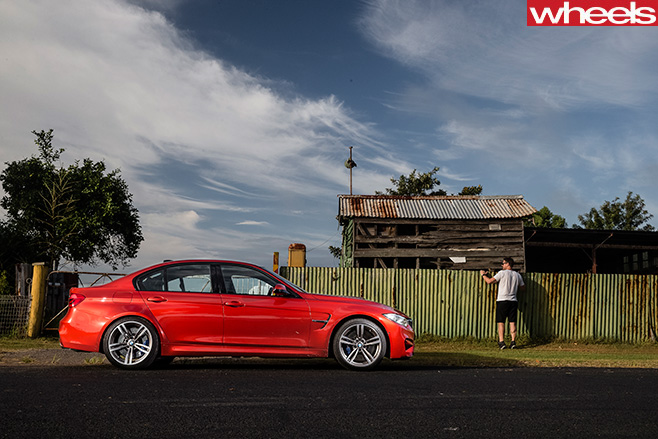
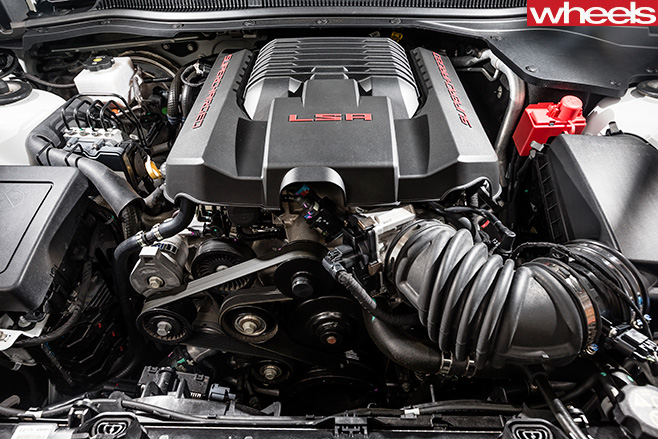
While the Clubsport LSA’s soundtrack can’t quite match the bassy ferocity of its 430kW GTS big brother, from zero to 80km/h, just shy of cut-out in first, it’s just three-hundredths slower than the C63 and one-tenth off the M3. Even to 160km/h, the difference is only a second and, while the HSV ultimately cedes accelerative honours to the Germans, the exhaust-crackle theatrics trumpeted from its bi-modal exhaust are worthy of a sizeable YouTube following.
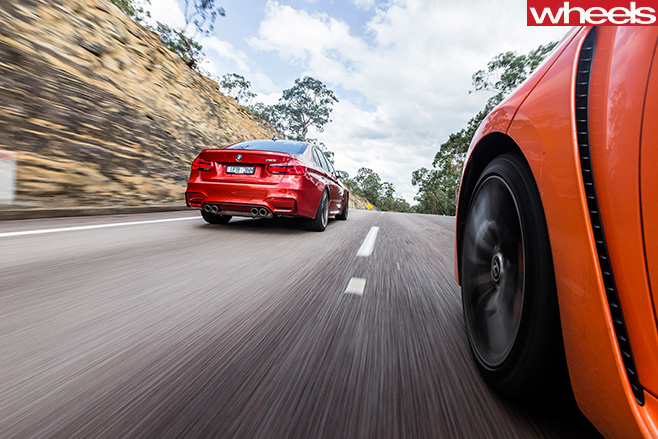
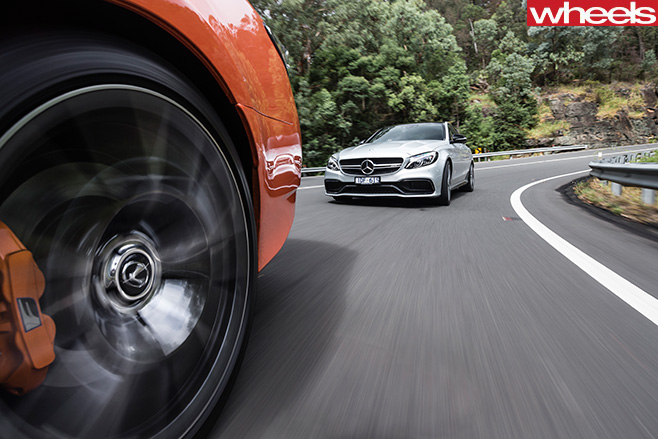
But the C63 S is ultimately the faster of the two, and the more tuneful. It whip-cracks from its quad exhausts as it upshifts with decisive intent, and beyond 180km/h it begins to pull well clear of the M3… not that anyone other than time-poor Germans hoovering up the autobahn between Stuttgart and Munich should give a damn.
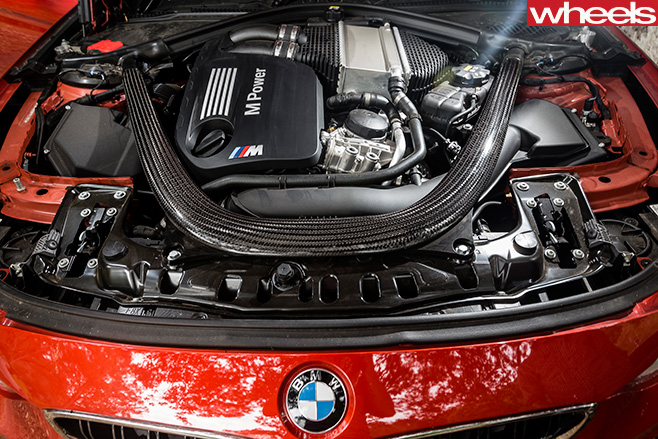
While not having a manual gearbox means it’s hard to play exhaust games, when the M3’s chubby turbo six is at full attack it’s still an effing brilliant sports sedan. Serving up unrelenting thrust and barking with each lightning-fast dual-clutch shift, there’s zero room for the chassis not to be on the same page.
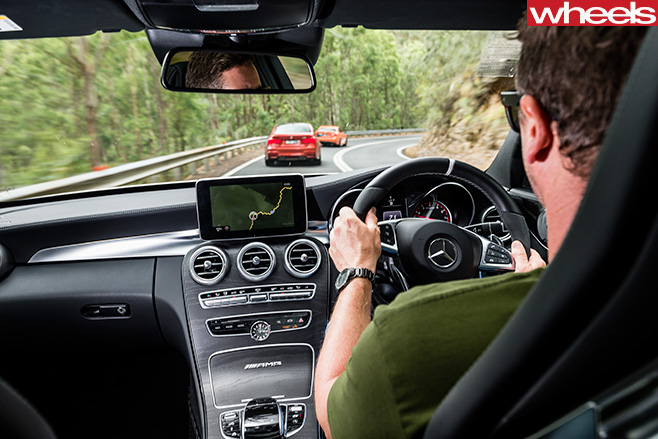
When really on it, the M3 driver is never entirely sure if the back is going to step sideways, and sometimes when it does it’s out and back in before you know it! If you’re aware of the BMW’s on-limit behaviour, it’s a wonderfully focused, fast and involving car, blessed with one of the world’s great steering wheels and the weight (in Sport mode) to match its bulldog stance. But the C63 eclipses it.
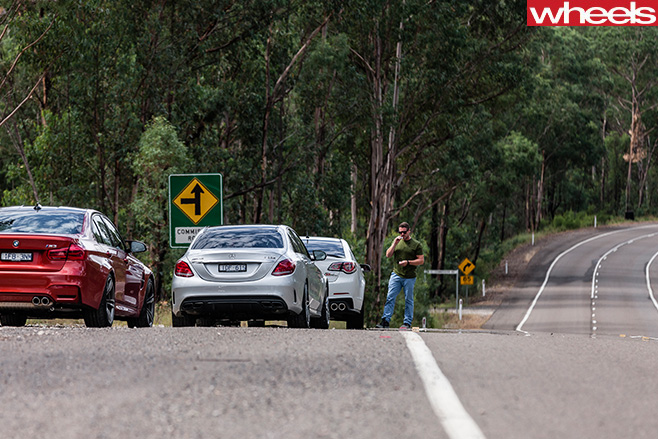
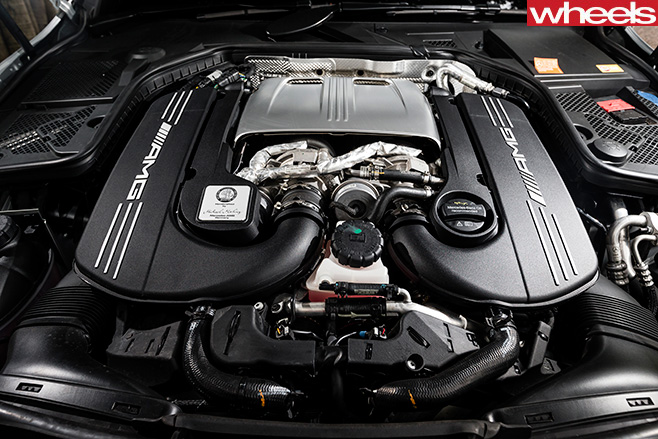
The AMG pivots on its rear end, points its pretty nose into a corner and traces a deliciously smooth line through before hooking up its Michelin Pilot Sport Cup rear boots and thundering ahead. And while it has grip to burn – certainly in the dry, and even in the wet if you aren’t too exuberant – there’s an adjustability to it that upholds the old W204 C63’s dynamic DNA while adding a whole new level of composure.
The AMG certainly feels much smaller and lighter than the Clubsport, with the added agility (and visibility) that goes with it, but that doesn’t mean that HSV’s blown bargain is unable put up a mighty fight. Providing you’re aware of the huge V8 sitting just behind the front axle line and the mass you’re wielding, the Clubsport is an incredibly capable beast, beautifully balanced by the throttle.
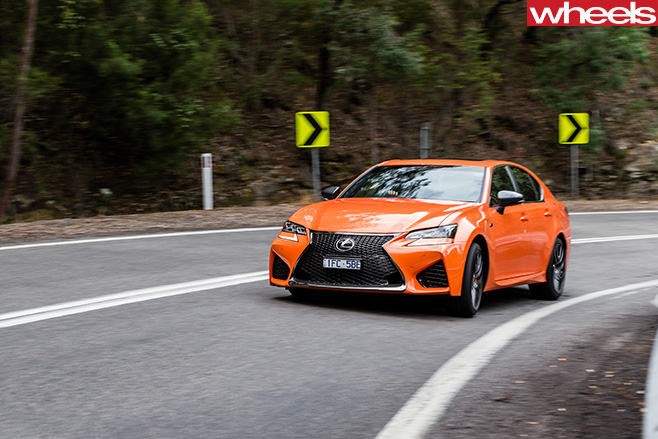
The Lexus is no dynamic duffer, either, despite what the purists might want to think. Its torque-vectoring system (labelled TVD) has three settings – Standard, Slalom and Track – though we left it exclusively in Slalom because that’s what makes the 1825kg GS-F feel most agile. And it corners. The torque vectoring really works in making the relatively large Lexus shrink around its driver, and the g-sensor that helps ensure its eight-speed auto is in the right gear at the right time is supported by the GS-F’s excellent balance. Only its steering drops the ball a little. While helpful in finessing the car’s cornering line, and linked to a rather likeable perforated-leather wheel, it’s too aloof for a sports sedan and no match for the GS-F’s entertaining chassis.
What the AMG manages with surprising efficacy is ride. Not in the truest sense because no car here is more firmly suspended than the C63, even in Comfort mode, and its lumpiness at low speed will have occupants rocking around like Bronwyn Bishop’s chopper in a strong wind. But at speed, it has a level of composure that enables it to resist irritating vertical movement while remaining hyper-focused in body control.
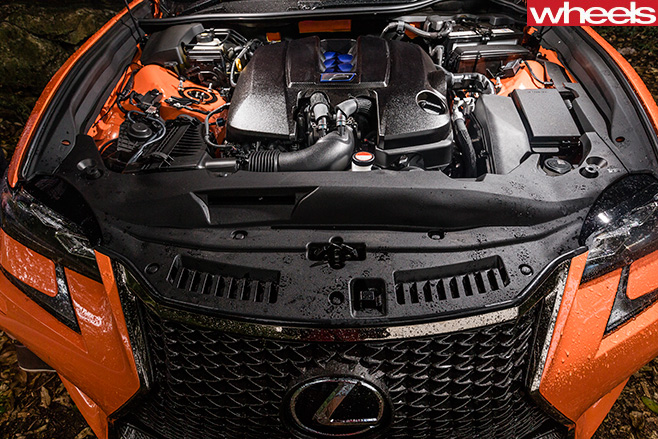
When you’re talking sprawling space, the HSV and Lexus put their longer wheelbases to good use. Each car’s rear seat is like stepping up to Business Class, with comparatively vast amounts of room in all directions. But, unexpectedly, it’s the Clubsport that offers the best ride of this group, even without the GTS’s excellent magnetic dampers.
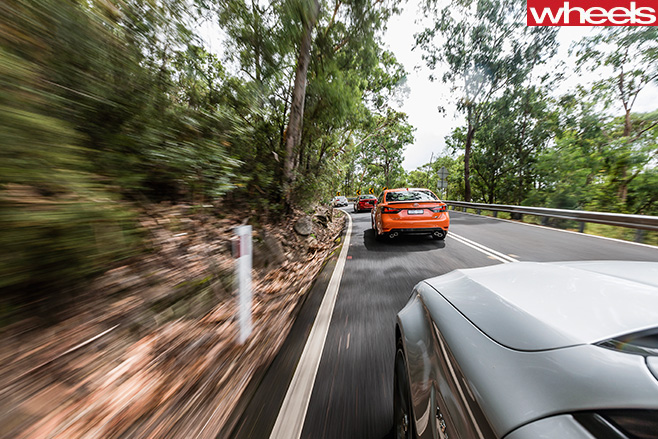
The whole point of grouping together this unlikely crew was never about putting apples with apples, or trying to turn a pumpkin into an orange. But that’s definitely what has happened to the now five-year-old, fourth-gen GS.
As far as relative bargains go, few will ever match HSV’s Clubsport LSA. It is vast – both in space and in visceral impact – and shouty in the best possible way, like it’s constantly yelling, “I’m having a freaking awesome time!”. It has the performance and dynamic ability to shade the Lexus, not to mention long-distance cabin comfort and ride quality to shame both the Germans. What that sharp entry sticker doesn’t buy is the craftsmanship on which its luxury-brand rivals build their reputations (for nearly double the price).
Charging a few thousand more for truly luxurious and beautifully stitched seat trim would go a long way to bridging the gap. The HSV’s benchmark seat comfort deserves as much.
In isolation, both the Germans are blinders – ballistic in a straight line, eye-widening around corners and dressed like the automotive equivalent of wearing a cutting-edge suit with pricey sneakers. In so many areas, they’re neck and neck – including fuel consumption averages over our 700km test of exactly 13.36L/100km each – but it’s the flavour left on your palette after gorging on both that ultimately makes one superior to the other.
The tough-looking M3 might be a brilliant all-rounder, and faster than just about any mortal could want, but it lacks that sprinkling of genius, the elusive pixie dust that separates real from surreal, that allows the C63 S to keep on giving. The uber AMG might be more expensive, and arguably less of a chest-beater for your Instagram account, but it’s hard to put a price on the X-factor quotient of a C63 S. Underestimate it at your peril.

TELL ME ABOUT THIS CAR
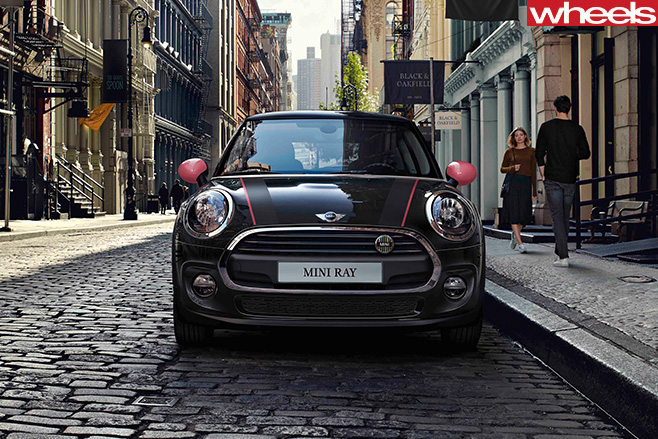
The Mini Ray is the new entry model to the three-and five-door coupe range. Priced from $29,000 via an introductory drive-away deal, it’s cheaper than the entry-level Mini Cooper.
STRENGTHS
- You can buy those classic Mini looks for about $2000 cheaper while the drive-away deal hangs around
- The ride on the 15-inch steel wheels with their high-profile sidewall tyres is pretty good for a traditionally hard-riding Mini
- The interior smacks of premium quality, with decent fit and finish around the cabin, and decent and tactile switchgear
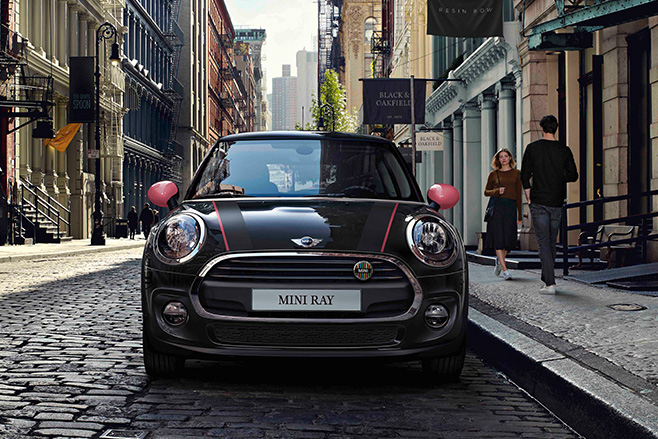
- No-cost styling package adds pink, yellow or green highlights to the wing mirrors, black bonnet stripes and under the doors, giving the car a huge lift visually
- Auto does a good job of keeping the hard-working 1.2-litre engine on the boil
- Reversing sensors help you feel less nervous about reversing the Ray, as rearward vision is somewhat limited
WEAKNESSES
- While the ride is good, there is a lot of road roar from the tyres over coarse-chip roads that are common in Australia
- The Hankook Kinergy tyres fitted to the 15-inch steel wheels on the Mini Ray are also relatively low-grip. Do a U-turn and they will squeal in protest even at low speeds.
- The steel wheels are covered with plastic hubcaps, making the Ray look cheap. Alloys would be better visually
- The 75kW three-cylinder engine performs well when it is revving hard, but while you’re idling at the traffic lights or taking off slowly it vibrates noticeably
- The Ray is the only Mini to miss out on passenger-seat height adjustment
- Everything is manual. There’s no set-and-forget for the air-conditioning, if it rains you have to switch on the wipers, and if it gets dark you have to switch on the lights. On almost all other Minis, these chores are automatic
- The Ray is locked out of a number of optional packages that would make it a lot more liveable for an everyday commute
- On paper, the base Mini Cooper looks better value, rounding out to about $31,000 drive-away. The difference in equipment levels between it and the Ray make the cheaper Mini look over-priced
As prices for premium cars rise, the prices of posh ones fall. That brings the Audi A1 1.0 TFSI, priced from $28,250, into contention as a genuine Mini rival. It boasts a punchy 1.0-litre engine giving good fuel efficiency, and strong handling and refinement even on its base suspension. However, there’s no reversing camera and it is still hardly cheap.
The $21,000 Fiat 500 Lounge is a smaller alternative that tries to make the most of its boxy exterior. It rides a bit harshly, and prices jumped by $2000 earlier this year, so in terms of value for money it is what it is.
Hyundai will sell you a quirky, suicide-doored-but-only-on-one-side Veloster Plus coupe for $29,490. However, while its drive experience is somewhat on par with the Mini’s lack of low-down oomph, the cabin aesthetics aren’t the same. Renault, meanwhile, will happily sell you a Clio GT Premium for $29,900. It’s the most conventional of the premium car choices here, but looks good inside and out and comes with a perky turbo engine.
Want all the style of a Mini Cooper but shy away from the premium price tag? There’s now a cheaper option that looks the part, as long as you don’t look too closely.
WHAT IS IT? Mini’s former price leader, the $24,950 Mini One, has gone. In its place is the Mini Ray, a badge last seen here in 2013. The Ray is available as either the three-door tested here, or a five-door, and carries over the One’s 1.2-litre turbo three-cylinder engine.
WHY WE’RE TESTING IT The Mini Ray costs a little more than the Mini One – the car it replaces – but includes a few nice, formerly optional touches that help to disguise its cheapness. Does the lower price tag also mean a cut-down implementation of the traditional Mini fun-to-drive ethos?
MAIN RIVALS Audi A1 1.2 TFSI Attraction, Fiat 500 Lounge, Hyundai Veloster Plus, Renault Clio GT Premium
THE WHEELS VERDICT Cheaper isn’t always better, and despite its veiled efforts to look more upmarket, the Mini Ray is a prime example. The Ray misses out on significant performance and equipment compared with the Cooper. Once the drive-away pricing honeymoon ends, the price difference between Mini’s entry-level model and the next rung up the product ladder will be too small to justify it.
PLUS: Smoothest ride of any Mini; polished interior; exterior enhancements disguise some of the cheapnessMINUS: Runs on less-grippy eco tyres; no reversing camera or cruise control; dated head unit graphics; struggles on value compared with a bigger-engined, better equipped Cooper
THE WHEELS REVIEW THERE’S a new cheap Mini in town. The price-leading One has gone, and in its place comes the Ray, Mini’s name used for the original cut-price version of the Cooper hatch launched in 2001 under BMW’s stewardship.
On paper, the $25,922 Mini Ray is only $658 behind the list price of the better-equipped base Cooper, although at $29,000 drive-away the honeymoon price for the Ray represents about a $2000 saving over the Cooper once on-road costs are factored in.
Outside, the stand-out cheap sign it’s a Mini Ray are the plastic hubcaps hiding 15-inch steel rims. However, a big, bright visual lift comes from the Ray’s default styling package that includes a colour-coded bonnet stripe, mirror covers and side scuttle in green, yellow or pink.
Part of the Mini experience we’ve always loved is the pep bed into it. The Ray’s engine misses out on the BMW-sourced Valvetronic variable valve technology that can adjust valve lift on the fly to eke out fuel savings, but it does get variable camshaft control for the intake and exhaust valves, and a stop-start function.
Its smaller 1.2-litre turbocharged three-cylinder engine only produces three-quarters of the power of the Cooper’s larger 1.5-litre triple, making 75kW and 180Nm. Fuel use for the Ray is officially rated at 4.9L/100km – 0.2L/100km higher than for the higher-displacement Cooper.
Inside, the Ray feels a bit mean. It only has single-zone climate control air conditioning, everything from lights to wipers to seat adjustments are manually operated, and the blocky red radio head unit graphics are more at home on a 1980s-era, 16-bit calculator screen.
The steering wheel lets things down. It has only two spokes, not the usual Mini three, and there are no buttons on it, as there is no cruise control. It also means the multimedia system needs to be adjusted via fiddly controls on the head unit.
There’s the usual Mini polish, though. The Ray’s fit and finish is impeccable, the switchgear feels nicely tactile, there’s Bluetooth and a USB port, the cloth seats come straight out of the Cooper, and the thrummy 1.2 turbo oozes character with revs on board.
Spend an extra couple of thou to step up to the Cooper and it brings much more. Compared with the Ray, the Cooper adds the bigger 100kW/220Nm 1.5-litre engine, 15-inch alloys, a height-adjust passenger seat, three-spoke steering wheel that links to both the audio system and adaptive cruise control, access to a much better list of interior highlights, more small item cabin and boot storage options, front fog lights, rain-sensing wipers, LED interior lights that flick through a rainbow of colours, and tyre pressure monitors. The Ray is also locked out from a number of Mini’s equipment packages designed to make it more liveable as a daily commuter car.
On the road, the Ray feels sluggish off the mark compared with the regular Mini. We tested the six-speed auto version that replaces the default six-speed manual for an extra $2350. The auto’s tune works well to squeeze something resembling performance out of the smaller triple when asked, but will chase low revs and fuel economy – bringing out the engine’s vibratey, lumpy worst – when off the boil.
The ride on the Ray’s 175/65 R15 Hankook Kinergy eco-rubber borders on the best in the Mini range. The high-profile tyres soak up lumpy roads well, although the tyres are noisy over coarse-chip surfaces. The rubber also lacks sufficient grip to tap that trademark go-kart handling; pitch the Ray into a tight corner and even at moderate speeds the tyres squeal excitedly like One Direction fans at a poster signing.
Mini’s Ray carries over from where the One has left off, complete with the not-quite-all-there Mini experience. It’s a little more exxy, and hides its cheapness a bit better. But if you can afford the extra $2K, the more authentic choice is always going to be the more richly equipped Cooper.
SPECS Model: Mini Ray Engine: 1198cc 3-cyl, dohc, 12v, turbo Max power: 75kW @ 4250rpm Max torque: 180Nm @ 1400-4000rpm Transmission: 6-speed manual Weight: 1150kg 0-100km/h: 9.9sec (claimed) Economy: 4.9L/100km Price: $29,000 drive-away On sale: Now
TELL ME ABOUT THIS CAR
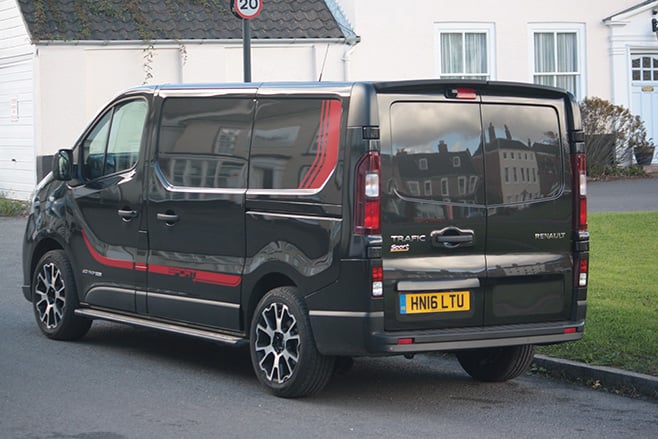
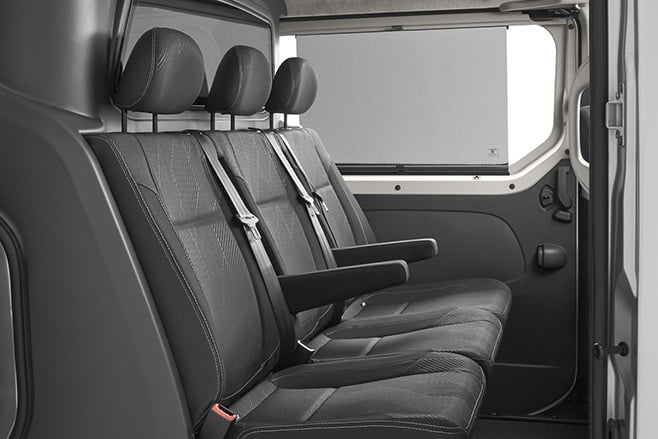
The Renault Trafic Sport is essentially a trim and equipment package for the current model Trafic commercial van. Alloy wheels, leather, stripes, side steps and contrasting body highlights are all an effort to widen the appeal of Renault’s mid-size commercial. The Sport option is destined for Australia mid-2017 and will be available as a six-seat crew van as well as a three seater.
STRENGTHS
- The diminutive 1.6 litre turbo-diesel powerplant gives nothing away in performance as far as mid-size vans go. The top spec engine uses twin-turbocharging to make 103kW and 340Nm and that torque is on tap from 1500rpm. The front wheel drive Trafic gets from 0-100km/h in 10.8 seconds. But it’s a van so who’s timing!
- From the driver’s seat the Trafic’s interior is a veritable Swiss Army Knife of practicality. Cubby holes, cup holders, power outlets and storage abound. The centre front seat folds down into a worktable with space for a laptop and also features a built-in clipboard. Plus there’s 5.2 cubic metres of load area out back.
- It’s quiet. As with some of it’s Euro competitors, the Renault uses a steel bulkhead to separate the cockpit and passenger compartments from the load area. This means there’s no driveline drumming though the shell of an empty van. The dCi engine maintains a civil note unless really pushed which means you can actually hear the music pumping from the Bluetooth enabled DAB Multimedia unit.
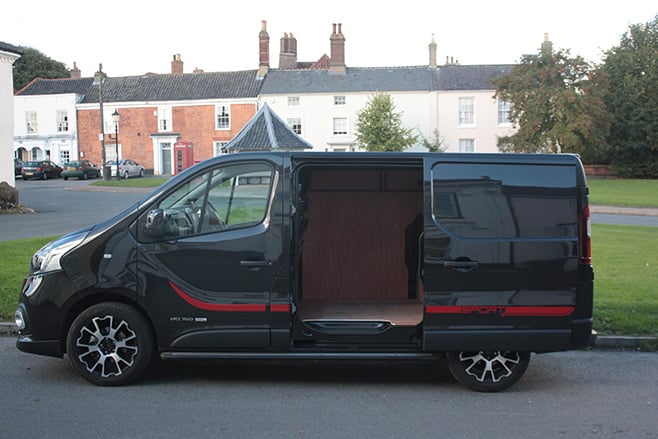
- The Sport package actually looks cool. The stripes and wheel package (not confirmed for Australia yet) give the otherwise mundane delivery van image of the Trafic a significant lift. And the leather trimmed interior feels special.
- Manual gearboxes are still all the rage for European light commercials. As such the entire Trafic range is only available as a six-speed manual. The upside is that it’s a great shifter with a very light throw. The low torque curve of the dCi engine makes it very forgiving when idling through heavy traffic.
WEAKNESSES
- Front-wheel drive makes for easy packaging from an engineering point of view. However it doesn’t make for a van with a great turning circle or on-road dynamics. The Trafic is prone to a little torque steer under heavy acceleration when empty. But throw a load in the back and the Trafic becomes a little more settled.
- The lack of a torque converter automatic gearbox will continue to be an issue for the Renault in the Australian market. The other volume sellers, namely Toyota and Hyundai, have an auto option and continue to dominate the mid-sized van market.
The Ford Transit Custom is pretty much on par with the Trafic in most areas, though the Ford gets slightly more safety kit as standard. However the Transit isn’t available with any sporty options or even with back seats. So in this price bracket that leaves the Hyundai iLoad or the Toyota HiAce. The Toyota inexplicably continues to dominate the Australian mid-sized van market in the face of well-equipped and well-priced competitors that are much better to drive. The Hyundai iLoad however is the pick if an auto is a must. The Hyundai isn’t the most dynamic thing to drive, or even to look at, but it’s a good all rounder.
WHAT IS IT? A tweaked up, and dare I say “sporty” lifestyle variant of the Renault Trafic commercial van. The current Trafic medium van platform arrived in Australia back in mid-2015 and brought more kit and striking Euro looks to the white-bread van segment for a reasonable price point. You can even have lairy colours.
WHY WE’RE TESTING IT The Trafic hit the market already touting strong commercial credentials and now Renault is exploring the work and play potential of the Trafic. 6-seater crew versions of the Trafic are expected in Australia in early 2017 and the Sport package is expected to arrive mid-2017. Dual cab utes for dual purposes have become hugely popular, maybe the door is now open for vans to become cool again?
MAIN RIVALS Ford Transit, Toyota HiAce, Hyundai iLoad.
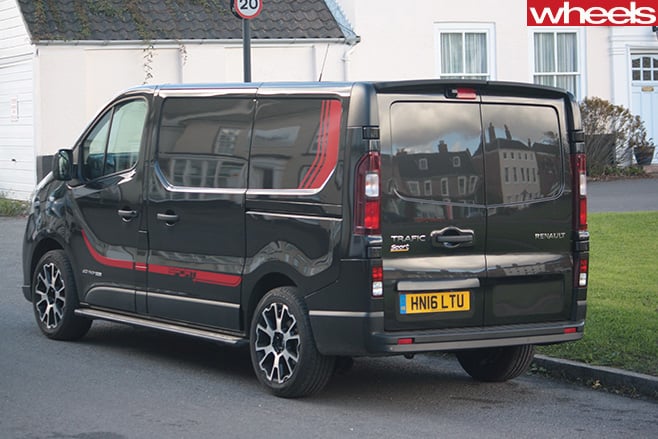
Plus: Punchy, thrifty and sophisticated bi-turbo diesel engine, slick manual gear shift. Minus: No automatic transmission option, front wheel drive affects turning circle and on road dynamics. Can feel bigger than it is from the driver’s seat.
THE WHEELS REVIEW If you’ve ever swept the shattered remains of a mega-dollar bicycle off your driveway you may want to keep reading. You won’t be the first or last person to forget that your carbon fibre treadly is still on the roof racks as you drive into your garage. Or maybe you’ve starred in one of the many online videos showing epic dirt bike-into-ute loading fails. Then life possibly could be easier with a van.
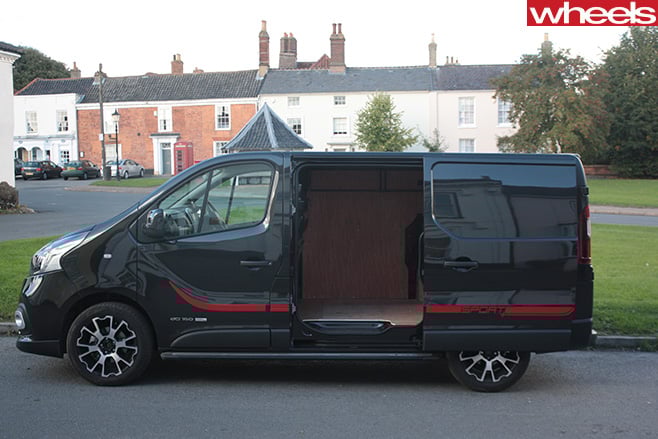
The Trafic uses a 1.6 litre dCi four pot diesel for power. Base models are armed with a single turbo 66kW/260Nm version of the powerplant while high spec variants like the Sport get a twin-turbo 103kW/340Nm version.
To make the Trafic a little more A-Team and a little less Bob the Builder, the Sport features a 7-inch multi-media touch screen with DAB radio and nav, auto headlights and wipers and highlights around the dash. Funky colour coded instrumentation, cruise control and speed limiter as well as Hill Start Assist and a Grip Xtend feature that helps with traction on slippery surfaces.
The short wheel base Sport we drove had 5.2 cubic metres of load capacity and the Trafic can carry 1,200kg. Access to the rear is via a sliding door on the passenger side or via barn doors on the rear.
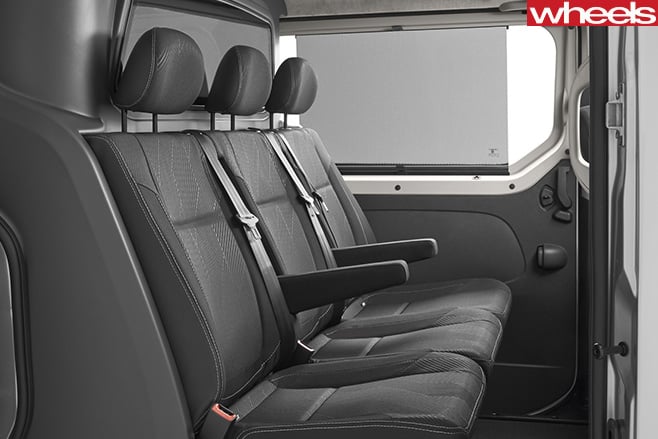
Our drive of the UK version of the Trafic Sport took in motorways as well as rural back roads and the Renault was an easy drive on all. The 1.6 litre oiler has plenty of poke with peak torque coming in at a relatively low 1500rpm. Peak power comes in at 3,500rpm. Renault currently claims a thrifty 6.2L/100km for this van yet it happily buzzed along at the 70mph motorway limit.
The Trafic is only offered in manual guise which may be an issue for some. But the 6-speed manual is a light shifter and as we found in London peak traffic not hard work to stir through the slots. The low torque curve of the dCi engine also helped when idling along in congested streets.
Pricing and spec is yet to be announced by Renault Australia. However, the Trafic Sport makes for a quite un-commercial commercial that could well be a safer way to transport your toys.
SPEC Model: Renault Trafic Energy dCi140 Sport Engine: 1598cc twin-turbo common rail diesel Max Power: 103kW@3500rpm Max Torque: 340Nm@ 1500rpm Transmission: 6-speed manual Weight: 1,683kg Fuel Economy: 6.2l/100km 0-100km/h: 10.8 sec Price: TBA On Sale: Mid-2017
