
Audi TT 2.0 TFSI SPORT Score: 80/100
Price & Equipment | 13/20
Base Audi coupe is pricier, at $71,950, than the mid-spec BMW coupe ($64,400). The entry-level TT is a six-speed manual front-driver with a 2.0-litre turbo-petrol four. It’s equipped with a rear camera, electric front seats, leather/Alcantara trim, attention- and lane-assist systems, satellite navigation, and tyre pressure monitors.
Interior & Versatility | 18/20
Cutting-edge cabin design with high-quality materials and tactile controls make the TT a class act. One party trick is the 12.3-inch TFT screen in the instrument cluster, which displays the sat-nav map, infotainment info, and the speedo and tacho. Another is the climate-control knobs on the air vents. ‘Plus twos’ ideally small or inanimate.
Performance & Economy | 18/20
Flexible 2.0-litre turbo four makes 169kW, with 370Nm spread over 1600-4300rpm, pushing 1305kg TT to 100km/h in a claimed 6.0sec – slower than the BMW, despite a superior 137kW/tonne power-to-weight. Like its rival, the TT has a subtly sporty note that could be louder. Thrifty 5.9L/100km combined-cycle economy on 95RON.
Ride & Refinement | 16/20
Like the BMW, the Audi rolls on 18-inch wheels and tyres. Front-drive TT is more supple than up-spec quattro and S-line versions, but it’s not as smooth at soaking up sharp-edged joins and lumps as the 228i, and is a bit noisier on ubiquitous Aussie country-road coarse-chip. Magnetic dampers help a lot, but come at further cost.
Steering & Handling | 15/20
TT’s electro-steering system has a variable ratio, so can feel a bit lazy at first, but the coupe’s snout starts to point more eagerly with lock. You miss the quattro TT’s neat ability to pre-empt corners with a shuffling of torque to the rear wheels, but the front drive is light on its tyres, with an ESC-based LSD system to reduce torque-steer.
BMW 228i COUPE Score: 84/100
Price & Equipment | 15/20
The 228i gains 45kW and 80Nm over the $51,000 base 220i. It shares much with its rival, including front and rear parking sensors, auto headlights, rain-sensing wipers, dual-zone climate control, sat-nav and leather trim. Undercuts TT’s price despite a standard eight-speed auto (six-speed manual is a no-cost option).
Interior & Versatility | 15/20
BMW a bit spartan inside, though sportier with the no-cost optional Sport Line pack. Materials not as rich as those in the Audi, and minor controls lack the TT’s tactility. There’s a bit more leg and head room in the rear, but it’s still tight. Front-seat comfort and ergonomics great, while intuitive iDrive system is a highlight.
Performance & Economy |18/20
The BMW musters a smooth 180kW and 350Nm from 1250-4800rpm from the same 2.0-litre turbo-petrol four as base 220i. Eight-speed auto and rear drive see the 228i sprint from 0-100km/h in 5.6sec (claimed) despite being heavier (1405kg) and carrying 128kW/tonne. Officially uses 6.3L/100km, helped by brake energy regeneration.
Ride & Refinement | 18/20
The BMW rides on 18-inch run-flats (there’s no spare; you get a tyre repair kit in the Audi) yet the 228i’s ride compliance is impressive. While the handling is sharp, the ride is not. The Bavarian coupe delivers a level of absorbency we could comfortably live with, both in urban and out-of-town driving.
Steering & Handling | 18/20
Balance, involvement and plain fun come with the 228i’s rear-drive specification. A thick wheel rim guides a tarmac-carving nose via sharp variable-ratio steering, and with a four-pot up front, turn-in is more enthusiastic than in the M235i six. The BMW is agile, composed and powers down hard with help from a rear electro diff lock.
VERDICT
A glance at the scores suggests this was an easy victory for the BMW 228i. It’s less costly than the base TT (despite sitting just a rung below the fiery M235i), and is quicker and more involving, which might be all that matters. However, it wasn’t a complete walkover. The third-gen TT takes Audi cabin class to new heights, with leading-edge design and cleverly deployed tech. The overall aesthetic and image is a matter of taste, but the TT’s styling is more resolved than the broad-sided BMW’s. It also comes standard with a manual, which is increasingly rare. Back in the BMW’s favour is its superior three-year retained value forecast, though both have similar warranties and service schedules.
It seems that buying the Bee Em and pocketing $7500 is the $64K answer to this coupe question.
This article was originally published in Wheels January 2016.
Entry to Porsche ownership looks like it will keep on getting cheaper with a turbocharged four-cylinder Macan now confirmed to arrive next year.
Porsche Australia is on record saying it would not introduce a Macan with less than six cylinders to our market, yet it has now backflipped on that call, including over the new boxer four-cylinder engines used for the forthcoming 718 Boxster.
Instead the Macan will use an inline four-cylinder engine with a turbocharger and of 2.0-litre capacity, pinched from the loosely related Audi Q5 but with higher outputs. With 185kW of power and 370Nm of torque, the Macan accelerates to 100km/h in a claimed 6.7 seconds.
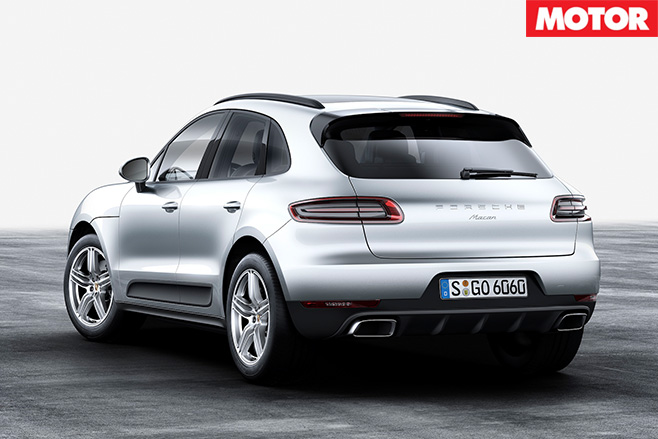
“With demand of the turbocharged six-cylinder Macan S, Macan S Diesel, Macan Turbo and recently announced Macan GTS still high in Australia, PCA [Porsche Cars Australia] has elected to delay the introduction of the new Macan four-cylinder until not before calendar year 2017,” the brand announced in a statement.
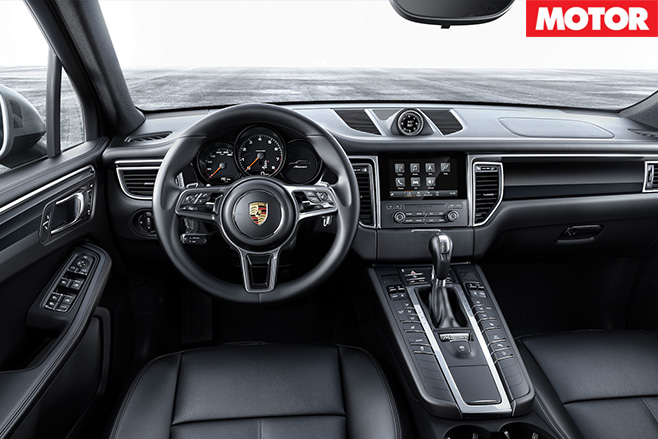
It seems like eons ago that Porsche enthusiasts had to get used to the idea of the Cayenne large SUV wearing the hallowed Stuttgart coat of arms. Then brand fans copped the Macan medium SUV replacing the Boxster as the entry-point to Porsche ownership, followed by news that a boxer four-cylinder would go into the Boxster itself.
Now it seems with the Macan scoring an Audi-derived inline four-cylinder engine, the question will be once again asked: when is a Porsche not a Porsche?
There’s nothing like a bit of road rage fury to get you through a Thursday. We’ve all been there, riding behind the backside of another car, wishing we could just nudge into them without causing any harm to them or our cars.
Unfortunately for these two drivers in Italy, their moment of driving anger has been caught on camera. In the video, the driver of a black Toyota Yaris is visibly chasing down a white Honda Jazz. The almost comedic-like street battle shows the cars screeching around corners of a one way street, with the Yaris clearly out for revenge even hitting the back of the car at one point.
We don’t have much information on what started the feud other than there was an argument between the two drivers.
The race ended when the Yaris rammed into the side of the Jazz, which carried two young children in the back. The driver of the Honda has informed the police but they didn’t arrive in time to stop the inevitable.
The Yaris driver has since been arrested and was reportedly under the influence, and the driver and passengers of the Honda are in hospital for treatment for minor injuries.
Thankfully no one was seriously injured. So what did we learn here, kids? Don’t tailgate and don’t piss off an Italian.
Tyre maker Goodyear is quite literally reinventing the wheel with the Eagle-360 concept unveiled at the 2016 Geneva Motor Show.
The spherical-shaped rubber concept tyre, intended for autonomous cars, will use magnetic levitation to connect to the car, rather than axles, and move the vehicle in any direction aiding navigation through tricky driving situations.
Reportedly, the Eagle-360 tyres will also have benefits in the maintenance of your car with less chance for damage to your suspension due to the magnetic connection, and a greater tread life thanks to the larger surface area.
The tyre will also feature built-in weather sensors, and the ability to stiffen in dry conditions and soften in the wet.
While we’re expecting to see self-driving cars on our roads within the next decade, the Eagle-360 tyre concept is still very new and probably won’t gain traction for quite some time yet. Still, we think these tyres are a pretty cool idea, and we’ll never tire (get it?) of these cool innovations.
Driving in snow isn’t something most Australians need to worry about too often. But that doesn’t mean we don’t question autonomous cars’ ability to cope with tricky weather situations.
It’s a relief then that Ford has been testing self-driving cars in the snow. In Michigan’s Mcity, Ford has been testing the vehicles using surveying technology called LiDAR and 3D maps which are created during the drier months. The goal is to ensure the cars stay on the mapped out roads, even during times of low visibility.
The theory behind this testing is simple (although rather complex in technology): highly skilled drivers train the cars to perform manoeuvres drivers may encounter on the roads or in slippery conditions. The sensors that surround the vehicles then send the information to powerful computers with algorithms to process that information. Ford is quite literally training the robot drivers.
Wet and icy roads can be dangerous, so add robot control into the occasion and you’ve got yourself a pretty worrisome predicament. That’s why this type of testing is vital in ensuring the safety of autonomous cars as all-weather vehicles.
“As humans we understand that can happen (weather changes) and we know how to deal with it and we need to make sure that our autonomous vehicles can also deal with those situations in the same way,” Ford’s Global Manager of Driver Assistance Research, Greg Stevens, said.
Part of us is really excited to see this new technology evolve, but another part is worried that this proves Will Smith’s movie, iRobot, is in fact a prophecy.
The V8-powered version of BMW’s 7 Series saloon has arrived, and even includes a stretched wheelbase if Sir needs it.
WHAT IS IT? THE V8 for the new 7 Series has arrived in both regular and long-wheelbase guises as it chases down the Mercedes S-Class and Audi A8 in the battle of the limos.
WHY WE’RE DRIVING IT This is an all-new 7 Series. Codenamed G11, the six-cylinder petrol and diesel variants arrived late in 2015, but these are the heavy-hitting, 330kW V8 models with even more standard gear. As well as the G12 long-wheelbase Li, the new range-toppers add more standard tech and a more rapid sedan.
MAIN RIVALS Mercedes S500, Audi A8 4.2TDI, Maserati Quattroporte
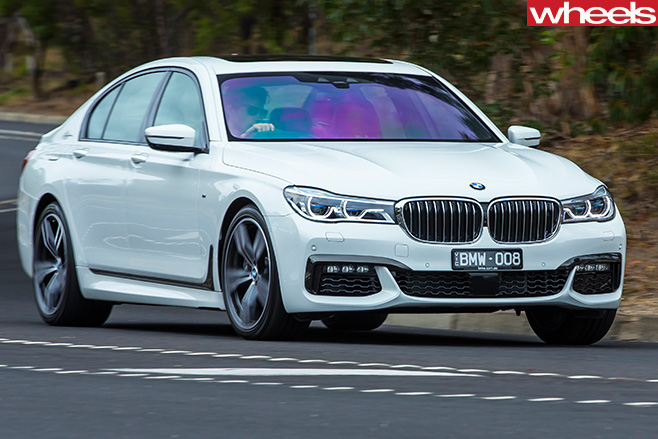
PLUS: Distinctive styling; charming interior with high quality fit and finish; increased feeling of luxury; class-leading fuel efficiency and benchmark dynamics MINUS: Clumsy gesture control; night vision screen far from driver’s eyes; M Pack loses Alcantara roof-lining
THE WHEELS REVIEW THE seventh-generation 7 Series dazzled at Wheels COTY 2016, but was limited to its six-cylinder powerplants. Now, the 750i has arrived with its twin-turbo 4.4-litre V8 delivering 330kW in a measured but devastating fashion. Yet for the $65K over a 740i, there’s far more to the 750i than simply a more powerful engine.
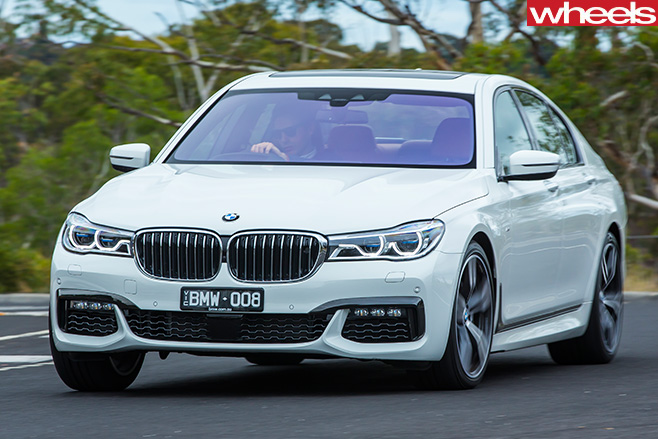
The 750i cockpit takes familiar BMW architecture, loads it with tech then dips it in swathes of Nappa leather and Alcantara. The dash top is leather; there’s a head-up display and digital instruments; the silverware around the HVAC feels metallic, not plastic. The plush rear carpet takes your feet to a new level of fetish. The rear also has some of the 7er’s boldest tech, including a tablet that unlocks 24 functions. That includes television operation and adjusting your seating position as well as that of the chair in front. You can also manage climate change, surf the ’net, and even take it with you when you’ve left a rear seat that’s as supportive and comfortable as the fronts.
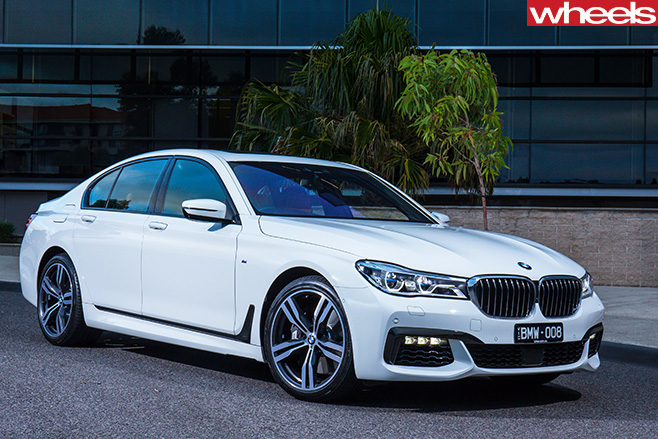
That V8 has a tough yet refined idle; a sophisticated baritone wedge that’s creamy and warm. Push the 750i’s progressive throttle hard, and it answers briskly. The eight-speed behaves more like Clark Kent deftly unbuttoning his business shirt to reveal a taut Superman chest, rather than him hastily ripping it open. It’s a feat to deliver a gob-smacking 4.7sec 0-100km/h acceleration claim, half-a-second faster than the old 750i, in such a polished fashion.
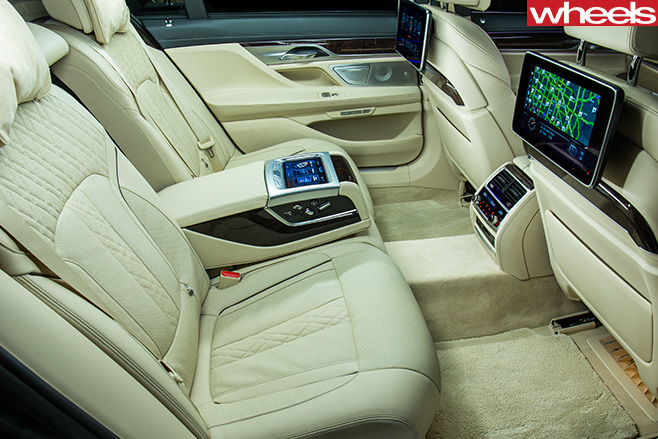
The driveline silkiness is not to say that the BMW lacks engagement. Despite being more than five metres long, with a wheelbase beyond three metres, the 750i handles and rides supremely. Standard is the ‘Executive Drive Pro’ adaptive air suspension, and in Comfort mode, its supple ride is impressive, a perfect partner for its near silent highway cruising. There’s a tiny amount of wind noise at 110km/h, but this is otherwise a luxurious sedan as intended.
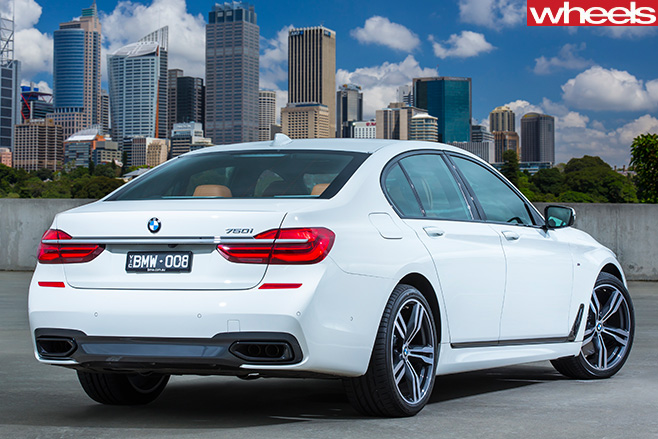
That makes the 750i a more characterful, seductive limousine than its six-cylinder counterparts, and an impressive motor vehicle. While its innovations are hardly rousing, the 7 Series melds a much more drivable chassis with its characterful V8, class leading fuel-economy and performance, all chaired from a far more opulent cabin. It’s a significant step up from its predecessor.
SPECS Model: 2016 BMW 750i M Sport Engine: 2498cc V8, dohc, 32v Max power: 330kW@5500rpm Max torque: 650Nm@1800-4500rpm Transmission: 8-speed automatic Weight: 1820kg 0-100km/h: 4.7sec (claimed) Fuel Economy: 8.1L/100km Price: $289,600 On sale: Now
It may be fashionably late, but the AirBumped Citroen C4 Cactus has finally arrived in Australian showrooms.
WHAT IS IT? This is Citroen’s funky new foray into the booming compact SUV market. It brings a comical name, funky styling and pragmatic innovation to the table.
WHY WE’RE DRIVING IT This is our first drive of the Cactus on Australian roads, with both the diesel- and petrol-engined models sampled.
MAIN RIVALS Mazda CX-3, Honda HR-V, Jeep Renegade, Renault Captur, Nissan Juke, Peugeot 2008, Fiat 500X, Holden Trax, Ford EcoSport
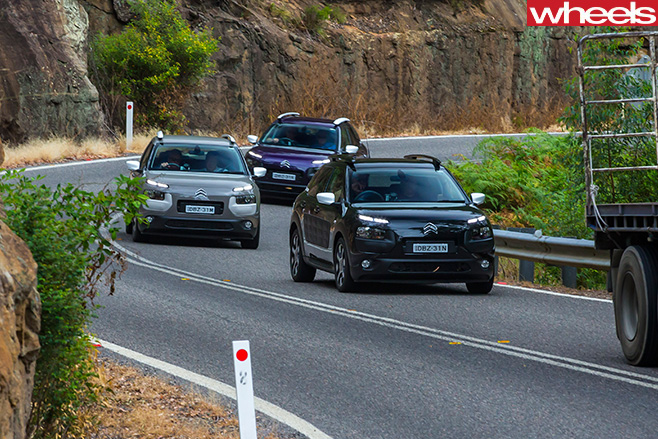
PLUS: Edgy looks, great packaging, sophisticated interior, quiet engines, six-year warranty MINUS: Jerky semi-auto transmission; lack of auto petrol model; no AEB; high pricing
THE WHEELS REVIEW THE puns seem endless: Citroen hopes for a sales spike as its new front-wheel-drive compact SUV aims to be a thorn in the side of its rivals. This pun-tastic prickly competitor’s name shows that, even before you’ve clapped eyes on its blunt, narrowed eyed-nose, or poked and prodded the ‘AirBumps’ that garnish its doors, you know that this car is a little tongue in check. And it’s entirely true that the French had no idea that, in local Aussie folklore, when something’s ‘cactus’, it ain’t good.
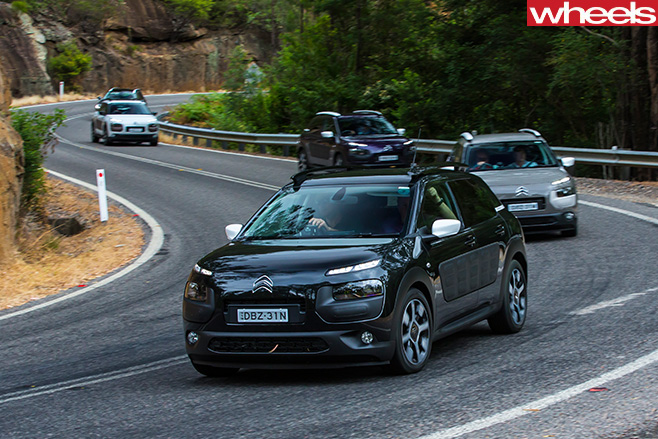
Regardless of engine choice, Cactus’s bold looks come in a single trim level with choices limited to an array of optional colour combos for the wheels, roof-rails and AirBumps. Standard equipment includes 17-inch alloys, crisp 7.0-inch colour display with reversing camera, digital radio and climate control. Lacking, though, is some crucial tech. Most notably, automated emergency braking is not even an option – and then there are the drivelines, which we’ll get to.
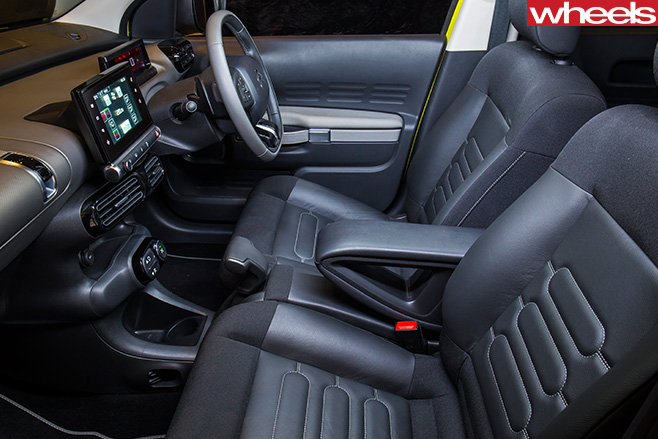
Here and now, the cabin is even funkier than the outside. A low, wide dash sees front ‘lounge’ seats connected to form a quasi-bench. They’re super comfy yet supportive. Look further and the Cactus cockpit continues to engage and amuse: those excellent door-pulls that mimic classic leather luggage handles not only look charming, but feel solid and dependable. It’s a stunning interior. The way the glovebox closes, the feel of the switchgear and the finish of the materials is both elegant and sturdy.
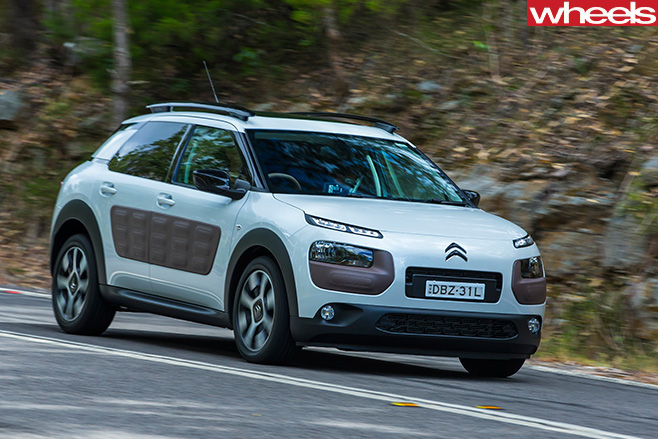
Yet the dated bones of the Cactus – it’s been on sale in Europe for almost two years, and based on PSA’s older PF1 platform – rear their ugly head through a lack of driveline choices. The 1.2-litre turbo-petrol engine is offered only as a manual, an antiquated five-speed at that. It’s now that you’ll notice that the retro-cool digital instruments don’t include a tachometer. You’ll also discover a driving position compromised by no steering reach adjustment.
That’s almost forgotten because that three-pot is an absolute gem. Its versatile, funky character comes with a thrummy note perfect for the jester-appeal of the rest of this car, and it works well with the competent yet not slick gearbox. It’s surprisingly quiet at speed, where it cinders to near silence, and there’s little road noise, too.
There’s also competent handling to go with the strong engines. On the twisty stuff the nose pitches, there’s a lot of body roll and the Cactus relies on its Goodyears to keep it all together. Around town, its slow-speed ride and refinement is excellent. The steering is light and easy, but lacks communication when things get serious.
A class-leading drive is not what the Cactus offers. Yet Wheels loves cars like this: a fresh approach that delivers an unmatched verve both in and out, with an interior that’s the most sophisticated and engaging in this segment. Where it falls down is in terms of its woeful semi-auto, lack of driveline choices and dated tech. The C4 is a solid contender, but its narrow range and ‘boutique’ pricing mean that it’s unlikely to rattle its main rivals’ cages.
CACTUS CROP The Cactus went on sale in Europe in 2014, so it’s almost two-years old already. That means that, given the typical life-cycle, it’s due for an update – and may get one within 12 months. The 208 itself is four years old, too, so will likely be the final vehicle using the PF1 underpinnings. The Cactus may not be in need of a styling facelift, but on our shopping list would be the EAT6 Aisin automatic that’s fitted to the DS3 and, more recently, the Peugeot 208 – both cars riding in the PF1 platform. And styling for the next-gen Cactus? Look no further than the AirCross Concept, which will also set the tone for a larger Citroen SUV.
SPECS Model: 2016 Citroen C4 Cactus Engine: 1199cc 3cyl, dohc, 12v, turbo Max power: 81kW@5500 rpm Max torque: 205Nm@1500rpm Transmission: Five-speed manual Weight: 1020kg 0-100km/h: 9.3sec (claimed) Fuel economy: 4.7L/100km Price: $26,990 On sale: Now
Even with 911s booming in demand, few will match the price or provenance of this Porsche 911 GT1 Evo soon to sell at a RM Sotheby’s Monaco auction. This is thanks to three things.
Firstly, the GT1 is more racing mutant than 911. Porsche built the 911 GT1 using a carbon monocoque and spaceframe in 1996 to beat up on McLaren and Ferrari in global GT racing, but things turned out less than stellar for it in the first few years.
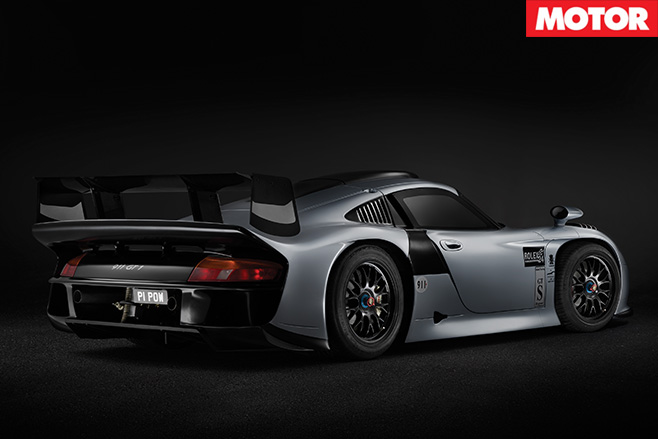
The GT1 Evo, however, addressed this in 1998, and added aerodynamic aids – namely that rear wing—along with 996-gen headlights as part of the upgrade. Porsche then homologated a run to get its hand stamped for racing.
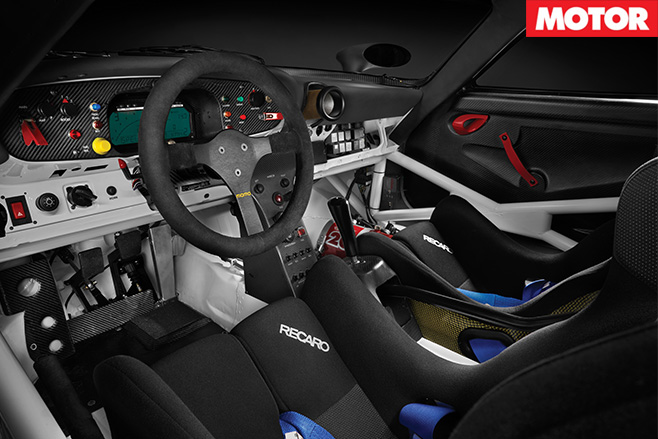
Take a look inside. Notice no carpet? Or at the engine, notice no silencers? This is not one of Porsche’s Strabenversions (street versions), this is a full gamut race variant, and someone’s slapped a number plate on its rear to make it the only street-registered ex-race GT1 Evo in the world.
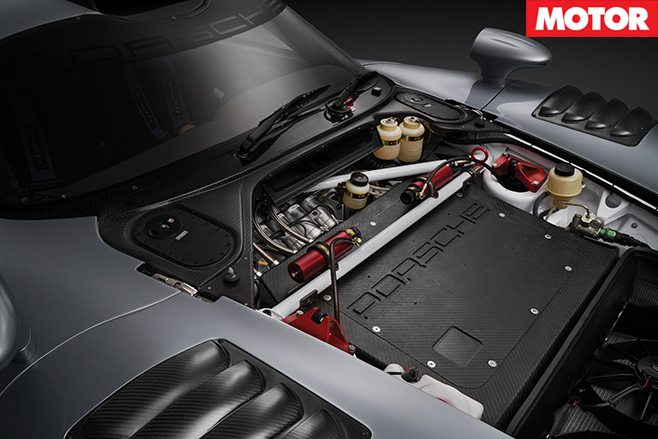
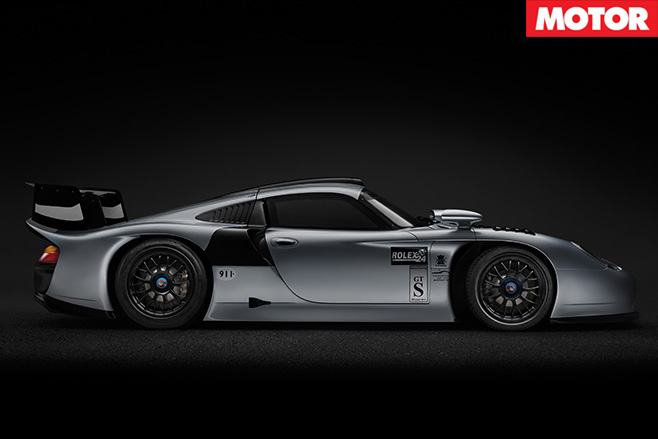
With cashed-up collectors out there, expect the GT1 Evo to go quicker at auction this May than it ever did on track.
Pictures by Chris Wilson via RM Sotheby’s
WRC stages are known to throw up unannounced obstacles.
Sebastien Ogier was reminded of this during last weekend’s Rally Guanajuato Mexico, where he developed a serious beef with a herd of rogue cattle during the first morning stage on Day Two.
WRC’s cameras captured the whole incident, which Ogier described as “a brief moment of terror”, not that you’d know it as his face betrays not a hint of emotion while threading the bovine barricade.
It’s testament to Ogier’s incredible ability to steer that both Daisy and co and the Polo R WRC escape without a scratch on their respective rumps. It’s what makes the Frenchman a three-time world champion.
It’s not the first time Ogier has come across an unexpected obstacle on Rally Mexico, in 2013 he came across a closed gate during one of the special stages. While on that occasion Ogier went on to win, this year he had to give best to Finnish teammate Jari-Matti Latvala.
The title of this film is actually a bit misleading, as there are few actual Scandinavian Flicks in it.
But who cares, because it’s awesome! It features an extremely talented Norwegian, Fredrik Sorlie, who has an almost unparalleled ability to hold a old Toyota sideways, which he does for a good three minutes straight.
His chariot of choice is an unusual one, a Toyota Cressida JZX30 powered by a naturally-aspirated 2JZ-GE from a MK IV Toyota Supra.
What Fredrik lacks in ultimate grunt he makes up for in commitment and silky smooth skill, as his ability isn’t limited to the snow. Here he is tearing up the Nurburgring.
And here is what must be a special private road…
