
Watching some noisy, fast cars drive around and around a racetrack isn’t everyone’s idea of a fun day out. Whether it’s on your bucket list or in the bucket, the Formula 1 Australian Grand Prix draws a huge crowd of visitors from across the world, and Melbourne puts on a big show – one that everyone should experience at some point.
Don’t worry if fast cars aren’t quite your thing, there are plenty of other reasons to enjoy the event including rubbing shoulders with celebrities, the chance to meet good looking drivers, and bragging rights. Here are 10 more things to love about Aussie Grand Prix that don’t include watching Formula 1:
- DISNEY ACTIVATIONS The kids will love the Disney Zone with the all new Star Wars experience and Pixar Cars activities. From finding your way through the Asteroid Escape Obstacle Course and Jedi Training Academy, to engine building competitions and various rides, there’s plenty here to keep the kids entertained for the day. Not to mention Flo’s V8 Diner for some R&R time for the parents.
- AIR SHOW What’s a major event without an air show? Also a way for people living in the suburbs neighbouring Albert Park to feel involved in the GP. The massive air display, run by the Air Force, is often a crowd favourite. Fighter jet fly-bys are something you feel as much as you see.
- SOCIAL MEDIA HUB Going to the GP to show Facebook that you’ve done something fun, but struggling to get a photo of the super-fast cars? Never fear. You can always visit the F1 Fanzone and engage with the digital kiosks. Do so, and you get the chance to win F1 experiences like meeting the drivers. If Daniel Riccardo is there, we’re in.
- PORSCHE KIDS DRIVING SCHOOL There is nothing worse than heading to an event with kids who just want to do what the adults are doing. But at the GP, they get their chance. The driving school will teach your kids road safety and also give them the opportunity to drive a Porsche pedal car. NOTE: Enrolment is in the Kids’ Zone Golf Course Precinct.
- AUSTRALIAN FMX GRAND PRIX Prefer Motocross to motor cars? Well, the GP also plays host to the Australian FMX Grand Prix where the best Freestyle Motocross (FMX) riders show off their two-wheeled skills.
- BIG AIR SHOW No, this isn’t about bigger planes than the air show above. This is where stuntmen and riders bring their BMX, parkour and skateboarding skills to the party and soar high above the crowds below. There’s also workshops run by the pro riders.
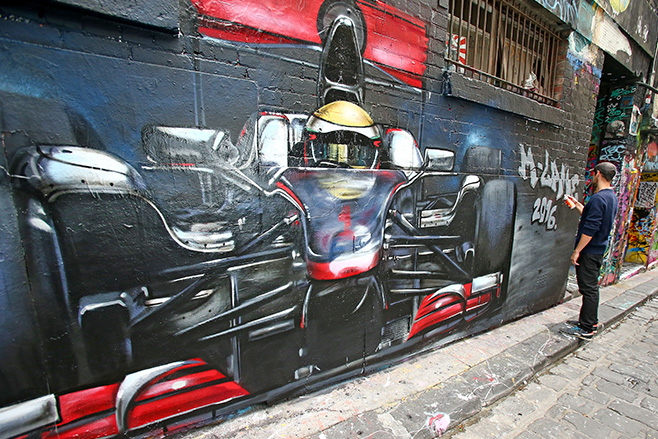
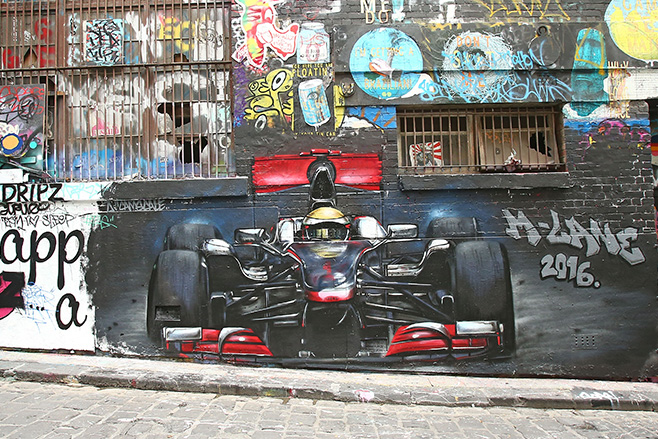
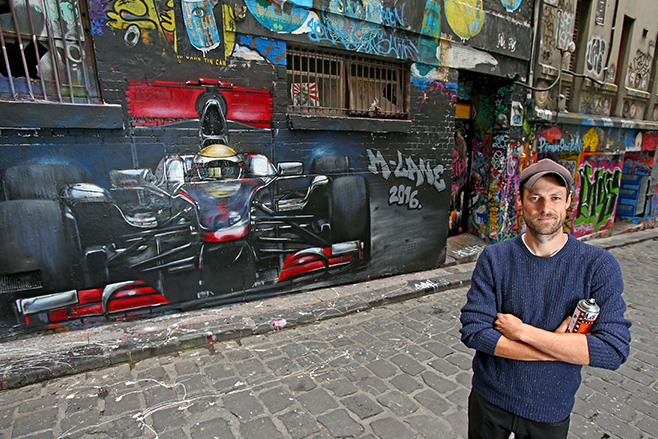
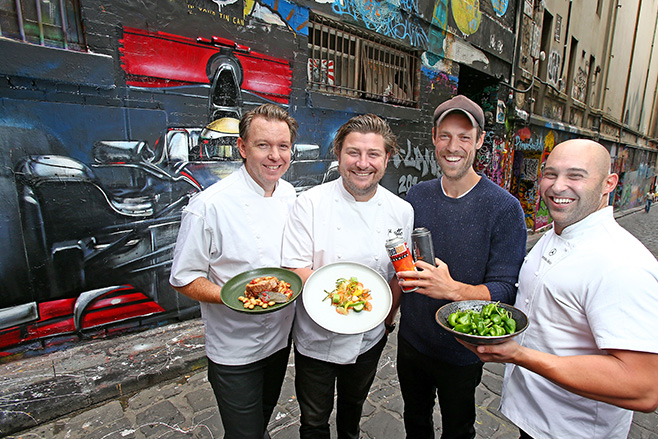
- M-LANE Located at the south end of the Action Zone, this new laneway is filled with food trucks, street art, live music and bars. There will be pop-up restaurants, Petaluma Bar, Genovese Coffee bar, two story B Double ‘Cloud 9’ event truck with bar, stage and screen, and celebrities chefs like Shane Delia on hand. You know where we will be!
- RENAULT TORQUE BAR AND ALUMBRA AFTER PARTY Lounging around in front of a big screen telly, with access to food, drink and DJs performing throughout the day, the Renault Torque Bar is the place to be if you want to be at the race, but not really trackside. If you’re lucky enough to make it to the official after party hosted by Alumbra on the Saturday, then have a glass of Moet for us!
- LIVE MUSIC Of course, a major Melbourne event wouldn’t be a major event without some live music acts. Headlining acts this year include Sneaky Sound System, Rogue Traders and Spiderbait, as well as Vaudeville Smash, Johnny Wonderpants, Dan O’Connor, the Johnny Rollins Band, Josh Owns, Generik, Yo! Mafia and Apax. There are various stages across the venue so make sure you check out the schedule for details.
- FREE STUFF Ok, so aside from all that, and obviously the big race, the Formula 1 Australian Grand Prix also allows free admission for kids 14 and under (accompanied by an adult ticketholder) and tickets include a free tram ride from Melbourne’s CBD. Sounds pretty good to us.
Walking out onto the tarmac in the small Finnish town of Levi, just this side of the Arctic Circle, I quickly realise jeans and a T-shirt weren’t really cutting it, and putting my big jacket in my bag may have been a mistake.
I’ve flown to the top of the world to claim a prize, and it’s a pretty cool one. Literally! I’ve been invited by Porsche Australia to take part in its three-day Ice-Force S course, as part of the Porsche Driving Experience. I’m here because I managed to put my No Second Chance 911 into the top three of the Australian Porsche Carrera Cup Championship last year.
By plane, Levi is 1.5 hours north of Helsinki. Flying into the Finnish capital, and with snow as far as the eye can see, it dawned upon me that I’m not in Broadwater, Queensland, anymore. Coming from the Gold Coast, there aren’t many days where the temperature even drops into single figures.

I’m not just here with a few motor racing mates, though – a group of 15 Aussies are here as customers to put a range of Porsches through their paces on the slippery stuff. Many of them have been coming up for several years, so there must be something to it.
Before we got into the course proper, though, we do what comes as naturally to Finns as motorcycling does to Aussies – snowmobiling. The landscapes up here are hard to describe for this humble driving instructor, but it felt like being on the set of a Hollywood blockbuster movie. The place is so vast and the colours so incredible. It’s absolutely like nothing I’ve ever seen ever before. Incredibly special.

I’m a big fan of the word ‘free’, so I took him up on the offer. “Are you sure?” said young mate with the confidence of youth. “I’ve had 7000 people through here, and I’ve never been beaten.” We’ll see, shall we?
The Finnish kid and I lined up on the back of the grid for our first race. With several Carrera Cup and Australian GT racers in front, I was reasonably confident of carnage on the first corner. And… I was right. To be honest, I did my fair share of punting people off into the snow banks, but hey, there was money on the line!
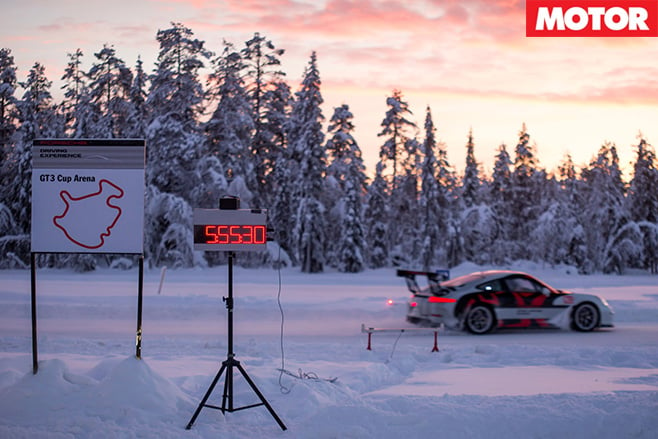
The course proper turned out to be nothing like what I expected. In my racing driver job, my main focus is finding and managing grip – and snow and ice don’t seem to offer much of that.
I’d spoken to a couple of other Porsche instructors, who had been over here a few years earlier, to hear their thoughts. Other than a few pointers you might be able to pick up, though, it’s one of those scenes that nothing can prepare you for it until you actually do it.
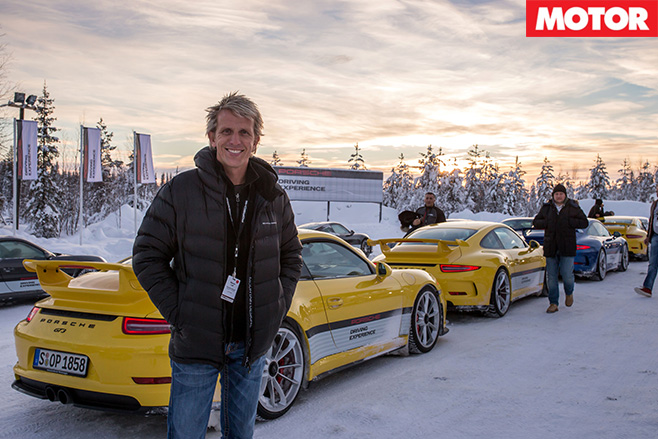
In the spirit of jumping right into the cold deep end, I climbed aboard the 911 Turbo S. I know the car very well from doing stuff back in Australia, but what amazed me straight away was how much grip the standard winter tyres had and how forgiving they were. It’s very controllable in everything that you do.
It’s much slower on ice than on the tarmac, but there is still a huge amount of control available to the driver. As with all kinds of driving, your inputs have to be smooth and precise. It’s no different from what I do on the track back home. Now, it’s just on a cold and frozen surface.
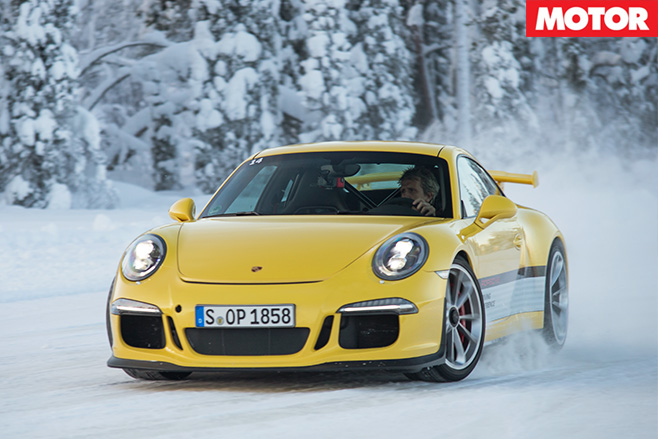
The Cup car was another level again. It had a proper rally winter-studded tyres, so the grip was just… insane. It had so much more grip than I ever believed possible in such conditions. The acceleration was probably the biggest eye-opener in the Cup car. You could feel it bite into the ground so hard. Even coming out of a second gear hairpin, the level of acceleration was unbelievable.
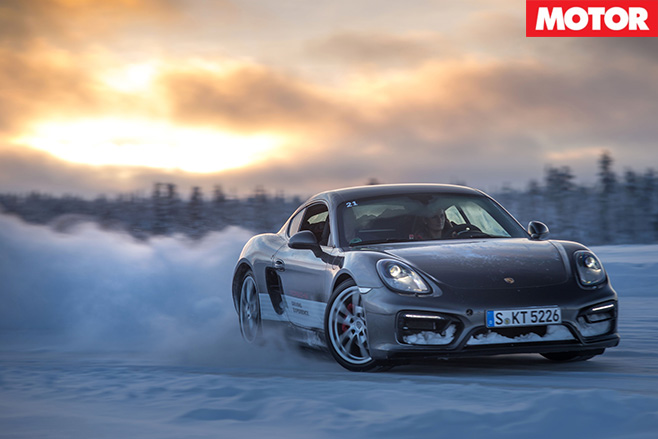
What impressed me most, though, was how much the other people on the course got out of it. A lot of them are business people who might do track days or some club racing. They find that snow and ice driving helps them sharpen up, and it gives them confidence that when the car starts to slide, they know what they need to do.
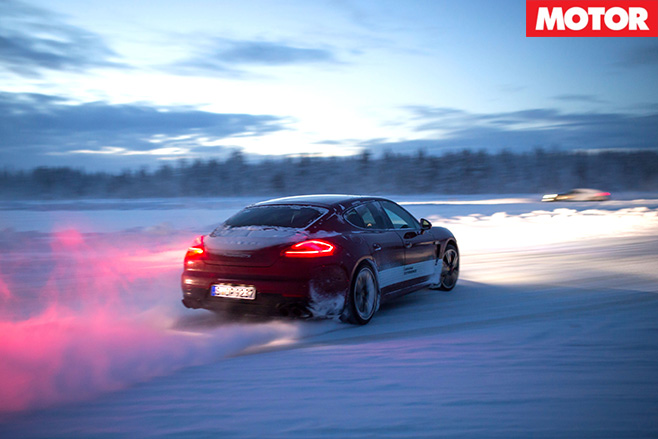
It’s a very social experience, as well. The second night we visit a big igloo called the Snow Dome. The chairs, tables, everything inside is basically ice, including massive sculptures. Thankfully the service was fast because it wasn’t exactly the Gold Coast in there.

If you’re looking for an awesome way to sharpen up your sliding skills and to have a genuine once-in-a-lifetime experience on ice – and, err, can afford it – they don’t come much more unique than this.
Will the suits ever learn? Once again BMW has graced us with a jaw-dropping show car yet the company is adamant that not only will it not be built, according to BMW chief brand designer Karim Habib it’s not likely to influence the styling of future product either.
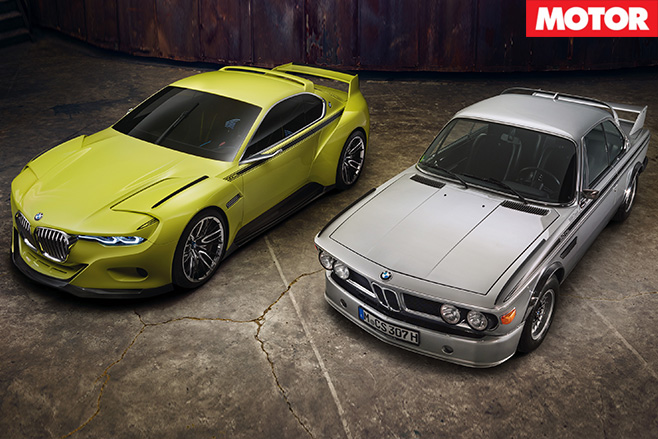
Following on from the 2008 M1 Hommage, which celebrated 30 years of BMW’s first supercar, and the 2011 328 Hommage, which paid similar tribute to the Mille Miglia-winning roadster on its 75th anniversary, the Hommage CSL has been created in memory of the famous ‘Batmobile’, BMW’s E9 3.0 CSL.
Three great show cars, three missed opportunities, as once again the company behind these show-stopping creations refuses to recognise their potential, draw up a business case and run them through a couple of customer clinics. The only way to change the minds of the bureaucrats is through public opinion, so let’s take a closer look at what constitutes a 21st century BMW CSL.
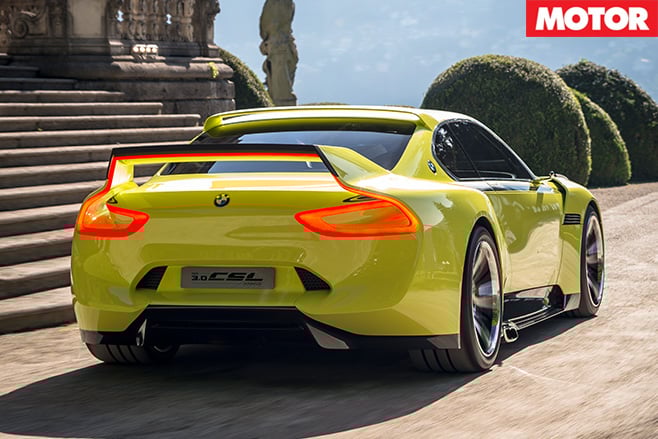
There were three different iterations of the breed: the carb-fed 134kW Mk I (1971-’72, 169 units), the fuel-injected 147kW Mk II edition (1972-’73, 929 units) and the wild 154kW Batmobile (1973-’75, 167 units) that famously came with the spoilers in the boot as they were technically illegal for road use in its German homeland.
The ‘L’ in CSL stands for leicht (German for light) and thanks to the use of thinner steel for the bodyshell, aluminium body panels, Perspex windows and no soundproofing these road racers weighed just 1165kg, a substantial 200kg less than the 3.0CS/CSi on which they were based.
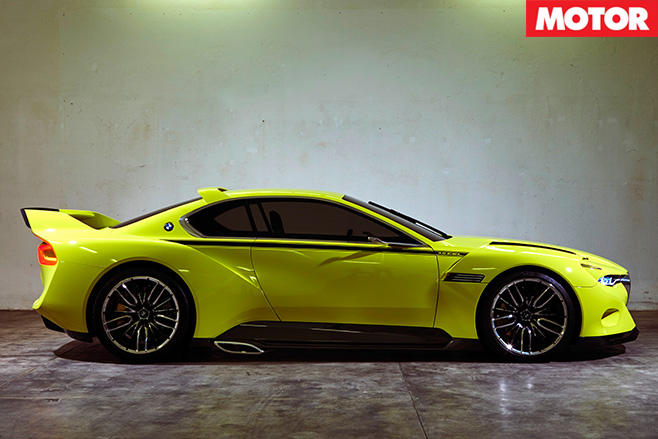
Sitting beneath that radically sculpted front clamshell is the 3.0-litre straight-six from the 435i, ably assisted by two conventional turbochargers and one electric unit; the two energy reservoirs from which the e-charger draws sit above the rear axle in place of seats. As the engine fires up the air on the passenger side blurs as the side-exit exhaust emits a noise that wouldn’t be out of place in the Le Mans pit lane.
Before we can commence our ’round-the-block encounter – literally, as the only location we can drive the unregistered, handbuilt canary yellow coupe is on the private grounds of Villa Erbe, next door to Villa d’Este – there is the small matter of getting inside.
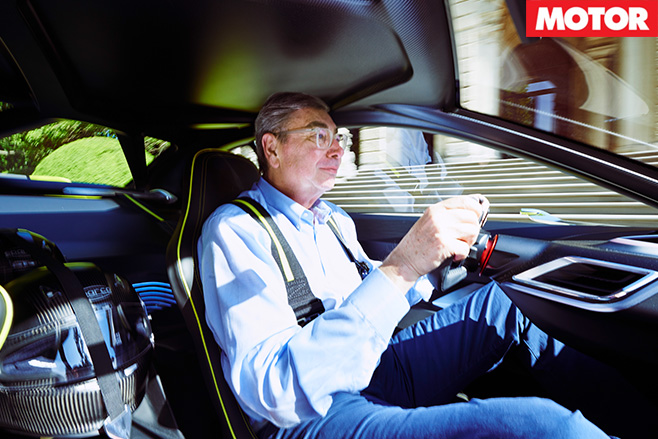
You sit low in a dark tunnel of man-made materials. This sombre environment is enlivened by alloy-capped pedals and plenty of bright yellow stitching. Everything about this interior is trying very hard to exude racecar cool, from the slim-fit, fixed-back carbon bucket seats, the lightweight headlining, the fire extinguisher system and helmet stowage behind the seats.
Most obvious of all, however, is the radical butterfly-shaped steering device – to call it a wheel would be plain wrong – a stylised version of the helm found in BMW’s M4 DTM racer.

Credit must go to BMW for making all its show cars driveable art, even if practical realities restrict the actual level of ‘driving’ that can take place. With this one-off automotive sculpture due to be revealed to the world in eight hours, speed is limited by hand signals to whatever the BMW minders deem acceptable.
The turning circle is gargantuan thanks to fat 21-inch wheels wearing 265/35 rubber at the front and 325/30 on the rear and the dampers feel almost solid to prevent that glossy front splitter from eating gravel.

In its current guise, the Hommage CSL feels to have the mechanical aggression to back up those wild looks. Of the five available solid period colours, Golf Yellow was rightly picked as the most eye-catching shade.
Further nods to the past are present in the full-length black rallye stripes, circular air intakes in the front bumper, chrome window surround and two BMW roundels just aft of the signature Hofmeister C-pillar kink. Imbuing the shape with modern muscle car aggression are those outrageously flared guards with “integrated wrapover wings” and the towering rear spoiler with integrated taillights.
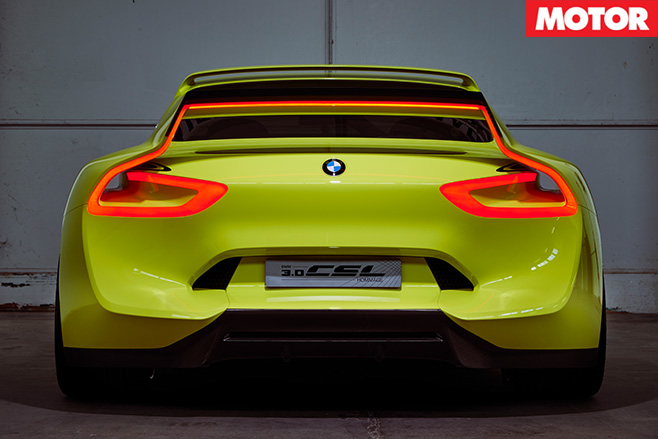
As it is, the Hommage CSL may indeed be too costly to be built at a profit, but when you want to invest in the brand, giving continual thumbs down is the wrong strategy. Having said no to the proposed 9 Series and M8 supercar, BMW management should give the CSL idea a second chance. Related opportunities include a contemporary 2002 positioned clearly below the M235i or a no-frills Bavarian Mustang powered by that iconic straight six.
Habib, who by now is wondering what I have been smoking, continues to tow the party line. “The Hommage cars make sure that old-fashioned excitement is alive and kicking. And don’t worry, we have more than enough ideas for the next three or four iterations.” Excitement, old fashioned? Will the suits ever learn?
Friends, countrymen, lend me your ears… I might just need them because mine are buggered.
Right now, I’m hearing a kind of ringing sound and everything else is a bit muffled. I remember a similar feeling when a bloke out in the middle of nowhere demonstrated his ‘party motor’ – a 454ci supercharged Chevrolet V8 on a trolley that farted flames out its sawn-off exhausts and pounded my eardrums like natives banging jungle bongos. I really thought I’d be deaf for good, but it all came good the next day.
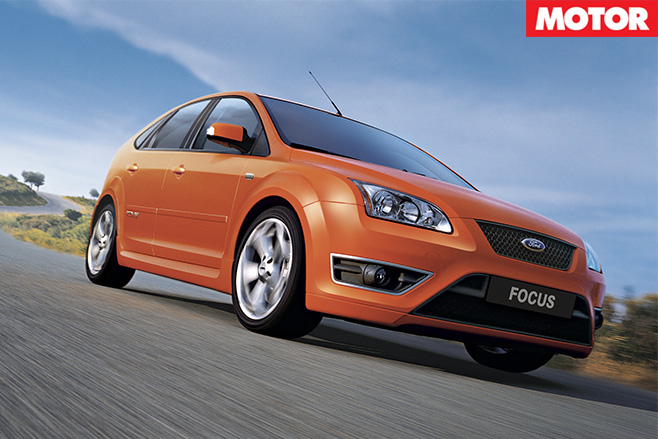
But this time there was no party, or even a motor, involved. You see, my much better half has a Ford Focus XR5, a five-cylinder turbocharged hatchback that I love driving. Back when my earholes actually worked, I loved to soak up that lovely meaty exhaust note and the occasional pop from the pipe as it burnt off excess fuel.
Anyway, the battery had let me down the day before, but the RACV man who came to save me reckoned it was fine and just needed a charge. He also said I must have left the headlights or the radio on and gently implied that I was an imbecile.
Turns out the RACV Imbecile Assist would come and replace it for $250. I could go and get a Ford-endorsed one for $100 less, but I’d have to fit it myself. That’s like three cinema choc-tops, so I had to do it.
The XR5 battery is lodged half under the windscreen wiper panel, which means it’s particularly tricky to get to. There was much grunting and cussing as I toiled away at a hard-to-get-at nut with a regular spanner.
I should’ve taken my geared spanners; I took a moment to think about how much I love my ratchet spanners. Those happy thoughts were shattered by the piercing wail of the XR5’s alarm.
Good god it was loud. The siren must be right next to the battery and the sound was amplified by the bonnet, which was right next to my bonce. I grabbed for the key fob to kill the wretched noise but it did nothing. I clumsily picked out the hidden hard key, unlocked the door and pressed the ignition, but nothing would stop the infernal din. Seriously, my ears have not been this abused since the years of Celine Dion.
Two minutes later, I finally got the battery connected properly and the bloody alarm finally stopped. And that’s when I realised that car alarms are completely pointless.
The siren was ridiculously loud, but no-one in that crowded car park did anything about it. They didn’t call the cops or even look twice. And I’ll admit it, I do look a bit like I would steal a car.
In fact, some people give me funny looks when I’m pushing my kid around in a pram, especially when I’m wearing a beanie and dark glasses. I reckon they think I just stole him, but they could just be looking because he is holding a Jim Beam and Coke (Dear Child Services, that last bit is a joke, he hates Jim Beam).
Think about it, when was the last time you heard a car alarm and thought, “golly, a crime is being committed. Where’s my cape?” You’re more likely to lie there thinking of imaginative ways to kill the jerk whose car alarm keeps going off when you are trying to sleep.
I guess the upside of my reduced hearing is that I am less likely to notice any stupid car alarms in future, which is good. But then I might also sleep through a smoke detector alarm and burn to a crisp, which is probably bad. Then again, I do have those choc-tops to look forward to.
Automakers are constantly looking at new ways to integrate your smartphone and your car. Remember when having Bluetooth connectivity for hands-free calling was a big deal? We’re way past that now.
Here are seven recent innovations we reckon will have a lasting impact on the way we drive.
VOLVO WANTS TO REPLACE YOUR CAR KEY WITH YOUR SMARTPHONE
Now this is truly keyless entry and exit! Volvo has developed a technology that has no car key whatsoever! Your smartphone is all you need, but more than that the Volvo Keyless Cars app allows you to let family members or friends use your car by sharing your digital key with their phone. In the same way, access to other Volvo cars can be shared with you when you travel. Check out the video below.
WIRELESS PHONE CHARGING FROM SKODA
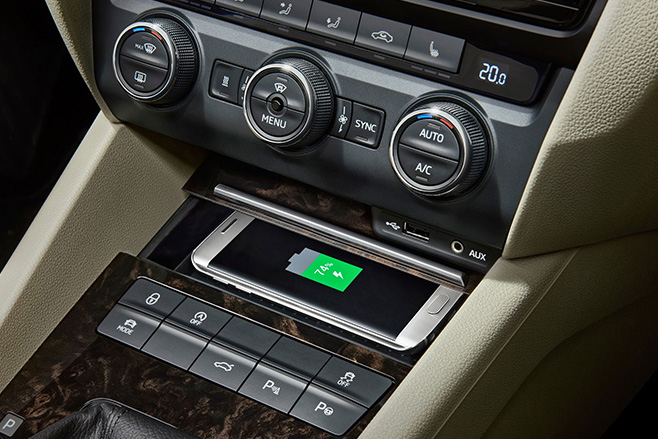
This is one we can really get behind. No longer will you jump into the car and go searching for your USB charging cable to keep your phone battery alive. Skoda has recently announced wireless charging technology it plans to put into Octavia and Superb models, in the not-so-distant future. Now you won’t need a cable to charge your phone at all, you just put the phone into the ‘Phonebox’ on the centre console and the car will charge it without wires!
VISA READY PAYMENTS FROM YOUR CAR
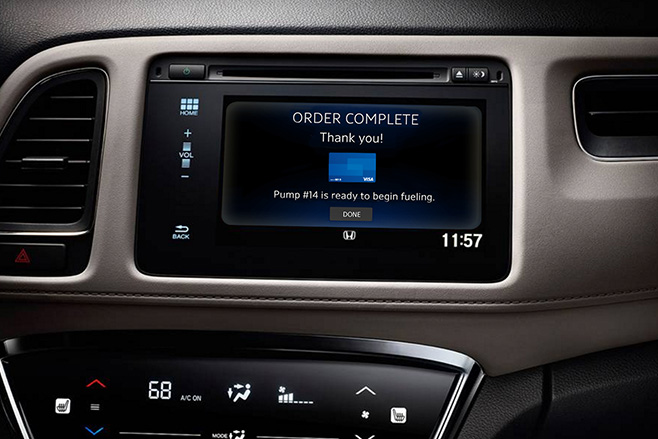
Have you ever been in a hurry to get somewhere with a car that’s running on empty and you arrive at a petrol station to find it’s full of people doing their weekly shop inside and holding everybody up? It happens, and it’s the worst. Visa knows this and has come up with a solution. Using their new technology called Visa Ready, your car can direct you to a petrol station, calculate how much it will cost to fill up and pay for your petrol without you ever needing to go inside.
Similar systems exist for paying at the pump, but the Visa system is different in that it has the potential to integrate with your GPS system and use your phone’s internet connection to find the cheapest fuel on your journey. It could also allow you to pay for other things, like car parking, from your dashboard. There’s a lot more that can be done as well. Imagine you’re at the shops and need to know how much time you have left on the meter. Check the Visa Ready smartphone app and it will tell you the answer down to the second.
ANDROID AUTO AND APPLE CARPLAY
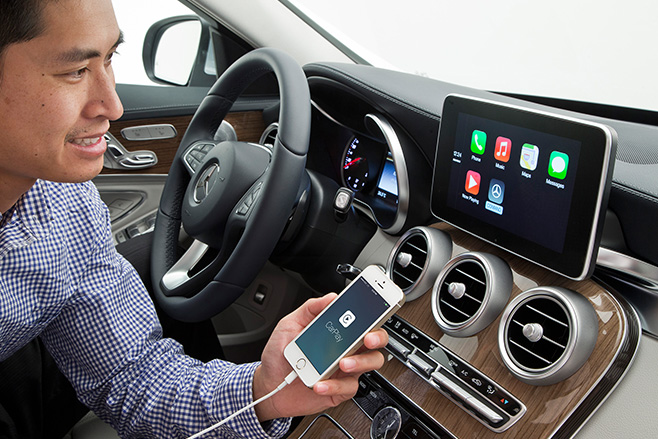
The two biggest players in the world of mobile phones are Google (Android) and Apple (iPhone). You know cars are the next big frontier when both of these giants of tech are pushing their own systems into our vehicles. It’s not all scary, though. These systems allow you to use more of your phone’s functions through the car than ever before. Streaming audio and satellite navigation are just the tip of the iceberg. These interfaces are already here and spreading to more and more new cars, and there’s a strong chance your next vehicle will have one or both of these systems built-in.
BMW CONNECTED DRIVE APP FOR ELECTRIC CARS
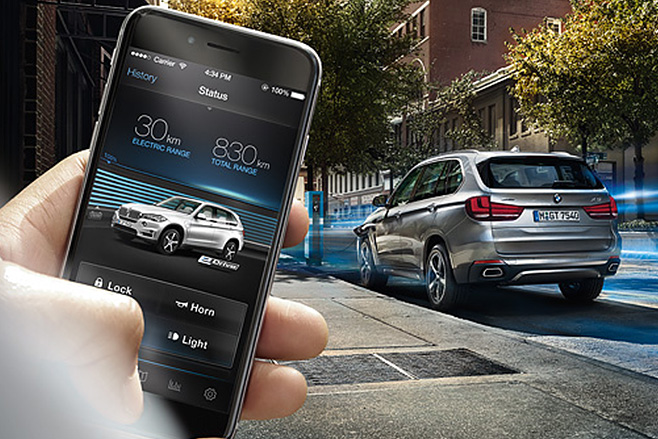
BMW has moved into the realm of hybrid vehicles in a big way, rolling out its eDrive electric technology and the ConnectedDrive smartphone app that goes with it. If you own a BMW hybrid car, you can use the app to monitor how much electric charge it has and tell it when you want it to stop charging. Imagine arriving at work and plugging your car in to charge, then keeping an eye on things from your desk.
Is it a hot or cold day outside? The app also allows you to start the car’s air conditioning to cool it down or heat it up before you get into it. You can lock and unlock the car with the app, use it to find the nearest charging station, even flash the car’s headlights or beep the horn to find the car in a busy parking lot. That’s smart stuff, BMW.
TESLA SELF-PARKING TECHNOLOGY
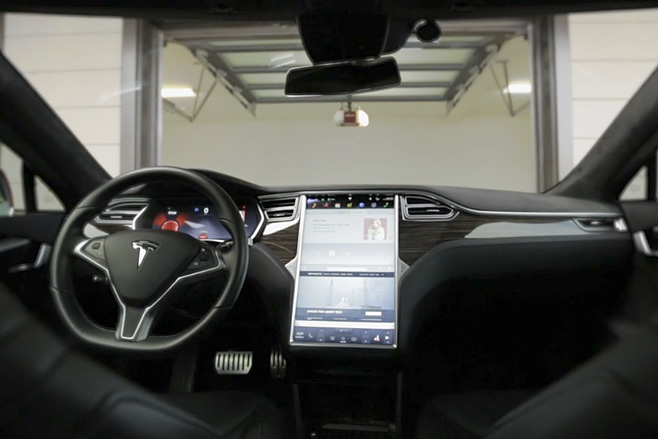
Wizards of all things electric, you just knew Tesla had to be on this list. Some Tesla models can now park themselves thanks to a recent software update. To make it work, Tesla owners must place their car within 10 metres of a parking space and then tell the car to park itself using a Tesla smartphone app.
The car can also leave a parking spot and drive to the owner when summoned. It’s a “baby step”, according to Tesla boss Elon Musk, toward being able to send your car off to find a park on its own and calling it back to you using your smartphone – like some sort of digital, car-sized puppy. With the rate of development at Tesla, it won’t be too long before that dream is reality.
DRIVE YOUR MERCEDES-BENZ WITH YOUR PHONE
Finally, the ultimate in James Bond trickery has arrived. Well, almost. Mercedes-Benz has developed its own parking-via-smartphone tech called Remote Parking Pilot. It goes one step further than Tesla by providing users with the ability to drive their car from the phone and not just activate the car’s autonomous driving mode. We can imagine a few scenarios where this sort of tech could come into play, like parking spaces so tight the doors won’t open. This app gives you another level of control.
As the most popular two-seater convertible sports car of all time, the Mazda MX-5 is an established motoring icon. But how has Mazda improved its winning formula and made this new model even more outstanding? Here’s what you need to know.
STAND OUT FEATURES
The first thing you notice about the MX-5 is how small it is. The dimensions of the new car are almost a match for the very first MX-5 that launched in 1989. There’s only two seats inside and everything about it feels pared back to the bare essentials. With so little left on the car has there’s a purity to the way it feels. It’s a machine with one clear focus, and that is to make you feel good when you drive it.
WHERE DOES IT FEEL AT HOME?
The MX-5’s steering and suspension are just magic, not at all harsh or hard to live with. Open-top touring on tight backroads is where the MX-5 really excels, but just being able to drop the roof on your way home from work is a great way to de-stress.
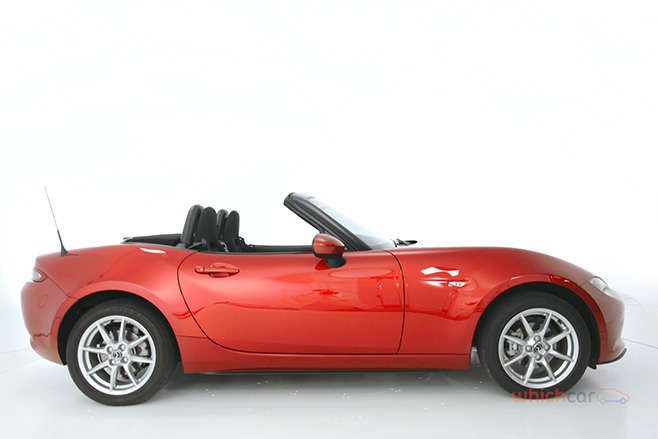
Mazda has made sure that using the convertible hood is almost effortless. It can be raised or lowered and latched easily with one hand, even when moving. It’s not electric, because motors add weight and the MX-5 is all about simplicity.
WHAT’S IT MADE FOR?
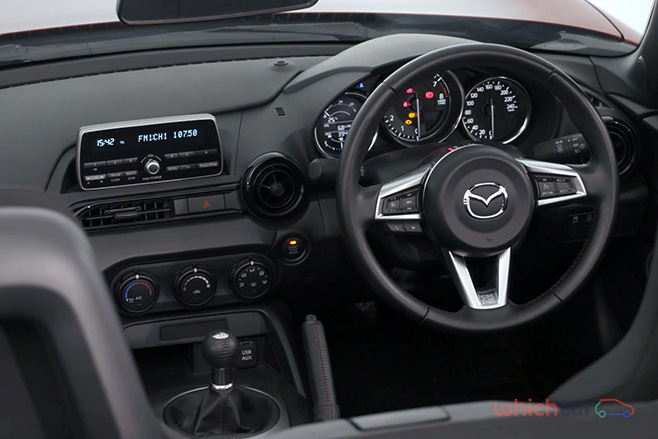
Mazda has had to get clever with the ergonomics inside this small cabin. For example, the cup holders usually live back here out of the way, but you can take one off and clip it into this spot up the front here when you need it.
The glovebox has been moved from the normal position, to a cubby here between the seats, and lots of the car’s functions can be accessed through buttons on the steering wheel rather than buttons on the dash.
We do wish the steering wheel had reach adjustment as well as height. I’m about six foot two and while it’s snug, I do fit fairly comfortably, I just wish I could get the steering wheel closer. Anyone taller than me may struggle for headroom.
CHOOSING YOURS
Mazda offers the MX-5 with two different engines, a 1.5L or a 2.0L. Both are four cylinder petrol engines and both are excellent. A lot of journalists love the smaller, high-revving motor, and others, such as myself, are in favour of the bigger one with that little bit of extra grunt. You can’t make a bad choice, but drive both and see what suits you. Both are available with a manual or automatic gearbox. If we were buying we’d get the manual.
Once you have your engine picked, you’ll need to choose a trim level. The two options are Roadster or Roadster GT. All MX-5s get decent equipment like cruise control, power windows and Bluetooth. Safety systems are the same on both models, the details of which you can find on our spec pages at WhichCar.com.au.
You’ll need to buy the Roadster GT if you want a premium infotainment system with sat-nav and upgraded speakers. The GT also has heated seats, auto headlights with daytime running lamps and a couple of other small extras.
WHO WILL IT SUIT?
The MX-5’s real party trick is its driving experience. If you only need a two-seater or there’s space in your garage for a weekend car, you really should give the MX-5 a go. It beat a field of tough competitors to win Wheels Car of the Year, and we can definitely see why.
Click here to read the full review on the Mazda MX-5.
AFTER EIGHT years at the crease Jaguar’s called in its XF for a clean-sheet overhaul. Then as part of what may be the world’s priciest diet, Jaguar spent more than £400m (AUD$800m) to have the new XF made at Castle Bromwich, its aluminium-specialising plant that also produces the XJ and F-Type.
As a result, the second-gen XF rolls out of Bromwich’s doors 75 per cent aluminium – just like the XE sedan. However that’s not all it shares with its smaller brother. Its front double-wishbone set-up, adaptive dampers (on S models) and modular platform are all derived from the XE.
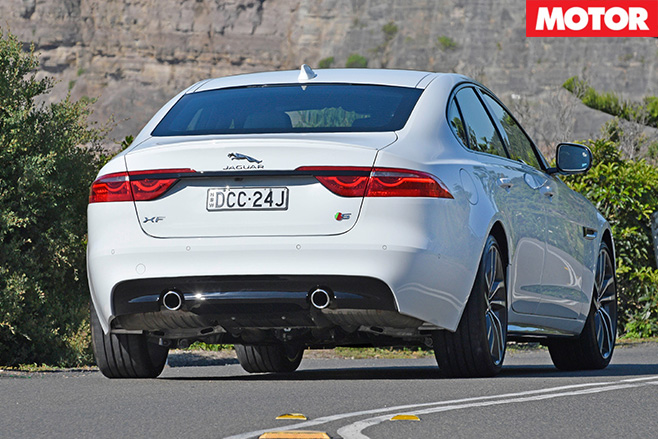
Thankfully, the XF cashes the cheques written by its brooding new look. With up to 190kg less hanging off its aluminium skeleton, the XF feels agile; wieldy even.
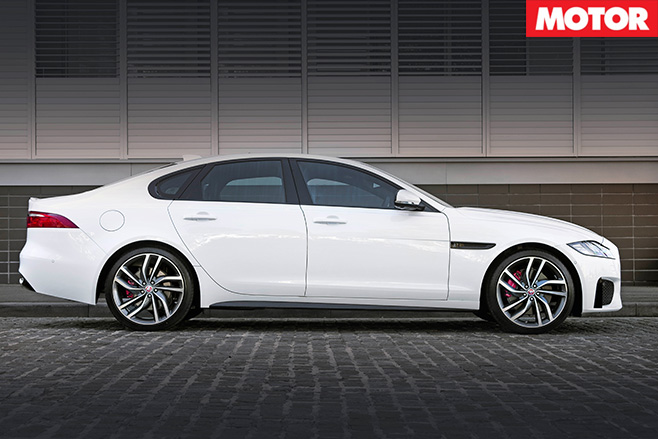
Jaguar matches the steering to a brilliant front end, too. It is impressive how the XF turns in with almost scything precision, making its nigh-on five metres easy to place.
Discovering how much grip exists at either end will have to wait until we throw the XF on more challenging roads, but Melbourne’s flowing hinterland revealed the XF’s suspension feels a touch floaty over rises and struggles to smooth mid-corner bumps. However, overall it feels controlled and well-resolved.
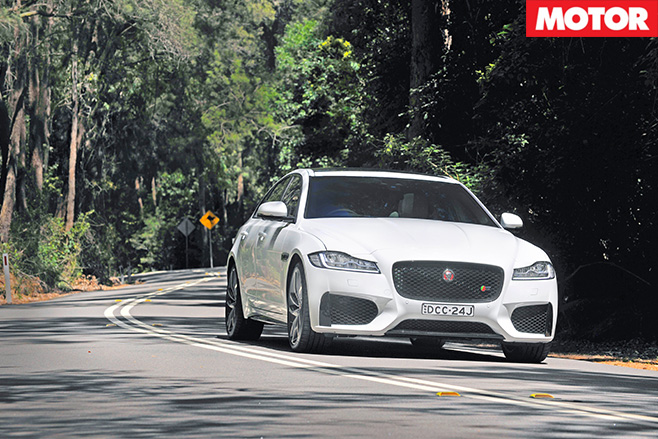
However, what was a snarling, raucous blown V6 in the F-Type S is a muffled introvert in the XF. Short on brawn or theatre, it feels burdened by the 1710kg-plus it has to carry.
Another gripe lies with the XF’s interior. It’s nicely designed, but until it welcomes Jaguar’s new fully digitised instrument panel and touch-only centre screen in a few months, which it calls InControl Touch Pro, it’ll feel well behind a BMW 5 Series’.
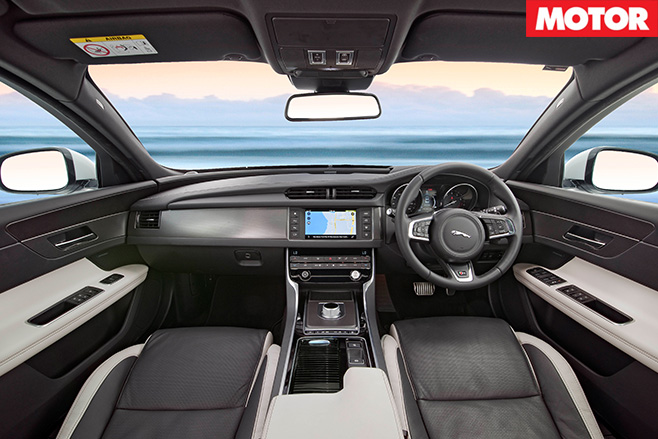
3.5 stars out of five
Jaguar XF S Specifications
Engine: 3.0-litre V6, DOHC, 24v, supercharger Power: 280kW @ 6500rpm Torque: 450Nm @4500rpm Weight: 1710kg 0-100km/h: 5.3sec (claimed) Price: $128,200
SUBARU has announced that it will campaign a single car in the 2016 Australian Rally Championship, after a 10 year hiatus.
The Subaru WRX STI NR4 will be driven by Molly Taylor, daughter of legendary co-driver and multiple ARC winner Coral Taylor, with Bill Hayes alongside as navigator.
To make its debut at the Quit Forest Rally over April 22-24, the car will be prepared by Tasmania-based Les Walkden Racing (LWR), which has built numerous title-winning rally cars for both the ARC and the Asia-Pacific Rally Championship.
“We’ve got a lot of work to do in testing before the first round in April,” said Taylor, 27. “But the NR4 is a great car and we look forward to seeing the return of the Subaru rally fans, both new and old.”
Subaru Australia managing director Nick Senior said Taylor’s attitude and success as the world’s top-ranked female rally driver made her a match for both the seat and the Japanese car maker’s aspirations.
“She’s a perfect fit for the Subaru brand as we move to attract new customers, particularly younger ones,” Senior said. “We really want our philosophy to be ‘Run on Sunday, buy on Monday.’”
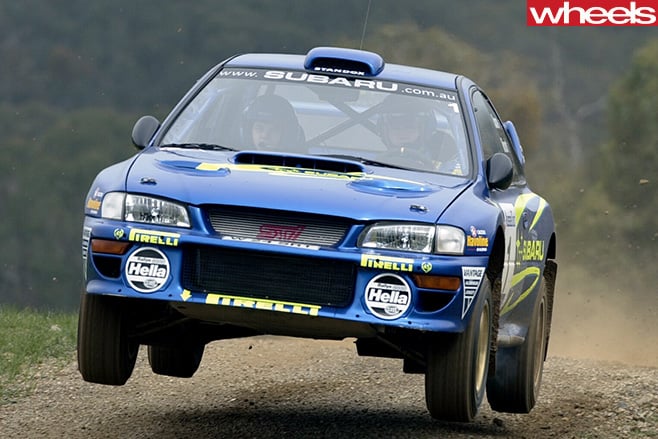
Subaru sold a record 43,600 cars in Australia last year, and is looking to build on that for 2016 despite supply shortages from its Japanese factories.
As well as introducing the high performance Levorg this June – a successor to the popular Liberty GT wagon – Subaru Australia will offer a limited run of 300 Forester tS models from mid-year as it looks to enhance its image with high-performance products.
Subaru built its global success of the back of the World Rally Championship. It won its first title in 1995 with Colin McRae, at the wheel of a blue-and-gold British-American Tobacco-sponsored Prodrive Impreza.
The following year, Subaru Rally Team Australia entered the ARC. It won 10 consecutive drivers’ titles and eight manufacturers’ crowns before it announced its withdrawal from the sport in November 2005.
Seven of those titles were won by the late Possum Bourne, while Cody Crocker won three in a row from 2003 to 2005.
The 2016 Australian Rally Championship consists of five rounds, with the finale Coates Hire Rally Australia held over November 18-20.
What stands out?
The Holden Cruze is comfortable and very well equipped for the money, and allows rear-seat passengers more space than most small cars. There are Cruze sedans, hatches and wagons. The Cruze was Holden’s alternative to the popular Toyota Corolla and Mazda3. For 2017, the Cruze was replaced by the Holden Astra.
What might bug me?
Engines use more fuel than the most efficient small car engines.You might wish for more feel from the steering, and there is no left footrest for the driver.In a Cruze sedan or hatchback, driving at 80km/h on the optional space saver spare until you can replace your full-sized flat tyre. Or if you have not optioned the spare, getting to grips with the tyre repair kit.
What body styles are there?
Four-door sedan, five-door hatchback, and five-door wagon.All are front-wheel drive. The Holden Cruze is classed as a small car, lower priced.
What features does every Holden Cruze have?
Cruise control, rear parking sensors, heated external mirrors, and headlamps that switch on automatically when it gets dark. Height and reach adjustment for the steering wheel.Bluetooth connectivity, a 7.0-inch colour touchscreen, and Holden’s MyLink infotainment system, which has Siri voice control operation and access to music apps such as Pandora and Stitcher.Electronic stability control, which can help the driver recover the car from a skid. All new cars must have this feature.Six airbags: two directly in front of the driver and passenger, a side airbag for each front occupant to protect the upper body, and curtain airbags protecting the heads of front and rear passengers from side impacts.All Cruze models come with aluminium alloy wheels, which are lighter and look nicer than the steel wheels often on base models near this price.All Holden Cruzes are warrantied for three years or up to 100,000km.
Which engine uses least fuel, and why wouldn’t I choose it?
The 1.8 litre petrol is the more fuel efficient of the two engines you can get in a Cruze, and it is the only option for the least expensive Equipe versions and each of the wagons. Unfortunately it needs plenty of encouragement to get along well, and can be noisy when revved hard.In official tests it uses 7.0 litres/100km for manual gearbox versions and 7.4 litres/100km for the autos (city and country combined).The 1.6-litre turbo engine fitted to Cruze SRi-Z sedans and hatches is more convincing, offering about 30 per cent more urge in most conditions and making less work of it.The downside is that it calls for premium unleaded petrol. But while it does use more fuel than the non-turbo 1.8, there is not a lot in it.The manual gearbox available on sedans and hatches with the 1.8 engine is a five-speeder. Manual SRi models get a six-speeder. All Cruze automatics, including those in both wagons, are six-speeders.
What key features do I get if I spend more?
Step past the Cruze Equipe sedan or hatch and spend more on a Cruze Z-Series sedan or hatch and you get a reversing camera, satellite navigation, seats trimmed partly in leather, and a leather-wrapped steering wheel. There are also several cosmetic changes, among them different wheels (but still 17-inch diameter alloys), spoilers at the rear of the body, and badged floor mats.Spend more again on a Cruze SRi-Z and you get the more powerful, 1.6-litre turbo engine, leather trim, heated front seats, and smart-key entry (you can leave your keys in your pocket or bag when unlocking the doors). Wheel size grows to 18 inches, and the tyres are wider and lower in profile (which enhances steering response marginally and looks sportier).The wagons are offered only with the 1.8 litre engine and automatic transmission. The CD has smaller – 16-inches – and narrower alloy wheels than the sedans and hatches, while the CDX rolls on the 17s. Each wagon offers the option of a full-sized spare (other Cruzes rely on a space-saver spare, at best).CD wagon features are otherwise similar to those on the Equipe sedans and hatches, while the CDX wagon compares with the SRi-Z, but with rain-sensing windscreen wipers and without the Z models’ sport-themed cosmetic touches.
Does any upgrade have a down side?
The wider, lower profile tyres fitted to the 18-inch wheels ride less smoothly and may cost more to replace than those on the 17s and 16s.The standard colours are white and red. All others cost extra.
How comfortable is the Holden Cruze?
The interior of the Cruze is a mixed bag. Commodore drivers will notice some familiarity in the look and feel of some switches and dials. But it lacks the overall elegance of the Commodore.The main controls are generally well laid out, although the abundance of silver-look plastics can feel overdone. Similarly, the blue-lit instruments and touches of chrome are starting to date.A disappointment up front is the absence of a driver’s footrest, a move taken on right-hand drive models to improve crash safety.Storage levels are good, with a small binnacle near the driver’s right knee and another handy, covered pod on top of the dash.The Cruze is slanted more towards comfort than sportiness, and is quiet and refined at speed.
What about safety in a Cruze?
Stability control and six airbags kick off a solid safety package, and auto headlights are a win.The addition of a reversing camera lifts the safety credentials of Z-model Cruzes and the CDX wagon.(To see a list of the safety features on any model, open the model from the Cars Covered By This Review dropdown near the top of this page, and look under the features tab. Safety-related features are listed in red.)No Cruze offers active safety features such as automatic emergency braking.The Australasian New Car Assessment Program (ANCAP) has given the Cruze its top mark for safety: five stars.
I like driving – will I enjoy this car?
The six-speed automatic gearbox fitted to all auto Cruzes is nicely tuned, but that can’t mask the underwhelming way the 1.8-litre engine in most goes about its business.The 1.6-litre turbo adds some zing to the more expensive Cruze SRi-Z and makes for much easier acceleration and cruising.Steering from a Cruze feels a little lifeless, and that detracts from otherwise acceptable manners. The SRi-Z lifts the game again however, with firmer suspension that improves steering accuracy. Its ride on 18-inch wheels trades some comfort for a more engaging drive, albeit one that doesn’t match the best-steering small cars such as the Volkswagen Golf and Ford Focus.
How is life in the rear seats?
The Cruze brings more leg room for rear-seat passengers than most small car rivals. Knee room, in particular is generous.There are no rear air-conditioning vents, however.
How is it for carrying stuff?
The wagon is the most cavernous, with 686 litres of luggage room. The sedan gets a still decent 445 litres, while the hatch is slightly less at 413 litres.Split-fold seats (60/40) help those looking to trade people space for cargo space.
Where does Holden make the Cruze?
The sedans and hatchbacks are made in Australia, and the wagons in South Korea.
What might I miss that similar cars have?
The Cruze does not offer active driver aids such as automatic emergency braking, which are available on the Mazda3 and Volkswagen Golf, for example.Other alternatives include the Toyota Corolla, Hyundai i30/Elantra, Ford Focus, Subaru Impreza and Honda Civic.
I like this car, but I can’t choose which version. Can you help?
SRi-Z hatch or sedan. The 1.6 turbo engine is a big step up, and these look sportier inside and out. It’s a better drive, and worth paying for.
When did Holden last update the Cruze?
The Cruze range received a minor revision early in 2015. About February 2016 the arrival of the Z-models brought mainly cosmetic changes, and the less well equipped of the turbocharged SRis was dropped from the range.Holden began to make the Cruze in Australia in 2011, building 126,255 sedans and hatches before production ceased on 7 October 2016. The Cruze was replaced for the 2017 model year by a new-generation imported small car, the Holden Astra.
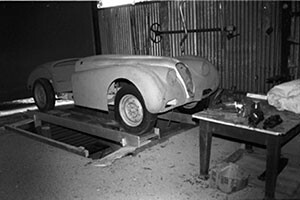
THERE IS an old and tired XK120 Jaguar that sits, half restored, in an open dirt-floored garage on the western side of Brisbane.
It has been half restored for several years, since its keepers have been busy with other things, and the car waits, watching the sun rise each morning and listening to the bird chorus in the trees. It’s at peace, and perhaps that is how it should be, for the car has had a long and curious life. There is that great day in 1951 to remember – a day that made the world sit up and open its eyes, for two men had taken this car and driven it at an astonishing speed for almost 1600 km across Australia.
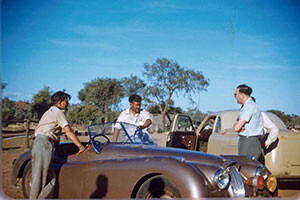
The story of how that day came about, and the things that happened afterwards, is even more astonishing. In 1951, Leslie Taylor was a 35-year-old, successful motorcycle dealer in Brisbane. He was also a moderately successful racing driver, competing in a homebuilt special powered by twin Ariel motorcycle engines, a monoposto bodied MG TC, a Cooper 1100 and several motorcycles. Les also wanted to break a few records, and knew that a good road “a thousand miles long” had been built by American Army engineers during World War II, running through the centre of Australia from Alice Springs to Darwin.
Jack Murray, a Sydney-based racing driver, had set a record between the two centres the previous year, driving his 1926 Grand Prix Bugatti fitted with a worked-over sidevalve Ford VS engine. “Gelignite” Jack and a co-driver had established a time of 16 hours, and there was also the world’s highest open road average to beat. This had been set in 1949 in the Mille Miglia sports car race, when Biondetti and Salani had driven a V12 166MM Ferrari 1590 km at an average of 131.26 km/h to win the event.
And there was a chance an annual race modelled on the Mille Miglia could be held between Alice Springs and Darwin, if somebody could prove it was possible.
On July 6, 1951, Les Taylor bought a new metallic-bronze XK120 Jaguar roadster from the Queensland distributors, Westco Motors. It was a four-speed, drum-braked, steel-bodied car. The DOHC cast iron six developed 119 kW at 5000 rpm from 3.5 litres and would push the heavy sports car close to 210 km/h, though it was difficult to stop and steered like a truck. The Taylor XK was registered Q540-023, and Les ran it in by knocking up 1900 km. He also told his chief salesman, ex-Spitfire pilot Dick Rendle, that he was going with him for a drive.
“One day,” said Dick, now retired, when I finally met him after many months of searching, “He walked in and said, ‘How about coming along with me? We’re doing a trip in a bit of a hurry from Alice to Darwin. You’re not going to get the sack if you don’t come, but …’ A week later he bought the car, and we went.”
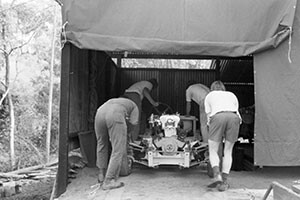
It was a busy 12 days. Apart from running-in the new car, a special 135-litre aluminium fuel tank had to be made and fitted in the boot, with an electric pump to transfer fuel to the main tank below. A nine-litre fire extinguisher was added to pump cold water into the radiator in case the engine showed signs of overheating; a small metal scoop was fitted at the top of the grille to deflect stones and insects and an electric siren was added to the front bumper bar. Finally, a loose tappet was adjusted.
The Jaguar was railed from Brisbane to Mount Isa, the terminal for the northwest railway, then driven along the Barkly Highway to join the north/south road at Tennant Creek, and Taylor and Rendle turned north to Darwin.
A telegram from Les sent on July 28 from Adelaide River to Frank Reid, his old friend and Castrol representative in Brisbane, implies that road conditions were not good: Slight mishap delayed here hazard greater than expected stop road not as expected conditions hot proceeding as planned without Dick … Les.
That 1600 km of “good road” the two men had been expecting to see was a narrow, sand-blown, second-class country road. It snaked between hills and gullies, dipped down to cross countless creeks and climbed mountains. The desert sands built up at the edges and spilled across the surface, and from Tennant Creek down to almost a third of the highway, the bitumen didn’t exist.
The engineers had started from Tennant Creek and worked northward, reasoning that the military didn’t need to go further south. Some of the “hazards” came in the form of unfenced cattle, mobs of kangaroos, wild pigs, wild horses, wild camels, and birds. Then, to make life even more difficult, there was an official speed limit of 65 km/h from Darwin to Tennant Creek, as the road was still technically controlled by the Australian Army.
Taylor and Rendle had travelled 3300 km to try for the record, and though the state of the road was a bitter disappointment, they were still determined to give it a go. The next day, there was another telegram to Frank Reid, this time from Darwin: Arrived Darwin stop completing arrangements confirmation here not yet available run most likely now north to south Dick due by flying doctor service may be tomorrow will advise all details may be Monday regards … Les.
At this point there’s a small mystery. Dick doesn’t remember any problems occurring at Adelaide River, or that he was flown from there to Darwin. He claims that he travelled with Les all the way, and doesn’t know why the telegrams were worded in that manner. His recollections of the rest of that trip are particularly clear, and research has failed to provide an answer.
The original plan for the record run had been roughed out in Brisbane by Les, Dick and Frank Reid. The objectives were to drive to Darwin, arrange for police permission to make the attempt, contact Department of Civil Aviation staff and confirm that departmental facilities could be used to establish starting and finishing times. Travel slowly down to Alice, checking road conditions and establishing fuel stops, rest overnight and begin the all-out effort from there.
“We worked out a 160 km/h average for the trip,” said Dick. “Frank reckoned we would have to keep at a steady 195 to 210.”
The confirmation that Les had hoped to get was a permit from the police. It was never granted. “The cops said, ‘We couldn’t sanction this, otherwise every silly bastard would be trying it’,” said Dick.
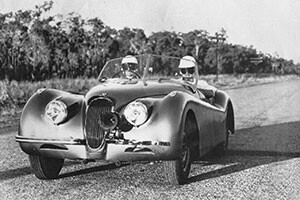
Dick Rendle’s Air Force experience was the key to DCA staff co-operation, which assured that the attempt would be accurately, though unofficially, timed. To generate more enthusiasm, Les booted the big Jaguar into a high speed run along the main runway at Darwin Airport, which was shared by the DCA and the Air Force.
“Someone said, ‘No planes flying – you’re OK,’ and off he went,” recalled Dick. “Les has never made a statement on this, or about the people who did the timing, as there was no way in the world he was going to get anyone into trouble.”
A decision was made to scrap the practice run and start from Darwin, early one morning. There was the problem of the hot northern afternoons: the Jaguar was prone to overheating and they were running out of time.
Dick remembers the eve of the event: “They said, ‘You’re bloody fools. Start early in the morning to beat the heat.’ We met the unofficial mayor of Darwin — a complete and utter buccaneer, for he had everything packed into caves. Barbed wire, crawler tractors, boxes and boxes of stuff. Born at the wrong time, he was. We spent the night with him – had a few beers and a bit of a talk — went to bed and then started.”
Almost 1600 km of rough, winding and dangerous road, with the last 530 km completely unknown to both driver and navigator. They warned the Main Roads engineers and telephoned to set up fuel stops. The tyres were pumped to 240 kPa (35 lb/in2) and the single spare checked, both tanks filled – “The petrol out there was half Standard and half kero” – and the XK120 was ready. The only concession the crew made to safety was to wear crash helmets and goggles. But, as Dick remembers, “We took the he helmets off after the first hour. Too bloody hot.”
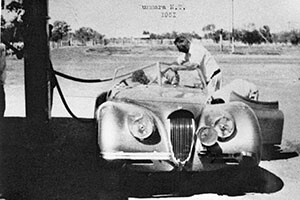
In the strange pink and grey light that comes before the red dawn of the north, indistinct figures began to gather in small groups at the entrance to the RAAF base in Darwin: journalists, photographers, RAAF personnel and men from the Meteorological Section of the DCA, who were there to establish the precise starting and finishing times, using International Air Radio Time. Les Taylor and Dick Rendle made a brief joint statement – “We hope to complete the trip in less than eleven hours” – and at exactly 6.30, on the morning of July 6, 1951, a signal was given and the bronze XR120 accelerated into history.
In the first 320 km, the road wound through and over a succession of rolling hills, and 12 minutes from the start Taylor and Rendle hit the first of a dozen kangaroos they were to meet that day.
“They just popped like a wet bag,” said Dick, and they stopped to check for damage. At 7.15 am the Jaguar roared through the “72 mile”; Adelaide River, 116 km from Darwin, and they were averaging 155 km/h. Pine Creek was 250 km from the start and they went through at 8.20, though the sustained speed from Adelaide River had dropped to 125 km/h.
They were going well and picking up the pace when disaster struck. Not far from Pine Creek, Les slowed the car to 145 km/h through a blind corner and saw a mob of wild horses standing on the road. There was only one way to stop and Les twitched the car into a tyre melting spin. That shrieking one-and-a-half spin finished with the nose of the Jaguar buried in a bank, while the mob of white-eyed and snorting brumbies fought to escape the terrible object.
When the dust cleared, eight horses were down on the road and the left front wheel of the car looked as if it had been kicked by an elephant. The tough little horses got up and walked away as Les and Dick began to change the wheel, then found that the crash had also bent the steering rod and the lower control arm of the suspension. Using a hammer and tyre levers, they managed to straighten the damaged parts back to somewhere near normal, fitted the spare wheel and started again.
The front end of the XK was now shuddering badly under brakes, and they had a useless spare wheel. Though that forced stop had lost them 20 minutes, they still averaged 97.8 km/h over the 103 km stretch to Katherine, which included 16 km of corrugated dirt.
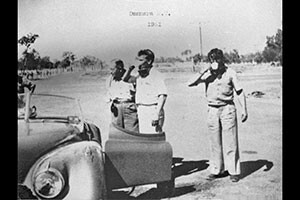
Refuelling in the Territory in 1951 was a slow and painful process; the petrol pumps outside the stores had to be manually primed by pulling and pushing a metre-long handle until the fuel filled a graduated glass bowl on top of the pump. The hose was then inserted into the tank, a valve opened and petrol fed by gravity from the bowl to the tank. Ninety litres — and 12 minutes – later, the Jaguar coughed into life and roared off to Mataranka Station.
Les and Dick left Darwin on run 6.30 this morning spun into bank wrecked one road wheel otherwise all OK left Katherine 9.30 stop will advise progress … Jim Cain.
Jim Cain was the Northern Territory area manager for Castrol, then known as C.C. Wakefield and Co, and had been delegated to advise Frank Reid on the progress of the record attempt. Dick Rendle was also nominated as chief photographer, and took both still shots and three rolls of movie film. “I suppose I shouldn’t mention this, but a lot of the time I was sitting on the back of the seat taking film, and we were doing anywhere between 160 and 195.”
The road was still twisting through hilly country and they were dodging stray cattle and flocks of galahs, though the greatest hazard came from the scores of “inverts” or storm drains. Often used in the construction of outback roads and cheaper than pipe-drained culverts, the inverts were 10-metre long concrete-lined hollows in the road surface, designed to allow floodwaters to cross the road without obstruction.
“The worst aspect of the whole trip was the storm drains,” said Dick. “At 130 km/h the car jumps, but at 195 the front takes off and the back comes down, and when you land the back tyres burn the paint off the mudguards”.
It was almost impossible to see the inverts until it was too late, and Les and Dick just took them as they came. They covered the 98 km from Katherine to Mataranka in 42 minutes, averaging 140.2 km/h and pushed the average to an incredible 163.7 on the road to Dunmarra, covering 224 km in 82 minutes.
Boys arrived Dunmarra 11.22 left 11.29 actual travelling time better than 160 kilometres per hour all going well … Jim Cain.
Dunmarra was the second fuel stop and far more organized. Les switched on the siren as they approached the town and the residents were ready. They shuttled the car between six hand pumps to fill the tank, gave them food and bottles of soft drink, and cleared a mass of galah feathers from the blocked radiator.
Boys passed Elliot 12.15 now just over half way … Jim.
The average had dropped back to 118 km/h. The road was difficult and they were being affected by heat and mirages – according to Dick, “You could see bloody elephants and a woman pushing a baby in a pram in front of us. Les nearly turned the car inside out for that one.”
Another problem occurred with the driver’s waste disposal system. “Les had rigged up a funnel and a tube that went out under the driver’s door,” Dick laughed, remembering the incident. “When he used it, the tube turned in the wind and he got a faceful.”
The road improved from Elliot to Tennant Creek, and they screwed the big Jaguar tight to consume 246 km in 92 minutes, averaging 160.7 km/h. The fuel stop at Tennant Creek was another quick one with the pump shuttle system used again, and the excitement was rising.
Les and Dick arrived Tennant Creek 1.47 and left at 1.52 everything excellent stop will advise when arrive Alice … Jim
For Frank Reid, sitting at his desk in Brisbane and relying on irregular telegrams, it must have been a nail-biting experience. He would have known that the most difficult section was just beginning, for the bitumen ended at Tennant Creek and the team still had the McDonnell ranges to cross, a ragged line of high peaks and tortured rock that stands to the north of Alice Springs.
There was almost another disaster not far from Wycliffe Well when the Jaguar, peaking at 210 km/h, hit an abrupt rise in the featureless road. The car was instantly airborne, flying for a heart-stopping 50 metres before hitting the ground. There was another leap like that before Barrow Creek, and again the superb driving skills of Les Taylor kept the car in a straight line.
The hazards kept coming, and they had to find a way through two herds of 600 bawling cattle that were being driven along the road by Aboriginal stockmen. Again at full speed, they raced on to Alice.
Boys passed through Barrow Creek averaging well over 160 at 3.16 … Jim.
The average wasn’t quite that good. The 225 km stretch from Tennant Creek had taken 89 minutes for a 151.9 speed. Alice was 284 km away and anything could happen.
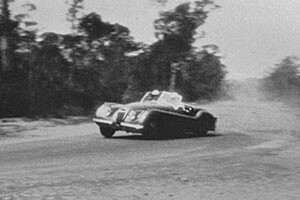
Though the Main Roads Department had been advised of the attempt, some of their work was still going on. Taylor and Rendle, hot, tired and dirty, rushed over a rise to find that the road had turned into a slippery black skid pan. A road construction gang was using a full-width bitumen boom to resurface the dirt road, and the tar was still hot and liquid. The big 16-inch wheels picked up the sticky black soup and flung it into the open cockpit, plastering driver and navigator. They got off the road and drove alongside until the new tar ended and they could scramble back and turn up the wick for the last final effort.
Les and Dick arrived Alice 5.02 pm taking 10 hours 32 minutes for trip stop both being questioned by police at present will advise after Les rings tonight … Jim.
The smoking Jaguar was stopped at the town boundary by a crowd of cheering spectators, photographers, reporters and several carloads of police. Les and Dick had taken everything the road and the country could throw at them, and set a record average of 145.89 km/h for 1536.7 km. That open road record was to stand until 1955, when Stirling Moss and Denis Jenkinson teamed to drive the fabulous sports/racing 300 SLR Mercedes-Benz to victory in the Mille Miglia and a new record of 157.5 km/h. And as far as the local police were concerned, laws had been broken.
“The police let Les drive the car to the boundary of Alice Springs to set the time, and then they took him off to jail,” said Dick. The car was impounded, Dick was questioned and allowed to go free, and two hours later he arranged bail for Les, this being set at 20 pounds. They booked into a hotel and Dick was in the shower trying to scrub the tar from his hair when the telephone rang. It was someone from Jaguar in England, wanting to know about the new record.
“I couldn’t tell them much. I was standing at the phone with a towel round me, and there was this black water running down from my hair. All I wanted to do was get back in the shower.” Then there was the man who approached Dick later in the evening. “This bloke came up to me in the bar and said he had been driving a Shell van along the road that day. He had been mapping the track for places where tourists could stop. He said he knew that there was a fast car on the road, though he didn’t reckon on meeting a low-flying aircraft!”
The court was convened the next morning, with Justices of the Peace B. C. Benett and H. van. Senden presiding. Les Taylor was charged with dangerous driving, speeding, driving without Northern Territory licence and driving a car not registered in the Northern Territory.
He conducted his own defence, pleading guilty to speeding and denied that he had driven dangerously. The police prosecutor, Senior Sergeant Fitzgerald, claimed that, “Unless the police stop this kind of driving, there will be an epidemic of it! I can see no purpose being served by crackpots driving along the Stuart Highway at tremendous speed, and I will do all in my power to stop it. Not only do they endanger their own lives, which might not matter, but they are a menace to others!”
Taylor countered by saying, “I drove fast, but safely,” and added that he did not know of any road user who was inconvenienced and that he had heard no complaints. He did not charge uphills and around blind corners, and safety was considered at all times. The judgement was a fine of five pounds plus 10 shillings costs on each of the first three charges, and three pounds plus 10 shillings costs on the last charge. That amounted to 20 pounds, the exact amount of bail.
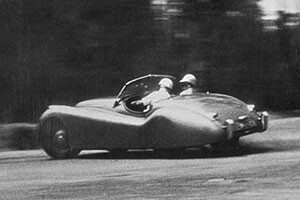
“Les got fined,” said Dick, “then we all went to the bar. The magistrates wanted to ask Les all the questions they couldn’t ask in court!” Dick maintains that half the people who helped to refuel the XK120 at each fuel stop were policemen in civilian clothes. A clipping from the Northern Standard (August 3, 1951) asked a pointed question: “Police Superindentendent Little-John would not comment this morning on Taylor’s trip or his race. Asked how Taylor was allowed to go so far before he was arrested, the Superintendent said he did not know.”
Taylor and Rendle could have been stopped at any point along that road. They had approached the police for official permission, and deliberately informed as many people as possible. There were newspaper reports before the event and radio stations broadcast regular progress bulletins. This tacit approval by the authorities and the well-timed publicity ensured that the road was almost totally free of traffic.
“We passed only four cars going either way,” remembers Dick. “Once people knew we were coming they just got out of the way, though there were people watching all along the road. It wasn’t as if the place was full of people. Virtually the only towns along the route were where we stopped for petrol. Even at Tennant Creek there were only three garages and five houses.”
And the magnificent XK120, splattered with mud and tar, looked as if it was ready to go again. The engine had used 600 ml of oil, no water and the car had averaged 3.9 km/L (11 mpg). And though the crash at Pine Creek had given the front end an extra 20 mm of toe-in, the tyres showed normal wear patterns. Taylor and Rendle left Alice the day after the record run and drove 1290 km without a break to Mount Isa. Les was in a hurry to catch a DC3 to Brisbane, as he was scheduled to drive his Cooper 1100 at a hill climb event that weekend. They averaged 106 km/h to Isa — though Les missed out on a seat and had to catch the next flight — and Dick drove the car back to Brisbane.
“Tell you what,” said Dick, “It took me nearly a month to get back to Brisbane. Everybody wanted to know about the trip. And I had to keep stopping, you see, as a lot of the road ran through private property.” The car finally arrived in Brisbane and was put on display at the Jaguar stand for the last few days of the Brisbane show. The record run had created a lot of publicity and not much else.
As far as Dick knows, there was never any sponsorship, though he thought that Jaguar flew Les to England, where he used the Vincent engine from his Cooper to power a borrowed Cooper and set a lap record at Silverstone. “As for me, just got paid for a week of doing nothing, instead of selling motorcycles.”
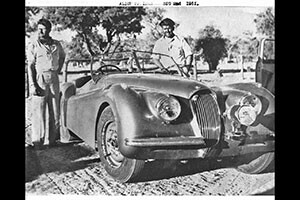
Les Taylor went on to race a variety of motorcars and established 14 national records at Leyburn, a disused Queensland airstrip that had been converted to a racetrack. He had planned to drive a new Fiat 1400 sedan for 24 hours, but a broken differential cut the available time in half. The Jaguar was sold to Rex Taylor (no relation); Dick left Les to set up his own business – “We were never mates” – and Taylor had marital problems.
“He left his wife,” said Dick, “Then he opened a car yard in Mount Isa. He got into some trouble with the big boys in Mount Isa and Darwin and disappeared in Darwin. At one stage, Frank Reid thought he might be in jail in New South Wales, but we never found out.”
From the records, and in the opinion of Dick Rendle, Les Taylor was an extraordinary driver: “Les was a studious type of bloke. He wasn’t an athlete, more like a Dick Smith. Les was magic behind the wheel. A lot of other people have said that, too.
“Les’s real forte was being able to line up a corner without a marker. I never saw him spin off. He raced the Jaguar at Leyburn and pushed Doug Whiteford’s Lago Talbot all the way. Whiteford jumped out of his car at the finish and raced over to shake Les by the hand. He said that he had never had a harder race.”
Like a broken racehorse, the XK120 was sold into obscurity. T. Rauchle, a resident of Leyburn, bought the car in 1953. It was never raced again, and was finally used as a hack to deliver mail over the rough dirt roads of Central Queensland. In 1968, Brisbane-based architect and motoring enthusiast Kees Heybroek went to Toowoomba in an effort to find parts for his Mark IV Jaguar. One and a half XK120 Jaguars were almost buried in long long grass behind a house, and Kees bought them on the spot. The complete car had 620,000 km registered on the speedometer, and the body had been painted by hand in red enamel.
“I had no idea,” said Kees, “That it was the Darwin-to-Alice car. I traced the registration back and discovered the history of the car when I went to the library to research 1951 articles on XK 120s. After that I found Frank Reid and he helped to prove it was the car from a photo he had of the car spinning, which showed the registration number.”
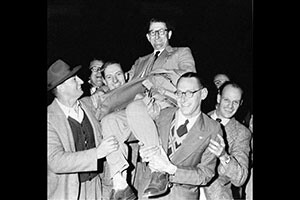
After 620,000 km, the Jaguar was tired. The engine was still fitted with the original pistons and polished crankshaft, though the suspension and drive train were badly worn. Kees and his wife Chris have been restoring the old warrior since 1971, and hope to have the rebuild finished in a couple of years. The car will be used for occasional tours, and Kees talked about trips into western Queensland and beyond. “I might even take it to Darwin and do the run again,” he says.
Dick Rendle had this to say: “It should be possible — if the road was closed, and with the support of proper pit stops — to average a hundred and seventy-five.”
I wonder?
