
PLUS
- The Lexus IS200t is packed with equipment, including real leather (many competitors use the fake stuff), heated, cooled and power-operated seats, rain-sensing wipers and satellite-navigation.
- The safety story is strong, too, and now includes auto emergency braking, which can automatically apply the brakes to avoid a rear-ender.
- The optional Mark Levinson sound system is a ripper with fantastic clarity and punch.
- The instrument cluster of the F Sport makes a big deal of the tachometer and is customisable depending on which mode you have it in.
- There’s a great choice of materials and colours and the attention to detail in the cabin is great, from the stitching on the leather to the interesting finishes applied to some of the plastics.
- Eight-speed auto hunts between gear ratios in everyday city driving.
- Foot-operated park brake is out of place with the modern touches elsewhere.
- Space in the back isn’t great, especially when it comes to leg room and fitting three in is a feat; that person stuck in the middle will have to deal with a large hump on the floor as well as minimal seat space.
- Lexus Remote Touch controller that controls the 7.0-inch colour screen takes practice; it can be easy to shoot past the virtual button you’re trying to land on.
An exquisite interior and smooth diesel engine distinguish the first car from premium Citroen sub-brand DS. How well does the chassis perform in an Australian environment?
WHAT IS IT? This is the first DS stand-alone car, as Citroen moves to separate its design-centric models into a premium sub-brand and leave the Citroen ‘C’ models for is more mainstream vehicles. This car, though, is an update of the Citroen DS 5.
WHY WE’RE DRIVING IT This is the first time we’ve driven the DS 5 on Australian roads, following our sample in France back in July 2015. DS has also confirmed feature and spec levels, as well as the $56,990 price for the ‘new’ DS.
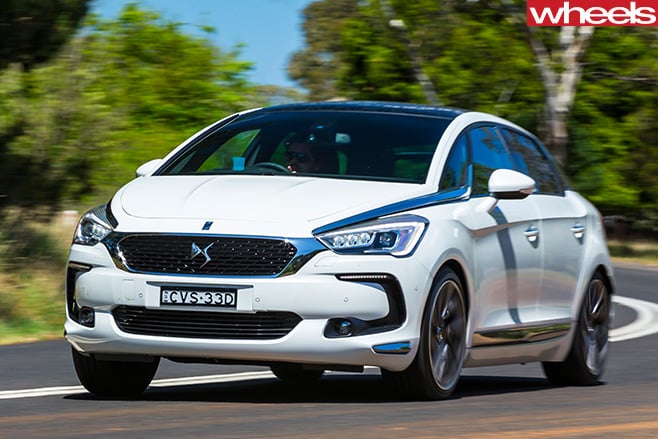
PLUS: Design nous, uniqueness, cabin quality MINUS: Average handling, poor ride, and higher price
THE WHEELS REVIEW WHAT was a Citroen DS 5 becomes, with this facelift and spec upgrade, the first DS model in Australia. So it’s a DS 5, period. In the change from Citroen to DS – the new premium sub-brand of Citroen – the 5 has been given an new front-end treatment that includes intricate LED headlamps as well as the ‘wings’ that link the chrome trapezoidal grille and march up the slanted bonnet of this rival for the BMW 3 Series. Or whatever it is, as DS Australia doesn’t seem to know how to describe the body-style of this five-seat model, calling it simply ‘unique’.
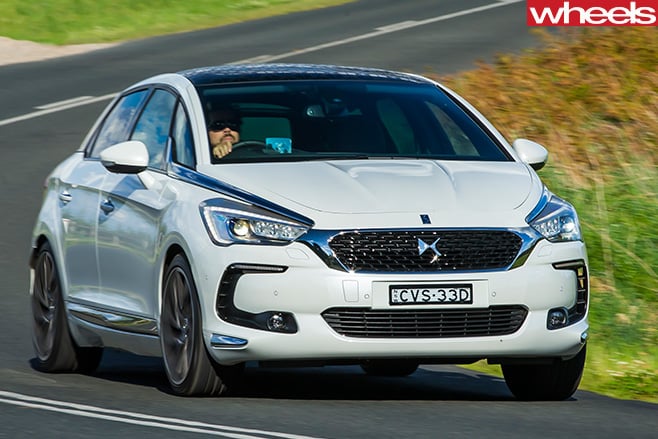
Under that long bonnet is an upgraded version of the excellent 2.0-litre turbo-diesel common-rail that we’ve seen here in the Peugeot 308 and 508 GT models, along with the smooth EAT6 six-speed automatic. It’s the only driveline sold here in the 5, as the 1.6-litre petrol made up a paltry 10 percent of sales and has been dumped. There are no paddleshifters, but you can change gears via the shifter, although the forward push of the delightful polished gear lever to change up a gear is the wrong way around (ask Porsche). There’s no need; instead, relax as the smooth, refined diesel marches from 0-100km/h in an adequate (surprisingly 0.9sec faster) 9.2sec, thanks to a 13kW and 60Nm increase in its vital stats, now 113kW/400Nm.
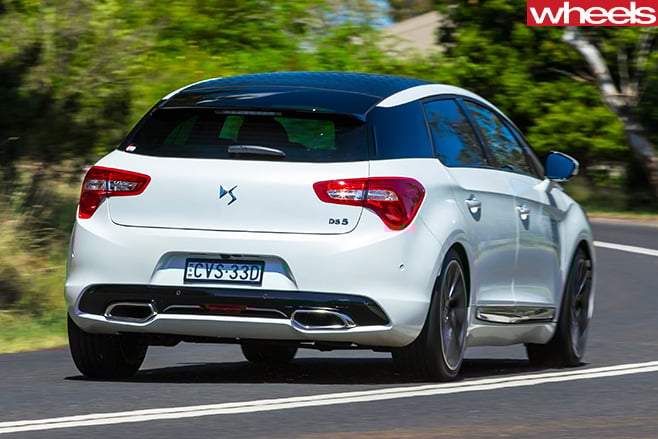
Get the 5 out of town, though, and every last contour, split, crack and minute undulation is sent back through that four-spoke steering wheel, its sharp angles reeking of wild Citroen cabins of the 1980s. Yet while we’re talking history, you wouldn’t know that the brilliant air-suspended DS is now 60 years old, as the ride in the brand-new 5 has been retuned and is harsh and rough. It’s made worse via the steering, which feels disconnected from the rest of the chassis.
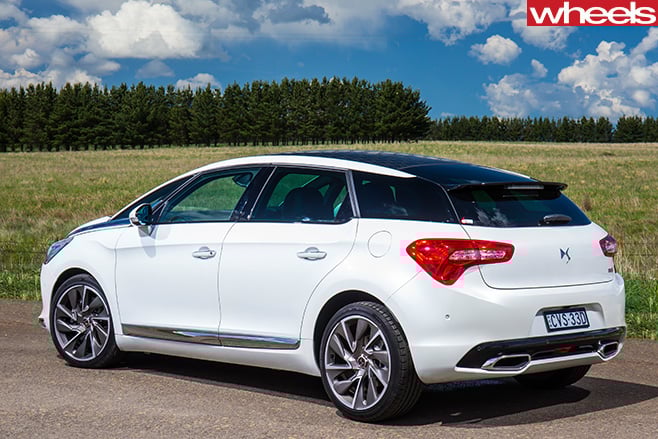
Other than being a well-decorated jumping castle, the interior is exquisite. Every last inch is dripping with design ideas, with stunning material finish, and there’s a standard panoramic glass roof that immediately gives the impression of space. So do the front-quarter windows that flank that raked windscreen, with a deep dash housing the new 7.0-inch touchscreen adding to the impression of size from the front seats.
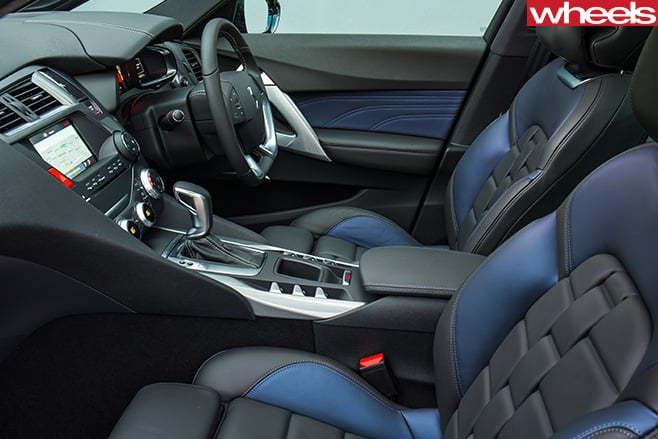
The hardest part of selling the DS 5 is that it’s now $3000 more expensive, at $56,990 including a six-year warranty. That places it in the crosshairs of cars as diverse as the Audi A4 2.0 TDI – which it has far more room than – and Volkswagen CC if you’re chasing more restrained style. So while it can’t pin down what segment it sits in, nor the ride and handling, the DS 5 does have ‘unique’ down to a tee. The 2016 DS 5 chases a historical landmark In the original 1955 DS, but it isn’t a landmark in its own right.
SPECS Model: 2016 DS 5 Blue HDi Engine: 1997cc 4cyl, dohc, 16v turbo-diesel Power: 133kW@3750rpm Torque: 400Nm@2000rpm Transmission: 6-speed automatic Weight: 1540kg 0-100km/h: 9.2sec Fuel economy: 4.5L/100km Price: $56,990 On sale: Now
For centuries the small Swedish town of Ängelholm was famed for its clay cuckoos – a small musical instrument that, when you blew air up a hole near the clay cuckoo’s arse, made a sound like a flute.
Today the clay cuckoo is going the way of the dodo. In Ängelholm, perched quietly on Sweden’s windy southern nipple, most of the old clay cuckoo workshops have closed. There’s only one left.
But Ängelholm thrives like a lot of Sweden because the Swedes like to build stuff. Anyone who’s ever bought furniture from IKEA and found themselves still screwing it together at 1am can attest to that.
So can a bald Swedish man called Christian von Koenigsegg. He lives in Ängelholm and likes to build supercars.
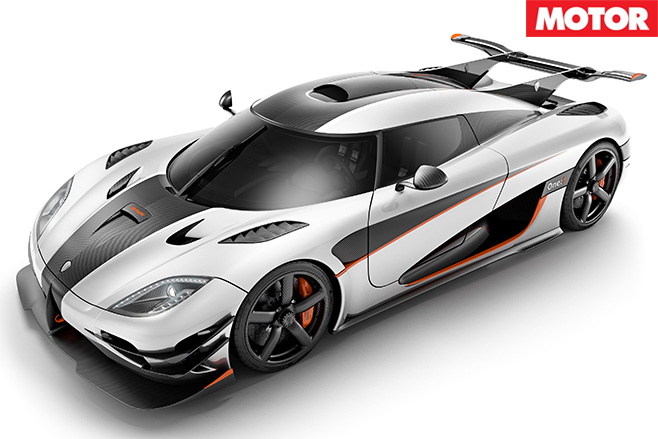
A few years ago, von Koenigsegg heard rumours McLaren, Ferrari and Porsche were developing hypercars so, not wanting to be left out, he ordered his team to build something to tackle them: the One:1.
It’s properly, lock-yourself-in-a-padded-room berserk. It weighs 1360kg and has 1360 horsepower – hence the name, referring to the illusive one-hp-per-kg figure.
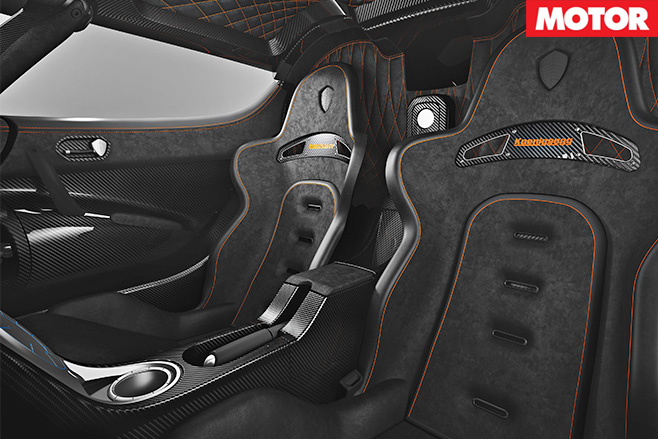
Torque? 1000Nm from just 3000rpm. Nose not bleeding? There’s 1371Nm on overboost. Twin-turbos cram 26psi, or 1.8 bar, into its 5.0-litre, dry-sumped, twin-cam V8. Around 2700rpm they reach full boost.
This relatively low peak-boost point is no accident, either. Von Koenigsegg hates lazy turbos so much that the One:1 uses new variable-geometry vanes that must be 3D printed they’re that elaborate.
The turbo blades aren’t the only 3D printed things – the titanium exhaust tip is created the same way. It takes three days to print and is the largest thing ever 3D printed in titanium. All to save a few grams.
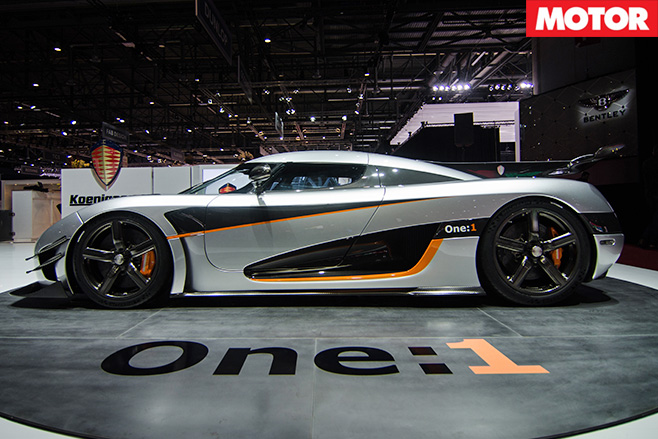
The war on grams continues to the wheels, which would cause you to weep if you ever kerbed them: they’re entirely carbonfibre. And look utterly pornographic.
They’re wide as a steamroller, too – 345 rear rubber wrapped around a 12.5-inch rim (20-inch diameter). They have to be that wide, given the One:1 must wriggle its 1014kW through only the rear hoops. No Veyron-esque all-wheel drive here – just a seven-speed dual-clutch ’box, an electronic diff and two ginormous rear tyres.
Koenigsegg might tell you all-wheel drive is for sissies but Isaac Newton would suggest otherwise. It might have 150kW and 171Nm over the Agera R but the rear-drive One:1 is no faster to 100km/h – still 2.8 seconds.
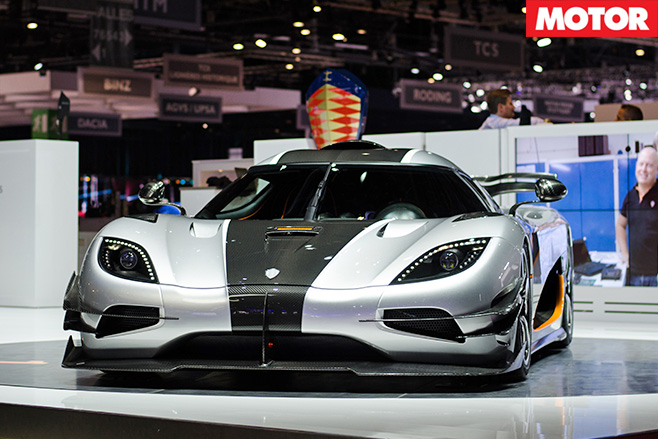
A first for Koenigsegg, the One:1 has active aero. There are venturi flaps under the car’s front and rear which change angle depending on the car’s speed. There are little aero doors on the front of the car that open and close, directing air through the body and out through the bonnet. Above decks, an active rear wing changes angle and also serves as an air brake during big stops.
And don’t think Koenigsegg is a bunch of Neanderthals transfixed on top speed and power. Its engineers will travel to Europe’s most popular racetracks with a One:1 prototype and tune the car for every corner. The information is logged into the car’s GPS so that if a customer ever visits said track, the car will know where it is and assume the optimised programming.
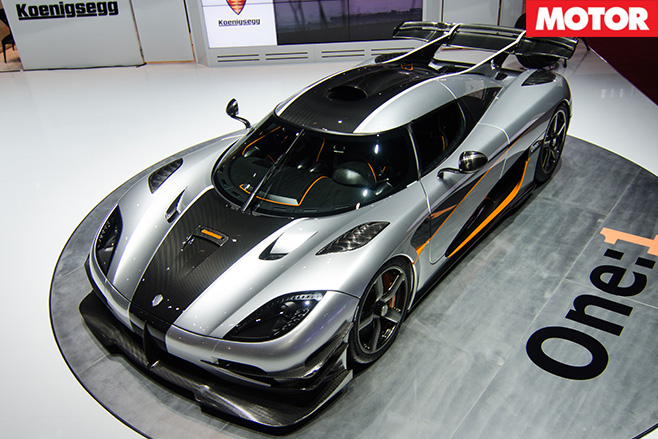
The P1 and LaFerrari are in their own race at 300km/h while the 918 is last by some margin. At 350km/h, the P1, LaFerrari and 918 hit their speed limiters while the One:1 and Venom GT crawl neck-and-neck towards 400km/h, Veyron in tow.
Eventually, the One:1 only just wins with its record-resetting top speed of 440km/h – in theory, at least.
Around the Nordschleife? That’s another story and something to keep Koenigsegg busy in sleepy little Ängelholm. They’ve certainly got a car cuckoo enough.
Gone are the days of hairy-chested burnouts and adrenalin pumping power-slides with only your right foot controlling the distance between you and the fence.
Now there is an increasingly common and ever present electronic nanny looking over your shoulder to oversee your playtime. Bad thing for the budding Beau Yates? Not necessarily.
Most industry pundits will have you believe the ever present nature of traction control and stability interference in modern cars is a bad thing.
For sure, in genuine race situations it can be a problem when the grip levels of the car exceed a certain pre-programmed range of the vehicles performance ‘envelope’ (which is derived from the vehicle’s behaviour on stock rubber), but for the majority of us who enjoy the odd social track day and some general driving fun, the modern traction-control system is your friend rather than your enemy.
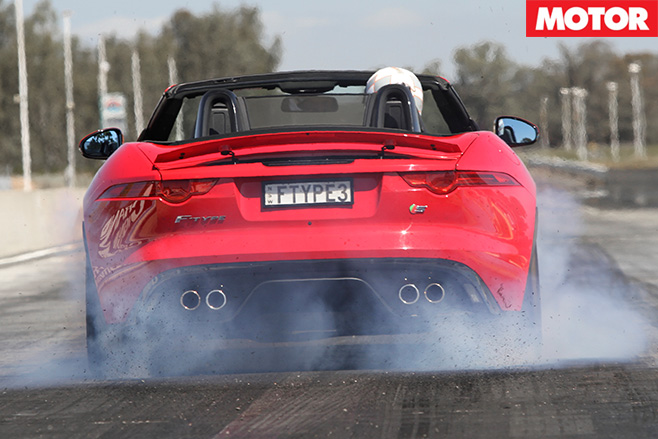
In the old days, traction control systems used an aptly named ‘Throttle Kicker’ to open and shut a cable throttle in a vain attempt to control grip, but today there is a blending of electronic throttle positioning, ignition cut, fuel cut, and even camshaft angle control to modulate engine torque and generate maximum grip.
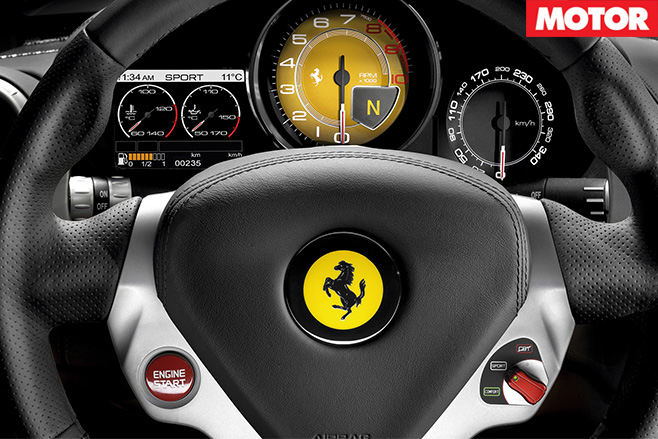
We received a first hand look at exactly how good modern traction-control systems are at a recent track day with a tuned Merc A45. Decent lap times were achieved running ‘Traction Off’ on some sticky tyres, but observers kept asking why the brake lights kept flashing around some long, hard corners. This wasn’t the driver, but the in-built AMG traction control system controlling torque and braking the vehicle so subtly the fairly experienced driver didn’t even notice.
Grip Control
The ECU does all the trick processing of torque signals from traction subsystems and determines how to modulate engine torque (via throttle closing, fuel cut, spark cut and cam timing) for targeted grip levels.
Cutting fuel injector pulse and/or energy to the spark plugs is used as a torque limiting function. When the throttle can’t be closed fast enough these ‘hard cuts’ are used as a backup system, and reward the driver with a misfiring staccato engine note.
Braking Traction
The ABS module has internal data processing but with hydraulic control, allowing braking to individual wheels at varying pressure. With ABS intervention in traction control it allows subtle brake application to control wheel slip.
New Diffs
Nothing new in electro/hydraulic differentials being used to control grip, but their actuation systems and method of operation have improved over the past decade. Expect even budget performance cars to feature E-diff slip control in the near future.
Down the Wire
‘Drive By Wire’ throttle is the main player in keeping wheelspin in check. Since there’s no greasy cable connecting your foot to the engine bay anymore, you plant your right foot flat and the electronic throttle will limit engine torque output to avoid wheelspin.
TOYOTA is planning a series of performance-enhancing changes to its 86 sports coupe in a sweeping revision of the car it launched in 2012.
But before you go running off to check the bank account, the chances of a forced-induction engine slipping under the bonnet are not looking good.
Tetsuya Tada, the chief engineer of Toyota’s sports car range, told Australian media this week that the “big minor change” update “coming soon” to the 86 would change how the performance model looked and performed.
First of all [for the 86] is progress,” Tada said. “I mean, big minor changes. Everything. Engine, body, suspension. Everything.”

“I think turbo is a very easy solution,” Tada said. “I always say we try to show something new, always something new, a challenging solution.”
So would the addition of turbo boost be the wrong project for Tada’s team of 200 engineers working on Toyota’s next-generation sports cars, including a replacement for the 86?
“I think so,” he said. “Downsizing turbo technology is the same as [a] diesel engine: high compression and low rpm maximum. So the biggest complaint about that type of engine is really about the engine sound.

Tada says his team of engineers had a wide range of drivetrain technologies to choose from, including the petrol-electric hybrid set-up used in the Prius, that could expand to its family of sports cars.
But don’t give up all boosted hope just yet. According to Tada, electric turbochargers that give an extra dose of power for a short time make a “really good solution”.
Click here to read the full range review of the Toyota 86.
WHERE DOES IT FEEL AT HOME?
Toyota has left no stone unturned in comprehensively improving this new HiLux, both on and off the road. And it’s worked. The HiLux feels at home just about anywhere.
WHAT IT’S MADE FOR
There’s a daunting 31 different varieties of the new HiLux. There are two-wheel-drive and four-wheel-drive models, dual cab, extra cab and single cab options, new gearboxes and new engines to choose from, including two all-new diesels and a petrol V6. Basically, there’s a model to suit your needs.
STAND OUT FEATURES
First impressions inside the HiLux are of a far more modern, stylish and car-like interior. This one we’re in now is the top-spec ‘SR5’ model, but even the entry-level ‘Workmate’ HiLuxs get a tablet-style touchscreen similar to this one. Toyota has also made more room in here by widening the cabin and lifting the roof.
ENGINES
The HiLux’s new diesel engines are a big improvement as far as refinement goes. They’re quieter and better to drive than the old ones. There’s more grunt too, though they’re not the most powerful units in the business. If you really want bragging rights you’d have to look at the Ford Ranger or Mazda BT-50. But the HiLux does measure up against its competitors with increased payload and towing capacities.
CHASSIS
The HiLux’s all-new chassis means it rides and handles better than before – but the biggest improvement? That has to be its off-road ability. It has more ground clearance, redesigned suspension for more wheel travel, and much more extensive underbody protection. The new traction control system is also worth mentioning. It’s so effective that you almost don’t even need the locking rear diff.
WHO WILL IT SUIT?
The Toyota HiLux has long been the most popular 4×4 vehicle in Australia, and with the launch of this all-new model it’s going to be even tougher to knock it off the top spot. The HiLux is known for its strength and reliability, and will work as a multi-purpose family car or as a tradesman’s best friend.
Click here to find out more about the Toyota HiLux.
PLUS
- A unique selling point for the Jeep Renegade in the compact SUV market is its off-road capabilities (for Trailhawk models only).
- American-designed, Italian-built heritage gives the compact Jeep plenty of personality.
- It’s full of little design quirks. Jeep’s designers have hidden a bunch of ‘Easter eggs’ within the design, see how many you can find.
- All models (except the Trailhawk) are available in ten colours. That’s more colours than a rainbow.
- It may look small from the outside, but once you get in, it has more space than you’d expect.
- Steering is much better than Jeeps of old.
- The back seats are a little flat. While this means they can fold flat to allow for more space in the cargo area, it does make them uncomfortable on long trips.
- The engine isn’t as punchy as you’d expect and could do with more grunt.
- Cargo isn’t overly spacious for long trips.
- A few annoying rattles.
Say you’re shopping for hats and come across two you like. Both protect and insulate your head. Problem is, one’s a Ralph Lauren, the other’s from Rivers. There’s probably little difference in quality, it’s just one makes you feel fuzzier on the inside than the other.
It’s here we find the Pro_cee’d GT’s (from here on called the ProCeed to save ourselves from grammatical insanity)biggest issue. Kia’s still struggling to break the prejudice its cheap and gloomy beginnings helped mould.
It’s not an image problem – that’s what Miley Cyrus has – more an awareness problem; Kia’s crop is much better than it used to be, and the ProCeed GT’s here to let the speed-craving crowd know.
Designed by a Frenchman, developed in Germany, and built in Zilina, Slovakia, Kia’s first performance car is a multilateral effort and we’re the first market outside of Europe to take delivery.
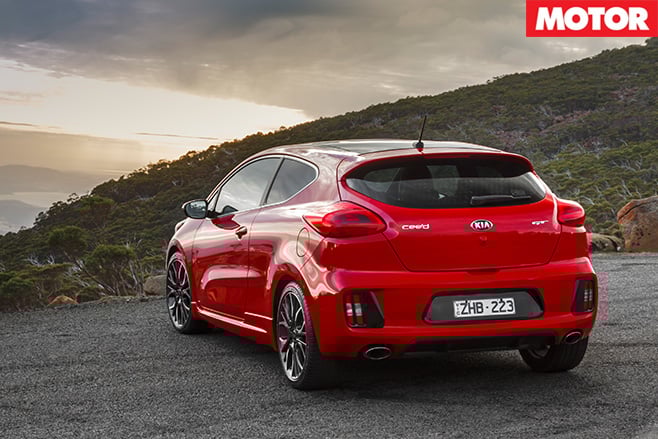
The front-driver borrows the first turbocharged petrol engine in the brand’s line-up, the 150kW/265Nm ‘Gamma’ four-cylinder from the Koup Turbo, with a shortened intake path, matched to a “simplified” main muffler. It’s available with a six-speed manual only. Front brakes are 300mm rotors clamped by performance pads, while its 18-inch wheels are wrapped in 225mm Michelins.
Get the car on a challenging road, such as the winding tarmac of southern Tasmania or ripple-strips of Baskerville Raceway, and it becomes clear why Kia equipped the ProCeed GT with a pair of well-bolstered leather-and-suede Recaros.
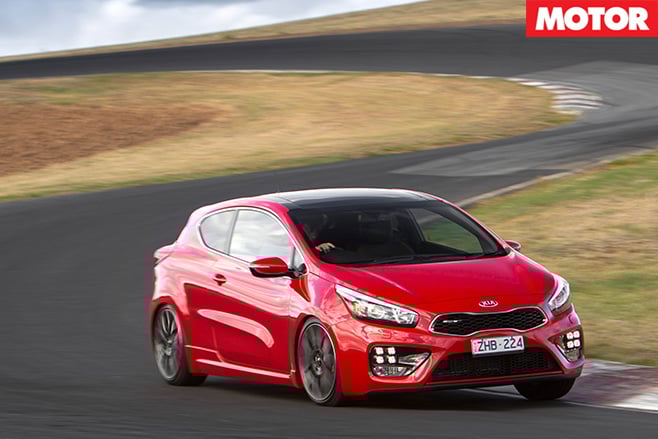
But progress comes at the expense of drama. From the inside the engine sounds boring, and has us pleading for some sound engineering.
First impressions suggest the steering lacks feel, but is superbly weighted. It’s also more accurate on-centre than other electric systems we’ve driven. Combined with good front-end point, the GT starts to stack up as a capable back-road beast.
The ride isn’t completely insulated from potholes but manages a compliance similar to similarly priced European sports hatches. Trailbraking into an apex at seven-tenths activates the lively rear-end, which doesn’t mind stepping into oversteer. It can get a little too dancy, though, occasionally feeling unstable in Baskerville’s bumpy braking zones.
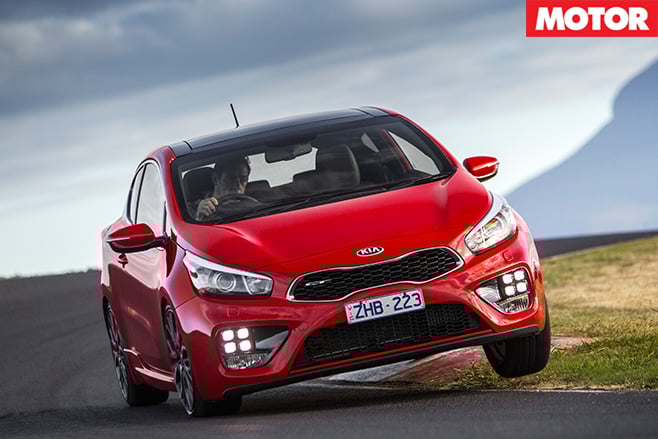
However, the amount of fun available for a smidge under $30K puts the ProCeed GT in the same bang-for-your-buck light as Ford’s Fiesta ST. Sure it may not be as focused, but it’s also hard to ignore the important stuff included in its package.
For instance, even the base GT scores Recaros, a leather steering wheel, cruise, dual-zone climate control, Bluetooth, 18s and a five-year warranty. It only foregoes superfluous luxuries found in the dearer GT-Tech like a panoramic sunroof, active HID headlights and push start.
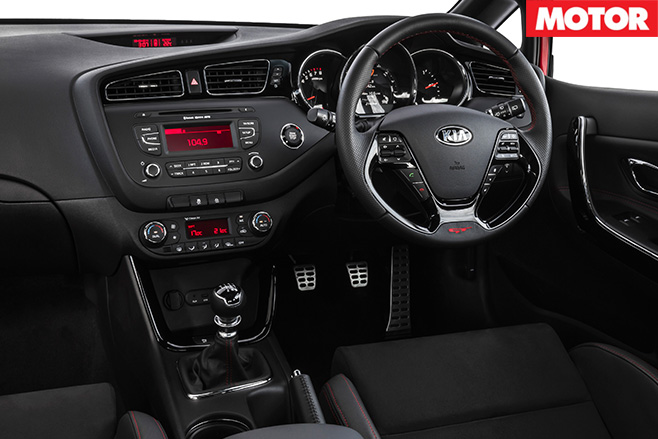
Okay, so there are a few markdowns, like the lack of any torque vectoring, the cable-type transmission slots without much conviction, it’s not going to set a drag strip on fire and any colour other than red’s going to cost you $595.
Otherwise it’s a cut-price Korean version of a three-door Volkswagen Golf GTI. Boil it down and there’s really only one thing keeping Kia from selling as many ProCeed GTs as it deserves, and some might argue that’s the small, shiny plaque on top of its grille.
3.5 out of 5
Specs Engine: 1591cc inline-4, DOHC, 16v, turbo Power: 150kW @ 6000rpm Torque: 265Nm @ 1750-4500rpm Weight: 1373kg 0-100km/h: 7.7sec (claimed) Price: From $29,990
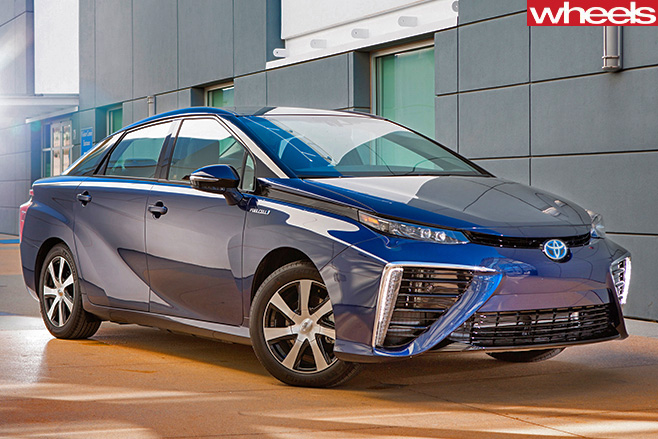
THE chief architect of Toyota’s first production fuel cell vehicle says he has a solution to Australia’s tainted brown coal reputation – turn the coal into fuel for hydrogen-powered cars.
Yoshikazu Tanaka, the chief engineer of Toyota’s Mirai hydrogen fuel-cell car, told Wheels that he believed converting brown coal to hydrogen fuel would help drive adoption of the technology here.
“Unfortunately we [Toyota] are not an energy company,” Tanaka said on the eve of the official opening of the Tokyo motor show this week. “Producing hydrogen, we believe, is not our business.
Highly polluting brown coal is a simmering topic in Australia, with highly charged political wrangling between the Greens and state and federal governments over the future of coal-based electricity generation in NSW and Victoria.
According to Tanaka, Kawasaki Heavy Industries Japan has already started work on building a full-scale plant in Victoria that will one day convert coal-based resources into hydrogen.
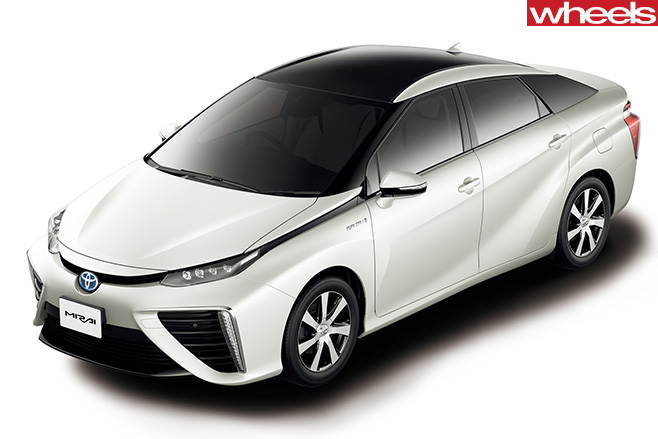
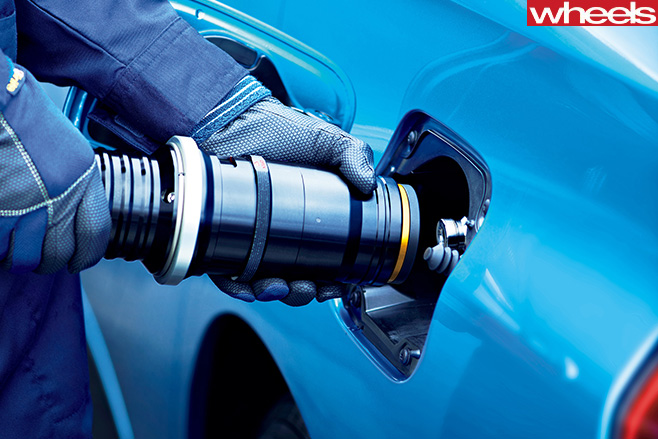
Toyota has since launched its Mirai fuel cell vehicle – the first production version of the technology in the world – but announced that it would not come to Australia because there is currently no way to refuel it.
Toyota’s chicken-and-egg approach to the technology is in contrast to rival Hyundai, which has flagged plans to introduce a fuel-cell powered vehicle potentially based on the Tucson SUV to the Australian market, and help kick-start the refuelling technology.
“All manufacturers are trying to get to a situation where they have emissions from the vehicle that are virtually zero,” he said.
“So it’s not a short-term political issue, it’s a longer-term infrastructure development and it requires not just government … there’s got to be private enterprise as well. We may have to get involved, other car manufacturers may have to get involved just to bring this kind of future to a reality.”
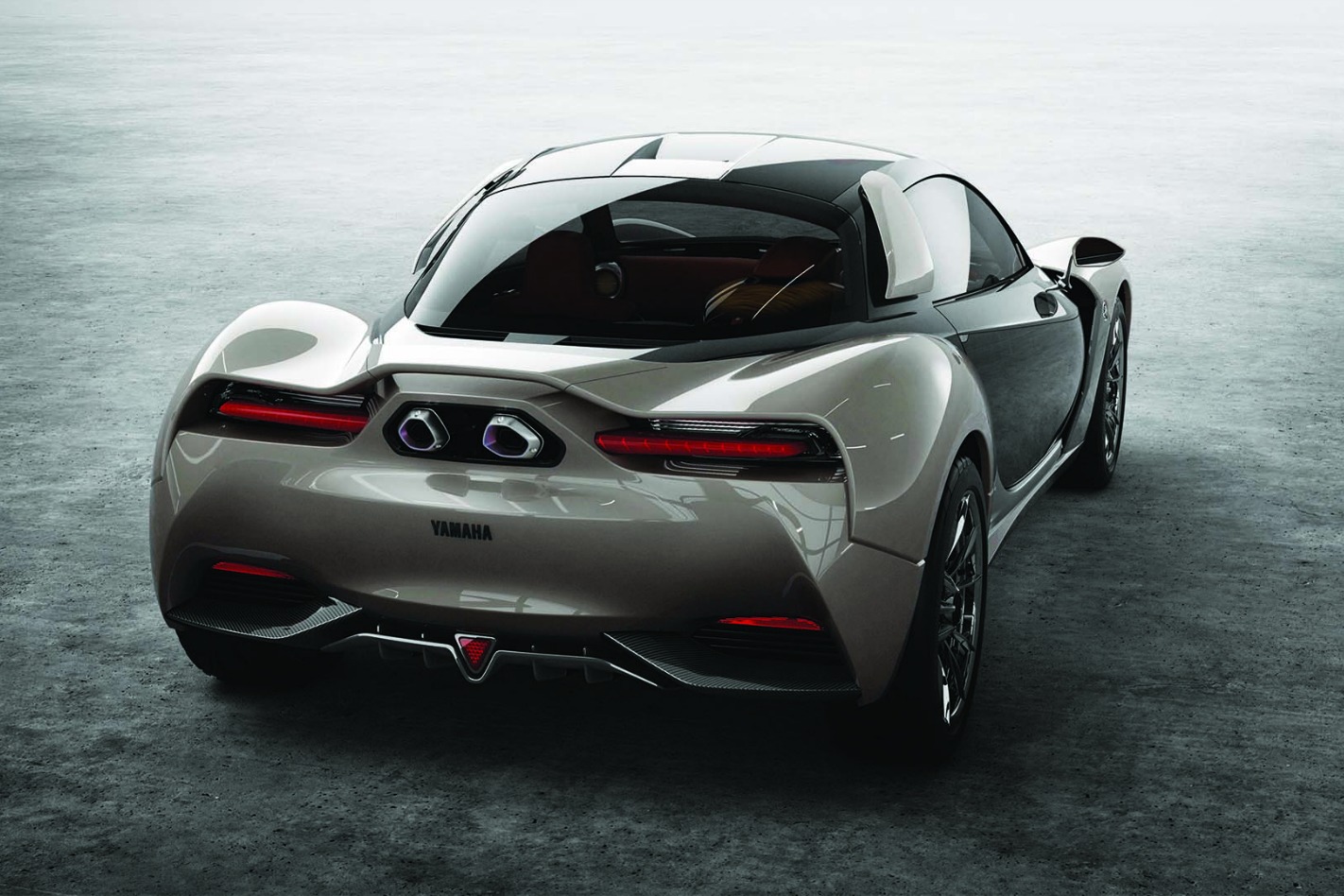
Yamaha has revealed one of the surprises of the Tokyo Motor Show with its super-lightweight carbonfibre sports car, the Sports Ride Concept.
Few technical details have been confirmed about the car, or whether it will even make production, however how it’s built has the potential to transform the car manufacturing process.
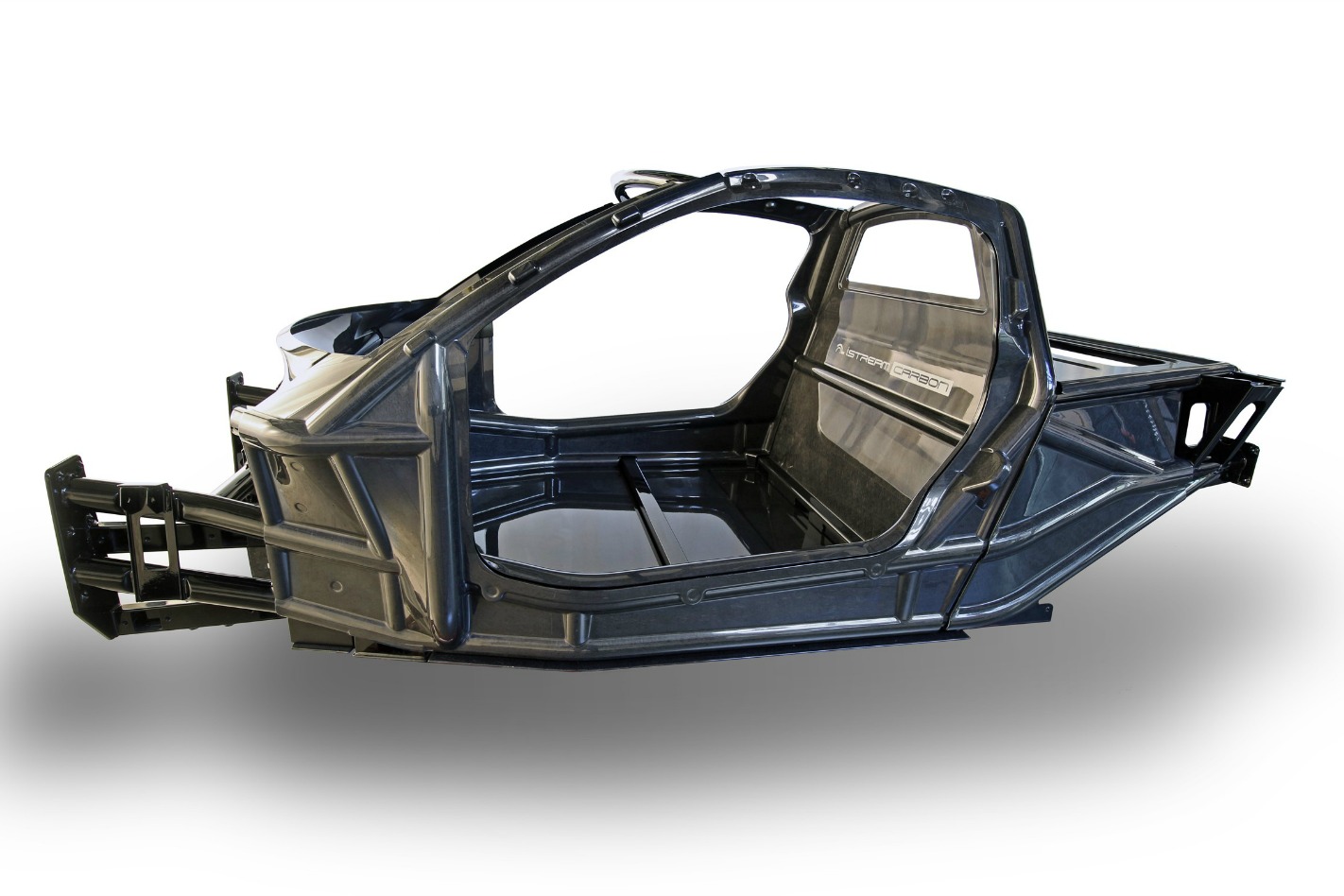
The Sports Ride’s structure is a result of Gordon Murray’s – yes, he of McLaren F1 fame – iStream Carbon process, which is similar to his iStream production process.
iStream Carbon is essentially the same but replaces glassfibre with carbonfibre which Murray claims “sets new standards for light weighting, rigidity and safety” while being far faster to produce than traditional carbonfibre. Murray claims a cycle time for each panel of just 100 seconds.
Murray has long been an advocate for lightweight cars and believes the iStream Carbon process is vital if cars are to meet future environmental targets.
This is good news for enthusiasts, as lighter cars should mean dynamics and performance improve with lower fuel consumption and mechanical wear.
A wave of new sports car that make a Mazda MX-5 look overweight and a Toyota 86 leaden and dull? Bring it on.
