
Welcome to the October issue of MOTOR, with the latest news, reviews and features from the wonderful world of performance cars.
Plenty to get through this month, so let’s get to it.
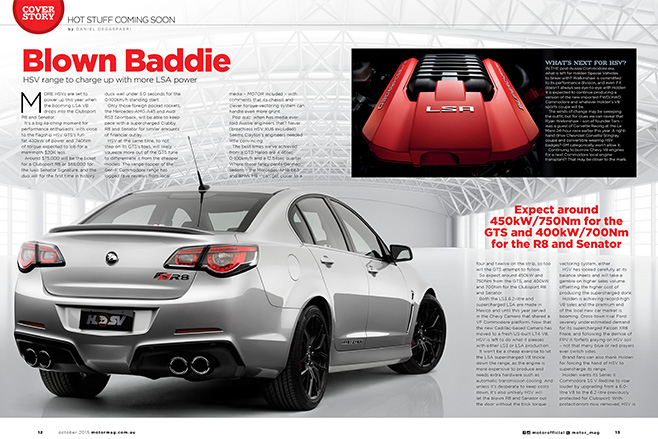
First up, we dish the dirt on HSV’s plans to farewell the Commodore in style by expanding use of the LSA supercharged 6.2-litre V8 to Clubsport R8 and Senator models. Meanwhile, word is Clayton has something special up its sleeve for the GTS, too.
It will bring Bugatti within fingertip reach of mere mortals – quite literally, because the Vision Gran Turismo Concept is headed for the gaming world.
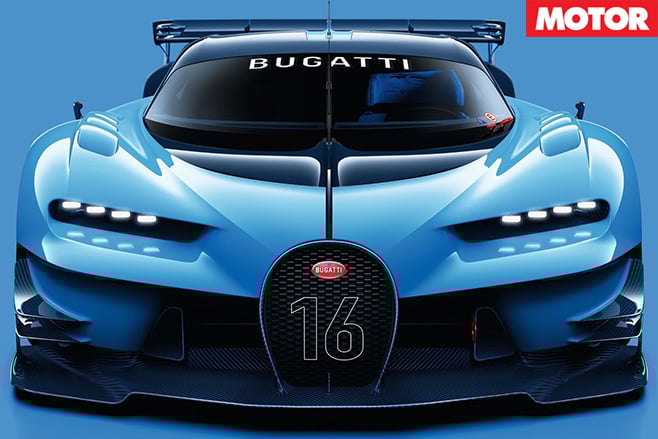
For any of the 450 total Bugatti Veyron buyers who could afford the million-dollar-plus hypercar, the Vision Gran Turismo more importantly showcases the future design language of the VW-owned brand. What you see here may even translate to the Bugatti Chiron that is rumoured to cost A$3.5m (so those Veyron buyers better dig deeper).
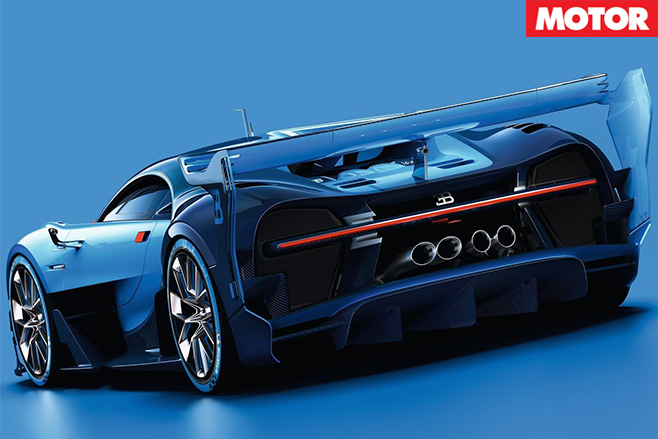
There are many Veyron styling identifiers, such as the backward-C sweep around the cockpit and that frowning nose. In case you’re wondering how many virtual cylinders the Vision Gran Turismo has, it’s sixteen, plus four turbochargers as identified by the same 16.4 engine plaque attached on the decade-old production Bugatti hypercar.
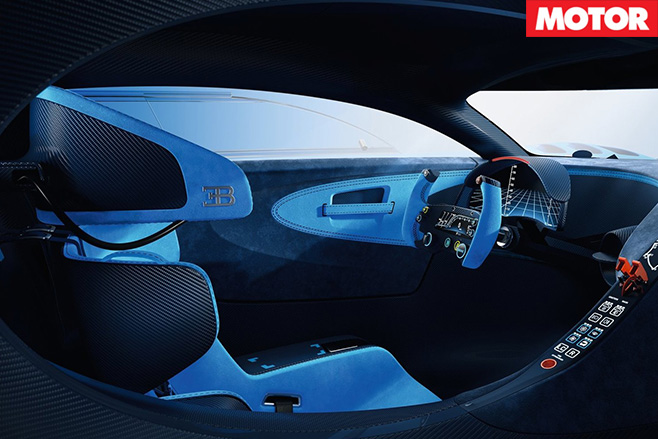
There’s no shortage of carbonfibre on the outside, or blue suede trim on the inside.
Bugatti insists that the styling elements seen here will be lifted from the world of Playstation enthusiasts to car buyers with pockets that run far deeper than an $89.95 game.
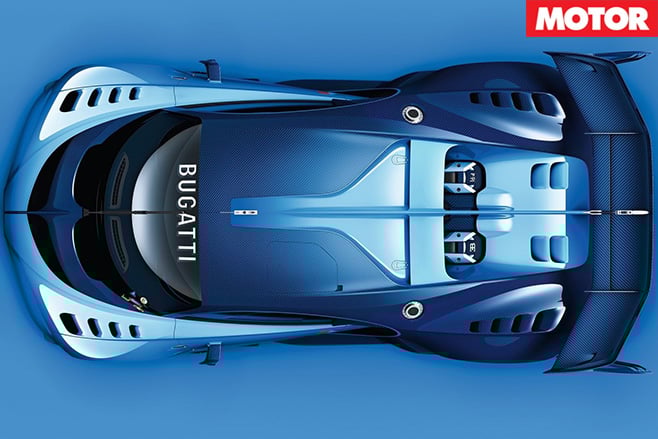
“Bugatti’s design DNA has reached a new stage of its evolution,” added Achim Anscheidt, head of Bugatti design.
TELL US A BIT ABOUT YOURSELF
I’m a stay at home mum. I have a two year old son, Hayden, and a five year old daughter, Chloe.
WHAT DID YOU THINK OF THE CAR?
“I love the Volvo. As soon as I saw it I loved the look of the car, it’s a beautiful looking car.”
RUN US THROUGH YOUR AVERAGE DAY…
Each day it’s a pretty early start. The kids get up around 6-6:30, have their breakfast, get everything ready and have the bags packed for Kinder. The Volvo made it very easy, the booster seat was brilliant and it’s just very enjoyable getting the kids in the car. The boot is excellent too, to put the stroller in the boot and there is a sensor on the boot that goes up and down really well. And then off we go.
AND HOW ABOUT THE DRIVE?
It’s a very easy drive, a very smooth car to drive. So it makes for a relaxing trip to Kinder. Yeah I love driving the Volvo. It’s very smooth driving over the speed bumps, I noticed that; the suspension is excellent. It’s so smooth that my two year old fell asleep at one point. The reverse cameras were really good when I was parking, that’s an extra bonus as well as the navigation. I found that really helpful having the navigation. Very easy to drive car, and it’s excellent, especially with young kids. Makes life as a mum very easy. Yep, we love it. We’ve all connected, the family is connected with it and I wouldn’t change it.
By the looks of it Ford’s planning to squeeze out another ST model, with the Mondeo now set to receive the go-fast treatment.
Spied in America by Motor Trend’s spy photographers, it seems Ford has taken to the Mondeo with the sports stick, with certain revealed details hinting the Mondeo will seek rivals more challenging than the Camry.
The news also backs up Ford’s claims it will launch 12 new global performance models by 2020.
Most telling of this is the spied Mondeo’s new exhaust pipe arrangement. Stuffed in place of the dual single-pipe outlets are a pair of twin-tailpipes, an ST signature.
While more subtle, an intercooler is reported to peer through the nose-cladding on the spy car, suggesting a higher output turbo four.
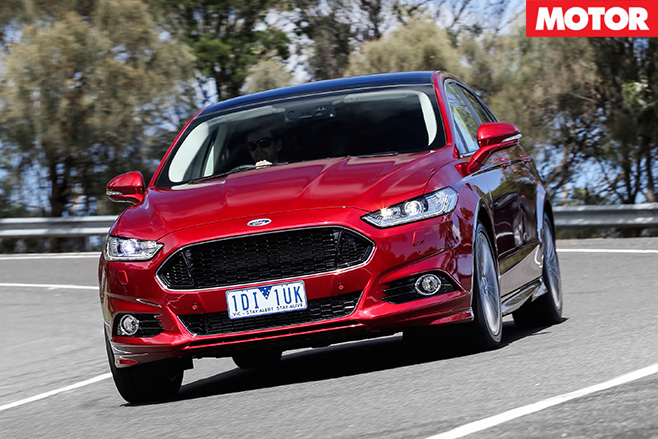
We do know, though, the Fusion, as the Mondeo’s known in America, is available with all-wheel drive.
With these two ideas, it’s not wild to speculate that a Mondeo ST could borrow some technology from Ford’s Focus RS all-wheel drive setup.
After all, Ford’s Joe Bakaj, Vice President of Ford Europe product planning, earlier this year said the Focus RS’s drivetrain will make its way in to other models to justify the investment developed the system.
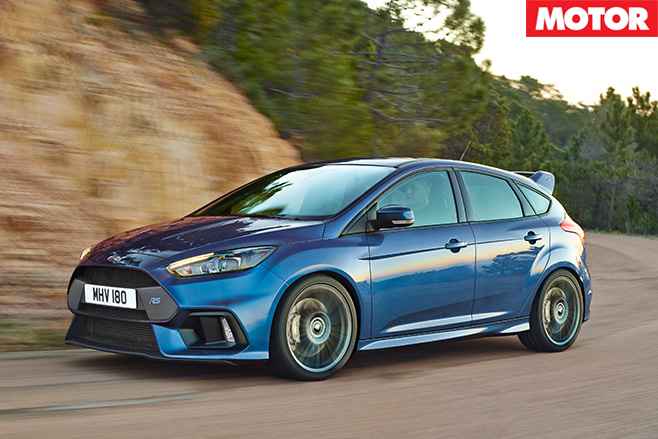
Because Ford has committed its new performance models to be global, and with the Mondeo already here, you could predict that a Mondeo ST might eventually find its way here.
And in bitter sweetness, it’s most likely what will fill the four-door performance car void to be left by the Falcon’s departure in late 2016.
For more photos of Ford’s spied ST model, visit Motor Trend.
Following hot on the heels of the limited-edition Cayman GT4, the Boxster Spyder is among the last of the current-generation mid-engined Porsche family.
But if you think the Spyder is simply a soft-top Cayman GT4 think again, for while the latter fuses elements of Carrera and GT3 into the smaller Cayman shell, the Spyder merely tweaks the DNA of the Boxster GTS, a car $23,500 cheaper and a phenomenal steer in its own right.
Unlike its hard-top GT4 sibling, the top-of-the-tree Boxster isn’t a product of Porsche’s motorsport department, though there is little separating the two in a straight line.
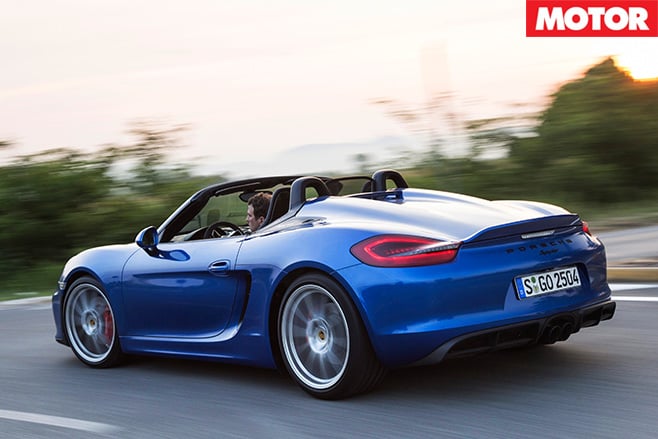
Combine this extra urge with a 1315kg kerb weight, the lightest of any Boxster, and 0-100km/h disappears in just 4.5sec on the way to a 290km/h top speed.
Key to that weight loss is the removal of the folding hard-top roof, replaced by a manually-operated bikini top which looks nice, can withstand an automatic car wash and remain in place at top whack, but requires the deft fingers of a surgeon to operate with any finesse.
Yes, it’s an improvement over the arrangement found on the previous-generation Boxster Spyder, but that will be of little comfort when every sudden weather change threatens to bring on a state of panic.
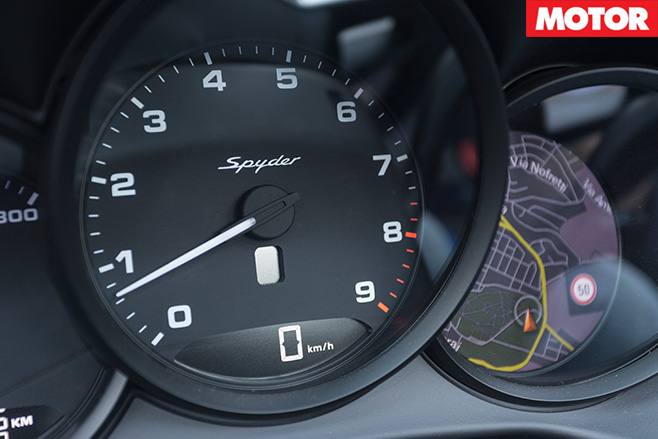
Another key difference between GTS and Spyder is the eagerness of the drivetrain. For maximum performance, keep it singing between 4500-7000rpm, where urge, thrust and throttle response are at their peak.
Being thankfully naturally-aspirated, it must work much harder than a turbo engine to muster up the power, but its response is more prompt, throttle modulation could hardly be sweeter and the engine note is a symphony.
The only available gearbox is a six-speed manual, but while the PDK would make it an easier day-to-day companion, the quick, slick manual is as good as they come.
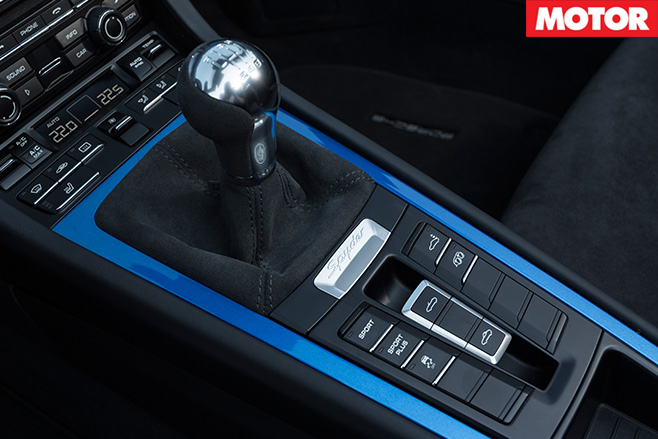
Carbon ceramic stoppers are a hideously expensive option, and one of questionable value unless your driveway resembles the Nordschleife.
With the serpentine tarmac of the Swabian Albs as our playground, the Boxster Spyder reveals a first-class driving experience, with brakes designed in heaven, super sensitive touchy-feely steering and a chassis that fuses grip, traction and roadholding with five-star finesse.
At the limits of adhesion the ABS will momentarily decelerate the inside rear wheel to quell understeer and pull the nose back in line, even before the intervention of PSM (Porsche-speak for ESP), however with the stability control disabled and those 420Nm turning the rear tyres, the mechanical locking differential ensures the Spyder is every bit as capable with opposite lock applied as its more hardcore brethren.
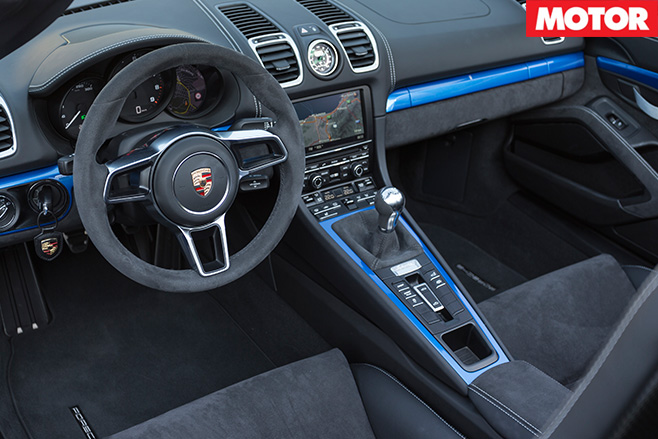
Inside, the driving environment is more familiar, though with added dashes of alcantara and colour on the centre console and dash. Tech heads will find the sea-of-buttons infotainment and heating controls somewhat antiquated, but the driving position is peerless with superbly supportive seats (single-piece buckets are optional).
Overseas the Spyder presents itself as a pared-back, no-frills retro-racer, however Australian cars come fully loaded with satellite navigation, dual-zone climate control, cruise control, heated seats and the higher grade stereo system all standard.
Thus equipped, given the extra performance on offer the $23,500 premium charged over the Boxster GTS begins to take on less relevance.
That said, the Boxster Spyder won’t be to everyone’s taste. It doesn’t have the poise, panache or motorsport-derived credibility of the Cayman GT4, and the compromised roof arrangement makes life harder than it needs to be, limiting the car essentially to a sunny day plaything for most.
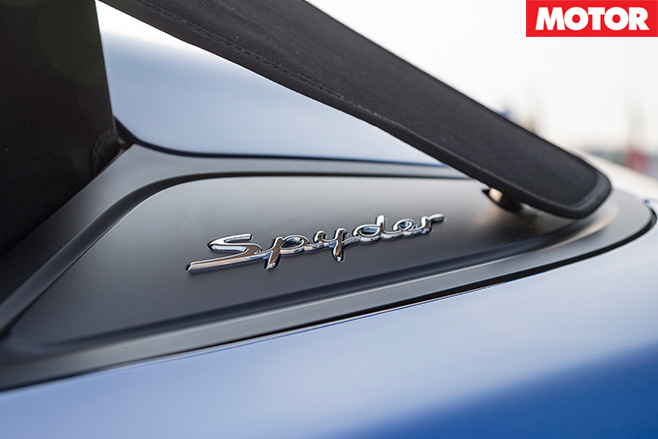
But pragmatism be damned, the retro-infused Spyder is an incredibly special car, a purist’s driving machine, the very existence of which should be celebrated for as long as possible.
With the imminent arrival of turbocharging, the next-generation of Porsche’s sports car range will offer a different experience. Whether or not Weissach’s engineers will continue on their current gold run is a question for the future, but for the moment, the hits just keep on coming.
The new Discovery Sport in diesel form is off to a flying start in Australia. Now a 2.0-litre petrol turbo variant has lobbed in, broadening the British 4×4 icon’s appeal.
WHAT IS IT Aimed directly at the BMW X3 and Audi Q5 set, the Land Rover Discovery Sport is the replacement for the slow-selling Freelander, even though it is slightly larger and offers a 5+2 seven-seater option. It was launched with diesels only, and the $59,990 Si4 SE will be the only petrol-powered version until a new generation of Jaguar Land Rover ‘Ingenium’ four-pot petrol engines lob sometime in 2016.
WHY WE’RE TESTING IT With petrol prices stable, Land Rover is giving its popular new Discovery Sport its strongest chance to dominate among luxury medium SUVs with the arrival of the 2.0-litre four-cylinder turbo-powered Si4 SE. Attractively priced and cleverly positioned, it promises to put the sport into this Land Rover driving experience.
MAIN RIVALS Audi Q5, BMW X3, Lexus NX, Mercedes-Benz GLC, Volvo XC60

PLUS: Handsome, classy cabin, space for 5, smooth and punchy drivetrain, sharp handling MINUS:Thirsty when pushed, tight third row seats, sub-German plastics quality
THE WHEELS REVIEW SINCE the Evoque arrived some years back, Range Rover has become something akin to Apple in the brand desirability stakes. Now that must-have fairy dust has rubbed off on the scorching-hot Discovery Sport from plainer sister Land Rover.
Let’s face it: the British-built premium medium SUV possesses a suaveness that’s alien to the Audi Q5 and co. But in Wheels’ recent group test the 2.0-litre SD4 turbo-diesel barely beat the Ingolstadt elder, so the just-released petrol version was approached with some trepidation.
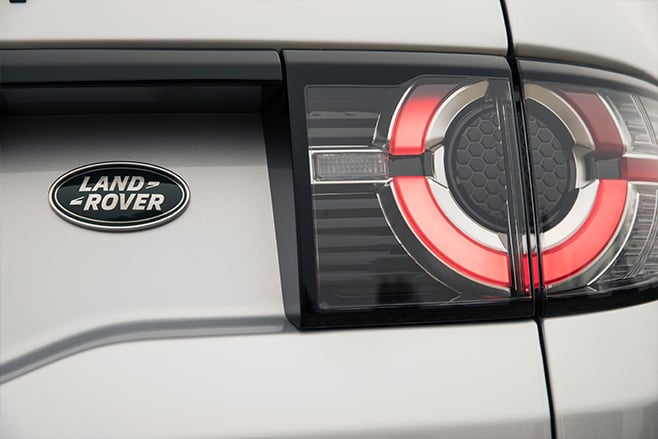
Of course, there’s a fuel consumption penalty compared to the diesel, the petrol averaging an indicated 10.7L/100km (about 13L/100km in the real world) hoofing around in ‘Drive’ and ‘DS’ sport modes. We barely bothered with the ‘Eco’ switch though, since it stole the swagger out of the Disco’s dance.
Another petrol benefit is the lighter kerb weight, which seems to translate into a more agile and controllable front end through fast, tight turns. Granted, that’s not the usual hunting ground for an SUV, even a monocoque-bodied one. But the accompanying direct steering, coupled with a pleasingly supple ride (despite sitting on optional 235/55R19 tyres), further fuelled our Si4 respect. Of course there’s still plenty of body roll, but the (also Ford-based) EUCD platform lurking underneath feels stable and composed, backed up by brilliantly effective braking.
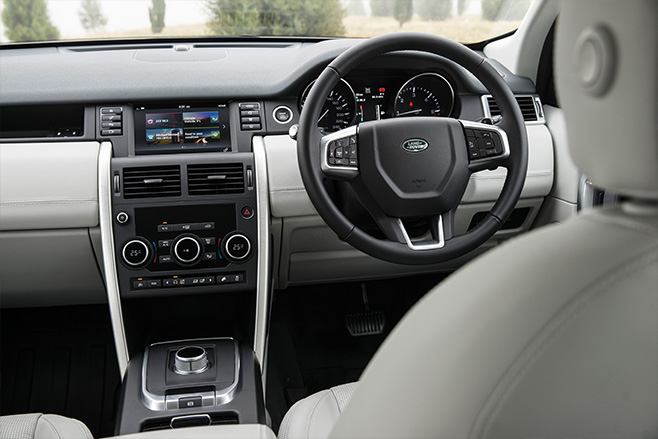
By our reckoning, then, the petrol eclipses the diesel. While the Disco Sport lacks the lush cabin polish of a Rangie Sport, it still beckons with value, style, speed and capability. No wonder Land Rover is becoming such a blue-chip brand.
SPECS Model: Land Rover Discovery Sport Si4 SE 4WD Engine: 2.0L 4cyl, 16v turbo Max power: 177kW @ 5500rpm Max torque: 340Nm @ 3200rpm Transmission: 9-speed auto Weight: 1844kg 0-100km/h: 8.2s Fuel economy: 8.3L/100km Price: $59,990 On sale: Now
BUILDING cars in Australia is not viable. Apparently. So tell me how Chrysler can justify bringing in a special-order 300 SRT to our market.
The new SRT, which has just gone on sale in Australia, is not a car you can buy in North America, its home market. Yes, you can buy a V6 Chrysler 300 there. And yes, you can find the SRT’s 6.4-litre V8 in near-identical guise under the bonnet of the Dodge Challenger. But a 6.4-litre Hemi V8 in a 300? Only we Aussies get it.

But how? Will it sell that many? “That’s a good question,” said Alan Swanson, senior manager of product strategy at Fiat Chrysler Australia, before the PRs butted in with “We don’t comment on sales forecasts”. Of course you don’t.
Yet Chrysler Australia has pushed the folk at Auburn Hills in Michigan directly for the hero 300 V8. And, somehow, has made the business case stick. That’s despite the fact that Chrysler sold only 563 examples of the previous 300 SRT here last year, 683 of them in 2013, and over the first seven months of this year had managed to move only 596 cars in total (granted, it offers only two ranges, the 300 and Grand Voyager).
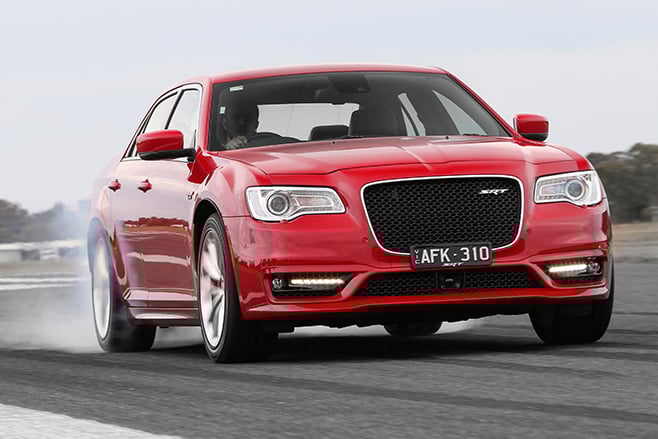
So how can Chrysler bring in an ‘Aussie special’ of a car built in Canada with a Mexican-made engine? By the end of July 2015, the 300 had sold 28,889 units in the US alone. That doesn’t include sales in any other market. Compare that to the Commodore’s 15,799 and the Falcon’s 3705 in Australia (neither figures including strong ute sales).
Of course, it’s fair to say that the Commodore – whose V8 is also made in Mexico – is getting a boost from the emotion of its departure as an Aussie car, and that Ford isn’t exactly spruiking Falcons – even its staff can’t get the car they want if it’s locally made, as the production lines have been wound back significantly.

The SRT is not even on sale in the UK, a huge right-hook market, where Chrysler currently offers only a diesel-powered 300.
Chrysler Oz says that it’s sold more than 3000 SRTs since the model was introduced here back in 2005. There will be more V8 Commodores than that sold between now and the end of the year.
Yet, with the Aussie dollar now at 70 US cents and China faltering, it’s not enough to keep the dream of local manufacturing alive.
The Bugatti Veyron was a landmark car, not just for its speed, but for discovering just how much money rich folk were prepared to spend on a set of wheels.
Its successor, the Chiron, looks set to reset that benchmark, with MOTOR’s European Editor, Georg Kacher, reporting for CAR magazine that Bugatti’s latest hypercar is set to cost 1.6m pounds, or A$3.5m.
To put that in perspective, for that amount you could buy Ferrari’s entire range, including a LaFerrari (if they weren’t already all sold), though you could argue anyone with the funds to buy a Chiron probably already owns a fleet of Ferraris.
For this staggering outlay, Bugatti is at least promising performance without equal. An upgrade version of the Veyron’s 8.0-litre quad-turbo W16 is expected, producing 1100kW/1500Nm.
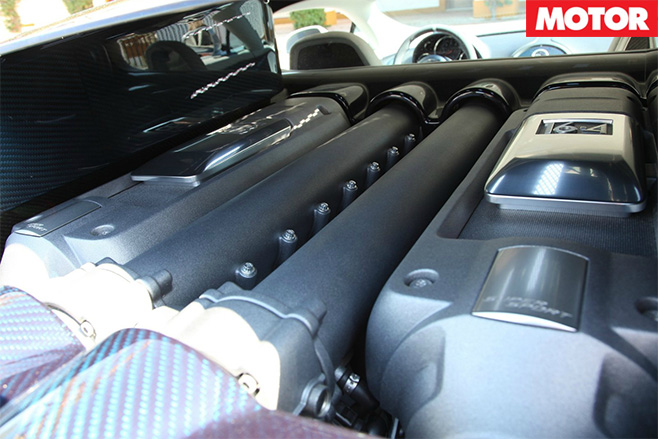
Such enormous grunt is claimed to fling the brand new Bug from 0-100km/h in 2.3sec and on to a top speed beyond 460km/h. On the other side of the ledger, cylinder deactivation will so be present for the first time, in an effort to curb the Veyron’s ferocious thirst.
Just 500 Chirons are expected to be built, with a public debut set for the 2016 Geneva Motor Show.
Mercedes-Benz has officially revealed the S-Class that will mark a drop-top’s return to model range after a 44 year absence.
And it’s back in a big way, as Mercedes-Benz promises magnesium body parts, fully automatic climate control, and even ‘pyrotechnics’ for its new soft-roof limo.
Those familiar with the S-Class coupe won’t be surprised by the cabriolet’s form. Besides the cloth roof, most of what you see underneath the glasshouse is shared with the Coupe.
Engines for the debuting S550 and AMG S63 4matic are also identical to their hard-roof counterparts, with the 550 relying on Benz’s 4.7-litre twin-huffer V8 for 335kW and 700Nm. Meanwhile the AMG S63 will channel its 5.5-litre twin-turbo V8’s 430kW and 900Nm through four wheels.
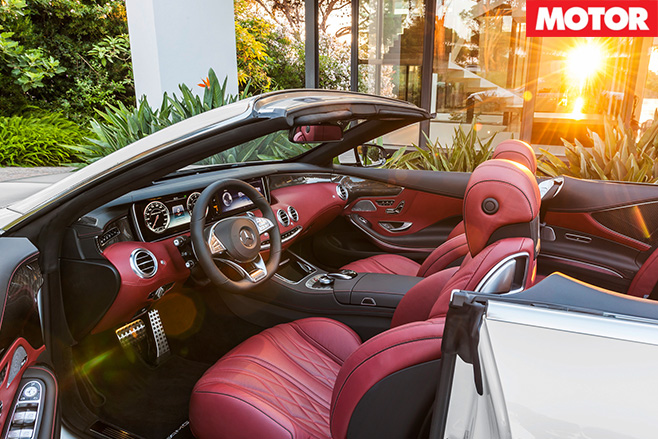
But to ensure the Cabriolet isn’t embarrassed on the scales Benz’s engineers have turned to material science. The new rear floor is now made from aluminium while magnesium has been used for the wall flanking the rear seats.
Benz won’t reveal a figure, but it does say the “bodyshell weight” of the coupe has been maintained, which means you can peg the Cabriolet at about two-tonnes.
More focused on passenger comfort than performance, though, the S-Class Cabriolet debuts new fully automatic climate control. Benz says 12 sensors and 18 actuators are used to ensure an “unnoticeable transition” between closed- and open-top environments.
And if you’re stubborn about having the top-down in winter, you can option to fit heating to your steering wheel and centre arm rests, while Benz’s neck-blowing Airscarf system promises to help keep things warm.
Available in black, dark blue, beige and dark red, the roof itself is said to fold away in 20 seconds during speeds up to 60km/h, and can be operated remotely.
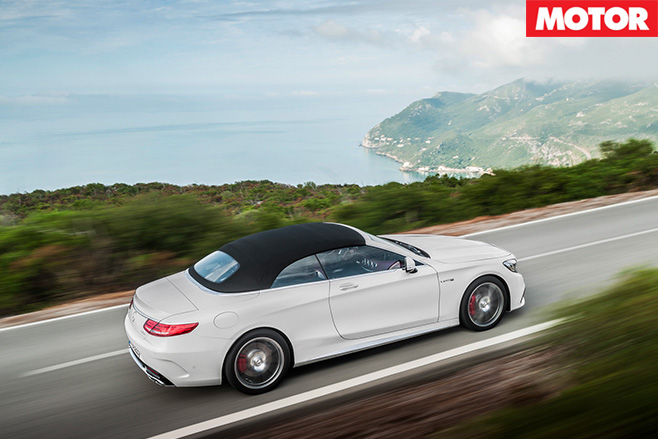
Judging by the rapid expansion of Mercedes-Benz Australia’s product portfolio, we expect to see the S-Class Cabriolet here after its market launch in early 2016.
In the meantime, both the S550 and S63 4matic Cabriolet are planned to debut at next month’s Frankfurt motor show.
Five years ago, Ford global chief Alan Mulally was being harassed at the Detroit Motor Show about whether the rear-drive Falcon would live on. “You’ll have Mustang,” he quipped before his henchmen ended the conversation.
It all makes sense now.
With Falcon set to be killed next year, there would have been no rear-drive car with a Ford badge on sale in Australia, a situation that some interpretations of the New Testament suggest could bring on the four horseman of the apocalypse and end civilisation as we know it.
Thankfully, the world’s most powerful ginger ensured this would not happen by putting his big rubber stamp on a plan to produce the Mustang with the steering wheel on the correct side of the dashboard for the first time in the iconic Ford’s 51-year history.
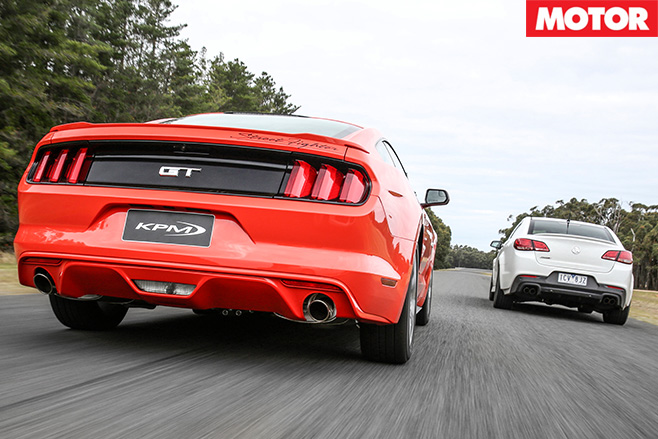
Of course, MOTOR couldn’t wait and managed to snaffle a drive of a private new-generation pony car import on Australian bitumen.
Driving the great American dream car wasn’t enough, though. No, we had to put it up against the mighty Holden Commodore SS.
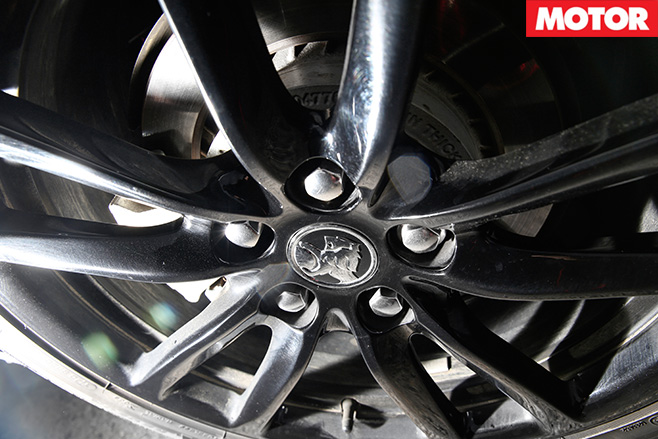
The last time Ford Australia sold the Mustang (apart from a handful of 1960s cars) was in 2001, when Prodrive handled the left-hand to right-hand drive conversions. It had a cracking V8 engine, but the car it was bolted into was bad and the handling was ordinary.
The next-generation car, which never made it to Australia, was not much better. Interestingly, American Mustang engineers were asked to jointly develop an independent rear suspension system with Ford Australia whitecoats, but they thought the Control Blade IRS of the 2002 BA Falcon was not refined enough and progressed with a more complicated system, which was then canned by the bean counters to reduce program costs.
As a result, the Mustang maintained a chariot-style solid rear axle that furthered its reputation of being a bucket with a great engine.
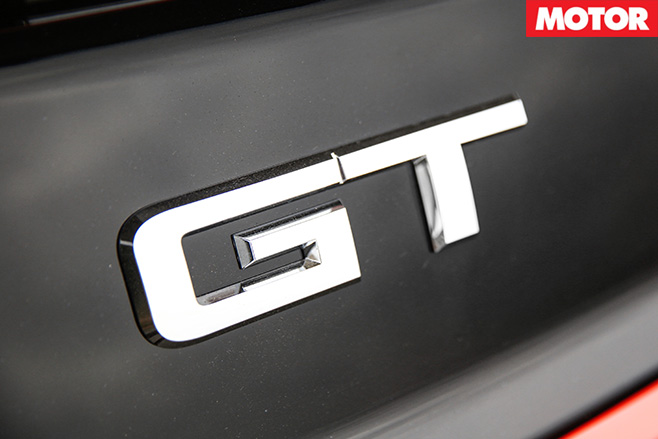
The company will use it as a development model for a series of high performance parts it’s going to build for Australian and US Mustang customers to be offered through Ford dealers.
The brand-spanking new Mustang is a California car (so no rust then), purchased straight from a Ford dealer in the sun-blessed state and shipped here.
Decked out in a brilliant shade of orange, it pops out of the dreary grey scenery in cold Victoria.
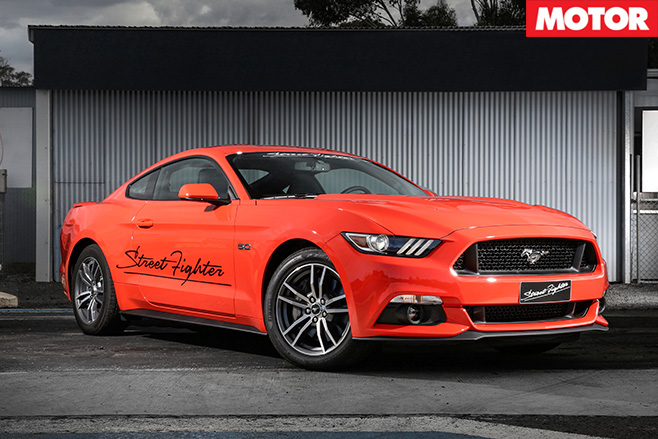
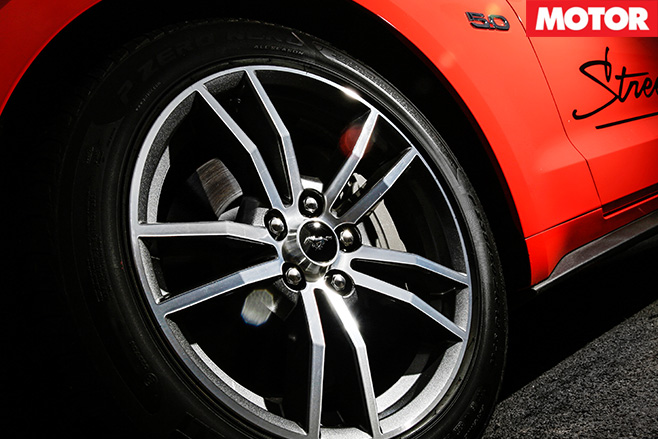
The GT does look a little under-tyred on its 18-inch wheels, but this is not the same spec that Ford Australia will be selling.
All the Australian Mustangs will get the Performance Pack, which means wider 19-inch wheels, retuned springs, a thicker rear sway bar and front strut brace as well as a shorter final drive ratio of 3.73:1 (our car has 3.55:1) and six-piston front Brembos.
The KPM test Mustang is also fitted with US-spec all-weather tyres, which have less grip, but will apparently be very good if there is a snowstorm.
The interior is a mixed bag. There are some cool bits, but some of the plastics are sub-par. But to call out the surface quality of the Mustang interior is like criticising Mad Max: Fury Road for not having enough dialogue as a vehicle for character development.
There are some nice touches though. The steering wheel has a cool retro design and looks like it has been chiseled from a big chunk of aluminium. It has a leather-wrapped rim that is perfectly shaped and there is easy access to the flappy gearshift paddles located behind it.
There is a neat build plate on the other side of the dashboard that says ‘Mustang, since 1964’, which is a fitting link to its rich past.
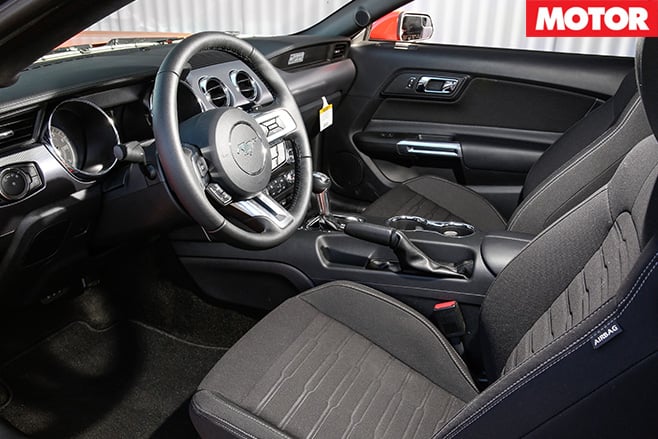
Now, I don’t want to be one of those fontophiles who bore people at dinner parties with the pros and cons of Helvetica and Times New Roman, but this speedo and tacho font is lame compared to the long number retro font from the last generation Mustang that recalled the glory of the 1960s and ’70s.
The rest of the Mustang dashboard is your standard Ford fare; there is a sound system, climate control, an ignition button and some cupholders. It has standard seat trim, which is kind of like sneaker fabric, and the seats, at least the front two, are supportive.
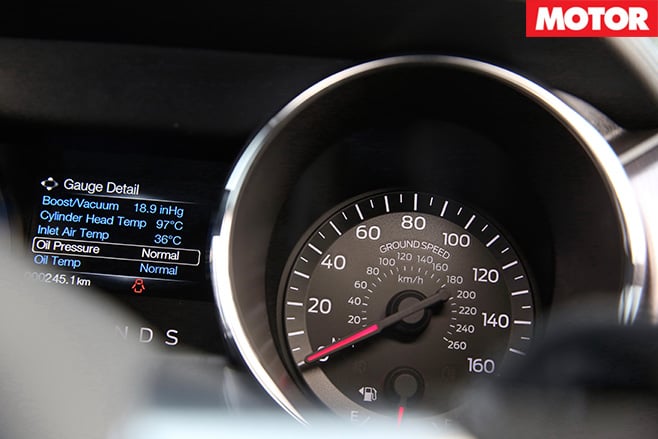
One feature that stands out in the cabin is the handbrake. It is an actual cable-type handbrake, which is a real blast from the past and contrasts to the electric park brake in the Commodore SS V Redline.
Whether Ford included this for handbrake turns or to save money and weight, we’ll never know, but I can confirm that it does work and you can bring on a silde by giving it a yank at the right moment.
I press the Start button and the V8 lurking under the long bonnet fires up with a satisfying growl.
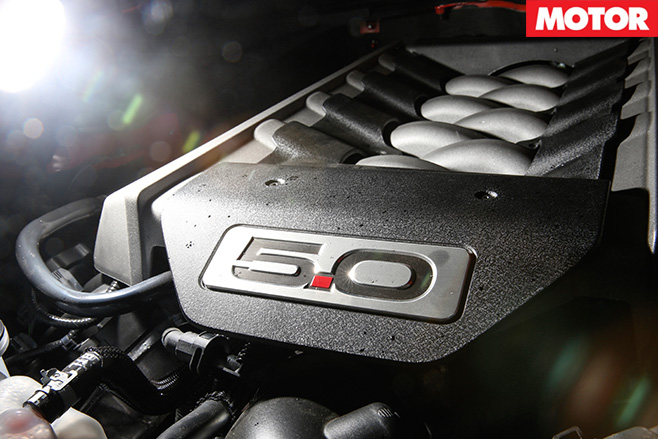
The driver’s view is a crucial part of the Mustang’s muscle car vibe. You can see a big bonnet with not just bulges, but vents as well. The only way they could make it more manly would be to strap a jackhammer and a giant raw steak on top.
The bonnet is so long and lifts up when I hit the accelerator as it surges towards the horizon. It’s like riding an extremely powerful oversized carrot.
And damn, does it feel fast.
The acceleration is something you expect from an engine considerably larger than 5.0-litres or one force fed.
A later run down the drag strip at Heathcote confirms my seat of the pants evaluation. The stock Mustang is good for a 4.9sec 0-100km/h and a cracking 13sec-flat quarter mile.
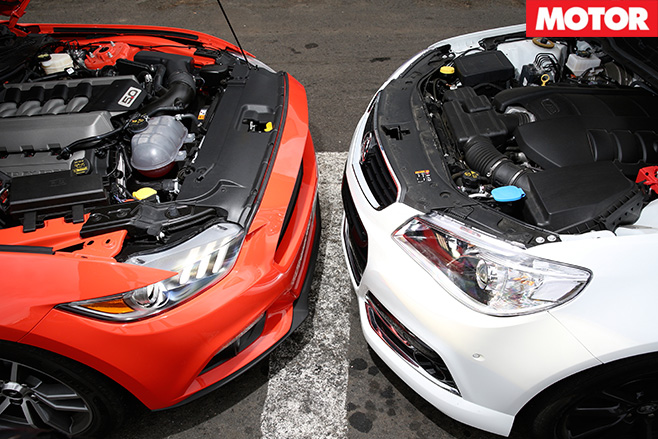
With a healthy 542Nm on tap and 325kW at the top of the rev range, I shouldn’t be surprised it’s so fast.
The wonderful V8 soundtrack adds to the impression of speed. It is guttural and fills the cabin, a much more aurally rewarding experience than the muted Commodore SS.
After some high speed runs, it is time to hit the Bosch skid pan and ask the age-old question: “Will it slide?”
The answer is a resounding yee-hah, which is means yes in this context. The Mustang steps out at the first request and the slide is long and easy to control.
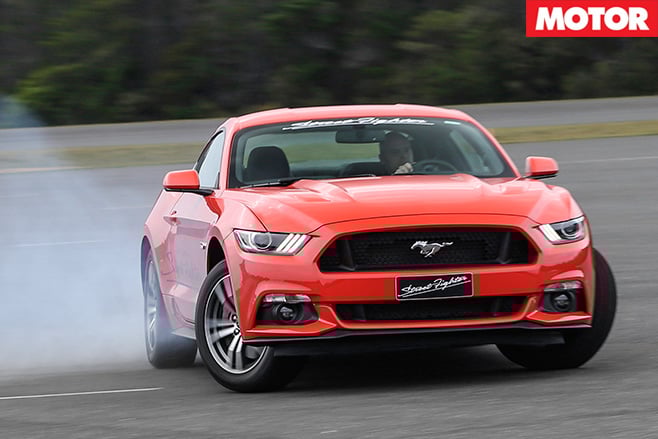
The Mustang feels like a Toyota 86 that was sent to jail and passed its time pumping weights.
We weren’t able to take the unregistered Ford over any uneven roads, but the American stock car does have more body roll than the super sharp Commodore.
It doesn’t have the loll-about-like-the-village-drunk suspension setting of some American cars and it is predictable, but it is on the softer side. Note the Australian Mustangs will no doubt handle differently.
Now it’s time to ask another important question: “Will it burnout?”
You might have noticed the Mustang comes standard with a Line Lock function in all markets except good old Nanny Nation (Australia), which allows for a car-controlled stationary burnout.
The omission doesn’t really matter because the V8 Mustang does burnouts ridiculously easily.
With 542Nm on tap, you could pluck a giant squid out of the nearby ocean, shove it into the Mustang and the odds are it could drum up a big smokey burnout from the rears.
Besides, I reckon if you need a car’s computer to help you do a burnout, you probably shouldn’t be doing a burnout. In fact, you should probably just catch the bus and suffer in your jocks.
Like the Ford, this is a muscle car, but more sensible. There are seats in the back for the family and a far more functional boot.
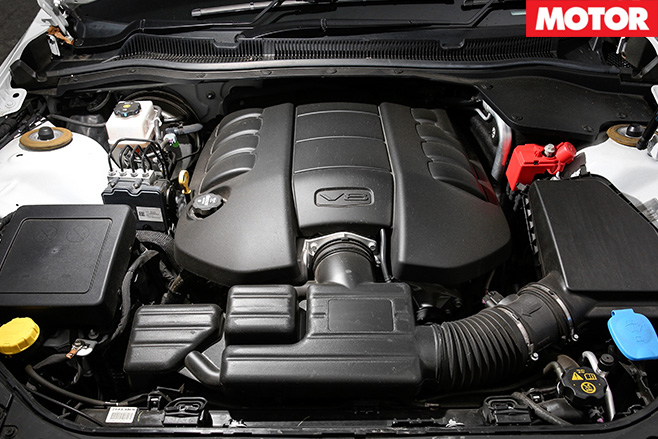
The SS doesn’t have quite the same urge out of the blocks and the 6.0-litre V8 tends to knock off early as the needle heads towards 5000rpm. You have to work it much harder than the Mustang, which is not surprising given it is down 55kW (the SS is supposed to have 5Nm more torque, but it seems less accessible).
Our later run down the strip showed it is definitely not quite as quick as the Mustang, doing a 5.65-sec 0-100km/h run and running a quarter in the mid-high 13s.
The numbers wouldn’t change, but it would feel faster with an aftermarket exhaust because the stock system means the V8 note feels detached, like it is only happening outside the car.
The SS can burnout and it can slide too, but it is not as keen to get sideways as the Mustang, possibly because it has less power, but it also seems to have better front and rear grip.
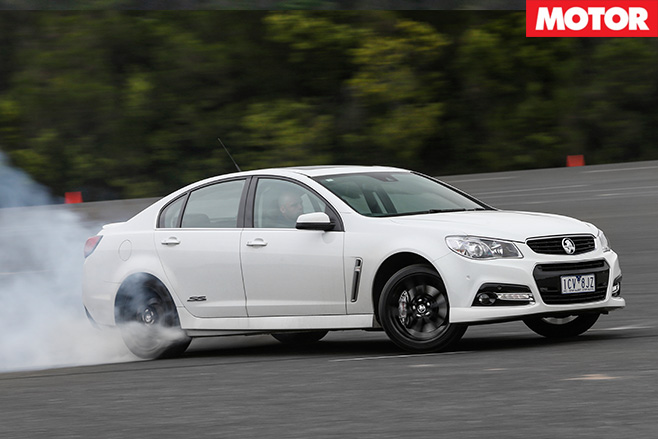
Later, on a run from Anglesea along the coast and then inland, the SS reminds us of what a great all-rounder it is, eating up the miles and galloping over some fairly ordinary surfaces.
The Holden is a muscular cruiser that can go hard when you want it to, but can also play the role of the gentle family hauler when required. It is more refined, not just in appearance, but on the road too.
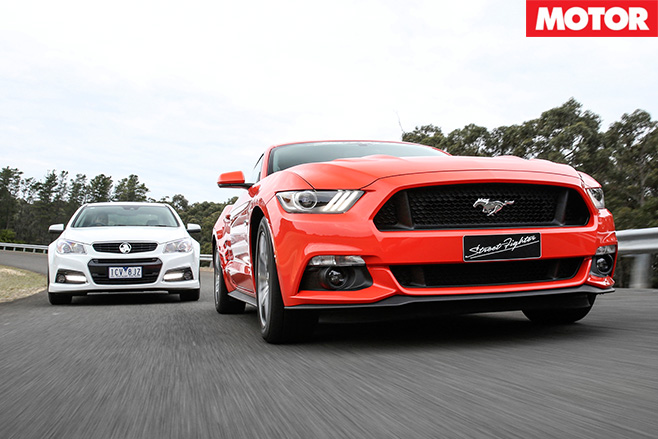
Our test is hardly conclusive, but does offer a tantalising preview of what is to come. The muscle car scene in Australia is about to get a whole lot more interesting.
| u00a0 | FORD MUSTANG GT V8 (US SPEC) | HOLDEN COMMODORE SS V REDLINE |
| Body | 2-door, 4-seat coupe | 4-door, 5-seat sedan |
| Drive | rear-wheel | rear-wheel |
| Engine | 4951cc V8, DOHC, 32v | 5967cc V8, OHV, 16v |
| Bore/Stroke | 92.2 x 92.7mm | 101.6 x 92.0mm |
| Compression | 11.0:1 | 10.4:1 |
| Power | 325kW @ 6500rpm | 270kW @ 5600rpm |
| Torque | 543Nm @ 4250rpm | 530Nm @ 4400rpm |
| Power/Weightu00a0 | 193kW/tonne | 153kW/tonne |
| Transmission | 6-speed automatic | 6-speed manual |
| Weight | 1681kg | 1766kg |
| Suspension | struts, coil springs, anti-roll bar (f); multi-links, coil springs, anti-roll bar (r) | struts, coil springs, anti-roll bar (f); multi-links, coil springs, anti-roll bar (r) |
| L/W/H | 4784/1916/1381mm | 4966/1899/1471mm |
| Wheelbase | 2720mm | 2915mm |
| Tracks | 1570/1637mm (f/r) | 1593/1590mm (f/r) |
| Steering | electrically-assisted rack-and-pinion | electrically-assisted rack-and-pinion |
| Brakes | 352mm ventilated discs, 4-piston calipers (f); 330mm ventilated discs, single-piston calipers (r) | 355mm ventilated discs, 4-piston calipers (f); 324mm ventilated discs, single-piston calipers (r) |
| Wheels | 18.0 x 8.0-inch (f/r) | 19.0 x 8.5-inch (f); 19 x 9.0-inch (r)u00a0 |
| Tyres | 235/50 R18 (f/r) Pirelli P Zero Nero all-season | 245/40 R19 (f); 275/35 R19 (r) Bridgestone Potenza RE050A |
| Price as Tested | US$35,000 (approx.) | $52,490 |
| Positives | Superb V8 engine; searing pace: adjustable handling; looks | Great chassis and steering; sedan practicality; value for money |
| Negatives | US chassis quite soft; we have to wait until December to arrive Aussie cars! | Not particularly quick; should sound better; looks a little plain |
| u00a0 | 4/5 | 4/5 |
Click here to read the full range review of the Holden Commodore.
