
Reports out of the UK are that Wolfsburg has green lit its R400, its ultimate version of the Golf R.
The R400 made its debut at 2014’s Beijing motor show purely as a concept, boasting a brow-raising 294kW and 450Nm from just two litres and four cylinders.
After months of online speculation, at one point fuelled by allegedly leaked official VW documentation, British media outlet Car has quoted VW’s powertrain boss, Dr Heinz-Jakob Neusser, as confirming the R-on-steroids fit for public consumption.
Though the three-door R400 concept didn’t stray wildly from the production R’s roots in terms of design, its performance claims are as wild as its outputs: an incredible 3.9 seconds for the 0-100km/h sprint and a top speed of an Audi RS3-rivalling 280km/h.
The concept featured a six-speed DSG transmission and, of course, all-wheel drive, presumably enhanced to suit the car’s bold specification targets.
The ‘400’ in the nameplate refers to engine output measured in PS, or an extraordinary 147kW per litre of specific output if the production version is to remain true to its namesake. That’s 88kW higher than Golf R.
It’s doubtful, though feasible, that the R400 may adopt the 2.5-litre turbocharged five cylinder from Audi’s RS stock, which makes 280kW in current trim and is said, by Audi engineers, to be close to breaching production tolerances for reliability.
More will be revealed closer to the production R400’s expected reveal at this year’s Frankfurt motor show in September.
Get your free weekly report from the world of fast cars – subscribe to the MOTOR newsletter!
It’s more Australian than a koala riding an emu while eating a lamington.
Performance utes are a uniquely Australian invention, not to be confused with their American ‘pick-up’ cousins.
Like all our locally-made beasties, they won’t be around for too much longer, which is a crying shame, as there aren’t too many better ways to have fun on four wheels.
Masses of power and torque, no weight over the back and rear-wheel drive means it’s virtually impossible not to enjoy yourself.
But which of the local crop is fastest? Check out the video above to find out.
Quick disclaimer: it was originally meant to be XR6 Turbo vs base SS, but a mix-up at Holden meant we landed a Redline instead. As it turns out, it wouldn’t have changed the result at all.
We’ll have more video from our ute shoot in the coming weeks.
AH, DRIFTING. It’s a magical world of oversteer, tyre smoke and slightly deranged machines like this 1000hp (on low boost) Mazda MX-5.
It belongs to Mad Mike Whiddett, a crazy Kiwi who went viral in 2013 by drifting his RX-7 up Queenstown’s Crown Range, and has finally been revealed after a painstaking build process before making its competition debut in the US.
Backed by Red Bull and with factory Mazda support, the NC MX-5, codenamed Radbul, is a technical tour de force.
Power comes from a twin-turbo 2.6-litre four-rotor Mazda rotary, which in its most conservative tune produces 1000hp, or 745kW.
Turn the wick up, though, and Mike reckons more than 1500hp (1120kW) could be possible.
Then there’s the MX-5’s short wheelbase to consider; a longer wheelbase is typically considered ideal for drifting, and makes initiating and holding a drift more manageable.
All this means steering Radbul at pro-drift speeds should be quite challenging.
Everything about Radbul is aggressive, from the engine to the chassis and even the custom body and aero set-up.
“I have driven some quick cars over the years, but nothing even comes close to how fast this thing is,” Whiddett said of his new creation. “With the short wheelbase and the power-to-weight ratio of more than one horsepower per kilogram, we knew it would be a handful.”
It’s enough to question if Mad Mike has indeed gone mad.
Radbul will make its competition debut on May 8-9 during the second round of the 2015 Formula Drift Championship at Road Atlanta in Georgia.
INDYCAR: New face wins but great Alabama comeback for Power
YOUNG American Josef Newgarden finally confirmed his talent on Sunday with a breakthrough win in a dramatic Indy Grand Prix of Alabama at Barber Motorsports Park.
The popular 24-year-old, the fourth winner in the first four races of the 2015 series, clung on to his lead as the laps ran down with Graham Rahal charging hard, taking second place from Scott Dixon on the final lap.
“I was so nervous [in the last few laps],” said Newgarden afterwards. “I’m normally not nervous when I’m racing.” But then he was staring at his first win in Indy cars.
Defending champion Will Power can rue a lost opportunity, the Queenslander hit with a drive-through penalty after he hit Takuma Sato exiting the pits.
Though clearly the guilty party, Power perhaps disingenuously asked his team over the radio: “What was the drive-through for?”
“Avoidable contact,” came the response.
“Typical!” commented Power, a gent with no great love of officials.
The green flag drive-through penalty dropped Power way back in the field, but he steadily pushed forward to take a points-gathering fourth.
It was a good result on the back of his disastrous weekend at the previous race in Long Beach.
Power’s Penske team-mates, Juan Pablo Montoya and Helio Castroneves, first and second in the standings before this race, finished 14th and 15th respectively. Montoya nevertheless maintained the series lead by three points over Castroneves.
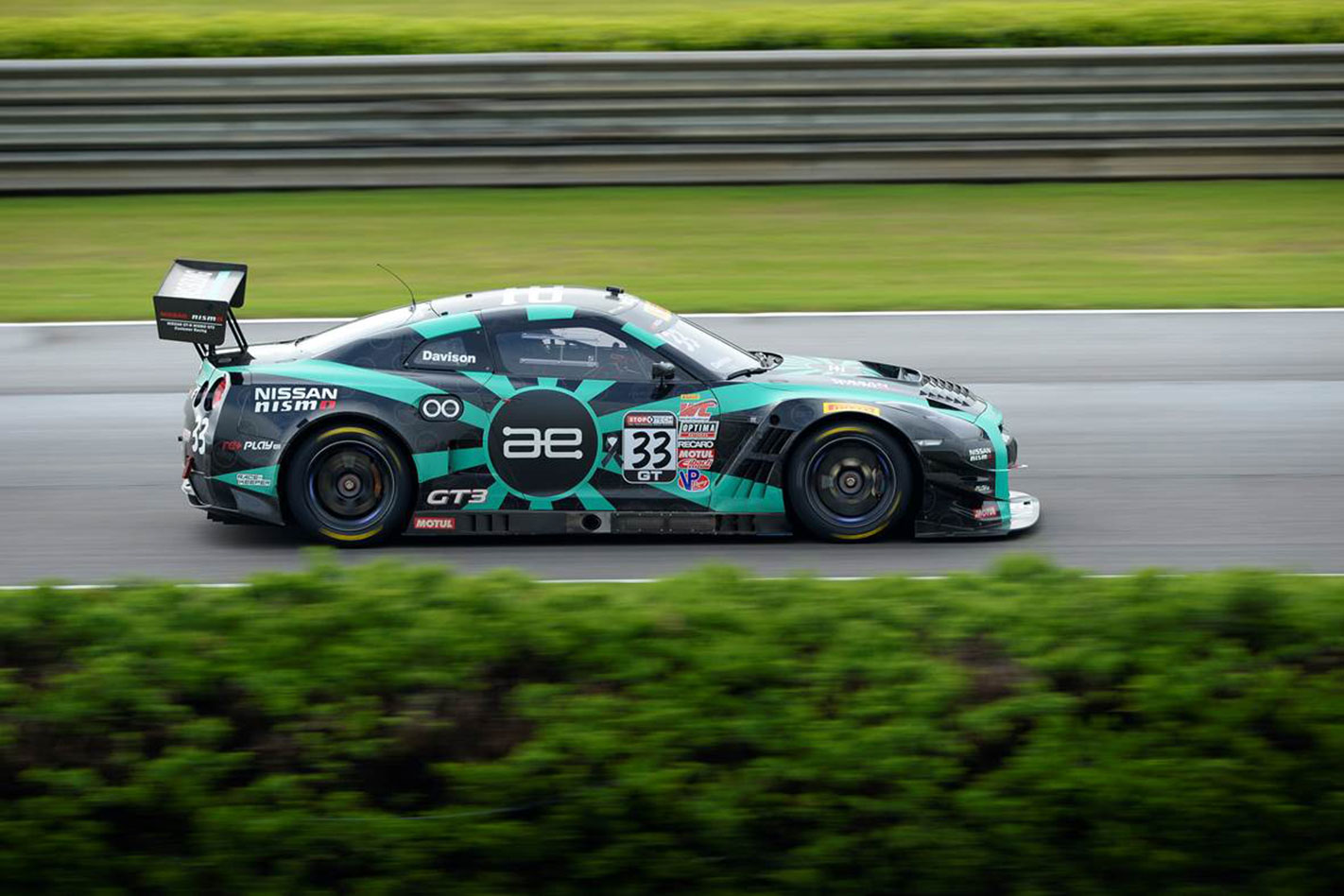
WORLD CHALLENGE: Aussie on top in GT
AUSTRALIAN James – now known as JD – Davison scored a flag-to-flag victory in the sixth round of the Pirelli World Challenge GT class of the MOMO Grand Prix at Barber Motorsports Park, driving a Nismo Nissan GT-R GT3.
It was Davison’s first career Pirelli World Challenge win and the first win for Nissan in the GT class in the American sports car series.
Melbourne-born Davison, son of former racer Jon and cousin of Will and Alex, moved to the US a decade ago when he was 18 and has carved out an impressive career since.
Highlights include a runner-up finish in the 2007 Pro Mazda and 2009 Indy Lights Championships. In 2013 he made an impressive Indycar debut and last year finished 16th in the Indianapolis 500 on debut.
This year he has a hectic schedule driving for TRG-Aston Martin Racing in the United Sportscar Challenge, and the AE Replay XD Nissan GT Academy team in the Pirelli World Challenge, debuting the Nissan GT-R GT3 in North America.
Saturday’s 50-minute race at Barber ended in a green-white-chequered finish with Davison holding off a late lunge from Nick Catsburg in a Lamborghini Gallardo GT3. Third was claimed by Mike Skeen in an Audi R8 LMS Ultra.
“I qualified on pole and won the race, so it was a pretty good day,” said Davison. “It doesn’t get much better.
“I’m just really pleased for the whole team. When you get a big opportunity like this with a manufacturer as a driver, when you’re expected to perform, you have to perform. A win and a pole six races into the year adds some confidence.”
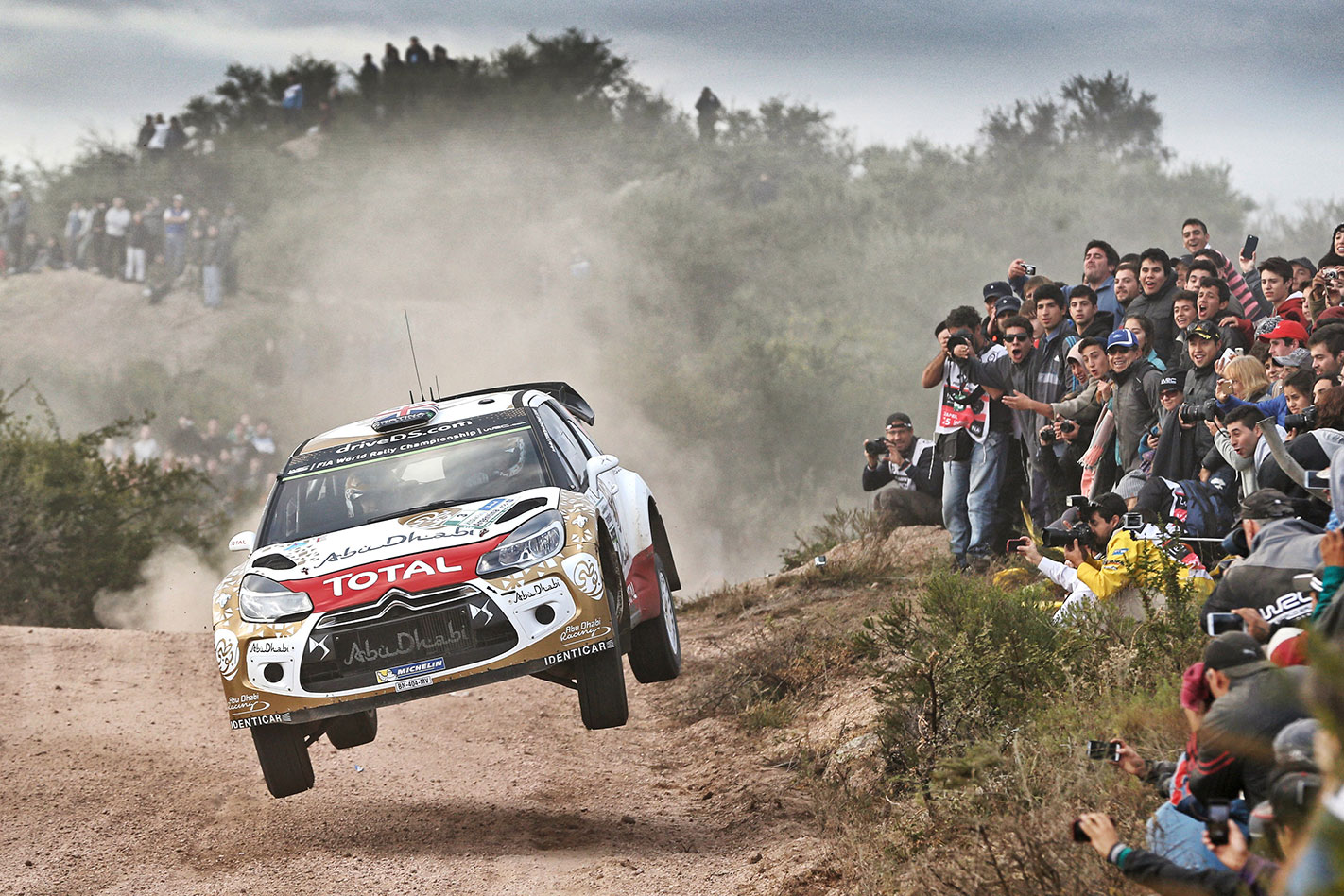
WRC: Brutal Rally Argentina to Kris Meeke
AFTER seven wins and 20 podiums on the trot, Volkswagen’s stunning run of successes in world rallying ended during a brutal Rally Argentina, which brought an emotional first-ever World Rally Championship victory to Northern Ireland’s Kris Meeke driving a Citroen.
The toughest rally of the year saw a podium bereft of a Volkswagen driver for the first time since Rally Australia in 2013. And reigning champ Sebastien Ogier has still not won in Argentina, the only round that has escaped his trophy hunt, his rally ending with a fuel-supply problem on stage two.
So the podium took on a different look with Meeke joined by Citroen team-mate Mads Ostberg and M-Sport-Ford driver Elfyn Evans.
Meeke’s win was the first for a British driver in the WRC since the late Colin McRae triumphed in Kenya in 2002. McRae, who died in a helicopter crash in 2007, helped Meeke financially during the early days of his rally career.
Meeke, 35, led from stage two until the end, driving cautiously yet fast enough to take an 18.1sec victory.
Martin Prokop was fourth in his Czech national team Fiesta while Hyundai Motorsport salvaged a top-five finish with Dani Sordo taking fifth.
VW’s Andreas Mikkelsen crashed after hitting a rock and Jari-Matti Latvala went out late, retiring from third with engine issues on the penultimate stage.
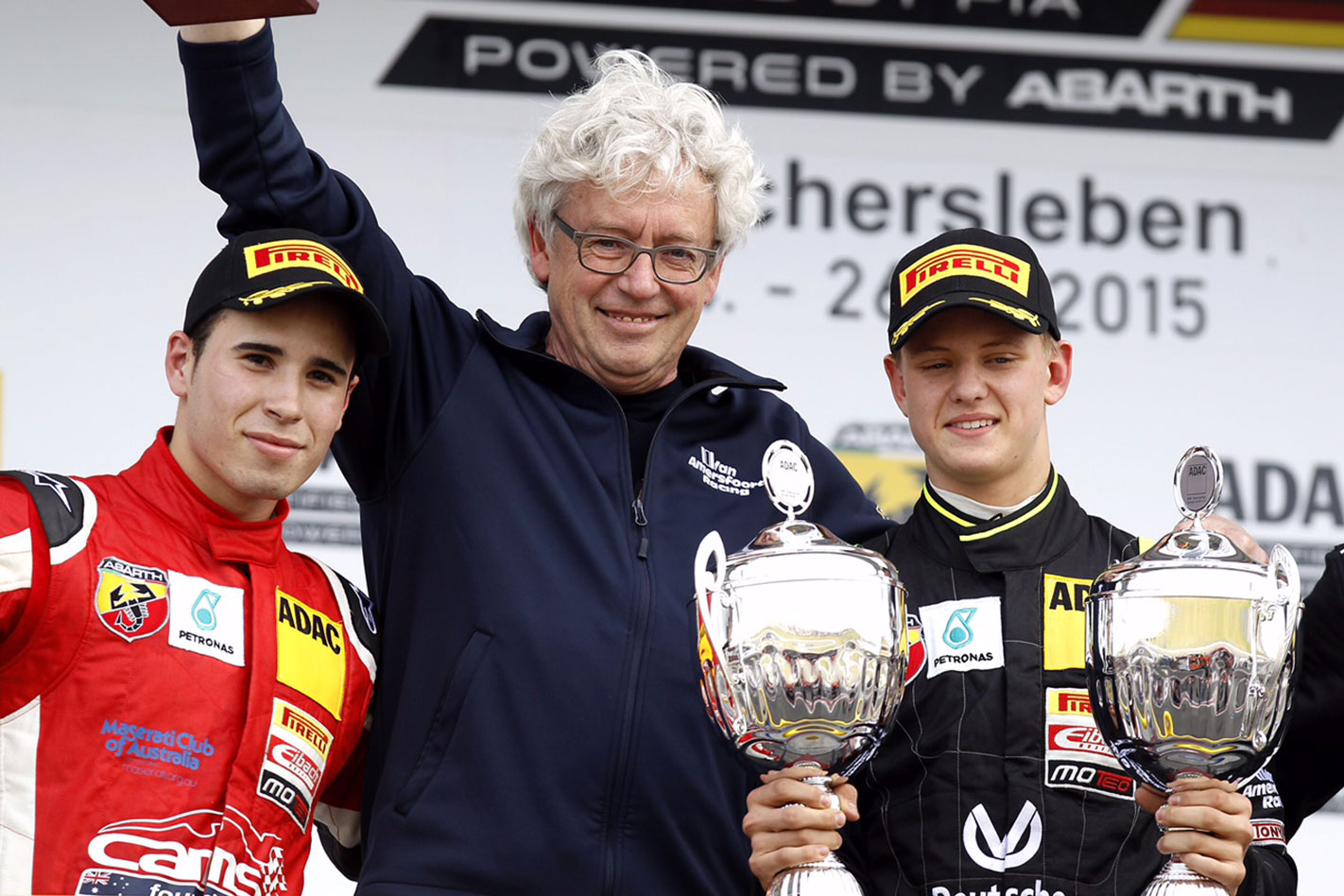
GERMAN F4: Maiden victory for Mick Schumacher; Aussie Mawson second
MICK Schumacher – the son of F1 legend Michael – has won on his car racing debut, taking the third of three races on the opening weekend of the German Formula 4 Series in Oschersleben.
And Australian driver Joey Mawson showed his credentials with a splendid second place.
After enjoying success in karting, 16-year-old Schumacher is contesting his first season in car racing this year.
Schumacher’s team-mate, 19-year-old Mawson, crossed the finish line behind him in second place, making it a one-two in the final for the well-established Dutch team Van Amersfoort Racing.
Schumacher, who finished ninth and 12th in the first two races of the weekend, laid the foundations for victory in the final at the start, pulling out a lead of over a second on Tim Zimmermann.
Then Mawson, who started fifth, got by Zimmerman to take second and began to hunt down Schumacher towards the middle of the race.
The Australian gained ground on his team-mate with every lap and was close enough to make an attempt at overtaking. But he didn’t get another chance, the race ending under the safety car.
“I’m very satisfied,” Mawson said. “A podium on my first weekend in the ADAC Formula 4 is perfect.
“I got off to a really good start, and overtaking during the race was great fun. At the end of the race, I was getting closer and closer to my team-mate Mick.”
Over in Aragon, Spain, the Formula Renault 2.0 Eurocup debut for Anton de Pasquale from Werribee South in south-west Melbourne didn’t go so well.
The 2014 Formula Renault 1.6 North European champion felt the heat of stepping up to the hotly contested 2.0 Eurocup, finishing 21st, 16th and 20th in the three races in his Aussie-flag liveried Team Koiranen car.
Nissan’s nipped and tucked Micra hits its rivals where it hurts – the bottom line.
WHAT IS IT? The long-awaited facelift of Nissan’s Micra city car, which boasts more equipment, sharper styling and a streamlined range. There’s also an unchanged $13,490 starting price, which makes it one of Australia’s cheapest new cars.
WHY WE’RE TESTING IT We like the Micra here at Wheels. The old car fared well in COTY testing way back in 2010, but has subsequently faded against fresher, sharper rivals . Hopefully this facelift brings a welcome return to form.
MAIN RIVALS Suzuki Celerio, Holden Barina Spark, Mitsubishi Mirage, Fiat 500
THE WHEELS VERDICT Cheap, cheerful and now bristling with more equipment, the updated Micra remains an attractive budget city car. Pity the package is let down by dated dynamics and a $16,000 Ti flagship that’s out of its depth against the more polished Mazda 2 and Volkswagen Polo.
PLUS: Fresh styling; boosted equipment; sharper pricing MINUS: dated dynamics and performance; compromised rear seating
THE WHEELS REVIEW IT’S TAKEN almost two years to arrive, but Nissan’s updated Micra has finally hit Aussie roads. Excess stock of the current, ageing Micra meant Nissan Oz repeatedly delayed the arrival of this new Indian-made model, which heralds a welcome equipment boost, a streamlined range and refreshed styling.
Two variants are now offered, base ST and top-spec Ti, with Nissan axing the old mid-grade ST-L. Both variants retain the old model’s 56kW/104Nm 1.2-litre turbo triple, and offer the choice of a five-speed manual (ST only) or four-speed automatic.
The manual ST’s $13,490 starting price remains unchanged too, meaning the Micra remains one of Australia’s cheapest new cars, while Nissan has lopped some $2000 from the flagship Ti, which now starts at $16,990. The styling updates are subtle, despite Nissan’s claim that more than 50 per cent of the body is updated, and include a sharper looking bonnet and grille, a revised front bumper and restyled tail lights.
It’s inside, though, where the biggest gains have been made. Improved interior plastics and a redesigned centre console lift the cabin’s ambience, as does the addition of rear power windows, an upgraded multimedia system and cruise control as standard. The rear seats are still pinched for knee room – Nissan can only do so much with a 2450mm wheelbase – and the squabs are fairly unyielding too.
Top-spec Ti models add a 5.8-inch touch screen with sat-nav, reverse camera, auto headlights and bigger 15-inch alloy wheels. None of the oily bits underneath have changed, meaning the Micra’s handling and performance, which was among the best in class five years ago, is now beginning to edge off the pace.
The existing 1.2-litre triple is lethargic off the line and sounds coarse and unrefined high in the rev range, the steering is vague and slow and the antiquated four-speed auto feels a ratio short-changed at freeway speeds.
Despite these flaws, there’s still plenty to like. The engine, while sluggish down low, makes good above 4000rpm, visibility is excellent and the handling, while not as sharp as it once was (especially compared to the new Suzuki Celerio), is still a cut above rivals like Mitsubishi Mirage and Holden’s Barina Spark.
The result is the updated Micra continues to sit on the right side of the subtle divide between cheap and cheerful and cheap and nasty. A new look and improved equipment boosts the appeal of the base ST, which retains its bargain basement $13,490 sticker. Where the Micra range makes less sense is with the flagship Ti, which despite more equipment and a thriftier $16,990 asking price, teases at the edge of the Micra’s brand equity, unable to match the refinement, equipment or appeal of rivals like the new Mazda 2 and VW Polo.
SPECS Model: Nissan Micra Ti Engine: 1198cc, 3cyl, dohc, turbo Max power: 56kW @ 6000rpm Max torque: 104Nm @ 4000rpm Transmission: 4-speed automatic Weight: 969kg 0-100km/h: 13.7sec Economy: 6.5L/100km Price: $16,990 On sale: now
Chairman of the Volkswagen Group Supervisory Board, Ferdinand Piech, resigned his position yesterday following the recent power struggle with VW CEO, Martin Winterkorn.
Grandson of Ferdinand Porsche, Piech and the Porsche family retain a 51 per cent controlling stake in the Volkswagen Group.
The Austrian engineer largely responsible for the Porsche 917, Audi Ur Quattro and Bugatti Veyron is infamous for ruling VAG with an iron fist.
In a recent interview with German magazine, Der Spiegel, Piech stated that he was “at a distance” to Winterkorn, reportedly over Volkswagen’s failure to crack the lucrative US market and extremely tight profit margins.
While the group as a whole is hugely profitable, largely thanks to the substantial profit margins earned by Audi (approaching 10 per cent) and Porsche (over 15 per cent), Volkswagen itself has seen margins shrink to just above two per cent in the first quarter of 2015 due to contracing sales and the enormous investment required in its MQB platform.
Piech has a history of dispatching high-ranking VW executives with a pointed remark; former Audi boss Frank-Josef Paefgen, Winterkorn’s predecessor Bernd Pischetsrieder and former Porsche head Wendelin Wiedeking have all found themselves suddenly unemployed after earning Piech’s displeasure.
Far from weakening Winterkorn’s position, however, Piech’s comments appear to have strengthened it, with Wolfgang Porsche saying “The statement from Dr Piech portrays his private opinion, which is not aligned with that of the family.”
The rest of the board also quickly moved to support Winterkorn, indicating that he is likely to be asked to stay after his contract expires in 2017.
It was expected that Winterkorn would replace the 78-year-old Piech as chairman when the latter’s term expired in 2017; deputy board chairman Berthold Huber will act as interim chairman.
The most immediate impact of Piech’s departure is that it apparently clears the way for Volkswagen to enter Formula 1. It’s believed that Audi is the most likely of the group’s brands to make the leap to F1, possibly by buying the Red Bull team.
We’ll bring you more news as it comes to hand.
FANS of ferociously fast British supercars of intoxicating beauty rejoice! The replacement for the 11 year-old Aston Martin DB9 has finally been spotted in what seems like a production-ready form, albeit wearing more camo than Arnie in Predator.
Snapped storming the Nurburgring circuit, the Aston Martin prototype is set to score a slew of Mercedes-AMG V8 turbos that have been comprehensively re-engineered for the DB11, as well as a development of the company’s own V12 (of Ford-sourced origin), also with forced induction. The former has a five per cent share in Aston and the latter retains eight.
Nestled within an evolution of the long-lived aluminium VH (for vertical/horizontal) rear-wheel drive architecture that is reportedly dubbed ‘VH500’, the ‘DB11’ as shown sits on what looks like a significantly wider track and longer wheelbase than its predecessor, suggesting deep changes to the accompanying suspension and steering. Mercedes-AMG is also developing an all-new electrical system.
Expect to see the DB9 replacement (DB11 is the favourite though DB10 is also in the mix as a possibility) surface in about a year’s time, with the next Geneva Motor Show in March 2016 as the venue most likely.
Before that, a glimpse of what the newcomer might look like on the move will be provided by the DB10, 007’s one-off ride created especially for the next James Bond film, Spectre, out in September and directed by Sam Mendes. Aston Martin has already said that Bond’s DB10 is not the DB9 replacement.
Pricing? It’s a fair bet that the bigger, stronger, faster and far-more high-tech ‘DB11’ will be well north of the $350,000 to $400,000 region currently inhabited by the DB9
The 102 year-old marque is in the midst of a new-model bonanza, previewing the reborn Lagonda uber-luxury sedan and controversial DBX crossover concept unveiled at last month’s Geneva show.
Have spy pics of your own? We’d love to see them. Just email them to [email protected]
Forget burnouts and lap times, it’s more about soaking up the scenery in Ford’s drop-top, four-pot pony.
WHAT IS IT? The entry-level convertible version of Ford’s all-American muscle car, the Mustang.
WHY WE’RE TESTING IT We’ve experienced the coupe, or Fastback, but this is our first stint behind the wheel of the vehicle expected to account for about 30 per cent of local Mustang sales.
MAIN RIVALS BMW 220i Convertible, Audi A3 2.0 TFSI Cabriolet, Nissan 370Z Roadster
THE WHEELS VERDICT More show pony than go pony.
PLUS: Muscular looks; design detail; flexible turbo four MINUS: Scuttle shake and body flex; lacklustre damping; a little too retro
THE WHEELS REVIEW Few cars rev up the Florida or Californian rental car market like a Ford Mustang Convertible. Hawaii also takes its fair share of Ford muscle with the sun soaker pack.
Whether it’s honeymooners or retirees, the prospect of a drop-top pony car holds widespread, age-defying appeal. It could soon in Australia, too, with the late 2015 arrival of the Mustang also ushering in the soft-top. No doubt the Gold Coast Hertz counter will be dusting off the bollards to deal with the queues.
To be fair Australia won’t be getting the full rental Mustang, which gets an uninspiring V6 that isn’t slated for local dealerships. Instead we’ll get the choice of a four-cylinder turbo or the classic V8, the latter commanding a $10,000 premium over the four-pot.
It’s the 2.3-litre Ecoboost we’ve chosen for this test. With a sticker of $53,990 ($6000 more than the equivalent Mustang coupe) it’s expected to be the more popular engine for a car more about soaking up the scenery and copping a few glances than setting a new lap record.
Not that the four is a slug – far from it. Its 233kW outguns most V6s and there’s a hearty 432Nm on offer. It’s that torque that’s the Mustang’s strongest suit. Pull from 2000rpm is brawny (it’s even huffing nicely from 1800rpm) and it maintains the oomphy deliciousness all the way to 5000rpm.
Less endearing is its high rev flavour. Apart from the dull exhaust note, which is hard to escape with the roof down, it doesn’t have the free-revving zing many will expect from a sports car. You could change gears sooner – the six-speed can be notchy but is direct – although Aussie versions only get a self-shifter, complete with shift paddles.
Performance is dulled in the soft-top though, a car approaching 1.7 tonnes thanks to 70kg of additional bracing and reinforcements to strengthen the body without a metal roof. Even that added torsional heft isn’t enough. The windscreen shakes at the smallest imperfection, although even over big judders it never twists uncontrollably. It’s like there’s some natural flex built in and despite claims that structural rigidity is better than ever, the engineers haven’t bothered chasing the final degrees.
Grip from the 20-inch Pirellis on the car we drove is good, borderline great even. It helps point the nose accurately, although the precision is ultimately limited by the heavy body and that corrupting flex. The independent rear end sticks reassuringly and provides confidence to punch out of corners hard.
But the suspension doesn’t always know how to deal with big lumps, especially mid-corner. It’s soft and relaxed rather than pinpoint sharp, presumably because a firmer suspension tune would turn that shaking into rattling. That means it can feel floaty and flustered once you over-challenge it Throw too many corners, bumps and changes of directions in a short stretch and it comes up short of answers.
Flatten the road surface and back off the pace and the Convertible’s personality shines. That accessible torque and the respectable ride make it an easy accompaniment to some loping, lazy corners on a sunny day.
There’s a rustle of wind waving around the back of the cabin and on to the necks of those up front, even with the windows up. Windows down it’s considerably more bracing. The electronic roof folding mechanism isn’t the last word in sophistication, but it pays to remember that this a Mustang. Dropping the top can’t be done on the run and requires the twist of a clunky handle before pressing a button on the roof for a quick seven-second operation. It folds away neatly enough although leaves a hole on each side. These can be covered by clip-in covers, but we suspect they’ll get as much use as the tall sixth gear in Sydney peak hour. None of which will upset those on their next holiday to the sunny US states.
Back in Australia, if you’re hell bent on the Convertible, you’ll need to accept that you’re diluting some of the sharpness that adds muscle to a muscle car. Many will see that as an acceptable trade-off for those looks.
SPECS Model: Ford Mustang 2.3 Ecoboost Convertible Engine: 2300cc 4cyl turbo Max power: 233kW @ 5500rpm Max torque: 432Nm @ 3000rpm Transmission: 6-speed manual (auto only for Australia) Kerb weight: 1675kg 0-100km/h: N/A Economy: N/A Price: $53,990 (auto only for Australia) On sale: Late 2015
If the thought of an automatic Toyota 86 excites you like a Home & Away marathon, or having electrodes stun your family jewels, you are not alone. We felt the same, and then we drove one.
We’re not sure if this is a compliment, but it was nowhere near as terrible as we expected. In fact, it was better than tolerable. It was kind of good.
Moving away from traffic lights, the tiny torque converter makes for a smooth getaway without the jerky pick-up we’re having to tolerate from twin-clutches.
Knock the auto lever into manual mode and you’ll find a bit of Toyota Camry in that it’s push for up, pull for down (but hey, good enough for a 911 Turbo). Steering wheel-mounted paddles, only on GTS, mean the Camry comparisons gladly end there.
Pluck a paddle and while it’s nowhere near as crisp and fast as a twin-clutch, you’ll find a surprisingly swift upchange. It’ll even hold the gear you’re in, bip-bip-bipping on the limiter all day if you so wish.
Get into the firm brake pedal, which, refreshingly, still requires a bit of hammy to pull up the 1298kg auto 86 (23kg heavier than the manual) and, while fans of exhaust theatrics will find the auto 86 severely underwhelming, the transmission matches revs quickly and cleanly as you reach for lower cogs.
As some routine rainy weather hit Melbourne, the MOTOR office even fought over our GTS test car which, with a limited slip diff so tight it felt shimmed, and no distracting clutch and gears, was horrendously easy to wriggle around on the throttle in the wet.
Sadly, however, the addition of a slushbox slows the already-lethargic 147kW 86 even further.
Don’t race your mates in the manual version, because to 100km/h, they’ll smoke you – at 7.6 seconds the manual is six-tenths quicker than the auto.
Fortunately, while many enthusiasts will find the 86 wanting for more power, others will discover plenty of handling depth to keep them distracted.
All the other things that make the 86 great are still there, too: tight and well-weighted steering, beautiful suspension that leans aggressively into its tyres. All making for one seriously fun little car.
All the 86 pitfalls are there, too: slightly budget interior, a loud but boring engine note and a firm ride at times.
So while we’re not going to start recommending the auto 86 over the manual, particularly given it’s $2800 extra on both GT and GTS, if you’ve just had your left arm amputated, the auto 86 is all right.
Click here to read the full range review of the Toyota 86
More concrete details have emerged from what continues to be the longest burning information rollout in recent memory, that of the Acura (nee Honda) NSX supercar.
While widely speculated for some time, it was confirmed in Detroit overnight that Acura/Honda’s forthcoming American-bred supercar will be a twin-turbocharged V6 of 3.5 litres of capacity, which is longitudinally mounted in the rear-midship location.
The engine boasts a 75-degree V formation, dry sump lubrication, has both direct and port fuel injection and has a (still rumoured) output of around 410kW.
The biturbo V6 is tied to a newly developed nine-speed dual-clutch transmission.
There is also a so-called “direct drive” electric motor at the rear that applies a torque boost directly to the V6’s crankshaft, while a twin-motor unit, or TMU, supplies drive to the front wheels.
The TMU, twin-turbo V6, direct-driver rear motor and nine-speed DCT utilize no fewer than 10 air-cooled heat-exchangers for thermal control.
The NSX will also debut two rather convoluted official names for its powertrain systems: the Sport-Hybrid SH-AWD Power Unit and the Sport Hybrid Super Handling All-Wheel Drive.
The all-wheel-drive system is said to be capable of decoupling the drive from the twin-motor unit to the front axle on demand, while the compliment of the electric motors – with their zero lag energy delivery – is claimed to offer a revolutionary level of dynamic torque vectoring to enhancing handling.
It has also been confirmed that, unlike the original NSX’s all-aluminium construction, the new-gen version features a spaceframe make from a combination of aluminum and high-tensile steel.
A claimed “world-first” rapidly-cooled casting technology, called ‘ablation’, is said to be used in key structural areas of the car, such as the A pillars.
We’ll have more details of the NSX as they come to light.
