
FORD Australia incoming president and chief executive Graeme Whickman says his predecessor, Bob Graziano, should be praised for ensuring the future of the Blue Oval here, rather than castigated for deciding to shut its two manufacturing plants and kill the locally designed and built Falcon.
He has also moved to end speculation Graziano’s decision to retire means the Broadmeadows assembly line and Geelong engine plant will close before the planned deadline.
Whickman takes over the top job from Graziano on April 1, meaning he is now charged with overseeing the shuttering of the Broadmeadows assembly line and Geelong engine-casting plant, and the end of Falcon and Territory SUV production no later than October 2016.
Graziano announced the closures in May 2013, and confirmed he had doubled his Australian tenure from three to six years to ensure he was here right through the “transformation” process from manufacturer to full-line importer. But after a 32-year career with Ford, the 55-year old has now elected to retire. He declined a Wheels request for an interview before his departure.
“Categorically not – completely unrelated,” Whickman insisted of Graziano’s departure and the timetable for closing the plants.
“Our plan for the cessation of manufacturing remains as we committed. Nothing is sitting in the background that would prompt Bob to make a decision and move on.
“Our plan is the plan; we have a build and a sales rate that support our commitment. Our commitment remains the same.”
While he was highly regarded within Ford and worked a succession of senior jobs in China, South America, South Africa and at Mazda in Japan, Graziano’s wooden public performances and grim determination to stick to the official message no matter what did not inspire during his Australian tenure.
But Graziano’s colleagues, including Whickman, describe him as intelligent, compassionate and of the highest integrity.
“Bob’s legacy is based on fixing the fundamentals and making some tough decisions and dealing with reality, but in a way that has been very dignified and respectful of people,” Whickman says.
“To judge Bob’s tenure on just one of those decisions is I think tough when he turned around and put in place a lot of fundamental elements that are required for us to become a sustainable and viable business.”
However, Graziano departs with Ford’s sales at their lowest since 1966 and Falcon’s 2014 result its poorest since the nameplate launched in 1960.
But cautiously, Whickman forecasts a turnaround based on an incoming rush of new models led by the all-new Mondeo, Everest and Mustang, as well as updates to Ranger and Focus. In total, Ford says it will launch 20 new models here by 2020.
“There will be an expectation that we would have a different number than we have been selling in recent years, but I am not going to make any crazy predictions,” Whickman says. “I am going to sit quietly and hopefully achieve with a bit of humility and respect, and then when we get there I’ll be happy about it.”
SUZUKI is attempting to crack the Micro segment with a new-generation sub-B hatch called Celerio. Dreary design and daft badge aside, the five-door runabout represents a real leap forward from the patchy Alto it replaces, and is cheap to boot.
WHAT IS IT? Built in Thailand, the four-seater Celerio replaces two models – the Indian-made Alto as well as the Euro-focussed Splash that never made it to Australia. Built on an all-new platform, it officially sits in the sub-B segment known as Micro in this country.
WHY WE’RE TESTING IT After the heartbreaking failure of the Volkswagen Up and frosty buyer reception suffered by the Fiat Panda, we almost gave up on ever seeing a punchy and perky city car that doesn’t feel like it’s been engineered down to the lowest possible price actually succeed in Australia. Enter the Celerio, a cheapie in price only.
MAIN RIVALS Holden Barina Spark, Nissan Micra, Mitsubishi Mirage, Fiat 500, Fiat Panda
THE WHEELS VERDICT No provisos are required for the Celerio, despite being the cheapest new auto available. It accelerates strongly, cruises quietly, stops well (finally), sips fuel, steers sweetly, rides comfortably, seats four sufficiently, parks easily, packs stuff in easily and fits into tiny spaces. That the spirited Suzi also slips in less than $14K driveaway is even more remarkable. Yes, foibles abound – biggest of all being a slight hesitation at take-off – but the Celerio’s can-do nature underlines the Japanese company’s decades of experience building capable city runabouts. It ought to be called Cheerio.
PLUS: Value, performance, handling, refinement, practicality, manoeuvrability MINUS: Dowdy design, CVT hesitation at take-off, 4-star ANCAP rating
THE WHEELS REVIEW The $13,990 Suzuki Celerio – short for Celestial Rio (Spanish for river) – is one of this year’s surprise packages. Can sub-zero expectations play tricks? Do we have a death wish? Or has the bad boy of the baby car brigade seduced us, like Grease’s Danny to our wide-eyed Sandy?
The thing is, Suzuki’s beauty school dropout was developed in Japan (and not India like the Alto it usurps), by an engineering team who actually gives a damn.
Take the Celerio’s styling (please!). Short overhangs, a glassy turret and an Austin Metro-esque boxy shape gel in an out-‘n’-proud function-over-form (anti) fashion statement, brilliantly fitting the city-car brief. That’s in start contrast to the Alto’s tiny windows and fat pillars.
Anyway, the aesthetics literally improve out of sight once you’re sat in the not-nasty cabin.
The Celerio sprung from a four-year Japanese development program benchmarking sub-B city car superstars like the Volkswagen Up, Fiat Panda and Hyundai i10. Cars you’d actually buy back then. Consequently, the cabin benefits from a user-friendly interface. Light floods in on a pretty Swift-esque dash defined by crisp dials, child’s play audio and climate controls, and fiercely effective ventilation.
Suzuki says this is the roomiest sub-B class combatant available anywhere, the upshot of ‘inside-out’ engineering and a wheelbase just 5mm short of Swift’s. So four adults can sit in spacious surrounds, with Conehead-pleasing headroom and sufficient legroom out back, while the 254-litre boot borders on bigness, supported by split/folding backrests that up the Celerio’s practicality ante.
Classy detailing abounds, like metal console and air-vent embellishments, Lena Dunham-esque polka-dot seat and door patterns, and un-tinny sounding doors. The only serious blot is front seat headrests that foul bouffant hairstyles. Road-test editor Ponchard also complained about an overly reclined rear backrest. That’s like whinging about too much sleep.
Awake and alert performance is another Celerio highpoint. Addressing one of our biggest Alto issues, the related 50kW/90Nm 1.0-litre three-pot atmo engine actually idles smoothly, though the lumpiness remains as power is applied. Note, though, that as you do so, a slight shudder accompanied by a momentary delay follows before smoothing out again. Pushing the Sport button that locks out the top ratio helps, but the hiccup can be irksome if you’re in a hurry.
The pleasingly smooth CVT will have the powerplant plateau-ing near the red line, but it is remarkably linear, always lively, and not too droney, with an extra burst of oomph in the upper reaches of the rev range adding to this unit’s can-do appeal.
That’s worth keeping in mind, for a flat and stable roadholding attitude means the Celerio can be driven flat-out through corners like one of the better city cars, backed up by enjoyably sharp steering that allows for precise handling. Note, however, that spoilsport stability/traction nannies do jut in frequently.
Conversely, that same helm astounds with ultra-tight manoeuvrability. And the suspension soaks up city bumps like a much bigger car’s. The catch? Some body roll, but then the Suzuki kind of rolls with the punches anyway. Plus, the disc/drum brakes never failed us at all, unlike the UK tests that forced delayed the car here.
Celerio CVT’s $13,990-driveaway pricing includes auto transmission, height-adjustable (powered) steering column, air-con, six airbags, stability control, Bluetooth phone and audio streaming, USB connector, remote central locking and a proper glovebox make it feel far from a pauper’s special edition. Another $1K less buys the five-speed manual.
So Suzuki’s latest sub-B troublemaker easily outstrips expectations. The design won’t make a splash and five-star safety should be a given, but the Celerio’s perky performance, happy handling, relative refinement and sizeable spec deserves to make waves… once people see past all the notoriety.
Model: Suzuki Celerio CVT Engine: 998cc 3cyl, dohc, 12v Max power: 50kW @ 6000rpm Max torque: 90Nm @ 3500rpm Transmission: CVT automatic Weight: 860kg 0-100km/h: Yes… Fuel economy: 4.8L/100km Price: $13,990 driveaway On sale: Now

THE Tesla Model X, the Californian car maker’s long-awaited SUV-styled people mover, has been sprung looking much closer to its production form.
Spy images hitting the Wheels inbox overnight show the car that should have been launched late last year – the project has suffered from several unexplained delays despite Australian order books opening up in 2013 – will keep its tricky “falcon” rear doors that will save the bumps in car tight parks, but could potentially result in a few cringeworthy crunches in low-roofed garages.
We’re yet to see the Model X wearing its showroom-ready skin after last seeing it in what the company said was near-production guise at last year’s Detroit motor show. The company now says that the first Australian Model X deliveries will roll out early next year after US customers start receiving them late this year.
Strangely, customers will have the first look at the new Model X, with Tesla founder Elon Musk saying the production version of the SUV won’t be seen anywhere else before US deliveries start late this year.
The seven-seat Model X looks like a stretched and enlarged version of its smaller fastback sibling, the Model S hatchback, and is expected to have the same choice of several low-set battery pack options, arranged in a sandwich beneath the vehicle’s floor, that vary the reach of the pure electric drivetrain.
The Model X is also expected to benefit from a number of software upgrades rolled out to Model S owners that Tesla claims will eventually include the ability to drive autonomously under certain conditions.
The new software, dubbed as update 7.0, will arrive only a few months after the most recent 6.2 update that added several electronic driver aids to the car’s functionality.
Tesla is expected to sell the Model X with full-time all-wheel-drive, adopting the same twin-motor driveline as the longer-range 85kWh versions of the 2014 Wheels Car of the Year finalist, the Model S, which uses a high-performance motor nestled over the rear axle and a second supplementary one between the front wheels.
Pricing is the big unknown, but Tesla has indicated that as it gains economy of scale, it will pass on savings to buyers. That suggests the Model X could land in Australia with a 60kWh battery pack for around $130,000 sometime next year. Upping the battery pack to 85kWh is expected to cost less than $160,000.
Remember, too, that when you buy a Tesla, you’re sitting on a seat built by Australian automotive component maker Futuris, which has moved into a factory near Tesla’s US production line to supply the electric car maker more efficiently.
Worldwide, Tesla is sitting on about 20,000 pre-orders for the Model X. Potential Australian owners can pre-order one for a $6000 deposit.
Have spy pics of your own? We’d love to see them. Just email them to [email protected]
The new generation Jaguar XF has been revealed in London ahead of its star-billing at the company’s New York motor show stand next week. It’s the second-generation of Jaguar’s answer to the BMW 5 Series and Mercedes-Benz E-Class as well as the recently upgraded Audi A6.
The all-new XF’s styling echoes the look that kicked of Jaguar’s revolution back in 2007 as the first of its current line of stunningly attractive models. Ian Callum, who responsible for both this XF and the original, explained to Wheels that this car didn’t need to make the splash of that 2007 version. “The XF has a different job to do,” Callum told Wheels. “[With] XE we’re able to do a sportier sedan. So I think the XF will grow up a bit. Because it’s in a different place now, it has a different job to do.”
That means the XF keeps its high waistline and overall posture, and head on is unmistakably a member of the Jaguar family – as is the smaller BMW 3 Series and Mercedes-Benz C-Class rival, the Jaguar XE. “You’ll see a change in style eventually, but it won’t be XF,” says Callum. “It won’t be dramatic; it will be evolutionary. Because the change happened because it had to happen – we had to move from 1955 to 2004 in one big jump. When people ask me ‘when will you do your next revolution, I don’t think I’ll do one actually. Of course we’ll move on and come up with different idea, but the main ethos is a continuation … because we don’t need to [have a revolution].”
The new XF is 7mm shorter and sits 3mm lower than its predecessor, but has a 2960mm wheelbase – a whopping 51mm longer, and a clear indication of Jaguar’s growth ambition in China, where rear-seat space is paramount.
It’s also much more advanced in technical terms, with its aluminium-intensive architecture reducing up to 190kg over the predecessor, with the rear-wheel drive sedan also 28 per cent more rigid than before and offering 50:50 weight distribution. At the front is a double-wishbone suspension arrangement, while there’s an integral link set-up at the rear. There’s also adaptive damping, electronic steering and customisable dynamic settings for both these and the throttle response.
Engines include a 2.0-litre diesel producing 120kW/380Nm from Jaguar’s new Ingenium family, as well as 132kW/430Nm version of the same unit. These will be the only engines to be teamed with a six-speed manual, with the optional eight-speed auto that’ll be hooked up to other engines: while full details are yet to be revealed, Jaguar has confirmed a 3.0-litre V6 twin-turbo diesel as well as the 280kW/450Nm 3.0-litre supercharged V6 found in the Jaguar F-Type coupe and convertible.
The engine and weight savings result in economy figures of ‘over 70mpg’ that translates to 4.0L/100km against the current 2.2-litre diesel XF’s best of 5.2L/100km. There’s no word yet on a hybrid version, however Jaguar’s experience combined with the fact that BMW, Audi and Mercedes offer hybrid versions of their sedans makes it likely that the new XF will indeed join the party.
Of course high performance versions will arrive later, with the current XF-RS offered in Europe in both sedan and wagon form and, thanks to a 373kW supercharged V8, is capable of 300km/h.
Inside, the laggy touchscreen of the previous model has been replaced by a 10.2-inch version that’s much more responsive to touch inputs, as seen on the Land Rover Discovery Sport shown at the Paris motor show in 2014, as well as a reconfigurable digital instrument cluster – think of the Audi TT virtual cockpit in more elegant form.
More detail on the Jaguar XF will be revealed at the 2015 New York motor show that commences on 1 April.
Leaked pictures of an uncamoflagued ‘BMW Concept M5’ have emerged on the internet, revealing Munich’s long-awaited F10M M5 sedan.
The concept’s design features a more prominent shark-nose to give the car’s face a more aggressive look than the rest of the 5-Series range, while the lower front splitter is much chunkier and features large air intakes at either side.The wheel guards and aero treatment isn’t over-the-top, ensuring the M5 still fits its ‘executive express’ moniker. But the huge charcoal alloys and overall proportions of the car leave you in no doubt as to what it might be capable of.And good authority suggests the peak power output of the 4.4-litre twin-turbo V8 will be nudging 450kW, and mated to a seven-speed twin-clutch gearbox.
It felt like yesterday: same roads, same routes, same silly speed. We used to be driving ourselves dizzy here in trick Mitsubishi Lancer Evos and Subaru Imprezas on steroids, relatively affordable fast cars that loomed large inside our heads and on our bedroom walls.
Ten years on, however, the once untouchable four-door Japanese batmobiles are about as en vogue as the Nokia 3110 mobile phone or a Rio MP3 player. The compact crackerjacks most petrolheads embrace in 2013 still can be had with four doors, four-wheel drive and turbocharged four-cylinder engines, but they are no longer street-legal derivatives of rally-bred icons made in the Far East.
It’s Deutschland uber Alles these days, premium eclipsing mainstream, Freude durch Kraft dressed up in more socially acceptable formats. Offering a similar mix of exciting dynamics, engineering excellence and fire-breathing performance, the new masters of the super-GTi segment are the top-of-the-line versions of the Audi A3, the BMW 1 Series and the Mercedes A-Class.
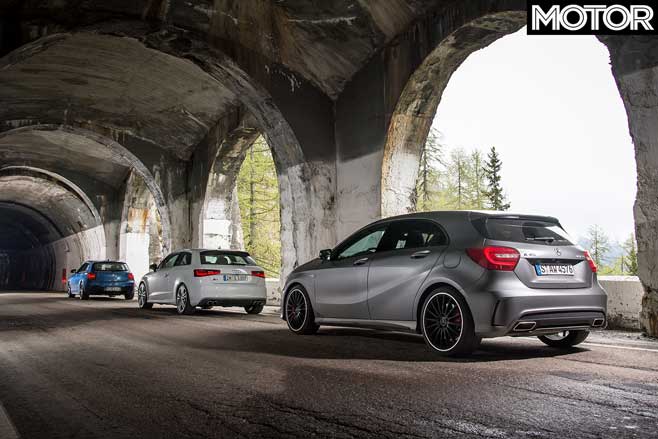
In the not too distant future, this group would have starred the 265kW BMW M2 and the 280kW Audi RS3, but right here and now the 265kW A45 AMG is facing the 221kW S3 and the 235kW M135i. Gentlemen, start your engines for a two-day no-holds-barred shootout on the Dolomites’ finest tyre-shredding, brake-eating turf.
Perhaps Mercedes should have known better and offered its silver fox clientele a less uncompromising A-class. One that looked friendlier, had a taller roofline and more rear headroom, not to mention a bigger boot and a softer suspension. Trouble is, this model already exists. It’s called B-class and it aims, by and large, at well to do pensioners with near-zero affinity to vehicle dynamics.
The target of the third-generation A-class are 30-somethings, dinks and chippies, yuppies and trendy urbanites. This audience is primarily interested in what street cred is made of: style, handling, performance and up-to-date convenience. True, the new A-class should ride better, it could do with adjustable dampers, and the dual-clutch transmission has its foibles.
But these flaws can be fixed, and the packaging & visibility issues pale against the Merc’s handling and roadholding virtues, its ability to surprise and delight, the sensation of being different from the pack in a way only Audis and BMWs used to be different.
Enter the fully loaded A45 AMG test car, a compact crackerjack costing almost as much as a naked C63 AMG. It is painted matte pewter, runs on black multispoke 19in alloys with polished flanges, and shows off the optional carbon fibre body kit which costs about as much as a six week package holiday in Mallorca. Mercifully Mercedes spared us the AMG aero treatment which makes the aforementioned Evo and Scooby look positively inconspicuous.
Pretty? Beauty is in the eye of the beholder who will likely concede that the A45 does have presence, overtaking prestige and the kind of novelty value which makes smartphones work overtime. The pursed snout is however a little long in profile, and the behind may be too broad and squashed for some liking, but the proportions are striking and there is no danger of mistaking the real thing for a tarted up A180.
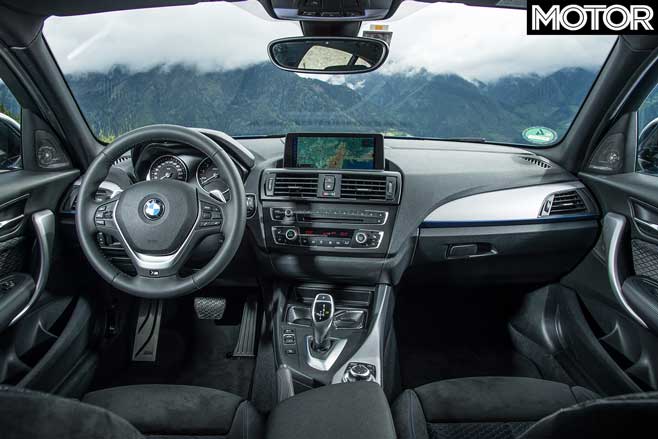
Still very much on subjective ground, we wonder how the 1 Series could ever be type-approved for daytime operation on public roads. Even in M sports livery, this is at best a mediocre piece of design which does not get any prettier when you climb into the sombre plastic wonderworld the cabin is best described as.
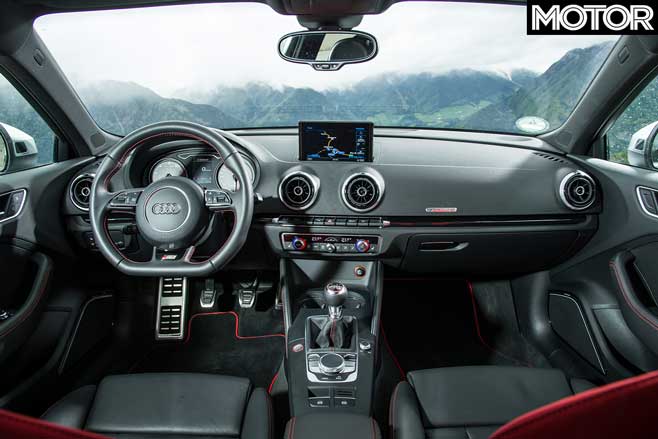
There is no doubt about it: BMW has a problem with perceived quality, which is not helped by the fact that it also affects the 3, 5 and 6 Series. While the A45 looks and feels more expensive in most places, in this respect even the Mercedes ranks one notch below the Audi which is expertly put together of classy materials.
So why is the must-have appeal of the S3 still only a 7 on a scale that stretches to 10? Because the cockpit layout is rather bland, because the three-door model fails to match the visual balance of the five-door Sportback out later this year, and because the S3 looks too much like an A3 S-line with four instead of two exhaust endpipes.
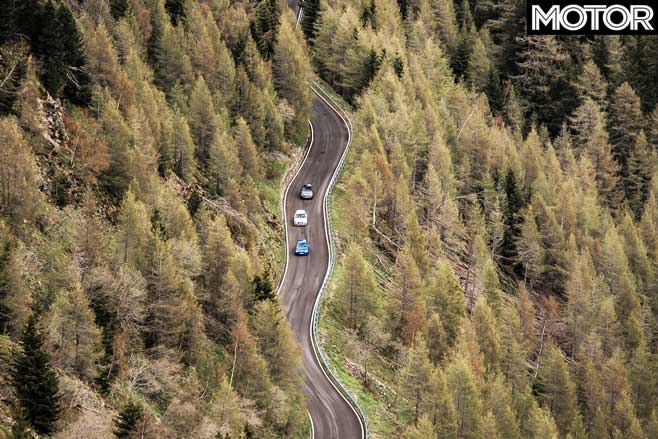
Normally in June, all passes connecting Italy to Austria and Switzerland are open, but since this spring is an autumn which has been pulled forward, evidently erasing summer in the process, we had virtually the entire alps to ourselves. Wherever a sign read Road Closed due to Snow, there was between 20 and 30 kilometres of virtually traffic-free dream territory lying ahead. Add to this a felt 50 miles of visibility, and you are on the threshold of driver’s paradise.
As luck would have it, not all cars arrived in the required specification, which resulted in the widest possible variety of drivetrain and suspension options. Our S3 was one of the very few specimen not fitted with the desirable S-tronic transmission. The manual shifter works well – short throws, positive action, pragmatically spaced gears, but at 5.2sec, it loses 0.4sec from 0-100km/h to the dual-clutch equivalent simply by taking more time to pass on the slices of the nicely stacked torque cake.
At 380Nm, the turbocharged 2.0-litre unit is not quite as well-endowed as its rivals, and yet it rolls out the dough all the way from 1800 to 5500rpm. Even dedicated clutch devotee will struggle to ignore the virtues of the S-tronic which include intuitive shift paddles, a coasting mode to be summoned in the efficiency programme, a launch control function and the loud automatic blipping of the throttle during gear changes in the dynamic programme. Maturity deficiency syndrome? Be my guest, buy an A3 2.0 TDI instead.
Our M135i came with the optional eight-speed automatic which may be not be particularly M-like but is extremely convenient. It would even be more perfect if there was a positive deterrent between park and drive to secure the lever in reverse, if the transition from sport to manual (to the left of the main gate) was less fiddly, and if coasting was part of the Eco Pro software. While left-hand drive M135i models can be specified with xDrive AWD, RHD cars can not, which is odd since the UK car configurator already lists a 120xd.
Through the countless hairpins, up steep slopes, and on a very mixed bag of winding roads, the absence of driven front wheels and a limited-slip differential looked at the beginning of our drive like a deciding dynamic deficiency of the BMW – but we were wrong. Thanks to its good dynamic weight distribution, the chip-controlled traction management and those fine composed-to-order Michelin Pilot Supersport tyres, the M car rarely put a foot wrong.
Unlike the Z4 engine which fields two parallel turbochargers and that sweet seven-speed DKG, the 3.0-litre straight six of the M135i makes do with a single twin-scroll charger and with said ZF automatic. Shaped like a Bavarian beer garden table, the torque curve plateaus from 1300 to 4500rpm at a constant 450Nm.
The discontinued Audi RS3 employed a 2.5-litre five to generate 250kW, thereby matching its closest natural enemy, the 1 Series M coupe. Only twelve months after their demise, both German kings of the fast lane would have been dethroned by the A45 AMG which squeezes 360bhp out of its turbocharged 2.0-litre engine.
Although it lacks two cylinders and 1000cc vis-a-vis the BMW, the peak twist action is an identical 450Nm. Again, full muscle is maintained over a wide rpm band, namely from 2250 to 5000rpm. To turn this torque punch into a mighty kick in the butt, the AMG engineers mated their reinforced seven-speed DKG to an aggressively tuned 4Matic driveline.
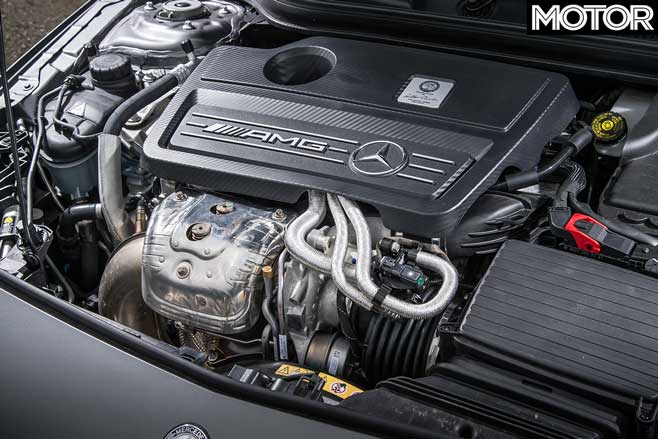
The software of the Speedshift box was borrowed from the SLS AMG GT, which is why the sportiest A-class, too, features three driving modes, a computer-generated heel-and-toe action, a racestart function and in manual/sport the same ultraquick shift times as the flagship gullwing coupe.
In C (for controlled efficiency), friends of the earth may relish start-stop and super-smooth gear changes at low revs. In S, the same process is repeated at a brisker pace. In M, you do the shifting, so don’t expect the black box to help out when the needle of the rev counter suddenly hits 6250rpm.
Good: on-demand M allows you to play the paddle piano for individual driving manoeuvres without first pushing the select button. Bad: the transmission will not accept early downshift orders. In will in fact only shift down when it reckons that the revolutions are evenly matched, which definitely takes too long on the fast approach to a slow bend.
WRX STI and Evo I-X ran turbochargers the size of an infant’s head, causing serious throttle lag followed by even more serious forward thrust. In the wake of these two wild winged warriors the motor industry has learned a lot about the art of turbocharging, virtually eliminating delay to throttle orders in the process.
At least that’s what we thought before setting off on the trails of Hannibal in these highly tuned triplets. No more turbo lag? Hop into the S3, and the ancient vice is back, large as life and annoying. The extra-cost S-tronic may to an extent cushion the effect, but in the manual version one must change down early to keep at least the bottom two LEDs of the boost gauge lit most of the time.
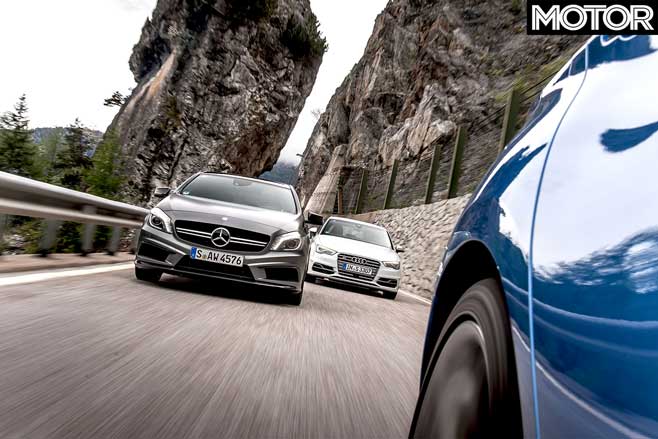
Which is a shame because after the delay there is always enough oomph on tap to zoom the car towards the next apex. It takes an adjustment in attitude and timing to step on the gas earlier so that little momentum is lost when snow white is propelling herself onto the next straight.
Perhaps this occasionally blurred communication between accelerator and engine control is partly due to the fact that the 2.0TFSI unit redlined at 6500rpm blends direct injection (at low and high load) with indirect injection (at part load). The totally theoretical claimed fuel consumption of the 1415kg Audi is 6.9L/100km.
Did the SLS-inspired A45 AMG convince us with a rapid-fire throttle response? Yes and No. In combination with the new exhaust (for reduced back pressure) and the advanced fuel injection (for improved thermodynamic efficiency), the twinscroll charger (which runs at a high 1.8bar) swings the whip hard and early.
It’s the DCT which can undermine this effort by sometimes preselecting the wrong ratio, by taking a little too long to make up its electronic mind now and then, and by occasionally triggering a counter-productive upshift. A software issue perhaps, but one that needs addressing. On a different front, the MB chips do a splendid job relaying a hackle-raising sensation of speed.
By momentarily retarding ignition and injection, they make leadfoot upshifts sound almost V8-like, they voice an angry blat-blat during downshifts, and they telegraph a catchy cocktail of charger whine and wastegate whistle into the cabin. Very artificial, but rather nice. With Racestart active, the 1555kg 265kW A-class will howl in 4.6 sec from 0-100km/h.
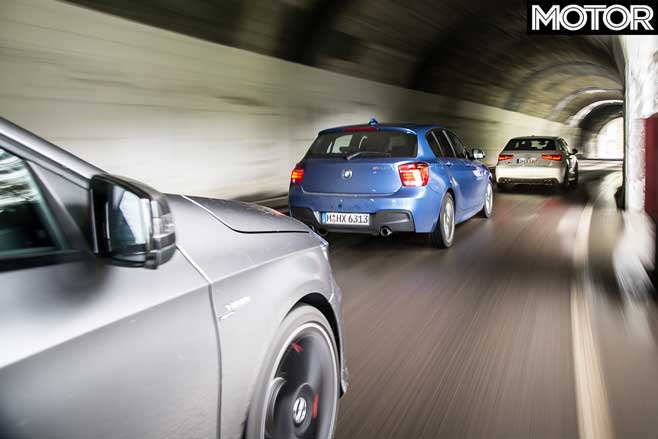
The official consumption on optional 19in rubber is 7.1L/100km. Spend a small fortune on the AMG drivers pack, and the Affalterbach power brokers will kindly raise the top speed from 250 to 272km/h which almost equals 6250rpm or the engine’s cut-out speed.
If the A45 is Darth Vader on the prowl and if the S3 is Zorro on his day off, then the M135i is Robin en route to lunch with Catwoman. Forget the German hot hatch competition, forget the Japanese Playstation connection, forget the fact that there is an M in this BMW’s model designation.
Marketing calls these niche models M Performance Automobiles (MPA), and that’s exactly what the M135i is: M make-up plus a performance engine and chassis, all wrapped up in the clothes of a compact gran turismo.
Believe it or not, but the high-end 1series makes the charismatic M coupe pale in more ways than one. How come? Because the halfbreed M car is benign instead of brutal, cosetting instead of crash-bang hard, relaxed instead of highly strung, easily accessible instead of radically focused.
For a start, the 235kW in-line six runs out of revs at an unambitious 5800rpm, it takes a relatively leisurely 5.1sec to satisfy the stopwatch squad, and its on-paper consumption is a comparatively unexciting 8L/100km.
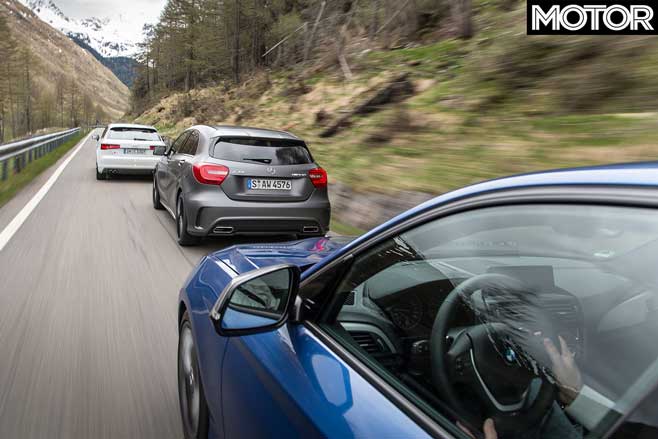
On the credit side, any trace of turbo lag disappears inside the fantastic ZF box, the mighty mid-range urge puts the four-cylinder competition into perspective, and there are absolutely no artificial ingredients involved in making this 3.0-litre motor sound spine-tinglingly good when the mixture gates open.
The BMW also is clearly the most comfortable car in this group. Even with the driving experience selector in sport or sport plus, the suspension will soak up most vagaries with a smile. Like the Audi, the BMW is available with three or five doors, and with manual or let-me-do-this-for-you transmission.
Included in the standard M pack are 18in wheels with 225/40 tyres up front and 245/35 footwear in the rear, sports suspension, sports brakes and variable-rate sports steering. The M135i was our number one choice on the poorly maintained Italian autostrade, but it is a touch too laid back to bring your blood to the boil on those memorable alpine special stages.
The brakes are furthermore on the soft side when pushed, the quick steering (only two turns from lock to lock) feels overdamped and undertransparant, and there is more roll and pitch and dive than we expected from a 1 Series model wearing the M badge.

Grip on the other hand is astounding in the dry, traction is only an issue when you ask for it by switching off ESP, and the stability through very quick uneven corners is supported by the nicely compliant spring and damper setting. So, full marks for ride quality, panache and refinement, but only 3.5 stars out of five for absolute sportiness and driver involvement.
Especially at a 10/10 pace, the S3 is even easier to drive than the BMW, which in turn feels significantly softer edged than the 1 Series M. While the M135i will want to understeer into a corner and oversteer at the exit, the Audi goes round bends like a slot racer with a second pin between the rear wheels. Neutrality is the name of its game, modularity ranks only second on its priority list.
Boring? Wrong term. The S3 rewards its driver with a different potpourri of talents. The roadholding is for instance so tenacious that we checked the Conti Sportcontact tyres (225/40 R18 all round) for magnetic metal flakes and hidden velcro strap fragments. The steering, overly light and a little mum, nonetheless turns honing the line into a surprisingly entertaining pasttime.
The attentive and easy to modulate brakes are strong enough to push the point of no return way past the apex. Thanks to these super-sharp anchors, the reassuring tyre grip and a guardian angel named quattro, the 221kW S3 can up to a point stay in touch with its 235 and 265kW challengers.
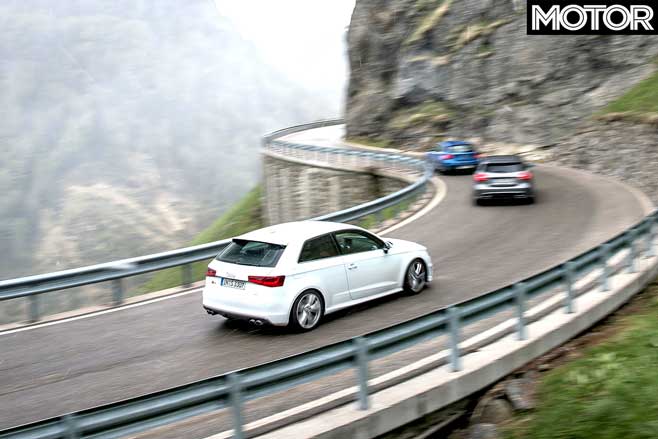
Eventually, the gap will widen and the Audi will drop back, still gracefully maintaining its composure. The car from Ingolstadt is tight-lipped, monosyllabic and reserved, strangely robotic in the way it performs, and flawed in its ability to turn a near-faultless performance into a tangible feelgood experience.
The A45 AMG is not just engine and badges and butch looks. It also boasts a heavily revised front and rear suspension with firmer mountings, recalibrated springs and firmer fixed-rate shock absorbers, fatter anti-roll bars and a reduced ride height.
Also new are the variable-effort but constant-rate steering, the high-performance brakes with ventilated and cross-drilled discs all-round, the more lenient stability control, and the latest-generation 4-Matic which diverts up to 50 percent of the torque to the rear wheels. The price you pay for all these goodies is about 20 percent higher than what Audi and BMW charge you for their best efforts.
We say the Mercedes is worth the premium – simply because it is the more exhilarating drive. The engine delivers quantifiable extra urge with real authority, the steering fuses input and feedback to a wonderfully three-dimensional level of control, four-wheel drive distributes torque with the eerie professionalism of a poker ace dealing his rounds, and the brakes bite with vigour and determination until, at the foot of the pass, smoke signals beg for mercy.
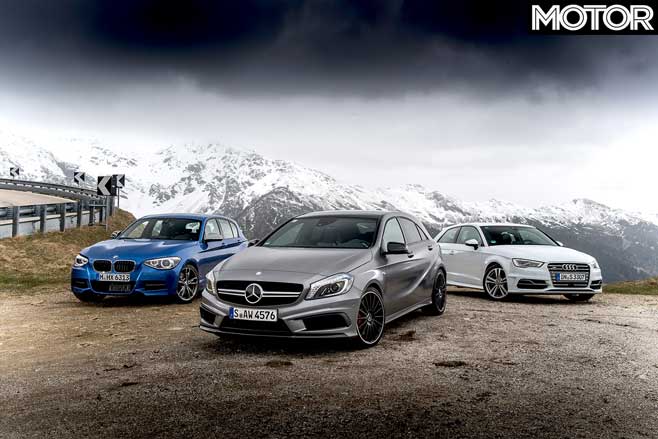
The A45 AMG is as chuckable as it is sure-footed. It can corner on three wheels, decelerate at a ridiculous yaw angle, put the power down even earlier than the Audi. What it cannot do is ride well, period. Even on smooth blacktop, it is patently obvious that eiderdowns were not on the shopping list.
Would the M135i have won if it looked better and felt more special inside? It might have come closer, but it would still be more of a GT than a GTS. Would the S3 have won if Audi managed to remove multiple layers of indifference and artificiality from what is, in essence, a solid concept? We would love to see the Quattro division succeed in making good cars great again, but the S3 (and the RS6) are tuned primarily for perfection, which is seldom synonymous with excitement.
So after 48 hours, 645 kilometres, 269 litres of four-star and three fresh shirts, the A45 AMG takes the trophy ahead of the BMW and the Audi, off-putting price tag and compromised packageing notwithstanding. The M135i feels like a neatly spiced up 1 Series, the S3 feels like an S-line A3 with more poke.
In contrast, the A45 feels more AMG than A-Class, more special than mainstream, more bespoke than bespoilered. For the time being, this Mercedes rules the microcosm that was once owned by Scooby, Mitsu & friends. But as soon as the M2 and the next RS3 are ready to pick up the gauntlet, we shall return to the big skies and to the dream driving roads for an encore.
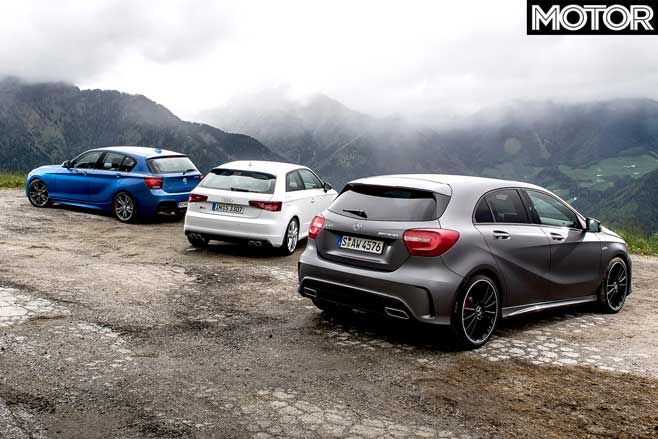
BMW M135i
Love: Engine, transmission, ride Hate: Design inside and out, not really an M car
Rating: 4 out of 5 stars Verdict: Wait for the facelift out next year
Audi S4
Love: Quality, refinement, infotainment, quattro Hate: Bland looks, bland dynamics, not really an S car
Rating: 4 out of 5 stars Verdict: Wait for the Sportback, buy an S-tronic
Mercedes-AMG A45
Love: Engine, noise, appearance, handling, roadholding Hate: Ride, price, transmission idiosyncrasies, instruments
Rating: 4 out of 5 stars Verdict: The real McCoy, soon also available as CLA and GLA
Lotus has yet again shaken up its parts bin to produce the latest in a long line of mid-engine sportscars with consummate track-day cred.
While the whole Club Racer formula is nothing to the Lotus brand, its application creates a desirable limited-edition coupe-only variant of the already ferocious Exige S, launched here in 2013.
Powertrain-wise, the Club Racer retains the same Toyota Aurion 3.5-litre V6 shared with boosted with an Aussie-designed Harrop supercharger, with outputs maintaining the regular S’s 258kW and 400Nm.
What’s new, however, is the 1161kg weighbridge ticket, skimming 15 kilos off the regular S through a gram reduction strategy to the doors, centre console, seat shells and battery.
The Club Racer also features the S model’s aggressive aero addenda that includes a specific front splitter, rear wing and flat underbody treatment the combines to contribute a claimed 42kg of downforce at 160km/h.
The Club Racer is claimed to sprint to 100km/h from and standstill in 4.0sec and has a v-max of 274km/h.
Standard fitment is a three-mode “traction slip threshold” controller for the electronic chassis smarts that a driver can tune to his or her liking.
While the Club Racer is hardly Lotus stepping outside its comfort zone, the new variant asks for a very modest premium over the regular Exige S in the UK market.
It remains to be see if the Club Racer will make the trip across the pond and how far beyond the Exige S manual’s $152,990 it’s likely to breach.
Get your free weekly report from the world of fast cars – subscribe to the MOTOR newsletter!
WATCH out, Honda Civic Type R and Renaultsport Megane, there’s a new kid in town. Meet the hottest-looking hatchback to ever roll out of a showroom – the Toyota Corolla Altis ESPORT Nurburgring Edition
On sale in Thailand from April 1, surely this CVT-shod corner carving Corolla is an April Fool’s joke. Google Translate tells us that the newly launched Corolla Altis ESPORT Nurburgring Edition – which is believed to have been once shown a picture downloaded from the Internet of the punishing German track – is made as a “new alternative to customers who love a challenge and need inspiration. Especially those who love to drive a joyful mood in driving the Corolla Altis S”. That’s a clearly defined customer, then.
Along with beefed-up (or is that hammed-up?) suspension, the Corolla Altis ESPORT Nurburgring Edition – which is yet to boast its improved dynamics by carving its way around the Carousel at the car-breaking German track – gains a sporty ground-effect aero pack that “reduces air resistance and reduces fuel consumption”, a Nurburgring sticker, LED headlights and daytime running lights, and special 17-inch alloys. Note that the previous record-holding hatches didn’t need the sticker, ran bigger wheels and made no mention of fuel economy …
The Corolla Altis ESPORT Nurburgring Edition – which is yet to set the infamous German track alight with the snap and crackle of its atmo 1.8-litre four-pot – uses a continuously variable transmission (don’t all hot street cars?) “that is customised to add emotion to drive the sport even more”. There’s not a dual-clutch or a manual gearbox in sight.
Still, it gains paddle shifters behind a steering wheel featuring red stitching highlights along with bucket seats and a red strips running along the piano black dash, with an immeasurable performance gain no doubt.
If it ever makes it to the Nurburgring, the Corolla Altis ESPORT Nurburgring Edition will need to fight for the front-wheel-drive record recently broken by a roll-caged production version of the now-turbocharged Civic Type R, which sits at 7min 50.63sec. Our bet is it’s more suited to the car park nestled snuggly between caravans and bratwurst stands, as its ability to carry fireworks is much more realistic than its ability to create them…
The super hyped-up Corolla is available in either black or white, as contrasting tones as the idea that this thing can tackle the Nurburgring with any ounce of poise, grace or credibility. Oh what a feeling.
The rare Lamborghini Miura P400 that car fans have long presumed was destroyed in the opening scenes of 1969’s The Italian Job has been unearthed still in mint condition.
According to reports and pictures from The Daily Mail, late last year two British businessmen were invited to inspect the orange Miura alleged to be the genuine celluloid legend garaged in storage in a Parisian underground car park.
After verifying the car’s authenticity, the pair bought what co-owner Iain Tyrrell calls “the holy grail of supercars” for an undisclosed amount, though the pristine Lamborghini is said to be valued at in excess of $AU1.9million.
The car stars in first three minutes of The Italian Job, climbing a pass in the European Alps during the opening credits, when it enters a tunnel and collides in to a bulldozer.
In a segue that has shocked car lovers for nearly half a century, the damaged, orange example of what’s widely considered the most beautiful supercar ever built is then completely destroyed after it’s pushed off the mountainside and into a river.
Tyrrell, who owns a classic car company, has validated his new purchase as genuine using the archives at Lamborghini – it transpires that SantAgata supplied two vehicles for the film, one for driving sequences and another damaged example for the ‘bulldozer sequence’.
Hired by Paramount Pictures for filming, the Miura was subsequently sold to a dealer, its custodianship thereafter tracked, though the car’s whereabouts after the mid-2000s became something of a guarded secret.
Around 740 of the original mid-V12-engined supercar were produced in its seven-year production between 1966 and 1973, many highly individualized – it’s claimed that various unique interior features of Tyrrell’s car support validation of its ‘legendary’ providence.
The original 1969 The Italian Job, starring Michael Caine, is regarded as one of the great car movies of all time and contains a legendary three-Mini getaway car chase scene considered one of motoring’s finest celluloid moments.
Tyrrell and co-owner Keith Ashworth plan to put the car on a global roadshow.
The actual crashed Miura is said to have disappeared, presumed stolen, shortly after its famous sequence was filmed.
Get your free weekly report from the world of fast cars – subscribe to the MOTOR newsletter!
The all-new Mercedes-Benz E-Class undergoes its final shakedown in preparation for a late-2015 unveiling with more space, better efficiency and straight-six engines
THE NEXT-GEN Mercedes-Benz E-Class will be unveiled by year’s end, ahead of a mid-2016 Australian debut, as these near production-ready prototypes of the Audi A6 and BMW 5 Series rival allude to.
Looking very much like the lovechild between the smaller C-Class and S-Class flagship, the W213 E-Class sedan as well as its T213 Estate wagon sibling also snapped here ditch the angular fussiness of their outgoing, 2009-vintage W212 predecessors for elegant proportions and aero-aiding curves.
Employing a longer and wider variation of Mercedes’ aluminium-intensive MRA Modular Rear-drive Architecture that was first used in the W205 C-Class in late 2013, the 10th-generation E-Class will be the biggest in the models’ near 65-year history. Its stretched wheelbase promises to provide unprecedented levels of interior space and despite the growth spurt, overall weight should match the smaller current model’s mass.
The big Benz also adopts a rollcall of S-Class-derived advanced driver tech, including sophisticated active crash-avoidance systems to make it one of the safest cars on the planet. Flanked by twin bars in the scoop shots, that’s what that big black plastic circle in the middle of the grille is hiding. Up-spec versions also adopt trick adaptive dampers combined with air suspension to help offset the inevitable 20-inch-plus wheel and tyre packages.
Cue surprise face: this will also be the greenest E yet, with a variety of e-motor electric hybrids on the menu as alternatives to the direct-injection four and six cylinder turbo petrol and diesel powerplants on offer. And, at last, the six-potters are said to revert to the classic in-line configuration not seen in this sized Benz in nearly 20 years, burying the ageing V6s forever. For Australia, expect to see the new-fangled nine-speed 9G-tronic torque converter auto on most models.
A peek inside the prototype’s cabin reveals a very C-Class inspired dashboard with more than a big helping of S-Class-style piano key like switchgear and twin monitors, dissected by a quartet of metallic air vents and COMAND rotary controller. All aim to exude the brand’s obsessive attempt to restore bank-vault quality to the series.
Along with the inevitable E63 AMG replacement – which will switch from the 5.5-litre twin-turbo V8 to a development of the 4.0-litre bi-turbo V8 from the Mercedes-AMG GT – the 2016 E-Class will also spawn the predictable coupe and convertible, as well as a third-gen CLS coupe sedan offshoots. Furthermore, the Mk4 version of the GLE SUV (formerly known as the M-Class) will also spring off the MRA componentry. Rumours are also circulating that an R-Class replacement may also surface with three-row seating.
But it is the base sub-2.0-litre four-pot turbos that will be the breadwinners for the three-pointed star Down Under, with the E200 replacement set to start off under $80,000 when it arrives later in the second half of next year.
The W213’s exact launch timing remains a secret, with speculation suggesting that it may debut as soon as at this September’s IAA show in Frankfurt, though other sources reckon that a Geneva reveal next March is more likely.
Whenever we see the new E-Class, 2016 promises to be a vintage year for the large executive sedan (and wagon) market, with the second-gen Jaguar XF imminent, while the next-gen BMW 5 Series expected to debut internationally before 2017.
Have spy pics of your own? We’d love to see them. Just email them to [email protected]
