
Henry Ford famously said, “A customer can have any colour… as long it’s black”, but it wasn’t because he was a sombre soul. Slow-drying oil-based paint was problematic in the early days of car manufacturing.
Colour pigments were expensive and tended to fade quickly. In the search for ways to simplify the process for mass production, Ford developed an asphalt-based enamel which pushed the palette to dark tones.
Technology soon overcame these issues and colour began to play an increasingly critical role in showroom appeal.
In the 1930s, the precursor to metallic paint was an expensive process that actually contained crushed fish-scales to create an iridescent effect. A more practical solution of aluminium flakes soon followed.
The post-war period of the 1950s saw a kaleidoscope of colour combinations, including pastel yellows, teals and even pinks. Metallics and two-tone paint schemes become hugely popular and set the scene for decades to follow.
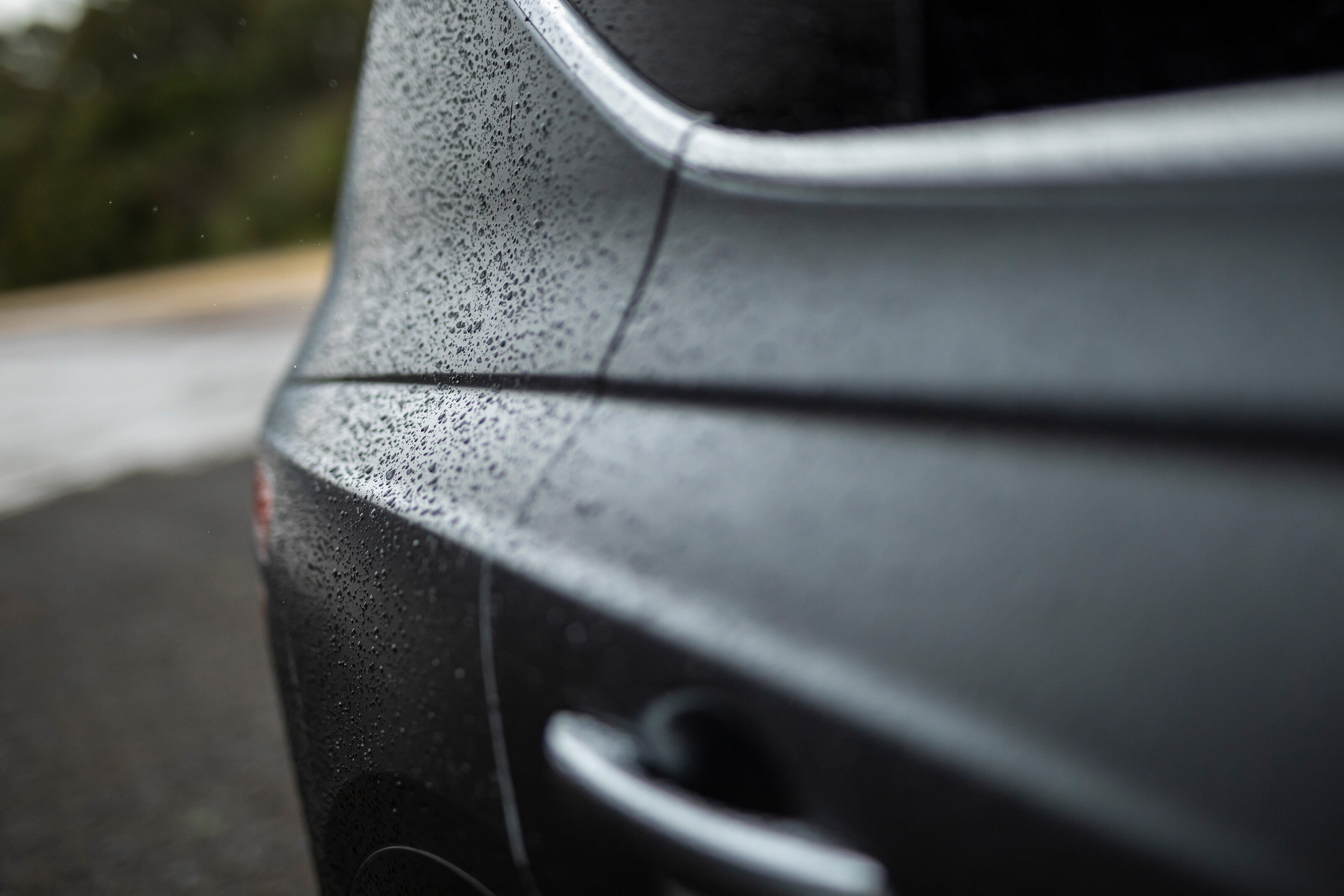
It’s unsurprising that white is the most popular colour, and a few pragmatic reasons come to mind.
During the muscle-car period of the 1970s, there were vibrant yellows, oranges and purples. They were contrasted with black or coloured stripes and graphics, creating a powerful statement of individuality. But where are they today?
It’s unsurprising that white is the most popular colour, and a few pragmatic reasons come to mind. Firstly, it’s absolutely neutral and requires no justification. It’s also the least expensive to produce and maintain, unless it’s a pearlescent variant. In hotter climates, white is an obvious choice.
Given many vehicles on the road are leased and operated by companies, white is the safe option for resale. Indeed, resale probably explains why all of the grey-scale colours are popular overall.
Most private buyers are often afraid to indulge in a vibrant colour for fear of a poor return on their investment. We are also too lazy to keep them clean.
Even when we do stray into the colour space, light to mid-metallic blues tends to be next most popular, but you wouldn’t call that daring.
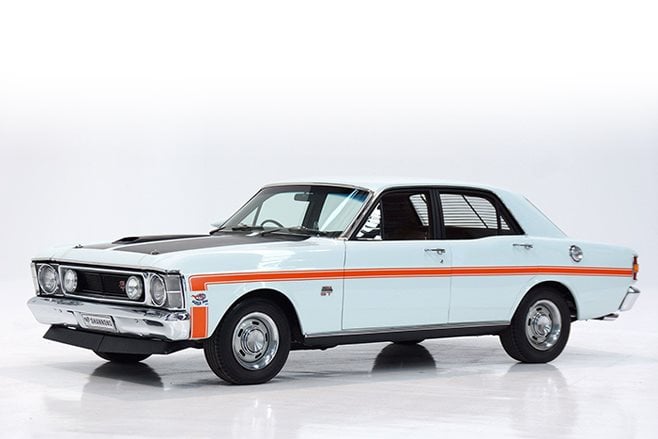
… the precursor to metallic paint was an expensive process that actually contained crushed fish-scales to create an iridescent effect.
Electric vehicles follow the same pattern, as there’s a perception that white, silver and blue are allied with technology and electrification.
However, we do see different results according to segment. Small cars offer more colourful options, as they are seen to be more youthful and playful whereas mid to large sedans and SUVs tend to be more serious and this is where we see the silvers and greys become dominant.
Modern paint technology has given these monotones a rich and lustrous look, which does make a car look luxurious, albeit bland.
Luxury cars are also predominantly silver or black, but they are also well-suited to deep and regal looking reds, blues and even greens. Vibrant colours on luxury cars are best reserved for American rappers or Saudi sheikhs.
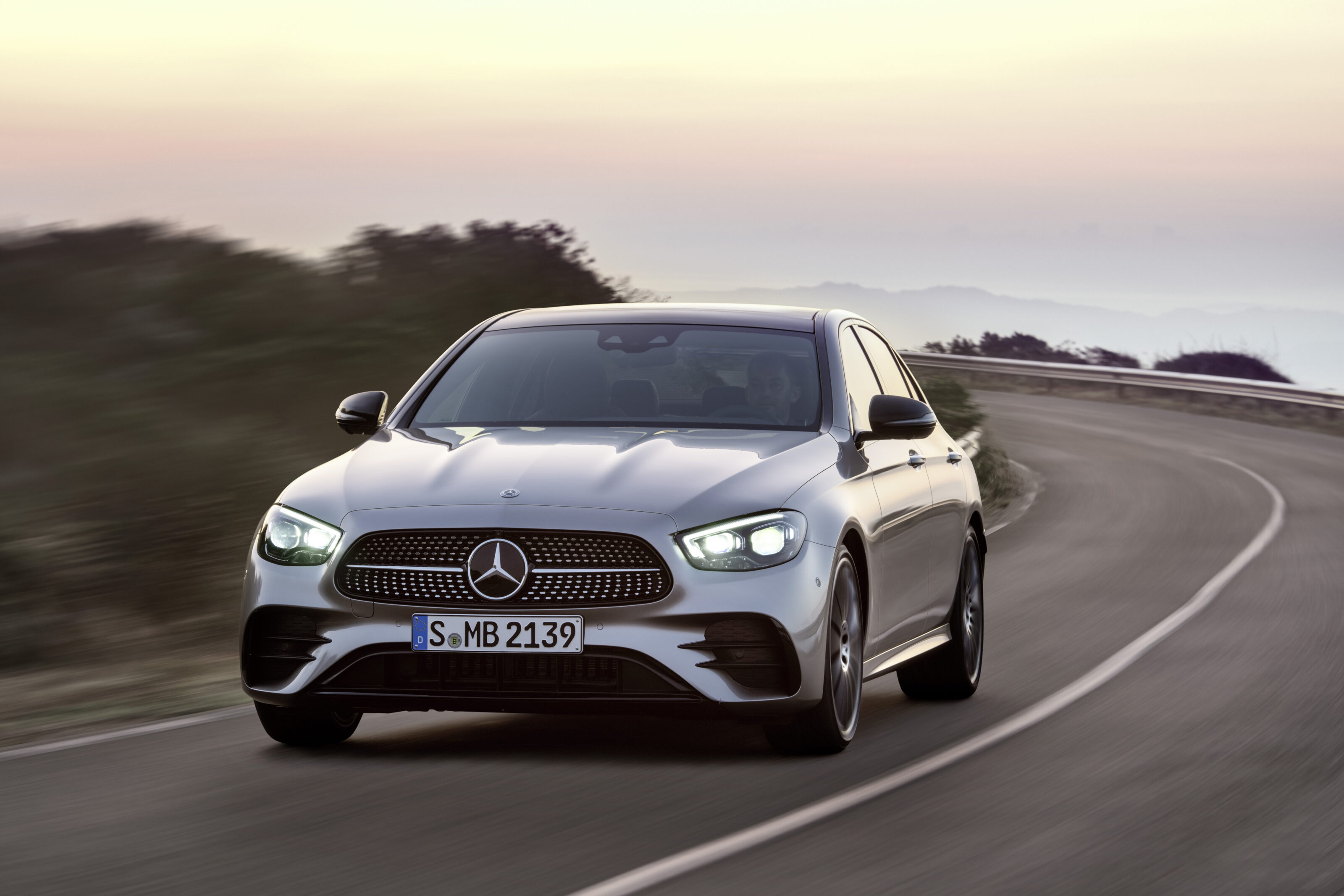
Sports cars are a different story and no prizes for guessing that red, orange and yellow are more popular here. Despite this, silver remains statistically more popular, but I suspect this can be attributed to the higher volume of German sports cars, which tend to be silver. More red Ferraris please! (Just wait until the Purosangue launches… – Ed.)
Carmakers have learned that the neutral, white and grey-scale palette is here to stay and accordingly will focus a lot of energy in developing rich finishes in this space.
But they will always add a few vibrant ‘hero’ colours which may only sell in very small numbers but serve a valuable role in attracting our attention on the road and hopefully draw us into the showroom. It’s then up to us to be brave enough to order the ‘Rainbow Sangria’ option over the ‘Vanilla Shake’.
Richard Ferlazzo is the former GM Holden Design Director
Sometimes heroes can come from the unlikeliest of places. Take the 2022 BMW 220i coupe as a prime example, which we can all now admire as an inspiration for assured self-confidence in the face of a baying mob.
If you don’t want to be wrong, it’s important that you consider your opinions carefully when it comes to the entry-level BMW coupe.
The straight facts on the 220i are such: it’s the cheapest BMW sports car you can buy today, offered to the public for $61,900 before on-road costs as the entry point to the G42 2er family (sitting below the peachy but nearly $100K M240i xDrive).
It uses a 2.0-litre turbocharged four-cylinder petrol engine to send 135kW and 300Nm to the rear tyres through a silky smooth eight-speed torque converter auto.
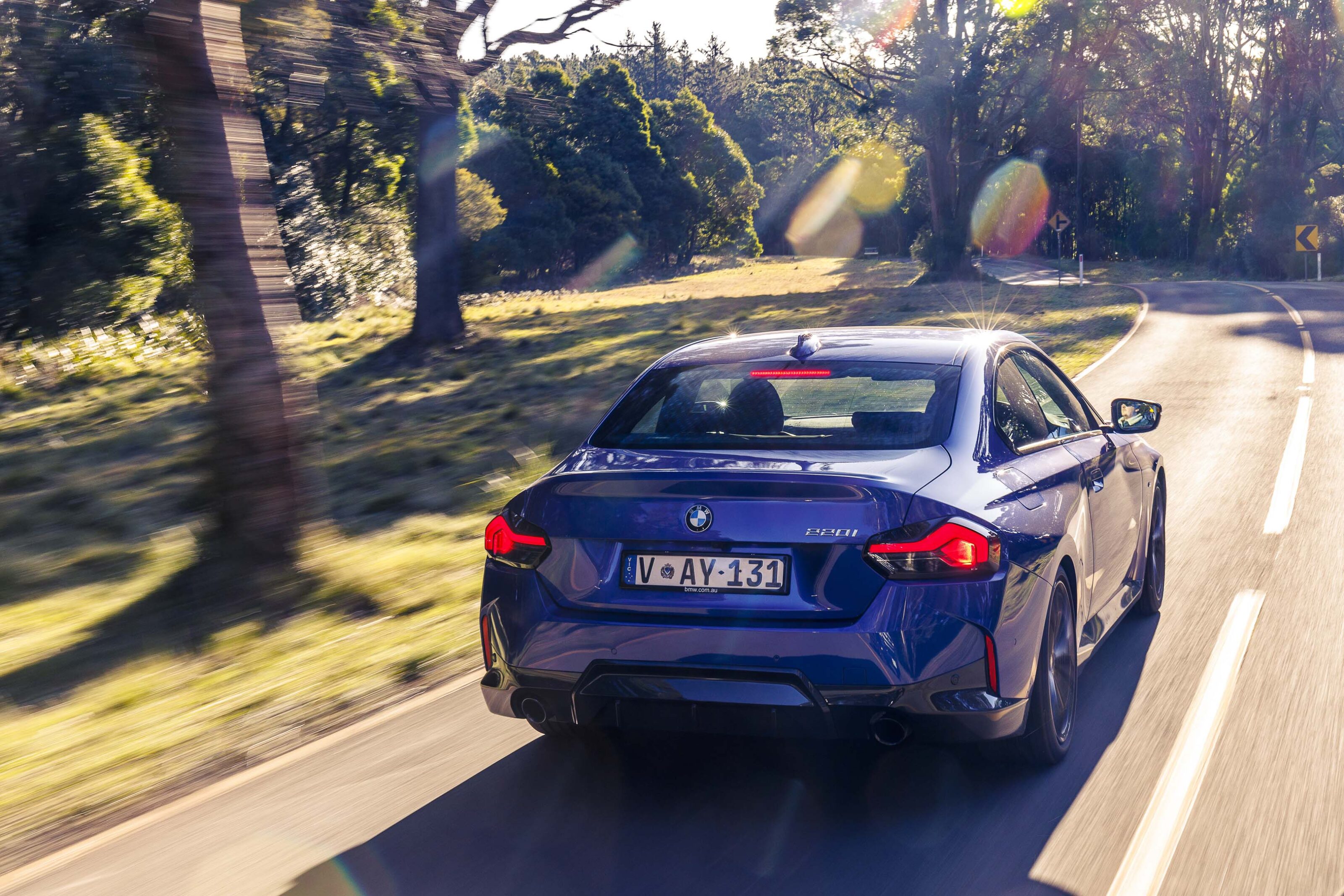
Inside, the cabin is spacious for its handsome two-door form, with a 2+2 configuration making it as practical as you could expect from a small coupe. This is reality, not perception.
As such, all things considered, the collective view of the 220i should overall have a rosy tint, no? Not to the baying mob. For that hive-minded collective, all things BMW are dreadful, the 220i no exception.
You see, the cult of criticism has BMW in its sights for a slew of perceived transgressions, ranging from heated seat subscriptions to bold grille designs. For the 220i, much of that unhappiness is centred on the engine. The online cacophony would have you believe it is ‘straight-six or bust’ for BMW sports cars.
The E30 M3 begs to differ. Back in the present, though, the B48 is a sweet unit that balances its performance requirements nicely with day-to-day useability. Its outputs of 135kW and 300Nm aren’t headline-grabbing, but perfectly enjoyable in the real world.
Lean on the B48 and it revs happily, thrusting the 220i down the road in a way that’ll put a smile on your face without also immolating your license.

We would like a little more perhaps in terms of character from the exhaust, though, which can be a bit one-note in its tenor.
The 220i proves there’s more to sports cars than outright power. Horsepower fetishists need not apply. Think of the little BMW coupe as a premium version of the driving style celebrated by the Subaru BRZ and Mazda MX-5 – and if you know anything about that pair, you know we mean that with sincere positivity. Flow and momentum is the name of the game.
Like that Japanese duo, the 220i teases you into this cat and mouse game where you try and scrub as little speed as possible heading into a bend, using the surprising front-end bite to tip in at pace, finding the apex and getting onto the throttle as early as possible.
Unlike its siblings the M2/3/4, you aren’t dancing on an oversteer-prone knife’s edge with the 220i’s throttle.
Lean on the B48 and it revs happily, thrusting the 220i down the road in a way that’ll put a smile on your face without also immolating your license.
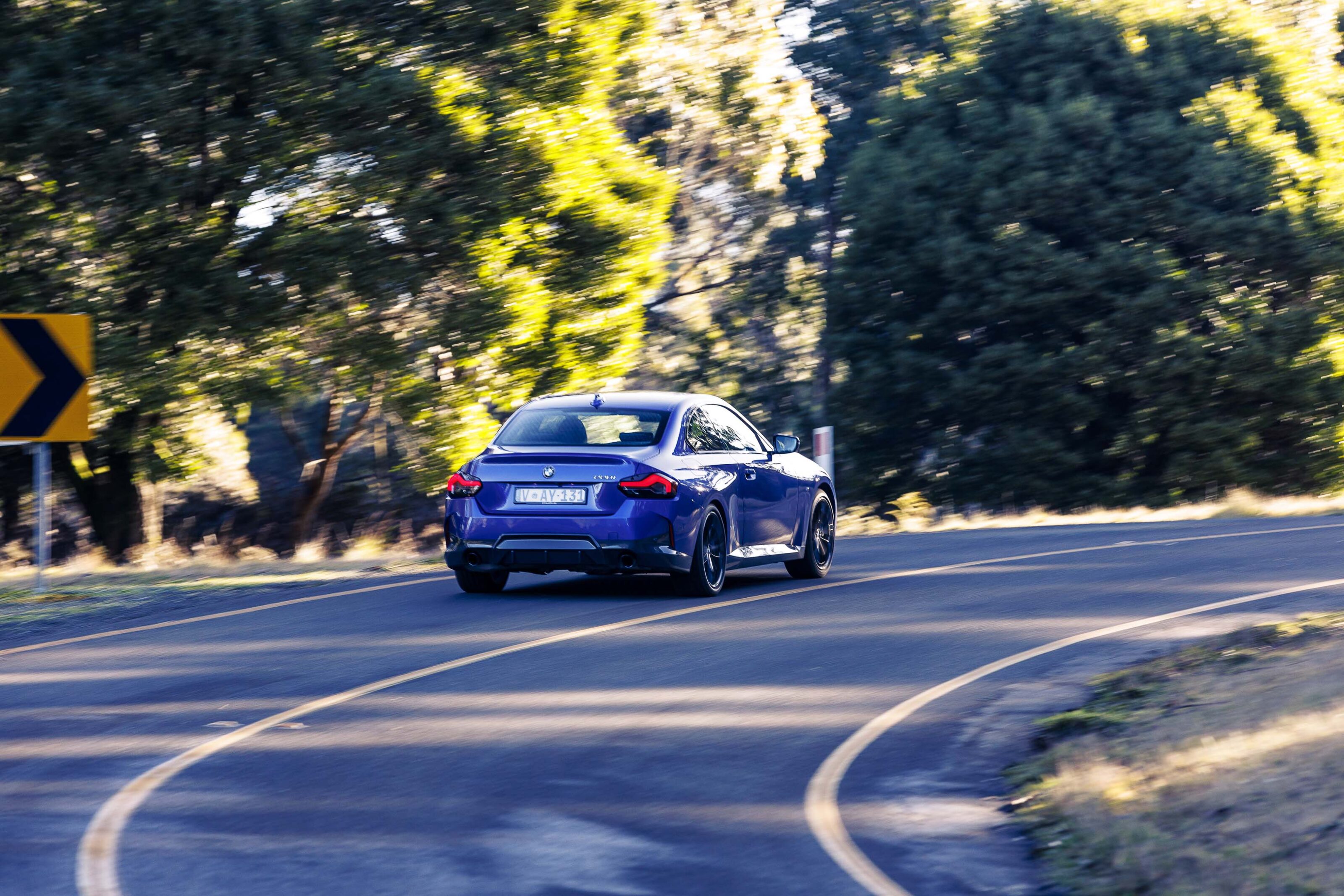
There’s a good amount of torque, and the 135 kilowatts are readily available but relatively modest, without leaving the car feeling underpowered.
Instead, you get to relish what is a well-sorted and balanced chassis. There’s plenty of mechanical grip to plunge into, and the suspension maintains impressive body control without being as rigid as a torture device. In fact, the damping is more aligned with everyday use, and all the bumps, potholes and bitumen imperfections that come along with such duty.
Complementing this are the goldilocks proportions of the current-generation 2 Series. Not too small, not too big, it fits wonderfully in even tight urban lanes, allowing you to drive it without staring at the mirrors as anxious sweat pours off your brow.
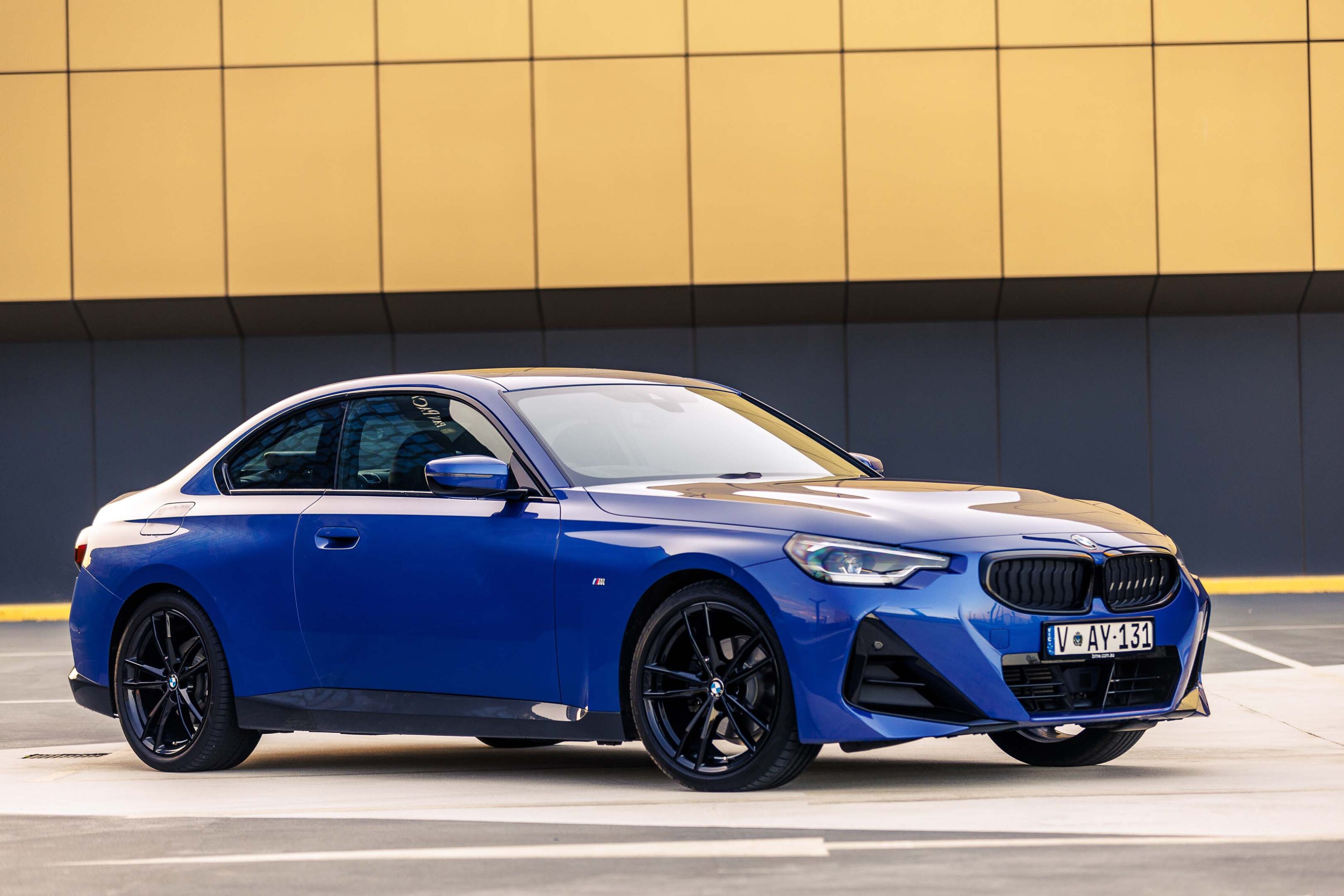
The biggest shortfall dynamically is the steering, which while having the requisite weight that gives the car a feeling of purpose in your hands, is bereft of feeling. Sharp and immediate off centre, the steering does also suffer from more artificial springiness than we’d like.
Special mention to the part leather, part suede seats, which offer exemplary cushioning, with plenty of bolstering that doesn’t impede you every time you attempt to enter the cabin.
On that note, for the money, the 220i offers a well-appointed interior and standard specification. For no additional outlay, you get M Sport styling (no bargain basement visuals here), 17-inch wheels, LED headlights and taillights, interior ambient lighting, a wireless phone charger, wireless Apple CarPlay and Android Auto, head-up display and dual-zone climate control.

More luxurious items are hidden in optional bundled packages. The $3400 Comfort Package adds heated seats, a heated steering wheel, electric front seat adjustment with driver’s side memory function and the convenience of proximity key entry.
Another $3400 adds a suite of extra driver assist features like adaptive cruise control, and $3000 upgrades the standard six-speaker sound system to a 14-speaker Haman Kardon set-up.
Perhaps most inspiring about our time with the 220i coupe was how useable we found it day-to-day, rather than the fact it was a surprising amount of fun to thrash. If you are comfortable with its proper coupe proportions, the 220i is a compelling everyday proposition.
Even for a two-door, the little Beemer offers plenty of space inside rather than feeling tight and cramped. The rear seats are useable from time to time for adults as well.

VERDICT
The BMW 220i isn’t the final word in sports car perfection, but it’s a worthy part of the line-up, and Australians are fortunate it is available locally.
Boiled down to its finest points, our assessment of the cheapest BMW sports car is that it is well-balanced.
It maintains an equilibrium of everyday utility with grin-inducing dynamics. If you are looking for an affordable way into BMW sports car ownership, the 220i M Sport is a convincing proposition.
Drive it and relish the wave of smugness that you are someone willing to defy the mob of wrong.

2022 BMW 220i specifications
| Body | 2-door, 2+2 coupe |
|---|---|
| Drive | rear-wheel |
| Engine | 1998cc inline 4, dohc, 16v, turbo-petrol |
| Transmission | 8-speed automatic |
| Power | 135kW @ 6500rpm |
| Torque | 300Nm @ 1350-4000rpm |
| Bore stroke (mm) | 82.0 x 94.6mm |
| Compression ratio | 11:01 |
| 0-100km/h | 7.5 sec |
| Fuel consumption | 6.3L/100km |
| Weight | 1490kg |
| L/W/H | 4537mm/1838mm/1390mm |
| Wheelbase | 2741mm |
| Price | $61,900 ($69,700 as tested) + on-road costs |
September 2, 2022: Plug-in hybrid power coming to Ranger in 2024
Ford will add a plug-in hybrid version of the Ranger to the Aussie line-up in 2024.
We’ve known for a while that a hybrid version of the popular dual-cab is coming and camouflaged test mules with hybrid powertrains have been snapped by spy photographers in Europe.But what we didn’t know was what kind of hybrid system the Ranger would use: a traditional battery-electric ‘series hybrid’, or a plug-in set-up with a larger battery and longer pure electric driving range.It’s the latter that’s shaping up as the most likely with Ford insiders hinting a plug-in offers better efficiency and greater usability for dual-cab buyers. A plug-in’s larger battery can be used to power tools and other accessories, for example.
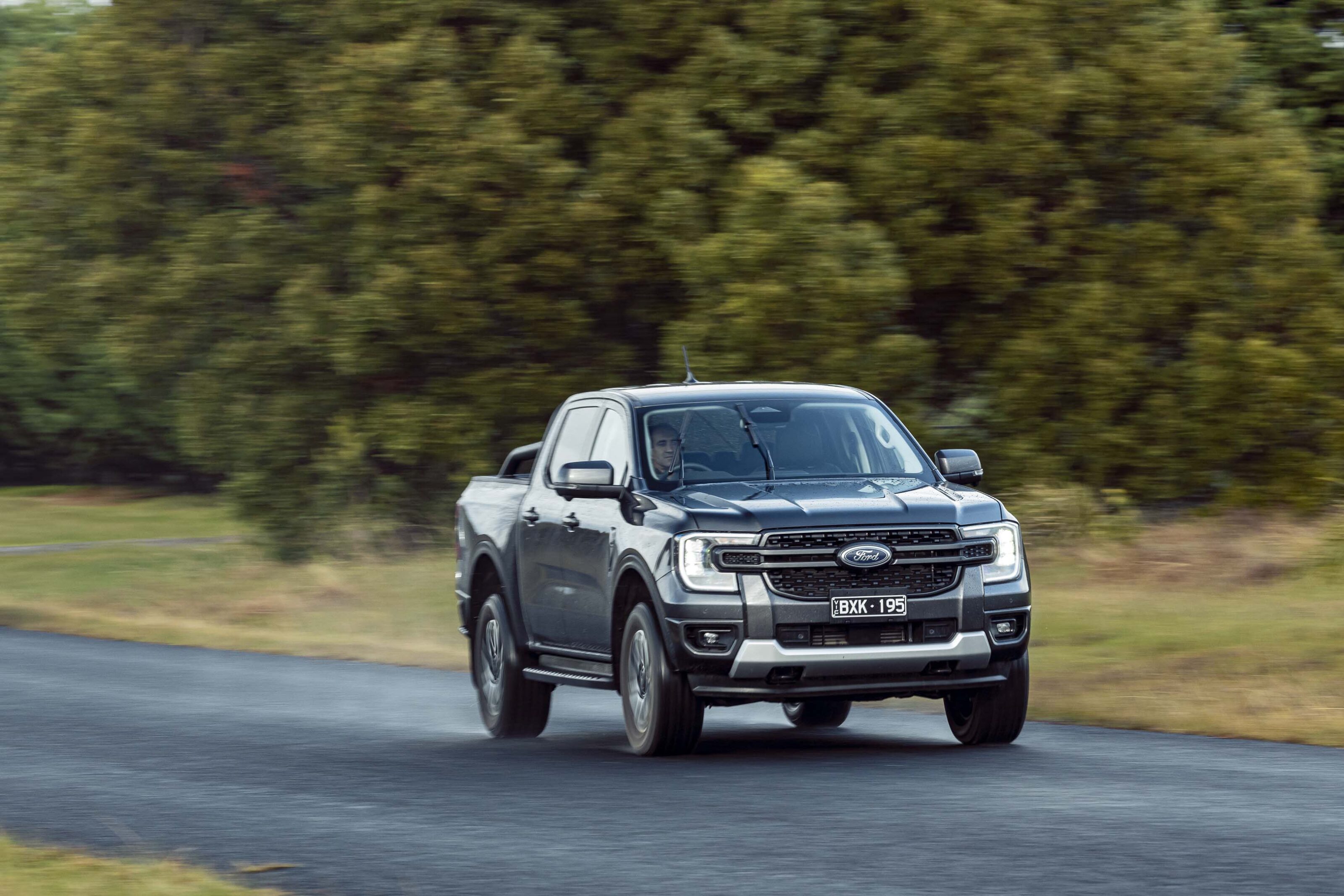
Wheels understands the plug-in Ranger will be the fifth model in Ford Australia’s promise to offer five electrified cars by the end of 2024. The other four will be the Mustang Mach E and three already confirmed variants: the Escape PHEV and two versions of the E-Transit van. It’s also possible a plug-in powertrain will join the new-generation Everest line-up given it shares the same T6 underpinnings as the new Ranger, although Ford Australia’s boss Andrew Birkic wouldn’t be drawn on the topic when asked at the Everest’s Australian launch.“What we’ve said publicly is we’re future-proofed for a form of electrification so that’s the only statement we’ve made,” said Birkic.Ford’s competitors are also working on hybrid versions of dual-cab utes. Nissan is developing a plug-in version of the Navara, for example, but Birkic remained diplomatic when asked if Ford wants to be a leader in electrified dual-cabs in Australia.“Certainly we’re going to see evolution and Ford continues to invest in electrification globally, he said. “Our compass needs to be about the customer. Particularly with pick-ups and trucks. There’s towing and carrying, so development needs to be built around customers and their usage patterns. It has to be customer led.”
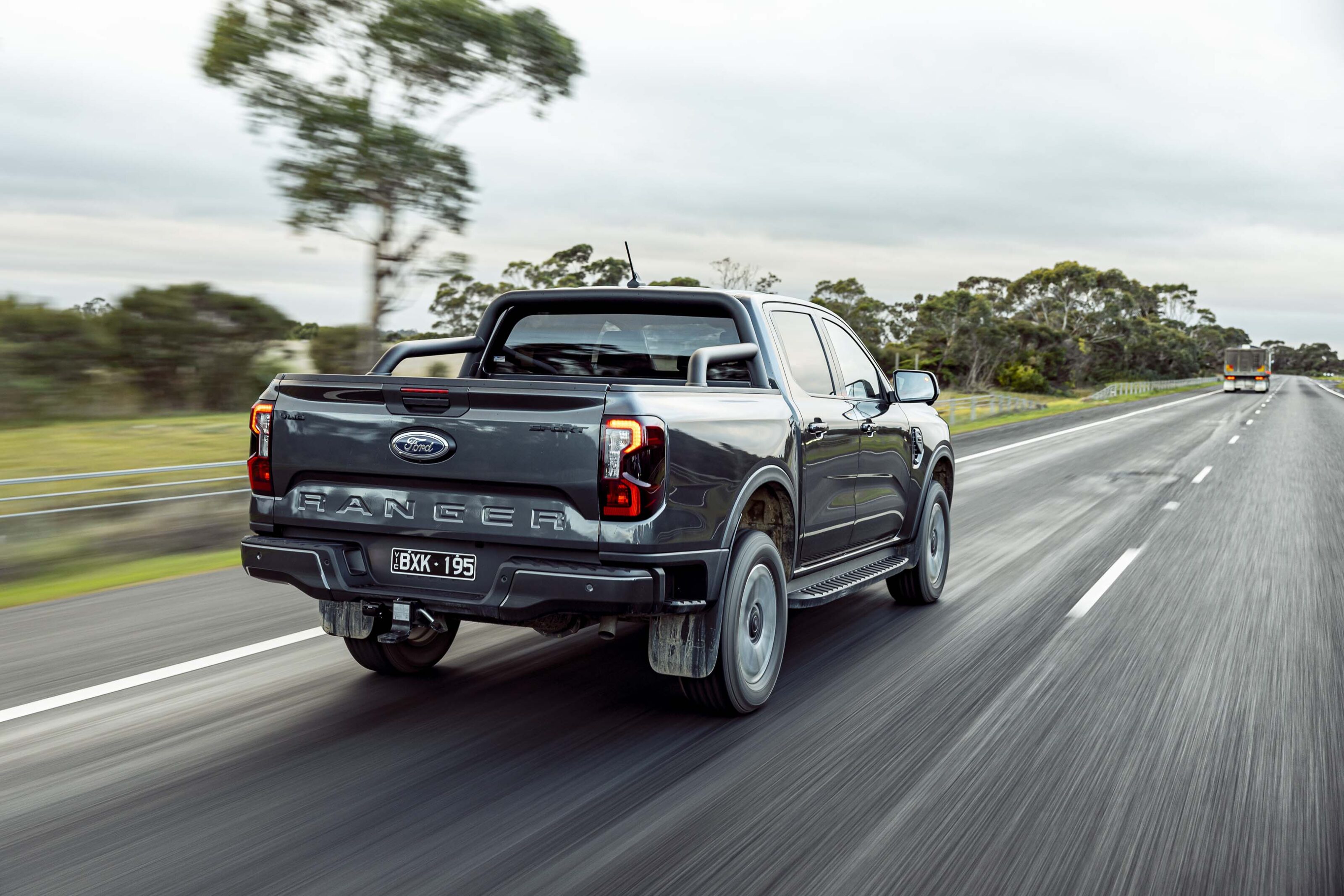
The story to here
November 25, 2021: Ranger could get hybrid tech
The 2022 Ford Ranger will see hybrid technology added in the future.
At the reveal overnight, Ford employees confirmed the new Ranger had been developed with the ability to adopt hybrid powertrains in the future – with expectations the electrified ute will be part of the local line-up by 2025.
At this stage, rumours and leaks suggest the Ranger will either get a traditional battery-electric hybrid engine or a plug-in hybrid powertrain – the latter typically providing a pure-electric driving range of up to 50 kilometres, give or take.
A hybrid Ranger is the missing piece in the Blue Oval’s push for electrification across its pick-ups, with both the smaller Maverick and larger F-150 being offered with hybrid power in North America.

While both the Maverick and F-150 use traditional hybrid engines, in June Ford Europe’s head of commercial vehicles Hans Schep told Automotive News Europe the brand will launch a plug-in hybrid (PHEV) version of the Ranger before 2025 – but declined to elaborate further when questioned.
If the model did go down the PHEV route, the larger electric motor and battery could be paired with a version of the 2.3-litre EcoBoost engine, already announced for the Ranger and expected for the North American market. Rumours suggest the Ford Bronco could also use this PHEV powertrain, with the Bronco sharing the same basic chassis architecture as the Ranger.
The Ford Ranger Hybrid is expected to be unveiled in 2024, but it will be worth watching to see which engine the Bronco Hybrid gets in the interim.
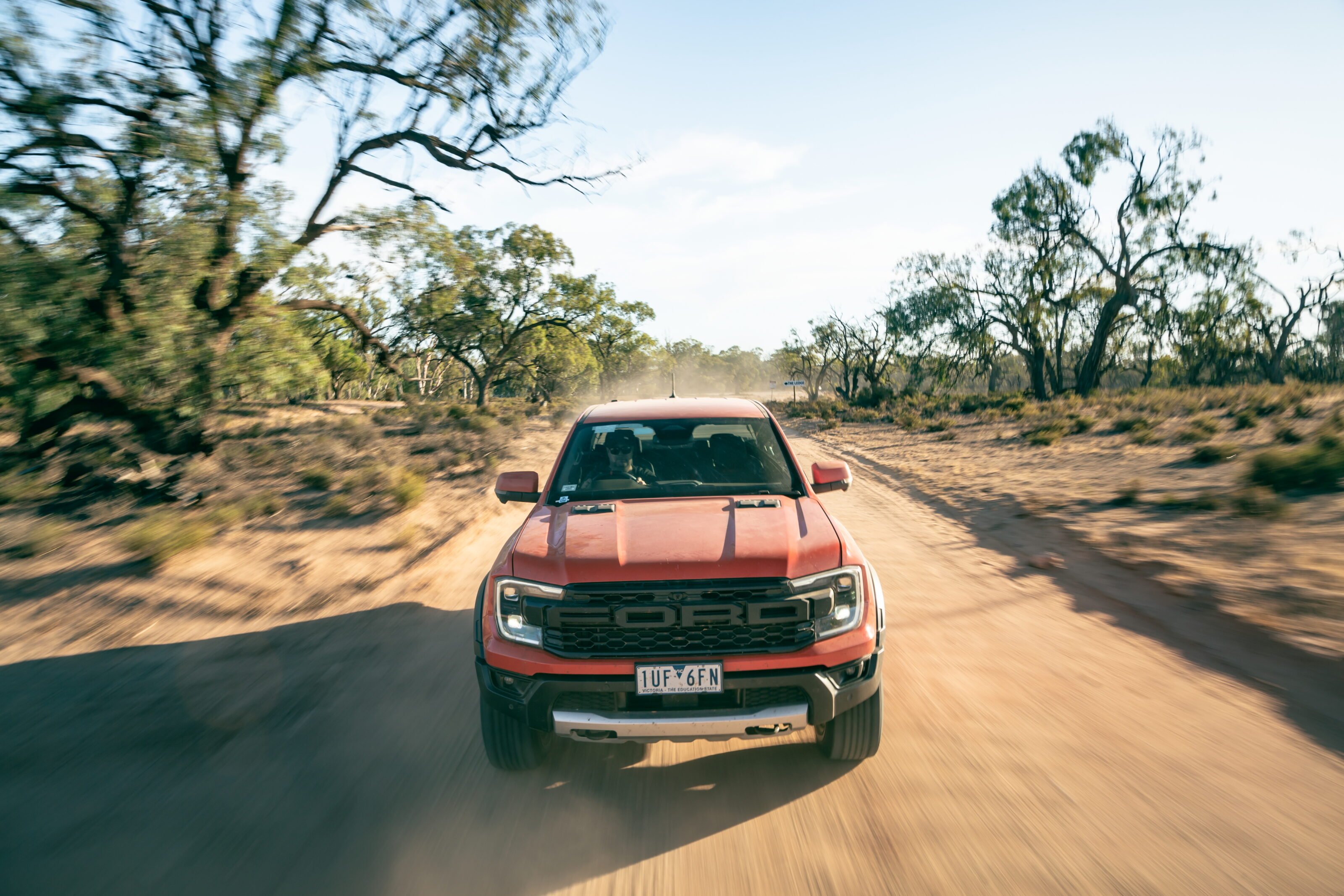
Five thousand orders for the new second-generation 2023 Ford Ranger Raptor have now been made, with the huge demand pushing wait times out to at least 10 months.
That means the $90,000-plus Raptor is effectively sold out until mid-2023 as you wouldn’t receive your ute until July next year if you placed an order today.
The first examples of the new ‘super ute’, which now has almost twice as much grunt as the original Raptor thanks to a 3.0-litre turbocharged V6 petrol engine, will begin to arrive Down Under later this month.
Ford has confirmed customer deliveries of the new Ranger Raptor will begin week commencing September 19.
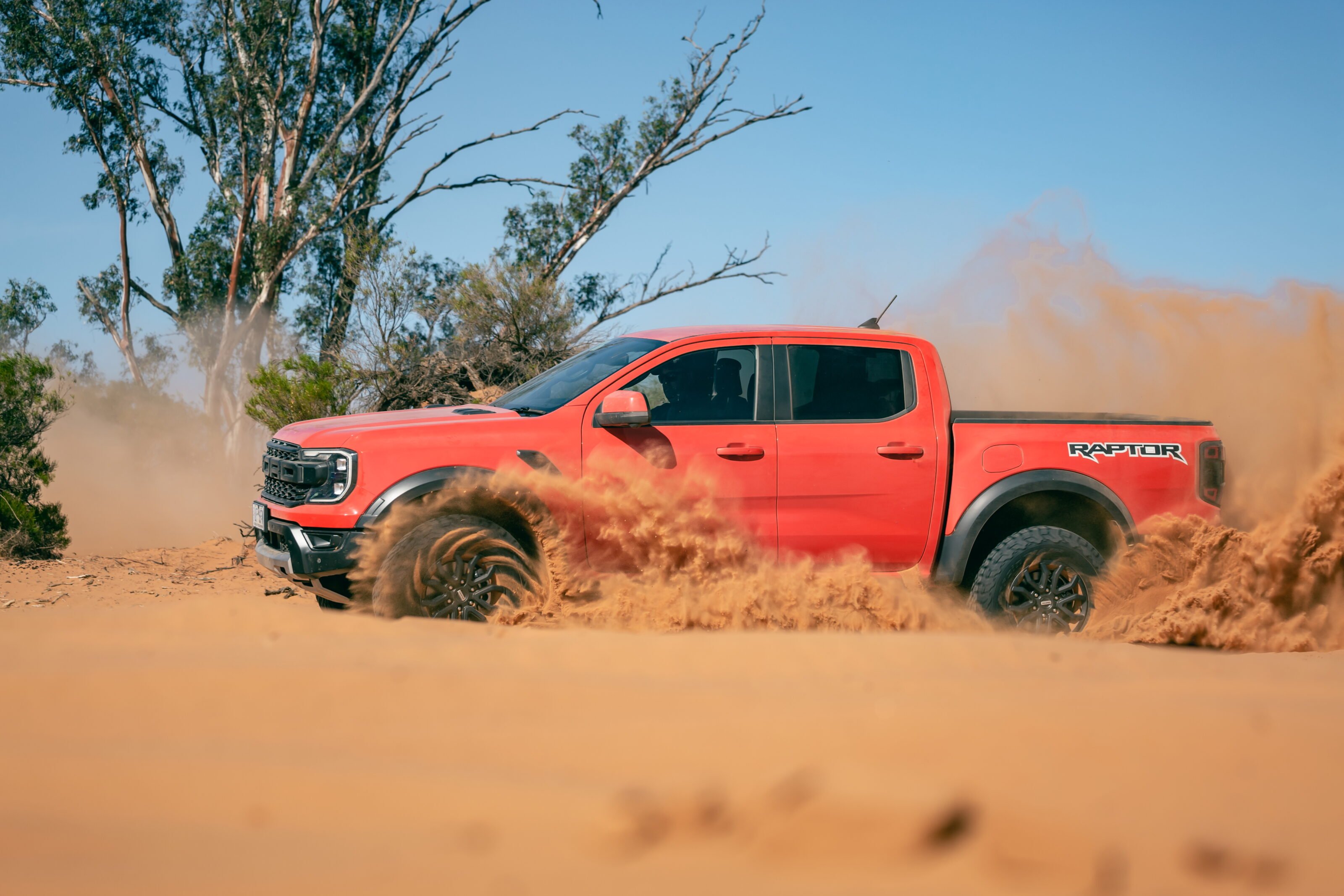
Deliveries of the new-generation Ford Everest will begin at the same time, although the large SUV is also facing long wait times for V6-powered models. The wait on an Everest V6 Sport and top-spec Platinum currently sits at nine months.
Ford says it’s working hard to secure supply of both Ranger Raptor and Everest, but added current supply chain difficulties are tricky to navigate.
“It certainly requires a lot of vigilance and it’s dynamic so it’s very hard to make definitive statements about supply when there’s not only chip constraints, but vessel delays and other components,” said Ford Australia boss Andrew Birkic. “We have a really strong order bank and now our job is to get the vehicles here to meet the demand.”
The huge demand for the new Ranger Raptor means it’s already well on its way to eclipse sales of the first-generation model. The original Ranger Raptor was a huge success for Ford in Australia with more than 10,000 units sold.
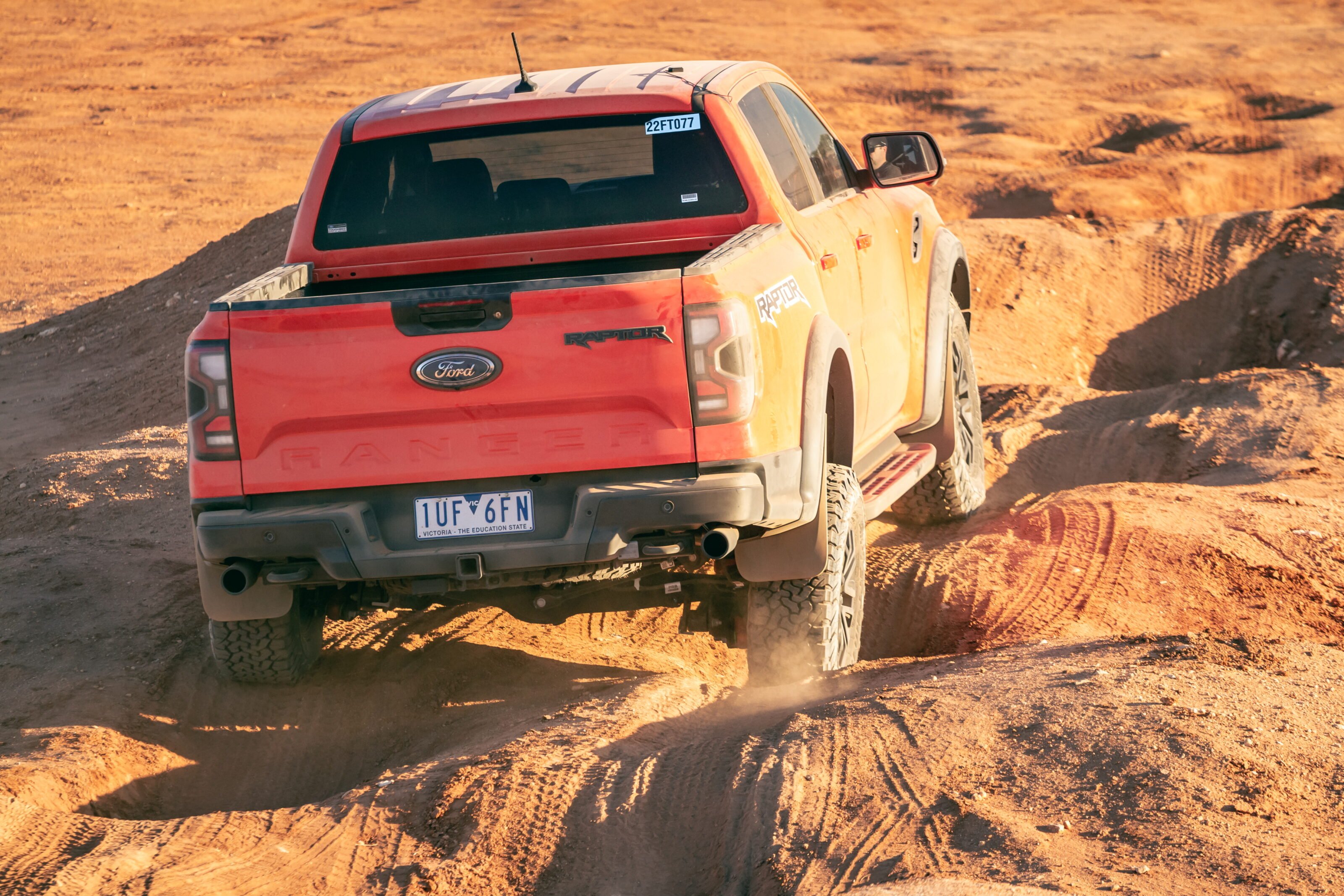
A key factor in the new Raptor’s popularity is its switch to a more powerful 3.0-litre petrol engine. The first Raptor was powered by a 2.0-litre bi-turbo diesel and that same diesel will still be offered in the new ute in Europe and some Asian markets.
Yet despite rising fuel prices and the opportunity to secure even more sales by offering customers two powertrain options, Ford Australia says it has no plans to sell a diesel version of the new Raptor Down Under.
“The diesel is for other markets,” said Ford Performance program manager Justin Capicchiano. “Right now it’s 3.0-litre only here and that’s the only powertrain we’re offering in Australia.”
When asked if Ford was worried some customers would find the new petrol engine too expensive to run, Capicchiano pointed to the 5000 orders as proof that the new ute’s additional performance is worth the extra thirst.
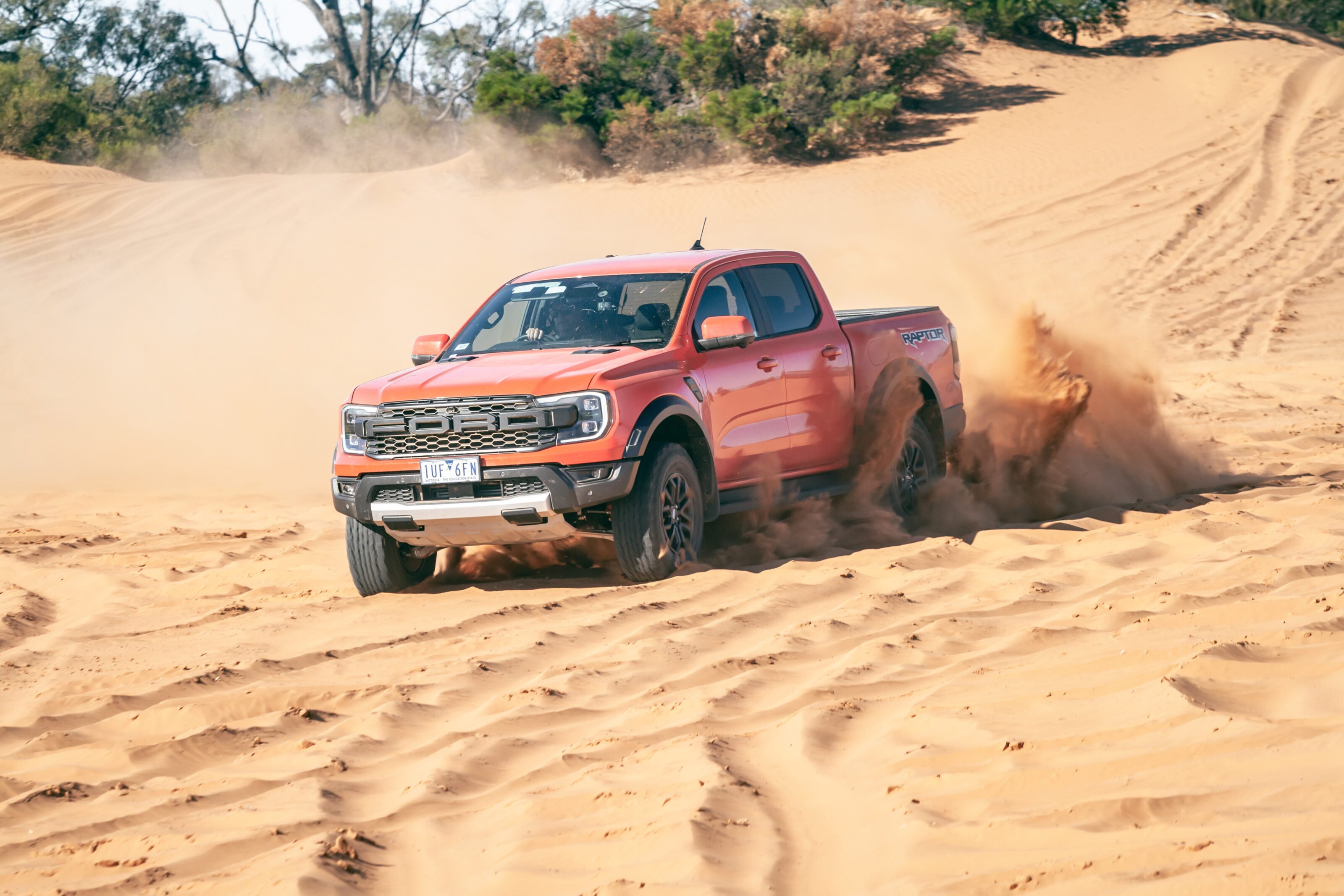
Officially the new Raptor drinks 11.5L/100km on the combined cycle. That’s a sharp spike over the diesel Raptor’s 8.1L usage figure.
“Not really,” said Capicchiano. “The stuff we’ve built into that engine [the 3.0-litre] if you drive it sedately it’s no worse than what an XR6 Turbo was back in the day.
“And the people that buy these things understand it’s now a performance truck and it’s going to come with an additional fuel use the previous one didn’t. But it’s a compromise they’re willing to make because they’re getting a lot more.
“And for the Asian and European markets that want that cost of ownership, we’ll offer the bi-turbo. It’ll be a slightly different proposition [to the petrol], but it will scratch that itch for them as well. It will still deliver the Raptor DNA and still deliver the Ford Performance mind set we want it to have.
“We didn’t just want to do the same truck as the previous one. Quite frankly [the diesel] is the same powertrain and gearbox and we didn’t want to just stick it in a different body and call it a day. We’ve spent genuine time retuning everything. The dampers, the steering, it’s all be completely retuned. We’ve done a hell of a lot of work.”
Snapshot
- 2023 Genesis Electrified GV70 pricing and features
- Priced from $127,800 before on-road costs
- Choice between five-year Chargefox subscription or home charger installation
The 2023 Genesis Electrified GV70 electric SUV will arrive in local showrooms this month, alongside the GV60 and Electrified G80 in the luxury brand’s line-up.
The Electrified GV70 is priced from $127,800 before on-road costs – a $38,733 premium over the petrol 3.5T AWD Luxury Pack – with one Performance AWD grade on offer.
The electric version of the Genesis GV70 features similar specifications to the flagship 3.5-litre twin-turbo V6 variant, but trades petrol power for two electric motors.
It competes against the BMW iX3, Mercedes-Benz EQC, Audi E-Tron and Jaguar I-Pace in the premium medium electric SUV segment in Australia.
REVIEW: Genesis Electrified GV70 driven
The new all-electric version of the Genesis GV70 is now in Australia, and we’ve driven it. Catch our review at the link below, and watch our video too!
Genesis Electrified GV70: The basics
| Powertrain | dual-motor, one front & one rear |
|---|---|
| Drive | All-wheel drive |
| Outputs | 360kW (boost mode), 700Nm |
| Battery | 77.4kWh Lithium-Ion |
| Driving range | 445km (WLTP) |
| 0-100km/h | 4.2 seconds |
| Charging | 800V architecture, 10-80% in 18 minutes via 350kW charger |

With two electric motors identical to the GV60 Performance on the front and rear axles, the Electrified GV70 sends power to all four wheels, offering up to 360kW and 700Nm.
This allows for a claimed 0-100km/h time of 4.2 seconds.
Underneath, the Electrified GV70 features a 77.4kWh lithium-ion battery, allowing for a WLTP-rated 445-kilometre driving range.
Featuring an 800-volt electric architecture, the vehicle can charge from 10 per cent to 80 per cent in approximately 18 minutes, when plugged into a 350kW public charger.
Genesis will offer Electrified GV70, G80 and GV60 buyers the choice of a complimentary five-year Chargefox subscription or home A/C charger and installation.

2023 Genesis Electrified GV70 Australian pricing
Prices exclude on-road costs.
| Model | Pricing |
|---|---|
| Electrified GV70 Performance AWD | $127,800 |

2023 Genesis Electrified GV70 features
Features unique to the Electrified GV70, in addition to GV70 3.5T Luxury Package
Standard equipment highlights, shared with GV70 3.5T Luxury Package

Options
- Two-tone olive green and ocean blue upholstery – no cost
- Two-tone glacier white and ocean blue upholstery – no cost
- Matte paint – $2000
Powertrains, charging and driving range
Genesis offers the Electrified GV70 with a single flagship powertrain globally.
It features dual electric motors producing 360kW in boost mode and 700Nm, with an electronic all-wheel-drive system.

It has a 77.4kWh battery pack, with a WLTP-rated 445-kilometre driving range.
According to the marque, the Electrified G80 will complete the 0-100km/h sprint in 4.2 seconds.
It supports direct current (DC) charging, with the 10 to 80 per cent fast charge claimed to take approximately 18 minutes using a 350kW charger.
Safety
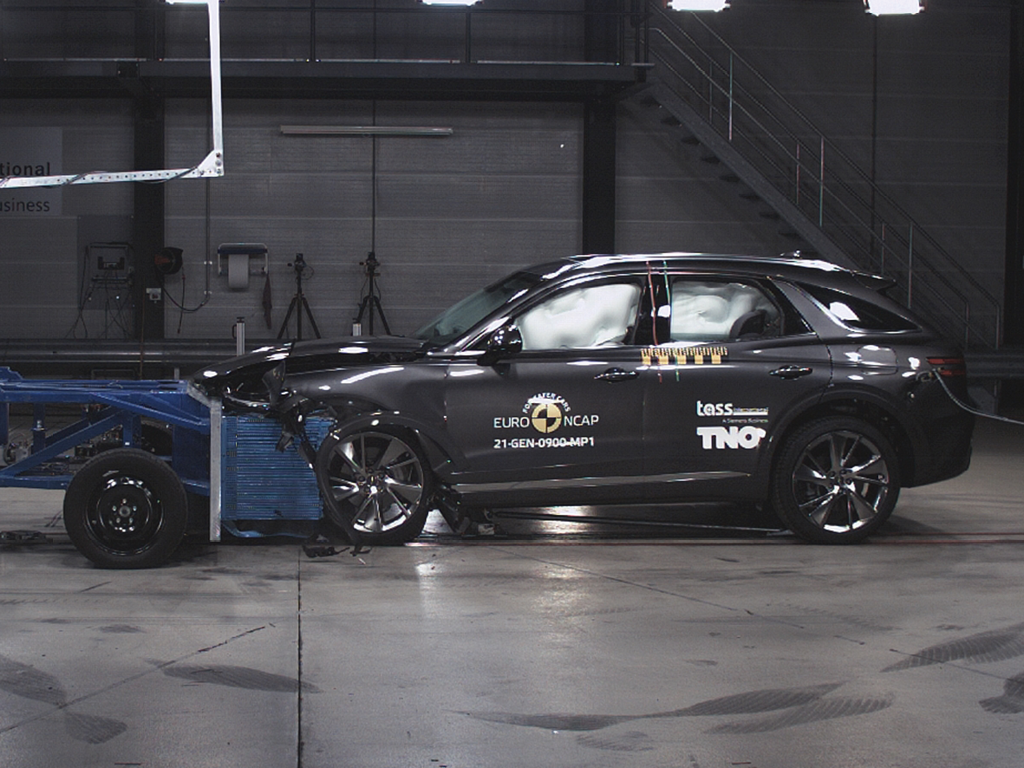
The Genesis Electrified GV70 is yet to be scored by ANCAP.
However, four-cylinder examples of the GV70 received a five-star rating, based on testing conducted in 2021.
It has a 89 per cent score for adult occupant protection, 89 per cent for children, 64 per cent for vulnerable road users, and 87 per cent for safety assist.
Eight airbags, including dual front, side, curtain, driver’s knee and front-centre, are fitted.
Each variant includes the following active safety equipment as standard:

Dimensions
The Genesis Electrified G80 has a wheelbase of 2875 millimetres, and is 4715mm long, 1910mm wide and 1630mm high.
Warranty and servicing
As per the wider Genesis range, the Electrified GV70 is covered by the brand’s five-year, unlimited-kilometre warranty, and five years of complimentary servicing.
Genesis also offers a number of added benefits to its electric vehicle owners, with the below services included in the purchase price:
| Eight-year warranty on the high voltage battery |
| Five-year Genesis To You and valet service |
| 10-year 24/7 roadside assistance |
| 10-year complimentary map updates |
| Choice of a five-year Chargefox subscription or home AC charger and installation. |
Availability
The 2023 Genesis Electrified GV70 will arrive in Australia this September, going on sale through the manufacturer’s limited dealer network.
The traffic has been a slog. The kind that concertinas for no apparent reason, all four lanes making choked, frustrated progress as we slowly leave the outskirts of Melbourne behind. But then, just before we turn off the motorway, a gap. Nail it!
The Sonora yellow Audi RS3 leaps forward, the sudden torque demand causing it to shimmy and buck on cold Bridgestones as it rushes towards 100km/h. A glance in the rear-view shows the angry – and equally yellow – nose of the Mercedes-AMG A45 S in lockstep as we both flatten the gas to finally get an inkling of what 2022’s most outrageous hatchbacks can do.
Sub 4.0-second runs in a grocery getter? They feel quicker than that, which begs the question: when did the humble hatch become so mental?
Not so long ago, 200kW was a huge number in hot hatch land but now we have outputs beginning with a three (or around 400hp in the old money), drift modes, six-figure price tags and acceleration so rabid it can make a 911 Turbo feel a touch sheepish.
Audi RS3 v AMG A45 S: The basics
| RS3 Sportback | A45 S | |
|---|---|---|
| Drive | all-wheel drive | all-wheel drive |
| Engine | 2480cc inline 5cyl, DOHC, turbo | 1991cc 4cyl, DOHC, turbo |
| Transmission | 7-speed dual-clutch | 8-speed dual-clutch |
| Power | 294kW @ 5600-7000rpm | 310kW @ 6750rpm |
| Torque | 500Nm @ 2250-5600rpm | 500Nm @ 5000-5250rpm |
| 0-100km/h | 3.8sec (claimed) | 3.9sec (claimed) |
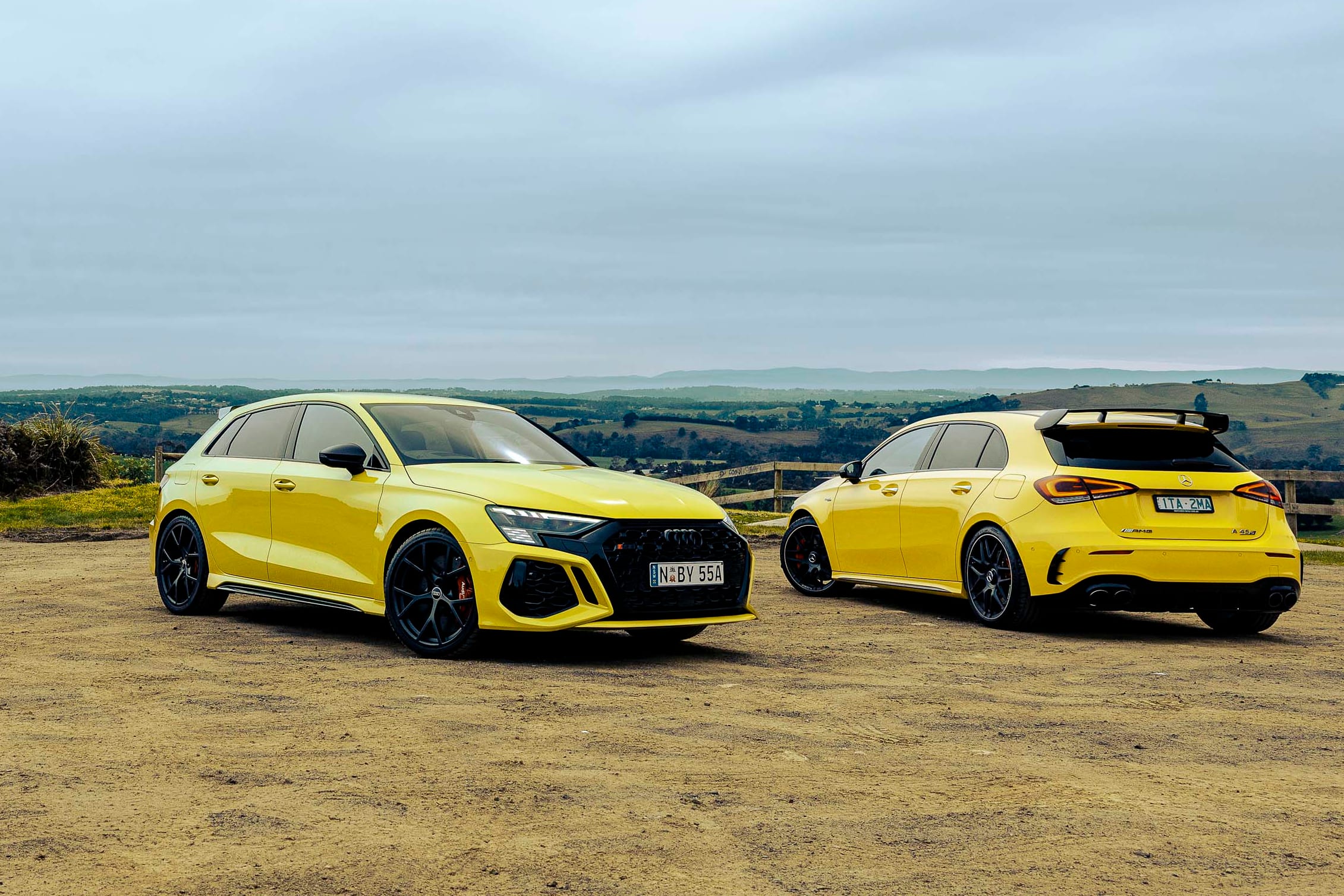
Think the term ‘hyper hatch’ is a touch hyperbolic? Give launch control a try in one of this pair.
In a world of increasingly quick and complex machinery, the A45 and RS3 are the apex predators. Audi and Mercedes-AMG have been slogging it out for hyper hatch supremacy for decades now but their product cadence has been staggered.
AMG last reset the bar back in 2019 when this second-generation A45 arrived, sideways and smoking, onto the scene. It wasn’t only faster and more capable than the frenetic and overly firm original A45, but it made the RS3 of that time feel wooden and off the pace.
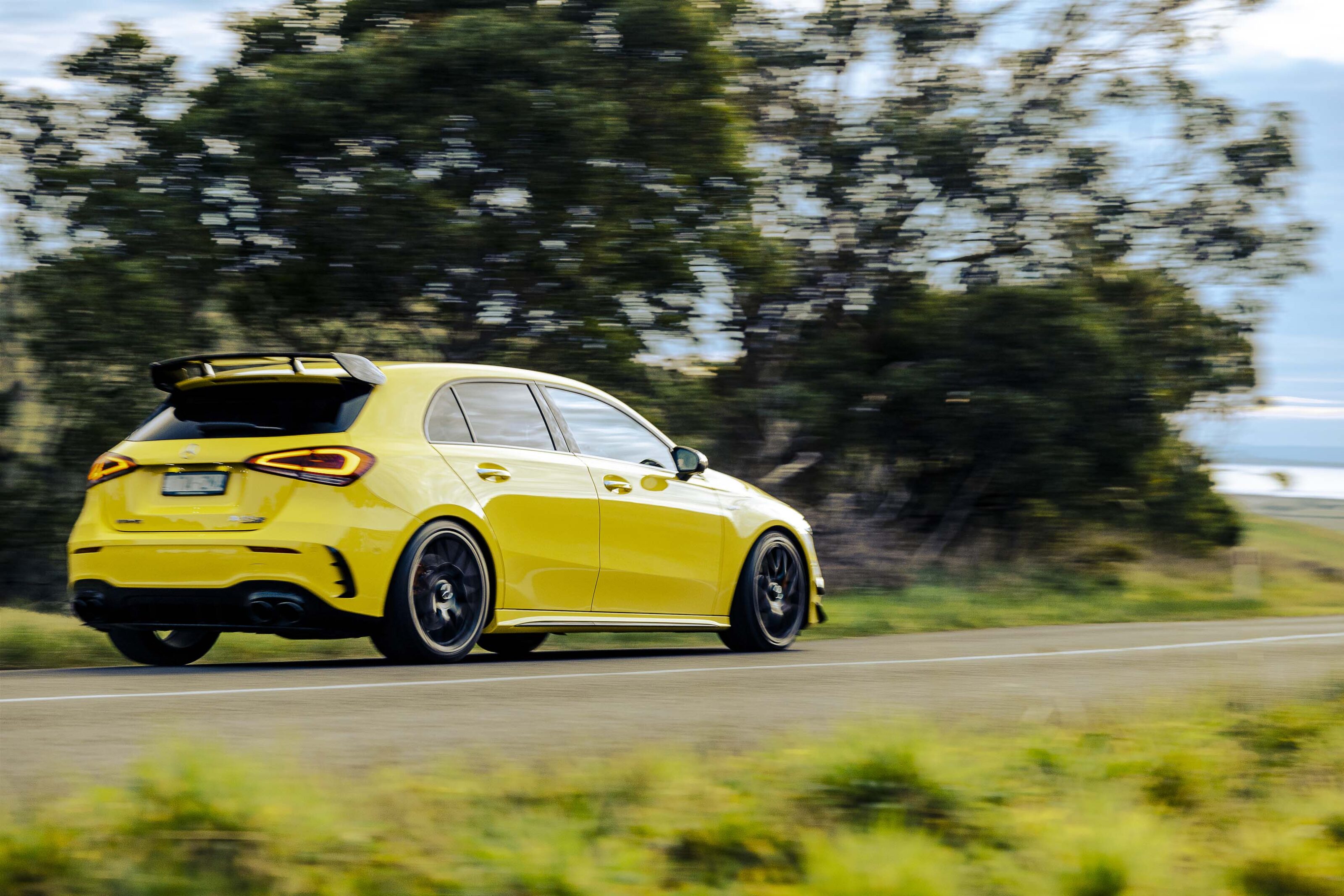
Now, though, we have Audi’s riposte: the third-generation RS3. It’s not quite as powerful as the AMG – 294kW plays 310kW – which begs the question of whether the hyper hatch power war is over. Then again, its wailing 2.5-litre five-pot turbo has exactly the same 500Nm of torque as you get from the four-cylinder Benz.
And in virtually every other metric, this pair goes tit-for-tat. Drift Mode? Present and accounted for courtesy of clever torque-splitting rear differentials. Sub 4.0-second 0-100 sprints? The AMG claims 3.9 seconds while the Audi stops the clock at 3.8sec.
Both also offer richly specced cabins, claim to drink exactly the same amount of fuel on the combined cycle and there’s only a whisker between them when it comes to weight: the Audi hits the scales at 1570kg, the A45 S is 15kg portlier.
Acceleration test
| Audi RS3 | AMG A45 S | |
|---|---|---|
| 0-10km/h | 0.3sec | 0.2sec |
| 0-20km/h | 0.6sec | 0.6sec |
| 0-30km/h | 0.9sec | 1.0sec |
| 0-40km/h | 1.2sec | 1.3sec |
| 0-50km/h | 1.5sec | 1.7sec |
| 0-60km/h | 1.8sec | 2sec |
| 0-70km/h | 2.2sec | 2.5sec |
| 0-80km/h | 2.6sec | 2.9sec |
| 0-90km/h | 3.0sec | 3.5sec |
| 0-100km/h | 3.5sec | 4.0sec |
| True speed at indicated 100km/h | 97km/h | 96km/h |
| 100km/h-0 | 36.5m | 37.6m |
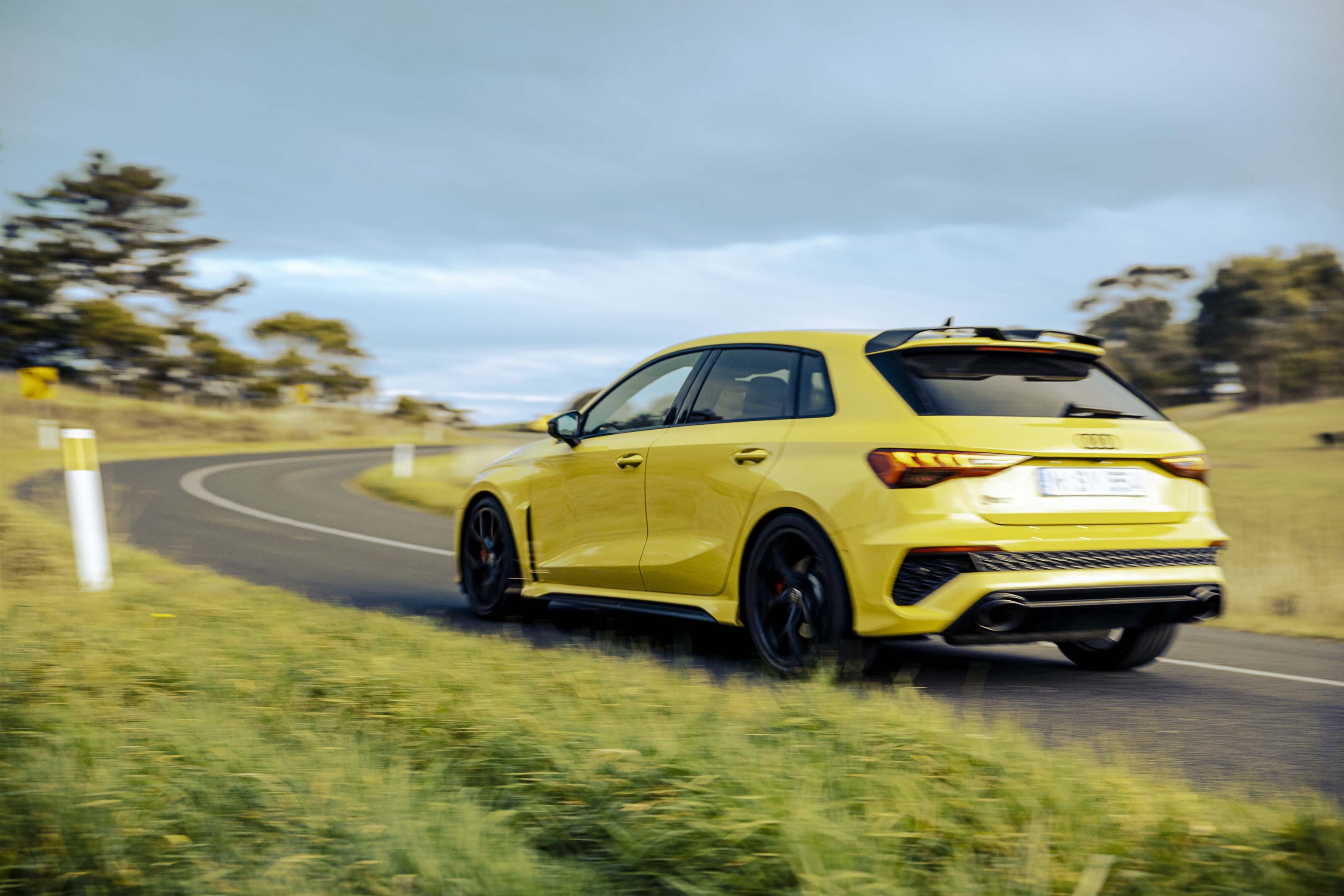
In virtually every metric, this pair goes tit-for-tat. Drift Mode? Present and accounted for courtesy of clever torque-splitting rear differentials. Sub 4.0-second 0-100 sprints? The AMG claims 3.9 seconds while the Audi stops the clock at 3.8sec.
Where they differ, slightly, is price. You can have the third-gen RS3 as a sedan but in hatchback form, it retails at $91,391 before on-road costs. The AMG is $99,085 before on-road costs, making it $7694 more expensive in standard trim. That’s not an insignificant sum but consider the options fitted to the two cars we’re testing here and the advantage swings back the other way.
Our A45 includes the Performance Package that for $5790 adds vice-like bucket seats, the boy-racer rear spoiler and other aero addenda plus an AMG Performance Sound system which boosts the volume of exhaust noise that’s piped into the cabin.
The RS3’s options are pricier, though as we’ll get to later, arguably not as desirable. First up is the $13,000 RS Dynamic Package which increases the top speed to 290km/h and replaces the standard steel brakes with larger carbon ceramics.
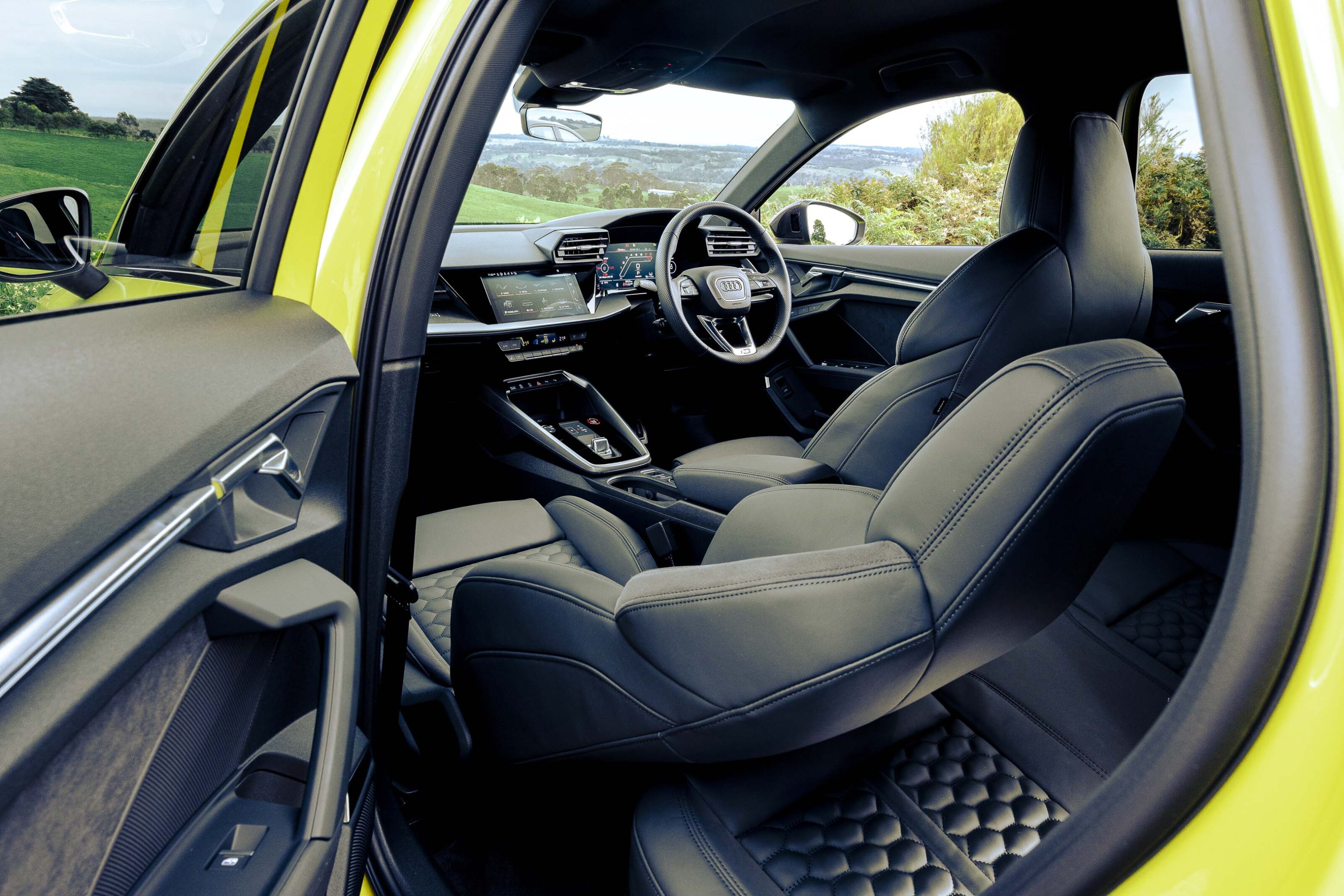
Our car also has the Carbon Pack, finishing the rear wing, mirror caps and side sills in carbon fibre for $6100. Add it all up and the Audi is $109,074 as tested while the A45 is $104,875. Six figures for a grocery getter? Welcome to 2022.
So it’s even stevens on the value front, yet for all their on-paper similarities it only takes a few corners to realise these cars are actually quite different to drive…
I start in the AMG; benchmark first then the challenger. Immediately I’m reminded of how much more bandwidth this car has over the original A45. AMG’s first mega hatch was brutally quick but also brutally firm to the point of being unpleasantly physical.
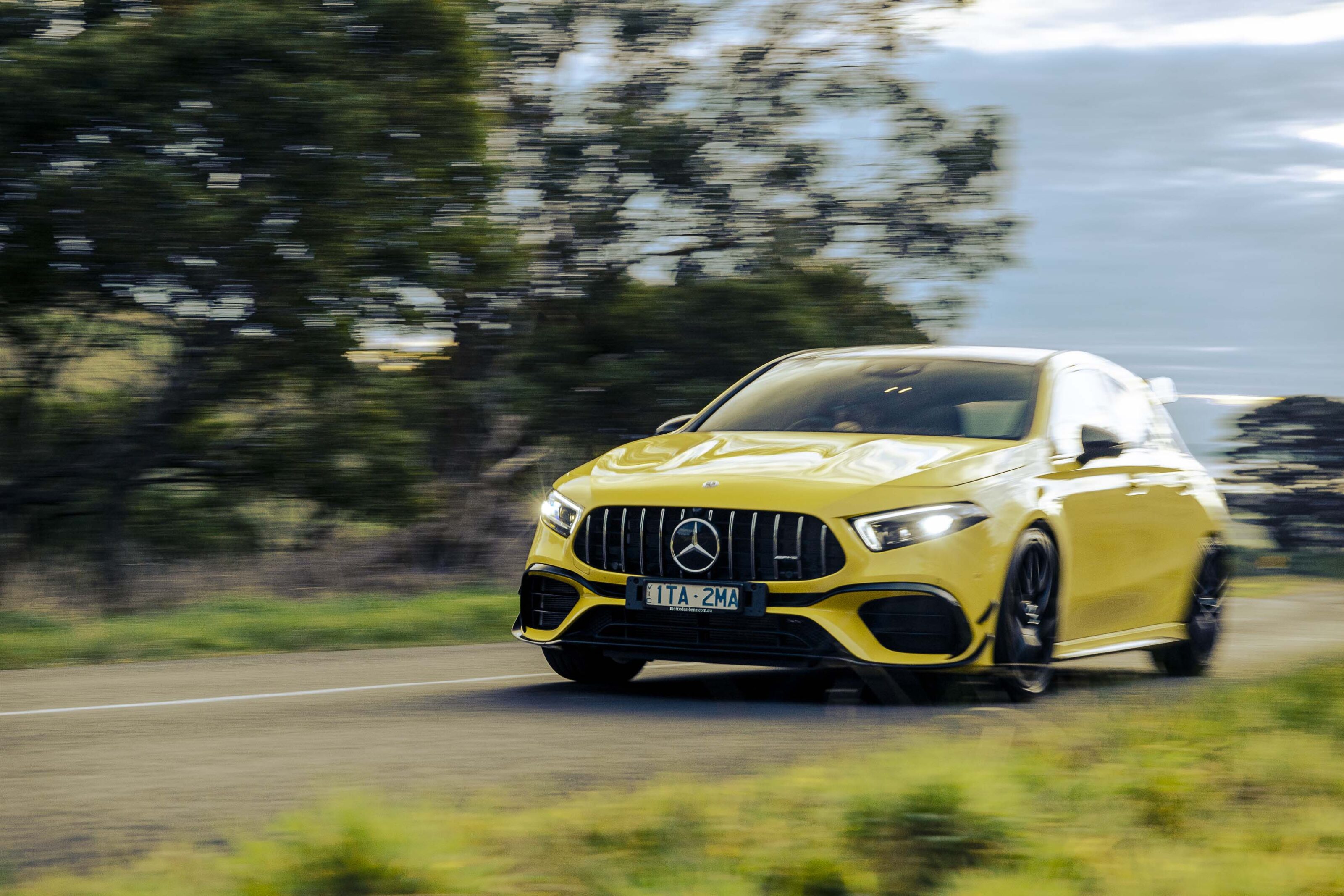
But at low speed, this new car is remarkably civilised. There’s hardly any hesitation from the eight-speed dual-clutch, throttle inputs are nice and gradual and the steering is light and direct.
Start to pick up the pace and the A45 is a willing companion. You still notice an underlying firmness, even with the dampers in Comfort mode, but where the old car would bang and jolt, the new A45 absorbs the hits with commendable composure.
Like the RS3, the AMG is riding on 19-inch wheels and while it’s still far from what you’d call supple, it does breathe with the road across all but the gnarliest of bumps.
Worried that the frenzied edge has disappeared? Don’t be. Cycle through the drive modes and the AMG quickly transforms from amenable to aggressive to downright unhinged.
The steering (2.5 turns lock-to-lock) takes on some welcome heft and there’s so much grip, agility and acceleration on offer that it’s hard to imagine many performance cars that could shake a well-driven A45 S on the public road.
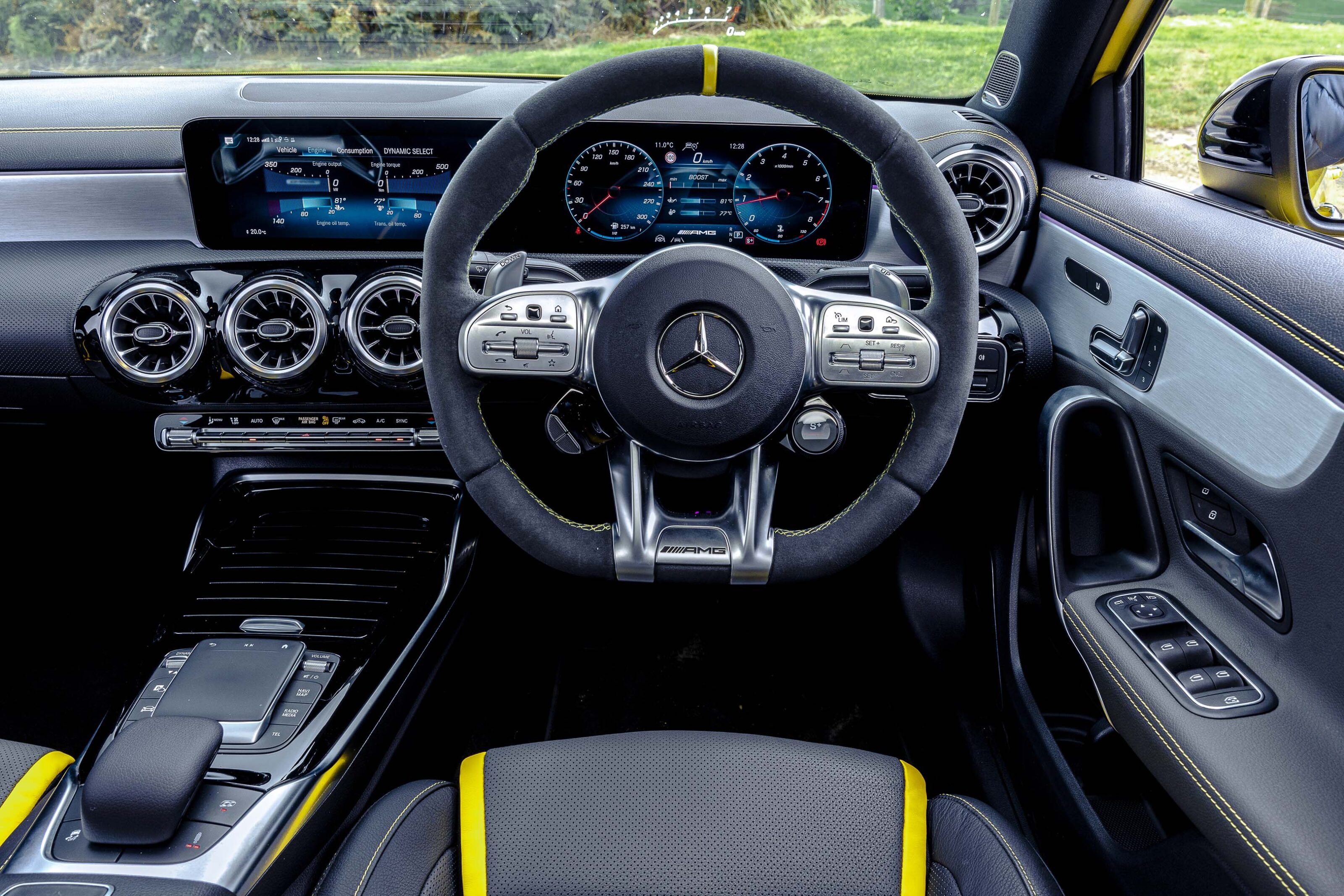
At low speed, this new A45 S is remarkably civilised. There’s hardly any hesitation from the eight-speed dual-clutch, throttle inputs are nice and gradual and the steering is light and direct.
It’s the engine that dominates. AMG’s hand-built 2.0-litre M139 was once the world’s most powerful four-cylinder and in Race mode it feels like an angry, buzzing bucket of bees. Against the bigger capacity Audi it doesn’t feel quite as muscular low in the rev range but that’s deliberate.
AMG’s engineers have manipulated the torque curve so that peak twist arrives at 5000rpm, meaning the performance and drama continue to build as you rush towards the 7000rpm redline.
There’s plenty of drama. The A45 is so loud that I actually feel self-conscious driving it hard, but the real stroke of genius is the exhaust note itself. Four cylinders with dual-clutch boxes can sound flat and farty but the A45’s soundtrack is commendably full and engaging.
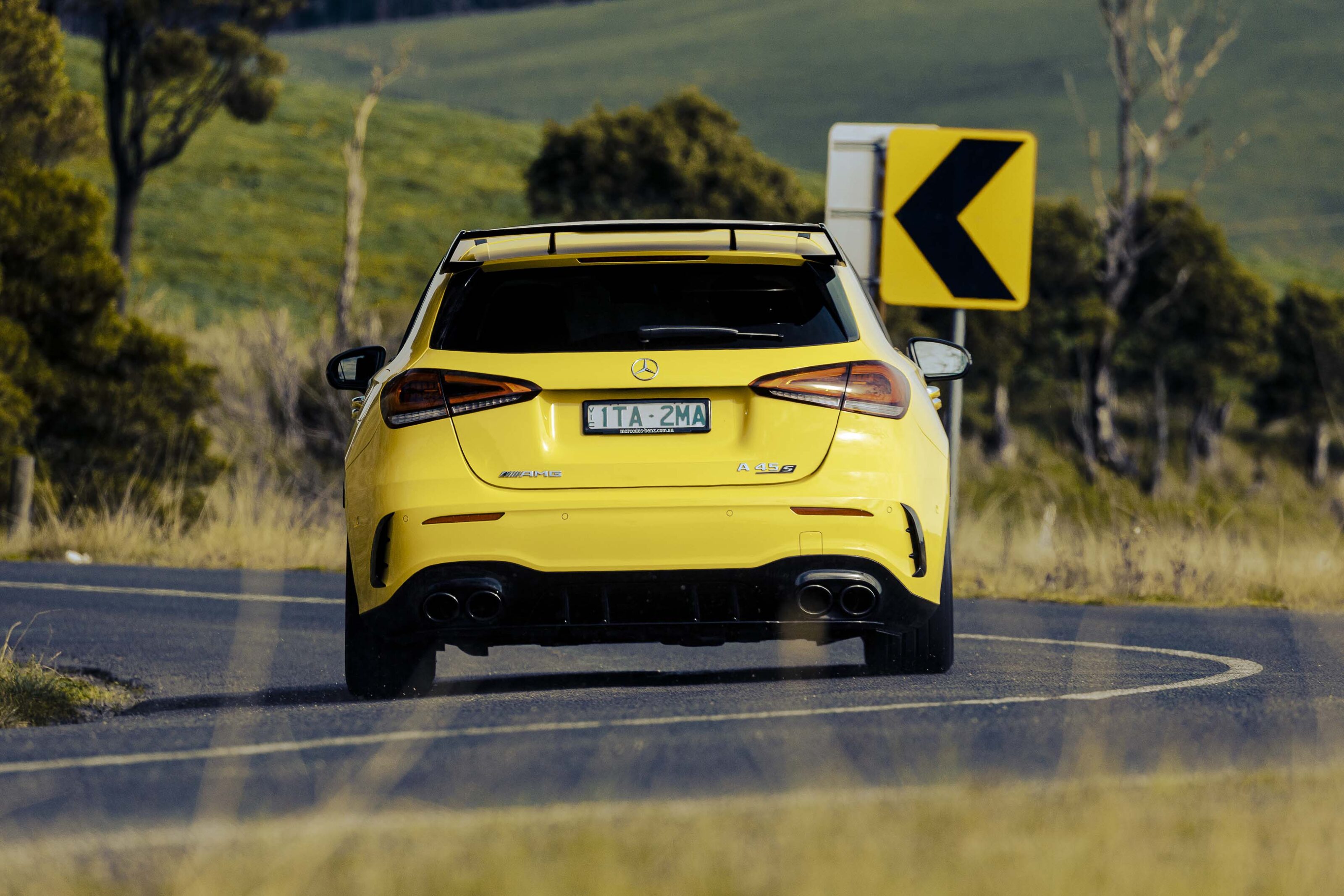
It doesn’t just get louder as the revs build but the tone and timbre get higher and more manic, too. Doesn’t sound artificial either, which is some achievement given the obvious degree of exhaust noise amplification going on.
The chassis is commendably neutral. You know that immediate and agile ‘go kart’ feeling that Mini has been banging on about for years? Where the wheelbase feels short and you’re planted between the two axles? The A45 has it in spades.
Incredible grip and tenacious acceleration are the AMG’s overriding dynamic qualities but there’s also a playful side worth exploiting. Dial in ESC Sport, or turn it off altogether, and you can liberate some small angles of yaw on a twisty section of tarmac.
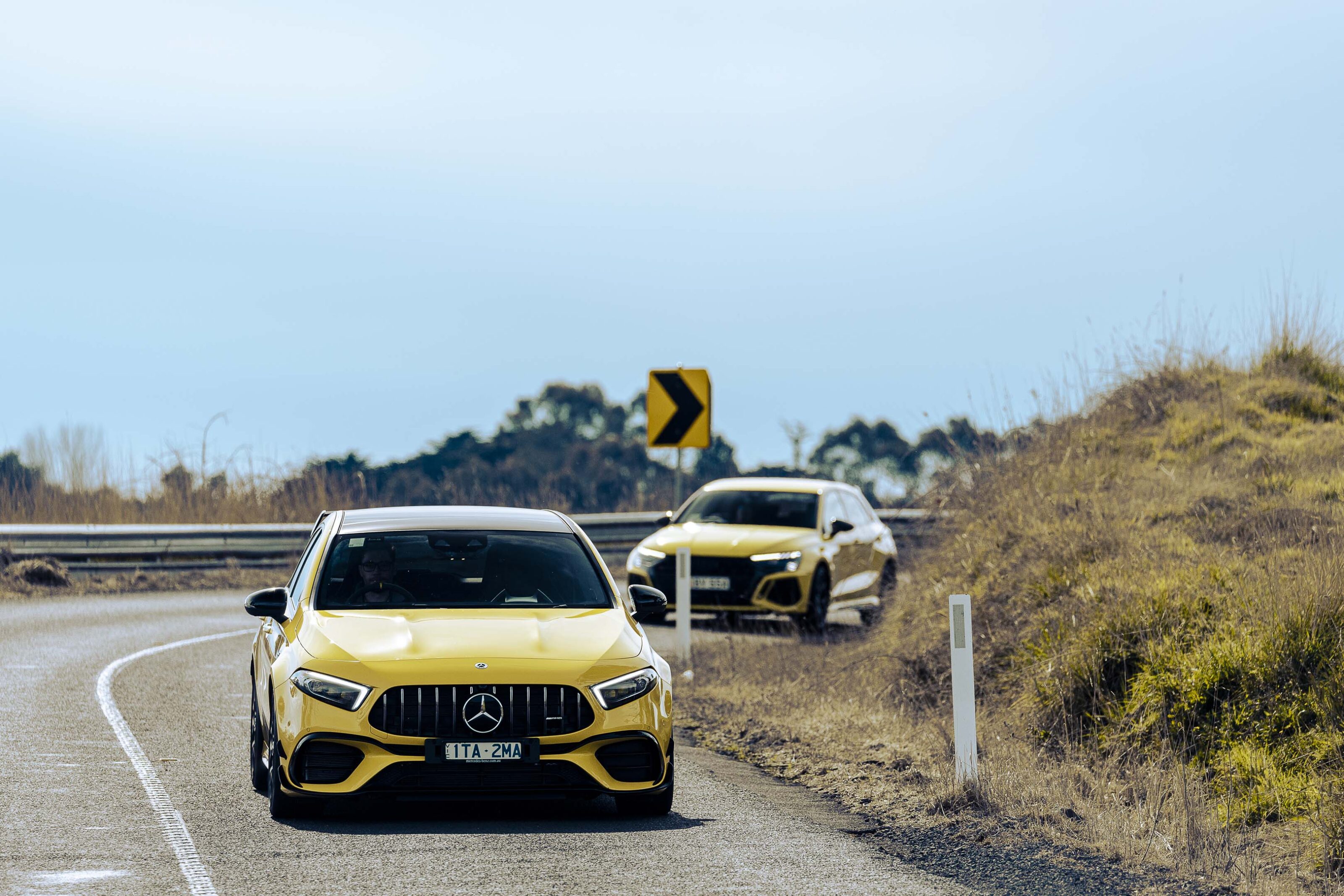
Understeer only really encroaches at vaguely ridiculous speeds and even though there is a Drift Mode function, you won’t be unsticking the rear end for huge throttle-steer slides on the public road. Instead, you can feel the clever rear differential shuffling torque backwards and, if you commit hard enough to throttle, the A45 does allow you to open the steering a touch as you power out.
It’s an addictive and rewarding thing to drive hard, like an over-stimulated Jack Russell that can’t wait to jump on every leg in the room. Stops well, too, thanks to a brake pedal that’s easy to modulate during hard driving and standard steel stoppers that comprise 360mm discs up front clamped by six-piston calipers.
Complaints? As a performance car, there are very few. The optional bucket seats are excellent, although I wish they went a touch lower. Perhaps the biggest trade-off is that the A45 always feels ‘on’.
It’s like a friend that doesn’t stop talking and there’s a strong sense that the A45 is constantly eager for a scrap. It’s certainly more frenzied and demanding than the RS3…
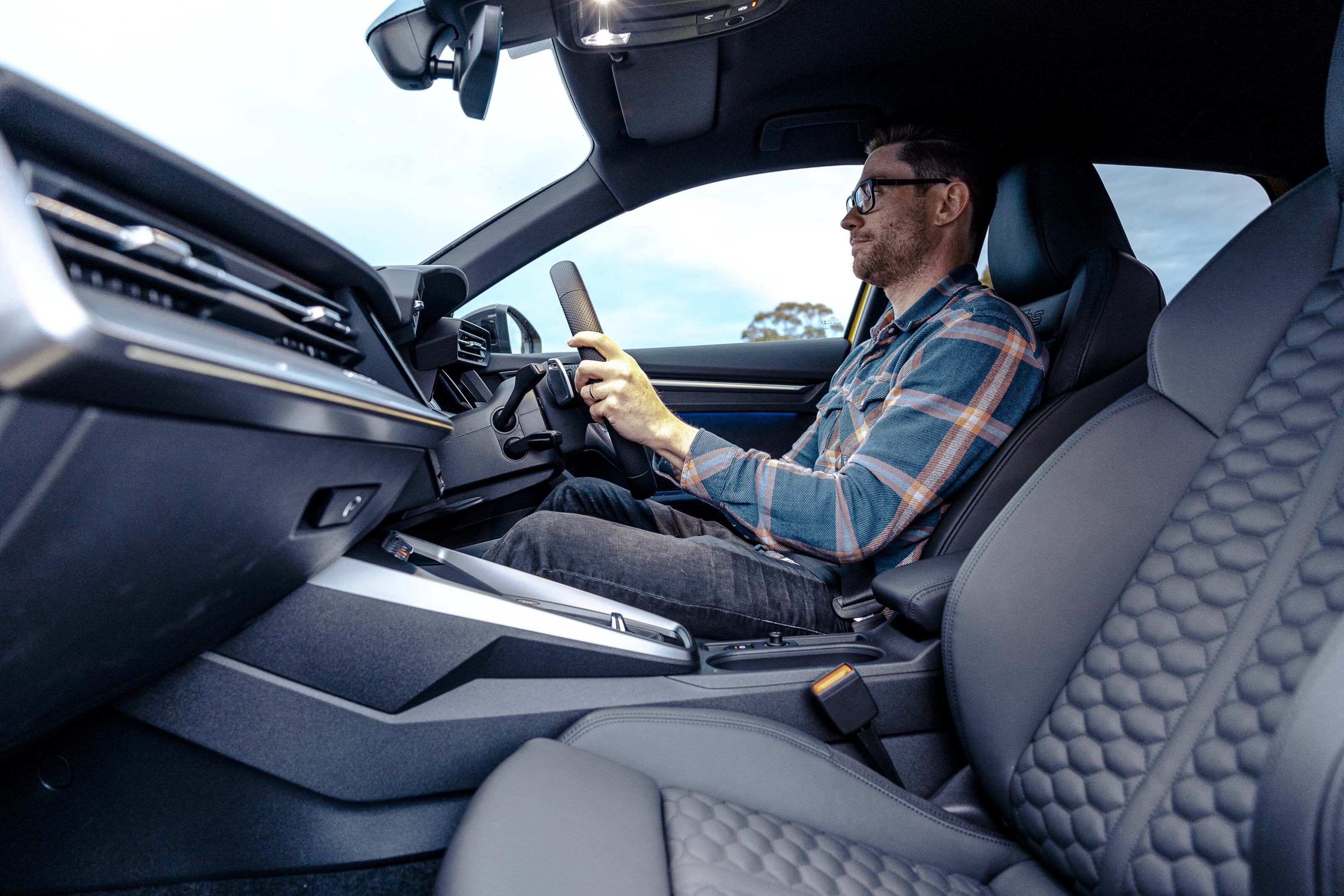
It’s like a friend that doesn’t stop talking and there’s a strong sense that the A45 is constantly eager for a scrap. It’s certainly more frenzied and demanding than the RS3…
Slip into the driver’s seat of the Audi and it instantly seems bigger and noticeably wider than the AMG. The cabin is roomier and the front contact patch also feels appreciably broader.
Like the previous RS3, this car continues the odd trend of fitting wider tyres up front (265/30 ZR19s plays 245/35 ZR19 out back) and after the narrow and eager A45, the RS3 feels considerably more hunkered down.
It’s quieter, too. Tyre roar is a tiring and intrusive companion in the A45 but the RS3 does a better job of filtering out unwanted road noise. The RS3’s exhaust note also has a quieter, more cultured edge, which only reinforces the sense that this is a more refined and polished package compared with the raw AMG.
Does this make it less exciting to drive hard? Initially, yes. It feels a smidge heavier, doesn’t change direction as zealously and its steering lacks the connection you get in the angrier A45. Where the AMG immediately inspires confidence, the RS3 takes longer to key into. Wasn’t expecting that.

One area it instantly trumps the A45, though, is how it rides. Audi’s engineers have worked hard to make the RS3 a more comfortable daily driver and they’ve ditched the old car’s magnetic ride control for a more sophisticated adaptive damper set-up. It’s a big improvement.
Keep the dampers in Comfort mode and the RS3 feels composed and compliant. Dial up Dynamic and things are noticeably firmer but unlike the A45, which can occasionally skip and bounce over really poor surfaces and cause you to back off, the RS3 is superior in keeping its wheels glued to the road.
Which car would be quicker point-to-point over a typical Aussie B-road? I reckon the RS3’s greater control would give it the edge.
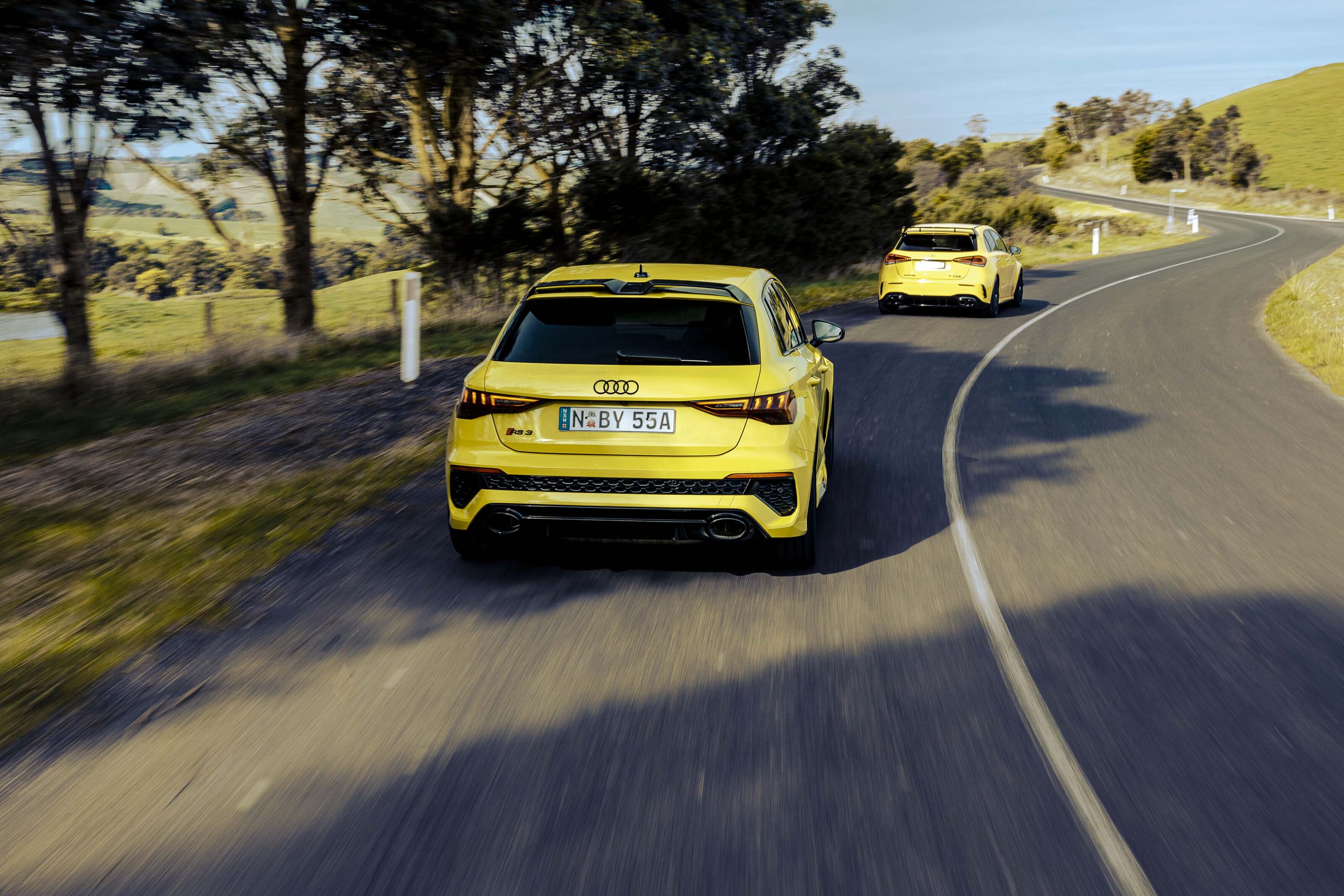
A couple of early niggles? Start to corner hard and it’s clear the RS3’s Nappa leather seats aren’t as supportive as the AMG’s optional buckets. And the Audi’s carbon-ceramic brakes are trickier to modulate, too.
The pedal is firm and grabs aggressively which undermines any additional stopping power the larger 380m discs provide. Our advice? Save your $13,000 and stick with the regular 375mm steel brakes, which we’ve found to be excellent.
Most surprising, however, is how the RS3’s 2.5-litre five-pot measures up. In isolation, it’s punchy, rorty and it pairs nicely with the slick-shifting seven-speed dual-clutch. The power delivery is different to the A45. Here the full 500Nm arrives from 2250-5600rpm, which makes the Audi feel more barrel-chested and muscular.
Sounds brilliant, too, and it’s certainly louder than the previous RS3 which had its exhaust note blunted through the fitment of a petrol particulate filter. But after the aural assault of the AMG, the five-pot RS3 sounds a touch tame. Wasn’t expecting that one either.
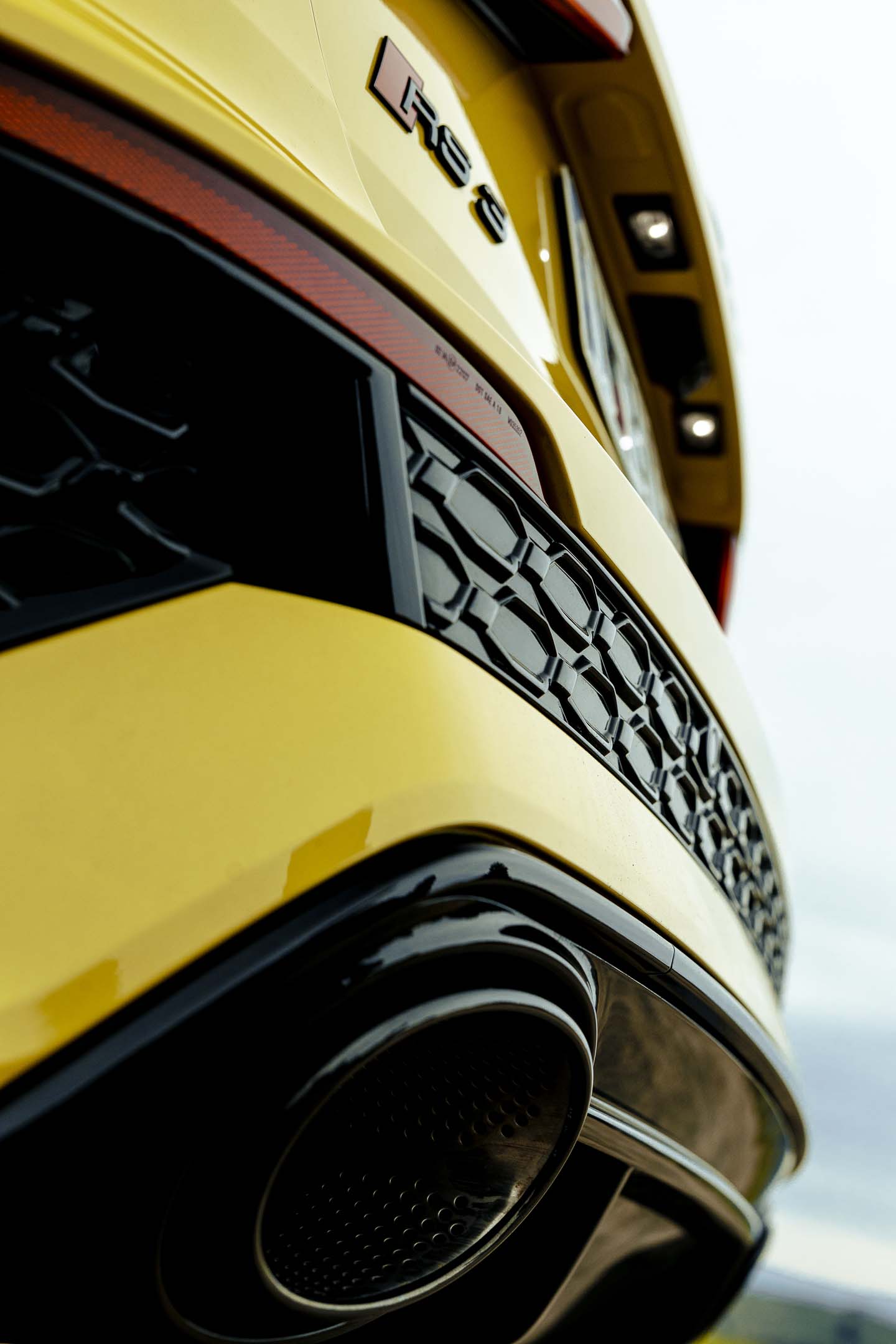
So it’s an inauspicious start for the RS3. It might be more comfortable and controlled but initially, at least, it can’t match the car from Affalterbach for adrenaline-soaked thrills. Take the time to explore the RS3’s many drive modes, however, and things start to fall into place.
Just like the A45 S, the RS3 is fitted with a ‘torque splitting’ rear differential and Audi has added a host of new drive modes to help exploit its newfound capability. There are now seven settings to choose from but the pair best suited for a fast back-road blast are RS Individual and RS Performance.
Both allow you to configure the steering, powertrain and chassis to your liking but RS Performance also uses a specific map for the rear diff to reduce understeer and oversteer.
With the right mode deployed, the RS3 delivers the same neutral, hunkered-down feeling as the A45 and, just like the Benz, you can feel the system deploying torque to the outside rear wheel as you drive out of corners.
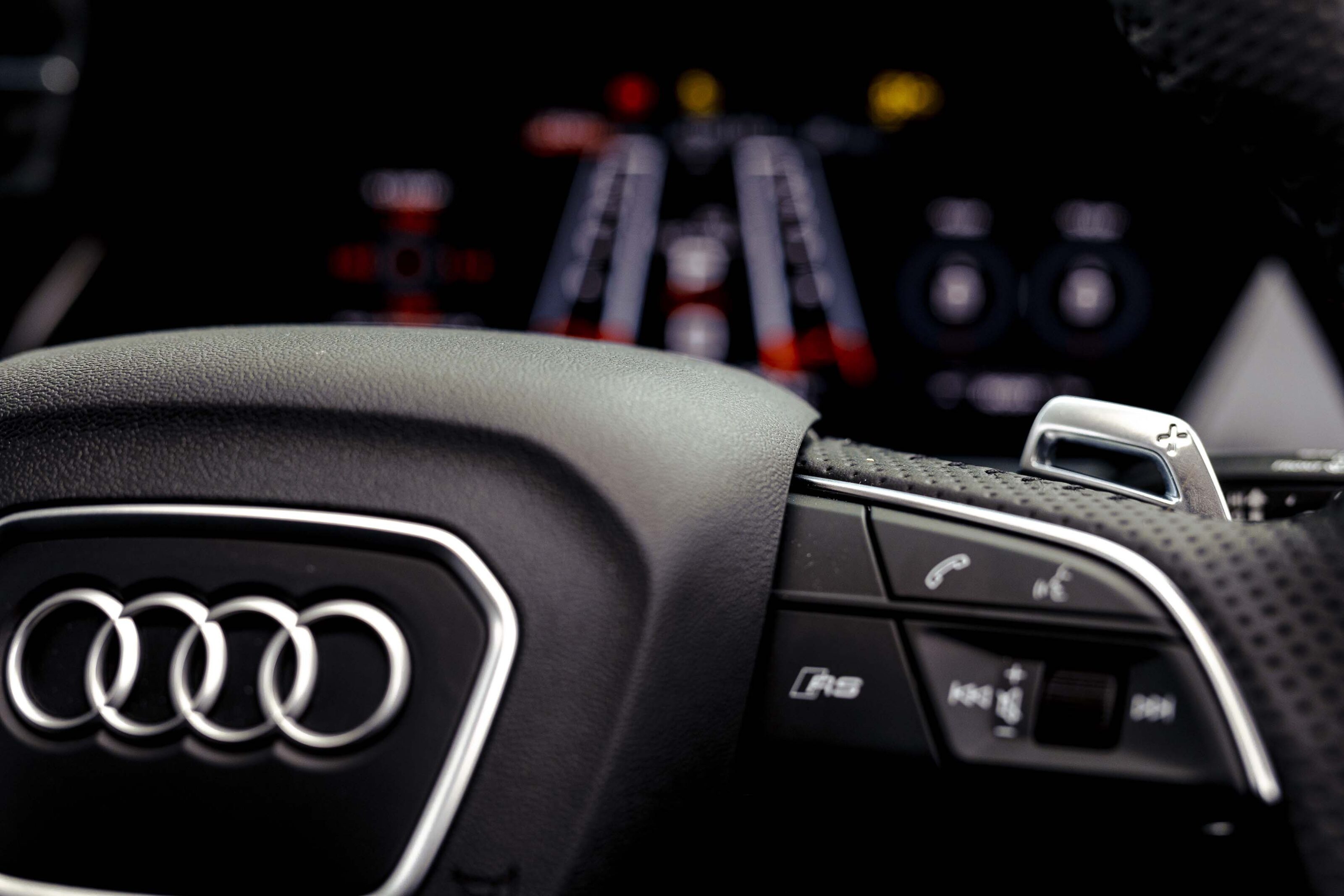
RS Performance also winds back the stability control and there’s just enough leeway to use a sharp lift to back the RS3 into corners and then plant the throttle early to relish in a balance that almost feels rear-driven.
Get it right and there’s a brilliant and deeply impressive car here. You just need to find the right mix of drive modes to unleash it. And that’s the key difference here.
The Audi might be the more accomplished and faster back-road runner but even at six- or seven-tenths the A45 is more exciting. And for a frenetic, no-holds-barred blast, the AMG isn’t only easier to hustle, but thanks to its boosted sense of sound and immediacy, it feels faster to drive.
It’s not, though, at least in a straight line…
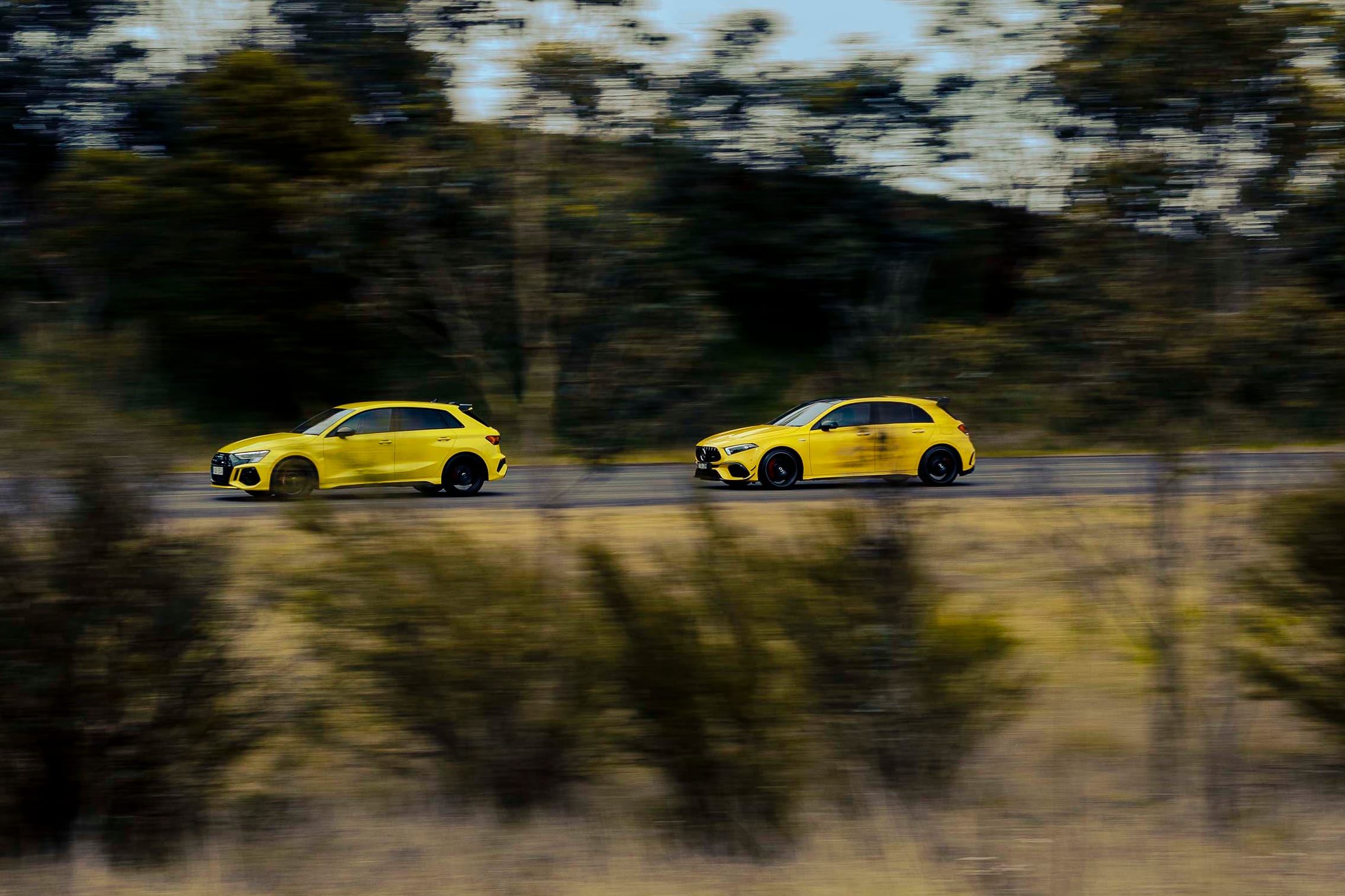
With our trusty VBOX datalogger attached and launch control activated, the A45 S rockets from 0-100km/h in 4.0 seconds dead.
That’s a tenth away from its official claim, which we have matched previously at the drag strip, but today the AMG is metronomic and clocks 4.0sec repeatedly despite us trying different drive modes and launch techniques.
The Audi’s first timed run makes mincemeat of the A45. It also completely destroys its official claim of 3.8 seconds. With launch control engaged, the RS3 hit three figures in 3.5 seconds. That’s supercar performance from a family hatchback.
And just like it drives on the road, the Audi was totally unflustered in how it rocketed away from the line. No real wheelspin, no violent gearshifts, just unrelenting acceleration.
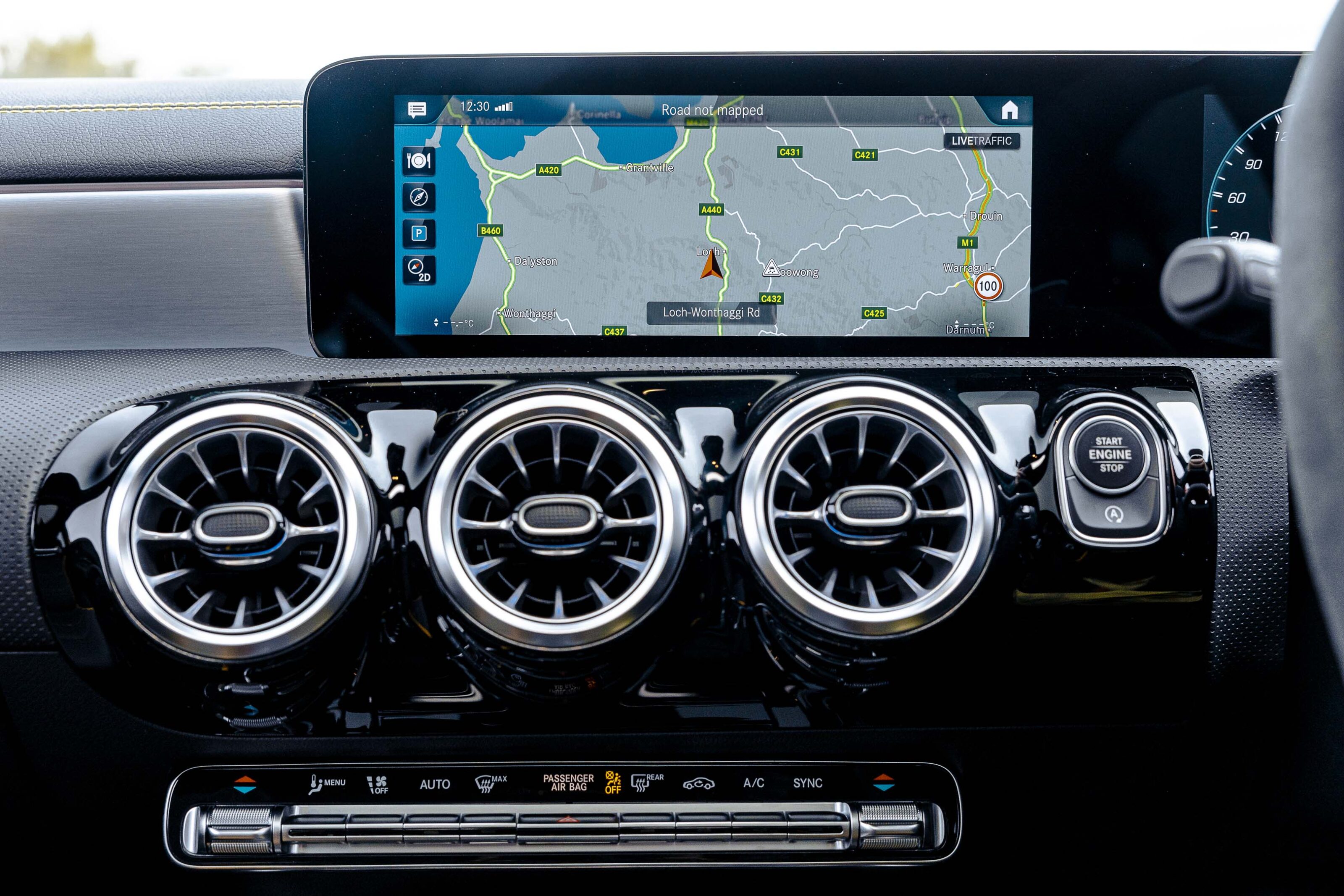
The other place the RS3 gazumps the A45? Interior presentation.
When I first drove the RS3 at its Aussie launch I criticised it for having some hard plastics below the beltline but against the A45 it feels a noticeable step above for materials and build quality.
As ever, Audi’s cabin design is modern, the digital driver display and central infotainment screen are easy to navigate, and crucially, unlike most new Volkswagen Group products, ergonomics haven’t been sacrificed in the pursuit of style.
Want to adjust the temperature or fan speed? Simply reach for a neat rocker switch ahead of the gear selector. Nice driving position, too, though like the A45 the driver’s seat feels a touch too high.
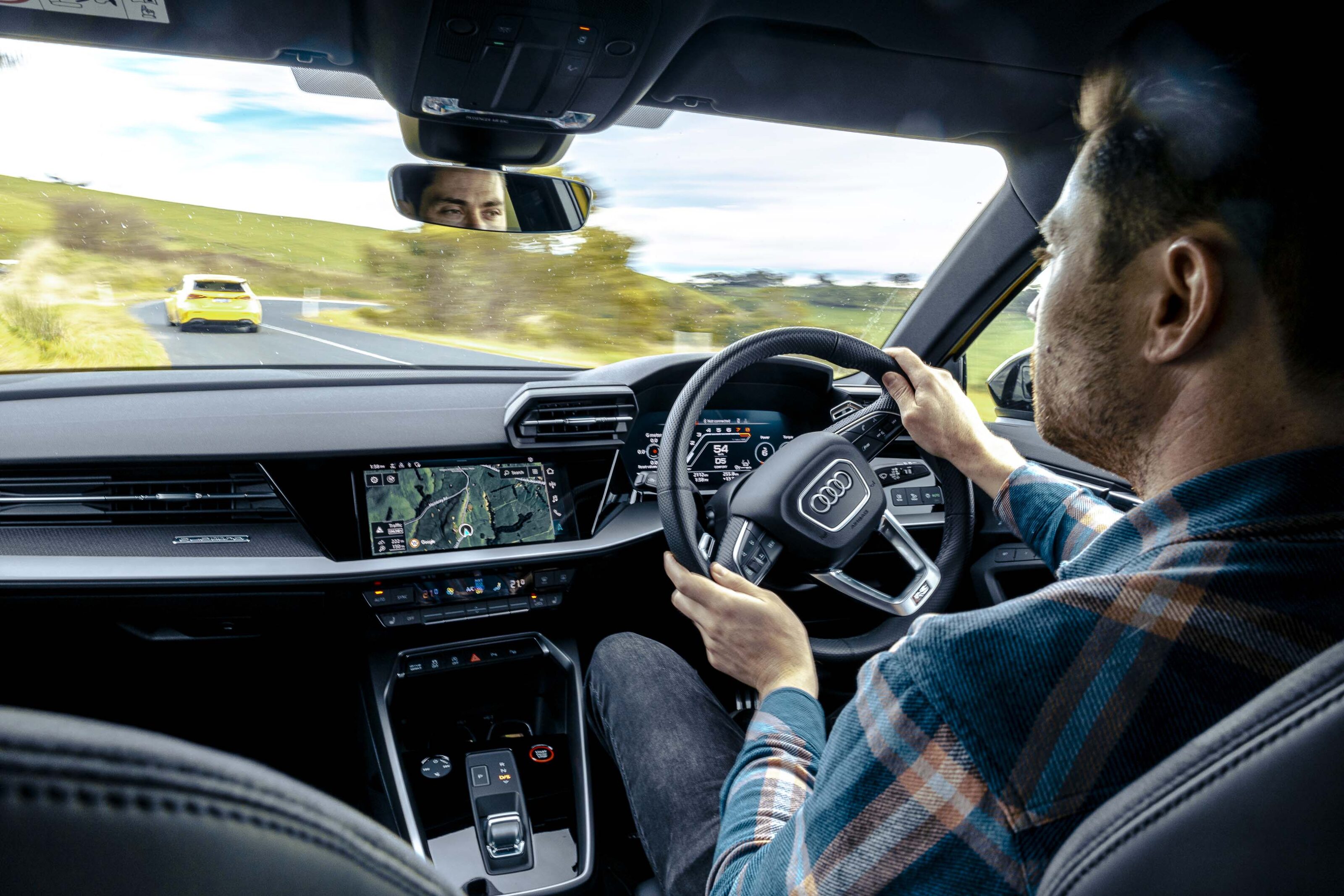
By comparison, the A45’s interior is superficially premium. The design and mix of materials looks good initially but once you start to touch and feel and interact with the cabin it begins to feel quite cheap.
In the Audi, hard plastics are mostly kept out of sight but the AMG has a big slab of thin piano black plastic around the central air vents, there’s shiny chrome on the centre console and all the switchgear and stalks feel plasticky and inferior. You don’t get wireless Apple CarPlay, either, which you do in the Audi.
Ergonomics are sound, though, and AMG’s Manettino dial on the steering wheel is the better solution for cycling through drive modes at speed. The Audi combines a drive mode button on the centre console with an RS hotkey on the right spoke of the steering wheel but it’s more finicky to use and requires you to take your eyes off the road.
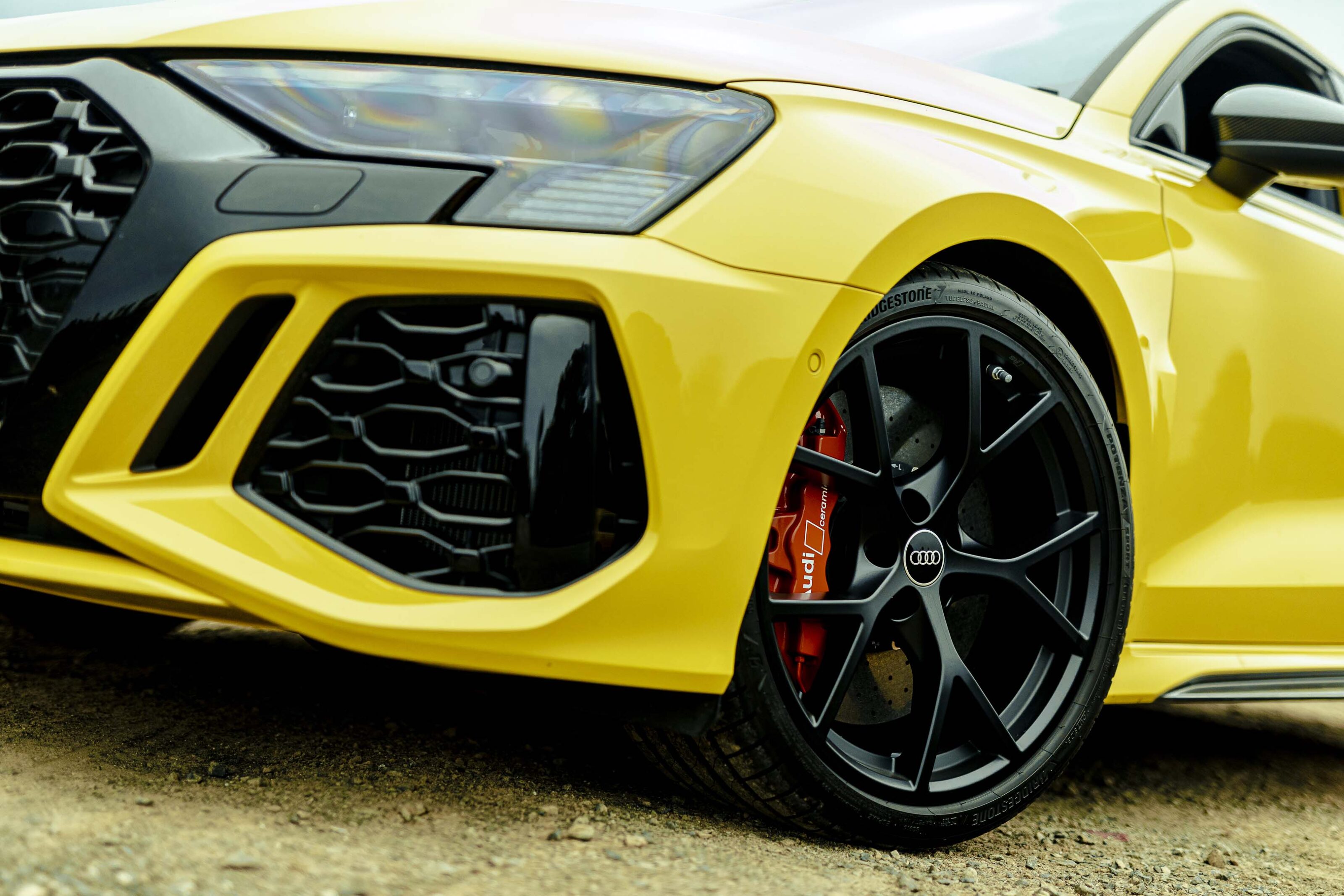
The AMG reclaims some more ground in terms of boot space. Needing to fit the new ‘torque splitting’ diff has seen the Audi’s boot shrink to a measly 281L. The A45’s luggage bay is noticeably larger at 370L.
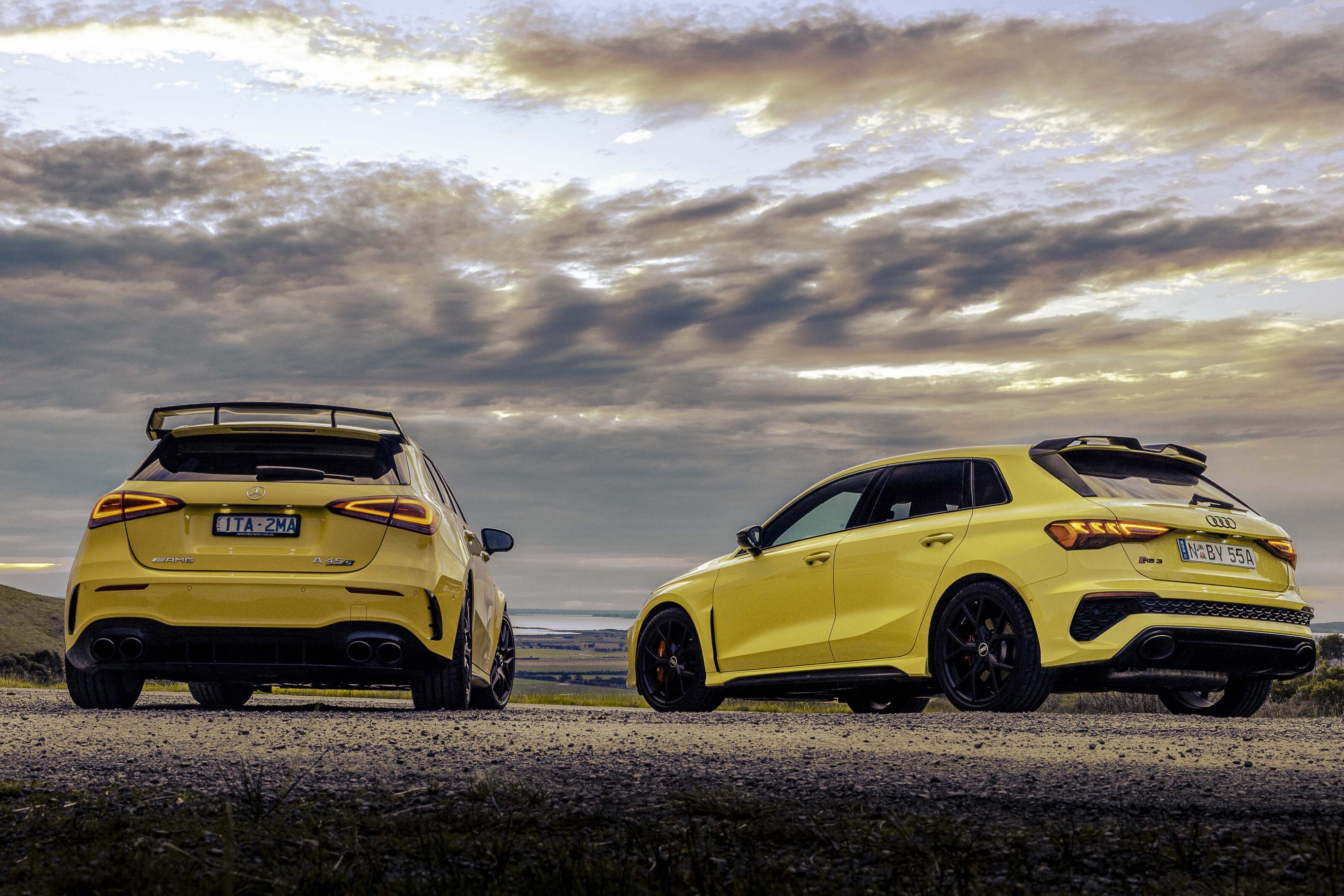
As for how they look, that’s down to you. Both are a riot to behold with their jutting noses, bright paintwork and huge rear wings but for us, the RS3’s wider proportions, chunkier front rubber and box-like vent on the trialling edge of the front wheelarch are more pleasing to the eye.
VERDICT
It all begs the obvious question: which of this pair is best? There’s no obvious winner. Just like their on-paper spec, there’s very little to split the A45 S and RS3 if you’re looking for an objective verdict.
Both are ferociously fast, phenomenally grippy and thanks to their complex all-wheel-drive systems, they’re more engaging and talented to drive than ever.
There’s also something to be said for their size and form factor. They’re remarkably easy to place on the road, which only adds to their sense of real-world pace.
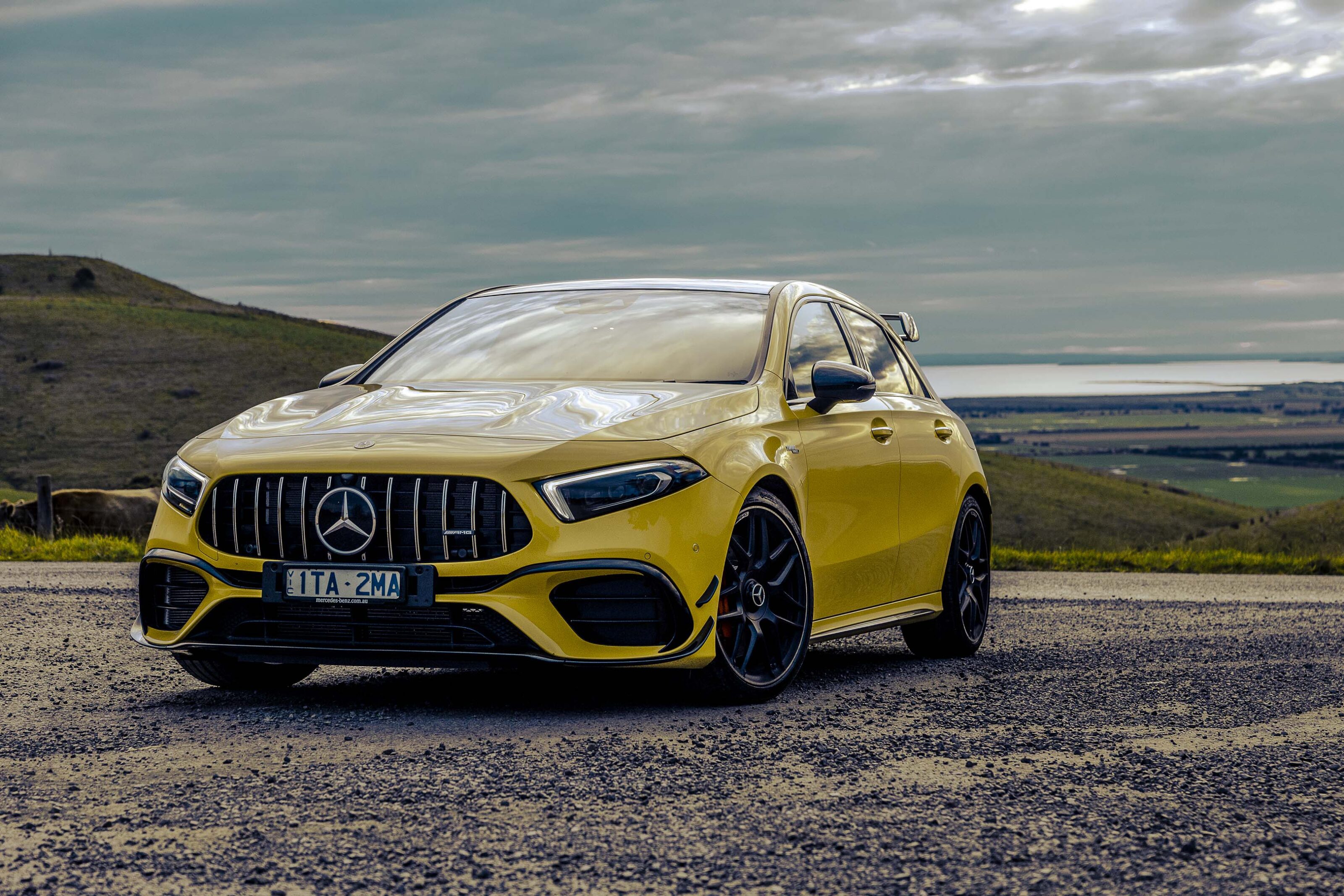
Both are ferociously fast, phenomenally grippy and thanks to their complex all-wheel-drive systems, they’re more engaging and talented to drive than ever.
But for all their similarities they do have distinct personalities. And that’s how we’ll split them.
The A45 is more fun. It’s highly strung and visceral, has the more exciting powertrain and while it might be slower against the clock, it’s the one that squeezes your adrenaline gland the hardest. But if a more balanced approach to performance is what you’re looking for, then the Audi is superior.
It’s more refined, has a better ride and its cabin is more luxurious, which is why it just edges ahead in the final tally.
Need a simpler way to decide? If engagement and driving thrills are your top priority, go for the AMG. But if you want a hyper hatch that’s outrageously fast but also easier to live with day-to-day, the Audi reigns supreme.
SCORING
Audi RS3: 8.1/10
Things we like:
- Rabid and repeatable acceleration
- Best-handling RS3 yet
- Cabin quality and space gazumps A45
- Easier to live with day-to-day than firmer AMG
Not so much
- Not as immediately exciting as A45
- Sportbacku2019s boot is tiny
- Five-cylinder soundtrack should be louder
- Carbon-ceramic brakes not worth the money
Mercedes-AMG A45 S: 8.0/10
Things we like
- Still the most engaging hyper hatch
- Easier and more rewarding to drive fast than the RS3
- Mental 2.0-litre is frantic and louder than the Audi
- Still enough bandwidth to use every day, just
Not so much
- Lacks RS3u2019s refinement and polish
- Circa-$10K price premium over Audi
- Always feels u201conu201d and lacks the RS3u2019s calmer side
- Rear seat is flatter and less comfortable, no wireless Apple CarPlay
Scoring breakdown
| Audi RS3 | AMG A45 S | |
|---|---|---|
| Safety, value and features | 7.5 | 7 |
| Comfort and space | 7.5 | 7.5 |
| Engine and gearbox | 9 | 9 |
| Ride and handling | 8.5 | 8.5 |
| Technology | 8 | 8 |
| Total: | 8.1/10 | 8.0/10 |
Audi RS3 v AMG A45 S: Specifications
| RS3 Sportback | A45 S | |
|---|---|---|
| Body | 5 door, 5 seat hatchback | 5 door, 5 seat hatchback |
| Drive | all-wheel drive | all-wheel drive |
| Engine | 2480cc inline 5cyl, DOHC, turbo | 1991cc 4cyl, DOHC, turbo |
| Compression | 10.0:1 | 9.0:1 |
| Bore/stroke | 82.5 x 92.8mm | 83.0 x 92.0mm |
| Power | 294kW @ 5600-7000rpm | 310kW @ 6750rpm |
| Torque | 500Nm @ 2250-5600rpm | 500Nm @ 5000-5250rpm |
| 0-100km/h | 3.8sec (claimed) | 3.9sec (claimed) |
| Transmission | 7-speed dual-clutch | 8-speed dual-clutch |
| Weight | 1570kg (DIN) | 1585kg (DIN) |
| Fuel consumption | 12.7L (as tested) | 13.4L/100km (as tested) |
| Front suspension | MacPherson struts, coil springs, adaptive dampers, anti-roll bar | MacPherson struts, coil springs, adaptive dampers, anti-roll bar |
| Rear suspension | Multi-links, coil springs, adaptive dampers, anti-roll bar | Multi-links, coil springs, adaptive dampers, anti-roll bar |
| L/W/H | 4389/1851/1463mm | 4445/1850/1412 |
| Wheelbase | 2631mm | 2729mm |
| Brakes | 380mm carbon discs with 6-piston calliper (f) 310mm discs singe-piston calliper (r) | 360mm discs with 6-piston callipers (f) 330mm single-piston calliper (r) |
| Tyres | 265/30 ZR19 (f) 245/35 ZR19 (r) Bridgestone Potenza Sport | 245/35 ZR19 Michelin Pilot Sport 4S |
| Wheels | Alloy 9J x 19in (f) 8J x 19in (r) | Alloy 8.5J x 19 (f/r) |
| Price/As tested* | $91,391/$109,074 | $99,085/$104,875* |
Skoda’s smallest model ironically has the longest name in the Czech brand’s line-up and, on its birth certificate, the full moniker reads Skoda Fabia 110TSI Monte Carlo Edition 150. Quite a mouthful for such a diminutive car, but the protracted name is not all bluster and indicates that this little hatchback has a lot to offer.
The 110 part denotes the four-cylinder engine’s power output in kilowatts, the Monte Carlo bit points to the highest level of specification in the Fabia range, while the Edition 150 is yet another reference to peak power – this time in metric horsepower or pferdestarke – because why not brag about it hey?
What’s Skoda’s connection to Monte Carlo? Find out here.
Skoda is excited about the Fabia’s power because you can’t get the same four-cylinder performance out of a mechanically related Volkswagen Polo unless you jump up to the more expensive GTI, while matching the performance with an Audi A1 will also require a bigger budget.
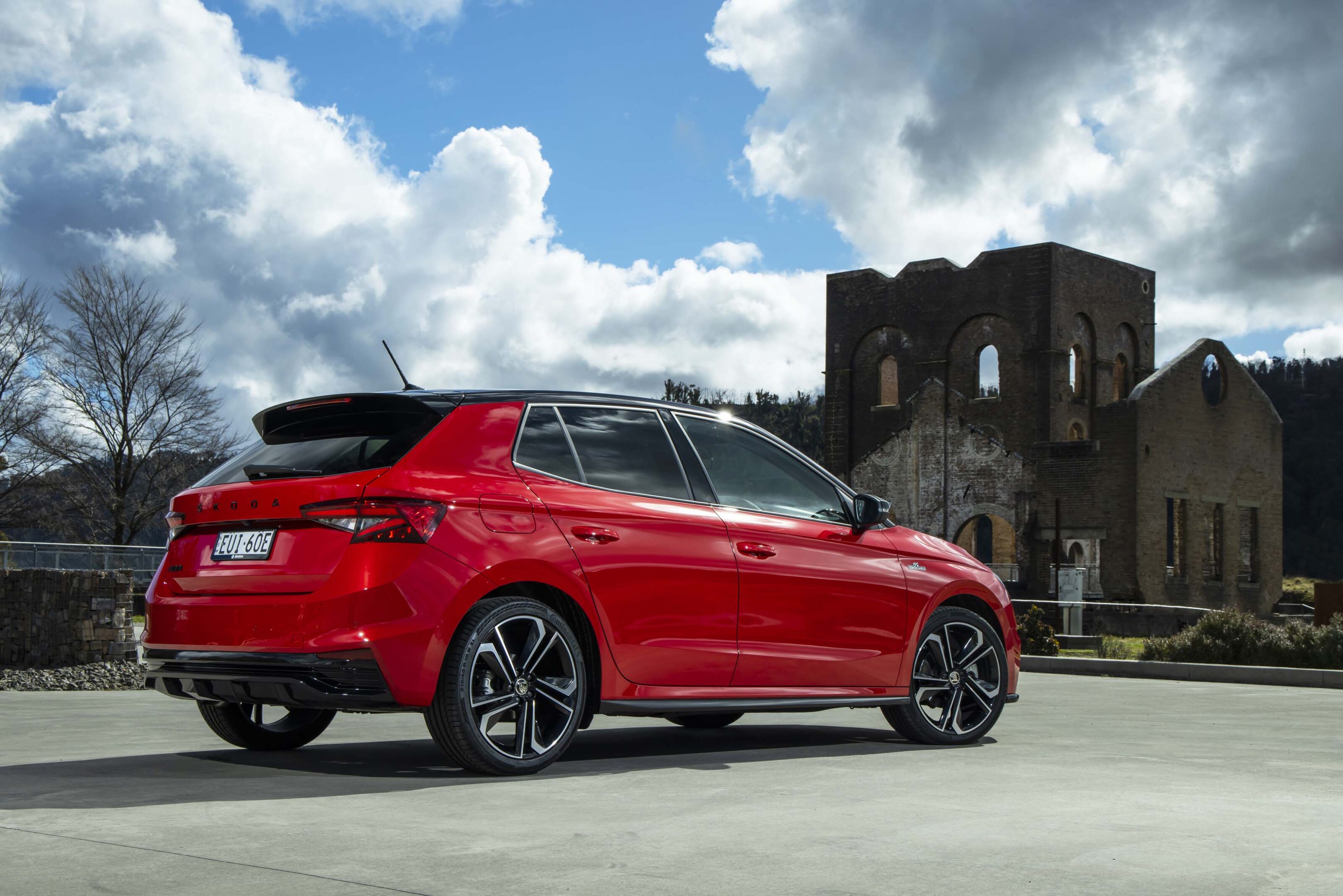
Within the VW Group’s little hatch family, therefore, the Fabia represents maximum bang for buck. But just how many bucks might seem like a stumbling block.
Priced from $37,990 drive-away, there’s no denying the Fabia isn’t cheap and, for now, it’s the only variant on offer. A three-cylinder version is available in Europe which we drove last year and if Skoda introduced a version locally it’s likely it would be priced similarly to the equivalent Polo, which ranges from the $25,250 Life manual, to the $31,250 Style auto (both before on-road costs).
But Skoda says its brand, regardless of the model, isn’t about cheap – it’s about value for money. Let’s find out.
You could start with the Fabia brochure, where you’ll find its generous list of standard equipment laid out in an easy-to-evaluate format, but better than that is to jump in. Once on board, the Monte Carlo specification quickly stands out.
Skoda says its brand, regardless of the model, isn’t about cheap – it’s about value for money.
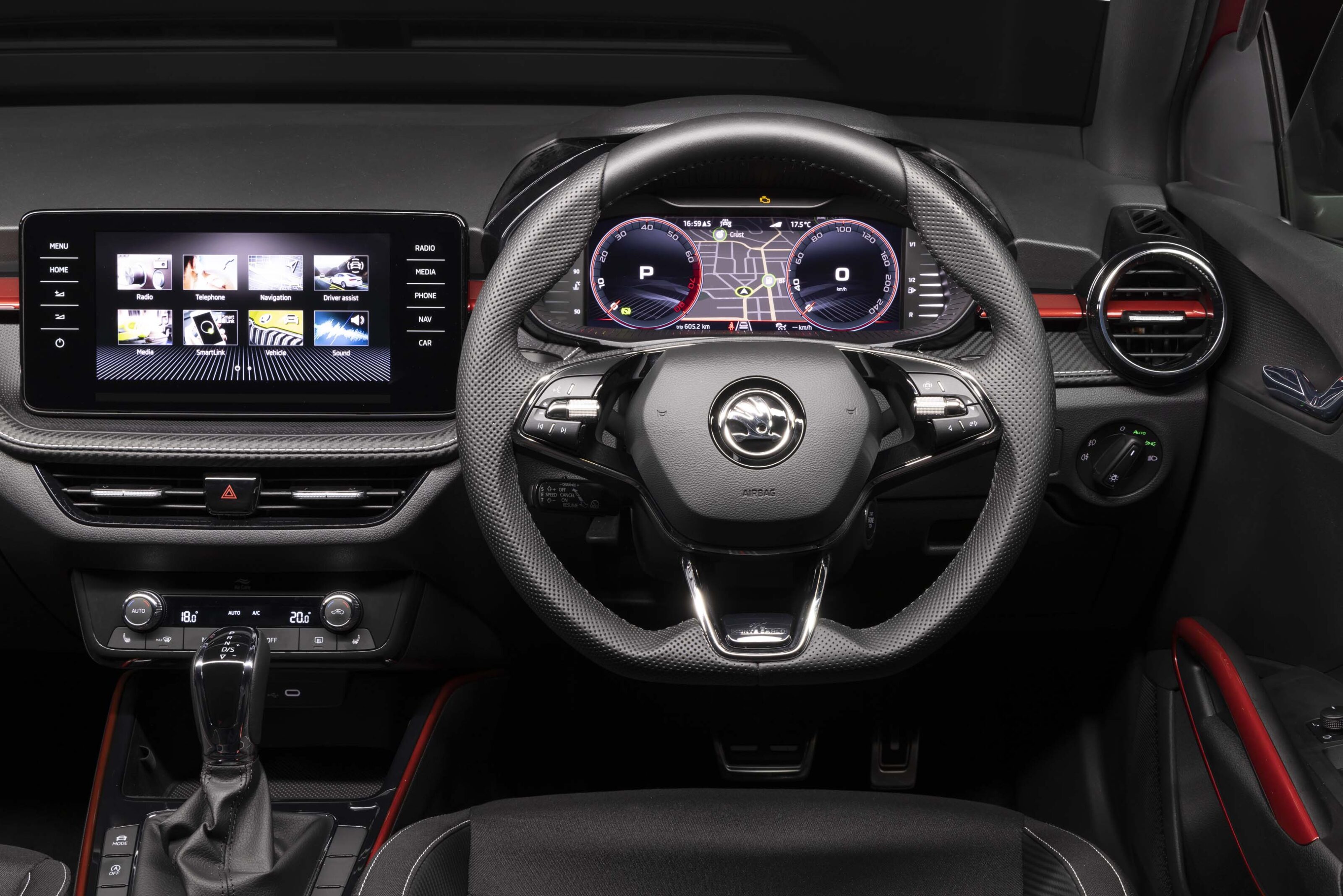
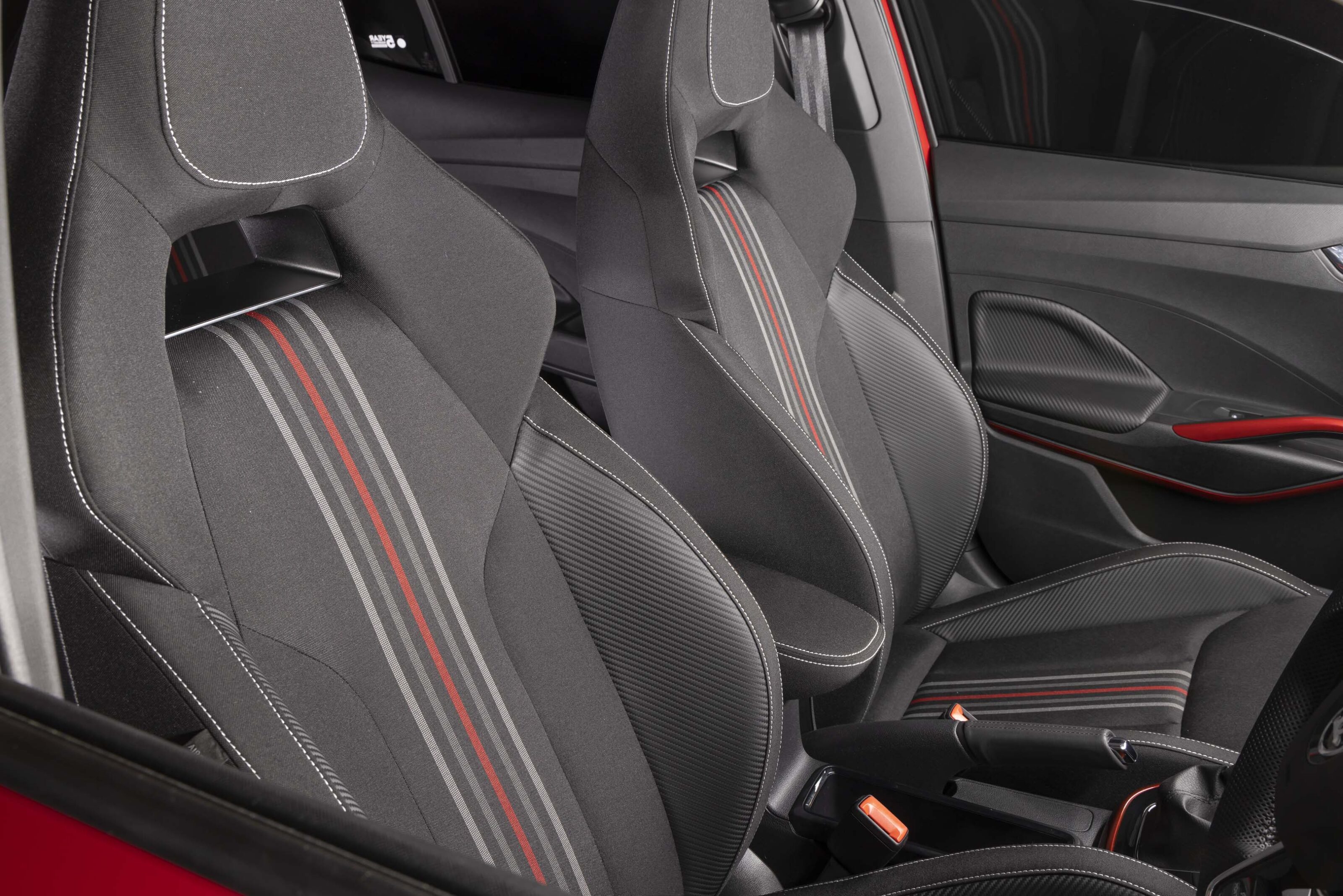
From the sports interior with racing-style front seats covered in attractive fabric with contrasting stitching and heaters, a beautifully contoured leather steering wheel, huge 9.2-inch central touchscreen and complementing fully-digital instrument cluster, the Fabia looks like it competes in anything but the compact hatch segment.
There are more grown-up features too, including a serious suite of driver assistance and safety systems from the now-ubiquitous and soon-to-be mandatory auto emergency braking with pedestrian and cyclist recognition, through adaptive cruise control, lane-keeping assistance and blind-spot monitoring, to a reversing camera, six airbags and ISOFIX child seats anchors for two of the rear seats.
Fair to say then, that the Fabia is the little car with big car appeal, but in reality, it’s actually not that small.
With an overall length of 4.1m and at nearly 1.8m wide, the Fabia is the biggest offering in the ‘compact’ hatchback segment and only just smaller than a Suzuki Vitara.
Its rear seats aren’t exactly cavernous but there’s definitely adequate space for a 187cm adult without their head touching the ceiling or knees digging into the back of the front seat. Little comforts such as rear air vents make a big difference to the overall feel and are unusual in this segment.
Up front, there’s 1428mm of elbow room for front occupants and the cabin initially appears spacious but the heavily bolstered seats can clash with the driver’s elbows during enthusiastic driving. If you’re not in control of the steering though, the Fabia is indeed as big as compact hatches get.
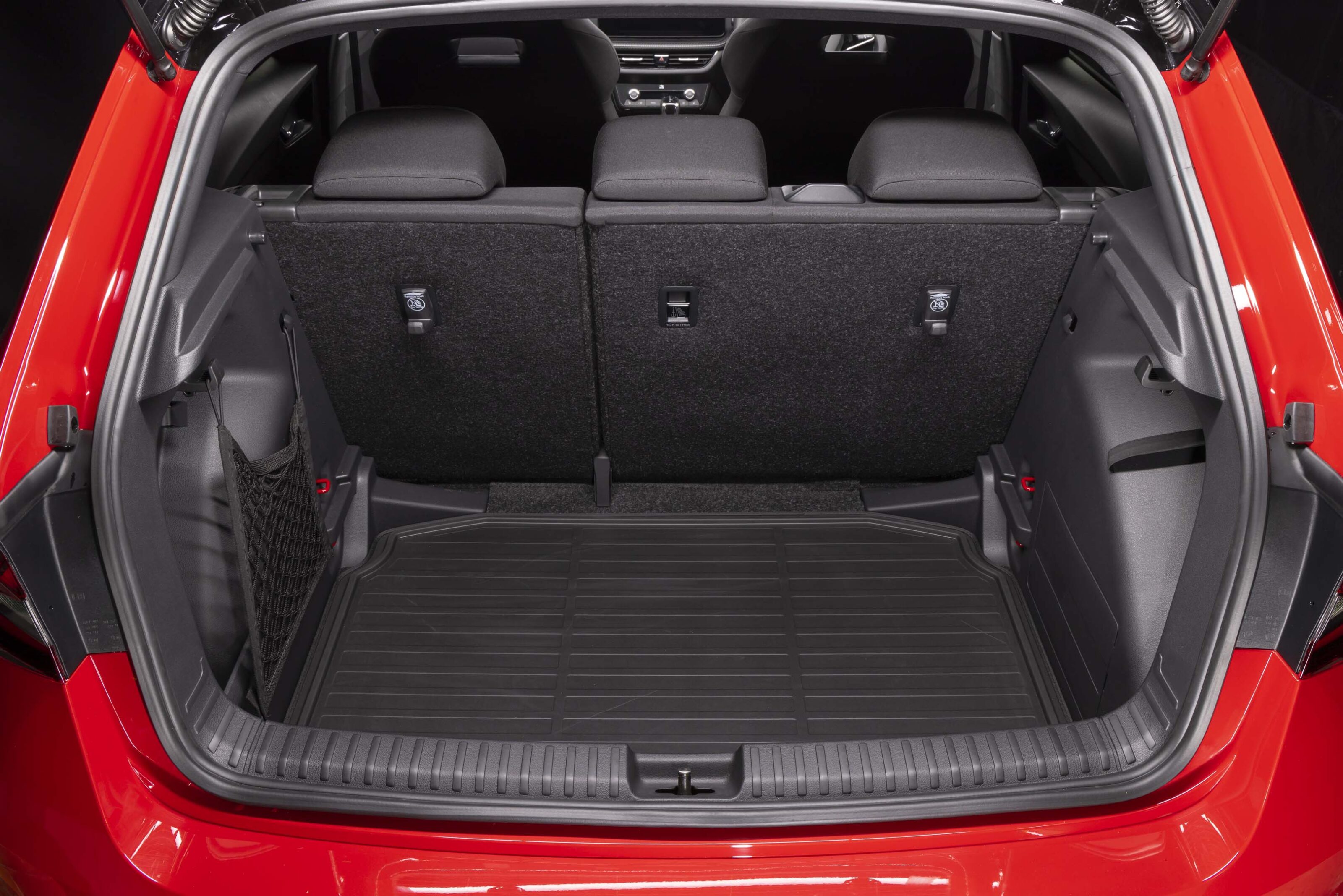
A 380-litre boot completes the Fabia’s volume proposition – generous for the compact segment and even beats the Toyota Corolla’s load bay, which competes in the small hatchback class above it.
There are a number of Chinese challenger brands that offer kit-laden models, including the MG3 which competes in the compact hatch marketplace, but while the MG starts to run out of momentum once you’re into the drivetrain and dynamics, the Skoda keeps getting better.
With a 1.5-litre turbocharged four-cylinder petrol under its bonnet, the 110TSI has a respectable 110kW of power at its disposal, but a beefy torque figure of 250Nm is its trump card and can only be bested in the segment by the manual-only Ford Fiesta ST and Hyundai i20 N.
The Skoda, however, sends its decent dollop of performance to the front wheels through a decidedly grown-up seven-speed dual-clutch automatic transmission and electronic limited-slip differential.
Its maker doesn’t make a big deal about the Fabia’s driving dynamics and fun factor, which is why the way the Monte Carlo comes as such a pleasant surprise.
Zero to 100km/h is done in a claimed 8.0 seconds, but peak torque arrives at just 1500rpm which makes the little hatch feel faster.
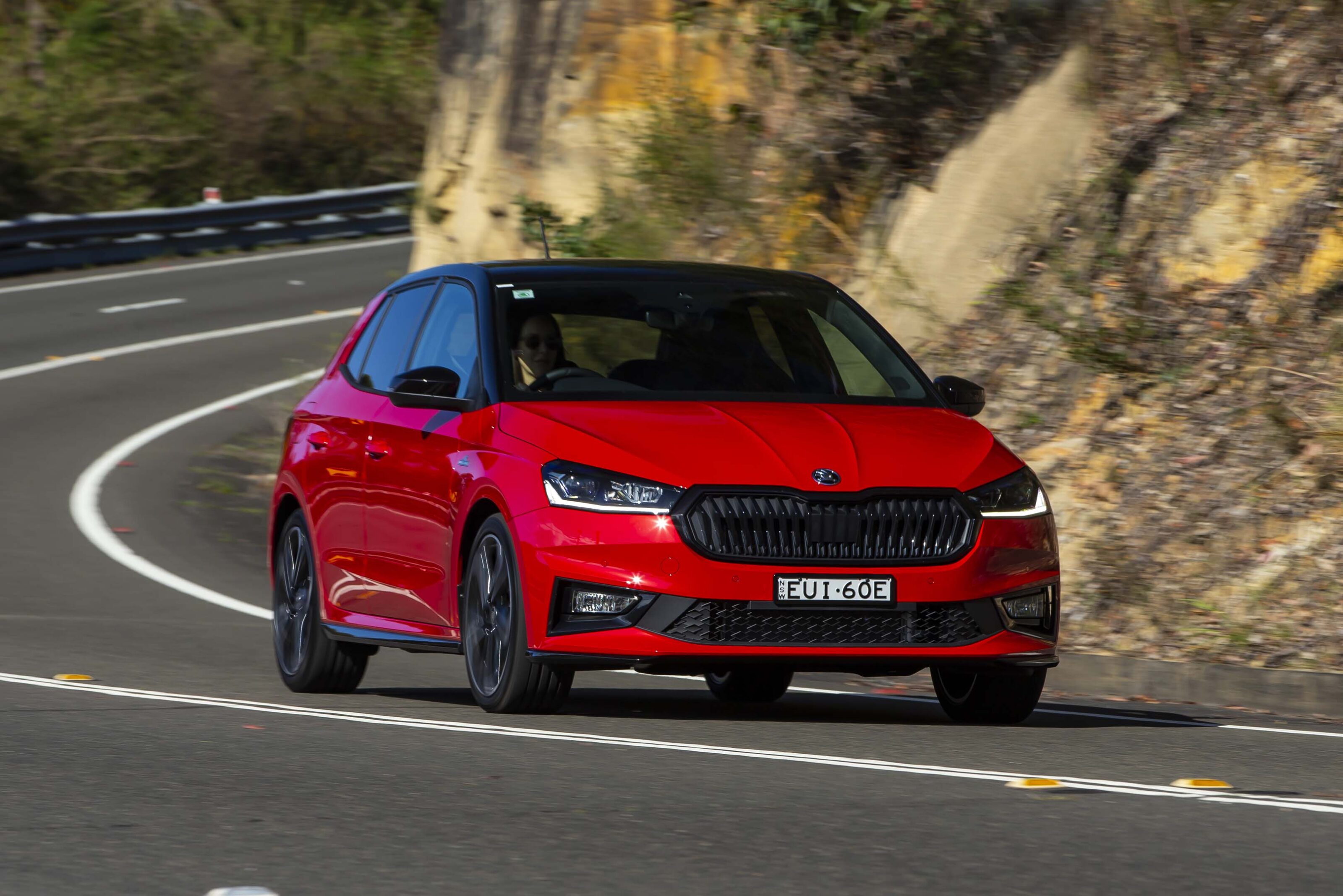
Traction through the combination of Bridgestone rubber and 18-inch wheels is excellent, while the LSD deals with changing surfaces and mid-corner acceleration with confidence and without torque-steer.
In the absence of an outright RS performance flagship, the Monte Carlo is the sportiest Fabia variant in any global market. It has sports suspension and a lower ride height, which has certainly stiffened the ride but there’s still decent compliance and balance of comfort.
Its maker doesn’t make a big deal about the Fabia’s driving dynamics and fun factor, which is why the way the Monte Carlo comes as such a pleasant surprise.
Perhaps the only black mark against the Fabia’s performance proposition is when it comes to braking.
Disc brakes in all corners are another selling point in the class, but a brake pedal with too much travel and creep doesn’t instil the confidence that its hardware pertains.
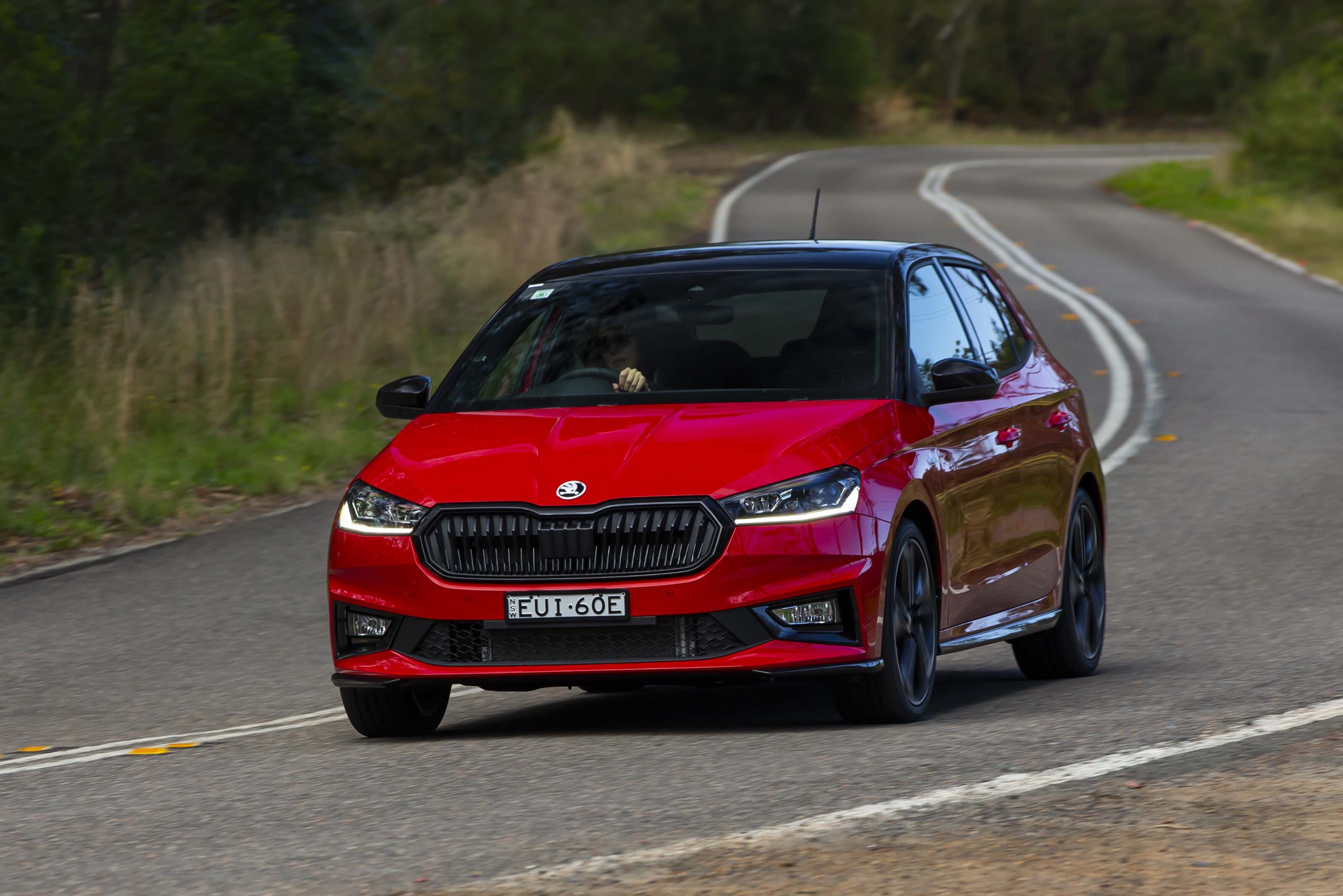
When it comes to cornering, however, the Fabia is very capable. An eager nose turns in fast and the classic MQB chassis and steering are lively and familiar. With a surprisingly neutral balance through corners, the littlest Skoda has a broader dynamic envelope than expected.
Its engine has two personalities and will rev out strongly to the redline or deliver big chunks of torque when the higher gears are grabbed, but with a lack of steering wheel paddleshifters, that job falls exclusively to the transmission calibration.
The gear selector lever can be used to provoke a shift but it’s calibrated to downshift with a pull back and shift up with a push forward – largely regarded as counterintuitive and I agree.
Fortunately, a choice of driving modes offers the best solution, with Normal mode hunting the higher gears while Sport allows the engine to rev more freely.
Speaking of Normal mode, the Fabia does that well too.
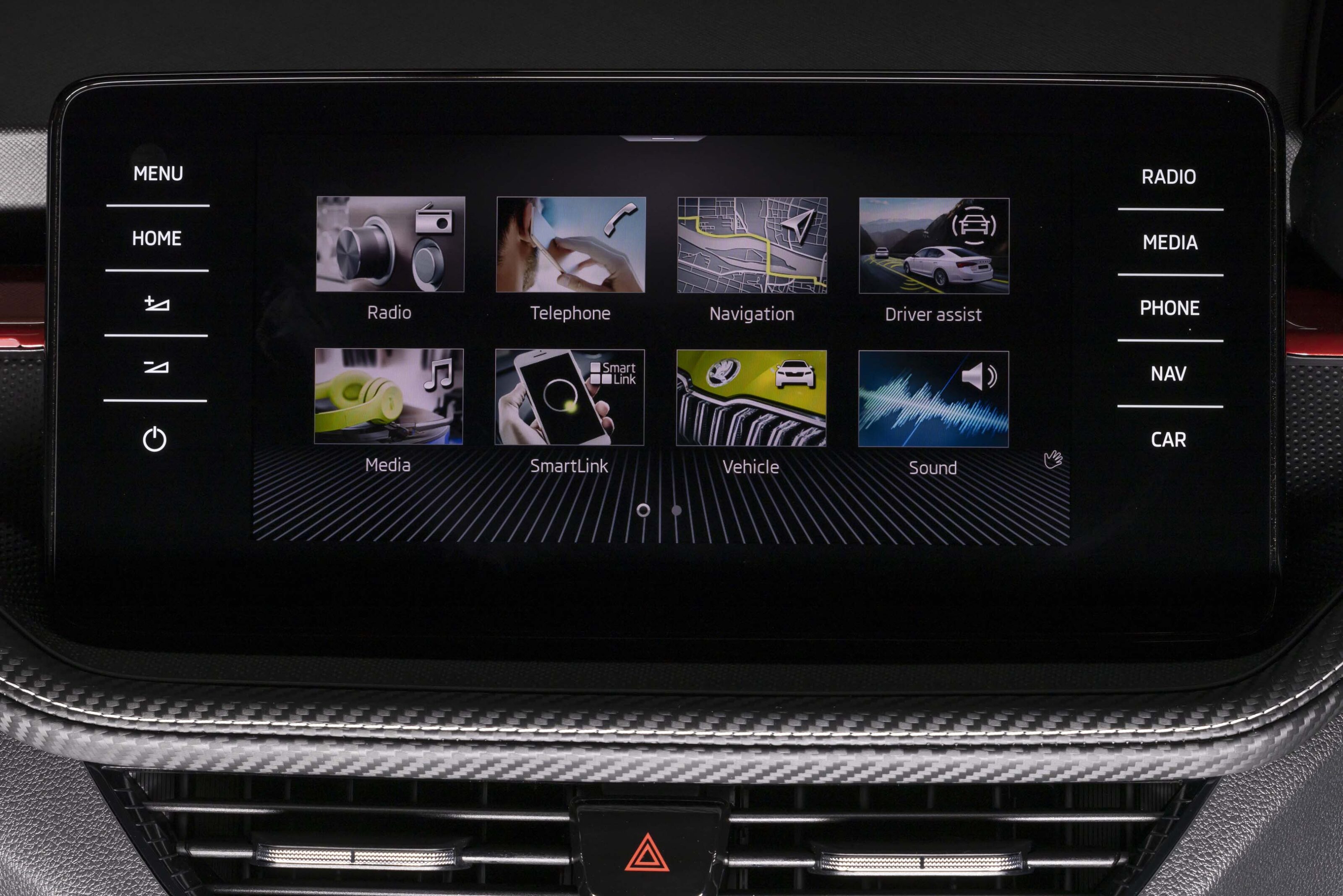
When the wireless Android Auto (Apple CarPlay is supported too) dropped out for a moment, native navigation was a welcome standard inclusion, while wireless device charging and four USB-C connections are two good examples of contemporary tech.
Cool ambient lighting, heated front seats and keyless access with push-button engine start also make the Fabia feel bigger in stature for the day-to-day grind.
VERDICT
If a compact hatchback is non-negotiable, then the Fabia is the most premium option under $40,000 and comes with a decent performance bonus
For the same budget as this Fabia, there are a couple of other hatchback options. The aforementioned Fiesta ST and i20 N are among the true performance car heroes regardless of the segment and price, but they can’t match the Skoda’s kit and neither are available as an auto. Oh, and the Fiesta is extinct in Australia.
For something that’s great to drive, Hyundai can also offer the exceptionally good i30 N-Line small hatch, which comes with the added bonus of more performance, space and independent rear suspension.
Almost the same applies to the Kia Cerato GT but if for whatever reason, a compact hatchback is non-negotiable, then the Fabia is the most premium option under $40,000 and comes with a decent performance bonus that it chooses to not shout about.
2023 Skoda Fabia Monte Carlo specifications
| Model | Skoda Fabia 110TSI Monte Carlo Edition 150 |
|---|---|
| Engine | 1498cc 4cyl, dohc, 16v, turbo-petrol |
| Max power | 110kW @ 6000rpm |
| Max torque | 250Nm @ 1500rpm u2013 3500rpm |
| Transmission | 7-speed dual-clutch auto |
| Economy | 4.9L/100km (claimed) |
| Weight | 1272kg |
| L/W/H/W-B | 4108/1780/1495/2564mm |
| 0-100km/h | 8.0sec (claimed) |
| Price | from $37,990 drive-away |
| On sale | now |
Jump ahead
- How much is it, and what do you get?
- How do rivals compare on value?
- Interior comfort, space and storage
- What is it like to drive?
- How is it on fuel?
- How safe is it?
- Warranty and running costs
- VERDICT
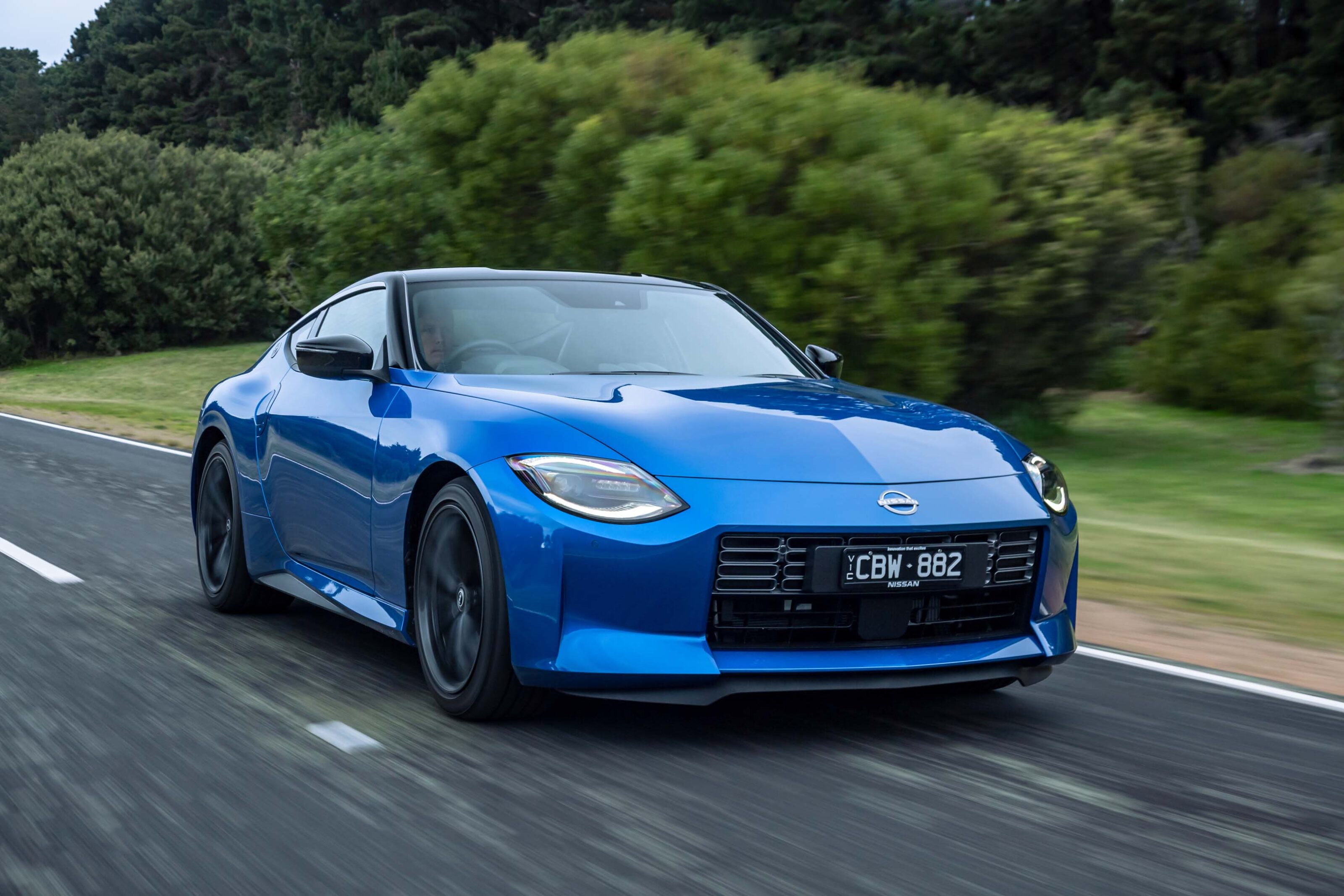
Introduction
We’ve waited a long time for this. It was back in September 2018 that Nissan head of design, Alfonso Albaisa first broke the news that the company was indeed working on a new Z car.
“The Z-car, oh my god. Huge pressure,” said Albaisa when reviewing the to-do list of Nissan design work. “You can imagine I’m completely excited that I am in the position to work on that.”
While rumours had swirled, this was the first time that Nissan had actually confirmed that the project was a go. And now, almost four years later, we’ve finally got some seat time in a car that many thought would never be built.
It’s easy to see the case against. After all, not many others are launching powerful rear-drive coupes that are supplied solely with an internal combustion petrol engine and offer the customer a three-pedal option. In order to bring such a car to market, it was clear that the Z couldn’t be a money-no-object exercise.
The question we’re looking to answer here is whether the wait has been worthwhile. Has Nissan delivered something that will delight Z enthusiasts the world over, or is this a case of cobbling pieces together from a parts bin and charging handsomely for it? Can it even be both? Let’s dive in and take a look.
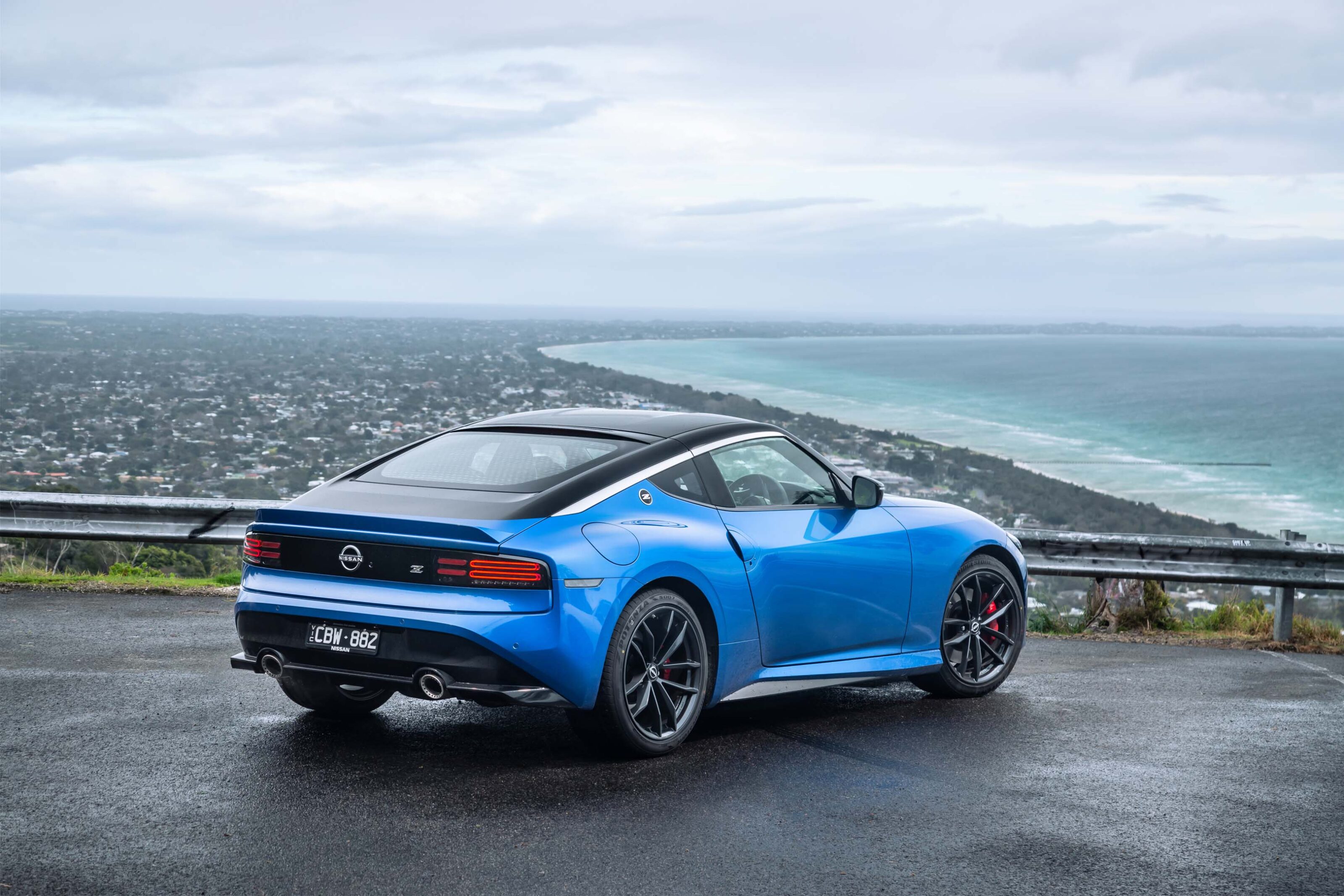
The question we’re looking to answer here is whether the wait has been worthwhile.
How much is it and what do you get?
One novelty on this Z is launch control, which tries gamefully on a frankly hideous weather day at the airstrip Nissan has booked. It’s fitted as standard to both the manual and automatic cars and we’ll reserve judgment on its effectiveness until we can try it in the dry. In both instances, it seemed easy to activate and not particularly finicky when it came to engine temperature prerequisites.
Other new aspects are an EXEDY racing clutch – don’t worry, it’s as benign as that of your gran’s Micra – and a carbonfibre tailshaft on the manual model which, incidentally, is priced at the same $73,300 (before on-road costs) figure as the auto. Then we come to the cabin.
You always suspect that the Z has been developed relatively inexpensively. I have no issue with that. Sports cars are niche products and in order to bring this model to market at all, Hiroshi Tamura and his team needed to demonstrate that it could be done in a cost-effective manner.
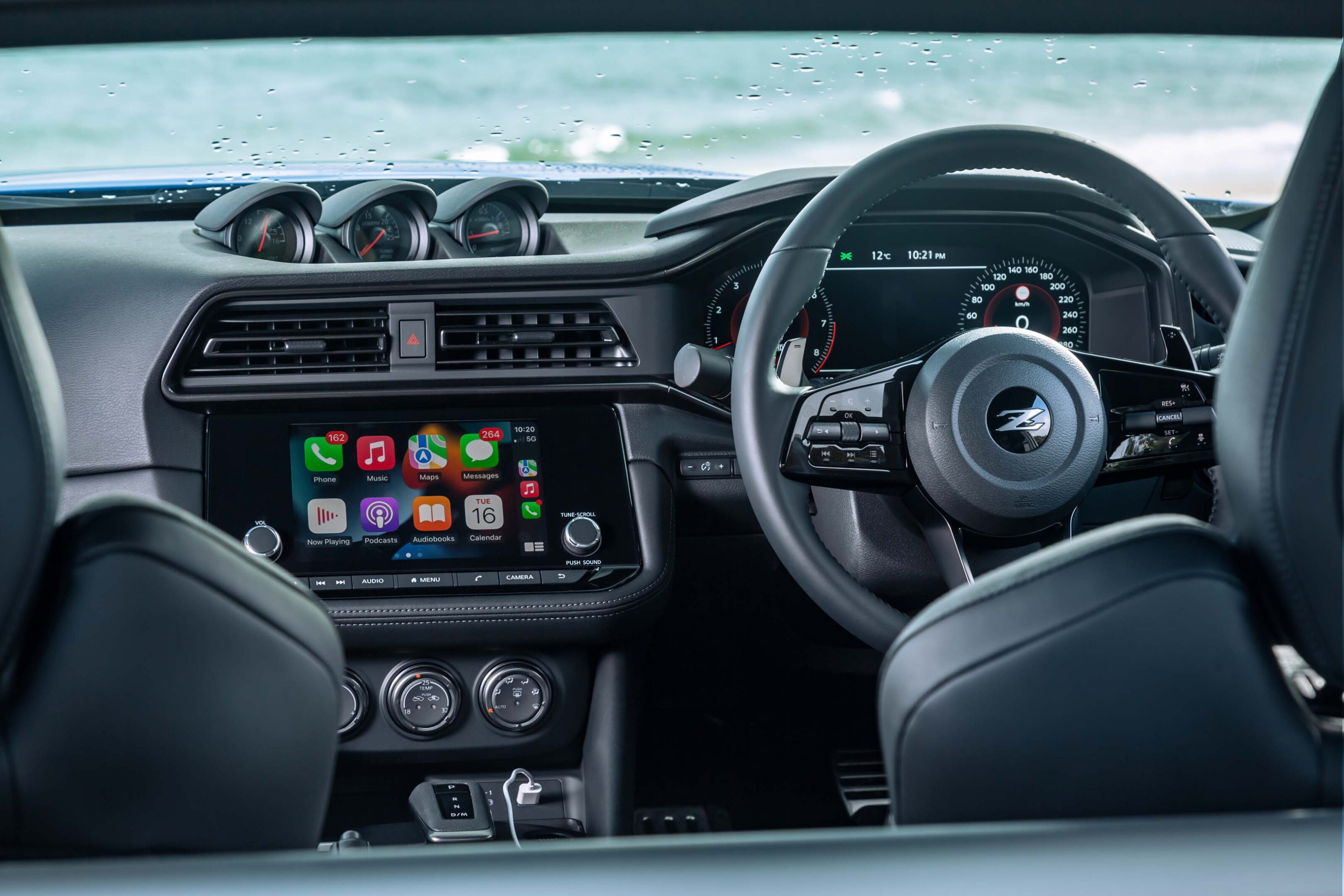
You always suspect that the Z has been developed relatively inexpensively. I have no issue with that.
As a result, it’s a melange of Infiniti bits, carryover 370Z parts, adapted or updated components and so on. It’s a credit to Nissan that it feels so cohesive, given its genesis.
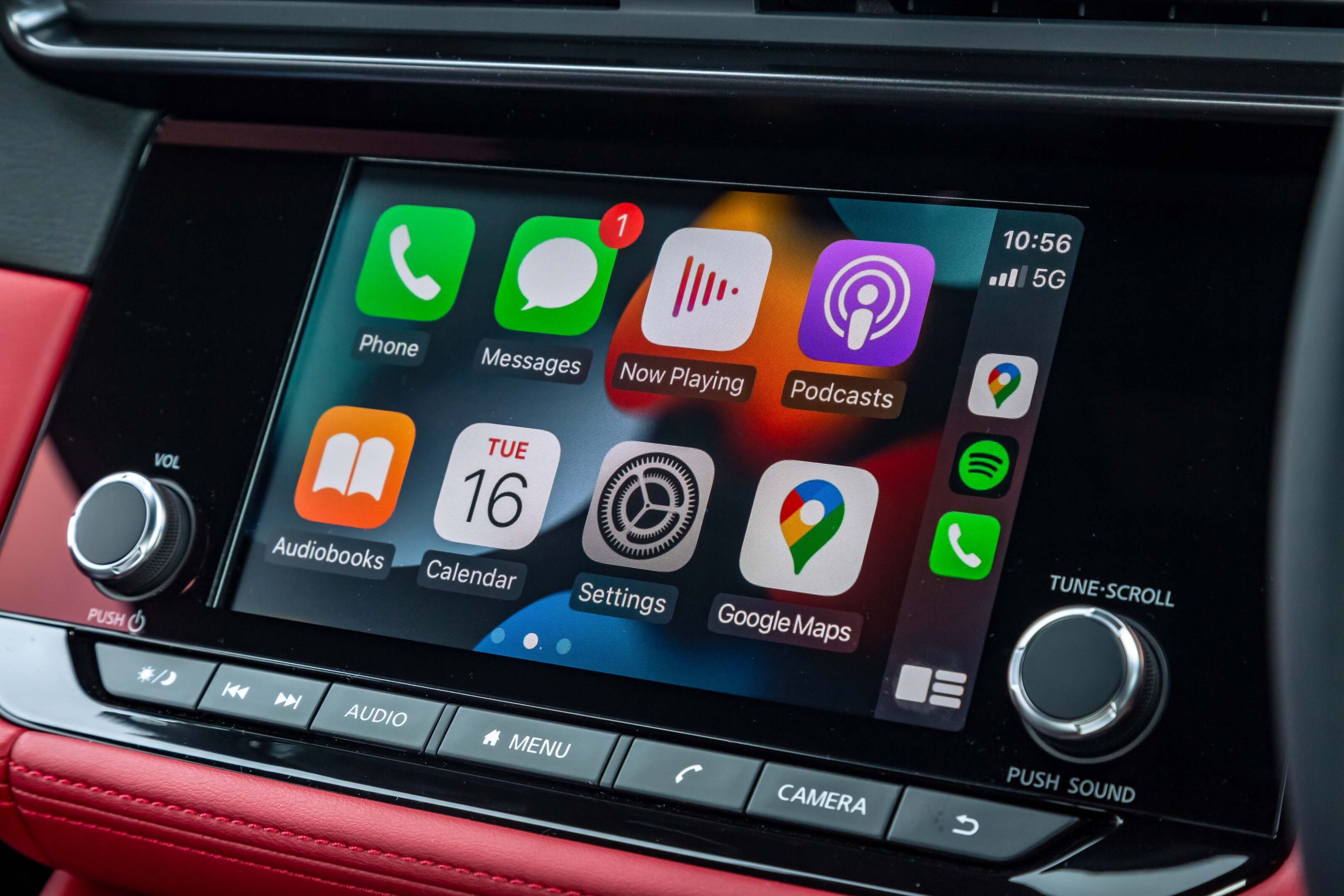
The cabin is where the belt-tightening is most obvious. You won’t find a head-up display, rain-sensing wipers, a phone charging pad or wireless Android Auto or Apple CarPlay. In fact, you’ll search in vain for any form of navigation at all in the recalcitrantly unresponsive infotainment system.
As recompense for failing to invest in the development of these systems, Nissan has thrown a bunch of gear at the Z including a Bose eight-speaker stereo, leather and suede heated and powered seats, an impressive safety suite, a multi-function 12.3-inch instrument panel and active noise cancellation.
How do rivals compare on value?
Available options here in Australia are virtually none. You’ll pay $700 for premium paint, while premium paint and a contrast roof will part $1200 from you. In other words, MSRP with all the gear but before on-road costs is $75,200.
That’s not bad considering the fact that the less powerful Supra GT currently opens at $87,303 before you start ticking boxes and applying on-road costs. Additional perspective is happily supplied by Ford, who will sell you a 339kW Mustang GT from $65,290 plus on-road costs.
Of course, if you really wanted to save a packet on your rear-drive manual or auto Japanese coupe, you could opt for the equally entertaining Subaru BRZ at around $40K, but you would be ceding a tall stack of power and torque.
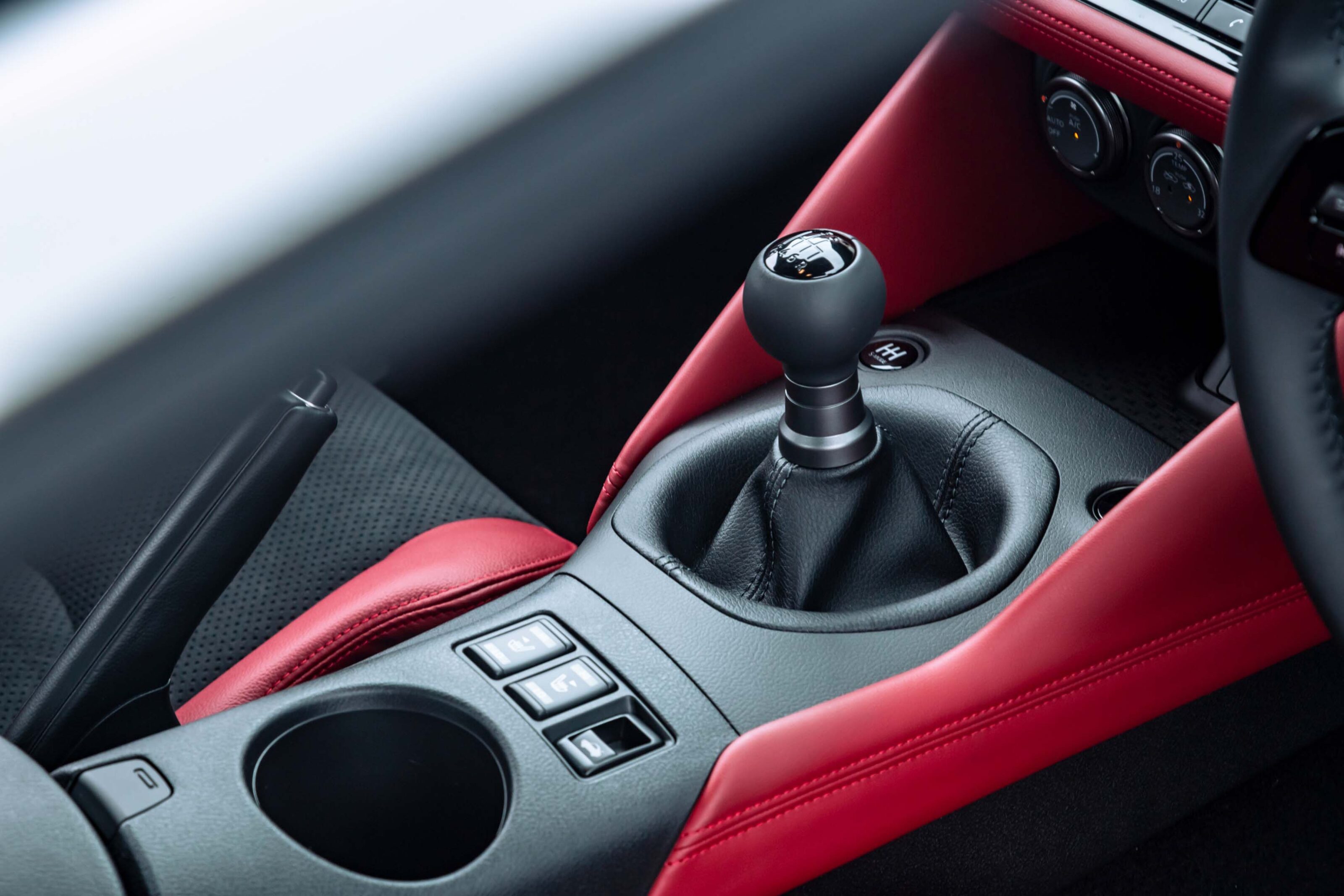
If you’re looking at the Nissan Z because you appreciate sharp aesthetics, then Audi’s TT 45 TFSI Quattro might also enter your equations at $85,300 excluding on-road costs, but do bear in mind that the pretty Ingolstadter isn’t available with a manual gearbox. With 180kW and 370Nm available, it’ll struggle to keep up with the Z on anything other than a streaming wet road.
Should you really want some additional perspective on the Nissan’s value proposition, then consider that it fronts up with more power and torque than a $180K Porsche Cayman GTS 4.0 or, come to that, an entry-level 911 Carrera at more than $240K before the inevitable options spend.
Suddenly $73,300 doesn’t seem an unreasonable demand. Don’t get too hung up on the $80K+ figure of the limited-run and mechanically identical Z Proto launch edition. That one’s sold out already.
If you really wanted to save a packet on your rear-drive manual or auto Japanese coupe, you could opt for the Subaru BRZ at around $40K, but you would be ceding a tall stack of power and torque.
Interior comfort, space and storage
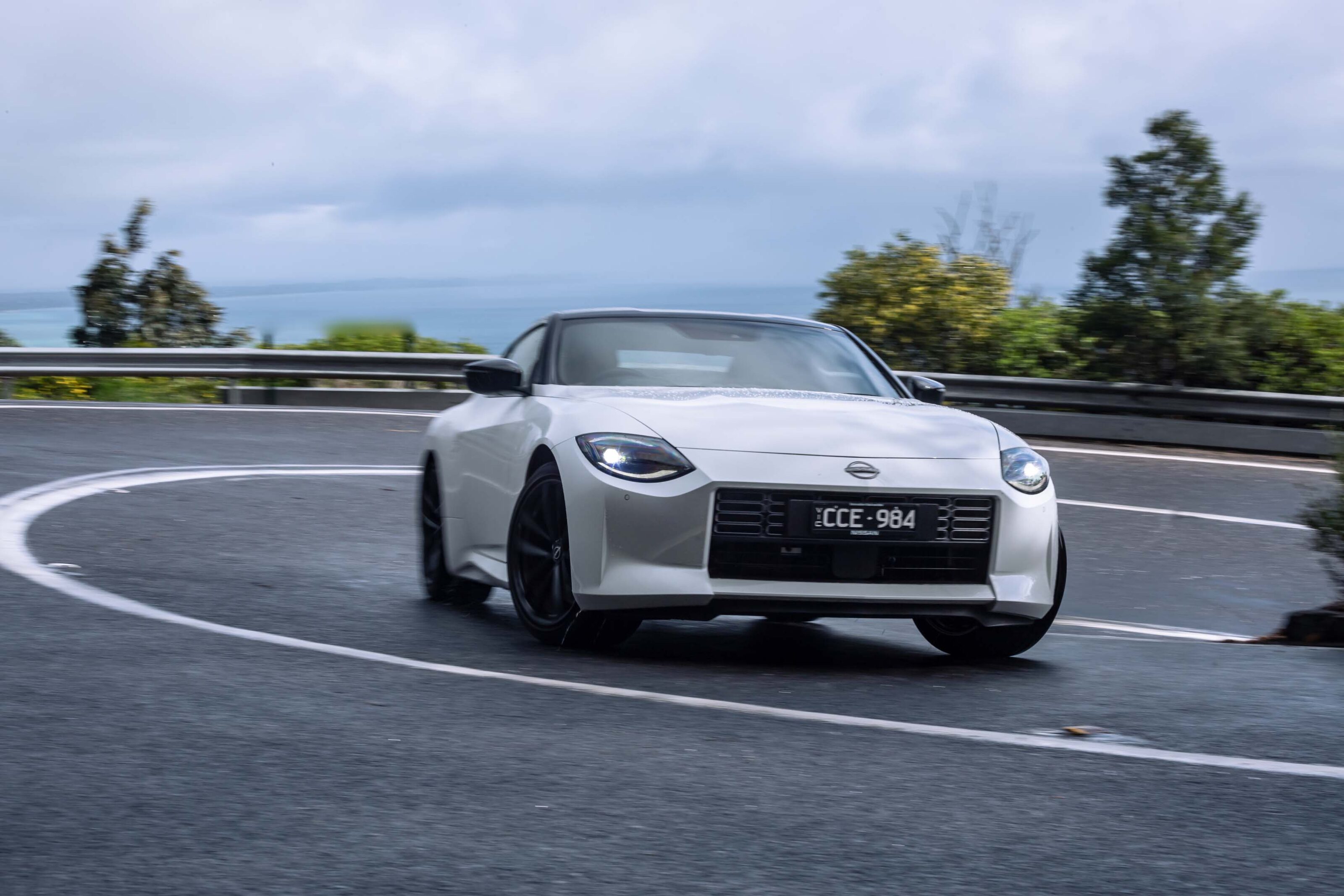
Get out of the claustrophobic Supra, rub your head because you’ve smashed it once again on the cant rail, then drop into the Nissan Z and you’ll be very pleasantly surprised at how generously cut the cabin is.
Even for taller drivers, the seat is mounted reasonably low, with manual lifters for the thigh and lumbar supports and electric controls – strangely mounted on the inboard side of the seat – for slide and tilt.
Accommodation inside the car is good, with a height-adjustable seat while the steering wheel, which features an identical rim diameter to the iconic R32 GT-R, features enough reach and height adjustment.
Oddments space is good with two cup holders rather than the 370Z’s one, but the rear luggage bay is shallow and will just about fit two very intimate carry-on sized cases. For a car with such a rangy, long-legged demeanour, it’s a bit of a shame that this so limits the Nissan’s grand touring credentials.
What’s it like to drive?
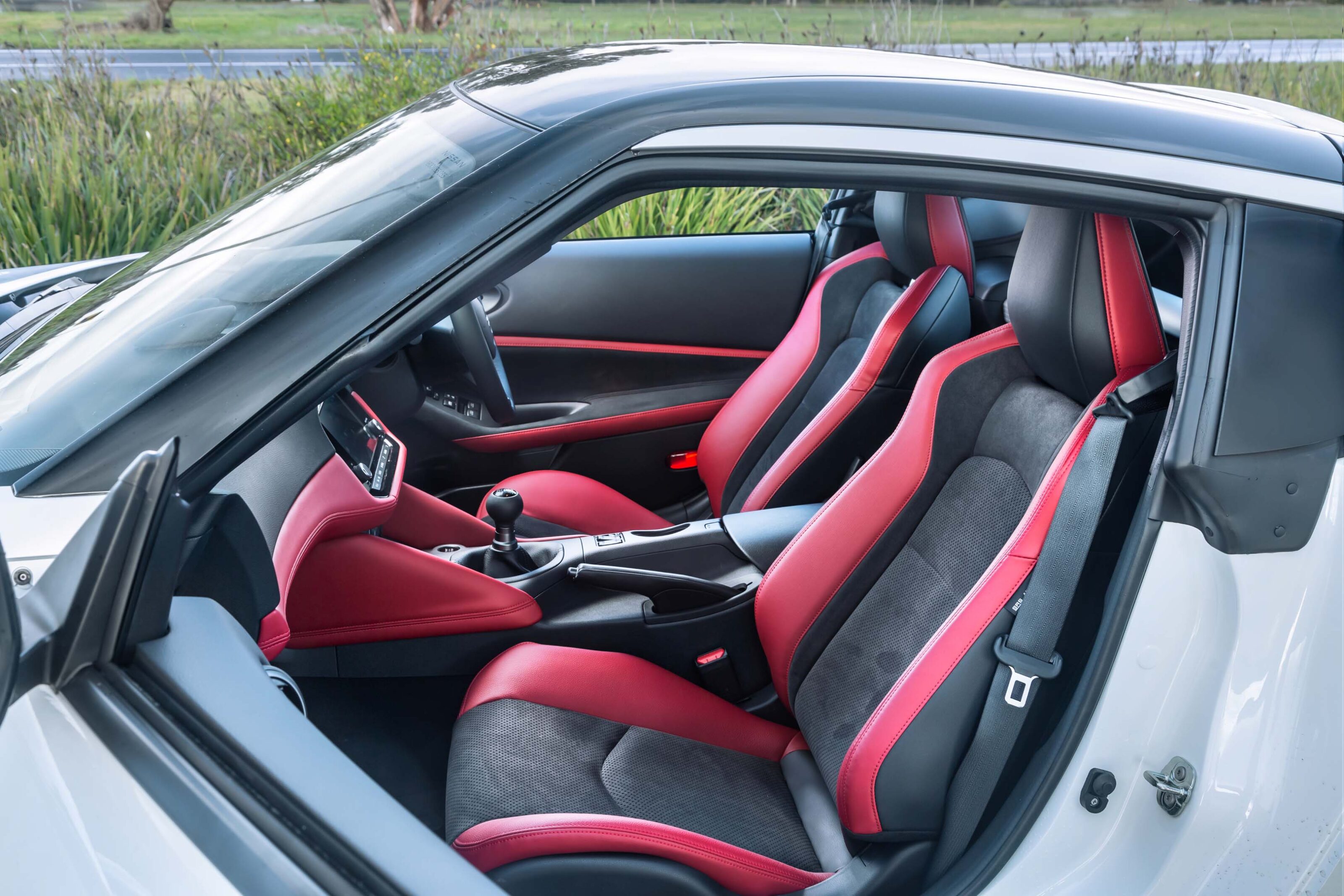
You’ll learn a lot about the Nissan Z’s dynamics within the first 50 metres behind the wheel. It nerfs over speed humps with a glossy finesse, the ride quality is, if not pillowy, then let’s call it cultured, and the steering bucks the current trend for neurotic racks. The Z never feels lax or lazy, but there’s a refreshing compliance to it that lends it an everyday utility.
Before delving too far into the details, some of the basics. Up front is a modified version of the VR30DDTT powerplant we’ve seen previously in the Infiniti Q50 and Q60, a twin-turbo V6 good for 298kW/475Nm.
This drives the rear wheels via either an adaptation of the Mercedes-Benz 9G-TRONIC automatic built by JATCO or a reworked version of Nissan’s six-speed manual transmission.
All Australian cars are mechanically equivalent to the US-spec Performance models and are therefore supplied as standard with a mechanical limited-slip differential and uprated four-pot front brakes.
It probably hasn’t escaped your attention that the list of 250kW+, rear-drive, manual cars that cost less than six figures isn’t exactly extensive.
Listed in price order, you have the Ford Mustang GT, the Nissan Z, the forthcoming three-pedal Supra and… that’s your lot. In terms of how they drive, it marks a convenient continuum from boofy at one extreme to bellicose at the other.
The Z’s automatic installation is fine. Like most such transmissions, it has too many gears to make taking control via the paddleshifters an ultimately fulfilling experience, and even when set into Sport mode, it occasionally decides that 1400rpm is where you need to be, which is odd for a car where it ought to be virtually impossible to find yourself somewhere outside a peak torque envelope that stretches from 1600 to 5600rpm.
It slurs gears smoothly and the sound symposer behind the dash gives the otherwise taciturn V6 some measure of aural clout, but you deserve better.
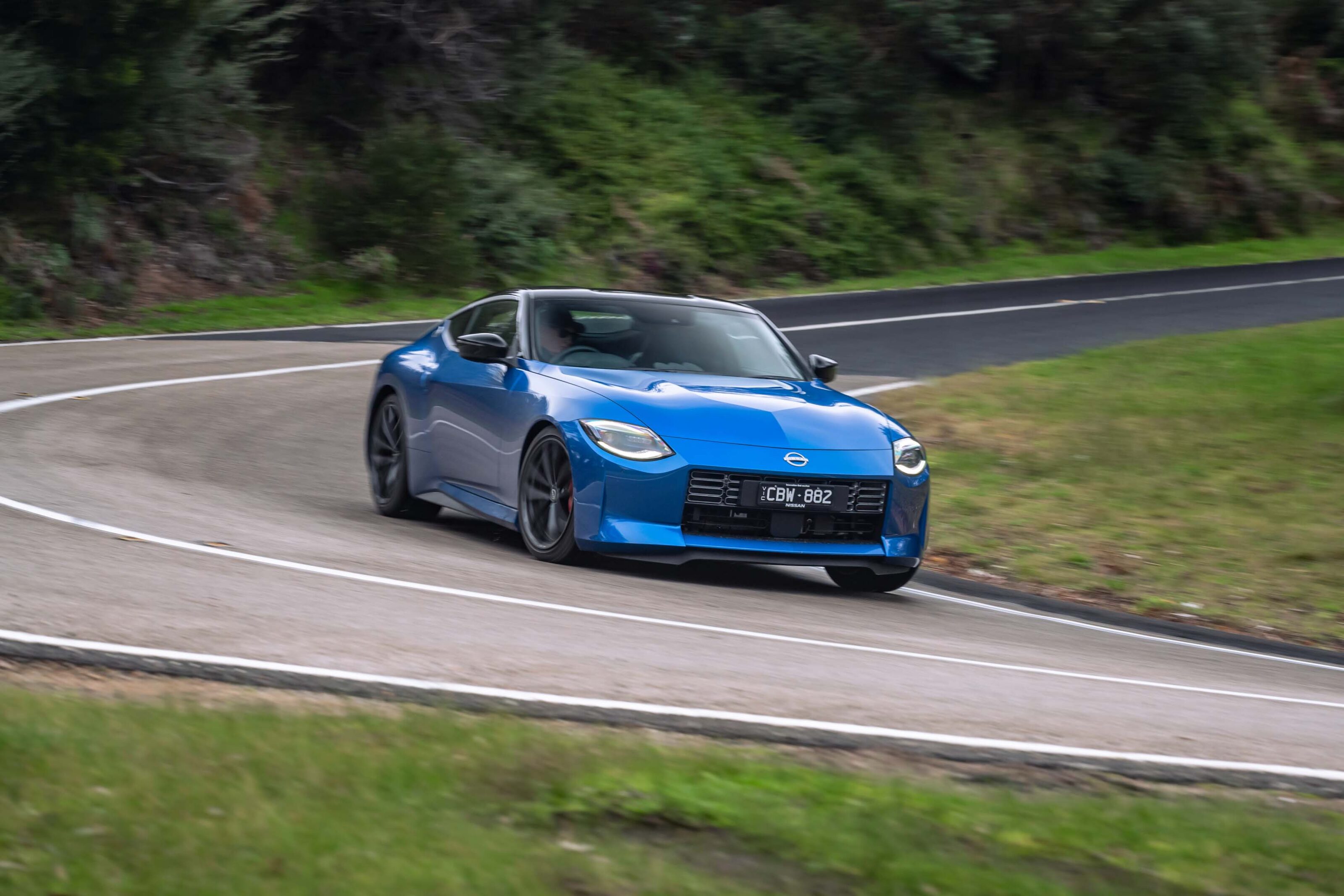
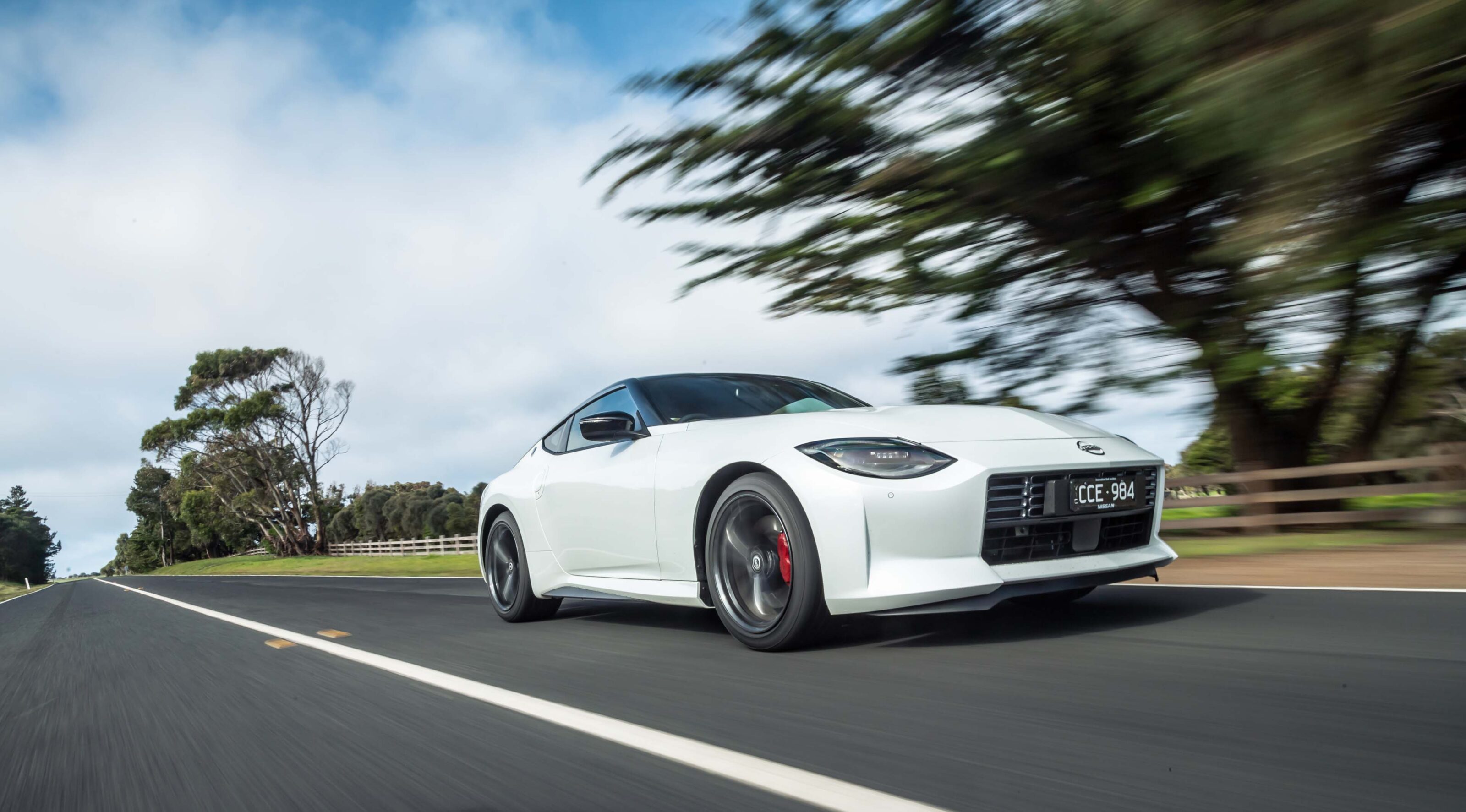
You deserve a gem of a six-speed manual. If all the justification you require to buy a car is for it to do one thing with absolute elan, well, here’s all the excuse you need. Warm it through and the shift action of this six-speed box is to be savoured.
Nissan has re-engineered the detents of the shift, with the check spring load increased by 50 per cent. This means that in the first half of the shift action from gear to gear, it feels as if the force required to shift has increased, while in the second half – as the lever snicks home into the desired gear – the force reduces, offering increased self-engagement feel. You’ll find yourself just buzzing up and down the box for the sheer tactility of doing so.
The active rev matching, first seen on a manual production model in this car’s predecessor, the 370Z, is as quick-witted as you need it to be but can be switched off if you’d rather get your footwell fandango on.
Warm it through and the shift action of this six-speed box is to be savoured.
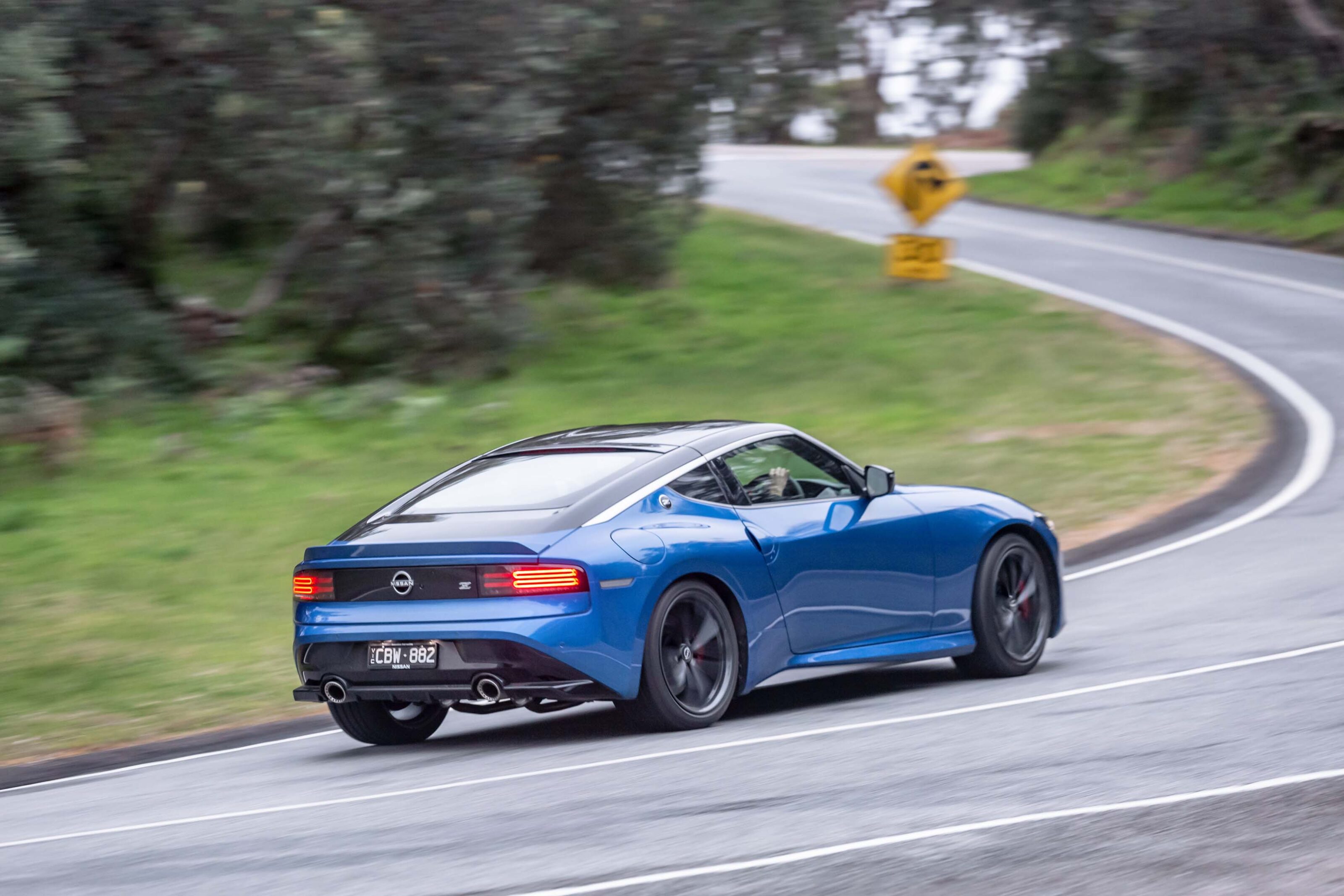
Nissan’s data on its rack-mounted electric steering assistance suggests it has been benchmarked against the Supra, but it feels a little less punchy than the Toyota’s tiller. It’s accurate and offers no nasty surprises, but is hardly overloaded with on-centre detail.
Mercifully, the hideous steer-by-wire system from the Infiniti Q50/Q60 didn’t come as part of a buy one, get one free package with the engine. The reason why the steering never feels quite as crisp as the Supra’s is, more than anything else, down to the choice of tyre.
The Bridgestone Potenza S007 is a serviceable hoop, but it’s certainly not in the same league as any suffix of Michelin Pilot Sport. It’s quiet on poor surfaces, and its sidewall hysteresis contributes to the ride quality but there’s not much flintiness about it.
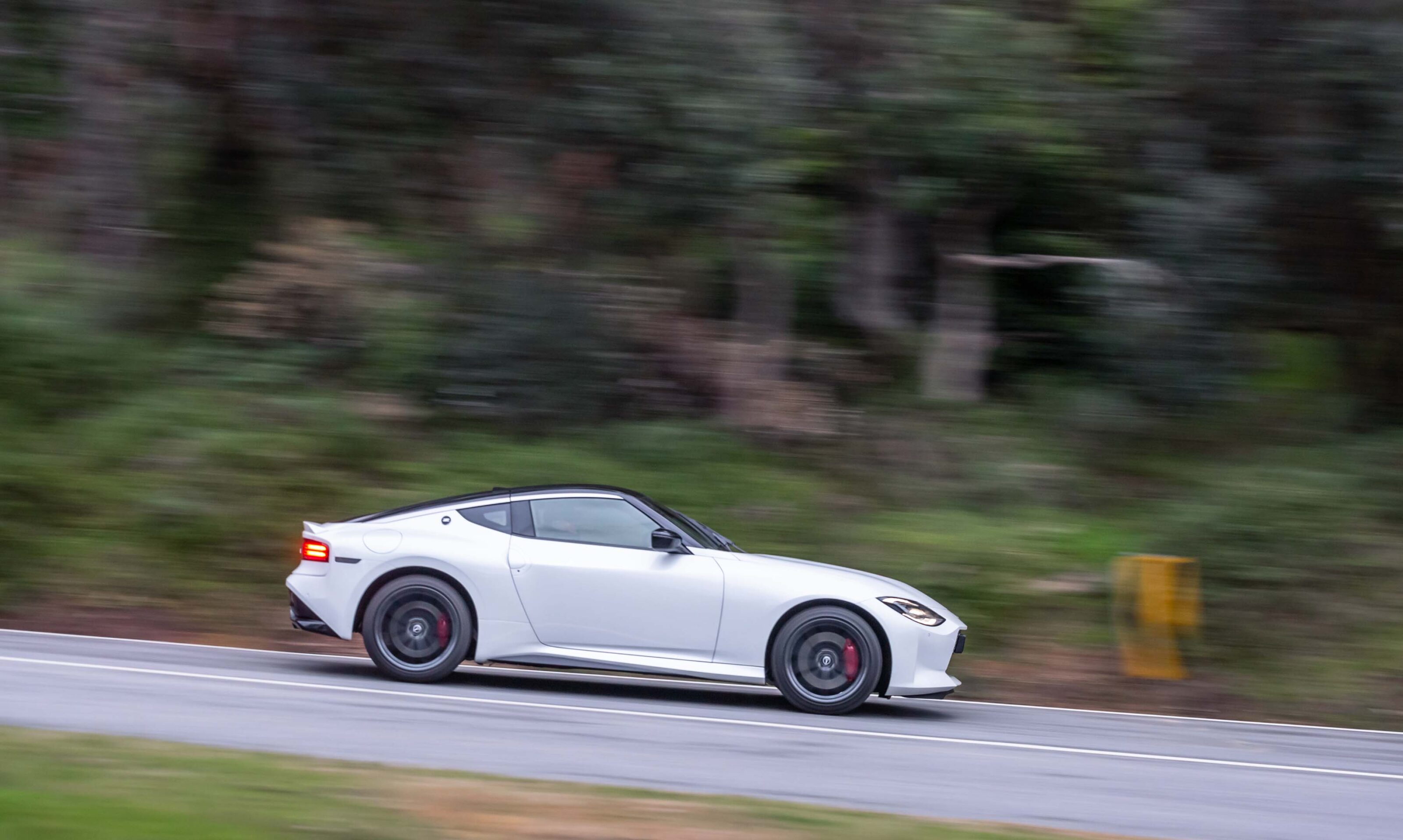
The reason why the steering never feels quite as crisp as the Supra’s is, more than anything else, down to the choice of tyre.
It’s an easy fix come tyre replacement time and one of the ways that the inevitable Nismo version of the Z can wick things up a bit.
That car will also need to add some sinew to the damping. Really get after the Z on a typical Aussie B-road and you find yourself wishing for a little more control, especially in rebound. Nissan claims the dampers are around 20 per cent more accommodating than those fitted to the 370Z, and I can believe it.
Where that car always felt a little fidgety, the Z flows better down most roads. It’s only if you really give it a pummeling that you start to see where a more focused model could work. It’s doubtful that it’d be much more powerful, Nissan suggesting that the VR30DDTT V6 is near its upper output limit for series production.
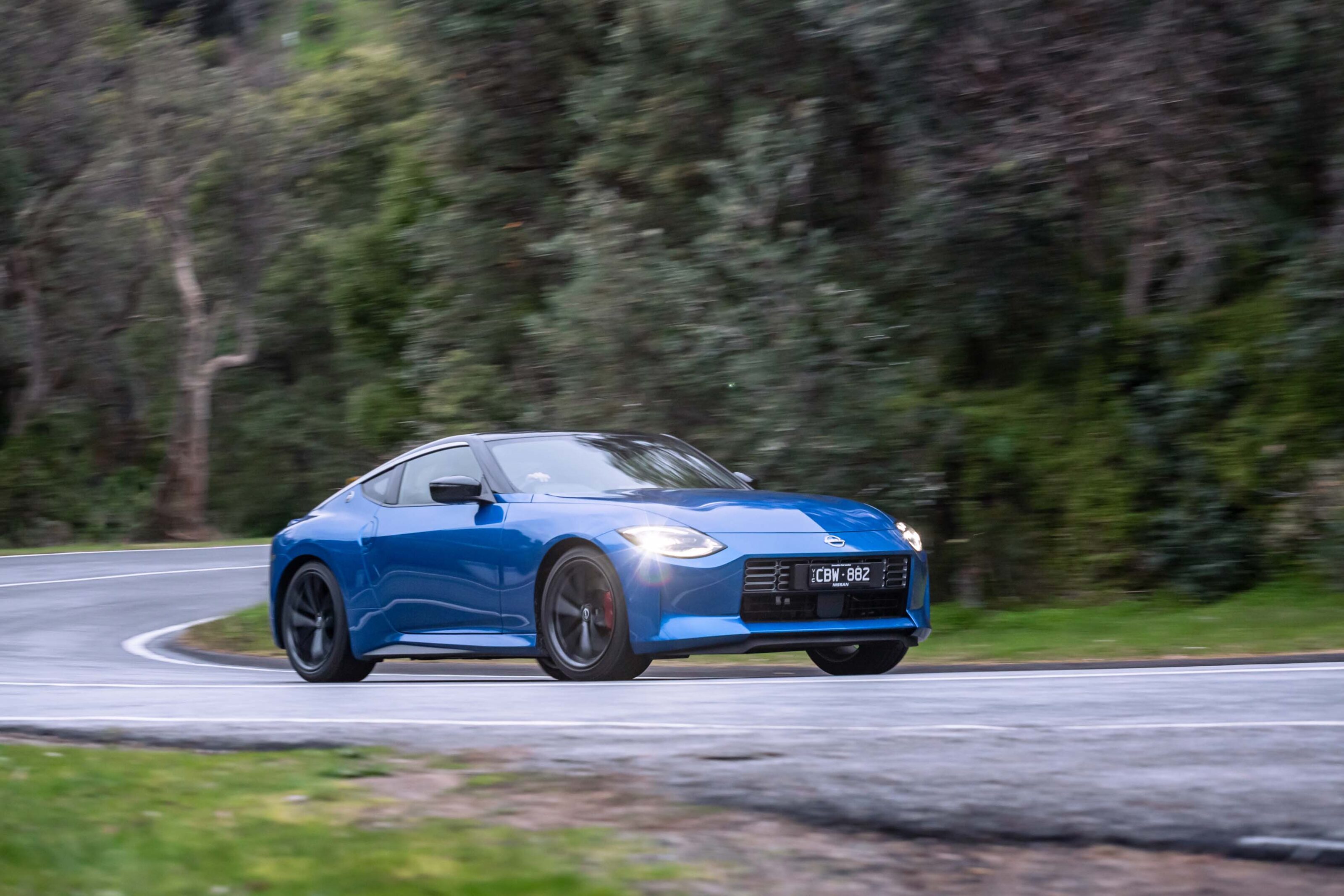
Brakes? The map for the brake pedal is heavily front-loaded, which can give the stoppers an initially overservoed feel albeit one you’ll soon get used to.
Thankfully we don’t get the weedy two-pot calipers that the entry-level US model gets, instead being treated to Akebono four-pot fronts that bite down on 355mm discs, with a two-piston 330mm set-up aft.
Nissan chooses not to quote a 0-100km/h time for the Z, nor a Nürburgring lap time. This seems a little rich, given that the same metrics were shouted from the rooftops with a megaphone regarding the GT-R. I guess it’s easy to crow when you’re winning and, as the first tranche of drag race videos out of the US suggests, the Z will be third in a three-car race with a Supra and a Mustang V8.
Still, the same site that published the most-watched race also presents a leaderboard where the Z outsprints a Lamborghini Gallardo, so it’s not exactly slow. Seat-of-the-pants meter says low-to-mid fours, and we’ll strap timing gear to one in due course when we pitch it into a comparison. As a pure road car, it’s quick enough to fulfil the brief.
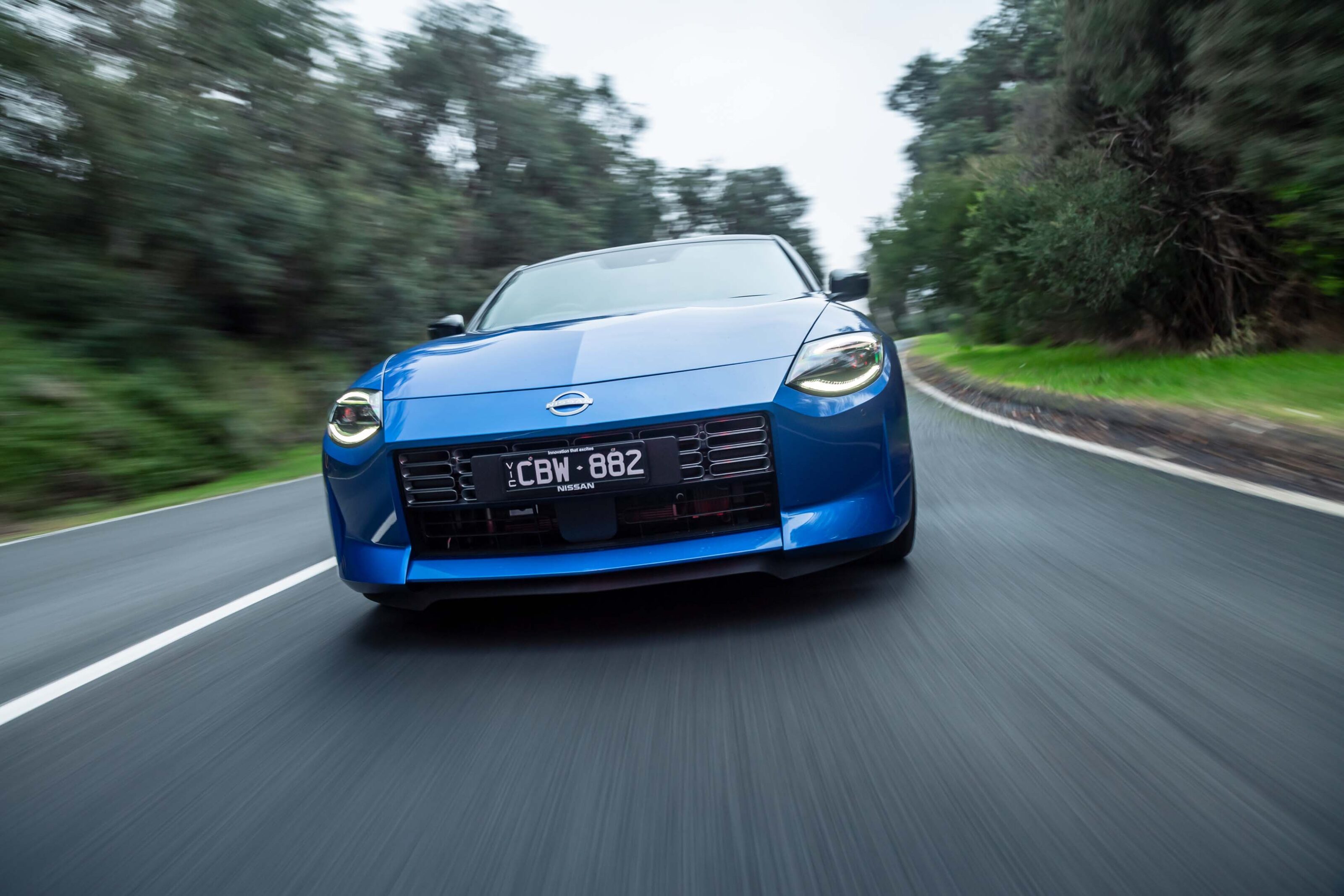
How is it on fuel?
Since you ask, not too bad at all, given it’s hefting a twin-turbo 3.0-litre lump.
The automatic is the one to go for if you want to keep a cap on your bowser spend, registering 9.8L/100km on the combined cycle.
The manual version sees 10.8L/100km. Such is the prodigious torque on offer that the Z is quite happy lugging along with less than 2000rpm showing on the clock if needs be, and the nine-speed auto can lope along in top on freeway runs at or near the national speed limit with only around 1500rpm on the dial.
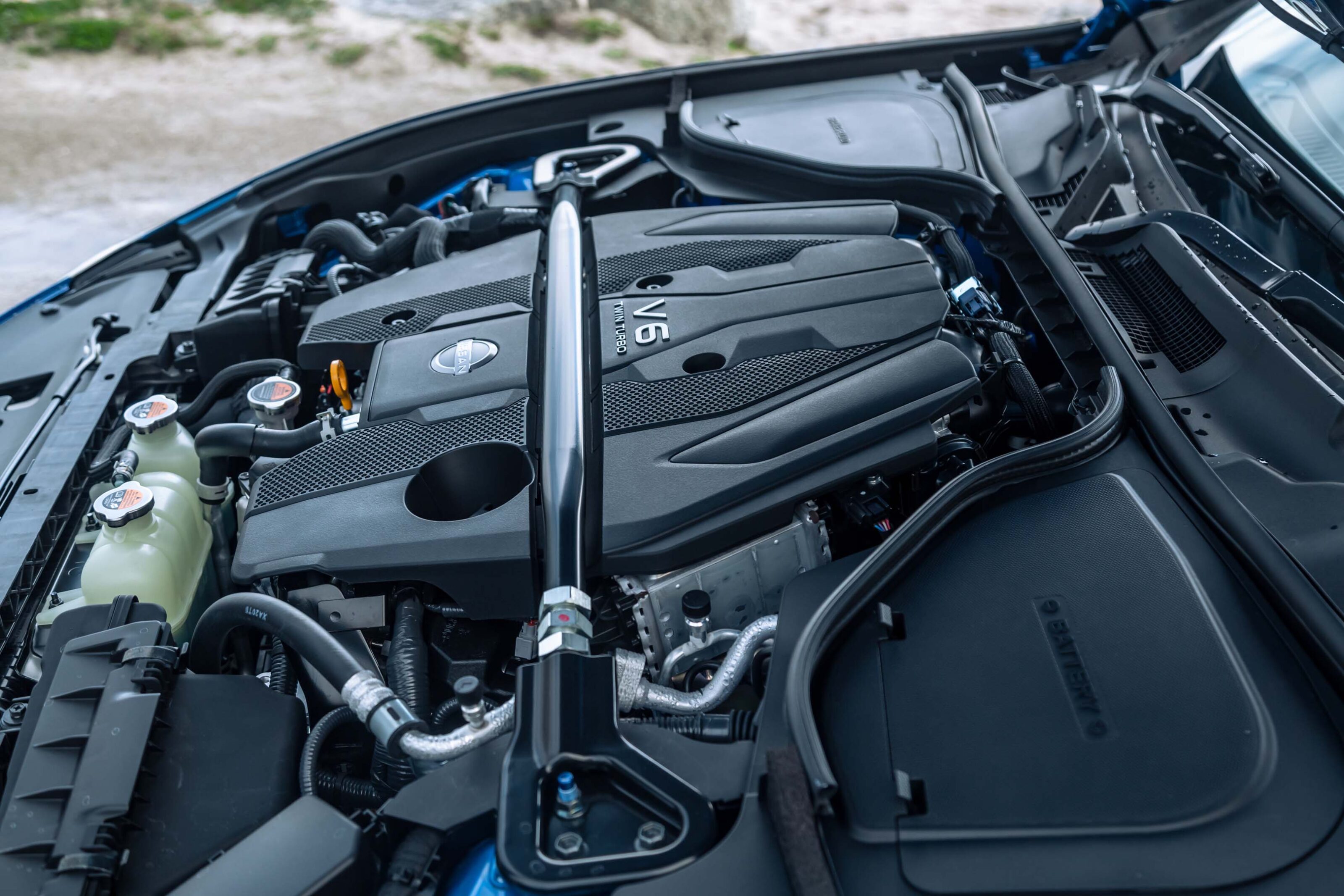
How safe is it?
Safety provision has been one of the biggest investments with the new Z.
Consider the fact that its predecessor, the 370Z, did without features such as auto emergency braking, blind-spot monitoring, lane-keep assist, rear cross-traffic alert and so on.
The latest Z has yet to be assessed by ANCAP but is supplied as standard with a full Nissan Intelligent Mobility suite. This comprises:
| Auto emergency braking with pedestrian detection |
| Forward collision warning |
| Blind-spot monitoring |
| Rear cross-traffic alert |
| Lane departure warning |
| High-beam assist |
| Traffic sign recognition |
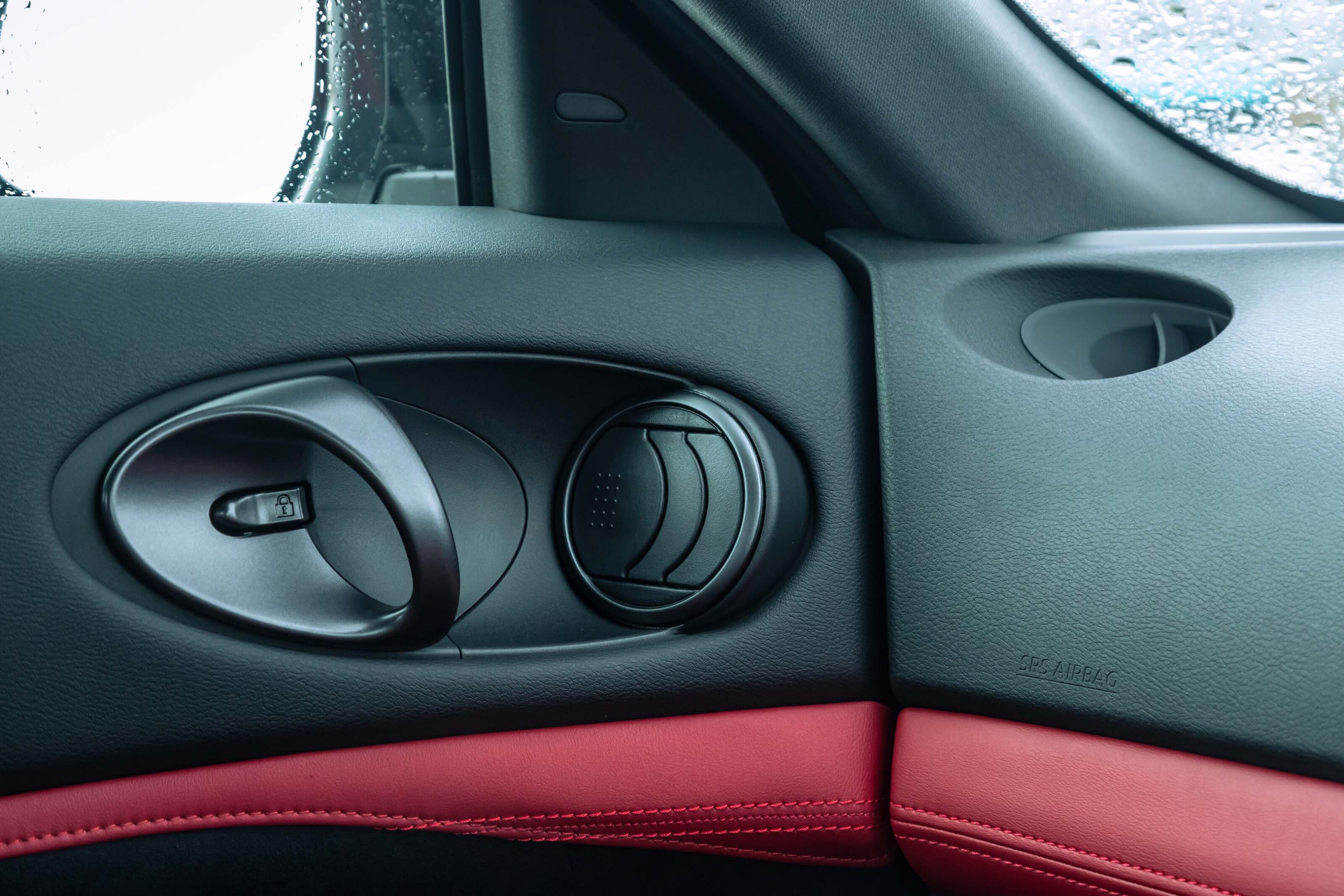
That’s on top of additional safety features which include:
| Front and rear parking sensors |
| Rear camera with predictive path technology |
| Electronic brakeforce distribution and brake assist |
| Front, side-front and side curtain airbags |
| Adaptive cruise control |
| Hill start assist |
| Tyre pressure monitoring |
| Vehicle dynamic control and traction control |
| ISOFIX and top tether child seat anchors |
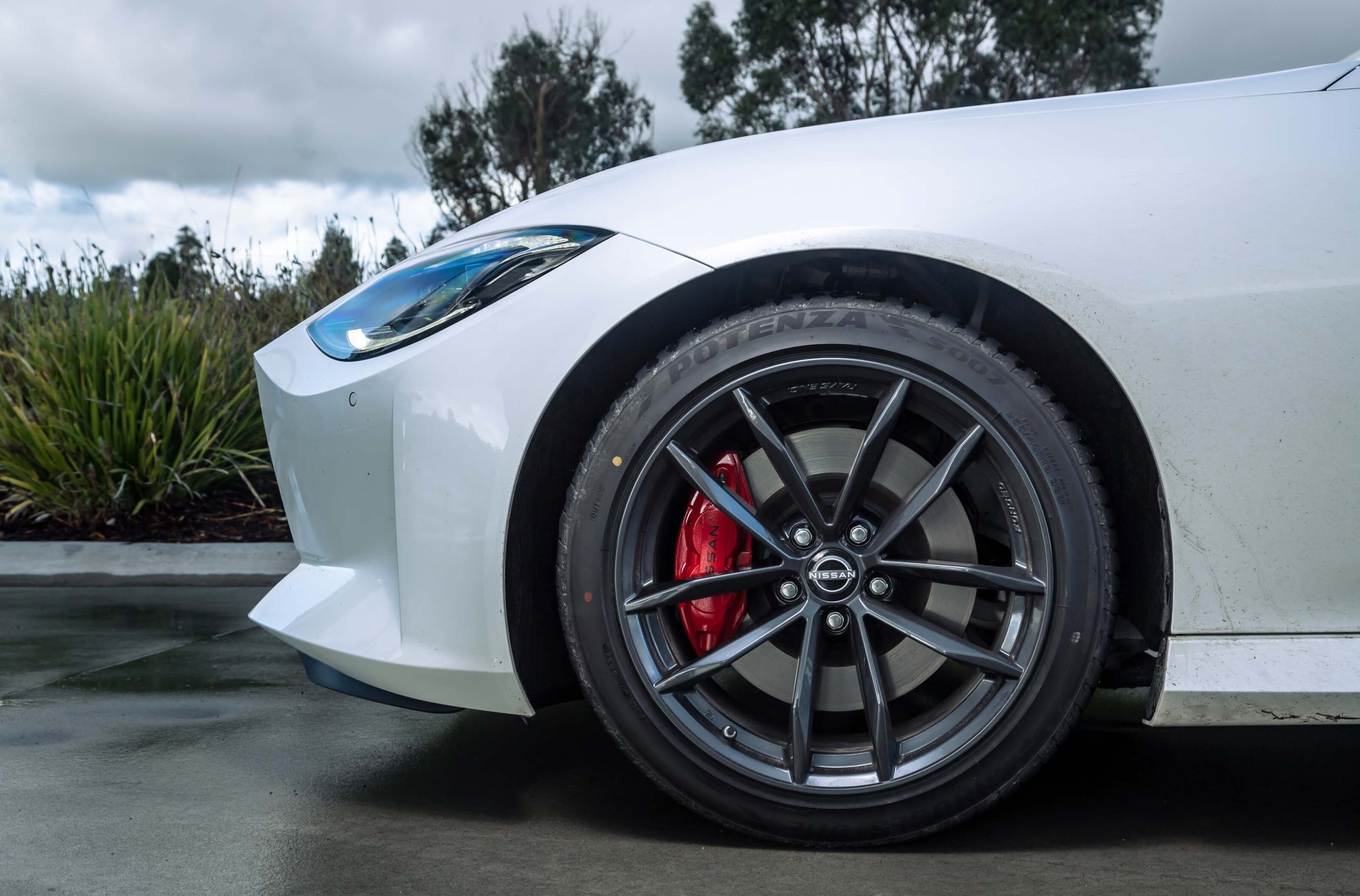
Warranty and running costs
The Nissan Z is supplied with a five-year, unlimited-kilometre warranty. Replacement rear tyres will set you back around $540 per corner. Should you prefer a more aggressive tyre come replacement time, you’ll pay around $50 extra per corner for a Michelin Pilot Sport 4S.
The fuel tank is 62 litres and the Z likes a diet of 98RON, so at $2 per litre, that’d set you back $124 to refill from fumes.
Residual values ought to hold very strong in the short to medium term, especially if you’ve secured a slot for one of the Z Proto models, of which there are mooted to be around 170 coming to Australia.
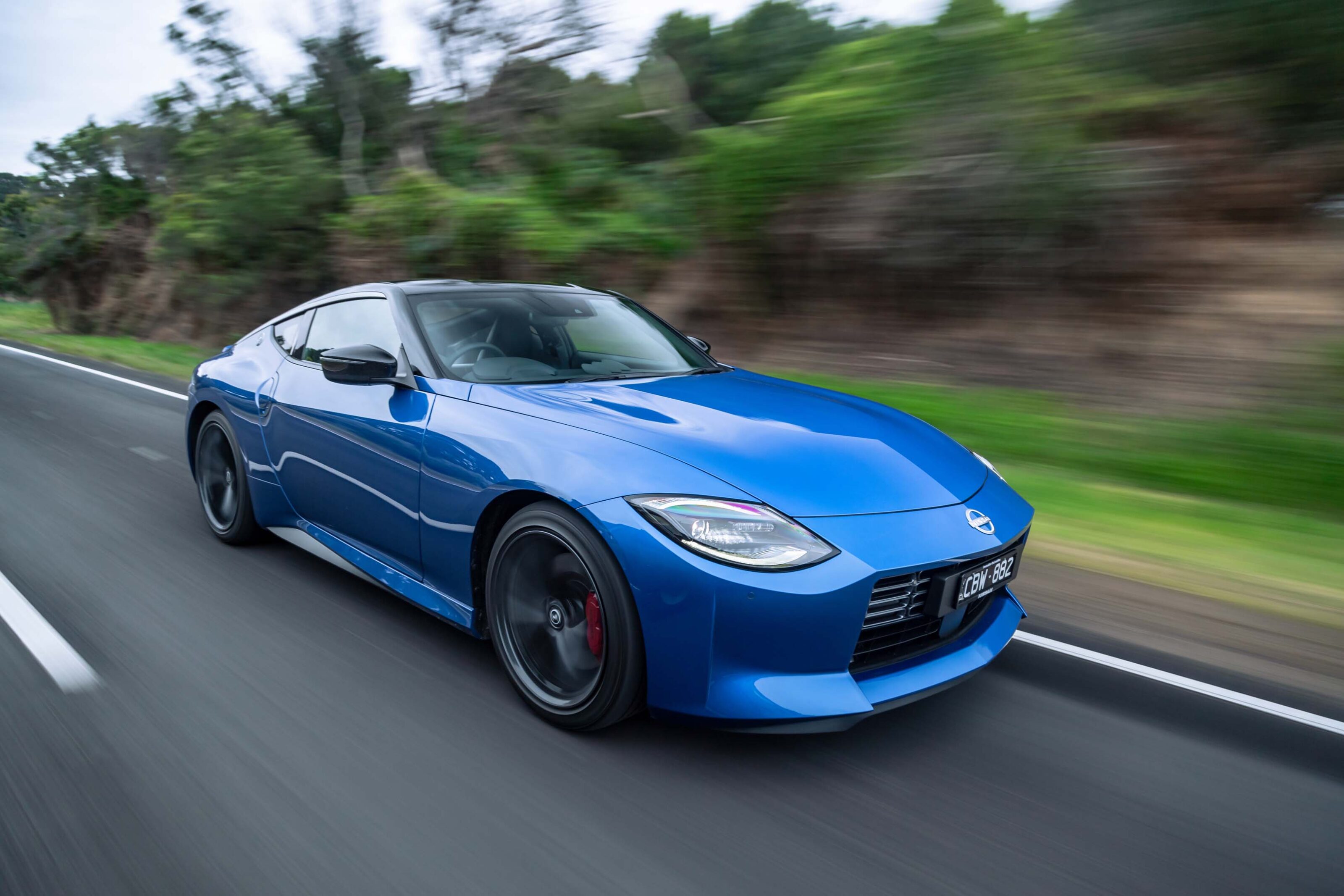
Nissan Australia is fighting for more supply of the Z and looking to combat dealer markups on cars. Around 70 per cent of early orderers have expressed an interest in three pedals which is encouraging.
In case you were wondering who the typical Z buyer is, Nissan reckons it’s a 40-year-old, with $130K of household income, neither traditionalists nor progressives whose main goal in life is seeking excitement. More than half consider themselves big spenders and come from an educated white-collar background.
Thus far the most popular colour is Seiran Blue (27 per cent of all orders) followed by Everest White (16 per cent) and then Black Diamond Metallic (13 per cent).
VERDICT
Had I placed an order for the Z, I’d be more than happy with what Nissan has created. In fact, I’d be delighted.
So is the Nissan Z the ‘nearly’ car that some have suggested? That very much depends on your expectations. For its target market in the US, it’s virtually bang on the money.
You will adore the Z if what you’re looking for is a strikingly styled coupe that you can happily use every day, which is more than quick enough to entertain, features a great ride and has a chassis that’s as entertaining as you could ask for – so long as you’re not expecting dynamics that’d see it emerge from a showroom onto the podium on a tarmac rally.
As a roadgoing system, a totality, it’s a very good package, benefiting from a number of mature and pragmatic decisions.
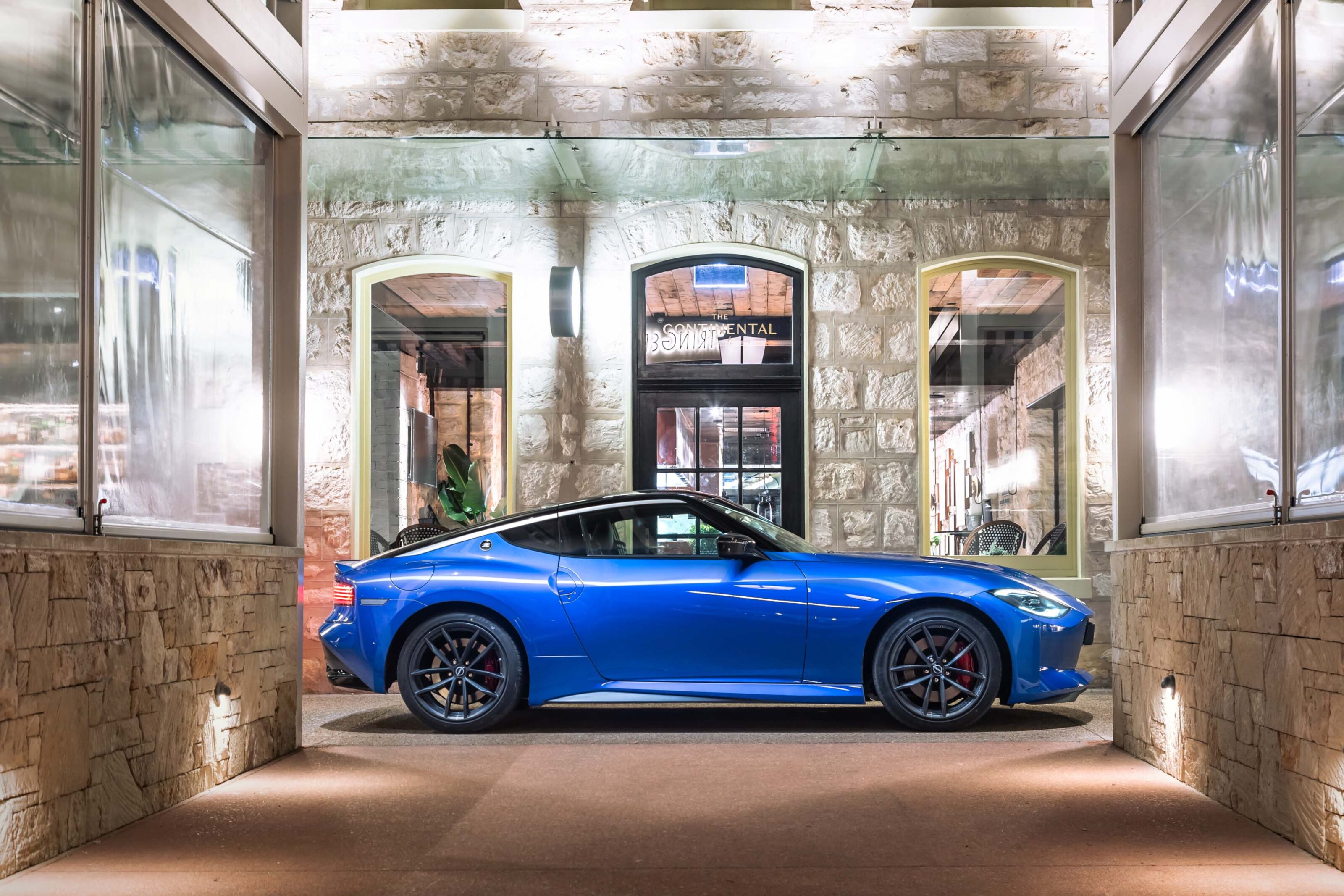
But what if you do want more? What if you’re a little more demanding in your expectations when it comes to ultimate driver involvement? As I see it, you have three obvious alternatives, none of which are unappealing.
You could pay more and buy a Toyota Supra, pay less and buy a Subaru BRZ, or sit on your money until the Nismo version of the Z appears.
Had I placed an order for the Z, I’d be more than happy with what Nissan has created. In fact, I’d be delighted. In chamfering off its attitude by a degree or two, Nissan has endowed the Z with a rare sensuality that we all too often miss when driving hard, fixating on a distant vanishing point.
Dial things back a notch, let the car breathe with the road and relish the silky tactility of that fantastic manual gearbox.
Screw the Nürburgring time. Enjoy the journey.
Frequently Asked Questions
2023 Nissan Z specifications
| Engine | 2997cc V6, dohc, 24v, twin-turbo |
|---|---|
| Max power | 298kW @ 6400rpm |
| Max torque | 475Nm @ 1600-5600rpm |
| Transmission | 6-speed manual / 9-speed auto |
| Weight | 1600/1633kg |
| Economy (manual / auto) | 10.8L/100km / 9.8L/100km |
| 0-100km/h (manual / auto) | 4.5sec / 4.3sec (estimated) |
| Price | $73,300 + on-road costs |
| On sale | now |
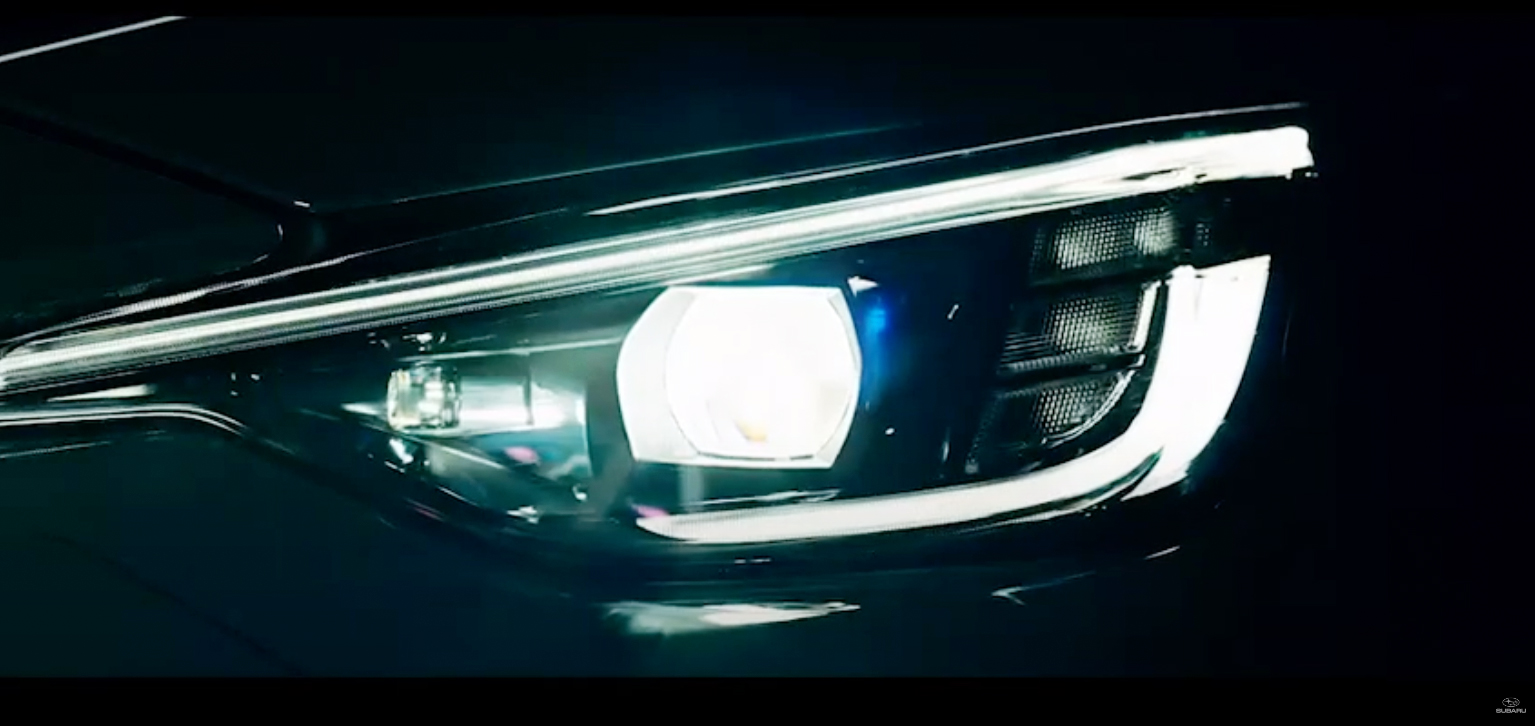
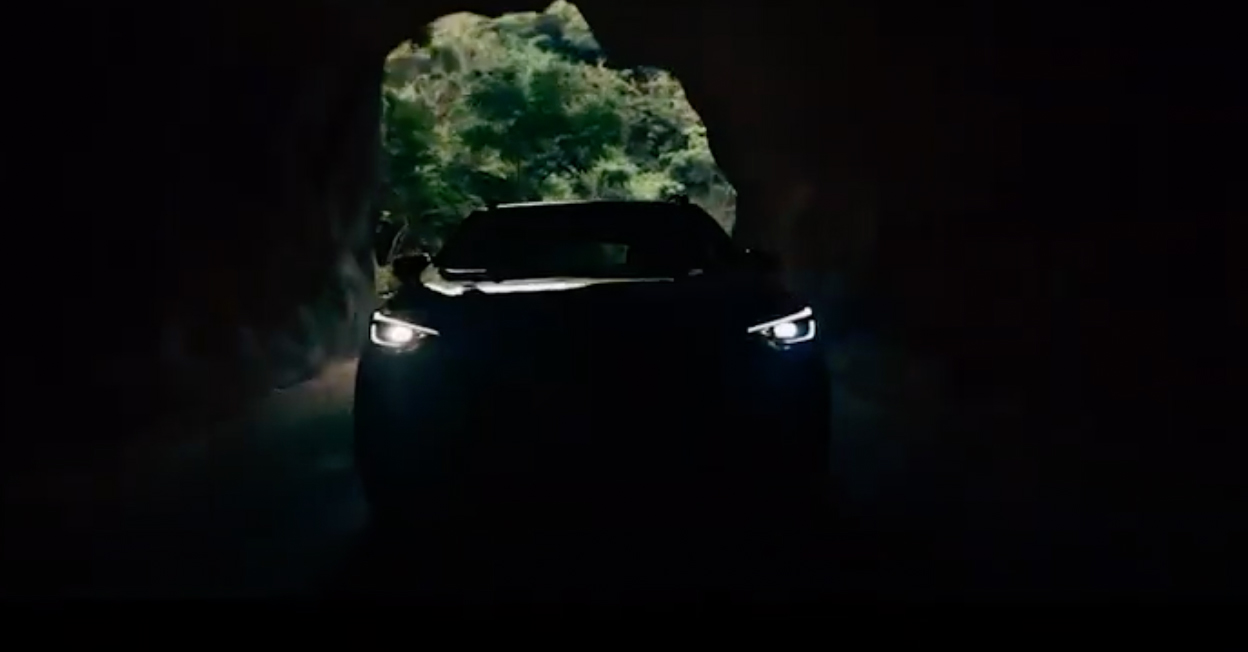
The upcoming new 2023 Subaru XV has been previewed today in a short clip on the company’s Japanese website and YouTube channels.
The new small SUV has been spied testing over the past year, but this fresh new release forms the first official confirmation that a next-gen XV is coming.
Known in the US as the Crosstrek, the XV has traditionally served as a jacked-up version of the Impreza hatch, giving the carmaker an easy entry into the high-selling ‘small SUV’ market.
The formula has worked, with the Subaru XV proving a popular option with buyers. Year to date (end of July figures), Subaru has sold 4728 examples of the XV, while its 2021 record reached 9342 sales.
However, rivals like the Hyundai Kona and MG ZS sold 18,423 and 12,748 units in 2021 respectively, while the unstoppable value-focused Mitsubishi ASX sold strong on 14,764 units last year. Wheels COTY winner the Mazda CX-30 is also a more popular offering, with 13,309 sold in 2021.
The incoming new Toyota Corolla Cross is also likely to present a major challenge for the XV, not to mention the rivals listed above.
Subaru will be looking to the new XV to conquest buyers away from those options, which will likely mean we can expect an even more style-focused offering in this coming new generation.
Power for the new XV will reportedly come from a downsized design of the 1.8-litre engine that features in the new Levorg overseas (sold here only in WRX guise), supposedly resulting in a turbocharged 1.5-litre mill that would replace the naturally-aspirated 2.0-litre engine offered in the current model.
A new generation of Subaru’s EyeSight safety technology is also understood to be in the works, boosting autonomous driving capability to Level 3 where appropriate.
What about a new Impreza?
Whether we’ll see a new Impreza join the new XV in Australia is a question that will have to wait.
While the badge has a long history here, the market’s increasing preference for SUVs could see the Impreza range either reduced or dropped. Year to date, just 1509 Imprezas have been sold in Australia, compared to 15,136 Corollas, 13,510 i30s, 8420 Ceratos and 5520 Mazda 3s.
Subaru Australia, for its part, is offering no comment on either the new XV or a new Impreza at this stage.
Watch for more details to come in the days ahead.
November 17: 2023 Honda Civic Type R pricing announced
Honda Australia has confirmed local details for its 2023 Civic Type R hot hatch, including pricing.
For the full run-down, click on the read more link below:
UPDATE: Honda confirms 2023 Civic Type R power outputs
Honda has announced full details for the 2023 Civic Type R hot hatch, including power outputs.
Our previous coverage, below, has been updated to reflect the new information.
The sixth-generation 2023 Honda Civic Type R will produce 235kW and 420Nm – a 7kW and 20Nm increase in power and torque respectively over the outgoing model – the company has confirmed today.
While this represents a jump in power for Australian and North American examples, the previous Type R also produced 235kW in Japan, but torque was identical at 400Nm.
As leaked details from late July revealed – and today confirmed by Honda – the Japanese-market ‘FL5’ Civic Type R has received a full-fat tune, with 243kW (at 6500rpm).

The difference in power between Japan and Australia is likely due to our 95-octane premium unleaded – compared with Europe and Japan’s better-quality 98-octane fuel, with fewer parts per million of sulphur.
The new model features an enhanced version of the previous generation’s 2.0-litre turbocharged ‘K20C1’ engine, paired to a six-speed manual transmission with rev-matching.
Honda says it aimed for the Civic Type R to be its ‘fastest’ front-engined, front-driven model ever, while offering an ‘addictive feel’ to the driver and a ‘secure feel’ for high-speed stability and imbuing trust in the chassis.

2023 Honda Civic Type R pricing
Previously leaked pricing for Japan has also been officially confirmed, with the Type R priced from 4,997,300 yen (AU$52,600), accounting for a five per cent jump over the outgoing model.
Locally, the outgoing ‘FK8’ generation was priced from $54,990 before on-road costs; however, Honda Australia has now shifted to a fixed-price agency model, with non-negotiable drive-away pricing nationwide.
As such, we’d expect the new Type R to be more expensive, to allow room for the single-variant Civic VTi LX hatchback, at $47,200 drive-away, and the upcoming hybrid variant.

The 2023 Honda Civic Type R will compete against the Hyundai i30 N, Volkswagen Golf R and Renault Megane RS, amongst other performance-orientated small cars.
It will arrive on local shores in early 2023, with further details – including pricing – to be revealed closer to launch.
