
If you caught some of the 2022 Goodwood livestream, or if you’ve been lucky enough to attend the Festival of Speed in person, you might think the best part about scoring a passenger ride up the hill is the full-bore run itself.
But you’d be wrong.
Lord March’s driveway is only 1.86km and if you’re in something quick – and trust us, AMG’s 540kW Track Series is quick – the entire run only takes about a minute.

You might be able to stretch that out a touch if your driver revels in destroying rear tyres and stops halfway up for a massive rolling burnout, as AMG factory driver Adam Christodoulou does, but still, the actual run is over in a flash.
The whole process, however, is much more involved. And happily the action that happens on either side of the run is just as exciting.
We get to the ‘Supercar Paddock’ early and spot the AMG GT Track Series easily. It’s parked next to the 1000+hp (745kW) AMG One, which is making its dynamic public debut, and its long bonnet is open as mechanics complete some last-minute checks.
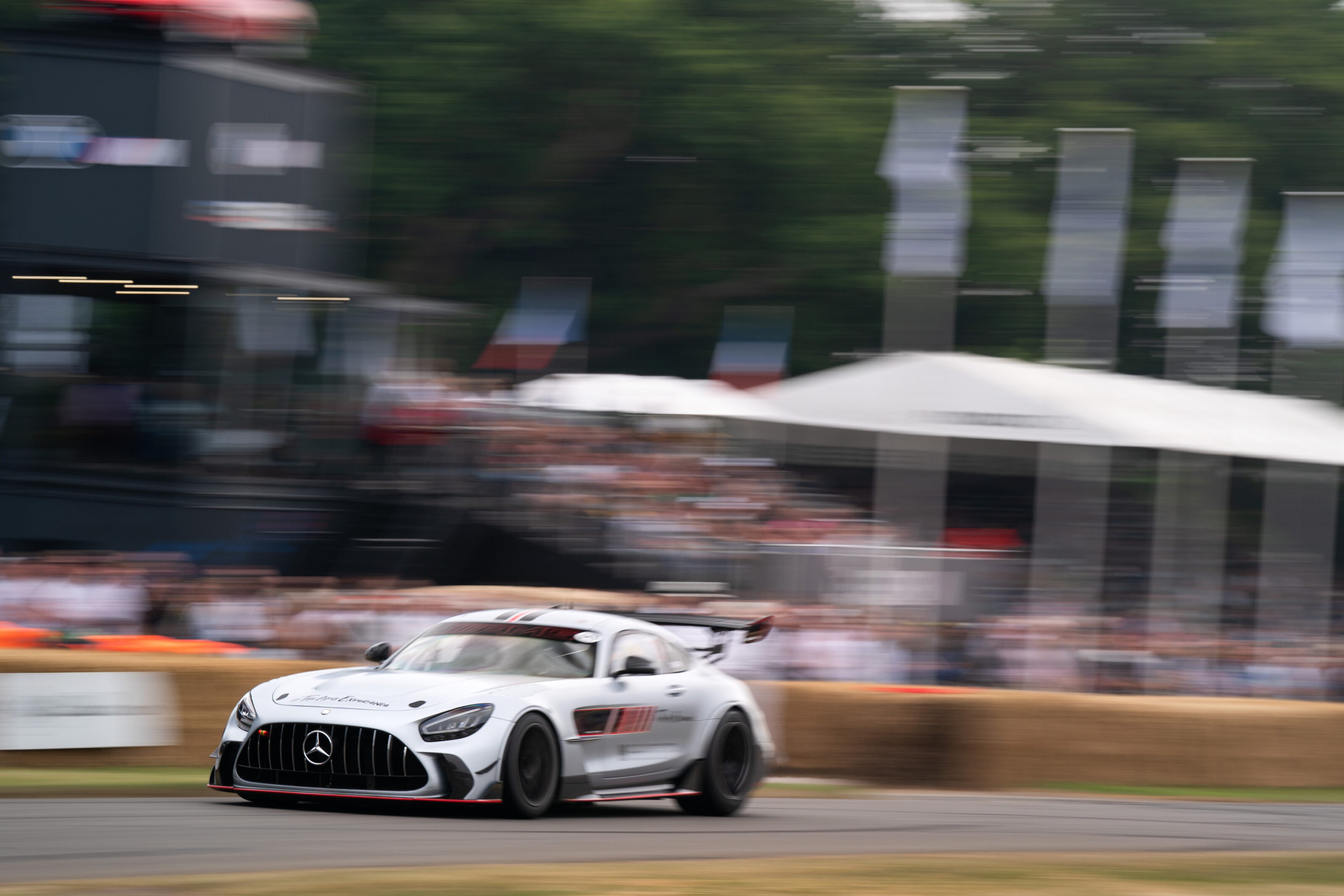
A carbon-bodied Bugatti Chiron SuperSport hunkers to our left, while across the walkway rests the Aston Martin Valkyrie, its Cosworth V12 idling smoothly.
It looks like the batmobile, with its top-hinged doors butterflied open and when its driver prods the throttle to warm up the engine, it’s so loud and it rips so quickly through its rev range that it actually makes people jump. The V12’s scream sets the whole paddock into overdrive.
There’s a last-minute kerfuffle as the Merc mechanics debate whether to swap the Track Series’ slick tyres for wets – it’s been raining, but the hill is starting to dry – before I’m handed a helmet and bundled, unceremoniously, into the passenger seat.

If I had any doubts as to the seriousness of the AMG GT Track Series, they quickly vaporise as I drink in the cabin. I had thought the Track Series was simply a GT Black Series with more power, but this cabin looks identical to AMG’s GT3 racing car.
You recline in fixed-back bucket seats, the centre console is made of carbon and festooned with buttons and dials that read ‘FIRE’ and ‘traction control’ and we’re cocooned in a full roll-cage. The rectangle steering wheel and beautifully machined pedal-box are adjustable and my driver, Adam, pulls and pushes them to set his driving position.
It’s properly hardcore in here and when the big 4.0-litre twin-turbo V8 fires into life, properly loud, too. Think of the Track Series as the lovechild between AMG’s GT3 racer and the road-going Black Series and you’re most of the way there.
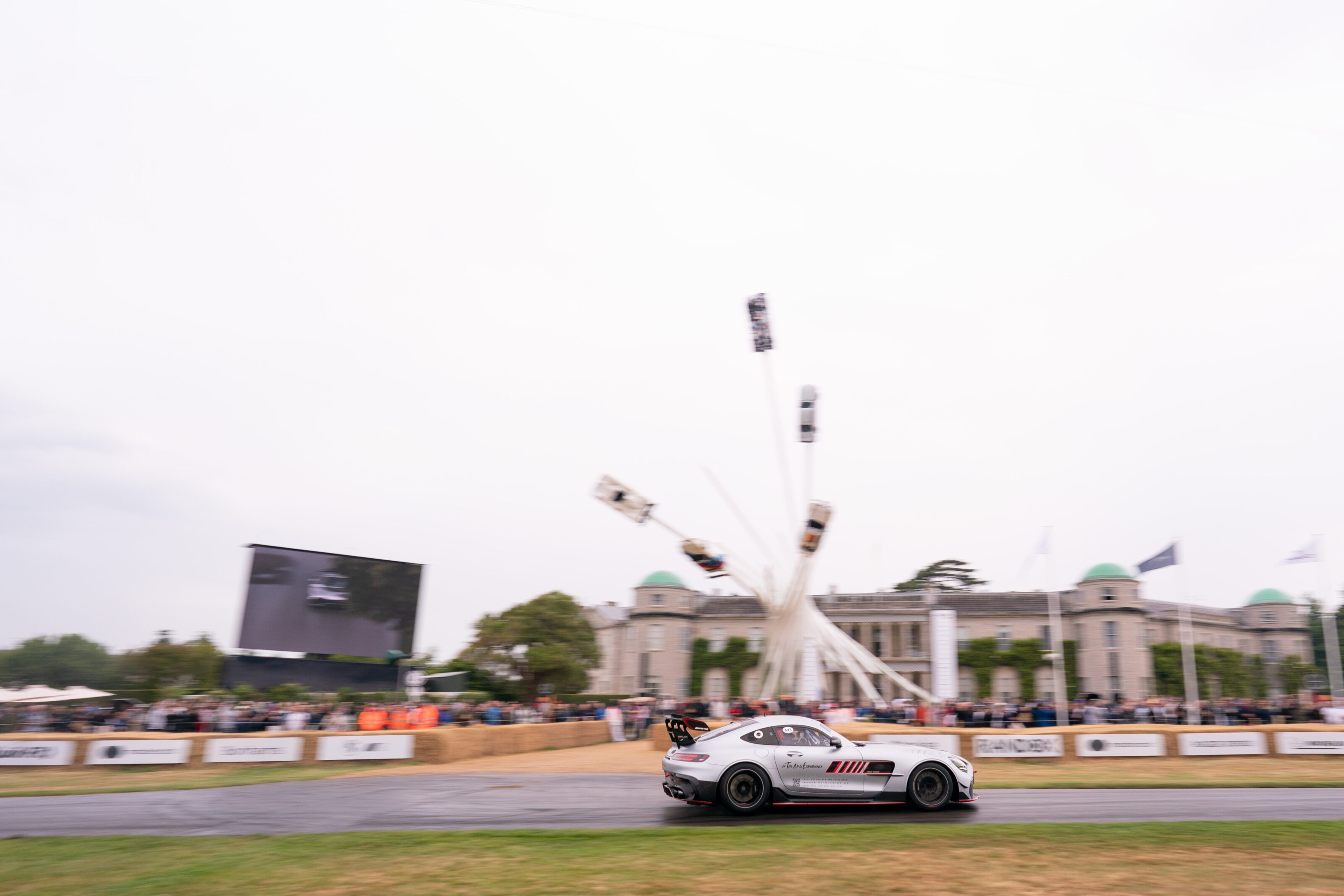
The V8 is basically the same flat-plane crank unit as you get in the Black Series but power has been massaged to 540kW. All that grunt is sent solely to the rear axle through a six-speed racing gearbox and the whole car is lighter thanks to the extensive use of carbon fibre.
The bonnet, bumpers, quarter panels and boot lid are all made from carbon, which helps the Track Series weigh in at just 1400 kilograms.
“It’s way faster in a straight line than my GT3 car,” says Adam. “And around a full lap at Mugello it’s only about 2.5sec slower. It has so much power.”

Getting to the start line is a bit of a palaver. Goodwood is now so big and has so many categories that we trundle slowly towards the start line but there are two highlights.
First, this might be the world’s coolest traffic jam. Porsches, Astons, Bugattis, Lambos and Koenigseggs all jostle for position and we’re funnelled through a narrow passageway that’s lined with people.
“I know what they want!” shouts Adam before repeatedly redlining the Track Series. It sounds manic, like a motorbike as it bounces ferociously off the hard-cut limiter, and the entire atmosphere is jubilant. Not for the first time, I wonder if the Goodwood Festival of Speed might be the best motoring event in the world.

The second highlight arrives when it’s our turn to make the necessary 180-degree turn to join the final stage of the queue.
Strictly speaking burnouts aren’t allowed (blame the safety boffins), but Adam waves over a marshal. “I don’t have enough lock to get around here…” he says. The marshal doesn’t need much convincing and with a conspiratorial wink he gives us the thumbs up.
The AMG leaps forward and suddenly we’re rotating, around and around, in a flurry of tyre smoke, transmission whine and V8 thunder.

As for the actual run? It might be short, but it’s exhilarating. Adam seems to have a particular hatred of rear tyres and the rear axle is still smoking as we barrel into the first turn.
Despite the slick surface it feels like there’s decent grip but the overriding sensation from the Track Series is of unbridled power and savage acceleration. The regular Black Series is a fast car but this is on another level altogether.
It races through the rev range and there’s almost zero tapering of the torque curve as the flat-plane V8 lunges for the 7000rpm limiter. Adam keeps it pinned though the enclosed section near the top of the hill and with a stone wall on one side and hay bales on the other, it feels astonishingly fast.
The 15 minutes or so that follow are just as compelling. With runs complete, cars come to a halt at a top turn-around bay and wait for the chance to trundle back down the hill. Drivers mill around, exchange friendly jibes and take the opportunity to investigate each other’s cars.

It’s such a mind-boggling collection of machinery that it verges on being overwhelming. And there’s zero arrogance or concern about you getting too close. Most drivers smile and nod before inviting you to look even closer.
There are a few events in the Southern Hemisphere that try to emulate the success of Goodwood but honestly, they don’t really come close. How can they? The sheer number of modern cars on display is incredible enough, but when you throw in the fleet of near-priceless historic racers and motorsport legends, Goodwood is really in a class of its own.
And unlike an event in Australia, which would rope off these special machines to stop people accidentally treading on a carbon splitter or leaning on a hand-beaten aluminium quarter panel, at Goodwood the cars are parked in the open. There’s a huge amount of trust and fans can get amazingly close.
If you haven’t been, stop hesitating. Goodwood is a must for any car lover.
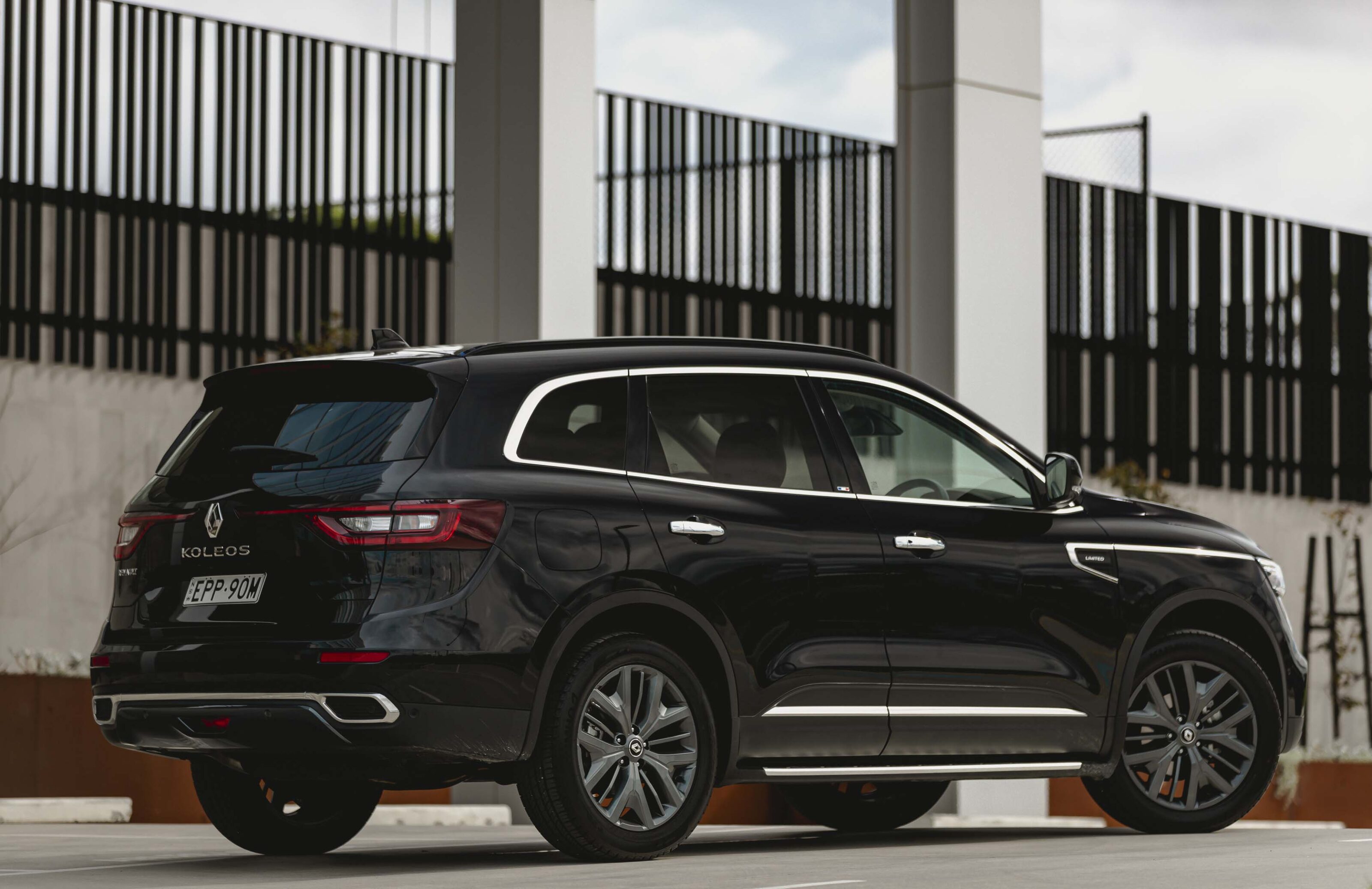
Renault wants this Koleos Black Edition to turn heads, adding it to the middle of the four-strong line-up for customers who want a “statement piece”.
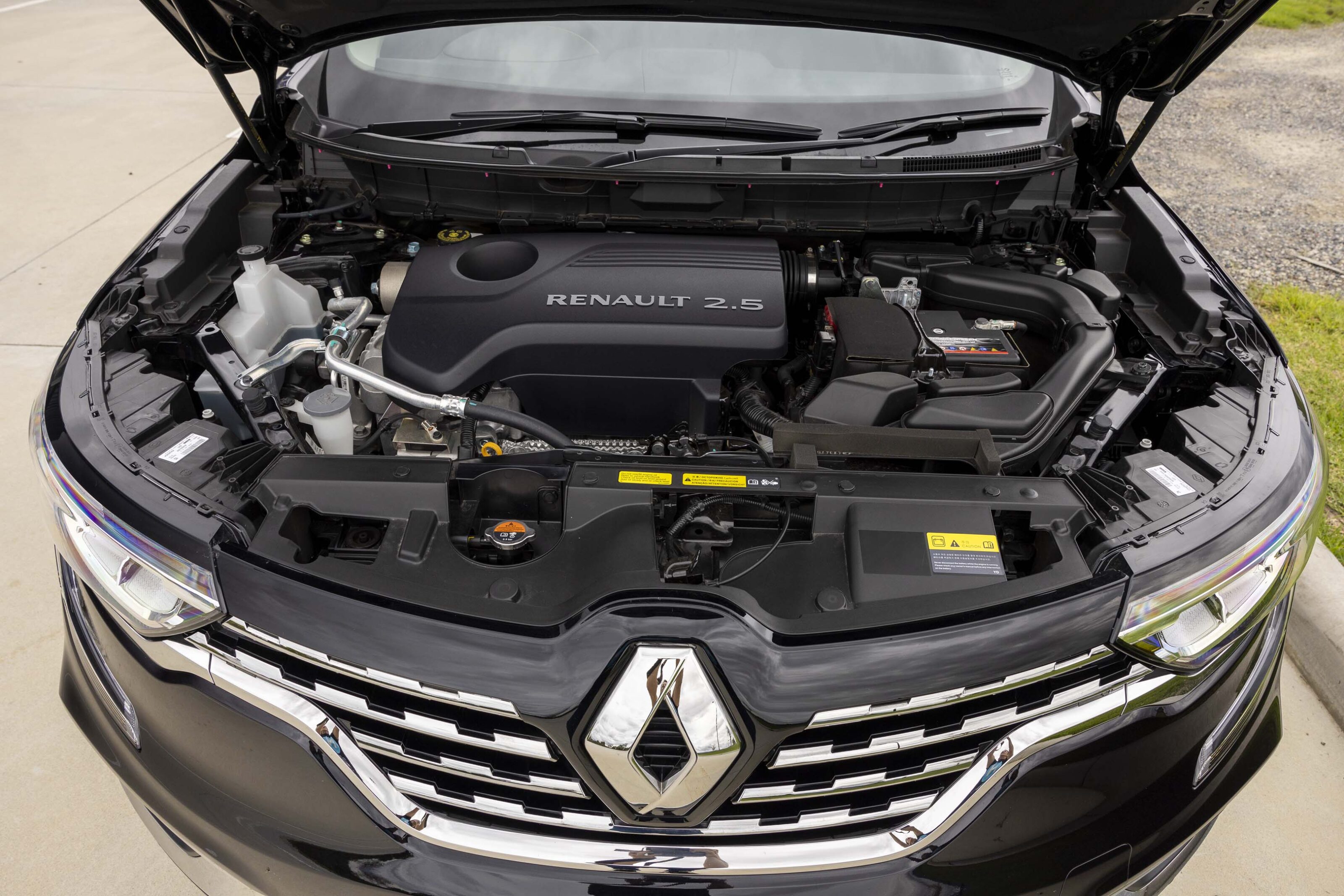
In its signature black hue, with some subtle but stylish details such as the French flag on the B-pillars and aluminium running boards, the limited-edition Koleos offers a classy and more aesthetically pleasing silhouette to what is otherwise a Nissan X-Trail underneath – powered by the same 2.5-litre naturally aspirated petrol engine paired with an identical automatic continuously variable transmission (CVT).
It’s an attractive and elegant design, but can the Black Edition offer more than just good looks?
Pricing and Features
The 2022 Renault Koleos line-up consists of four grades: Life, Zen, Intens 4×2 and Intens 4×4 – with the mid-range Black Edition nestled between the Zen and Intens.
Pricing for the range currently starts from $38,246 for the Life, with the Zen commanding $42,151 and Intens asking $48,920 (for the 4×2 configuration) and $51,212 (for the 4×4) respectively. Meanwhile, the limited-run Black Edition costs $42,000. All prices are drive-away.
Oddly this edition somehow costs less than its lesser-specced Zen sibling – albeit only by $151, bucking the trend of limited-time-only cars commanding a higher premium on account of their exclusivity and extra accoutrements.
As of July 1 this year, however, Renault will increased the cost of its entire vehicle range, so it’s worth checking our pricing story for the latest information.
Meanwhile, drive-away pricing for segment rivals, varies – it’s in the ballpark cost of its rivals, but more popular models cost more for similar.
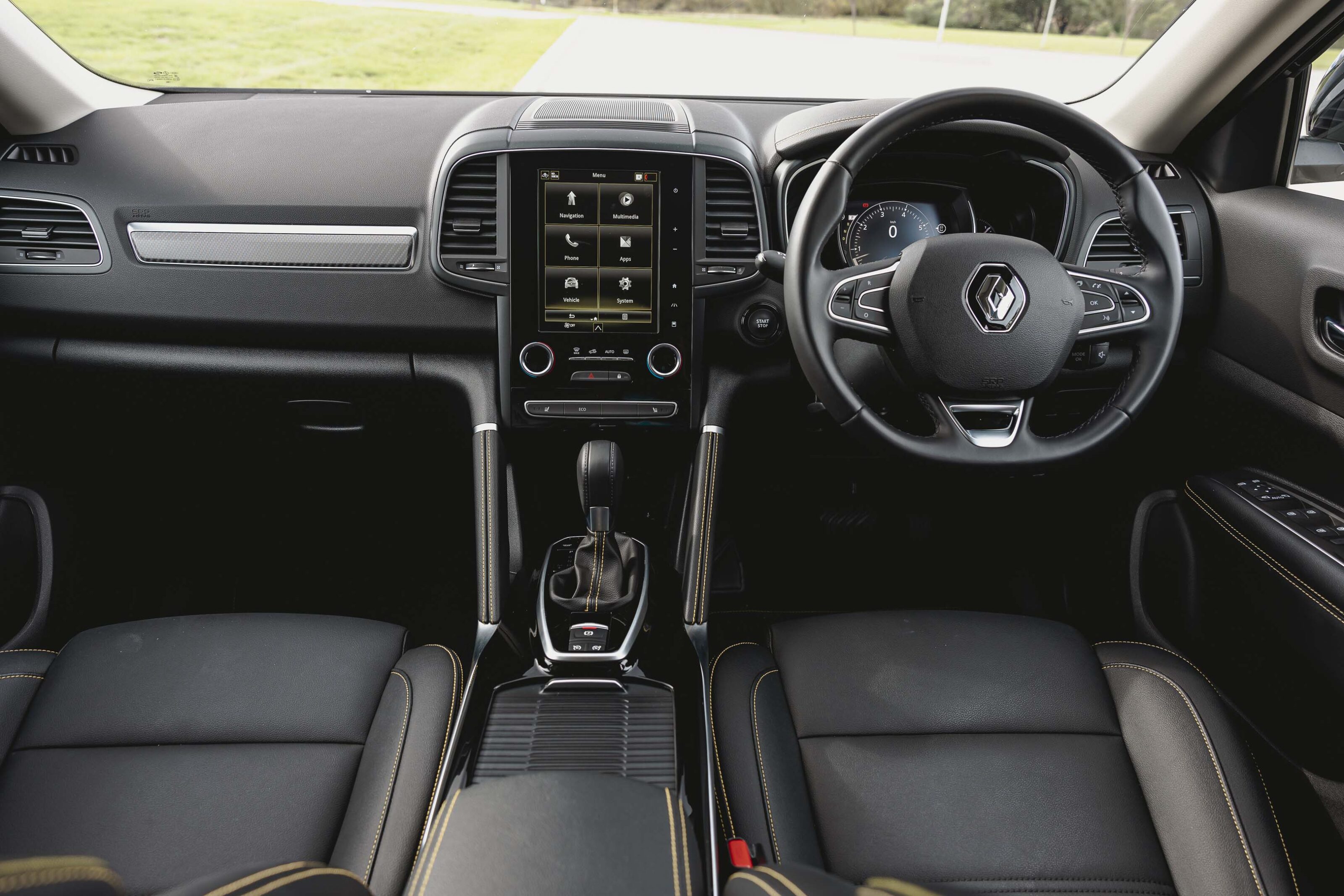
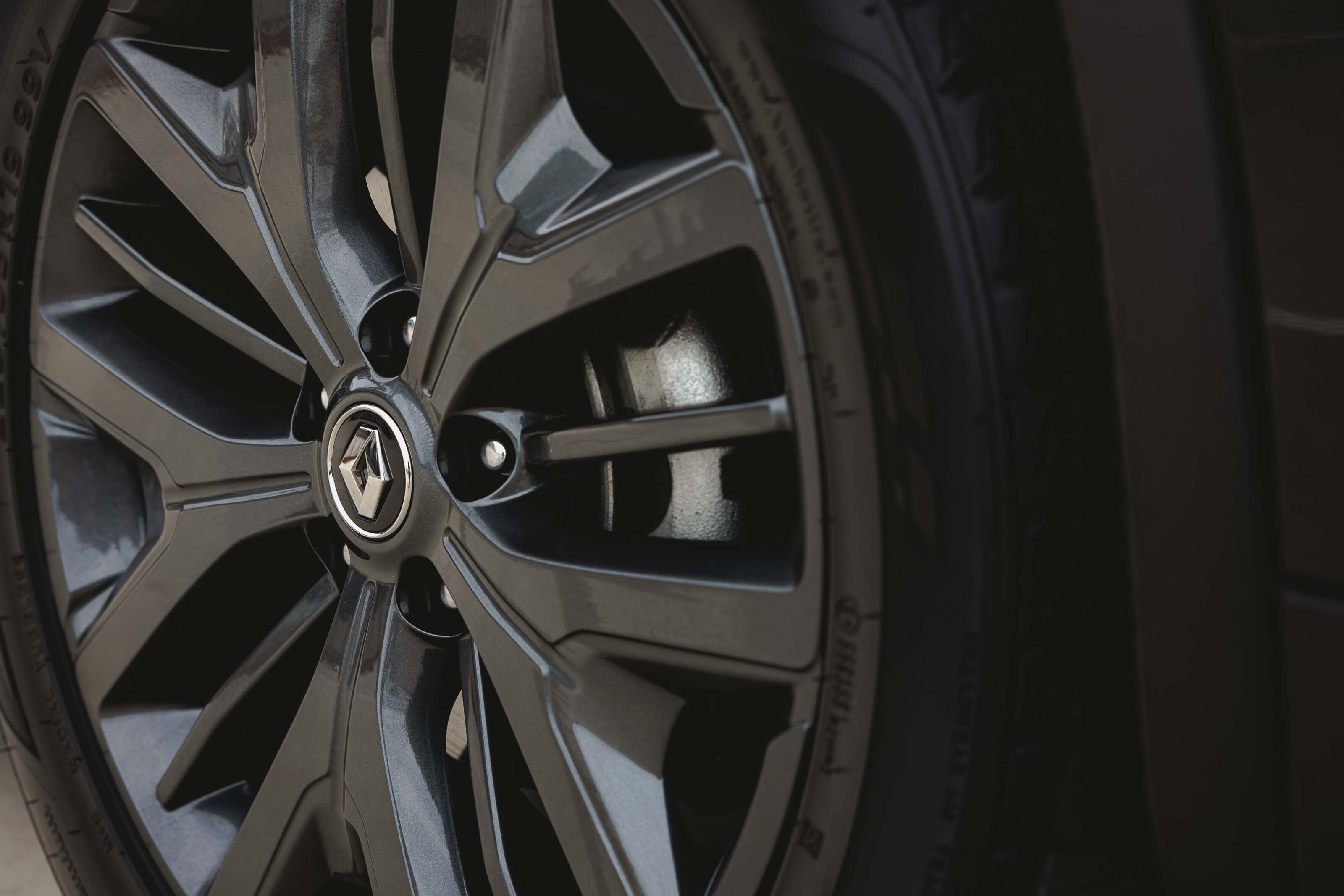
As standard, the Black Edition gets: 19-inch dark grey alloys, an 8.7-inch portrait infotainment touchscreen, Arkamys 3D sound system, Apple CarPlay and Android Auto (wired), sat-nav, hands-free key card, engine start button, automatic ‘walk away’ door locking, powered tailgate, 17-inch spare wheel, electrically-adjusted driver’s seat with electric lumbar support, reclining rear seats, dual-zone climate control, heated and cooled front cup holder and rear privacy glass.
Metallic paint is also standard on the Black Edition – ours was black (quelle surprise), but you can opt for grey or white free of charge. Red is also available as the standard colour on other grades, where white, grey and black all cost $800 extra.
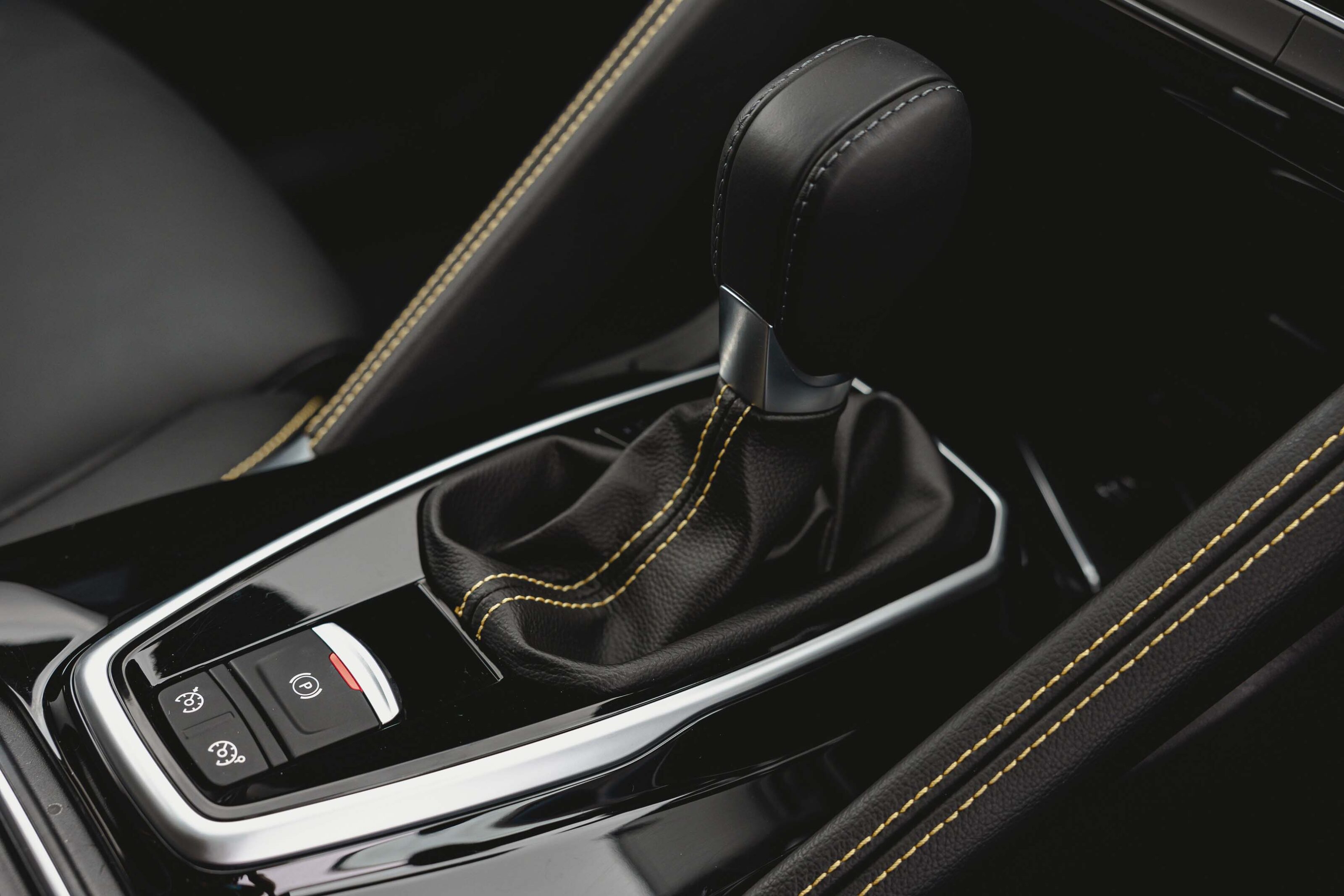
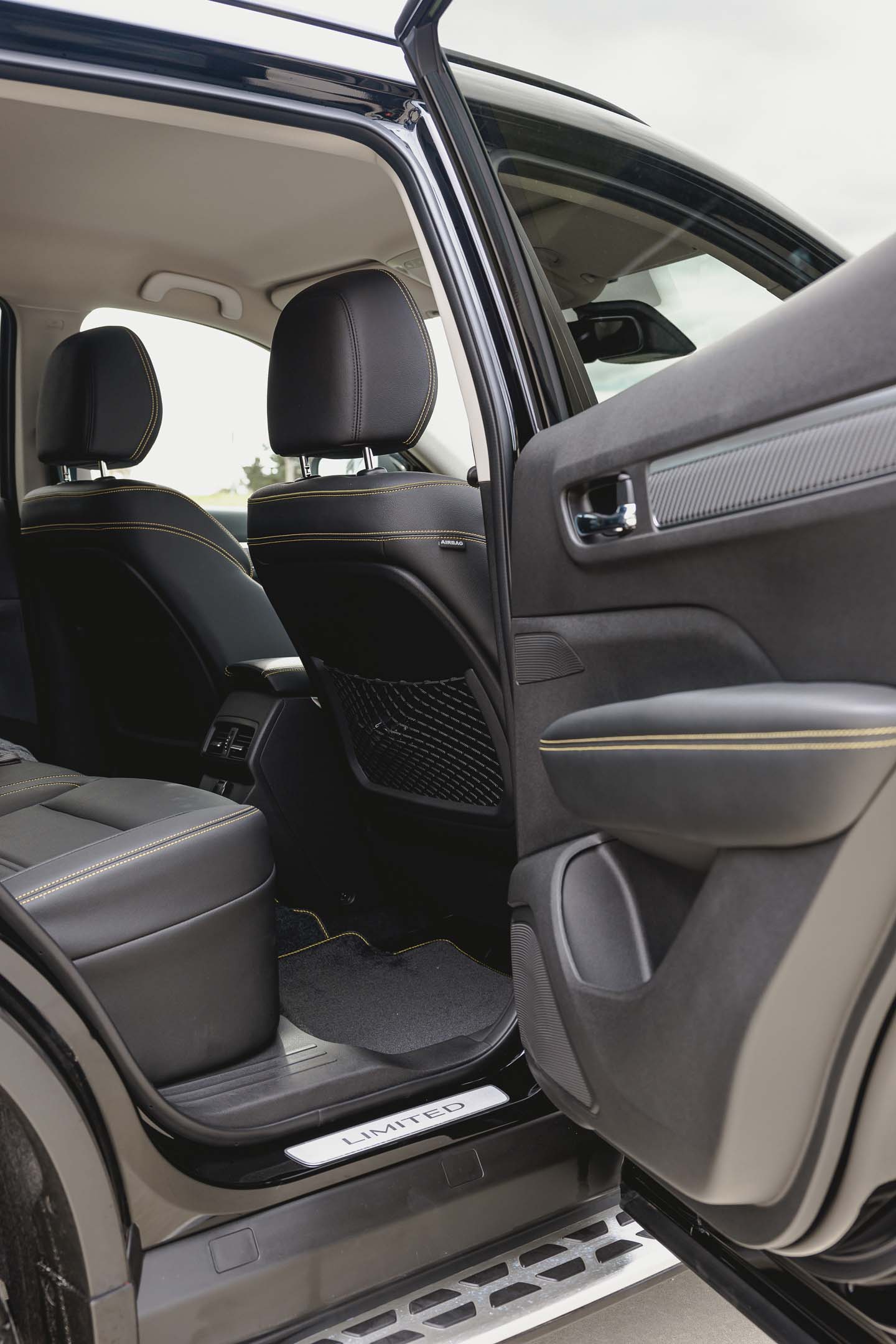
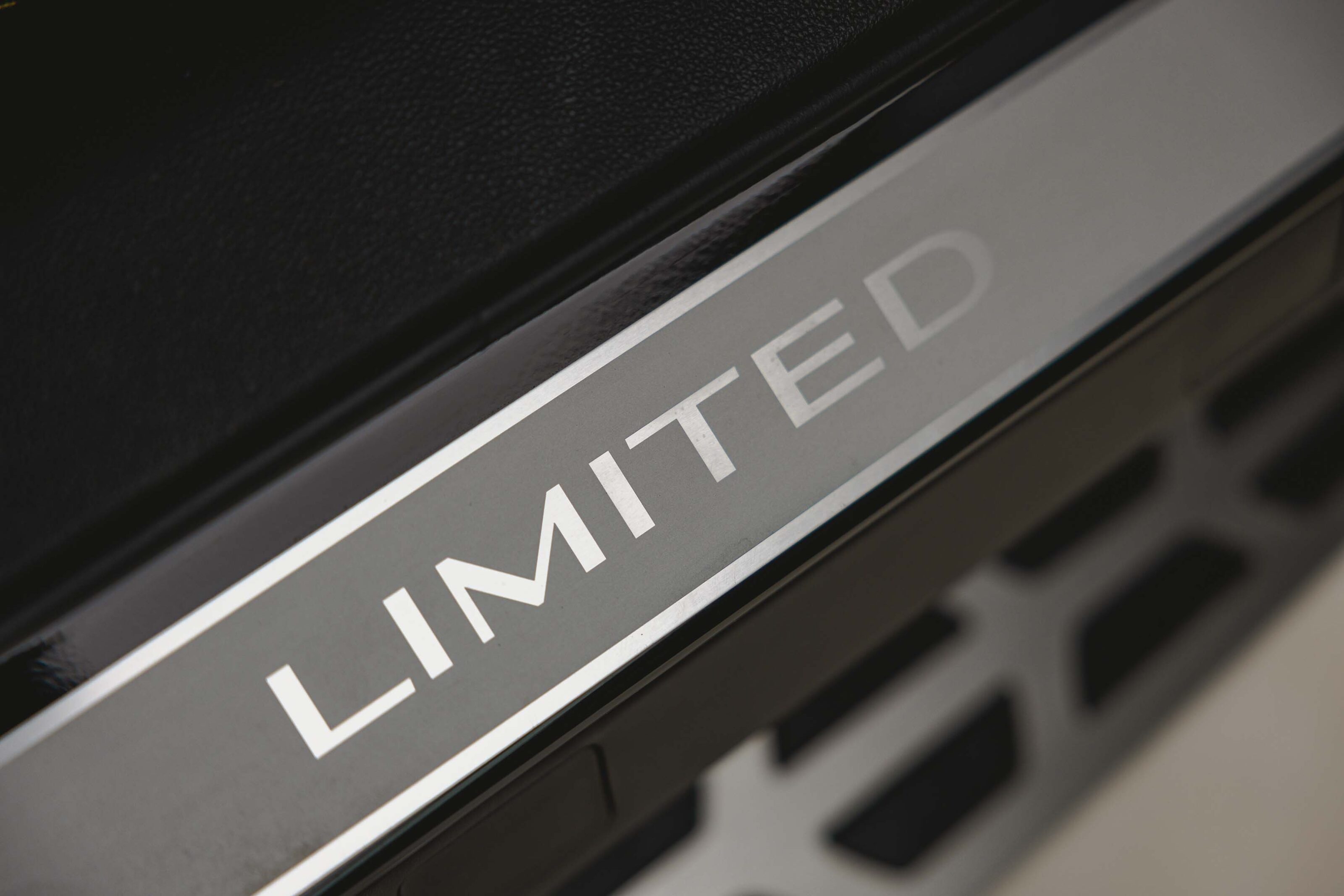
To set the limited-edition Koleos apart from its regular look, the Black Edition gets: gloss black roof rails and mirrors, dark grey front and rear skid plates, silver side steps and ‘limited’ badging – as well as black leatherette upholstery with yellow contrast stitching on the dash, seats and floor mats, which is complemented by a beige headliner so it doesn’t feel too dark inside.
It’s these details that make this special variant stand out – both the cabin and exterior details – are classy and do a lot to lift the overall package.
The aesthetics are further boosted by sleek chrome strips around the windows, along the side profile and the door handles. Even though there are some harsh plastics in the cabin, they are muted enough to give the illusion of a more upmarket look.
In spec terms, it’s closer to the range-topping Intens that also has 19-inch wheels and the 8.7-inch screen – but the Black Edition loses out on the Nappa leather interior, sunroof and premium Bose sound system. In comparison, the Life gets dark carbon cloth trim and 17-inch wheels while the Zen features dark carbon leatherette and 18-inch rims. Both make do with the lesser 7.0-inch touchscreen.
Other than accessories, there are no other costed options for the Koleos Black Edition. Buyers can, however, buy the Easy Life Package for $2000 on the Zen, which adds the 8.7-inch screen and hands-free tailgate.
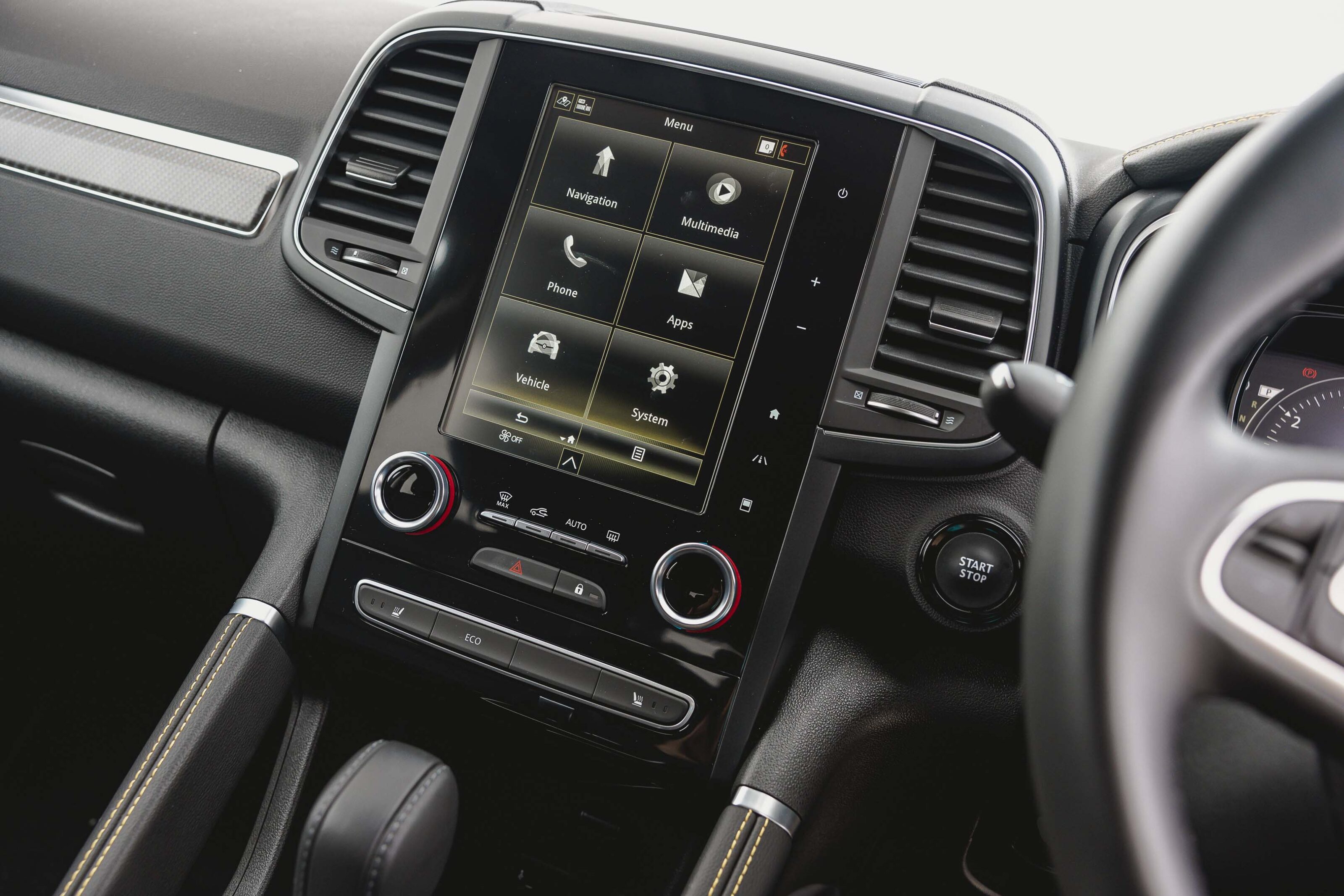
Said infotainment system, however, proved divisive in our family, with some feeling it appears awkward and outdated, while others said it was unassuming if not altogether that modern. Looks aside, its overall functionality was not too complex, but it couldn’t be called straightforward or user-friendly either – getting to the bottom of where to find various things took some patience.
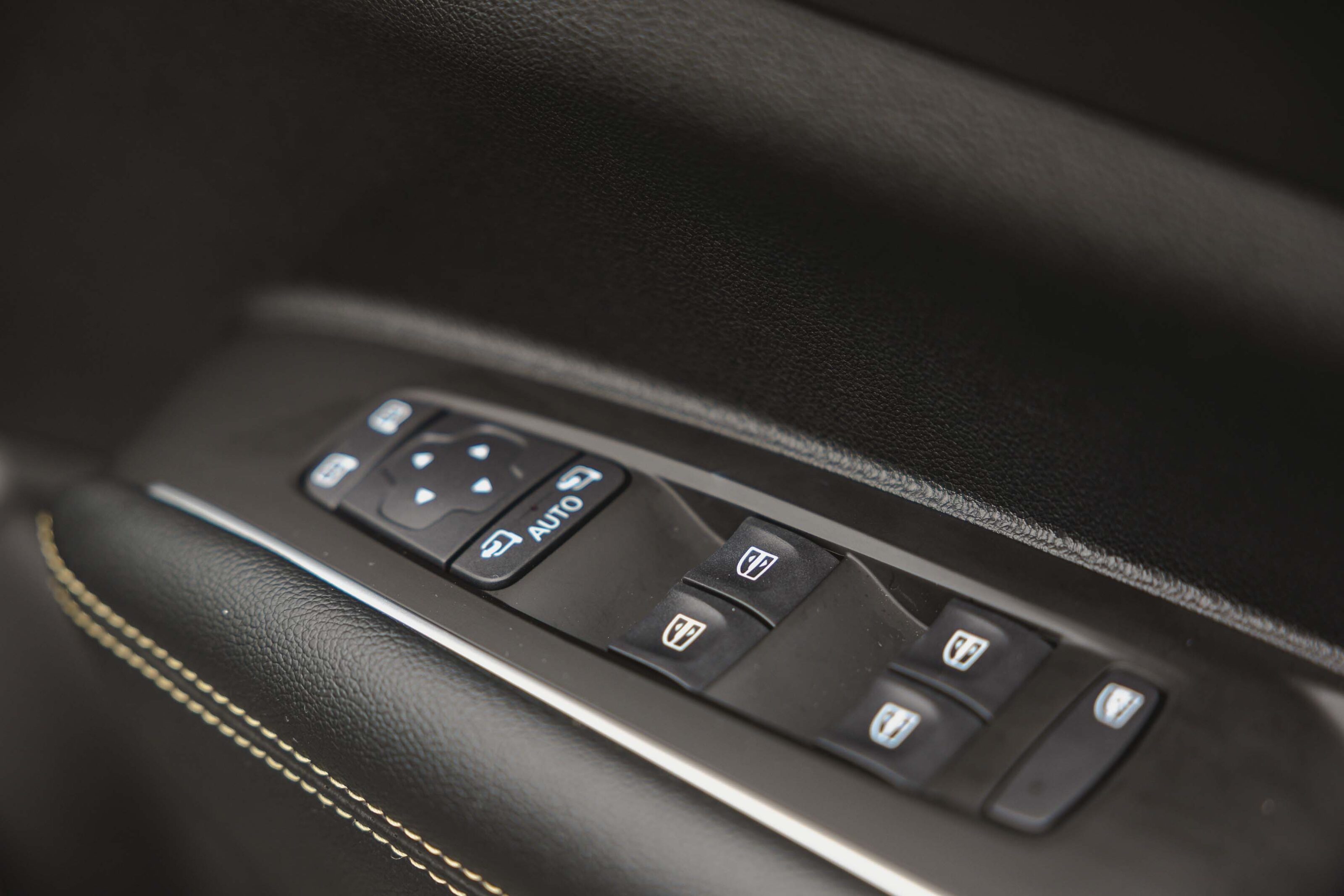
Adding to the general confusion was figuring out what half the controls on the steering wheel actually did. While the right-hand side covered the basics of changing radio stations or volume, the left-hand side was not instinctive at all.
During our whole time with the car, we couldn’t get to grips with the R and O buttons and in fact, it took a Renault rep scouring the manual for the relevant information to find out. As it happens, the R button is to put the cruise control into standby and the O reboots it.
Furthermore, the on/off for the cruise control system is actually in the centre console and nowhere near the steering wheel – as is the case with other Renault models.
It seems an oddity of French design that some core functions are in strange places – in addition to the cruise control, Renault, Peugeot and Citroën all put their door locking/unlocking control on the dash near the touchscreen when it’s far more intuitive to have it on, you guessed it, the door. Bizarre.
Other quirks of the Koleos include the sat-nav loudly insisting it must still route you to your destination unless you physically un-program it – even though you’ve already arrived there and since left.
The key is quite funky, and its credit card-like proportions mean it fits snugly into the palm of your hand, even if it is slightly awkward to keep hold of if you have other things to carry at the same time – luckily the car has the soft-touch auto unlocking doors to make things easier.
The powered tailgate is another nice addition but unfortunately the button to control it looks and feels quite cheap.
It’s now five years since the Koleos was awarded a five-star ANCAP rating, with the assessment program going through a number of changes since then.
But even so, the Koleos we had on test has access to the full suite of Renault’s safety systems, including: electronic stability control, anti-lock braking system (ABS), cruise control, emergency brake assist, forward collision warning, lane departure warning, blind-spot monitoring, rear view camera (good quality, if a little fuzzy at night), front, side and rear parking sensors (accurate but not overzealous) and hill start assist.
Comfort and Space
As mentioned earlier, the aesthetics of the Black Edition are really where this car excels and nowhere is that truer than in its interior. The look and feel of the fabrics in the cabin are of reasonably high quality, though not to the degree you’d be able to call them premium or luxury, and the contrast yellow stitching is striking.
There are still a few hard plastics to be found, and the black leatherette found on the seats, trimming the centre console and on the dash – though doing its best – is still trying to be something it’s not.
Visibility is good too – though we would have loved the electrically-operated panoramic sunroof available on the Intens – and the rear windows benefit from privacy glass as standard.
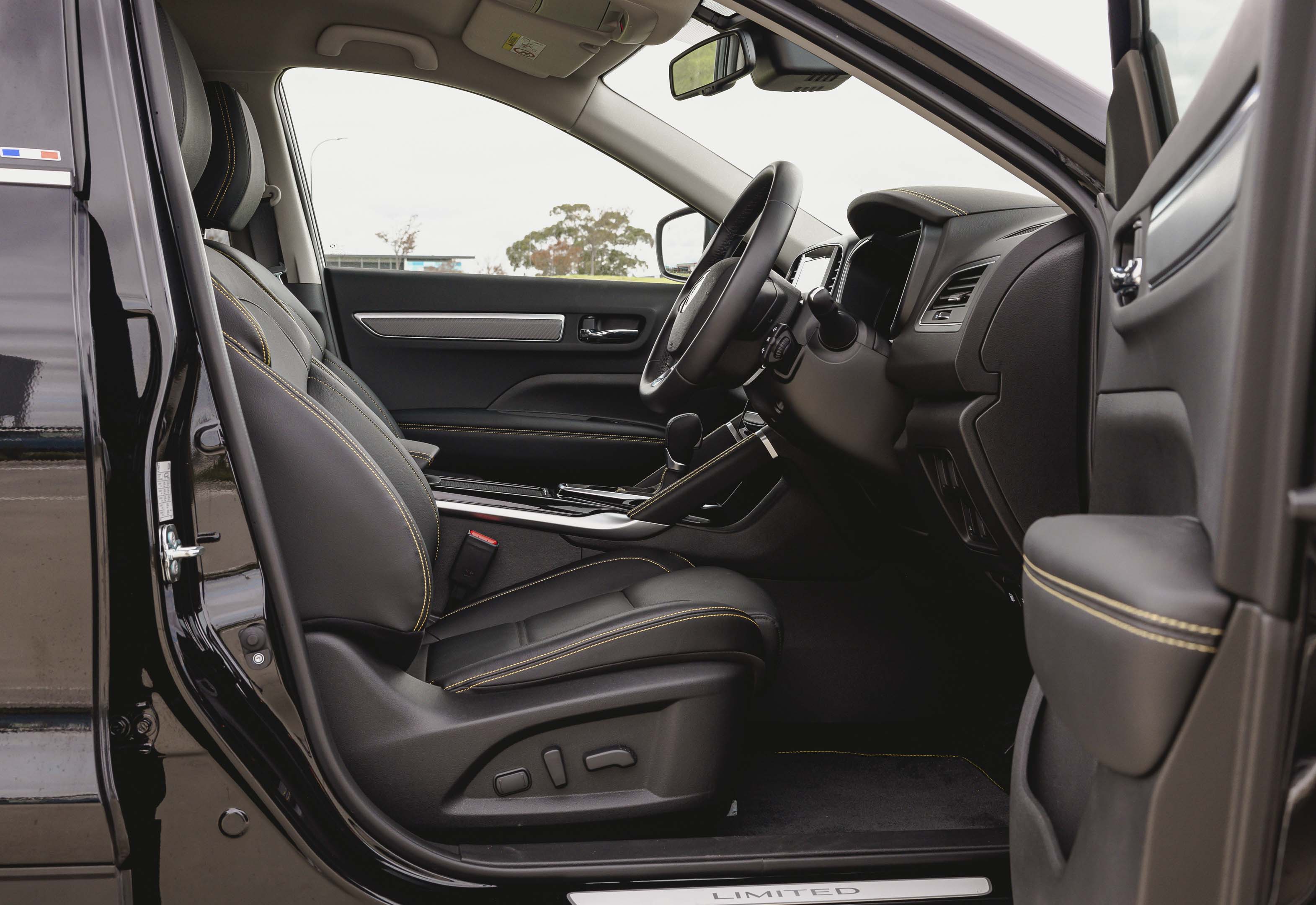
The heated front seats themselves are comfortable and, thanks to the electronic toggles on the side, the driver’s position can be easily altered to find the perfect setup – sadly no such luck for the front passenger.
What can’t be adjusted, and did in fact cause us quite a degree of discomfort during our time with the car, was the pedal position. When braking or accelerating the right foot has to be bent harshly upwards to accommodate it, leading to strain on the top of the foot and ankle. No amount of shifting the seat adjustment seemed to make any difference, and that would be a real gripe for long-term ownership in our minds.
Up front, there are plenty of mod cons to be found, with two USB ports and a 12V socket, as well as what Renault says are two ‘heating and cooling’ cup holders. It seemed to us, however, that there was actually space for four drinks in the centre console – two normal-sized and two smaller ones, possibly for securing European-style slimmer soft drink cans.
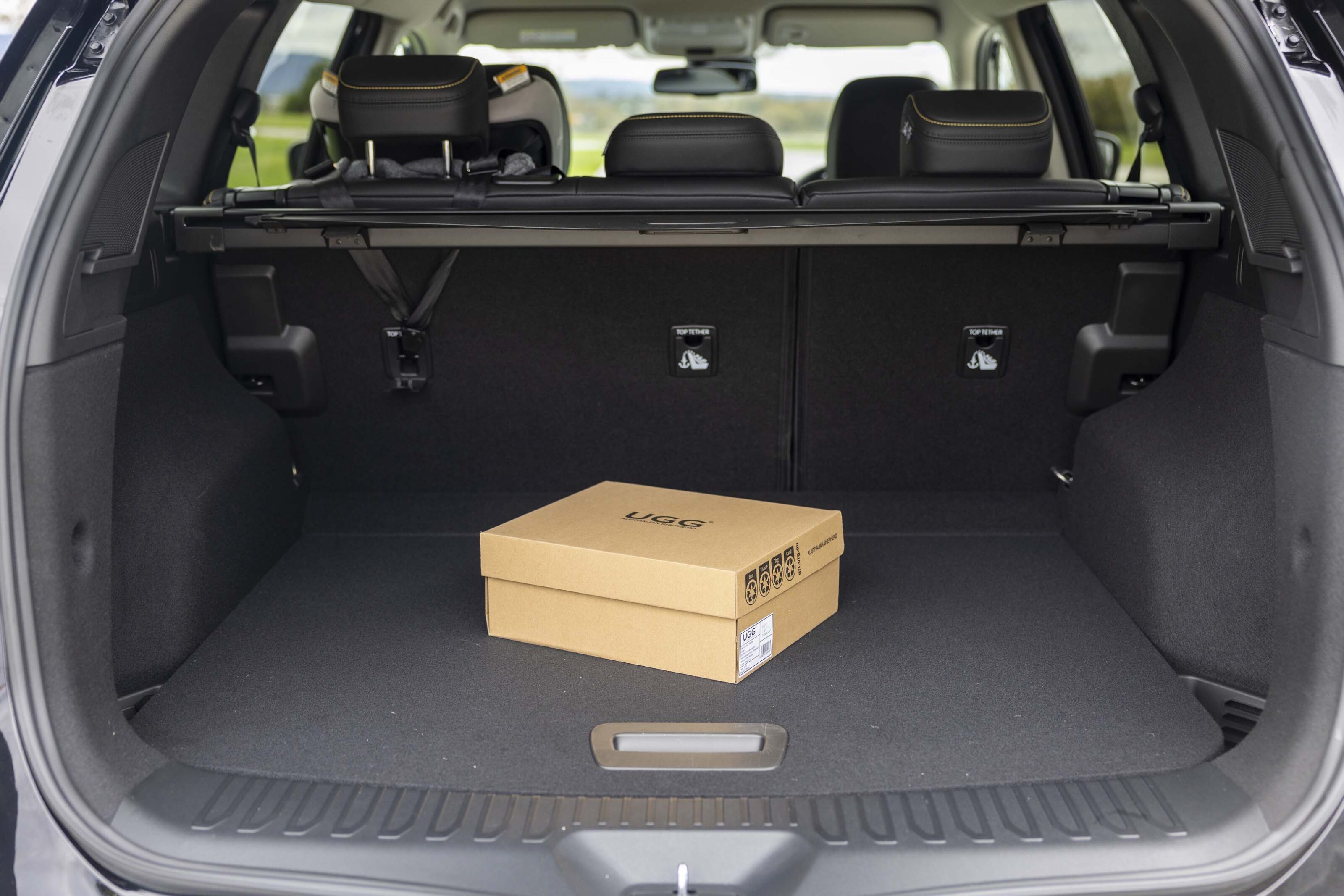
There is plenty of space throughout the cabin – just watch out for the oversized visors that can, and will, bonk you on the head getting in and out if you’re not careful. The boot too is capable of holding an impressive 458L of cargo with the second row of seats up and 1690L when folded down.
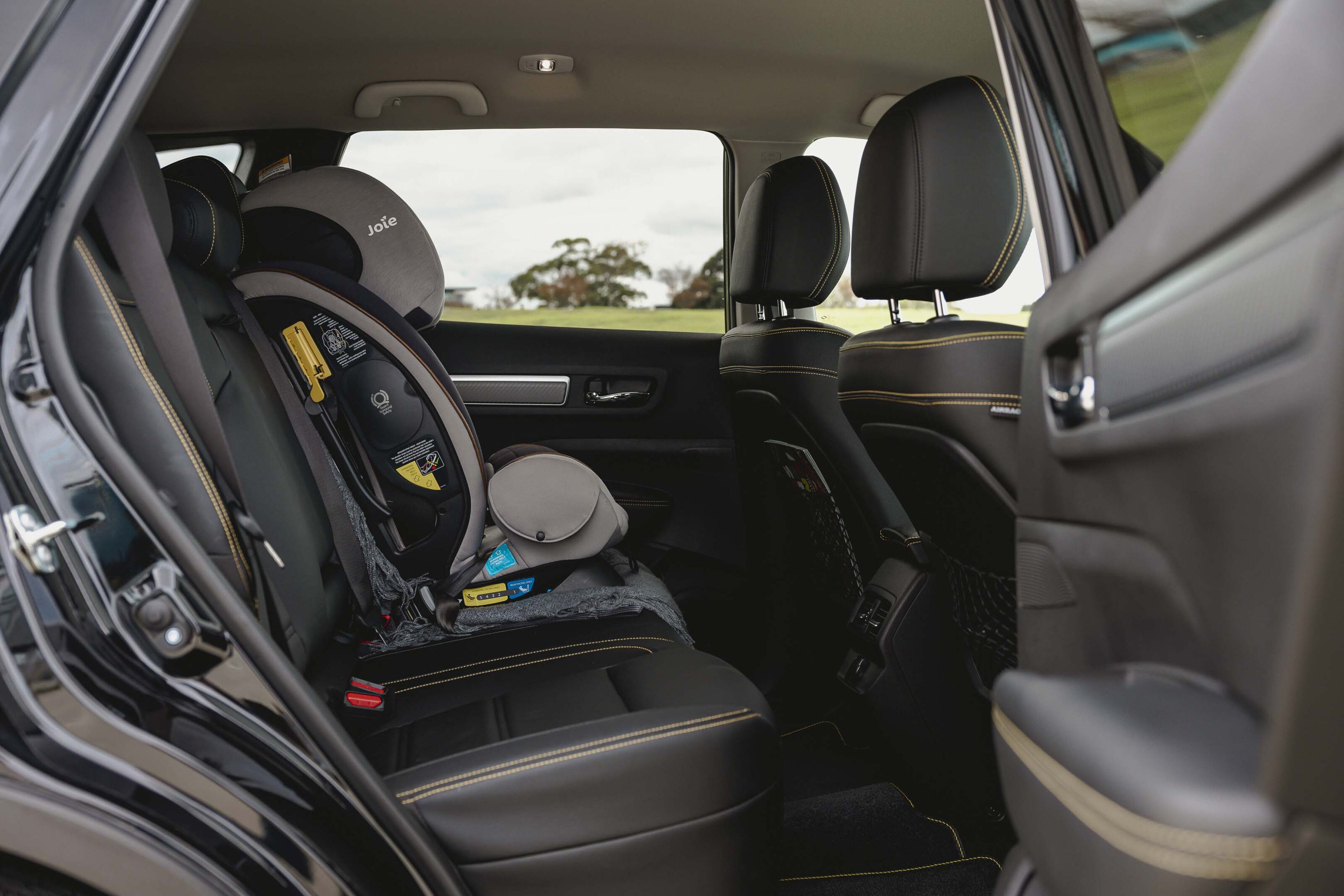
Legroom is generous, and rear occupants sit higher than in the front too. Importantly, it has proved the easiest car of its segment we’ve tested so far to fit a child seat side-by-side with two adults – both comfort-wise and for ISOFIX installation. The seatbelts can even be clicked into place without the usual 20-minute wait for Nana to figure out “where it’s gone”.
There are no frills for rear passengers though, which is a downside, aside from two cup holders in the armrest if no one needs to sit in the middle. Map pockets made from netting feature on seat-backs, which look and feel quite cheap these days, but do the job.
On the Road
The 2022 Renault Koleos line-up is powered by just the one 2.5-litre four-cylinder petrol engine with an automatic continuously variable transmission (CVT) – the same set-up found in the Nissan X-Trail range.
While all grades utilise the 2.5-litre donk and CVT, only the top-spec Intens 4×4 gets all-wheel drive, while all others, including the Black Edition, are driven by the front wheels.
The engine makes 126kW and 233Nm – not quick, but it’s not underpowered either. While the acceleration is a bit of a non-event, the Kumho Crugen tyres can create their own unwanted drama, sometimes struggling for grip on a tight turn taken at speeds as low as 40km/h.
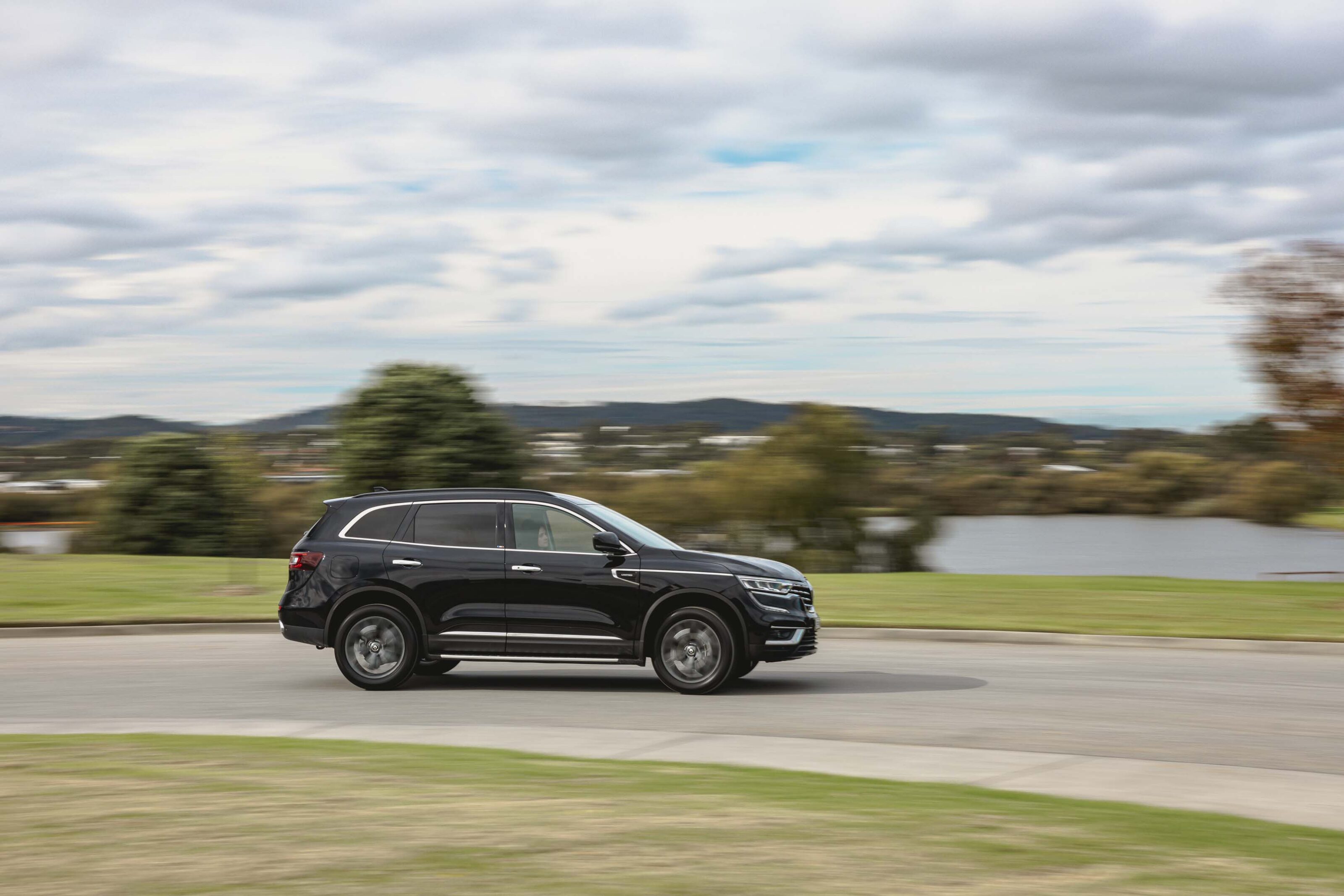
It can sound like you’re driving the getaway car for a bank job, which is at odds with the otherwise fairly relaxing driving experience.
It could also use more torque for a vehicle of its size – as offered in competitor models with a diesel powertrain.
Renault did introduce a 2.0-litre turbo-diesel in 2017 before removing it again from the updated Koleos range when it arrived in 2020 due to minimal sales. A shame, as it would make it a more compelling experience to drive and also improve the fuel economy by roughly 2L/100km. While the turbo-diesel offered 6.1L/100km, the petrol’s rating comes out at 8.1L/100km.
Though the transmission felt surprisingly capable and not excessively noisy in our recent test of the current-gen X-Trail, with no noticeable lag at any point, the same can’t be said for the effect an identical transmission has in the Koleos.
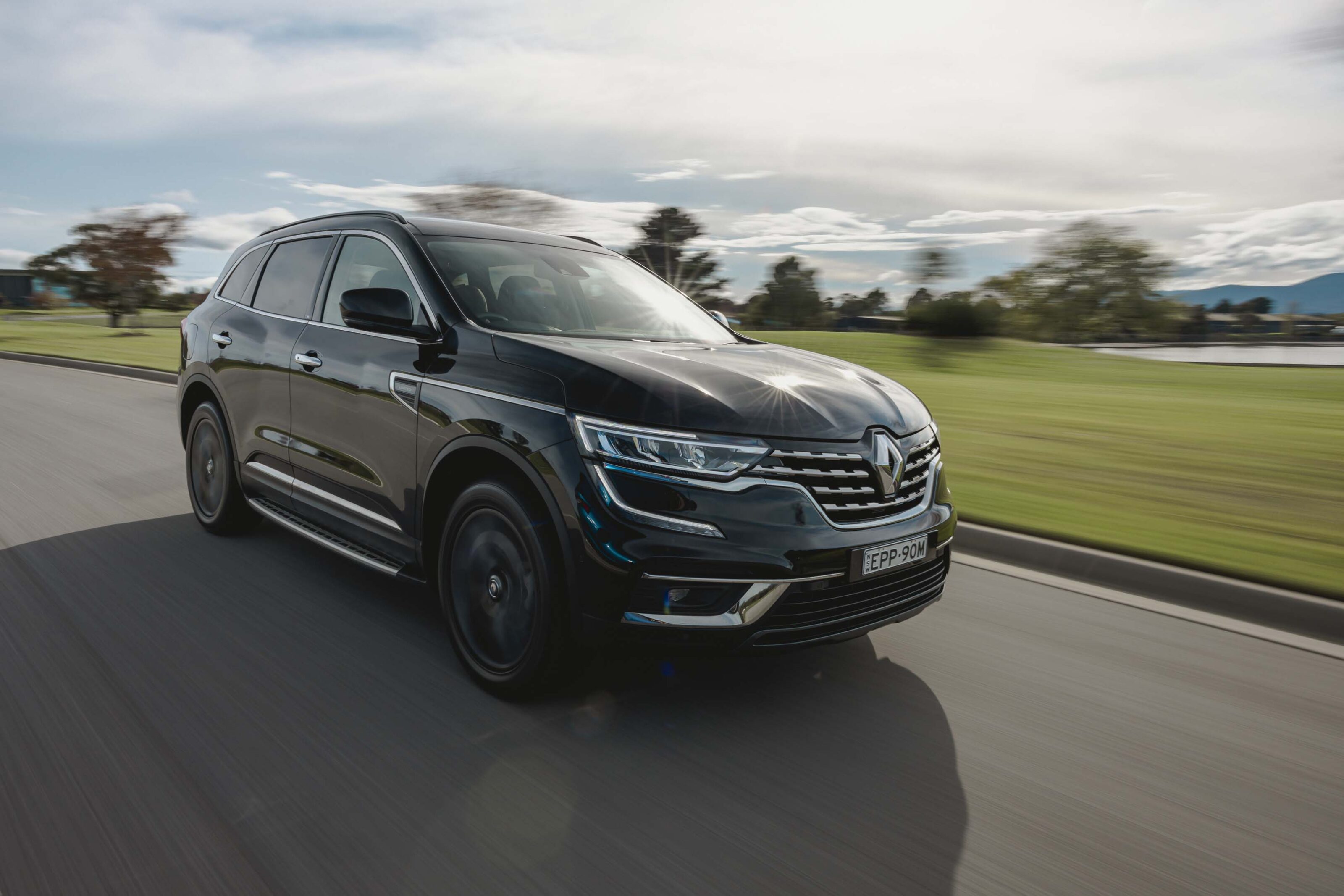
In the French-branded version, we found the CVT to be strained, sounding like it robbed the power and potential of the engine. Under hard acceleration, it also feels like it’s hunting for the right ratio and makes a bit of a racket doing so. There are no paddles for switching gear in manual mode, so you need to row the shifter back and forth old-school style. At least changes executed this way are reasonably responsive.
The ride, however, is configured to be comfortable and smooth. There’s no harshness in the damping and the Koleos feels unruffled by most road surfaces, even in the middle back seat where traditionally you tend to feel more pronounced jarring over speed bumps or potholes.
However, this does come at the expense of some body roll through tighter corners and roundabouts, and also shows up the light and vague steering.
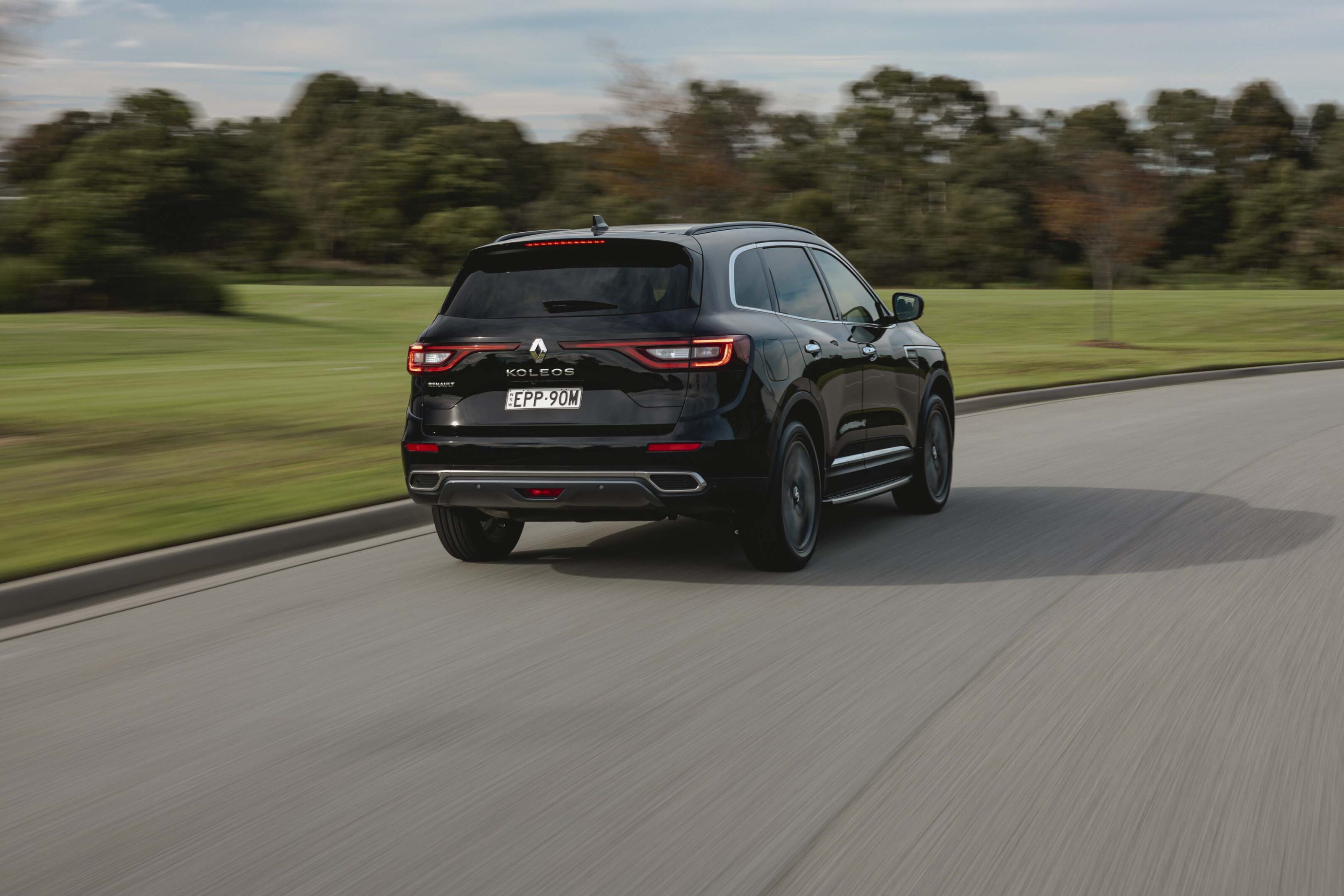
As the Koleos is more likely to be driven on straighter suburban streets than on twisty roads, this might not be much of a deal-breaker.
That said, although braking power is perfectly adequate, we can’t overlook the fact that our experience of the Koleos was so dominated by a feeling of low-speed understeer and lack of grip – made even worse in Melbourne’s wet Autumn months.
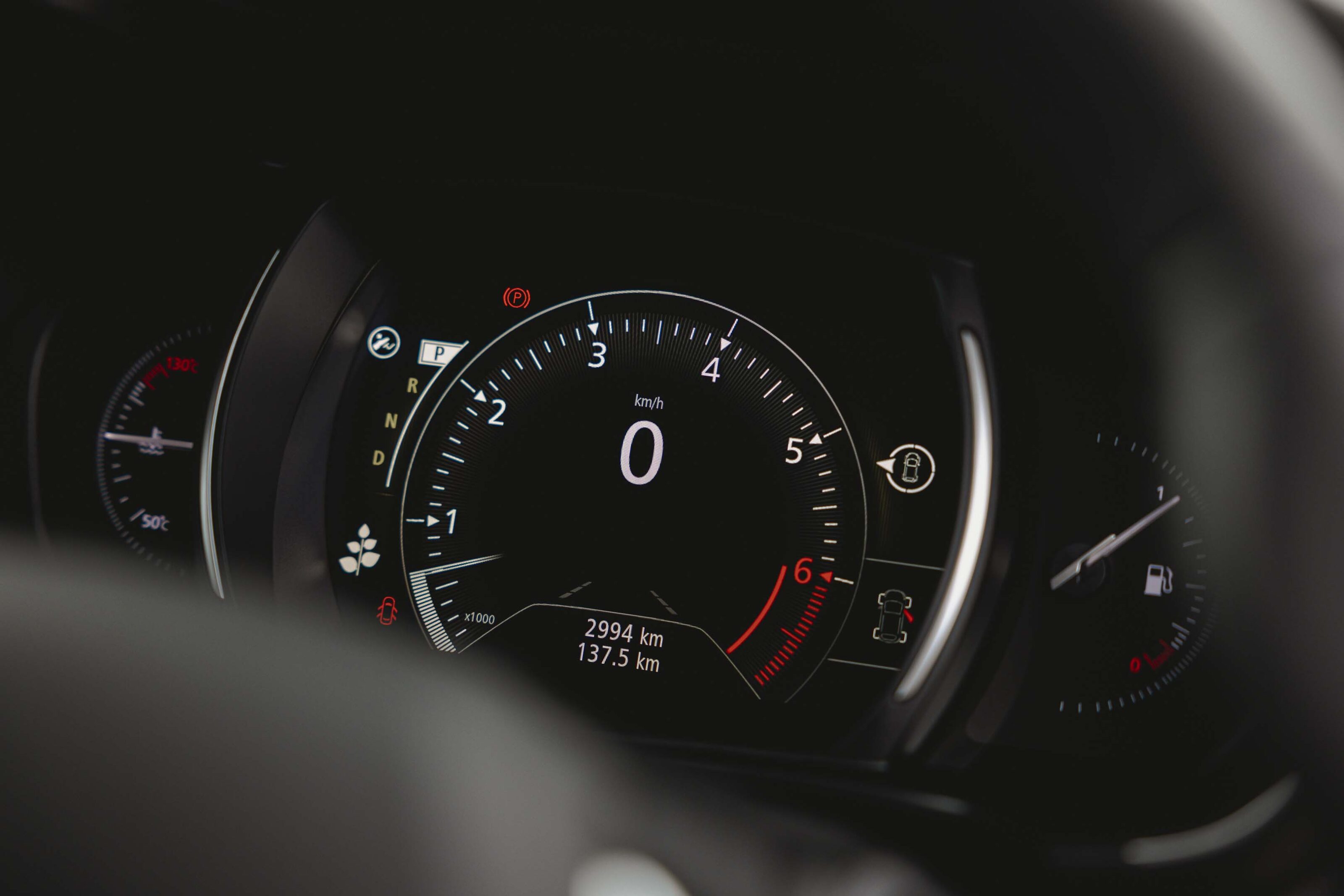
Just one configurable driving mode is available in the Koleos and that’s Eco. But it’s pretty ineffective and zaps all power, making it more effort than it’s worth.
Ownership
Renault Australia offers a five-year, unlimited-kilometre warranty, with five years’ free roadside assistance and capped-price servicing.
Service costs for the 2.5-litre petrol Black Edition are:
VERDICT
While the 2022 Renault Koleos Black Edition looks the part, offering an more premium package at a better price than the closely-matched Zen grade, it is let down by its driving performance compared to other SUVs going for that ‘premium’ vibe in the segment.
In fairness to the Renault, it does have kerb appeal, but we’re just not sure we agree with the carmaker’s sentiments that it “represents a premium European offering combined with genuine value thanks to its high levels of safety, technology and cutting-edge design”.
For only a matter of a couple of hundred dollars – or a few thousand at most – some rivals offer a better driving experience and match, or better, the Koleos on spec.
Though the Black Edition is the new wild card Renault has brought to the table, its beauty only runs skin deep and that might not be enough for it to win hearts and minds in the battle of the mid-sized SUVs.
2022 Renault Koleos Black Edition specifications
The mid-size SUV segment is as hotly contested as ever these days, and it’s no longer so simple for buyers – with options now spanning far beyond the established nameplates like CR-V, CX-5 and RAV4.
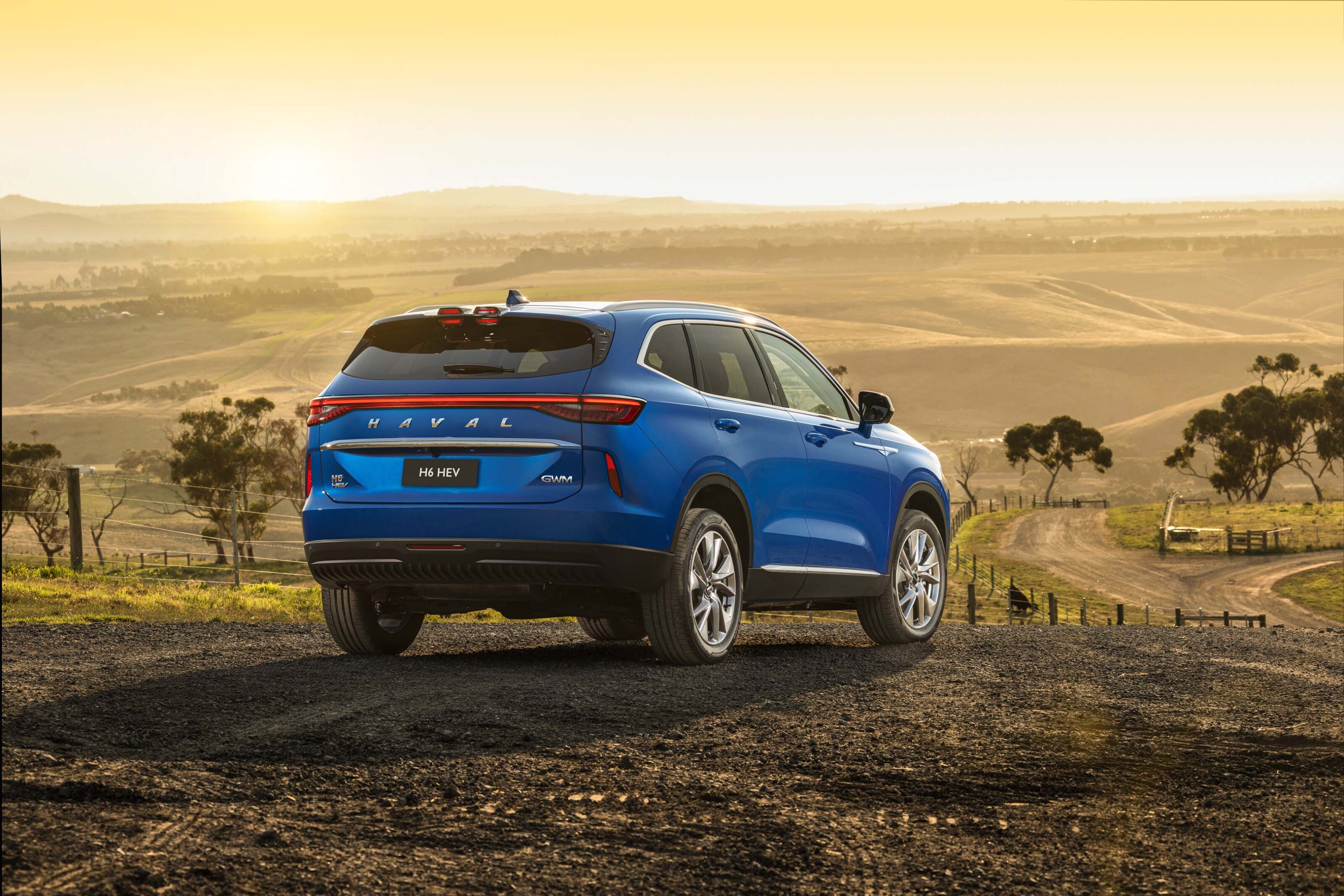
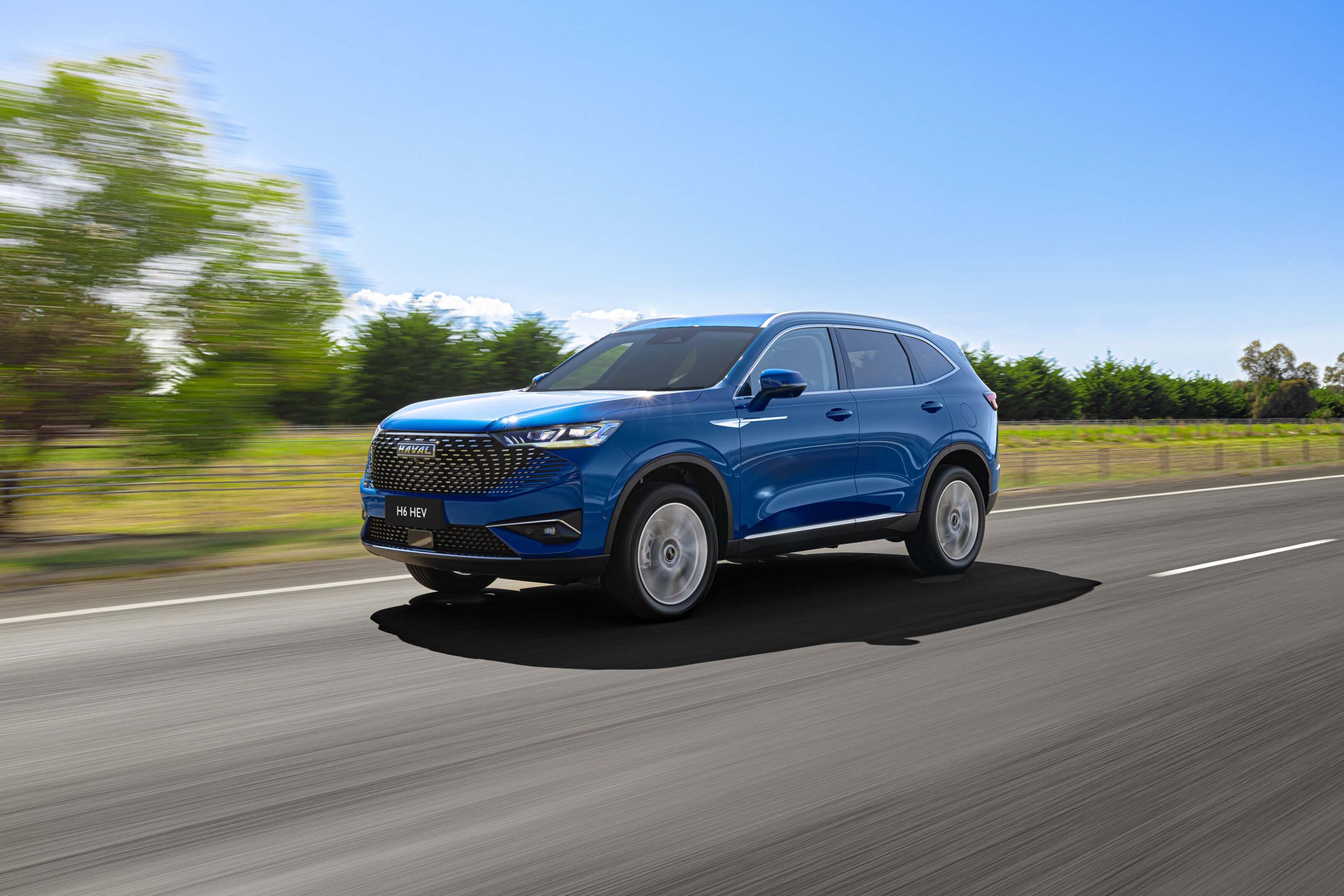
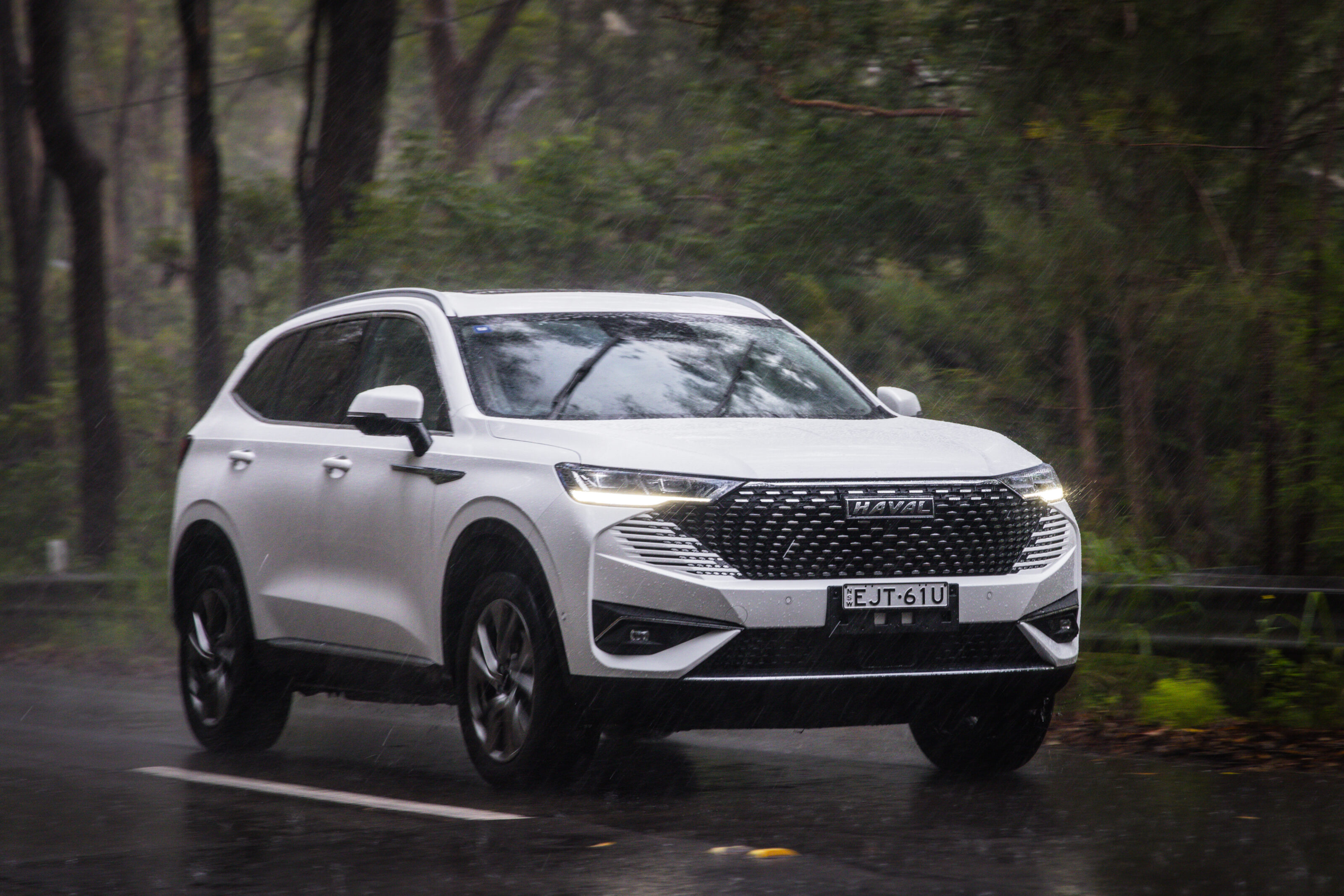
The bold-looking 2022 GWM Haval H6, while a comparatively new player to the game, trades on its generous feature set blended with a keen sense of value.
The range ascends through Premium, Lux, Ultra and Ultra Hybrid variants.
There are plenty of reasons GWM Haval’s most advanced SUV yet offers a compelling ownership proposition, particularly in today’s climate, and here we provide a guide to six key areas: Technology, Practicality, Comfort, Economy, Safety, and Assurance.
Technology
Across the range, buyers gain a suite of safety and convenience features.
All models incorporate Traffic Sign Recognition that notifies the driver of prevailing speed limits, while Lane Keep Assist and Blind Spot monitoring with Lane Change Assist keeps the H6 from being steered off the road or into oncoming traffic.
For longer journeys, a Driver Drowsiness Detection system can warn of potential fatigue behind the wheel.
The mid-range Lux and flagship Ultra variants gain additional features, including a 360-degree camera that provides a birds-eye image of your car that allows the driver to monitor their immediate surroundings.
They also include an Adaptive Cruise Control system with Stop/Go functionality that removes driver stress and effort in slow-moving rush-hour queues. These variants also provide a temporary hands-free mode for freeway driving, called Intelligent Cruise Assist; Ultra variants add another semi-autonomous feature – Full Auto Parking that takes over the steering for parking manoeuvres.
H6 Ultra and H6 Ultra Hybrid also feature a Head-Up Display (HUD) that projects key information, such as speed, onto the windscreen.
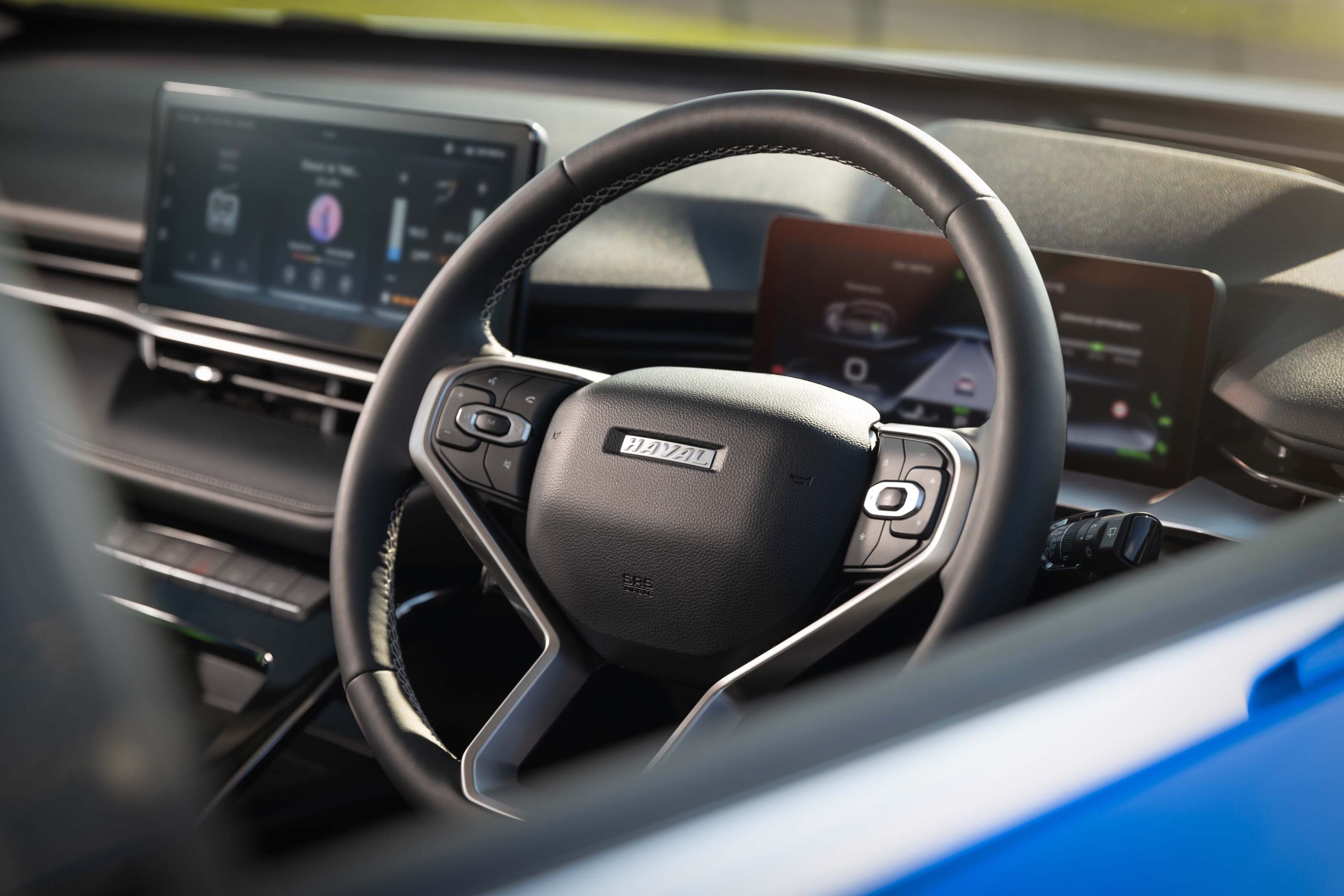
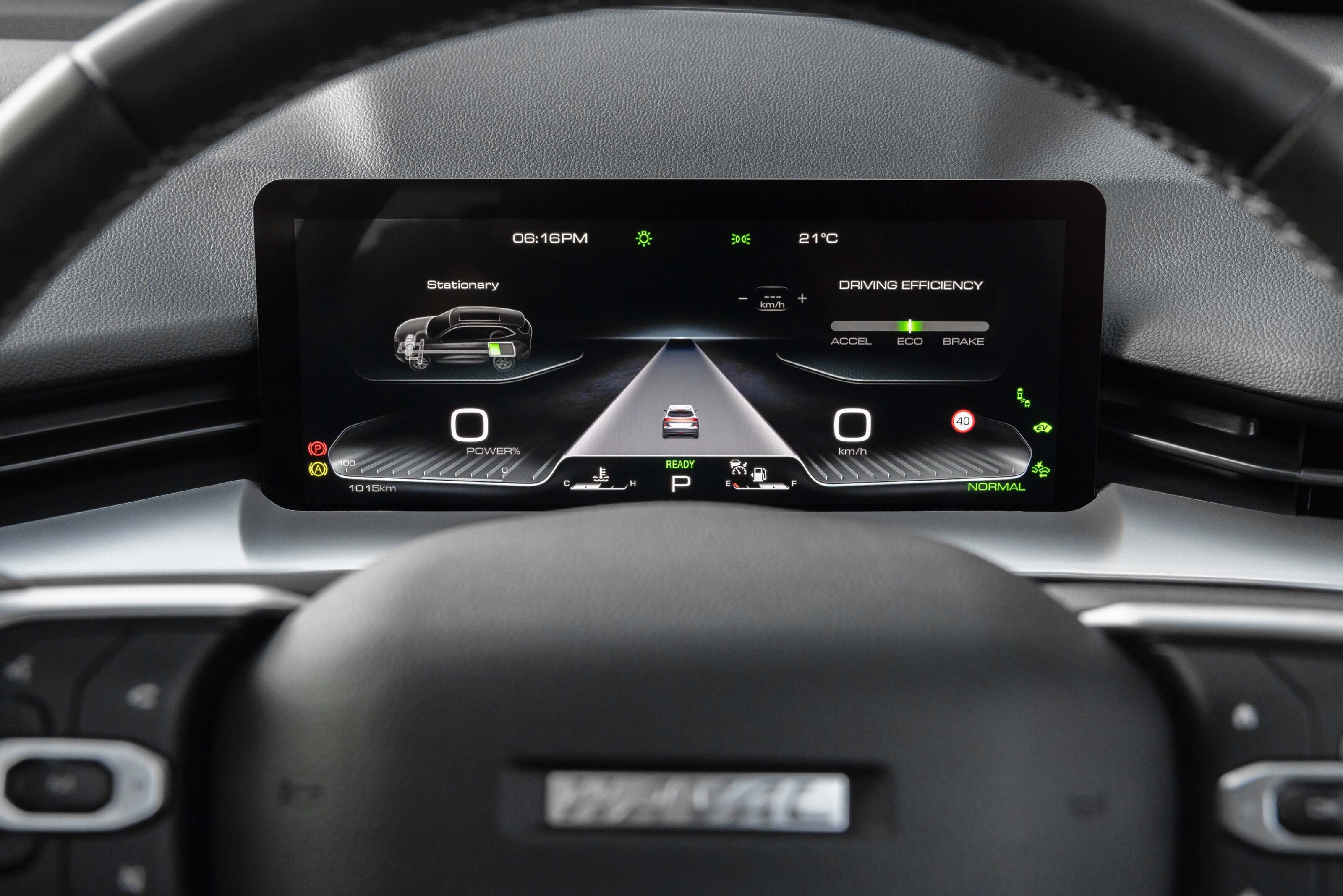
Every Haval H6 is equipped with a 10.25-inch colour digital driver display. In Premium and Lux variants, this is matched with an identically sized infotainment screen in the centre of the cabin – which handily controls virtually all of the car’s functions except for the climate control.
Stepping up to the Ultra or Ultra Hybrid brings a more expansive, 12.3-inch infotainment display, which is joined by a wireless phone charging pad to the front cabin.
Apple CarPlay and Android Auto smartphone integration is standard on all models.
Practicality
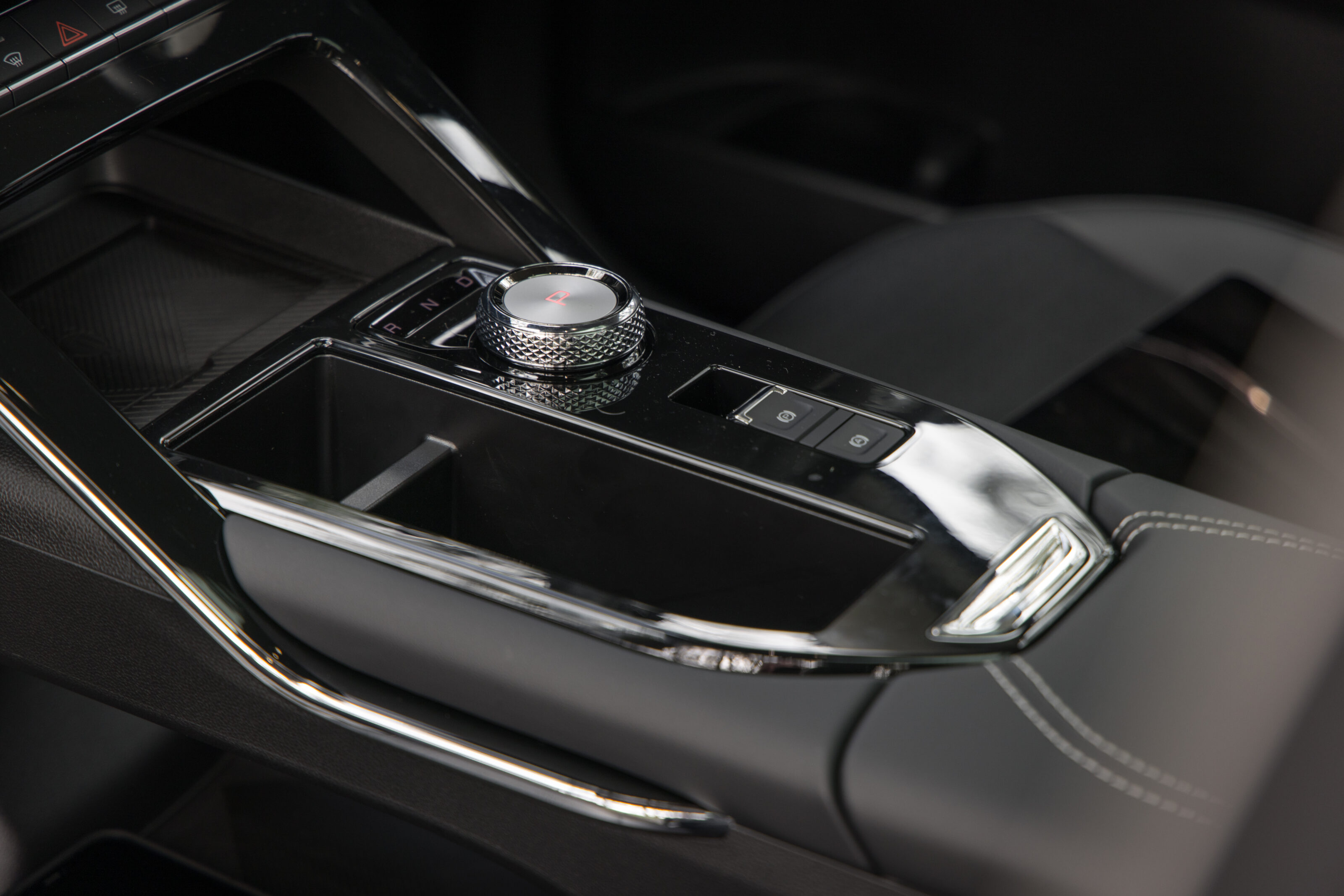
A keen focus on intelligent packaging is signalled by the ease of cabin storage up front, including sizeable cupholders that can convert into a deep empty tray, a deep storage bin under the armrest, and a secondary storage area underneath the floating centre console where you’ll also find two USB ports.
The second row of seats fold 60/40 for flexible load-through transporting. With seats up, the boot swallows 600L, which more than doubles when the second row is fully folded to 1485L.
Lux models and above gain roof rails as standard, while the Ultra and Ultra Hybrid feature an automatic tailgate function.
Comfort
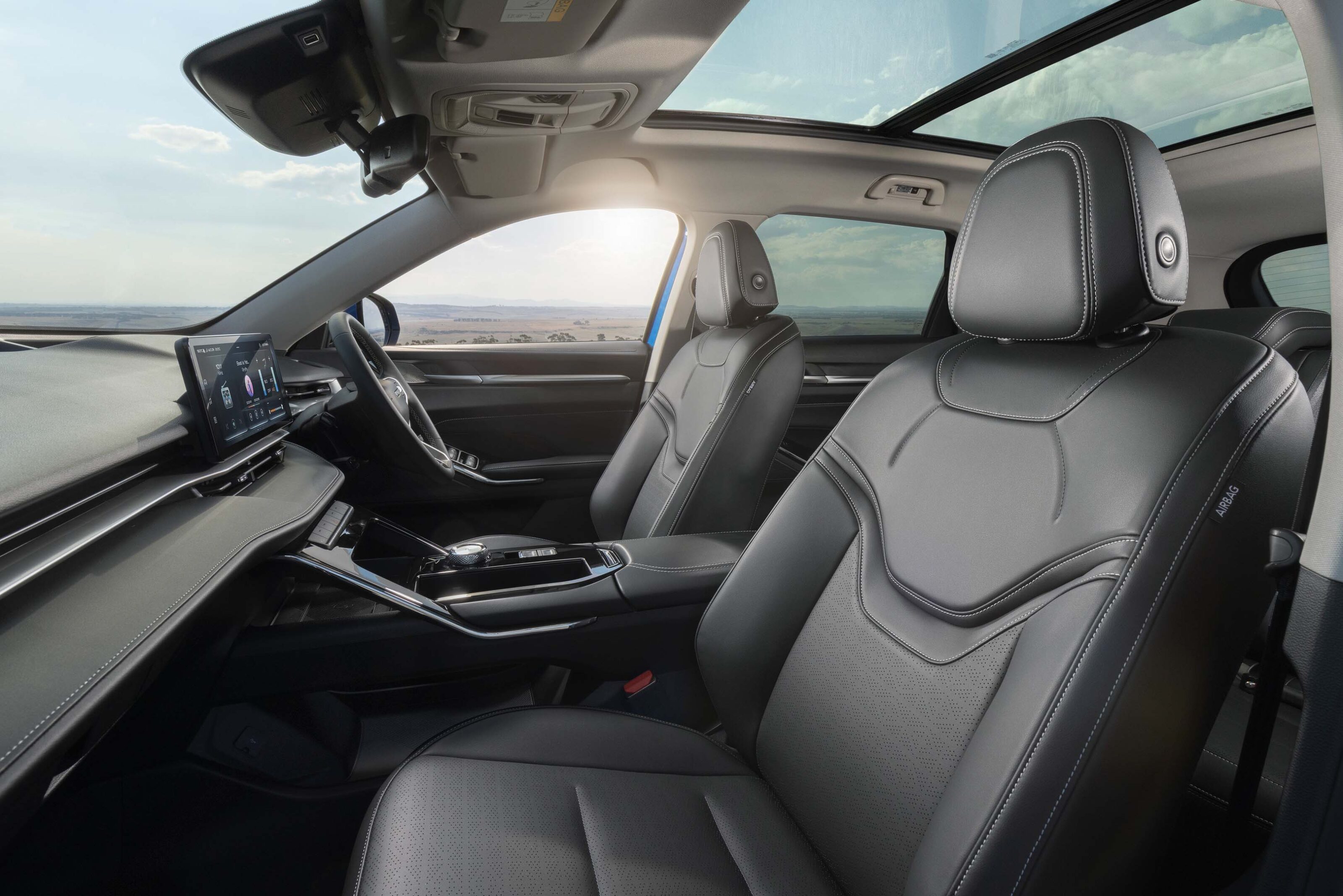
From the entry-level variant, LED ambient lighting and fabric upholstery are standard-fit items.
Stepping up to the H6 Lux adds eight-way power-adjustable and heated front seats, plus dual-zone climate control and an electronic anti-glare rear-view mirror. Flagship Ultra and Ultra Hybrids further include power seating with heating and cooling functions, as well as a heated steering wheel and a panoramic roof.
Lux and Ultra models also step up from cloth trim to ‘Comfort-Tek’ leather upholstery.
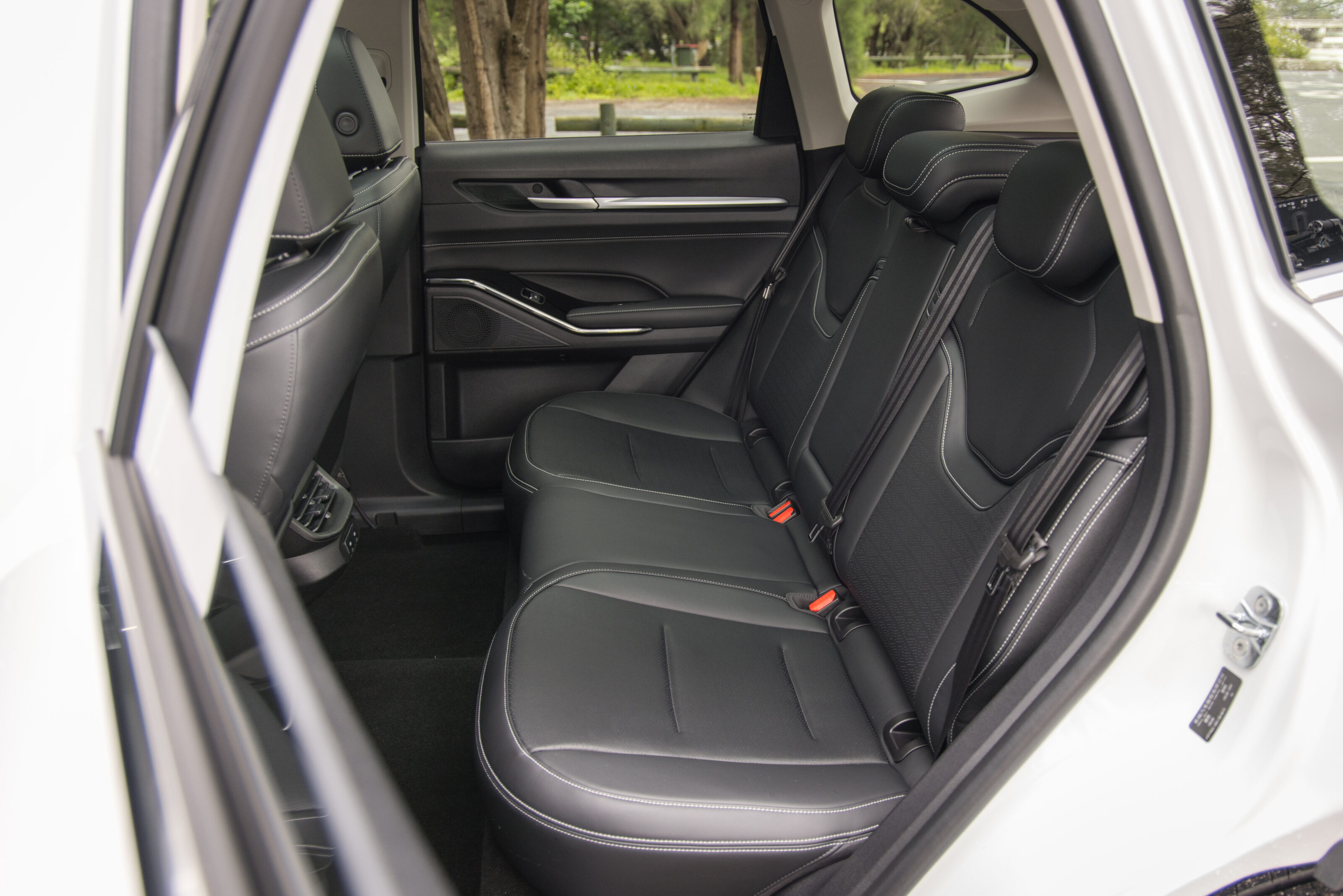
The back seats offer great space for the class with good headroom even for taller folk. The middle seat is a particular beneficiary of a low transmission tunnel that doesn’t encroach on knee room for an adult-sized passenger in the centre seat. There are also rear air vents and another two USB ports back there.
Economy
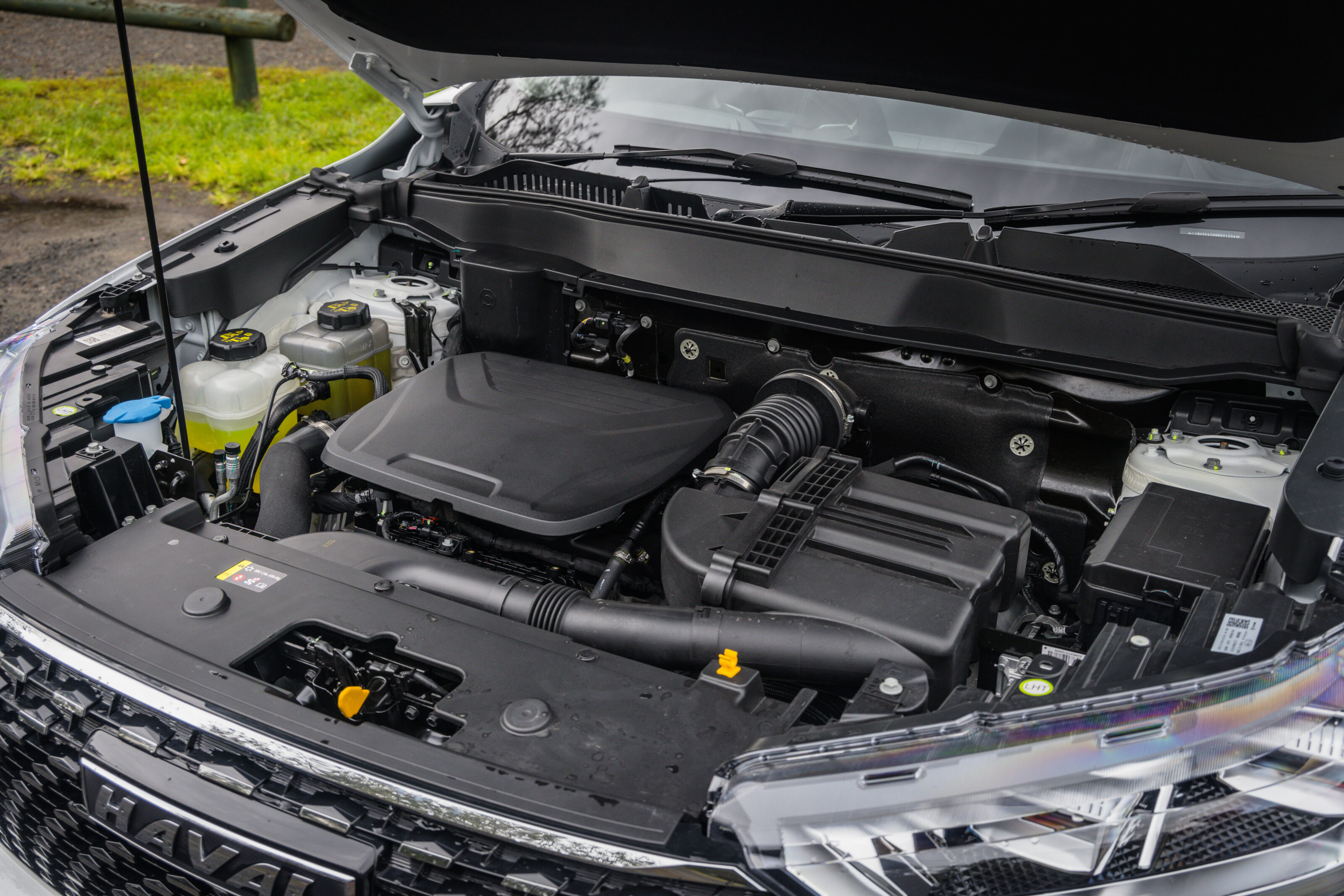
For the hypermilers out there, the H6 Ultra Hybrid is the undoubted pick of the current GWM Haval H6 range with its official fuel figure of 5.2 litres per 100km. This is marginally greater than the hugely in-demand (and more expensive) Toyota RAV4.
This is produced by the H6 Ultra Hybrid’s 1.5-litre four-cylinder engine, producing 110kW and 230Nm, aided by an e-motor producing a further 130kW and 300Nm. That’s a combined 179kW and an impressive 530Nm.
A 1.18kWh battery also offers limited EV-only driving which will be great for short trips around the neighbourhood.
The GWM Haval H6’s regular drivetrain – a turbocharged four-cylinder engine – still offers fuel consumption as low as 7.4L/100km in front-wheel-drive form, while offering healthy engine outputs of 150kW and 320Nm.
Safety
The GWM Haval H6 was awarded top marks by ANCAP, wearing Five Stars for all variants.
GWM Haval’s midsized SUV scored relatively high marks across the board: 90 per cent for adult occupant protection, 88 per cent for child occupant protection, 73 per cent for vulnerable road user protection and 81 per cent for its safety assist systems.
The H6 is constructed with a high-strength steel body and features an extensive safety suite harnessing 14 Radars and six cameras.
Every H6 in the range features front, side, curtain and even a front-centre airbag that helps prevent a clash of heads between the front occupants in the event of a side impact.
Standard-fit safety suite across the range includes autonomous emergency braking, lane-departure warning, blind-spot detection, and lane-change assist.
Lux and Ultra variants include parking sensors front and rear.
Stepping up to the Ultra or Ultra Hybrid also nets you rear cross-traffic assist with auto-braking function and an Intelligent Dodge feature.
Assurance
The all new GWM Haval H6 is supported by a seven-year/unlimited kilometre warranty, plus five years of Roadside Assist. In the case of the H6 Ultra Hybrid, its battery is further covered by an eight-year warranty. A five-year Capped Price Servicing program is also available.
Snapshot
- $3000 subsidy on 15,000 vehicles
- Capped at $58,000 u2013 including delivery and options costs
- Response to rising fuel prices
UPDATE, July 1, 2022: Queensland’s $3000 EV subsidy in effect from today
The Queensland Government’s electric vehicle rebate scheme is now in effect, with prospective buyers offered a $3000 discount on their purchase.
Announced in March as the Palaszczuk Government’s response to fuel prices hitting $2 per litre, the start of the new financial year has put the $3000 subsidy into effect, applying to the first 15,000 battery electric vehicles purchased in the state.
However, there are some minor caveats – just like other states, the rebate is on the RRP (list price) plus the delivery charge and optional extras, meaning cars such as the Hyundai Kona Highlander Standard Range (usually $58,000 before on-road costs) are excluded.
The story to here
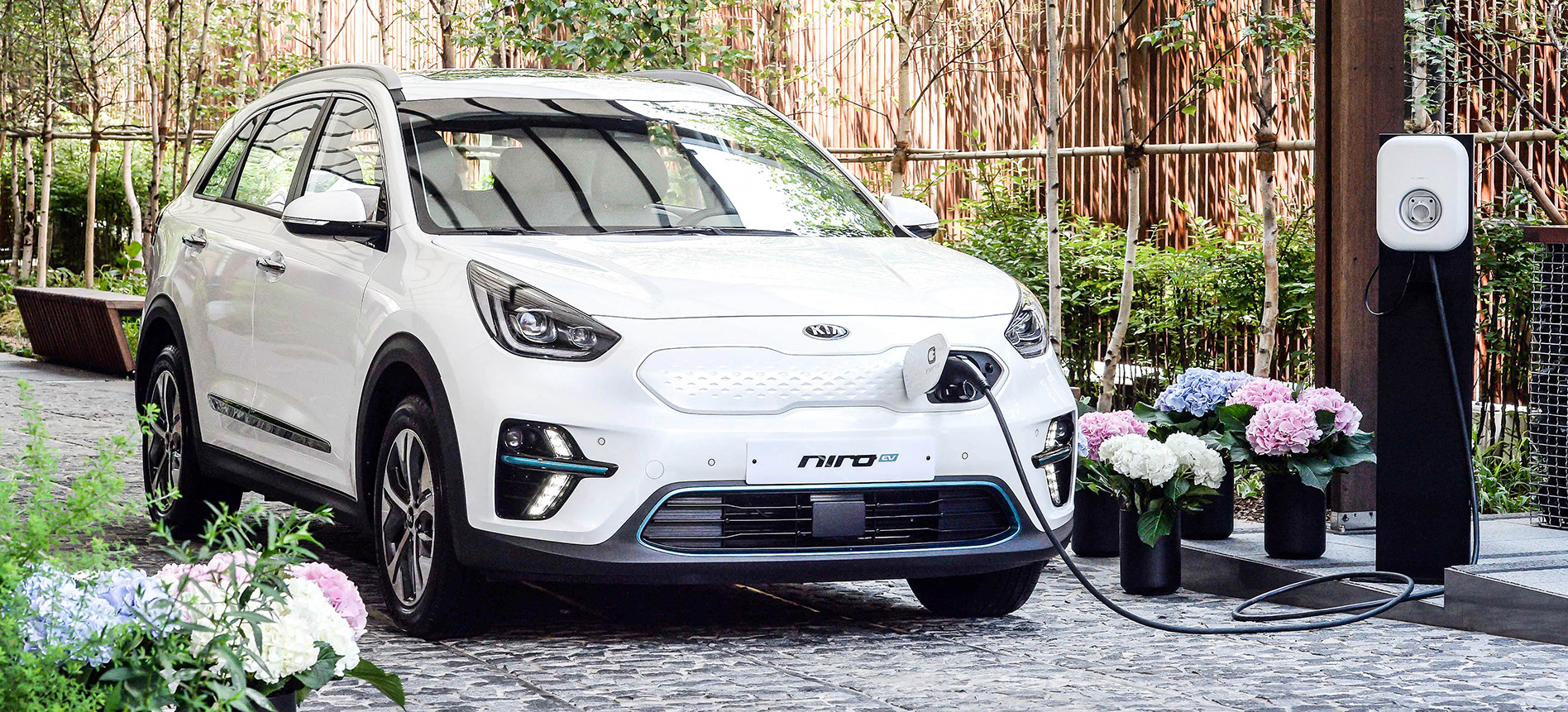
March 16, 2022: Queensland to offer $3000 subsidy for EVs from July 1
Queensland has become the latest state to offer a subsidy on the sale of an electric vehicle in response to soaring petrol prices across Australia.
Premier Annastacia Palaszczuk made the announcement on Wednesday that her Government will be offering $3000 off the cost of a new EV as of July 1 this year as part of a $55 million package.
But a cap of $58,000 excludes a number of Australia’s top-selling EVs, such as the Tesla Model 3, which has recently undergone a number of price increases across its range.
For the second time in recent weeks, Tesla has jacked up the cost of its most popular model, now standing at $63,900.
However, it will cover vehicles such as; the MG ZS EV, BYD Atto 3, and Nissan Leaf.
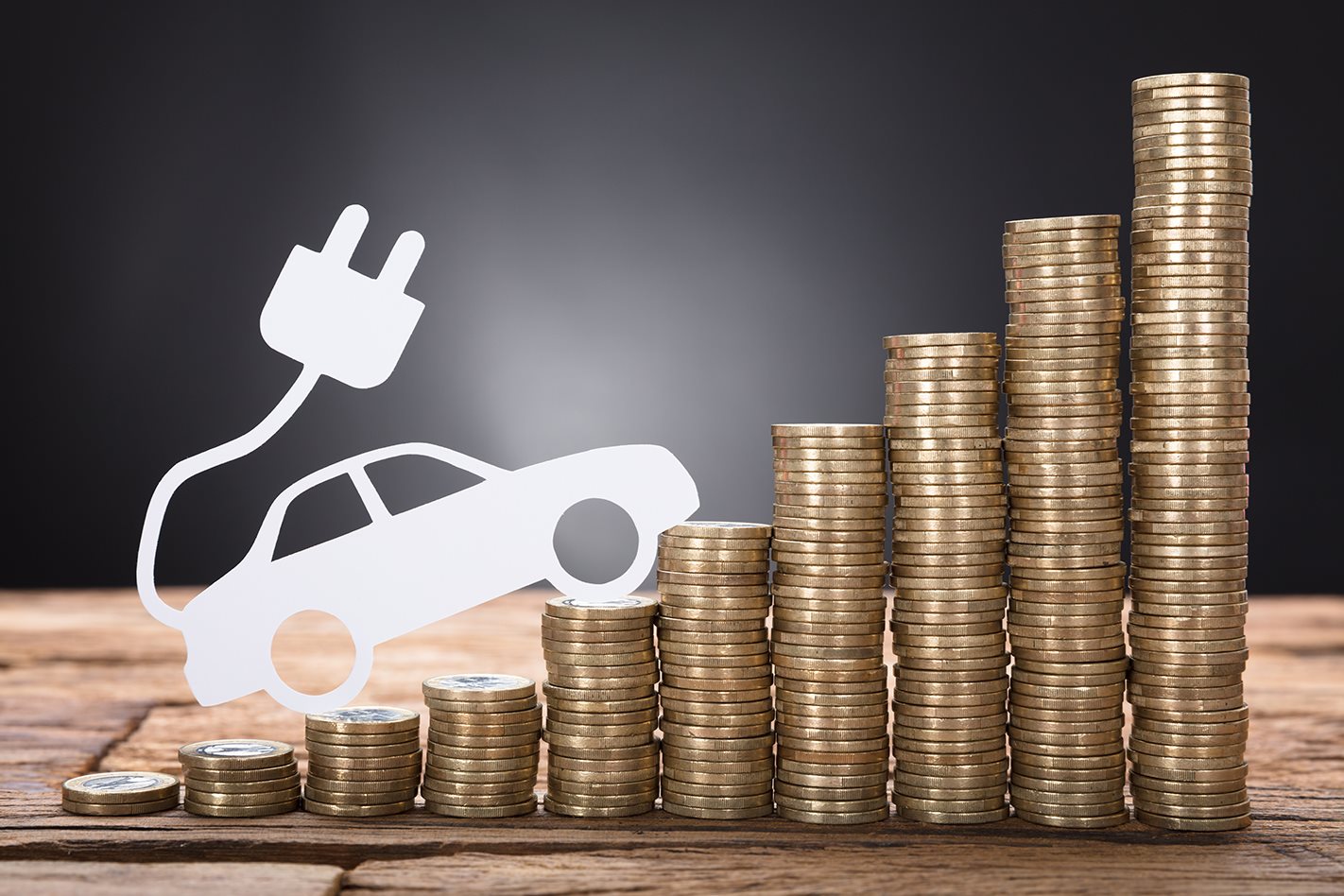
While QLD is set to offer the same discount as New South Wales, Victoria and South Australia, the price limit is around $10,000 lower – with NSW’s cap sitting at $68,750, VIC’s at $68,740 and SA’s at $68,750.
The amount of vehicles the subsidy applies to in QLD however is relatively on par, with Premier Palaszczuk stating it will be available on 15,000 cars, compared to 25,000 in NSW, 20,000 in VIC and 7000 in SA.
Claiming the introduction of the policy is both a response to petrol spiking above $2.20 a litre, as well as the increasing need to slash emissions.
“The skyrocketing price of petrol is putting enormous strain on household budgets,” Palaszczuk said.

“I know there are plenty of Queenslanders out there who want to make the switch to electric. We all want to see reduced emissions and a cleaner environment. That’s why we are going to do what we can to make the cost of electric vehicles that little bit cheaper. We’re making electric vehicles more affordable and accessible for more Queenslanders.
“Global warming increases the frequency and severity of extreme weather as we have seen all too clearly in the past two weeks. This announcement is a key part of our Zero Emission Vehicle Strategy: the goal is to reduce our emissions and reduce the impact of climate change.”
In addition to offering a subsidy, the State will also provide a further $10 million to build more charging stations.
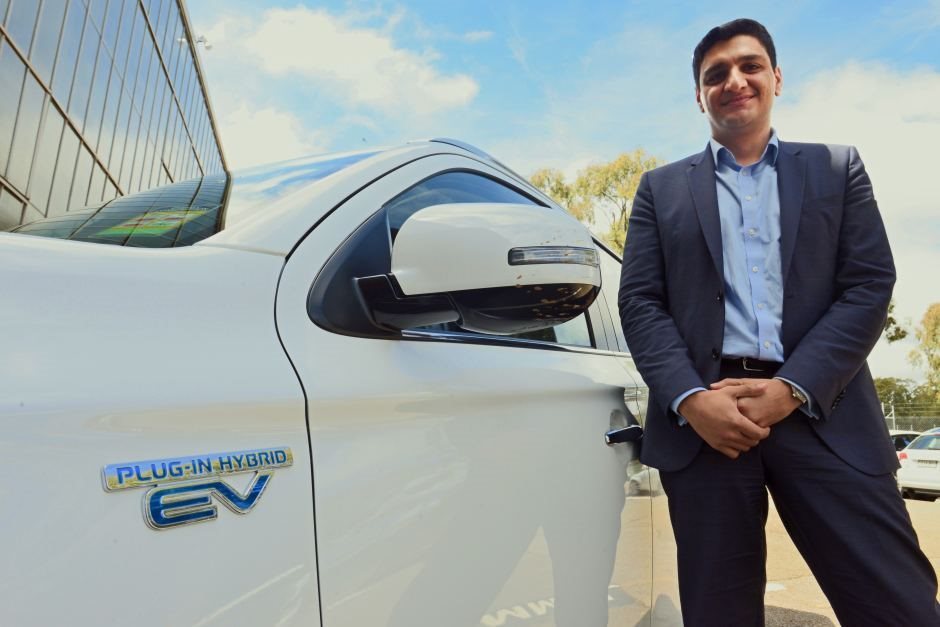
“Queensland was the first Australian state to develop an EV strategy and today’s announcement shows there’s still strong momentum toward an electric future in the Sunshine State,” said Electric Vehicle Council chief executive Behyad Jafari.
“Instead of filling up on foreign oil, Queensland drivers should be filling up on the abundant sunshine and wind their state offers.
“We know Queensland drivers already have great enthusiasm about the idea of switching to an EV, this package will help convert a lot of that enthusiasm to action.
“Queenslanders understand the myriad benefits of electric vehicles and that’s been emphatically underlined recently with all the petrol price volatility. This kind of government support will give drivers confidence to make the move now instead of putting it off.
“Now what we need is for the Federal Government to back Queensland’s efforts and support it with overdue reform like the introduction of fuel efficiency standards.”

The Federal Chamber of Automotive Industries’ Chief Executive, Tony Weber, said the grants will be a welcome support to potential EV buyers, but questioned the State’s target of 50 per cent of new passenger vehicles being made up of EVs by 2030 and 100 per cent by 2036.“The FCAI believes the Government’s continued focus on developing EV recharging infrastructure and fleets is vital in supporting the penetration of EV’s into the Queensland market.“[However] the primary policy objective is to reduce CO2 emissions and our pathway to this objective in the transport sector needs to be a holistic one. Electric vehicles alone will not achieve this in Australia.“The pathway to reducing emissions through to the mid-2030s will rely on a range of low emission technologies that include plug-in hybrid, hybrid and even highly efficient internal combustion engines in addition to pure EVs.“Improvements in fuel quality and the introduction of a broad based and nationally consistent road user charge scheme, as well as a vehicle emissions target, are all needed to bring the best low and zero emissions technology to Australia.”
Snapshot
- 2023 Genesis GV60 pricing announced early for Australia
- Luxurious electric SUV priced from $103,700 before on-roads
- More-potent Performance variant listed at $110,700
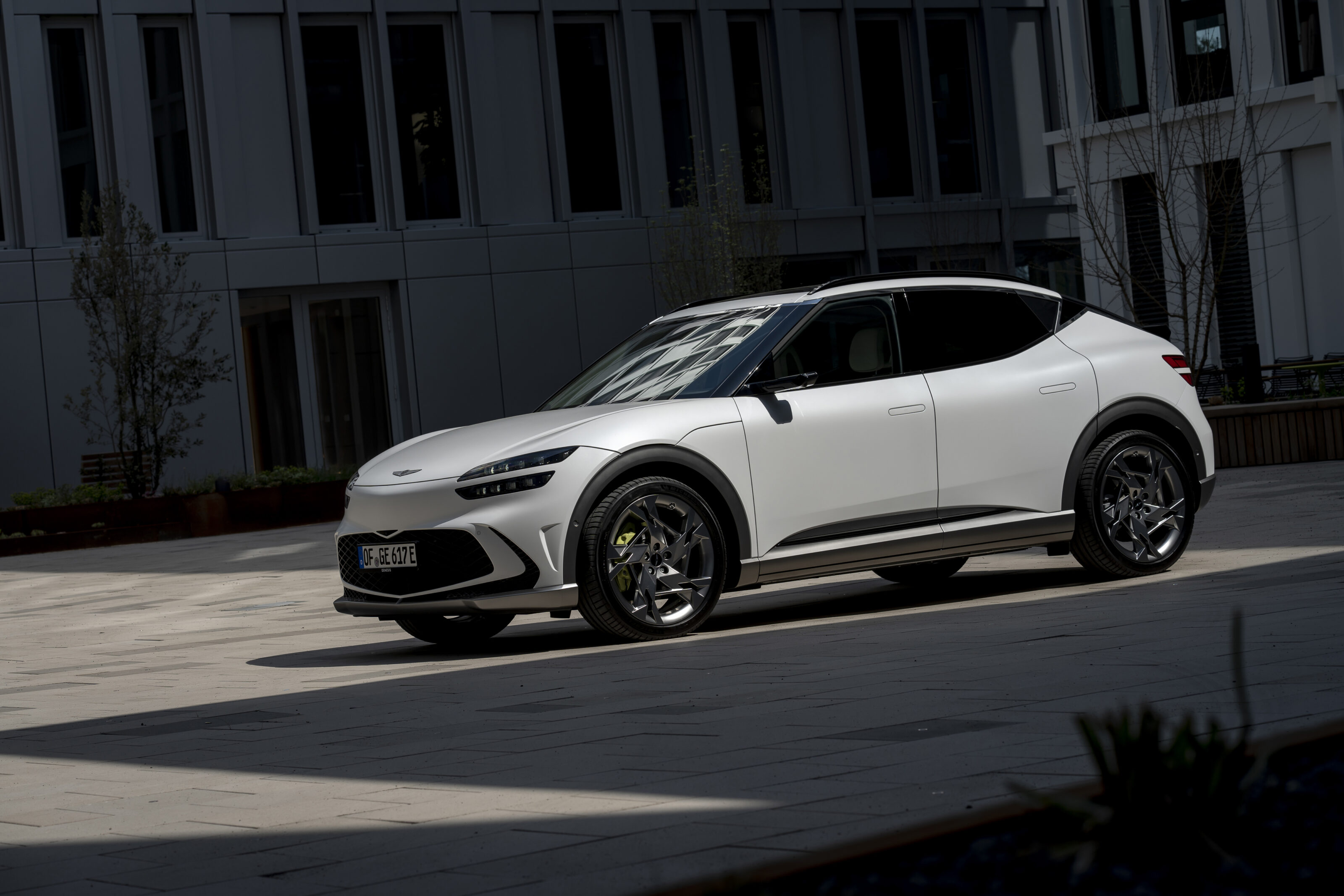
Pricing for the 2023 Genesis GV60 electric SUV has been prematurely revealed in a third-party industry guide distributed today.
According to the price guide, the Genesis GV60 will exclusively feature all-wheel-drive in Australia, with two variants: the entry-level GV60 Lux, priced from $103,700 before on-road costs, and a flagship GV60 Performance, from $110,700.
Genesis Motors Australia is expected to confirm official pricing and specification for the GV60 in the coming weeks, ahead of customer arrivals in the third quarter of 2022.
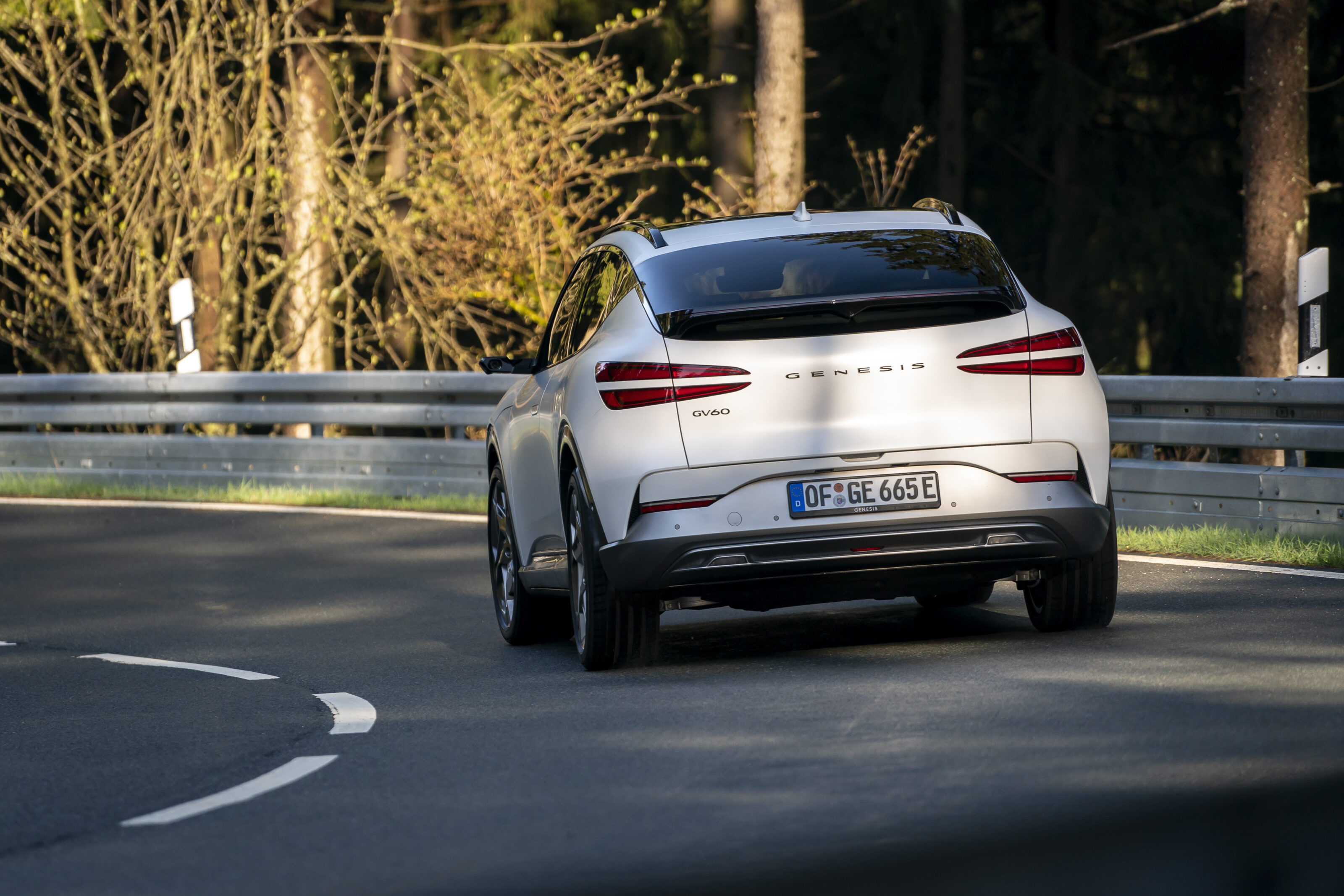
The 4.5-metre electric SUV, listed in the small SUV category for the price guide, shares its E-GMP platform with the Hyundai Ioniq 5 and Kia EV6 crossovers and the forthcoming Hyundai Ioniq 6 electric sedan.
Locally, the Hyundai Ioniq 5 is listed at $75,900 in dual-motor AWD form, and the Kia EV6 GT-Line AWD is priced from $82,990 before on-road costs.
Both the Hyundai and Kia are larger than the swoopy GV60, with each competing in the large SUV segment in Australia.
In addition, the newly-launched Tesla Model Y is priced from $72,300 plus on-roads in entry-level RWD guise, or $96,700 for the flagship Performance dual-motor AWD.
Genesis has suggested that the larger Electrified GV70 electric SUV – based on the GV70’s existing rear-wheel driven internal-combustion platform – will be priced between $105,000 and $115,000.
This pricing is likely to cause some overlap with the smaller GV60, which features additional technology, but a 200-millimetre shorter body.
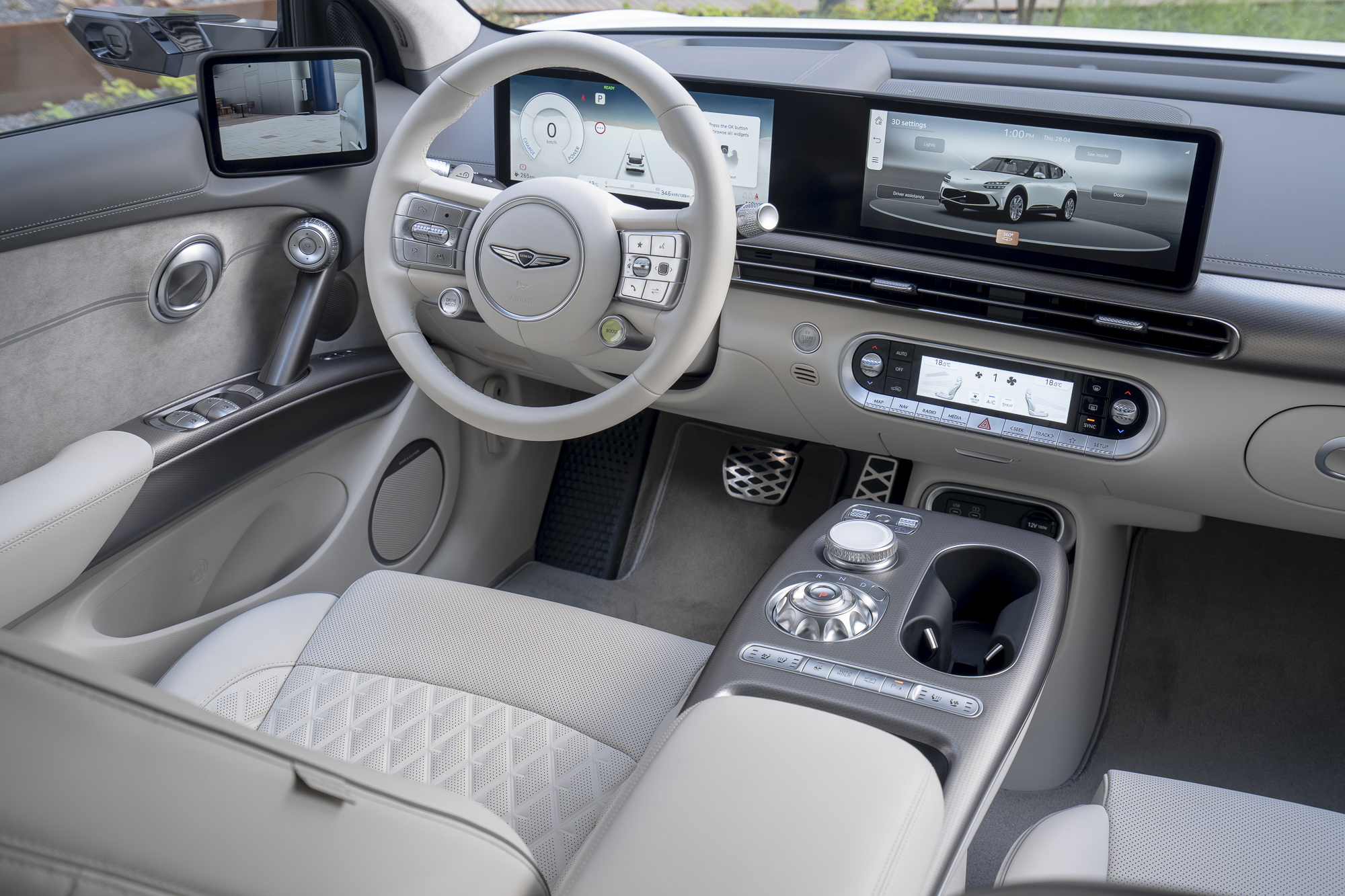
Local specification details are yet to be confirmed, however, standard features could include; heated and ventilated Nappa leather seats, heated rear seats, head-up display, dual 12.3-inch displays, fingerprint reader, power tailgate, suede headlining, and a Bang & Olufsen premium audio system.
Facial recognition technology to unlock the GV60 could make an appearance in Australia, while a unique crystal-ball gear shifter will feature across the range.
As with the Hyundai Ioniq 5 and Kia EV6, the Genesis GV60 and Electrified GV70 will support 800-volt charging hardware. This enables access to public 350kW DC fast chargers.
The standard all-wheel-drive Lux combines 74kW front and 160kW rear electric motors for 234kW of power and 650Nm of torque.
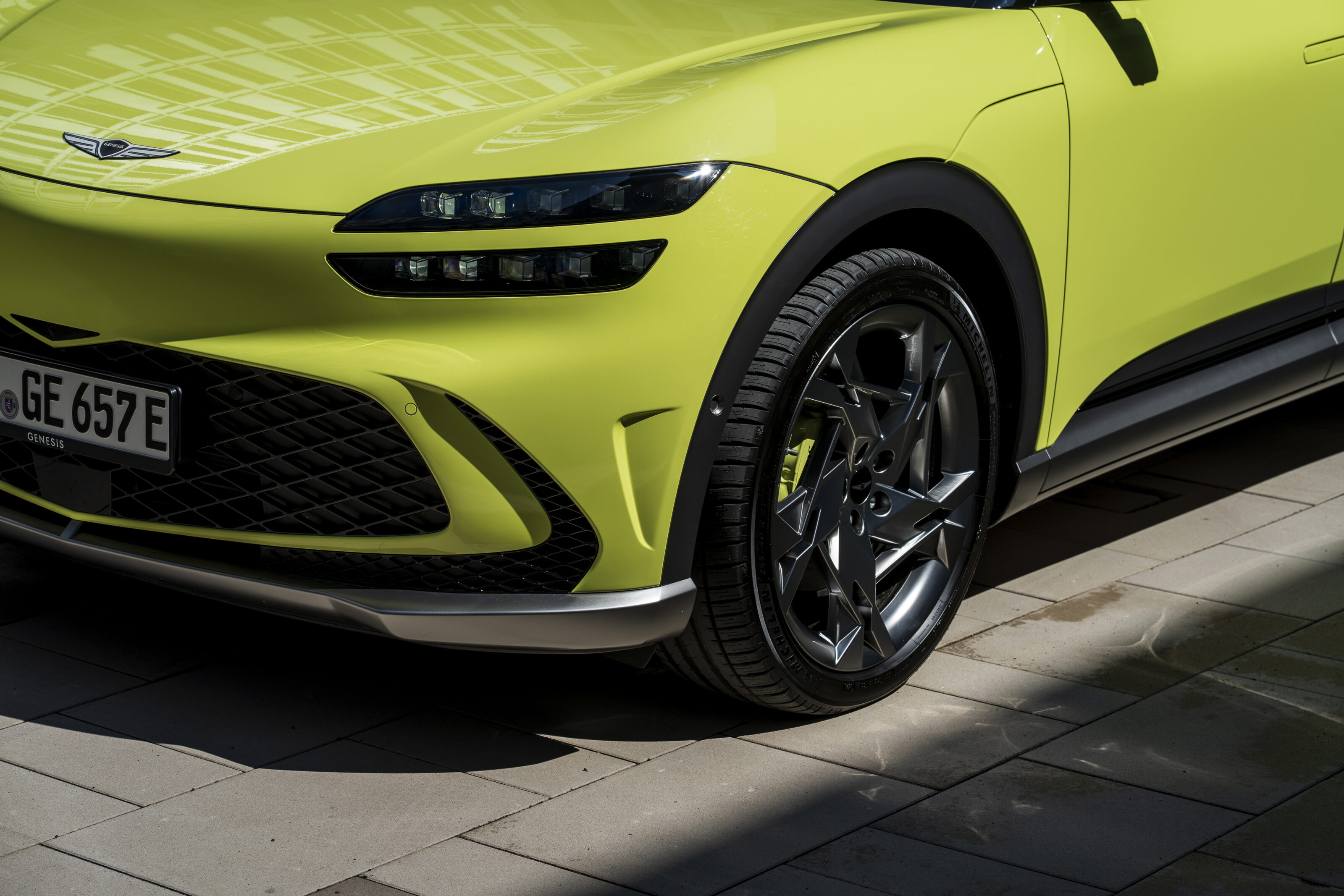
For the flagship GV60 Performance, the 74kW front electric motor is replaced with a more-powerful 160kW unit, for a combined 320kW output. It will complete the 0-100km/h sprint in 4.0 seconds.
Torque remains identical to the Lux; however, the available Boost Mode will increase power up to 360kW/700Nm for a short period.
The outputs in the Performance aren’t quite on par with the Kia EV6 GT, which is expected to arrive in Australia in early 2023 with a circa-$100,000 price tag.
It features 430kW and 740Nm for an estimated 3.5 second 0-100km/h run.
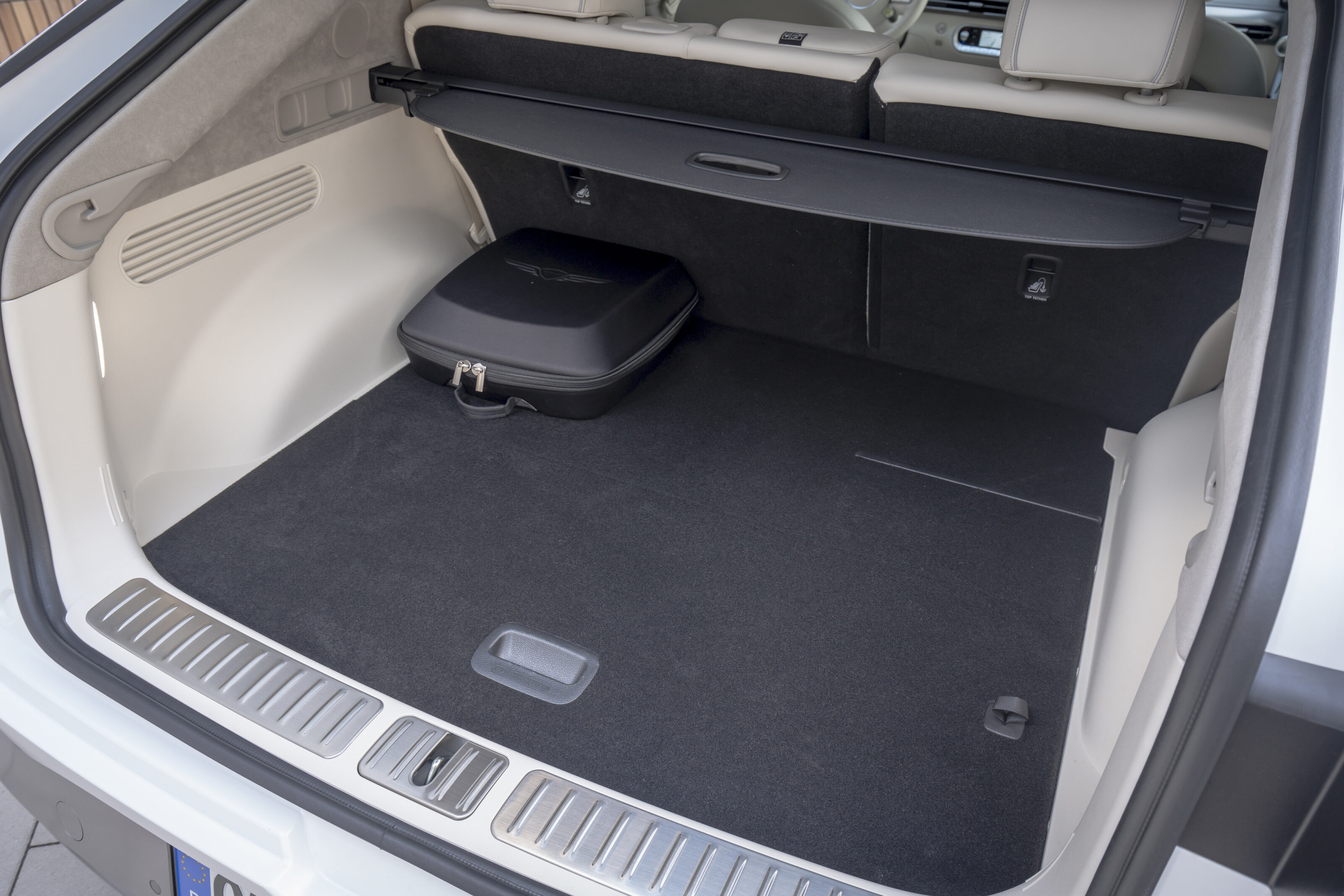
A 77.4kWh battery is included across the GV60 line-up, allowing for a WTLP-rated 470km range for the Lux or 465km for the Performance.
The single-motor rear-wheel-drive GV60 is not expected to join the local range for now, but the brand certified the model for sale in Australia earlier this year.
The 2023 Genesis GV60 is expected to arrive in Australia in the third quarter of 2022, joining the Electrified G80 electric sedan and Electrified GV70 electric SUV.
Motorsport Australia, the national governing body of motorsport events, has released its electric vehicle regulations to prepare its competitors and officials for electrified cars on track.
Australia’s Federation Internationale de l’Automobile-affiliate is supportive of electric vehicles at its events – whether they are a conventional hybrid, a plug-in hybrid or a fully-electric vehicle – with the latest regulations aimed at making motorsport safer for all involved.
Where fire and burns are a common risk in conventional cars, EVs run the added risk of giving those who come into contact with them an electric shock if the power source isn’t properly grounded.
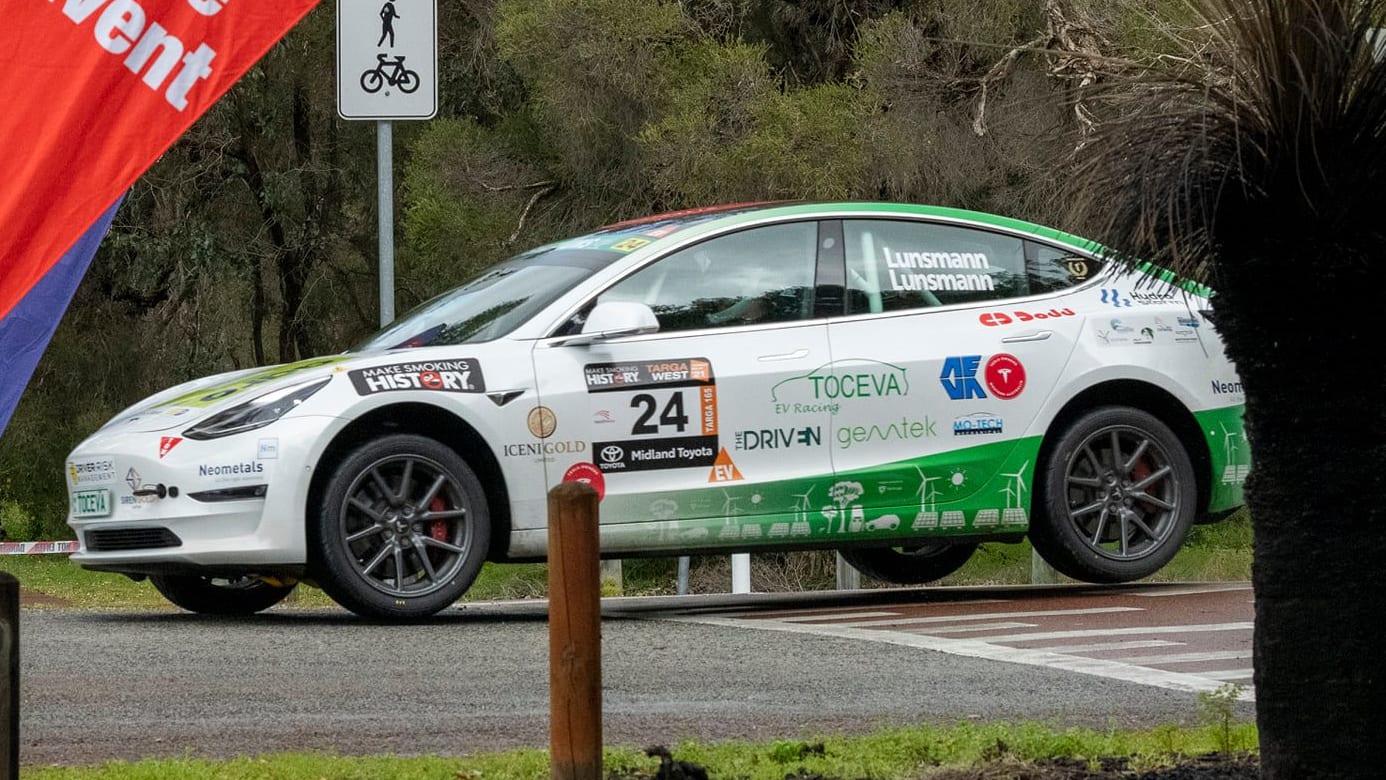
To combat this, Motorsport Australia has mandated the use of specific personal protective equipment (PPE) to ensure those involved in events are better protected in the case of a shock.
Pit paddocks and medical crews will start to carry high voltage rescue hooks – designed to pull people away from cars if they’ve been temporarily paralysed by an electric shock – while venues need to provide a water bath or have a high volume water supply available to reduce cell thermal runaway if batteries overheat.
Dedicated competition EVs are required to be fitted with an emergency stop switch (ESS) to isolate the general circuit breaker and high voltage components of a car, although this doesn’t apply to unmodified road cars.
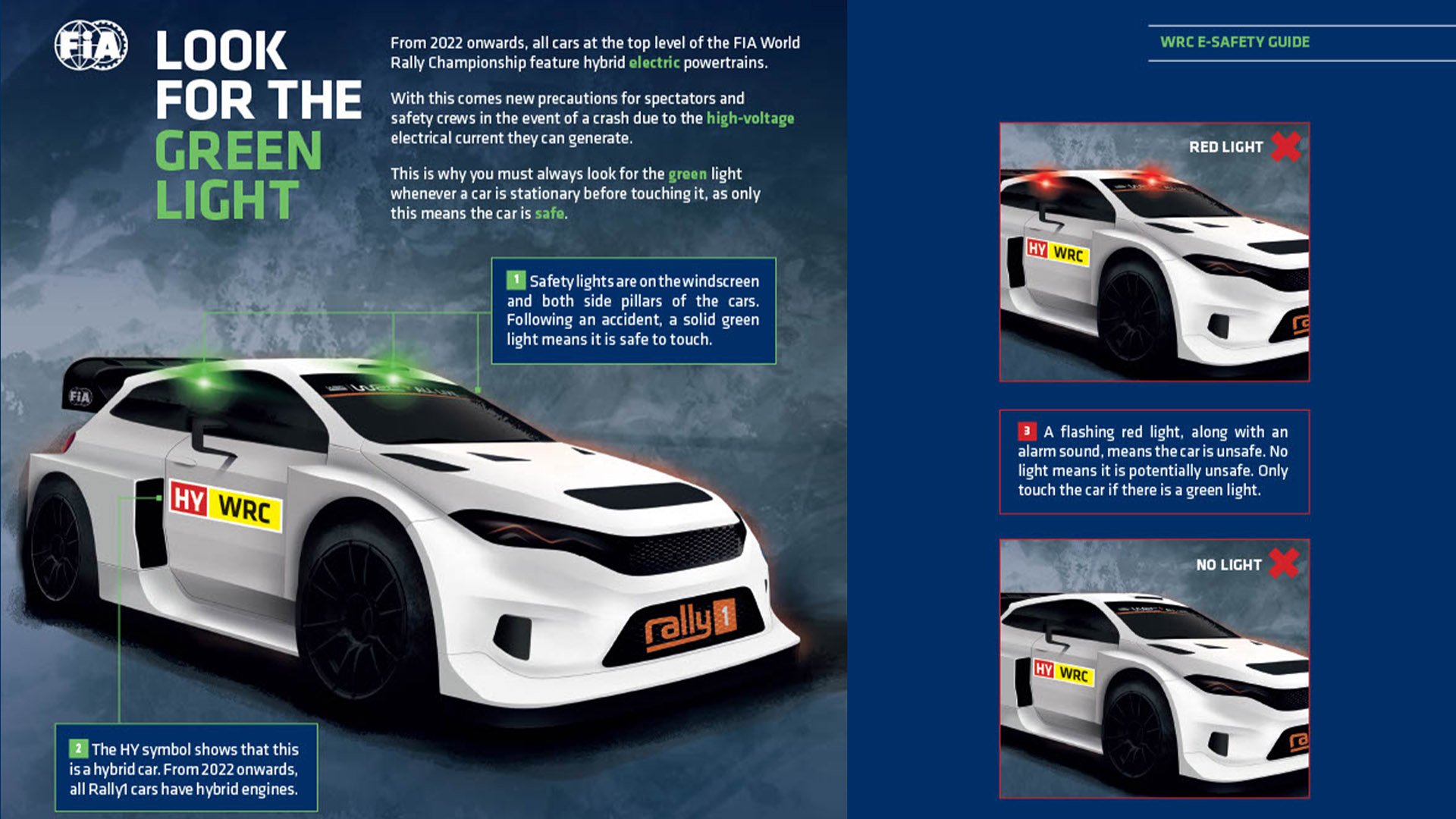
Status indicators will also become the norm on EVs and battery-equipped vehicles, with Motorsport Australia borrowing a similar system to Formula 1, Formula E and the World Rally Championship where a red or green light will be illuminated to show whether the vehicle is safe to touch or not.
Motorsport Australia’s director of motorsport, Michael Smith, believes the regulations are an important step in allowing EVs to compete in local events.
“Whether it be international, national or grassroots events, there is a clear indication from manufacturers that electric vehicles are going to be a big part of our future, both in every day driving and in turn, we will see more electric vehicles in motorsport,” Smith said.
“Motorsport Australia is well aware of the importance of being ready to welcome those electric vehicles, which present different safety and technical requirements to the traditional internal combustion engine.
“These regulations are a starting point for those wishing to have electric vehicles be part of their event and highlight specific requirements for competitors, officials and event organisers.
“This is just a small step on the journey and from the Board down we are committed to ensuring we focus on making sure our sport is sustainable, safe and keeping up with current trends.
“We also know that traditional petrol engines have a future in our sport and will continue to be part of our events for many years to come.”
Just like fully-fledged race cars, Motorsport Australia will require series production EVs to hold an MA Log Book, with the ultimate aim of gathering more data for incident management and assisting venues in understanding what facility upgrades may be required.
Motorsport Australia has listed the Electric Vehicle Appendix on its website, along with a list of frequently asked questions, for anyone wanting to know more about the regulations.
Snapshot
- Ioniq 5 allocation reopens on July 13
- Latest batch will include 130 examples
- All cars are pre-built, will be delivered within four to six weeks
Hyundai has confirmed it is opening the order books for another batch of its Ioniq 5 electric vehicle, set to go back on sale on July 13.
To cope with the high demand for the Ioniq 5, Hyundai has staggered the ordering process for its electric model, with the upcoming round marking the fifth allocation of the EV to go on sale since its launch in October last year and the latest batch since March.
A total of 130 cars will be up for grabs when the allocation opens on July 13, with Hyundai confirming “all are pre-built but they include a good spread of colour and variant mix”.
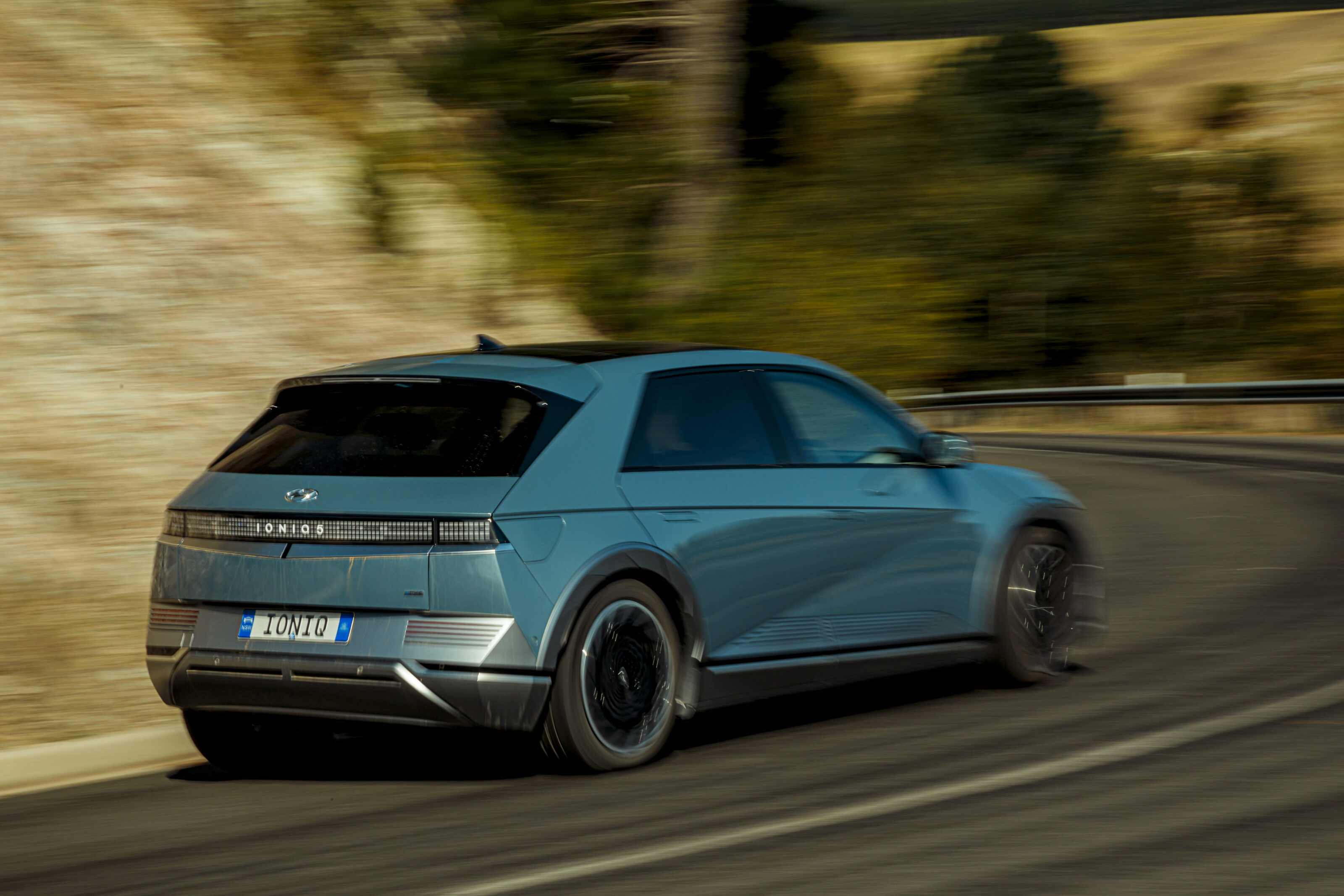
Prospective buyers from all Australian states and territories other than the Northern Territory will be able to put in an order for the Ioniq 5, as Top End customers miss out for the fourth batch in a row.
Given the cars are already built, Hyundai estimates delivery times to customers of around four to six weeks, although more examples are set to arrive later this year.
“We are waiting on confirmation from our factory, but we will likely be going to market with another drop of cars in August and September as well,” a Hyundai spokesperson told Wheels.
“People who miss out in July will have more chances in the coming months.”
The latest release of the Ioniq 5 will bring its total Australian deliveries to roughly 700 units after the first batch sold out in under two hours.
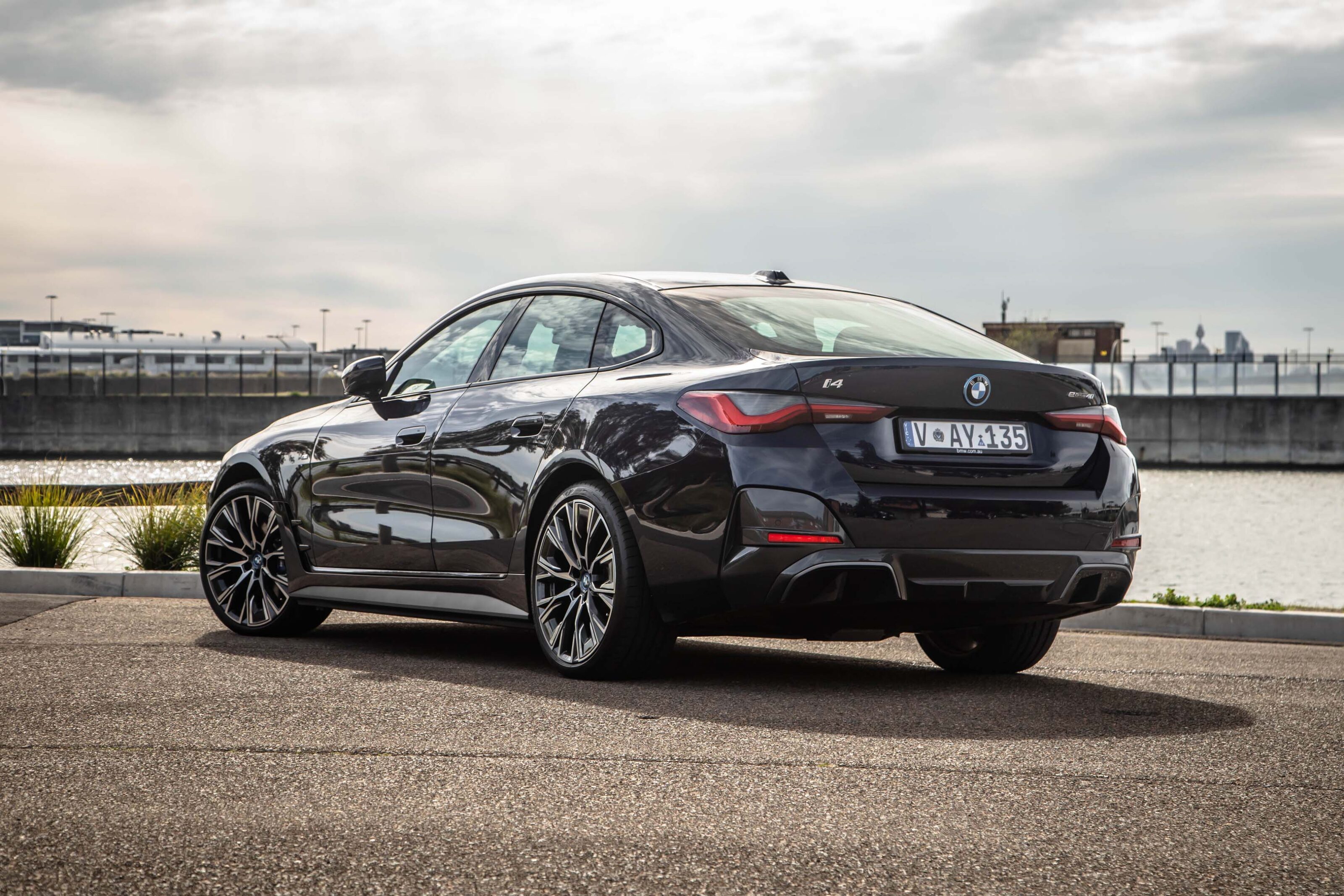
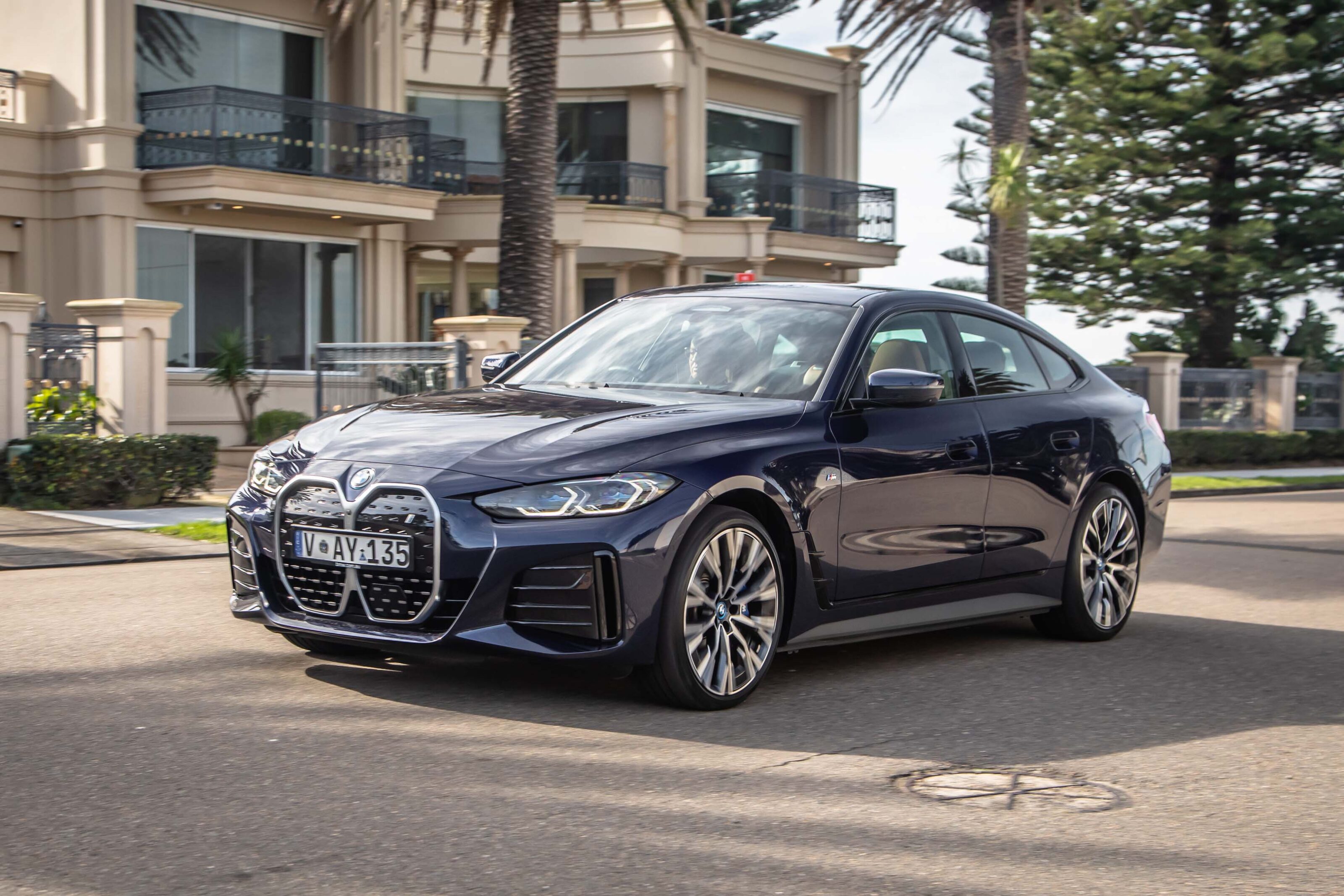
A little while ago I drove the BMW i4 M50, the marque’s first M-fettled EV (or so they say) to go on sale. It was very fast and a lot of fun but also probably a fair bit more than people expect from this four-door coupe. And this is where the 2022 BMW i4 eDrive 40 tested here comes in.
It’s more relaxed, with a lower power figure, just the rear wheels driven (in classic BMW style), lighter and, perhaps crucially, it has a longer claimed electric range. It’s probably more in keeping with the 4 Series Gran Coupe buyer, someone who is looking for a bit more style than the excellent 3 Series can offer but without necessarily wanting the performance the looks suggest.
I guess you’d call it more of a lifestyle purchase than a practical one. Up until the last couple of years, an EV was not on the minds of the average car buyer and probably even less so those looking to buy a high-end German one.
Pricing and features
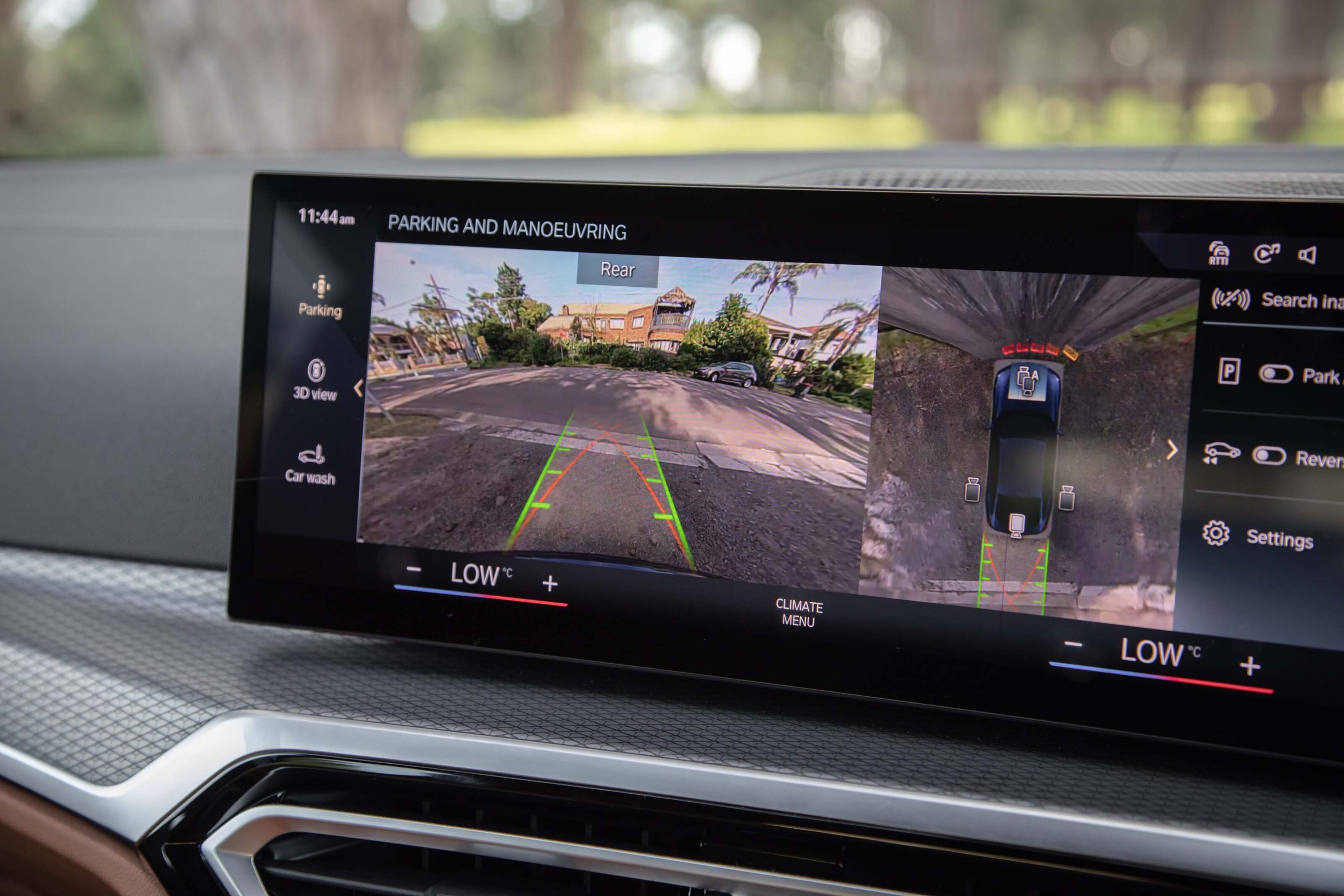
The 40 starts at $99,900 before on-road costs and features 19-inch alloys, leather interior, auto LED headlights, head-up display, adaptive suspension, auto parking, keyless entry and start, front, side and reversing cameras, auto wipers, three-zone climate control, electric front seat adjustment, a powered tailgate, digital dashboard and a tyre repair kit.
The sweep of the 14.0-inch touchscreen and 12.3-inch dashboard features BMW OS 8, the brand’s latest version of iDrive. As always, you can control either via the rotary controller on the dashboard or the touchscreen or via gestures that might get you arrested/road-raged in certain circumstances.
You also get a three-year subscription to a range of connected functionality, sat-nav, wireless Apple CarPlay, wireless Android Auto and digital radio. The standard 10 speakers are more than enough but there is a Harman Kardon upgrade to 16 thumpers should you so desire.
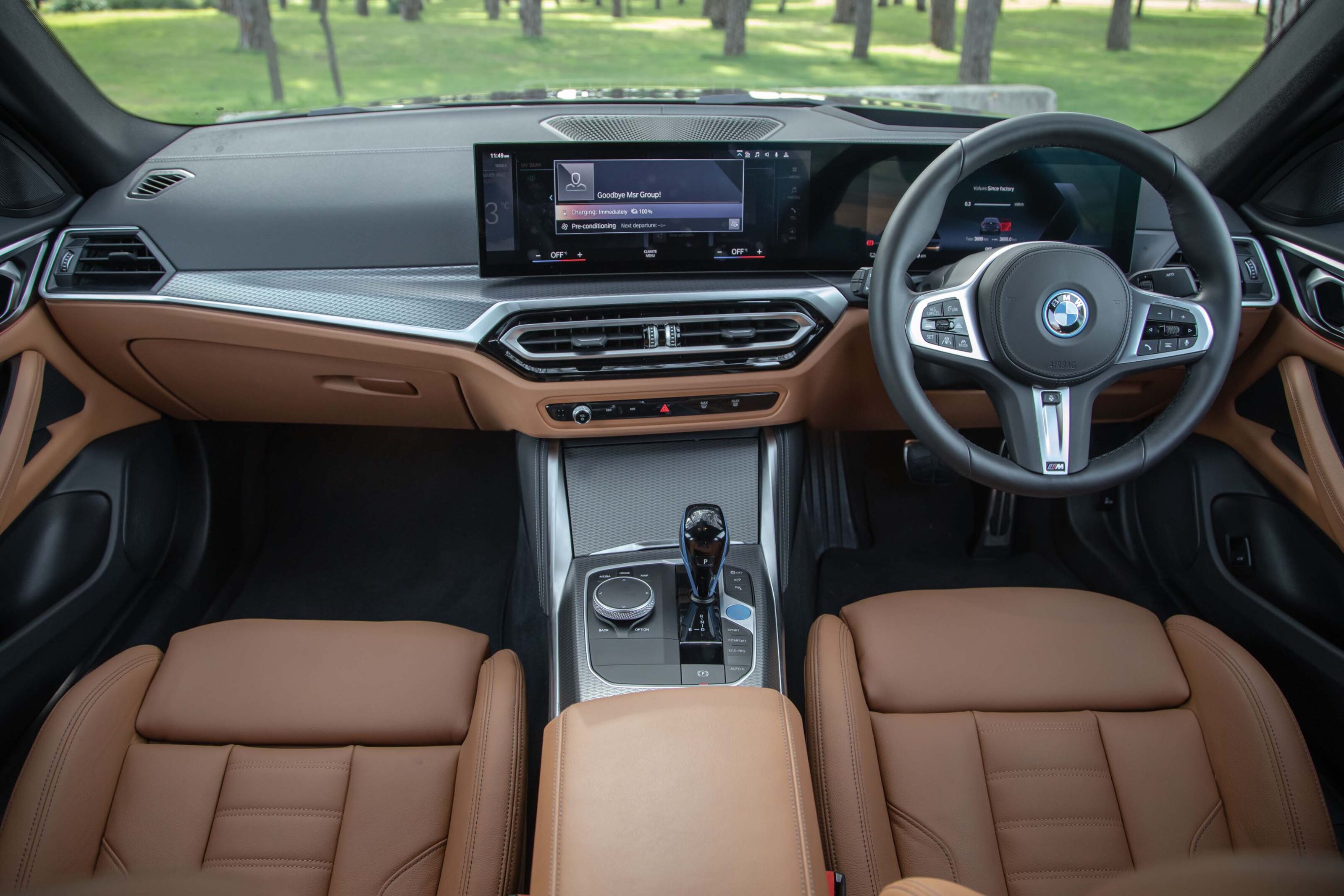
The safety list comprises six airbags, the usual ABS and stability controls, forward auto emergency braking, steering and lane control assist, lane-keep assist, lane departure warning, lane change warning, forward and rear cross-traffic alert, crossroad warning and evasion assistant.
As tested, this car features the $5800 Visibility Package (metallic paint, glass sunroof, Laserlight headlights), 20-inch aerodynamic wheels ($2000), the $1500 Comfort Package (heated seats front and rear, heated steering wheel and driver’s lumbar support) and M Sports front seats ($2000) taking the total to $113,050 plus on-road costs, or about twelve grand short of the M50 which has pretty much all of that apart from the wheels.
Non-electric versions of the 4 Series scored five ANCAP stars in 2019 but the electric version has not yet been crashed or rated.
Comfort and space
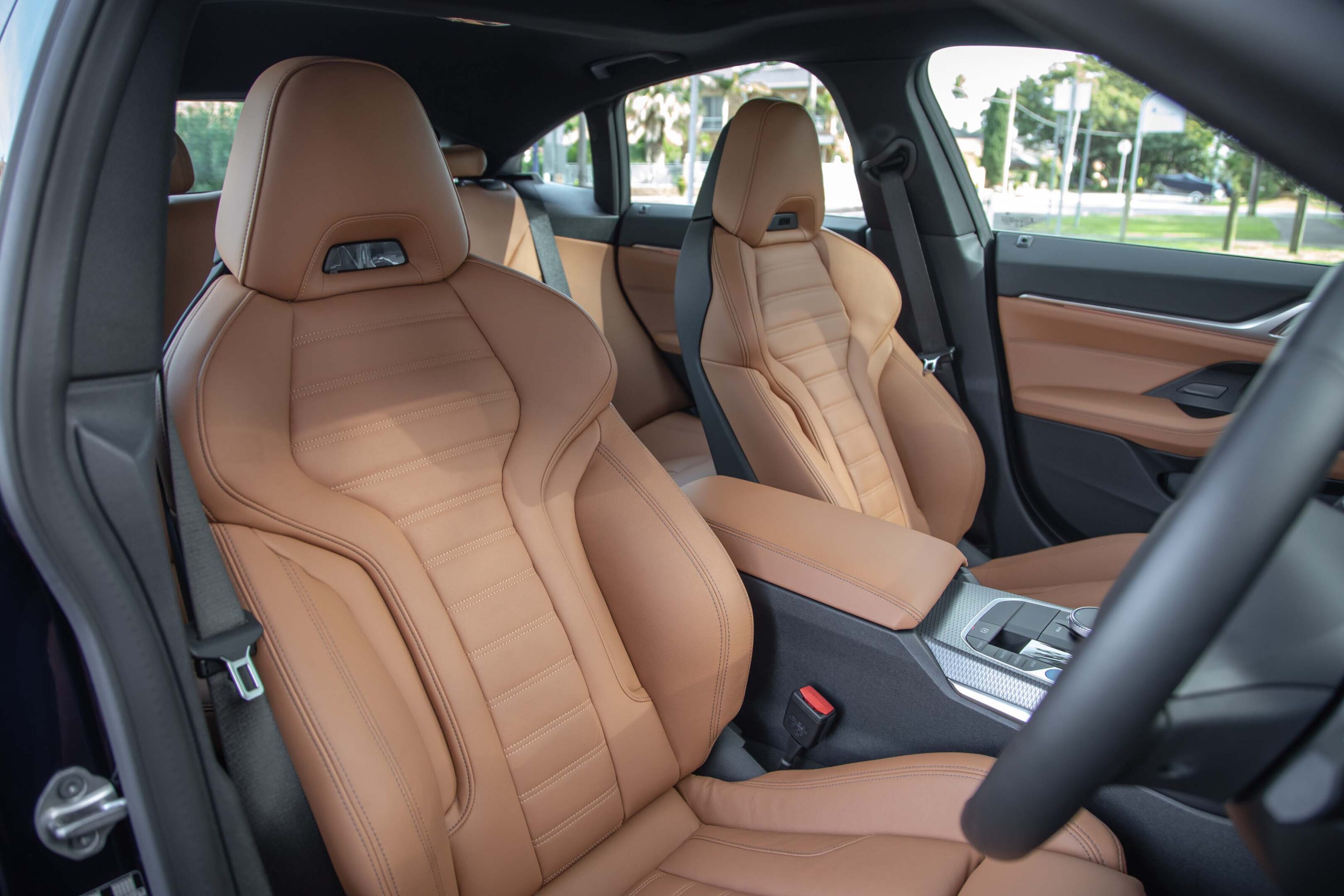
The standard i4 front seats are sports seats of the BMW “sports” variety but this car had the even better M Sport seats. They have plenty of adjustment available as well as a highly adjustable steering column.
Storage comes in the form of bottle holders in the doors (small), a pair of cup holders in the console, a shallow tray under the armrest with a USB-C socket and a wireless charging pad under the centre stack, as well as a USB-A port.
The curved twin-screen setup from the iX looks fantastic on the dash, housing a 14.0-inch media system screen and a 12.3-inch digital instrument panel. I’m a big fan of both of these even if there are probably slightly too many options to click through on the screen and you have to tap a shortcut to get into the climate control.
Being so obviously based on a 4 Series Gran Coupe, it should come as no surprise that things are tight in the back seat.
While the fuel tank and diff are chucked, they need to be replaced with batteries and an electric motor, which means the rear seat actually sits slightly higher, knocking out a few millimetres of headroom.
It’s pretty cosy for me at 180cm, with my knees very close to the seat in front when set for my driving position. The seats themselves are comfortably shaped in the outboard positions and will ensure you stay in place in during cornering should you find yourself in the rear seats.
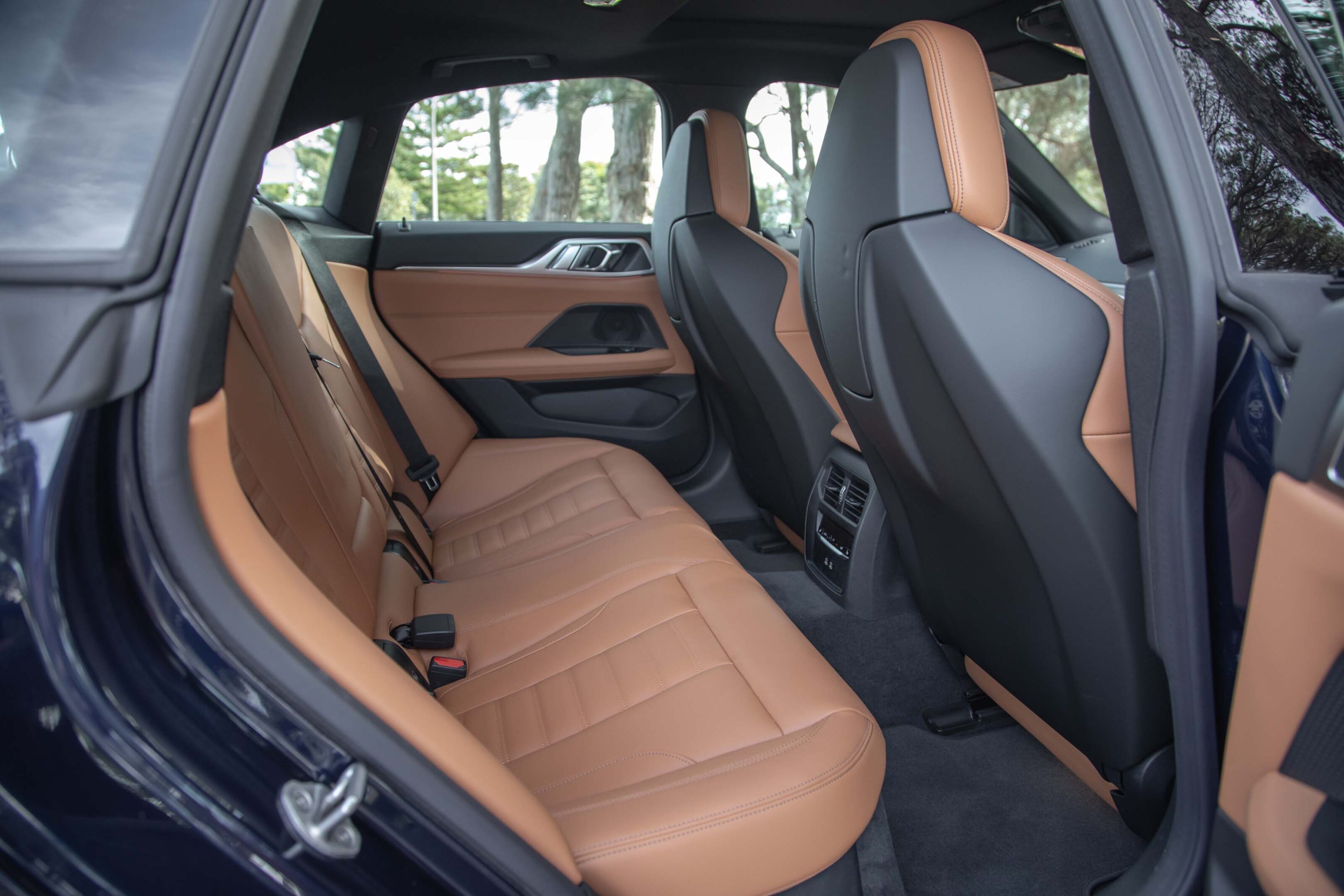
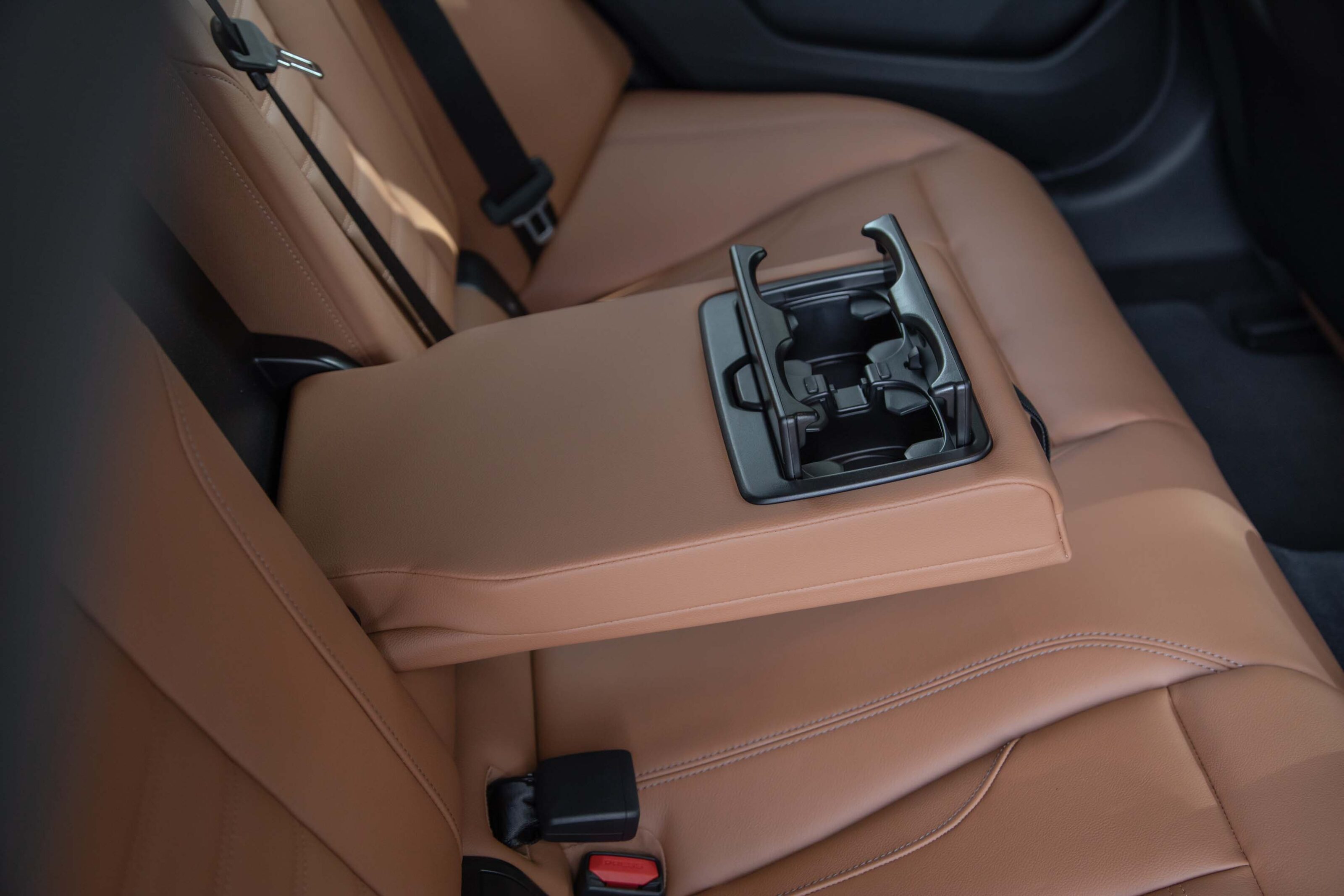
The near-useless middle seating position features an armrest with two cup holders and there are air vents, a climate control zone and two USB-C ports for the rear, so while BMW taketh with one hand, it delivereth with another.
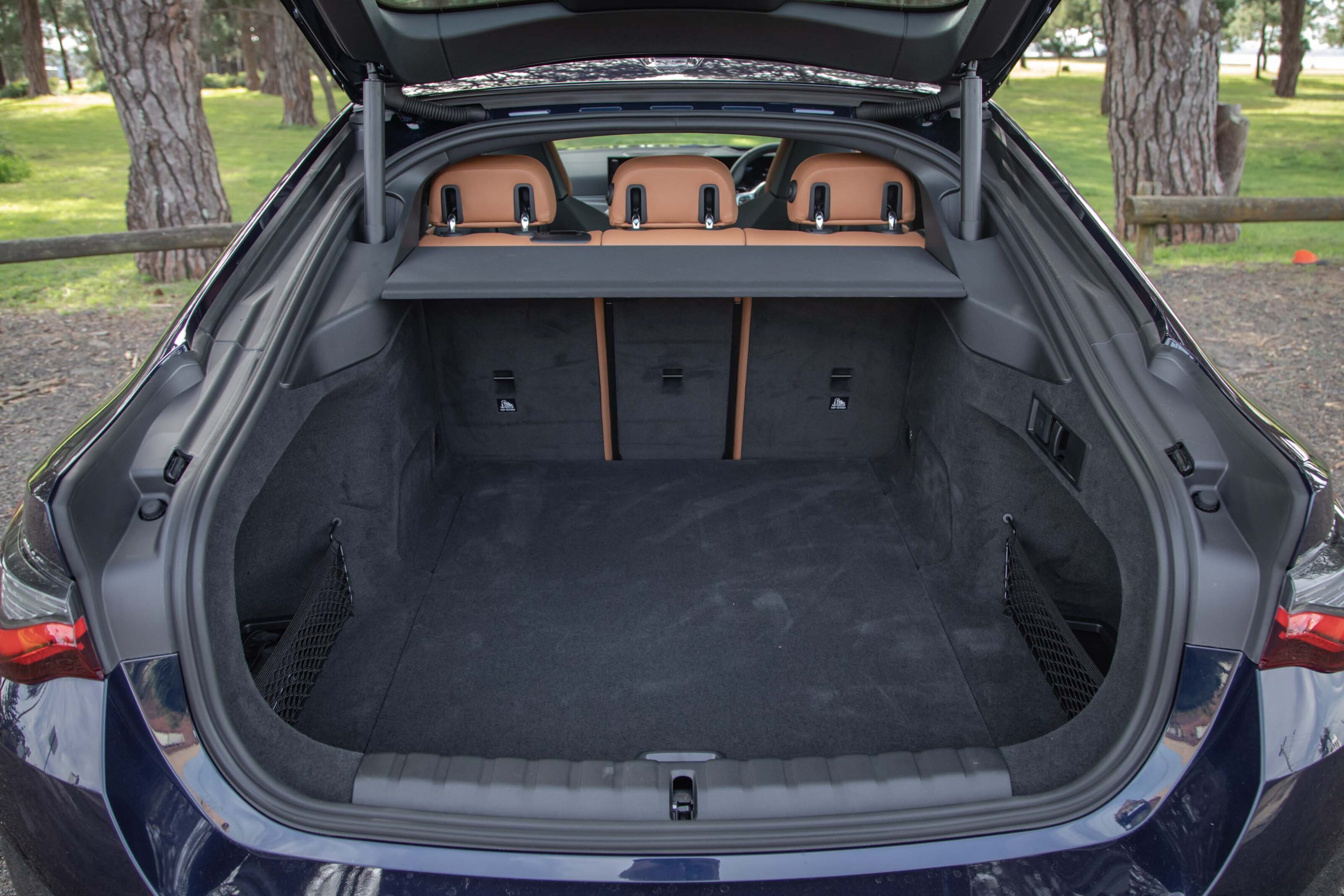
As with the occupant space, cargo capacity is down by a barely noticeable 10 litres to 470L with the 40:20:40 split-fold bench in place and 1290 litres with all three sections folded.
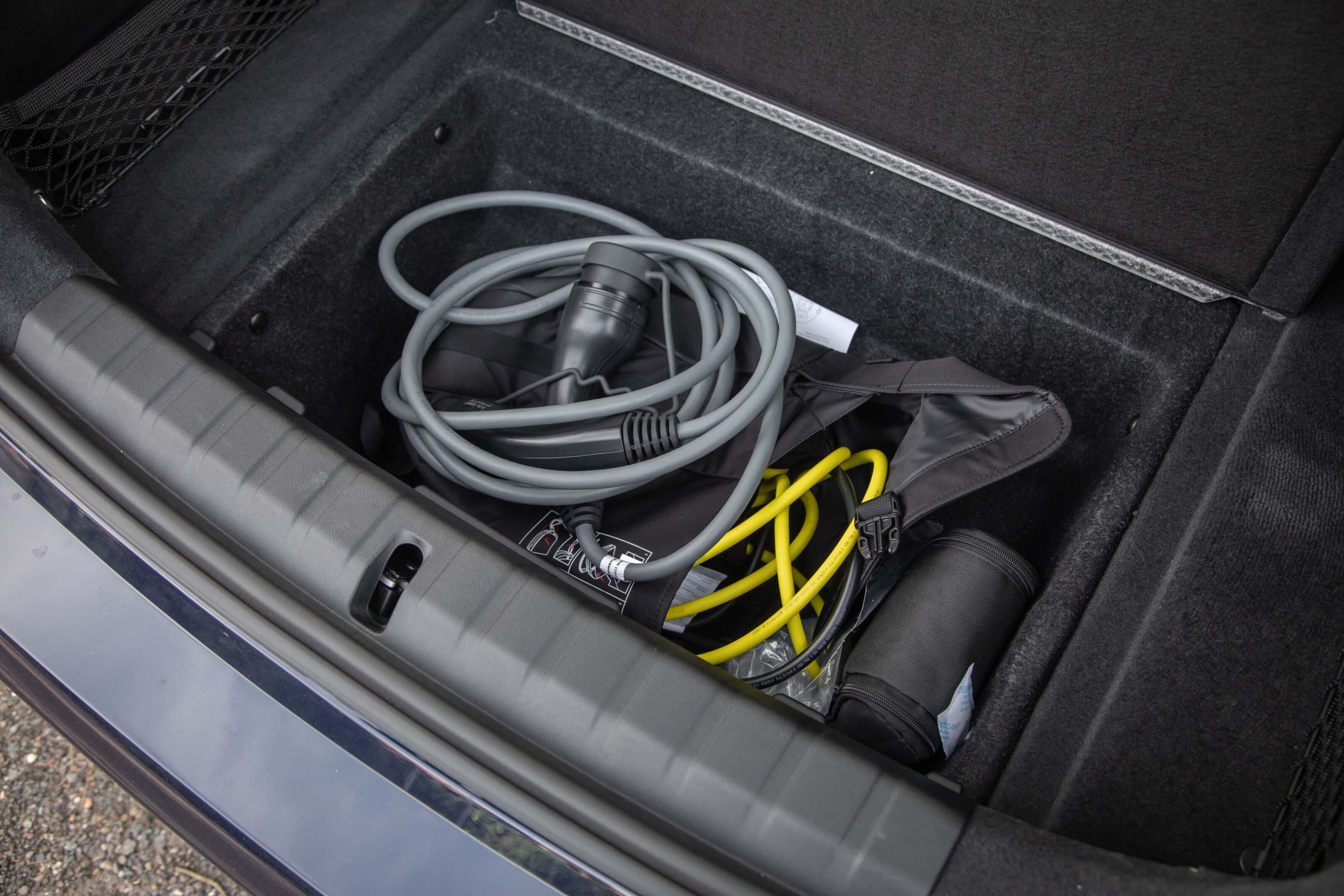
Under the boot floor is a space for your charging cables that will actually take your charging cables, although the stereo upgrade eats a fair bit of that.
Battery and charging
The i4 40 has an 84kWh lithium-ion battery, with 81kWh of useable capacity for a WLTP range of 520km, about 65km more than the M50 that has two motors drawing power rather than one.
AC charging starts at 1.8kW from the supplied three-pin charger, which will take two whole days to charge the car from dead to full if you are the kind of person who runs their EV battery that low. Adding a wallbox at home will get you to 7kW and what will essentially be a long overnight charge to full. If you’ve got three-phase power, you go to 11kW, which will bring it down to about eight or nine hours.
You can program the system to charge to a certain point, for a certain departure time and to take advantage of cheaper rates, such as the NSW off-peak charge (based on time-of-use) that kicks in at 10pm and continues until about 6am. Or you can get it to charge during the day from your solar panels if you have them.

BMW EVs come with a five-year Chargefox subscription, so you can charge for free at that company’s expanding EV charging network at between 50kW and the i4 40’s maximum of 200kW.
The battery charges at full whack between 10 per cent and 80 per cent charge, slowing considerably on either side of those numbers for battery health reasons.
If you can find a charger that will give you 200kW, BMW says you’ll go from 10 to 80 per cent in 31 minutes. At 50kW, I got 24.84kW in 26 mins, which is $14.91 if you’re paying for it.
In the short term, the Chargefox subscription is a little dicey as so many of its Tritium chargers are flat-out broken. In my review of the M50, I noted that the two fast chargers were out. That remained the case almost two months later, but the week following my i4 40 drive in early June 2022, the 350kW chargers were back.
For a couple of days before one of them stopped working and the 50kW went down in sympathy. Once again, the 165kW ABB-branded Chargefox charger that won’t deliver more than 50kW saved the day.
I am quite certain that Chargefox and Tritium will get this problem sorted. When it will be sorted is the big unknown. Kind of like BMW’s stubborn refusal to increase the length of its warranty. One day we’ll get a press release announcing the longer warranty and this nightmare will be over.
On the road
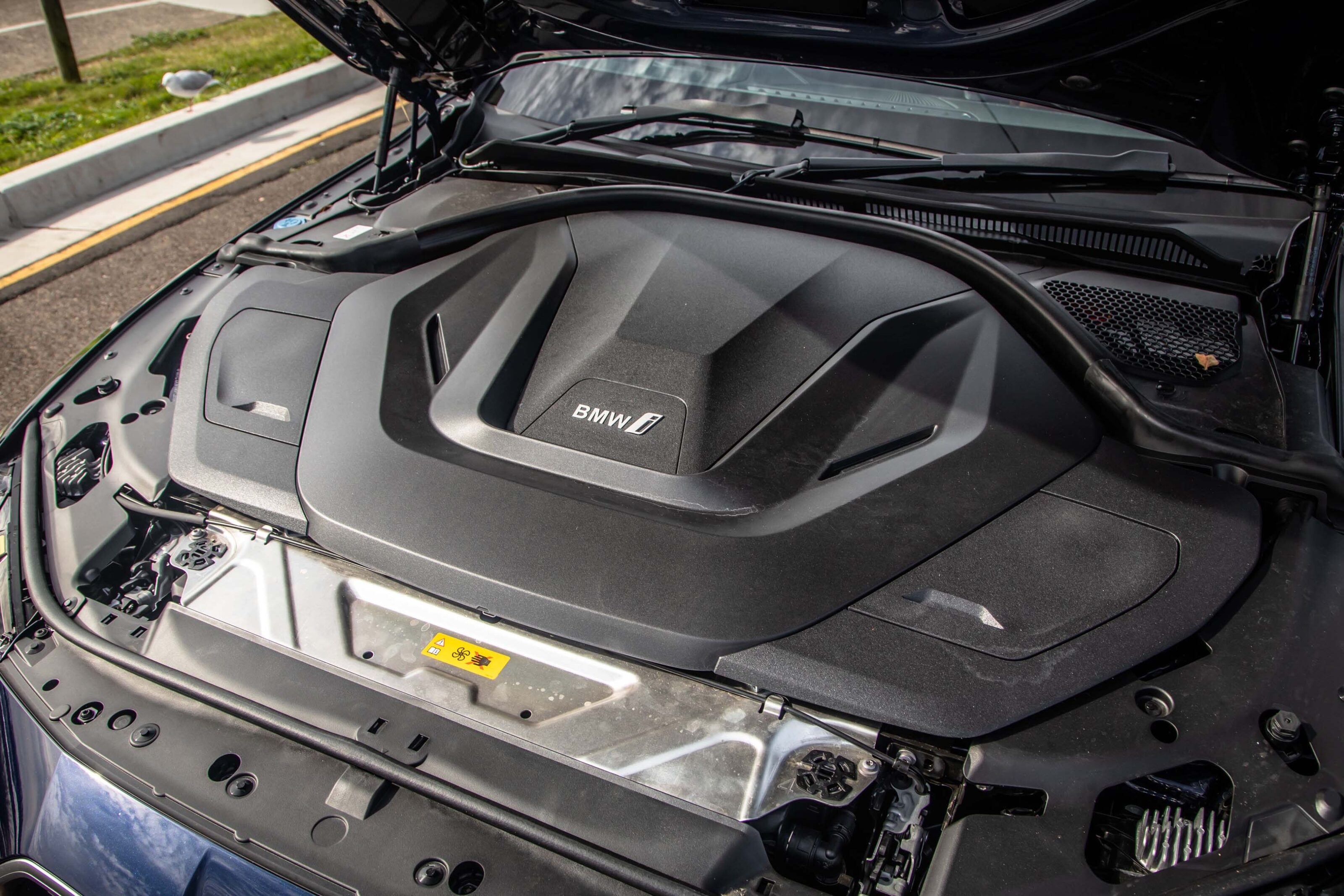
This entry-level i4 40 has but one electric motor fitted at the rear axle, with still-impressive outputs of 230kW and 430Nm. The power figure lines up between the 430i with 190kW/400Nm and the M440i’s 285kW/500Nm.
Weighing, quite literally, against the i4 is the extra heft of all the EV gear, with the i4 coming in considerably over the two-tonne mark, around 500kg more than the four-cylinder turbo. As always, it is my solemn duty to inform you that being an EV, the weight is lower in the car and therefore not as debilitating from a ride and handling perspective.
That’s true enough, but this car had the 20-inch wheels that the M50 didn’t have and I was very curious to see how that would pan out. The M50’s ride could be a little rugged on occasion and that car is heavier again, so I did make a mental note to find out what an i4 on 20s would be like.
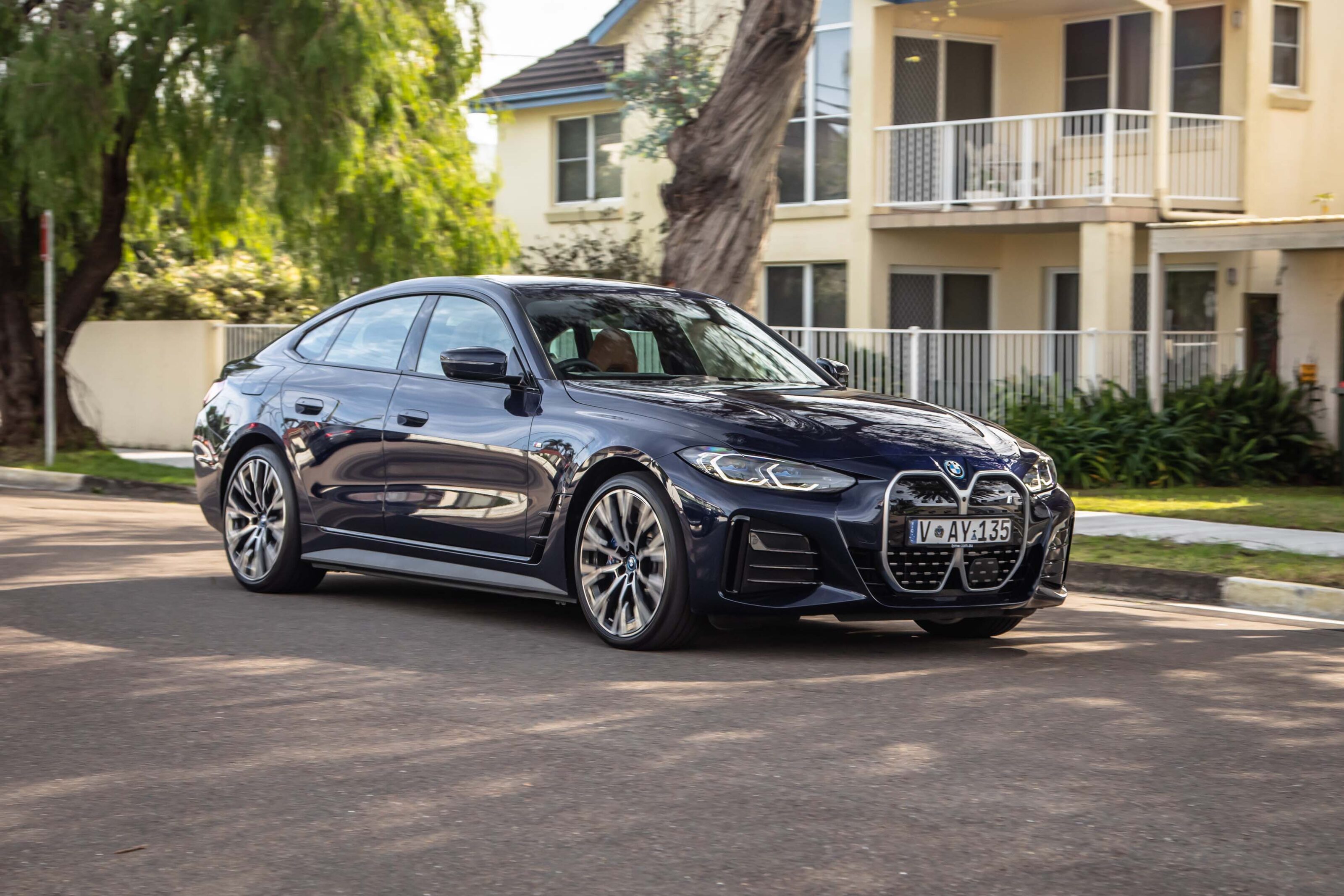
Turns out, it’s pretty good, much better than I was expecting. I figured it would have to be reasonably stiff to stop it from hitting the bump stops, but it had a much more fluid ride. It’s only when you get into really tight turns or quick changes of direction that you notice how much heavier it is and, let’s be honest, most buyers of this variant will not be hounding hot hatches down a twisty road all that often, if ever.
If they did, they’ll have a great deal of fun, of course. The 0-100km/h time of 5.7 seconds is hot-hatch quick and given the torque is available from zero, it rinses them in the run to 80km/h before the single gear starts to get too long and the hydrocarbon huffing hatch catches up.
You can get the i4 into a really nice rhythm in the bends, though, and it’s so serene even on the big 20-inch rims. I saw little point in switching to Sport mode most of the time but did prefer to have the shifter in B mode, which amps up the regenerative braking energy recovery system.
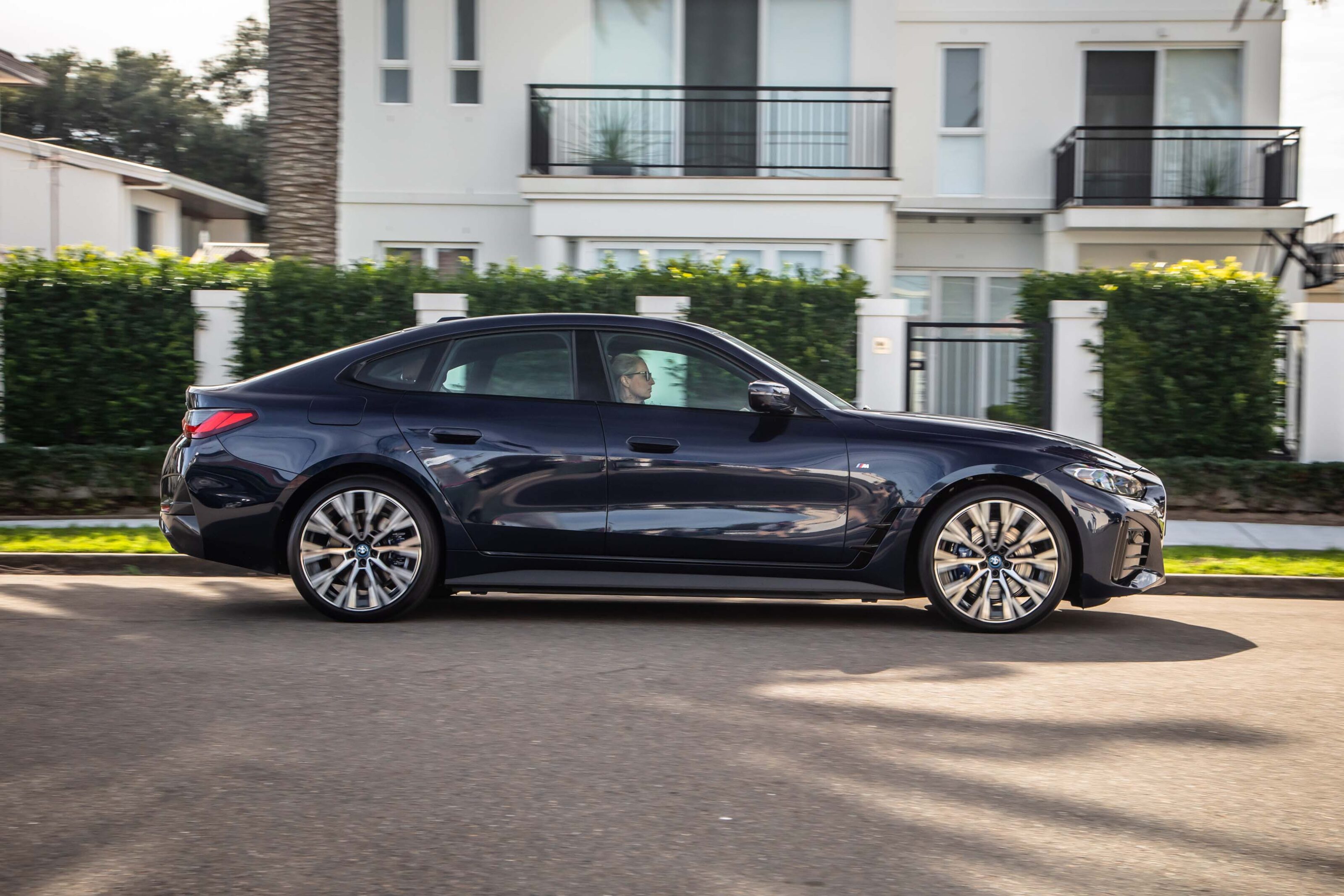
You can select how the energy recovery works in Drive, with three levels on offer plus adaptive. I found that when sharing the car with my wife, leaving it up to us both to switch to B for the maximum one-pedal driving effect was better.
And as I discovered on the iX, the adaptive system can catch you out, meaning you’ll be lunging for the brake pedal when you approach a stopped car but steer it towards the empty lane, the recovery suddenly winding right off like you have taken your foot off the brakes yourself. I guess you’d get used to it, but I wasn’t a fan despite being impressed with the thinking behind it.
On top of operating based on what the sensors can see, it also uses the sat-nav to decide if it’s coming up to a T-intersection and will reduce speed at a stronger rate. You’ll still need the excellent brakes on occasion and BMW has nailed the transition from energy recovery to physical braking.
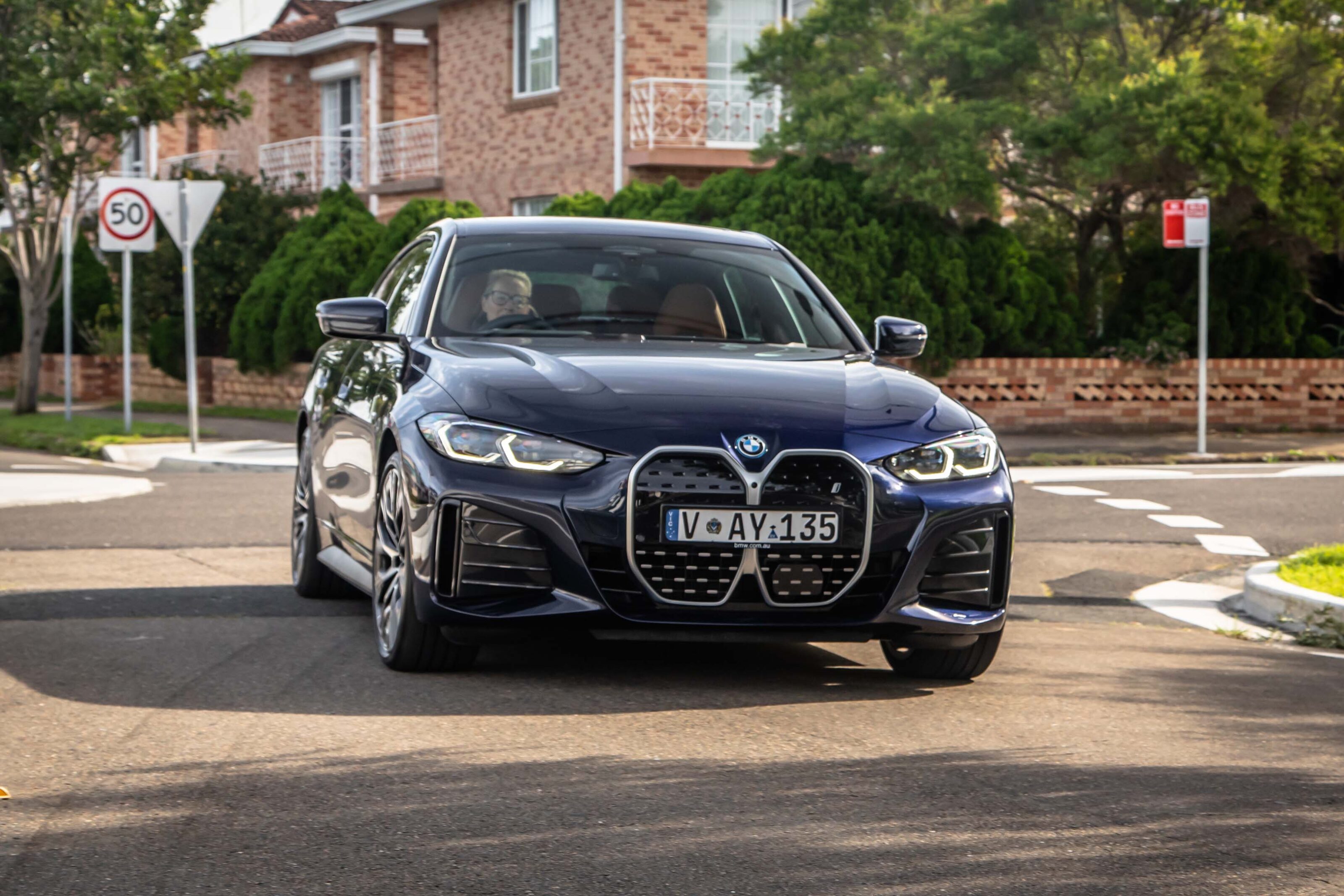
Which brings us to the car’s range. The official figure of 520km is not bad at all, but you’re not going to get it, at least not easily. When I stepped into the car just one percentage point off full, the dashboard told me it was well short of 520km, indicating 409km.
I knew it was a pessimistic number because that’s what BMW does and it began to climb as I drove it home through Sydney traffic. At 60 per cent it told me it had 242km, but again that was pessimistic as after it gulped down 24kWh it rose to 399km. So it’s a bit confusing and I do wonder if it would quite make the 465km number the M50 claims.
Another annoyance is the fact that unlike Tesla, Polestar and Volvo, the sat-nav doesn’t warn you straight up if you won’t make it to the destination on the remaining charge in your battery.
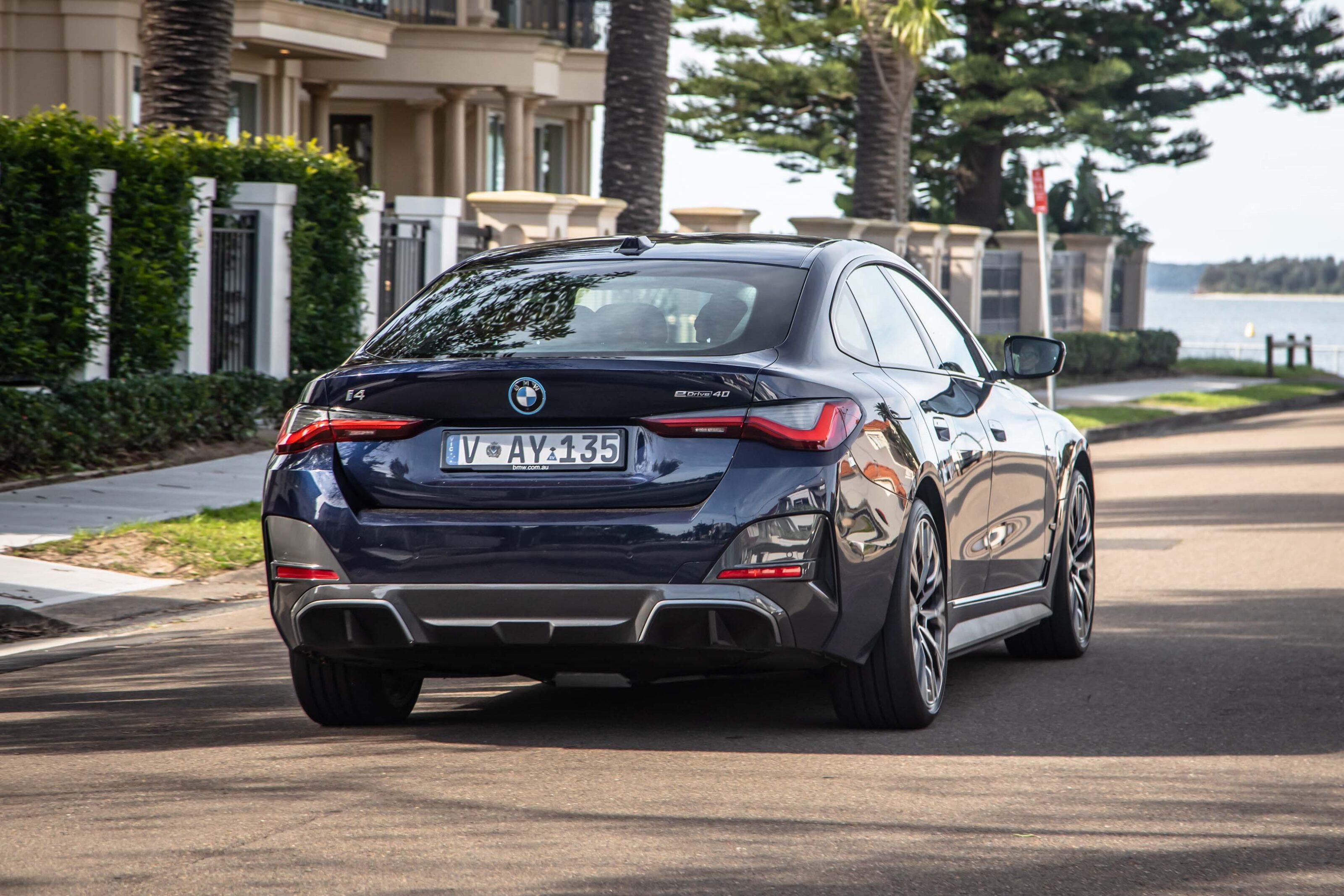
When I punched in Albury from my Sydney home it laid out a route but not one that explicitly took me past Chargefox chargers nor indeed any available charger at all.
I know it will do what the ICE cars do – let you know when range is becoming a problem and offer to route you to a servo – but it just makes the planning of a long trip more difficult.
On the bright side, I bested the 22.2kWh/100km claimed energy consumption figure by nearly ten per cent, landing at 20.1kWh/100km.
Ownership
I’m tempted to cut and paste my usual complaints about the BMW’s warranty, but I won’t.
Instead, I will say in a frustrated and bored tone that a three-year, unlimited-kilometre warranty is no longer competitive or defensible either at this price point or in this market where five is normal, seven not unheard of. Mitsubishi, of all companies, offers a ten-year warranty.
Cheeringly, the battery warranty of eight years/160,000km is rather more like it and the five years of Chargefox rapid charging will make a material difference to you as the network expands.
If you live near one, you’ll be saving a lot of money given the company recently jacked up its retail rates to 60c/kWh for rapid charging on its seemingly unrepairable network.
Another bit of good news comes in the form of pre-paid service plans, or at least their cost. As ever, BMW offers condition-based servicing and the plans come in four and six years.
A four-year plan is $1240, or $310 per year and six years is $1765 or $294 per year. Both are usefully cheaper than the ICE or PHEV service plans.
VERDICT
After driving the dual-motor M50, I wondered if the i4 40 would be a better car all round. Practicality, as expected, is identical, but the 40’s steering is certainly better and the ride a bit more compliant.
It’s arguably more fun to drive with the more purist vibe of the rear-wheel-drive set-up and steering less corrupted by a metric crapton of torque. They’re certainly quite different cars; the 40 is more of a wafter and the M50 a glory-chaser and, for some folks, even an M3 replacement/alternative.
With its sensible range, everyday usability, and ability to put a smile on your face, it would find a home on my driveway without a single objection from my wife, who fell in love with its easy-going demeanour.
Related video
2022 BMW i4 40 eDrive specifications
| Body:u00a0 | Five-door coupe |
|---|---|
| Drive: | RWD |
| Engine: | Single current-excited synchronous motor |
| Transmission: | Single speed |
| Power: | 250kW |
| Torque:u00a0 | 430Nm |
| AC charging | 1.8kW (max 11kW) |
| DC Charging | Max 200kW |
| 0-100km/h:u00a0 | 5.7s (claimed) |
| Battery | 84kWh/81kWh usable |
| Energy consumption:u00a0 | 22.2kWh/100km (ADR) |
| Electric range (WLTP) | 520km |
| Weight: | 2125kg |
| Suspension: | MacPherson struts front/multi-link rear, adaptive damping |
| L/W/H:u00a0 | 4783mm/1852mm/1448mm |
| Wheelbase: | 2856mm |
| Tyres:u00a0 | 245/40 front, 255/40 rear R19 |
| Wheels:u00a0 | 19-inch alloy wheels (no spare) |
| Price:u00a0 | $99,900 + ORC |
Snapshot
- 2023 Kia Niro arrives in Australia
- Priced from $44,380 for the hybrid and $65,300 for the EV
- Hybrid and electric drivetrains largely carried over from existing model
UPDATE, July 1, 2022: 2023 Kia Niro pricing and features announced for Australia
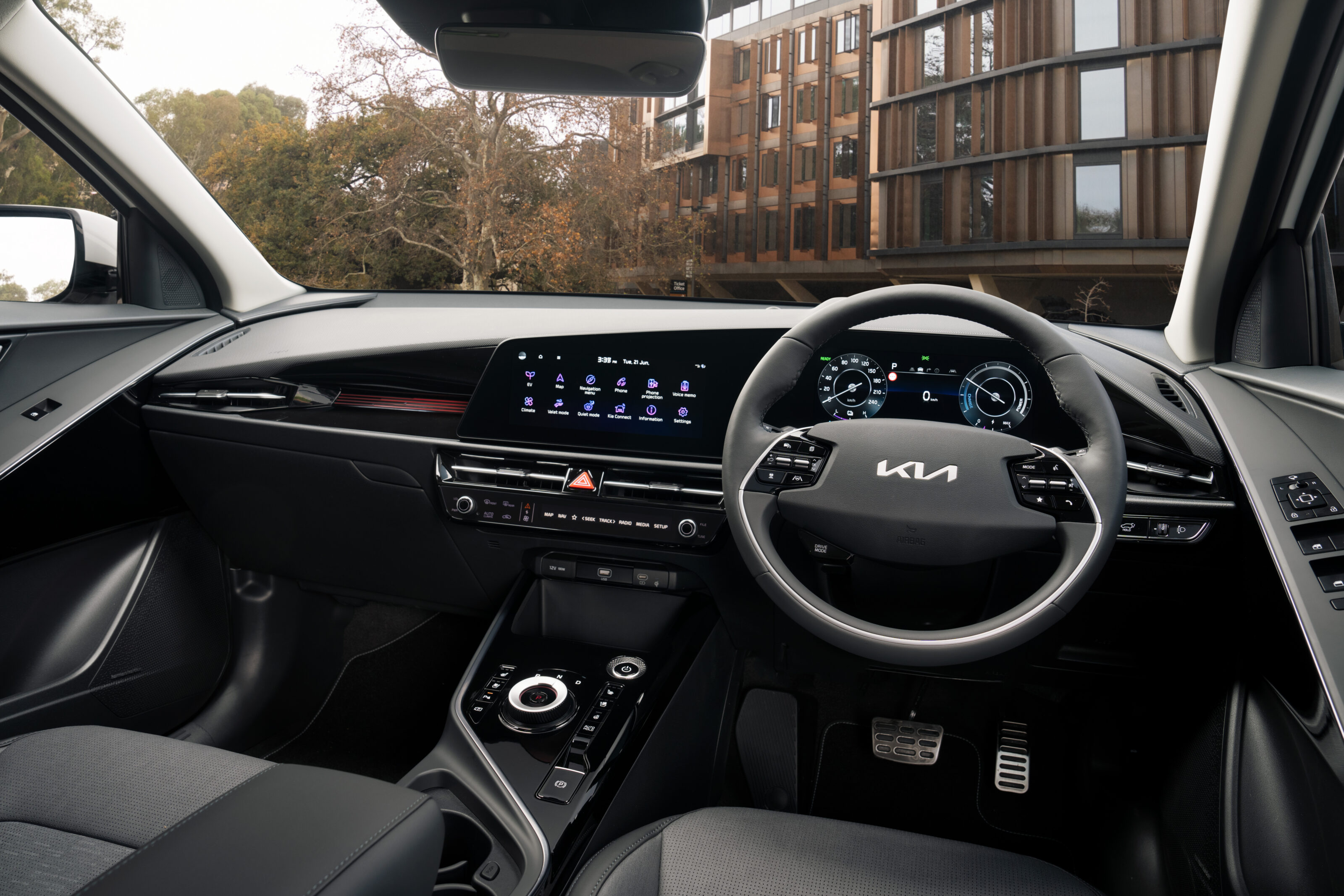
Kia Australia has confirmed pricing and specification details for the second-generation 2023 Niro, ahead of its local launch in July.
Our first details story published in early June has been updated to reflect this information.
Kia is continuing its strong rollout of electrified products in Australia.
The 2023 Kia Niro small SUV will begin arriving in Australian showrooms in July in both hybrid-electric (HEV) and all-electric (EV) forms.
Pricing is up by $4390 for the entry-level S hybrid, now available from $44,380 before on-road costs.
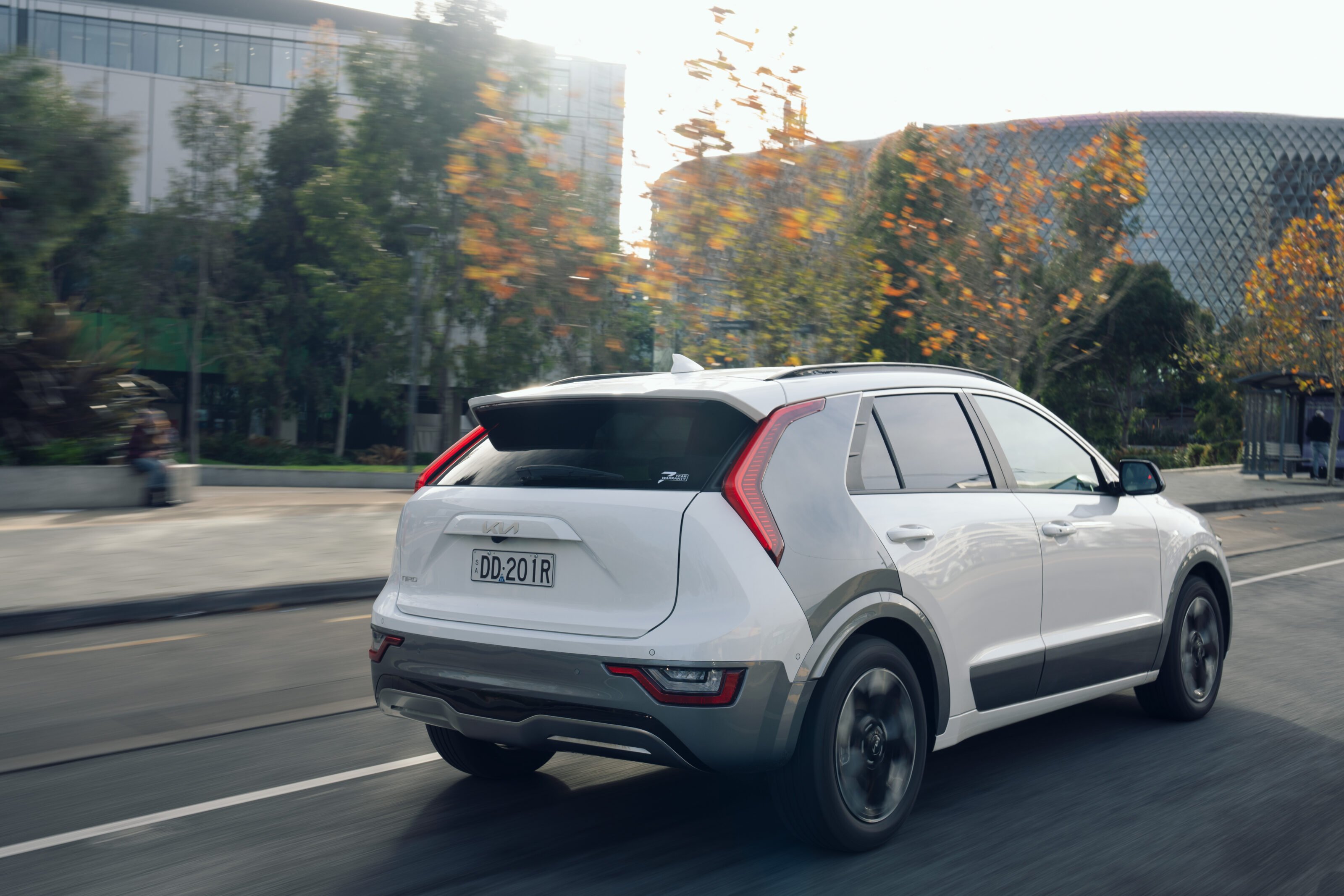
Meanwhile, the base Niro EV has risen by $2710 at $65,300 – putting it within close proximity to the larger EV6, which rides on the dedicated E-GMP electric architecture.
Replacing the first-generation Niro – which first debuted in 2016 but only made its Australian launch last year – the second-generation model will not include a plug-in hybrid version to slot between the hybrid and fully-electric variants.
The new-generation model is an evolution over the outgoing version, retaining its internal-combustion underpinnings, albeit on a newer ‘N3’ platform shared with sister brand Hyundai’s i30 Sedan.
Damien Meredith, chief operating officer of Kia Australia, said the Niro represents a sizeable improvement over its predecessor, helping to bolster the Korean manufacturer’s local line-up of electrified vehicles.
“The past year has been an exciting time for Kia in Australia, particularly when it comes to electric vehicles, with electrified variants being added to [the] Sorento range and the recent introduction of EV6 – which is proving to be more popular than we could have ever imagined,” he added.
Kia has conducted a full ride and handling tune for the second-generation Niro in Australia, making it the first vehicle from the Korean brand to receive steering map changes since the onset of the COVID-19 pandemic in 2020.
Towards the end of this year, the 2023 Niro range will expand with the addition of the Niro Plus, a ‘purpose-built vehicle’ based on the first-generation Niro EV aimed at taxi and ride-share drivers.
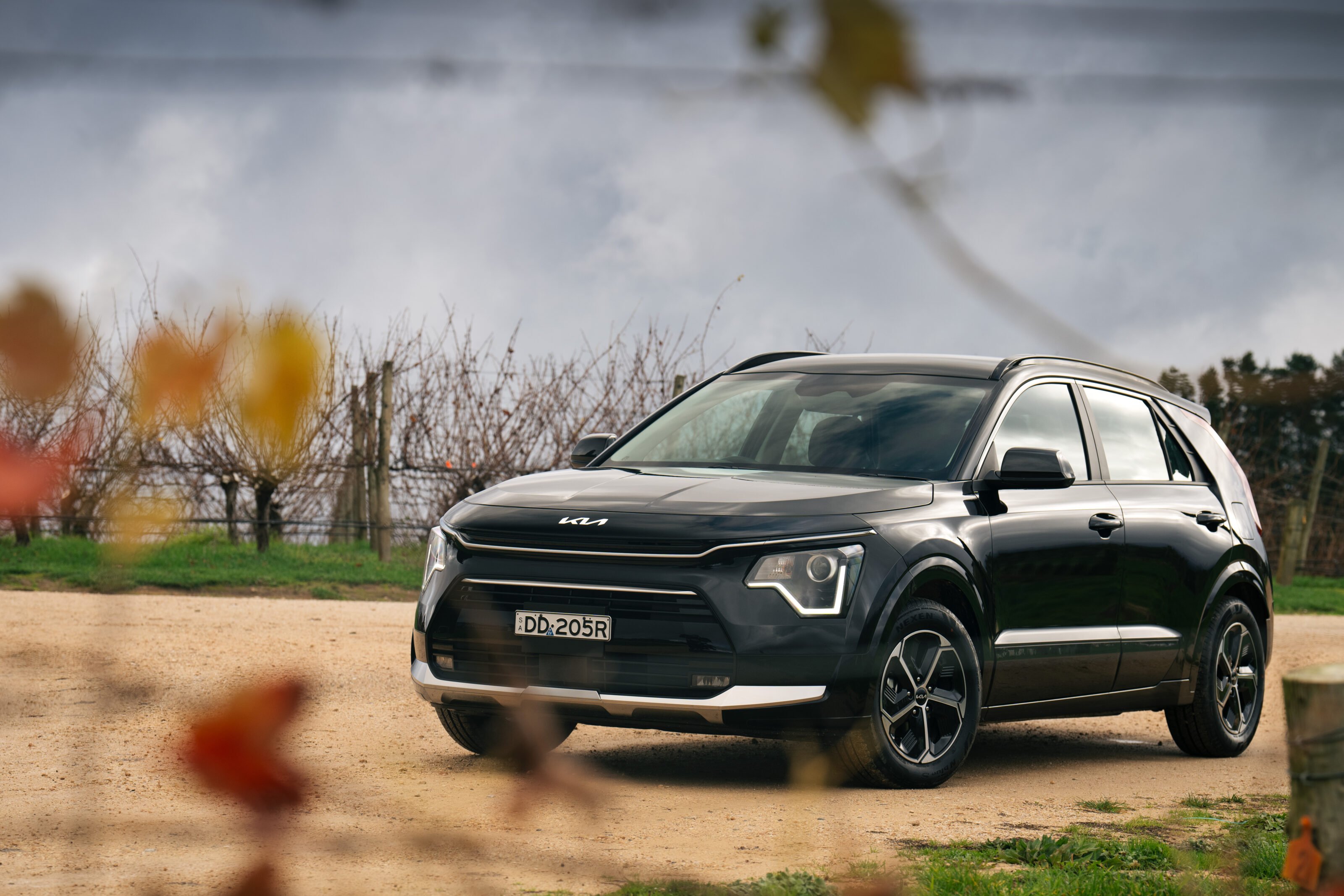
2023 Kia Niro Australian pricing
| Model | Pricing |
|---|---|
| S Hybrid | $44,380 (+$4390) |
| GT-Line Hybrid | $50,030 (new, up $6140 over Sport) |
| S EV | $65,300 (+$2710) |
| GT-Line EV | $72,100 (new, up $6110 over Sport) |
A gloss-black C-pillar can be optioned at no extra cost for GT-Line variants finished in mineral blue or cityscape green, while a steel grey C-pillar and body cladding is available for the GT-Line EV in snow white pearl.
2023 Kia Niro features
For the new-generation Niro, Kia has kept the S as its entry-level variant, while the GT-Line replaces Sport as the flagship, as per the brand’s other offerings.
Both grades are available in hybrid or all-electric form.
S Hybrid
GT-Line Hybrid, in addition to S Hybrid
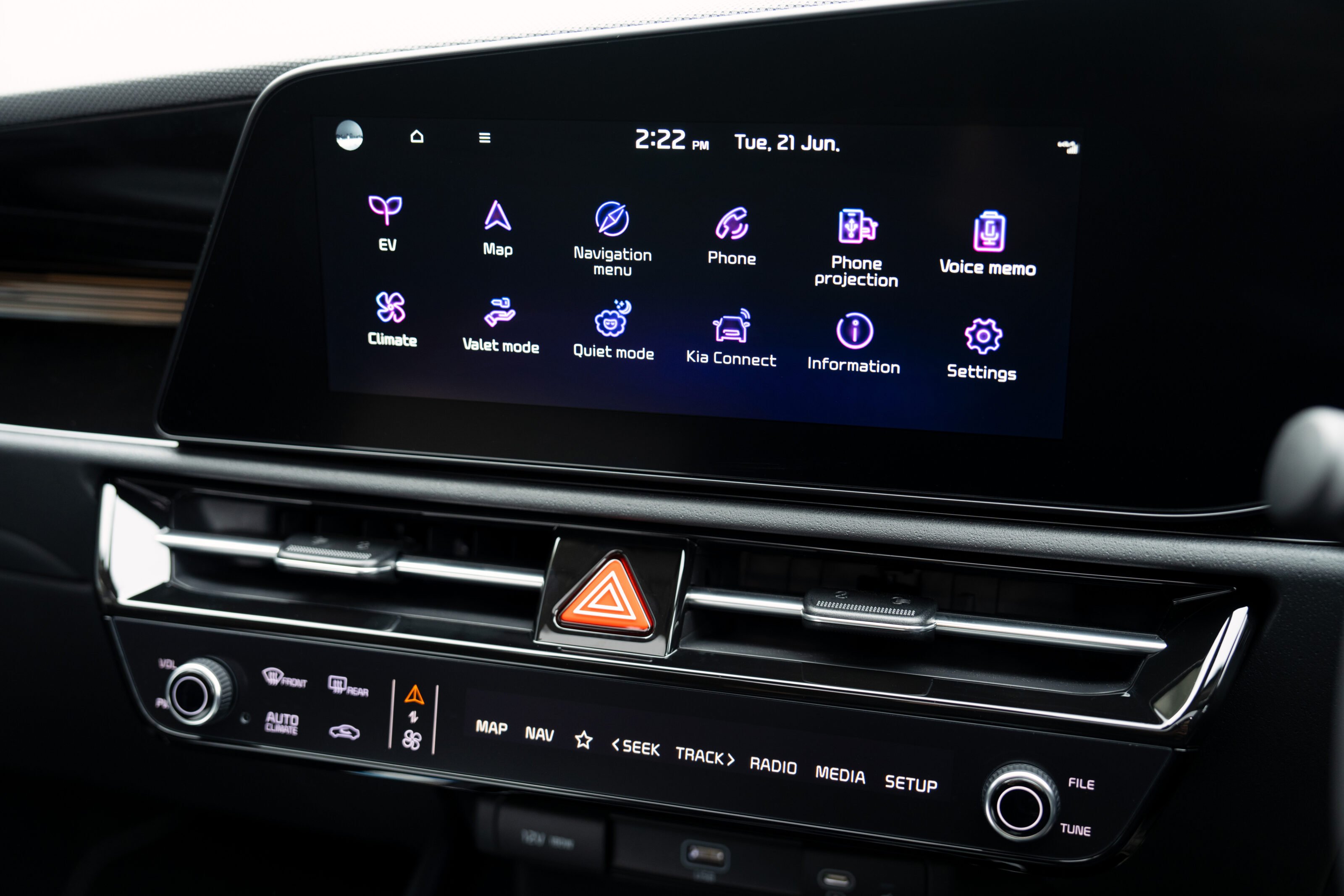
S EV
GT-Line EV, in addition to S EV
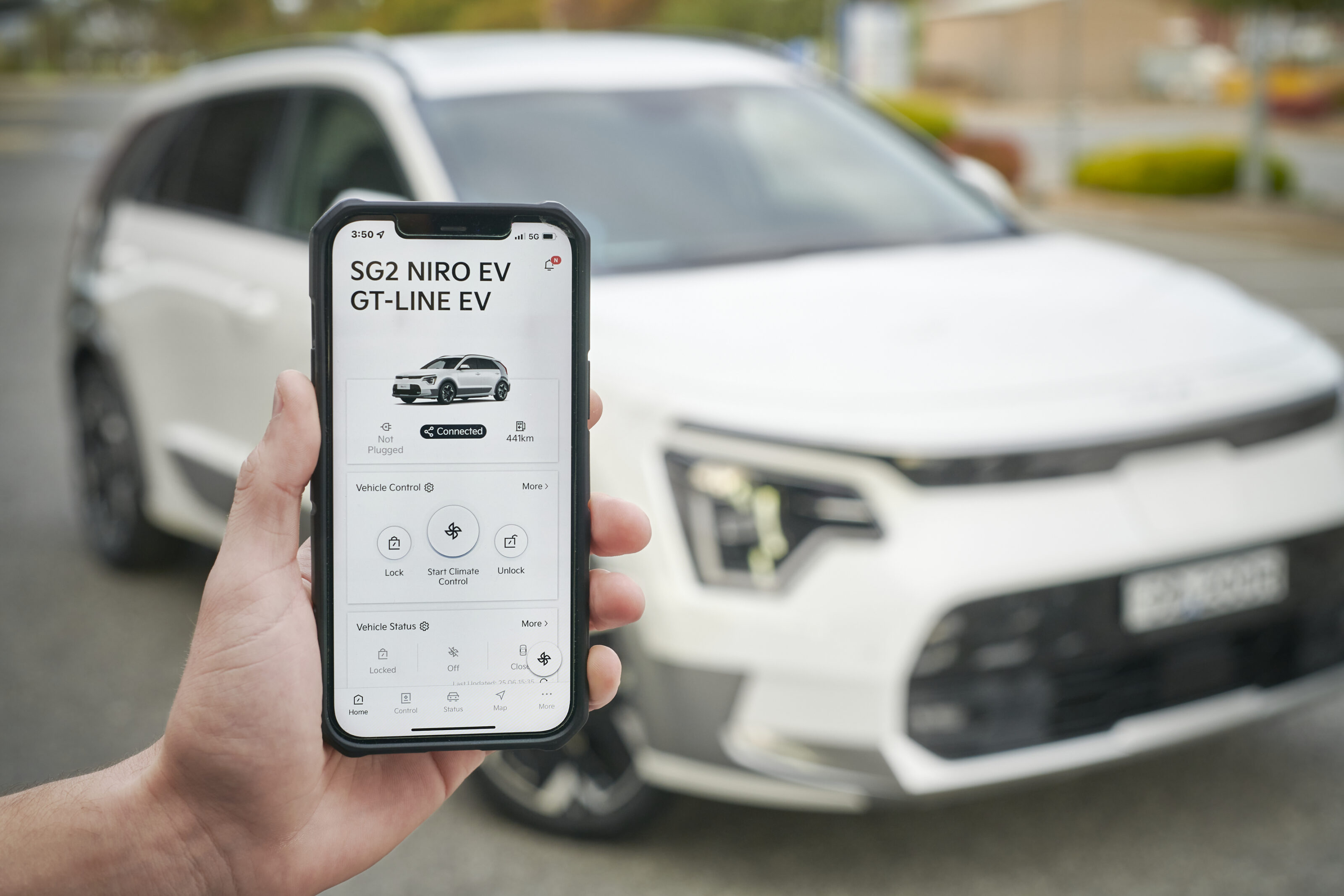
GT-Line grades feature Kia Connect, the manufacturer’s latest telematics-based service, which allows owners to link up to their car via a smartphone app, unlocking features such as:
Kia Connect
Powertrain, driving range and charging
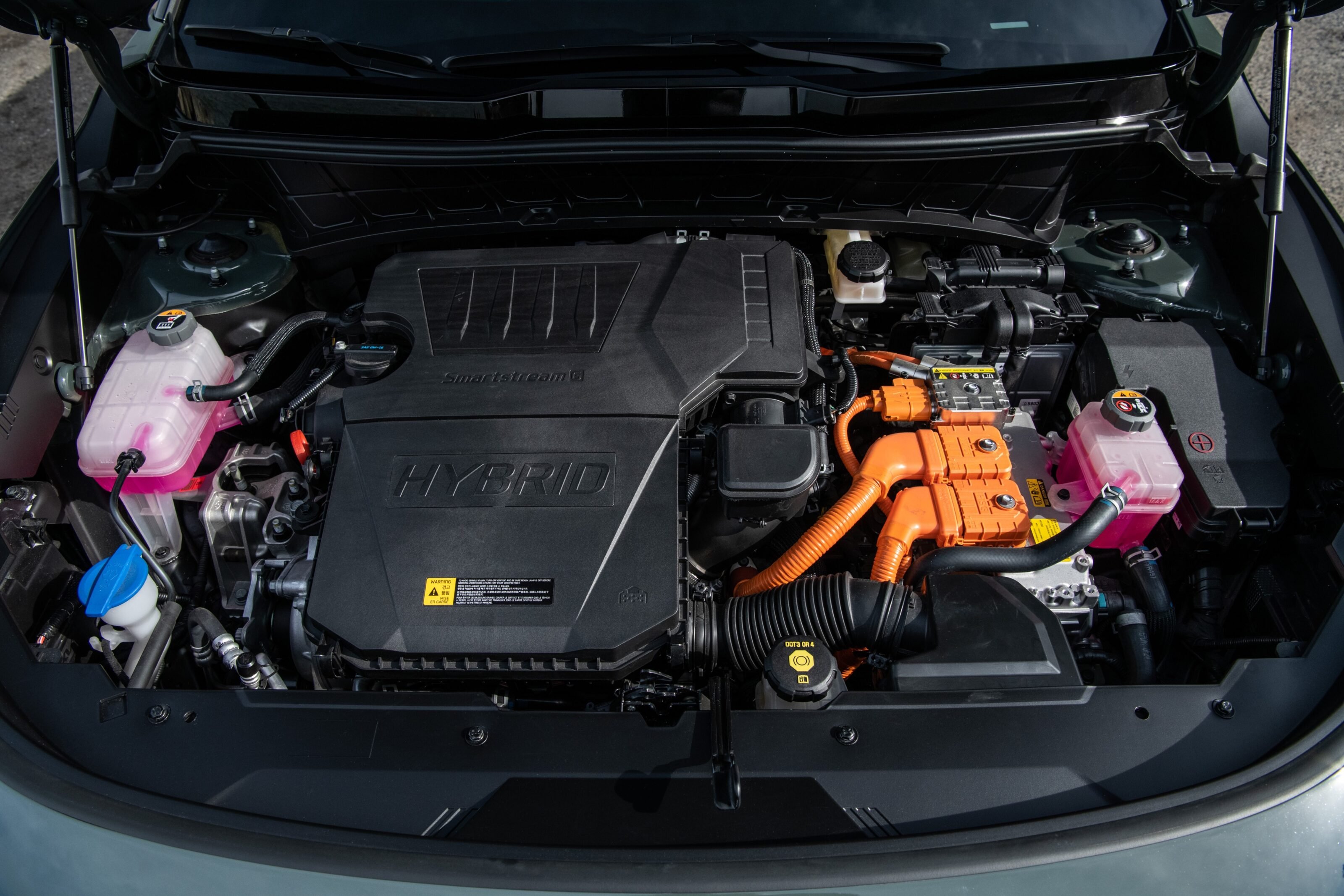
Niro Hybrid
The hybrid powertrain remains unchanged from the previous Niro, featuring a 1.6-litre naturally-aspirated four-cylinder petrol engine producing 77.2kW of power and 144Nm of torque (down 3Nm on the outgoing model).
The engine is mated to a 32kW electric motor for a combined system output of 104kW and 265Nm.
A 240-volt, 1.56kWh and 6.5Ah lithium-ion polymer battery under the rear seat provides power to the electric motor, returning a fuel consumption rating of 4.0L/100km – up by 0.2L/100km.
As before, the Niro HEV delivers its power to the front wheels through a six-speed dual-clutch automatic transmission.
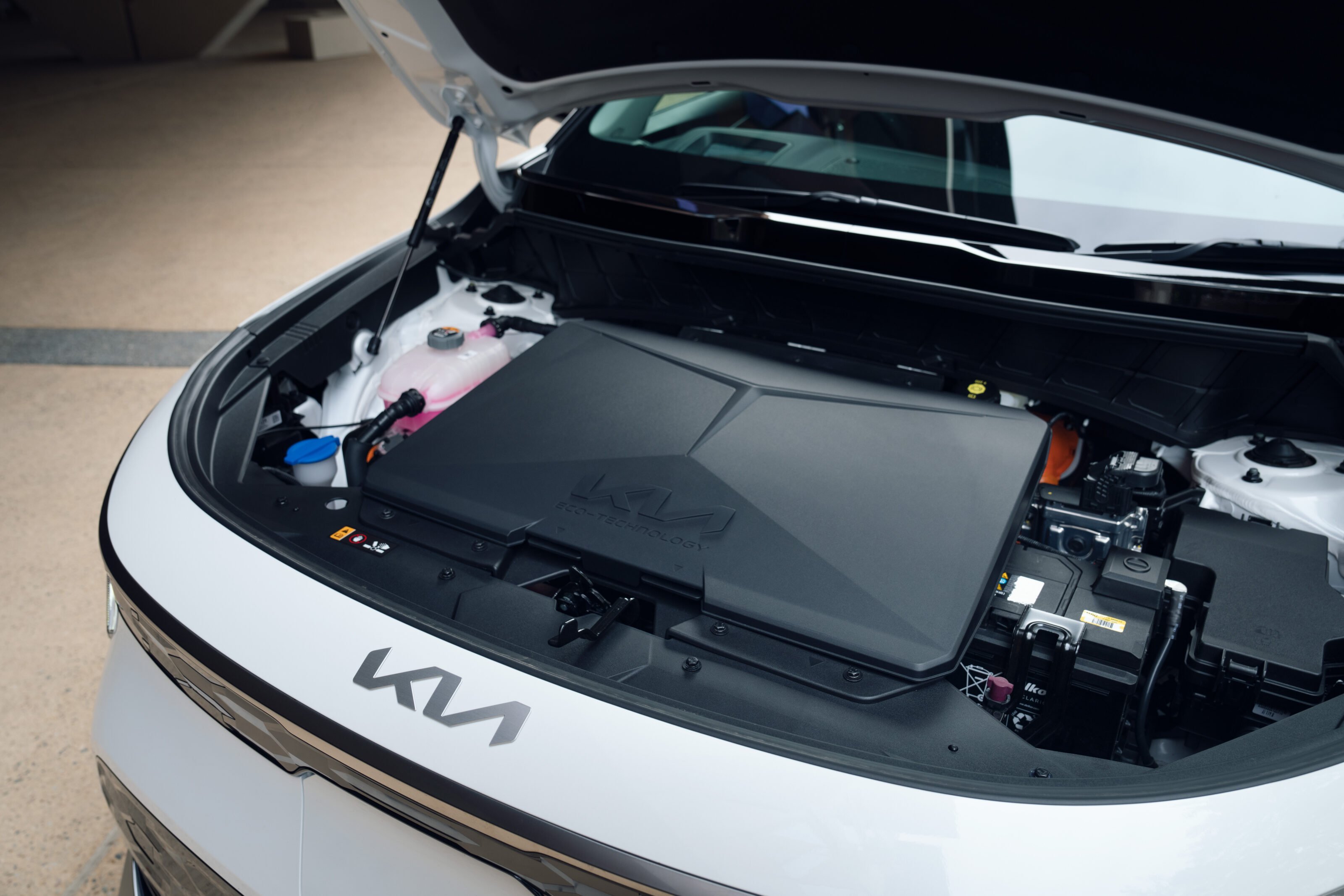
Niro EV
For the Niro EV, its 150kW electric motor is carried across from the existing car, although Kia states it now develops just 255Nm – a drop of 140Nm compared to the outgoing model.
Kia has not explained why torque is substantially lower for the new-generation Niro, but claims “performance is not compromised whilst range has been improved”.
Drive is still sent to the front wheels via a single reduction gear transmission, with the 64.8kWh battery pack enabling a driving range of up to 460 kilometres – a five kilometre bonus over the car it replaces.
Utilising a CCS2 charge port positioned on the front bumper, the Niro EV will take approximately 43 minutes to get from 10 to 80 per cent with a fast charger, due to a maximum rate of less than 100kW.
The WLTP-rated driving range for the Niro EV is 460 kilometres.
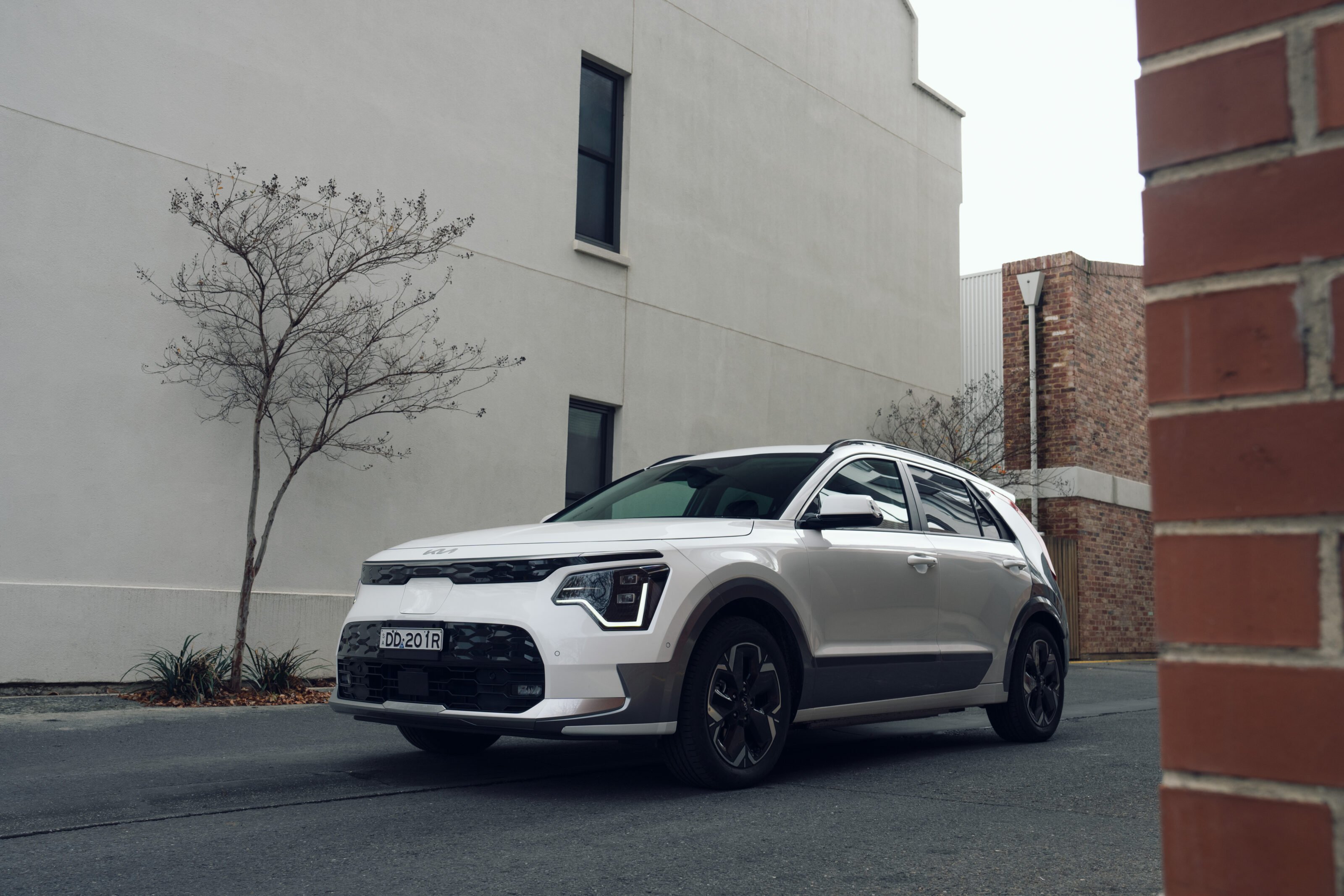
Safety
While its predecessor achieved a five-star ANCAP safety rating, the new-generation Niro is currently untested.
Eight airbags (dual front, dual side, dual curtain, driver’s knee and centre) feature across the Niro range.
Each variant includes the following active safety equipment as standard:
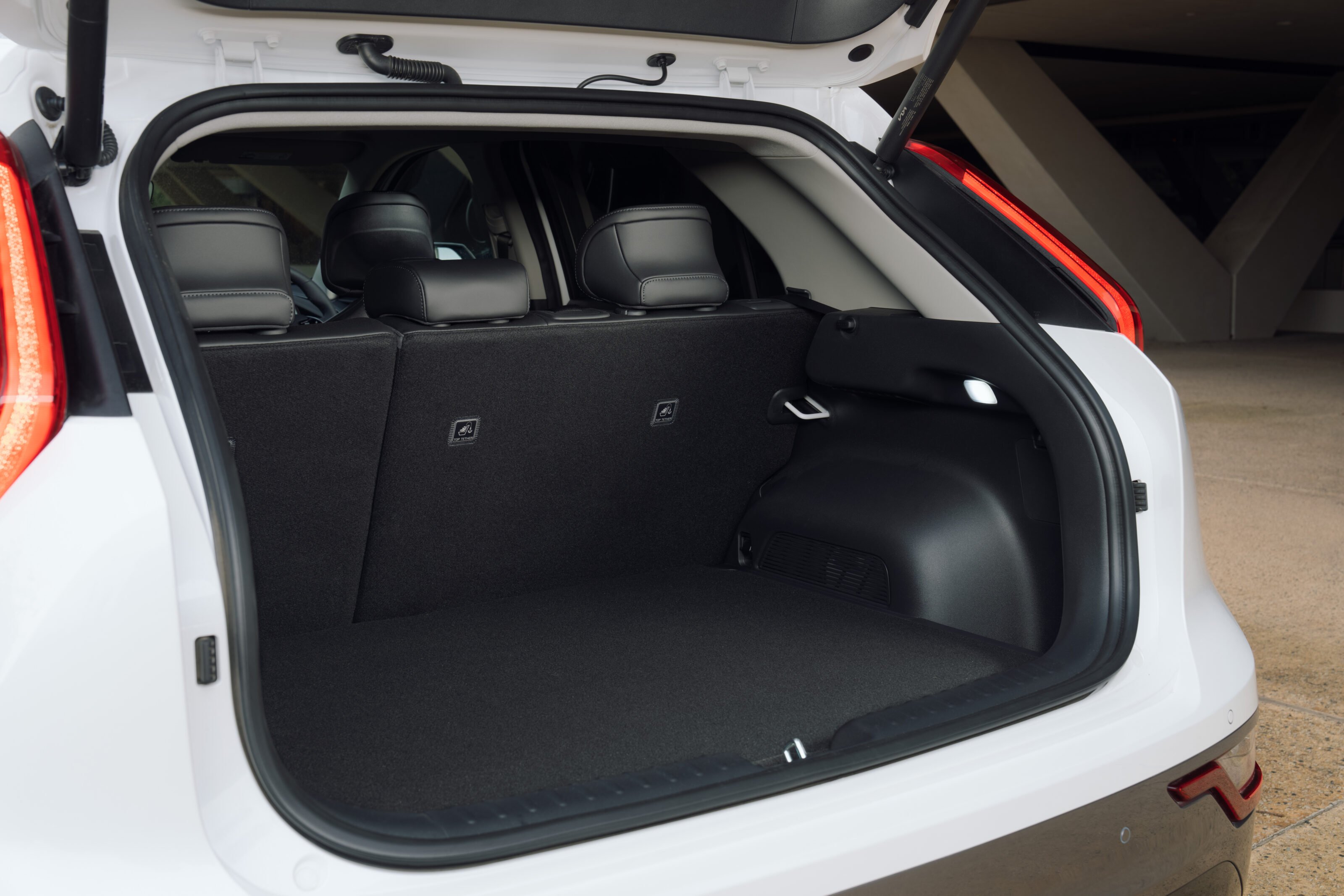
Dimensions
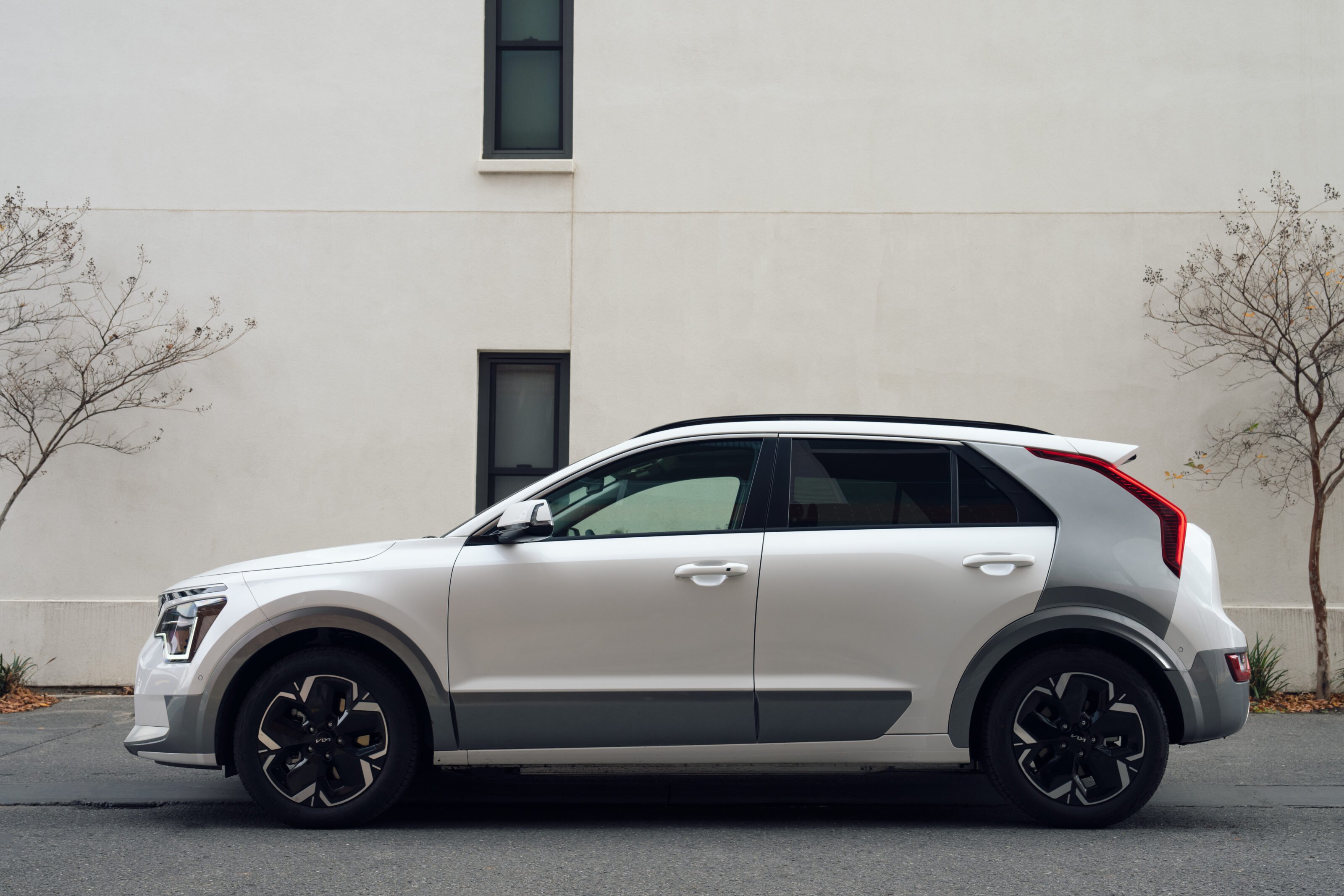
Although its mechanical underpinnings are largely unchanged, the Niro is now bigger than before, with every dimension (bar height) increasing over the existing crossover.
Now 4420 millimetres long, the HEV has grown by 65mm, while the EV is 45mm longer. The width of both variants has expanded by 20mm to 1825mm, while the wheelbase is also 20mm longer at 2720mm.
Only the height of the Niro is unchanged, with the HEV standing 1545mm tall, while the EV is 1570mm from top to toe.
Warranty and servicing
As with the rest of Kia’s range, the Niro is covered by a seven-year/unlimited-kilometre warranty, lasting prospective buyers to 2029 if they snap up an example this year.
Capped price servicing details are yet to be announced for the 2023 Niro.
Availability
The 2023 Kia Niro Hybrid and Niro EV are now on sale in Australia.
It’s usually a bad idea to apply a hard-to-say-quickly name to a car. Skoda Scala. Go on, say it quickly several times. Actually, don’t. You might bite your tongue then blame me and I have enough on my plate. Adding irate readers with a newly self-inflicted speech impediment to the list will not help.
When the Scala popped up in my booking calendar I was quite pleased. I recalled that I had driven the Scala soon after its arrival in Australia that my brain convinced me was 2019 rather than when it actually arrived, just over a year ago. It had to be then because that’s when the story is dated and the car I drove was the Launch Edition.
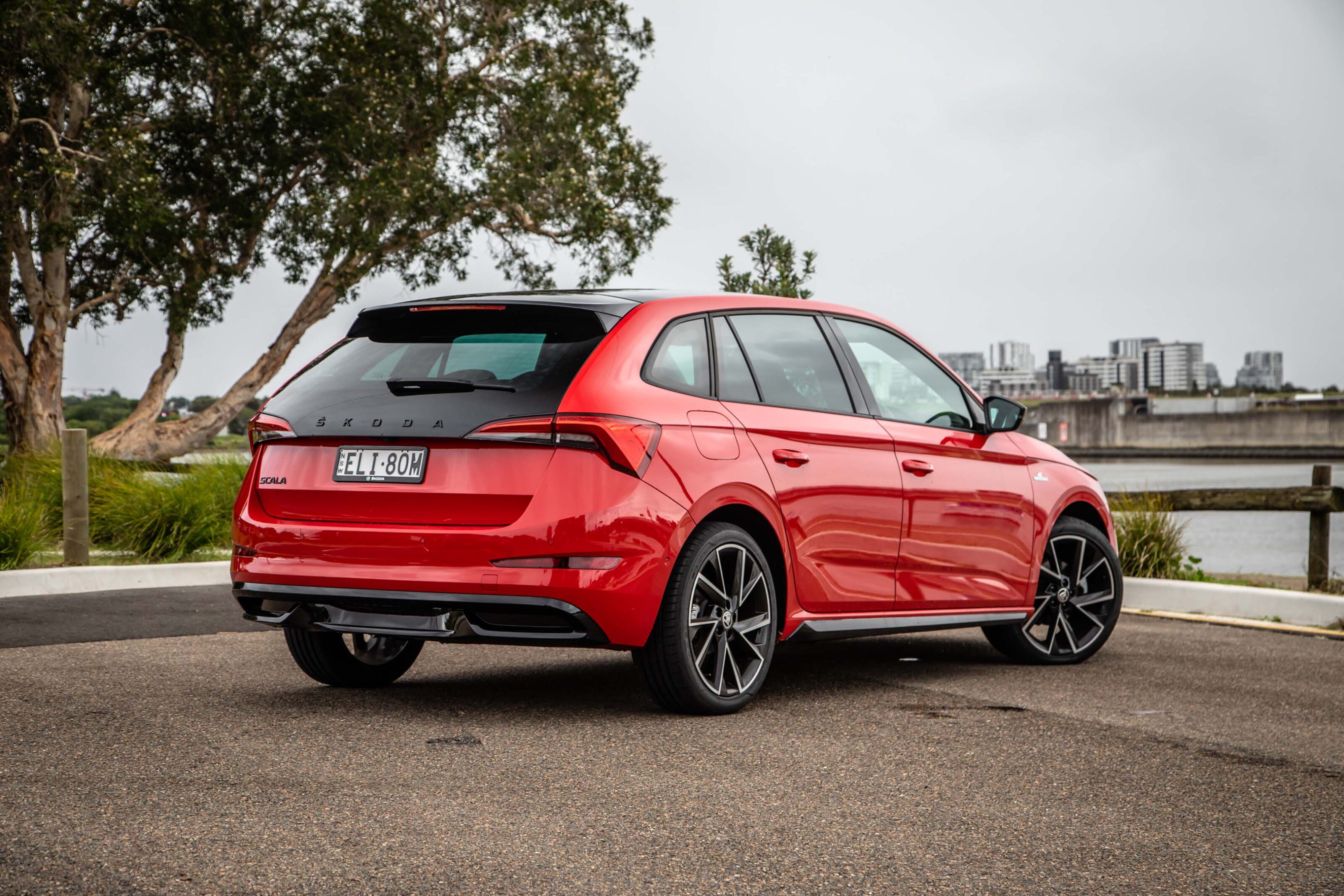
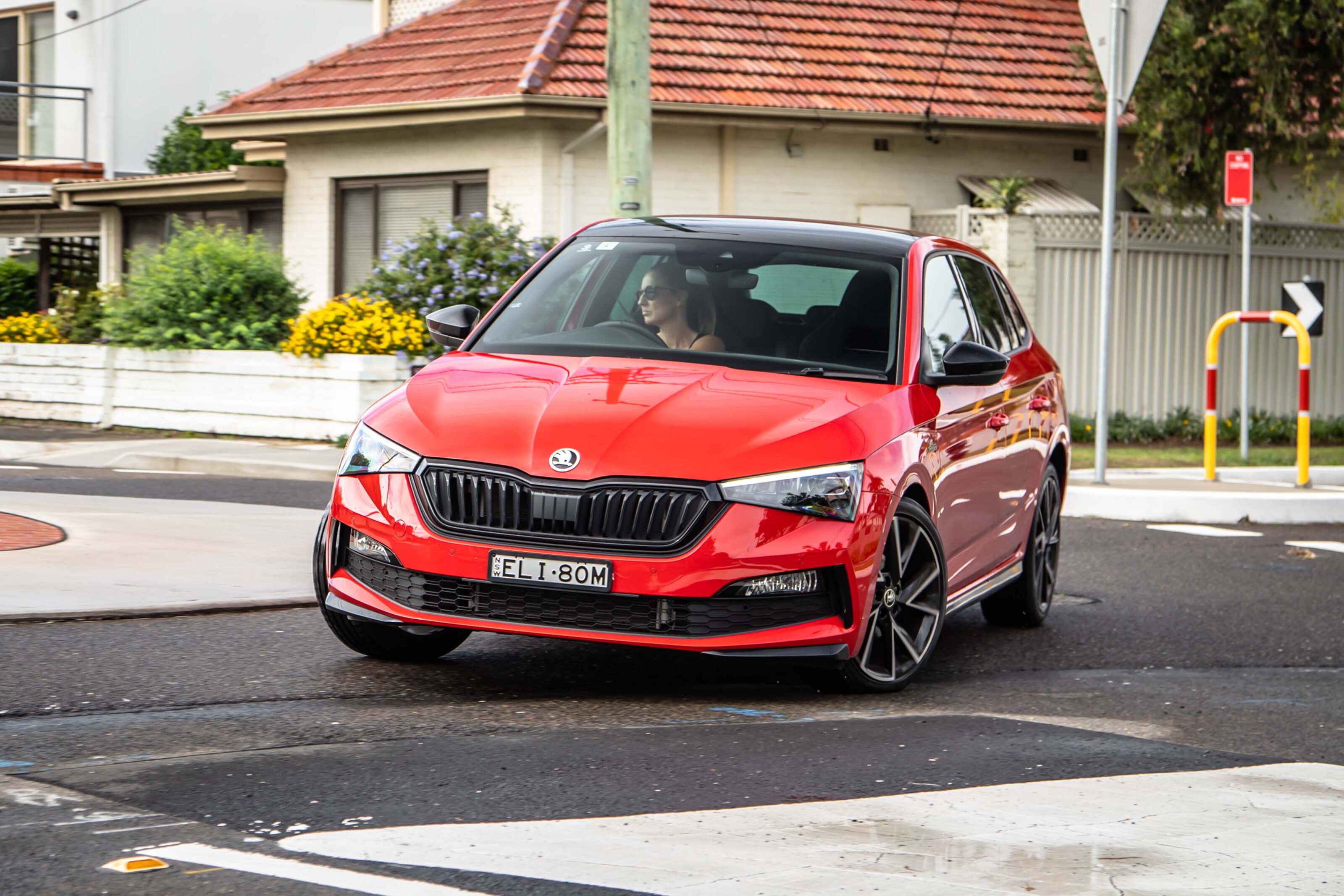
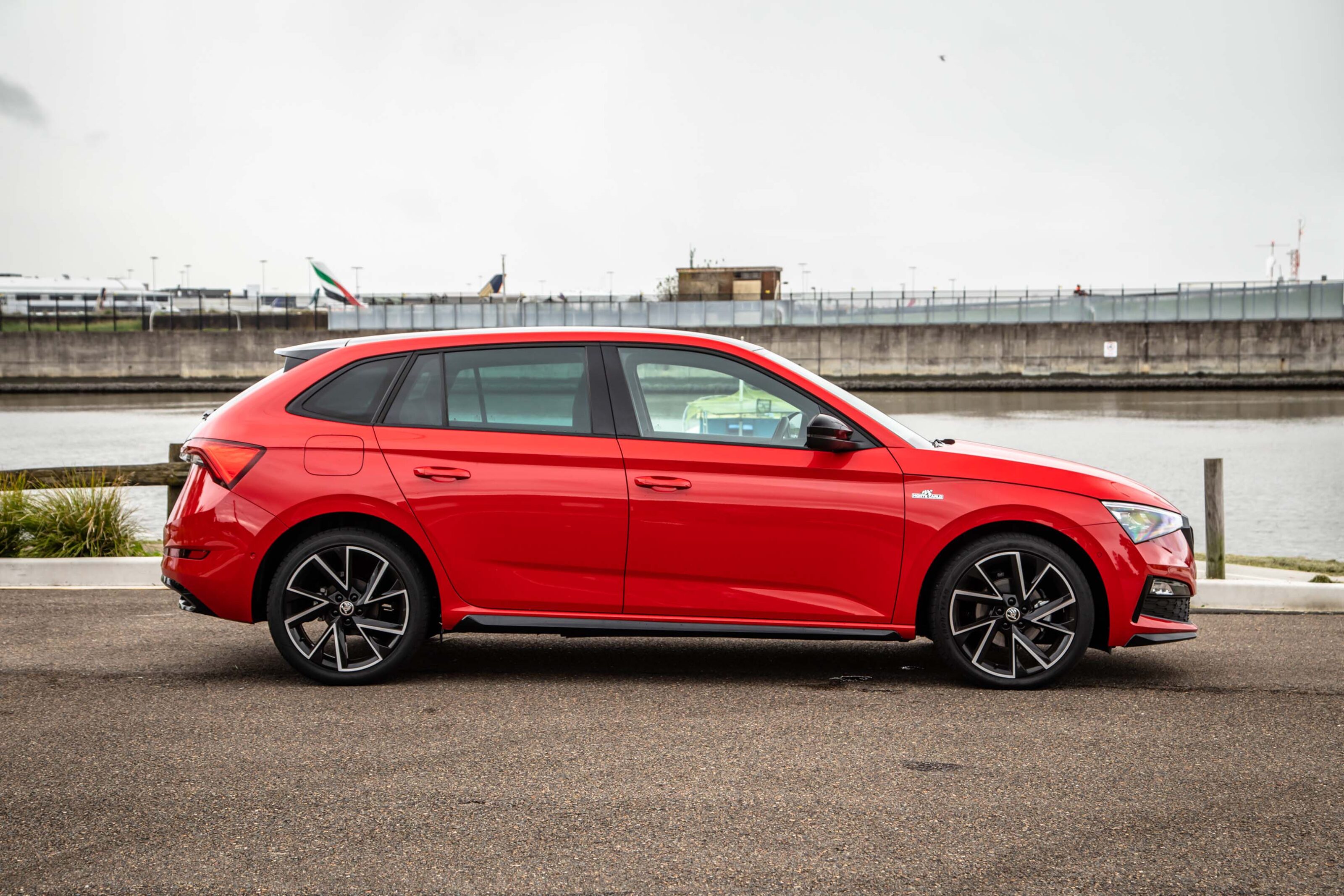
Much has changed since then and that includes the addition of the stylish-sounding Monte Carlo specification level of this Golf-sized hatchback.
Pricing and features
For 2022, the Monte Carlo’s price tag carries a $38,990 drive-away figure, which used to be pretty stiff for a small hatchback but is now almost routine. For some, it’s probably not very enticing when there are lots of other hatches and SUVs to choose from around and under that price but Skodas have an allure all of their own.
Adding to the pricing dilemma is the fact that there are also a few missing bits and pieces because of the wretched semiconductor shortage.
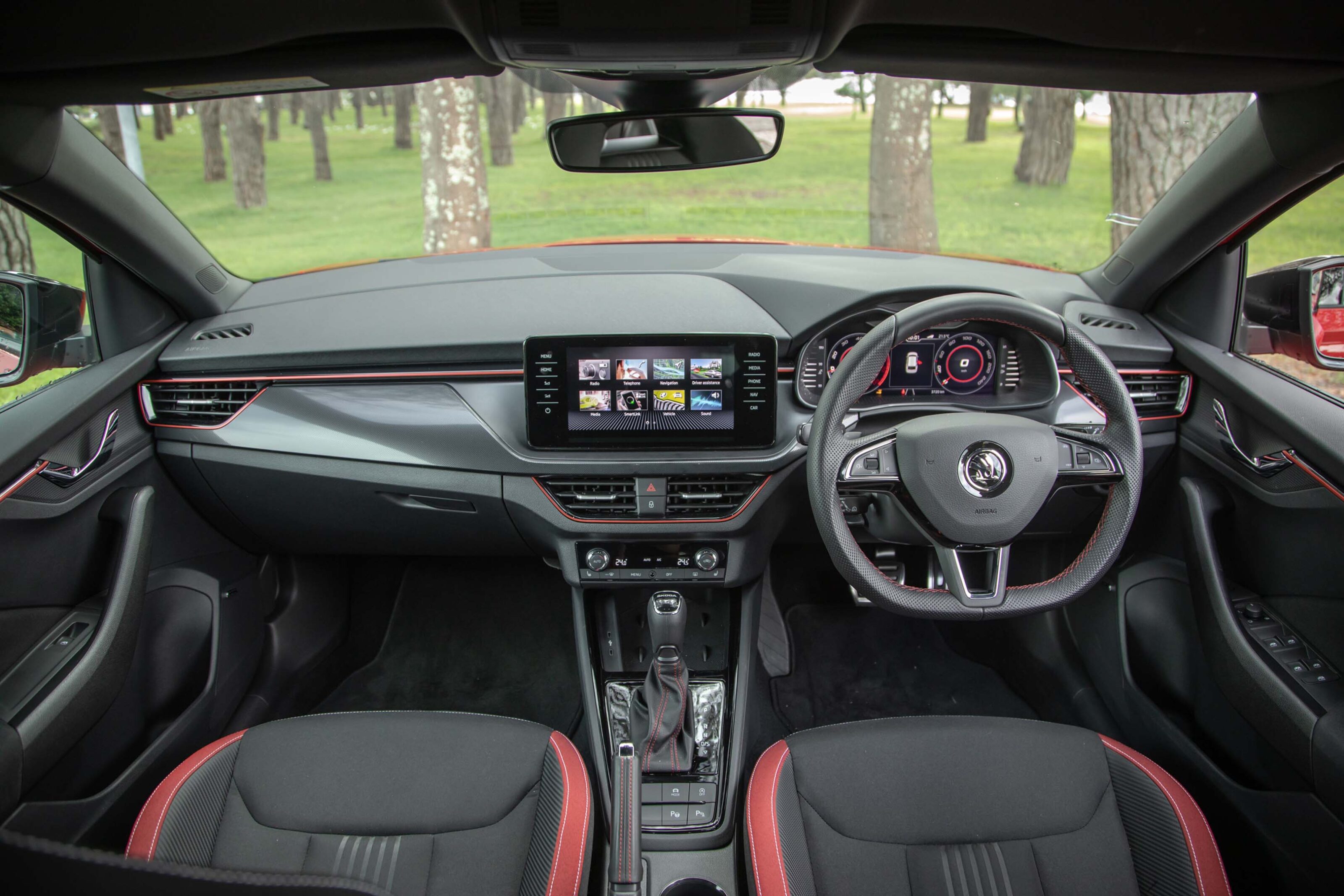
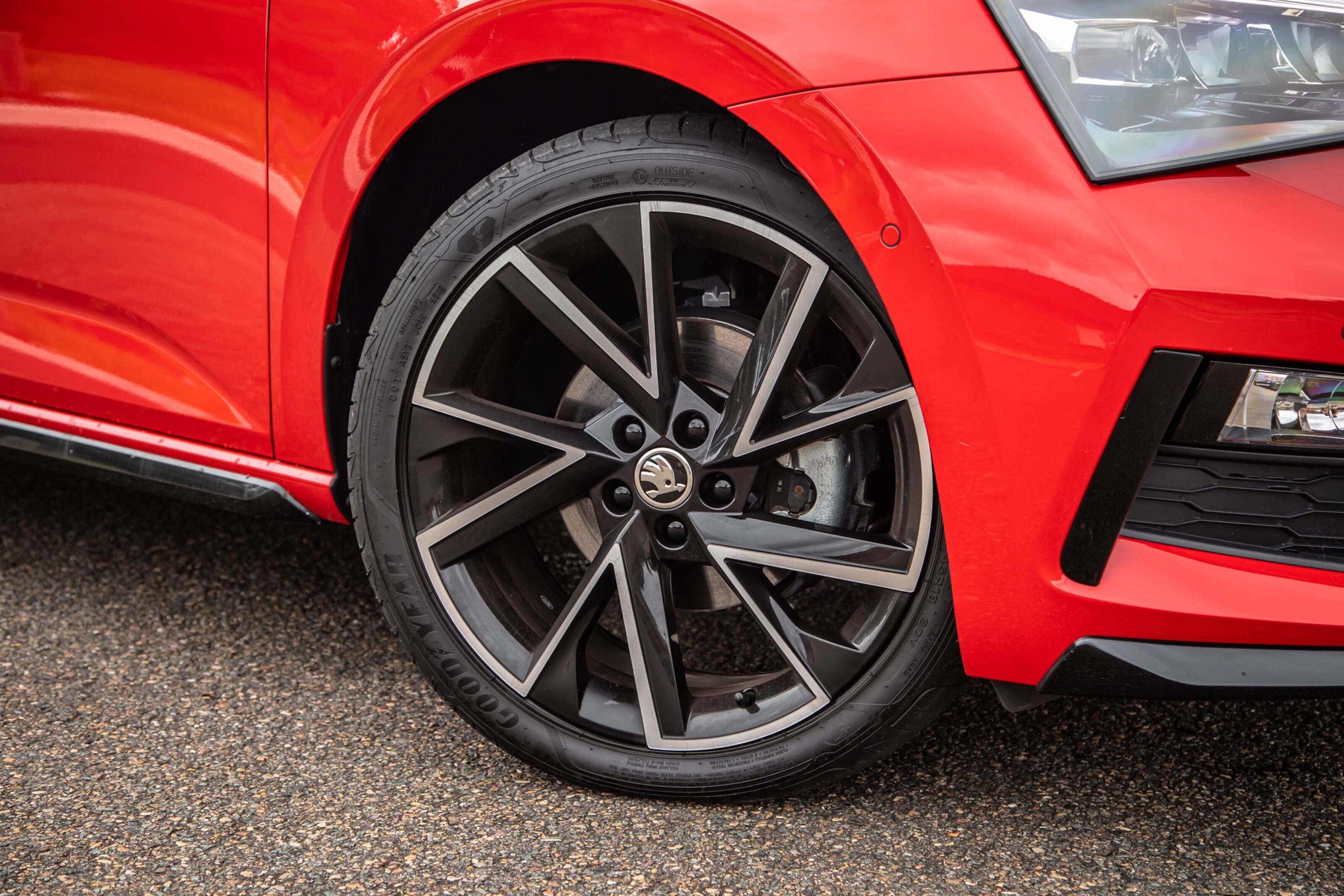
For your money, your Czech-made Scala Monte Carlo has 18-inch alloy wheels, an eight-speaker stereo, dual-zone climate control, Monte Carlo-specific cloth seats, a reversing camera, keyless entry and start, adaptive cruise control, glass sunroof, auto LED headlights, powered tailgate, leather steering wheel, auto wipers, folding heated power mirrors and a space-saver spare.
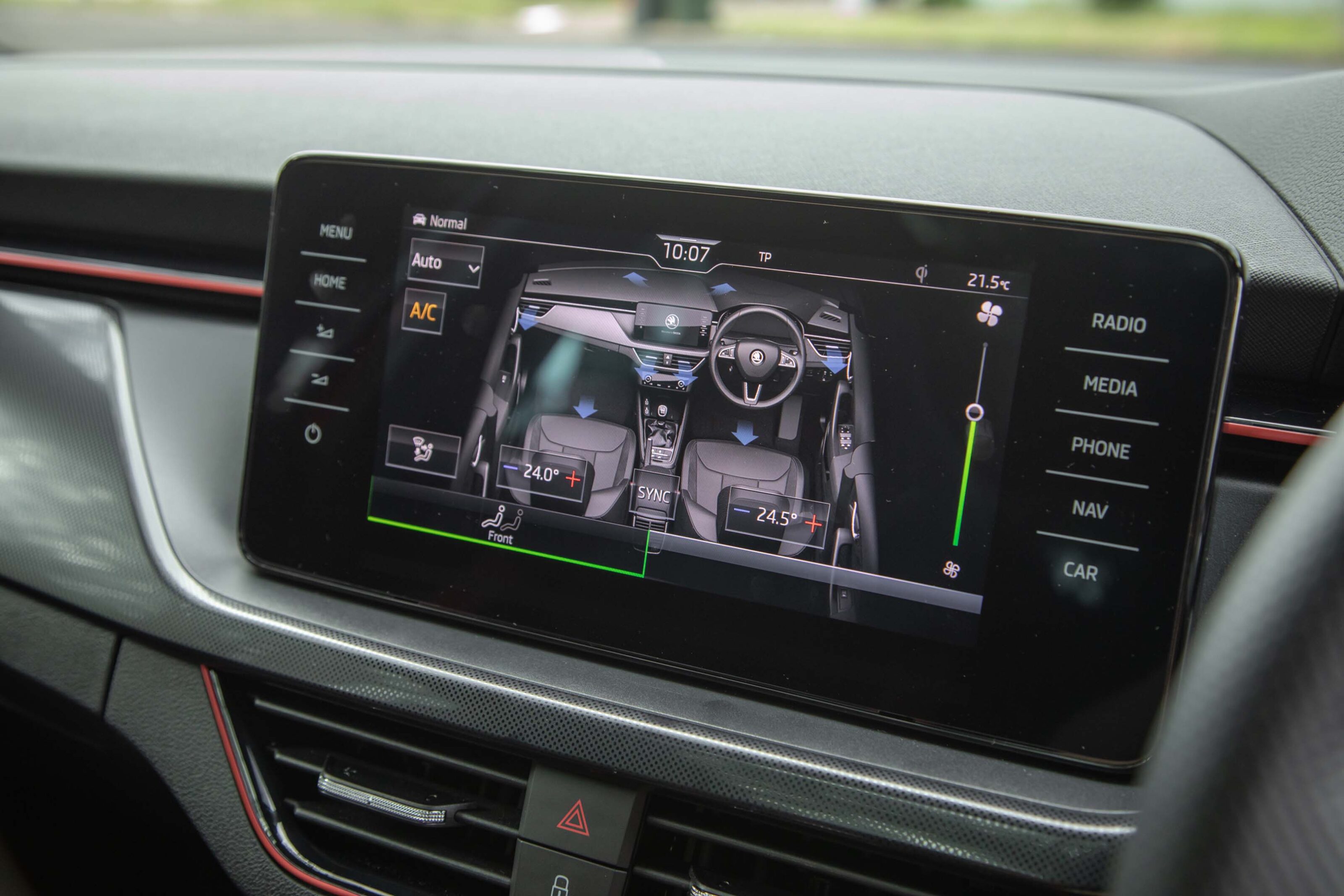
Standard on the Monte Carlo is an 8.0-inch touchscreen with Apple CarPlay and Android Auto. The system is clear and easy to use, if not exactly bang up to date, but given what’s happening elsewhere in the VW Group, I’ll take it. You can upgrade to the larger 9.2-inch screen and fresher software if you’re keen.
The safety package has taken a hit as a result of the semiconductor shortage, with MY22 cars missing out on blind-spot monitoring and rear cross-traffic alert. You do still get seven airbags (including a driver’s knee airbag), the usual braking and stability controls, multi-collision brake, forward auto emergency braking, adaptive lane assist, two ISOFIX points and three top-tether anchors.
However, it appears that you can still add the $4300 Travel Pack that comes with the 9.2-inch screen, park assist, rear cross-traffic alert, blind-spot monitoring, heated front and rear seats, as well as wireless Apple CarPlay and Android Auto.
The Scala scored five ANCAP stars in 2019 via its agreement with EuroNCAP.
Comfort and space
Not all small hatches are created equal and the Scala certainly has a lot of room packed into its hatchback footprint.
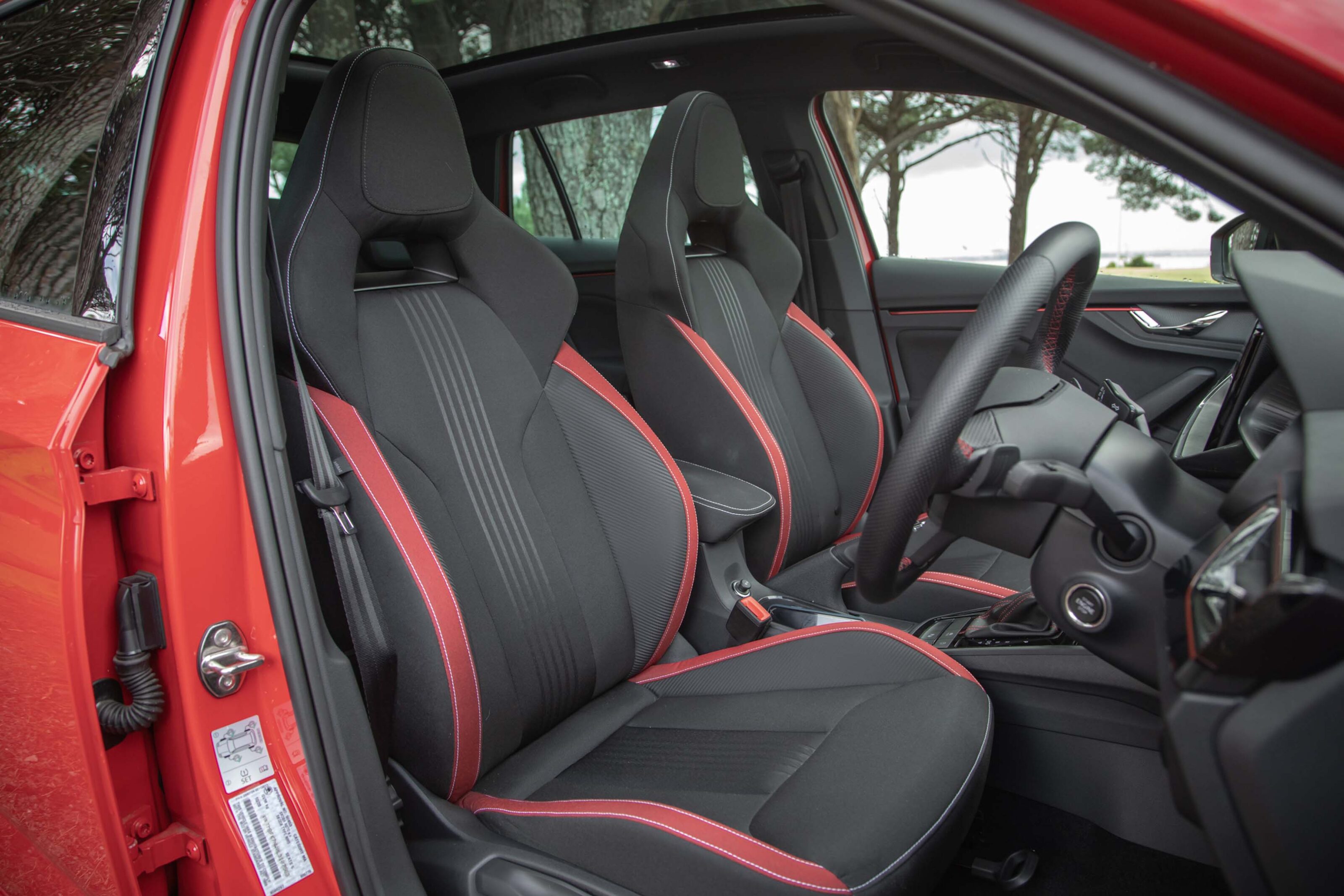
Based on the VW Group’s excellent MQB platform, front-seat passengers have a ton of room. The Monte Carlo’s cloth-covered seats are the best in the range, as it happens, and are very comfortable and look quite racy too. As is standard for a Skoda, it’s a very clean dash design, with everything you need close to hand.
You get that weird VW Group three cupholder arrangement in the front, with two coffee-cup-sized parts overlapping with a third mid-section that looks tailor-made for those small energy drink cans.
The front door bins are big and will take decent-sized bottles and the four USB-C outlets are equally divided between front and rear. Your phone goes under the centre stack and will charge there too if it’s wireless-equipped.
And the in-door umbrella holders remain one of the great joys of Skoda ownership.
The back seat is a nice comfortable space with an impressive among of legroom and headroom for a small hatch. There’s not a great deal of shape to them but that does mean three across the back is doable if the middle passenger is short.
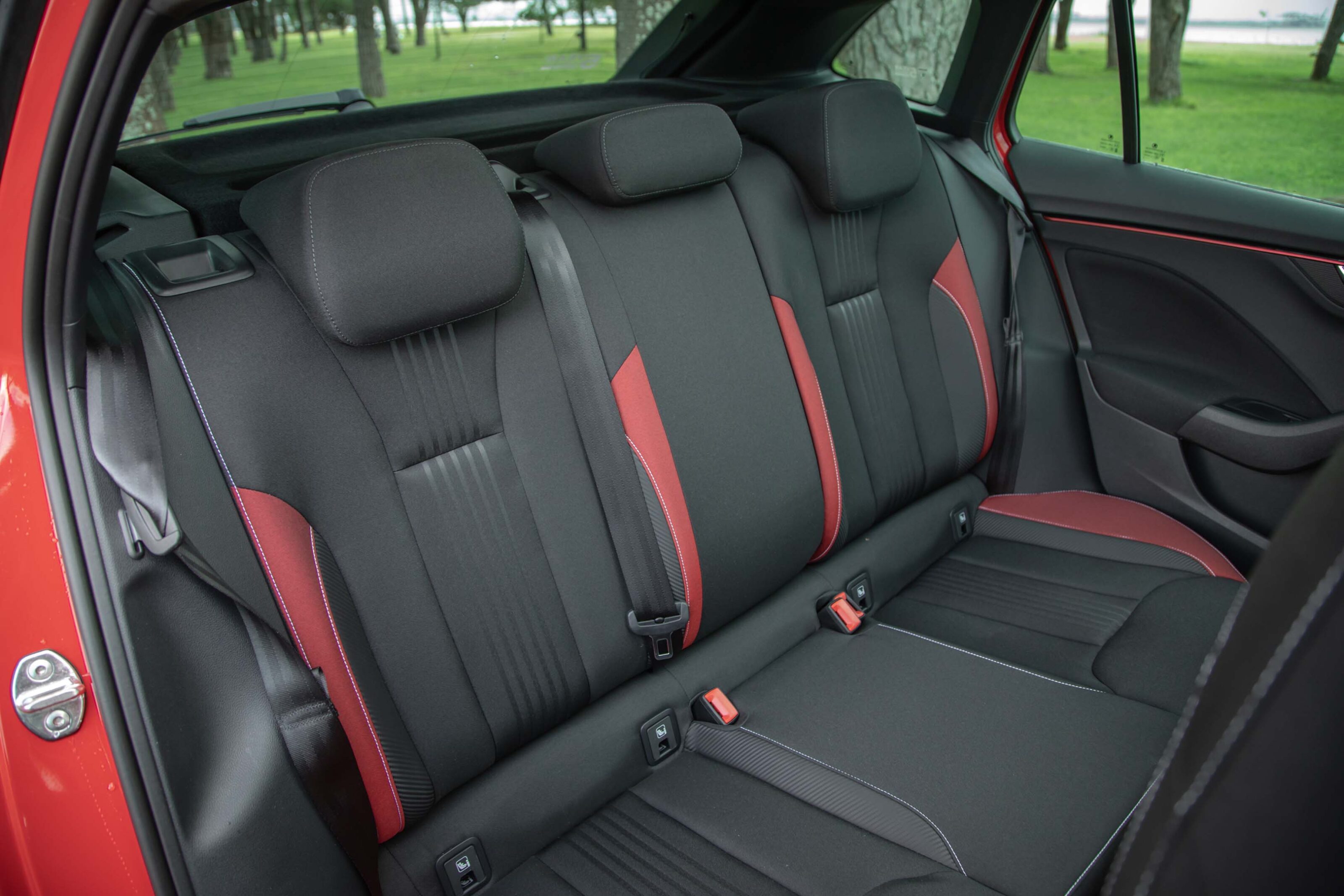
Although the door pockets aren’t huge they will take a bottle but the lack of armrest and therefore cupholders is a bit of a drag. It does have rear air vents though, so it’s not all bad. The view out of the big windows is good, too, as is entry and egress through the wide door apertures.
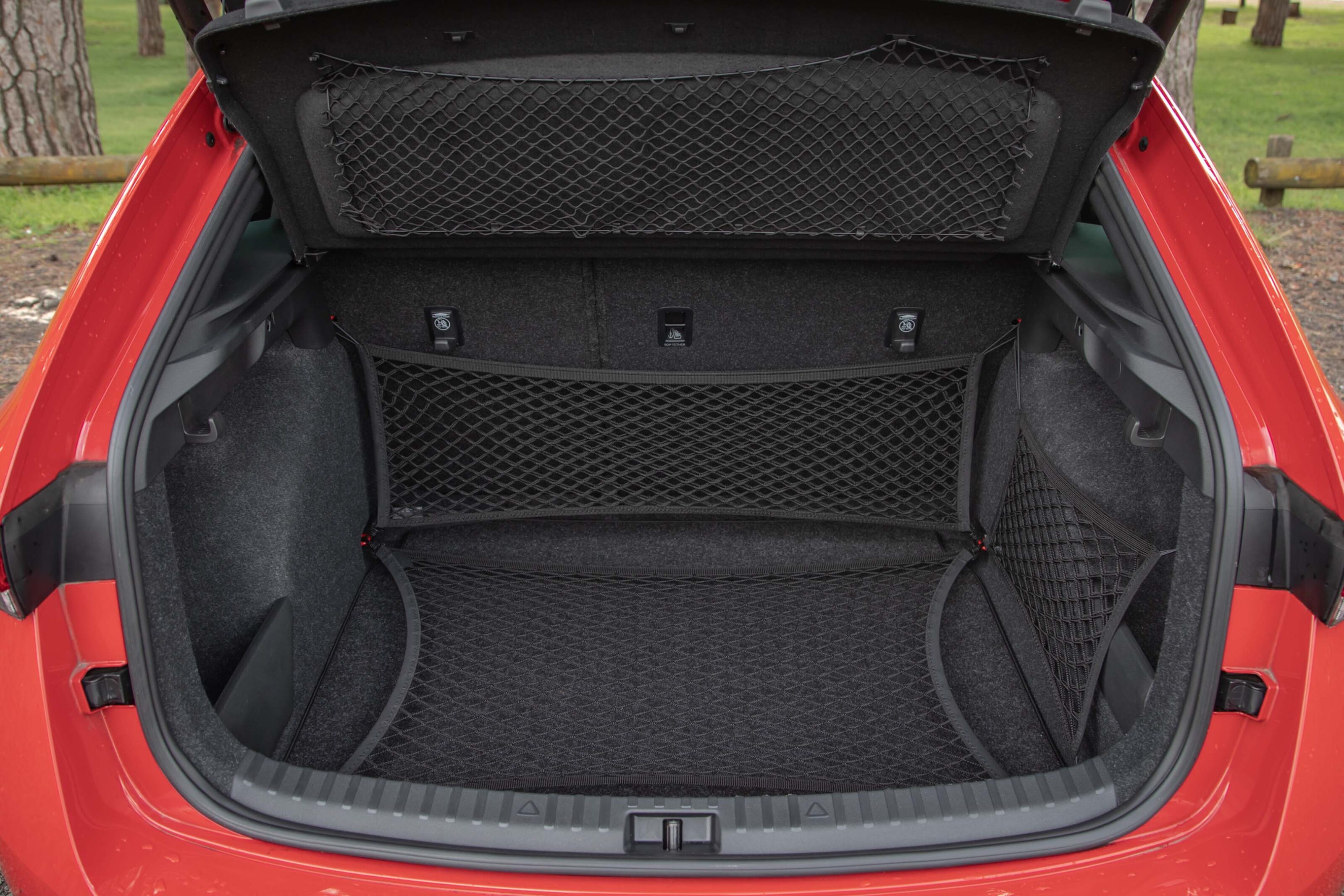
The powered tailgate gives you access to a whopping 467-litre boot with a reversible floor that’s carpet on one side and rubber on the other. There are also nets everywhere for tying things down, a couple of bag hooks, a 12-volt power socket and underneath the floor is a space-saver spare wheel.
Put the rear seats down and remove the parcel shelf to liberate a pretty impressive 1410 litres of space.
On the road
Before I start talking about the engine, I’m going to tell you that I really like the way the Scala drives. It’s really well tuned up for city driving, with quick, light steering, a taut but comfortable ride and handling balance and plenty of vision in all directions.
A few years ago, that would have been enough for me to tell you to get out there and buy one. But as this part of the market has shrunk and prices risen inexorably, the segment’s protagonists have lifted their game.
The current Mazda 3 is a belter of a car to drive and at this price, you’re getting a high-spec one with the 2.5-litre engine. The Scala’s predecessor, the unloved Rapid, traded on being quite cheap and reasonably cheerful. At nearly forty grand, the Monte Carlo has to be a good car or it’s going to sink, er, Rapid-like.
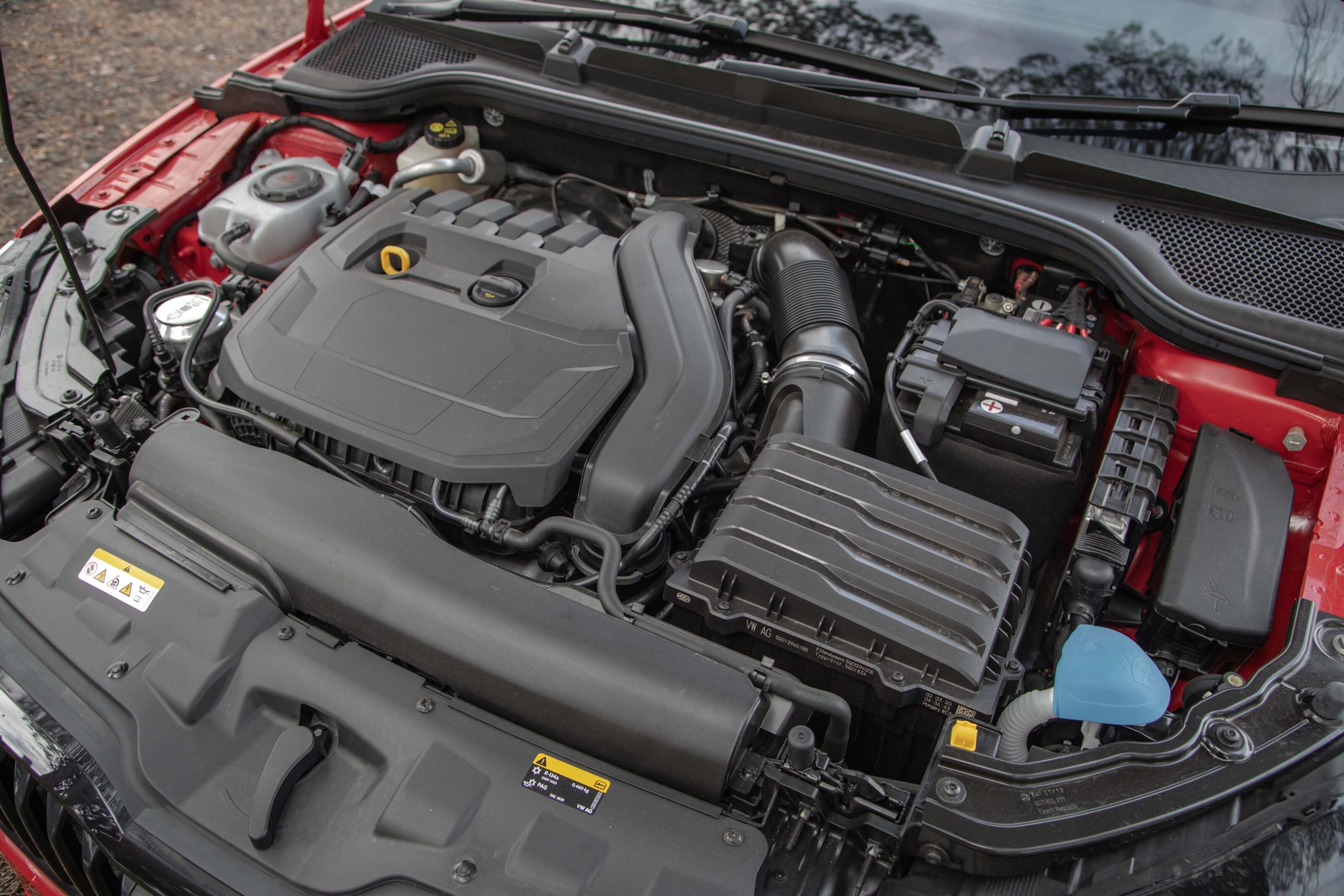
Under the bonnet is a 1.5 four-cylinder turbo, mustering up an entirely reasonable 110kW at 6000rpm and 250Nm between 1500 and 3500rpm. As you might expect, a seven-speed dual-clutch transmission sends the power to the front wheels.
While there’s a slight hesitation from a standstill – a bit of turbo lag and a bit of standard dual-clutch dithering – things improve on the move. There isn’t a stack of power but you can still get up a decent head of steam and ride the torque.
The Scala is the kind of car you gravitate towards no matter how short the drive. It makes the most of its 15mm drop in ride height and attendant tweaks to the static dampers with a sharper front end and a sportier feel all round.
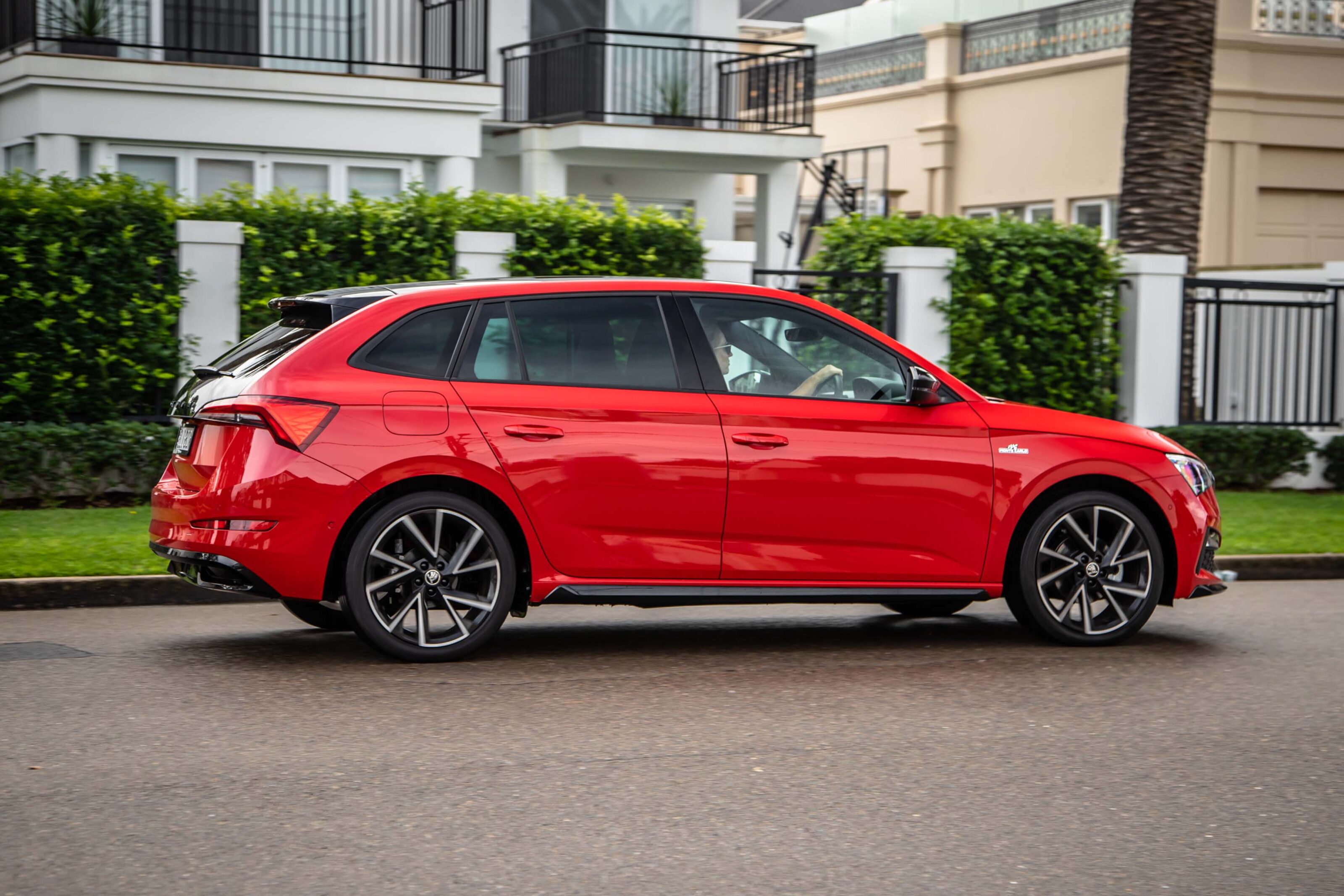
The ride may not be to everyone’s taste but the Monte Carlo is a Kia Cerato GT-Line equivalent in the Skoda range and it does the job.
On smooth surfaces, it’s a very easy car to live with and when things get a bit rougher, it’s just a little firm – which is why it will come down to taste rather than there being a specific problem.
The first Scala I drove had the adaptive damping and, honestly, I suggested leaving it in Normal mode because the Sport setting was a bit too firm. I think the Monte Carlo’s static set-up is better than both for someone keen to crack on.
Ownership
Skoda offers a five year, unlimited-kilometre warranty with a year of roadside assist thrown in.
You need to service the Scala every 12 months or 15,000km as part of the capped-price servicing regime. The first service is $314, the second $481, the third $462, the fourth a knee-weakening $800, the fifth back down to $462 and the sixth up again to $562 for a total of $3081 over the first six services, or about $513 per year. Not cheap but not hugely outrageous either.
You can pre-pay for seven years of servicing – and extend your warranty to the same length – and Skoda says you’ll save roughly the first three services’ worth or about $1300 give or take.
VERDICT
While the warm hatch vibe is restricted to chassis tweaks and the seats, in the context of the Scala it’s worth a few more bucks for even more fun.
Not everyone is going to be beating a path to a Skoda dealer for a Scala, let alone drop nearly forty thousand on a Monte Carlo.
But with ever-narrowing choices for the buyer of the once-dominant small hatchback segment, it’s cool that the Scala is here and that it even exists in the first place.
If you don’t want or need the sportier chassis, the base Scala is better value for money because it still has all the things that make the Scala an excellent hatch.
There aren’t many European hatches left, so the Scala Monte Carlo stands out just for that. But it backs it up with a fun chassis, plenty of equipment and that if-you-know-you-know vibe that Skodas are so good at.
And you’ll always have an umbrella handy.
