
The upcoming 2023 BMW M2 looks to be the final non-electrified BMW M car, with future performance models to go hybrid.
In an interview with German publication Bimmertoday, BMW M CEO Frank van Meel confirmed the new M2 would be the brand’s last car not to feature any kind of hybrid assistance, as it plans to implement 48-volt systems into more of its models.
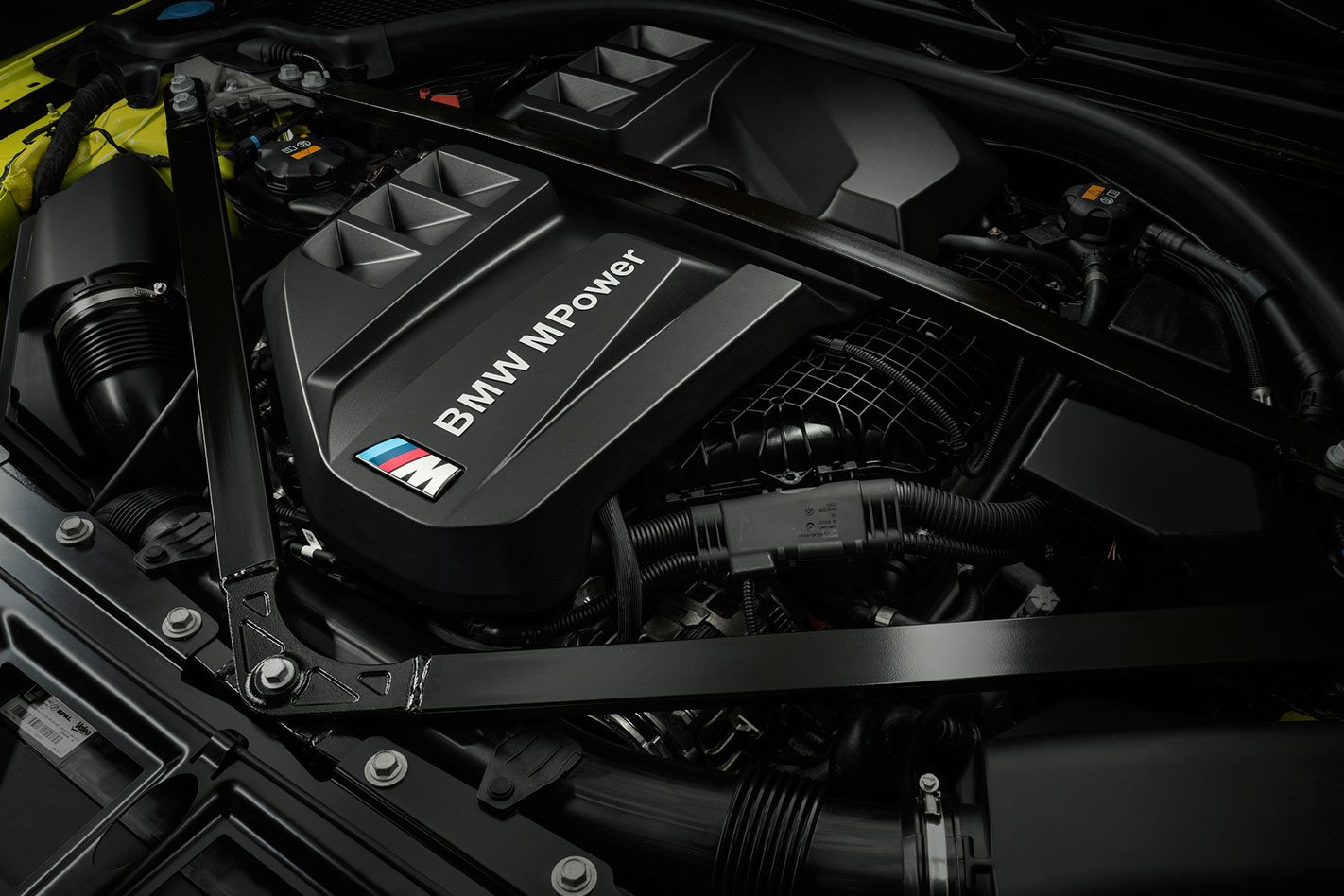
“The BMW M2 will definitely be a purist driving machine with its straight-six and rear-wheel drive,” said van Meel. “We will see increasing electrification in other vehicles, of course in different forms, starting with the 48-volt electrical system and plug-in hybrids to fully-electric drives.
“From this point of view, the M2 will be the last M with a pure combustion engine drive, and also without electrification scope – such as a 48-volt on-board network, yes.”
UPDATE, June 2022: BMW M2 prototype review
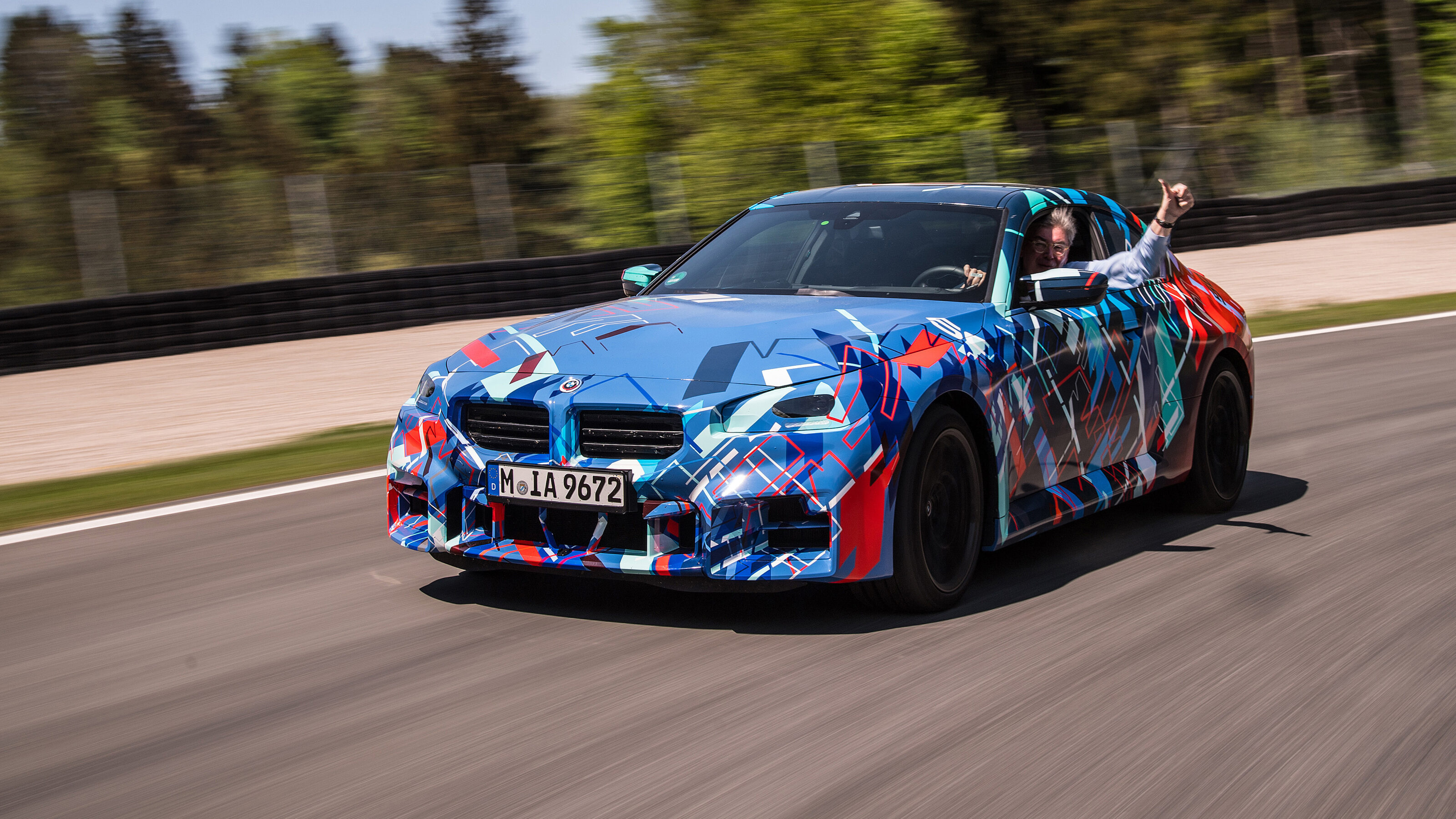
We’ve now driven the new M2 on track! It’s still camouflaged, and technically a prototype, but this is your best insight yet on what’s to come.
“Specify this new M2 with the no-extra-cost manual, and you have a fairly-priced instant classic with no waiting list. A no-brainer, really.”
Get the full story at the link below.
The story to here
Previously, van Meel clarified the second-gen M2 will also be available with a manual gearbox.
“The trend has been towards automatic transmissions for years, although lately it has stalled a bit,” van Meel continued. “Especially in the M2 segment, there are still a lot of manual fans who are looking for something special and have less and less choice.
“That’s why we have a very high proportion of manual transmissions in the USA in particular, even over 50 per cent, and in Europe we still had a proportion of over 20 per cent right up to the end – even if it’s not faster or more efficient than the automatic.”
Wheels anticipates BMW will launch the new M2 later this year, with the final combustion engine-only M car to go on sale at some point in 2023.
UPDATE: Model Y Long Range AWD available to order in Australia
Tesla has added the third and final Model Y variant to the Australian range. With 533km driving range (WLTP) and $81,900* starting price, it sits smack-bang between the Standard Range and Performance trims.
Our original story, below, has been updated to reflect the addition of the Long Range AWD variant.
*Price is listed before on-road costs and Luxury Car Tax
UPDATE: Model Y driven in Australia
The Tesla Model Y is now in Australia, and we’ve driven it. We’ve also now compared it directly with Kia’s EV6, on the road. Catch our video and reviews at the links below.
The story to here: 2022 Tesla Model Y pricing revealed
Snapshot
- Tesla Model Y launches in Australia
- Base rear-wheel drive variant to go on sale from $68,900
- Performance grade starts at $93,900 before on-road costs and Luxury Car Tax
The 2022 Tesla Model Y has finally launched in Australia, with pricing and features announced for the EV.
Available locally in base rear-wheel drive, all-wheel drive Long Range, and AWD Performance guise, the Tesla Model Y will start out at $68,900 before on-road costs while the flagship Performance opens its account at $94,900 – jumping up to $98,435 when including the Australia-wide Luxury Car Tax.
Compared to its Model 3 sedan sibling, the Model Y is $5000 more expensive in its more basic form, the Long Range AWD is $8000 up, while the Performance incurs a $9000 premium.
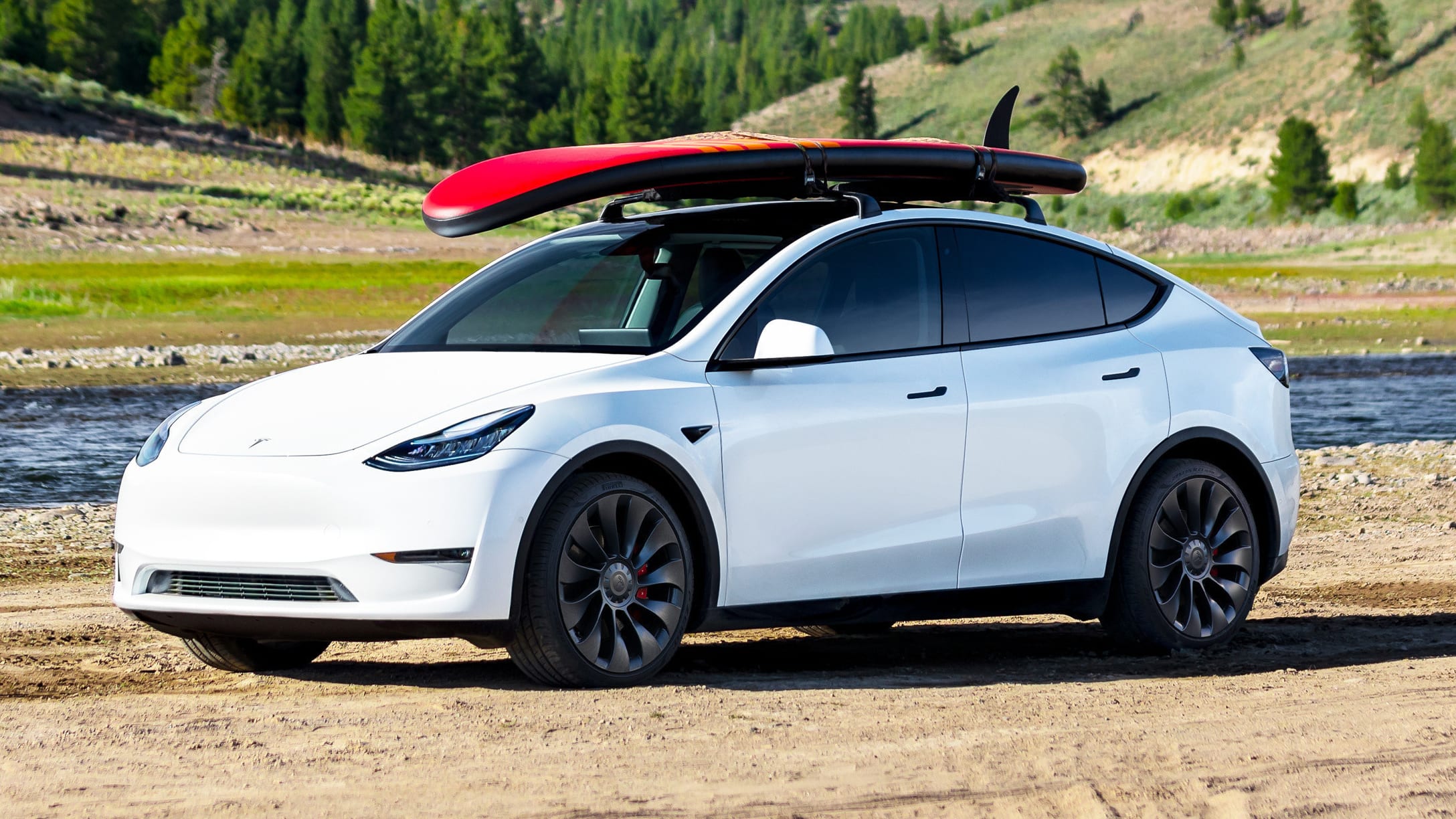
Driving range is slightly down on the sedan too, with the entry-level Model Y featuring a WLTP-rated driving range of 455 kilometres (down from the Model 3’s 491km), the Long Range 533km (13km adrift of Model 3), and the Performance can go for up to 514km on a charge (34km less than the sedan).
As with the sedan, Tesla hasn’t provided specifics around how much power the Model Y makes or its battery capacity, but the rear-wheel drive SUV has a claimed 0-100km/h sprint time of 6.9 seconds, while its all-wheel drive counterpart 5.0 seconds and the performance can achieve a 3.7 second time en route to a top speed of 250km/h.
Where the liftback SUV really shines is in its boot capacity. While the 3 sedan boasts a respectable 649-litre boot space with its second row of seats up, Tesla claims the Model Y has a cargo capacity of 2158 litres when the back seats are dropped, with more accessibility to the rear thanks to its hatch.
https://www.instagram.com/p/Ce0PzWrAsuv/
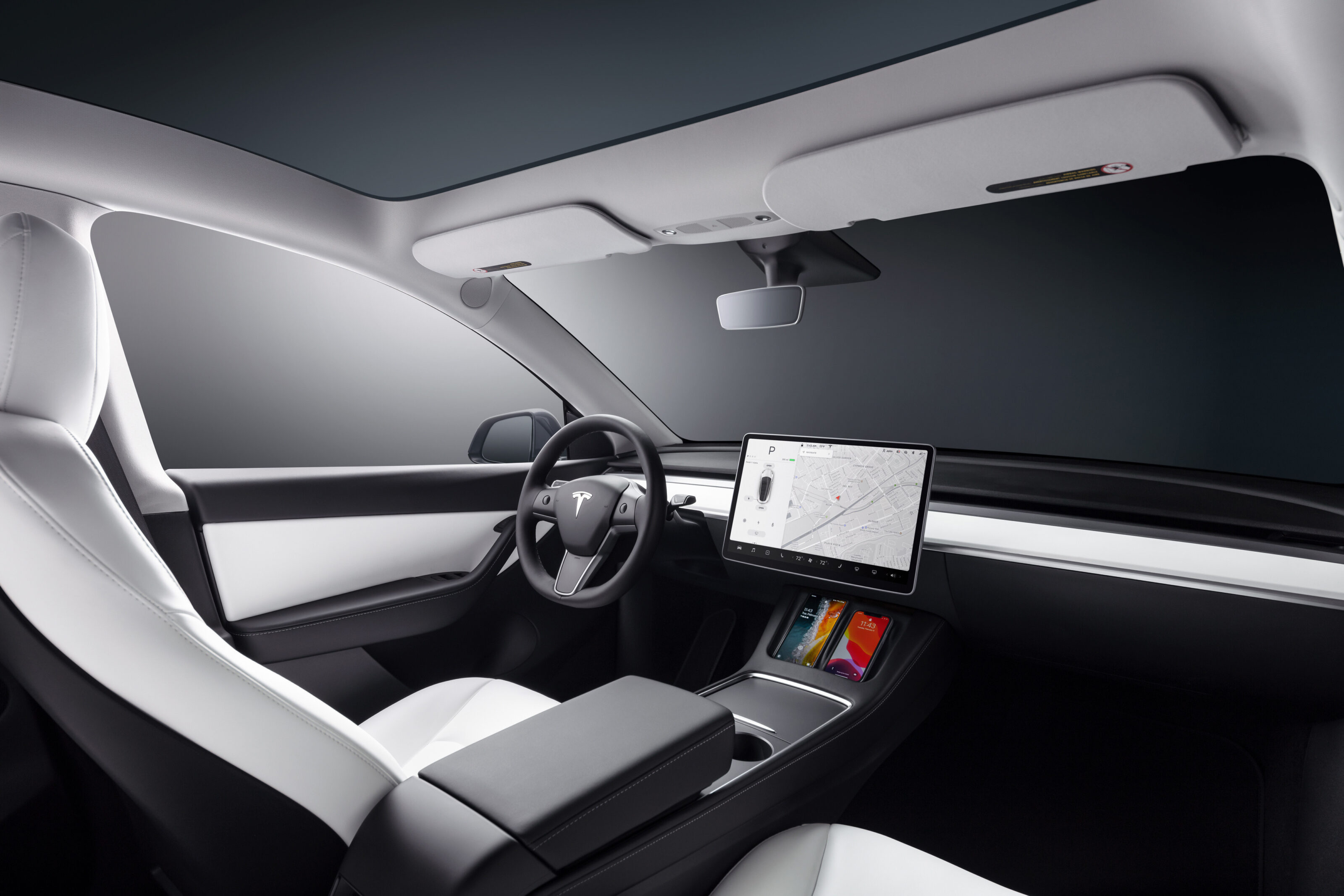
As with the rest of its model range, access to the Model Y is keyless and can be managed through Tesla’s smartphone app, while interior functions are controlled via the centrally-mounted 15-inch touchscreen.
Tesla’s Australian Supercharger network currently consists of 230 chargers at 49 locations, providing the fastest EV charging available locally.
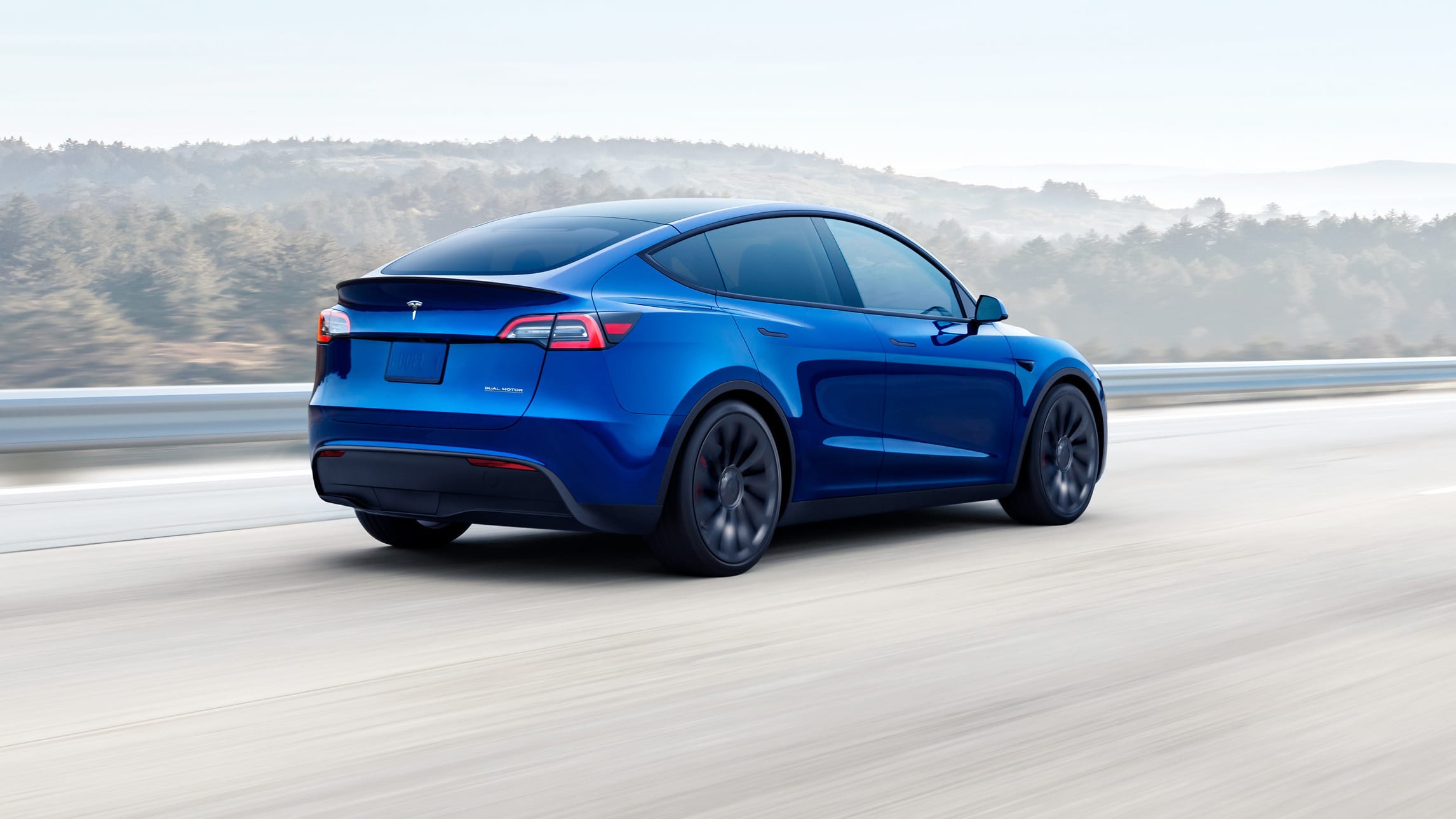
Tesla says deliveries for the Model Y will begin in the second half of the year between August and November, with its online Design Studio now live for customers to personalise their orders.
| Model Y Standard Range RWD features | |
|---|---|
| Single-motor, rear-wheel drive | 19-inch u2018Geminiu2019 wheels (20-inch u2018Inductionu2019 wheels optional) |
| 455 kilometre driving range | All black premium interior (black and white optional) |
| 6.9 second 0-100km/h time | 15-inch central touchscreen |
| 217km/h top speed | 2158 litre cargo capacity |
| 1909kg kerb weight | HEPA air filtration system |
| Five-seat configuration | Tow hitch to become available from early 2023 |
| Model Y Long Range AWD features | |
|---|---|
| Twin-motor AWD | 19-inch u2018Geminiu2019 wheels (20-inch u2018Inductionu2019 wheels $2400) |
| 533km driving range (WLTP) | All black premium interior (black and white $1500) |
| 5.0 second 0-100km/h time | 15-inch central touchscreen |
| 217km/h top speed | 2158 litre cargo capacity |
| 1979kg kerb weight | HEPA air filtration system |
| Five-seat configuration | Fixed glass roof |
Model Y Performance
| Model Y Performance features | |
|---|---|
| Twin-motor, all-wheel drive | 21-inch u2018Uberturbineu2019 wheels |
| 514 kilometre driving range | Performance upgrade pack |
| 3.7 second 0-100km/h time | LED foglights |
| 250km/h top speed | Aluminium pedals |
| 1997kg kerb weight | Fixed glass roof |
Cupra‘s Born electric vehicle is proving to be the brand’s second most popular model locally – with plans in motion to boost the number of cars destined for our shores, according to the firm’s Australian boss.
Due to launch in Australia next month, local executives believe the Born EV could play a bigger role than originally planned in getting the little-known Spanish carmaker off the ground.
Ahead of Cupra’s July arrival in Australia, the brand’s local director is already pushing to increase the number of Born EVs in the sales mix. Ben Wilks believes the new Labor Government’s policies will stimulate the already high level of interest in the VW ID.3-based hatchback EV.
UPDATE, December 2022: Australian Born pricing announced
Cupra has confirmed Australian pricing and features for its Born electric hatch. Get all the details at the link below.
Story continues…
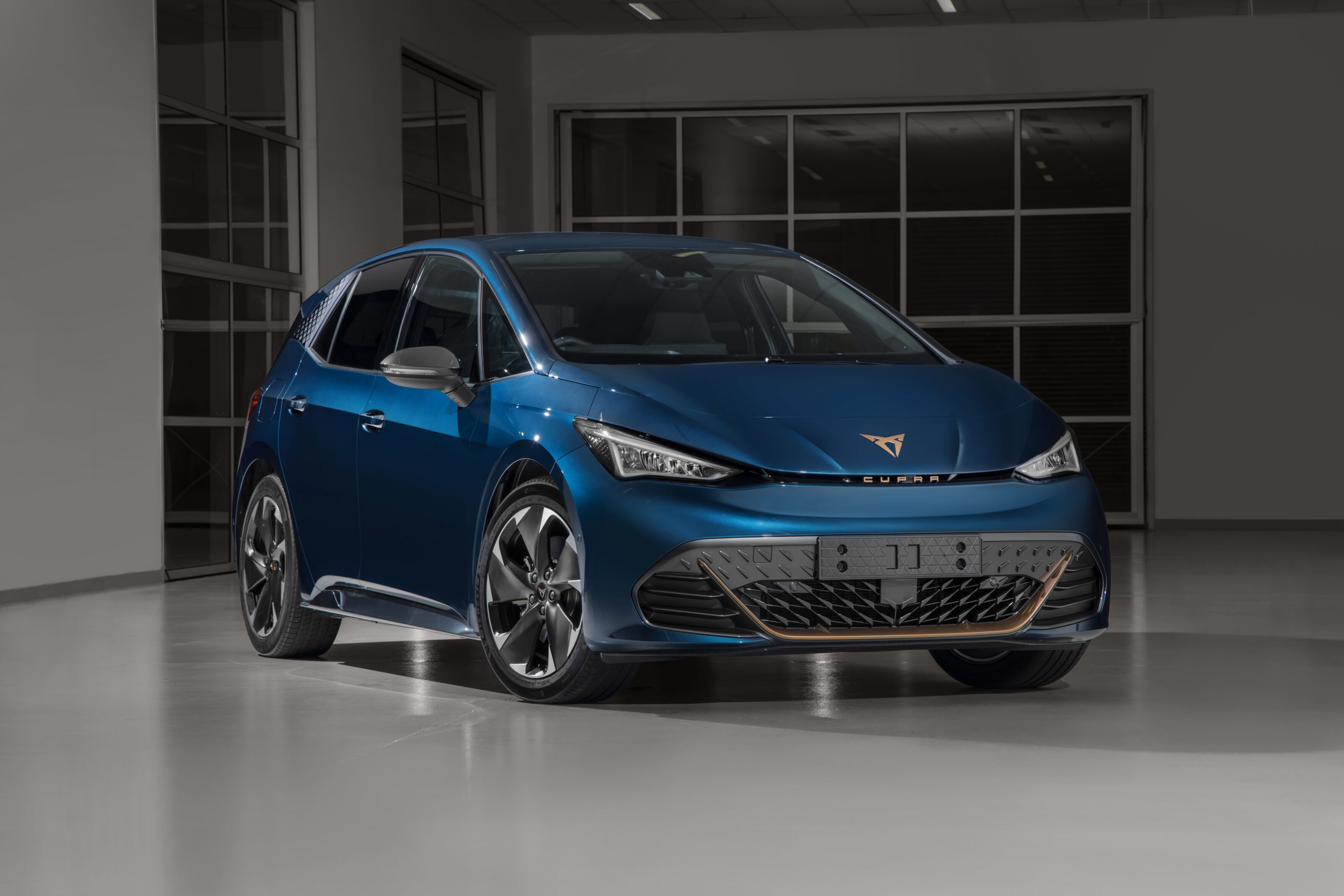
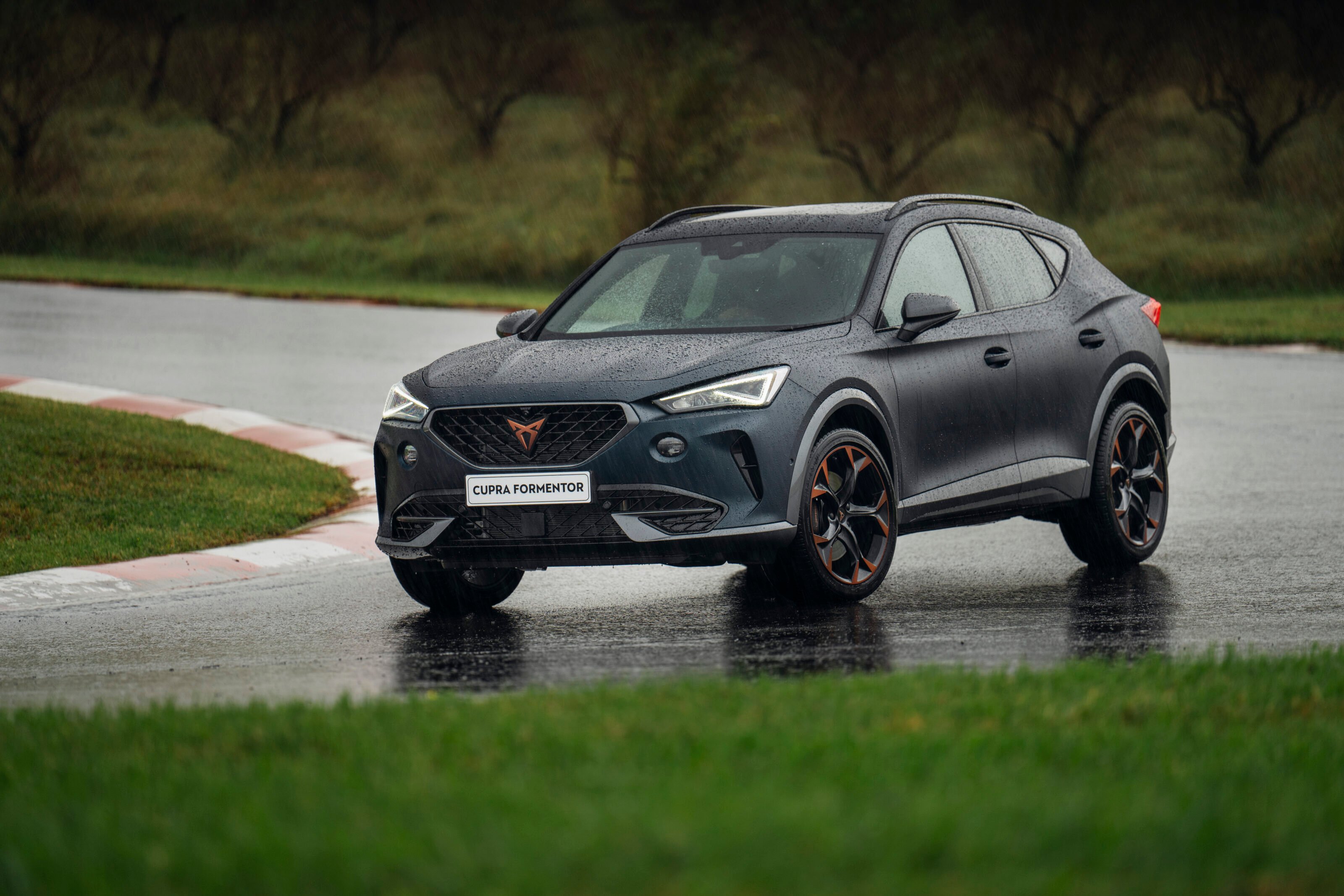
Cupra has been carefully watching indicators of demand for its cars in Australia, including activity on its online configurator. “It’s been the second-highest performing car,” said Wilks.
“So Formentor has been the most, about 40 per cent. Born’s just after it. I think we’re just on 30 per cent of the interest is for the Born. So there’s a huge amount of interest there.”
With Labor’s changes to import duty and Fringe Benefits Tax making EVs more affordable, Wilks is applying pressure to get more Borns. “The demand is certainly there, and we’re using that to push to get as much production as possible.”
Asked if the number of Borns allocated to Australia was higher now than before the Federal Election his reply was simple – “absolutely!”
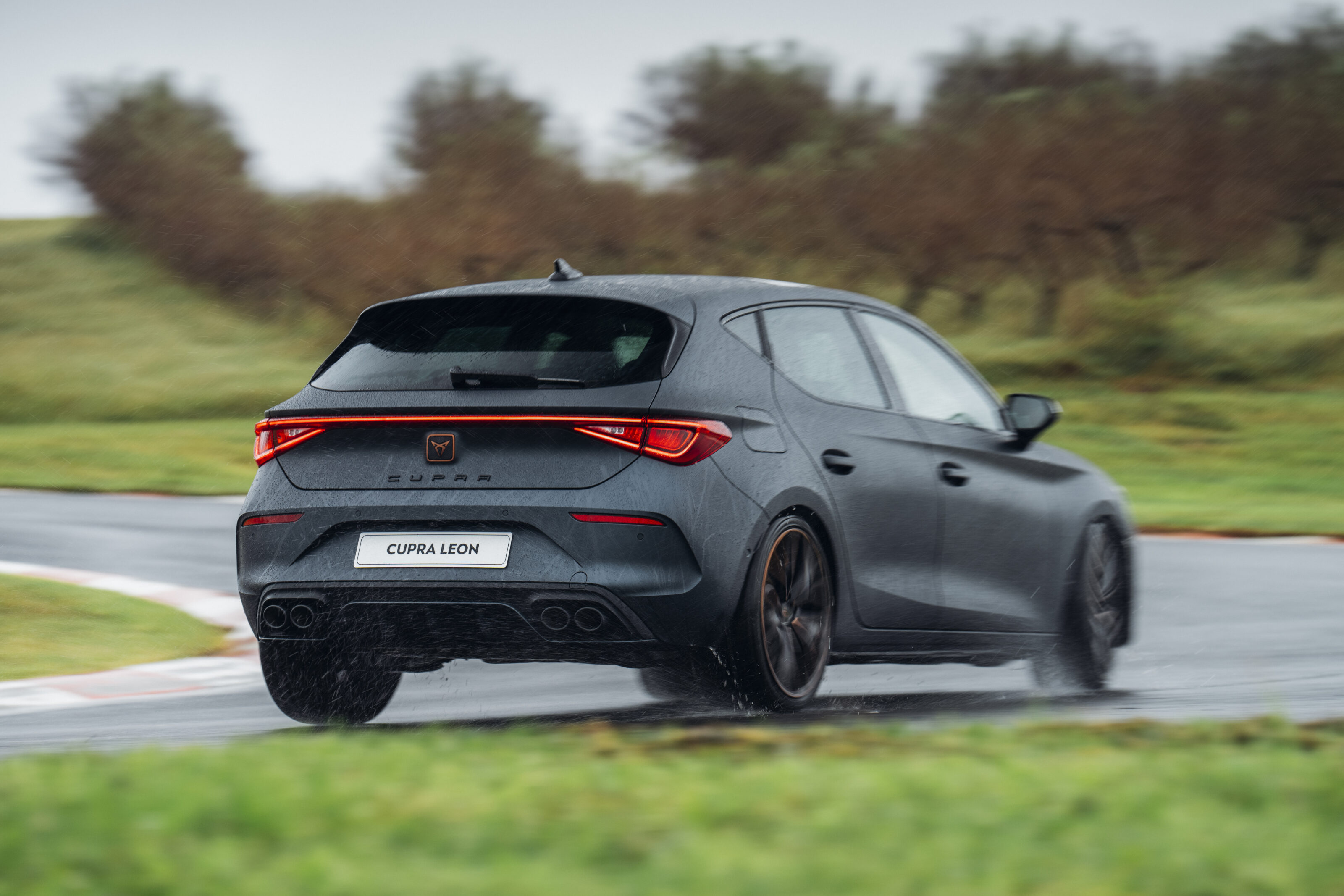
The Born will be added to Cupra’s three-model launch line up of Formentor, Leon and Ateca very early in 2023. Initially, only a version with the largest 77kWh battery pack will be offered.
It’ll be priced similarly to the Leon VZx and VZe, said Cupra Australia product and planning chief Jeff Shafer. This points to a price-tag of around $60,000 before on-road costs.
“For now, where Australia’s at, is having something that’s got a good solid amount of [driving] range to have as the first step in our electric offer,” he said. “Then we can, down the track, move to other batteries.”
The Born is sold in Europe with less costly 58kWh and 45kWh battery packs. Shafer confirmed that both are under consideration for Australia.
Much depends on whether the Labor Government moves to introduce legally binding emissions limits on new cars sold in Australia.
“I think, like most organisations, we want to see clear and consistent policy at a federal level that allows us to have some stability,” Shafer said. State governments have already acted to encourage EV uptake, but the result has been a consumer-confusing range of different incentives.
Ben Wilks believes national measures would be more effective. “It would make a substantial difference,” he said, referring to the introduction of legally binding emissions targets.
Since it launched as an independent offshoot of VW Group’s long established Seat brand, Cupra has delivered 200,000 cars globally, said CEO Wayne Griffiths at an event this week near Barcelona to preview new models coming by 2025.
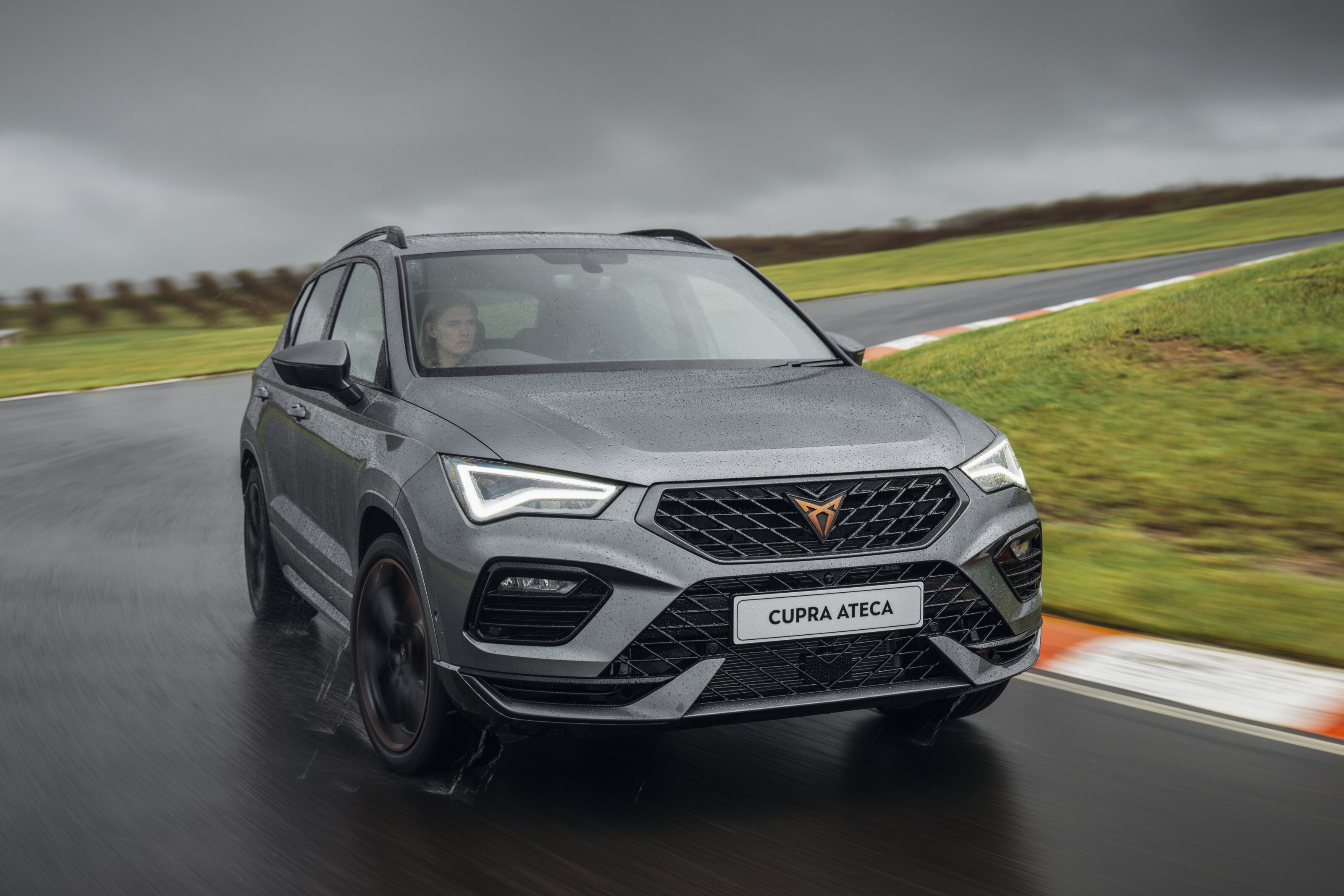
According to Griffiths, Cupra’s turnover has grown from €430 million (AU$642 million) in 2018 to close to €2.2 billion (AU$3.3 billion) in 2021. This is “far beyond expectations”, he claimed.
There’s more to come. “In the mid-term, our aim is to deliver 500,000 cars per year and push forward with our international expansion into new markets as well as entering new segments,” he said. He’ll be counting on Australia to help make this happen.
That 500,000 production number would make Cupra roughly the same size as its parent, Seat. Importantly, from VW Group’s perspective, Cupra’s higher profit margins promise to deliver a much better return on investment than Seat’s line-up of mainstream models.
Aston Martin recently appointed another new CEO, who has brought a bunch of highly regarded names to the table.
Without a doubt, Amedeo Felisa has submitted highly-flying plans and a watertight formula for product-driven prosperity, despite the ripe age of 76.
Having fired the previous number one, Tobias Moers of AMG fame, the majority shareholder Lawrence Stroll decided to put all his money on the Italian connection and its strong Ferrari background.
Meanwhile, the AML passenger car division is haemorrhaging cash as if there was no tomorrow, the state-of-the-art F1 satellite is accrueing championship points at a disappointingly slow rate, the market cap has plummeted to a little over £800 million, and the high-risk strategy for the next five to 10 years may drive the English sports carmaker straight into the arms of a new investor, or – in a worst case scenario, the liquidator.
What are the options for the fashion industry billionaire who is prepared to move heaven and earth to beat Ferrari at its own game? And what does it take to steer the coveted and still valuable brand to sustainable profitabilty?
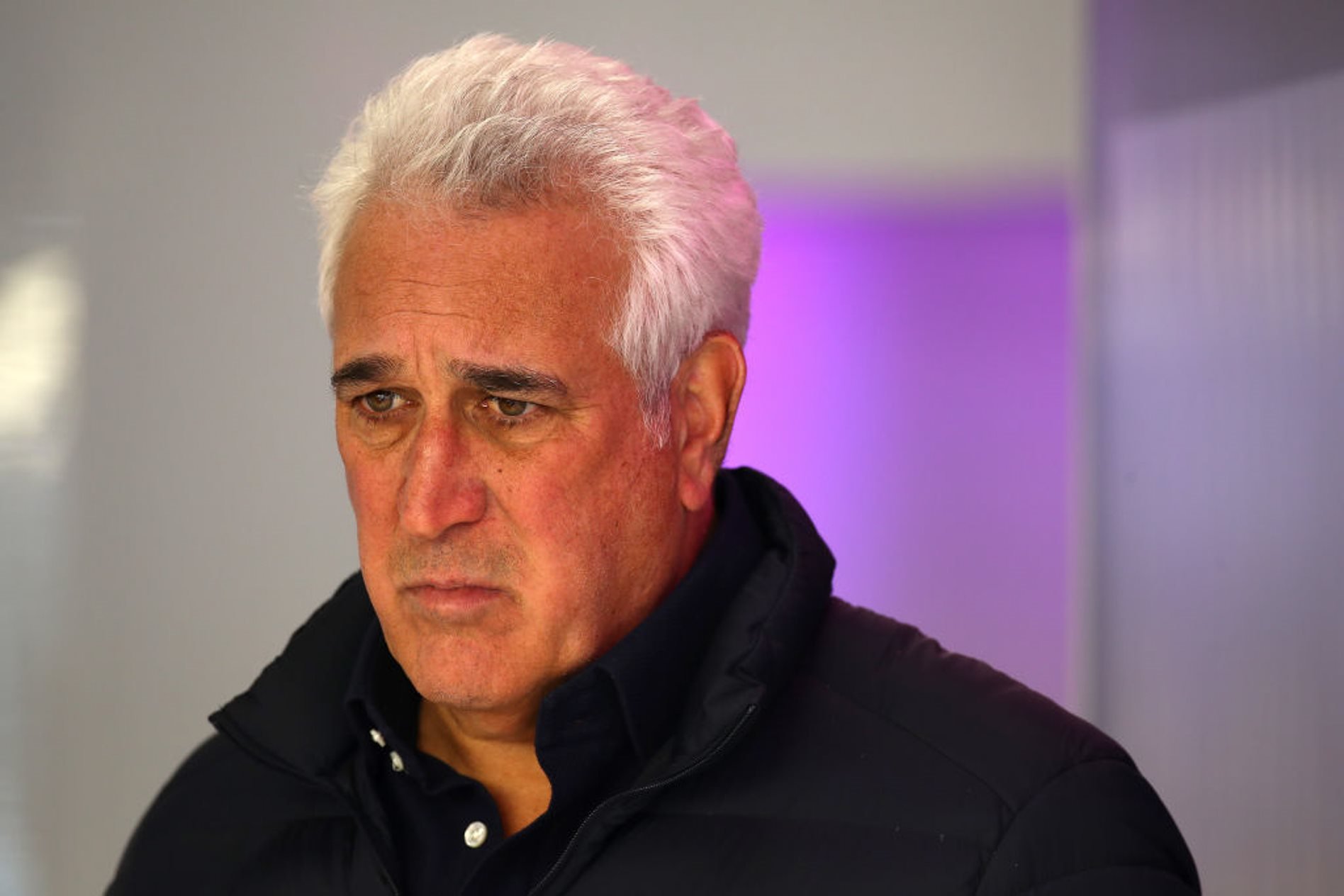
In early 2020, the Canadian tycoon Lawrence Stroll invested around £182m in Aston Martin Lagonda Global Holdings plc, which bought him a 16.7 per cent share of the company. This was later extended to 25 per cent. In October of the same year, Mercedes confirmed its intention to increase its holding in stages from 15 to 20 per cent.
Within the last twelve months, however, the AML share price fell from £26 to £10, fixing the current value at £813m. Since debts and other liabilities are claimed to amount to close to €1 billion, the company´s financial situation can only be described as dire. Which is bad news in view of the fact that Aston soon needs fresh funds to develop the eagerly awaited mid-engined sports car, not to mention a fresh range of fully-electrified classics and few-offs.
What is going to happen next? The low share price makes AML an attractive takeover candidate. Mercedes first considered a purchase years ago when they were still contemplating the Premium Sports Luxury division that would have included AMG, Maybach and Aston.
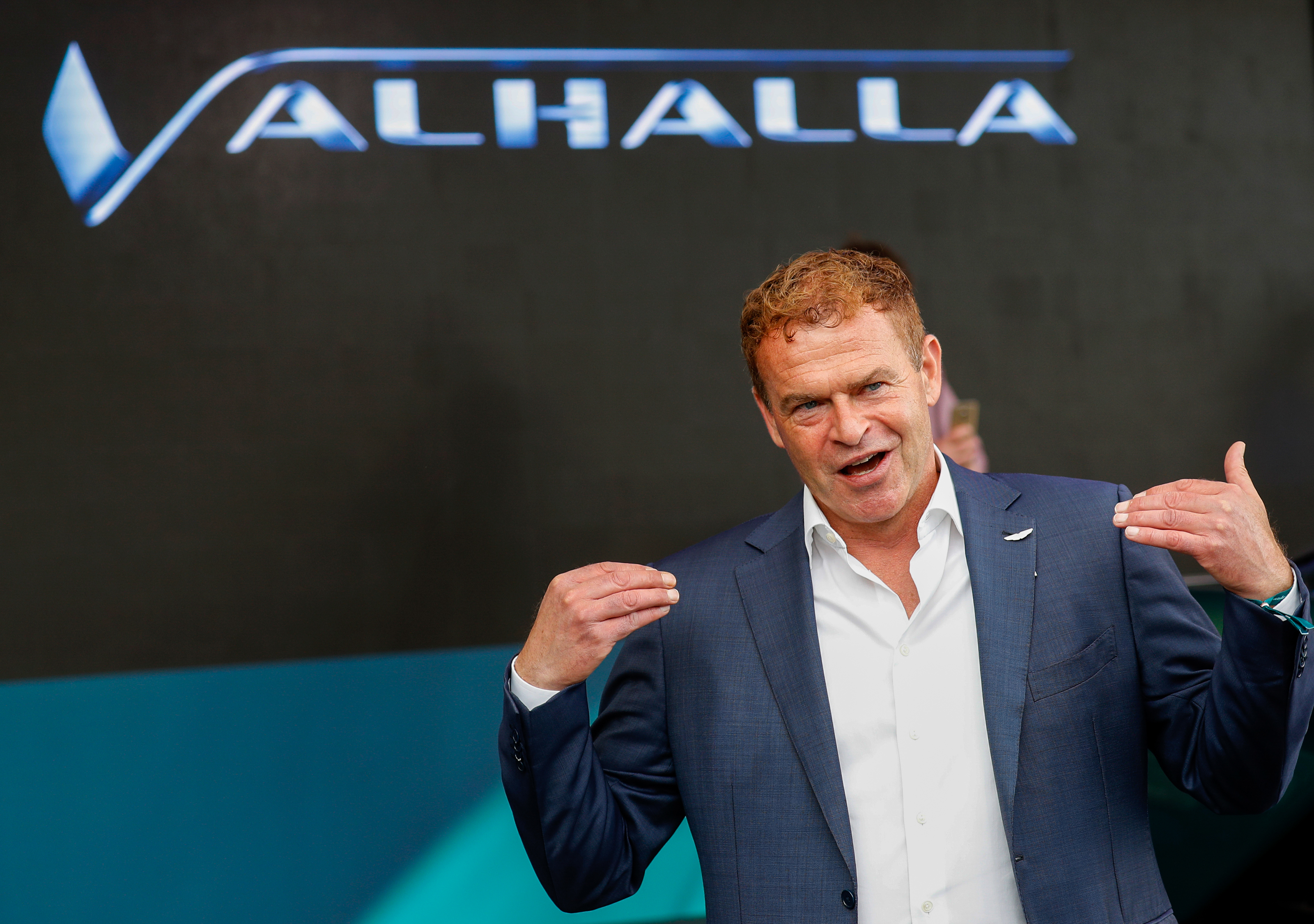
An Audi delegation was at the 2022 Jeddah GP approached by Stroll and allies. Both parties met again in Silverstone on May 7/8 at the team´s incredibly advanced F1 HQ to talk about possible joint efforts on- and off the track. Fielding one car as Audi and the second as Aston emerged as one of several options.
The Germans are also said to be inclined to check out the passenger car division, but after the rocky McLaren experience, they now insist on an early due diligence check – which takes at least four weeks and won´t be completed before early July. Apparently, Lucid Motors is also interested in developing a joint electric sports car architecture with Aston, but the cash-poor Americans would need a wealthy backer to make this off-beat programme fly.
The darkest horse in this autojumble is Geely. The Chinese MB affiliate, which already owns Lotus, Polestar, Volvo and Seekr, has repeatedly voiced a strong interest in Aston. It has the money to buy the company outright, but might alternatively provide access to Lotus and Seekr technology in exchange for a to be decided number of shares.
Unlike the colourful amateur investors who have been running the on-off Aston Martin show with mixed fortunes for most of the century, the Geely chairman Li Shufu has the power, the vision and the network to turn AML into a serious player in the premium sport-luxury market. Thanks to the Mercedes connection, the future product plan mapped out by the departed CEO Tobias Moers could be easily confirmed or reinstated, using AMG architectures, OS and drivetrains as planned.
What exactly did go wrong for the previous chairman? On the surface, Moers was grilled for not meeting the delivery targets of the first batch of Valkyrie hypercars – which are instrumental for the firm´s cash-flow and image.
In reality, however, it was the initially unintended concerted effort of the predominantly-British Aston establishment and the majority stakeholder-cum -entourage that ousted the chairman after less than two years at the helm.
Mind you, Tobias Moers is not your generic easy-going, pragmatic and harmony-seeking top manager, but a relatively rough, and occasionally rowdy, certified engineer who was born to execute and deliver – not to deliberate and reconsider.
As a result, his arrival struck the Gaydon complacency like a bomb. It did not take the Swabian long to sift the wannabes from the pros – the first group was fired, the second merely tolerated. His main confidantes were the new COO Michael Stonaugh (ex-Bentley), the chief powertrain engineer Ralf Illenberger (ex-AMG) and the purchasing Tsar Aurelien Faucheux (ex-Nissan).

Making enemies, not friends, was an inherent part of the unavoidable collateral damage. The chief creative officer Marek Reichmann and Tobias Moers clashed early on in the game, the chassis guru Matt Becker threw in the towel soon after, and the lesser ranks were not exactly thrilled either when they found out that the head honcho was about to establish satellite R&D offices in Remshalde (a Stuttgart suburb) to get specialist work done faster and more professionally than in the UK.
No, the former-AMG chief certainly is neither Mr Nice Guy nor the world´s greatest motivator. But he was firmly on track to speed up the transformation to a sleeker digital company until Monday, May 2, when, upon his routine arrival in the UK, the luckless HansDampf was told that his services were no longer required.
Since late last year, the writing on the wall left little doubt that the end of the TB regime was near. While Marek had virtually free reign as design was in many cases prioritised over engineering, Tobias struggled to please the big boss who later hired Amedeo Felisa as chief technical advisor. He also mulled over installing his new friend as the next CTO, which would have further undermined the CEO’s already shaky standing.
At a princely rate of £10,000- a-day (all salaries are made public by law), the former Ferrari chairman started to put together his own shadow cabinet. Over a short period of time, Felisa gathered a bunch of well known former Ferrari workmates like Marco Mattiacci (sales and marketing), Roberto Fedeli (recently confirmed as the future CTO) and Vincenzo Regazzoni (manufacturing). Weeks before he left, Moers himself took on Claudio Santoni, the driving force behind the breakthrough McLaren carbon fibre tub.
People who know him picture Lawrence Stroll as a dedicated motorsport guy, a shrewd businessman, an avid car collector and a retail specialist who is about to open a number of AML flagship stores all over the world to boost the ho-hum brand image, sources say.
Insiders describe him as supportive, but not always trusting, a sports car aficionado rather than a visionary, an executive who doesn’t take no for an answer and enjoys running his one man show from the lofty top.
But he is a newcomer to the car industry, and the paradigm shift from combustion engines to fully-digitalised EVs is neither his pet subject nor his forte. Within only six months, he turned from a half-hearted Moers supporter to a full-time sceptic. In the end, he obviously had more confidence in Marek and Amedeo than in Tobias, who had played all his aces by laying out a solid future product portfolio that relies heavily on Mercedes platforms, systems and software.
One of Felisa’s many claims to fame is his very first modular all-aluminium Ferrari architecture capable of underpinning front- and mid-engined sports cars of all sizes. It was an ingenious concept, quite affordable and modular before the word became common language, highly flexible and with a huge potential for multi-cycle evolution.
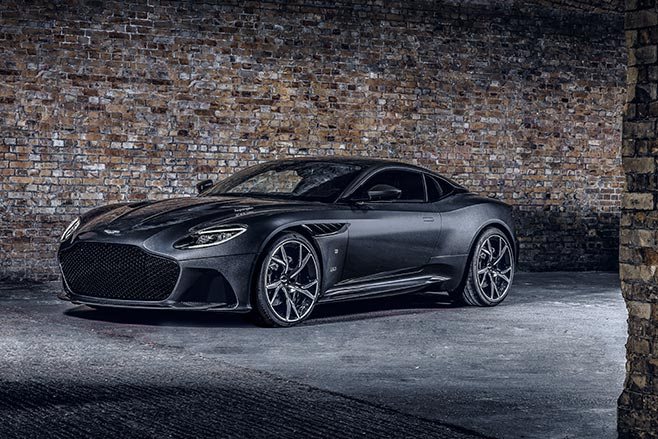
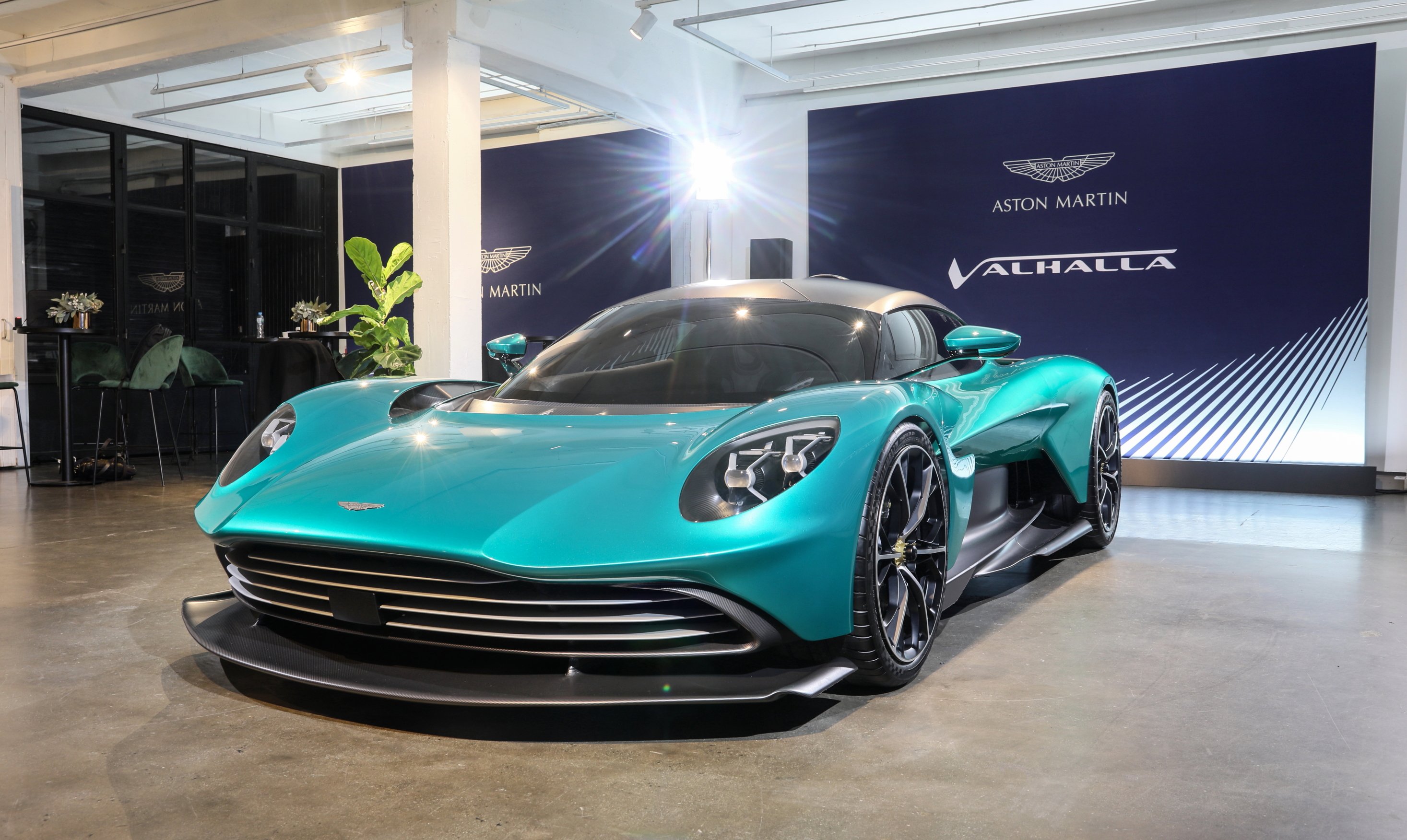
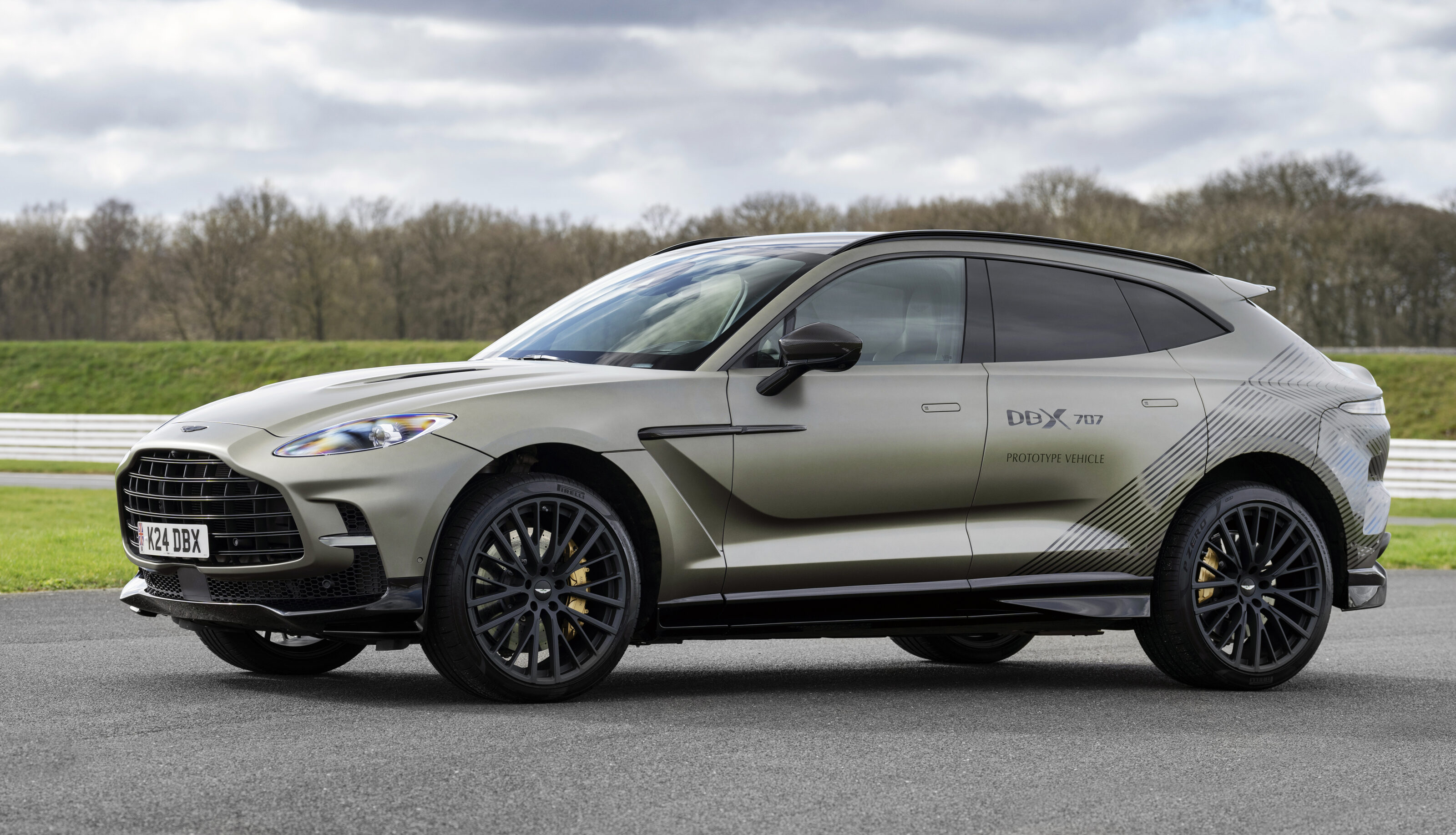
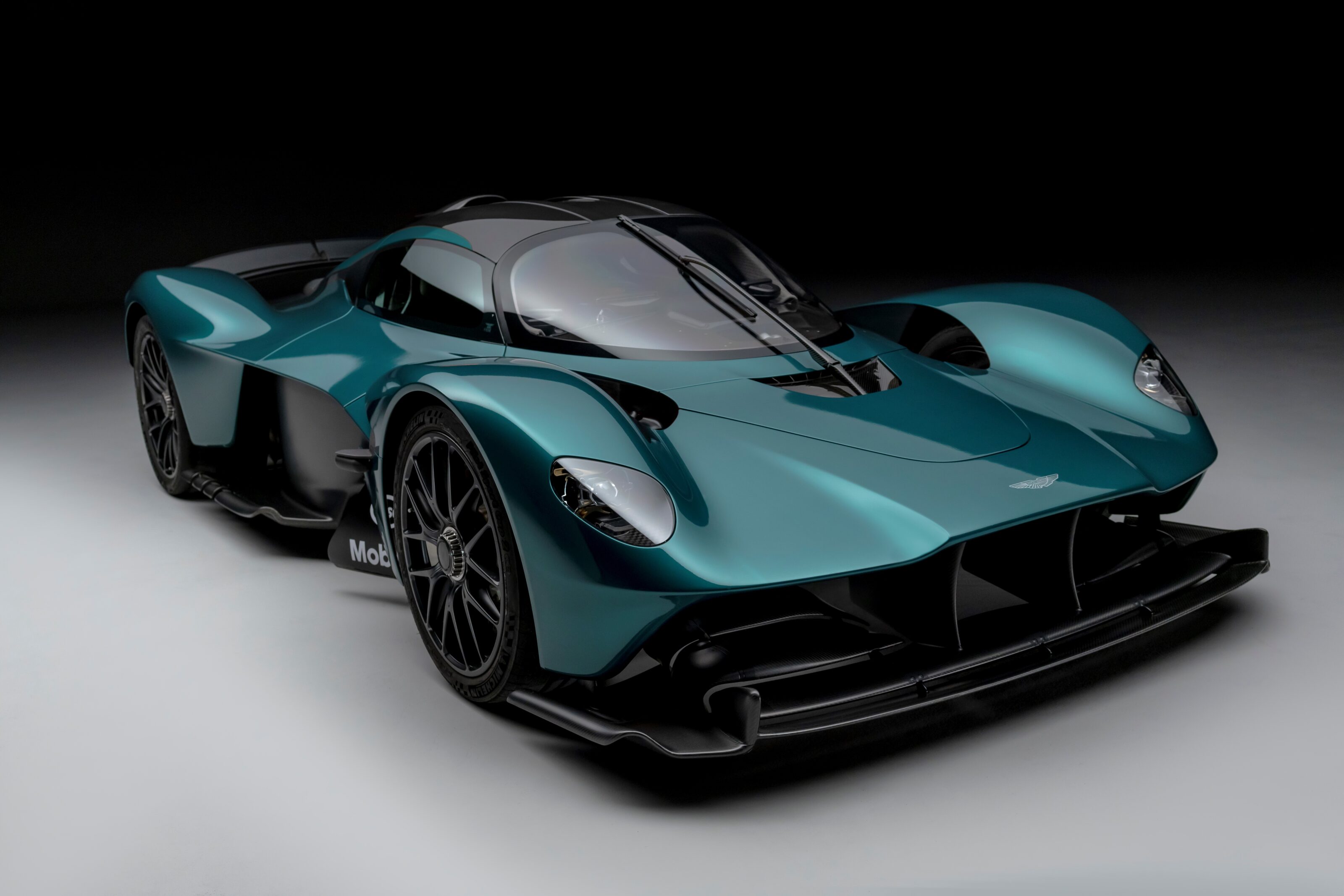
When the commendatore-to-be first arrived in Gaydon, he found a relatively modern and closely related model range consisting of Vantage, DBS, DB11 and DBX. In a different orbit, AML had just launched the Valkyrie hypercar and was laying the finishing touches on the Valhalla supercar, both developed and built in conjunction with the UK specialist supplier/manufacturer Multimatic – which is also in charge of the AMG One.
While the marque’s own V12 would need work to meet the EU7 emission norm, the AMG V8 is a safe CO2 bet through the end of the decade.
Under Moers, the convoluted production process was straightened, the scope of the colour and trim facility was drastically expanded, the scalable rear subframe of Valkyrie and Valhalla was the designated basis for all future mid-engined cars – perhaps even including the upcoming EVs.
Had Stroll supported this clear-cut strategy, he would have kept his German front man, no doubt about it. But the fashion tycoon fell for Felisa instead.
Why? Because with a bit of luck and extra effort, no one can design, develop and build a better Ferrari fighter than the best chief engineer Ferrari ever had.
But here comes the crunch: Felisa is allegedly not prepared to make Gaydon his new second home. Instead, he would prefer to transfer the R&D department lock, stock and barrel to Northern Italy, where talent, suppliers and facilities are readily available in the heart of the Modenese motor valley.
There was talk about Aston moving into the Silk Roads/FAW complex in Reggio Emilia, where the Chinese start-up planned to assemble that ominous de Silva-designed e-hypercar announced in February 2021.
But upon closer inspection, the incubator techno park turned out to be little more than a fenced greenfield site on the appropriately named Viale Felisa. It’s still possible a pending notary agreement will provide access to this conveniently situated location, but scouts are simultaneously checking out possible alternatives in the greater Boilogna area.
Mind you, we’re talking about a design and engineering centre, not a full-scale assembly plant.
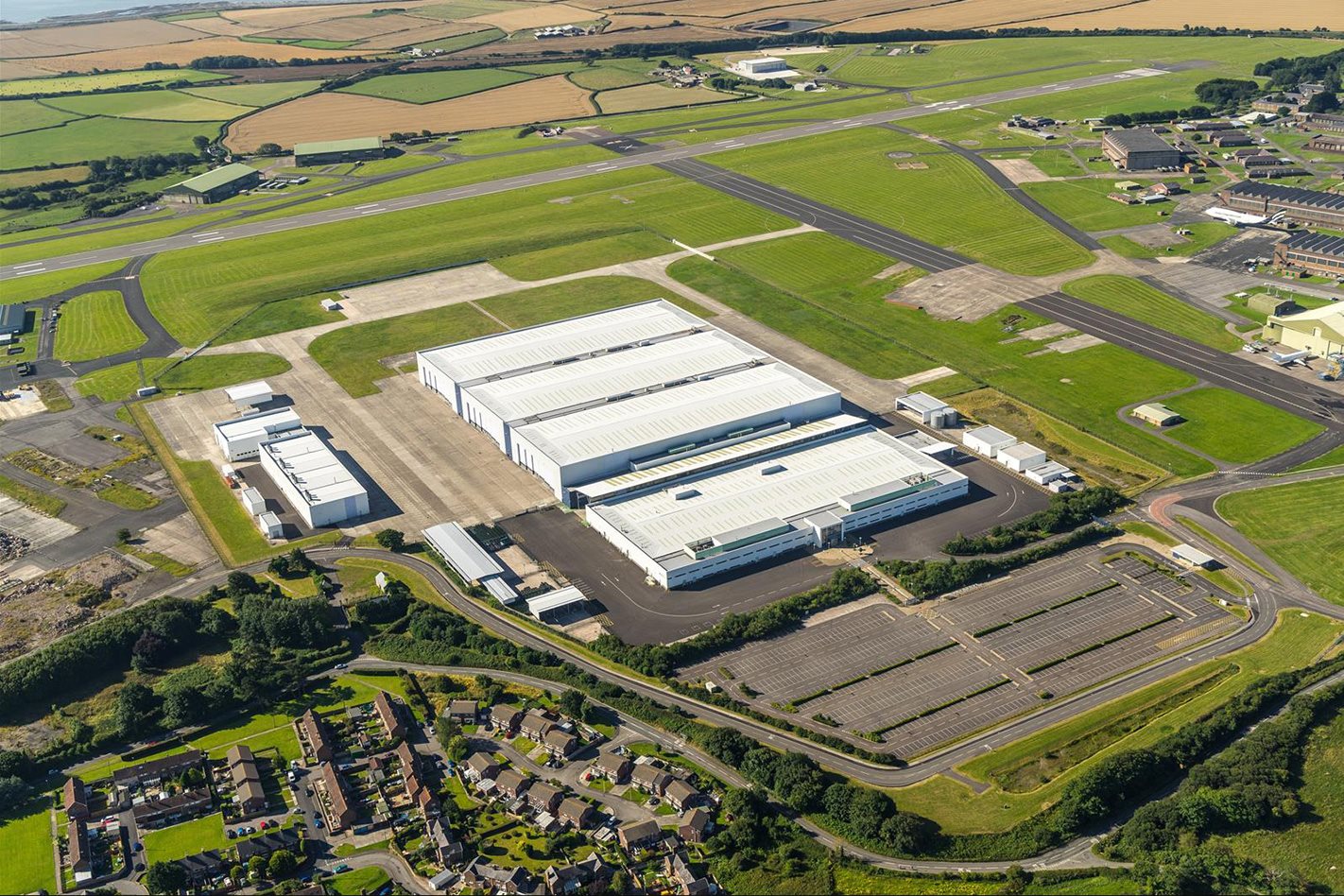
What is going to happen to Gaydon, you ask? According to those in the know, AML has a while ago signed a sale and lease-back scheme, which would allow them to close the site for good with very few strings attached. Right now, the maximum theoretical capacity with all the stops pulled out is a claimed 27,000 units – 12,000 in Gaydon and 15,000 in St Athans, Wales – which only opened in November 2019.
Having invested more than £200m in the Silverstone F1 showcase premises and facing a major revirement of the sports car division, Mr Stroll needs to keep a watchful eye on his cash-flow, so shutting Gaydon may indeed be a shrewd move.
Only time will tell whether the Italian connection is an equally clever strategic gambit. The up-front expenditure is bound to be considerable, and the return on investment won’t show on the balance sheets before 2025 when that mid-engined Project AM900 is expected to debut.
At this time, the marque’s crystal ball is clearly loaded with plenty of ifs, buts and question marks. Will the new leadership use the hybridised 622kW Mercedes V8 as planned, or revive its own, more compact and lighter 708kW 3.0-litre V6?
Does deriving the mid-engined Vanquish from that modular high-end hypercar/supercar DNA really warrant a water-tight business case? Which role will the DB12 (follow-up to the DB11) play, and what about that allegedly dramatically different DBS replacement? Is Aston about to fall in the McLaren rut by spreading too little substance over too much ambition?
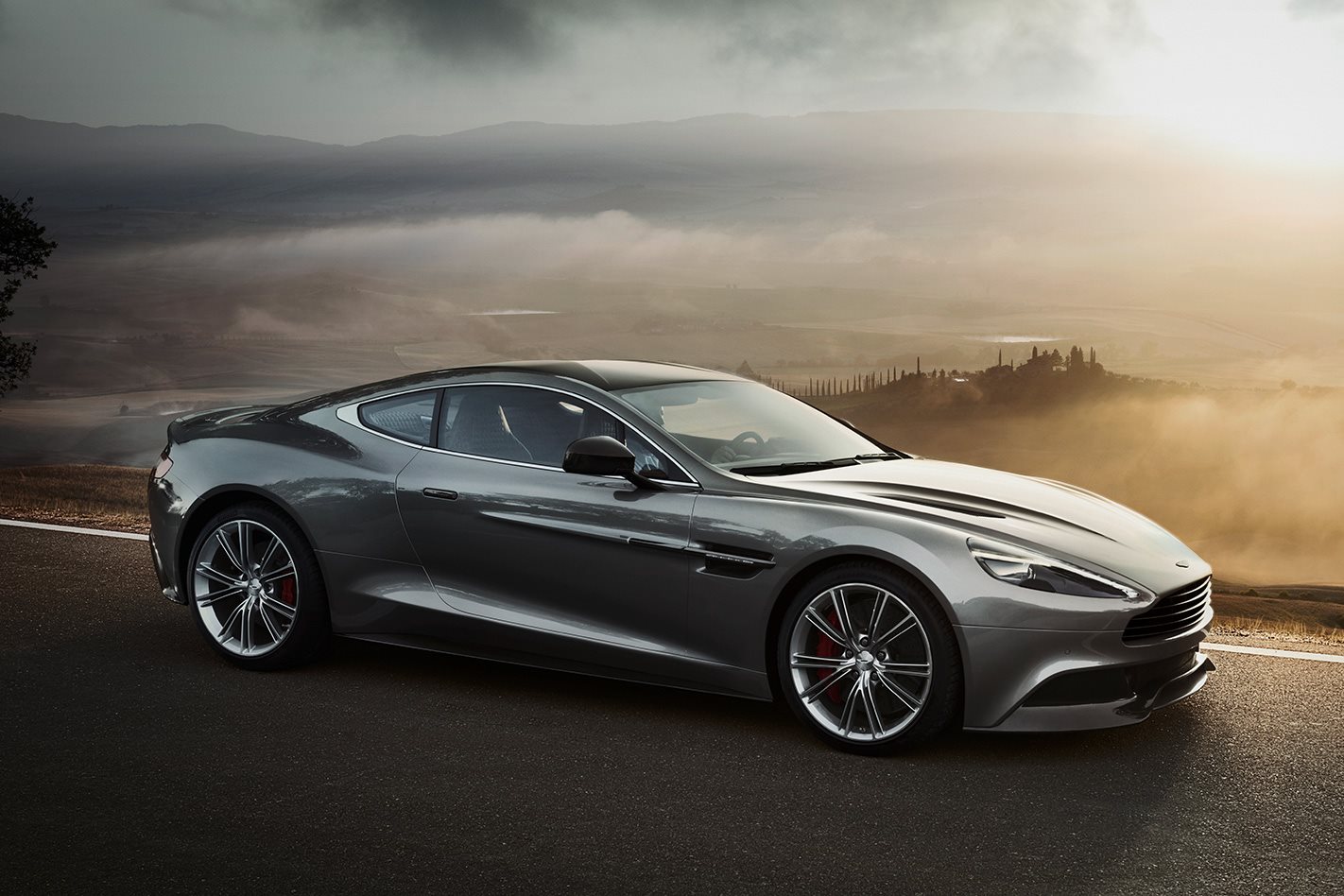
Let’s, for a start, look at the role Mercedes will likely play in the restructuring. According to a couple of sources from Stuttgart, the open-end co-operation deal with Aston is surprisingly flexible. In a nutshell, it’s a friendly can-do scheme, not a must-do arrangement.
The Germans are willing to supply engines and other componentry including complete architectures at comparatively favourable rates, at least until the end of the decade.
But there is an exit clause which lets AML off the hook short-term should the company choose to change direction. Also, Mercedes has yet to officially agree to be Aston’s EV partner. The contract with Multimatic is a separate item.
Since the specialist shop is about to ink a major long-term contract with Ford, Aston may have to renegotiate or find a new supplier – think Dallara, sit back and relax. The final assembly for all models could quite easily be pooled in St Athans where labour is cheap but qualified personnel hard to come by.
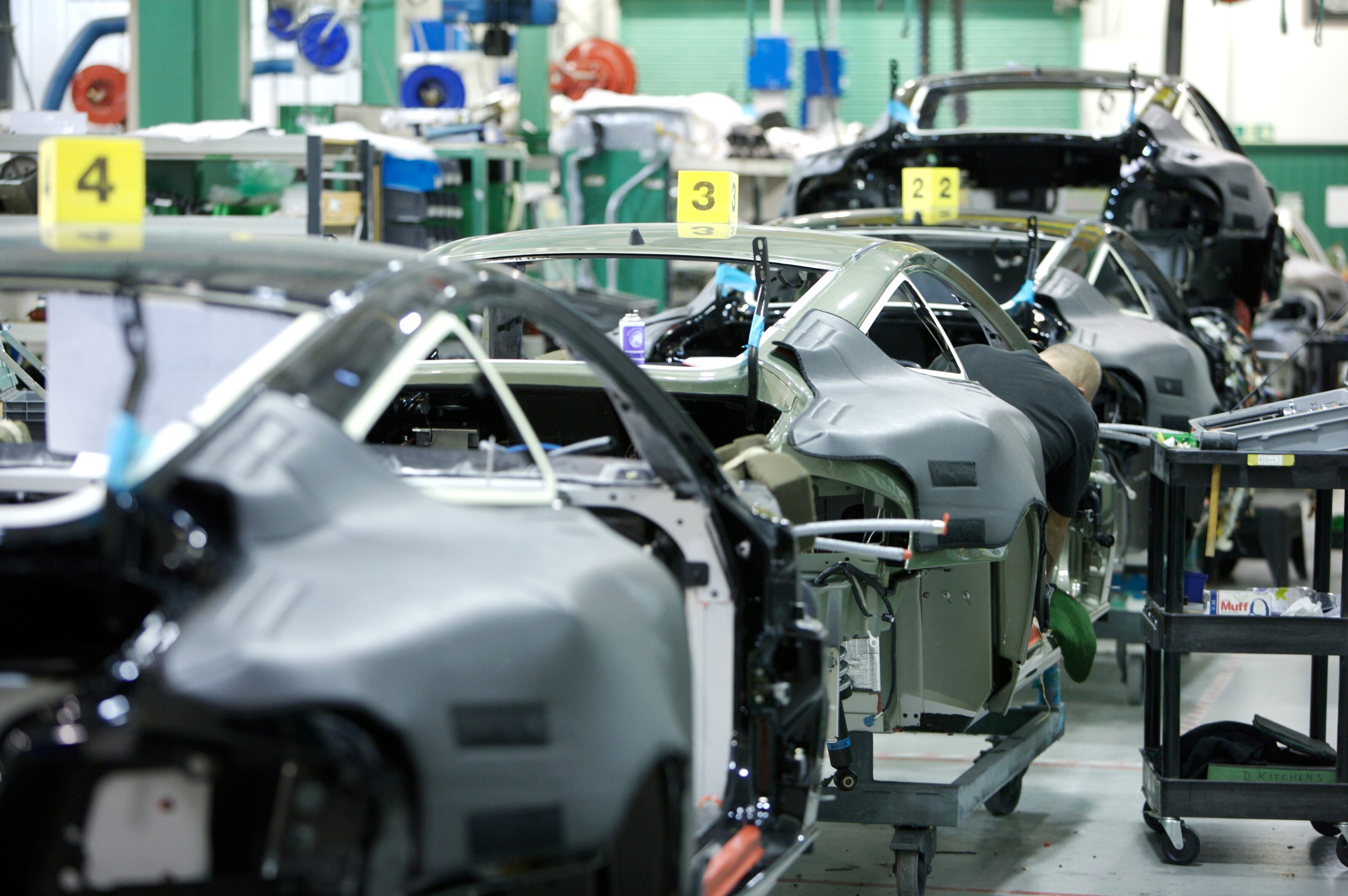
More than two years since the first announcement, both the Valkyrie and the Valhalla look underpriced and are thus unlikely to earn the targeted margins, the tag the bigwigs have in mind for the 622kW AM009 (new Vanquish) is tipped to undercut the Ferrari F296, and the ageing front-engined sports cars which are about to receive a facelift complete with a new IP are not exactly surefire long-term money makers either.
Adding the Valkyrie Spyder and a track-only version should help, but the main vessel hope is the DBX – which goes PHEV next year, while the rumoured coupé is still hanging around behind the scenes.
Last but not least, the Vantage is due for a number of design and engineering upgrades which should include a new 447kW-plus top-of-the-line V8 powertrain. That’s a lot of variation, complexity and low-volume niche product for a manufacturer which sold 6200 vehicles last year – an 80 per cent increase over 2020, but still not even close to Ferrari’s 11,155 units.
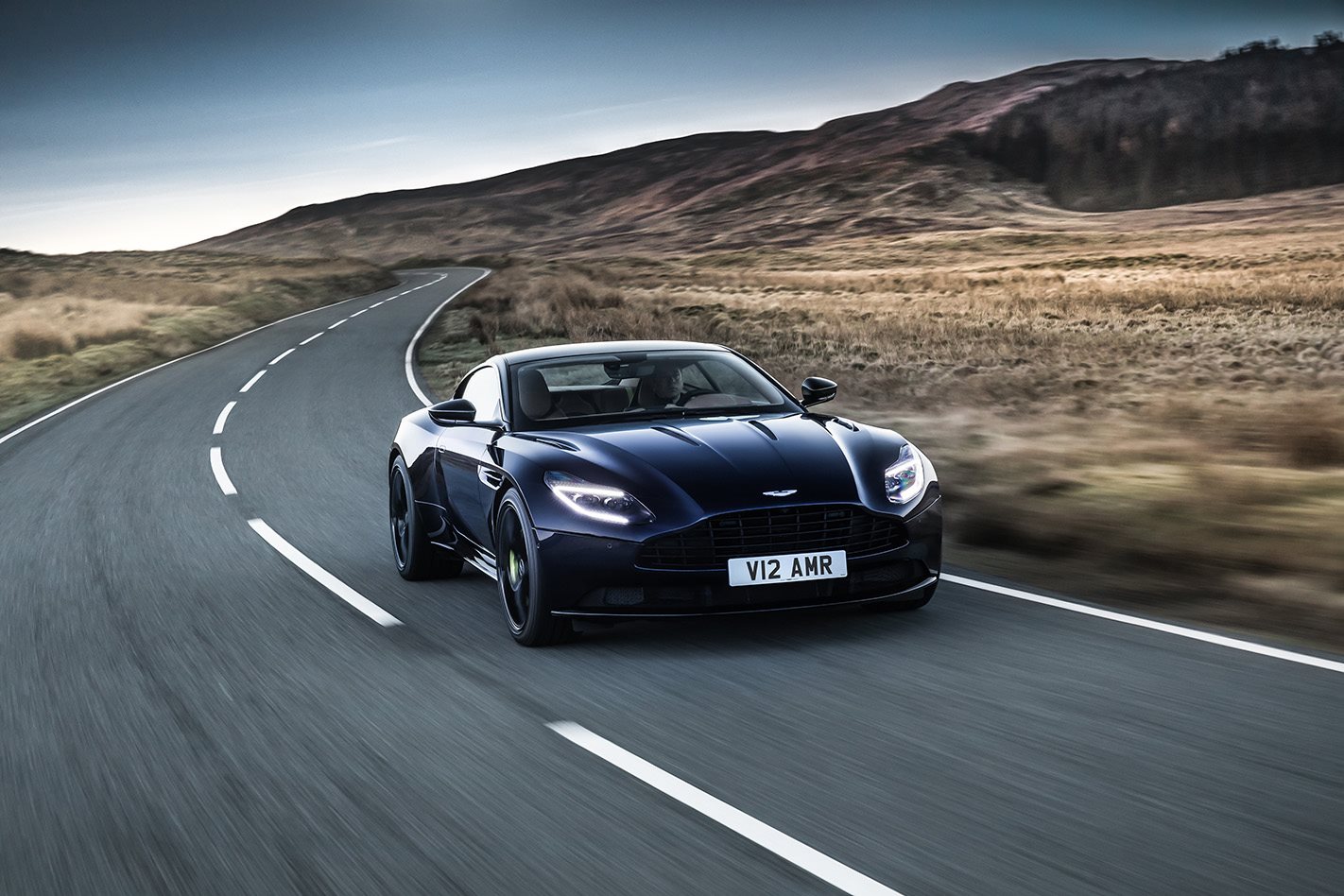
The fully-electric age should dawn for AML no later than 2027 when the first battery-powered SUV is due, which will probably be sold alongside the DBX for some time.
It shares its underpinnings with a brand-new AMG crossover dubbed X591. Although it is available to Aston, management has so far rejected the four-door EV coupé based on the AMG GT-S replacement.
Not unlike the slow-selling Rapide in character and ability, this bodystyle was once considered as a possible comeback star for Lagonda, but reviving the almost forgotten brand turned out to be much too costly.
Which leaves the brand with a zero-emission coupé and roadster expected in 2028 and 2027 respectively. While the roadster is in essence a rebodied and more powerful variation of the follow-up to the next Mercedes AMG SL, the coupé owes its genes to the future e-power AMG GT codenamed C592. The DB12 due in 2025 and the next DBS – if it happens at all – are expected to go down the PHEV avenue. Is this plan still up-to-date? Only messieurs Felisa and Stroll know the answer.
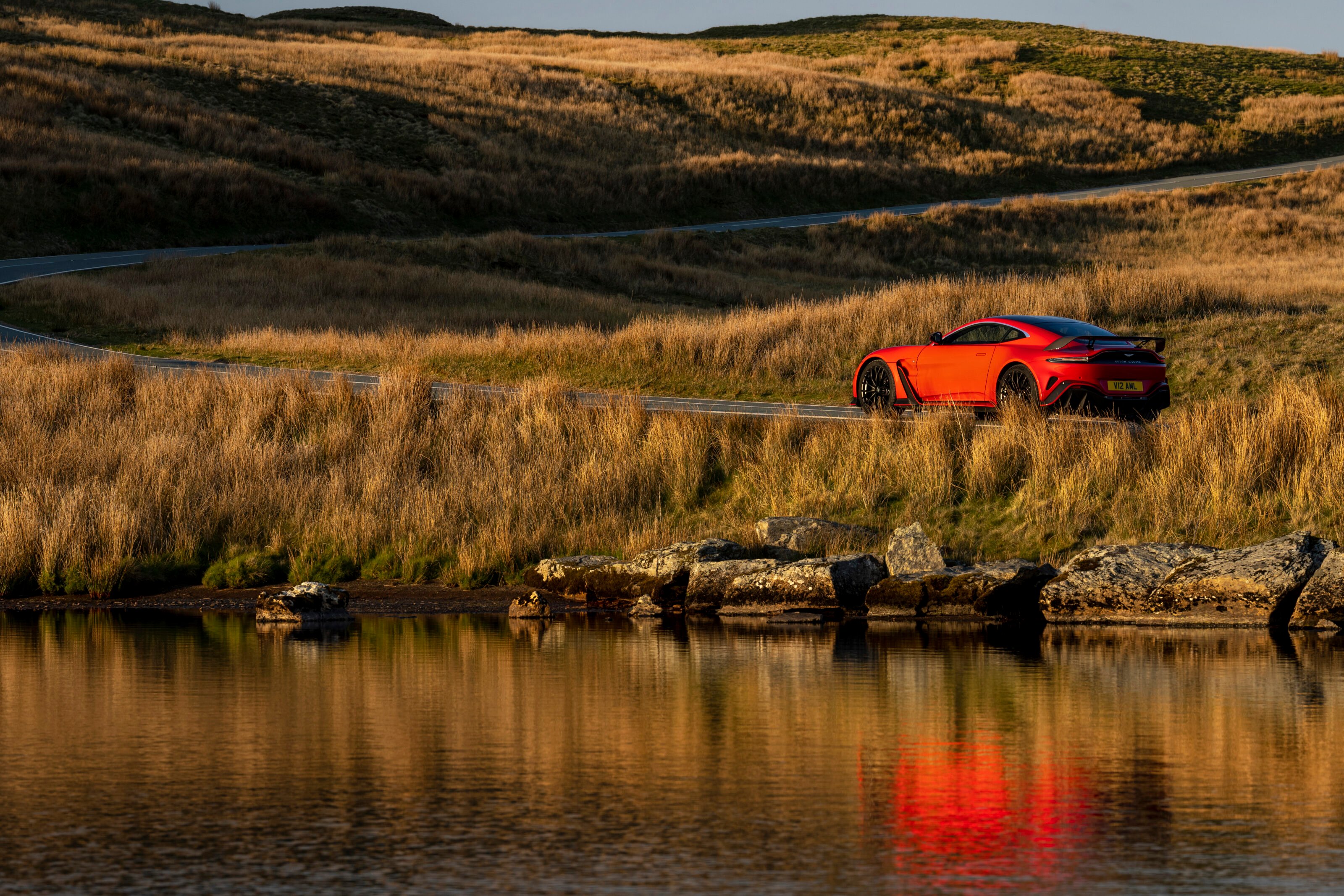
The biggest challenge these two men are facing concerns a magnitude of adaptation and integration issues.
At a point in time when the inside line to Mercedes and AMG needs to be reconfirmed, fusing Anglo-German hard- and software, rewriting programmes for both brands, linking two operating systems, co-ordinating a host of interfaces and creating a common, fully flexible and upgradable electronic architecture is bound to be an arduous, time-consuming and costly task.
Even though Felisa, who still is one of the top guys in the business and who – unlike Moers, the solitary soldier – has several right-hand aides he can actually trust, may find this conflict situation uncomfortably tricky.
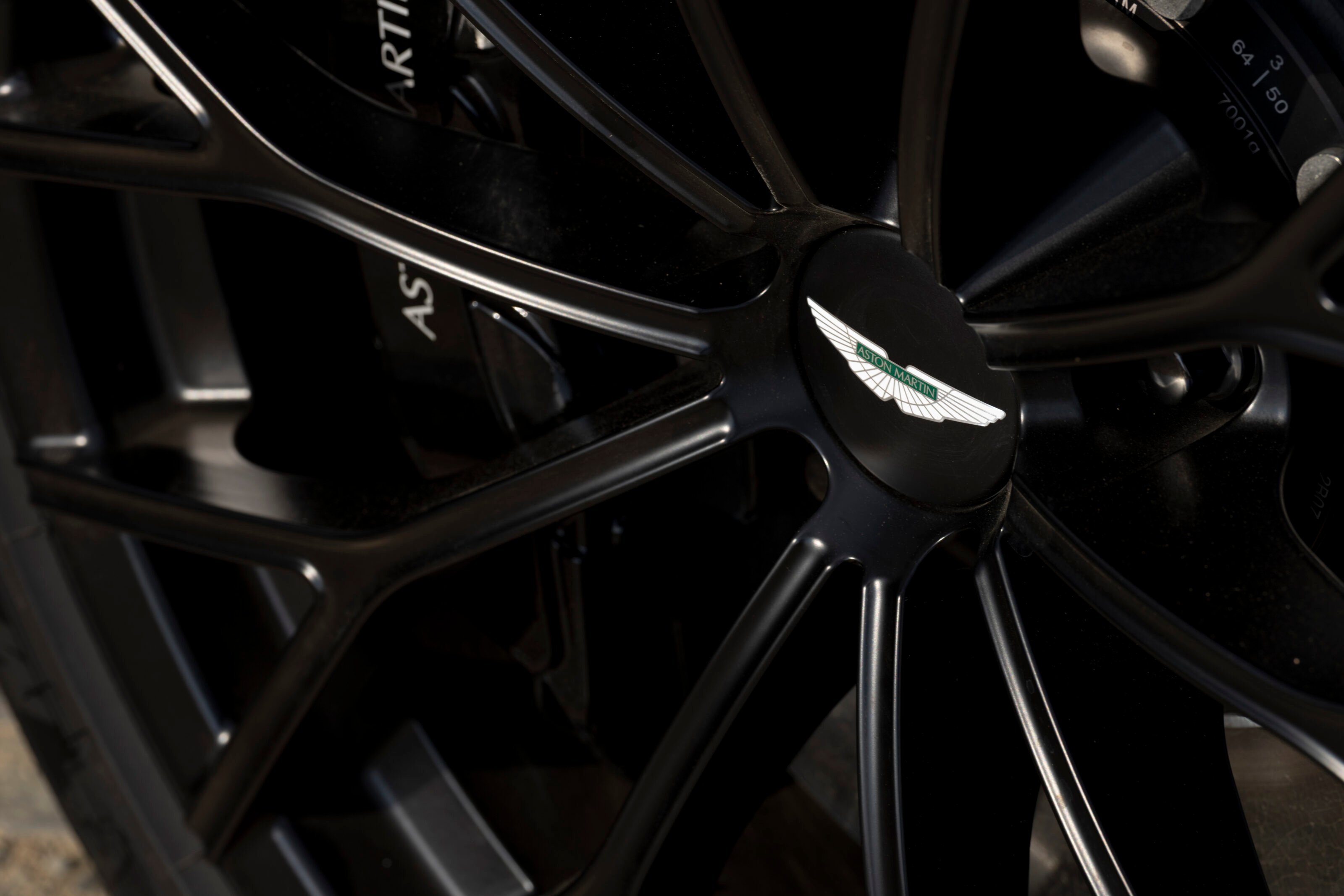
Moving R&D to Italy, maintaining a pragmatic relationship with Mercedes AMG, deciding what to do with Gaydon, satisfying an impatient and increasingly disillusioned majority owner, and making that better-than-the-rest Ferrari-beating sports car come true is bound to rock even the most confident mindset.
Even at the time of writing, this report may already have been rendered void by secret proceedings behind the scenes. Audi has allegedly agreed in recent days to take the next step towards an in-depth evaluation, even without prior authorization by the board and Geely’s confirmed hunger for AML is reportedly growing as the course of events keeps sweetening a possible deal, and the investor community is without a doubt stimulated by the deflated market value.
One thing is clear: chances that Aston will rise like a phoenix from the ashes without outside support, fresh capital and radical restructuring efforts are diminishing by the day.
UPDATE, November 23: 2023 Toyota RAV4 pricing announced
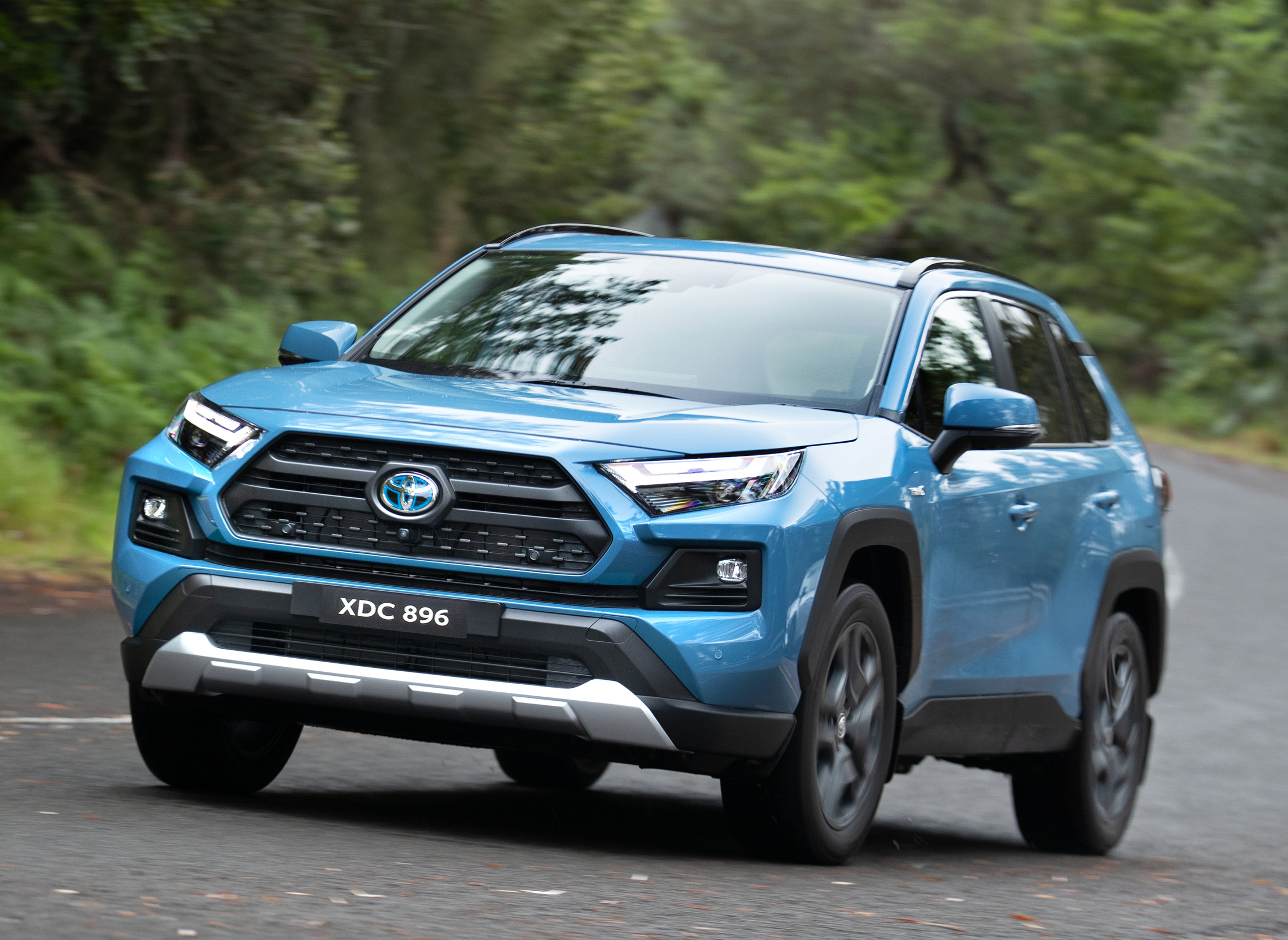
Australian pricing and specs for the updated 2023 Toyota RAV4 have been announced. Get all the details at the link below.
STORY CONTINUES: 2022 Toyota RAV4 Cruiser Hybrid 2WD review
Having Australia’s top-selling passenger car and holding enough forward orders to issue a 12-month delivery wait is cause for celebration. If you’re Toyota. Less so, perhaps, for eager and presumably patient prospective owners of the 2022 Toyota RAV4, property so hot it’s become the bullseye of the new-car delay dartboard.
Fanning demand flames further is the expanded and revised MY22 range: refreshed styling, equipment tweaks and the addition of a new mid-spec hybrid-only XSE.
Petrol-electric motivation, accounting for around 75 per cent of RAV4s sold (or ordered), can now be had across every one of the mid-sized SUV’s five trim tiers.
And that’s just the start. Toyota is also due to roll out a new multimedia format by year’s end – perhaps as a broader MY23 update – that will finally put the current, familiar and achingly passé infotainment regime to pasture.
With unofficial murmurings that wait times for RAV4s could be shortening, exactly what you get if you order one now appears to be a little bit more of a crapshoot than it once was.
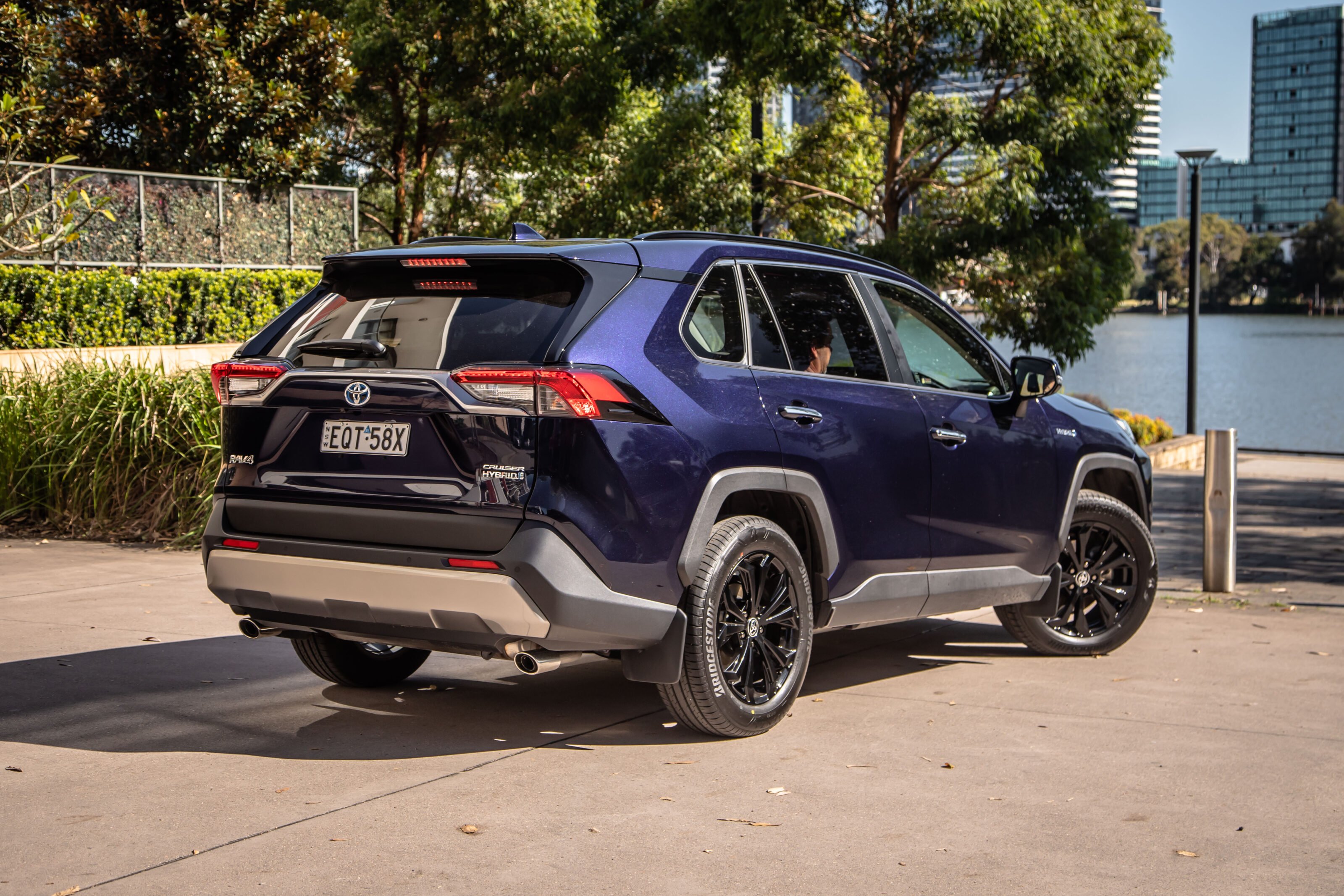
Regardless, the revised MY22 Cruiser Hybrid 2WD on test here arrives with more upgrades (and a stiffer price hike) than found elsewhere in the RAV4 range. Its plumper features list pushes the penultimate variant upmarket a little, unsurprisingly giving the new XSE mid-ranger sat below it some extra breathing space.
Regardless, there’s a fair case that, on paper, the fancier Cruiser, in bum-dragging petrol-electric guise, is just about the sweetest spot across the RAV4’s 13-strong line-up, offering goodness tailor-fit for Aussie taste in an SUV package that, on sheer popularity alone, couldn’t hit the mark any truer.
Pricing and features
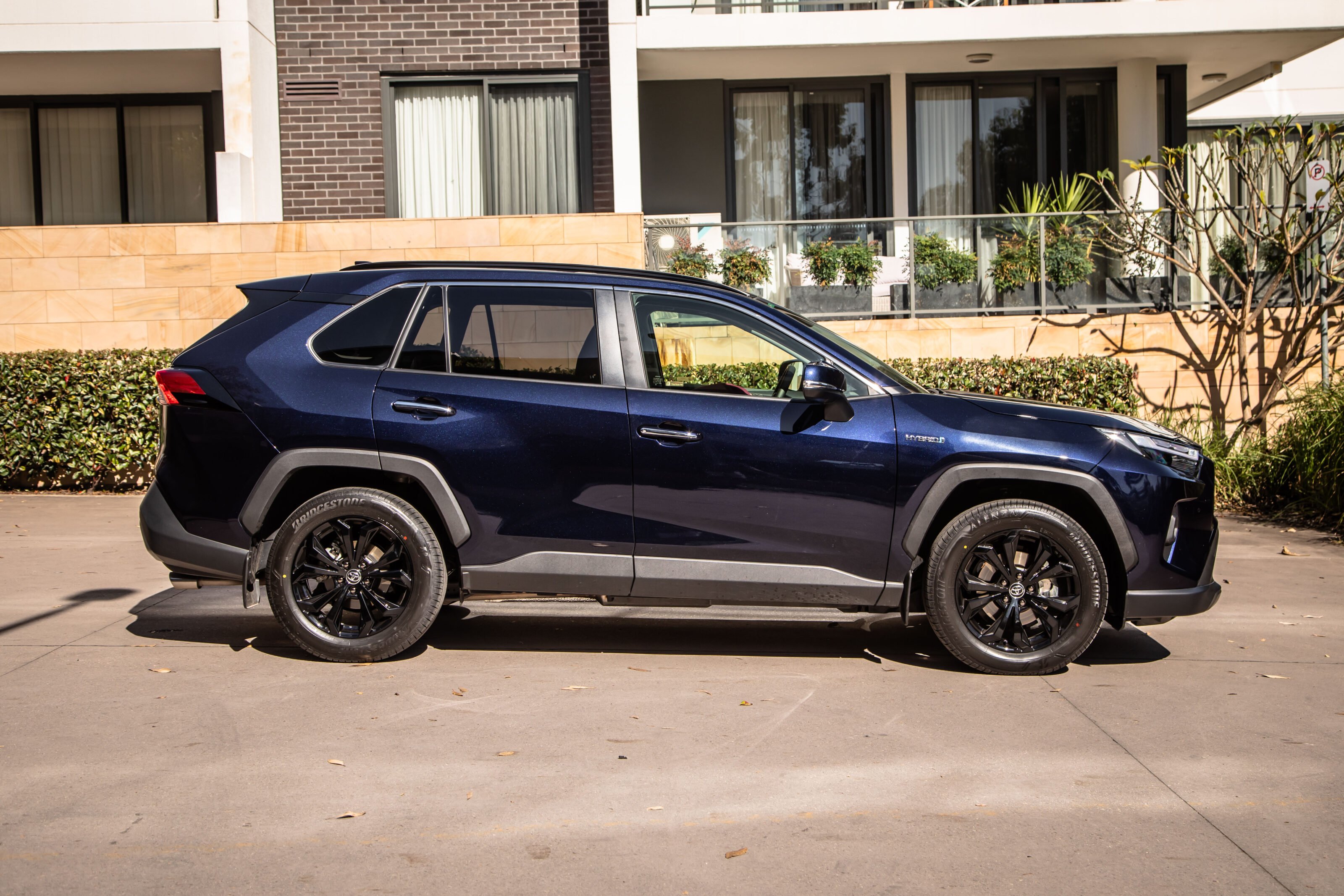
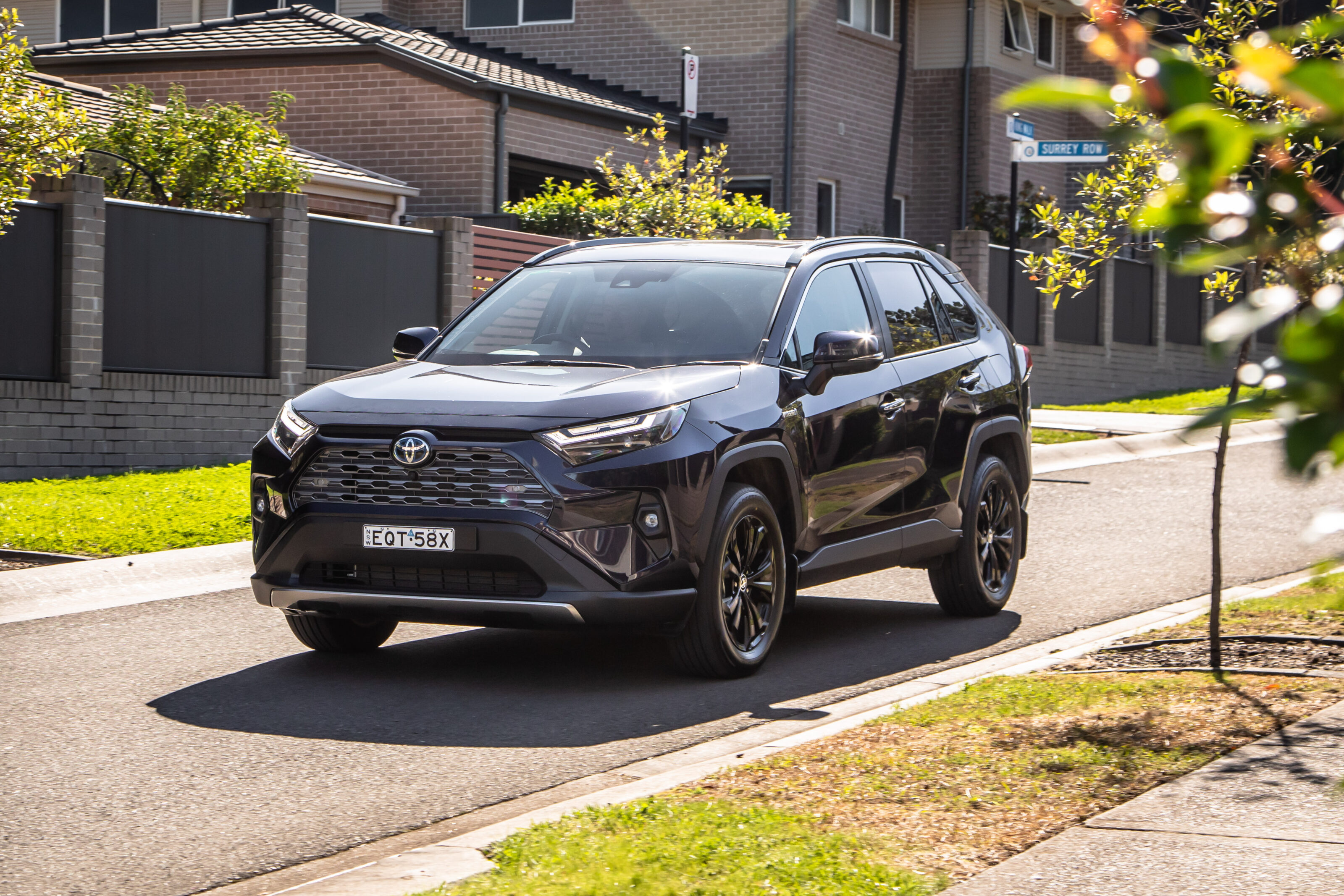
The MY22 update tickled some RAV4 variants more than others, though subtle front-end massaging, with hybrids now fitting projector-type headlights and LED foglights.
New wheel designs are the most conspicuous aesthetic change, bringing a classier vibe to the likes of the lower-rung GXL, for instance.
Read our full story here for the complete range rundown.
The Cruiser? Pricing rose for MY22 by $750, pegging our hybrid front-driver at $45,750 before on-road costs, some $2500 pricier than the petrol version and $3000 under the all-wheel-drive hybrid version.
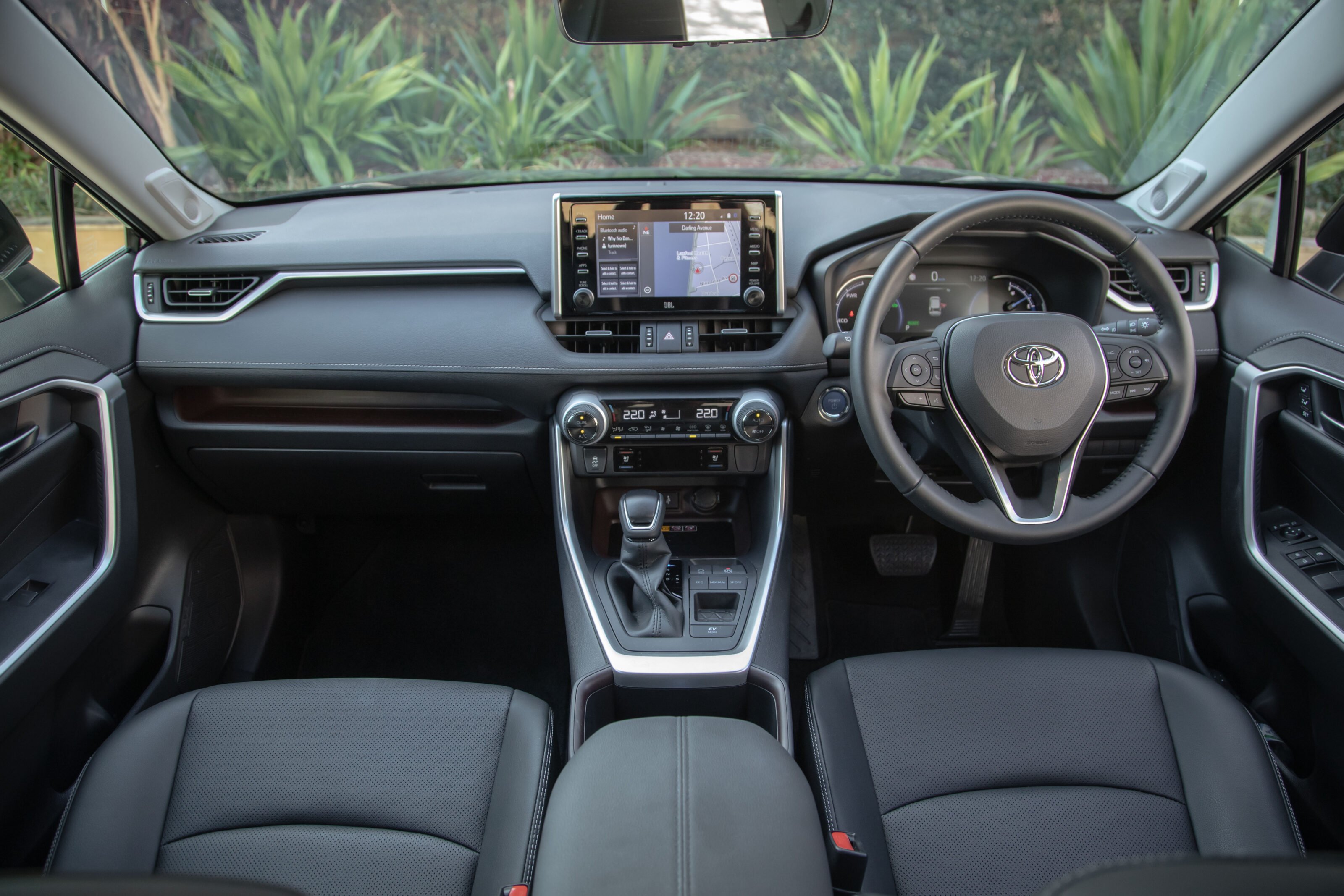
New additions to brim the Cruiser goodies bag include eight-way power adjustment, heating and ventilation for both front seats and a new digital camera-based rear-view mirror.
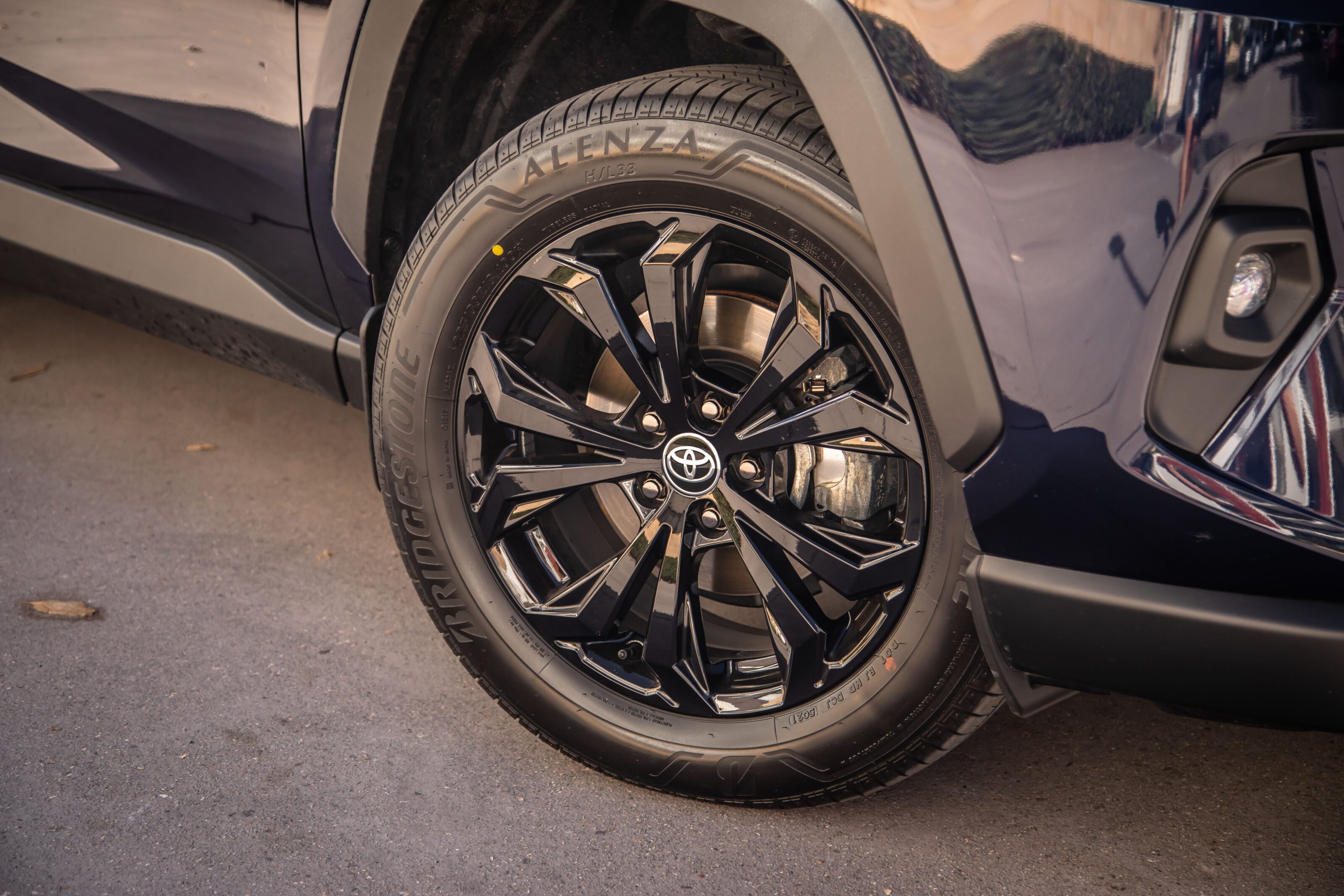
Opting for a hybrid version brings a new gloss black 18-inch wheel design, while petrol versions of the Cruiser get 19s.
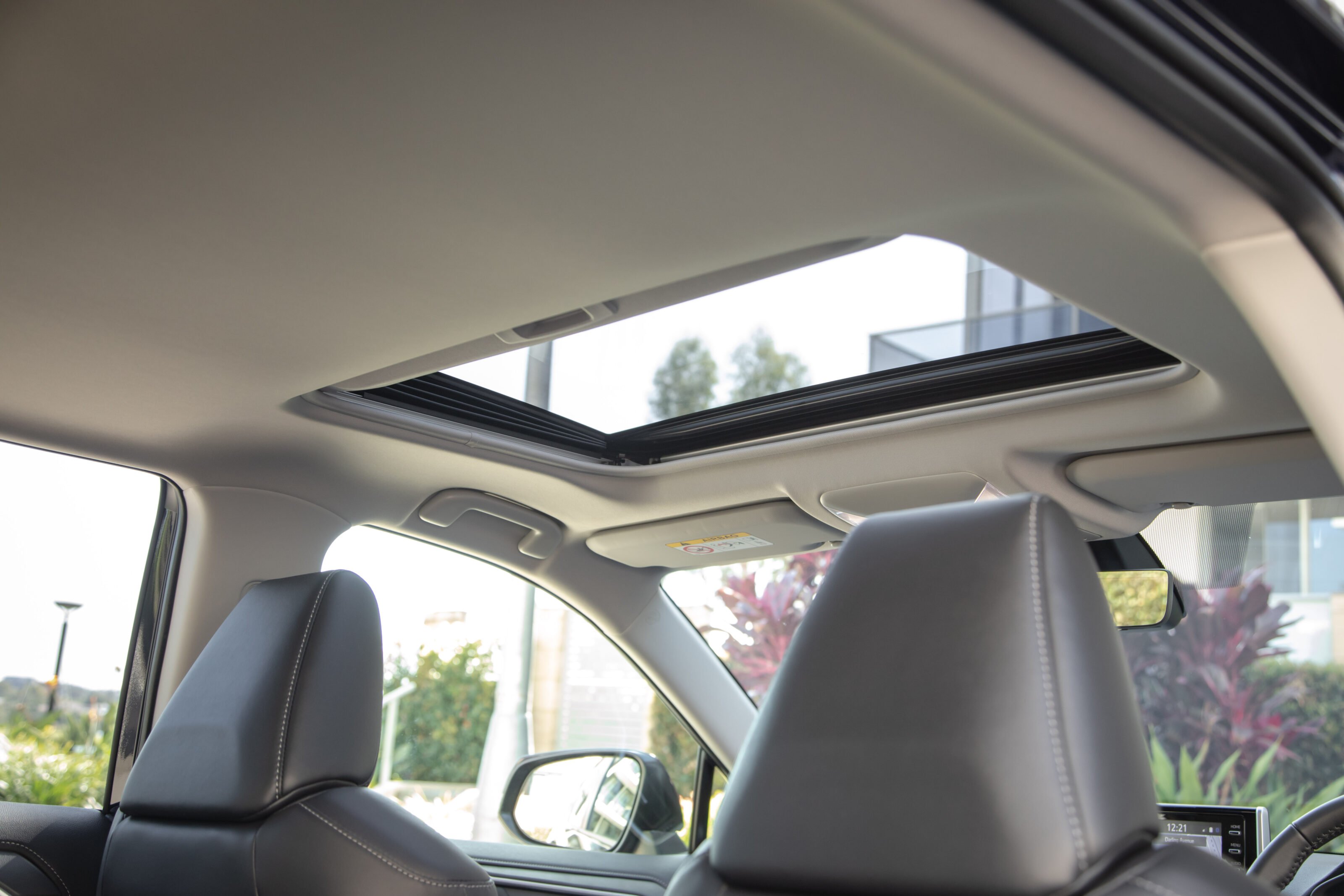
That’s fresh sweetener atop carryover Cruiser spec that separates itself from lower grade RAV4s with features such as leather trim, auto-power folding mirrors, a powered sunroof, ambient lighting, a surround camera system with front camera view and a nine-speaker JBL sound system.
Other niceties such as the extended leather/leatherette door trims, powered tailgate and the high-grade 7.0-inch ‘supervision’ driver’s display were Cruiser exclusives until Toyota slipped them into the newcomer XSE as well.
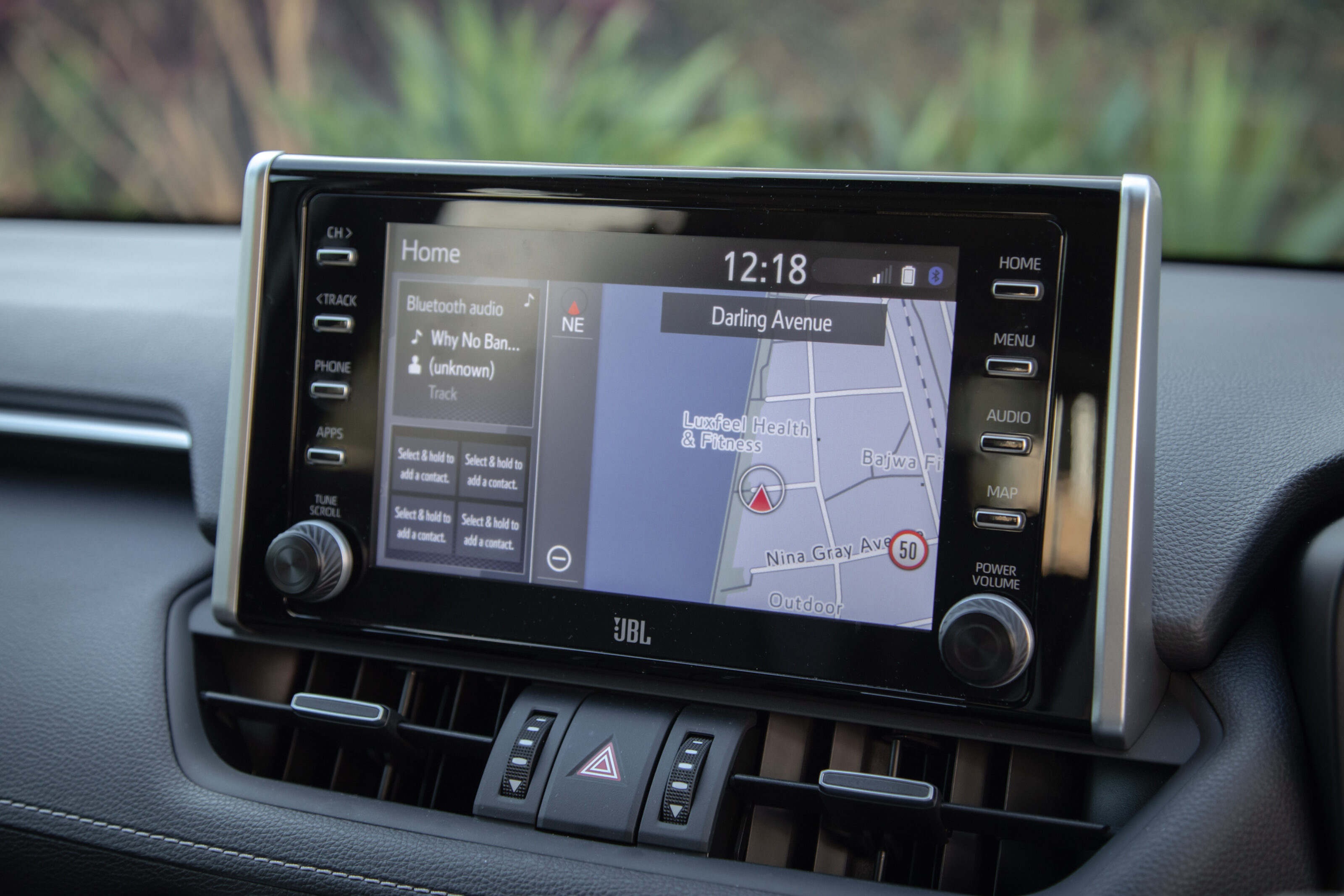
Somewhat make-do at the high end of the RAV4 range is an 8.0-inch touchscreen infotainment system with DAB+ digital radio, sat-nav and wired Apple CarPlay and Android Auto – plus five USB-A ports – that’s offered range-wide, right down to the base GX.
Inductive phone charging and dual-zone climate control are also fitted on all versions from the GXL up.
The RAV4 wears a five-star ANCAP rating based on 2019 assessment and features Toyota’s ‘Safety Sense’ suite.
Those safety features include auto emergency braking with pedestrian and daytime cyclist detection, blind-spot monitoring, lane departure warning, lane tracing assist, rear-cross traffic alert, adaptive cruise with stop/go and traffic sign recognition.
Omitted from the assistance list are rear cross-traffic assist and parking brake support – via auto braking forward or reverse – as featured exclusively on the top-grade Edge. Airbag coverage includes front, front-side, curtain and driver’s knee coverage.
Comfort and space
Chunky and solid exterior looks are mirrored in feel once you climb into the RAV4. While some of its Toyota stablemates feel generally undercooked (HiLux), old hat (LandCruiser) or overly quirky (Yaris Cross), the mid-sized SUV range presents as relatively clean and straightforward, distinctive in its own right yet nicely resolved and fuss-free.
The ambience balances roomy airiness and a sense of sportiness injected by hunkered seating and a prominent dash and centre console, without robbing from sound ergonomics or clarity of outward vision. And yet it maintains a robust vibe that implies there’s ample metal cocooning its occupants.
It’s deceptively clever in design, a cabin space that’s conspicuously well packaged and amply spacious.
Some material choices won’t leave Lexus losing sleep, with its leather and leatherette more hardy than sumptuous, though ample solidity in the RAV4’s control and switchgear and most touchpoints are plaint and tactile.
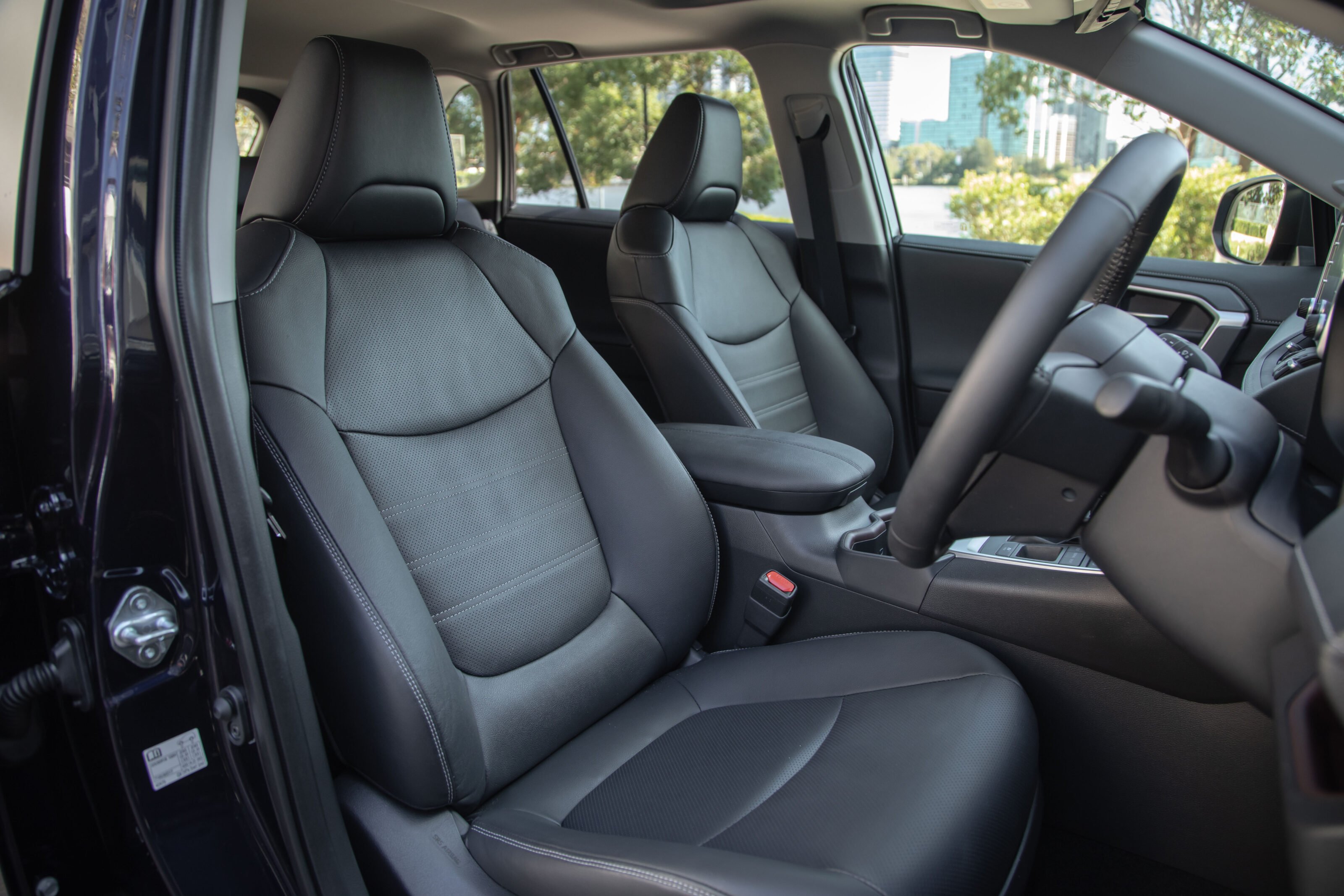
Interestingly, the Softex premium faux hide used in the higher-grade Edge is also plied in the XSE sat below the Cruiser, though there’s little about our test subject that you’d call certifiably lower rent, though some plastics are quite rudimentary.
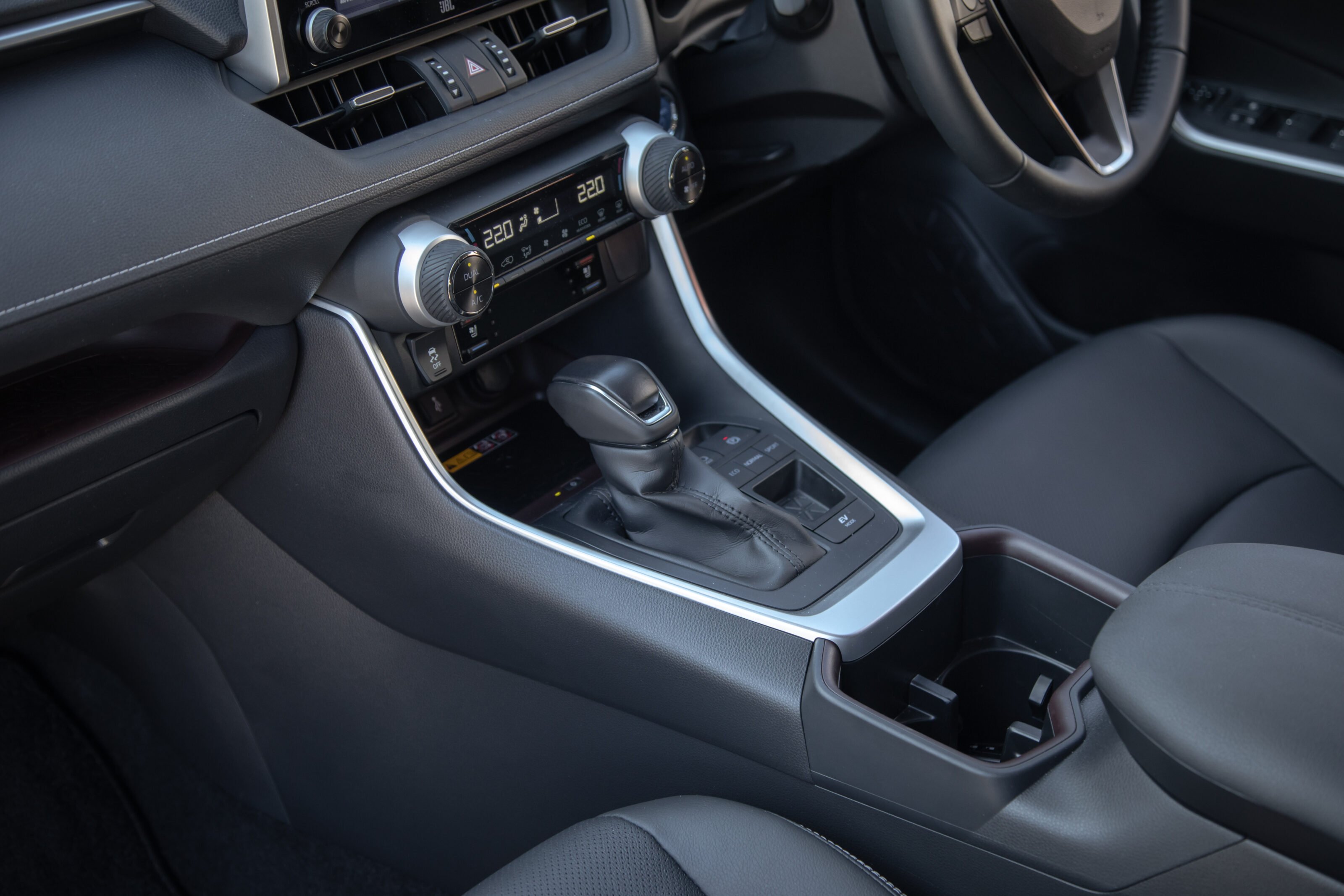
The seating is comfy and almost lounge-like, with lots of scope for tailor-fit adjustment. Bringing a touch of celebration is the nice rubber knurled climate control and audio dials, while the partial analogue ‘supervision’ instrumentation is clear and pleasing if not nearly as tech-fancy or content-rich as a proper digital display.
Storage is ample, with dual USB-A ports tucked in the deep console bin, while door bins, cup holders and the inductive phone charge pad are all generously sized.
Infotainment continues to drag down the RAV4’s high average – again, a wholesale upgrade is coming within the year – and there’s little doubt a format closer to that favoured by Korean rivals will bring a significant lift in interior presentation and multimedia usability.
The long-suffering 8.0-inch unit remains clunky to use, slow in response and patently low-brow in display quality. Its feature set ticks all of the requisite boxes, though it just doesn’t do anything particularly well, from Bluetooth call quality to the resolution of the surround cameras and through to its frustrating sat-nav interface.
Pluses, though, are that smartphone mirroring works as expected and the physical buttons and dials in the touchscreen frame offer ever-handy function shortcuts.
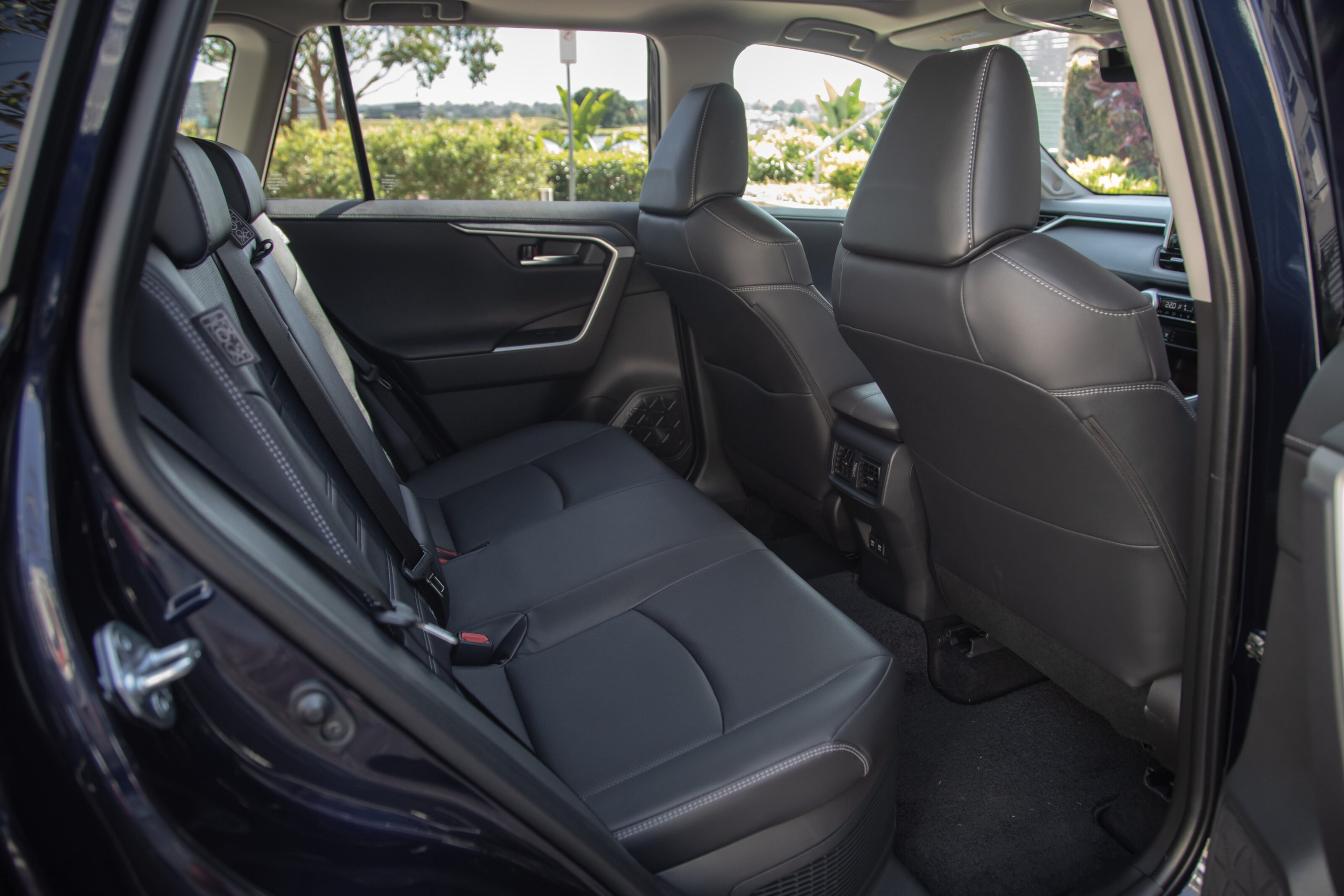
The RAV4’s airy vibe and genuine roominess follows through to row two. Head and knee room are exacerbated somewhat by a low rear seat base and there’s just enough cabin width to offer five-adult accommodation.
The rear bench is both comfy and supportive enough for long-haul occupancy and as a four-seater it brings a complete array of features that includes dual USB-A ports, air vents in the rear of the centre console, decent door bins and dual cup holders in the fold-down armrest.
Isofix mounts are located in the outboard positions and there’s ample clearance to access and install or remove child capsules without back-aching contortion.
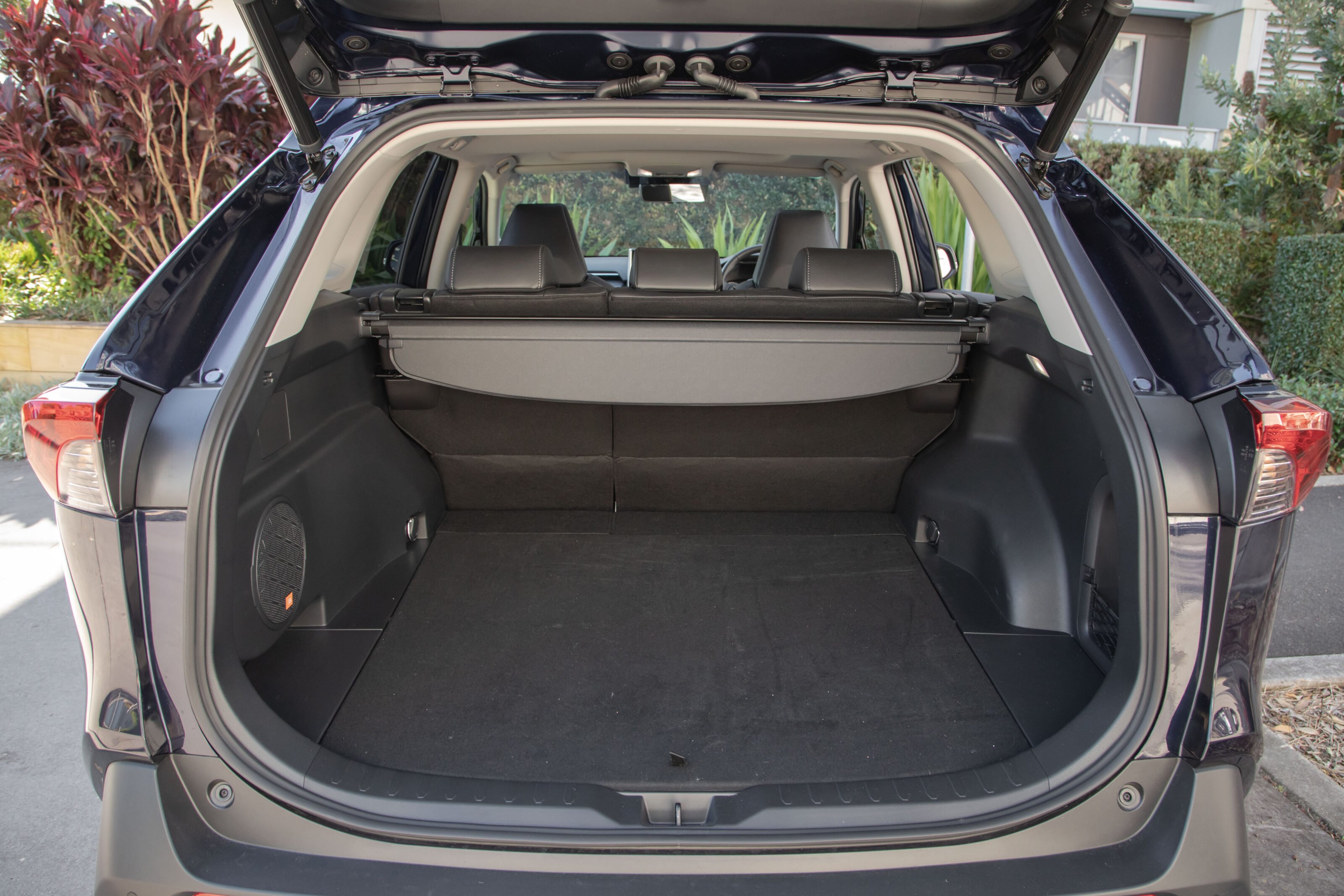
Its versatile luggage space offers a decent 580 litres, complete with a dual-level floor you can set to taste. The 60:40-split rear seatbacks fold to create a nicely flat load area as a two-seater – Toyota doesn’t quote expanded volume – and the cargo area fits neat conveniences such as tiedown points, netted storage cubbies and a removable fabric parcel shelf assembly. A space-saver spare is housed under the floor.
On the road
The most popular power unit in the biggest-selling passenger car in Oz is hardly cutting-edge electrification. But what Toyota’s evergreen petrol-electric system pays are the sorts of dividends so many buyers want: frugal (4.7L/100km claimed) running on cheap (91 RON) fuel, a theoretical 1000-kilometre range and turnkey ICE-like convenience, no plugging in required.
This palatable buy-in is matched by cheap servicing ($230 per year capped). It’s an easy, hassle-free path Toyota has trekked for a good while now, if one increasingly palatable to buyers’ increasing eco-sensibilities.
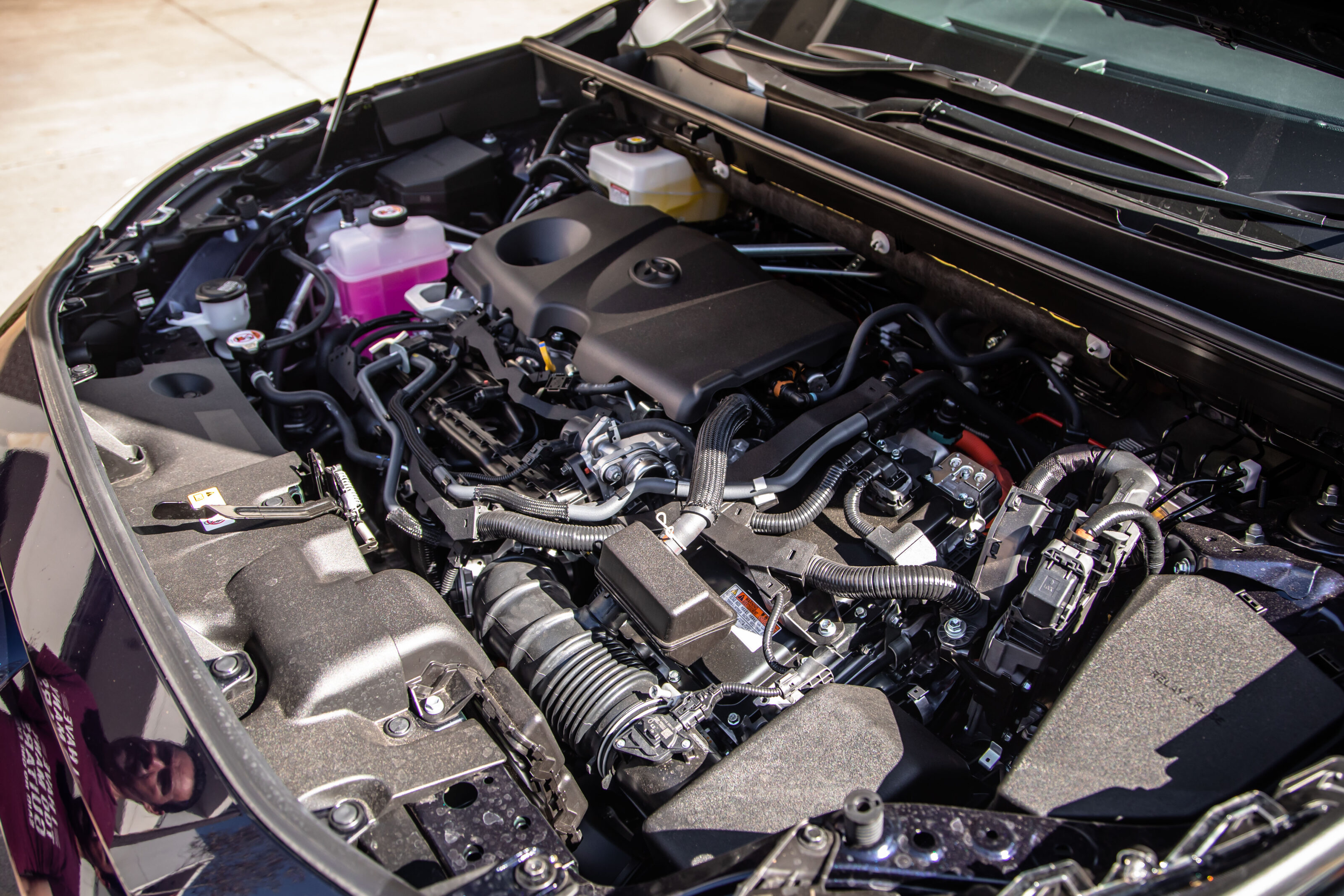
The front-driven format atmo 2.5-litre petrol four outputs 131kW and 221Nm, which is fairly torquey for an Atkinson cycle engine. Meanwhile, dual electric motor-generators producing a combined 88kW and 202Nm are paired to a nickel-metal-hydride battery.
At 160kW total system power, the FWD is just three kilowatts shy of the AWD powertrain that adds a third 40kW and 121Nm electric motor to the rear axle. Toyota doesn’t quote any peak system torque figures.
The RAV4 starts and sets off in electric drive but with any enthusiasm from the driver, its petrol engine rumbles into life. The EV and ICE drive shuffling and blending is noticeable and far from seamless, though drivability is quite polished at a leisurely cruise, where the hybrid system remains fairly quiet and refined.
Dig in and the petrol 2.5 does get raucous. Add the flaring nature of the continuously variable transmission and at times there’s little synchronous about the soundtrack and forward motion.
That said, it’s surprisingly surly and quite linear when accelerating hard, even if little about its character encourages you to do so on a regular basis. But favour more casual inputs and the RAV4 can be downright serene.
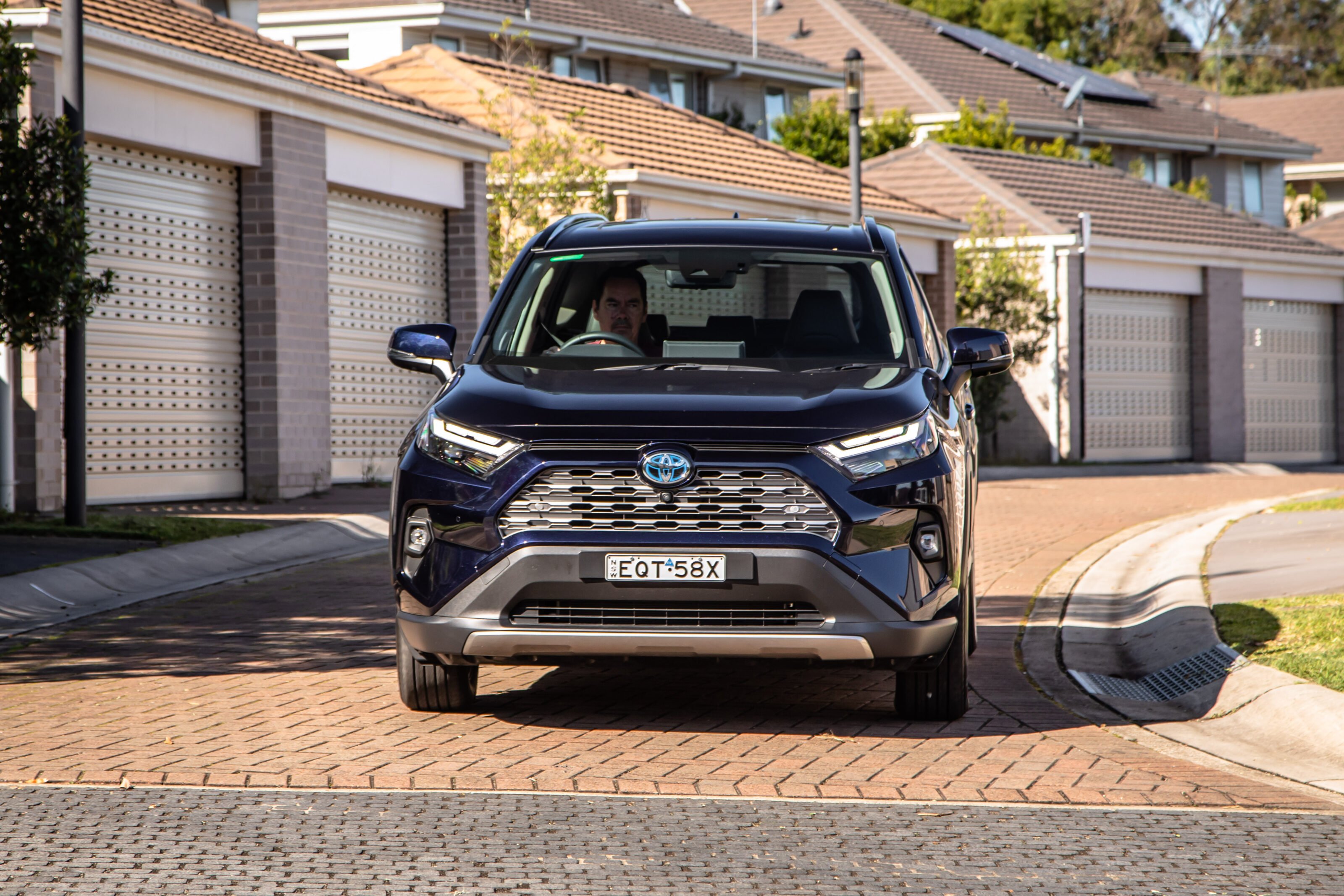
On balance, the mid-sized Toyota SUV delivers much that many owners like but mightn’t necessarily ask for.
It’s a nice size; large and significant enough to underpin and sense of surety yet pleasingly cooperative, thanks to its deceptively keen TNGA underpinnings and accurate steering.
The ride and handling balance is a real highlight. Rather than adopting sporty pretension and rigid nature to justify it, the RAV4 presents a blend of well-judged and nicely rounded compliance with keen body control and genuine driver communication and engagement.
It’s not merely softly set, there’s clearly some considerable effort on Toyota’s part, in tuning and spec, to hone out discomfort from the on-road experience, be it filtering out small road imperfections or investing in noise suppression where it counts. It’s prone to some tyre rumble on coarse surfaces though that is somewhat exacerbated by the RAV4’s usually quiet-running nature.
The RAV4’s real strength is that it’s so comfort-focused across such a breadth of driving disciplines, from peak-hour crawl where the hybrid system tends to return its best efficiency best, to open road touring.
But even with long stints stretching its legs, our tester returned consumption safely in the fives.
Is it left lacking without all-wheel drive? Not really. It takes a fair effort to get the front tyres scrabbling and even then it’s not caught short on thrust, to the point where digging about for alternative Power or EV drive modes isn’t necessary.
That said, stumping up for all-paw traction might prove the best foil for regional owners who habitually find themselves on mixed surfaces. Or if you’re towing: the FWD’s paltry 480kg braked (or unbraked) trailer capacity jumps to 1500kg in AWD guise.
Shortcomings? Not many.
The lane departure warning does have a low threshold, triggering below 50km/h to an annoying extent on back streets when you’re threading between parked cars and the road centre lines. And the digital rear-view mirror, with its default long-lens camera display mode, is more of a novelty than a genuinely useful convenience.
Ownership
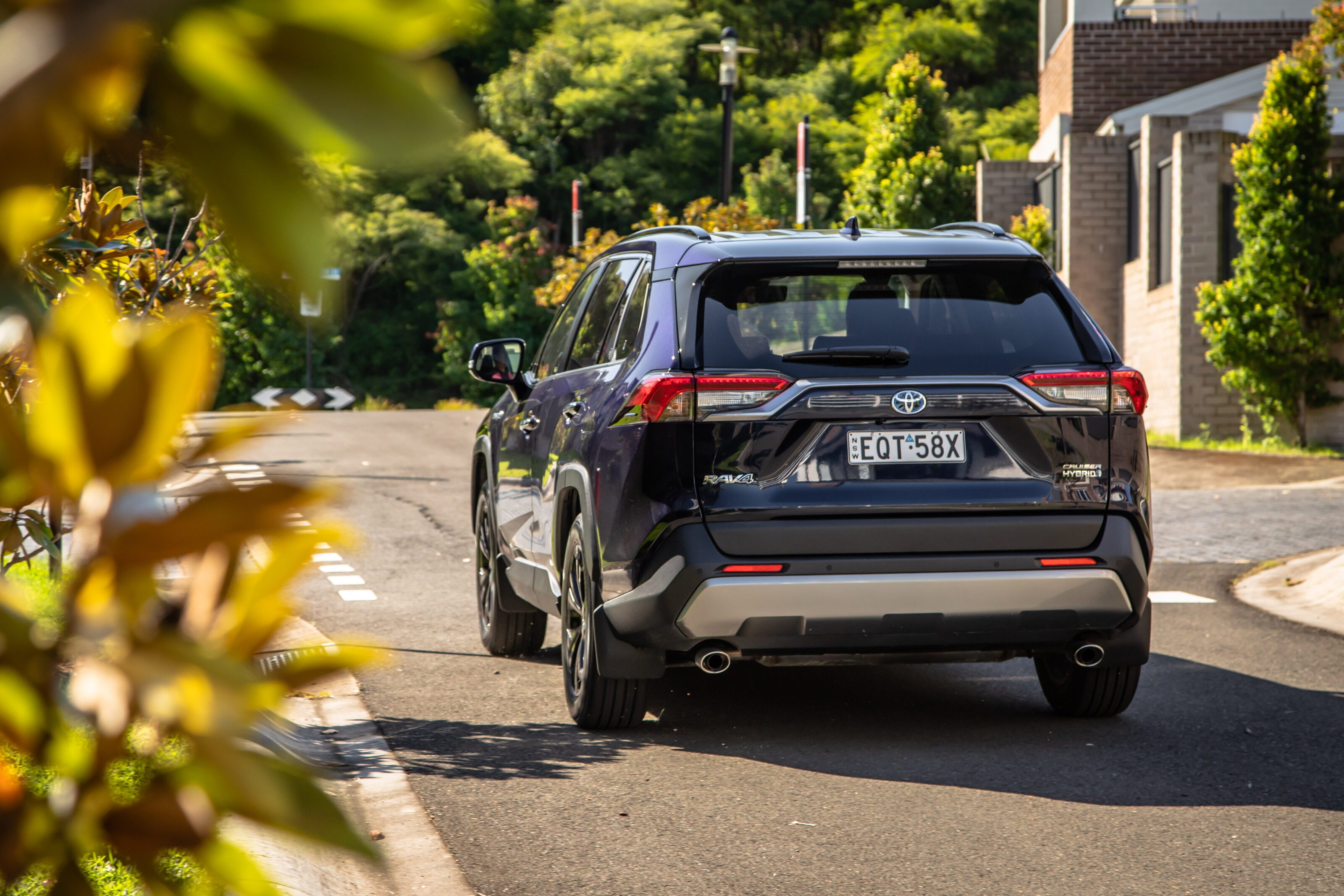
The RAV4 is covered by Toyota’s five-year, unlimited-kilometre new vehicle warranty. The hybrid system’s battery is guaranteed for up to 10 years. Service intervals are every 12 months and 15,000kms with each visit is capped at $230 for the first five years.
It’s cheap to service and cheap to run, too. That ‘frugal fives’ fuel economy can be had on crappy 91 RON or E10.
VERDICT
Toyota’s mid-sized family hauler has so many good things going for it that, if it wasn’t the most popular SUV in Australia, it would deserve to be.
That it’s such hot property just goes to prove how this global model fits local tastes and wants oh-so well.
The hybrid factor – with real-world advantages and virtually compromise-free – is just part of the allure though it’s a significant one. That Toyota’s technical take is a bit old hat matters little to buyers shopping for the benefits the RAV4 offers in droves and its only real rival, the Subaru Forester Hybrid, struggles to match.
While there’s a fair argument that the new XSE mid-ranger is a sweeter spot in the RAV4’s recently expanded range, the closely stacked variants make for an easy walk up or down depending on your budget and equipment whim.
At least, that would be the case in a world without year-long waiting lists.
Ink an order now and there’s a fair chance RAV4’s long-suffering infotainment woes – the blackest mark on the current MY22 page – will be rectified by new-generation multimedia once keys land in patient hands.
2022 Toyota RAV4 Cruiser Hybrid 2WD specifications
UPDATE, June 9, 2022: European Union ICE ban upheld, set to come into effect by 2035
Proposed amendments to the European Union’s plan to ban the sale of new internal combustion engine-powered vehicles by 2035 have been voted down.
According to Automotive News, members of the European Parliament voted against a proposal to lessen the current goal of a 100 per cent reduction in emissions by 2035 to 90 per cent.
The report also states the EU lawmakers voted against an amendment which would allow manufacturers to purchase credits for synthetic and e-fuels, making projects currently underway from carmakers such as Porsche and the Japanese alliance of Toyota, Subaru, Mazda redundant.
While the EU plans to go carbon-neutral by 2050, Australia currently lacks a concrete emissions reductions strategy, with the new Labor Government having previously only announced its plan to reduce carbon emissions by 43 per cent before 2030.
The story to here

May 15, 2022: European Union one step closer to banning ICE vehicles
The European Union is getting closer to banning the sale of internal combustion engine-powered (ICE) vehicles by 2035, with the European Parliament backing the EU’s plan this week.
Last year, the EU proposed an effective ban of new ICE vehicles by 2035, with the plan then handed down to the European Parliament this week where lawmakers threw their support behind the target, per reports from Automotive News Europe.
While the proposal doesn’t explicitly prevent ICE-powered vehicles from being produced, the plan would result in a 100 per cent reduction in carbon emissions by 2035, effectively killing off fossil fuel-powered vehicles.

The clamp-down on emissions would result in electric vehicles (EVs) and hydrogen fuel-cell vehicles (HCEV) becoming the predominant choices in the market, with most European and international manufacturers introducing targets to ditch ICEs well before the 2035 cut-off.
However, ICEs might be thrown a lifeline in the form of hydrogen, with carmakers such as Toyota, Subaru, Mazda and Renault developing traditional combustion engines which utilise hydrogen rather than fossil fuels as their power source.
Porsche is also throwing its weight behind zero-emission fuels, announcing last month it would invest roughly $100 million to develop efuels with a production facility earmarked for Australia.
Australia currently has no specific policy relating to the banning of fossil fuels, reflected in last year’s net zero 2050 plan which had no mention of phasing out ICEs.
Snapshot
- New M2 to be produced at BMW’s plant in Mexico
- Next-gen coupe could produce as much as 317kW
- Reveal expected in the second half of 2022
UPDATE, June: BMW M2 prototype review
We’ve now driven the new M2 on track! It’s still camouflaged, and technically a prototype, but this is your best insight yet on what’s to come.
“Specify this new M2 with the no-extra-cost manual, and you have a fairly-priced instant classic with no waiting list. A no-brainer, really.”
Get the full story at the link below.
May 27: BMW teases new M2 again
BMW has continued to preview its upcoming, second-generation 2023 M2 coupe, with the rear-wheel-drive sports car shown off drifting in the dark.
Having previously only teased the new M2 in camouflage, the latest BMW video briefly shows its upcoming model going sideways in an industrial area, while also featuring a brief shot of its interior – albeit focusing on the driver.
April 24, 2022: BMW M2 teased, Mexican production confirmed
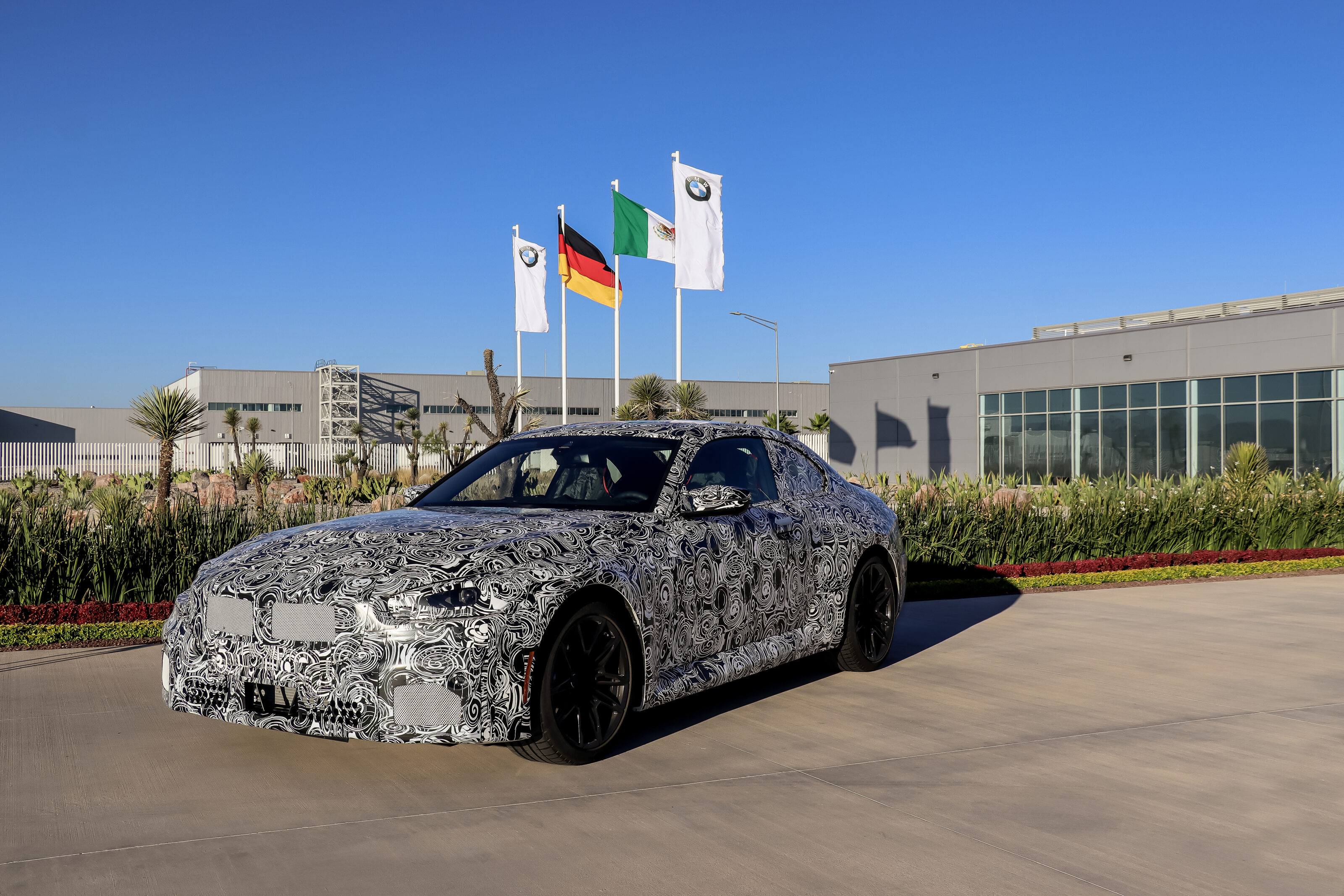
The 2023 BMW M2 performance coupe has been teased in Mexico gearing up for production.
Set for reveal before the end of 2022, production of the next-generation M2 will shift from Germany to join the 2 Series and 3 Series at BMW’s plant in San Luis Potosí, Mexico.
March 28: VIDEO! BMW M2 caught testing at Nürburgring
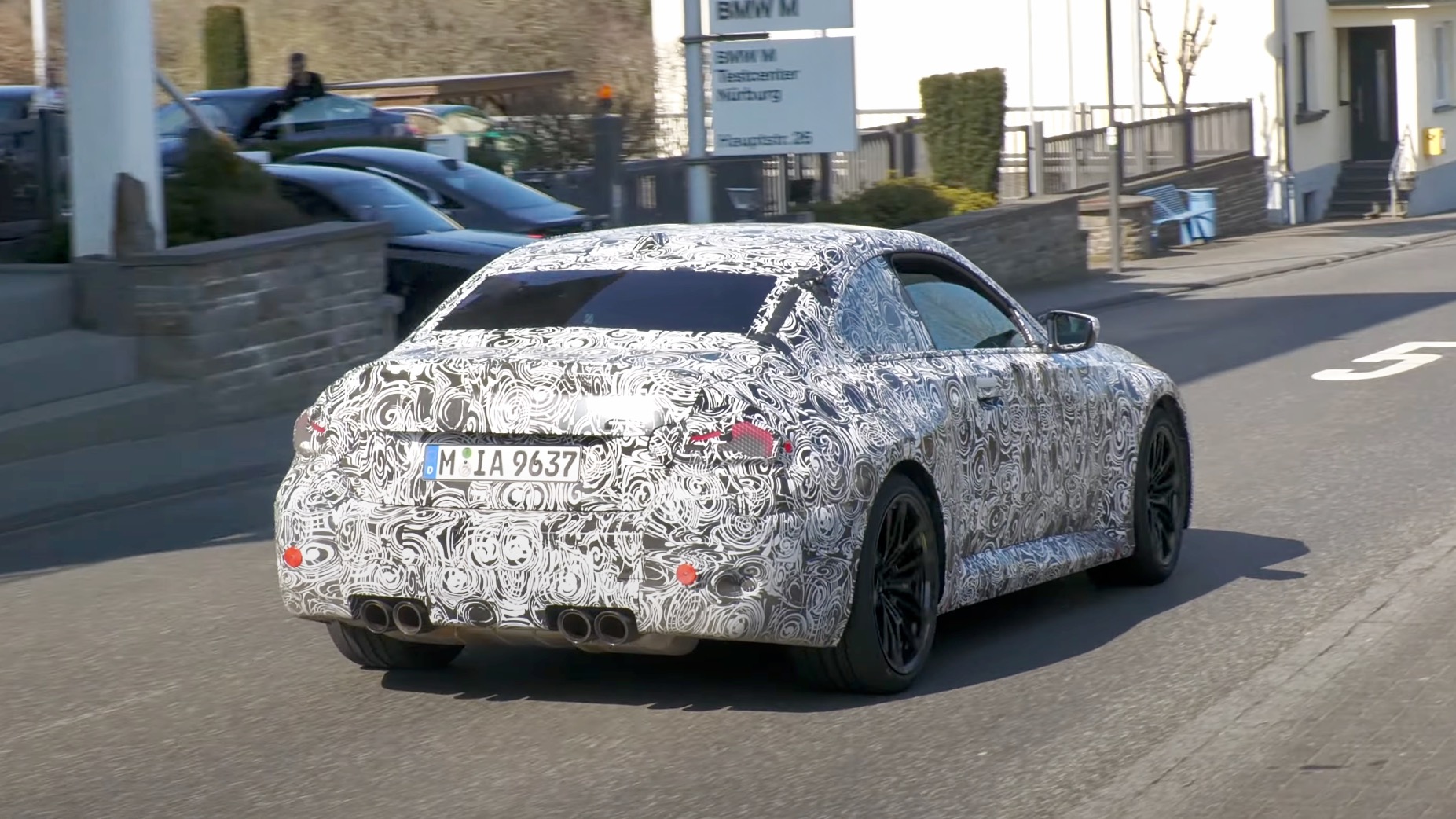
A prototype of the 2023 BMW M2 has been spied at the iconic Nürburgring track in Germany, with a manual gearbox confirmed to feature in the second-gen model.
YouTube channel CarSpyMedia filmed the new-generation M2 leaving BMW M’s testing facility before being sent out onto the circuit.
September 18, 2021: BMW M2 preview
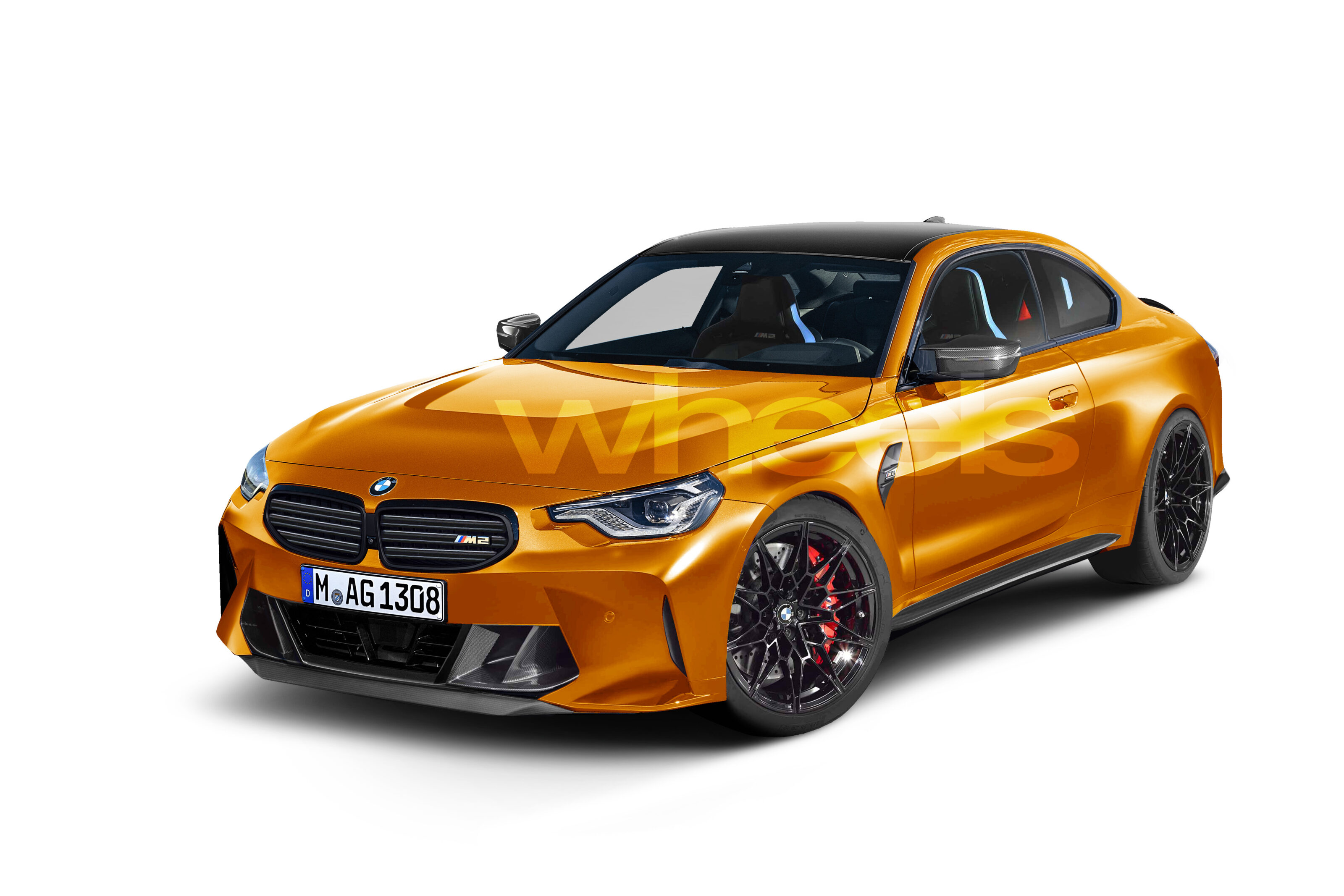
BMW is developing a new rear-wheel-drive M2 performance coupe, as part of a future compact M car line-up that will include an all-wheel-drive M2 Gran Coupe and a 1 Series with around 300kW.
The second-generation M2 coupe, which takes the internal codename G87, is scheduled to go on sale in Europe in 2022, making a 2023 debut likely for Australia. It will bring with it a detuned version of BMW M’s latest six-cylinder petrol engine, sourced from the new M3 and M4
June 1, 2021: Next BMW M2 rumoured to have 365kW and no xDrive
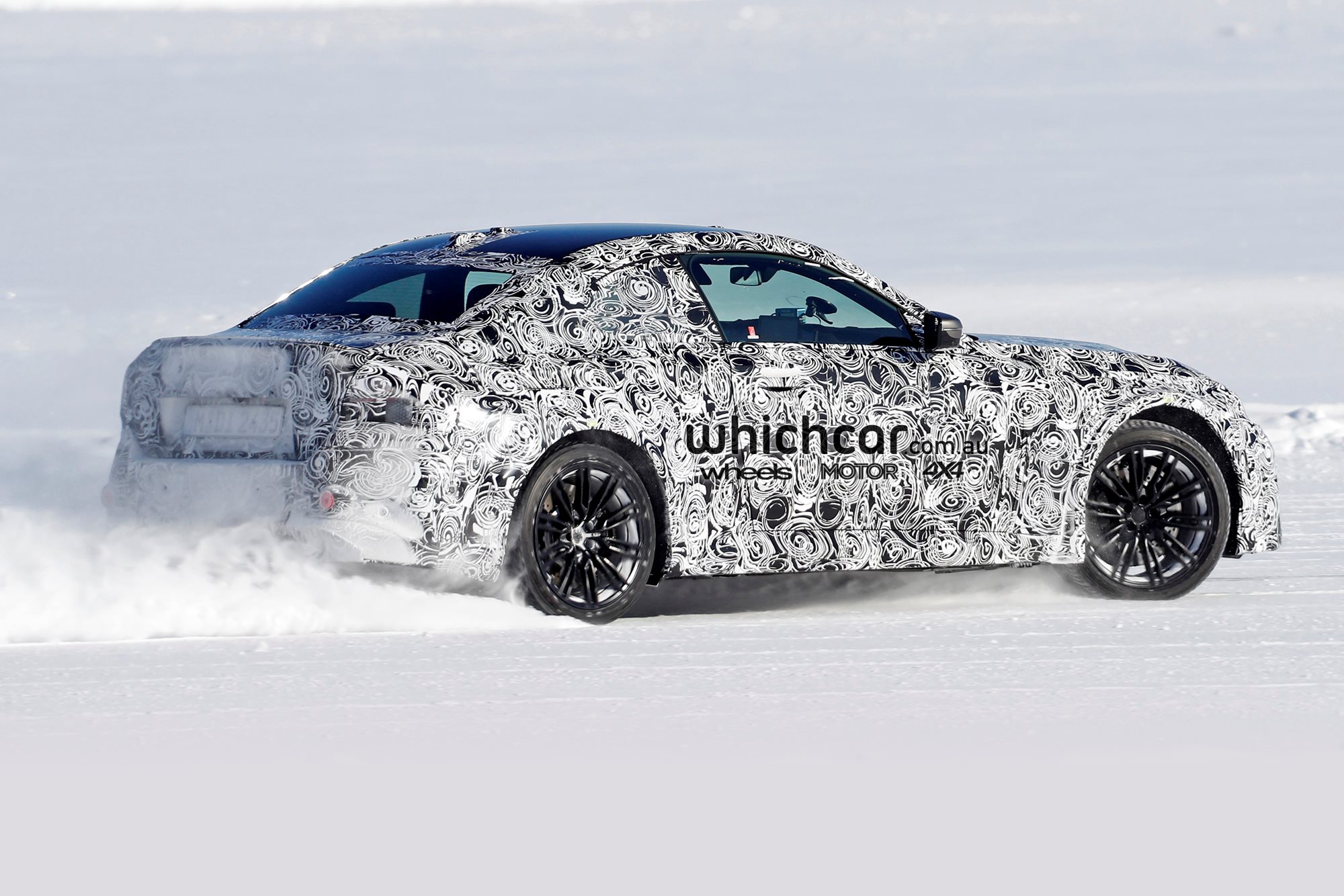
The 2023 BMW M2 may still be more than a year away from an official unveiling, but rumours about the upcoming entry-level M Car have been flying lately.
According to BMW Blog, there are now whispers the next-generation G87 M2 could be released with as much as 365kW.
If true, that’s a huge jump in performance compared to its predecessor, the F87 M2, which was released back in 2016 with its N55 twin-scroll turbo 3.0-litre straight-six producing just 272kW.
UPDATE, June 9: Fisker Pear interior rendered
Fisker has released a new teaser for its Pear electric vehicle, saying it is designed for a “metropolitan lifestyle”.
On top of the previous teasers we’ve seen (further below) the latest release shows off a minimalist interior design, with a floating infotainment system perched in front of its occupants.
According to the manufacturer, the Pear crossover will also feature a ‘Houdini trunk’ – something it says is “an alternative to traditional rear cargo hatches”, which will allow the Pear’s interior to “offer a new level of storage for its segment”.
Single and dual-motor variants have been confirmed, with both powertrains set to be available offering four levels of option packages. On top of this, two battery packs will be available, with the larger Hyper Range pack targeting a driving range of more than 500 kilometres thanks to the Ocean-derived SolarSky panoramic roof.
The story to here
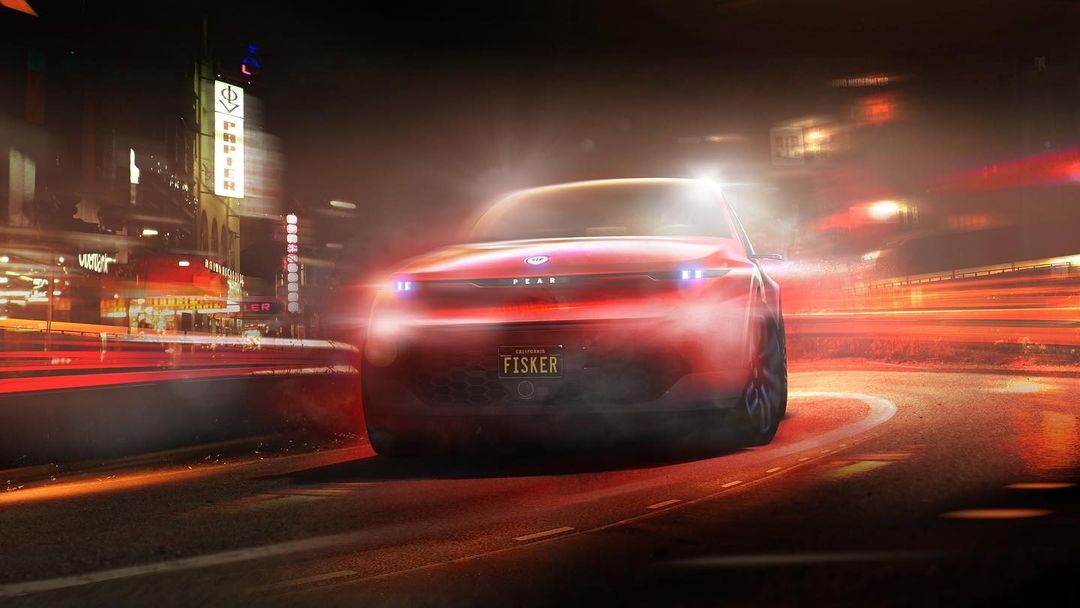
May 27: Fisker Pear teased again
American electric vehicle start-up Fisker has teased its upcoming Pear SUV yet again, this time with a few extra details.
Company founder and CEO Henrik Fisker took to Instagram to show off the latest rendering of the EV SUV, this time revealing its slim LED headlights and illuminated front badges.
The Fisker boss also reiterated his team is working to get the Pear on sale for less than US$29,000 (AU$40,850) – making it one of the cheapest EVs on the market even before the US$7500 (AU$10,500) federal tax credit is applied.
https://www.instagram.com/p/CeBZ17LLslp/
Fisker also said a Pear prototype could be finished ahead of schedule, potentially being unveiled this year – and with production to start by 2024, depending on how soon it can get its new factory in Lordstown, Ohio operational.
The Pear will join the Ocean as Fisker’s two model offerings, as the latter is slated to go on sale later this year in the United States.
May 13: Fisker Pear production plans confirmed
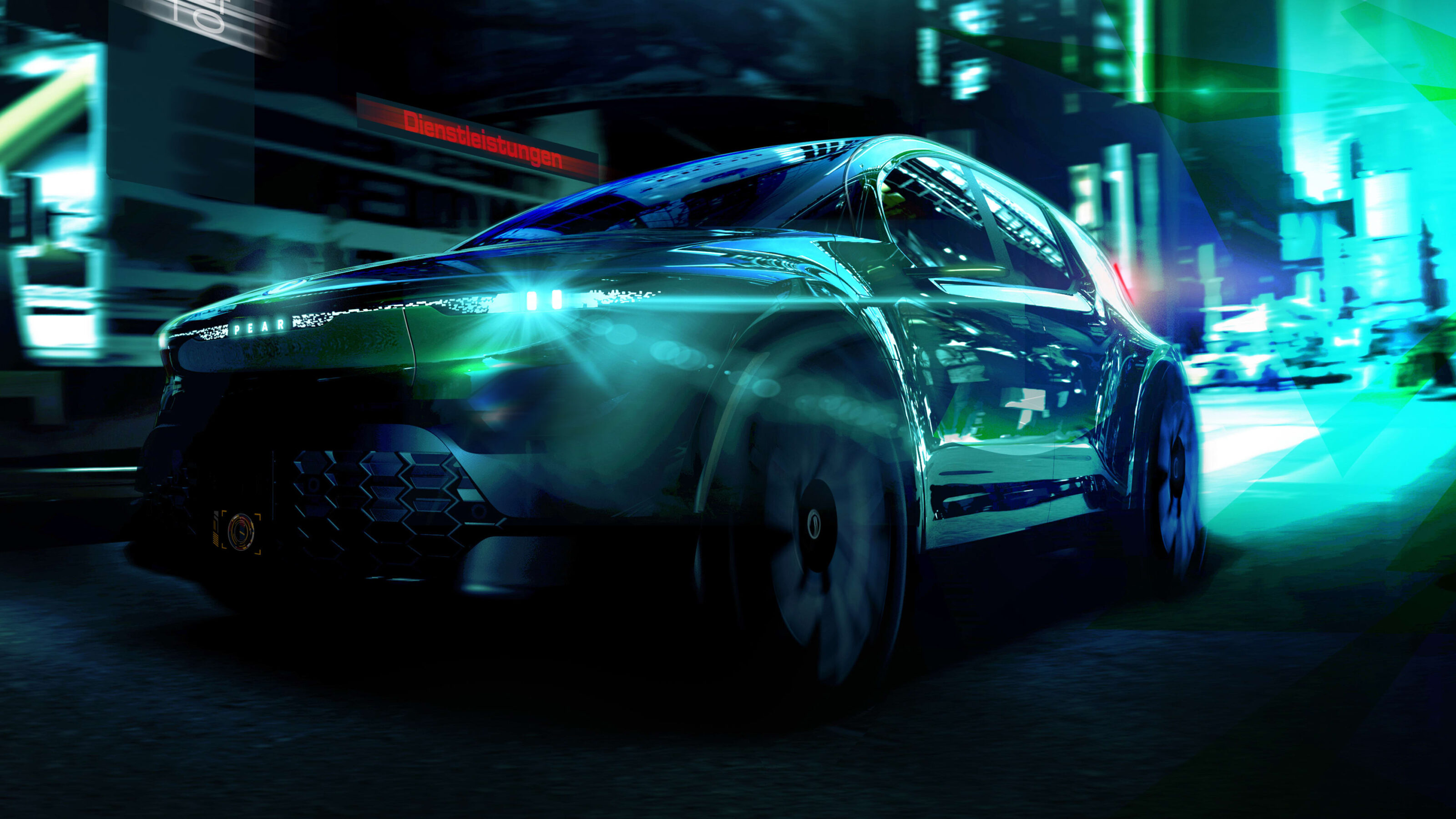
Fisker has announced production of its Pear electric vehicle will be in Lordstown, Ohio, after the manufacturer and Foxconn acquired a former General Motors plant.
In a joint announcement, Fisker and Foxconn confirmed the EV brand’s second model would be built in the mid-west facility, with at least 250,000 examples expected to be produced annually.
Home to the production of certain GM vehicles from 1966 to 2019, the Lordstown Assembly plant was most recently utilised by fellow electric vehicle start-up Lordstown Motors, with the latter’s fate remaining unknown after today’s announcement and GM selling its stake in the manufacturer earlier this year.
Production of the Pear will follow the Ocean, Fisker’s upcoming SUV, with CEO Henrik Fisker saying, “the Pear will be a revolutionary electric vehicle that won’t fit into any existing segment.”
Read on below to find out what we know so far about the Pear EV.
February 18: Fisker Pear set to launch as more affordable EV
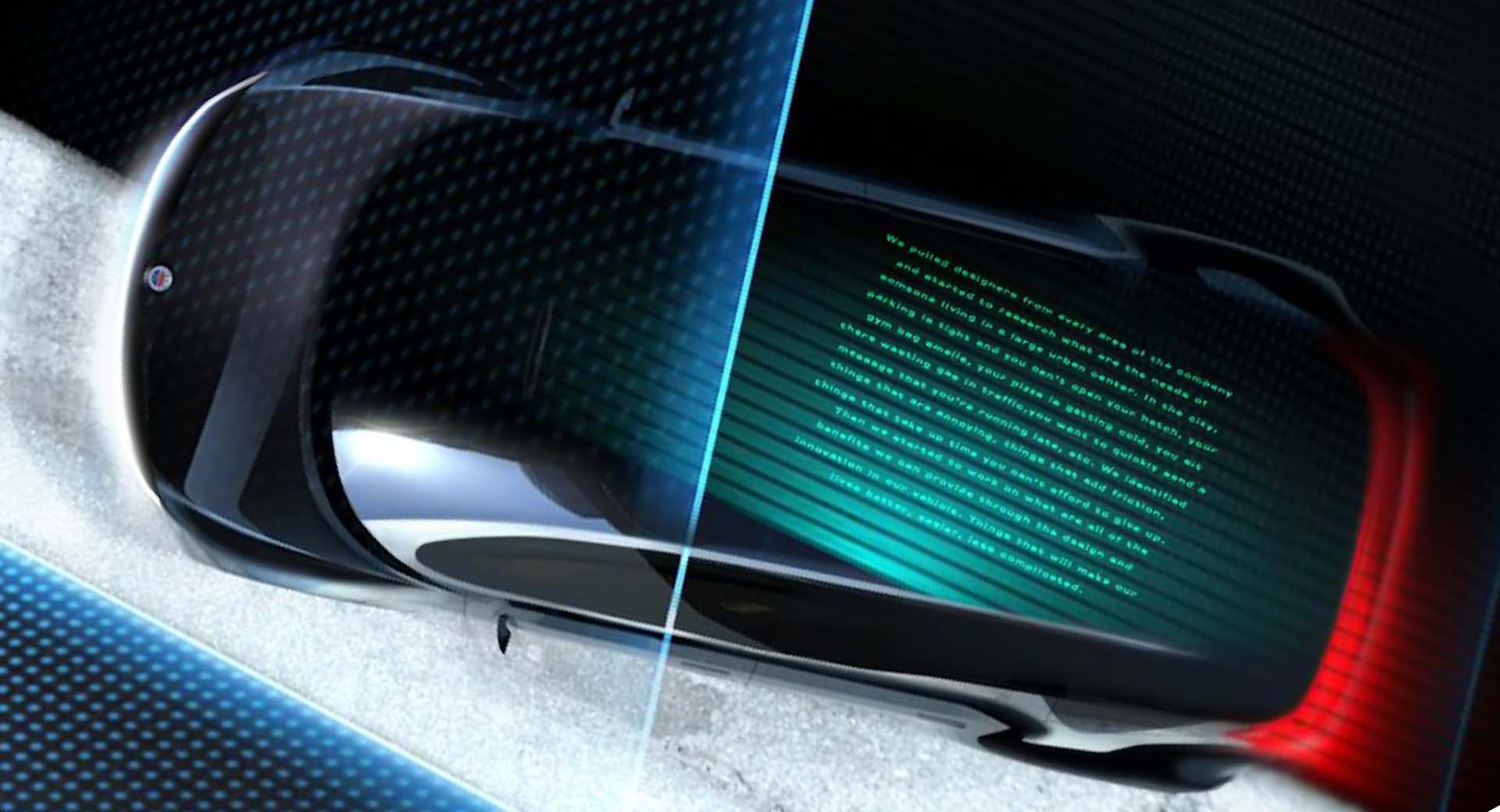
American electric vehicle manufacturer Fisker has teased its newest model, the Pear.
Pear is an acronym for “Personal Electric Automotive Revolution” according to the new carmaker, and production is expected to begin in 2024, when it is claimed to launch with a price of US$29,990 (AU$42,000).
The new electric car will follow the lead of the Ocean SUV, but as a more affordable option in its lineup.
Although details are not yet available, Fisker stated that the Pear would be a compact, urban electric vehicle (EV) with digital connectivity and room for five passengers.
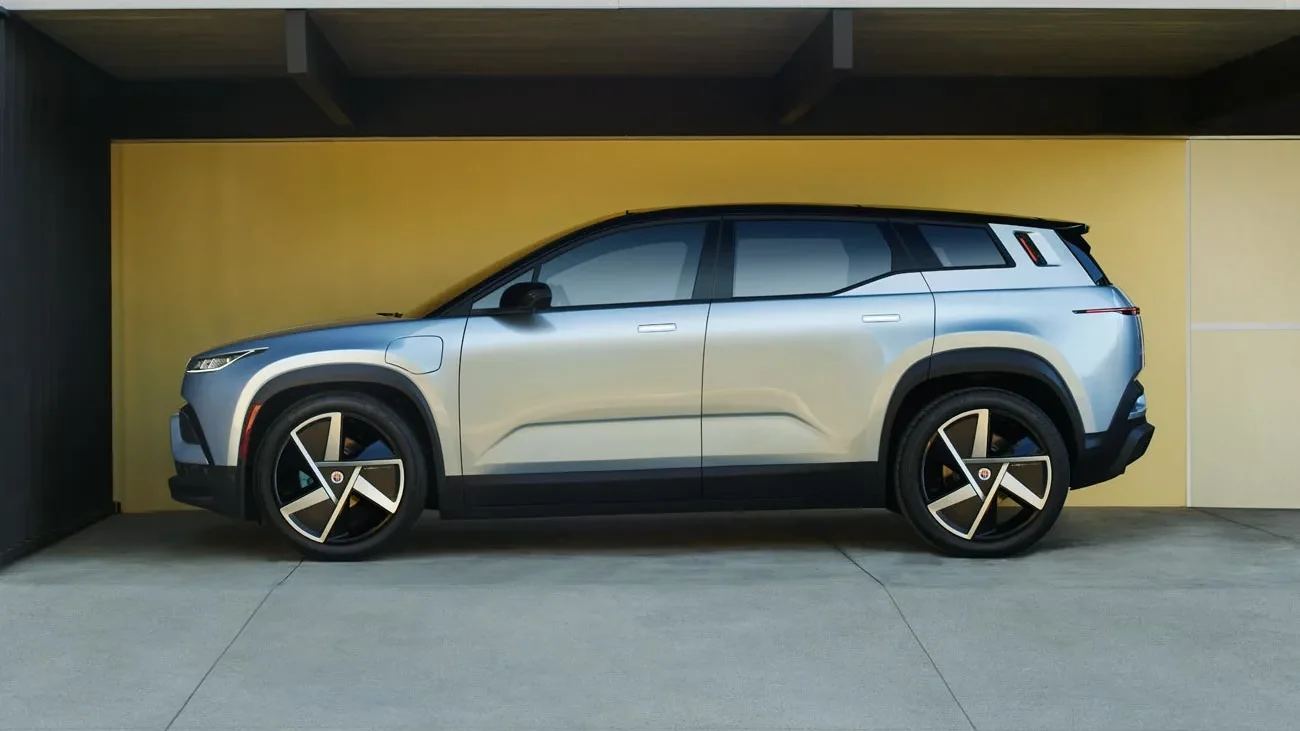
It is likely the Pear will come with a smaller battery pack than the Ocean and have less powerful electric motors due to its lower price. It’s possible that the new entry-level EV will have a battery of around 60kWh and a driving range of about 320 kilometres.Fisker’s teaser photo shows a compact crossover-looking car. Although it is an overhead shot, the EV can be seen borrowing styling cues from the Ocean. It will have the same rounded front fascia and short bonnet meeting with flared haunches, and tapered rear.
The Pear’s development will be done in conjunction with Chinese electronic company Foxconn (and be built in China) which recently expanded into electric car manufacturing and launched a pair of electric vehicles itself.Henrik Fisker, CEO of the start-up, said the “PEAR will be a beautiful, affordable, urban mobility device that features the latest technology. This is an exciting vehicle, and a great time for the company as it expands its product line.”
Fisker has previously said it wants to launch in Australia, but has not confirmed any details.
Snapshot
- $300,000 package to enable the installation of 180 chargers
- Up to 100 private owners able to access $1000, 80 businesses to get $2500
- Stamp duty to be waived on new EVs
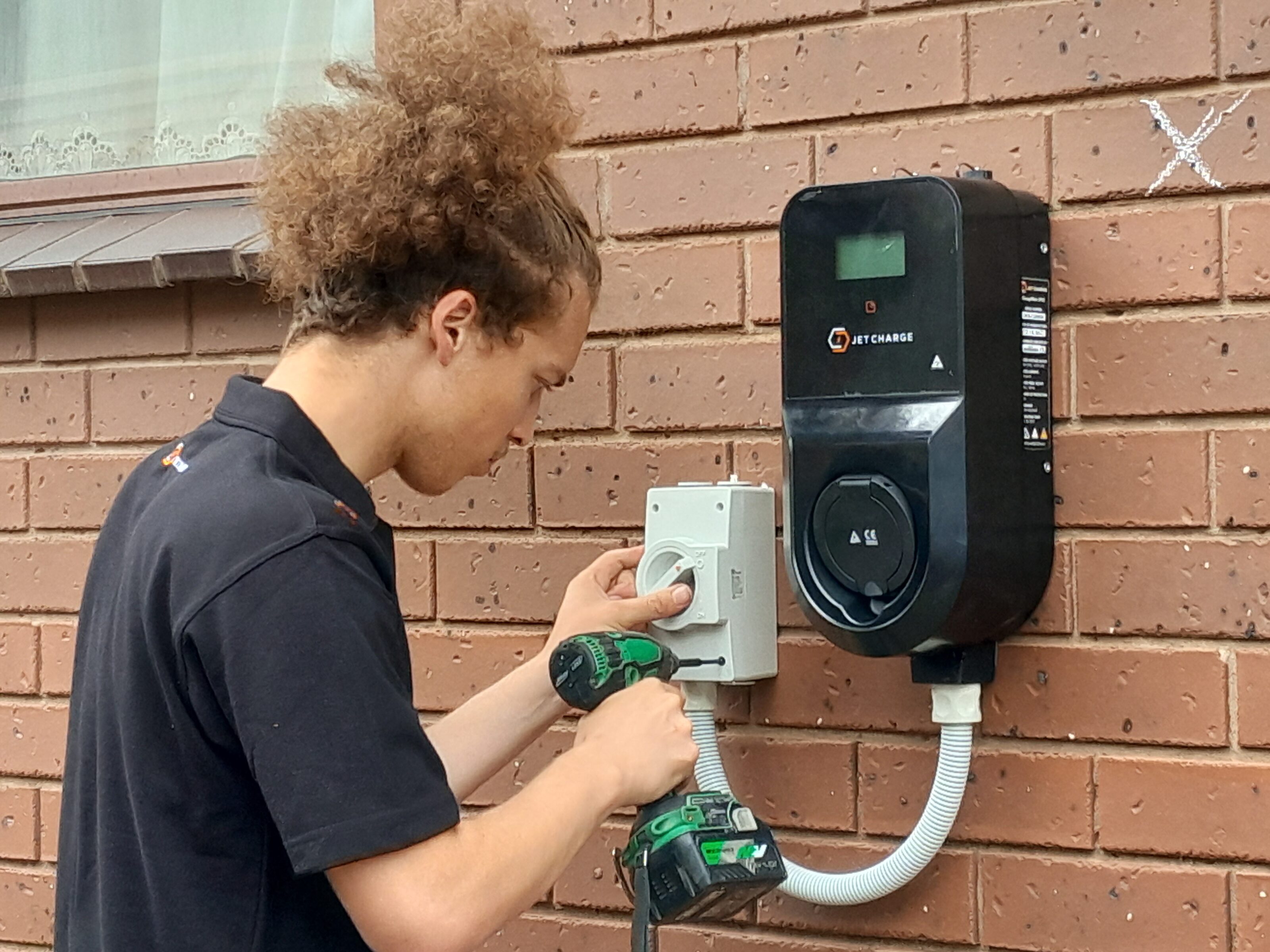
The Northern Territory Government has announced an investment package worth $300,000 for the installation of electric vehicle (EV) and plug-in hybrid vehicles (PHEVs).
Set to be implemented from July 1, 2022, the NT Government will introduce the Electric Vehicle Charger (Residential and Business) Grant Scheme – providing 100 residential grants of $1000 and 80 business grants of $2500 to applicants with EVs and PHEVs – halving the cost of purchase and installation of most chargers.
On top of this, the State Government will also scrap stamp duty on new EVs and PHEVs worth up to $50,000 from July 1, 2022, until June 30, 2027, saving buyers up to $1500.
Northern Territory Chief Minister Natasha Fyles said the investment was crucial for the Territory to achieve its goal of net-zero emissions by 2050.
“The [Northern] Territory Labor Government will continue to invest in new industries, expand business opportunities and create jobs for Territorians,” said Fyles.
“We are progressively working towards a target of 50 per cent renewables by 2030 and zero emissions by 2050. We are protecting and creating a sustainable environment for all Territorians to enjoy. Incentives and programs like this supports jobs and our environment.
“$300,000 will be invested in supplying part of the cost of installing an EV charger at your home or business. Local businesses and families will benefit from this scheme – whether it’s receiving the work now to install an EV charging system or to include a new asset to your business – it’s a win for the Territory.”
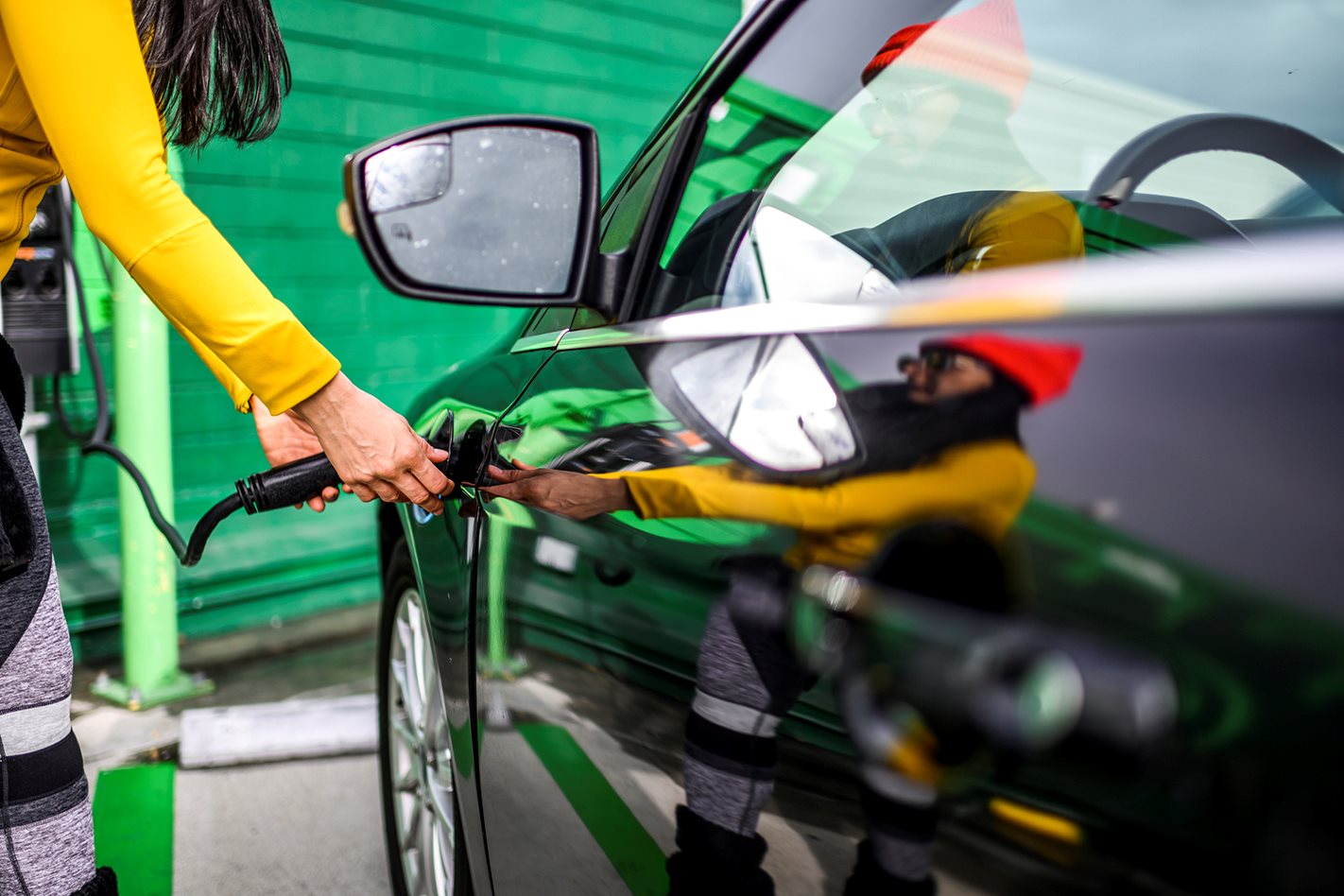
Minister for Infrastructure, Planning and Logistics Eva Lawler believes the stamp duty saving will allow new EV and PHEV owners to invest back into new charging technology at home.
“The Territory Labor Government is continuing to strive to reach our renewables and climate change targets,” said Lawler.
“From July 1, the Northern Territory will be leading other jurisdictions when it comes to electric vehicle incentives – $1500 off stamp duty until 2027, and the opportunity to apply to have part of your electric charging station paid off.
“The creation of this electric vehicle policy supports our Government’s actions on addressing climate risk and to transition to a low-carbon economy. Responding to climate change will not only help us protect our environment, but will support this new industry and the jobs that come with it.”
The NT Government has previously announced its plans to increase its fleet of electric vehicles by 20 per cent over 10 years to a total of 200 vehicles by 2030.
China’s answer to Google has unveiled the Jidu Robo-1 concept, a driverless car planned to go into production in 2023 as part of an ambitious move to take on Tesla.
The Jidu Robo-1 would become the first car to be released from Jidu Auto, a joint venture formed in January 2021 between Chinese internet firm Baidu and Volvo-owning Chinese carmaker Geely.
The Robo-1 SUV features a Level 4 autonomous driving system, which can operate the car without human interaction – though is one step below fully automated capability.
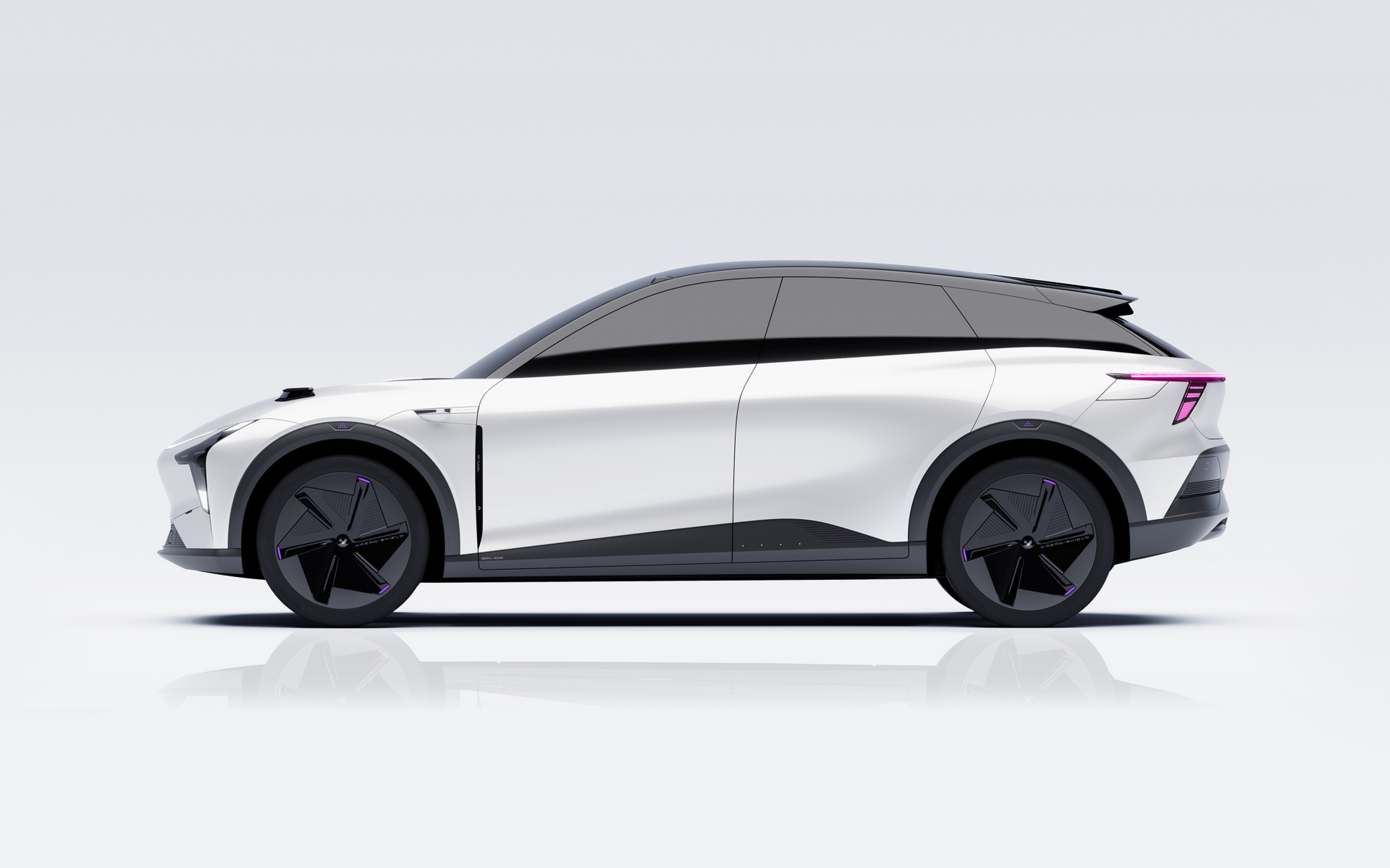
Distinctive exterior features include two 180-degree field-of-view lidar laser detection cameras, which pop out of the front guards, forming a total of a dozen high-definition autonomous driving cameras positioned around the vehicle.
The striking, pillar-less concept vehicle features dihedral doors up front and rear-hinged ‘coach’ handle-less doors at the back, while other stand-out design elements include Tetris-style pixel headlights and tail-lights with intelligently controlled, variable LED lighting.
A full-length panoramic roof blends into a rear design incorporating an electrically operated rear spoiler that rises and falls depending on vehicle speed to either reduce drag or improve downforce.
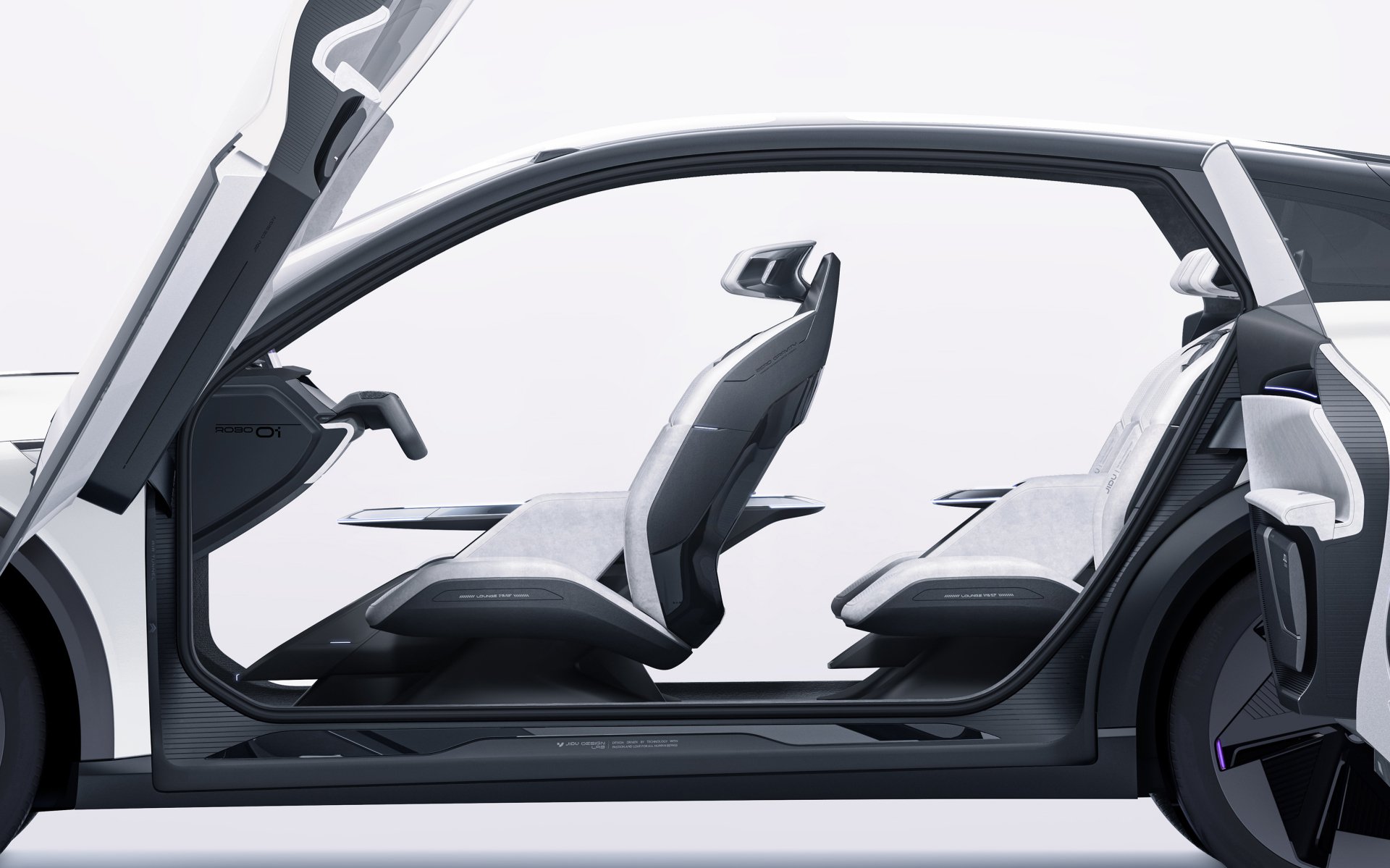
Inside, a minimalist, yet dramatic, cabin brings a full-width digital display with claimed high-resolution graphics and fast frame rate, and includes games to help entertain front occupants – including the ‘driver’ when not steering the car.
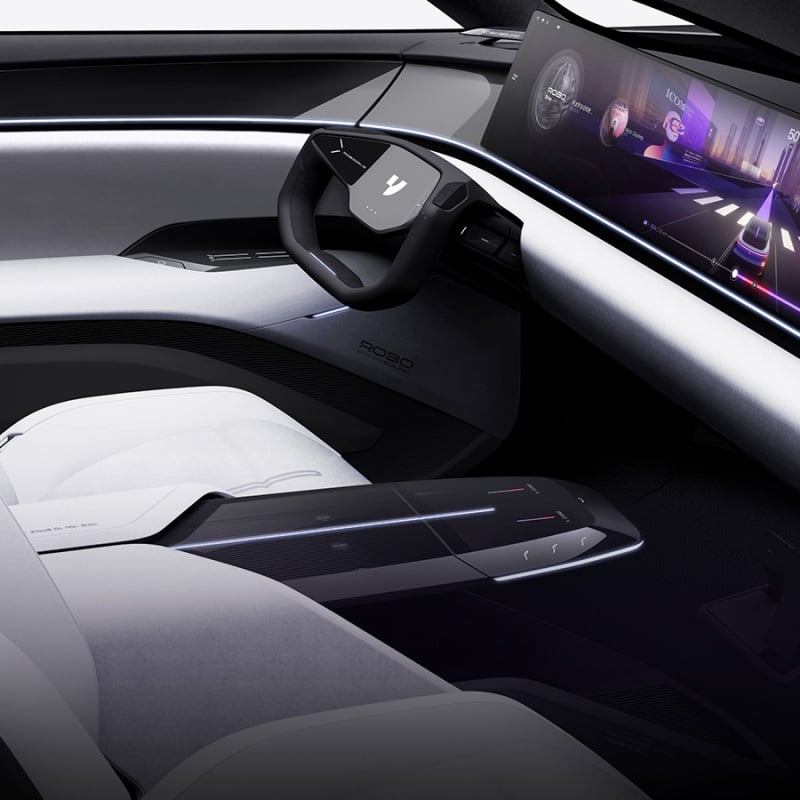
When the driver wants or needs to take control, a retractable, U-shaped steering wheel comes into play – following the trend for yoke-style tillers.
There’s an advanced audio system promising cinematic-quality sound, while occupants can use an artificially-intelligent voice command system to activate functions.
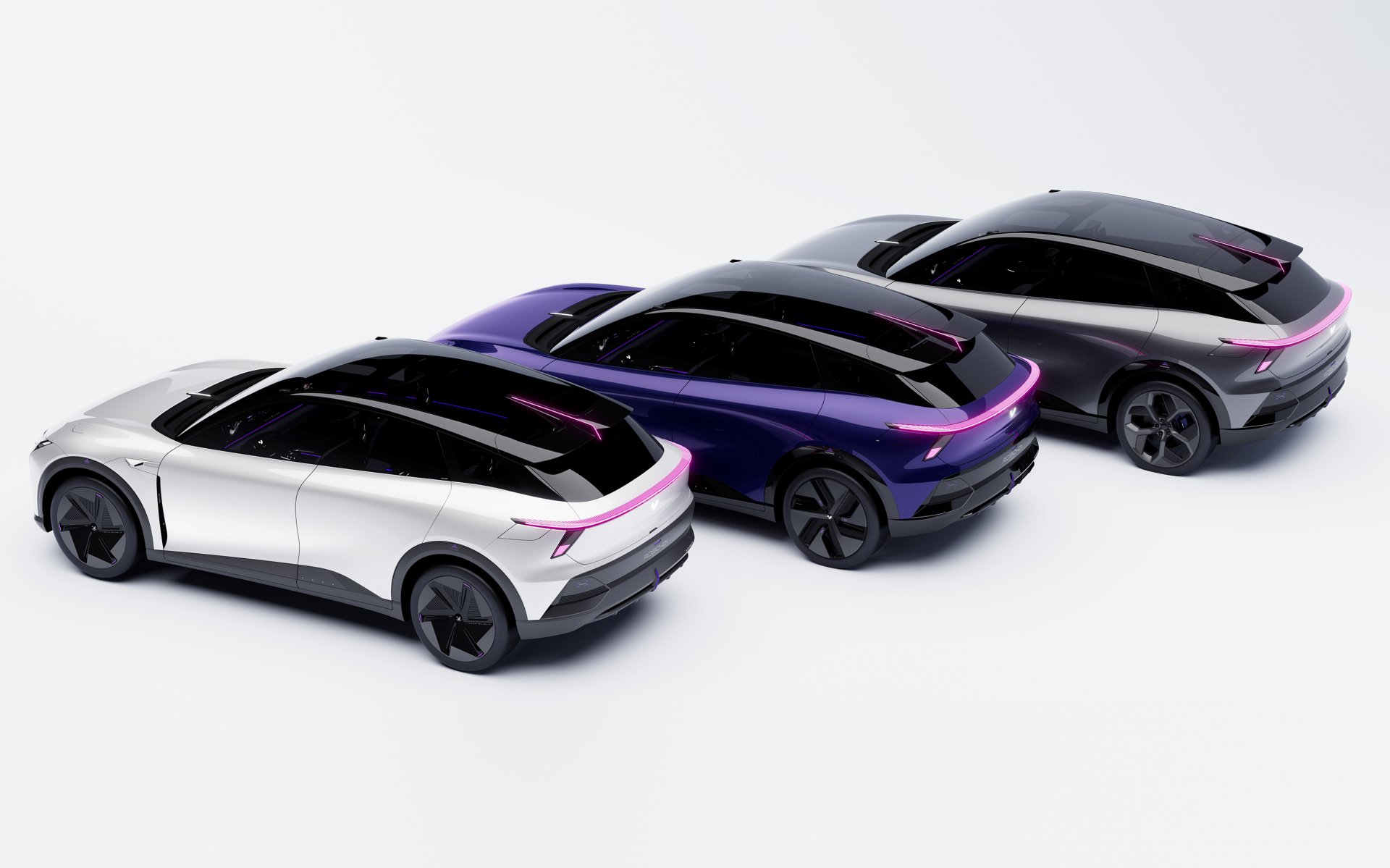
All four seating positions use lightweight, ‘spaceship-inspired’ zero-gravity seats, while the wraparound cabin design incorporates variable ambient lighting.
The Robo-1 production car will reportedly be 90 per cent faithful to the concept vehicle.
