
From the outset, Mazda’s electric foray looked like it would have a tough time convincing the judges it deserved to be there. Not only does the MX-30 E35 have a relatively short range rated at 224km on WLTP (but more like 180km in the real world) and modest performance, it also comes at an eye-watering price of $65,490.
Compared with some other EVs on the market and even a couple in our fleet this year, the unorthodox Mazda’s value equation appears impossible to solve. And yet, the quirky crossover started to melt a frosty reception early on with some irresistibly charming features.
As only the third model in Mazda’s history to wear the MX badge, its first pure-electric coupe-profiled crossover certainly deserves to be labelled ‘Mazda Experimental’ but has it been too much of a risk?
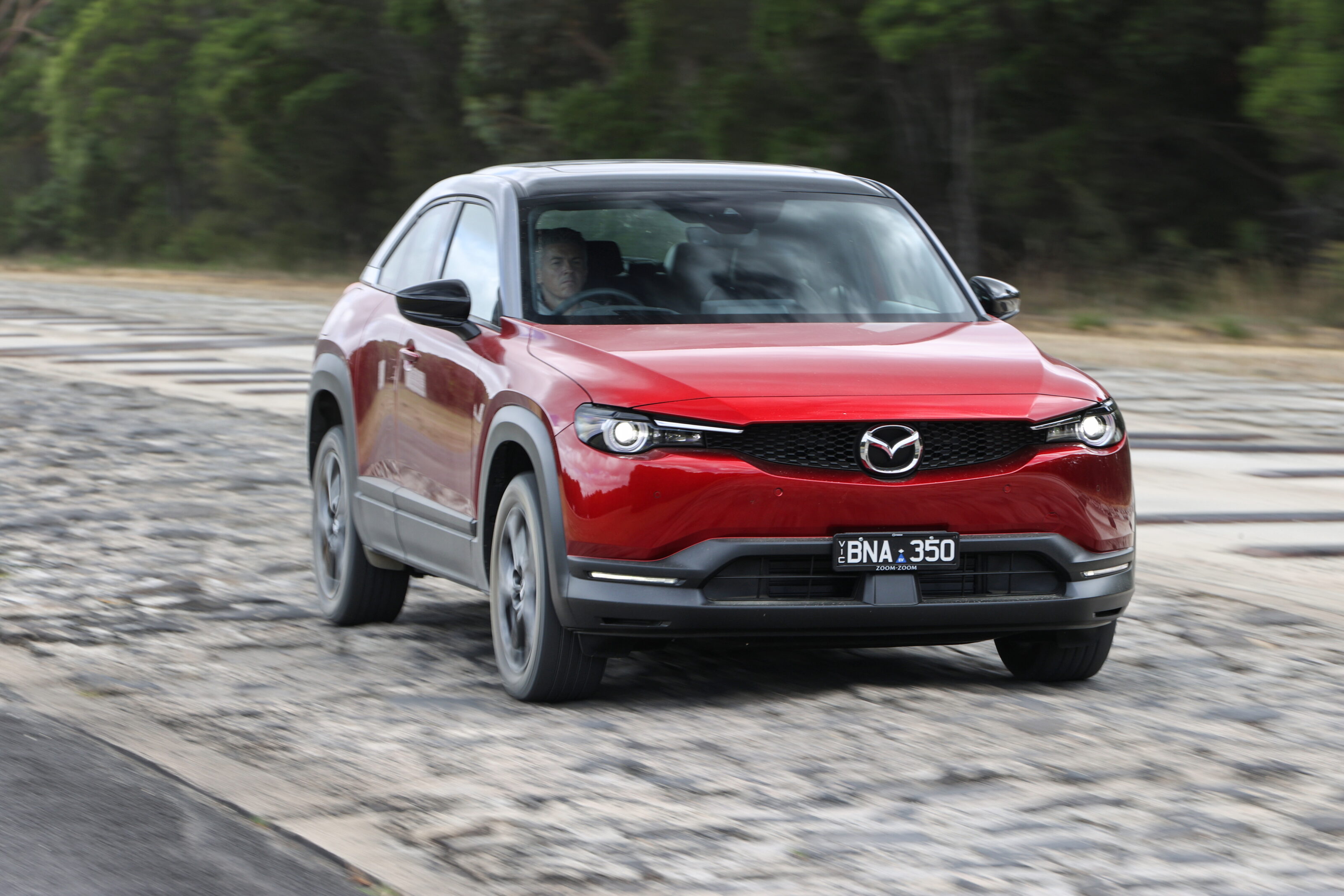
Perhaps the biggest departure from the company’s Kodo design language to date received both praise and criticism from all six judges including our design authority Ferlazzo. “The MX-30 makes a fashion statement but pushes the boundaries of practicalities,” he said.
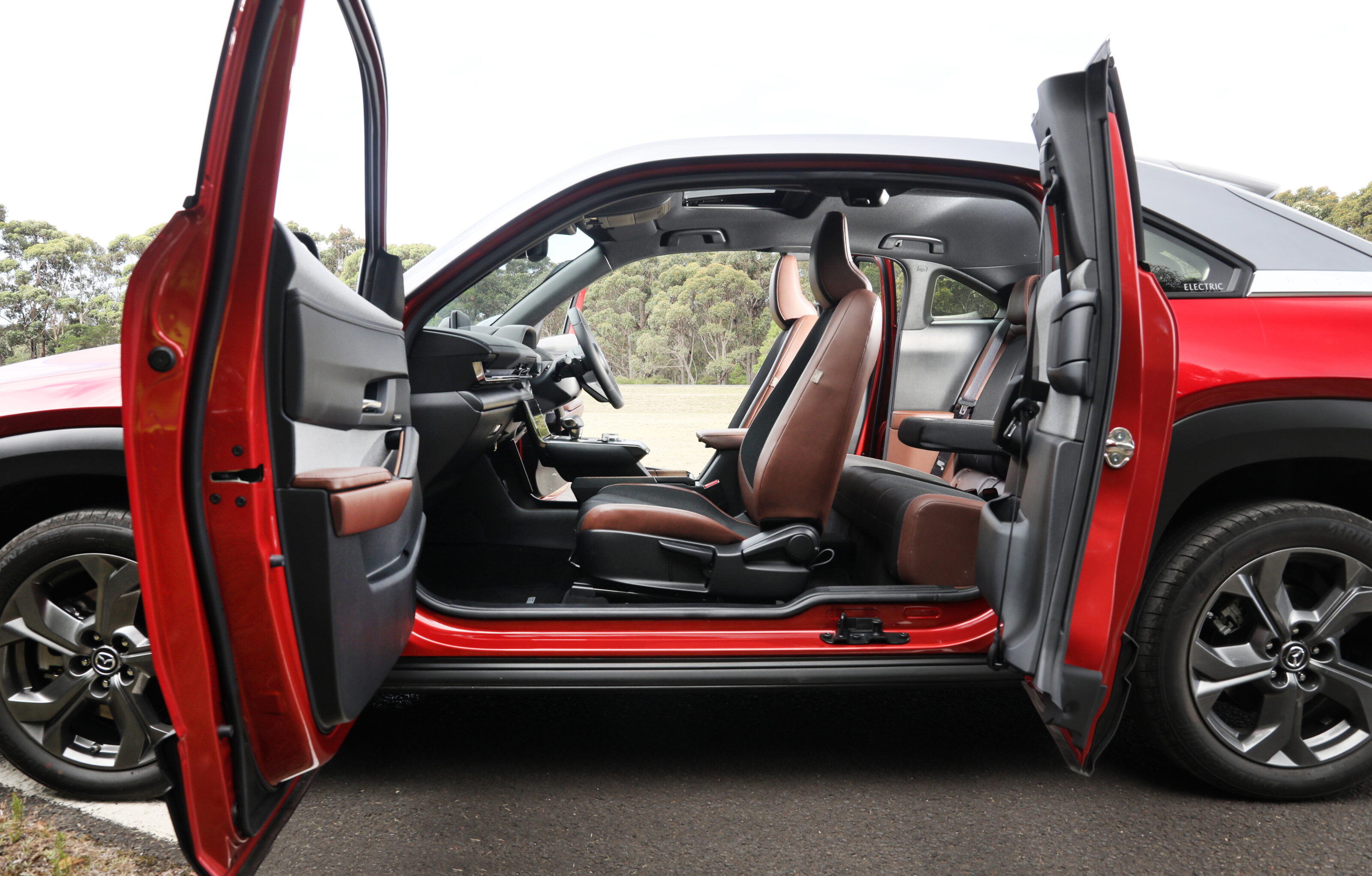
Most notably, the E35’s ‘freestyle’ doors (particularly on the driver’s side) copped the most mire as an example of style over apparent substance. “Overlapping, suicide doors seemed innovative on RX-8, but quite impractical on a city-style electric hatch,” agreed Jez.
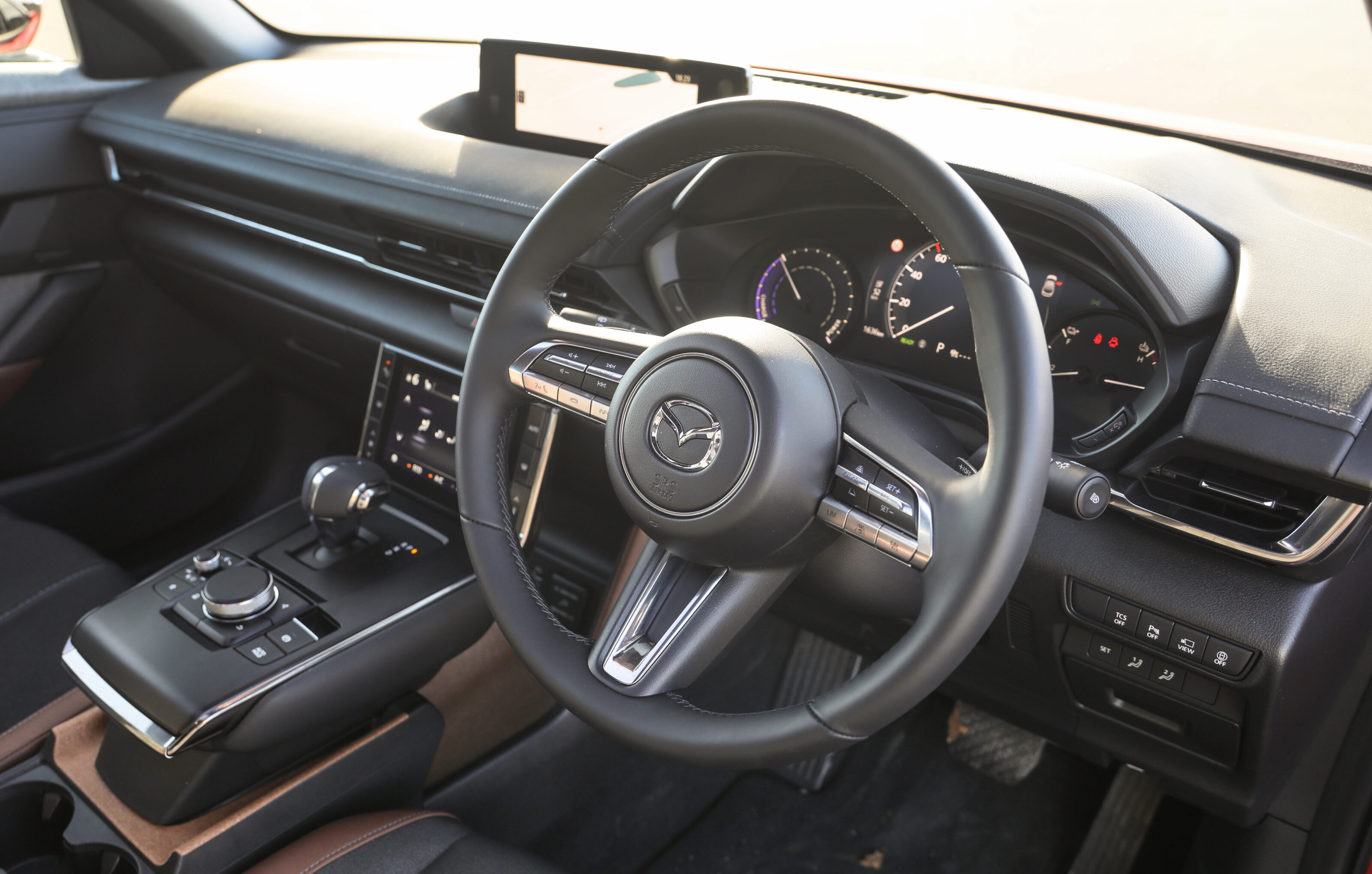
On the inside, the polarising design continues. Inwood criticised the cork touch-points for their reconstituted and plastic appearance compared with the more natural and beautiful material showcased by the MX-30 concept. That aside, the cabin ambience, finish and quality is in keeping with the Japanese car maker’s bid to push its brand into more premium territory and won favour with all that climbed aboard.
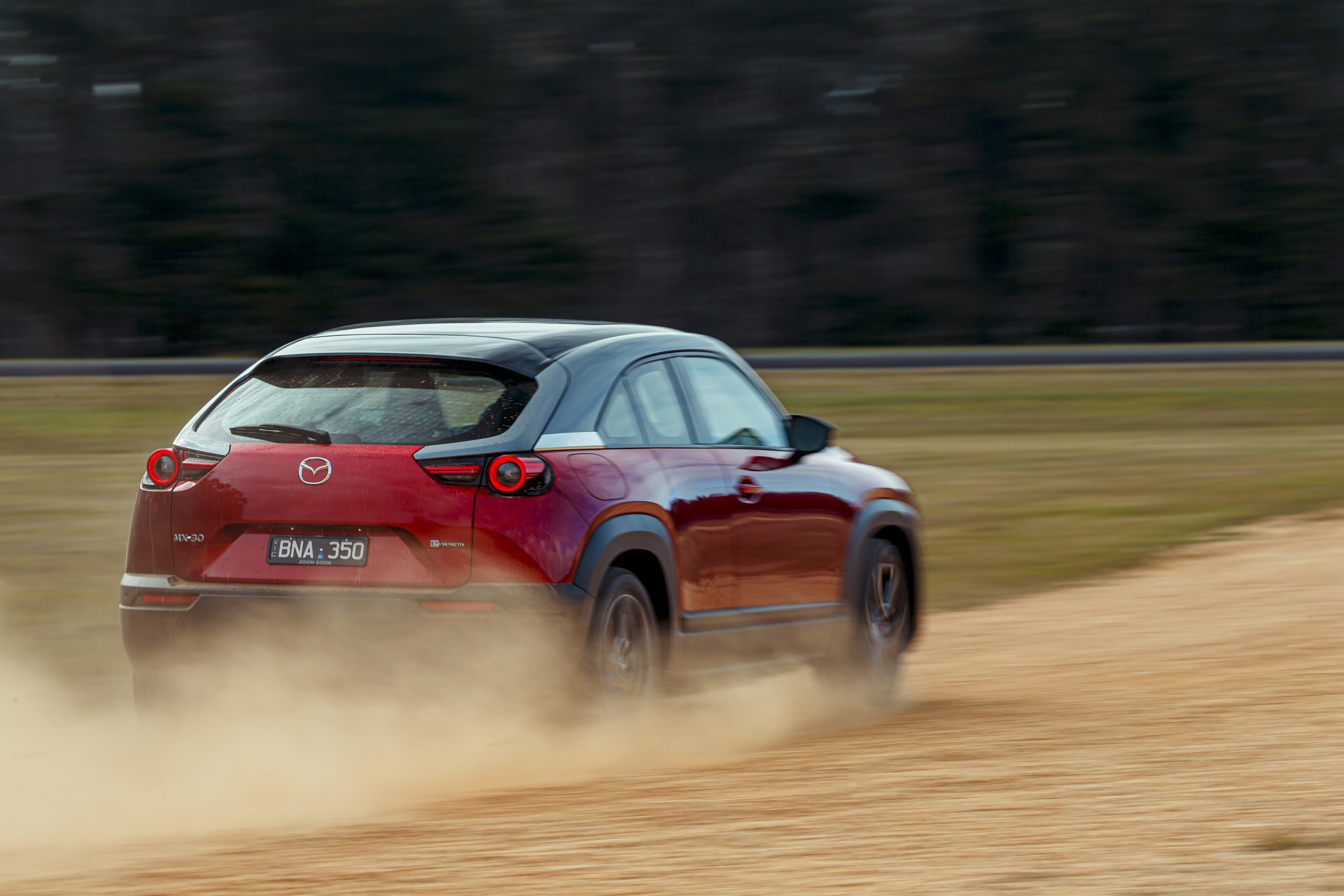
With just 107kW and 271Nm from its single motor and 35.5kWh battery, performance expectations were decidedly low, but the MX-30’s electric drivetrain adds just 160kg to the kerb weight of the petrol versions and its road manners were surprisingly sprightly.
Front-end grip was impressive, as was body control especially through the lane-change test with an eagerness to change direction and recover without complaint.
Combined with crisp steering, the driving experience earned the MX-30 more respect than most had been prepared for.“Good to see Mazda continue its aim to please drivers even with an EV,” commented Jez.
“Distinctive interior design and materials reminiscent of the BMW i3 – but so is the price” – Jez Spinks
A strange Jetsons-meets-combustion sound generated under acceleration polarised judges’ opinion but all agreed the boomy cabin noise over bumps was too much for an otherwise quiet and comfortable EV.
Curt suggested that Mazda may have been a little too experimental with this latest MX, and that its various interesting facets might have worked better in different applications. “It’d fare better with genuine SUV body style and packaging.
Or shoehorning its range and outputs into a light Fiat 500 competitor – a funky urban runabout – at a price starting in the high threes or low fours,” he said.
Compared with the petrol and very-mild hybrid versions of the MX-30, the electric E35’s less conventional powertrain is a better pairing with its mould-breaking design, and one might argue the forthcoming rotary range-extender is the version that’ll better honour the MX moniker.
Ultimately, it was the questionable packaging, meagre range and mighty price disparity that relegated this intriguing Mazda to the ‘not quite’ pile.
A practically compromised exercise of style over substance, but nonetheless a fascinating glimpse into what Mazda is capable of in an exciting new electric arena.
Line up this bigger, smarter, bolder and more expensive Kia Sportage against the model it replaces and we doubt even the most devoted fans of the nameplate could draw much of a family resemblance. Kia hasn’t so much as overhauled its best-selling model for this fifth-generation; it’s transformed it.
Core to the step change is a move to the Hyundai Motor Group’s N3 large platform (shared with the new Tucson), which allowed for a significant dimensional increase. Now 175mm longer and boasting a wheelbase stretched by 85mm, the Sportage has gone from being one of the smaller SUVs in its class, to one of the largest.
This generational stretch has done wonders for the sense of interior space and roominess, especially for second-row passengers. It’s boosted boot space, too, to a Toyota RAV4 rivalling 543L, and includes the fitment of a full-size spare.

Top marks for packaging, then, especially for families who will also appreciate the twin rear air vents and the USB-C outlets integrated into the backrests of the front seats.
The variant chosen for COTY testing – the $52,370 flagship GT-Line – meant Sportage was able to put its best foot forward on two counts: in the cabin and under the bonnet.
While every variant in the four-tier model range scores an impressive list of standard gear and a full suite of active safety equipment, which includes a centre airbag between the front seats, only the GT-Line boasts Kia’s attention-grabbing 12.3-inch curved instrument cluster. It pairs with another 12.3-inch central screen for a twin-screen digital dash design that has more than a whiff of Mercedes-Benz about it.

The rest of the cabin imparts a Euro feel, too. Materials quality is high and fit-and-finish is impressive, causing Dan to remark: “It feels absurdly premium for a South Korean car of this price.”
“Easy to recommend, but it doesn’t break new ground” – Dan Gardner
Comparisons with the lower-spec Hyundai Tucson also at COTY were illuminating, with the Kia’s extra glitz, glamour and gear justifying its $7K premium over its Korean sibling.
Powering the GT-Line is the same 2.0-litre turbo-diesel as found in the Tucson, producing 137kW/416Nm. It’s a gutsy unit that’s easily the pick in the Sportage range (a 2.0-litre atmo petrol and 1.6-litre turbo petrol are also available) but doesn’t sidestep all of the usual diesel drawbacks.

As some judges noted: “NVH is well rounded, though the diesel can be a little clattery”, and that it’s “a little vibey at idle.”
The ride and handling compromise is also nicely judged for a family SUV, thanks in part to a local suspension tune. Kia Australia’s chassis guru Graeme Gambold selected special Mando dampers which strike a decent balance between compliance and control and helped the Sportage impress on our dynamic courses. “Quite quick, capable and grippy,” noted Curt.
Excellent composure and road manners on gravel were another highlight, although while it’s a capable family hauler, the judges noted Sportage isn’t in the same dynamic league as some rivals when really pushed. “Not as sorted as Mazda CX-5 or VW Tiguan,” said Jez. “Steering has room for improvement, too.”

So it’s bigger, better, bursting with useful equipment and thoughtful touches (like the blind-spot camera that appears on the digital dial pack when indicating), and it’s nicely sorted on the move.
So why didn’t the Sportage progress as a COTY finalist? Dylan summed it up best: “Sportage is hard to fault, yet it’s also hard to praise. It lacks the fairy dust of other cars here.”
The general consensus was that while it was a seismic step forward for Sportage, this new model didn’t break enough new ground, or progress its segment in a meaningful way. Which was enough to halt the likeable Kia’s progress.
It might be hard to believe, but the 2022 Skoda Fabia is the most expensive new Skoda money can buy, and if you want to own an example of the fourth-generation range-topper it’ll cost you about $325,000.
We would have to agree that’s a little outside most compact hatchback budgets but the factory-built R5 variant is equipped with all-wheel drive, a 214kW turbocharged 1.6-litre four-cylinder, and a roll cage, to list a few of its more compelling features.
If you don’t necessarily need to compete in the FIA WRC 2 rally category, however, then the Monte Carlo that’s arriving on Australian shores in the third quarter of this year may be a little more suitable. But if that’s still a bit pricey with an estimated price of about $30,000 then what about this?
UPDATE, July 2022: Australian pricing announced for new Skoda Fabia
Local pricing and features for the new Skoda Fabia have now been revealed. Get all the details at the link below.
The story to here
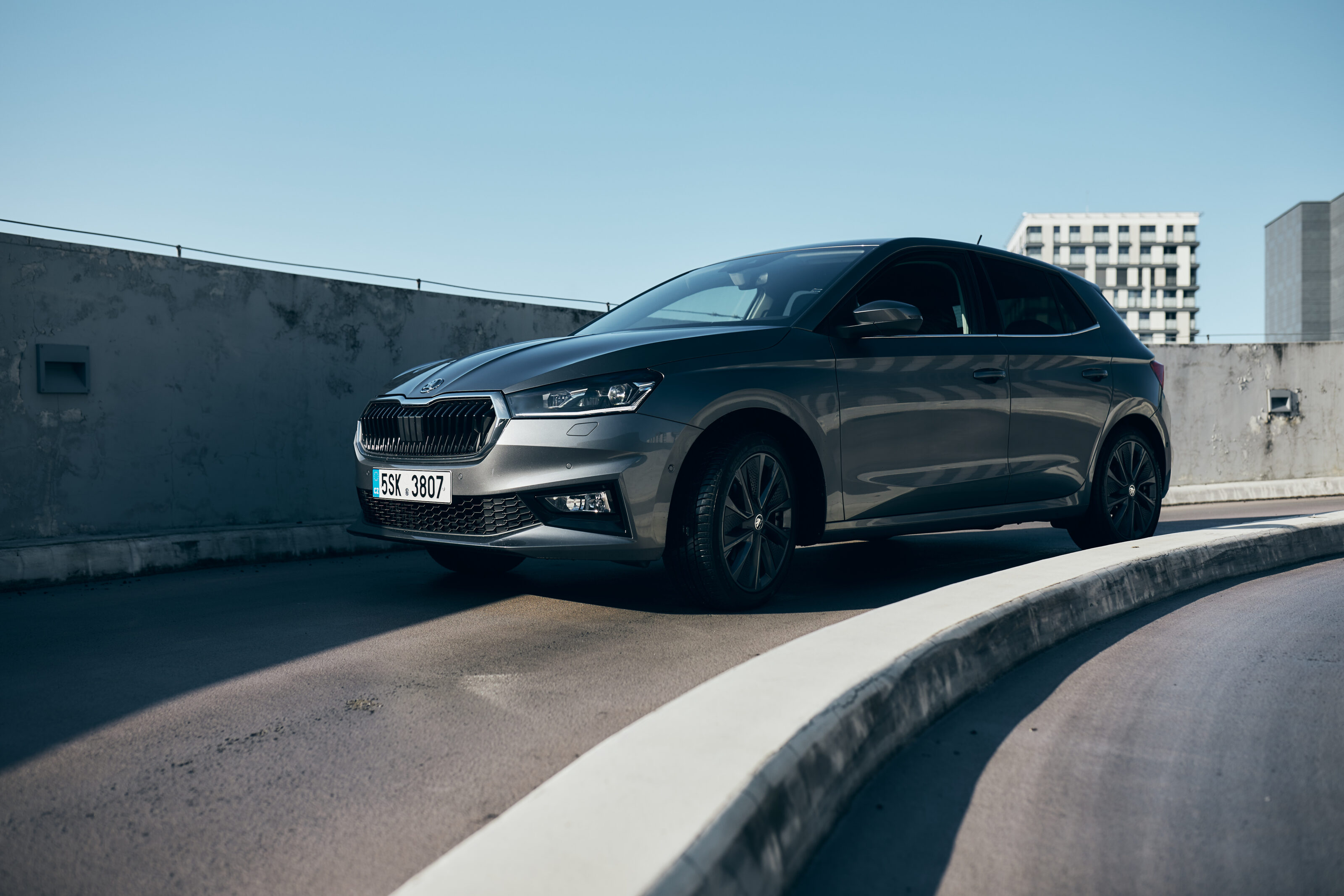
Positioned below the 1.5-litre four-cylinder version, the 81 TSI is fitted with the 1.0-litre turbo three-cylinder found in the current run-out version for improved fuel efficiency and, perhaps more importantly, a sharper price. It’s not quite confirmed for Australia yet but it’s likely it’ll join the family in 2024.
“There is scope to expand the range but not in the first year of sale,” says Skoda Australia. But we hope it does, because this more accessible version of the all-new Fabia makes light work of some big-car duties.
During a week with the smallest member of the Skoda line-up, I covered almost 1000km, making the trip from Prague to Vienna and back again, plus a variety of short blasts in between. The impression it left is one of a much larger car and that this little hatch has never felt more grown-up.
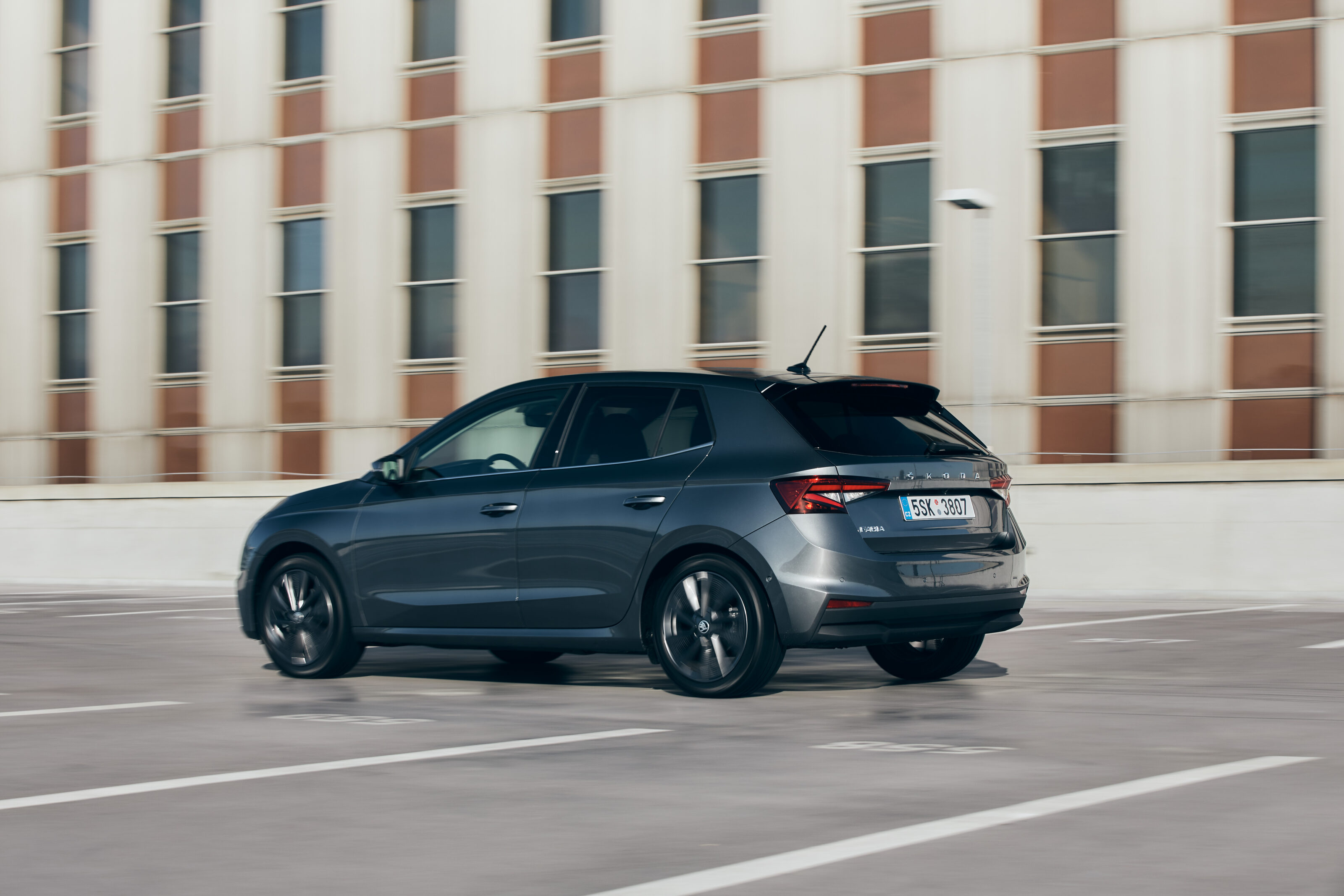
Australia’s road rules might have you believe that a five-door with just three cylinders under its bonnet would be a deathtrap on Europe’s 130km/h limit (plus a bit) freeways but the 81 TSI is incredibly capable at demolishing distance.
Its seven-speed dual-clutch auto has the perfect ratios for optimising the prominent torque at lower speeds, and while overtaking becomes a bit more of an effort near the speed limit, it has the legs for comfortable cruising.
During a week with the smallest member of the Skoda line-up, the impression is of a much larger car and this little hatch has never felt more grown-up
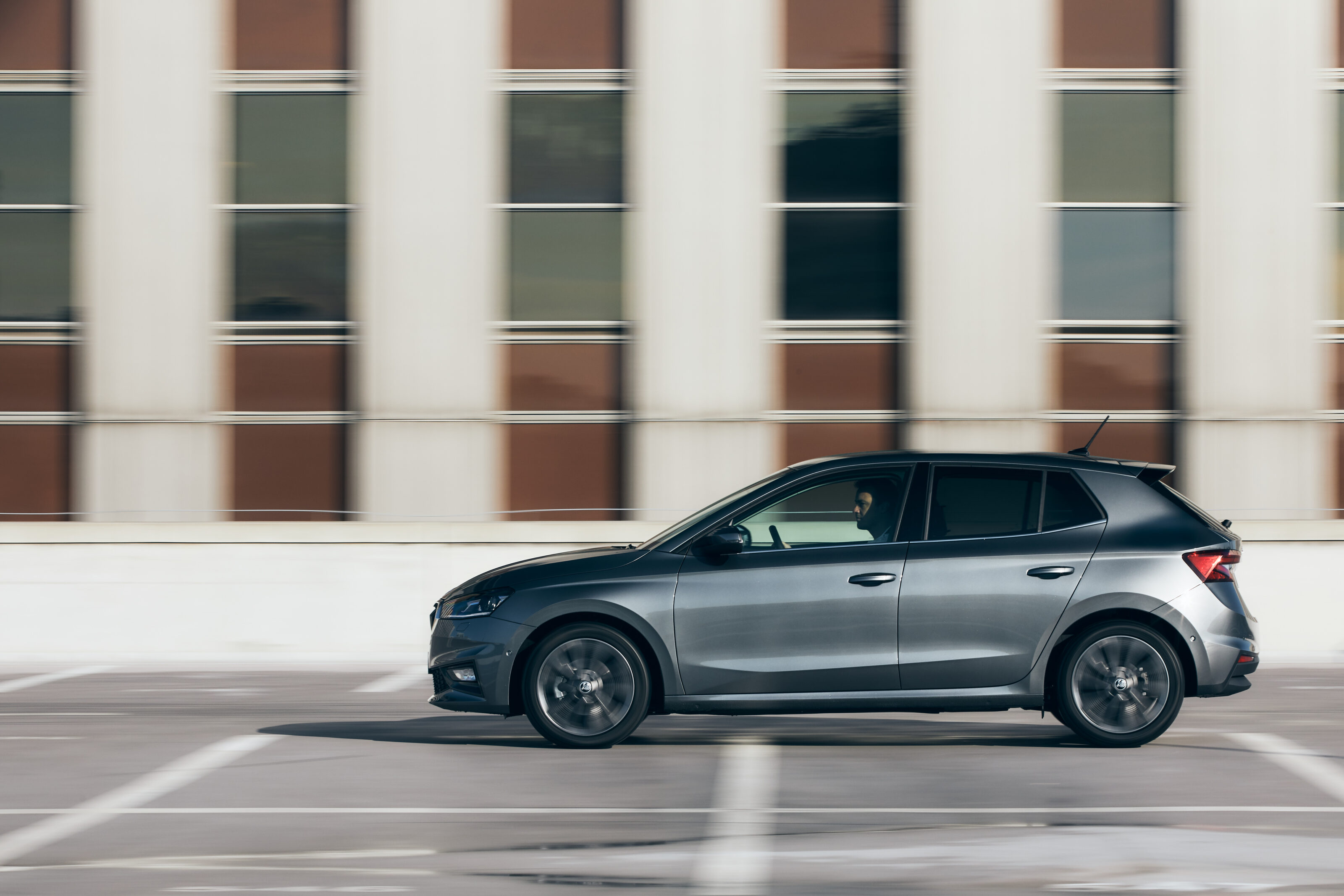
At lower speeds, the 81 TSI’s engine and transmission are calibrated for more relaxed progress. The full 200Nm of torque is developed quickly, making for rapid progress but a reluctance to rev combined with a little rev-hang at higher engine speeds removes any hope that this version might moonlight as a baby RS, along with an occasionally laggy and flustered transmission made more obvious by the lack of shift paddles. It’s a shame because the Fabia’s chassis really shines.
Steering responsiveness is a treat, the Fabia has an obedient front end, it’s light on its feet and there’s heaps of grip from the Michelin Primacy 3 rubber – particularly in the wet. But easily its strongest virtue is economy. Skoda claims a combined figure of 5.5L/100km and even with a week of decidedly ambitious driving style loaded with luggage and enthusiasm, the little Skoda still managed a figure of 6.2L/100km.
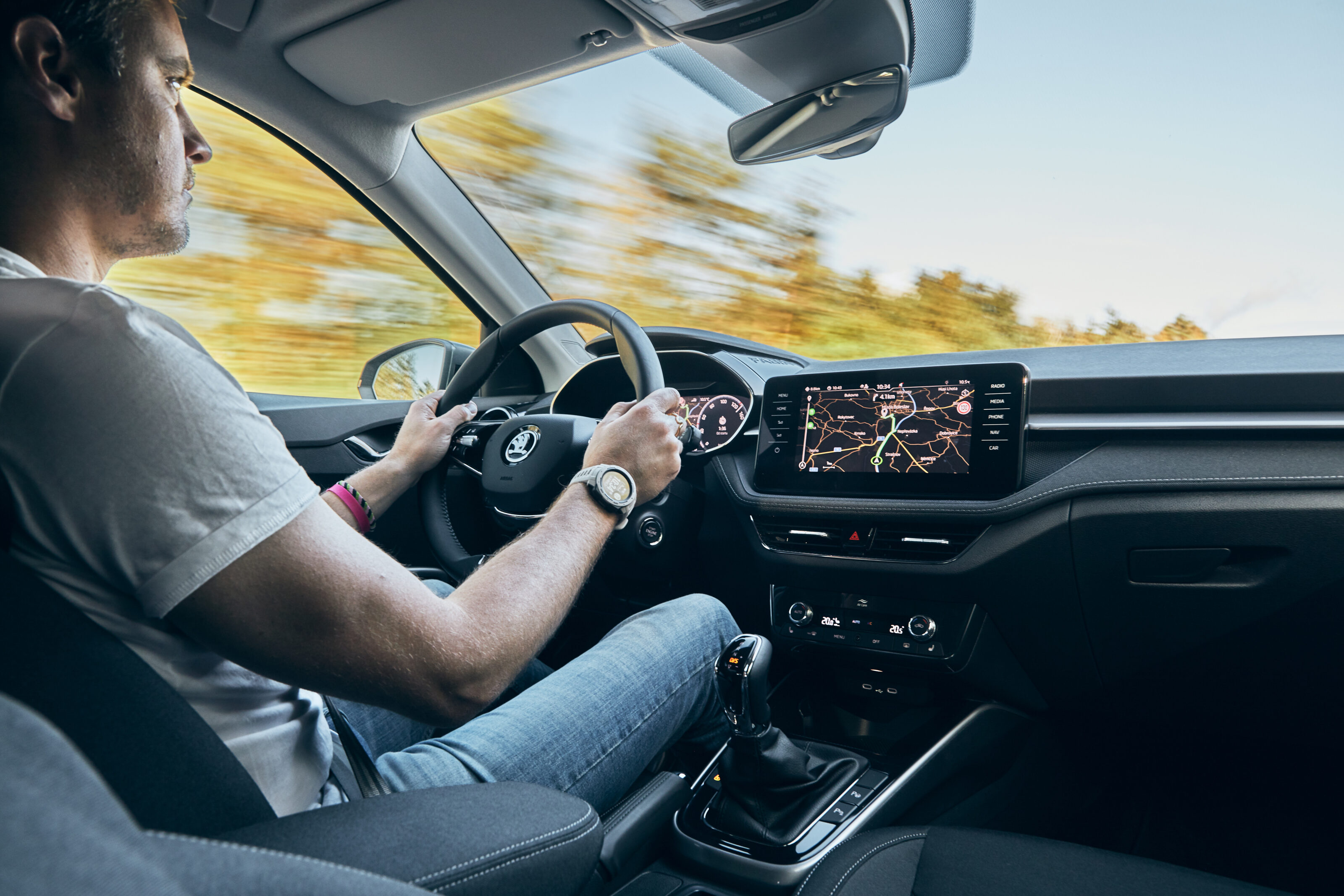
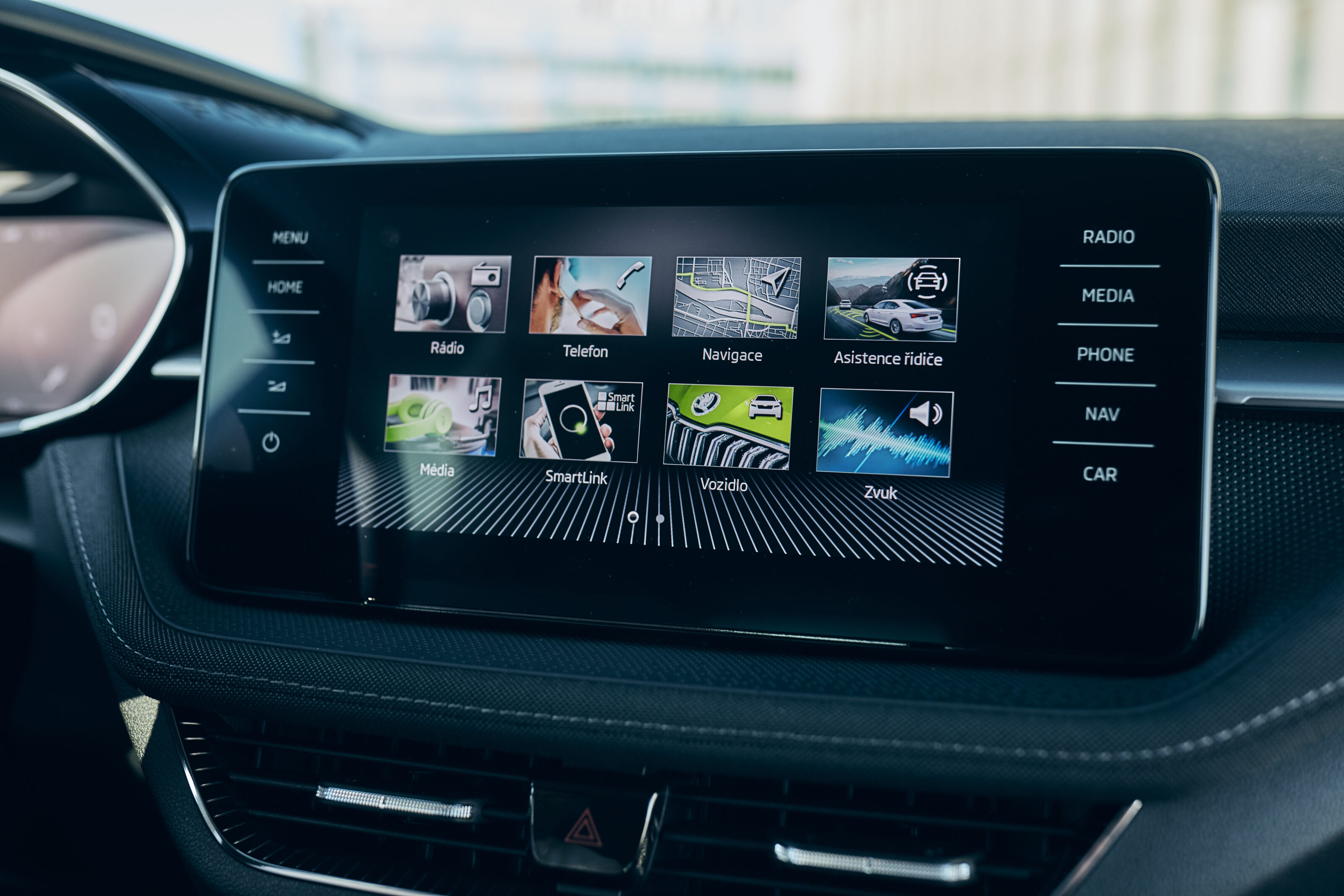
In Skoda’s ranks, the Style specification is about the entry-to-mid-point of the range, but there’s still lots of equipment when applied to the Fabia. Australian specifications may differ, but ours had 17-inch wheels, heating for the steering wheel and front seats, a 10.3-inch fully digital instrument cluster, 9.2-inch central touchscreen, LED headlights and a dusting of Skoda’s ‘simply clever’ touches about the car too.
We particularly liked the windscreen ice scraper hiding in the fuel flap, device holders for rear passengers and USB-C charge port behind the rear-view mirror for powering a dashcam.
Australian specifications may differ, but ours had a dusting of Skoda’s ‘simply clever’ touches – we particularly liked the windscreen ice scraper in the fuel flap

Knitting all that substance together is a new design that has an adult’s confidence and more effectively aligns with the rest of the Skoda family. There’s no faux-sports D-shaped steering wheel, opting for a more mature round version with cool ‘phantom’ third spoke. The seats usurp leather in favour of a pleasant and high-quality fabric, while the dash is ergonomically laid out.
The Fabia has also grown up technologically. Wireless Android Auto and Apple CarPlay, wireless device charging, self-parking, adaptive cruise control and speed sign recognition are all available, as is navigation, although we couldn’t learn Czech quickly enough to evaluate the latter in a week.
Practicality also ranks very highly with a car that is both a decent size – measuring 4.1 metres long and just less than 1.8m wide – but still has the visibility and perfectly placed driving position to handle the proportions in Prague’s tight and distractingly beautiful streets.
Its boot can be optioned with more clever features to introduce flexible storage spaces, hooks, nets and even a special hammock for stowing damp umbrellas (if you choose to not use the one hidden in the front door), but even in standard trim, the 380-litre luggage area is big for the class.
From its larger grille and chiseled light units, to the spacious interior with quality materials and features, the new Fabia is more car for the cash.
With its excellent blend of sharp chassis, equipment and fuel economy, the fourth-gen Fabia family will be more in keeping with the brand’s core values and well worth the wait
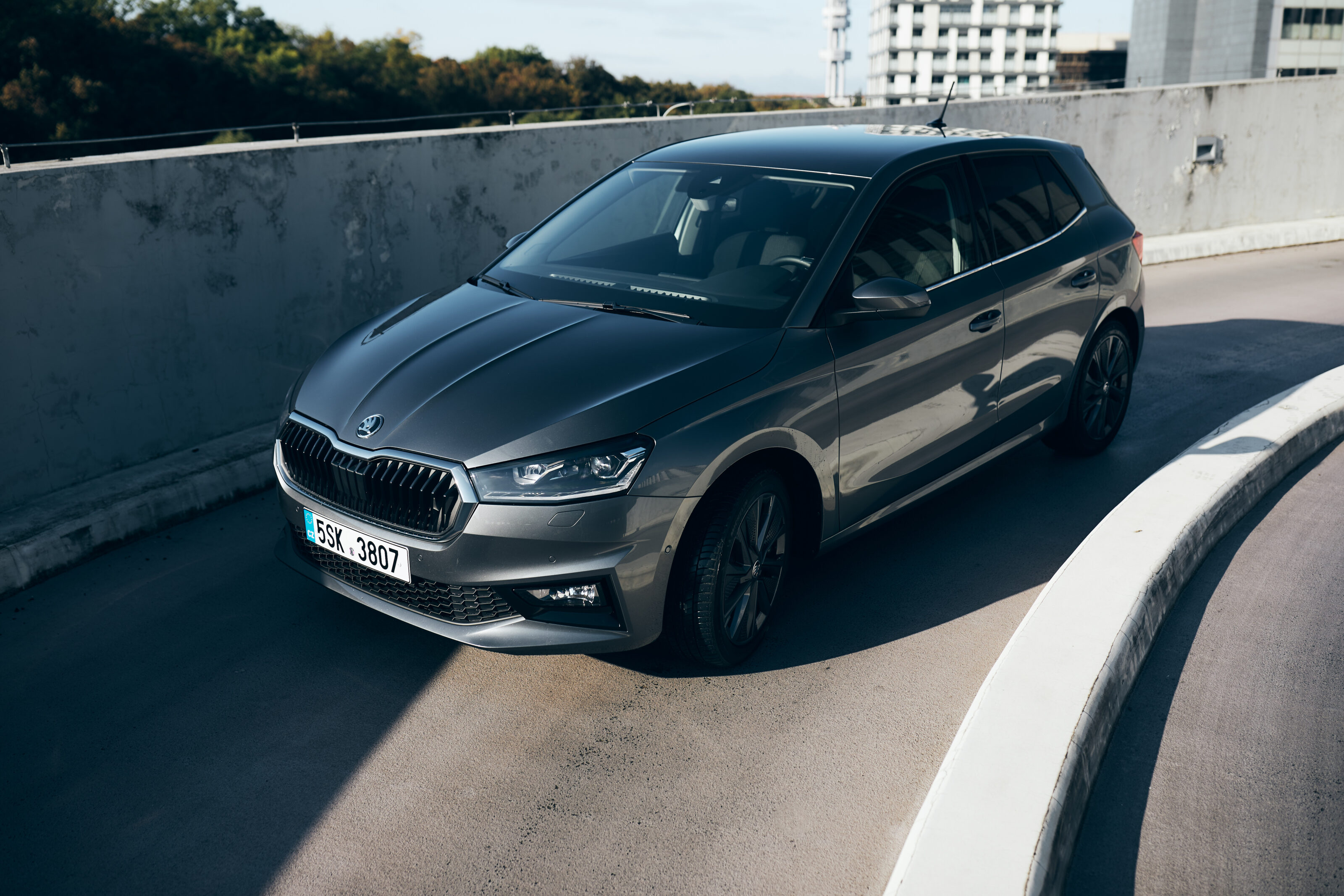
The Monte Carlo that’ll be on offer later this year will deliver the biggest chunk of kit in the range as well as an additional 30kW and 50Nm over the three-cylinder, and zero to 100km/h acceleration that beats the 81 TSI by nearly two tenths.
But, for the brand that forged its place in the market as the Euro that costs less, the Fabia is getting rather pricey. Then again, with its excellent blend of sharp chassis, equipment and fuel economy, an additional member of the fourth-gen Fabia family will be more in keeping with the brand’s core values and well worth the wait.
And it’ll help you save a little faster for that R5 to sit alongside it in the garage.
2023 Skoda Fabia 81 TSI specifications
Nissan recently ripped the covers off the seventh generation of its halo Z sports coupe model, oozing styling cues from the granddaddy of Z-cars, the S30 series that ran from 1969 to 1978. It could be argued that the Z family has never strayed too far from the S30 template: six-cylinder engine beneath a long bonnet, a pert coupe cabin over the driven rear wheels.
Purists like to point to the very first Z, the two-seater, 2.4-litre Datsun 240Z, which rocketed to best-selling sports car status within three years and ended Britain’s hold on affordable sportsters.
We’re here to argue that the 260Z, introduced in 1974, is the more truly representative of the breed. Because it’s where the bloat began.
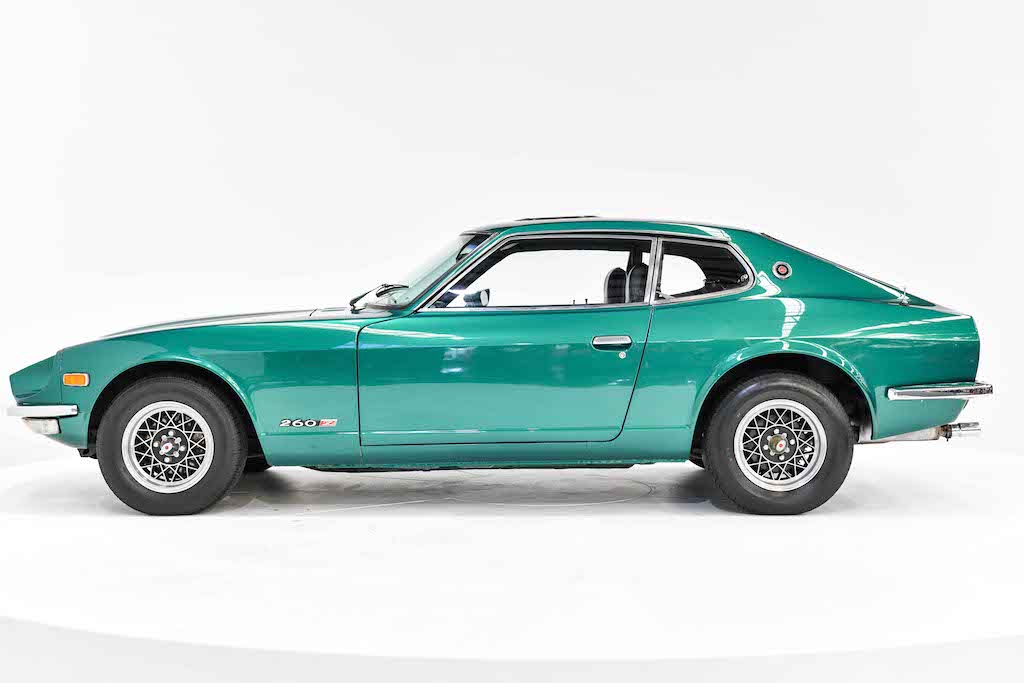
Launched amid the global oil crisis and choking US emissions and safety laws, the 260Z stepped up engine capacity (from 2.4 to 2.6 litres), though the two-seater proved to be no quicker than the 240Z it replaced. More significant was the addition of a cushier, two-plus-two seater version. Both body styles were sold in Australia, but as with the following two or three Z generations, two-seaters are rarely seen.
Inspired by Jaguar’s stretch of the E-Type coupe (the E had inspired the Z from the start), Nissan stitched an additional 30cm into the wheelbase and raised the rear roofline.
The latter gave at least some extra headroom for the kiddie-sized rear seats, each of which was drooped between the transmission tunnel and a wheelarch.
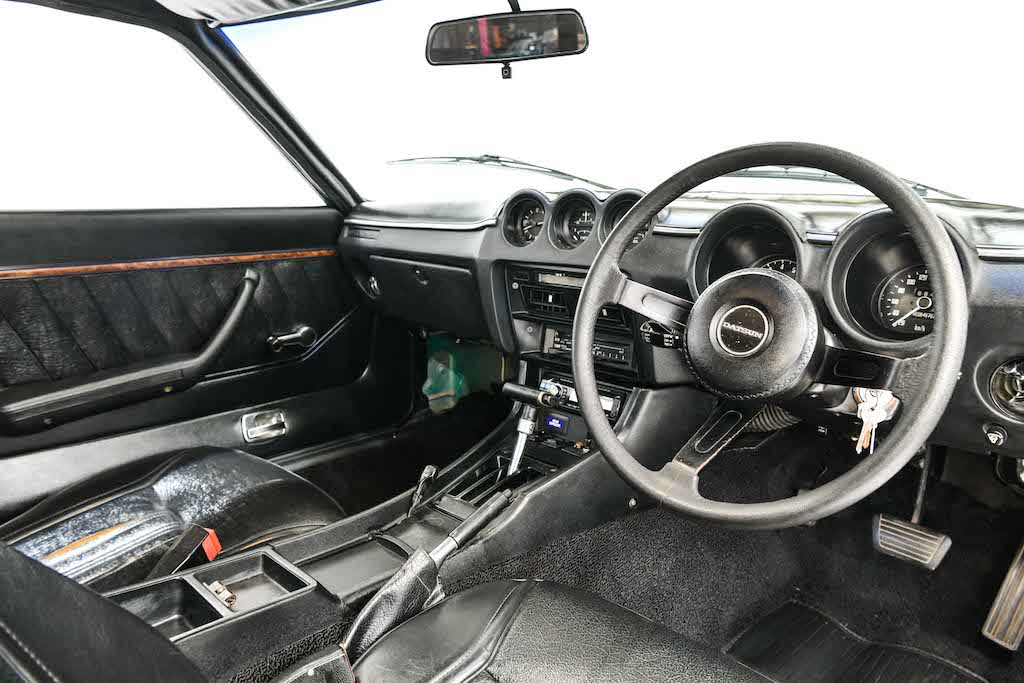
The bigger body added in the region of 150kg, bumping the 260Z to 1185kg, and despite a quicker steering ratio than the wandery 240Z’s, not much else was quicker: the weight gain and moonshot gearing, with a massively overdriven fifth, resigned this Z to a grand touring role.
What followed, the 280ZX of 1978, simply sealed the theme: a light, pure sports car brims with appeal, attracts youth-seeking older and wealthier owners (particularly in the vital US market), begins to make concessions like extra seating, ride comfort, interior equipment … and within a couple of generations, is a cellulitic send-up of itself. I’d argue that, despite various turbo and two-seater versions, it’s never really recovered.
Nissan’s SR30 production figures, listed by years rather than model variations, suggest a total 260Z production of around 300,000.
Quality dodge
The 260Z 2+2, like the 1975 model pictured, shows its bigger body in the too-long doors and flatter roofline. Rear windows hinged open, but the seating was marginal and bolt-upright. Folding rear backrest and hatchback rear provided some grand touring versatility. The interior equipment list was excellent – a standard radio and intermittent wipers were noteworthy in 1974 – but sadly the plastics were awful and the sheetmetal turned out to be no better.
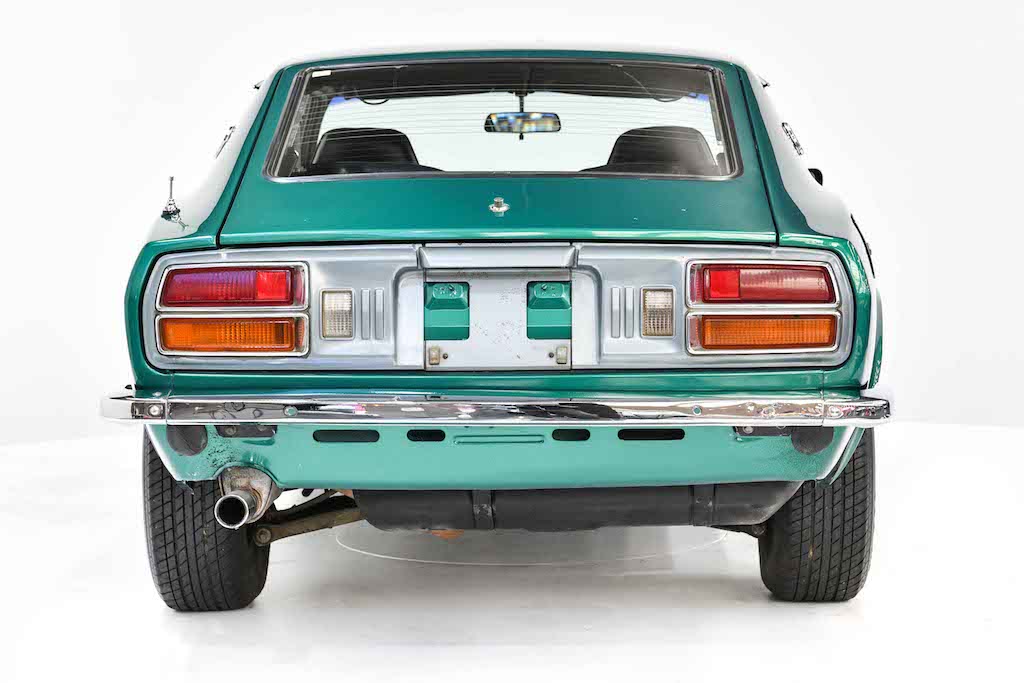
Tall diff tales
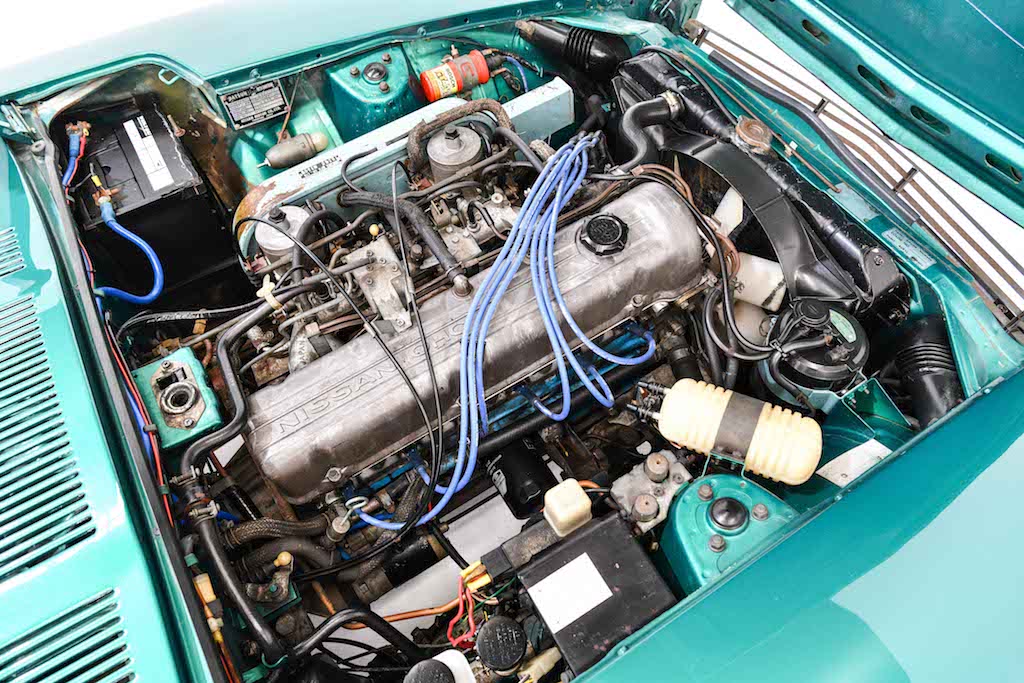
The 260Z used a mildly warmed-over, twin-carb version of the 2565cc sohc, in-line six fitted to the contemporary 260C sedan. In Z guise it made 119kW at 5600rpm and 205Nm at 4400rpm, though the latter understated the fairly truck-like torque. It drove through a long-legged five-speed manual or a dreary, three-speed slusher, shared with Ford and Mazda. Manuals got from 0-100km/h in around 12 seconds, hamstrung by the tall diff.
Aside from creating “the world’s first electric sports car” with an enticing name, Venturi is a fascinating car company. The French brand has gone through a few different guises, first starting out as a manufacturer of Lotus Esprit-looking V6 turbo coupes while also dabbling in Formula 1 with Larrousse and its maligned Lamborghini 3.5-litre V12.
This is all before going bankrupt in 2000 and being bought by a wealthy, EV-loving Monegasque entrepreneur who transformed the company and its vision. Oh, and throw in a Formula E team and some electric land-speed records, too.
So, while that backstory is undoubtedly intriguing, Venturi itself is like opening Pandora’s box. In terms of performance electric vehicles for production, the Fétish is genesis. However, it didn’t start life full of battery cells. Instead, the 2002 concept that debuted at the Paris International Motor Show was a Renault-powered, four-cylinder two-seater based on a rebodied Renault Spider.
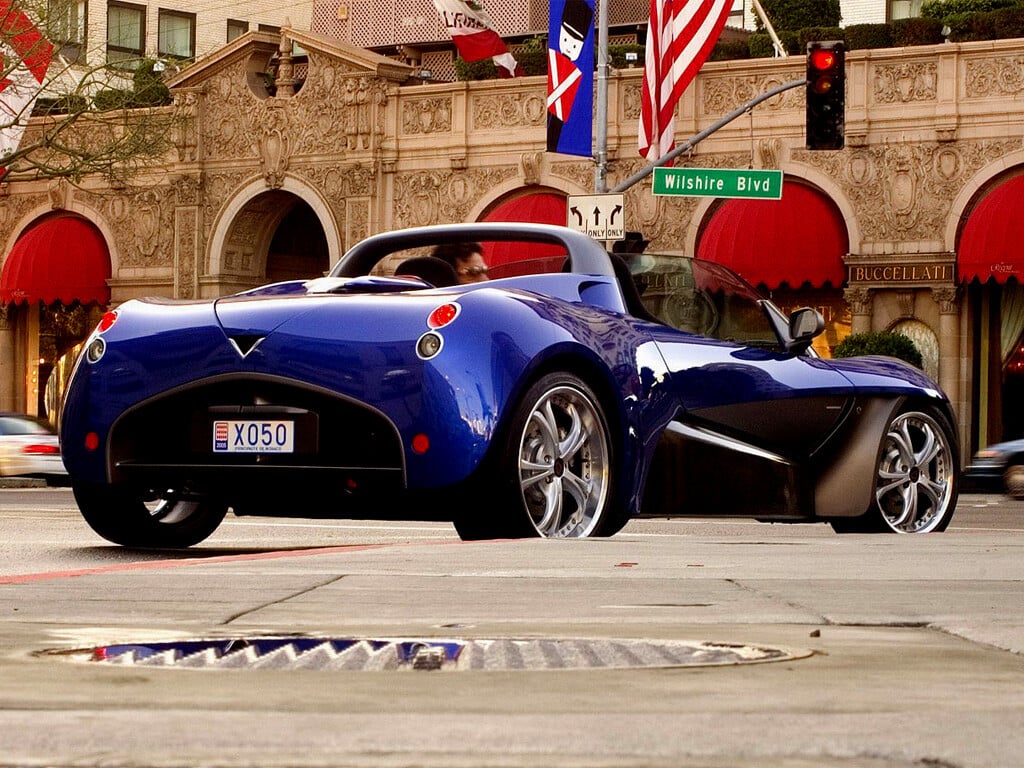
That didn’t quite fit with the electric dreams of boss, Gildo Pallanca Pastor. Enter lithium-ion batteries, a honeycomb-style carbon fibre/aluminium chassis, carbon panels and scissor doors.
The new direction saw the creation of an EV made for fun and it went into production in 2004. The electric motor sent 180kW and 220Nm to the rear axle alone and was powerful enough to send the Fétish to 100km/h in a claimed 4.5 seconds.
The brisk pace was aided by a rather lithe kerb weight of just 1099kg, giving the Fétish a power-to-weight ratio of 164kW/tonne. The 100 lithium-ion batteries, arranged in a T-shape, accounted for a third of that heft and they could be fully recharged in 3.5 hours at best.
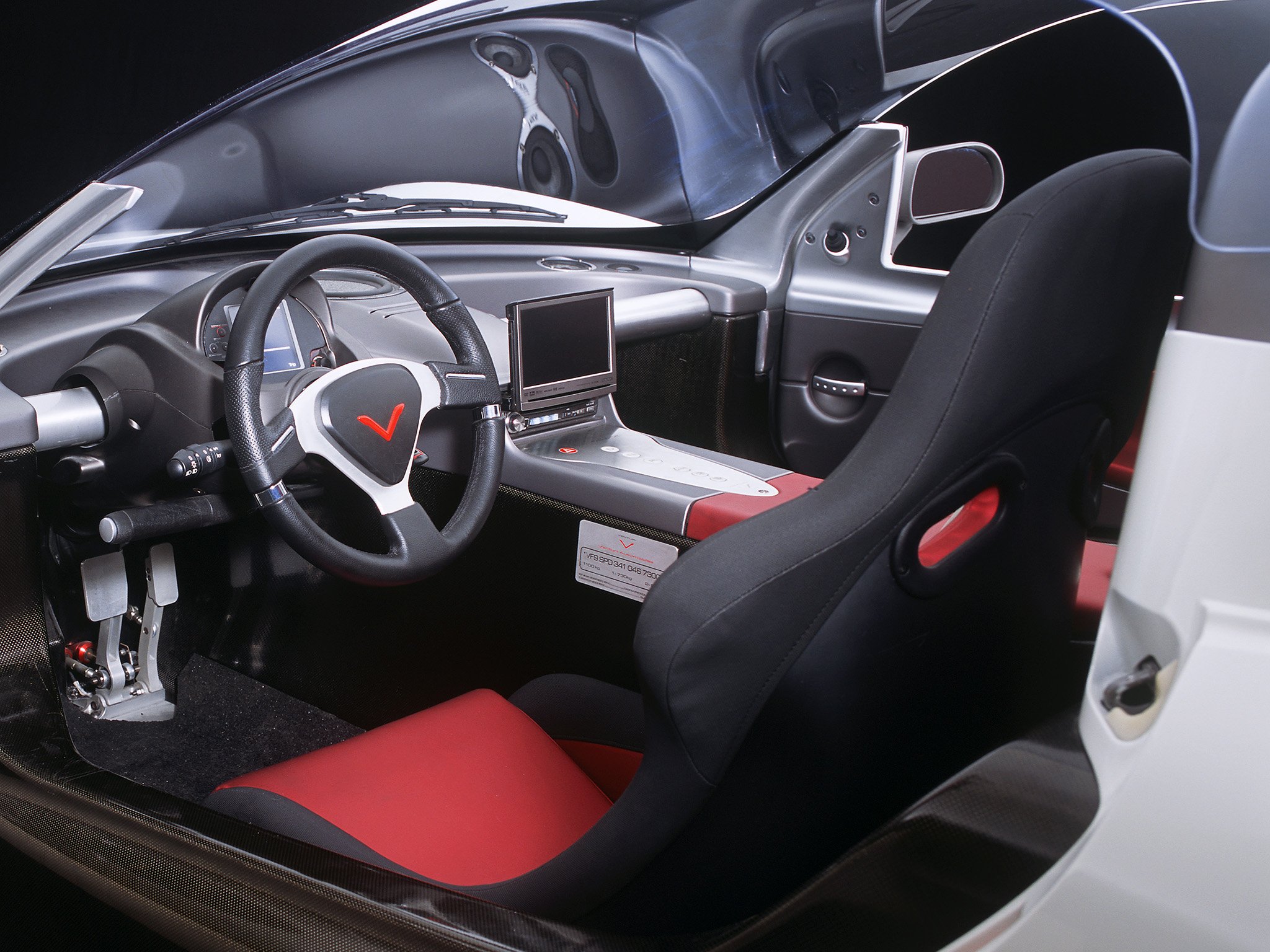
Range, was quoted as 322km. However, that’s based on keeping speeds to 90km/h – the Fétish was limited to 170km/h. A multi-link rear paired with wishbone front suspension, while grippy Michelin rubber wrapped 18-inch wheels up front and 19-inch wheels at the back. Production was based in Monaco with the engineering led by Gerard Ducarouge, a French F1 designer.
Only 25 Fétishes were built, with a second-generation coming on board in 2010 with figures increased to 220kW and 400Nm. By then Venturi also had competition from the Tesla Roadster.
With the next Porsche Cayman/Boxster rumoured to be going electric, it’s important to know that EV performance started as a roadster endowed with an interesting name.
Venturi Fétish specifications
| BATTERY: | 53kWh Lithium-Ion Polymer |
|---|---|
| POWER:u00a0 | 180kW |
| TORQUE:u00a0 | 220Nm |
| WEIGHT:u00a0 | 1199kg |
| 0-100km/h:u00a0 | 4.5sec (estimated) |
UPDATE, April 22: Stellantis suspends production in Russia, Continental resumes operations
The ongoing invasion of Ukraine by Russia has resulted in more automotive manufacturers leaving the country, with Stellantis announcing its suspension of Russian operations.
Stellantis, which owns Peugeot, Citroёn, Jeep, Fiat and Opel, is pausing production and sales of each brand in Russia, a country in which it holds just a one per cent stake of the new car market.
“Given the rapid daily increase in cross sanctions and logistical difficulties, Stellantis has suspended its manufacturing operations in Kaluga [Russia] to ensure full compliance with all cross sanctions and to protect its employees,” the manufacturer said.
“Stellantis condemns violence and supports all actions capable of restoring peace.”
Meanwhile, tyre manufacturer Continental has restarted production in Russia, with Automotive News Europe reporting the German brand is claiming the decision is to protect its local workers.
“Our employees and managers in Russia face severe criminal consequences should we refrain from serving local demand,” Continental told the publication.
“In order to protect our employees in Russia from prosecution, we are temporarily resuming the production of passenger tyres for the local market at our tyre plant in Kaluga if necessary.
“The basis for this step is the duty of care for our employees in Russia.”
It is understood the tyres it produces will be made for civilian passenger vehicle use only.
The story to here
March 24: Renault pulls out of Russia following international backlash
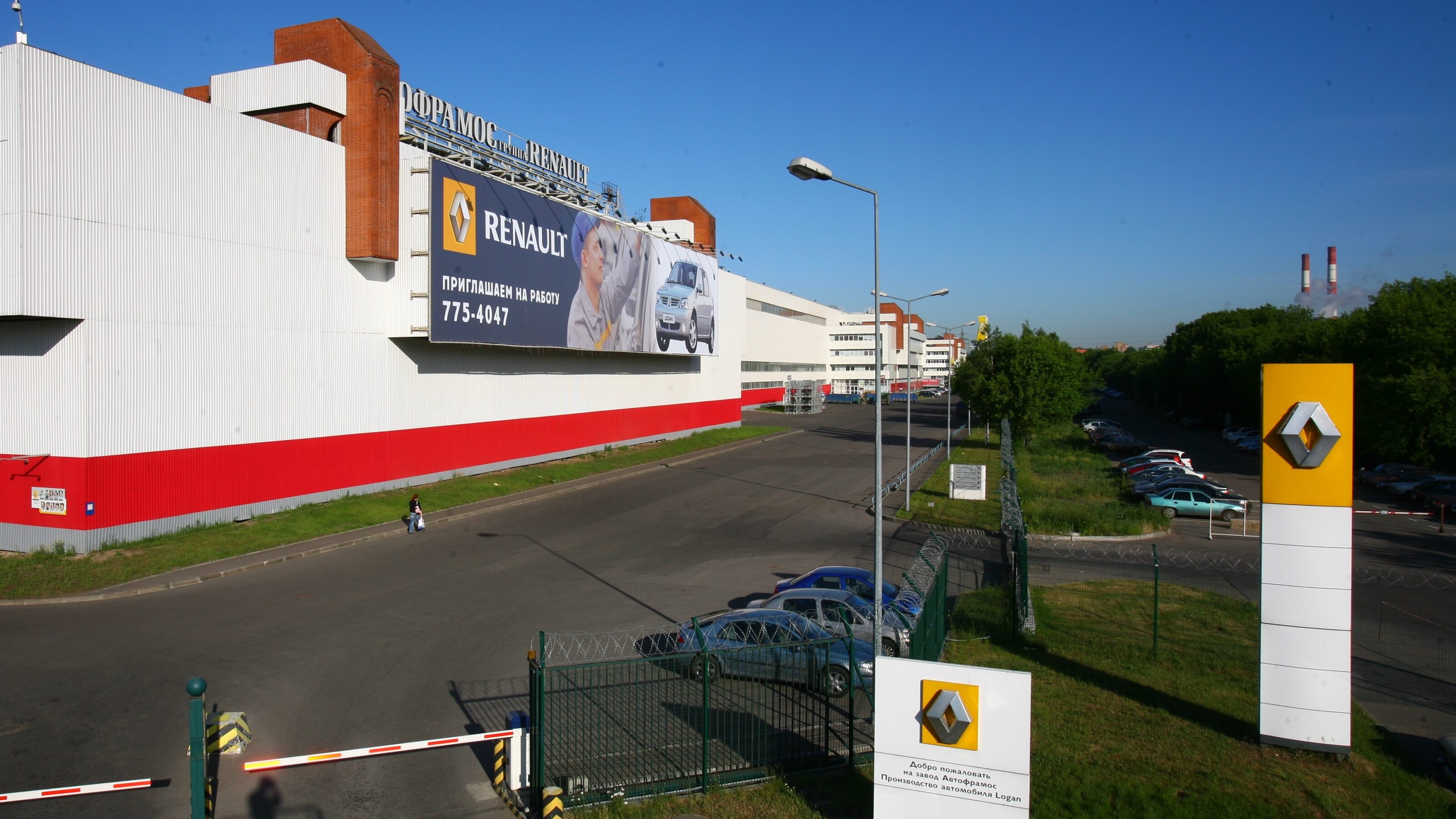
Renault has announced it suspended its operations in Russia, a week after it resumed production in the country.
Despite supply-chain difficulties, the company had been attempting to restart work at its Renault and Avtovaz plants since last Wednesday, conspicuously remaining the only automotive giant to persevere with its Russian operations.
However, Renault did a backflip this week after Ukraine President Volodymyr Zelenskyy called out the brand – which France owns 15 per cent of – in an address to French lawmakers.
“French companies must leave the Russian market,” Zelenskyy said in a video address, reports Politico, criticising Renault and other companies for “sponsoring the Russian war machine”.
Many commentators online had called for a boycott of Renault products throughout the world in recent days in response to the perceived inaction from the French carmaker.
“Renault Group activities in its manufacturing plant in Moscow are suspended as of today,” the company said in a statement released overnight.
“Renault Group reminds that it already implements the necessary measures to comply with international sanctions.”
The company said it was assessing its 67 per cent stake in Russian brand Avtovaz, “taking into account the current environment, while acting responsibly towards its 45,000 employees in Russia”.
As reported by WhichCar earlier this month, regardless of the stance it takes, Renault Group could end up losing its controlling stake to minority shareholder Rostec, with the country introducing laws that would allow it to seize foreign-owned assets from companies originating from “unfriendly states”.
Rostec is a state-owned defence company run by Sergey Chemezov – a known ally of Russian President Vladimir Putin.
March 14: Suzuki and Infiniti exit Russia
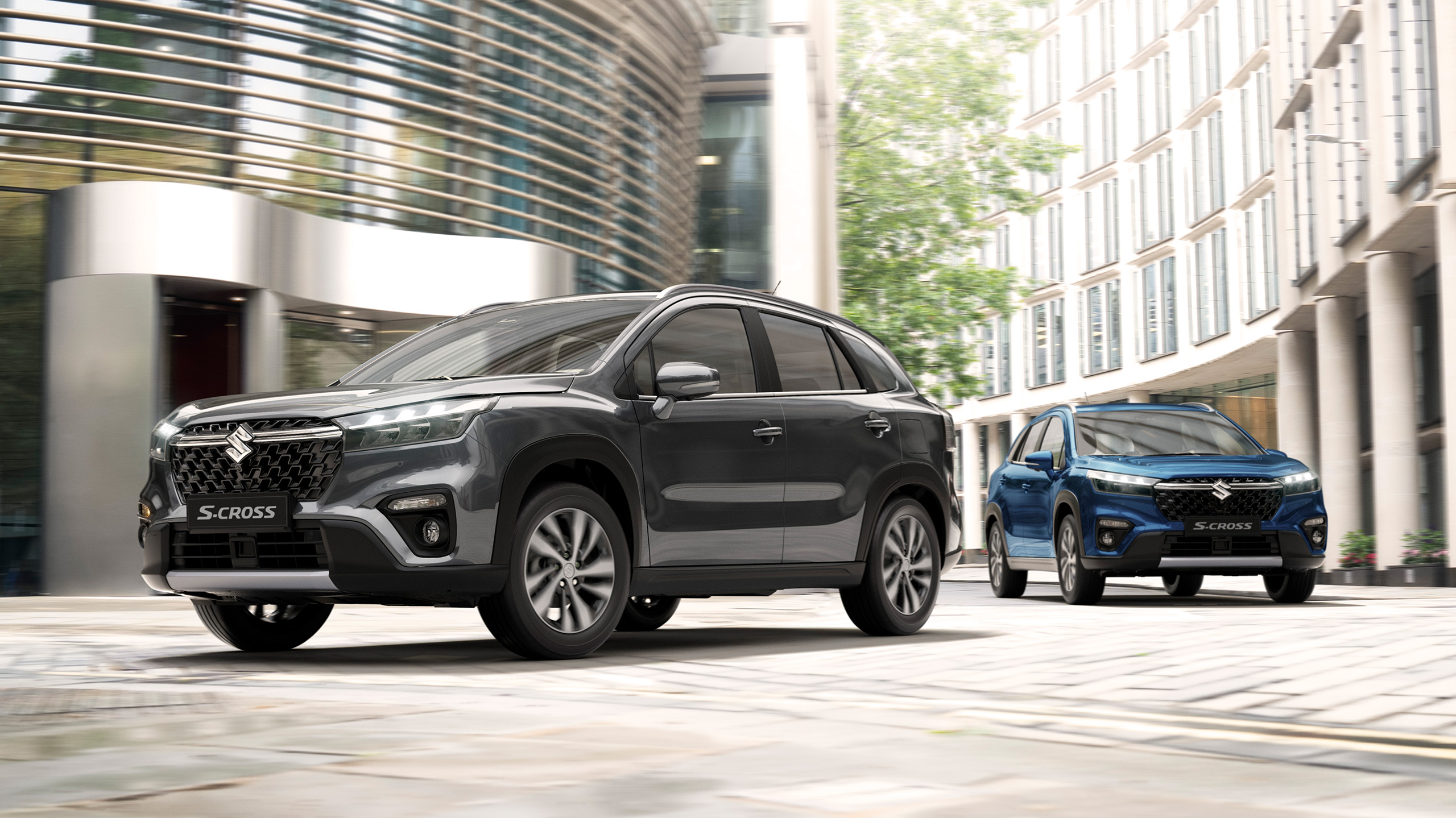
Japanese manufacturers Suzuki and Infiniti have joined the list of automotive brands to exit Russia in the wake of the ongoing conflict with Ukraine.
As reported by Reuters, Suzuki’s Hungarian plant has suspended exports to Russia and Ukraine, affecting the market which accounts for roughly 10,000 deliveries annually.
Suzuki has said it will continue production in Hungary, establishing a new goal of shifting affected orders to other markets, allowing its plant to keep up with planned production volumes.
Infiniti has followed the lead of parent company Nissan by suspending the delivery of vehicles to the Russian market indefinitely, although stock at dealers still remains according to Kolesa.
A spokesperson for the Russian arm of the brand said it would be impossible for Infiniti to pull out of one of its most important markets, stating “leaving the market is not discussed”.
Other manufacturers to suspend their operations in Russia include Nissan, Mercedes-Benz, Volkswagen, Porsche, Bentley, Honda, Mazda, Toyota, BMW, Ford, General Motors, Volvo, and Jaguar Land Rover.
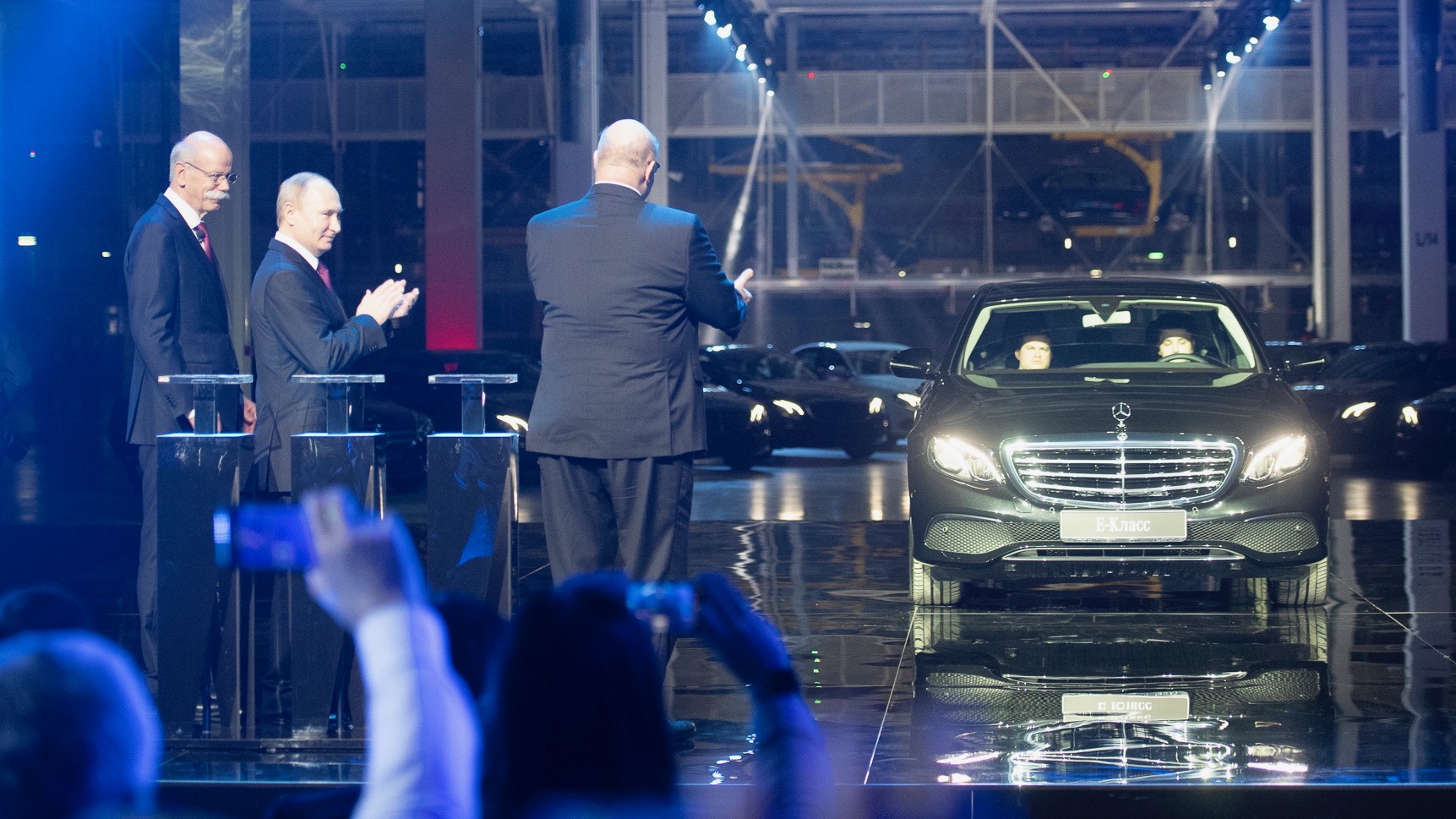
March 4: Nissan, Mercedes-Benz and Volkswagen pull out of Russia amid sanctions
Following widespread international sanctions against the nation, Nissan, Mercedes-Benz, and Volkswagen Group brands are the latest car manufacturers announcing suspended operations in Russia.
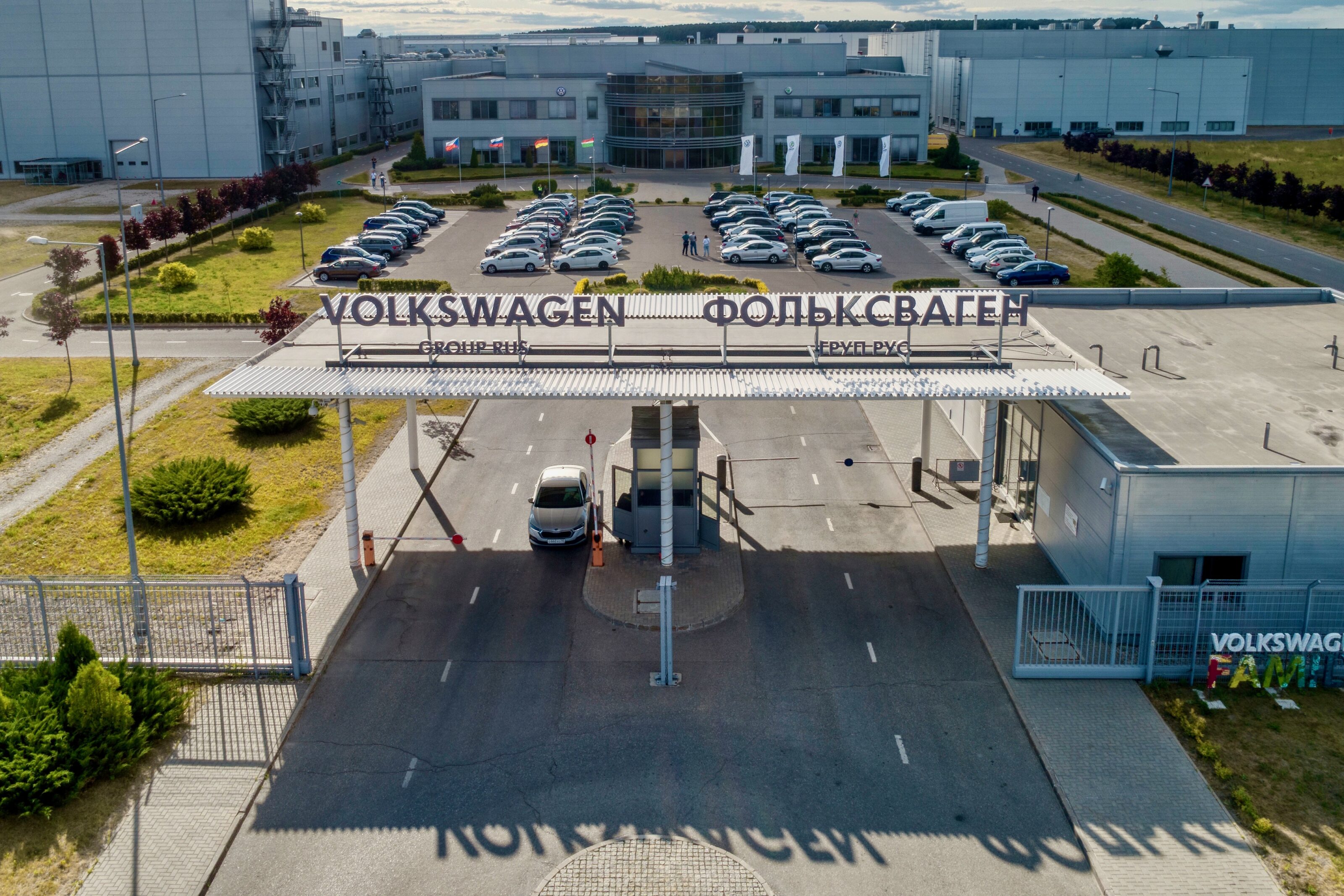
Volkswagen, Porsche, and Bentley have all halted vehicle exports into the country, while production at the company’s Russian factories producing Volkswagen and Skoda models have been stopped “with immediate effect”.
According to market intelligence firm Focus2Move, Russia sold 1.57 million vehicles in 2021 – a slight increase over 2020, but still down on pre-pandemic sales of 1.76 million in 2019.
Of the 1.57 million recorded sales in 2021, Nissan sold 53,000 vehicles, Automotive News Europe reports, while Volkswagen’s Russian sales have been listed at 216,000 for the year – accounting for 2.4 per cent of its global sales.
Despite spending €250 million (AU$375 million) on a new Russian plant which opened in 2019, Mercedes-Benz has also suspended production, as well as stopping exports into the country.
Honda, which was scheduled to exit Russia this year, has also announced it has stopped vehicle exports – with local publication Kolesa reporting the company has closed its business earlier than planned.
According to Nikkei Asia, Mazda also plans to halt exports of parts, though Kolesa states the company’s Vladivostok plant is still operating at this time.
While many car companies have cited Russia’s actions in Ukraine as reason for stopping sales and manufacturing, some insiders have said difficulty in shipping and receiving payments has contributed to the announcements.
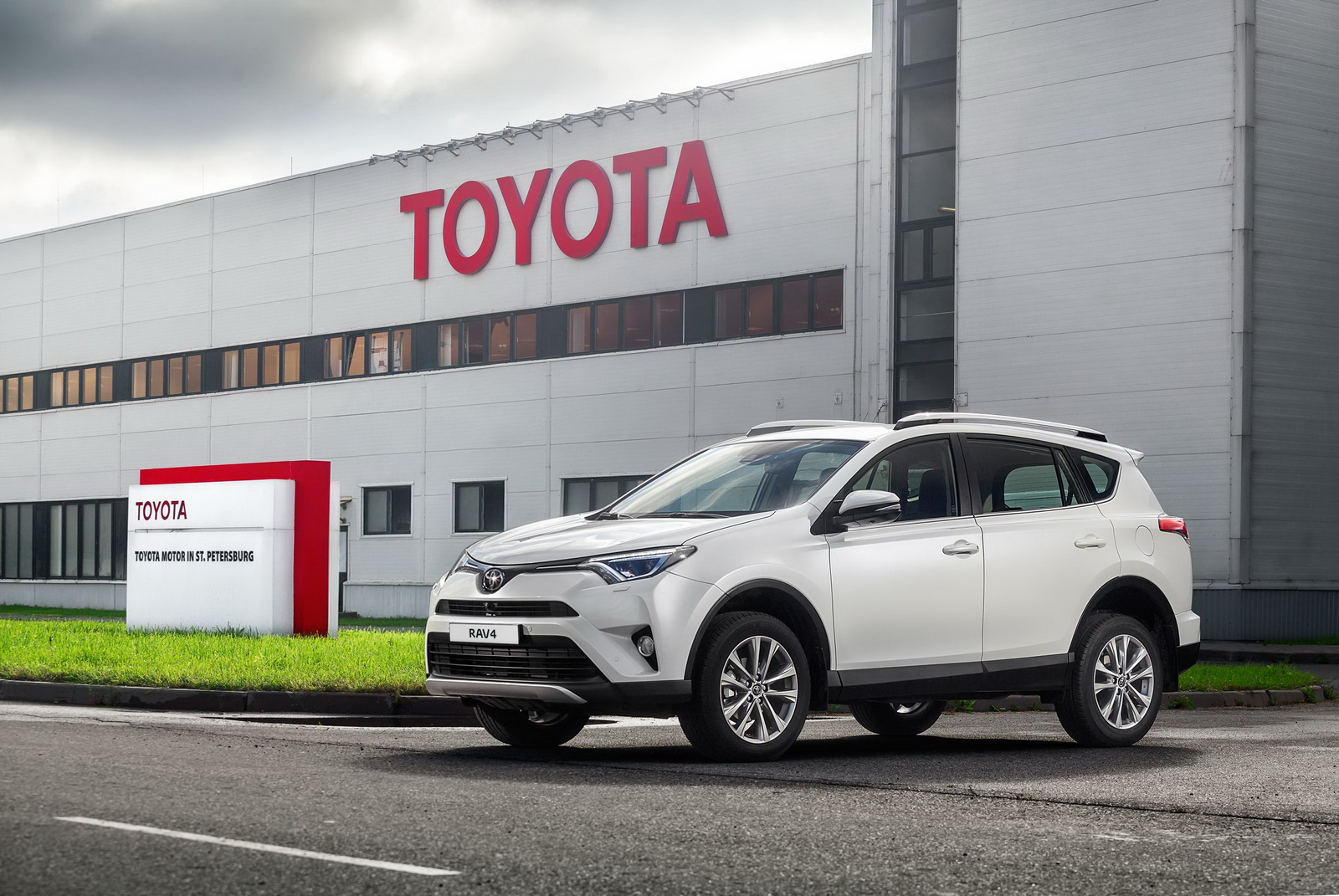
March 3: Toyota halts Russian production
Toyota has announced it will halt production at its Russian factory later this week, with vehicle imports into the country also being paused until further notice.
Toyota joins BMW, Ford, General Motors, Volvo, and Jaguar Land Rover who have also announced the suspension of operations in Russia this week.
While some carmakers were outwardly critical of Russia, Toyota cited supply-chain disruptions for the decision.
“Like everyone around the world, Toyota is watching the ongoing developments in Ukraine with great concern for the safety of [the] people and hopes for a safe return to peace as soon as possible,” a statement from the company read.
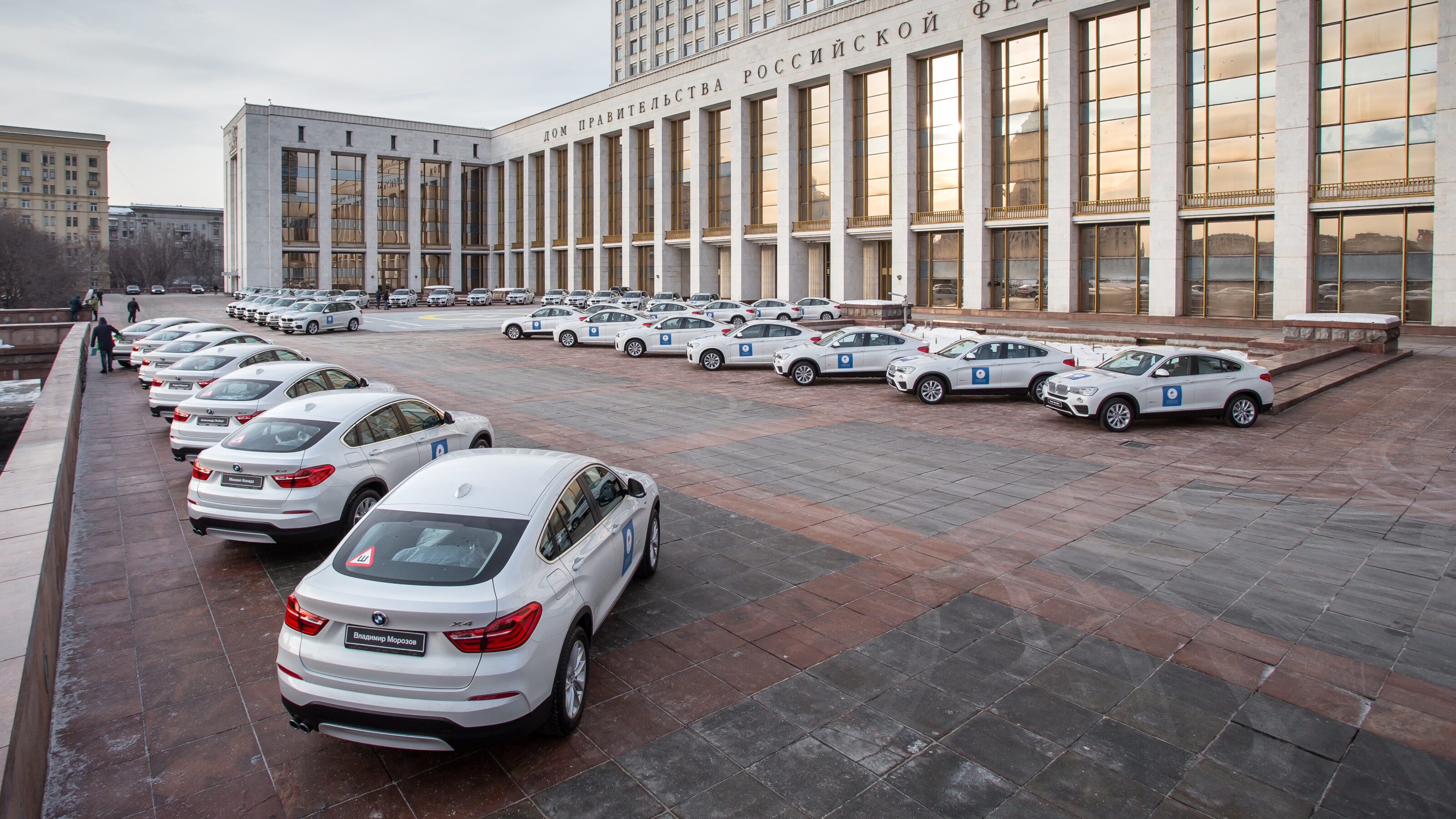
March 2: Automotive manufacturers begin Russia exodus
A growing number of car manufacturers are suspending operations in Russia in response to the ongoing conflict in Ukraine.
BMW, Ford, General Motors, Volvo, and Jaguar Land Rover are among the companies halting new-car sales in Russia following widespread international sanctions on the country.
“GM is committed to complying with the laws and regulations of the markets in which we do business, including applicable US economic sanctions and export control laws and regulations,” General Motors said in a statement, CNN reports, saying it would suspend exports to Russia until further notice.
Other carmakers weren’t as reserved: “The BMW Group condemns the aggression against Ukraine and follows the developments with great concern and dismay,” a translated statement from German website Bimmer Today read.
“We expressly support the sanctions decided by politicians. Due to the current geopolitical situation, we will stop our local production and export for the Russian market until further notice.”
While other businesses such as Harley-Davidson and Daimler Trucks have also announced similar measures, oil companies Shell and BP have gone a step further, abandoning joint ventures with their Russian counterparts.
The decision to suspend sales in Russia may be easier for manufacturers like Volvo and Ford, which do not have a large presence in the country, but more painful for Renault Group – which counts Russia as its second-largest market after France.
Toyota also shut down its Japanese factories for 24 hours when a large parts manufacturer became victim to a crippling cyber attack, following the Japanese Government’s public statement of support for Ukraine, while announcing sanctions against Russia’s central bank.
Earlier this week, Volkswagen announced it would be forced to temporarily shut production at two of its German plants due to supply issues with parts suppliers located in Ukraine.
Lexus’s original NX may have become the brand’s best-selling model, yet the mid-sized luxury SUV disappointed in key areas including ride quality and refinement.
This presented plenty of opportunity for its successor to spring positive surprises at Car of the Year, with expectations raised by a new platform shared with the excellent Toyota RAV4.
The first surprise was the variant provided by Lexus. With the timing of the NX’s local launch – just a week before our test program – necessitating a wildcard entry, the model put forward was an NX350 rather than the anticipated NX350h hybrid that is expected to be the most popular with buyers. (Or perhaps, plucked from the top of the range, Lexus’s first-ever plug-in hybrid, the NX450h+.)
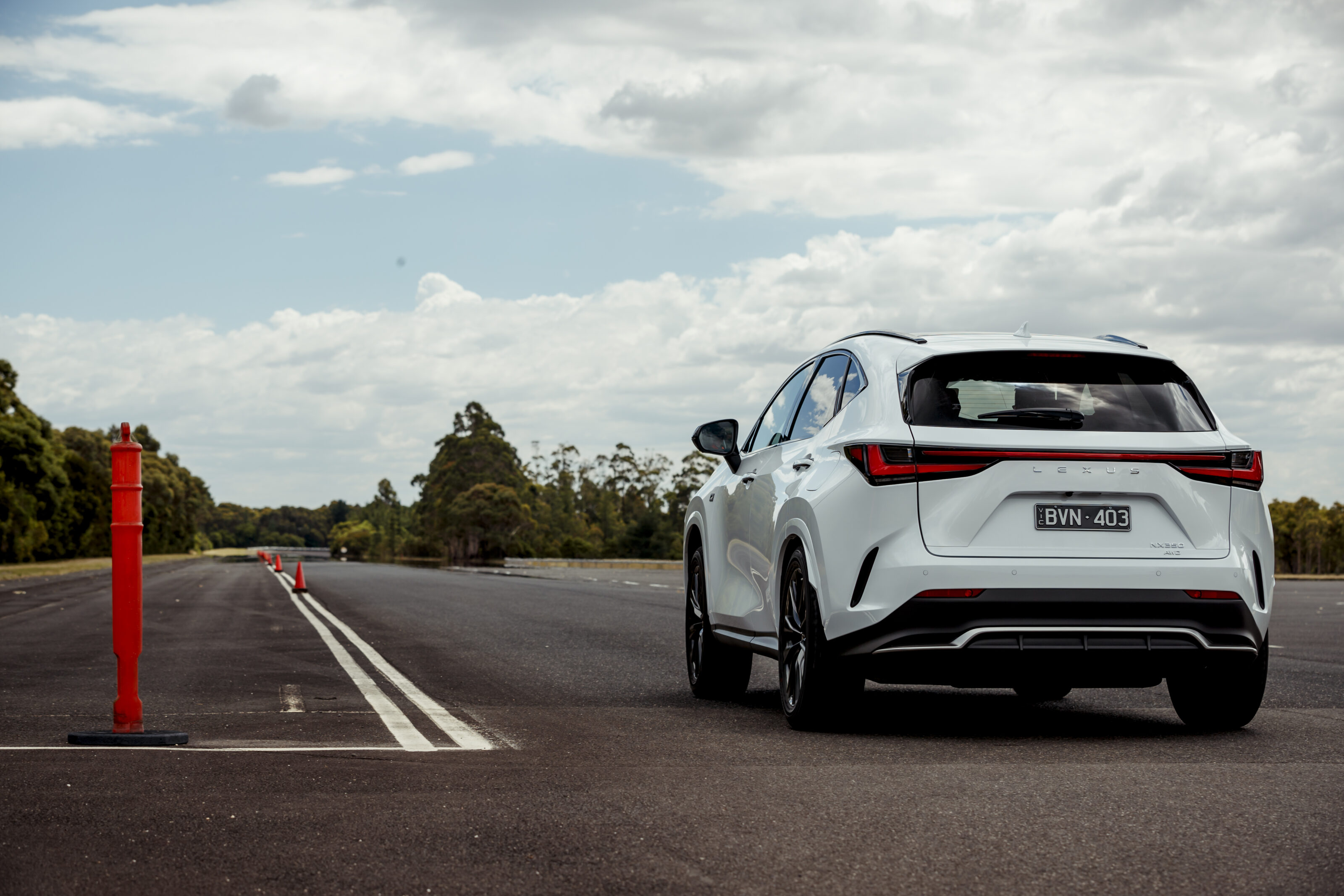
The NX350 F Sport wasn’t without its own intrigue, however, featuring a new 2.4-litre turbocharged petrol engine, adaptive suspension, and the same, all-new 14-inch infotainment display offered in NX350h Sports Luxury models and the NX450h+.
Lexus rarely fails the value test and the NX doesn’t deviate from that norm – even with the $77,900 NX350 F Sport that’s priced well above the $60,800 base NX250.
Well-equipped from the off, the NX range gives its 350 F Sport plenty of extras that include 20-inch wheels, drive modes, tri-beam LED headlights, colour head-up display, ventilated front seats, and panoramic view monitor.
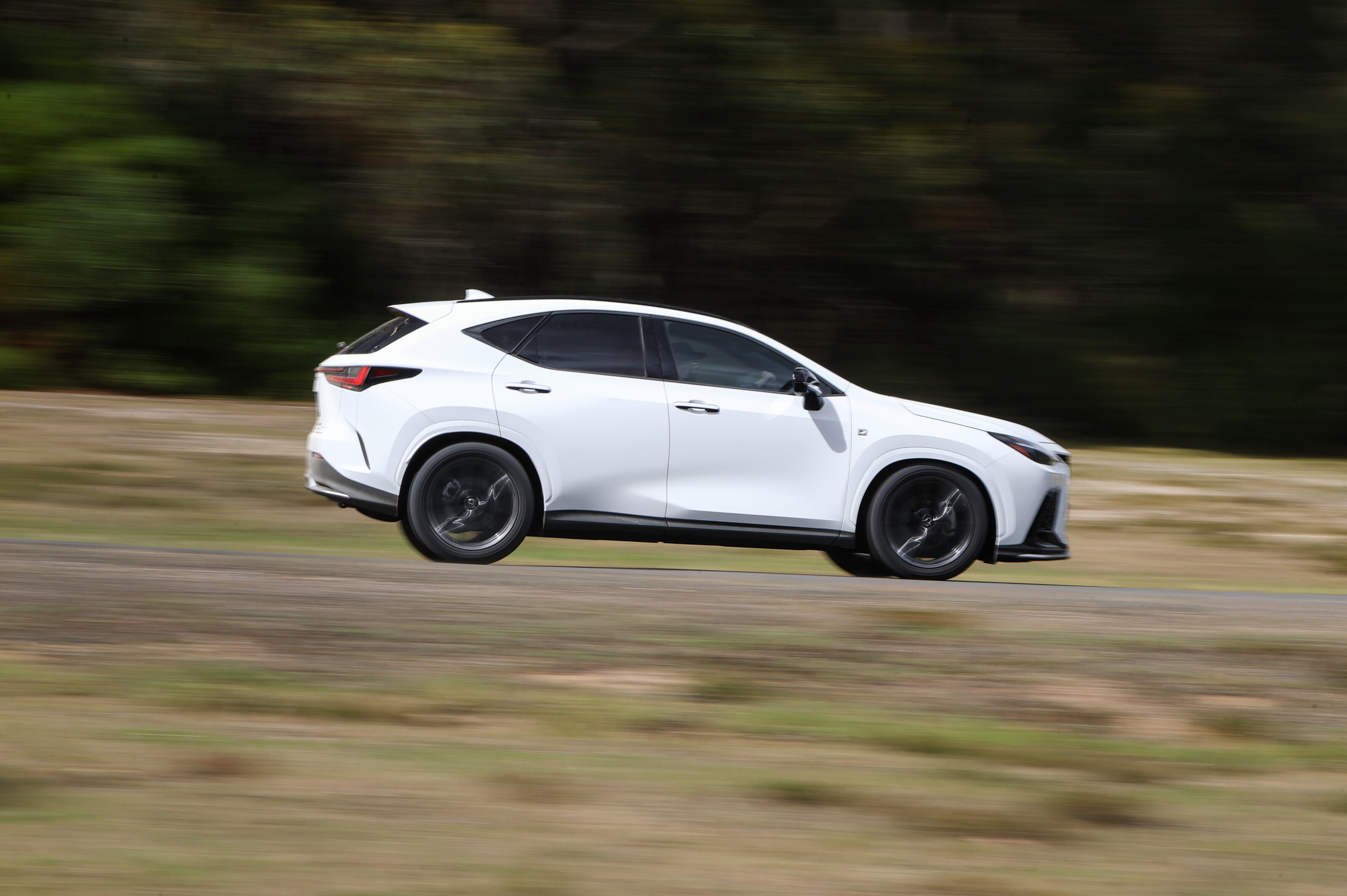
Ticking off the Safety criterion in the process, NX driver-assist systems are bolstered by the arrival of Intersection Turn Assist, Emergency Steering Assist, and Safe Exit Assist that combines blind-spot sensors and electronically controlled door latching to prevent untimely openings when parked.
“Much improved, yet still stumbles in a few unexpected areas” – Dylan Campbell
Technological newbies include a digital rear-view mirror as part of an Enhancement 2 Package, though the judges were most curious to explore Lexus’s response to long-standing criticism of ergonomically flawed infotainment systems.
As part of the NX’s driver-oriented ‘Tazuna Cockpit’ concept, a touchscreen display is 9.8 inches in lower-spec models or a sizeable 14 inches higher up. There’s no doubt the larger display looks more naturally integrated and limits the amount of shiny black plastic for the surround, and it commendably retains physical temp/fan dials.
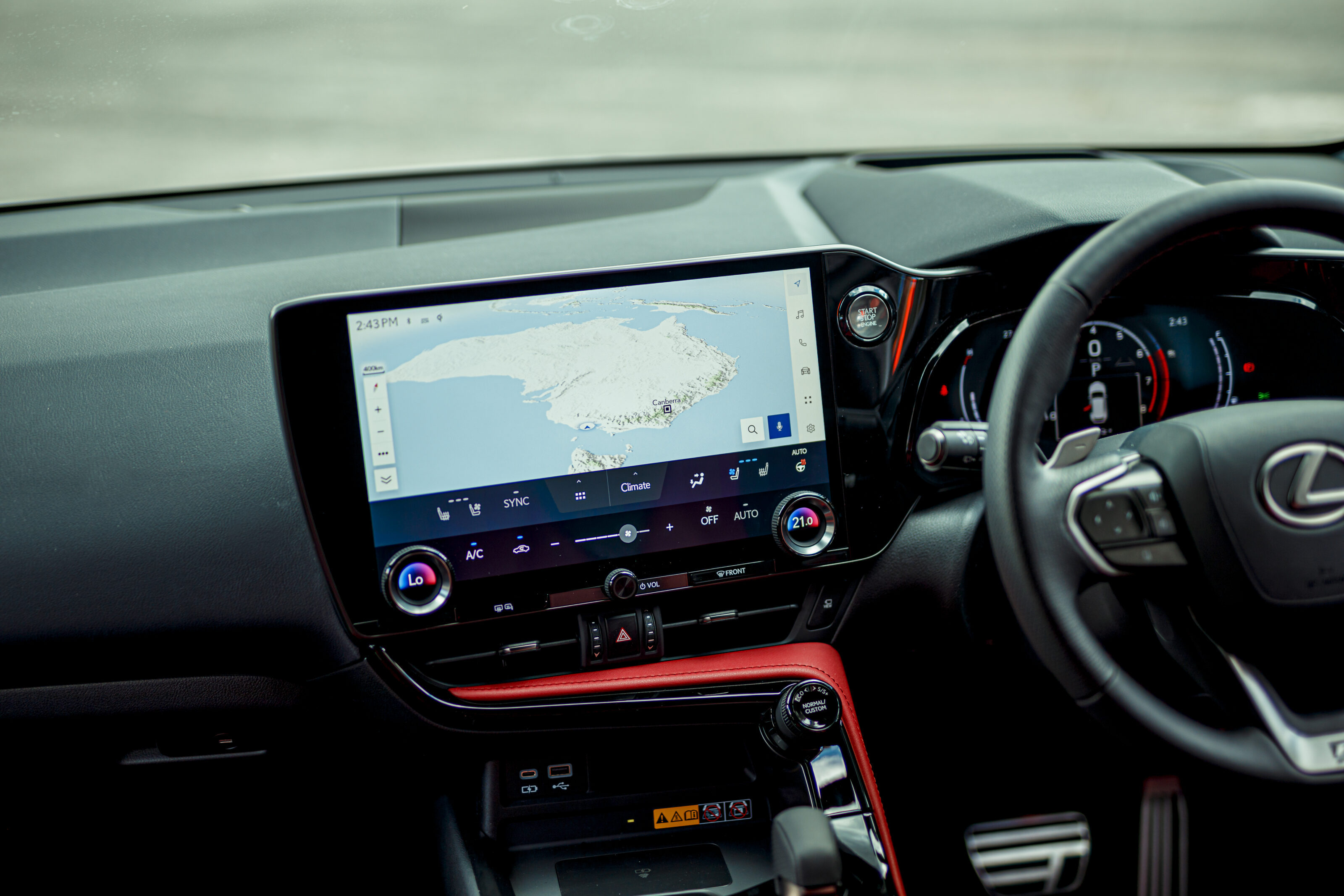
Subtle it is not, though there was agreement that the touchscreen approach was an improvement over Lexus’s fiddly trackpad-style Remote Touch system.
The judges just wished the interface had made a similarly big jump, with sentiments summed up by Dan: “The multimedia system didn’t get the badly needed overhaul.”
There was also little love for the 8.0-inch digital driver display, which lacks the sophisticated presentation found elsewhere in the segment – some sub-$60K mainstream SUVs included.
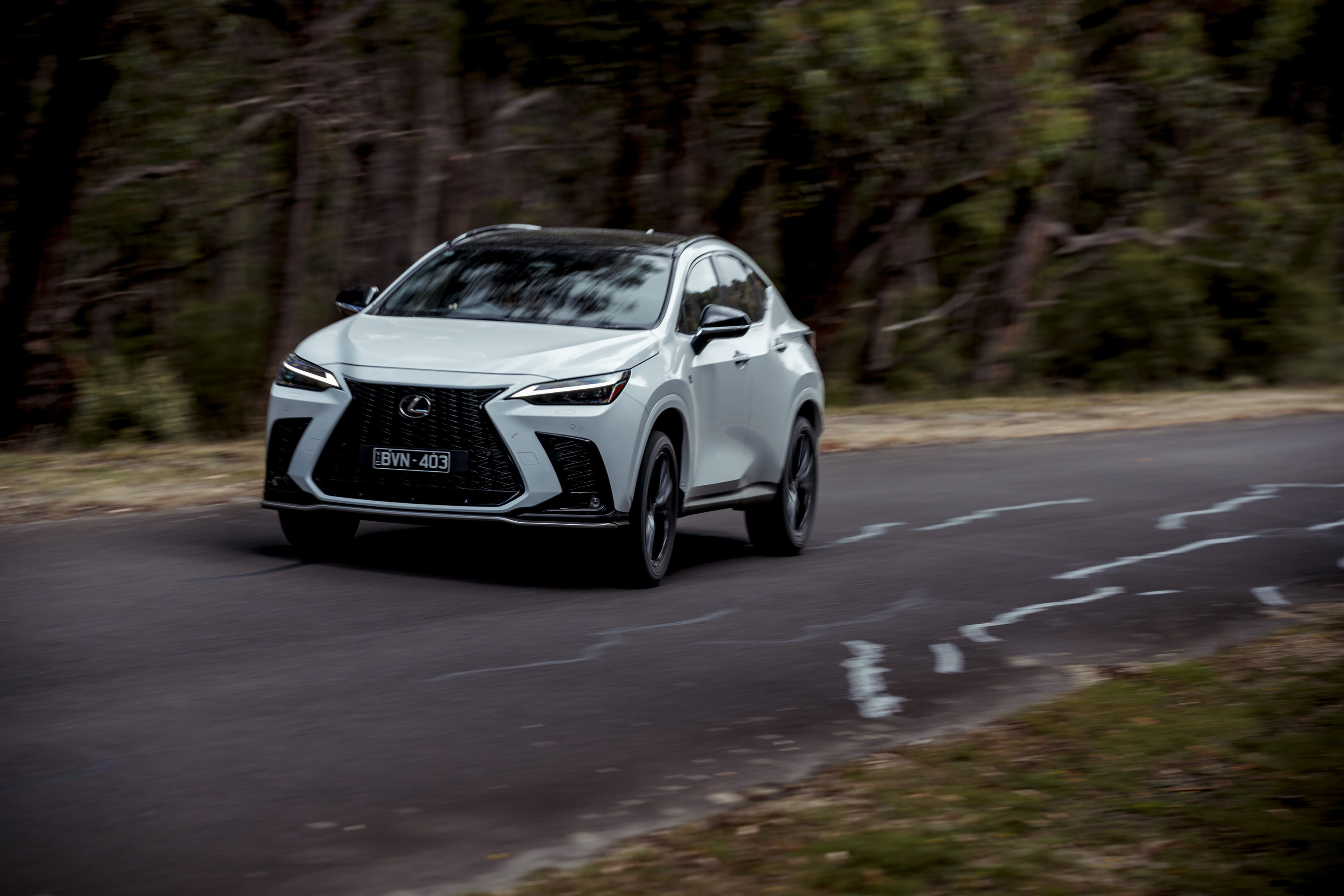
F Sport seats garnered plenty of praise, but the cabin’s overall luxury execution wasn’t considered an unqualified success. While nice finishes, quality materials and tactile switchgear were evident, so too were hard plastics more conspicuous than ideal in a segment containing impeccably presented rivals such as the Audi Q5 and the 2018 COTY-winning Volvo XC60.
Expectations that the second-generation NX would be better to drive than its predecessor were realised at the proving ground, with the NX350 F Sport showcasing sharp-ish steering and disciplined body control. This was ably supported by the strong turbo engine and plenty of traction from the all-wheel drive system.
Refinement wasn’t a stand-out, however, with noticeable wind and tyre noise on the Highway Circuit. Curt cut to the chase in the final discussions, stating simply that the NX “doesn’t really benchmark anything anywhere”.
UPDATE, January 2023: 2023 Subaru Crosstrek pricing announced; pre-orders open
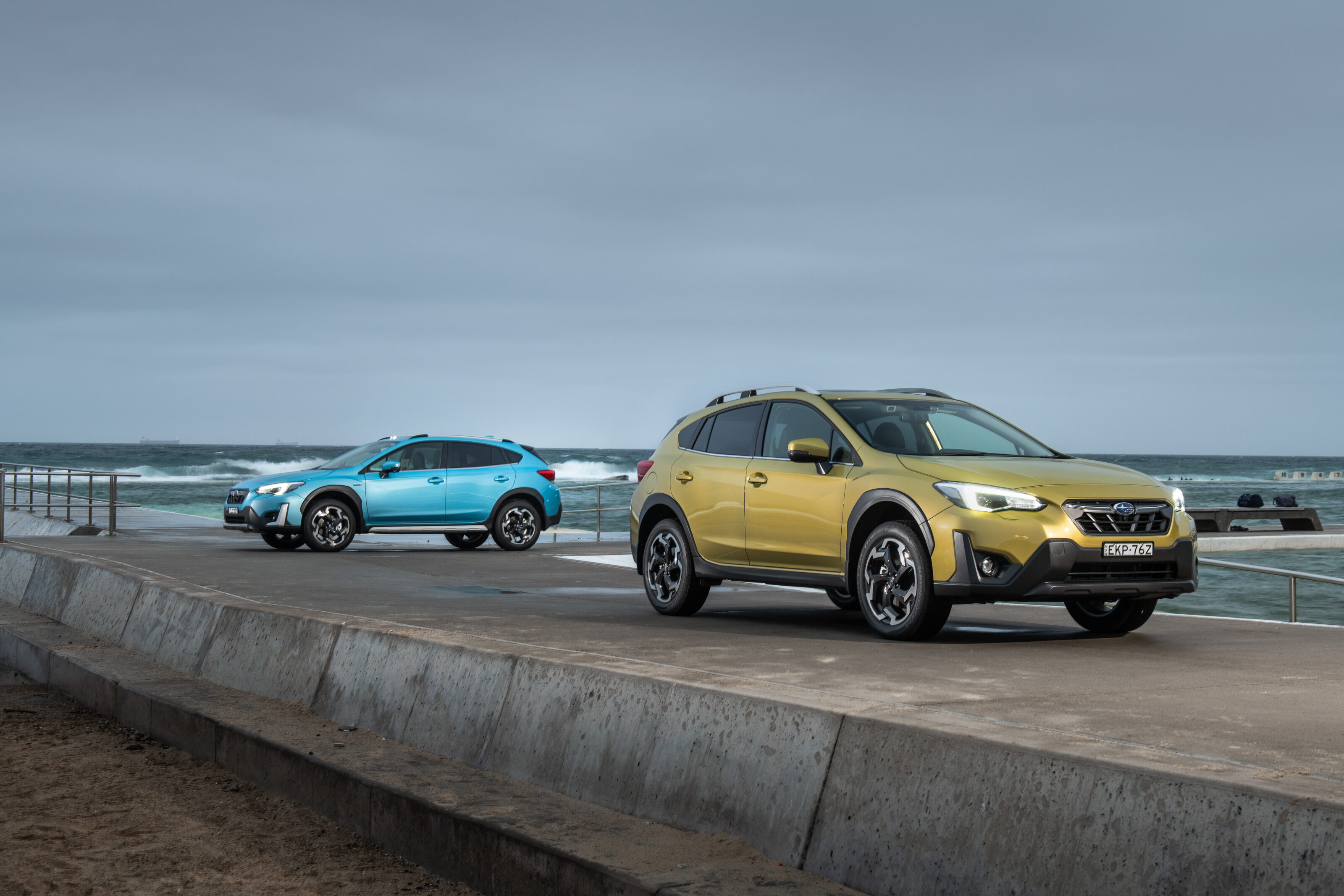
Subaru has confirmed its XV replacement, the 2023 Crosstrek small SUV, will arrive in Australia in April from $34,990 before on-roads.
For the full run-down, click on the read more link below:
Story continues…
2022 Impreza 2.0i and XV 2.0i variants axed, prices increase
Snapshot
- Subaru Impreza and XV 2.0i variants axed from local range
- Existing grades up between $400 and $500 for model-year 2022
- Autonomous emergency braking now standard
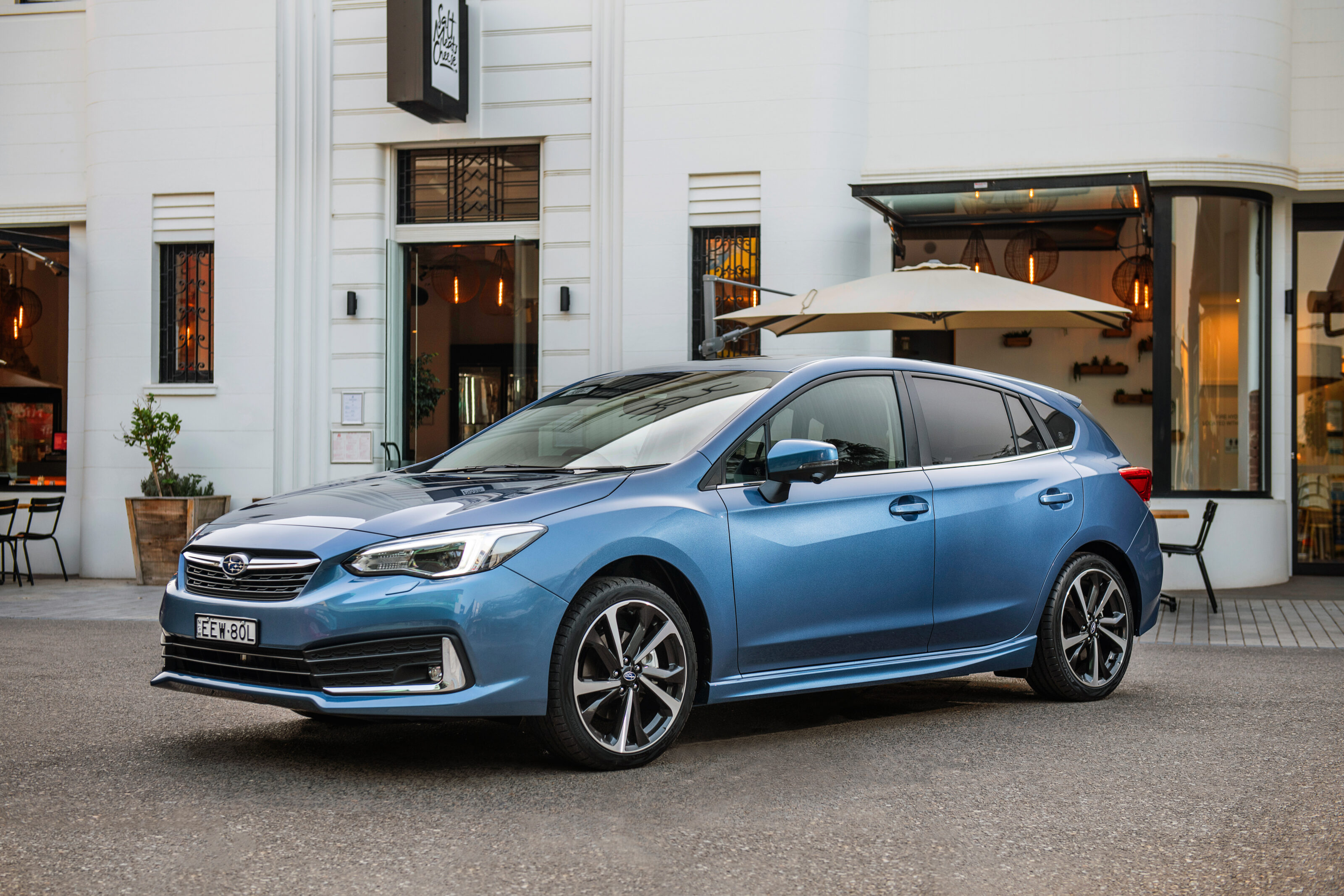
The price of entry into Subaru’s Impreza small car and XV small SUV lines has increased by $2700, following the removal of the entry-level 2.0i grade.
Prices for the remaining variants have risen by $400 to $500 for model-year 2022, with no other changes to specification for the Impreza and XV.
The base variants – known as 2.0i – were not fitted with Subaru’s EyeSight active safety technology, which includes autonomous emergency braking (AEB), lane-keep assist, lane departure warning and adaptive cruise control.
“In-line with Subaru Corporation’s ‘Towards Zero’ commitment of zero fatal accidents in a Subaru vehicle by 2030, and in recognition of features that are becoming increasingly standard across the segments, the MY22 Impreza and XV line-up has been updated to include Subaru EyeSight Driver Assist technology as standard across all variants,” said a spokesperson for Subaru Australia.
“As a result, the Impreza 2.0i-L AWD and the XV 2.0i-L AWD will be repositioned as the new entry level variants of the revised range.”
The addition of active safety features across the range allows the Impreza and XV to match rivals such as the Toyota Corolla and C-HR, Mazda 3 and CX-30, and Hyundai i30 and Kona in offering potentially life-saving technologies as standard.
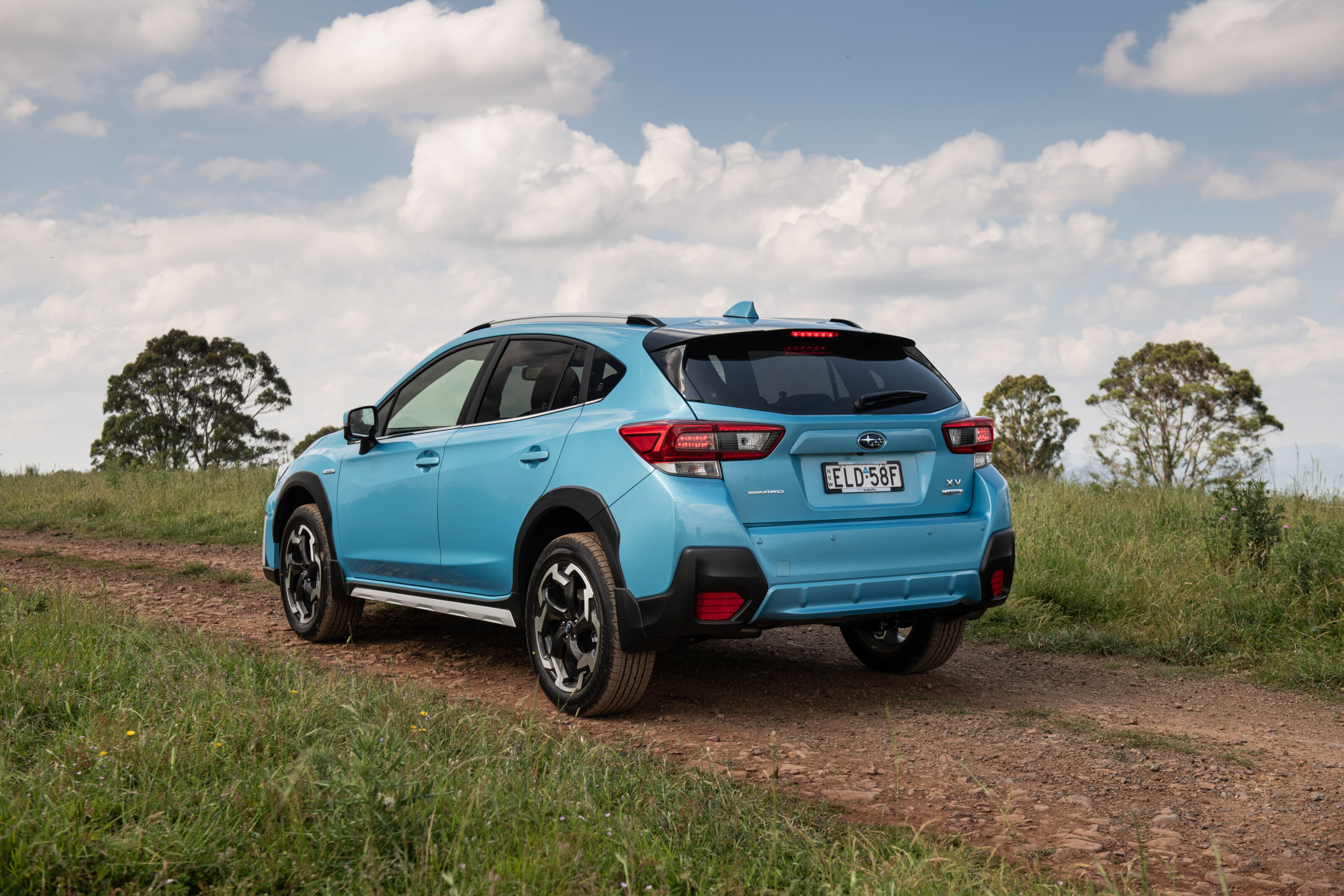
Over the previous 2.0i, the new ‘entry-level’ 2.0i-L also includes; a larger 8-inch infotainment display, dual-zone climate control and a leather-wrapped steering wheel and gear shifter.
However, additional safety features including blind-spot monitoring, rear-cross traffic alert, reverse AEB and automatic high-beam remain exclusive to higher grades.
The lack of AEB on the entry-level Impreza and XV was an increasingly rare factor in the Australian market, with the defunct variants being one of few models in each respective segment to not include the technology as standard.
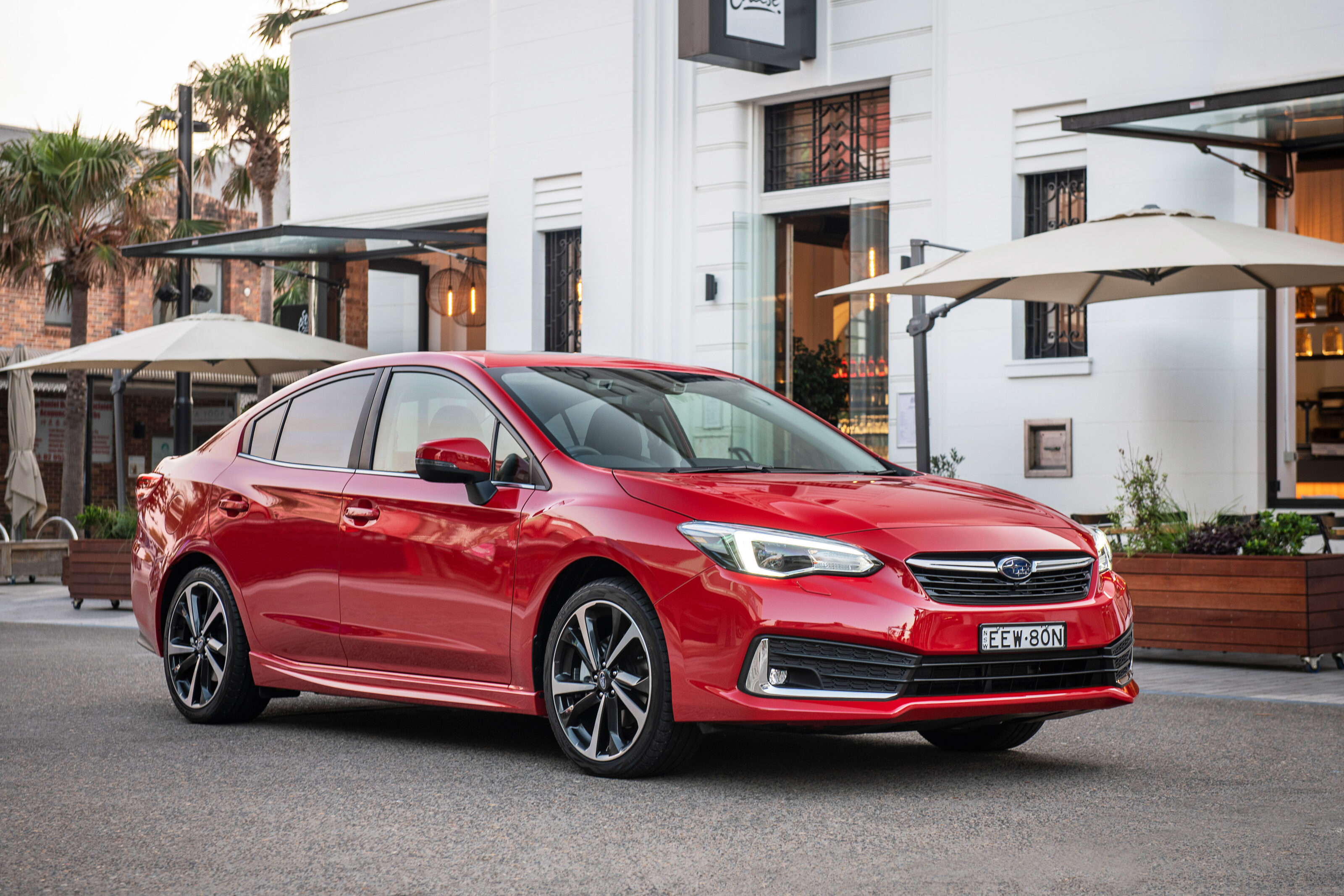
2022 Subaru Impreza pricing and features
Prices exclude on-road costs.
2.0i-L
2.0i Premium
2.0i-S
2022 Subaru XV pricing and features
Prices exclude on-road costs.
2.0i-L:
2.0i Premium, in addition to 2.0i-L:
2.0i-S, in addition to 2.0i Premium:
Hybrid L
Hybrid S, in addition to Hybrid L:
UPDATE, December 19: Q8 E-Tron driven!
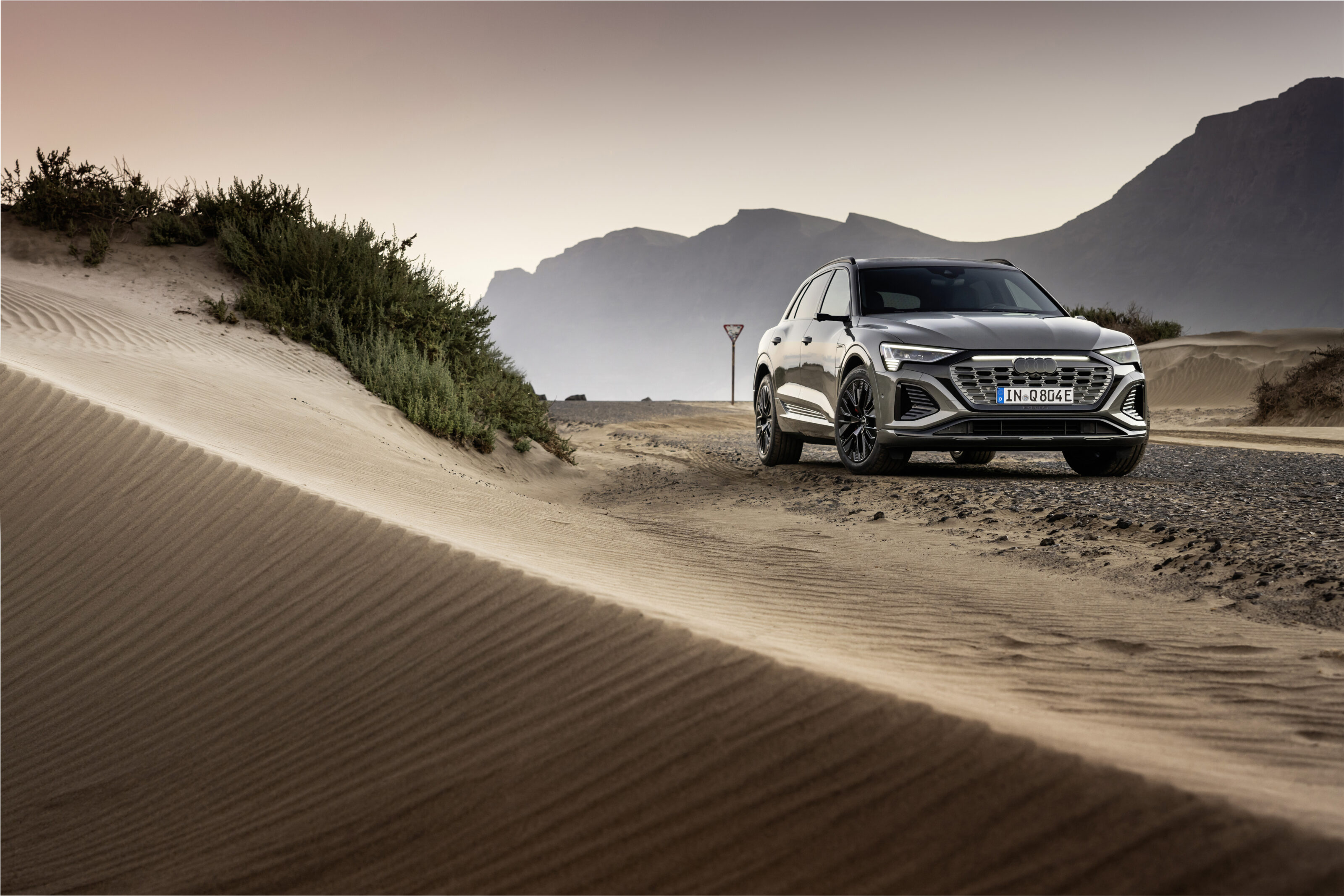
Following its unveiling in November, we’ve now driven the updated Audi Q8 E-Tron (the SUV formerly known as ‘E-Tron’). Get our full story at the link below.
The story to here
November 2022: Renamed Audi Q8 E-Tron revealed
Audi’s facelifted E-Tron, now known as the Q8 E-Tron, has been revealed. It has no relation to the existing Audi Q8, of course, but giving it a ‘Q’ name at least now brings it in line with the growing E-Tron line, including the Q4 E-Tron and E-Tron GT. Get the full story at the link below.
April 22, 2022: E-Tron range pricing goes up as S arrives
Snapshot
- 2022 Audi E-Tron S now in showrooms
- E-Tron range starts from $139,900 plus on-road costs
- 370kW/973Nm performance S variant from $168,400 before on-road costs
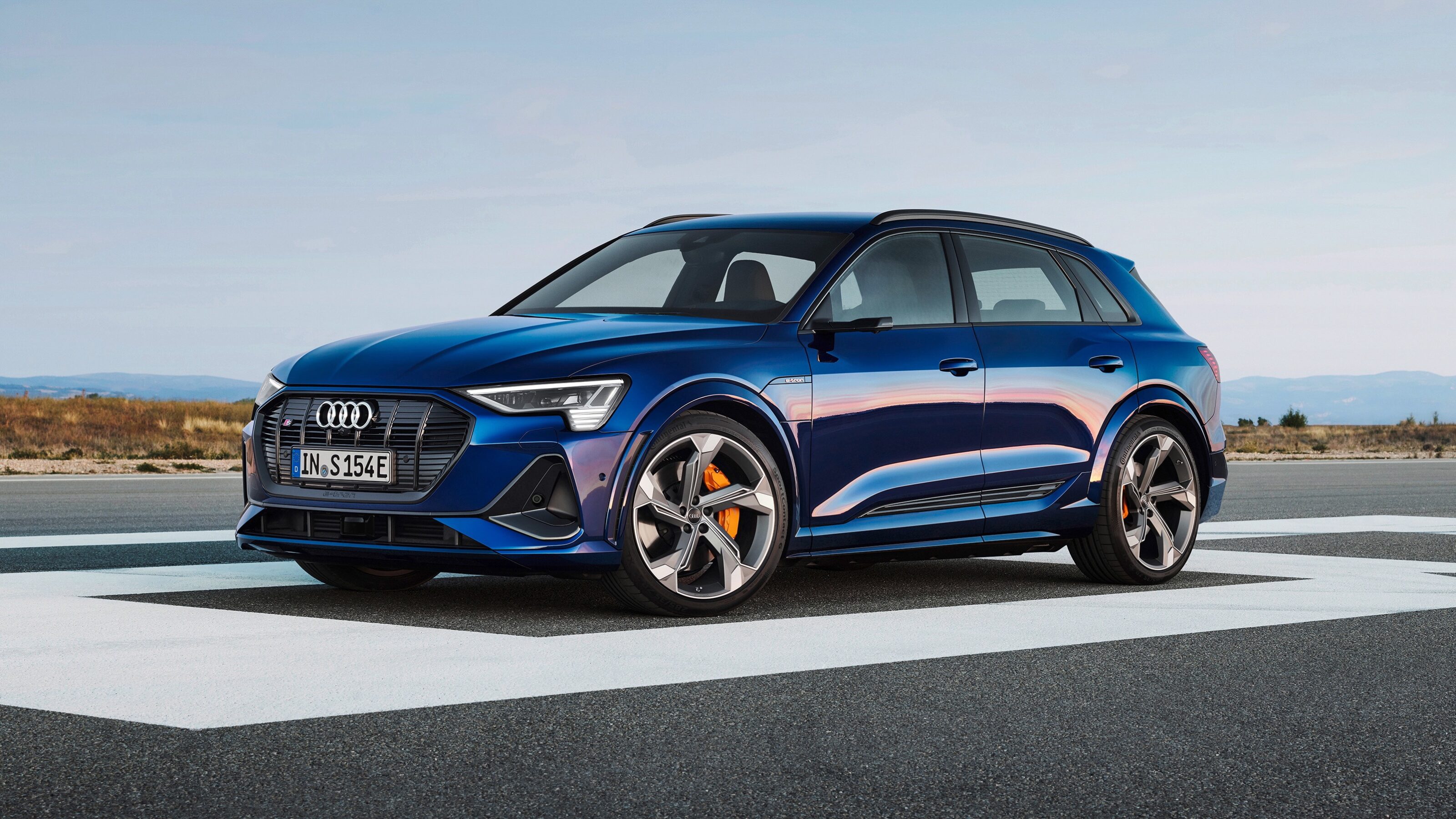
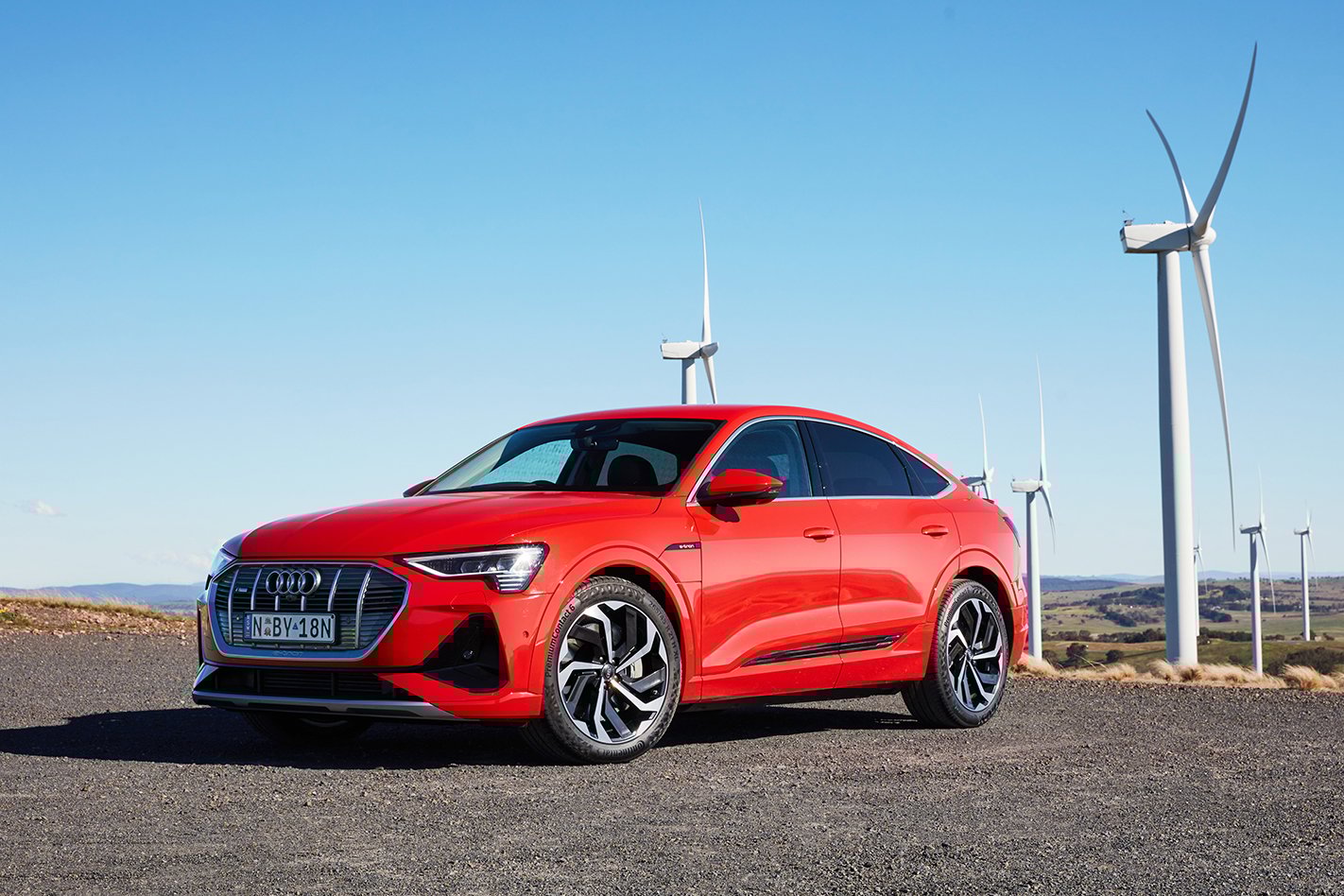
The first examples of Audi’s 2022 E-Tron S and S Sportback have arrived in Australia, hitting showrooms as prices of the electric SUV range have increased.
Affecting all grades including the new S variant, the E-Tron’s list pricing has gone up by $2800 for every variant bar the S Sportback, which has increased by $2700 to $175,400 before on-road costs.
The price hike pushes the entry-level E-Tron 50 up to $139,900 before on-road costs in wagon guise, as the Sportback variant incurs an $11,000 premium.
The more powerful E-Tron 55 now starts at $148,900, with the Sportback also available for the same jump in price over the wagon.
Entering the line-up for the first time, the E-Tron S is now on sale from $168,400 before on-road costs in its wagon body style while the E-Tron S Sportback will set buyers back $175,400, an increase of $7000 over the traditional SUV shape.
Full pricing and specs for the model are available below, with the new 2022 figures amended to reflect the E-Tron’s current list price before on-road costs in Australia.
December 2, 2021: E-Tron S price and specs
The 2022 Audi E-Tron S and S Sportback have joined the Australian line-up.
Audi announced the E-Tron S and E-Tron S Sportback models will join the all-electric E-Tron range as flagship models, offering a significant performance gain over standard variants.
Both the standard E-Tron S and Sportback versions use dual electric motors at the rear axle and a single electric motor for the front axle, putting out a combined output of 370kW and 973Nm and sending the vehicle to 100km/h from a standstill in 4.5 seconds.
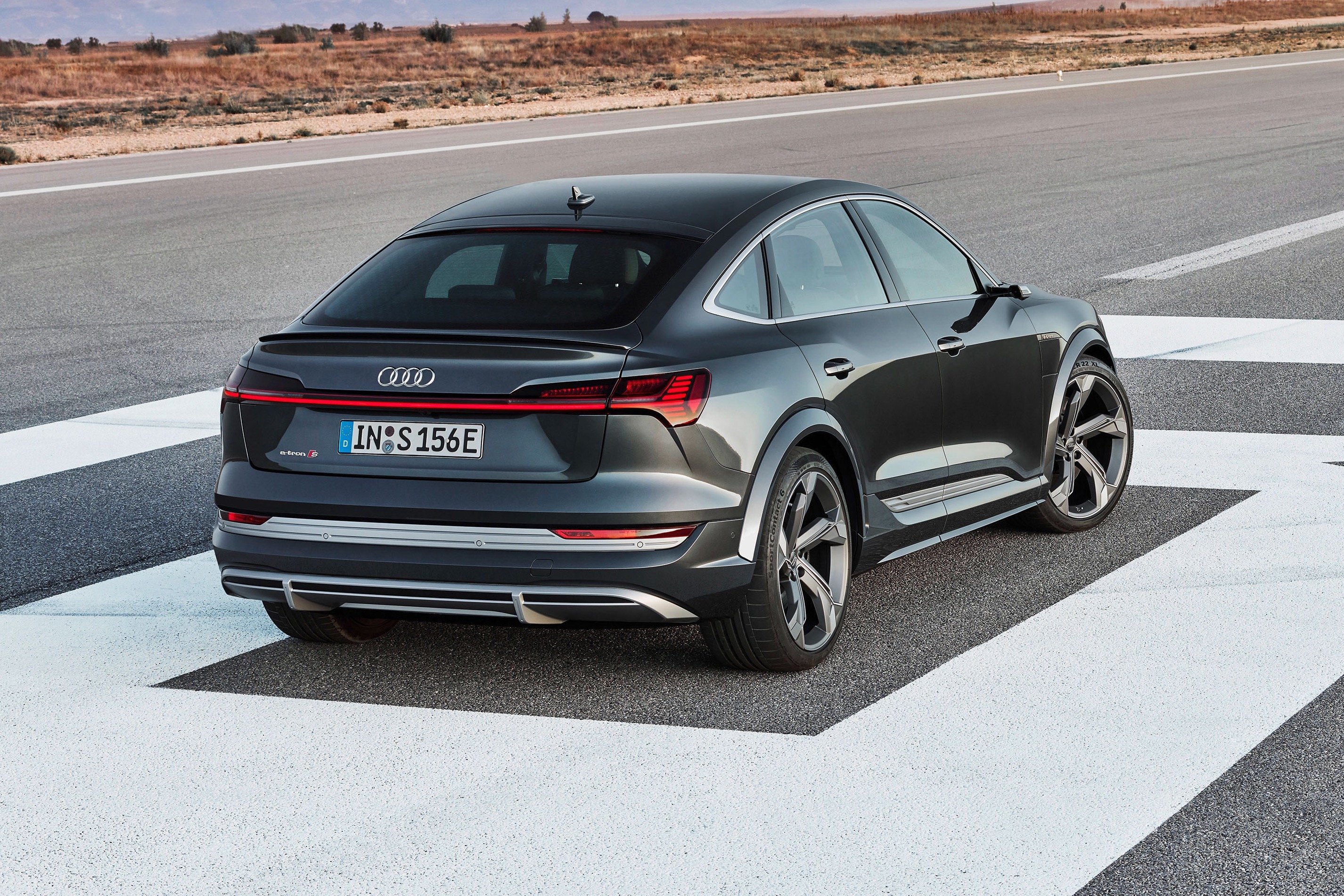
Thanks to an 86kWh battery pack, the E-Tron S delivers up to 413 kilometres of driving range on a single charge, while the Sportback offers slightly more at 418km.
A single-speed transmission is used to help power the rear wheels, utilising torque vectoring in place of a mechanical differential to aid efficiency, with the front electric motor engaging in low traction or when the driver demands additional performance.
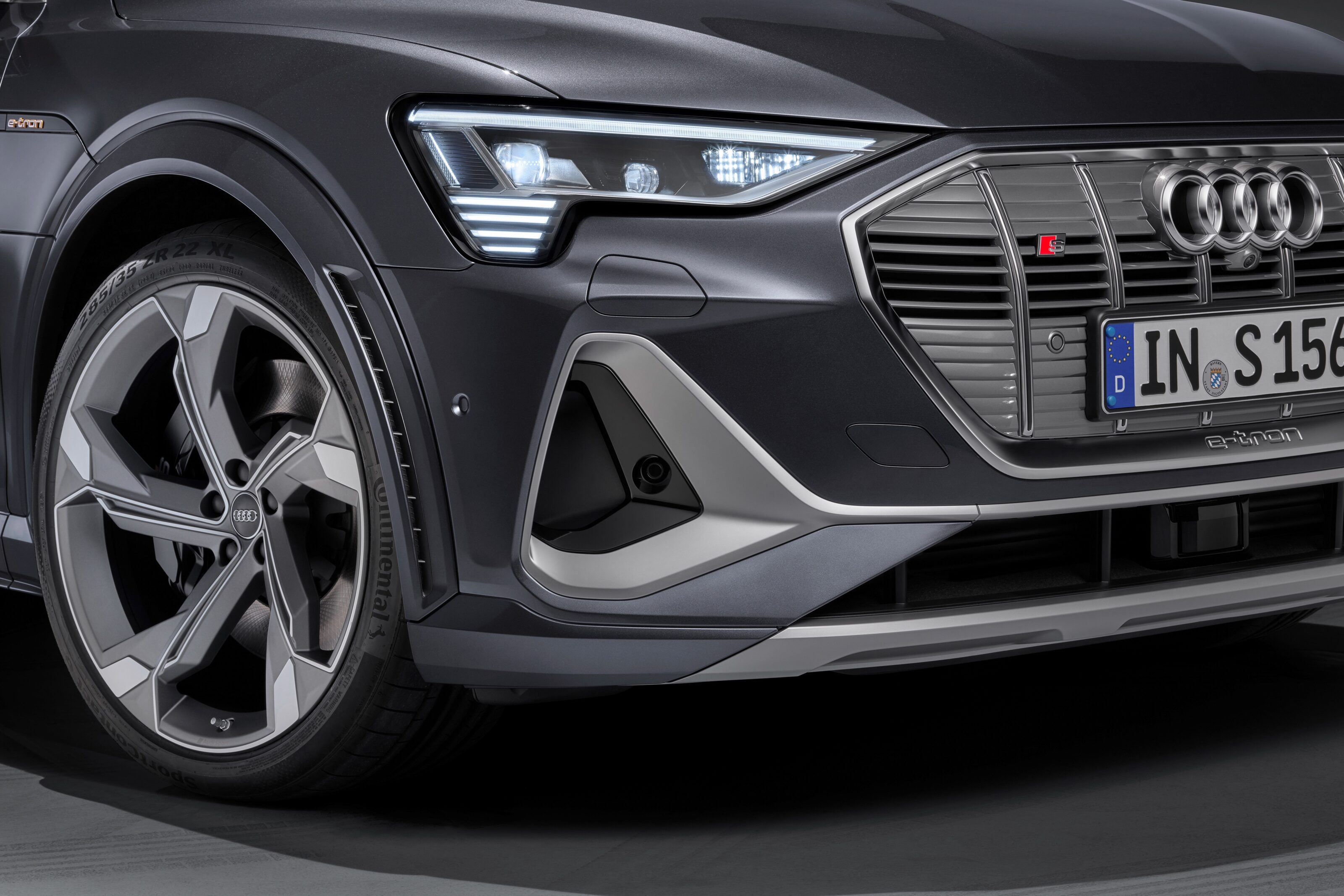
Inside, the models receive heated electric front S sports seats with embossing, heated S sports leather steering wheel, a 16-speaker Bang & Olufsen sound system, and a panoramic glass sunroof.
The new flagship models come standard with 21-inch alloy wheels, aluminium mirror caps, orange brake callipers, and optional matrix LED headlights.
The 2022 Audi E-Tron S and E-Tron S Sportback will be available to purchase from early next year.
2022 Audi E-Tron Australian pricing
| Model | Price |
|---|---|
| E-Tron 50 Quattro | $139,900 (+$2800) |
| E-Tron Sportback 50 Quattro | $150,900 (+$2800) |
| E-Tron 55 Quattro | $148,900 (+$2800) |
| E-Tron Sportback 55 Quattro | $159,900 (+$2800) |
| E-Tron S | $168,400 (+$2800) |
| E-Tron S Sportback | $175,400 (+$2700) |
Note: Prices exclude on-road costs.
October 27, 2020: E-Tron price and specs
After a series of delays and setbacks, the Audi E-Tron and E-Tron Sportback are now rolling into Australian showrooms.
Pricing for Audi’s first series production EV starts at $137,700 for the entry-level E-Tron 50, which plugs in the line-up with a 71kWh battery that sends 230kW and 540Nm to all four wheels via two electric motors and an electrical evolution of the company’s proprietary quattro all-wheel-drive system.
Above that, the more powerful E-Tron 55 costs $146,700 and boosts battery capacity to 95kWh with a corresponding jump in performance to 300kW and 664Nm – enough to accelerate to 100km/h in 5.7 seconds versus the 50’s 6.8s.
Range is dependent on a number of environmental factors, says Audi, but provisionally rates the E-Tron 50’s range at about 300km, while the 55 will go about 400km before needing an electron feed.
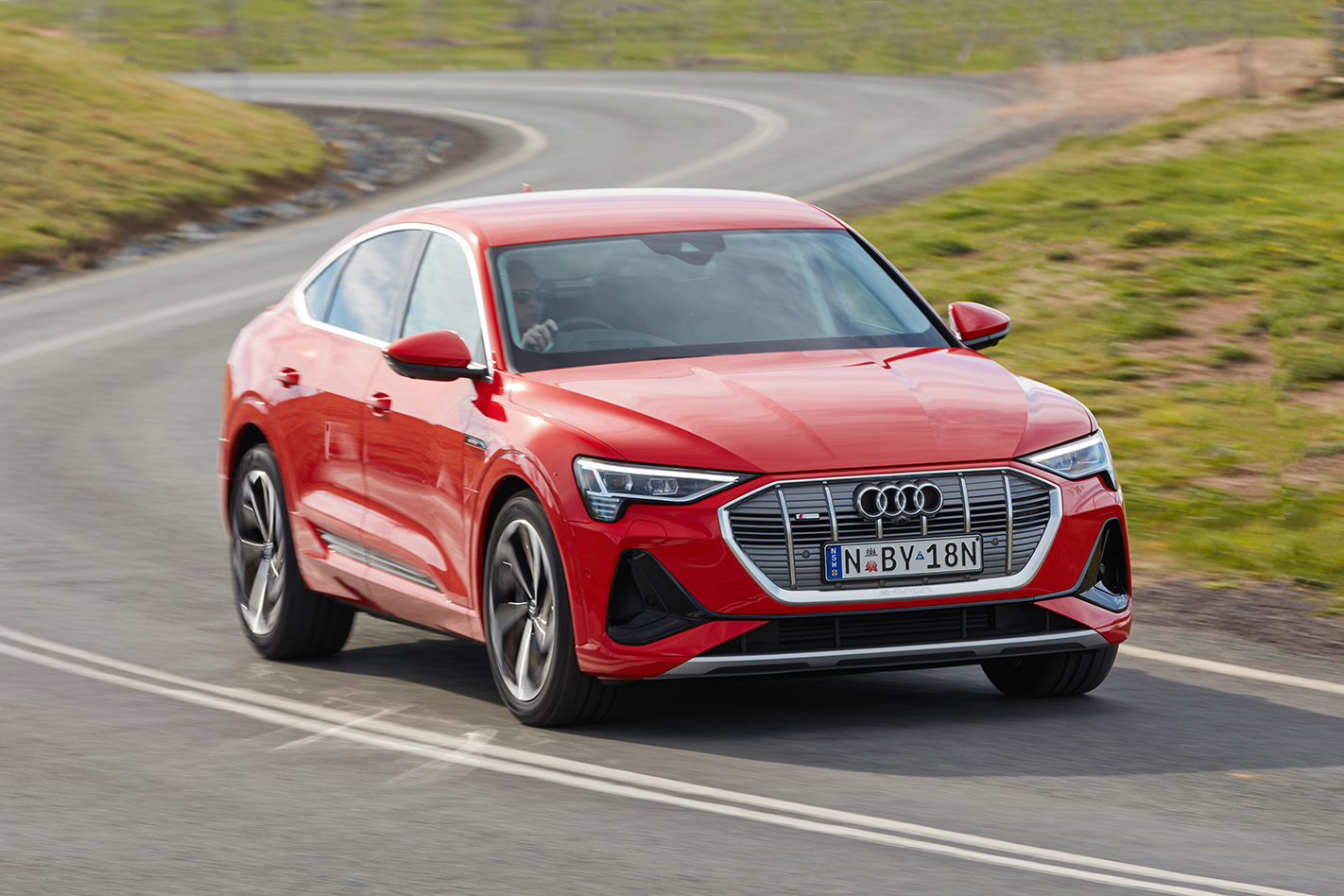
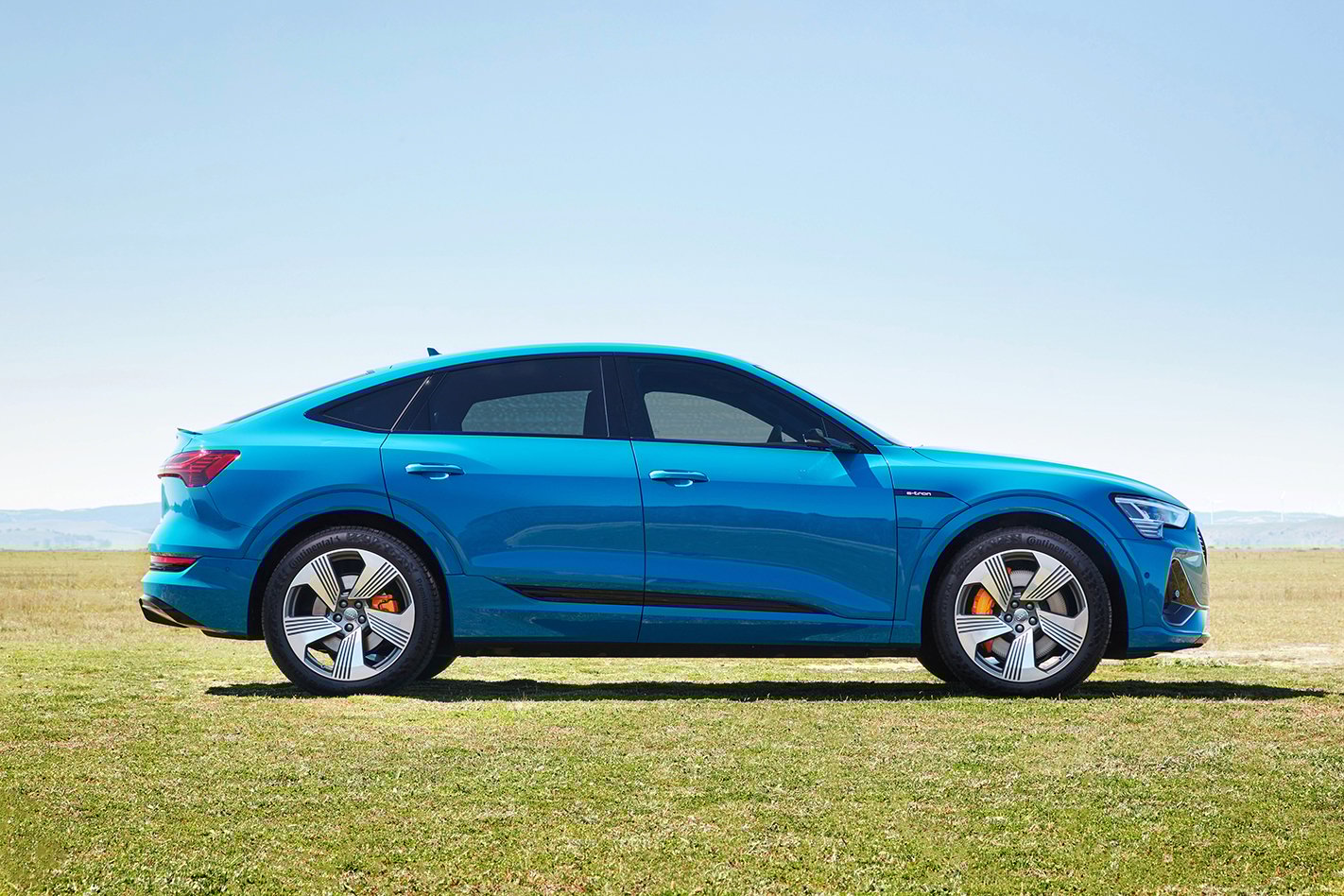
Alongside the more practical SUV, a Sportback model of the E-Tron is also up for grabs, adding a more slippery and elegant version with the same mechanicals but with an $11,000 premium over the standard version.
The arrival of Audi’s electric foray is also being marked by just 70 examples of a special First Edition of the E-Tron 55 and E-Tron Sportback 55, costing $159,600 or $169,950 respectively.
First Edition variants add to the 55’s mechanical and performance base with a number of options included as a deal sweetener.
Unsurprisingly, E-Tron pricing lands competitively close to the E-Tron’s handful of direct rivals, including the Mercedes-Benz EQC that costs from $137,900 and the $124,100 Jaguar I-Pace.
Charging ahead
The new Audi EV has a charging socket on each side. Plug into the passenger-side AC socket with an 11kW home-charging kit and the E-Tron 50 will take a full charge in 6.0 hours, while the 55 needs about 8.5 hours.
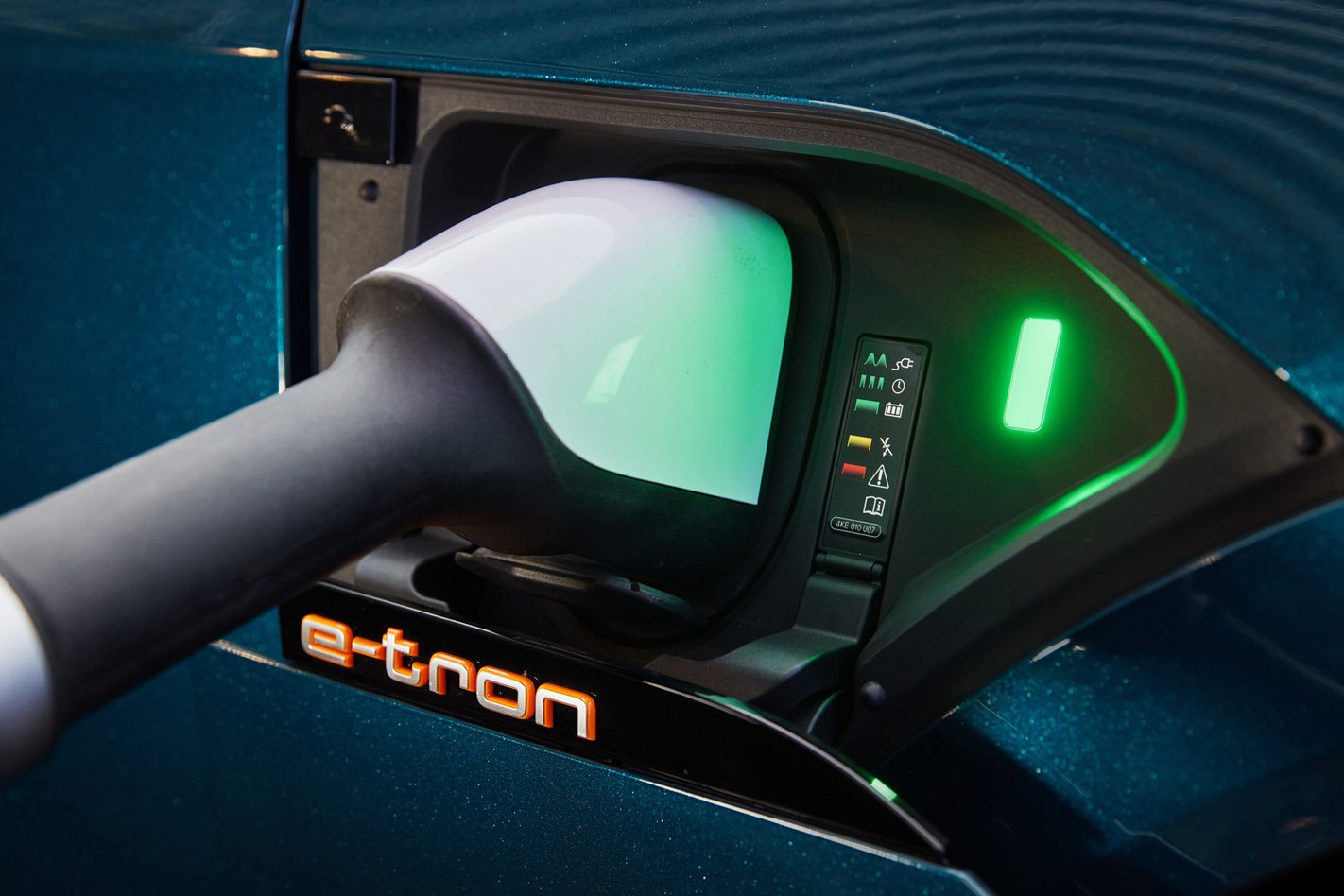
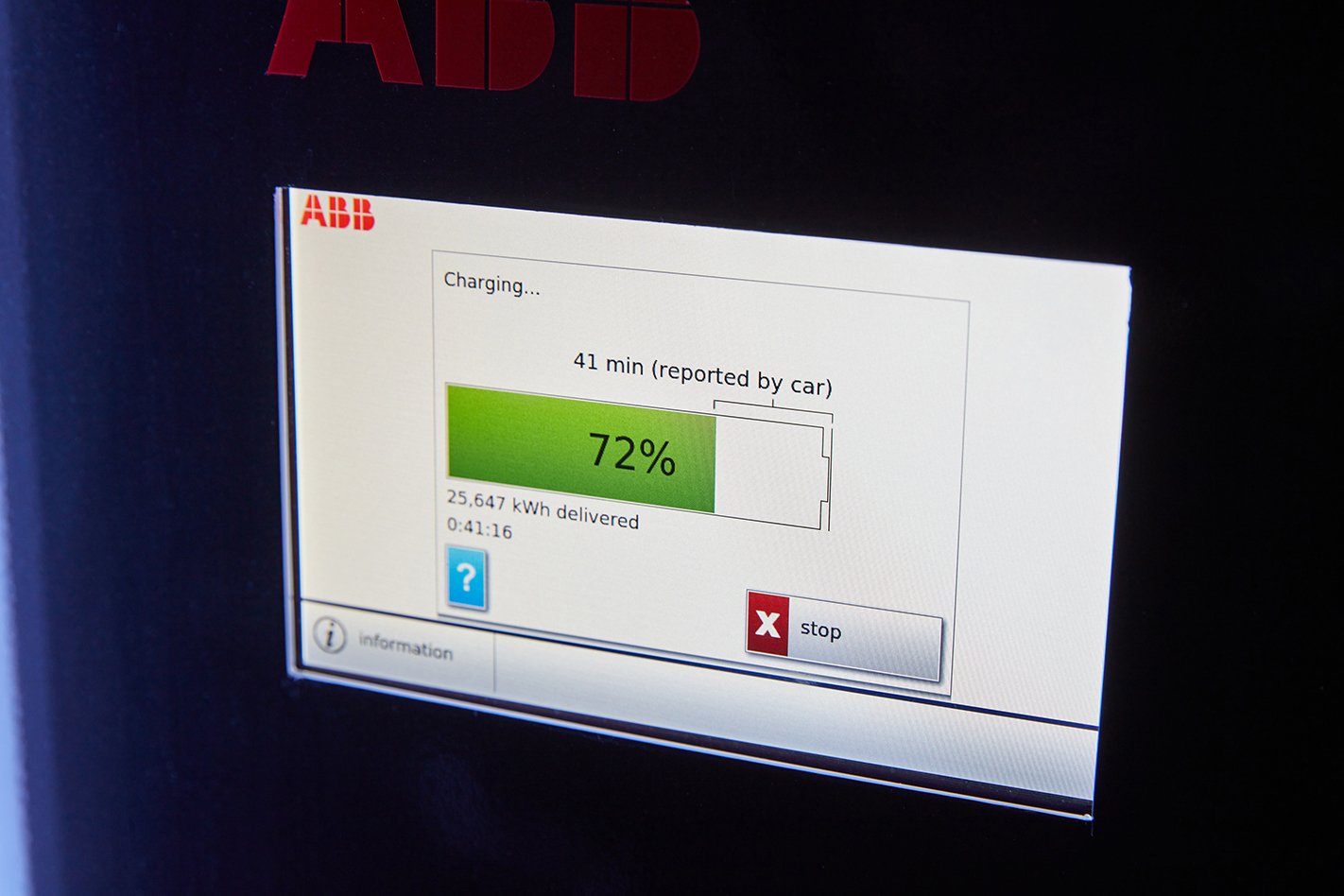
However, park alongside the correct fast-charger and the driver-side socket will allow 55 versions to charge with 150kW (or 120kW for the 50), allowing an 80-percent top-up in just 30 minutes.
Read the paper and sip a servo coffee for 45 minutes and your E-Tron will be fully charged.
Customers will be offered a ‘home check’ inspection of their power infrastructure and the option to install special JetCharge home fast charging equipment at additional cost.
If requested, the installation will be completed before the E-Tron is delivered.
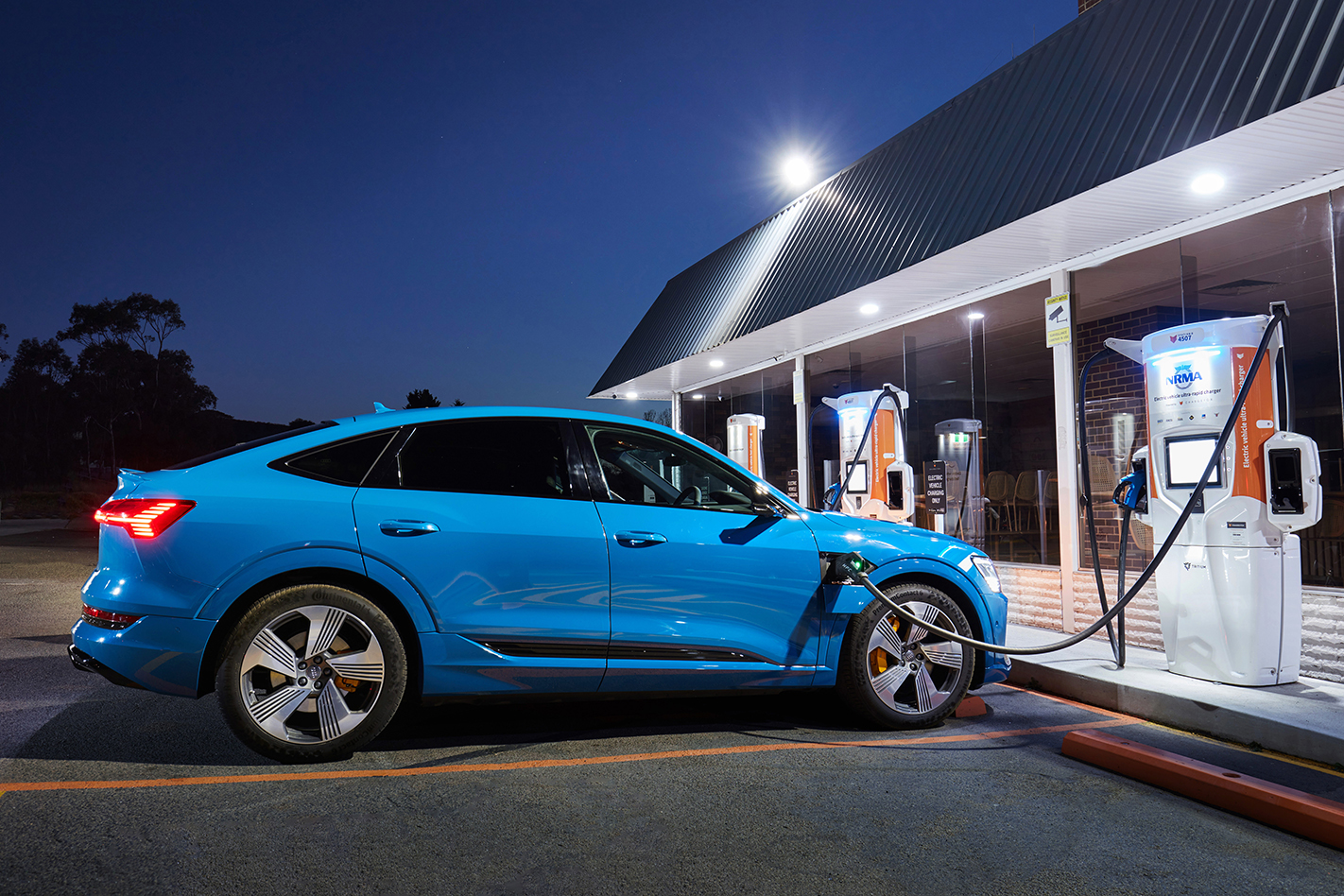
As well, six years of ChargeFox membership is included with the sale of an E-Tron, allowing owners to use a network of about 1100 public charging locations for no extra cost.
More chargers are being added to the ultra-high-speed chargers, which use only renewable sources of power to provide the EV power.
Unlike some other EV brands, Audi is guaranteeing its lithium-ion battery packs not just for complete failure, but capacity degradation where the unit has a significant reduction in range compared with a new battery.
The battery guarantee is for up to eight years or 160,000km.
If required, Audi’s specially trained technicians will replace individual cells rather than removing the entire battery pack. The solution is more cost-effective, faster and more environmentally sensitive, according to the company.
As per many EVs, the E-Tron uses regenerative braking to top up the battery with energy that would otherwise be wasted during conventional friction braking.
Steering wheel paddles are used not to change gears (of which there is one) but to select the level of regenerative braking.
In its most aggressive regen mode, the range is optimised by up to 30 percent, says Audi.
Pulling e-power
Unusually, Audi has also highlighted the suitability of the E-Tron for towing. While many manufacturers avoid the subject of range-destroying hauling, Audi says the E-Tron can pull up to 1800kg of boats, caravans, trailers or whatever you like.
While the company acknowledges that towing will significantly impact the E-Tron’s range, it points out that heavy loads will increase the effect of regenerative braking and provide a greater percentage of range-boosting.
Related: Electric cars are surprisingly good for towing
Interior space is said to be generous thanks in part to the absence of a transmission tunnel intruding into the cabin area (With an electric motor on each axle, a connecting transmission is not necessary).
Rear seat room is particularly obvious, says Audi, while the boot offers up to 660 litres of luggage volume. The E-Tron is very close in dimensions to the company’s Q7 large SUV.
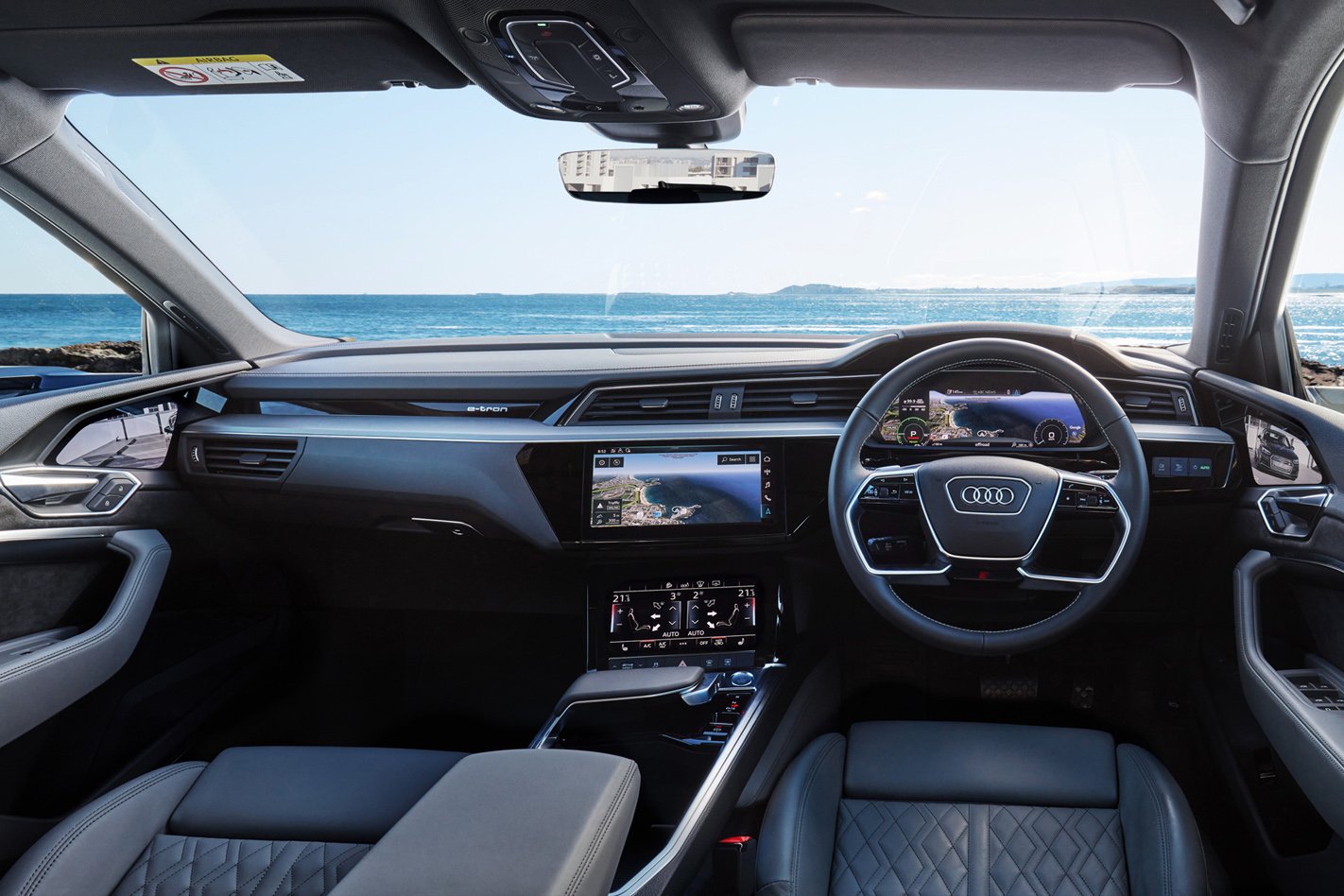
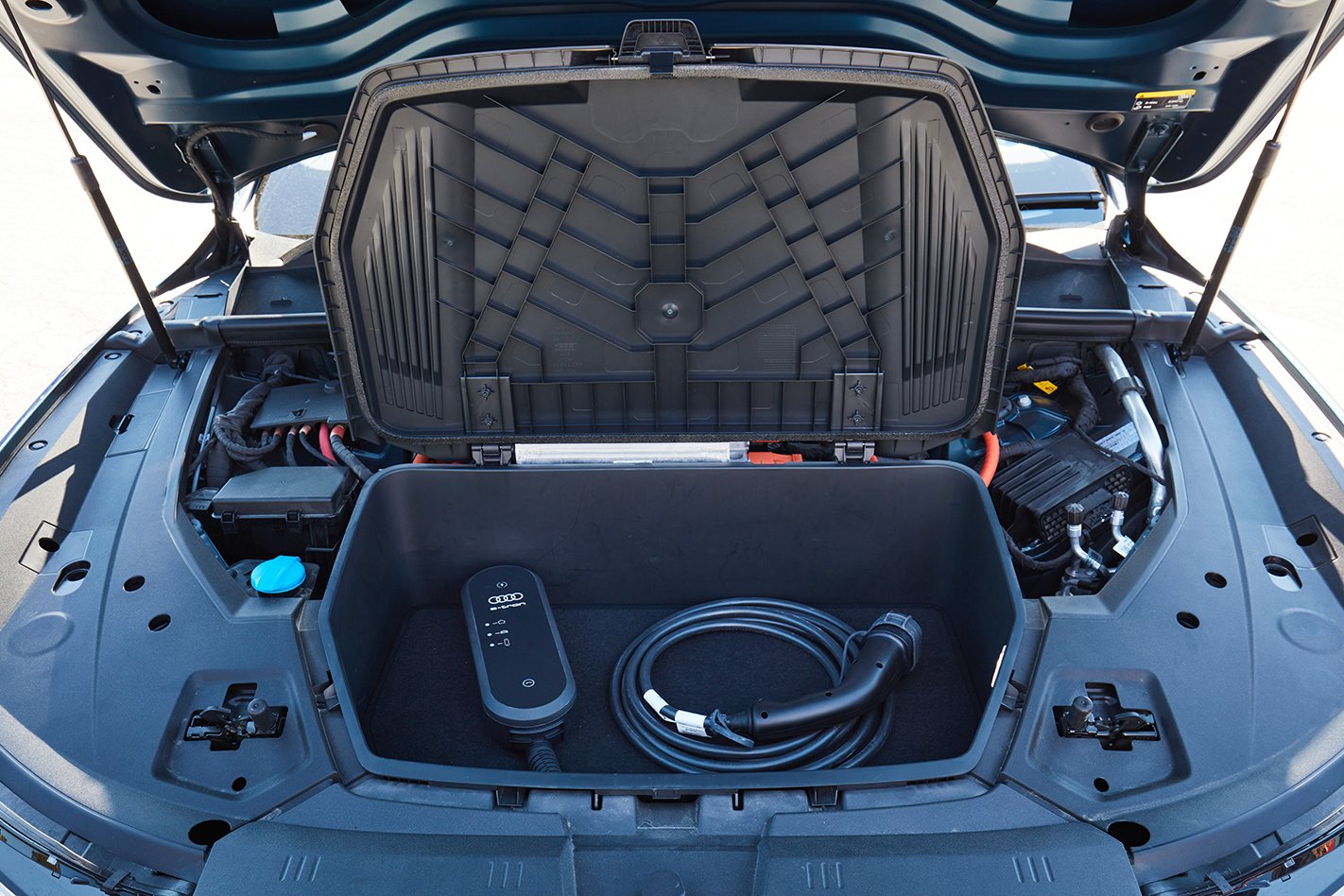
The Sportback’s more coupe-like profile sacrifices 45 litres of space but both models offer another 60-litres of storage under the bonnet.
Size and range comes at a cost and the E-Tron tips the scales at a hefty 2555kg for the 55, while the 50’s smaller battery saves some mass for a kerb weight of 2445kg.
Audi went to significant lengths to extend the E-Tron’s real-world range including particular attention to the aerodynamics. An active grille can shutter itself when maximum cooling is not required for lower drag, while a flat but dimpled underbody minimises turbulent air flowing under the vehicle.
E-mirror
For those customers after the ultimate drag-reduction, Audi is offering its ‘virtual wing mirrors’ that replace conventional side mirrors with cameras and LED touchscreens placed on the inside of the door.
The optional feature not only chops overall drag coefficient by 0.02, but has safety advantages with improved low-light vision and a minimised blind spot.
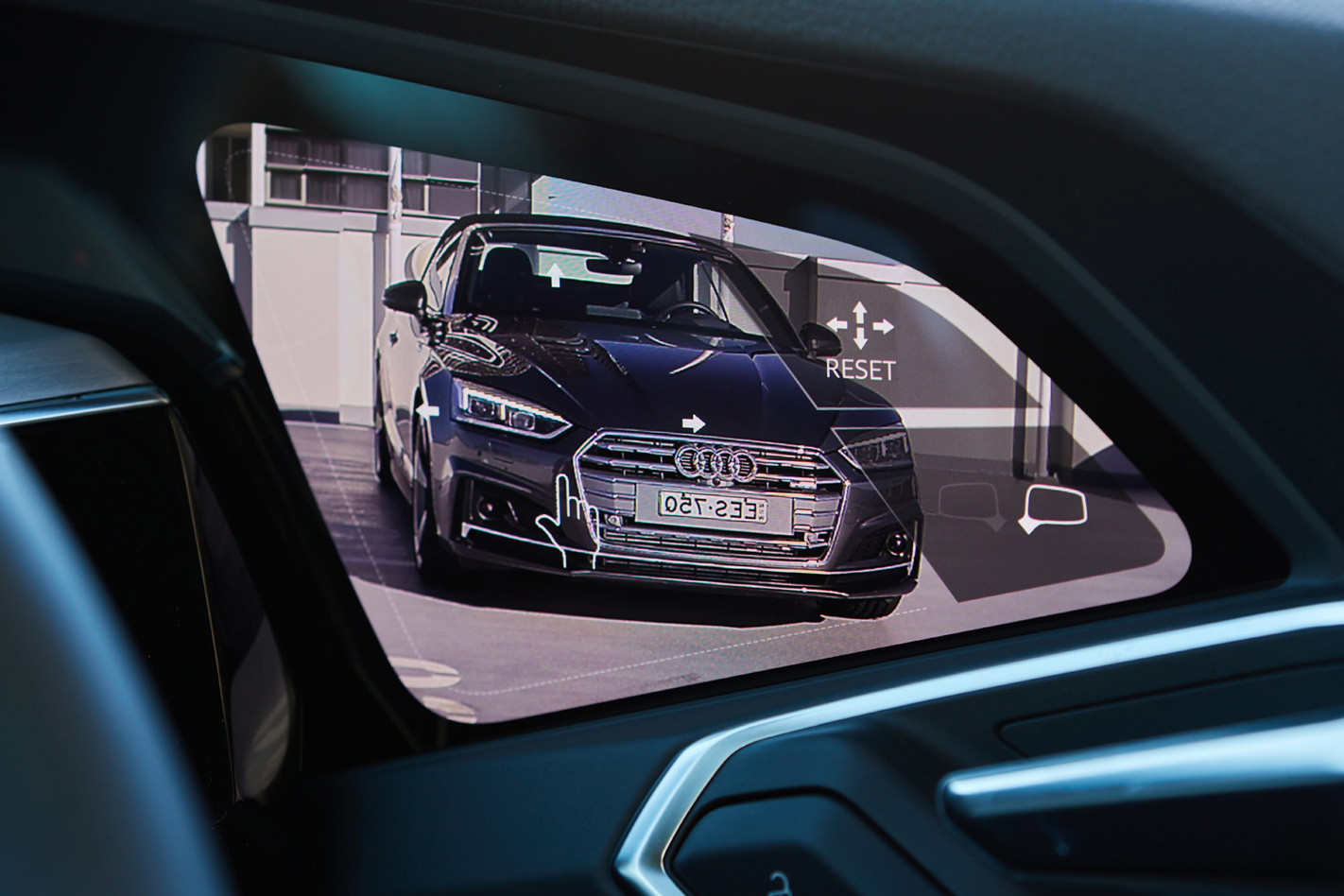
Cameras replacing mirrors is a production-car first and will cost customers an extra $3500 but is available bundled into a Premium Plus package for $9700 or $6700 when added to any Sportback version.
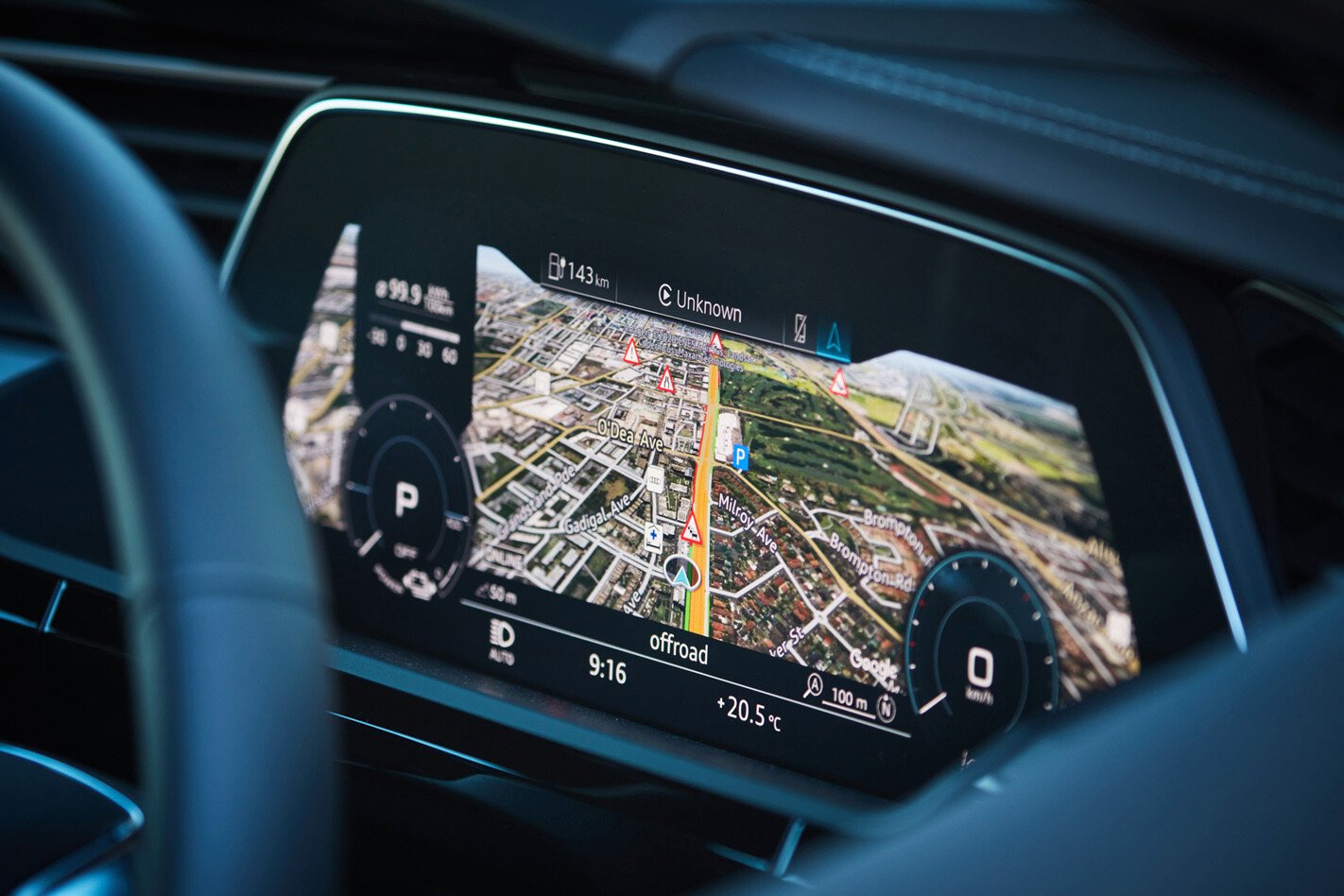
Standard gear includes Audi’s MMI information system which offers EV-specific functions including navigation that can calculate if a charge will be required en-route, most efficient route planning, and the effect of heavy ‘consumers’ on range, such as air conditioning and heating.
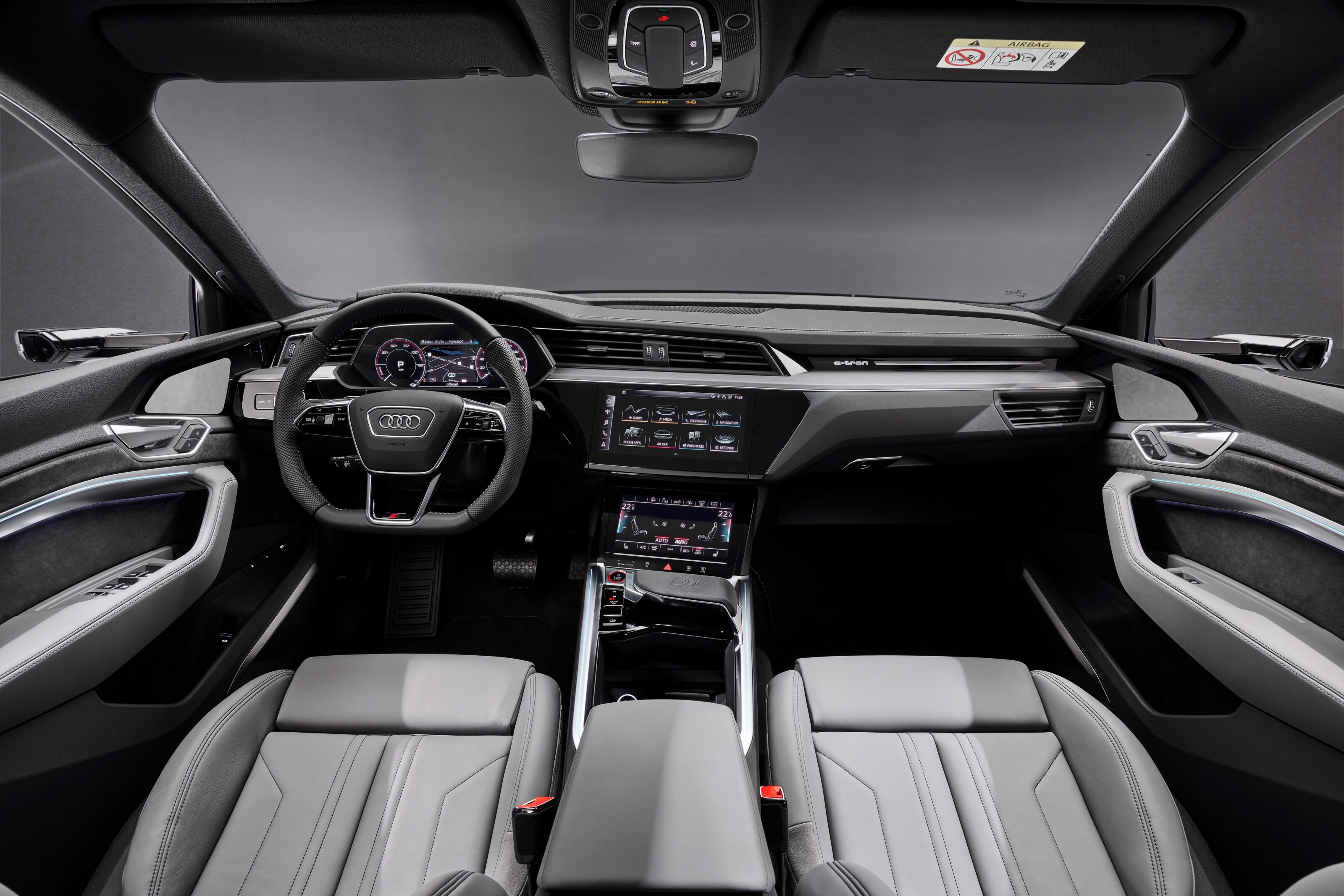
In addition to Audi’s now commonplace Virtual Cockpit fully-digital instrument panel, a dual haptic touchscreen dominates the E-Tron’s central dash area.
The top 10.1-inch screen is for all information and entertainment, while the lower 8.6-inch touchscreen looks after climate and comfort settings.
A high level of safety is standard as recognised by ANCAP and its highest five-star rating thanks to state-of-the-art driver assistance systems, other road-user protection technology and eight airbags.
Milano leather can be upgraded to the same Valcona hide found in the A8 limousine flagship, along with sports front seats and leather dash upholstery with the $2950 Premium Interior Pack.

Finally, if a growing national fast charger network, up to 400km range, and the latest mileage-boosting electronics and information systems aren’t enough to dissolve so-called range anxiety, Audi is including six years of roadside assistance – which includes helping with a flat battery.
If your idea of family planning is to spurn any and all form of contraception, there’s hope beyond buying a 12-seater Toyota Hiace with a solid rear axle and leaf springs. You could buy a Kia Carnival.
Bringing back memories of the 2003 Honda Odyssey – low and wide, and launched with a scandalous advertising campaign that wouldn’t fly 20 years later – resident designer Ferlazzo said it best as the judges perused the new fourth-generation Carnival at the start of its COTY bid: “As close as you can get to a ‘sexy people mover’ … if that’s possible.”
Kia’s bold eight-seater is 5.1 metres long – 40mm more than the outgoing model, 30mm of that in the rear overhang – but where the old Honda Odyssey blurred the lines between people-mover and station wagon, the new eight-seat Carnival is more like a people-mover-cross-SUV.
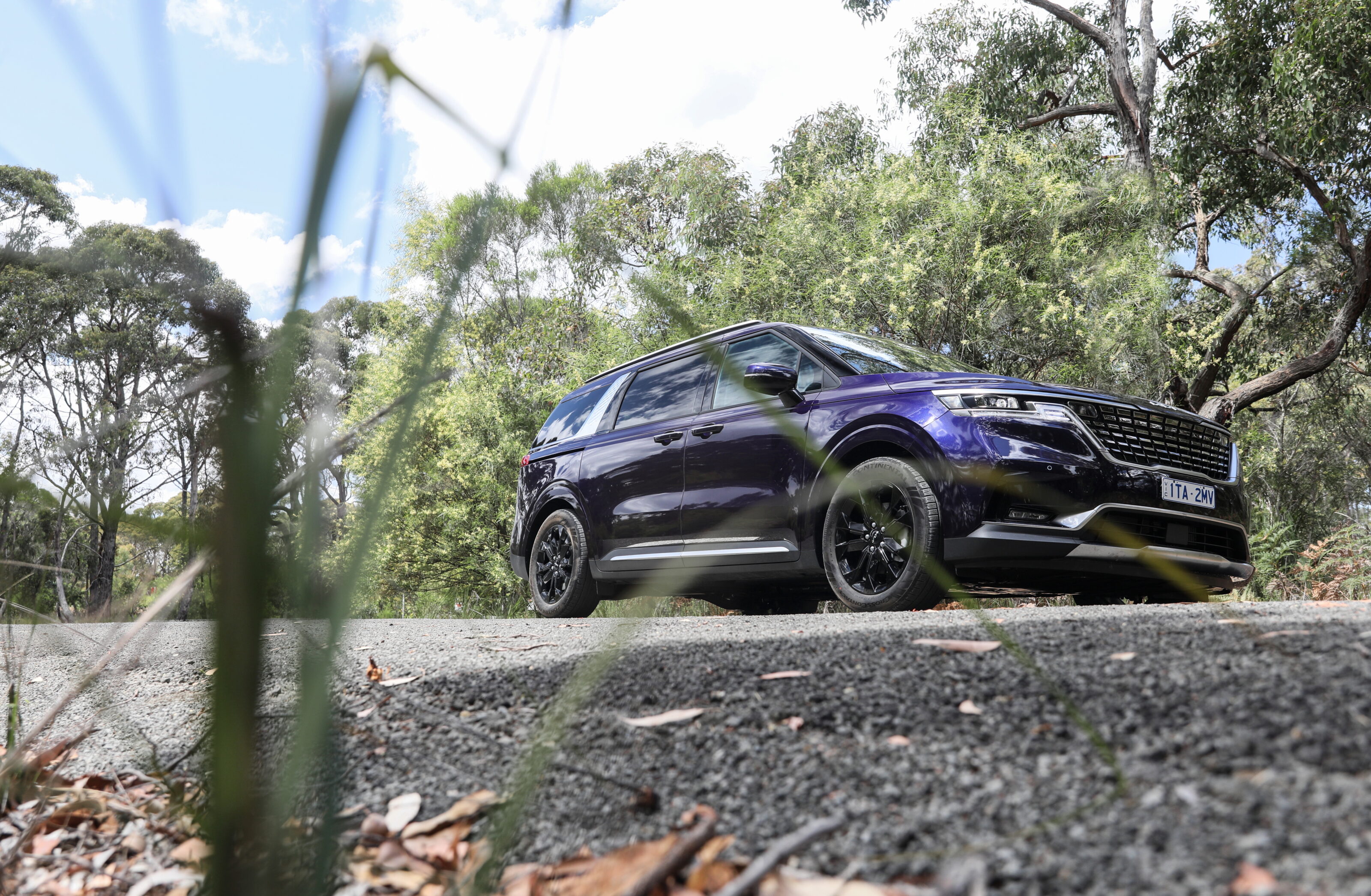
With perhaps the tiniest dash of sports car. Its short front overhang, masculine presence and chiselled dimensions certainly had the judges soaking it all in. A people mover!
But the initial excitement of the walkarounds – including folding down the second row to reveal a luggage space of 2905 litres, aping almost a Boeing C-17 – cooled as we rolled the fourth-generation Carnival out on to the Anglesea proving ground. The variant we chose was the 2151cc turbo-diesel as installed in the top-spec Platinum, with every bell and whistle imaginable – as you’d hope for $67,580 before on-road costs.
“Easily the best of a scant and largely unloved segment” – Curt Dupriez
Unsurprisingly, it feels truly cavernous inside – you’ll never be wanting for space. A beautiful relationship between throttle calibration and turbodiesel torque means you can’t help but fold the central arm-rest down and fat-arm the Carnival everywhere.
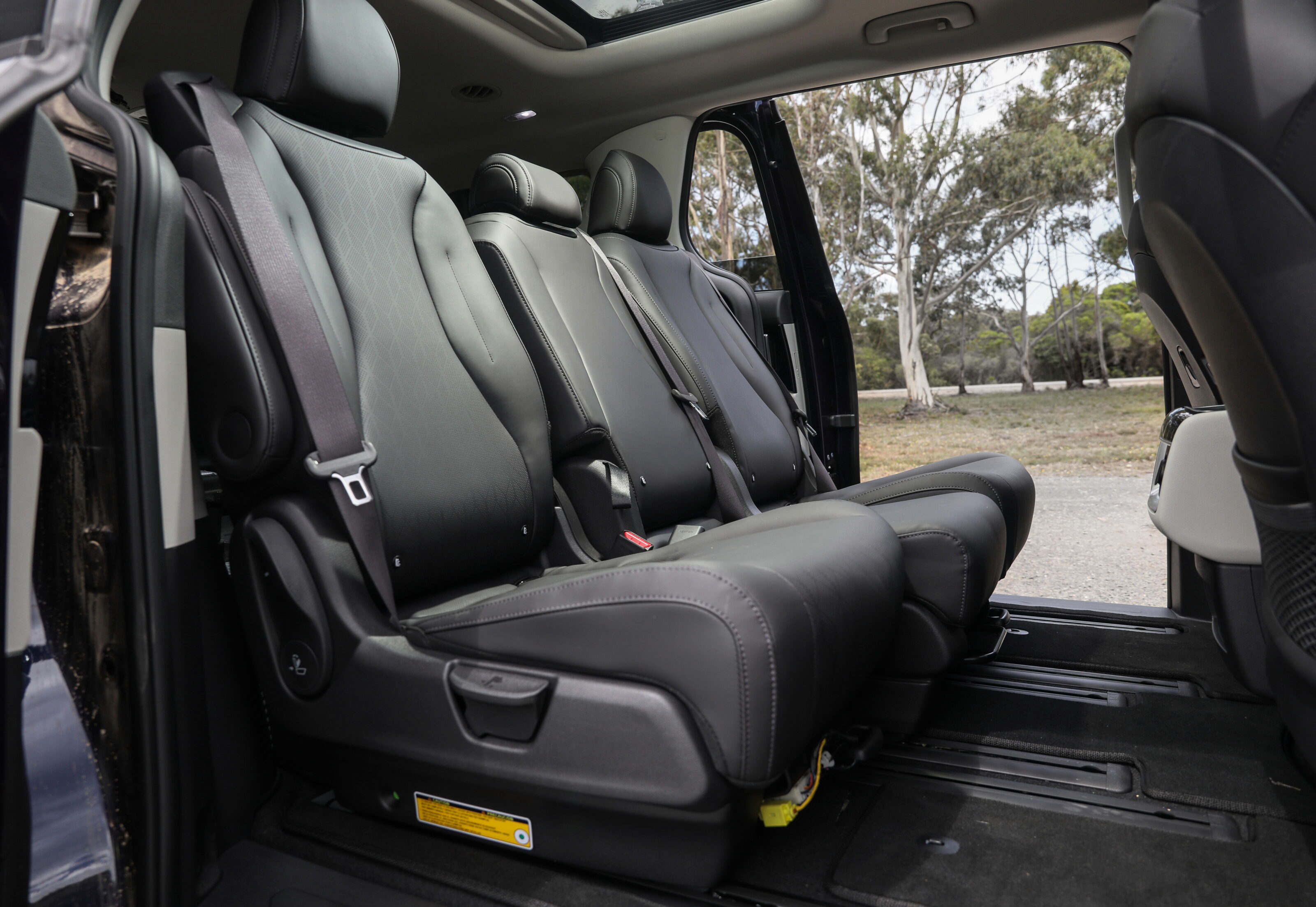
There’s a certain La-Z-Boy quality about it. Predictably soft, comfortable suspension and a long wheelbase give the impression the Carnival could make 1000km feel an awful lot shorter. And with 6.5L/100km claimed consumption, you could theoretically do that on just one fill of the diesel’s 72-litre tank.
And around the proving ground it was difficult to fault for what it is. With a bit of squat, it was easy to bother the front tyres with too much throttle resulting in wheelspin, especially on dirt, making you think it would be a better vehicle with all-wheel drive.
But for its size, it did everything better than we’d expected it to, from handling to braking, even if it was a bit of a cruise liner through the lane-change. (You might be tempted to smash a champagne bottle on the front of it soon after purchase.)
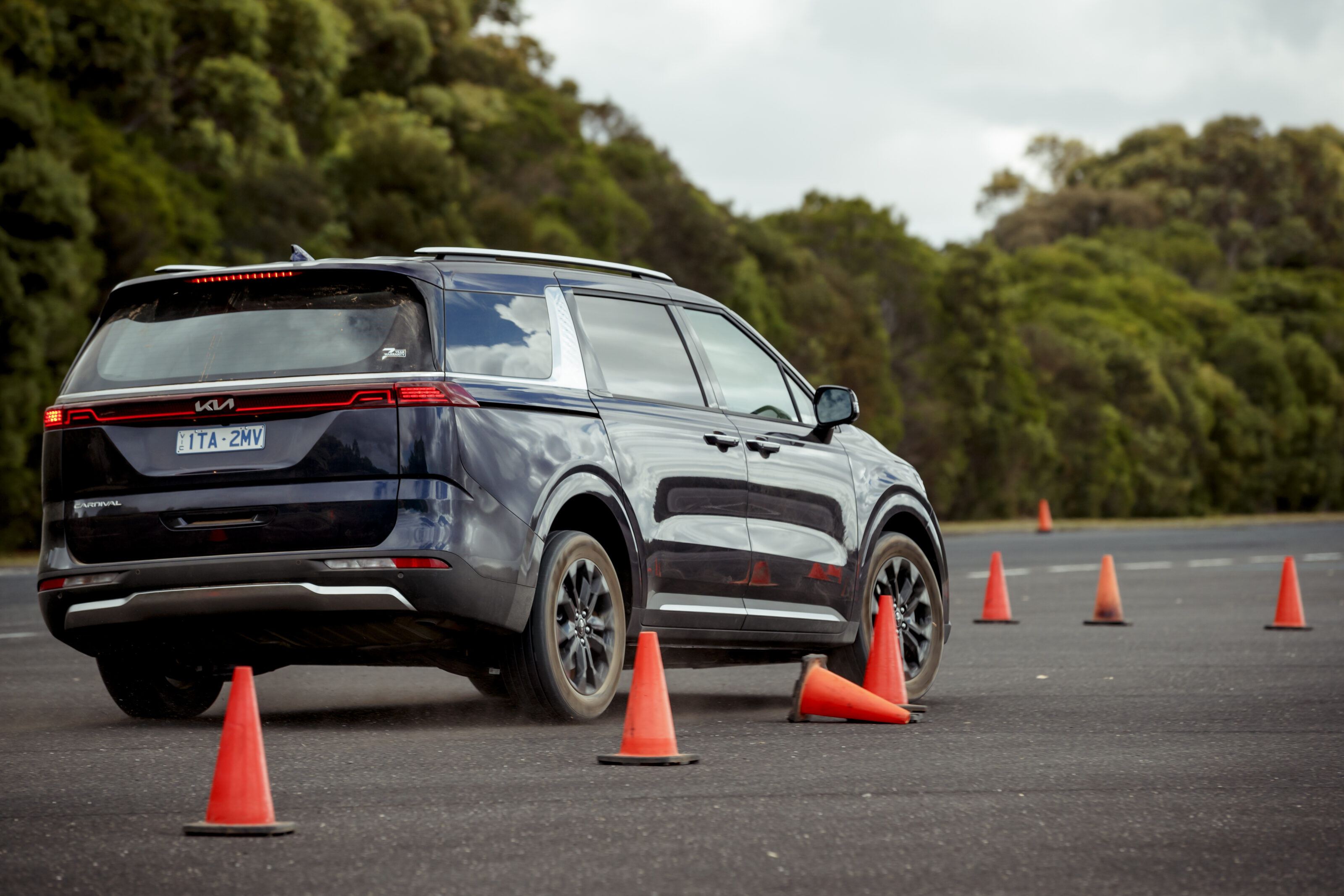
But while the Carnival does a rock-solid job of its intended purpose, in the company of every other car at COTY – especially some of its South Korean brethren, the Palisade especially – it merely shined while others sparkled against all the criteria. It opted for a solid rather than spectacular showing – and left the judges to nit-pick.
“The seats are too firm and lack long-haul comfort,” said Curt. “Mid-grade Si a sweeter spot.”
“Didn’t notice as much engine noise in the Palisade. Certainly less refined at idle,” said Inwood.
And so even in the face of things like a seven-year warranty, the Carnival was knocked out in the first round. Rest assured, it would have beaten a Hiace. Soundly.
