
UPDATE, March 7, 2022: Swiss electric vehicle manufacturer Piëch Automotive has released a new behind-the-scenes video, as research and development continues on its upcoming 2024 GT coupe.
As the marque etches closer to the scheduled mid-2024 production start, it has launched a waiting list for interested parties and debuted an in-depth product film, explaining further details for the GT.
With the latest battery technology, recharging the Piëch GT from 0 to 80 per cent is claimed to take just five minutes, while the 0-97km/h sprint is said to be completed in less than three seconds.
The story to here
October 7, 2021: It was less than a year ago when Porsche CEO Oliver Blume proclaimed the iconic 911 would retain its combustion engine for the foreseeable future, but the German carmaker’s design boss is already considering an electric 911 beyond 2030.
Speaking to the UK’s Autocar, Porsche design chief Michael Mauer suggested there were strong opinions for and against the idea of a battery-powered 911 at the company.
“I’m part of the group that went from air-cooling to water-cooling, and now we have turbocharged engines,” Mauer said, but argued a 911 with a petrol engine is increasingly difficult to package.
“Maybe an electric 911 is another story, but purely from a design standpoint an electric 911 is even easier in the future.”
But while those within Porsche are still debating a flagship electric sports car, the great-grandson of company founder Ferdinand Porsche is building his own.
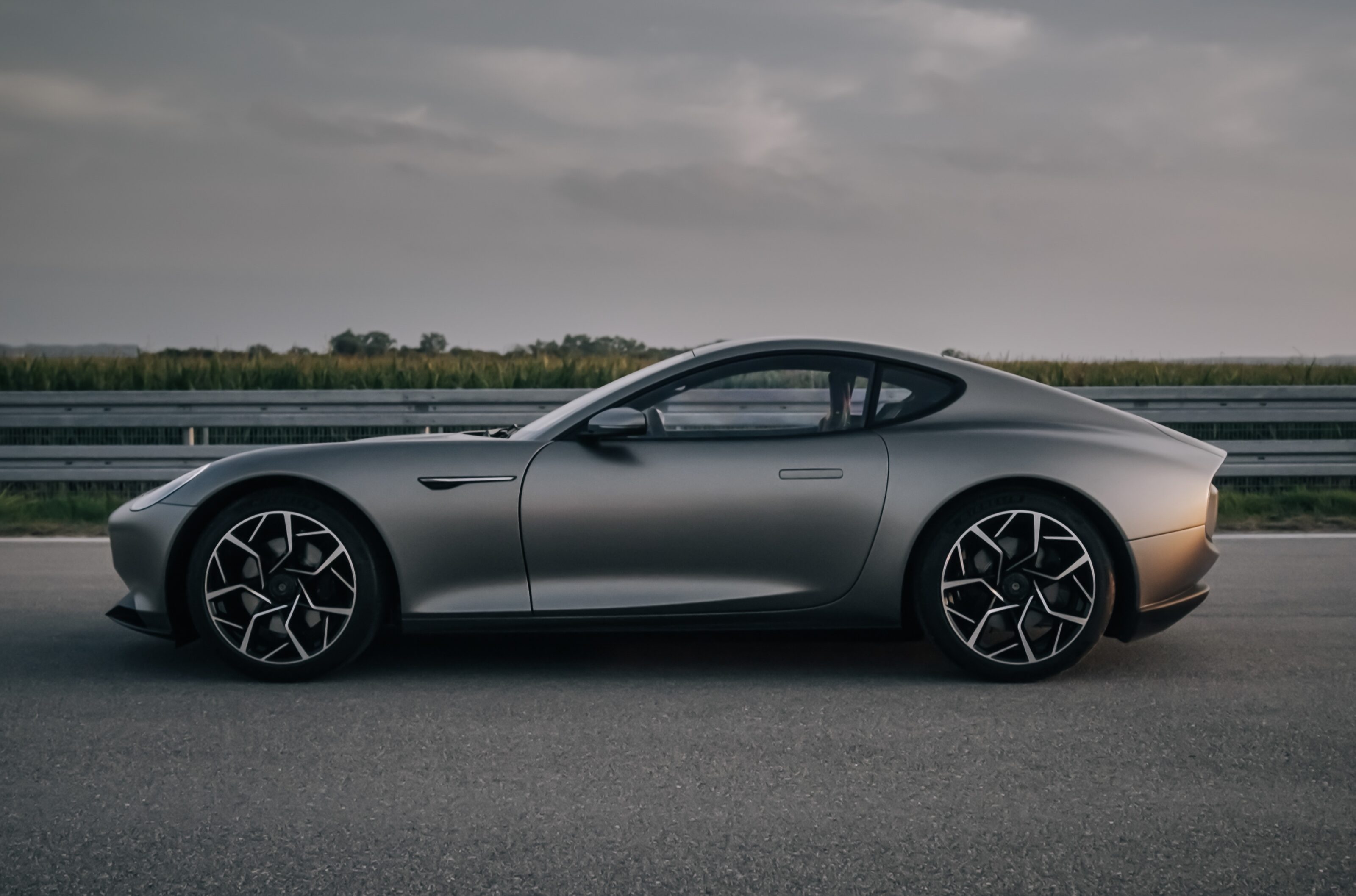
In 2019, Anton ‘Toni’ Piëch announced his intention to create a two-door sports car with a 300kW battery-electric powertrain and a driving range of 500km – today the vehicle is about to begin its pre-production testing phase.
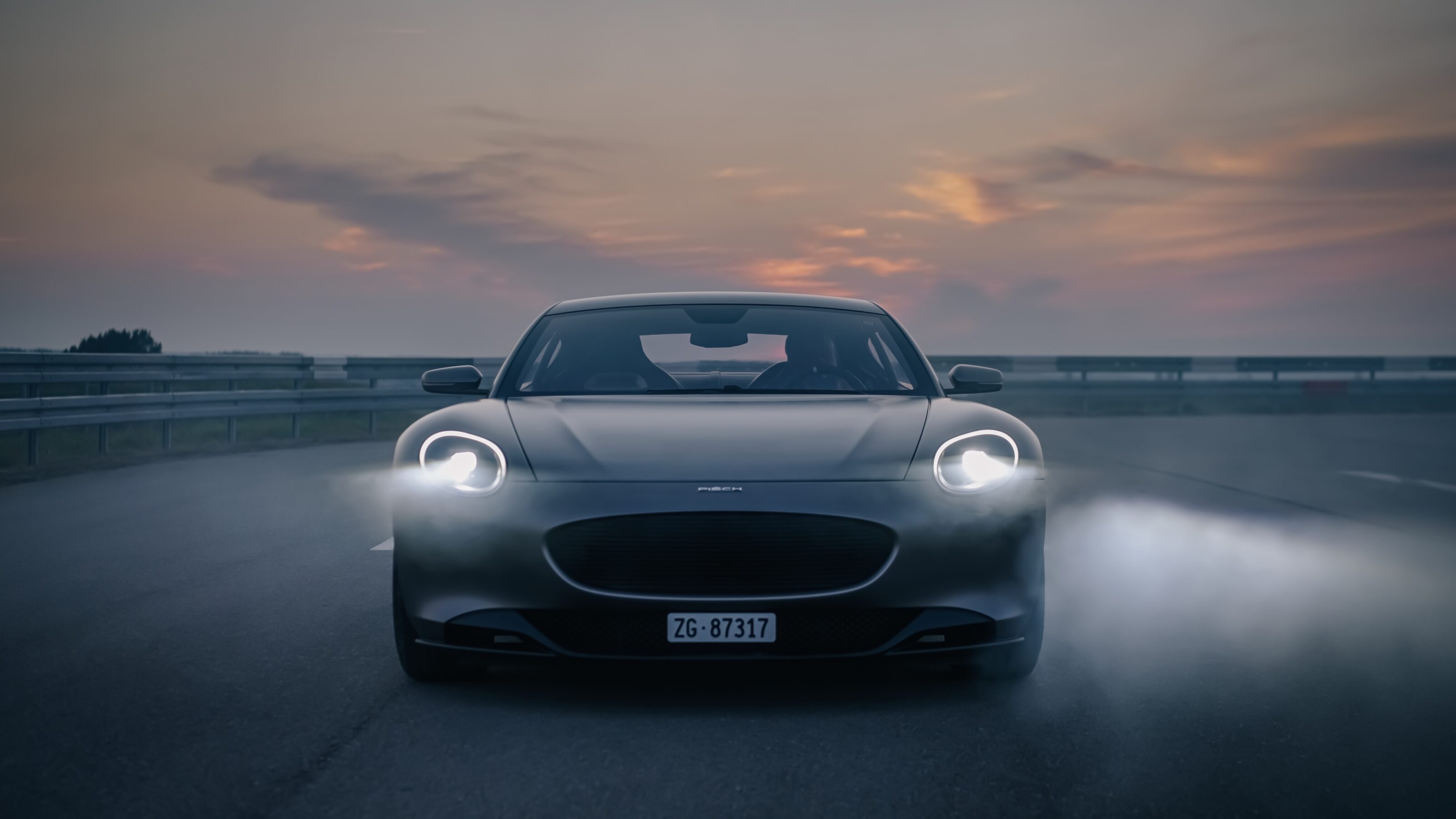
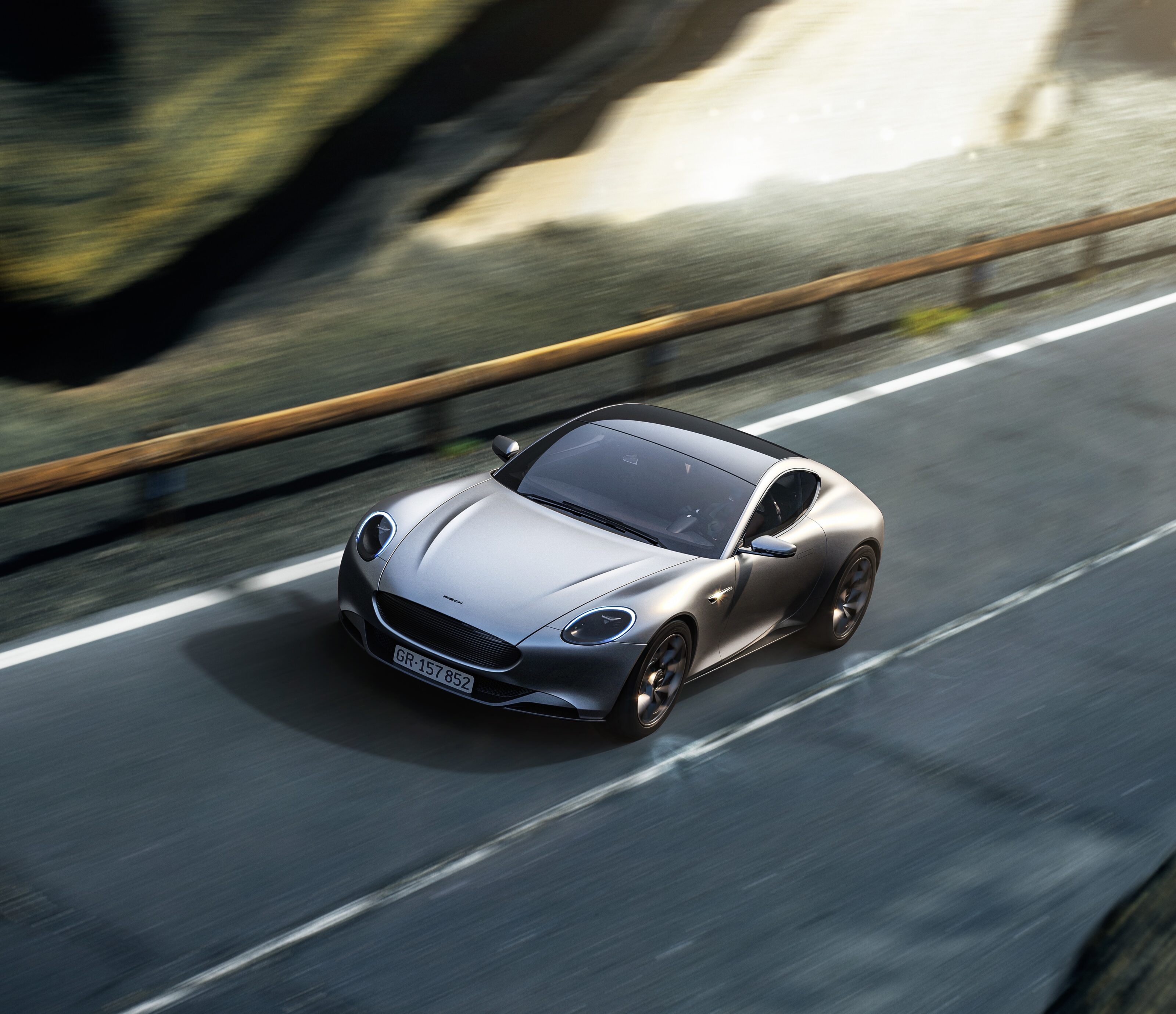
Named the Piëch GT, the car now has around 450kW from its three electric motors – thanks to improvements in available technologies – which the company claims is enough to get the 1800kg coupe to 100km/h from a standstill in under three seconds.
“The new Piëch GT should convincingly transport the DNA of a classic sports car into the electric age,” said Rae Stark Rajcic, Piëch Chief Design Officer and co-founder.
“We created a sports car with a timeless design, just like we would dream [of] ourselves. And we spoke at length with car enthusiasts about what is missing on the market. The result was a modern classic that is not bound by any consumer cycles.”
Though the Piëch GT has a shape reminiscent of classic sports cars, there appears to be more of an influence from Aston Martin than of Porsche – perhaps to help distance itself from its links with the German brand.
“Not only are we flexible in terms of design and body shapes, but we are also keeping all options open when it comes to powertrains,” explained Toni Piëch.
“We’re starting with electric cars, but our modular vehicle architecture would allow us to respond flexibly to corresponding developments and breakthroughs in the field of hydrogen or fuel-cells.”
Unlike many other electric vehicle start-ups, Piëch appears to have no financing issues. In May, a Zurich-based holding company with links to Rajcic submitted an unsuccessful offer of €7.5 billion (AU$11.9 billion) to Volkswagen Group for the purchase of Lamborghini.
With strong financial backing, the Piëch GT will be one of three models from the Swiss carmaker – with a sedan and SUV expected in the coming years.
The company’s first prototypes of the GT will undergo testing over the next year, lead by veteran BMW M engineer Klaus Schmidt.
“Piëch is exactly following the tried-and-tested testing cycles of German premium manufacturers here, with trials in heat and dust, in sub-zero temperatures with ice and snow, and on demanding roads and racetracks such as the Nürburgring Nordschleife, to be able to meet our target of starting series production in 2024,” Schmidt said.
The company has plans to launch the Piëch GT in Europe, China, and the US – around the same time Porsche is rumoured to be launching all-electric versions of its Boxster and Cayman.
The Porsche 911 has long been praised for continuing the same recipe for decades, but Piëch could be positioning its GT as the car’s spiritual successor in the new age of electric cars.
Snapshot
- Model 3 Standard Range price up by $1000
- Waiting times out to five to seven months
- Pricing unchanged for Long Range and Performance
A small price increase for the base Tesla Model 3 has been accompanied by significant expansions in delivery times for the world’s most popular electric car.
Pricing for the Model 3 now starts from $60,990 before on-road costs, an increase from $59,990.
Buyers are likely to find that easier to digest than the disappointment of waiting times which now stretch to between five and seven months.
Tesla’s Australian operation isn’t permitted to discuss business matters relating to the company, but the global semiconductor shortage is affecting supply as with every other car maker.
There are no price changes for the $73,200 Long Range and $84,900 Performance variants.
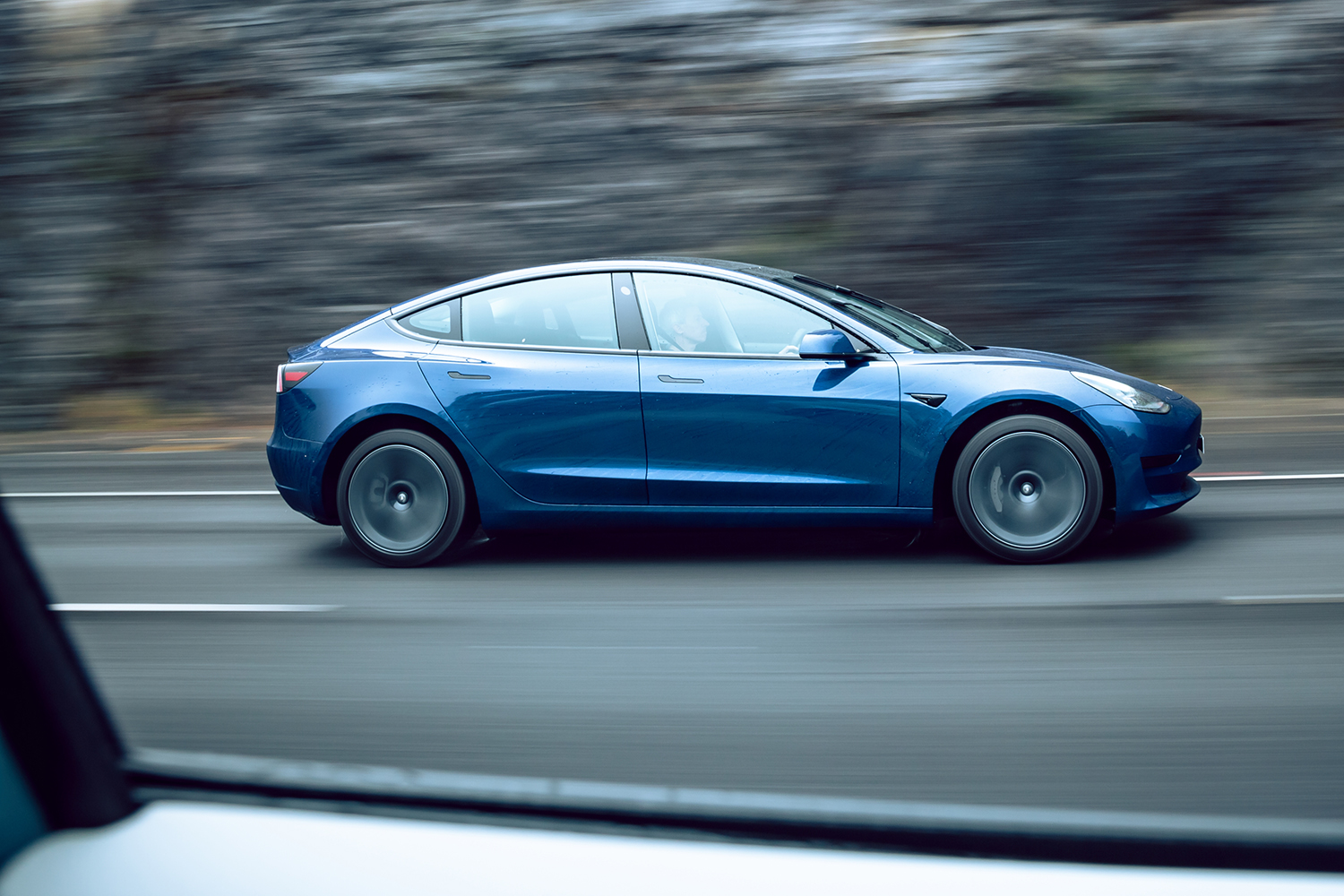
Tesla updated its most affordable electric vehicle with larger batteries throughout the range, increasing the range of all three Model 3 variants.
The Model 3 entry model’s WLTP-rated range is now 491km, with the Performance rated at 547km and the Long Range living up to its name by taking owners up to 602km.
The base Model 3 was the only variant to lose some performance with its quoted 0-100km/h acceleration downgraded from 5.6 to 6.1 seconds.
The Long Range and Performance remain at 4.4 and 3.3 seconds, respectively.

Latest Model 3s also feature an updated infotainment system that introduces what Tesla is calling “some of our most creative features”.
The large central touchscreen has gained a revised interface with simplified controls, available Dark mode, and a customisable app launcher.
Navigation now allows map details to be hidden, game additions include Sonic the Hedgehog and Sudoku, and TikTok now forms part of the Entertainment section.
A Boombox Megaphone could please budding politicians, allowing a voice to be projected via the car’s external speaker.
Among other updates, the blind spot camera provides a live camera view via the touchscreen – in a similar way to top-spec Kia and Hyundai models, though via their driver displays.
There is still no confirmation on timing for the Model Y SUV that is closely related to the Model 3.
Snapshot
- Q4 Sportback 40 delivers 534km driving range
- Five to 80 per cent charge time down to 28 minutes for Q4 40 E-Tron
- Q4 E-Tron still not confirmed for Australia
UPDATE, March 4, 2022: A host of updates have been handed down to the 2022 Audi Q4 E-Tron in Europe, with the electric vehicle now benefiting from faster charging across the range.
Keeping its 77kWh battery pack, a series of software optimisations for the car’s thermal management and control systems allow for shorter charge times, with the entry-level Q4 40 E-Tron now boasting five to 80 per cent can be achieved in 29 minutes at 135kW – down from 38 minutes.
The higher-spec Q4 50 E-Tron Quattro’s charge time has also been reduced, although only by two minutes from 38 to 36 minutes using 135kW DC rapid chargers.
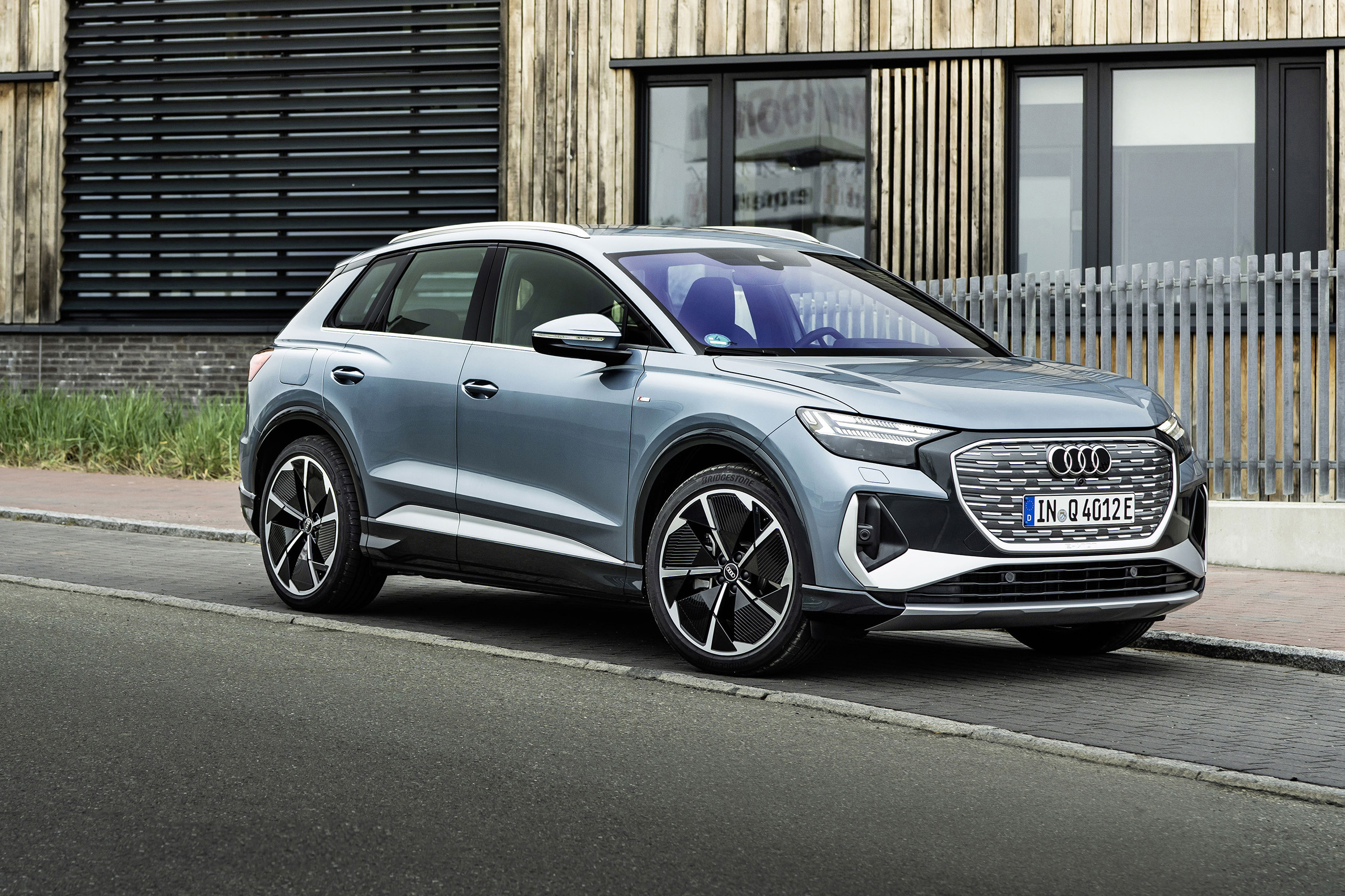
Updates continue inside the cabin, with the car’s MMI infotainment screen now upgraded to a 11.4-inch unit complete with Amazon Alexa, which gives occupants voice control over the car’s integrated smart controls.
Audi Australia still remains coy about the status of a local launch for the Q4 E-Tron, telling Wheels: “Currently there is no update and the Audi Q4 E-Tron has not yet been confirmed for the Australian market.”
The story to here
August 2, 2021: Audi has revealed two more variants to its Q4 E-Tron range with the release of the 45 Quattro and the Sportback 40, each boasting specs not otherwise available in the model line-up.
In the case of the Sportback 40, it becomes the furthest travelling Q4 E-Tron with a WLTP tested driving range of 534km, the best results of any Audi electric model and 26km further than the Q4 40 E-Tron.
Utilising the same 150kW/310Nm rear-wheel motor and 77kWh battery pack as the hatch-shaped Q4 40 E-Tron, the Q4 Sportback 40 will go on sale in Europe for €49,500 (AU$80,000), €2000 (AU$3235) more than the five-door.
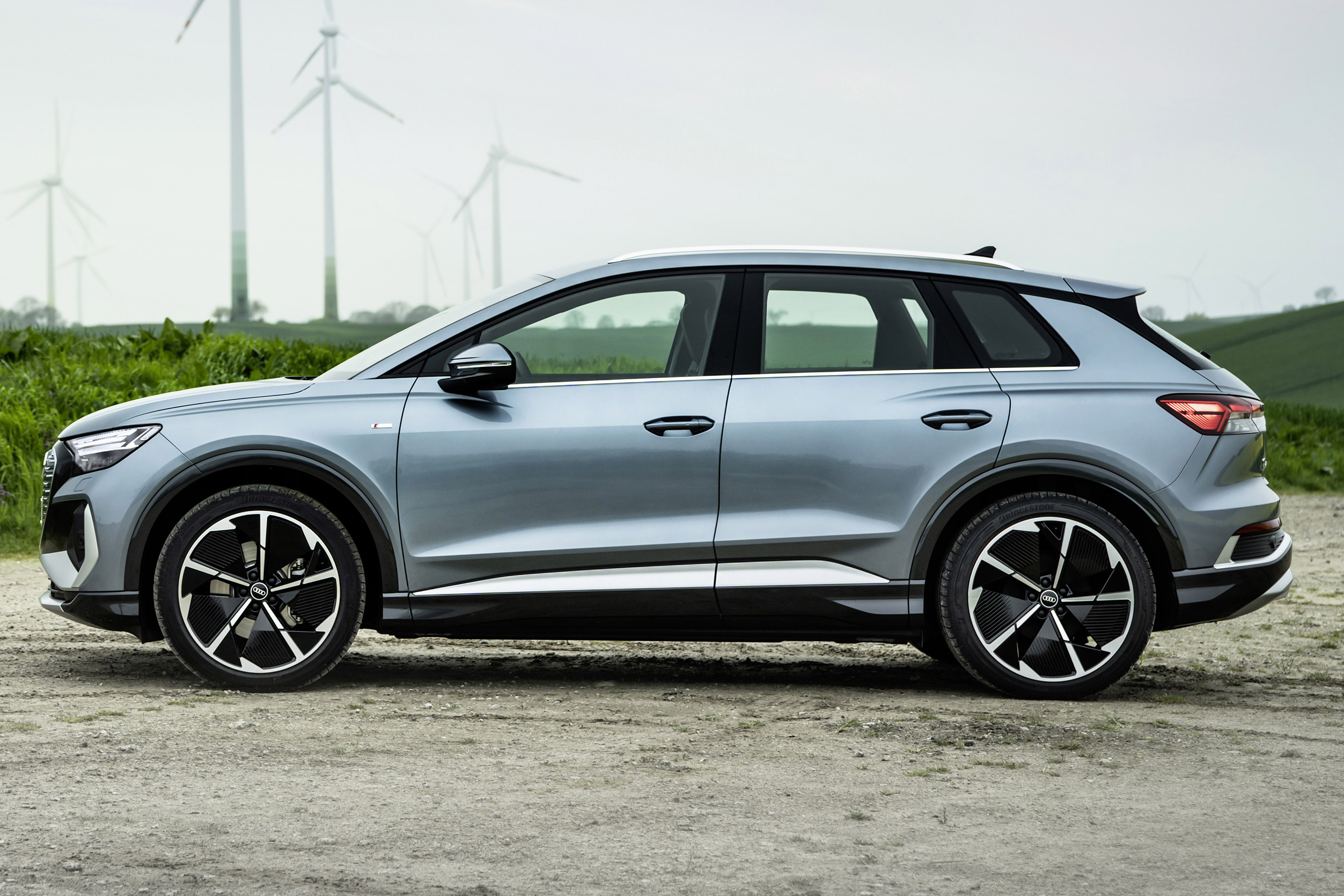
The new Q4 45 E-Tron Quattro will feature all-wheel-drive, as its name suggests, coming through the use of electric motors on the front and rear axles which combine to deliver 195kW, second only to the 220kW Q5 50 E-Tron Quattro.
Boasting an increased range of 490km over the 50’s claimed 474km despite packing the same 77kWh battery pack, the 45 Quattro will start at €50,900 (AU$82,330), around €2000 (AU$3235) less than the range-topping variant.
The Q4 E-Tron range is based on the same Volkswagen Group MEB platform as the VW ID.3 and ID.4, as well as the Skoda Enyaq, all of which haven’t been confirmed for Australia yet.
Snapshot
- Lucid reduces 2022 production aim to 12,000-14,000 units from 20,000
- Manufacturer only delivered 125 units last year
- Current reservations exceed 25,000 units
American electric vehicle manufacturer Lucid has reduced its 2022 production targets after missing its expected delivery quota last year.
The start-up EV maker put its first model – the Air – into production at the back end of 2021, setting a target of 500 but only managing 125 by the end of the year – as a total of 300 customer deliveries have now been made up to the end of February 2022.
Reflecting on this result, Lucid announced it would proactively cut the number of vehicles it aims to deliver this year, with its initial target of 20,000 units now slashed to 12,000-14,000 over the course of 2022.
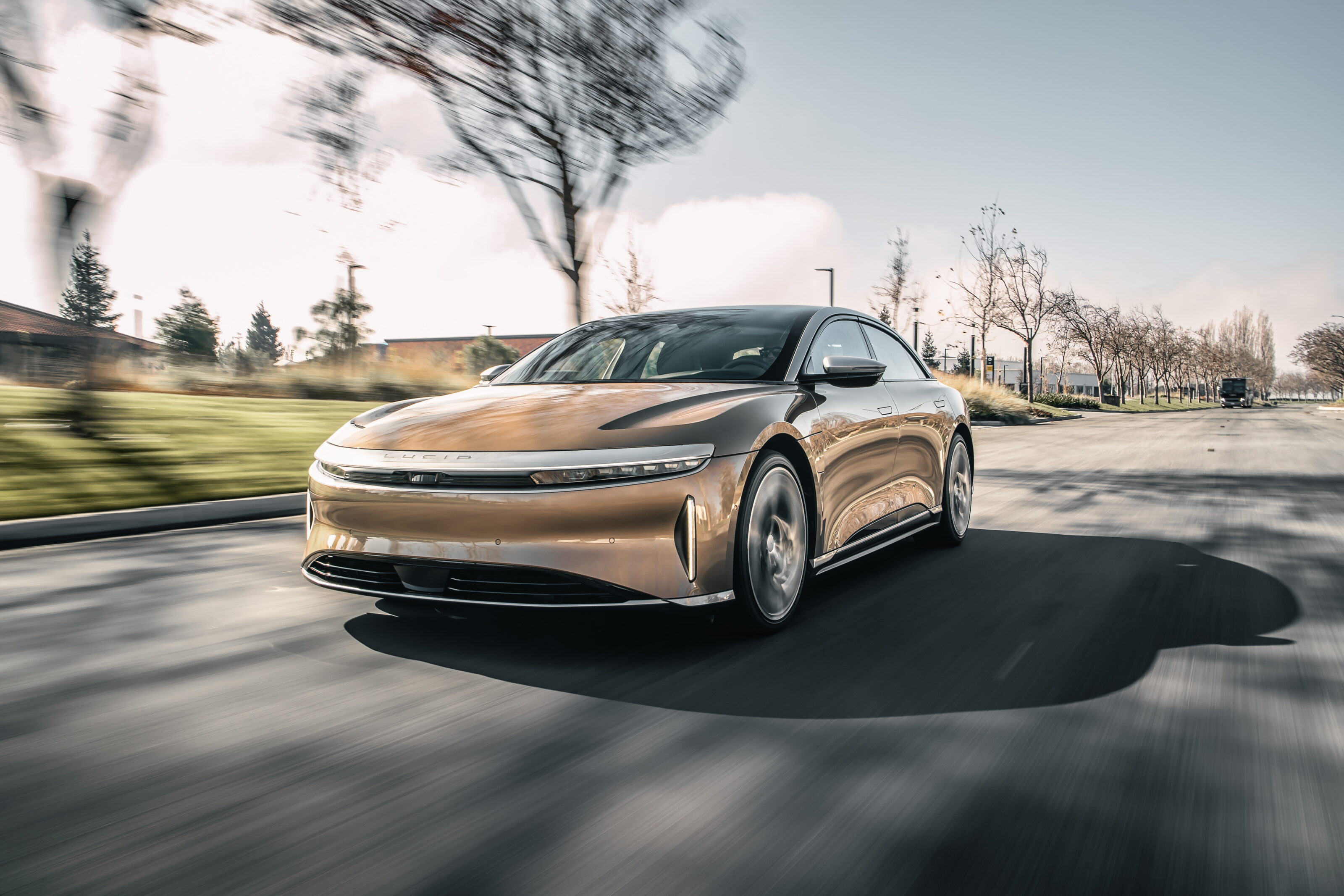
However, the start-up still has in excess of 25,000 reservations to fall back on, amounting to more than US$3.5 billion (AU$4.78bn) in sales thanks to the entry-level Air Grand Touring’s starting price of US$139,000 (AU$190,000), which steps up to US$169,000 (AU$230,000) for the flagship Dream Edition.
Despite the reduction, chief financial officer Sherry House believes the company is in a strong position, as it is poised to expand its Casa Grande facility in Arizona by 260,000 square metres.
“We have a strong team, strong products, and a strong balance sheet with over US$6.2 billion (AU$8.44bn) in cash on hand at year-end,” said House.
“We continue to invest in our business; we met our target of opening 20 Studio and Service locations in North America; in 2022 we will expand our footprint in Europe and the Middle East while laying the foundation for a later expansion into the Asia Pacific, and we remain on track to grow our Casa Grande facility to nearly quadruple its size as the first greenfield dedicated EV factory in North America.
“Today we announced plans to build a brand new manufacturing facility in Saudi Arabia; we estimate that the location of our first international manufacturing plant [there] may result in up to $3.4 billion of value to Lucid over 15 years.”
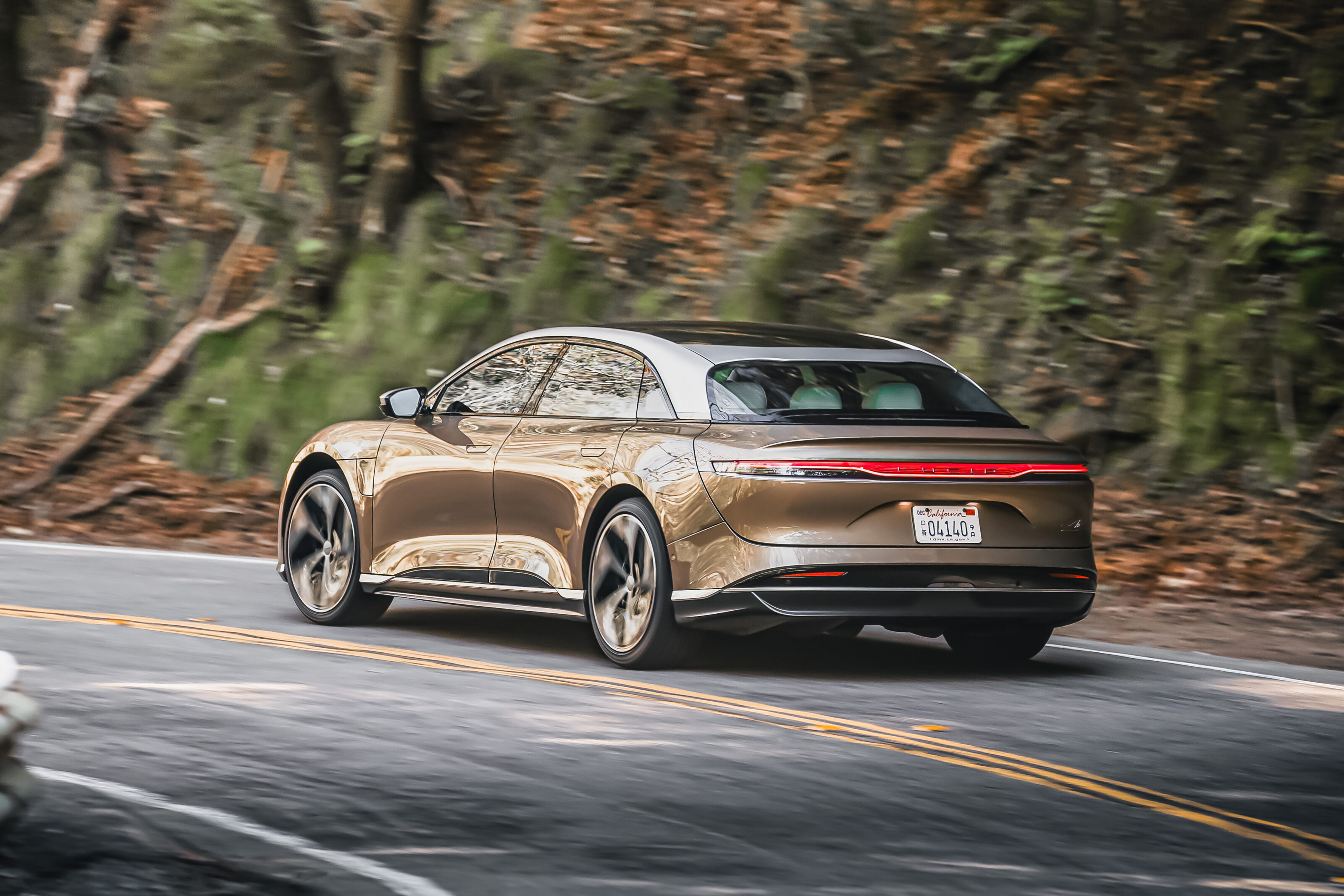
Lucid boasts the highest EPA-rated fully-electric driving range of any electric vehicle manufacturer after its Air Dream Edition became the first EV to crack through the 800 kilometre barrier, setting a recorded driving range of 837km.
While North America is Lucid’s sole market at this present point in time, the brand has previously said an Australian launch is on the agenda, although we’ll have to wait for right-hand-drive production models to begin rolling down the line first.
UPDATE, November 2022: 2023 Kia Seltos on sale in Australia
The Kia Seltos has come in for its midlife update, gaining new looks, new tech, and an eight-speed automatic to replace the 1.6 turbo petrol model’s seven-speed dual-clutch automatic. Get all the details at the link below.
Story continues…
A new 2022 Kia Seltos GT-Line FWD Limited Edition variant will join the model line-up in the second quarter of this year.
For the first time, Kia will offer the range-topping Seltos GT-Line with the 2.0-litre non-turbo four-cylinder petrol engine and front-wheel drive.
Performance for the 2.0-litre has yet to be confirmed, but it’s expected the GT-Line FWD will borrow its powertrain from other FWD variants, sending 110kW and 180Nm to the front wheels through an automatic CVT transmission.
While it loses out on power and grip compared to the flagship 1.6-litre turbo Seltos GT-Line AWD, claimed fuel consumption should be noticeably improved – dropping from a combined 7.6L/100km to 6.8L/100km.
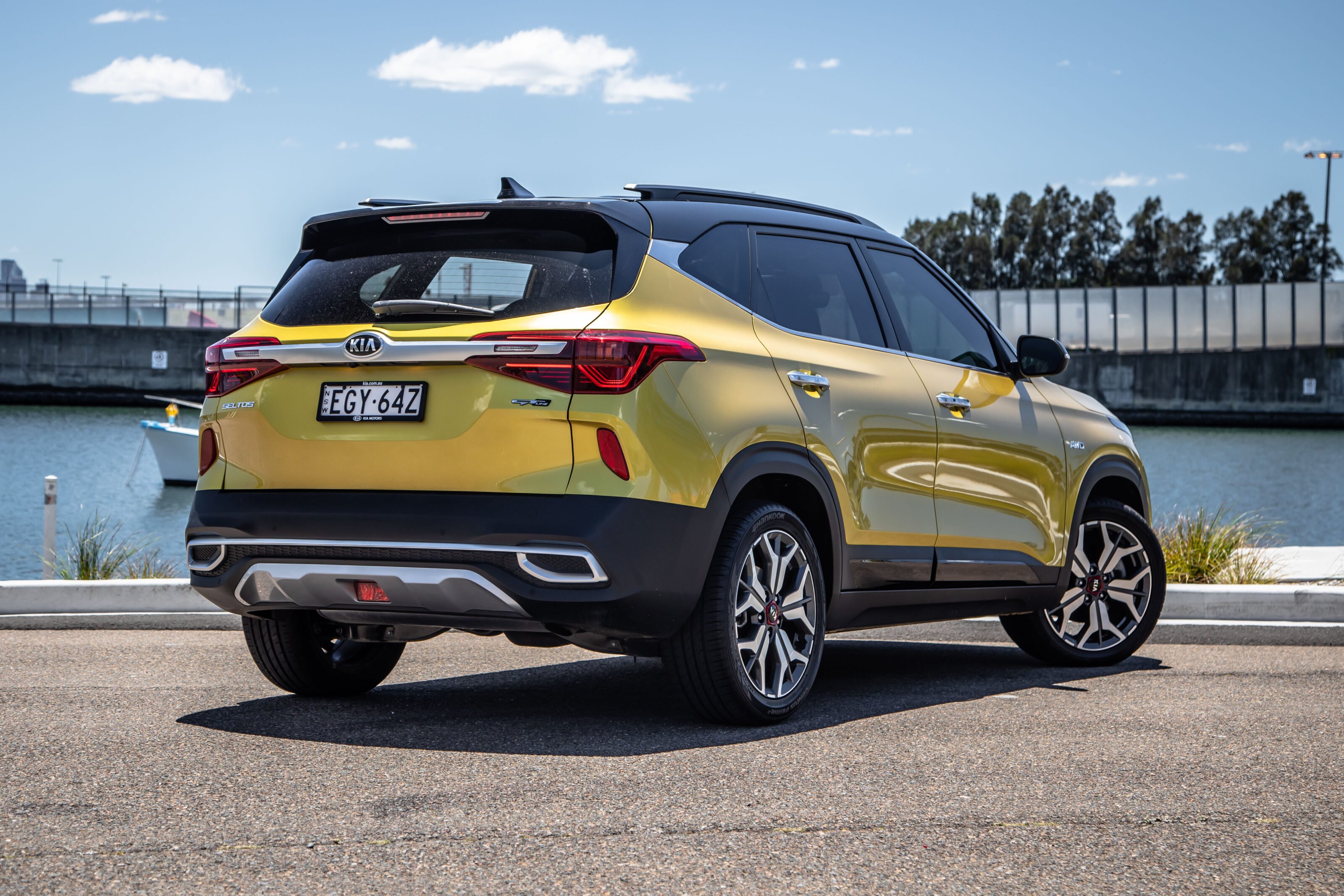
Kia will be filling a gap in the Seltos line-up by offering the new GT-Line FWD, designed to sit between the Seltos Sport+ AWD and the GT-Line AWD.
The Seltos GT-Line FWD Limited Edition offers similar standard equipment to the AWD version, with LED headlight and daytime-running lights, automatic wipers, synthetic leather interior, mood lighting, heated and ventilated power front seats, heated steering wheel, wireless smartphone charging, 7.0-inch digital instrument cluster, head-up display, and an eight-speaker Bose premium sound system.
Pricing will be announced closer to launch, but it’s likely the new variant will enjoy a discount of $3500 below the AWD version, putting the Seltos GT-Line FWD Limited Edition at around $41,790 drive-away – matching the price difference between the other FWD and AWD variants in the range.
However, pricing may be even lower, with documents provided to Wheels showing the model may not come with a sunroof as found on the flagship AWD variant.
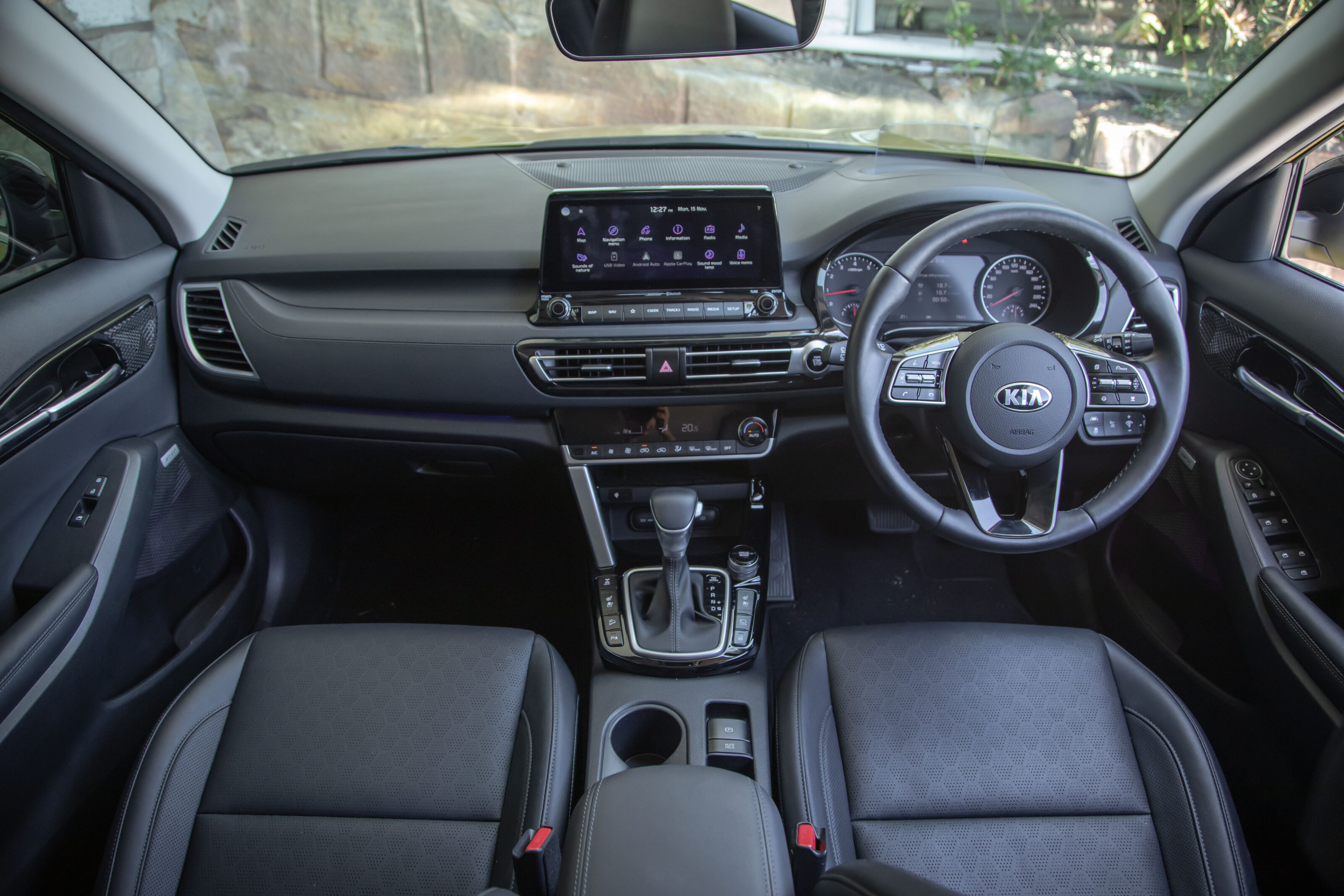
The vehicle will be offered in starbright yellow as standard with 18-inch alloy wheels, though buyers will be able to option steel grey, cherry black, gravity grey, Snow White pearl, Neptune blue, or Mars orange for an additional cost.
Wheels understands the Limited Edition name relates to time rather than quantity, thanks to a facelifted 2023 Kia Seltos arriving in the latter part of the year.
Expect full pricing and features to be announced in the coming weeks, ahead of the launch of the 2022 Kia Seltos GT-Line Limited Edition in the second quarter (April to June inclusive).
Snapshot
- Compass Night Eagle on sale from $39,950 before on-road costs
- Replaces outgoing Launch Edition with a $2000 price increase
- Only current Compass grade to offer front-wheel drive, six-speed auto
The 2022 Jeep Compass has regained its entry-level Night Eagle variant, replacing the Launch Edition grade which served as the base trim last year.
Going on sale for $2000 more than the Launch Edition, the Night Eagle is the only Jeep Compass to use a six-speed torque-converter automatic gearbox as well as a front-wheel drive system, with all those above it scoring a nine-speed automatic transmission and all-wheel drive.
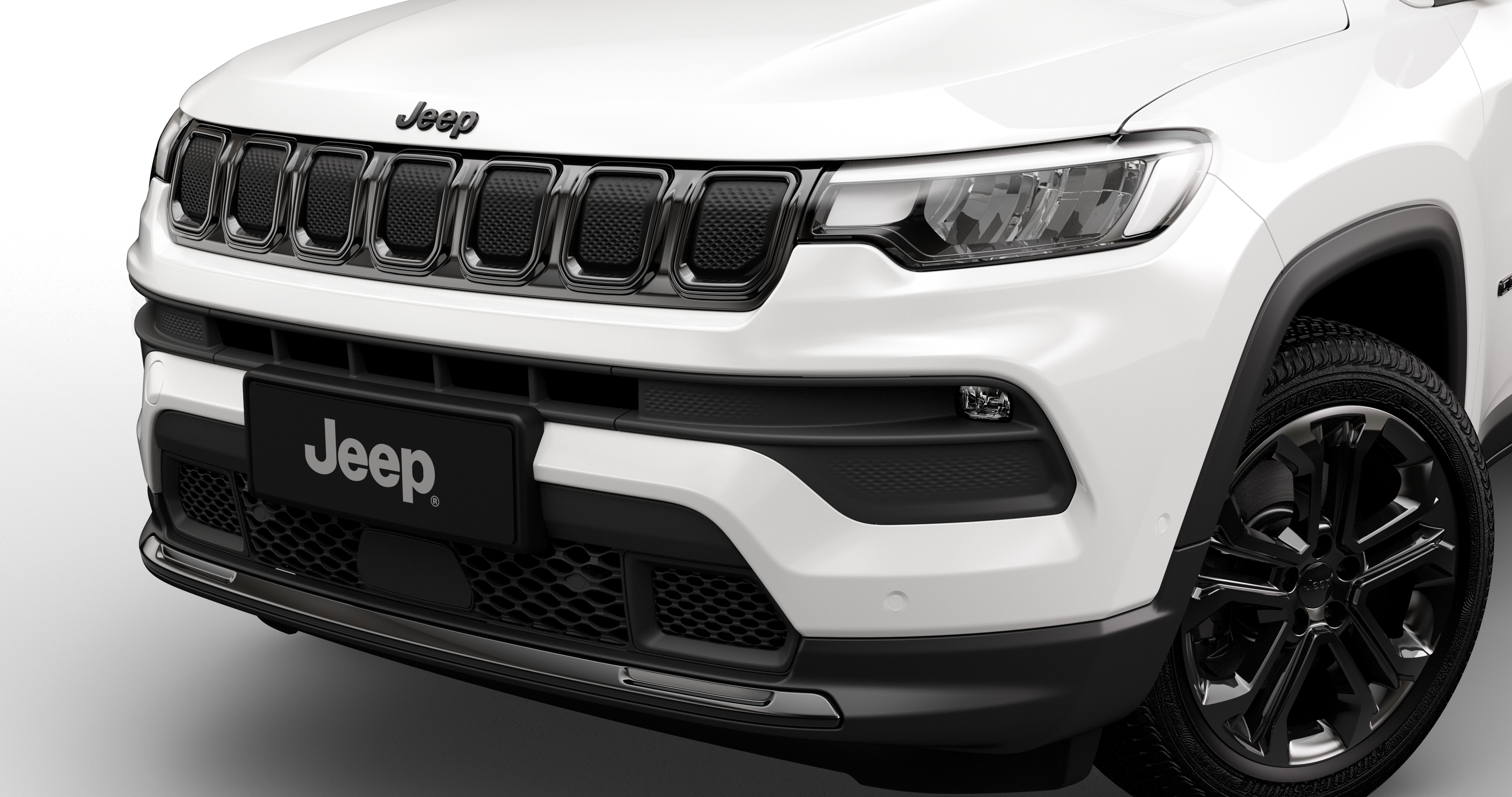
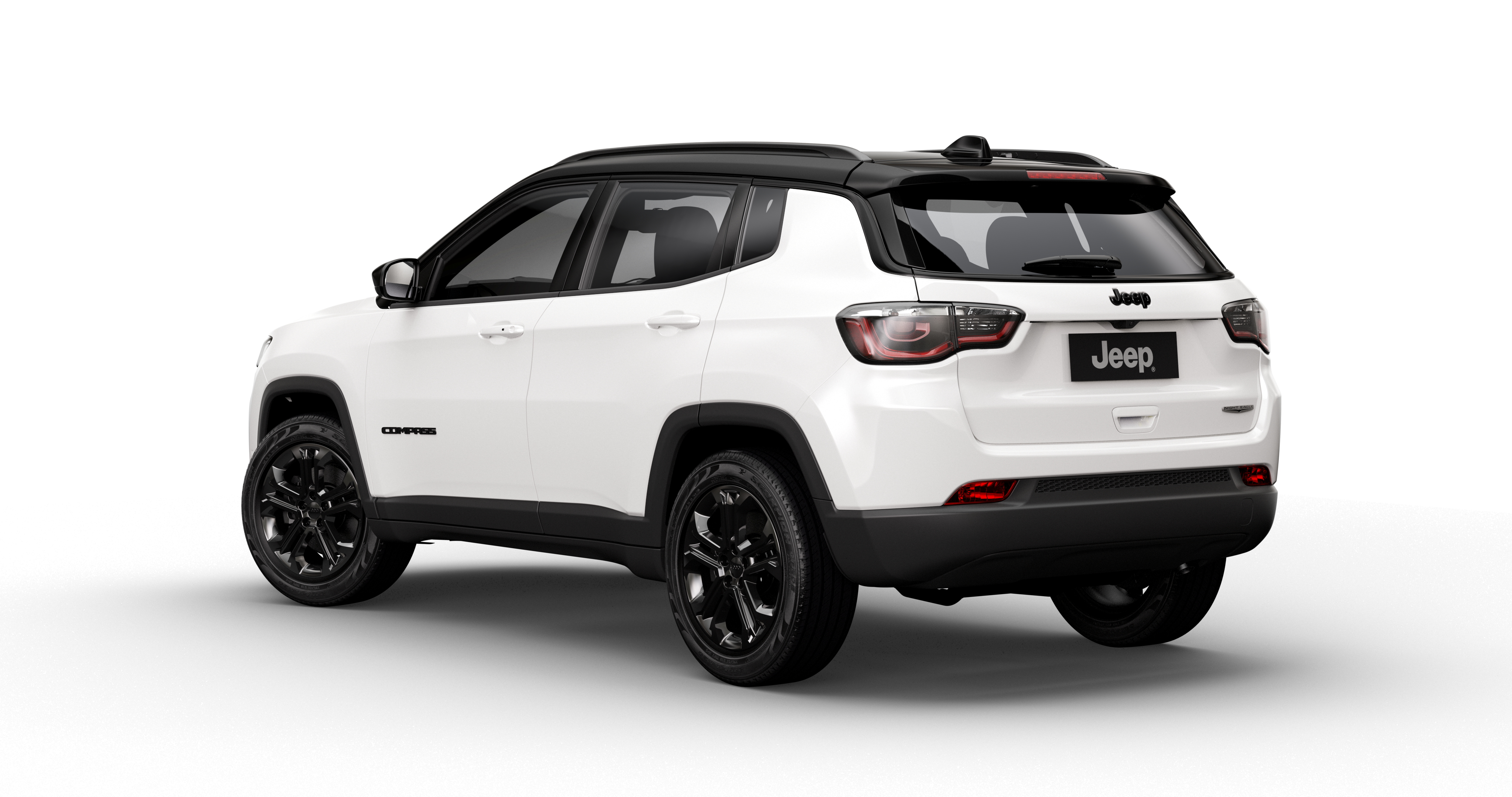
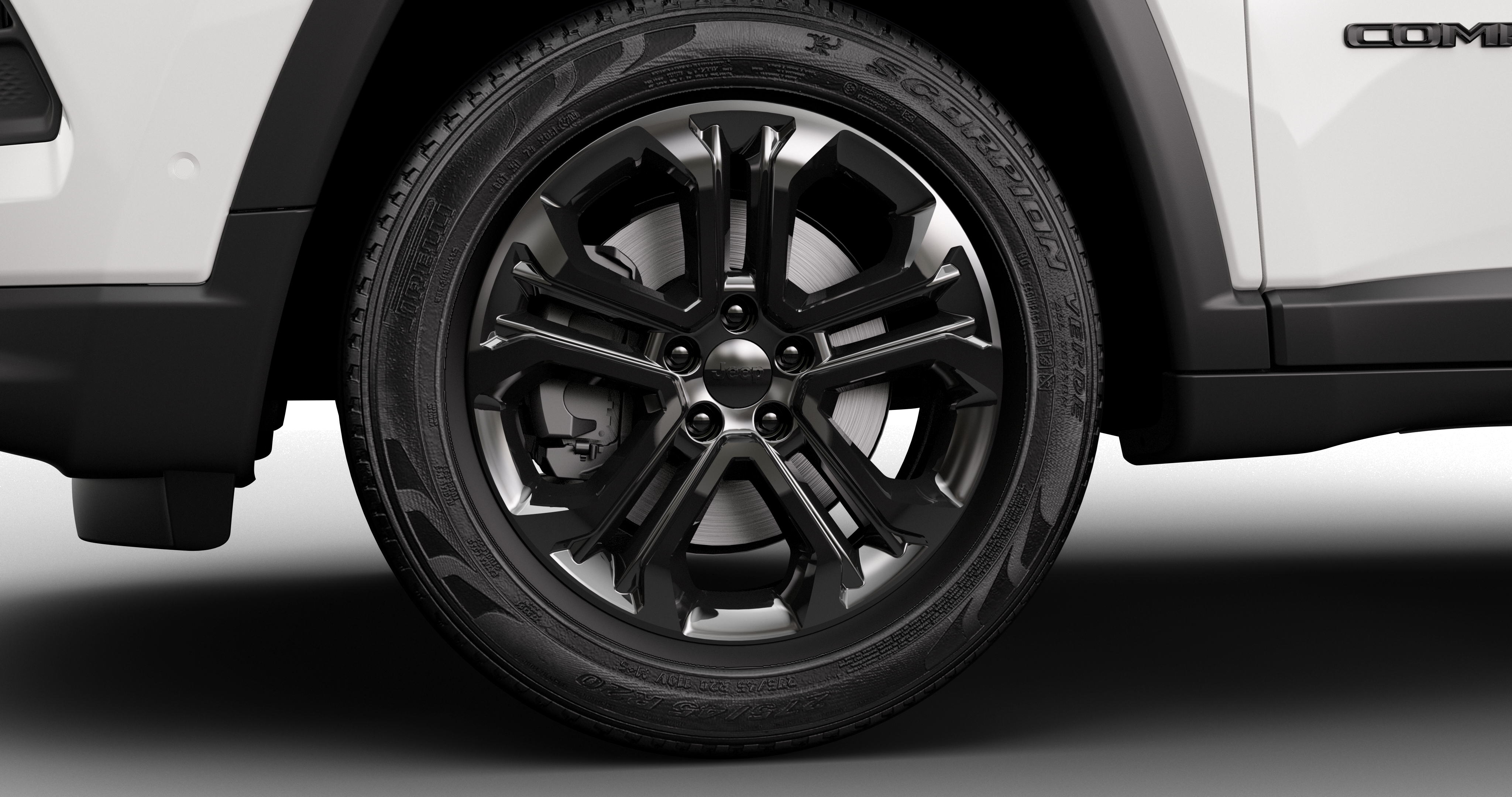
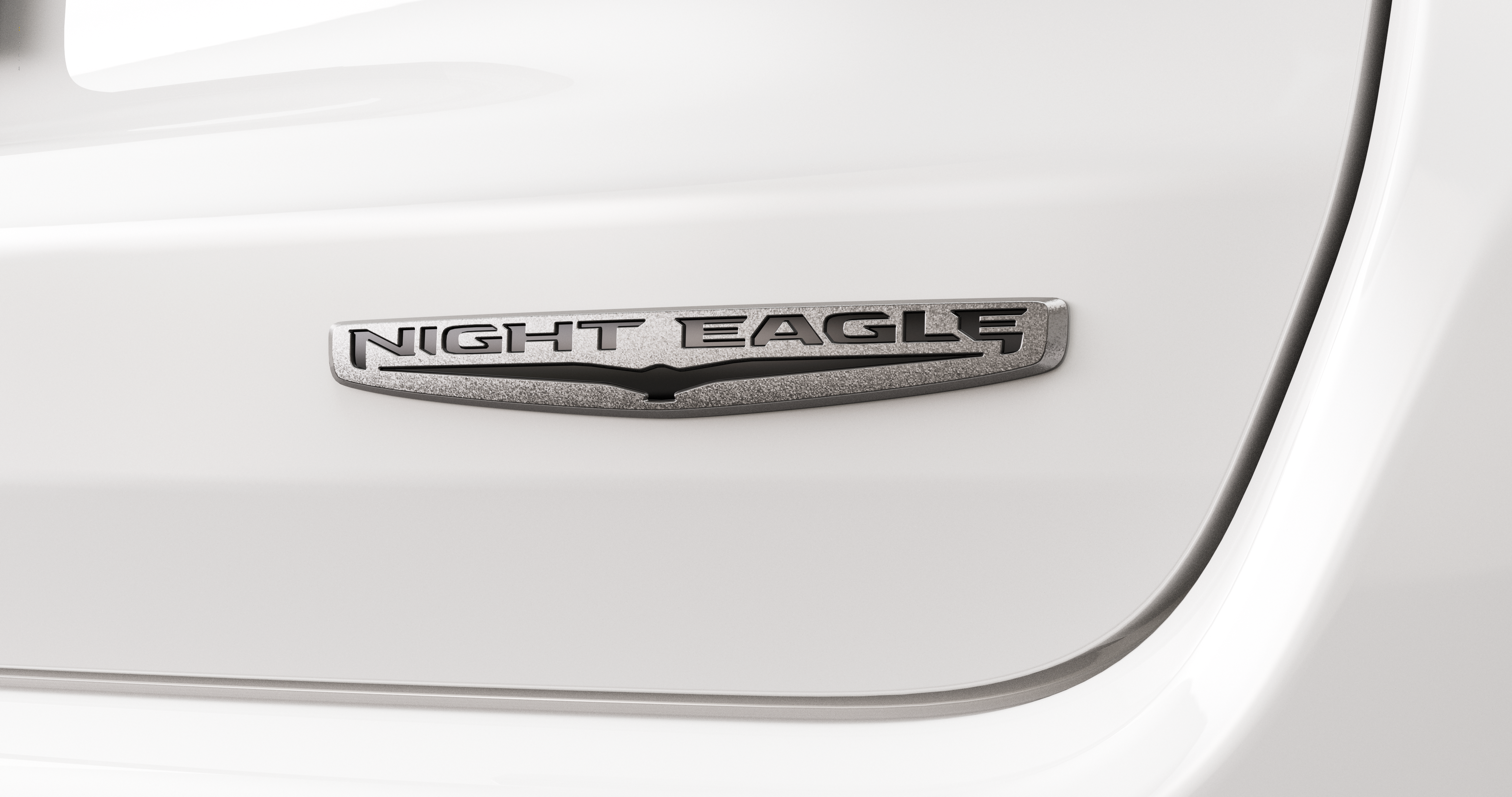
As the name suggests, the Night Eagle brings dark highlights to the Compass’s exterior features, with 18-inch polished black alloy wheels, gloss black fog lamp bezels, a black front grille, badging and window surrounds.
Pricing
As well as the Night Eagle increasing the Compass’s entry-level price by $2000, the rest of the trim line-up has undergone a $1000 jump for the second time in six months.
Prices exclude on-road costs.
| Variant | Price |
|---|---|
| Compass Night Eagle | $39,950 (+$2000 over Launch Edition) |
| Compass Limited | $45,350 (+$1000) |
| Compass S-Limited | $48,350 (+$1000) |
| Compass Trailhawk | $52,650 (+$1000) |
Options
In addition to the base pricing of the Night Eagle, Jeep offers two cost options for the variant.
Bright white will be available as a standard colour until it is replaced by pearl white from July 2022.
| Option | Price |
|---|---|
| Dual-pane sunroof | $2200 |
| Premium paint (Colorado red, brilliant black, galaxy blue, grey magnesio, hunter green, minimal grey) | $895 |
Features
Standard equipment on the entry-level Night Eagle includes:
| Black low-back bucket seats |
| Black headliner |
| Piano black interior accents |
| Black accent stitching |
| Black instrument panel |
| LED reflector headlamps |
| Premium LED fog lamps |
| Black painted roof |
| 18-inch polished black alloy wheels |
| Gloss black badging |
| Gloss black fog lamp bezel |
| Gloss black grille |
| Body colour/platinum front fascia |
| Black windows surrounds |
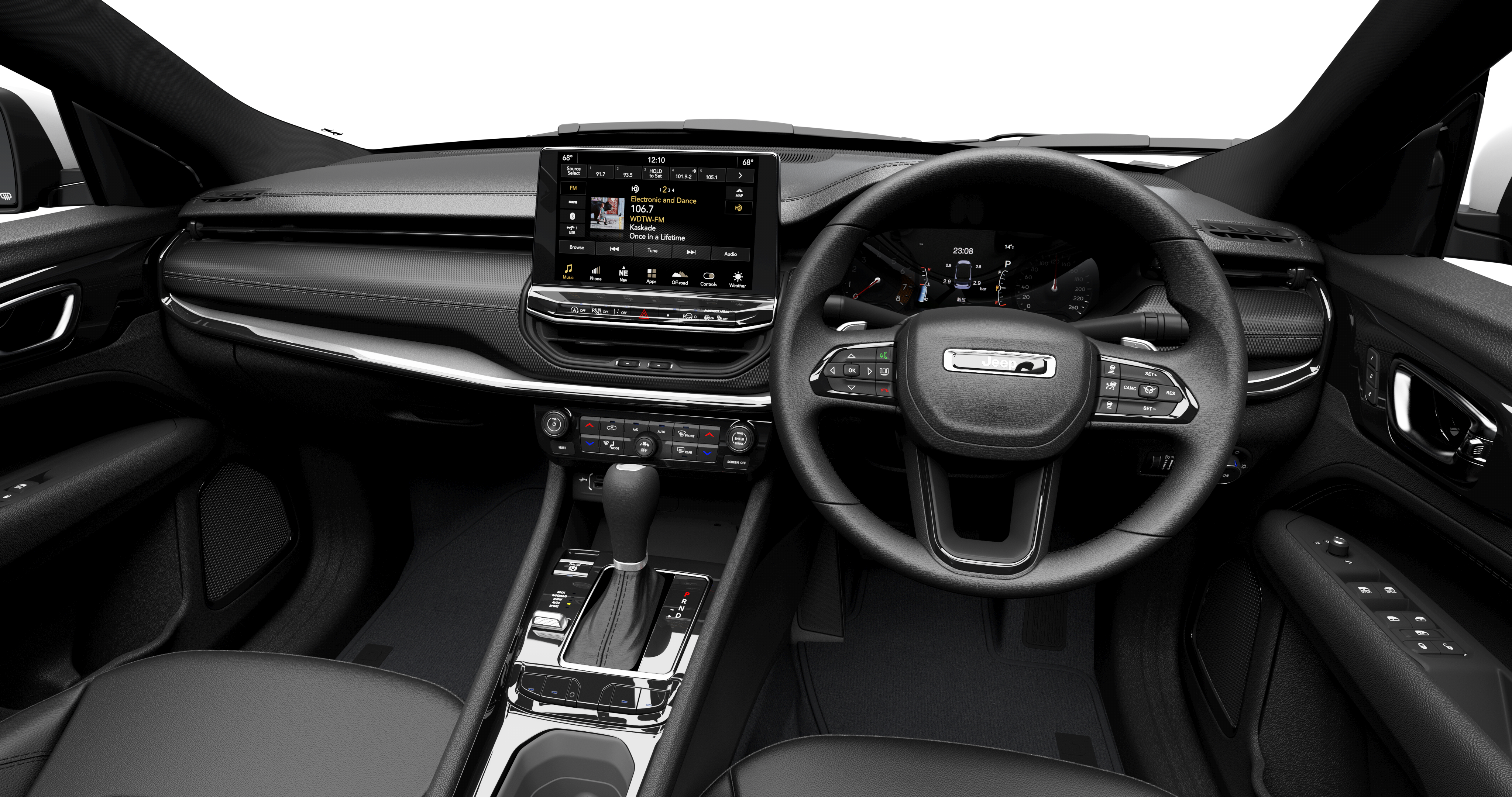
| Uconnect 5 navigation with 10.1-inch screen |
| 7.0-inch TFT colour display |
| First and second row USB-A and USB-C |
| Wireless charging padu00a0 |
| Remote proximity keyless entry |
| Push button start |
| Rain sensitive windshield wipers |
| Electric park brake |
| Automatic headlamps |
| Automatic high beam control |
Engine and drivetrain
Carrying across from the existing Compass range, the Night Eagle is powered by a 2.4-litre, naturally-aspirated four-cylinder petrol engine, producing 129kW and 229Nm to give it a power-to-weight ratio of 89.2kW/tonne.
Drive is set to the front wheels through a six-speed torque-converter automatic gearbox, setting the Night Eagle apart from the rest of the Compass variants, which are available with a nine-speed auto and all-wheel drive.
With no mechanical differences to the Launch Edition, fuel consumption is unchanged for the Night Eagle, remaining at a combined 7.9L/100km.
Safety
Last tested by ANCAP in 2017, the Compass range boasts a five-star safety rating, as the Night Eagle features a range of safety equipment as standard, including:
| Intelligent speed assist |
| Traffic sign recognitionu00a0 |
| Pedestrian emergency braking |
| Drowsy driver detectionu00a0 |
| Active lane management systemu00a0 |
| Automatic electronic brake hold |
| Adaptive cruise control with stopu00a0 |
| Full speed forward collision warning plus |
| Blind spot monitoring |
| Rear cross path detection |
| Active lane management |
| Parkview rear back-up camera |
Warranty and servicing
Jeep offers a five-year/100,000-kilometre warranty across its entire model range, extending to all variants of the Compass.
The Compass is also covered by Jeep’s capped-price servicing, with the petrol Night Eagle, Limited and S-Limited costing owners $349 at every 12-month/12,000-kilometre service interval, while the diesel is an extra $50 with its $399 capped-price applying across the 12-month/20,000-kilometre intervals.
Availability
The Jeep Compass Night Eagle is now available across the brand’s dealerships Australia-wide.
UPDATE, February 2023: New Corolla rendered
While we wait for Toyota to offer more details on its next-generation model plans – electric and otherwise – we’ve had a crack at imagining how the next Corolla will look. The question is, will it also go electric? Get that story at the link below.

Story continues…
Electric 2023 Toyota BZ Corolla spied in China, Australian launch unlikely
A prototype thought to be a fully-electric 2023 Toyota BZ Corolla has been caught testing ahead of its release in late 2022, but don’t expect to see the vehicle in local showrooms any time soon.
While the model name has yet to be confirmed, it’s believed Toyota is co-developing a cut-price Corolla with Chinese electric carmaker BYD, though the car will be exclusive to China according to a report from Reuters.
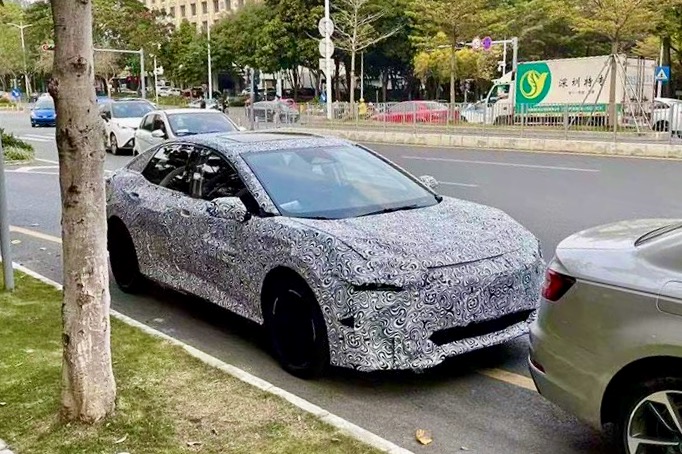
Despite the camouflage, the sedan appears to be the same as the BZ SDN concept previewed at Toyota’s electric vehicle (EV) showcase in late 2021, based on these photos posted to Korean forum Autospy.
The BZ Corolla is expected to be unveiled at the Beijing motor show in April, featuring a new lithium-ion-phosphate Blade battery from BYD – a new type of battery which offers higher energy density and significantly increased safety features compared with most EV batteries.
Toyota isn’t the only company looking to use the new technology. In 2021, a rumour out of China suggested Tesla was also looking to use BYD’s batteries in its cars, with media reporting Tesla vehicles will begin deliveries with the new Blade battery pack from the second quarter of 2022.
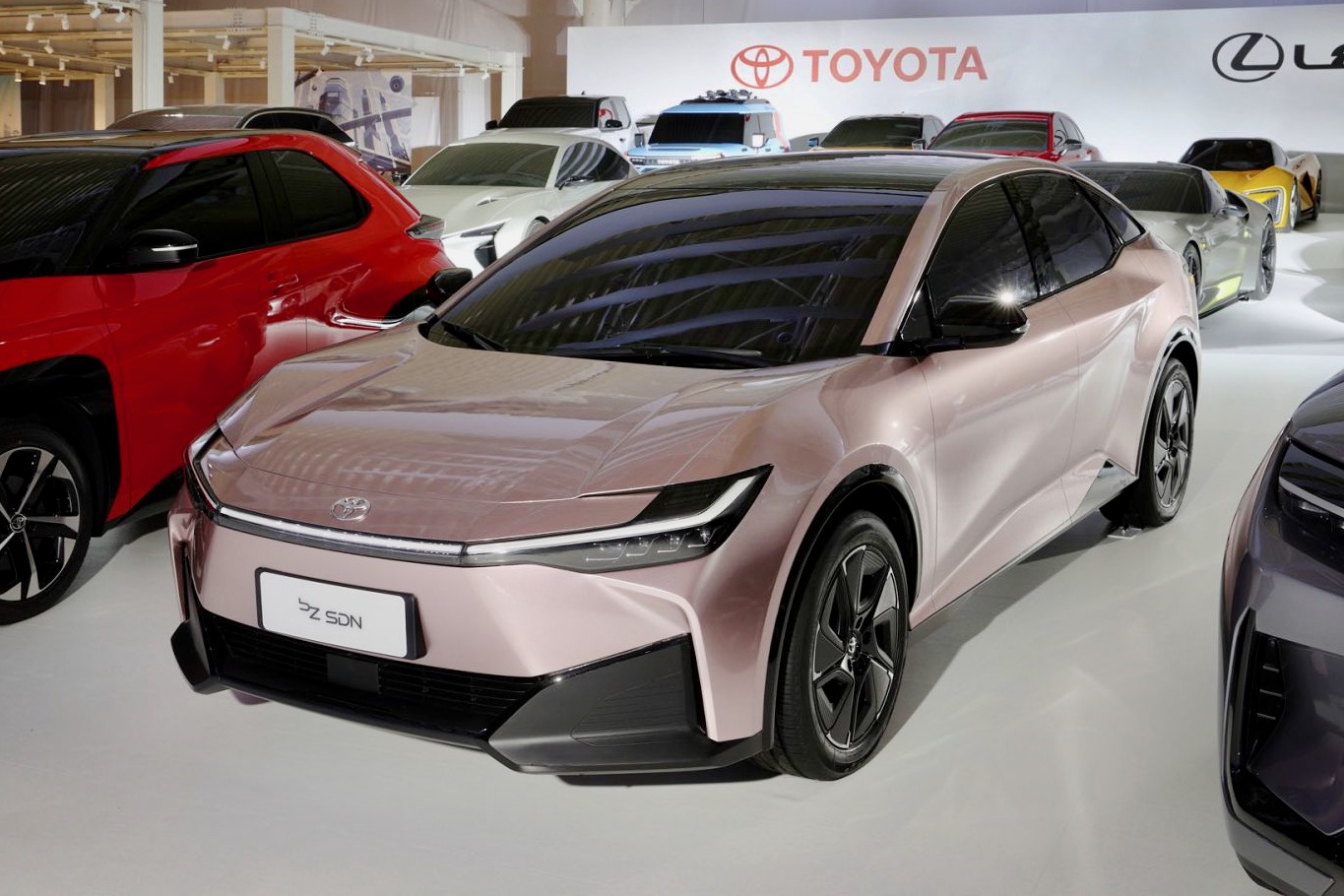
“The [Toyota] was enabled by BYD battery technology,” an anonymous source told Reuters in December.
“It has more or less helped us resolve challenges we had faced in coming up with an affordable small electric sedan with a roomy interior.”
Offering improved rear-seat legroom over internal-combustion models, the 2023 Toyota BZ Corolla is likely to be offered in China for ¥200,000, or just over AU$41,000.
Snapshot
- Bentley reportedly developing smaller SUV
- Likely based around the new PPE architecture, shared with the next-gen Porsche Macan
- Expected to arrive in the coming years
Bentley will reportedly launch a new SUV in 2025 to compete against the next-generation Porsche Macan and Range Rover Velar.
A new premium SUV to sit beneath the larger Bentayga has been rumoured for many years, with Bentley executives first announcing plans of exploring further SUV derivatives more than half a decade ago.
While this has yet to come to fruition, and Bentley has remained coy on its future development plans, the British luxury marque – now under the control of Audi from January, 1, 2022 – is believed to be developing a new vehicle underpinned by the Volkswagen Group’s latest Premium Platform Electric (PPE).
This architecture will underpin the next-generation Porsche Macan, as well as the Audi Q6 E-Tron and A6 E-Tron Sportback.
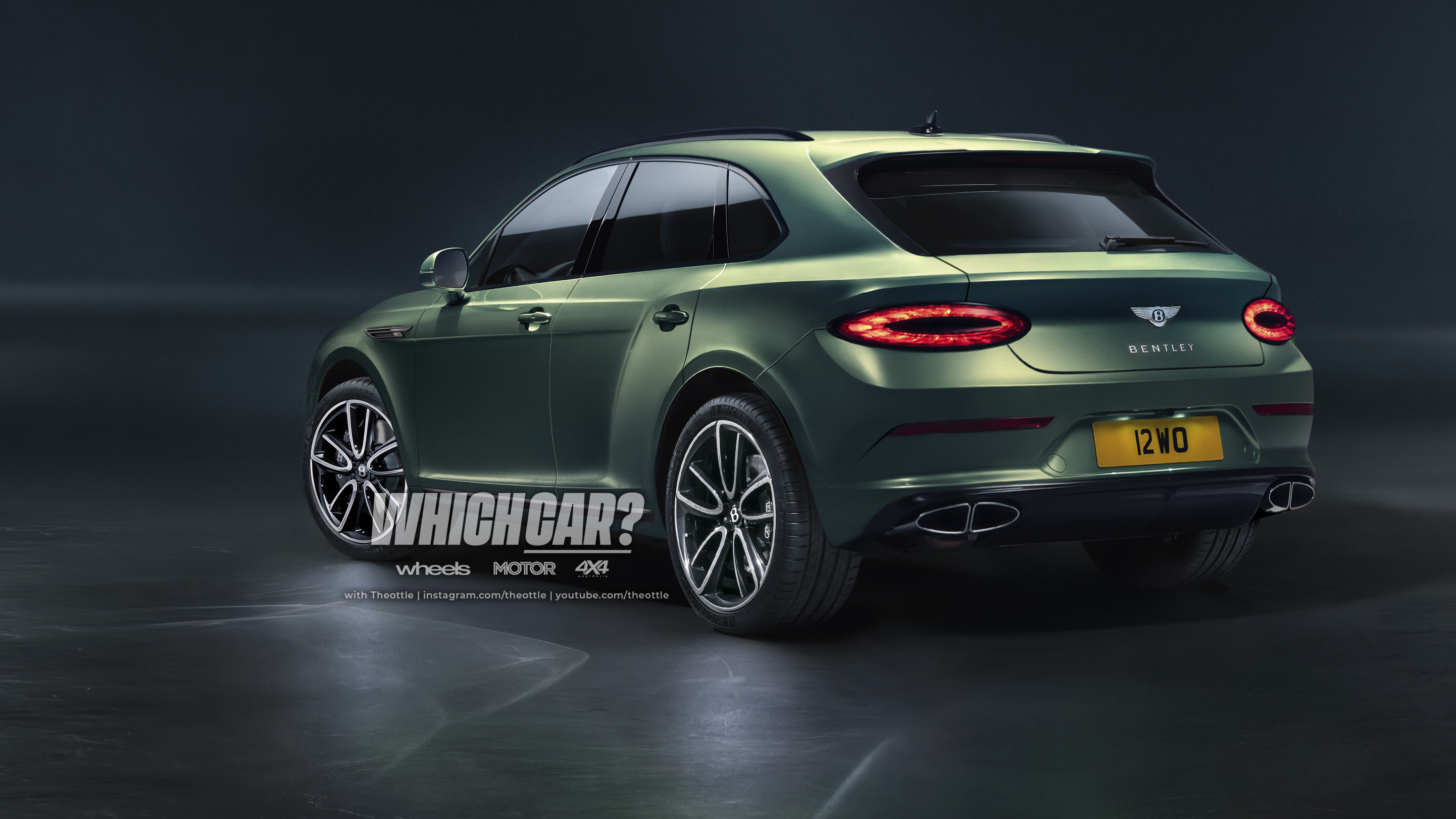
Now, a new pair of renderings by Theottle have imagined what the upcoming D-segment luxury crossover could look like.
Inspired by the current Bentayga, the pictures bring the large SUV’s design into a smaller medium-sized body to create a ‘baby Bentayga’ look.
The as-yet-unnamed electric SUV is anticipated to adopt the latest Bentley design language, first debuted on the Bentayga and Continental GT facelifts, as well as the bespoke Mulliner Bacalar. This includes the brand’s iconic dual circular headlights, slim oval-shaped tail-lights, and a large grille.

First detailed last year, Bentley has declared all non-electrified vehicles will be phased out by 2026 – with the line-up to consist of electric and plug-in hybrid (PHEV) models – before it goes electric-only from 2030.
Bentley currently sells two electrified vehicles: the Bentayga Hybrid and Flying Spur Hybrid.
The brand claims 39 per cent of its owners are considering a battery electric vehicle as their next car, despite the successes of its internal-combustion engines.
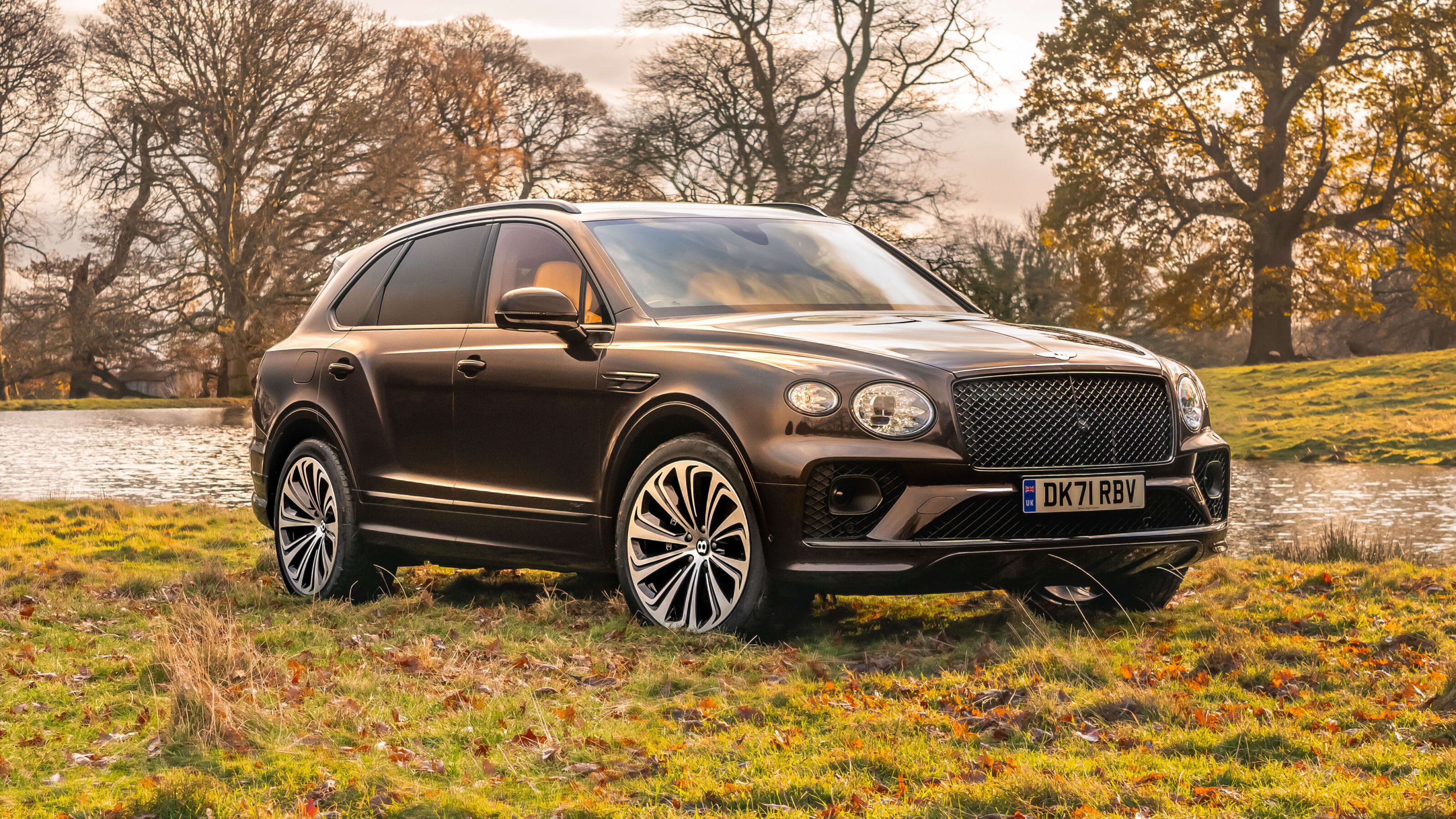
A new SUV, designed to compete against the long-wheelbase Range Rover, is likely to arrive soon after and be based around Project Artemis – a development program led by Audi intended to showcase the best of the Volkswagen Group’s autonomous driving and energy efficiency capabilities.
It is expected to be underpinned by the forthcoming Scalable Systems Platform (SSP), which will succeed the MEB and PPE architectures across each VW Group brand within the next five years.
Indirectly succeeding the now-discontinued Mulsanne flagship, the ultra-luxury EV is rumoured to commence production in 2026, alongside the forthcoming electric Audi mother ship.
Bargains. We love them. Can’t get enough of them. Except, it seems, in the automotive world. With most manufacturers heading upmarket with pricing if not necessarily the product to do it, MG is sticking to its guns. You’d forgive the now-Chinese company for thinking that’s a great opportunity to sit back and say, “This will do.” Cheap, reasonably cheerful, job done.
Commendably, it has not.
The MG ZS and I have a complicated relationship. The best I could say about the first one I drove was that it wasn’t all that bad and for the money, verging on good. I forgave the shortcomings of the ZS EV because, well, it was a full EV with, again, an unbeaten price. I knew, however, that like Hyundai and Kia before it and the Japanese makers before them, improvements were not just inevitable, they were approaching rapidly.
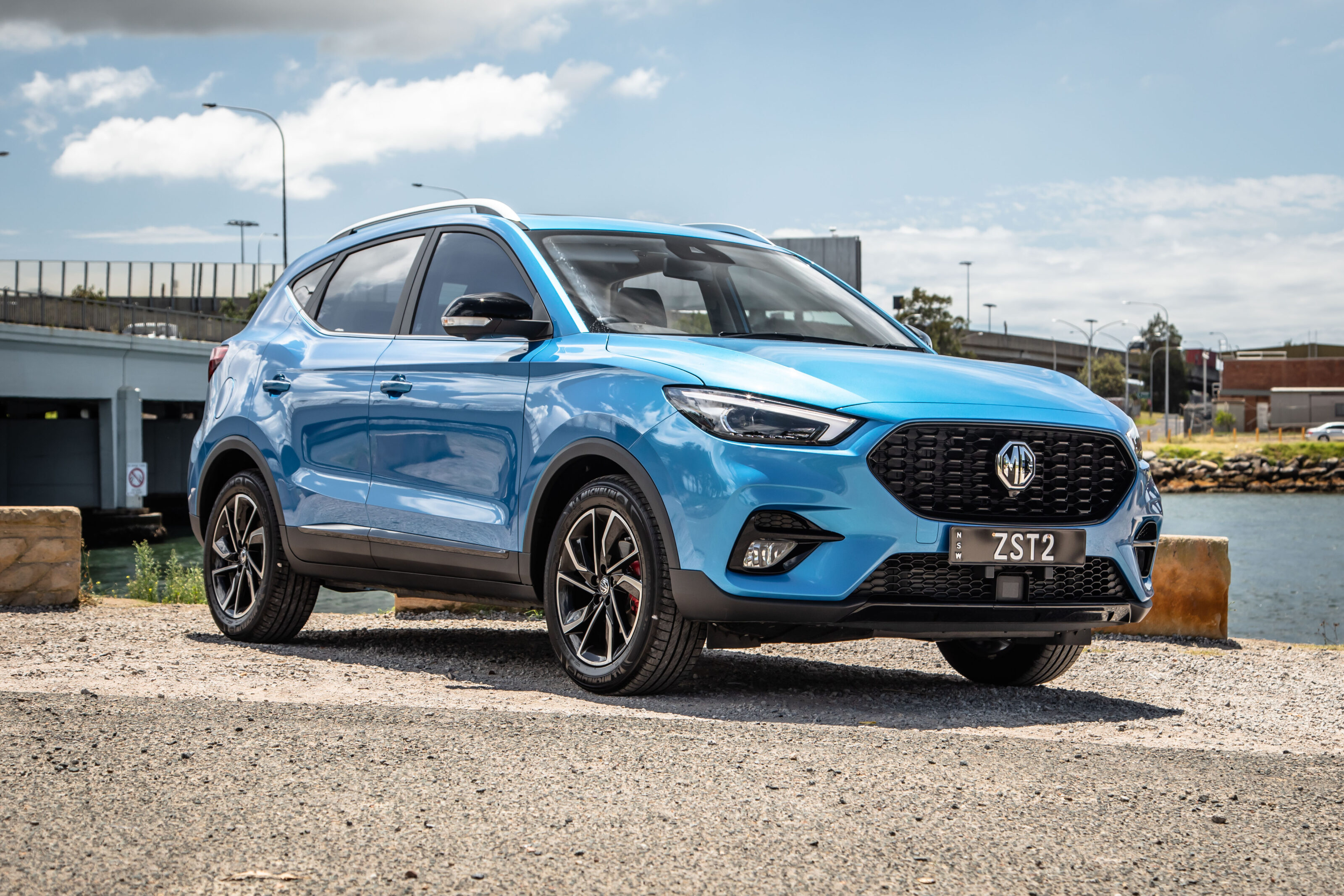
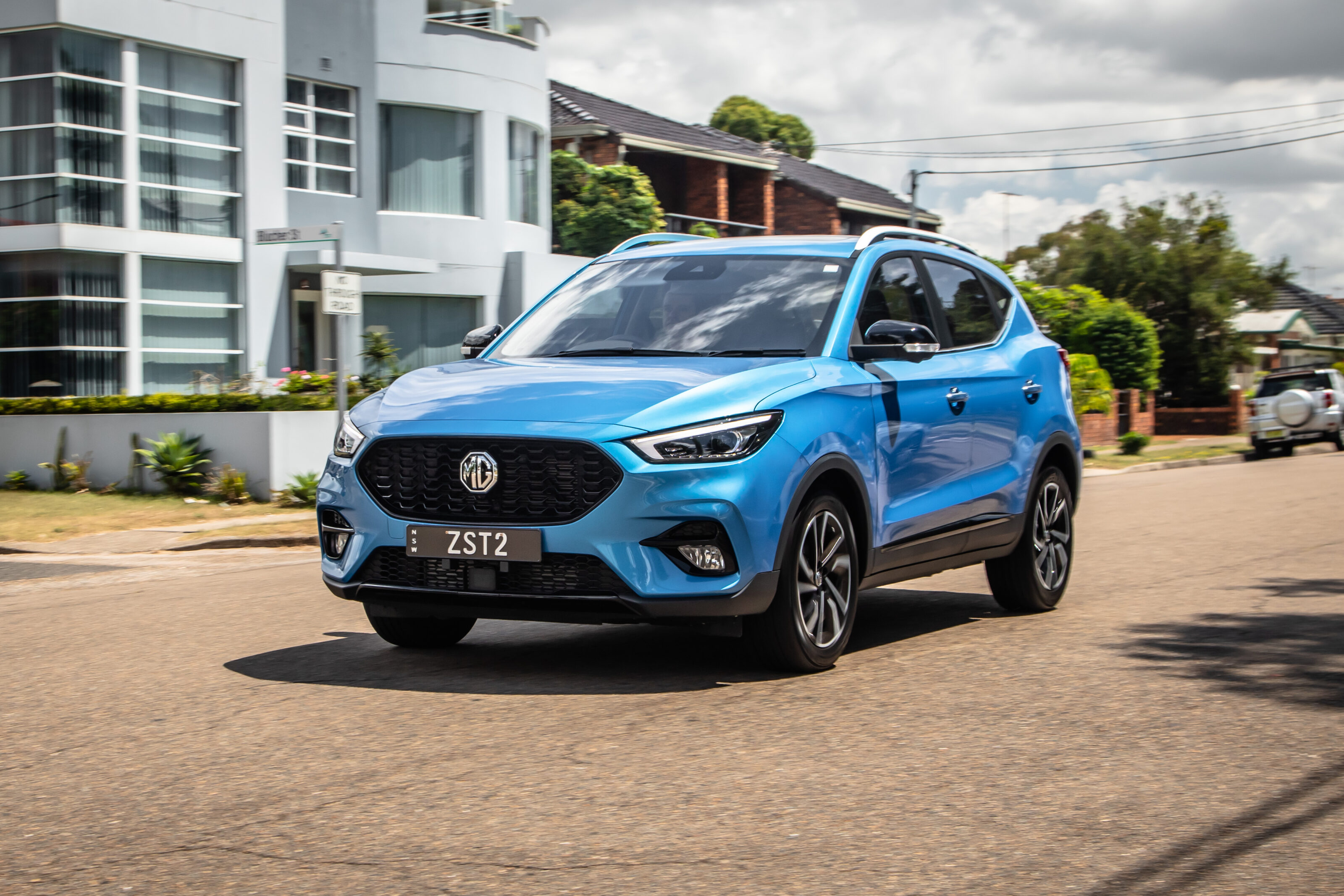
So in a market where MG is now a regular in the list of top ten best-selling car brands, the 2022 MG ZST must be doing something right. A hefty facelift of the original ZS compact SUV (which still soldiers on in basic Excite form for an astonishingly cheap $22,490 drive-away), the ZST comes in four specifications with a choice of two engine and transmission packages and a raft of improvements.
Pricing and Features
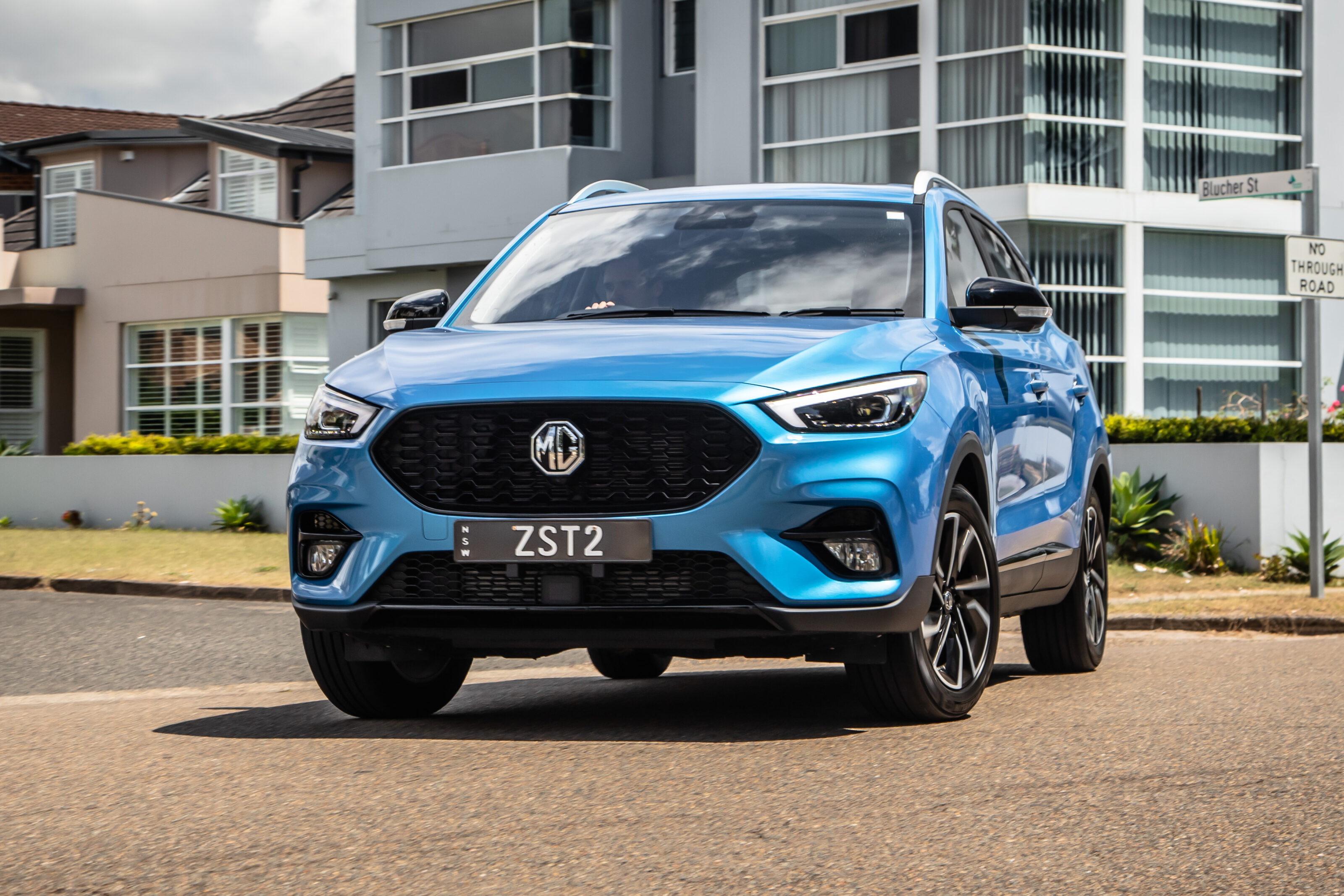
The four-strong ZST range starts at $25,490 for the 1.5-litre naturally-aspirated, CVT-driven Core. The turbo 1.3 makes its first appearance in the third car of the set, the $29,990 Excite and is also in the car I had for a week, the $32,990 Essence in Brighton Blue. All these prices are drive-away.
Trawling through the spec sheet, it’s not long before you discover that differences between the Excite and Essence are largely cosmetic.
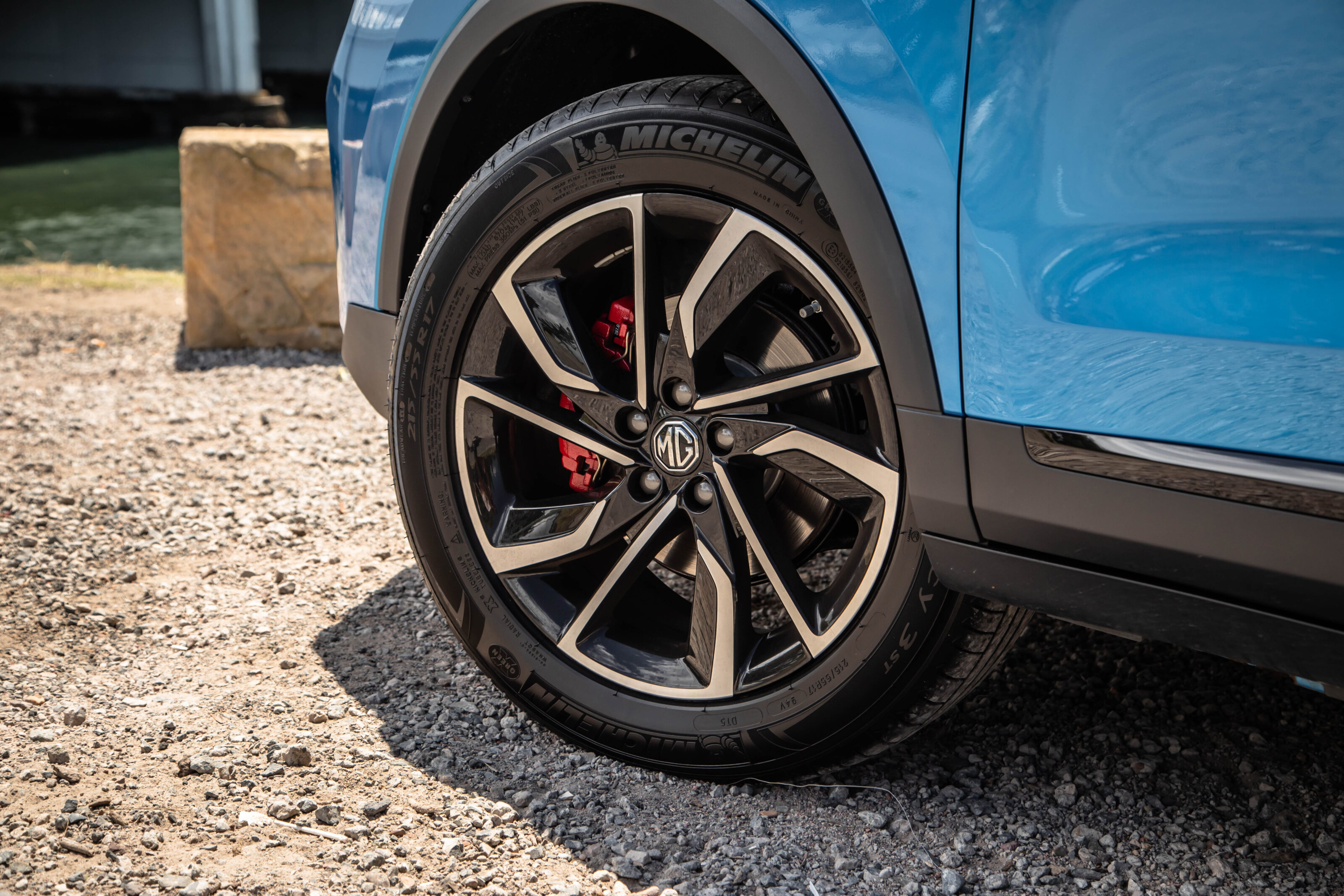
The Essence has the sportiest of 17-inch wheel designs, a six-speaker stereo, power front seats with heating, PVC seat trim, auto LED headlights, auto wipers, huge double sunroof, air-conditioning, adaptive cruise control, rear parking sensors, keyless entry and start, front, side and reversing cameras, power windows and mirrors and a space-saver spare.
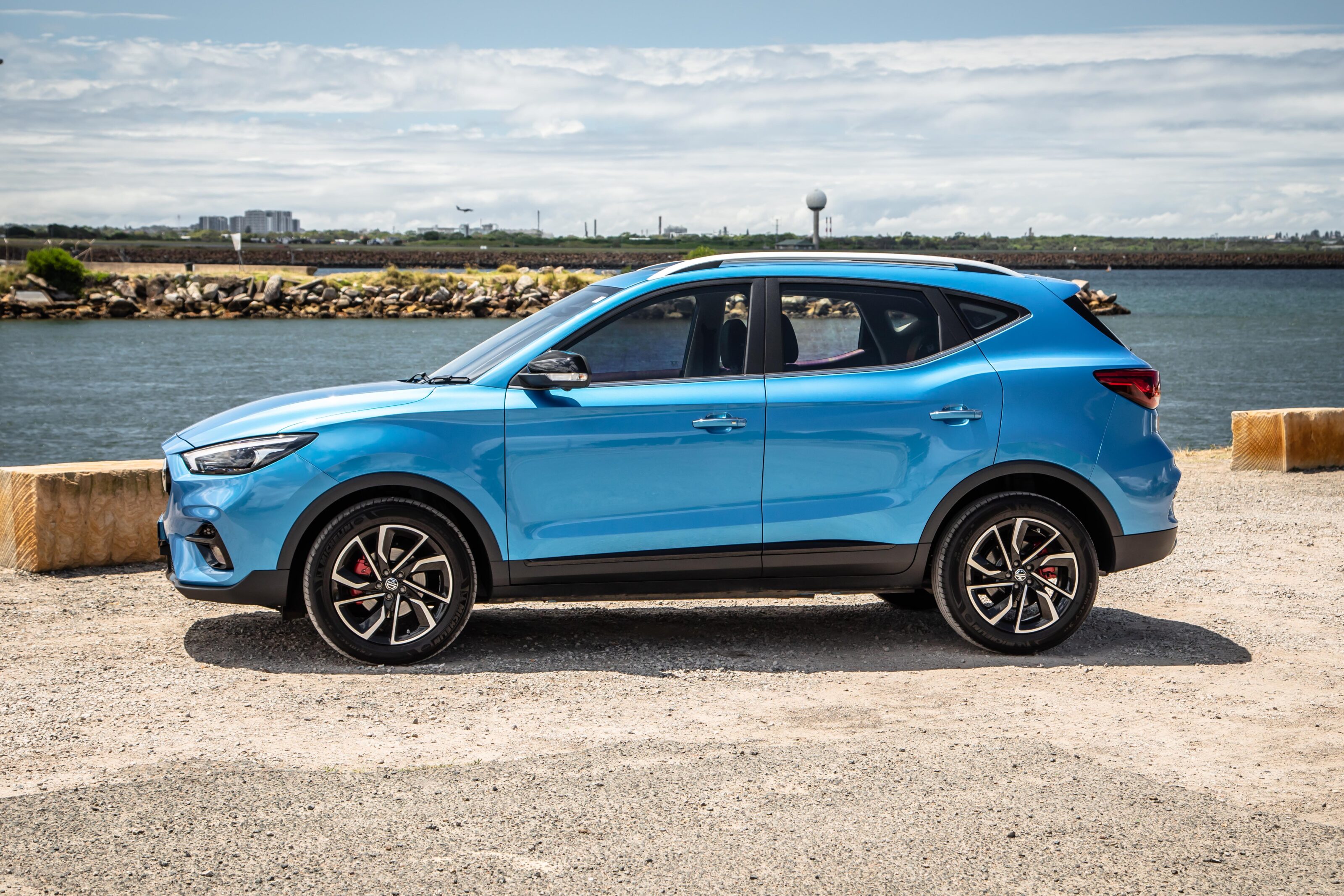
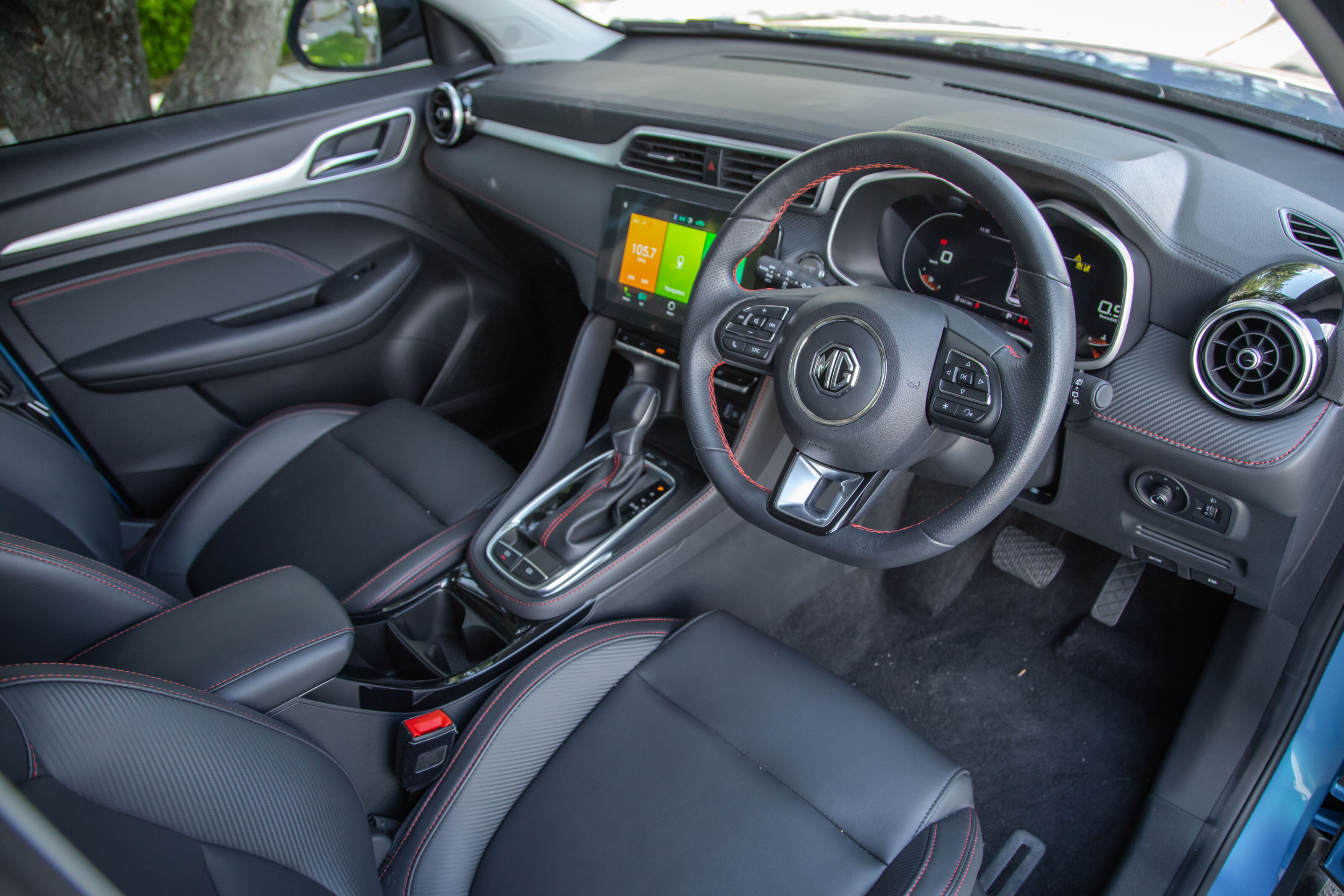
A digital dash is exclusive to the Essence and it’s actually quite good. I rather enjoyed the safety display that showed which way you might be drifting from your lane with a very Namco Final Lap arcade game vibe. The sunroof has a perforated cover, which doesn’t prevent much light from getting through and doesn’t stop much heat either.
There is plenty of bling across the range, so the top spec is distinguished by the alloys, MG embroidering in the seats and the sunroof. The Essence shares racy red brake calipers with the Excite.
A digital dash is exclusive to the Essence and it’s quite good. I rather enjoyed the safety display and its Namco Final Lap arcade game vibe
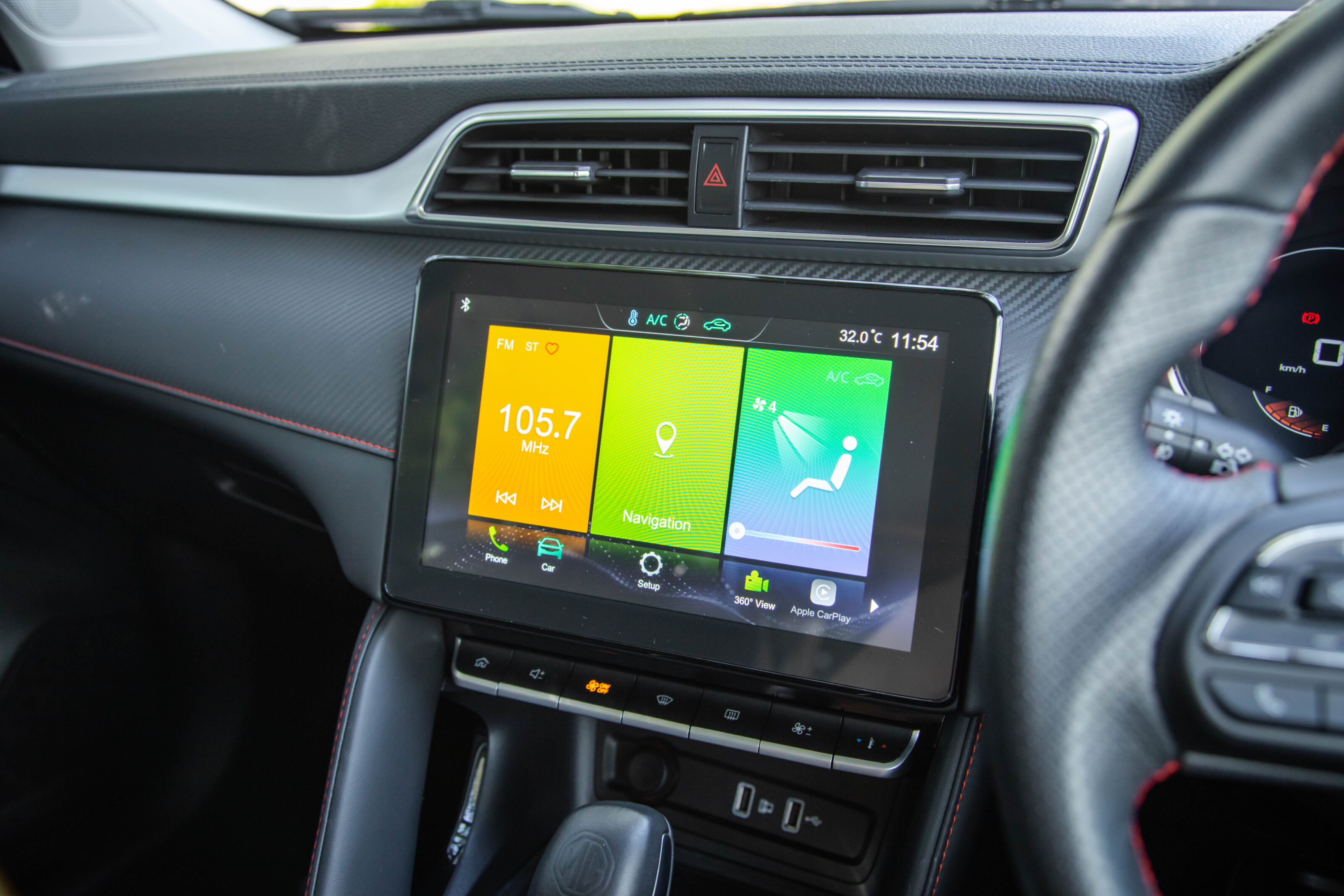
MG’s own software adorns an impressive-looking 10.1-inch touchscreen display, a rather better effort than the old ZS. It has sat-nav, Apple CarPlay and Android Auto and is very, very slow to operate, which is a bit of a shame. I often found myself hitting buttons twice to make things work only to find myself somewhere I didn’t want to be. Patience is the name of the game, but really, if you’re going to cram lots of things into the screen to cut down on buttons, make it fast. Also looking at you, Peugeot.
Having said that, the software is steadily improving over time and is looking better every time I see it. The hardware just needs a bit of sorting.
MG’s Pilot safety package comes with six airbags, the usual braking and stability systems, forward collision warning, forward auto emergency braking (AEB), lane departure warning, blind-spot monitoring and reverse cross-traffic alert as well as two ISOFIX points and three top-tether anchors for child seats.
ANCAP awarded the MG ZS four stars in 2017 but has not given an official rating for the ZST specifically. Curiously, the ZS EV has a five-star rating from November 2020 and I would venture that the ZST’s equipment level is closer to that car’s spec.
Comfort and Space
Being a compact SUV, the MG punches on with quite a few cars and as far as interior space goes, it’s somewhere in the middle. It’s not nearly as small as the Mazda CX-3 nor as expansive as the Nissan Qashqai or Kia Seltos.
The front seats are very comfortable and look pretty good with the bold MG embroidery. While I’m usually a fan of fake leather, an unusually honest description of the material in the spec sheet as “PVC” had me nodding in agreement when I first sat in them. And swearing in pain when I’d left the car out in the sun, projecting me back to my youth in the back seat of a 200B. Give me the cloth of the base level Core version any day. The sunroof and its paper-thin cover are partly to blame here.
Being a compact SUV, the MG punches on with quite a few cars and as far as interior space goes, it’s somewhere in the middle
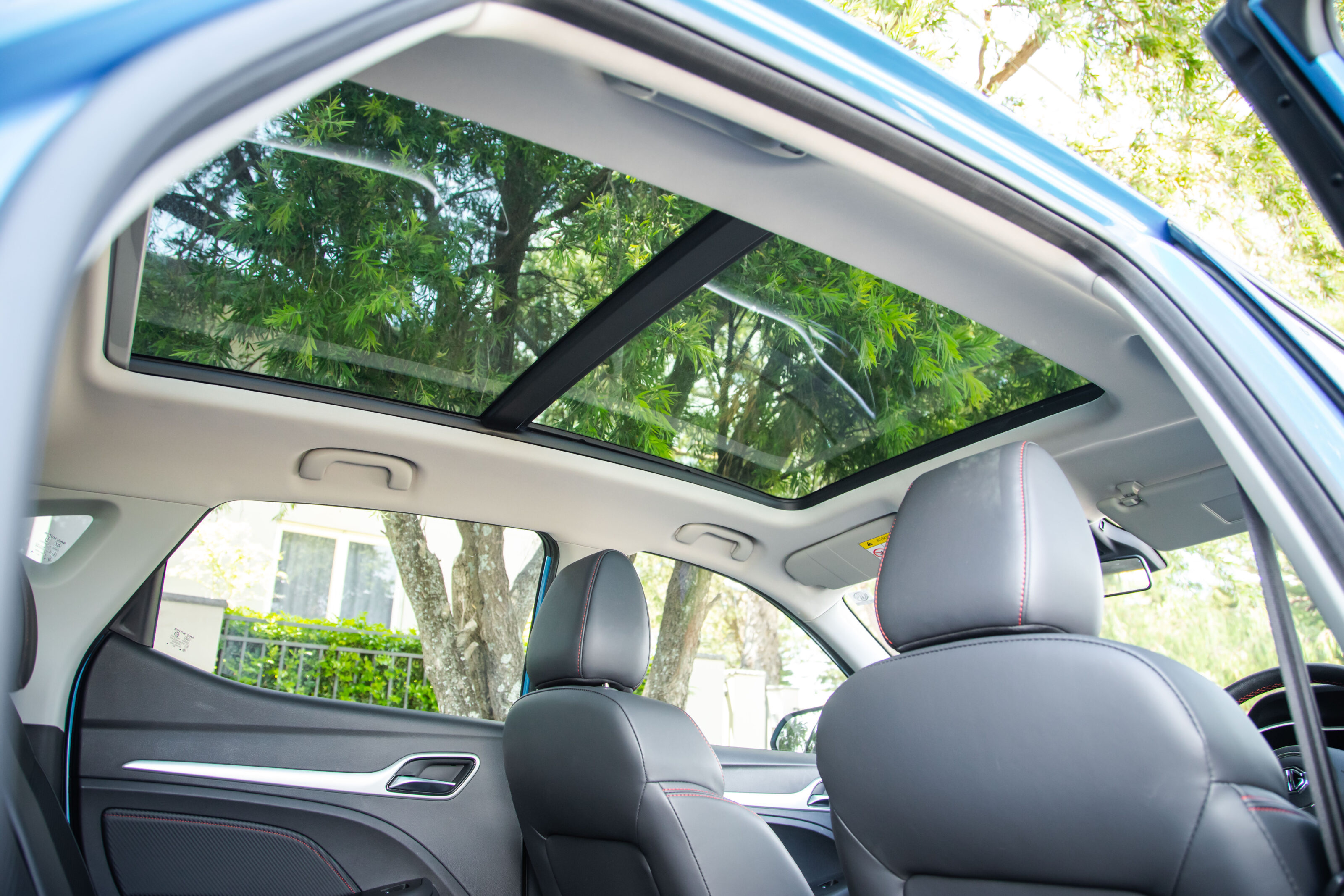
When sitting behind my own driving position, rear legroom is pretty good for me at just under 180cm. The seat is high so taller folks will brush the sunroof cover, but again, for me it was pretty good. The middle seat is, of course, very tight but that’s par for the course in this size of car.
A quartet of USB ports – two in the front and two in the rear as well as an additional one on the rear-view mirror for a dashcam – keeps everything charged and ready to go.
The boot starts at a reasonable 359 litres, rising to 1187 with the 60:40 split-fold out of the way. Towing capacity is fairly meek at 500kg.
On the Road
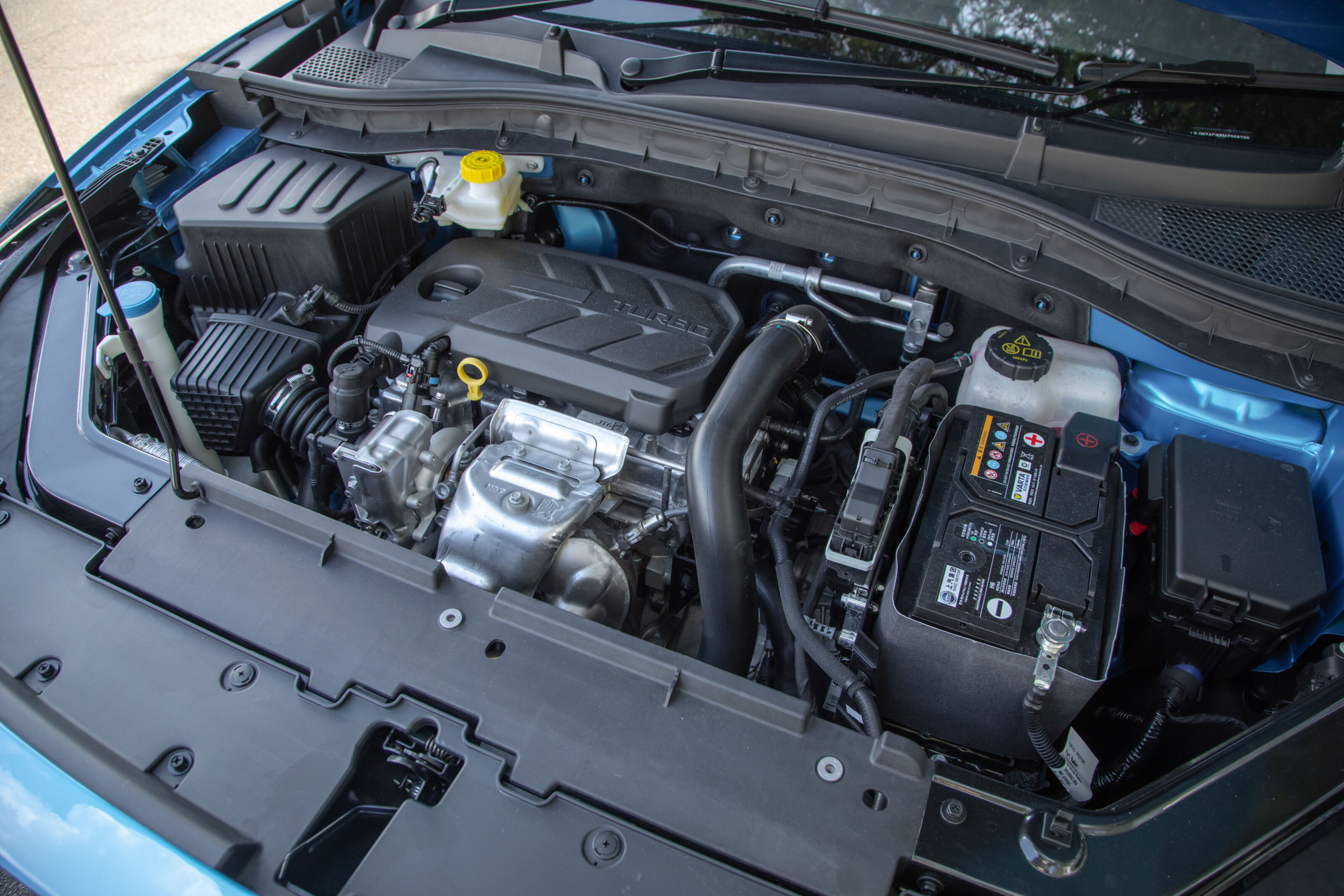
One of the main differences on the Essence is the drivetrain, again shared with the Excite. MG’s 1.3-litre three-cylinder turbo sounds tiny – and it is – but it is reasonably powerful, delivering 115kW at a high-ish 5200-6200rpm and a solid 230Nm between 1800 and 4400rpm. Further sweetening the deal is the fact that a six-speed Aisin torque converter automatic shifts the gears and drives the front wheels rather than the entry-level engine’s CVT.
The turbo triple was developed in concert with General Motors so that’s reassuring.
It pulls quite willingly, but like the steering you’re best leaving the transmission in Sport mode as it creates a sense of urgency rather than slowly slushing away in the default setting. The transmission itself is reasonably well-calibrated and is a huge step up from when I first drove the ZS a few years ago.
The engine isn’t going to win any awards but does the job without complaint which, again, is par for the course in this segment.
There are still a few niggles. The driving position is high, which is fine, but the steering column is only adjustable for tilt and not reach, so I never really got completely comfortable with it. And on top of that, the wheel itself is offset to the left so you drive a bit crooked. Again, I guess it’s one of those things that you get used to.
At first, I found the steering itself way too light, but in the menu options you can select from three settings and I actually quite liked the firmest. My wife agreed that the extra weight made it much more agreeable and nicer to drive.
The engine pulls quite willingly, but like the steering you’re best leaving the transmission in Sport mode as it creates a sense of urgency
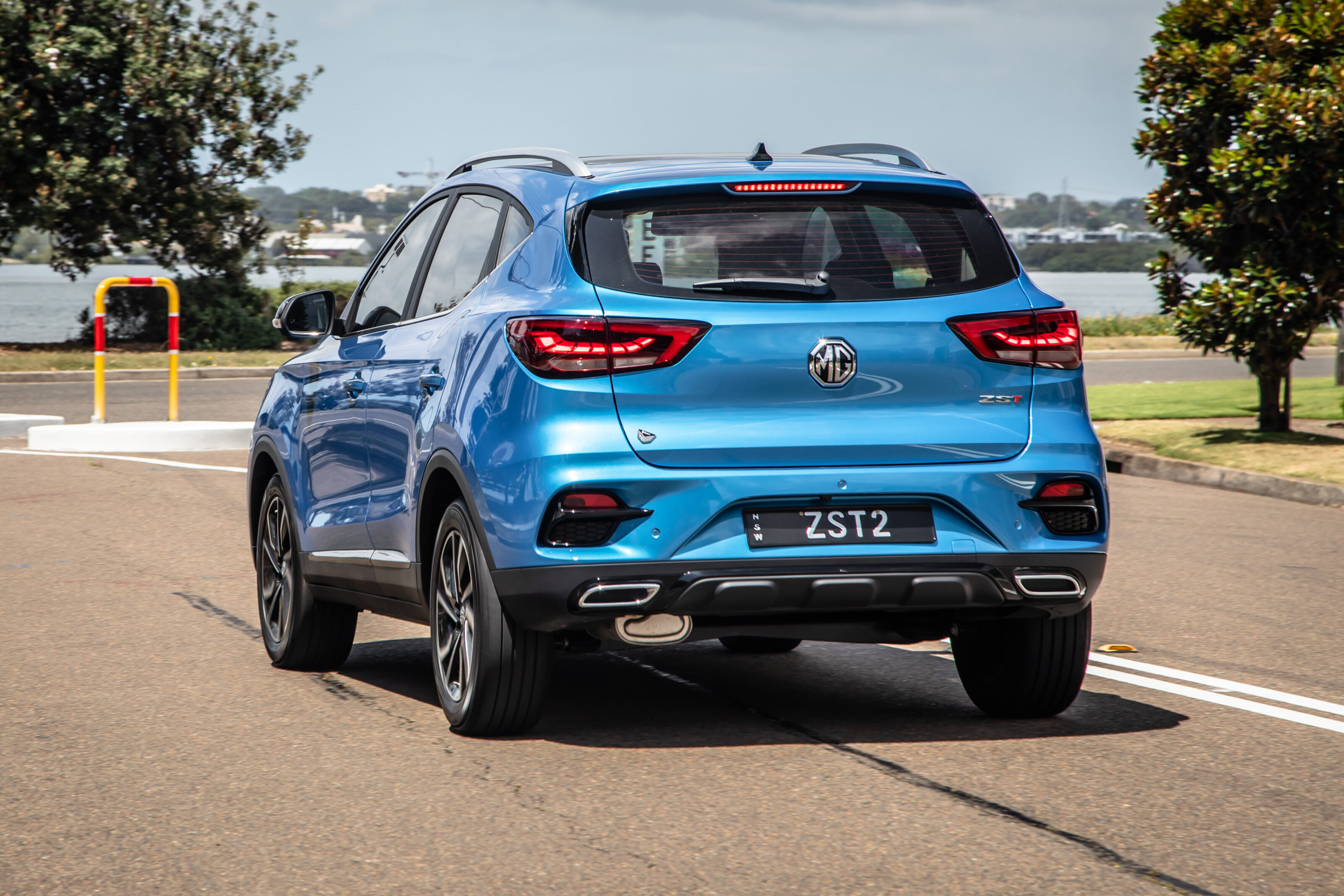
Another improvement is the way it rides. It’s still a bit harsh over sharper bumps and the rear end skips like most torsion-beam-suspended backsides do, but overall the ride has improved immensely.
It’s still not a big fan of corners with body roll and a gooey response on the brake pedal, but this really isn’t a key requirement of the target market and nobody in their right mind is buying an MG for whacky fun times.
The camera system is ambitious and quite clever. When you indicate in a particular direction, the screen shows a view down the side of the car so you know whether it’s clear or not when making a turn, kind of like Honda’s LaneWatch system. The image is a bit grainy but no worse than, say, a half-million-dollar McLaren.

The safety systems are a lot more comforting these days, too, with none of the frantic squawking at phantom obstacles of the past and no rage-quitting when you ignore the lane departure warning that hasn’t noticed you have your indicator on.
Ownership
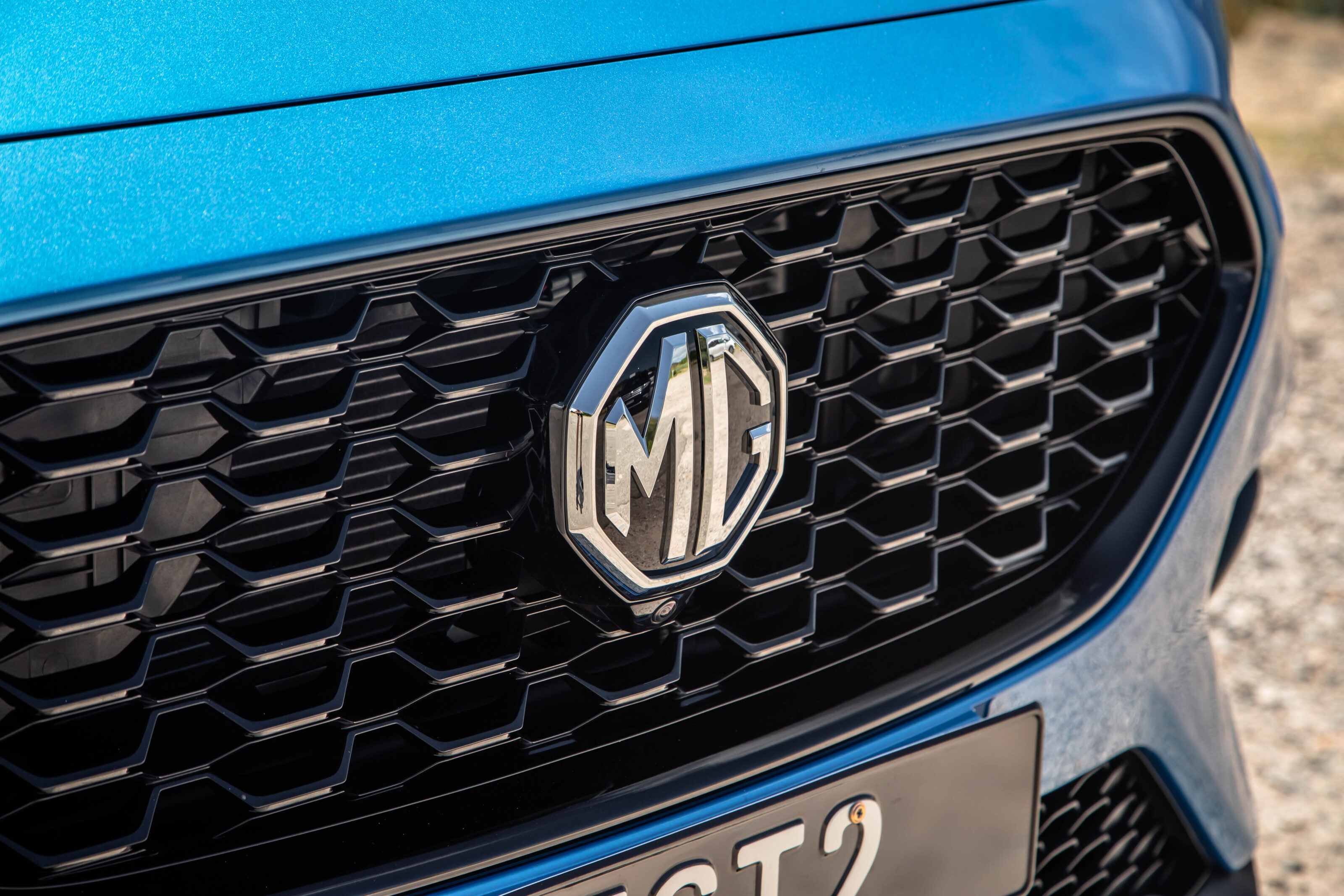
MG offers a seven-year/unlimited-kilometre warranty, which is excellent going and only beaten (on a technicality) by Mitsubishi’s ten-year/150,000km offer. A roadside assistance package also runs for the length of the warranty.
The company also offers what it calls Precise Service Pricing, with the first seven services costing $2164 or an average of $309 each. There are a couple of scary jumps like the fourth and fifth visits but the pricing is close to, say, the Ford Puma but more expensive than a Toyota C-HR or Yaris Cross.
VERDICT
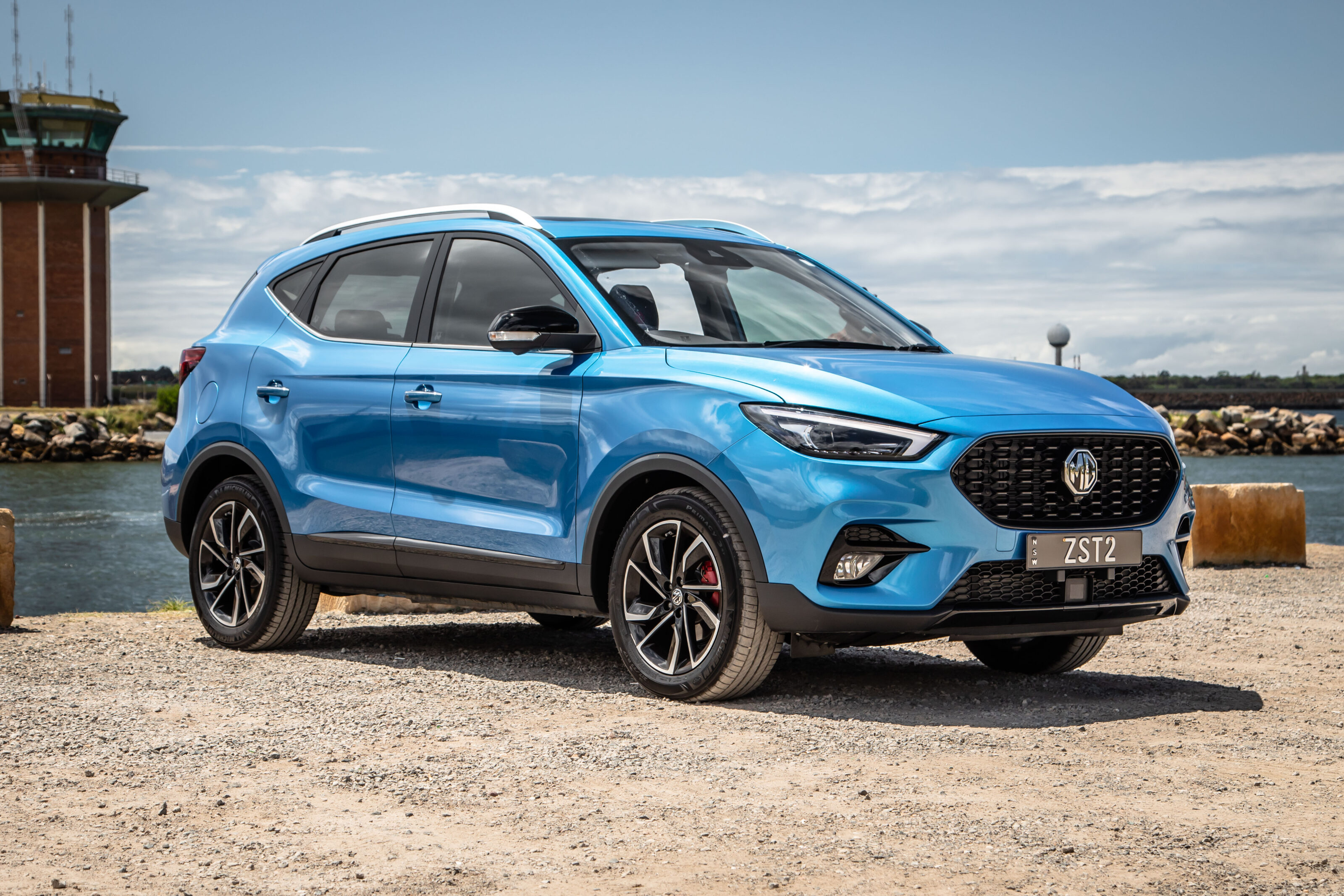
All in all, I’m very pleased with how much better the ZST has become. Bit by bit the company has knocked off the rougher edges, fixed what’s needed and made the ZST a much more appealing package.
While $32,990 drive-away puts it in the mix with a lot of very good cars, it’s definitely worth saving a few bucks and dropping back to the Excite if you don’t need a sunroof and digital dashboard.
MG sold nearly 19,000 examples of the ZS and ZST last year, so it’s a company on the march. The progressive improvement of the ZST, HS and ZS EV will probably start troubling other carmakers that have so far dismissed MG as a bargain and nothing else more threatening.
There’s still a way to go, but the distance to the competition from Japan and Korea is now much shorter.
2022 MG ZST specifications
| Body: | 5-door compact SUV |
|---|---|
| Drive: | front |
| Engine: | 1.3-litre turbo three-cylinder |
| Transmission: | 6-speed automatic |
| Power: | 115kW @ 5200-5600rpm |
| Torque: | 230Nm @ 1800-4400rpm |
| Bore stroke (mm): | 79.0 x 91.2 |
| Compression ratio: | 10.0 : 1.0 |
| 0-100km/h: | 11 sec (estimate) |
| Fuel consumption: | 7.3L/100km (combined) |
| Weight: | 1295kg (tare) |
| Suspension: | MacPherson strut front/torsion beam rear |
| L/W/H: | 4323mm/1809mm/1653mm |
| Wheelbase: | 2585mm |
| Brakes: | 2800mm ventilated disc front / 280mm solid disc rear |
| Tyres: | 215/55 R17 Michelin Primacy |
| Wheels: | 17-inch alloy wheels (space-saver spare) |
| Price: | $32,990 drive-away |
Steve L writes: I’ve been really impressed with the way the Peugeot 508 GT drives, but then realised that I could get a Sonata N Line for much the same money. While the Peugeot is a lot more elegant, I can’t seem to overlook the fact that the Hyundai has so much more grunt. Where should I put my money?
We’re also big fans of the super-agile Peugeot 508 but it’s a fact that you’d be handing over $57k for a car with just 165kW.
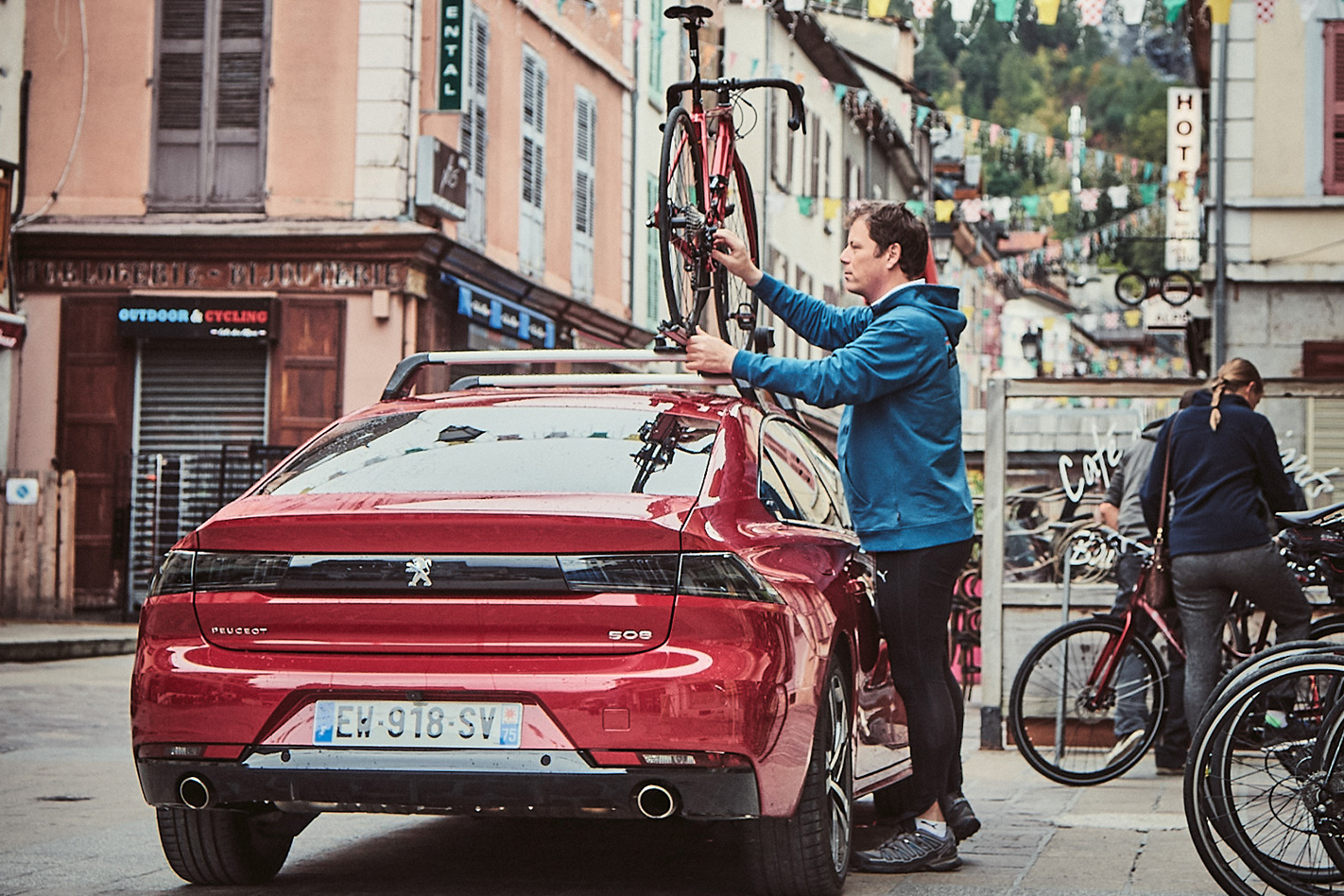
On a bang for buck basis, that’s not exactly stellar. The Hyundai does seem to offer a lot more in terms of performance and tech for a lot less, but the overall execution feels a bit lumpen next to the svelte and sophisticated Frenchie.
After all, once you experience Peugeot’s ‘cat’s paw’ massage function you’re never going back.
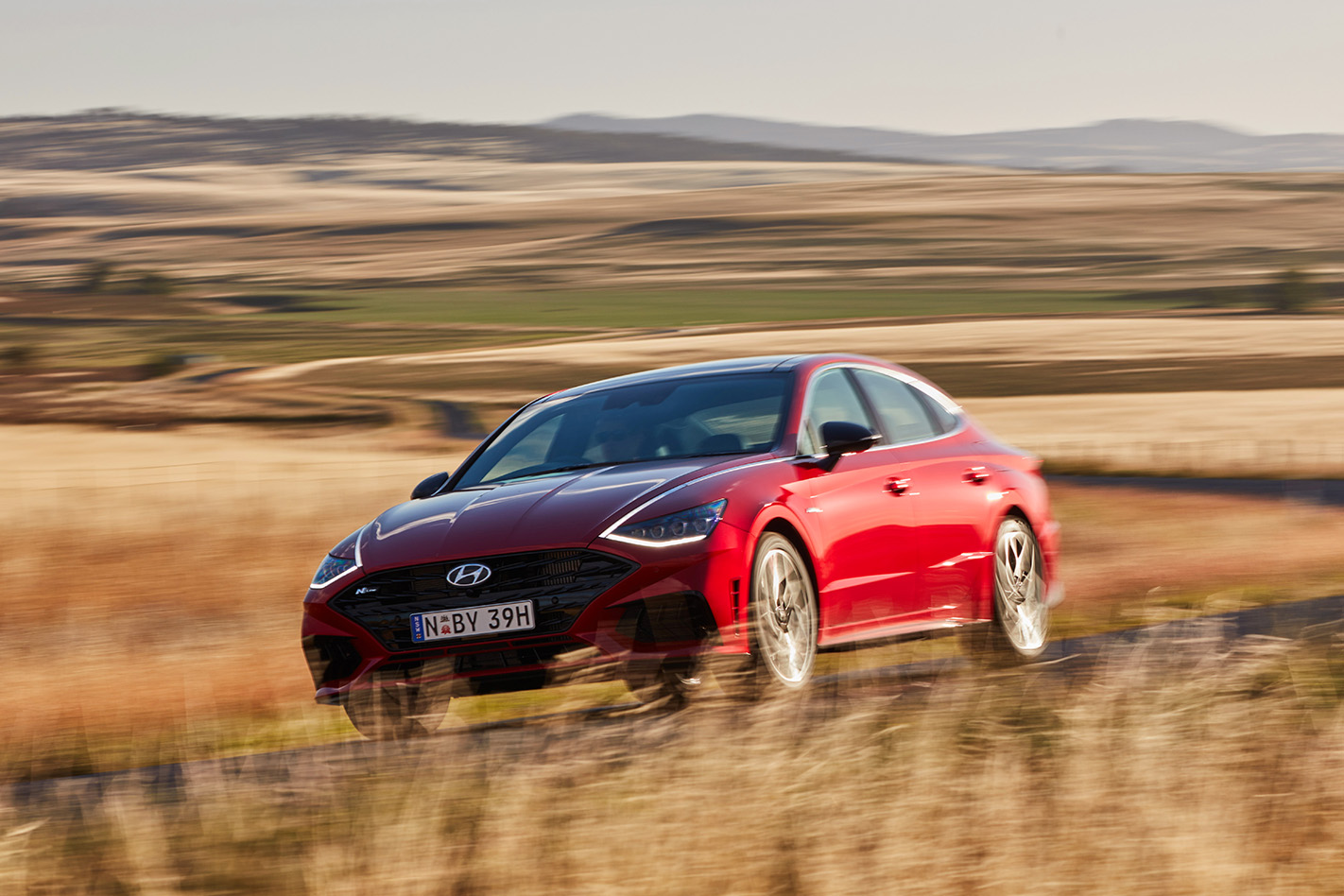
I’d venture that you can do even better than both of these cars by looking beyond the Sonata N Line at another Hyundai – the i30 Sedan N. It’s a similar size to the Peugeot and is the best sports sedan in its class. Check out Alex Affat’s review in this issue and then get back to us if you still want that Sonata. – AE
