
Snapshot
- Y4 FMC was used in the 2001 and 2002 WRC seasons
- Originally campaigned by Colin McRae and co-driver Nicky Grist
- Crash on the final day of Rally GB ended McRae’s title ambitions
One of the World Rally Championship’s most iconic cars has come up for sale, with genuine pedigree from one of the sport’s favourite drivers.
Built in 2001 by the Malcolm Wilson-led Ford World Rally team, this Ford Focus was designed to take 1995 WRC champion Colin McRae and co-driver Nicky Grist to the title.
A two-time rally winner in 2001, this chassis won both the gruelling Argentina and Acropolis events, which allowed McRae to take the title fight to fellow Briton Richard Burns, culminating in a two-way shootout at the season finale on home soil.
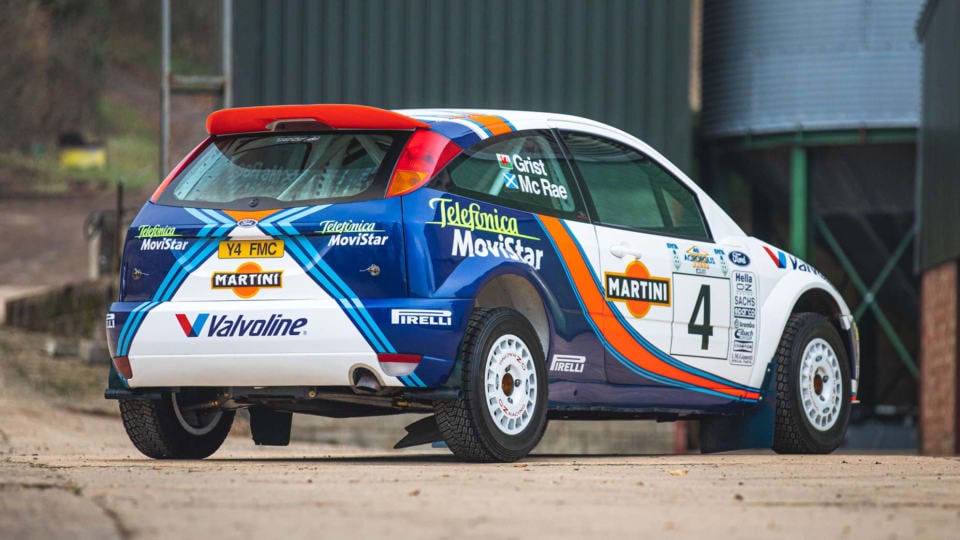
Despite leading on the final day of competition and in position to win the title, McRae hit a rock in the inside of a fast right-hander, launching the Focus into the air and ending his championship aspirations, allowing Burns to claim his only world title.
Rebuilt for the 2002 campaign, McRae and Grist couldn’t replicate their success from the year prior in the car bearing registration ‘Y4 FMC’, with the it being moved on to a British owner, competing in national-level competition.
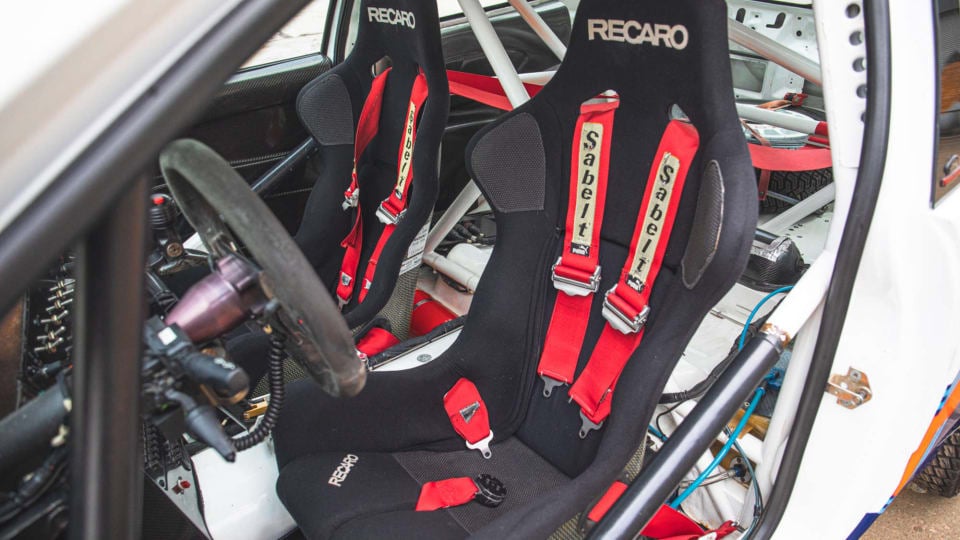
Returned to its former glory in the iconic white, red and blue Martini colours, the car has been meticulously restored by a rally specialist, with all original M-Sport created parts fitted, as well as logbook documentation.
As Lot 319 in Silverstone Auctions’ season opener for 2022, its guide price is estimated around £300,000-350,000 (AU$565,000-660,000), although who knows how much it more it could have been worth had McRae been able to seal the championship.
Snapshot
- V8 from Lexus RC F being converted to run on hydrogen
- Yamaha brought in to assist with development
- Engine features an 8-to-1 exhaust manifold
Toyota is investing heavily in keeping internal combustion engines alive, turning to Yamaha to develop a V8 which runs on hydrogen.
The Japanese manufacturer has made no secret of its intentions to save internal combustion, having formed an alliance with Mazda and Subaru, among others, as well as making a Corolla race car with a hydrogen-fuelled GR Yaris engine.
Doubling down on its hydrogen-powered aspirations for ICEs, Toyota has plucked the 5.0-litre 2UR-GSE V8 from the Lexus RC F for its latest project, retaining a healthy output of more than 330kW with zero emissions coming out of its top-mounted 8-to-1 exhaust manifold. It’s a drop in power of just 10kW, but a gain of 20Nm in torque over the standard engine – bumping up to 540Nm.
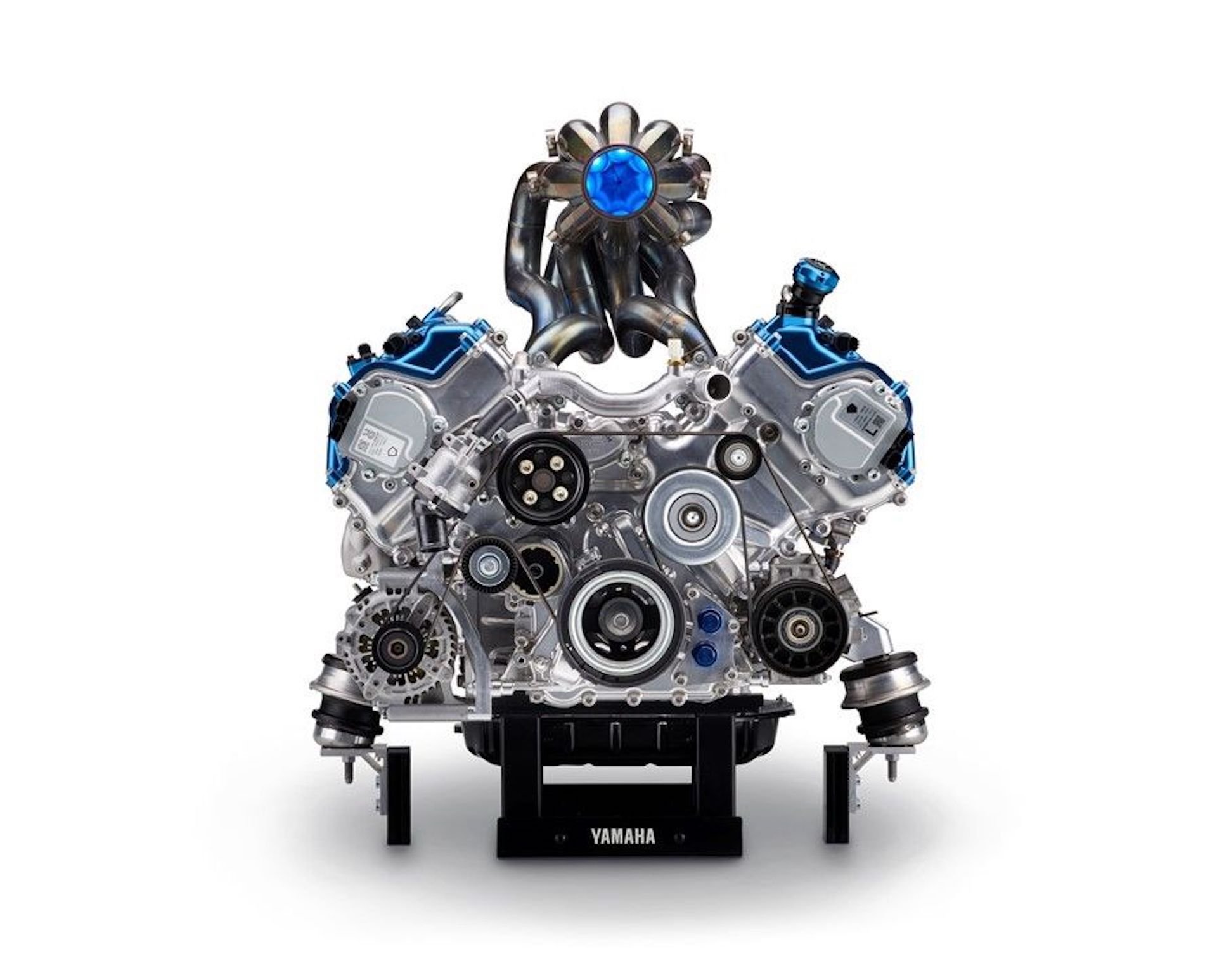
While the car’s original heads were designed by Yamaha, the engine tuner/motorbike manufacturer/piano maker had to make slightly more drastic changes for the bent-eight to run on hydrogen, changing its intake manifold and injectors – as well as more tweaks to the cylinder heads.
Realistically, the engine could be dropped straight into an RC F with a new exhaust manifold and pressurised fuel system being the only major changes needed, as Yamaha Motor’s head Yoshihiro Hidaka believes the hydrogen V8 is proof ICEs can be kept clean.
“We are working toward achieving carbon neutrality by 2050,” said Hidaka.
“At the same time, ‘Motor’ is in our company name and we accordingly have a strong passion for and level of commitment to the internal combustion engine.
“Hydrogen engines house the potential to be carbon-neutral while keeping our passion for the internal combustion engine alive at the same time. Teaming up with companies with different corporate cultures and areas of expertise, as well as growing the number of partners we have, is how we want to lead the way into the future.”
Despite rumours circulating about a hydrogen-powered LandCruiser in development, Toyota is far from putting all of its eggs into one hydrogen-filled basket, with the manufacturer unveiling its plans to introduce at least 30 battery electric vehicles to the market by 2030, as Lexus targets becoming an all-electric brand by 2035.
UPDATE, March 29 2023: Australian timing confirmed for ID models
Volkswagen Australia has today confirmed local launch timing for its ID.3, ID.4, ID.5 and ID.Buzz models – get all the details at the links below.
November 2022: ID.4 driven in Australia!
We’ve now had a chance to drive an overseas ID.4 car in Australia. Get our full story at the link below.
Story continues…
Be sure to wear flowers in your hair, or perhaps even don that wrinkled rainbow hippie outfit before taking the retro-futuristic electric Microbus for a ride when it arrives – optionally as a long-wheelbase people mover and cleverly packaged cargo van. (Although exact Australian plans are still to be confirmed.)
Designed with a sublime grasp of flair, style and tradition, the versatile low-drag 2023 Volkswagen ID.Buzz e-van shares more elements than expected with the 1950 classic. Its powerplant is again rear-mounted, driving the nearby wheels accompanied by subtle transformer whine.
In long-wheelbase guise, it seats up to seven passengers in reasonable comfort. The massive power-operated sliding doors create an even bigger aperture than the double side-hinged portals of yore, and the bright four-lite greenhouse mimics the original except for the optional dozen skylights.
Even the driving position – relatively close to the windscreen, throning on a pair of high-mounted captain’s chairs – evoke thoughts of the days of free love and psychedelic music.
UPDATE, Dec 15: ID Buzz comes to Australia
Volkswagen’s ID Buzz has been whisked into Australia for a quick tour, ahead of its local launch in the coming year. Join John Law for a look at its features and space.

Story continues…
The production version differs from the acclaimed concept in numerous areas. The roll-down windows are of course no longer flush-fitting, the black cast-iron hinges of the available split rear doors stick out of the Cargo model like two sore liquorice thumbs, the two-tone colour schemes and the contrasting material mix are a little too gaudy for such a classy design, and the ergonomic chaos pioneered by ID.3 hatch and ID.4 SUV was unfortunately passed on like a haptic virus to the ID.Buzz.
You still start the motor by pushing a button, but the gear selector which grows out of the steering column works to a modified yet no more intuitive pattern. The distant 12-inch touchscreen and the cursed touch sliders arranged below it still make the driver play index finger Bingo 24/7. Voice control is a useful option, except that all safety-related commands are off-limits.

By and large, design, packaging and functionality are spot-on. The only serious qualm is the poor visibility with regard to traffic lights and signs mounted more than a foot above the driver’s eye level. In Europe, leaning forward often solves the problem, but Americans used to single sky-high traffic signals overlooking the crossroads are bound to balk at this inconvenience. In contrast, it’s hard not to appreciate the roomy, bright and well-considered cabin.
The optional massage seats are first-class comfy, leg- and headroom is abundant in rows one and two, the split rear bench tilts flat and is easily adjustable in reach.
Folding all chairs from the B-posts back to the tailgate creates a wide, level and carpeted loading (or sleeping) area along with an additional underfloor storage cubicle. It’s a pragmatic arrangement, solid, rattle-free, properly trimmed and a breeze to use via two side-mounted levers. No surprise that VW is already looking at a fully electric Multivan tailor-made for tomorrow’s even more environmentally conscious nomads.
The ID.Buzz drives like a trucklet and car hybrid. For a start, the substantial kerb weight of 2.5 tonnes is an ever-present factor

The ID.Buzz will be available in standard- and long-wheelbase form. The base model is 200mm shorter and 12mm lower than the front-engined T6.1. It can thus enter parking structures with a height restriction of 1950mm without brushing the coiffure. While all Buzzes come with two sliding doors, only the kerbside swing-open device is standard on the Cargo version.
Also unique to the light commercial vehicle are the three-seat cabin, the fixed steel partition with or without window, and the comprehensive fastening equipment with eyes, rails, clips and whatnot.
The 1230mm clearance between the rear wheel houses enables the silent hauler to swallow two Euro pallets. While the Buzz can stash away up to 1121 litres of goods, the storage area of the LWB Big Cargo sister model measures an enormous four cubic metres. Lifting heavy stuff is made easy by the low loading sill which peaks at 623mm. The towing capacity works out at exactly one tonne.

The ID.Buzz drives like a trucklet and car hybrid. For a start, the substantial kerb weight of 2.5 tonnes is an ever-present factor. As a consequence, flooring the throttle at the lights does not have the typical kick-in-the-butt effect EVs have become famous for.
Although the instantly available maximum torque is a fairly generous 310Nm, the hand-stopped acceleration time from 0-62mph worked out at 9.8 seconds – that’s about 1.5sec slower than the ID 4 and on par with the T6.1 Multivan.
The ID.Buzz’s driving range between recharging stops is said to be in the area of 523 kilometres. While most ID models are good for a top speed of 160km/h, the battery-fed people mover is restricted to 145km/h.
The extra weight and the larger frontal area are also taking their toll in terms of overall efficiency, which is reflected by the observed energy consumption of 23.7kWh/100km – that’s not exactly brilliant in view of the recorded average speed of 62km/h. On the autobahn, 30kWh/100km (give or take a couple of digits) will therefore likely be the norm rather than the exception.
At an average charge speed of 125kW, it takes about 38 minutes to restore the SOC from five to 80 per cent, so make that a large cappuccino and treat yourself to a second donut.
No surprise that VW is already looking at a fully electric Multivan tailormade for tomorrow´s even more environmentally conscious nomads.

There are also a couple of upsides to the ID.Buzz’s weight, most obvious being the tarmac-hugging centre of gravity ensured by the heavy underfloor battery rated at 77kWh net. In combination with the long 2988mm wheelbase and the independent suspension all-round, the ID.Buzz professes a better than expected ride over long undulations, uneven patchwork surfaces, and level railway crossings.
Shod with 235/45 R21 rubber up front and even wider 255/40 R21 rear footwear, the well balanced overall compliance is repeatedly crushed by the tyres’ stiff sidewalls, the rigid high-speed rubber compound and the Yeti footprint. Adjustable shock absorbers are an option the test car was not fitted with; the same goes for the so-called Progressive Steering and the almost indispensable heat pump.
Worthwhile extras include adaptive IQ matrix headlights, Travel Assist with ACC, and Park Assist with memory. The latter feature remembers favourite parking spots and does its own multi-turn manoeuvring even if this means squeezing at an angle into super-tight lots or backing out of long, narrow and curvy access paths. Amazing, this.

The steering feels light but never vague, it is direct but not nervous, and it describes an extra-tight turning radius of under 11 metres which is exceptional for a 4712mm MPV.
The brakes – discs at one end, drums at the other – are keen on restoring energy, providing instant feedback and indulging in effortless repeat action. Unlike other previously driven IDs, this one decelerated progressively to a full stop without a noteworthy increase in pedal pressure. The more energetic of two brake energy recovery modes is calibrated to relay that one-pedal feel some love and others hate.
Alternatively, you can go with the flow and hope that the selected drive mode will engage Coast before the increasingly frustrated chauffeur reaches for the non-existing shift paddle – a classic missed opportunity.
Not surprisingly, the 150kW motor mated to a single-speed transmission fails to add a new chapter to The Great Electric Performance Revolution, but it does an okay job, predominantly in urban driving conditions.
Next year, VW will offer a smaller battery (52kWh for 305km of range) as well as bigger 111kWh unit which should be good for around 605km. Also in the works is a 4WD GTX edition rated at 223kW and an unchanged 310Nm.
There are upsides to the weight. Most obvious is the tarmac-hugging centre of gravity ensured by the underfloor battery. With the independent suspension, it professes a better than expected ride

Prices are typically released late in the game, and since this is a seller’s market due to strong demand and the persistent microchip shortage, the numbers are at this point more provisional than ever.
Accordingly to be taken with a pinch of salt are the 54,000 Euro estimate for the Cargo and the 49,000 Euro tag for the standard-wheelbase ID.Buzz, both before subsidies and other incentives. Add at least 15,000 Euro for a fully-loaded specimen, and 5000 Euro more for the limited First Edition. Sounds like a lot, yet seems to be the going rate for comparable SUVs and MPVs including high-end Chinese imports.
Looking deeper into the crystal ball, we can see a fully electric California camper based on a reinforced MEB platform, an all-new electric T8 Transporter co-developed with Ford and a fully autonomous Buzz which is due to join the self-driving Moia fleet in 2025 as a pivotal part of Volkswagen’s future on-demand mobility services campaign.
While Ford has allegedly agreed to buy 600,000 MEB component sets for its Cologne-built zero-emission Focus-size hatchback, VW is extending the production capacity of the Hannover plant to make room for 400,000 Buzz Cargos and 600,000 Buzz People over life cycle. From 2025 onwards, the MEB 2.0 architecture will be phased out step by step in favour of the even more flexible SSP (scalable systems platform) matrix.
We like this video
Snapshot
- Passat set to lose its five-star ANCAP rating
- Most recent model update in 2020 saw increased tech included
- Volkswagen Australia Brand Director questions ANCAP’s decision
Volkswagen’s Passat will be without an ANCAP safety rating at the end of 2022, owing to new rules from the crash test authority.
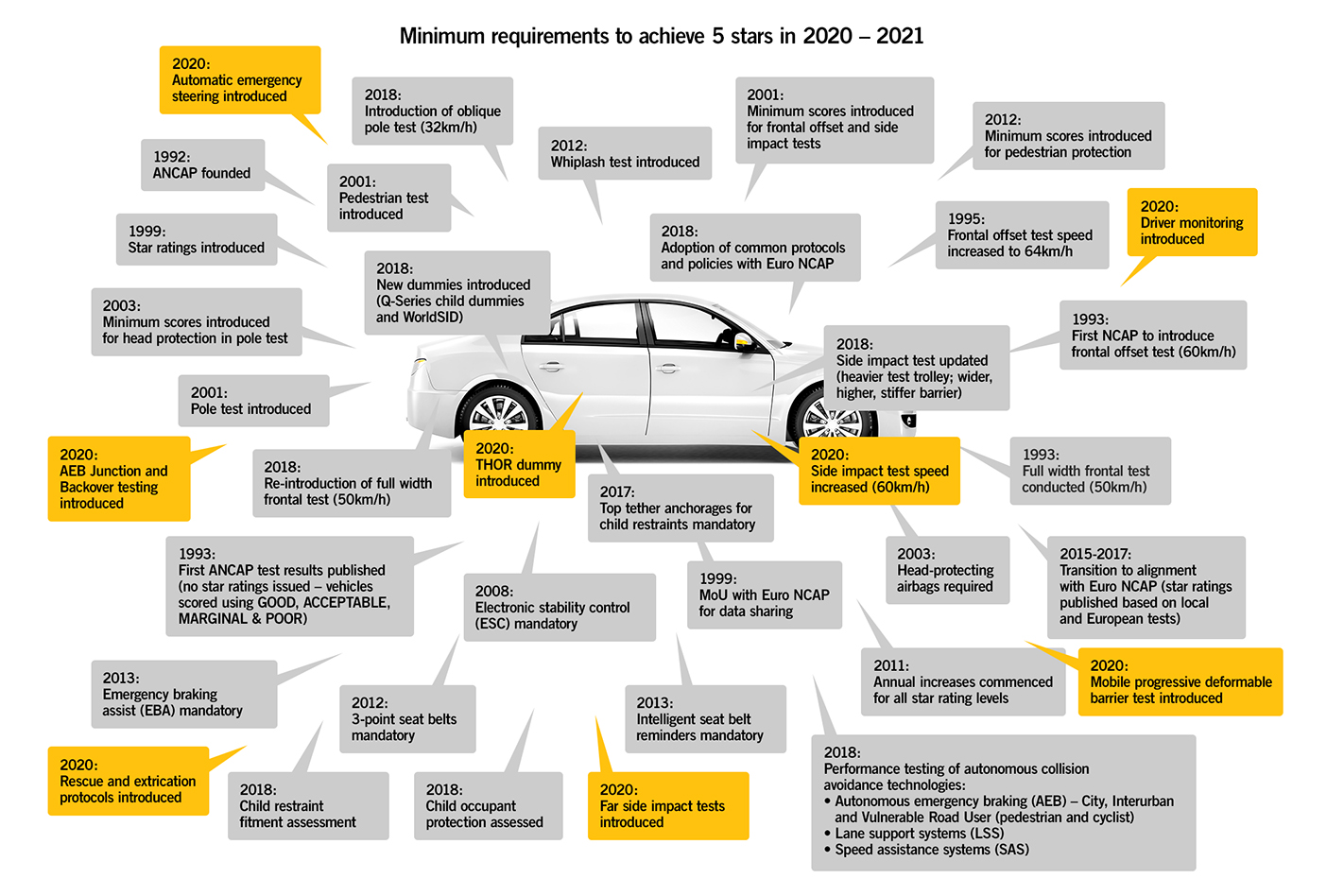
As first revealed by Wheels last year, the Government-funded independent crash testing authority announced a six-year expiry date for its star ratings, meaning any vehicle which hasn’t been re-tested since 2015 will have an ‘untested’ label applied at the end of the year – with the current generation Volkswagen Passat one of those in the firing line.
Last tested at launch in 2015, the Passat scored a five-star rating, despite safety equipment such as adaptive cruise control, rear traffic alert, front assist, lane assist and side assist being optional on the base variant – although each of these features became standard when the model was updated in 2020.
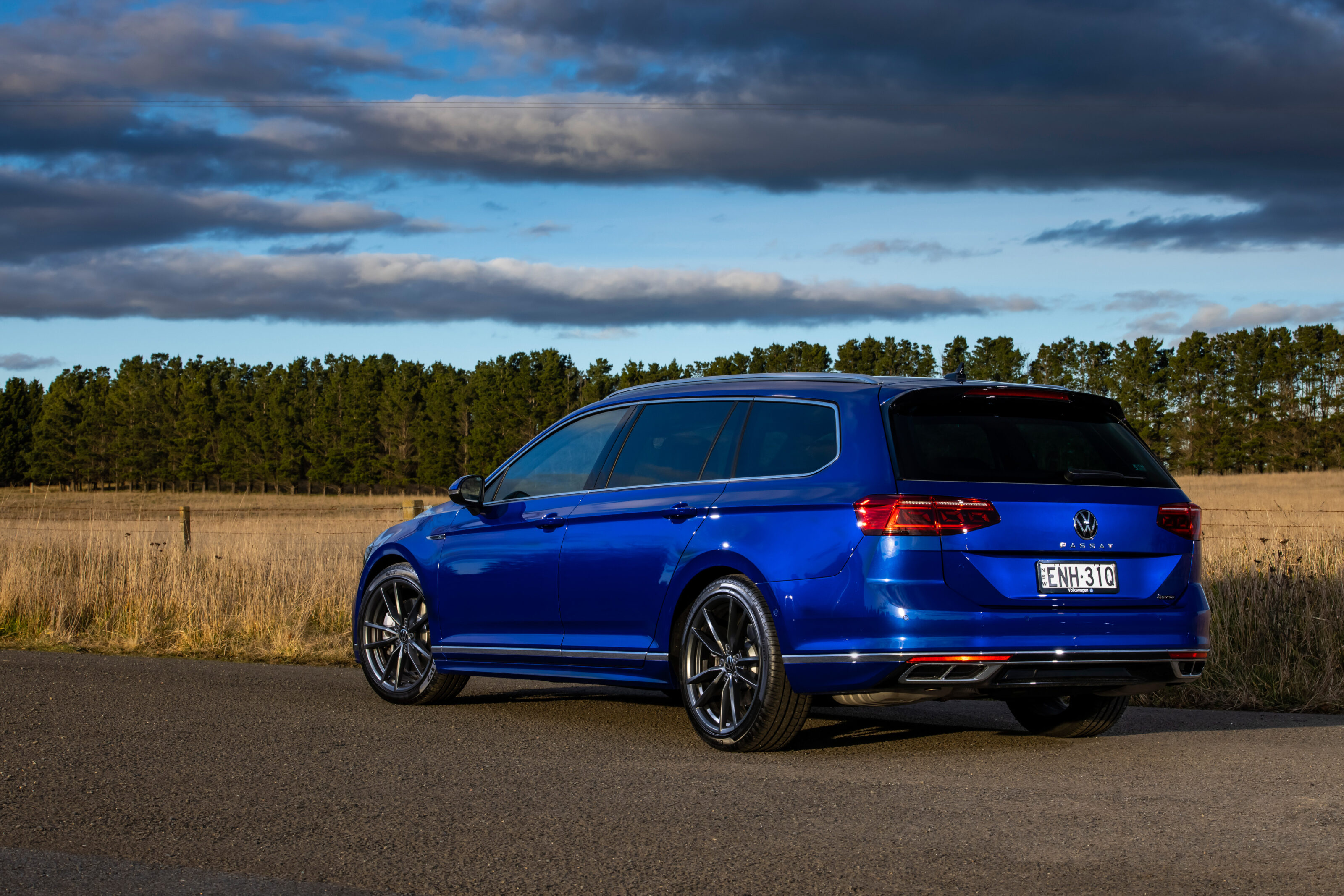
Despite more safety tech including 360° proactive occupant protection, manoeuvre braking, travel assist, emergency assist and pedestrian monitoring being included in the 2020 update, ANCAP doesn’t count the addition of this equipment as enough to warrant a reissuing of the Passat’s five-star rating.
As a result, VW has hit out at ANCAP’s decision to apply the six-year rule to the Passat, joining calls from those who question the relevance of the organisation.
“Just as ANCAP has elsewhere rightly pointed out the absence of safety technology, why would it fail to account for active and passive safety upgrades that bring a model to the forefront of occupant and bystander technology?,” questioned Brand Director of Volkswagen’s passenger vehicles operations in Australia, Michal Szaniecki.
“It is unclear if ANCAP withdraws ratings at a specified point merely for administrative convenience. It is clear that the Passat has embodied ANCAP’s previously stated ideal that a model should become safer throughout its lifecycle.”

Last year, Volkswagen announced it would be dropping the Passat sedan from its line-up, with the Arteon fastback set to replace the four-door, leaving just the Passat wagon as the sole offering for the model.
Throughout 2021 a total of 1169 Passats were sold in Australia, making up just under three per cent of the 40,770 new Volkswagens registered over the 12-month period.
Speaking with Wheels last year after the changes were announced, ANCAP CEO Carla Hoorweg said the six-year system was to eliminate confusion for buyers, providing clarity so consumers can compare star ratings more accurately.
“What we will end up with is that all ratings will have a six-year validity, so then you’ll be able to see very clearly whether or not the rating is valid or expired,” said Hoorweg.
“It gives you that ability to compare how long this rating has to run versus one that’s more recent – you know it’s going to be valid for longer, so you’ve got that five-star rated car with a valid rating that’s going to last until the end of the sixth-year life.
“I think that gives you a way of comparing, and going, ‘well, if I’m buying a vehicle that has five stars from 2017 versus a vehicle that has five stars from 2019, I know that the 2017 one is older and the rating is going to expire [sooner]’.”
Elswhere in the industry, Kia Australia’s general manager of product planning, Roland Rivero, has previously supported ANCAP’s changes, telling Wheels its ratings were informative to customers.
“For the average punter, safety in totality is a big consideration. Our research came back that it was number two in reasons for purchase,” said Rivero.
“We can all have our own opinion about ANCAP, but the customer voice, the market voice is probably the most important of the lot…it’s the market that’s dictating the terms, and as OEMs our job is to sell cars to the greater market, so it’s their voice we’re listening to. It does bring an influential aspect to the purchasing decision.”
Models last ANCAP tested in 2015
| Make/Model | Star rating |
|---|---|
| Ford Everest | Five-star |
| Ford Ranger | Five-star |
| Haval H9 | Four-star |
| Honda HR-V | Five-star |
| LDV G10 | Three-star |
| Mazda2 | Five-star |
| Mazda CX-3 | Five-star |
| Mitsubishi Pajero Sport | Five-star |
| Mitsubishi Triton | Five-star |
| Nissan Navara | Five-star |
| Skoda Fabia | Five-star |
| Suzuki Vitara | Five-star |
| Tesla Model S | Five-star |
| Toyota HiLux (Rugged and Rugged X variants only) | Five-star |
| Toyota Prius V | Five-star |
| Volkswagen Passat | Five-star |
Renault has teased its upcoming hydrogen-powered concept car, set to be officially revealed in May.
Details of the as-yet unnamed concept car are unknown, although Renault’s choice of words to say it is powered by a hydrogen engine rather than an electric motor suggests this could be an internal combustion engine (ICE) which uses hydrogen in place of fossil fuels, rather than electric vehicle relying on a fuel cell.
Electric vehicles have received a big push from automotive manufacturers over the past year, with nearly every brand announcing fully-electric strategies.
However, more and more manufacturers are coming around to the idea of hydrogen as a zero-emissions alternative.
If implemented in Renault’s concept car, it won’t be the first time we’ve seen such technology – Toyota is currently developing and racing cars in Japan which utilise ICEs converted to run on hydrogen, although it hasn’t been adopted in production vehicles just yet.
For exterior styling, the concept seems to borrow some cues from its Mégane E-Tech Electric, including the thin LED lights, while the daytime running lights in the bumper are unlike any in Renault’s current range.
We can also see traditional side mirrors replaced by a set of cameras, making for a more slimline look, while also reducing drag – a crucial element to new car design, electric or not.
Renault has recently trademarked hydrogen-related logos for its upcoming vehicles, with ‘Renault H2-Tech’ hinting at a potential hydrogen-only range of cars, set to be sold alongside the fully-electric E-Tech range.
The French manufacturer has previously announced its commitment to 100 per cent EV sales in Europe by 2030, however it’s not known whether this would be altered to cover all zero-emissions vehicles rather than putting all of its eggs in the EV basket.
Snapshot
- Driving simulator app in development with Porsche
- Allows people to use their smartphone to scan roads they drive and play them in a simulator
- Release date and final details unconfirmed
There’s nothing worse than being on a great stretch of public road and having the driving experience ruined by wildlife, other motorists or overly conservative speed limit restrictions.
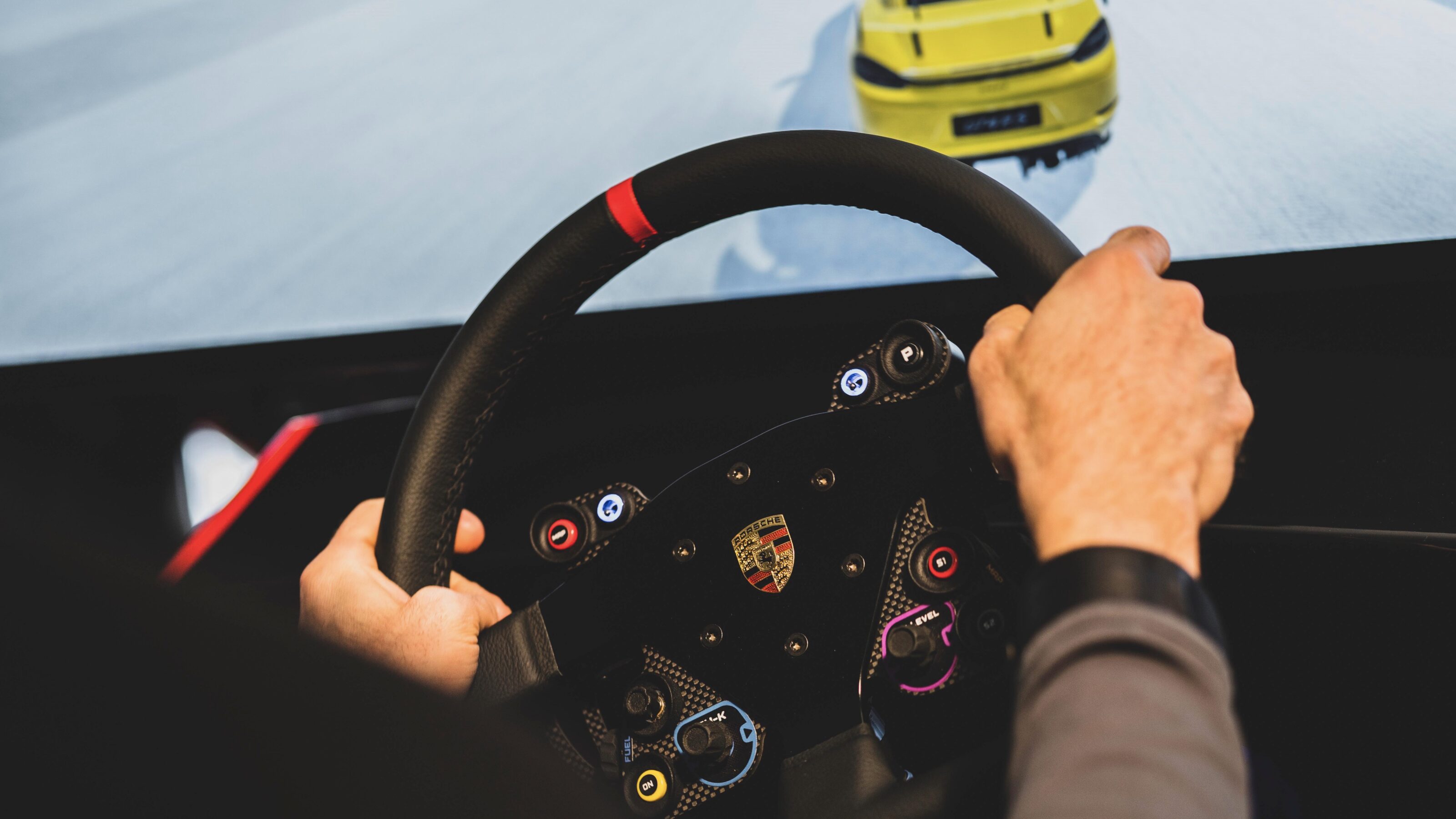
Porsche is looking to solve that issue with its latest creation – an app dubbed Virtual Roads, developed in conjunction with Swiss start-up Way Ahead Technologies.
The basic idea of the software is to allow users to record any road of their choosing that they drive in the real world, which will then gets uploaded to a driving simulator allowing the road to be driven virtually.
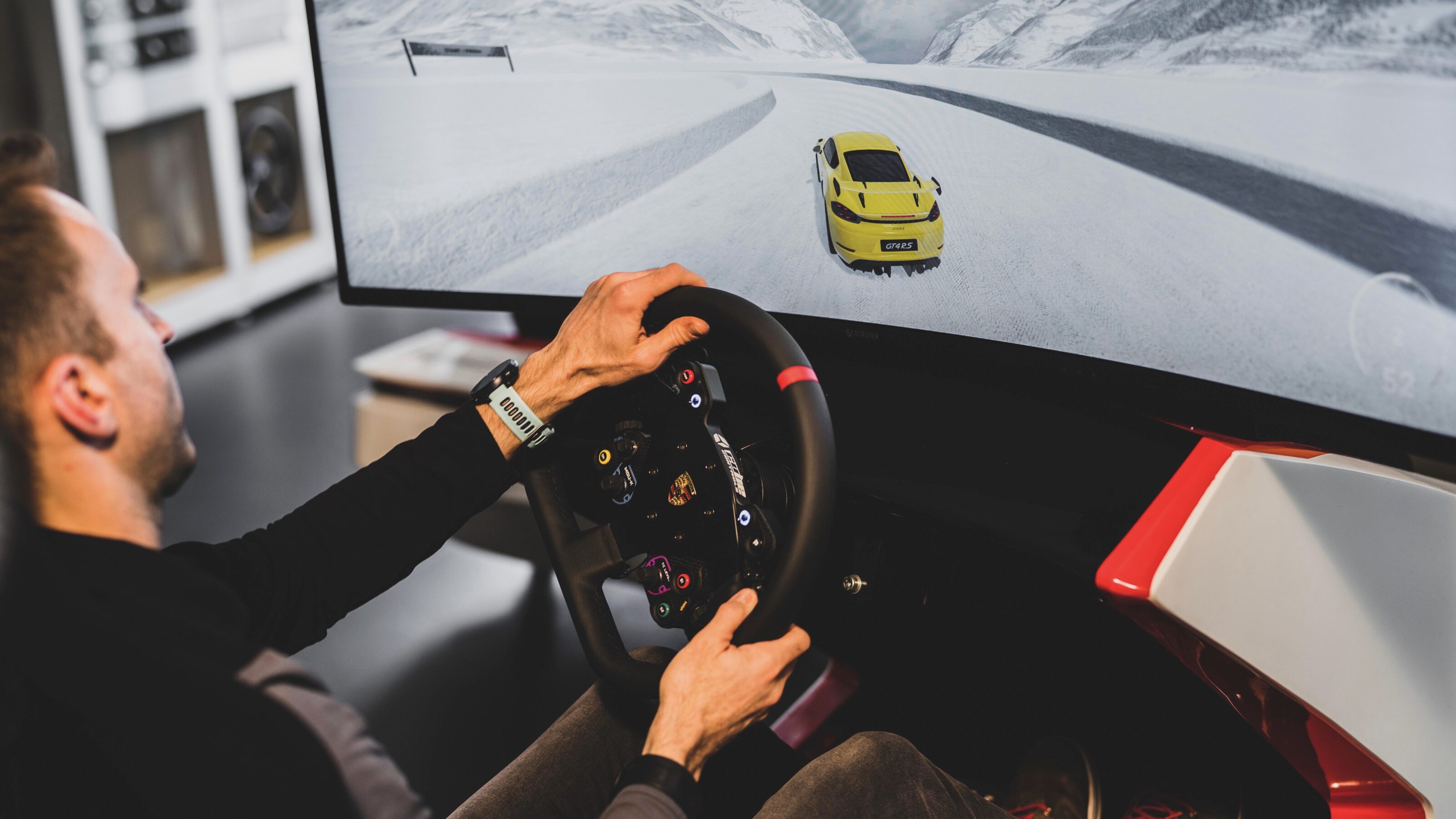
Essentially, if your run on iconic tarmac like the Great Ocean Road is ruined (which it almost always is), you can just go back and have a proper crack in the simulator as many times as you want.
Users with the app will simply mount their smartphone to the dashboard of their car, and it will record the whole 3D environment of the road, including trees, basic landmarks and barriers.
At first the app will only allow for virtual play to take place on smart phones, but Porsche has named popular driving simulation Assetto Corsa as one of the platforms the Virtual Roads app will eventually be compatible with.
“If you ask people what they think is the most beautiful road, everyone has their own, very personal route in mind,” said Robert Ader, chief marketing officer at Porsche.
“We want to trigger these great memories with a much simpler digitalisation process that allows anyone to drive their favourite route virtually.”
At this stage neither Porsche or Way Ahead Technologies has given a release date for the new app, and it’s also unclear if the product will only be exclusive to Porsche owners or the wider public.
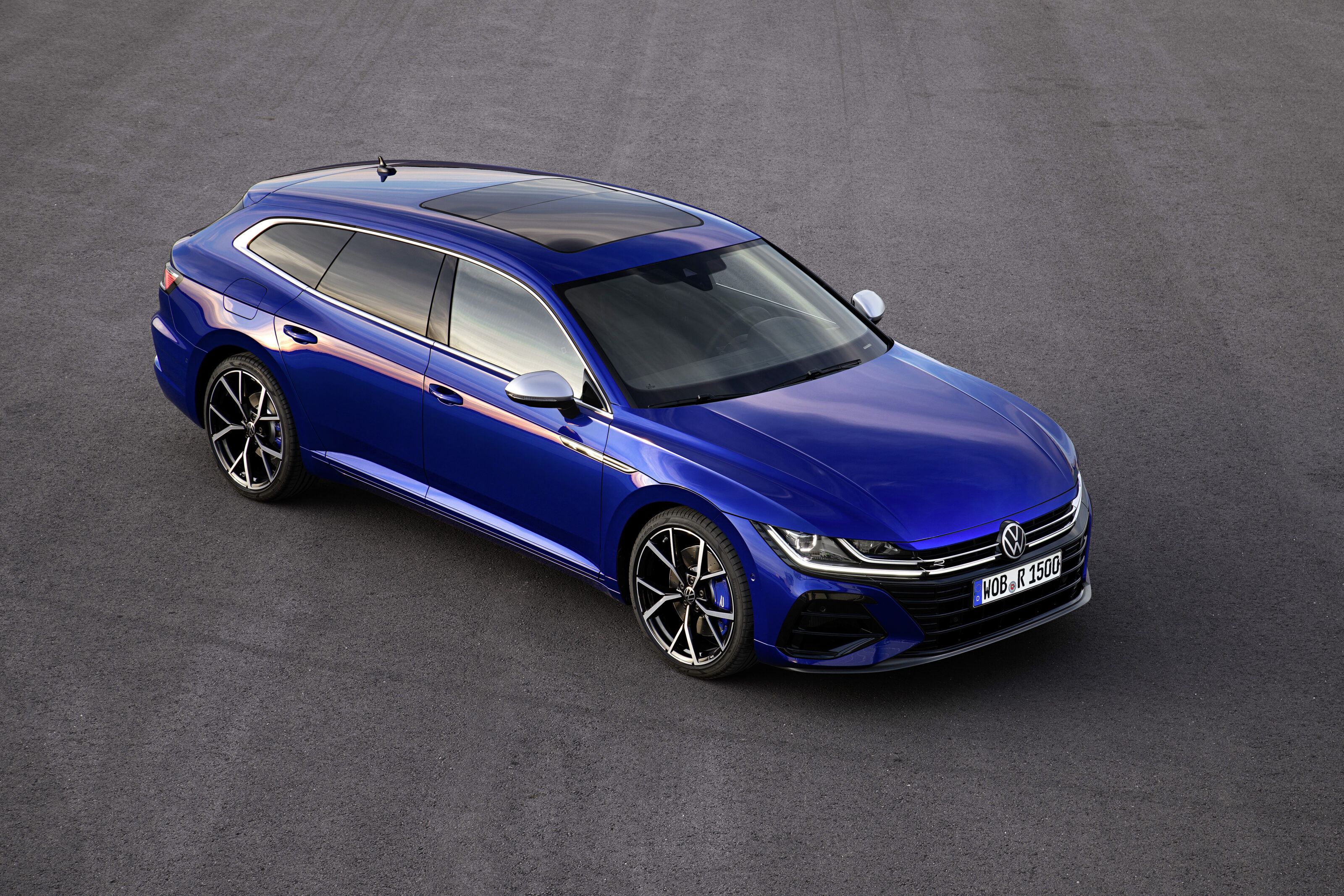
“That’s not a shooting brake” said one Facebook commenter, in response to an image of the (very good looking, mind you) Volkswagen Arteon Shooting Brake.
I typed out a response, but refrained from hitting Enter. It read something like: “in so far that it’s not a horse-drawn carriage used by aristocratic hunting parties, you’re right”.
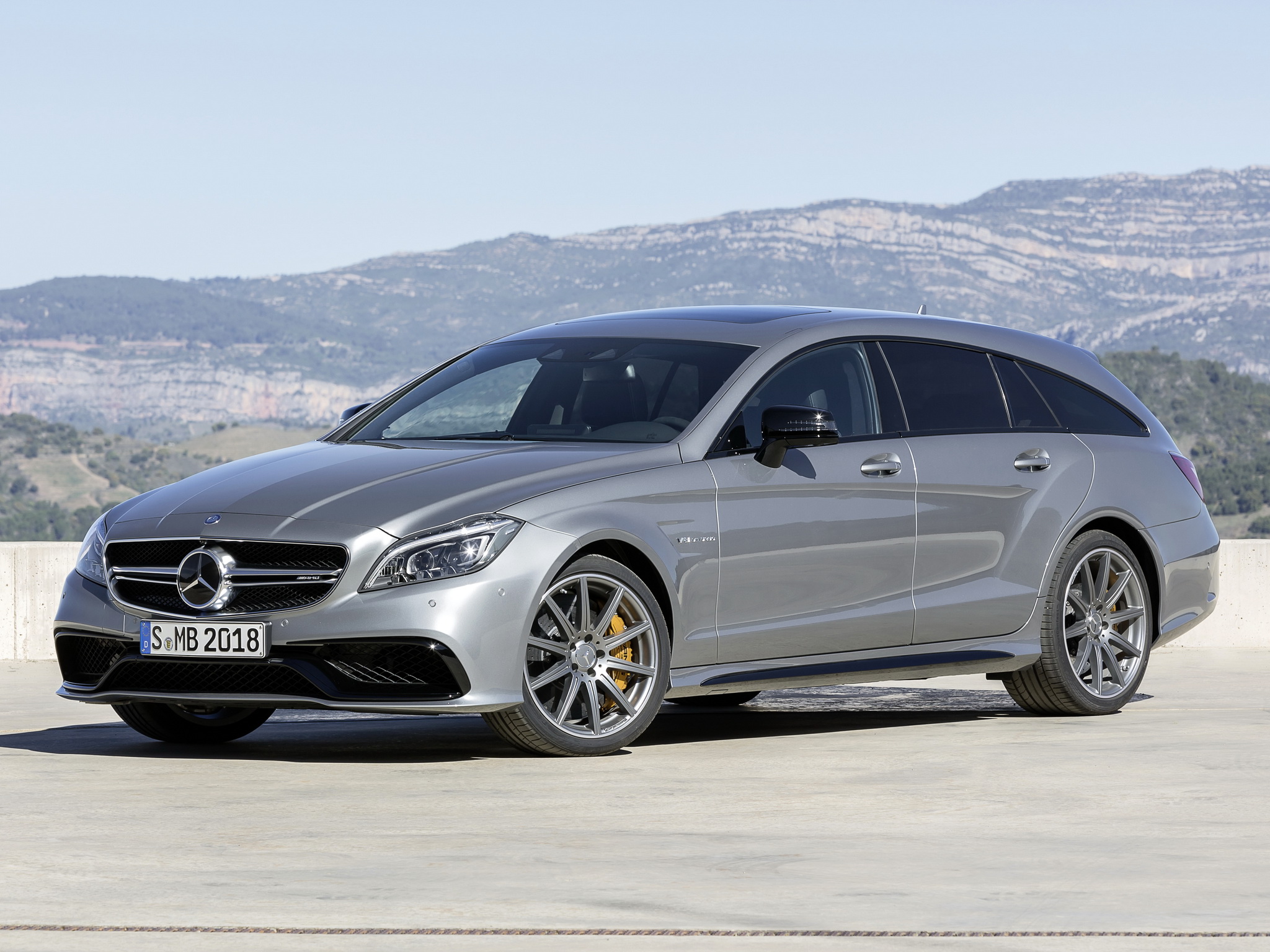
So what is a ‘shooting brake’? Is it simply manufacturer marketing speak or is it really different to a station wagon, or an estate? It’s easy to write the term off as simple PR spin and, in modern times, perhaps that’s somewhat deserved. Can we lay blame on Mercedes-Benz, which set the contemporary trend with the long-roof variant of the C218 CLS of 2012?
In truth, the etymology of the term ‘shooting brake’ actually takes us far back before then, before the dawn of the motor car and back to the age of horse-drawn transportation.
In the early days of coachbuilding; and we mean that in the truest sense of the word, not the sort of stuff you’ll find on the main stage at Pebble Beach, a ‘brake’ was a specific type of carriage used in training (or literally ‘breaking the will’) of wild or untamed horses. Earliest use cases came to the aid of service and draftwork.
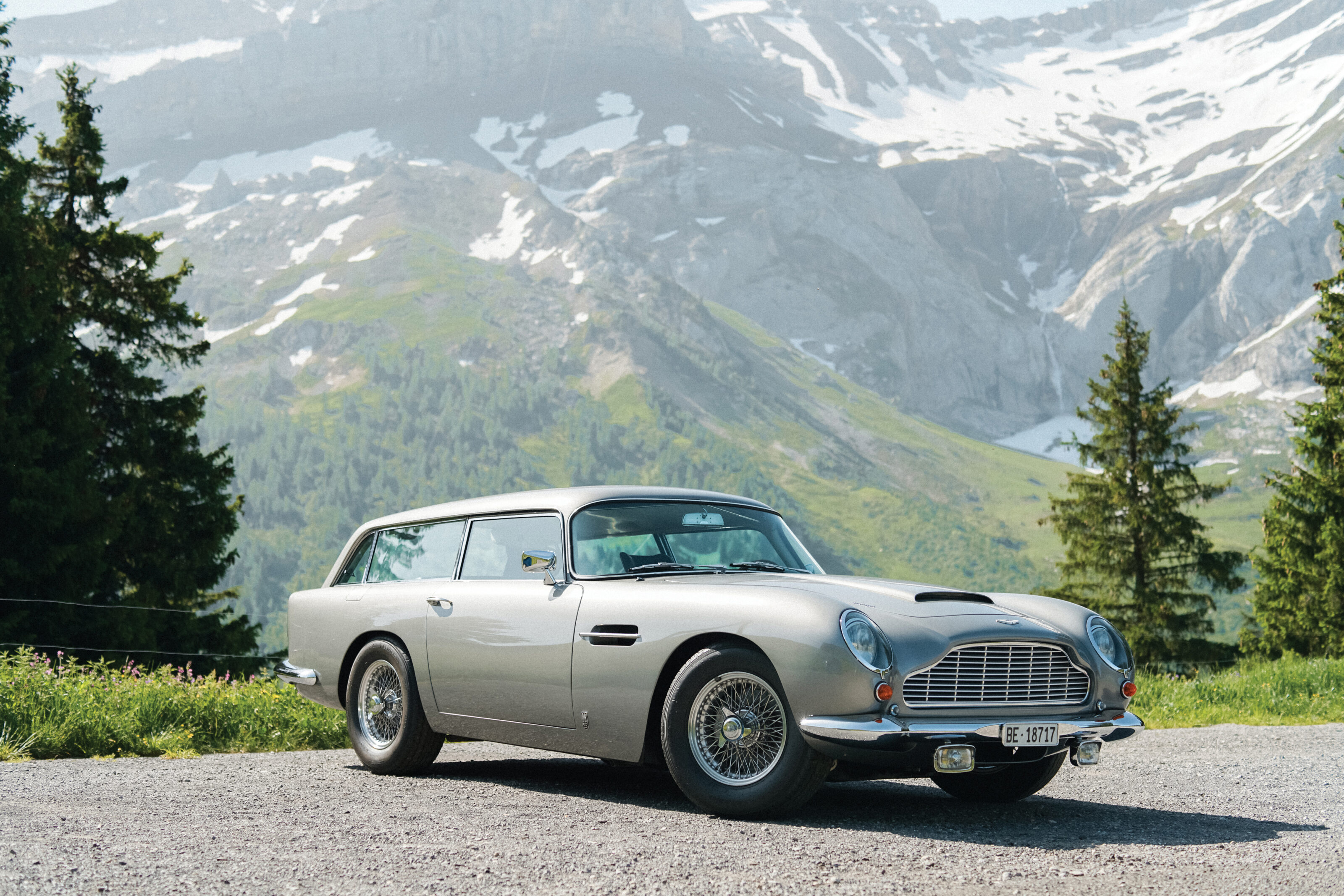
The term ‘shooting brake’ later emerged to describe a horse-drawn wagon used for more aristocratic activities like carrying gamekeepers, sporting hunters, hunting dogs and game to and from excursions. The term simply carried over with the advent of self-propelling vehicles.
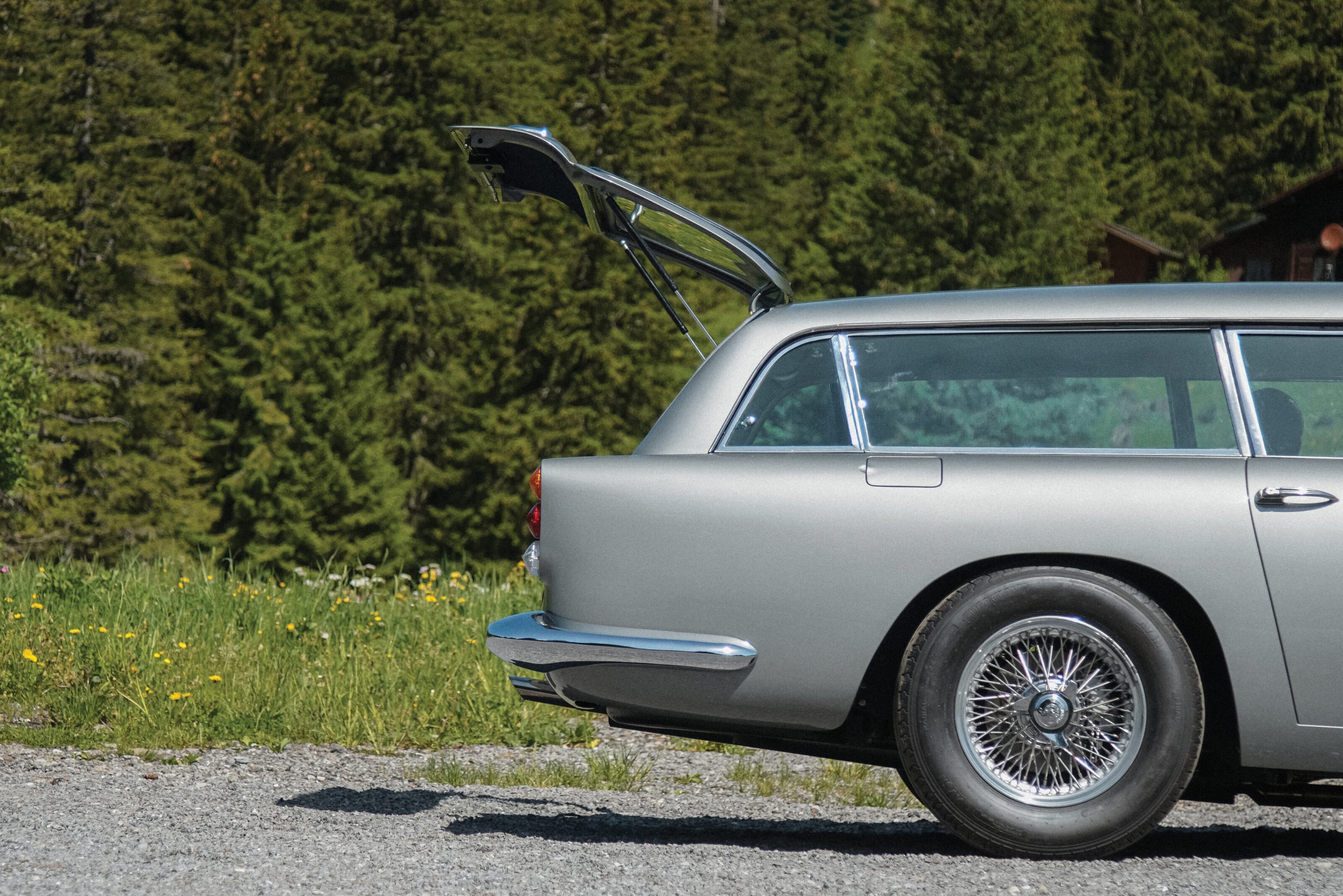
In more modern times, the label is commonly used within coachbuilding circles (we’re talking the Pebble Beach stuff here) to stylistically describe traditionally three-box car designs that have been converted into two-box designs with extended rooflines and, generally speaking, just two doors.
The denotation of an ‘estate’ car has traditionally been the English descriptor of a two-box car design, and shares a similarly socially stratified origin to the shooting brake label. Put simply, rich people lived on estates, and were marketed big-booted cars to carry rich people things, like lacrosse sticks and horse saddles.
The term ‘station wagon’ has more blue-collar roots, but its origins also stem from the era of horse-drawn propulsion. In those days, and in the early days of the automobile before widespread adoption, long-distance travel was primarily conducted via rail-based transportation.
Horse-drawn carts called ‘depot hacks’ ferried people and luggage to and from the train station, itself referencing the outmoded term ‘hackney’ – a horse-drawn taxi. With the advent of the motorcar, the term ‘depot hacks’ initially carried over in reference to the modified Ford Model Ts that replaced the old horse and carts.
From 1923, these Ford Model T depot hacks were partly constructed by Ford in Michigan, which provided buyers, often fleets for hotels and resorts, with a driving chassis before a third-party coachbuilder fixed a bespoke wooden body with roomy seating, ample luggage space and a two-box longroof design.
These Model T depot hacks were also referred to as, you guessed it, station wagons. And by 1929, the Ford Model T Station Wagon was a genuine factory offering in the catalogue. The rest, as they say, is history.
But history has since deleted another major pioneer of the beloved wagon package. Did you know that Ford wasn’t the first to offer a factory-built station wagon? Back in 1921, then-CEO of General Motors, William ‘Billy’ Durant, was ousted from his post (for the second time), and quickly established Durant Motors.
One of Durant’s sub-marques, Star, gave the Model T real competition in the low-price segment and beat the Michigan giant in offering a factory-built station wagon to market by as early as 1923. The Star itself was a sales success, but financial mismanagement at a corporate level saw Durant Motors dissolve by 1932. Having lived through two World Wars, Henry Ford knew one thing better than most. History is written by the victors.
Snapshot
- Toyota filed a petition to allow adaptive high-beam in 2013
- The technology has been in use in Australia, Europe and Japan for a decade
- But it fell foul of US rules pertaining to maximum low-beam strength
American regularity bodies aren’t generally known for their expeditiousness. However, even the most fastidious bureaucrat would have to concede that nine years is a long time to approve vehicle technology that has been in use overseas for a decade.
That’s how long it took the National Highway Traffic Safety Administration (NHTSA) to hand down a final ruling that will allow car manufacturers to introduce adaptive driving beam headlights on new vehicles in the United States, as reported by Reuters.
The long-awaited decision comes almost a decade after Toyota filed a petition to allow the technology, which automatically adjusts LED headlights so they can provide more illumination without dazzling oncoming motorists.
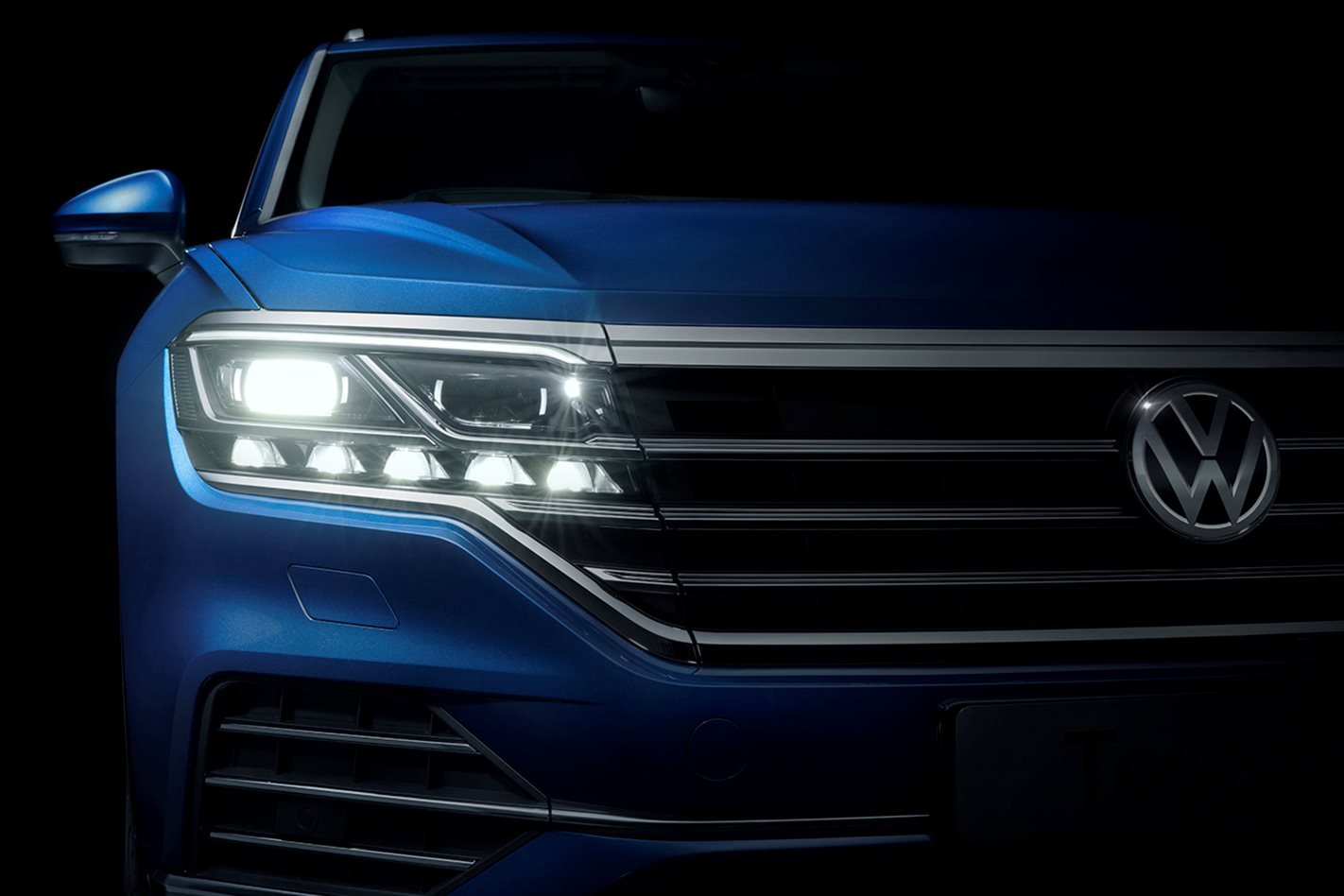
The ruling allowing the technology, handed down on February 15, actually came as a surprise to many as it was before the November 2023 deadline set for the NHTSA to make up its mind.
Not to be confused with auto-high beam, which dips the lights when a vehicle is approaching, high-tech adaptive driving-beam headlights have been permitted in Europe for more than a decade and are also approved here in Australia, Japan, Canada and other countries and are becoming increasingly popular in mainstream models.
However, they ran afoul of the US rule pertaining to maximum levels for lower beams.
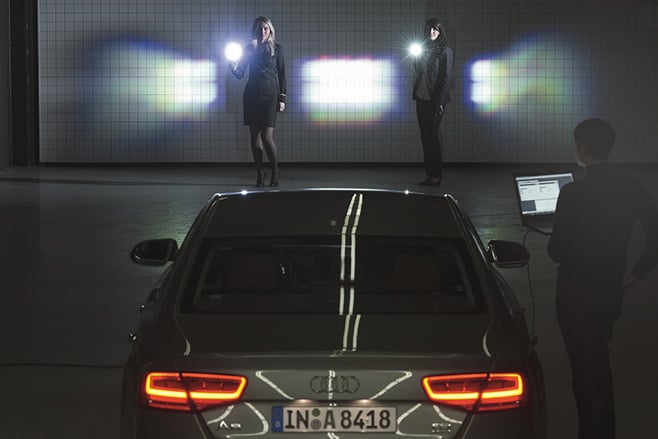
The NHTSA conceded the new rule “will improve safety for pedestrians and bicyclists by making them more visible at night, and will help prevent crashes by better illuminating animals and objects in and along the road.”
According to Reuters, NHTSA data shows about 72 per cent of pedestrian fatalities and 51 per cent of driver fatalities in the US occur at night despite accounting for just 25 per cent of vehicle miles travelled.
Adaptive driving beam headlights explained
Also known as selective high-beam, or Matrix LED by Volkswagen, adaptive driving beam technology uses dozens of light-emitting diodes in each headlamp that each light up a very small section of the road ahead.
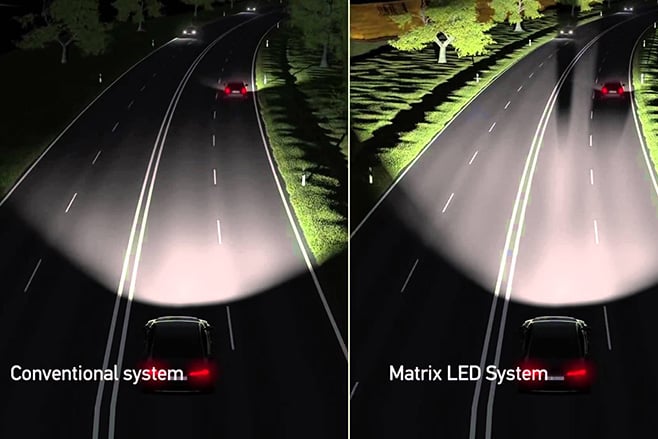
All of them on at the same would provide maximum illumination, but with the use of sensors, the light pattern can be finally adjusted so individual LEDs will turn on or off to ensure they do not dazzle other drivers.
The light output of each individual LED can be varied. That means a portion of the road ahead can be lit dimly rather than darkened entirely, or illuminated even more brightly to draw the driver’s attention to that particular area.
As the above image shows, the light can be shone on either side of a vehicle travelling in front.
Click here to find out more.
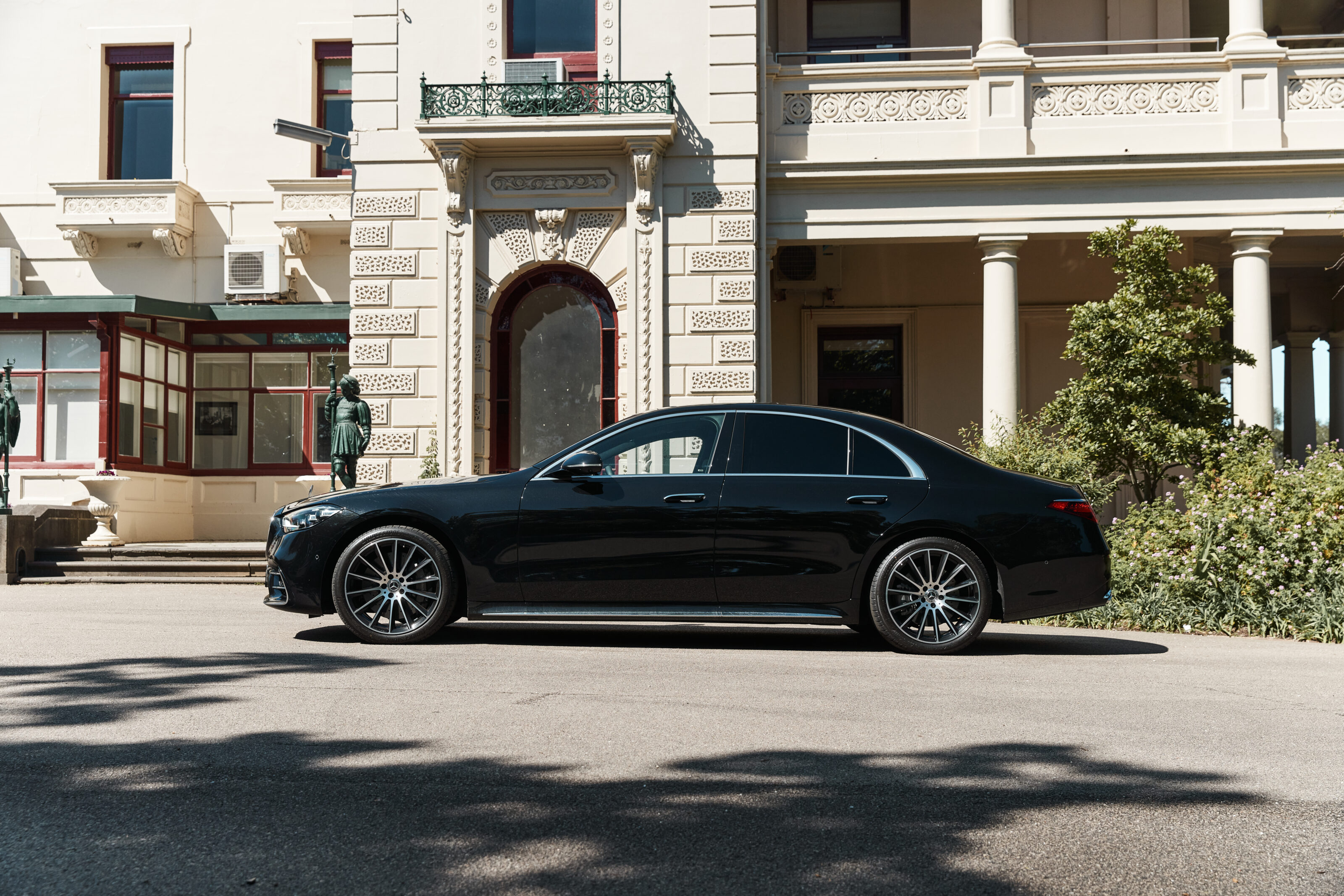
For decades the Mercedes-Benz S-Class has defined what the term ‘luxury car’ means, and the 2022 Mercedes-Benz S 450 4MATIC is no different.
It has come a long way since its origins in the 1951 model 220, or even perhaps the first of its name introduced with the 116 series in 1972.
Rather than embodying the best of the current age, however, the S-Class usually gives a glimpse into the future and has consistently set the benchmark for what we might expect to see from more mainstream brands in years to come.
Alongside safety enhancements that were introduced as part of the MY21 update in February this year, the seventh-generation model brings with it an enormous, and beautifully crisp, 12.8-inch OLED touchscreen providing access to the brand’s second-gen MBUX infotainment system.
The 2022 S-Class also has improved aero-acoustics over the previous generation, while the high rigidity of the new aluminium hybrid bodyshell – 60kg lighter than its predecessor – is claimed to provide the basis for even more comfort when it comes to noise and vibration suppression.
Pricing
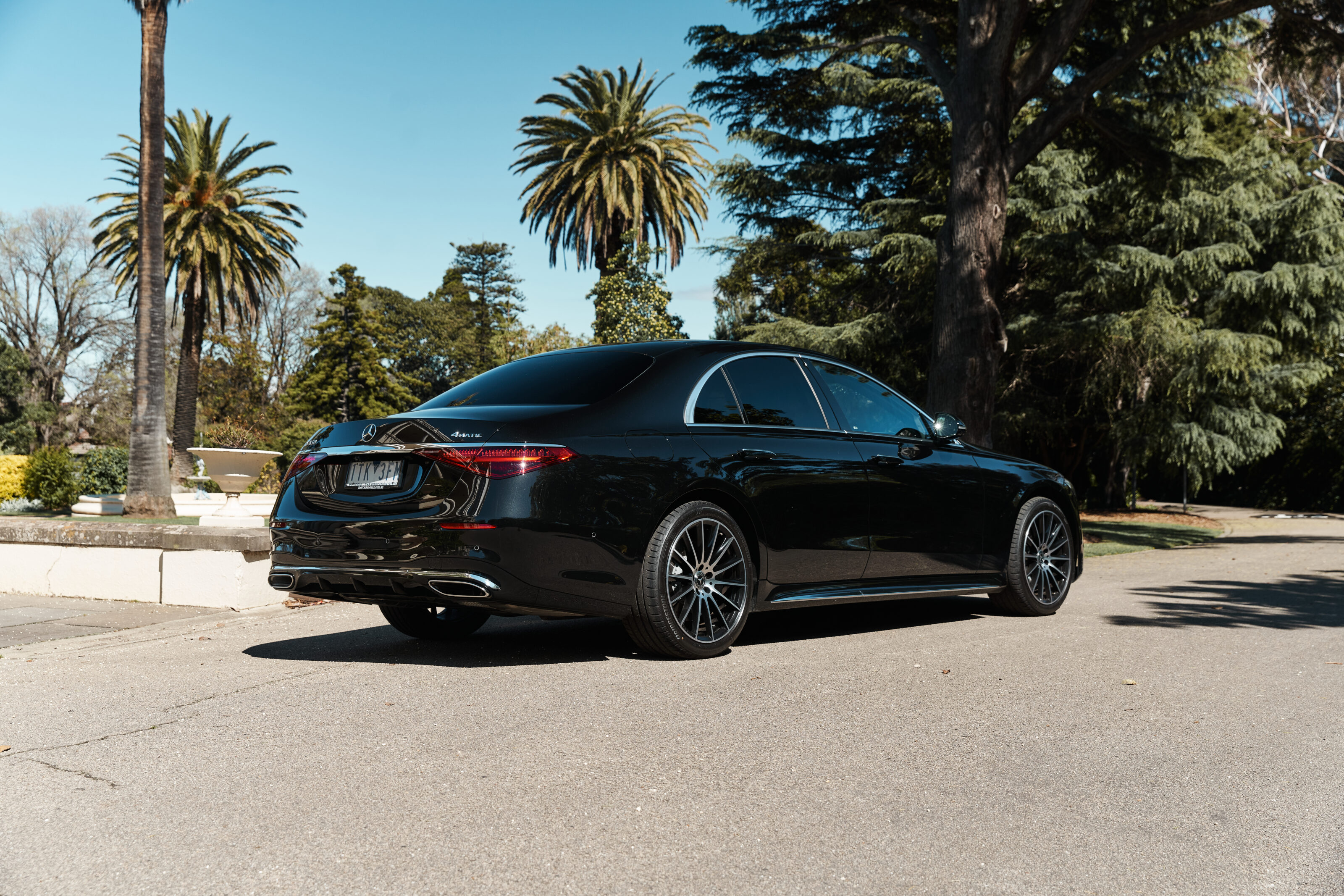
For 2022, pricing is actually marginally lower than for the previous year, dropping from $240,700 to $240,577 for the standard wheelbase, or from $264,900 to $264,777 for the long wheelbase. A range-topping S 580 L is also available for $329,776. Prices all exclude on-road costs.
The version tested here is the Mercedes-Benz S450 in standard obsidian black metallic paint – optioned with AMG Line trim ($6500), the Rear Entertainment Package ($8700), Rear Seat Comfort Package ($7800), Exclusive Package ($12,500), Energising Package ($11,000) and rear-axle steering ($2700). In total that adds up to $289,777 worth of car, before on-roads.
Features

As you would expect of an S-Class, the supremely elegant S 450 certainly cuts a dash. The design oozes executive appeal, with ultra-tight shut lines and an unmistakably efficient shape – its 0.22 Cd makes it one of the most aerodynamic cars available in the world – while also sporting a muscular stance, in this case enhanced by optional AMG Line styling, 20-inch multi-spoke wheels in high-gloss black and larger brakes on the front axle. It has real road presence, especially given the vehicle’s size.
Move inside and the ultra-luxury experience is taken up another notch. The interior features Exclusive Nappa Leather upholstered seats so comfy you can sink right into them, a high-gloss black poplar wood trim for the dash and a centre console decked out in a black crystal look. The AMG-Line multi-function sports steering wheel is also swathed in the same Nappa leather to complement its surroundings.
If there’s just one thing that stands out, it is the velour head cushions attached to the headrests. The look of the material here is just a touch at odds with the overall aesthetic, even if they are incredibly comfortable.

The presence of a dual-sliding glass panoramic sunroof for front and rear occupants gives the cabin a bright and airy feel, enhanced by ambient lighting (available in a variety of colours controlled through the infotainment hub) running along the lengths of the doors and the dash, while the 710W 15-speaker Burmester sound system is nothing short of cinematic.
Up front, electronically adjustable seats with memory function can be controlled from conveniently placed five-way buttons on both doors, which also allow occupants to turn on heating and ventilation depending on the weather.
Though many modern cars, especially those at the pricier end of the scale, now have head-up displays, the S 450’s goes the extra mile – not only showing the digital speedometer but also sat-nav directions through its augmented reality function.
Rather than embodying the best of the current age, the S-Class usually gives a glimpse into the future.

For example, animated turn-off arrows are virtually and precisely projected onto the road lane, telling the driver when to turn and at what angle. It sounds like it would be distracting, but is in fact extremely useful and hopefully will make those ‘damn, I just missed my freeway exit’ moments a thing of the past.
The showpiece in this car though has to be the 12.8-inch OLED portrait touchscreen, which cascades down from the top of the dash to the centre console and is home to Mercedes’ second-generation MBUX infotainment system.
Its image quality is just on another level compared to any in-car screen we’ve seen – the definition is crystal clear, with every colour appearing bold and vivid against the black trim surroundings.

The menus found within are fairly logical and easy to use at a standstill, if potentially a bit fiddly on the move – as are a few other things.
These include the button to switch driving modes (you can easily end up hitting the one next to it instead when trying to click right), the gearshifter being on a stalk behind the steering wheel (it’s too easy to knock into neutral accidentally and I much prefer a traditional setup) and the adaptive cruise control can be complicated to configure while driving, largely due to the capacitive touch pads used to control it on the steering wheel (like an iPhone screen) that are sometimes slow to react and just not as intuitive as physical buttons.
As well as featuring wireless charging and Apple CarPlay/Android Auto capabilities, MBUX provides Mercedes Me app connectivity and the ‘Hey Mercedes’ voice control function that is simple to use and a lot of fun – like having your very own butler in the car with you.
Don’t feel like turning on the seat massage (there are multiple options to choose from depending on the mood you’re in) yourself or pushing the button to bring up the rear sun-blind? They’ve got it covered. There were only a few times we asked it to do something for us where it wasn’t able to comply – an impressive feature to have.

Equally impressive is the 12.3-inch digital instrument cluster, which tracks the eye movements of the driver and passenger to recognise who’s in the hot seat and adjusts to their preferred settings accordingly – as well as boasting a 3D effect that is jazzy, if a little distracting at times.
Through a series of different layouts, you can opt to have a map fill the whole binnacle screen, or dedicated displays such as Classic and Sport – though we feel the bright red colouring of the latter is a little garish and unbecoming of an S-Class model that doesn’t have the full-blown AMG performance.
In a similar vein, when stopped at a red (and you’re not at the front of the queue) up pops a traffic light view showing what’s happening in front of you at the junction. Sounds cool, although we feel it’s a tad gimmicky and we can’t quite work out what purpose it really serves.

In addition to the main touchscreen, two smaller 11.6-inch units are included for back seat passengers on this test car, which have to be optioned via the Rear Entertainment Package – a nice to have if someone needs to spend extended time in the second row and wants to relax watching the box. Headphones are also included as part of the deal.
There are too many optional extras to list here, but in addition to those already mentioned (or packages for rear occupants placed on this test model and outlined below) buyers can opt for the long wheelbase – which brings with it as standard forward-facing airbags for the second row (a world first), electrically adjustable rear seats with memory function and dual-zone climate control like that found in the front.
Comfort and space

The words comfort and space literally sum up some of the best features of this vehicle – especially the second-row experience, which is more akin to flying business class than sitting in the back of a car.
As mentioned, the Exclusive Nappa leather (courtesy of the Exclusive Package) throughout is soft, supportive and exudes luxury. And it is well complemented by the Dinamica microfibre headlining.
The SWB measures 5179mm in length, with a width of 2109mm and height of 1503mm – its wheelbase is 3106mm, 110mm shorter than the LWB.

Although it could be argued that the SWB is more of a driver’s car than a limo – those seeking the latter are perhaps more likely to go for the LWB – the standard version holds its own. It’s hard to imagine anyone being uncomfortable or feeling cramped in the back seats with all the bells and whistles on offer – even more so with the optional Rear Entertainment, Rear Seat Comfort and Energising packages we have here.
There’s more than enough legroom for rear passengers, as well as those in the front, and the boot holds 550L which is comfortably capacious enough for two large suitcases and two smaller sized ones for trips to the airport and the like.
It’s hard to imagine anyone being uncomfortable or feeling cramped in the back seats, with all the bells and whistles on offer.

The Rear Entertainment Package does what it says on the tin and includes the two aforementioned 11.6-inch touchscreens for occupants to use to watch TV or listen to music.
There’s also a separate tablet housed in the centre armrest/middle seat for passengers to have an almost entirely distinct in-car experience from those up front, providing the ability to control features such as the two-zone climate control, seat position and massage if they wish.
One particularly satisfying element that warrants a mention here is the way in which you dock the tablet – instead of just a simple button to click it in place, the charging port is motorised and couples automatically with a completely silent motion when you place the tablet in its spot. It’s the small things like this that show Mercedes has really put effort into making every experience in the car a real luxury, even down to the last detail.

As in the front row, rear seats are electrically adjustable (due to the options fitted to this car) with controls on the doors as well as through the tablet, and passengers can also make use of two USB-C ports and cup holders.
The addition of the Energising Package is where the S-Class really stands a cut above the rest. Not only does it include a perfume (housed in the glovebox) to provide a relaxing, almost spa-like, scent but clever technology activated by the touch of a button or voice command changes the lighting and music to make the environment more relaxing – handy for captains of industry who need some downtime after a stressful day.
On the road

Though the S-Class is an undeniably comfortable and luxurious affair that’s generally chosen by those who want to be ferried around, this is also a car the driver can genuinely enjoy.
Powered by a 3.0-litre inline six with mild hybrid “EQ Boost”, mated to a nine-speed automatic transmission, the S450 produces 270kW of power and a brawny 500Nm of torque. It’s definitely no slouch and feels like it can respond with plenty of oomph regardless of the speed.
While Comfort mode certainly maintains the elegant status quo with almost imperceptible gear changes, Sport or Sport + show that there’s more to this machine than doubling as a plush airport lounge on wheels.
With the latter in particular, throttle response sharpens dramatically, and the steering weights up nicely without feeling artificial. Suddenly it feels much lighter on its feet for what is still a considerably long and heavy car.

In fact, the steering is really well judged overall, and really inspires confidence that you can place the car on the road just as easily as you would a compact hatchback. This is in no doubt helped by the optional rear-wheel steering system fitted to this car, allowing it to tuck itself around tiny, tight roundabouts like it’s half the size.
This is because the steering angle at the rear axle is up to 10 degrees, reducing the turning circle by as much as two metres to less than 10.9 metres. On faster, flowing corners, the smallest S-Class also handles impeccably. It feels surefooted and provides excellent grip and control thanks to its 4Matic all-wheel-drive setup.
Mercedes’ Airmatic air suspension also ensures a wonderfully smooth ride, absorbing all the bumps and lumps with ease, though particularly large ones can cause some slight reverberation.

Engine sound can be a little more intrusive than you’d expect, especially on start-up, but overall road clamour is negligible and the resounding impression is of a hushed and serene atmosphere for everyone onboard, helped by noise-insulating acoustic glass on the front windows.
Meanwhile, brake pedal feel is not as good as it could be. Though there’s nothing wrong at all with the braking force itself, it’s just not communicated as strongly to your foot as we’d like. It means you have to press harder than you’d expect, which is surprising for a vehicle of this ilk.
Officially rated at 8.6L/100km on the combined cycle, we’ve found the best fuel economy we could achieve in this S-Class was 9.2L/100km despite the assistance of the mild-hybrid EQ Boost. Pretty close, given we drove on a mix of roads and enjoyed the full potential of Sport + quite frequently.
Safety and ownership
The S 450 comes with a host of active and passive safety systems across its line-up – which are all standard with the exception of the forward-facing airbags in the second row as mentioned above as these are available only on the long wheelbase variant.
Highlights include:
- Active distance assist
- Route based speed adaptation
- Evasive steering assist
- Active stop and go assist
- Extended automatic restart in traffic
- Active lane change assist
- Pre-Safe Plus including impulse side
- Urban Guard vehicle protection
- 10 airbags
- Electronic stability program
- Traffic sign assist
- Parking Package with active parking assist and 360-degree camera

The fifth-generation S-Class has new and numerous improved functions, such as intelligent compliance with speed limits. For the most part, we found it to be pretty accurate at acknowledging changes along the freeway, although sometimes it wasn’t entirely on the money, showing you shouldn’t rely on the car to do all your thinking for you – even if it is an incredibly capable machine.
Lane-change assist gently draws the vehicle back into the middle of the lane without making any sudden, jerky movements – or using a loud and annoying noise – if you come too close to leaving it. A series of beeps also occurs if you let go of the steering wheel for too long but in no way is the alarm aggressive, which is in keeping with the premium feel.
Though the adaptive cruise control works well, it isn’t the most straightforward to set up, which is a surprise considering such systems are far easier to use in some far less luxurious vehicles. Put it this way, you’ll want to figure it out before you go anywhere as trying to understand it on the move is tricky and distracting.
The 2022 S 450 does not have an ANCAP rating.

As the S-Class luxury sedan is Mercedes-Benz’s flagship model and comes with a hefty price tag, it’s unsurprising that it doesn’t sell in big numbers. If everyone had one, what would be the appeal after all? Year-to-date 175 have been sold, with 11 of those in September (LWB and S 580 included).
It leads its upper large (more than $100,000) segment rivals such as the Audi A8, Porsche Panamera and Lexus LS that have sold just 23, 42 and 30 units respectively.
All Mercedes-Benz products come with a standard five-year/unlimited-kilometre warranty – with three years of capped-price servicing at intervals every 12 months or 25,000km.
VERDICT

The 2022 Mercedes-Benz S 450, much like its predecessors, is the ultimate in automotive luxury. While it certainly comes at a price, there’s a lot of kit in there to justify almost every dollar, and it’s the combination most of us can only dream of having in a vehicle – providing the optimum balance of performance, comfort and safety.
Highlights for us are the large portrait touchscreen, which is unparalleled in other vehicles of this segment, the ‘Hey Mercedes’ voice control functionality, and the engaging handling and steering, which you just don’t expect from a car of this size or class.
There’s no doubt this is an exceptional vehicle. It continues to lead where others follow, and delivers on defining the standards of luxury.

While the S-Class is slightly let down by the brake pedal feel and louder-than-expected engine, there’s no doubt this is an exceptional vehicle and lives up to the standards you’d expect of Mercedes-Benz’s flagship model. It continues to lead where others follow and delivers on defining the standards of luxury in this segment.
If we had to choose, we might opt for the long wheelbase to get the rear front facing airbags and electrically adjustable second-row seats as standard – as well as the extra 110mm of legroom of course.
The S 450 SWB costs $240,577 before on-roads and all the options outlined here, which push the price up to $289,777 + ORC. By comparison, the Audi A8 is $167,515 + ORC and a Lexus LS $218,115 drive-away while the Porsche Panamera range kicks off at $232,463, also drive-away before any extras are added.
2022 Mercedes-Benz S450 4 MATIC specifications
| Body | Five-door sedan |
|---|---|
| Drive | all-wheel |
| Engine | M256 3.0-litre six-cylinder petrol with EQ Boost |
| Gearbox | nine-speed automatic |
| Power | 270kW @ 5500-6100rpm |
| Torque | 500Nm @ 1600-4500rpm |
| Compression ratio | 10.5:1 |
| 0-100km/h | 5.1sec |
| Fuel consumption | 8.6L/100km (combined) |
| Weight | 2076kg (kerb |
| Suspension | Airmatic air suspension |
| L/W/h | 5179/2109/1503mm |
| Wheelbase | 3106mm |
| Brakes | Ventilated discs front and rear, front are perforated |
| Tyres | 255/40 R20 (front); 285/35 R20 (rear) |
| Wheels | 20-inch |
| Price | $240,577 + ORC |
On our travels across the world wide web, it’s not just cars that catch our eye. Sometimes it’s scale models, posters, watches and toys. Whether you’re looking for a missing piece for the house, or wanting to expand your track pack, here are ten cool products that we’ve been lusting over lately.
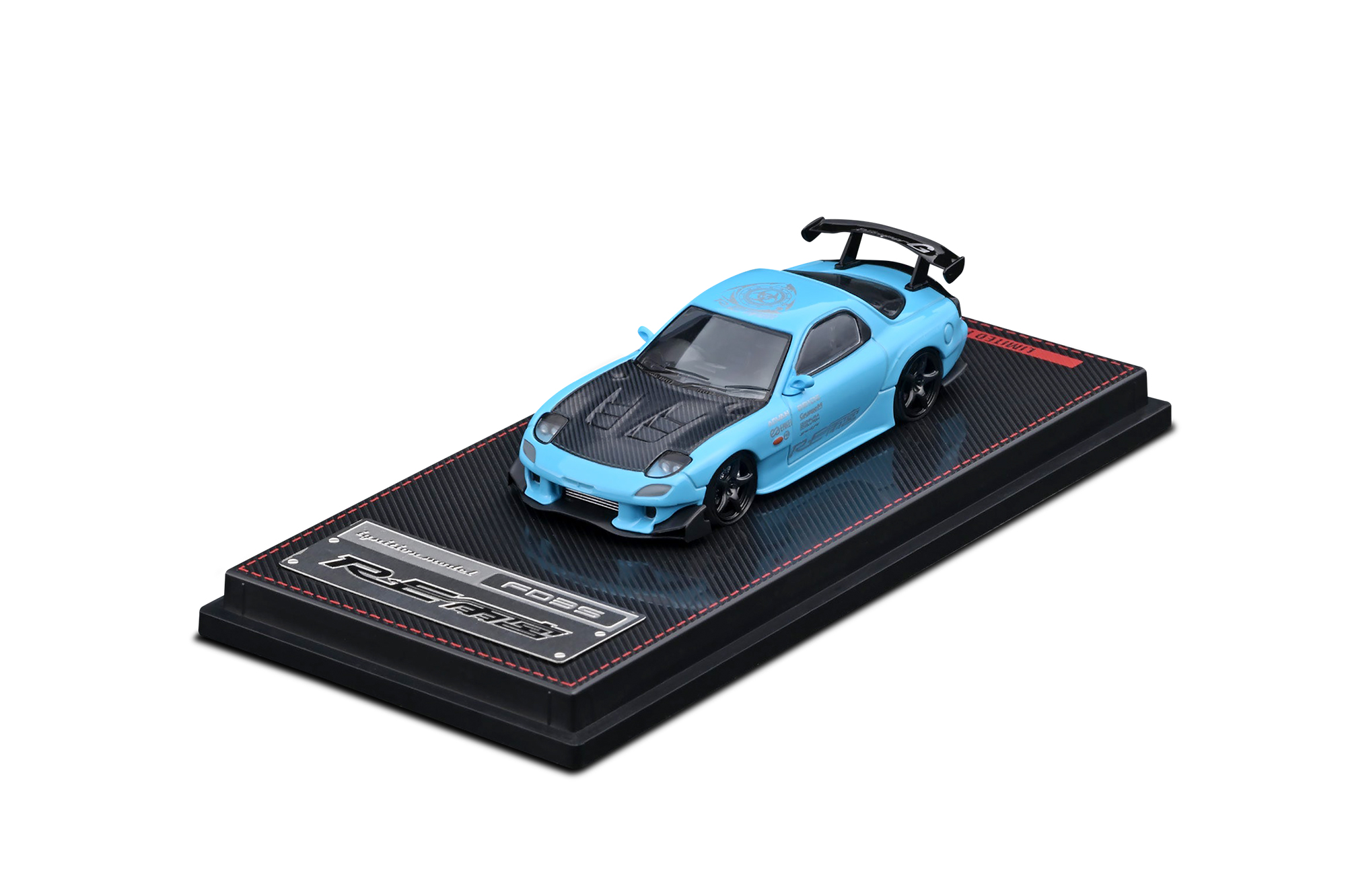
1:64 Mazda RX-7 RE-Amemiya Ignition Model – $50 – anthonysdiecasts.com.au
Ignition Models produce incredibly detailed 1:64-scale models with their finger on the pulse of the JDM tuning industry.
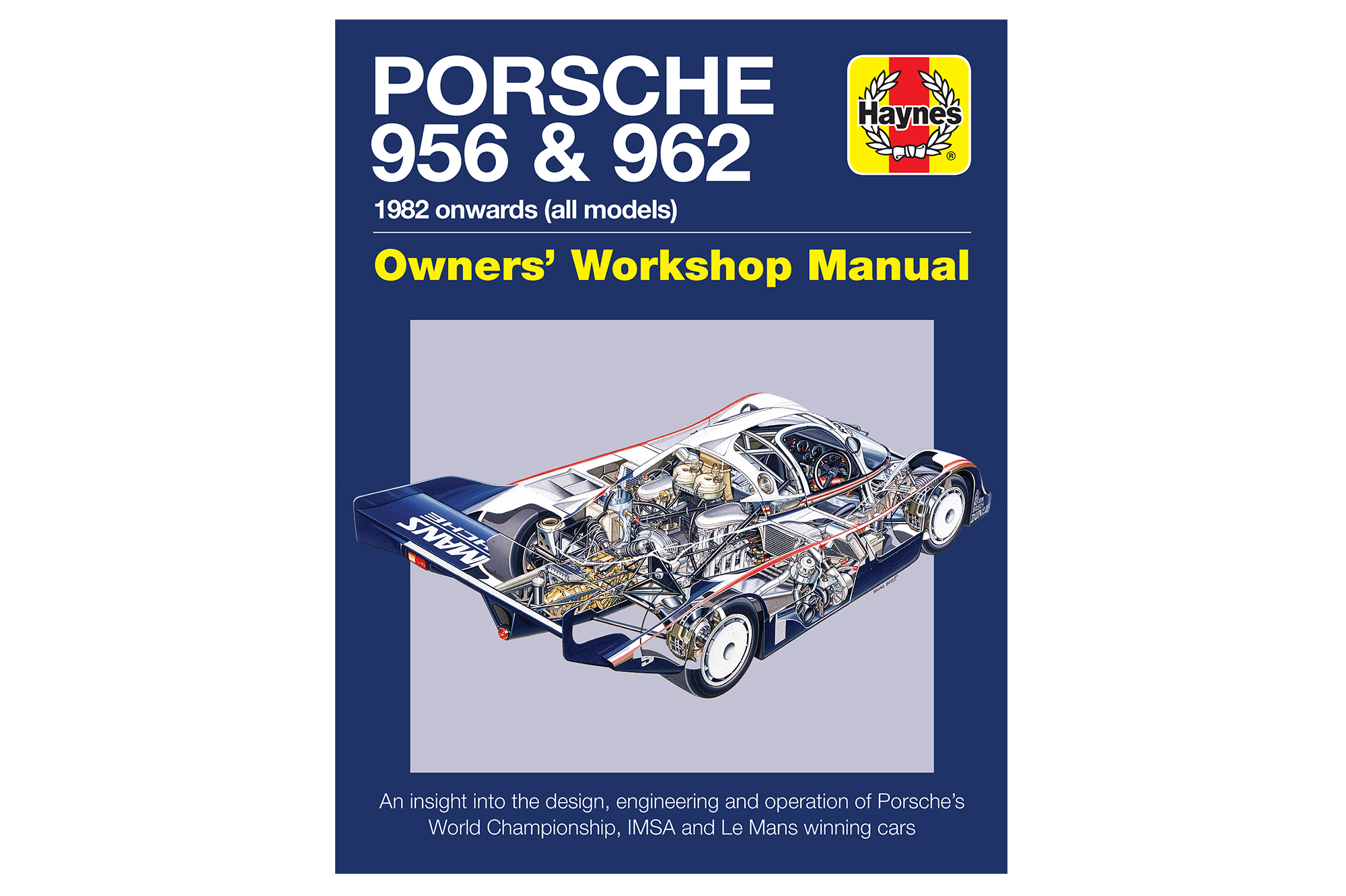
Haynes Workshop Manual – Porsche 956/962 – $50 – haynes.com
Main dealer servicing bills crucifying you? Haynes has the perfect way to save a few bucks when servicing your Porsche prototype.
Rolf Stommelen 1976 Porsche 935 Print – $85 – ricardo-car-artwork.com
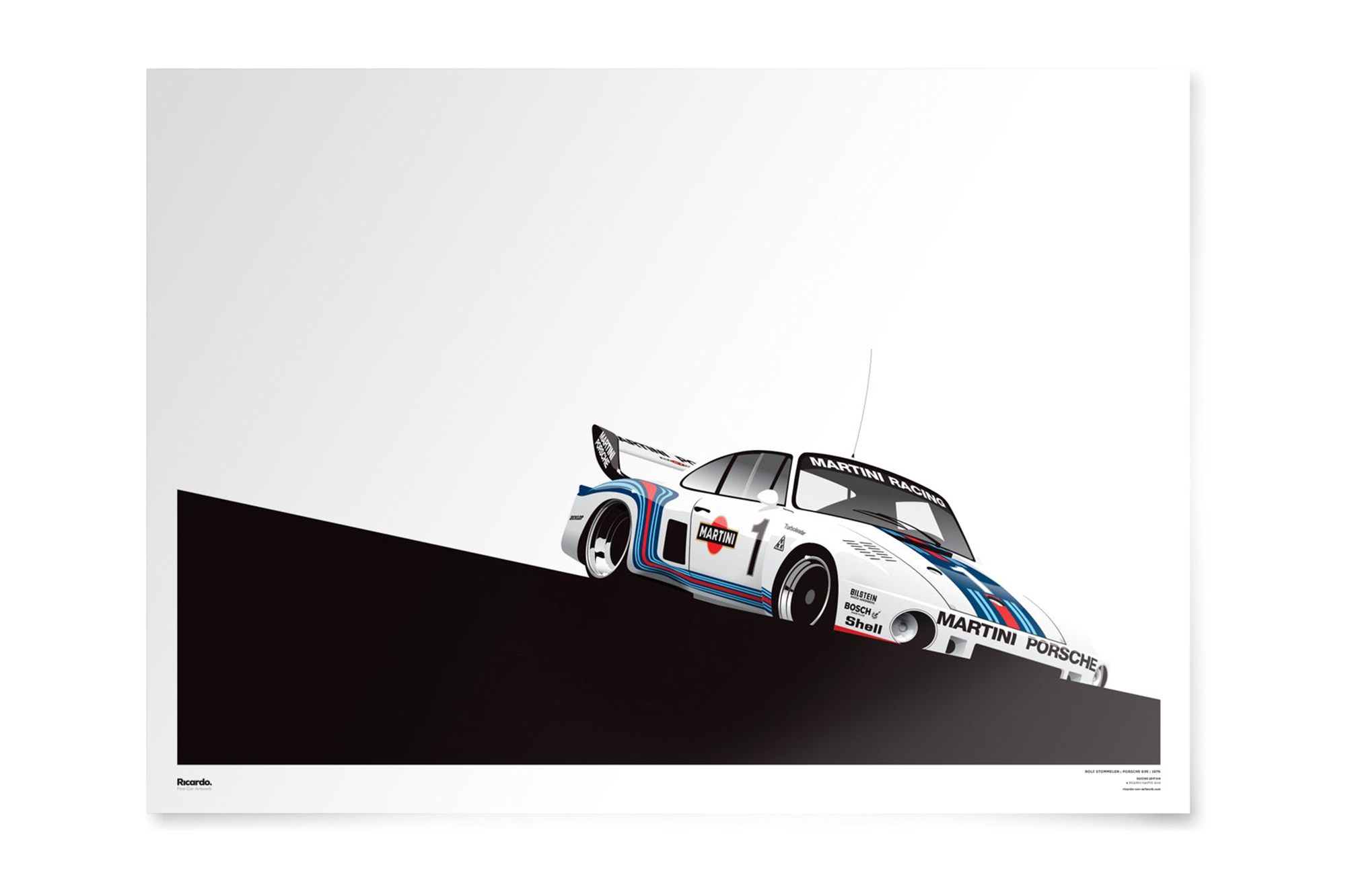
Ricardo Santos is a Portuguese graphic designer producing stunning art pieces featuring some of motorsport’s biggest icons.
Omega Speedmaster 65th Anniversary – $123,750 – omegawatches.com
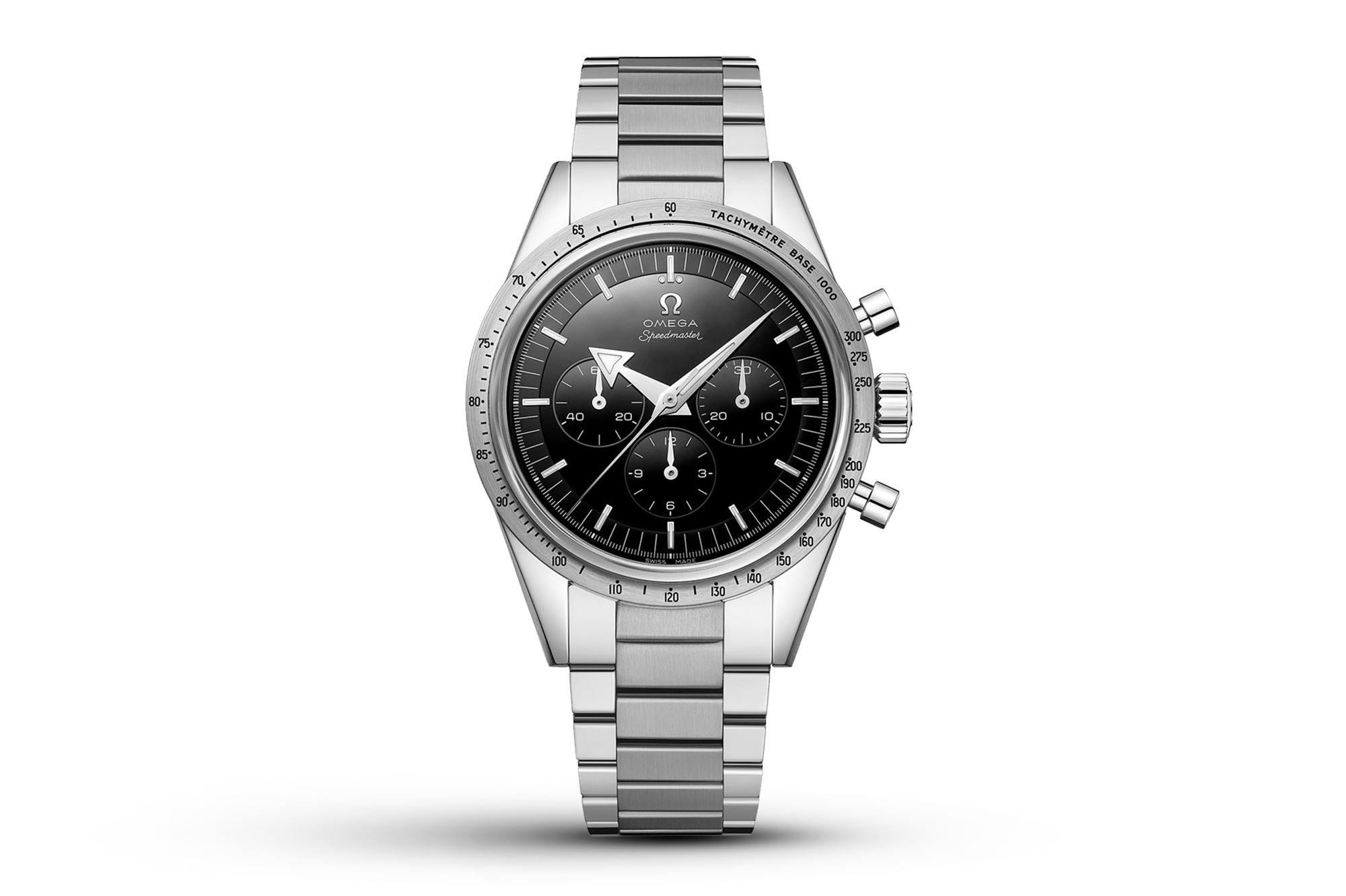
Broadarrow hands, the historic recently-revived Calibre 321, straight lugs, Dot-over-90 tachymeter bezel; this white ‘Canopus’ gold anniversary special ticks all of the Omega collecting boxes while flying well under the radar.
‘The Batman’ Lego Technic Batmobile – $170 – lego.com
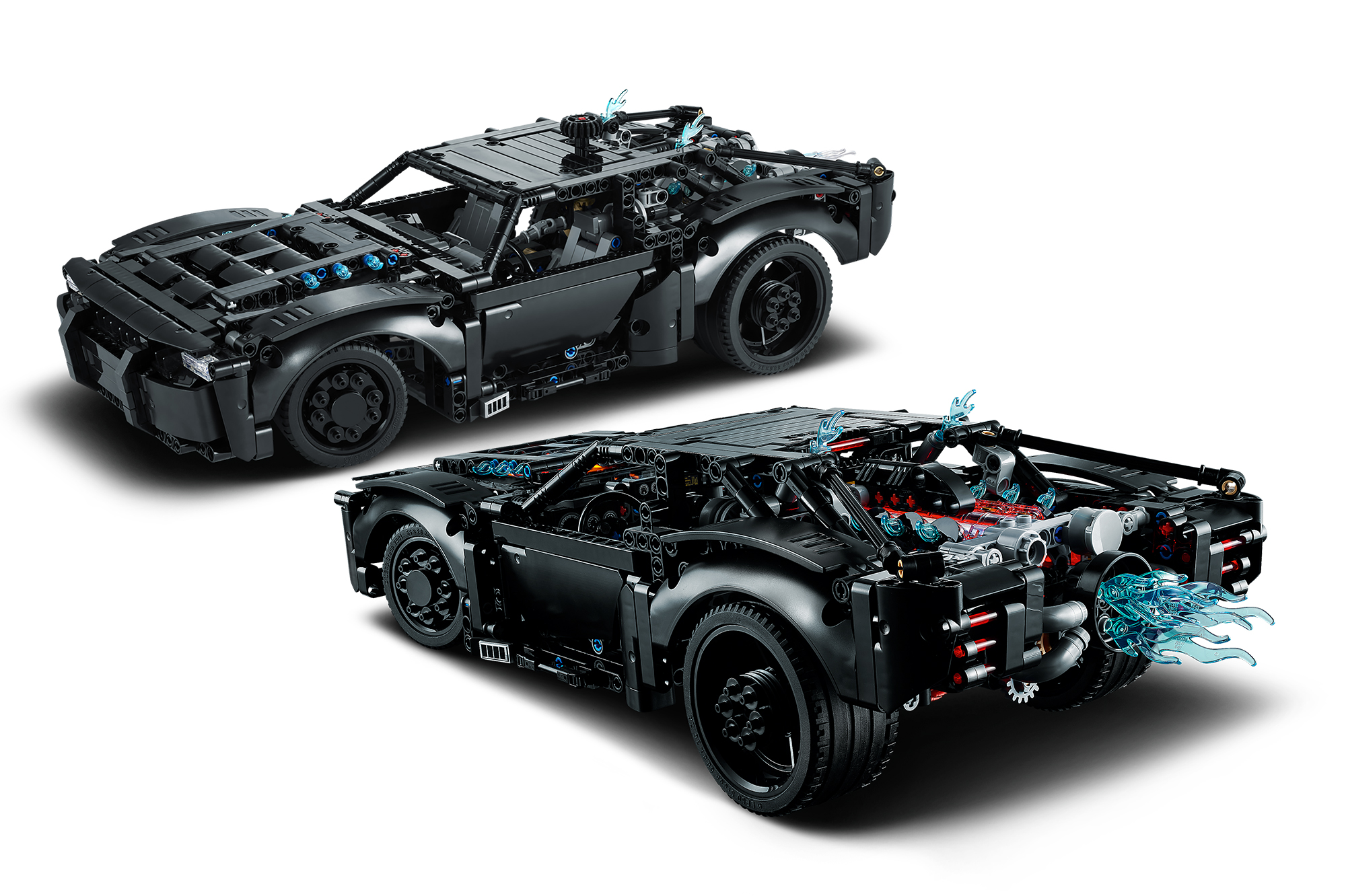
Matt Reeves’ upcoming ‘The Batman’ movie sees our Caped Crusader behind the wheel of a rear-engined V10 tube-chassis hot rod. Lego has released its Technic version, comprising 1360 pieces with moving pistons, rotating differential with functional illuminated ‘light bricks’.
Track Pack
Jackaroo 1.5T Extra Low Trolley Jack – $572 – proworkshopgear.com.au
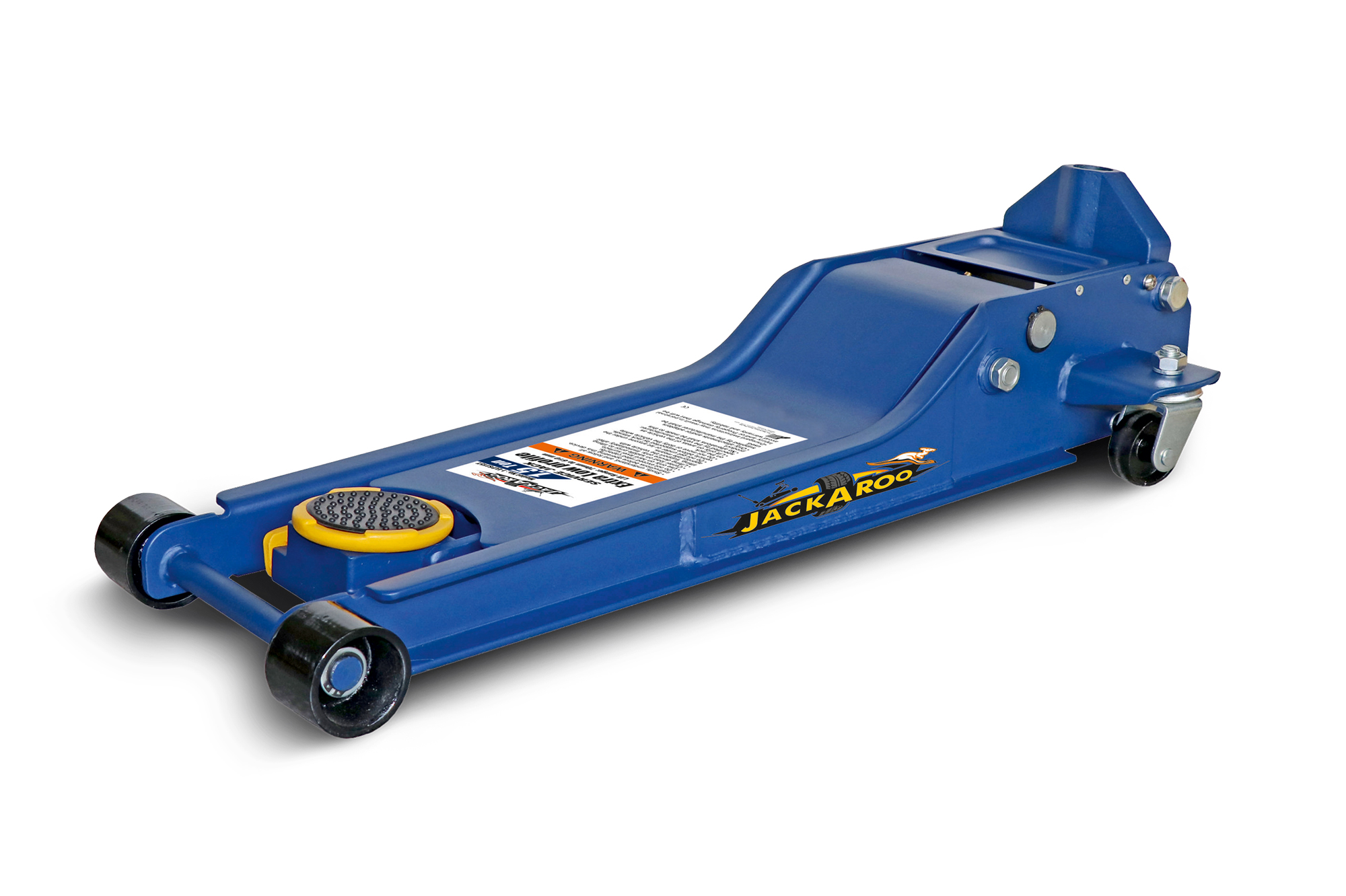
Lowered cars can be a pain to get in the air. An extra low-profile trolley jack can eliminate the need for ramps, this one measuring 70mm at its lowest. Dual pump, built-in safety valve with a 1500kg capacity.
Formawerx 911 Homage Key – $400 – formawerx.com
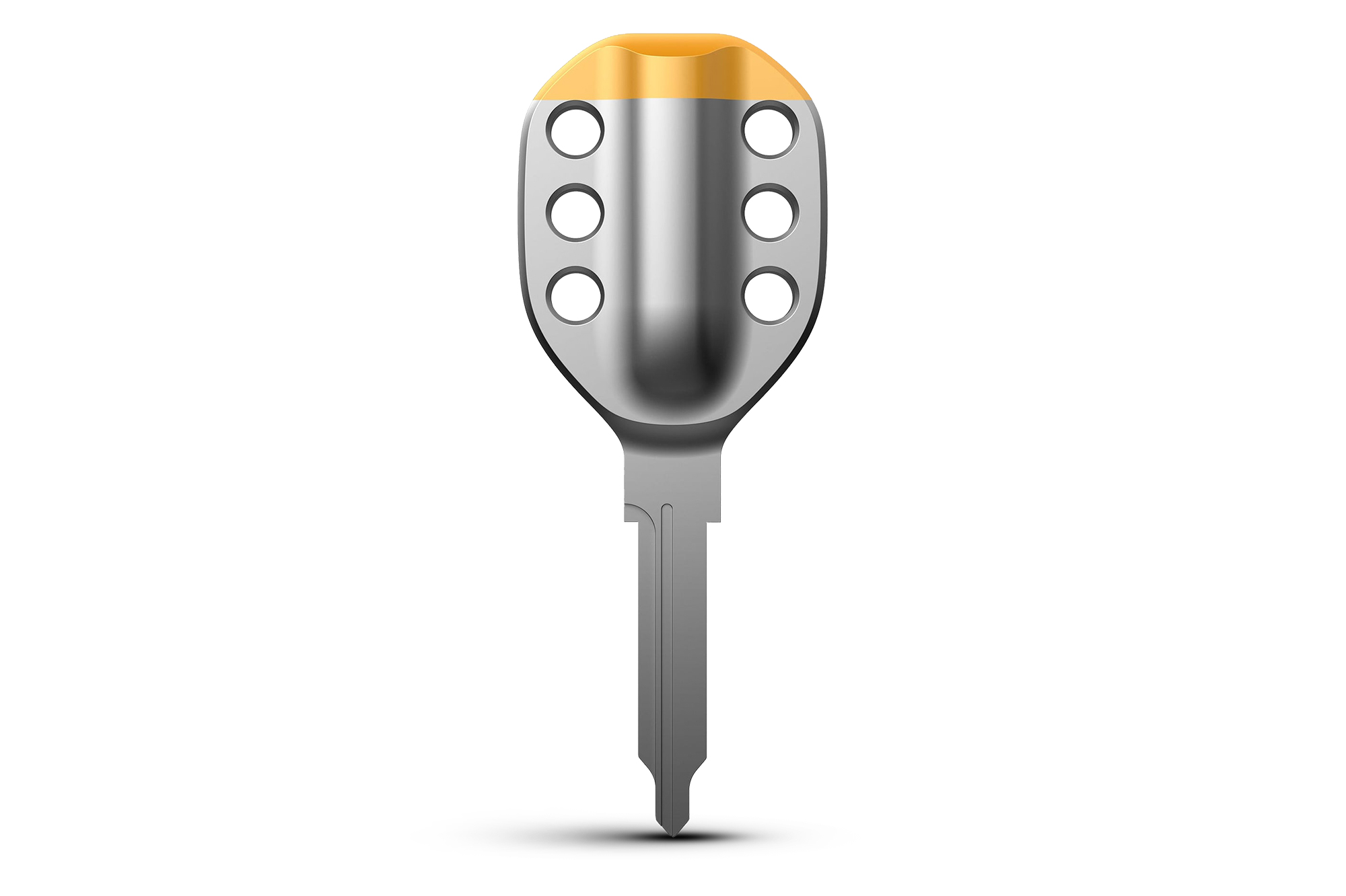
These finely finished key blanks from Formawerx, for the classic 911, reference Porsche’s Group 6 prototypes with a range of colour options.
RaceLogic Performance Box Touch – $1099 – vboxaustralia.com.au
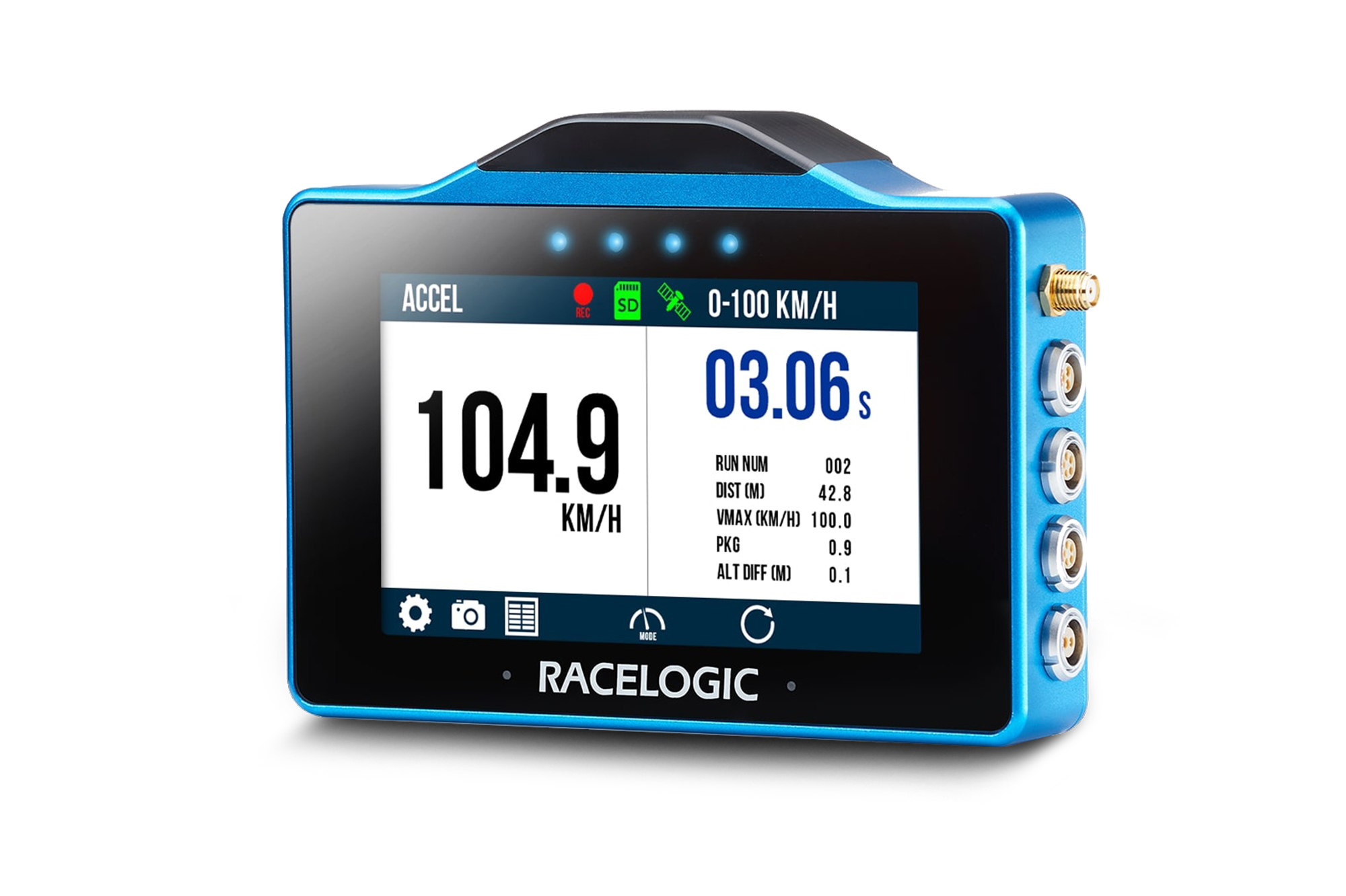
GPS-based data capture system tracks your vehicle’s speed, g-force and handling and can greatly aid on-track driver development.
Piloti ‘Pinnacle’ Black – $265 – piloti.com
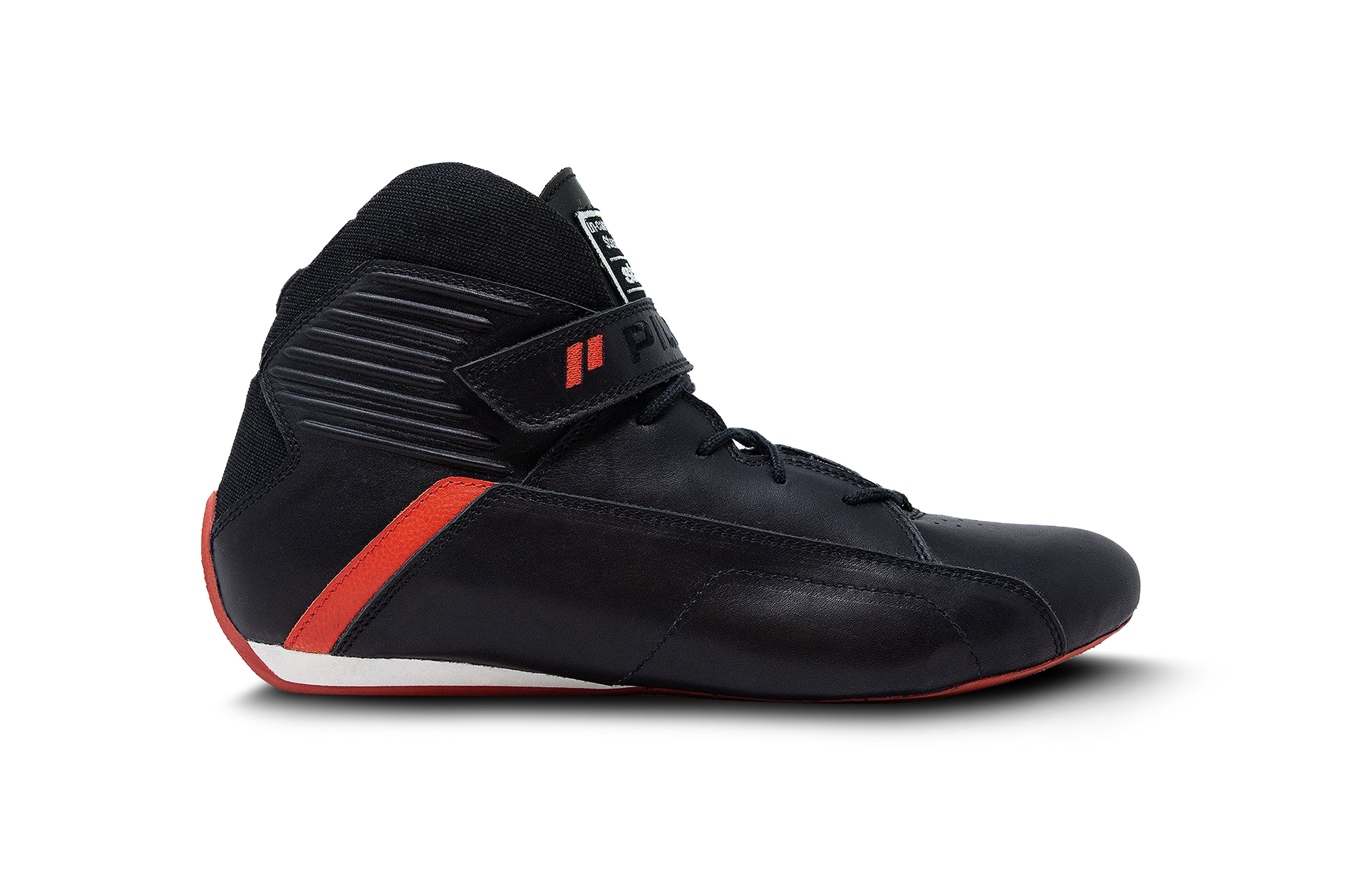
Developed in conjunction with racewear veterans, Stand21, Piloti’s Pinnacle driving shoe is FIA-certified and SFI-rated. Fire retardant, with anti-vibration sole.
Armadillo Reservoir Bag – $99+ – giantloopmoto.com
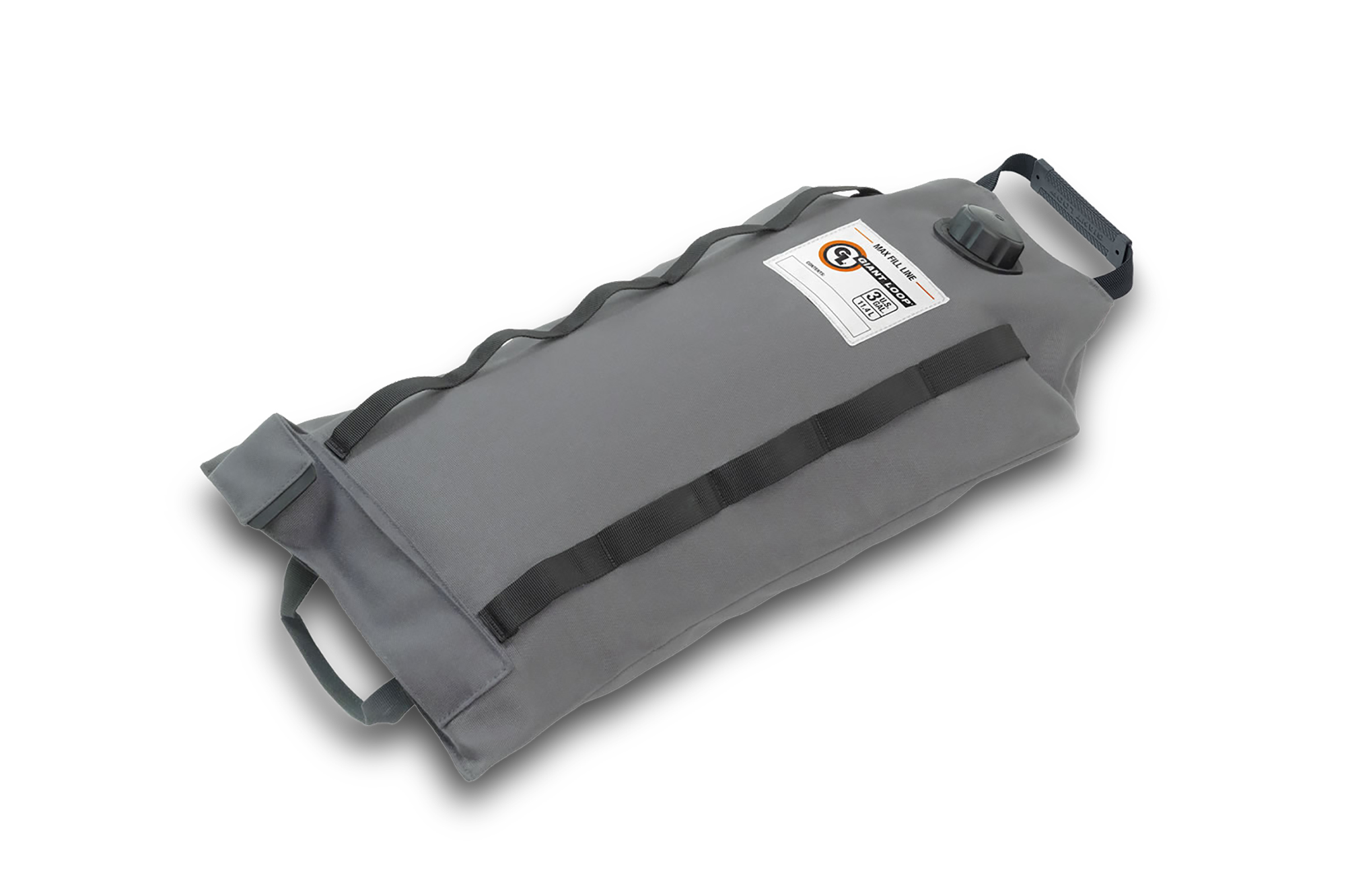
Going on a trip and need some versatile fuel stowage? These convenient bags make carrying extra juice extra easy. Dual layered with spout included.
