
DS, the luxury arm of Citroen, has shown how learnings and technology from its six years in Formula E can be developed into road car applications.
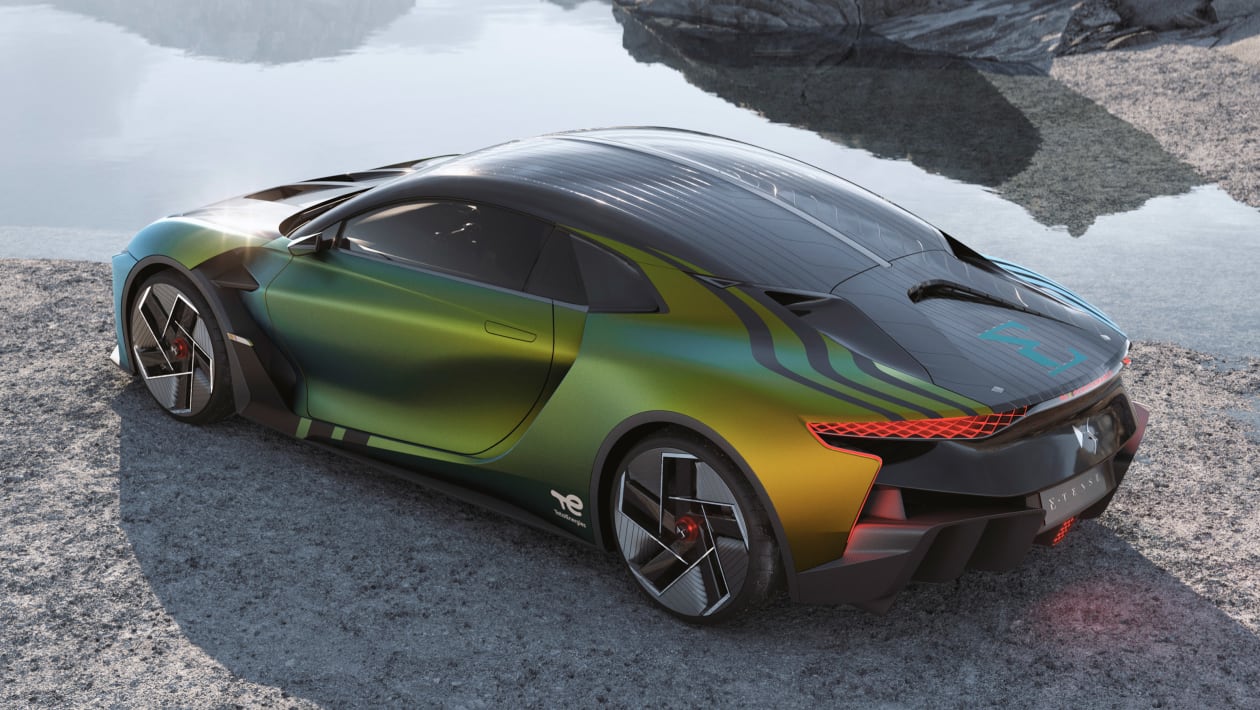
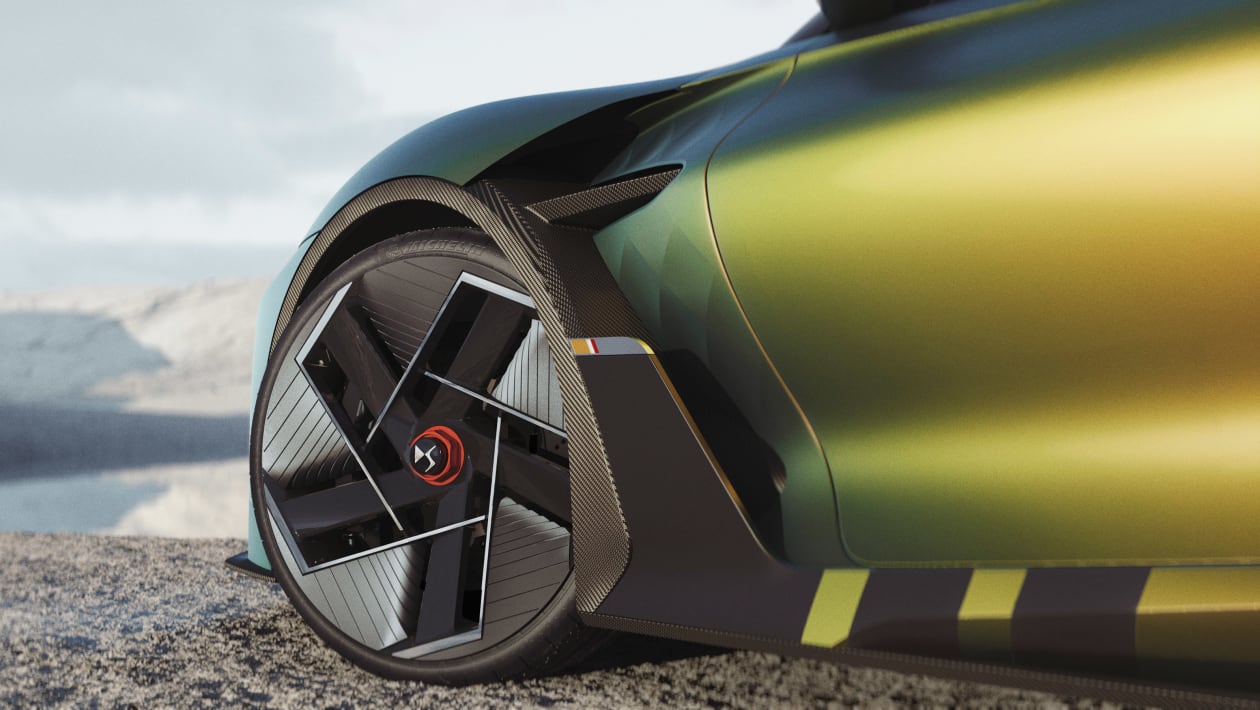
A facelift of the concept first shown off at the 2016 Geneva Motor Show – albeit with far lower power expectations – the E-Tense Performance is an electric coupe produced with a lightweight carbon fibre body and chassis, and a powerful twin-electric motor setup for all-wheel drive.
DS claims output reaches almost 600kW and a huge 8000Nm (not a typo) of torque which would give the car a sub-three second 0-100km/h sprint if it can get it to the ground.
However, it is also the other electric architecture which is even more interesting.
No driving range has been given but DS says the E-Tense Performance uses clever battery technology for compact packaging and impressive regeneration, allowing extended driving.
The battery sits in a carbon-aluminum housing with what DS calls ‘innovative’ battery chemistry. The regeneration system which produces energy while the car is slowing down can regenerate at a high capacity of 600kW, effectively reversing the motor’s output.
Although shown in renderings for now, DS will produce a prototype vehicle and its Formula E team drivers Jean Eric Vergne and Antonio Felix da Costa will pilot the car on its first runs. Beyond that, DS says the technology has road car applications too.
“It is a laboratory that we will use to analyse the behaviour of components and to develop them with a view to future manufacturing,” said DS Performance director Thomas Chevaucher.
“The idea is also to find solutions to lower costs, make them easier to manufacture and explore implementations in production models. The next generations of the E-Tense range will benefit from these developments.”
DS hasn’t said if a production coupe will spawn from the E-Tense Performance but confirmed that the front-end design is the direction for the brand’s next-generation of all-electric cars.
The front grille in particular is an interesting design, using a digital surface and flanked by LED daytime running lights made up of 800 individual LED units.
Some features are more typical of a concept car however, such as the replacement of the headlights with a camera system for data collection and ‘beetle-effect’ pearlescent paint that shifts colour.
Snapshot
- Previous-gen Civic Type R resets its own lap record
- Honda has now set or beaten the front-wheel-drive record three times
- New Civic Type R expected to be revealed later this year
The FK8 Honda Civic Type R might have gone from Australia but that hasn’t stopped it leaving without writing one last chapter in its local legacy.
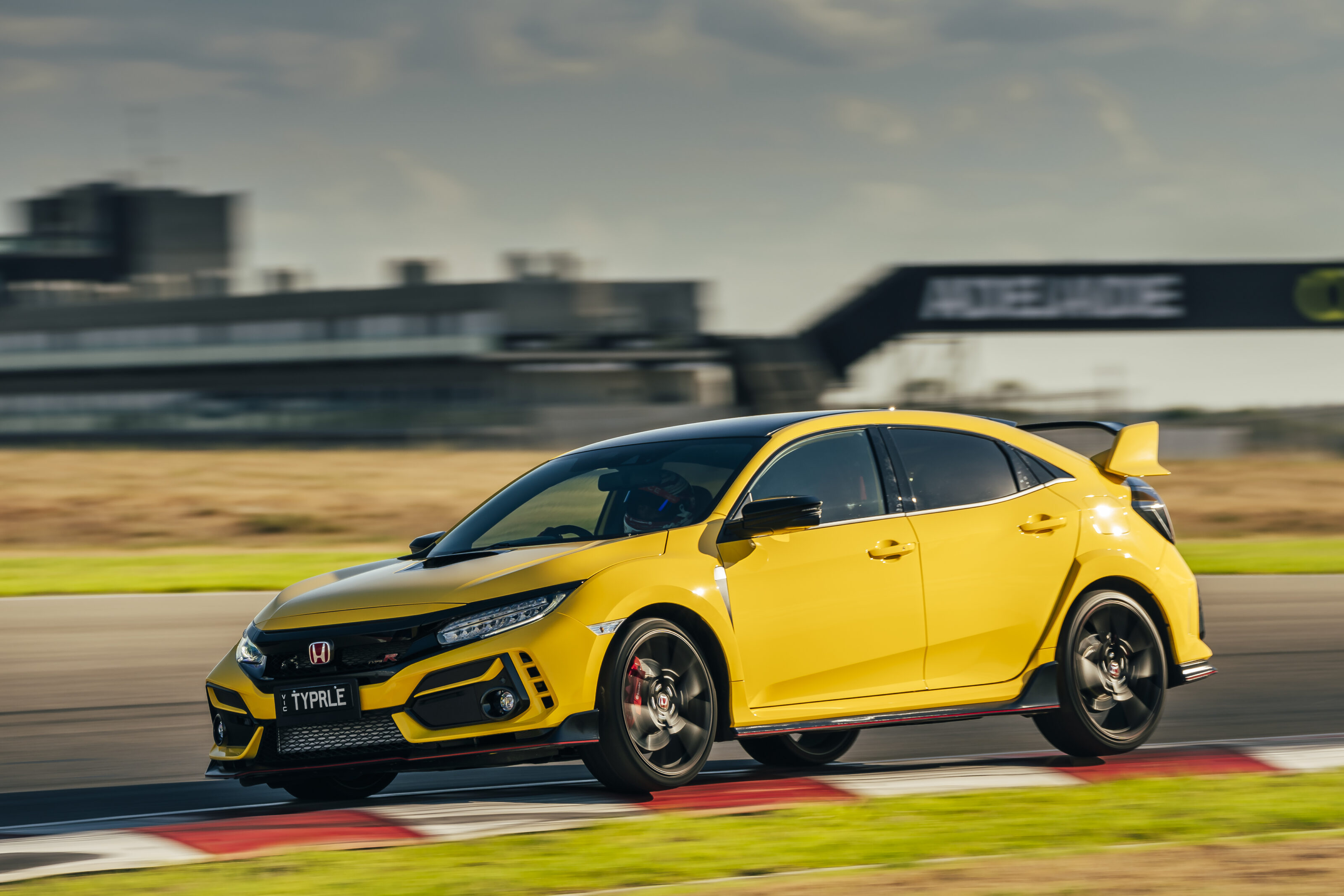
Launched last year as the final iteration of the fifth-generation Civic Type R, the Limited Edition was put through its paces at The Bend Motorsport Park in South Australia, setting a new front-wheel-drive production car lap record around the 4.95 kilometre International Circuit.
With 2019 TCR Australia runner-up and Supercars co-driver Tony D’Alberto behind the wheel, the benchmark time of 2:13.251 set earlier in the day aboard a standard Type R was beaten by just under a second, as the new record stands at 2:12.260.
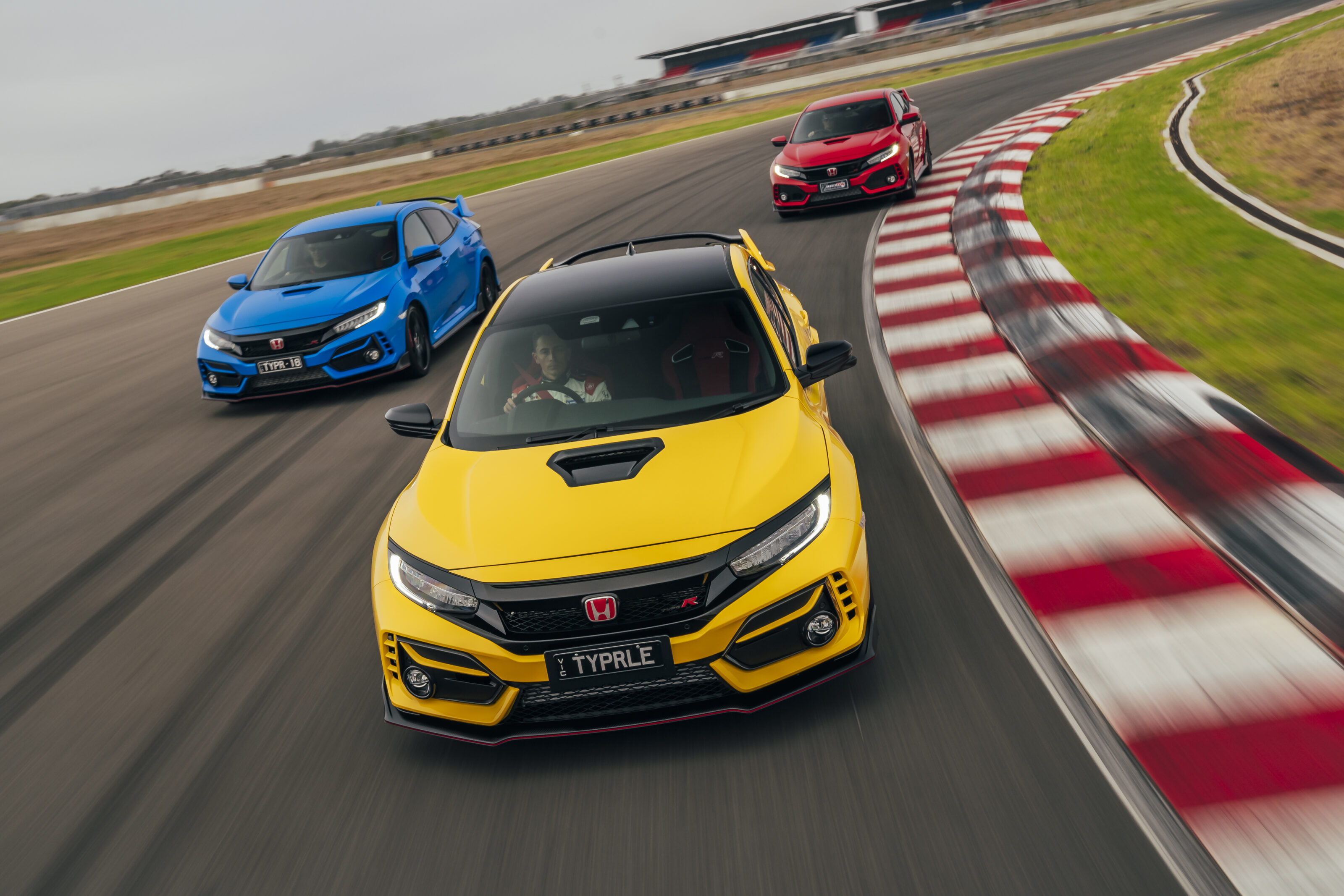
The time was also a full two seconds faster than the existing record of 2:13.251, set by James Moffat in a Renault Megane RS Trophy in late 2019 – repeating Honda’s breaking of Renault lap records after a similar feat was achieved at Suzuka two year ago.
Limited to 20 units, all of which were painted in Sunlight Yellow, the Limited Edition arrived in the middle of last year, selling out before the first examples turned up on local shores at around $70,000 before on-road costs.
Despite the 2.0-litre turbo four-pot remaining unchanged with 228kW/400Nm on tap, the Limited Edition went on a diet – scoring 20-inch lightweight BBS wheels shod in Michelin Cup 2 tyres, a deletion of its rear wiper, parcel shelf and sound deadening, attributing to a total loss of 17kg, now down to 1376kg.
Regarded as one of the best hot hatches on sale when it launched in 2018, the FK8 won two MOTOR Bang for Your Bucks titles in a row, beating out stiff competition from its European and Asian rivals.
However, the FK8 Type R is set to be replaced, making way for the high-performance variant of the 11th-generation Honda Civic, currently undergoing testing at Japan’s Suzuka Circuit with many expecting the existing Type R’s engine and drivetrain to carry across.
The Rolls-Royce Wraith and its convertible sibling, the Dawn, have been discontinued for the Australian market.
A spokesperson for Rolls-Royce confirmed the Wraith and Dawn can no longer be ordered, with the Phantom, Ghost, and Cullinan SUV now forming the company’s local line-up.
The decision to withdraw the vehicles in Australia leaves the luxury carmaker without a two-door model to sell until the pure-electric Spectre arrives in late 2023, and follows the removal of the Wraith and Dawn from the US market in 2021.
It’s likely the decision is related to a recent announcement by Rolls-Royce parent company BMW that it would end production of the 6.6-litre N74 twin-turbo V12 this year – an engine used by both the Wraith coupe and Dawn convertible.
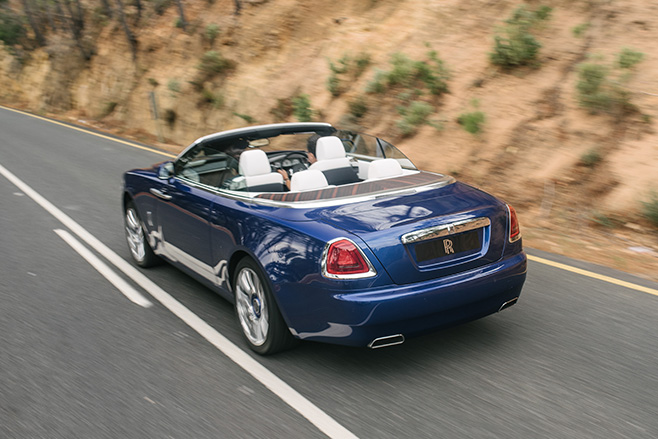
The Phantom, Ghost, and Cullinan all use a 6.75-litre twin-turbo V12 – also a member of the N74 engine family, but unique to Rolls-Royce – which will continue to be built for the foreseeable future.
The news comes off the back of a sales record for Rolls-Royce, with 5586 vehicles sold in 2021 – the most in its 117-year history.
In Australia, combined sales of the Wraith and Dawn amounted to 20 vehicles sold throughout 2021, or more than 60 per cent of all Rolls-Royce cars delivered to customers in the last calendar year, suggesting the decision to remove the two models was not due to a lack of interest.
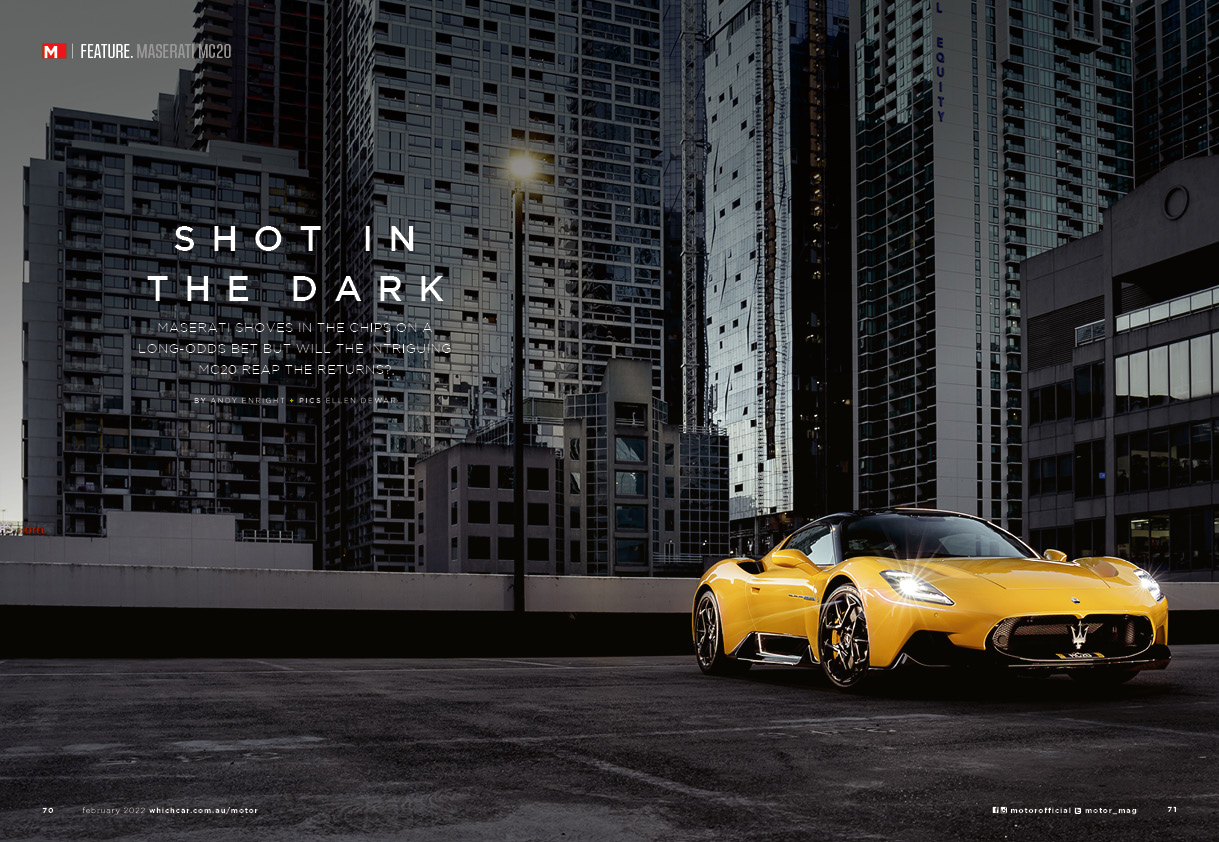
Recent history hasn’t been kind to the iconic Italian Maserati brand, but change could soon be afoot with a renewed corporate focus and a range of intriguing new metal on the way.
Central to Maserati’s resurgence is the radical MC20, as the brand bets heavy on a sleek mid-engined formula. There’s chequered precedence within the halls of Modena, in the form of the 1970s Bora, but until now, the brand has lacked a true halo flagship to add magic to its range of otherwise handsome SUVs and sedans.
With a 3.0-litre twin-turbo V6, an all-new forged carbon chassis, and a power-to-weight ratio that bests a Porsche 911 Turbo S, the MC20 might just be the most important new Maserati ever. We wrangle the first example in the country and spend a night out on the town to experience this monumental step change for ourselves.
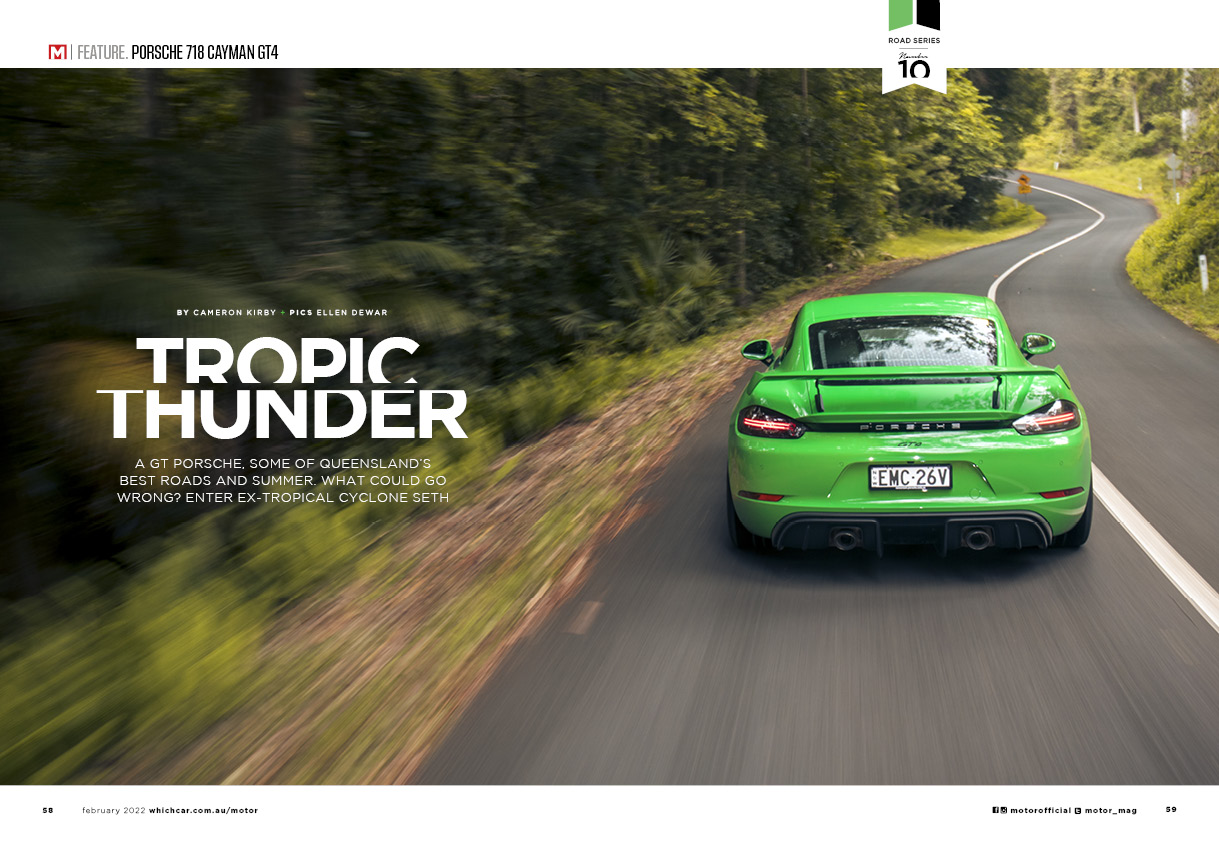
From the bright lights of Melbourne we travel to the sopping tropics of Queensland. Bundaberg native Cameron Kirby takes to the wheel of Porsche’s track-focused Cayman GT4, and navigates 398 kilometres of Queensland’s best roads while outrunning an approaching storm front.
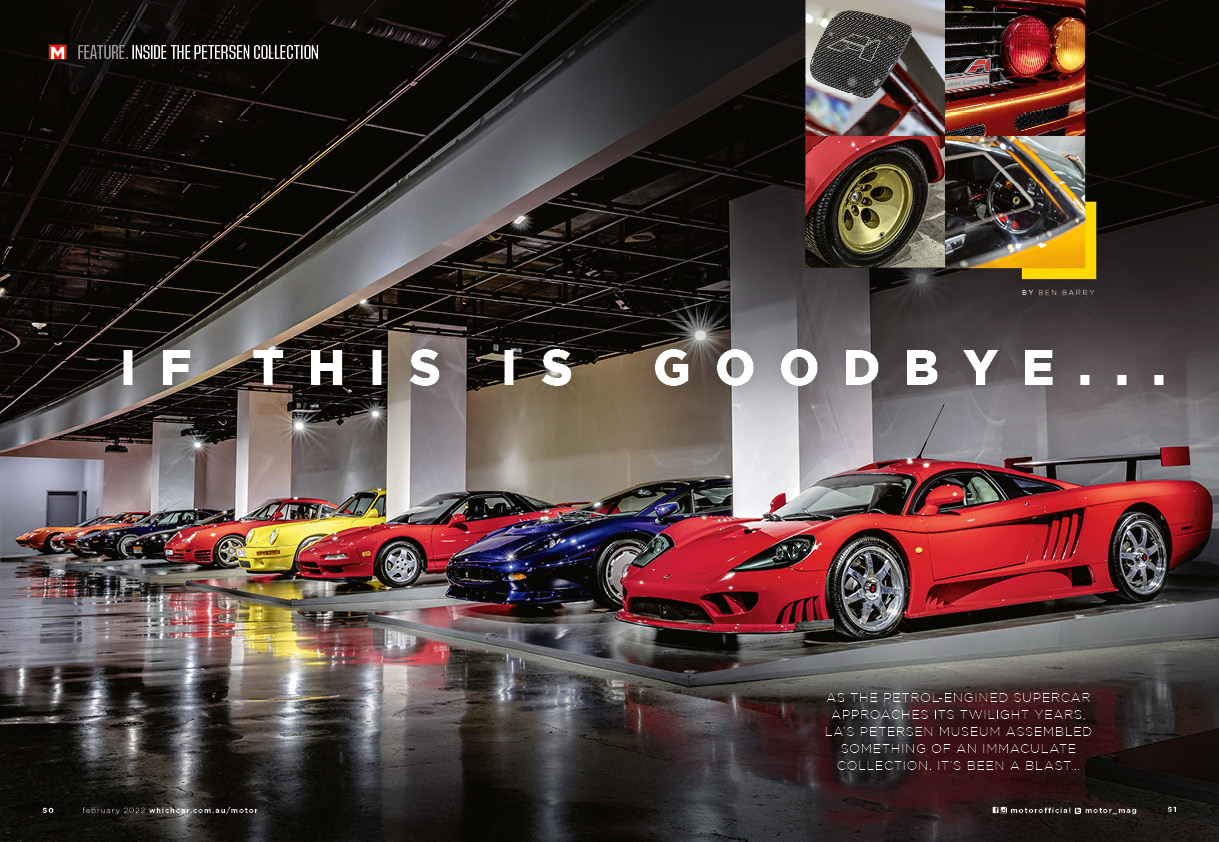
It’s no secret, however, that petrol-burning supercars are approaching their dying light. To reflect on the cars that made us dream, we take a stroll through history at LA’s Petersen Museum who have pieced together an astounding collection of icons that paved the way to our modern era of performance.
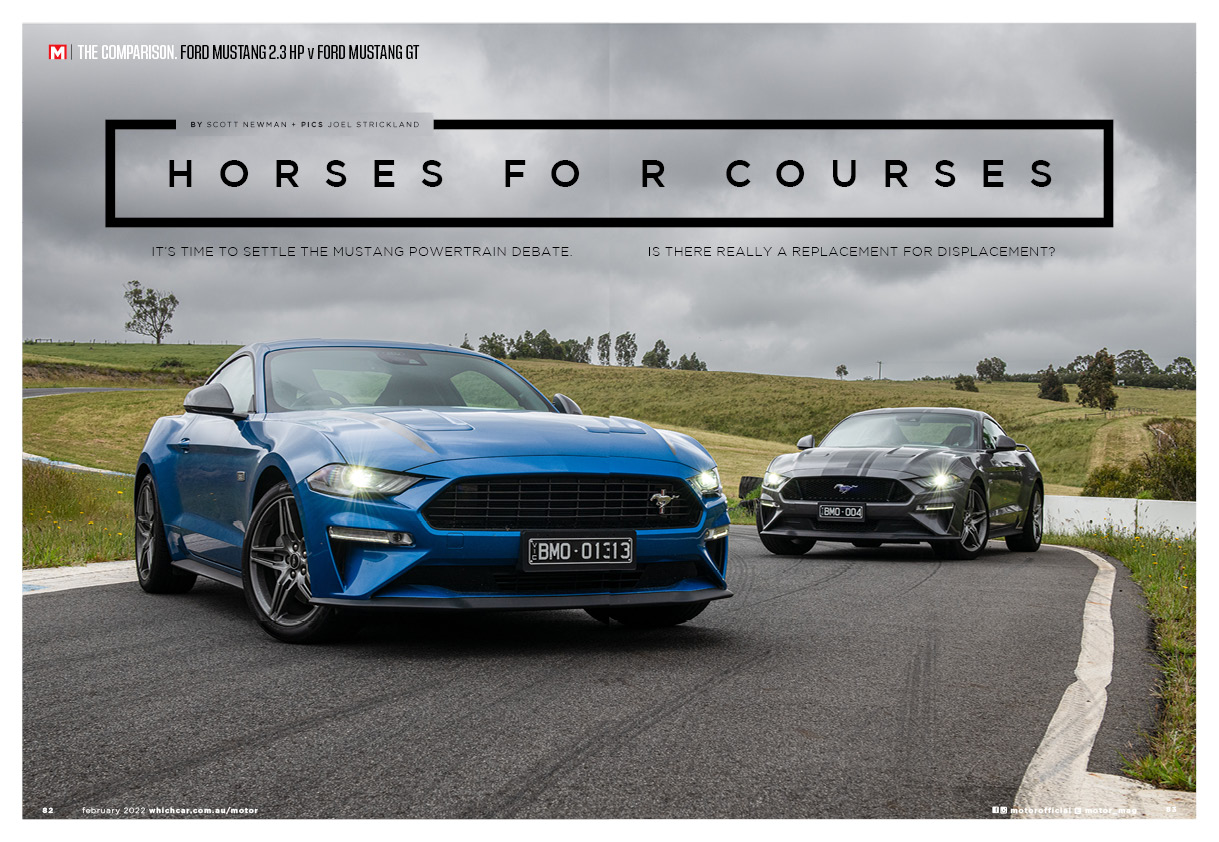
Further back, we take to the track to settle the Mustang powertrain debate, once and for all. Boosted 2.3-litre four-cylinder versus bellowing 5.0-litre V8 – is there really a replacement for displacement? We take to the Haunted Hillclimb track two Mustangs and a RaceLogic Driftbox, digging deep into the data to find out which is better.
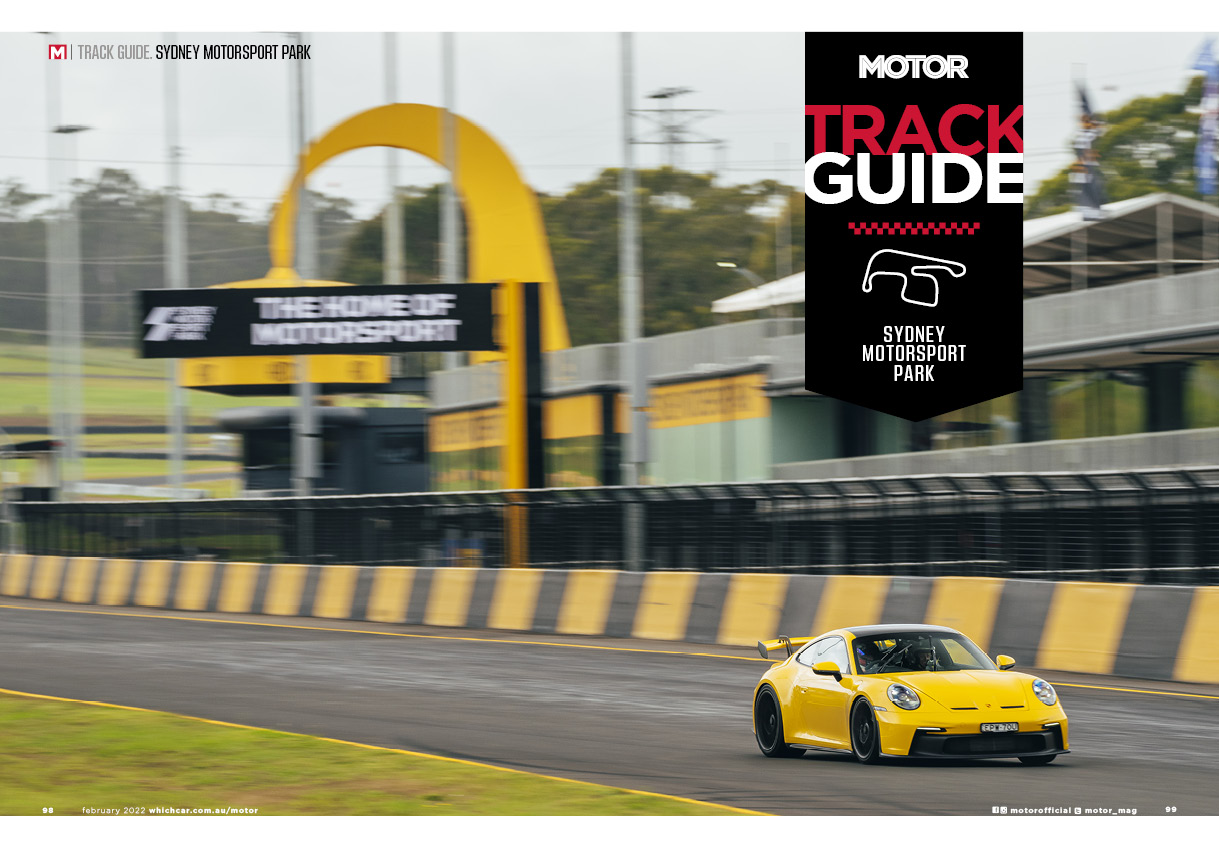
Luffy returns to give you a turn-by-turn master’s guide to Sydney Motorsport Park, Andy Enright lists the Top 10 best hidden European racing circuits and Alex Affat considers the used-buy prospects of the Volvo S60 Polestar.
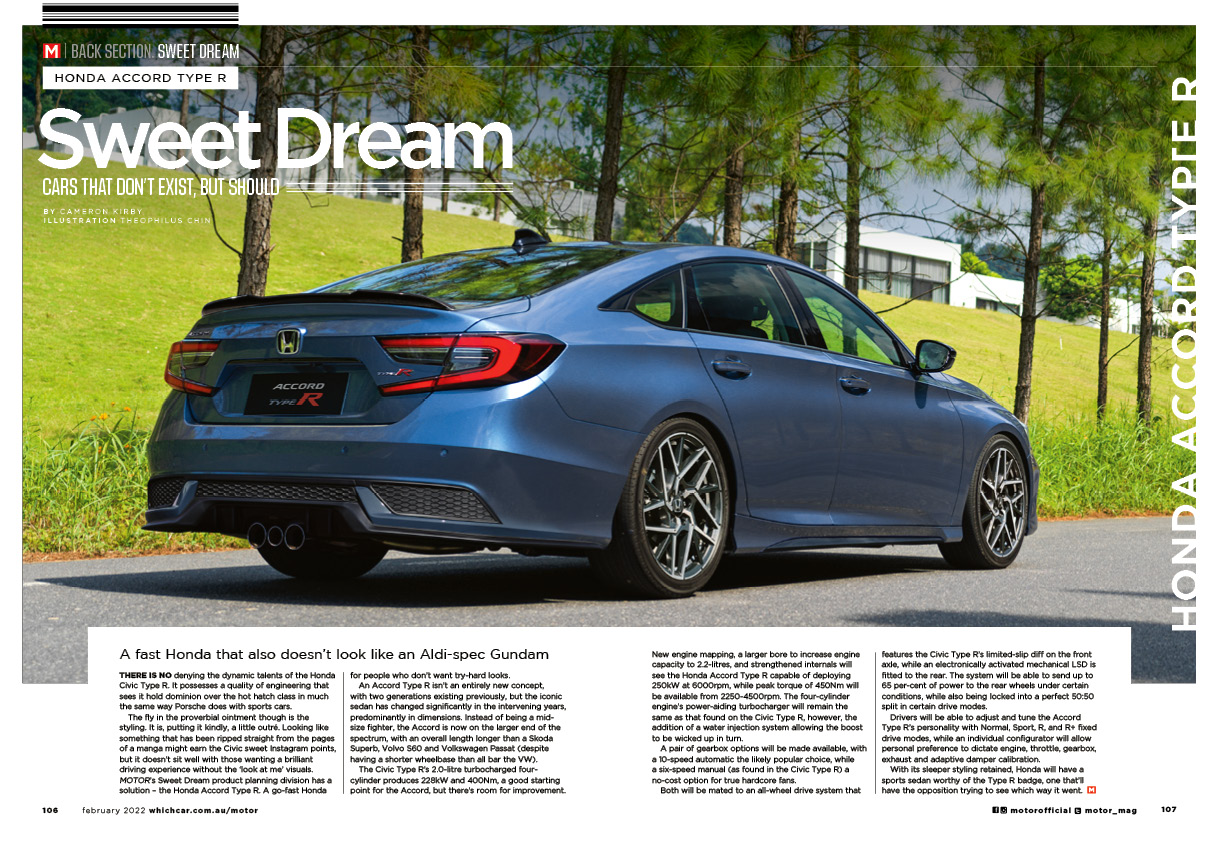
We don our product planning hats to imagine a modern iteration of the Honda Accord Type R for this month’s edition of Sweet Dream and have our first drives of the supercharged RTR Ford Mustang Spec3, Mercedes-AMG CLS 53, Hyundai i30 Sedan N, McLaren 720S GT3X and Gunther Werk’s epic 993 Speedster.
There is plenty more to see in the latest issue of MOTOR. You can find the February edition in stores today, or subscribe here and have them delivered straight to your door!
A new report is pushing for the Federal Government to do more to encourage an Australian electric car industry.
Dr Mark Dean from The Centre for Future Work, an initiative from think tank The Australia Institute, says the global shift to electric vehicles presents a significant opportunity for Australia to position itself as a leader in electric vehicle (EV) manufacturing.
In the paper, titled Rebuilding Vehicle Manufacturing in Australia: Industrial Opportunities in an Electrified Future, Dean argues Australia is a prime candidate for an EV industry, thanks to a highly-skilled workforce, advanced industrial base, and rich mineral reserves required for batteries.
“But what it lacks is an overarching, coordinating and strategic national industry policy [for electric cars]” – which he argues could also lead the sustainable transformation of Australia’s economy.
Among the recommendations laid out, the paper calls for an EV manufacturing industry commission, with a view to develop a framework for Australian-based carmakers within 18 months.
Tax incentives could also be utilised to encourage buyers to purchase battery-powered vehicles, the report says, as well as providing motivation for global car companies to set up operations locally.
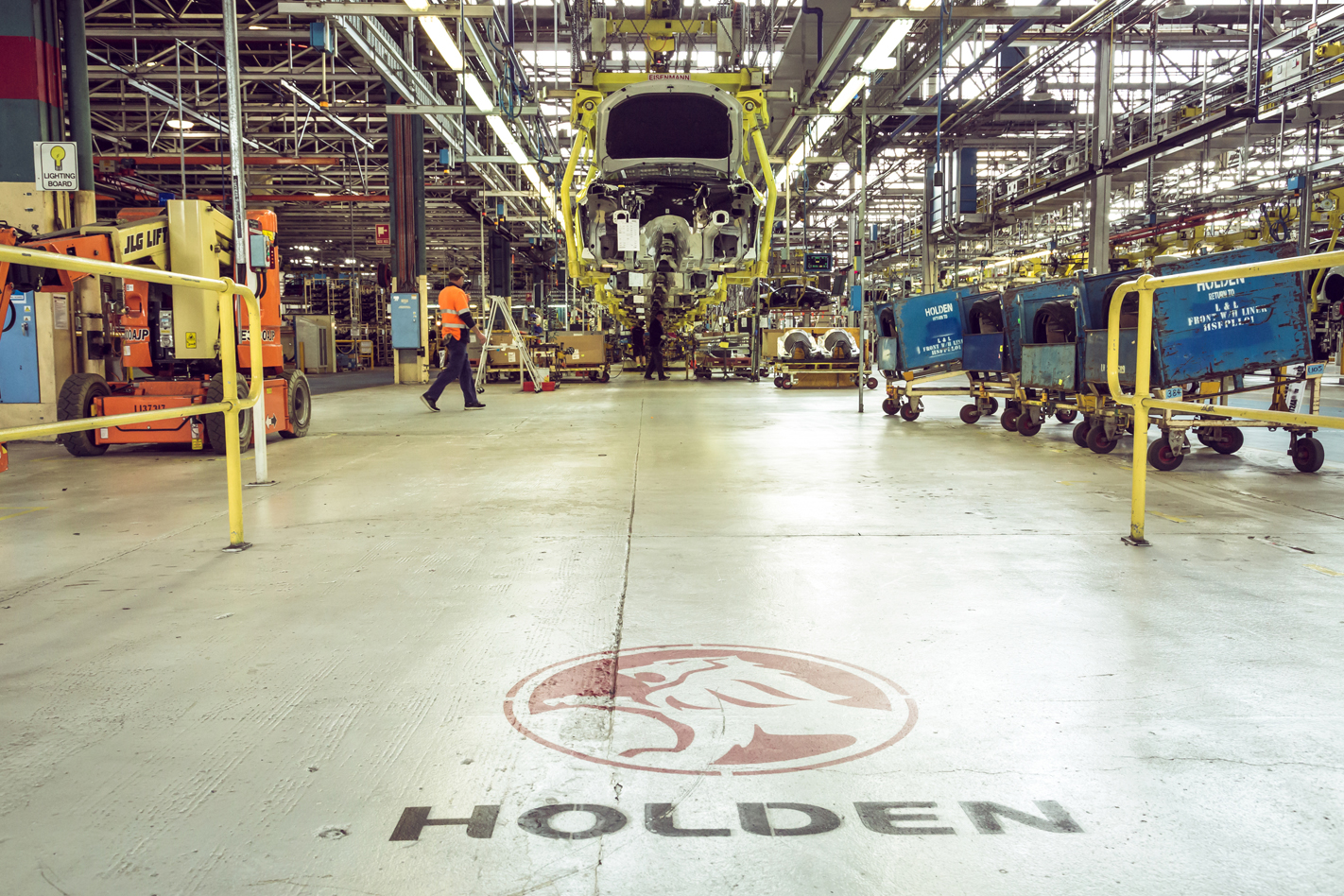
Large-scale passenger car manufacturing ended in Australia when Holden’s local production lines came to halt in 2017 – around a week after Toyota, and a year after Ford.
Meanwhile, Australian company Tritium was praised by US President Joe Biden this week for announcing a new electric vehicle charger factory in Tennessee, with 500 jobs set to be added to the American state.
The new factory is expected to bolster production from its Australian plant.
“The new manufacturing facility Tritium announced today is more than just great news for Tennessee. Yes, it’s going to create more than 500 good-paying jobs in Tennessee, but it can deliver greater dignity and little more breathing room to workers and their families,” Biden said.
“Tritium’s new facility is going to produce up to 30,000 of these chargers every year. They’ll use American parts, American iron, American steel. And they’ll be installed up and down the highways and corridors in our communities all across the country.”
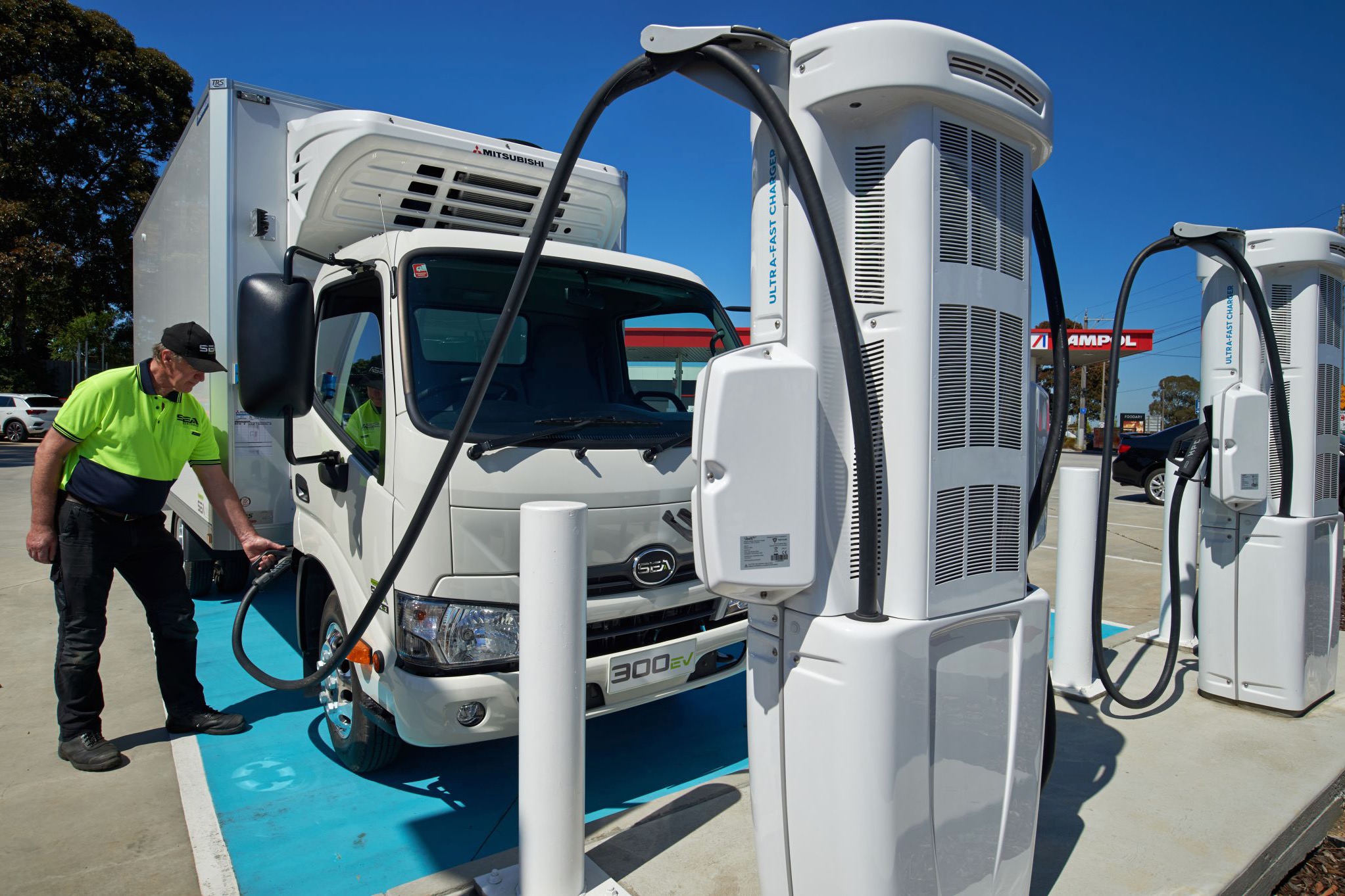
While the Australian Government announced its Future Fuels and Vehicles Strategy in November 2021, with $178 million dedicated to hydrogen and EV infrastructure, this week also saw the Labor-led Senate Economics References Committee release a report on its inquiry into Australia’s manufacturing industry.
In the 142-page report, electric and autonomous vehicles were cited as possible avenues for Australian manufacturing, with a number of recommendations pointing to financial incentives to help nurture a local manufacturing industry.
Australia will miss out on Kia’s new Sportage PHEV as the manufacturer’s local outpost says it is still evaluating the electrified SUV.
First revealed in August last year and now on sale in North America, the plug-in hybrid variant of the new-generation Sportage is still without a local berth locked in, sitting in limbo just like its Korean sibling, the Hyundai Tucson PHEV.
A spokesperson for Kia Australia told Wheels the firm is still interested in bringing electrified versions of the Sportage to the local market – either as a conventional hybrid or PHEV – but nothing has yet been set in stone.
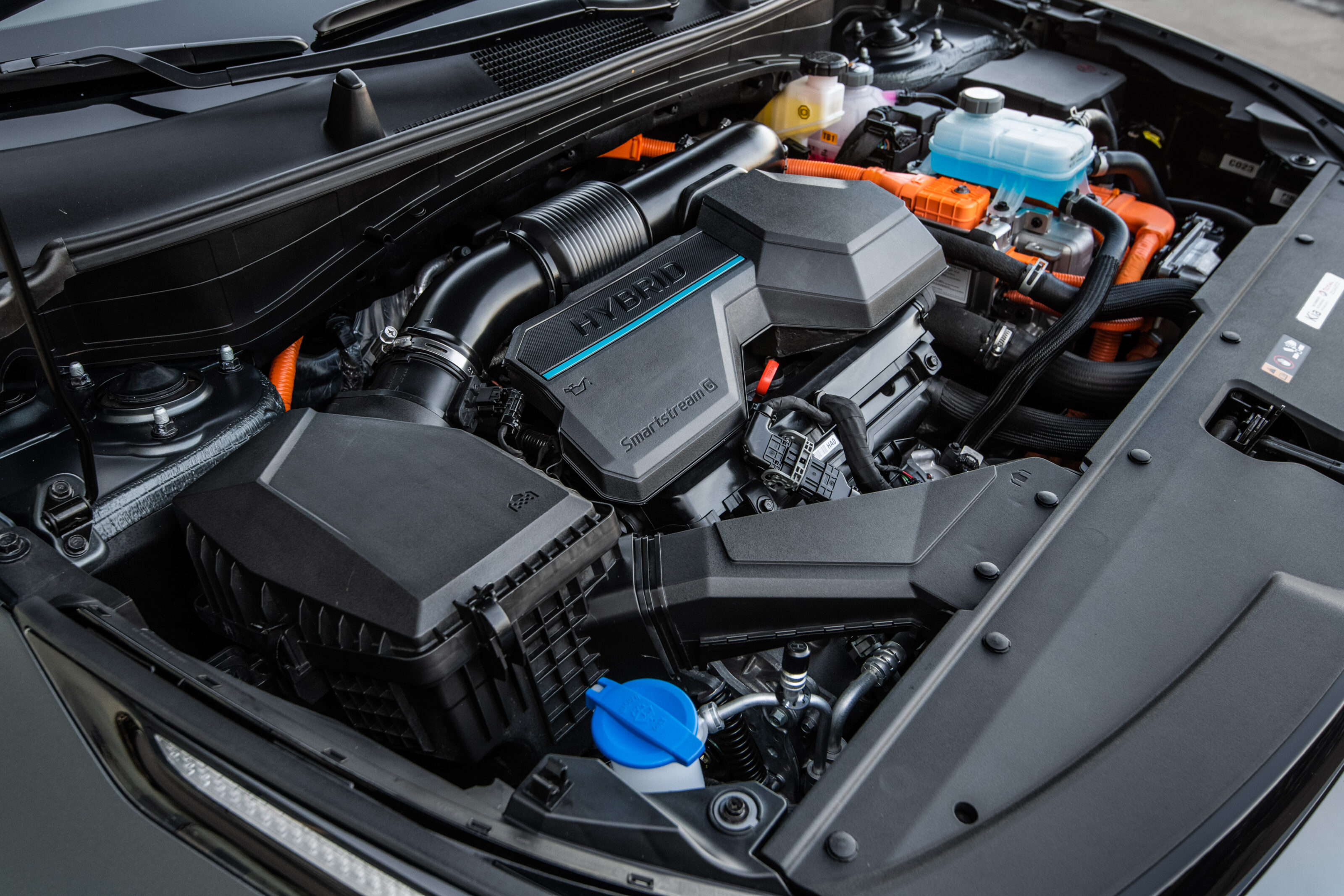
“Kia Australia is keen to introduce an electrified variant/s to the Sportage range however, these matters take time and we don’t have a final confirmation either way from HQ,” said the spokesperson.
“Which electrified variants will be included in the Sportage range is still under study.”
Despite the hesitation around its electrified Sportage, Kia is currently pushing to deliver the first examples of its EV6 fully-electric vehicle to customers, having announced pricing for the new model within the last fortnight.
The story to here
August 25, 2021
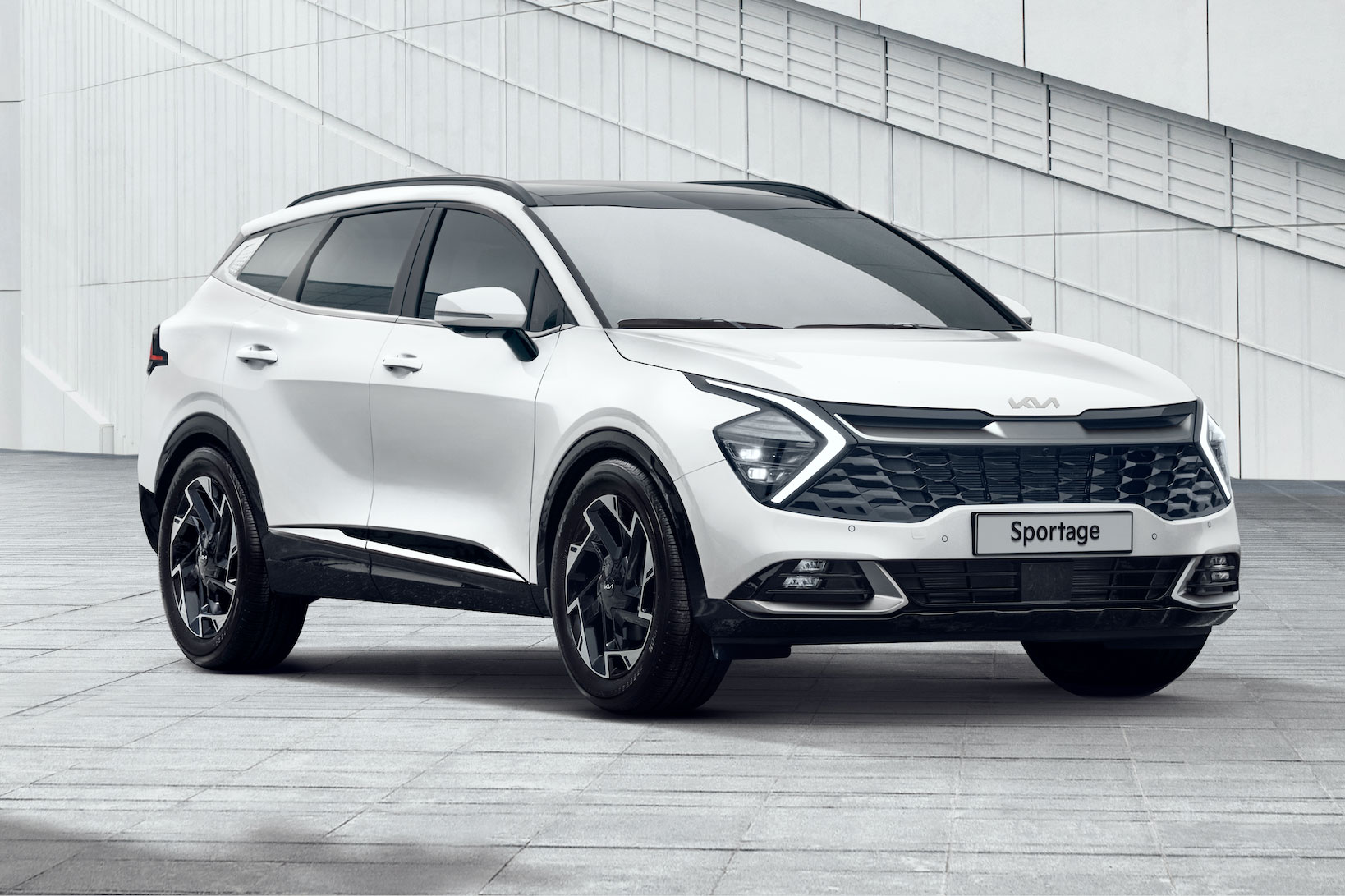
The new Kia Sportage will debut at the upcoming IAA Mobility Show in Munich with its plug-in hybrid variant making its first European appearance.
Unveiled in July, the new Sportage features Kia’s new design language, as well as an updated range of powertrains – headlined by the 1.6-litre, turbocharged four-cylinder engine and 66.9kW electric motor it shares with the upcoming Sorento PHEV.
With a 13.8kWh battery pack assisting the internal combustion engine, the PHEV variant can achieve fuel consumption figures of 3L/100km, while the electric motor can run for over 50km on a charge.
September
The new Sportage is now in Australia, so check out the latest news and review coverage on our Sportage landing page.
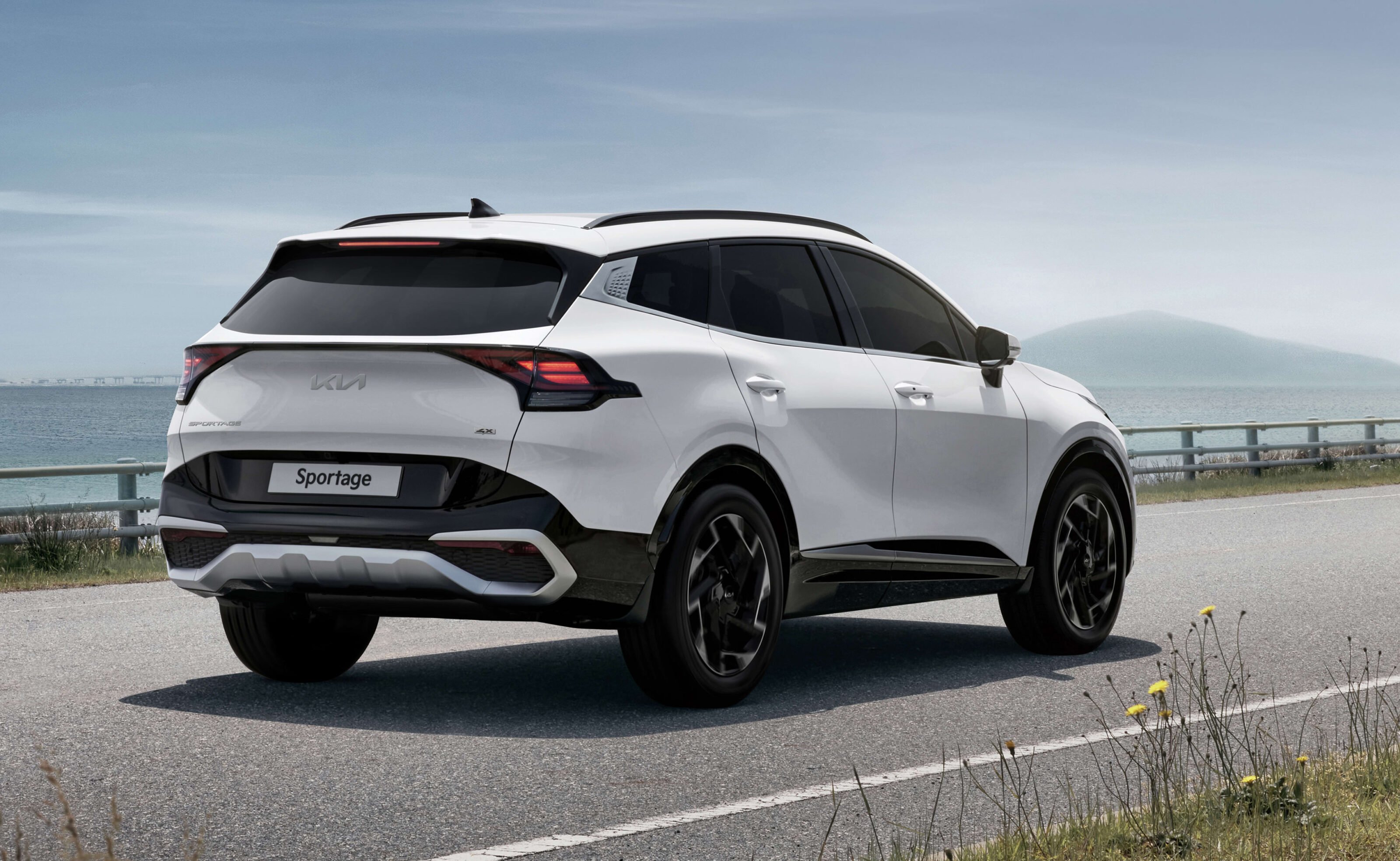
Despite these encouraging figures, Kia Australia has confirmed it is not considering adding the PHEV to its line-up – potentially due to emissions regulations which prevented Hyundai from bringing its new Tucson PHEV to market – telling Wheels it is keen on the mild-hybrid variant, although this too is unconfirmed for a local arrival.
As it stands, the Sportage will launch in Australia later this year with a choice of two engines – a 1.6-litre, four-cylinder turbocharged AWD petrol unit, making 132kW and 265Nm, as well as a 2.0-litre, four-cylinder turbo diesel which produces 137kW and 417Nm.
The team at Kia Australia has been instrumental in developing a local-only suspension package for the fifth-generation Sportage, conducting R&D in rural New South Wales to adapt the SUV to suit rough roads Down Under.
UPDATE, September 2 2021: The new Sportage is now in Australia, so check out the latest news and review coverage on our Sportage landing page.
Snapshot
- 2022 Lexus NX is available with petrol, hybrid and plug-in hybrid powertrains
- Three trim grades to choose from
- Pricing starts at $60,800 before on-road costs
- It debuts Lexus’s all-new ‘Tazuna’ cockpit
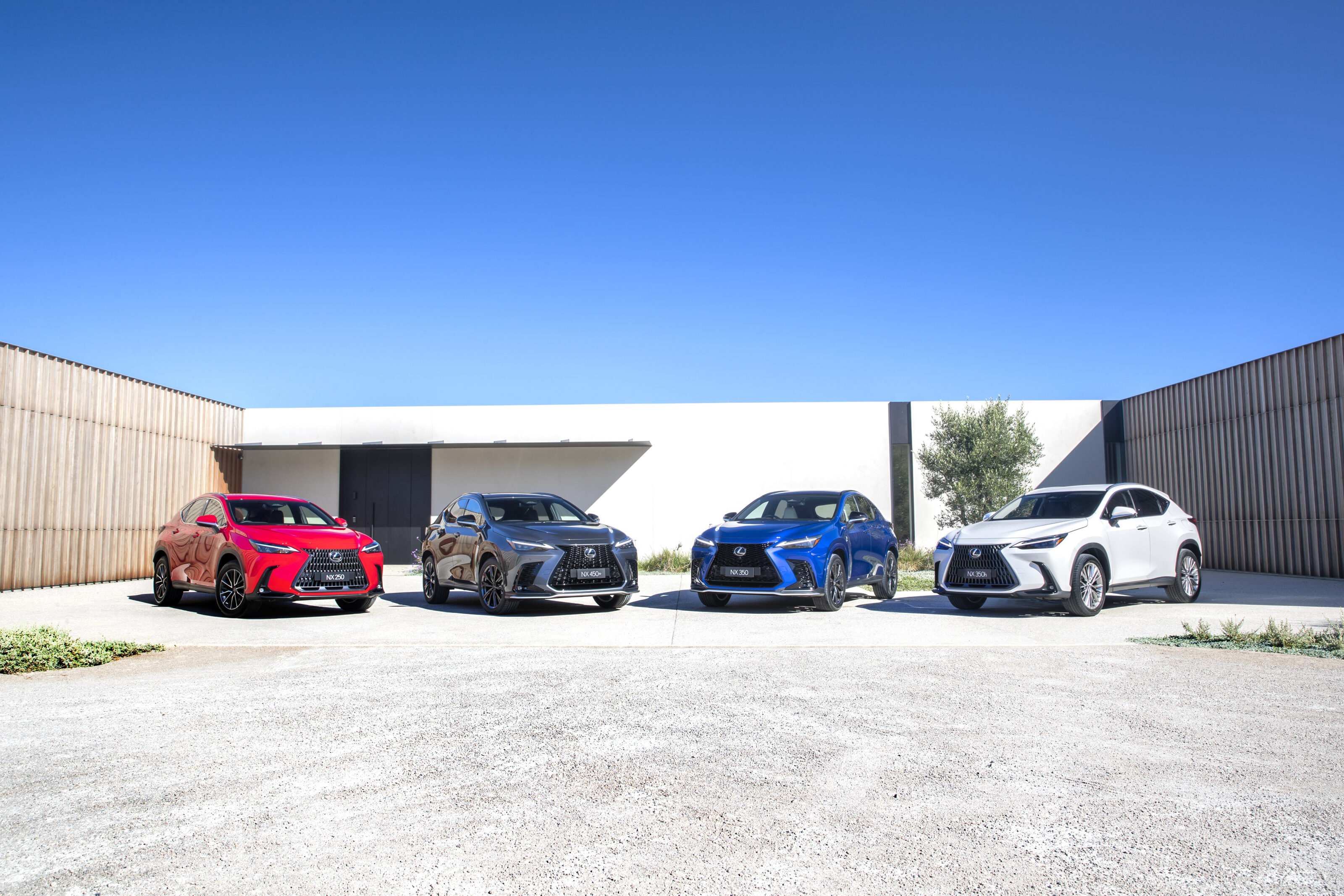
The all-new 2022 Lexus NX range has launched in Australia with four powertrains, including the Japanese luxury carmaker’s first plug-in hybrid.
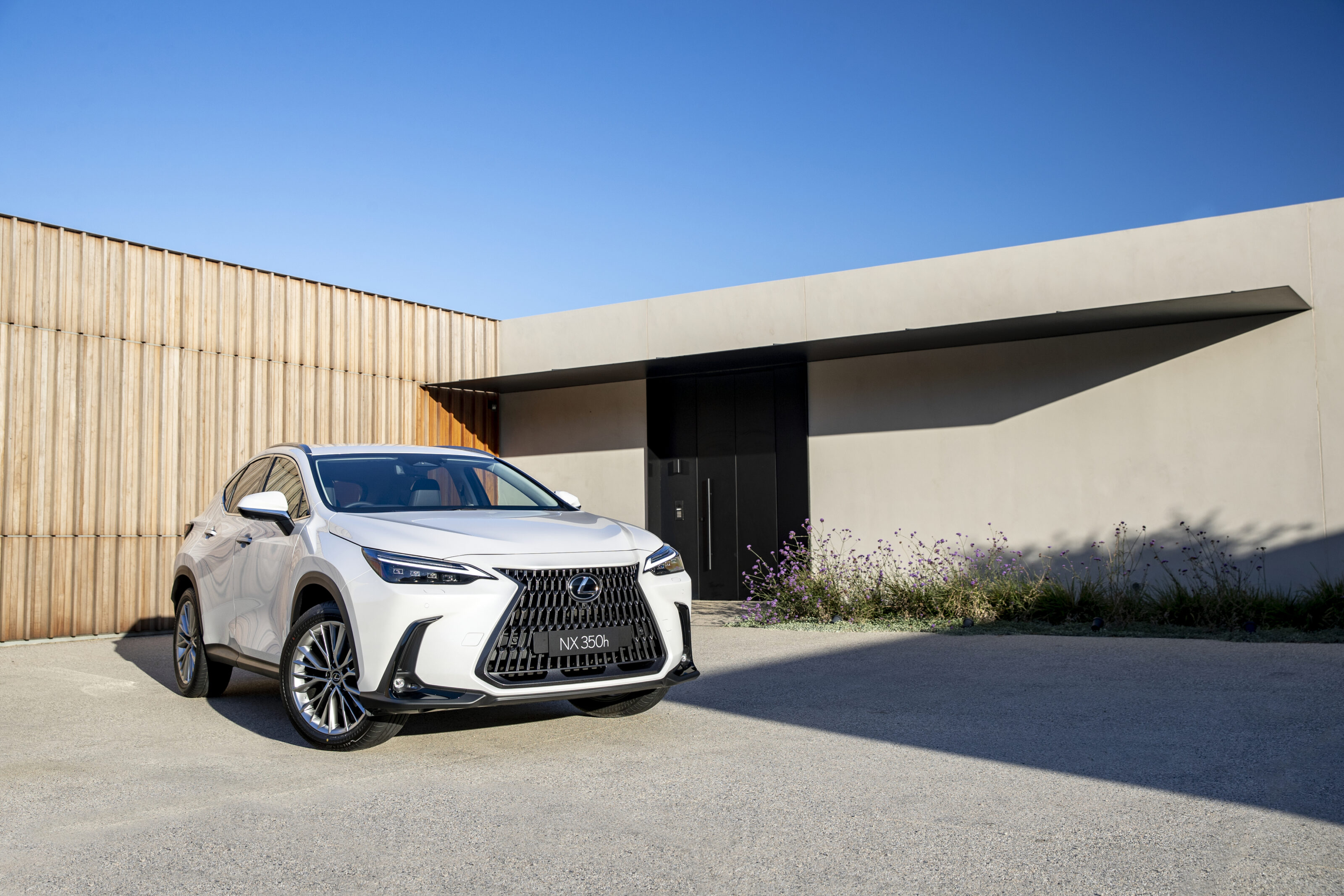
The NX 450h+ PHEV joins the entry-level NX 250, NX 350 and hybrid NX 350h in the second-generation NX line-up, which like its predecessor is expected to be Lexus’s biggest seller in Australia.
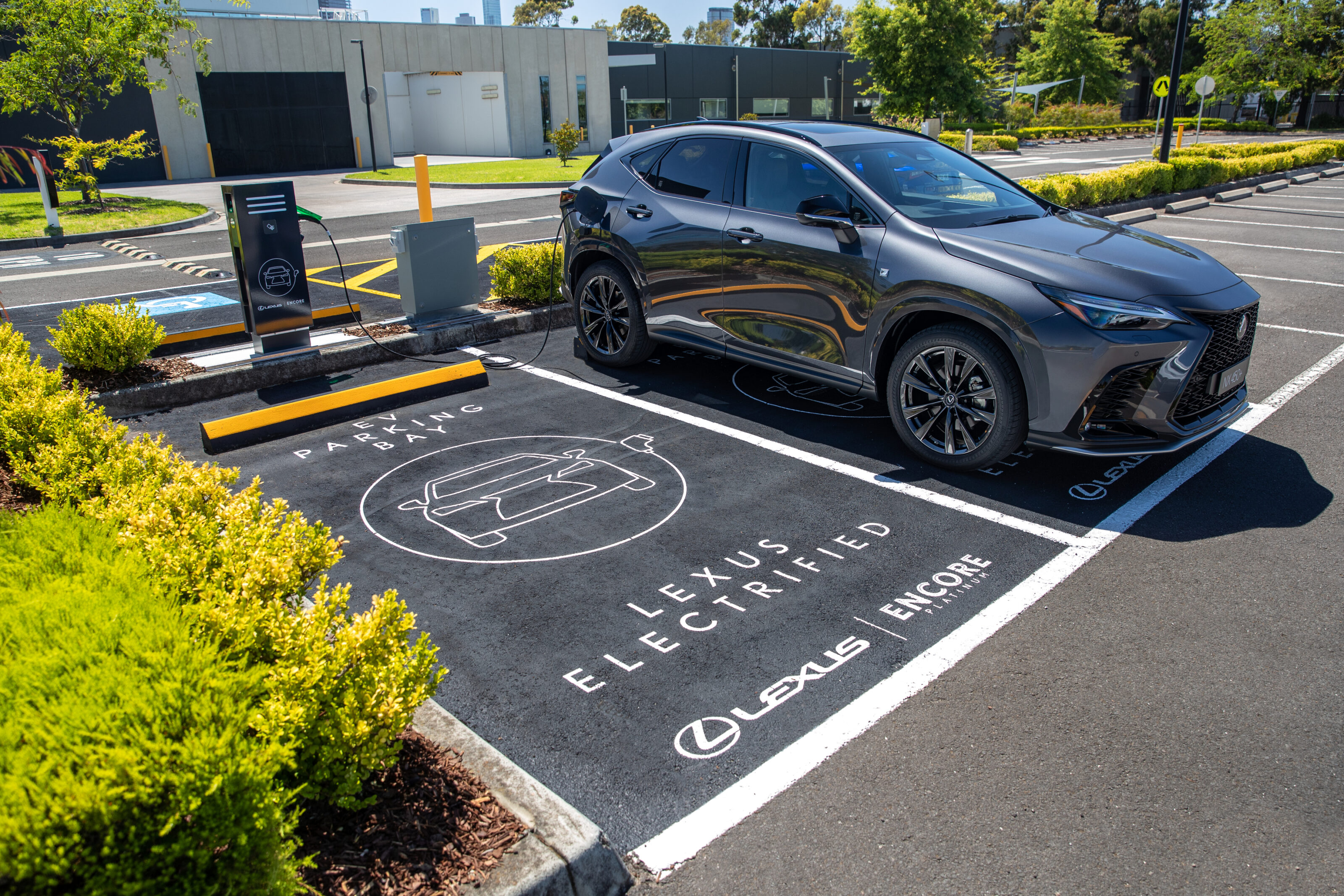
Lexus has confirmed local pricing, which starts at $60,800 for the 2.5-litre FWD NX 250 Luxury, with the range-topping NX 450h+ F-Sport priced at $89,900 which includes three years of complimentary membership of the Encore benefits owner program and a free home charger.
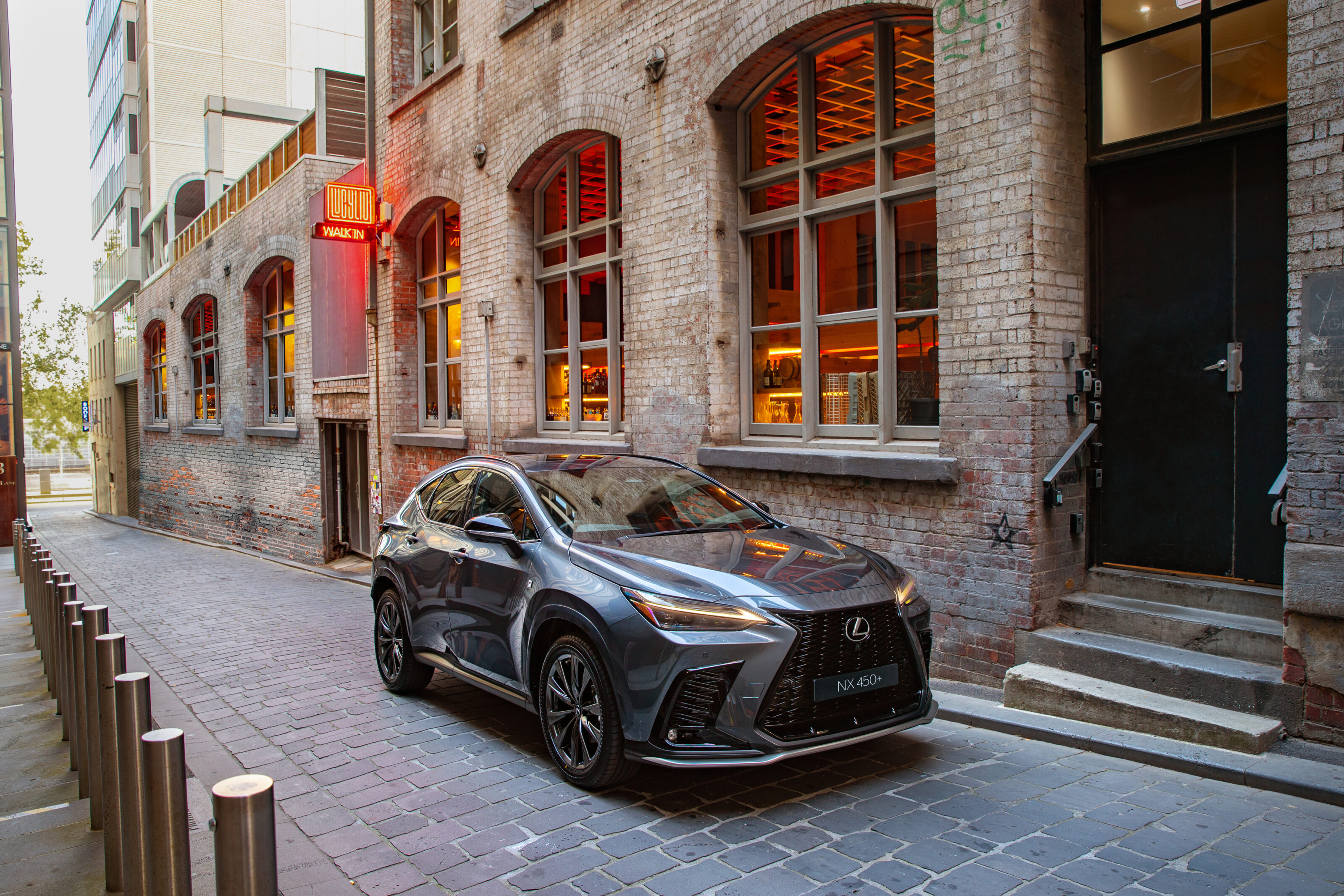
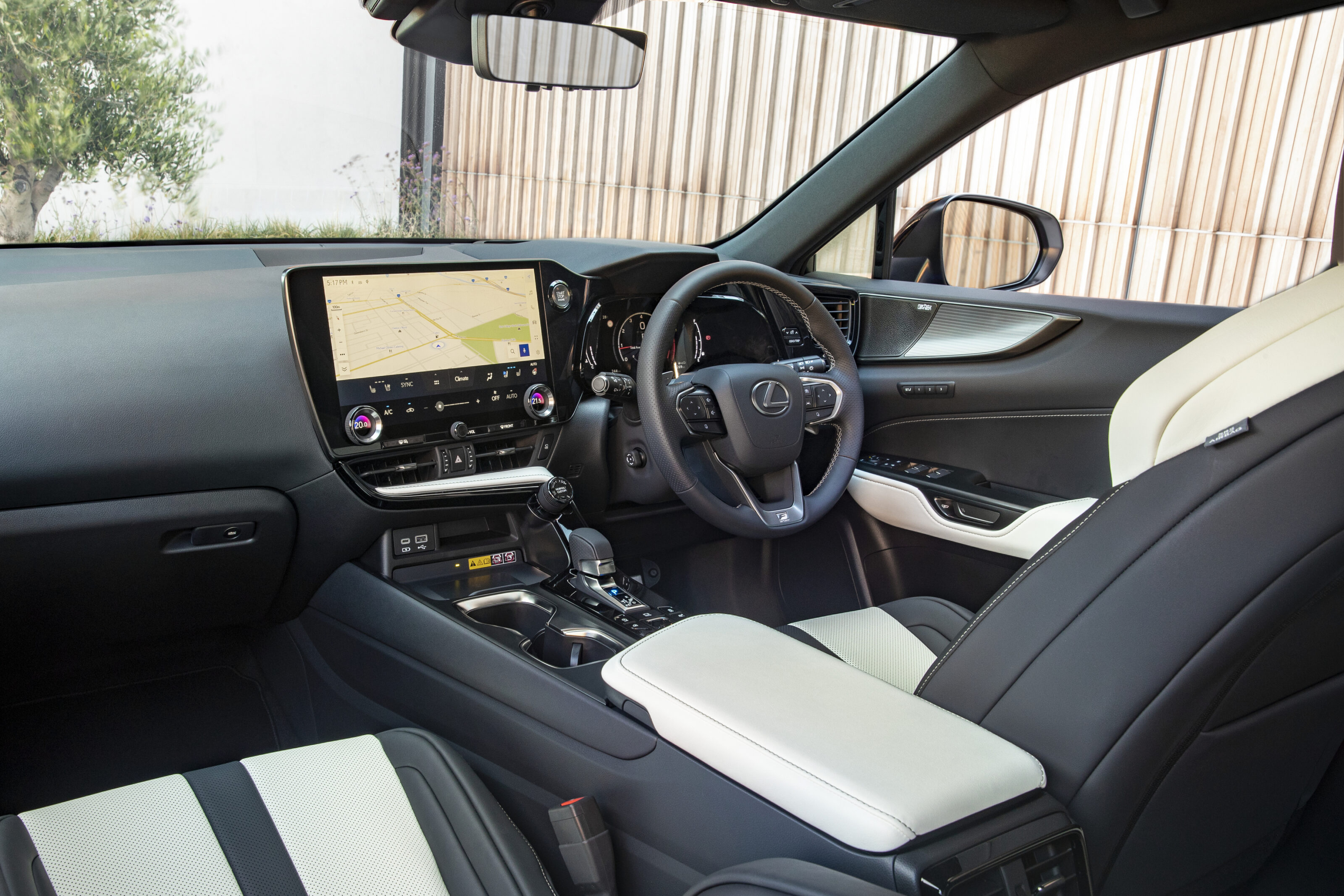
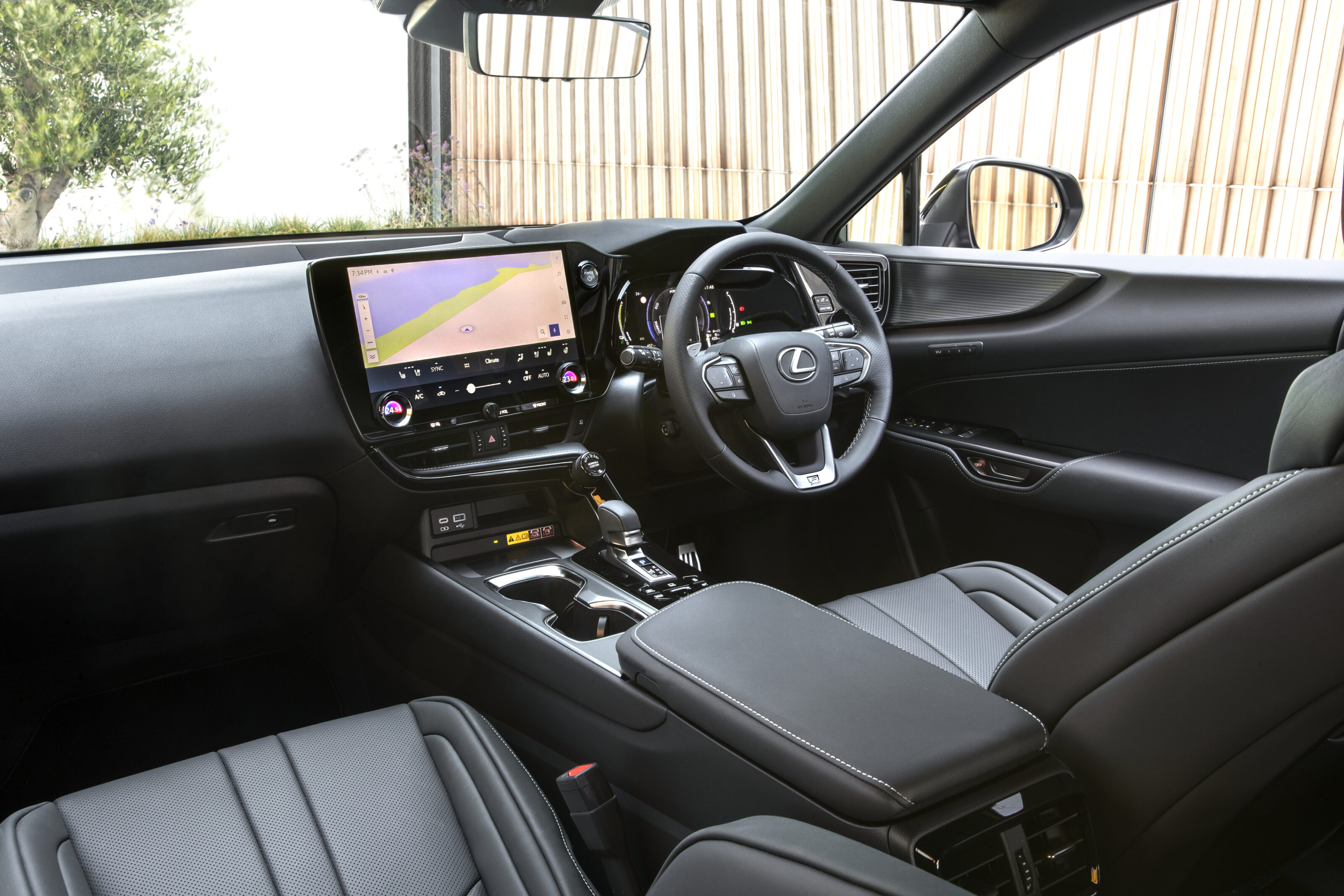
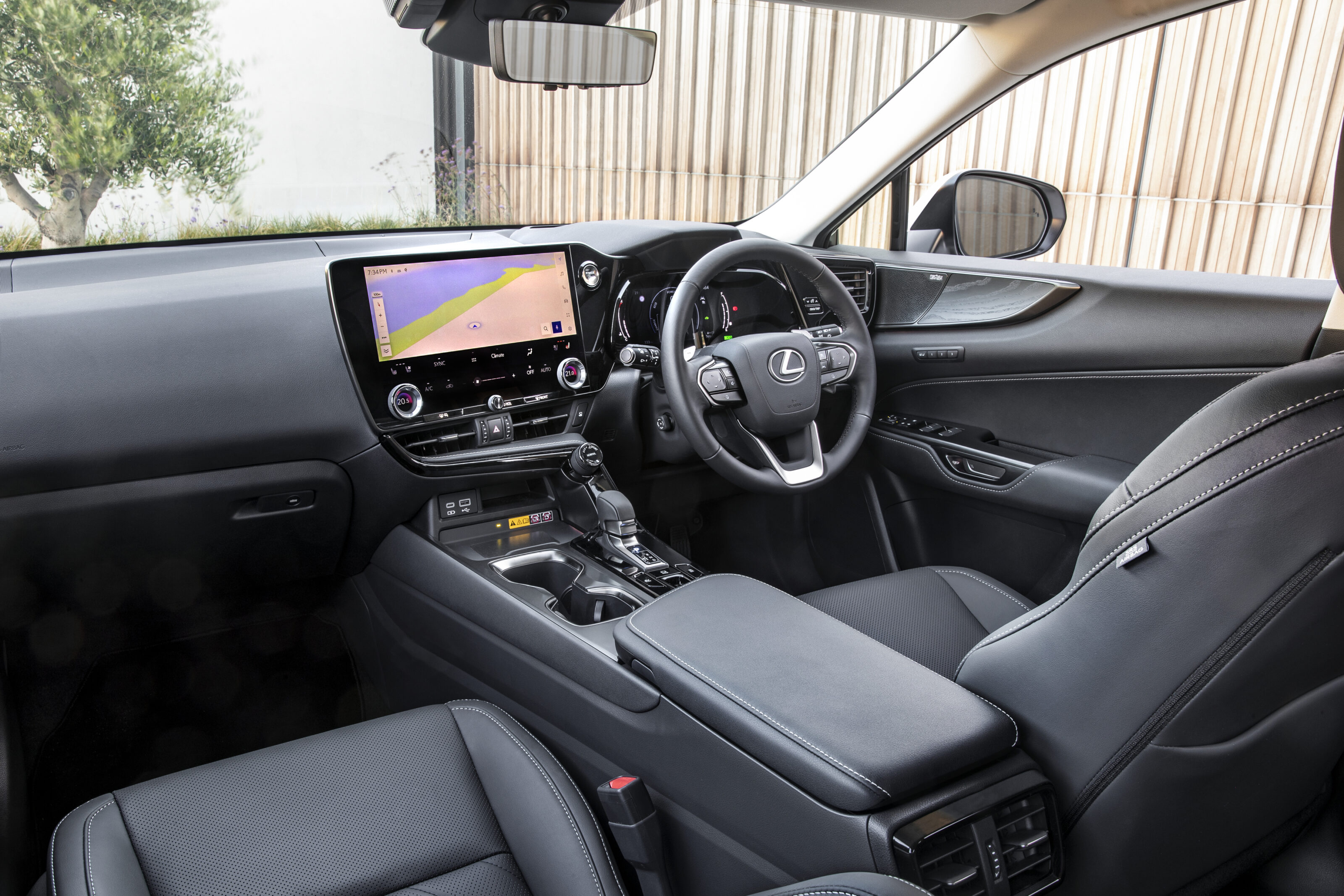
As well as being the first Lexus model with a plug-in hybrid powertrain, the NX sees the production debut of the brand’s long-awaited new multimedia system and driver interface.
Inspired by the connection shared between a horse and rider through a set of reins, the Tazuna cockpit concept groups critical driving information directly in front of the driver on the digital instrument cluster and – on Sports Luxury and F Sport grades – a colour head-up display (HUD).
The centrepiece is the new-generation multimedia system displayed on an expansive 9.8-inch (NX Luxury grades) or 14.0-inch (F Sport and Sports Luxury) touchscreen, which is controlled onscreen or with a series of physical shortcut buttons for the most frequently used functions – a far cry from the fiddly touchpad which has long been a fixture in Lexus models.
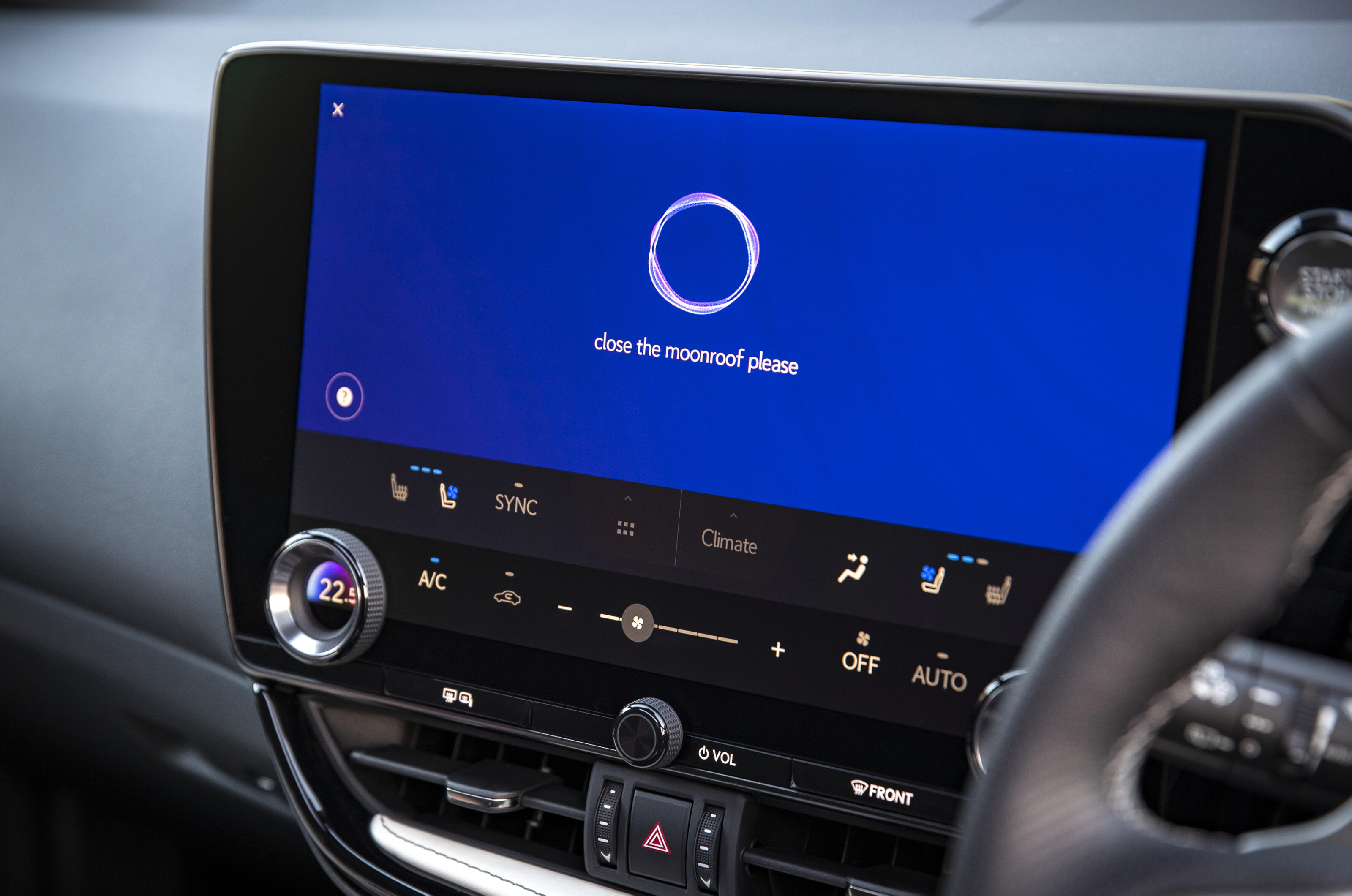
The NX also debuts the new Hey Lexus voice control system that like its Mercedes counterpart operates vehicle functions like the windows and climate control with simple plain-English commands. The system can also be used with satellite navigation by simply saying something like ‘Hey Lexus, I’m hungry’, which will bring up nearby restaurants.
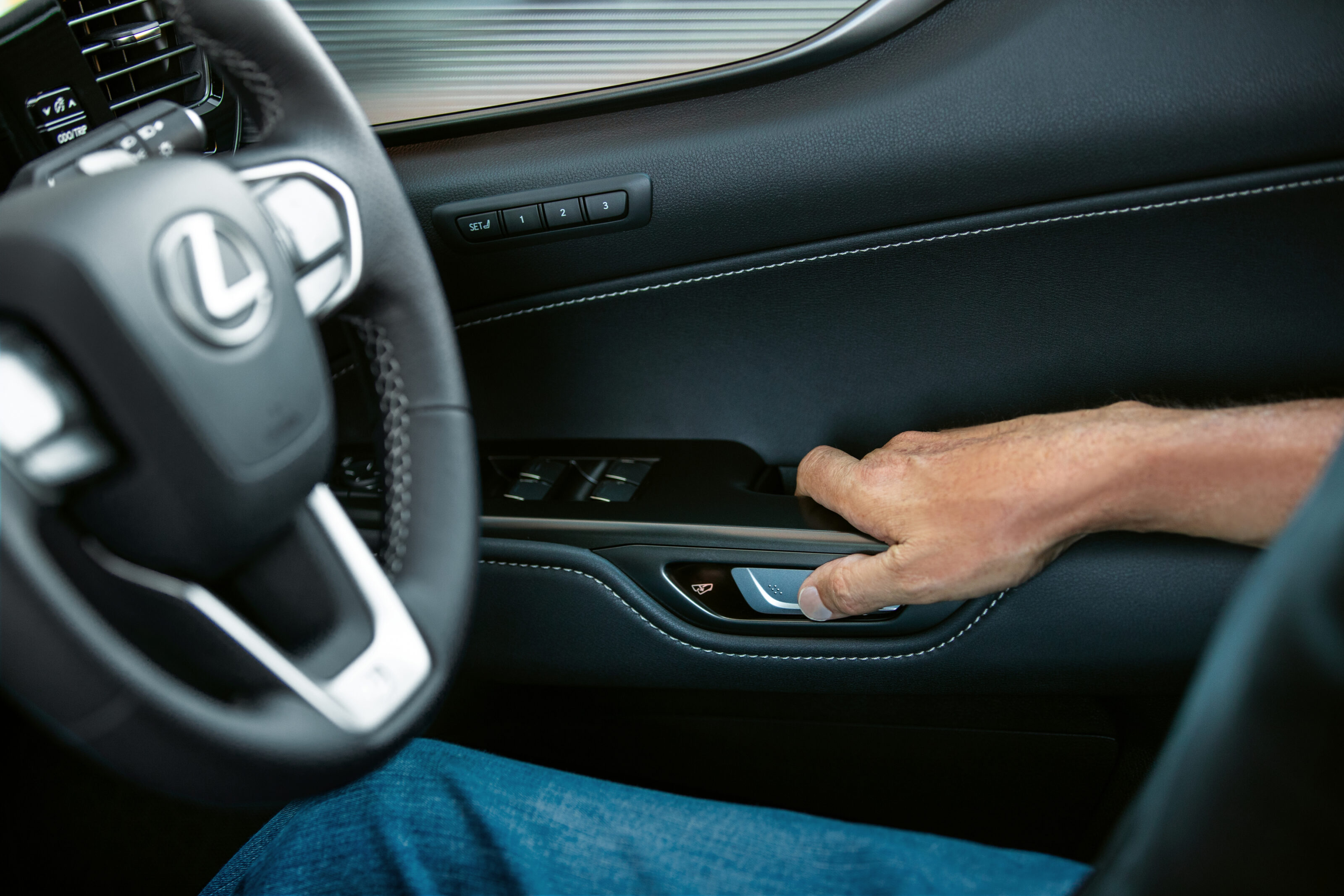
Another new Lexus technology to debut on the 2022 NX is the e-latch electronic door-release system that replaces the conventional interior and exterior door handles and incorporates a safety cancelling function called Safe Exit Assist, which can help prevent doors from being opened in the path of bicycles and vehicles approaching from the rear.
NX buyers can also download the latest Lexus Connected Services smartphone app, which allows drivers to remotely lock the car’s doors and boot; turn the engine on and off; activate the car’s horns, headlights and hazard lights; and set the climate control. Additional functions for the NX 450h+ include access to battery charge information and the locations of nearby Chargefox charging stations.
Other functions include access to vehicle information including the odometer, tyre pressures, fuel level and distance to empty, recent trip information, last known location, the lock/unlock status of the doors, windows, boot and bonnet and the off/on status of hazard lights.
The app can also synchronise with the vehicle’s multimedia system to offer cloud-based connected navigation with live traffic, weather, parking and map updates, location searching, and first-mile and last-mile routing.
2022 Lexus NX Australian pricing
The NX250 will serve as the entry-level variant of the range, while the NX350h makes up six of the nine available grades – as the NX350 and NX450+ are available in F Sport guise only.
| Model | Price |
|---|---|
| NX250 Luxury | $60,800 |
| NX350h Luxury 2WD | $65,800 |
| NX350h Luxury AWD | $70,400 |
| NX350h Sports Luxury 2WD | $73,100 |
| NX350h Sports Luxury AWD | $77,900 |
| NX350h F Sport 2WD | $73,100 |
| NX350h F Sport AWD | $77,900 |
| NX350 F Sport AWD | $77,900 |
| NX450h+ F Sport AWD | $89,900 |
Prices exclude on-road costs.
Engines
Opening the range is the Lexus NX250, using a 2.5-litre non-turbo four-cylinder petrol engine, producing 152kW and 243Nm, and powering the front wheels through an eight-speed conventional automatic transmission to deliver a claimed combined fuel consumption of 6.9L/100km.
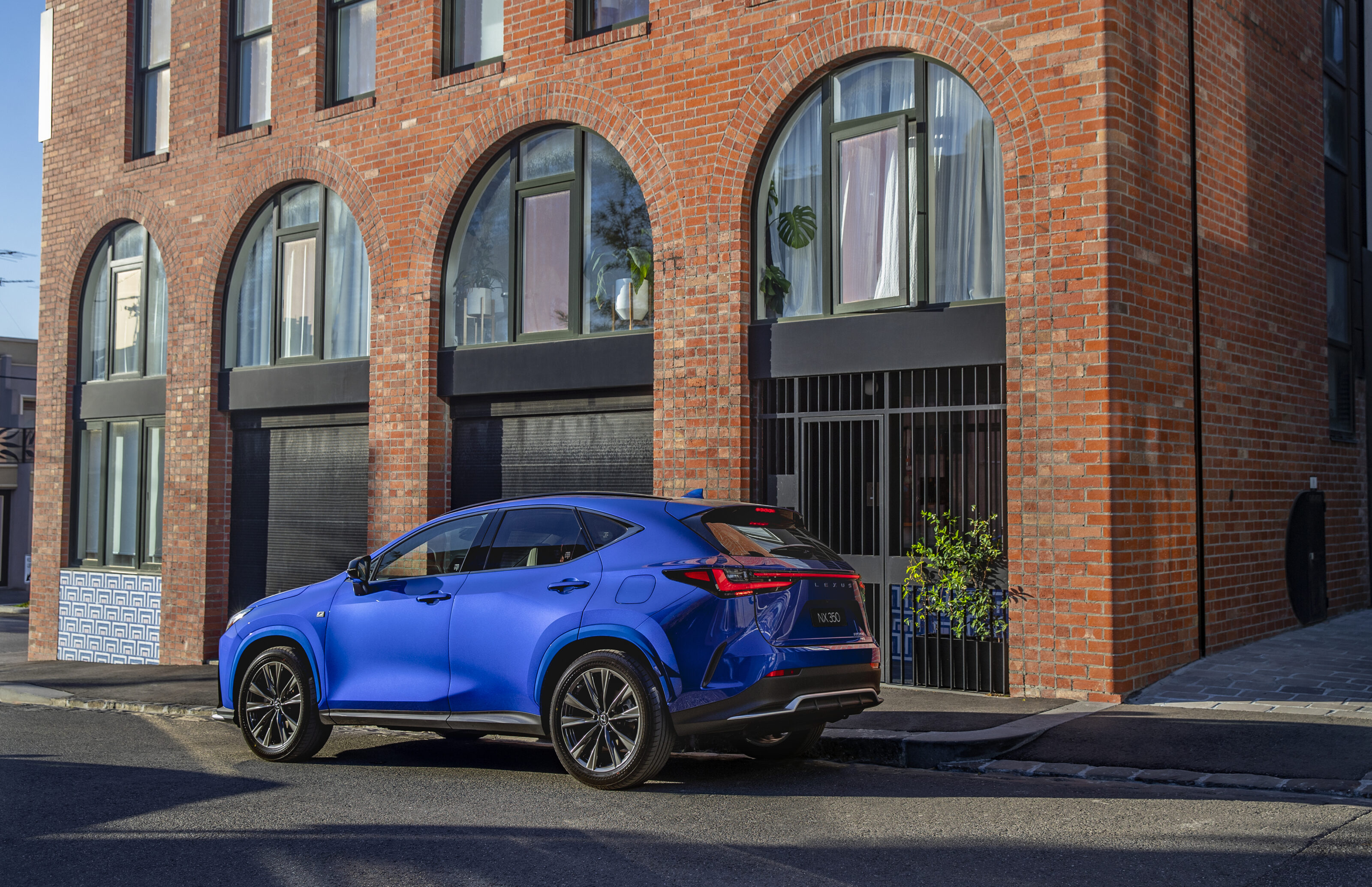
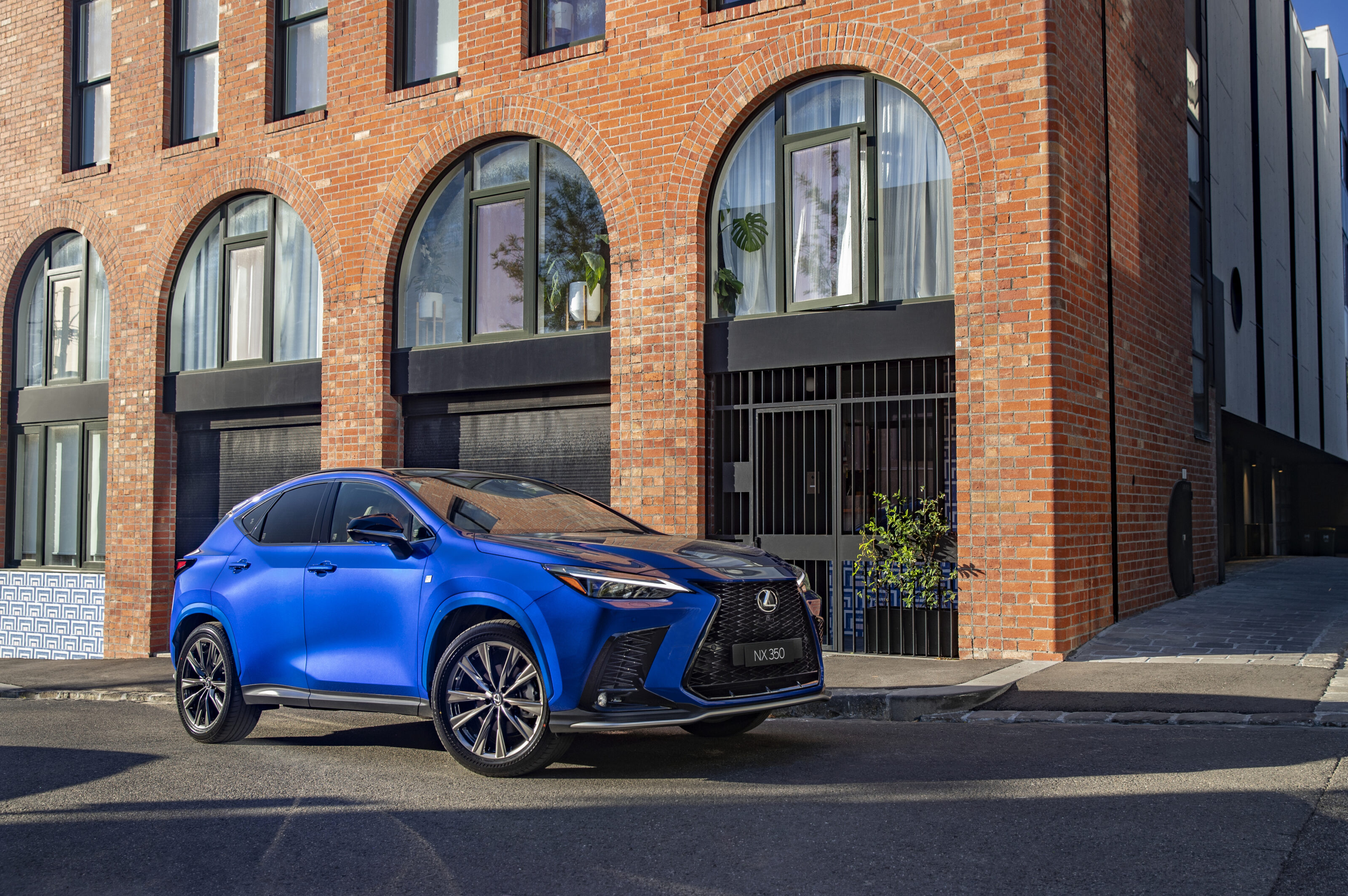
The NX350 is fitted with an all-new 2.4-litre turbocharged four-cylinder petrol engine, sending 205kW and 430Nm to all four wheels through an eight-speed automatic transmission. A combined fuel consumption figure for the new engine has yet to be published.
Making up a majority of the range is the NX350h, using a 2.5-litre non-turbo four-cylinder petrol engine mated to a hybrid-electric system, producing a combined total of 179kW in two- and all-wheel-drive guise.
While the combustion engine develops a maximum torque output of 239Nm, the front electric motor peaks at 270Nm and the all-wheel-drive variant can produce up to 391Nm, giving a sizeable amount of assistance.
Finally, the range-topping NX450+ benefits from its larger battery pack and plug-in hybrid capabilities to provide a combined system output of 227kW, thanks to its 136kW/227Nm 2.5-litre naturally-aspirated petrol engine, 134kW/270Nm electric motor on the front axle and 40kW/121Nm motor on the rear axle.
The 18.1kWh battery is one of the bigger ones found in the PHEV, which allows for an excellent 87km complained all-electric range. However, this means takes a little longer to charge; about 2.5 hours at a 7kW AC fast charger, or about nine hours on a standard 240-volt wall socket.
Features
The NX250, NX350 and NX450+ are only available in a single variant – Luxury for the NX250 and F Sport for the NX350/NX450+ – while the NX350 can be optioned in either Luxury, F Sport, or Sports Luxury grades.
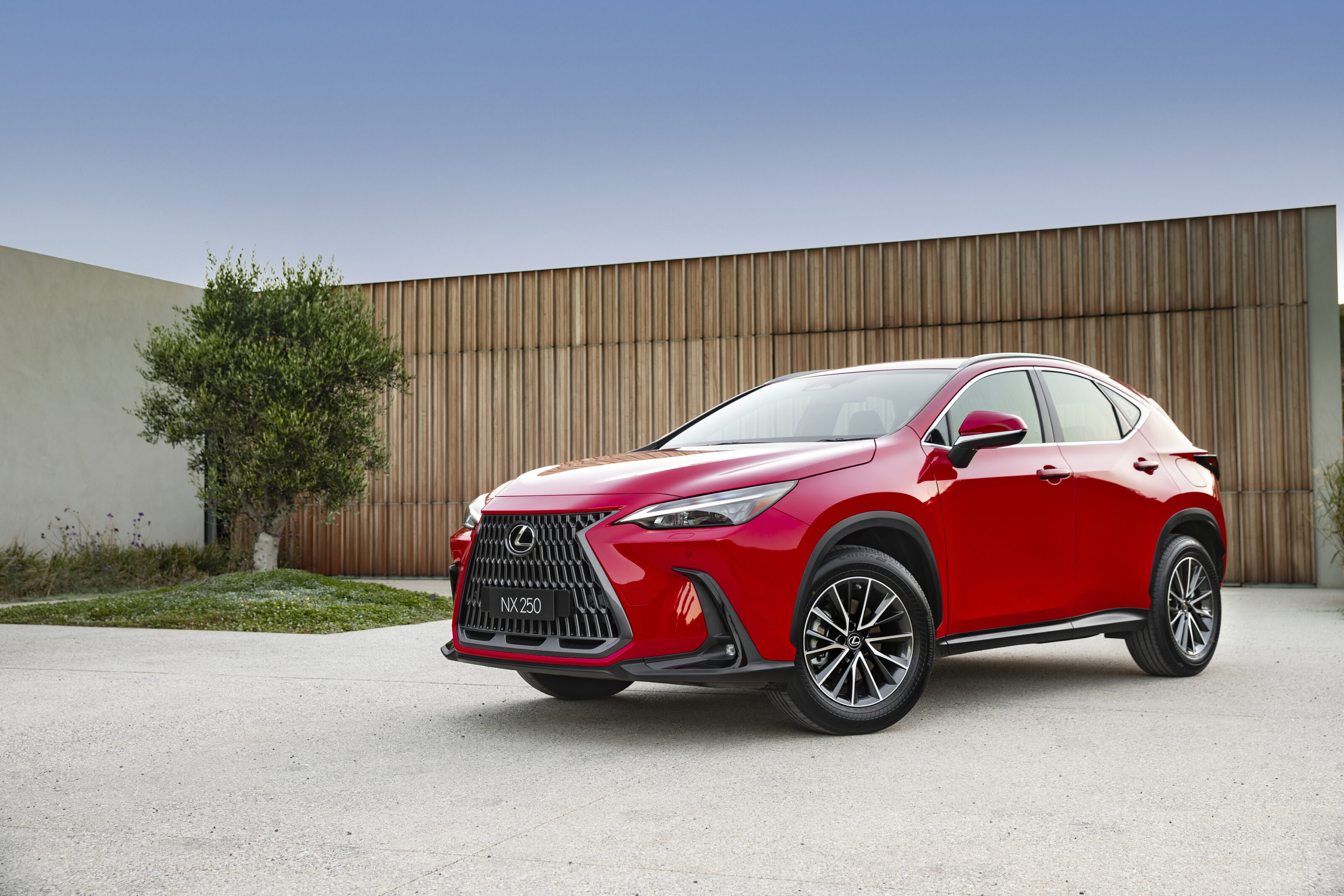
2022 Lexus NX Luxury
As the base-level Luxury spec is available with the NX 250 and 350h and includes:
| LED headlights |
| LED fog lights |
| Automatic high beams |
| Keyless entry and start |
| Radar cruise control |
| 9.8-inch infotainment touchscreen with speech recognition |
| DAB+ digital radio |
| Satellite navigation |
| Apple CarPlay and Android Auto capability |
| Power adjustable steering column |
| Eight-way power front seats |
| Heated front seats |
| Dual-zone climate control |
| Power tailgate |
| 18-inch alloy wheels |
2022 Lexus NX F Sport
The F-Sport spec is available across the range and is the only trim level available with the turbocharged petrol NX 350 and the 450h+. In addition to the Luxury, it adds:
| Tri-beam LED headlights |
| Adaptive high beam system |
| 14.0-inch infotainment touchscreen |
| Optional 17-speaker Mark Levinson audio system |
| Panoramic camera |
| Optional digital rear-view mirror |
| Optional panoramic moonroof |
| Optional heater steering wheel |
| Touch-sensitive steering wheel controls |
| Wireless smartphone charging |
| Colour head-up display |
| Sporty instruments |
| Heated and ventilated front power sports seats |
| Ambient lighting |
| Three-mode adaptive sports suspension |
| Body kit |
| 20-inch alloy wheels |
2022 Lexus NX Sports Luxury
In addition to the entry-level Luxury, the range-topping Sports Luxury variant adds:
| Tri-beam LED headlights |
| Adaptive high beam system |
| 14.0-inch infotainment touchscreen |
| Panoramic camera |
| Digital rear-view mirror |
| 17-speaker Mark Levinson audio system |
| Optional panoramic moonroof |
| Optional heater steering wheel |
| Optional intelligent park assist |
| 20-inch alloy wheels |
Options
In addition to the comprehensive levels of standard equipment found in the NX range, Lexus also offers a handful of enhancement packs to select grades.
Enhancement Pack 1 – $3000
NX250, NX350h Luxury, NX350h Sports Luxury and NX350/350h F Sport only
| Moonroof (NX250 and NX350h Luxury only)u00a0 |
| Panoramic moonroof (Sports Luxury and F Sport only) |
| Kick sensor for power tailgate (standard on F Sport) |
| Wireless Smartphone charging (standard on F Sport) |
Enhancement Pack 2 – $6000
NX350h Sports Luxury and NX350/350h F Sport only
| Panoramic moonroof |
| Heated steering wheel |
| Digital rear-view mirror |
| Mark Levinson 17-speaker audio system |
| Intelligent parking assist (NX 350h F Sport only) |
Safety
The 2022 Lexus NX is offered with the following safety equipment:
| Lexus Connected Services with SOS call, automatic collision notification, and stolen vehicle tracking |
| Electronic door-handle latch with safe-exit function |
| Intersection turn assist |
| Emergency steering assist |
| Pre-collision system with pedestrian and daytime cyclist detection |
| Parking support braking |
| Blind-spot monitor |
| Lane-keep assist |
| Road sign assist |
| Tyre-pressure monitoring system |
Availability
The 2022 Lexus NX range is now on sale in Australia.
Snapshot
- Ford Fiesta ST to go without blind-spot monitoring and rear-cross traffic alert
- Automatic engine stop/start removed from 2.0-litre Ranger variants
- Australian regulations trip-up power plug offered in Ranger, Everest and Transit
Ford has deleted a number of features across its local line-up, as it continues to deal with the global semiconductor shortage which is affecting the automotive industry as well as regulatory issues unique to Australia.
Locally-delivered examples of the facelifted 2022 Ford Fiesta ST will arrive without two key active safety technologies: blind-spot monitoring and rear-cross traffic alert.
These safety technologies were included on pre-facelift versions of the Fiesta ST, along with AM radio – which is also removed for 2022.
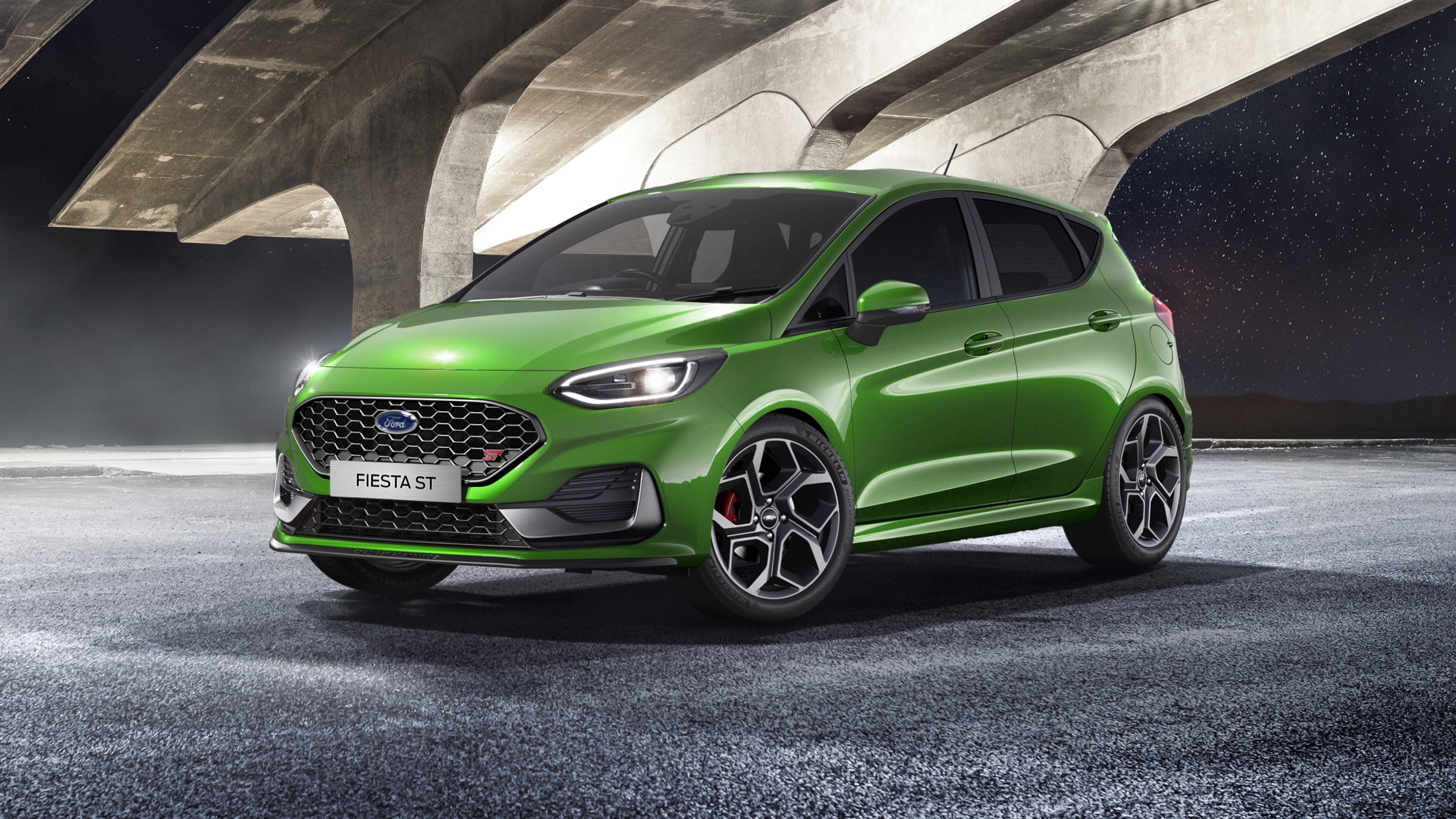
A spokesperson for Ford Australia told Wheels, “we continue to work with our suppliers as we navigate the continuing supply chain challenges, however in order to allow customers to receive their vehicles without additional delay, Australian-delivered MY22 Fiesta ST vehicles will not be produced with BLIS or rear cross-traffic alert.”
The importer has also confirmed variants of the current-generation 2022 Ford Ranger fitted with the 2.0-litre bi-turbo diesel engine landing in Australia will not feature its automatic engine stop-start system.
“Due to semiconductor supply constraints, and to ensure customers receive their vehicles without additional delay, certain Rangers arriving in Australia from January 2022 are not being produced with auto stop-start.”
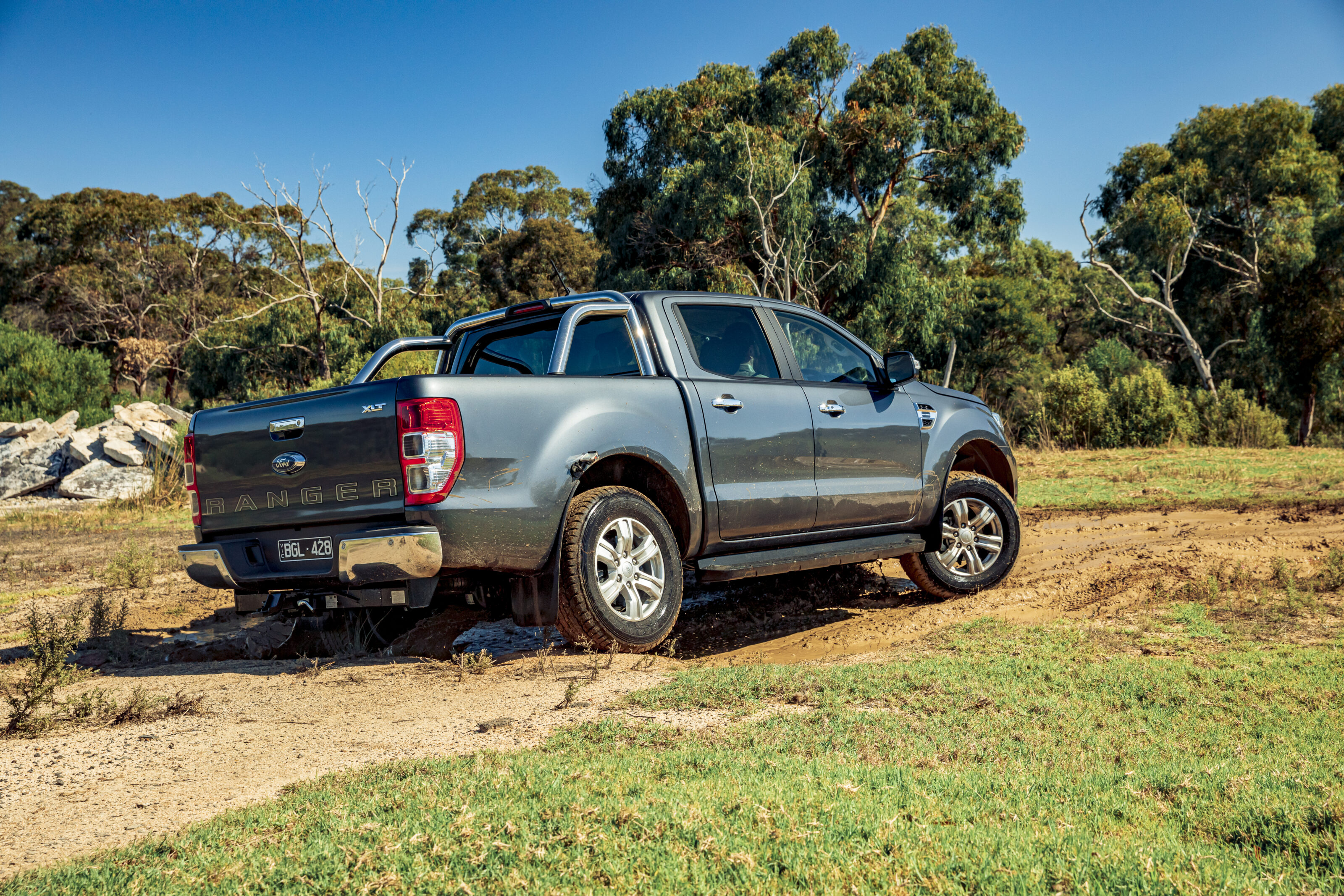
The removal of the auto stop-start system from selected Ranger variants joins a number of modifications made to the vehicle in the past 12 months, as Ford prepares to wind down production of the current-generation model.
Over the past year, local examples of the popular Ranger ute have seen the removal of several key features. This includes the CD player, rear tailgate lock on Wildtrak and Raptor, rear console 230-volt power port, and several minor deletions – including the extendable sun visor arm.
However, over the same period, the mid-spec Ranger XL saw the addition of the 2.0-litre diesel, which was previously exclusive to the XLT, Wildtrak and Raptor variants. Ford also added adaptive cruise control as standard to the near-flagship XLT, leaving semi-automatic parking as the sole Tech Pack add-on.

A CD player and 230V power port are also missing on model-year 2021.75 versions of the related Everest four-wheel-drive.
The international power port – also scrapped from certain variants of the Transit van – is a victim of Australian regulations, which require the installation of an Australia and New Zealand pattern plug.
“While the socket is compatible with Australian plugs, the AS/NZS 3112 Standard (‘Approval and test specification for plugs and socket-outlets’) requires a socket that matches an Australian plug specifically as opposed to a universal, multiway configuration,” the spokesperson said.
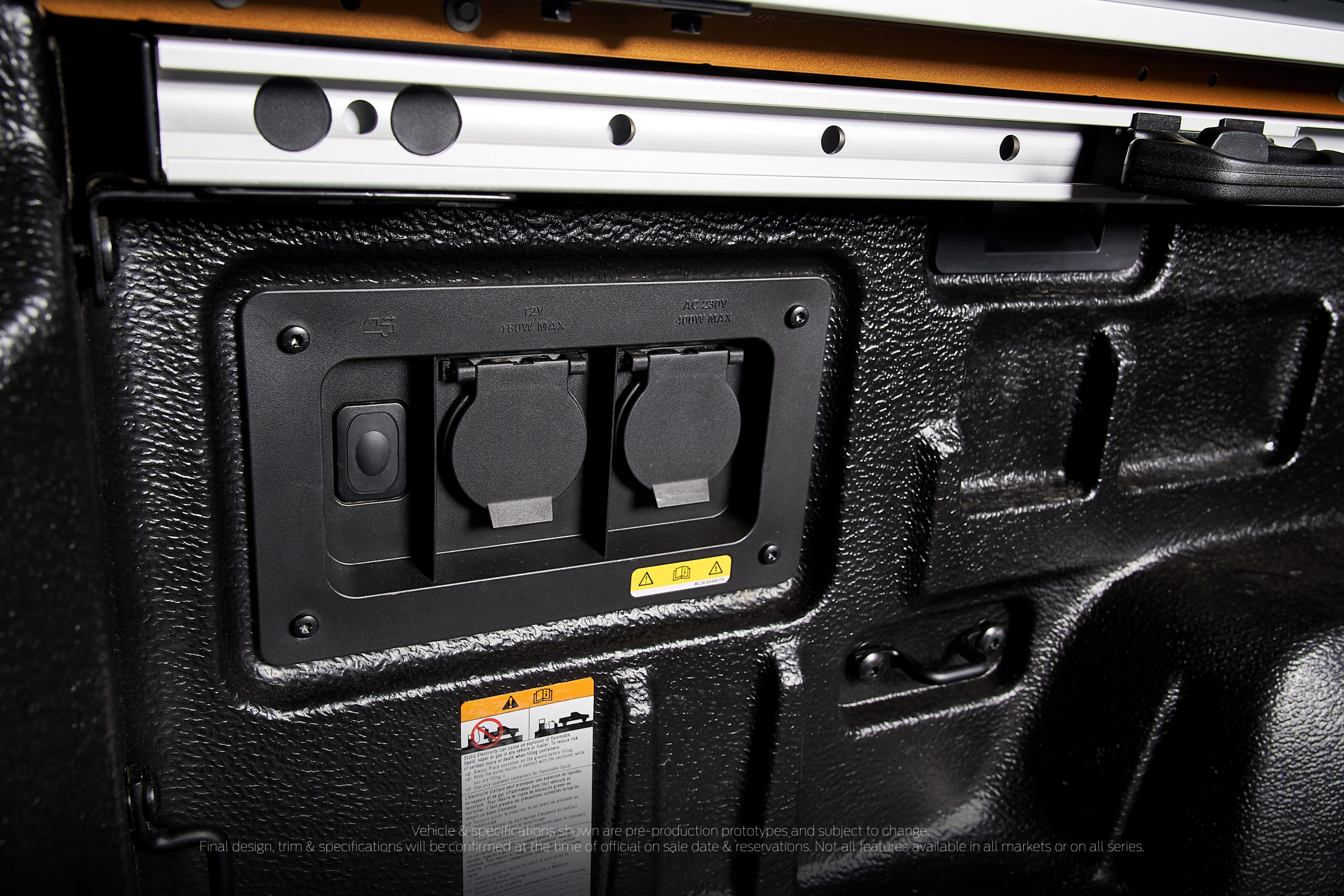
It was fitted to the Ranger XLT and Wildtrak since 2015, Raptor since 2018, Everest since 2015 and Transit since 2013, but removed from June 2021 across all four models.
“This includes Australian-delivered Next-Generation Ranger, which will not be offered with the 400W inverter and plug in the load box when the vehicle goes on sale later this year.”
“We reiterate that our power inverter system has been designed to Ford’s own global engineering standards, and customers who already have a Ranger, Everest or Transit fitted with these sockets can continue to use them.”
Ford says it will “continue to work with the regulator to resolve the issue”, meaning the new-generation Ranger is expected to regain the 400W inverter and plug when likely engineering work to convert it to the Australia and New Zealand standard is completed.
Snapshot
- Porsche now offering rentals in Melbourne
- 718, 911, and Taycan models to choose from
- Day, week, or weekend times available
Porsche Australia has launched a new rental service which allows anyone to experience current-generation sports cars from the brand.
For now, the program is running in Melbourne only, as part of a six-month pilot program.
The Porsche Drive Rental service has on its fleet a 718 Boxster S, a fully-electric Taycan 4S, a 911 Carrera S, and a 911 Carrera 4S.
Each car can be rented for a 24-hour experience on weekdays, over a full weekend, or across a seven-day period, with pick-up and drop-off based at Porsche Centre Melbourne.
Porsche Drive Rental prices start at an easily remembered $718 for the 718 and $911 for the 911, and $899 for the Taycan.
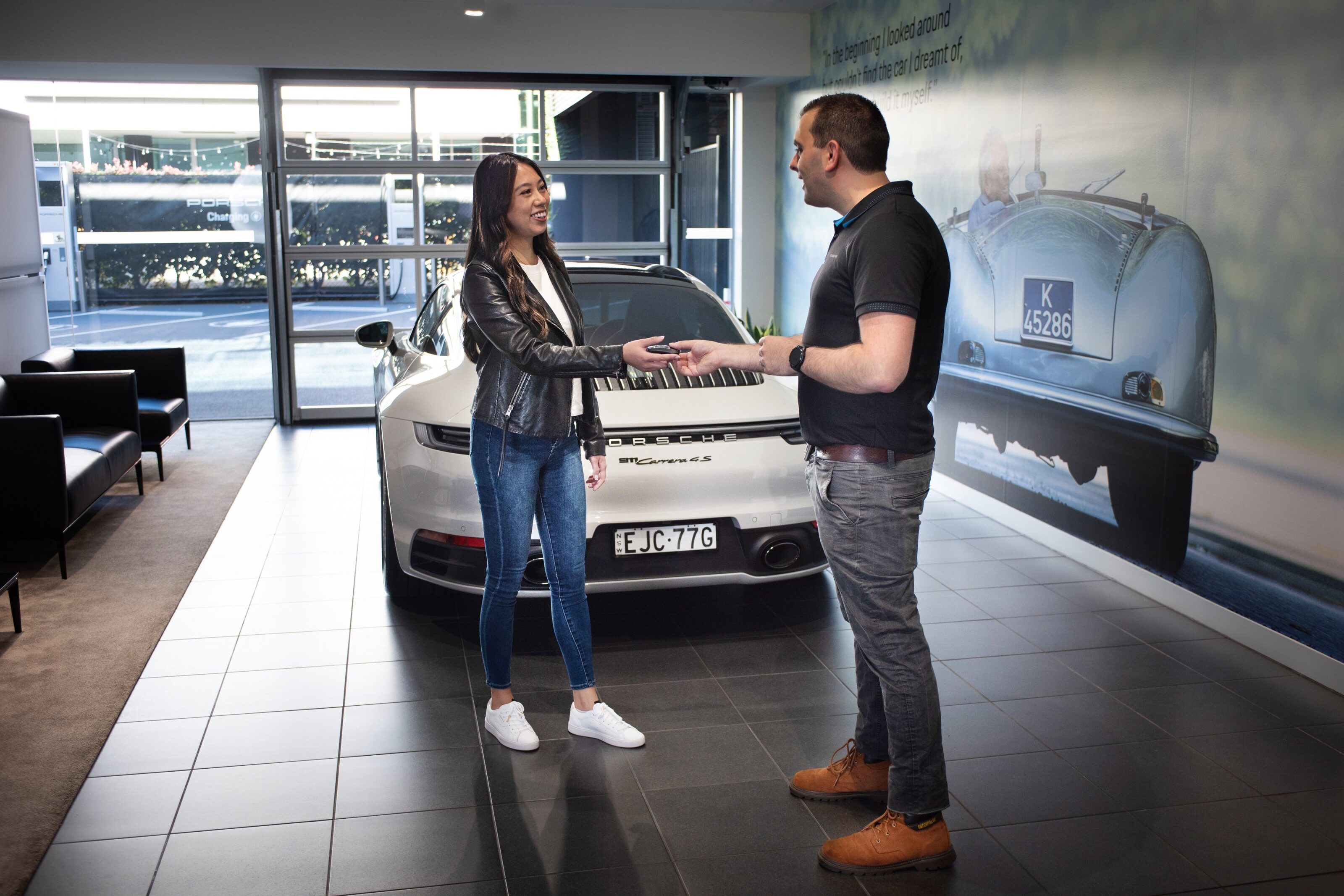
“Porsche Drive Rental is the latest example of us introducing innovative products to the Australian market,” Porsche Australia CEO Daniel Schmollinger said at the announcement.
“This pilot program in Melbourne will give us tremendous insights into how we evolve this offering in Australia in future years.”
Those wanting to take part must be at least 27 years old, have held a driver’s licence for at least five years, and will need to provide a $6000 security deposit via credit card.
Australia is the latest to benefit from the service, with Porsche Drive Rental already established acros 60 locations in Europe, Japan, and North America.
Bookings can be made at the Porsche Drive Rental site, found here.
The 2022 Haval Jolion Vanta has been introduced to the wider model range as a limited-edition flagship model.
Following the introduction of the H6 Vanta last month, Haval has applied the same treatment to the smaller Jolion, which adds styling updates to the range-topping Ultra variant.
Limited to just 500 – half the number of the H6 Vanta – the Jolion Vanta is offered exclusively in Mars red metallic paint, contrasted with black 18-inch alloy wheels and black exterior trims.
The Jolion Vanta is a $1495 increase over the Ultra on which it’s based, costing from $34,485 drive-away – which includes the $495 normally charged for metallic paint. However, the Jolion has seen two $1000 price hikes applied since November 2021.
Its 1.5-litre turbocharged four-cylinder petrol engine produces 110kW and 220Nm, powering the front wheels through a seven-speed dual-clutch automatic transmission, and delivering a combined fuel consumption claim of 8.1L/100km driven.
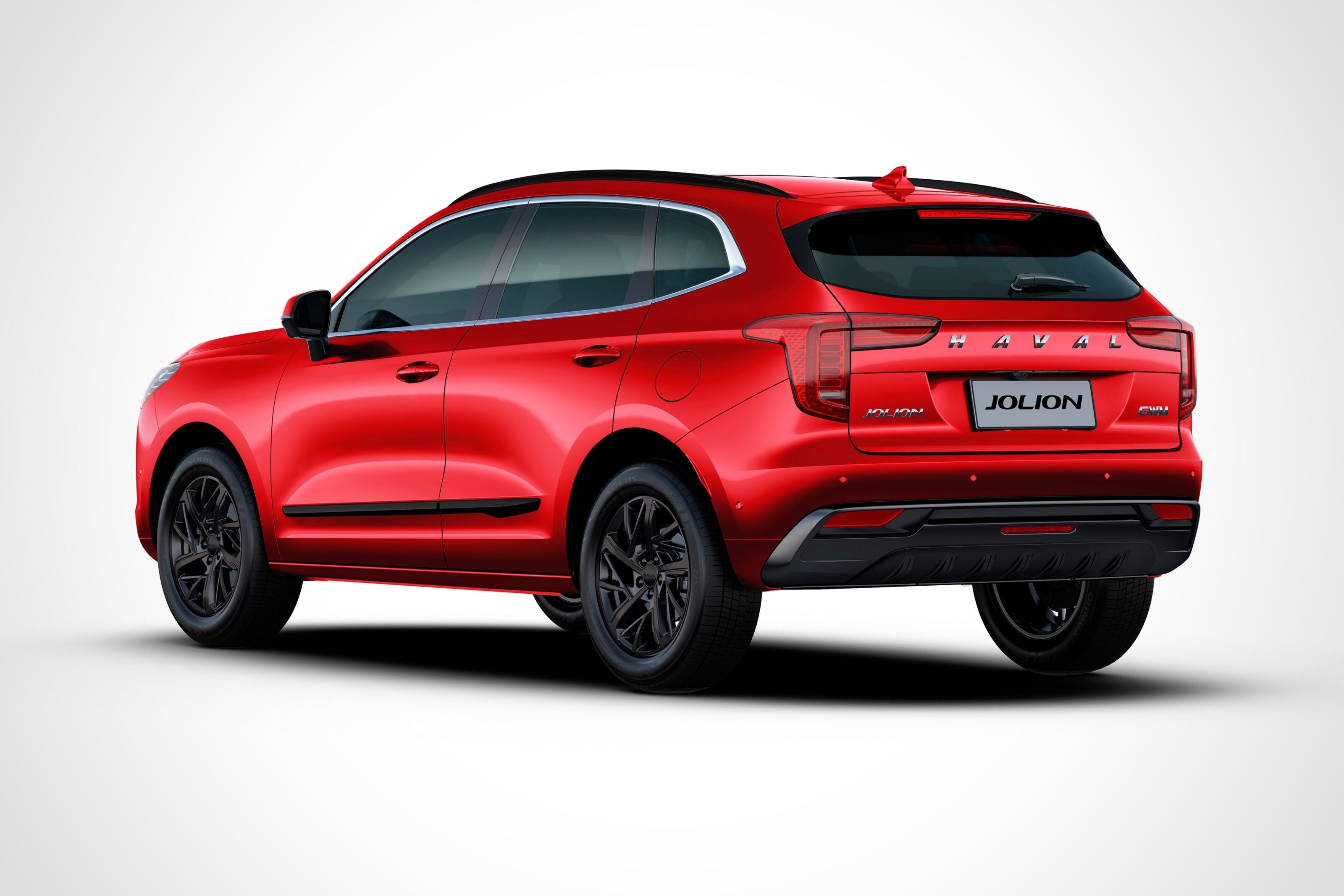
The Vanta benefits from the standard features found in the top-spec Ultra, including a premium interior, panoramic sunroof, head-up display, wireless smartphone charging, and a 10.25-inch infotainment screen with 360-degree camera, as well as Apple CarPlay and Android Auto.
Along with seven airbags, the Jolion also features autonomous emergency braking (AEB) with pedestrian and bicycle detection, radar cruise control with stop and go, lane-keep assist, lane departure warning, and traffic sign recognition.
The 2022 Haval Jolion Vanta comes with a seven-year/unlimited-kilometre warranty, five years of roadside assistance, five years of capped-price servicing, and can be ordered now from $34,485 drive-away.
