UPDATE, February 7, 2022: Ford’s North American operations will be running at reduced capacity in the coming weeks as semiconductor shortages hamper one of the Big Three.
As reported by CNBC, a dwindling supply of chips is most likely to hinder production of the best-selling F-150 pick-up truck, the Mustang Mach-E, the Bronco SUV and Ford Transit van, all of which will only affect buyers in the North American region.
A total of eight plants are expected to be affected, either operating at a reduced capacity or coming to a halt altogether, as will be the case at plants in Michigan, Illinois, Missouri and Mexico.
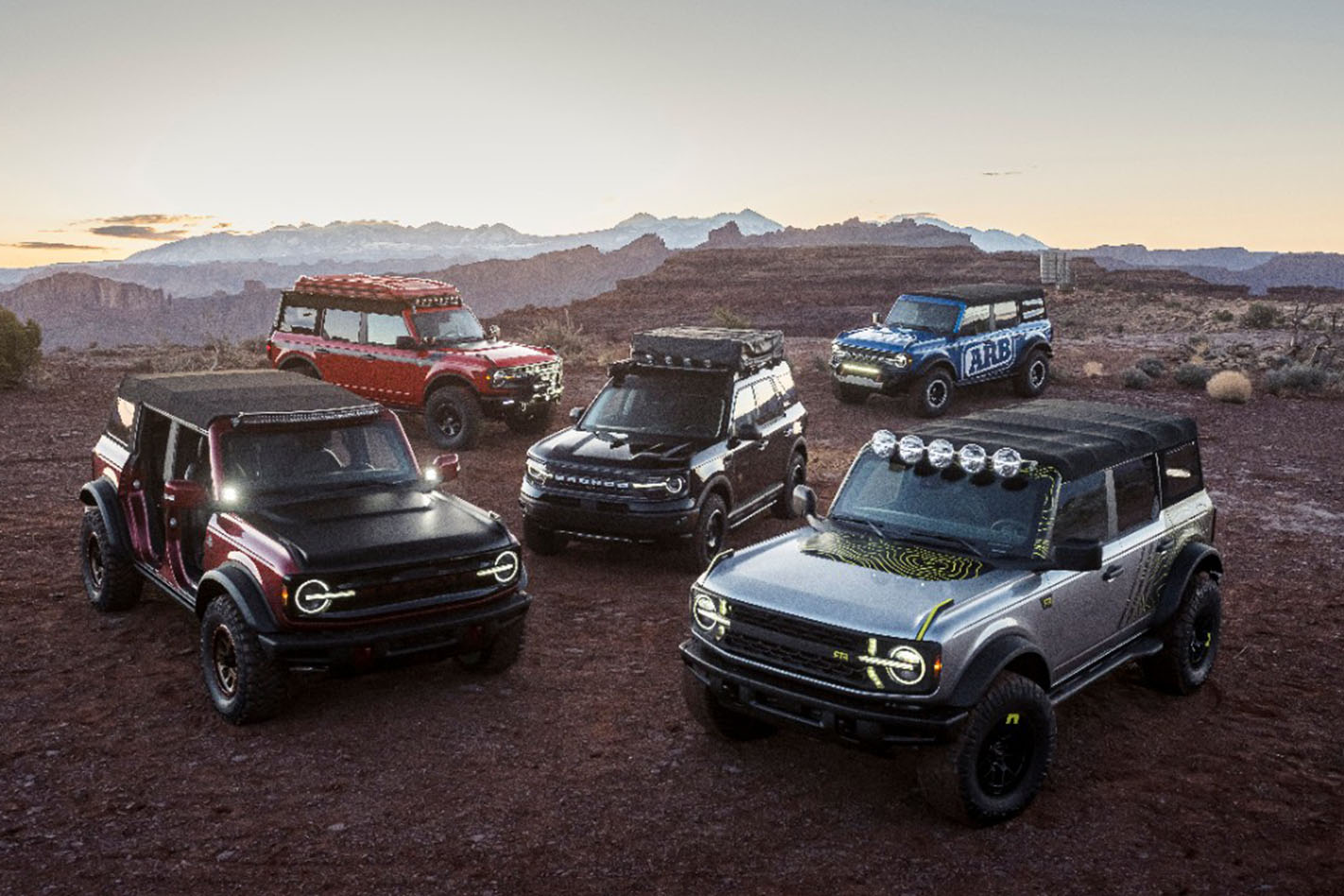
Despite previously prioritising production of the F-150 – the highest-selling vehicle in the United States for decades – the Blue Oval is now forced to ration its part supply to keep cars rolling off the production line.
“The global semiconductor shortage continues to affect Ford’s North American plants – along with automakers and other industries around the world,” Ford said in a statement to CNBC.
“Behind the scenes, we have teams working on how to maximize production, with a continued commitment to building every high-demand vehicle for our customers with the quality they expect.”
It’s the second time in as many months where Ford has hit pause on production thanks to the chip shortage, as the Flat Rock plant which assembles the Mustang underwent a week of downtime last month (more below).

The story to here
January 20, 2022: Production of Ford’s Mustang has been paused for a week, owing to the ongoing semiconductor shortage.
According to The Detroit News, the pony car’s production facility in Flat Rock, Michigan, will be idled for the next week as Ford starts to hit semiconductor supply issues.
It’s the first time the Mustang has been directly impacted by the shortage, despite Ford’s priorities remaining with production of the F-150 – which remains the best-selling vehicle in America.
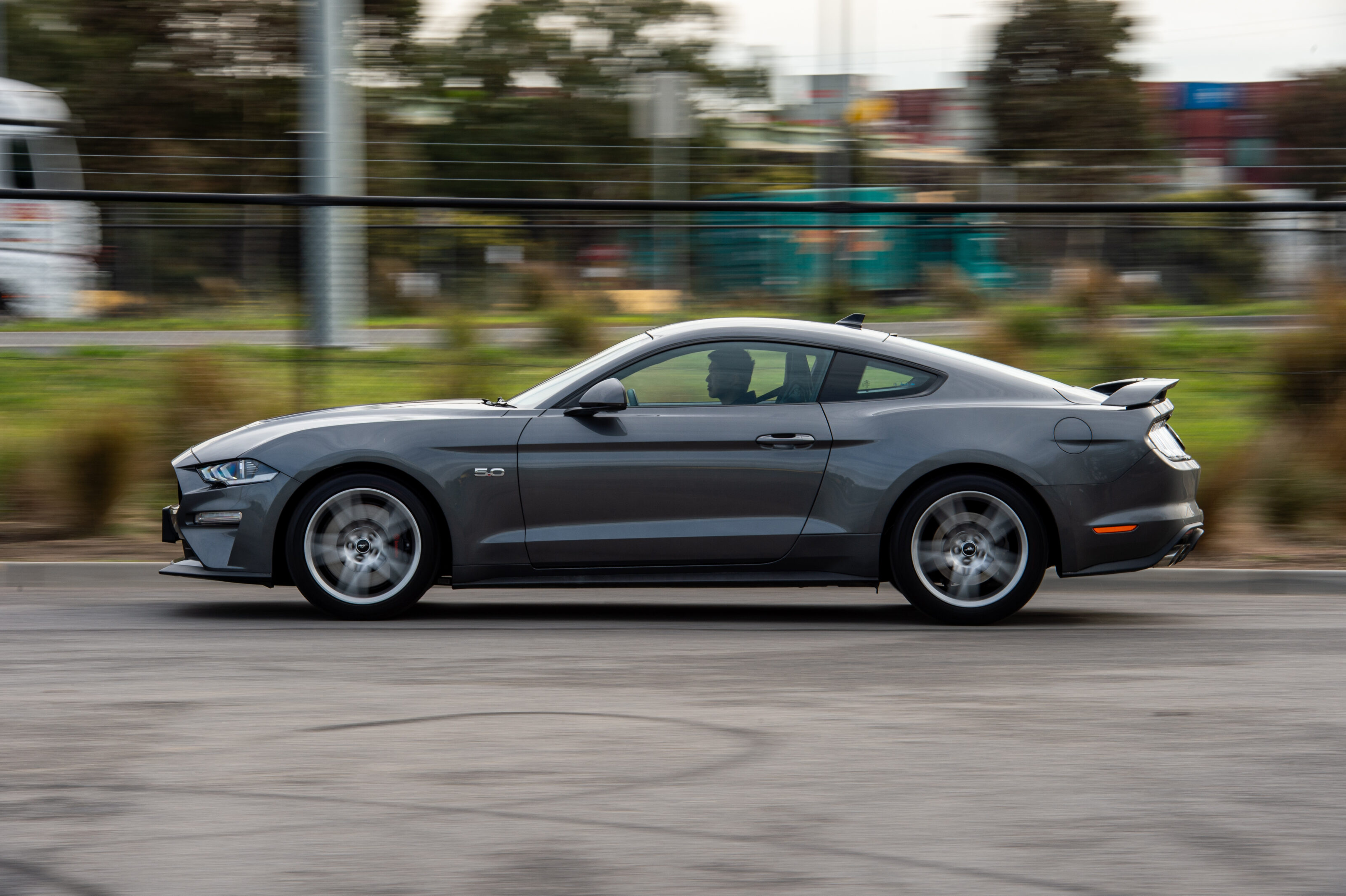
Last year saw Ford Australia sell fewer Mustangs than any other year since official local arrivals began in 2015, shifting just 2827 units throughout the year compared to its peak of 9165 vehicles sold in 2017.
Despite this, a Ford spokesperson told Wheels the production pause wouldn’t affect Australian buyers, with current waiting lists stretched out until beyond March.
“The reported pause to production will not affect Australia, however demand for Mustang continues to be strong, and with limited stock of Mustang, there are waiting periods on most variants into Q2 2022.”
Having started in 2020, the semiconductor shortage impacted Ford’s third-quarter profits last year, as the Blue Oval’s net income fell by just 23 per cent from the same point in 2020, and overall revenue dropped by five per cent compared to 12 months prior.
All-round accomplishment doesn’t draw the limelight quite as brightly as heroics. It’s why the Kia Cerato cruises under most radars despite amalgamating various virtues that meet more needs than wants. If you’re after decent space, equipment, safety, ownership credentials and general competency and you really, really can’t stomach the me-too SUV format, the small Korean – in sedan or hatchback form – makes a shrewd alternative for the pragmatically minded.
The Cerato Sport+, tested here in four-door form, is perhaps the recently updated range’s most sensible proposition. The penultimate variant piles on appointments found in the broader Cerato menu by stops short of the GT’s performance pretensions and the turbocharged, dual-clutched, multilink-suspended and athletically styled indulgence of the flagship.
And the ‘plus’ bit means it shoehorns the broadest available safety suite as standard that’s otherwise optional downstream in the range.

The four-door also manages to mask stigmatic small-sedan doldrums with a curvaceous silhouette and, besides, trainspotting reveals it offers a markedly larger boot (502L plays 428L) than its trendier liftback twin.
With the left-brain buzzing, the Sport+ sedan presents itself with enough ‘just fine’ in enough areas to convince that it’s the finest Cerato of the current, recently facelifted crop. Or so it appears on virtual paper…
Pricing and Features

The Sport+ lists for $31,140 before on-road costs in either four- or five-door guise, a price point that has been a near-constantly moving target since this generation first lobbed in 2018, when it was over five grand more affordable.
At the time of writing, the national drive-away offer is $33,190 sans options, of which there’s an extra $520 sting for fancy paintwork.
Pricier, then, is perhaps not excessively so. The Kia sails beyond a Toyota Corolla SX sedan ($28,890) if sitting level-pegged with its Korean cousin, the Hyundai i30 Elite ($31,190). As an SUV substitute, a Cerato Sport+ is $2100 more affordable than Kia’s Seltos Sport Plus ($33,290) with a similar drivetrain. All prices before on-road costs.
The Sport+ is underpinned by the same naturally aspirated, torsion-beamed underpinnings as more affordable S and Sport versions if, of course, topped with fulsome garnish.

Outside, fitment includes 17-inch alloys (with the Safety Pack’s larger rear brakes), dusk-sensing halogen headlights, LED daytime running lights, front and rear parking sensors, power-folding mirrors and not much that can’t be had on the more affordable regular Sport.
The cabin, though, gets Plus exclusives such as keyless entry and go, leather-appointed trim with front seat heating, dual-zone climate control and an electro-chromatic rear-view mirror.
Every Cerato grade bar the entry S gets Kia’s high-spec 10.25-inch infotainment system featuring sat-nav, DAB+, wired Apple CarPlay and Android Auto and the ever-curious Sounds of Nature ambient noise effects as a sort of occasional-use novelty trick. Thankfully the glitch-prone wireless smartphone mirroring offered in the base variant has been omitted from the range’s upper reaches.
With the left-brain buzzing, the Sport+ sedan presents itself with enough ‘just fine’ in enough areas to convince that it’s the finest Cerato of the current crop

Apart from paint, options are limited to the Safety Pack suite, commanding an extra $1500 in S and Sport but bundled into the Plus as standard. With it comes auto emergency braking with pedestrian and cyclist detection, adaptive cruise control, blind-spot monitoring, rear cross-traffic alert and safe exit warning.
Exclusive to the Plus (and GT) are both blind-spot and rear cross-traffic collision avoidance protocols. Active lane-keeping and lane following is standard right throughout the Cerato line-up. It’s a shame, however, that LED headlights offered on the GT are absent from the Plus features list.
The Cerato is a range of split merit in the eyes and clipboards of ANCAP; hatch and sedan versions fitted with the Safety Pack get five stars, those without get four. That said, all and sundry fit front, side and curtain airbags.
Comfort and Space

The cabin is classic and familiar Kia, neat and austere with nothing too funky or too adventurous, minted in the marque’s penchant for dark grey with flashes of frosted silver and piano black, all of it a little too conspicuously plasticky to lift itself too upmarket.
Not much has changed since this generation lobbed in 2018 bar the revised Kia logo on the horn cap, though the bright and colourful 10.25-inch screen and small touches such as the electric park brake and updated TFT driver’s screen do lift general presentation nicely.
It’s … fine. The ergonomics are sound, it’s an intuitive cabin design to negotiate, the seats are comfy and supportive enough to neither wow nor annoy. The perforated seat trim is hardy and not very supple, but it looks tidy enough. It’s a cabin fit-out offering flashes of niceness (seat heating) in an execution that otherwise constantly reminds that it’s primarily out to cover fundamental bases (mechanical seat adjustment with no lumbar support control).

Still, it’s a tactile cabin with soft surfaces around the dash and door trims, pleasant touchpoints, a quality feel to the controls and switchgear and a good sense of general solidity. Plasticky though the presentation might be, it looks and feels well-built, right down to the quality of exterior paintwork.
Infotainment, too, is large, crisp, fetching and easy to use, its colourful display adding a splash of interest to the cabin’s otherwise stolid colour scheme. The lack of inductive charging isn’t a big issue given the wired smartphone mirroring, which is a messier if ultimately more reliable connection than the wireless format also offered across the Kia (and Hyundai) ranges.
It’s a tactile cabin with soft surfaces around the dash and door trims, pleasant touchpoints, a quality feel to the controls and switchgear and a good sense of general solidity

Row two offers decent leg and shoulder room, making for a comfortable four-adult prospect with enough room for five at a pinch. The sloping roofline, however, does restrict headroom a bit and will have taller occupants brushing their heads against the ceiling. Comfort in the flat-backed seat is adequate though hardly rave-worthy while rear air vents and a sole USB outlet covers fundamental rear-passenger appointments.
The 502-litre boot space is nice and deep, with proportions generous enough to swallow large bulky objects, while the rear seatback splits 60:40 for a bit of added load-through practicality. There’s a space-saver spare under the floor, in a housing suspiciously large enough to house a full-sized wheel.
On the Road

In short, the naturally aspirated 2.0-litre four and six-speed auto powertrain is workmanlike and adequate for tasks that don’t want for large doses of enthusiasm. But nor is anything wrong with it. In fact, the marriage of the MPi four (not the Smartstream unit offered overseas) and torque-converter slushbox is quite a smooth and rosy one, with more inherent cooperation and refinement than most of the dual-clutch-specced powertrains kicking around the Asian mainstream.
With a lukewarm 112kW and its 192Nm peak perched up at 4000rpm, the two-litre is no pulse-raiser and yet, somewhat surprisingly, it does almost everything it needs to. Response is crisp, the transmission is alert, and it musters up more enthusiasm than you initially expect, only becoming slightly gruff once you trounce on it and which is rarely called for around town.
Its consumption, faithful and impressively unwavering mid-eights across balance real-world motoring, is fine enough. And on a diet of crappy 91RON if you choose

On the open road, though, it can get caught labouring in kickdown during valiant attempts to overtake a B-double or when called to merge swiftly into fast-moving gaps.
This powertrain fits the bill, or at least the realistic bill for the Sport+’s pitch and purpose. Its consumption, advertised at 7.4L/100 combined and delivering a faithful and impressively unwavering mid-eights across a balance of real-world motoring, is fine enough. And on a diet of crappy 91RON if you choose.
The drive is, like much of the rest of the package, competent if largely unremarkable. It points faithfully and is easy to judge and place on the road, which had better be with a degree of accuracy lest you encounter a fight from Kia’s sensitive lane-keeping and lane-centring smarts.
This remains the one area most Korean machinery calibrations seem genuinely uncomfortable when subjected to the usually unkempt and sometimes hostile Aussie hot-mix landscape.

Ride comfort is patchy. Essentially, the primary ride is decent, slightly firm if with enough pliancy to round out large and sharp hits, though it often doesn’t seem so because the suspension is so noisy and thumpy when asked to serve its task. Not helping is that the secondary ride is more fidgety than it really needs to be, as if to inject some terse sportiness purely for vibe’s sake.
The by-product is a suspension tune that’s generally quite composed but, in its main shortfall, suddenly becomes unrefined when confronted by road acne. It’s an ever-present and underlying sensation that might’ve otherwise been masked to some degree by the absence of the prominent amount of tyre noise the Cerato drums up loudly across various road surfaces.
Ownership

The Cerato comes with Kia’s excellent seven-year, unlimited-kilometre warranty with ongoing roadside assistance provided you keep servicing with Kia.
Service intervals are 12 months or 15,000 kilometres, whichever comes first, totalling $2939 over its price-capped seven-year/105,000km duration, which averages out to just under $420 per year. For an uncomplicated mechanical package, that’s kind of pricey.
VERDICT

The Kia Cerato Sport+ is decent in enough areas to mark its territory as a solid all-rounder. But while the four-door doesn’t do anything badly, it doesn’t really assert itself confidently in any area among a small passenger car segment that’s making forward strides, regardless of its wider popularity.
It faces fresher (Hyundai i30 Sedan), sportier (Ford Focus ST), more premium (Mazda 3), cheaper to buy and own (Toyota Corolla) competition and fails to offer a key point of difference (as per the all-paw Subaru Impreza).
What’s more, this comes at a creeping price point that no longer looks quite as value-laden as it was just a few years ago when Cerato was considerably more affordable.
2022 Kia Cerato Sport+ sedan specifications
| Body | four-door sedan |
|---|---|
| Drive | front-wheel drive |
| Engine | 2.0-litre four-cylinder |
| Bore/stroke | 81.0 x 97.0mm |
| Compression | 10.3:1 |
| Power | 112kW @ 6200rpm |
| Torque | 192Nm @ 4000rpm |
| Transmission | six-speed automatic |
| Weight | 1320kg (kerb) |
| Fuel consumption | 7.4L/100km claimed |
| Suspension | strut (front), torsion beam (rear) |
| L/W/h | 4640/1800/1440mm |
| Wheelbase | 2700mm |
| Brakes | 280mm single-piston (front), 284mm single-piston (rear) |
| Tyres | 225/45 R17 Kumho Ecsta PS71 (f&r) |
| Wheels | 17-inch wheels (space saver spare) |
| Price | $31,140 + on-road costs |
I have spent a lot of time on planes in the past few months and you may even have seen some of the results of my selfless nomadic wanderings around Europe in these very pages. But while I haven’t yet had the gall to hammer the work credit card for a full business-class ticket, I have at least had the fortune to completely avoid budget airlines.
If you’ve never suffered the indignity of a so-called ‘low cost’ airline allow me to run you through a typical scenario as a warning with a broader message. It starts with a search for flights using a popular aggregator service which will inevitably throw up a couple of prices that appear to be too good to be true – they are. However, if you decide not to heed the oldest consumer mantra in the world and continue with QueasyJet, RyanAaargh or Ti-grr then you will spend the next three hours checking boxes for optional extras. Check-in baggage, choose a seat, insurance for when we cancel your flight for no apparent reason, cover for your bags that we lost and won’t return for three days – by which stage you’ll already be home.. and so on.
When it comes to check-in at the airport, the permanently disgruntled staff will weigh your ‘free’ hand luggage and if it’s a single gram over – bang, $50. And if you should choose to opt out of any of these, the unchecked box serves as a disclaimer allowing the airline to get away with virtually any stuff up it wants without any recompense or consequence.
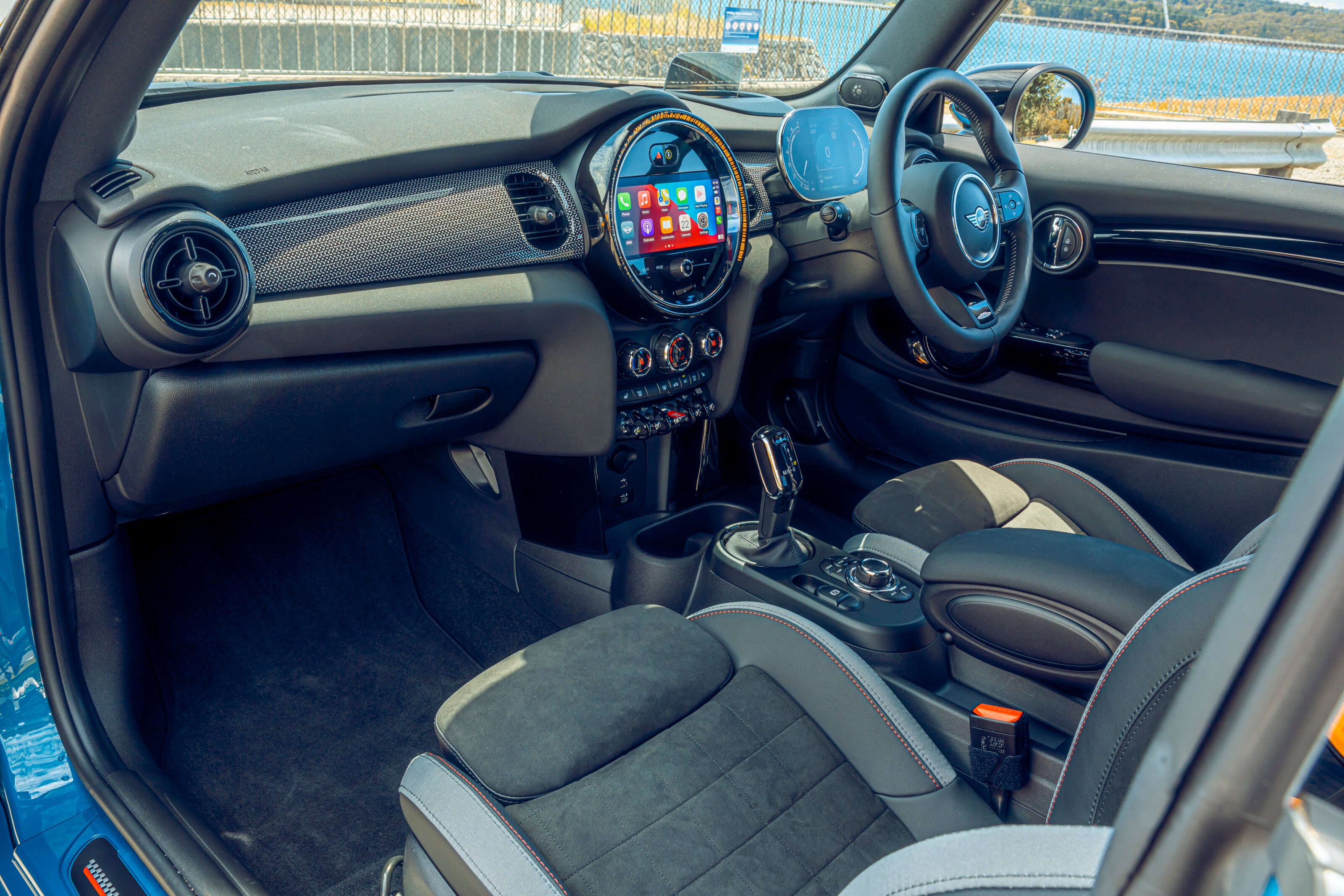
Yet, if you click all the boxes for peace of mind suddenly the ticket costs more than a business-class return – not so budget after all. More chillingly though, car manufacturers are toying with something similar for cars. A number of premium brands are testing the market with what they call subscription, pay-per-use or on-demand features and they have the potential to make cars as poor value and annoying as a budget airline.
At the milder end of the spectrum, software such as navigation and select applications would not be permanently accessible in your car and only available if you pay for the feature to be unlocked temporarily. Not so bad? The principle is scalable and sets a precedent for other on-demand features previously included in the traditional purchasing process – and the manufacturers are thinking about it.
Next could be a heated seat for the driver or climate control for the second row passengers or maybe a head-up display. But it gets worse, because virtually any element of a new generation of cars will have the potential to be switched on or off using the advanced electronic systems that run them.
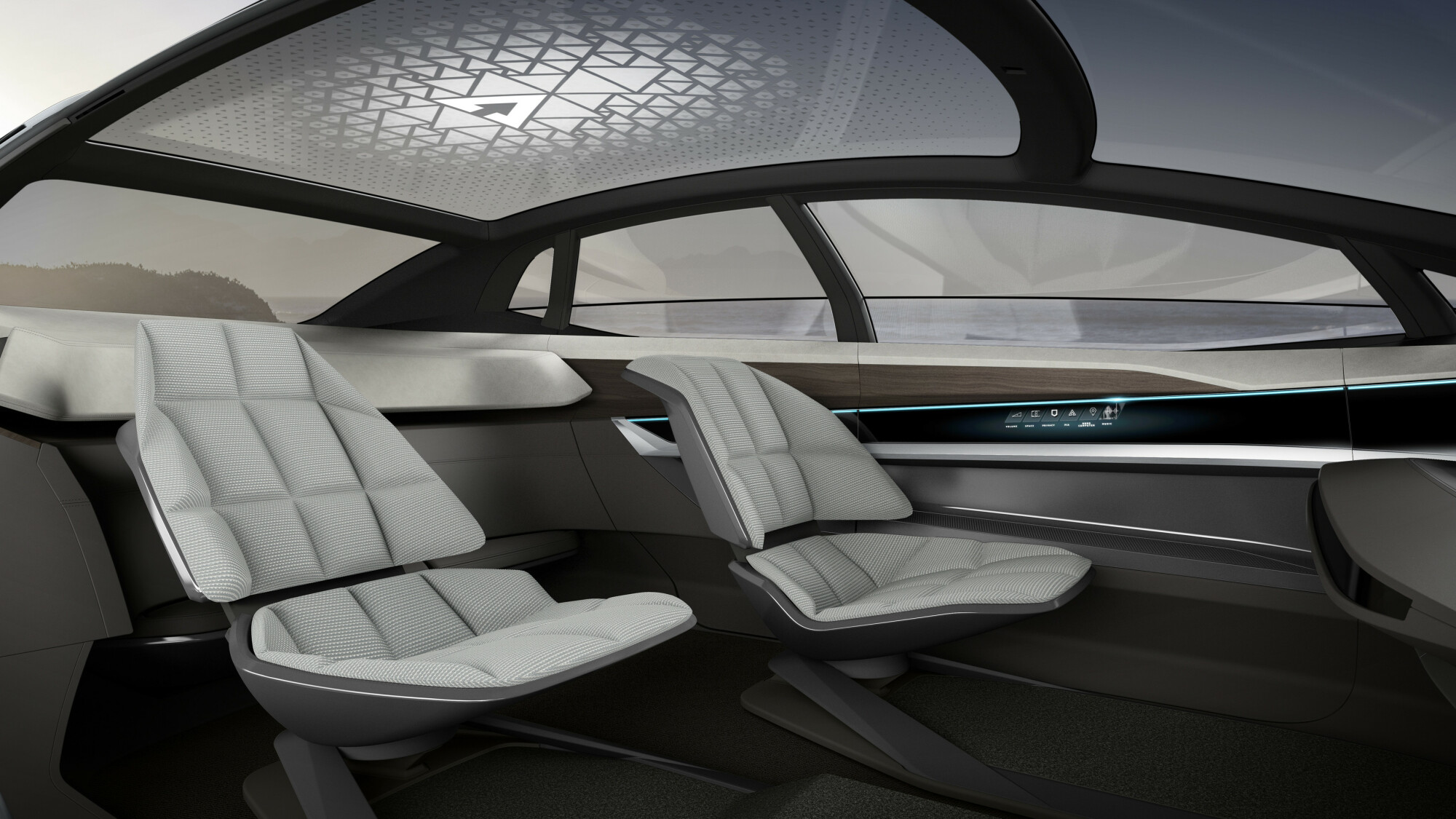
Tesla is already doing it with features that are built into the model at birth but can be activated later in the car’s life. So imagine if the car you bought was 200kW when delivered but could be boosted to 300kW for the occasional track day. Perhaps your front-wheel drive car could have the rear wheels switched on for a trip to the snow or maybe even converted to rear-drive for 30 minutes when covering your favourite mountain pass? Got a flat? Open the application and pay for the manufacturer to hit the deflated tyre with a shot of goo and air over-the-air and allow you to get on your way.
Premium brands argue this makes perfect sense as you don’t need the full complement of equipment each time you jump in the car and subscriptions have the potential to make car ownership cheaper, but how can they? If the heating element is already installed in the steering wheel, or the 360-degree cameras fitted around the vehicle on the production line, haven’t you already paid for it?
Of course, this idea works beautifully for car-sharing in which the car is not owned by the user and only ever effectively rented by members of the service. In these circumstances it makes sense to unlock the required features each time a new user takes a car just like the convenience of renting the car itself. But be careful what you wish for because today it’s Android Auto and Apple CarPlay. Tomorrow it’ll be speed governors and virtual tailpipes.
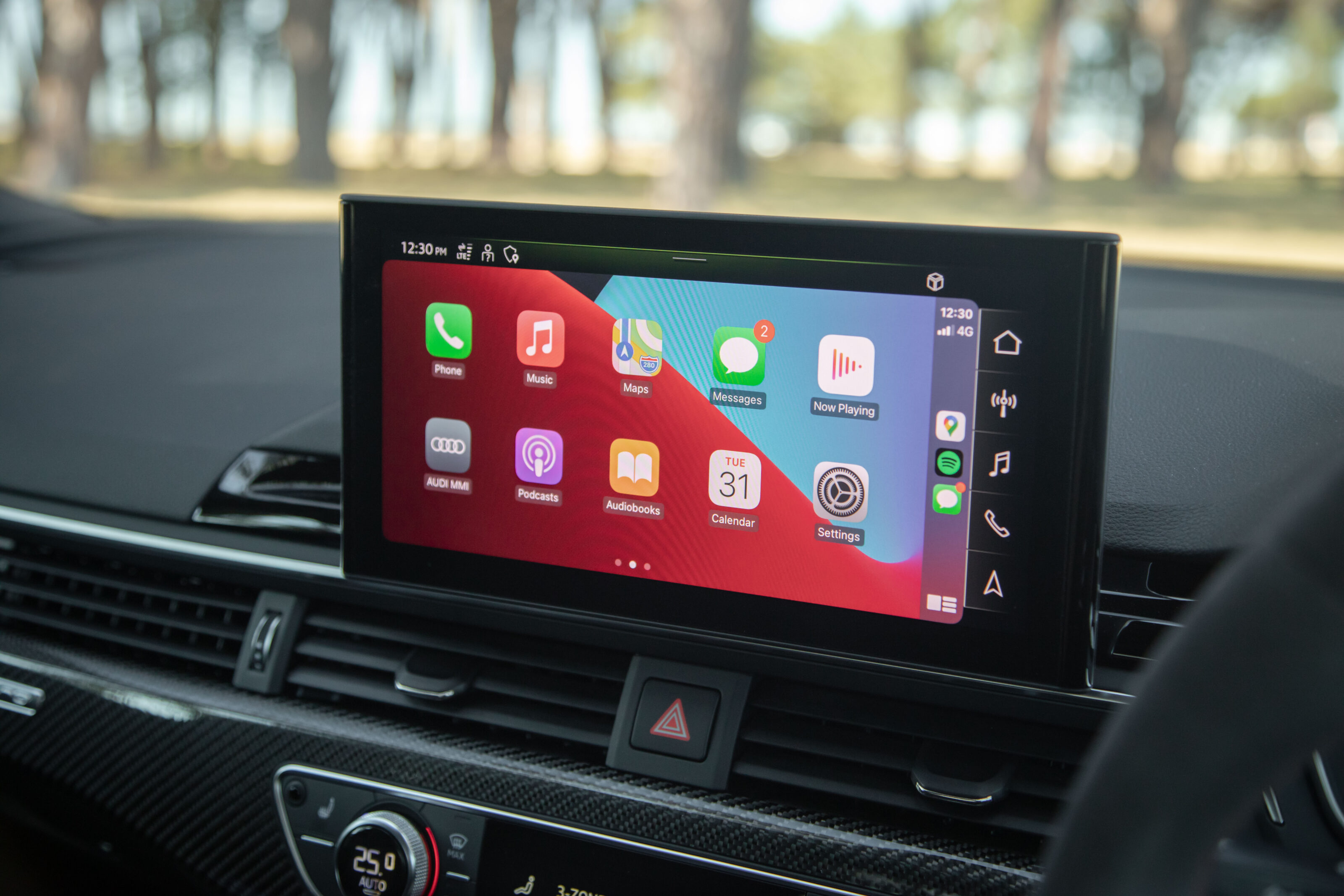
Snapshot
- Average estimated waiting time for a new car in Australia is four months
- Toyota, Kia, Nissan and Isuzu among those experiencing longer delays
- West Australian buyers have the longest wait
- Numbers do not necessarily reflect waiting times across entire model ranges
The typical waiting time for a new car in Australia increased by 250 per cent since the start of the Pandemic, with the average time for many models extending beyond six months, according to figures released by vehicle pricing advice website PriceMyCar.com.au.
The data, compiled with information from dealers, vehicle brokers and buyers who enter the price of a vehicle and its estimated delivery date, shows the average national waiting time for a new vehicle has increased from 36 days in January 2020 to 126 days in January 2022.
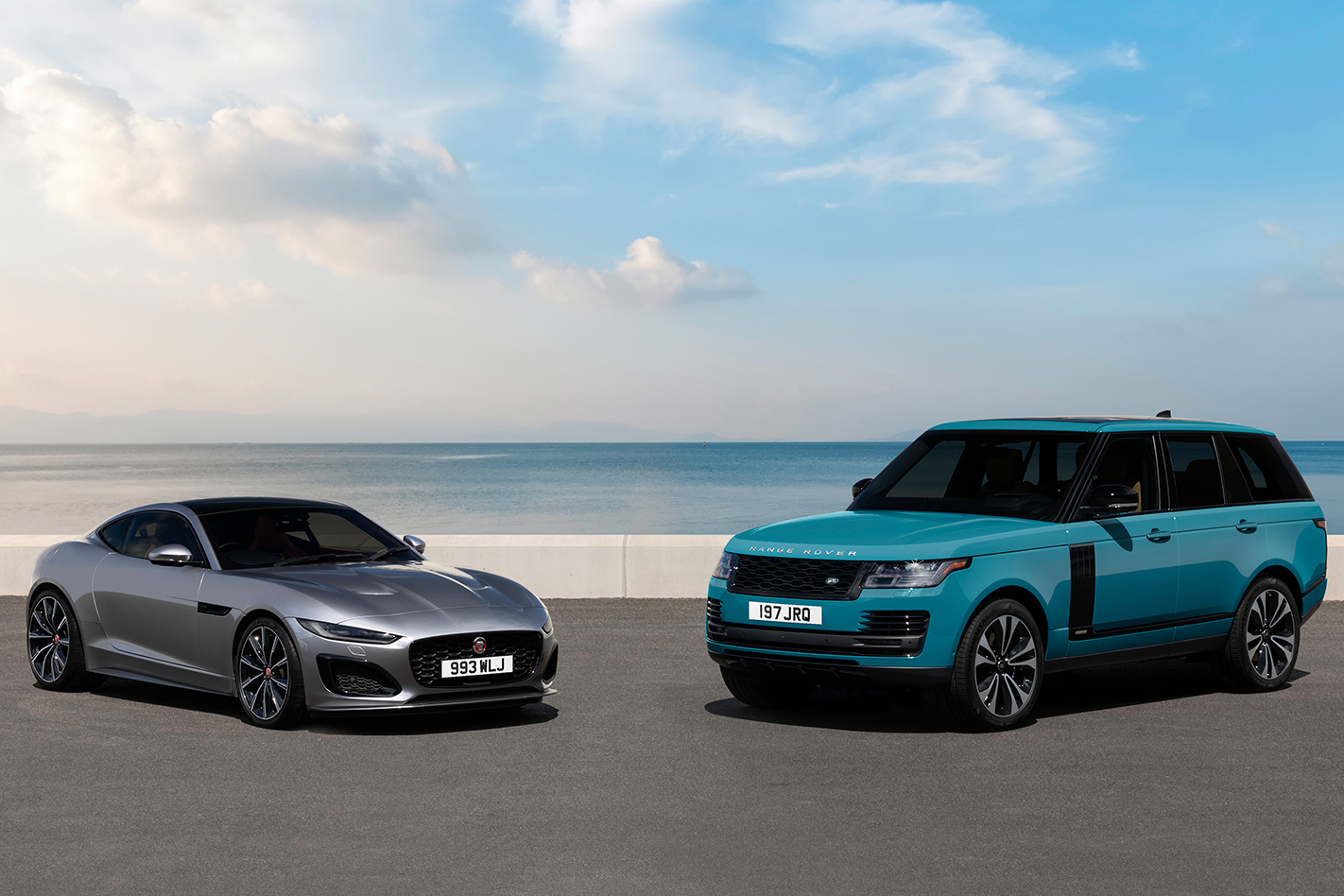
The estimated delivery dates, which are collated by make and model, and by state, reveal the Jaguar Land Rover (JLR) group topped the list last month with an average 218-day wait, followed by Volvo (199), Isuzu (189), Toyota (180) and Kia (173).
JLR Australia did not dispute the figure, with a spokesperson telling WhichCar the company was currently experiencing Covid-19 supply chain disruption, including the global availability of semiconductors, which is having an impact on its production schedules.
“We are working closely with affected suppliers to resolve the issues and minimise the impact on customer orders wherever possible,” they said.
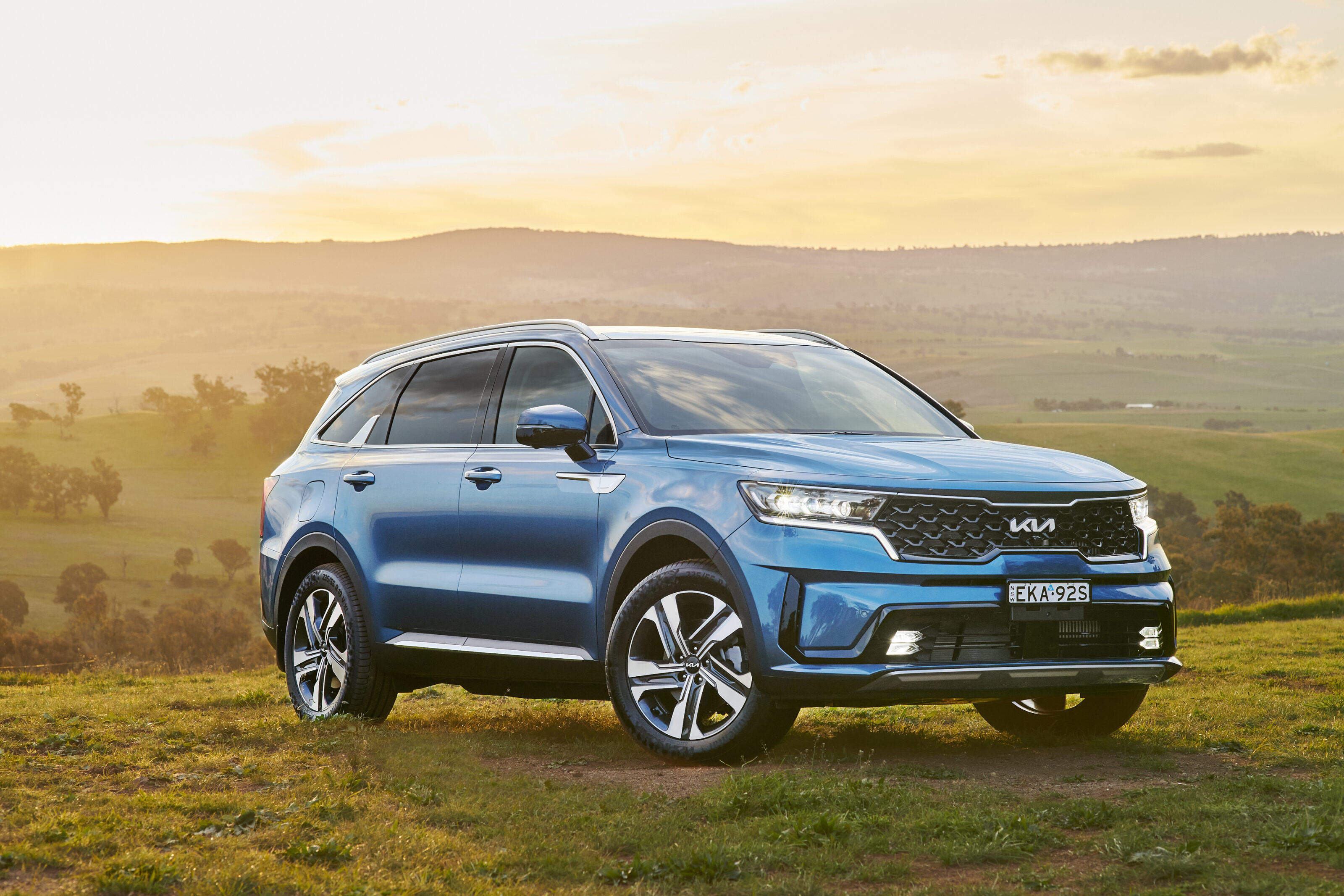
Kia’s delivery woes were led by its Sorento large SUV, which, according to PriceMyCar had the longest waiting period of any new model of 274 days or nine months due to the plug-in hybrid version facing delays of about 10-months due to high demand for it in Europe.
A Kia Australia spokesperson said the Korean carmaker was also beset by various component shortages, which continued to impact mainly the higher specification grades of several models across the Kia range, which also include the Seltos and Carnival that according to PriceMyCar are subject to delays of 255 and 225 days respectively.
“We have been and will continue, to work closely with Kia HQ to source more supply and expedite delivery where possible,” the spokesperson said.
“Kia Australia does provide customers with the opportunity to cancel their order and receive a full deposit refund if the wait time exceeds their required time frame for a vehicle.”
Damn lies and statistics
As the Sorento PHEV showed, the total average waiting time for particular brands could be skewed by a particular model or variant, which Volvo Australia was keen to point out when disputing the 199-day waiting period that saw it come second to JLR on the list.
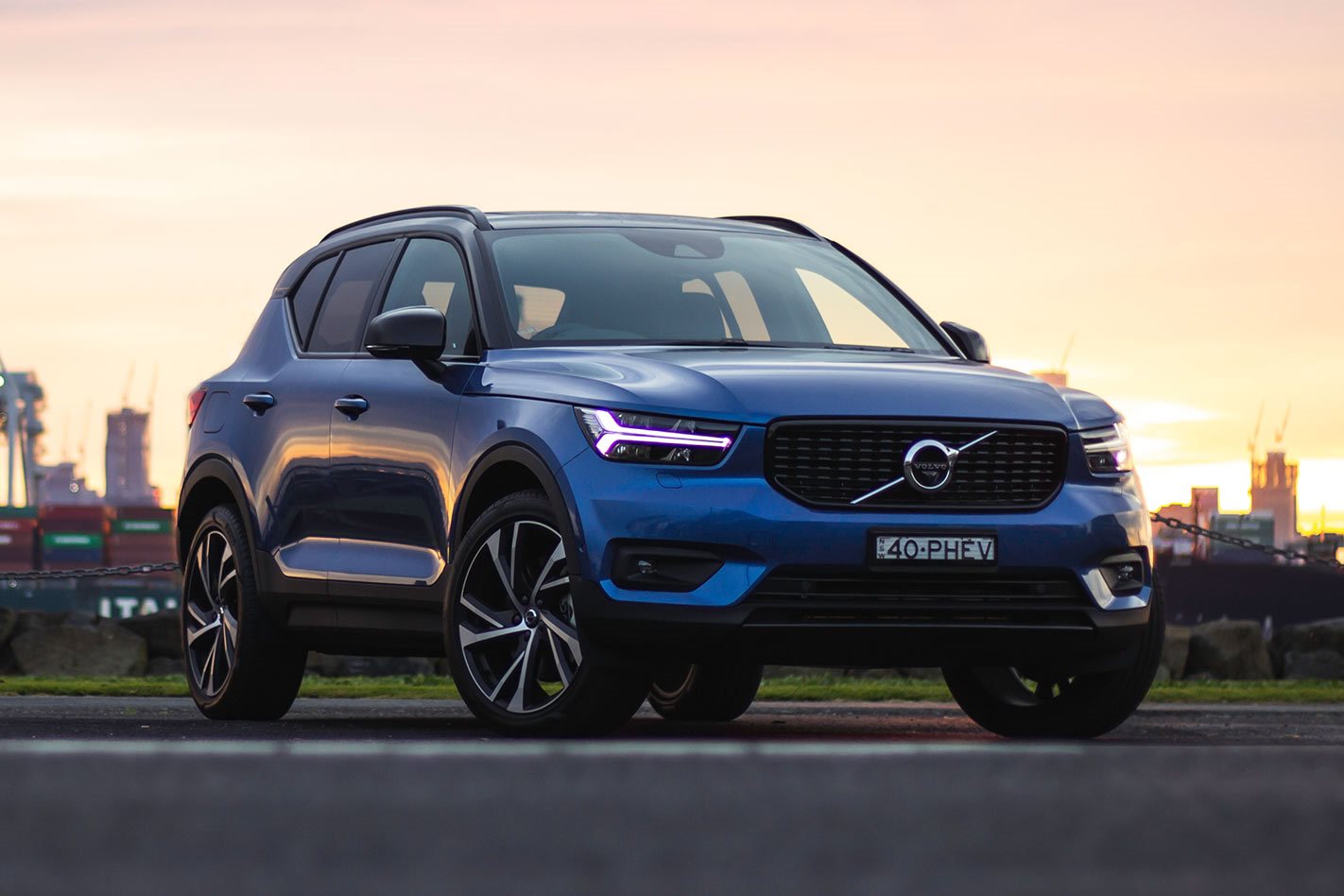
A Volvo spokesperson told WhichCar that figure was inflated by the high demand for its XC40 Recharge EV and PHEV variants that, due to being available in limited numbers, were selling out before they arrived.
They said there is a steady supply for all other models, including the petrol XC40 variants, with 30 days worth of stock on the ground. They added there were 400 unsold vehicles with another 1000 to arrive this month.
PriceMyCar founder and CEO Dave Lye conceded the total figures can be affected due to certain models and variants being in high demand.
He said it was difficult to split models into separate variants, which is why XC40 is listed as having a 221 day waiting period, despite the availability of the petrol versions.
He added that because estimated waiting times are partly crowd-sourced from buyers the system was better suited to popular mainstream models.
Delays may have peaked
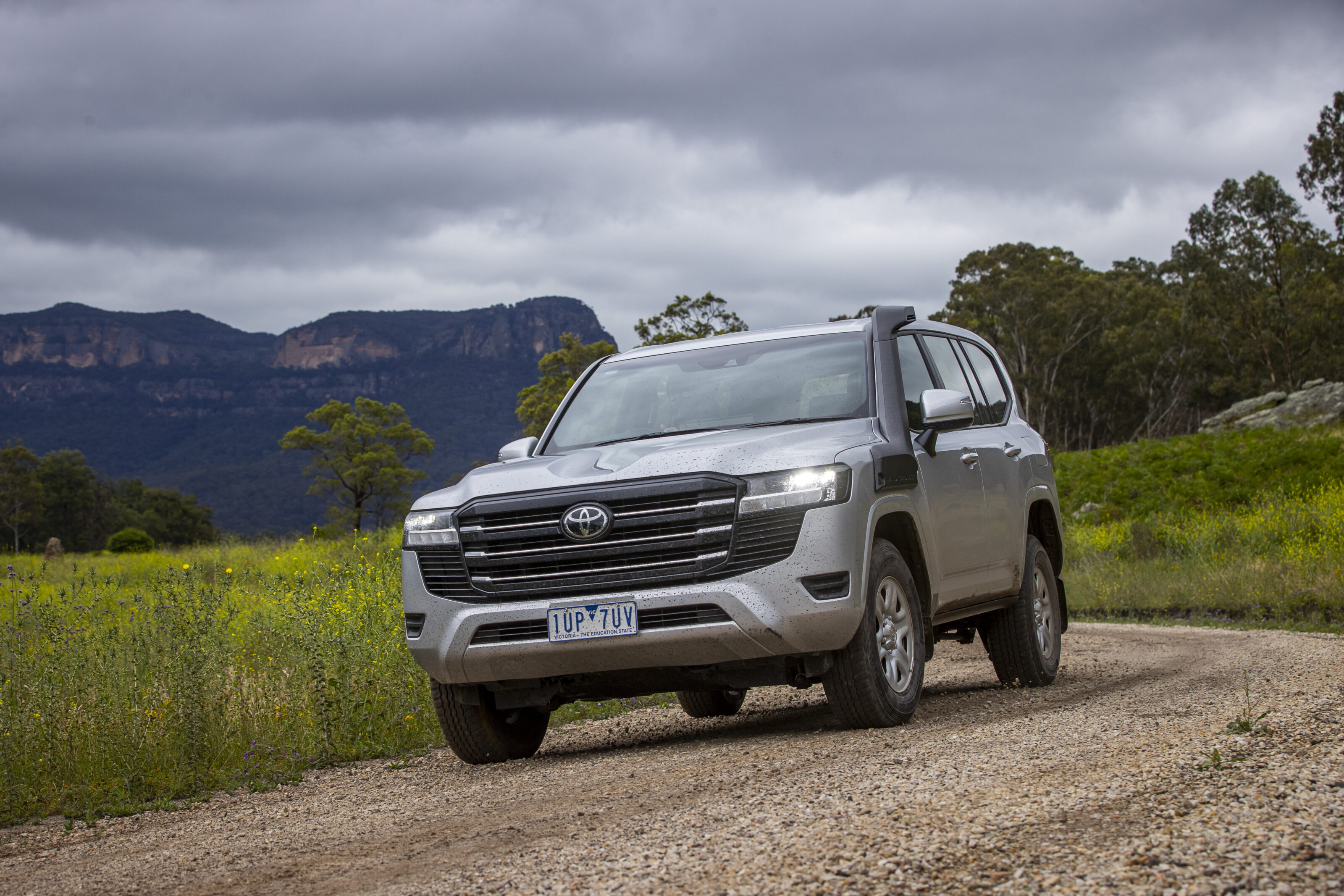
People in Western Australia have the longest waiting period in the country, an average of 157 days, with that number not helped by continuing border closures and the popularity of Toyota HiLux and LandCruiser 300, which by January 22 were experiencing national average waiting times of 155 and 200 days.
Expect that LandCruiser 300 figure to rise across Australia, with Toyota warning of production shutdowns in Japan due to COVID-19-related parts shortages, which have plagued the industry.
Also affected is the RAV4, which has an average waiting time of 258 days, led by demand for the popular hybrid variants. This likely explains why Australia’s most popular SUV of 2021 dropped out of the top-10 sales list in January 2022.
It’s not just the global supply-chain chaos that are affecting vehicle deliveries Down Under. Australia is down the pecking order when it comes to receiving more efficient vehicles, including EVs and hybrids, with factories prioritising markets with stronger emissions laws than Australia’s lax regulations – according to Kia this is a key reason for the delays facing the Kia Sorento PHEV.
The good news is the waiting times may have peaked, with numbers slightly down from December 2021, which saw a peak average national waiting period of 128 days, but a slight downward curve for most of the worst affected models – hopefully, this will become a trend.
If you need a new car quickly in the meantime, Peugeot has the quickest turnaround of 42 days, followed by Honda (55), MG (60), Jeep (63) and LDV (65).
Tesla did not feature in the PriceMyCar data, but WhichCar has heard from Model 3 buyers who have been told to expect a waiting period of 14 to 20 weeks.
Waiting times in the above story and tables are based on those reported in January 2022 by pricemycar.com.au, which were the most current at the time of writing.
Click here to look up updated waiting times for particular makes and models. WhichCar recommends that you double-check any figures for a car you are interested in purchasing with the appropriate dealership.
French luxury brand DS is commemorating the historic Louvre Museum in Paris, which houses the Mona Lisa and other world-famous arts.
The 2022 DS 3 Crossback Louvre is a limited-edition variant of the Peugeot-based small SUV, with numerous styling tweaks and hundreds of digitised art pieces on the infotainment system.
Unfortunately, a re-introduction of the premium DS marque – spun-off from the Citroen range in 2015 – was effectively ruled out for Australia by local officials in late-2018 (with no recent plans), meaning the DS 3 Crossback remains limited to Europe and China.
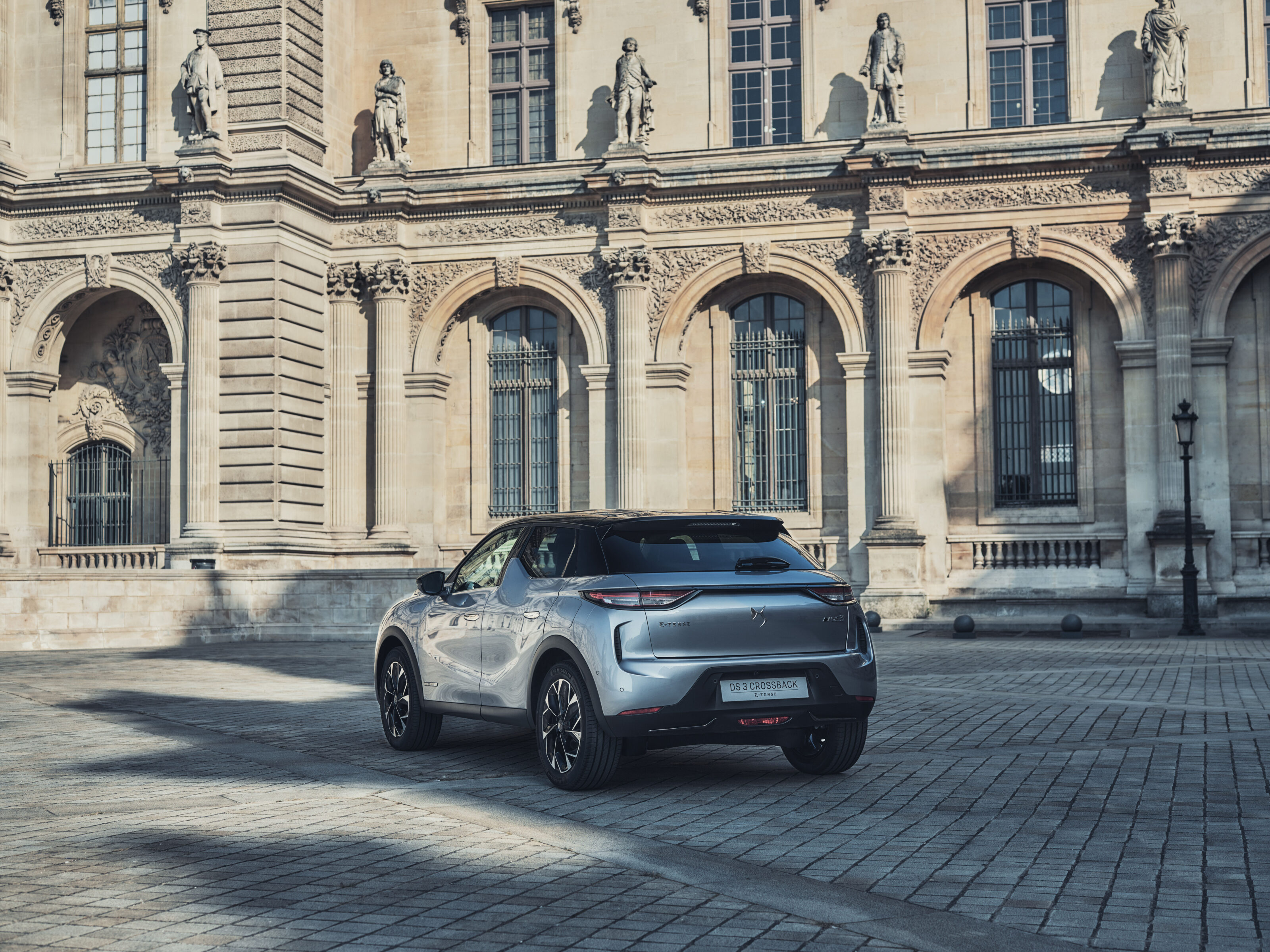
Hints of the museum are shown through unique ‘Louvre’ badging on the bonnet, doors and tailgate, along with pyramid etchings on the darkened grille, door mirrors and 18-inch alloy wheels.
DS will offer the 3 Crossback Louvre in four monochrome colours, with each including a black roof to visibly lower the roofline of the vehicle.
The interior also receives tweaks, including black ‘watch strap’ Nappa leather on the seats, dashboard and door panels. The steering wheel has also been hand-covered in leather, with ‘pearl’ stitching and embossed inserts.
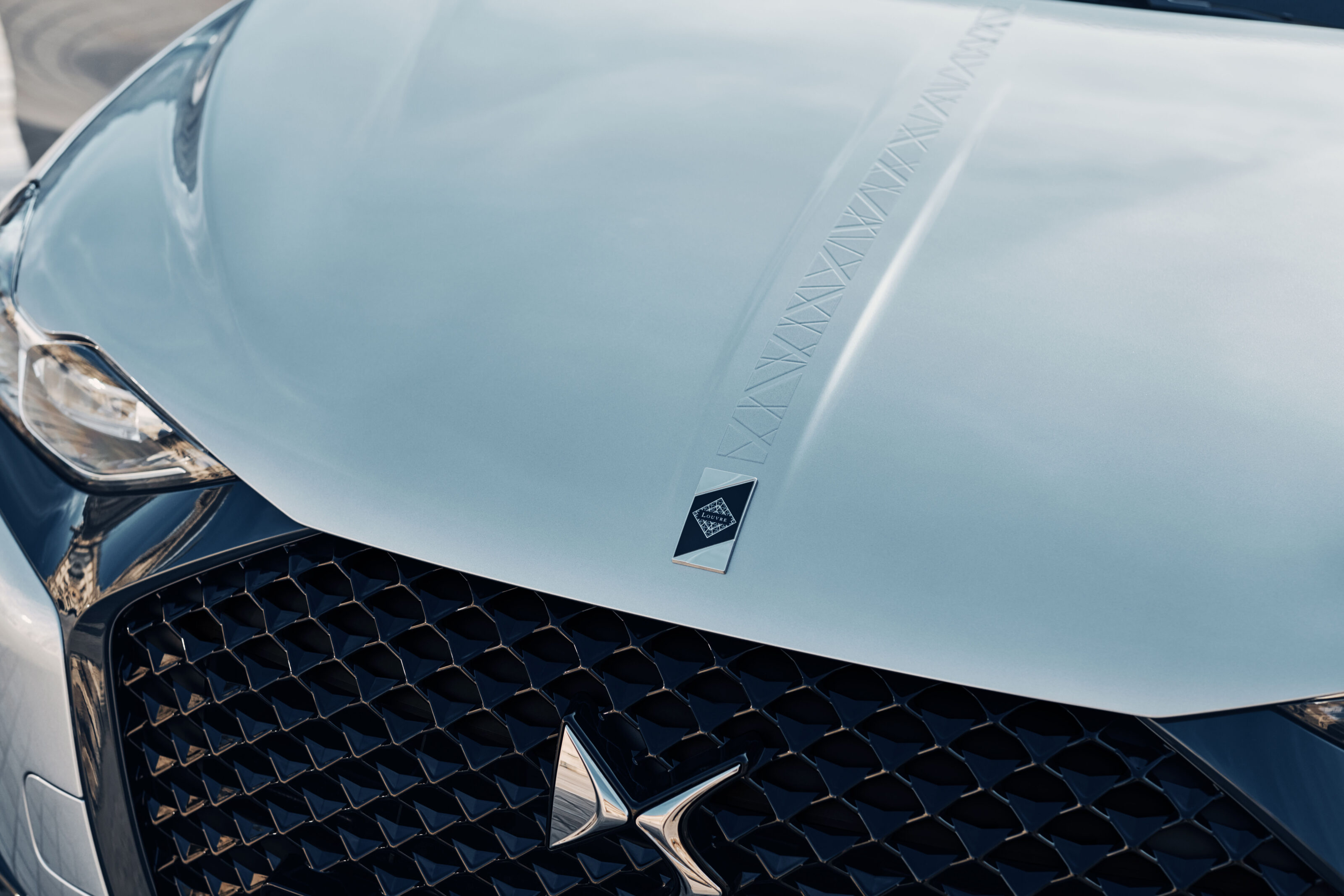
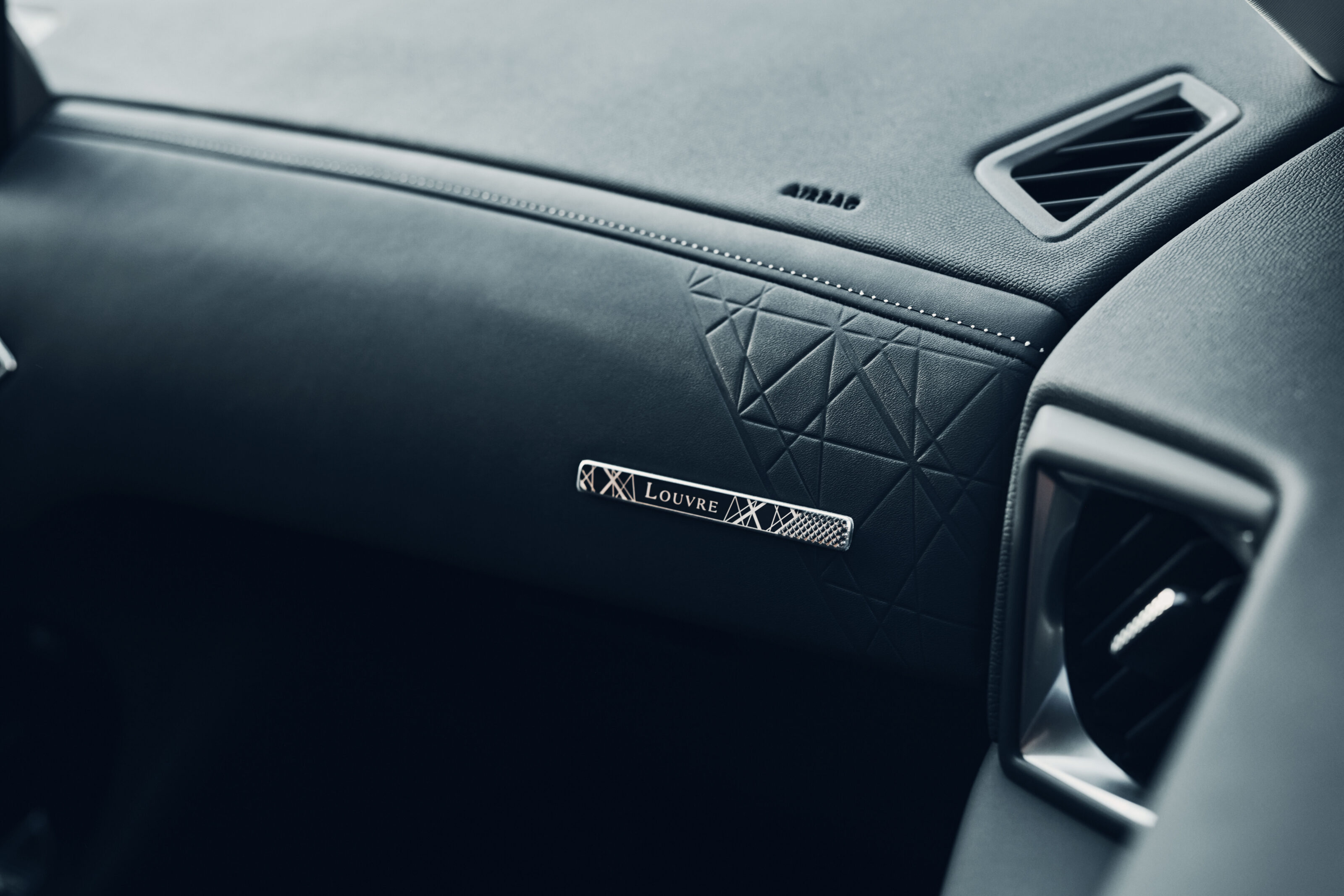
A laser engraving of the pyramid logo is included on the gear shifter, while the dashboard is also adorned by Louvre badging.
As with the regular DS 3 Crossback range, the Louvre includes a 10.3-inch infotainment system. However, the software has been modified to include 182 artworks displayed at the iconic museum – including the Mona Lisa, the Wedding at Cana and the Egyptian statue of the Seated Scribe.
Each artwork is displayed on a weekly basis or through a search engine, with each work accompanied by an included podcast that delves into its origin.
The 2022 DS 3 Crossback Louvre is available in the United Kingdom with a turbocharged 1.2-litre three-cylinder – available in 95kW and 115kW tunes – and a 100kW pure-electric powertrain with up to 300km of real-world driving range.
Pricing kicks off from £34,420 (AU$65,630), with the flagship all-electric ‘E-Tense’ variant listed at £40,800 (AU$77,790).
In a bid to stay afloat amongst a sea of Stellantis-owned brands, DS is poised to go all-electric from 2024, utilising the STLA Medium architecture.
If you’re looking for a comfortable, refined and capable small car with a bit of a difference, you’d better stop reading now. While the Abarth 595 Competizione is capable, it is neither of the other things and, if I may be so bold, all the better for it.
Some people – people like me and very few of the people I know – are smitten with the idea of a tiny hatchback with a can – actually an entire slab – of whoop-ass rammed into its diminutive dimensions. And there aren’t many around these days, with the Ford Fiesta ST, VW Polo GTI and Hyundai i20 N taking up most of the space. Even then, they’re the Titanic to the 595’s tug boat.
This isn’t a car for everyone and, as you’ll shortly find out, the 595 Competizione is the nichest of niches with the possible exception of the completely mad 695.
Pricing and Features
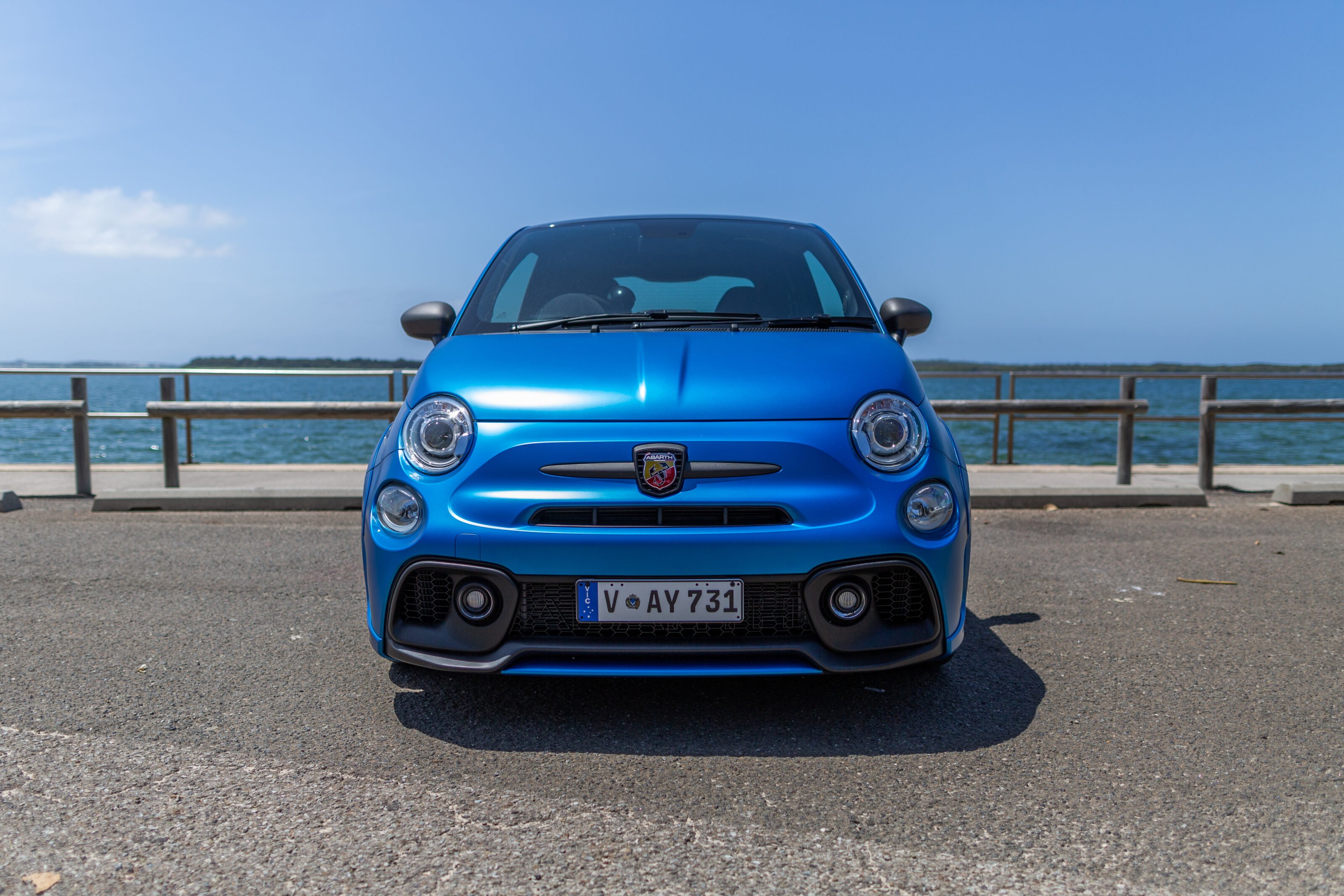
This version of the Abarth 595 is a step up from the first step on the Abarth ladder. You can buy an Abarth 595 for a tick under $30,000. The Competizione goes for $33,250 before on-road costs.
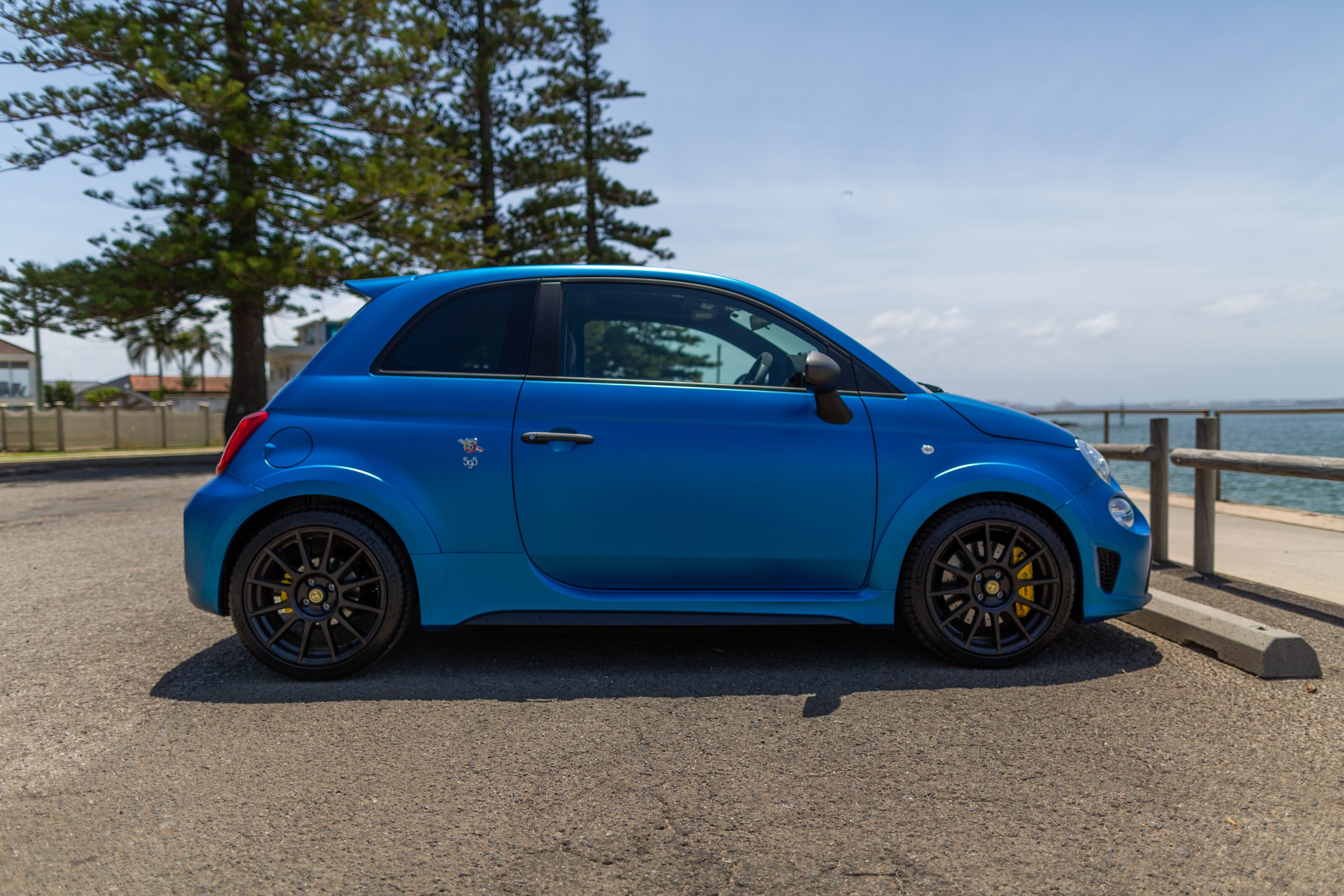
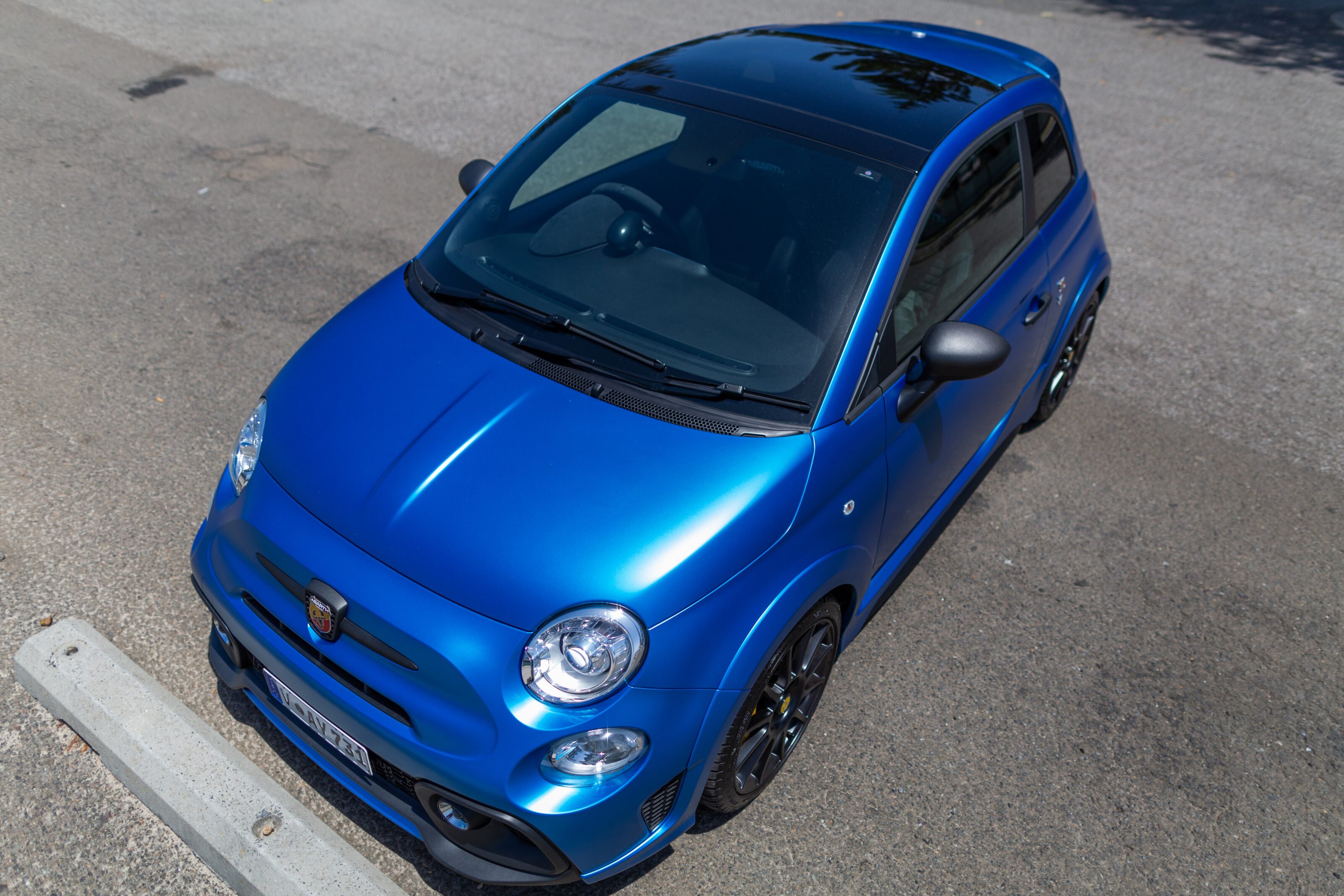
Before we get into the base specification, bear in mind that the car I drove is nearly ten grand more with matte blue paint for $1600, a body kit ($2450), Premium Pack ($2500), Sport Pack (another $2500) and yellow Brembo brake calipers for $250. The Brembos are standard, the yellow paint isn’t.
The base car starts you off with 17-inch alloys, climate control, central locking, rear parking sensors, automatic halogen headlights, auto wipers, digital dashboard, metallic gear shifter (which gets very hot in the sun), leather steering wheel and seats, and a tyre repair kit.
It’s not a lot of gear, but I would argue quite strongly that at least you can get this stripped-out version without having to wear the cost of options that some brands chuck in.
A 7.0-inch touchscreen running the very busy-looking UConnect software does duty in the centre console and has a number of features including USB Apple CarPlay, Android Auto and DAB+ digital radio. It’s fine but equally, nothing to write home about.
And so we come to the extensive options list. The paint and the calipers are self-explanatory and in the case of the former, colossally expensive for such a small machine. Having said that, your only freebie is white and a bunch of colours are $650. So you’ll be paying for a paint job if white isn’t your thing.
Some people – people like me – are smitten with the idea of a tiny hatchback with an entire slab of whoop-ass rammed into its diminutive dimensions
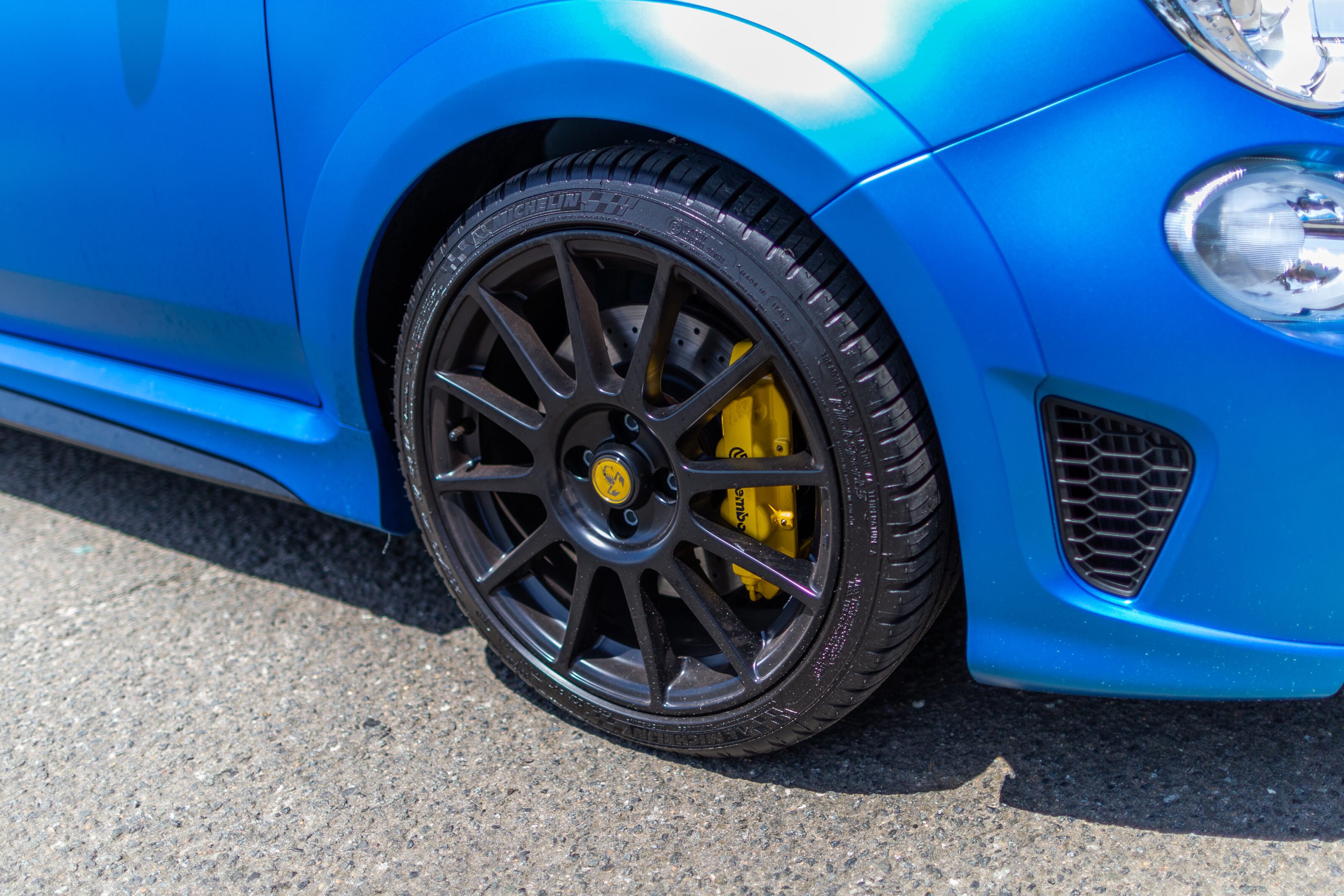
The Competizione body kit doesn’t really add anything of significance to the car; it’s purely cosmetic. The Sport pack delivers a pair of very firm Sabelt seats, blacked-out wheels and an Alcantara steering wheel.
The Premium Pack adds bi-Xenon headlights (good) and a sunroof with a perforated sliding cover (not so good). Sadly you can’t get the headlights separately.
So, yeah, you can spend more than forty grand on an Abarth 595 Competizione, but you don’t have to. Keep that in mind.
The safety list is a bit skinny, with seven airbags, stability and traction controls, rear parking sensors, tyre pressure monitoring, two ISOFIX points and two top tethers. The car on which it’s based, the 500, was last tested by ANCAP in 2008 and that may as well have been a hundred years ago as the rules have changed so much, so its five-star rating is well and truly expired.
Comfort and Space
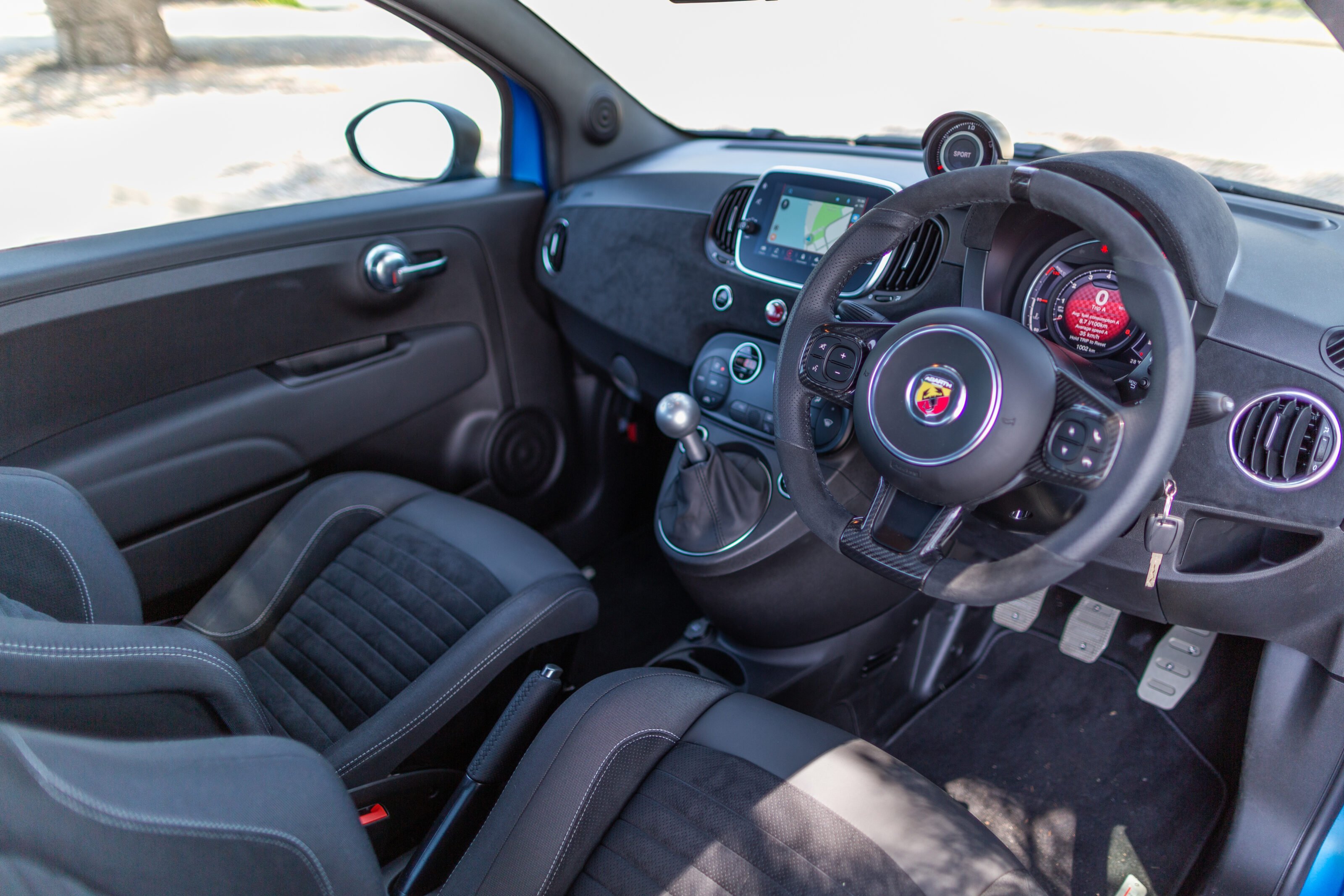
The Fiat 500 cabin is impressively sized for its tiny proportions. Front passengers may find the Sabelt seats an acquired taste because they ensure you are set very high and you can’t ratchet them down. The sunroof is no help.
You do have two USB ports, two cup holders and a little slot you can stand your phone in, though. For some reason, the window switches are on the centre console on either side of the shifter and my brain just refused to accept that they were there. Were this my car, I would wear the door armrest down pawing at where my head thinks the window switches should be.
Rather worse is the fact that you can’t adjust the rake of the seats with the door shut. I made this wild claim on Twitter and a bunch of chuckleheads suggested that’s because I have giant meaty hands but I can assure you that my slender fingers could touch the wheel but not get the purchase to turn it. Probably not an issue if it’s just you driving, but if you’re sharing this car with a different person, you might get a bit tired of it.
The extra Alcantara of the extra option packs makes it really nice … the hot ball of alloy that is the shifter on a summer’s day is both confounding and hilarious
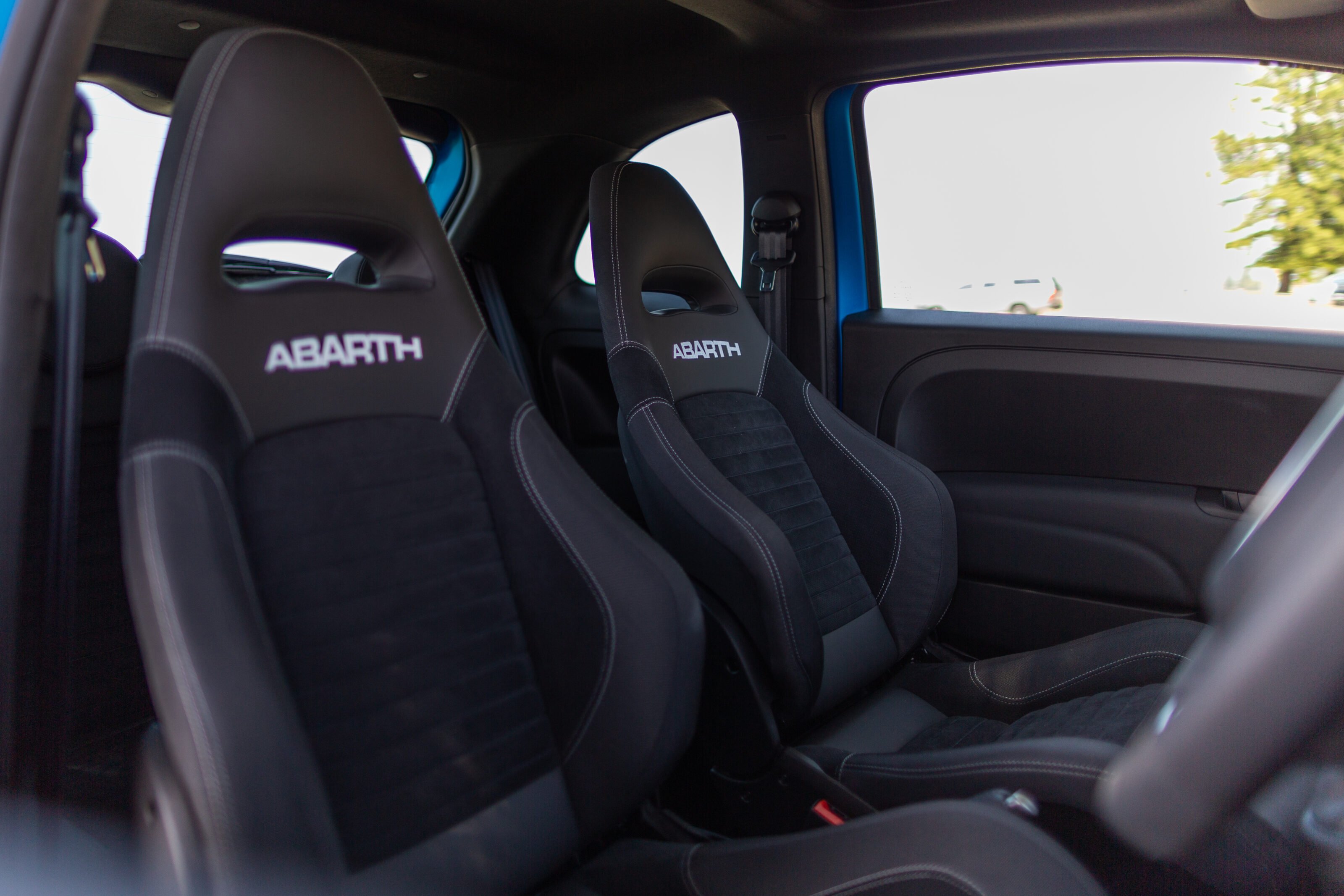
Sticking out of the dashboard is a doof-doof boost gauge, which looks comical and is a bit out of place next to the very useful all-digital instrument pack. The extra Alcantara splashed about the place as a result of the extra option packs makes it really nice, though. The hot ball of alloy that is the shifter on a summer’s day is both confounding and hilarious.
The rear seats are quite competent at their job, allowing folks my size (180cm) to sit in reasonable comfort as long as the passenger in front isn’t a selfish git. If you or any regular passengers are tall, I’d recommend avoiding the sunroof unless you spend a lot of time on dark country roads and need the bi-Xenons.
Being a shopping trolley, the boot is a predictably small 185 litres, but if you put the hard-backed seats down you get 550 litres.
On the Road
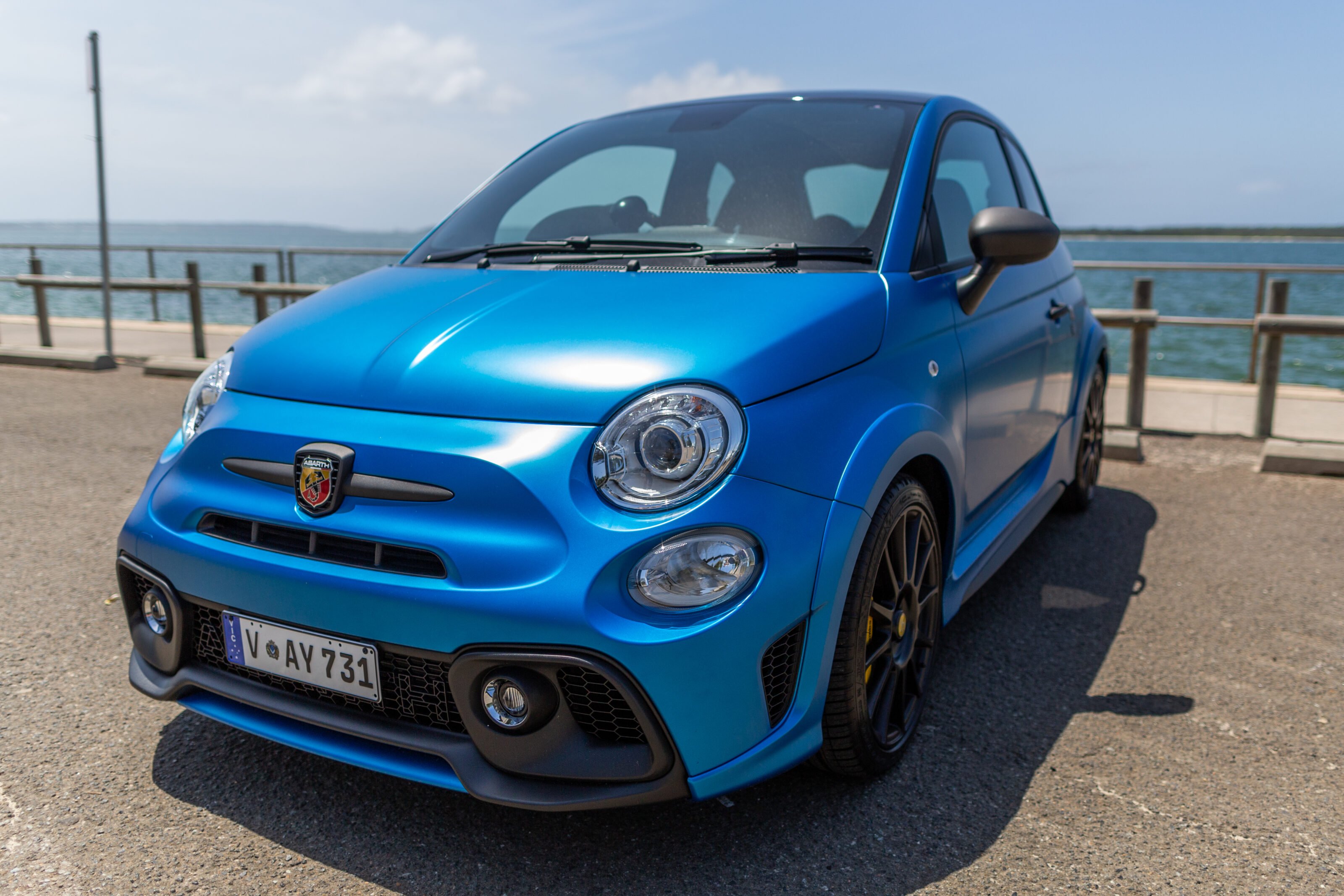
Now, some of you will be wondering what the Competizione bit in the name means. First up, you get more power. The less-than-thirty-grand 595 makes do with 107kW and 206Nm of torque, which is pretty good to move just on a tonne about at a decent clip.
It’s fun and engaging as it is, driving the front wheels through a five-speed manual or …shudder…Fiat’s five-speed single-clutch semi-automatic. I shudder because really, it’s not very good and, also, it shudders.
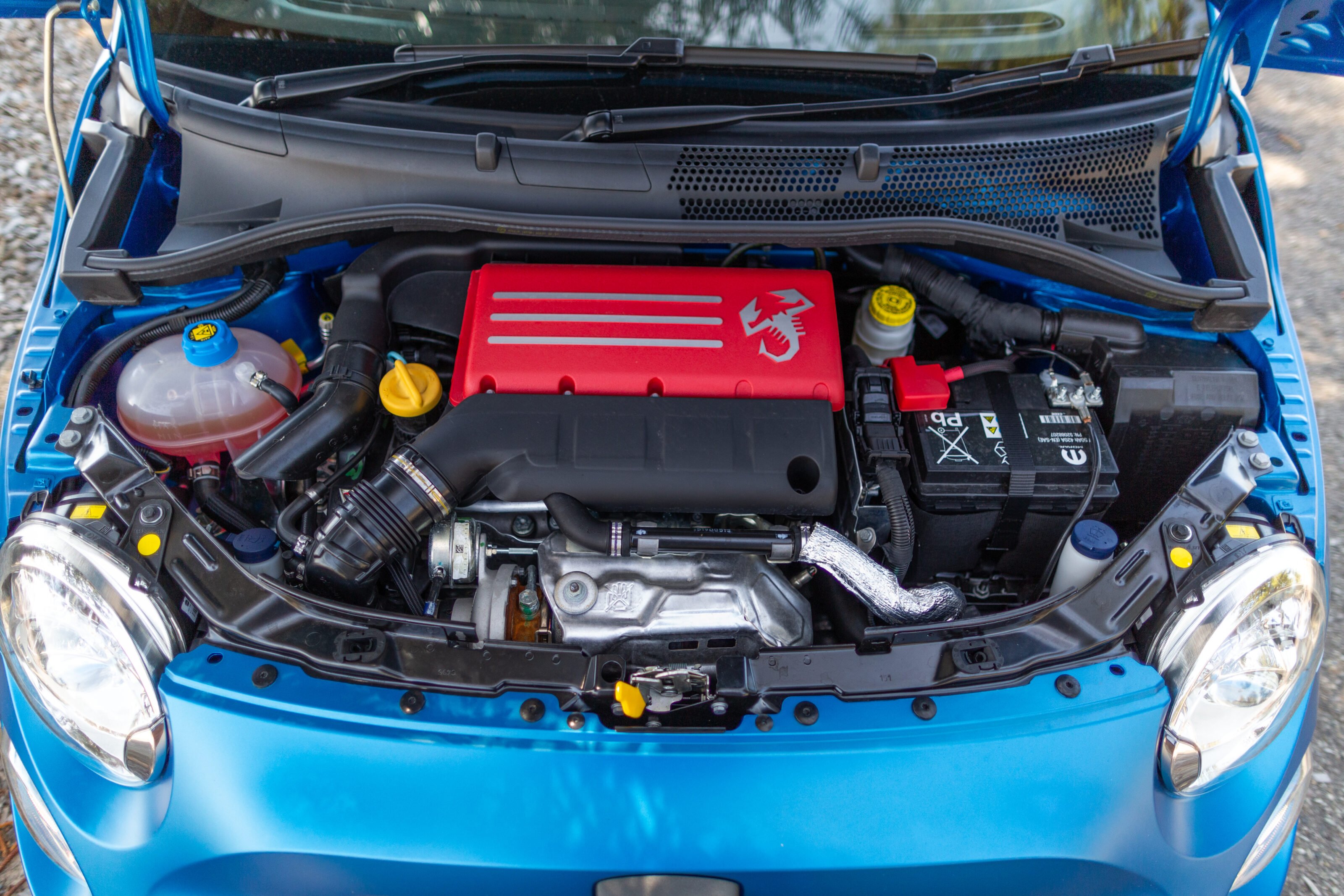
In the Competizione you get a lot more grunt from the 1.4-litre, with 132kW and 250Nm while also claiming a bit of “this engine’s in the Abarth 124 Spyder, you know,” pub cred. It’s still a five-speed manual and the only problem with that was that I kept looking for sixth.
Abarth claims 6.0L/100km on the combined cycle, which I think might almost be achievable given I drove it as is intended rather than to reach that number, scoring 8.2L/100km. So that’s pretty good going. It does like the good stuff, meaning you have to avoid cheaper 91 RON fuel, which is entirely predictable for a European car.
One of the things I really liked about this car was the gearbox. More to the point, I liked the relationship between gearbox, engine and pedals. The clutch is light and easy to use, the shift short and swift and the pedals lined up very nicely for super-easy heel and toe action.
Being able to put meaningful pressure on the brake pedal while also blatting the throttle with the side of your shoe is one of the great old-school delights of the hot-hatch genre. The big alloy pedals work so well at enabling these heroics.
The 1.4-litre is at its huffing and puffing best in the Abarth. Lots of turbo whistle, an idle that sounds like it has a big lumpy cam and two big bore exhausts poking out the back deliver a surprising amount of aggro. It pulls strongly from rest, with a 0-100km/h time a second better than its cheaper version, at under seven seconds.
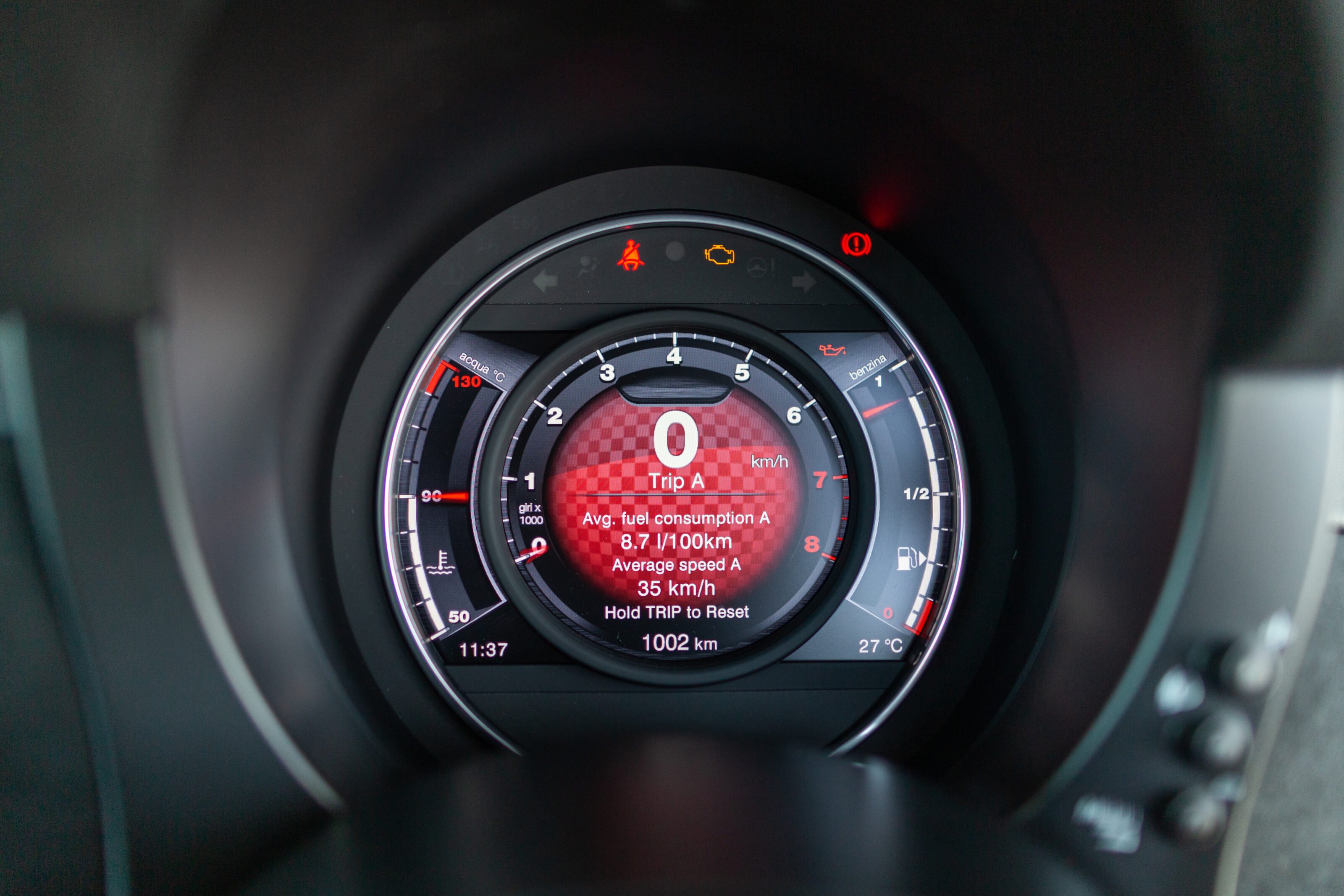
And underneath it is an uninspiring-sounding MacPherson strut front/torsion beam rear but with added adaptive suspension. You’ll be hitting the Sport button every time you get in because it’s hard to tell in such a short wheelbase car if it ruins the ride, so you may as well have everything switched on.
Bombing around town and the suburbs in this thing is so much fun. Loud and obnoxious, this car turns heads as well as it should. Few cars are this much fun for everyone involved and the angry Abarth scorpion plastered all over the car at every opportunity is well earned.
Bombing around town and the suburbs in this thing is so much fun. Loud and obnoxious, this car turns heads as well as it should
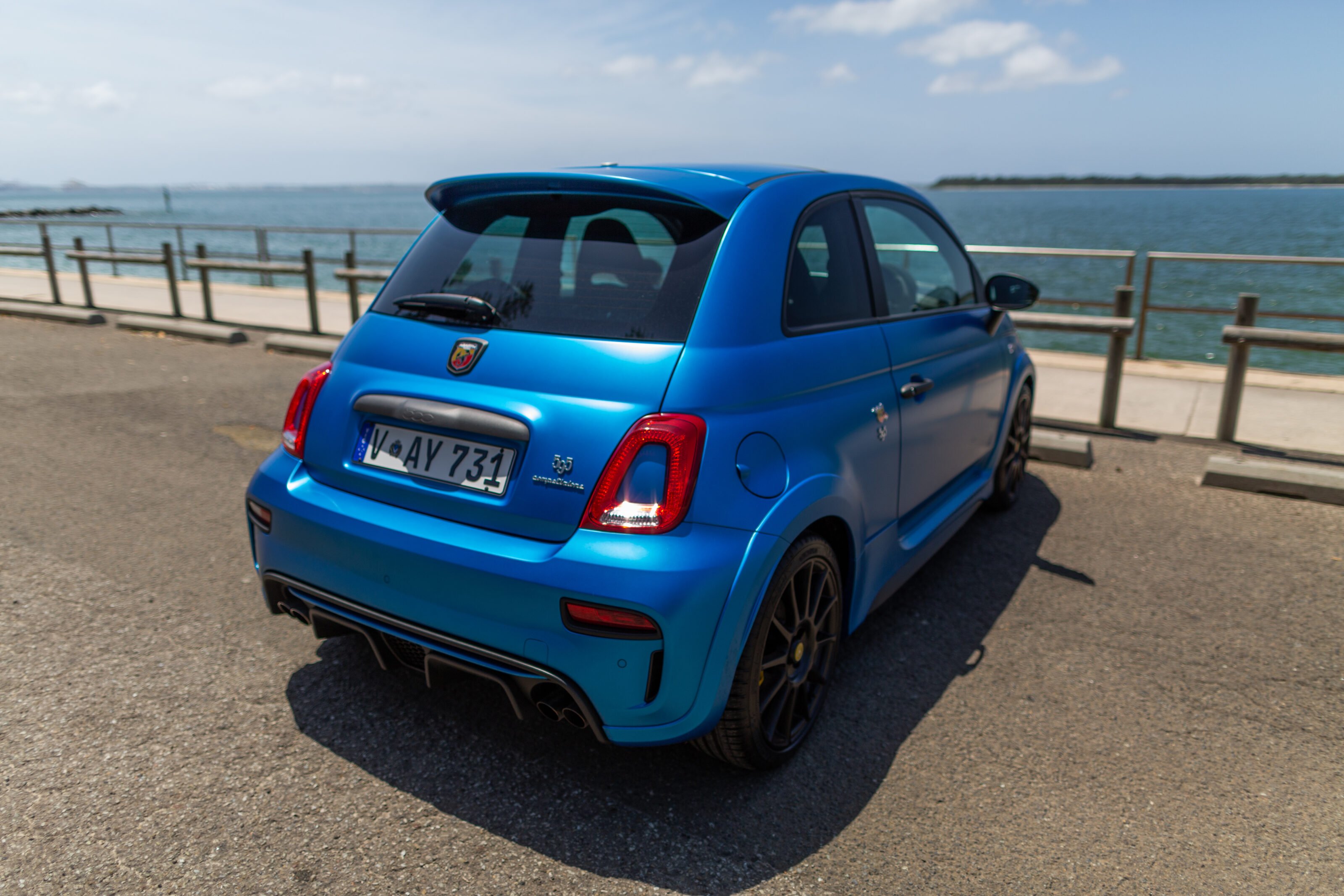
On the fun bits, you can get it into a proper rhythm and really play around with the car. You won’t be waggling the tail or getting out of shape – again, a short wheelbase isn’t going to deliver much in that way – but you can brake late, turn in, find the grip on the Michelins and power out.
That’s not to say it’s on rails because it absolutely isn’t. The 40-profile tyres don’t have a lot of give in them, so a bumpy road will be a lot of fun if you don’t mind bouncing around and finding the smoothest path through. I know I do and it’s quite exhilarating without you having to be on the wrong side of the law to get there.
The only real gripe I have is that the steering wheel feels a bit big in the Abarth. Making it smaller would provoke other complaints, so the right decision has been made; it’s just not quite right. But that’s okay, because not quite right is this car’s stock-in-trade.
Ownership
Fiat’s three-year/150,000km warranty applies and it will not surprise you to hear I think it should be longer than that, at least five years. Cheeringly, the capped-price servicing regime runs for a lengthy 10 years/150,000km.
From that you may have deduced that servicing is but once a year or every 15,000km and you would be correct. Three years costs $1271 ($423.60 average per visit), five years $2267 ($453.40 average) with a total of $5626 over ten years or $526 per year. It may not be super cheap, but most “cheap” capped-price service deals run out in half that time, Mitsubishi excepted.
VERDICT
The Abarth 595 Competizione is all about fun. The score doesn’t reflect just how much your heart has to be in it to really dig this car. There’s absolutely nothing wrong with that because as much as we don’t like to admit it, pretty much every car purchase has some emotional contribution. Even if it’s because you don’t like the shape of the wing mirrors, that’s an emotional decision.
A 595 Comp costs a lot of money for a little car but what it lacks in size and comfort it more than makes up for it by being hilarious to drive. Bonkers Italian cars are a true delight and this one has bonkers by the truckload. In a good way, obviously.
2021 Abarth 595 Competizione specifications
Are you shopping for a gift, or just looking to treat yourself? Here are five cool pieces of automotive kit that we’ve been lusting over lately.
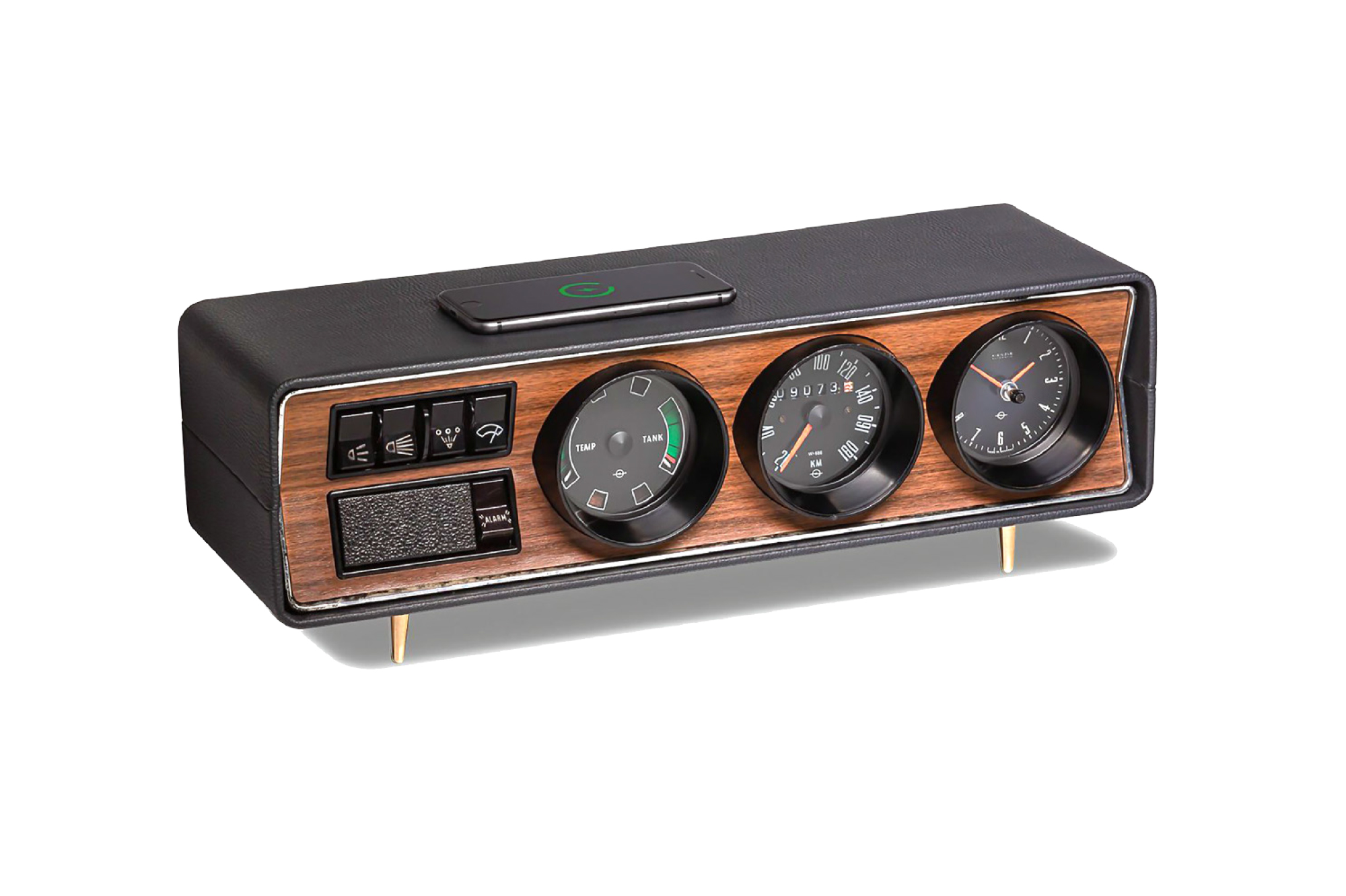
Re-Engauge ‘Bochum’ Desk Clock – $1375 – shop.classicdriver.com
Polish startup repurposes vintage analogue automotive instruments into charming desk clocks with added wireless charging capability
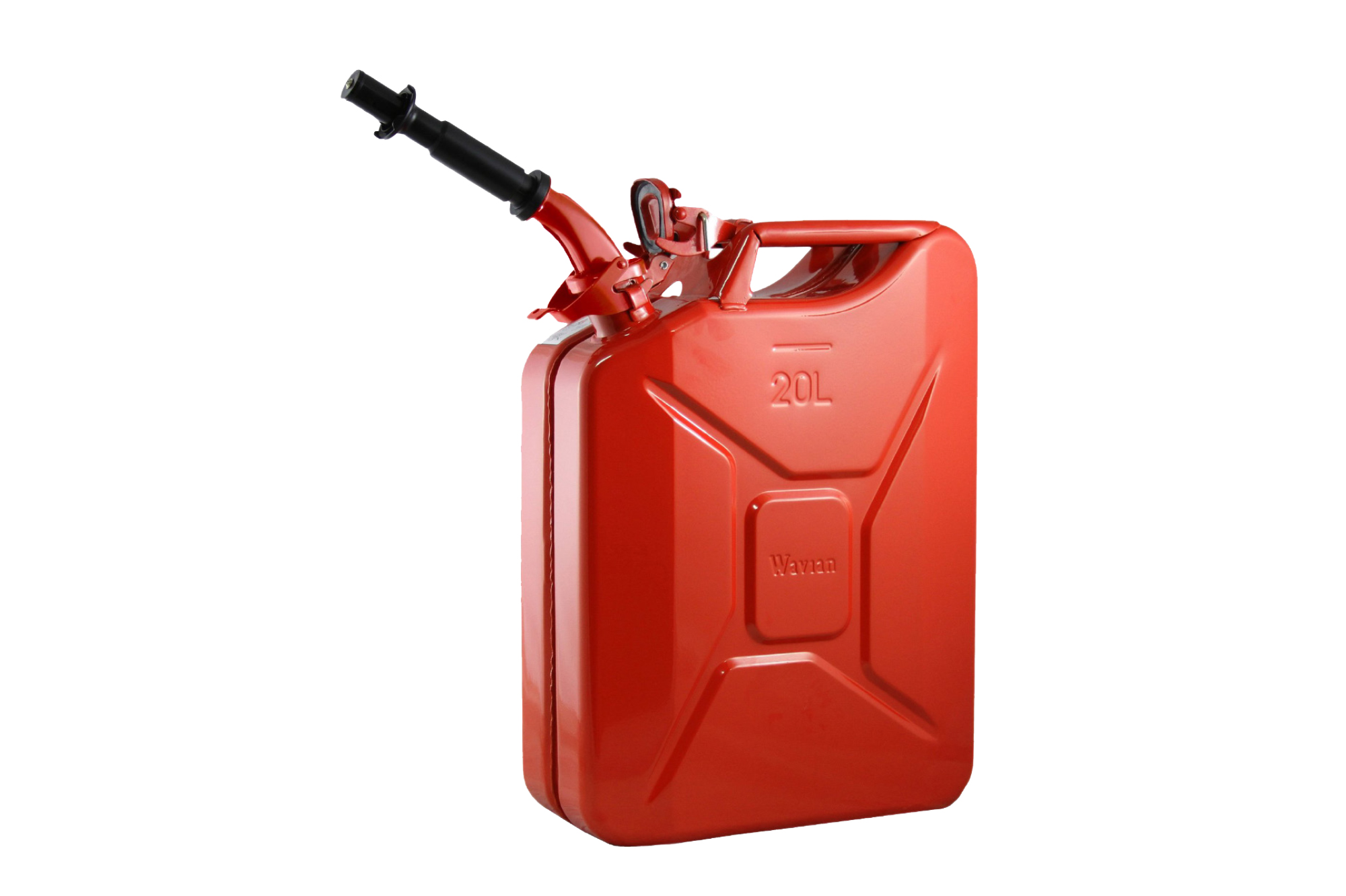
Wavian NATO Jerry Can – $128 – wavianusa.com
There are cheaper jerry cans out there, sure, but this is the ‘OG’ from the original manufacturer that has been supplying NATO countries for over 75 years. Available in five, ten and 20-litres
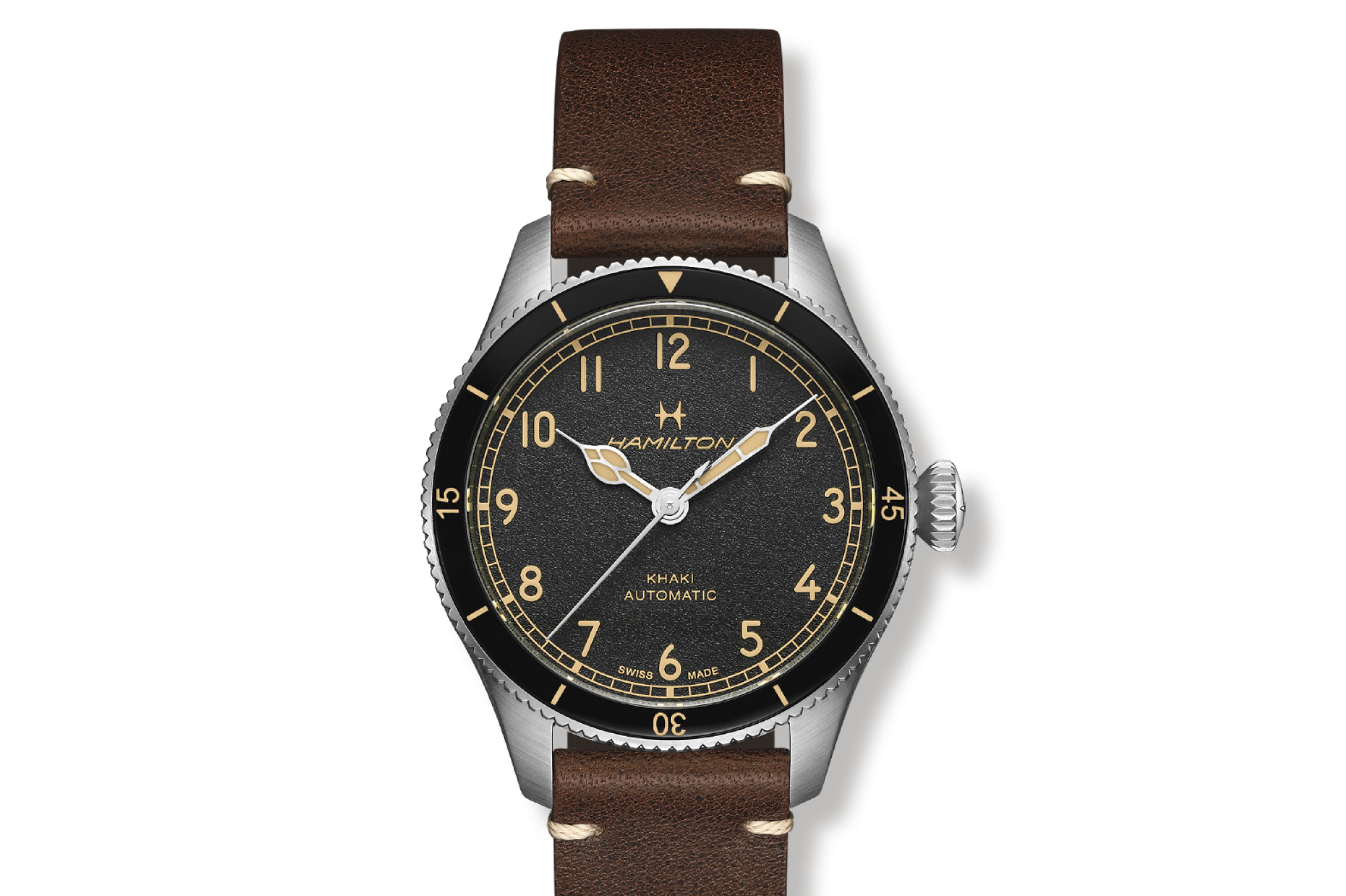
Hamilton Khaki Aviation Pilot Pioneer – $1395 – hamiltonwatch.com
Tapping WWII heritage, the classically-sized 38mm pilot’s watch is a fine faux-vintage daily wear. ETA-based H-10 calibre inside
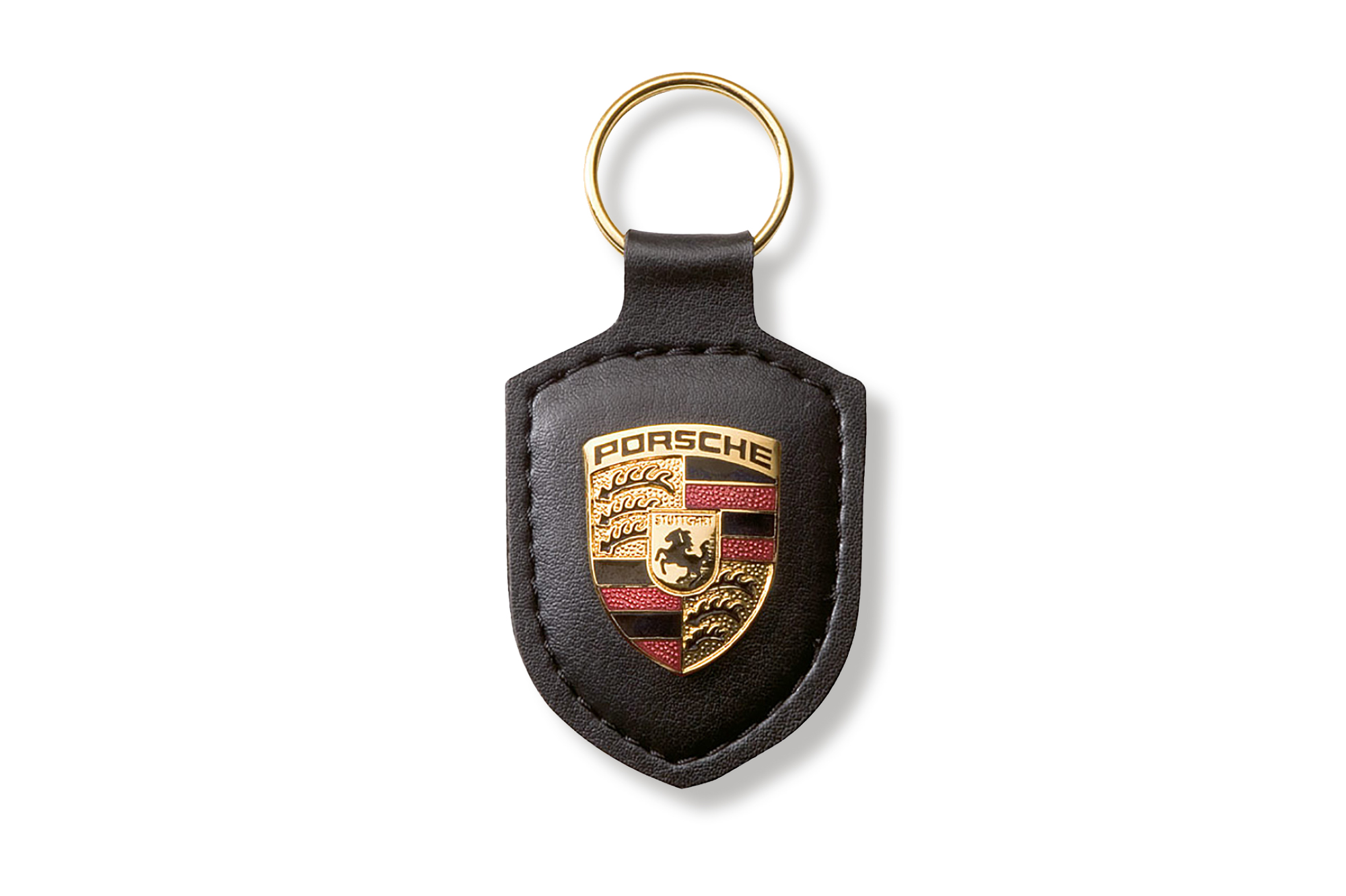
Porsche Crest Keyring – $40 – shop.porsche.com/australia
A thoughtful gift for your favourite Porsche owner, these 8.5x4cm keyrings are available in a range of colours and materials to match the car
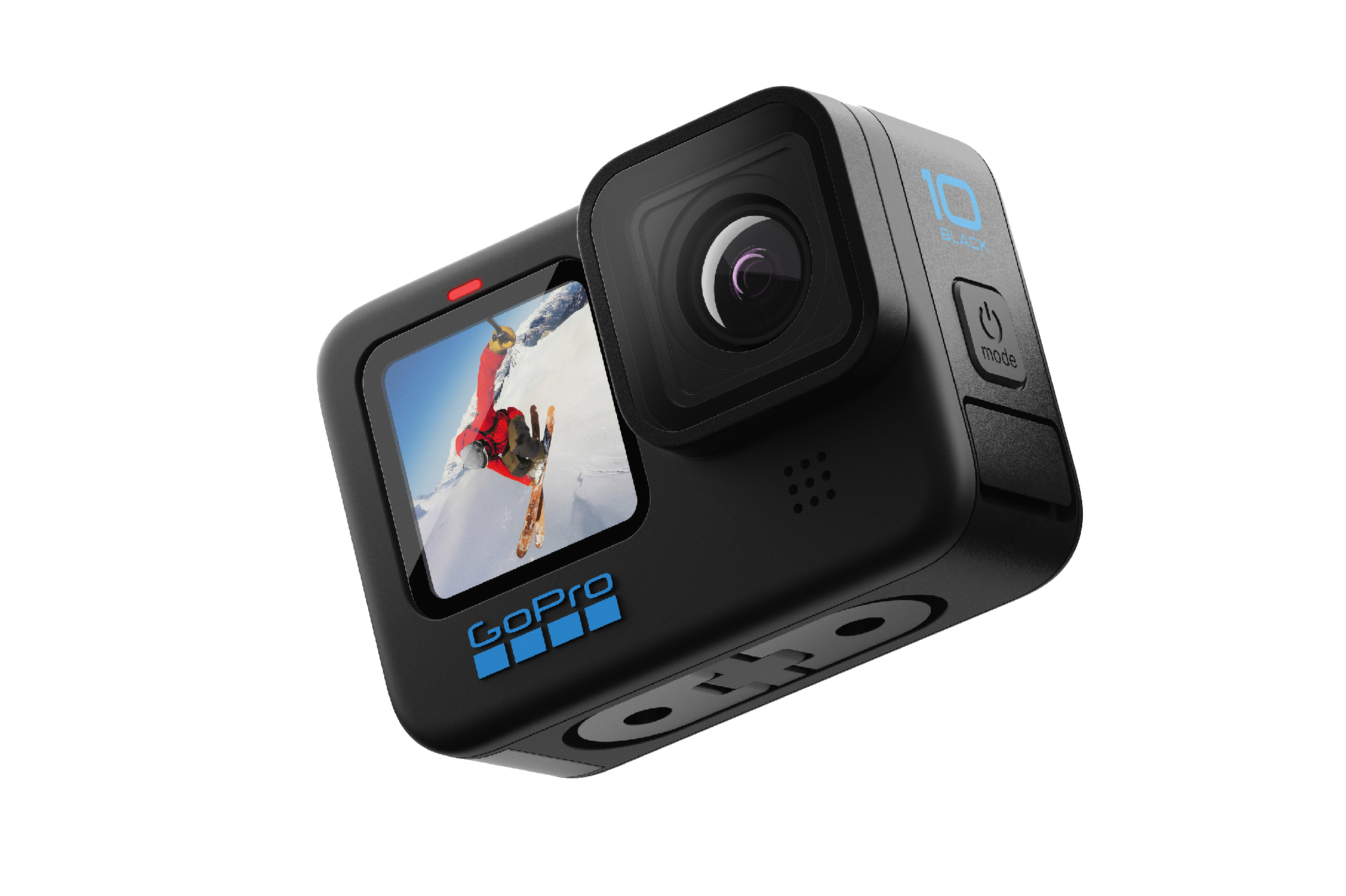
GoPro Hero10 Black – $749 – jbhifi.com.au
Did you really set a PB if you don’t publish the in-car footage on Facebook? GoPro’s latest action cam outputs 23MP photos and 5.3K video with patented HyperSmooth 4.0 video stabilisation. Cloud connectivity with waterproof (10-metres) construction, the Hero10 will handle almost anything you can throw at it.
It won’t survive being run over by a car, though. Ask us how we know…
A new flagship 2022 Subaru WRX 22B has been created as an homage to the original Impreza-based 22B of the late 1990s.
Digital artist Rain Prisk made the rendering of the WRX coupe based on the recently-unveiled performance sedan from Subaru, called the ‘2022B’.
Like the original 22B, the modern version has two doors and bolstered guards, a large rear wing, and the iconic pink STI badge in the front grille.
However, unlike the new WRX, Prisk has adopted traditional wheel arches, rather than the squared versions bordered with black plastic.
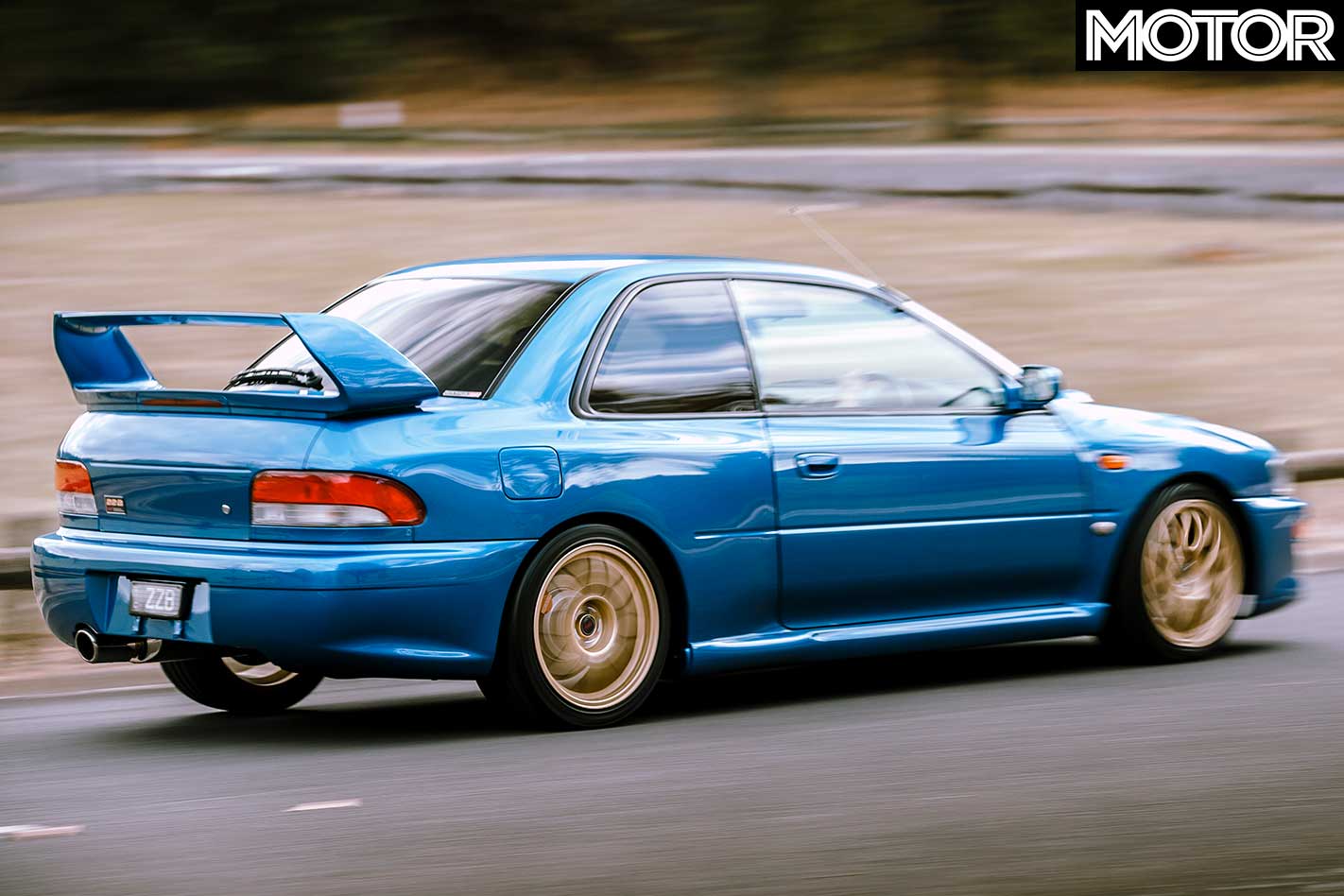
To finish off the look, the 2022B sits on a set of dished gold mesh alloy wheels clad in semi-slick tyres.
While the original 22B was powered by a 2.2-litre turbocharged four-cylinder boxer engine, the upcoming 2022 Subaru WRX uses a 2.4-litre turbo-four, producing 202kW and 350Nm.
There’s no sign of Subaru planning a two-door WRX coupe, however Australia is getting a long-roof WRX Sportswagon based on the Japanese-market Levorg.
The Mazda 6 has long been a staple of the medium-sized sedan market, recently locked into a battle for second place with the Skoda Octavia while the Toyota Camry continues to have the momentum of a runaway freight train.
Despite being underpinned by a chassis that is coming up on a decade in production, continual refinements to the Mazda 6 have helped it remain competitive against its European and Asian rivals.
For a week, the Mazda 6 Sport sedan replaced my own Octavia and was given a shakedown around Brisbane to see if the Japanese manufacturer still has a product to fight with, or whether the next-generation model should be brought forward to replace it.
Pricing

Available in any one of four flavours, the Mazda 6 range can be purchased as a four-door sedan or five-door wagon with a variety of eight colours to choose from, three of which come with a $495 price tag.
In sedan guise, the 6 is $1300 cheaper than the longroof, starting at $34,590 before on-road costs for the entry-level Sport four-door. Moving up to the Touring will bump that figure up to $38,890, followed by $46,690 for the GT SP before topping out at $50,090 for the range-topping Atenza (all before on-roads).
On test is the Sport, finished in Deep Crystal Blue Mica (my pick of the colour palette) with the optional $246.46 floor mats, the only non-standard feature I could pick out. All up, Mazda’s website calculates this spec 6 would set buyers back $38,618 drive-away, keeping it under the $40K mark.
Features

Facelifts and upgrades throughout the third-generation 6’s lifecycle have allowed it to stay relevant in a competitive segment, although as previously mentioned, its sales of 1408 units to the end of November are dwarfed by the Toyota Camry, which in a single month can nudge the Mazda’s year-to-date result.
With its last exterior facelift coming in 2018, the 6 is starting to look a tad dated but not yet out of date, helped in part by the abundance of chrome surrounding the grille and other highlights.
If there’s one reason to upgrade from the Sport variant, it is the wheels – while the 17-inch alloys and 225/55 tyres are indeed a comfortable and quiet combination, they look small in the arches, seemingly tempting buyers to step up a grade for a slightly more well-rounded look.

Mazda seems to have left an 18-inch size hole in its line-up, as the Sport and Touring are only available with 17-inch wheels while the GT SP and Atenza go straight up to 19s, shod in 225/45 rubber.
The side and rear styling is nothing exciting but far from offensive, while the single exhaust outlets on either side of the bumper provide symmetry where other models in the segment tend to play the easy game with a single exit.
At 4865mm in length, the 6 just scrapes into what can be deemed as a medium-size car these days, although the Euro-oriented wagon actually measures up 65mm shorter thanks to its 2750mm wheelbase, a decent chop from the sedan’s 2830mm.

Width remains identical for both bodies at 1840mm, while their heights stand at 1450mm in sedan guise and 1480mm for the wagon, resulting in kerb weights of 1539kg and 1555kg respectively.
Boot space is ample in the sedan at 474 litres when the back seats are up, however, this is less than the Camry (524L) and Octavia liftback (600L).
For the long-roof 6, boot capacity is raised to 506 litres when the second row of seats are up, increasing to a generous 1648 litres when folded down, second only to the Octavia wagon by 52 litres.
The standard key is a relatively flat unit with the three buttons positioned on its side, creating a lot of awkward pocket-fumbling situations that ultimately end up in pulling it out to check the right button has been pressed.
Annoyingly, this entry-level 6 doesn’t have touch-sensitive door locks (keyless entry is standard from Touring grade and up), something I discovered when carrying a relatively heavy bag of shopping that was slipping out of my hands. While it’s a first-world problem, having to set things down rather than just walk up to the car is a bit frustrating.

Stepping inside the cabin, any concerns about the base model being a cheap, no-frills option are quickly put to rest. Surfaces are soft to the touch and it’s nearly impossible to find any hard plastics, giving the occupants a premium feel for a cut-price cost.
Otherwise, being behind the wheel is a pretty nice place to be, and an abundance of tech makes it more relaxing.
Standard across the race is wired Apple CarPlay and Android Auto, with which there were no issues in terms of operation – although it would be nice if Mazda could introduce wireless operations to truly get a leg up on its competitors.
Despite coming up on a decade in production, Mazda has made continual refinements to help the 6 to remain competitive against its European and Asian rivals.

The 8.0-inch infotainment screen is easy enough to navigate with either the control dial on the console or through touch inputs when stationary, with the usual host of USB/Bluetooth/DAB+ digital radio available on top of the Apple and Android systems and pumped through a very impressive six-speaker system.
Even though the tech up front is up to date, a lack of rear USB ports leaves that extra little touch to be desired, making rear passengers fight for one of the front chargers.
A head-up display with speed limit sign recognition is a far handier tool than I expected it to be, especially driving through unfamiliar suburbs, but one drawback – common across similar systems – is an inability to integrate with mapping apps when using smartphone mirroring rather than the native sat-nav interface.
I should clarify there’s nothing wrong with the standard Mazda navigation system, it’s just that phone apps tend to be better at keeping you aware of delays on the road.
Going from car to car as we do in this business, it’s sometimes hard to get your head around certain steering wheel layouts but the 6’s is intuitive, with cruise control easy to find, activate and set to sit as close behind the car in front as it allows.
Comfort and space

As someone of average build and six feet tall, there is enough room in the Mazda 6 no matter what seat I position myself in. Even after enlisting the help of a much taller friend, we could set the driver’s seat to his position then sit in the back with enough room to stretch out, while ISOFIX points in the rear means the kids will be safely locked in.
While I personally haven’t sat in the leather-appointed seats of higher grades, it took a few days and far too many manual adjustments to get the driver’s seat to a position I was totally comfortable in, mainly due to an excess of lumbar support even in its lowest setting.
Another problem arose when cornering in the 6 due to the lack of side support on the seat, forcing me to brace myself a little more than anticipated – I know it’s not a performance car but when it rolls through a corner, it would be nice to at least be supported from the position of control.

Realistically, the only issues I had were with the seat, although some would argue it’s the most important part as you can’t operate the car without it. A more useable armrest on top of the centre console would’ve been a nice touch but maybe that’s for the next generation.
The 60:40 split rear seats can be folded using either the tabs just next to the outer headrests or two handy levers in the boot, although pulling these still requires you to open the rear doors to totally fold the seatbacks.
As someone who is six feet tall, there is enough room in the Mazda 6 no matter what seat I position myself in.
On the road

Up here in the affordable parts of Brisbane, there are a few different road surfaces to contend with; smooth, bumpy and unloved. Across all three, there were no complaints from myself or passengers while travelling in the Mazda 6, even from bumps which I’m used to avoiding totally.
With a pass on the local roads, a few runs on the M1 reiterated this would be a very solid highway cruiser for families, soaking up the bumps and really feeling eerily smooth, as the steering and throttle inputs seem to be optimised to driving on motorways.

Despite being a mid-size sedan with over a tonne and a half of weight to lug around, the Mazda 6’s “Sport” tag does well to live up to its name considering the rest of the market, handling better than its competitors in the segment.
However, give it a bit too much and you start to feel the comfort-focused suspension starting to wonder if you’ve asked a bit too much of it, with body roll starting to come to the fore, encouraging you to dial it back a bit.
If there’s one upshot to this characteristic, it is at least linear in how it flows through a corner, with no real weight transfer issues arising when going on- or off-throttle.

However, you often do have a bit of time to think about how to set up a corner on account of the base engine in the Sport and Touring grades.
Under the bonnet of the two variants is Mazda’s 2.5-litre, four-cylinder engine. It pushes out 140kW at 6000rpm and 252Nm at 4000rpm, resulting in a power to weight ratio of 93.3kW/tonne.
While this power is identical to the similarly priced Skoda Octavia 140TSI Limited Edition, the Czech car pushes out 320Nm between 1500-4180rpm thanks to its turbocharger and its power to weight ratio is a superior 99.6kW/tonne.
Although the engine delivers enough to move the Mazda 6, there are times when more power is desired, such as merging on the rarely fast-flowing M1 when traffic is moving at 100km/h.

If you want a bit more oomph from your 6, the GT SP and Atenza gain a turbo to bump outputs up to 170kW at 5000rpm and 420Nm at 2000rpm, a considerable jump over the naturally aspirated unit for a healthier 107.9kW/tonne.
No matter which engine you choose, drive is exclusively sent to the front wheels through a conventional six-speed torque-converter automatic – a pleasant departure from the all-too-common CVTs.
Unfortunately, I think I’d enjoy the stronger donk a fair bit more than the entry-level unit, as you really start to feel the weight of the car when trying to drag it up to speed and I daren’t try any overtakes on country roads because there just might not be enough space to get the job done.

Fuel economy on the combined cycle is rated at 7.0L/100km but I was unable to properly test this as the tank barely went down by a quarter over the seven days it was in my possession, although after some city and vigorous driving the trip computer reported 9.0L/100km.
With a 62-litre fuel tank fitted to all variants, achieving around 800km of range between fills is theoretically possible, especially on high-speed highway runs.
A few runs on the M1 reiterated this would be a very solid highway cruiser for families, soaking up the bumps and feeling eerily smooth.
Safety

Standard across the Mazda 6 range are a host of safety features, including:
- Blind-spot monitoring
- Driver attention alert
- High beam control
- Intelligent speed assistance
- Lane departure warning
- Lane-keep assist
- Adaptive cruise control with stop and go function
- Parking sensors (rear)
- Rear cross-traffic alert
- Auto-dimming rear-view mirror
- Reversing camera
- Smart brake support
- Smart city brake support
- Traffic sign recognition
- Tyre pressure monitoring system
Within five minutes of picking the car up, I had located and disengaged the lane departure warning and lane-keep assist systems, both of which proved to be far too intrusive around the arterial roads. Although a handy feature on the highway, around town it was nothing but frustrating.

The adaptive cruise was intelligent and left consistent gaps, although the underpowered engine sometimes struggles to keep the spaces as tight as I wanted, especially when some of the more aggressive drivers on the road want to make use of every available spot
A lack of front parking sensors is a bit of a shame, although it acts as another incentive to step up to a higher grade. With a relatively tight car space where I live, I found myself backing the car in rather than going nose-first – not my preferred style but with the relatively long bonnet, it was the safest option.
Last tested in 2018, the Mazda 6 range retains its five-star ANCAP safety rating, having fared particularly well in the adult and child occupant protection tests (95 and 91 per cent respectively) but losing a lot of marks for its pedestrian protection, with a score of only 66 per cent.
Ownership

As with the rest of the Mazda range, the 6 is covered by a five-year/unlimited-kilometre warranty, throwing in complementary premium roadside assistance for the period to sweeten the deal.
Mazda’s capped-price servicing is also applicable to the 6, covering the first five services at intervals of 12 months/10,000km, whichever comes first.
Pricing for these services alternates between $337 for the first, third and fifth service while the second and fourth are $30 more, contributing to a total capped-price service cost of $1745 over the five-year period.
VERDICT

Better suited to highways than city streets, it’s the kind of car that would be perfect for a two-adult, two-child family that does regular interstate travel, with the boot providing decent space for luggage and equipment while those who need more flexibility have the wagon option.
I understand why the Sport and other base variants across many models exist but I would personally spend a bit more coin to move up the food chain, although going high enough to get that desirable turbo engine does come at a significant $12,000+ premium over the Sport.

At that sort of money, you’re almost into the territory of Skoda’s Octavia RS – but some may not want to deal with the dual-clutch gearbox or significantly firmer ride.
Still, the Mazda 6 seems like good value and there’s certainly still a market there for it, but its next generation (which is rumoured to switch to a rear-drive platform with powerful six-cylinder engines) will need to do some pretty special things if it wants to de-throne the Camry.
Flashback
2021 Mazda 6 Sport specifications
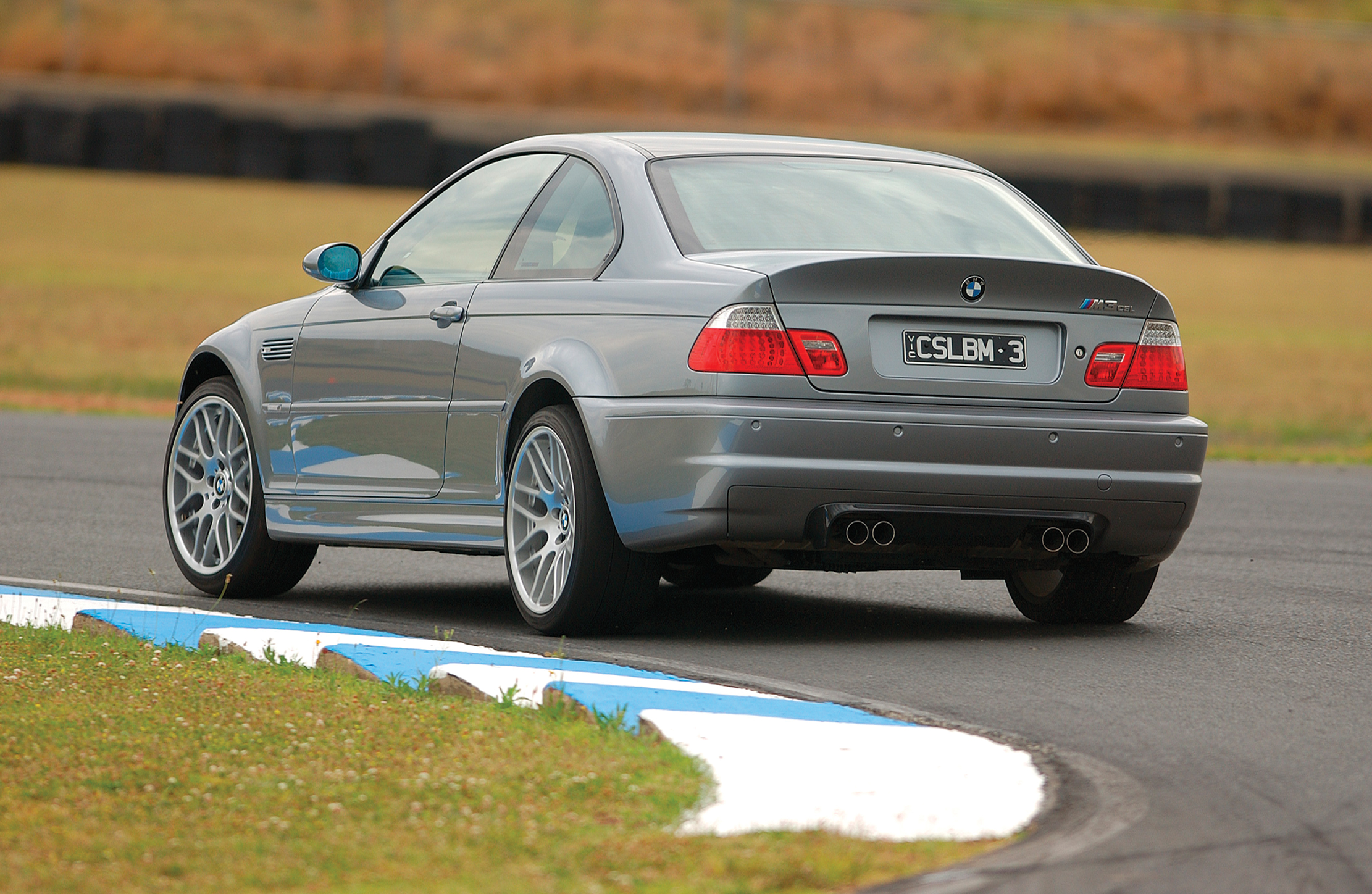
Circuit Breakers
We’ve got BMW’s scary-fast M3 CSL. We’ve got Porsche’s hardcore 911 GT3. We’ve got Eastern Creek Raceway. Well, what would you do?
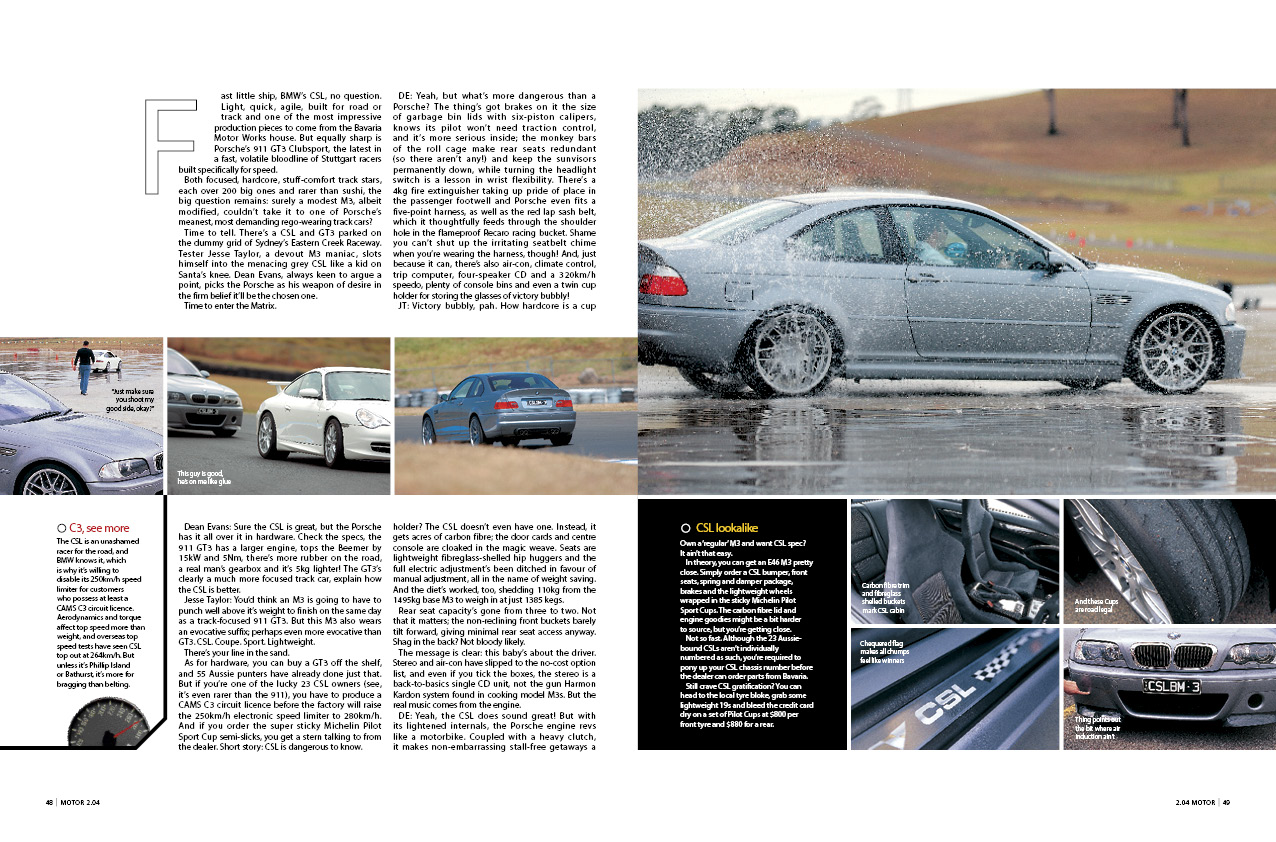
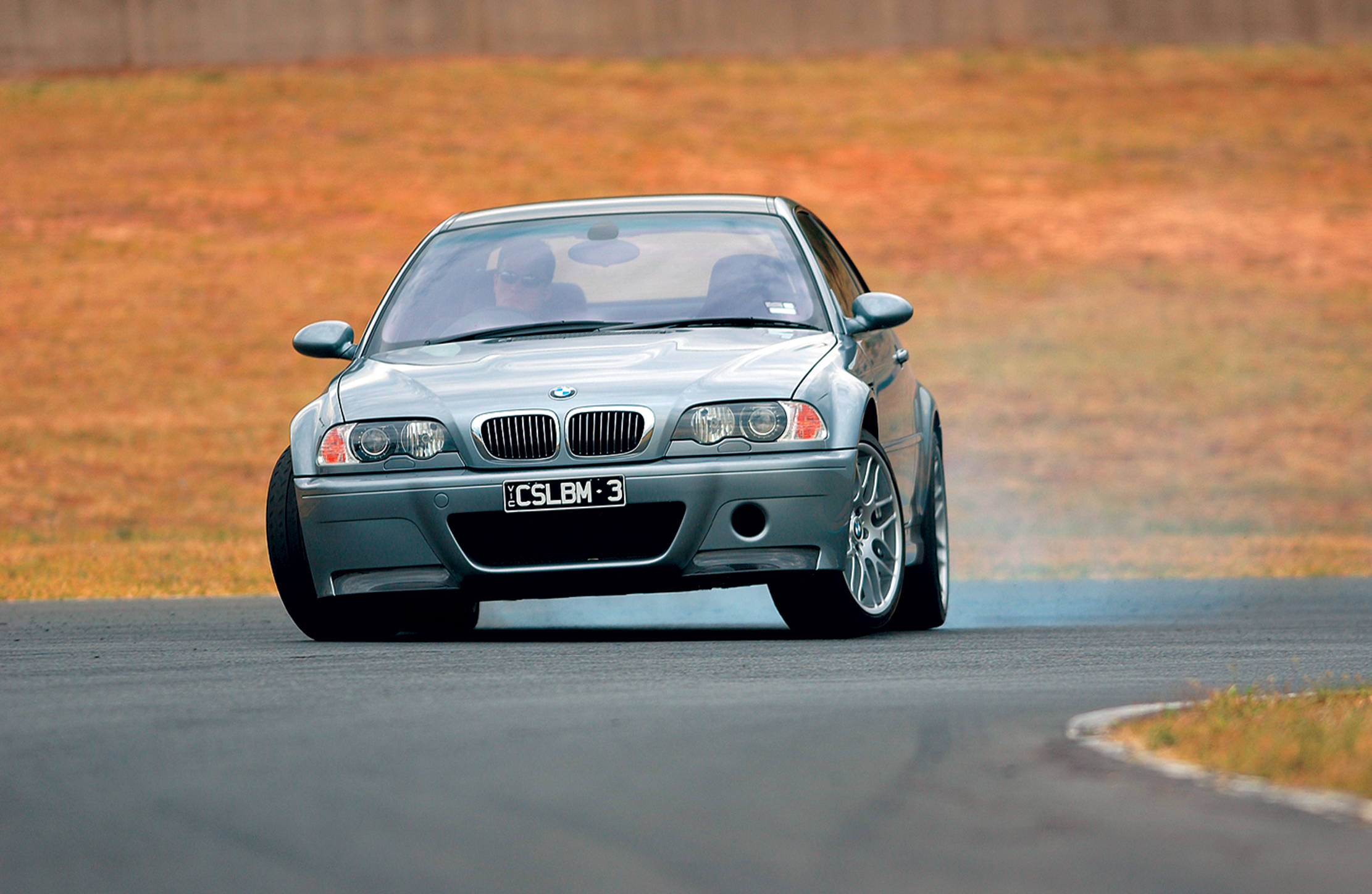
Fast little ship, BMW’s CSL, no question. Light, quick, agile, built for road or track and one of the most impressive production pieces to come from the Bavaria Motor Works house. But equally sharp is Porsche’s 911 GT3 Clubsport, the latest in a fast, volatile bloodline of Stuttgart racers built specifically for speed.
This feature was first published in MOTOR magazine’s February 2004 issue
Both focused, hardcore, stuff-comfort track stars, each over 200 big ones and rarer than sushi, the big question remains: surely a modest M3, albeit modified, couldn’t take it to one of Porsche’s meanest, most demanding rego-wearing track cars?
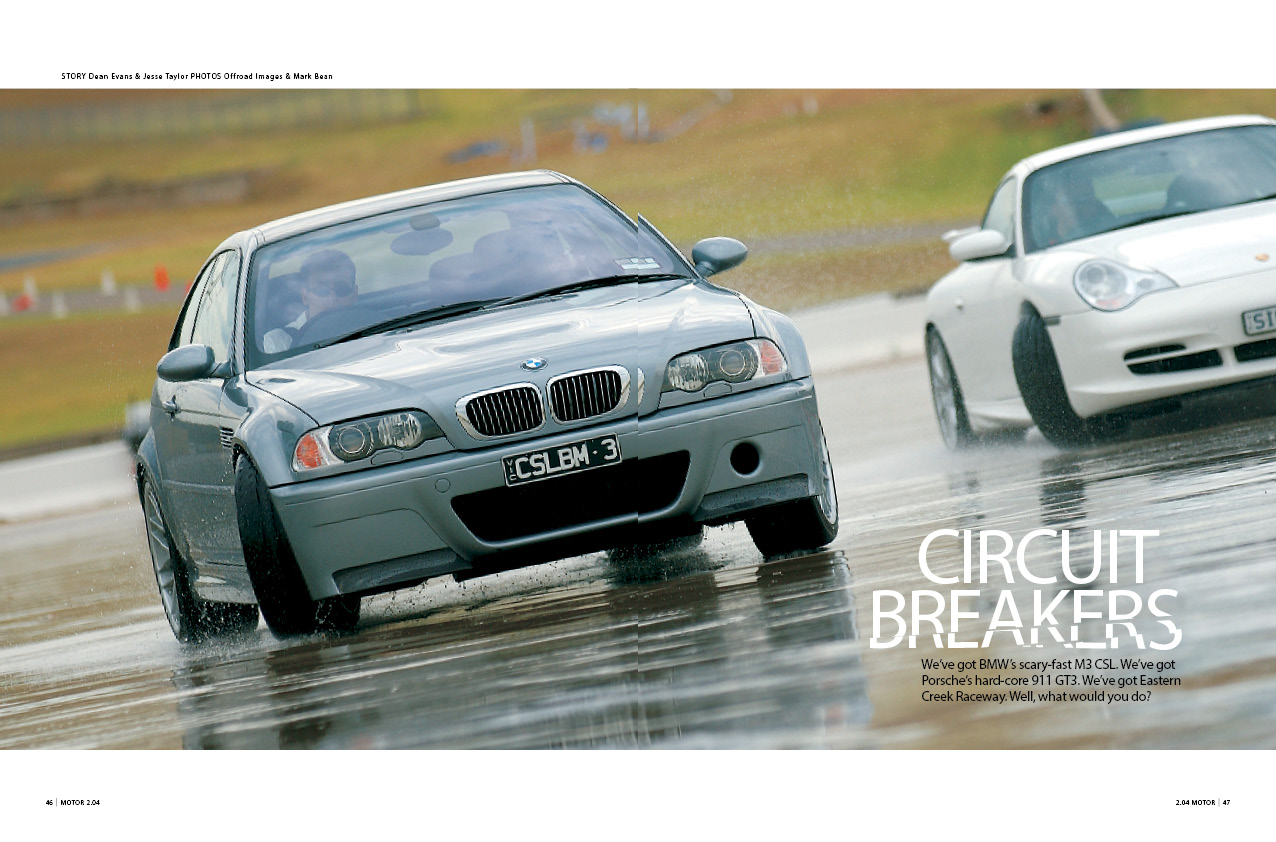
Time to tell. There’s a CSL and GT3 parked on the dummy grid of Sydney’s Eastern Creek Raceway. Tester Jesse Taylor, a devout M3 maniac, slots himself into the menacing grey CSL like a kid on Santa’s knee. Dean Evans, always keen to argue a point, picks the Porsche as his weapon of desire in the firm belief it’ll be the chosen one.
Time to enter the Matrix.
Dean Evans: Sure the CSL is great, but the Porsche has it all over it in hardware. Check the specs, the 911 GT3 has a larger engine, tops the Beemer by 15kW and 5Nm, there’s more rubber on the road, a real man’s gearbox and it’s 5kg lighter! The GT3’s clearly a much more focused track car, explain how the CSL is better.
Jesse Taylor: You’d think an M3 is going to have to punch well above its weight to finish on the same day as a track-focused 911 GT3. But this M3 also wears an evocative suffix; perhaps even more evocative than GT3. CSL. Coupe. Sport. Lightweight.
There’s your line in the sand.
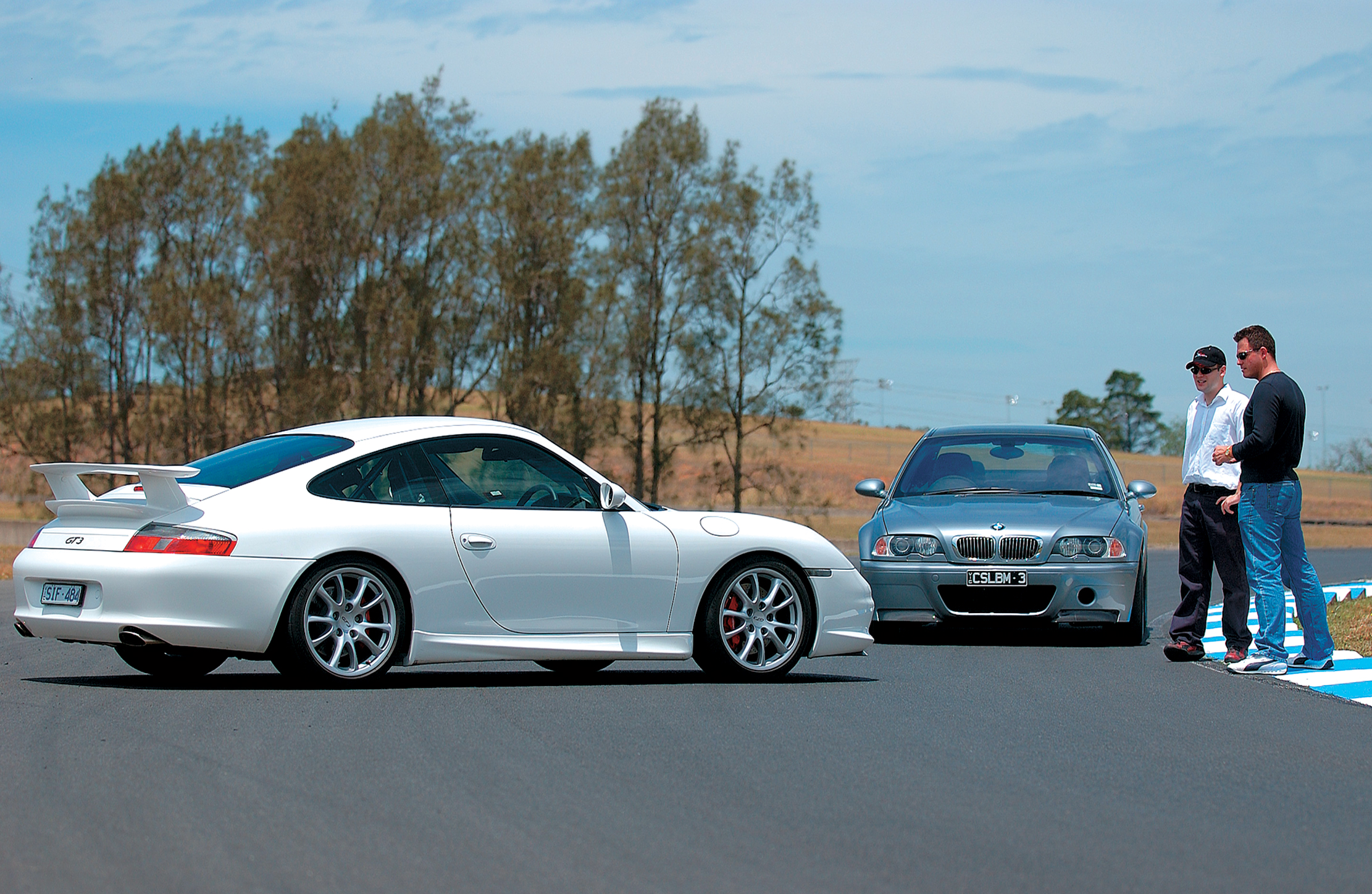
As for hardware, you can buy a GT3 off the shelf, and 55 Aussie punters have already done just that. But if you’re one of the lucky 23 CSL owners (see, it’s even rarer than the 911), you have to produce a CAMS C3 circuit licence before the factory will raise the 250km/h electronic speed limiter to 280km/h. And if you order the super sticky Michelin Pilot Sport Cup semi-slicks, you get a stern talking to from the dealer. Short story: CSL is dangerous to know.
DE: Yeah, but what’s more dangerous than a Porsche? The thing’s got brakes on it the size of garbage bin lids with six-piston calipers, knows its pilot won’t need traction control, and it’s more serious inside; the monkey bars of the roll cage make rear seats redundant (so there aren’t any!) and keep the sunvisors permanently down, while turning the headlight switch is a lesson in wrist flexibility. There’s a 4kg fire extinguisher taking up pride of place in the passenger footwell and Porsche even fits a five-point harness, as well as the red lap sash belt, which it thoughtfully feeds through the shoulder hole in the flameproof Recaro racing bucket. Shame you can’t shut up the irritating seatbelt chime when you’re wearing the harness, though! And, just because it can, there’s also air-con, climate control, trip computer, four-speaker CD and a 320km/h speedo, plenty of console bins and even a twin cup holder for storing the glasses of victory bubbly!
JT: Victory bubbly, pah. How hardcore is a cup holder? The CSL doesn’t even have one. Instead, it gets acres of carbon fibre; the door cards and centre console are cloaked in the magic weave. Seats are lightweight fibreglass-shelled hip huggers and the full electric adjustment’s been ditched in favour of manual adjustment, all in the name of weight saving.And the diet’s worked, too, shedding 110kg from the 1495kg base M3 to weigh in at just 1385 kegs.
Rear seat capacity’s gone from three to two. Not that it matters; the non-reclining front buckets barely tilt forward, giving minimal rear seat access anyway. Shag in the back? Not bloody likely.
The message is clear: this baby’s about the driver. Stereo and air-con have slipped to the no-cost option list, and even if you tick the boxes, the stereo is a back-to-basics single CD unit, not the gun Harmon Kardon system found in cooking model M3s. But the real music comes from the engine.
DE: Yeah, the CSL does sound great! But with its lightened internals, the Porsche engine revs like a motorbike. Coupled with a heavy clutch, it makes non-embarrassing stall-free getaways a minor challenge. The flat six has a real growling roughness, a raucous mechanical clatter to it at low speeds, but smooths out above four grand. At 6-2 it really hits, where the VarioCam hauls it to the 8200rpm rev limit, 200 higher than CSL. And look at that massive 100mm bore; there’s 80 percent of torque from just 2000rpm. Cop that!
JT: Whatever. Sure, the GT3’s got the wood on paper, but it’s out here that counts. Fire up the CSL’s highly strung 3.2-litre straight six and there’s more snaps, crackles and pops than in Rice Bubbles. Blip the loud pedal twice for the hell of it and all your hairs stand to attention. The CSL’s also got 80 percent of its twist on the boil from two grand and peak torque arrives at 4900rpm – 100 revs lower than the GT3. And with max power wrung out at 7900rpm, the CSL’s got a bigger useable rev range.
Once the tacho needle breaches 6400, the six kicks like a VTEC Honda and piles on revs at a frightening pace. Under load the engine note is anvil hard, with an evil induction roar from the gaping 90mm carbon fibre intake trumpet. At the other end of the combustion process, a wall of noise blares from the quad exhausts. Observers in the pits reckon you could pinpoint its location thanks to the blood-curdling wail. Every downshift, hard throttle application and trace of wheelspin echoed across the track. The Porsche? Can’t hear it until it’s upon you.
DE: Or passing you! For an air-breathing six, the GT3’s a rocket in a straight line. While the CSL is stuffing around with traction control, DSC, Sport buttons and SMG levers held forward to activate the launch control, the Porsche just dials up six grand, drops the clutch and blazes up both rears as it belts out a 0-100km/h time half a second faster than the Beemer and stretches the gap down the quarter. After just 400 metres, it’s going 5km/h quicker and taken just 13.0 seconds! How far back was the BM?
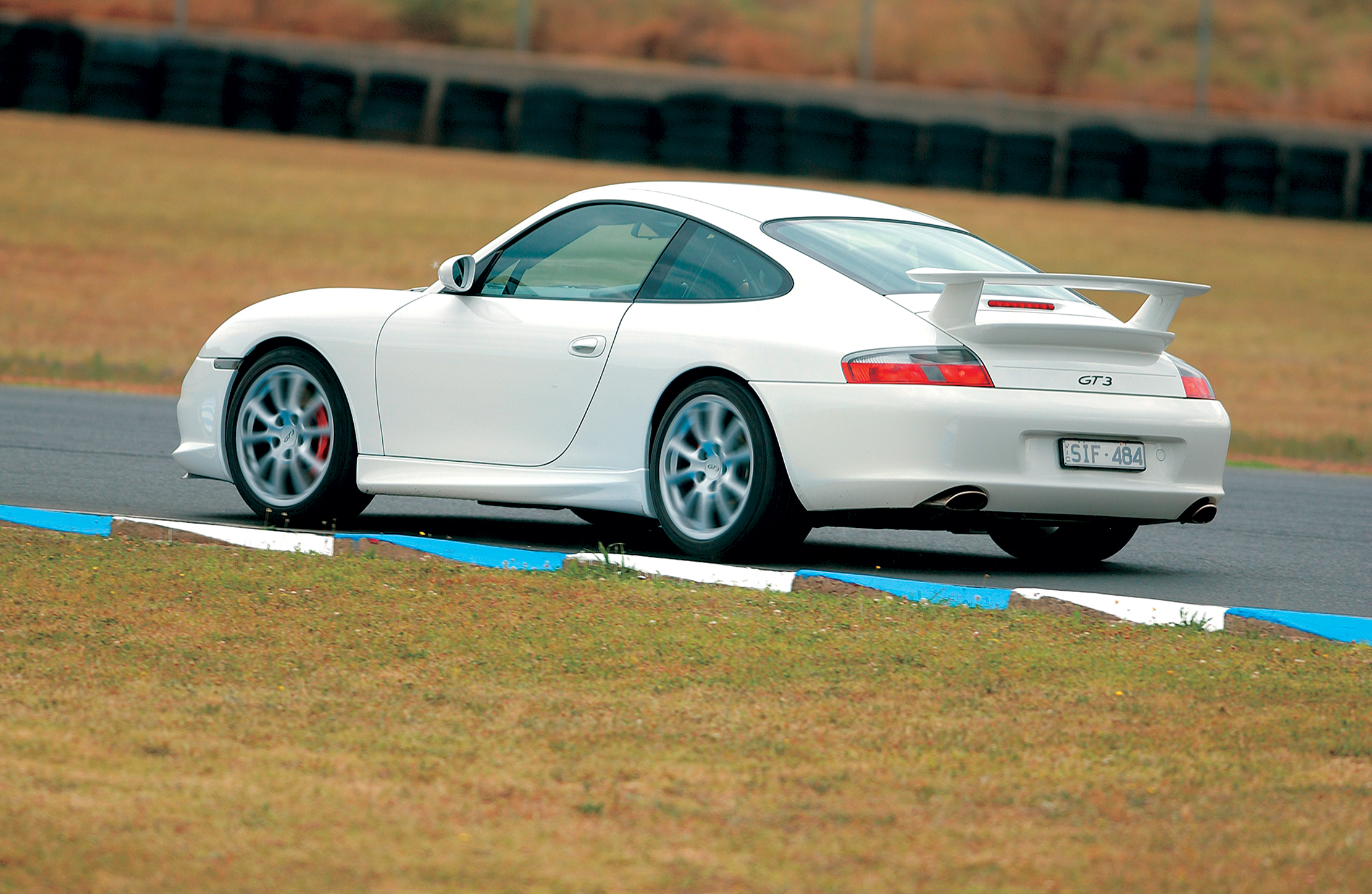
JT: But we’re not here for drag racing. The CSL, and the Porsche, are built for hot lapping. And for all the extra urge and crispness of throttle response, it’s the almost unbelievable levels of turn-in bite and mid-corner grip in the CSL that’s so addictive. The grip from the semi-slick Cups is incredible. You’re exiting a corner realising the CSL could have carried another 10 or 15 kays. So next lap you swallow the brave pill, sink the slipper and tip into the same corner with another 15 kliks on board. And still the Bimmer shrugs its broad and talented shoulders at the timidity of the mug behind the wheel. Up to that point, the CSL allows you to take liberties that would have you flinching in the Porsche.
DE: There’s a Porsche logo on my wheel, but I’m finding it damned hard to keep up, especially out of turn three, where the BMW simply powers away and the Porsche is yawing and fidgeting, on the verge of oversteer. At 9/10ths the GT3’s edge is very ragged, whereas the BMW’s edge at the same point seems polished and chamfered!
We could have stiffened up the 911’s adjustable sway bars in 15 minutes, but it was still a handful. Relatively. Under brakes it wants to swing around if there’s any steering on board, and it’s twitchy through the turns; you soon get used to that, though. But under power it pushes if you jump on it too soon, and if you’re too aggressive it wants to break the rear free. Then after a lap or two the rear tyres seem to lose grip and you’re squeezing the power on later and later, trying to limit the power oversteer. It’s hard work! You find yourself relying on its brakes to make up time, and thankfully they’re gold; use ’em like you’re trying to fade them and they stubbornly refuse, allowing you to go in deeper and press harder. I could make up at almost 50 metres under brakes into turn two.
JT: Yep, the CSL could do with better brakes, despite the larger rotors and recalibrated ABS. Disappointingly for the $210,000 ask, the cross-drilled discs are still clamped by single-piston slider-type calipers. But with the excellent front engine/rear drive balance (51:49 front to rear weight distribution) and the mind-blowing grip of the Cups, you can drive around the downfall of the anchors.
But for all the ground the Porsche bites out of the CSL under brakes, the M3 takes it back with interest on turn-in and through mid-corner. It’s simply a matter of trusting the grip and faithful feedback sent through the chunky suede steering wheel and quick rack. I’m picking up the throttle harder and earlier until the front end pushes a fraction on exit or the rear starts to wander wide at mid-corner. And the CSL is leaving me plenty in reserve for adjustment.
Of all the corners at Eastern Creek, the 911 is only making real ground exiting the change of direction at turns 6/7, and this is down to both cars’ gearing in the second-to-third change rather than grip. Still, I’d be curious to try the GT3 on these tyres.
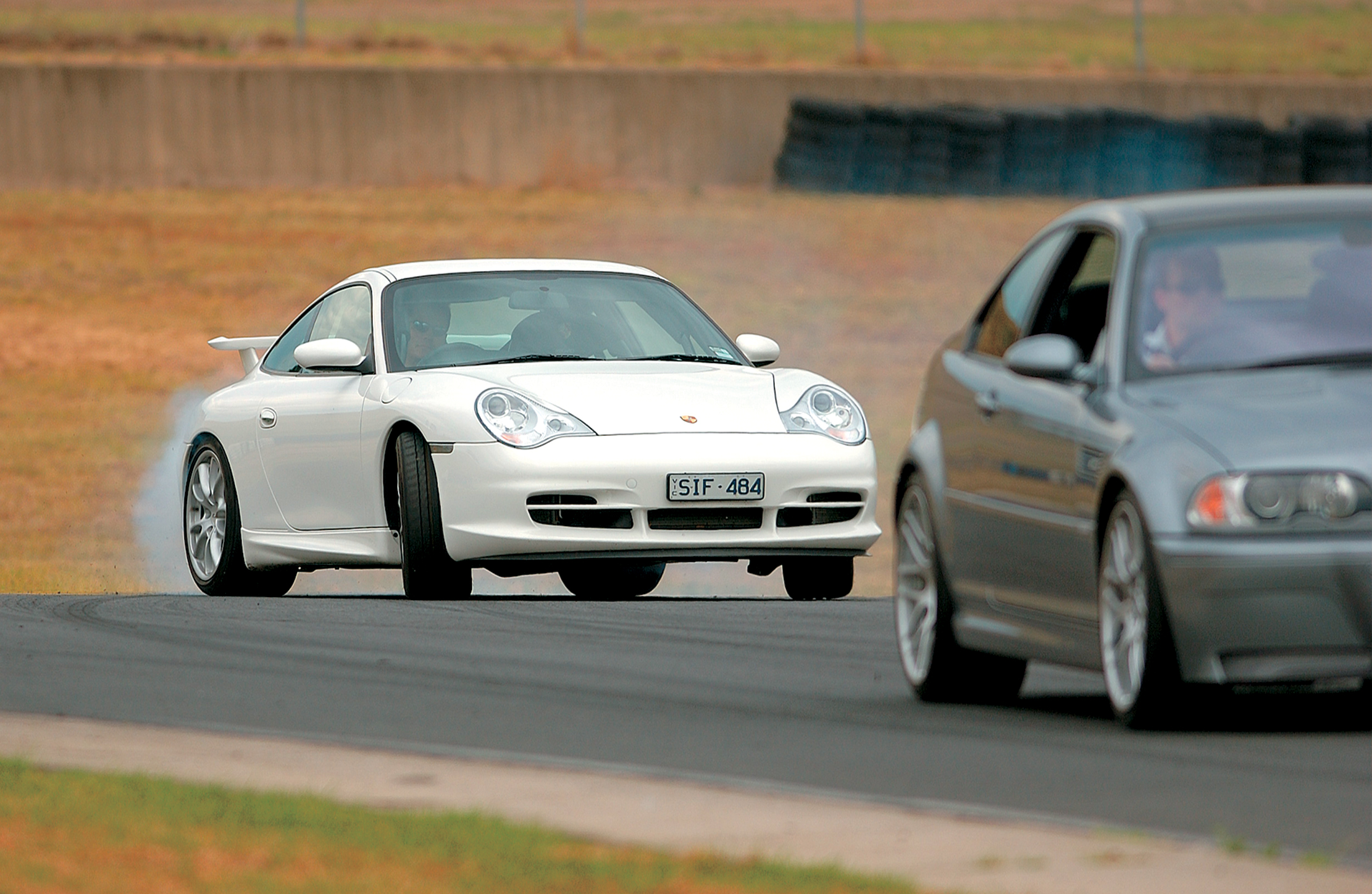
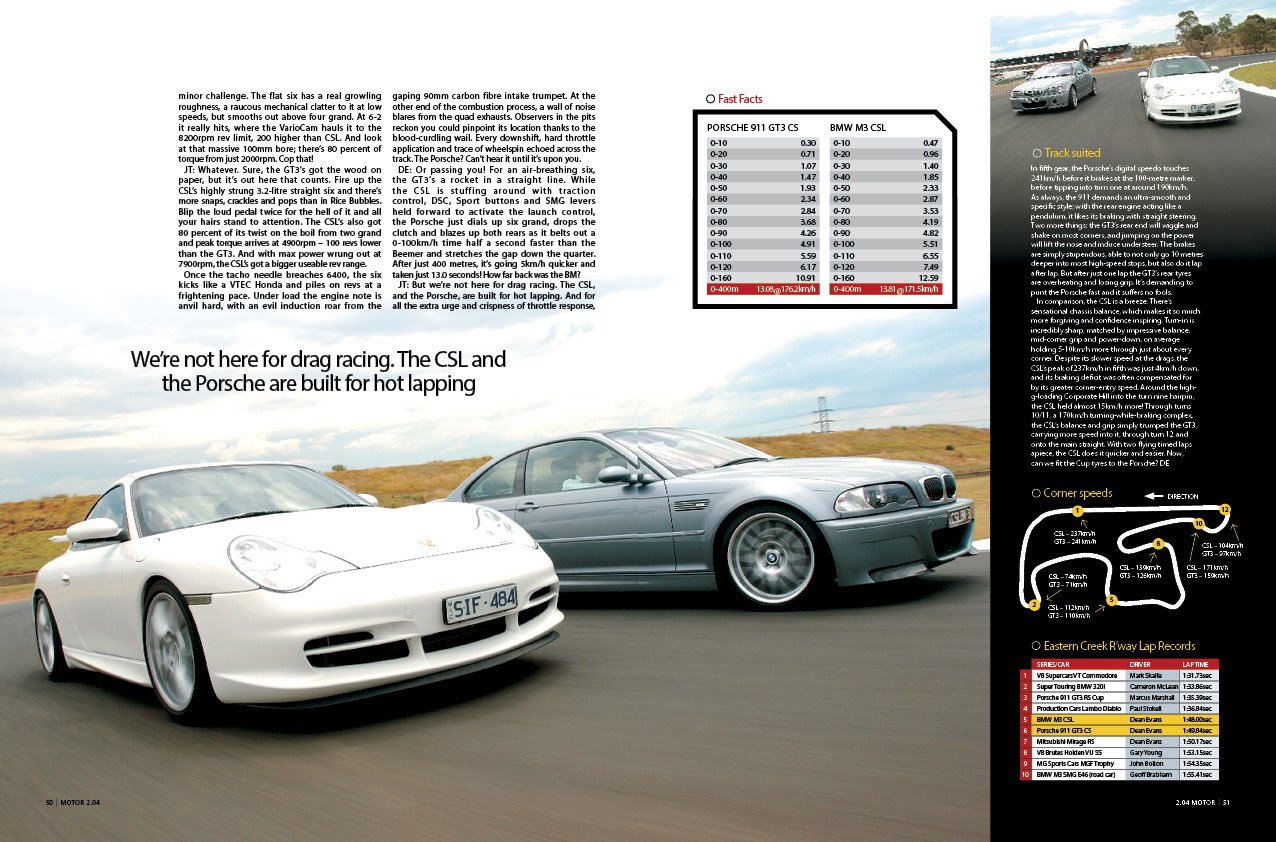
DE: Yep, gimme those Cups. I reckon there’s at least a second or two around here in the tyres alone. It’s clear the Porsche is working hard to keep up. After three hot laps, it was pretty obvious which one was easier and more consistent to drive fast. The GT3 felt faster in a straight line, but it was losing so much through the corners! I thought the Porsche’s best lap time, for a road car on semi-road tyres, with two people aboard, was pretty damned impressive. A lap around Eastern Creek in 1min 49.84sec is not hanging around. And it backed it up with a 1:49.86!
JT: Shame it’s slow compared with the BMW! Its quickest lap was 1.8sec faster with a 1min 48.51sec, then a 1:48.00! Down the main straight, that’s an average gap of 65.5 metres or 14.5 car lengths (based on average lap speeds of 128.77km/h for the GT3 and 130.99km/h for the CSL). But the GT3’s chasing the M3 down by the end of the straight. Which is pretty impressive as it’s giving up a few car lengths onto the straight.
DE: The GT3’s constantly playing catch-up. It’s almost 10km/h slower onto the main straight, but it grabs fifth gear about 100 metres earlier, rounds up and blasts by the BMW and is 4km/h quicker before braking. The 911 loses out through the turns, but makes it up on the straights, both accelerating and braking. I do like the BMW’s paddle shift, though. As sharp and solid as the Porsche shift is, the ability to keep both hands on the wheel is a bonus.
JT: Yeah, despite what Morley reckons, SMG II works well enough, particularly with the sharper shifting revisions in the CSL. And you’ve gotta love the bigger (than M3) blips on downshifts.
A couple of UK magazines have questioned whether the CSL has stepped up the game over a regular M3. As an unashamed M3 fan, I can tell you it’s a huge leap for M-kind. Whether it’s worth an extra $70,000 is another matter entirely.
DE: Yeah, next to an M3 the CSL is questionable value, but it’s clearly a better track tool. I’d like to see how fast a regular M3 SMG would be with the CSL’s Cup tyres, quick rack, airbox and exhaust bolted on. I think it’d be close to flat 1:50s.
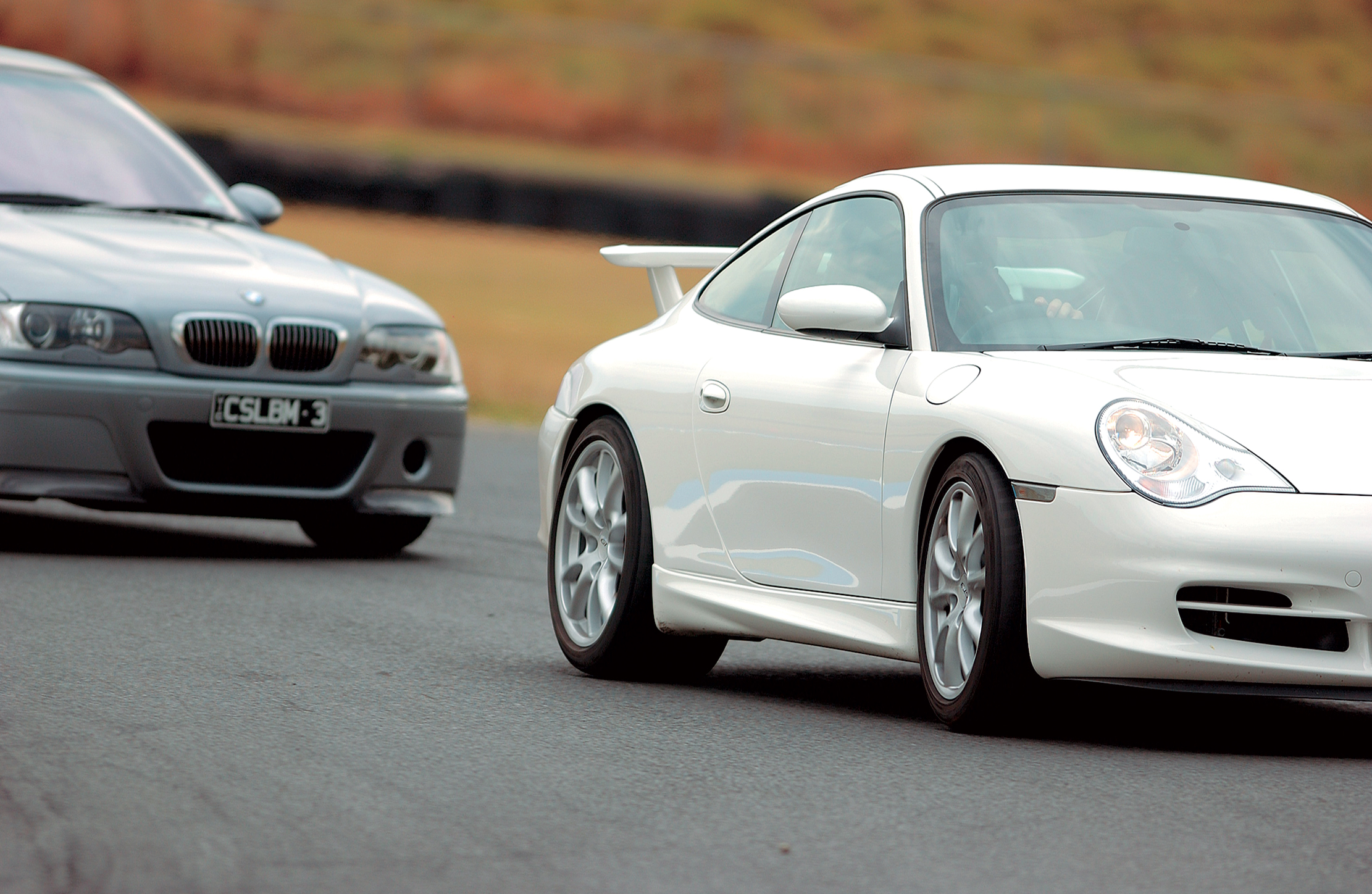
The GT3, on its own, is a performance bargain considering it’s the same price as an NSX or Viper. But then you realise it’s just been beaten by a cheaper BMW. I know the Cups would help the 911’s lap times, but it wouldn’t change the way it’s a more demanding drive. After a 20-lapper in the Porsche, you’d be both slower and sweatier. Today the CSL beat it easy and it’s 30 grand cheaper.
In fact, I’ve changed my mind. I still love the Porsche for its styling, performance and handling, and I’m sure it’d be as fast, if not faster than the CSL on equal tyres and with a bit of sway bar tuning. But for its chassis balance and that angry rasp of induction and exhaust note, I’d pocket the 30 grand and take the CSL.
JT: Tough luck, it’s already spoken for.