Noble Piece Prize
Twin-turbo V6, almost 320kW, rear-wheel drive and just 1000kg. This is the supercar-crushing Noble M400 and it’s driftingly good fun
Flat in fourth gear, there’s a lunatic pedestrian in the distance. He’s standing on the inside of the corner, circling his arms at me like a windmill. Faster? OK.
This feature was first published in MOTOR magazine’s January 2005 issue
Into the braking zone, lift off the accelerator and a pair of blow-off valves choofle and sneeze 12psi of boost an arm-span from my ear, while a super hard stamp on the brakes sinks the nose into the track. The shifter slots into third, as the large discs savagely scrub 100 kays off the 200km/h the silver coupe had just seen.
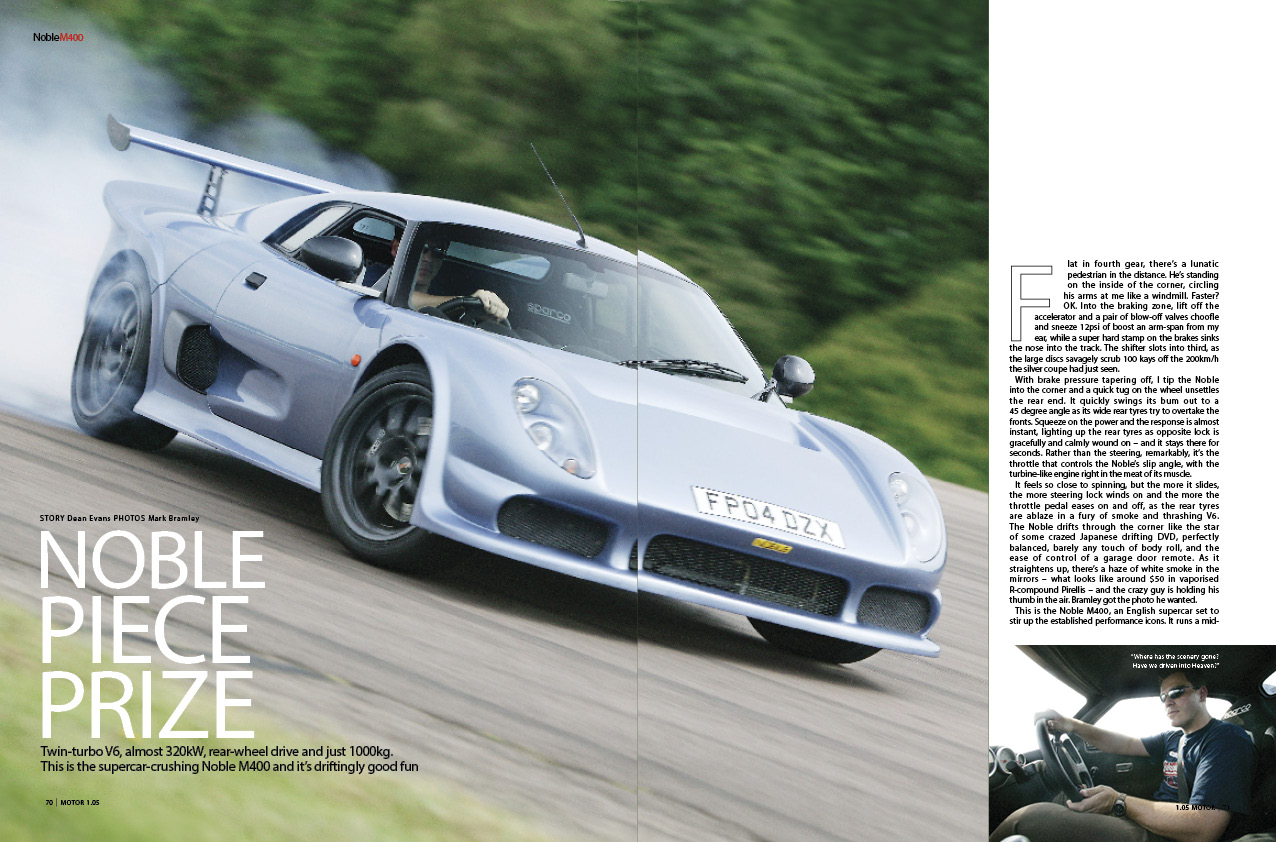
With brake pressure tapering off, I tip the Noble into the corner and a quick tug on the wheel unsettles the rear end. It quickly swings its bum out to a 45 degree angle as its wide rear tyres try to overtake the fronts. Squeeze on the power and the response is almost instant, lighting up the rear tyres as opposite lock is gracefully and calmly wound on – and it stays there for seconds. Rather than the steering, remarkably, it’s the throttle that controls the Noble’s slip angle, with the turbine-like engine right in the meat of its muscle.
It feels so close to spinning, but the more it slides, the more steering lock winds on and the more the throttle pedal eases on and off, as the rear tyres are ablaze in a fury of smoke and thrashing V6. The Noble drifts through the corner like the star of some crazed Japanese drifting DVD, perfectly balanced, barely any touch of body roll, and the ease of control of a garage door remote. As it straightens up, there’s a haze of white smoke in the mirrors – what looks like around $50 in vaporised R-compound Pirellis – and the crazy guy is holding his thumb in the air. Bramley got the photo he wanted.
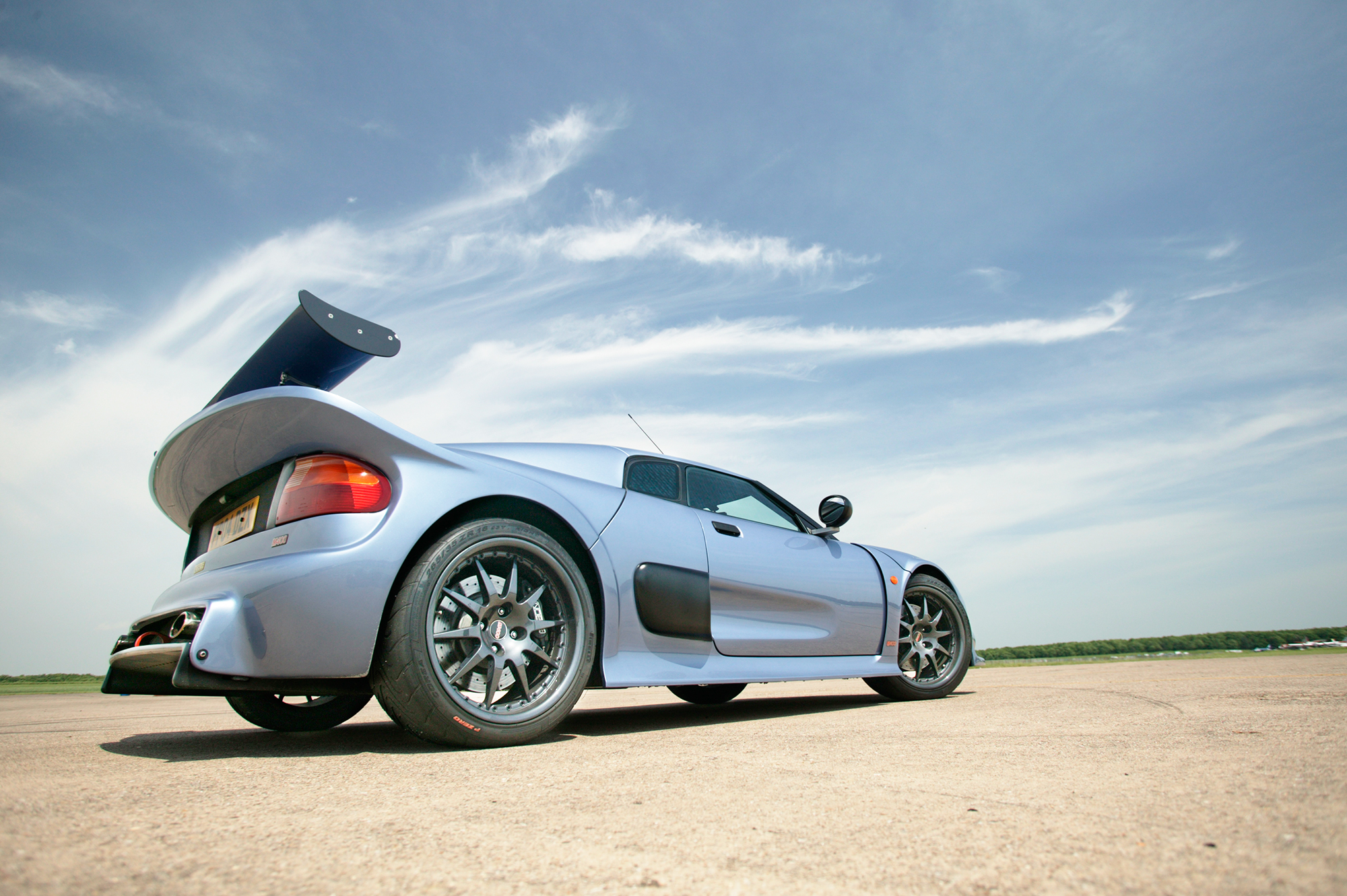
This is the Noble M400, an English supercar set to stir up the established performance icons. It runs a mid-mounted twin-turbo 3.0-litre V6 producing 317kW, but it’s not about the engine. It has track compound Pirellis, but it’s not about the tyres. It’s not even about the fact Noble has flown us to the Bruntingthorpe track, about three hours north of London, to thrash its new $200,000 supercar that’s destined for Australia.
Nope, it’s about the wonderful chassis, a mid-engined, rear-wheel drive, tight two-seat steel spaceframe with bonded and riveted alloy panels, double wishbone suspension and a full integrated roll cage with the rigidity of a cadaver that makes the Noble so immensely agile.
It’s all down to the evolution of the vehicle Lee Noble started with, the 2.5-litre turbo M10, which then progressed to the M12. The more street-friendly GTO 3R version of which has just landed in Australia with 263kW, 0-100km/h in 3.7 seconds and one of the best chassis ever to be built.
The M400 is the harder, track-focused version with signature side scoops to feed the engine, black end plates on the rear wing and a rear diffuser. Like the M12, its chassis is built by a South African company who also makes Cobra replicas, taking about eight weeks to construct. The chassis arrives at Noble’s workshop complete with the panels, brakes and suspension, interior, dash, seats and gauges already plugged in, ready for Noble’s engine and ancillaries.
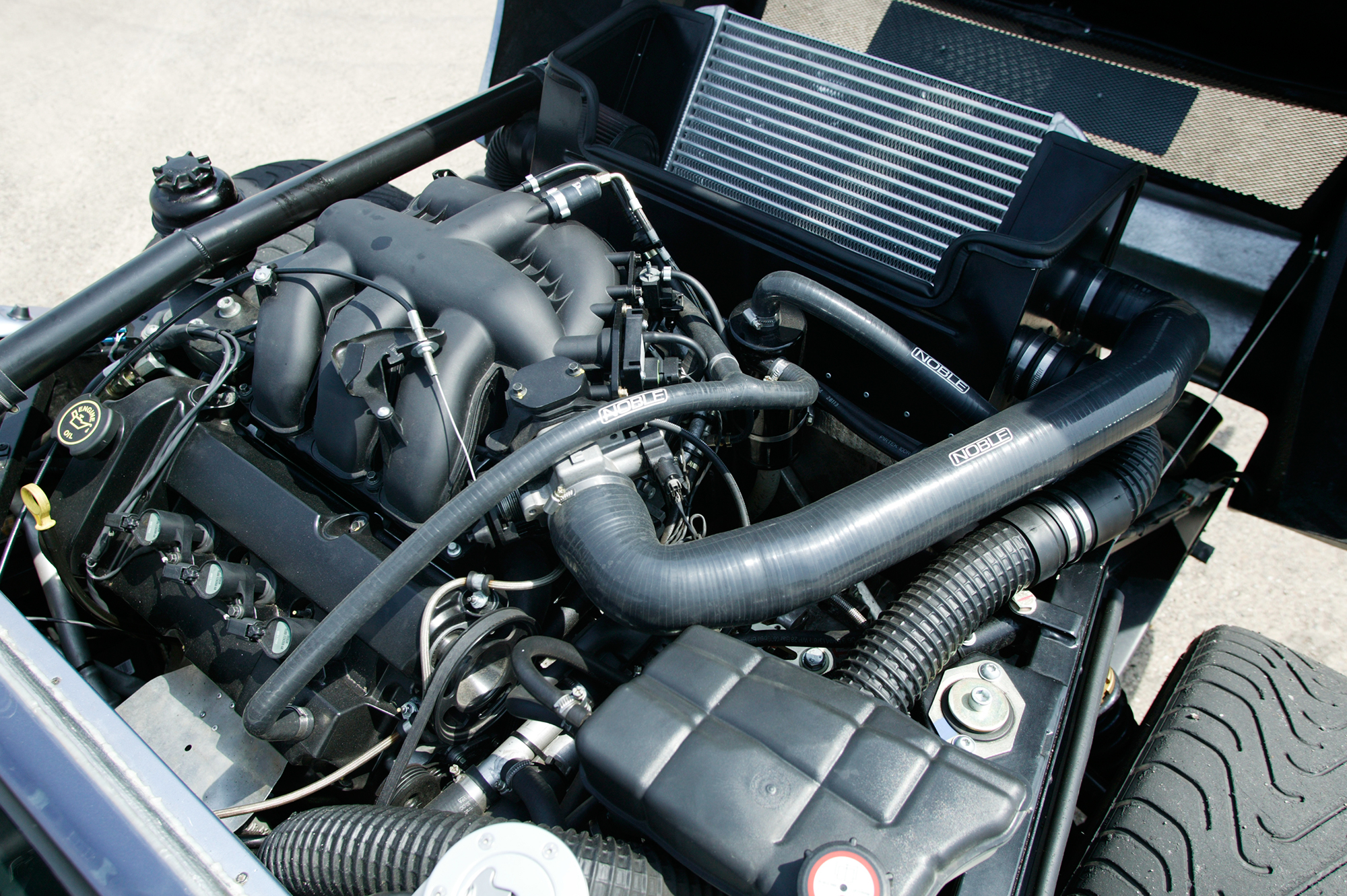
Over just one week and about 70 man hours, Noble then fits the running gear, starting with a Ford Mondeo engine. Yep, a plain old 3.0-litre V6 arrives from America, but with Noble-spec forged pistons that lower the compression ratio. Slung in behind the driver, the V6 has a turbo hung off each bank, a single intercooler at the rear, and more internal mods over the regular M12: wilder cams, larger turbos with 0.15 bar (2psi) more boost, taking it up to 0.85 bar (12psi), plus an oil cooler, sump baffles and a sharper shifter in the Getrag six-speed gearbox.
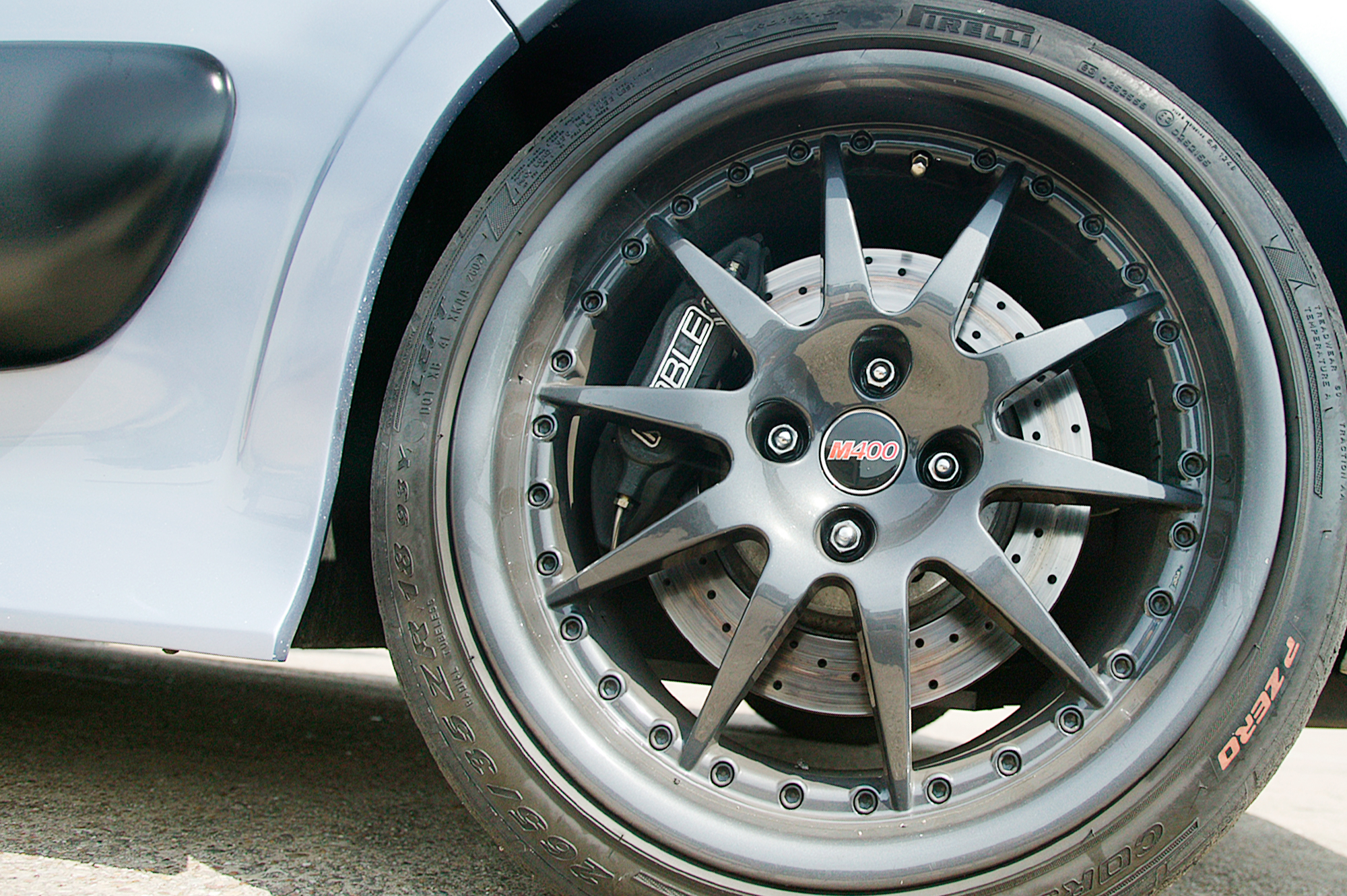
Noble’s also lopped 20kg from the M12’s weight by offering air-conditioning as an extra cost-option on the M400, emphasising that this model is aimed more for the track than the road. The coil-over double wishbone suspension is stiffer, and the M400 runs race track compound, super tacky Pirelli P Zero Corsas.
Make no mistake, this is a kit car, and the swoopy body styling with gaudy rear wing was created from Lee Noble’s mind, not from a computer. But after five years of Noble build, the quality is pretty good.
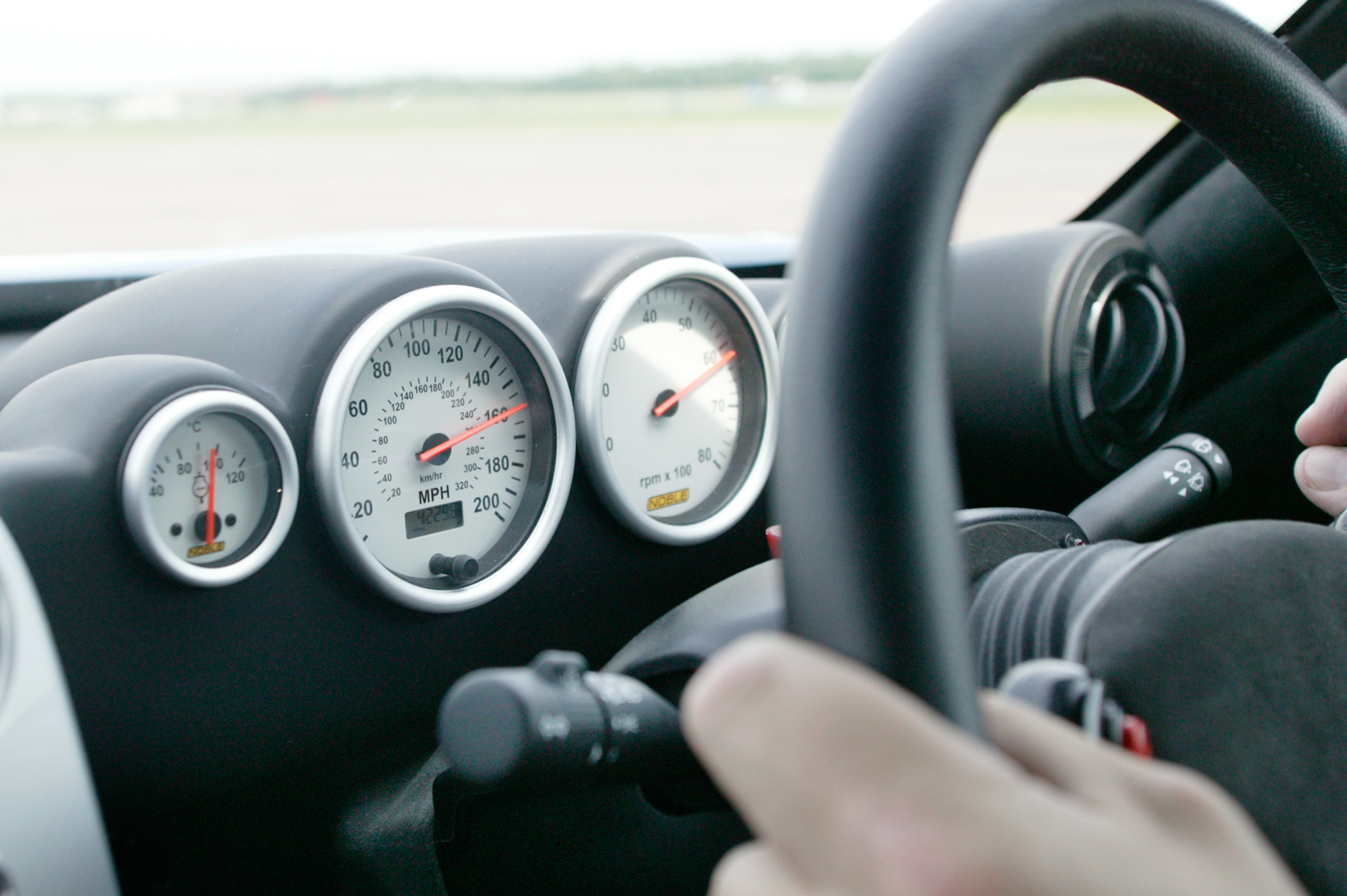
The interior reflects the car’s philosophy: clean, simple and with minimal distractions. The bank of basic gauges and wrap-around Sparco seats are in line with the lack of traction or stability control. There is a Mondeo wiper/indicator stalk whose shroud didn’t fit as neatly as it could on our car, but that was the only build quality issue. Simple and pure, there isn’t even ABS – not that there’s anything wrong with that.
Combine the sticky Pirellis with 330mm rotors (30mm thick at the front, 28mm rear) and four-piston calipers, and the 1060kg weight of the M400 is blessed with immense braking power. In fact, parallels are easy to draw to a famous German marque, at least in performance and handling. But while a 911 driver gets all the frills, the Noble needs none of them because it’s a basic car done well: stiff chassis, great suspension, big brakes, a purposeful interior and a superb engine.
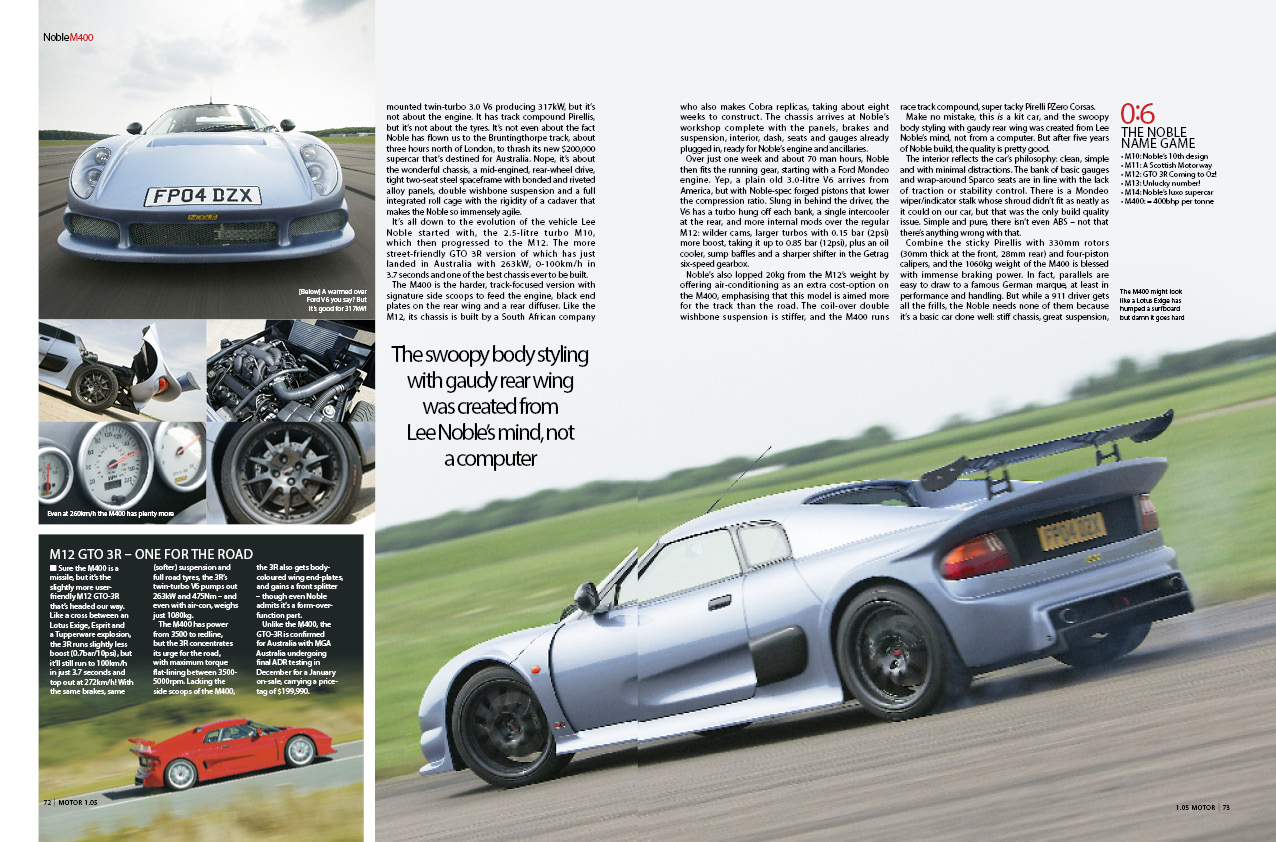
Jab the metal starter button and the V6 fires into life, the engine is smooth and the clutch action is docile. Jam the throttle open though, and from 3500rpm the Garretts spool up, and this incredible thing happens: it actually sounds good. It’s a mixture of throaty V6, and the choof and chortle of the turbos and rushing air.
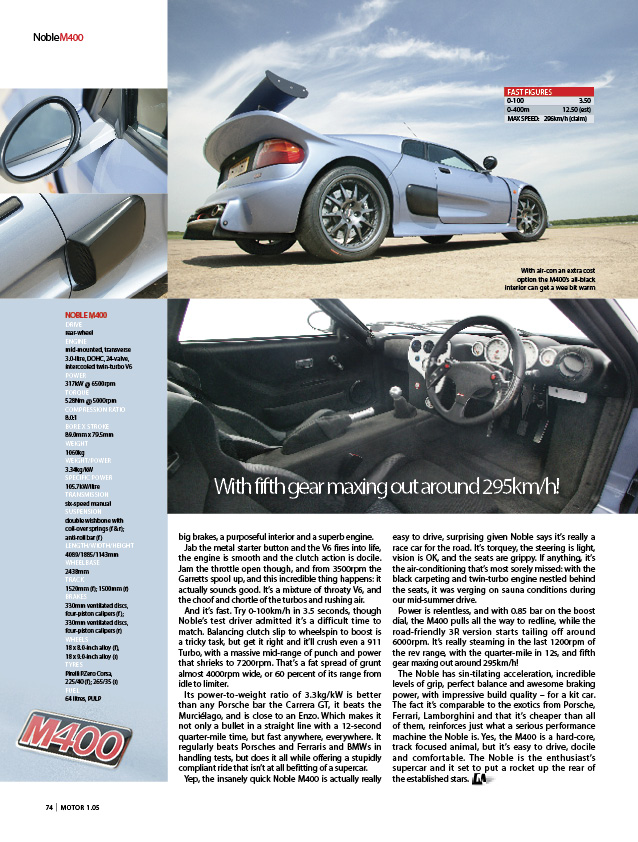
And it’s fast. Try 0-100km/h in 3.5 seconds, though Noble’s test driver admitted it’s a difficult time to match. Balancing clutch slip to wheelspin to boost is a tricky task, but get it right and it’ll crush even a 911 Turbo, with a massive mid-range of punch and power that shrieks to 7200rpm. That’s a fat spread of grunt almost 4000rpm wide, or 60 percent of its range from idle to limiter.
Its power-to-weight ratio of 3.3kg/kW is better than any Porsche bar the Carrera GT, it beats the Murciélago, and is close to an Enzo. Which makes it not only a bullet in a straight line with a 12-second quarter-mile time, but fast anywhere, everywhere. It regularly beats Porsches and Ferraris and BMWs in handling tests, but does it all while offering a stupidly compliant ride that isn’t at all befitting of a supercar.
Yep, the insanely quick Noble M400 is actually really easy to drive, surprising given Noble says it’s really a race car for the road. It’s torquey, the steering is light, vision is OK, and the seats are grippy. If anything, it’s the air-conditioning that’s most sorely missed: with the black carpeting and twin-turbo engine nestled behind the seats, it was verging on sauna conditions during our mid-summer drive.
Power is relentless, and with 0.85 bar on the boost dial, the M400 pulls all the way to redline, while the road-friendly 3R version starts tailing off around 6000rpm. It’s really steaming in the last 1200rpm of the rev range, with the quarter-mile in 12s, and fifth gear maxing out around 295km/h!
The Noble has scintillating acceleration, incredible levels of grip, perfect balance and awesome braking power, with impressive build quality – for a kit car. The fact it’s comparable to the exotics from Porsche, Ferrari, Lamborghini and that it’s cheaper than all of them, reinforces just what a serious performance machine the Noble is. Yes, the M400 is a hard-core, track focused animal, but it’s easy to drive, docile and comfortable. The Noble is the enthusiast’s supercar and it set to put a rocket up the rear of the established stars.
Electric vehicles are, in many ways, simpler than conventionally powered cars in that they have far fewer moving parts or things that can go wrong.
However, anyone new to EVs would be forgiven for being a little confused at all the numbers relating to their power, battery capacity and how long they take to charge, as their respective units of measurement all contain a reference to kilowatts (kW).
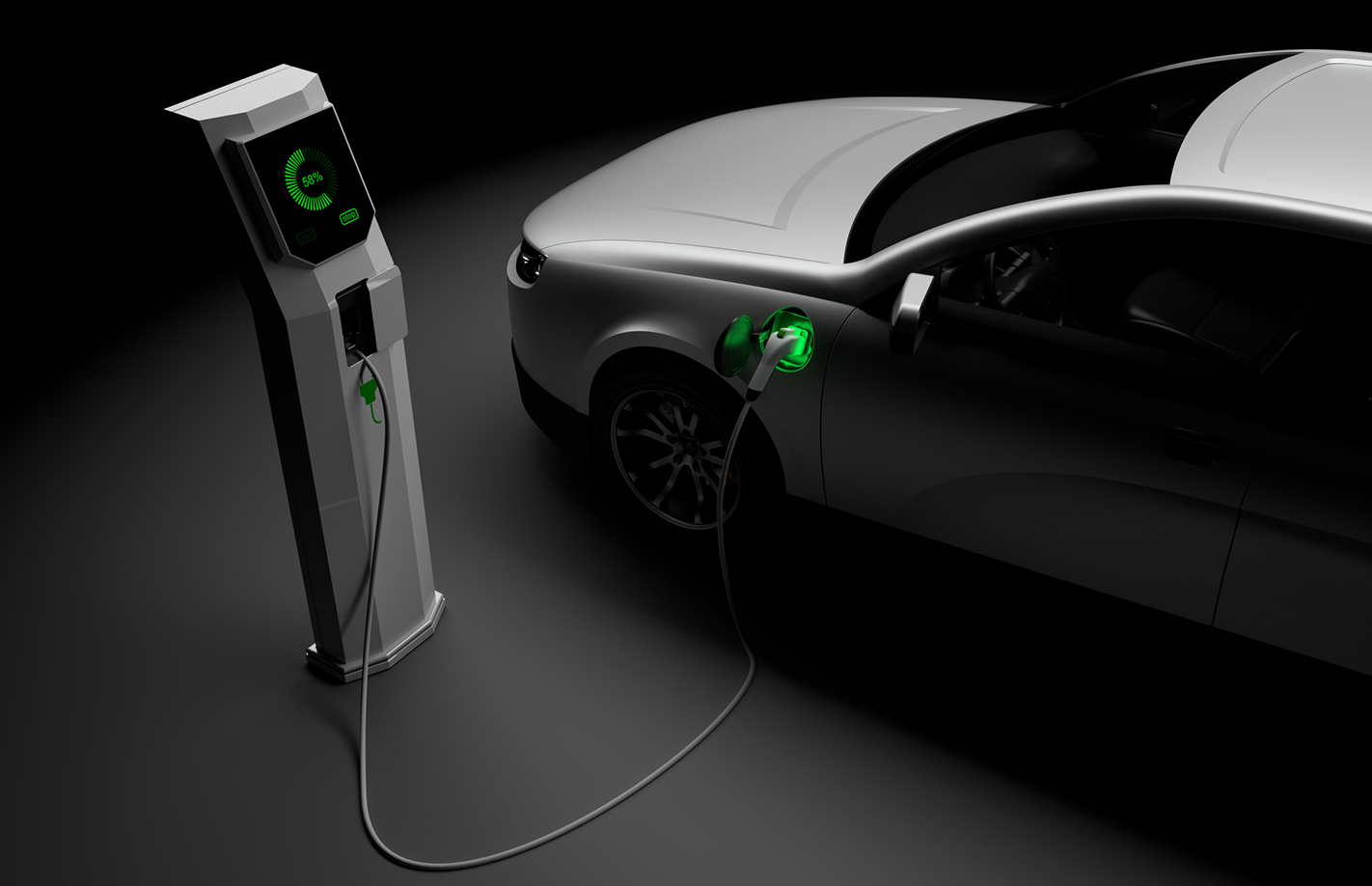
So what do the numbers and letters mean and how do you tell them apart?
EV motor power (kW)
The car’s power is fairly straightforward and refers to the electric motor’s maximum output. This is measured in kilowatts (or 1000 watts) just like a normal internal combustion engine (ICE). The higher the kW figure, the more oomph you’ll get at the expense of energy consumption.
As the following list shows the power ratings of EVs aren’t too different when compared with similarly-sized and performing ICE vehicles.
- Nissan Leaf – 110kW
- Hyundai Kona Electric – 150kW
- Mercedes-Benz EQC – 300kW
- Porsche Taycan Turbo S – 560kW
- Tesla Model S Performance – 595kW
Battery capacity (kWh)
The total battery capacity of an EV is measured in kilowatt-hours (kWh or kW-h). This rating tells you how much electricity can be stored in the battery pack. It’s a unit of energy just like calories and one kWh is equal to 3600 kilojoules (or 3.6 megajoules). Unlike kW, it is not a unit of power.
Lower-powered EVs require a smaller capacity; for example the Nissan Leaf stores 40kWh and the Hyundai Kona Electric 64kWh. The Porsche Taycan Turbo S meanwhile stores a maximum of 93.4kWh.
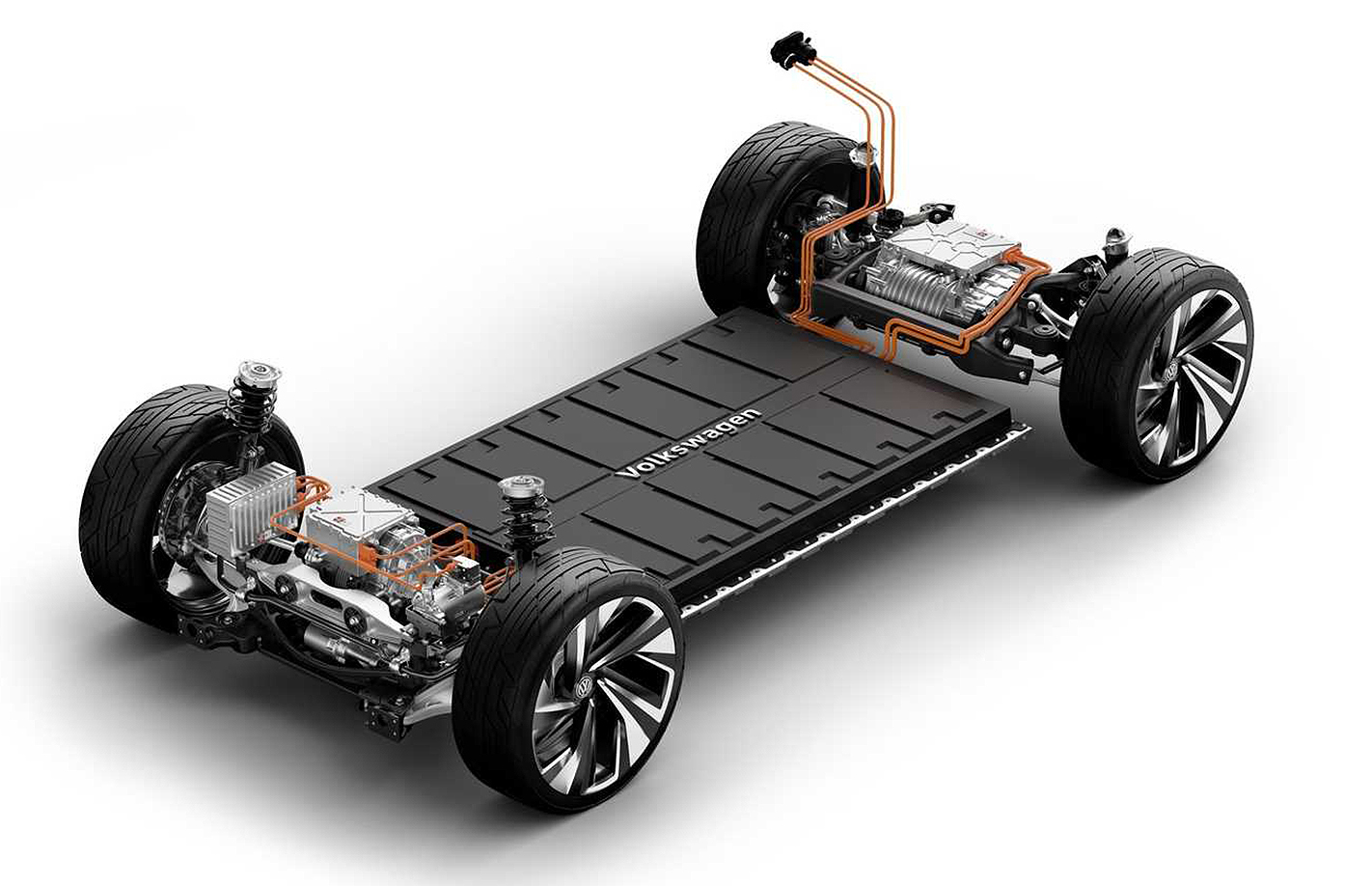
If all these cars had the same electric motor (and thereby the same maximum amount of power drawn from the battery at any given time) the Porsche would have the longest driving range because of its higher capacity.
However, the Porsche has a 560kW motor that’s designed for high performance and that comes at the cost of driving range, which is about 405 kilometres. But the Hyundai Kona Electric has a 557km distance range, even though it has a smaller battery capacity, because its motor is less powerful.
The reference to ‘hours’ in the unit is a source of confusion for some, but it’s fairly simple. The kilowatt unit is calculated as the amount of energy necessary to produce a kilowatt of power sustained for one hour.
EV efficiency (kWh/100km)
Like how ICE vehicle fuel consumption is measured in litres per 100km in highway, urban and combined settings, EV efficiency is rated by the number of kWh consumed over 100km.
More economical EVs, such as the Hyundai Kona, consume about 14kWh/100km combined, while the larger and more powerful SUVs such as the Audi E-Tron will suck electrons at a rate of 24kWh/100km.
It’s worth noting that while petrol and diesel vehicles are more efficient on the open road, EVs consume less power in urban settings as stop-start driving allows for coasting and the recouping of energy through regenerative braking.
Charging point power (kW)
A kilowatt is also the unit of measurement and energy used for charging points. With electricity, a watt is simply the voltage (volts) multiplied by the current (amps), which means the higher the kW number the more electricity is being used to charge your car, which means quicker charging.
This is why a 400v/50kW rapid charger will charge an EV far quicker than a 240v/2.4kW socket in your garage.
For more on electric vehicles, see our guide below.
Snapshot
- 2014-2016 Hyundai Sonata recalled
- Faulty indicators could signal the wrong direction
- A total of 2404 cars are included in the notice
Hyundai has recalled a total of 2404 examples of the 2014 to 2016 Sonata due to a potential issue with the vehicle’s indicators.
According to a recall notice published by the Department of Infrastructure, a software issue with the Smart Junction Box could activate the turn signals in the opposite direction to what the driver intended.
Hyundai will contact affected owners, but the company can be contacted directly by calling 1800 186 306 or visiting a dealership, found here.
You can check a list of all 2404 VINs related to the recall by clicking here.
Snapshot
- Range Rover Evoque plug-in hybrid joins Land Rover’s expanding PHEV line-up
- Three-cylinder, 1.5-litre engine combines with eight-speed auto transmission
- Price starts at $102,001 before on-road costs
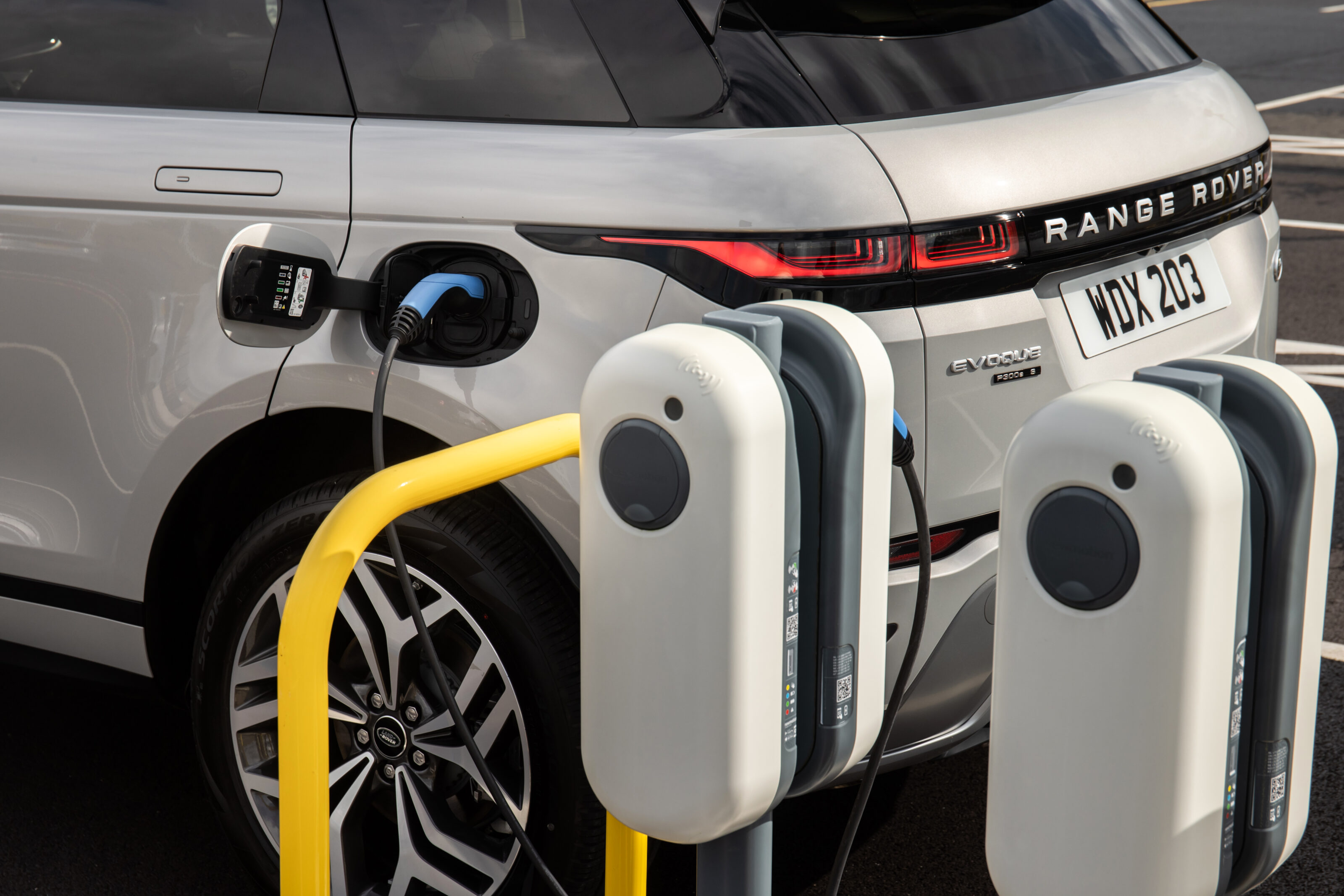
The Range Rover Evoque is Land Rover’s latest model to get the plug-in hybrid (PHEV) treatment, joining the existing line-up at a premium cost.
Although it’s launching in 2022, Jaguar Land Rover Australia refers to the incoming model as its MY23 Evoque, despite the updated SUV being able to order now.
Expanding the Evoque line-up to include a PHEV variant falls in line with Land Rover’s increasingly electrified model range, joining; the existing Range Rover Sport P400e PHEV, the soon-to-be-launched Range Rover PHEV (available to order from January 27), the Range Rover Velar PHEV (available for customer orders from Q2) and Defender 110 PHEV (available for customer orders from the third quarter).
The inclusion of the PHEV in the Evoque range comes at the cost of its D200 Ingenium variant, which previously served as the only diesel engine in the line-up – last available from $79,510 before on-road costs.
Pricing
All Australian-bound Range Rover Evoques score the R-Dynamic package, with the entry-level SE P250 available for just under $5000 less than the HSE P250, while the PHEV commands a premium of nearly $20,000.
Prices exclude on-road costs.
| Range Rover Evoque R-Dynamic SE P250 | $78,052 |
| Range Rover Evoque R-Dynamic HSE P250 | $82,699 |
| Range Rover Evoque R-Dynamic HSE PHEV | $102,001 |
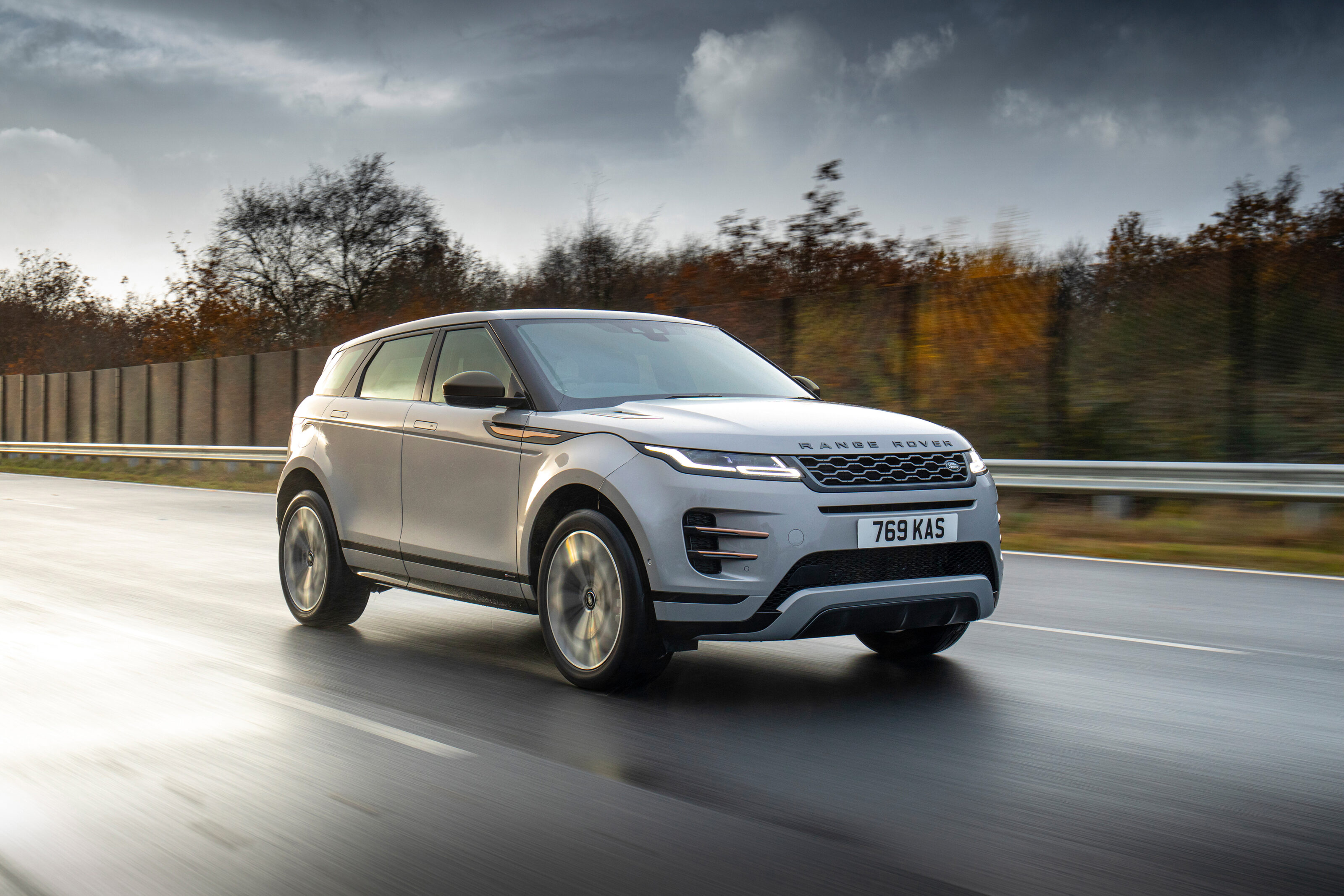
Engine, drivetrain and transmission
The incoming Evoque PHEV sees Land Rover’s smallest offering downsize to its lowest-displacement engine yet, as a 1.5-litre, three-cylinder turbocharged petrol unit is mated with an 80kW electric motor on the rear axle, combining for a total output of 227kW and 540Nm – an increase of 43kW and 175Nm over the P250.
Drive from the internal combustion engine is sent to the front wheels through an eight-speed, torque converter automatic gearbox, rather than the all-wheel-drive, nine-speed setup four in the P250 variants
Located underneath the rear seats, its 15kWh lithium-ion battery is good enough to provide an all-electric driving range of 62 kilometres, as well as assisting the combustion engine to record WLTP tested fuel consumption figures of 2.0L/100km.
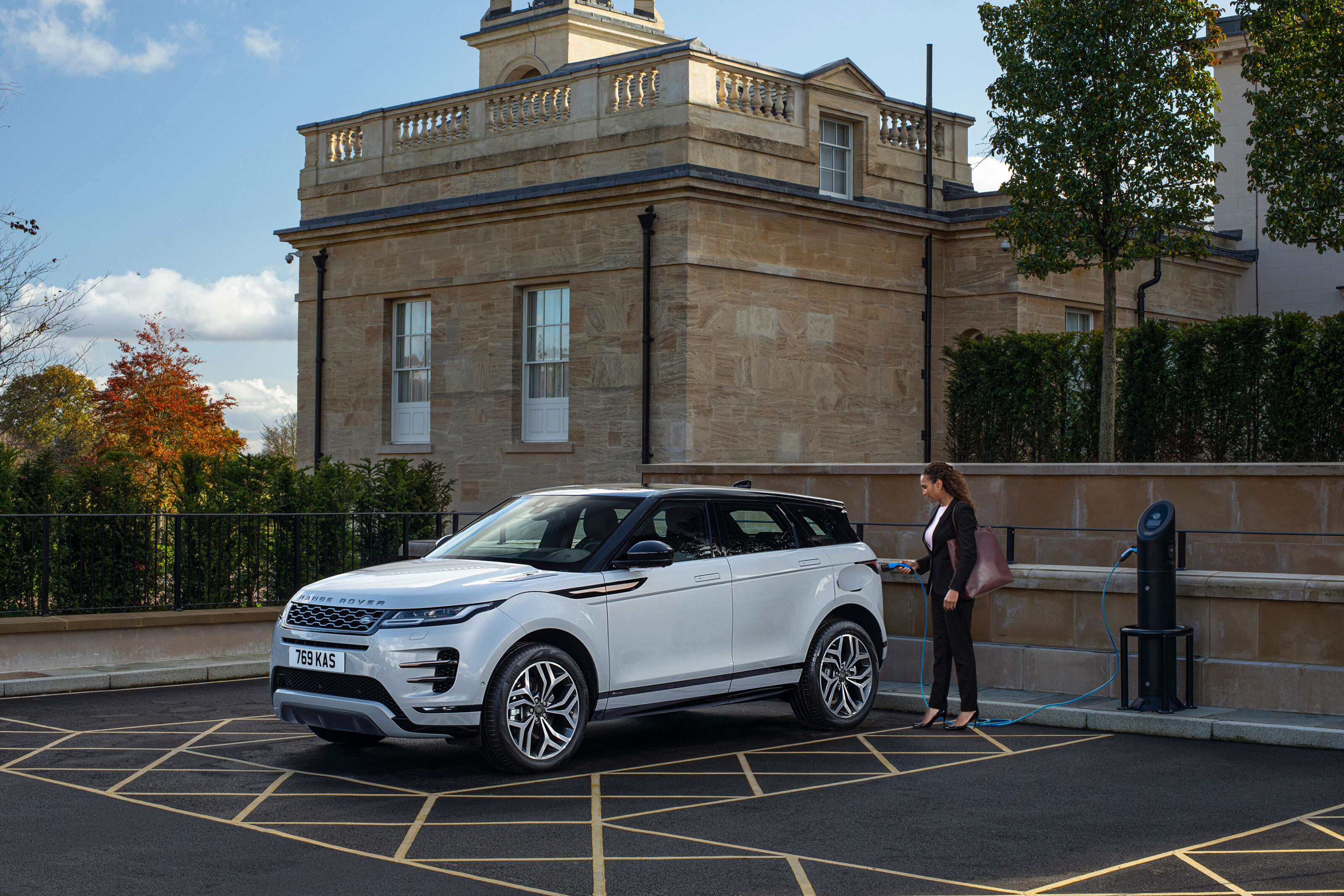
The Evoque’s 7kW on-board charger allows it to connect to any 240V household socket, an AC domestic wall box or public charge point, providing charge times of two hours and 12 minutes from 0-100 per cent using the latter technology.
For DC charging, the Evoque can do so at up to 32kW, lowering its 0-80 per cent charge time to just 30 minutes.
Availability
JLR Australia says it has prepped dealers to open their order books for the MY23 Evoque range, although it couldn’t provide a date as to when the first arrivals will begin, with customers encouraged to speak with their dealer for further clarity.
Key Points
- Pricing for BRZ Coupe starts at $38,990 before on-road costs
- New-gen car will be available in BRZ Coupe and Coupe S trim
- First 500 cars sold out
January 21, 2022: First Australian BRZ drive
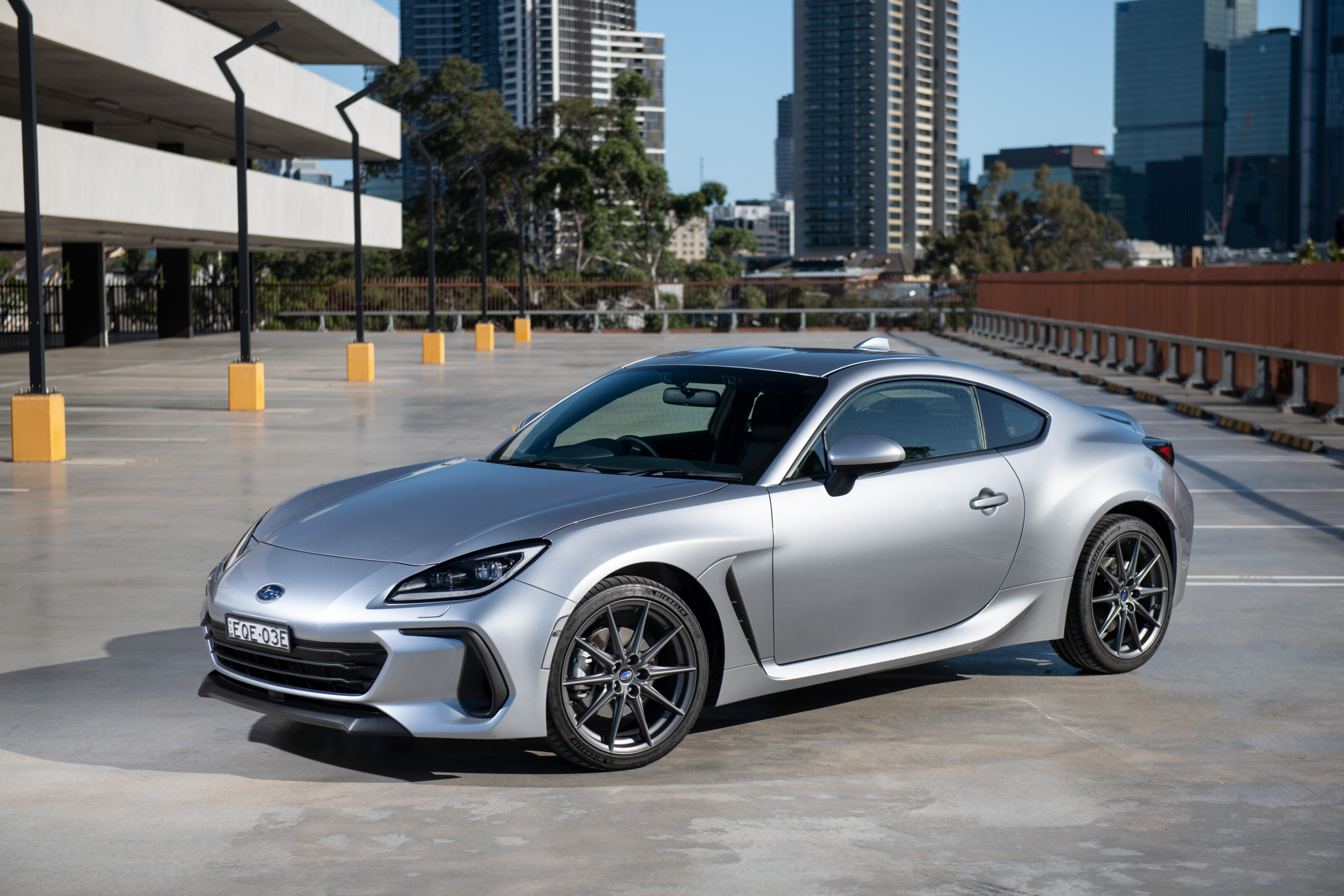
Our man Ash got the chance to try out the latest Subaru BRZ at a slippery Sydney Motorsport Park this week – far from ideal conditions for pushing the rear-wheel drive coupe to its limits.
To prove its new coupe is better than the old one, Subaru took the liberty (pardon the pun) of bringing its OG BRZ to SMP, providing a direct, back-to-back test environment to see where the improvements lie.
The results? You’ll have to read on to find out:
December 13, 2021: Australia’s first BRZ allocation sold out
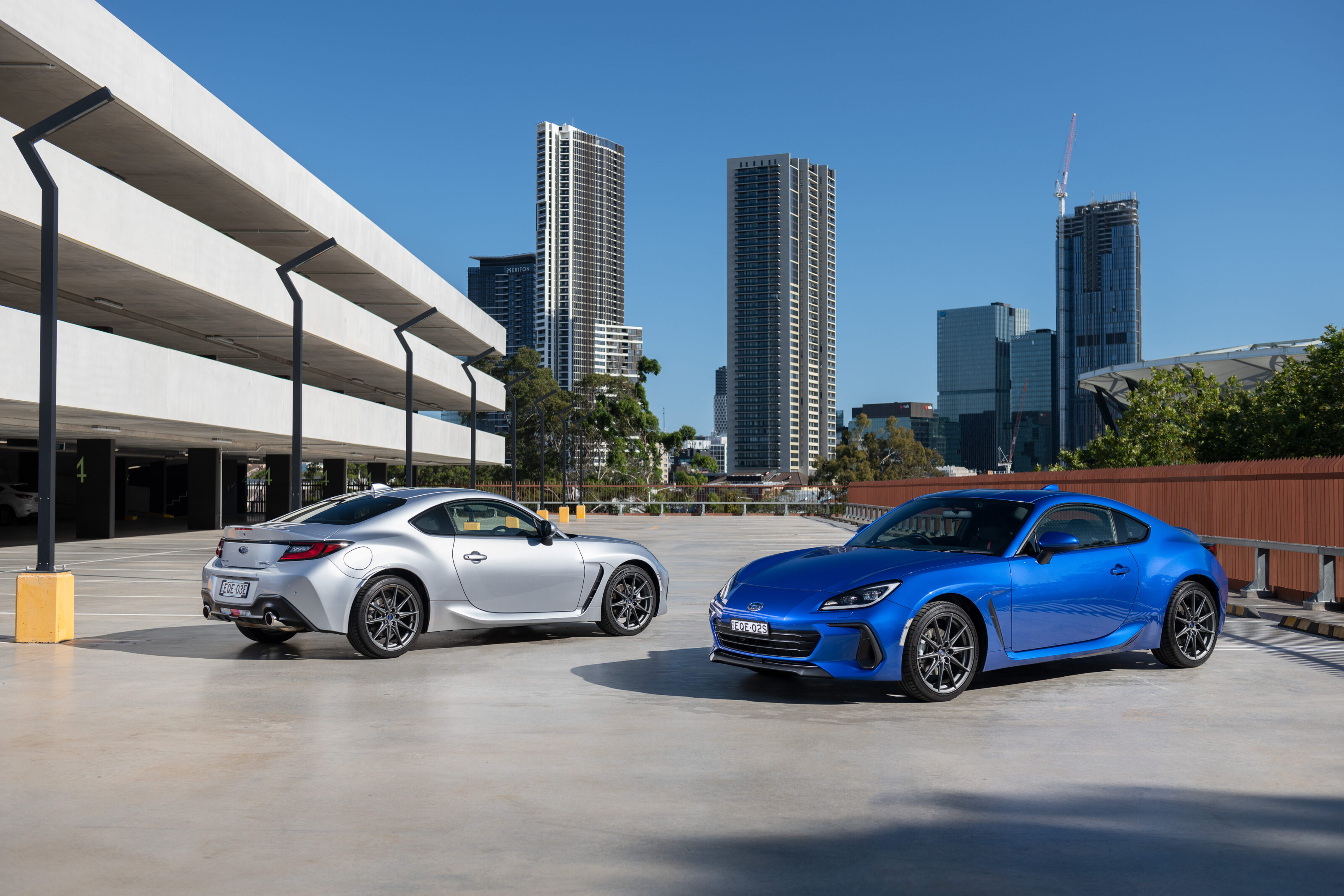
The first 500 examples of Subaru’s 2022 BRZ have sold, with the initial allocation exhausted soon after it went up for sale.
While those first 500 cars will arrive in the early stages of 2022, further units down the line aren’t tipped to turn up in Australia until later in the year.
September 7, 2021: 2022 BRZ pricing revealed
Subaru has announced local pricing of its new BRZ, starting out at a list price of $38,990 before on-road costs for the BRZ Coupe manual while the automatic commands a $3800 premium.
The higher-spec BRZ Coupe S goes on sale from $40,190 before on-roads in manual guise and $43,990 when optioned with the auto ‘box, gaining heated leather/Ultrasuede front seats in place of the standard cloth units.

February 18, 2021: BRZ set to arrive late-2021
The new Subaru BRZ is slated for a late-2021 arrival in Australia, set to go on sale before Christmas.
Its local launch would signal the end of a near 10-year wait since the first-generation BRZ arrived on Australian shores, having turned up in dealers throughout 2012.
Note: As of January 2022, no customer BRZ deliveries have been recorded in Australia.
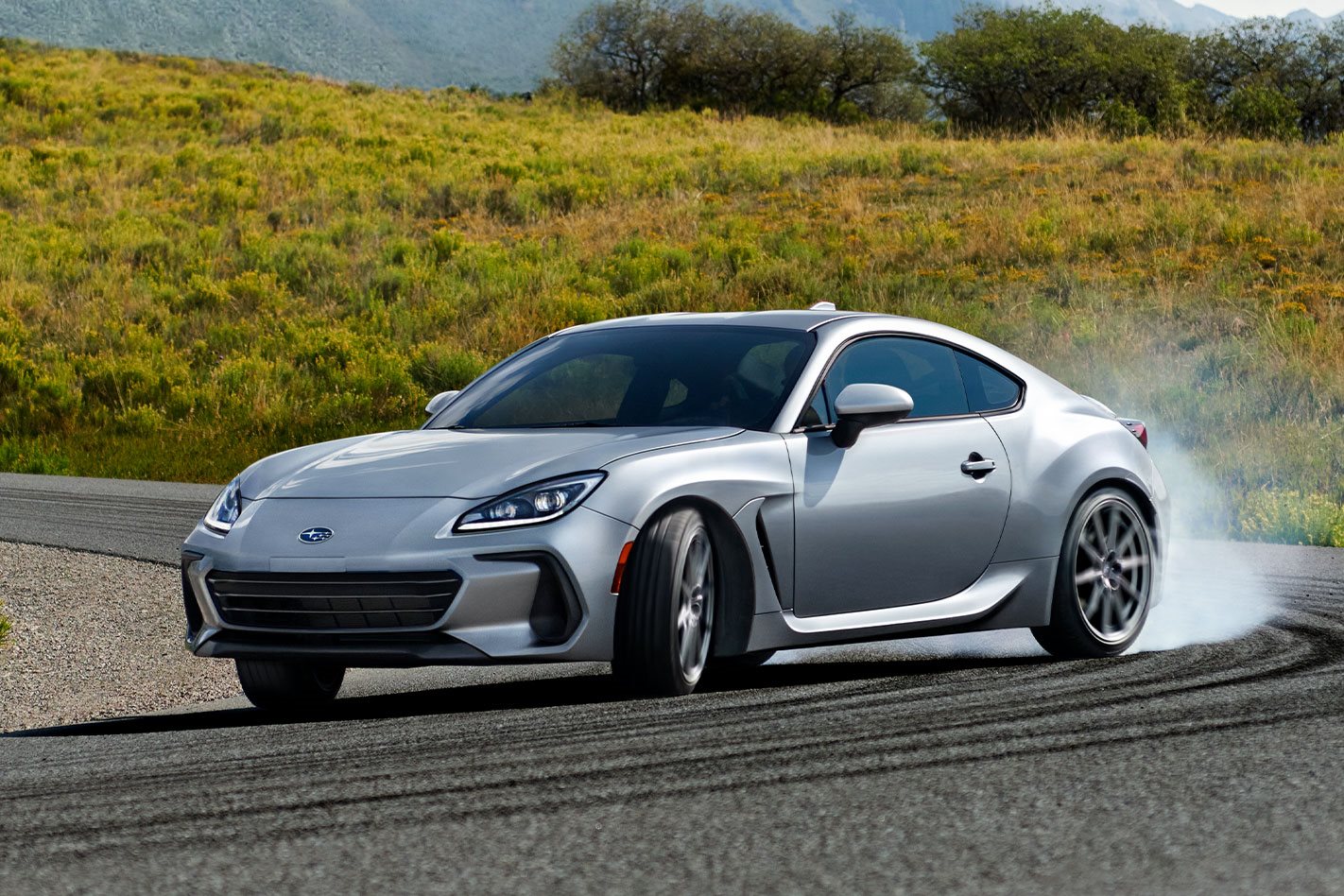
November 17, 2020: Second-generation BRZ global reveal
Every so often you drive a car that in the first hundred metres or so reveals itself to be greater than the sum of the numbers on the spec sheet.
The 2012 Subaru BRZ was one of those cars. It wasn’t the fastest, most powerful, or even the best-looking sports car on the market. But it was a real driver’s car. Like the original Mazda MX-5 or Porsche Boxster, it had a sweet chassis the engine simply could not overpower. The BRZ taught you not to waste momentum; to be economical with the brakes, and precise with your lines; to make the most of the chassis and the power and the grip at your disposal.
It’s a tough act to follow, but the redesigned 2021 BRZ, which is expected to arrive in Australia in the third quarter of 2021, looks up to the challenge. It has a new 2.4-litre flat-four under the bonnet with more power and more torque.
The new body structure is more rigid to further sharpen handling response, and it gets bigger wheels and tyres. Both the interior and the exterior have been restyled. And it’s still low and light and rear-wheel drive.
The original Subaru BRZ was the result of one of the car industry’s oddest joint ventures since Alfa Romeo teamed up with Nissan in the 1980s to produce the ARNA, a car that spectacularly combined Alfa’s suspect reliability with Nissan’s sloppy handling and boring styling.
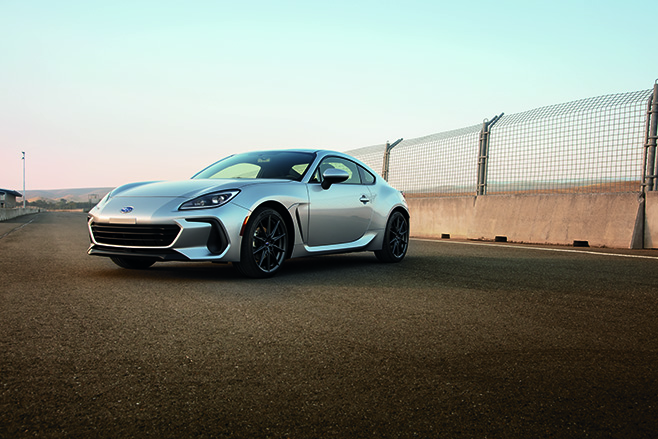
But Subaru joining forces with Toyota was a win-win deal: Subaru got a sports car it could not afford to build, and Toyota got a sports car it had no room to build.
Toyota did the planning and the design. Subaru did the engineering and manufactured the BRZ and Toyota’s identical 86 in its Gunma plant in Japan. More than 120,000 of them have rolled off the line at Gunma since the beginning of 2013, two-thirds wearing Toyota badges.
But the sports car market is a finite and fickle one: Combined 2019 sales were barely one-fifth those of 2013, though the BRZ held up much better than the 86.
The joint venture strategy hasn’t changed – there will be a new Toyota 86 – but as with the original, it’s the new Subaru BRZ we get to see first.
Though the internet buzzed with rumors the 2021 BRZ would get the 194kW, 375Nm turbocharged 2.4-litre flat four that powers the Subaru Ascent SUV in the US, it launches with a naturally aspirated version of the engine.
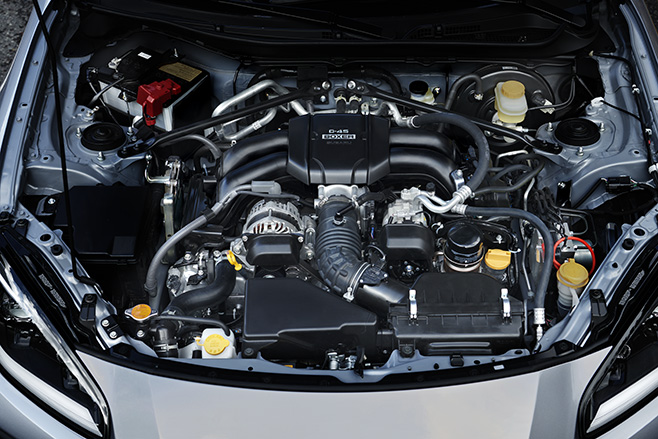
Fitted with Toyota’s D-4S direct and port injection system, the engine develops 170kW at 7000rpm and 250Nm of torque at 3700rpm, increases of 12 percent and 18 percent, respectively, compared with the outgoing 2.0-litre.
Significantly, the new engine’s torque peak arrives 2700rpm lower in the rev band.
As before, buyers will be able choose from two Aisin six-speed gearboxes, one a manual, the other an automatic with manual control via steering wheel mounted paddles. The automatic features a new sport mode that enables more rapid downshifts, the software blipping the throttle to match revs, and uses data from yaw sensors to hold a lower gear during hard cornering.
A limited slip diff is standard, and the integrated traction and stability control system, which has five settings, has been recalibrated to allow more input from the driver before intervening.
Chassis hardware follows the template of the original car, with struts and coil springs up front, specially designed to allow for a low bonnet line while maintaining a long stroke to ensure optimal compliance and ride quality, and a multi-link suspension at the rear.
There have been subtle but significant changes to the body structure, however. The front and rear subframe mounting points and other connection points reinforced to improve stiffness. Subaru claims front lateral bending rigidity has been improved 60 percent, improving turn-in response.
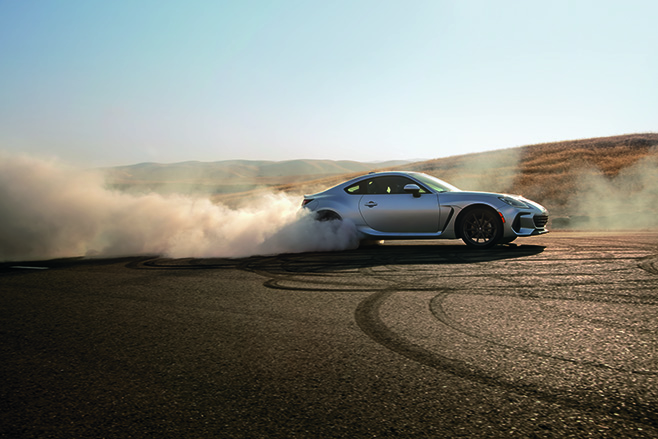
The new BRZ’s more coherently aggressive design is the result of more than just a major facelift. The wheelbase has increased five millimetres to 2575mm, while overall length has gone up 23mm to 4265mm and overall height has dropped 10mm to 1310mm.
Every exterior panel is new, even the roof, which is slightly narrower because the tumblehome has been increased to accentuate the bodysides. The front guards, the bonnet and the roof are all made of aluminium to counter the extra weight of the bigger engine.
According to Subaru’s numbers the new BRZ weighs between four and 12kg more than the old car, depending on trim and transmission.
While flourishes like the large side vents that open on to pronounced sills running under the doors catch the eye, it’s the detail changes that truly transform the car. For example, the glass behind the side windows is trapezoidal rather than triangular, allowing a subtle line to run right along the top of the door and onto the front guards, eliminating the jink at the base of the A-pillar seen on the old car.
The bulges over the front wheels have gone, too, and the cleaner surfacing of the bonnet allows the new front fascia to roll down to a broader, shallower grille. From front on the new BRZ has none of the squinty demeanour of the old car; from the rear it looks less fussy, more sophisticated.
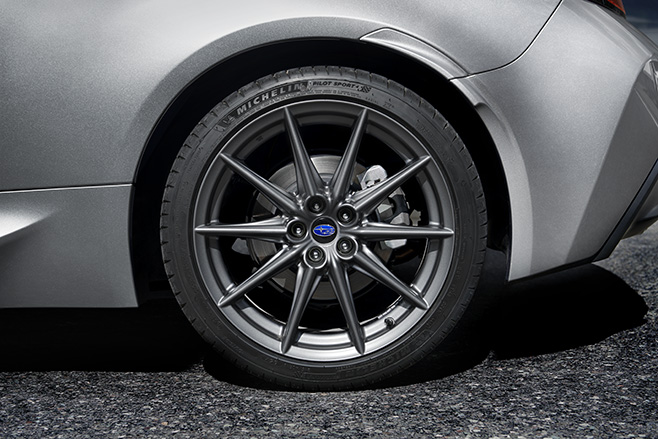
Not all the new styling elements are there for show: Those side vents pull air from under the bonnet and the front wheel arches and direct it along the upper surfaces of the sill panels, which kick up towards the rear of the car like spoilers and, says Subaru, help generate downforce at speed.
The new wheels are an inch larger in diameter, with 17-inch items standard, and 18-inchers fitted to the more highly equipped models. Base tyre is now a 215/45 R17, with a 215/40 R18 tyre fitted to the bigger wheels.
Inside, the redesigned interior features a customisable digital instrument panel. The standard display features the tacho front and center, with the water temperature and fuel gauges on the right. On the left, the display can be switched to show amps or peak g loadings.
With the traction and stability control system in track mode, the tacho display is automatically changed to a linear graphic with colour coding to help time upshifts right on the 7000rpm red line. In the middle of the dash is an infotainment touch screen.
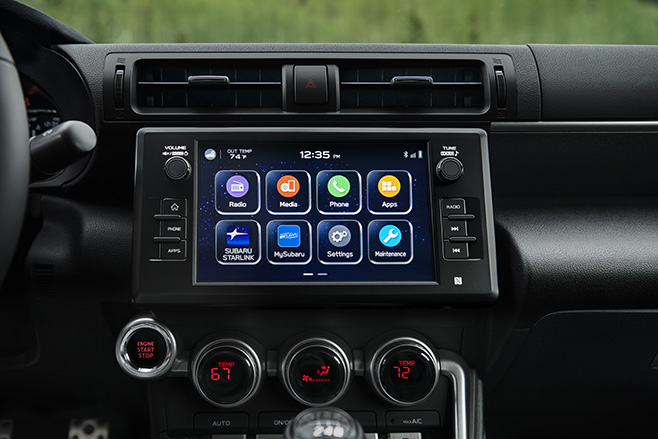
The Subaru multimedia system offers standard smartphone integration, supporting both Apple CarPlay and Android Auto.
A slightly better weight-to-power ratio means the new Subaru BRZ should be quicker than the old one to 100km/h. More significantly, though, the improved mid-range torque should punch the car harder out of corners.
Combine the extra performance with sharper responses, courtesy of the front stiffer structure and – on the 18-inch rims – lower profile tyres, and it all adds up to a car which, for enthusiast drivers, promises to deliver terrific bang for the buck.
FIXING A WASTED OPPORTUNITY
Wayne Cherry, the former vice-president of design at General Motors, cleared his throat, looked at the 2012 BRZ, and quietly declared: “This car is a wasted opportunity.”
There was stunned silence for a moment as eyebrows shot skywards, then a babble of voices filled the room. Wha…? No! Huh? Cherry stood his ground. “This car,’ he said, “has a mechanical package any designer would kill for. And they wasted it.”
Cherry explained the BRZ’s unique combination of a front-mounted flat-four engine and rear-drive meant it could have been wrapped in sheet metal that gave it the proportion and stance and flair of, say, an Aston Martin.
“The BRZ should have been a beautiful car,” he said bluntly. “It’s not beautiful.”
Now, the new BRZ won’t shame a Ferrari Roma. But lessons have been learned. Sharper, cleaner, with subtly tweaked proportions, it’s a much more glamourous sports car than its predecessor.
THE BRZ YOU WON’T SEE
What about those rumours the new Subaru BRZ would get the 194kW, 375Nm turbocharged version of the 2.4-litre flat-four? Will the Toyota 86 get the engine instead? Is it being saved for a mid-cycle facelift of the BRZ?
Nope, and nope, insist well-placed Subaru sources.
While a turbocharged engine would raise the car’s price to the point where the GT86 version would start to encroach on Supra, and Subaru dealers might struggle to sell a turbo BRZ, the simple reason is the engine, codenamed FA24F, just won’t fit.
Why? The single turbocharger sits underneath the block. The entire front structure of the new BRZ/86 would therefore have to be re-engineered to mount the engine high enough to ensure adequate ground clearance.
That, say Subaru insiders, would add weight, destroy the BRZ’s low bonnet line, and raise the car’s centre of gravity, compromising handling. Add it all up and 2.4 Turbo versions of the BRZ or GT86 are non-starters.
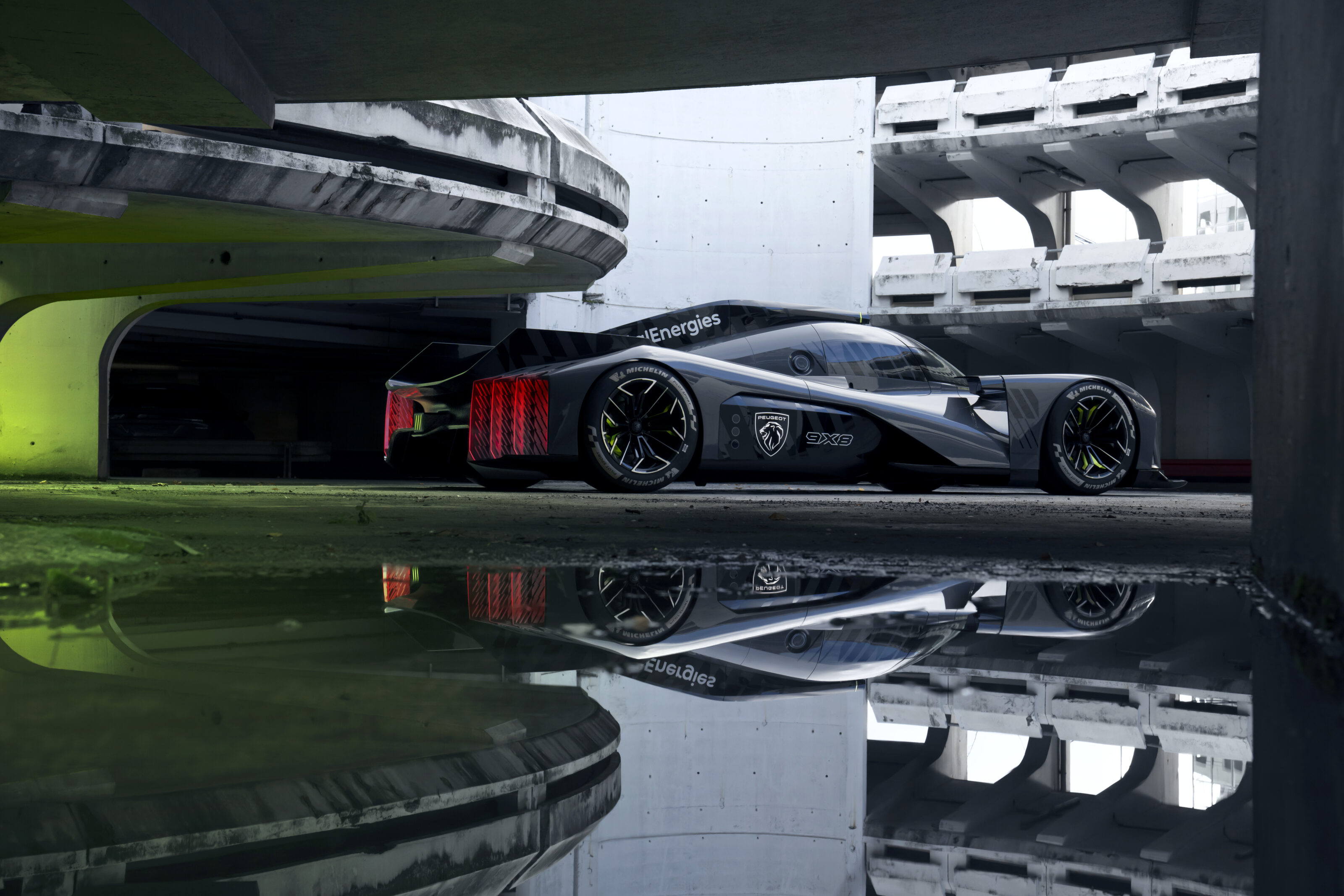
UPDATE, January 21: Race cars look just as good not moving as when they’re on the race track – or at least that’s what Peugeot wants you to think.
The French manufacturer has shown off a series of “ultimate design” images of its upcoming 9X8 hybrid racer, highlighting its unique but functional design – including its notable lack of a rear wing.
For Peugeot’s sake, we hope the car spends less time stationary when it’s on the race track, having recently taken to European circuits for testing (below).
The story to here
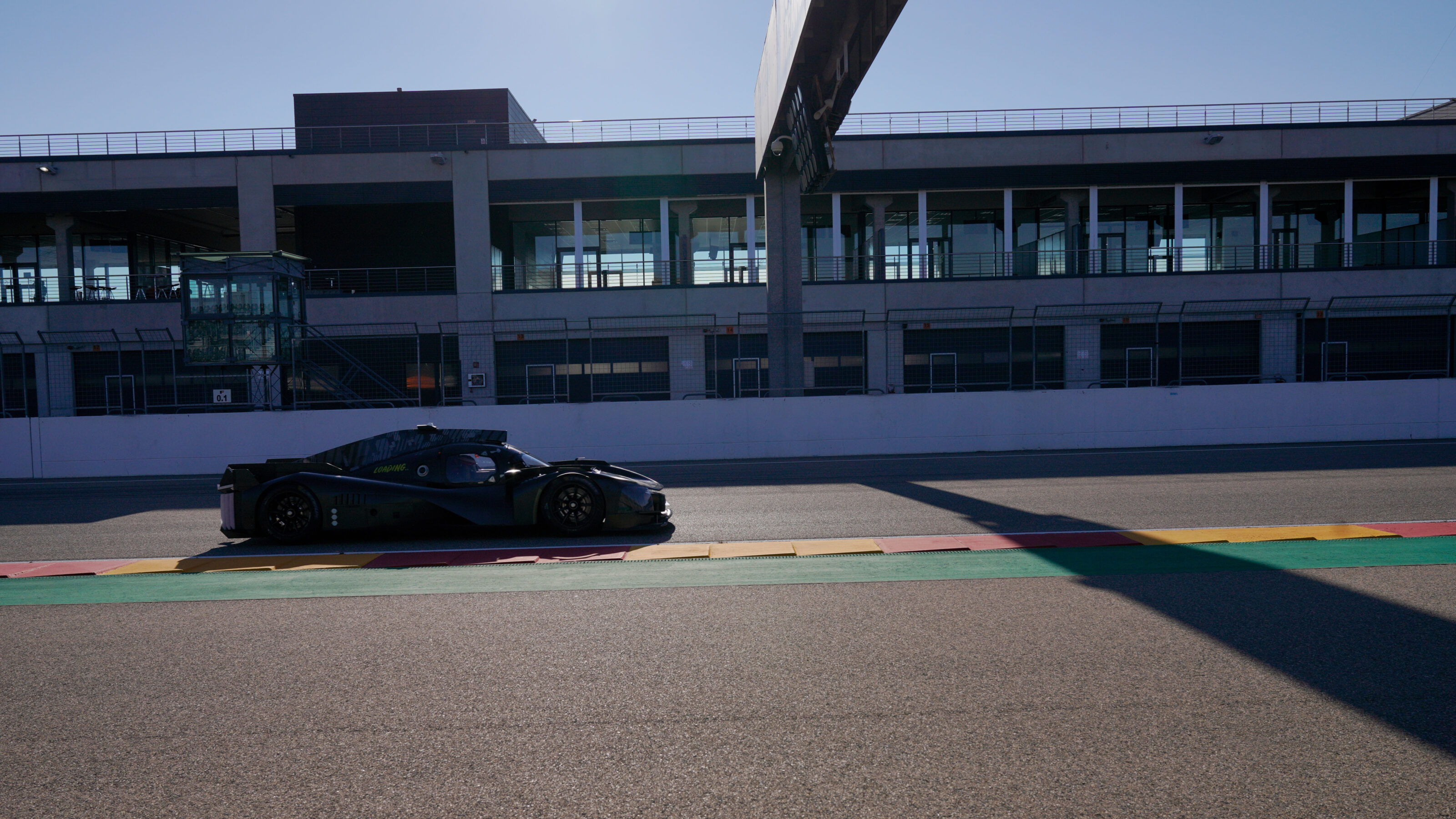
January 20: Peugeot has revealed more of its 9X8 hybrid Le Mans 24 Hours and World Endurance Championship (WEC) race car, although with changes over its first showing.
Peugeot’s 9X8 is the latest competitor the team will run and with high expectations, as both the 1990s’ 905 and 2000s’ 908 both won at Le Mans.
It will miss competing in Florida for the 12 Hours of Sebring race, and it is not known exactly when the new 9X8 will make its debut as it undergoes further validation. However, the 9X8 must compete in at least one event before the Le Mans 24 Hours, which is held this June.
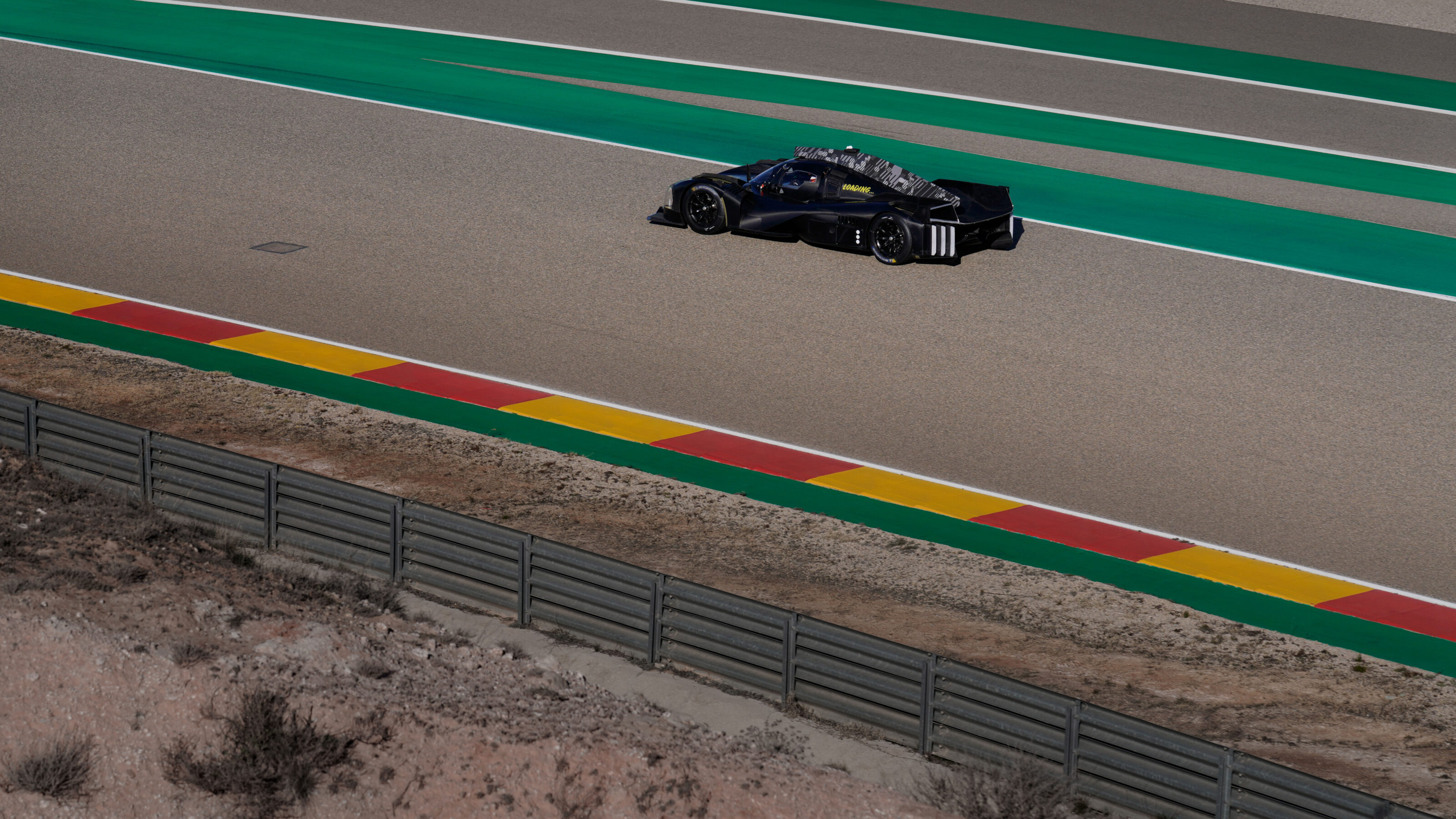
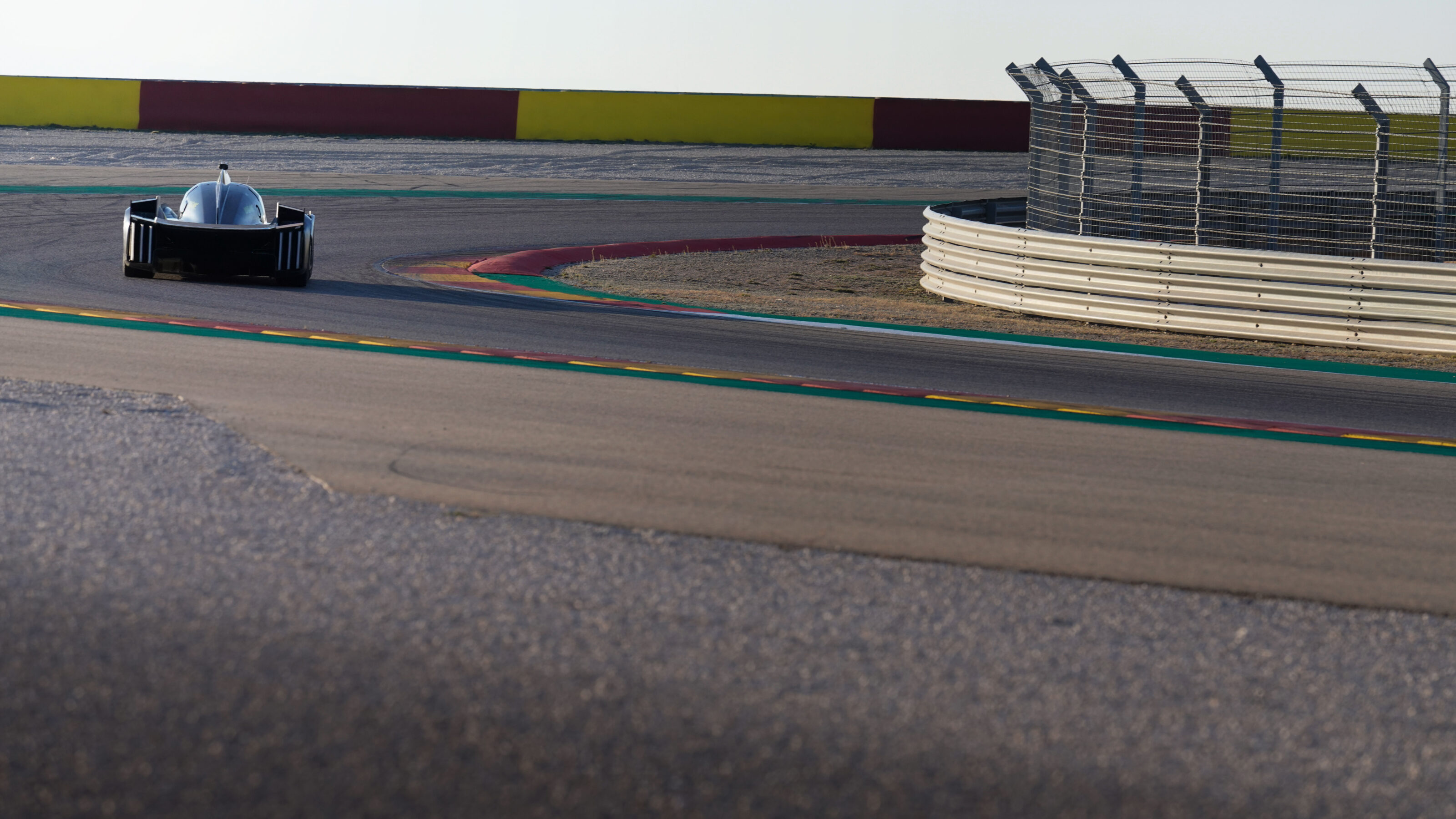
Last year, Peugeot released images of the model with a small rear wing, but these new photos show it without a rear wing, which appears to be the direction the French outfit is taking for its Le Mans competitor.
Peugeot’s technical director, Olivier Jansonnie, confirms that rear wing removal is the right direction, although testing is not complete on the aerodynamics.
“Our calculations and wind-tunnel work have confirmed the pertinence of our decision to run without a rear wing. Along with the developments and settings this option calls for, we expect it to be validated as we test at different circuits with differing characteristics.”
Peugeot design director, Matthias Hossan further added that the 9X8 blends both the brand’s design language and aerodynamic needs.
“Since the 9X8 is a Peugeot, the original sketch that steered our work portrayed a big cat ready to pounce – a stance that we have suggested by the slightly forward-tilting cockpit. The overall lines express the brand’s styling cues, while its sleek, racy, elegant forms inspire emotion and dynamism.
“An effort was also made to replicate the look of the Peugeot ‘i-Cockpit’ dashboard layout inside the 9X8 – an area of racing cars which, until now, tended to be purely functional rather than deliberately styled.”
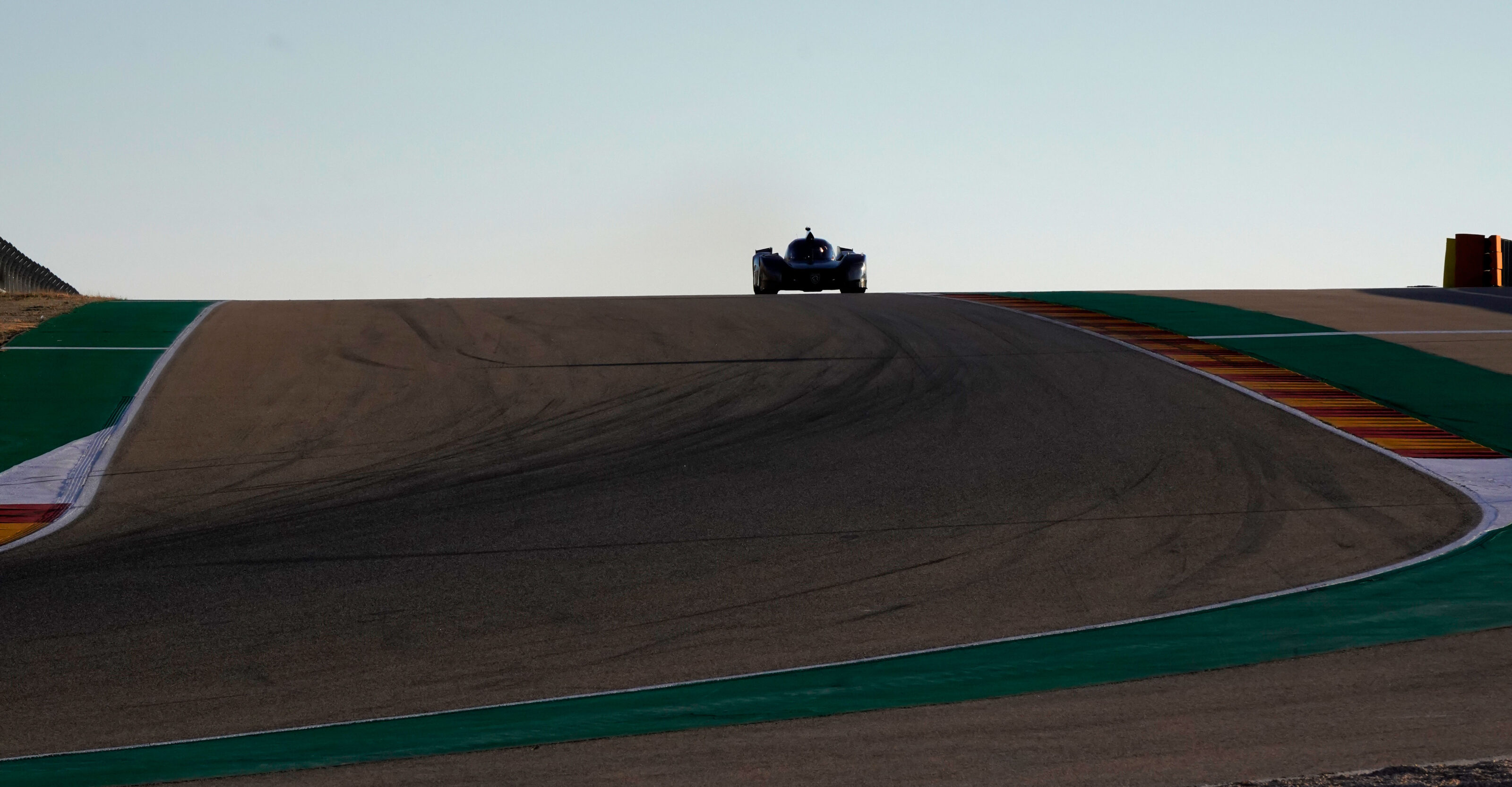
Powering the racer is a rear-mounted 2.6-litre twin-turbo V6 petrol engine producing 500kW and a front-mounted electric motor developing 200kW through a seven-speed sequential transmission.
It is expected that the first official outing will be at the Spa 24 Hours, although remaining non-committal Stellantis motorsport director Jean-Marc Finot said: “The 9X8 will make its race debut based on its level of readiness, reliability and competitiveness as agreed with the championship’s organisers, who we’ll keep regularly updated as our development programme progresses.”
Snapshot
- Total of 206 Chrysler 300s recalled
- Transmission control module programming could push noise levels above limit
- Cars may not be compliant with ADR 83/00
Fiat Chrysler Australia (FCA) has recalled 206 units of its Chrysler 300 sedan, as the vehicle might not comply with local noise emission laws.
It’s claimed the programming of the Transmission Control Module (TCM), in examples built between 2020 and 2021, may cause the car’s external noise levels to exceed those set as a requirement under Australian Design Rule 83/00.
ADR 83/00 states a passenger vehicle with power outputs between 150kW and 320kW cannot exceed a decibel limit of 80dB – with the threshold increased for those which make more than 320kW to 83dB.
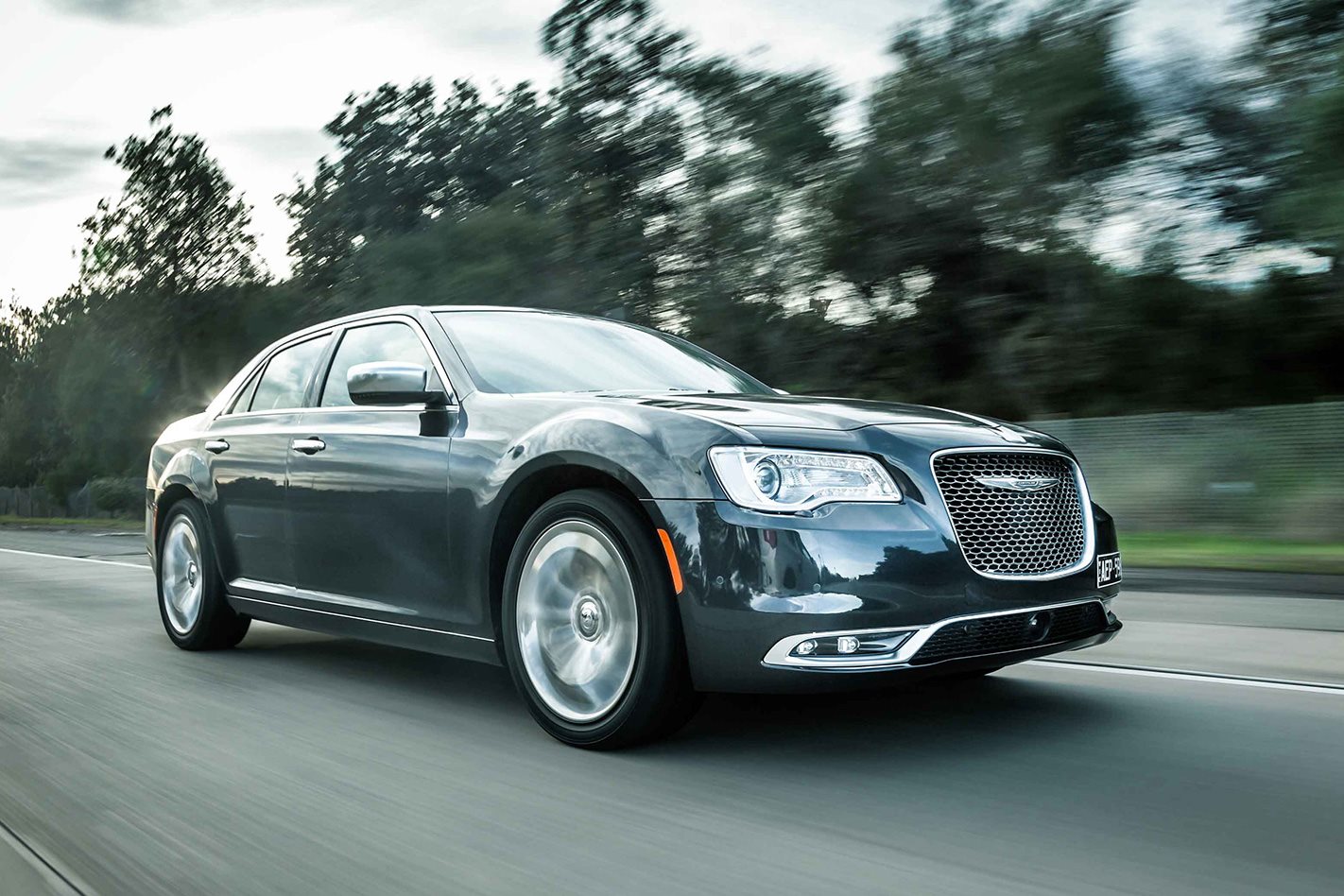
Although it’s not specified as to whether it is the 210kW V6 300C or the 350kW V8 Hemi 300 under recall, FCA will need to rectify the issue so the vehicles affected comply with the regulation.
Despite Chrysler announcing its exit from Australia at the end of last year, the recall work will be undertaken by FCA dealers across the country, a majority of which now sell Jeep as their sole offering.
If you’re unsure about whether your car is affected, FCA’s customer service team can be contacted at 1800 870 714 or [email protected]
A list of VINs for affected vehicles can be found here.
Snapshot
- Total of 1912 Model S Teslas recalled
- Bonnet may open unexpectedly while driving
- Tesla will contact owners when parts are made available
Tesla’s flagship Model S has been recalled, owing to a bonnet catch-related issue.
Impacting a total of 1912 units in Australia built between 2014 and 2020, the Model S is under recall due to a manufacturing issue with its secondary bonnet latch, potentially being located in the wrong position – which would fail to properly secure the bonnet.
If this is the case and the primary latch is released, the bonnet may open without warning while the car is moving, putting its occupants in danger of having an accident.
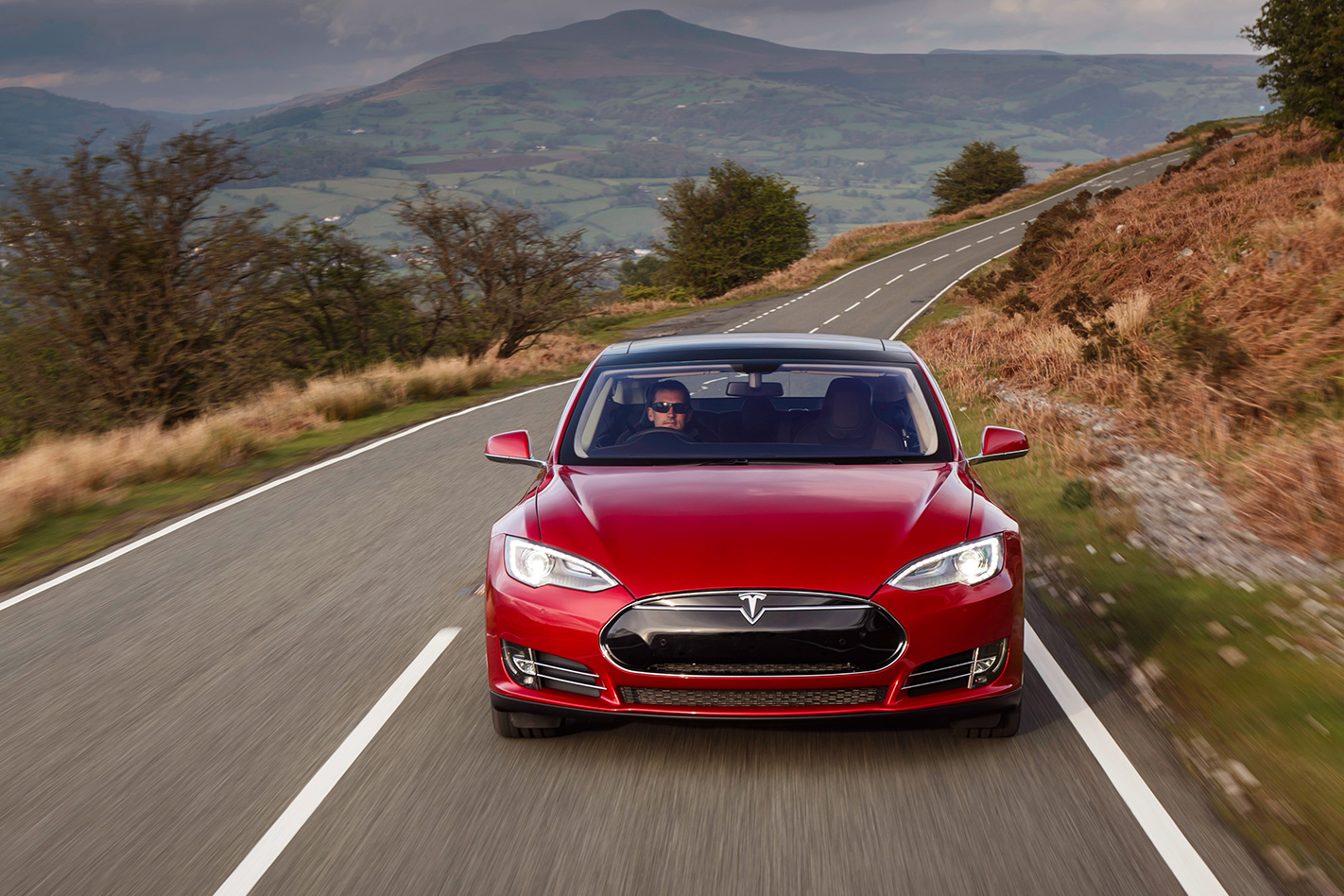
Tesla says it will notify owners when the parts to rectify the issue arrive, after which it will allow owners to schedule an appointment through the Tesla App.
Any Model S owners who are unsure as to whether their car is affected can use Tesla’s VIN search or look through a list of VINs here.
UPDATE, June 2022: Pilot Sport 5 tested!
Well, we’ve now driven cars fitted with Michelin’s newest flagship performance rubber. To get our view on how they go, hit the link below.
“The amount of wet grip, some of it on virtually standing water, is truly impressive.”
The story to here
Michelin is getting ready to release a new-generation tyre from its Pilot Sport series.
A leaked promotional video of the Michelin Pilot Sport 5 has appeared on YouTube in recent days, with some limited product information also being posted to third-party websites – though an official announcement has yet to come from the French tyre company.
The Pilot Super Sport and subsequent Pilot Sport 4 and 4S tyres have long been favourites in the car community, with a number of manufacturers fitting them as standard equipment to performance-oriented models.
Sizes for the new range appear to start from 205/40R17 all the way up to 275/45R20, with all Pilot Sport 5 tyres enjoying the maximum speed index ‘Y’ rating of 300km/h.
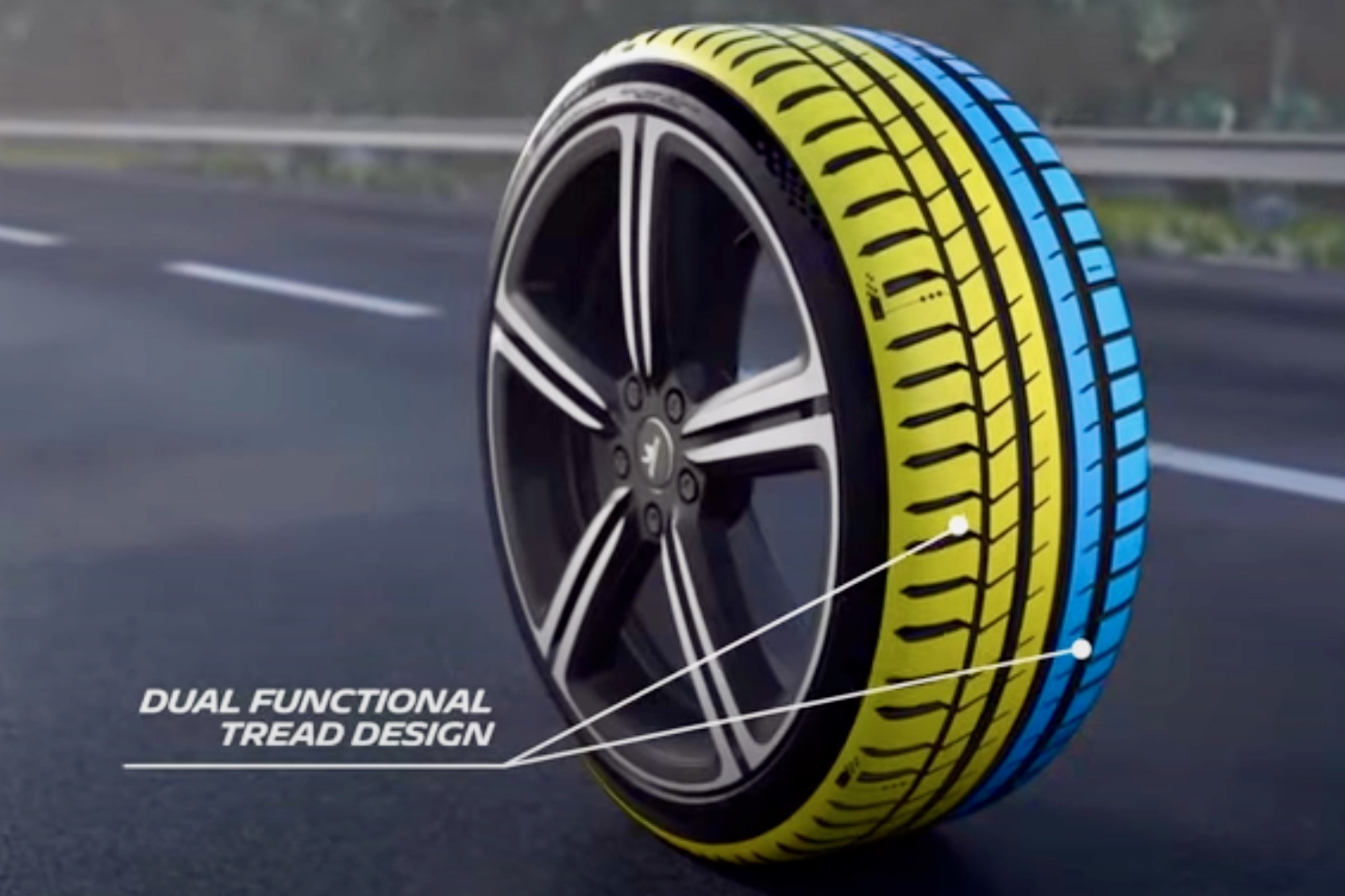
It’s not clear yet whether the PS5 will replace the PS4 and PS4S range entirely, with some generations of tyres being sold alongside each other in the past.
WhichCar has contacted Michelin Australia and this story will be updated with its response.
Thanks to Leo Ng for the tip. If you find something you think we should know about, head to the Contact Us page and let us know.
What happens in your head when someone unexpectedly enquires about buying a car you swore you’d never sell? If you’re as attached to a car as I am, it’s actually rather unsettling.
You see, for reasons that only now am I beginning to unpack, early on in my life I decided that Nissan was ‘my’ brand. Never had I really questioned it, either.
It wasn’t because of Gran Turismo (although shoutout to the Pennzoil R33 GT-R LM of GT2), or The Fast and the Furious, either. It was, like so many of these stories, down to my dad.
Dad’s a car guy, and granddad was too. Part of me thinks it might actually be somewhat hereditary.
It’s only as I feel I’m beginning to get older, that I’m starting to reflect more on where I come from. I come from a family of immigrants. I’m a first generation Australian, and dad is a first generation South African, whose dad left a poverty-stricken life in China at 15 by himself with nothing but the clothes on his back. He did well for himself, built a life in South Africa and, in his later years, was able to own a W123 Benz that became something of family lore to a young me here in Melbourne.
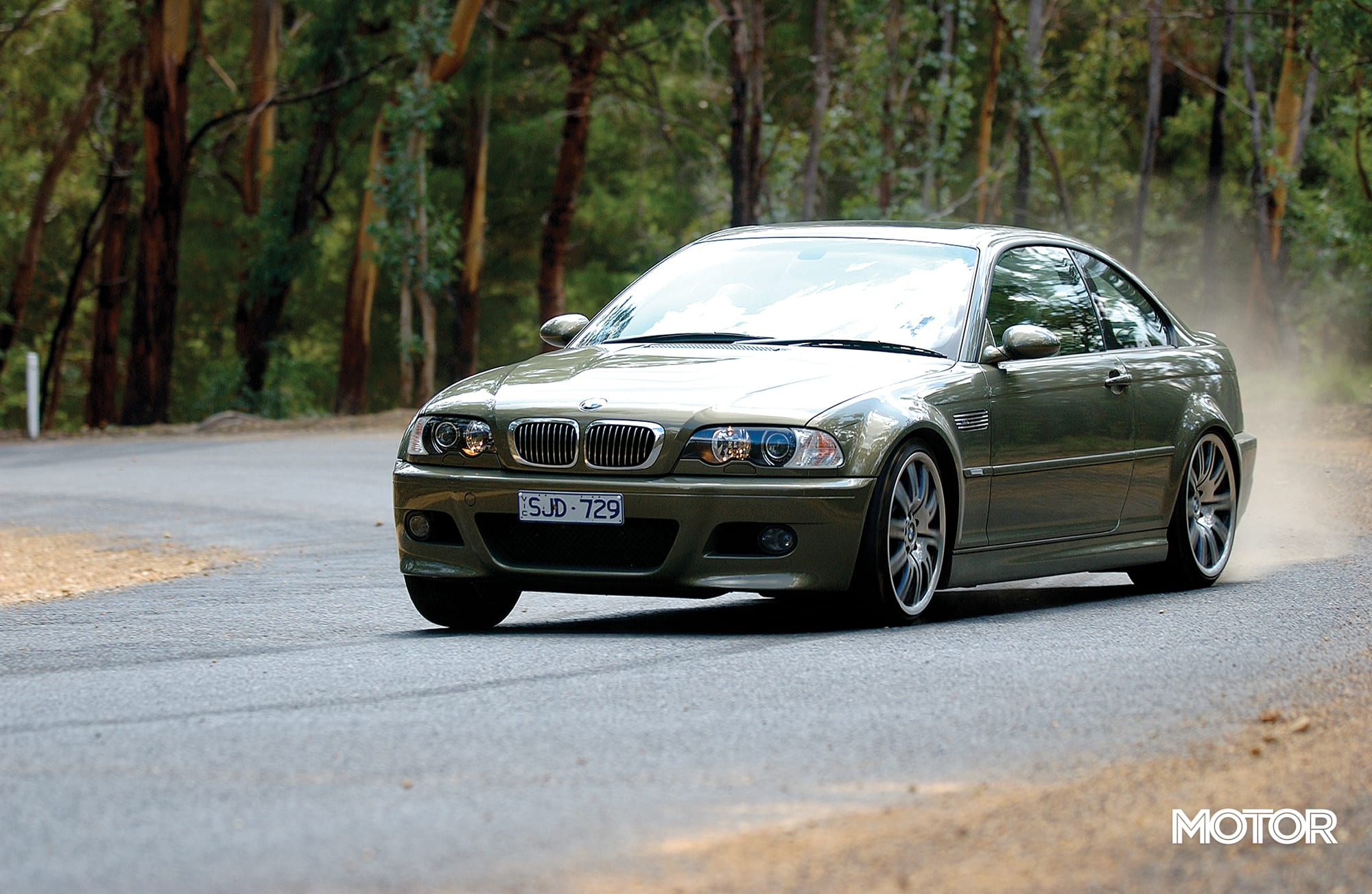
Growing up in apartheid South Africa as the more globalised post-war car industry matured in tandem, dad has always placed German sports cars on the very highest pedestal. That was also instilled in me from birth. I was raised on air-cooled Porsches, BMW M cars and the view from the back seat of an AU Falcon. Dad eventually bought his dream car though, a BMW M3.
I was still at that age when you think your father is an infallible superhuman figure, and I thought the same of that car. But dad had a habit of taking it to JDM workshops when investigating weird sounds, thinking they were cheaper than the dealership. I remember going with him once and us both peering through a service window at two R32 GT-Rs and two GTS-T sedans, double stacked on two side-by-side lifts. I remember making some quip about his M3 being faster than those old things, and him quickly rebutting that they were probably faster.
That was the moment, or at least the conception of the idea that I might be a Nissan guy. Subsequent years, including learning more about the R32’s controversial (more so back then) local motorsport provenance in the face of homegrown V8s, only bolstered my passion. They felt like underdogs, and I always backed the underdogs.
All this means that the very notion of selling my GT-R involves some internal disentanglement from an identity I’ve unknowingly spent my whole life cultivating.
So when a polite message landed in my Facebook inbox a few weeks ago, raising the notion of relinquishing a car I swore I’d never sell, it felt something akin to cutting off my own finger.
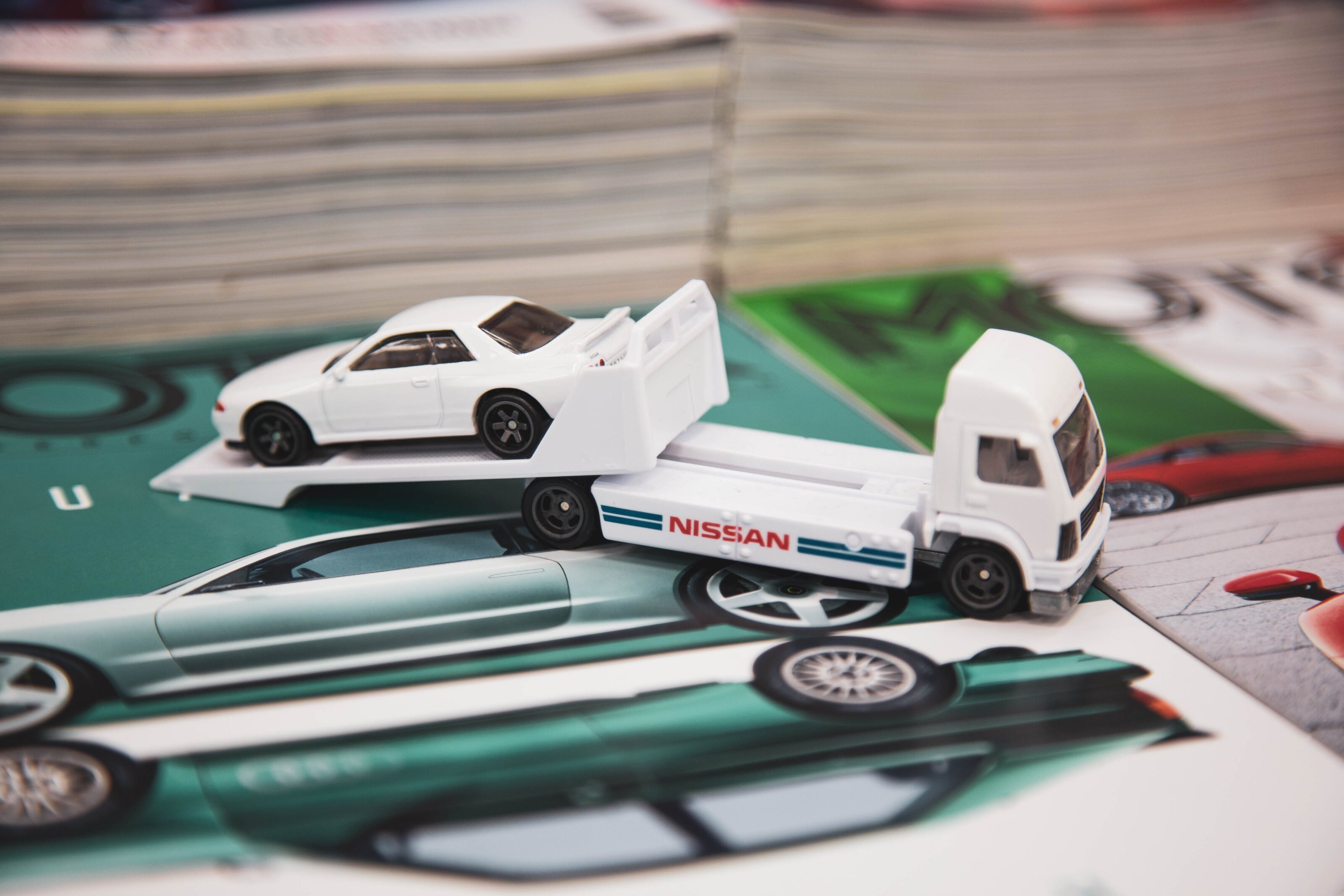
After deep reflection, I did throw out a number – knowing it was far beyond market value. But it’s not just the car, it’s everything I’ve collected around it over the years: period Bathurst merch from ’91 and ’92, vintage Nismo clothing, stacks of literature (including Phil Scott’s famous July 1989 issue of Wheels) and too many scale models to count. If the car ever does go, the only things I’m keeping are photographs.
It’s not just ‘stuff’, though. These things are tangible capsules for stories (historical or sentimental), memories and relationships. I’ve unearthed rare gems in an unknown suburban hobby shop with my old pal Angelo from Unique Cars, and treasured the HotWheels Cameron Kirby bought me for Christmas in my first year working here.
Therein lies the true value of ‘collecting’; it shouldn’t simply be about the money or simply owning things that others don’t. In the same way that cars represent more than mere transport, their ability to connect you to other people and things larger than yourself is what makes them so captivating.
And yes, I still have the car, and I’m still a Nissan guy.