
The mining industry is investing heavily to ensure it can supply the automotive industry with the ingredients required for electric vehicle batteries in the coming years.
Australian mining company BHP has announced a AU$130 million deal to strengthen its supplies of nickel and cobalt from Tanzanian mining company Kabanga Nickel, which claims to be implementing responsible mining practices.
“We’ve heard a number of the auto manufacturers saying, ‘By 2025, we really need to ramp up production, we really need these metals’,” Kabanga Nickel CEO Chris Showalter told The Age and the Sydney Morning Herald.
“It’s quite widely known they are really scrambling to try to secure the inputs for batteries… and it’s going to become increasingly harder for them to do that in an ESG-friendly way.”
Carmakers have been under increasing pressure to source battery materials from mining companies with ‘environmental, social, and governance’ (ESG) as a core principle, with allegations of poor labour practices in the Democratic Republic of Congo and Russia – where a large amount of these key metals come from.
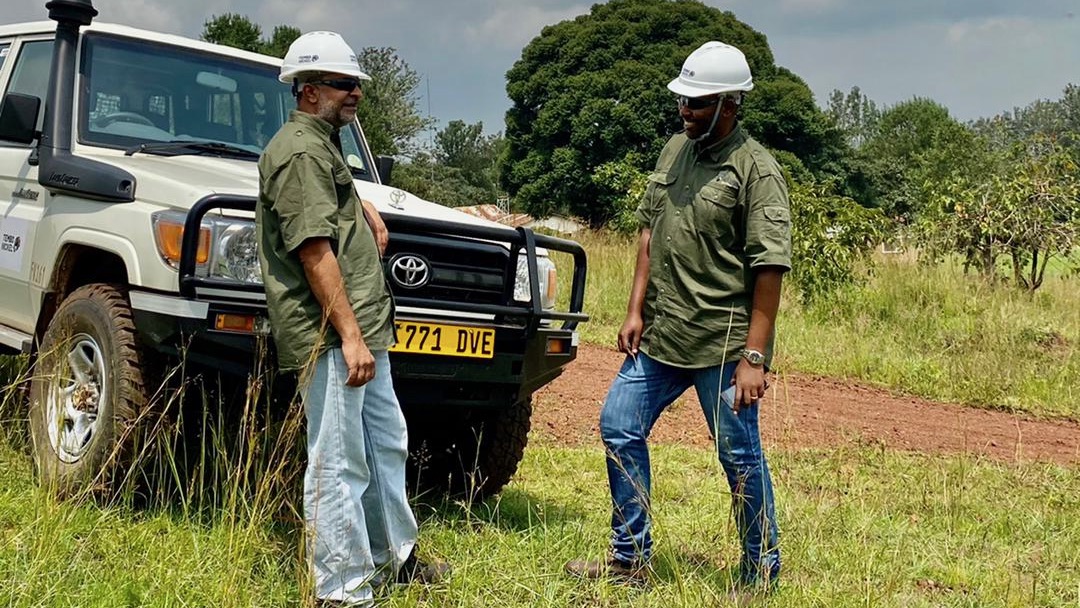
“When we look at demand in 2025, the quality of the metal we will be producing will not only be in demand but there will be a premium attached to that for being able to provide the market with some of the ‘tick boxes’ that will be demanded,” Showalter said.
In July 2021, BHP signed an agreement with Tesla to supply the electric vehicle manufacturer with nickel. Tesla has previously said it estimates it will spend more than US$1 billion (AU$1.37B) on the raw battery materials annually.
The latest investment will accelerate the Kabanga Nickel project, with production expected to begin in 2025.
According to the Volkswagen Group’s multifaceted grapevine, the deal is as good as done – Audi and Porsche will enter Formula One.
All that’s missing is the thumbs up from the Volkswagen supervisory board which is due to meet in February and then again in March. If the powers in charge agree, Audi and Porsche will enter top-league motor racing in 2026.
But that’s no big news anymore – and only part of the story. After all, the plan is for Audi to team up with the McLaren motorsport division and to take over McLaren Cars. It’s one complete all-in parcel, racing and automotive, lock, stock and barrel.
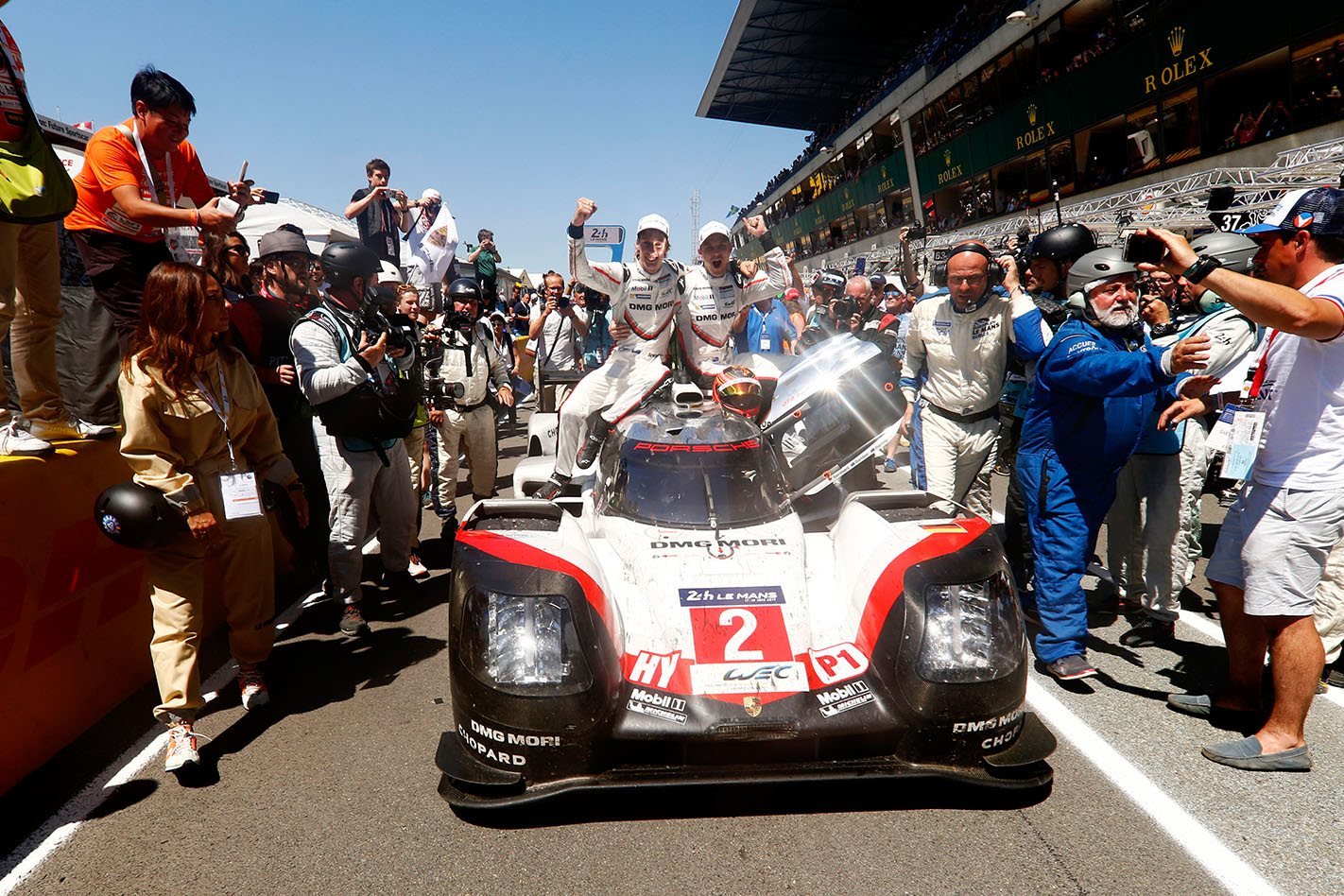
The due diligence phase has not yet begun, but the lawyers of both parties are already talking, and the main stakeholders – among them the Mumtalakat Holding Company from the Middle East – are allegedly willing to sell the loss-making car business.
But why on earth does Audi need another sports car brand? The debatable reasoning suggests substantial economies of scale between Lamborghini, McLaren and Porsche as well as the opportunity to form the world’s strongest sports car group.
For a while, it was not clear whether Audi and Porsche would field two pairs of jointly developed F1 race cars or act merely as powertrain supplier. It now transpires that the latter option is about to materialize.

While Audi would partner with McLaren (no longer a rivalling sports car maker but an ally), Porsche is said to have an arrangement with Red Bull Racing in the works (energy drinks and sports cars don’t compete). There even exists a fallback Plan B: Audi & Williams and Porsche & Alpha Tauri or even Haas.
The new drivetrain is reportedly a joint effort by Audi Sport and Porsche Motorsport. Although the VW side had favoured an ultra high-performance 2.0-litre four-cylinder which was from the very beginning part of the so-called world engine project, the FIA opted for the 1.6-litre V6 turbo which was a precondition for Ferrari to stay in F1.
Fed by sustainable fuels and devoid of the capricious MGU-H energy regeneration system, the combustion engine will in the future be supported by 475bhp of e-power – that´s about triple the current output. A budget cap is to be be imposed to lower the barrier to entry.
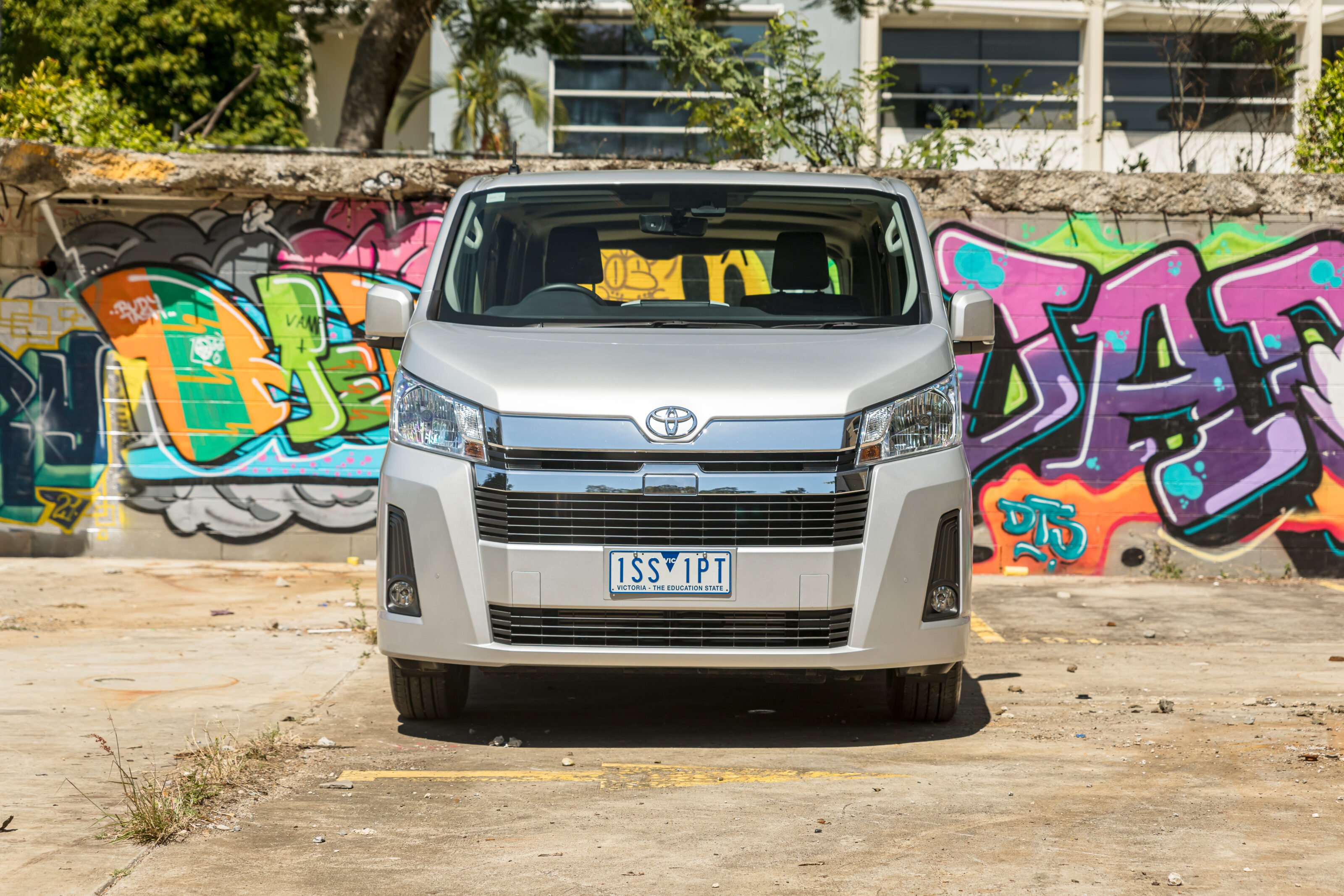
The Toyota HiAce is, simply and truthfully, Australia’s favourite shoebox on wheels.
Notoriously dependable, the HiAce has spent the last half-a-century winning the hearts of couriers, electricians, house-movers and hippie-campers.
Through wisdom shared from father to son, mother to daughter, tradie to apprentice, the box-on-wheels came to be known as the safe bet. Not dissimilar to its boisterous big brother, the un-killable HiLux.
So when the sixth-generation HiAce dropped back in 2019, the first major revision in 15 years, its sleek semi-bonneted not-so-box-like shape was a significant detour from the ways of old.
EDITOR’S NOTE: Since this story was filed, Toyota has confirmed you can now have the HiAce in any colour you like, as long as it’s white.
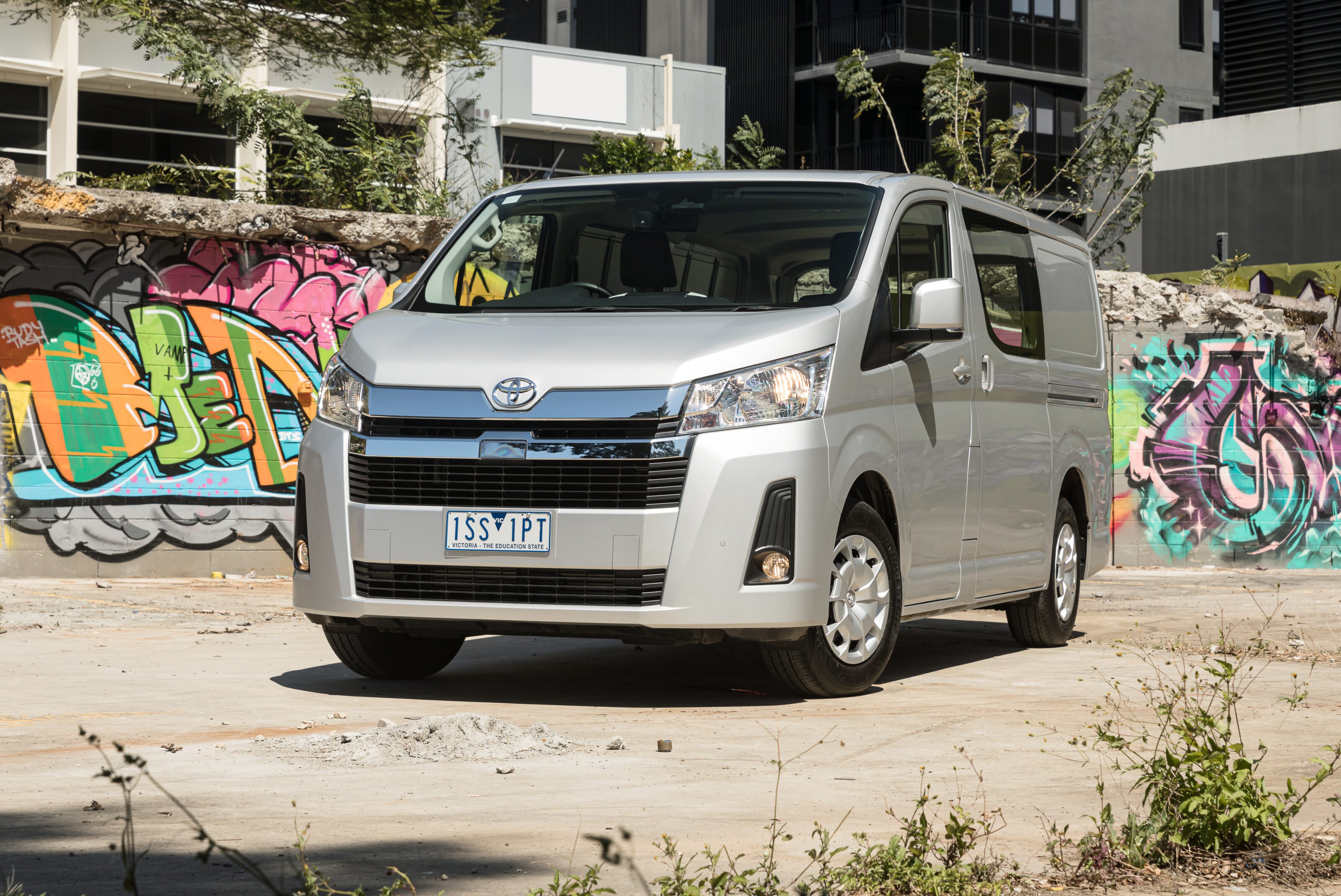
At first glance, the classy redesign looks like a people mover masquerading as a commercial van. Or vice-versa? Who knows, and who cares because it’s a winner.
Toyota clearly spent those 15 long years getting the new model range right, and the sales data confirms it, as the HiAce continues to dominate the mid-sized van segment.
The 2021 LWB HiAce model we tested, compared with the previous generation, brings more tech, more grunt, more cargo space and a five-Star ANCAP safety rating.
The 2021 LWB HiAce, brings more tech, more grunt, more cargo space and a five-star ANCAP safety rating.
The Nitty Gritty
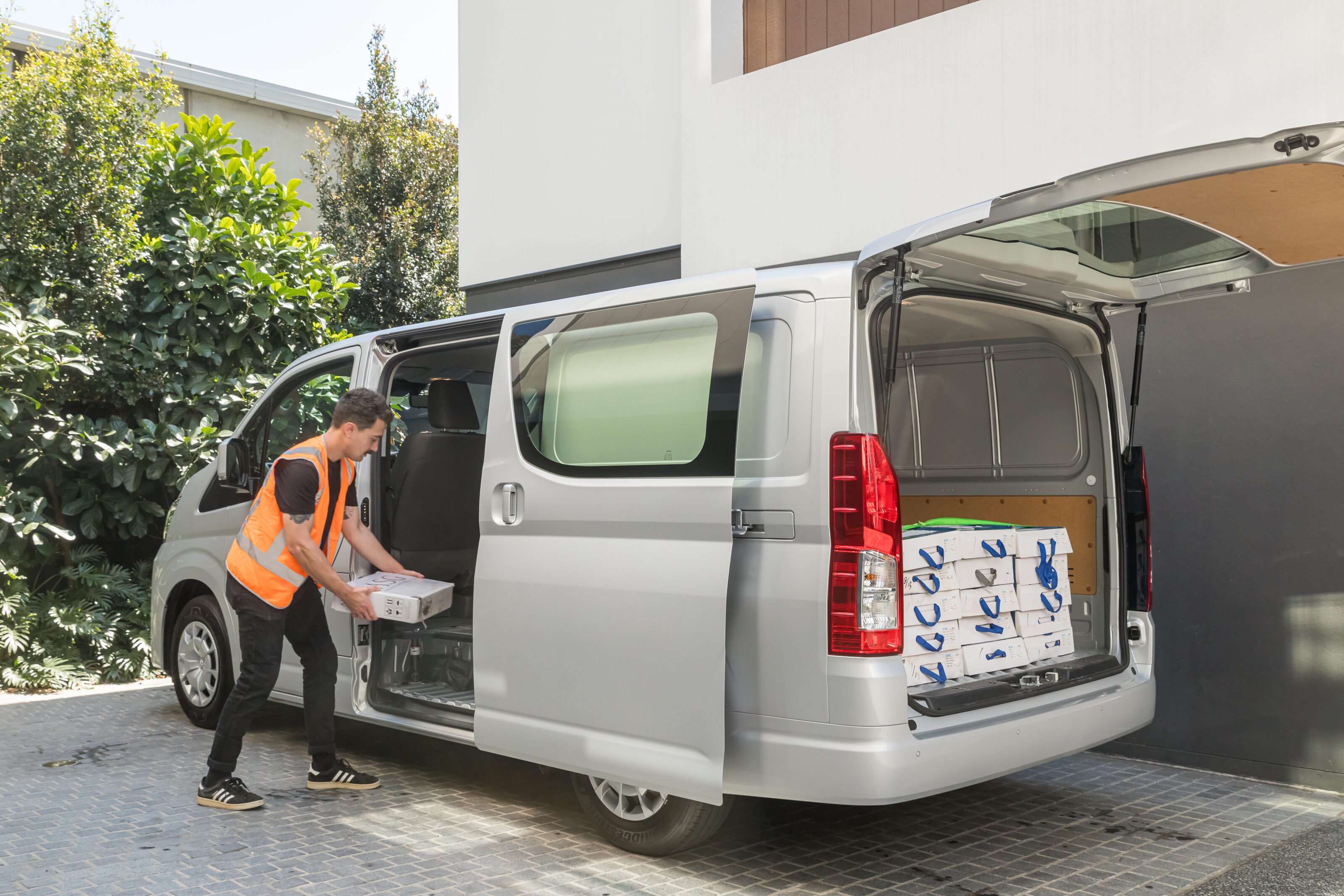
Cargo space is up from the old model, but that’s hardly surprising given it’s an all-round heftier beast.
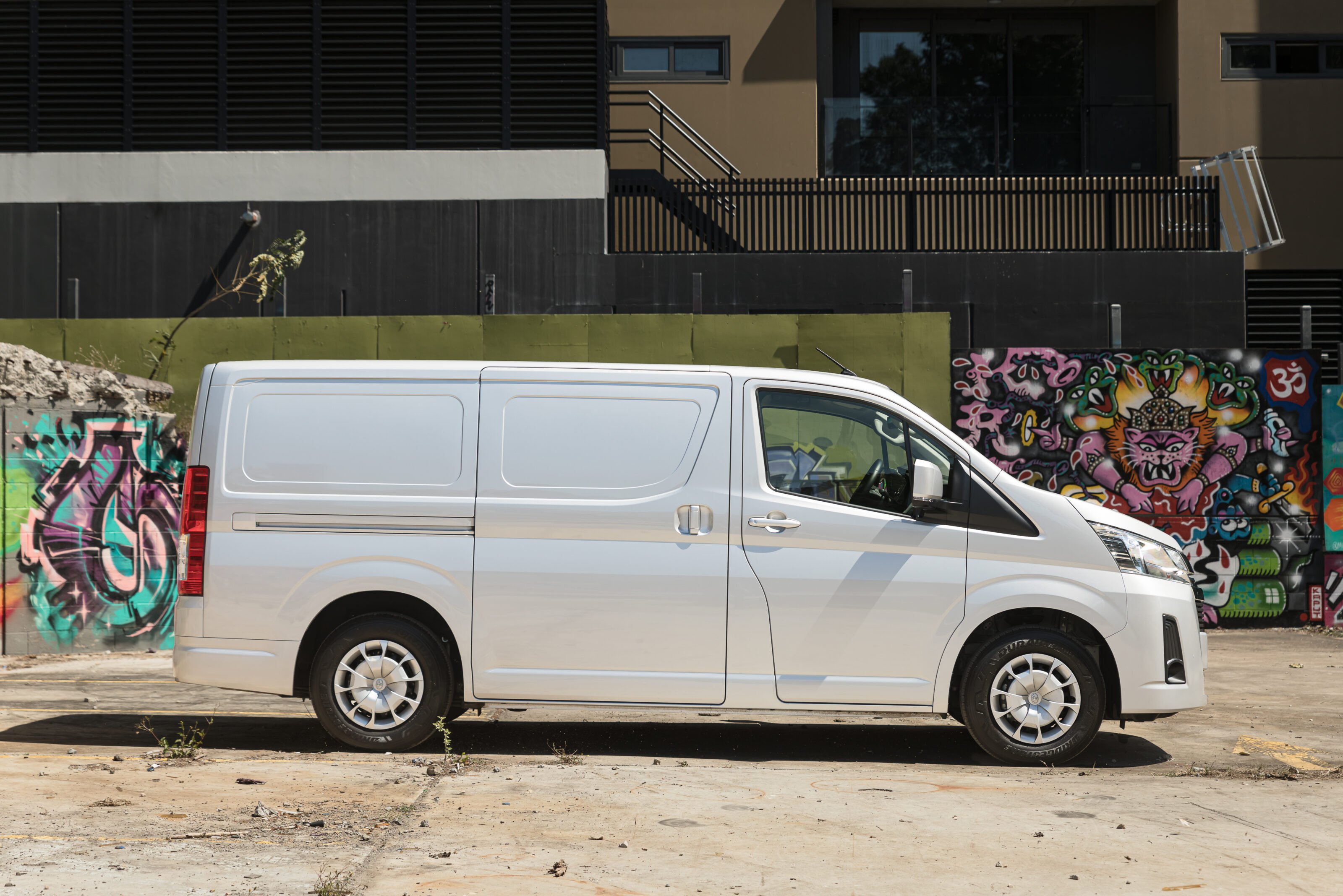
The LWB HiAce is 570mm longer than its predecessor, at 5265mm from bumper to bumper, which you’d assume is due to the semi-bonneted front. The actual wheelbase itself is longer though, and the track is wider, too.
With a car-park-friendly 1990mm overall height, the new LWB HiAce is only a centimetre taller than the outgoing model but that roof height contributes to the increase in cargo capacity.
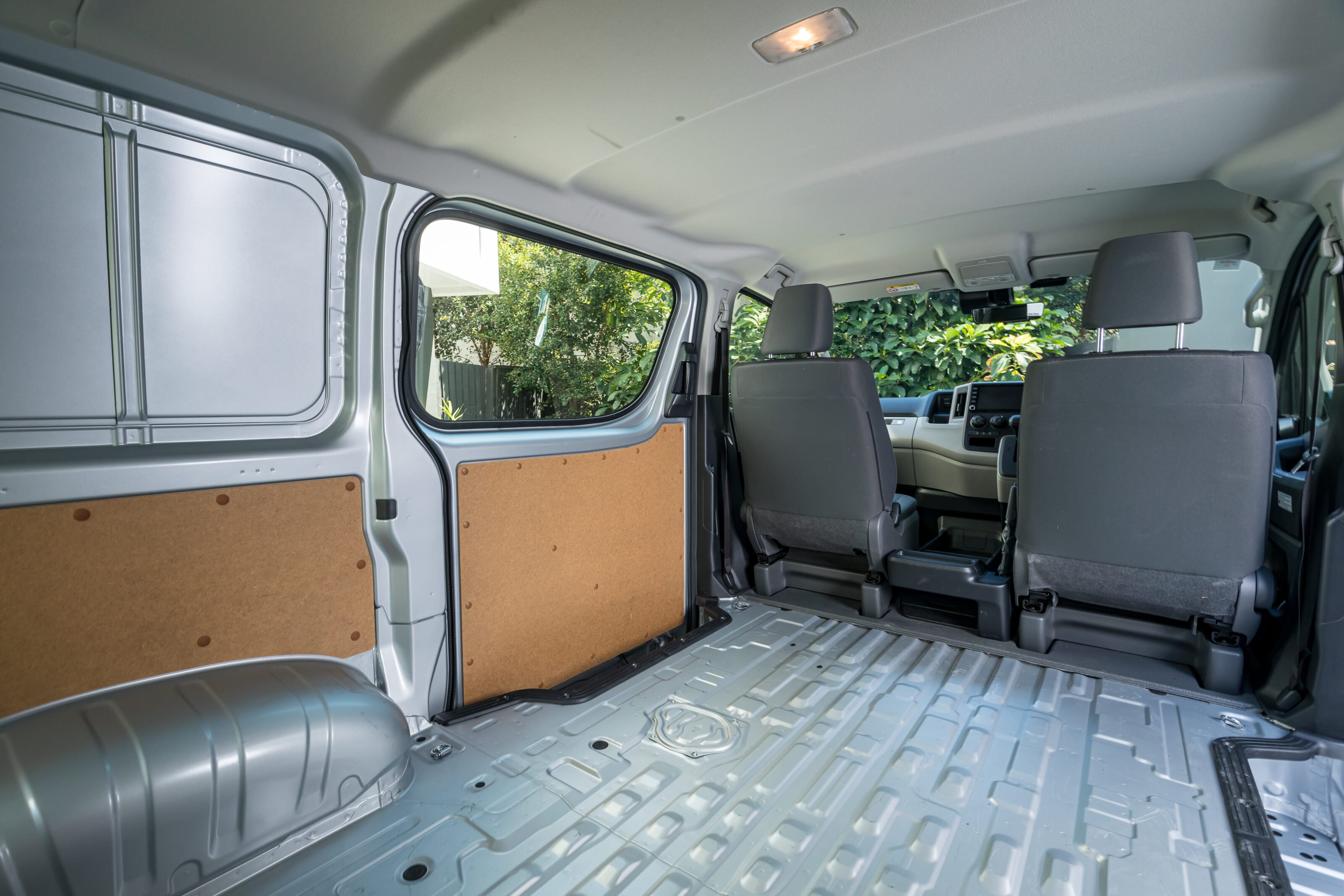
A total cargo capacity of 6.2 cubic metres puts it ahead of the old shoebox, but rear length from hatch to front seats has dropped by 470mm to a still-respectable 2530mm. The overall increase comes in the form of a 5mm interior height bump, now 1340mm from floor to roof.
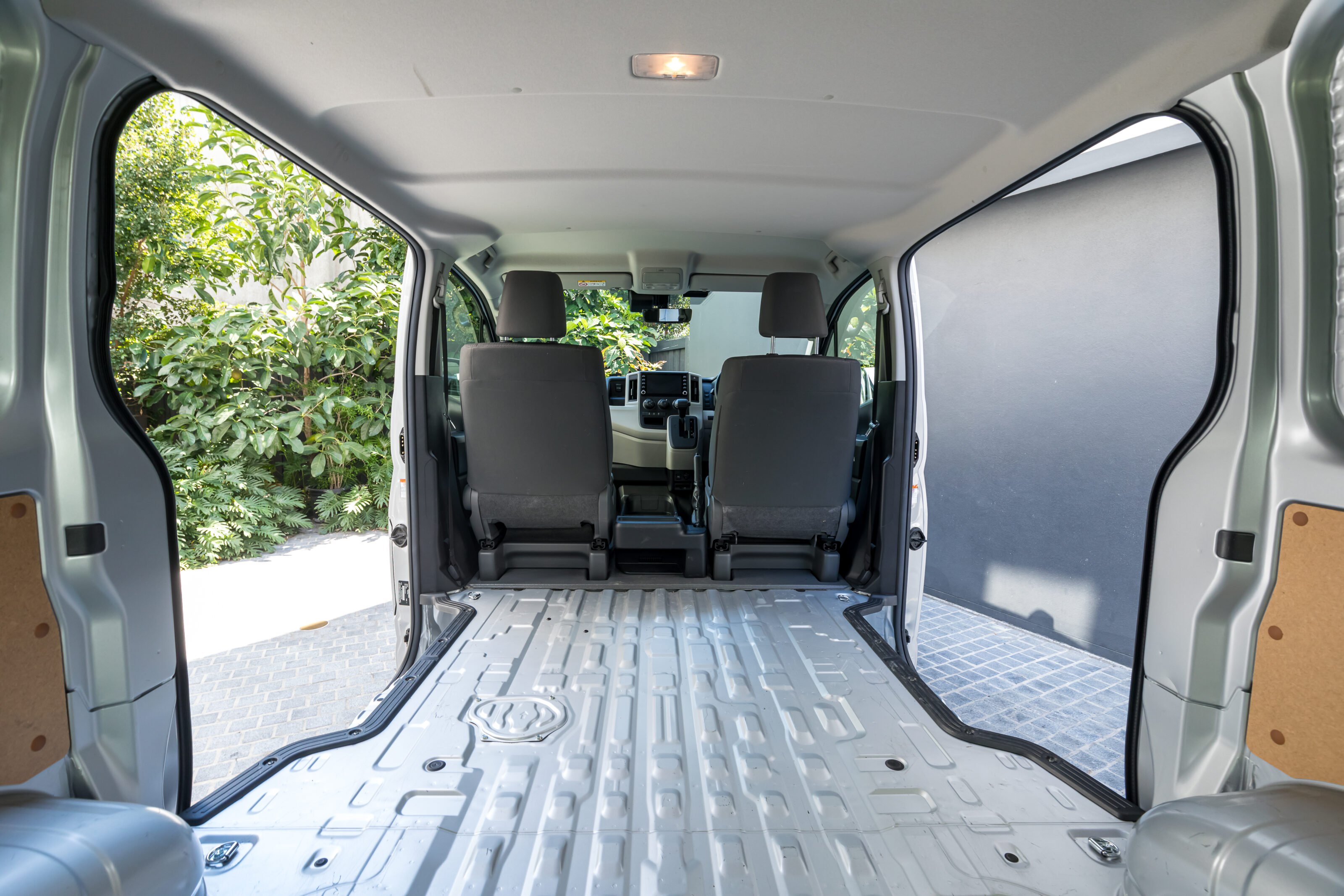
For those of you who are more visual, the increased cargo space will happily accommodate an Aussie pallet between the arches, and thanks to the standard inclusion of dual sliding doors, access has never been better.
The self-shifting LWB HiAce we tested has a kerb weight of 2205kg, which with a GVM of 3300kg, leaves a healthy 1095kg payload including the driver.
A competitive braked towing capacity of 1500kg for the auto, and 1900kg for the manual, gives tradies the option to tow. Mind you, most don’t buy a van to pull a trailer.
Six tie-down points are spaced throughout the rear cargo area, which proved to be plenty for us, although the painted floor would benefit from a non-stick cargo mat if putting the van to work.
How’s it Drive?
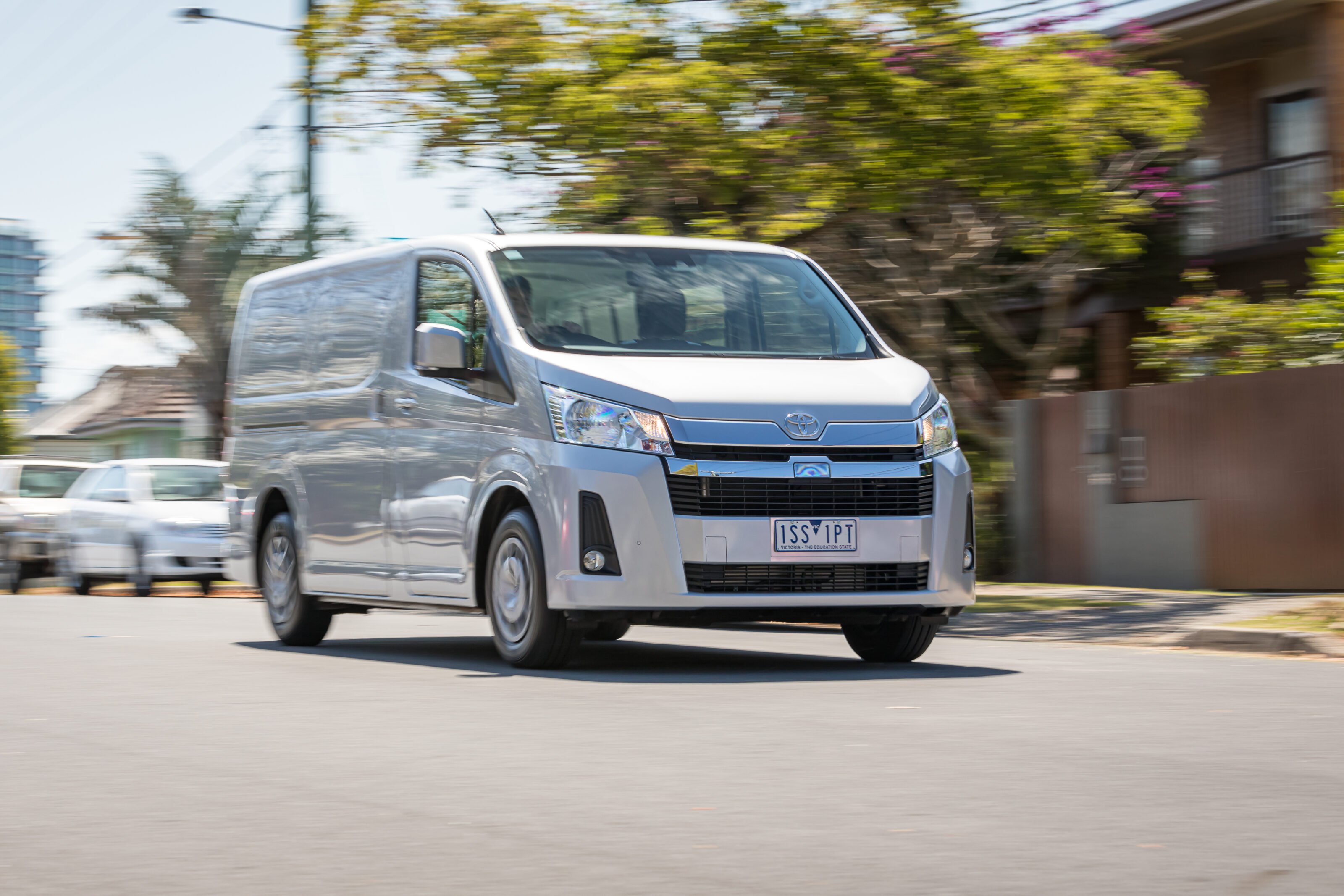
The HiAce was put through our proprietary durability test, which it passed with flying colours.
Across the few hundred kilometres we did, it was all work. Literally, all work. I say that with an air of resentment because the moment ‘mates’ find out about a van test, the empty offers of a “carton to move this”, a “carton to move that”, start flooding in.
Final fuel-use figures landed at 12.8L/100km versus official claims of 8.2L/100km, but it was given a fully-loaded hiding, quite frankly. Very little of the testing was done unloaded, so we’d expect to see that number drop closer to Toyota’s claimed figures with more mixed use.
We had the HiAce filled to the brim with 400kg-or-so of furniture, four times over, as well as transporting heavy loads of façade glass for a construction company, and finally, put to work on a good ol’ dump run. It loved every second of it, performing flawlessly.
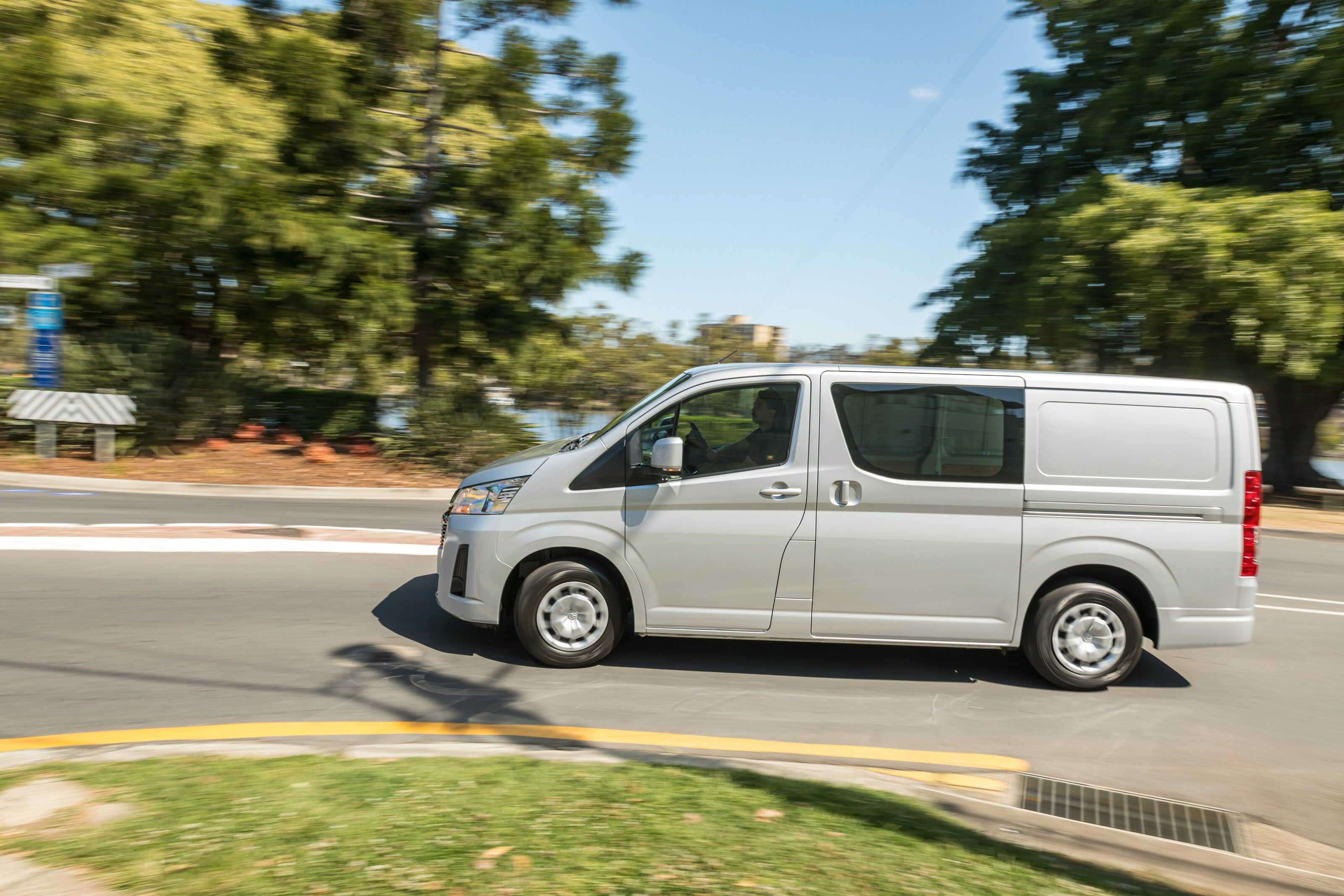
The powertrain is an absolute peach in the HiAce, performing effortlessly loaded right up and punchier than a van has a right to be when running around empty. But we aren’t complaining, because who said vans can’t be a hoot to drive?
It stops on a dime, too, with no real noticeable difference when carrying a healthy load, though naturally, loaded braking is a more gentle exercise.
The Euro-5-compliant 2.8-litre four-cylinder turbo-diesel, lifted from the tried-and-tested HiLux, produces 130kW/450Nm. It’s down on power, ever so slightly, on the HiLux’s 150kW/500Nm tune but it doesn’t hang about, with no discernible turbo lag or cog-confusion from the ‘box.
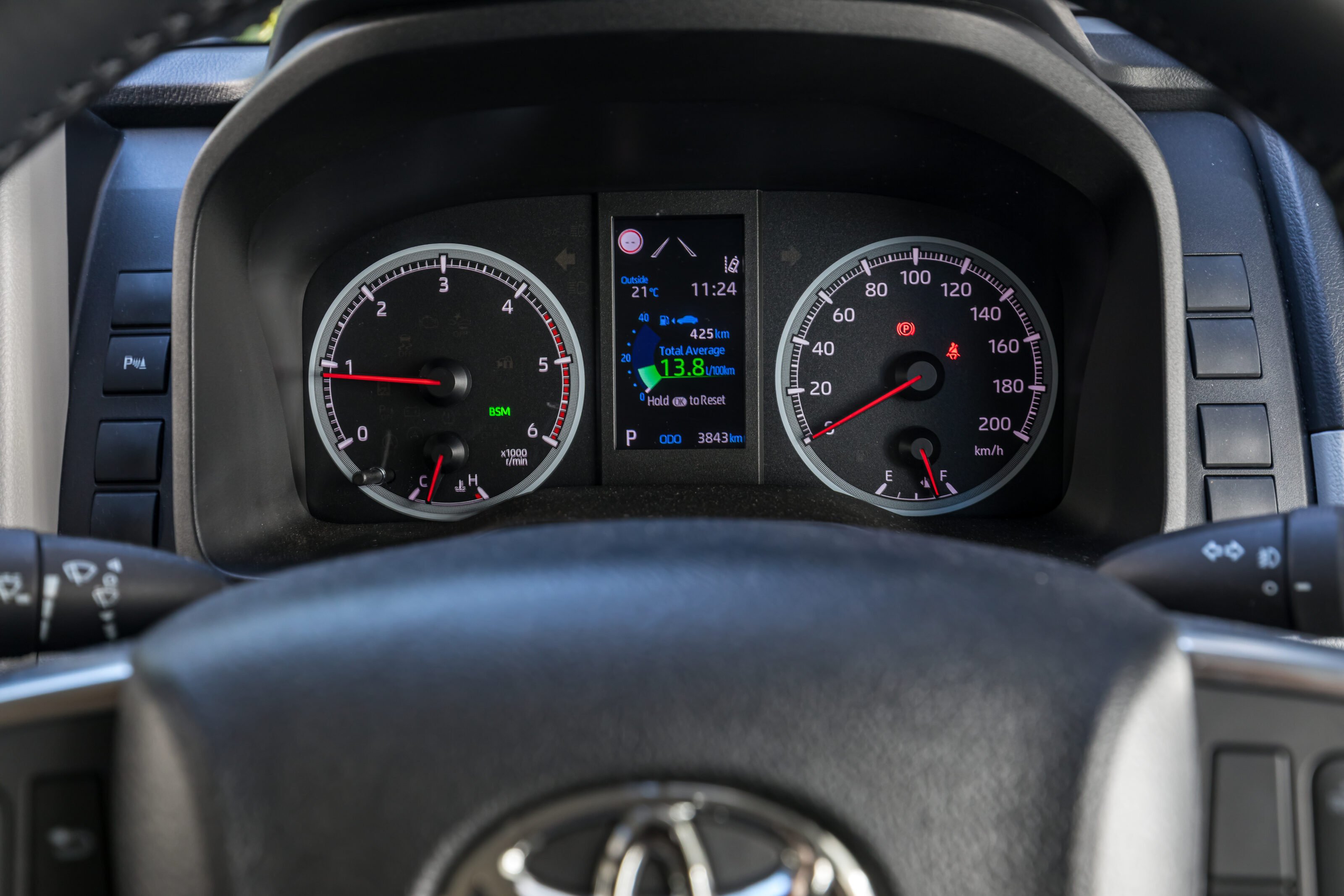
Speaking of the gearbox, the Aisin-sourced six-speed automatic brings the best out of the 2.8-litre diesel donk, offering robust engine braking by holding gears when loaded and perfect gear selection in all the driving scenarios we put it through.
The steering is also top-notch in the HiAce, with 3.5 turns lock-to-lock and an impressive 11-metre turning circle. It’s a real ballerina around town, a cinch to park, and suffers none of the torque-steer typical of front-drive rivals in the van segment.
Its rear-wheel-drive configuration offers benefits beyond a lack of torque steer, with better traction when loaded and no axle tramp whatsoever when empty.
Compared to the predominantly front-wheel-drive van options out there, the rear-driven HiAce puts the torque down more effectively and feels better under acceleration.
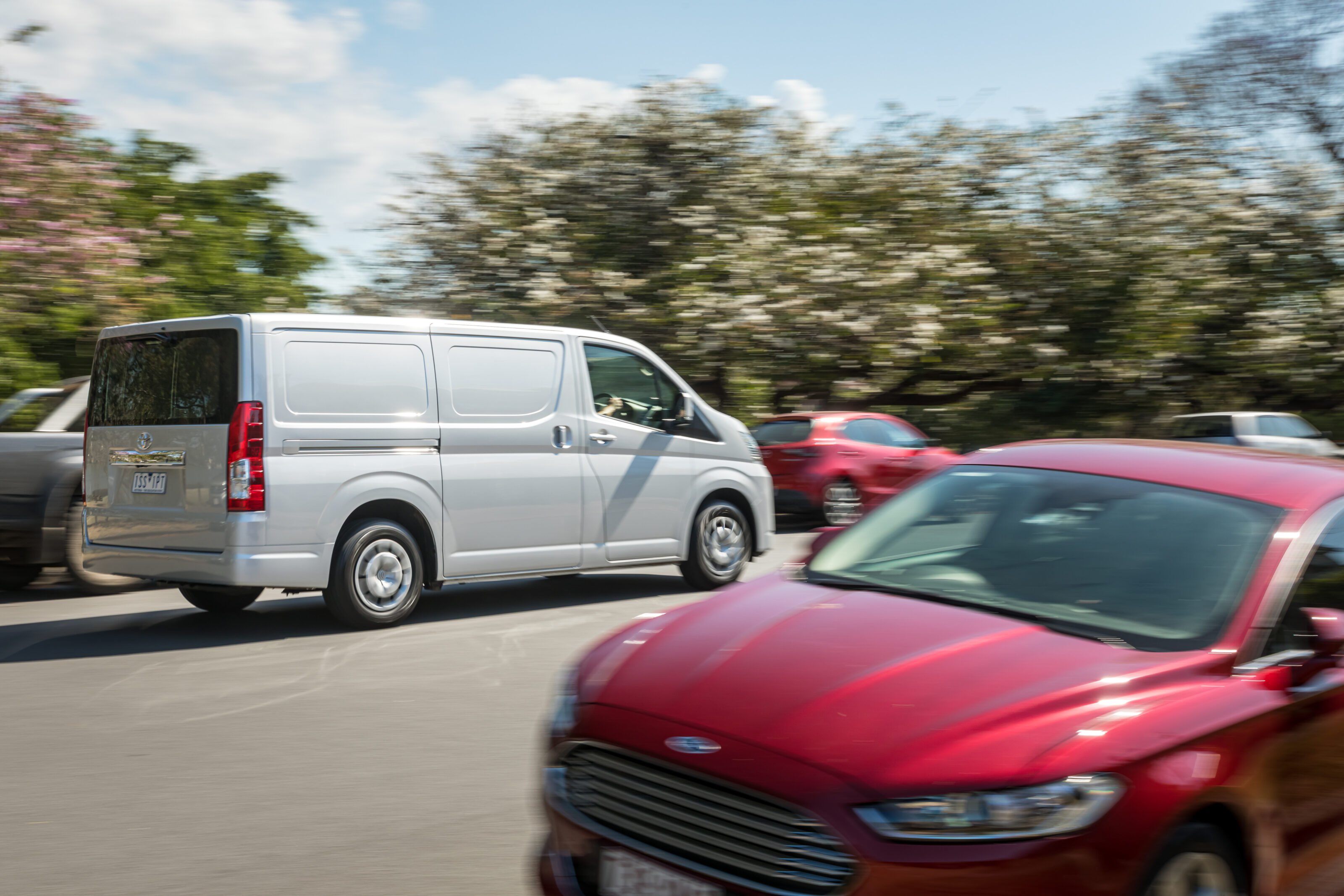
Automatic engine stop-start does its job to save a few millilitres of diesel here and there, but it didn’t shut off instantly like some systems. That’s a big plus and far less of an annoyance in stop-start traffic.
That little bonnet up front, by the way, has benefits beyond just visual appeal. Moving the motor forward frees up weight over the front axle, improving stability and handling, as well as access to the engine bay and cabin.
Front-end feel and general stability are miles ahead of the outgoing model, no doubt largely due to that semi-bonneted front-end and longer wheelbase.
In true Toyota workhorse fashion, the interior feels appropriately drab. A simple, plastic interior makes for an easy wipe down and it’s a pleasant place to be overall, particularly for a commercial vehicle.
One beef we had with the interior finish was the white, or beige rather, portion of the dash. The off-white plastic is prone to smudges from greasy mitts so, if you’re likely to ingest the odd hot-box dimmy between deliveries, carry some wet wipes.
The cup holders are a slightly awkward size, too. While perfect for a tradie-suitable 1.5-litre water bottle, they’re utterly incapable of cradling a regular-sized hot coffee – to the point where iced long blacks were opted for over the standard scolding-hot equivalent. You can’t be too safe but, then again, perhaps Ice Break is the preferred caffeinated beverage for van duties.
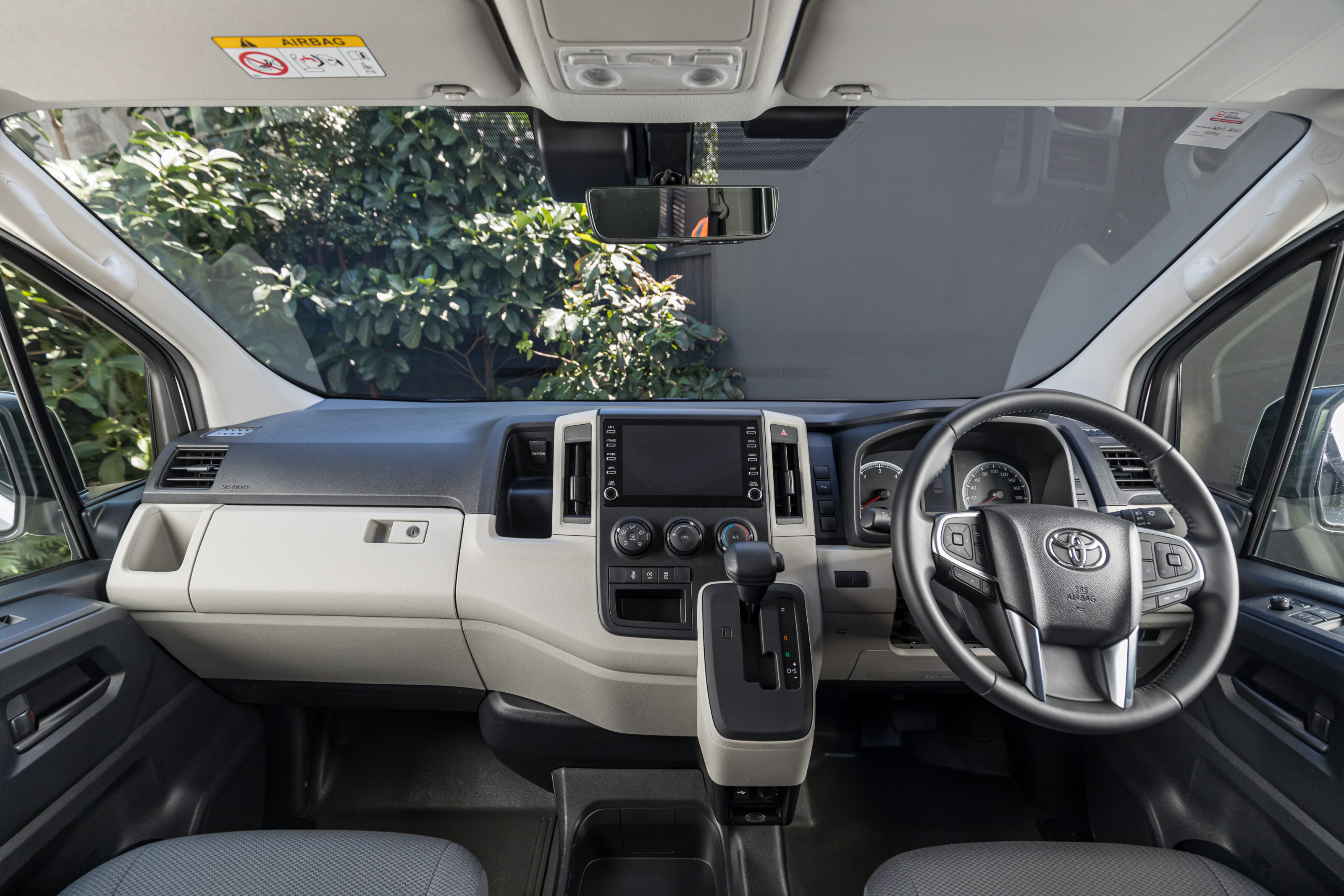
From an ergonomic and functionality standpoint, the interior is a step up over previous models, with a height-adjustable seat, tilt and telescopic steering wheel adjustability, and plenty of storage.
The ‘sitting over the steering wheel’ feeling you get in a cab-over van is gone, with car-like ergonomics offered in the new HiAce.
While calling the interior ‘drab’ may suggest it’s basic, it does bring plenty of safety and multimedia tech to the table that we enjoyed.
From an ergonomic and functionality standpoint, the interior is a step up, with a height-adjustable seat, tilt and telescopic steering wheel, and plenty of storage.
Toyota’s safety tech suite, dubbed ‘Toyota Safety Sense’, comes standard in the HiAce featuring a pre-collision safety system with pedestrian and daytime cyclist detection, lane departure alert with steering assist, road sign assist, blind-spot monitoring, rear cross-traffic alert, and auto high beam.
The pre-collision and lane departure assist work perfectly and aren’t overly intrusive like many other systems. There was no abrupt braking or misguided ‘Jesus, take the wheel’ lane departure assist scenarios.
A five-star ANCAP safety rating and seven airbags, including front side-curtain ‘bags, bring the van’s safety right up to par with competitors and add fleet buyer appeal.
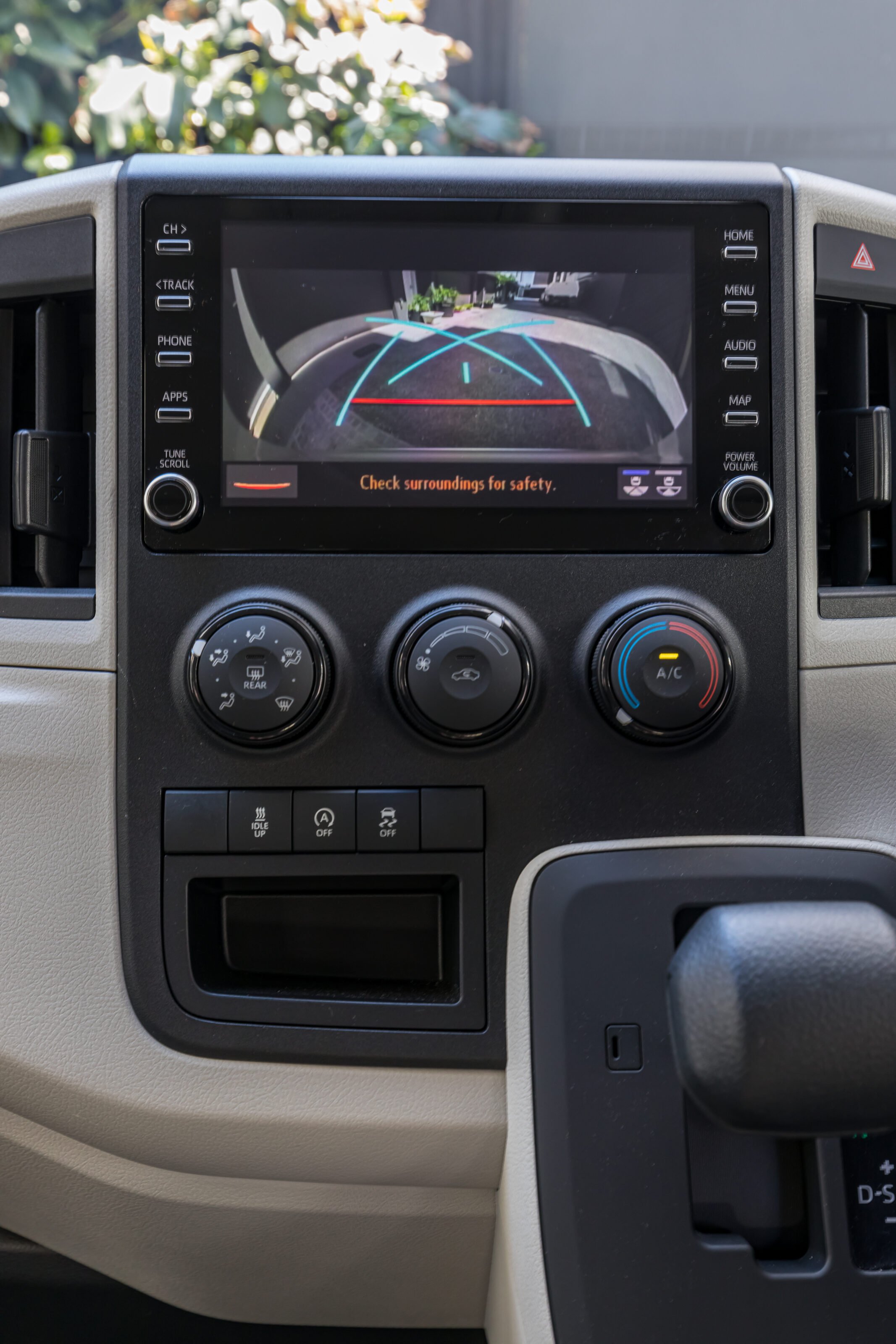
The HiAce does score a reversing camera, with front and rear parking sensors, but 360-degree cameras would have been a bonus.
Why? Because the standard camera distorts so badly at the edges, possibly due to the wide-angle lens used, that it became mandatory to cross-reference with mirrors. So, just remember your mirrors are your friend, because the confusing rear-view camera won’t be a good enough excuse for the boss if you slap a pole trying to park.
Apple CarPlay and Android Auto come standard, as well as a fantastic sat-nav that, if we were putting the van to delivery work, we’d use over the phone apps.
We’re used to a bit more audio bang for buck in 2021, the HiAce’s two-speaker system leaving a bit to be desired, but an aftermarket upgrade would solve this. It’s a van, after all.
The lack of cargo barrier as standard makes it a must-tick extra at the dealer, for a couple of reasons.
Firstly, the aircon simply isn’t up to the task of cooling the entire cab and cargo areas. And secondly, pretty much all commercial vans run a cargo barrier so it should be standard fare given most of these vans will get put to work.
Above all else, it was the grunty powertrain that really stole the show across the kilometres we did – the rest just came together to complete the well-engineered puzzle.
Value and Ownership
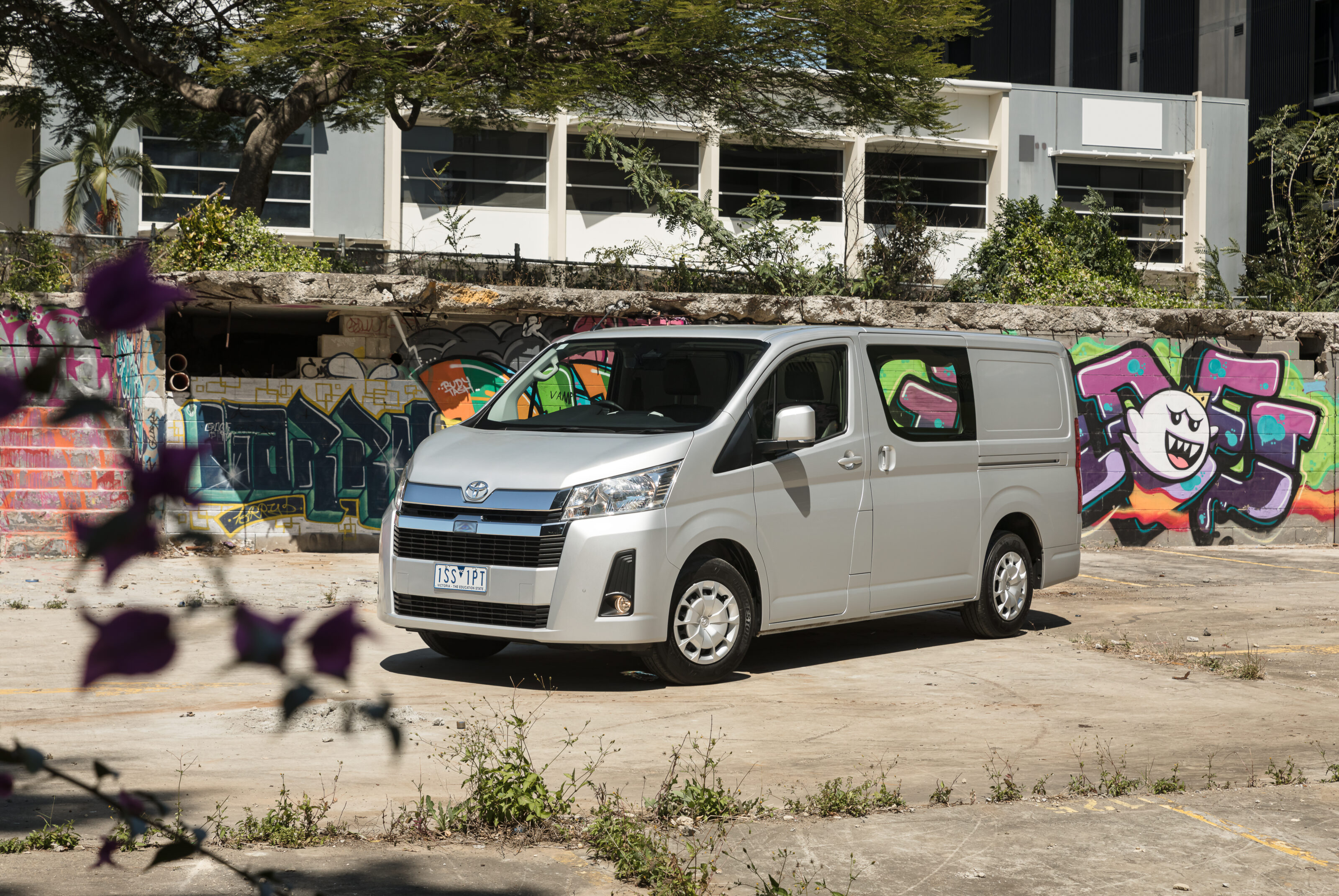
At $46,230 before on-roads, the LWB HiAce auto isn’t the cheapest mid-sized van, nor is it the exxiest, but what it offers is a proven class-leading package.
Toyota offers up a five-year unlimited-kilometre warranty, but do bear in mind the service intervals for all HiAce models are six months/10,000kms – a little more frequent than some of the competition.
The servicing frequency becomes less of an issue with Toyota’s Service Advantage, offering punters capped-price servicing for three years/60,000kms, at $240 a pop for the diesel.
By work van standards, aside from a few niggling gripes, the HiAce justifies its spot atop the mid-sized van sales ladder.
Australia’s favourite shoebox on wheels remains the dependable workhorse we’ve come to know and love. But now it does everything it’s always done well, even better.
2021 Toyota HiAce LWB specifications
| Body | Five-door van |
|---|---|
| Drive | Rear-wheel |
| Engine | 2.8-litre inline four-cylinder turbo-diesel |
| Transmission | Six-speed automatic |
| Power | 130kW @ 3400rpm |
| Torque | 450Nm @ 1600-2400rpm |
| Weight | 2220kg |
| L/W/h | 5265/1950/1990mm |
| Wheelbase | 3210mm |
| Tracks (f/r) | 1670mm |
| Turning circle | 11m |
| Cargo space length | 2530mm |
| Cargo space width | 1760mm |
| Cargo space height | 1340mm |
| Cargo Space volume | 6200L |
| Payload | 1095kg |
| Towing capacity (braked) | 1500kg |
| Fuel tank capacity | 70L |
| Fuel Economy (claimed) | 8.2L/100km |
| Fuel Economy (as tested) | 12.8L/100km |
| Suspension | McPherson strut, stabiliser bar (f);leaf spring, rigid axle (r) |
| Steering | Hydraulically-assistedrack and pinion |
| Brakes | 296mm ventilated discs (f); 320mm ventilated discs (r) |
| Wheels | 16 x 7J steel all-round (full-size spare) |
| Tyres (f/r) | 215/70R16 |
| Price | $46,230 (plus on-road costs) |
Welcome: Slide Ways
Price as tested: $63,000 This month: 974km @ 8.8L/100km
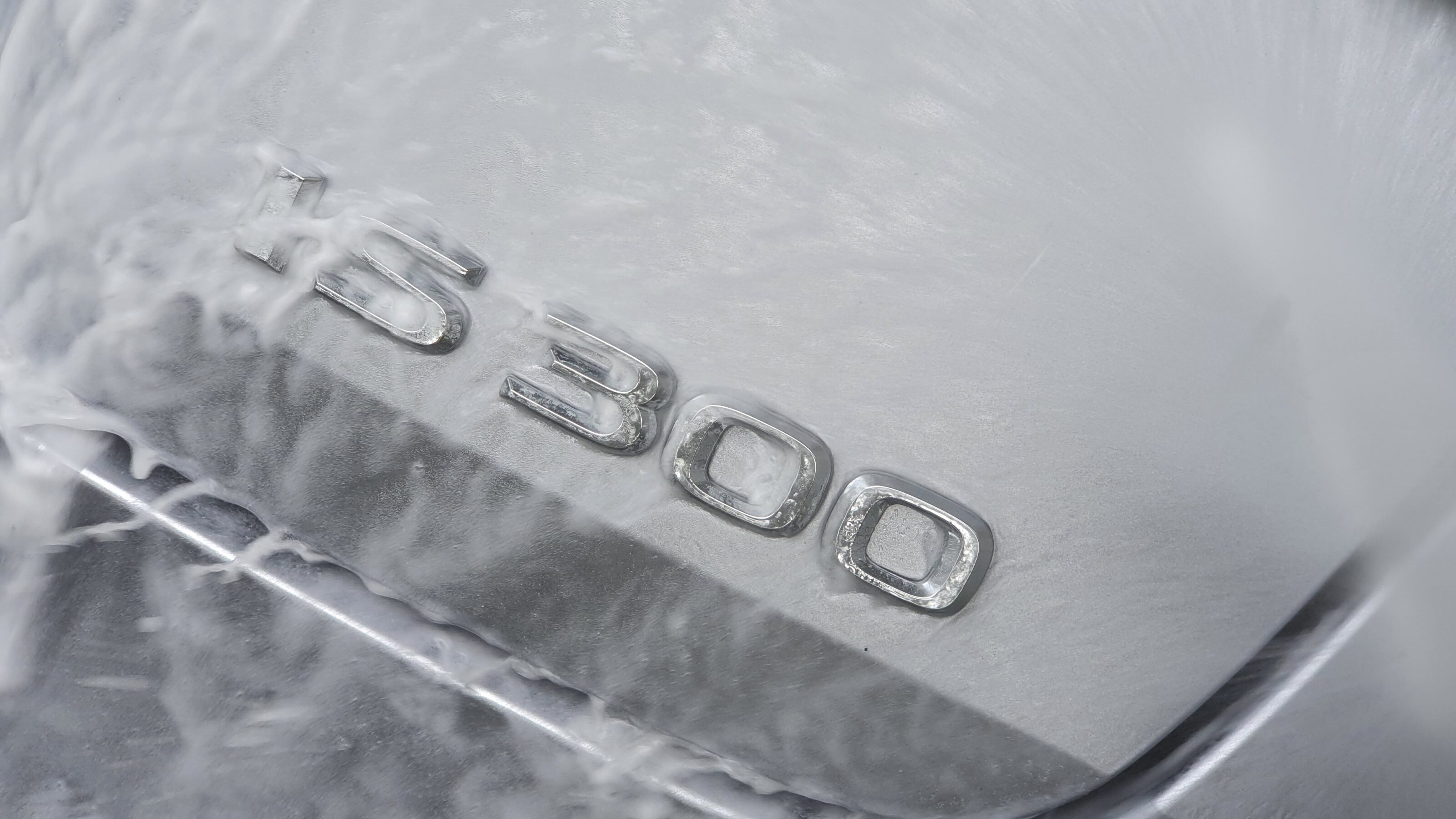
Could you sum up the reason for buying your car in seven words? It’s like the ultimate car-enthusiast elevator pitch, but here’s the kicker. In order to make it truly compelling, it has to move beyond the purely personal. ‘The best solution for my needs’? Get out. I’m not interested in your needs. Sell me the benefits in a way that gets my attention.
With the Lexus IS300 Luxury, that pitch is really easily made. The best quality sedan for the money. That’s it. If you want to argue that one, you’re likely to lose. Lexus has the warranty claim data to back that one up. So why don’t you see thousands of these cars clogging Australia’s arterials in the same way that you do, say, Merc C-Classes, BMW 3 Series or Audi A4s? Are we a nation that doesn’t put a premium on build quality and reliability? That’s a damning accusation, and one that doesn’t really bear much in the way of scrutiny. We’ve long valued rugged dependability but somewhere along the way we’ve become a nation of automotive bowerbirds, attracted to all things new and shiny.
While the Lexus IS300 has enjoyed a very sleek makeover, jump inside and it’s not the last word in state of the art modernity. There’s no wireless phone charger or head up display. You’ll search in vain for USB-C slots, a voice-activated assistant, launch control, idle stop or matrix headlights.
Fortunately, the latest refresh of the IS has seen the foot-operated parking brake ditched and a slick 10.3-inch touch display with Apple CarPlay and Android Auto introduced, which means that you’ll have to use the infernal touchpad less frequently.
New standard safety kit includes a pre-collision system with day and night pedestrian detection and daytime cyclist detection, along with all-speed adaptive cruise control, lane-tracing assist, road sign recognition, blind-spot monitoring, parking support brake and rear cross-traffic alert (with braking). Given that this is the entry-level car in the IS range and does without any of the fancy Enhancement Packs that many buyers choose, it’s good to see features like smart entry and start, heated and eight-way power adjustable front seats, dual-zone climate control, 10-speaker audio, digital radio, satellite navigation with live traffic alerts, voice control, and LED headlights with automatic high-beam making the standard equipment sheet.
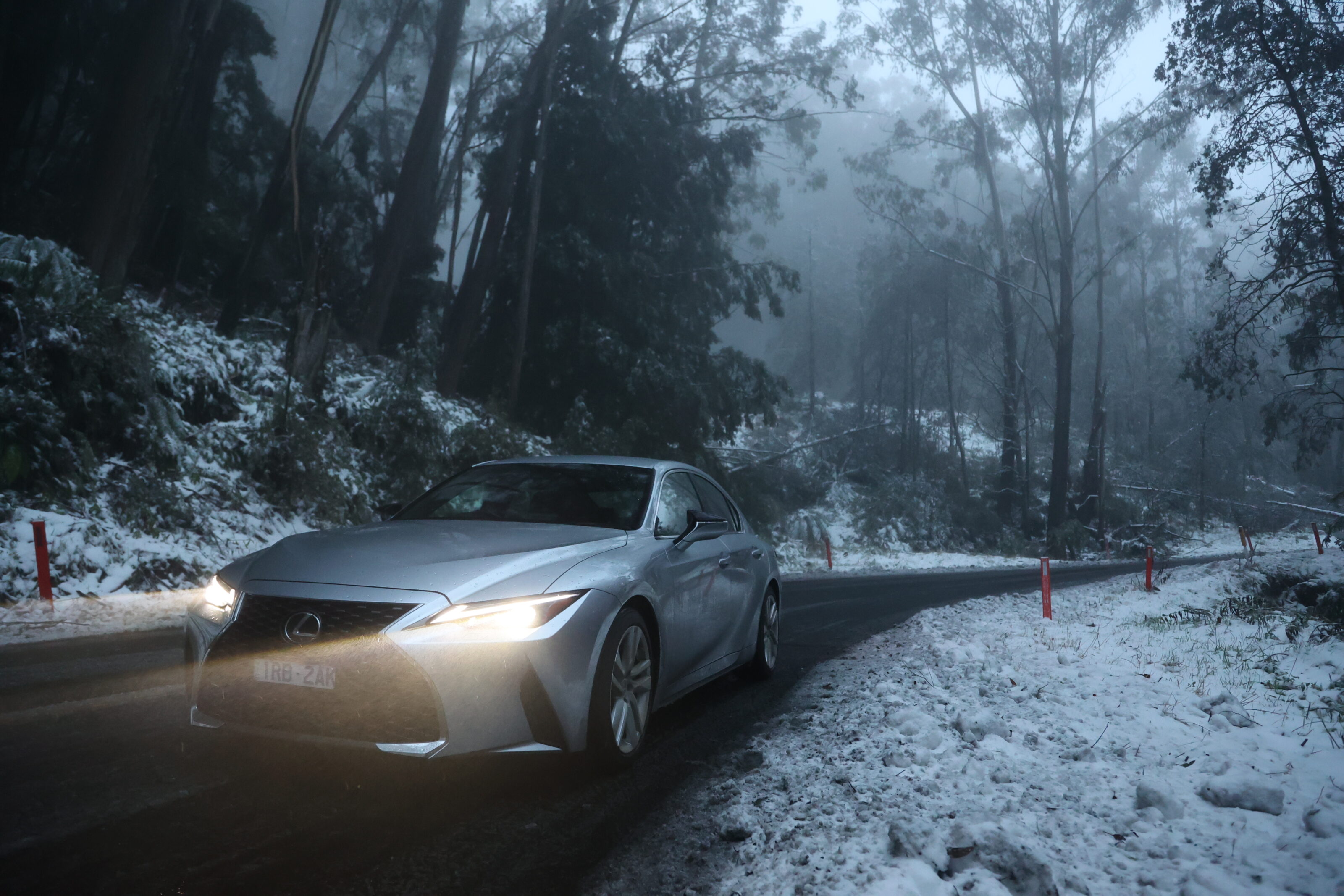
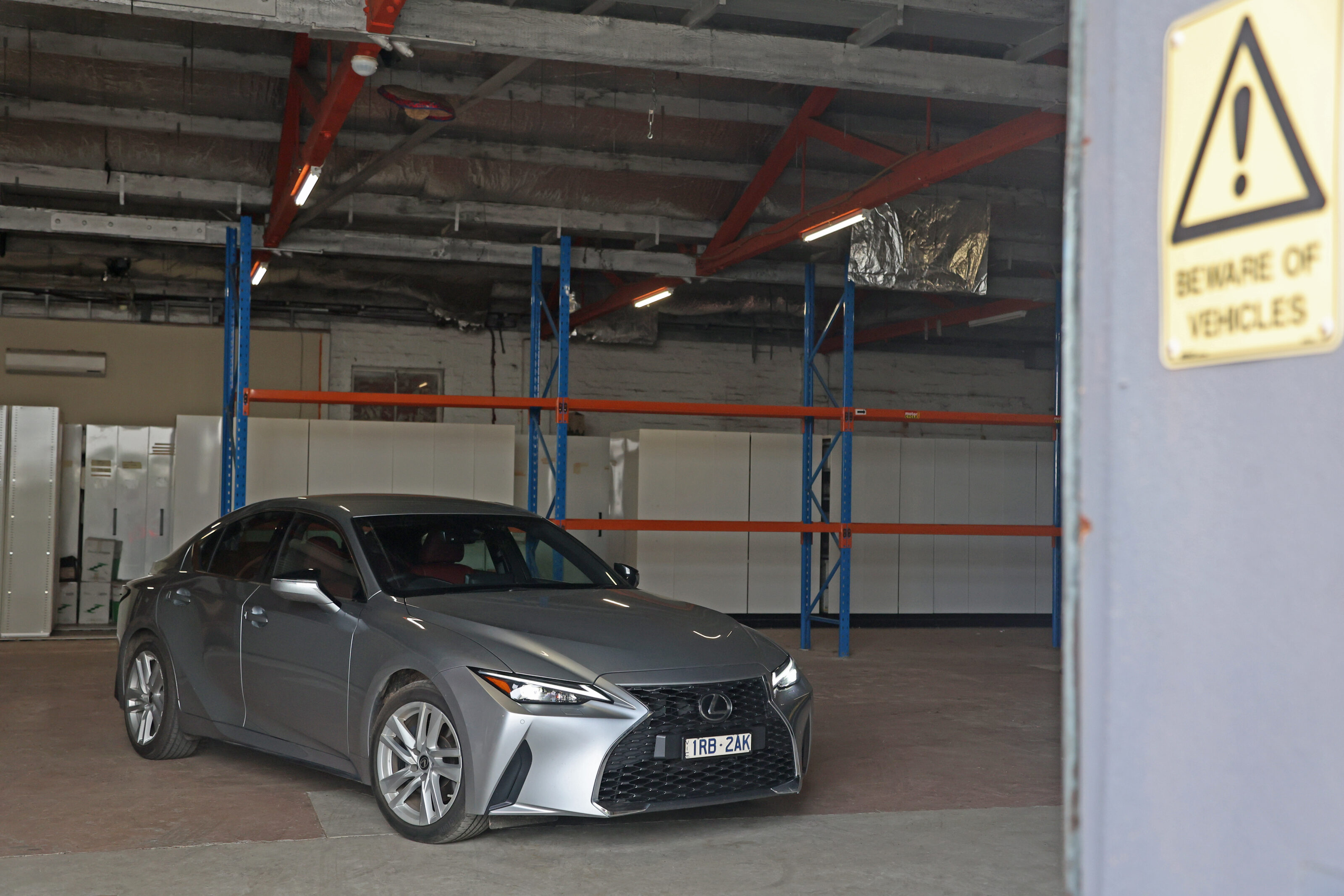
None of that really helped me during my first jaunt in the IS300. What I needed was all-wheel drive and/or winter tyres after an ill-advised evening trip to enjoy an unseasonably early snowfall at Mt Baw Baw. The Bridgestone Turanza rubber waved the white flag two thirds of the way up the hill and I then effected a very pedestrian 1km reverse back to flatter ground, passing a BMW 7 Series which had managed to slide down the camber of the road into a ditch. I would have probably got a few metres further up the hill by disengaging the Snow mode traction control at the very end, but the beckoning lights of the village cafe were still a long way distant.
First impressions after a few hundred kilometres? It’s supremely comfortable, utterly devoid of rattles and squeaks and, subjectively at least, I think it’s the most elegant-looking car in its class. It’s not all perfect though. The charmless-sounding 2.0-litre turbocharged engine still has a long way to go to worm its way into my affections and some of the interior ergonomics are a little idiosyncratic to say the least. But the best quality sedan for the money is off to a solid start, even if it didn’t make it all the way to its first destination.
Update 1: Rattle, Minus the Hum
This month: 1295km @ 8.2L/100km Total: 2271km @ 8.4L/100km
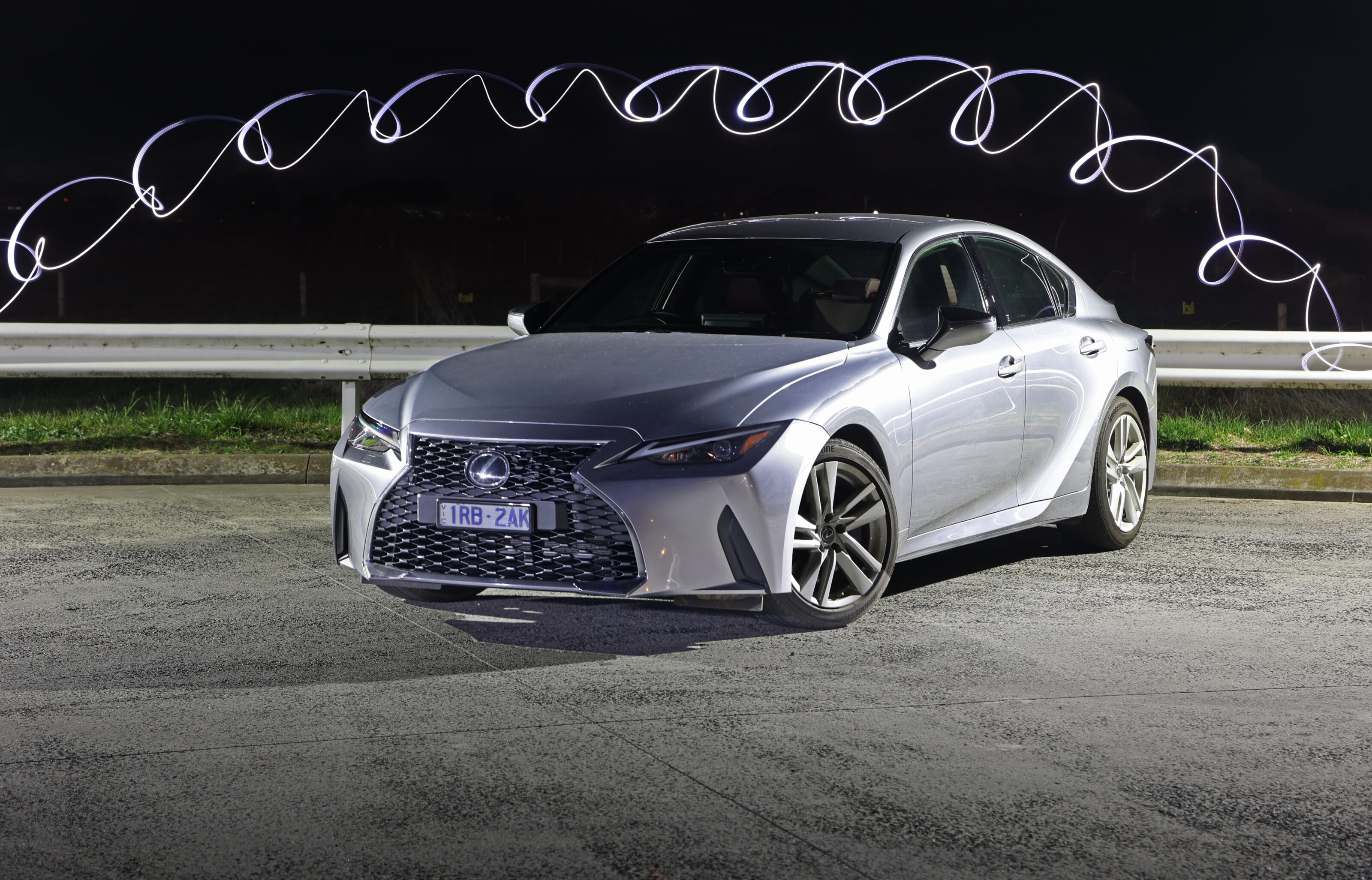
Here’s some advice for you. Never enter a jet-wash bay after a van that looked as if it had acted as an emergency rescue vehicle in a bog-snorkelling competition. I made that mistake this week and will never do so again, firing mud and more organic looking stuff all over the Lexus I was trying to clean. It went all over me as well, and as a result the IS300 has smelt a bit ‘earthy’ of late. You know that whiff when you drive past a massive cattle yard? That.
It also did something very un-Lexus on the drive home, perhaps in response to being subjected to the forcible re-infusion of heifer into the upholstery. It developed a noisy vibe. It sounded like it was somewhere just below the dash roll top, making the sort of catarrhy death rattle that Darth Vader made when Luke Skywalker pulled his helmet off, shortly before setting fire to him on a stack of Euro pallets.
A Lexus with a rattle is like a VT Commo with a fuel filler flap. It doesn’t happen and it had undermined my automotive worldview so comprehensively that I pulled into a servo and ate two bags of Allen’s Party Mix while I came to terms with the consequences. Fuelled with so much palm oil that I may have rendered 0.2 orangutans homeless, I gave the dash top a solid larruping and, presto, the rattle ceased.
Other observations? I’m not really missing the monster Mark Levinson stereos that some Lexus models come fitted with, as the standard 10-speaker unit is good enough for my needs. The automatic high-beam headlamp set-up is one of the better examples of its ilk and the heated seats are fierce enough to turn that faint heifer hum into something more like parking behind the grease trap at your local Hungry Jack’s.
Despite the odd hiccup, life with the IS300 is good, but I have become rather paranoid about lapsing into an accidental Partridge; Norfolk’s favourite graveyard-shift radio presenter being a renowned Lexus lover. Still, if that’s the most significant of my worries, I’d probably call that a win.
Update 2: An Unwelcome Intrusion
This month: 562km @ 8.9 L/100km Total: 2833km @ 8.5L/100km
Vehicle standard ADR 85/00 – Pole Side Impact Performance – doesn’t sound anything out of the ordinary, but for the Lexus IS300 it’s the Grim Reaper. Drafted into legislation in December 2015, it started a countdown clock which, when it hits zero on November 1st this year, means the non-compliant IS, along with the sexy RC coupe and the unsexy CT hybrid potato, can no longer be sold without a modification that the local importers reckon is cost-prohibitive. Factory orders ceased on June 30, which means that if you want an IS 300 Luxury, you’ll need to start scouring dealer stock.
Here’s my advice to you. Don’t buy one. As much as I’ve enjoyed running this car, it’s my job to offer you solid consumer advice and there is a better option available. It’s called the IS350 F Sport, packs a 221kW atmo V6 instead of a 180kW turbo four and injects an element of mechanical charisma that this car so badly yearns for. Trim-for-trim, it’s also only $5K more expensive, which seems like a reasonable deal if only for the additional kilowatts. Who knows, you might also be able to snag a run-out deal if you’re a demon negotiator.
The rest of the IS300 package is quietly excellent, however. Rather than flit straight to the next long termer with nary a backwards glance, I felt a genuine wrench when the time came to hand the Lexus back. There are certain things that you acquire in life that form a bond and enjoy an extended welcome, and I could see a Lexus IS purchase easing into that role. It’s a slow burner, with qualities that are far from overt. There’s little about it that’s alpha or thrusting and I must admit I admire the quiet confidence it has in its own skin.
The day before the IS was due to be returned, I woke late, got into the Lexus, loaded a long playlist and drove with no particular destination in mind. The delightful thing about the IS300 is that it’s always there for you but rarely imposes its personality into the conversation. If it was a person, it’d be a great listener. I still think there’s room in the market for cars like this. Poles clearly have an alternate opinion.
Snapshot
- Chrysler sold just 115,000 cars in the US in 2021
- The legacy brand is set to be EV only by 2028
- It’s likely one of the EVs will be a 300 successor
Chrysler, one of the big American brands synonymous with the term ‘Yank tank’, is ditching HEMIs in favour of batteries to power its big-car lineup.
Parent company Stellantis confirmed the shift at the unveiling of its Airflow electric concept at 2022 Consumer Electronics Show in Las Vegas.
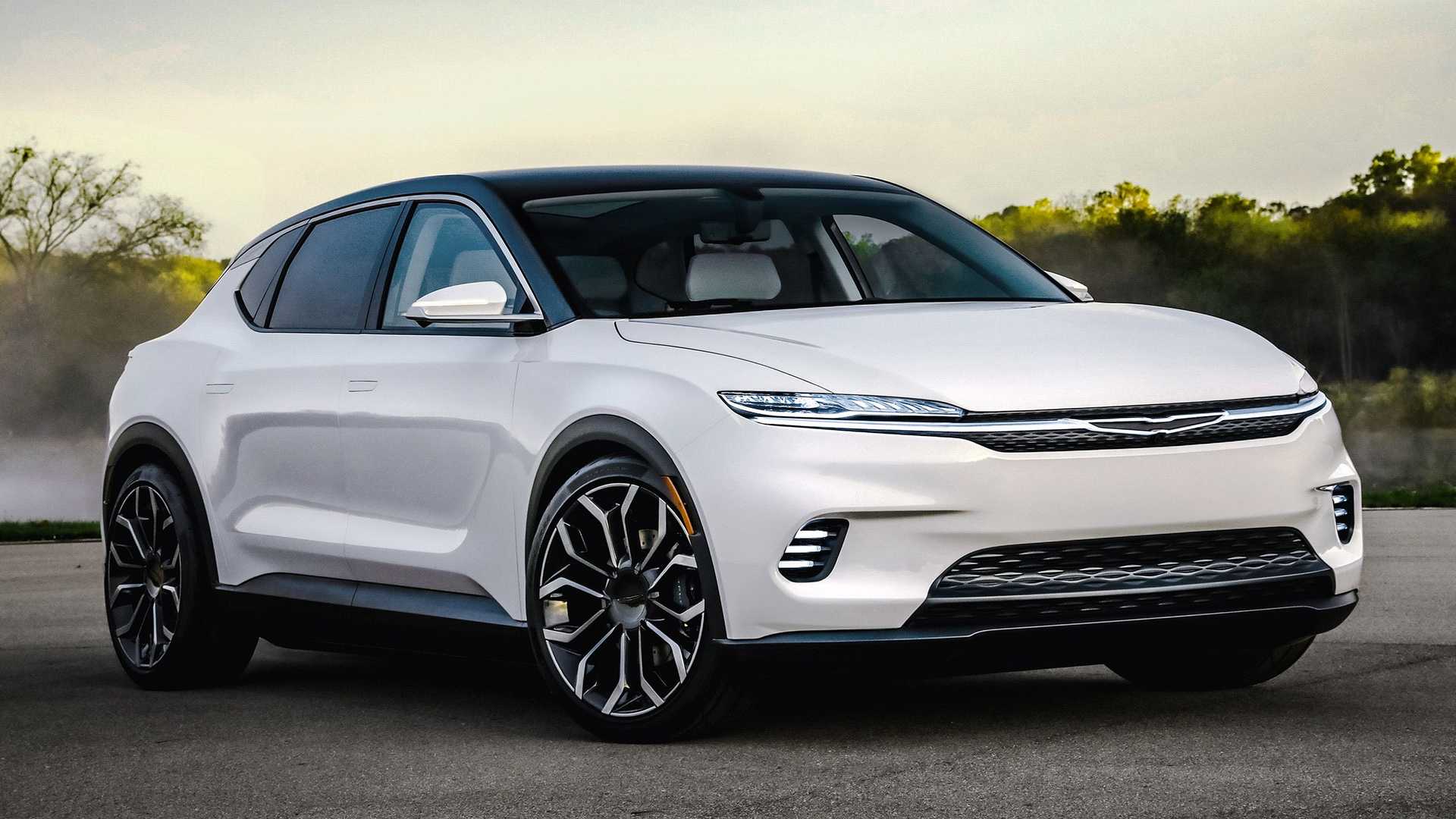
Chrysler CEO Christine Feuell added some flesh to the bones of the announcement, saying the company planned to launch its first BEV in 2025 and two more by 2028 which will be based on existing models.
Fueller told Automotive News each model will ride on the STLA Large (‘Stella’) platform, and are likely to be successors of the 300 sedan/wagon and Voyager and Pacifica people movers, possibly in crossover form.
“Our intention is to redefine products for those [minivan and large sedan] segments, and they’re certainly going to be a vast departure from what’s in market today,” she said.
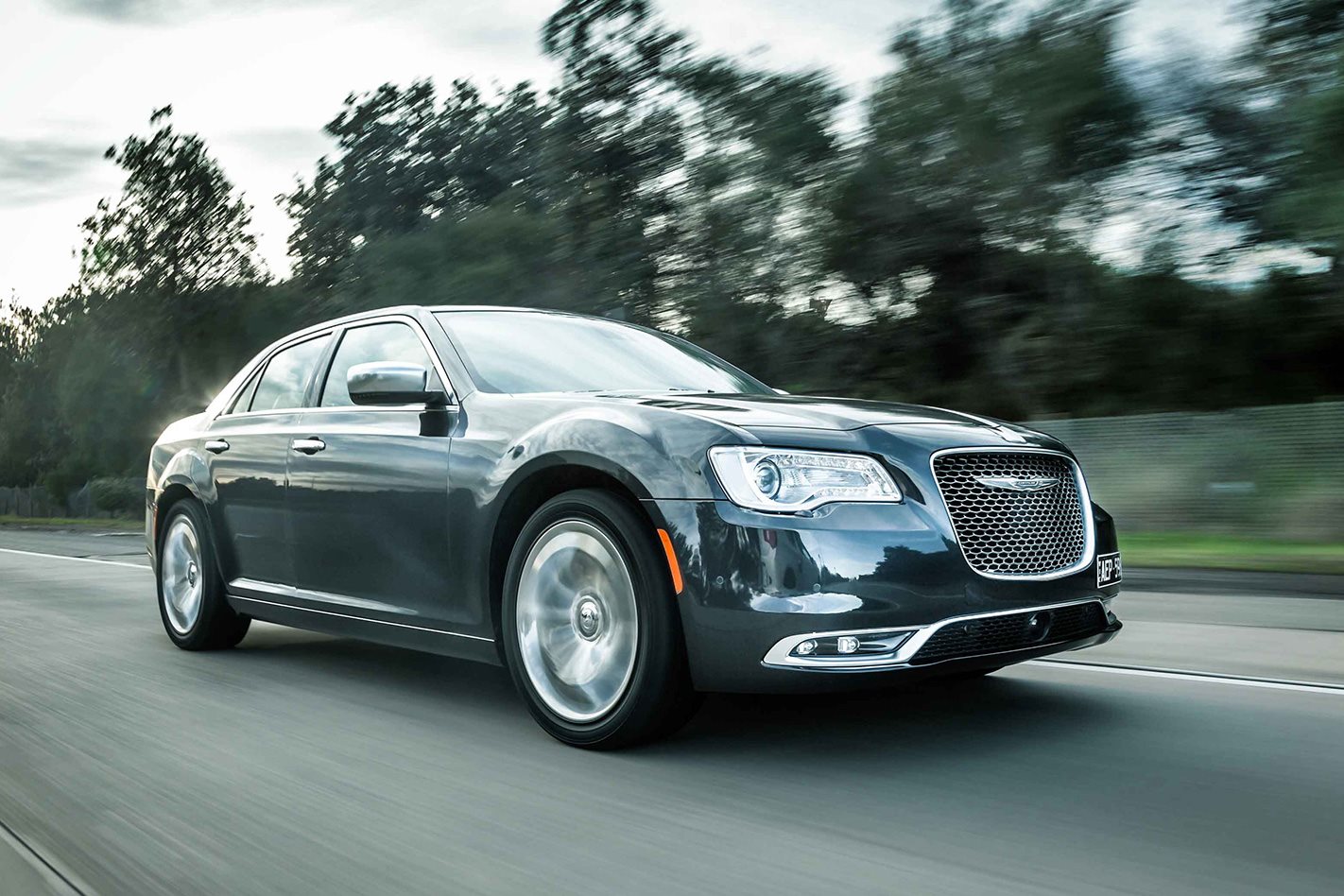
Interestingly, Fueller compared the legacy brand, which sold just 115,000 units in the US in 2021, to a start-up and said the new models would appeal to the kind of buyers that opted for Teslas.
Until its first EV arrives expect Chrysler, which withdrew from the Australian market in 2021, to stay afloat by milking its current line-up with special editions.
Charging down Gardner straight, tickling the redline in a high gear and seeing the vast blue horizon that is Bass Straight rush towards you. As you crest the rise past the start/finish line it feels as though you’re about to fall off the end of mainland Australia. It’s easy to get caught up in the moment before you tip it in to Turn One – and hang on. Not all views are created equal.
However, as our resident gun driver, Warren Luff, found out during MOTOR performance testing, approaching the first braking marker at full velocity in a Lamborghini Gallardo can be daunting for other reasons – wildlife.
“Many years ago I hit a seagull at the end of the front straight. I got it smack bang in the middle of the windscreen at about 260km/h. I thought it was going to shatter the windscreen,” Luffy recalls.
Luckily for him, and MOTOR’s potential insurance claim, the rake of the windscreen saved the day. Unfortunately, we can’t say the same for our feathered friend. “The noise was horrendous. I had a helmet on, but I’m pretty sure I did shut my eyes. I looked up in the rear-view mirror and there’s feathers going everywhere. Unfortunately, I did lose a bit of time on that lap!”
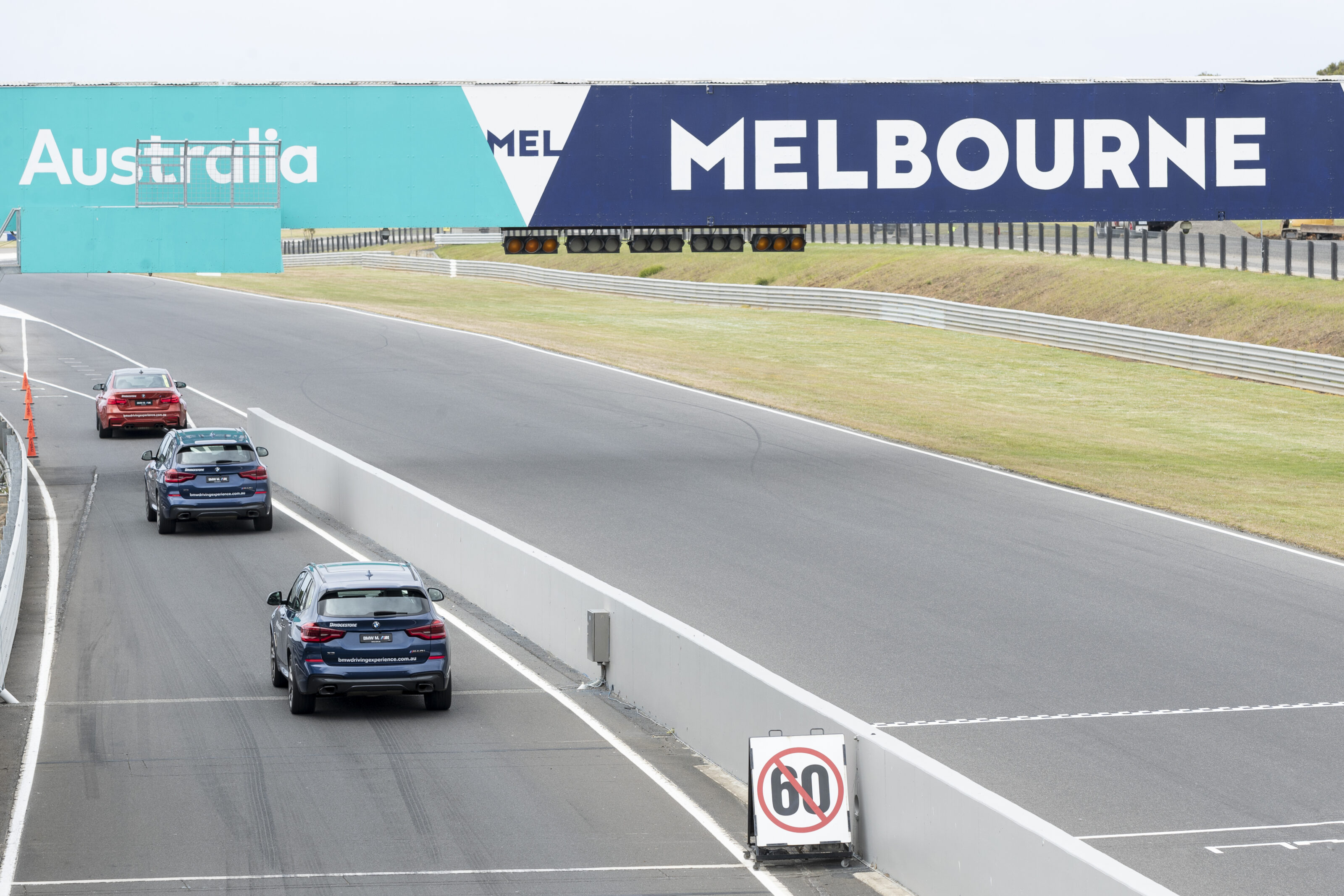
So, while the Phillip Island Grand Prix Circuit is picturesque, it’s also a tough assignment for many varied reasons. Still, since 1956 (the current site was purchased in 1952 by Phillip Island Auto Racing Club), Phillip Island has played host some very important events.
For such an iconic track, PI has endured a tale of woe, with various periods of disuse. However, it is a motorcyling Mecca, and ignited endurance racing for touring cars locally, with the first Armstrong 500 being held in 1960. The 500-mile race was won by Frank Coad and John Roxburgh in… a Vauxhall Cresta.
With heavy Ford Falcons cutting myriad laps two years later, the track surface deteriorated. Due to a lack of funding to repair it, Phillip Island lost the iconic race to Bathurst, which became the 1000km race we know today.
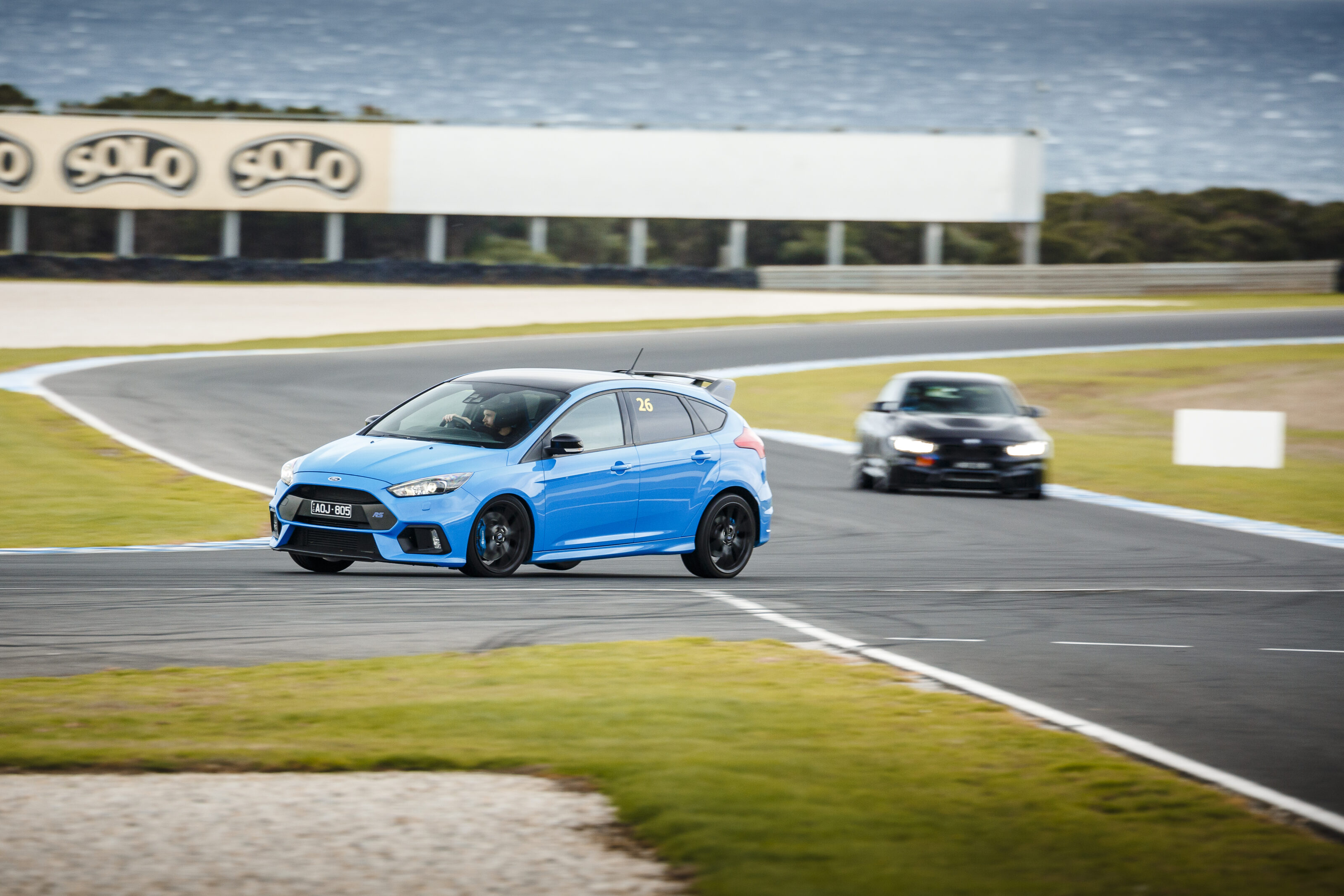
Since 2004 the Phillip Island facility has been under the ownership of Lindsay Fox’s Linfox Property Group and has held major categories like MotoGP, WSBK, and Supercars. However, it’s also well-used in terms of track days and driver-training events. The entire circuit was resurfaced in 2012 in a $3m upgrade.
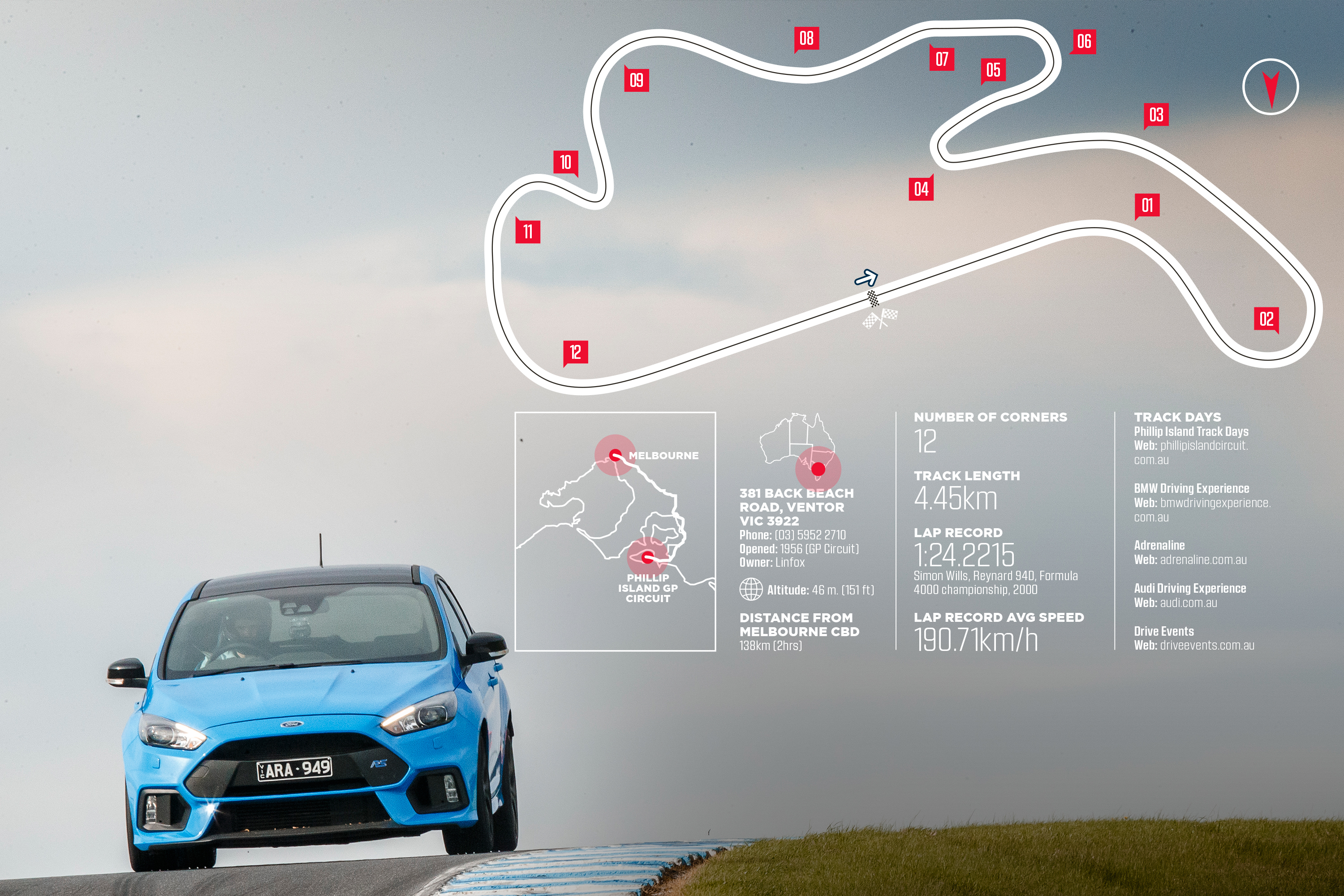
Phillip Island’s 12-turn layout looks easy enough on paper. In reality, the 4.45km circuit is anything but, with high-speed sections requiring precision and bravery. However, it’s not just the demanding track that requires attention, Mother Nature plays a huge part, too.
Whether it be 650hp Supercars, Porsche Carrera Cup cars or driver-training events, our gun driver Warren Luff has completed countless Phillip Island laps. So, strap in and take notes from one of the best. You won’t have much time to look at the view. Welcome to MOTOR’s track guide to the Phillip Island Grand Prix Circuit.
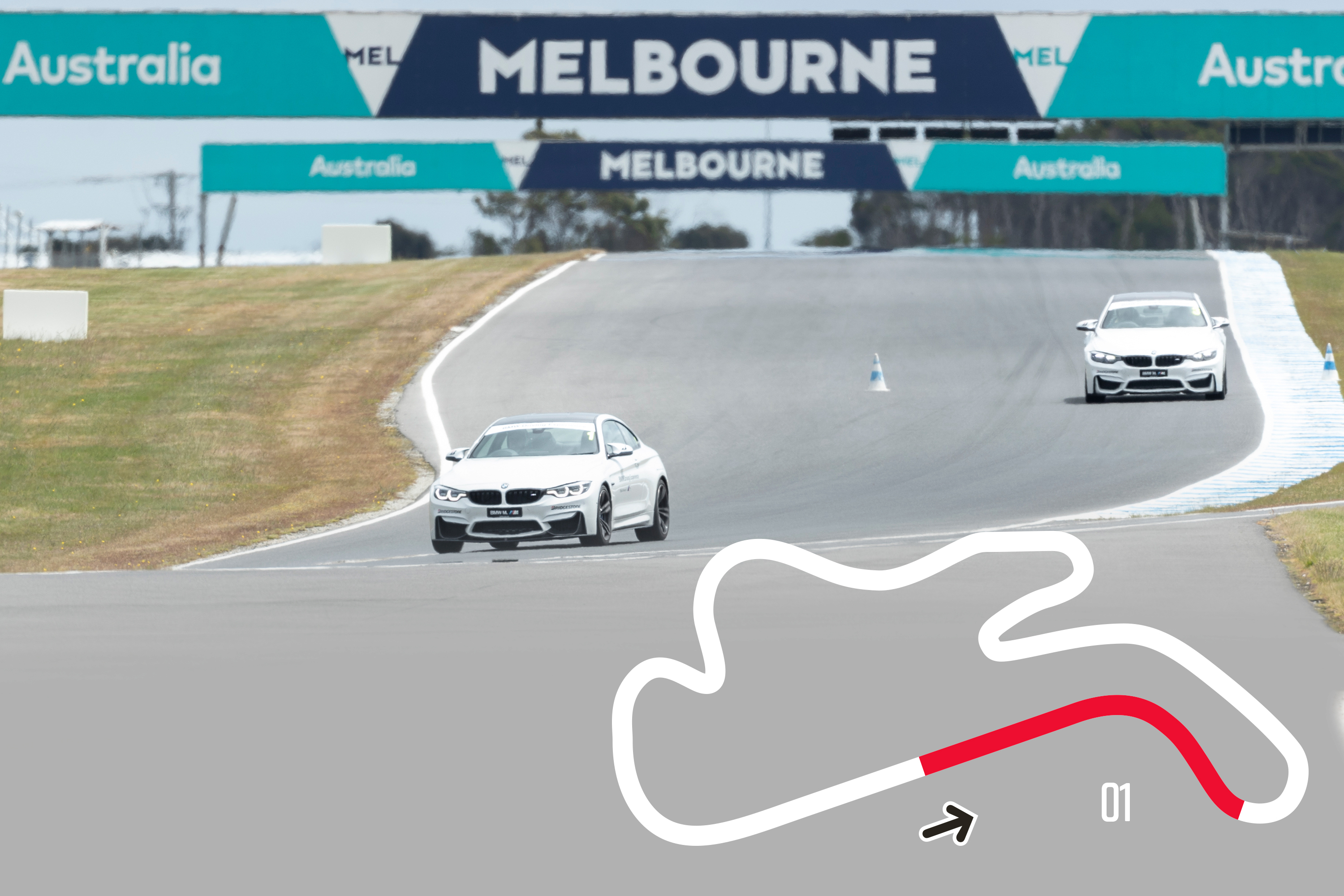
Section one: Starting strong
Turn One (Doohan Corner)
Braking is much deeper than you originally think is possible, and you carry the brake in on initial turn in. In something serious like a Porsche 911, you drop back to fifth gear. The apex is about the middle of the kerb and you turn in a bit early to allow for the centrifugal force to push you wide.
The transition from getting off the brake pedal and back on the throttle needs to be very smooth as it’s easy to upset the car’s balance. Remember to keep your eyes up and be looking to Turn Two by the time you’re at the apex. It’s helpful to use the accelerator to keep the rear of the car settled as being off throttle too long can cause the rear to step out from mid to corner exit.
Use all the road to the left on exit and let the car run out wide, don’t try to keep it tight on exit. If you’re going to go off you’re better to go with it rather than persisting with fighting the car by trying to keep it on track.
MOTOR TIP
Wind direction can play a huge part in the car balance. A headwind on the front straight will usually mean really good front grip through Turns One, Two and 12. But remembering when you get to Turn Four you now have the wind behind you making it harder to stop. So take this in to consideration when thinking about what the car is doing.
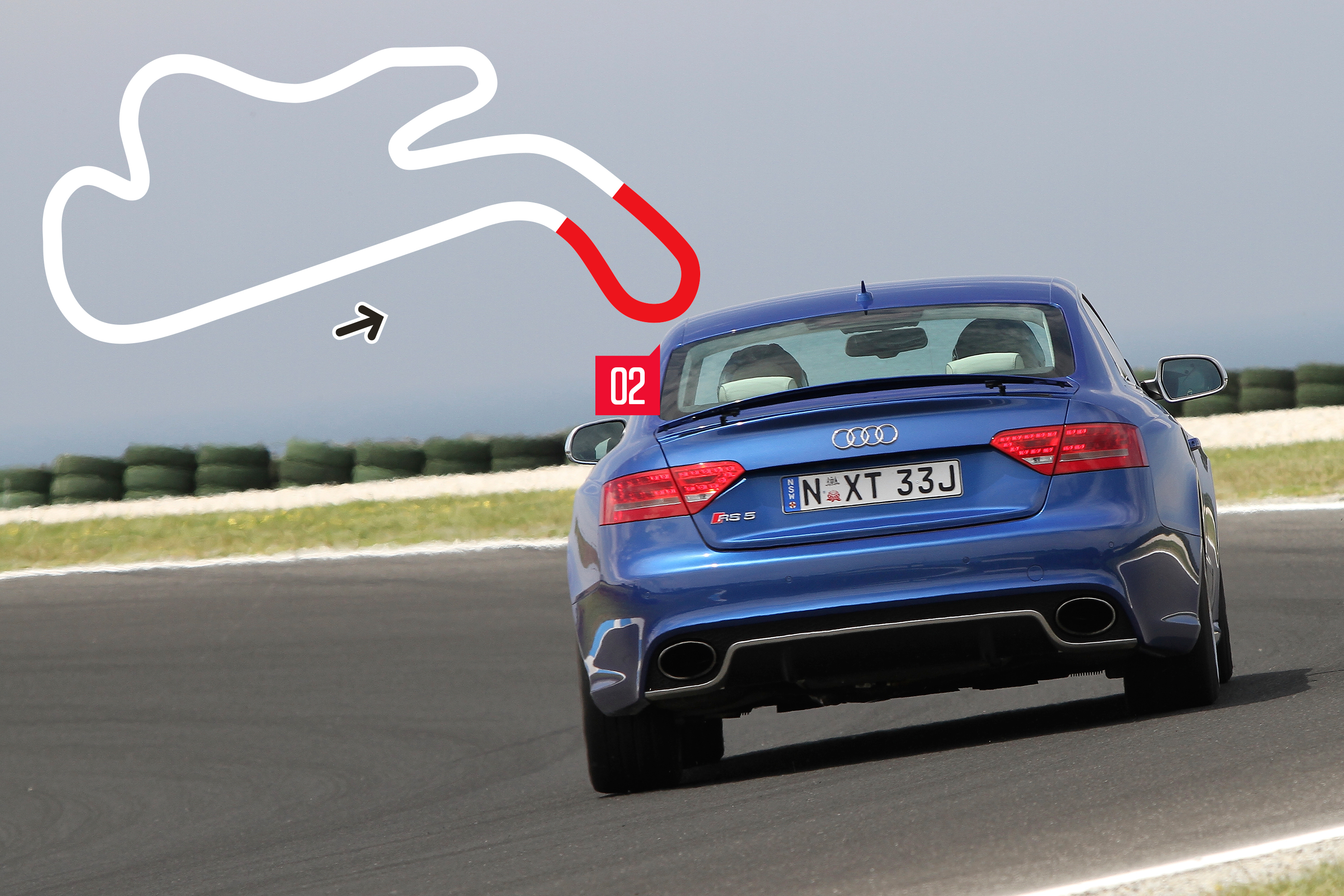
Section two: Double the apexes
Turn Two (Southern Loop)
After exiting Turn One you really only get back to the middle of the track before you need to brake for Southern Loop. Turn Two is a reasonably simple double apex, but it can become tricky in the second half of the corner if you over-slow the car on entry. You need to trail brake a long way in to keep the weight on the nose at the mid-corner rotation point.
If you decrease speed too much on entry you end up picking up the throttle too early and this leads to bad mid-to-exit understeer in most cars. It also means you’re very slow to full throttle, which could lose you up to half a second on the run down to Turn Four. So, use road speed on entry to not only gain time on the way in, but it also stops you picking up the throttle too early causing understeer and losing time on exit.
Just after the first apex is where you want to be releasing the brake, then it’s important to stay off the throttle until you rotate the car while aiming/looking to the second apex. At this point it’s essential not to open the steering up too much on exit as it’s easy to drive it straight off the road, outward force will take care of pushing you to the outside kerb.
MOTOR TIP
You spend a lot of time loaded in corners, so a smooth, accurate and deliberate driving technique is required. You’ve got to make the car do what you want it to do. However, there’s a very fine line between being assertive and being overly aggressive. If you start throwing it around it’ll create problems. You’ve got to be very controlled with where you want to place the car so that you don’t upset the balance.
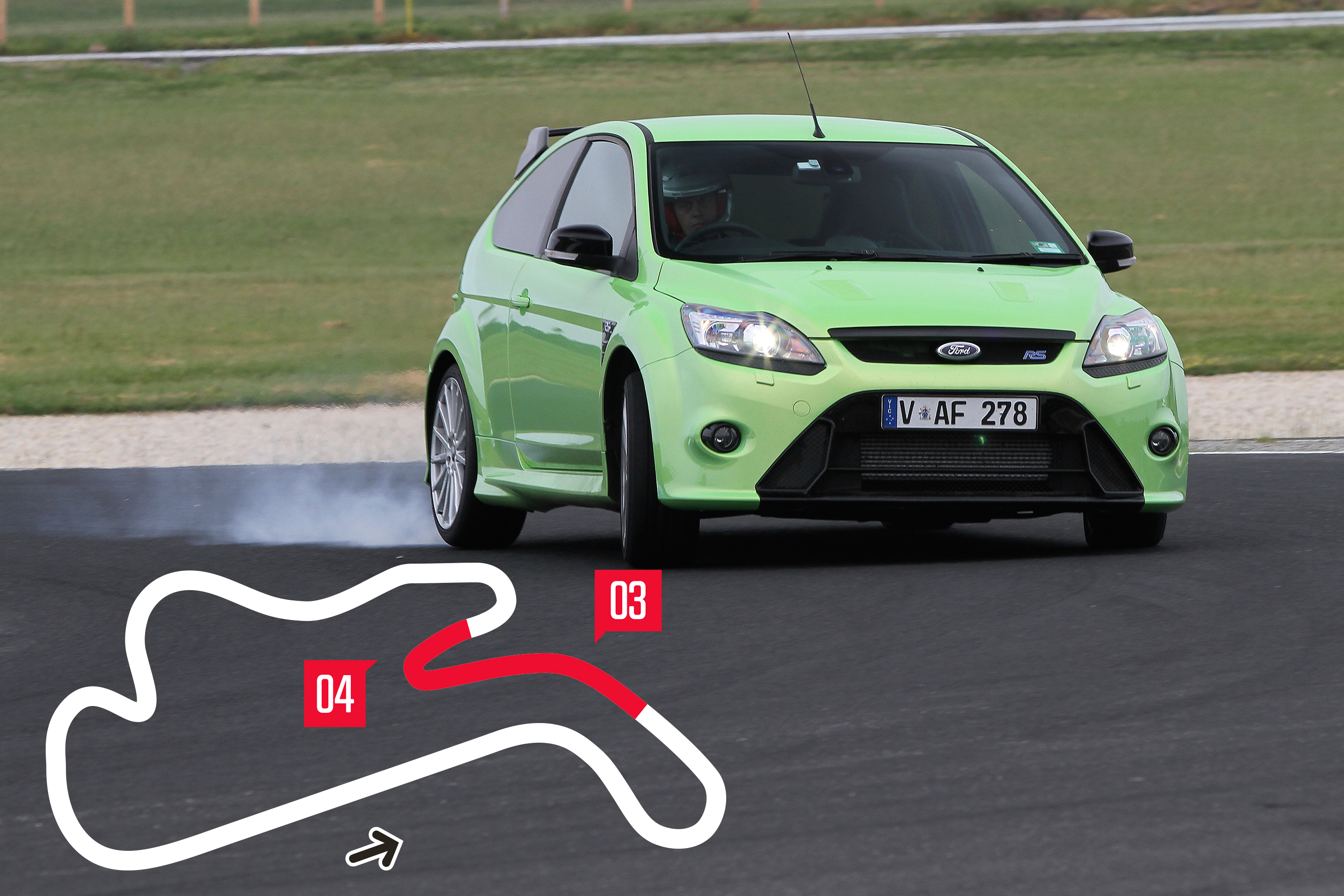
Section three: Stoner and Honda
Turn Three (Stoner Corner)
In just about anything it’s an easy flat, but remember to hug the inside as much as possible on corner exit to set yourself up for the run toward Turn Four.
Turn Four (Honda Corner)
A lot of time can be gained under brakes. And with a long run-off road there are not too many reasons not to explore the limits. Practice slowing the car for what it can do instead of braking for the distance to the corner. Try decreasing speed before the corner to help your brain compute how much later you can actually get on the anchors.
Being such a slow-speed corner there’s not a huge amount of time to be gained in your line, it’s more about getting the car rotated and being able to gain good purchase on exit. Usually a tight line is best and using the kerb can help pivot the car at the mid-point to set up for a better exit.
MOTOR TIP
Don’t try to go too fast too soon. It’s a track you’ve got to give a high level of respect. If it goes wrong here, it can go wrong in a big way. Phillip Island is a circuit where you’ve got to treat it with a high level of respect and work your way up to it slowly. So, you’ve got to crawl, walk and then run. The biggest mistake people make is having too much speed through Turn One, Hayshed and over Lukey Heights.
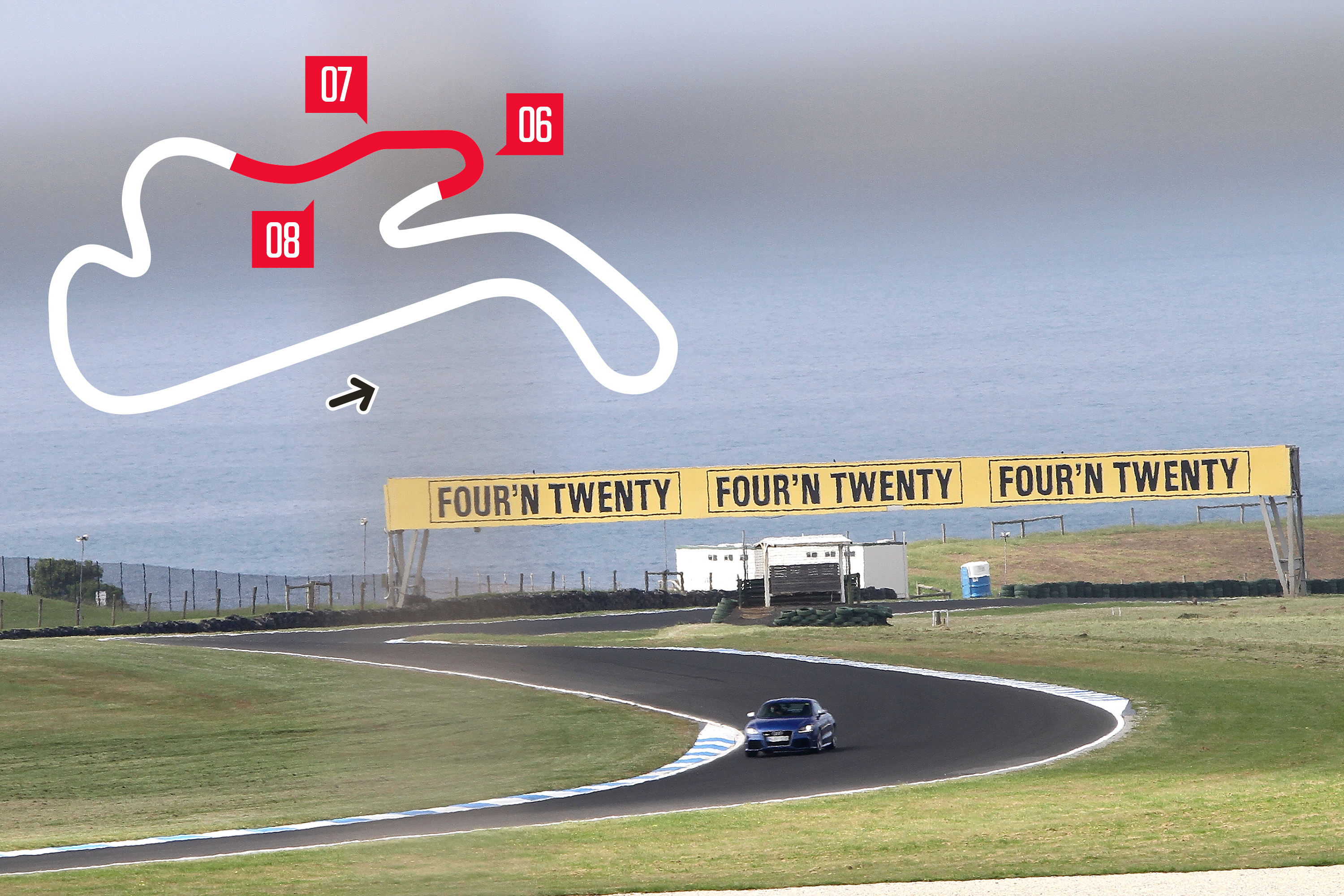
Section four: Siberia to Hayshed
Turn Five
You can’t even really call it a kink, so yes, it’s flat.
Turn Six (Siberia)
You end up treating this like a double-apex corner, with the difference being you don’t get all the way to the kerb (first apex) on entry. Imagine your first apex is one or two metres out from the kerb. Like Turn Two you maintain speed and brake on entry and allow the car to rotate mid-corner before picking up the throttle.
The second apex is very late and a good exit is critical to speed through Turns Seven and Eight. Again keep your vision up and looking to where you want the car to end up, getting smoothly on to the power and full throttle is the key here.
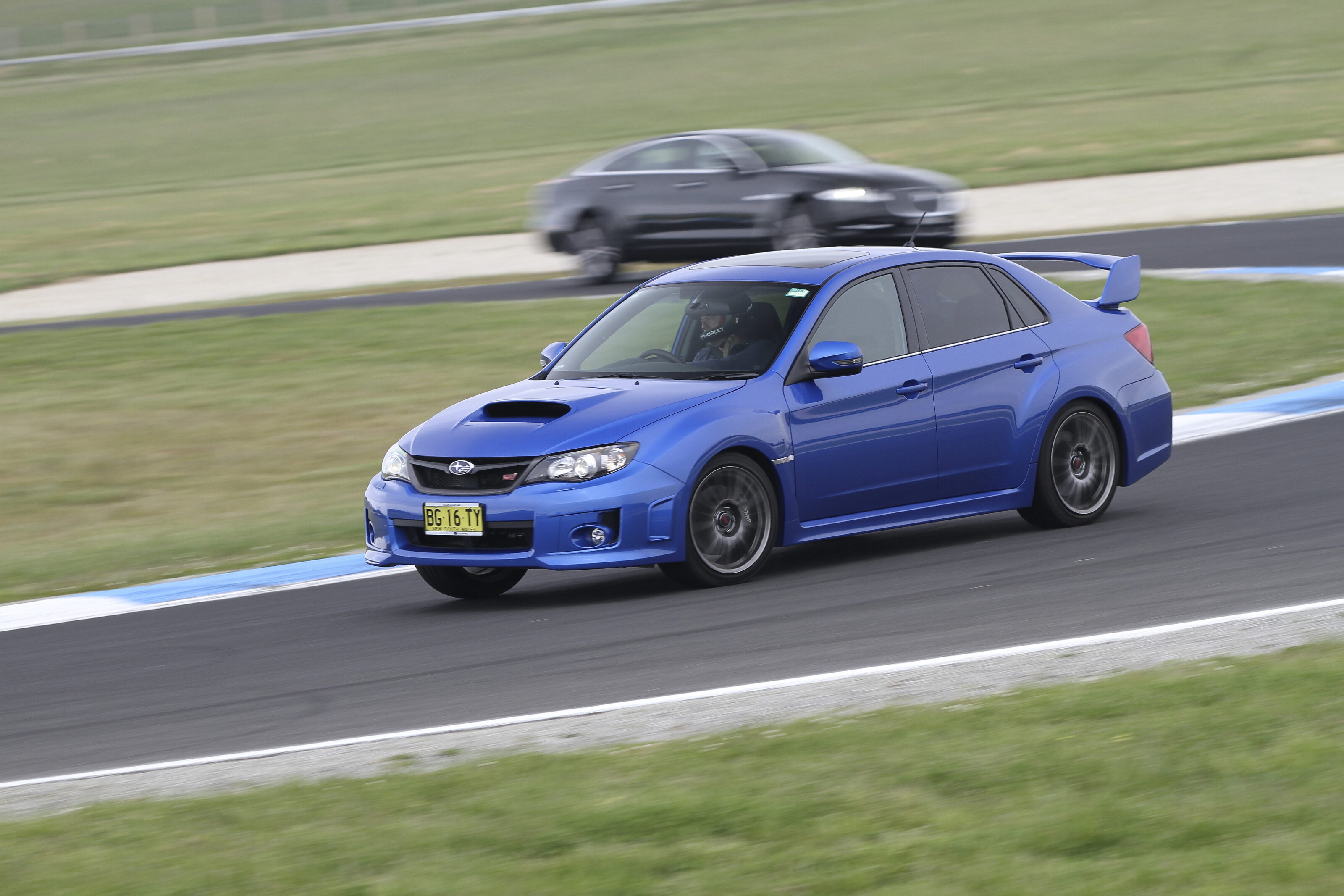
Turn Seven
Again, it’s a kink not a corner, so keep the foot flat.
Turn Eight (Hayshed)
How much speed you carry through here will depend on what car you’re in and the tyre underneath you. If you’re in something like a race car it’ll be flat, but early on it might take a few laps to build up to it. You can use a lot of kerb on the inside (in dry weather conditions) now it’s a flat design. This addition makes the track another metre wider and, therefore, it’s that bit easier to do it flat.
MOTOR TIP
When you start pushing the limit, there’s a lot of time to be made up in the faster sections by not over-slowing the car. If done, drivers often get on the throttle too early which creates mid-corner understeer. Having confidence to carry mid-corner speed is where there’s a huge amount of time to be gained. Once it’s lost, it’s virtually impossible to make back up. Finding your brake markers is so important.
Section five: Lukey Heights to MG
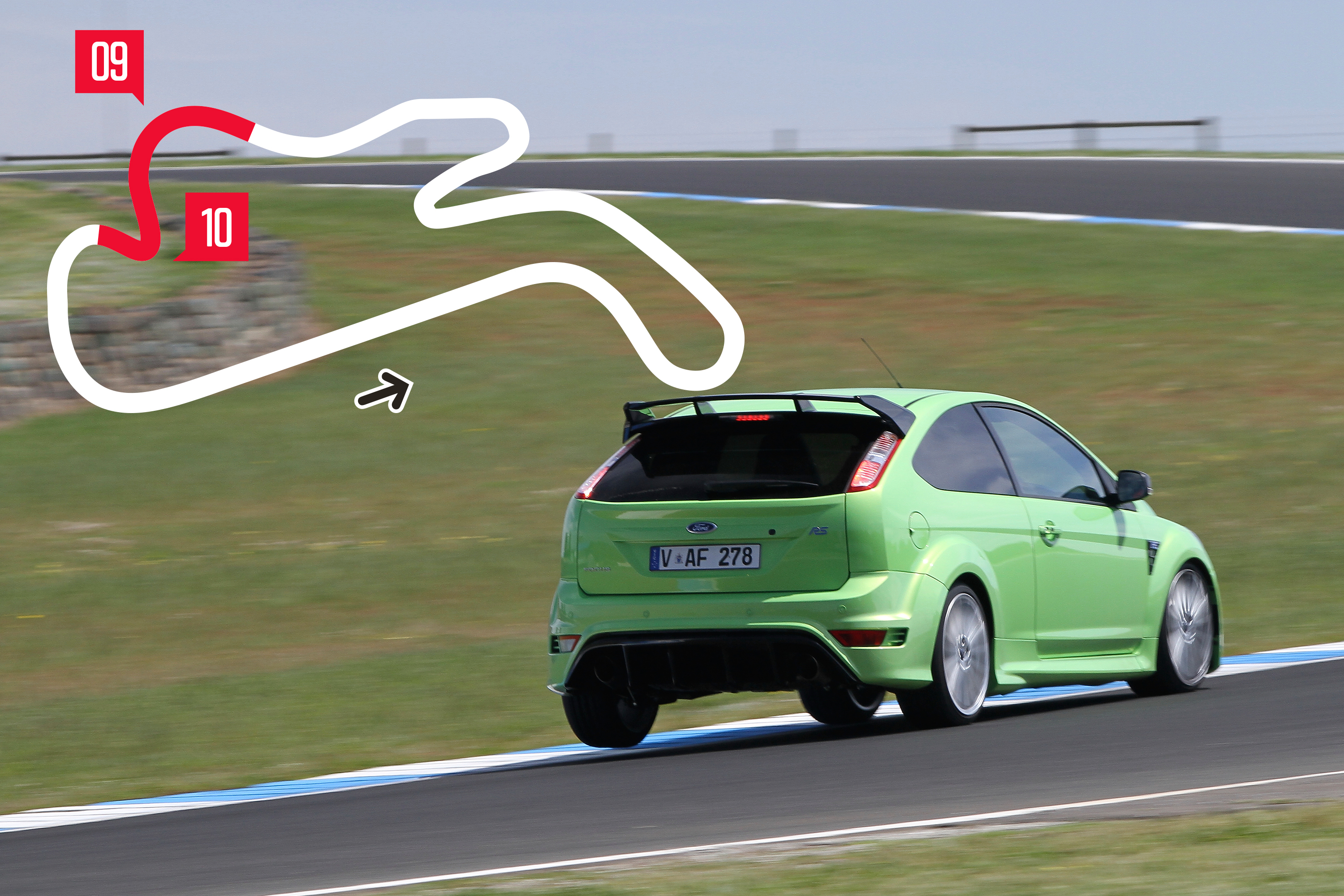
Turn Nine (Lukey Heights)
The approach is from about the middle of the track and you brake and turn in, aiming for the kerb, quite early. You can use a lot of kerb on this first part of the corner because it’s flat like Turn Eight. You can maintain a lot of entry speed here and because it’s uphill you end up with positive front grip. However, you do need to be careful that you don’t lose the rear once loaded.
More often than not your turn-in speed is dictated by how much grip the rear of the car has. Through the middle of the corner you let the car drift about a car width wide of the kerb, and then aim it back to the inside at the top of the hill. Levelling the throttle is important to keep the car settled and only once you get to the top can you think about full throttle for the short run down towards the braking zone of Turn 10.
Turn 10 (MG)
Being a downhill braking area it’s easy to out-brake yourself. It’s an early turn-in here because of the declining surface and the fact it’s easy to understeer wide. You can use the inside kerb to help rotate the car like at Honda. What you’re looking for is good power down on exit while also trying to keep the car straight as possible. Your terminal speed at the end of the front straight starts from getting a good exit here.
MOTOR TIP
Leave your traction and stability control on! It will, potentially, be the thing that saves you if things go wrong. When you start pushing towards the upper limits, those systems will probably cost you a bit of lap time, but until you build confidence it’s beneficial to leave them on and have them there as a safety net.
Section six: The run home
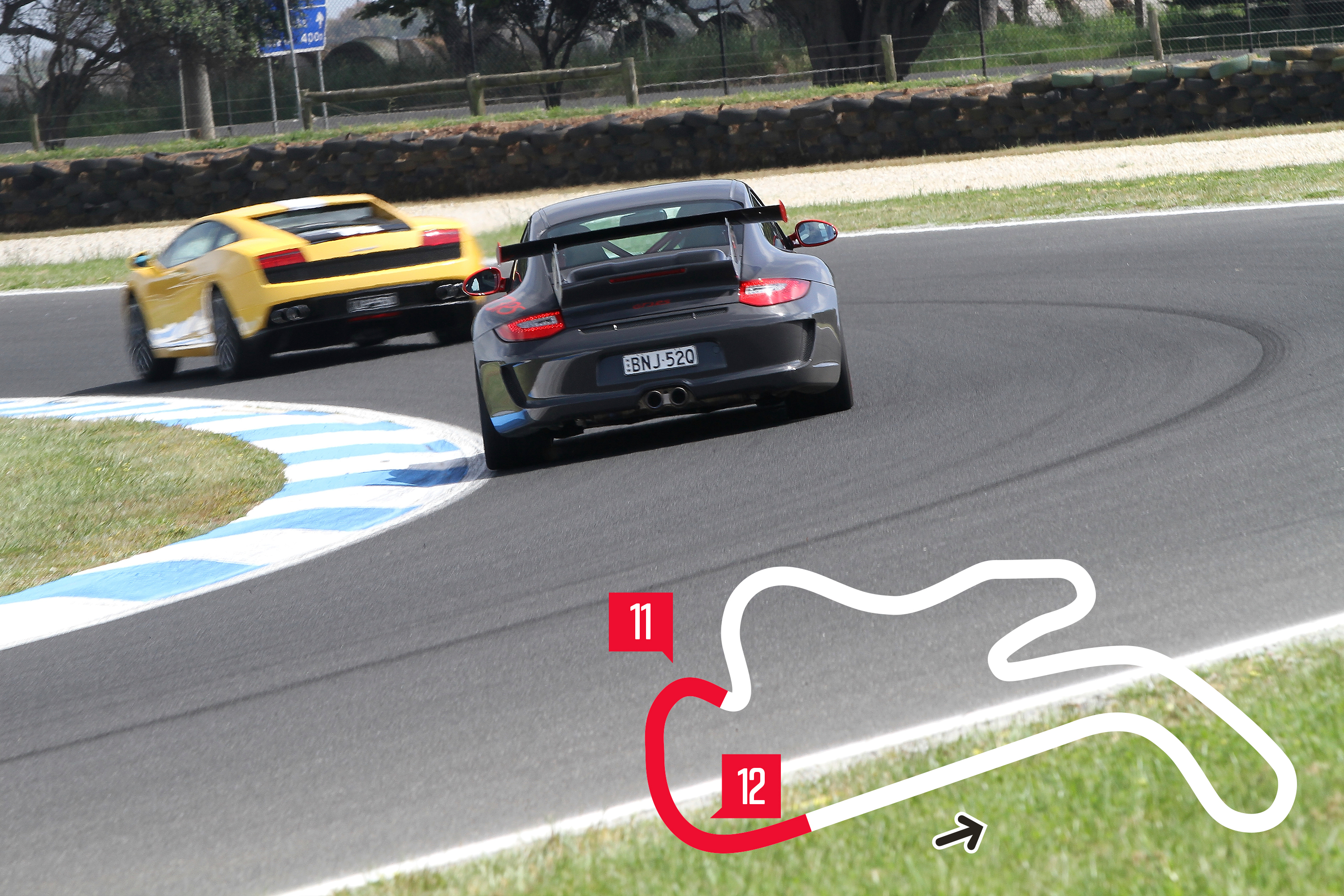
Turn 11
Usually in most cars it’s a short shift to third gear prior to turning in, so you use the lift-off and gear change to get a small amount of weight transfer to the front to help point the nose. It’s another early turn in and you use as much kerb as you can, keep your eyes up and be looking down to Turn 12.
This is all about building speed and momentum to be fast on to and down the front straight. Similar to the exit of Turn Two, don’t open the steering up too early as you head toward the exit, inertia will drag the car to the outside of the track.
Turn 12
Usually just roll off the throttle on entry – and I do mean roll off. If you snap off the throttle suddenly it can be enough to lose the rear. Again, this is all about maintaining as much car speed as possible to be fast down the main straight. You want to aim for your apex point to be opposite or just before the marshals post and you can use the inside kerb because like most it’s very flat.
Again keep your eyes up and focus down the straight not off the outside of the track. Physics will take care of pushing you wide, so don’t start opening up your steering at the apex too early.
MOTOR TIP
If you have a tail wind on the front straight you will have terrible understeer at Turns One, Two and 12, but really good braking at Turn Four because you have a head wind. Be mindful because it’s very easy to chase the weather as much as the car and track.
WHERE BRAVERY MEETS THE SEA
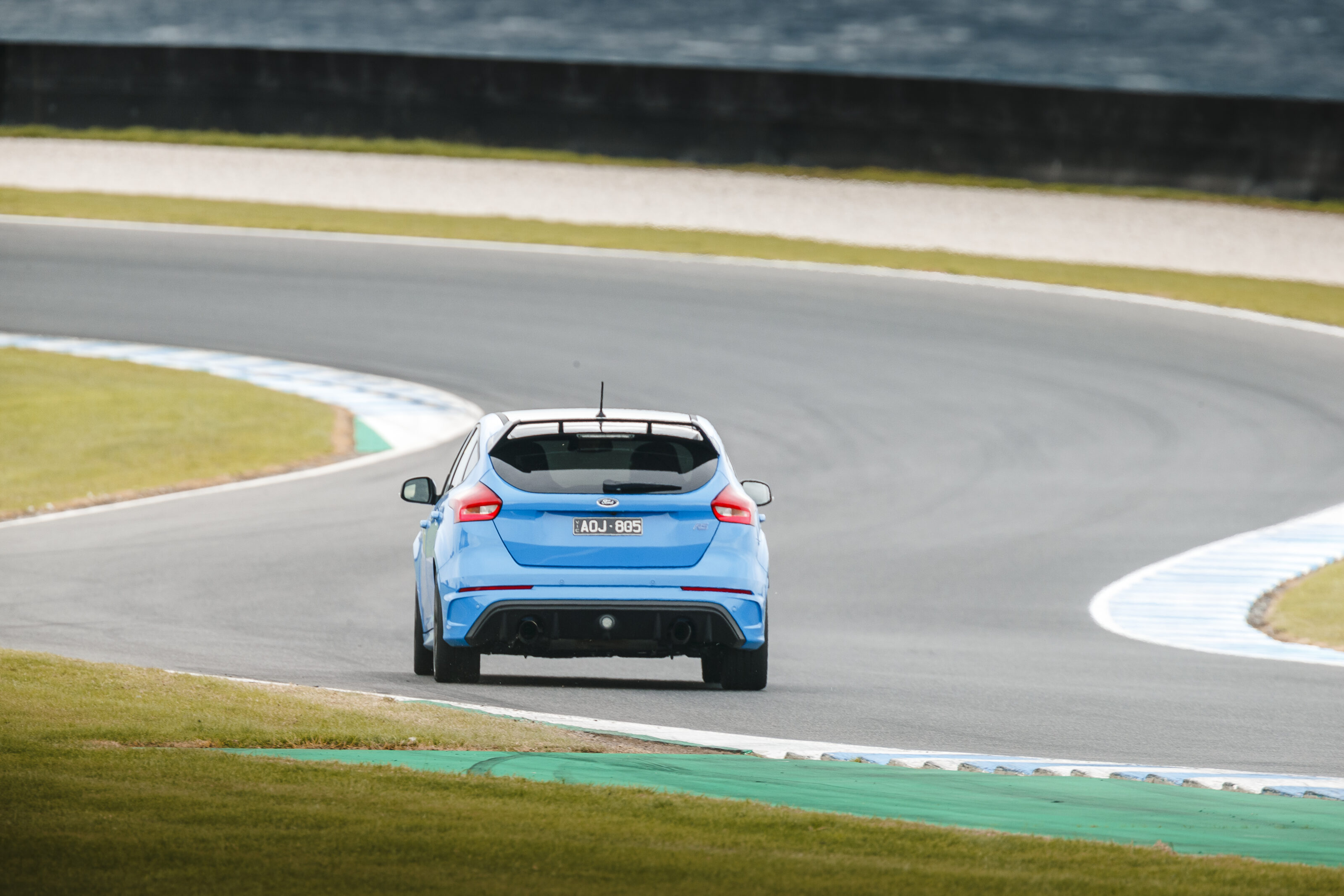
Jaw-dropping views and big commitment, PI doesn’t do things by halves
There aren’t really any bad places to watch the on-track action at Phillip Island – though Siberia didn’t get its nickname because of the track design.
The high speed nature of the FIA Grade 3 circuit means drivers in any vehicle are entertaining to see attacking the track. Famous for its motorcycle racing, we highly recommend making a trip to The Island when either the World Superbike or MotoGP circus’ are in town. Attending smaller events means you can park your car track side.
While Simon Wills holds the official track record, he isn’t the quickest person to lap Phillip Island. Matthew Radisich set a claimed 1:17.005 benchmark in his 2011-spec Dalarra IR-05 IndyCar during an unofficial practice day. Japanese race teams would frequently test at the venue in the early ‘90s, with Nissan’s test drivers reported to lap Phillip Island in the R90C in a time of roughly 1:18.

We haven’t conducted group testing at Phillip Island in production cars for some time, but Luffy’s benchmark figure in a Porsche 911 997 GT2 sits at 1:43.10. Using more modern metal, Porsche test driver Matthias Hoffsummer managed a 1:38.02 in a 918 Spyder.
If you haven’t mustered the required bravado to attack the full the circuit in your pride and joy just yet, there is a hire kart facility at the venue which offers budget thrills on a shrunken imitation of the full circuit’s layout. Divebombing your mates into Lukey has never been safer.
Phillip Island has been laser scanned, and can be driven in a raft of digital racing machines on iRacing.
WHO RUNS TRACK DAYS AT PHILLIP ISLAND?
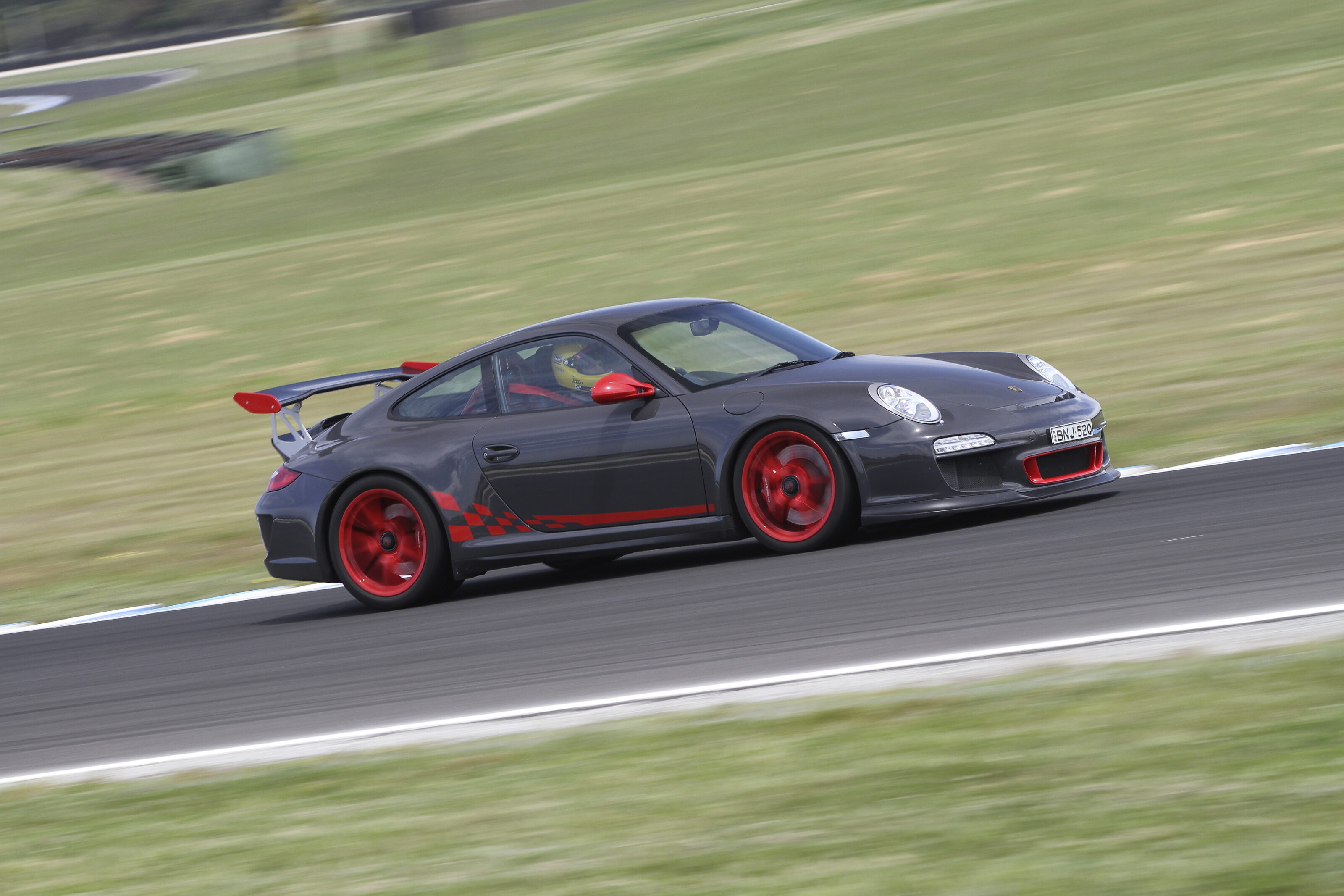
| Phillip Island Track Days | phillipislandcircuit.com.au |
|---|---|
| BMW Driving Experience | bmwdrivingexperience.com.au |
| Adrenaline | adrenaline.com.au |
| Audi Driving Experience | audi.com.au |
| Drive Events | driveevents.com.au |
Phillip Island Grand Prix Circuit key info
| Number of corners | 12 |
|---|---|
| Track length | 4.45km |
| Lap record | 1:24.22 Simon Wills, Reynard 940, Formula 4000 championship, 2000 (190.71km/h average speed) |
| Address | 381 Back Beach road, Ventor, VIC 3922 |
| Phone | (03) 5952 2710 |
| Opened | 1956 (GP Circuit) |
| Owner | Linfox |
| Distance from Melbourne CBD | 138km (2hrs) |
Snapshot
- Porsche scraps plans to build SSP-based electric vehicle
- Flagship model will now be produced alongside Macan and Panamera
- All three EVs will instead ride on the VW Group’s PPE platform
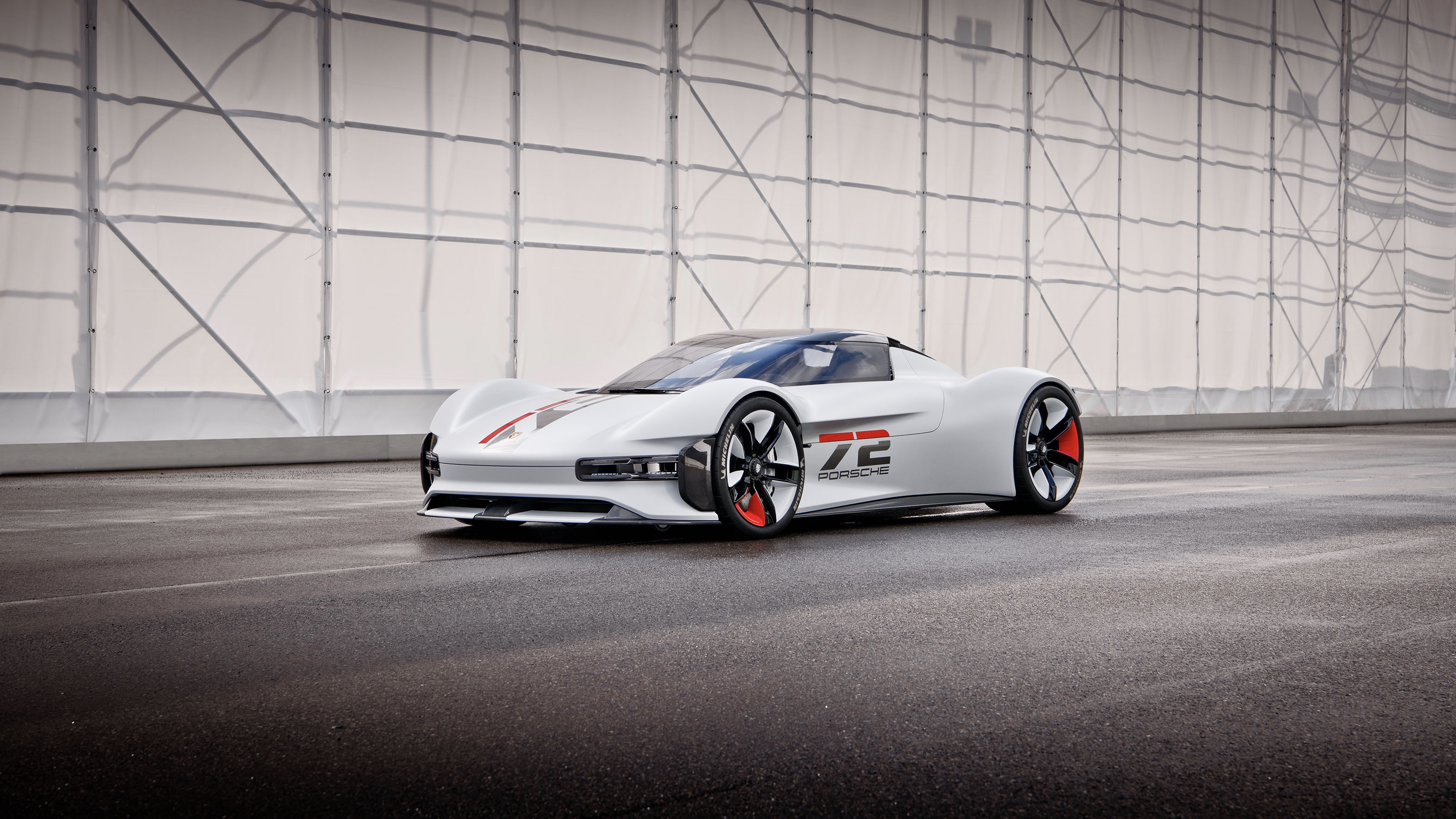
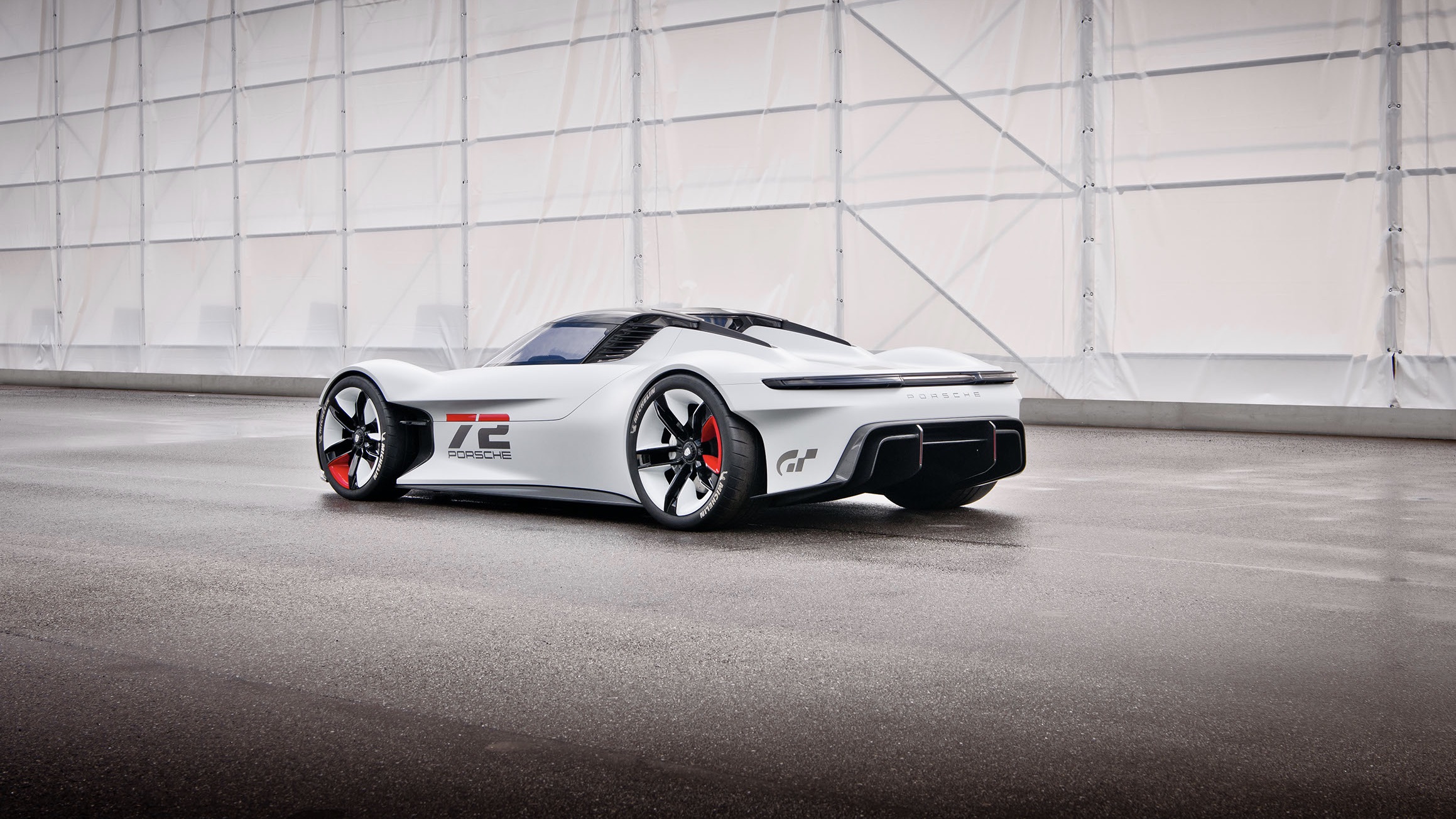
Porsche has scrapped plans to build a new technology-laden electric vehicle in Hanover, Germany.
The performance marque was in the early stages of developing a joint flagship EV with Audi, through the latter brand’s Project Artemis program – both based around the Volkswagen Group’s upcoming Scalable Systems Platform (SSP).
Bentley will also establish one electric model around the project, which is intended to showcase the best of the VW Group’s autonomous driving and energy efficiency capabilities.
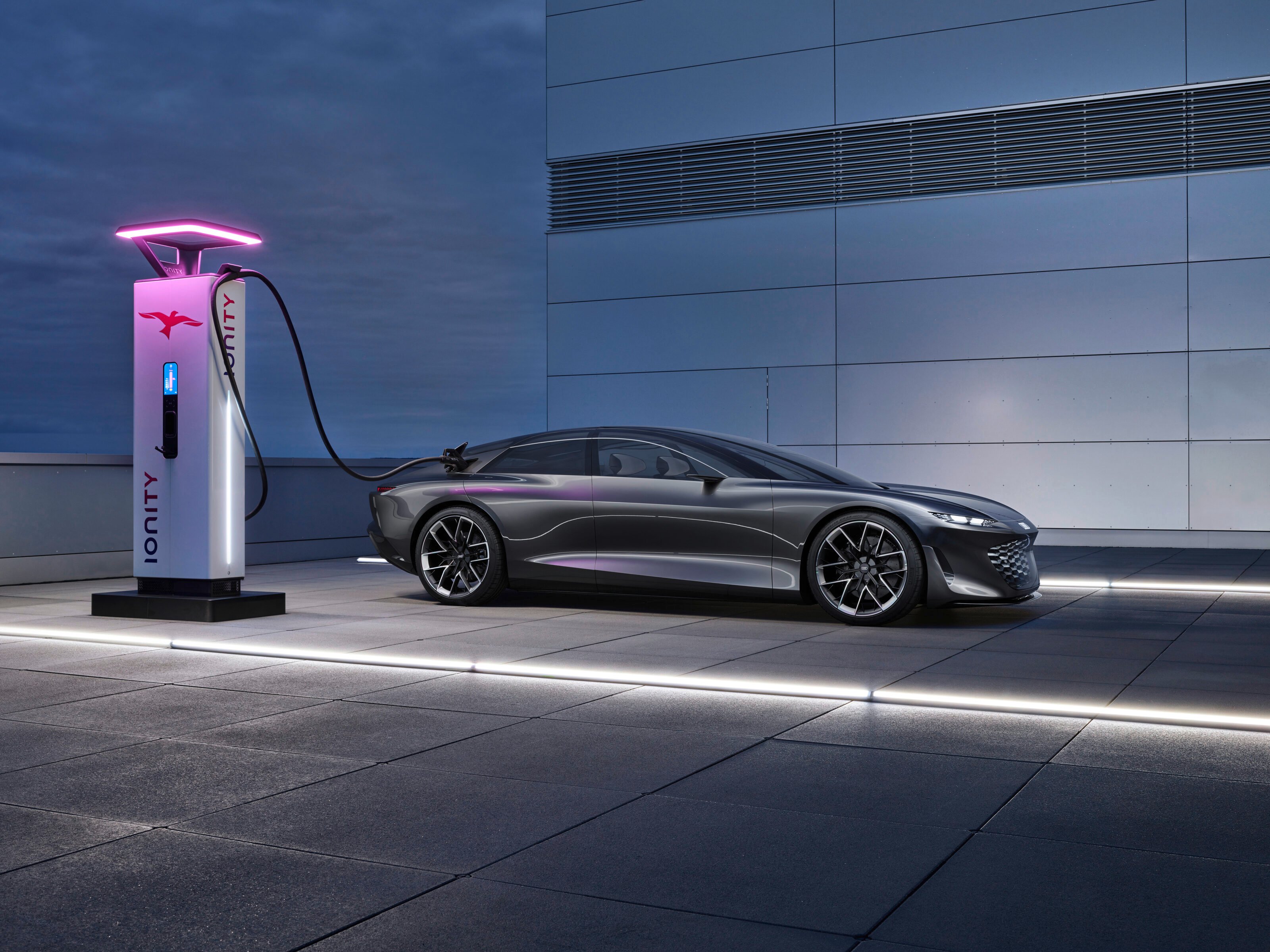
As per Electrive, Bentley has also thrown a spanner in the works for its flagship EV, with final production rumoured to now take place in England – with only the bodywork to be produced in Germany.
However, according to a new report by Automotive News, Porsche will pay around €100 million (AU$160m) to Volkswagen Commercial Vehicles after it decided to backpedal on the deal.
Porsche will instead manufacture its electric vehicle, known internally as the K1, at its Leipzig plant, which currently produces the Macan and Panamera.

Electric successors to both will also be built in Leipzig, with all to be underpinned by the Premium Platform Electric (PPE) architecture.
The 2023 Macan EV will become the first Porsche based around the platform, which will be shared with the Audi A6 E-Tron and Q5 E-Tron.
Production of the flagship PPE-based Porsche is now expected to commence in 2026 – around one year later than initial SSP plans – with an electric successor to the Cayenne also anticipated to arrive at a similar time.
The Hanover plant, which is operated by Volkswagen Commercial Vehicles, will construct the all-electric Volkswagen ID Buzz – set for debut on March 9 – and its ID California spinoff, as well as the forthcoming Audi and Bentley electric flagships.
In a press release published in December, chairwoman of the works council at Volkswagen Commercial Vehicles, Bertina Murkovic, said the brand had “disappointment at Porsche’s rejection of the Hanover site.”
It is believed the funds paid by Porsche will compensate Volkswagen Commercial Vehicles for the production of fewer SSP-based vehicles, with the now-scrapped flagship model projected for around 25,000 sales per annum.
The decision to move away from Project Artemis is believed to centre around the heavy focus on self-driving technology, with Porsche believing its buyers are more interested in performance than autonomous systems.
Snapshot
- Some retailers have stock, phone around
- Fuel stations on Hume Highway have run dry, but local servos better stocked
- Key manufacturers with vehicles requiring AdBlue are confident of dealer supply
UPDATE, January 25, 2022: Relief in sight, as large AdBlue delivery begins across Australia
A number of major carmakers with vehicles impacted by the ongoing AdBlue shortage are going through a feast or famine of the in-demand product, while retailers face the same uncertainty.
Having kicked off last month thanks to a dwindling supply of urea – the main component of diesel exhaust fluid (DEF) – there were fears that stocks of AdBlue (the trademarked name of DEF) would run out in Australia, bringing the logistics industry to a grinding halt as well as impacting a large number of passenger vehicles.
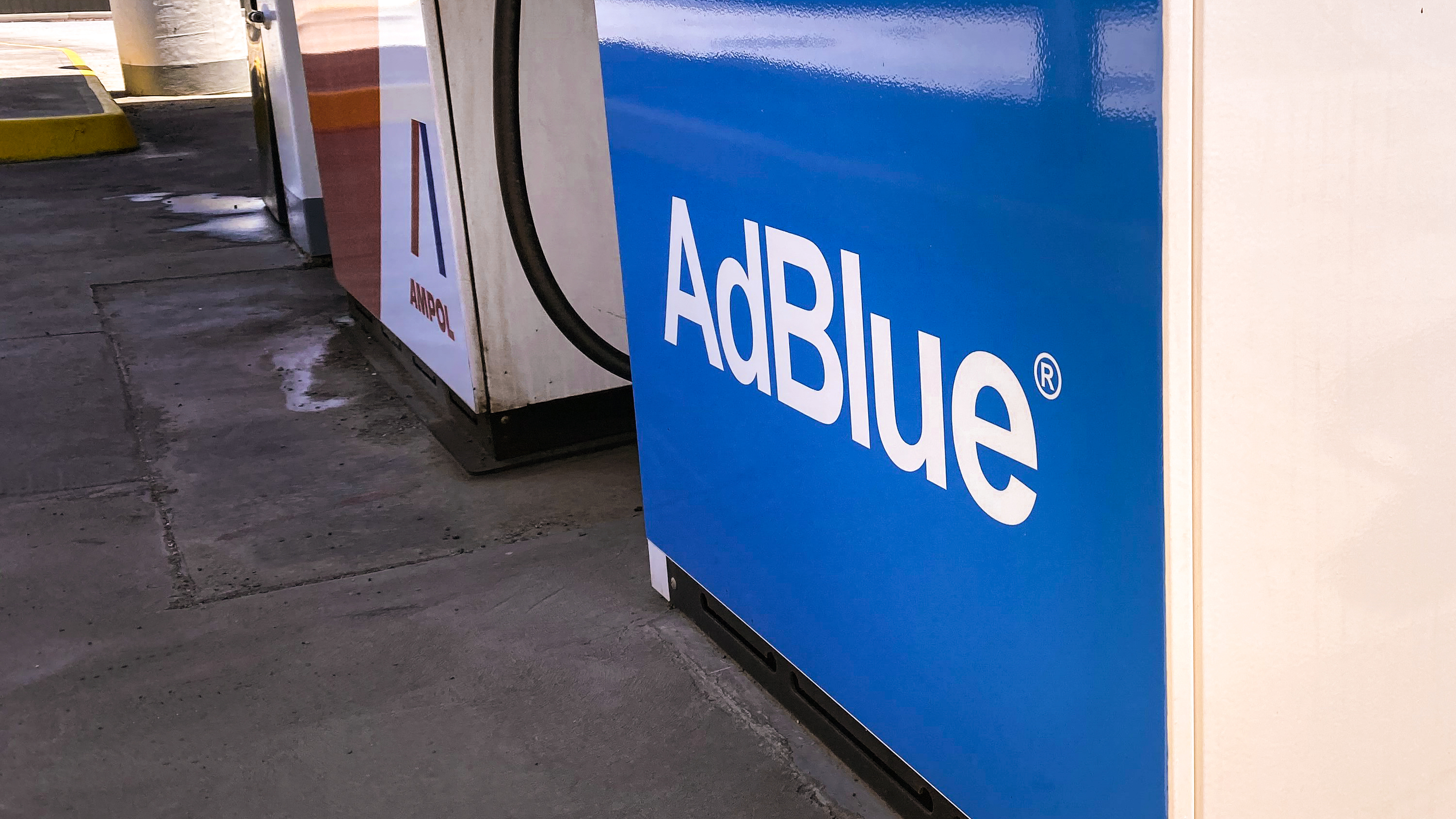
WhichCar contacted a number of high-traffic fuel stations along the Hume Highway between Melbourne and Sydney, with almost all outlets confirming they are out of AdBlue, both at the pump and in take-home bottled form.
So where can I get AdBlue?
We wouldn’t say the news is grim, but it isn’t great. You can get AdBlue if you hunt around, and these are your best options.
The shortage has hit a number of retail outlets which sell AdBlue in pre-packed containers, as many in Melbourne also say they’re out or have only low supply, leading motorists to struggle with refilling their tanks at home.
However, further north towards the Queensland border, a handful of BP fuel stations confirmed to WhichCar they had supply of AdBlue at the bowser, while some retail outlets in Brisbane said their shelves had recently been restocked, with demand having subsided lately.
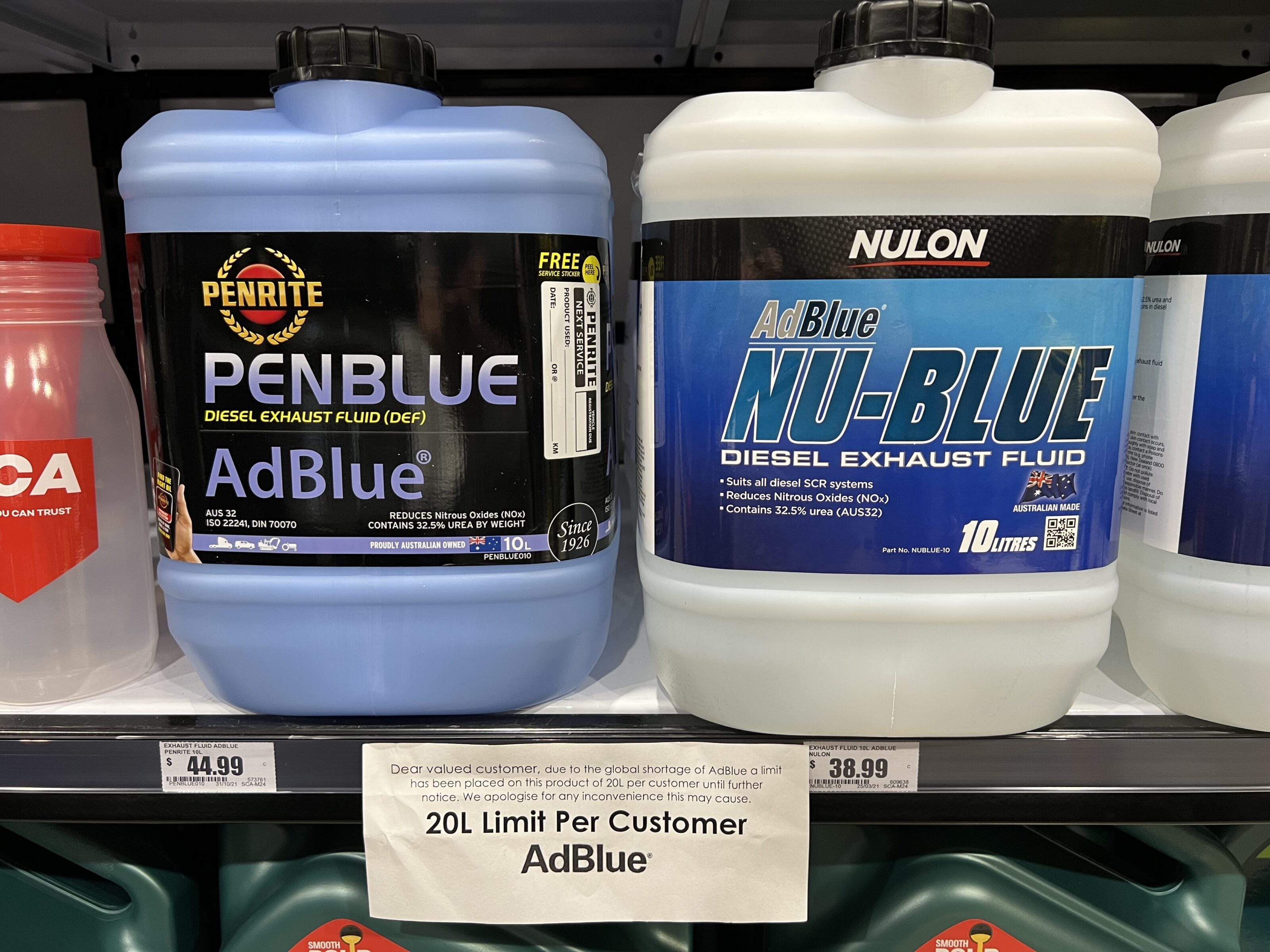
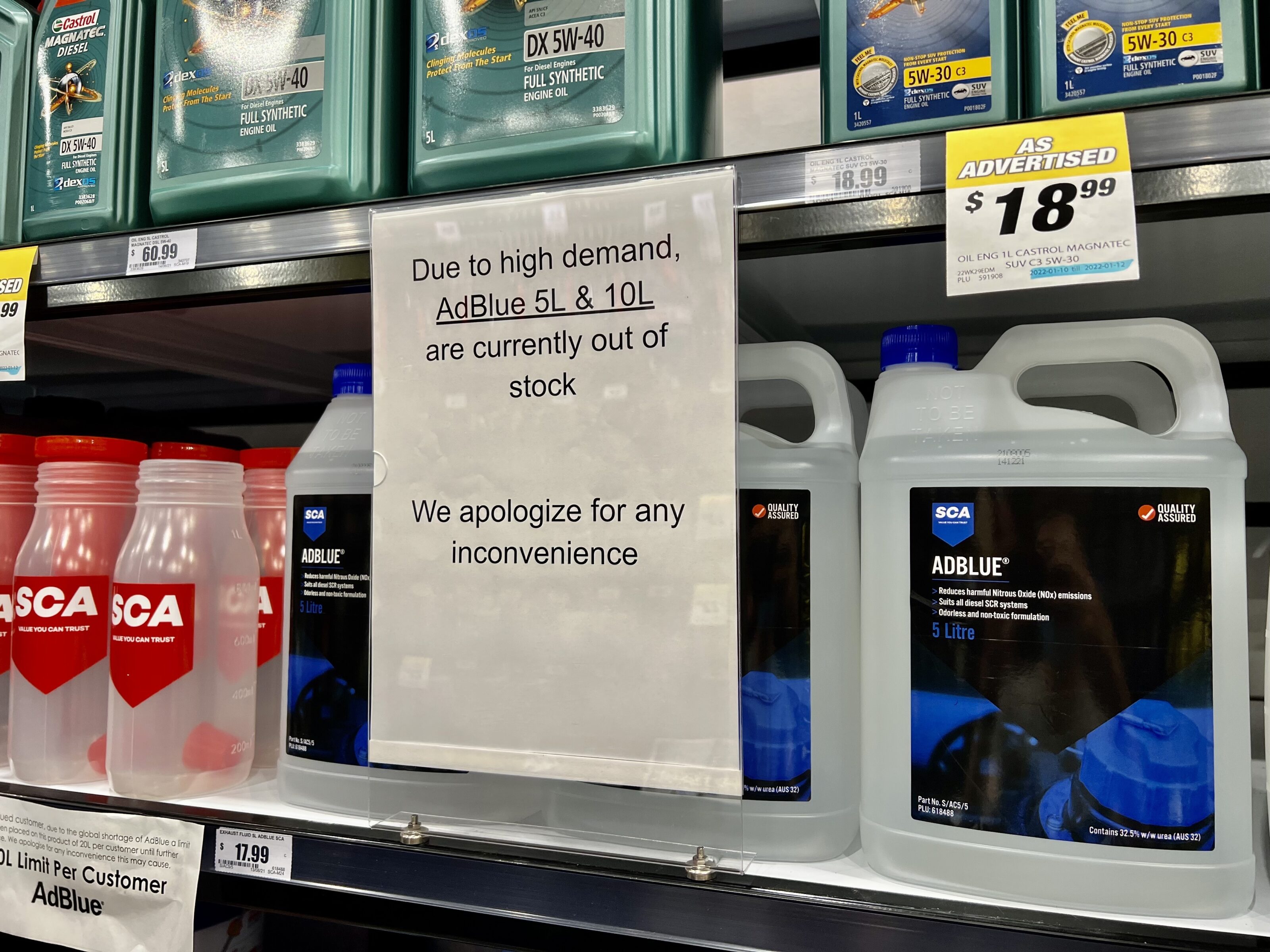
Within a one-kilometre radius, three retail stores – Supercheap Auto, Repco and Autobarn – all had mixed results.
While not available through their online store, walk-in Supercheap stores appear to have AdBlue products on the shelf – both their own brand and those from Penrite and Nulon – with a limit of 20 litres per customer, while Repco has stock and no explicit limits on the quantity which could be purchased.
NOTE: In both cases, stock appears to vary, so you should call stores before heading in.
The Autobarn stores we called were out of stock, with one sales assistant explaining that although suppliers had been providing AdBlue to the retailer, they are currently selling only to freight and logistics-based businesses. Private customers, we were told, would have to wait until February at the earliest.
Things are a bit different further south, though, as every Supercheap Auto, Repco and Autobarn store contacted in Sydney was completely out of stock with no timeline given as to when they were receiving more, other than Autobarn who again said their main supplier, Penrite, was advising a potential delivery in February.
Mixed availability continues across manufacturer dealer networks within Australia. A Jaguar Land Rover spokesperson was confident of AdBlue levels at its service outlets, telling WhichCar, “we are currently working with our suppliers to ensure ongoing supply of AdBlue and continue servicing our customer’s needs.
“Our retail (dealership) network is currently able to top up impacted vehicles to keep our customers mobile. We encourage customers not to panic-buy AdBlue.”
This was backed up by a call to a JLR dealer who said AdBlue was in stock and available to be purchase as a top-up for Jaguar and Land Rover owners. While owners can’t buy a pre-packaged bottle over the counter, the AdBlue top-up is included as a regular service item.
Mercedes-Benz Cars also said it was comfortable with stock levels internally. “Stock of AdBlue for authorised Mercedes-Benz passenger car service centres is managed centrally and distributed as needed.
“We have sufficient supply for the foreseeable future, and are closely managing stock levels and orders from the service network to maintain availability for our customers.”
“The top-up size of AdBlue (1.89L) is available for over-the-counter customers who may be running low and simply need a smaller refill for continued mobility.”
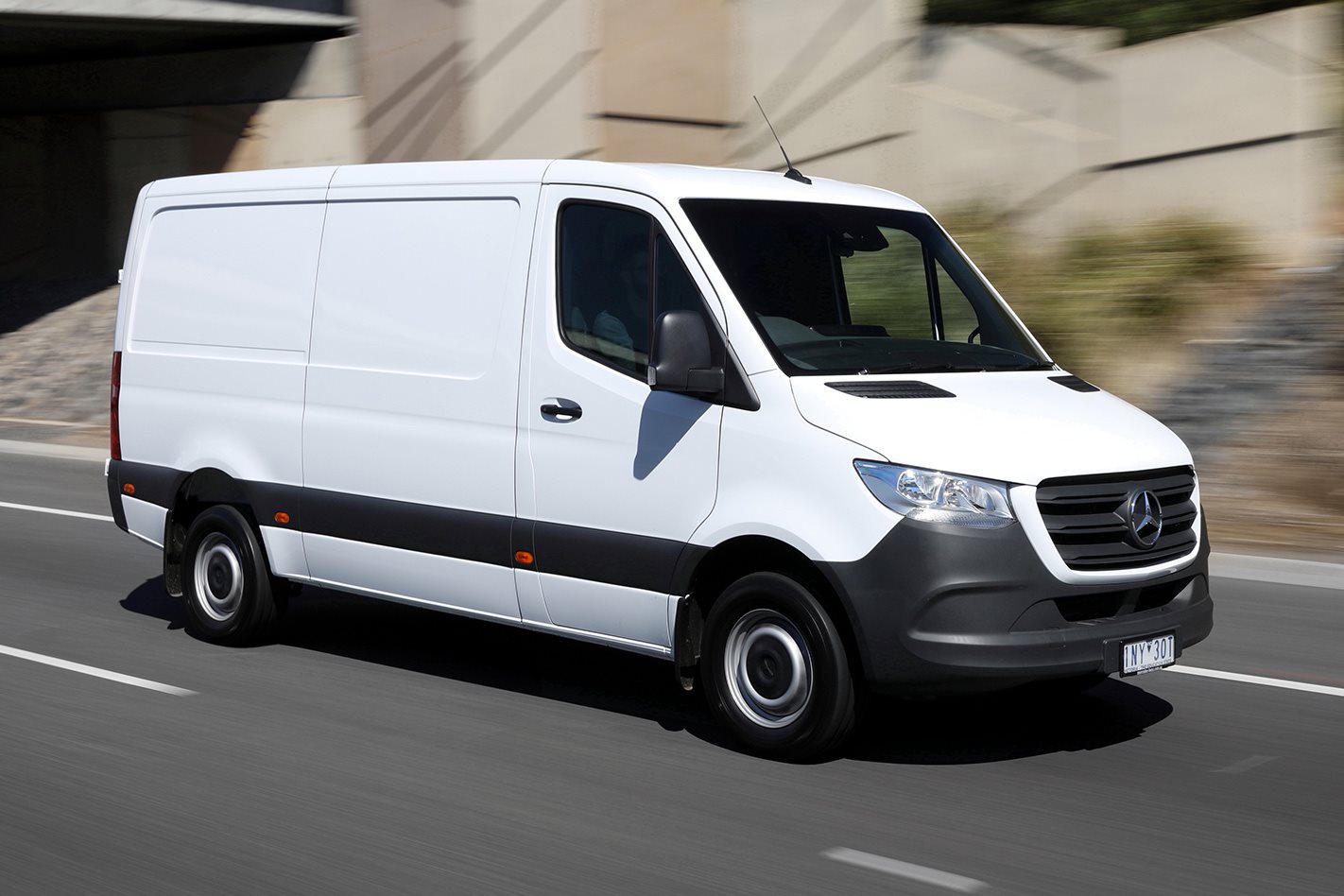
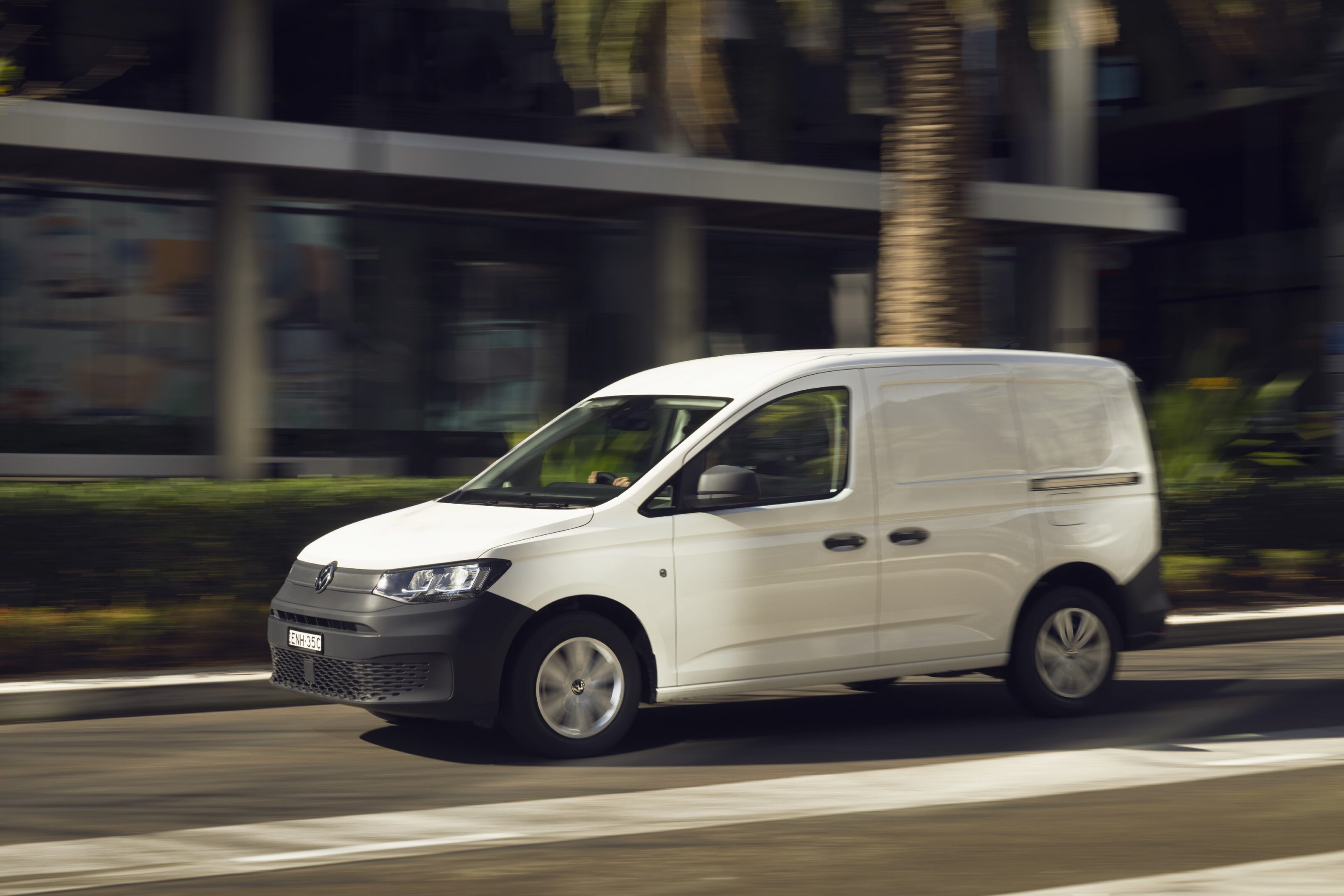
Volkswagen said it is currently monitoring supply levels, with a spokesperson reminding owners of how infrequently vehicles need AdBlue topped up – a reminder that, for most owners, there’s no need for crisis-level panic buying.
“The [Volkswagen] Group is monitoring supply. Its dealers are able to meet customer requirements.
“It’s worth remembering that with the given average annual distance travelled by private owners, AdBlue would require refilling at most twice a year.”
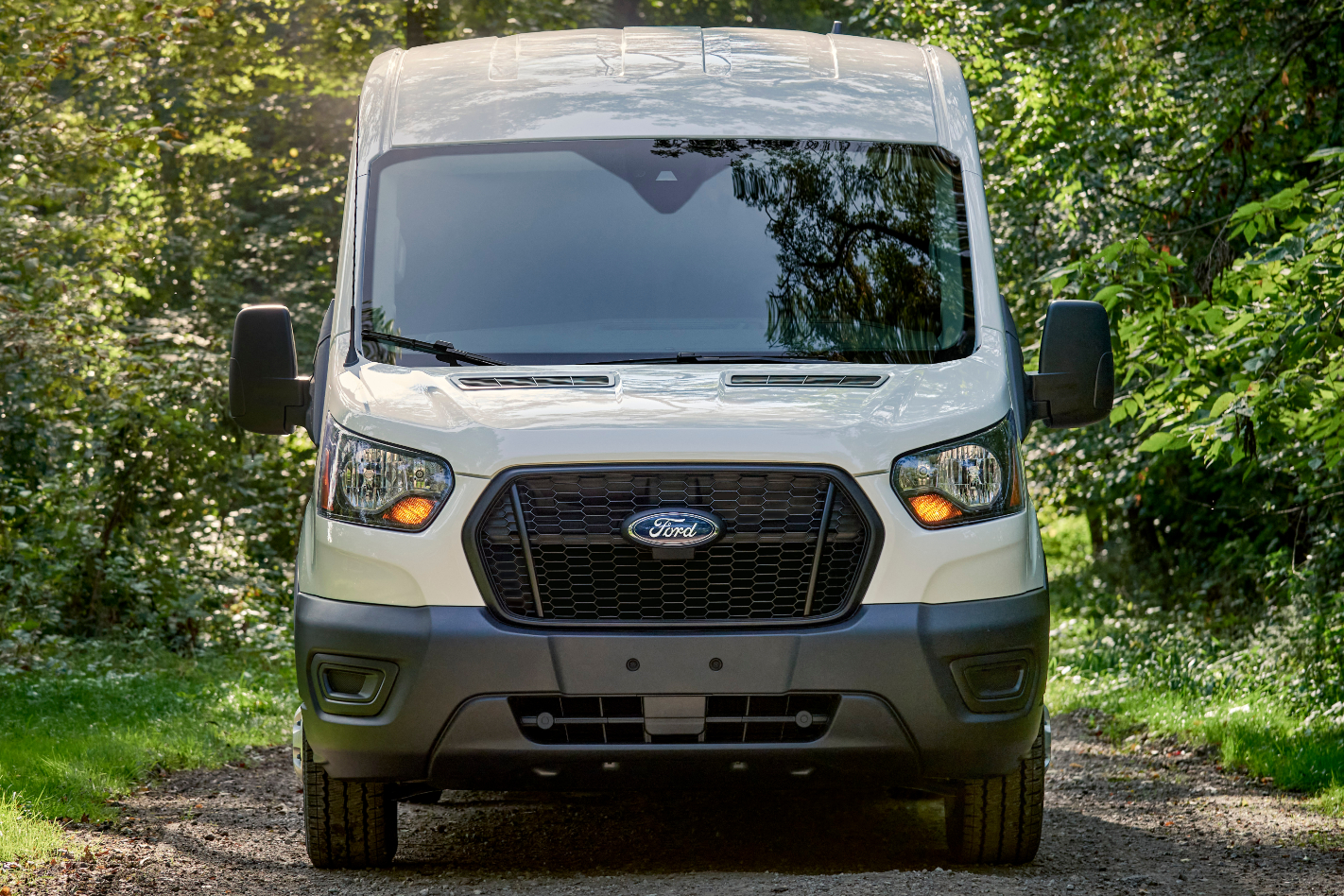
A Ford spokesperson was unable to offer as much certainty, confirming only that it is working with dealers to help keep customers informed.
“Supply varies from dealer to dealer, but we will work with dealers to ensure they have accurate information to communicate with customers,” said a spokesperson.
“We recommend that customers stay aware of the level of AdBlue in their vehicle and refill their tank periodically, paying attention to any dashboard warning lamps.
“To prevent their vehicle running out of AdBlue, if customers are unable to replenish their AdBlue at a Ford dealer, we recommend they seek to obtain AdBlue from an alternative supplier. Customers should also note the specific storage requirements and expiry dates of any AdBlue they purchase.”
WhichCar contacted a large Ford service centre in Brisbane which stated it was completely out of AdBlue, a problem it claimed was due to a lack of supply from Penrite. It’s worth noting this service department was located less than 10 minutes away from the aforementioned Supercheap and Repco outlets which had supply.
Penrite has been contacted for comment regarding its shortage of stock across Autobarn, Burson Auto Parts and Ford.
Prices of AdBlue vary from pump to pump and retailer to retailer, with pump costs hovering around $2 per litre while pre-packaged supplies can range from around $4/litre to $10/litre, depending on the overall size.
Most people will purchase the Chevrolet Silverado 1500 LTZ to tow horse floats the size of train carriages but you could make the case for buying it even if you’ve got nothing to haul at all.
That’s almost entirely down to the beguiling 6.2-litre atmo V8 under the bonnet, inserted to provide that unrivalled 4.5-tonne braked towing capacity courtesy of 313kW and 624Nm of twist. But it’s also one that – provided aforementioned equestrian train carriage is not on the hitch – makes this Yankee Doodle pick-up Australia’s quickest ‘dual-cab ute’.
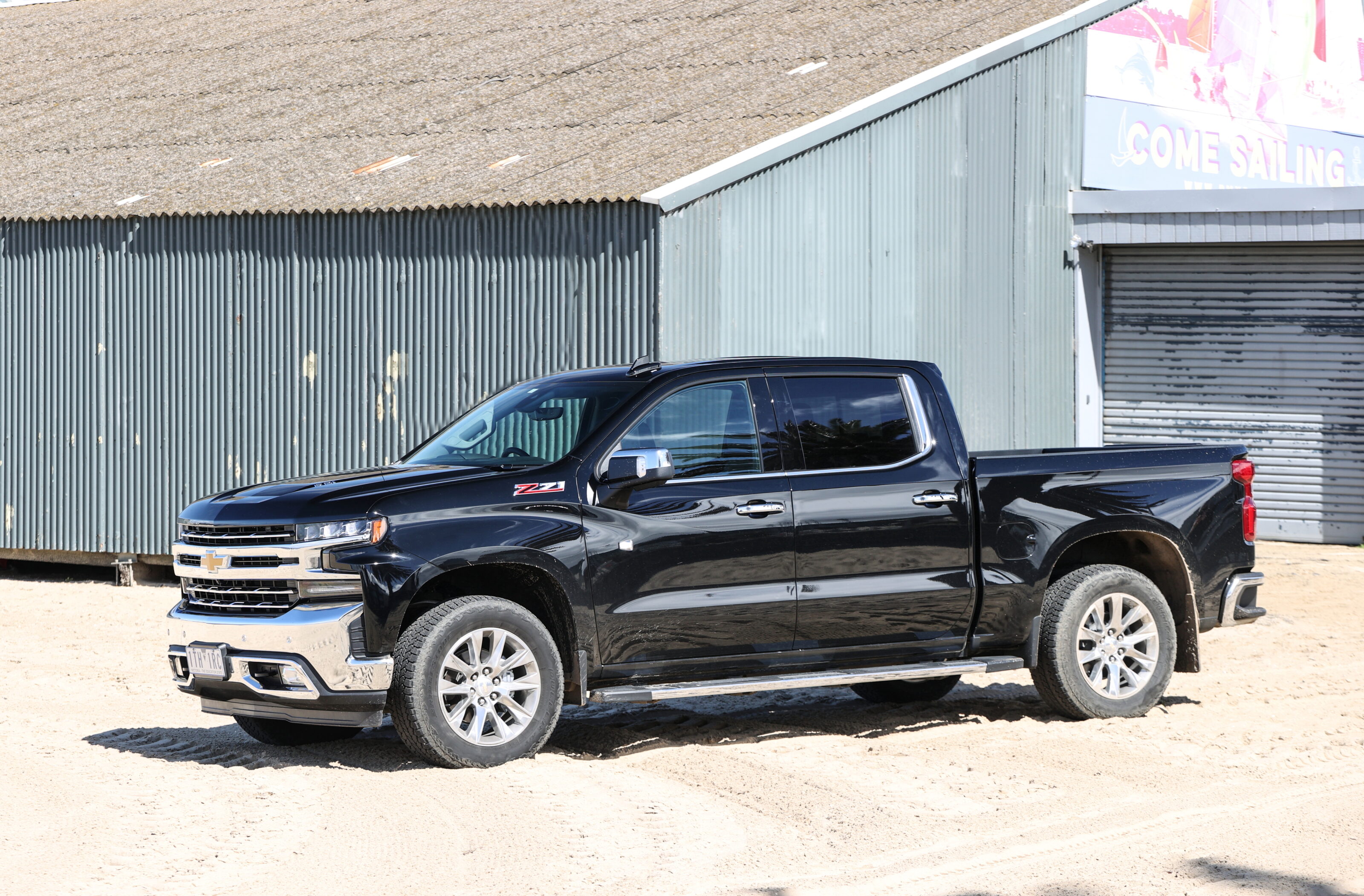
In our own drag strip testing we’ve recorded the Silverado 1500 LTZ snarling from 0-100km/h in a respectable (for a 2540kg behemoth) 6.4 seconds, on to a 0-400m time of 14.5 seconds. To 100km/h from rest, this American brute is a staggering 4.1 seconds quicker than Ford’s supposedly performance-focused Ranger Raptor (which we’ve recorded at a very lazy 10.54sec).
The Ranger Raptor and every other dual-cab ute in Australia are lucky the Silverado didn’t cop even more power again as part of a 2021 model year update now available in Australia.
Chevrolet has taken very much an ‘if it ain’t broke’ approach to its Silverado refresh as it holds off the bulk of changes – and a high-tech total interior overhaul – for the 2022 model.
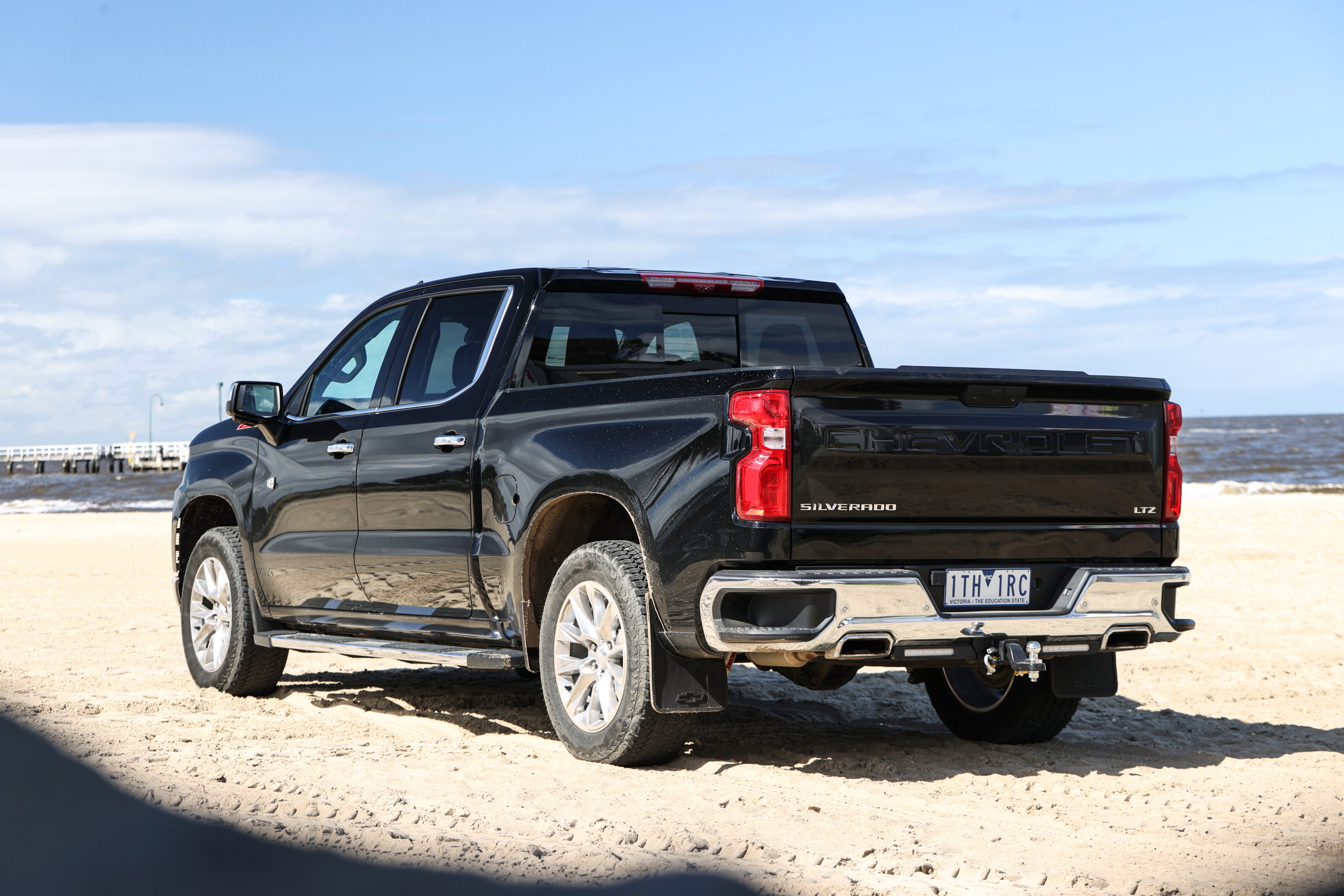
In the United States, the 2021 model year changes centre mostly around other Silverado variants, meaning the 1500 LTZ we get in Australia gets newly wireless Apple CarPlay and Android Auto plus a new rearward distance alert in the blind spot camera view when changing lanes with a trailer.
There are other very minor changes to the camera views – newly overlaid reversing lines, for example – and a new trailer Jack-Knife Alert but that’s about it.
In Australia the LTZ continues to sit atop a two-tier model range with the LT Trail Boss kicking off at $106,990 before on-road costs. A new Silverado 2500 HD is imminent, packing a 6.6-litre turbo-diesel V8 with as much torque as 1234Nm for those who’ve always dreamed of owning a tugboat on wheels. It will cost a slightly eye-watering $144,990 excluding on-road costs.
The LTZ Premium we’re testing today remains $114,990 + ORC, which is very expensive by Ford Ranger and Toyota HiLux standards, but buys you what would be a very highly optioned Silverado in the States.
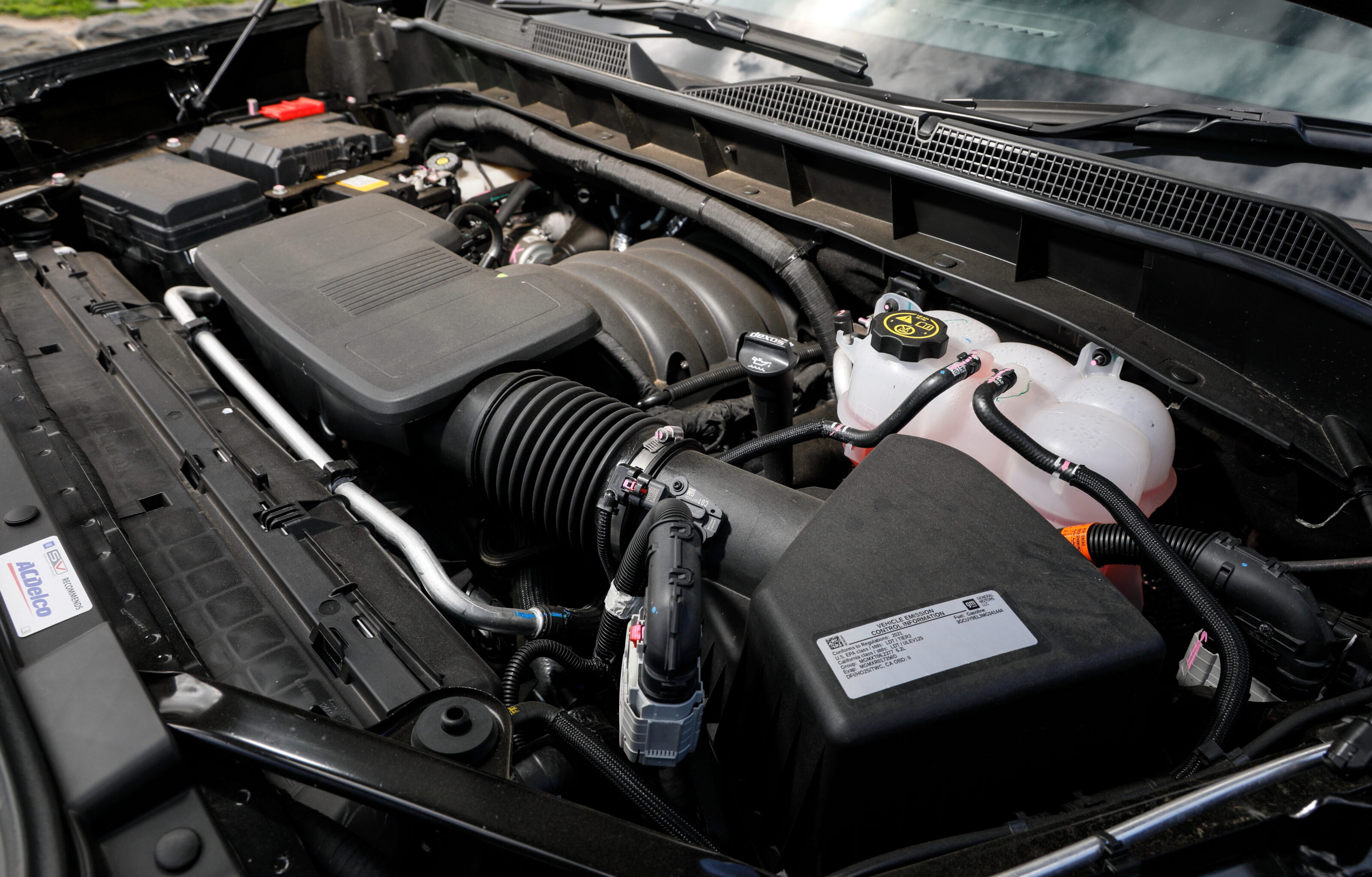
Nestled within the high, slab-shaped front end is that aforementioned 6.2-litre L87 V8 from the beloved LS family of engines that powered hot Holden Commodores for a generation. While it continues to spurn dual cams for pushrods, GM says it doesn’t need them and has instead equipped direct injection and cylinder deactivation, in a somewhat quaint attempt to improve economy and reduce emissions.
The big bore, naturally aspirated V8 sends its old-school grunt through a 10-speed torque converter automatic and a two-speed transfer case providing high and low all-wheel drive; and high rear-wheel drive. Left in its default automatic drivetrain mode the Silverado is effectively rear-drive, bringing in the front axle as traction requires.
Australian Silverado LTZs get the off-road Z71 pack that’s optional in the States, which bolts on trick Rancho dampers, that transfer case, a heavy-duty locking rear diff, underbody bash plating, off-road tyres and Hill Descent Control.
Packed to the gills, Aussie-delivered 1500 LTZs also get 20-inch wheels, an electric tailgate and a spray-on bed liner. Hard and soft tonneau covers are offered as options to cover a generous-sized tray with 12 standard tie-down points and a 760kg maximum payload.
To 100km/h from rest, this American brute is a staggering 4.1 seconds quicker than Ford’s supposedly performance-focused Ranger Raptor.

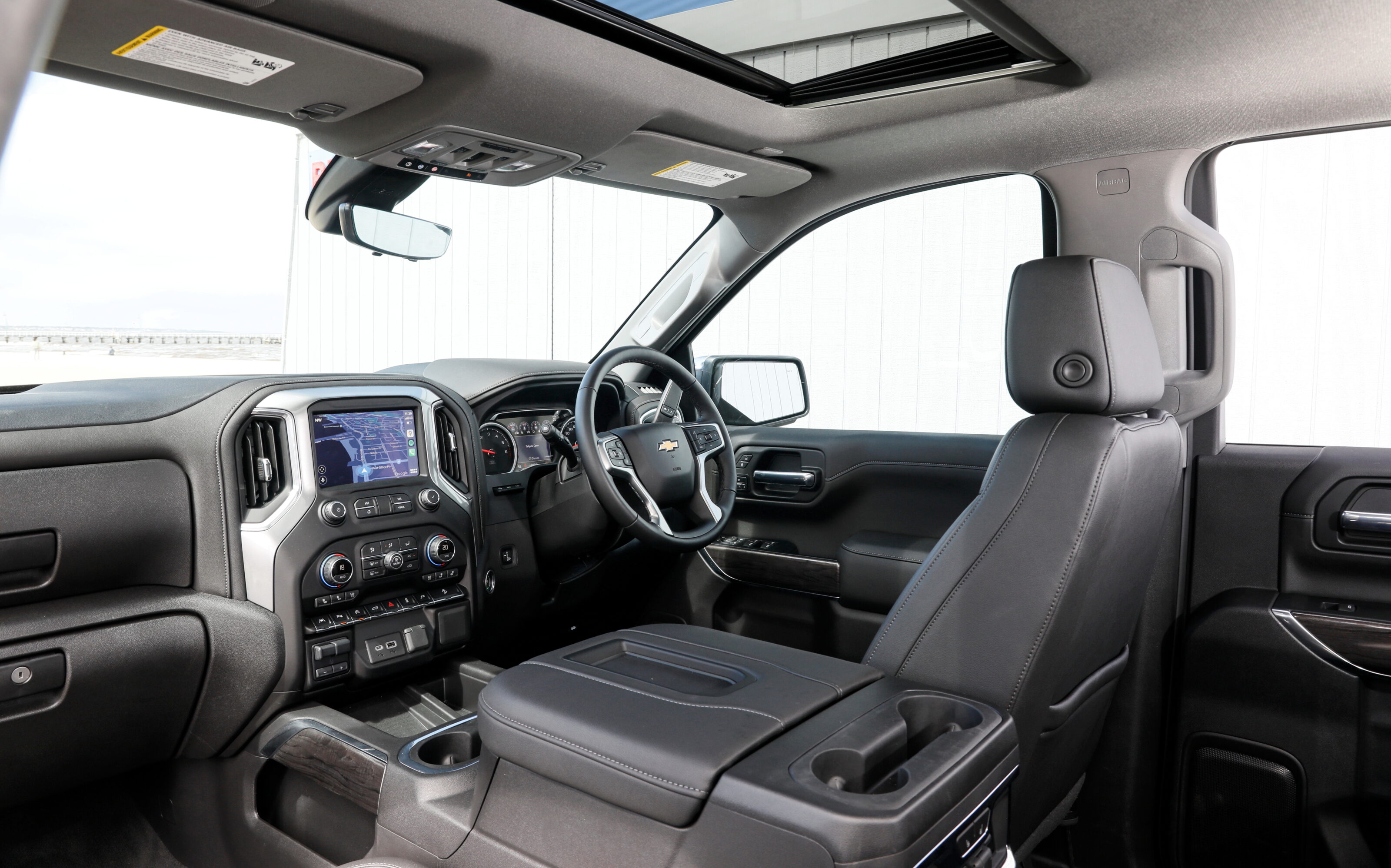
Inside, the smorgasbord of standard equipment continues. There’s leather-appointed, heated and cooled, 10-way power-adjustable front seats; heated steering wheel; sunroof; head-up display; seven-speaker Bose audio; adaptive cruise; low-speed Autonomous Emergency Braking; trailer brake controller; video rear vision mirror and a lot more.
A panoply of parking cameras are a game-changer once you’ve clambered aboard the towering Silverado. We counted seven cameras offering no fewer than 15 different views including a trick, birds-eye 360-degree perspective, but also forward and rear views for parking. There’s kerb cam for front and rear wheels on both sides, a camera offering a top-down view of the tow ball (perfect for solo trailer hitching) and a tray camera. There are additional provisions for trailer cameras if you have those installed, too.
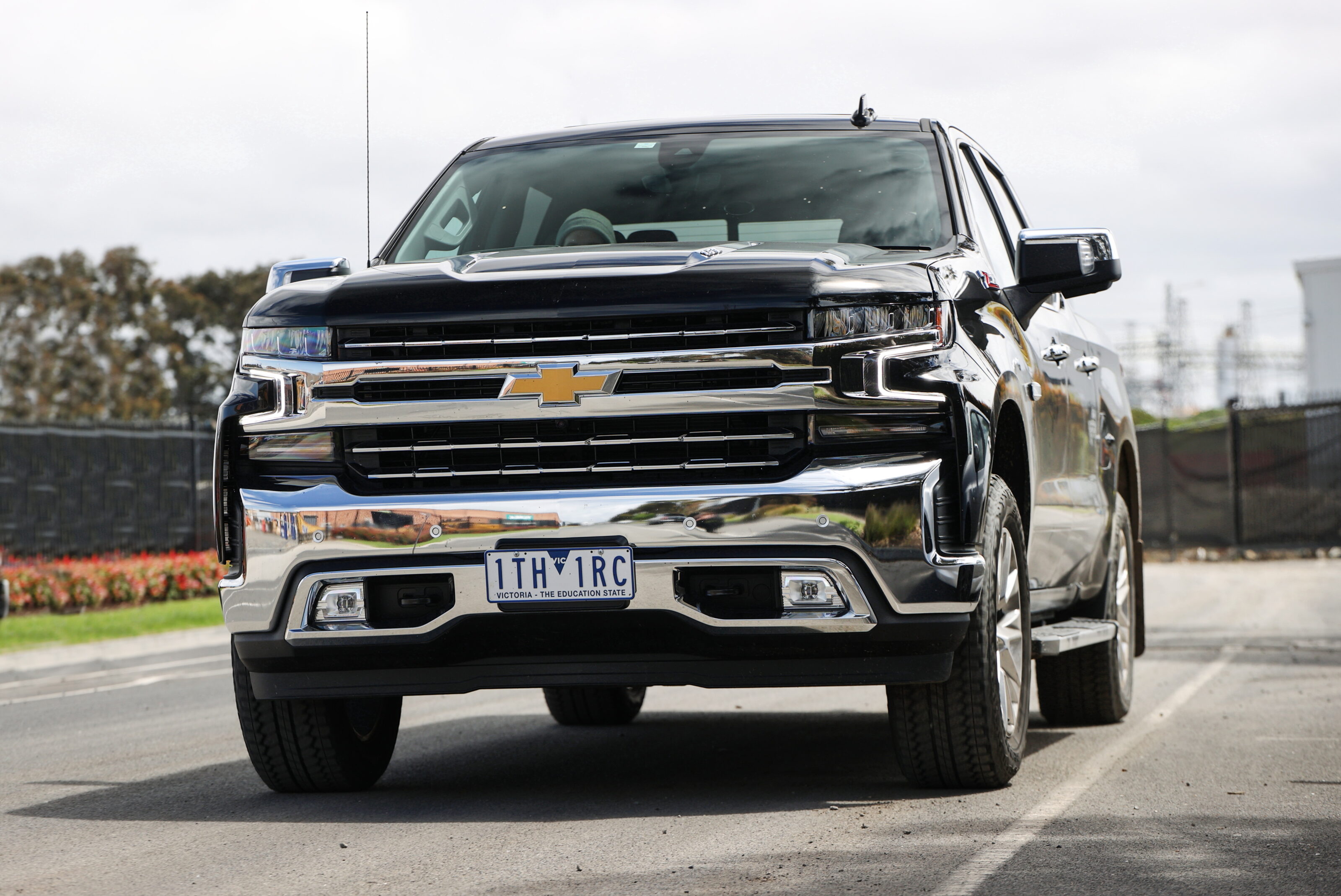
Without these cameras, the Silverado would be a very different beast to own and drive given – and it’s a bit of a broken-record theme with this vehicle – it’s so large. Approximately 60mm taller and 35mm wider than a dual-cab Ford Ranger Raptor, it’s the length that makes all the difference, at roughly half-a-metre longer in wheelbase and length.

In the inner city – or, to be fair, any Australian supermarket car park – the Silverado is almost impractically proportioned, feeling as wide as a three-seat sofa and always asking you to consider its length in some way. The front of it hangs out of a standard Australian car park space by a humorous distance. Fortunately, those excellent parking cameras and surprising manoeuvrability make the Silverado much easier than you’d expect – almost fun – to park.
Across the Pacific, this is just how they scale their dual-cabs but the roads, car parks and gas stations must all be another dimension larger than little old Australia. Fortunately, on country roads – where you can stretch the big Chevy’s legs – size concerns fade as you discover what is a comfortable long-distance cruiser.
Towing notwithstanding, this is where the Silverado excels, offering all the effortlessness you could ask for, beginning with American-sized seats that flatter the average-sized Australian into thinking maybe they didn’t put on as much COVID lockdown paunch as they first feared.
Ride comfort, general refinement and road noise are also good, although it’s possible to find yourself on a classically poor stretch of Australian country road that manages to upset the Silverado’s suspension in just the right way, making it annoyingly busy over bumps. This could possibly be countered with a bit of weight in the tray or, to be fair, a caravan the size of a small apartment.
While it’s tempting to pre-judge the Silverado as just a simple-minded contraption for towing, on its own it makes you feel like the king of the road with its sheer Hilux-emasculating dimensions and, again, that very likeable V8.
So likeable is that L87 engine, the Silverado would appeal a whole lot less with anything else. Plant your foot and the LTZ momentarily forgets its size as the V8 bellows a polite but crisp and perfectly audible induction note – we almost forgot what a good induction note sounded like. And you’ll absolutely be Googling aftermarket Silverado exhausts.
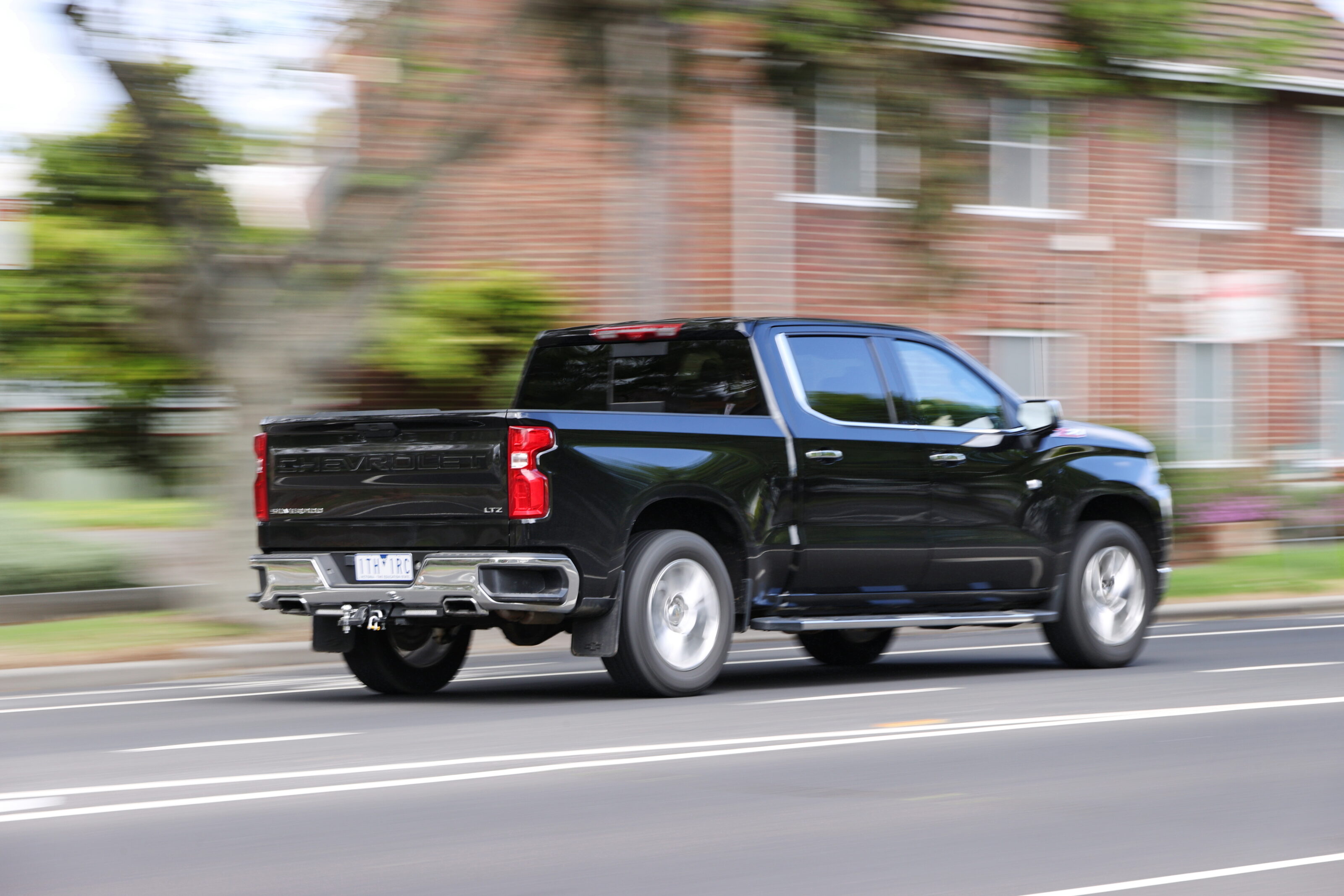
The V8 and the 10-speed auto are well-matched, delivering beautifully smooth everyday operation, the auto also offering pleasingly well-spaced ratios that more than a bit account for that energetic acceleration.
Approach a corner and decently direct steering, strong brakes and sorted suspension encourage you to get stuck in. The excellent V8 feels straight out of a sports car; the Silverado almost thinks it’s a Maloo. However, while it’s pretty good up to about six or seven tenths, ultimately it starts wilting dynamically if you push any harder.
A ladder chassis, live rear axle, leaf springs and near four-metre wheelbase can only do so much. But it certainly handles better than it needs to, and a lot of that has to do with its relatively light 2540kg weight. It’s also quite fun on dirt in rear-drive mode, although the ESC can only be turned off at speeds up to 60km/h.

Of course, the big Silverado is not without its flaws, the biggest of which has to do with the interior ambience for the $115K price. While Walkinshaw has done a faultless job of converting the Silverado to right-hand drive here in Australia – it might even be better built the second time around – the interior feels like that of a $75K car itself based on a $30K car. To use a Commodore analogy, a Calais is itself a tarted-up Evoke. The Silverado is like a Calais that costs $115K.
Anyone coming from your standard fare dual-cab ute will likely be very happy with the Silverado’s interior but if you own anything with a German badge on the front of it – and at $115K for the Chevy, you very well might – you’ll find the Silverado’s interior at best ‘nice enough’ and at worst, averagely built and cheaply appointed.
At $115K you’ll find the Silverado’s interior at best ‘nice enough’ and at worst, averagely built and cheaply appointed.

While the engineering talent feels to run deep in the Silverado, surface-level refinement – again for the price – is merely satisfactory. Call us nitpickers but the air-conditioning compressor could be heard whirring away at lower speeds like a bearing was going.
Carry a bit of speed into a corner with some mid-bend corrugations and you might encounter some nasty steering rack rattle. In the rain, water can be heard washing inside the front wheel arches with crass loudness.
To be fair to the Silverado, you don’t really buy this vehicle for the finest in luxury motoring and for what it does offer, $115K could be seen as a bit of a bargain. Especially considering in the USA, the exactly-specified Silverado would cost about A$82K. To have it shipped to Australia and converted to right-hand drive to a high standard for just $35K extra isn’t terrible. GMSV could almost have charged more.
It’s also – and perhaps this is beyond obvious – very thirsty. We measured 14.7L/100km in mixed, slightly enthusiastic driving. You’re looking at more than $150 at current petrol prices to fill its 91-litre fuel tank, although it is a nice feeling seeing 950km of available range. Obviously, this all changes again the second you use it for towing.
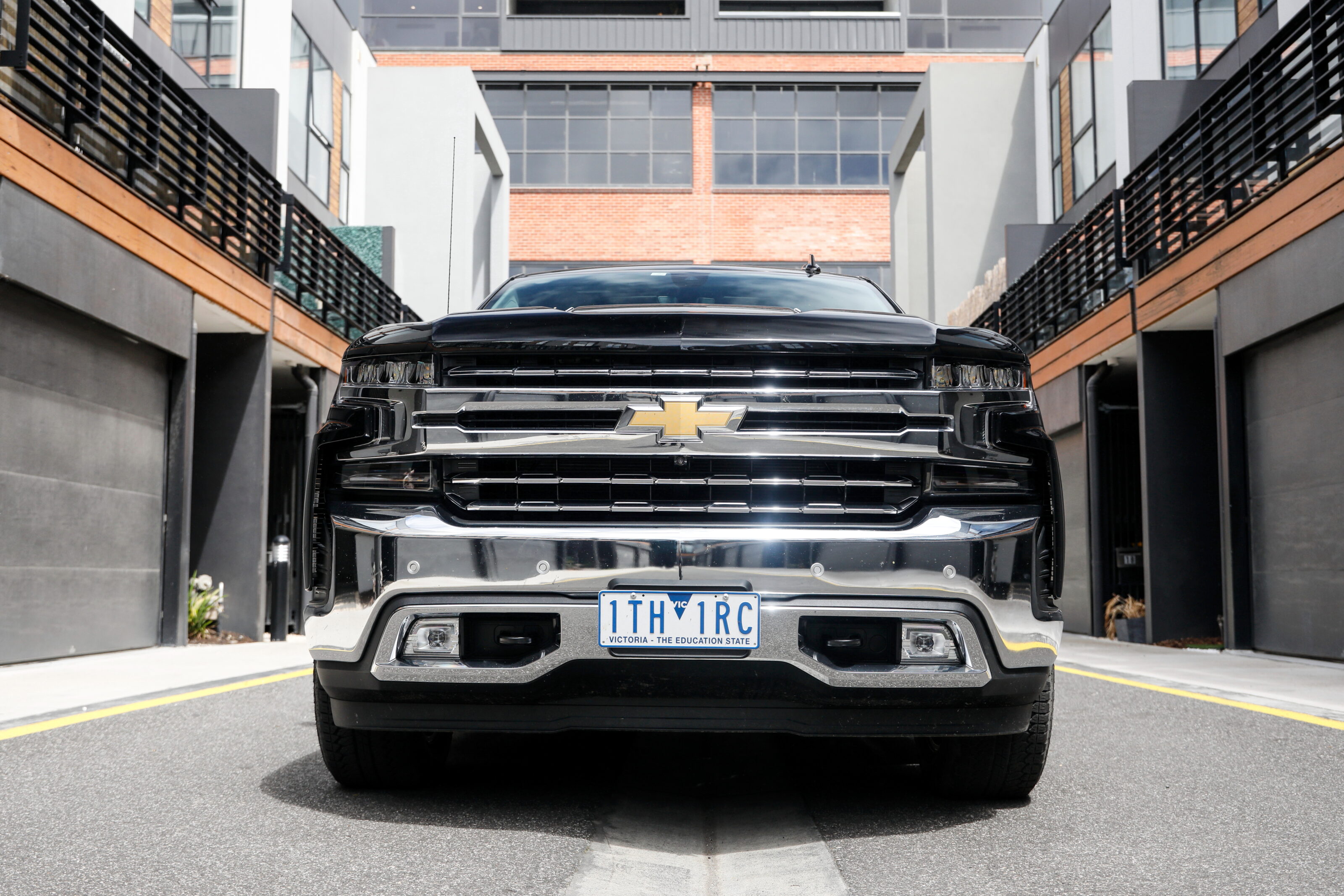
One thing the Silverado also deserves credit for is offering another level of versatility again above the standard-fare Australian dual-cab ute. It’s just another scale bigger. The tray is almost large enough for a double mattress (if you squished it in there a bit). The back seat, meanwhile, is as if made for NBA players with an almost unnecessary quantity of leg and knee room. Four 180cm-plus adults would fit comfortably.
The Silverado is offered with a three-year, 100,000km warranty which includes complimentary roadside assistance. Service intervals are 12 months or 12,000km, whichever comes first. In Australia it doesn’t really have any direct competitors beside the RAM 1500.
Both come with huge V8s, are about as quick each other, the same size and offer the same 4.5-tonne braked towing ability. The Silverado is pricier but the newer generation vehicle and nicer to drive. In America the ‘big three’ pick-ups are the Silverado, RAM and Ford F-Series but the Blue Oval doesn’t offer its F150 in Australia (somewhat inexplicably, as it would surely be popular).
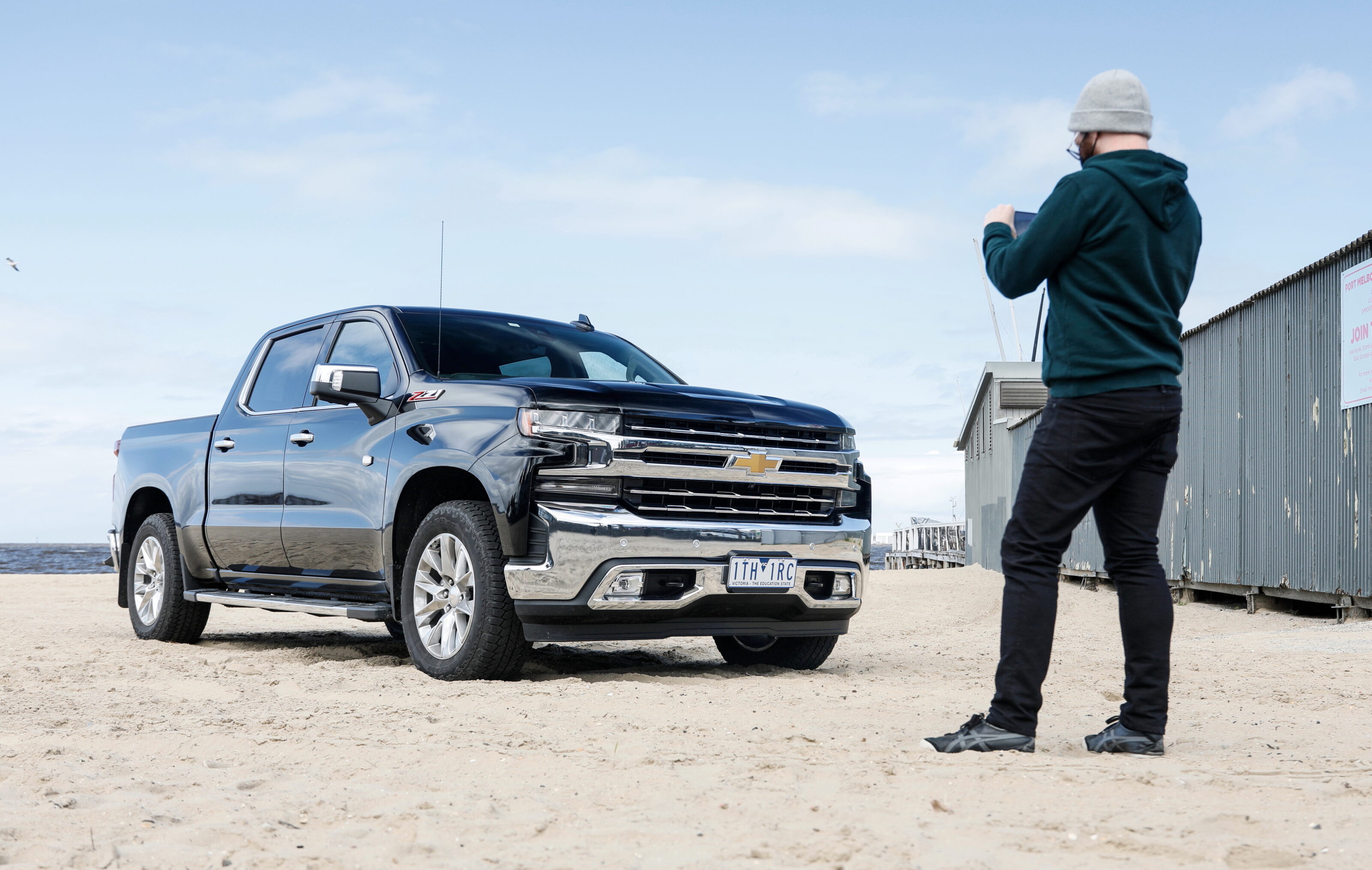
In the final reckoning, the Silverado will be bought mostly by those who need to tow, and while this is not a towing test by any measure, they’ll find probably the best vehicle in Australia for such a task.
But those with a bit of cash to burn who’ve been waiting for a V8-powered Ranger Raptor, could find the big Chevy ute tiding them over – especially if they’re not averse to some aftermarket accoutrements.
2021 Chevrolet Silverado 1500 LTZ size comparison
| Length | Width | Height | Wheelbase | Weight | |
| Chevrolet Silverado 1500 LTZ | 5931mm | 2063mm | 1933mm | 3750mm | 2540kg |
| Toyota LandCruiser 300 Sahara ZX | 5015mm | 1980mm | 1950mm | 2850mm | 2610kg |
| Ford Ranger Raptor | 5398mm | 2028mm | 1873mm | 3220mm | 2376kg |
| Jeep Gladiator Rubicon | 5591mm | 1894mm | 1909mm | 3488mm | 2242kg |
| RAM 1500 Laramie Crew Cab | 5833mm | 2080mm | 1917mm | 3569mm | 2650kg |
| Mercedes-Benz G400d | 4669mm | 1931mm | 1969mm | 2890mm | 2489kg |
| Toyota HiLux SR5 | 5325mm | 1855mm | 1815mm | 3085mm | 2055kg |
2021 Chevrolet Silverado 1500 LTZ specifications
In the last four weeks, I’ve driven three cars which were so obscenely powerful that I hardly ever used full throttle. Now I’m terrified I might be one of those stupid people who believe modern cars are too fast.
The first was Porsche’s fastest SUV to date – the Cayenne Turbo GT – and while its 4.0-litre turbo V8 pumps out a respectable 471kW it feels like a lot more when you’re trying to drive it in an unseasonal blizzard. Next was the Ferrari 812 Competizione – a car that musters a phenomenal 610kW from its naturally aspirated V12 but when it’s at the Fiorano test track in the pissing rain the engine feels as though it’s fuelled by pure distilled evil.
And then there was the McLaren 720S which might only have a paltry 530kW by comparison but weighs about 1400kg and has to send its full might to the ground through just two contact patches.
Regardless of the vehicle type, powertrain or purpose, each of these cars is fast in a way that suggests Isaac Newton was wrong about something. Both the Ferrari and McLaren will deliver your mortal frame to 100km/h from a standstill in less than 2.9 seconds and the sensation is something you can never fully prepare yourself for. Imagine being hugged and assaulted simultaneously and you’re half way there.
The Brit has the tighter of the gear ratios and, with your toe buried in the bulkhead, it’s almost impossible to pull the upshift paddle fast enough to keep up with the flat-plane crank V8. It’s not a lot different in the 812, the key difference being that the awe-striking accompanying soundtrack is coming not from a rear-mid-mounted engine behind but from ahead. I honestly felt like the old lady in the Aphex Twin track Come to Daddy.
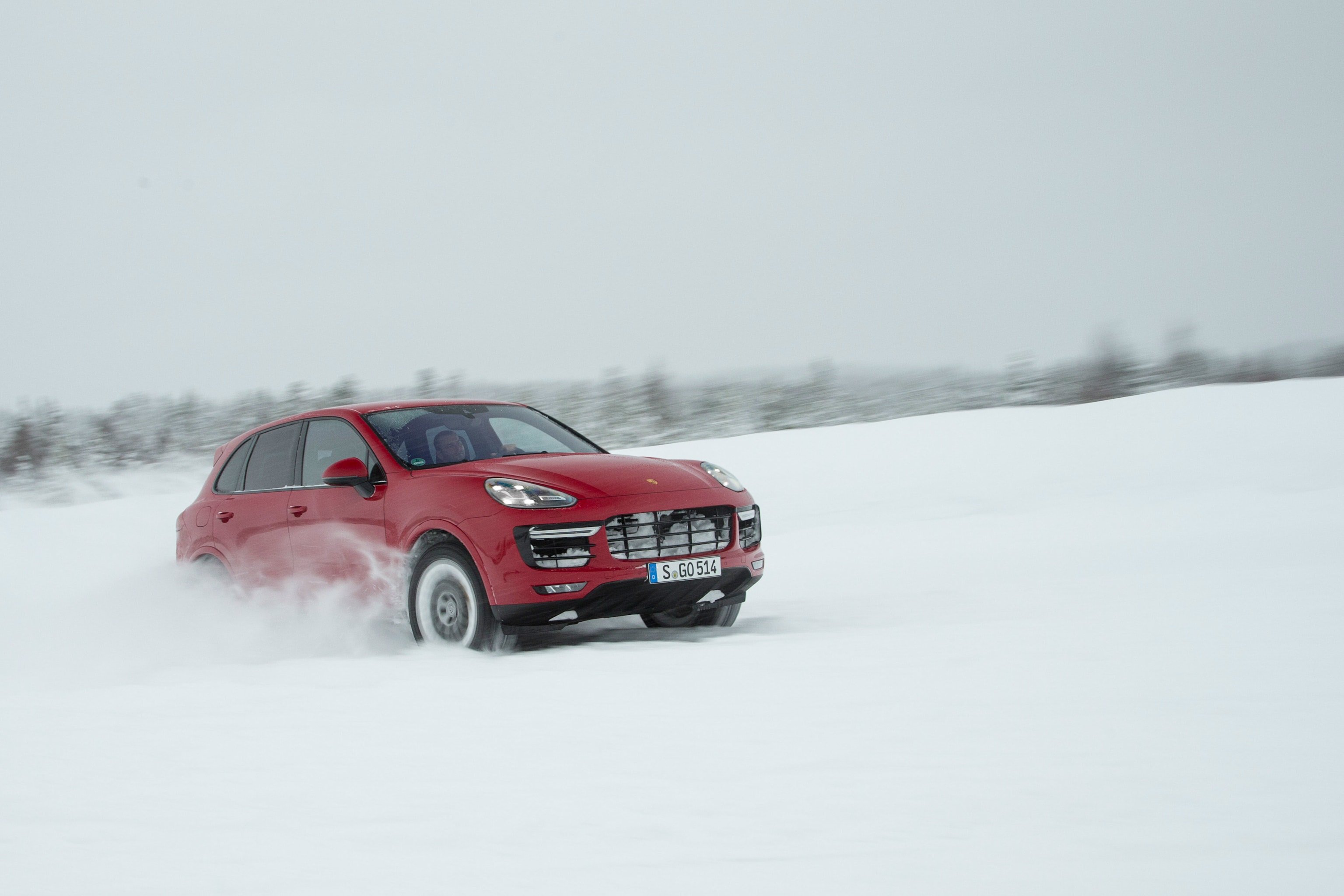
The Porsche delivers its knockout punch differently but just as violently. While the supercar pair save their most offensive acceleration for the dizzying heights of the redline, the Cayenne feels like it’s trying to snap all its wheels off at any engine speed and in any gear. I’ve never driven a combustion-powered car that delivers full torque (850Nm) so eagerly and instantly that it could have been electric. Under normal circumstances, the GT is wickedly fast but when you throw an early winter snow fall into the equation, each application of throttle feels like flicking elastic bands at an unrestrained pit bull.
And yet here I am sitting at my desk with all my arms and legs attached and, even more amazingly, all three cars are back with their respective owners in perfect condition. How is it possible that I managed to unleash a total of 1611kW in the snow and rain without any period of familiarisation or special training and I am not dead? It’s actually very simple.
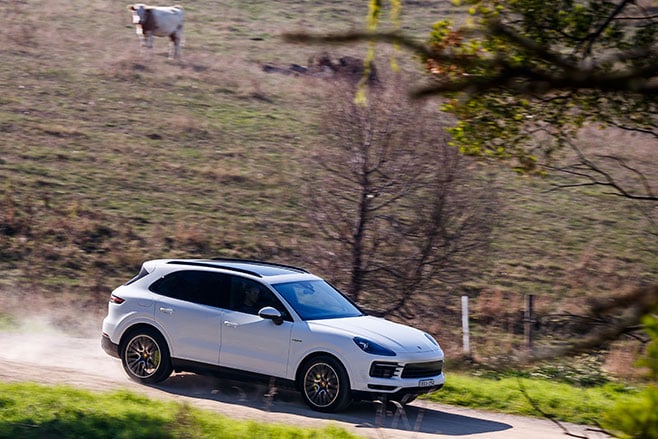
Modern cars are incredibly safe and capable of so much more than we really ever ask them to do. In the case of the Porsche, it had been fitted with Continental Winter Contact tyres which meant it found traction in conditions where I would have bet hard cash there was none. As you might expect, there is a price to pay for the extra grip. With the special rubber fitted, the Cayenne has its maximum permitted speed lowered to 240km/h – that’s right – even though it had winter tyres fitted, it is still safe to equal a Subaru WRX’s maximum speed.
Want another example? In an emergency, the McLaren will come to a complete stop from the national speed limit in 29 metres thanks to exotic brakes, clever aerodynamics and light weight. Oh, and the Ferrari has a stability and traction control system so sophisticated it can actually calculate the available friction of a road surface even under normal driving conditions.
Of course, in the wrong hands, a supercar can be as dangerous to heath as plutonium ravioli but here’s the undeniable truth that even the most staunch performance car opposition can’t contest. Cars that can go around corners fast are also very good at avoiding hazards, bigger brakes are better in an emergency, cyclists can hear a V10 better than a silenced four-cylinder and BMW’s M4 hero Sao Paulo Yellow is almost exactly the same tone as a hi-vis vest. I’ve said it before and I’ll say it again – fast cars are safer.
