
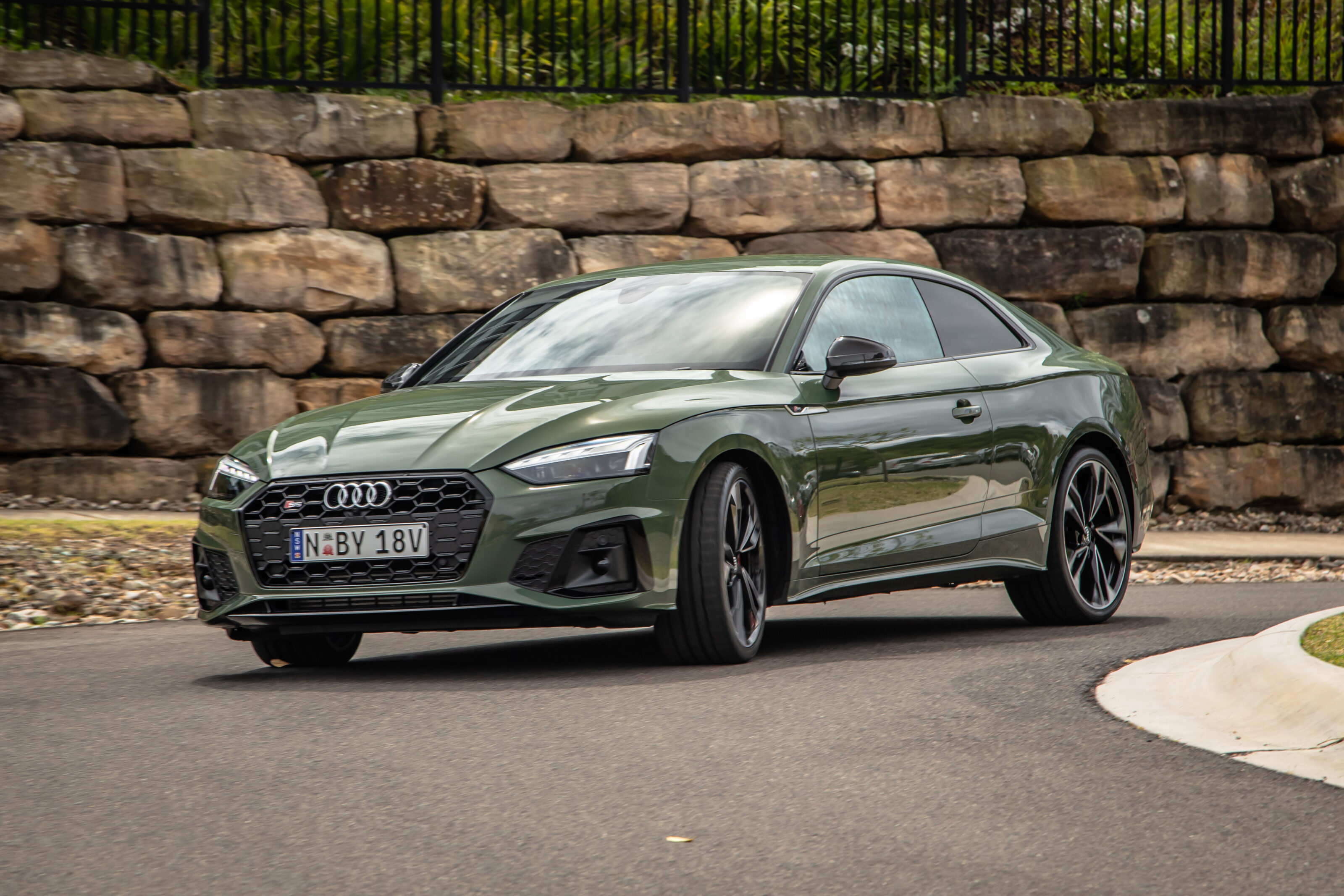
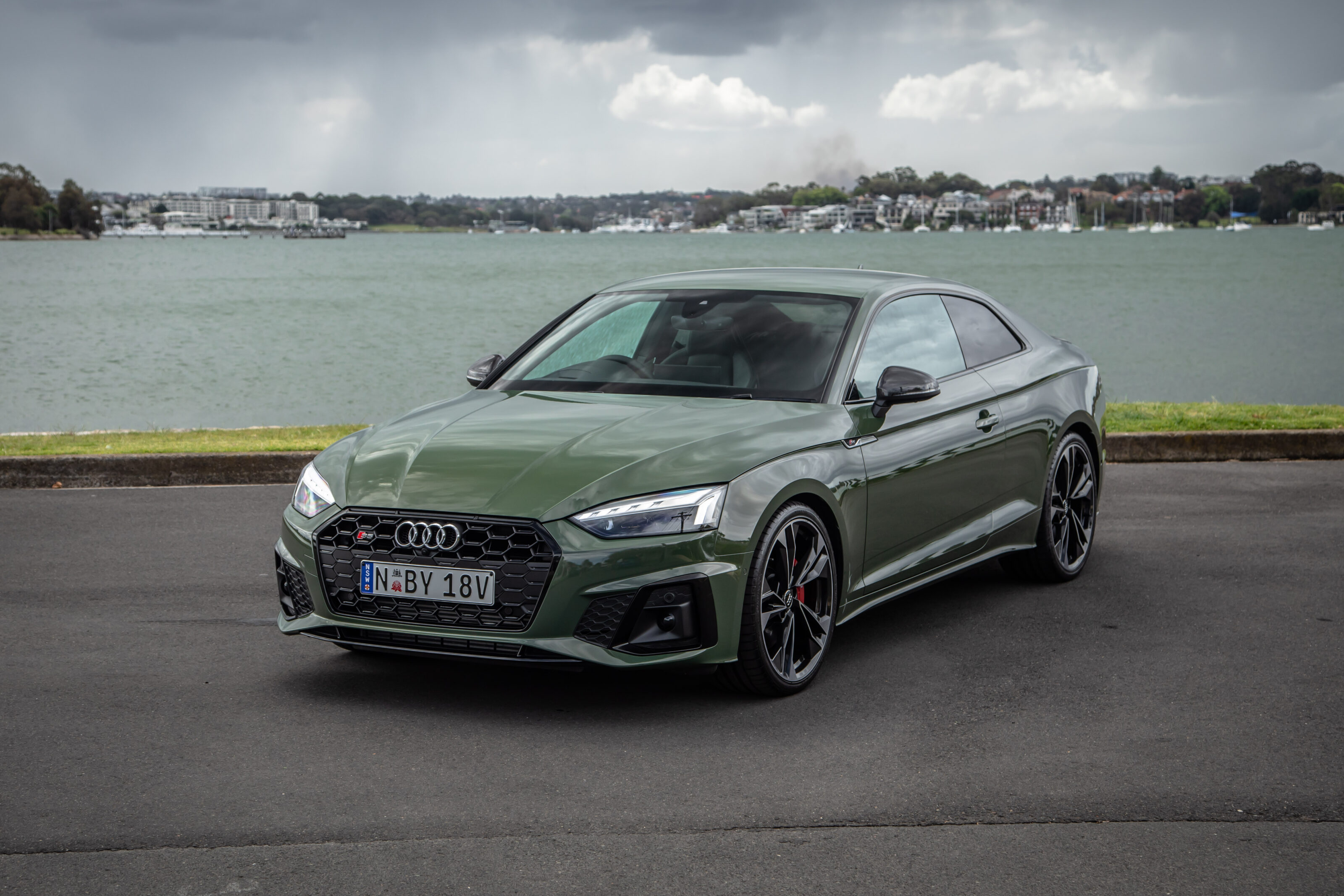
For detractors who charge that Audi’s S5 Coupe isn’t the fullest monty, its current MY21 guise is convenient ammo. Its recent facelift might be relatively subtle, but it keeps to the brief of toughening and sharpening an already gym-toned form and the combination on test here.
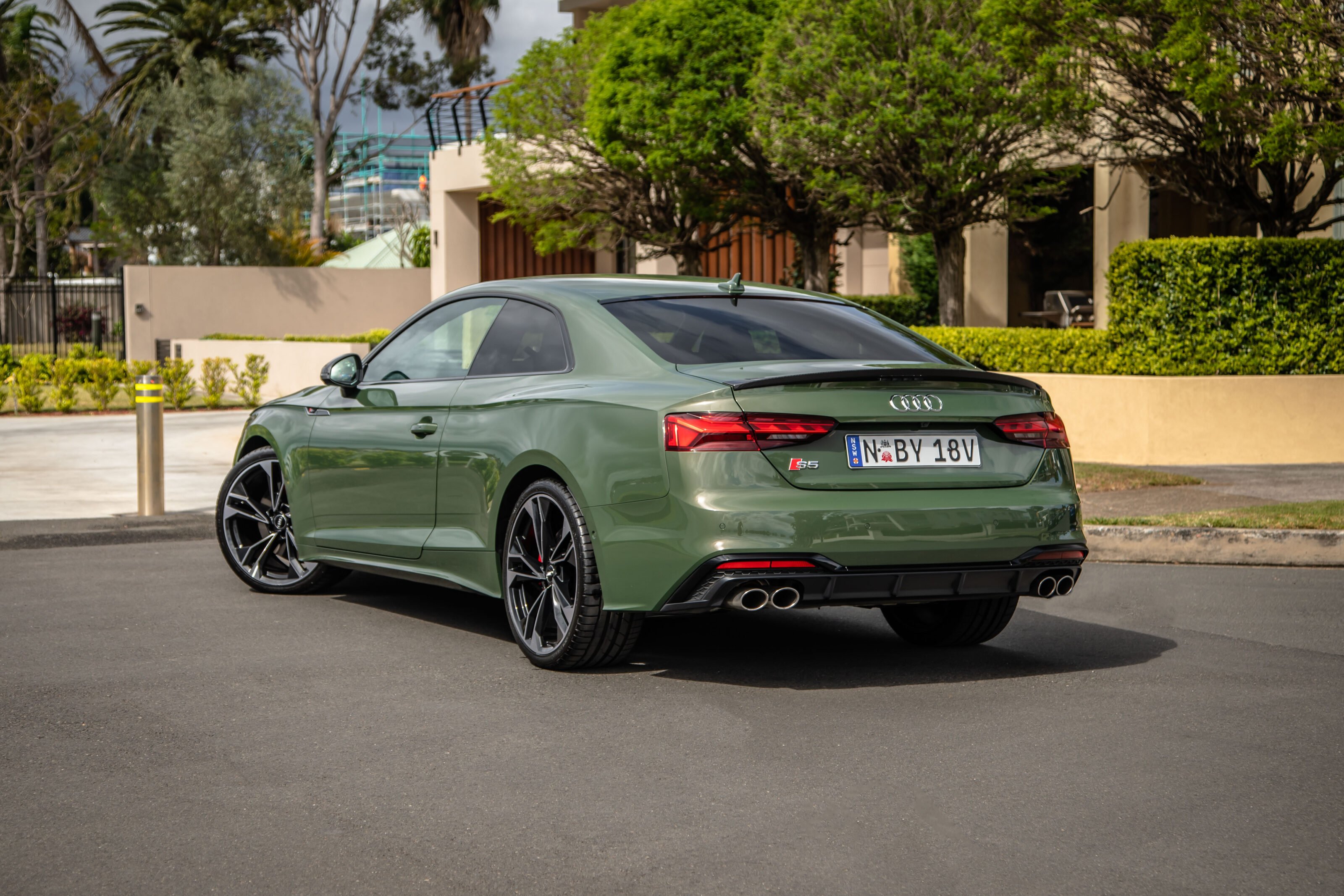
Fresh black-accented rolling stock and battle-ready District Green topped with an unhealthy Carbon and Black highlight binge, it’s big on purpose and, conspicuously, it apes RennSport stock a little too faithfully.
As fetching a styling amalgamation as it is, the S5 looks at least to swing a larger hammer of promise, even if delivery sticks to the breed’s traditional middleweight sport-performance. Particularly given the MY21 is unchanged under its bullish, racy skin.
Surely, it’s a fairly tricky task creating a more compelling, perhaps emotionally charged mid-sized performance coupe without impacting the restraint and measured balanced that makes for a fun if tempered, daily-digestible package.
That is, after all, the S5’s major strength, rather than some weakness as it’s often construed. In fact, it’s that blend of purpose and pleasantry where this two-door coupe spiritually evokes the original Ur Quattro, and the common body style just anchors the pitch nicely.
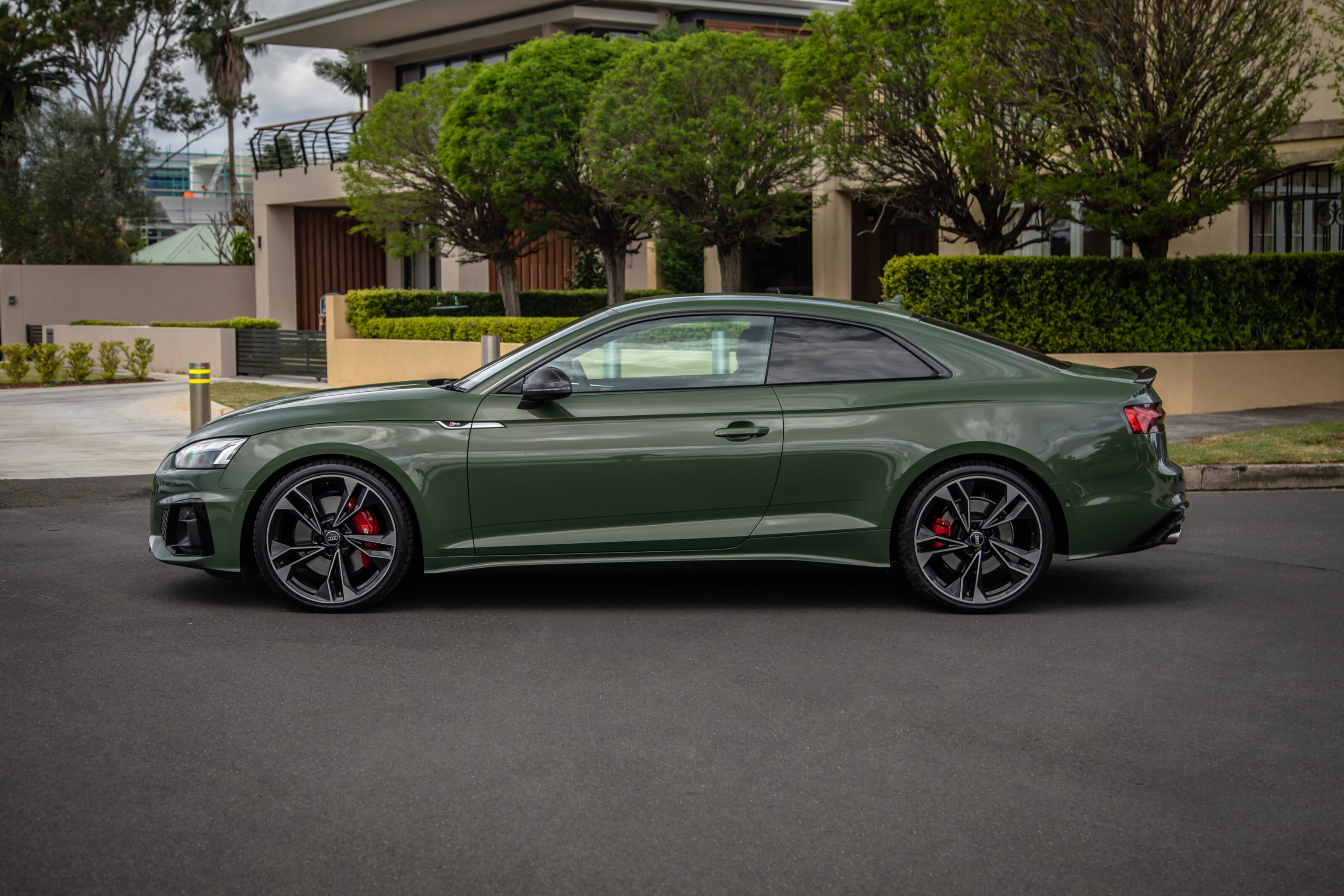
The S5 has a well-crafted, verging on opulent in interior fit-out, effortlessly techy and fully featured.
It’s also indulgently selfish in two-door form yet not overly impractical because of it, an extra sheen of sporting purity over its kin, athletic at heart if tempered nicely for everyday transit or unflustered long-haul grand touring.
And its 260kW turbo V6, while neither fire-breathing nor exotic, befits the premium Euro sport coupe persona and delivers the expected sub-five-second performance that goes with it.
It’s that blend of purpose and pleasantry where this two-door coupe spiritually evokes the original Ur Quattro.
Pricing and Features
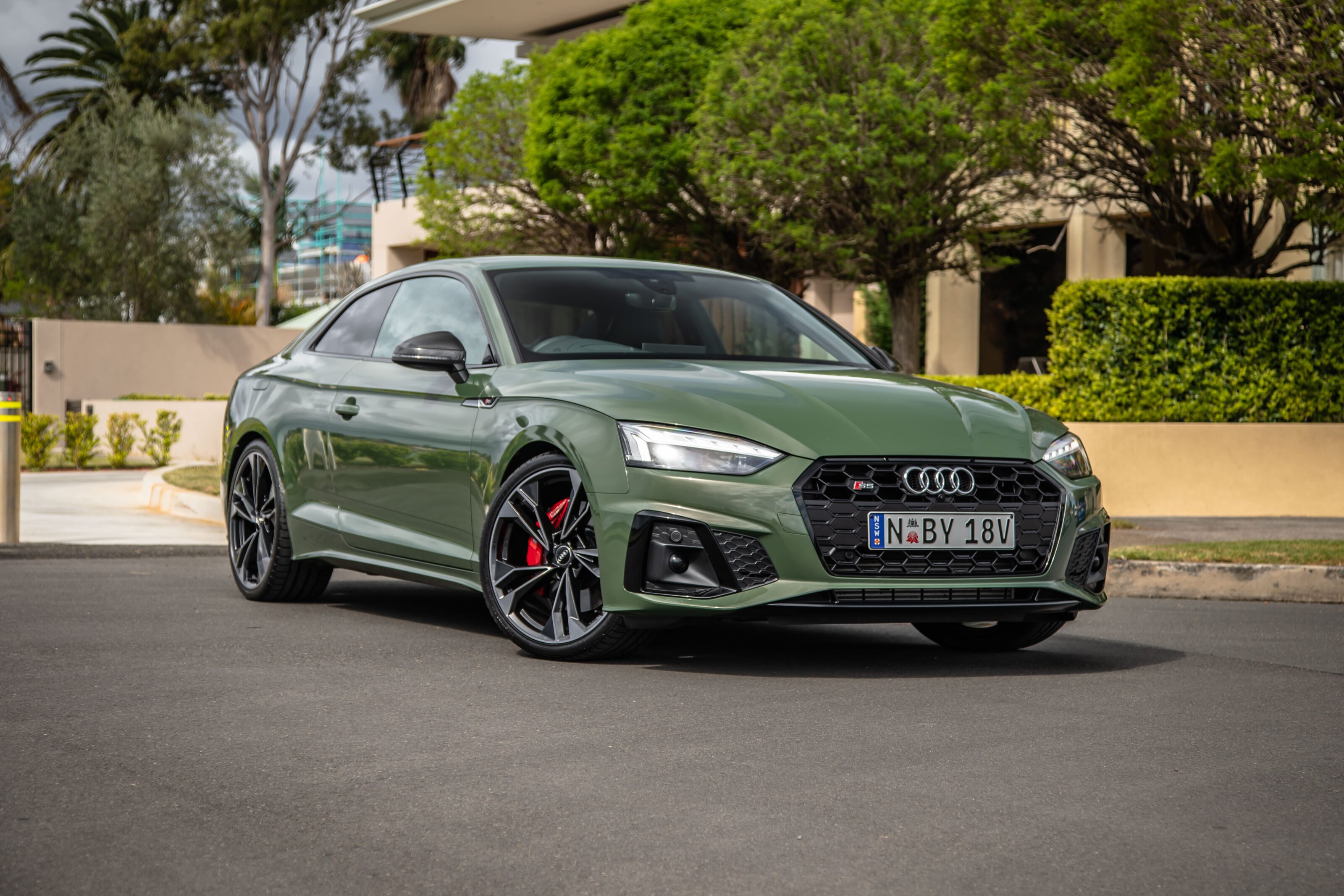
The MY22 S5 Coupe lists as a cleanskin for $108,700 before on-road costs, pricing having crept up $2800 since the pre-facelifted MY20.
That said, this current B9 generation’s 2017 arrival saw the S5’s price point drop by a whopping 17 grand against its B8 forebear to align with the likes of Mercedes-AMG’s then-new six-pot C43 competitor.
A two-door version is priced identically to the five-door Sportback, the more practical twin traditionally outselling the coupe in Australia by around five to one. A Quattro sport diff ($2990), which ought to be standard, as well as the aforementioned Carbon and Black package ($3500) nudges as-tested outlay to $115,190 list.
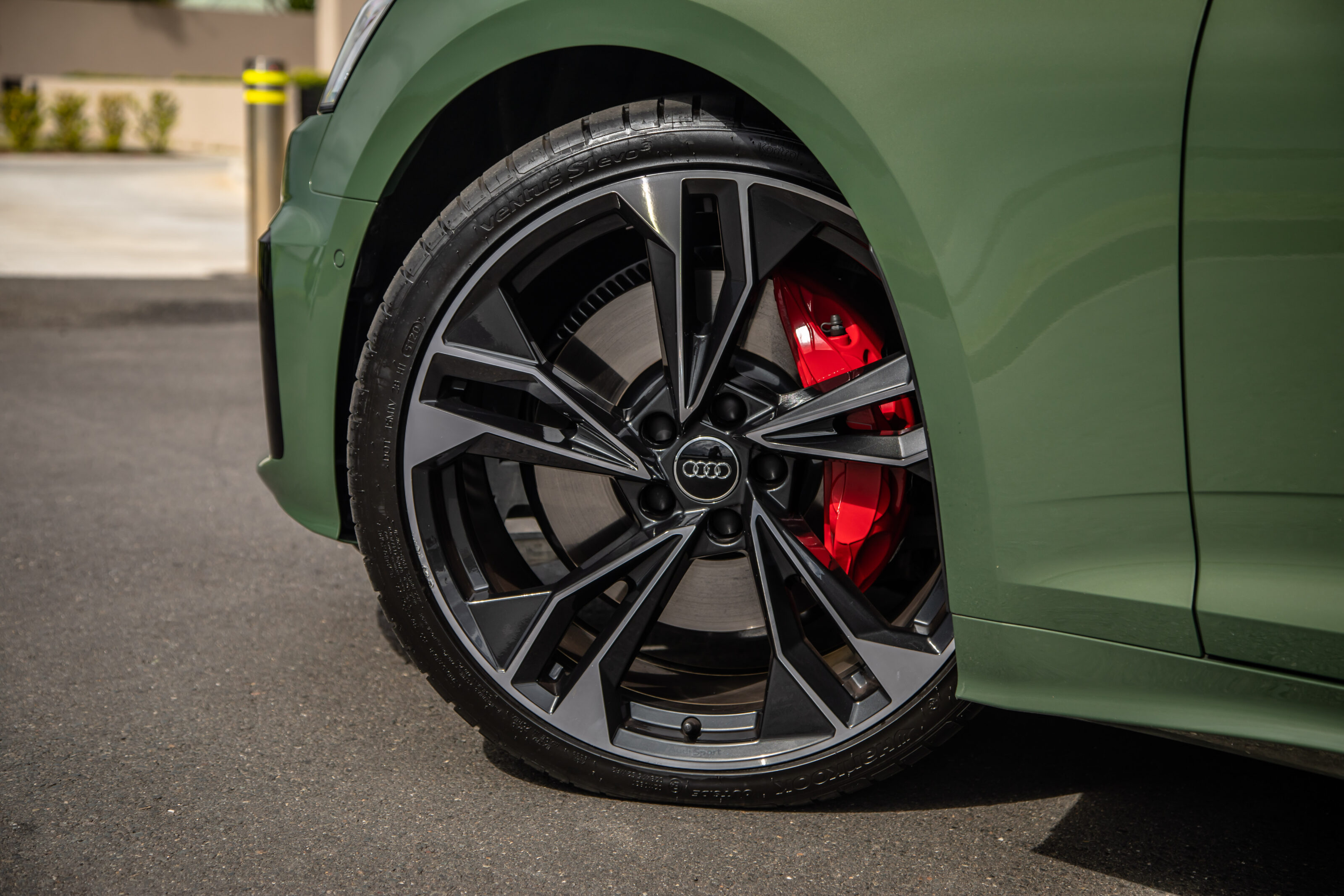
Headlining features includes 20-inch wheels (S4s get 19s) in a no-cost choice of three designs, adaptively damped suspension, six-piston front brakes and Matrix LED headlight trickery. There’s no extra charge for any paint choice.
Inside, the S5 fits fine Nappa leather seats with front seat massage functionality, extended upholstery, a head-up display, three-zone climate control, ambient lighting and Bang & Olufsen 19-speaker 3D sound.
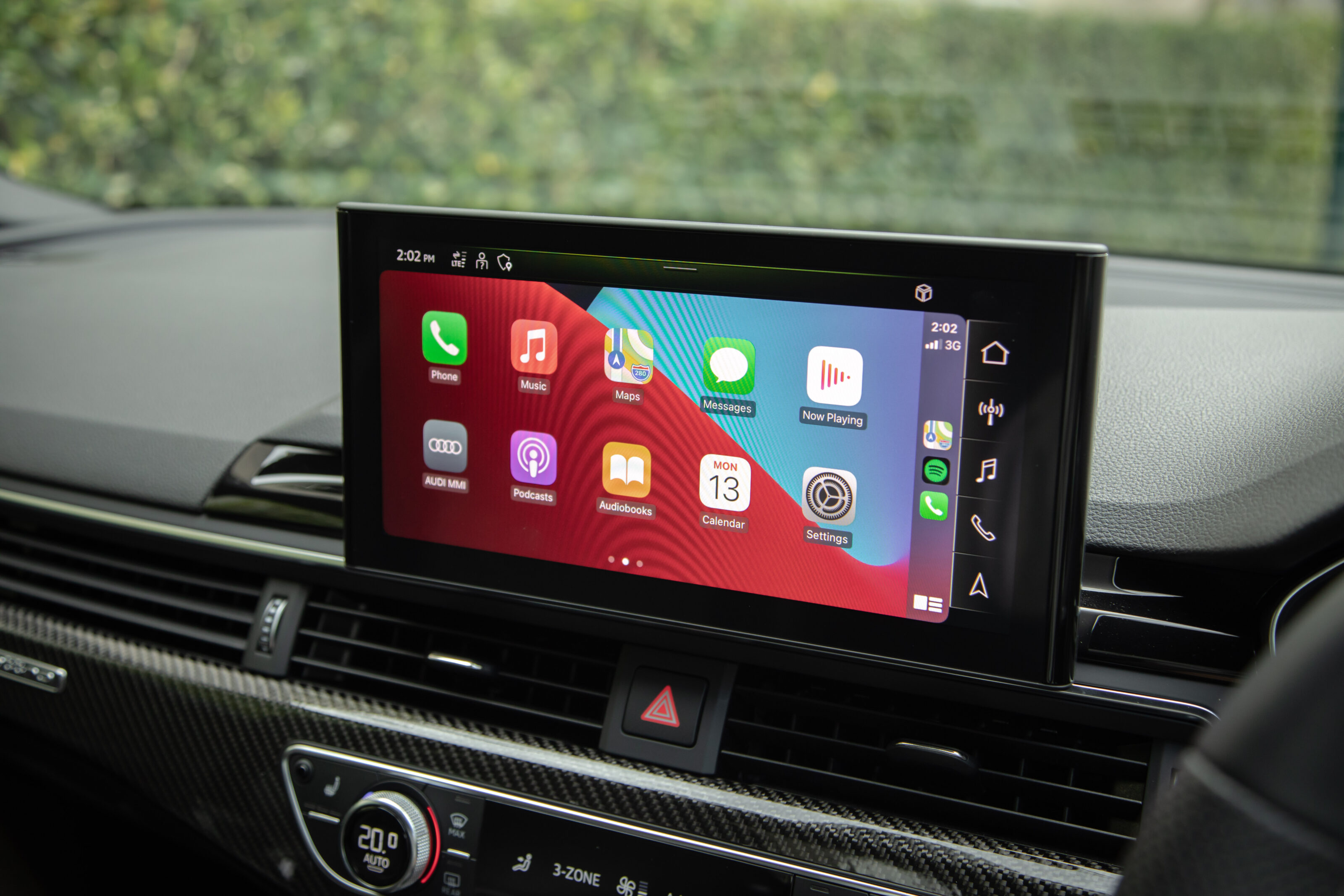
The MY21 facelift replaced the old 8.0-inch infotainment with a 10.1-inch touchscreen design, incorporating a 360-degree camera system, MMI navigation touch content, smartphone mirroring and inductive phone charging. Cruise control is adaptive.
Changes for the MY21 are mostly in the details, a move from a flat-bottom wheel (as tested here) to a round-bottom tiller, wireless Apple CarPlay integration and an extra, third Dynamic skin for the 12.3-inch Virtual Cockpit driver’s display.
The S5 Coupe fits six airbags, all-speed autonomous emergency braking with pedestrian detection, blind-spot monitoring, active lane-keeping, driver alert, an active bonnet and a tyre pressure monitor. The MY21 upgrade brought swerve assistant, rear cross-traffic assist, exit warning and pre-sense rear to the comprehensive active safety suite.
It’s currently unrated by ANCAP though the structurally related A5 carries over A4’s five-star result, itself only applying to four-cylinder variants and based off 2015 Euro NCAP testing: some assurance by very slim association, but still…
Comfort and Space
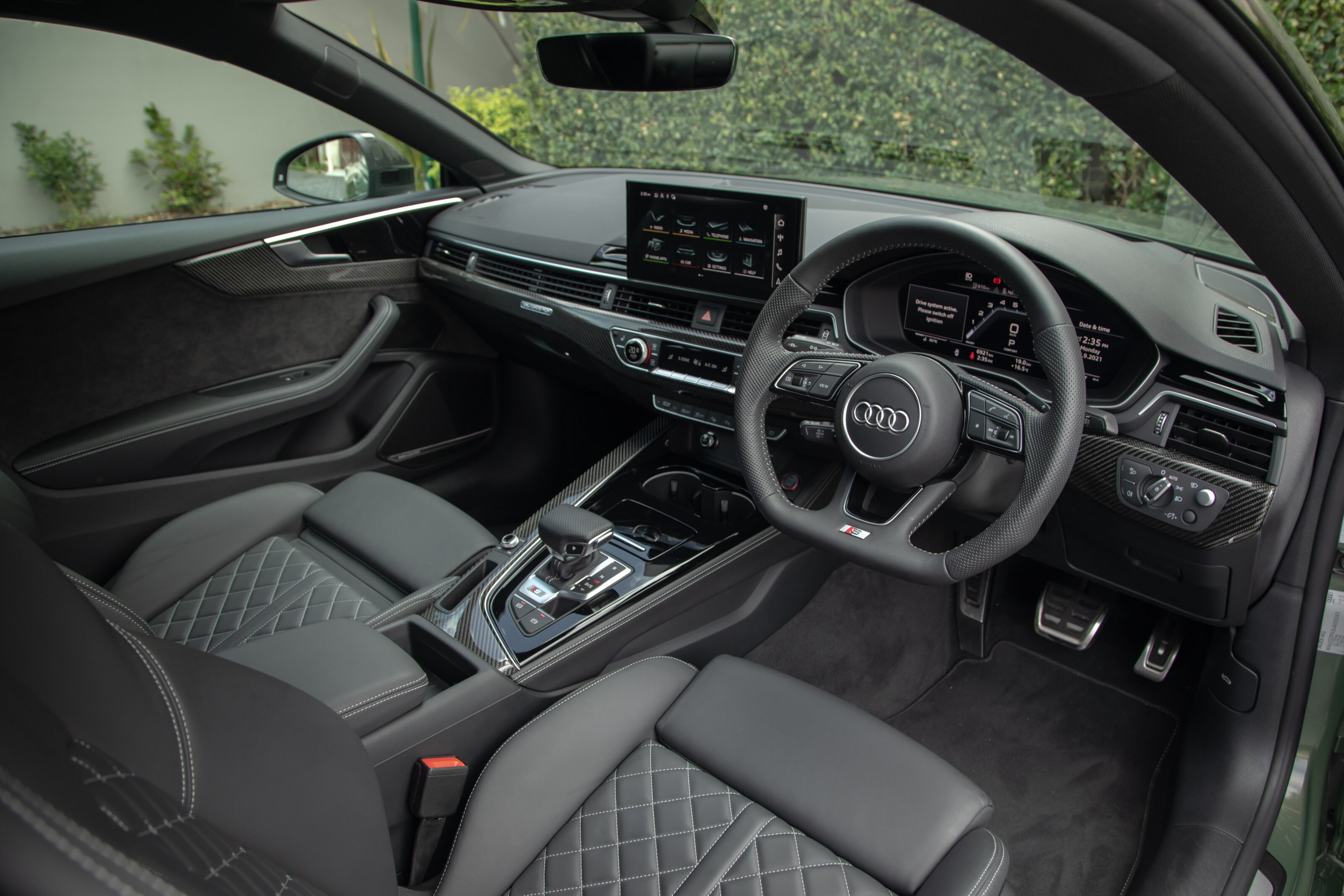
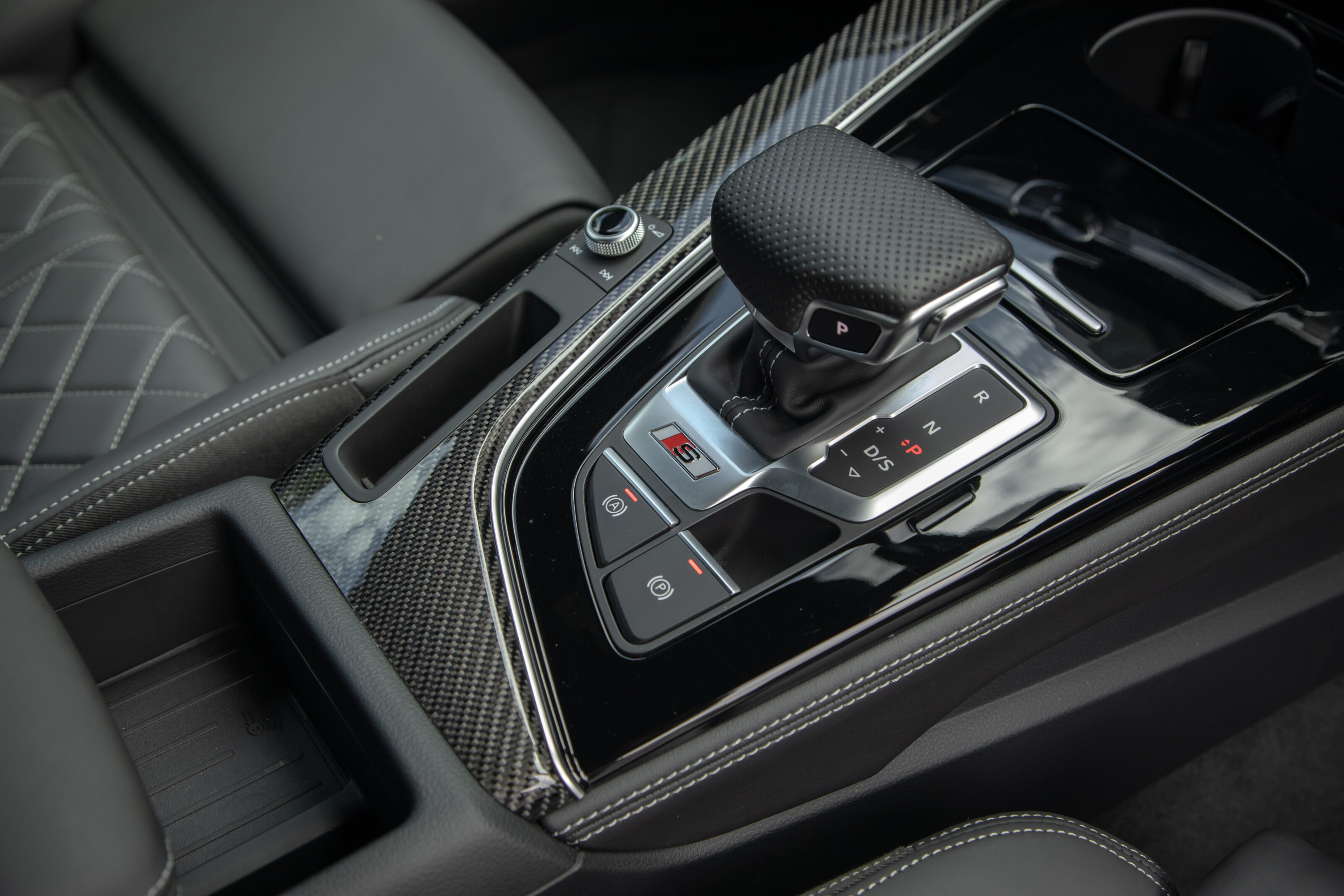
The interior delivers on six-figure fitness and then some, rich and opulent if awfully heavy-handed with the carbonfibre-like accoutrement. The fit-out negotiates the middle ground between sporty S Line-augmented A5 and full-blown RS racer-isms by tracking a little closer to the latter’s territory, but it’s slightly relaxed, friendly enough for the peak-hour grind and unfatiguing when facing long stints in the waxy leather, diamond-stitched saddle.
On that note, the front pews are excellent, anchoring the upmarket cabin ambience, all-singing and dancing with a breadth electro-pneumatic adjustment from relaxed to firmly form-fitting depending on taste or driving situation. Our early build demonstrator fits the old, fetching flat-bottom wheel and its loss in MY22 configuration is a shame.
The material and textural blend is Audi interior design at its best, the extended trim treatment removing any veneer of cost-consciousness, the use of double stitching, suede and matte brushed metallic effects generous if not pleasingly short of ostentation.
It’s neat in detail, too, from the frameless mirror to the tactility of the switchgear and button damping, strategically lavish as a sort of deal-maker for buyers Audi is targeting with its S grade machinery, arguably more at home shoehorned into the two-door body style than Ingolstadt’s other mid-sized packages.
There’s just enough specific skin content in the digital display to make this Virtual Cockpit take seem proprietary, something of a trap Audi has built for itself in a format that’s too samey in so many model lines.
The loss of the old MMI Touch to a pure touchscreen infotainment interface is still a downgrade, regardless of Ingolstadt’s firm objection, while the recent move to a larger 10.1-inch screen helps mint the S5’s premium effect.
Audi has managed to shake many of the bugs that once plagued the back end of its digital eye candy, such as Google-sourced navigation mapping glitches. It’s still less than a harmonious marriage between Audi’s ecosystem and smartphone mirroring, but the proprietary features are decent and the sharpness and clarity of mapping and 360-degree camera system – with handy low-forward view – is superb.
The HVAC controls, with full two-row, three-zone independence, is a nice inclusion even if row two accommodation is best reserved for small kids or masochists.
The loss of the old MMI Touch to pure touchscreen infotainment interface is still a downgrade, regardless of Ingolstadt’s firm objection.
The Coupe really is the driver’s choice of the line-up, if mostly because three other available body styles – sedan, wagon, Sportback – are far better suited to more than one passenger. But the least spacious package is also the mid-size S at its most naturally driver-focused. It is great that buyers have a choice and that the most driver-selfish option remains on the menu.
You sit low, its ergonomics are sound, its controls ideally placed and form fit for red-hot enthusiasm. Even the long frameless doors and self-sealing glass reinforce a sense of sportiness lacking in fast sedan, wagon or crossover alternatives. But quite why Audi’s designers continue to balls up the left-foot dead pedals in most of its model lines, sunk deep in the footwell and causing exhaustive seat squab adjustment, is an eternal head-scratcher.
At 410 litres, the Coupe’s boot is more compact than the sedan (420L) or Sportback (470L) if reasonably roomy and serviceable for most everyday requirements and large enough for a couple of cases when the touring weekends away beckon.
On the Road
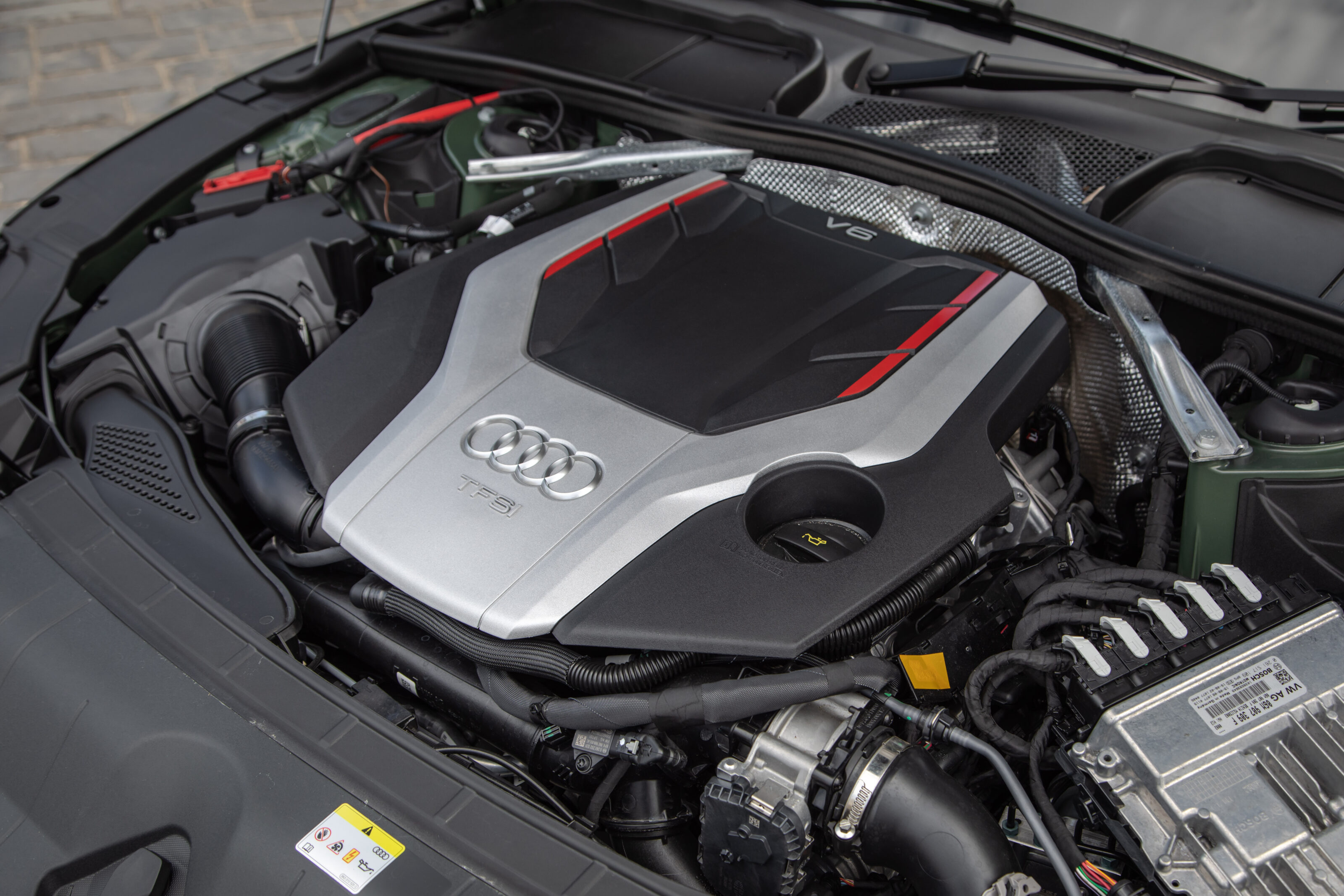
The current 260kW hot-vee single-turbo 3.0-litre V6 gets tarred with lacking the character of the old supercharged six (by shades), the charisma of the Noughties 4.2 V8 and having little of the speccy provenance of any contemporary inline-five or RS’s feisty 2.9 biturbo.
But it’s a fine unit with healthy stats – 500Nm in a thick 1350-4500rpm slab where you need it, lively 6400rpm top end, 4.7 seconds of collective 0-100km/h goodness plied via an eight-speed conventional auto that quickly proves a more fittingly refined unit than the old B8’s dual-clutch application.
It is, in short, a fittingly measured powertrain for the S5 brief, right down to the muted sonic gargle that’s polite enough for steady consumption if nicely rorty for sporadic punches.
On the march, delivery is eager, solid and flexible, with no dips or troughs, the ever-handy tap-for-sport sharpening response without overt transmission histrionics and making it equally useable around town as strung out on a back road.
But where the engine and transmission marriage is sweetest is at a dull roar, with nice and progressive tractability delivered with smooth fluidity, as pleasant and dignified as you like.
There’s a suggestion in its manner that the Normal drive mode calibration errs more towards drivability than absolute economy and it bears out in consumption: mid-11s for balanced driving against its 8.8L/100km claim, spiralling well into the high teens if regularly leaning into its sporting chops.
The B9-gen two-door has been dynamically peachy since inception and there are more than shades of the big brother RS’s lively keenness to rotate and pitch in this more sombre S guise.
It doesn’t quite have the crispness, outright focus or cooperation when properly strung out to its limits – obviously – but the chassis’ breadth of talent and ability from mild to wild is nicely judged and befitting the coupe format that promises sportiness and decent performance in fairly balanced measures.
There’s ample grip for manhandling, though the S5 responds more naturally when progressively leaning into its talent, where it remains diligent and cooperative yet relaxed enough to not turn your knuckles white or fuse your spine with an overly punishing ride in pursuit of milking maximum agility.
Indeed, the chassis’ five-link suspension has been massaged to the point where there’s genuine compliance no matter how you choose to set the standard-fit adaptive dampers and there’s less Jekyll and Hyde between Comfort and Dynamic ride setting than in the RS.
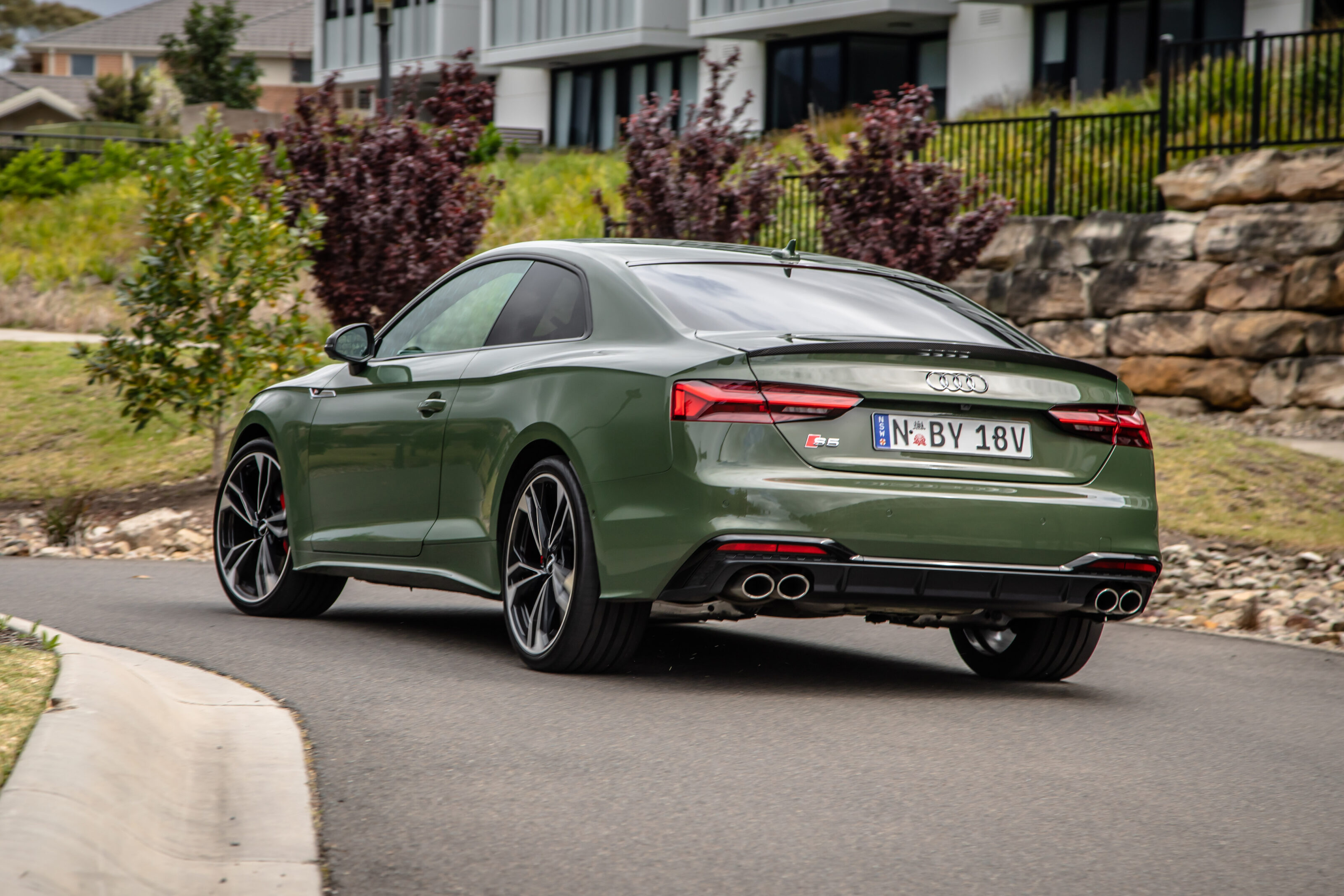
Audi’s steering is a matter for taste; clear and linear and thankfully bereft of silly adaptive ratio folly if notably ambivalent to the amount of lateral load-up across the front axle in communicating feedback.
It certainly tracks accurately and it takes some effort to break away the coupe’s front-end point or, for that matter, shift its tail off-line without a fair measure of provocation.
Does the optional sport diff bring real benefit? Only once the red mist properly descends and outside a race track environment – hardly S5’s forte – it brings shades of benefit at a spirited grand touring clip.
It’s a three-grand splurge for the completists even if, again, it ought to be fitted as standard anyway. Thankfully those powerful six-pot front anchors, with a solid pedal and progressive bite if prone to faint low-speed squealing, are bundled into the core package.
None of its fervour impinges on the S5’s around-town friendliness. Its seamless powertrain, clear and measured damping and a sense of honed solidity makes for a comfortable companion for long stints in the saddle and, bar some tyre thrumming on motorways, it’s a polite cruiser and exceptionally convincing grand tourer.
Its seamless powertrain, measured damping and honed solidity make for a comfortable companion – it’s a polite cruiser and exceptionally convincing grand tourer.
Ownership
Audi persists with an ordinary three years of unlimited-kilometre warranty from the date of first registration.
Capped priced servicing, though, runs through five years, costing $3150 (at the time of writing), which averages out to $630 per year for each 12-month/15,000km visit.
VERDICT
The S5 Coupe really became more likeable in B9 form, which brought a big drop in price along with growth in polish and maturity. And the blink-and-you-might-miss-it MY22 does no harm or much benefit besides edging the styling brief deeper into the RennSport territory for sheer feel-goodness even if there’s no extra sportiness or performance to join it.
It remains quick, capable and engaging, albeit without quite the potency its façade suggests, thought the real depth in quality and key appeal is as an all-rounder for most driving occasions. The mid-strength coupe is nicely built, lavishly presented, and goes large on feel-good factor in a lot of nice areas.
In many ways, the S grade embodies premium European motoring properly, without overt cost-cutting and sans high-performance excess. The six-pot turbo befits the medium sports coupe format, it’s both comfortable and purposeful with natural duality, and the indulgence of the handsome two-door form remains a distinctive drawcard in an increasingly homogenised motoring world.
2021 Audi S5 Coupe specifications
| Body | Two-door coupe |
|---|---|
| Drive | AWD |
| Engine | 3.0-litre V6 turbocharged |
| Transmission | Eight-speed automatic |
| Power | 260kW @ 5400-6400rpm |
| Torque | 500Nm @ 1350-4500rpm |
| Bore/Stroke | 84.5mm x 89mm |
| Compression ratio | 11.2:1 |
| Fuel consumption | 8.8L/100km (claimed) |
| Weight | 1715kg |
| Suspension | Five-link (front and rear) |
| L/W/h | 4705/1846/1368mm |
| Wheelbase | 2765mm |
| Brakes | 350mm six-piston (front);350mm twin-piston (rear) |
| Tyres | 265/30 R20 Continental ContiSportContact 5P |
| Wheels | 20-inch wheels (space-saver spare) |
| Price | $108,700 +ORC |
On the 4th January 1961, a Boeing B-52 Stratofortress broke up over Goldsboro, North Carolina. As the aircraft gyrated to the cotton fields below, it ejected two fairly fundamental items of hold luggage, namely a pair of Mark 39 thermonuclear bombs. Each had 250 times the destructive power of the device that levelled Hiroshima or, to put it another way, more than the cumulative total of every bomb dropped in the history of aerial warfare.
Opinions vary as to how close Goldsboro came to being substantially remodelled. One of the devices hit the ground at speed, the warhead burying itself nearly 60 metres into the earth. The other had gone through three of its four stages to detonation, its deployed parachute catching it neatly in a tree.
What five of the eight crew members who survived by ejecting or bailing out must have felt as they floated towards a possible nuclear conflagration is hard to imagine. Probably pondering how they managed to get into that situation.
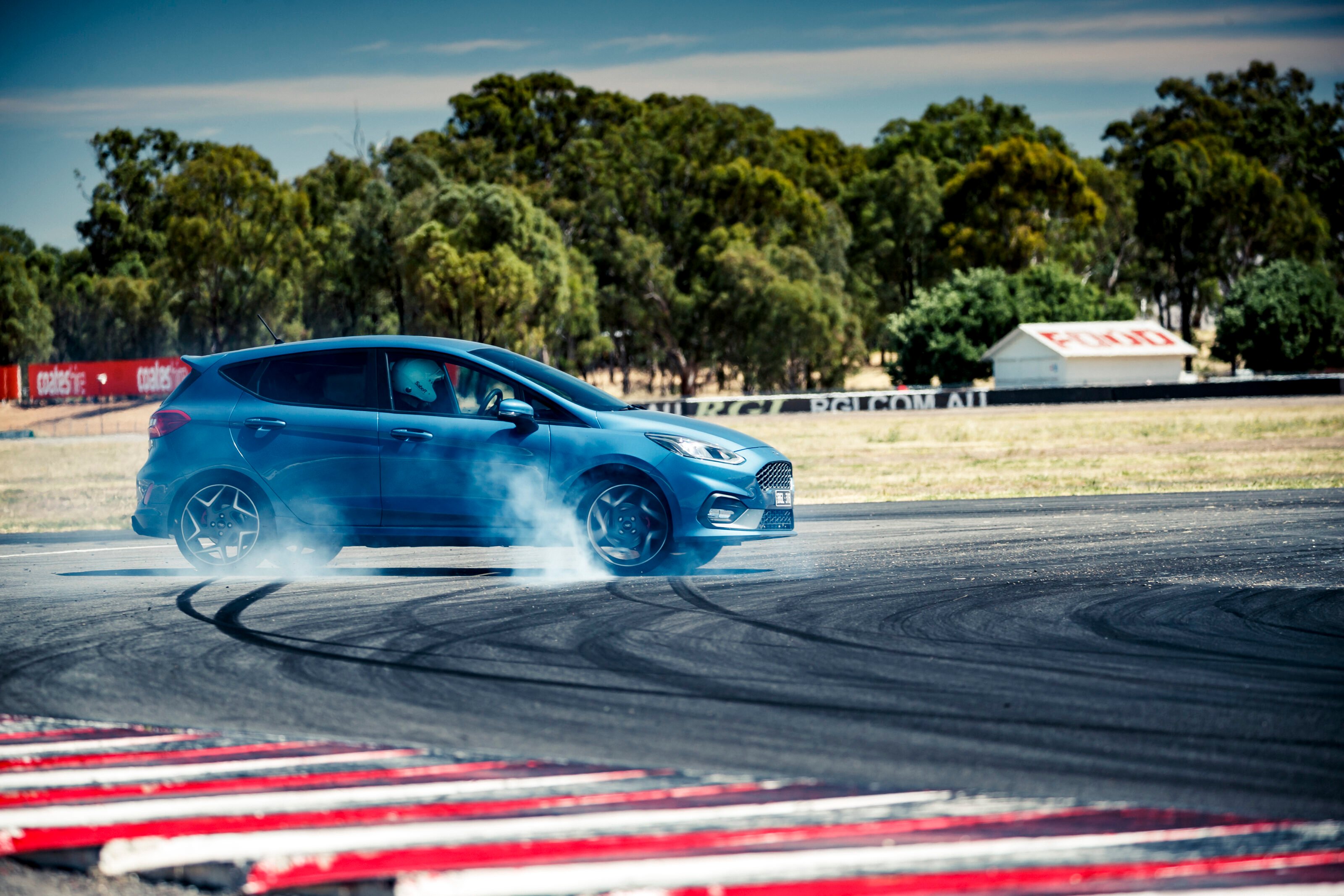
As drivers we don’t always have time to ponder the consequences of our errors, at least not before the fact. In 35 years of driving, I’ve yet to have a really big accident, certainly not anything hard enough to deploy an airbag, but even the other incidents are frequently mentally replayed. I’m not sure if you’re the same, but I beat myself up over things that happened decades ago, in a bid to learn lessons from those mishaps of the past.
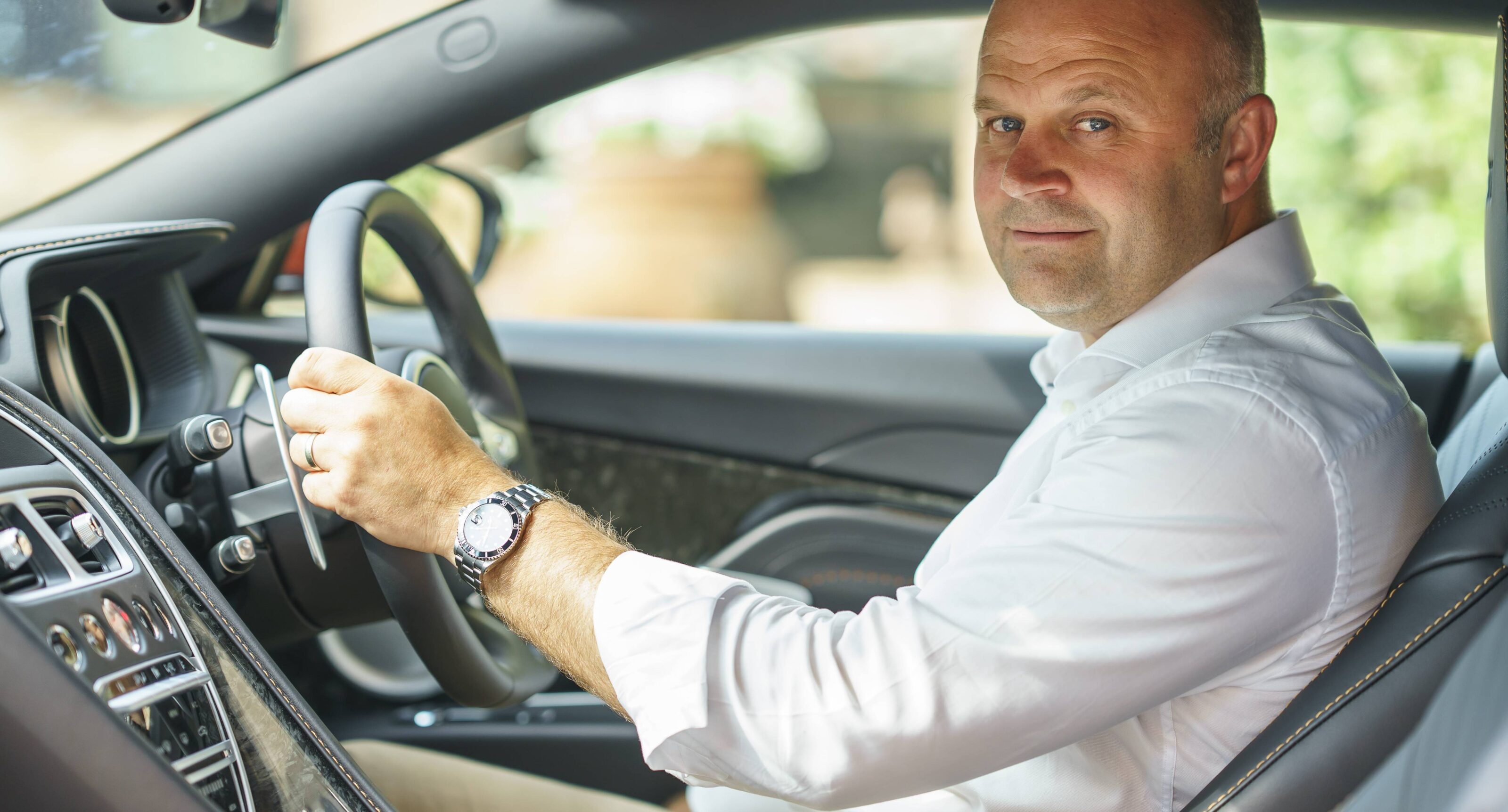
If I’m brutally honest, most of them came back to one thing: illusory superiority. I thought I was a lot better at driving than I actually was. Call it the folly of youth if you will, but in every indiscretion I experienced, I was feeling pretty godlike right up until that moment I wasn’t. I can thank one man for knocking that out of me: Matt Becker, the man responsible for how modern Lotuses, Aston Martins and, soon, McLarens drive.
Sitting alongside Becker at a number of race tracks demonstrated how little I knew. Yes, I could pedal around the circuit at an okay clip, but unlike Mr Becker, I didn’t have plans B, C and D in my locker to execute if plan A went awry. I realised I was operating on bravado and a certain lack of imagination rather than a reliable skillset.
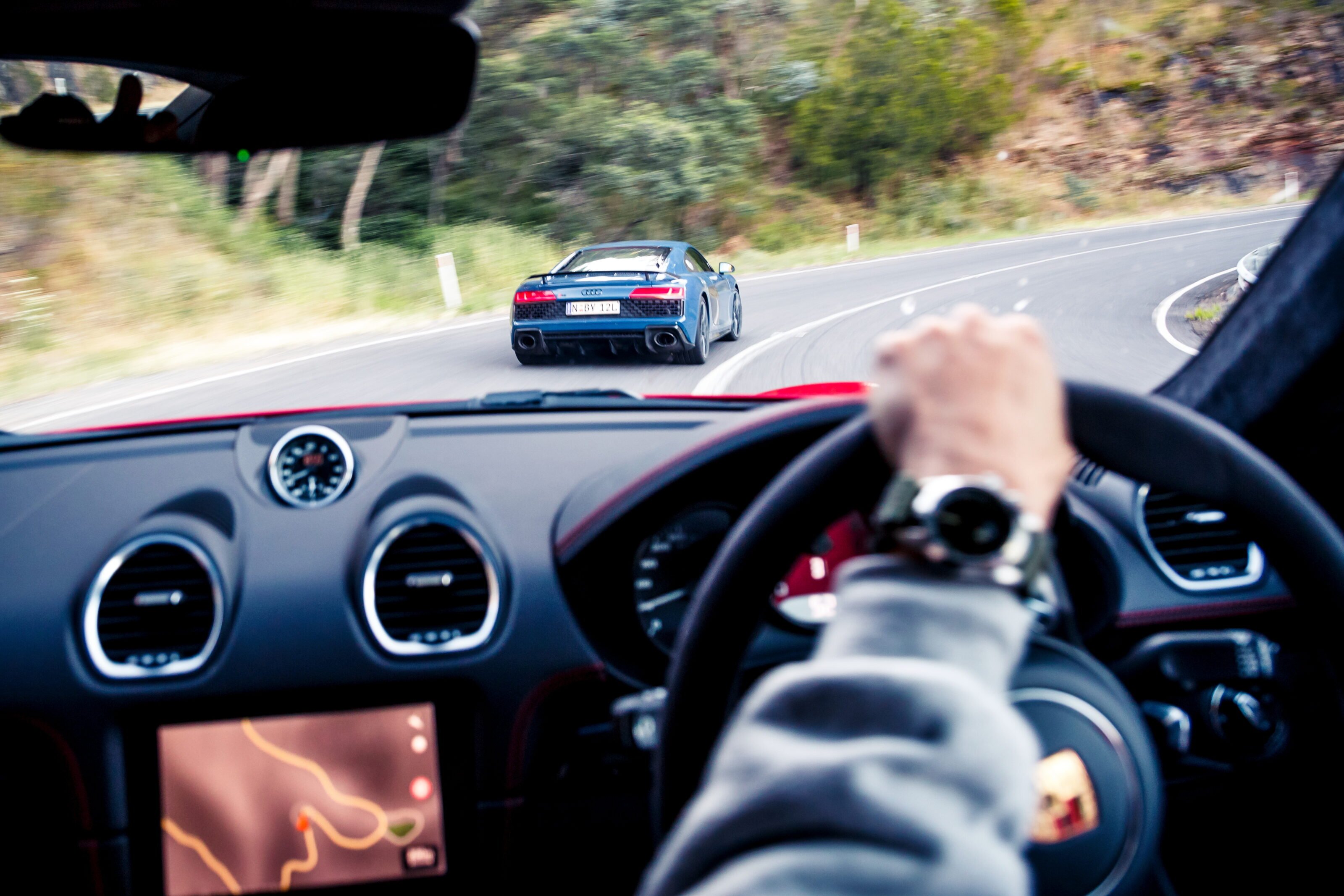
Since those days I’ve tried to become a better driver. I’ve come to recognise that dangerously giddy feeling when you feel you can do no wrong behind the wheel. I’ve worked on my technique. I’ve learned like a sponge through many years spent circuit driving and always tried to jump in next to people who are better than me. I’m a good way from infallible, but I like to think I’ve reduced my odds of stuffing things up.
I still go to track days and recognise people who are the image of old me. I sat next to one once at Spa in a Porsche Carrera GT, and witnessed the panic and recrimination on his face as he ploughed into the gravel trap at Pouhon. As the guardrail loomed, for a moment he was that guy parachuting down onto Goldsboro, wondering where it had all gone wrong.
You’re never too old to keep improving your skills. Or, as my dad once wearily told me after another teenage tale of automotive woe, “It’s what you learn after you think you know it all that counts.”
Key Points
- New Haval H6 plug-in hybrid launched in Thailand
- Claimed all-electric driving range of 201 kilometres
- Combined power and torque output of 240kW/530Nm
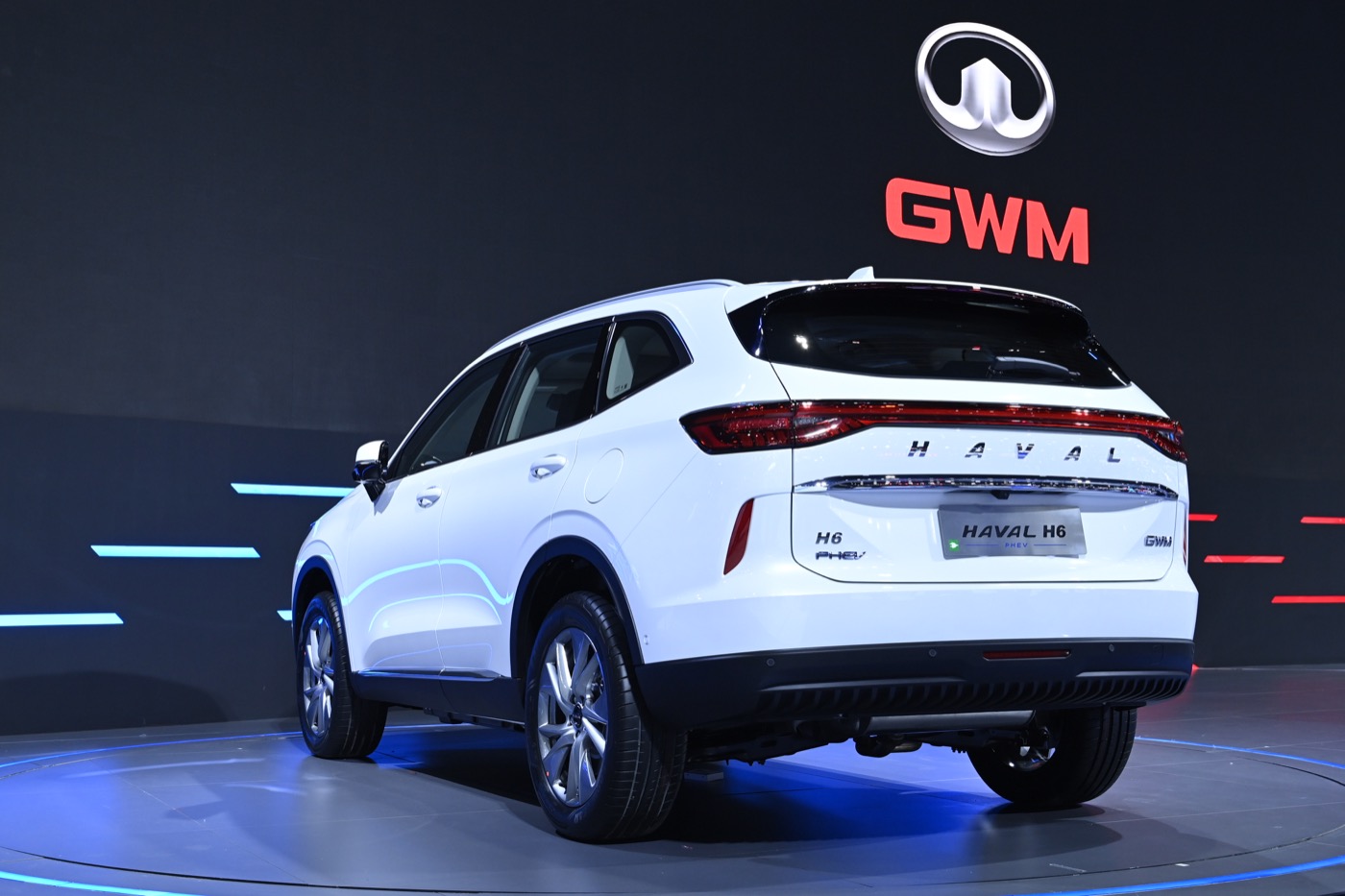
Haval’s latest H6 SUV has been launched in Thailand, featuring a plug-in hybrid (PHEV) drivetrain which offers a significant boost over the upcoming H6 Hybrid.
Still retaining the 1.5-litre, turbocharged four-cylinder petrol engine under the bonnet, the Haval H6’s combustion engine is paired with an electric motor to provide combined power and torque outputs of 240kW and 530Nm – a 61kW increase over the conventional hybrid.
Although it offers more power and far more torque than most hot hatches, drive is sent exclusively to the front wheels through a dual-clutch automatic transmission, electronically controlled to provide the best balance of power from the combustion engine and electric motor.
Despite the hefty power and torque figures, Haval claims the H6 PHEV has an all-electric driving range of up to 201 kilometres on the New European Driving Cycle (NEDC), thanks to a rumoured 41.8kWh battery pack, also found in the Wey Coffee 01, which uses the Lemon platform.
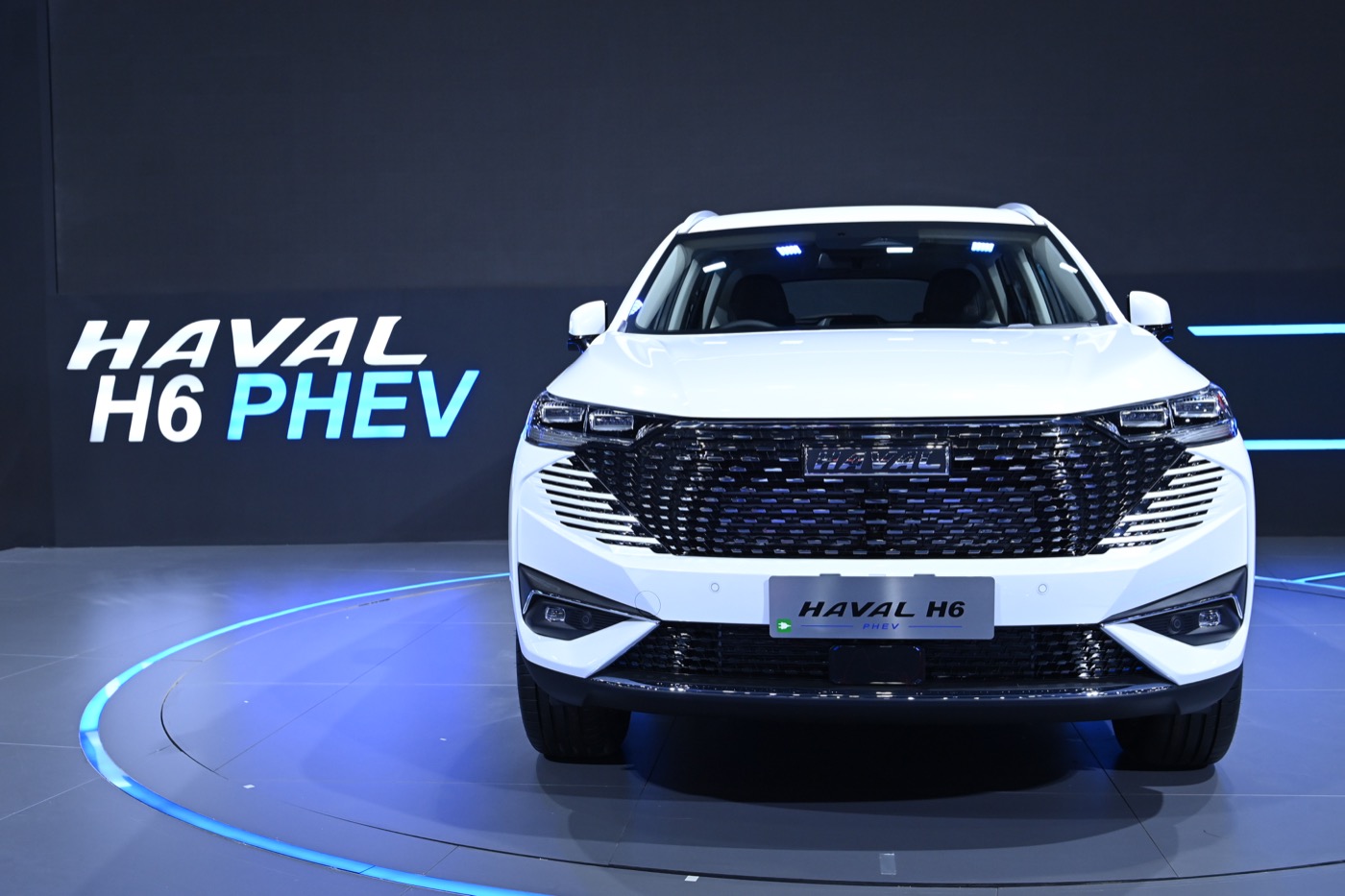
Apart from some front-end tweaks, which includes a larger grille, the looks and equipment of the H6 PHEV are identical to the Hybrid, riding on 19-inch alloys and with a host of modern features inside.
As with the recently-revealed Jolion Hybrid, the H6 PHEV isn’t expected to be given a local berth just yet, with a spokesperson for the Chinese manufacturer telling Wheels it was focusing on the H6 Hybrid’s Australian debut.
“At this stage, we have no firm plans to add the H6 plug-in hybrid to the Australian line-up,” said the spokesperson.
“Our current focus is on bringing the H6 Hybrid to market.”
Snapshot
- E3 platform to combine parts of TNGA-C and e-TNGA architecture
- Production will mainly be based in Toyota’s European plants
- Japanese manufacturer hasn’t committed to an all-electric vehicle line-up
Toyota is creating a new platform called E3 which combines various parts of TNGA-C and e-TNGA architecture for flexible drivetrain deployment.
Destined for European production lines, it will accommodate hybrid, plug-in hybrid and also fully electric powertrains which can’t currently be produced there.
The new E3 platform symbolises ’emotion, engagement and energy’ and is the most efficient method to bring various TNGA traits into one platform. Without it, Toyota would not be able to produce fully-electric vehicles in markets that will have the highest demand for them.
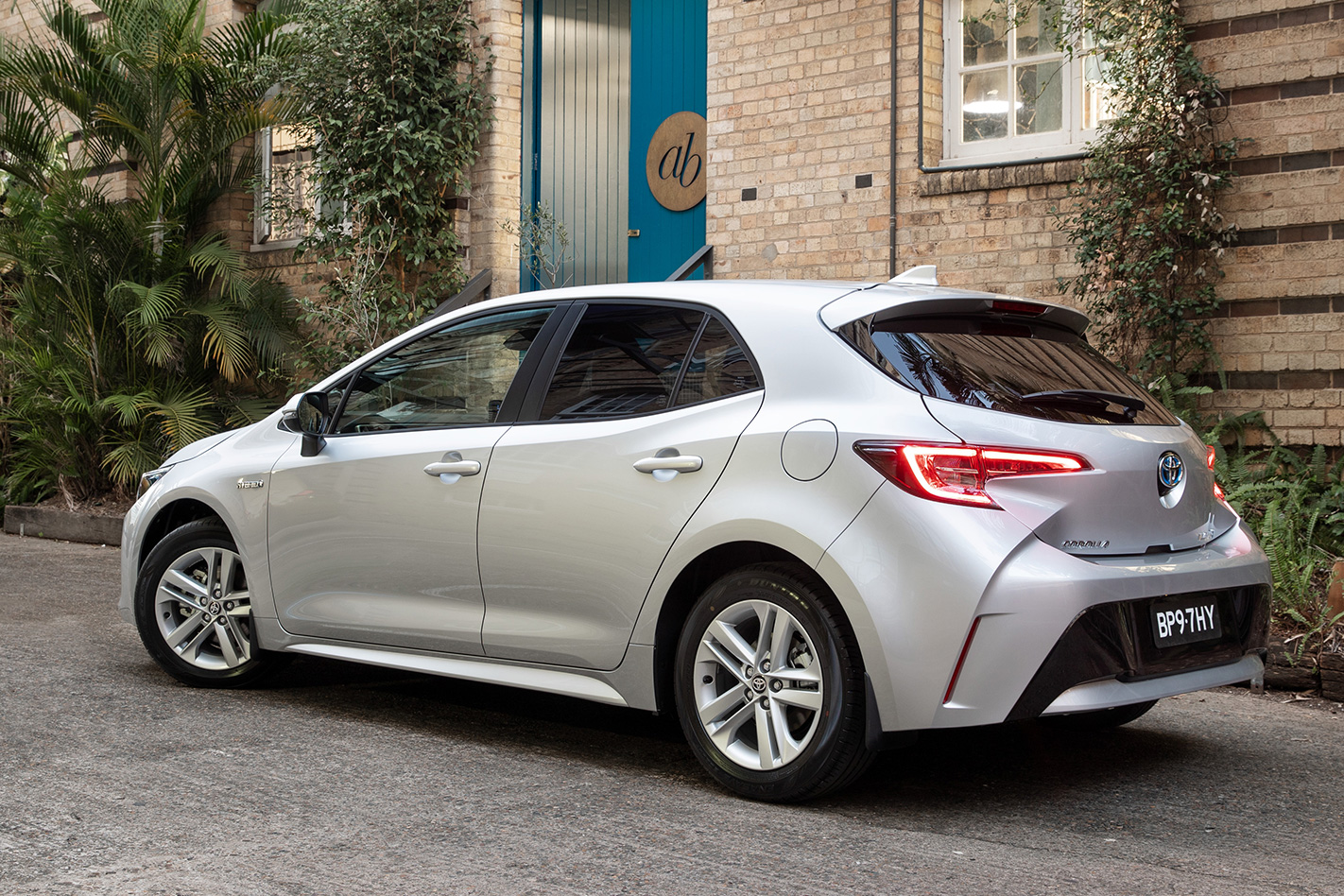
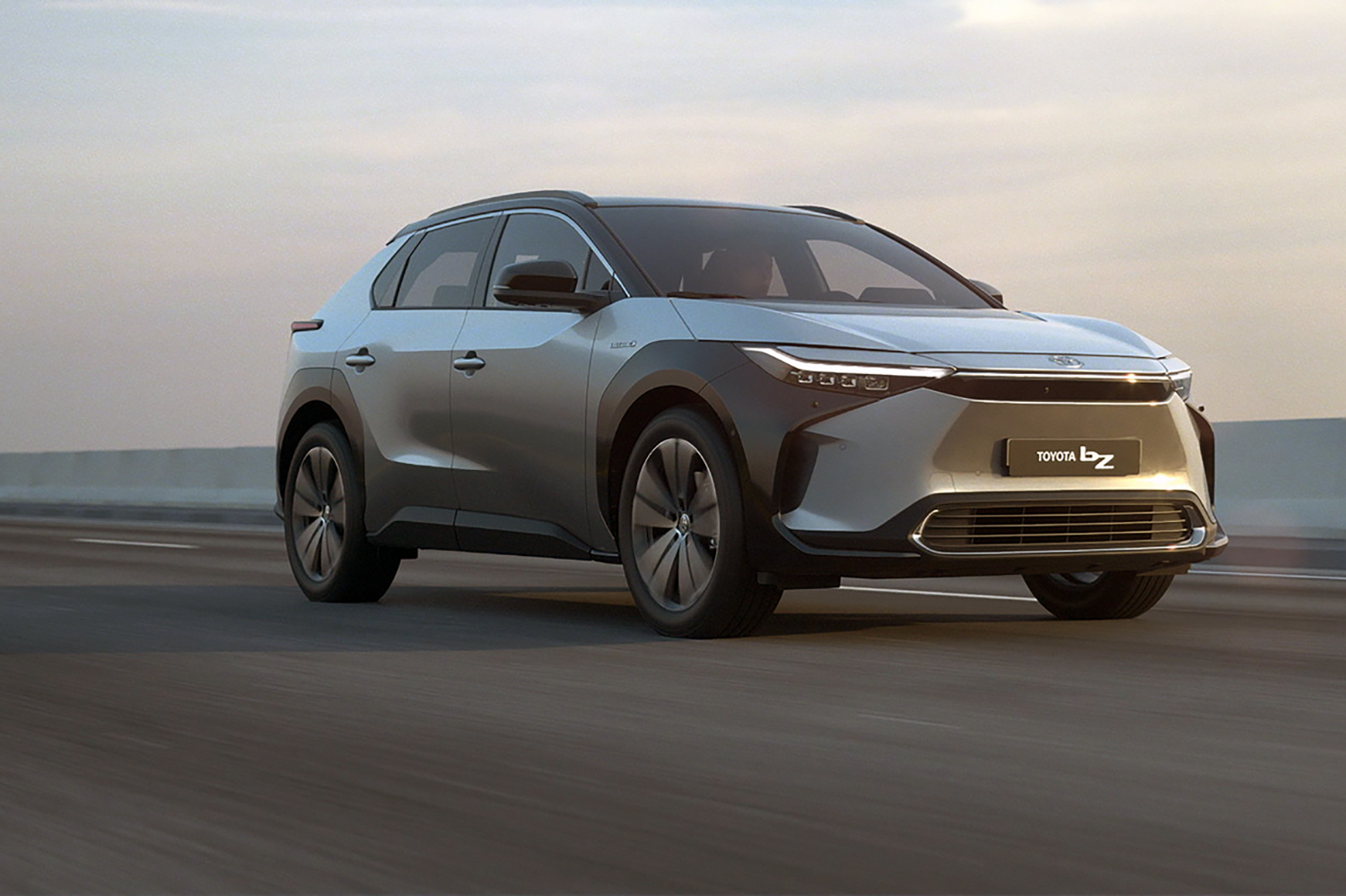
Creating the new platform will open production for pure EVs at plants in countries such as Turkey and the UK, meaning vehicles like the upcoming bZ4x can be built there rather than being imported from Japan, which is currently the only site where it can be assembled.
Before the first pure-electric is produced, however, it could be models such as the new generation C-HR that will be made available – with a variety of powertrains on the new platform, including plug-in hybrid.
“We are convinced that the journey to carbon neutrality will not be only electric, it will be eclectic – that is to say, it will embrace multiple technologies and fuels which all lead to the same destination,” Toyota’s European CEO, Matt Harrison, told Automotive News Europe.
Having the new platform created on some existing structures from Toyota’s TNGA platform, the Japanese carmaker will be able to minimise costs and timeframes for launching new models.
Toyota can also use existing factory lines without the need for a major costly overhaul; the Turkish and British plants already build TNGA-C based models, including the new Corolla, and can produce almost half a million units each year.
Toyota’s strategy with E3 is something many vehicle makers are having to consider as a greater need for hybrid and electric drivetrains occur, forced by regulations in some countries – yet not as important in others. However, Toyota’s E3 will allow both pure-electric and hybrid to be available in markets that need it.
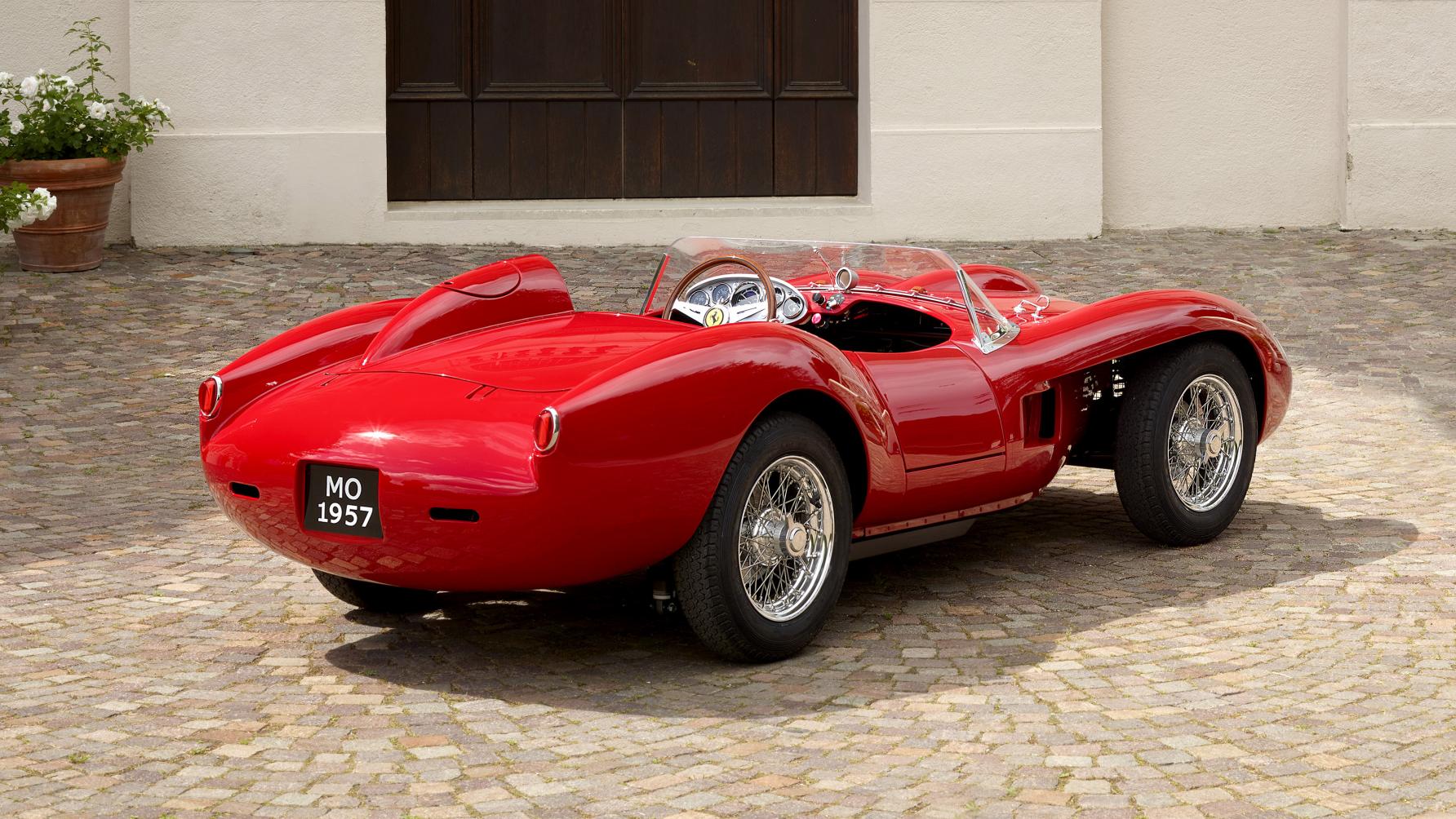
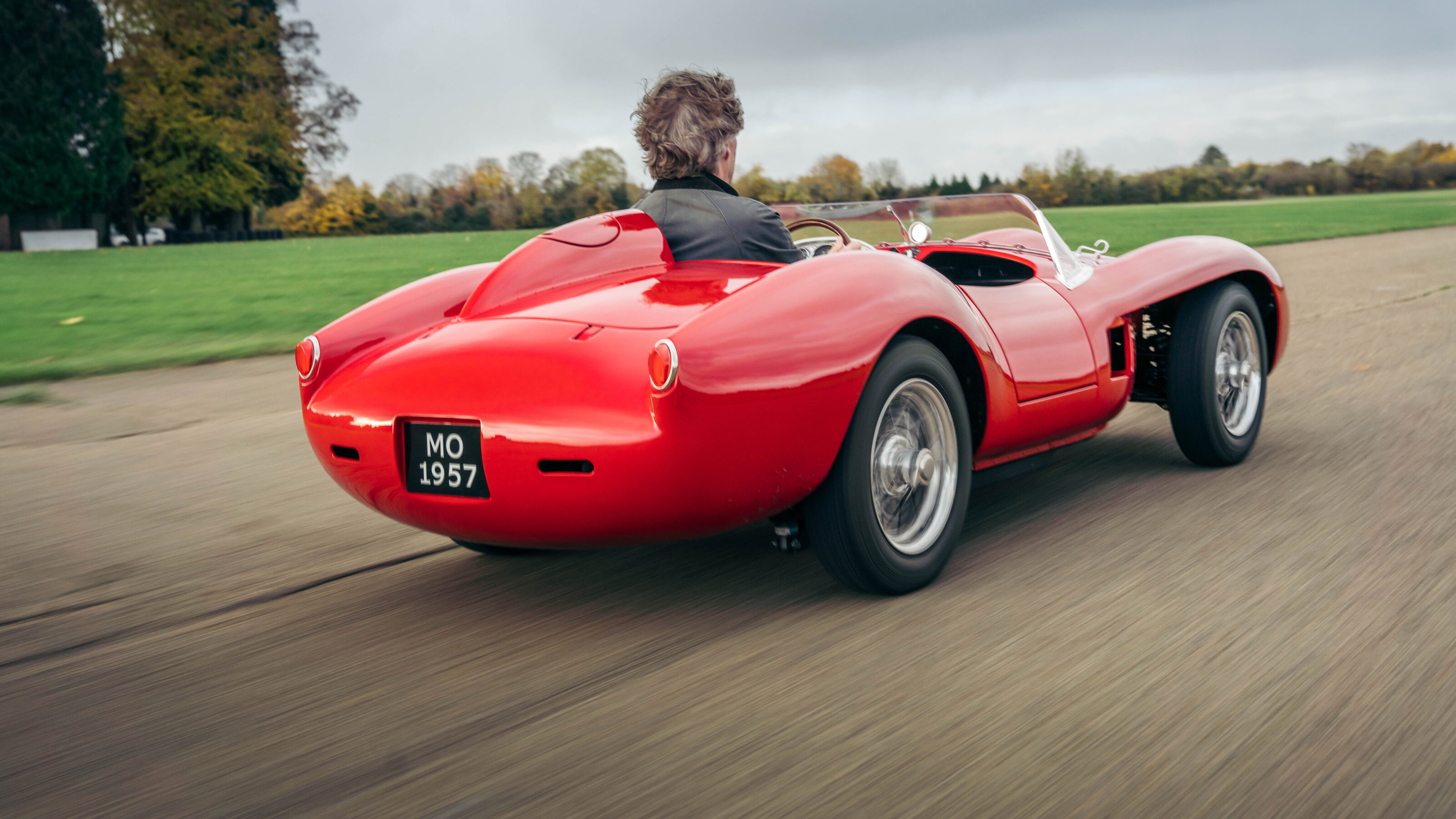
You could dismiss the Ferrari Testa Rossa J as the ultimate, money-no-object Christmas present for the rich kid who has everything. But that would be selling it short. The $150,000 (plus tax and shipping) electric-powered Testa Rossa J is a Ferrari-approved three-quarter scale replica of one of Maranello’s most iconic sports racers, right down to its tubular steel chassis and hand-formed aluminium bodywork.
It’s a beautiful little jewel of a thing. And while it looks toy-like, it’s nothing like a toy to drive. It’ll hit 80km/h, has four-wheel disc brakes with Ducati calipers, the same suspension geometry as the original 250 TR, and runs on proper Pirelli tyres.
Ferrari built 33 full-size 250 TRs between 1957 and 1961, and they pretty much won everything worth winning in international sports car racing, taking victory three times in both the 24 Hours of Le Mans and the 12 Hours of Sebring, and winning the 1958 Targa Florio, among others.
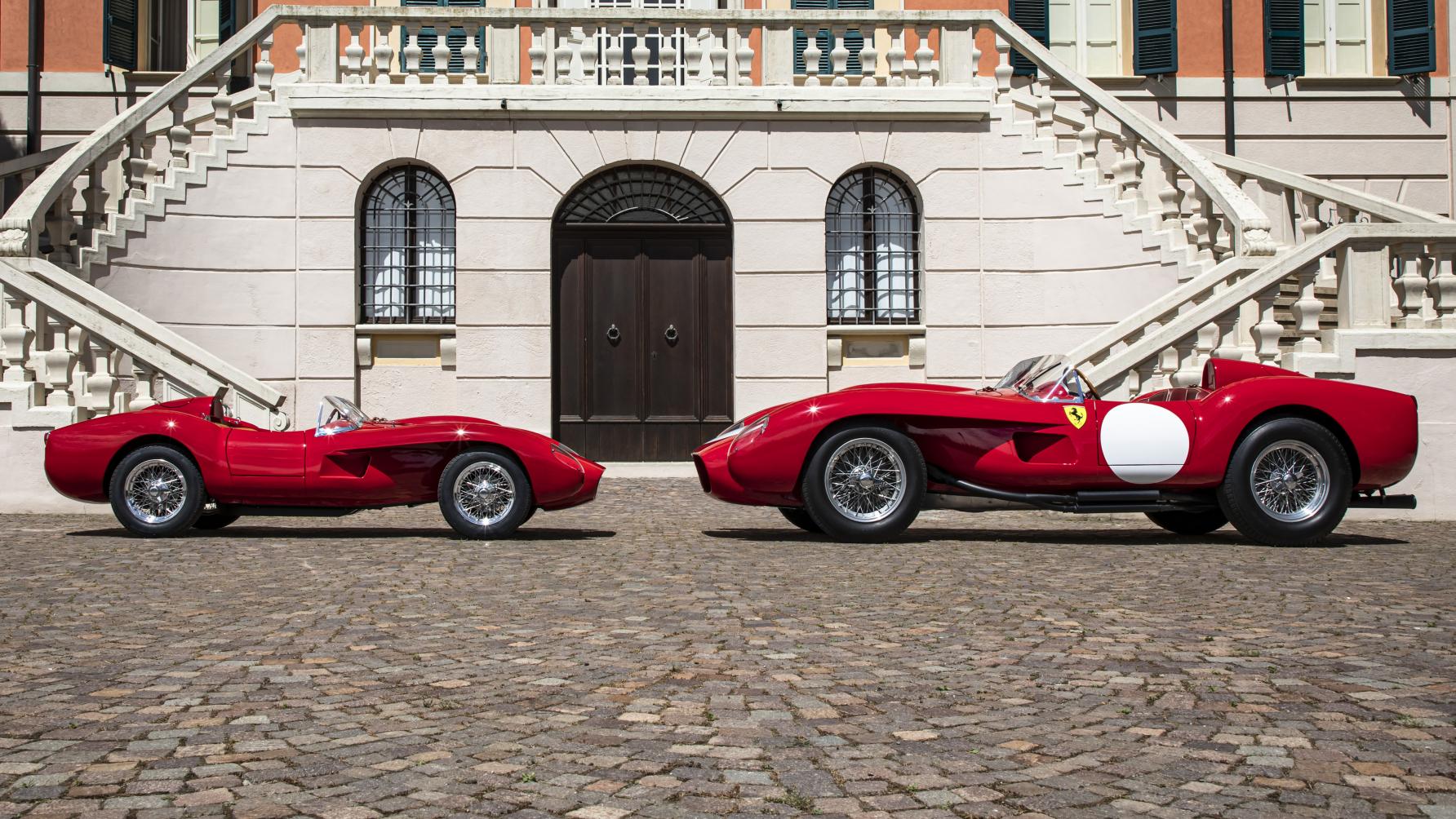
The 250 GTO is reckoned to be the most valuable classic Ferrari, but the 250 TR, especially the 1957 version with its distinctive ‘pontoon’ front guards, runs it a close second. In 2011 the original 1957 TR prototype changed hands for more than $23 million.
Against that background, the limited edition Testa Rossa J – just 299 will be made – looks a bargain. For well-heeled Ferrari collectors, at least.
The Testa Rossa J is the third car from The Little Car Company. Based at Bicester Heritage, north of London, The Little Car Company makes – as its name implies – a little cars. Special and expensive little cars.
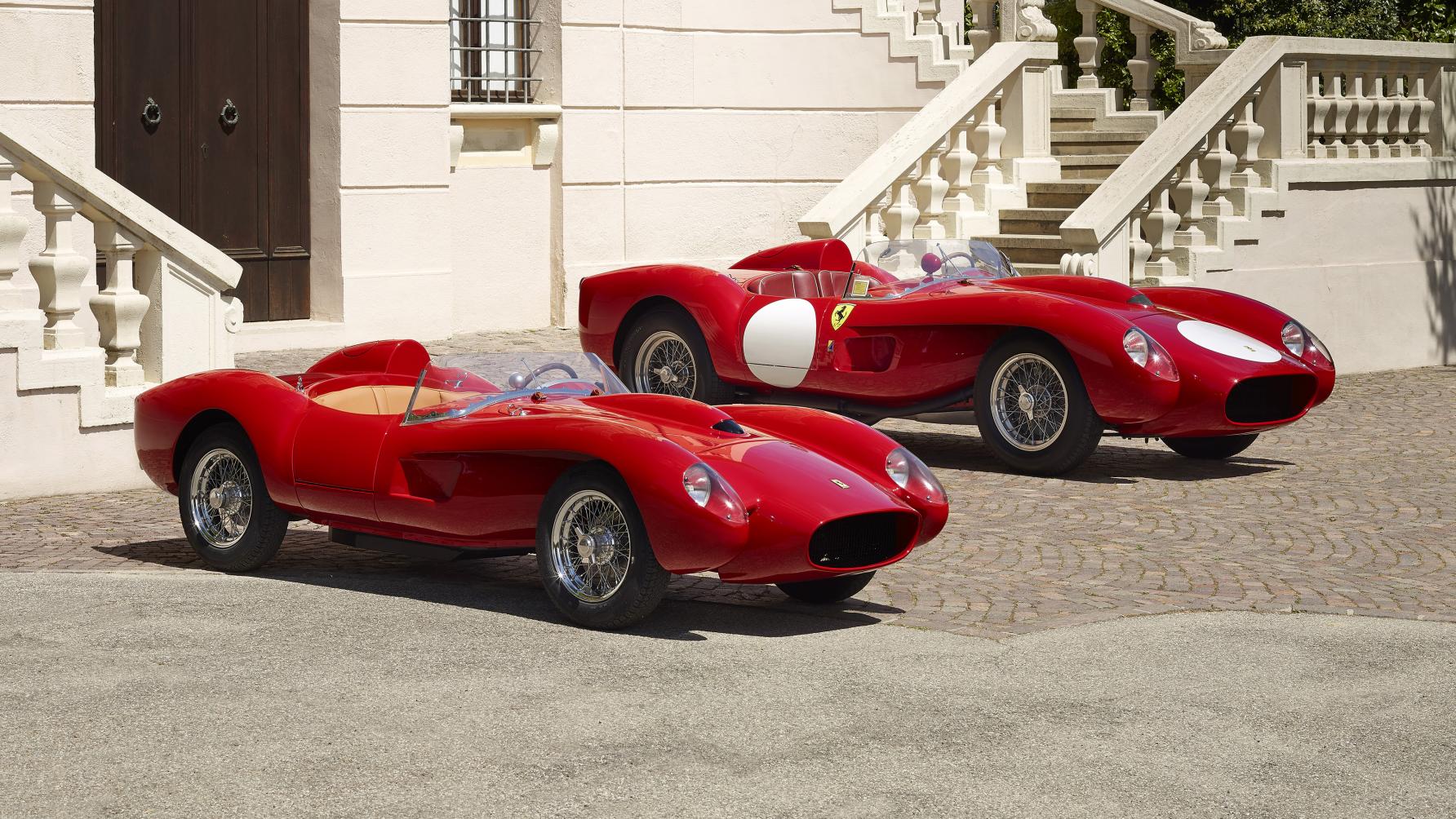
It’s a beautiful little jewel of a thing. And while it looks toy-like, it’s nothing like a toy to drive. It’ll hit 80km/h, has four-wheel disc brakes with Ducati calipers, the same suspension geometry as the original 250 TR, and runs on proper Pirelli tyres.
Founded in 2018 by self-described ‘serial entrepreneur’ Ben Hedley, The Little Car Company got its start when, to celebrate the marque’s 110th anniversary, Bugatti asked it to create a modern version of the Bugatti Baby, the half-scale Type 35 built in Molsheim in 1926 as a fourth birthday present for Ettore Bugatti’s youngest son, Roland.
Hedley’s proposal differed from the original in one key respect: The Little Car company Bugatti Baby II, which ranges in price from $48,000 to $93,000 (plus tax and shipping) is a three-quarter scale car. “I wanted something that adults as well as children would be able to drive,” he says. Just 500 are being built.
The launch of Bugatti Baby II was followed in 2020 by the reveal of the kid-sized Aston Martin DB5 Junior, which can be ordered in more powerful Vantage specification or as the 007-worthy No Time To Die Edition complete with fake machine guns behind the headlights, switchable license plates, and a smoke machine at the rear of the car.
The Testa Rossa J was created using data from original drawings in the archives of Ferrari’s Classiche Department in Maranello. Its tubular steel chassis is a precisely scaled-down replica of the full-size original.
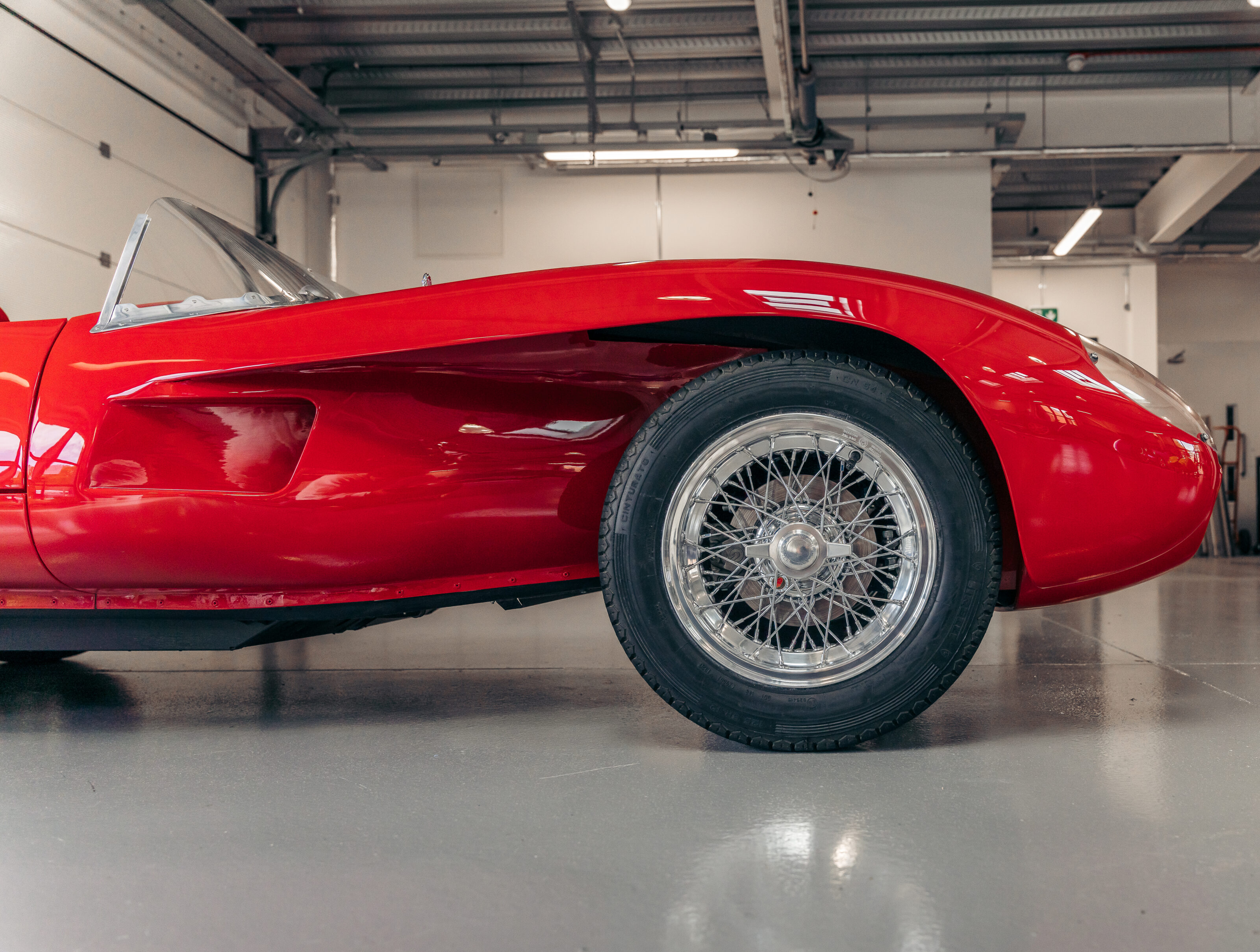
The suspension features Bilstein coilover shocks and Eibach springs, and the Pirelli tires on the handmade 12-inch wire wheels (genuine Borrani wire wheels are available as an option) are the same size as those used on another Italian automotive icon, the original Fiat Cinquecento built from 1957 to 1975. The bodywork has the exact proportions of the original 250 Testa Rossa and is made the same way.
The Prancing Horse badge on the front of the Testa Rossa J is the genuine item, and the accelerator and brake pedals are from the F8 Tributo.
An online car configurator allows customers to choose from 14 historical liveries, 53 bodywork colours and additional personalized racing liveries, all rendered in the same paint used on Ferrari road cars. The bench seat is trimmed in factory Ferrari leather.
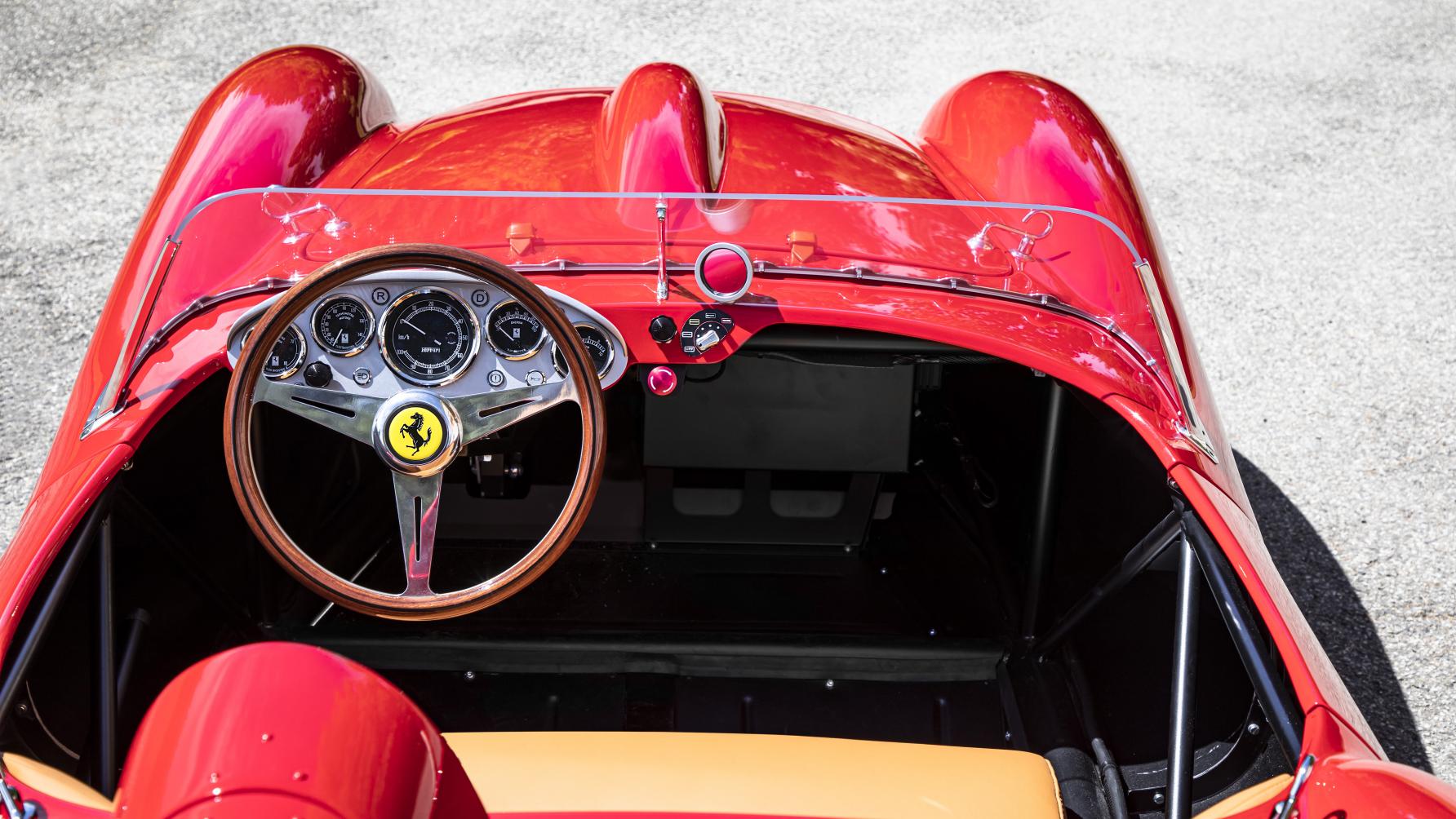
The vintage-style three-spoke wood-rim steering wheel is from Nardi, which supplied steering wheels for the original 250 TRs, and while the gauges on the instrument panel have been repurposed for use in an electric car, they feature the same design and fonts used back in 1957.
The Nardi wheel has a quick-release mechanism that enables it to be removed so adults can clamber into the cockpit. On the centre of the dash is what looks like a Manettino from a modern Ferrari. It’s where the key to start the car is inserted, and twisting it activates four different drive modes.
Powering the Testa Rossa J is a 12kW electric motor mounted at the rear and driving the rear wheels. The motor is fed by three 2kW/hr batteries mounted up front that deliver up to 90 kilometres of range and can be recharged in four hours.
Novice Mode, designed to allow children to be able to learn to drive the Testa Rossa J in safety, restricts the e-motor’s output to 1kW and the top speed to 20km/h and will automatically shut down the car if it travels beyond a certain distance from a hand-held key fob.
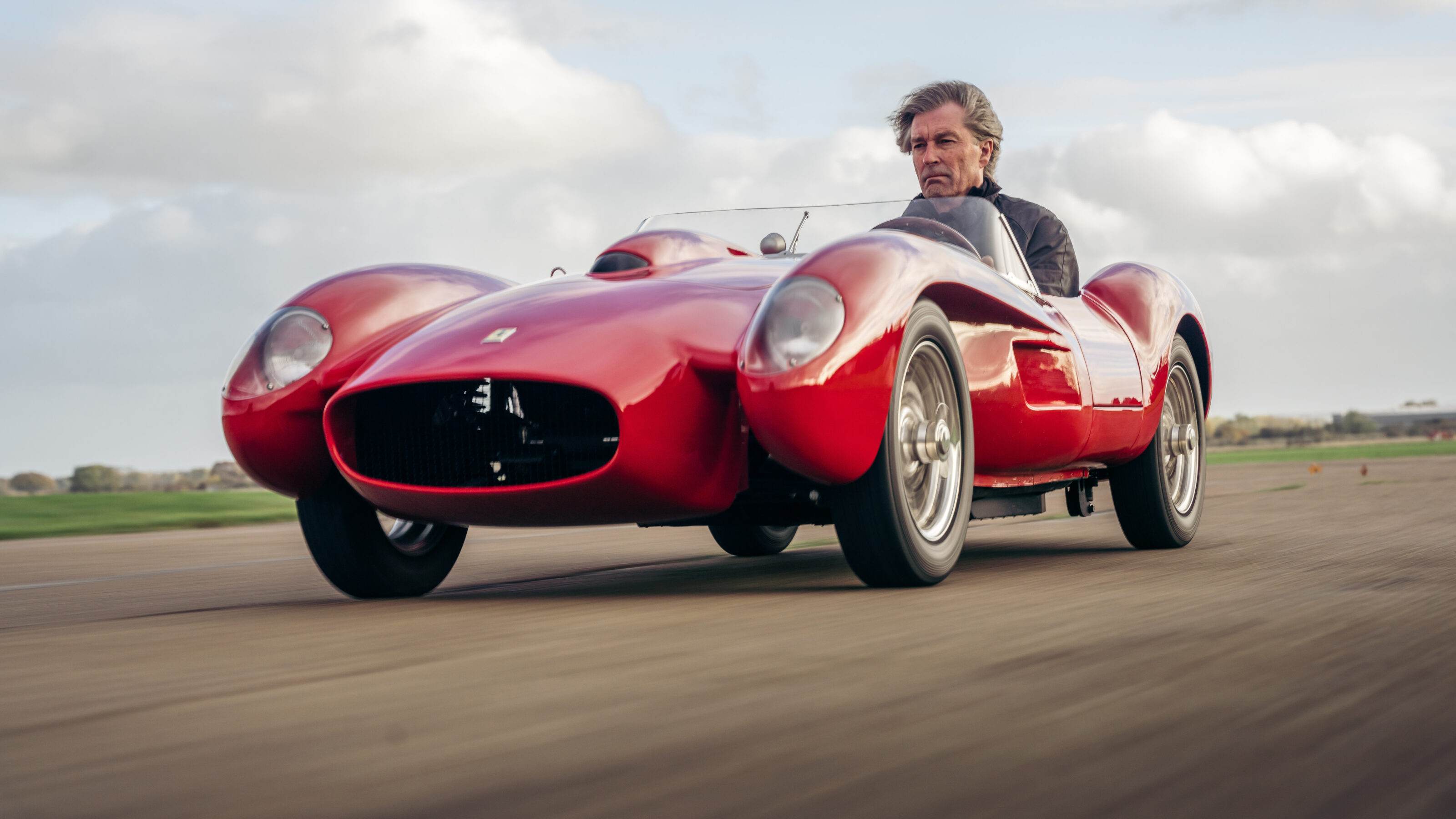
Comfort Mode increases the e-motor’s output to 4kW and allows speeds of up to 45km/h, Sport Mode takes it to 10kW and allows up to 80km/h, and Race Mode to boosts output to 12kW for even sharper acceleration.
This is no glorified golf cart: The Testa Rossa J weighs just 260kg and in Race Mode has a weight-to-power ratio 3.7 times better than the quirky, road-legal, electric powered Citroën Ami city car, and almost twice the top speed.
And while 80km/h doesn’t exactly sound Ferrari-fast, when your head and torso are out in the freezing slipstream of a British winter’s day, it certainly feels it.
More importantly, though, the Testa Rossa J isn’t just a point-it-and-plant-it drive experience. Push it through the corners and you’ll feel the roll in the suspension and the compliance in the tires.
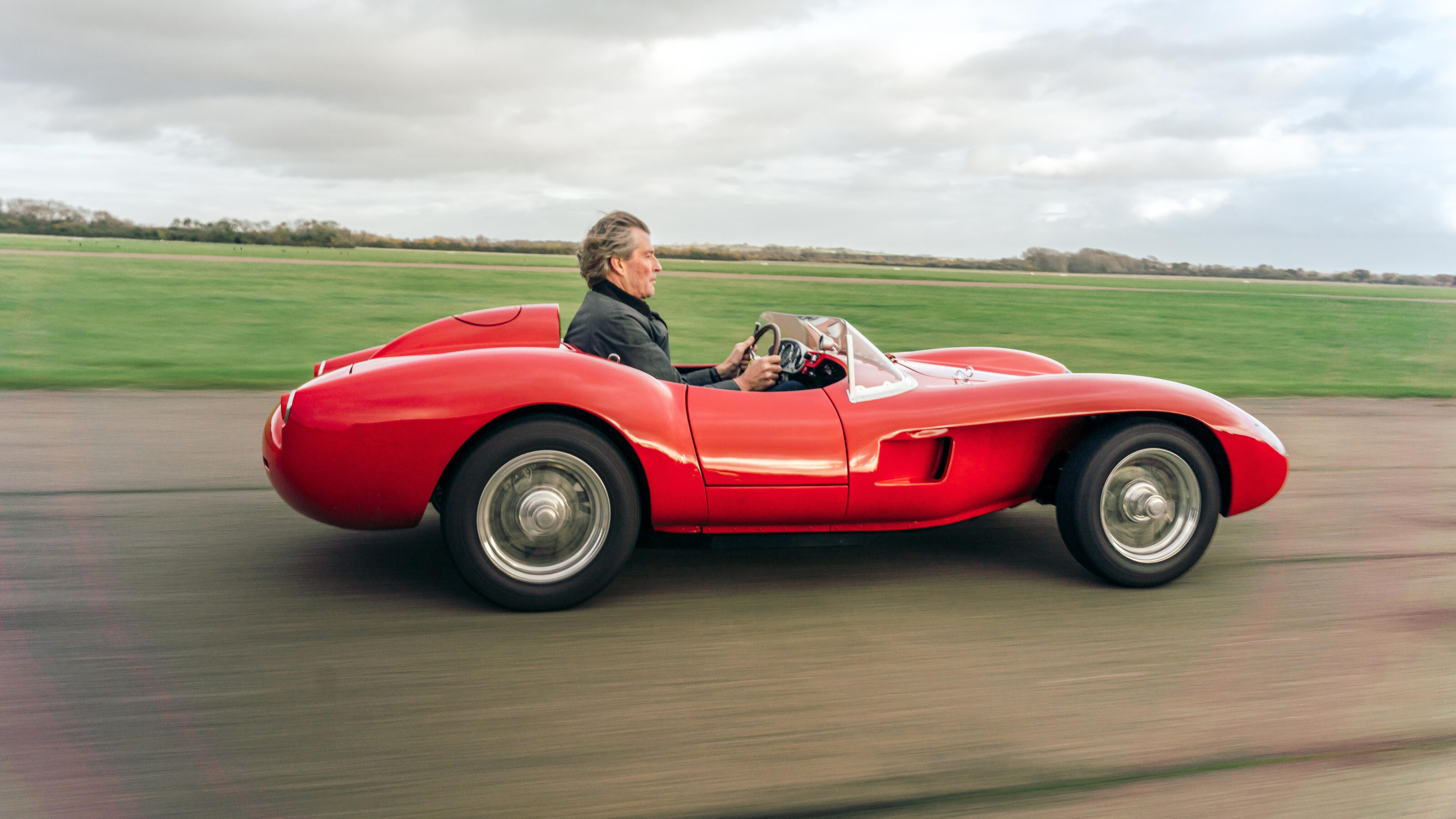
It really feels like an old front-engine sports car; it likes to be braked early, settled, then turned in, with the power fed in early to get the weight transfer to the rear axle.
“We thought you were bringing us a toy, but you’ve brought us a real car,” Ben Hedley says Ferrari execs told him when he showed them the prototype.
At Ferrari’s request, the Testa Rossa J has a genuine Ferrari VIN plate. It also asked that The Little Car Company remove its own logos from the car.
“They’ve told us this is the first Ferrari ever made outside Maranello,” says Hedley. “That’s quite a compliment.”
Key Points
- Peugeot commits to all-electric models in Europe from 2030
- Combustion engines will still be used in other markets
- Parent company Stellantis is targeting 70 per cent electric sales by 2030
French manufacturer Peugeot has announced its intentions to deliver an all-electric model range in Europe from 2030.
Peugeot CEO Linda Jackson told Automotive News Europe the manufacturer was committing to make only electric vehicles for the European market from 2030, five years before the expected European Union mandate to ban internal combustion engine production comes into play.
However, the move to exclusively producing EVs won’t apply worldwide, as Peugeot still plans to manufacture vehicles with internal combustion engines for international markets with sufficient demand past that date, with its range of EV platforms able to be adapted to suit fossil-fuel powered cars.
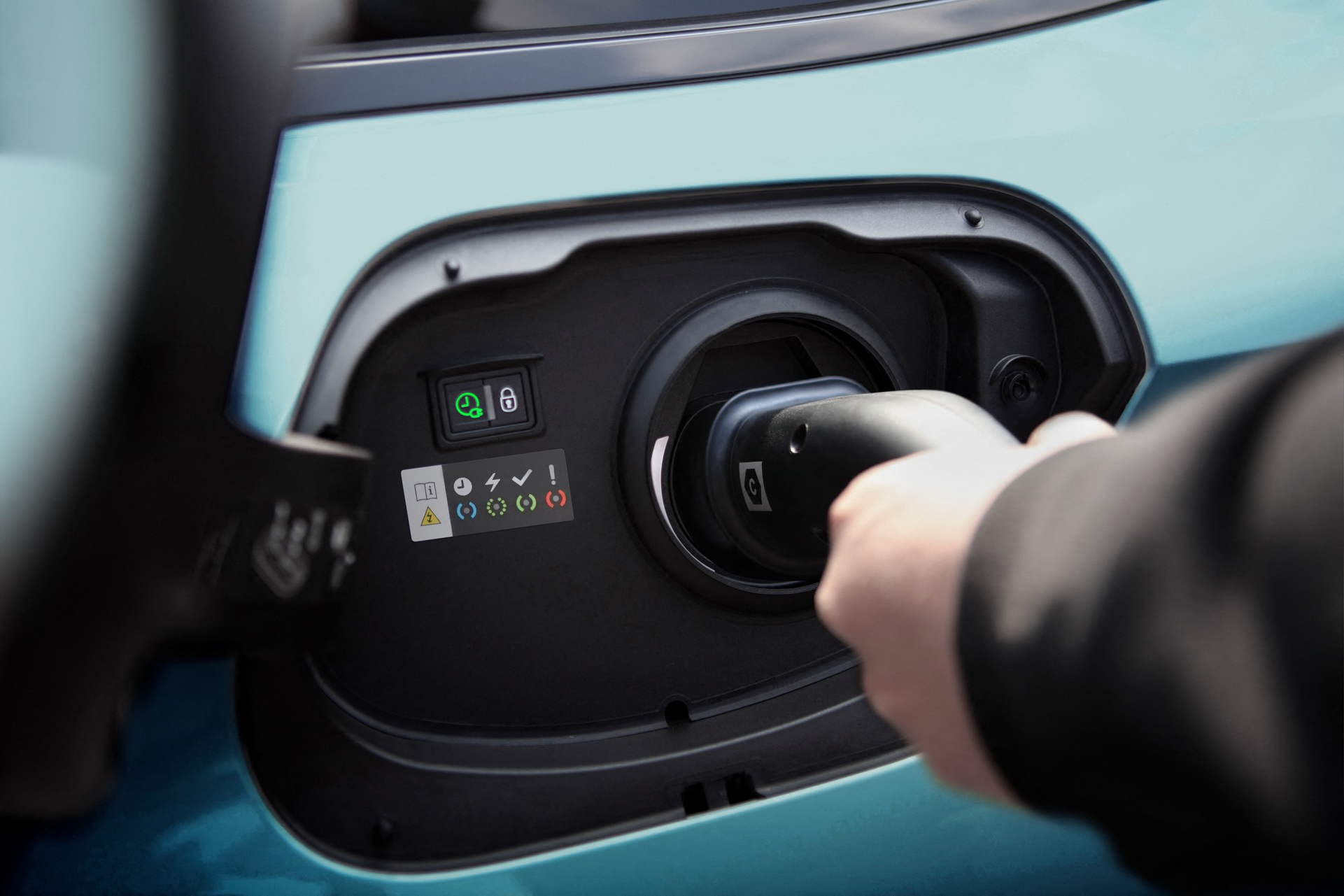
“As we move on to the new [Stellantis] platforms (STLA Small, Medium, Large) by 2030, in Europe all of our models will be electric,” Jackson told the publication.
“But I still have to make sure I maintain internal combustion offerings for my international customers.”
In Europe, roughly 70 per cent of Peugeot’s model line-up is electrified, either with fully-electric drivetrains or plug-in hybrid options.
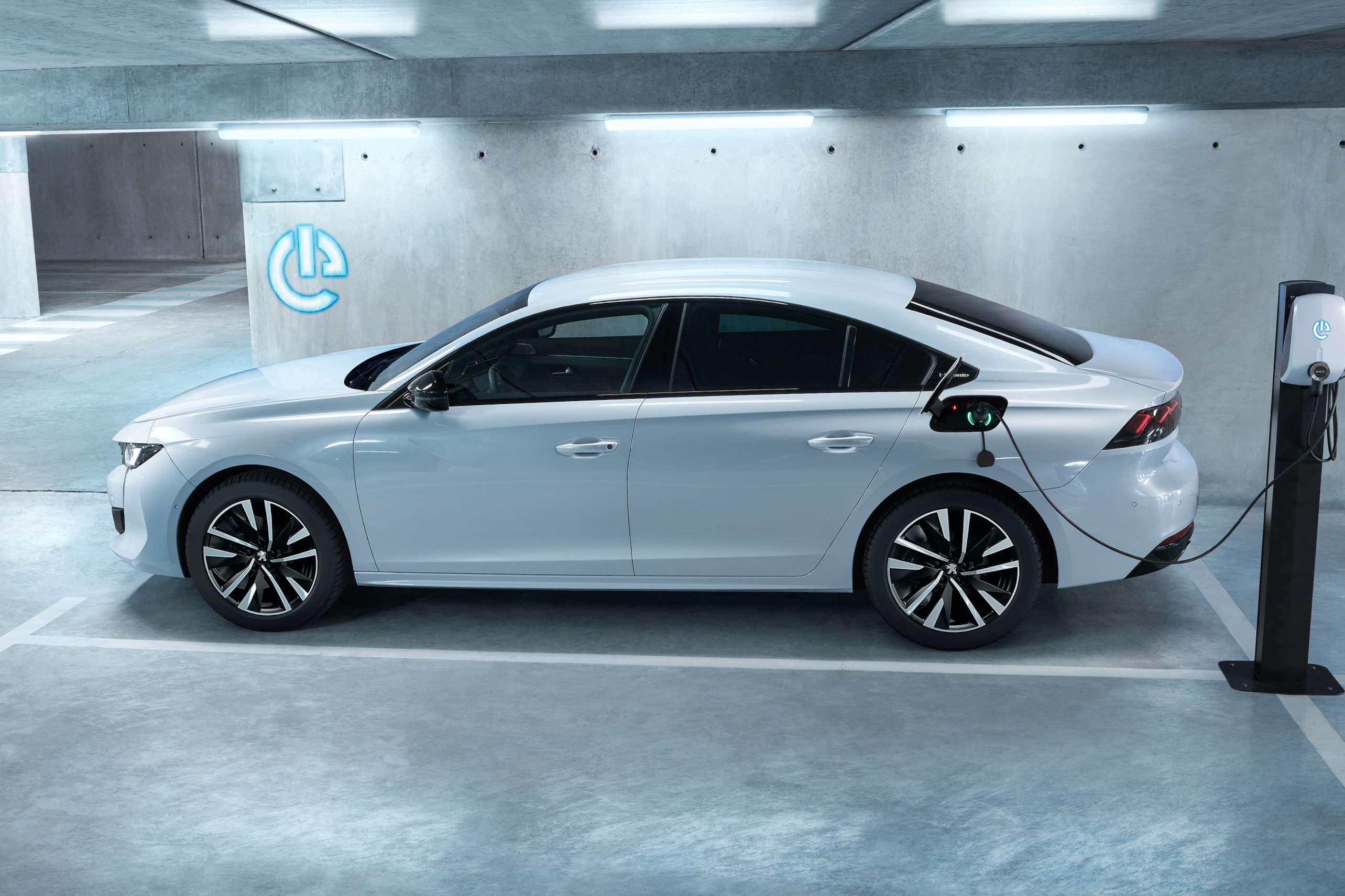
Earlier this year, parent company Stellantis announced its intentions to electrify each of its 14 brands, outlining its plan for 70 per cent of vehicle sales to come from EVs by 2030 in Europe.
At present, there are no electrified Peugeot models on sale in Australia, although this is set to change from next year with the first-quarter launch of the 508 GT Fastback Plug-in Hybrid and the 3008 GT Sport Plug-in Hybrid AWD, followed by the new 308 later in the year.
The petrol-powered 2022 Lexus LX 600 will be sold in Australia alongside its diesel counterpart, the 2022 Lexus LX 500d, documents have revealed.
Regulatory filings submitted by Lexus to the Department of Infrastructure show the company has sought approval to bring in both powertrains announced for the LX at the model’s unveiling in October.
Unlike the Toyota LandCruiser 300 Series, which will be solely available in Australia with a diesel powertrain, Lexus buyers will have the additional option of a 3.5-litre twin-turbo petrol V6 engine producing 305kW and 650Nm in the LX 600.

The LX 500d uses a 3.3-litre twin-turbo diesel V6 putting out 227kW and 700Nm – the same specifications found in its Toyota cousin.
Both engines are coupled with a 10-speed automatic transmission, and a low-range four-wheel-drive system.
While Lexus has yet to formally announce Australia specifications, the documents show a total of 12 possible configurations of the new LX across four variants, including an F Sport model.

Along with the option of a sub fuel tank for diesel models, buyers have the option of choosing five or seven seats – with a special ‘VIP’ four-seater limousine available on the LX 600 for the first time.
Full pricing and features for the 2022 Lexus LX range will be announced closer to the four-wheel-drive’s local launch next year.
When we think of the Ford Sierra, the fire-breathing Cosworth/RS500 springs to mind. As the dominant force in local and world touring cars, even us Aussies got behind the idea of a four-cylinder, and not a V8, in top-flight tin-top racing in the late ’80s and early ’90s. Punters even jeered when Dick Johnson and John Bowe were ‘robbed’ a Bathurst title in 1992 due to a red flag technicality, demoting the DJR Sierra to second.
However, there was another way. It came before the boosted four-pot screamers and dominated its domain in much the same way – and it was branded an XR8. Like the homologation rules that delivered us the road-going Cosworths, South Africa gained a four-door, 5.0-litre V8-powered Sierra back in 1984. Regulations for the SA Group One category stipulated that 200 road-legal examples must be built and sold, but the end tally crept to 250. Again, for South Africa only.
While Dick Johnson turned to the Mustang after the Greens’-Tuf XE Falcon, Ford Motorsport in SA plonked the 302ci Mustang V8 into a Sierra for the road-going specials. Okay, the raw numbers aren’t mind-blowing in a modern context.
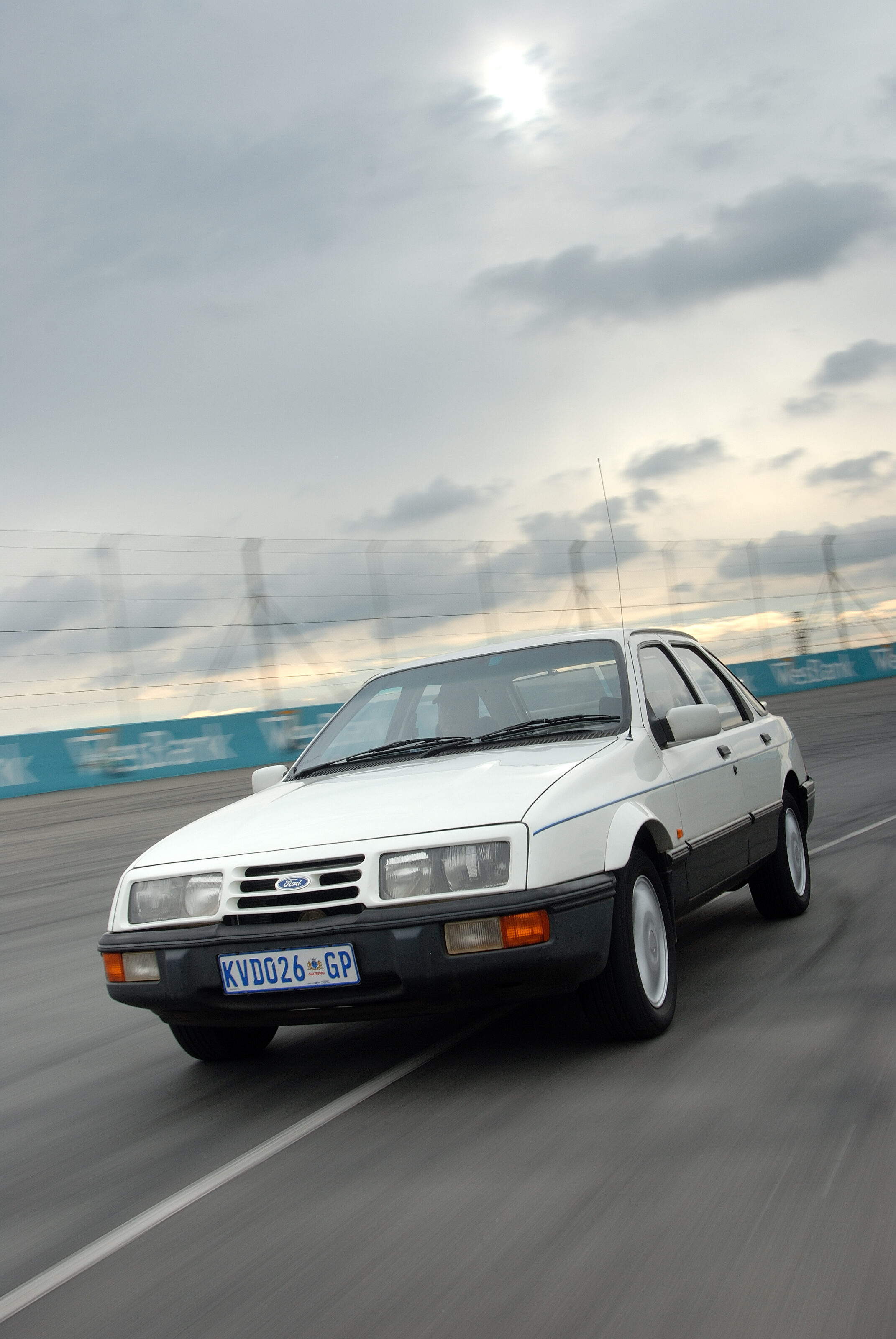
Try 161kW @ 4750rpm and 374Nm @ 3250rpm for the road car. However, the 0-100km/h time of 6.95 seconds, a standing kilometre in 28.24sec and a top speed of 231km/h is much more impressive. Remember, this was ‘84. Entry-level Ferraris had 179kW.
The XR8 also only weighed 1269kg, or 30kg more than the RS500, and with tweaks to the cooling, suspension and brakes it was a tidy handler. It uses the Mustang’s Borg Warner T5 five-speed manual as well as a Borg Warner differential. The side shafts and driveshaft were beefed-up considerably.
A MacPherson strut front end and an independent rear featured springs 50 and 40 per cent stiffer respectively, while ventilated four-pot calipers took care of arresting the XR8’s surprising turn of speed.
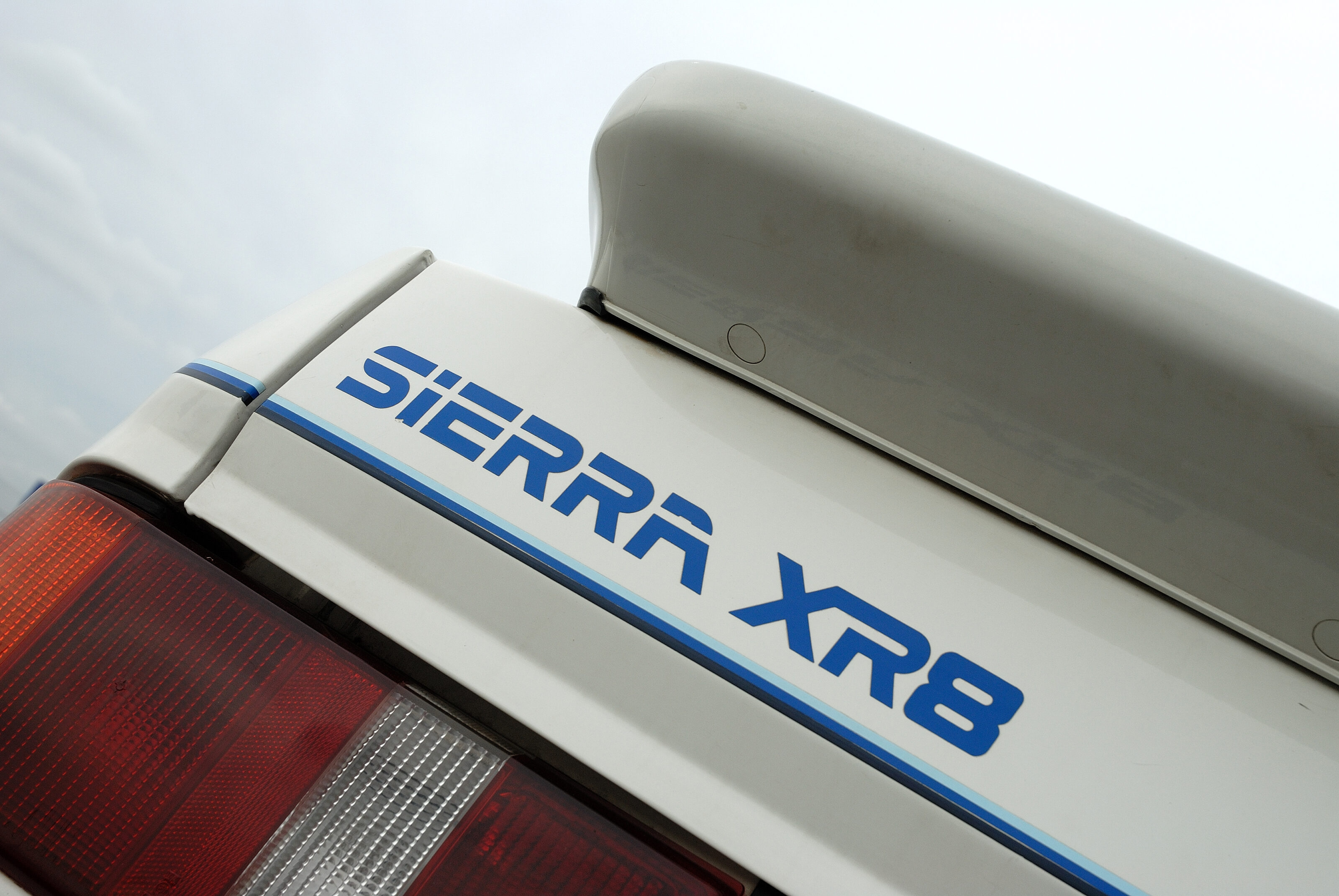
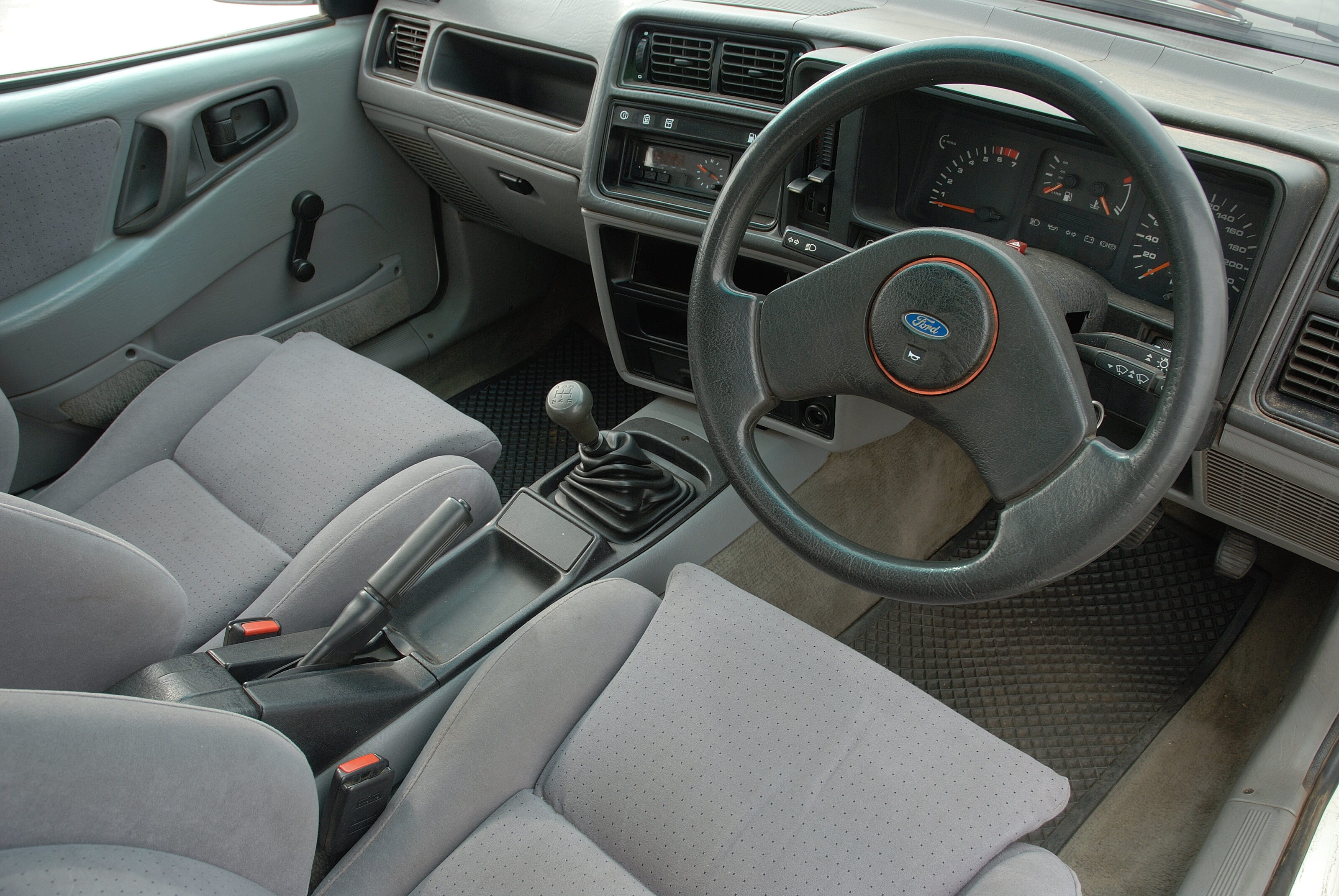
To fit the pushrod bent-eight in the relatively small engine bay the belt-driven cooling fans were swapped out for electric units and a slotted grille was added. Aesthetically, the 15.0 x 6.0-inch Ronal wheels were machined to fit over the upgraded brakes and you could option it in any colour you liked – as long as it’s white. Two-tone white. With Ford Motorport triple blue pinstripe and a grey interior.
The exterior isn’t dominated by the Red Baron-inspired rear wing the RS500 is known for. Instead, it uses slightly less ostentatious XR4i-style bi-plane rear deck. It’s on super-skinny 195/60 rubber, so it’s liable to hang its tail out at virtually any sniff of throttle.
Each of the 250 V8-powered Ford Sierra XR8s built are numbered accordingly. It’s just a shame none of those came Down Under.
Off and racing
While the Sierra XR8 is an interesting track tool, it also competed against a BMW 745i – yes, that’s right, a 7 Series. Alfa Romeo entered its lightweight GTV6 3.0-litre and an R31 Nissan Skyline also made an appearance.
1984 Ford Sierra XR8 specifications
| Engine | 4942cc V8, OHV, 16v |
|---|---|
| Power | 161kW @ 4750rpm |
| Torque | 374Nm @ 3250rpm |
| 0-100km/h | 6.95sec (claimed) |
| Weight | 1269kg |
Key Points
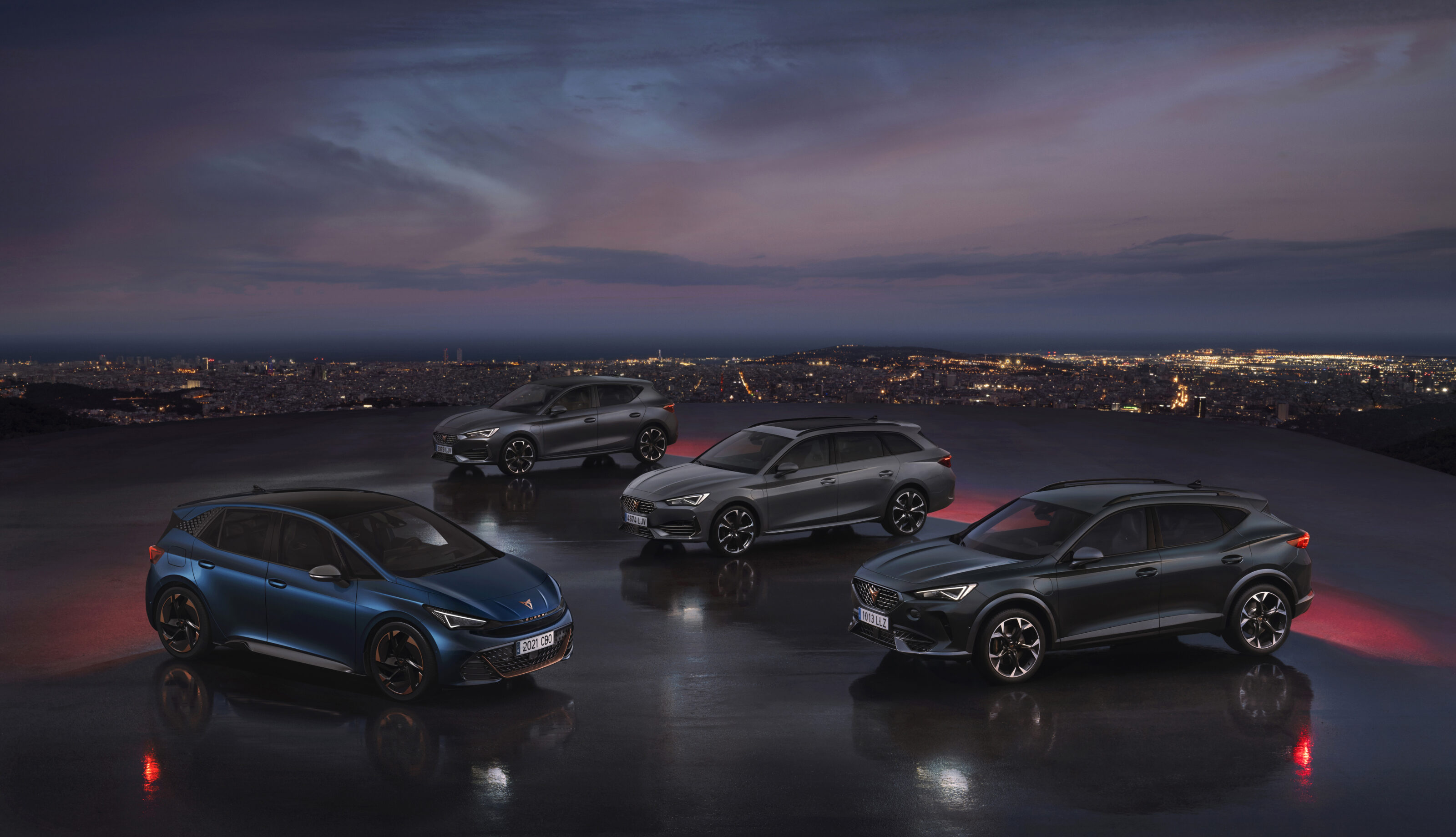
- Cupra Born hatch to arrive quarter four 2022
- Pricing will be along the lines of the Golf GTI
- First EV to land in Australia from the VW Group
The Cupra Born will be the first VW Group electric car to reach Australia, set to arrive in late 2022 with a Tesla-beating price tag.
The Born electric hatchback wasn’t expected to be released locally until 2023, along with the twin ID.3 from parent company Volkswagen.
European demand, combined with the Australian Government’s dearth of EV incentives, continues to delay the introduction of the ID.3 to this market, giving the young marque a helpful internal coup.
Volkswagen’s Spanish Cupra brand is being launched in Australia in the second quarter of 2022, four years after being switched from a Seat performance sub-division to a standalone entity.
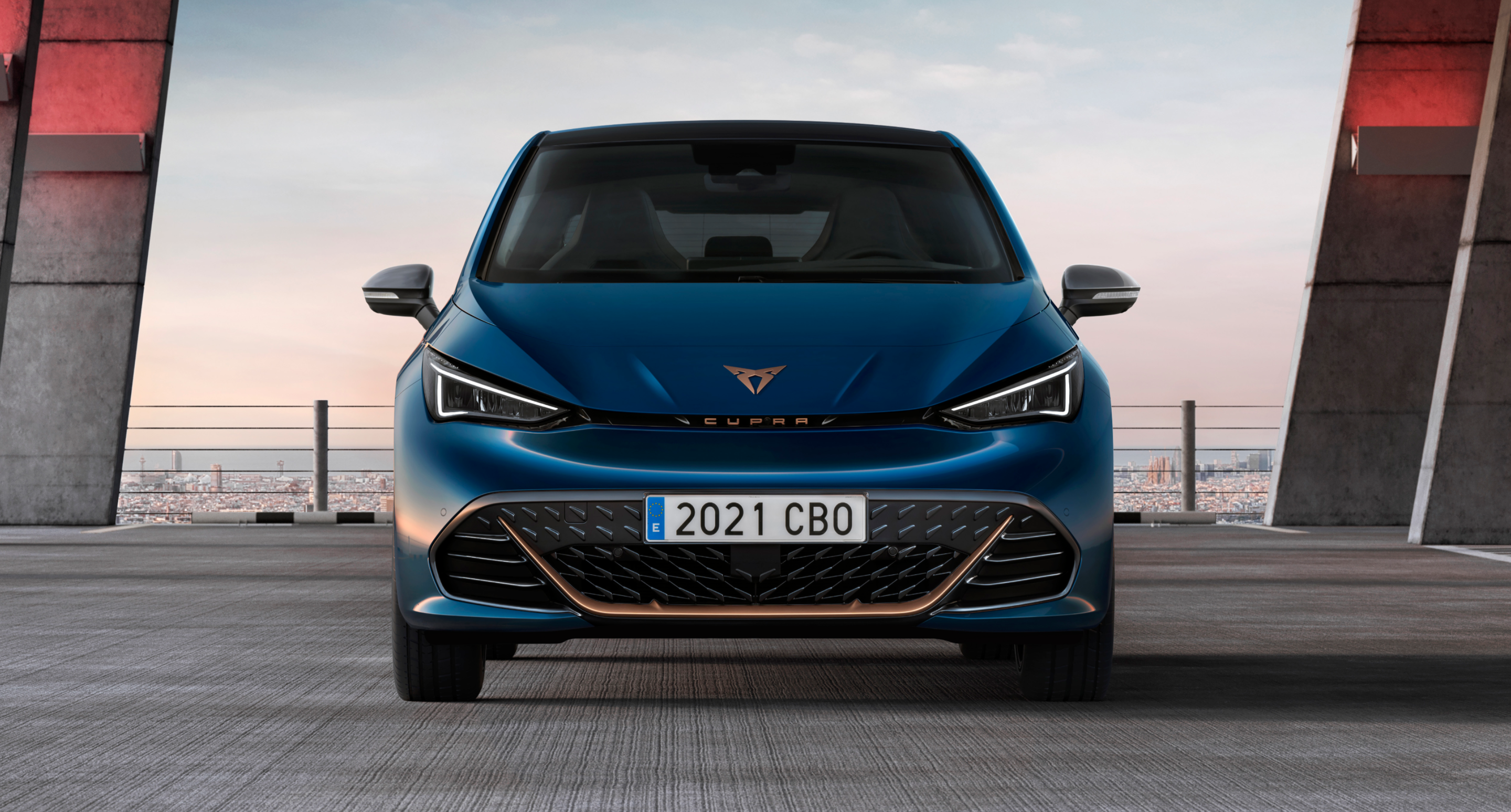
An initial line-up will include plug-in hybrid variants for its Leon hatchback and Formentor SUV, along with petrol engines and a petrol-only Ateca SUV – though Cupra is the first VW Group brand to commit to what will eventually be an electric-only line-up.
Cupra Australia is also aiming for the Born to make its mark with competitive pricing that undercuts other European EVs.
“Cupra wants to be the first European brand with an affordable EV,” said VW Group Australia spokesperson Paul Pottinger.
“There’s potential for it to start at the price of the current Golf GTI. It will certainly be considerably less than the cheapest Tesla.
“We will then look to introduce our VW ID range from 2023.”

The Golf GTI currently costs $53,300 before on-road costs. A similar price point would ensure the Born is well within the cost threshold for the best EV purchase incentives offered in Australia.
These are currently led by New South Wales, which offers up to $5540 in rebates and stamp duty savings on electric cars costing less than $68,750.
It would also undercut the most affordable Tesla, the Model 3, which starts from $59,900.
Cupra’s Born is a hatchback similar in size to a Golf, whereas the Model 3 is a mid-sized sedan.
Cupra Australia isn’t yet confirming which Born variant will be imported.
The smallest, 45kWh battery version is less likely considering Cupra has been spun off from Seat with a performance focus.

A 58kWh Born equipped with an e-Boost performance pack for 170kW and 350Nm promises to be the fastest version, with a claimed 0-100km/h time of 6.6 seconds.
The regular 58kWh Born, Cupra’s most popular version in Europe, has 150kW and 350Nm and completes the same sprint in 7.3 seconds.
A 77kWh version offers the longest WLTP-rated driving range, at about 540 kilometres.
Volkswagen’s ID.4 SUV is among other ID models on the target list for Australia and might be deemed a greater priority than the ID.3 considering it offers a vastly more popular body style.
Neither ID model is expected here before 2023 at this stage, while the Enyag EV from VW’s Czech brand Skoda is also not anticipated to arrive until either 2023 or 2024.
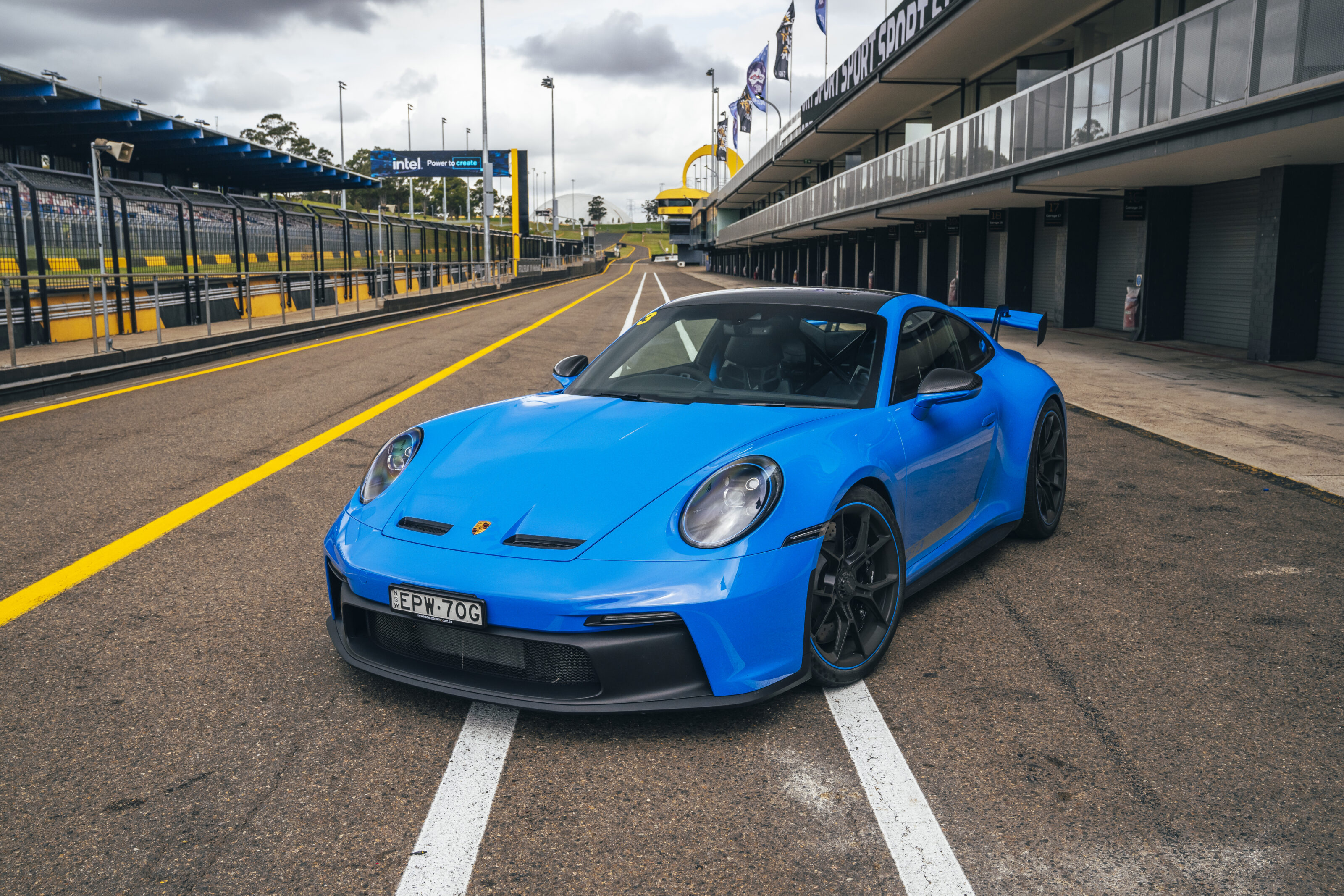
Even by the standards of the Porsche 911, the new 992-generation GT3 appears to be an evolution of the species. This has always been the case of course, but a quick glance at the spec sheet appears to suggest a particularly small step forward.
Incremental tweaks abound. The 4.0-litre naturally-aspirated flat-six now produces 375kW and 470Nm, increases of 7kW and 10Nm courtesy of the individual throttle bodies first introduced on the limited edition 991.2 Speedster, but the gear ratios in the seven-speed dual-clutch gearbox are the same.
The body is 11mm longer and 8mm taller (width is the same), resulting in a 5kg weight gain. Unsurprisingly, with similar power and weight its performance claims are equally similar, the 0-100km/h time remaining static and the 0-200km/h figure improving by just 0.2sec.
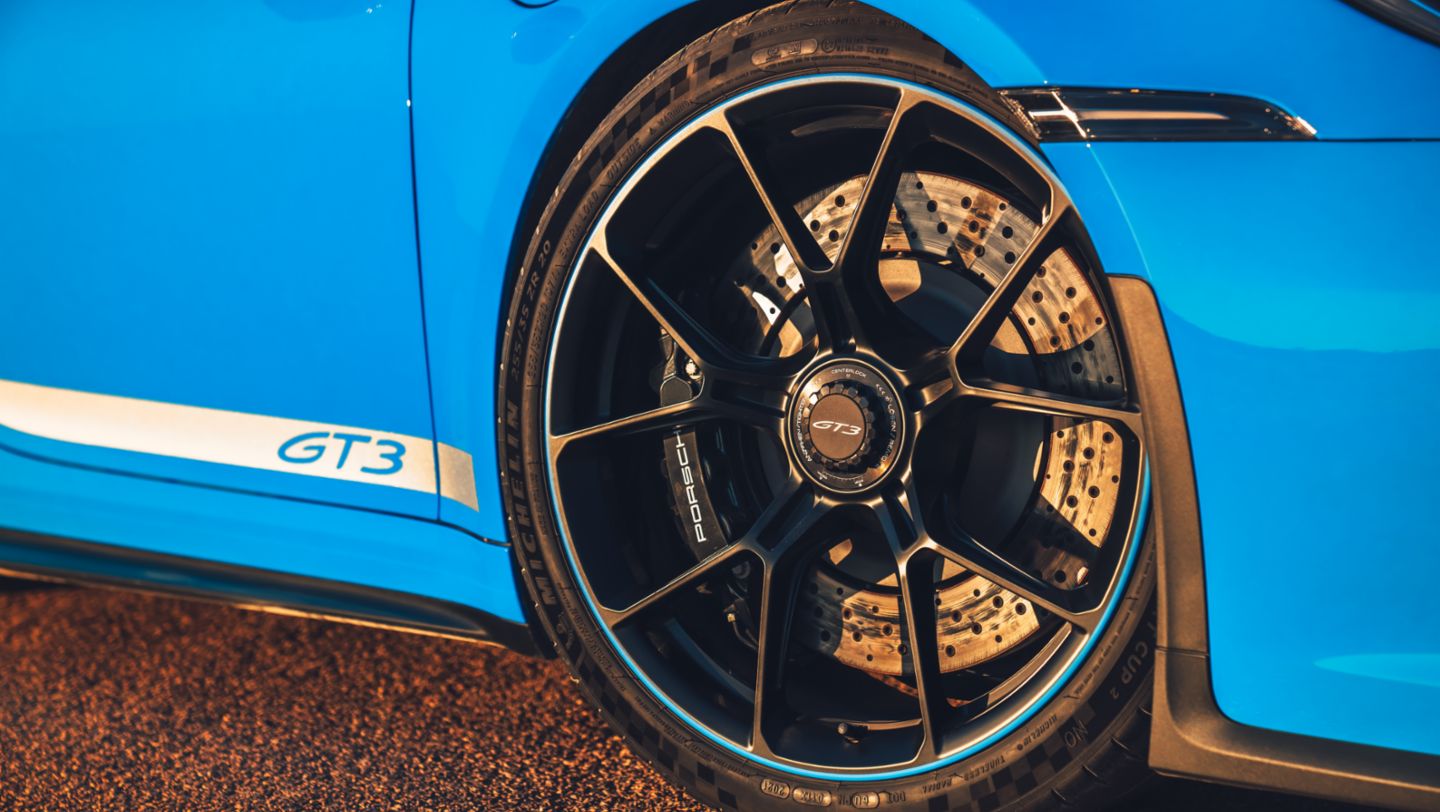
The tyres are 10mm wider at both ends, the front wheels a half-inch wider and the rears an inch bigger in diameter, the front brake rotors are 28mm larger; everywhere you look there are incremental changes, but it does suggest that Porsche is just tinkering around the edges, that it’s run out of ideas somewhat.
The 992 GT3 is 17.5sec quicker around the Nurburgring than its predecessor. Its 6:59.927sec effort is faster even than the previous-gen GT3 RS.
One figure, however, says otherwise. The new 992 GT3 is 17.5sec quicker around the Nurburgring than its predecessor. Its 6:59.927sec effort is faster even than the previous-gen GT3 RS and, if you want a graphic illustration of how far we’ve come in 20 years, a mind-altering 1min1.2sec quicker than the first 996 GT3.
Dig a little deeper and it becomes apparent that Porsche’s GT department, led by the charismatic Andreas Preuninger, has done anything but rest on its laurels. For a larger, stiffer bodyshell with bigger wheels, tyres and brakes to put on only 5kg is quite an achievement. A carbon bonnet helps, as does lightweight glass (both pulled from the GT3 RS ideas cupboard), while the exhaust system is 10kg lighter than before.
Straight-line acceleration may be similar to before, but 0-100km/h in 3.4sec and 0-200km/h in 10.8 sec with a 318km/h top speed is nothing to sneeze at, the slight improvement coming courtesy of a shorter final drive ratio and better aerodynamics.
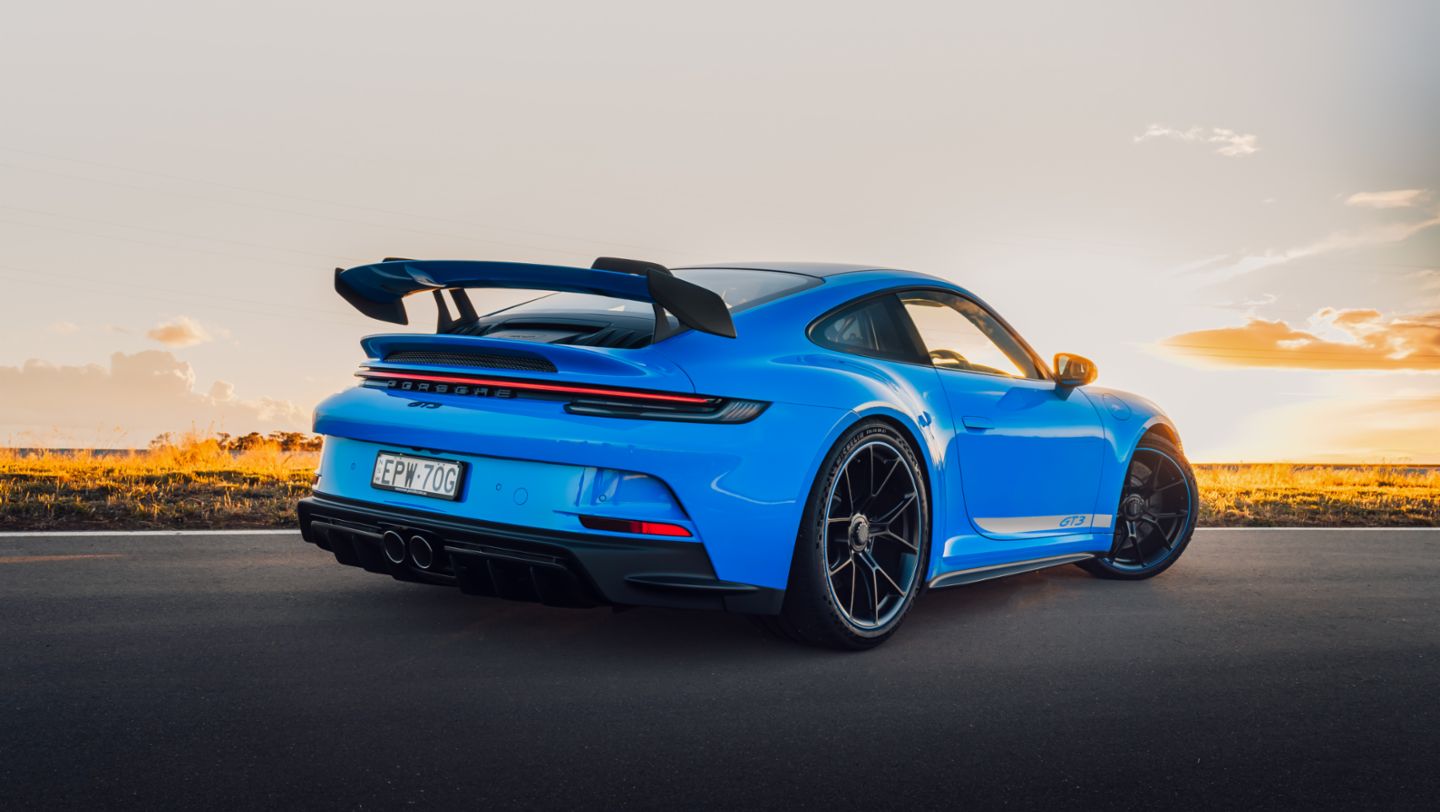
Manipulation of the air is one area the 992 has taken a big step forward over its predecessor. At the front, the packaging of the nose required the introduction of two nostrils in the bonnet to vent air from behind the central radiator.
At the rear there is the new ‘swan neck’ rear wing. By attaching the supports to the top of the wing, it leaves the downforce-generating underside free to work with the ducktail spoiler and huge diffuser to increase downforce by 50 per cent at 200km/h. Adjust the wing to its track-only ‘Performance’ setting and that figure increases to 150 per cent.
The final piece of the puzzle is virtually invisible, at least until you reveal a front wheel. Every road-going 911 until now – including all 992 models – has used MacPherson strut front suspension, but the new GT3 copies the RSR Le Mans racer by adopting a double-wishbone front end.
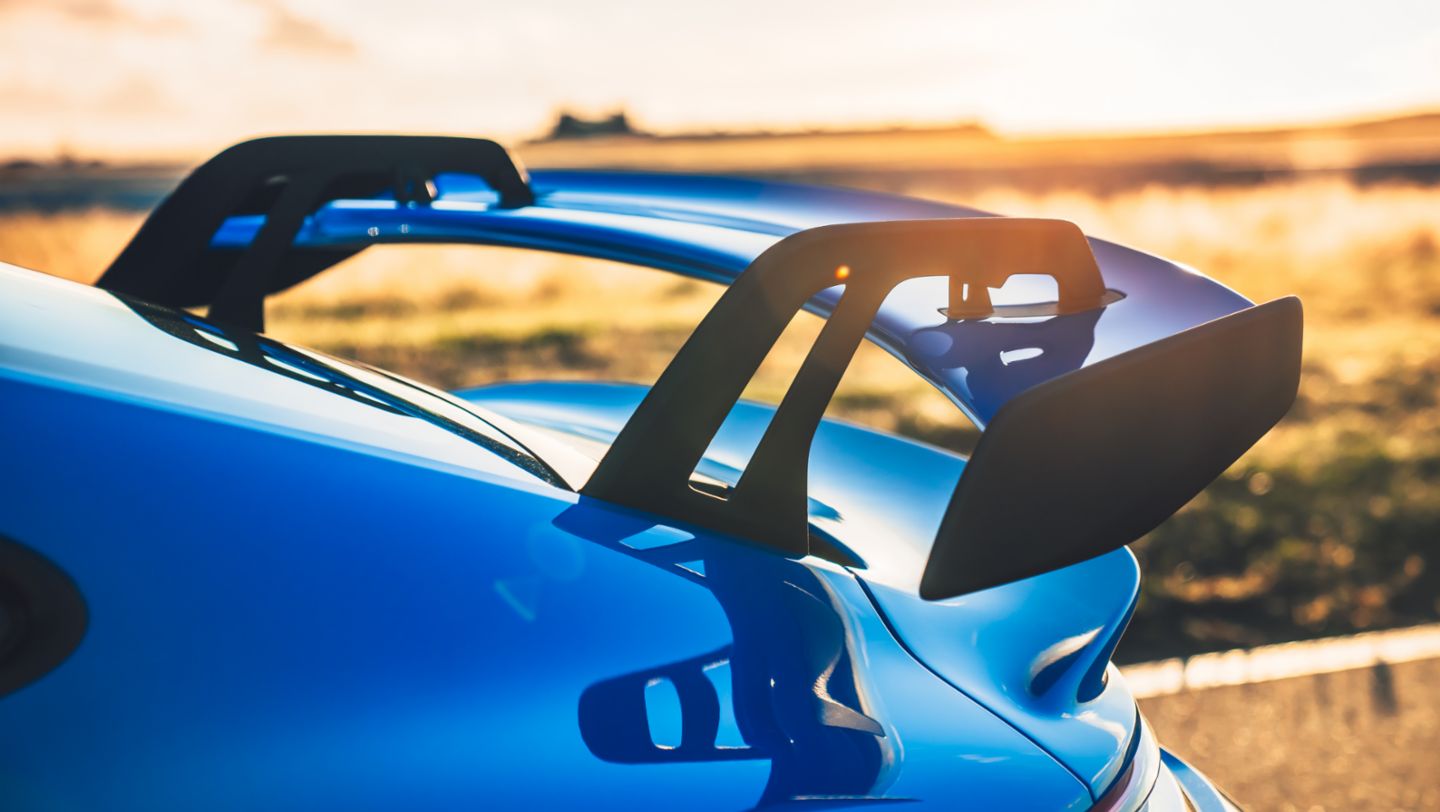
It’s made possible by the larger 992 body, but even so, the cost and complexity of installing a completely different front suspension layout on the same production line would’ve taken a few meetings to sort out. It’s a superior performance car solution, providing greater wheel stability under load.
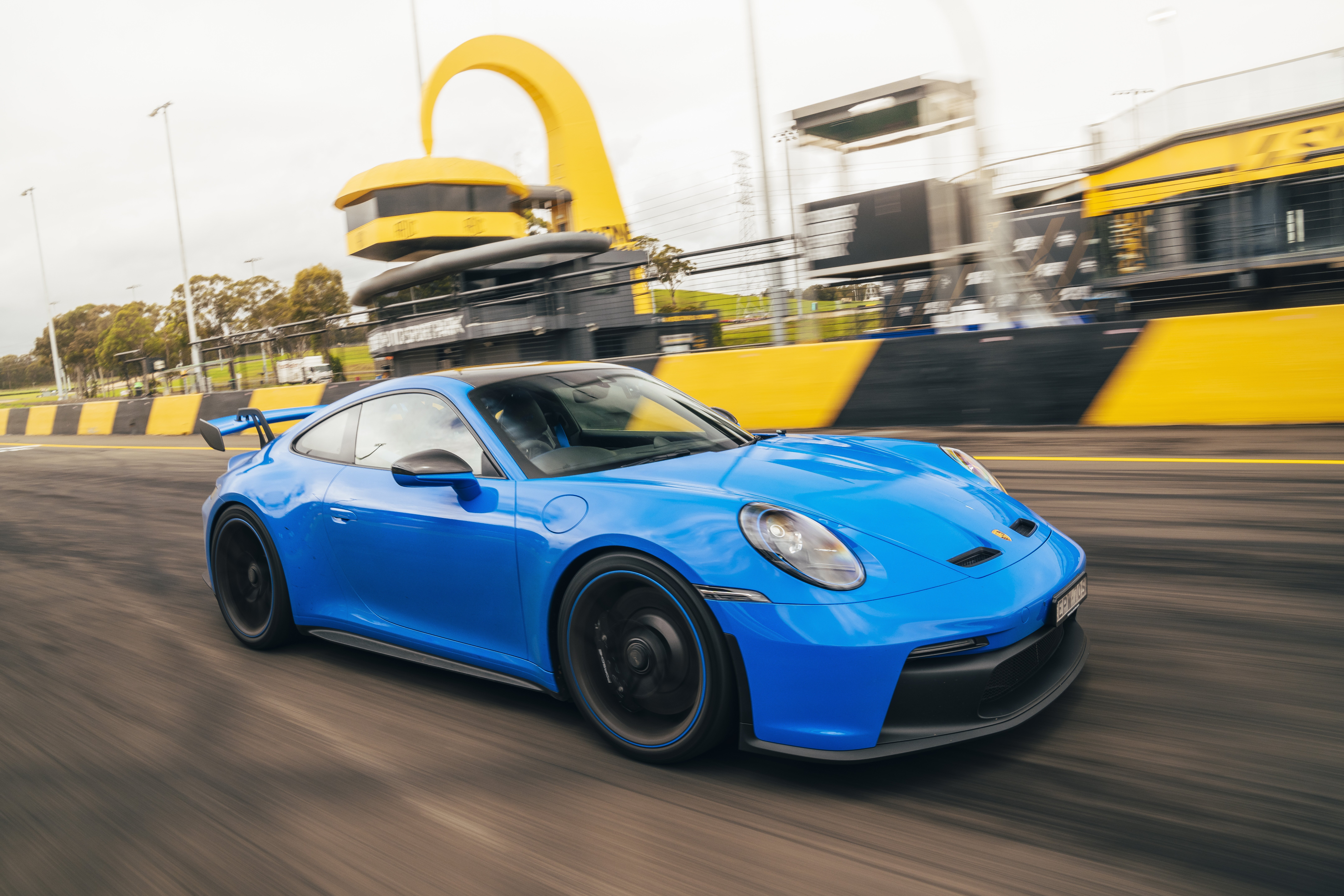
All of this is just letters and numbers on a page, though, knowledge regurgitated from the press kit – research not assessment. Thankfully, we have a day at Sydney Motorsport Park and a trio of identical Shark Blue 992 GT3 PDKs, not to mention a who’s who of Australian racing drivers on hand to ensure that the driver (in this case me) isn’t the weak link in the chain: Luke Youlden, Craig Baird, Alex Davison, Tony D’Alberto and Fabian Coulthard just to name a few.
The final piece of the puzzle is virtually invisible, at least until you reveal a front wheel … the new GT3 copies the RSR Le Mans racer by adopting a double-wishbone front end
Each car is fitted with bucket seats, a half cage and six-point harnesses (though the lap-sash belt suffices), but there are a couple of new additions to the driving environment. The first is electric height adjustment for the seat, which sinks your bum virtually to the floor. In general, the driving position is very good in terms of the arm-wheel/leg-pedal relationship, the brakes located nicely for either left- or right-foot braking, but the bucket seat does force quite a hunched posture, especially with a helmet on.
The interior is simple but high quality, a digital screen either side of the central analogue tacho adding a dash of technology, though the regular 992’s futuristic gearshift toggle has been replaced by what looks like a manual lever, even in these PDK-equipped cars. It allows gears to be changed sequentially as well as via the paddles.
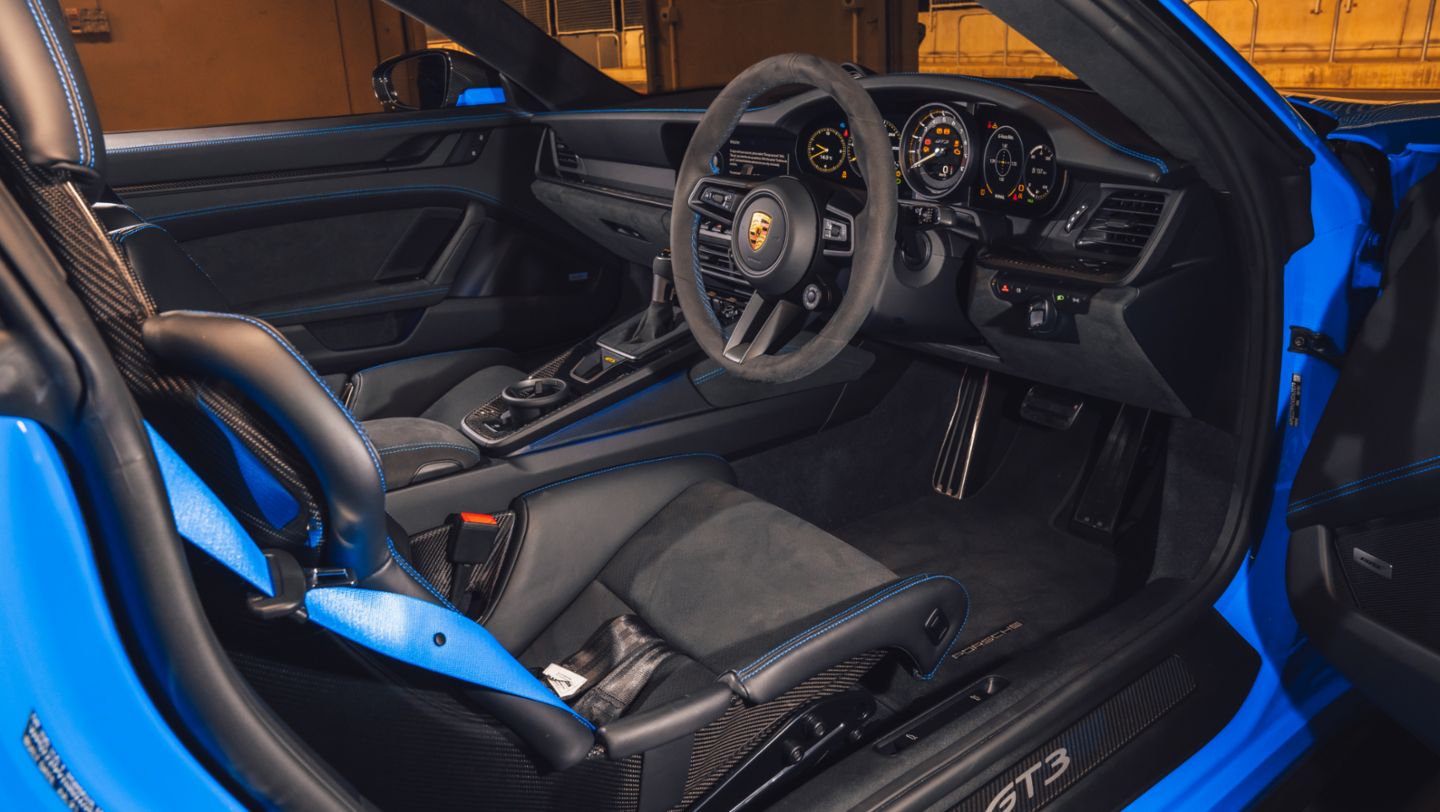
Push the top and pull back to select drive, then tweak the rotary dial on the steering wheel – another new feature – to click through Normal and Sport modes to Track, which alters the engine and gearbox mapping, while the adaptive dampers can be set to Sport (firm) or Track (very firm).
Despite its performance potential, the GT3 isn’t intimidating in the slightest. The steering – still variable ratio but quicker across the board than before – is relatively light without a hint of slack and the immediacy of its responses indicate I’m going to need to push a lot harder to start approaching its limits. A sign of the effortless speed it generates is the fact that while I feel a 1min45sec lap will be a good place to start, the data says my opening salvo is a 1min40.3sec.
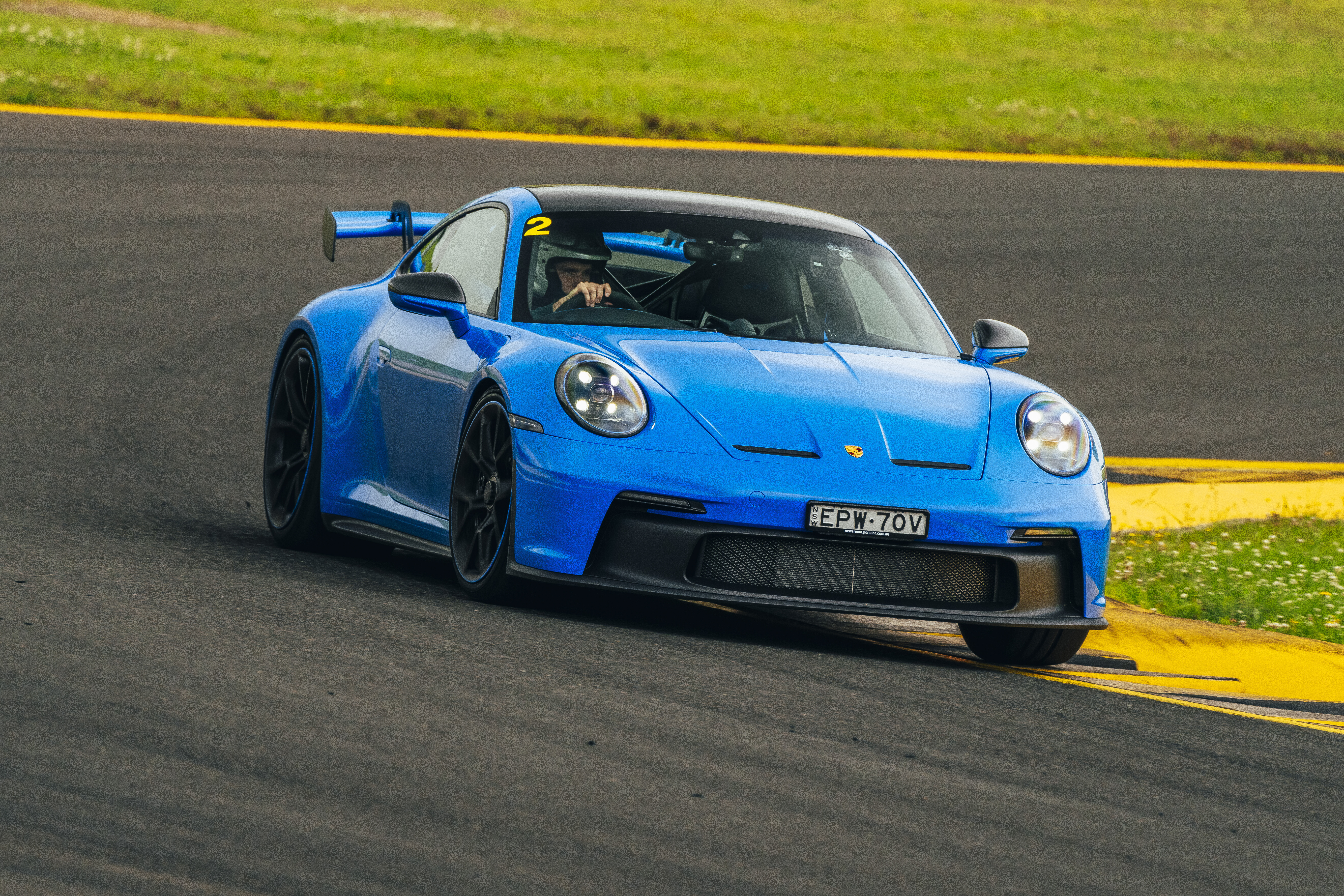
There’s still plenty of time to find, but the opportunity to do so is delayed by the arrival of rain. Track-focused cars on wide semi-slick tyres in the wet are usually of similar effectiveness as reading a newspaper in the rain, but while colleagues who bear the brunt of the weather come back a little ashen-faced, on a wet-but-not-puddled track the GT3 is surprisingly capable.
Traction is no longer absolute, but the linear nature of the naturally aspirated engine makes full throttle in second gear still a possibility with a bit of patience. It’s the communication from the front end that really stands out, though. It sticks better than you’d think, but also telegraphs when it starts to relinquish its purchase beautifully.
Despite its performance the GT3 isn’t intimidating in the slightest. The steering is relatively light and the immediacy of its responses indicate I’m going to need to push a lot harder to start approaching its limits.
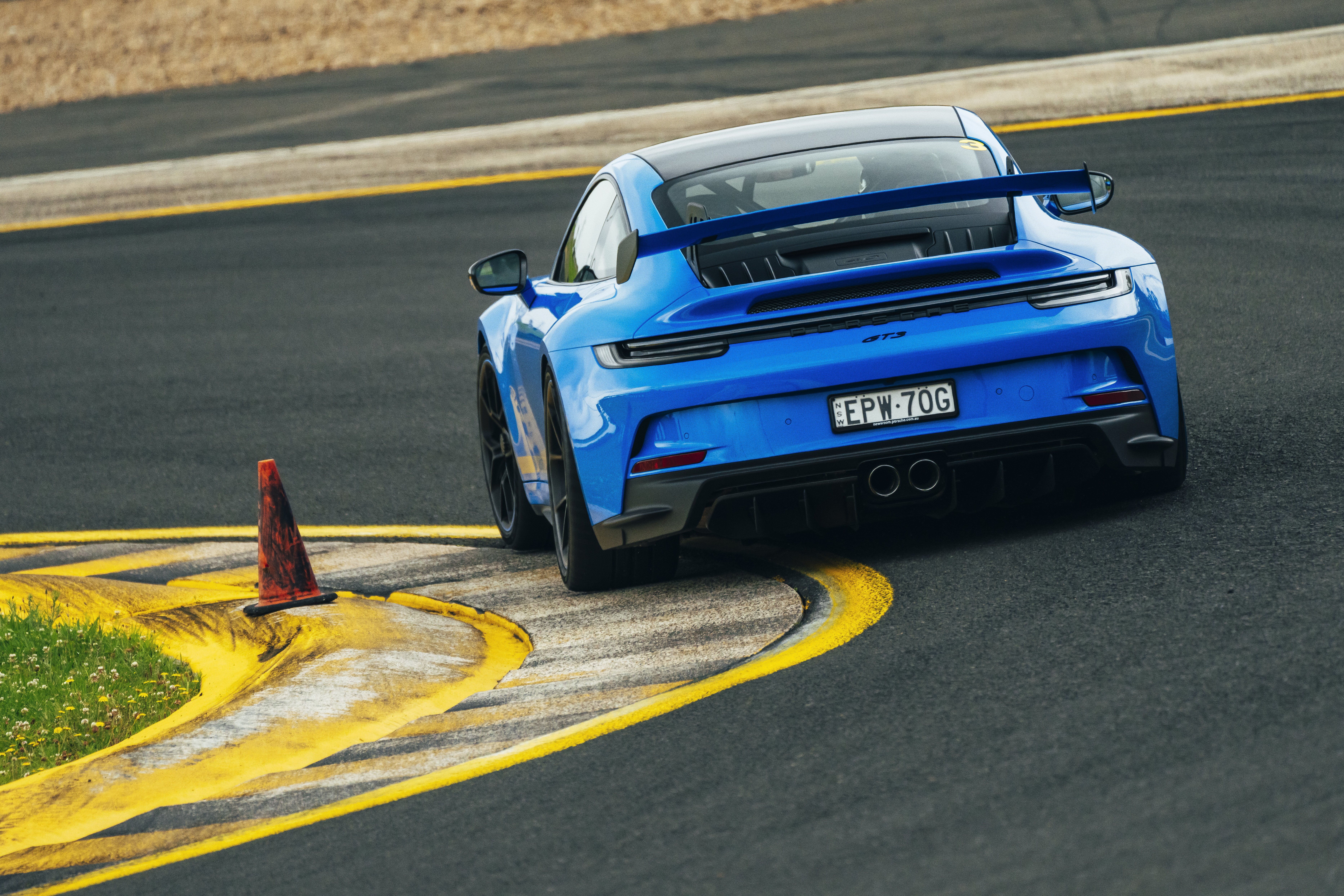
Happily, the track dries and with increased familiarity comes increased commitment. Outputs of 375kW/470Nm might not raise eyebrows as they once did but the GT3 screams its way to 245km/h down the main straight, the latest noise and emissions regs failing to completely mute the flat-six howl. It’s smoother than the 991 or 997 engines, less visceral, but still music to the ears.
Stability into and through the super-fast turn one is ridiculous, though the otherwise spookily telepathic PDK ’box does get slightly confused, holding fifth through the corner then kicking down to fourth once throttle is reapplied on the exit. It doesn’t upset the car and it’s a problem easily rectified by blipping down to fourth manually during braking.
Those brakes receive a mighty workout into turn two, shedding 140km/h in a little over 100m, but fade is never an issue, at least in our five-lap sessions. Long corners like SMP’s turn two (and three, and four, and seven…) have traditionally been tricky in a 911. Brake too much and the rear will swing wide, brake too little and the front won’t bite; likewise, accelerate too hard, too soon and the front lifts and understeers wide.
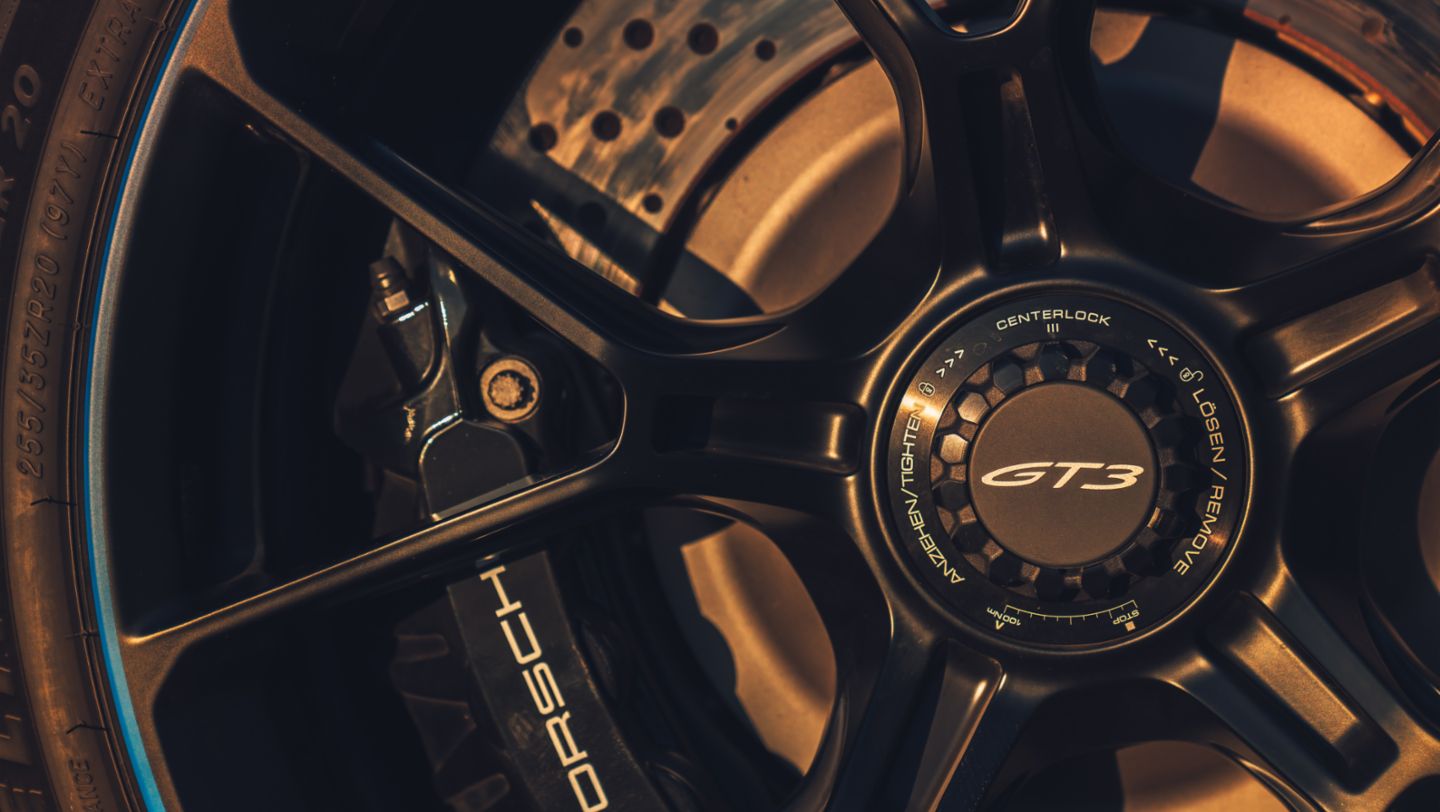
This is still the case – physics dictate it with a rear-engined layout – but as with each successive generation of the 911 the 992 manages to further hide these characteristics. Turn the wheel and the front responds, lifting mid-corner usually just tightens the line rather than resulting in some lurid oversteer slide and as long as the throttle isn’t treated like an on-off switch the GT3 generally goes exactly where you point it on corner exit.
If that makes it sound like Porsche’s road racer has become slightly prescriptive and lost some of its edge, then nothing could be further from the truth. It’s probably fair to say that the 992 GT3 is easier to drive quickly than ever, but I’d argue that makes it more rewarding for amateurs without sacrificing its appeal to more experienced punters.

A couple of laps with Youlden on a half-wet, half-dry circuit shows just what the car is capable of in expert hands. It becomes a canvas to which he applies his brush strokes, the GT3 feeling excited to have someone who can exploit it properly behind the wheel. With the help of the instructors, even I manage a 1min38.9sec lap. For context, at PCOTY 2010 Luffy’s best effort in an R35 GT-R (the quickest car there by some margin) was a 1min44.2sec. Yes, 10 years is a long time ago, but equally, I am a long way from Luffy.
At this pace the GT3 comes alive, squirming through turns as the lateral limit is approached but not in a way that erodes confidence; it’s merely telegraphing that it’s beginning to work hard. As is the driver due to the pace you’re travelling at, though happily any indiscretions are quickly mopped up by the PSM stability control system.
It’s probably fair to say that the 992 GT3 is easier to drive quickly than ever, but I’d argue that makes it more rewarding for amateurs without sacrificing its appeal to experienced punters.
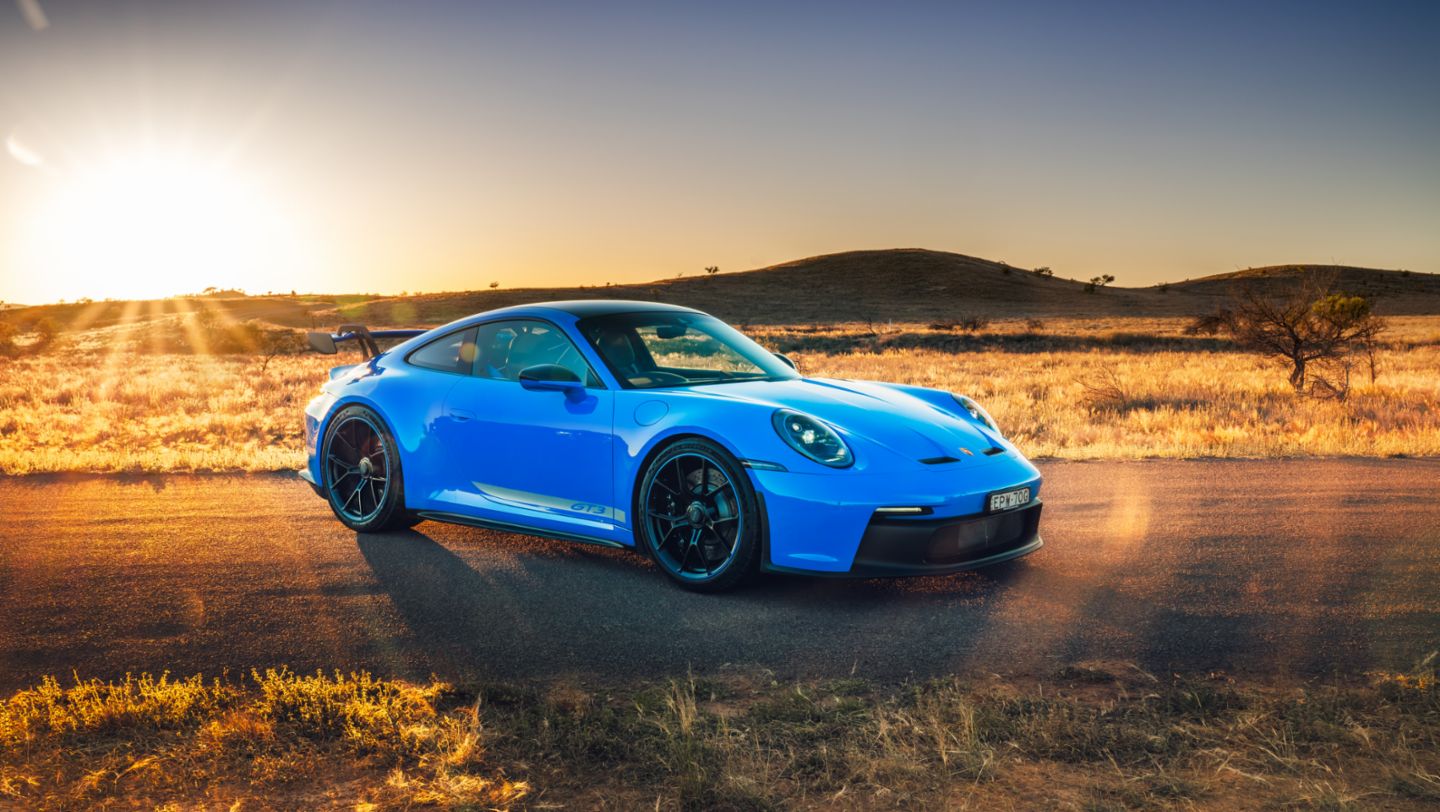
While the changes to the 992 GT3 are more extensive than first appears, it is still an evolution of what came before. Would I recommend that 991 or 991.2 GT3 owners rush out and upgrade? Probably not, though equally, if they’ve extracted all they can from their current steeds and want to reset some PBs, the 992 will undoubtedly do so.
You can guarantee plenty of them will occupy pit garages all over the country (and indeed the world) in the months and years to come, for as a machine to drive to the track, hot lap all day then drive home again, it is still virtually without peer. When you’re the dominant species, sometimes a small evolution is all that’s required.
2022 Porsche 911 GT3 specifications
| Body: | 2-door, 2-seat coupe |
|---|---|
| Drive: | rear-wheel |
| Engine: | 3996cc flat-6cyl, DOHC, 24v |
| Bore/stroke: | 102.0 x 81.5mm |
| Compression: | 13.3:1 |
| Power: | 375kW @ 8400rpm |
| Torque: | 470Nm @ 6100rpm |
| Power/weight: | 261kW/tonne |
| Weight: | 1435kg |
| 0-100km/h: | 3.4sec (claimed) |
| Top Speed: | 318km/h |
| Transmission: | 7-speed dual-clutch |
| Suspension: | double-wishbone, coil springs, helper springs, adaptive dampers, anti-roll bar (f); multi-links, coil springs, helper springs, adaptive dampers, anti-roll bar (r) |
| L/W/H: | 4573/1852/1279mm |
| Wheelbase: | 2457mm |
| Tracks: | 1601/1553mm |
| Brakes: | 408mm ventilated/drilled discs, 6-piston calipers (f); 380mm ventilated/drilled discs, 4-piston calipers (r) |
| Wheels: | 20 x 9.5-inch (f); 21 x 12.0-inch (r) |
| Tyres: | 255/35 ZR20 (f); 315/30 ZR21 (f) Michelin Pilot Sport Cup 2 |
| Price: | $369,600 + ORC |
