
How do you neatly encapsulate that certain feeling of ‘rightness’ in a performance car? You feel it within the first 50 metres and it takes something wholly egregious from that point forward to change your opinion.
Still, when you pause to consider it, your first handshake with a car tells you a great deal. You’ll know whether the driving position has been nailed, you’ll key into the finesse of the tip-ins of the major controls. You’ll already have a handle on how the steering is geared and how the suspension traverses whatever surface you’re on. But if there’s one thing that inspires confidence like none other, it’s how these components blend to make the car you’re driving feel smaller and wieldier than you’d ever have imagined.
The Mercedes-AMG CLS 53 4MATIC+ is not a small car. From prow to posterior this third generation C257 model, first introduced in 2018, measures a smidge over five metres, if smidges are reckoned to be 12mm long. With its fiendishly complex supercharged and twin-turbocharged straight six, all-wheel drive underpinnings and 13-speaker Burmester stereo it tips the scales at 1985kg, or roughly two 70kg passengers more than the weight of a Tesla Model 3 Performance, itself no lightweight.
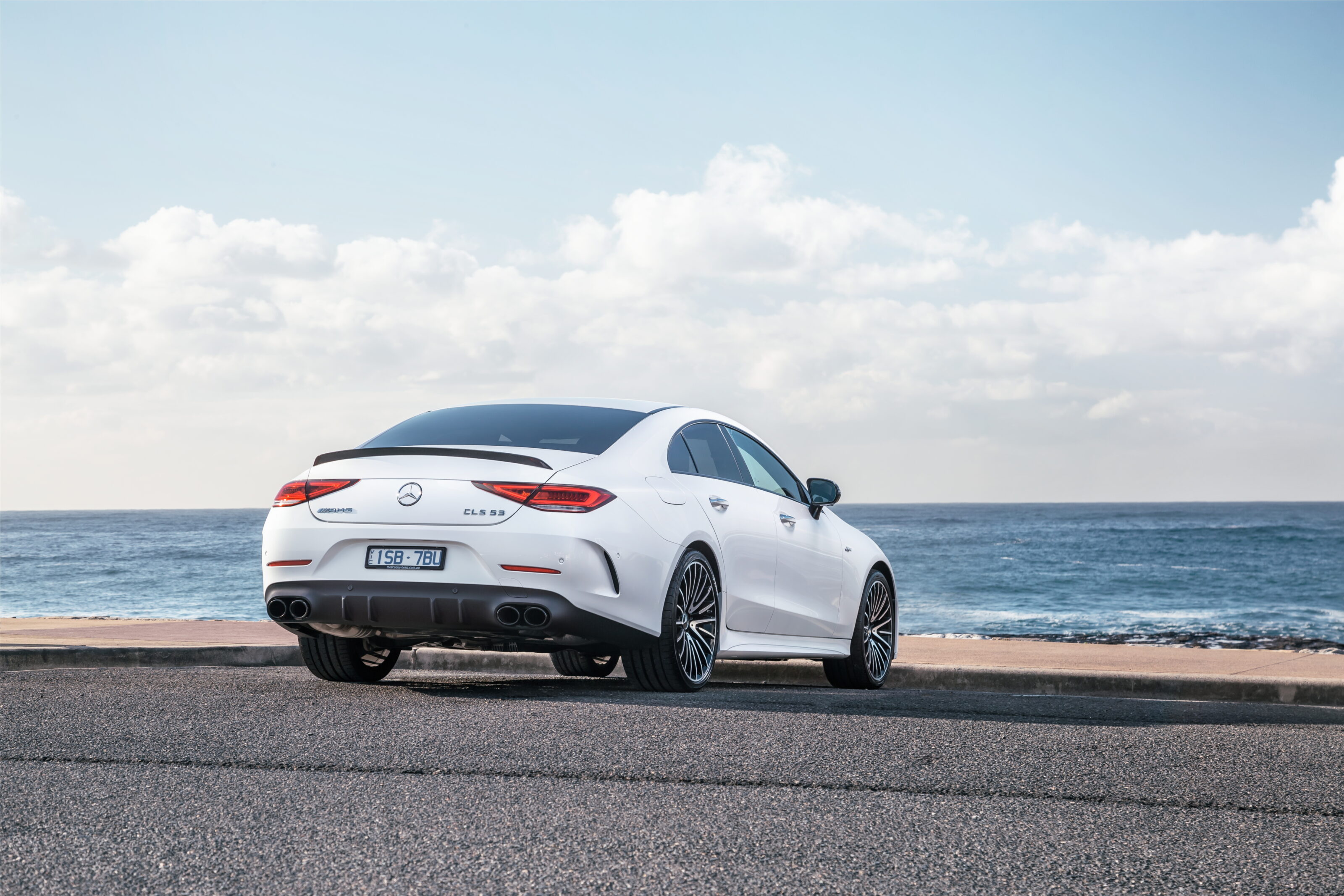
Yet there’s a certain lithe coordination about the way the CLS 53 comports itself. It feels all of a piece, it’s easy to both manoeuvre at low speed and heft into a bend at speed. But before we get too far into that, it’s worth rewinding a moment and explaining why we’re behind the wheel of this car at all.
As some of you might have guessed given the date of its introduction, the CLS 53 has come in for a mid-life wash and brush-up.The unexceptional CLS 450 model has been ditched from the Australian line up, leaving the AMG 53 the sole CLS model available. That’s no bad thing. It was only ever $15k more expensive, and that cash bought you an additional 50kW and 20 Nm, a stack of additional equipment and sharper styling to boot. Since the range has been rationalised, Mercedes has given the CLS 53 a six-grand price haircut which makes it better value than ever.
It also gets a new front apron with a high-gloss splitter and a more assertive AMG-specific Panamericana grille. The AMG Night Package is now standard, which trims the window surrounds and mirror caps in high-gloss black. Meanwhile there are new 20-inch wheels, a black diffuser insert, privacy glass from the B-pillar back and an AMG lip spoiler.
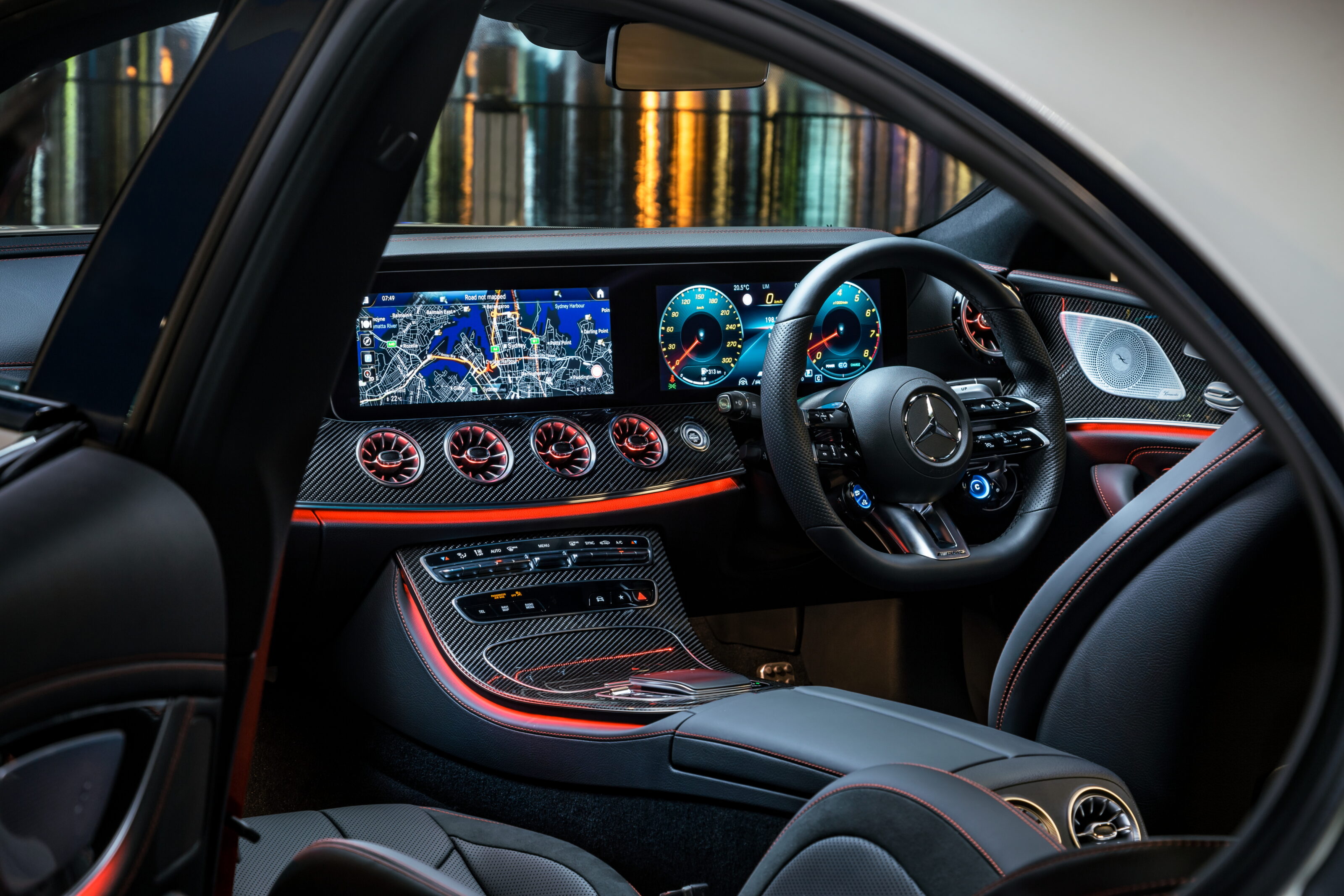
Indoors there’s a pair of 12.3-inch screens with the latest MBUX infotainment, the AMG multifunction steering wheel and the 13-speaker Burmester sound system. Those looking for even more exclusivity will need to act quickly if they’re to get on the shortlist for the 20 Limited Edition models coming to Australia. Part of a global run of just 299 cars, the Limited Edition is finished in either Cashmere White Magno or Selenite Grey Magno and throws a whole load of cosmetic upgrades at the CLS 53 as well as the AMG Dynamic Plus package which includes a Race program with drift mode. Fastest finger first can net one for an extra $14k over the CLS 53’s $183,600 base price.
Splashing out of a sodden Phillip Island circuit, I’m given to pause and consider where this generation of CLS fits with its predecessors. The original C219 version was a knockout, that banana-shaped barnstormer that could, from 2006, be had with a naturally-aspirated 378kW 6.2-litre M156 engine. The second generation C218 car arrived in 2010 and never created quite such a stir. It was better built and went down a road in a more composed manner, but the 5.5-litre twin-turbo M157 (in anything from 386 to 430kW tunes) was never a powerplant from AMG’s very top drawer.
Fast forward to 2018, when the C257 model arrived. With no 63-badged model ever offered, it would be easy to dub this, from an enthusiast’s perspective at least, the runt generation. Unless you’re absolutely wedded to every last person in the neighbourhood knowing that you’ve bought a V8, there’s a lot to like about this CLS53 AMG. For a start, it feels like a proper sports sedan.
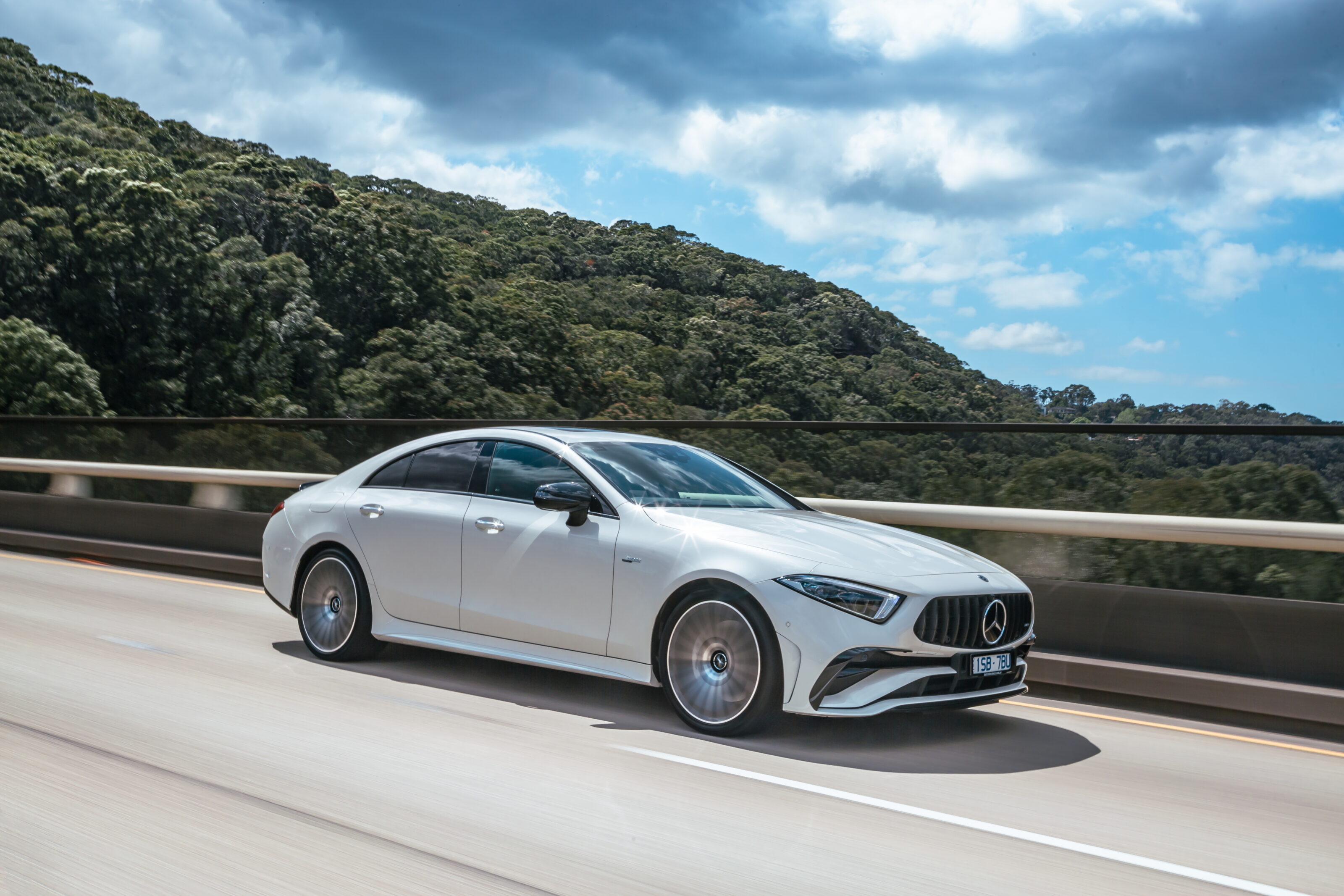
That’s a bit of journalist-speak for the fact that it rides a bit firmer than you might well expect. Some will like the fact that it feels all of a piece and can corner flat and hard, but there will be others who get into the CLS and expect a sleeker version of the E-Class. They’ll be disappointed that this is no lugubrious wafter. Road imperfections filter through to the cabin, the suspension bumps and thumps like distant thunder and there’s a persistent tyre roar at speed. It’s never harsh, but it always serves to remind you that you chose an AMG version.
The engine hasn’t had anything done to it. It’s still a mighty thing, with a torque curve that looks like a Badlands mesa. Anywhere between 1800 and 5800rpm, you have the full 520Nm measure available to you, which means that you probably won’t need to be twanging on the paddles like Earl Scruggs to make decent progress. The 48V mild-hybrid tech acts as torque fill, ladling on 6kW and 250Nm which helps the CLS 53 to 100km/h from rest in 4.5 seconds.
Aside from the race circuit, Phillip Island doesn’t offer too much for the keen driver, so we head inland to the roads that rise into the rolling Gippsland hills. These are properly testing roads, used by Wheels magazine for years as part of its Car of the Year assessment loops.
There’s a bit of everything here: weird cambers, bad weather, split-mu braking zones, humps, crests, compressions and some beautiful open sinuous sections where you can tip the AMG downhill like a slalom skier, getting early into the turns and feeling the weight shifting laterally as both you and the car calculate how much of the grip envelope you have remaining.
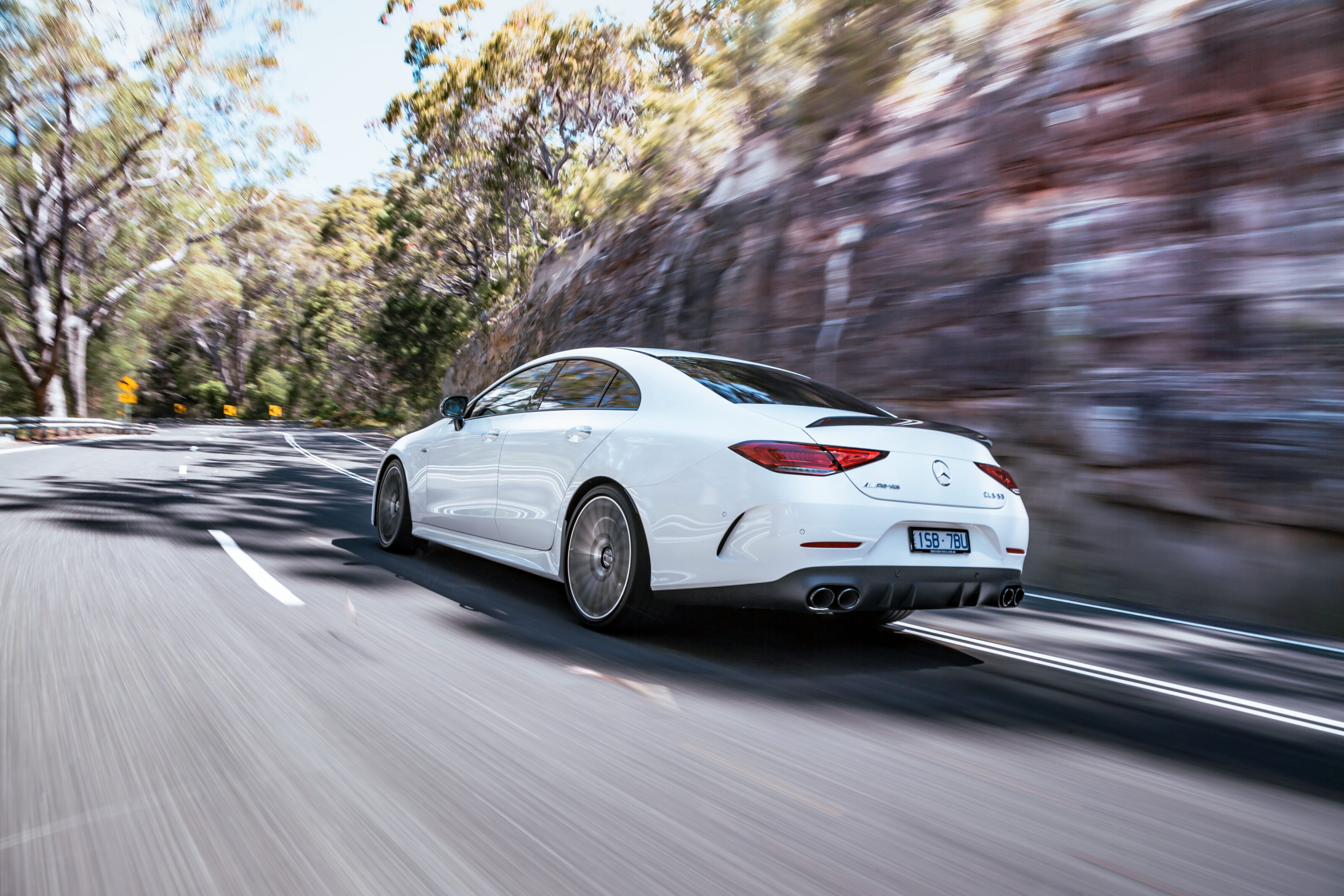
The steering is a little mute when you really want it to speak to you, and in the less aggressive drive modes, stability control interventions arrive a little earlier than you may expect for an all-wheel drive car, but other than that, it’s an impressive performance. Yes, it’s tempting to think what a 63 version would offer, but every once in a while, less can be more.
Even with a $183k sticker price, an AMG badge and 1980kg to arrest, the CLS 53 doesn’t come standard with carbon ceramic brakes, but the standard stoppers certainly aren’t found wanting. Notched into a conservative drive mode, the conservative transmission calibration slurs into higher gears early.
The 3.0-litre six, despite a slightly uncouth idle, offers a syrupy pour of torque, the electric motor secreted between the engine and gearbox delivering a smooth swell of torque to 2500rpm, with the electric compressor filling any residual lag for another 500rpm. The 48v electrical system and integrated starter-alternator also afford a beautifully finessed idle stop function.
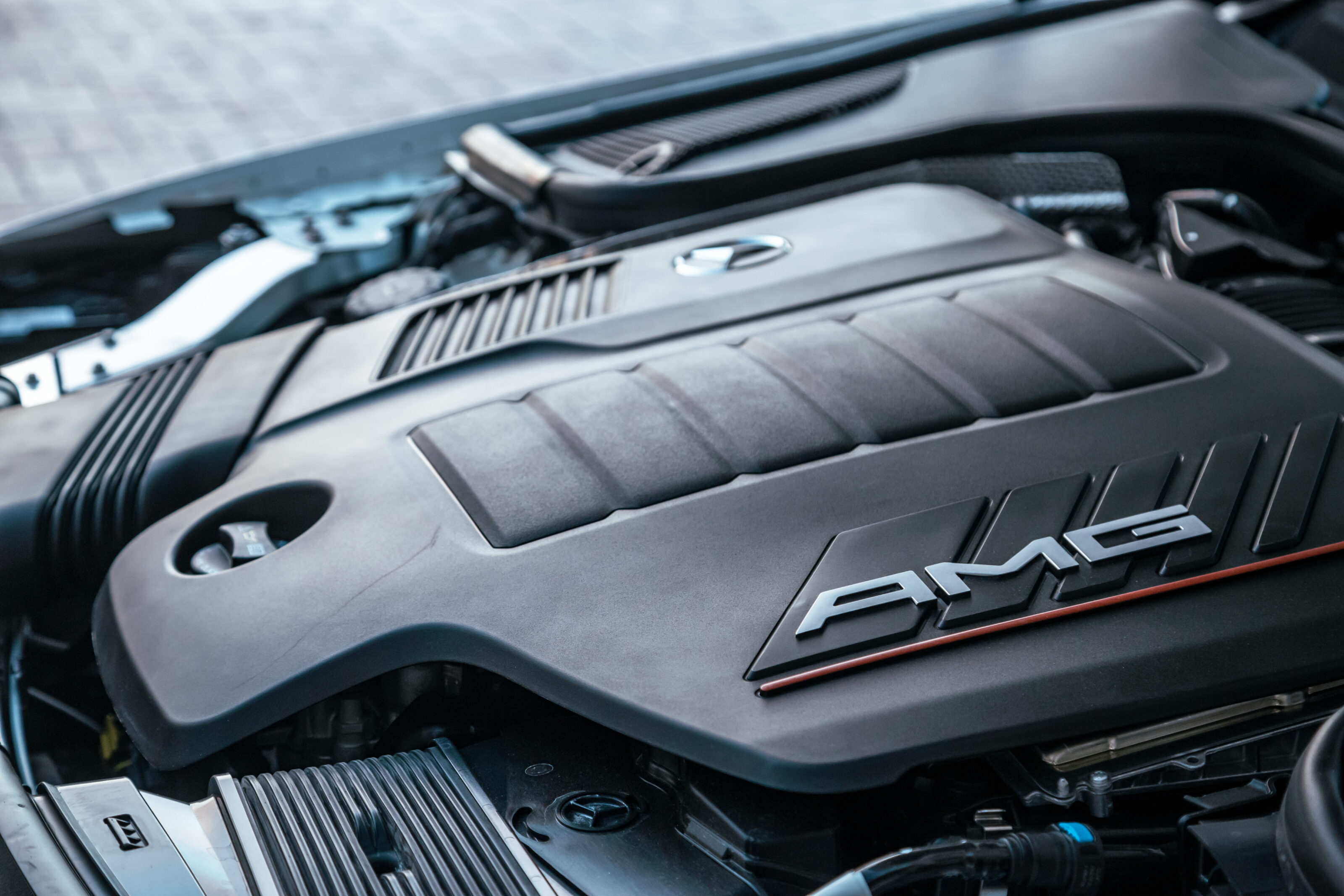
Click into Sport+ and the air suspension girds itself a little, the exhaust note hardens and steps up a semitone, the stability control loosens its belt, the throttle map delivers more in the first couple of inches of pedal travel and the transmission gets its game face on. Above 4500rpm, the engine note hardens and by 5000rpm it’s hauling hard. Peak power arrives at 6100rpm, all 320kW of it, after which the 6500rpm redline forces you to snick up another gear.
Really jag the throttle and you hear a faint whine of the electric motor at work, accompanied by100% fill on the boost gauge. There’s no doubting the effectiveness of motor, compressor and all-wheel drive, punching the CLS out of tighter corners with spooky grip. If you’re looking for something more expressive in its ability to steer from the rear, sign up for a C63 while you still can.
The Mercedes-AMG CLS 53 isn’t overt. It probably isn’t the car that appears in first or even second place on your shortlist when shopping in this category. But as long as you can live with the fact that this slick-looking four-door coupe has a bit of sinew about its ride quality, there’s a lot to like here. Runt generation? Spend a little time with this car and get back to me on that one.
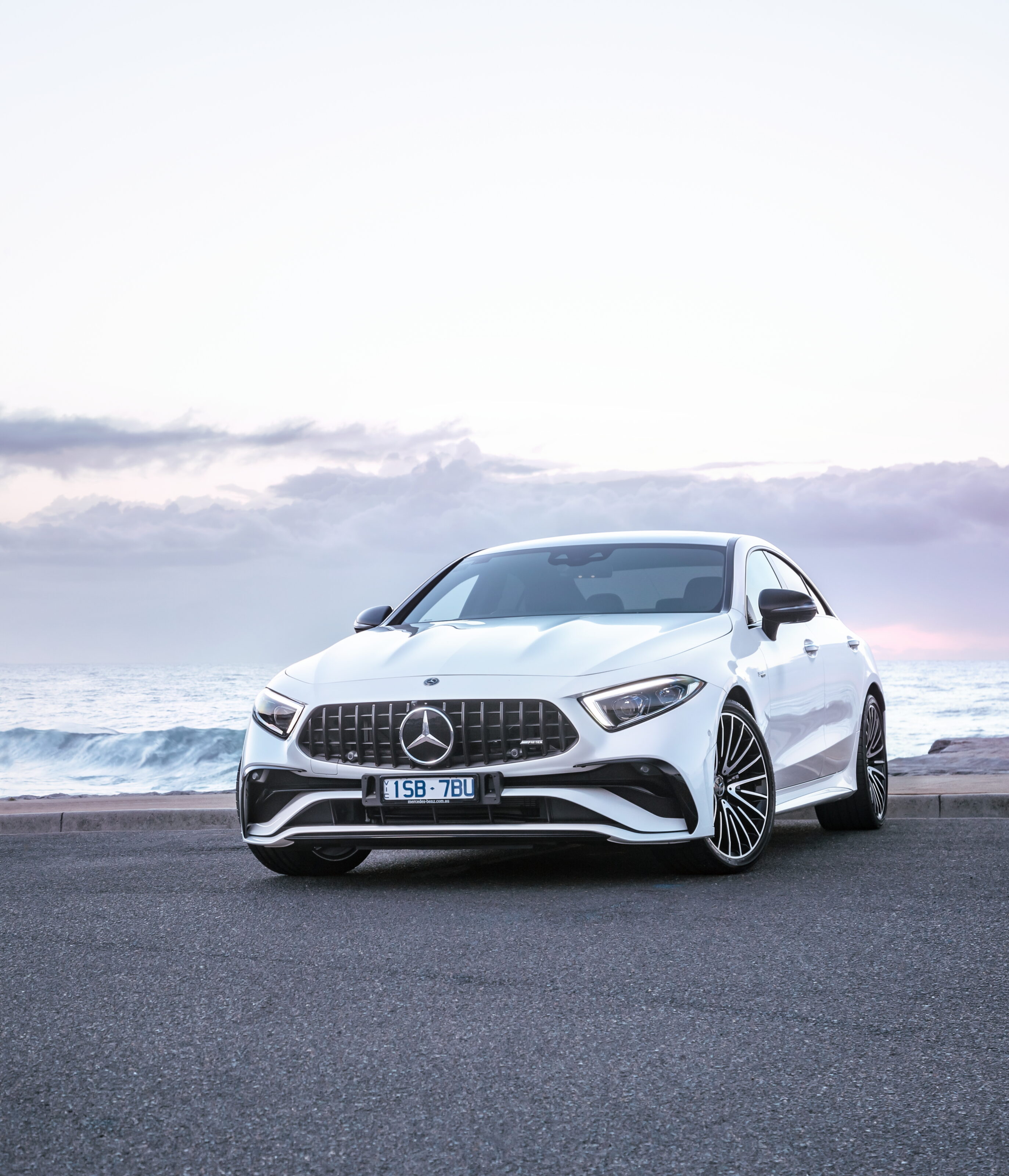
2022 Mercedes-AMG CLS 53 specs
Those who remember its Australian introduction in 2014 would be forgiven for feeling a little shiver at the mention of the BMW 2 Series. Not because the company’s little coupe was in any way lacklustre but because a completely different 2 Series Active Tourer model launched just months after, bringing a dumpy people-mover body and BMW’s first foray into front drive.
The decision to link two such radically different models with the same moniker still seems a little strange seven years on, but the other legacy that lives on is the model’s intrinsic connection to driven-wheel controversy.
While the F22 coupe has only ever been offered as a traditional rear-drive sports-focused model, for the second-generation G42, the flagship BMW M240i will only be available with all-wheel drive … for now.
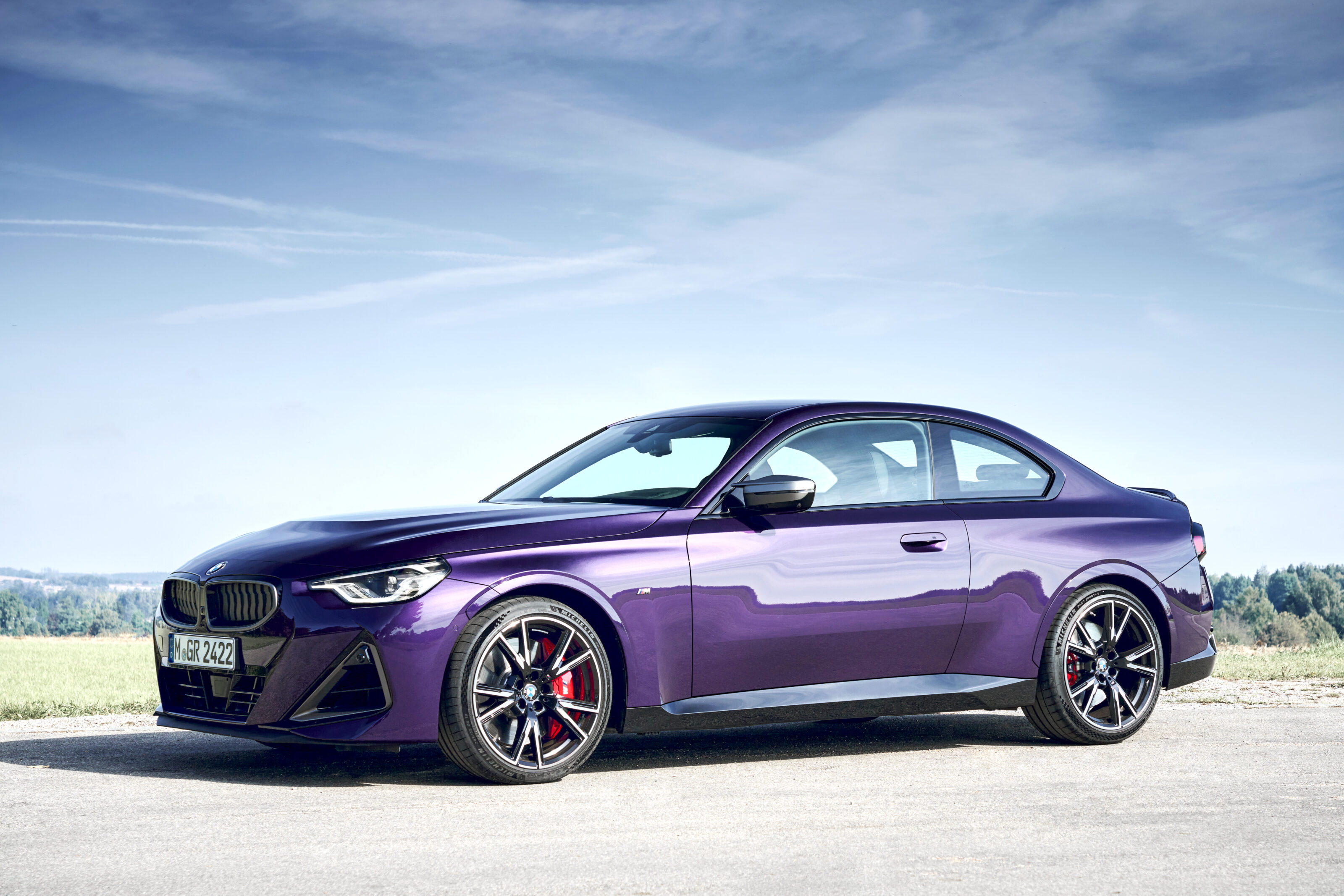
When it arrives in early 2022, the M240i xDrive will cost $89,990 before on-road costs – a premium of about $8000 over the outgoing M240i rear-drive but it’ll pack in a lot more than just an extra driven axle to justify the cost.
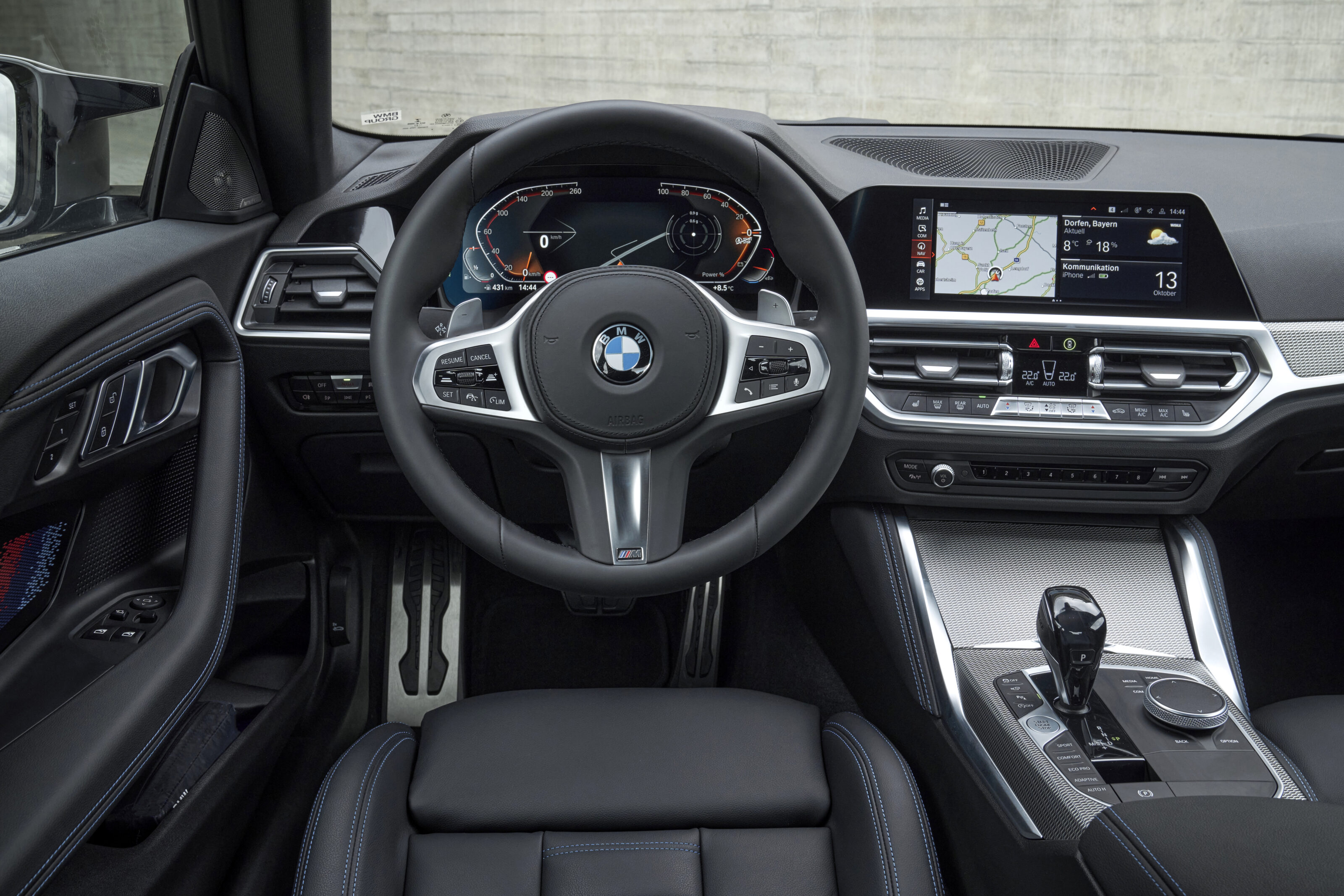
BMW’s Live Cockpit Professional will be standard fare in Australia, which means a 10.25-inch touchscreen infotainment display running iDrive System 7, a 12.3-inch digital dash, Android Auto and Apple CarPlay are all included. As is the sensational Harman Kardon sound system.
The cabin gets a range of top-shelf materials and sports seats with options to upgrade to bucket seats, sunroof, heated seats and M-sport colour seatbelts to name a few. On the outside though, the new coupe gets a styling makeover that’s wildly different.
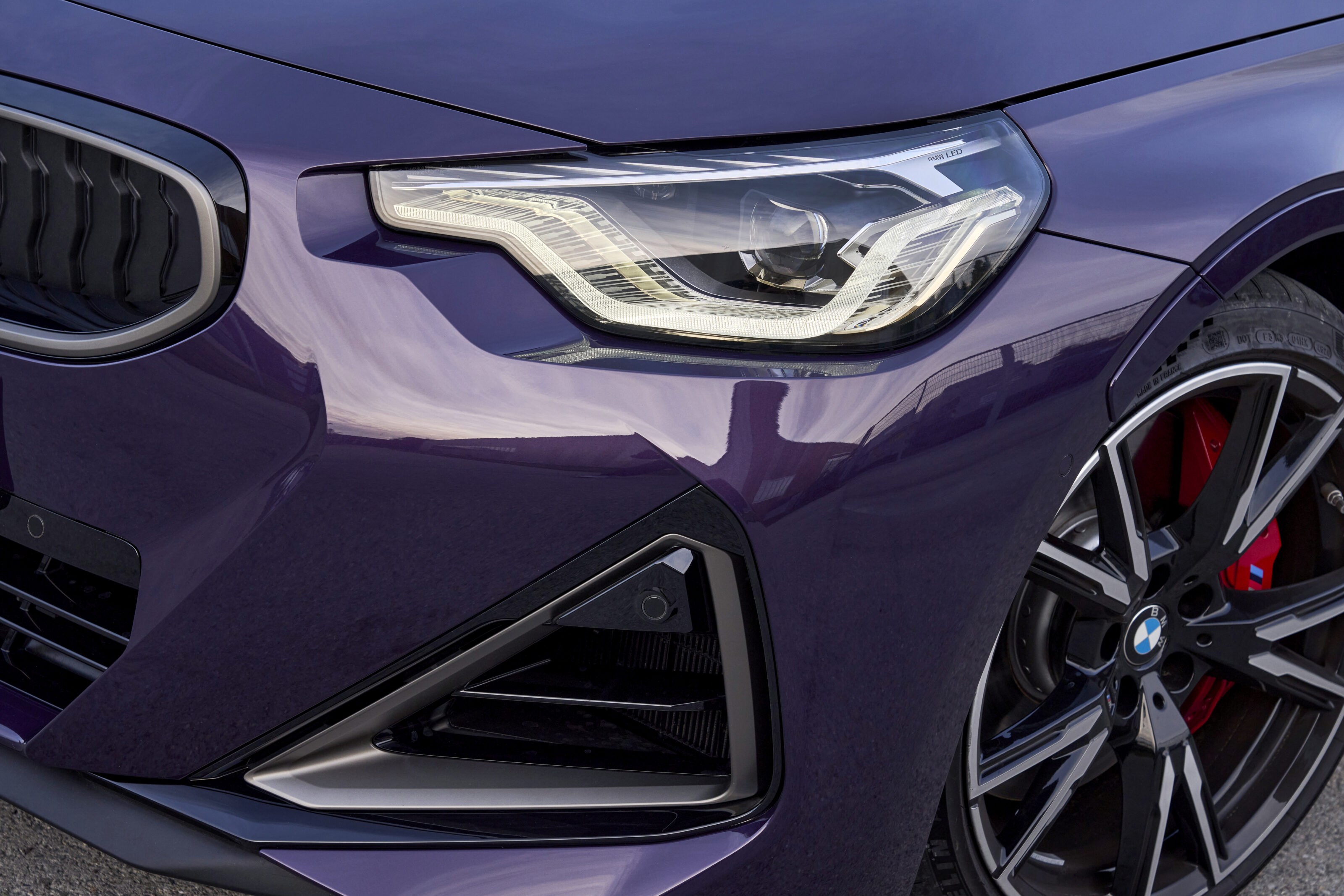
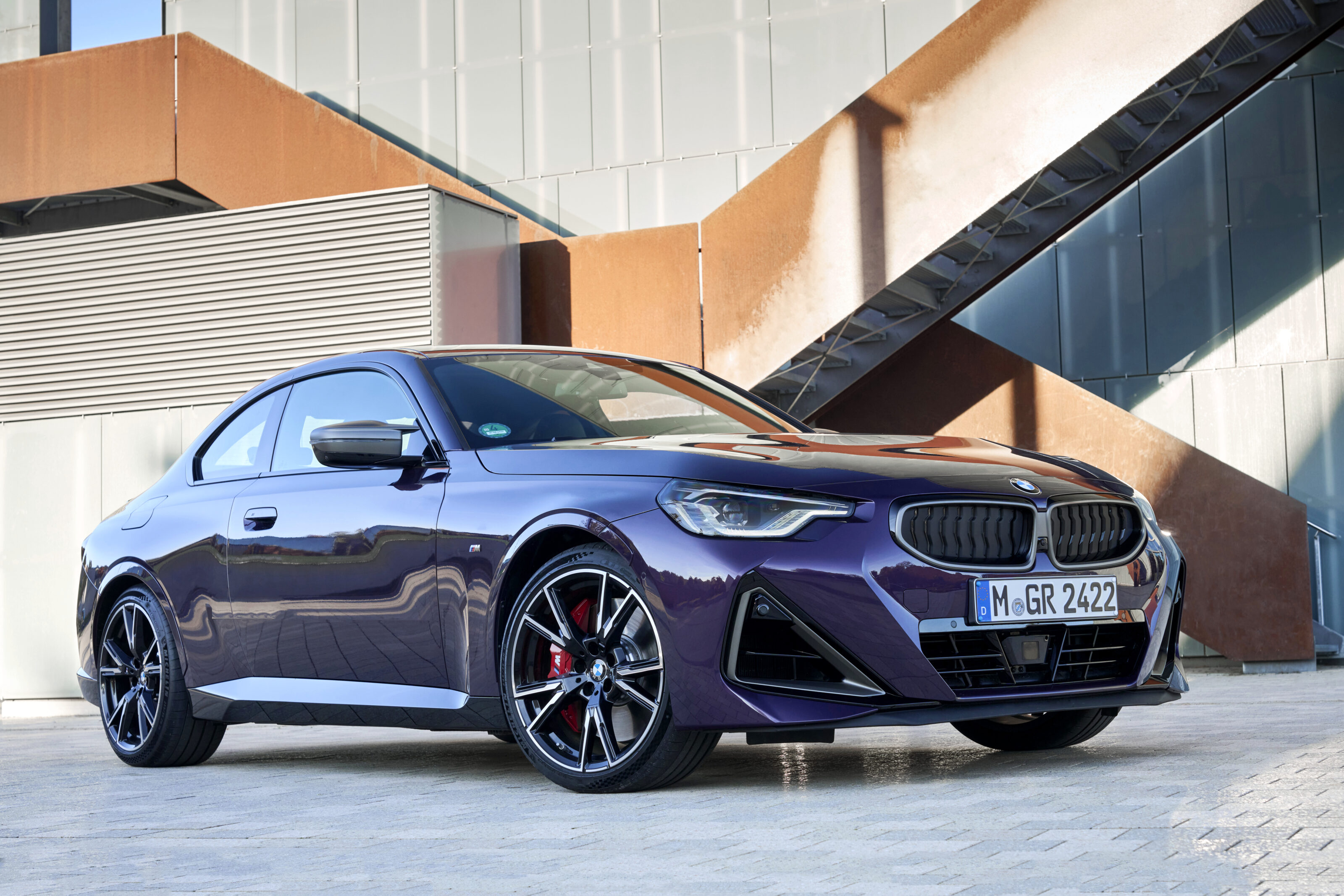
For the first time since early 3 Series variants, the headlights have morphed into a single-light design as a nod to the 2002 of the 1970s, says BMW, and the effect is arresting. It combines with a wider grille with active louvres, massively bulged bonnet, muscular arches, and a new ‘pulse’ LED taillight design that’s equally radical.
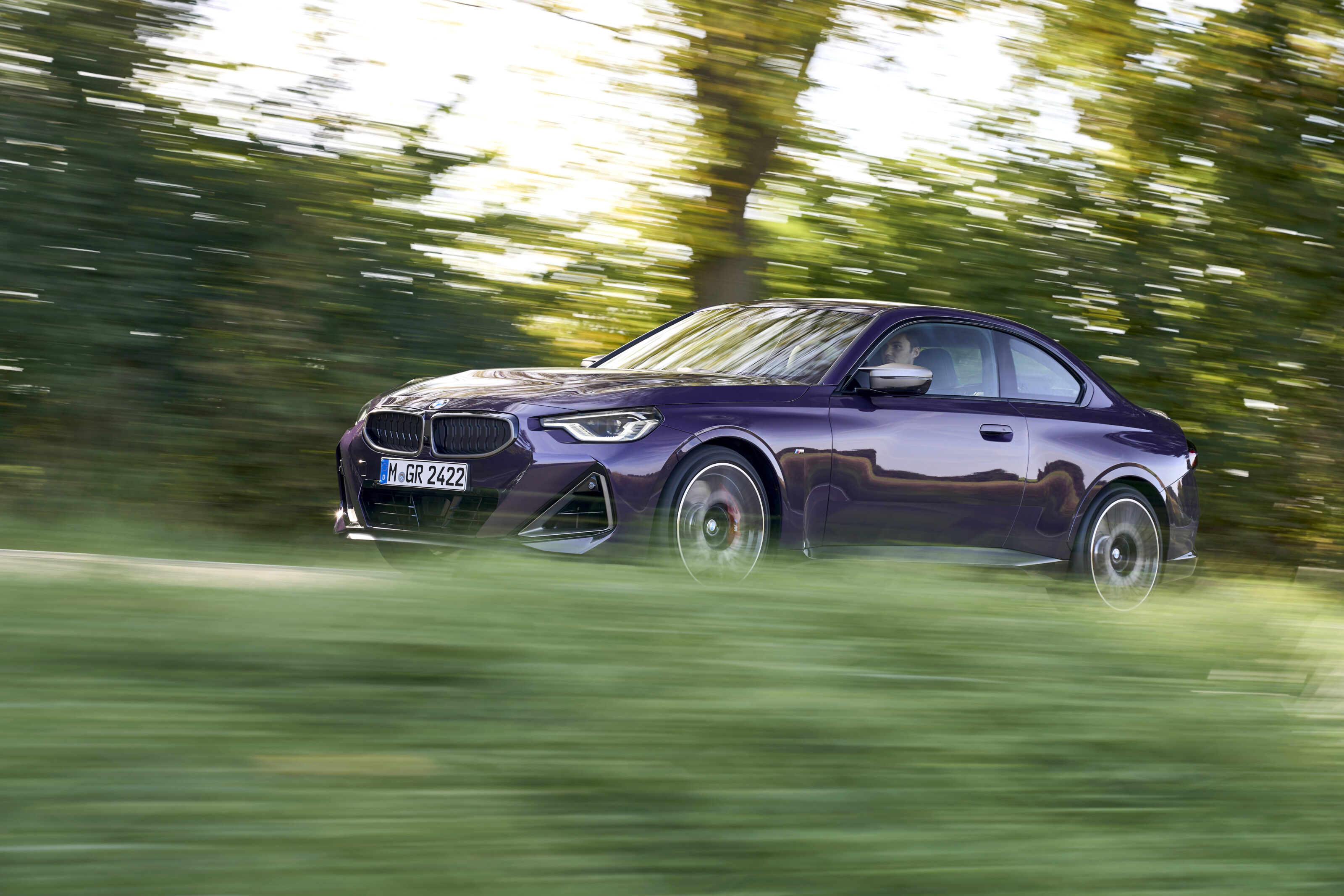
The departure from tradition has divided opinion but is deeply pleasing on first inspection, especially when combined with optional larger 19-inch wheels and that Thundernight purple paint, which evokes BMW’s 1990’s Techno Violet.
For the first time since early 3 Series, the headlights have morphed into a single-light design as a nod to the 2002 of the 1970s, says BMW, and the effect is arresting.
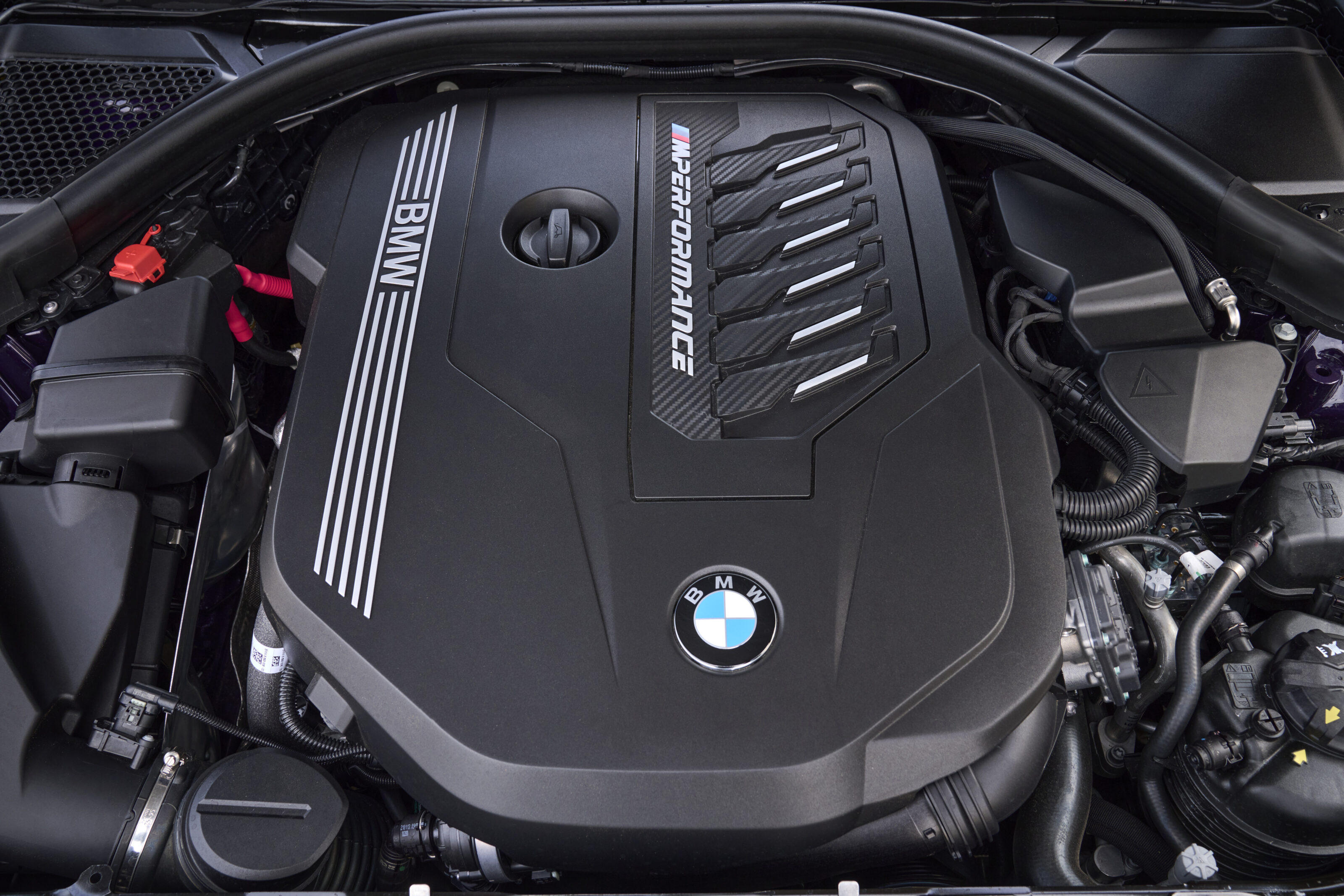
Then there’s the 3.0-litre straight-six turbo-petrol engine that produces an extra 25kW, taking peak power to 275kW (torque is unchanged at 500Nm). Add this to the extra traction and 0-100km/h acceleration has plummeted to 4.3 seconds (three tenths faster than the F22).
Number nerds will notice that the new coupe has more power than the M2 did when it was first introduced, prompting the question: Is the M240i more car for the cash? Well, after a first blast outside the model’s hometown of Munich, I have the answer.
More significantly than the power and traction advantages, the new 2 Series now rolls on the same platform as the larger 3 Series and 4 Series dizygotic twins and it really shows. Over the previous coupe, the new M240i is 105mm longer, 64mm wider and has a 51mm longer wheelbase. The result is a car that is visibly larger inside and out but most importantly, a track width that has increased 63mm at the front and 35mm at the rear combined with a 28mm lower overall height makes the new version feel completely different.
Its chassis feels very square and there’s a stability and far more planted feel on the road, especially when hunting autobahn-only speeds. But the extra traction made possible by the adoption of xDrive can catch out the unwary with lower lateral grip in wintry conditions. Shod with Michelin Pilot Sport rubber, the M240i will happily slide into a four-wheel drift with little provocation.
Thankfully, the 50:50 weight distribution allows for careful monitoring of grip levels and the power delivery feels predominantly rear-biased. Even though there’s no option to force exclusive rear-drive as per the M5, the more aggressive drive modes can decide to send 100 per cent of power to the back end by themselves.
It’s paired with a new neutral but tactile steering feel that has more in common with the current M3 than previous M2 DNA. The eight-speed automatic is slick and crisp but capable of delivering violent shifts in the Sport Plus mode and pairs well with the updated engine.
Hold that thought while we talk about the note – it’s glorious. There may be a little engine sound piped in via the stereo but it’s an honest and convincing noise broadcast live from under the bonnet. The newest version of the B58 sounds classically straight-six and even a little reminiscent of the early M20 and M30 12-valves.
Thankfully, the 50:50 weight distribution allows for careful monitoring of grip levels and the power delivery feels predominantly rear-biased.
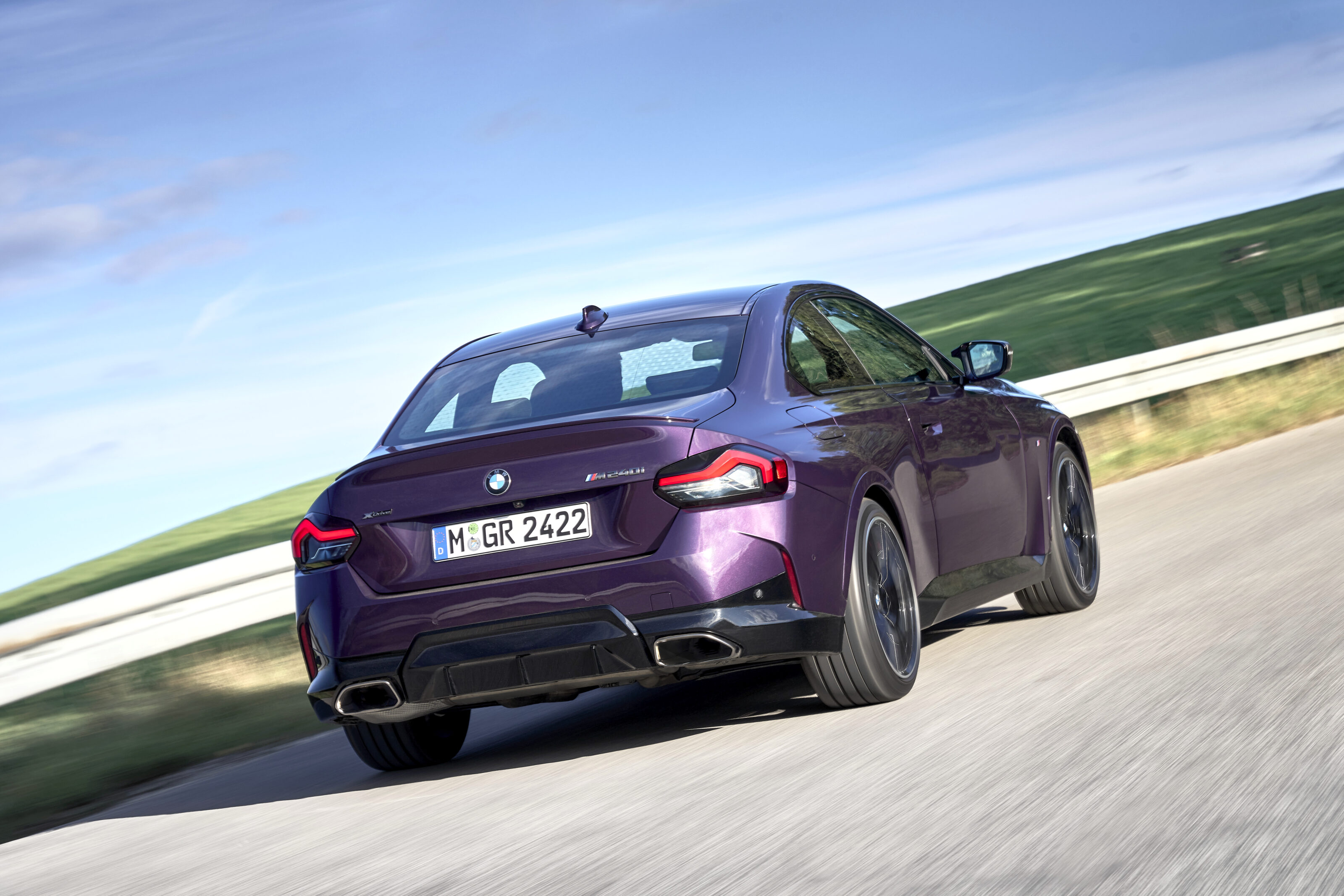
Other notable improvements include a 12 per cent increase to stiffness thanks in part to the addition of strut bracing, the enhanced LSD and adaptive M-Sport suspension for an overall more mature car. In essence, the current flagship of the 2 Series range feels more like a baby M3 than a more compelling M2-lite option.
But if the lack of a rear-drive option and manual gearbox is troubling you then fear not. BMW has confirmed an sDrive version of the M240i that, for now, will not be coming to Australia in favour of the more kit-packed xDrive. However, in the same vein as the popular M2 Pure, you can expect a stripper, track-focused version to emerge at a point down the line offering rear-drive, lighter weight and lower asking price.
From a somewhat murky introduction seven years ago, the 2 Series has evolved into something with a much clearer path and incredibly bright prospects. Comparing the new M240i to the outgoing F87 M2 is a fruitless exercise but when used as a lens to glimpse the forthcoming G42-based M2, it reveals something truly awesome on the horizon.
Have you hit a roadblock with your Christmas shopping, or maybe you’re wondering what to get us?
Here are five cool pieces of kit that we’ve come across this past month.
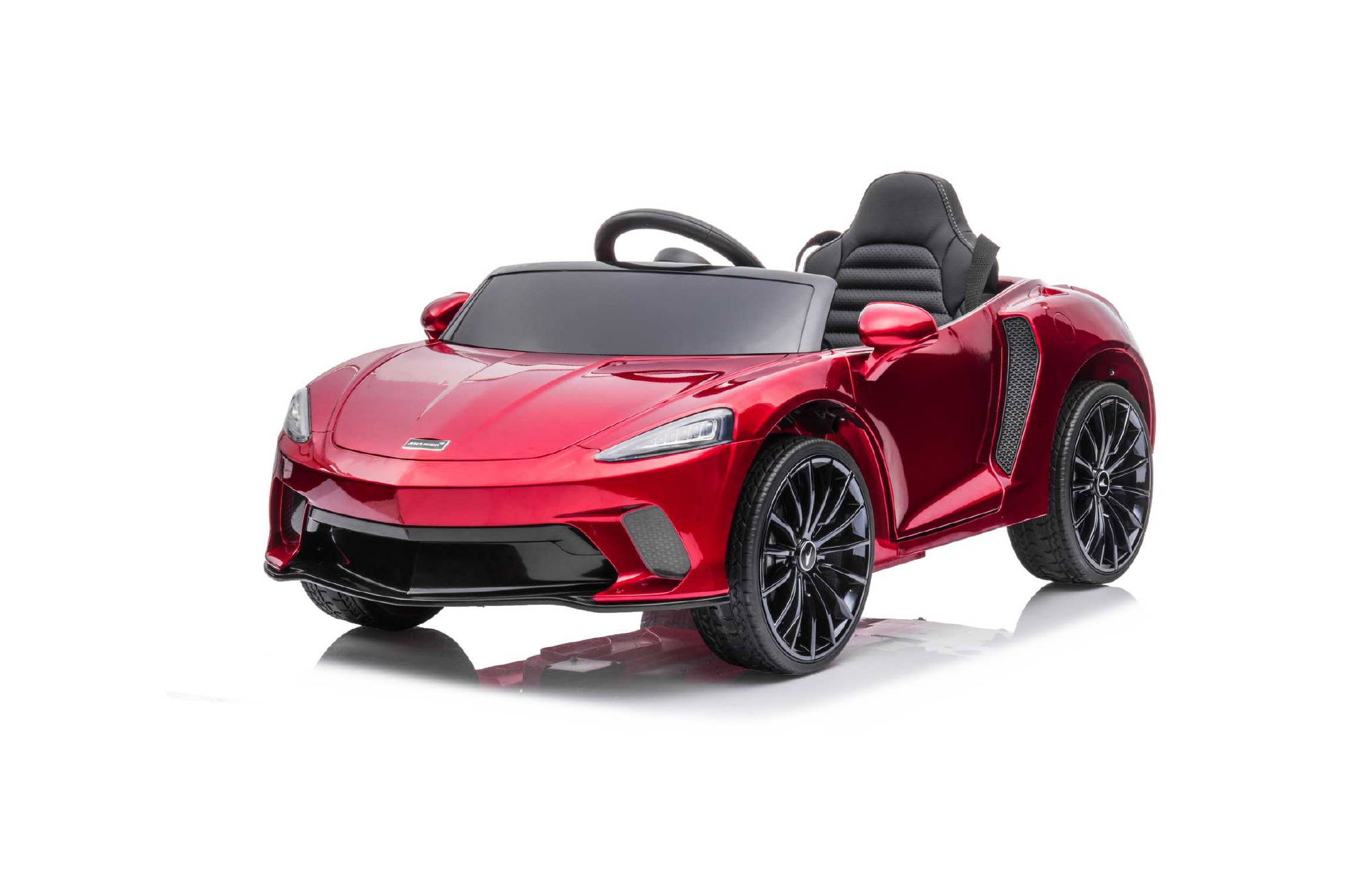
Mclaren GT 12v ride-on car – $349 – littleriders.com.au
Start the little ones young with the most stylish ride-on car around. Standard equipment includes dual motors, leather trim, MP3 player and LED lighting
V-Max Socks – $16 – heeltread.com
This mob creates the socks you won’t mind getting for Christmas. This pair taps 80s cult SEGA video game OutRun with pixelated palm trees, fictional Testarossa Spider and all

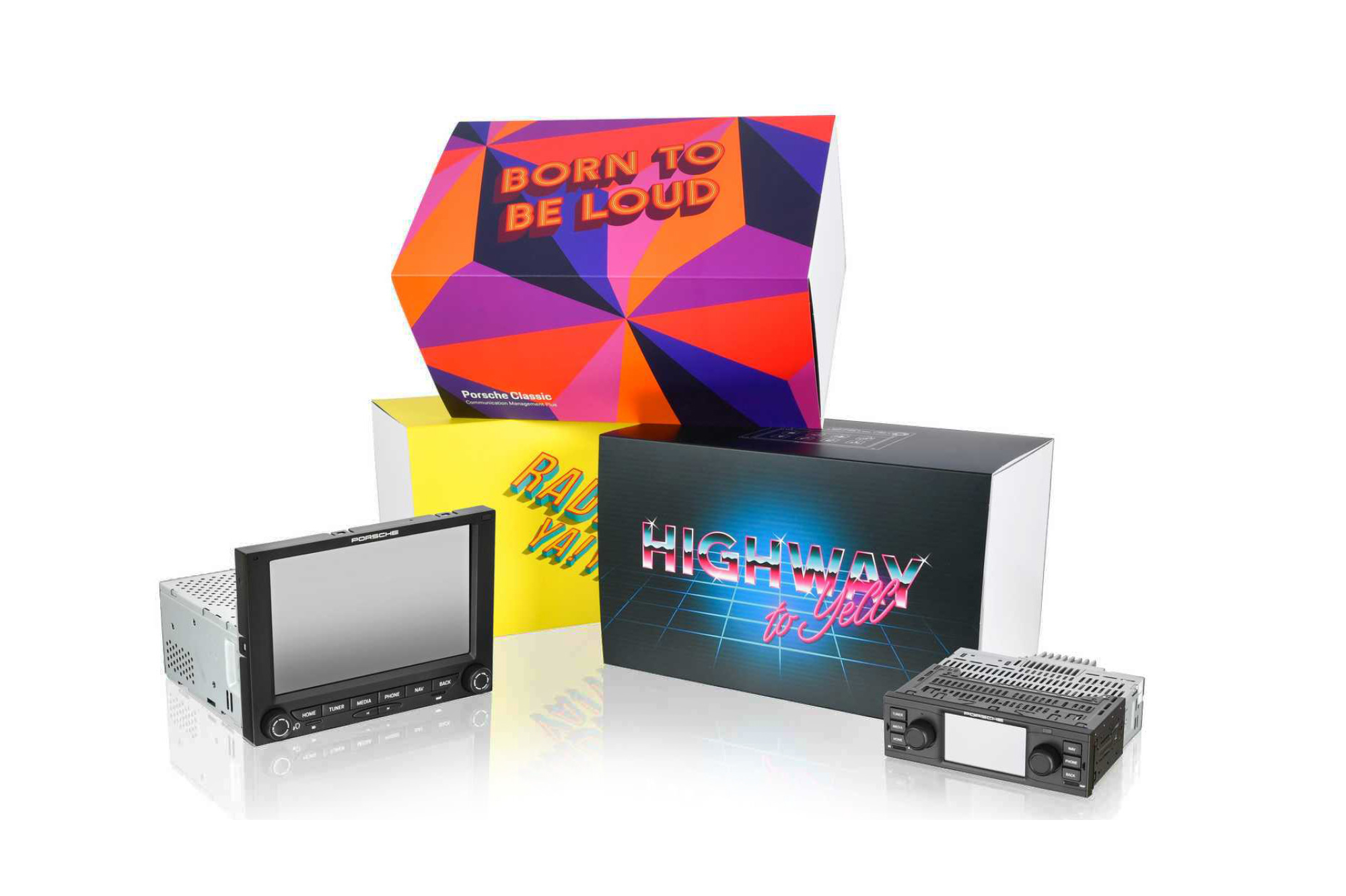
Porsche PCCM upgrade – $2695+ – porsche.com
Own an old Porsche but want modern amenities like DAB+ radio and Apple CarPlay? Porsche’s range of PCCM headunits look period correct but function like new
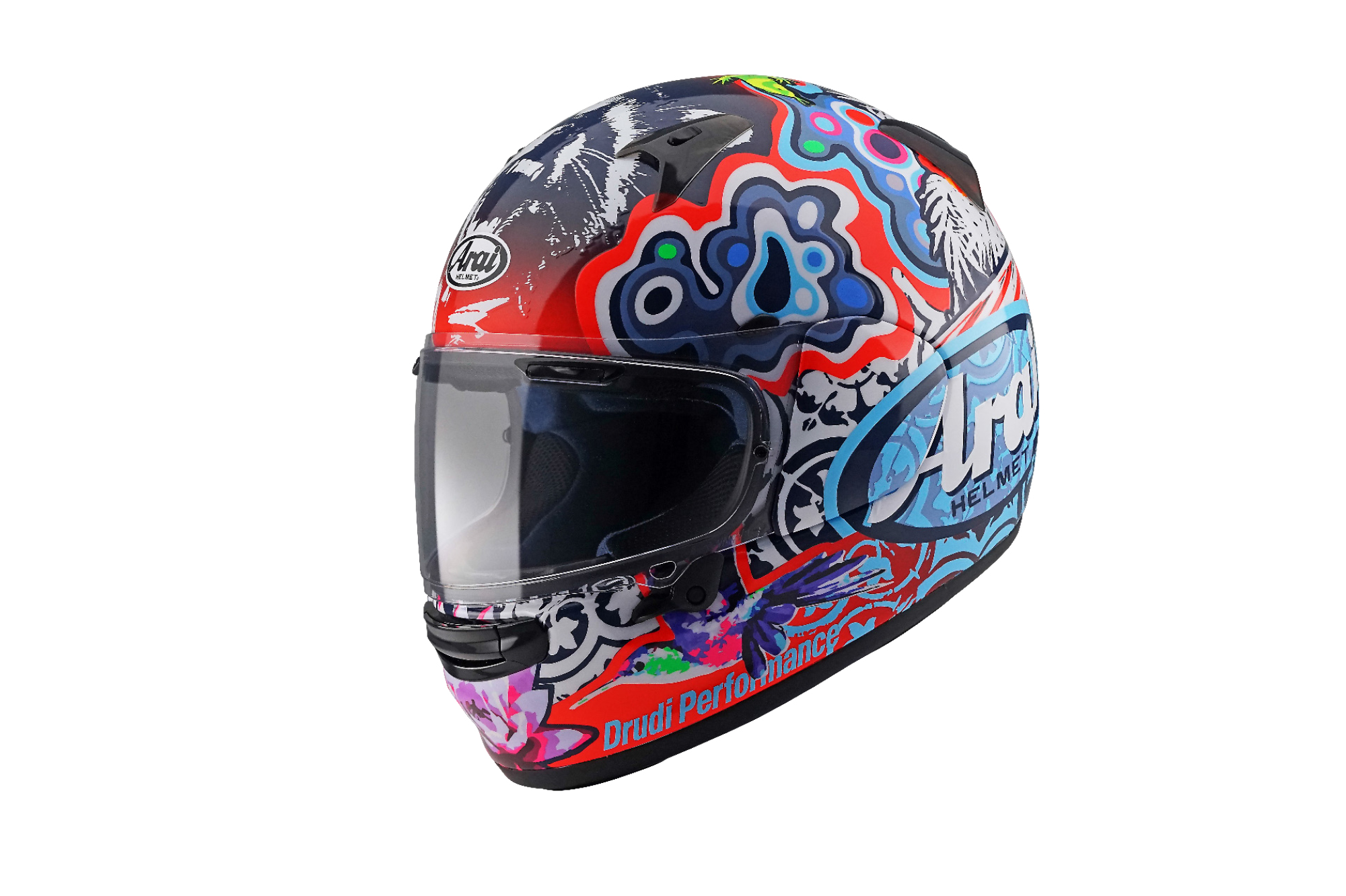
Arai Profile-V Jungle 2 helmet – $720 – easyr.com.au
Add some colour to your track day pack with this eye-catching Arai motorcycle helmet. Comes with European standard ECE 22-05 certification
IWC x HotWheels Pilot’s watch LE set – $15,700 – iwc.com
Did you know that IWC runs their own historic racing team that campaigns a 1955 300SL Gullwing? The Swiss firm’s CEO is a genuine petrolhead, and big-time Hotwheels collector, which explains this collaboration to mark the racing team’s return to this year’s Goodwood.
Limited to 50 sets; you get a steel toolbox, IWC Pilot Chronograph and a highly-detailed collectible Hotwheels replica

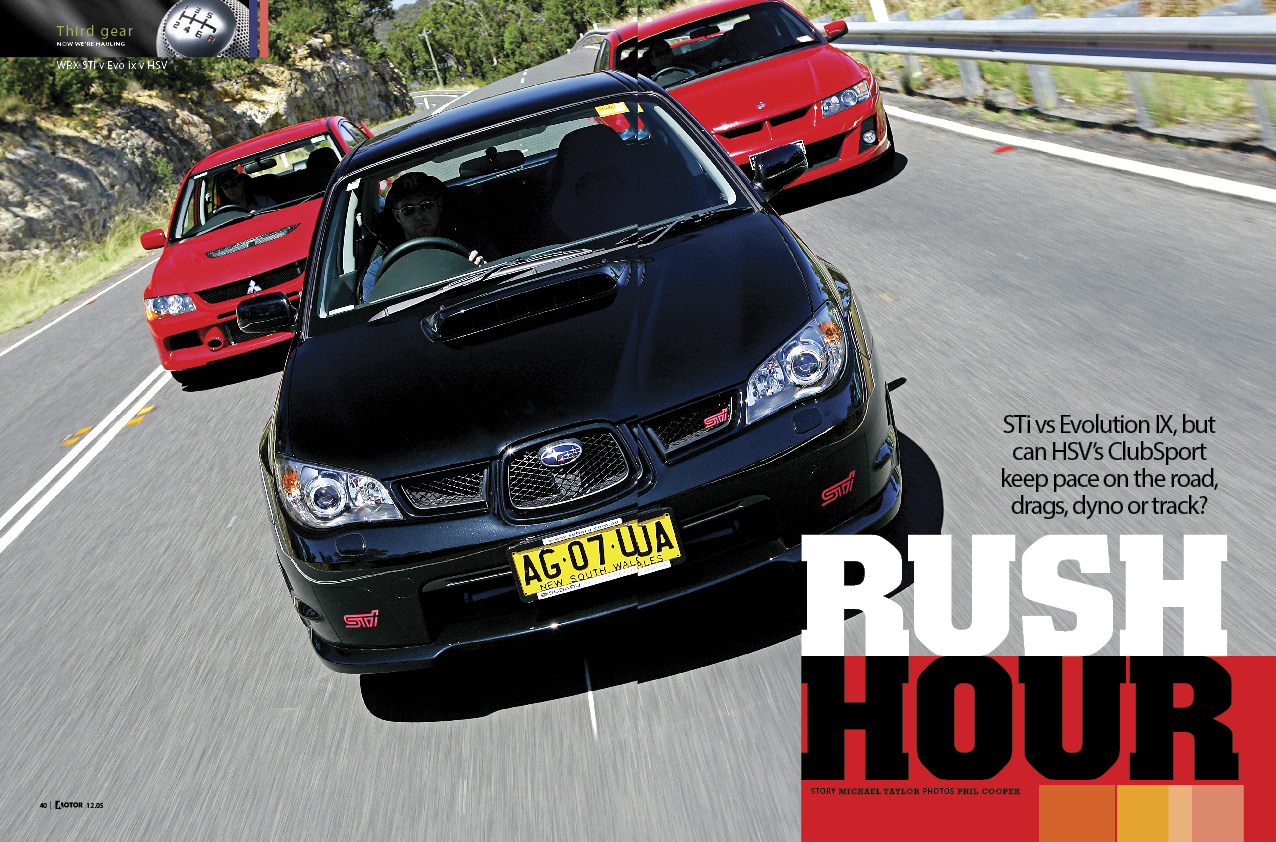
One of these cars is clearly not like the others. It’s the big one with its tailplane safely out of the airflow and a bad case of wing envy. Which is probably fair enough, seeing as it’s never seen a wind tunnel.
What HSV’s ClubSport has instead is space, luxury and rear-drive, straight-line mumbo in a boofy 297kW 6.0-litre V8 package. And it’s the only one allowed to race at Bathurst.
Is that enough, though, to keep the VZ HSV ClubSport on an equal footing with a pair of all-wheel drive turbo cars that are cheaper and seem to get proper, engineering upgrades whenever the weather turns cloudy?
Competition between the WRX STi and the Lancer Evolution is intense; significant advances get annualised model designations by Subaru, and Mitsubishi’s now into its ninth Evolution since 1992 – not including half-steps like the Evolution 6.5.
But the move to the MY06 has been one of the most significant in STi history, with the adoption of the US-spec 2.5-litre boxer four-cylinder giving a huge boost not only to the peak torque, but also to driveability across the rev range. Power goes up 11kW to 206, but power isn’t the STi’s real story.
Subaru’s STi has always had extreme ride and the hollowness of its sub-4000rpm performance as its downside, so you’d recommend them as sole household cars only to extreme enthusiasts. Try as they might, Subaru couldn’t fix the hole by stuffing more tech into a 2.0-litre four so it finally relented, and now the STi’s got nearly 50Nm more torque (392Nm) at 4000rpm. More important to the STi story, it’s noticeable all the way through the range, and it’ll actually give you something more than just the MY05’s intake groan if you open the throttle in fifth gear at 50km/h.
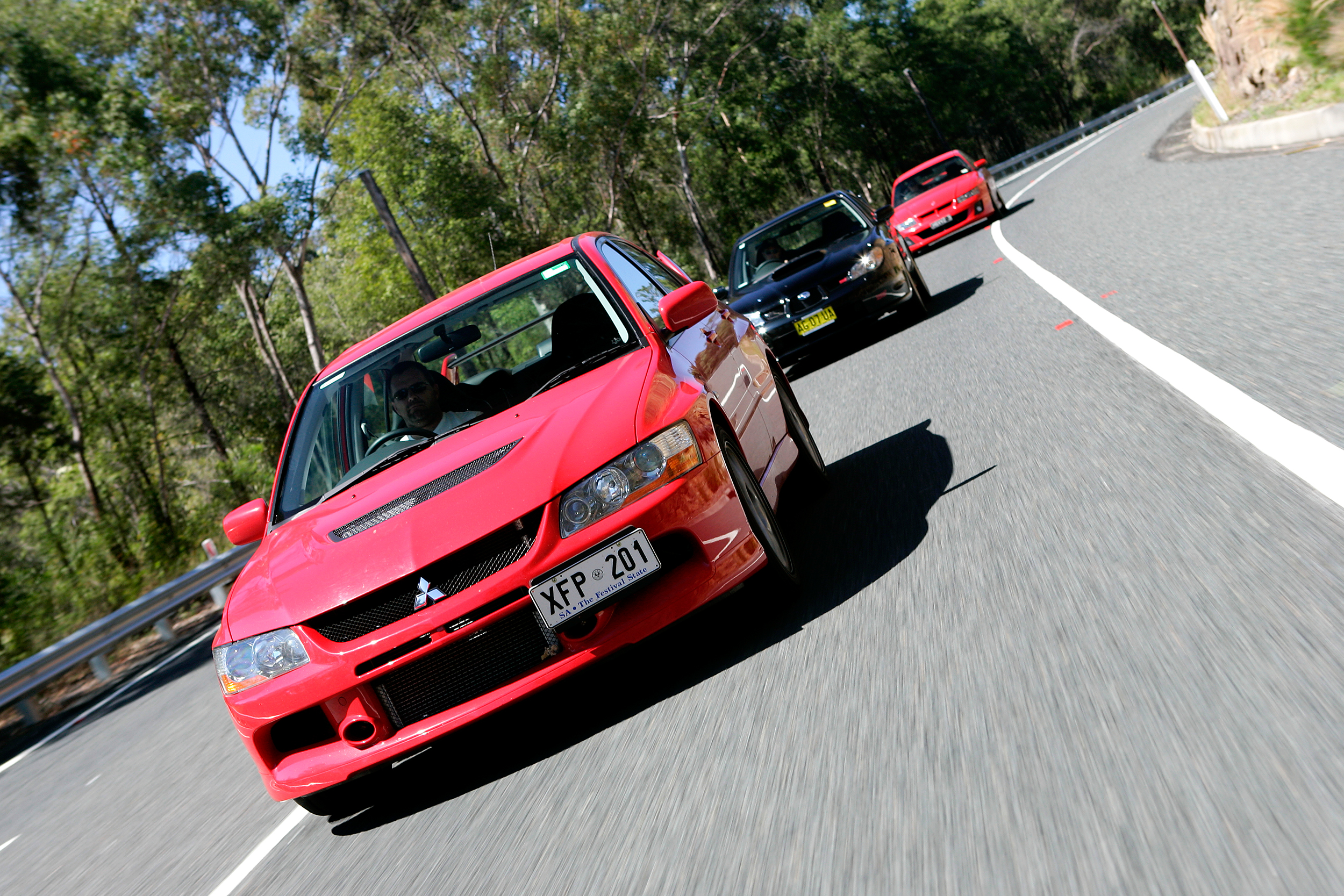
That’s never really been a problem in the Evo, because its torque curve is fatter and the IX’s peak, while lower at 355Nm, arrives at only 3000rpm and the turbo seems to spool up more urgently than the Subaru’s anyway. The reason this model is so significant in the evolution of the Evolution is that it’s finally become a full-line Mitsubishi model in Australia. That means greater integration; it brings in as many cars as it can sell, it gets a six-speed manual and it gets a jump (like the STi – now ain’t that a coincidence?) from 195 to 206kW.
Everybody kind of knows Evos have had more power than that anyway, but Mitsubishi is putting the jump down to the adoption of MIVEC variable cam timing, which switches to the aggro inlet cam at 3600rpm.
The IX is a genuine, fine-tuning evolution, with upgrades to everything from the turbo compressor to the spark plug tips; from the timing belts to the piston oil rings; and from the six-speed gearbox (the Australian VIII had a five-speeder) to the 200 extra spot welds. It also gets tweaks, like an alloy roof, big-arse Brembos and a gun anti-theft tracking system.
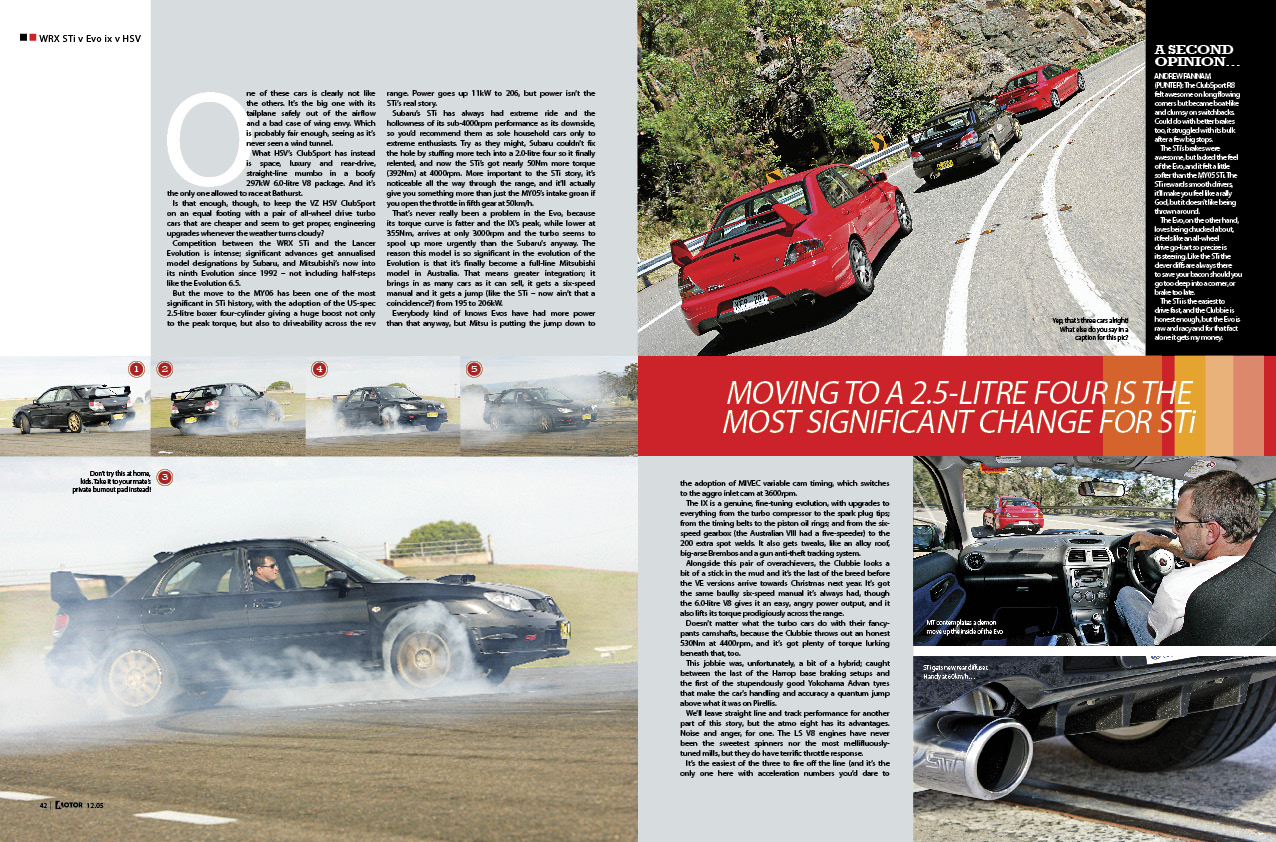
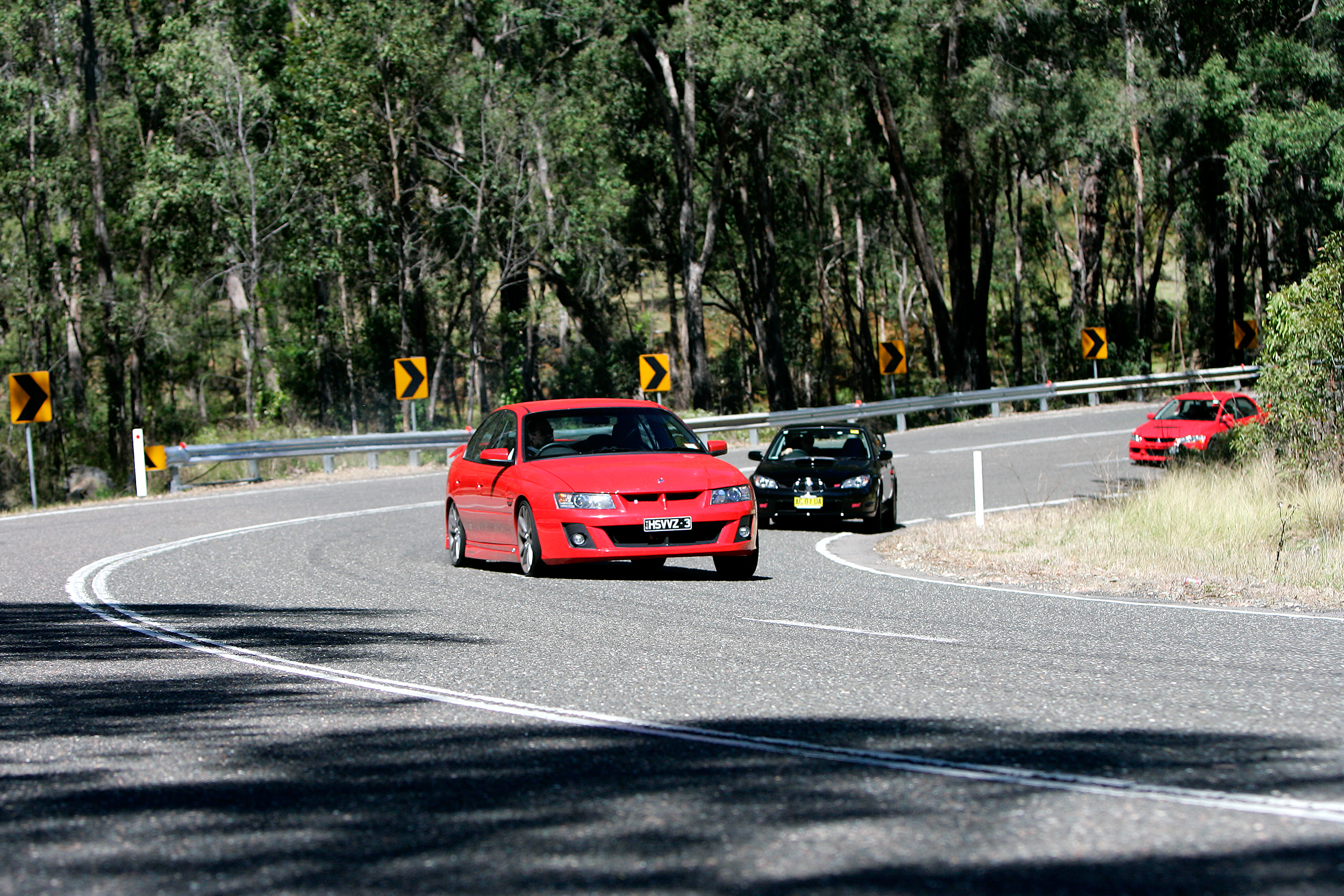
Alongside this pair of overachievers, the Clubbie looks a bit of a stick in the mud and it’s the last of the breed before the VE versions arrive towards Christmas next year. It’s got the same baulky six-speed manual it’s always had, though the 6.0-litre V8 gives it an easy, angry power output, and it also lifts its torque prodigiously across the range.
Doesn’t matter what the turbo cars do with their fancy-pants camshafts, because the Clubbie throws out an honest 530Nm at 4400rpm, and it’s got plenty of torque lurking beneath that, too.
This jobbie was, unfortunately, a bit of a hybrid; caught between the last of the Harrop base braking setups and the first of the stupendously good Yokohama Advan tyres that make the car’s handling and accuracy a quantum jump above what it was on Pirellis.
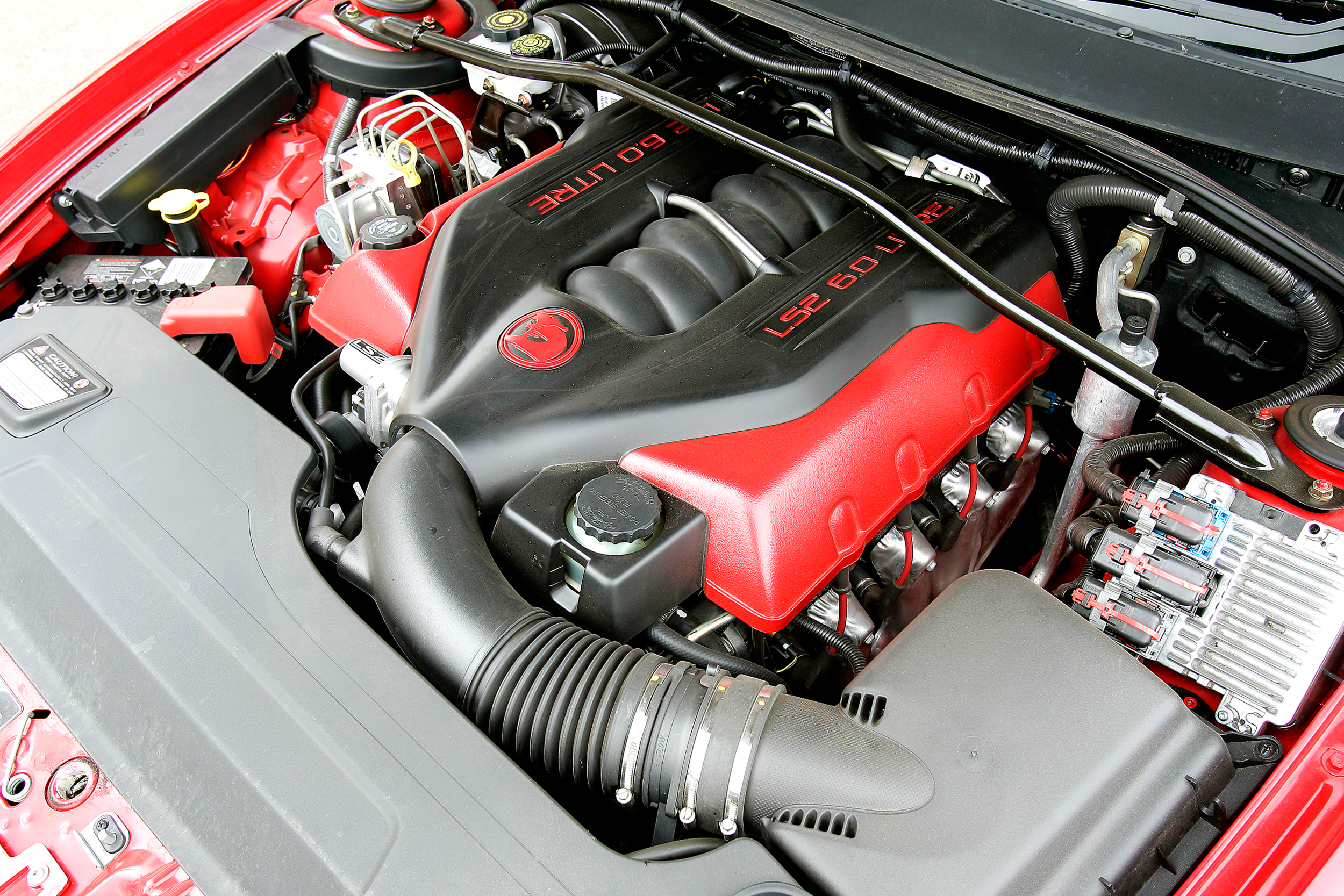
We’ll leave straight line and track performance for another part of this story, but the atmo eight has its advantages. Noise and anger, for one. The LS V8 engines have never been the sweetest spinners nor the most mellifluously-tuned mills, but they do have terrific throttle response.
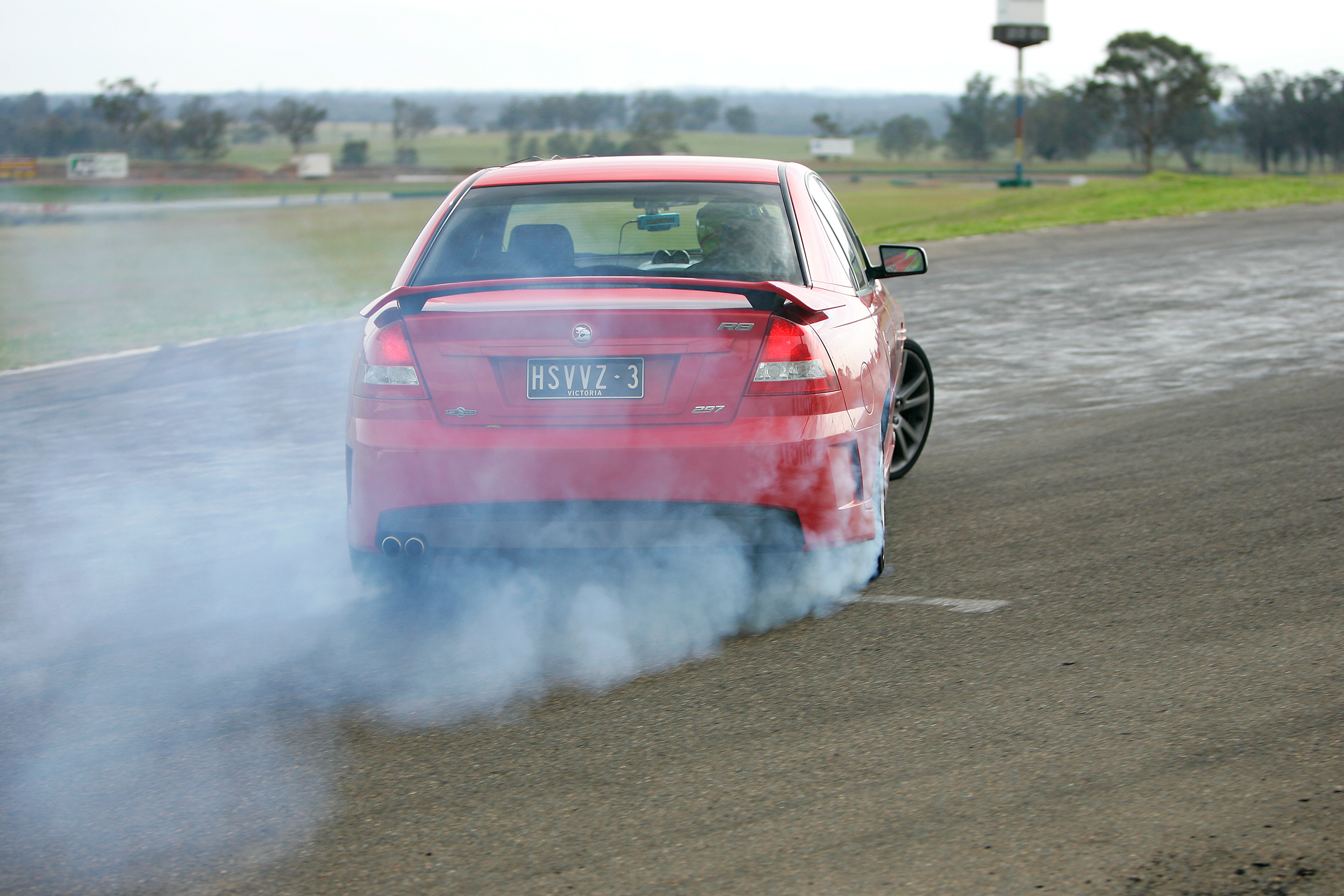
It’s the easiest of the three to fire off the line (and it’s the only one here with acceleration numbers you’d dare to repeat if you owned the thing) and there’s something about knowing you can spin up the back boots from even rolling first gear starts that gets the testosterone unconsciously cranked up. A couple of quick blips on the throttle, step off the clutch and there they go.
It’s strong, then, and it’s far stronger in rolling in-gear starts than the 5.7-litre LS1 was, even in HSV spec. It’s not as smooth as classic V8s of yore, with the engine ripping and snarling its way through the detonations in its top 2000rpm, but that doesn’t mean it’s not impressive. Take it to the top 2000 revs in any gear and it’s happening quickly, with the shift alarm buzzer annoying you from 6250 and giving you another couple of hundred rpm grace before it hits the cutout.
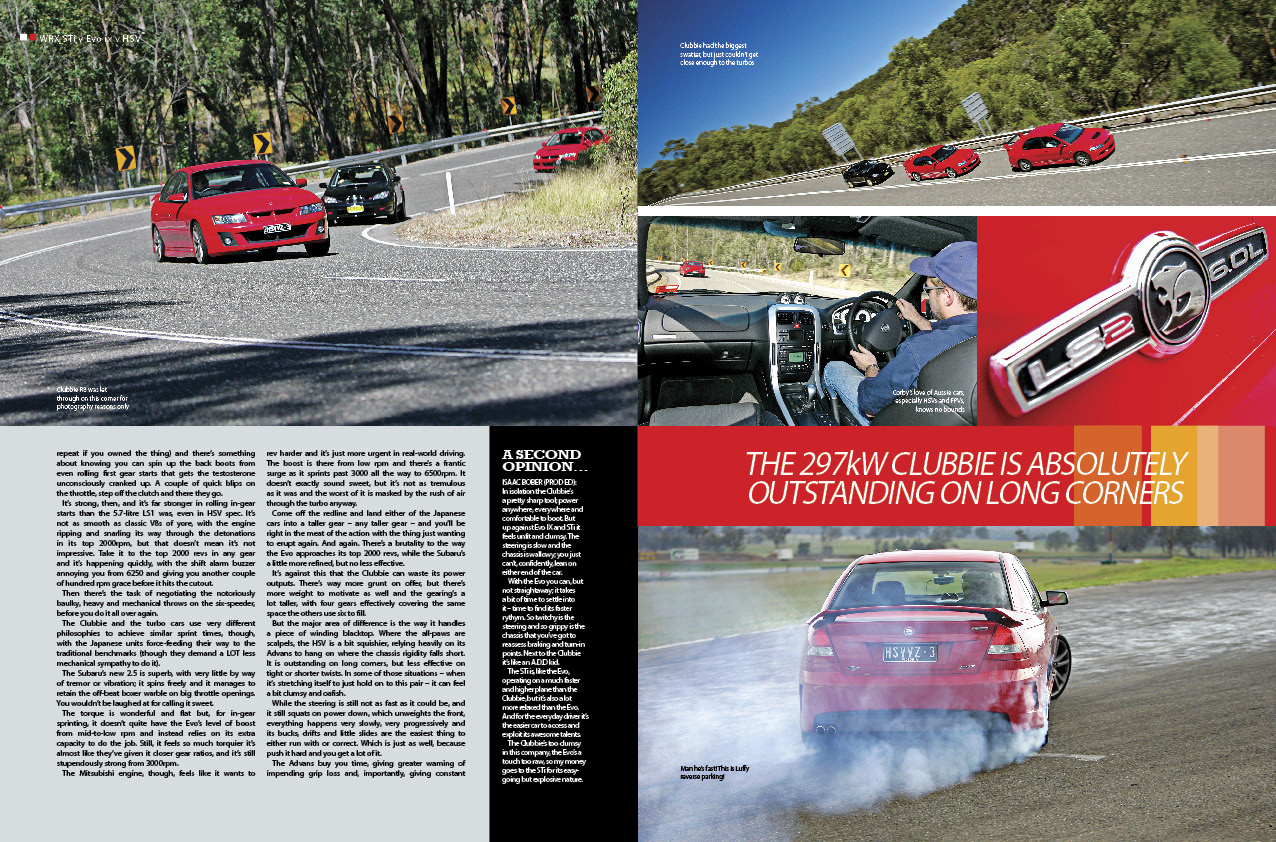
Then there’s the task of negotiating the notoriously baulky, heavy and mechanical throws on the six-speeder, before you do it all over again.
The Clubbie and the turbo cars use very different philosophies to achieve similar sprint times, though, with the Japanese units force-feeding their way to the traditional benchmarks (though they demand a LOT less mechanical sympathy to do it).
The Subaru’s new 2.5 is superb, with very little by way of tremor or vibration; it spins freely and it manages to retain the off-beat boxer warble on big throttle openings. You wouldn’t be laughed at for calling it sweet.
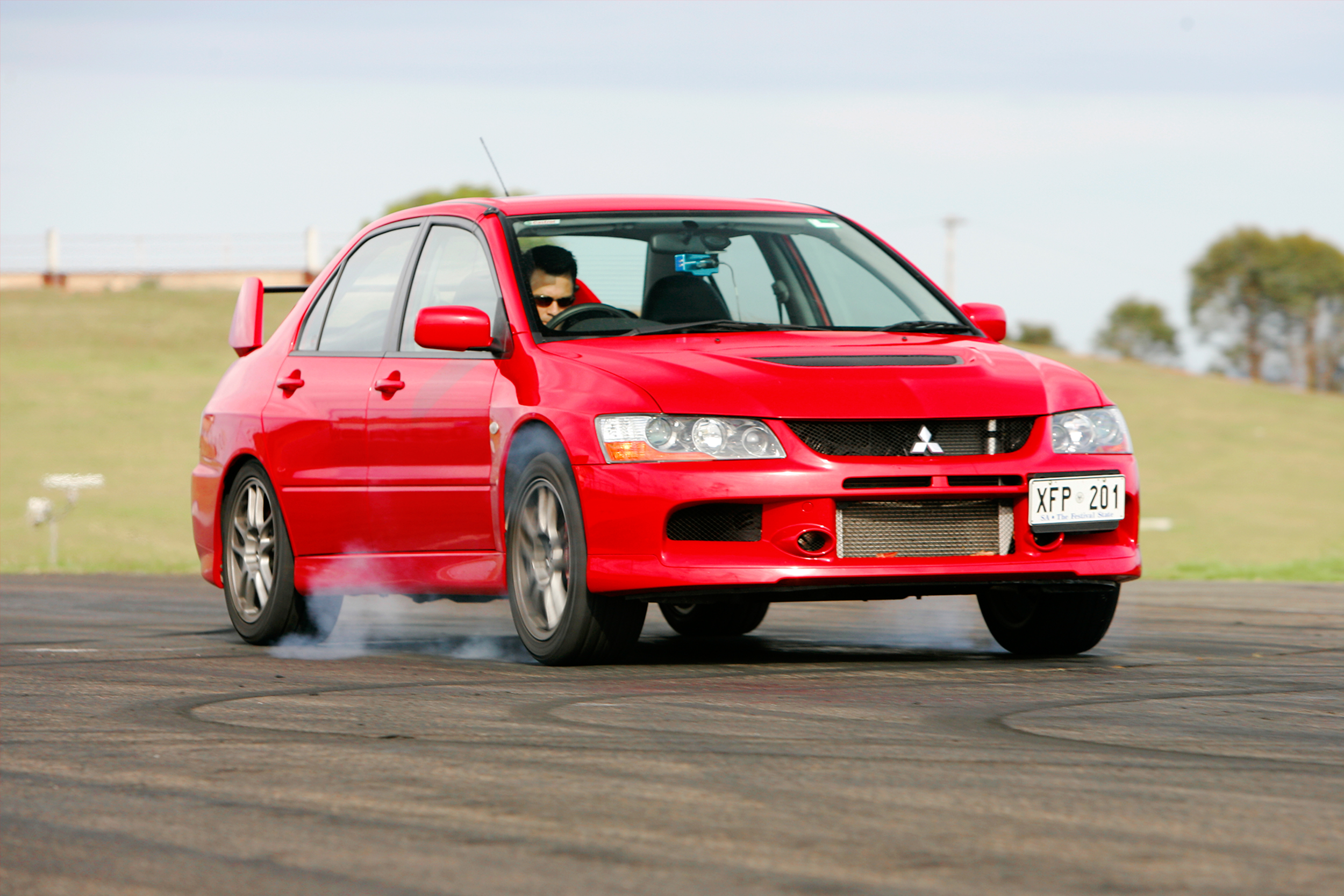
The torque is wonderful and flat but, for in-gear sprinting, it doesn’t quite have the Evo’s level of boost from mid-to-low rpm and instead relies on its extra capacity to do the job. Still, it feels so much torquier it’s almost like they’ve given it closer gear ratios, and it’s still stupendously strong from 3000rpm.
The Mitsubishi engine, though, feels like it wants to rev harder and it’s just more urgent in real-world driving. The boost is there from low rpm and there’s a frantic surge as it sprints past 3000 all the way to 6500rpm. It doesn’t exactly sound sweet, but it’s not as tremulous as it was and the worst of it is masked by the rush of air through the turbo anyway.
Come off the redline and land either of the Japanese cars into a taller gear – any taller gear – and you’ll be right in the meat of the action with the thing just wanting to erupt again. And again. There’s a brutality to the way the Evo approaches its top 2000 revs, while the Subaru’s a little more refined, but no less effective.
It’s against this that the Clubbie can waste its power outputs. There’s way more grunt on offer, but there’s more weight to motivate as well and the gearing’s a lot taller, with four gears effectively covering the same space the others use six to fill.
But the major area of difference is the way it handles a piece of winding blacktop. Where the all-paws are scalpels, the HSV is a bit squishier, relying heavily on itsAdvans to hang on where the chassis rigidity falls short. It is outstanding on long corners, but less effective on tight or shorter twists. In some of those situations – when it’s stretching itself to just hold on to this pair – it can feel a bit clumsy and oafish.
While the steering is still not as fast as it could be, and it still squats on power down, which unweights the front, everything happens very slowly, very progressively and its bucks, drifts and little slides are the easiest thing to either run with or correct. Which is just as well, because push it hard and you get a lot of it.
The Advans buy you time, giving greater warning of impending grip loss and, importantly, giving constant feedback on the degree of grip loss and what the next step’s going to be.
That’s not to say it’s especially agile (it’s not) or happy about altering its chosen line (which happens more effectively with throttle input, rather than steering). It’s just a less frantic method of eating kilometres and corners, and it’s only a bit less effective for it.
The Subaru, by comparison, makes even average drivers feel like a driving God. Not the God, like Juha. Just a God. Like Petter. It’s perhaps the world’s easiest and best nine-tenths car.
Not that there was much wrong with the MY05, but it’s refinements to the Driver Control Centre Diff (DCCD) and the addition of a torsen front diff that’s done it – and the change in the standard drive balance from 35:65 front-to-rear to 41:59. Understeer? Not now. Stand on the throttle and it pulls you tighter into the apex in contravention of all traditional rules of driving. And common sense.
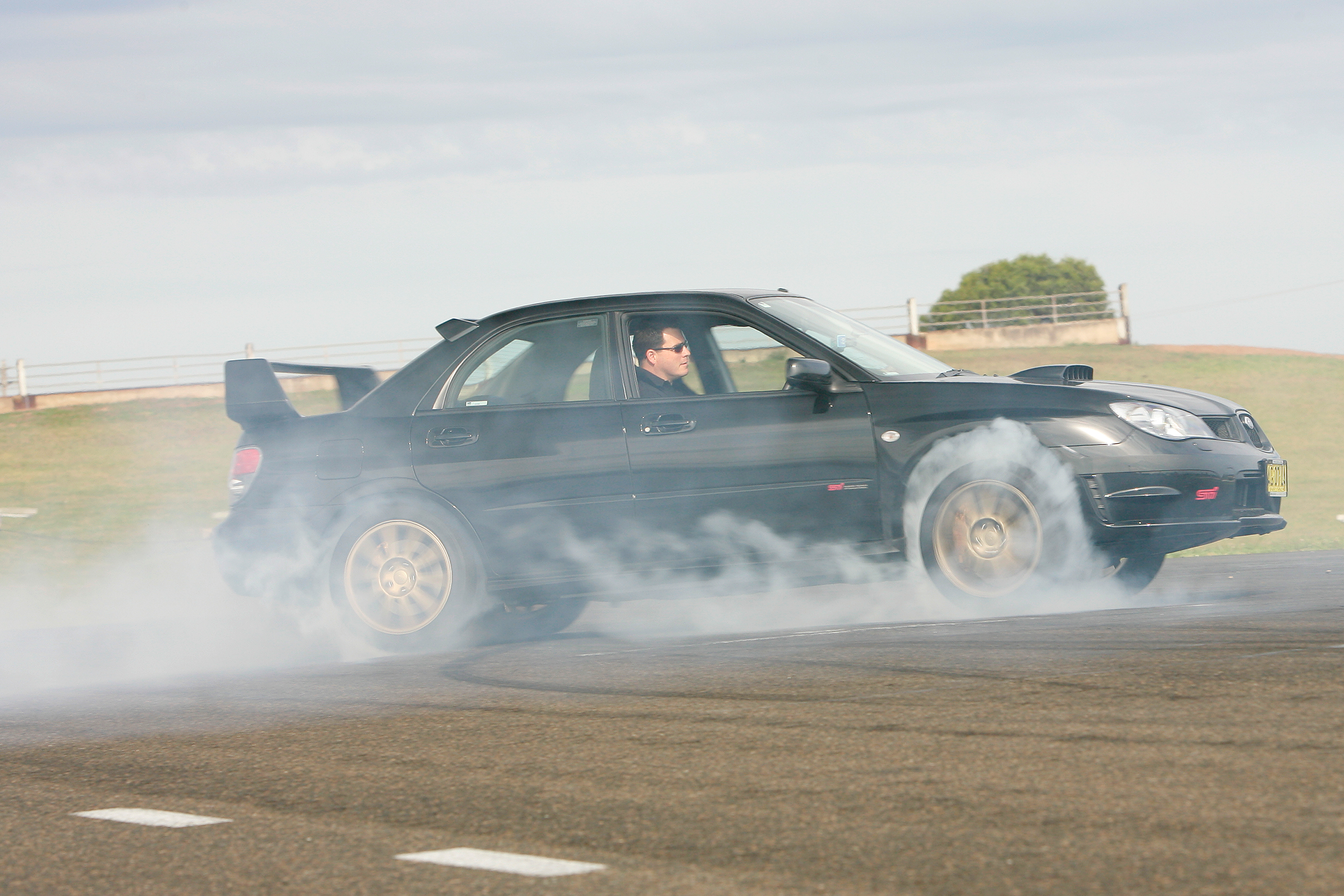
You can feel the diffs – especially the front one – working to counteract the chassis’ natural tendencies and it all works phenomenally well in low- to medium-speed corners. It’s a bit bizarre, and you get a much harder turn-in bite if you give it some spring back, turn, then stand on the throttle. On the semi-slick Potenzas it makes a huge difference, especially at the back end of long corners.
Get used to that little quirk, though, and it’s as easy as pie to drive at almost its outer limits, and everything about it has been designed to feed you confidence. You can’t get into big oversteer or understeer slides, but you can have little versions of either, depending on your preference.
You still feel like you sit above the roll centre (the STi has 5mm more ground clearance than stock Imprezas), and the whole car feels a lot heavier and more rigid than its weight suggests.
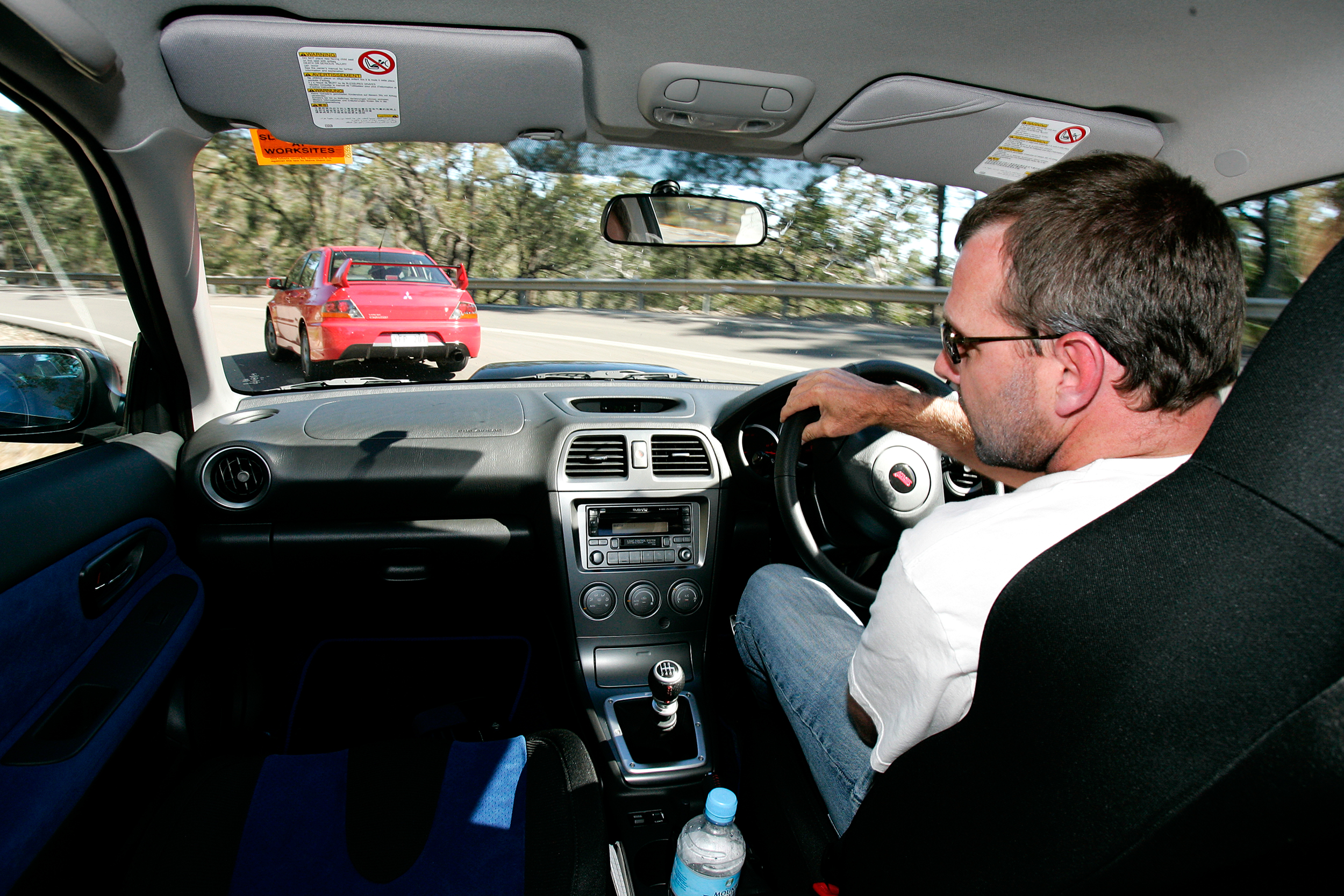
That confidence feed probably starts with the steering and the brakes. The steering weight is just about perfectly matched to the grip levels everywhere – though the rack could be quicker for higher-speed corners, and it can develop a fearful rack rattle when it’s absolutely out of grip on a long corner.
The brakes are superb. They have zero pedal travel before the pads bite the rotors and the pedal stays high and solid and consistent, and the ABS doesn’t interfereuntil it’s all getting very desperate. There’s not a lot of modulation or feel in the pedal, but there’s consistency and, to most drivers, that’ll be enough.
Just about its only quirk is that its grip seems to taper away on faster corners, where the Evo has consistent levels of grip throughout the angle ranges.
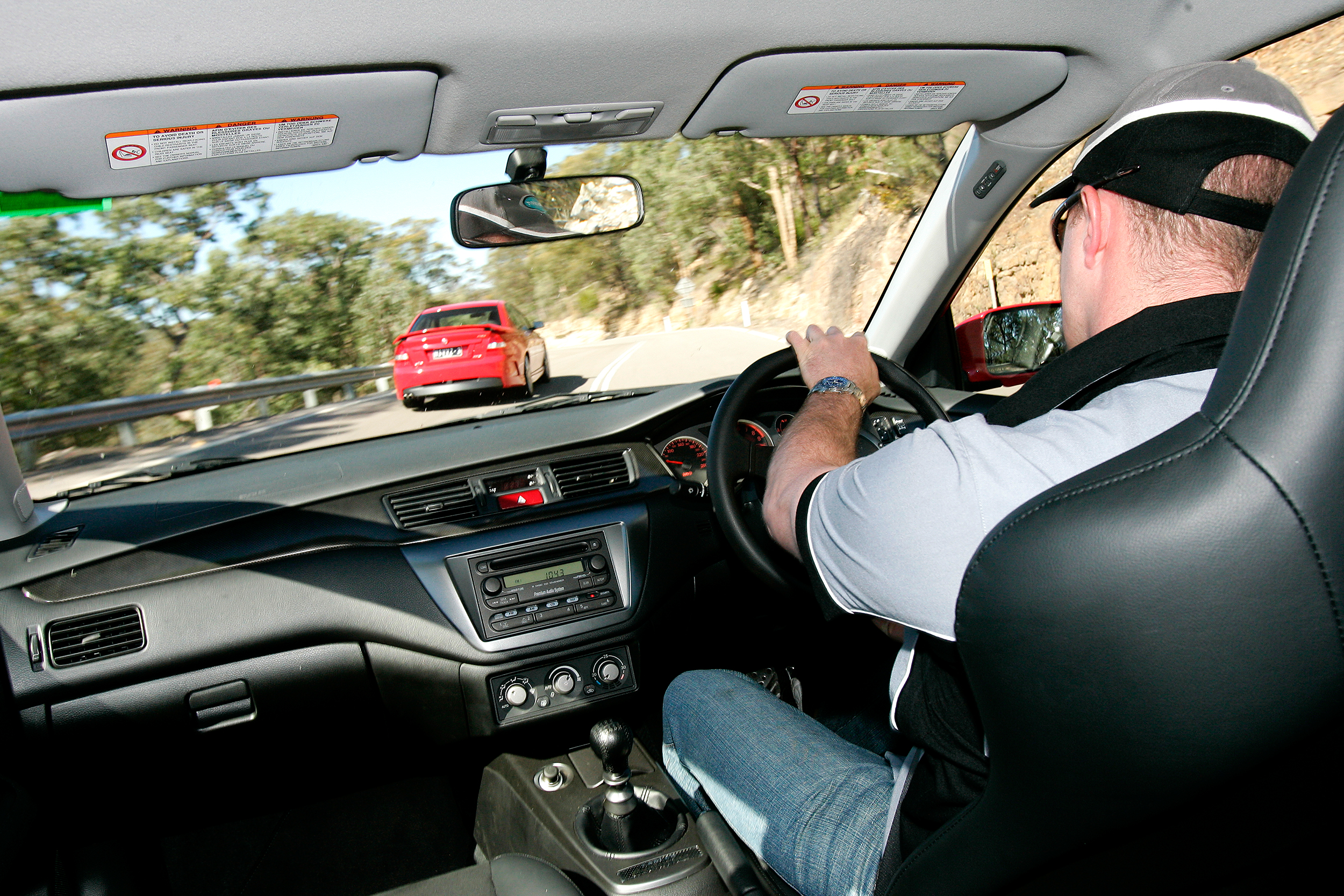
The Mitsubishi rides harder with far lighter, far quicker steering. It’s easily the most kart-like of the three. Push it hard and it loves you to stand it on its nose at the front half of a corner, then swing the turbo into action to get the diffs – especially the rear diff – pushing you into line.
And nothing here gets out of the back end of a corner like the Evo does. Even the STi at the peak of its powers, teetering on the edge of its stupendous grip levels, can’t hold the Evo (on the road, at least) as the active centre and rear diffs push drive to different parts of the car to keep the thing on line.
Keep the weight out of your fingers and the steering’s so quick that you think it, and it’s there. The technology is similarly effective, similarly reassuring, but somehow keeps some level of challenge in it for you.
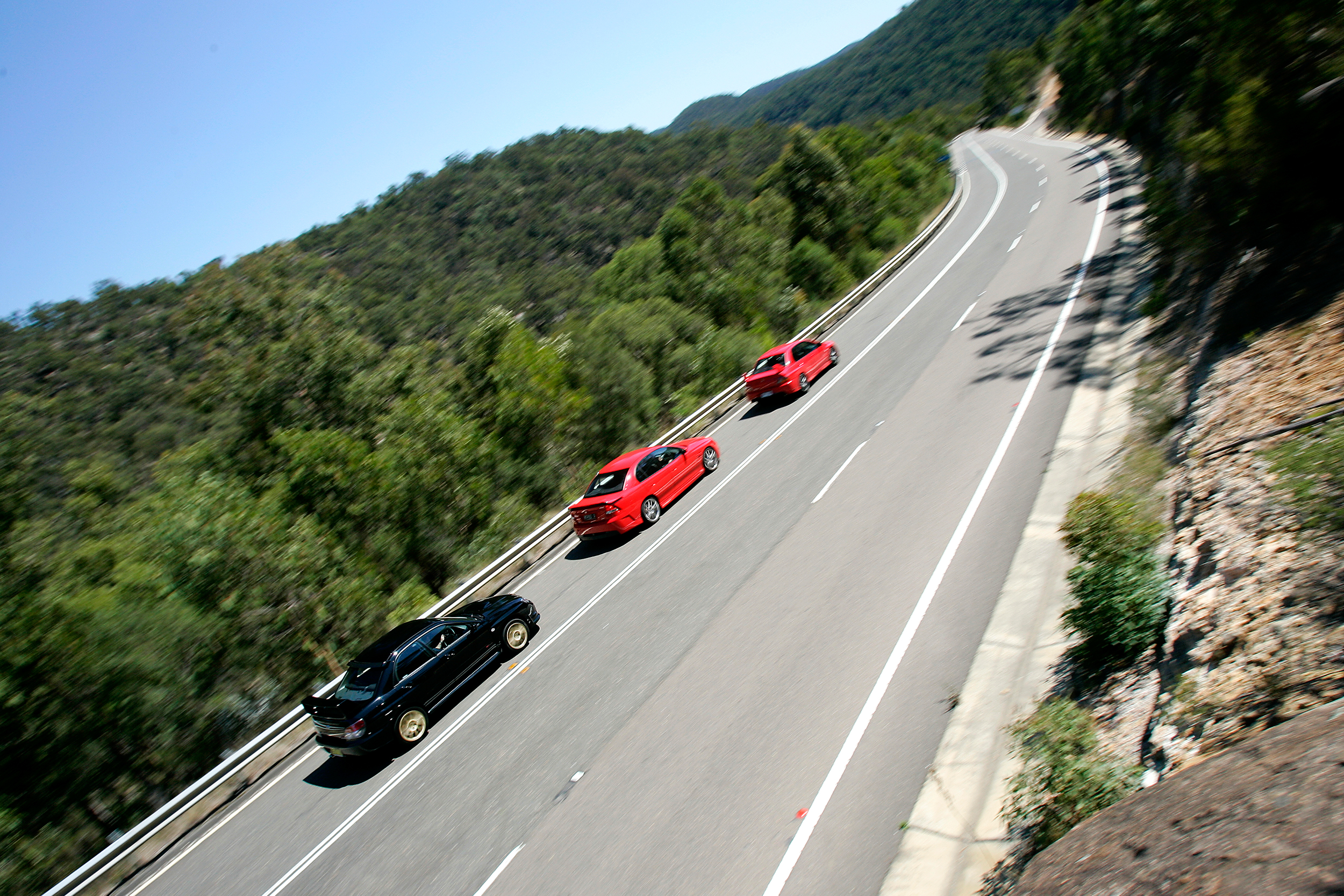
You can throw it into corners at ridiculous velocities and you can almost point it, stand on it and leave the on-board brains trust to sort it out for you. And its new gearshift is a jewel. You think the Subaru shift is good – it is – but alongside Evo’s new six-speeder, it’s a bit slower,mechanical and baulkier. The Evo shift is like its steering. When it’s flowing, the shifts are happening almost without you knowing you’re doing it.
Its tyres don’t have the grip of the STi’s – but it feels like it’s got a slight advantage in steady-state mid-corner chassis grip that (almost) cancels that out. While its brakes don’t have the same high bite point of the STi, they’re just as good, give a little more feedback and progression through the pedal and, like the Subaru, obstinately refuse to fade.
All three of these cars trumpet their credentials through their interiors – the Clubbie’s more luxurious cabin should be a giveaway and, besides, HSV doesn’t have the R&D resources of the others. Still, the HSV seats are supportive and grippy. They’ve also got good adjustment range and the cabin is inherently more quiet than the others, and it’s not as knocked around by coarse chip roar.
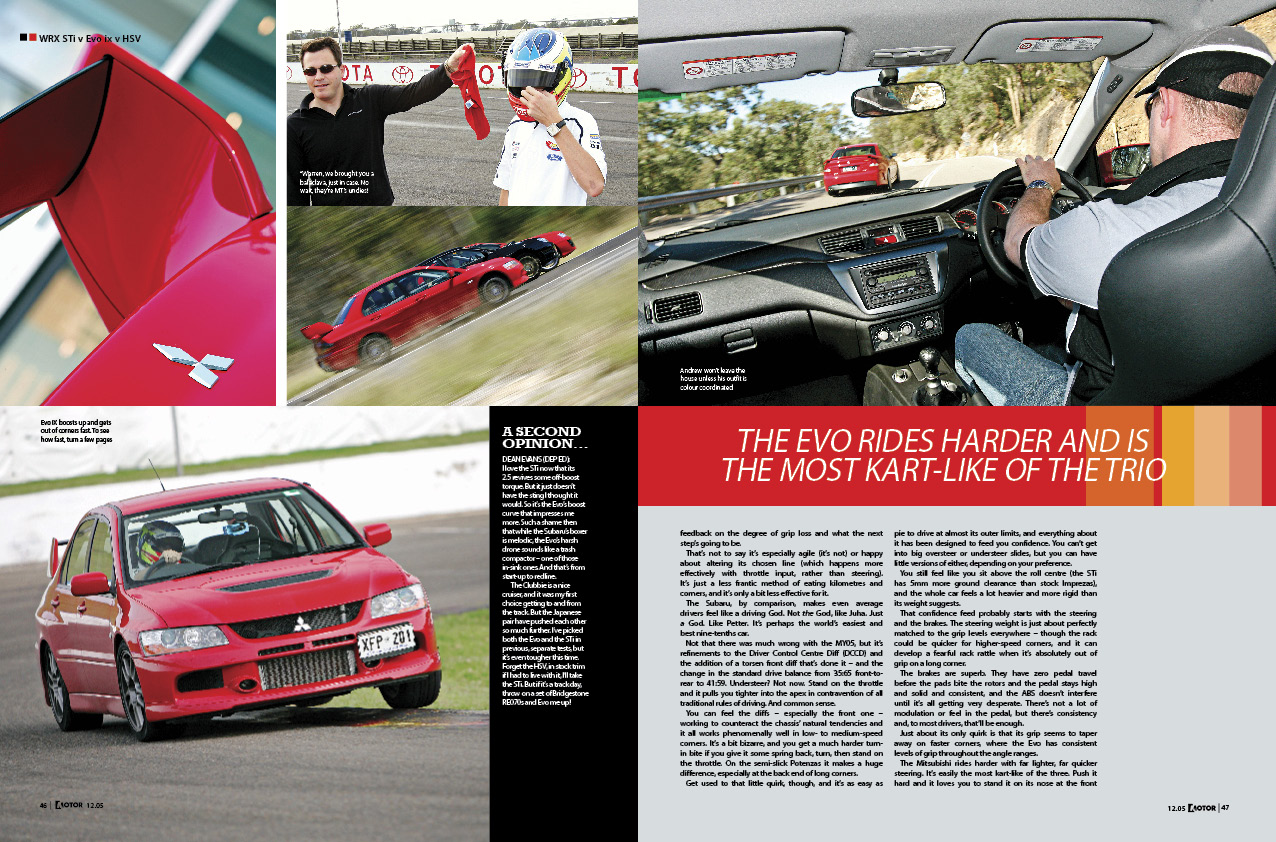
The Japanese cars suffer from this, especially from the rear. The HSV rides far better (even on 19s), the Evo far harder, and the STi neatly in the middle.
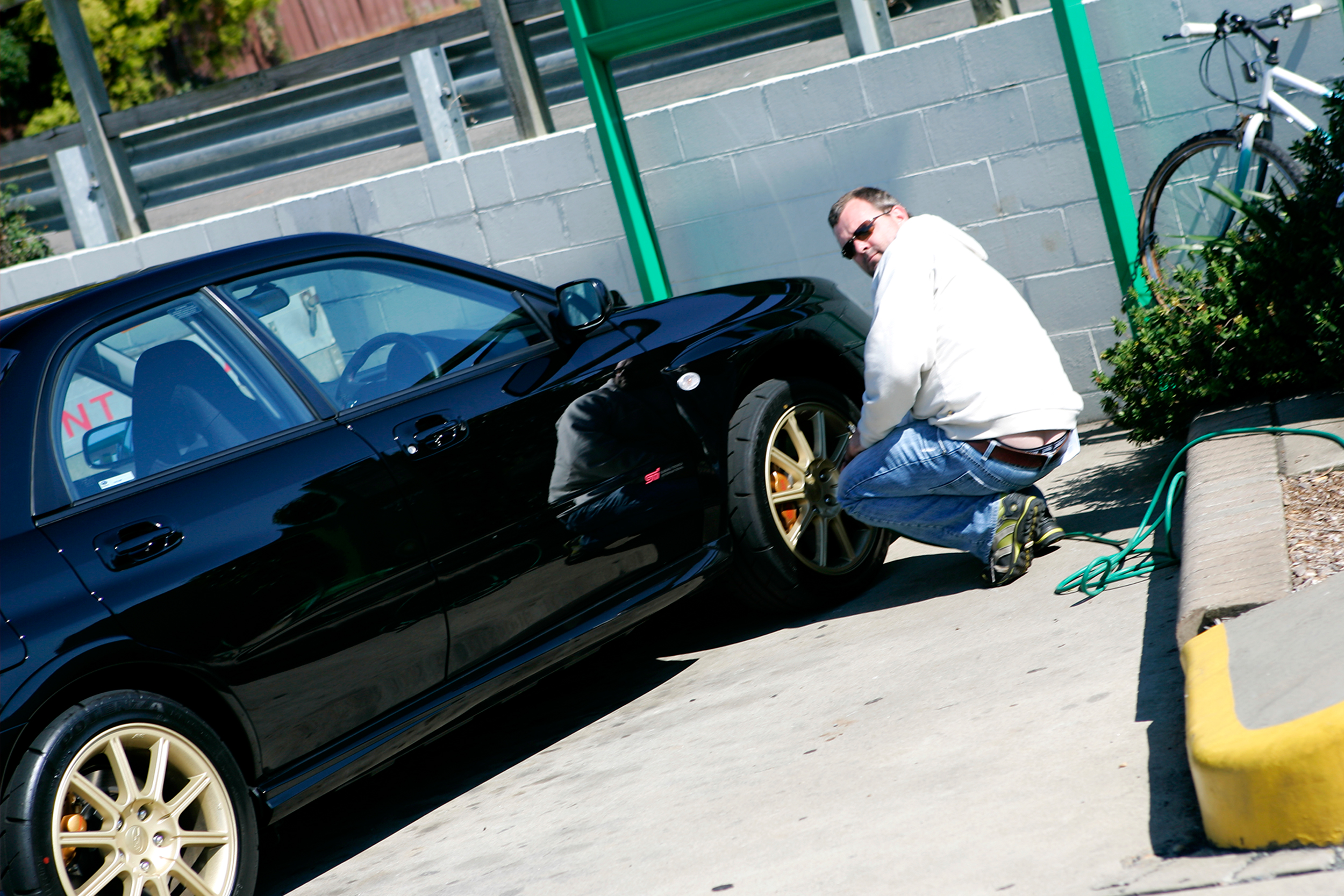
The STi’s seats look great but they fall away for lumbar support over distance and they’ve not got the Evolution’s grippy bolstering. Still, the Subaru runs a clear second for trim levels, even though the Evo has a more grown-up interior than ever before.
The STi is now a seriously potent device and is the first hyper WRX you’d recommend to someone as an only car. But it feels a bit like the tyres and diffs are making up for a chassis that doesn’t have the Evo’s grip or poise. It’s supremely effective, but in some ways it’s too easy to drive quickly.
Beneath a couple of hundred grand, there’s probably only one other car that can match it. And that’s the Evo. A car that feels a touch more rear-drive (against the STi which feels a touch front-drive) and a car that pleads with you to go harder. A car that loves to be driven on the nose at the front half of a corner and a car that engages the driver more and more as the driver gets more and more committed.
Maybe that’s the compromise they’re walking here. The Clubbie is a more relaxed, better riding, more comfortable way of doing the job, and rear-drive gives it perhaps a wider range of fun tickets.
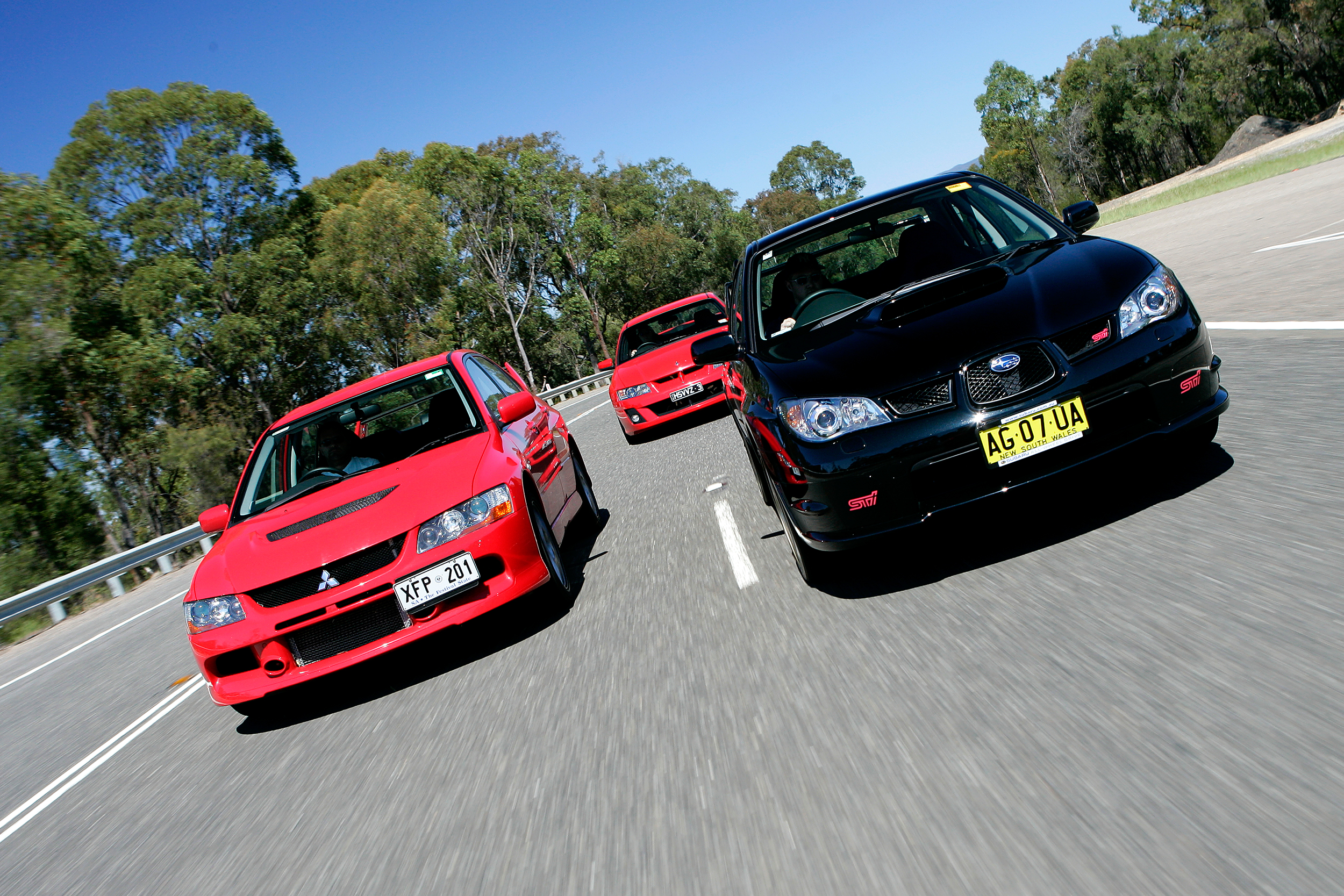
Both of the Japanese cars leave you in awe of their achievement, especially at the price. The STi is now a capable all-round very fast car with no significant average point, let alone a weak point, yet feels just a little wooden in the way it goes about its business.
The Evo has yet to compromise its core, and it’s just a more energetic, frantic, enthusiastic weapon, and just as forgiving if you get it wrong. There’s always something happening, it’s always asking for more and it’s just a more rewarding car to get the most out of.
It can’t be abuse if it begs you to do it, can it?
Key Points
- New homes and other buildings to require EV charge points from 2022 in UK
- Includes buildings with >10 parking spaces undergoing ‘largescale renovations’
- Expected to add approximately 145,000 new chargers per year
United Kingdom Prime Minister Boris Johnson has announced plans for a dramatic expansion of the nation’s electric vehicle charging network, ahead of a planned ban on petrol and diesel autos from 2030.
New homes and other buildings – such as supermarkets and offices – will be required to install electric vehicle charging points from next year, in an effort to add more than 145,000 new chargers per annum until the end of the decade.
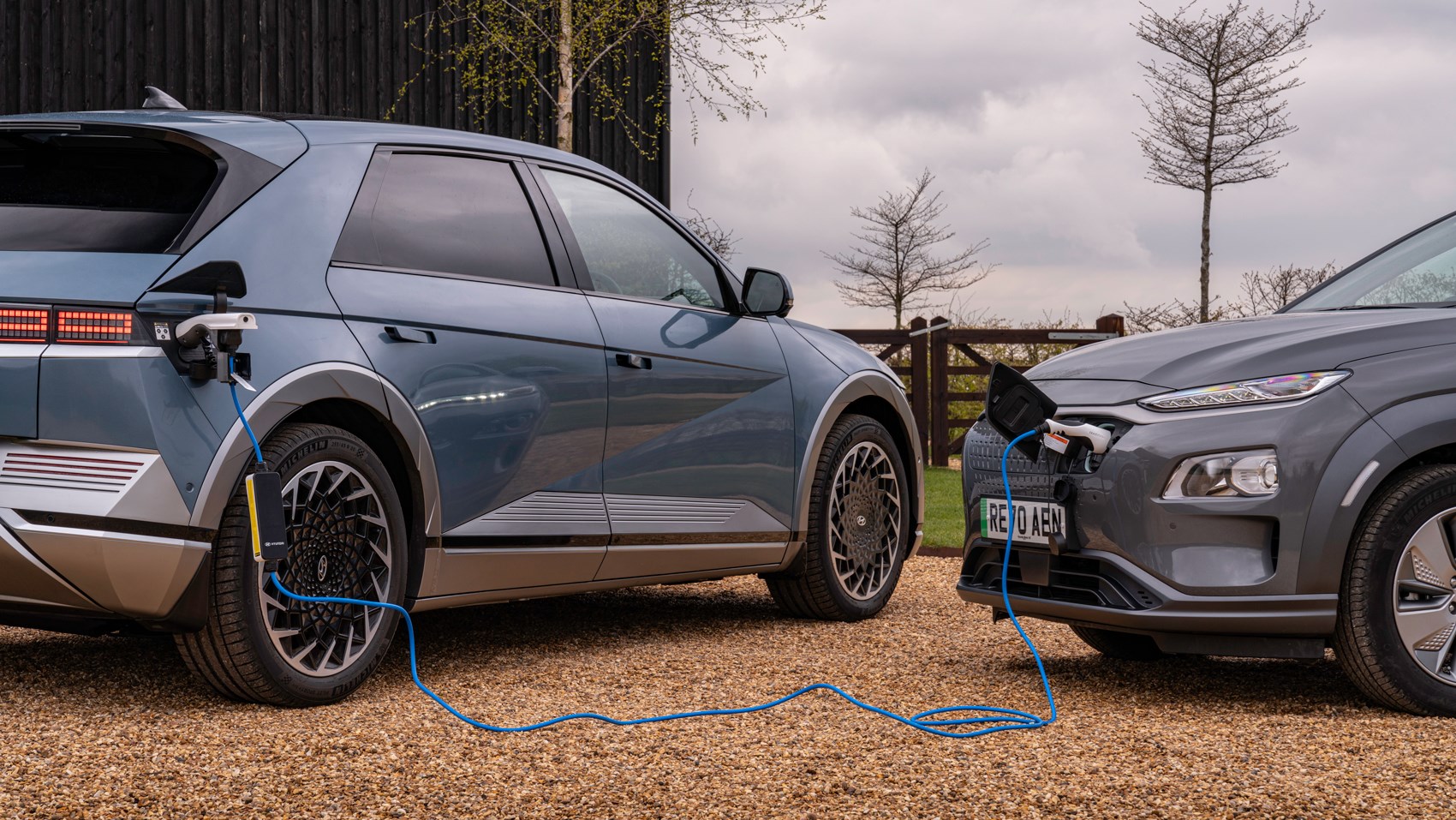
Announced during Boris Johnson’s speech to the Confederation of British Industry (CBI) on Monday, the requirement will also expand to major renovations taking place on existing buildings with more than 10 parking spaces.
The Government says the extra charging points will build on the existing 25,000 home and workplace stations in the UK, and will sit alongside other scheduled expansions to the network.
“We’re regulating so as to require new homes and buildings to have EV charging points, with another 145,000 charging points to be installed thanks to these regulations,” said Johnson.
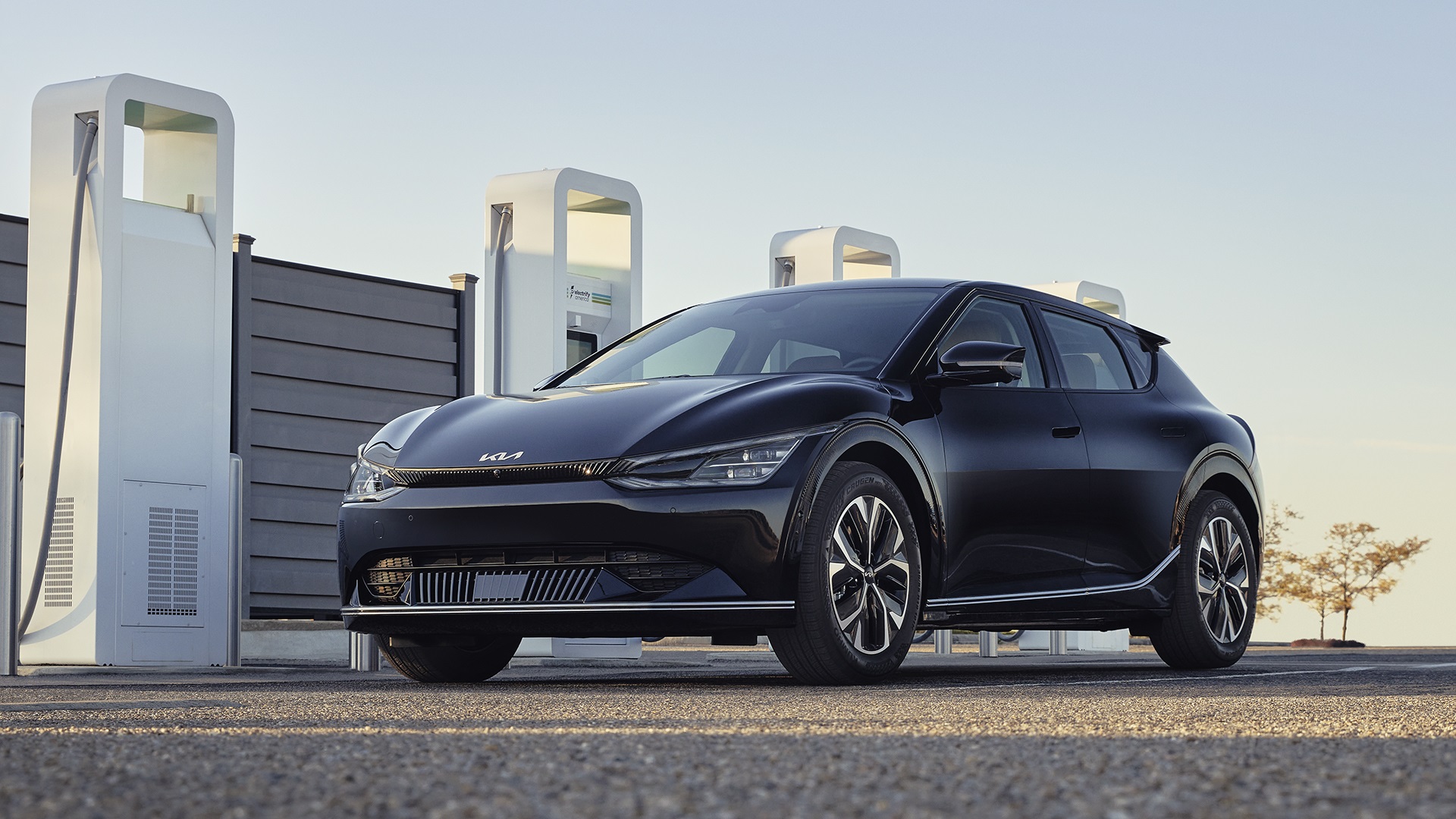
The PM told business leaders “we must regulate less or better and take advantage of new freedoms,” while also stating the Government will increase investment in science and technology, raise productivity and “then get out your way”.
During his speech, Johnson also touched on the advancements of electric vehicles since he wrote about the first Tesla sold in the country back in 2010, as a contributing motoring journalist for GQ.
“I tried the first Tesla for sale in this country for GQ,” he said. “It expired in the fast lane of the M40, I’m sad to say, though I think they’ve got a lot better.”
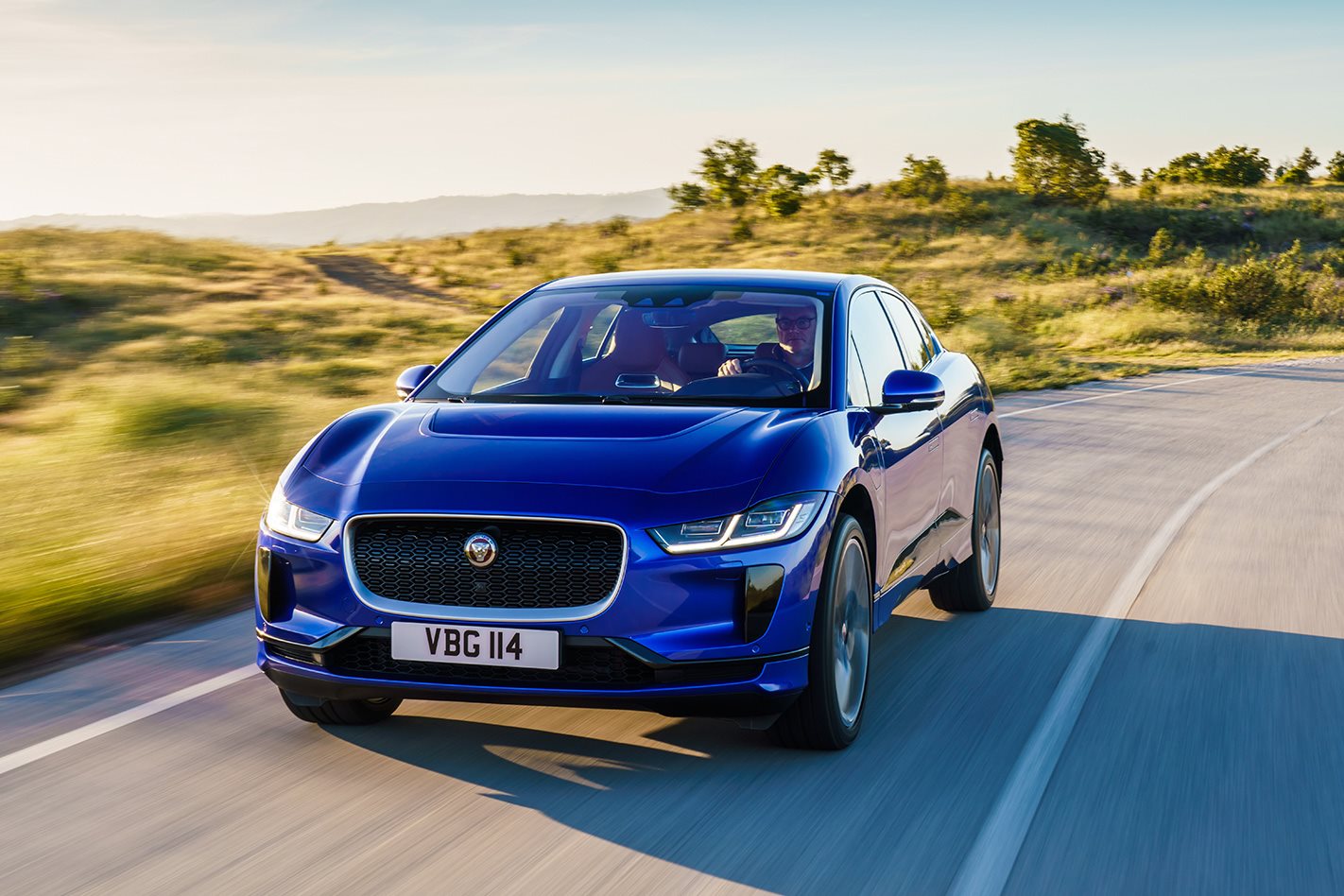
The news comes weeks after the United Kingdom hosted the COP26 climate change conference, with the British Government pledging an extra £970 million towards the nation’s vehicle electrification efforts in the lead-up to the event.
Key Points
- ACCC investigation concludes
- Watchdog has chosen not to pursue concerns due to private legal action
- Holden’s car servicing arrangements still under assessment
The Australian Competition and Consumer Commission (ACCC)n has concluded its investigation into the closure of Holden in Australia, choosing not to pursue its concerns about the treatment of dealers.
After General Motors announced it would be pulling Holden from Australia before the start of 2021, the ACCC said it received complaints from local dealers claiming Holden had known GM’s plan but had continued to establish and acquire new dealerships.
As Holden was removed from the Australian new car market, a large number of local dealers found themselves without a product to sell, with many effectively forced to agree to GM’s offer of $1500 compensation per remaining car.
ACCC chairman Rod Sims said the investigation had found poor conduct by Holden and General Motors, although due to a large number of former dealers currently taking private action against the manufacturer, it would not pursue its concerns.
“Many Holden dealers felt badly let down by Holden and had invested significant amounts of money into the dealerships that would soon stand idle,” said Sims.
“We started an investigation into Holden’s conduct towards its franchisee dealerships because Holden’s conduct appeared to be very concerning.
“While our investigation left us with concerns about Holden’s treatment of some of its dealers, the ACCC has decided not to pursue [them], in large part because any ACCC action may prejudice the private [legal] action taken by dealers.
“This was a difficult decision based on a range of considerations.
“The behaviour by Holden has done much to damage the General Motors brand in Australia, and perhaps beyond.
“The way Holden withdrew from Australia and managed the process and its relationships with long-standing loyal dealerships should serve as a lesson to all franchisors of what not to do in managing their relationships with franchisees and treating them fairly and with respect.”
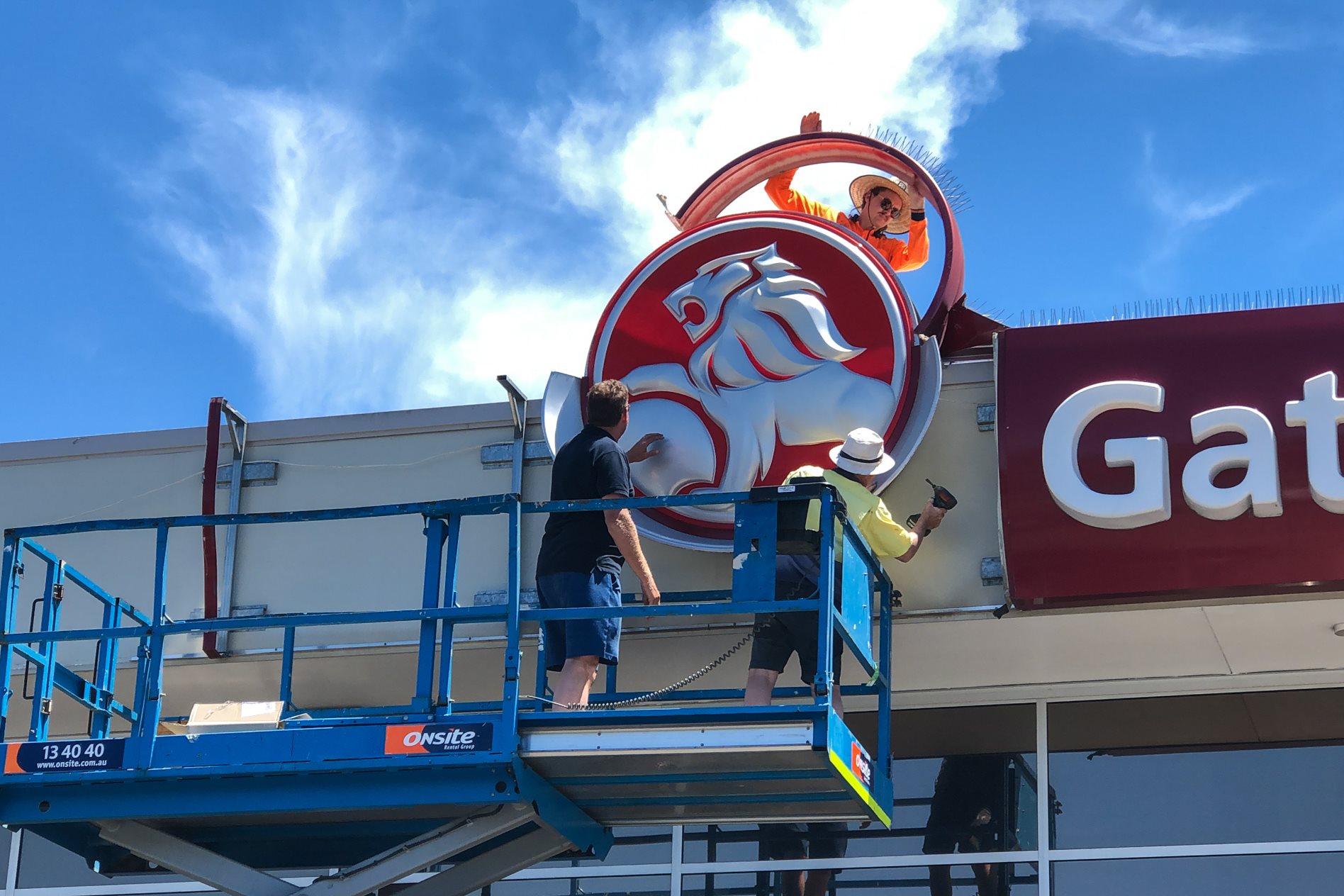
Australian Automotive Dealer Association (AADA) CEO James Voortman said the ACCC’s decision to not take GM to court was in no way a reflection of the manufacturer doing the right thing – rather as an example for other brands not to repeat its mistakes.
“This will be disappointing news for many ex-Holden dealers, but General Motors should not see this as vindication of its actions,” said Voortman.
“The ACCC has by no means endorsed the actions, labelling its treatment of dealers as ‘a lesson to all franchisors of what not to do’ and ‘damaging the General Motors brand’,” he said.
“GM’s actions led the Government to introduce reforms on July 1 this year which would prevent other car manufacturers following [its lead]. These are important reforms for the Australian automotive industry and we will continue to monitor the operation of these laws.”
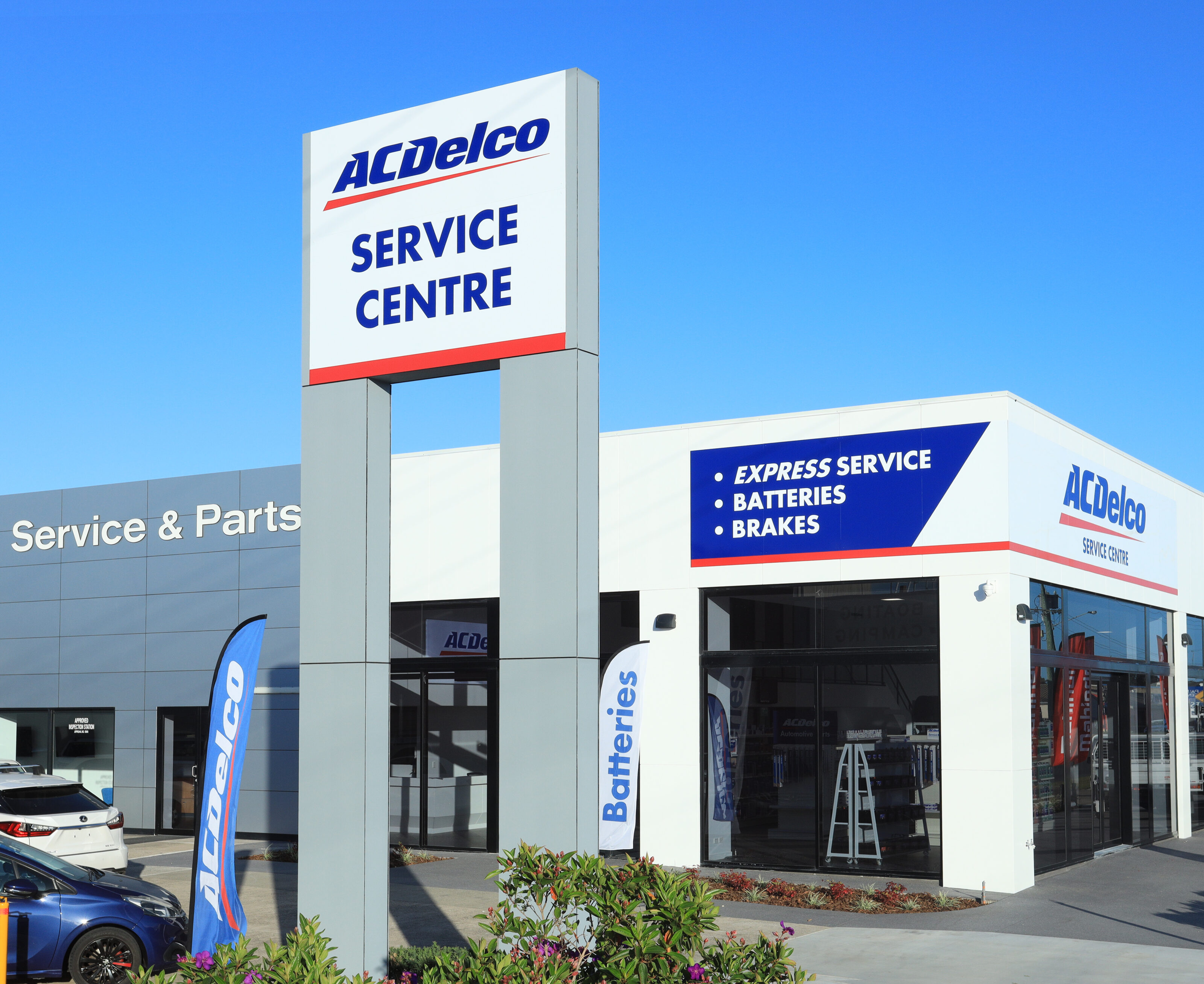
The ACCC noted it is continuing to assess, “whether Holden’s car servicing arrangements, including [its] decision to end its ‘lifetime’ capped-price servicing program, raise any issues under the Australian Consumer Law.”
As reported earlier this year by WhichCar, it is understood former Holden dealers and service centres will soon be renamed under GM’s parts brand, ACDelco, potentially ending the existence of the manufacturer in Australia.
At the time, a local spokesperson for GM Australia told WhichCar it had not made the name change compulsory as yet, although it had strongly advised its service fleet to move under the ACDelco banner.
Hyundai has announced it will begin trialling Level Four autonomous vehicles from 2022 in the South Korean capital of Seoul.
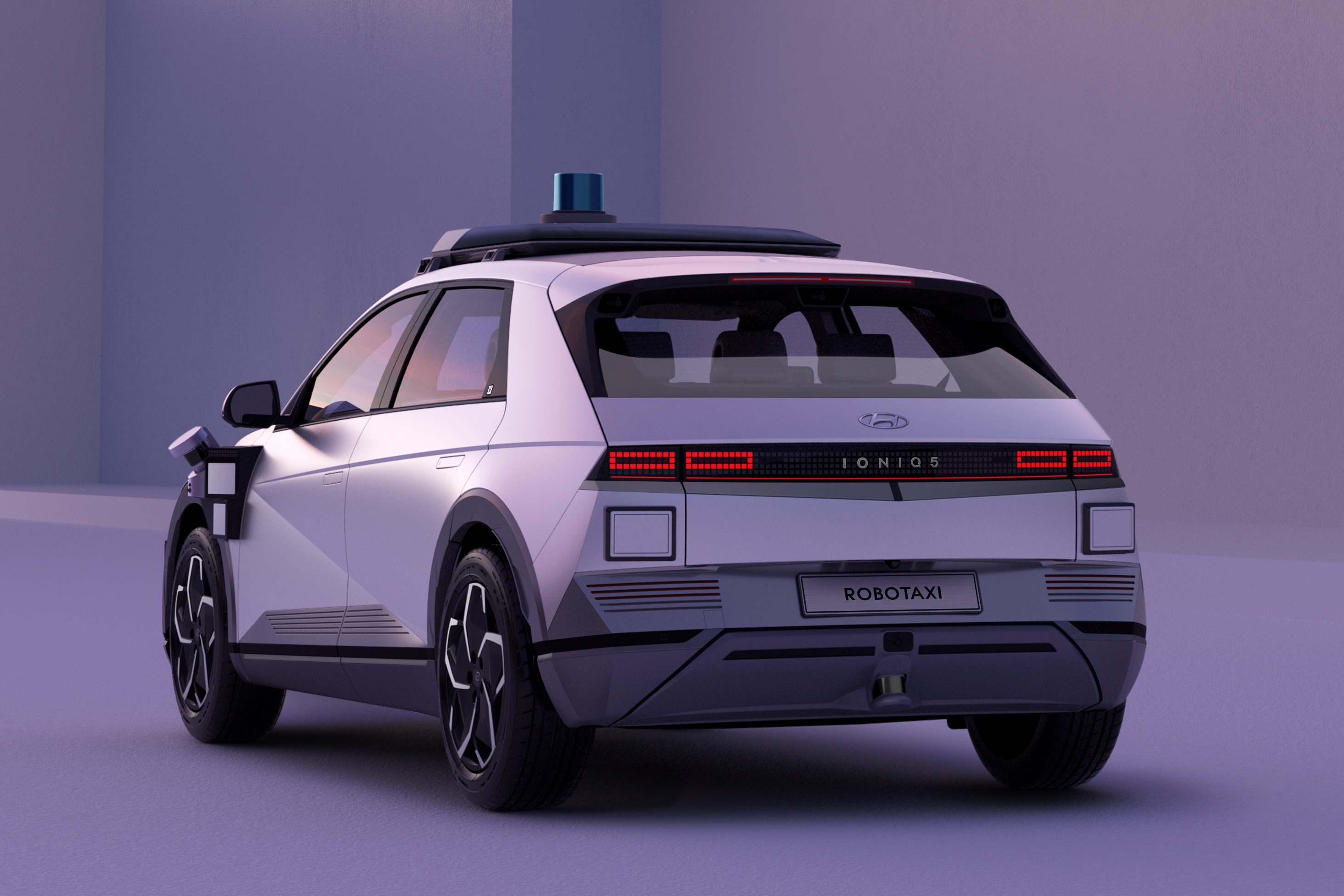
According to The Korean Car Blog, Hyundai said it would begin testing its ‘robotaxi’ fleet, based on the fully-electric Ioniq 5.
Hyundai unveiled the Ioniq 5 robotaxi in September, with plans to run the vehicles on the roads around Los Angeles.
Under the internationally-recognised Society of Automotive Engineers’ guidelines, Level Four autonomy means the vehicle will drive itself within limited environments, and won’t require passengers to take over.
It’s the second-highest level in the hierarchy, with Level Three autonomous driving software most commonly seen on Tesla vehicles – the vehicle can drive itself under limited conditions, such as in a traffic jam, but the driver must take over when the vehicle requests it.
Many cars currently on sale have Level Three driving functions offered as standard, allowing the vehicle to provide a degree of steering, braking and acceleration to support the driver, such as radar cruiser control and lane-keep assist.
“We’re developing a fully-autonomous technology that won’t require the driver’s intervention, based on the self-driving [system] that has been verified and applied to existing models,” Jang Woong-jun, head of Hyundai’s autonomous driving division, said at the 2021 Seoul Mobility Show this week.
Jang also announced the Korean car giant was planning to introduce an autonomous “robo-delivery service,” which could improve the efficiency of logistics.
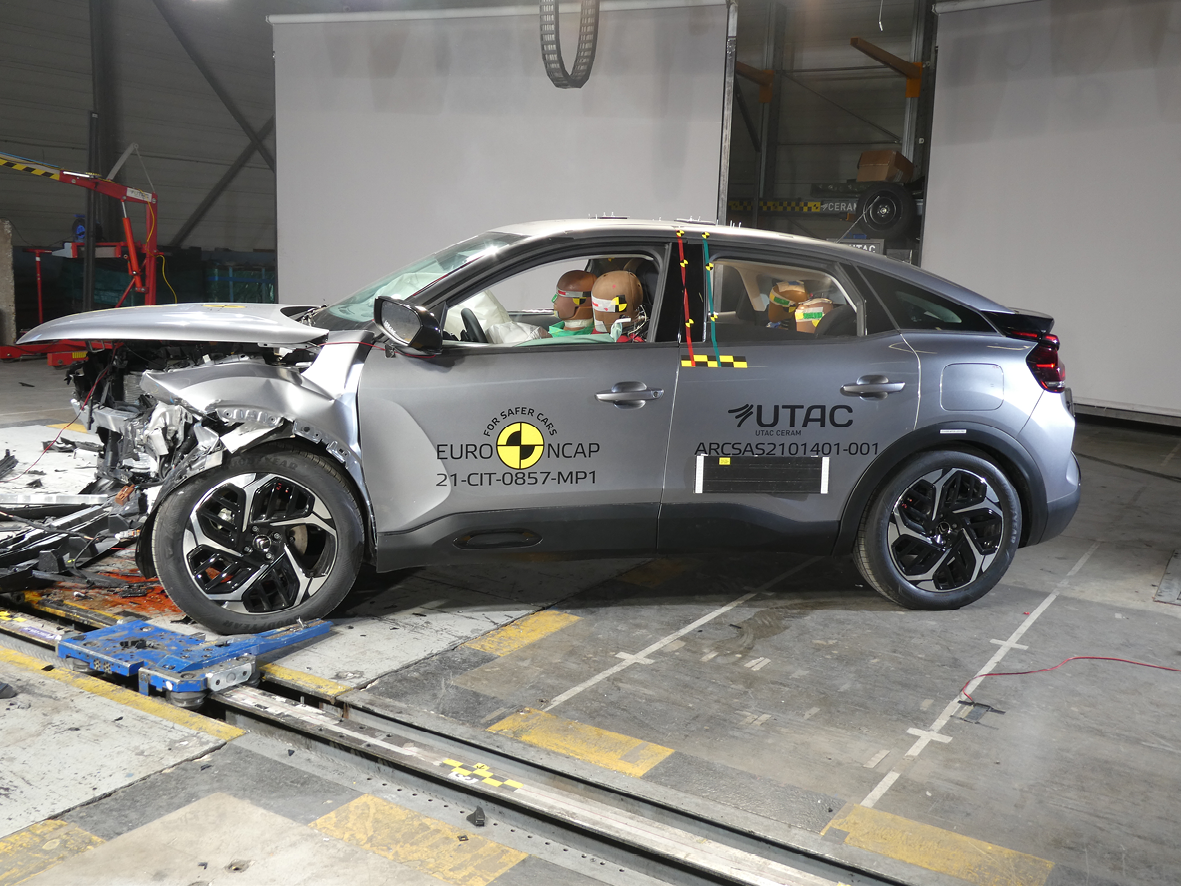
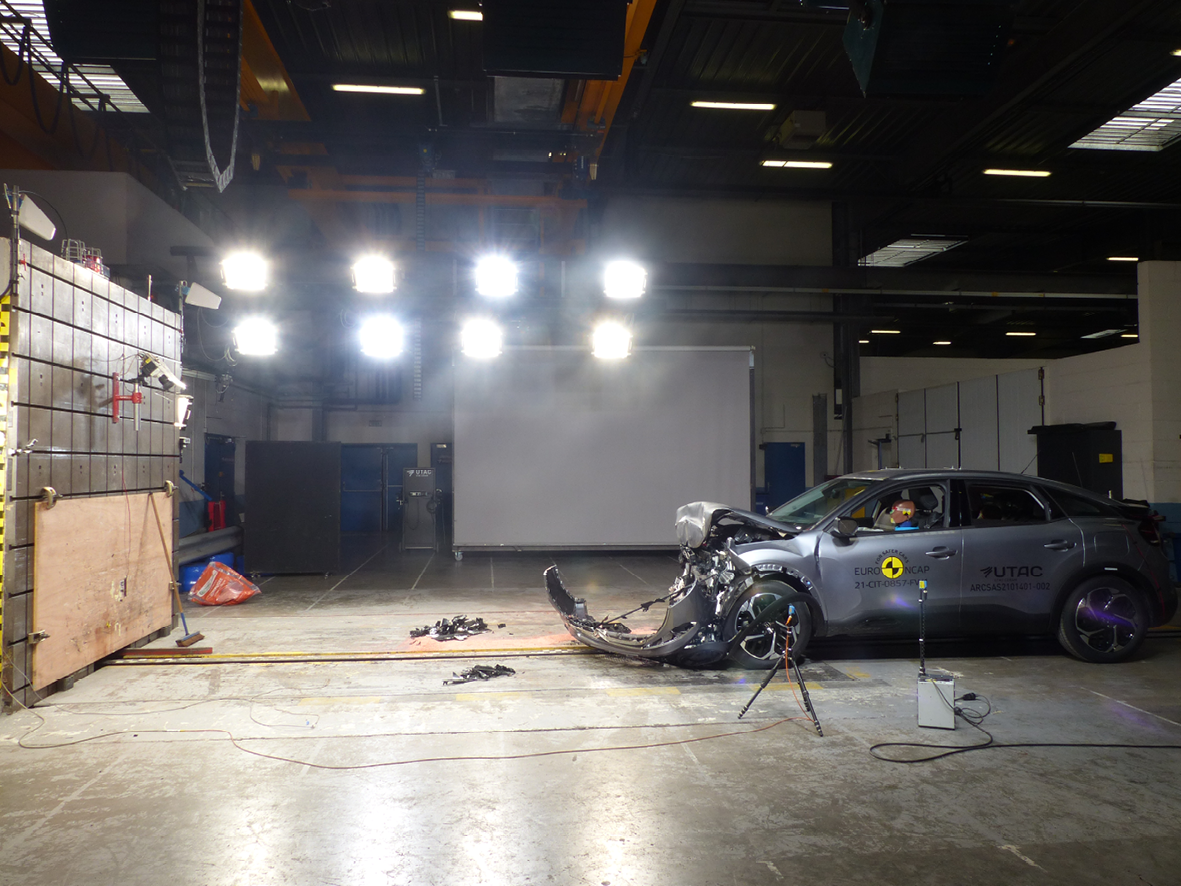
The new Citroen C4 has been given an unwanted title, becoming just the second vehicle to not receive a five-star ANCAP safety rating since 2020.
According to the independent crash testing authority, the new-for-2022 C4 could only achieve a four-star rating, with just one of its four tested categories passing over the threshold for five stars, similar to the Kia Cerato S and Sport.
Rolling out across Australia and New Zealand this month, the C4’s poor score was largely attributed to its 57 per cent result for vulnerable road user protection as well as its 62 per cent rating for its safety assist systems, both unable to clear the five-star threshold of 60 and 70 per cent respectively.
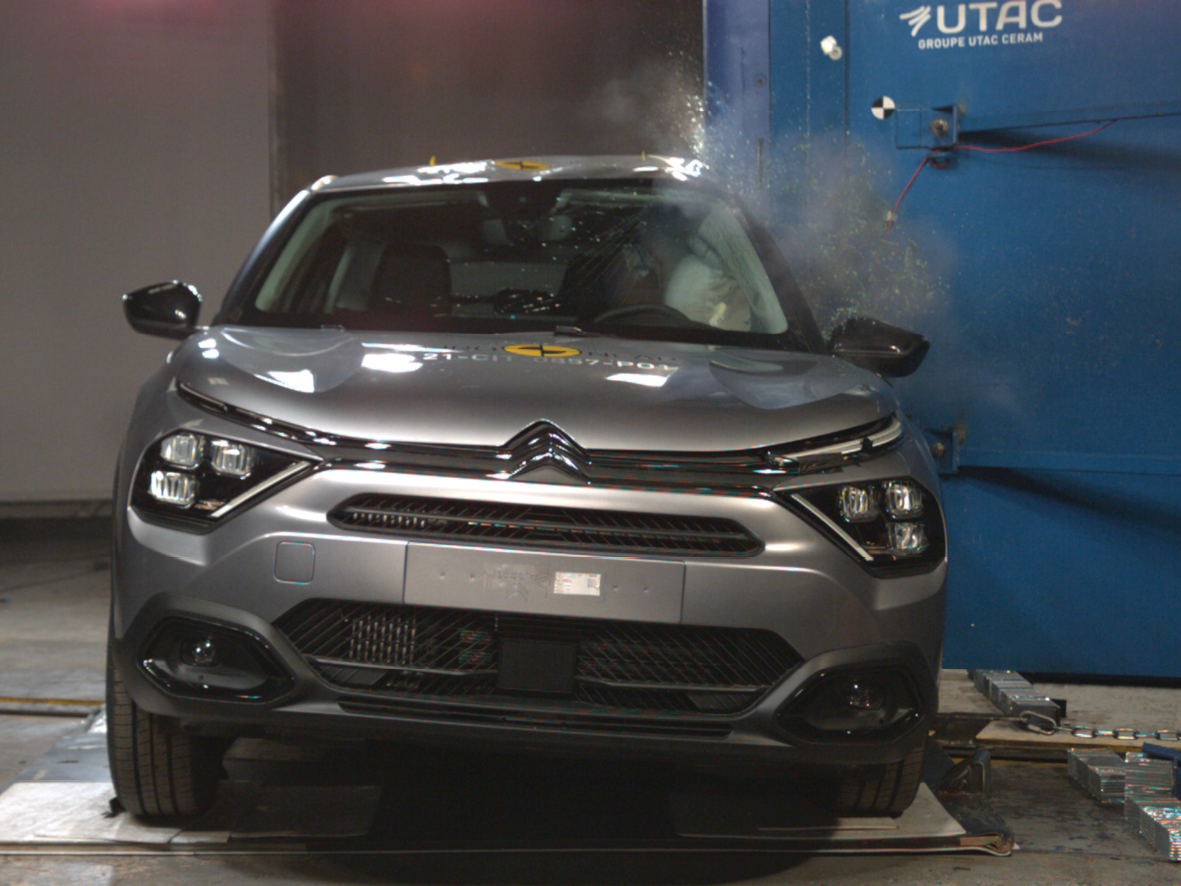
While its 76 per cent result was far from the lowest-scoring aspect, ANCAP believes the adult occupant protection score was due to a lack of far-side impact protection for the C4 which lacks a centre airbag, leading to just 0.12 points out of four points in this test.
ANCAP CEO Carla Hoorweg criticised Citroen its inability to construct a C4 which could score five stars in its crash tests, saying it wasn’t a focus of the French manufacturer.
“Unfortunately, the Citroën C4’s scores fell short in three of our four key areas of assessment meaning it was unable to meet the five-star safety standard consumers and fleets have come to expect,” said Hoorweg.
“21 of the 23 new models rated by ANCAP to our current 2020-2022 criteria have achieved five-star ANCAP safety ratings, and this highlights the great work vehicle manufacturers are doing to provide their customers with the safest vehicles they can.
“Achieving the highest level of safety in ANCAP assessments is not a simple task, yet it is clear through the star rating results we continue to see from the vast majority of brands that collectively the ambition exists to supply the safest vehicles possible.
“The safety performance of the C4 suggests the same level of ambition shown by many of its competitors was not a focus for Citroën with this particular model.
“It is likely that with some small enhancements, Citroën could see the C4 elevated to five stars, and we would strongly encourage Citroën to consider introducing such improvements.”
It’s not all bad news for the C4, as its child occupant protection rating of 81 per cent exceeded the five-star threshold by one per cent, although the testing protocols calls for the lowest-rating category to determine a vehicle’s overall rating.
A spokesperson for Citroen Australia told Wheels it was still confident in providing a safe vehicle to consumers.
“As with all Citroen vehicles, the C4 focuses on providing safety, comfort and convenience,” said the spokesperson.
“The single highly-specified C4 variant available in Australia comes as standard with 18 of the latest generation driving technologies that help ensure a safe and convenient driving environment.”
ANCAP noted the C4 sold in Australia features safety equipment such as a camera and radar autonomous emergency braking (AEB) system which are not available on European examples, however it was noted this ultimately didn’t affect its rating.
Key Points
- WRX S4 to be available in Japan only
- STI Sport trims available
- All JDM examples score a rear window wiper
The Japanese market has gained another edition of the new Subaru WRX, with the S4 launching overnight.
Available only in its homeland, the S4 comes in four flavours – GT-H, GT-H EX, STI Sport R and STI Sport R EX – but is only sold with the ‘eight-speed’ continuously variable transmission, omitting the six-speed manual which is standard in the regular WRX.
Power from its 2.4-litre, turbocharged flat-four engine remains unchanged at 202kW, however the S4 has been dealt a minor torque increase, bumped up by 25Nm to 375Nm.
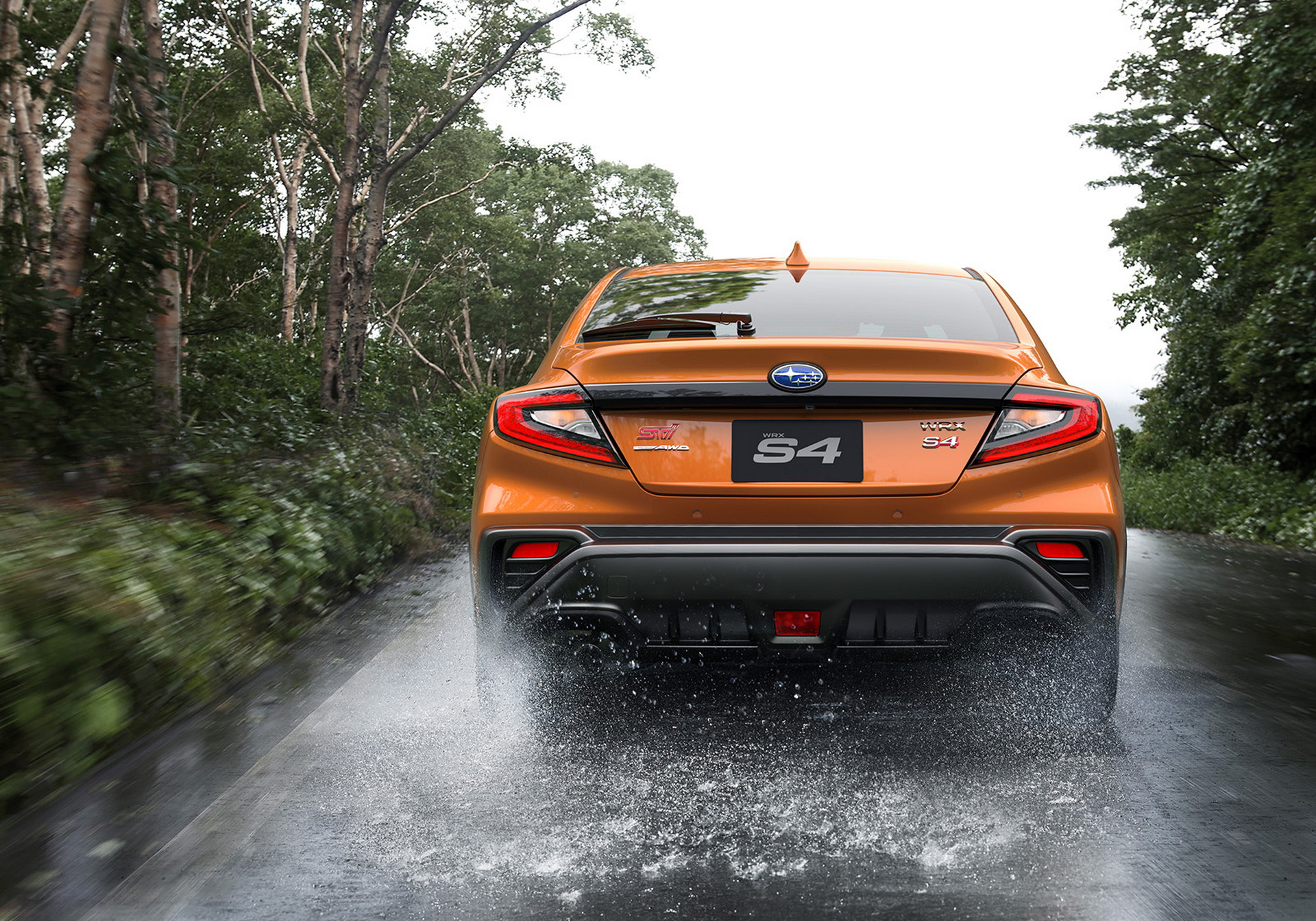
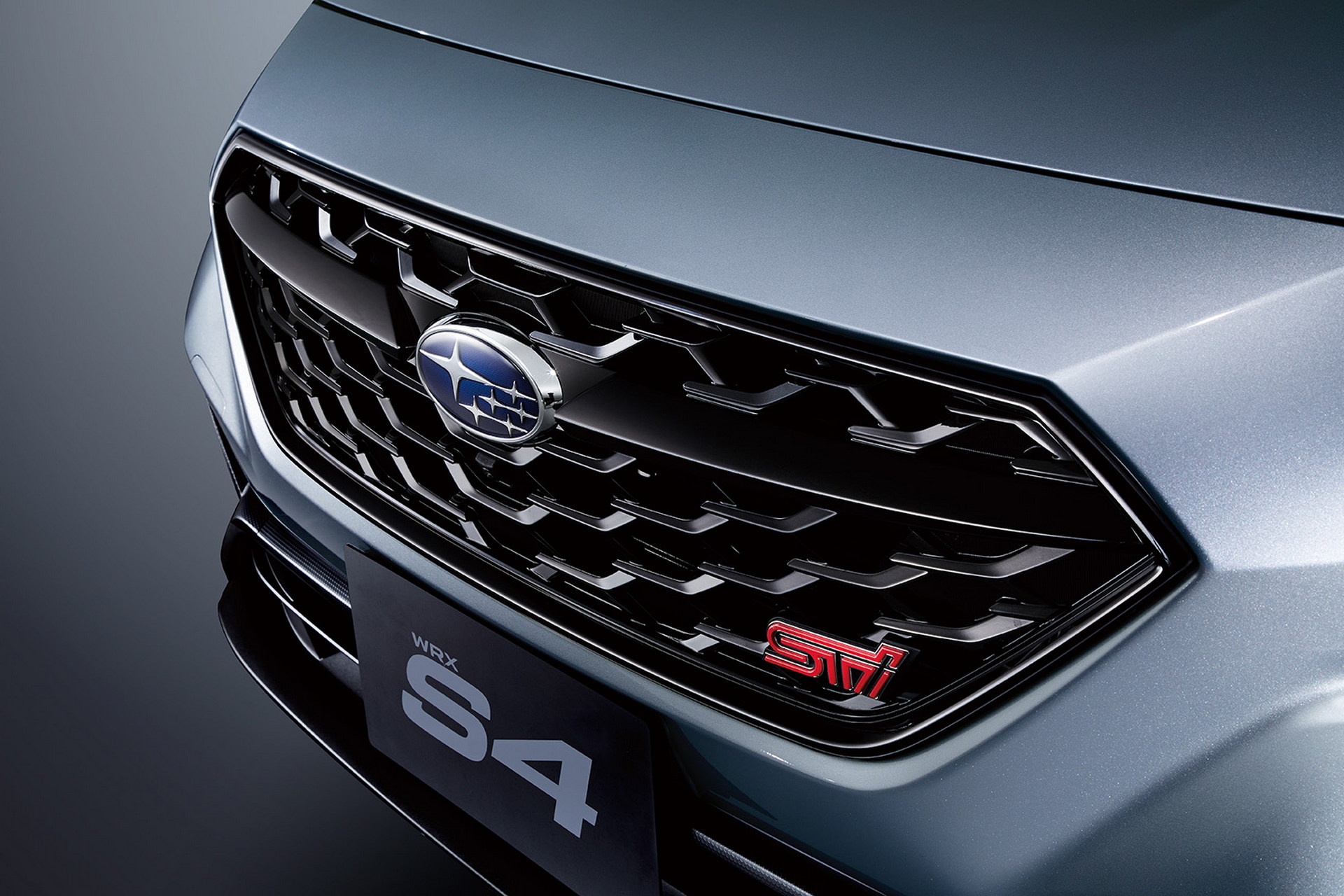
All WRX S4 variants gain a rear window wiper, an unusual addition for a sedan but not uncommon in the Subaru universe, most JDM GC8 and STIs were fitted with the handy feature, making it easier to denote imports from locally-delivered examples.
Active torque vectoring is standard across the range while STI-badged variants score Drive Mode Select, tweaking aspects of the WRX S4 such as its engine, all-wheel-drive system, dampers and power steering.
On top of this, the STI grades also gain Recaro ultra suede front seats, leather interior highlights, aluminium pedals, carbon-look trim, the 11.6-inch infotainment screen, a JDM-specific 12.3-inch digital dash and STI badges on the grille and boot.
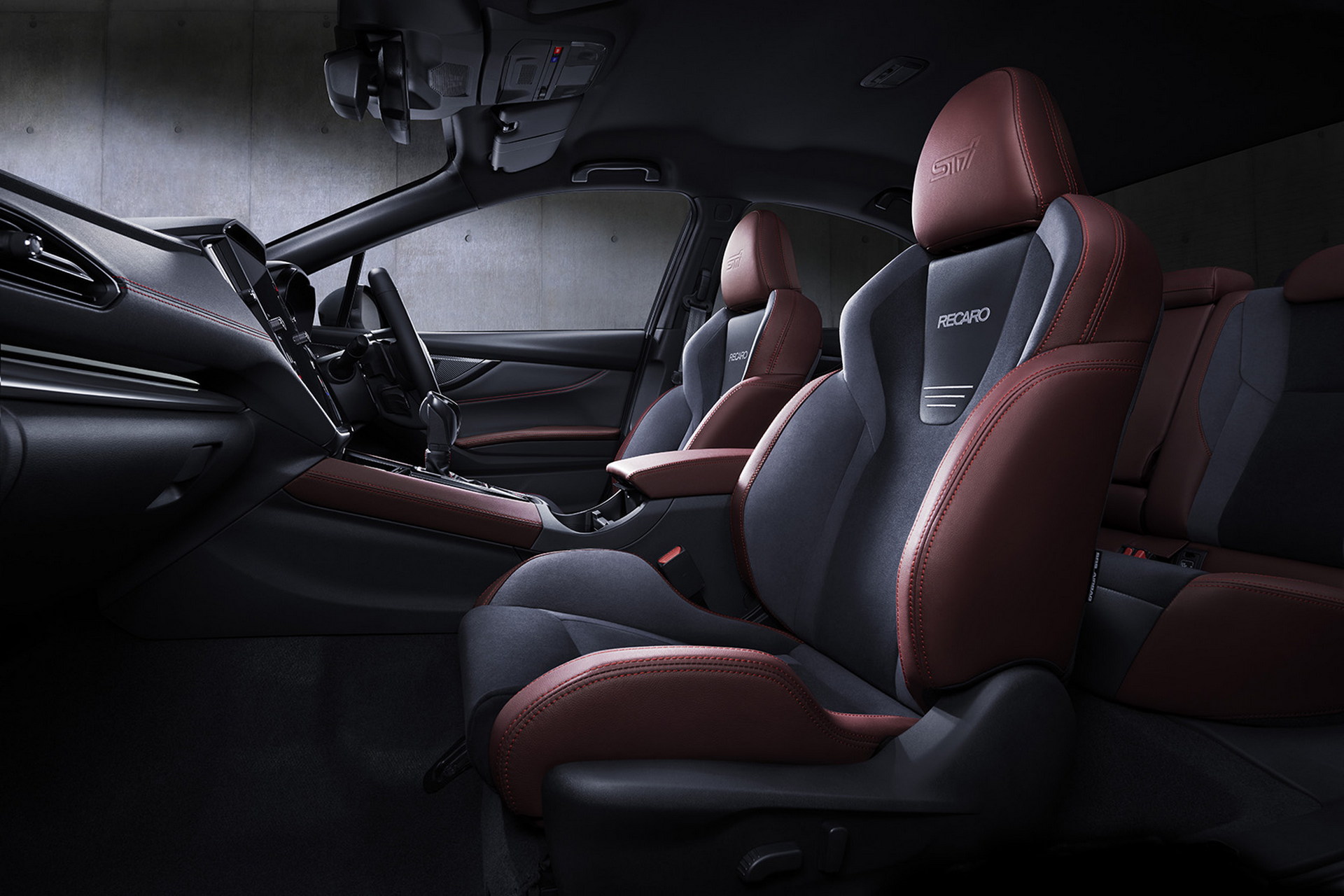
Those who opt to buy the cheaper GT-H grades have to make do with with the two-screen setup for infotainment and HVAC controls, a setup which looks significantly cheaper than the high-end Starlink option.
Unfortunately for interested local parties, Subaru won’t be shipping any S4s to Australia despite it being right-hand drive only, with production targeted at 500 units per month for the first year.
The entry-level GT-H is on sale from ¥4,004,000 (AU$48,680), up to ¥4,389,000 (AU$53,360) for the GT-H and STI Sport R before topping out at ¥4,774,000 (AU$58,000) in range-topping STI Sport R guise.
Key Points
- Mazda backs bio fuels to save the internal combustion engine
- Manufacturer has committed to 25 per cent electric vehicles in its line-up from 2030
- Hydrogen-powered engines already being touted as a fossil fuel alternative
As more and more manufacturers commit to electric vehicle production targets, some are hedging their bets by holding on to internal combustion engines until the end.
Japanese manufacturer Mazda has been conservative with its electric vehicle (EV) production targets, having previously announced just one-quarter of its models will be fully-electric by 2030, far less than most European manufacturers which expect over half their sales to come from EVs.
However, it seems there’s a reason behind this, as Mazda’s European arm believes advancements in synthetic, sustainable fuels will ensure the future of ICEs, acting as a complementary technology between conventional engines and EVs.

Speaking to Autocar, Mazda’s European research director Christian Schultze said bio fuels weren’t there to compete with EVs, rather easing the transition to them.
“We believe that e-fuels aren’t in competition with the electrification route but complement it,” said Schultze.
“E-fuels can be used already on existing cars and future cars. Having two pathways to follow can get us to climate-neutrality faster and better.
“There are pros and cons of both. Combustion engines are hard to make as quiet as an EV, while long-distance journeys are harder to make with an EV. Let’s use the good points of both technologies to drive forward carbon-neutrality rather than betting on one technology.”
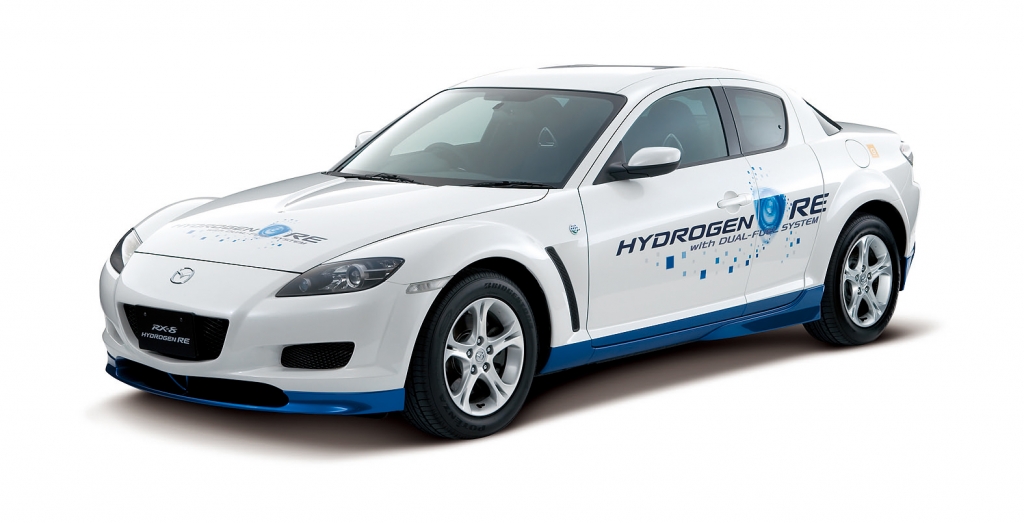
Over the recent years, Mazda has continued to invest heavily in ICEs, from its fuel-efficient range of SkyActiv engines to a potential revival of the rotary by utilising hydrogen as its source of fuel, something it previously trialled in 2003 with an RX-8 which could run on hydrogen or petrol.
Earlier this month, a handful of Japanese manufacturers including Mazda announced they would be developing carbon-neutral fuels for combustion engines, spearheaded by Toyota which has already debuted a hydrogen-powered Corolla race car, driven by the three-cylinder turbocharged engine from the GR Yaris.
Porsche has been developing its own bio fuels, and while it cost is significantly higher than that of fossil fuels – around $13.24 a litre to produce – Schultze believes this price would only continue to drop, right down to the equivalent of current fuel prices.
”By 2030, it can be around one euro [per litre]. When you factor in CO2 taxation on fossil fuels, I think gasoline prices will become even higher. E-fuels are very very close to being on a par with gasoline prices.”
