
Snapshot
- 2022 Subaru WRX officially unveiled
- Powered by a 202kW/350Nm 2.4-litre boxer engine
- Arrives into Australian showrooms in the second quarter of 2022
The 2022 Subaru WRX has finally been revealed, signalling a new era for the carmaker’s most iconic model.
Subaru unveiled the WRX late on Friday night to a global audience, and while the car is all-new, it follows a recipe that’s nearly 30 years old.
The WRX is powered by a 2.4-litre horizontally-opposed four-cylinder turbo engine, producing 202kW and 350Nm – a turbocharged version of the FA24 engine found under the bonnet of the new Subaru BRZ, utilising a new electronic wastegate to improve responsiveness.
Peak power comes at 5600rpm, while torque is available from 2000rpm all the way up to 5200rpm – 400rpm earlier than the outgoing model.
A choice of either a six-speed manual or a new simulated eight-speed CVT automatic (with paddle-shifters) is on offer, mated to an all-wheel-drive system with a viscous centre limited-slip differential for the manual. No 0-100km/h sprint time has been provided at the car’s unveiling.
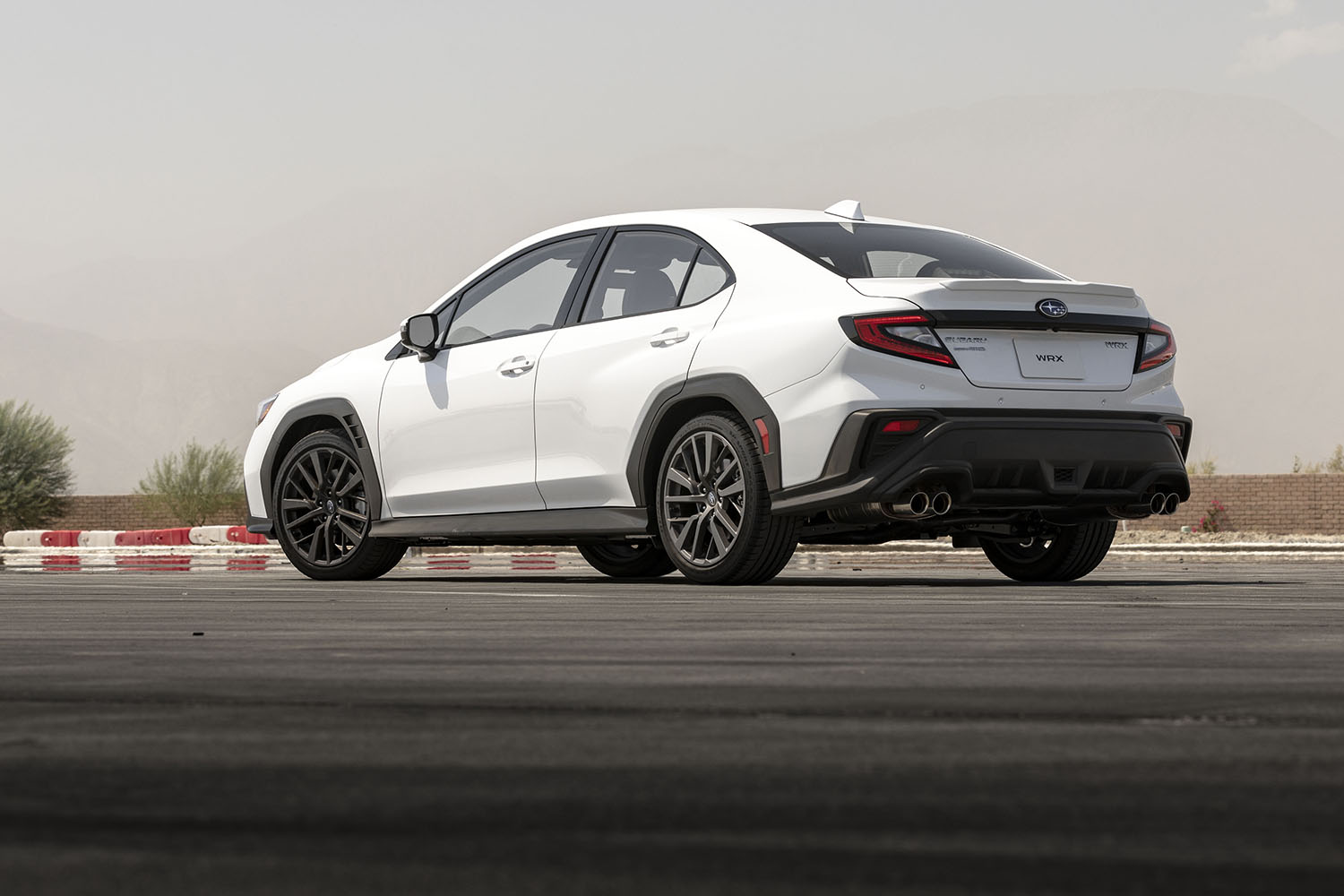
Motor has been told the exact specifications for the Australian-market WRX will be released closer to a local launch in the first half of 2022.
If the sedan makes it here unchanged, the new model will enjoy an increase of five kilowatts over the outgoing model, while torque remains unchanged.
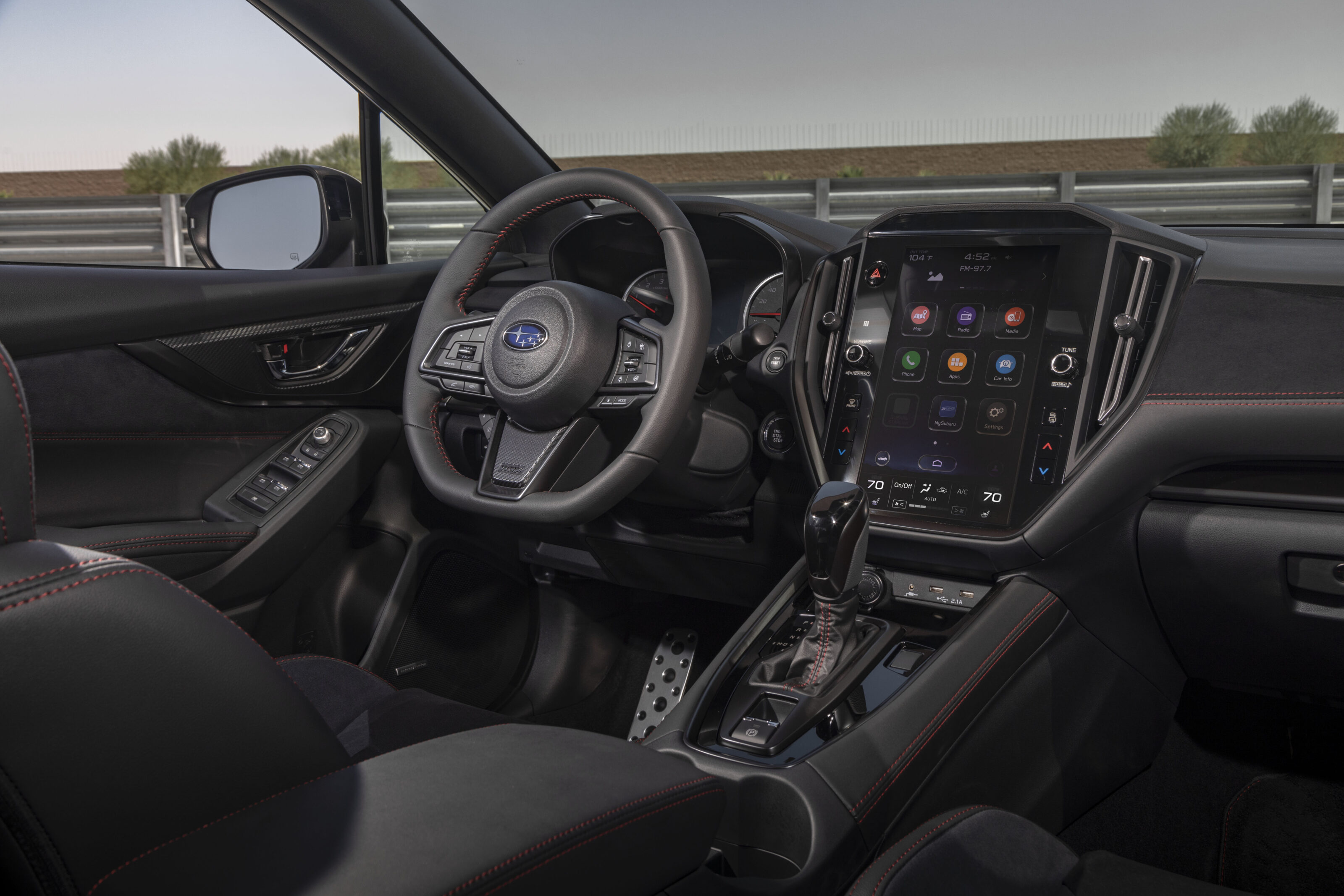
Inside, a portrait-mounted 11.6-inch infotainment screen with Bluetooth, Apple CarPlay, Android Auto, and satellite navigation connects to an optional 11-speaker, 504-watt Harman Kardon sound system.
Occupants get front Recaro sports seats trimmed in Ultrasuede and contrast red stitching, with the driver’s seat being eight-way power adjustable.
While yet to be confirmed for Australian models, a new range-topping ‘GT’ variant offers Drive Mode Select, allowing the driver to personally configure steering feel, the car’s SI-Drive system, and the electronically-controlled dampers – an exclusive feature to the GT, and the first time a WRX has been fitted with active dampers.
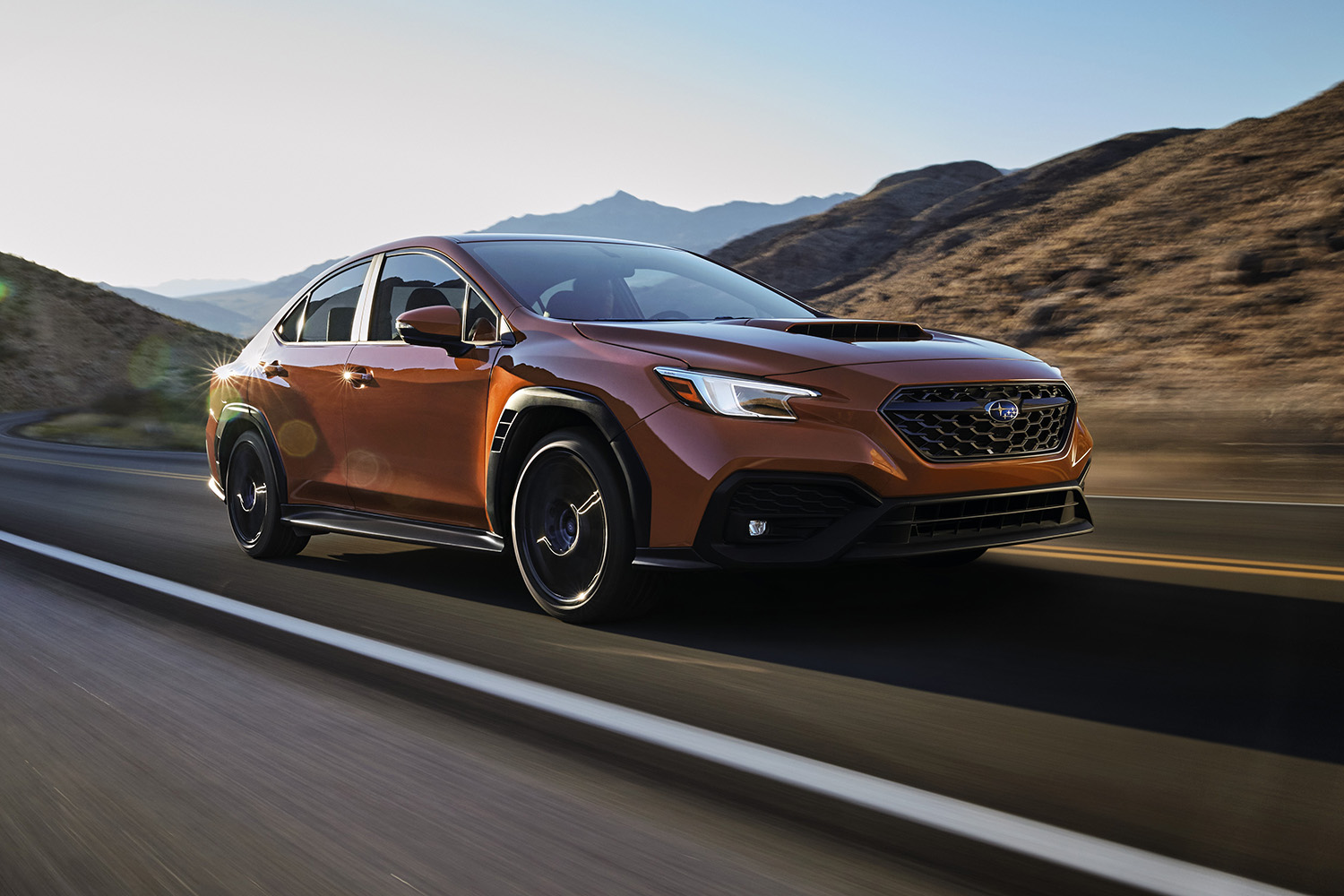
The 2022 WRX gets a striking new design, with ‘Kono-Ji’ headlights and tail-lights (Japanese for U-shaped), squared wheel arches, and the WRX’s trademark bonnet scoop. A set of 17-inch alloy wheels are standard, with 18-inch matte grey wheels fitted to the GT model.
The WRX’s look is shared with the Levorg station wagon launched earlier this year, and inspired by the Viziv Performance STI concept car from 2018.
While the Levorg has been confirmed for local release, a spokesperson for Subaru Australia previously hinted at the model being offered to a wider audience here – suggesting we could see the return of the WRX wagon, possibly in STI trim. In recent days, the brand’s local arm told Motor there wasn’t anything more to share on that front, but to stay tuned.
As with previous models, a high-performance WRX STI is expected to follow, with rumours out of Japan suggesting a power boost of as much as 298kW. As shown on the Viziv concept car, bolstered guards and big wings will likely be on the agenda.
Underpinned by the carmaker’s Subaru Global Platform, the 2022 WRX gains a longer wheelbase than the 2021 version, increasing by 22mm to 2672mm. Though longer and wider at 4669mm and 1826mm respectively, the new model sits 7mm lower at a height of 1468mm.
Subaru says the new WRX uses a stiffer chassis with a lower centre of gravity, improving handling and passive safety, while active safety systems have also being updated. Radar cruise control with lane centring assist is now part of EyeSight, which is standard across the WRX range when optioned with an automatic transmission.
“To say we’re incredibly excited about the all-new Subaru WRX global reveal is an understatement,” Subaru Australia General Manager Blair Read said at the announcement.
“We look forward to sharing more information about this highly-anticipated model with Subaru enthusiasts and Australian consumers in the coming months.”
The 2022 Subaru WRX will arrive into Australian dealerships in the second quarter of 2022 (April to June inclusive), with local pricing and specifications to be announced closer to launch.
What about that STI version?
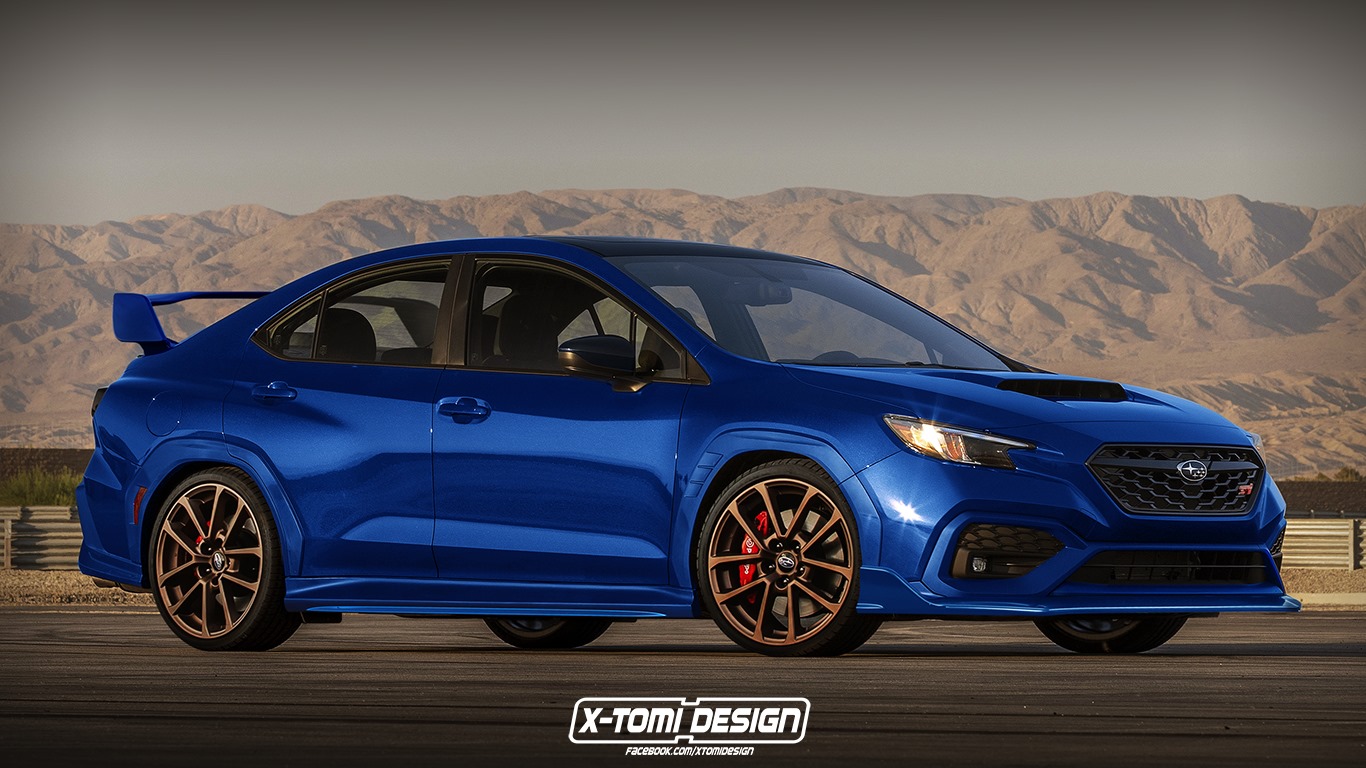
Timing for a reveal of the new WRX STI is still to be confirmed, but independent artist X-Tomi has already had a crack at how it might look. Check it out below.
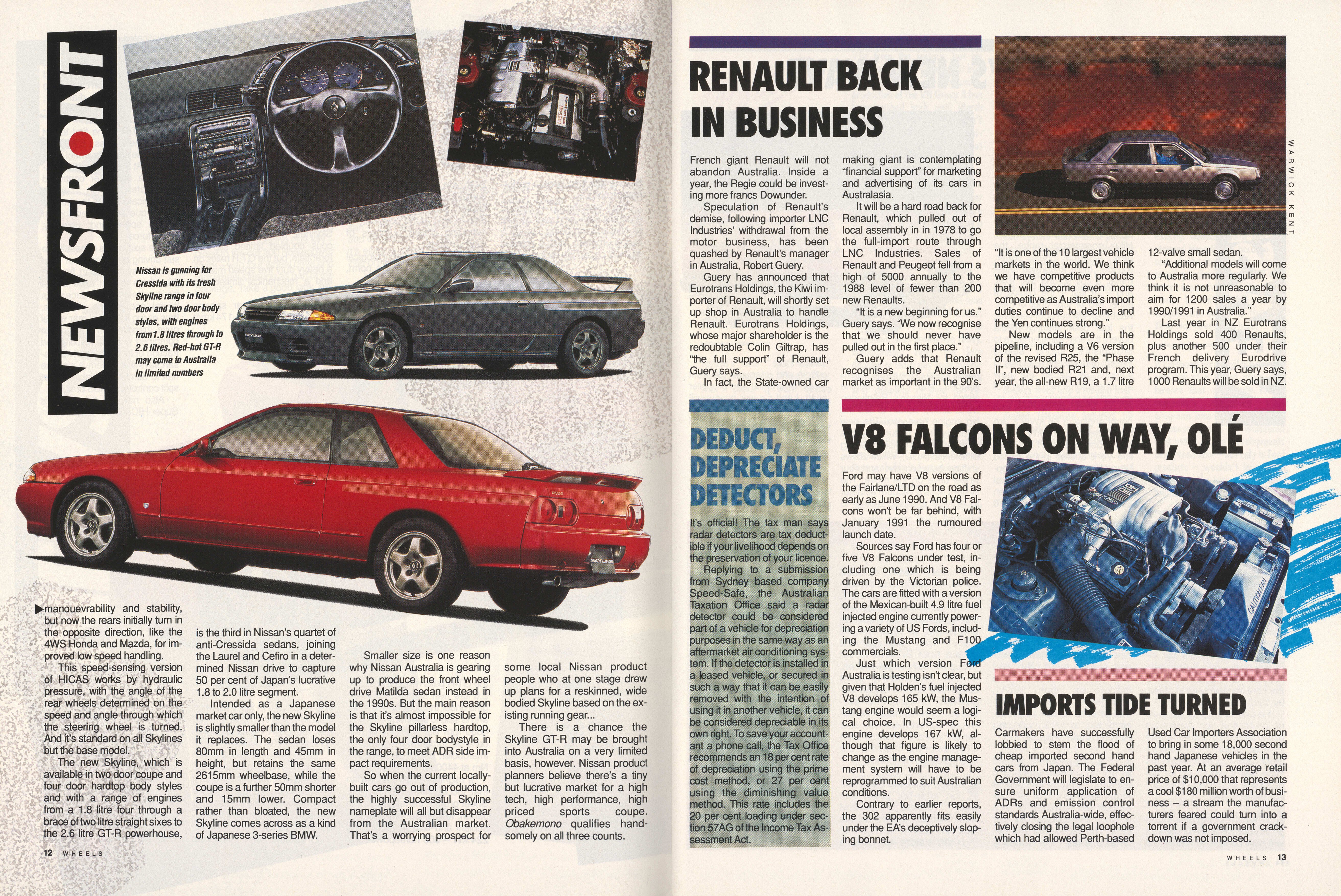
“The Japanese call it Obakemono – the monster,” wrote our Japanese correspondent, Peter Nunn, in the July 1989 issue of Wheels.
“No wonder. It’s an arsenal on wheels powered by a twin-turbo straight-six producing 209kW… with four-wheel drive and four-wheel steering…”
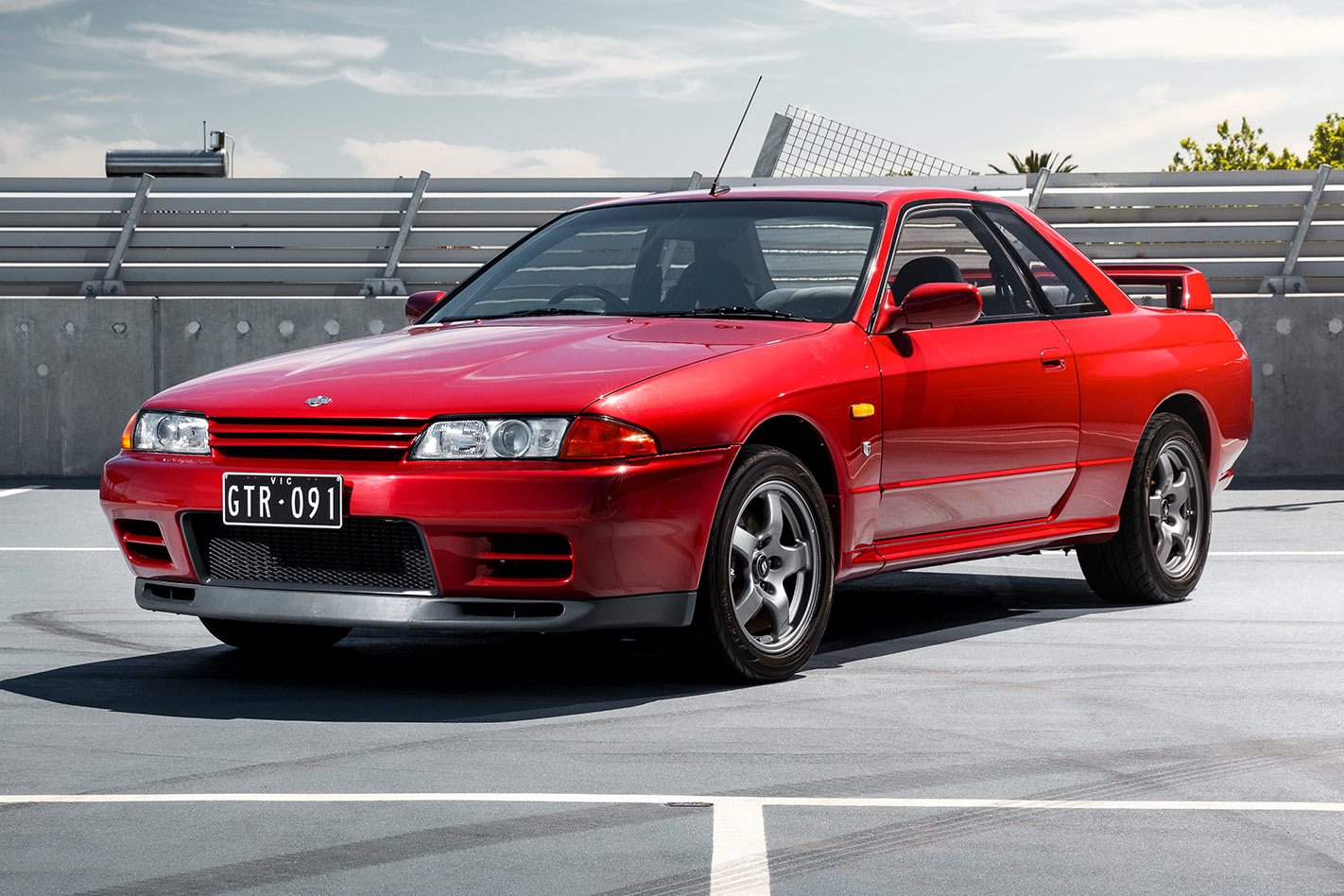
There was no way Nissan’s R32 Skyline GT-R wasn’t going to be our cover story that issue. Never mind its eye-popping high-tech spec: Nissan wanted to race the GT-R against Ford’s all-conquering Sierra Cosworth in the Australian Touring Car Championship. As such, Australia would be the only place outside Japan where the GT-R would be sold as a road car.
Wheels then-editor Phil Scott, one of my mentors and the man I’d eventually succeed as editor, regularly ran ideas for covers and cover blurbs past me. Not that he needed to – Scotty had a great feel for a snappy line that would sell a story. But he valued fresh eyes and fresh input because he knew something better might come from it.
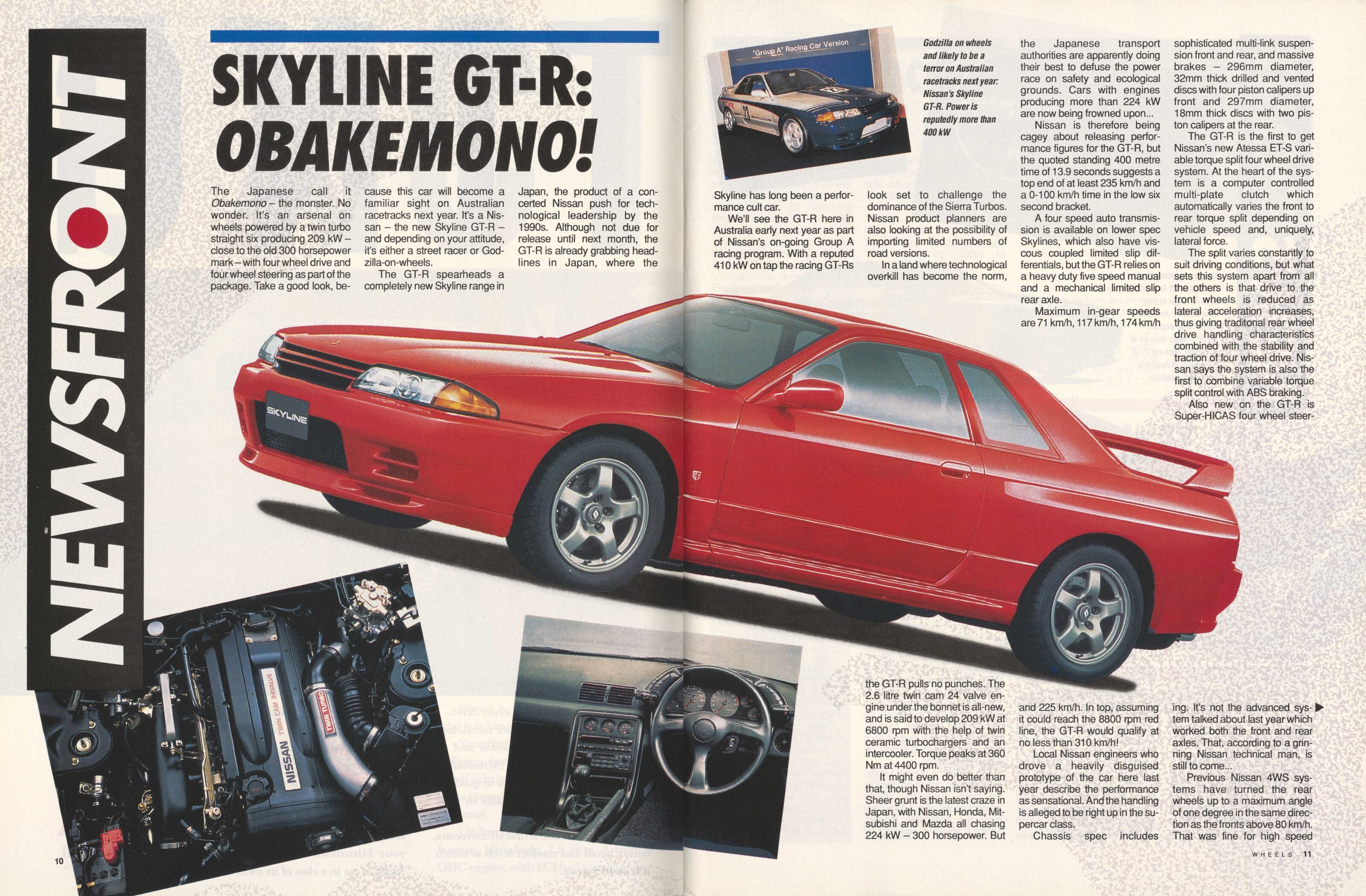
The Skyline on the cover mockup was bright red, a colour the car would never actually be painted. Phil wanted an image that would pop on the newsstand and had sent the official Nissan shots of a dark grey GT-R to a guy who’d mastered, in those pre-digital camera days, the art of converting a transparency into a digital image, and then, pixel by pixel, changing a car’s colour.
Phil wanted bright red, and bright red is what he got, though if you look closely at the cover you’ll see the color of the window trim and even black element behind the rear quarter window glass were changed to red as well. There wasn’t the time or the money to go back and fix it.
“Skyline Supercar!” read the main cover line. But Phil was wrestling with a second line that explained why someone should buy the magazine and read the story.
I suggested swapping out “Skyline Supercar!” for “Obakemono!” figuring the odd-looking word would make people read a second line that went something like: “Nissan’s new Skyline supercar aims to take on the Sierra.”
Scotty rightly pointed out an unknown foreign word would probably have the opposite effect: After trying to figure out how to pronounce it, newsstand grazers would get bored and move on to the next magazine. “Anyway,” he said, “what does it mean?”
“It’s Japanese for monster,” I replied, citing Nunn’s story.
“What, like Godzilla?” said Phil.
And the rest is history…
(Don’t worry about trying to read the above article scans, we published it online back in 2009.)
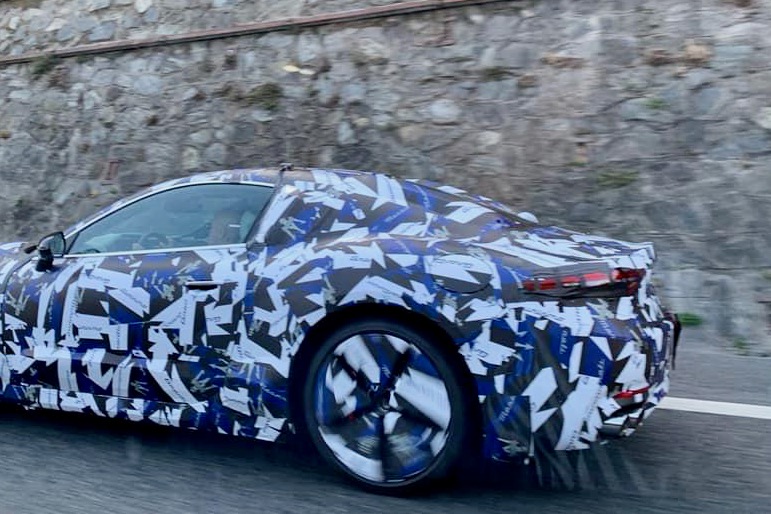
The 2022 Maserati GranTurismo has been caught undergoing testing, providing a clearer look at the vehicle’s rear end.
Maserati released its own teaser images of the next-generation GranTurismo in June, but the pics didn’t show the camouflaged car from the back.
These new amateur spy photos – posted to Korean website Autospy – appear to show that much of the GT’s design language will come from the recently-released Maserati MC20 supercar, adopting upright LED headlights, slim triangular tail-lights, and a large panel ahead of the C-pillar adorned with a Maserati trident emblem.
The performance luxury coupe could also borrow its petrol powertrain from the MC20, helping Maserati to amortise costs on its all-new 3.0-litre twin-turbo V6 engine – though it’s likely the GranTurismo and its open-air GranCabrio sibling will receive the engine in a detuned state.
The Italian sportscar brand has confirmed the new two-door will eventually be offered with all-electric propulsion. As the flagship of the model range, the Folgore (translating to ‘lightning’) will reportedly use three electric motors (two on the rear axle and one on the front) for a total output of 485kW, allowing a 0-100km/h time of under three seconds.
With the company officially teasing the model in June, it’s expected the 2022 Maserati GrandTurismo will be fully unveiled within the coming months.
The multi-national automotive manufacturing group Stellantis will be reducing its footprint in China, closing one of its two plants due to low sales.
As a part of the Chinese Government’s requirement for all foreign manufacturers to be aligned with a local partner, Stellantis – through Fiat–Chrysler China – had formed a joint venture with GAC, operating across two plants in Changsha and Guangzhou.
According to Reuters, poor sales in the world’s most populous country will force the Dutch-based company to transfer production from Guangzhou to Changsta, with just 12,228 vehicles sold so far this year coming nowhere near the combined factory output of 328,000 units annually.
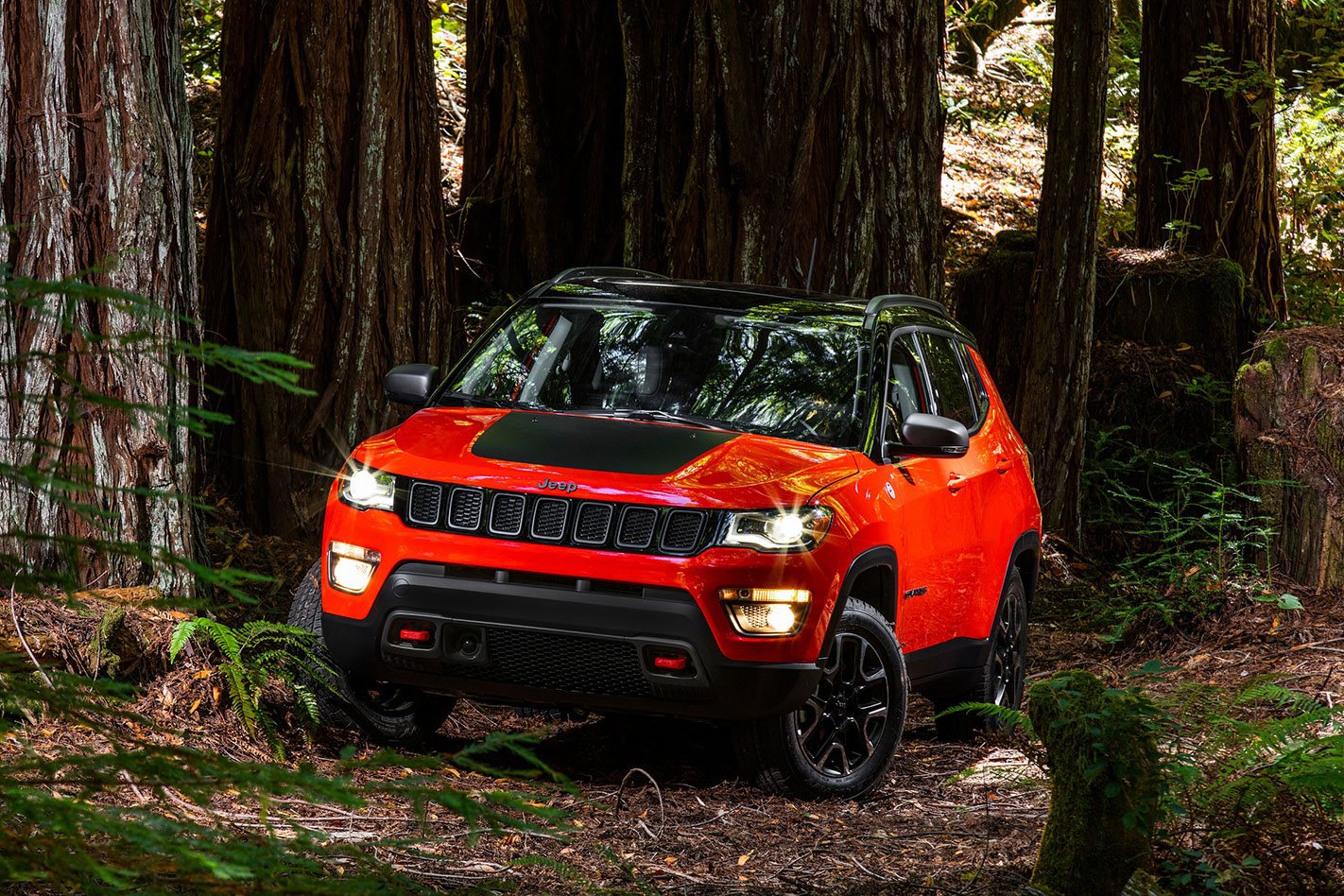
A statement from GAC outlined the reason behind the closure, saying it is to “increase (the) utilisation rate of plants and lower cost”. Essentially, the Changsta factory’s yearly output of 164,000 vehicles a year is significantly greater than the sale rate of Stellantis’s vehicles in China.
While the Stellantis-GAC joint venture has only just exceeded 12,000 sales of Jeep SUVs, the Stellantis and Dongfeng partnership has seen greater success, with 47,788 sold from January to July – although this second alliance has also had to consolidate its resources, closing two factories due to overcapacity.
Despite the struggles in South-East Asia, Stellantis CEO Carlos Tavares said he plans to bring Opel to China in the near future, looking to sell its line-up of electric vehicles.
Snapshot
- 2022 Abarth 595 pricing and specifications updated for new model year
- Line-up now only comprises flagship Competizione variant
- Priced from $32,950 plus on-road costs
The 2022 Abarth 595 Competizione has been updated for the new year with fresh styling and revised options.
Some 13 years after Abarth showed off its first sporty model based on the Fiat’s retro 500, the Italian performance brand has revised its Australian portfolio, slimming down its 595 line-up to solely offer the vehicle in range-topping Competizione specification.
However, while the 595 Competizione is the only model consistently offered by Abarth, locally buyers still have a chance to put their name down for one of the 30 limited-edition 595 Scorpioneoro models.
Automatic headlights and wipers have been added to the range, as well as an updated “splash” screen for the 7.0-inch infotainment screen, with DAB+ digital radio, Apple CarPlay, and Android Auto.
Available from $32,950 before on-road costs for the hatch, or $36,950 plus on-roads as the 595C convertible, the new 2022 model range can now be optioned with a $2450 body kit with scorpione black and rally blue paint colours.

A set of 17-inch Montecarlo alloy wheels – which the company says are inspired by the iconic Lancia Delta Integrale rally car – are now standard.
Also borrowing from its rich racing heritage – a new matte rally blue exterior colour has also been added, which is said to celebrate the 1970s Fiat 131 Abarth rally car, and is available for an additional $1600.
Hatchback buyers can choose from a Premium Pack, which adds xenon headlights, sunroof, and antenna with aluminium roof cap, for $2500.
The Sport Pack can also be optioned for the hatch for $2500, adding black leather Sabelt GT sports seats, 17-inch Supersport matte black wheels, and a dashboard trimmed in Alcantara synthetic suede.

Those wanting the 595C can option the cabriolet with a $4200 Performance Pack, which mirrors the Sport Pack on the hatch, but adds xenon headlights. A Visibility Pack is also available for $1700, which includes xenon headlights and 17-inch Supersport matte black wheels.
All 595 Competizione models are powered by a 1.4-litre turbo four-cylinder engine, sending 132kW and 250Nm to the front wheels through a five-speed manual or an optional $2000 five-speed single-clutch automatic.
A wide variety of paint options are available for the Abarth, with 10 exterior paint options – some with a black roof option – as well as stripes and colour-coded mirror caps.
The 2022 Abarth 595 Competizione is now on sale.

2022 Abarth 595 Competizione standard features
| Abarth leather seats |
| 7.0-inch touchscreen with DAB+ digital radio, Apple CarPlay, and Android Auto |
| Leather-wrapped steering wheel with carbon-fibre trim |
| 7.0-inch TFT instrument cluster |
| Sports pedals |
| Abarth sports exhaust |
| Rear parking sensors |
| Red Brembo front brake calipers |
| Daytime-running lights |
| Automatic headlights |
| Rain-sensing wipers |
| Abarth bimodal Monza exhaust |
| Front & rear adaptive suspension with Koni shocks |
| Tar Cold Grey exterior trim highlights |
| 17-inch alloy wheels. |

2022 Abarth 595 Competizione optional equipment
Premium Pack – $2500 (hatchback only)
| Xenon headlights |
| Sunroof |
| Antenna with aluminium roof ca |
Sport Pack – $2500 (hatchback only)
| Sabelt GT Black leather seat |
| 17-inch Supersport matte black wheels |
| Alcantara dashboard. |
Visibility Pack – $1700 (convertible only)
| Xenon headlights |
| 17-inch Supersport matte black wheels. |
Performance Pack – $4200 (convertible only)
| Sabelt GT Black leather seats |
| Xenon headlights |
| 17-inch Supersport matte black wheels |
| Alcantara dashboard. |
Exterior options
| Gara white (no cost) |
| Modena yellow ($650) |
| Campovolo grey ($650) |
| Pista grey ($650) |
| Abarth red ($650) |
| Metallic record grey ($650) |
| Metallic podium blue ($650) |
| Metallic scorpione black ($650) |
| Pastel adrenaline green ($650) |
| Matte rally blue ($1600) |
| Competizione body kit, scorpione black or rally blue only ($2450) |
| Yellow/black brake callipers ($350) |
| Black roof, with selected colours only ($1600) |
| Red/white/black stripe and mirror caps ($450). |
New York is set to become the second state in the US to impose a future on ban the sale of internal combustion engined vehicles, following on from the example set by California.
State Governor Kathy Hochul signed a bill earlier this week which will require 100 per cent of vehicle sales by 2035 to come from zero emissions vehicles, effectively eradicating ICEs from passenger vehicles in the area – while a mandate for heavy vehicles likely won’t be introduced until 2045.
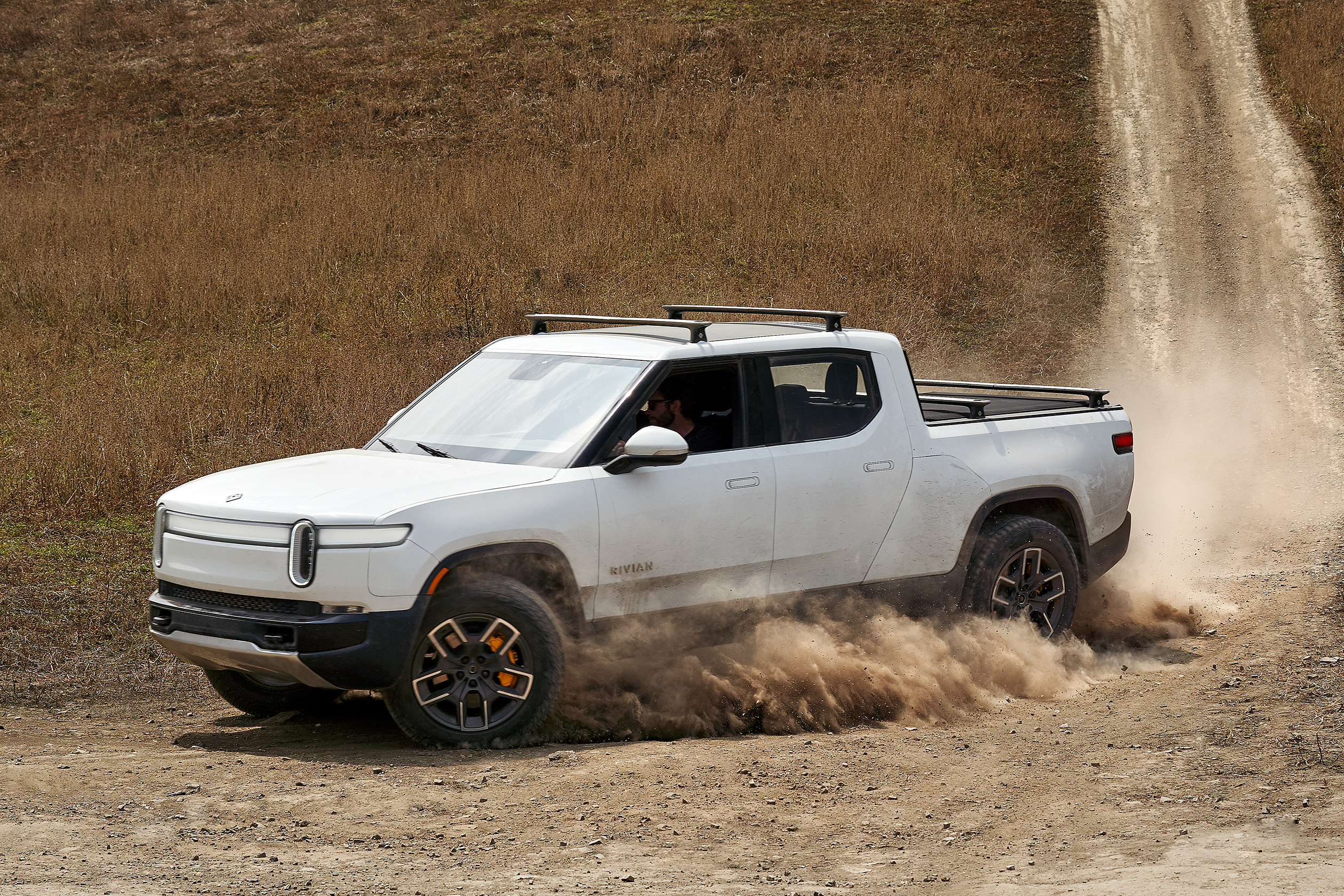
While manufacturers such as Rivian, Lucid, Fisker and Tesla already provide an all-electric model line-up, the ‘Big Three’ of Ford and Dodge haven’t made specific committed to a date they were transition to an EV future – leaving only GM which has said it won’t produce light duty ICE vehicles by 2035.
However, President Joe Biden is keen for US manufacturers to accelerate the move to EVs, recently asking the Big Three to pledge to reach a target of 50 per cent EV sales by 2030 – although push back from the industry has potentially lowered the target to 40 per cent.
The European Union has recently table a proposal to ban the sale of ICE vehicles by 2035, while the UK has already introduced measures to stop new vehicles being produced from 2030.
Australia is currently lagging behind the rest of the world with regards to zero emissions vehicles, having not yet introduced a roadmap to move away from ICEs and not yet offering a unified incentive package towards EVs.
Snapshot
- Case thrown out by NSW court
- No airbags have failed to deploy properly anywhere worldwide
- Australian recall affected almost 120,000 VW Group cars
UPDATE, September 10: A Supreme Court judge has awarded costs to Volkswagen Group Australia after a case against the manufacturer involving Takata airbags was thrown out.
In June, Justice Stevenson ruled the plaintiff, Passat owner Professor Dwyer, did not establish that his vehicle was not of acceptable quality when he purchased it – nor that he had suffered any actual loss or damage from a Takata airbag having been fitted to his car.
As a result, this week the case was formally dismissed and the court ordered the plaintiff and litigation funder should foot the car company’s legal bill.
The story to here
June 22: The Supreme Court in New South Wales has thrown out a case made against Volkswagen over claims some airbags fitted in its cars were faulty.
The plaintiff in the case, Professor Phillip Dwyer, claimed there was a propensity for PSAN (phase-stabilised ammonium nitrate – the chemical used as a propellant in the relevant airbags supplied by Takata) to degrade – which could cause them to explode or malfunction in the inflators installed in Volkswagen vehicles.
However the court found no such link could be established, and also that Professor Dwyer could not prove his VW Passat was not of acceptable quality when he purchased it.
Additionally the court ruled Mr Dwyer could not prove he’d suffered any actual loss or damage because a Takata airbag had originally been fitted in his vehicle, “not least because Volkswagen has, without charge, replaced the Takata airbag with an airbag which is undoubtedly sound”.
In its defence, the Wolfsburg firm stated there have been zero incidents worldwide where a Takata airbag has ruptured in a VW vehicle.
In February 2016, Volkswagen in Germany began testing 20,000 airbag inflators retrieved from its vehicles manufactured from 2005 onwards around the world, under varying climactic conditions, but found all had deployed correctly.
It said it had complied with the mandatory recall notice, issued by the Australian Government, and replaced Professor Dwyer’s Takata airbag at no cost to him in 2019 when his vehicle had its 60,000km service, even though there had been no examples of the airbags failing to deploy properly and no recall issued in Europe.
The plaintiff took civil action against the German carmaker, and six other manufacturers, in 2018 regarding a global recall of Takata airbags. The other six cases have yet to be determined.
In a judgment handed down by the court on June 18, Justice James Stevenson said: “VW AG’s Product Safety Committee determined there was no systemic risk associated with airbag inflators installed in Volkswagen vehicles that would warrant their recall.
“Indeed, I was informed that no European regulator has required a recall of Volkswagens fitted with Takata airbags. The results of the Empirical Analysis Program suggest the airbags are safe.”
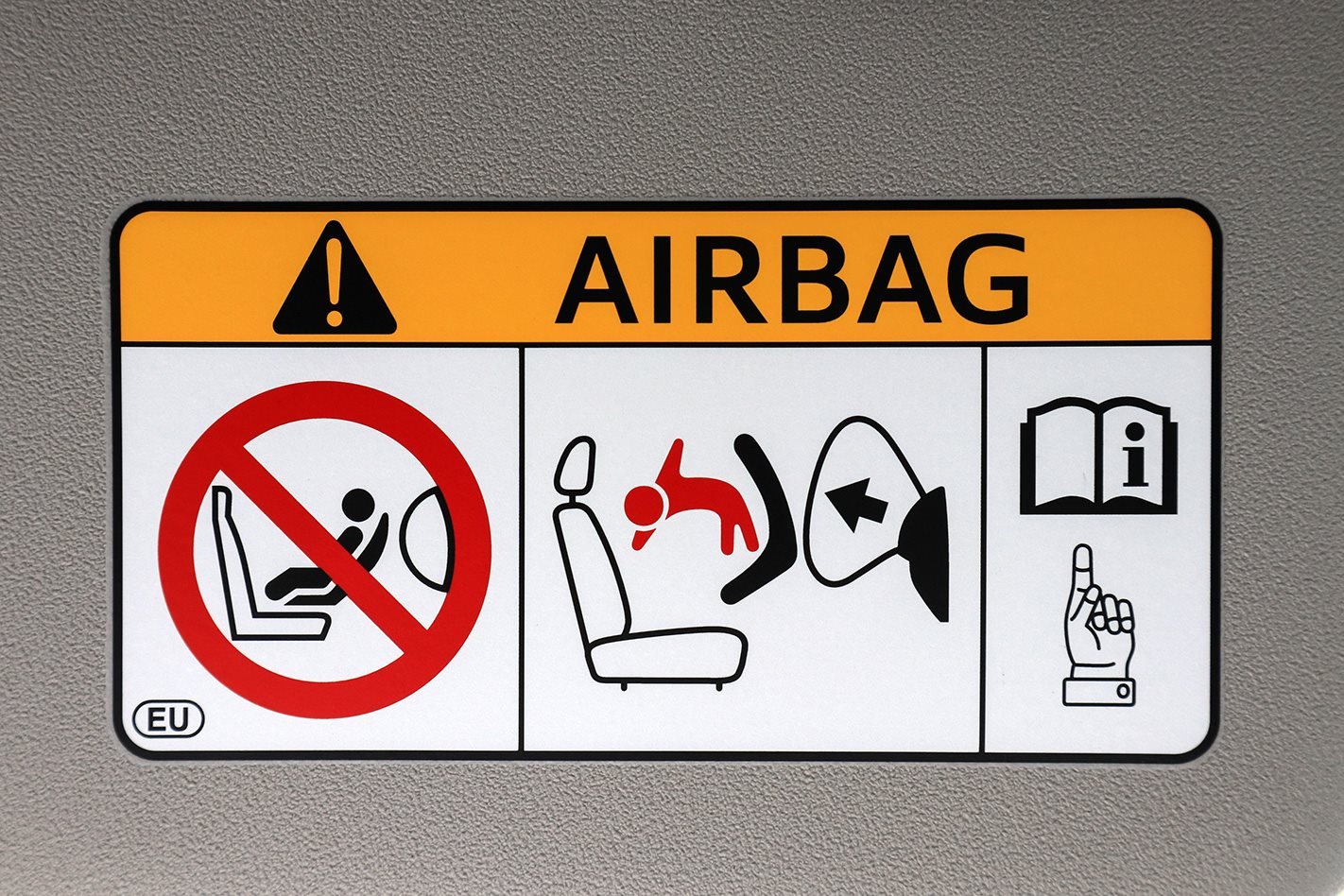
A spokesman for VW Australia added: “VGA [has] maintained that the case brought against it was without merit and resolved to defend the action. As was shown in evidence, there have been no incidents reported of a Takata airbag rupture in any relevant Volkswagen vehicles in the field globally.”
The court ruled Professor Dwyer was only entitled to damages for the loss that he has actually suffered.
In total 101,759 Volkswagen cars and 17,595 Skodas were involved in the recall in Australia.
Tesla founder and CEO Elon Musk has claimed the new Model S Plaid has set a Nürburgring lap record for electric production cars, posting the car’s time slip online.
Although there has been no official confirmation, according to Musk, the Model S Plaid was able to lap the famed Nordschleife in 7:30.909 – some 12 seconds faster than the existing record holder, Porsche’s Taycan Turbo S.
If Musk’s claim is true, the Model S Plaid is within a second of cars such as the 992 Porsche Carrera S and the Chevrolet Corvette C8 when hurtling around the 20.73km course.
Previously another Model S Plaid allegedly broke the Taycan’s record in 2019 – but this vehicle was modified, meaning any attempt at officially knocking off the Porsche wouldn’t stand.
Earlier this year, an enhanced Model S Plaid, featuring slick tyres and aerodynamics, shattered the Laguna Seca lap record for electric vehicles – with Musk saying today Tesla will make a similar attempt at the Nürburgring in an unrestricted car.
With 820kW on tap, the Model S Plaid is Tesla’s most powerful vehicle and can accelerate from 0-100km/h in a claimed 1.9 seconds – reaching an alleged top speed of 320km/h.
My very first job in motoring journalism was almost my last. Back in 1998, the title I worked for took a bunch of the newest and freshest performance cars and set up an informal race from sea to sea across the UK. The star of the show was the Nissan Skyline R33 GT-R, marking the very first time a GT-R had been officially imported to those shores. Cars were allotted to drivers by drawing straws. The short straw, in effect the joke car, was a Hyundai Pony. The GT-R was billed as ‘the car that almost drives itself’ due to it being packed with so much processing power which, by today’s standards is probably on a par with my garage door opener. I managed to prove otherwise by driving it into an Armco barrier, but that’s another story for another day.
If you’d have told me then that one day I’d be driving a Hyundai sedan with more power than the jaw-dropping Godzilla, I’d probably have laughed in your face, but here it is, in the form of the latest Sonata N Line.
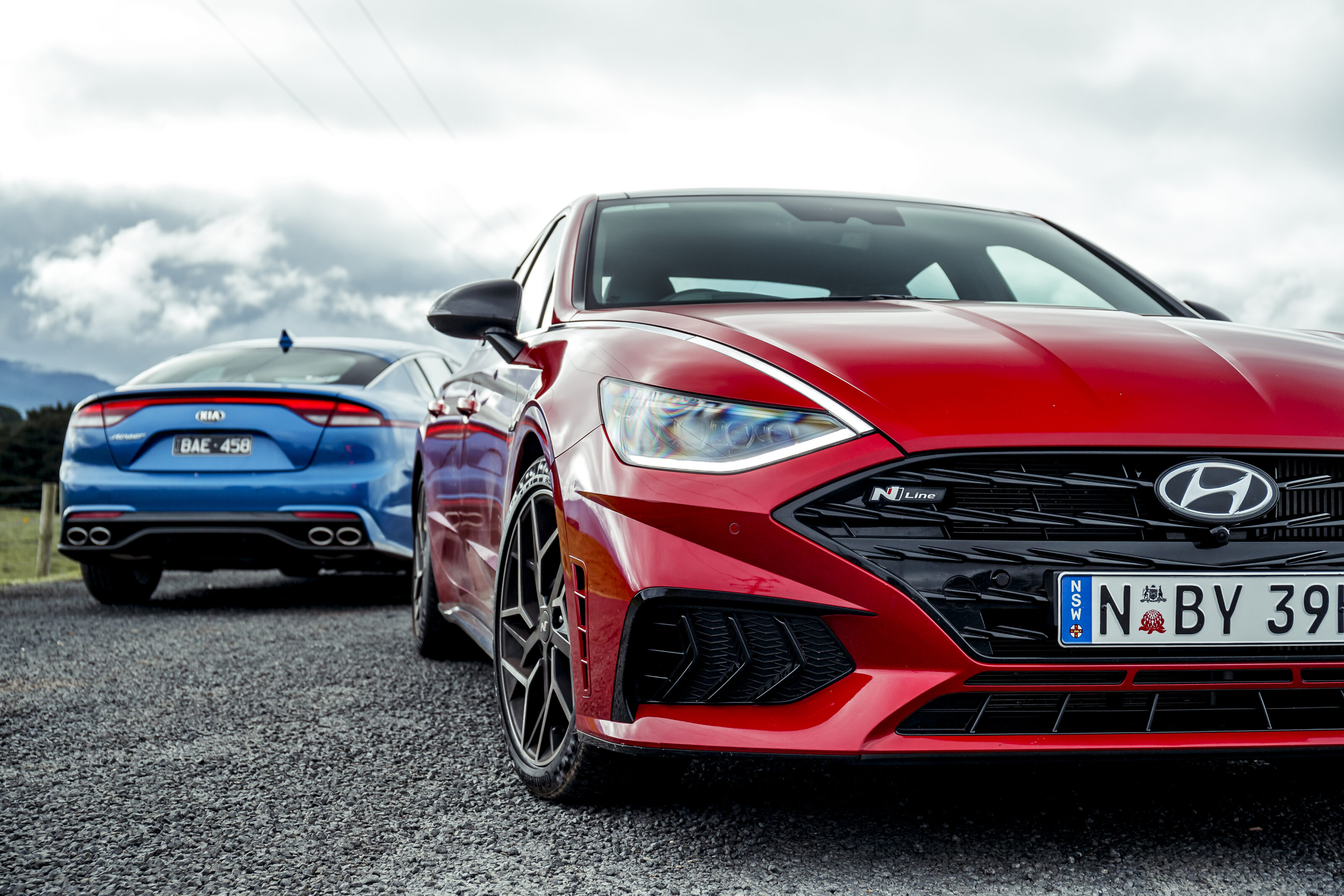
I also laughed when asked if we should include the Sonata N Line in our Hot Source section. Hell no, what do we want that in there for? The more I considered it, the more I wondered whether perhaps the joke was on me. Here was a car that was affordably priced, stacked to the gills with gear but which would conceivably dip into the fives to 100km/h on a decent strip. Yes, its 213kW drove through the front wheels, but that same 213kW is some 7kW more than the old Japanese ‘gentleman’s agreement’ power limit. So this Sonata is packing more grunt than hero cars from our youth such as the Honda NSX, Toyota Supra, Subaru Impreza 22B and, yes, the Nissan Skyline GT-R. Letters about the GT-R’s real power output to the usual address, please.
So, yes, I reckon it does deserve a place in Hot Source. Finding a rival to put up against the $50,990 Sonata is fairly straightforward, too. None of the German brands deliver much in the way of interest, or indeed kilowatts at this price point… 110kW worth of Audi A4 35 TFSI anyone? Thought not. Instead, we turn to the 182kW, $50,050 Kia Stinger 200S which, while not getting particularly close to the Sonata’s punchy power-to-weight ratio, offers up an intriguing Korean front- versus rear-drive face-off.
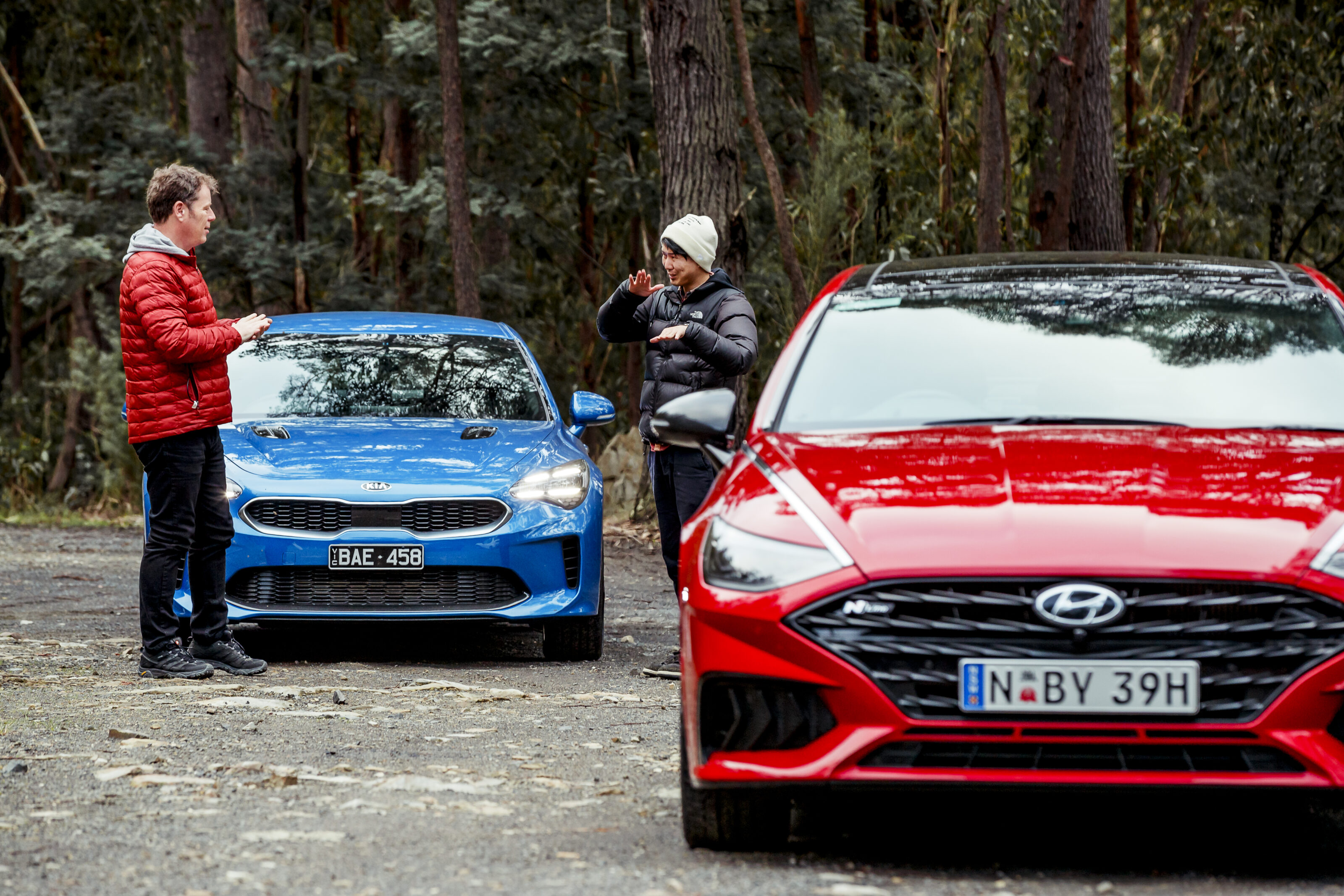
The Sonata is a big car. It takes up more space on the road than a BMW 750i V12 from the Nineties, yet weighs a mere 1636kg. At this point, I usually mention something along the lines that aesthetics are subjective, but in this instance I’m prepared to park that argument. While the overall stance and line of the Sonata are deftly executed, the details are overwhelming. Whether it’s the goofy scatter of fake vents, the bizarre daytime running lights that arc up and round through a chrome-effect detail line or the rear end that is one horizontal element after another all sitting atop a non-functional diffuser, it’s as if Hyundai didn’t know where to stop.
By contrast, the Stinger looks an exercise in restraint and maturity, although it doesn’t sit on its wheels quite as smartly as the Sonata, its slightly porcine flanks and oddly offset overhangs making it look more conservative and, yes, a little older. The plumped up haunches and lengthy dash-to-axle proportions scream rear-drive though, which helps underscore its increasingly rare key dynamic attribute. Photographer Dewar proclaims the Kia an easy car to photograph, unlike the Sonata which affects a weird barbel-faced bottom-feeder look from certain angles. It’s certainly happiest in profile.
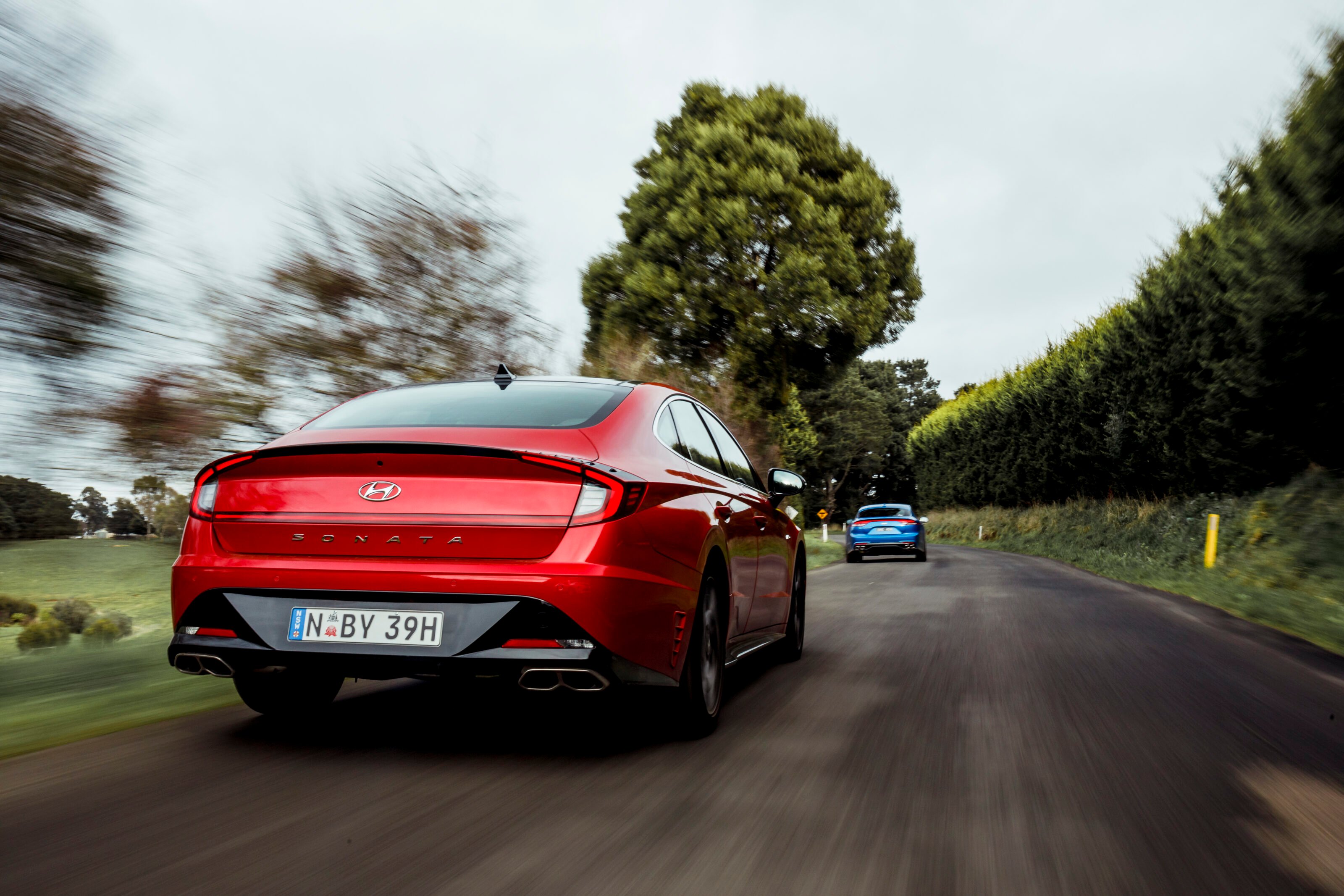
The N Line is the only Sonata model that Hyundai offers and there’s so much gear in it, it’s hard to know where to start. It has everything you could reasonably expect at this price point and ladles in extras like the TFT digital clocks that switch to rear-view cameras when you indicate, heated rear seats, 12-speaker Bose stereo, 12-way adjustable driver’s seat, power blinds in the rear, Nappa Leather and suede heated and cooled front chairs, head-up display and so on. When you consider this versus the price point of the new Golf GTI, it’s unlikely that you’ll ever feel short-changed here.
Given the standard inclusions, Hyundai could probably be excused for making certain economies beneath the bonnet, but the 2.5-litre direct injection lump certainly fronts up with some compelling numbers. It drives through an eight-speed dual-clutch and makes its peak power at 5800rpm, with 422Nm arriving at 1650rpm and not getting its coat until 4000rpm. It’s undeniably effective. In anything other than bone-dry conditions there’s enough juice being applied to the 245/40 R19 front Continental Premium Contacts to send the front axle into some entirely furious tramp off the line.
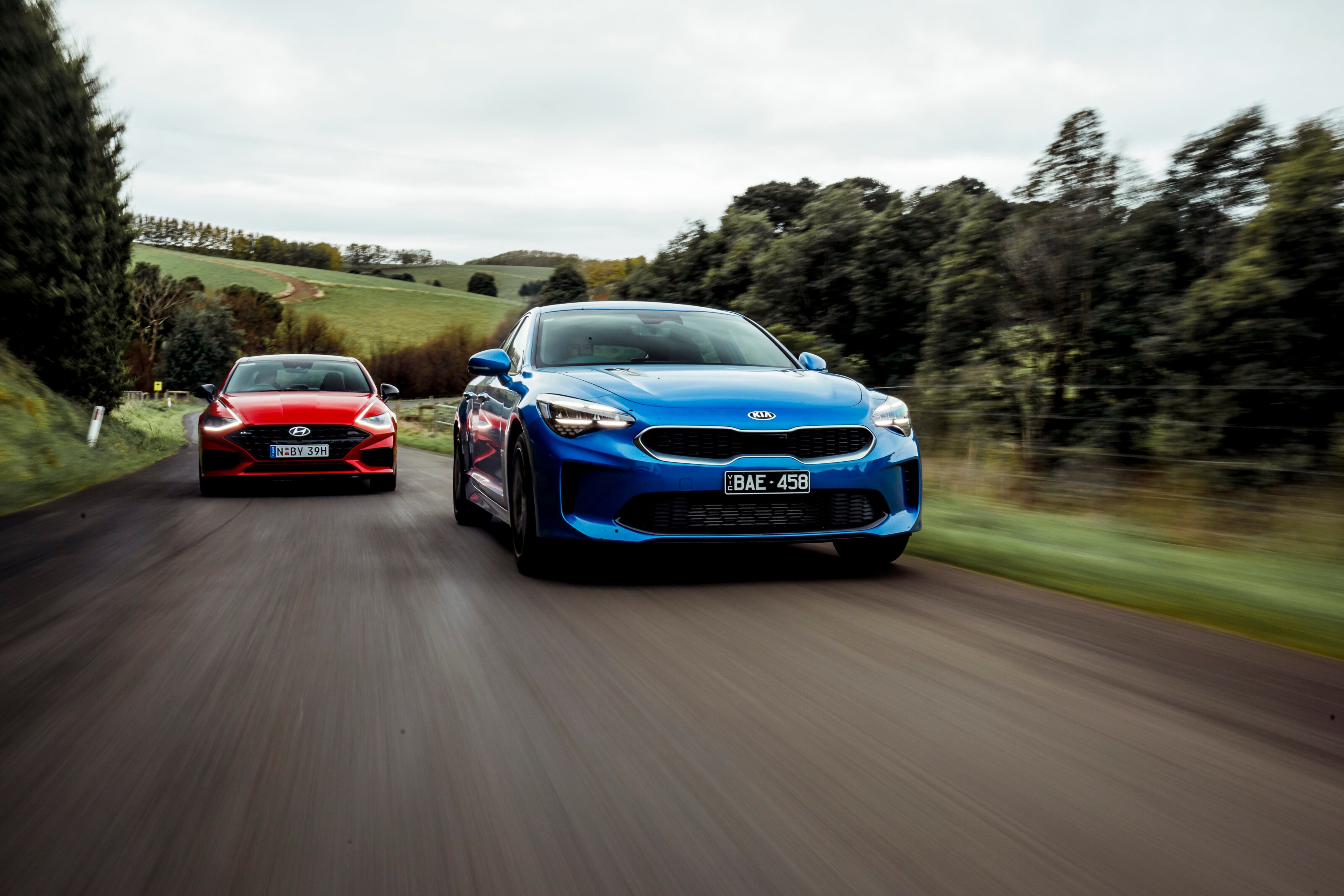
The angriest Sport+ drive mode shucks off much of the moderating influence of traction control, which only makes things worse, so Sport is a better mode for road driving, helping to quell torque steer admirably. With launch control enabled, the Sonata is able to hit 100km/h in a very reasonable 6.0 seconds on a non-prepared surface. While you do get a slightly elastic but wonderfully malleable power delivery, the engine note isn’t any great advertisement for internal combustion. There’s an almost diesel-like toppy clatter to the two-stage variable-induction G4KP 2.5-litre, which the Sonata shares (in certain markets) with the latest Kia Sorento and Hyundai Santa Fe SUVs. Even an Active Sound Design symposer and noise cancellation can’t rescue it from its acoustic shortcomings.
Not that you have to work the engine too hard to keep pace with the Stinger. We’re talking a power-to-weight ratio of 130.2kW/tonne for the Sonata versus 103.6kW/tonne for the Kia, or more than 21 per cent greater in the Sonata’s favour. The difference off the mark is less than that, thanks to the Kia’s traction advantage, with the 200S recording a 0-100km/h time of 7.1 seconds.
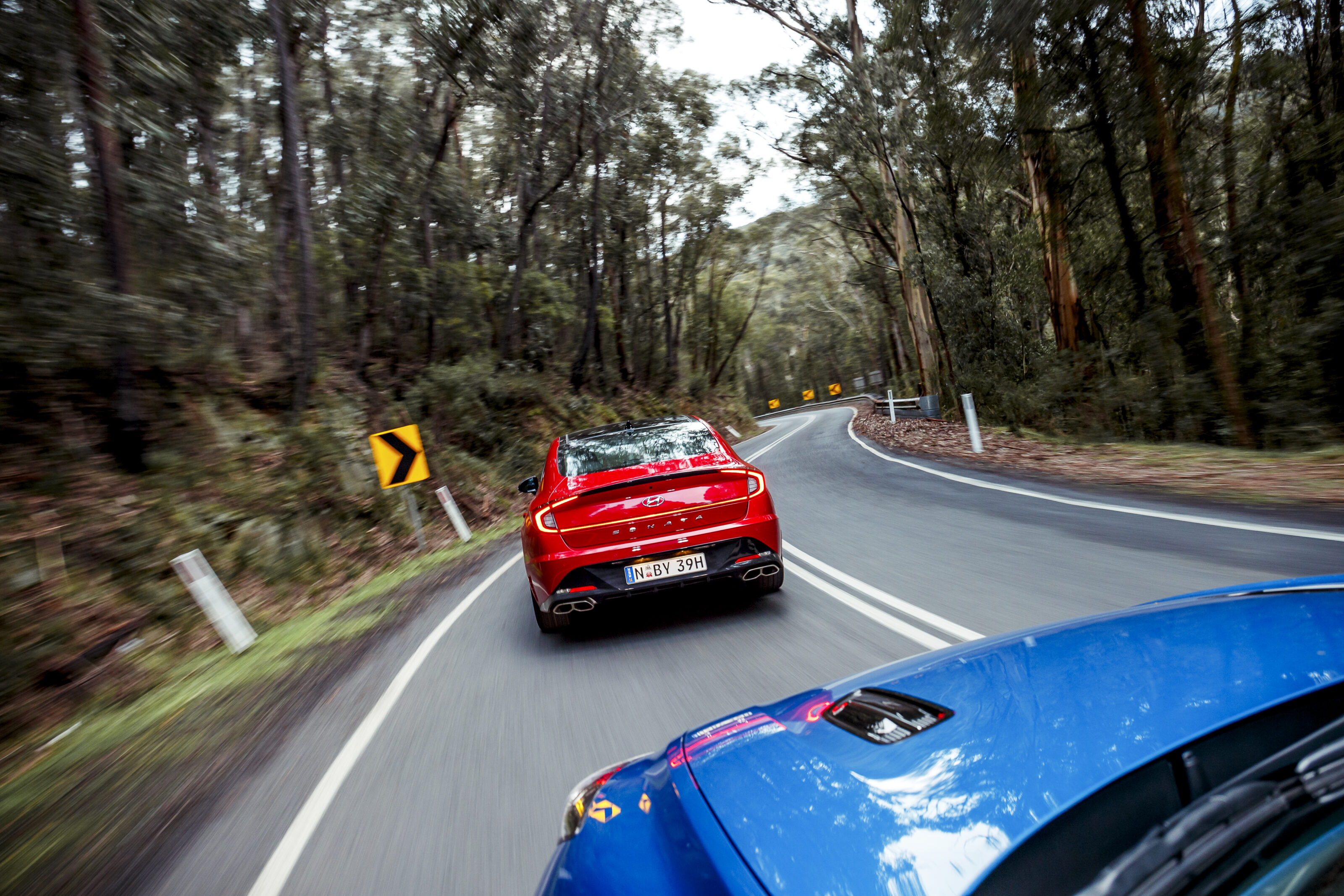
We headed onto the closed road between Noojee and Mt Baw Baw for our drive assessment, road crews working to re-open this section following the recent storms. Only on the very tightest corners does the Sonata struggle to put down its power, with most bends seeing its crisper dual-clutch and superior PWR take lengths out of the Kia in the sprint to the next braking zone. It’s markedly faster and feels livelier too, with its column-mounted electric steering offering keen turn-in and decent accuracy. It never feels particularly organic in its response but you soon learn to key into it. The transmission is slick and rapid, with the N Power Shift function keeping the throttle open wider and longer during upshifts for a little extra drama when engaging the next gear.
The brake pedal is reassuring in its calibration, working on 345mm front discs, but a spirited drive on a twisty section saw the pedal soften a little after a couple of kilometres out and back. We discover one particularly challenging corner with surface ripples in the braking zone and then a noticeable bump when powering out. The Sonata’s slightly terse suspension tune never has the suppleness to deal with the high-frequency ripples on the way in, leading to understeer which is easily managed, but the big hit on the way out creates no particular dramas.
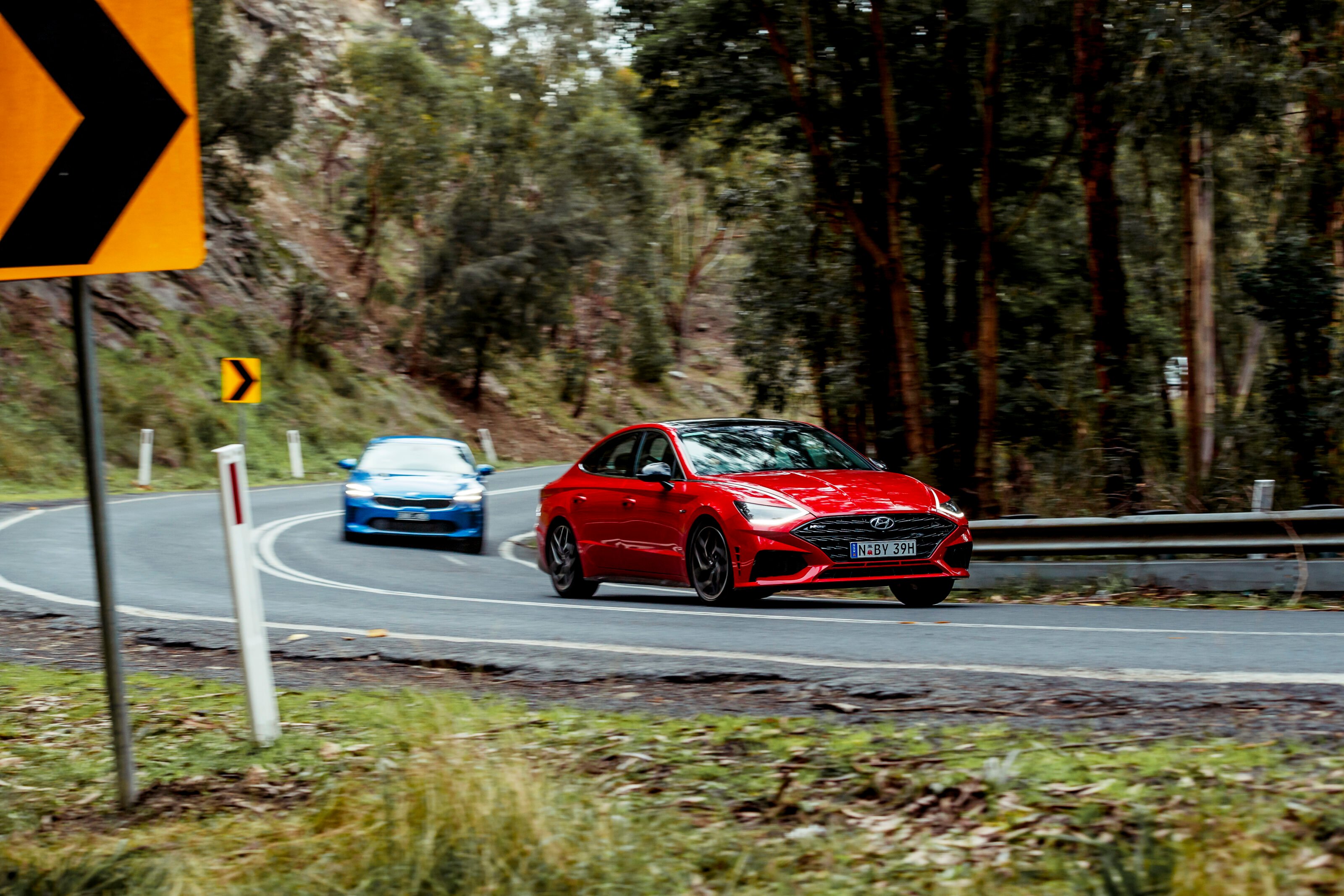
Jump into the Stinger and it’s a very different story. Its softer front damping manages to steamroller the ripples flat, but as soon as you begin to progress the throttle on the exit of the right-hander, the car is tipped into incipient oversteer by the bump and the stability control takes a hard bite at the nearside front brake disc. So fierce is this application to counter the yaw response that after a couple of runs through the corner, the Stinger’s pads smell extremely toasty. Dial the systems out and you’ll need quick and accurate hands.
There’s something reassuring about the Kia’s benign roll response and the way that you can shift its masses about predictably. There’s no LSD or variable-rate steering as in ritzier Stingers but throttle calibration is a little more measured than the Sonata. The Stinger’s eight-speed torque-converter automatic, while not so responsive to manual downchange requests as the Hyundai’s dual-clutcher, slurs through gears more cleanly, shocking the drivetrain less. The Stinger rides on a more focused tyre than the Hyundai, but puts less rubber to the road, the 225/45 R 18 Continental SportContact 5s offering up a contact patch that’s 12.3 per cent smaller. This coupled with the Stinger’s additional 120kg of heft means that it’s easy to exceed the Kia’s limits of front-end grip if you’re trying to keep pace with a well-driven Sonata.

For the most part, the Stinger feels a more amenable thing to pedal at anything up to eight-tenths, which makes it a great car for ‘normal’ sporty road driving. This raises a question and it’s one that’s absolutely key to this comparison. Remember that we’re comparing a front- and a rear-drive car here. Is the Stinger a good enough rear-drive car to accept its other shortcomings versus the Sonata? Having run a Stinger V6 long termer, my view of the platform gibes with that of Scotty Newman, who’s waving goodbye to his Stinger V6 in the Garage. It’s a good chassis, but not a great one. If you really want to exploit the benefits of rear-drive, it probably wouldn’t be either of ours’ first port of call.
In this company it’s also starting to feel a little dated, despite a 2021 refresh, which sees the Stinger receive updates to its suite of safety systems, a larger but occasionally fritzy infotainment system with Apple CarPlay and Android Auto connectivity, full width rear lights, crisper-looking front lamps, restyled wheel designs and some higher quality interior touch points. It’s undoubtedly a simpler car inside than the Sonata and, for some, that’s no bad thing. Live with a Stinger and you’ll come to the conclusion that the rear-drive chassis isn’t the big draw. Its sheer ease of use is what makes the Kia such an endearing proposition.
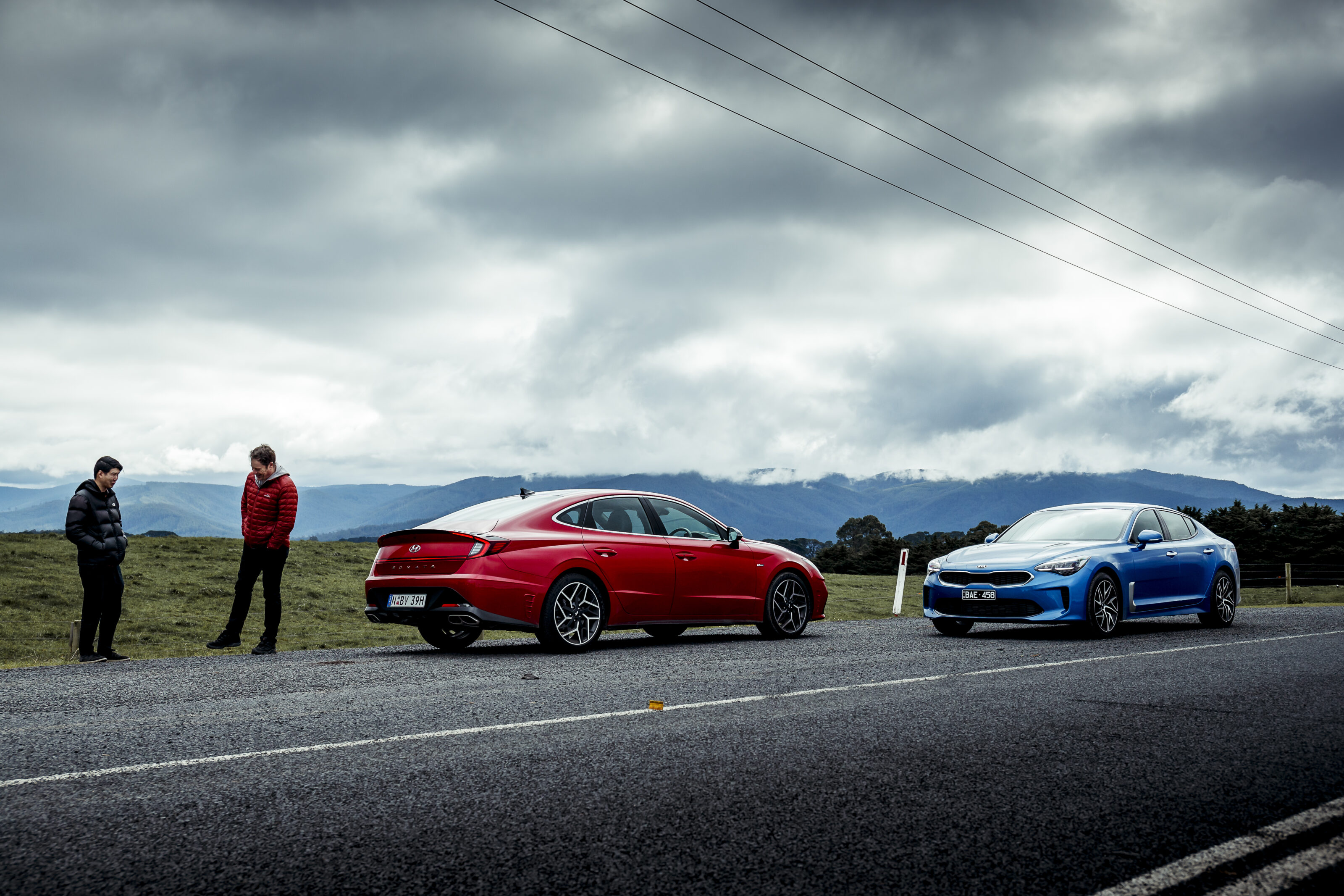
Like every Stinger before it, this 200S is plagued by a near-constant hatch rattle when encountering imperfections in the road surface, fixed by fitting a revised rubber bump stop inside the boot. You’ll also want to switch off the overly intrusive lane-departure warning, which entails a trawl through the touchscreen on every journey. That also gets rather old quickly. For the most part, the interior ergonomics of the Stinger still stand up very well, even if it is missing gear like a wireless phone charger, seat heaters or a head-up display.
Thankfully Kia has fixed what was one of the Stinger’s most frustrating dynamic oversights, namely that when you flick the ’box into manual mode while in Sport or Sport+, it’ll hold that gear until instructed otherwise. Previously, the Stinger would allow a few seconds in manual before snicking back into drive, which was hopeless as it would often click out of, say, pre-selected third gear at corner entry and straight up into seventh, leaving you with no meaningful throttle authority at apex. It’ll still do that in Comfort mode which is no great issue, but is thankfully a bit cleverer in the angrier settings.
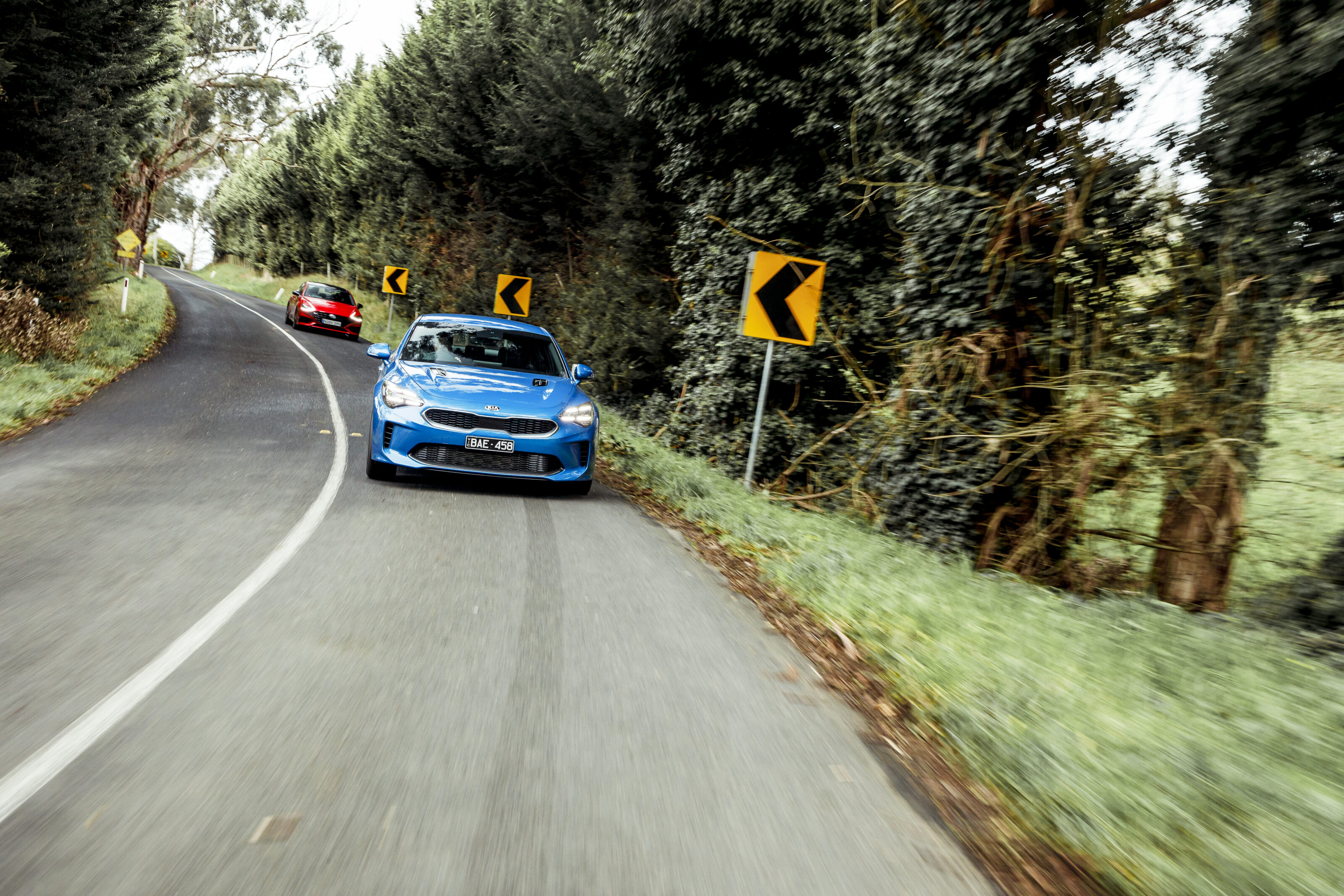
The Sonata’s slightly dorky button-initiated transmission is part of a sea of piano black that soon looks a little matte sebaceous after use, and the virtual clocks, which switch from a bright metal look to carbon-fibre effect in sportier modes, always raised a chuckle. You’ll find yourself switching into Sport at night whether you need it or not, merely to dim the gauche glare of the standard dials. Strangely, the more modern infotainment system in the Sonata was far flakier in recognising and retaining smartphone mirroring than the Kia’s, but the inbuilt navigation system is a couple of steps more sophisticated than Kia’s serviceable effort. The ‘Sounds of Nature’ ambient sound package common to both cars is a bit of a head scratcher, the ‘calming’ foosteps in the snow sounding more like a stalker outside your ski chalet.
The Sonata also features rear-vision cameras that temporarily replace the speedo and tacho with a view down the flank of the car when, respectively, the left or right indicators are operated. The irony is that your peepers will probably only alight on these displays if you’re not using your mirrors properly.
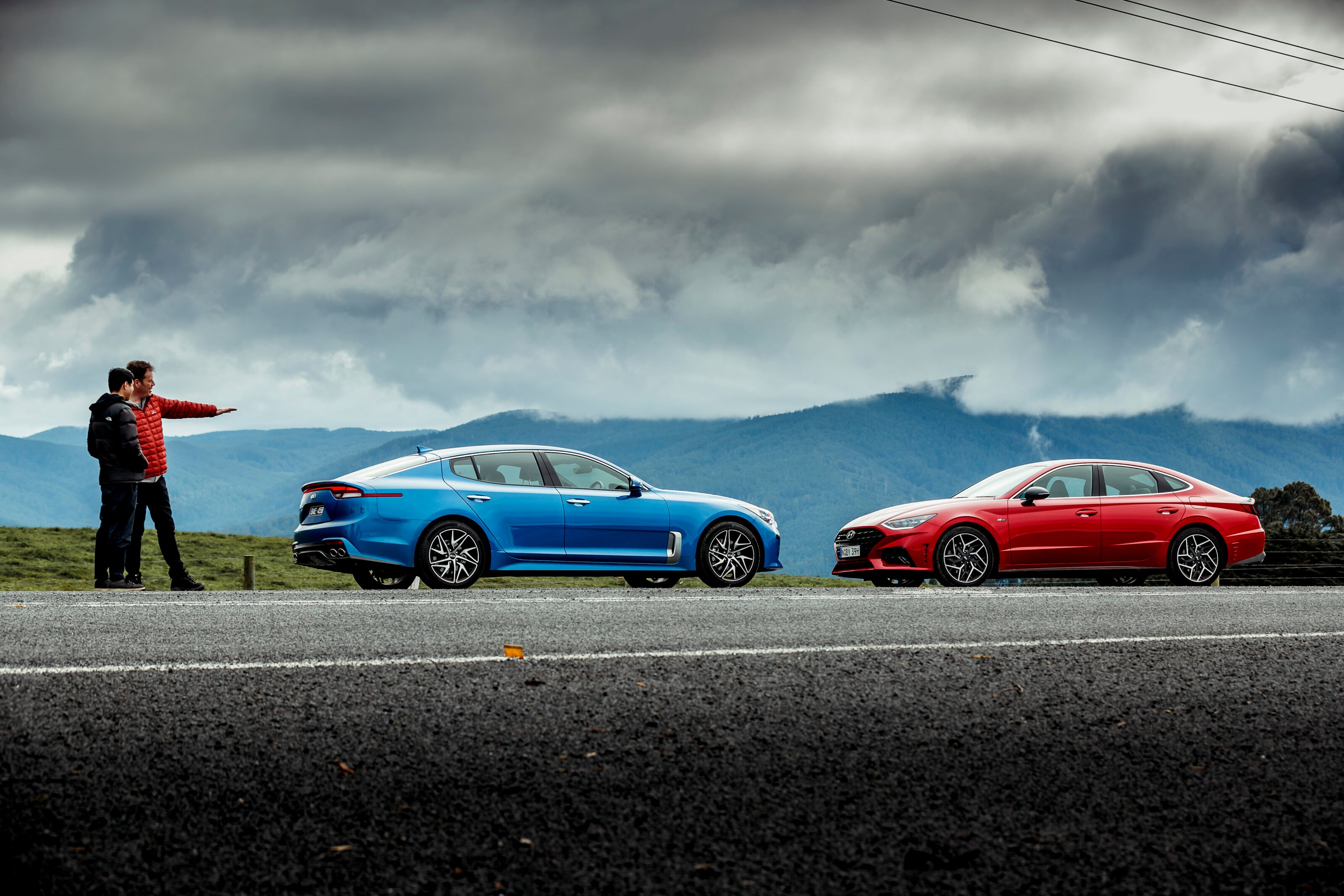
This highlights the issue with the Sonata N Line. There’s precious little subtlety to it. Curiously for a company which is on such a high as Hyundai, this manifests as underconfidence; that the only way for this car to be taken seriously would be to inject it with an excess of almost everything, when dialling things back a few degrees would have resulted in a better end product.
The fake vents, the carbon-fibre virtual dials, the nibbly suspension tune, the vortex generators on the rear light clusters: it’s all just a bit much. It’s hard to complain about the sheer amount of content that Hyundai is packaging into the Sonata N Line for $50K, but there are times when a cogent argument can be made for something that feels simpler, friendlier and purer.
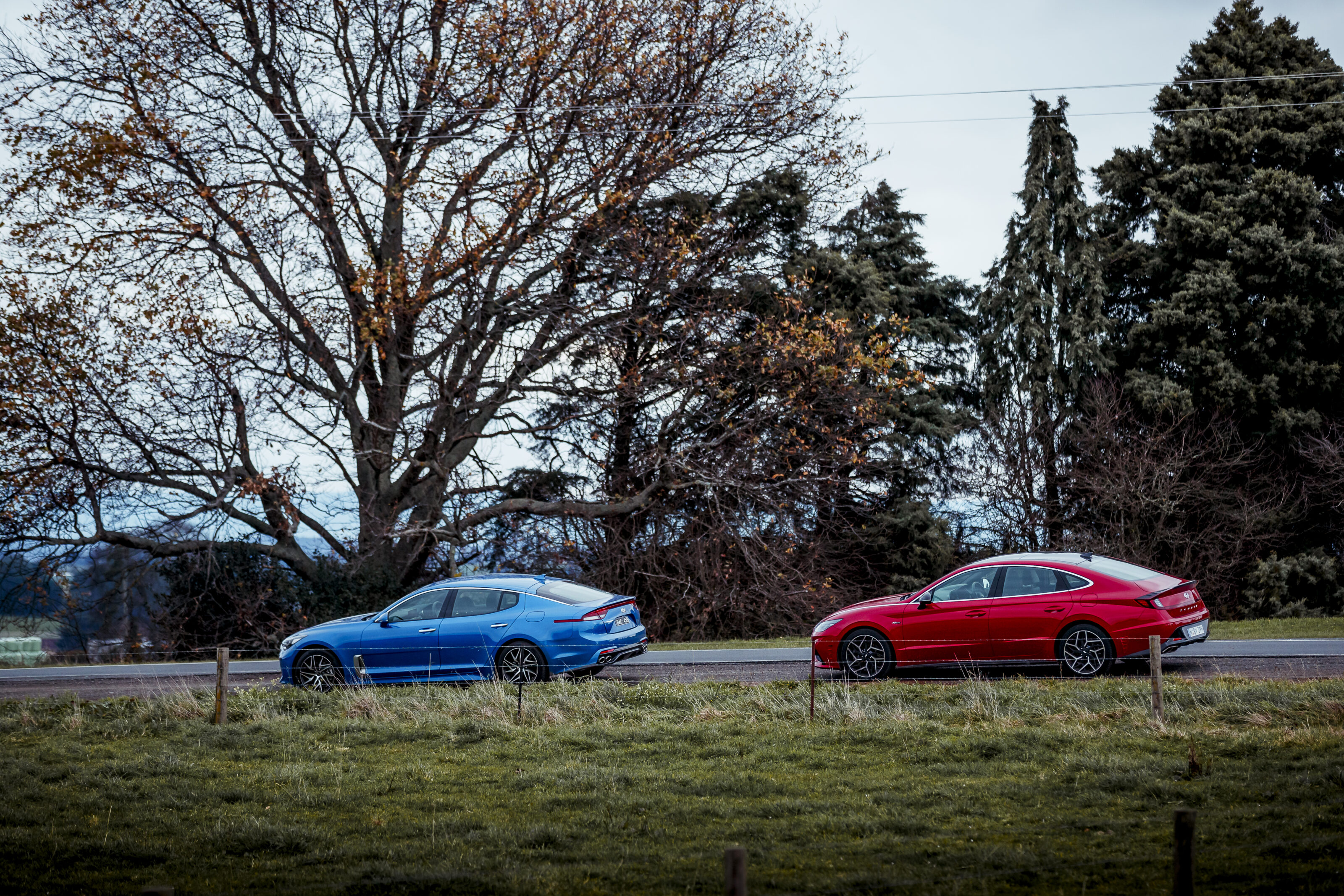
That car could well be the Kia Stinger 200S. Where the Sonata is over-wrought, the Stinger is confidently understated. As a performance car, it’ll be left for dead by the sheer muscle of the Hyundai, but there’s a complementary feel to many of its controls that makes driving the Stinger at briskish road speeds surprisingly satisfying. Up the ante and it gets a little ragged. The same can be said for the Sonata but its limits are higher and therefore less likely to be breached on the public highway.
So which to choose? There are solid arguments for both. If you’ve grown out of hot hatches and need a family car that can still raise a smile, there’s much to be said for the Sonata N Line. Yes, some of its execution is a bit on the nose, but it’s a fundamentally capable thing that’s decent value. If it weren’t for the excesses of its styling, it’d make a great Q-car, as there’s something satisfying about leaving respectable performance cars for dead in a Hyundai Sonata. It’s lavishly equipped and nicely finished but does it deserve a nod of respect in the company of today’s performance sedans? By the numbers, most certainly.
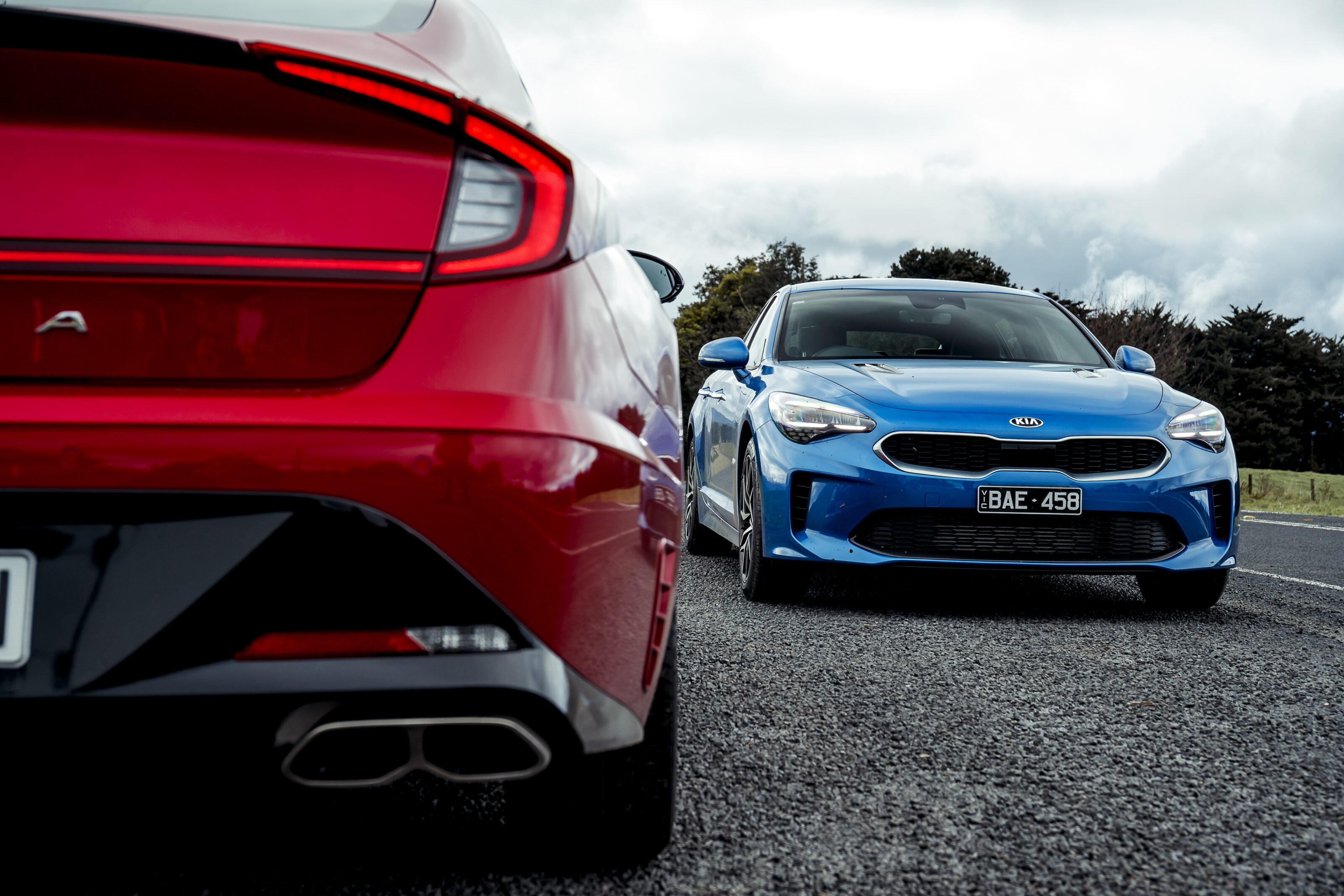
Look deeper and the warp and weft of its argument start to fray. It’s a car that unravels the more you ask of it, yet the flinty brittleness of its ride remains even when you’ve mentally dialled back. The Stinger, on the other hand, can always lean on its benign basic fluidity, helped in this instance by a little more tyre sidewall and some more conciliatory damping.
There’s the kernel of an excellent car in the Sonata N Line but the execution is, at present, a little unresolved. The Stinger is the opposite, a car that makes a decent fist of fairly uninspiring ingredients and these two contrive to meet somewhere in the middle. Right now I’d take the Stinger. It feels more comfortable in its own skin and more rewarding to flow along a challenging road due to a certain measured assurance in the feedback loops of controls and responses. Such is the inherent promise of the Hyundai that its day will surely come. Today, however, is not that day.
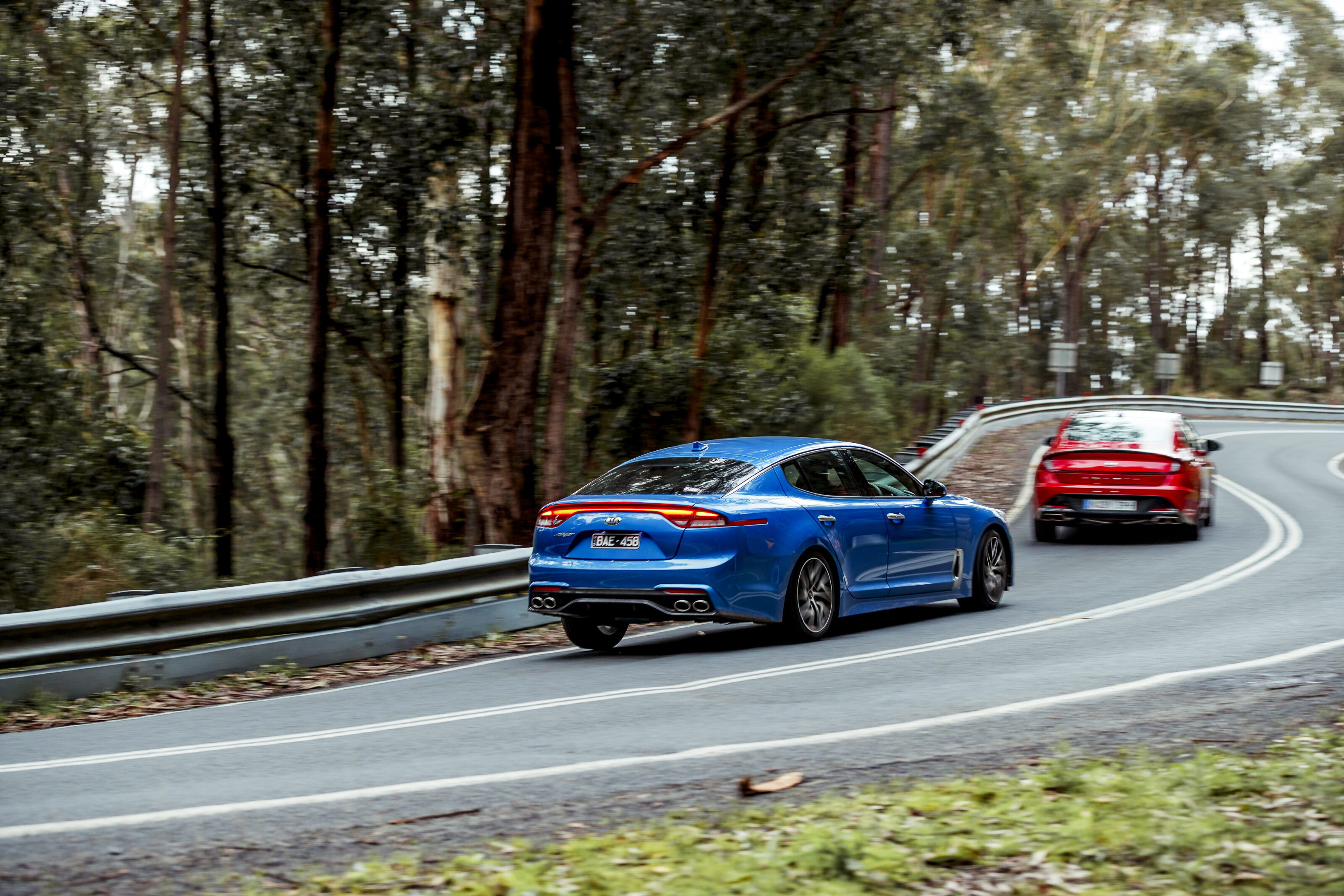
2021 Hyundai Sonata N Line specs
| Body | 4-door, 5-seat sedan |
|---|---|
| Drive | Front-wheel |
| Engine | 2497cc inline-4cyl, DOHC, 16v, turbo |
| Bore x Stroke | 88.5 x 101.5mm |
| Compression | 10.5:1 |
| Power | 213kW @ 5800rpm |
| Torque | 422Nm @ 1650-4000rpm |
| Power/Weight | 130.2kW/tonne |
| Transmission | 8-speed dual-clutch |
| Weight | 1636kg |
| Suspension | Struts, coil springs, anti-roll bar (f); multi-links, dampers, coil springs, anti-roll bar (r) |
| L/W/H | 4900/1860/1445mm |
| Wheelbase | 2840mm |
| Tracks | 1610/1617mm (f/r) |
| Steering | Electrically assisted rack-and-pinion |
| Brakes | 345mm ventilated discs, 4-piston calipers (f); 325mm solid discs, 2-piston calipers (r) |
| Wheels | 198 x 8.0-inch (f/r) |
| Tyres | 245/40 R19 98Y (f/r) Continental PremiumContact 6 |
| Price | $50,990 |
| Pros | Strong engine; body control; keen VFM; quick transmission; lightness |
| Cons | Overbaked styling; ride firm; poor engine acoustics; power understeer |
| Rating | 7.0/10 |
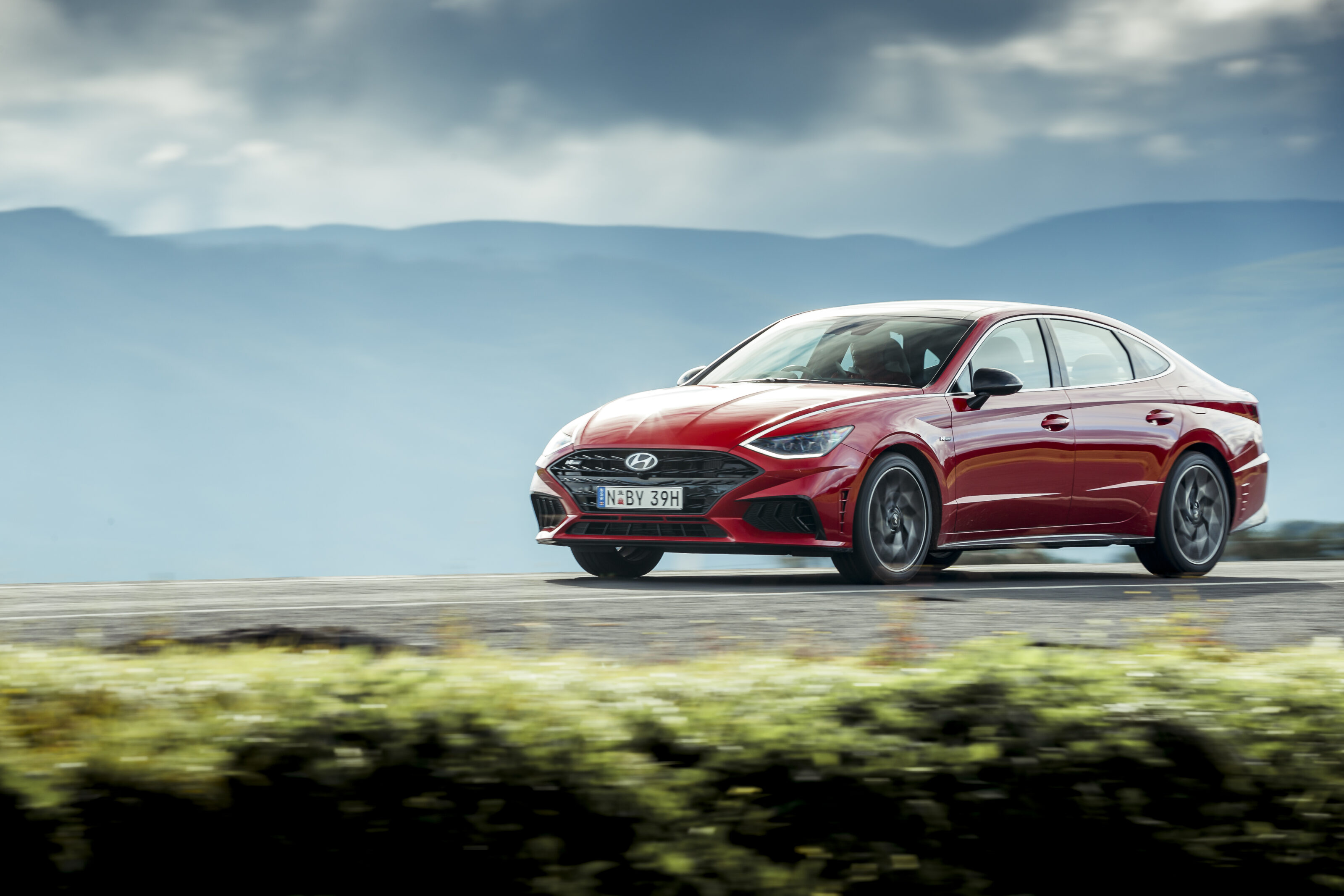
2021 Kia Stinger 200S specs
| Body | 5-door, 5-seat liftback |
|---|---|
| Drive | Rear-wheel |
| Engine | 1998cc inline-4cyl, DOHC, 16v, turbo |
| Bore x Stroke | 86.0 x 86.0mm |
| Compression | 10.0:1 |
| Power | 182kW @ 6200rpm |
| Torque | 353Nm @ 1400-4000rpm |
| Power/Weight | 103.6kW/tonne |
| Transmission | 8-speed automatic |
| Weight | 1756kg |
| Suspension | Struts, coil springs, anti-roll bar (f); multi-links, coil springs, dampers, anti-roll bar (r) |
| L/W/H | 4830/1870/1400mm |
| Wheelbase | 2905mm |
| Tracks | 1596/1647mm (f/r) |
| Steering | Electrically assisted rack-and-pinion |
| Brakes | 320mm ventilated discs, 4-piston calipers (f); 314mm solid discs, two-piston calipers (r) |
| Wheels | 18 x 8.0-inch (f/r) |
| Tyres | 225/45 R18 95Y (f/r) Continental SportContact 5 |
| Price | $50,050 |
| Pros | Ride comfort; sweetly willing lump; practicality; improved u2018box |
| Cons | Not that quick; handling scratchy at limit; sheep in wolfu2019s clothing? |
| Rating | 7.0/10 |
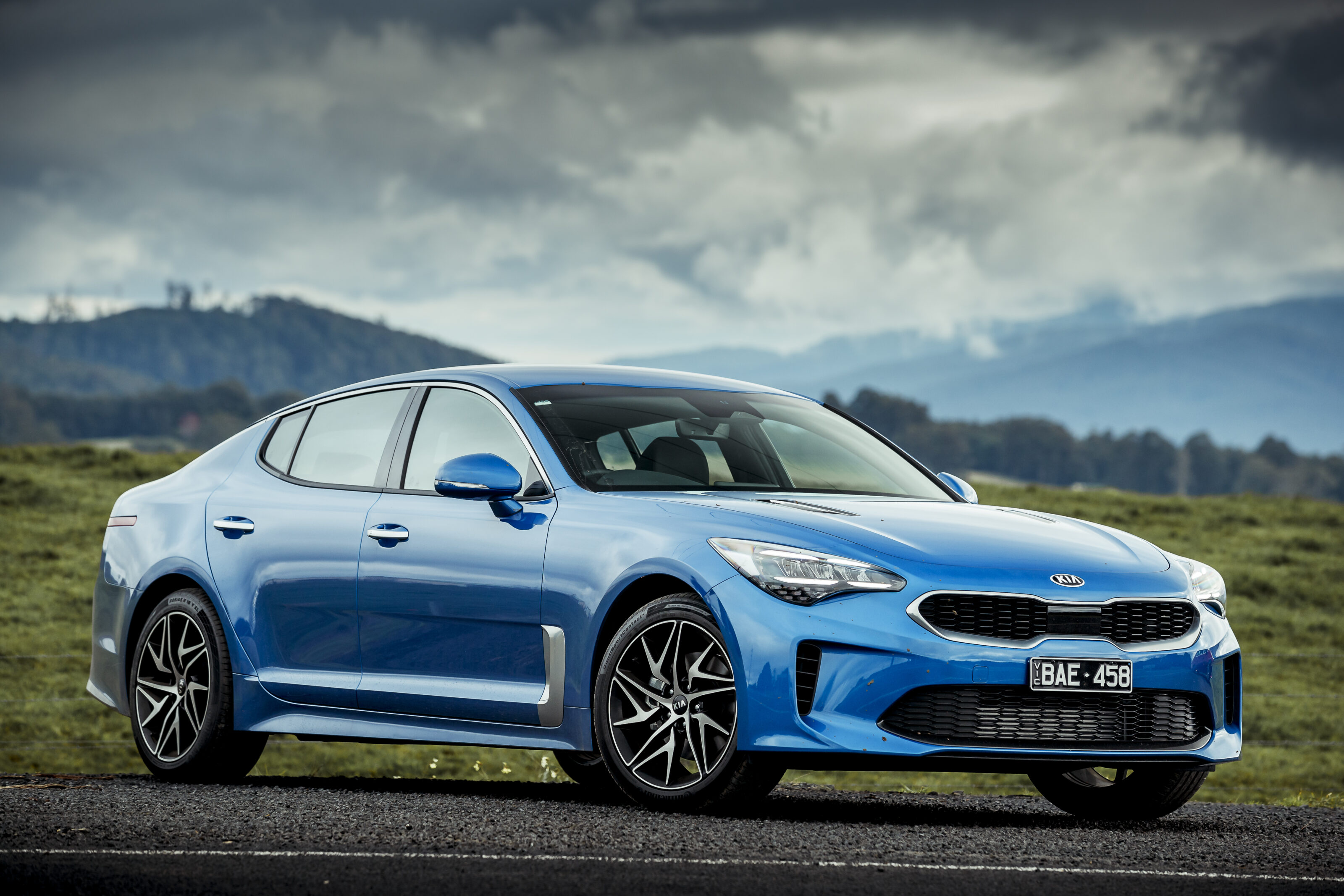
Porsche has confirmed the bark of a flat-six will continue to resonate from its tailpipes for at least another 10 years, with petrol engines locked into the line-up alongside incoming electrified powertrains.
While the end of internal combustion is looming on the distant horizon, the German manufacturer has a strategy to hold onto pistons and cylinders as long as possible before electric completely proliferates the family of sports and SUV models.
Speaking to Motor in Munich, Porsche AG CEO Oliver Blume confirmed petrol engines would continue to feature as part of the entire model portfolio as hybrid and full-electric versions are gradually introduced.
“In the transformation period over the next 10 years we will offer in every Porsche segment one combustion engine, one hybrid and one electric engine,” he said.
The exact transition strategy, including model drivetrain phase-in and phase-out, is not yet being detailed – but it’s understood the venerable 911 brand halo will be the among the last to give up spark ignition.
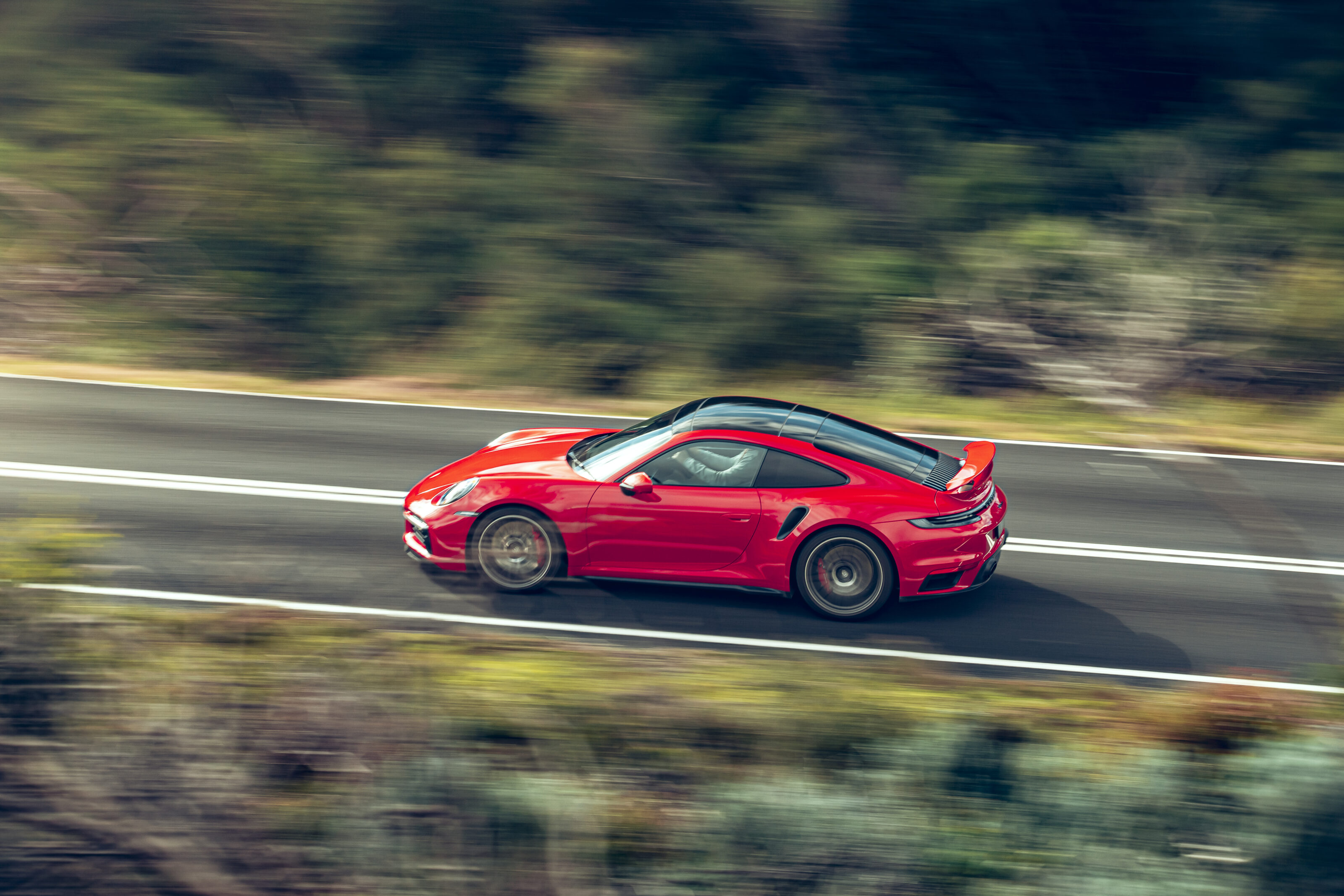
Critically though, Porsche’s strategy to prolong petrol power is part of a carbon-zero approach to align with its other sustainability policies. While the company’s E-fuels project is still in small-scale trials, a larger scaled-up operation will soon provide a source of non-fossil-derived petrol for use in a number of applications.
“E-fuels do make sense when you produce them in regions of the world where sustainable energy is unlimited,” said Blume. “We will have the first lot of these E-fuels by next year to build some lighthouses – motorsport, Porsche Experience centres, first filling in our factories and testing.”
Unlike oil-derived hydrocarbon fuel, E-fuels are made using renewable sources of energy and, while its use does release CO2, synthetic petrol is a cleaner and a more sustainable option for the twilight years of combustion engines.
And even though passenger vehicles may be preparing for petrol to go out to pasture, Blume highlighted the need for the fuel beyond the motoring sector.
“[It’s needed] not just in the automotive industry, but also in the flight industry and the ship industry where you won’t have any other option in the future. Synthetic fuels will be the only option.”
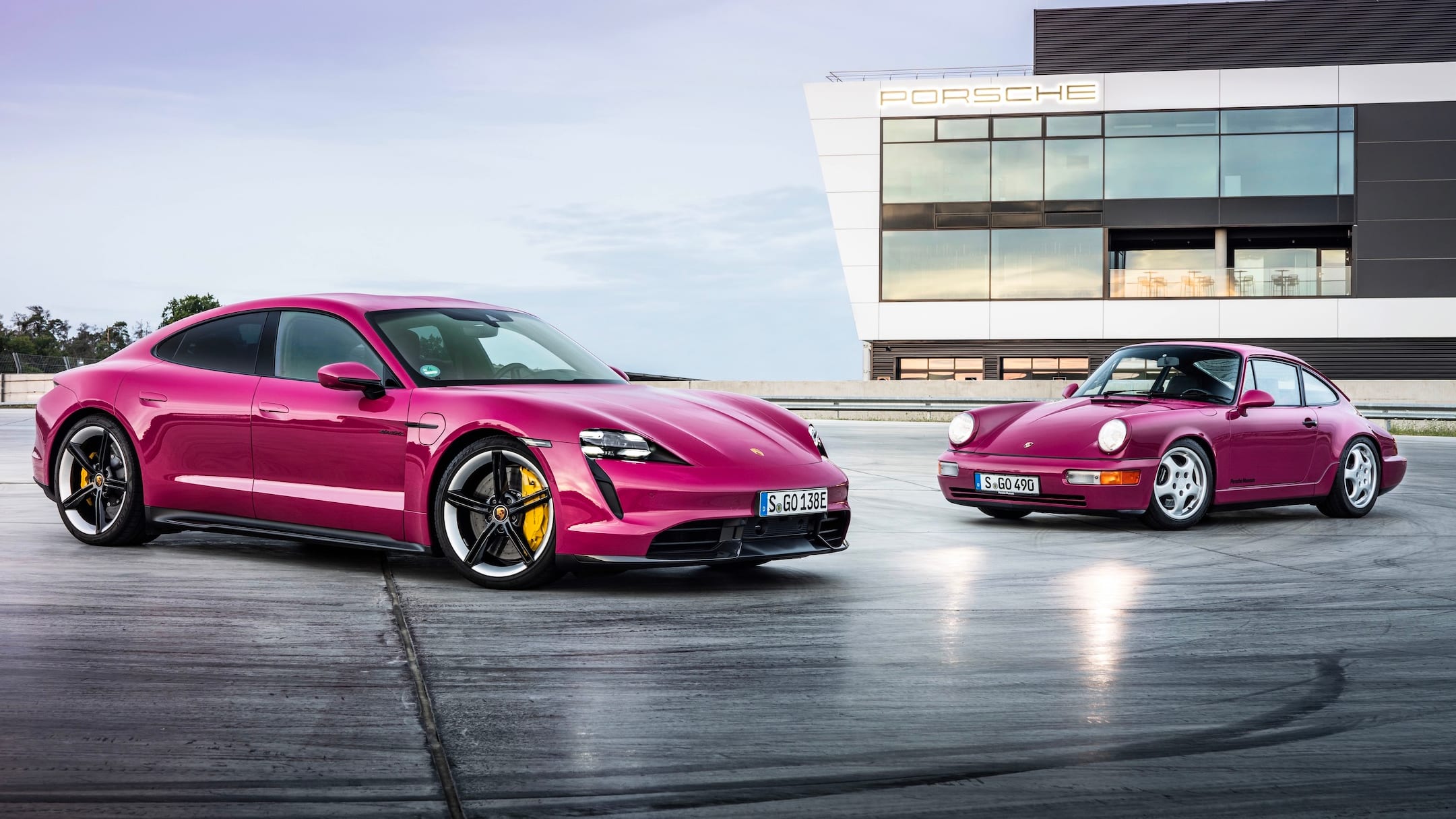
An eventual pure-electric Porsche line-up is inevitable, and the first approximate date of the full transition is also ticking down. But even when a combustion-power engine will no longer be found in the iconic family, the equally cherished boot badges will live on.
Blume explained that the introduction of the Taycan title was necessary for the arrival of Porsche’s first modern battery-electric car, as it slotted into a segment not occupied by any other model. As for the rest of the range however, the much loved names of the exiting line up will endure the switch to electric.
“Taycan was another story. It was a new segment for the first time and it was its own car, therefore we decided to go for a new name.
“Porsche has always remained Porsche only by changing [with the times].”
