Snapshot
- Similar design to ID.4 but with more dramatic rear end
- Could be unveiled at Munich Motor Show
- Likely to feature same 220kW AWD dual-motor powertrain as the ID.4
UPDATE, August 7: Volkswagen has now confirmed it will unveil the ID.5 – specifically the performance-focused ID.5 GTX – in its production form at September’s Munich motor show.
Unlike the recently cancelled New York motor show, the Munich event is still slated to go ahead, with doors to open on September 7.
The story to here
August 2, 2021: Volkswagen has provided a further glimpse of its latest electric vehicle, the ID.5, in a series of camouflaged images posted on social media this week.
A coupe-styled companion to the ID.4 medium SUV, the ID.5 doesn’t stray far away from the formula set by its less-angular twin, with design from the B-pillar forward looking identical across both models.
Instead, a more-radical rear end with a sloping roof line poses as the only major difference between the two vehicles, much like the distinction between the BMW X5 and X6 twins.
https://www.instagram.com/p/CR9LzGpKRgS/
The company claims the design of the ID.5 helps with aerodynamics, allowing for a reduction in drag and boost in energy efficiency which work to increase the driving range. A large spoiler on the boot lid of the ID.5 will also help with air flow.
Sharing its MEB platform and various powertrains with the ID.3 small car and ID.4, the teaser images confirm the ID.5 will be offered with a GTX variant, likely powered by the same 220kW all-wheel-drive dual-motor powertrain as the ID.4.
It’s also likely to feature a 77kWh battery, allowing for a confirmed 497km driving range – a slight increase compared to the 480km figure claimed by the ID.4 GTX.
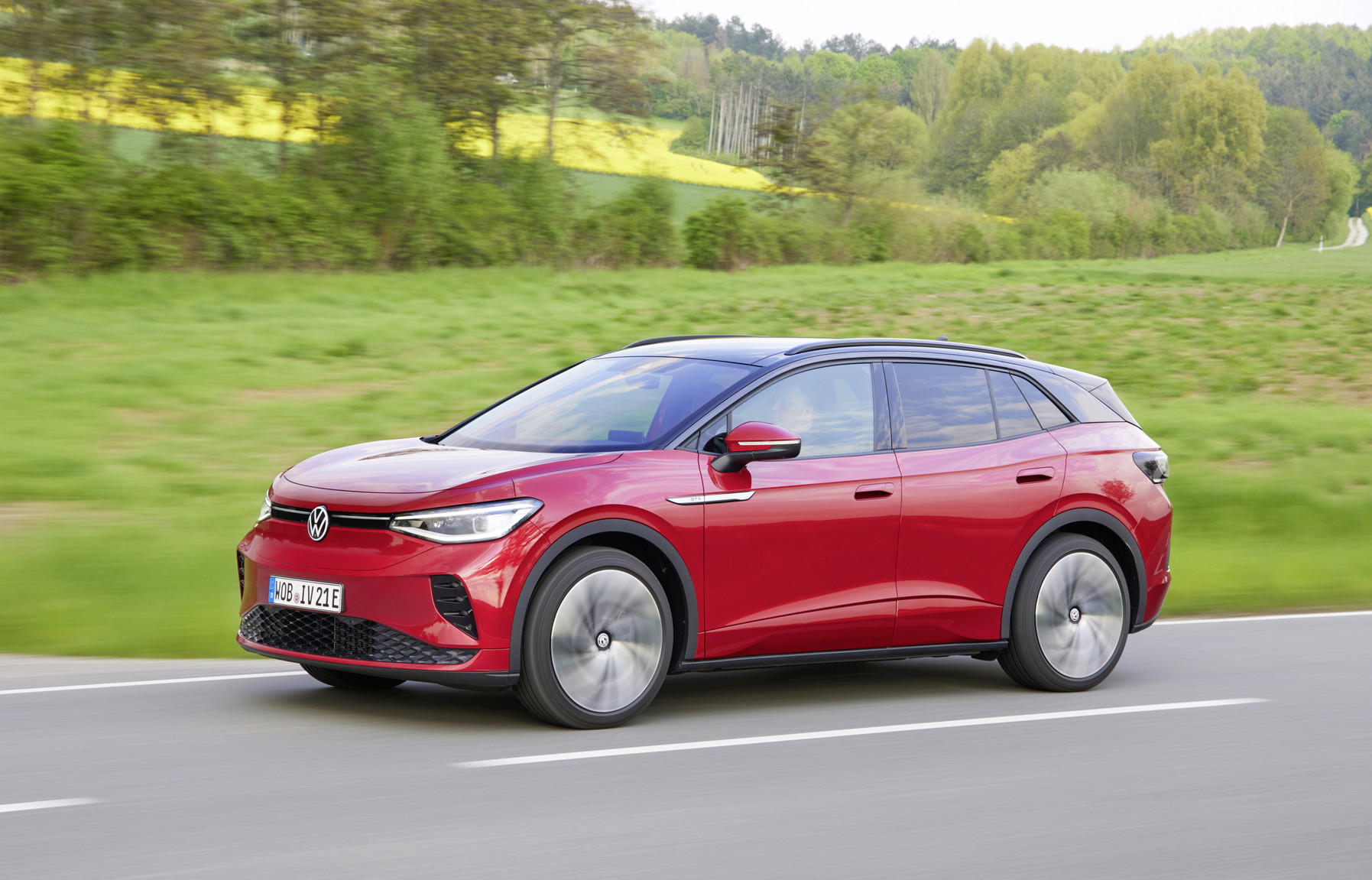
Regular rear-wheel driven variants of the ID.5 will offer a maximum driving range of 540km.
As with the ID.3 and ID.4, this RWD version consists of a 77kWh battery propelled by a 150kW electric motor.
Volkswagen has not confirmed when the ID.5 coupe SUV will be officially unveiled, but a debut at the 2021 Munich Motor Show in early September is expected – although an online reveal could occur before then.
It’s a speed war shootout as Australia’s fastest on four wheels battles the meanest on two
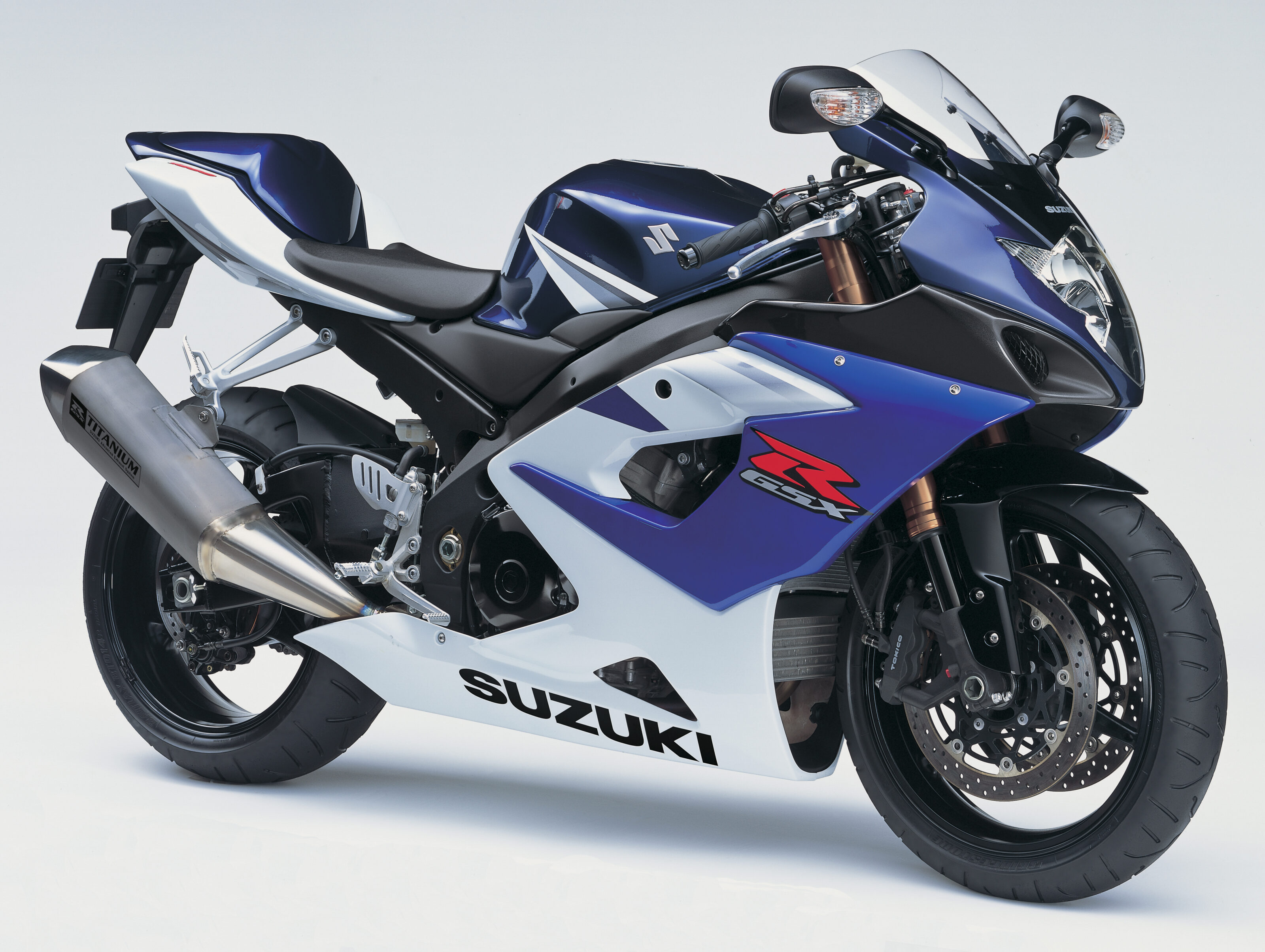
Here’s a fact. Porsche’s ceramic brakes, standard on this 911 Turbo S, are an $18,990 option on the Carrera. An entire Suzuki GSX-R1000 retails for $18,950. Yep, a bike is $40 cheaper than brakes.
This article was first published in the August, 2005 issue of MOTOR
We’ve proved the Porsche 911 Turbo S is fast. With an 11.9 second ET, it rips up the quarter-mile to stamp it firmly in supercar territory. Sure it costs the same as a house, but before we even start bragging, those smug motorbike gits start smirking, suggesting that the true use of the word ‘super’ ends in ‘bike’. And costs a whole lot less. Tossers.
But frankly it’s a fair argument. As car guys, we’ll happily sacrifice a little speed for the comfort of a roof, radio, air-con, windows, heated leather seats, conversation with a passenger and the security that four tyres offer to ensure imminent death isn’t around the next corner in the form of a patch of gravel, a patch of oil or another motorcyclist’s spleen. But exactly how much speed are cars sacrificing? And in 2005, can a fast car compete with a fast bike?
As a bike rider, I can see from both sides of the climate controlled door glass and those not used to Gimping up in full-body leathers for a Sunday morning blast may not fully realise how fast crotch rockets are. In a straight line, even a half-decent bike will be in the next suburb and finishing an oil change by the time a fast car grabs second gear.
Though GSX1300, R1 and ZX-10R sound like chemical compounds, they do represent some serious speed. And knowing their haughty belief in the superiority of bikes, we issued a courteous challenge to our sister mag Australian Motorcycle News (AMCN): “So you bicycle wankers wanna race a car, before you all kill yourselves on the latest Hondasaki PMT1300? Try and stump up with something decent too, ’cause we want something fast to beat…”
“The bike is cranked over so far, it scrapes its footpegs at turn four”
Funnily enough, they accepted. Enthusiastically. If that’s what “Screw you car girls, see you at the track,” meant. Knowing our challenge was serious, AMCN called in the current big gun of supersports, a machine so fast they label it a hyperbike: Suzuki’s GSX-R1000. Sh*t. It may not roll off the tongue as sweetly as Carrera or Boxster, but roll on a handful of throttle and it’ll suck the skin from your eye sockets faster than you can say ‘have I prepared a will?’
From just 999cc of twin-cam, fuel-injected four-cylinder, the performance of the Suzuki is, as much as its pains us to say it, not in another ballpark, but another sport. Though the Porsche has almost three times its power, it also has ten times its weight. The Suzuki’s power-to-weight ratio makes a Ferrari Enzo look like an off-roader. A Hummer.
Over the standard speed tests, it’s laughable: 0-100km/h in 3.26 seconds is exactly one second faster than the hard-launching all-wheel drive turbo Porsche. And the bike’s 10.4 quarter-mile – faster by 1.6 seconds – included wheelspin from a foggy, greasy morning track.
And that’s the Suzuki’s Kryptonite, its contact on Earth.
Tyres that are barely wider than a car’s space saver, with a contact patch the size of a mobile phone, are expected to transfer power to the road without transferring body parts.
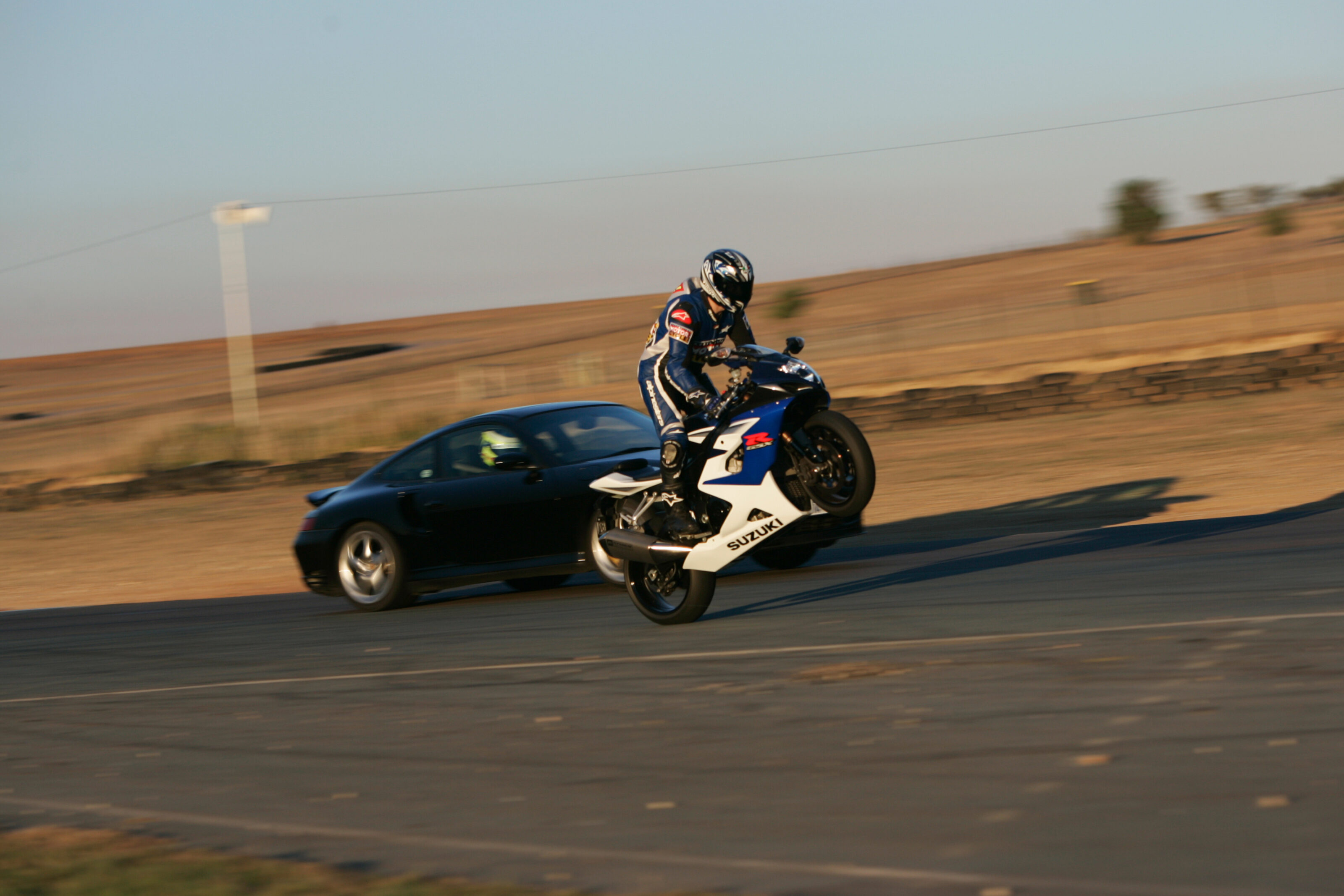
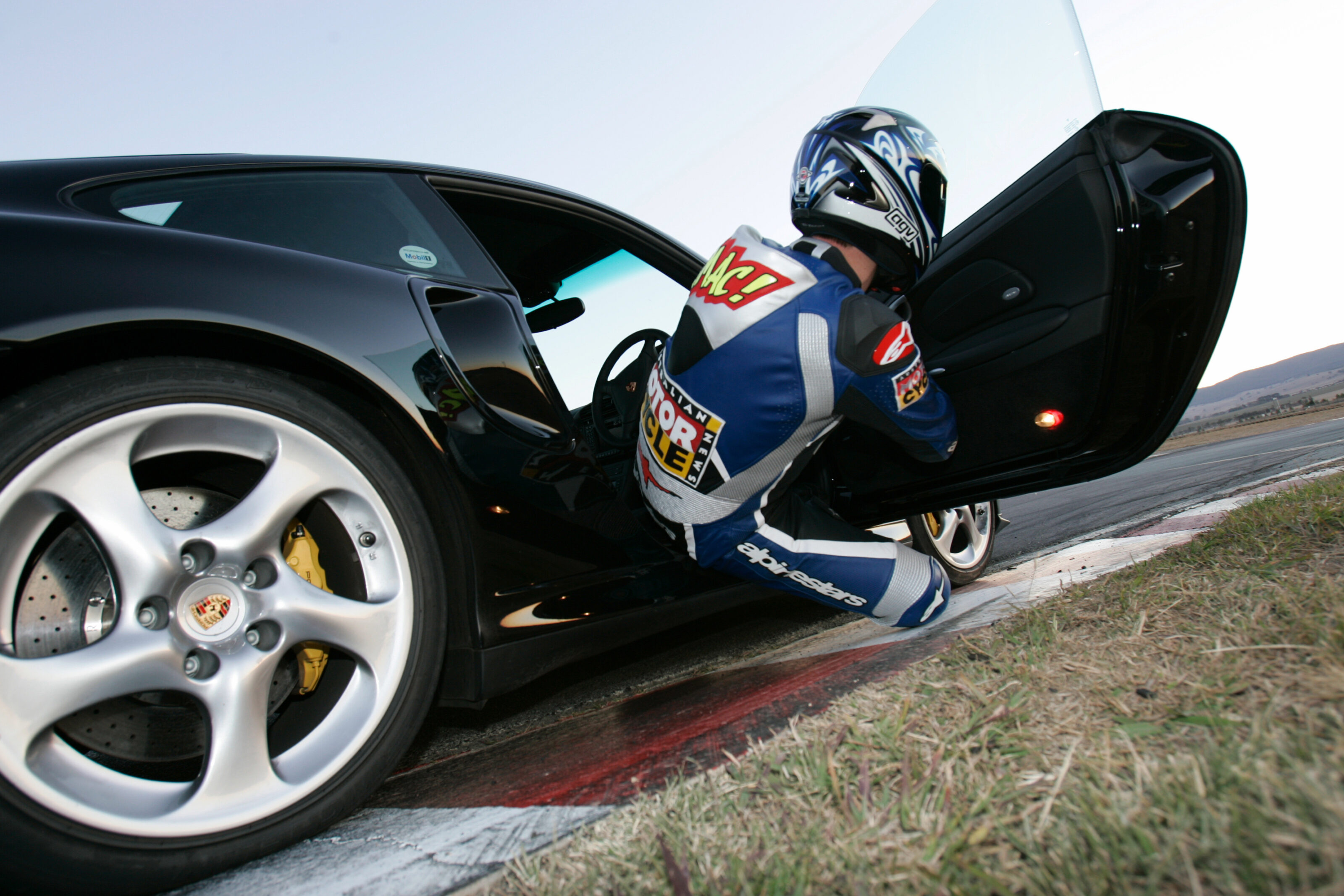
The organ donor in charge of the two-wheeled machine of death was AMCN’s deputy editor Sam Maclachlan, a pretty handy bit of bike ballast if 100-metre-long wheelies are anything to judge a rider by.
Knowing the GSX’s reputation for speed and our genuine desire to beat the bikers, we didn’t want to let the car down, so we enlisted V8 Supercar driver Warren Luff. The experienced Stone Brothers’ Racing driver does Porsche Experience training days, holds a bike licence and knows the fast way around our chosen challenge track, Wakefield Park, near Goulburn, NSW.
A tightish 2.2km loop built on the side of a hill, Wakefield favours both car and bike in different areas but with similar results, evidenced by the current V8 Supercar record of 60.0, versus the Superbike lap record of 59.9 seconds.
TRACKSIDE
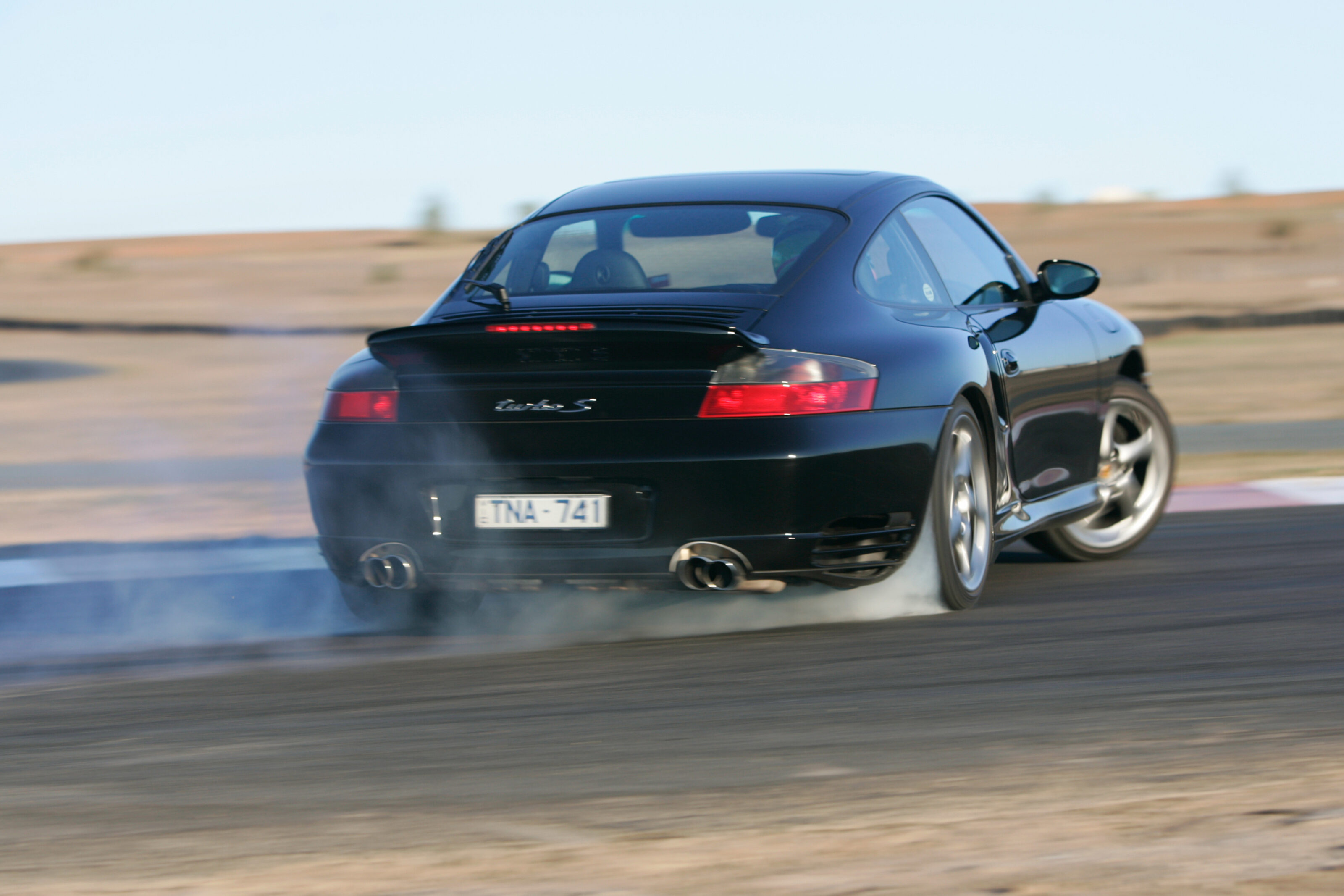
Time to get serious. With tyre pressures brought up 2psi front and rear, Luff hits the track in the 911 Turbo S and immediately bangs out a fast 1:07.78, beating our previous record around Wakefield, a 1:07.94 in BMW’s M3 CSL.
Warren’s strength is his ability to set a fast time early and repeatedly. A lap later he trims it to 1:07.60, backing it up with a 7.7, 7.8 and a “that’s as fast as she’ll go”. Time to strap the VBox to the bike.
The car and bike’s strengths and weaknesses are almost opposite around Wakefield. Across the start finish straight, the bike is braking 50 metres before the turn one kink, back to second gear, which it holds for the rest of the lap.
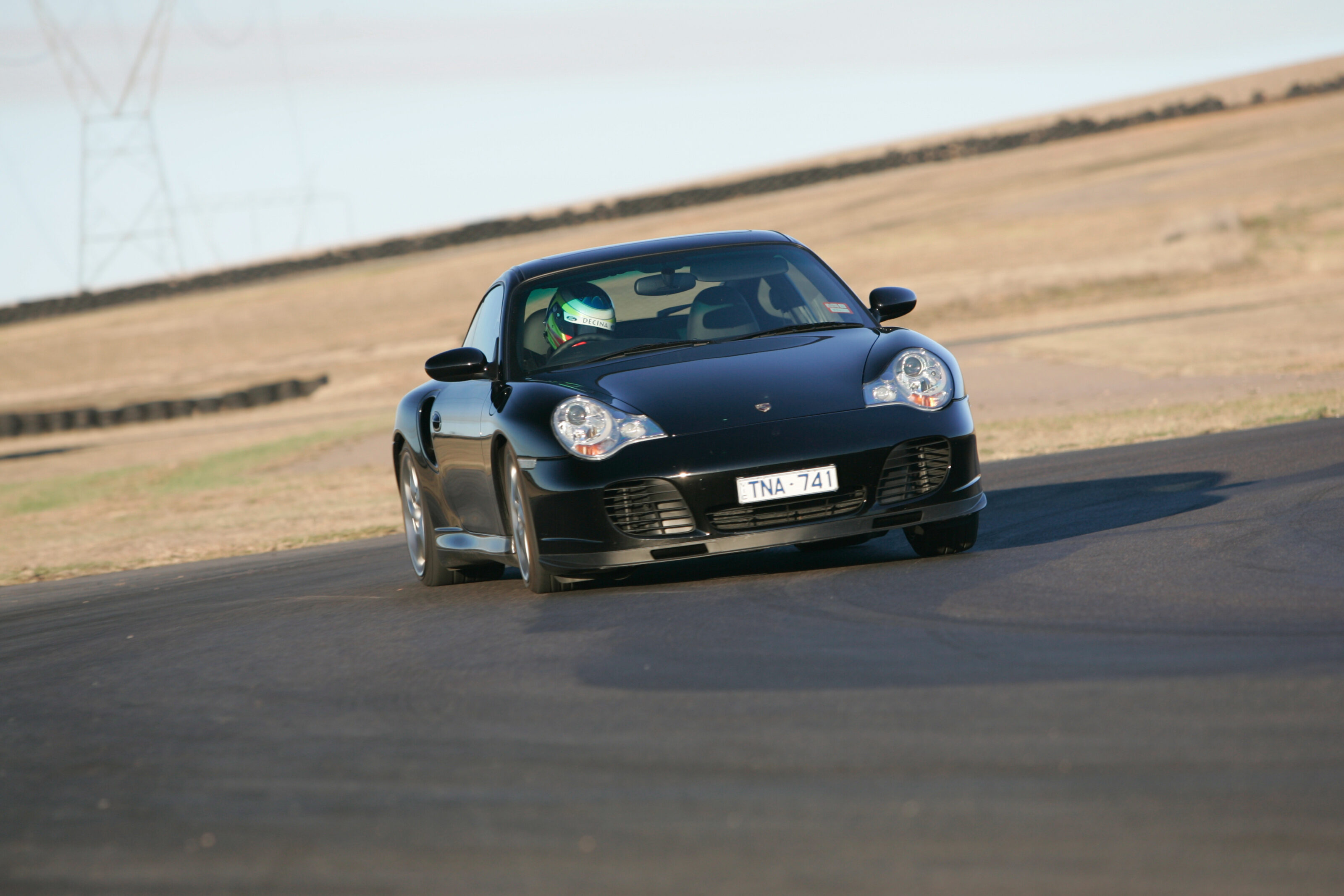
The 911 brakes ‘at’ the kink, the awesome ceramics and six-piston calipers slashing speed from the Turbo at insanely late distances. Using fourth, third and second, despite its weight, it uses the stability of all-wheel drive and the grip of four fat tyres to wash off speed every bit as equal as the lighter bike. But then the car turns in faster.
By turn two’s apex, the 911 holds a 6km/h advantage and edges in front. But up the hill to turn three, five times the torque means little when the amazing acceleration of the bike winds out second gear to the limiter and puts it back in front of the car with a large 12km/h advantage.
From here it’s car land with tight, cambered, high-lateral g-force corners that allow the car to use its mechanical grip. The 911 loses a little through the tight turn four because of the fast direction change before it that better suits the bike. But through the top three corners, the bike is always turning, cranked over so far it scrapes its footpegs – and Sam’s knee sliders – at four.
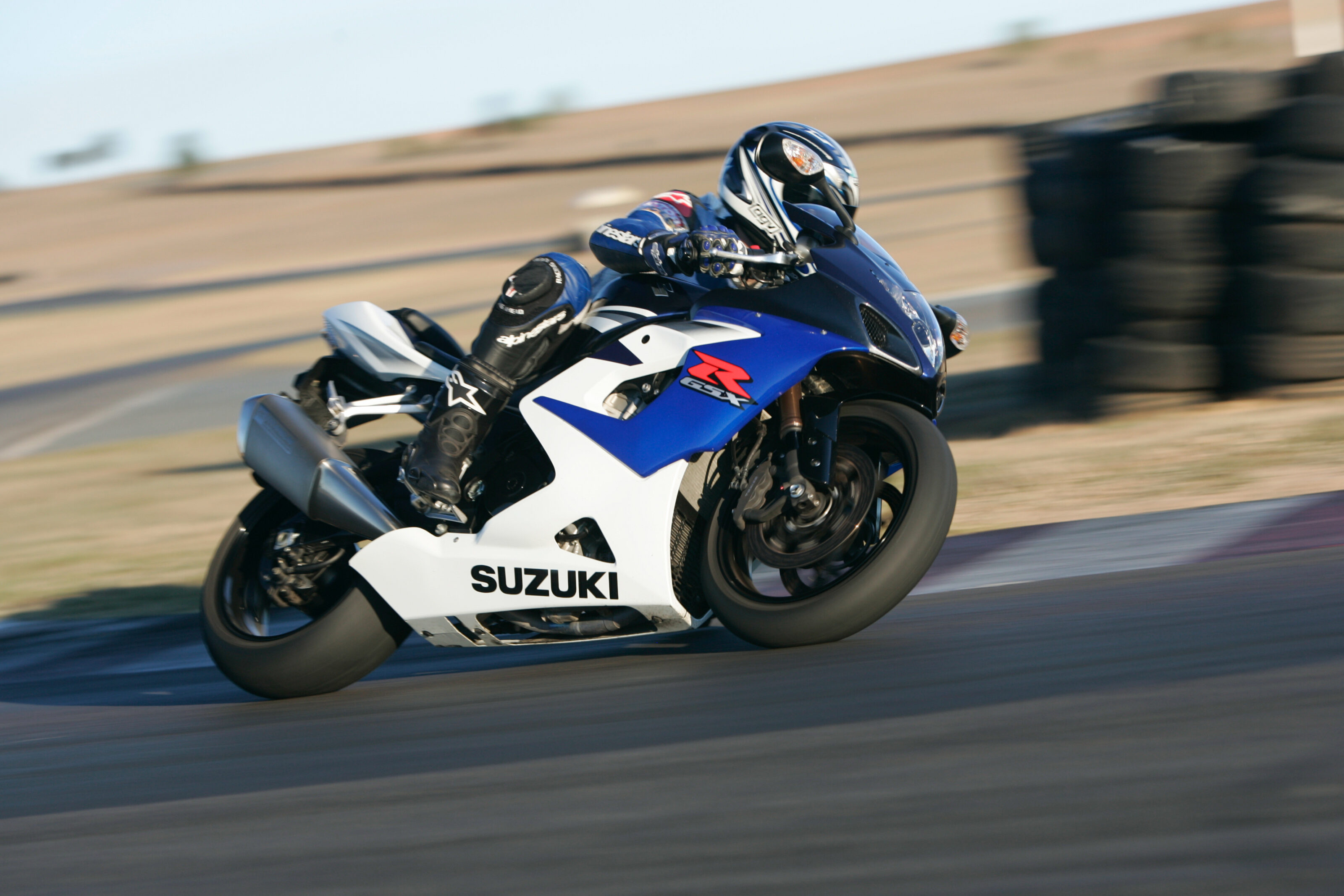
But the Turbo is quicker through the cambered downhill turn five, thanks to the car’s ability to use the extra width of Wakefield’s kerbing. Warren aims the car’s inside tyres at the smooth kerbs, straightening the curve and maintaining speed. Sam, on the bike, is avoiding the slippery kerbs like they’re ice. Which to a bike, they are.
Through the sweeping downhill right turn six and left-turn seven, the car is flat and full boost in third, Warren eases for a fraction on entry into seven to pull in the nose. The bike is cranked over and unable to put power down; upright for just a second between the turns, a quick wrist twist blasts the bike up to match the Porsche’s peak speed of 148km/h, before again being outbraked by the Porsche into the tight left-hand turn eight.
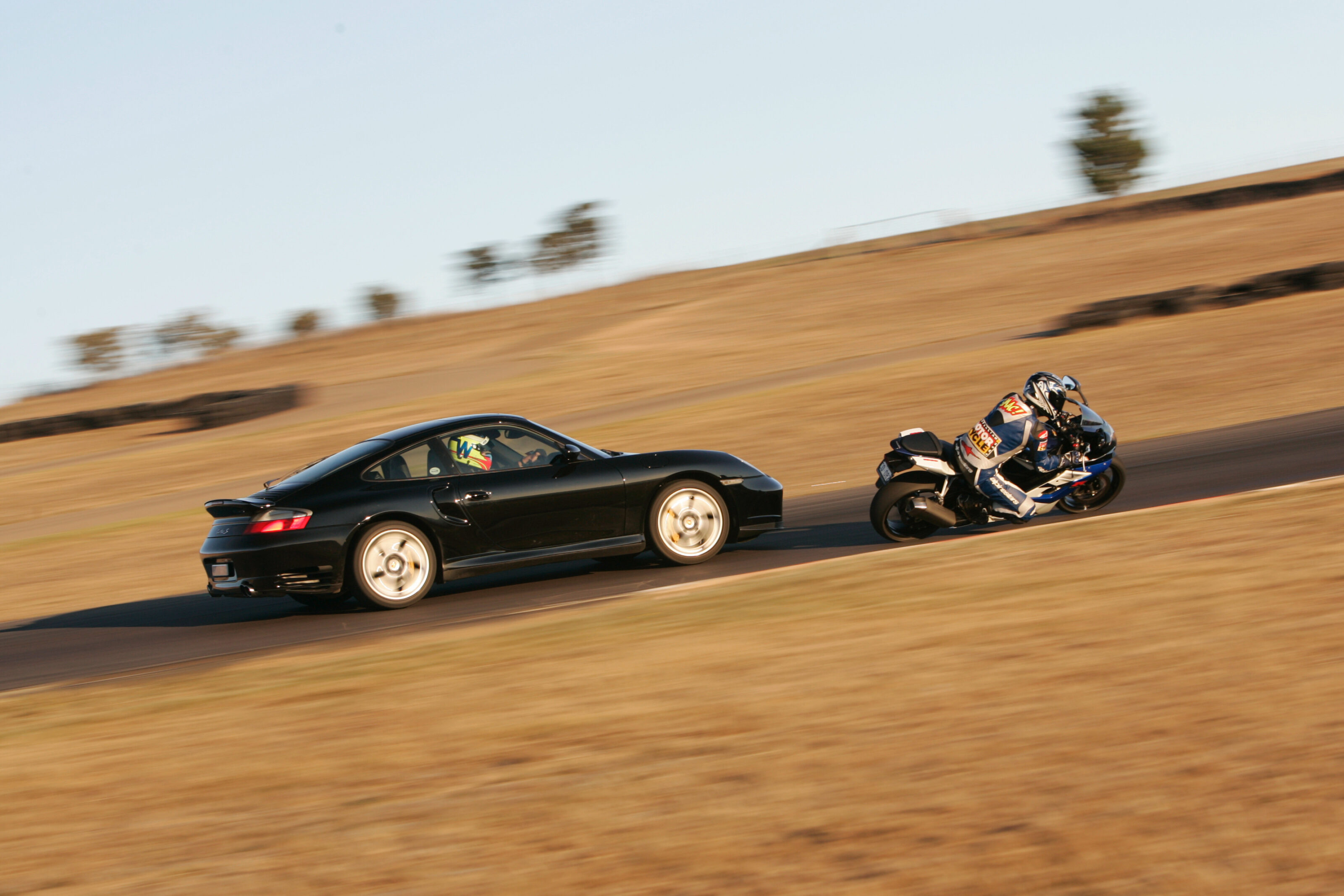
Amazingly, here at half-track they’re dead even, each with a split time of 35.5 seconds.
The second slowest corner on the track, the apex speed at turn eight again goes to the car which drops down to second gear, fights understeer and then, because of Porsche’s front-rear drive split, power-oversteers on exit before grabbing third.
The Turbo uses its torque and grip to full effect between eight and nine, on the limit of sliding and holding third gear, for what proves to be the most interesting comparison of the track.
At the turn nine right-hand sweeper, the car’s mechanical grip gives it an advantage of 10km/h. But from here, the bike flexes its muscle.
Once upright, the GSX-R storms out of the corner, trying to buck Sam as the tyres follow the road seams that the 911 didn’t even notice. In the short 200 metre straight, the bike turns a 10km/h defecit to a massive 16km/h advantage.
But the Porsche brakes 40 metres later and draws dead even with the bike, both tipping into the final turn ten corner with a 54.1 second split time.
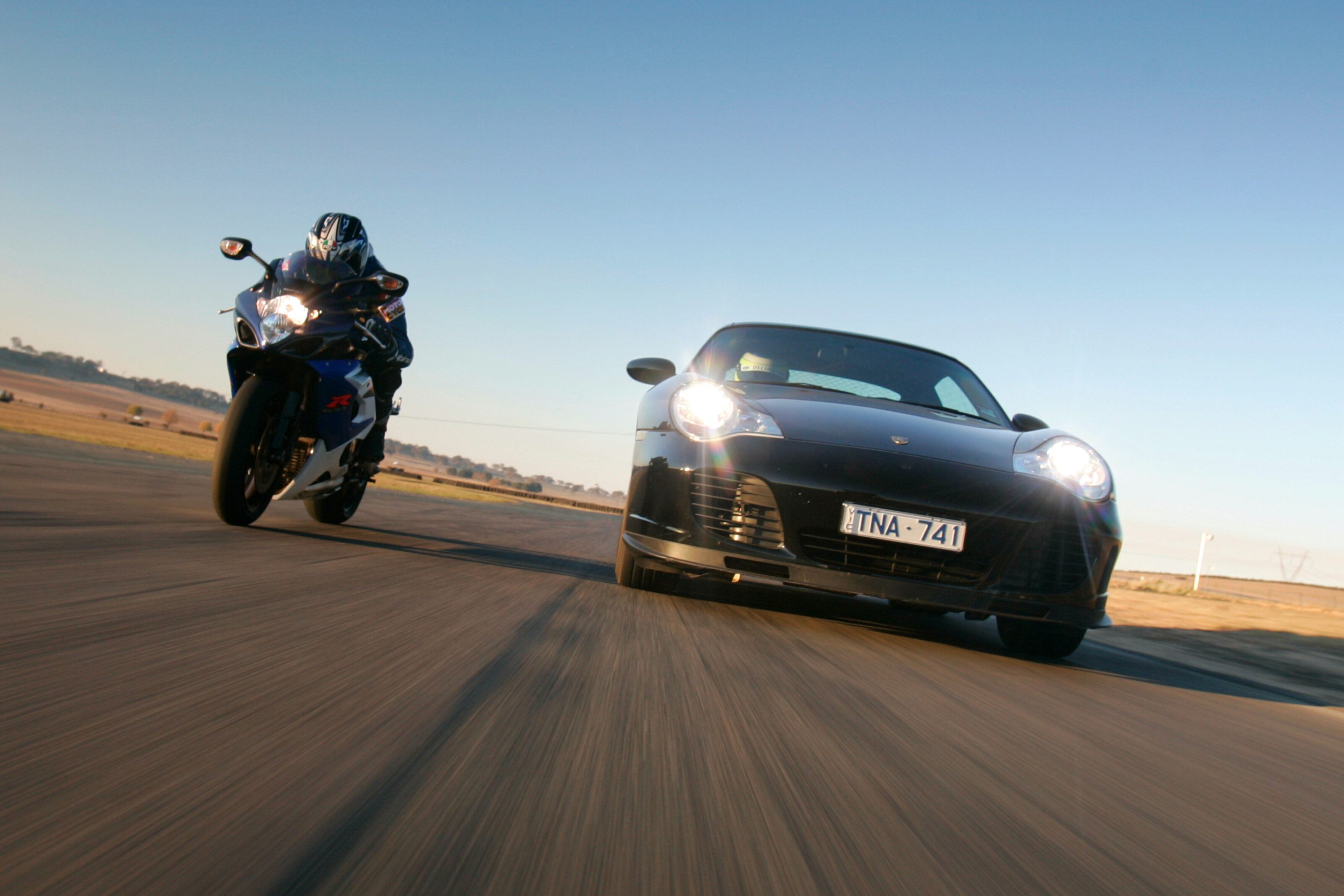
Braking into ten, the slowest on the entire track, bumps unsettle the bike and lift the rear tyre off the ground. The Suzuki turns in earlier and smoother, where the car apexes later to straighten the exit. Remarkably, both carry the same 61km/h at apex.
The Porsche gets on the power earlier, but 50 metres from the corner, as the bike gets upright and the Porsche grabs third gear, it’s like the 911’s dropped anchor as the Suzuki romps away insanely fast to be 35km/h faster over the start/finish line. Top speed in the Turbo is 201km/h, despite being on the power for 80 metres longer. The bike peaks at a massive 226km/h.
Lap time for the bike? Using Warren’s 1min:07.7sec as the target, Sam builds speed throughout the day from 1:10s, to 09s, a few 08s, then high 1:07s. The car is still in front for most of the day, but Sam grows balls and finally satisfies his day-long complaint of not being able to get heat and grip into the front tyre, and from his 12th lap of the session bangs out six laps faster than the Porsche. His best of 1:06.5 is 1.1 seconds faster than the 911 Turbo S.
So the bike gets there, pipping the Porsche at the post. Sure, we used a pro in the car, but we also chose the best bike around.
Yes, a bike pro like Superbike champ Shawn Giles may have gone a second faster and yes, the car is 18 times the price of the bike, but at the end of the day, after the final shot was taken, in the dark, with 9 degrees ambient temperature, Sam mounted up solo for three tortuous hours of blistering cold wind and the sound of a four-cylinder thrashing away at 5500rpm in sixth gear.
Warren and I accepted the car’s 1.1-second loss, cranked up the Porsche’s heater, CD and conversation, and cruise controlled back to Sydney in comfort.
And wondered if Suzuki would consider swapping a bike for some slightly used ceramic brakes?
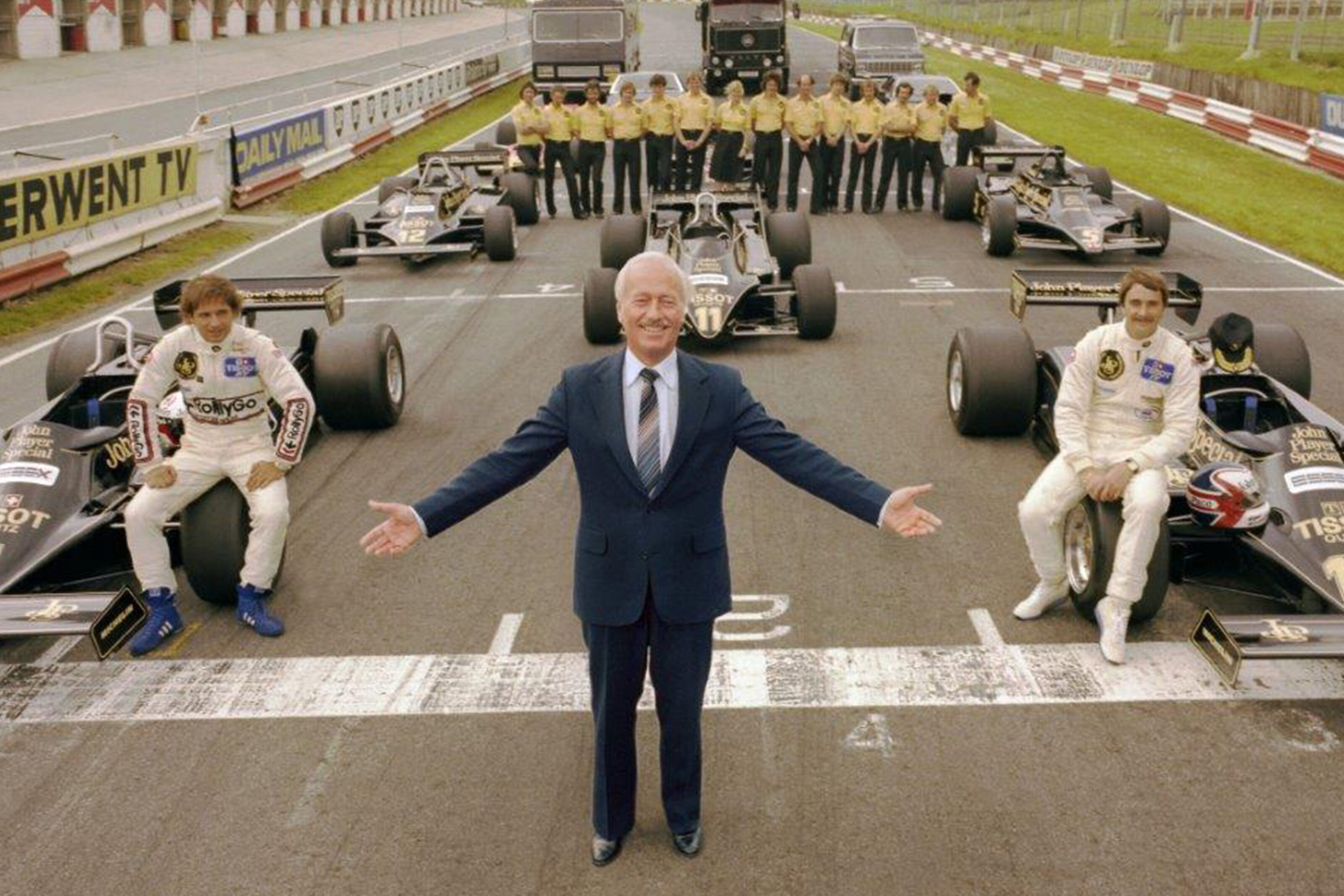
Lotus has always been a bit of a battler. While founder Colin Chapman’s light and often innovative road and racing cars made Lotus a household name around the world, the company has often lived hand-to-mouth, surviving on little more than its wits and its ability to conjure inspirational drivers cars out of metal and fibreglass and other people’s powertrain parts.
Since Chapman’s death in 1982, Lotus has been variously owned by General Motors, Italian businessman Romano Artioli (who also resurrected Bugatti and after whose granddaughter, Elisa, the Lotus Elise was named), and Malaysian carmaker Proton. Since 2017, however, it has been majority-owned by Geely, China’s largest privately-owned carmaker. And for the first time in decades, the future of Lotus looks secure.
Thank Geely chairman Li Shufu. The quietly spoken, modestly dressed Li, who writes poetry for recreation and smiles and chuckles frequently as he answers media questions, hardly fits the stereotype of a hard-charging, self-made automotive tycoon. Born in 1963, he started working as a photographer, dealt in scrap metal and began making parts for refrigerators in the 1980s. He graduated to making whole appliances, dabbled in construction, and started making motorcycles in 1993. In 1998 the first Geely cars – the name sounds similar to a Chinese word for “lucky” – rolled off the assembly line.
When Li realised in 2006 that the quality and design of Geely cars was still years behind standards acceptable to consumers outside China, he began discussions about acquiring Volvo from Ford, then bleeding cash and on the road to bankruptcy even before the global financial crisis hit. Ford had paid $6.45 billion for the Swedish carmaker in 1999. Li picked it up for just $1.8 billion in 2010.
Li has since proven a worthy steward of the brand: While leveraging Volvo’s design and engineering expertise across Geely’s Chinese brands, he has been careful to ensure Volvo cars and SUVs have retained, even enhanced, their uniquely Swedish character. And he’s following the same pattern with Lotus. The tiny British company’s unique expertise in ride and handling and lightweight construction is now part of Geely; in return Lotus finally has the resources to develop its first all-new line of cars in a quarter of a century.
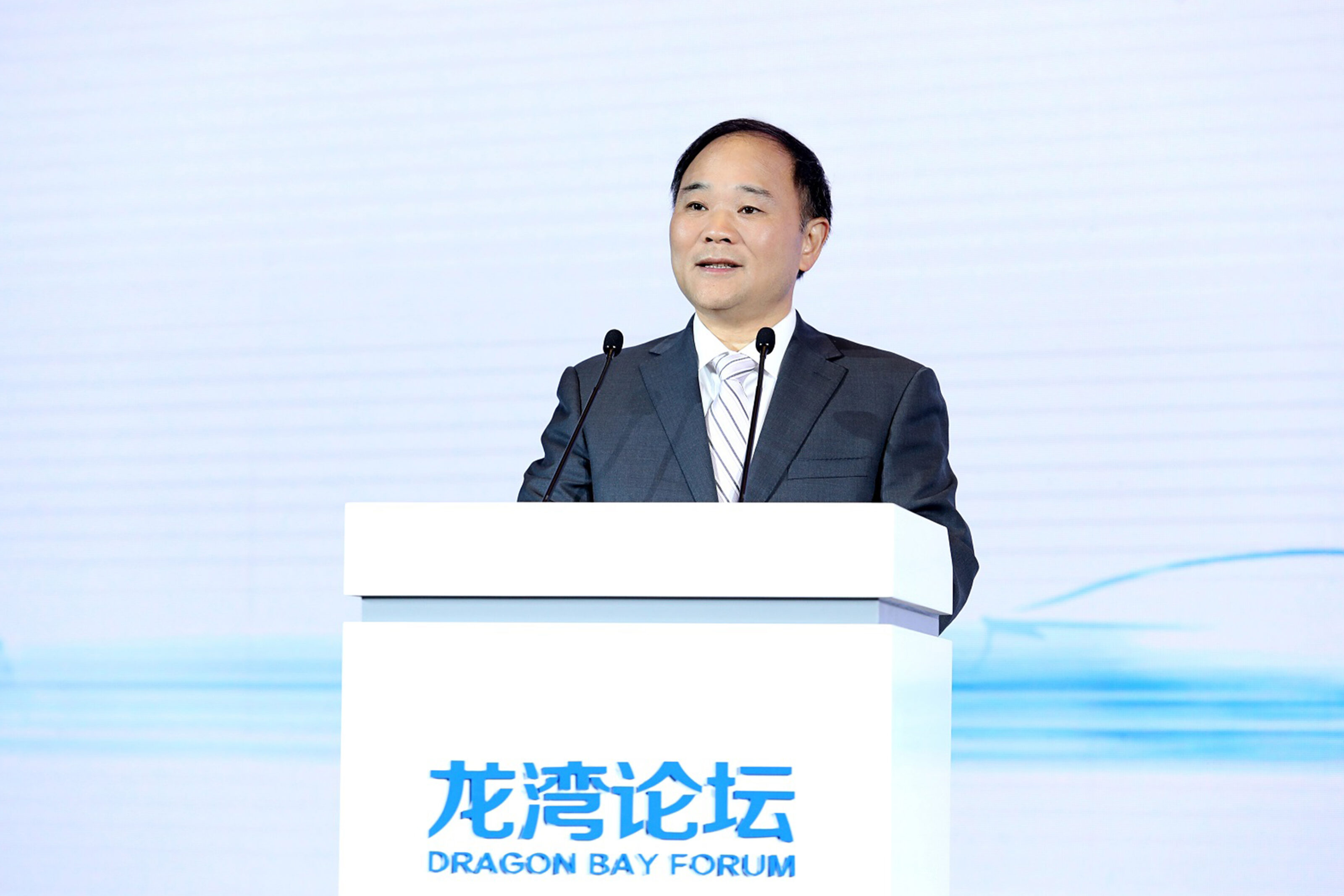
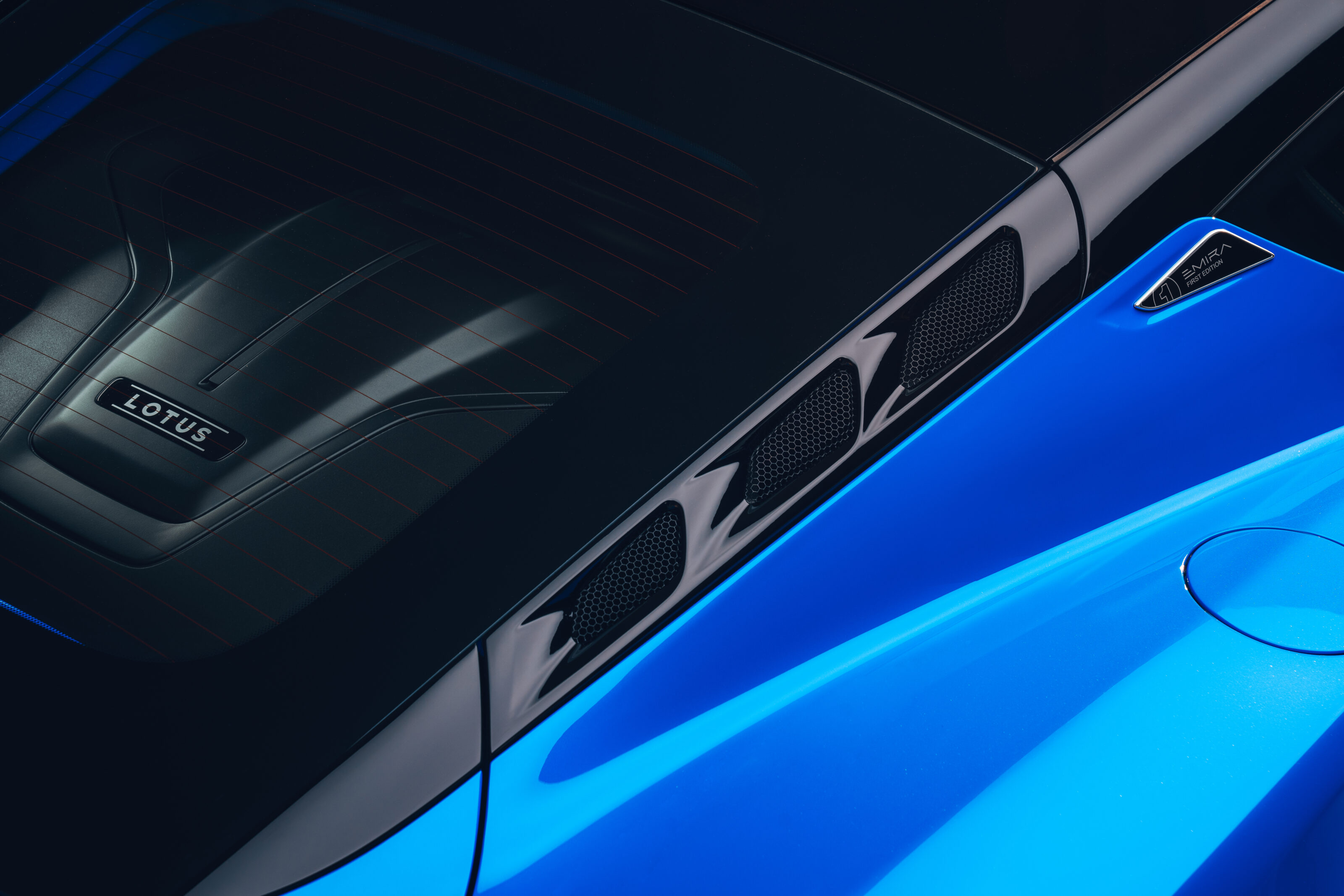
The new Lotus Emira is a first step. Though its chassis, body, interior and much of its hardware are all different from what Lotus insiders call the three Es – Elise, Exige, Evora – the Toyota-sourced 3.5-litre V6 with its six-speed manual or six-speed automatic has been carried over. But Geely’s ownership has unlocked a new engine supplier: Mercedes-AMG (Li Shufu is Daimler AG’s single largest shareholder, having acquired a 9.69 per cent stake in the company in 2018). The potent AMG-developed turbocharged 2.0-litre four-cylinder engine, codenamed M139, and its AMG-tweaked eight-speed dual-clutch transmission will power an entry-level version of the Emira due in the middle of 2022. And it will play an increasingly important role in Emira through the rest of the decade, not the least because the Toyota V6 cannot be made to meet the proposed Euro 7 emissions regulations expected in 2027.
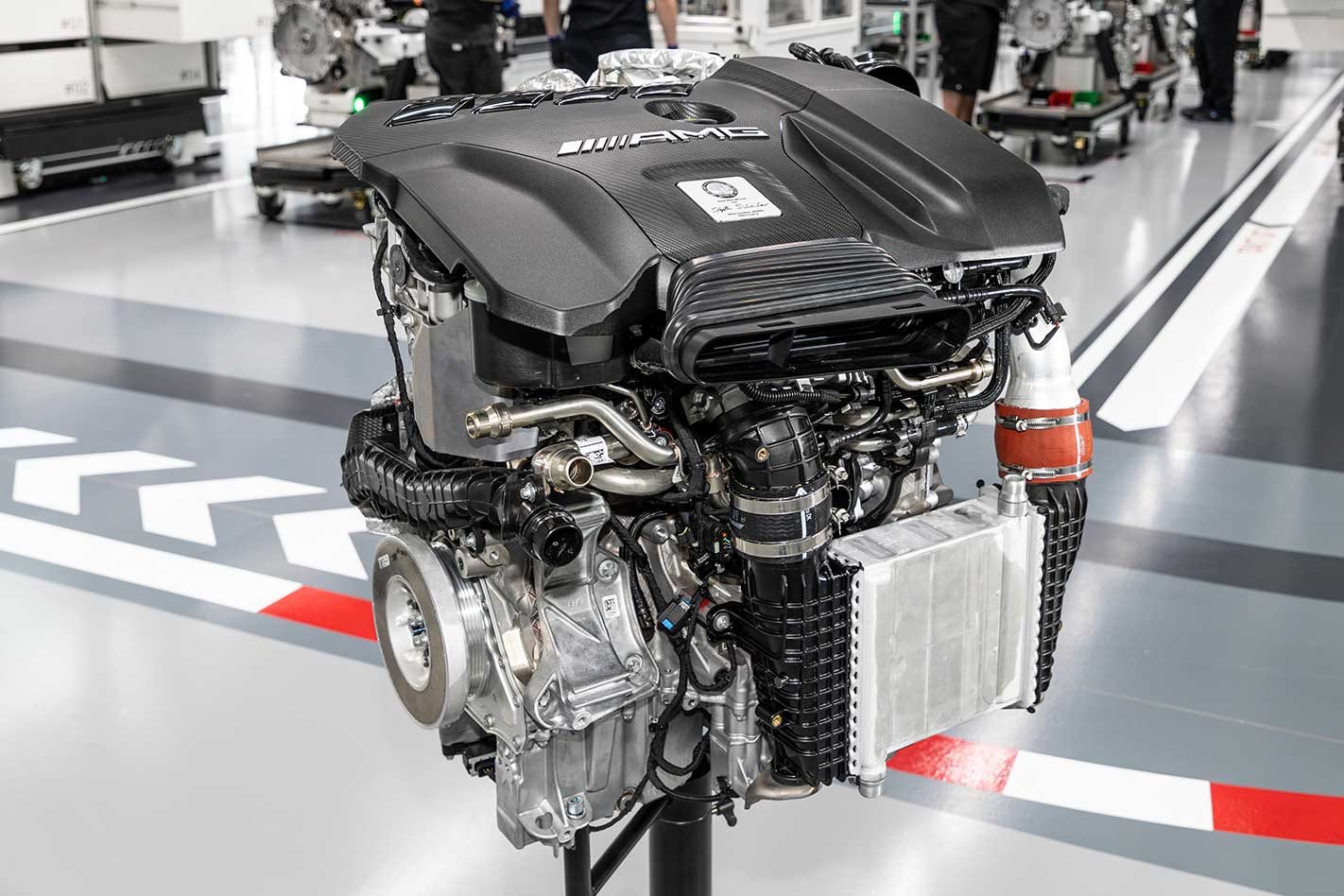
“The V6 is the engine that we know and we’ve lived with for a long time now,” says Lotus managing director Matt Windle. “It’s a great engine and fits really well in the car. But we wanted to offer something else as well – lower emissions, lower capacity – matched with a dual-clutch transmission. I think matching the M139 with our chassis is a winning combination. We’re really excited about that car.”
Lotus vehicle dynamics chief Gavan Kershaw agrees. “I love the V6,” he says. “I’ve grown up with it, and it’s got a really strong character – the throttle connection and the sound, with a manual transmission and an LSD. But you jump in the four-cylinder Emira and it feels super modern and very strong in performance. It’s like being back in my GT4 race car.”
Matt Windle admits the M139 engine currently doesn’t meet Euro 7, either, but says Lotus will work with AMG to get it compliant. Although Mercedes-Benz has just announced that even its AMG-branded vehicles will be EVs by 2030, helping small manufacturers with internal combustion engines for niche markets promises to be a nice sideline: Aston Martin boss Tobias Moers has already declared his intention to work with AMG to make its versatile 4.0-litre twin-turbo V-8 Euro 7 compliant so he can keep building Astons with the engine.
The potent AMG-developed turbocharged 2.0-litre four-cylinder engine, codenamed M139 will play an increasingly important role in Emira through the rest of the decade
Though Lotus has, like Volvo, announced it will be building nothing but electric cars by 2030, that doesn’t necessarily mean the end of the Emira. “If there are markets that want it, we might build the car,” says Windle, “or somebody else might build it for us. There’s also a lot of interest in licensing Elise, Exige, and Evora, so there might be interest in licensing Emira when we get to that stage.”
Reading between the lines, then, don’t be too surprised if a version of the Emira, possibly restyled and wearing a different manufacturer’s badge, is being built in China after 2030. That said, as far as Matt Windle is concerned, the future of Lotus is 100 per cent electric. “I don’t need to sell the Emira platform,’ he insists. “I’ve got a business case that pays back what we need. If somebody comes along and wants to license it, that’s extra.”
A big part of Windle’s remit is to grow the Lotus Engineering business. Lotus Engineering’s past portfolio has included pioneering work on active suspension and helping General Motors create the original quad-cam Corvette ZR1. In 2009 it showed how Toyota could pull up to 38 per cent of the weight out of its Venza crossover. But in recent years the business had dwindled to little more than engine testing work for other manufacturers.
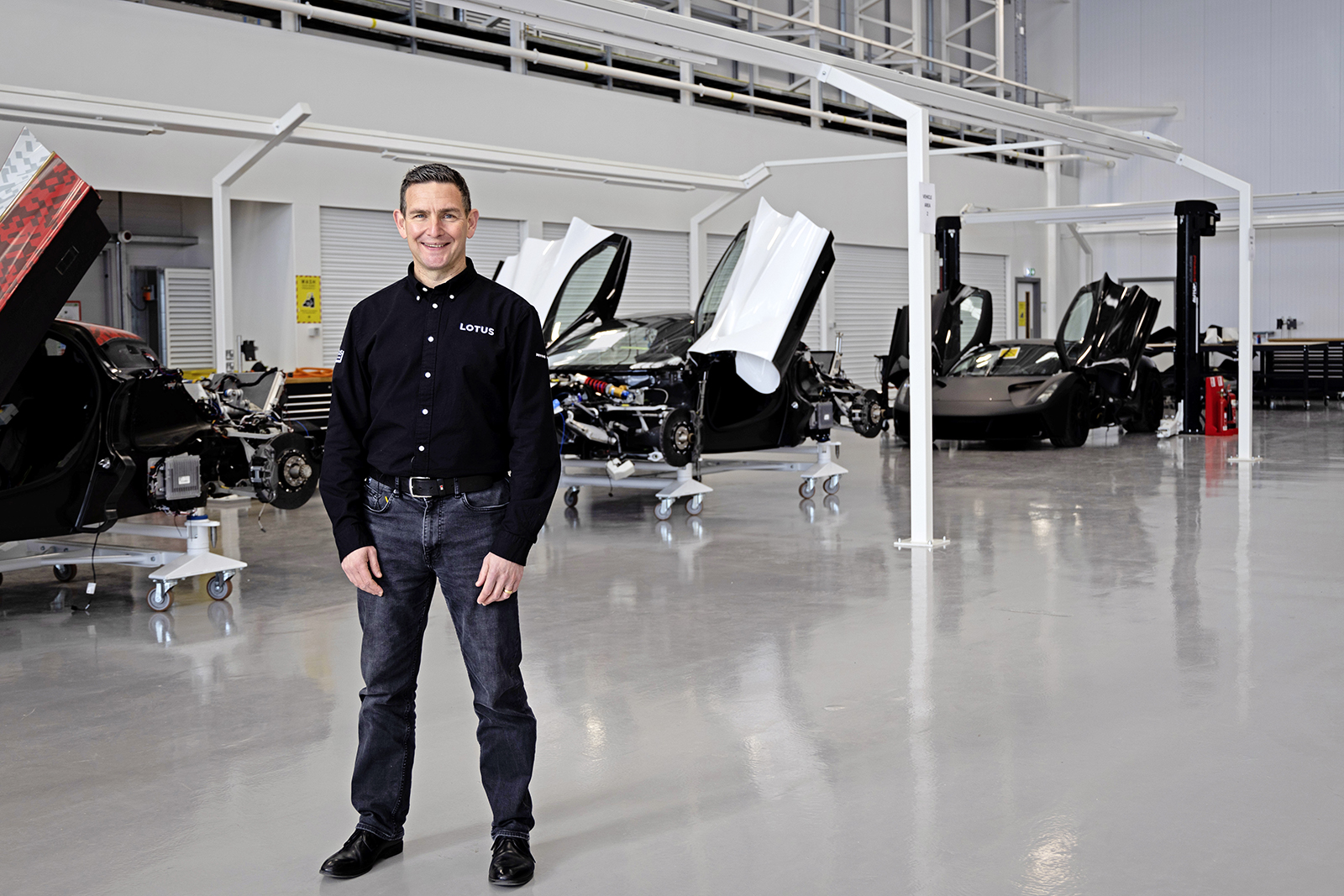
The move to electric power is a key element of the plan to revitalise Lotus Engineering, Windle says. “When we set our Vision80 strategy back in 2017, we convinced Geely that we should invest in our own electric vehicle platforms because we knew we would get to the stage where we’d able to talk to other OEMs about them.” The recently announced memorandum of understanding signed with Renault is a case in point.
Though Lotus and Renault insiders are keeping the details close to their chests, Lotus is developing an electric vehicle platform called ESA (Electric Sportscar Architecture) that will also be used by Renault’s Alpine brand. The platform will be common, but a modular approach to the EV elements – e-motors, battery and so on – will allow each manufacturer to tailor the final product to their own unique specifications. As befits Lotus tradition, insiders say it will be one of the lightest EV platforms yet developed.
Lotus is also working on what has been dubbed the “Lifestyle” electric vehicle architecture. This is completely different from ESA and is being developed to underpin four- and five-door vehicles, including a Lotus crossover. Like ESA, Lifestyle is a modular architecture. But this time the development of the e-motor and battery modules is being done in close collaboration with Geely, which suggests elements of it will also be used in Geely products in China. With its development cost amortised over a much higher volume, this platform could make the crossover one of the most profitable Lotus models in history.
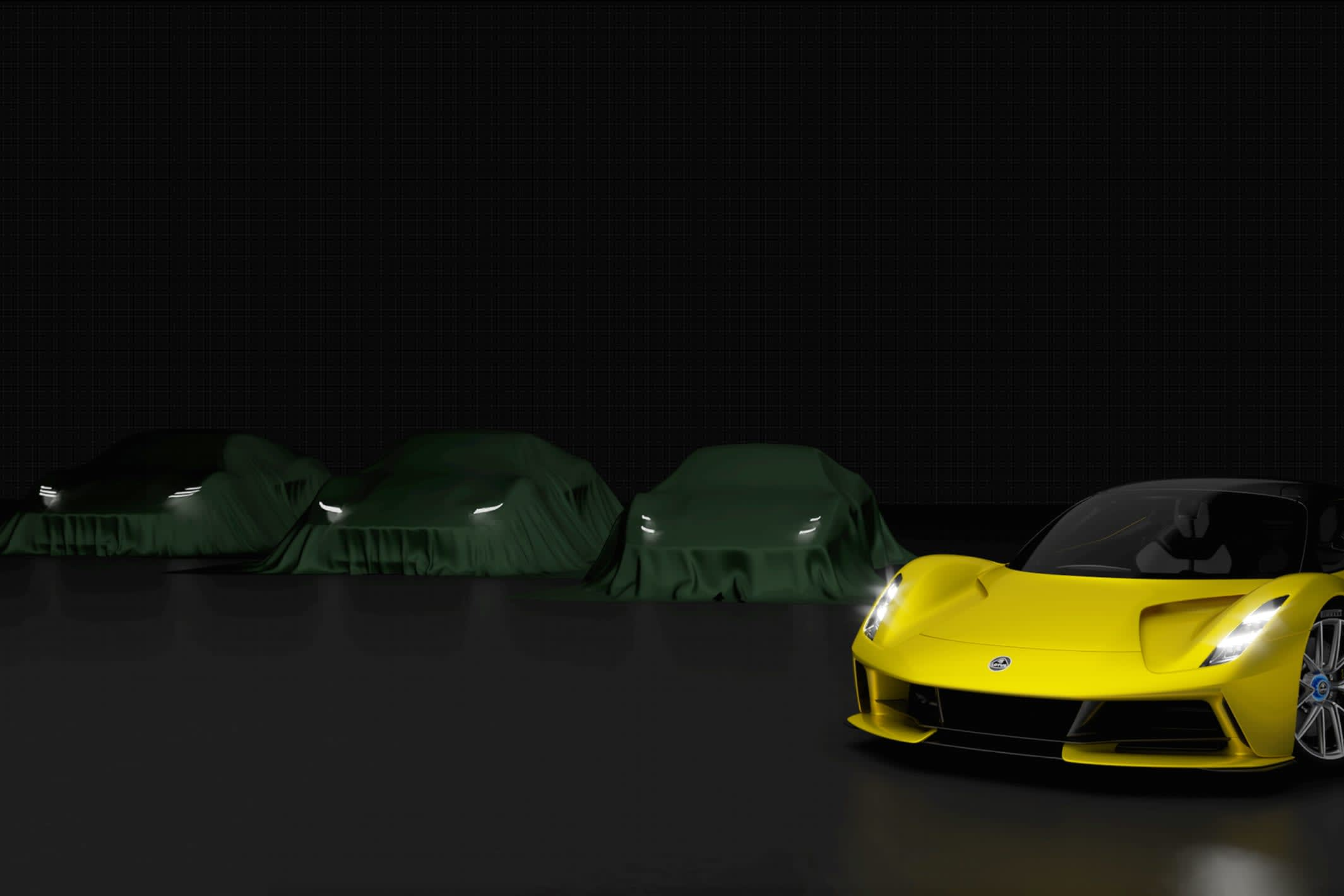
The first electric Lotus to hit the market, of course, will be the Evija, a limited edition, all-wheel drive hypercar with almost 1500kW, making it, says Lotus, the most powerful production car in the world. The $3 million Evija won’t contribute much to the bottom line, however, despite that dizzying price tag. Indeed, at the time of writing, not all the 130 cars set to be built over the next two years had been sold.
Evija’s mission is more nuanced than mere money-making, says Lotus design chief Russell Carr. And its mission statement has come right from the top. “We got a message from Li Shufu [shortly after Geely took a majority stake in Lotus] that he wanted to do a hypercar,” Carr recalls. “He wanted a halo product to reset the mindset – in public about what Lotus was about, and in the company about how hard we should strive. He’s got everyone enthused.”
Lotus is developing an electric vehicle platform called ESA (Electric Sportscar Architecture) that will also be used by Renault’s Alpine brand
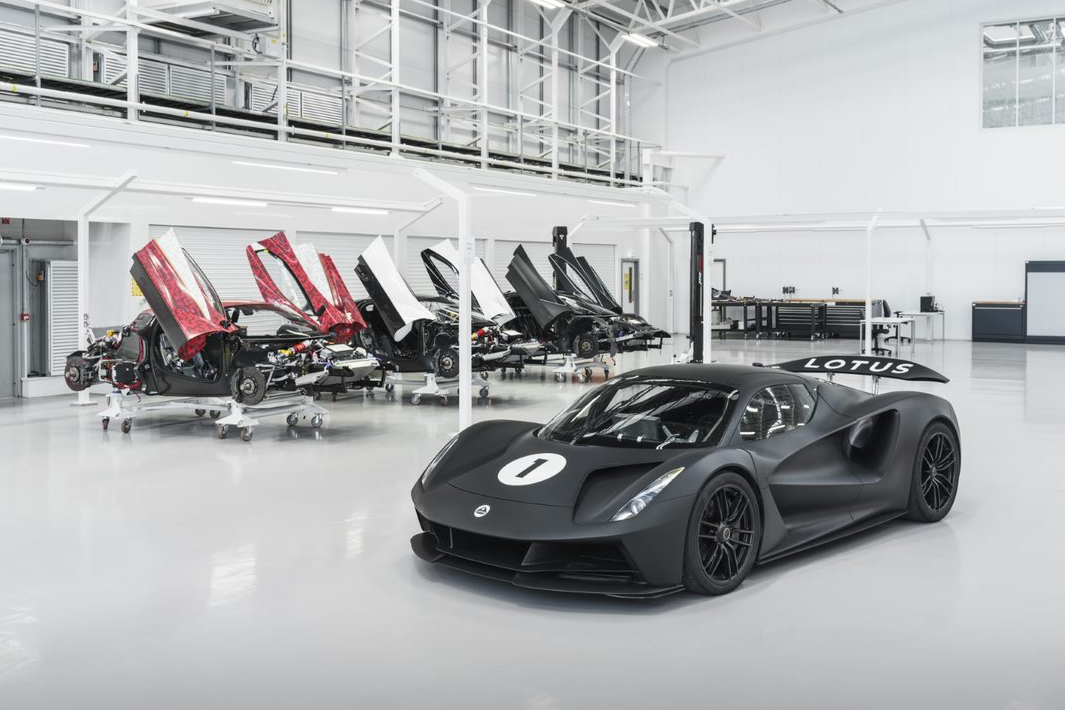
You can feel it at Hethel, the headquarters of Lotus since 1966. Built on what was a World War II bomber base, Hethel is out in the breezy flatlands of Norfolk, 240km east of Birmingham, the traditional hub of Britain’s automotive industry. As such, there’s a faintly defiant otherness about Lotus, and a unique sense of loyalty among its workforce.
“Of the many manufacturers I have worked with over the years, Lotus has been the one closest to my heart,” says Matt Windle, who started his career at Hethel in 1998 as a CAD designer before returning in 2017 as head of engineering.
Gavan Kershaw has worked at Lotus since he was 16, learning his chassis tuning trade from the legendary John Miles, who once raced Lotus F1 cars alongside Jochen Rindt.
And even though there’s now a Volvo company car on his driveway, design chief Russell Carr, who’s worked at Lotus since 2010, has long preferred to drive his personal Evora to work every day, even through winter snowstorms. “I live these cars,” says Carr, who’s just traded his Evora on a bright orange Exige, “so I know what’s good and what’s bad”.
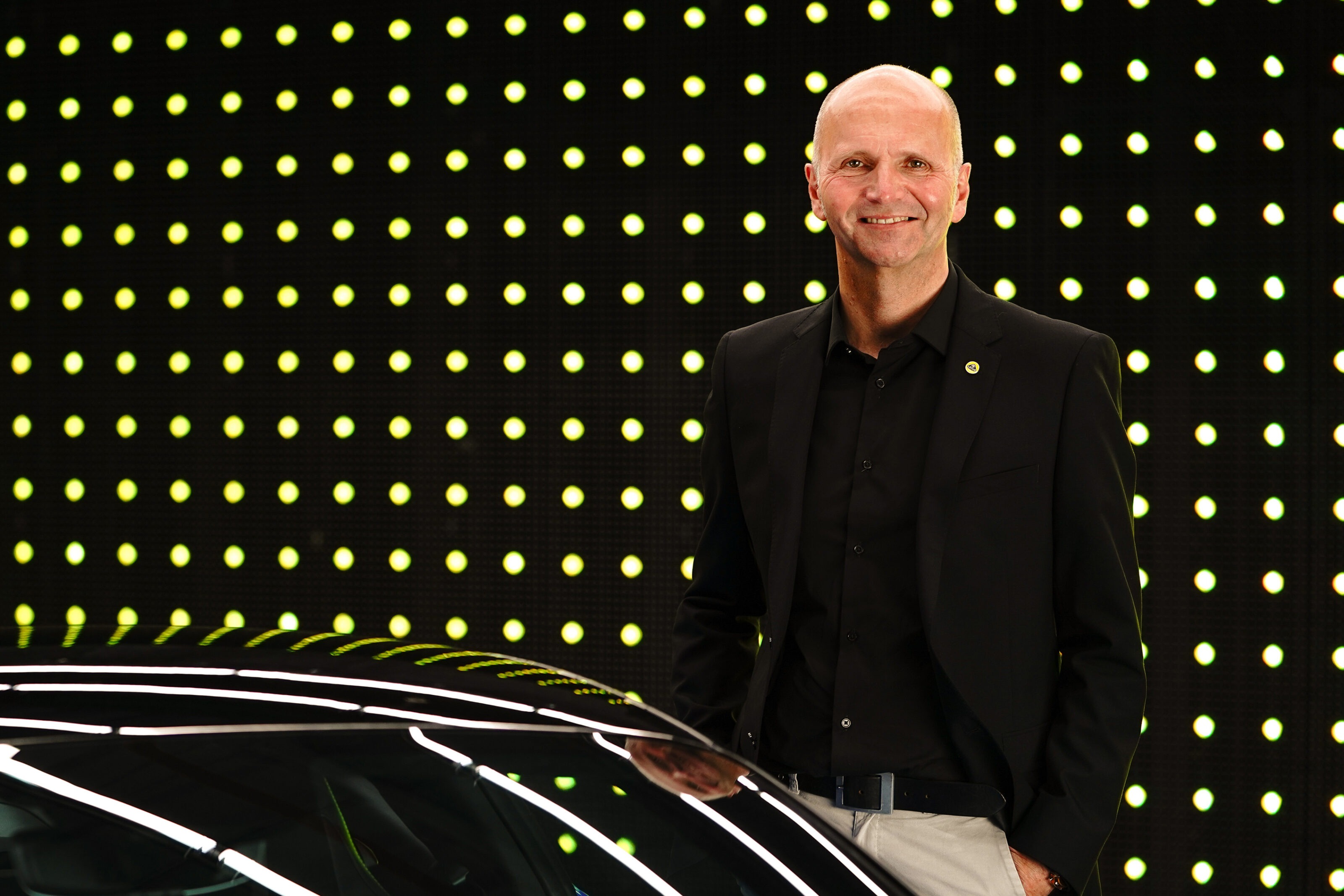
The passion at Lotus for Lotus is undiminished. What’s changed is that passion is going mainstream. Lotus still wants to build cars that are light, responsive, and wonderfully engaging to drive. “We weren’t looking to change the world,” says Kershaw of the Emira. “It’s mature but confidence-inspiring. We’ve kept the car very compliant, it rotates around your hip, and you can feel the efforts build up.” But as the well-equipped Emira shows, enjoying a Lotus no longer means putting up with cars that can be grimly spartan to live with when you’re not pin-balling them from apex to apex on your favourite road or a racetrack.
And for good reason: “There is a larger percentage of Porsche, Jaguar, BMW owners who use their cars every day than Lotus owners,” admits Simon Clare, executive director of global marketing at Lotus. “We want to start attracting people out of Porsche Boxsters, Jaguar F-Types, BMW Z4s so the Emira had to be more practical.” And the new mood at Lotus is certainly expanding the company’s horizons: “America is the biggest sportscar market in the world, says Clare. “The new Corvette definitely comes on to the competitor list in terms of what we are benchmarking.”
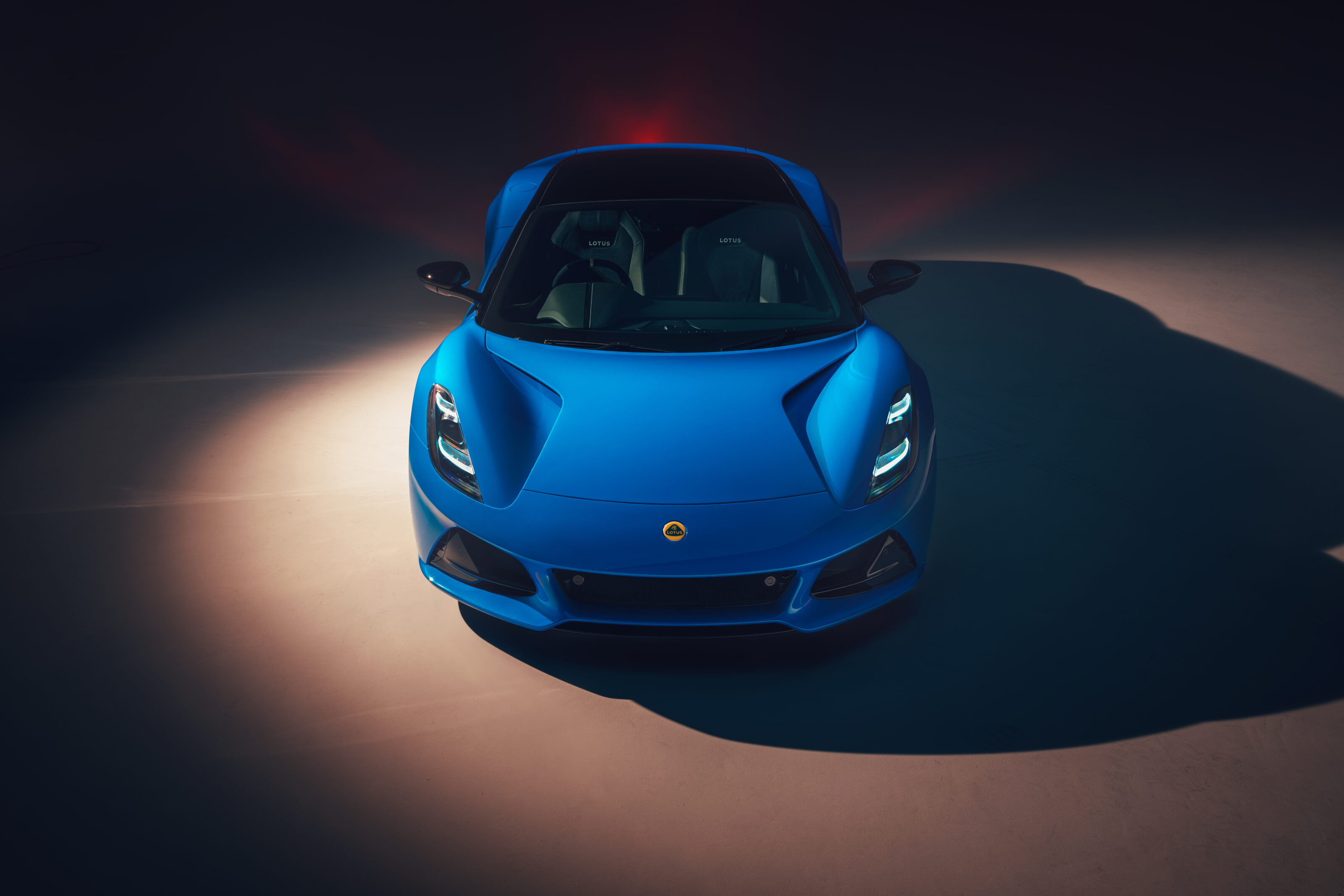
The Emira has been engineered as a global car, and its target is to more than treble global Lotus sales to about 4800 vehicles a year. North America is expected to be one of the car’s biggest markets, accounting for 30 per cent of sales, but Lotus is also looking to Emira to get it into new markets in Asia, as well as markets such as South Africa and New Zealand, where the company’s tiny volumes have hitherto made exports prohibitive.
Despite a planned eight-year life span that makes the 25-year-old Elise look positively ancient, the Emira is likely to be regarded as one of the most consequential Lotus cars since the M100 Elan launched way back in 1989. Like the M100 Elan, and indeed the original Elan that debuted in 1962, the Emira is designed to be a Lotus that can be driven every day, a Lotus that can be enjoyed by a customer group that doesn’t believe owning a sportscar requires stoic acceptance of faults and idiosyncrasies.
If it succeeds, one of Britain’s most iconic sportscar brands will be well placed to prosper in the brave new electric automotive age.
Snapshot
- Heavily armoured vehicle makes 450kW/830Nm
- Priced from u20ac457,100 (AU$731,348) before on-roads
- Marque has been making these kinds of cars since 1928
When Gerard Butler is protecting the US President in whichever city is due to fall next, he’s going to want to be sitting in the Mercedes-Benz S 680 Guard 4MATIC.
The new special edition S-Class, which comes with AWD for the first time, is designed to keep heads of state and business leaders safe, while still experiencing the luxury of Mercedes-Benz’s flagship model.
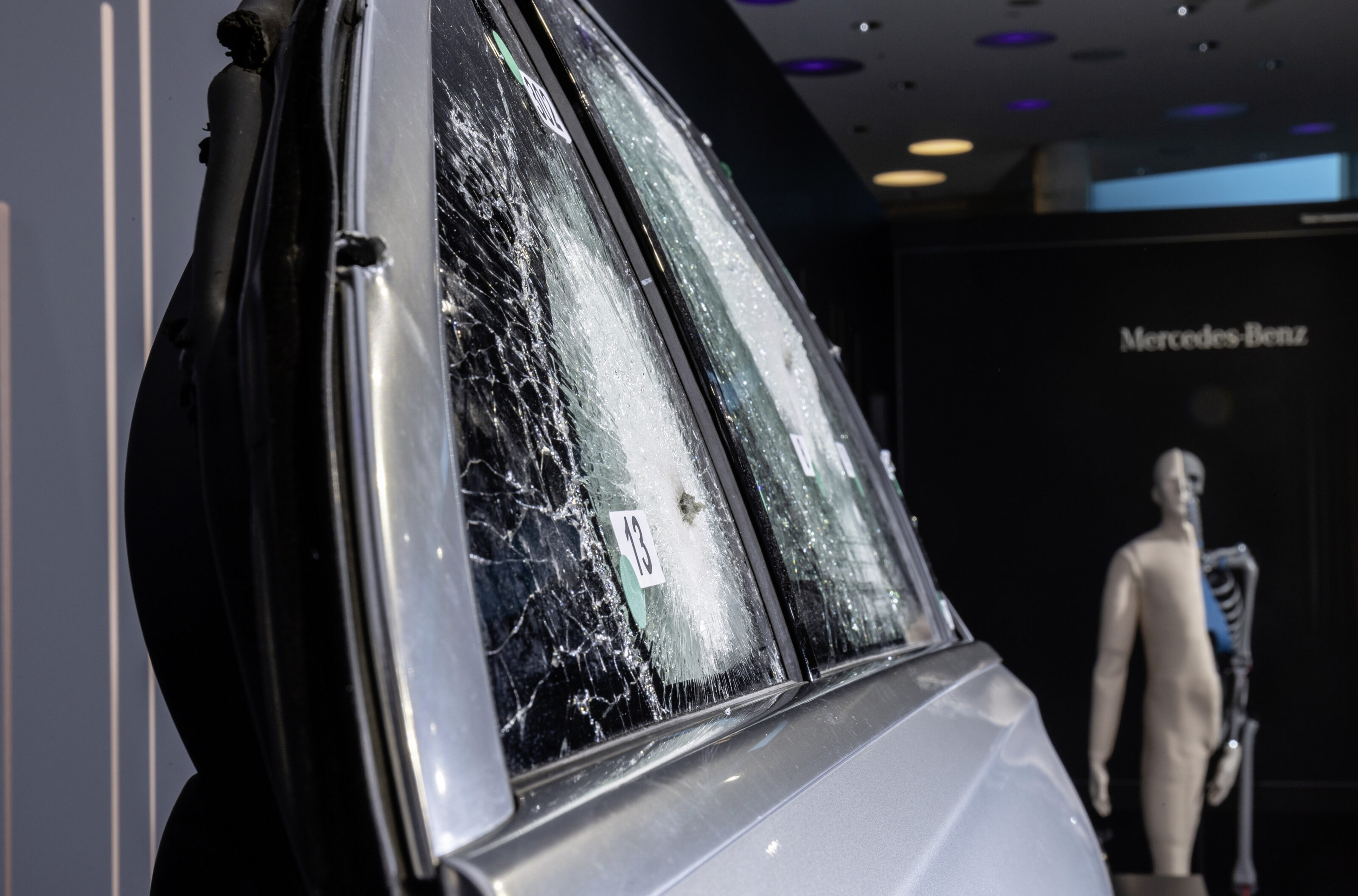
Featuring multi-layer ‘sandwich’ protection glass windows coated with polycarbonate to stop splintering, the unique S-Class meets the highest ballistic test level for civilian vehicles – and apparently is particularly resistant to explosions.
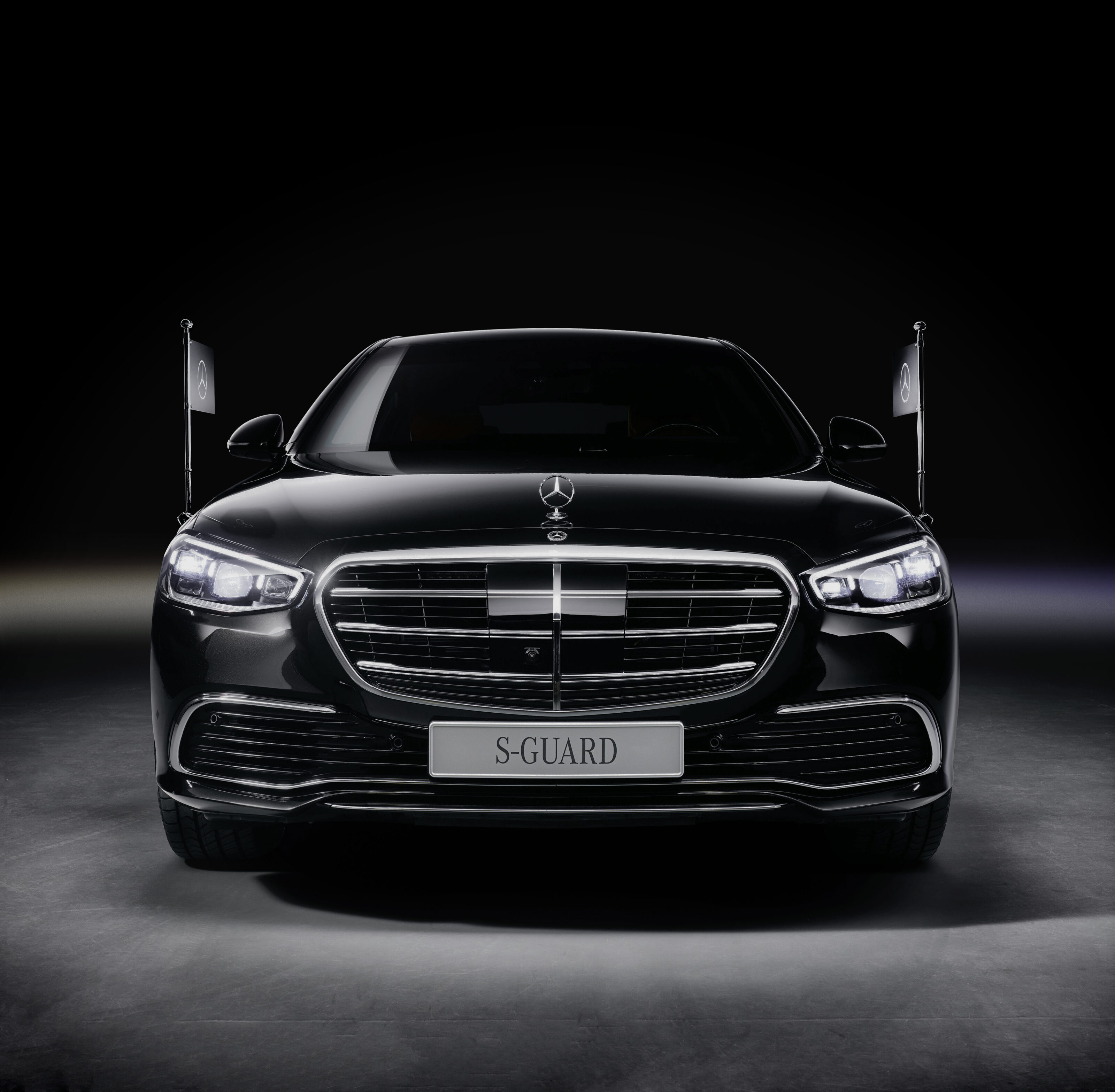
Where the protective materials were previously integrated into the standard structure, this car has been developed with its own specific armoured bodyshell. Coated in an outer later of aluminium, you’d never be able to tell from the outside what lays underneath.
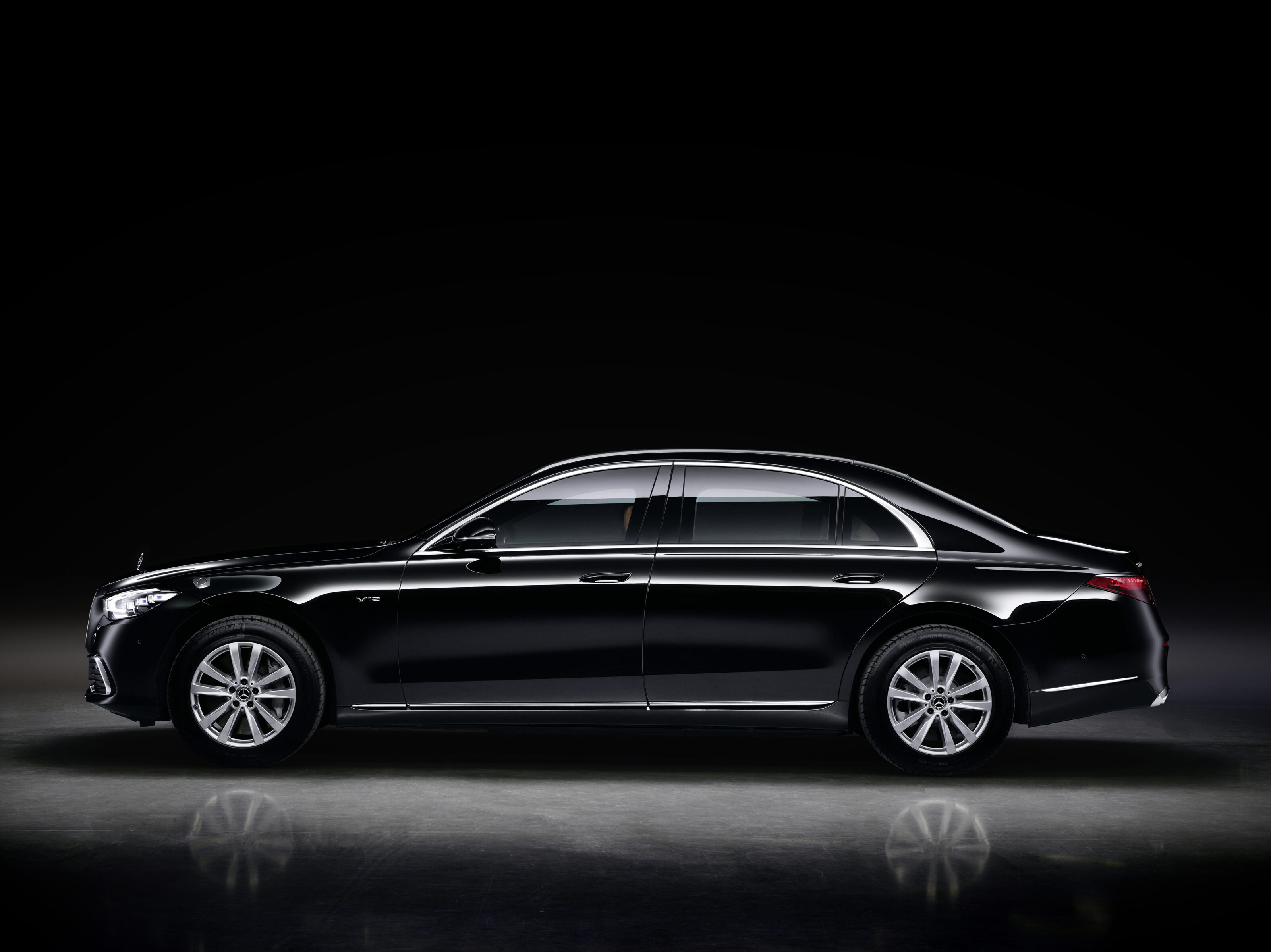
The suspension, engine and transmission have also been adapted to ensure handling which is virtually on a par with any other S-Class.
The interior space too benefits, as Mercedes claims the comfort largely corresponds with the normal long wheelbase S-Class.
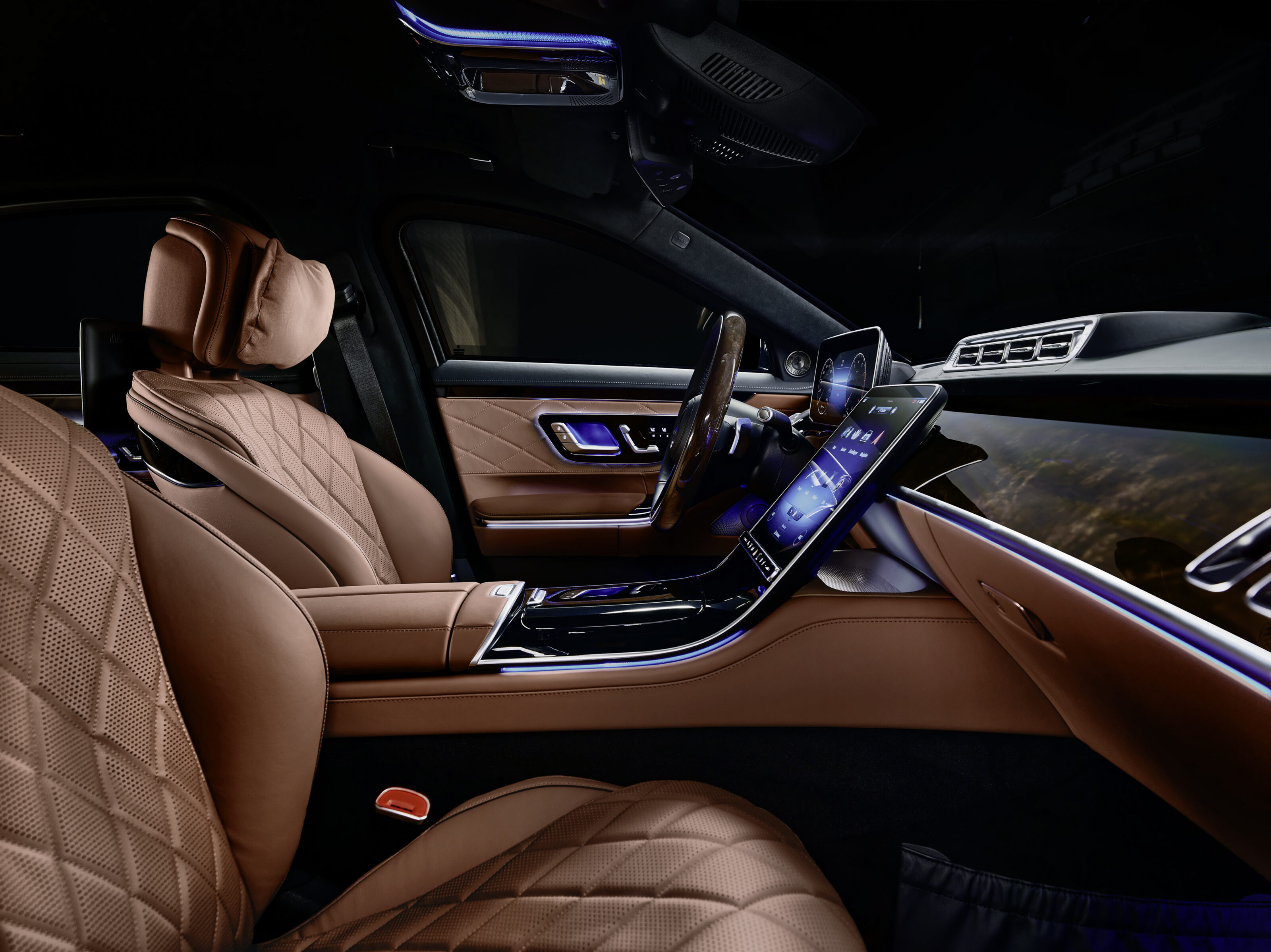
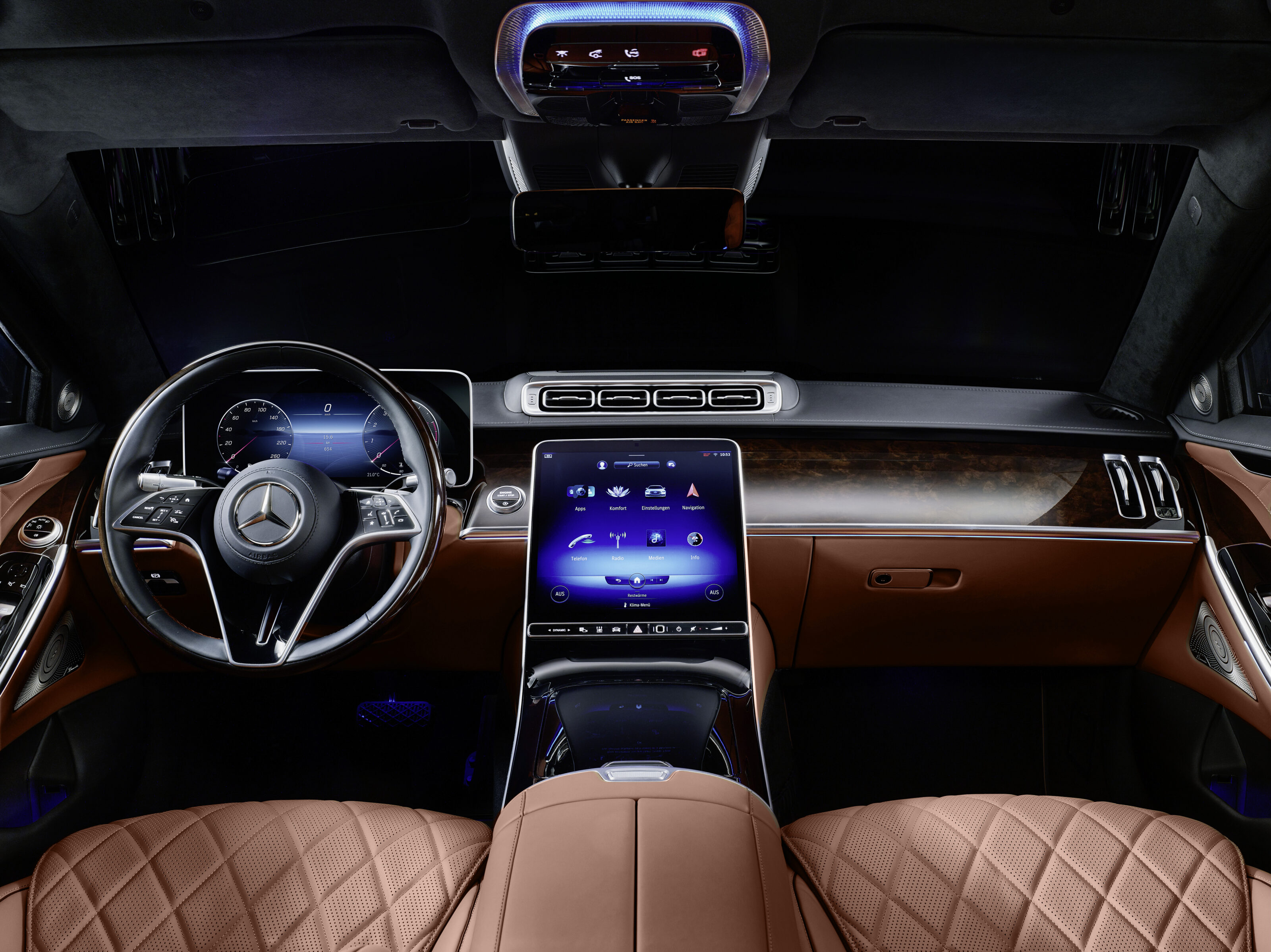
The Guard comes in either four or five seat versions, and like its regular sibling, features active ambient lighting and a media display featuring OLED technology – though optional extras which contradict the protective purpose, such as a sliding sunroof, are not available.
There is also a lot of smarts hiding away in the hydraulically (instead of electrically) operated window lifters. Even if power fails, they can still be closed in the event of an attempted attack.
Other special equipment designed specifically for the S 680 Guard 4MATIC includes; a fire extinguishing system, an emergency fresh air system which protects occupants from penetrating smoke or irritant gases, a siren, flashing lights and radios, as well as a panic alarm system.
The Michelin Pax run-flat tyres are fitted as standard and even when defective, can last up to 30 kilometres – offering plenty of time to get out of danger zones.
The certification by Beschussamt Ulm (Germany’s ballistic testing authority) was carried out for the first time using so-called biofidelic dummies. With bone and soft tissue-like constructions, they imitate the human body particularly realistically.
The new specialised Merc not only meets the testing requirements of the highest civilian protection class for bullet-resistant and explosive resistant vehicles – which need to be able to withstand fire from an assault rifle using armour-piercing ammunition – it also achieved top scores in all tests.
The S 680 Guard is powered by the familiar V12 (M279) engine making 450kW/830Nm, while the exhaust gas turbochargers, exhaust manifold and air ducting have all been adapted to suit this special variant.
Also new is a closed-loop petrol-engine particulate filter. According to the German carmaker, the most important features of the engine include; an all-aluminium crankcase, a one-piece chain drive, a forged crankshaft made of high-quality quenched and tempered steel, forged pistons and a multi-spark ignition system with twelve double ignition coils.
The standard torque distribution for this model is 31 per cent to the front axle and 69 per cent to the rear. Among other things, the all-wheel drive was adapted to suit the higher vehicle weight of the Guard with stronger side shafts. Speaking of weight, it brings the rated fuel economy up to a thirsty 19.5L/100km.
Priced from €457,100 (AU$731,348) before on-roads, it will celebrate its world premiere at the IAA in Munich later this month.
This isn’t the first armoured car to come out of Stuttgart, Mercedes-Benz has been building special protection vehicles since 1928. It started with the Nürburg 460 model, when Daimler-Benz became the first company to begin factory-fitting saloons with special protective features to shield the occupants from gunshots and explosives.
Mercedes-Benz also developed specially protected variants of subsequent luxury-class and prestige vehicles such as the “Grand Mercedes” 770 and the 500 model. The Japanese Emperor Hirohito personally chose an armoured “Grand Mercedes” as a befitting vehicle for his own use in 1935.
Many politicians and heads of state followed the emperor’s example, and from 1965 onwards, the company offered numerous models with special protection.
In addition to the Mercedes-Benz 600, offered as a Saloon and Pullman Saloon, these included V8 models of the S-Class in the 1970s and 1980s – such as the 280 SEL 3.5, the 350 SE/SEL and 450 SE/SEL as well as the 380 SE/SEL to 560 SEL.
In 2016, the company presented the Mercedes-Maybach S 600 Guard, the first model to meet the highest level of protection for civilian vehicles with resistance class VR10.
A mid-size SUV is generally not a pulse-racing prospect. Conservative but handsome lines, a well-thought-out interior, a sensible number of specifications ranging from, “oh, that’s not bad” through to, “oh, why not, I’ll treat myself”.
The Tucson epitomised that and did it well for some years. Too many, in fact, because I distinctly recall listening to a dealer saying the Hyundai retail network was “screaming” for a new Tucson.
Hyundai would probably be the first to admit that it probably took a little longer than anyone wanted but then it would just pull one of those big showy drop sheets and show you what a little longer in the oven has meant.
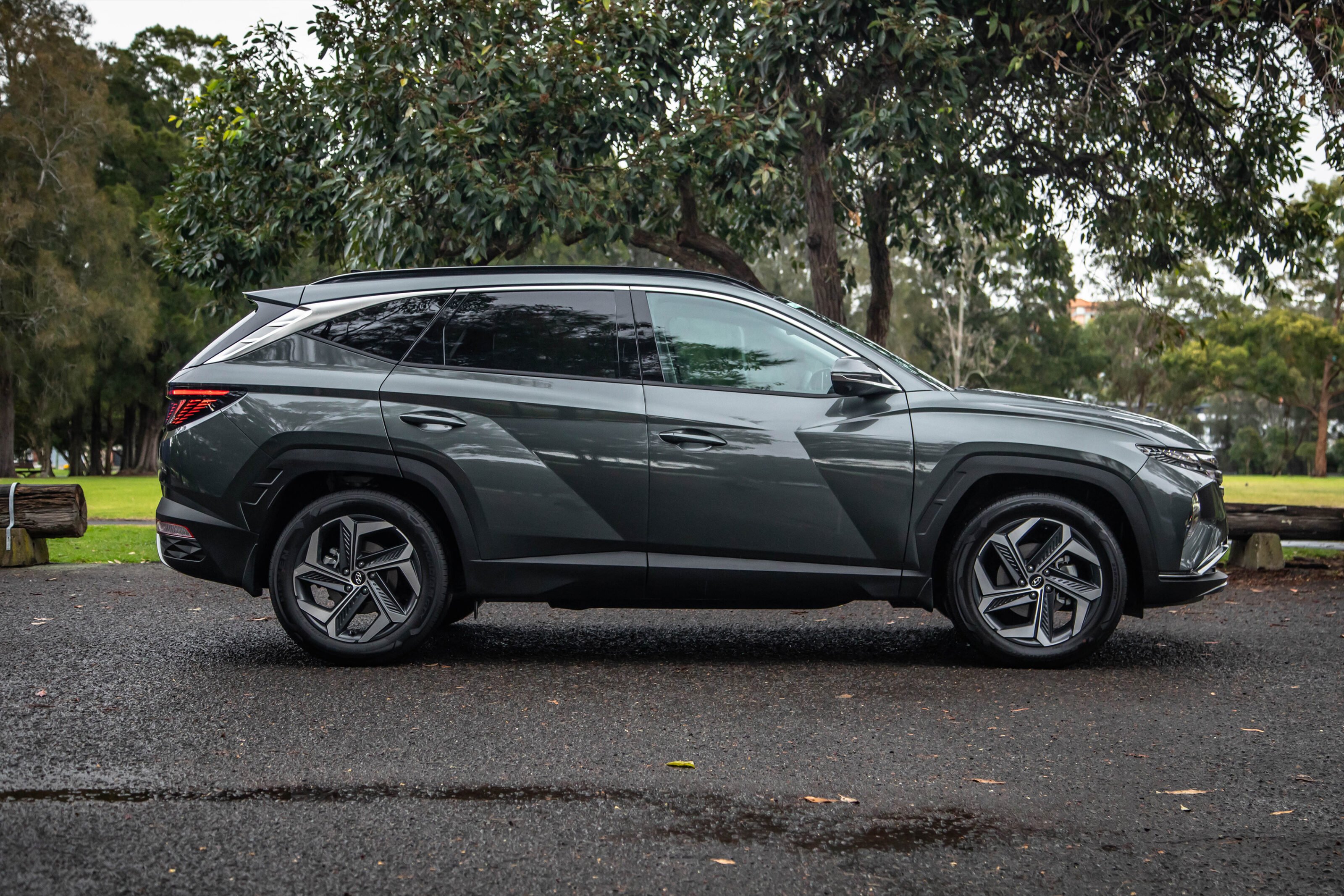
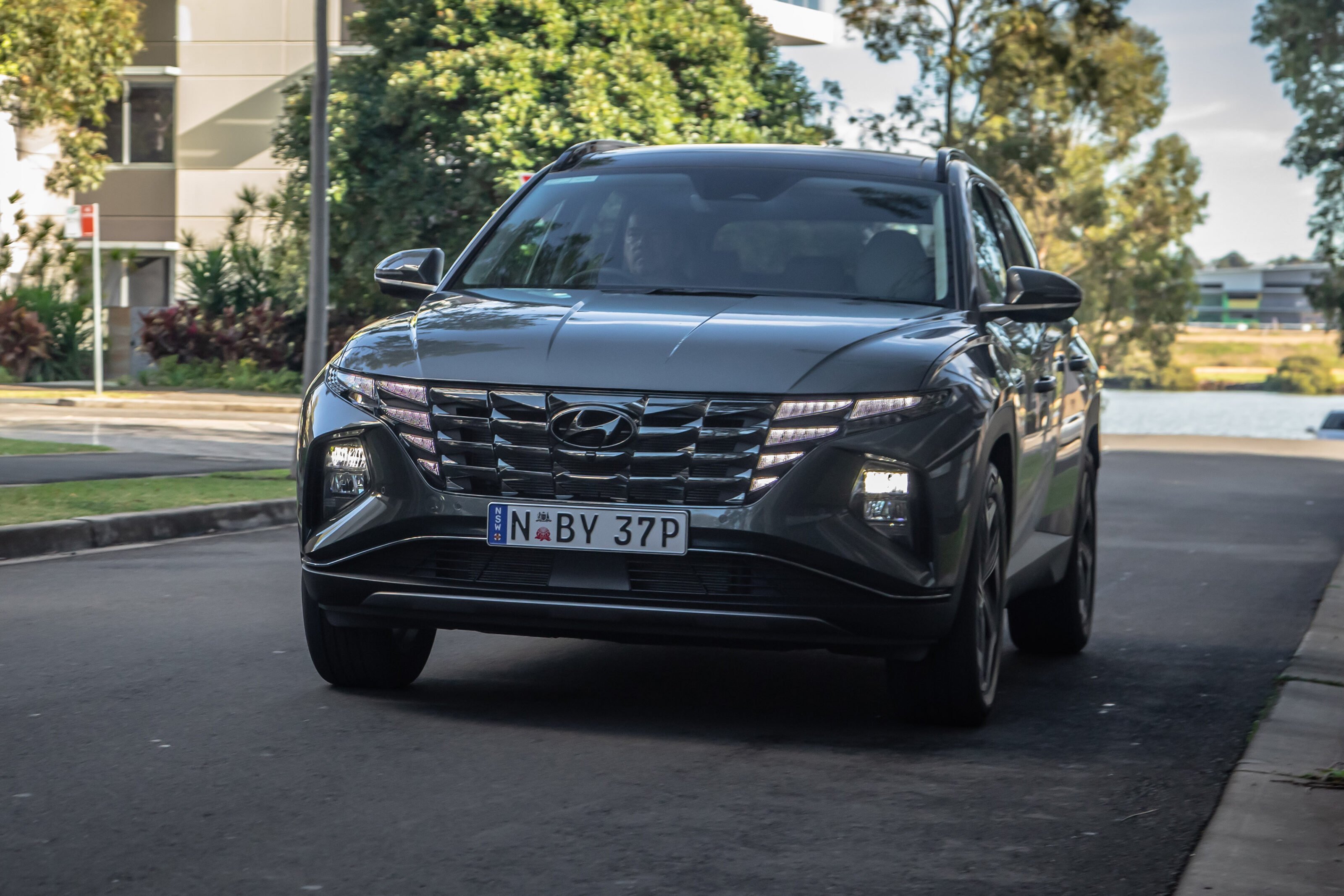
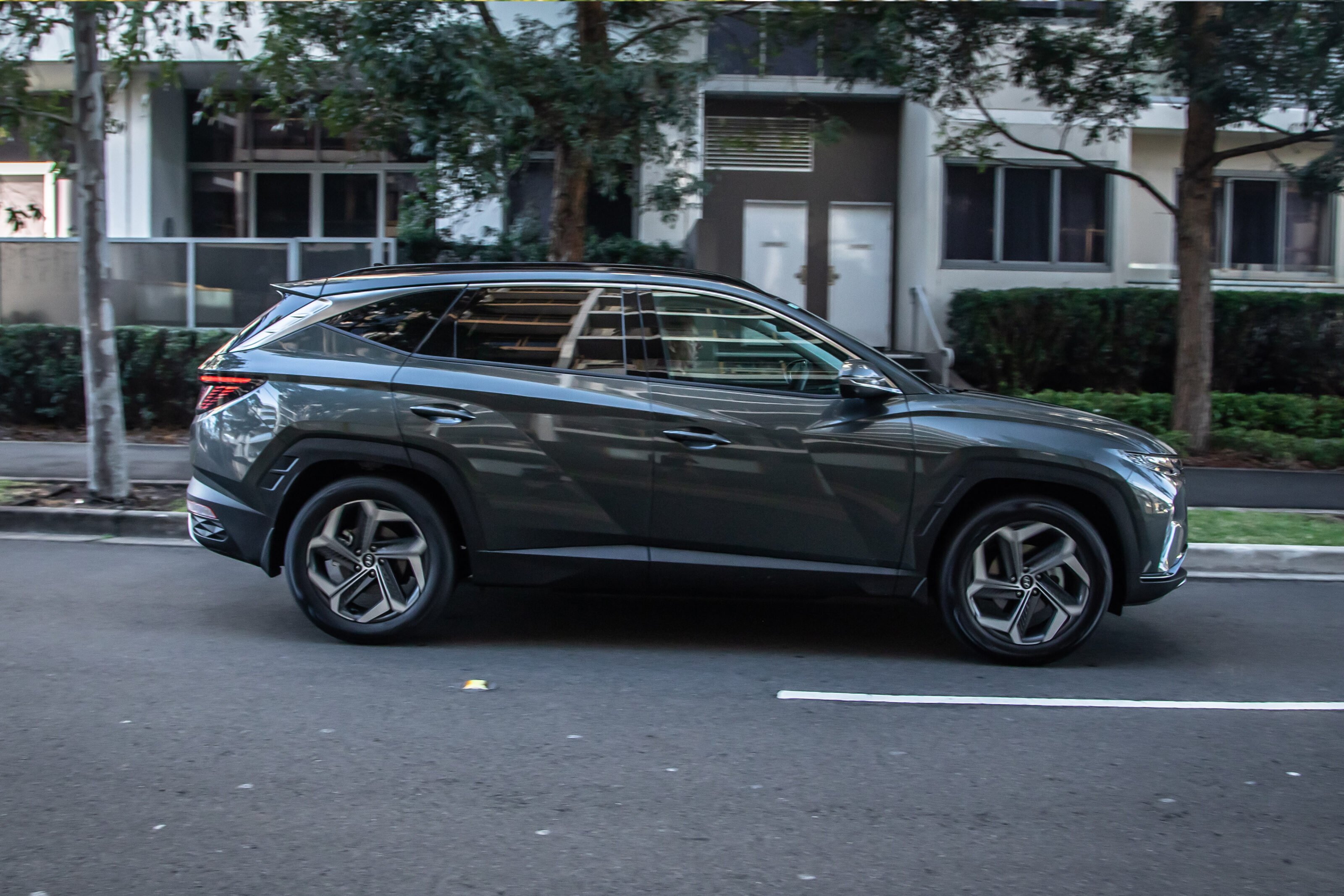
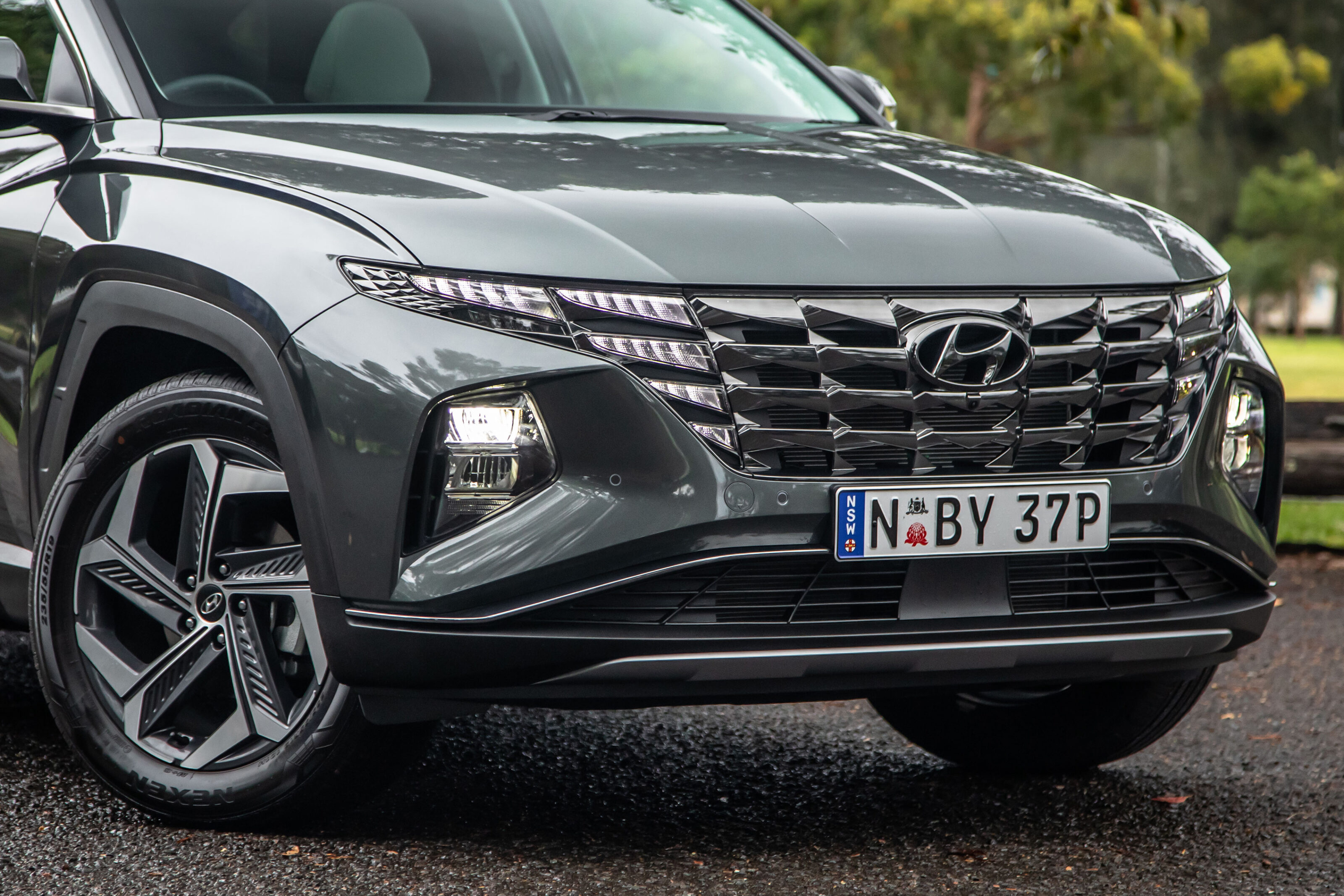
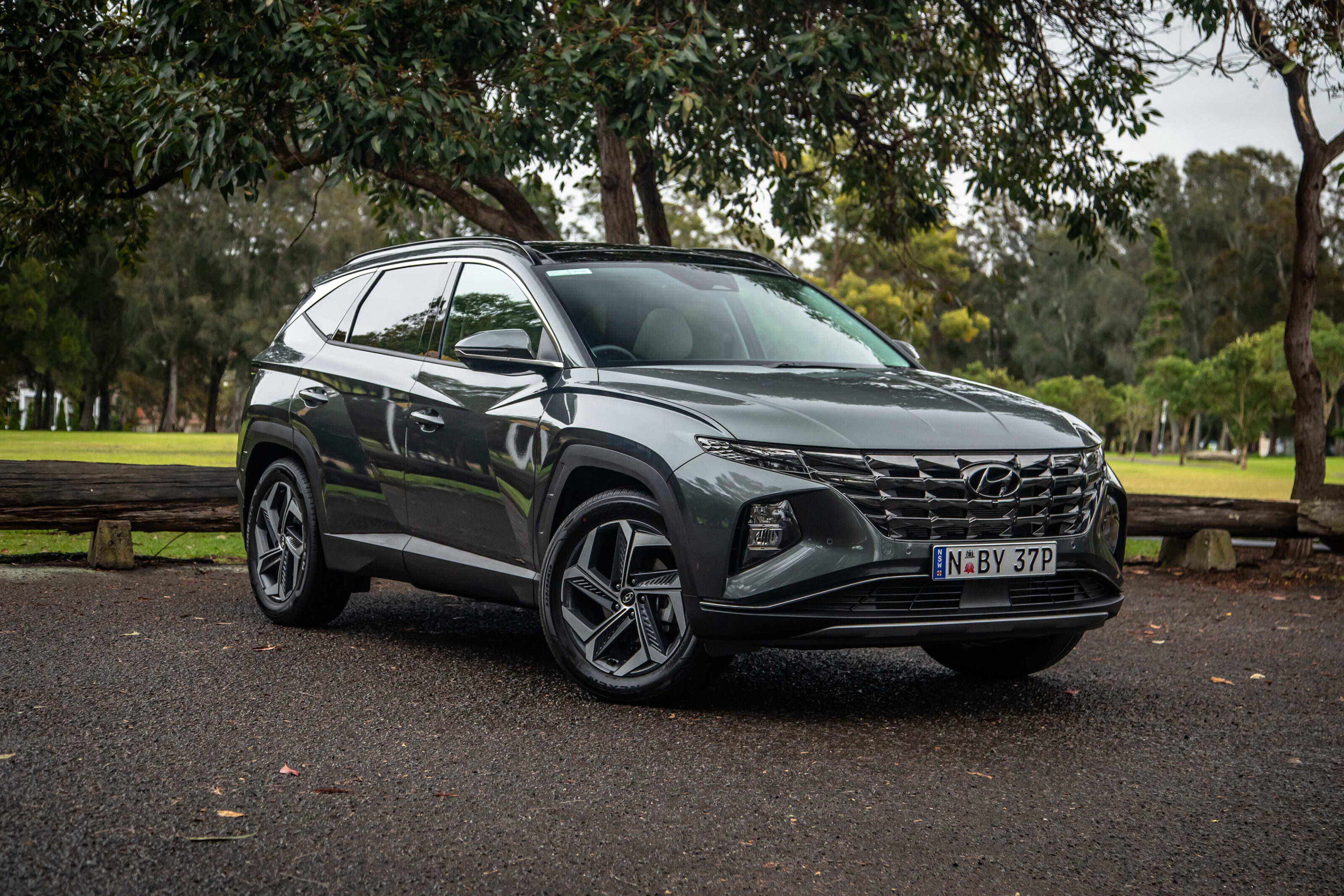
As a result, the new Tucson still covers that range of emotional purchasing responses but adds in a hearty dose of, “hot damn, just look at this thing”. With Luc Donckerwolke at the design helm after stints at various car companies – including, as you may have guessed from the triangles, Lamborghini – the new machine is wild-looking, right down to the wheels.
Hidden LED driving lights that melt into the grille, big Bangle-esque creases and slashes in the side, you can’t miss the new Tucson.
Pricing and Features
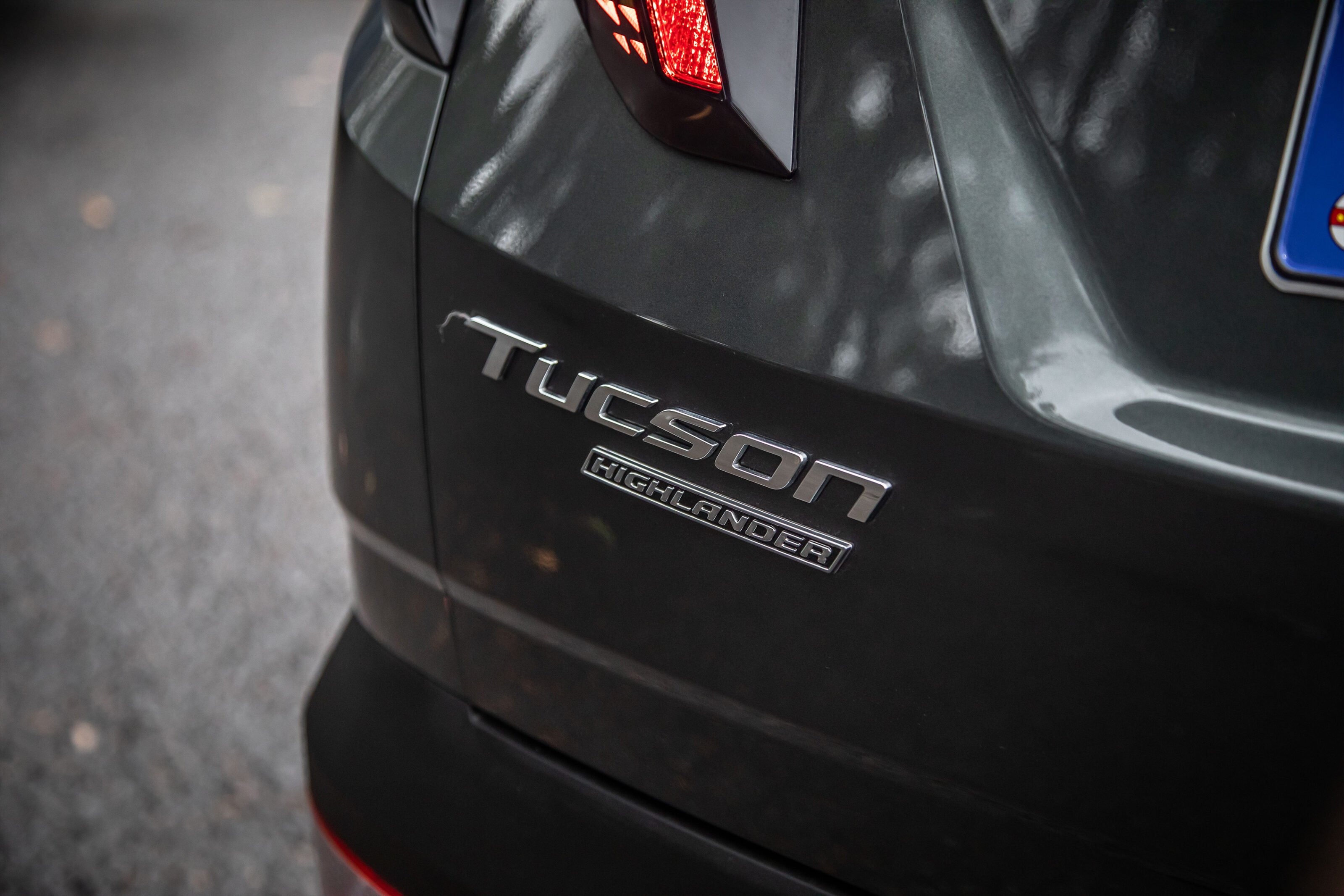
The Tucson now comes in three trim levels, with the top two offering a choice of powertrains, two petrol and a diesel. The top-of-the-Tucson range is the Highlander and you can have it with the 2.0-litre petrol, 1.6-litre turbo or the 2.2-litre diesel.
If you’re wondering where the hybrid or PHEV option is, keep wondering – Hyundai reckons it can’t offer them at a compelling price so, er, isn’t. Toyota is probably fairly pleased with that as two-thirds of RAV4 sales are the hybrid and they’re not made in Europe with expensive Euros to exchange at the airport.
Anyway, the car I’m going to take you through is the 2.0-litre Highlander that retails for $45,000 before on-roads. That’s a bigger number than the 2020 model but there’s a lot more to this new Tucson than the old.
I’d go as far as to say that in some respects, it’s an even bigger jump between the 2020 and 2021 cars than there was between the ix35 and the Tucson. And in other, admittedly fewer respects, not so much.
Your forty-five large includes 19-inch alloys, LED lighting front, rear and inside, eight Bose-branded speakers, 10.25-inch touchscreen, digital dashboard, cameras all around, front and rear parking sensors, active cruise control, electrically adjustable front seats with heating and cooling, heated rear outboard seats, sat-nav, leather seats, power everything and wireless charging for compatible phones.
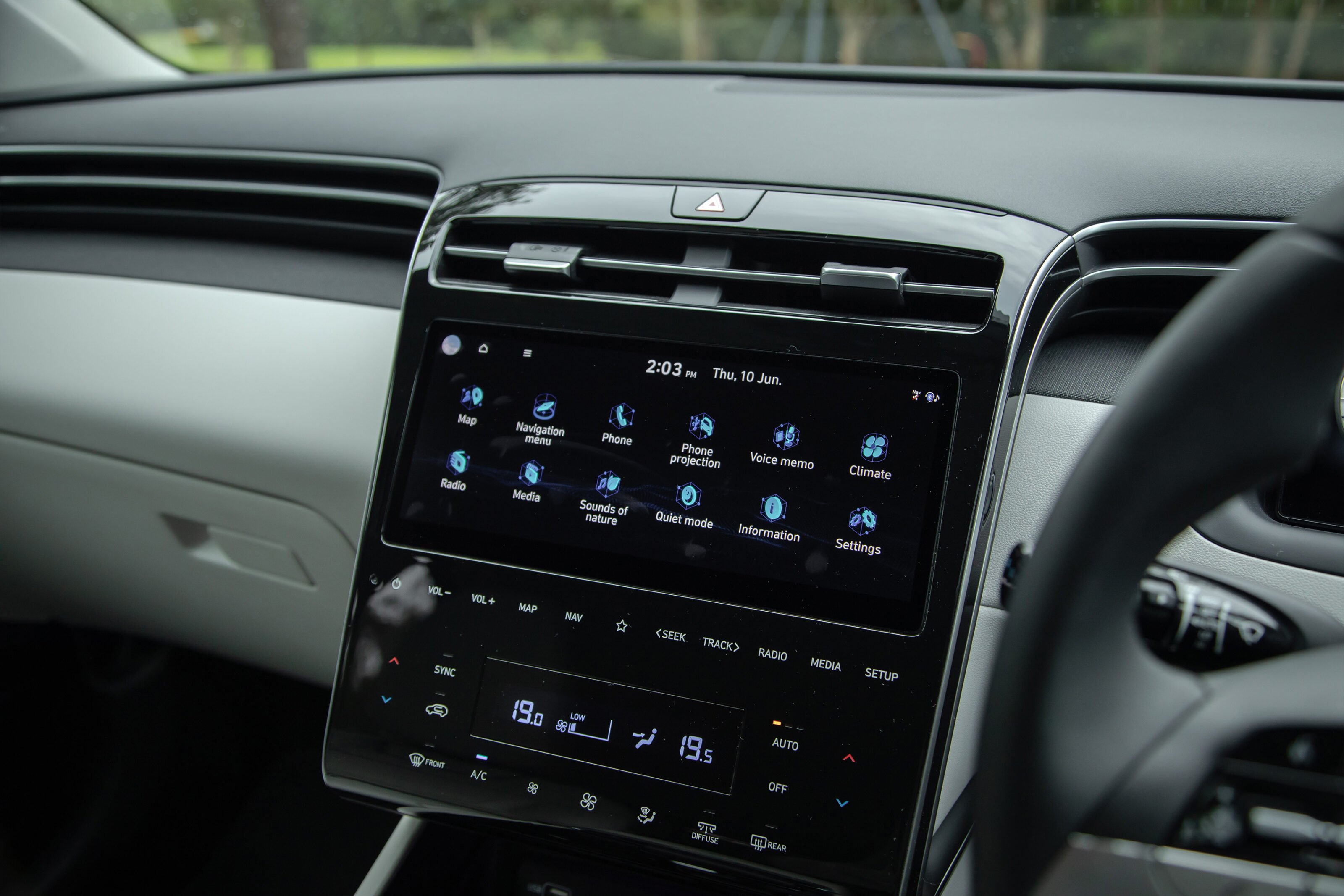
Hyundai’s excellent new media system lives in that big screen along with the satellite navigation, a bunch of clever features like quiet mode, Apple CarPlay and Android Auto (both, infuriatingly, via USB) and DAB+ digital radio.
The stereo is pretty good and I guess the Bose badges mean Bose speakers. I thought the sound was perfectly acceptable but haven’t driven a Tucson without them.
Just one of the eight colours is free (white. Surprise!) while the rest are a fairly annoying $595. Well, annoying when you’ve already dropped $45k.
You can also add the N-Line Pack for another thousand dollars, which just adds some cosmetic frippery, unlike the more expensive pack on the entry-level and Elite grades that adds a lot more stuff like LED lighting already included on the Highlander.
The comprehensive safety package includes seven airbags, ABS, stability and traction controls, forward AEB (10-85km/h for pedestrians and cyclists, 10-180km/h for other vehicles), junction turn assist, rear cross-traffic alert, rear AEB, lane keep assist and blind-spot monitoring. The seventh airbag is a centre front airbag to stop heads clashing in side collisions.
As in the Santa Fe Highlander, the Tucson ships with Hyundai’s Blind Spot Monitor. This system somewhat soothes my disappointment at a fully digital dash not doing much other than changing colour.
When you hit the indicator, a camera feed of the corresponding side of the car replaces the dial on that end of the instrument panel. It’s terribly clever and beautifully integrated.
You also get two ISOFIX points and three top tether mounts for child seats. ANCAP has not yet awarded a safety rating but it will be quite a surprise if it isn’t five stars given the centre airbag and the rest of the safety gear.
Comfort and Space
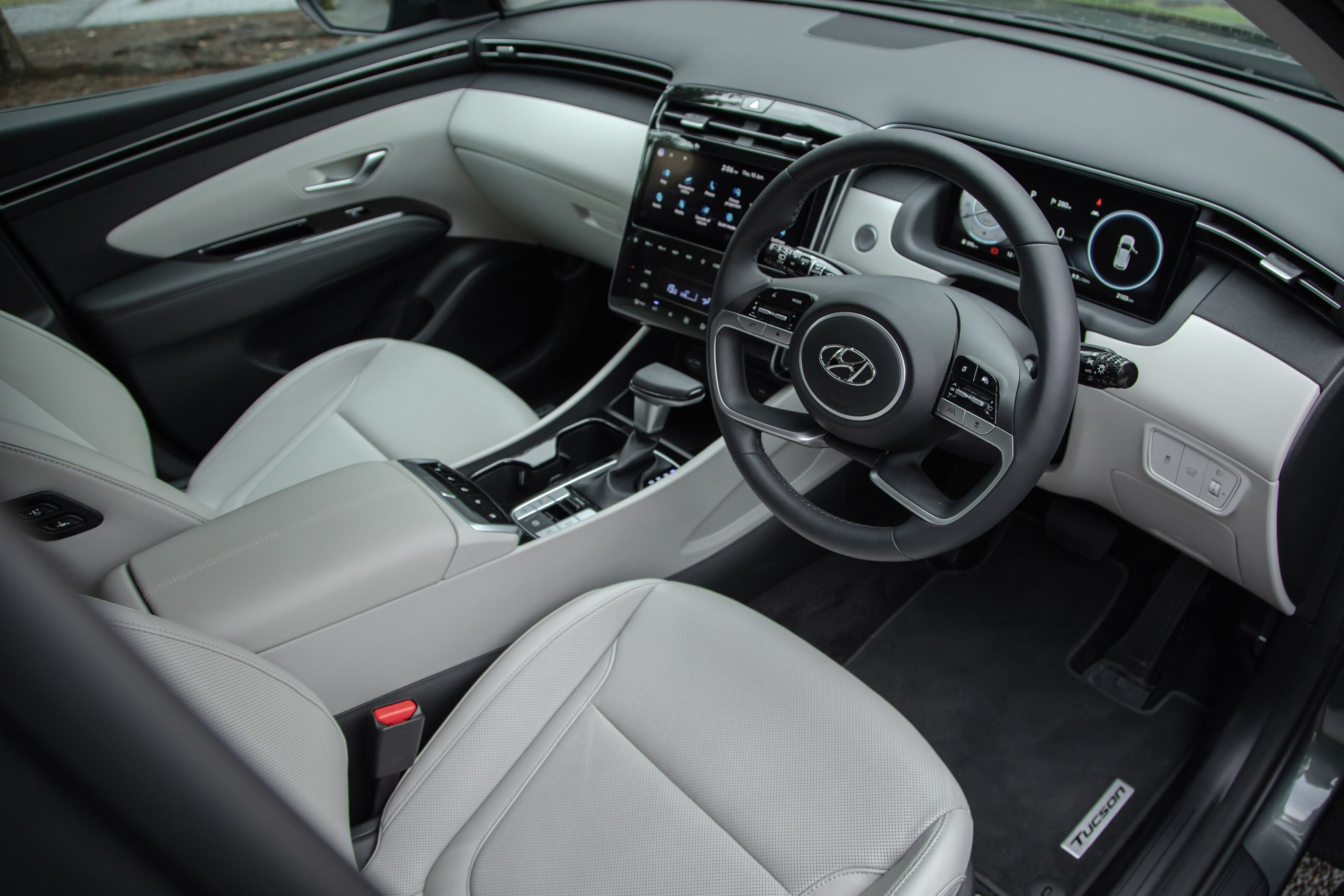
This is a cracker of an interior. When I posted a pic online, my Twitter followers were most impressed before asking if it was as good as it looked. And it is. The light leather looks great (you can also choose brown or black), brightening the cabin no end.
The big touchscreen is surrounded by glossy black plastic and touch-sensitive ‘buttons’. I’m not a fan of the lack of physical buttons but the dual-zone climate controls are physical and very easy to use.
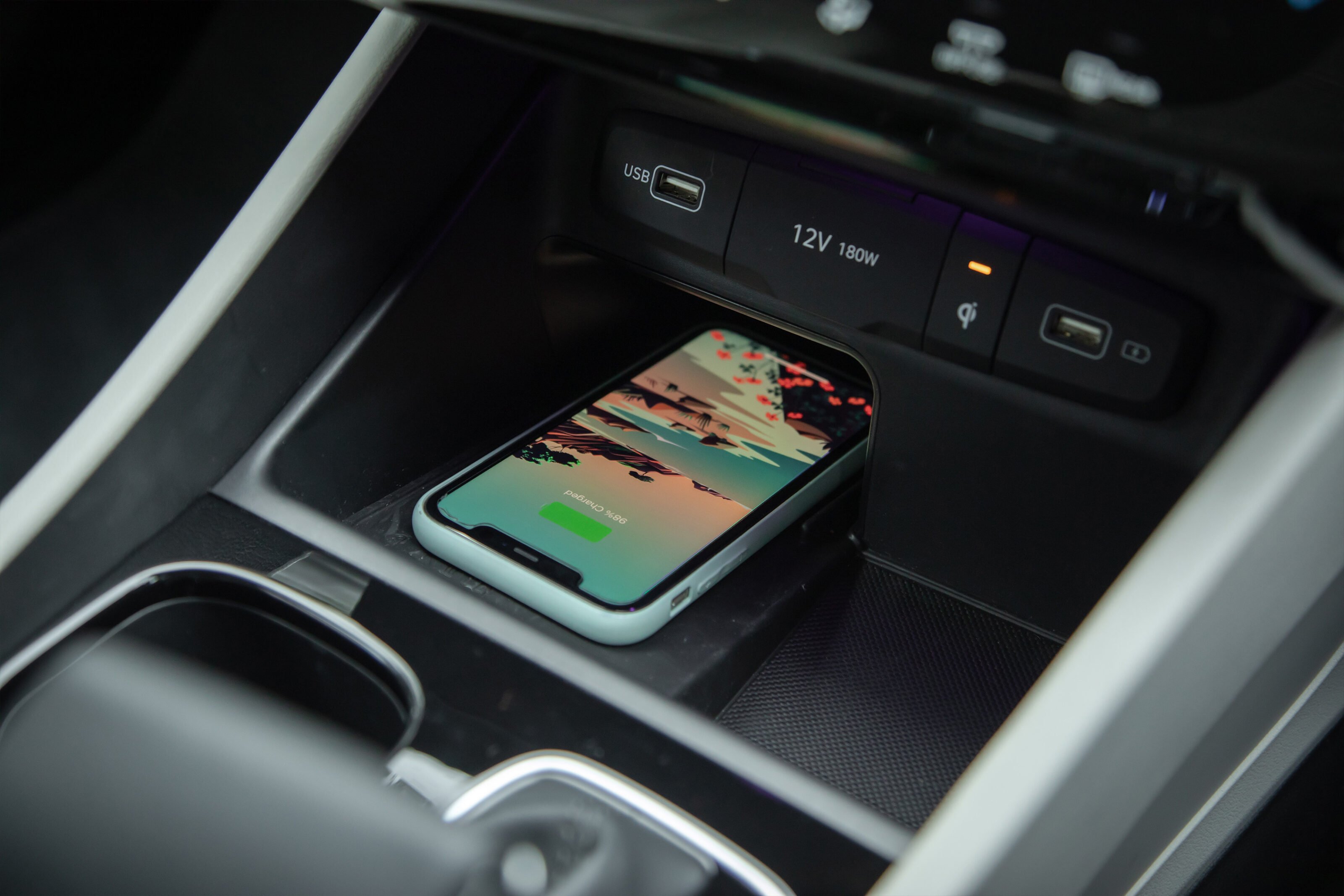
The fantastic looking front seats could be out of something significantly more expensive, echoing the triangle patterns from outside. A few hours in these saddles were no trouble at all, the phone charging in the wireless charging pad, our coffees in the two cupholders and our water bottles in the doors.
Along with the wireless charger, there are two USB-A ports up front and two more in the back. The centre armrest also has a console bin underneath.
This is a cracker of an interior. My Twitter followers were most impressed before asking if it was as good as it looked. And it is.
This new Tucson is bigger and, crucially, has a longer wheelbase. Most of that has gone to looking after rear-seat passengers, who have a ton of room. I can sit behind my driving position – I’m a gnat’s under 180cm – and I have knee room, legroom and space to shove my size tens under the seat.
Even with the panoramic sunroof, I’ve got plenty of head clearance and the seat itself is really comfortable. Storage runs to mesh pockets, two cupholders in the fold-down armrest and bottle holders in the doors.
Owners of small children will be pleased to read that the back doors open up really wide.
The boot is a massive 539 litres and with the seats down that triples to 1860. It has a nice wide opening and the boot floor is flush with the loading lip and the wheelarch intrusion isn’t too bad.
On the Road
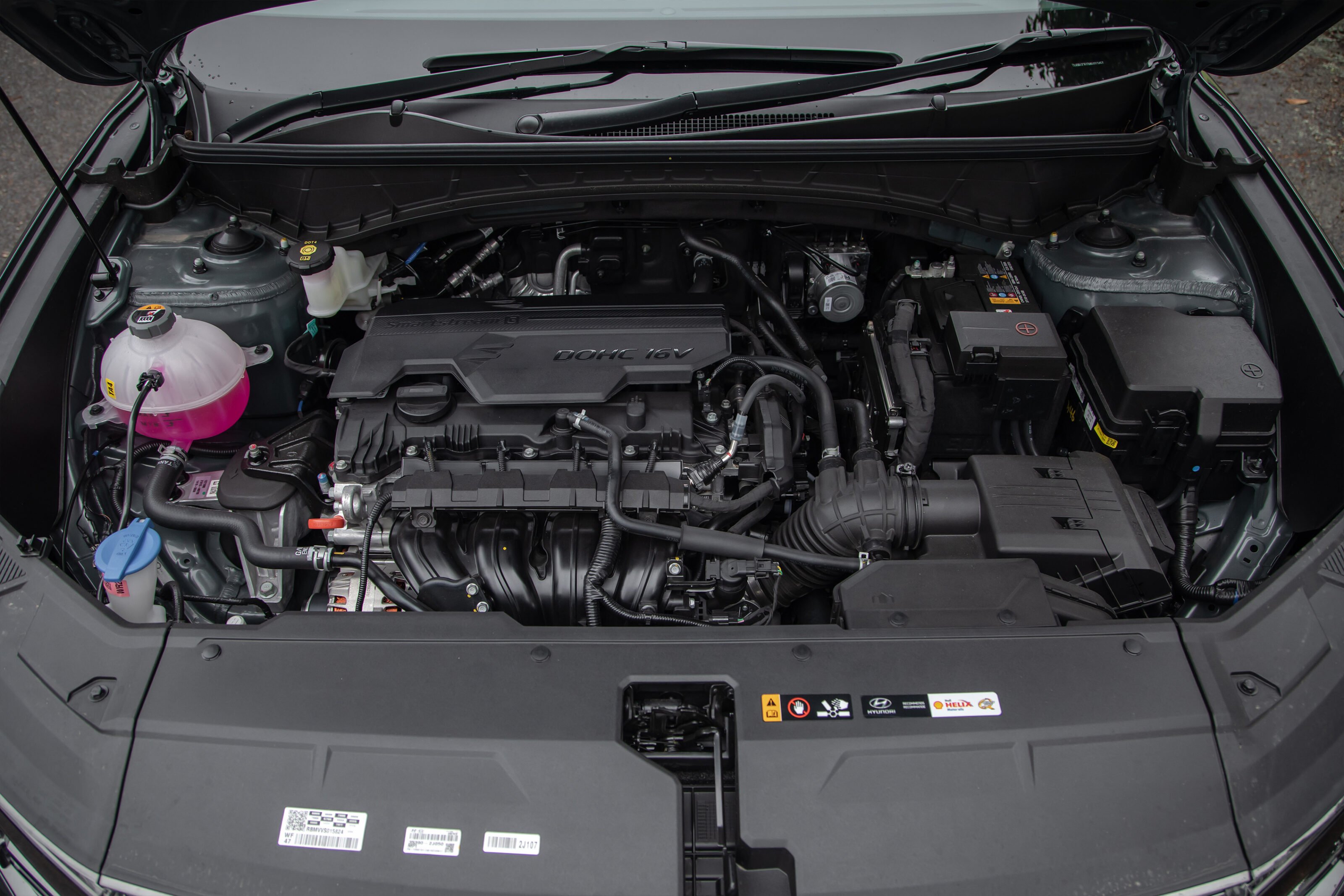
Sadly for a car that looks so wild and is sold on the idea of being a peek into the future, the only contemporary thing about the 2.0-litre engine is that it’s new.
Power is down over the older, lighter car, to 115kW at 6200rpm and 192Nm at 6200rpm. The combined cycle figure of 8.1L/100km is higher than the old direct-injected car but it still has a six-speed torque converter transmission.
It might sit behind the amazing, clever lighting and grille arrangement that makes it look for all the world like an EV but it’s depressingly old school.
It’s not a bad engine, but it can struggle a bit with the Highlander’s 1530kg kerb weight plus two people, a dog and a water bottle on board.
It’s quiet enough most of the time and does what you ask it to do, but really, it’s a bit weak for a car at this price level. There’s a reason Mazda doesn’t offer the higher-end CX-5s with the gasping 2.0-litre.
Compounding the crushing ordinariness of the engine is the fact this Tucson has a very impressive chassis. Like other freshly arrived Hyundais, the suspension tune is a global tune wrought by many more hands than the local tune of some others in the range.
That immediately sets off alarm bells in my head because the Tucson is sold in America and we all know how they love a handler. Well, they might love a well-sorted car, it’s just so many Americans haven’t met one yet.
My suspicions were confirmed when I discovered that this new car rides absolutely beautifully.
Unruffled by Sydney’s pathetic excuses for suburban streets, its laissez-faire attitude to arterial road maintenance and the frankly hideous state of the motorways and their Hague-worthy surfaces, it suddenly makes sense to pay this kind of money.
Even on big 19-inch wheels, the Tucson rides with uncanny smoothness across pretty much anything. Even the sternest test of a car’s suspension, the shopping centre rubber speed bump, is dispatched with almost Audi air suspension-like haughtiness.
That should mean the handling is less than great, right? Well, yeah, but it isn’t. It’s really good fun to drive through the corners, with a front end that’s keen to go where the well-weighted steering sends it. Despite the plushness of the ride, there’s no slack in the front end or that awful, unsettling corkscrewing some softly sprung front ends dish up.
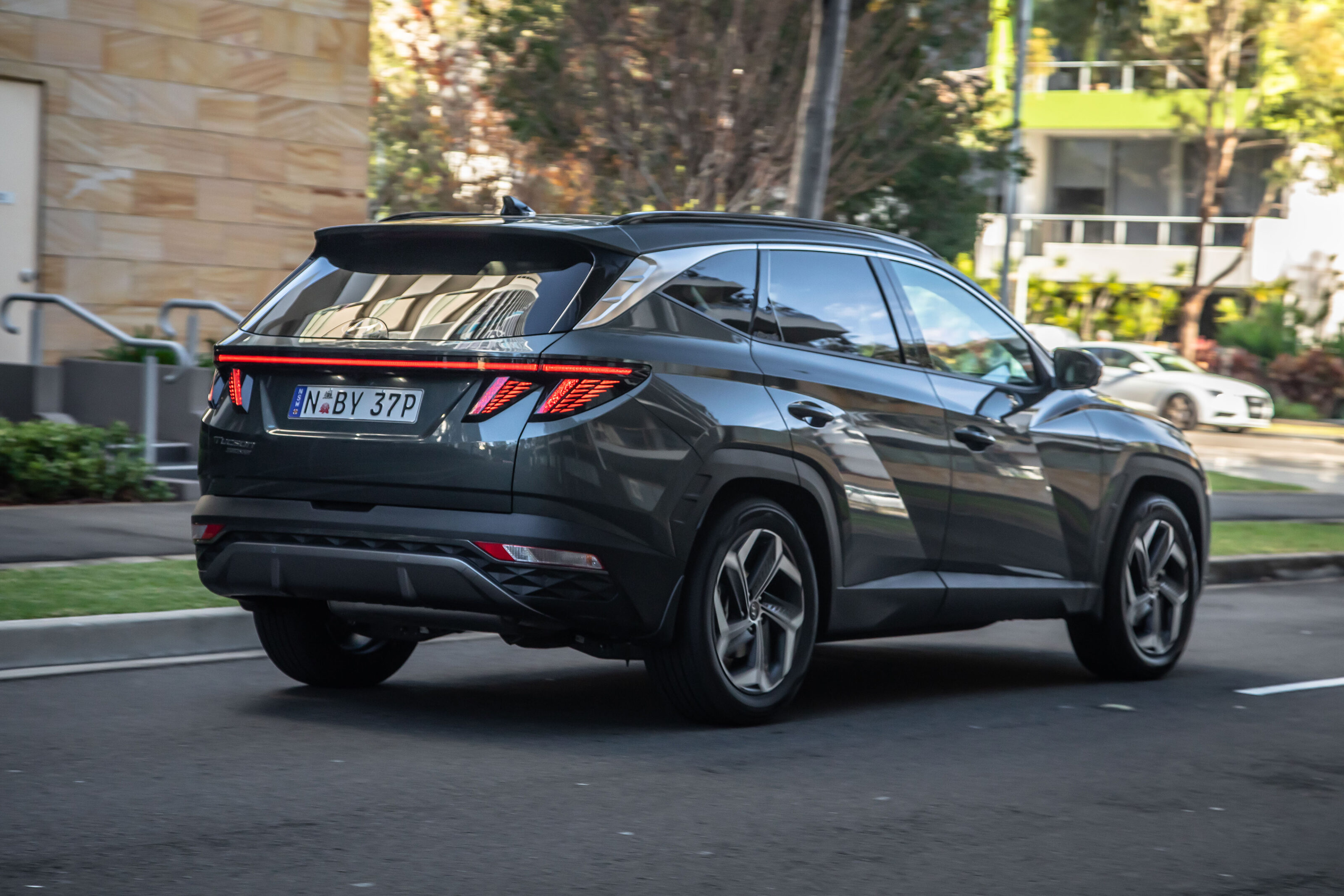
Remember how I said my suspicions were confirmed? Don’t listen to me. Well, do, just not the bit where I was wrong.
It has plenty of grip even in this front-drive-only version and it makes you wonder why Hyundai is even bothering with this naturally aspirated engine for the Highlander spec.
For a car so comfortable to handle this well is the work of many, many, many hours and miles pounding around, so for me, the engine is kind of selling it short. If this is one of the reasons this car took so long, it’s worth the wait.
It’s also, then, a great pity the wing mirrors punch through the silence created by well-insulated suspension and a quiet engine. They’re probably not loud but because nothing else is, but they sound it.
For a car so comfortable to handle this well is the work of many, many, many miles pounding around, so the engine is kind of selling it short.
Ownership
As always, Hyundai offers a five-year warranty with unlimited kilometres. You get 12 months of roadside assistance out of the gate and every time you service with Hyundai, you get another year up to a mildly astonishing ten years.
Servicing for the MPI-engined cars comes around every 12 months or 15,000km. A prepaid service plan costs either $957 (three services), $1276 (four) or $1595 for five.
The point of pre-paying is to roll it into your finance. If you don’t do that, the first five services will cost you $319 per service before moving around a bit for the next few years. Hyundai lists service pricing for actual decades.
VERDICT
The new Tucson is a big jump from what was an already pretty competent, if ageing car. The Highlander spec is always a bit of a stretch in this segment, doubly so when it comes with the lower-powered 2.0-litre.
Of course, I might be in an army of one as I reckon this engine will be gone within the year as most buyers choose the 1.6-litre turbo petrol with all-wheel drive. Cars at this level are a treat.
Having got that off my chest, the new Tucson is seriously impressive. I’m not sure if I want or need everything that’s in the Highlander, but you can’t argue with the specification level, the safety or the sock-stealing looks, inside and out. It’s a properly modern-looking car to carry Hyundai’s medium-SUV hopes in a crowded, hyper-competitive market.
It rides better and looks better than just about anything, is now big enough to trouble them all for space and comfort and throws in bags of individuality. It’s likely to sell by the shipload, but nobody is going to look at it and say it’s just another SUV.
2022 Hyundai Tucson Highlander specifications
| Body: | five-door mid-size SUV |
|---|---|
| Drive: | Front-wheel drive |
| Engine: | 2.0-litre four-cylinder |
| Transmission: | six-speed automatic |
| Power: | 115kW @ 6200rpm |
| Torque: | 192Nm @ 4500rpm |
| Bore stroke: | 81.0mm x 97.0mm |
| Compression ratio: | 10.8 : 1.0 |
| 0-100km/h: | 11 sec (estimate) |
| Fuel consumption: | 8.1L/100km (combined) |
| Weight: | 1530kg |
| Suspension: | MacPherson strut (front); multi-link (rear) |
| L/W/H: | 4630/1865/1665mm |
| Wheelbase: | 2755mm |
| Brakes: | 305mm ventilated disc (front); 300mm solid disc (rear) |
| Tyres: | 235/55 R19 |
| Wheels: | 19-inch wheels (full-size alloy spare) |
| Price: | $45,000+ on-road costs |
Until relatively recently, if you were shopping at the smaller end of the SUV market, your choices were limited to a range of, dare we say it, slightly daggy and awkwardly proportioned models. The reason? Producing a small crossover that carries a recognisable family resemblance is not simply a matter of dialling in 75 per cent and hitting the photocopy button.
Instead, design teams are faced with the challenges of adhering to ADRs, packaging constraints and practical inclusions, all while trying to end up with something that shares an aesthetic theme with its larger siblings. And it doesn’t always work.
Models including (but certainly not limited to) the first generation Nissan Juke, BMW X1 and Jeep Patriot demonstrate how a company identity doesn’t necessarily translate elegantly into a small model foray. However, things couldn’t be more different today and it’s at the small end where arguably the most handsome creations are happening.
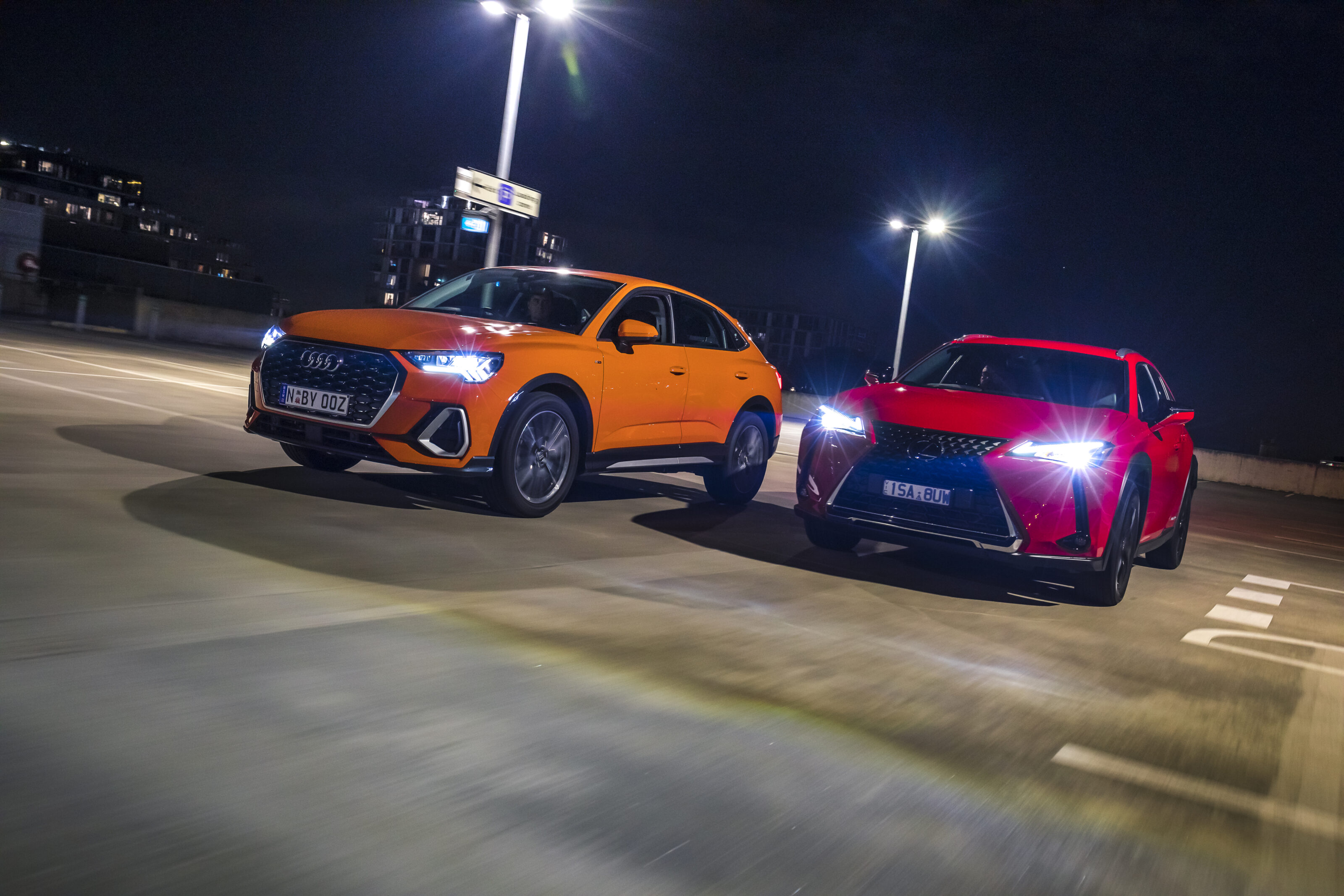
The revolution is being powered in part by the emergence of more coupe-like profiles that started at the larger end of the market but are now cascading down to smaller models. The trend originates in 2008 with BMW’s X6 but, today, it’s quicker to list the manufacturers that don’t offer some kind of coupe/SUV interpretation than list those that do.
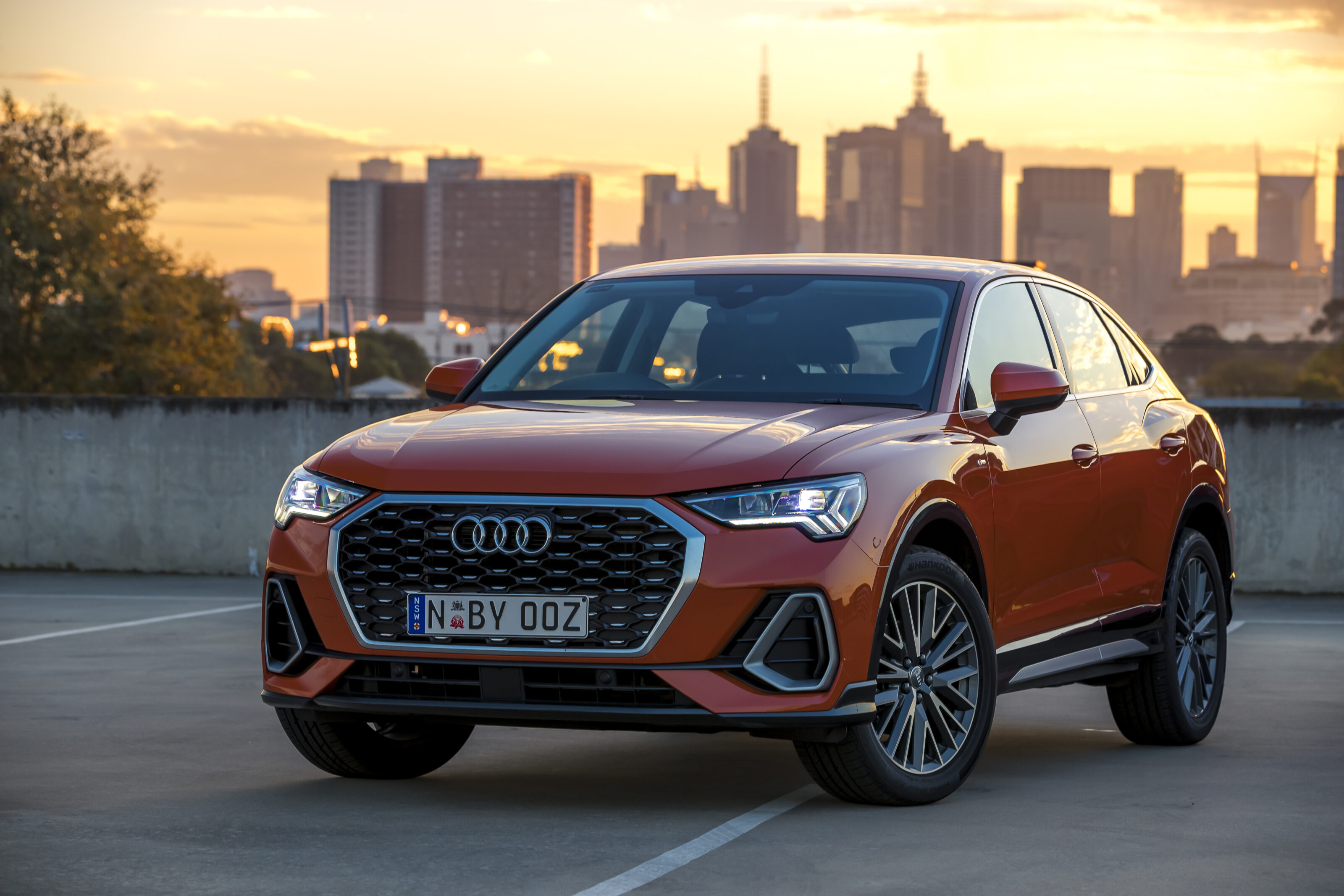
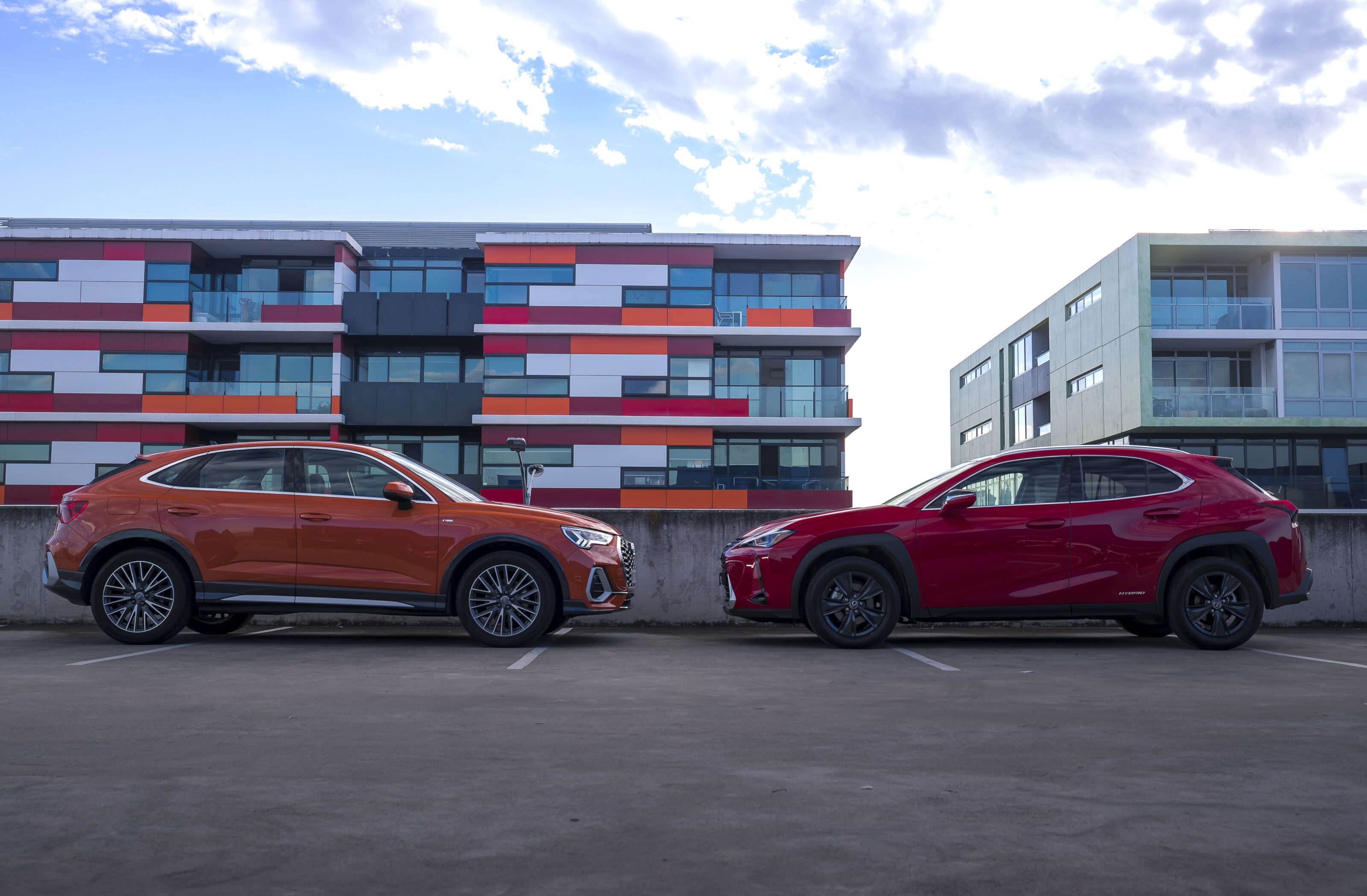
One such rival is Audi, which not only offers the Q3 in more conventional SUV form, but a Sportback option alongside it – the same mechanical package wrapped up in a smarter suit. While the Q3 is on offer in four varieties, the more esoteric Sportback is available in three. And the most affordable of those is this, the $50,000 35 TFSI S-line.
Like its two Sportback siblings the coupe version of the Q3 commands a price premium over the more conventional equivalents but the biggest price difference is for the entry 35 as the coupe gains sporty S-line trim as standard. Upgrade from a 40 TFSI or RS Q3 to the Sportback and it’ll cost you about $3000 whereas the 35 TFSI Sportback is $3500 more expensive.
Both cars offer feasible four-person transport, with a fifth person optionally slotted in as long as everyone in the second row is on good terms
Lexus’ response to the shifting SUV styling trend is different. With the exception of the largest LX, all the Japanese manufacturer’s SUVs have now adopted the more coupe-like approach including its smallest – the UX.
Whether you choose the petrol or hybrid powertrain, Luxury, Sports Luxury or F-Sport grade, all UXs share the same more elegant profile with no boxy fraternal twin on offer.
The eight-variant range opens with the $44,500 UX 200 Luxury, but with a budget the same as the entry Audi Q3 Sportback, you can step up to the most affordable UX hybrid.
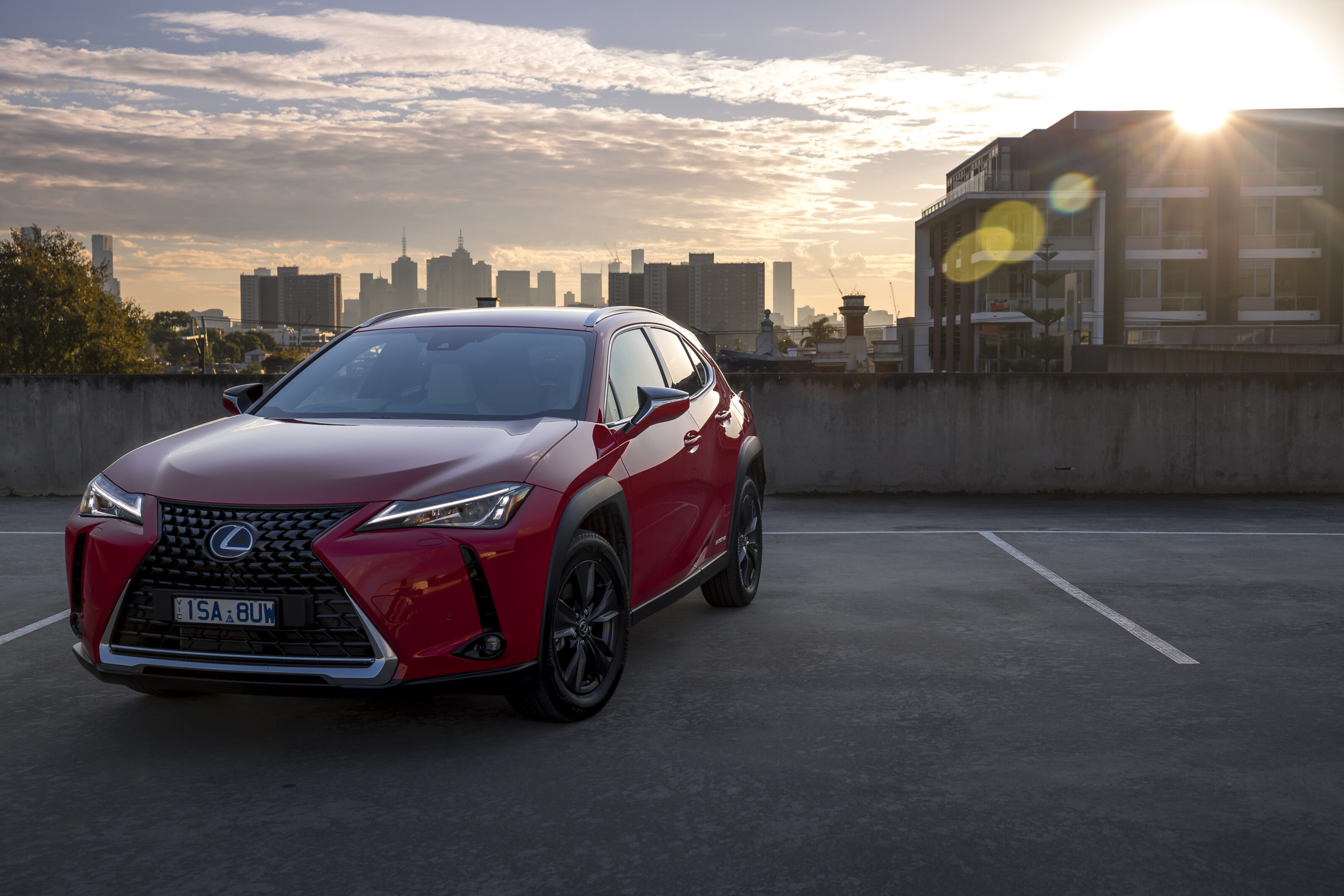
Costing $52,000, the UX 250h Luxury is just about the cheapest way into the Lexus ownership experience with only the aforementioned UX 200 and entry CT200h hatchback commanding a lower price.
But the Lexus feels anything but cheap. Even with the most affordable specification, the little SUV packs in a generous amount of kit and quality thanks in part to a 2020 update that added the optional Enhancement Pack 2 as standard.
That means you’ll pay no extra for wireless device charging, keyless entry and push-button start, LED foglights, power tailgate, digital radio, navigation and smartphone mirroring.
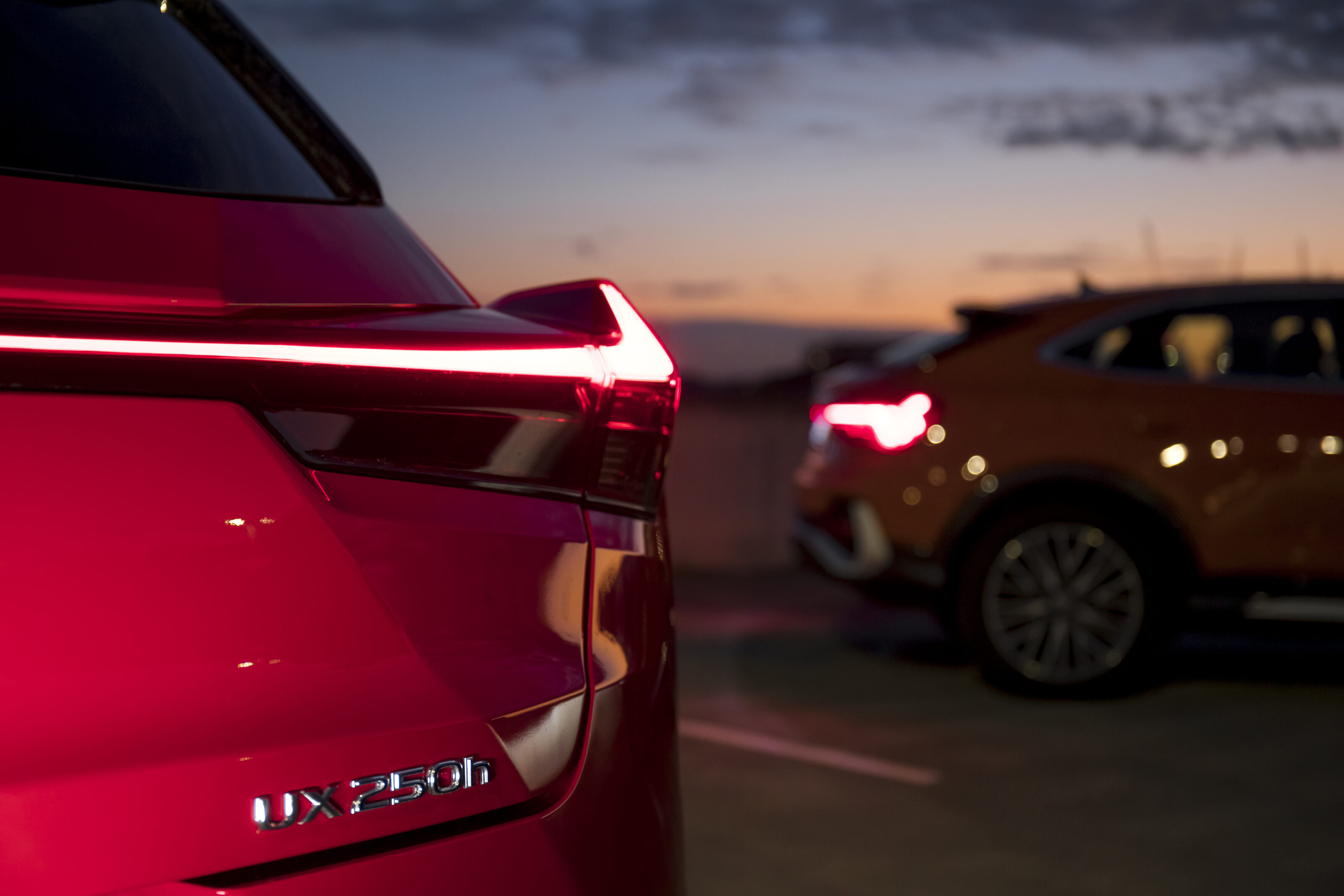
But it’s the stuff that comes as standard range-wide that makes the biggest impression when you hop aboard the UX. Real leather is added to the seats from Sport Luxury grade upwards but the light grey synthetic material covering the seats in the Luxury is almost preferable.
The seats it adorns are enveloping and comfortable, have electric adjustment, powerful heaters and promote a big-car driving position not dissimilar to the RC coupe. The standard semi-digital driver’s instrument cluster is a unique blend of traditional and technological, while the central information screen continues the cutting-edge feel with a large sharp display. Only the somewhat retro-feeling climate control panel detracts from an otherwise thoroughly modern interior.
But the Lexus certainly doesn’t upstage the Audi for impressive interior touches. Like the UX, the Q3 cabin offers beautiful quality materials, first-class build quality and tons of tech – from the Virtual Cockpit digital instrument cluster to the large central touchscreen. The Audi’s climate panel is also slender, but it manages to look a little more contemporary.
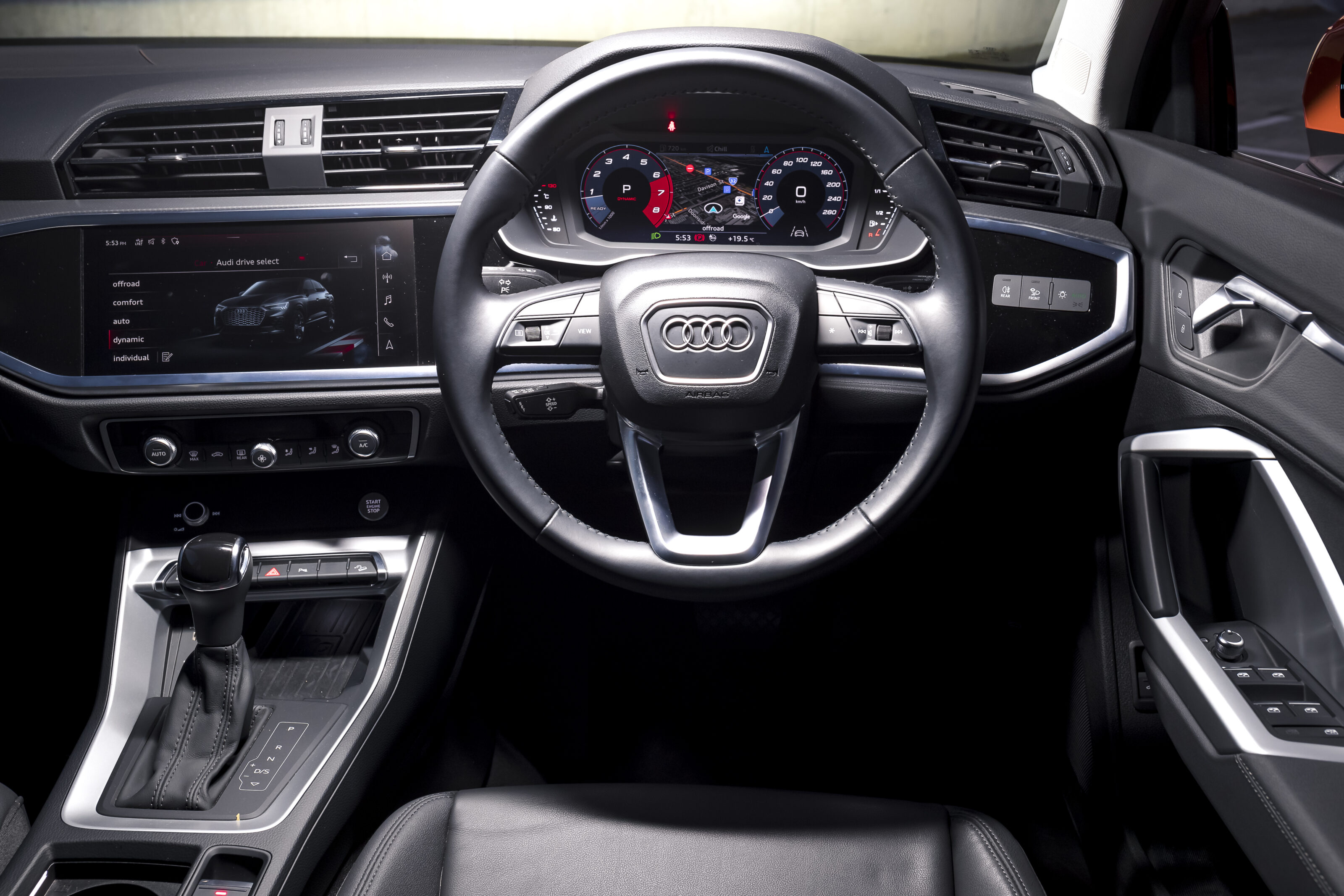
As far as perceived modernity goes, Audi’s combination of digital instrument cluster and 10.1-inch touchscreen feels fresher and has sharper graphics compared with the Lexus, which is more understated. In practice though, both systems are functional and easy to navigate and the UX thankfully has fewer of the annoying buried features found in other Lexus systems.
Unlike the most affordable UX, the Audi’s cabin does feature some real cow on the seats in places along with its own version of imitation hide but again, the effect is convincing and pleasant. Compared with the Lexus however, the Q3’s seats feel flat and less supportive and its spacious cabin feel is very different to the cosier and more immersive UX ambience.
As far as standard equipment goes, Audi is also targeting the premium market without the need to run the options gauntlet. The Q3 matches the UX’s proposition of wireless device charging, power tailgate, digital radio, LED exterior lighting and ambient cabin illumination but misses out on seat heaters and electric adjustment.
Its lovely Pulse Orange paint will also add $600 to the bottom line and the 19-inch wheels it wears here add another $500. Conversely, Lexus won’t ask you to put your hand in your pocket for the equally radiant Caliente Red you see here, nor its 18-inch rims.
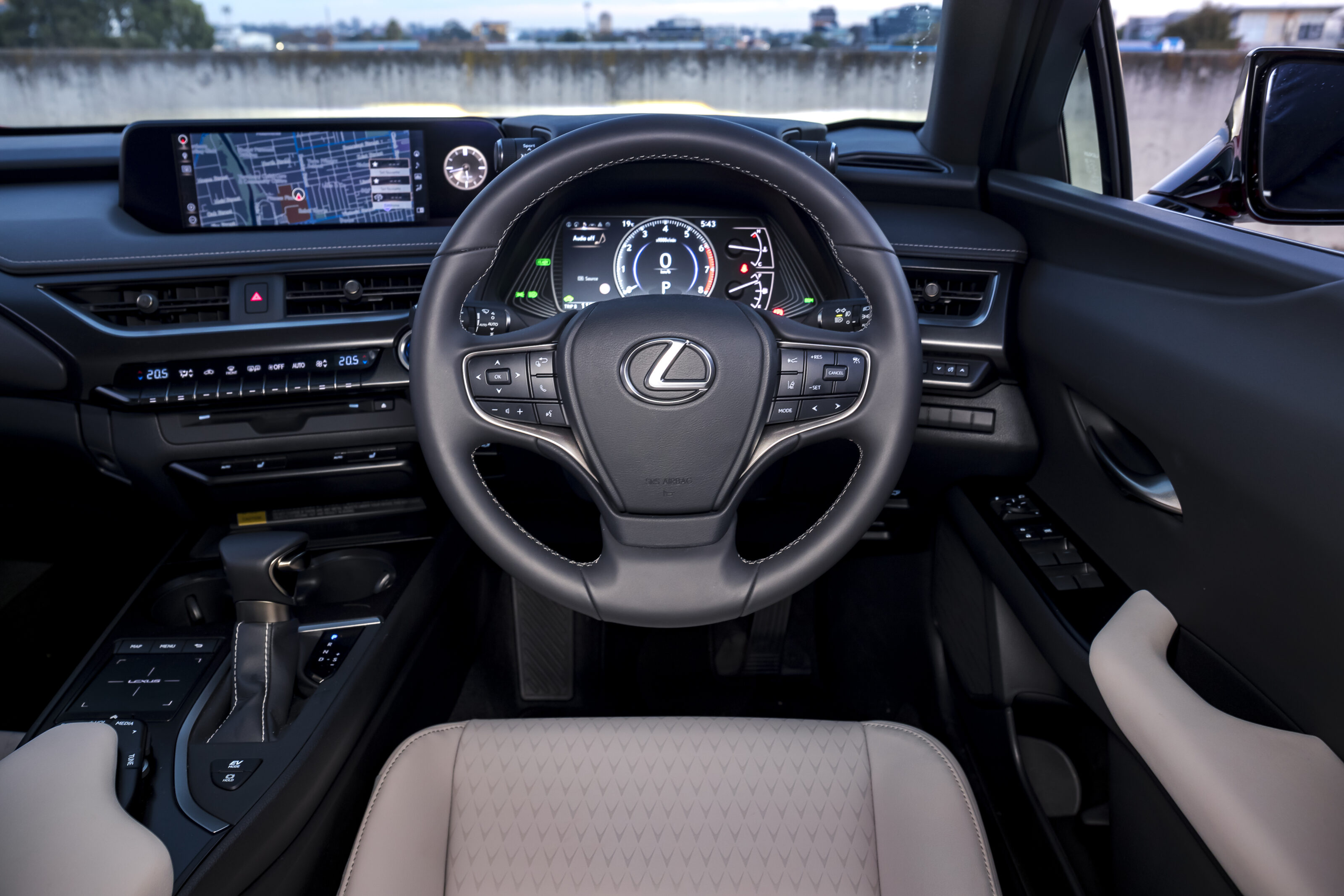
The Audi trumps the Lexus for things like LED headlights but neither offer limo-like features such as a head-up display and panoramic sunroof unless you step up to the flagship versions.
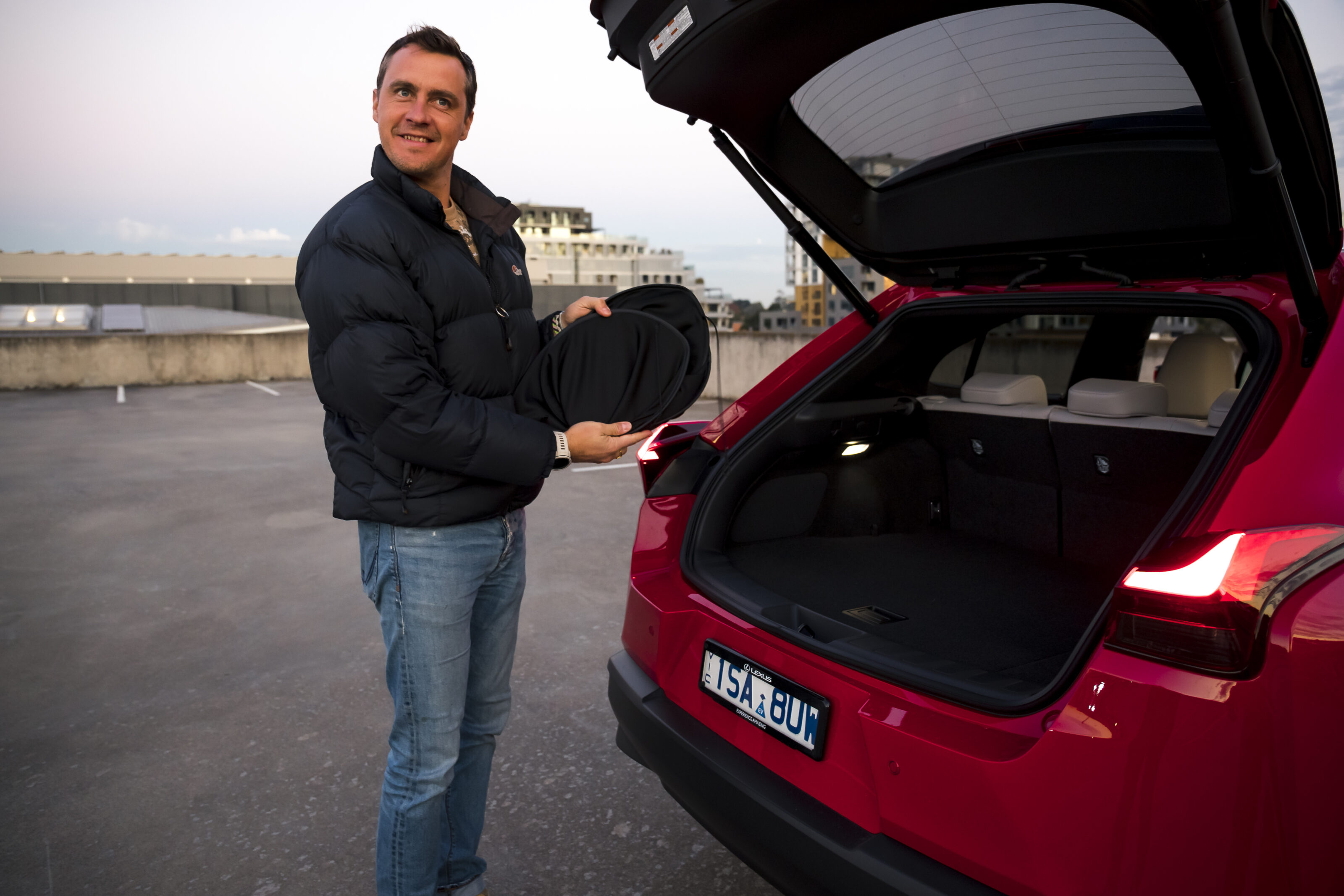
Spec levels align fairly closely with no clear leader in terms of standard equipment, but the Q3 Sportback gains a practical advantage over the Lexus. At the back end, the Sportback forfeits no luggage space over the Q3 with an identical and generous 530-litre boot and the option to expand through 40:20:40 folding seats, providing up to 1400 litres of volume.
Opt for a non-hybrid UX and you’ll get up to a relatively small 424-litre boot but the hybrid battery robs more space and drops volume to a tiny 368L (a height-adjustable boot floor adds another 44 litres) while expanding space into the second row is only possible through 60:40 split seats.
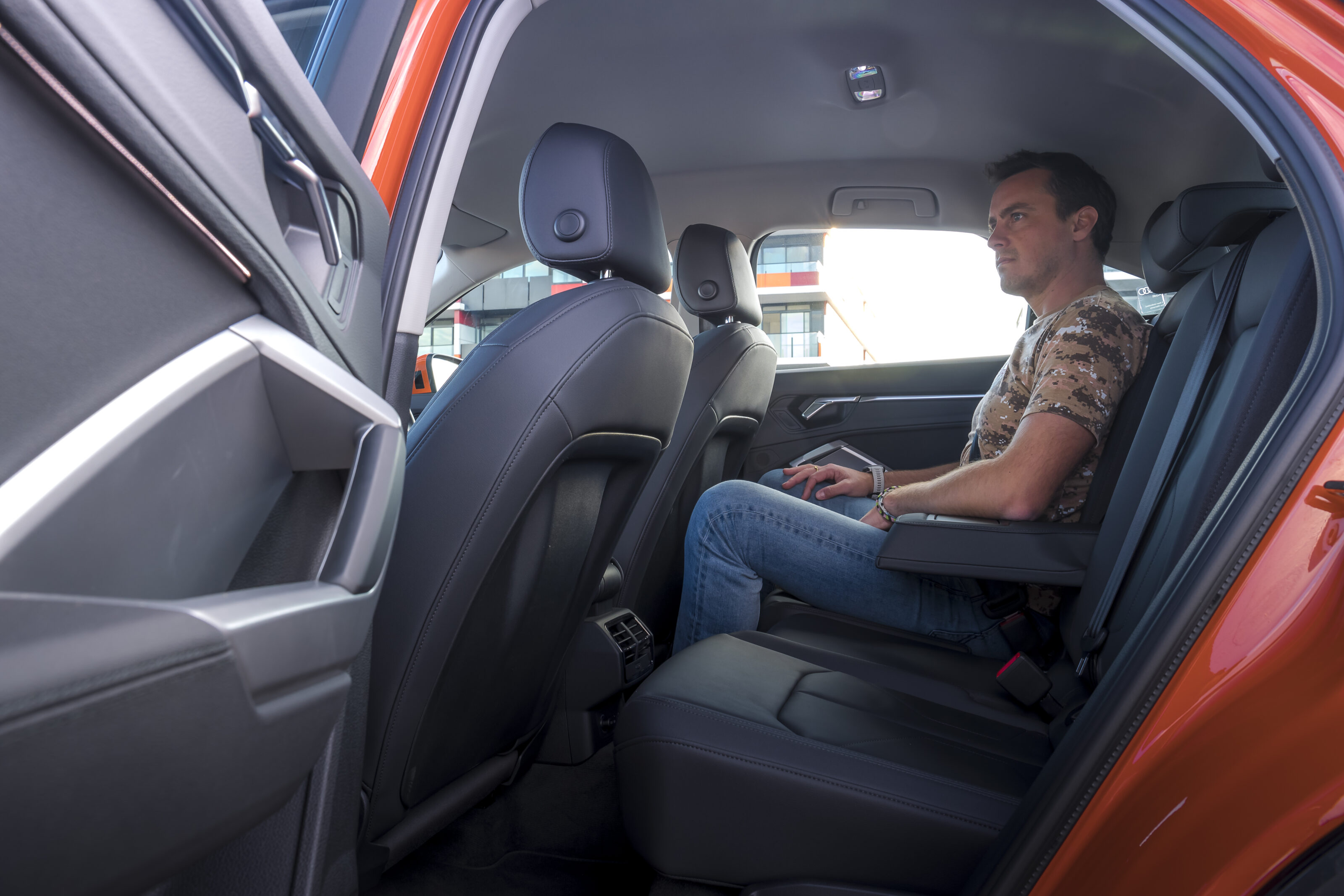
Passenger accommodation behind the front row is a much closer-fought battle with surprisingly roomy spaces even for occupants with long legs. With a more comfortable recline and better under-thigh support, the Lexus mimics the feel of the front seats, while the Audi offers a similar perch-like position of its front row.
Either way, both cars offer feasible four-person transport with a fifth person optionally slotted in as long as everyone in the second row is on good terms.
While both the Q3 Sportback and UX are available with all-wheel-drive systems, the pair we have are strictly front-drive only and far more focused on the surfaced roads that meander our cities. It’s here that the Lexus draws out somewhat of a lead.
With almost 20 years of use in production vehicles, Audi’s dual-clutch automatic transmission has become a refined, efficient and lightweight automatic, proliferating numerous models throughout the Volkswagen Group family, but its nature still leans to the more aggressive side.
For negotiating slow-speed urban traffic the uptake of torque is at times abrupt, and at others curiously delayed. It’s almost as if the six-speed unit is constantly overthinking and trying to pre-empt the driver’s intent with a level of intuition that’s simply not possible.
Once in gear, it delivers beautifully rapid and clean shifts and if you are after a full launch-control start from the lights it will oblige this effectively too. But about town, it can become a little tiresome especially if you spend a majority of your commute trying to beat the traffic.
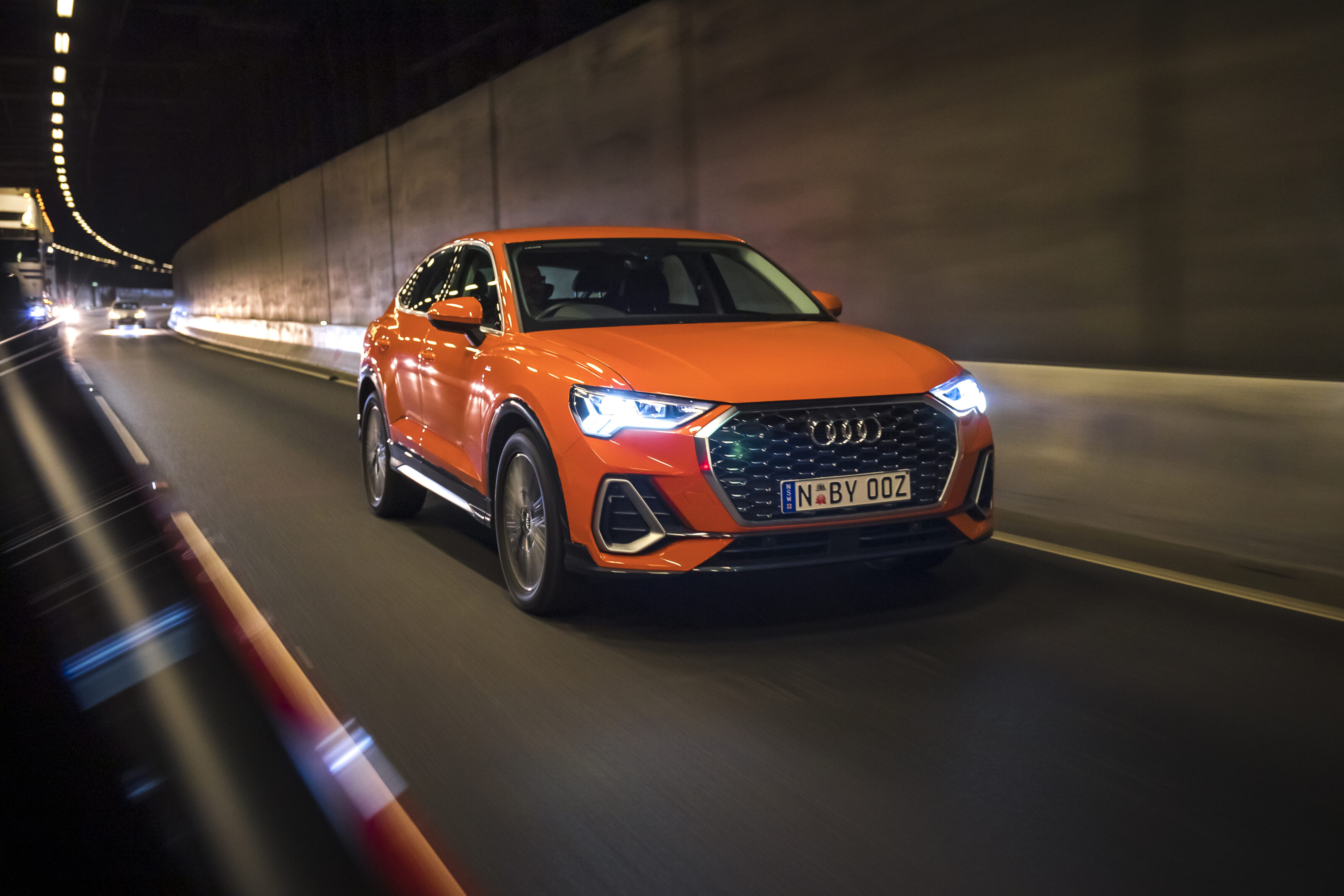
By stark contrast, the UX’s transmission was born for the metropolis thanks to its hybrid pairing. Press the accelerator in the Audi and it takes a moment to decide how much clutch slip you might want, while modulating how much throttle it can give you. In the Lexus however, the response is to simply feed instant electric torque to the wheels via a CVT and introduce engine power as soon after as is possible.
The Lexus’ 2.0-litre naturally aspirated engine lags the Audi’s 1.4-litre turbo torque 205Nm to 250Nm but it feels like those numbers have been inverted from a standing start. Bizarrely, the apparent inversion continues at higher speed with the 110kW four-cylinder Audi engine feeling more muscular than the 131kW produced by the Lexus four-cylinder.
Officially, the Audi will do the zero to 100km/h dash in a claimed 9.3s while Lexus says the UX 250h will make the benchmark in 8.5s and that feels about right in practice.
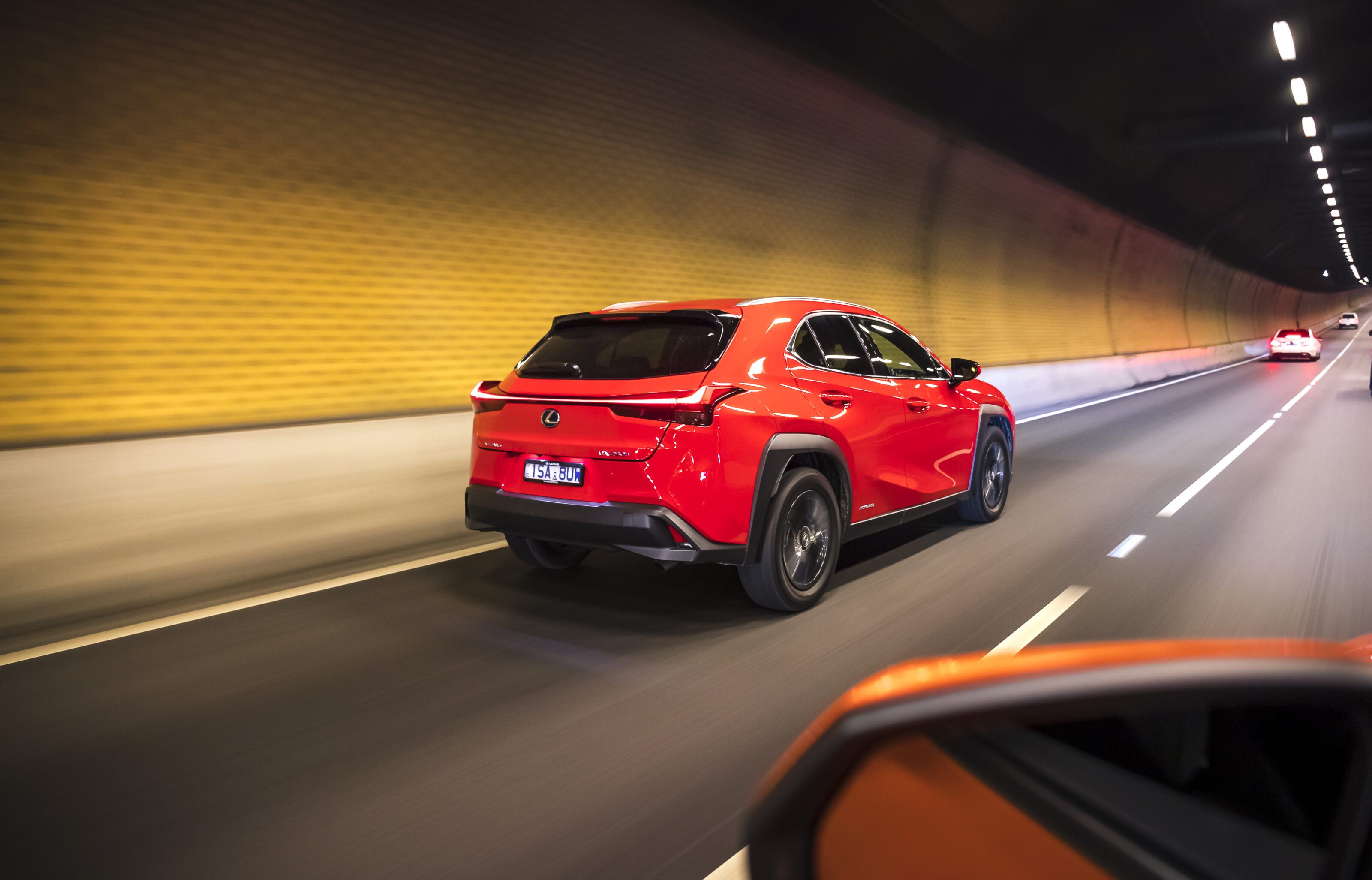
Despite the sophisticated forced induction applied by the Audi engineers, the Lexus hybridisation will always have the efficiency upper hand as long as there is any kind of stop-start traffic involved. Lexus claims a figure of 4.5L/100km vs 7.3L/100km for the Q3.
But the convenience and lag-free nature of power/torque delivery in the UX is far more beneficial than objective figures on paper.
Out of town, the Audi engine has a free-revving charisma that’s fun to explore – although wringing its neck for meaningful performance can become exhausting and it’s not long before thoughts of hybrid seamless power filter back.
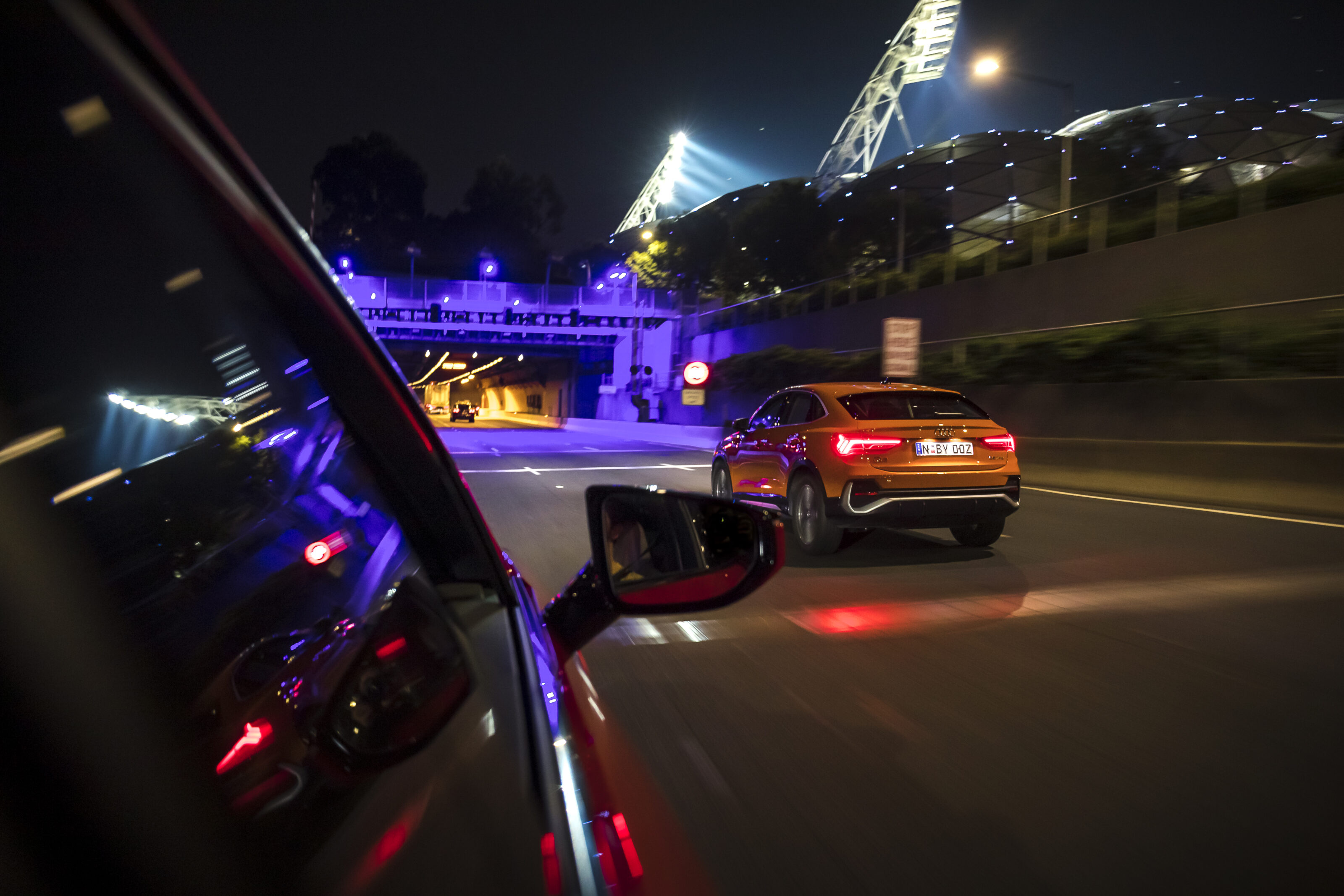
That said, the electrification benefits become less obvious on faster roads and at more continuous speeds.
Surprisingly, there’s only about 30kg between these two SUVs, with the Lexus unsurprisingly tipping the scales heavier at about 1575kg but in both cases, handling and dynamics defy their weight.
Despite lacking proprietary Quattro grip, the Audi has abundant traction and only occasionally complains with wheel slip. Its front end is light in the hands with delicate steering and an occasional vagueness under acceleration – although rarely manifesting itself as outright torque steer. When not testing the limits, the ride is stiff but comfortable with a positive rigidity to the chassis.
The Lexus on the other hand has an even more responsive steering turn-in and a deeply satisfying combination of comfort and dynamics. There’s a low-speed nimbleness that pairs perfectly with the about-town power but the characteristics also translate to more of a large-car feel when up and about.
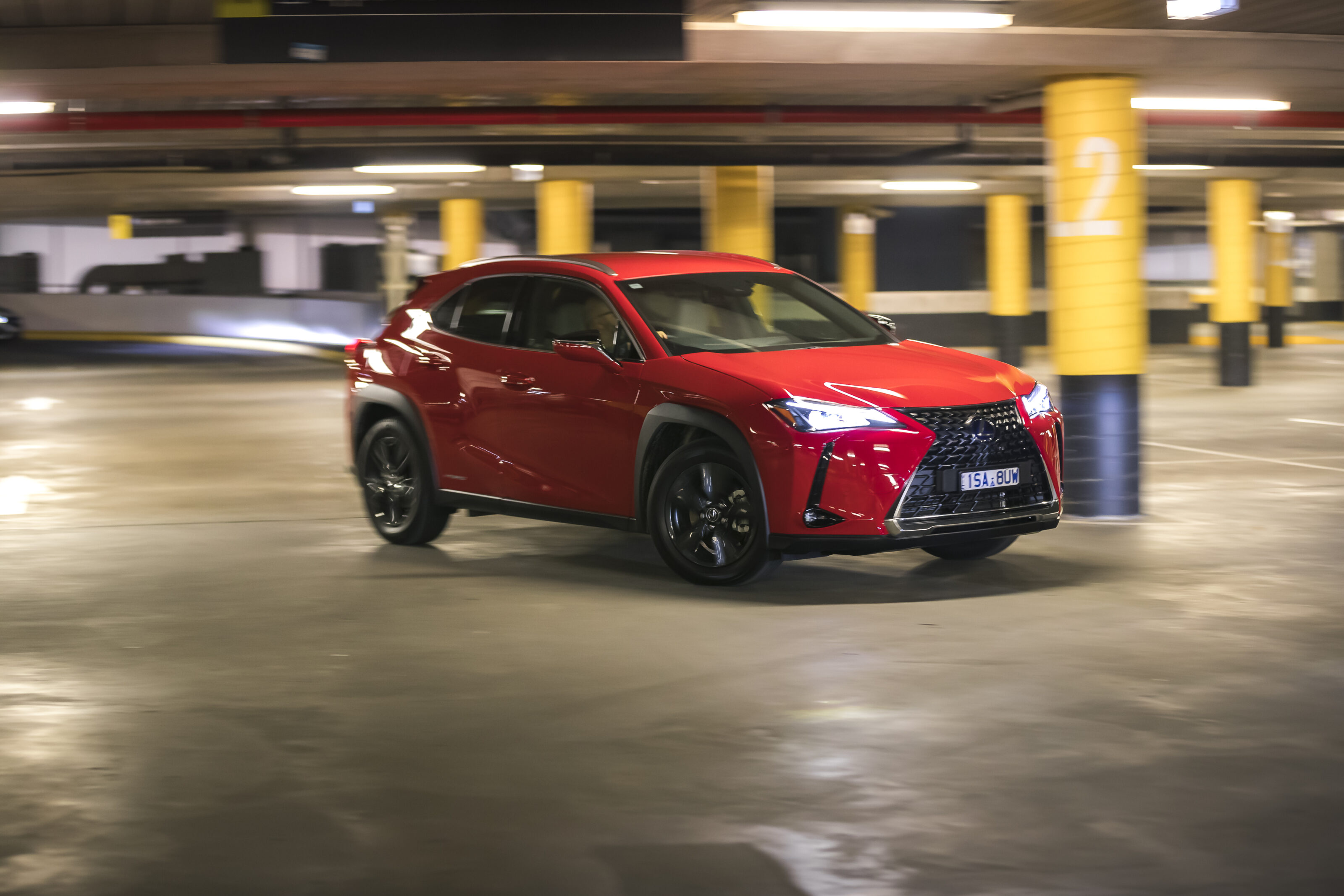
Although some small and mid-size SUVs suffer from a toppling feeling thanks to their tall stance and narrow footprint, neither the Audi nor Lexus have a hint of it, although the UX offers the best all-round balance of stability, driving enjoyment and comfort.
With a full skirmish to the ragged limits of dynamic ability, it’s likely the Audi’s taut composition and wider rubber would return the best lap times, but that’s an unlikely driving scenario for either of these models. We didn’t go there.
Both models came out wearing bright war paint and promising big things from two well-known and respected brands but it is the Lexus that feels more relaxed in its own ability, while the Audi feels like it has something to prove.
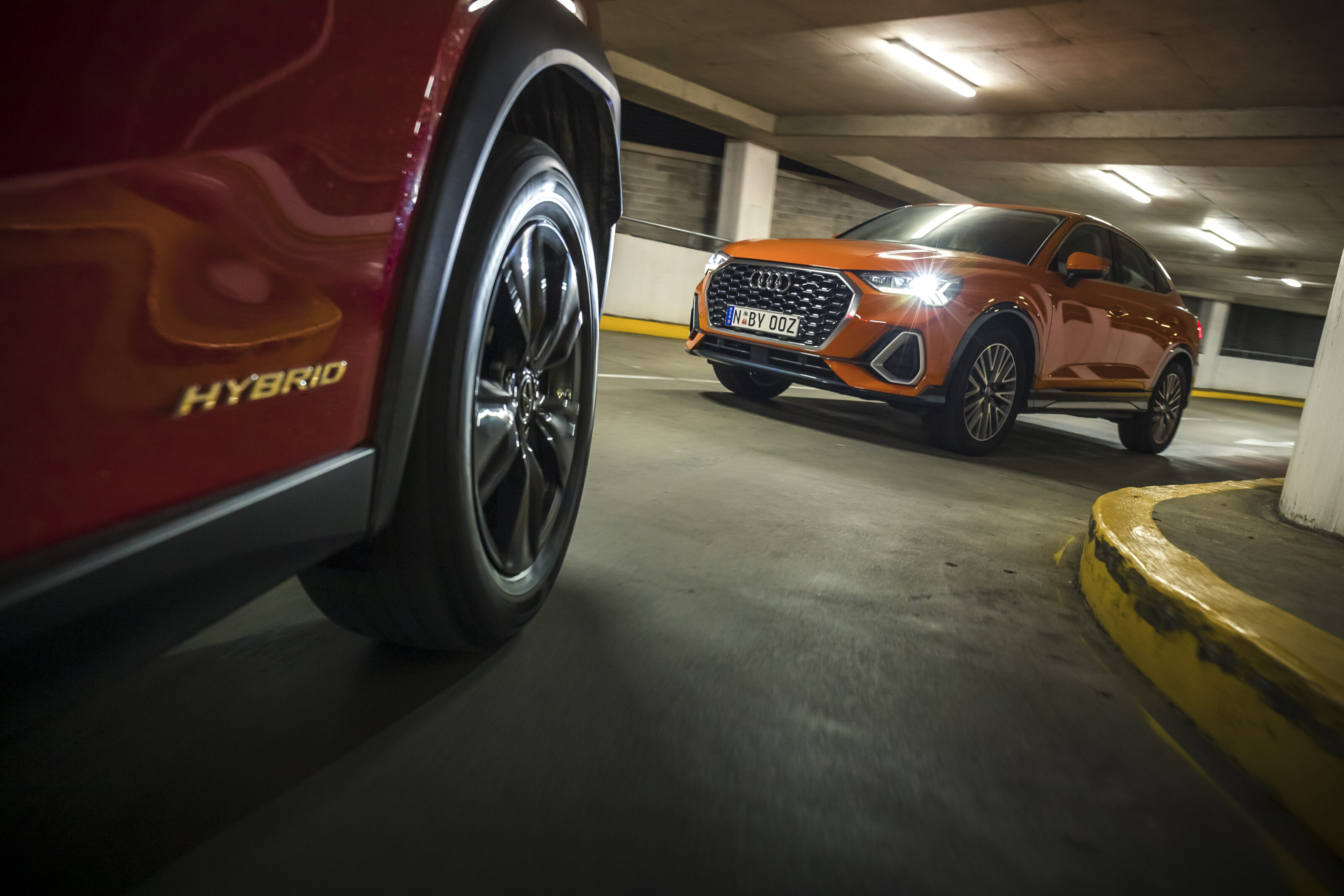
Both offer a generous amount of equipment for their asking prices despite representing the more entry-level end of their respective model lines. Likewise, both the UX and Q3 Sportback have rewarding characters whether they’re driven hard or not.
Practically speaking, Audi’s contender is the clear leader in this pair with more space and more convenience features but, with a more versatile and effortless powertrain that offers excellent efficiency as a bonus and a more well-rounded balance of ride and dynamics, the Lexus is the easier car to recommend.
The real winner though? Well that has to be the small SUV market as a whole. With a pair of such handsome models punching hard for $50,000, the competition has never been tougher and the days of ugly crossovers and SUVs are numbered if not already gone.
One of the local automotive industry’s most respected figures is just weeks from retirement, as Subaru Australia announced David Rowley would depart the company later this month.
A doyen in the automotive media landscape, Rowley has spent the past 22 years at Subaru, having joined the brand as its public relations manager in January 2000 after a three-year stint at Honda.
Starting off as a journalist in his native England at the Yorkshire Evening Post in 1988, Rowley held positions at The Australian, Qantas and PR firm Macro, before moving across to the world of four wheels.

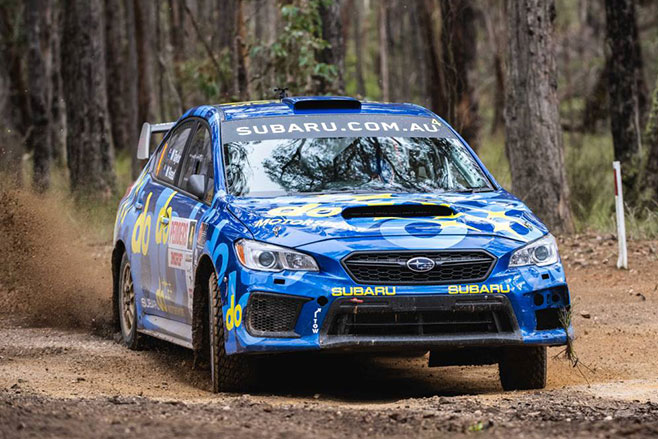
Since joining Subaru, Rowley has been there for some of the brand’s biggest moments in Australia, from surpassing 50,000 WRX sales locally, to its six Australian Rally Championship titles with Possum Bourne, Cody Crocker and Molly Taylor behind the wheel.
Subaru Australia’s general manager, Blair Read, said the PR guru has been a significant part of the company locally.
“Dave has been instrumental in building the Subaru brand and cementing its reputation in the Australian market, including the successes in motorsport which it is still known for today,” said Read.
“We are privileged to be able to continue on this journey with the strong foundations he has set in place, and are eternally grateful for Dave’s significant contribution over the past two decades.
“We wish him all the very best and many wonderful adventures in his retirement.”
The soon-to-be retired Rowley has reflected on his time at Subaru and within the industry, thanking those who had given him opportunities along the way.
“As a relatively late entrant into automotive in my mid-30s, I was fortunate that the Subaru chiefs back in the day, Trevor Amery and Nick Senior, were prepared to take a risk on someone with so little industry experience,” said Rowley.
“It’s been a privilege to work with the Subaru Blue Army over so long, and while the brand and product are fantastic, it’s the spirit of the people working within the organisation that have fuelled my PR passion.
“Equally, I’m grateful to the many automotive media contacts whose interest in all things Subaru has kept me gainfully employed. The media landscape continues to evolve rapidly, with ever-increasing deadline demands – and multi-skilling across different platforms – making a hugely challenging environment.
“They have my admiration, as do my wonderful Subaru colleagues.”
Upon hearing of Rowley’s retirement, a number of WhichCar staff wanted to pay tribute to the veteran PR chief, speaking of their experiences with the man who has been a constant in the industry.
“Here’s a fella who will be truly missed,” said publishing director, Mike Stevens.
“Much like some school teachers, there are grumpy and unreachable PRs out there who make you wonder how they thought a public and media-facing role was the career for them – but not Mr David Rowley. He’ll always take your call, and always with the most refreshingly cheerful greeting.
“He’s always been among the most helpful communications managers I’ve encountered, never dancing around a question – even when he can’t give you the answer you’re chasing.
“I’ve had the privilege of travelling with David a couple of times – I’ll never forget being among the very first people in the world to see the BRZ (and thus the 86) – and on each trip, he was as much our beaming servant as our sage guide.
“I wish you all the best, mate, and I hope to see you around the traps. Enjoy your well-earned retirement!”
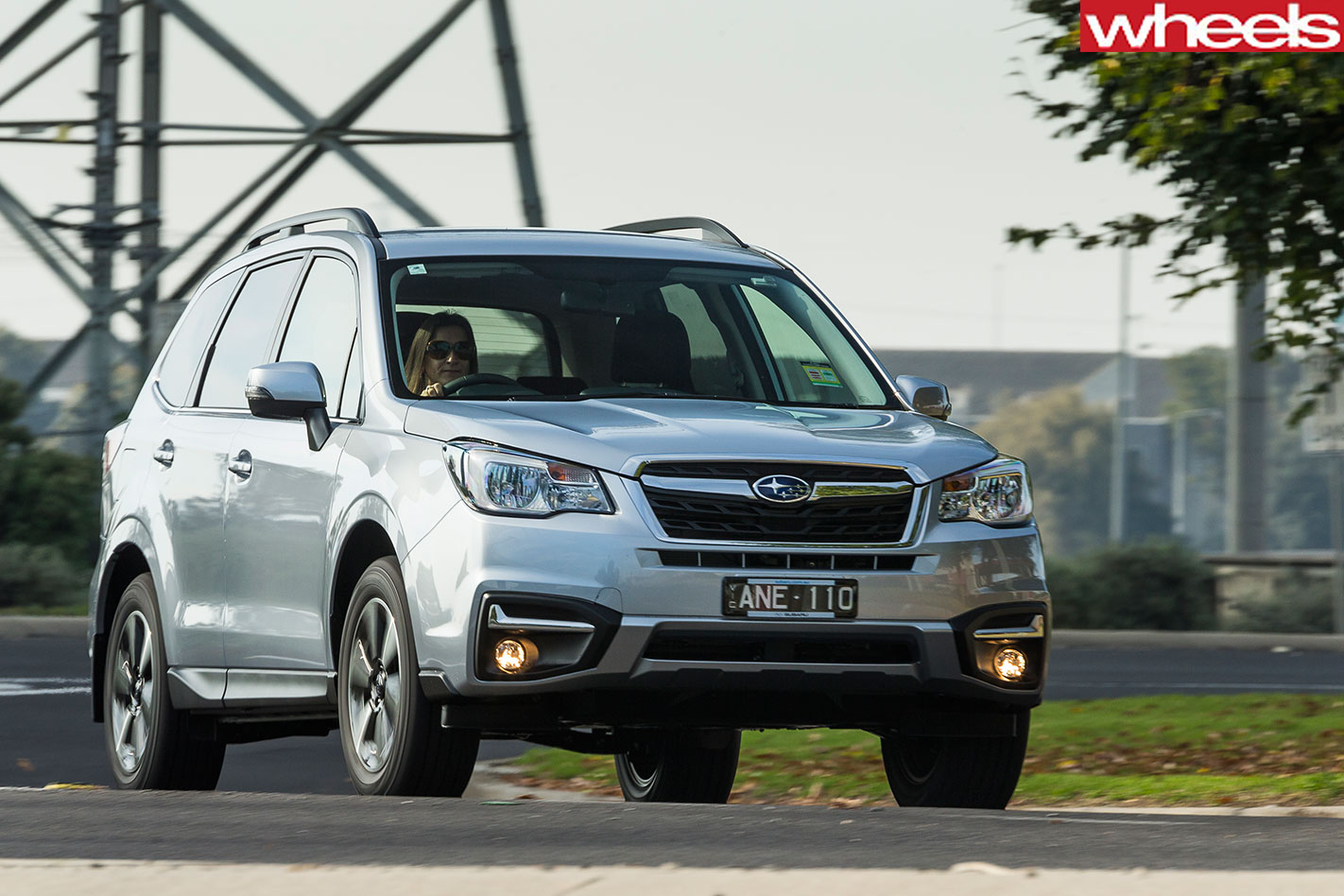
“Dave Rowley is one of the greats,” said journalist Daniel Gardner.
“There are few PRs who operate with the same level of candid professionalism, while also maintaining a generous measure of good humour and fun.
“Media personalities and journalists can be a challenging breed and, to the best of my knowledge, Dave hasn’t punched a single one in 22 years. This is a true testament to his good nature and enduring pleasant manner.
“Whether it be eating unidentifiable things on a boat on the Sumida River, or freezing our faces off in a forest waiting for a blue WRX to drive past too fast, I will miss working with Dave and thank him for always making me look better at my job than I really am.”
Snapshot
- New road user tax for EV and PHEVs has been in effect since July 1
- Government argues it is needed to get money back from EV subsidies
- Car industry disagrees with strategy
UPDATE, AUGUST 6: VicRoads has defended already issuing warnings to electric vehicle owners for failing to submit odometer photos of how far they’ve travelled, just one month after its controversial road tax scheme started.
As part of the distanced-based charge introduced on July 1 this year, new and existing EV owners are required to lodge how many kilometres they’ve driven.
According to The Driven, some motorists have already fallen foul of the policy, being threatened with losing their registration – barely one month after the new system came into force.
A spokesperson for the Victorian Department of Transport, however, said the process has always been outlined clearly.
“Zero and low emission vehicle (ZLEV) operators who have registered their vehicle since July 1, 2021, have 14 days in which to make an initial odometer declaration,” they said.
They added that if the reading isn’t provided on the first date the car is registered, owners could be hit with a higher charge as the authority would work out an average daily distance travelled based on the next time a declaration is made, and will send a bill on that basis.
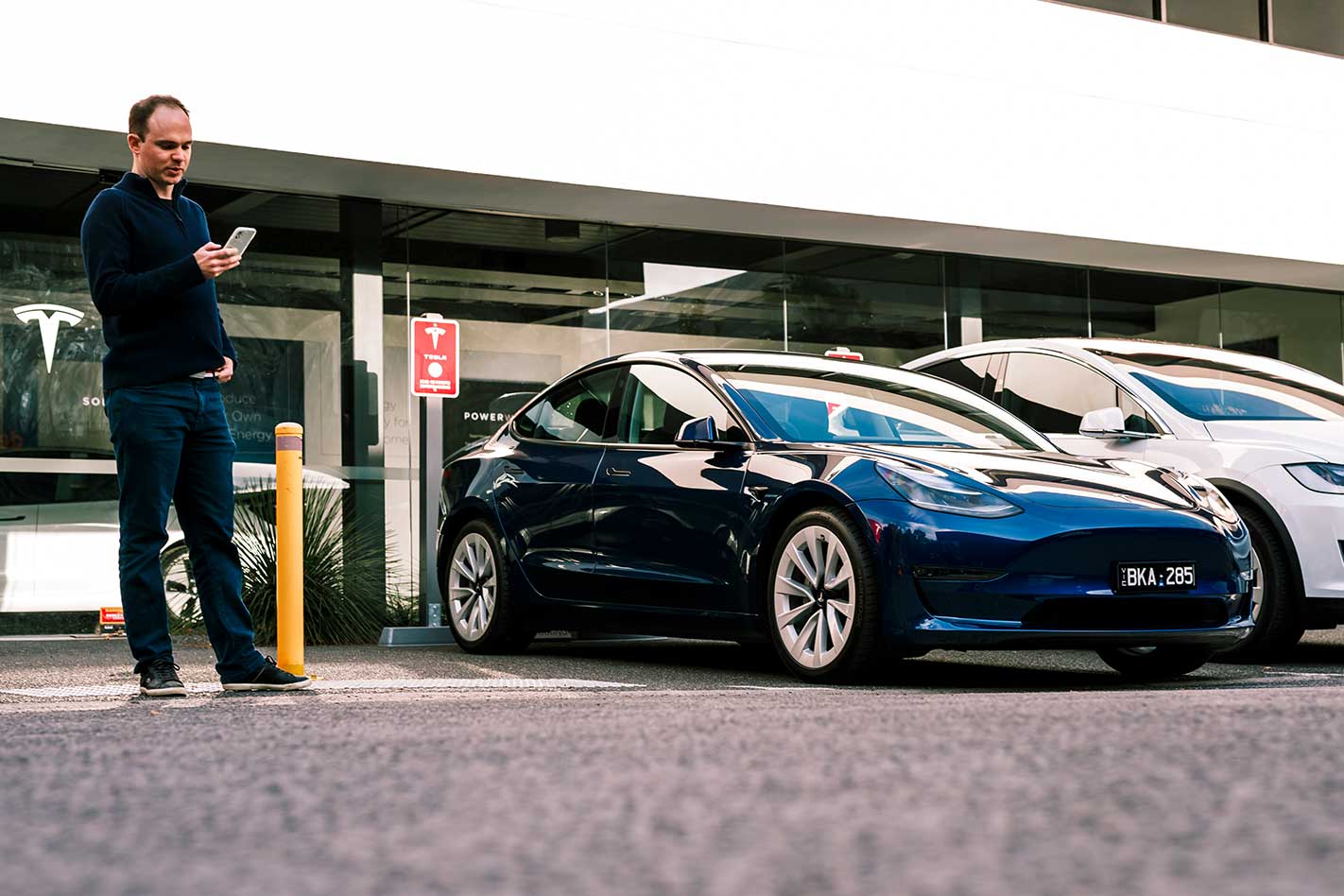
The story to here
JUNE 18: From next month, electric vehicle owners in Victoria must send the state’s highway authority photos of their car’s odometer to record how far they’ve travelled or face having their rego cancelled.
On July 1, the Victorian Government’s controversial tax on EVs comes into force – with VicRoads this week revealing the way it plans to charge owners will be by requiring an odometer reading and supporting photo as evidence each time the vehicle’s registration is renewed.
What’s more, anyone caught trying to pull a fast one by providing a false reading could end up with 60 penalty units against them and an almost $10,000 fine. For businesses the punishment rises to 300 penalty units or a $50,000 fine.
The Department for Transport said “failure to comply with the scheme may result in penalties, including the suspension and cancellation of a vehicle’s registration”.
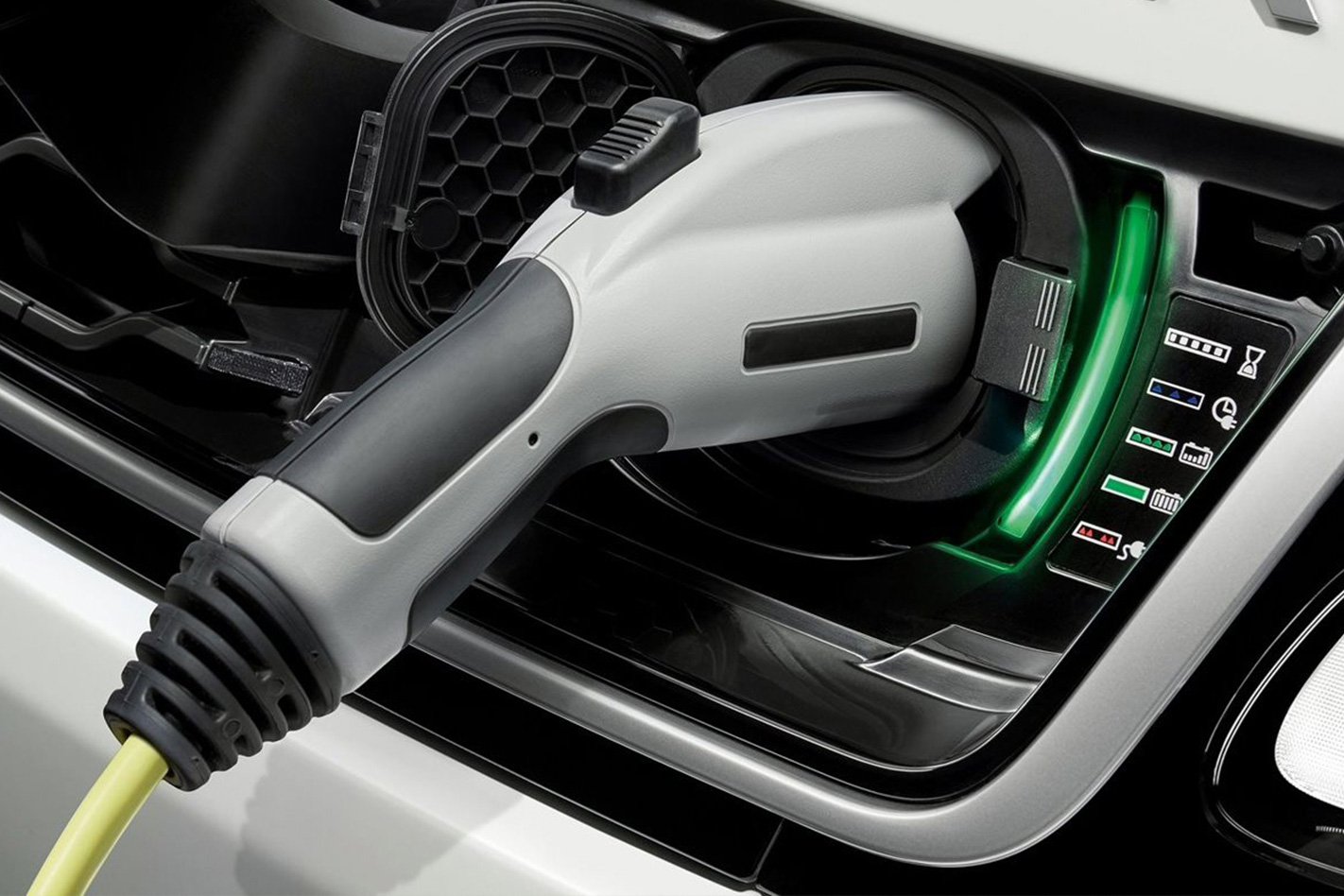
The new distanced-based charge will see electric vehicle (EV) and plug-in hybrid (PHEV) drivers pay for each kilometre they travel.
Owners will have to pay 2.5c/km for an EV, while those with a PHEV get a 0.5c/km discount given they already pay the fuel excise when filling up at the pump, but will be offered $100 off the cost of their annual registration (effectively making an EV’s first 4000km, and a PHEV’s first 5000km, free).
While mild hybrids will not pay the tax, they also will no longer be eligible for the $100 rego discount from July 1.
Passed on May 25, 2021, the policy is aimed at zero and low emission vehicles, essentially charging owners for not having to pay the 42.7 cent per litre Federal fuel excise, instead implementing a tax based on kilometres driven in a year.
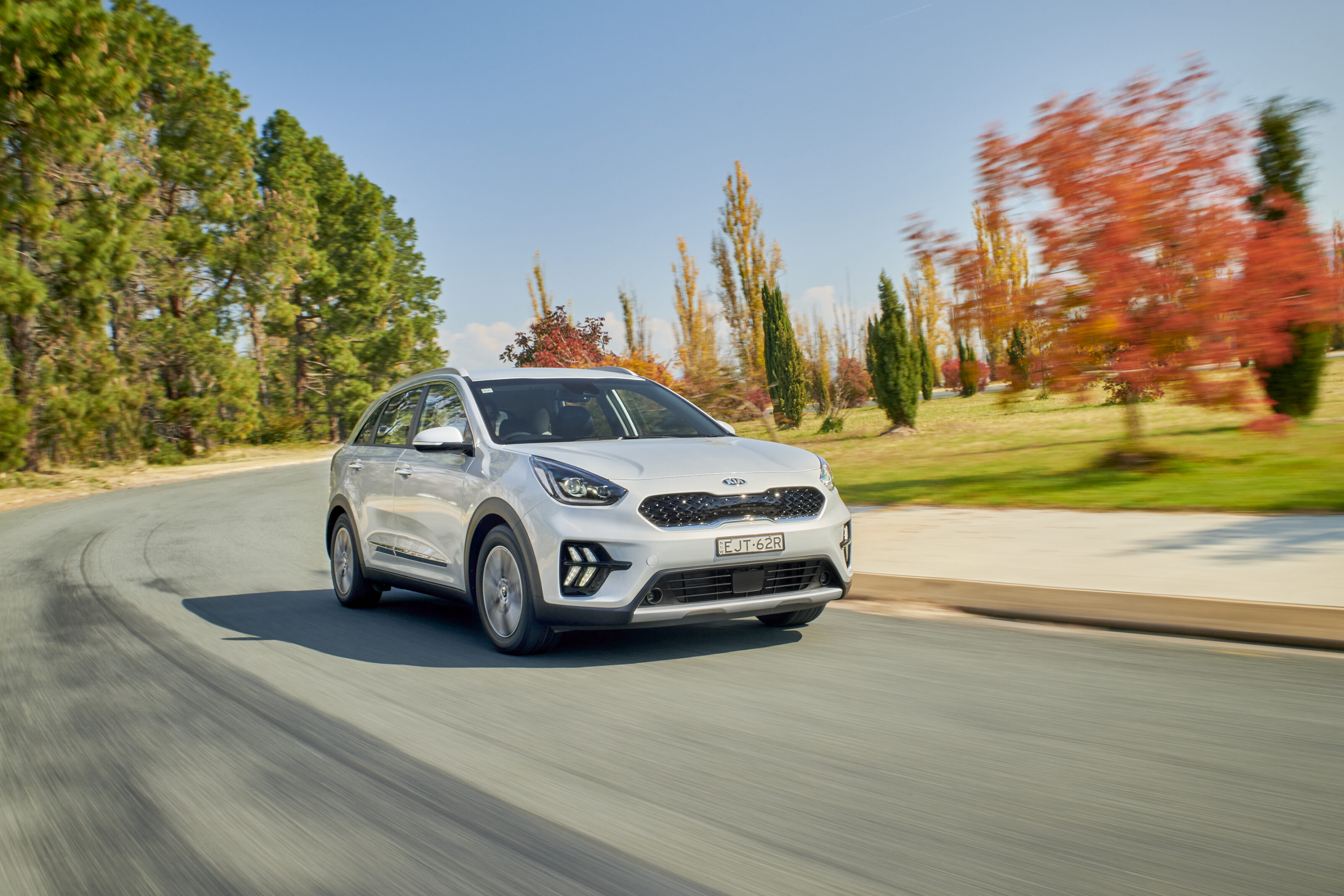
The scheme has been heavily criticised – not just for its charges, but also on the basis of how it records the distance travelled in a year.
Instead of utilising a system similar to pink slips in New South Wales, where vehicles are independently inspected every 12 months and the odometer reading is recorded, VicRoads will send a request to owners for a photo of the vehicle’s odometer reading when they renew their registration.
Behyad Jafari, CEO of the Electric Vehicle Council, said: “The whole idea and process was just rushed in without any consultation with industry. And it shows. Delaying the charge until we have higher penetration of EVs and spend time consulting on a system actually built for the 21st century, not the 20th century, would benefit everyone.”Not only are plug-in hybrid drivers being double-charged, but they are also exempt from the main Government subsidy. The Government is definitely making it hard for plug-in hybrid drivers. Any increased cost to plug-in hybrid drivers must be offset, at the very least, to ensure Victoria doesn’t go backwards when it comes to EV adoption. “Any additional charges to EV owners acts as a disincentive, particularly at this stage of the market. Governments should be doing everything they can to encourage EV uptake, not adding extra charges which complicates things for consumers. The Victorian Government seems to be shooting itself in the foot with this premature tax on EVs.”
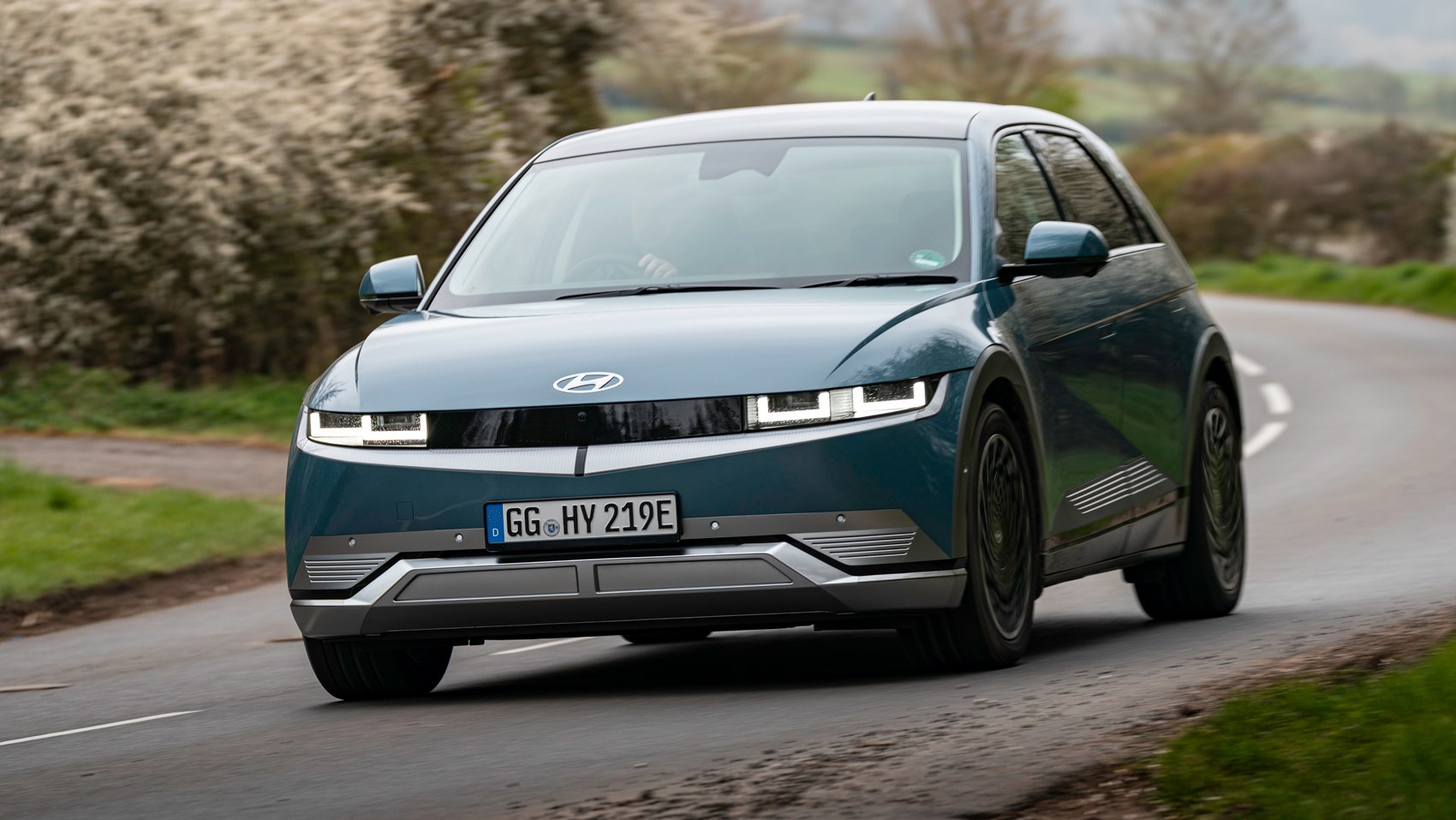
Speaking to WhichCar, Hyundai Australia criticised the immediate implementation of the EV tax, saying there’s a need for one further down the road but now is not the right time.
“As cars become more efficient and use less fuel – or no fuel at all in the case of EVs – the Government’s income from fuel excise will drop away,” said a Hyundai spokesman.
“So at some stage in the future we will need to consider road user charging more broadly – on a national basis, for all vehicles using the roads.
“Until such a national strategy is developed, we don’t believe now is the right time to tax zero-emission vehicles.
“Road user charging would be better timed after incentives are in place to encourage public adoption of EVs. We see government incentives working well in most advanced nations across the world, as a key component of climate change policy.
“We are encouraged by the Victorian Government’s incentives package for EVs and the accompanying investment in EV charging infrastructure.
“Once incentives are in place and we see consumer uptake of EVs accelerate, the time will be right to look at road user charging more broadly.
“Until then, we don’t advocate taxing the most advanced and efficient vehicles on the road.”
A new subsidy scheme for new EV buyers has also recently been introduced by the Victorian Government, taking $3000 off the price of a fully-electric or hydrogen car at the dealer, though this too has come under fire for being “confusing”, with some dealers applying the discount while others aren’t.
The Department for Transport has defended the road user charge, claiming it is necessary to claw back money from the subsidy scheme.
“We’re taking bold steps to achieve net zero emissions in Victoria by 2050,” a spokesman said.
“We know transport is one of the state’s biggest emitters – and through our Zero Emissions Vehicle Roadmap, we’re ensuring Victoria is a leader in the uptake of zero-emissions vehicles by making them accessible to more Victorians.
“Our $100 million support package for zero-emissions vehicles includes a new vehicle subsidy so more people can access a new, cleaner car, increased charging infrastructure and initiatives to increase corporate fleet purchases.
“These investments have been made possible by a zero and low-emissions Road User Charge which will ensure all road users contribute their fair share towards the cost of Victoria’s road network as we work to make our roads cleaner.”
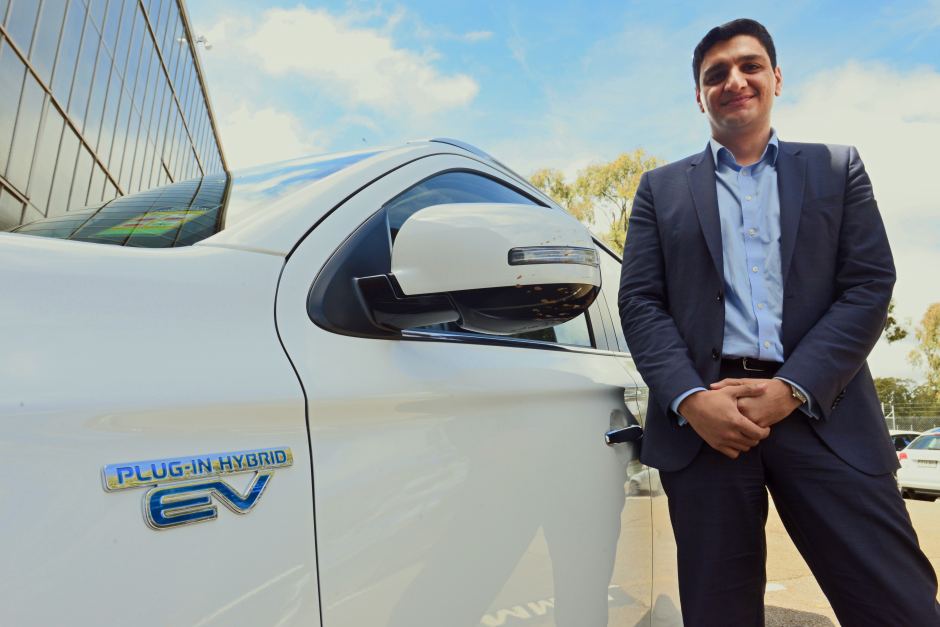
It would be easy to think that when comparing the cost of Toyota’s Camry Hybrid with Tesla’s Model 3 – if one were inclined to make such an odd comparison – the much cheaper Camry would come out on top in the ownership stakes.
However, a number of stories in recent months have highlighted key factors that show the Model 3 – now available for just under $60,000 – can be the more cost-effective purchase if the vehicles are sold after five years with an average of 20,000 kilometres added to the odometer each year.
In a recent video published by YouTuber ‘Tesla Tom’ (a Tesla fan and owner who holds the Camry Hybrid in high regard), this exact argument is made.
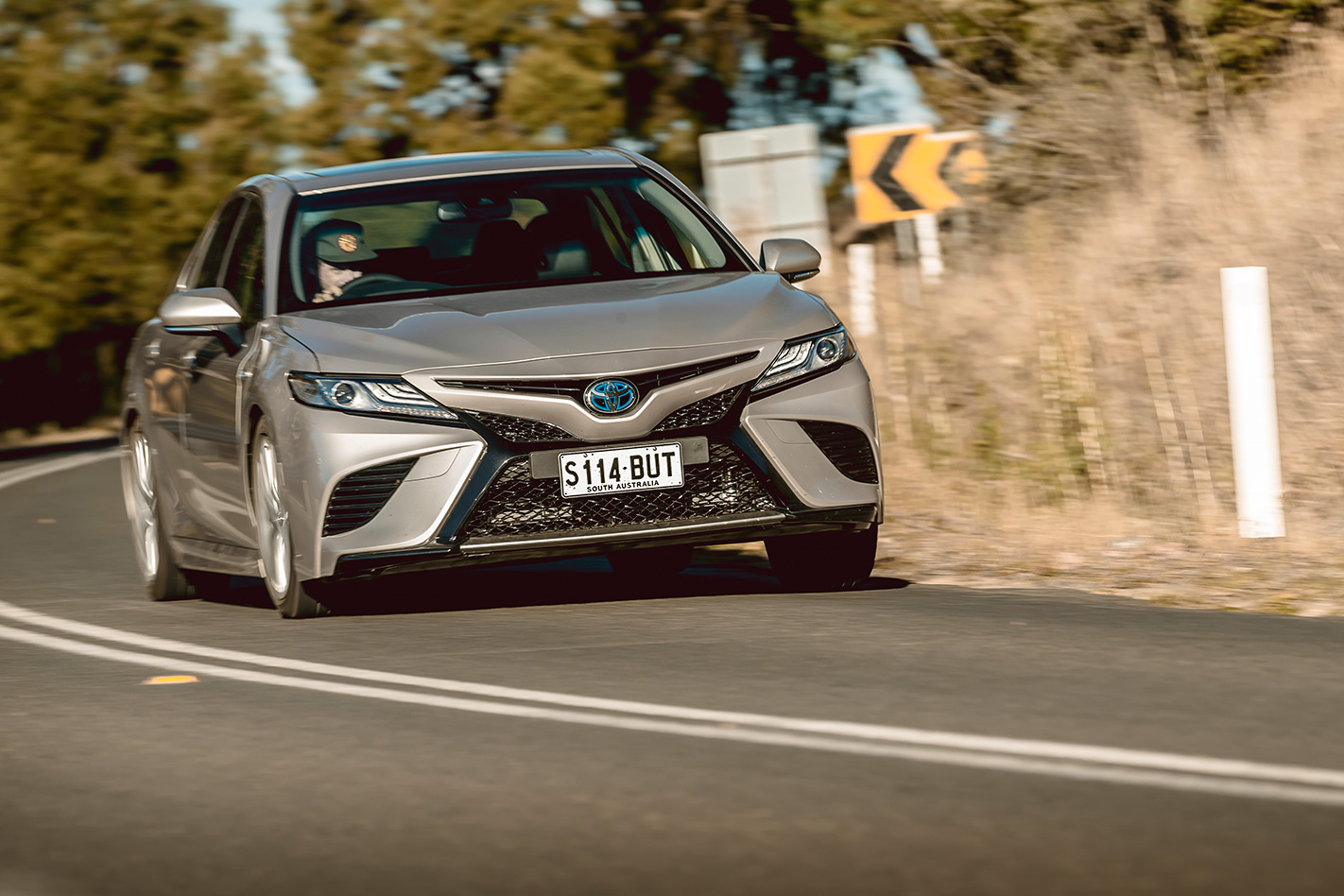
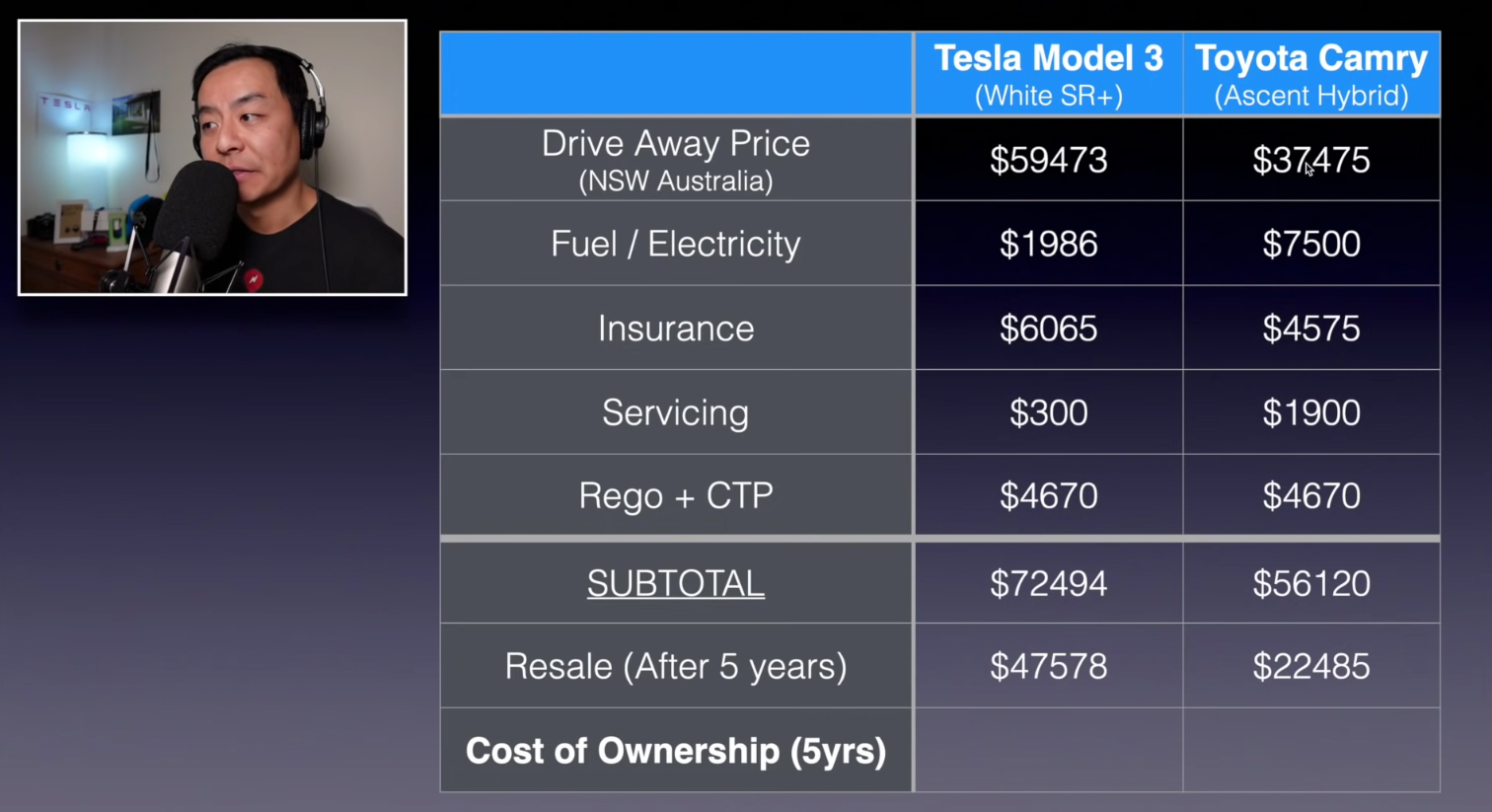
Along with the above details, some assumptions need to be made, including an average price of $1.50 per litre of petrol for the Camry, with a 5.0L/100km fuel consumption figure. (Officially, the Camry Ascent Hybrid claims 4.2L/100km, and a real-world figure would likely be higher.)
A depreciation of 40 per cent over five years is also assumed (although the overall Camry range has shown higher rates in recent times).
Likewise, assumptions for the Model 3 (this time based on his experience) include a 16kWh/100km efficiency rate with around 1kWh per day of “phantom loss”, along with 90 per cent of its charging carried out at home with a price of 6.6 cents per kWh. The remaining 10 per cent is given to Tesla Supercharging locations, at 52 cents per kWh.
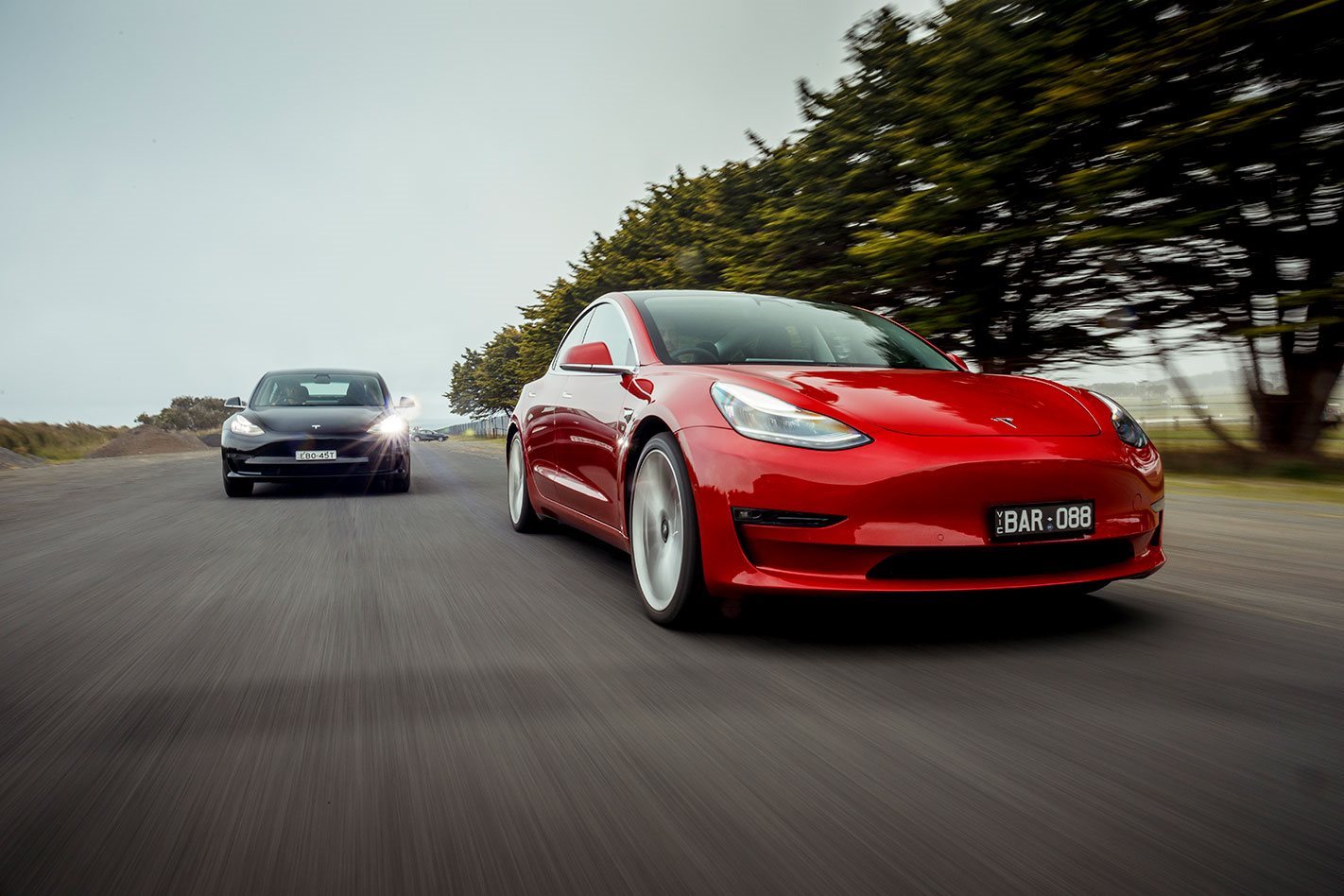
A five-year depreciation rate of 20 per cent is given for the Model 3 – although this number is based on US data, as nobody in Australia has owned a Model 3 for so long just yet.
These numbers are all explained more specifically in the video, along with servicing/parts costs and the incentives available for EVs, but – without spoiling the verdict – the screengrab below shows a breakdown of the anticipated costs.
How does it turn out? Hit play on the video above!
A bespoke McLaren Speedtail called ‘Albert’ has been commissioned by the British manufacturer’s Beverly Hills dealer, resulting in a paint job which took 12 weeks from prep to polish.
Already a unique vehicle with only 106 units produced, the dealer in question wanted something which would make its Speedtail stand out even further from the crowd, requesting a very special paint job for its $3million-plus supercar.
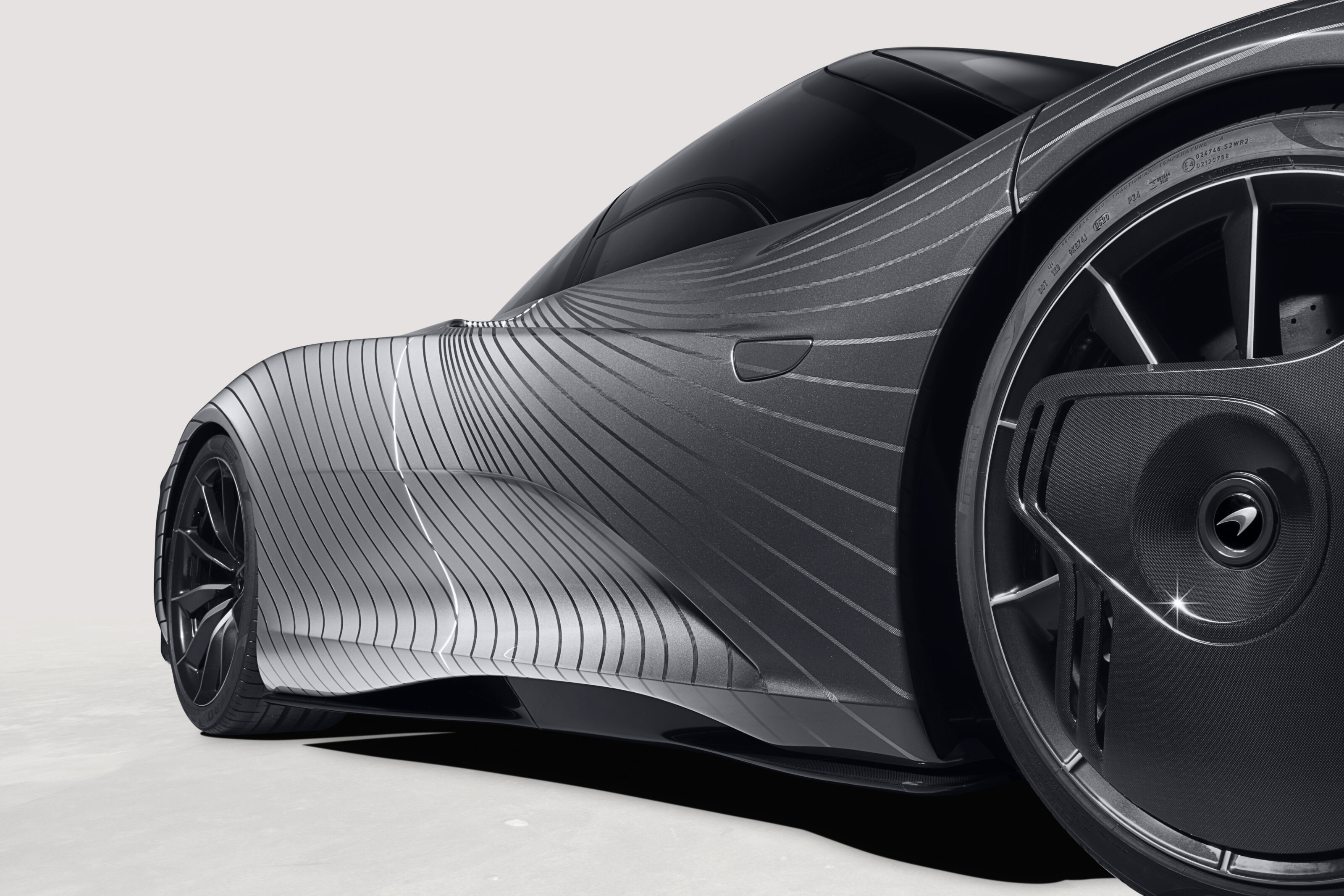
The transitional paint over the one-off Speedtail is a mix of Ueno grey, which was one of the two main colours of the 1995 Le Mans winning McLaren F1, and magnesium silver – the finish of the first F1 road car unveiled in 1992.
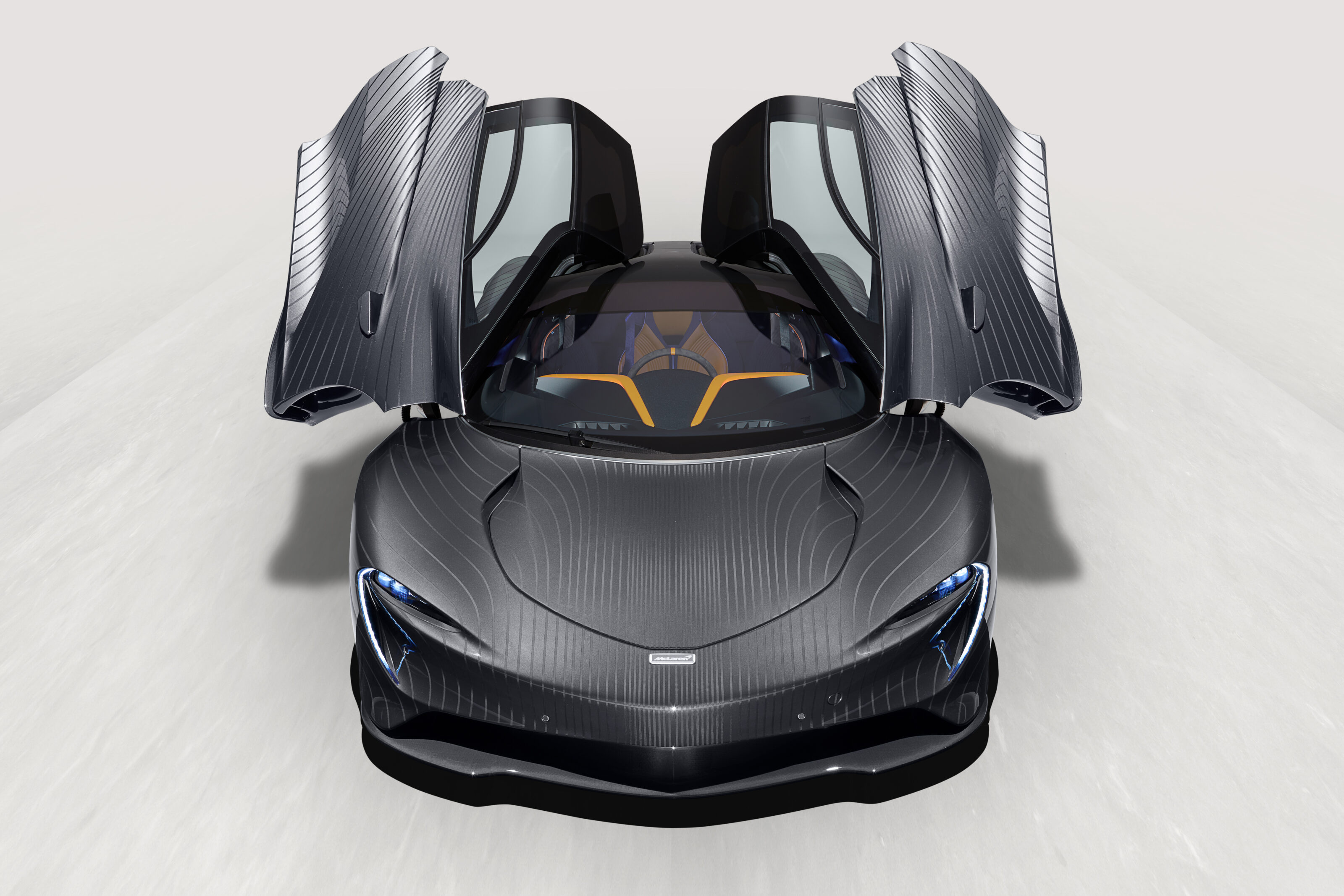
Of the 12 weeks McLaren Special Operations spent preparing and applying the paint to the carbon fibre body, two were dedicated to masking off the panels, a process which resulted in just under two kilometres of tape being used.
The result is a tribute to McLaren’s MVY02 Speedtail prototype, which also bore the ‘Albert’ name, paying homage to Albert Drive in Woking where the McLaren F1 was tested in its pre-production guise before becoming the world’s fastest car.
With its 4.0-litre, twin-turbo V8 and electric motors making a combined 772kW and 1150Nm, the Speedtail sprints from 0-300km/h in just 12.8 seconds, going some way to justify its hefty price-tag – despite not being road-legal in the United States, thanks to its use of cameras in place of physical mirrors.
Despite this, the Speedtail Albert will make its public debut at Sunset GT in Beverly Hills this weekend before next weekend’s Pebble Beach Concours d’Elegance.