
UPDATE, June 2022: Pilot Sport 5 tested!
Well, we’ve now driven cars fitted with Michelin’s newest flagship performance rubber. To get our view on how they go, hit the link below.
“The amount of wet grip, some of it on virtually standing water, is truly impressive.”
MOTOR’s 2021 Tyre Test
Panic. That’s what set in when I realised that MOTOR’s 2021 Tyre Test was only days away, and I hadn’t yet checked the forecast. Call it traumatisation, but memories briefly returned of last time when biblical weather forced us to abandon the event halfway through.
That’s not to say our annual rubber torture test – back after a Covid-induced hiatus in 2020 – can’t handle a bit of rain. Just intermittent showering can undermine the predictability of data. And given Australia’s most trusted and longest running independent tyre test is built on solid bankable numbers, I didn’t want to stress thinking about how we could avoid that being compromised.
Fast forward to Tuesday, April 27. Morning dawns without a cloud in the sky as we roll into Sydney Dragway, where the space outside the scrutineering shed will be our official place of business for the day. We’re on.
Gun-driver for hire Warren Luff is already scanning the area from the passenger’s seat, mapping out cones in his mind to design the slalom, wet and dry emergency braking test, lateral G test and motorkhana within the vast area. We’ll get on to them later.
Supporting crews crucial to getting today off the ground, including the team from Tyreright that will be on the rattle guns, begin to arrive as Luffy zig zags the car park in our hire car with a boot full of orange cones.
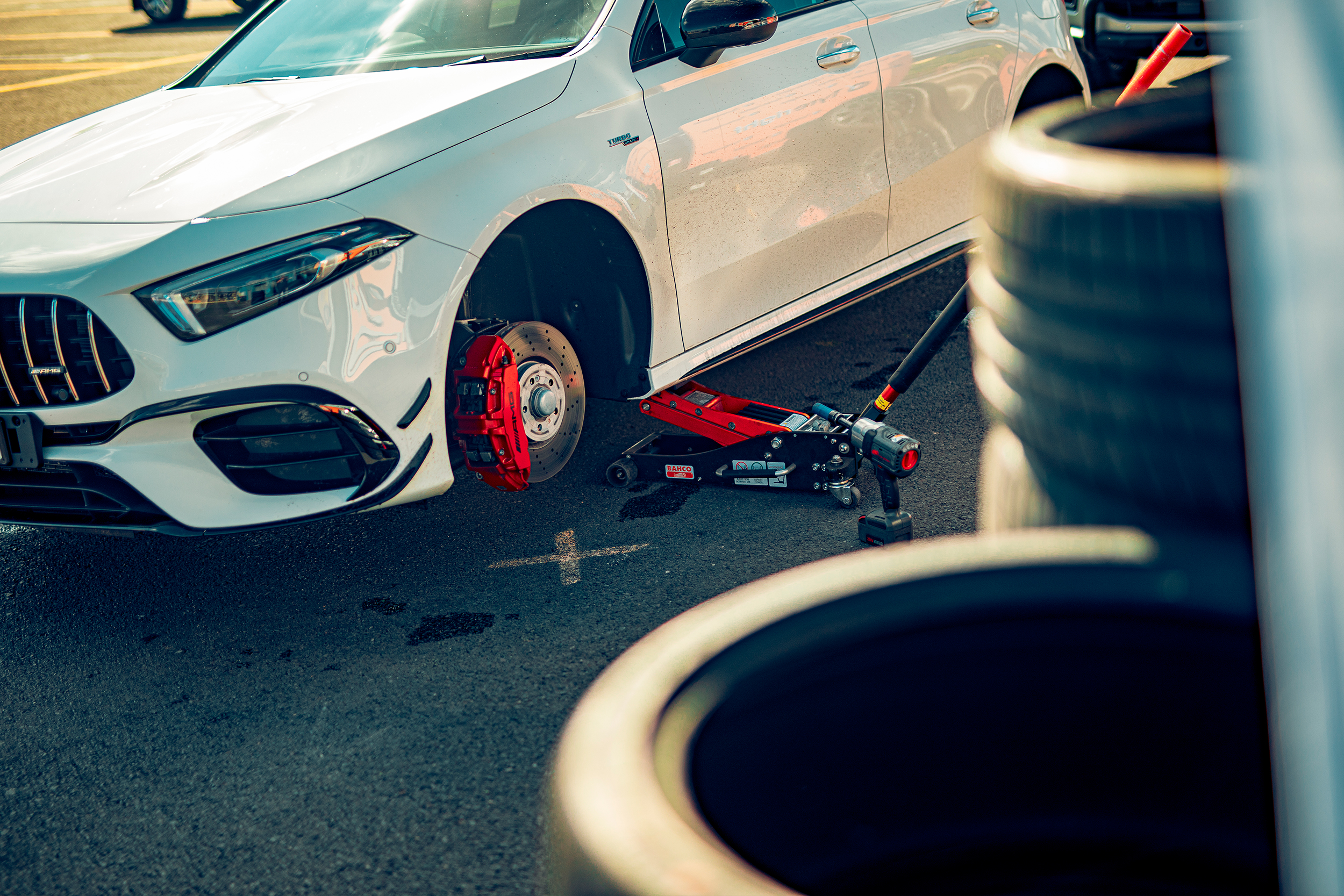
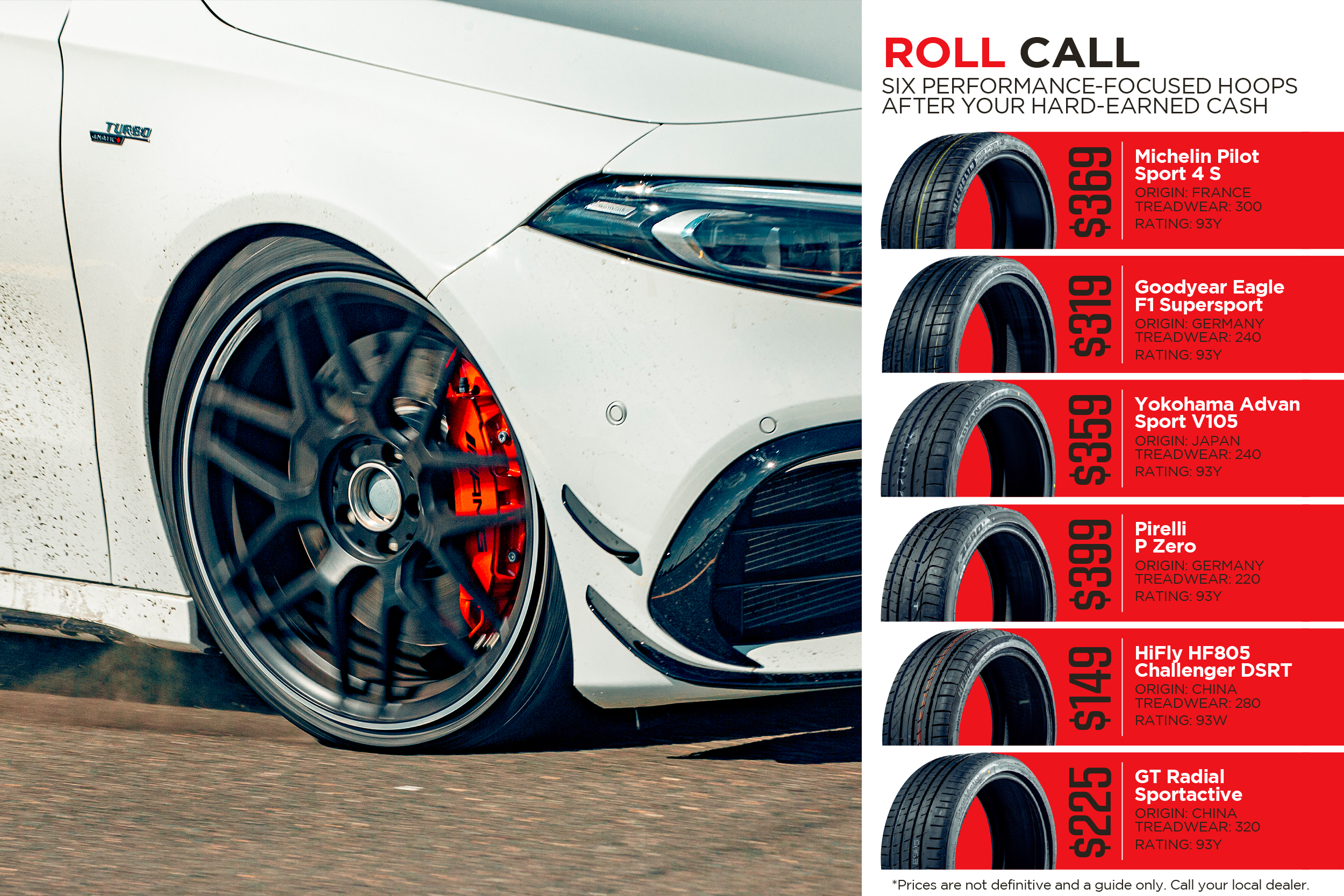
A ute-load of our rubber arrives next, delivering six high-performance patterns and two distinct groups of competitors. First, there are the big boys. The Michelin Pilot Sport 4 S is back to defend its 2019 win. Meanwhile, it’s flanked by the Pirelli P Zero, Yokohama Advan Sport V105 and Goodyear Eagle F1 Supersport.
Rounding out the field are a pair of budget contenders in the GT Radial Sportactive and HiFly Challenger HF805 DSRT. What was missing? Unfortunately, Bridgestone’s new Potenza Sport had not launched in time, and the Maxxis Victra VS5 missed the boat, literally – they were stuck at a port up north. Unfortunately it’s also the first time Continental did not have its always-competitive rubber in the ring since 2012.
Few cars are fit enough to put a field of tyres through their paces for any tyre test, let alone on tyres of this calibre. But the Mercedes-AMG A45 S, a 309kW/510Nm all-wheel drive turbo terror with punchy diffs and adaptive suspension, is as precise as it is explosively quick.
With 360mm brake discs and bulging six-piston calipers up front pairing with 19-inch wheels wearing 245/35 ZR19 all around (a relatively common tyre size in performance car land), the quick-footed A45 S stood up as the perfect tool to dissect our field.
Delivered with a full tank of fuel, the only preparation needed for the A45 S was to switch off ESP and turn on its Race Mode, priming its various hardware for their highest performance. And lastly, a VBOX – which we use for any competitive test where data is paramount – was plugged into the 12-volt power supply so it could track each run with satellite-linked accuracy.
Before we unleashed Luffy, though, there were a few matters of process to clarify. The first rubber to run through our disciplines was already on the A45 S, given they are our control set. But setting them to placard pressures – 44psi on the front and 41psi at the rear – begins a process we’ll repeat again for each tyre for the sake of consistency.
Importantly, with all sorts of variables threatening to change the testing conditions throughout the day, the control tyres were tested in the morning, midday and late afternoon to reveal if a specific time is more favourable than another. We then used linear regression to adjust the raw data with a weighting based on this, eliminating any doubt about the run order favouring specific tyres.
Each tyre was run through the disciplines in the same order, beginning with a short run-in to de-glaze the tyres. The first victim was the control, followed by the Goodyear, HiFly, GT Radial and then the control again before a lunch break and re-fuel. After lunch, Luffy will finish with the Pirelli, Yokohama, Michelin and control. And with that out of the way, let the games begin…
01: Motorkhana Course
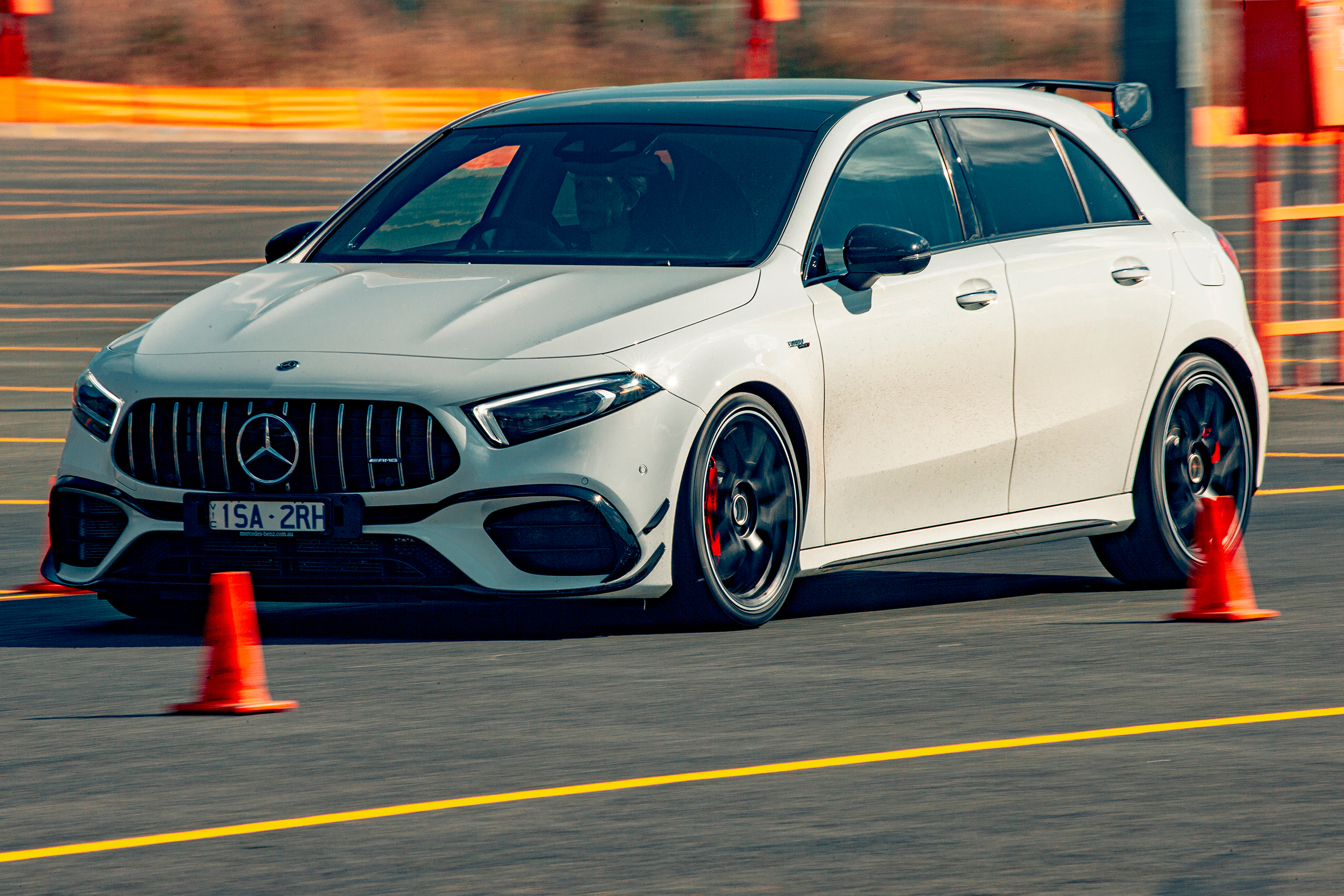
It’s hard to spot, but down the opposite end of the carpark, a ‘race track’ hides in plain sight. Among the rectangular lawns laid in a grid are twists and turns used for a much larger motorkhana during North Shore Sporting Car Club’s tarmac rallies.
We focused on just nine of those corners for our 424m motorkhana. The exercise is an indispensable tool for tyre testing because not only are fundamentals like braking, traction and lateral grip crucial to a fast lap, but it focuses on peripheral aspects of tyre performance as well.
For instance, extra feedback helped Luffy hit his markers more precisely. Then there’s endurance. Because the course was tackled in a clockwise direction, the left front tyre was worked hard consistently until the A45 S briefly straightened out over the start-finish line at over 90km/h and then barrelled into the first right-hander again.
The results are decided on the elapsed time each tyre needs to complete three laps. And to eliminate as many variables as possible, Luffy began with a full-speed flying start.
It was quickly established that Goodyear would be the one to beat this year, despite Luffy saying the Eagle F1 suffered from some understeer compared to the control tyre. It trounced the following HiFly, GT Radial and Pirelli.
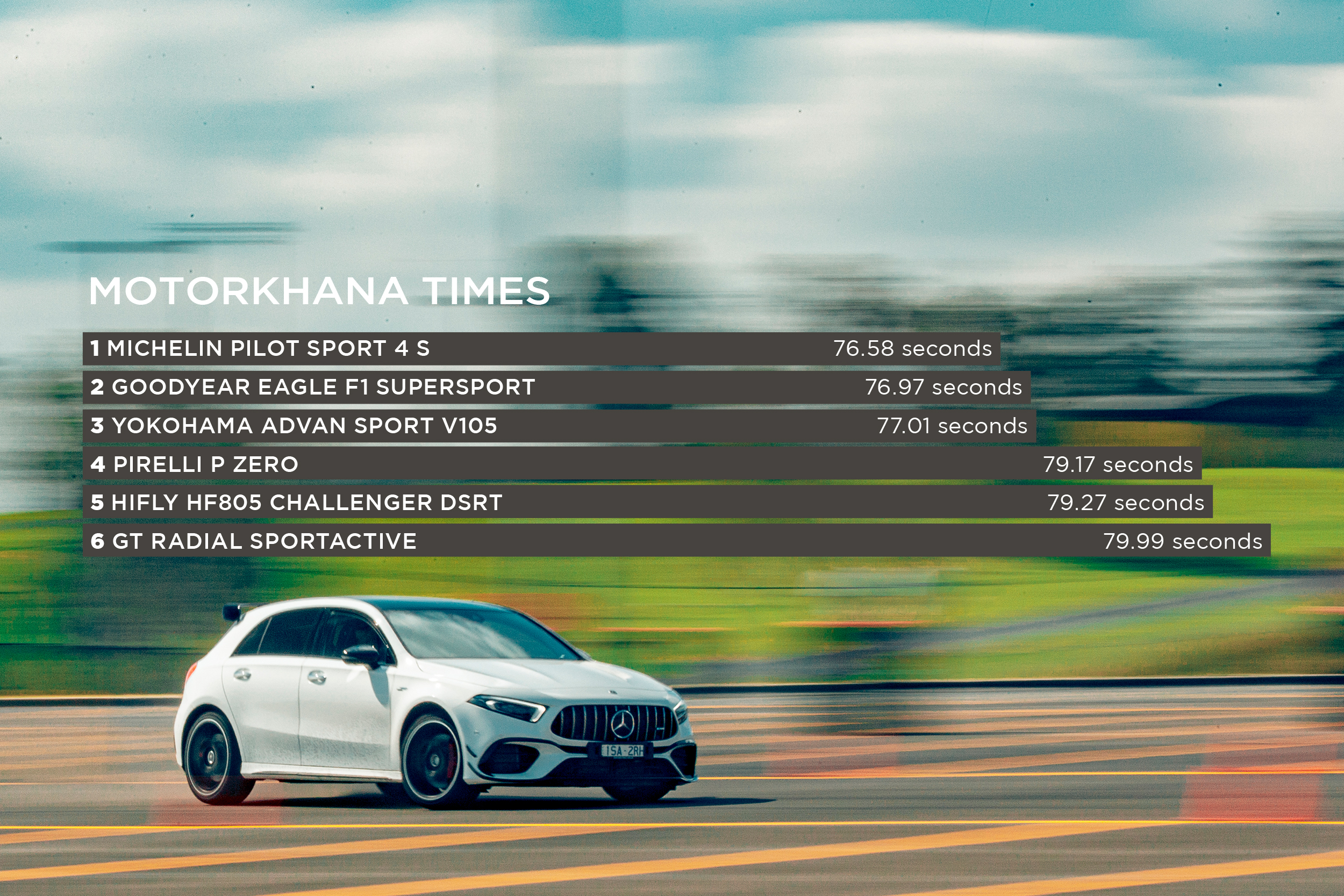
Only the Yokohama and Michelin had the chops to knock off the Goodyear. But as we’d find out, only one of them did it convincingly enough to avoid being relegated by the linear regression-based formula.
The control tyre results revealed that they favoured conditions later in the day, improving by almost half a second overall. The formula responded to this by handing each tyre a weighted improvement, with the further a tyre was from the ideal conditions equalling a more dramatic adjustment of their results.
In the end, the Goodyear was close enough to the Yokohama on raw data to bag second place.
02: Lateral G-Force
Our lateral G-force test measures how hard a tyre can hang on to the road, full stop. Back near the motorkhana, Luffy picked out two corners that make a double-right. After approaching the first bend at 40km/h, he accelerated as hard as possible into the second, pushing the tyre to the edge of grip.
During this, a tyre inevitably might step over its grip limit and spike a reading on the VBOX. While the software already applies a smoothing value to the data to minimise any anomalies, Luffy also ran the test three times in either direction to give us a broader and more accurate range of results.
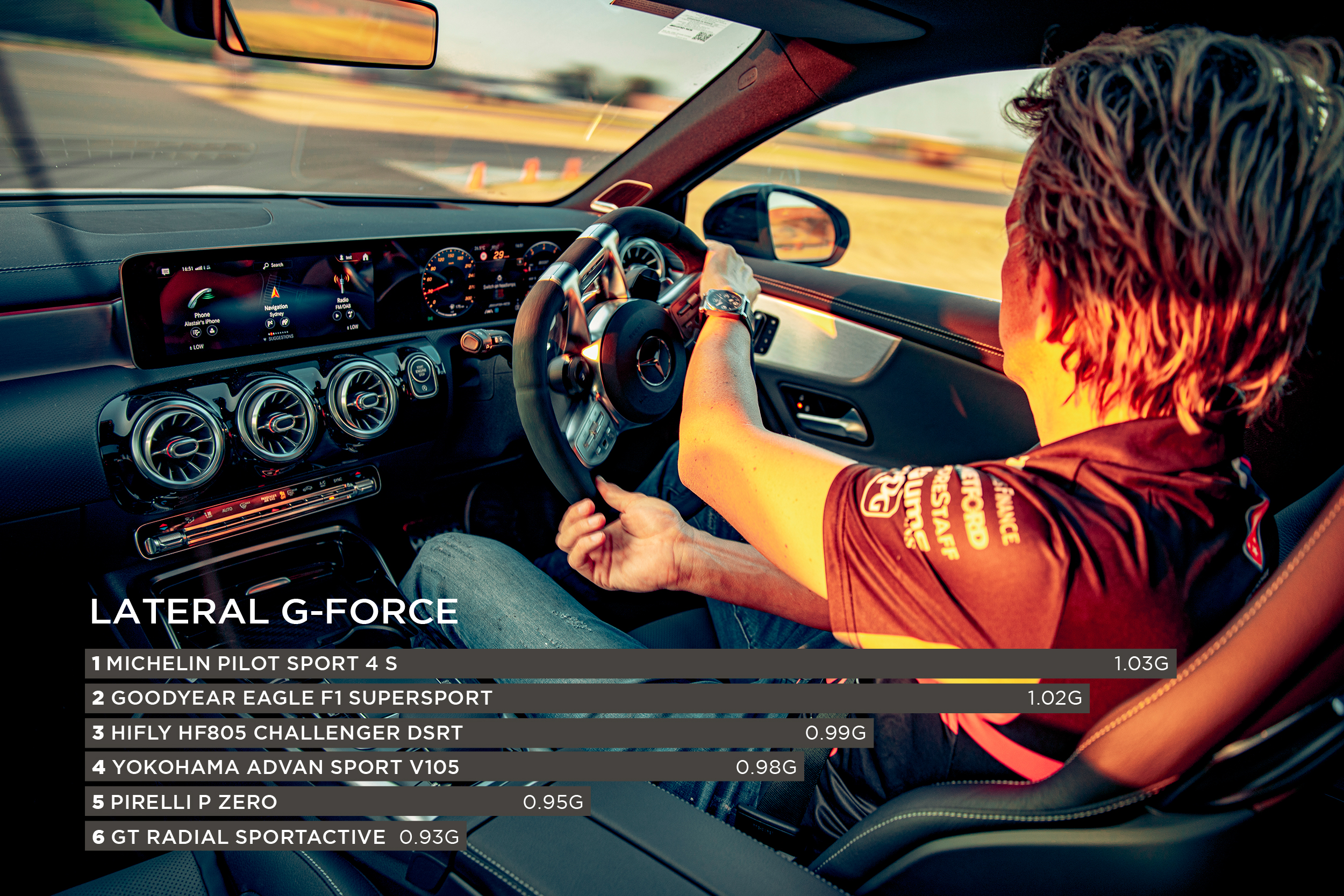
Then, to refine them even further, we also flick the worst and best G-force figures each tyre records and then average the remaining four. Straight away, like in the motorkhana, the Goodyear set a benchmark average for the day. Its 1.0226G remained the top score until, again, the Michelin dethroned it with a dominant 1.039G average.
The differences in control tyre performance were only minor, with grip improving from an average of 1.0075G to 1.0125G. As a result the Michelin and its big grip-loving shoulder blocks, were safe.
Feeding the data into our formula only split the equally matched Yokohama and HiFly’s raw results in the latter’s favour. And while no tyre followed the Goodyear and Michelin above an average of 1G, it’s worth mentioning the HiFly was the only other tyre that logged 1G-plus on two of its eligible attempts.
03: Slalom Course
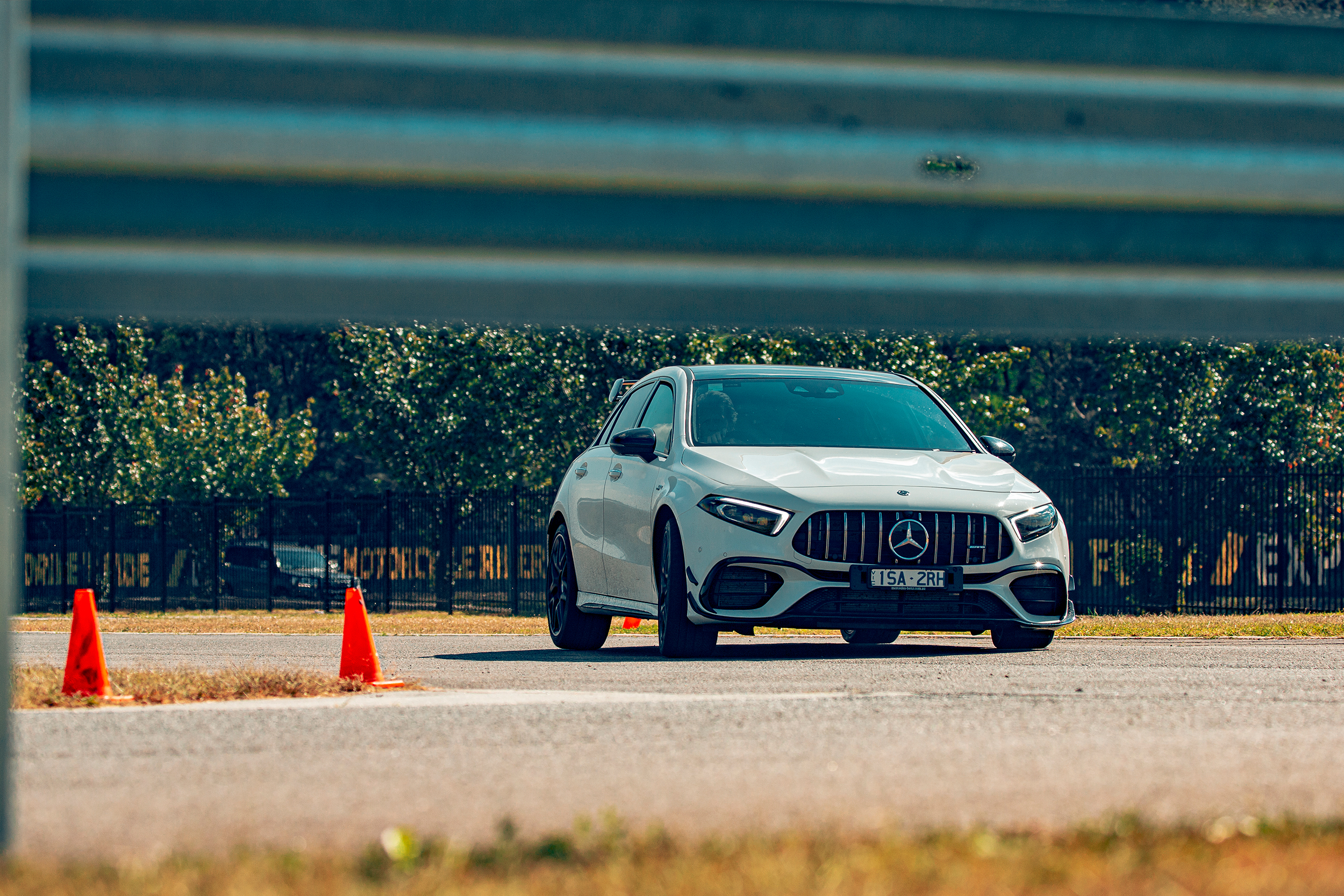
The slalom remains a relatively simple way to effectively size up a tyre’s performance capability for two reasons. The repeated direction change requires good mid-corner stability, while forward momentum needs tenacious traction.
With nine cones set at equal distances over 160m, Luffy approached the first one at 40km/h and then dropped the hammer once that cone disappears past the A-pillar in his peripheral vision. From there, it’s about going as fast as the tyres allow until over the finish line.
The test was repeated four times after the first run. Once the data was downloaded and verified against Luffy’s handwritten notes, the best and worst runs were dropped to leave us with an average of the remaining three – minimising the chance of anomaly.
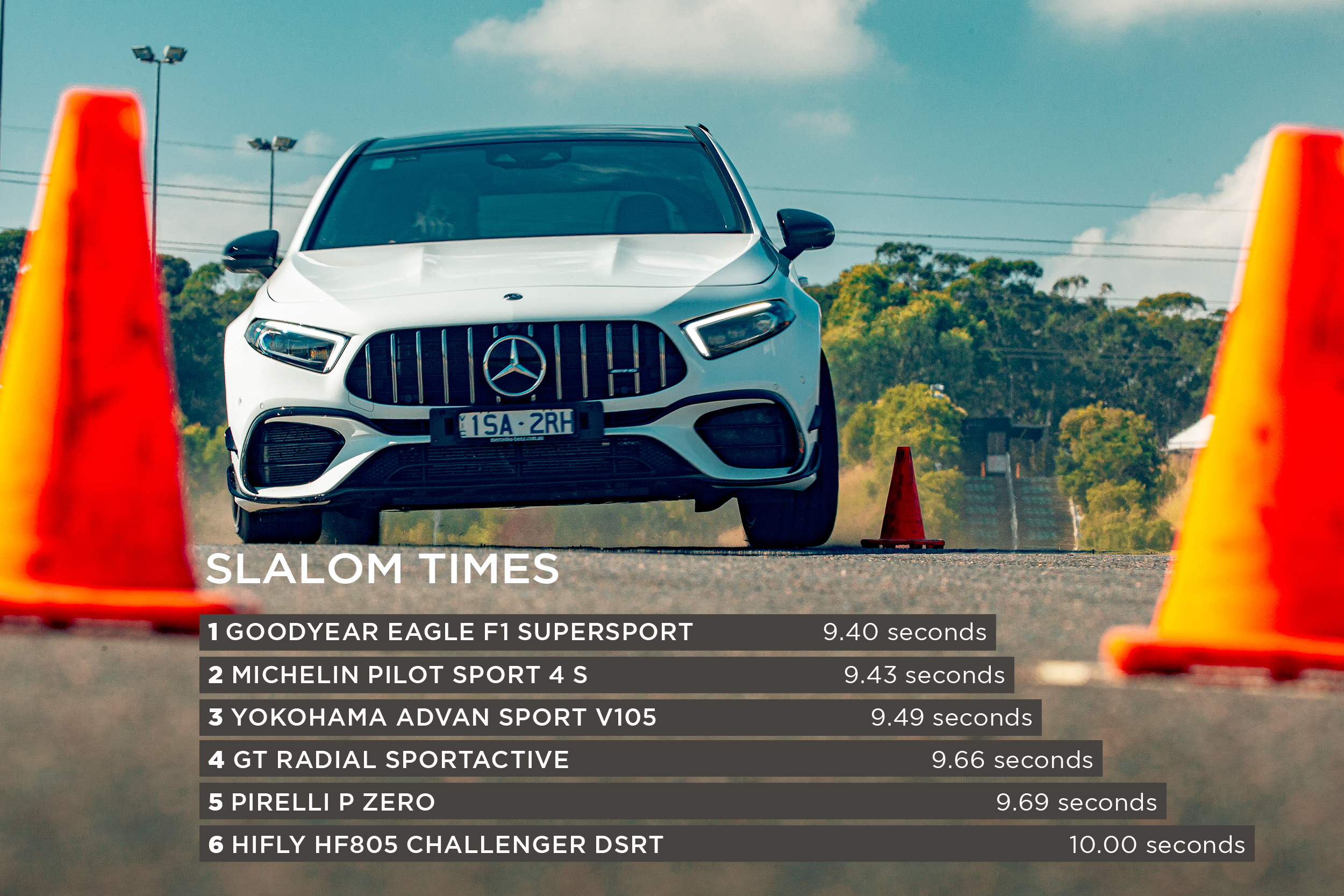
Again the test was the Goodyear’s to lose. Every tyre after failed to knock off the German-made hoop from top spot until, surprise surprise, the Michelin. But while the Michelin found five hundredths on average over the Goodyear, we’d stop short of saying it won the test.
Our control tyre also found speed throughout the day. It gained a tenth on its second run and then a hundredth on its third and final go. This tapering advantage was most likely dictated by the surface temperature, which jumped from 27.7 degrees Celsius in the morning to 36.9 degrees at midday but then only peaked at 39 degrees.
In the end, our formula only penalised one tyre after adjusting the results. The Goodyear put in a good enough performance on raw results alone, much earlier in the running order, to overtake Michelin once a weighted adjustment was applied.
04: Wet & Dry Braking
Few things stress a tyre’s importance more clearly than an emergency braking test. That’s not only because the results spew out the widest variation between best and worst in our field, but also because it’s easier to understand how the difference translates to the real world. Five metres here could hold the difference between avoiding or meeting disaster.
Ours involved seeing which tyre can stop in the shortest distance from 100km/h. It’s not far from the truth saying you or I might find ourselves trying this out unexpectedly behind a pile-up on the highway.
The method involved Luffy charging at a braking zone at 110km/h and then braking as hard as possible for a full ABS stop. This way we measured how well the car can stop from 100km/h, rather than the driver.
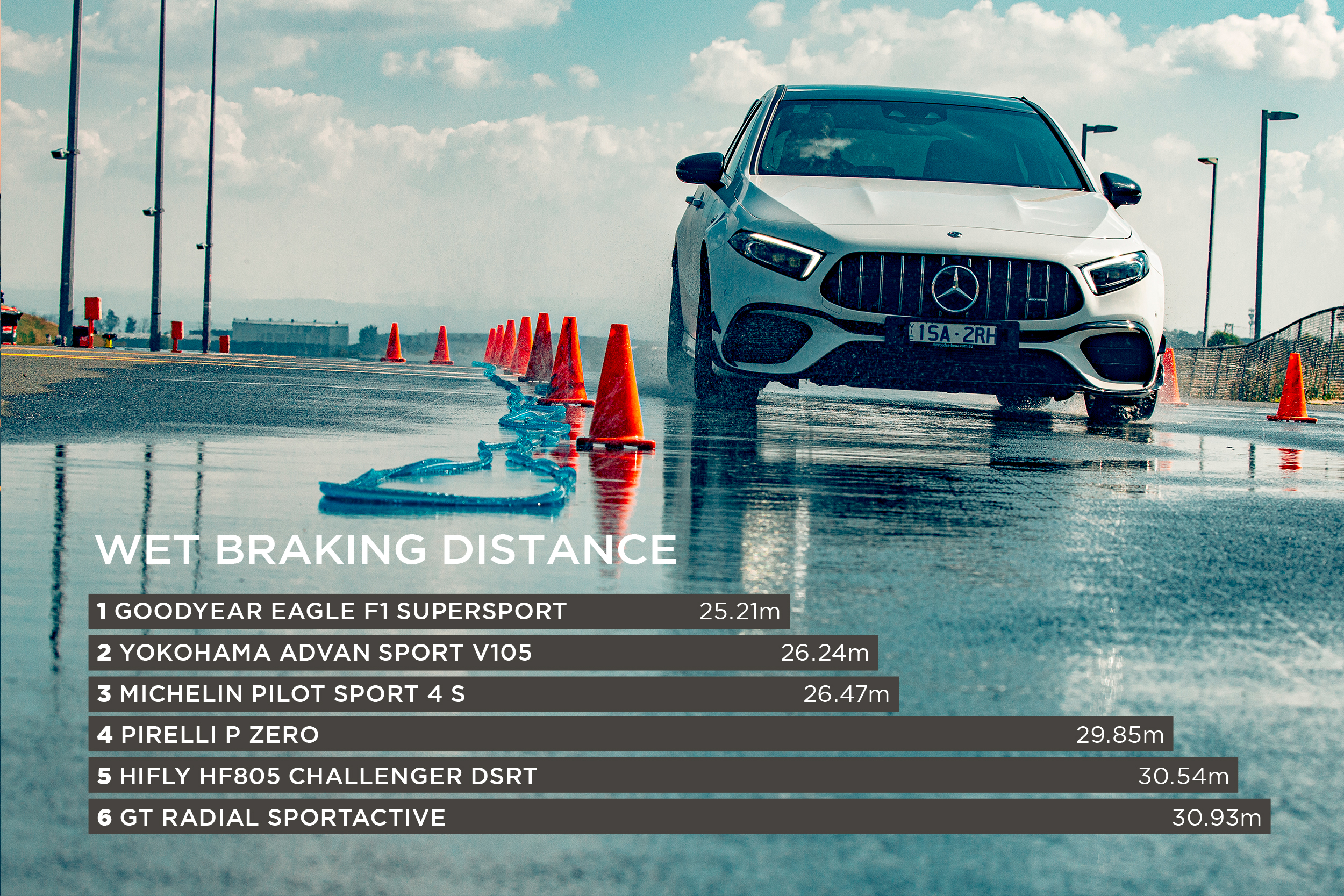
The wet test, meanwhile, replicated our dry method. Instead, this time Luffy approached a section drenched under soaker hoses at 90km/h so the VBOX can record the distance it takes to stop from 80km/h.
Every tyre had three runs at each test, with the average of those stopping distances being counted.
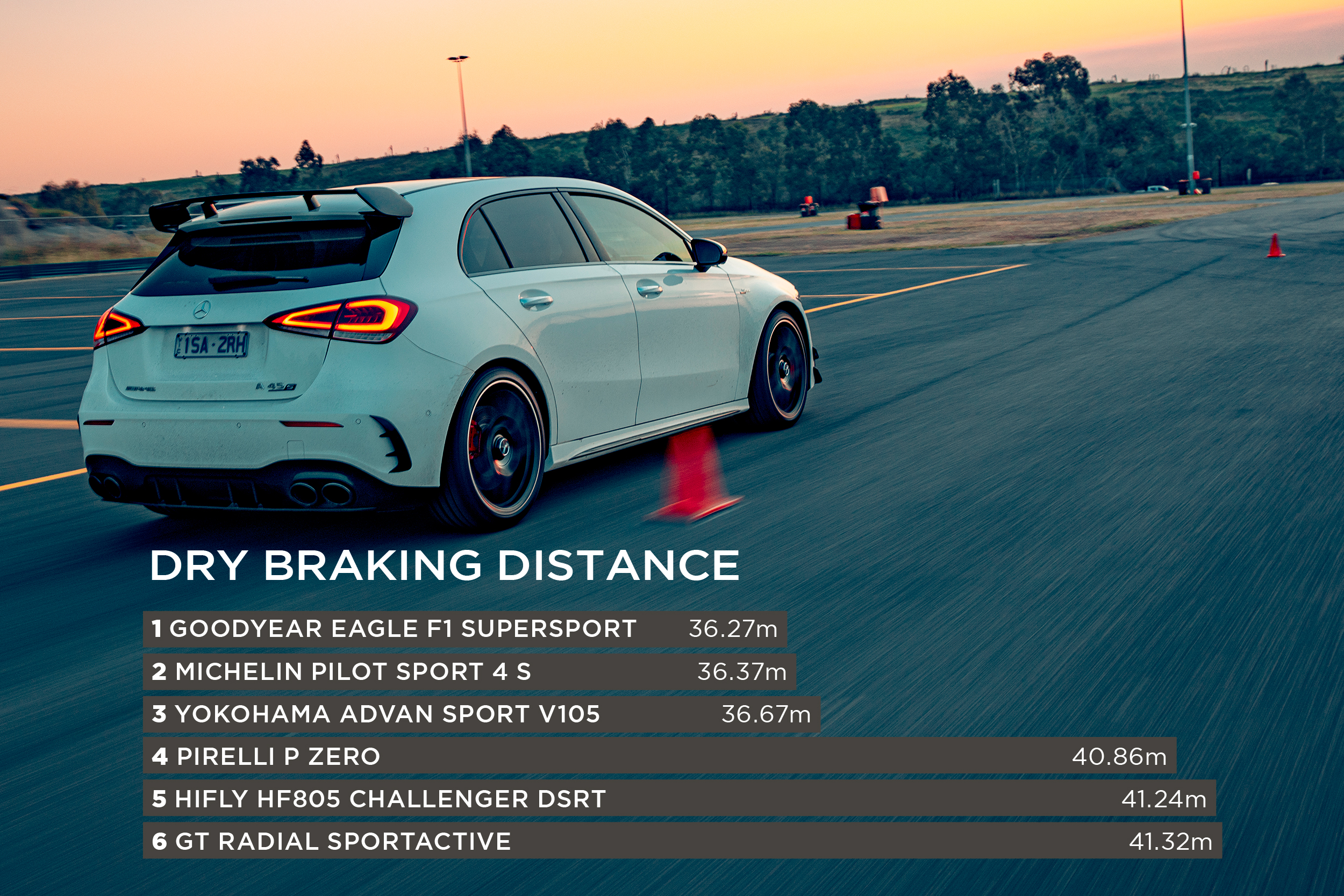
Although the Michelin logged the shortest average distance in the dry, closely followed by the Yokohama, the control tyre performance improved considerably over the day. A combination of rising surface temperatures and increasing brake efficiency saw its distances fall from 38.91m at first to 37.77m and then finally 37.55m.
So, after feeding the results into our linear regression-based formula, the earlier run Goodyear emerged on top. The formula slashed just over one metre from its stopping distance. Meanwhile, the Yokohama and Michelin only improved by 0.3m and 0.1m respectively because they ran just before the last control tyre, which wasn’t enough to catch the Goodyear.
It was a similar story for the wet test. Rising temperatures and a slight breeze in the afternoon saw the control tyre performances improve as the day went on. However, this made no difference at all to the eventual winner, only second place. The Yokohama leapfrogged the Michelin into second after the formula set the results straight.
MOTOR 2021 Tyre Test Winner: Goodyear Eagle F1 Supersport
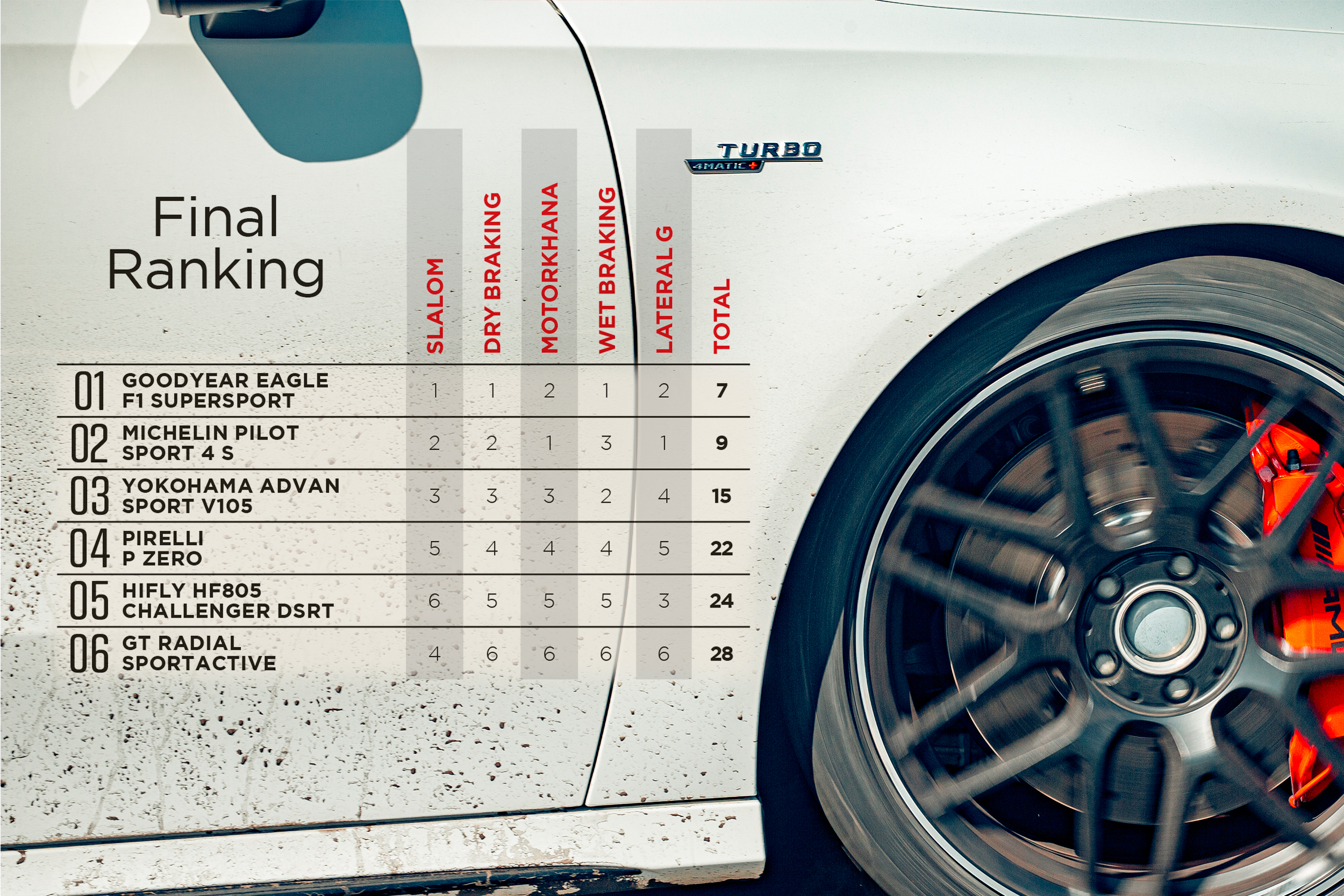
To determine a winner, we’ve kept it as simple as possible. Each placing a tyre achieved is the score given to it for that discipline. Those scores are then tallied. Finally, the lowest score wins.
It was clear from the outset a dogfight was brewing between three patterns: the Goodyear Eagle F1 Supersport, Michelin Pilot Sport 4 S and Yokohama Advan Sport V105. They shared the top-three places in every discipline, except the Lateral G, where the Yokohama was downgraded to fourth after the results were adjusted.
Besides a strong wet braking test, the Yokohama primarily occupied third place – leaving the Michelin and Goodyear to duke it out for the win. But running the two premier patterns at opposite times of the day put a lot of power in the linear regression-based formula’s hands, as the Michelin’s top showings on raw data were never guaranteed.
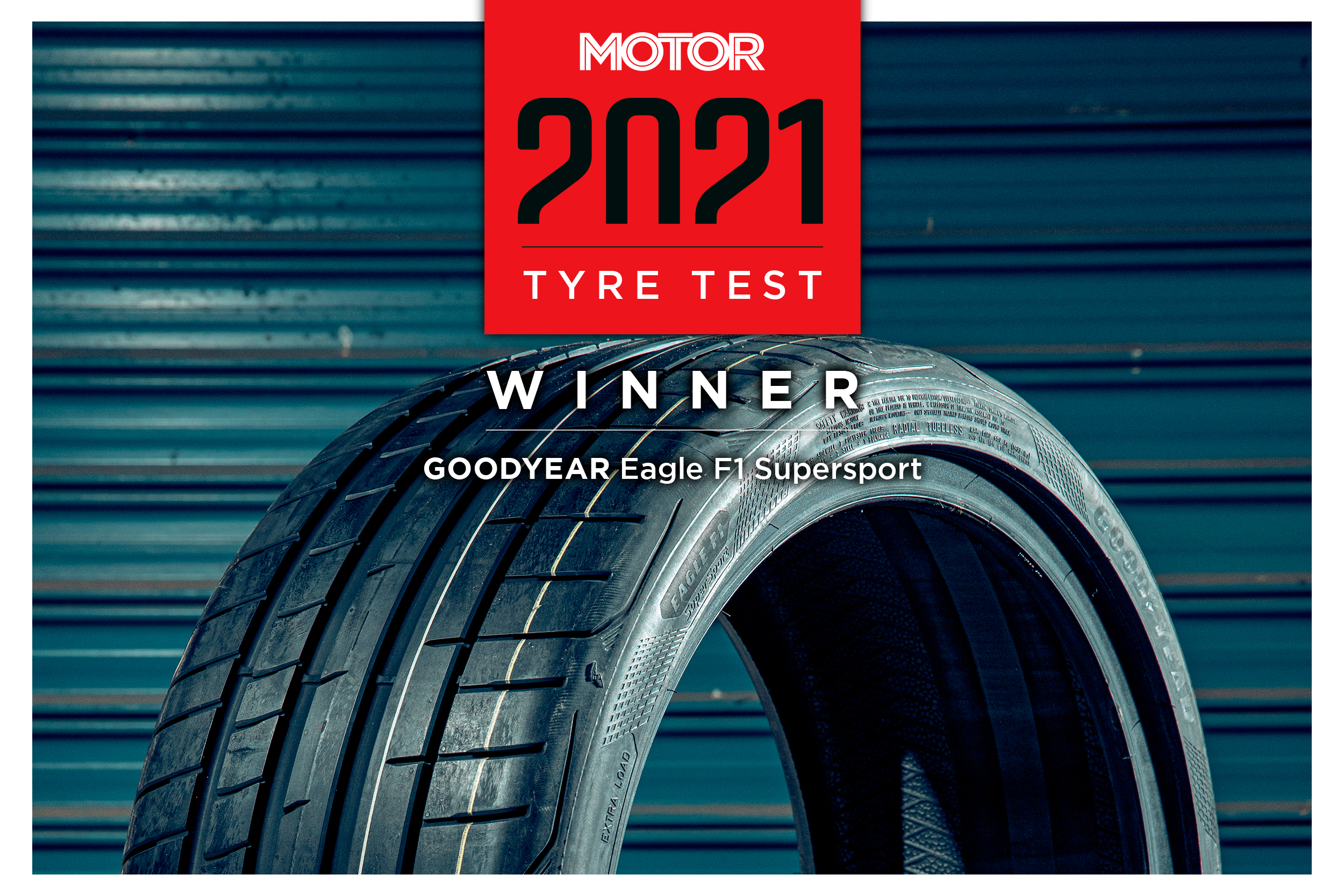
As it turned out, with the control tyre consistently improving towards the day’s end, the formula made the reigning champ Michelin relinquish the slalom and dry braking wins to the Goodyear. Add that to a convincing win in the wet even on raw data, and the event was sealed in the Goodyear’s favour.
Victory comes as redemption for the Goodyear, which fought hard in 2019 to finish second behind the Michelin. The improvement was unexpected, but the Goodyear faced the exact same settings as its competitors, so we can’t take anything away from a deserving win.
Down the order our bottom three found themselves locked in a battle similar as the top. The Pirelli P Zero, HiFly Challenger and GT Radial finished fourth, fifth and sixth respectively in most disciplines and placed in the order as such, completing the picture for the class of 2021. Bravo.
The Hot Seat
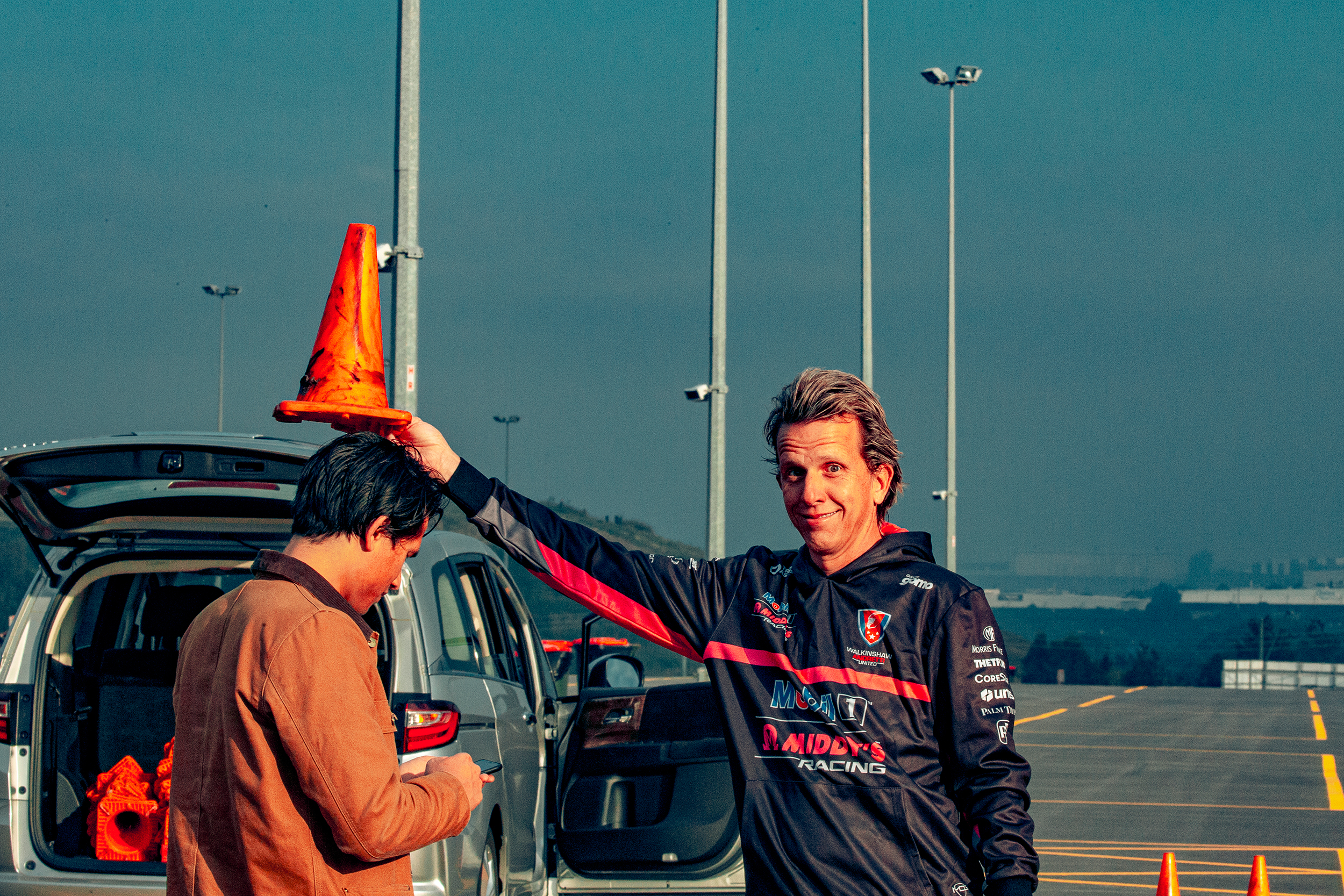
Warren Luff, the ring master
With more than 20 individual exercises to run on each tyre, testing rubber is serious work – both on the mind and body. This is why we’re lucky to have someone of Warren Luff’s calibre behind the steering wheel.
Lending his services to MOTOR for more than a decade as the gun driver on most of our mega tests, whether they be to find the best performance car or tyre, he also finds himself regularly on the roster of Australia’s top motorsport firms.
A two-time Sandown 500 winner in 2012 and 2016, he’ll again be looking to add a Bathurst 1000 win to his multiple podiums at The Mountain this October for Walkinshaw Andretti United as co-driver alongside young gun Bryce Fullwood.
Even with this experience, he still admits tyre testing is one of the most physically demanding tasks he faces.
But this makes his consistent ability to get the most from each tyre – fundamental to a successful event – more astonishing. We’re lucky to have him.
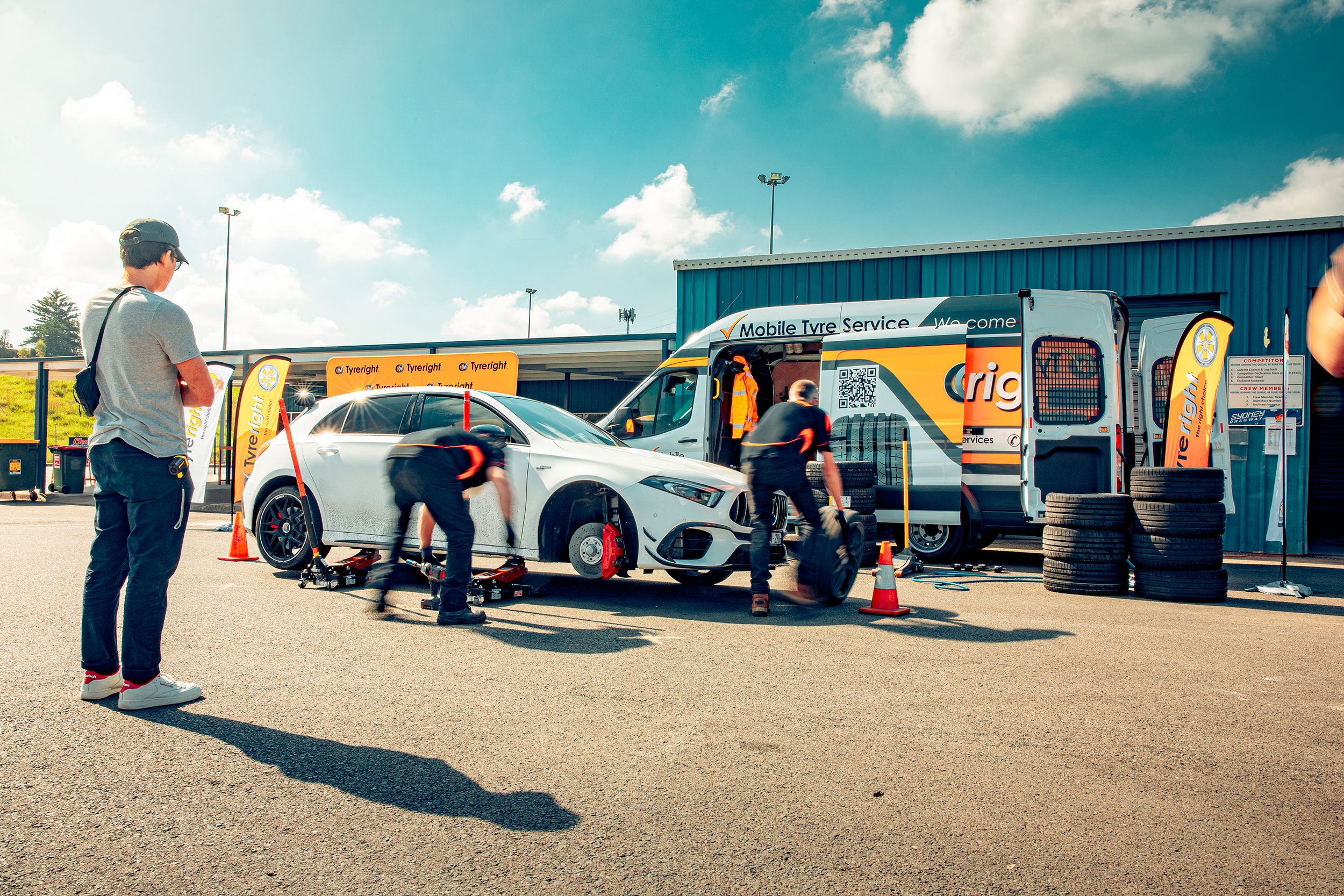
Hooray Tyreright
Our number one pit crew
A huge thanks goes to the crew at Tyreright.
As the operational bedrock of our tyre test and critical to a successful day, they kept our schedule ticking over as planned after handling the 36-plus tyre changes we needed without a flinch – all while only having the one set of wheels on the A45 S to work with.
Their high-end Mobile Tyre Fitment station based on a Ford Transit came decked out with professional gear from Eagle SMF, and it made us wonder if we’d ever need to travel to a tyre shop again when they can simply go to you.
Make sure you visit tyreright.com.au or phone 138 168 when shopping for your next set of tyres.
Jaguar Land Rover has announced Lennard Hoornik has been appointed as its new Chief Commercial Officer.
Mr Hoornik, who replaces Felix Bräutigam, will begin his new role immediately.
According to the British marque, he will be responsible for all global sales and marketing activity for both the Jaguar and Land Rover brands.
Previously he has spent eight years at Dyson as Chief Commercial Officer, as well as holding senior roles for Sony, Sony Ericsson, and HTC.
Thierry Bolloré, Chief Executive Officer at Jaguar Land Rover, said: “Lennard is an excellent addition to our business and is a hugely experienced leader in bringing products to market in exciting new ways. Innovation has been a key thread in his career, making him perfectly placed to realise the potential of our Reimagine strategy.”
Launched earlier this year, the carmaker’s strategy is designed to help it achieve zero tailpipe emissions by 2036 and net zero carbon emissions across its supply chain, products and operations by 2039.
Snapshot
- Grand Sphere concept set for September reveal
- Sky Sphere concept could be unveiled at the Pebble Beach Concours d’Elegance
- Design chiefs speak of freedom not having to design around ICE
Audi’s design team has opened up about the German marque’s future in an ever-changing world as the company transitions towards electric vehicles, moving away from its aesthetic norms.
Three of Audi’s key designers spoke to media at a tech talk on Friday off the back of its three ‘Sphere’ concept vehicles being released earlier last week, teasing the future direction of the brand’s EV models.
In the presentation, the new Grand Sphere was shown off in greater depth ahead of its official debut at the IAA Munich Motor Show this September, giving a deeper look at the future flagship vehicle for Audi.
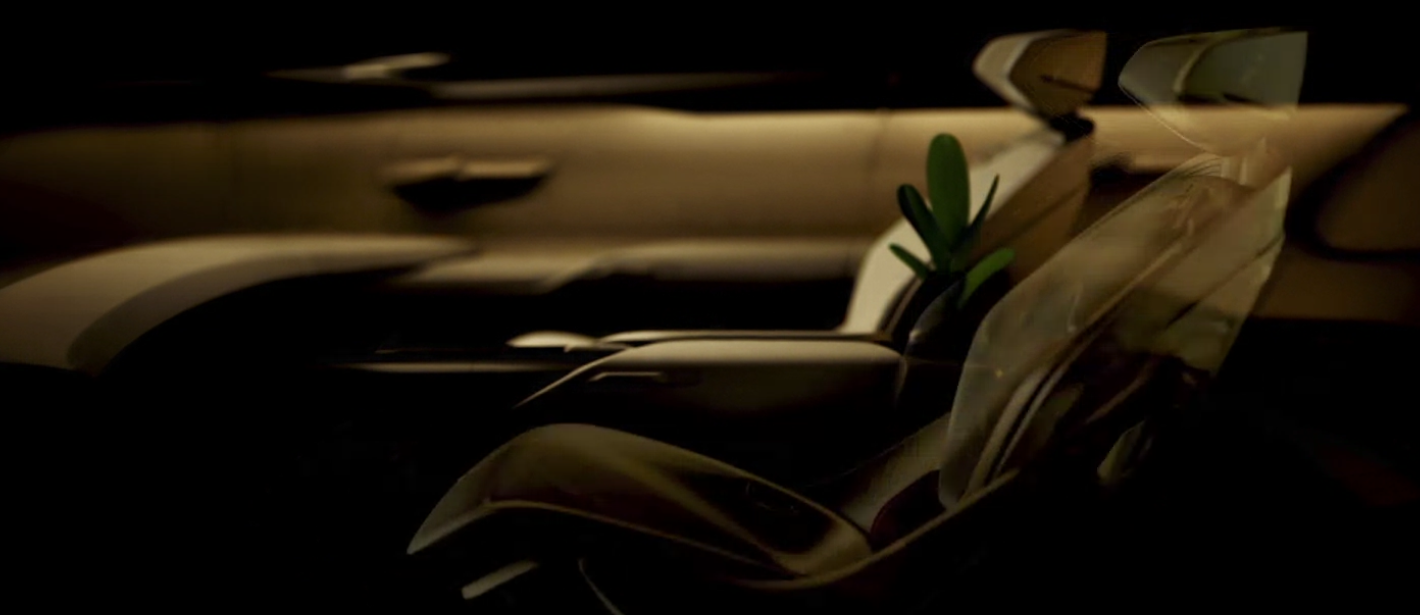
Due to its short front and rear overhangs, space inside the cabin has been increased from existing Audi luxury models such as the A8, with head of interior design, Norbert Weber, saying the revised interior will redefine perceptions of luxury.
With reduced exterior dimensions, Weber and his team were able to utilise the extra freedom to create a more balanced interior which gives back to the first row occupants, allowing them to share in the same experience as those in the second row.
As a level four autonomous vehicle, it can either be operated by the driver or the car itself, with the front seats featuring the ability to recline while the car is self-driving.
Weber said the driver’s seat needed to have the ability to be a relaxation space while not in control, but still provide support when it is being operated.
He added that a focus still remains on making sure it meets safety standards regardless of position, with a greater level of importance being placed on voice recognition tech to provide the driver with some level of control.
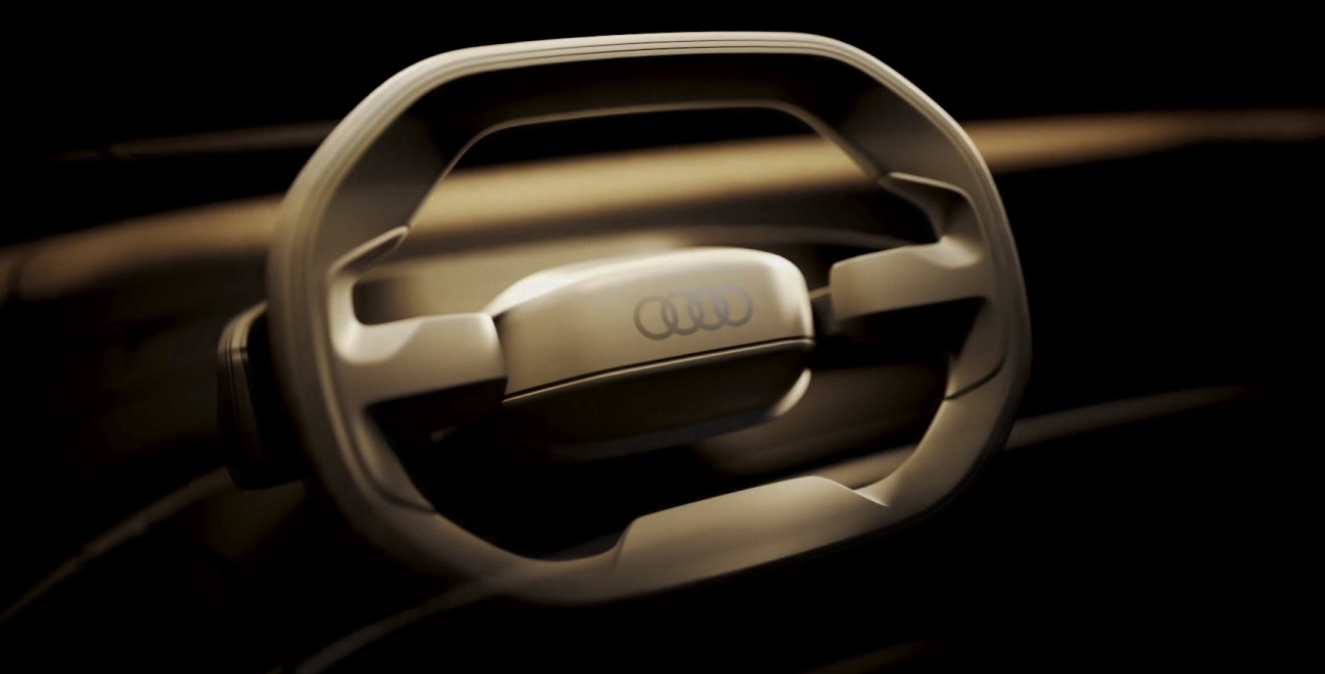
Audi’s head of exterior design, Philipp Römers, said the relocation of the vehicle’s power source from the front in a traditional internal combustion engine (ICE) car to under the floor in an EV gives more freedom of design, allowing the wheels to be placed closer to the edges while also minimising front and rear overhangs.
This greater flexibility for exterior design meant Römers and his team could shape a vehicle to not only look more appealing but also provide a better drag coefficient, a hallmark of Audi’s models over the years can now have a major bearing on an EV’s driving range.
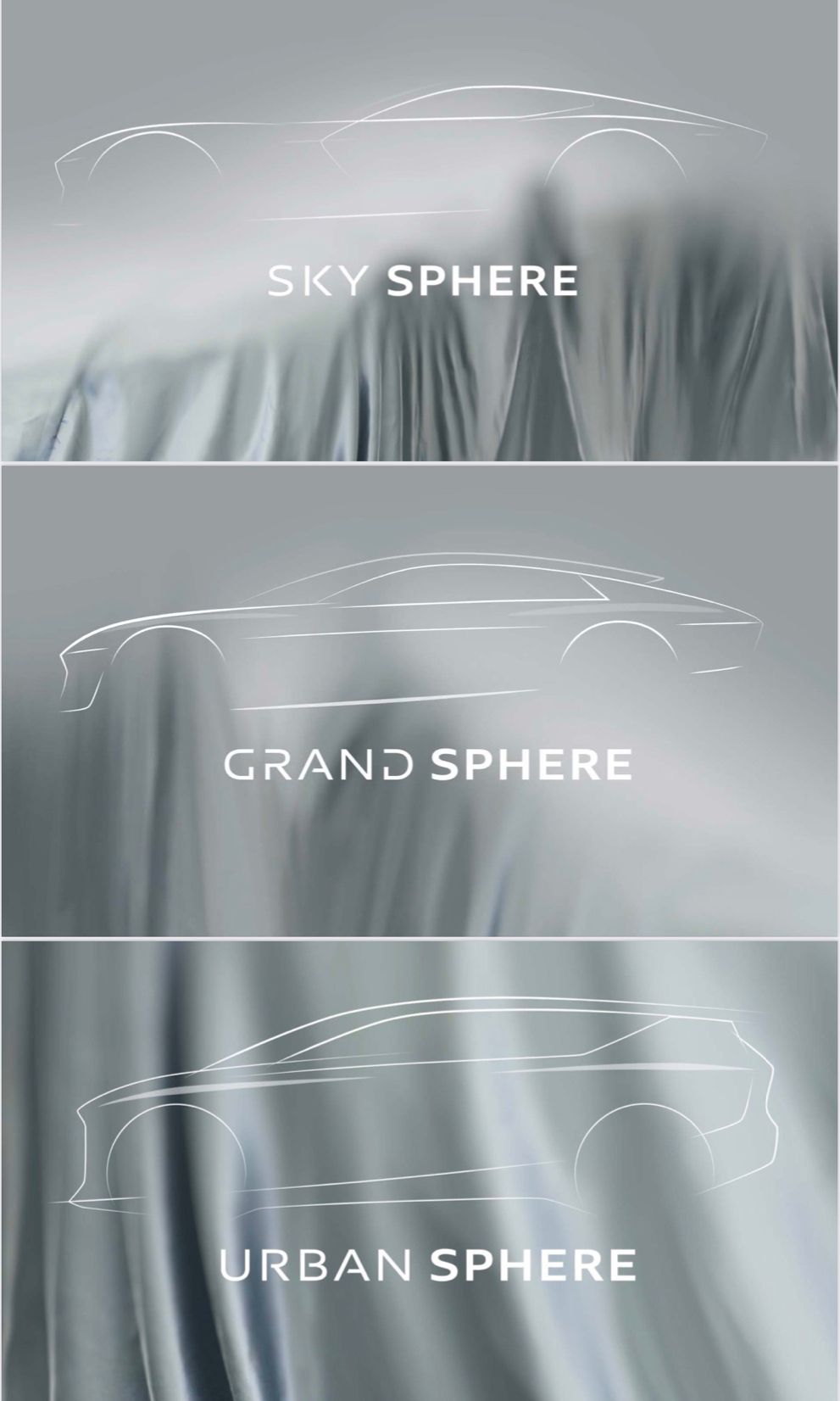
When questioned by WhichCar about why the Grand Sphere and Urban Sphere had adopted short front ends while the Sky Sphere featured a long bonnet, even by ICE standards, Römers said the car’s design came from it being a larger class car with different functions to the other concepts, although he didn’t provide details as to what these functions were.
Marc Lichte, the overall head of design for Audi, echoed his colleague’s comments about the benefit of electric technology in car design, providing a better canvas for his team to work on.
With design no longer limited by ICEs, Lichte said the future of Audi’s cars can make vehicles into a third living space, whether it be for work, relaxation or entertainment.
Official unveiling is set to begin on September 6 when the IAA Munich Motor Show begins, as Audi begins its transition away from ICEs and towards only selling EVs, a target it hopes to reach by 2026.
Snapshot
- Local launch expected before the end of 2021
- Pricing starts at $59,990 for 220i, $30k extra for M240i xDrive
- All Australian-delivered 2 Series Coupes will be fitted with BMW M Sport pack
UPDATE, July 12: BMW Australia has confirmed pricing of the new 2 Series Coupé, expected to land locally towards the end of 2021 or the beginning of 2022.
The entry-level 220i will start at $59,900 while the range-topping M240i xDrive attracts a $30,000 premium, on sale from $89,990. Both prices exclude on-road costs.
Only Alpine White paint is available for no extra cost across both variants, with the optional Black Sapphire, Mineral White, Melbourne Red, M Portimao Blue, Thundernight and M Brooklyn Grey setting buyers back another $1700.
Vernasca leather comes as standard on the M240i xDrive, but it is a $2860 option for 220i customers who’d like an upgrade from the standard Alcantara interior trim.
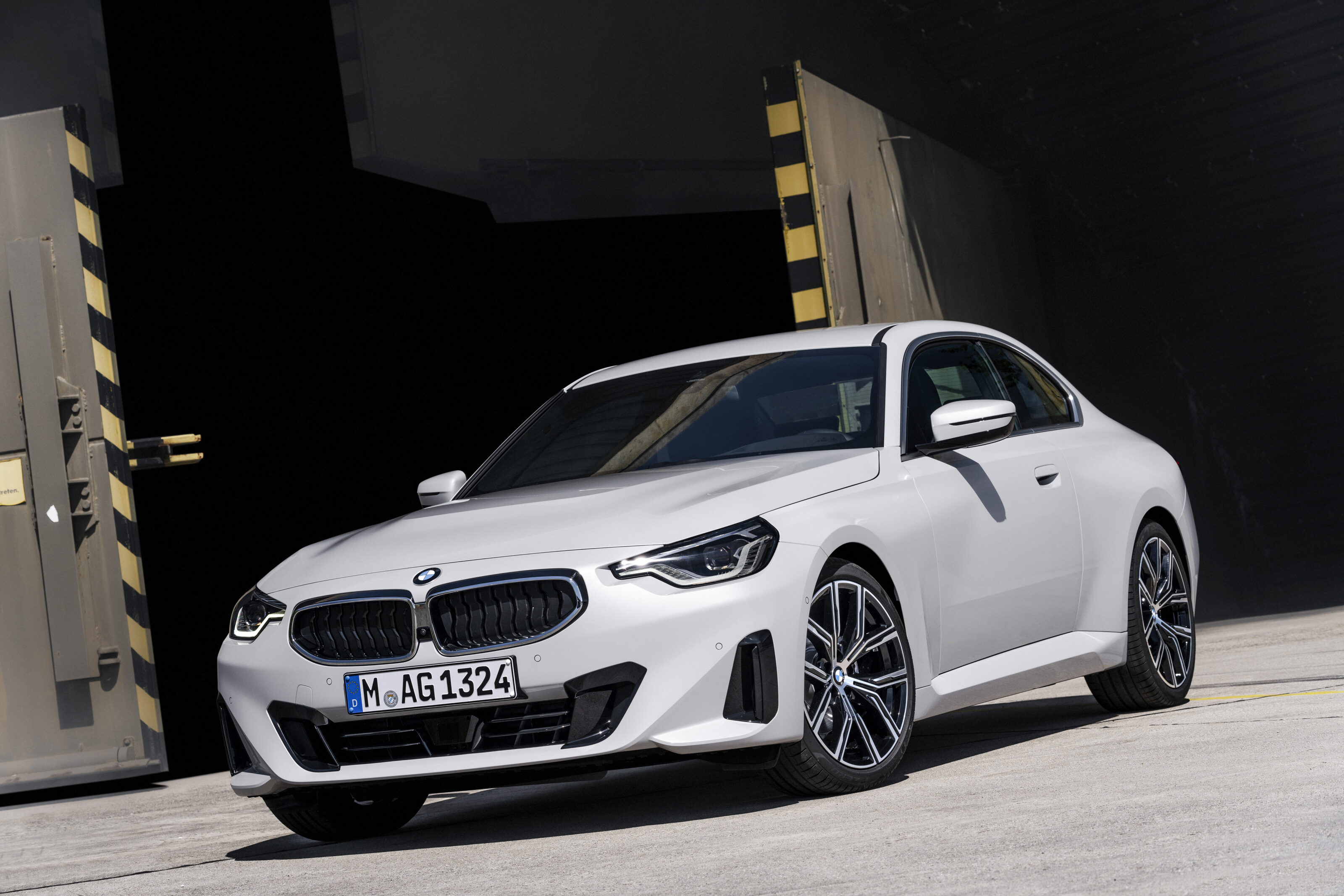
A range of optional packages will also be available across both variants, adding extra features for a premium on top of the vehicle’s base price.
Enhancement Package – $3900 (220i only)
| Metallic paintwork |
| Electric glass roof |
| 19-inch M light alloy wheels |
Comfort Package – $3400 (220i), $1500 (M240i xDrive)
| Steering wheel heating |
| Comfort access system (standard on M240i) |
| Lumbar support (standard on M240i) |
| Electric seat adjustment (standard on M240i) |
| Seat heating driver and front passenger (standard on M240i) |
Driver’s Assistant Package – $3400 (220i)
| Tyre pressure monitoring system |
| Adaptive LED headlights |
| High beam assistant |
| Active Cruise Control with stop and go function |
| Parking assistant plus |
| BMW Drive Recorder |
M Sport Plus Package – $2500 (220i), $1200 (M240i xDrive)
| M Sport Brakes (standard on M240i) |
| M Lights Shadowline |
| M Seat Belts |
| M Rear Spoiler (standard on M240i) |
| M High-Gloss Shadowline with extended contents |
Executive Package – $3000 (220i), $2800 (M240i xDrive)
| Remote engine start |
| Steering wheel heating |
| Tyre pressure monitoring system |
| Alarm system |
| Sun protection glazing |
| Harmon Kardon surround sound system (standard on M240i) |
| BMW Drive Recorder |
2022 BMW 2 Series Coupe pricing for Australia
| 2022 BMW 220i | $59,900 |
| 2022 BMW M240i xDrive | $89,990 |
Prices exclude on-road costs
For more on the new-generation 2 Series Coupe’s design and performance, see our story below.
The story to here
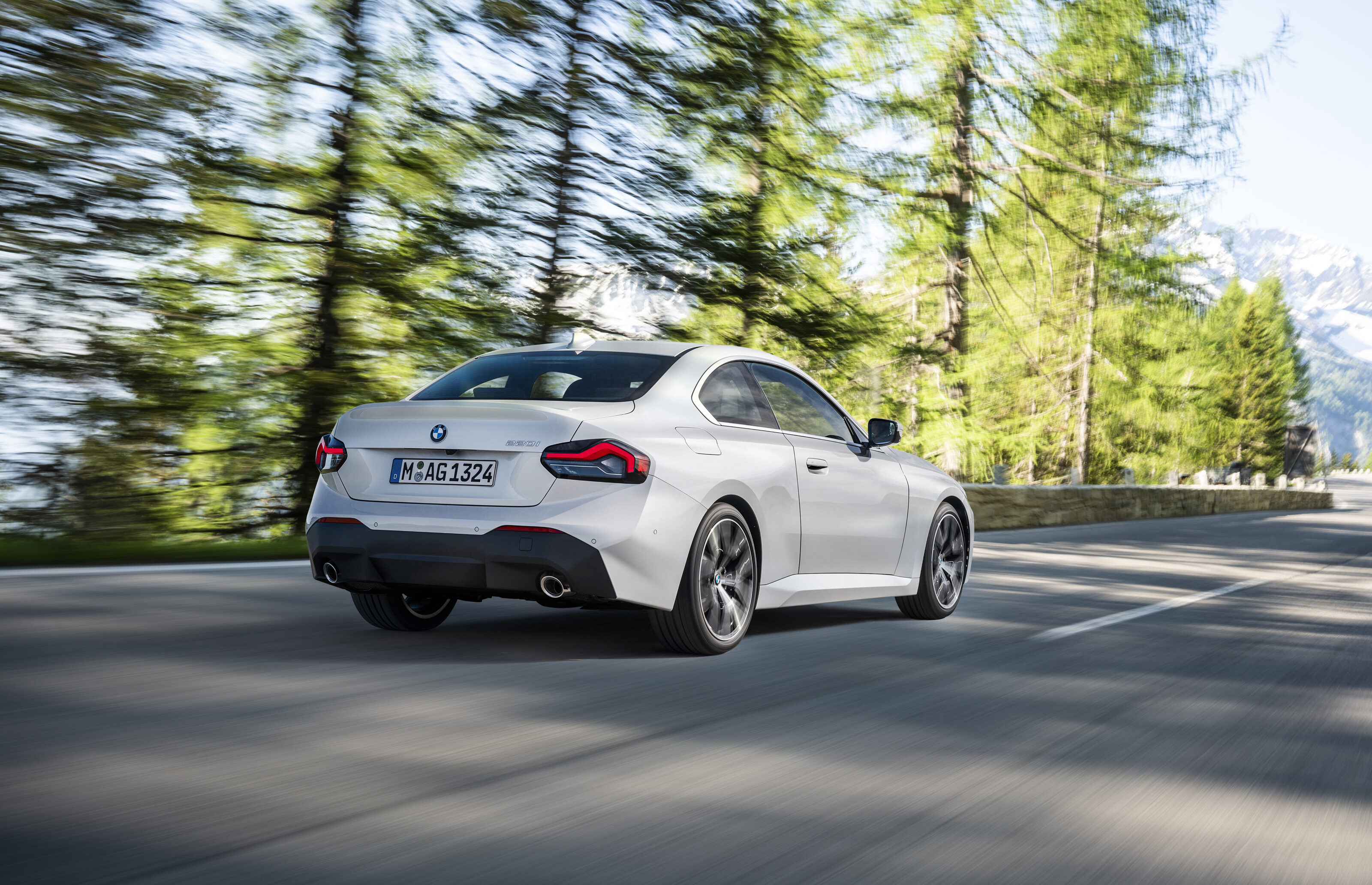
July 7: The 2022 BMW 2 Series Coupe has been officially revealed after what feels like an endless supply of leaked and spy photography.
The final product paints a compelling picture, with inimitable styling which both conforms and spearheads aesthetic elements of BMW’s current design language.
Based on a modified version of the CLAR platform currently used by the G20 BMW 3 Series, the new 2 Series sits longer, wider, and lower than the car it replaces.
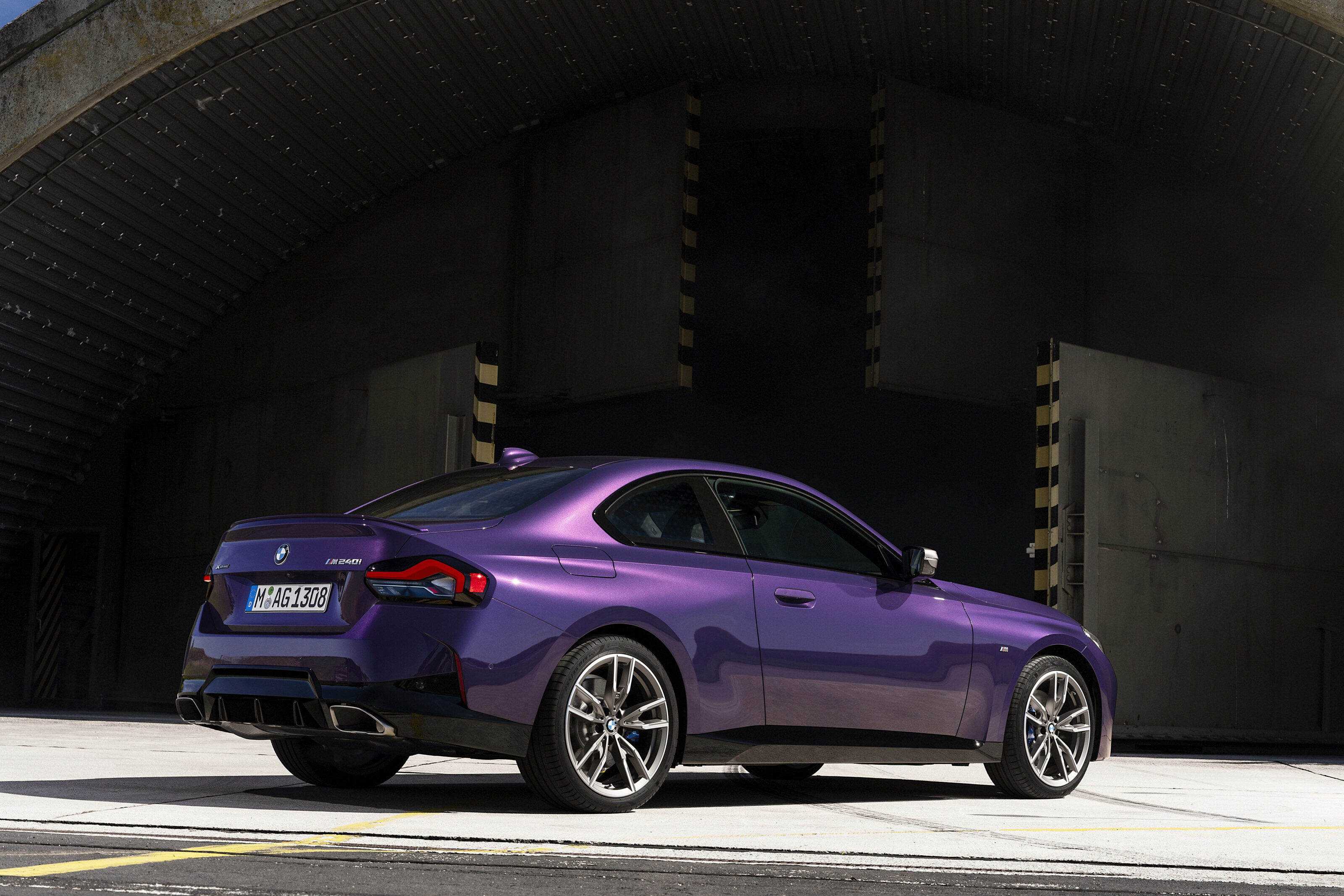
BMW Australia has confirmed we can expect to see the new coupe land Down Under at the end of 2021.
Wheels understands that, from launch, two model variants will be offered locally – the 220i and the M240i xDrive – and all Australian delivered cars will come with the M Sport pack as standard.
This means, for the first time, Munich’s 2 Series Coupe performance ‘M-light’ option, the M240i, won’t be available with rear-wheel drive.
Nor will the new compact two-door coupe come with a manual gearbox. Presently, it would appear the eight-speed ZF torque converter auto is the only option, and chances are, fans of three pedals will have to wait until the new M2 is unveiled in 2022.
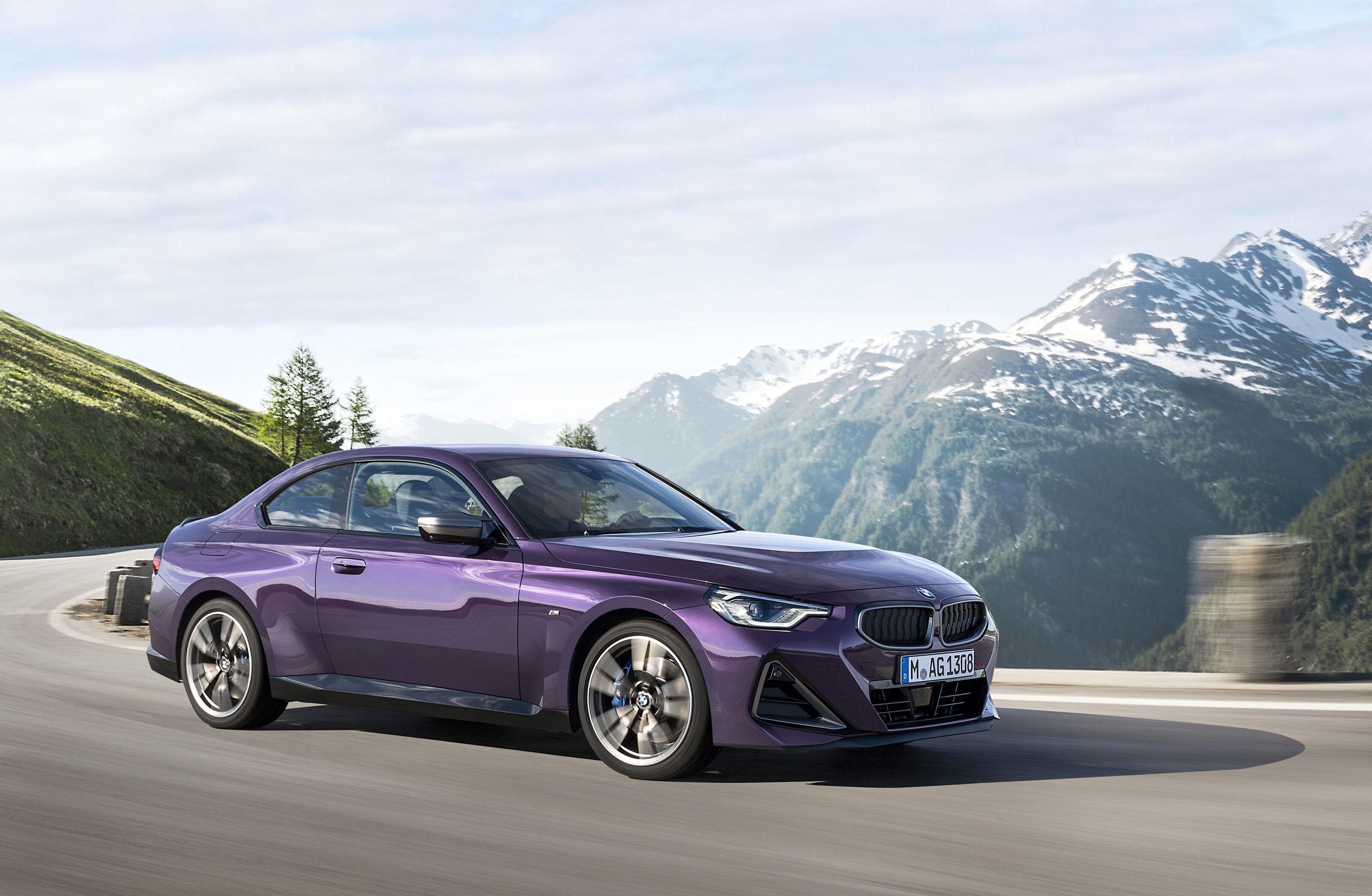
Drivetrains, performance, and fuel economy
The entry-level 220i will be powered by BMW’s turbocharged 2.0-litre four-cylinder petrol engine, which produces 135kW and 300Nm.
Drive will be sent to the rear wheels through ZF’s aforementioned eight-speed auto, and BMW claims a 0-100km/h time of 7.5 seconds.
Fuel economy on the WLTP combined cycle is rated at 6.3L/100km.
The range-topping M240i xDrive will be powered by the German brand’s familiar and formidable B58 twin-scroll turbocharged 3.0-litre six-cylinder motor.
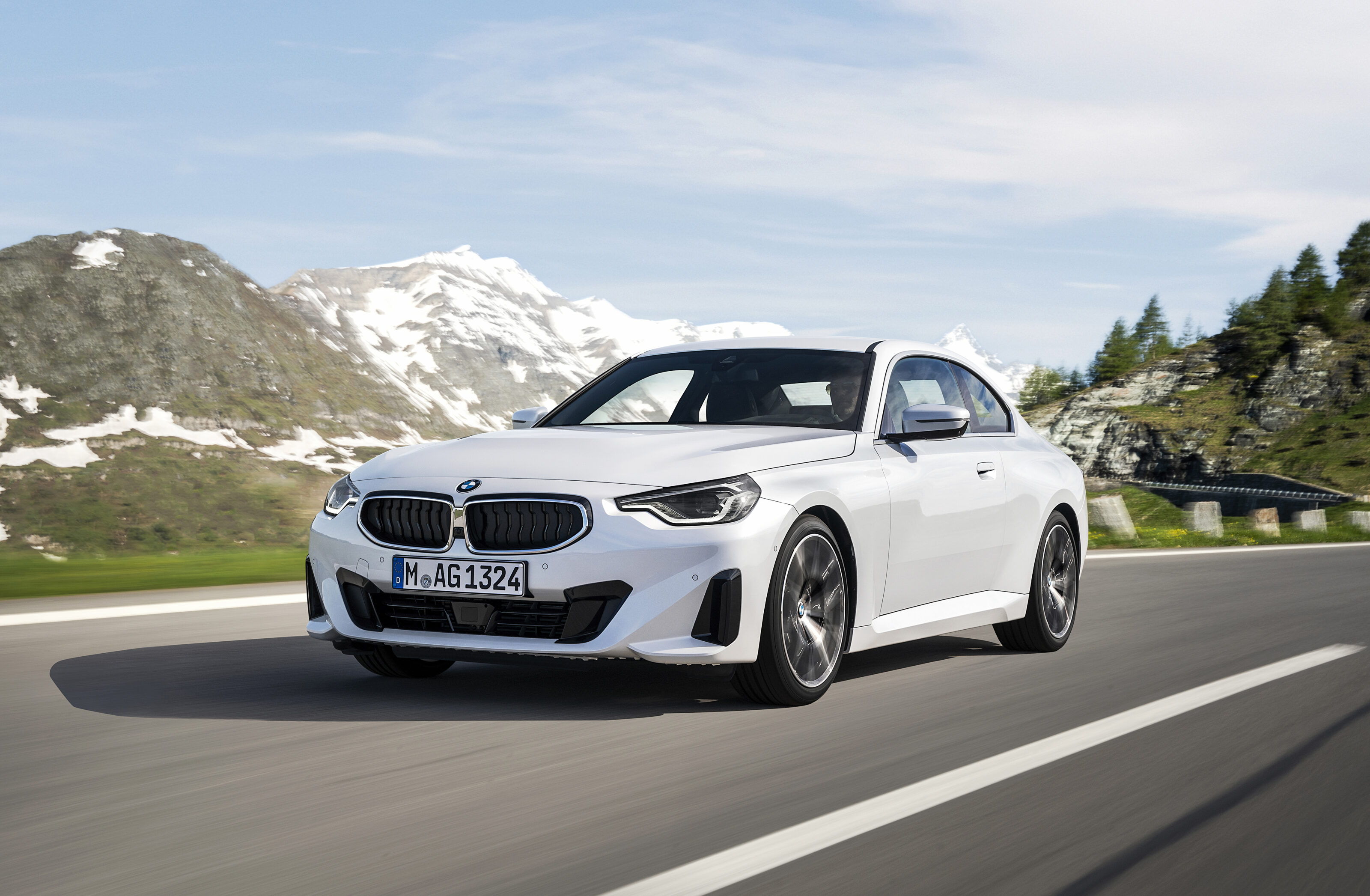
Power is rated at 285kW (25kW more than the old M240i) and 500Nm, with drive being sent to all four wheels through the same eight-speed auto.
Quoted performance is quite remarkable considering this is BMW’s cheapest ‘M’ coupe, with 0-100km/h said to take just 4.3 seconds.
To put that number in perspective, the last generation F20 BMW M4 Competition is only 0.3 of a second faster.
The M240i xDrive returns a WLTP-certified combined fuel cycle figure of 8.1L/100km.
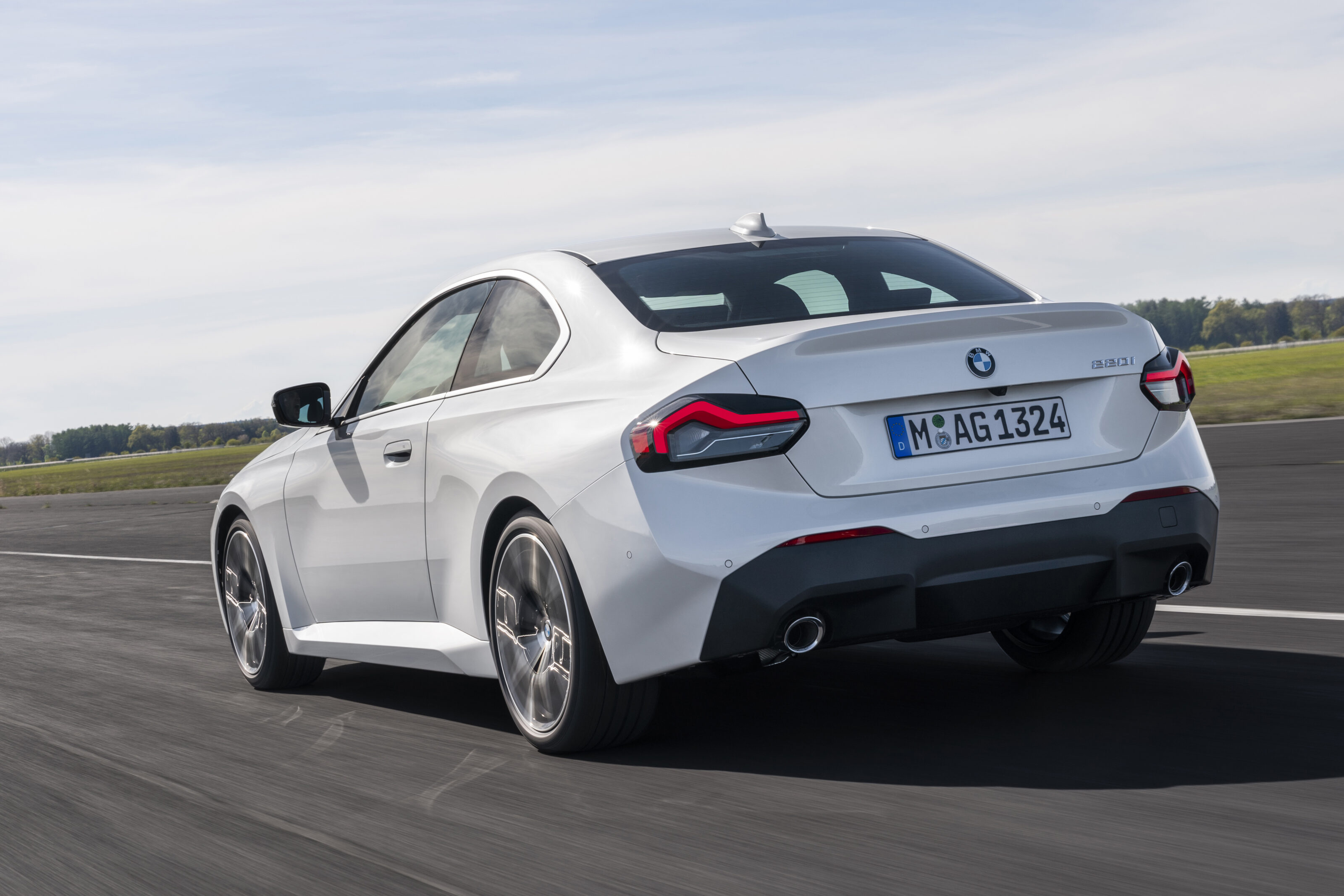
Dimensions and chassis
Being based on the G20 3 Series’s larger CLAR modular platform, albeit with a fair few modifications, the new two-door coupe is noticeably larger than the car it replaces.
In fact, the new coupe is 105mm longer, 64mm wider, and has a wheelbase measuring 51mm more than the outgoing F22 2 Series.
The new car also sits 28mm lower, and track widths both front and rear have been bumped up too – 54mm front and 31mm rear for the standard car and 63mm front and 35mm rear for the M240i xDrive.
Couple these stats with increased body rigidity and a near-perfect 50:50 weight distribution, and you’ve got the recipe for a car with the potential for a much more dynamic chassis than its predecessor.
Exterior
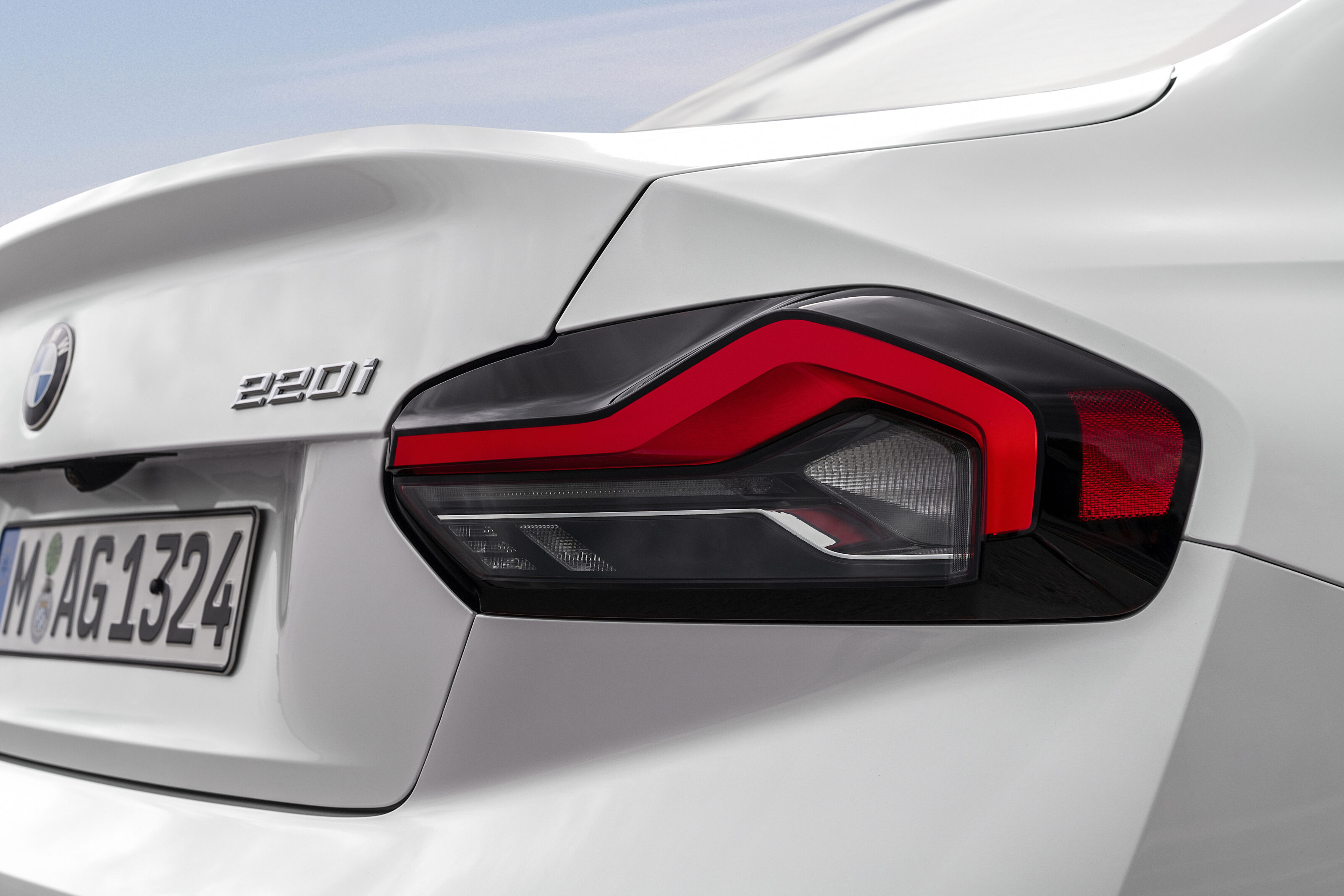
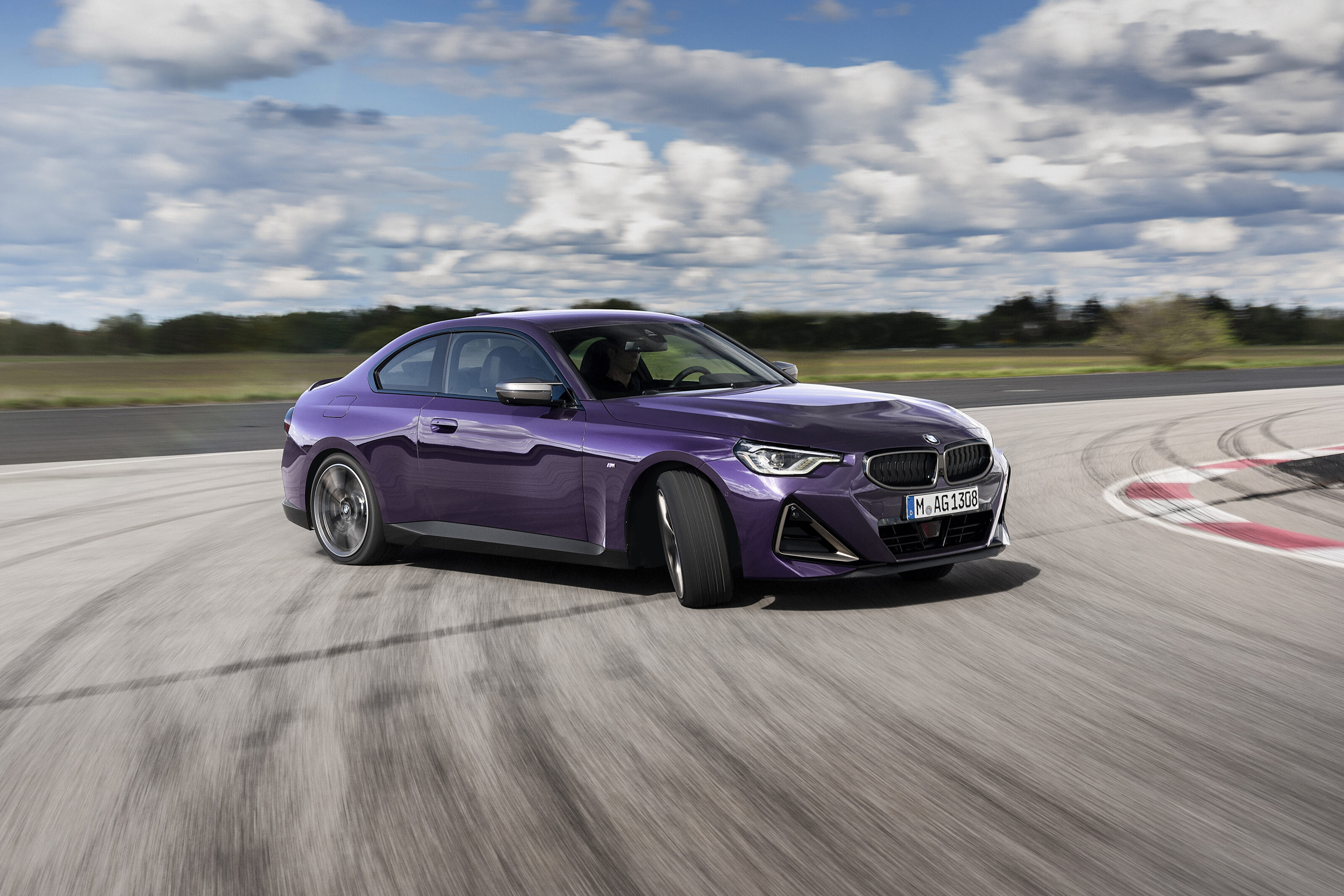
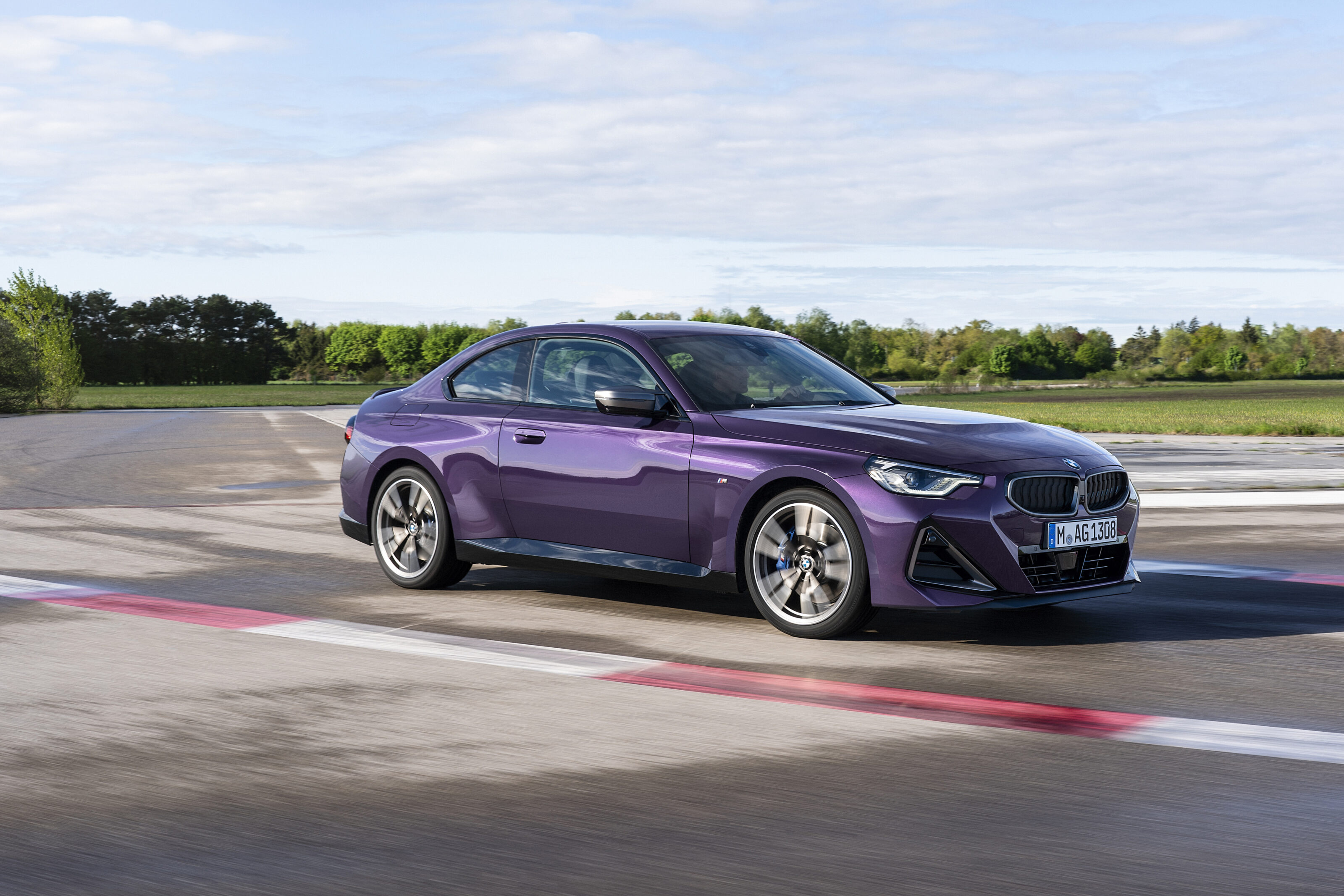
The G42 2 Series scores some attractive new LED headlights, as well as a more subtle grille than some of its larger siblings.
There’s a pronounced ‘power bulge’ in the car’s bonnet and box-style flared wheel arches which give the car an aggressive look.
Overall, it appears the new coupe has closed the gap to BMW’s fully fledged 2 Series M-Sport product, the upcoming G87 M2.
For Australia, 18-inch M-Sport alloy wheels will come as standard on the 220i, while larger, lightweight 19-inch alloy wheels wrapped in Michelin Pilot Sport tyres will be fitted to the M240i xDrive.
Interior
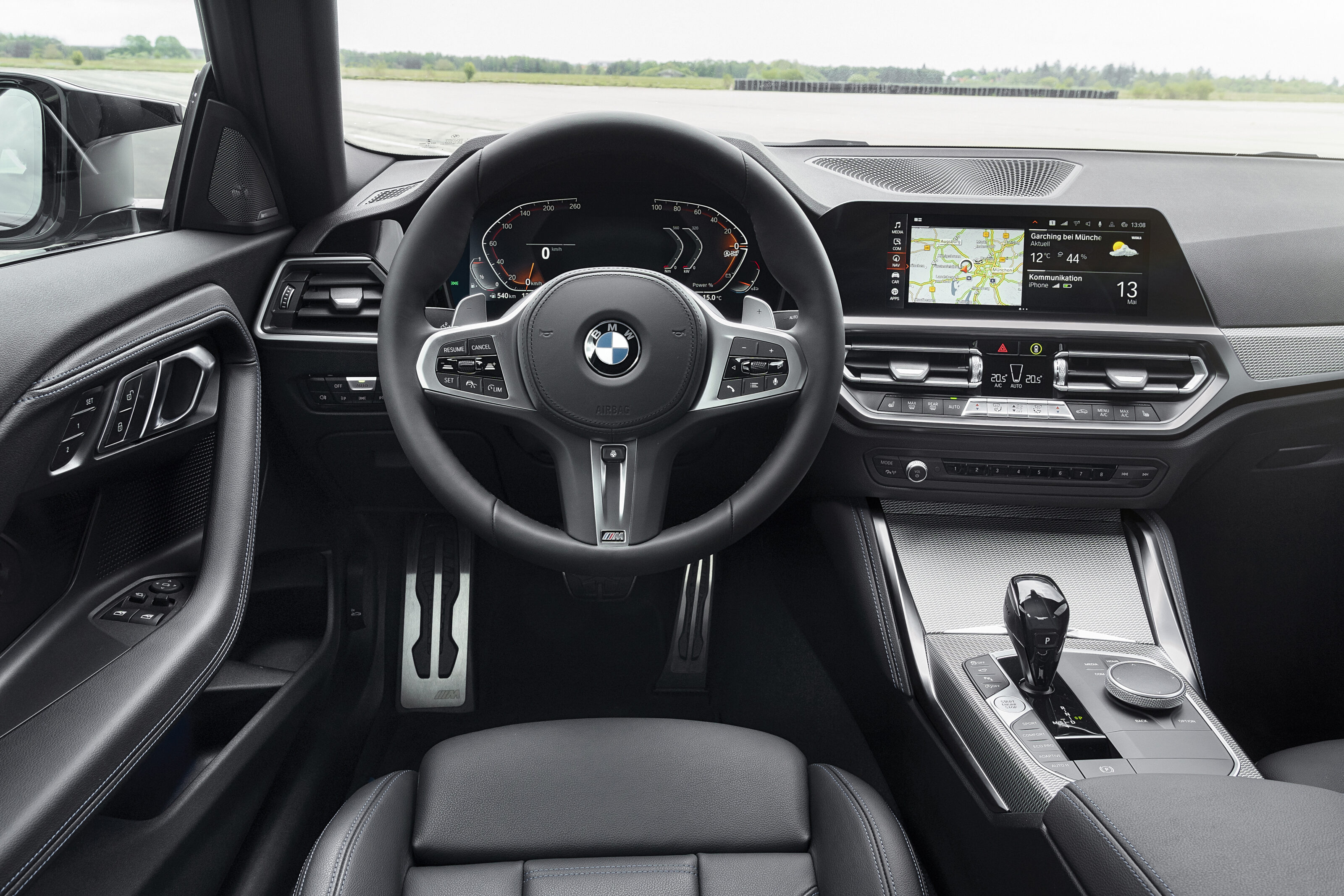
Inside, the coupe is fitted with a familiar, albeit more upmarket, interior we’ve seen on other current BMW models such as the 1 Series hatch and 2 Series Gran Coupe.
All 2 Series Coupes will come with BMW’s Live Cockpit Professional in Australia, which means a 10.25-inch touchscreen infotainment display running iDrive System 7, 12.3-inch fully-digital dash, and Apple CarPlay and Android Auto are all standard.
A head-up digital display will also be available for the first time in the badge’s existence.
Other options include a glass slide/tilt sunroof, Harmon Kardon stereo, a heated steering wheel, and heated seats.
Safety
The new 2 Series Coupe will come with a host of standard safety features, including front-collision warning, speed limit info, lane departure warning and cruise control with brake function.
Optional safety equipment includes driving assistant with lane change warning, rear collision prevention and rear crossing traffic warning, active cruise control with stop and go functionality, park distance control, reversing assistant, reversing assist camera, surround view, and remote 3D view.
When will the 2022 BMW 2 Series come to Australia?
According to BMW Australia, both the 220i and M240i xDrive will land on Aussie shores before the end of 2021, or at the latest, in January of 2022.
UPDATE, March 29 2023: Australian timing confirmed for ID models
Volkswagen Australia has today confirmed local launch timing for its ID.3, ID.4, ID.5 and ID.Buzz models – get all the details at the links below.
November 2022: ID.4 driven in Australia!
We’ve now had a chance to drive an overseas ID.4 car in Australia. Get our full story at the link below.
Story continues…
Volkswagen ID.4: International first drive
The Beetle. The Golf. Tough acts to follow. But that’s exactly what the Volkswagen ID.4 must do. Like the Beetle and the Golf, the ID.4 has been designed as a family vehicle that will be sold around the world. And just as the enduring Beetle and the evergreen Golf came to define the Volkswagen brand for generations of consumers, Wolfsburg hopes the ID.4 can do the same for a whole new generation. The electric generation.
The Europe-only ID.3 launched Volkswagen Group’s vaunted MEB electric vehicle architecture, but the ID.4, not expected to arrive in Australia before 2024, is the first global Volkswagen to be built on the new hardware. MEB has cost billions to develop and is intended to underpin millions of battery-powered Volkswagen Group cars and SUVs over the coming decade. Yep, Volkswagen’s going all-in on electric vehicles, and the ID.4 is anything but a tentative toe in the water.
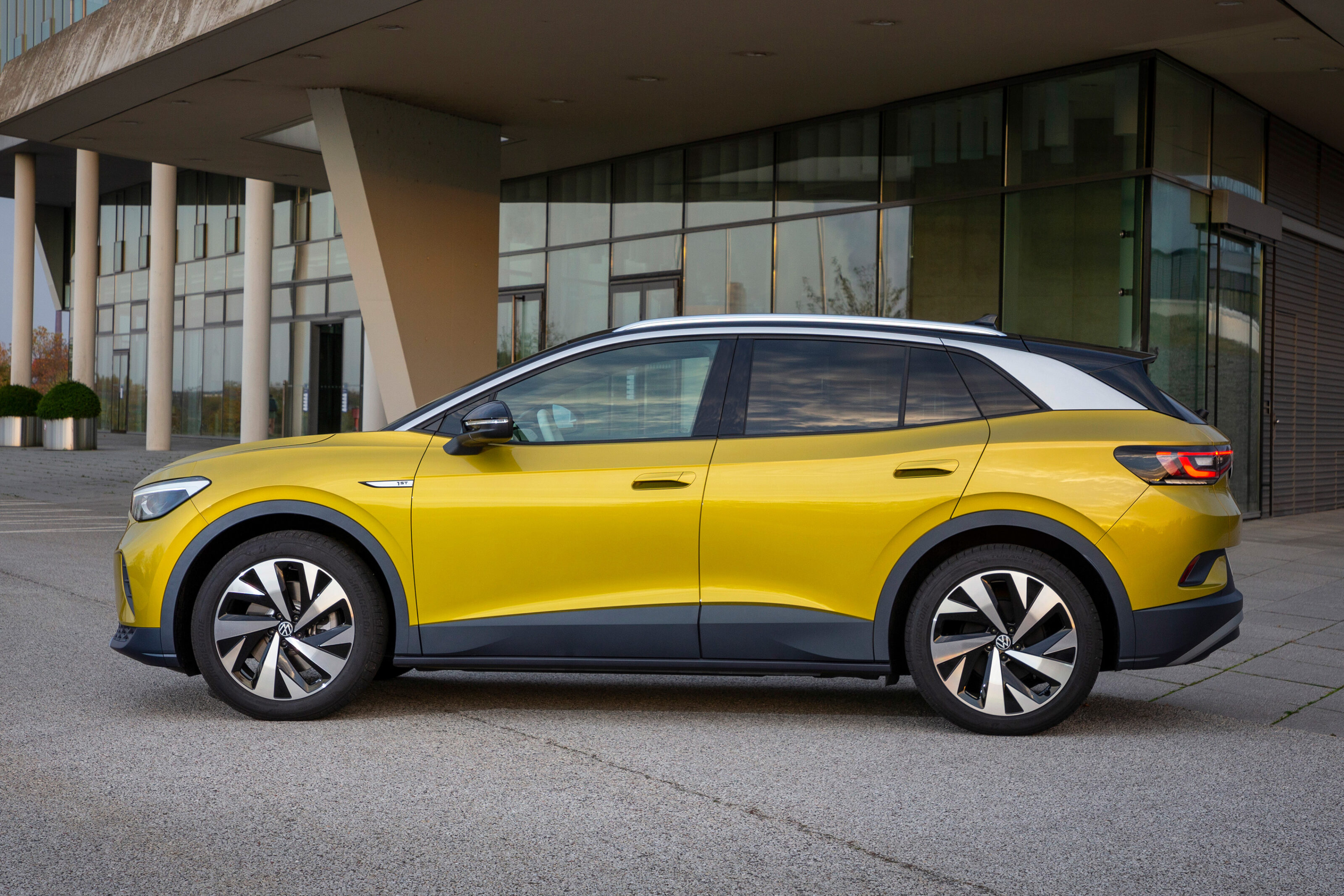
The ID.4 1st Edition Pro Performance shown here is a special launch model fitted with what is currently the top-spec 77kWh battery and a 150kW e-motor mounted at the rear and driving the rear wheels. Claimed range is 538km according to the urban-focused European WTLP protocol, or 402km according to the EPA test in the United States, which includes more highway mileage. Entry-level ID.4s will be available with a 52kWh battery and the choice of either a 109kW or 125kW e-motor. The ID.4 range will be topped by the GTX, which gets an 80kW e-motor at the front axle to deliver all-wheel drive and a total system output of 220kW.
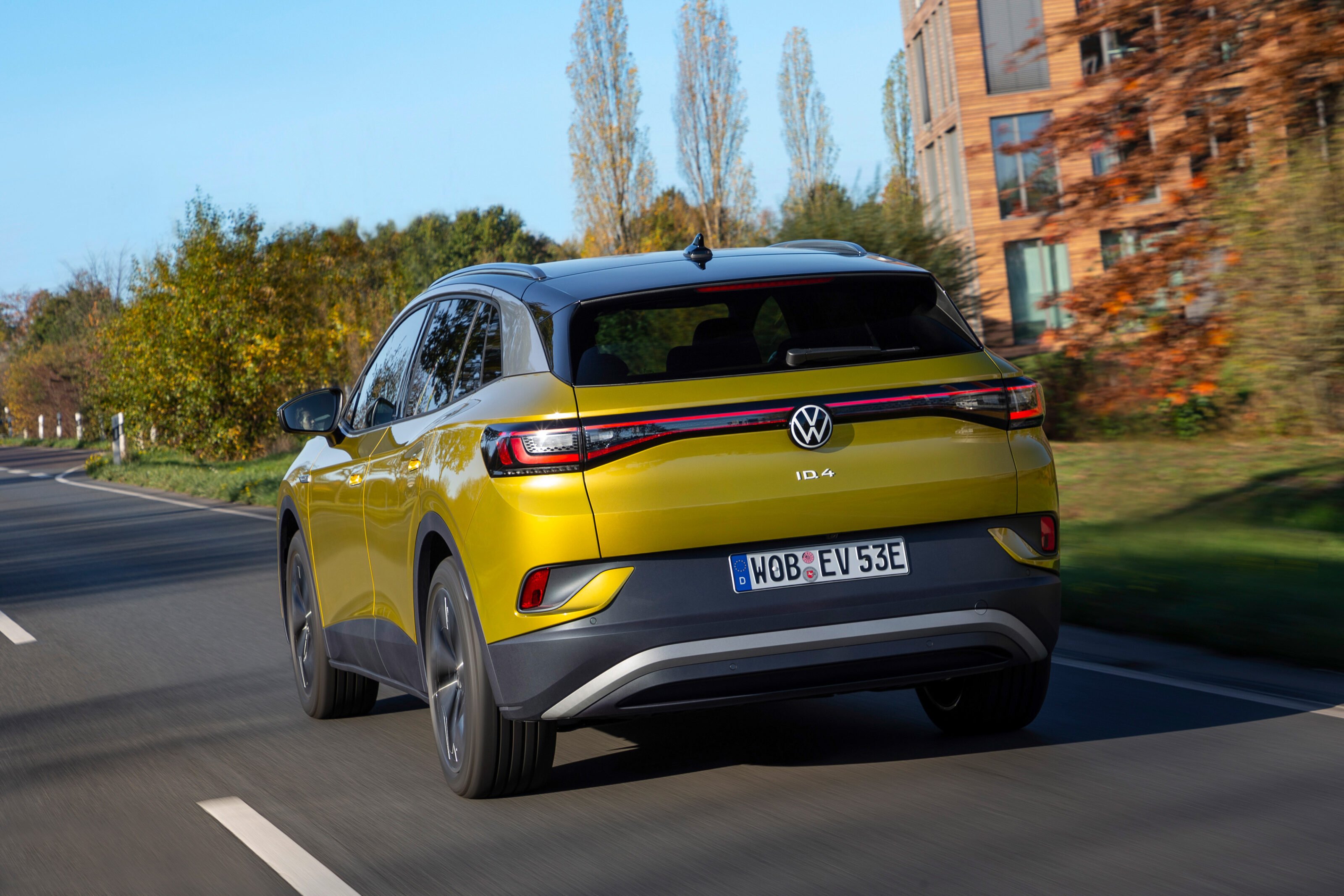
It’s not just the ID.4’s powertrain that betrays just how dramatically the automotive mainstream is changing in the 21st century. It’s the way it looks, too. Sedans, hatches, and wagons are fast becoming yesterday’s family cars, so though the ID.4 shares much of its hardware with the Golf-like ID.3, it’s configured as a mid-size SUV, aimed squarely at the heart of the world’s fastest growing and most popular market segment.
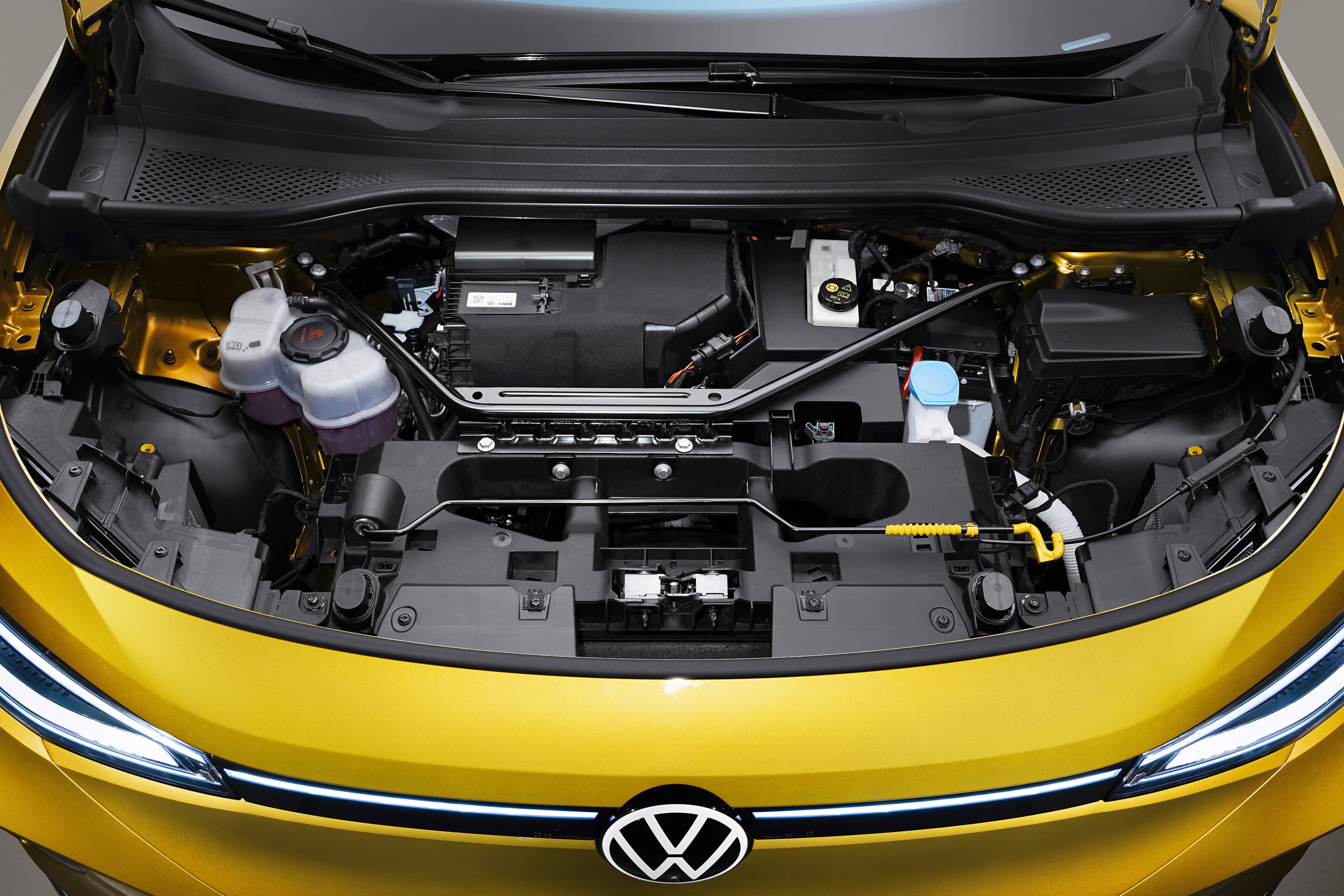
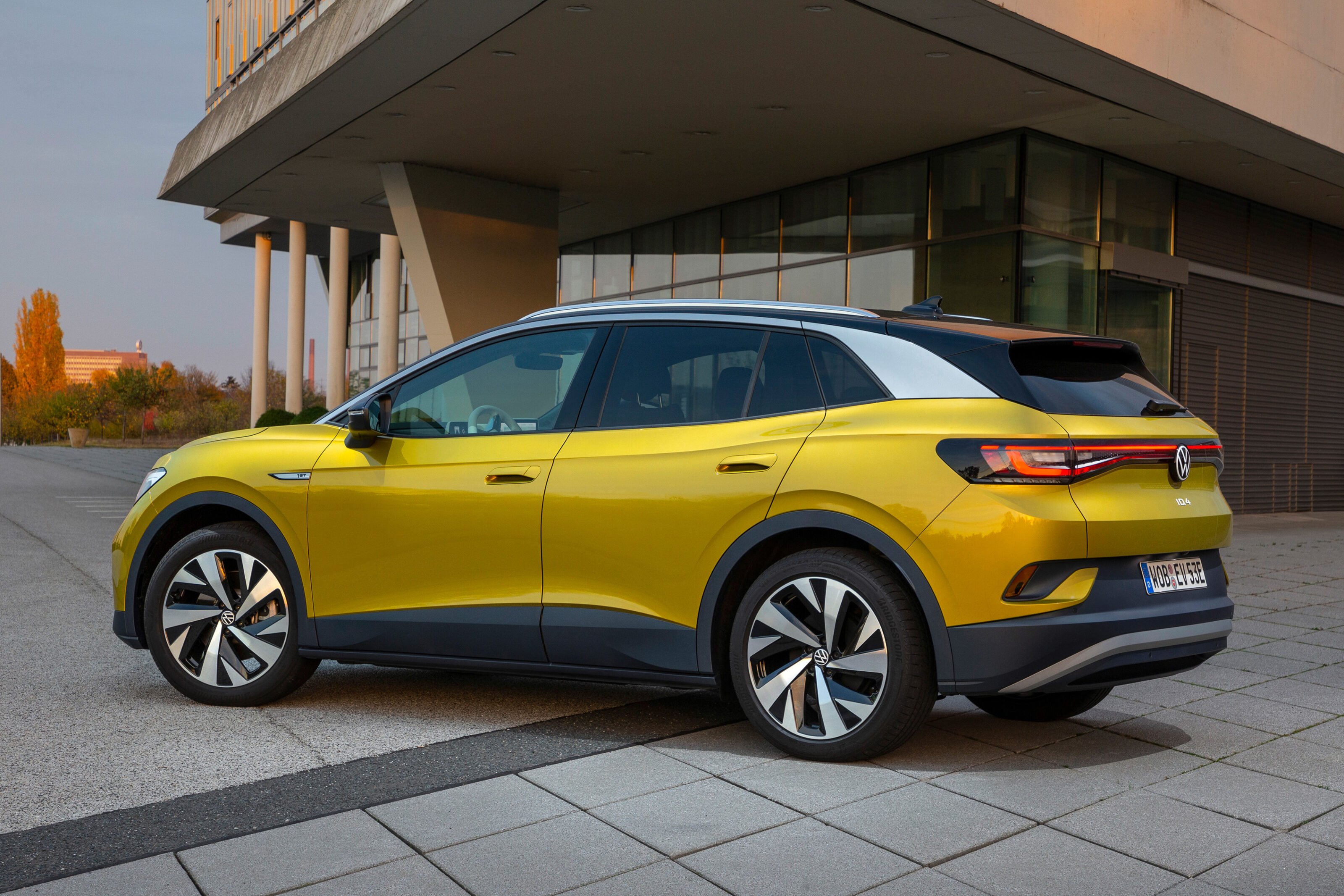
At 4584mm long and 1852mm wide the ID.4 sits between the Toyota RAV4 and Mazda CX-5 but is 45mm lower overall than the Toyota and 35mm lower than the Mazda. The ID.4’s 2771mm wheelbase is 81mm longer than the RAV4’s and 71mm longer than the CX-5’s, and this, combined with the lower roofline and lack of a grille, makes the Volkswagen look deceptively sleeker than other mid-size SUVs.
That longer wheelbase, combined with the inherent packaging advantages of the MEB architecture, should make the ID.4 noticeably more spacious inside than its conventionally powered rivals. The tape measure tells a different story, however: The ID.4’s rear-seat legroom is the same as that of the RAV4 but despite appearances, the Volkswagen has significantly more headroom. And at 543 litres, the ID.4’s rear load space doesn’t quite match the 580 litres offered by the RAV4, though it easily tops the CX-5’s 442 litres.
It’s not just the ID.4’s powertrain that betrays just how dramatically the automotive mainstream is changing. It’s the way it looks, too.
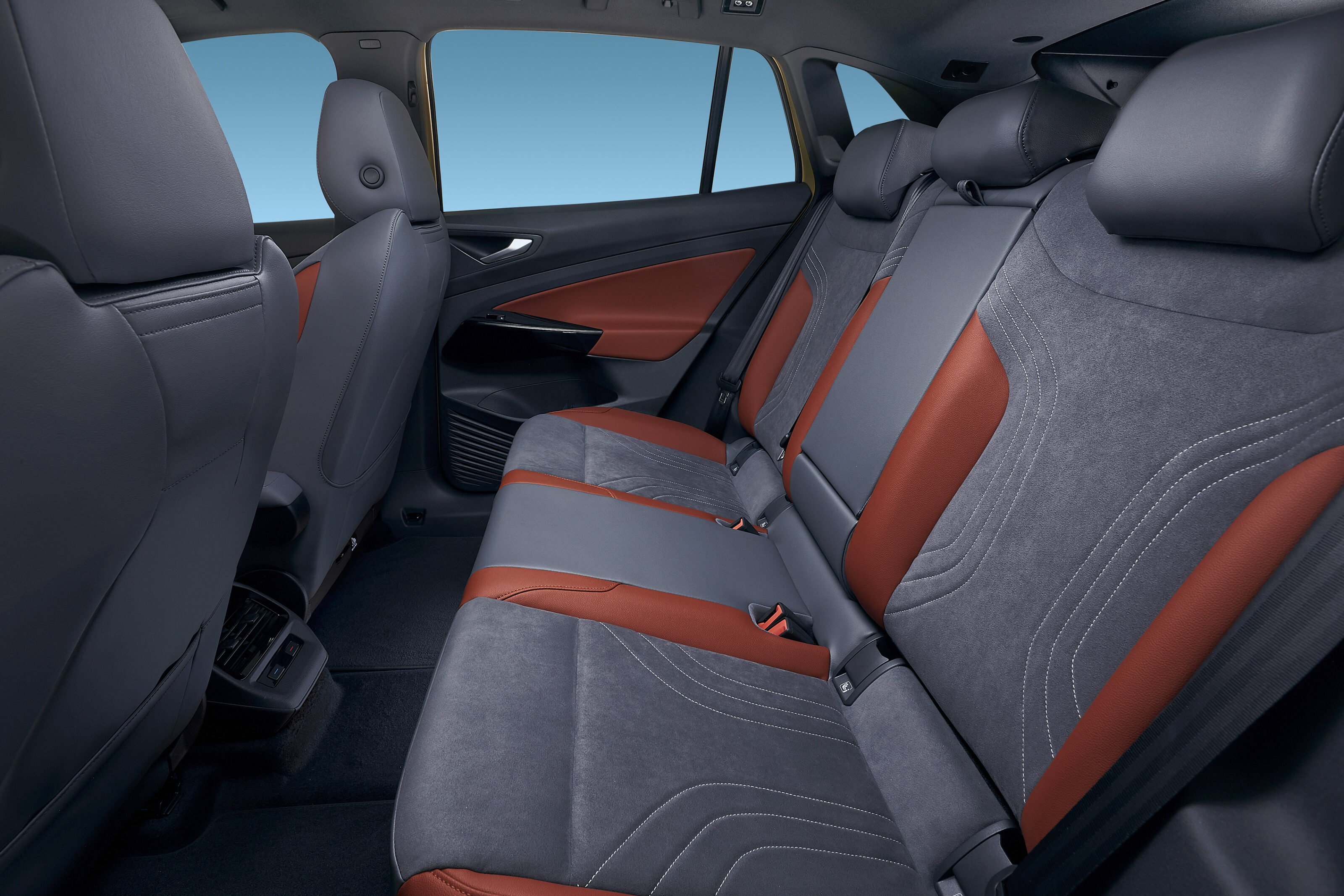
The ID.4 1st Edition is priced at £40,800 in the UK, which is 11 per cent more than the all-wheel-drive Tiguan R-Line with the 2.0-litre TSI engine. Using the similar Australian-spec Tiguan R-Line as a baseline, you’re looking at a car that will cost close to $70,000 here. In addition to all the usual 21st century digital perquisites – central touch screen, sat-nav, adaptive cruise control, Apple CarPlay and Android Auto connectivity, etc. – the 1st Edition spec includes 20-inch alloy wheels and an interior finished in black, brown, grey, and white.
Curiously for a modern Volkswagen Group product, the interior doesn’t feel especially premium. The minimalist approach to the instrumentation and controls is very Tesla-esque, but the white steering wheel, the white steering column shroud with the small, white-framed digital instrument panel mounted on top, the white frame around the central touchscreen, and the white plastic panels around the window lifts on the doors feel cheap and will inevitably get grimy. Fortunately, in regular ID.4s all these pieces are black.
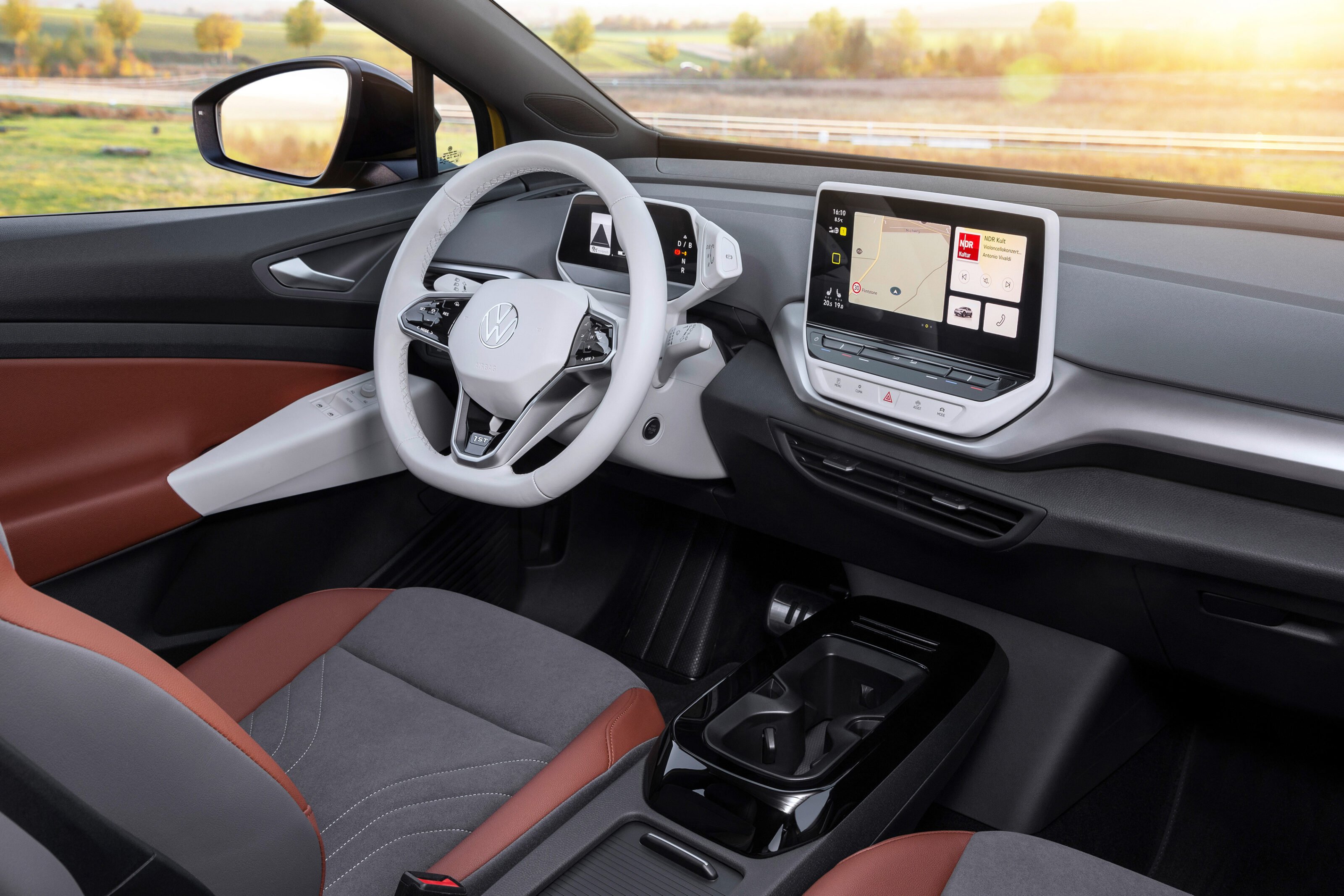
For a vehicle with a long wheelbase and flat floor, the relative lack of storage space in the ID.4’s cabin is also surprising. The free-standing centre console is narrow and shallow, its entire length rising no higher than the base of the front seats. What looks like a proper glovebox is a visual con – open the lid and all you get is a storage compartment half the width of the lid. The door pockets are a reasonable size, but no better than you’ll find in many regular cars.
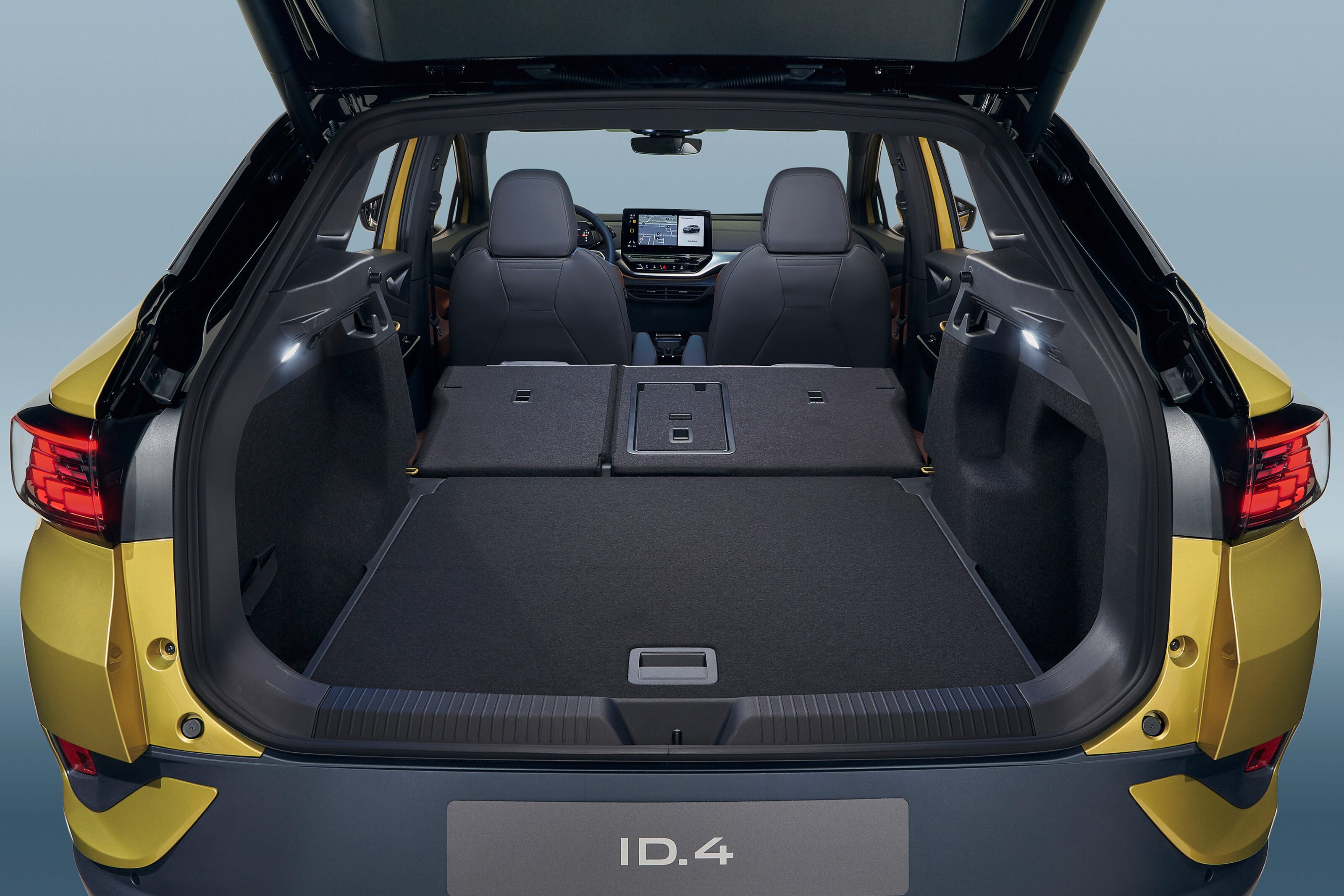
As mentioned, the rear load space is decent. There’s a hatch through to the cabin for long loads such as skis, and with the rear seats folded, the ID.4’s load-lugging capacity jumps to 1575 litres – still not a match for the RAV4’s 1690 litres, though. Lifting the rear hatch reveals a quality niggle: The metal hooks for the luggage tie-downs at the front of the load space aren’t fully painted like those at the rear, and once you notice it, you can’t un-see it. And you’ll lift the rear hatch a lot, because that’s where the ID.4’s charging cables are stored, in a small compartment under the floor.
Unlock the door, slide in behind the wheel, put your foot on the brake and, like a Tesla, the ID.4 silently wakes up. Twist the toggle on the right-hand side of the instrument panel into D – or twist it once more to B if you want a high-regen drive mode that allows close to one-pedal driving – and you’re good to go.
There is 310Nm of instant-on torque from the rear-mounted e-motor, so like most electric vehicles, the ID.4 steps off briskly despite its 2124kg overall weight. Volkswagen claims a 0-100km/h acceleration time of 8.5 seconds, making it comfortably quicker than either the 1550kg RAV4 or the 1559kg CX-5. When we tested both last year, these respectively took 9.4 seconds and 10.3 seconds for the sprint. And VW’s claim may be a conservative number: Instrumented performance tests of the 1st Edition in the U.S. suggest it could be almost a second quicker. We can confirm, however, that the ID.4’s top speed is indeed 160km/h.
There is 310Nm of instant-on torque from the rear-mounted e-motor, so like most electric vehicles, the ID.4 steps off briskly despite its 2124kg overall weight.
As you might expect, the ID.4 drives differently from almost every other Volkswagen. The smooth, silent surge of acceleration is standard electric vehicle fare. Volkswagen offers four drive modes: Eco, Comfort, Sport, and Individual. Among other things, Eco dials back the reaction to accelerator inputs and limits the top speed to 130km/h. It’s fine for constant freeway running but makes the ID.4 feel too lethargic around town and on country roads, where the Comfort setting delivers the quicker response useful for plugging gaps in the traffic or overtaking.
Offering a Sport mode in a conventionally powered family SUV is usually a triumph of marketing hype over common sense, and it’s even more emphatically so in this electric Volkswagen. Selecting Sport mode in the ID.4 simply deadens the already slightly gluey steering even more, and introduces lift-off regen that’s about half as strong as that when you switch past D and into B. Apart from the fact that using kinetic energy is more efficient than recycling it back into the battery, the ID.4 flows down the road better in Comfort mode, which allows the car to coast when you lift off, and allows you to decide precisely when to initiate regen through the simple expedient of squeezing the brake pedal.
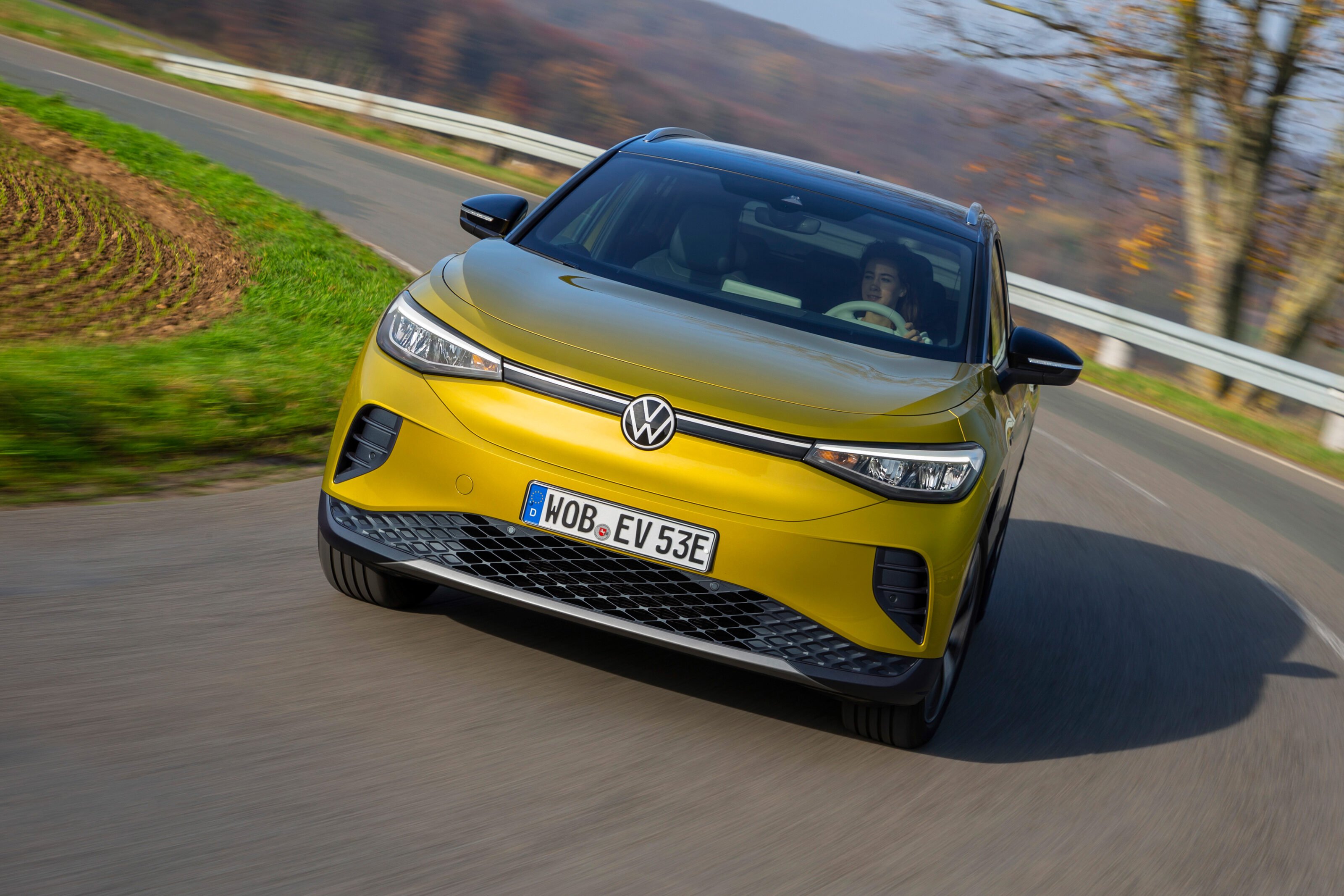
The brake pedal feel is good, however, and the transition from regenerative braking to mechanical braking imperceptible. The reason the ID.4 has drum rear brakes, says Volkswagen, is the power of the regenerative braking effect means it doesn’t need four-wheel discs.
Rear-wheel drive means the ID.4 has a tighter turning circle than front-drive architected mid-size SUVs such as the RAV4, despite its longer wheelbase, but at 3.0 turns lock to lock the steering is lower geared than most. Rear-drive, along with a lower centre of gravity courtesy of the battery mounted low in the chassis, also makes the ID.4 feel sportier in the twisty bits than most mid-sized SUVs.
Rear drive, along with a lower centre of gravity courtesy of the battery, also makes the ID.4 feel sportier in the twisty bits than most mid-sized SUVs.
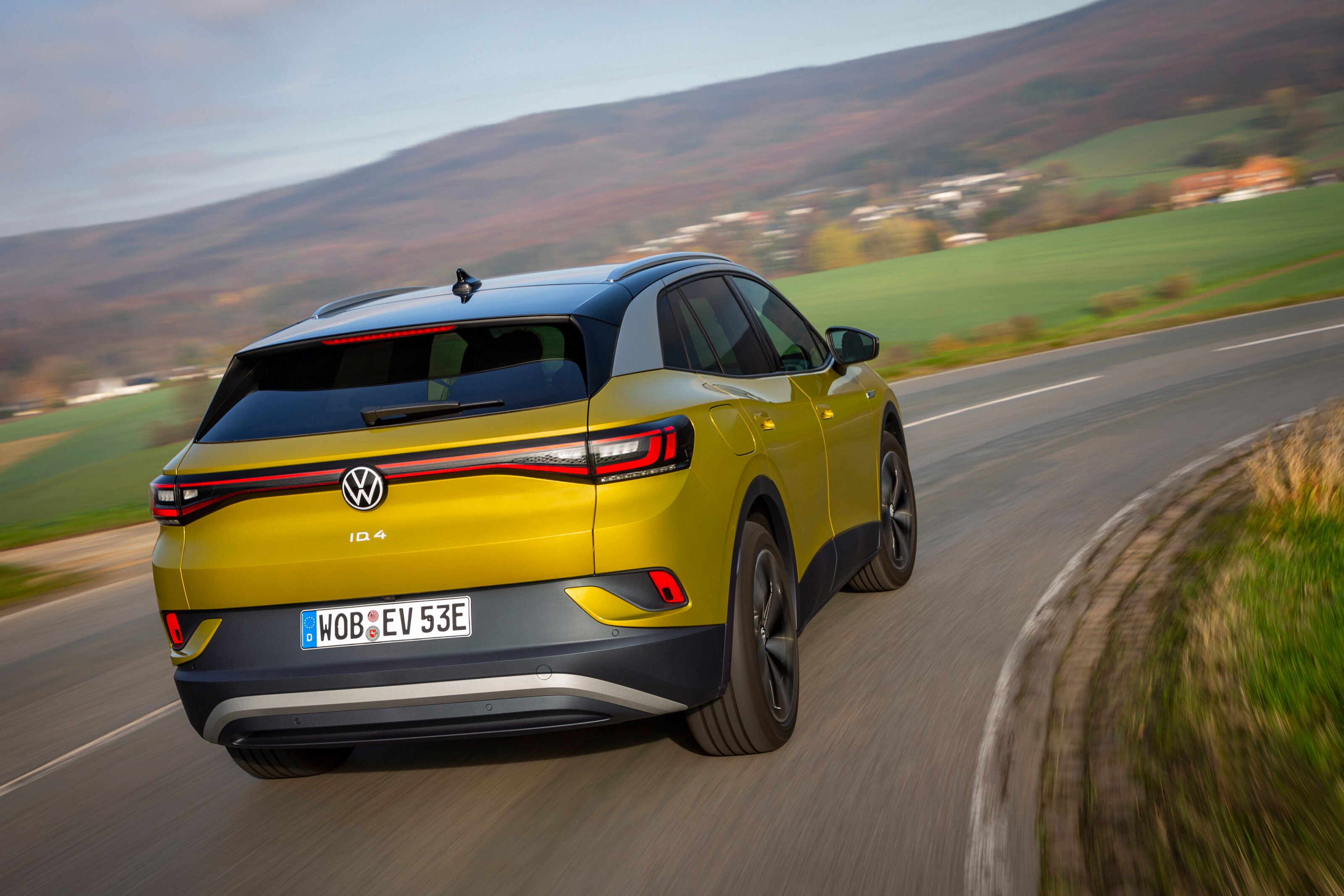
But here Volkswagen was overplayed its hand, at least in the 1st Edition: The firm spring and damper rates designed to manage the ID.4’s considerable mass on smooth, winding German roads have endowed the car with an arthritic low-speed ride that’s totally at odds with its mission as a quiet and comfortable family wagon. The stiff sidewalls of the Bridgestone Turanza Eco tyres – 235/50 R20 up front and 255/40 R2 at the rear – exacerbate the impacts felt through potholes and over sharp bumps. The 18- and 19-inch wheels of the regular ID.4 lineup, shod with higher profile 60- and 55-series rubber, would seem a more sensible choice.
The Beetle and the Golf were game-changers. The Volkswagen ID.4 is not. Well, not in the same sense. Though generally competent, the ID.4 doesn’t rewrite the rulebook in terms of electric vehicle performance or functionality or value. But the industrial thinking behind it, driven by the desire to build electric vehicles by the million, makes it every bit as significant a Volkswagen as those two icons.
2022 Volkswagen ID.4 1st Edition specifications
Snapshot
- New Trail Boss will be the cheapest Silverado in Australia
- Z71 off-road pack comes standard with increased ride height and skid plates
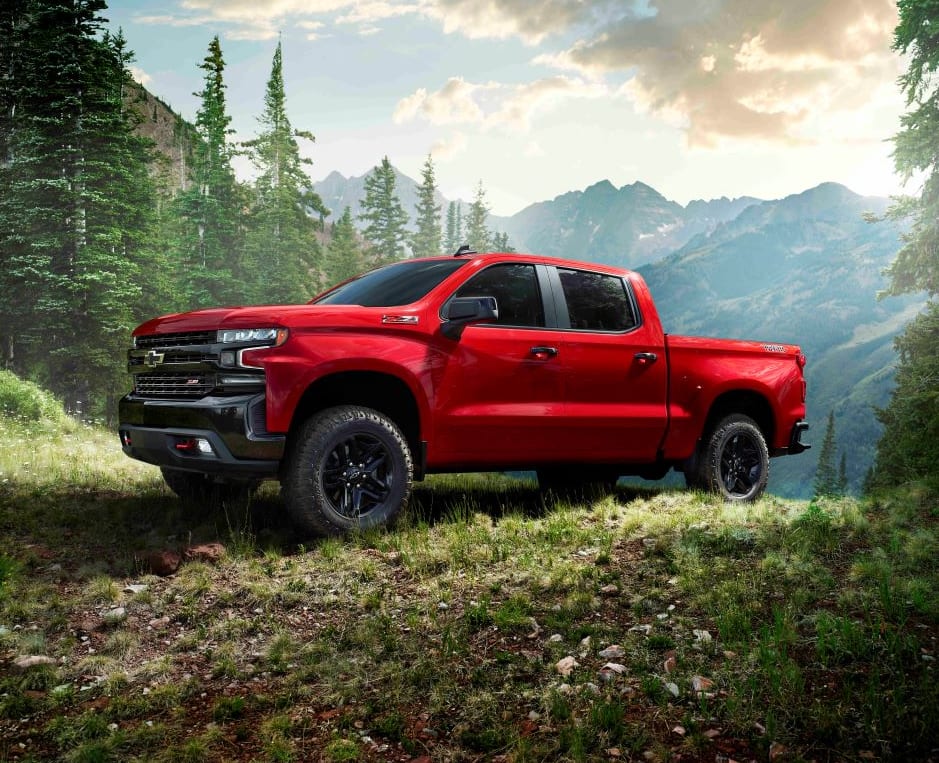
UPDATE, JULY 12: General Motors Specialty Vehicles (GMSV) is set to launch the new Chevrolet Silverado 1500 LT Trail Boss in the next couple of weeks, delivering the first orders of the cheapest truck in the company’s Australian range.
Initially announced at the end of March (below), the LT Trail Boss is now the entry-level to the Silverado line-up locally, scoring a 6.2-litre V8 which makes 313kW/624Nm, allowing the truck to tow up to 4.2-tonnes.
Fitted with the Z71 off-road package, GMSV general manager of marketing, customer experience and communications, Jodie Lennon, believes this is a capable vehicle for those wanting adventures off the beaten track.
“Thanks to more than 100-years of truck building know-how, Chevrolet has been able to continually enhance its product and develop it into what it is today,” said Lennon.
“Trail Boss is the truck to choose when it comes to handling the rough stuff and getting things done.”
The story to here
MARCH 31: GMSV has revealed its latest addition to the Chevrolet Silverado 1500 pick-up line – the LT Trail Boss.
As standard, the vehicle will come with a host of fit for purpose off-road features such as; Rancho monotube dampers, a factory fitted suspension lift kit that raises the front axle’s ride height by 25mm and the rear by 30mm, Hill Descent Control, underbody skid plates, heavy-duty air filet and blackened 18-inch alloy wheels.
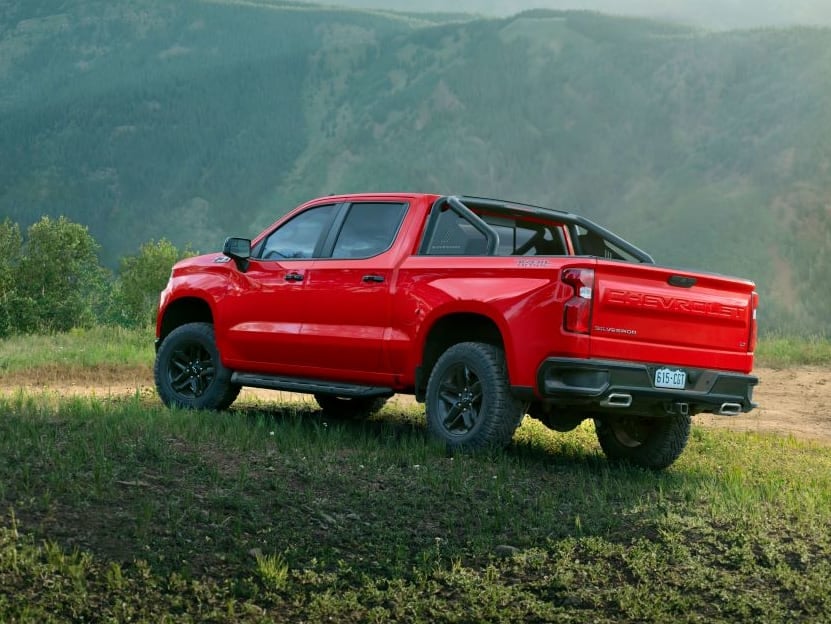
Despite all this kit though, the new LT Trail Boss is now the cheapest Silverado you can buy in Australia, with an RRP of $106,990.
That makes it $7,000 cheaper than its closest model sibling, the Silverado 1500 LTZ Premium Edition.
GMSV is keen to point out that the main differences between the LTZ Premium Edition and the new Trail Boss is the latter pick-up’s off-road credentials.
“LT Trail Boss personifies what Silverado is all about. It’s big, it’s tough and it comes ingrained with brand DNA which showcases qualities of strength, power, performance and no-nonsense work-hard attributes,” Joanne Stogiannis, director of GMSV, said.
“It is purpose-built, born to perform, offering rugged dependability in off-road settings when exploring on the weekend, but is also at home in urban environments during the week.
“It will enable big thrills and big adventures – it’s a way to really enjoy and experience the road less travelled.”
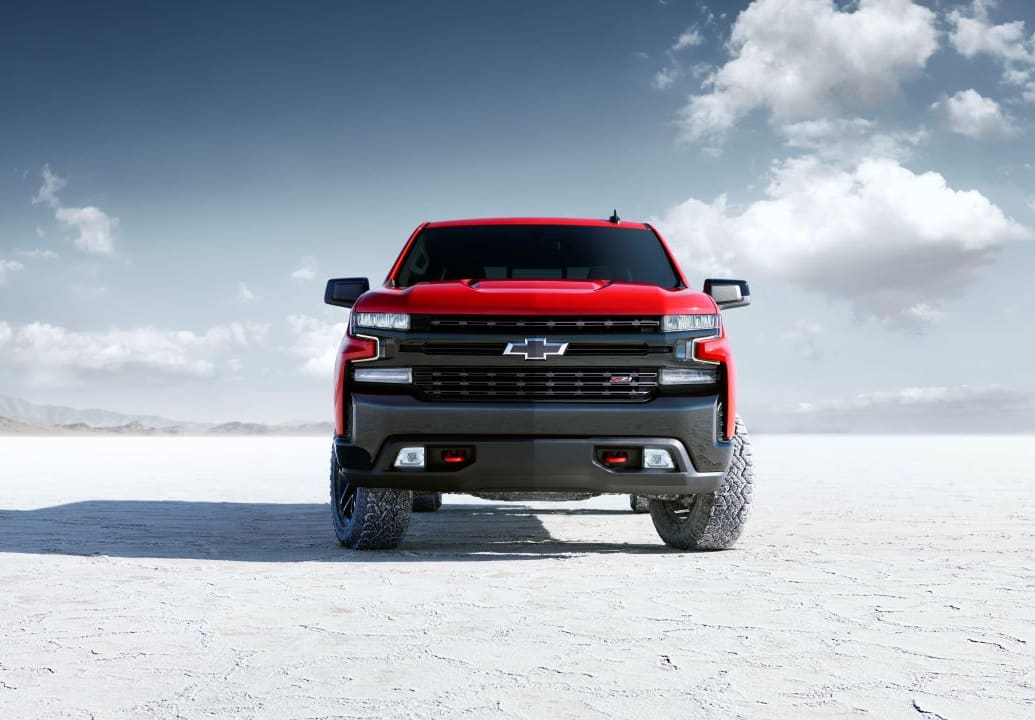
Powering the pick-up is the same 6.2-litre EcoTec3 V8 petrol engine found in other models in the range.
The gargantuan motor will pump out 313kW and 624Nm, sending its power to all four wheels via a 10-speed automatic transmission with a column-mounted gear selector.
Inside there’s a leather-wrapped and heated steering wheel, 10-way adjustable power and heated front seats, and wireless Apple CarPlay and Android Auto.
The new pick-up will also be packing several safety features too, including front and rear park assist, lane change alert with side blind zone alert and rear cross traffic alert.
Order books for the new GMSV Chevrolet Silverado LT Trail Boss are open now, with deliveries expected in Q3 of this year.
Snapshot
- September 6 reveal expected
- First Renault model to use CMF-EV platform
- Production models set to be released next year
Renault will use the upcoming IAA Munich Motor Show to debut its all-electric Mégane crossover, the French manufacturer’s first vehicle on its new CMF-EV platform.
According to Motor1 reports, the Mégane E-Tech Electric is set to be unveiled on September 6 as the IAA Munich Motor Show, with the Mégane being the focal point of Renault’s stand at the trade show.
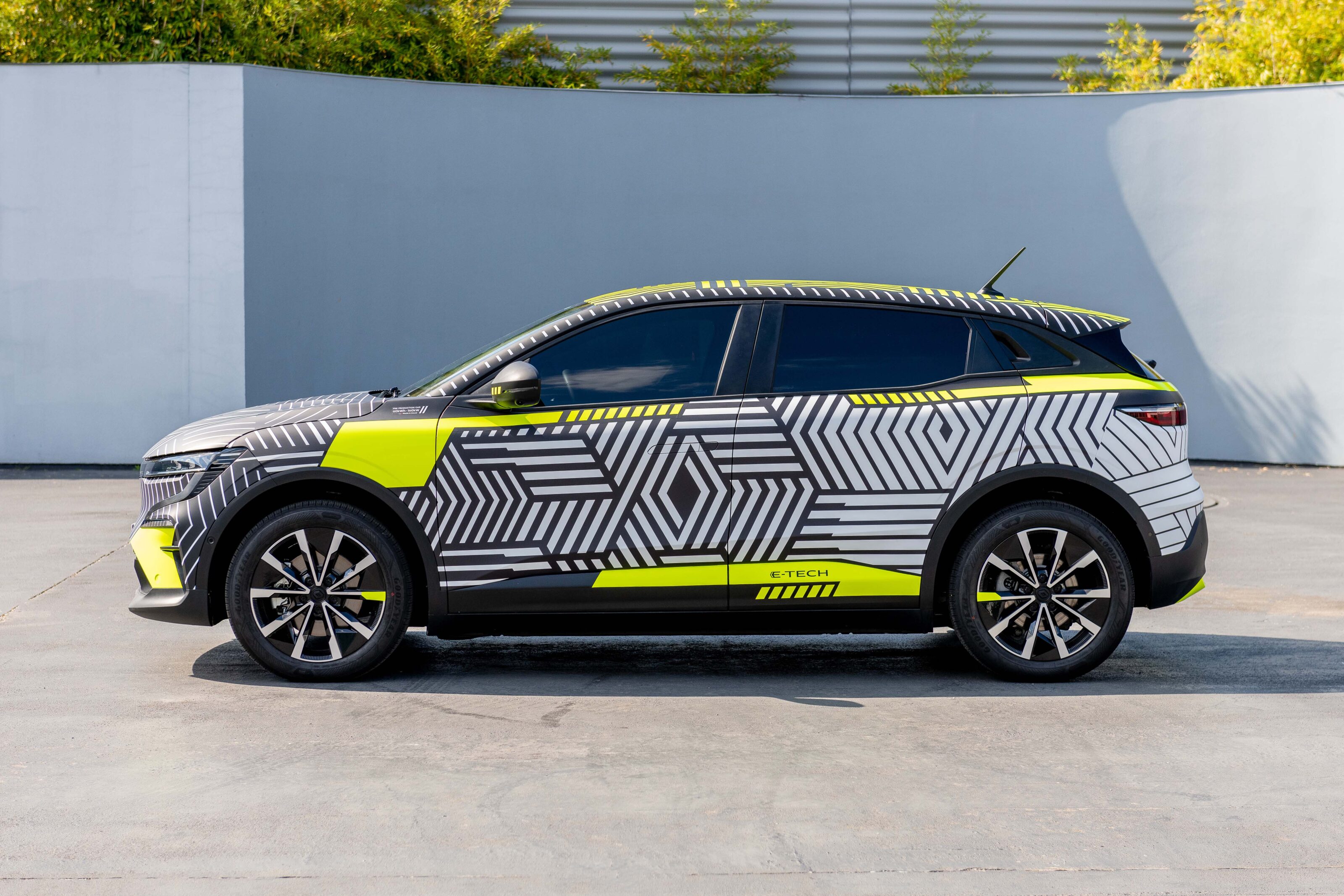
First revealed in 2020 as the Mégane eVision, the E-Tech Electric was given its final name last month when Renault first took the covers off its pre-production model – lightly camouflaged in black and white stripes with a hint of fluorescent yellow.
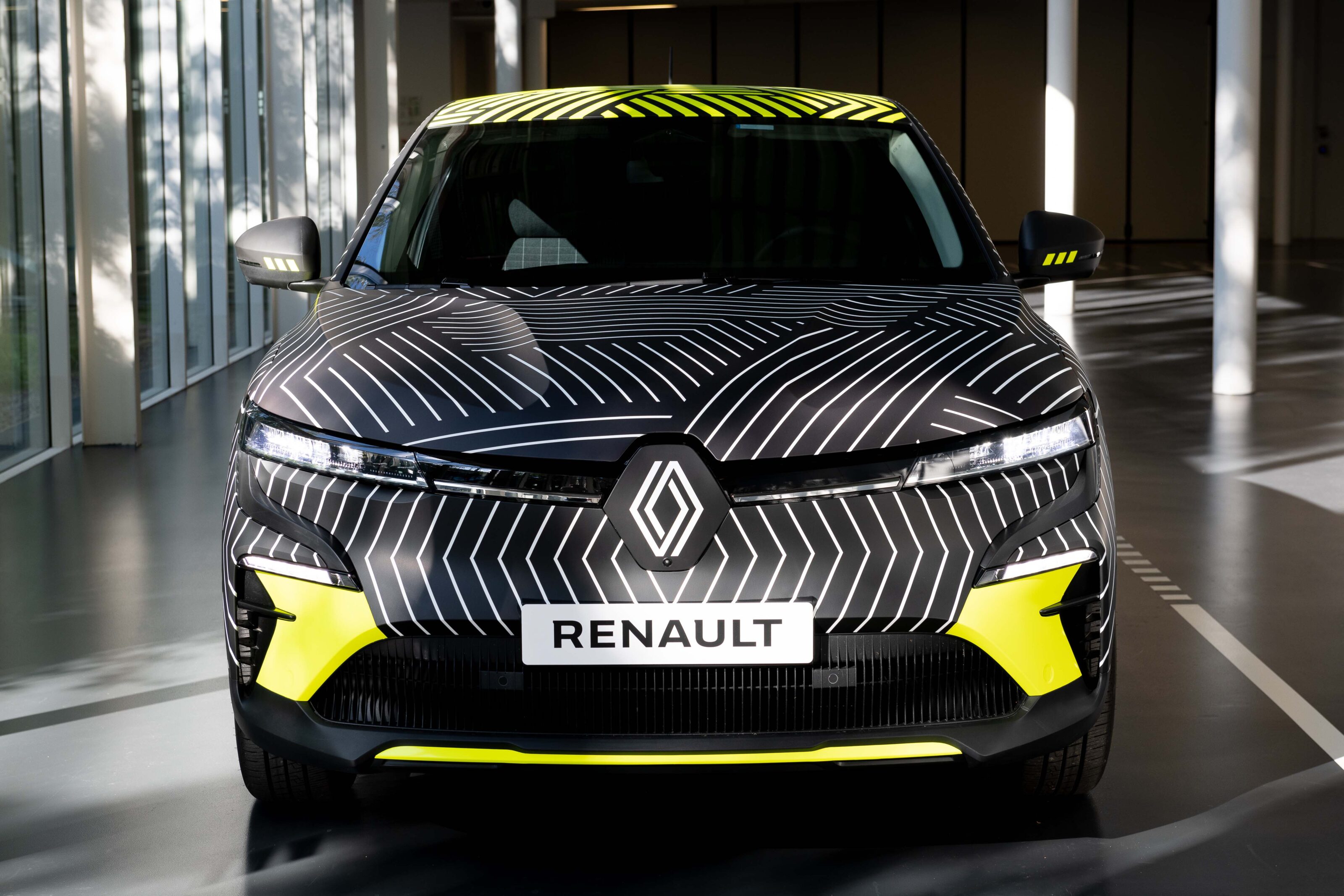
Underpinning the Mégane will be the first iteration of Renault and Nissan’s CMF-EV platform, featuring a 160kW motor on the front axle which is paired to a 60kWh lithium-ion battery pack.
Initially launching in 2022, further power options could be available in the Mégane E-Tech as it is based on the same architecture as the Nissan Ariya, a crossover which produces 225kW thanks to its dual-motor, all-wheel-drive system – also available with a larger 87kWh battery pack.
Renault is also expected to show off its modern homage to the classic Renault 5 at the motor show, in line with its recently announced target of reaching 65 per cent electrification by 2025 with 90 per cent of models to be fully electric by 2030.
The current Mégane is offered as a hatchback and sports tourer in Europe, available with either a petrol, hybrid or diesel power unit – though Renault’s UK division dropped the latter engine from its range last week.
November 2023: See our evolving 2024 Forester coverage
Get on top of all you need to know about the upcoming new Forester at our linked story below.
Story continues: 2022 Forester pricing and details
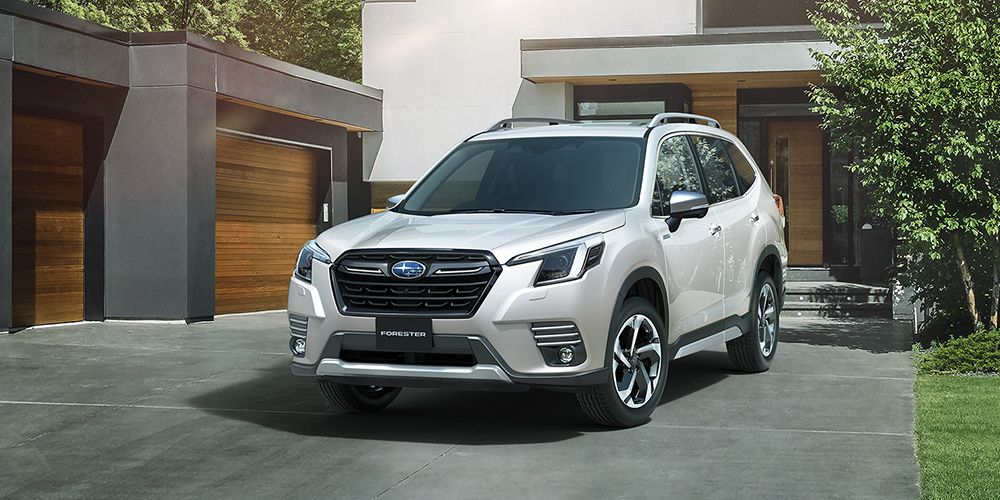
Subaru has confirmed details of its freshened-up 2022 Forester range, updating the model which first hit Aussie shores in 2018.
Snapshot
- Fifth-gen Forester launched in 2018
- Update brings comfort and exterior changes
- Due to hit Australia this November
Pricing now kicks off at $35,990 for the entry-level car, a slight increase over the 2021 model’s $35,190.
Safety has been bolstered, with lane centring, lane departure prevention, and autonomous emergency steering added to the Forester’s EyeSight suite.
The front spring and damper layout has been refined, which Subaru says will improve the Forester’s ride comfort and handling response.
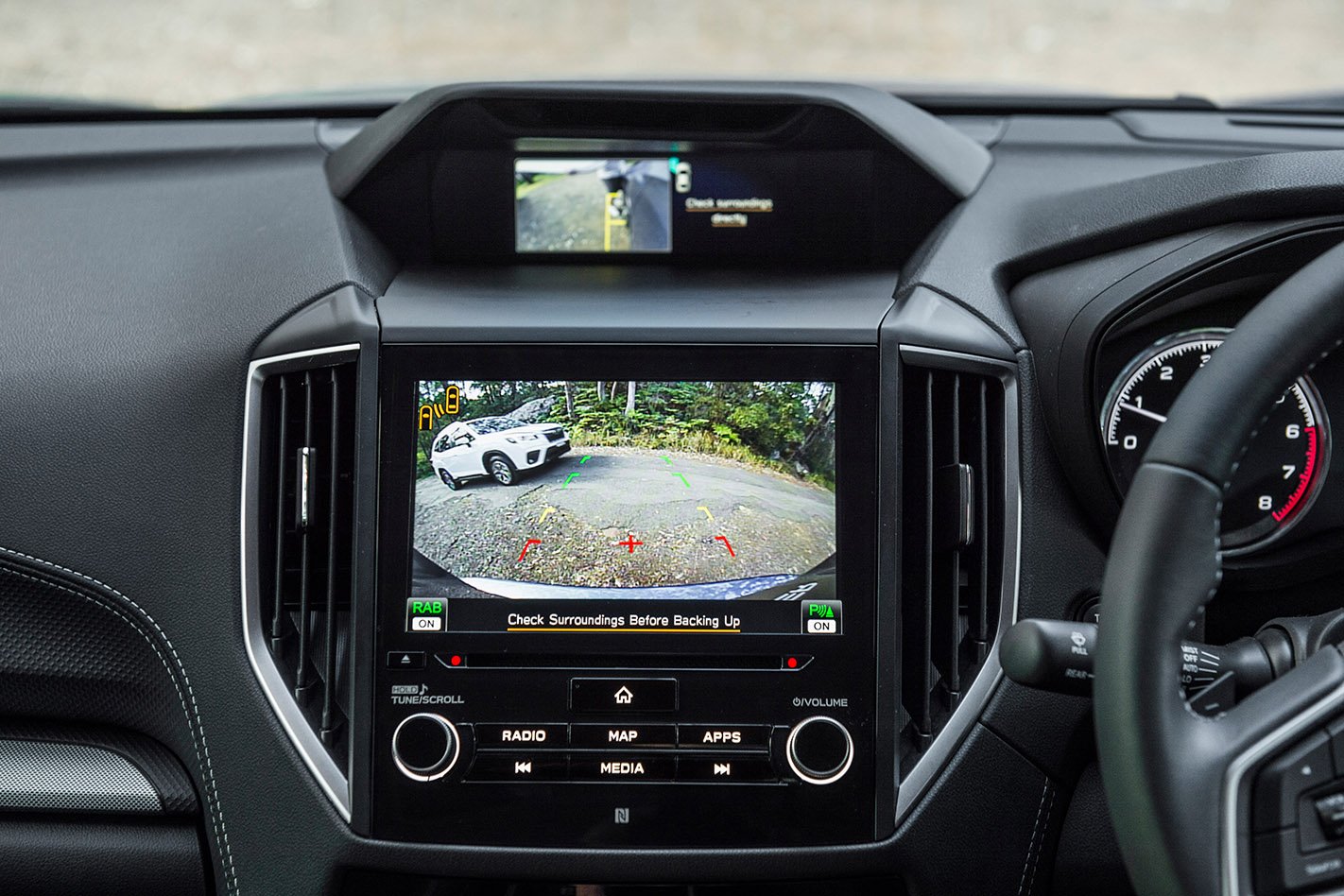
The all-wheel-drive ‘X-Mode’ has received similar treatment. The rough-terrain system can now automatically re-engage when the Forester’s speed drops below 35km/h, while hill descent control has also been improved.
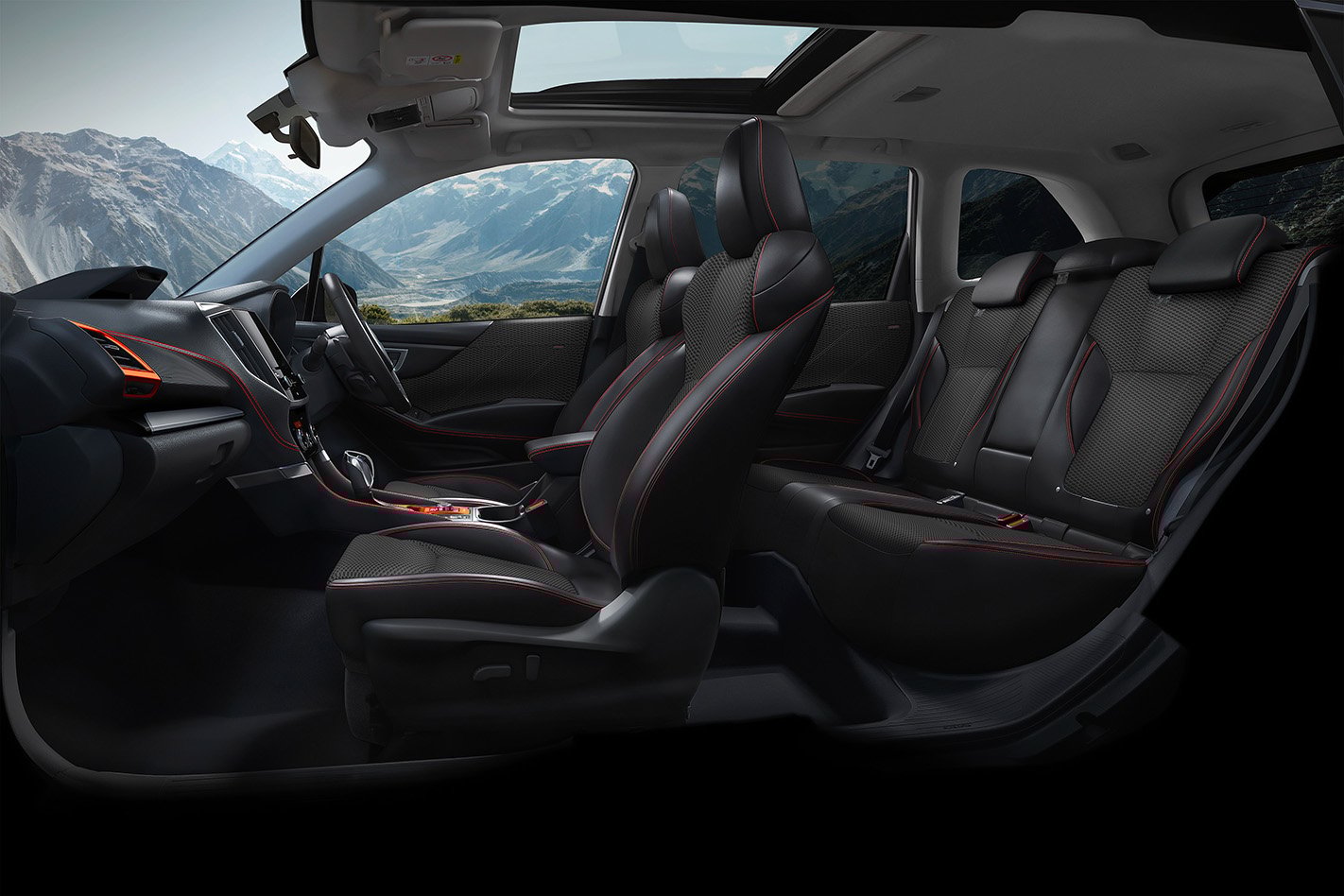
Touchscreens across the entire Forester range are now 8” wide, where the 2.5i, 2.5i-L and Hybrid L previously used 6.5” units. The driver monitoring system now boasts gesture-controlled climate control adjustment, allowing drivers to change temperature settings with a hand gesture.
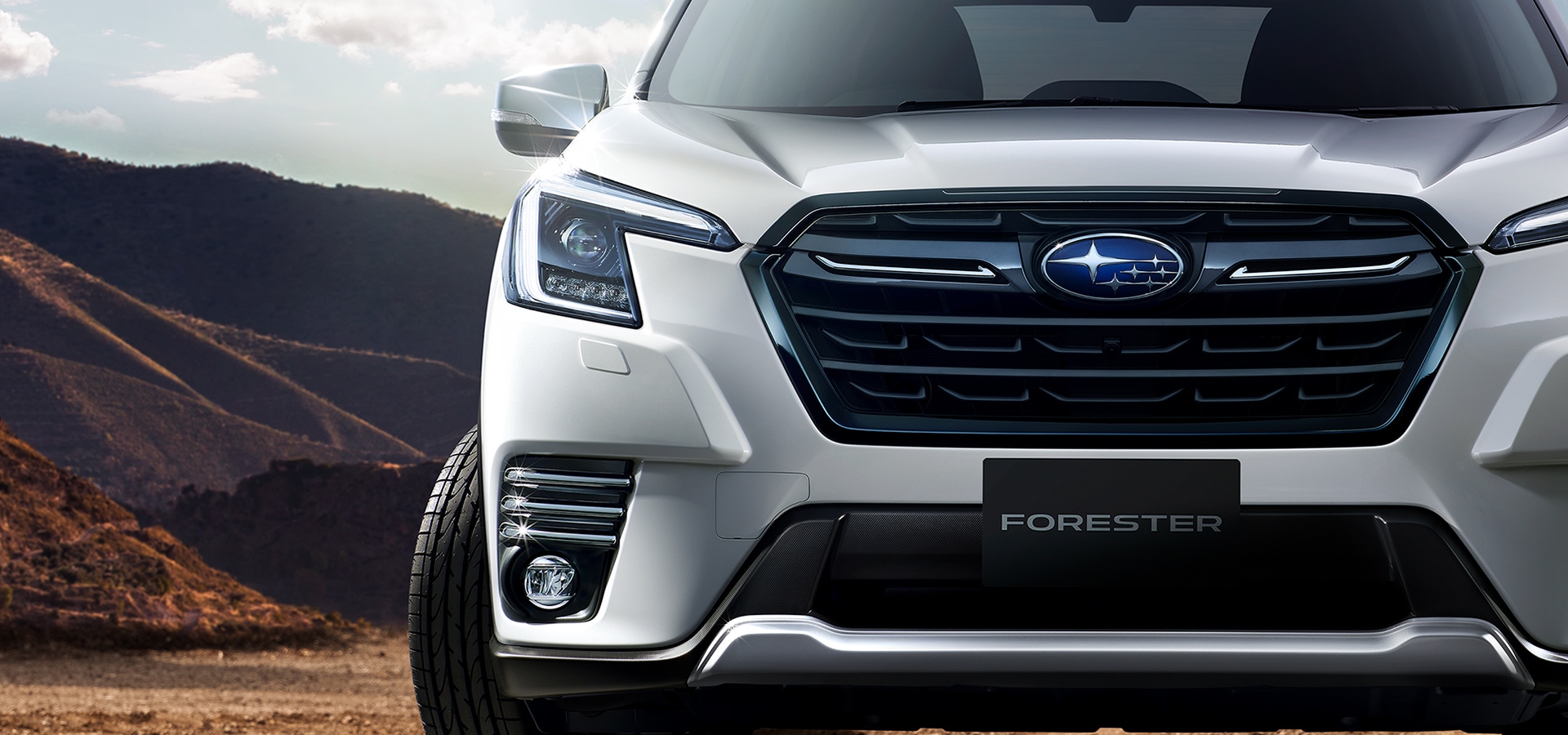
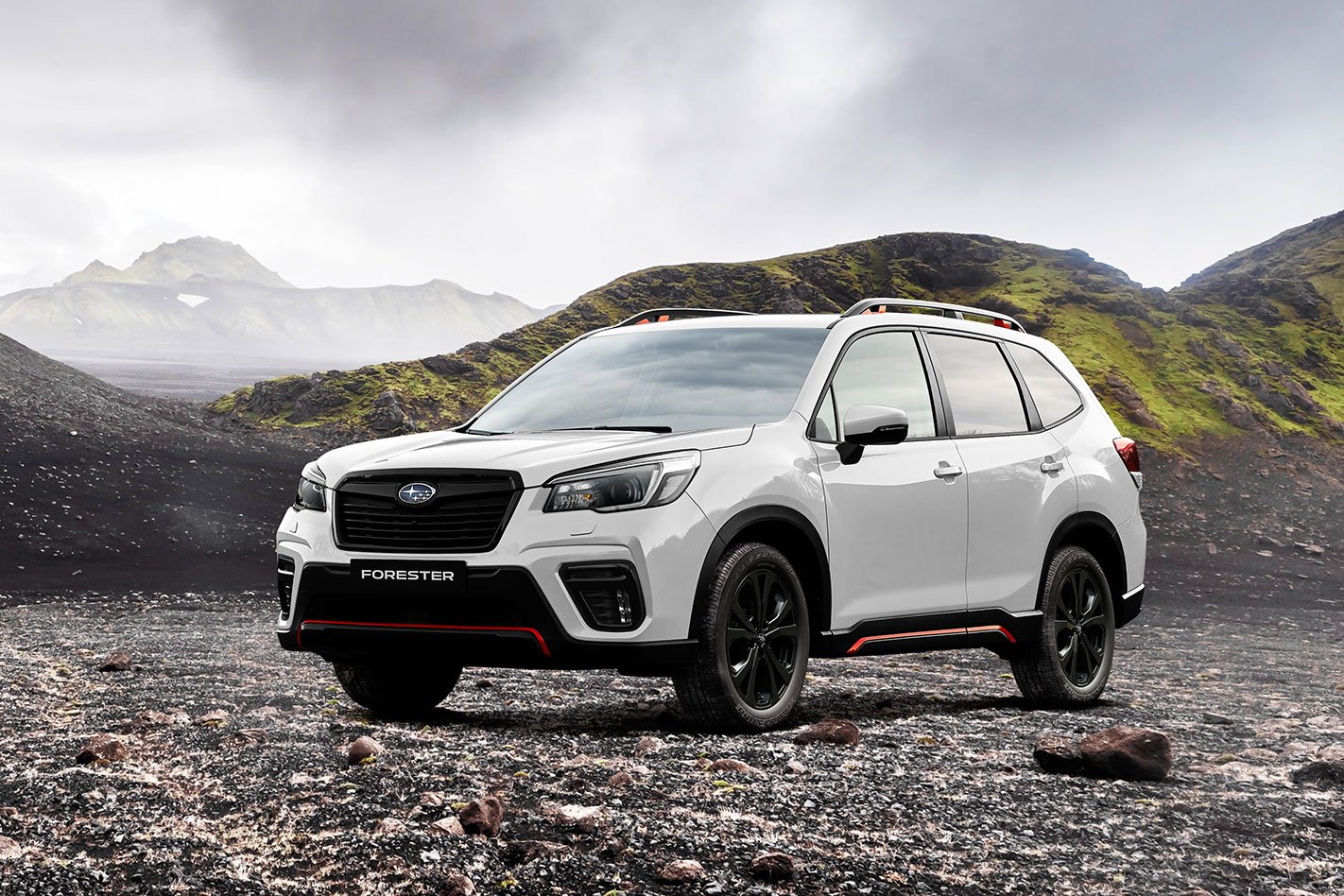
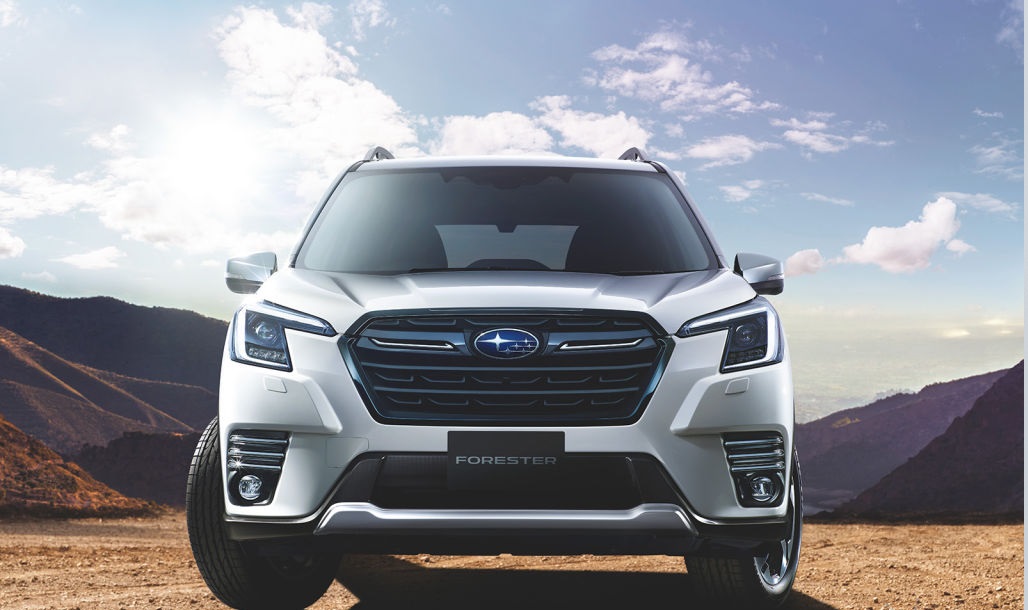
The most obvious external change is a sharpened front end, which now features C-shaped headlights, plus a new fog light, bumper and grille design. New alloy wheel designs for the 2.5i-S and Hybrid S are also standard, alongside a number of small cladding changes. Autumn green, brilliant bronze and cascade green are new colour options, offered on all cars aside from the 2.5i Sport.
Pricing and options
Like the 2021 model, the 2022 Forester will be offered in seven specifications (pricing before on-road costs):
| Forester 2.5i AWD | $35,990 |
| Forester 2.5i-L AWD | $38,390 |
| Forester 2.5i Premium AWD | $41,140 |
| Forester 2.5i Sport AWD | $42,690 |
| Forester 2.5i-S AWD | $44,190 |
| Forester Hybrid L AWD | $41,390 |
| Forester Hybrid S AWD | $47,190 |
Engine, transmission, and performance
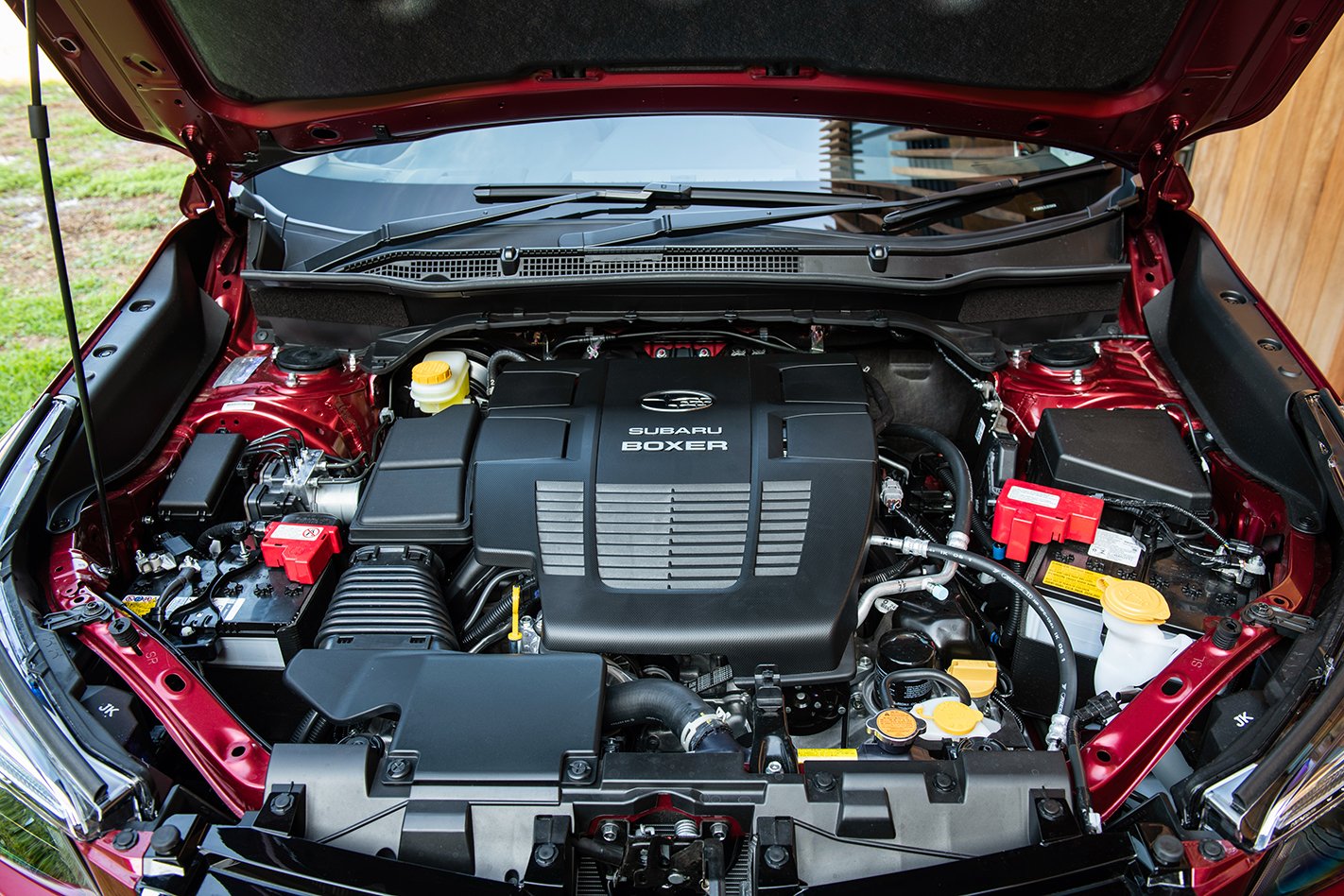
Output from the 2.5-litre, naturally-aspirated petrol four remains at 136kW/239Nm. Introduced to the Forester range in 2020, Hybrid variants feature a 2.0-litre petrol engine good for 110kW/196Nm, plus a 12.3kW/66Nm electric motor.
Both engines are backed by a continuously variable transmission (CVT).
Features
The base-model Forester 2.5i AWD’s features include:
| Fog lights |
| Reverse camera |
| Steering responsive headlights |
| 8u201d LCD touchscreen |
| Apple CarPlay and Android Auto connectivity |
| Dual-zone climate control |
| 8u201d LCD touchscreen |
| Smart key and push-button ignition |
| 17u201d alloy wheels |
The 2.5i-L and Hybrid L AWD add:
| Adaptive driving beam |
| Facial recognition |
| De-icing wipers |
| Heated seats |
Moving up to the 2.5i Premium AWD means:
| Eight-way driver and passenger seats |
| Premium cloth trim |
| Automatic mirror and seat adjustment |
| Subaru Intelligent Drive (SI-Drive) with Intelligent and Sport modes |
| 18u201d alloy wheels |
| Passenger side auto-dipping mirror |
| Sports pedals |
Similar to the Premium in trim, the 2.5i Sport AWD adds:
| Sunroof |
| Sport instrument cluster |
| Water-repellent cloth trim |
Choosing either the top-of the range 2.5i-S or Hybrid S AWD adds:
| Leather-accented trim |
| Eight-speaker Harman Kardon sound system |
Safety
With the new additions mentioned above, all Foresters now feature:
| Seven airbags |
| Adaptive cruise control |
| Brake light recognition |
| Lane centring |
| Lane departure prevention |
| Autonomous emergency steering |
| Lead vehicle start alert |
| Pre-collision brake assist |
| Pre-collision braking system |
| Pre-collision throttle management |
| Blind spot monitoring |
| Lane change assist |
Selecting any model above the base 2.5i AWD gives you:
| Driver monitoring system |
| Adaptive driving beam |
| Reverse automatic braking |
| Side view monitor |
Dimensions
The 2022 Forester is 4625mm long, 1815mm wide and 1730mm tall. It’s narrower but taller than the rival Toyota RAV4.
Warranty and servicing
All Foresters are backed by a 5-year, unlimited-kilometre warranty and receive an eight-year, 62,500km capped price servicing plan. Hybrid variants have an eight-year, 160,000km high-voltage battery warranty.
Availability
The 2022 Subaru Forester is expected to arrive in Australia from November 2021.
Snapshot
- Combined fine of u20ac875million (AU$1.39billion)
- Daimler not fined because it revealed what was happening
- VW considering whether to appeal
Volkswagen and BMW have been fined a combined €875million (AU$1.39billion) by the European Commission for colluding over the development of emissions-cleaning technology in their cars.In a case entirely separate to the Dieselgate scandal, the two carmakers, along with Daimler, had possessed the technology to reduce harmful emissions more than was required under EU law – but avoided competing to do so, reports Reuters.The talks, held a decade ago, centred on design standards for AdBlue – an additive used to cleanse nitrogen oxide from exhaust gases produced by diesel cars.
When it laid charges in 2019, the Commission said the German carmakers had colluded to restrict the size of AdBlue tanks between 2006 and 2014 in order to make the urea-based additive less convenient to use.
The case has set a precedent by extending the application of the law to technical-level talks between industry players.
European Union anti-trust chief Margrethe Vestager told a news conference in Brussels last week: “This is a first. [The] decision is about how legitimate technical co-operation went wrong. And we do not tolerate it when companies collude.”
Vestager said both BMW and VW had agreed to settle the case and acknowledged their roles. As a result, Volkswagen will pay a fine of €502m and BMW €373m. Although Daimler also colluded in the matter, it was not fined because it informed the authorities what was going on.
A statement for Volkswagen AG said it was considering whether to appeal the fine in the European courts later this year, as it believes the EU Commission should have issued clearer industry guidelines about co-operation between manufacturers rather than hitting the carmakers with fines.
“VW has cooperated fully with the European Commission throughout the proceedings,” it said.
“The Commission is breaking new legal ground with this decision, because it is the first time it has prosecuted technical cooperation as an anti-trust violation.
“It is also imposing fines even though the contents of the talks were never implemented and customers were therefore never harmed. In fact, the tank sizes and ranges of the vehicles involved were two to three times higher than discussed in the talks.
“The existing Commission guidelines on horizontal co-operation agreements date from 2011 and no longer do justice to the complex challenges facing the automotive industry in particular in the area of necessary technical co-operation.”
A statement for BMW Group added: “The European Commission acknowledges that the proceedings now concluded by settlement represent uncharted territory for anti-trust law.
“Price and territorial agreements were not the subject of this investigation. The European Commission nevertheless used the standards generally applied to ‘classic’ cartels of this kind to calculate the fine – with merely a certain reduction to reflect the unique nature of the case.
“The Board of Management of BMW AG has now accepted this fine in the current settlement, which acknowledges the excessive transparency provided in the context of the discussions in question – with regard to the necessary size of AdBlue tanks, the range that can be achieved with them and the presumed average AdBlue consumption.
“However, excessive transparency, like that during the discussions between the manufacturers, may also be prohibited under competition law – even though this transparency did not disadvantage customers in any way.”
I still vividly remember the moment I realised cars would be a big part of my life. I was in my early teens standing with my dad on a hillside somewhere in the north of Italy when something distant interrupted the serenity of a perfect summer evening – a noise unlike anything I’d heard before.
It was certainly an approaching car but the sound it produced while blasting up this winding ribbon of a road out of sight was something cavemen would have hidden from. It had the revs of a race engine but not the volume – a monster’s howl that was both frightening but also as silky and alluring as a Siren’s irresistible song. I was captivated.
As it rounded the corner and exploded into sight dad turned to me, both of us wide-eyed, and said one word – Ferrari. That was it – one unfiltered assault on my ears by the V8 Ferrari F355 reverberating from the Italian countryside, and I had been inoculated with octane and irrevocably sworn into the holy church of speed.

You probably have a similarly poignant memory; the moment that marked your transition from an avid interest in cars to lifelong healthy obsession, but statistics suggest we are a dying breed. About 60 per cent of 18 to 24 year-olds have a driver’s licence, while the proportion of those Australians that either own or are considering buying a car is even slimmer.It’s a complex situation being driven by better public transport, growing car-sharing services and urbanisation, but perhaps there is another more concerning cause – maybe cars just aren’t as interesting anymore? Take the F355 that lit my automotive inferno for example.
The current bearer of the mid-engined V8 mantle for arguably the world’s most evocative car brand is the F8 Tributo – a car that produces 150kW more power than the F355 and will get to 100km/h from standstill in 2.9 seconds – almost 2.0 seconds faster. It’ll also V-max at 340km/h, which is a whole school zone faster than my sweetheart Ferrari.
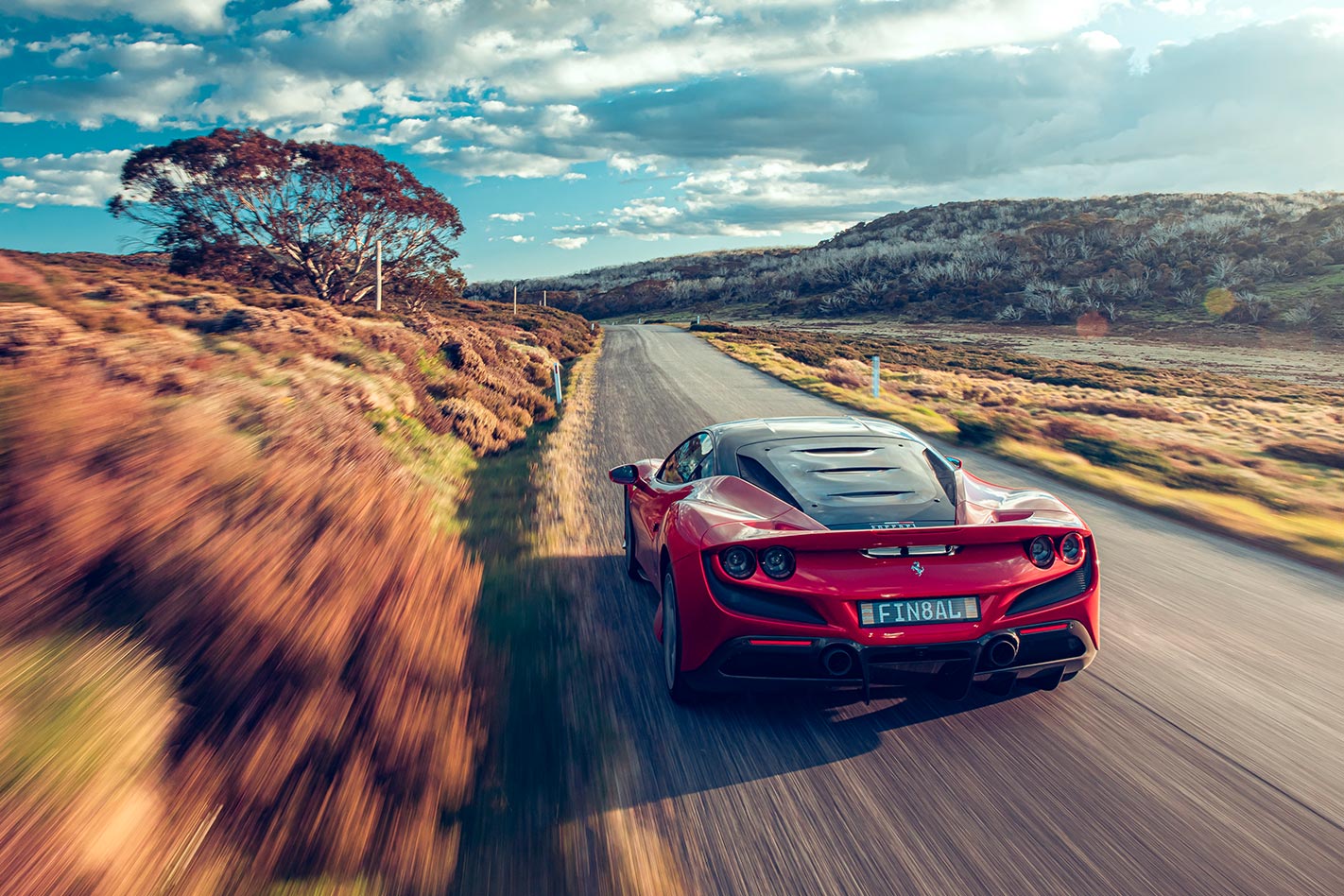
But as an impressionable young man, all of those figures were completely inconceivable and almost meaningless. After all, until I was old enough to jump behind the wheel and experience what zero-to-100 felt like in 10 seconds, how could I possibly imagine doing the milestone dash in a third of that?
Critically though, the F355 blew me away with the way it looked and sounded – two things a young person can easily put into context and, I’m sorry, two things the F8 doesn’t do half as well. Argue with me all you like on that point because examples are numerous. If provoked, I’ll draw a line to future cars that make hardly any sound at all and probably won’t even need the organic spacer between the seat and the steering wheel to go at all. Is it any wonder young people are taking the tram?

It’s a sobering thought and one that should trouble me more but it doesn’t thanks to people like Will – a young man not a lot younger than I was when I first heard a Ferrari. We recently got talking because I had been told he liked cars – boy, does he like cars.
Browsing the internet for inspiration, not only did Will know every machine by make model and, in most cases, variant, he knew something about each one, too. He also has an incredible skill for asking about every single car I haven’t driven…
But whether the chat was about a Rolls-Royce, Rimac, Range Rover or Renault, not once did either of us single out a car specifically because it was electric or petrol, and rarely was its performance mentioned. The love of cars is something broader and more inclusive than stuff you can jot on paper.
Yes the sensation of monumental acceleration and cornering speed is massively addictive, but the universal excitement of cars is the freedom and possibilities they bring.
It’s not up to previous generations of petrolheads to dictate the future of cars to the next – partly because they won’t even be called that. Voltnuts, Ampheads or current-junkies perhaps? No, we should be listening to what piques the passion of young drivers and car lovers and, if we do, what comes next will be every bit as glorious as a naturally aspirated V8 at 8500rpm.
