Classic Wheels

Gallery 1
First published in the June 1967 issue of Wheels magazine, Australia’s best car mag since 1953. Subscribe here and gain access to 12 issues for $109 plus online access to every Wheels issue since 1953.
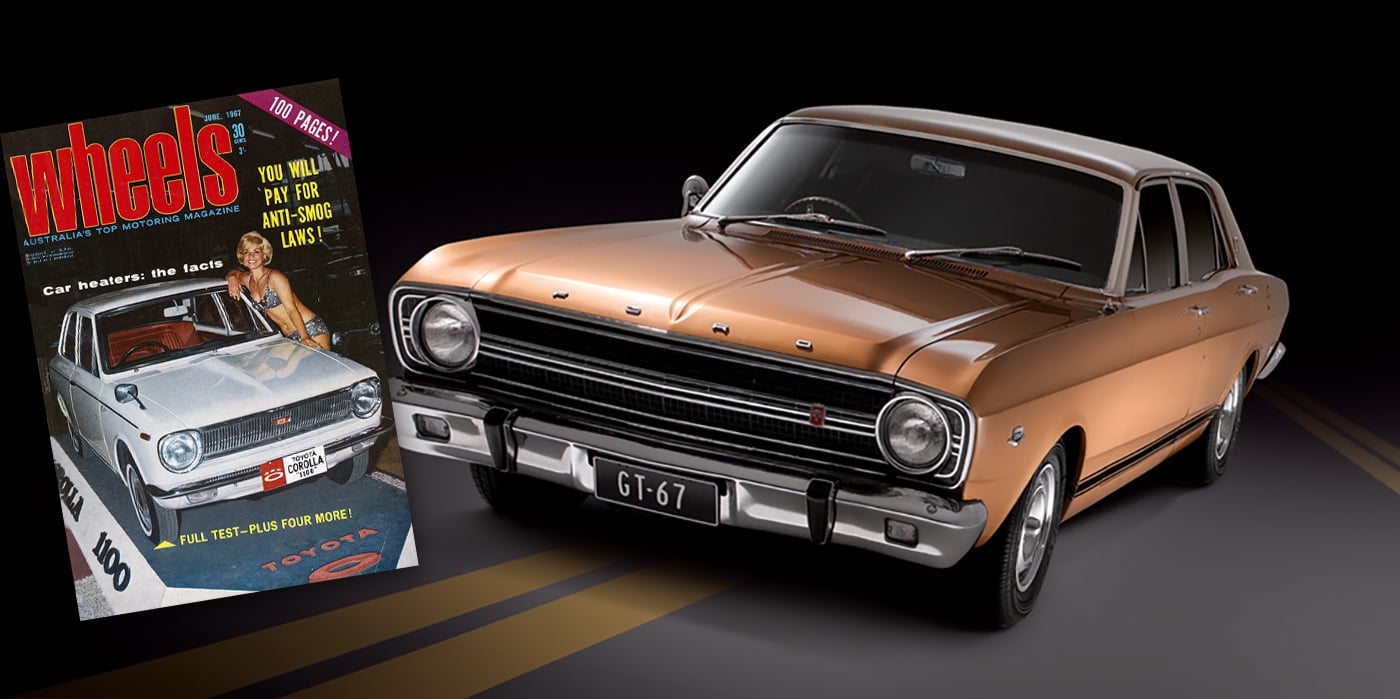
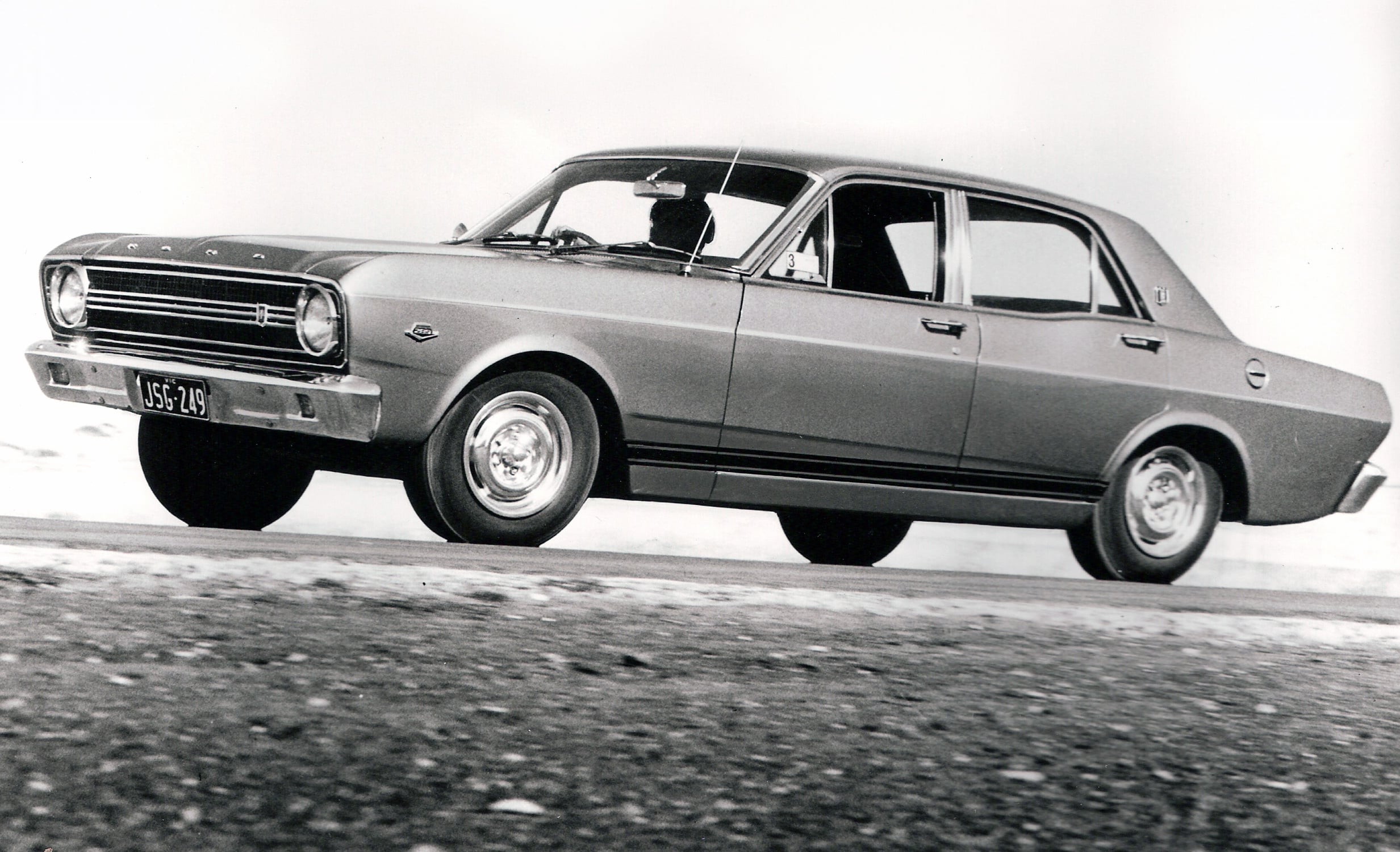
A high performance version of Ford’s Falcon V8 has been as inevitable as plum pudding at Christmas. It’s been longer coming than most people expected but initial impressions indicate that it’s been worth the wait. We first predicted the Falcon GT in January.
1
Ford started experimenting with a GT concept of the car long before the XR was introduced. It had hoped to win some police contracts with a faster, four-on-the-floor XR V8 which gave rise to stories that a Falcon GT would come out with the rest of the cars. Then the buzz was that it would blossom alongside the Fairlane. Wisely, Ford held back another month, for the GT would have certainly taken the shine off the Fairlane’s publicity.
Essentially, the Falcon GT will be a limited production model, but is being screwed together within Ford’s Melbourne plant. Initial production runs look like being in lots of 300 because Ford top brass are just a bit wary as to its sales potential. However, our guess is that Ford may be astride a tiger with this one.
A lot of non-Ford motorists are going to be drawn into the fold by the thundering performance, good roadholding, brakes and quick steering. Ford is undecided about running the GT in the Gallaher 500 at Bathurst this October. Even if a works entry doesn’t appear there is sure to be a stack of GTs battling for line honors against the Alfa Supers.
1
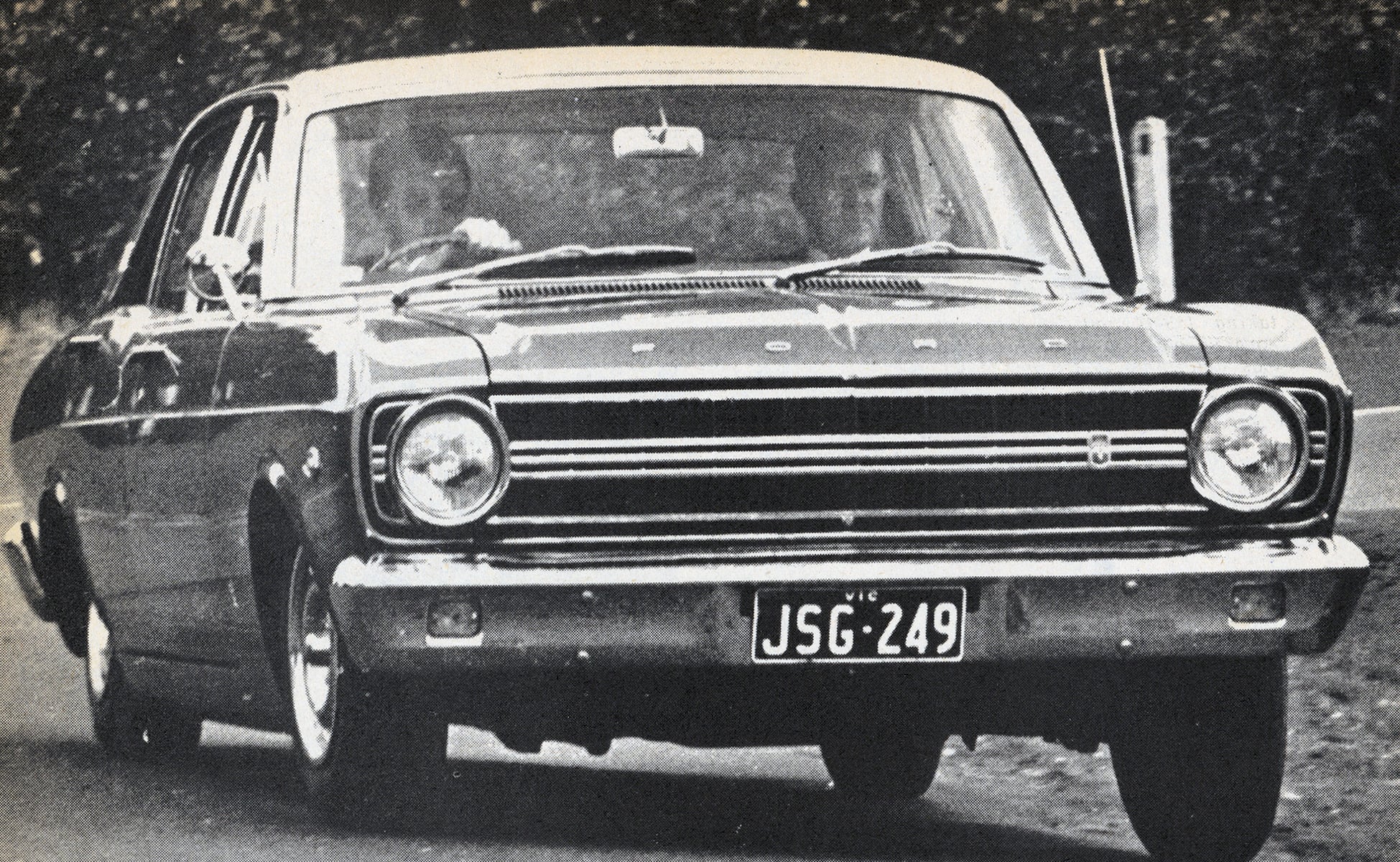
Like the T-model black, the Falcon GT comes in any colour the customer wants – as long as it is metallic gold with black trimmings.
Limited production has obviously been to blame for this uniformity, but the colour is attractive enough to please most people. In fact, the GT is more Fairmont than Falcon. With the exception of the floor shift and dashboard, the cabin is pure Fairmont in style, all in black seats, headlining, carpets, the lot. The colour, the black go-faster stripes below the doors and across the back, GT. badges and a partially blacked-out grille the main clues to the hot one’s identity.
Take it a step further. The wheels have 5½ inches to carry 185-14 radials and have chromed hubcaps that have been designed to look like no hubcaps. Suspension modifications have dropped overall height by three inches and it’s more obvious at the back than the front. Spring rates have been fiddled and 1⅜ competition dampers fitted all round to give a firmer, better controlled ride. It is still not harsh. The front anti-roll bar has gone up in diameter.
We had half expected to see some positive rear axle location arrangements, but apparently Ford’s engineers believe they have the situation in hand. Certainly the rear-end felt right, but a final opinion on this will not be available until we get a car for full road test. Front brakes are assisted 11 in. discs with hard linings which, during our short experience with the GT, seemed able to give plenty of bite low down with no noise. Rears are 11 in. drums.
1
At last the steering is just the way everyone had always hoped it would be one day – three turns lock to lock instead of 5.5. With a car like this, the normal 23 to 1 steering ratio just had to be replaced. Naturally, it is heavier than the standard ratio. We expected to have to go through a superman act at parking speeds, but it is actually comparable with a Holden.
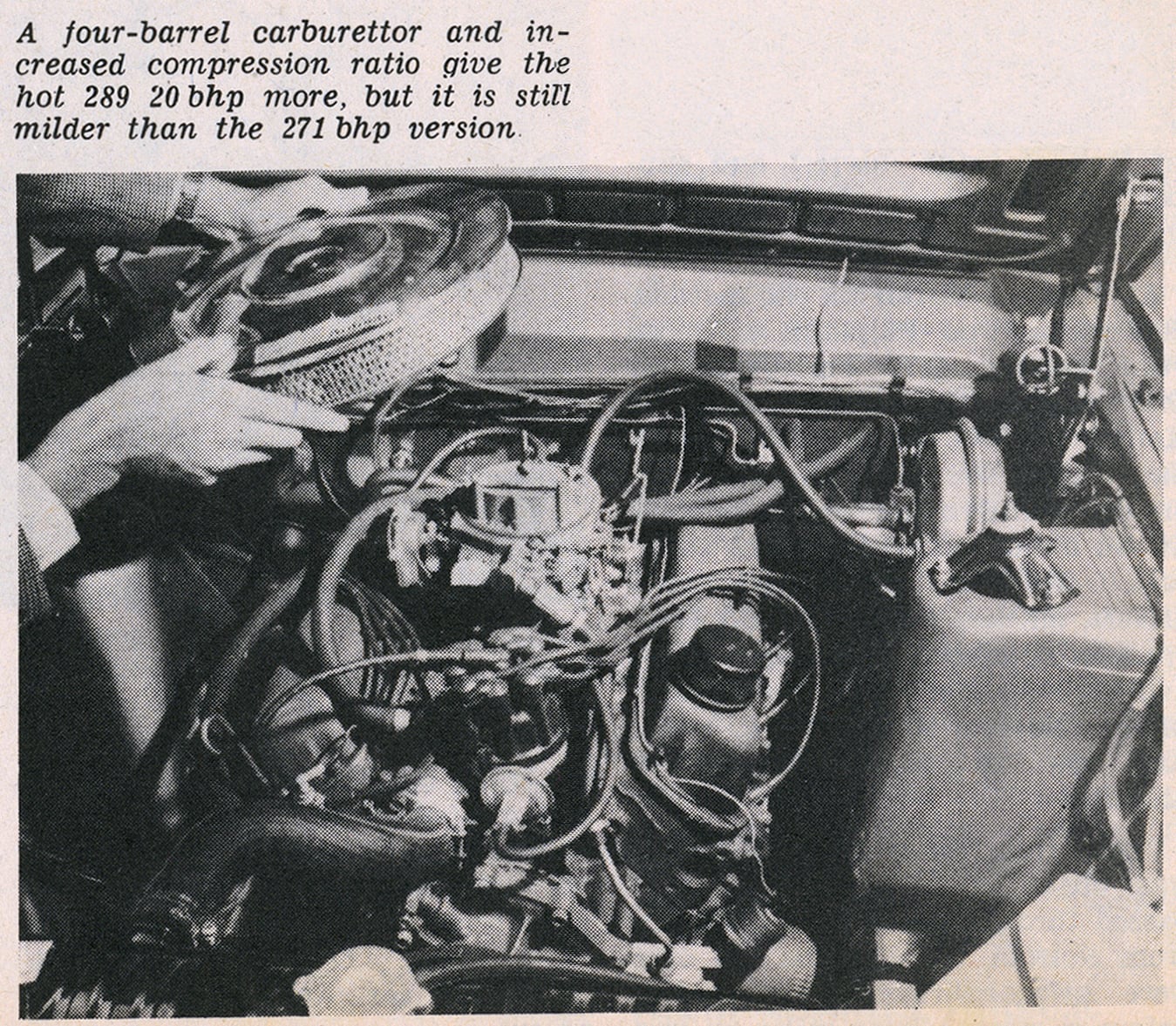
Front mudguard badges announce that the GT has the 289 cubic inch (4.7-litres in case you had forgotten) “High Performance” powerplant. High performance though it may be, the V8 in the GT is a long way from being the wildest 289ci that money can buy. Its basic ingredients are bigger carburettor, high compression ratio and slightly better breathing all round. Hydraulic lifters are still used. The normal 289 has a two-barrel carburettor, 9.3 to 1 compression ratio and develops 200bhp at 4400rpm with 282 lb/ft of torque at 2400. The HP engine has a four-barrel carburettor, 9.8 to 1 compression ratio and develops 220bhp at 4800 and 305 lb/ft at 3200.
Because the GT must necessarily be a roadable, city car as well as a flier on the highway, Ford has kept its output way down. Another 51bhp can be flashed up any old time by installing the Mustang high performance engine, but this tends to be a bit on the harsh side as well as being considerably more costly.
1
As it stands, the GT will potter along at 1000rpm (20mph) in fourth and accelerate smoothly and quietly. The engine pulls so well in top that it’s almost like driving an automatic. We kept to 3000rpm to protect its newness, but even so there was no shortage of punch.
Overall gearing at 2.93 to 1 is high enough to make wheelspin on dry bitumen fairly unlikely from a standing start, unless the driver is really trying. The deep rumble from the single exhaust pipe should be enough to demoralise the opposition at the traffic lights without the need to go off at full charge. Top speed should be over 110mph.
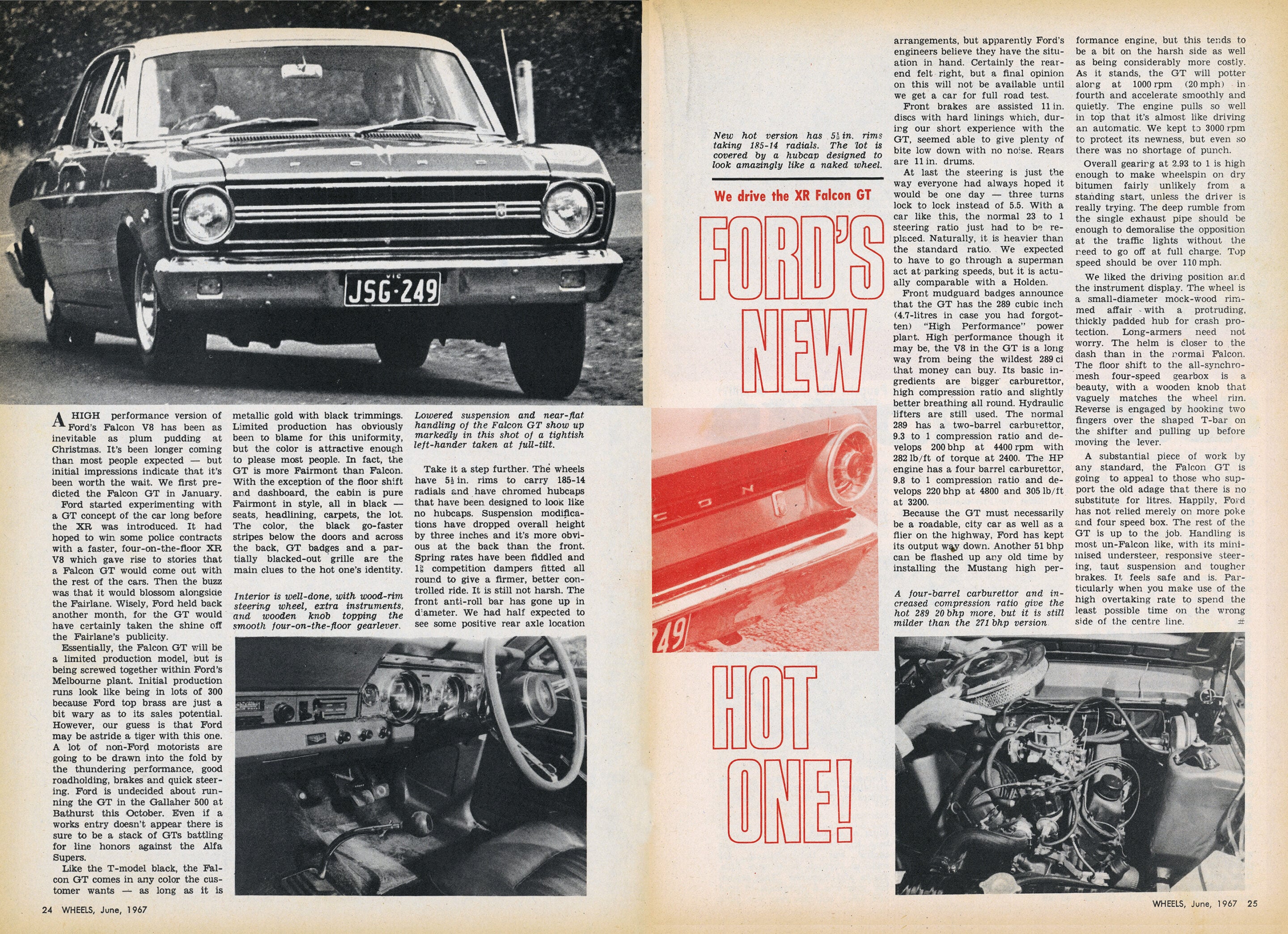
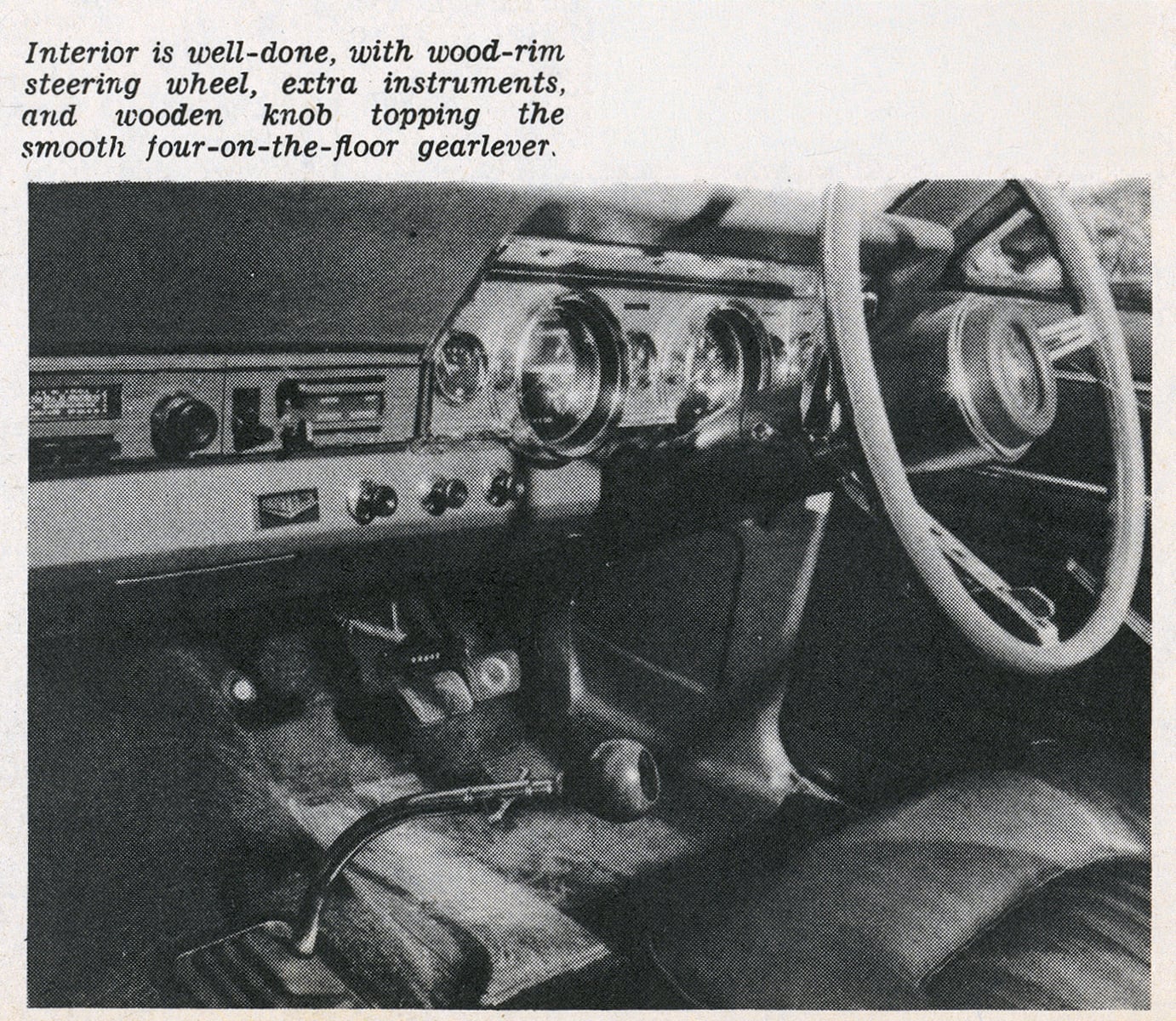
We liked the driving position and the instrument display. The wheel is a small-diameter mock-wood rimmed affair – with a protruding, thickly padded hub for crash protection. Long-armers need not worry. The helm is closer to the dash than in the normal Falcon. The floor shift to the all-synchromesh four-speed gearbox is a beauty, with a wooden knob that vaguely matches the wheel rim. Reverse is engaged by hooking two fingers over the shaped T-bar on the shifter and pulling up before moving the lever.
1
A substantial piece of work by any standard, the Falcon GT is going to appeal to those who support the old adage that there is no substitute for litres. Happily, Ford has not relied merely on more poke and four-speed box. The rest of the GT is up to the job. Handling is most un-Falcon like, with its minimised understeer, responsive steering, taut suspension and tougher brakes. It feels safe and is. Particularly when you make use of the high overtaking rate to spend the least possible time on the wrong side of the centre line.
Follow WhichCar/Wheels on Google
Click the button below to make WhichCar by Wheels a preferred source for your news.


We recommend
-
 Ford Falcon
1968 Ford Falcon XT GT review
A touch of hair-on-the-chest motoring in Australia's fastest production saloon
-
 Features
From the Wheels archive: Ford's Monaro fighter
After years in the two-door wilderness, Ford threw down the gauntlet with the release of 1972's Falcon Hardtop.
-
 Classic Wheels
From the Wheels archive: The best Holden ever!
Wheels gushed over the all-new HQ Holden in September 1971, declaring it 'far and away the best Holden ever'.