Features


Gallery 1
“Toyota’s mini-4WD has the underpinnings of a hot hatch – and ‘cool’ and ‘cult’ written all over it.”
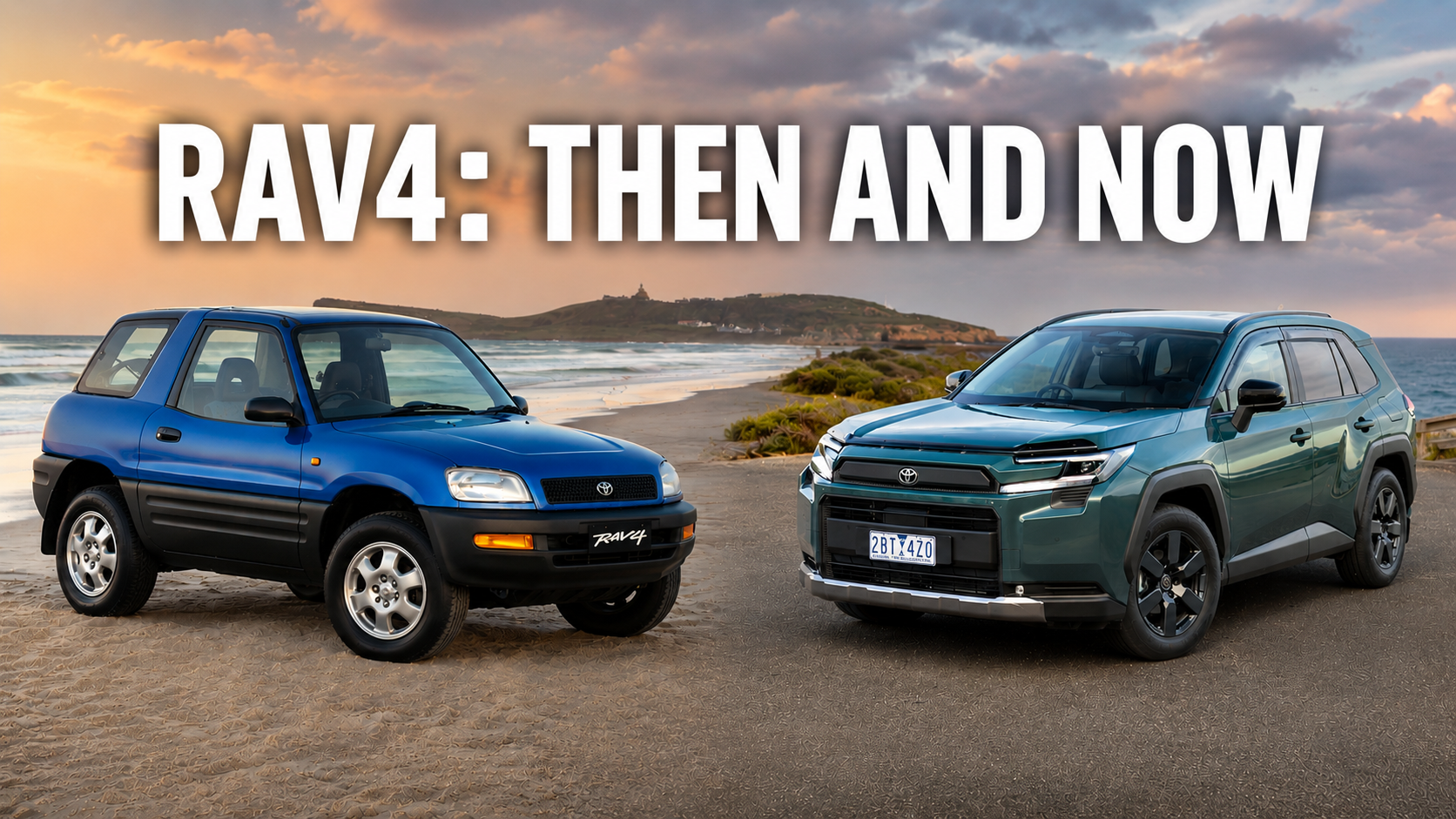
So wrote Wheels in July 1994 of the then brand-new Toyota RAV4 which had just arrived in Australia amid much fanfare and with both eyes firmly on the ‘youth market’. No one, not even the august scribes at Wheels, could have foreseen what would transpire over the intervening decades. As the saying goes, from humble beginnings…
Fast forward 32 years and six generations of RAV4 later and not only is Toyota’s soft-roader the king of SUVs in Australia, but it’s also totally unrecognisable from the ur-RAV4 Wheels first reviewed in 1994.
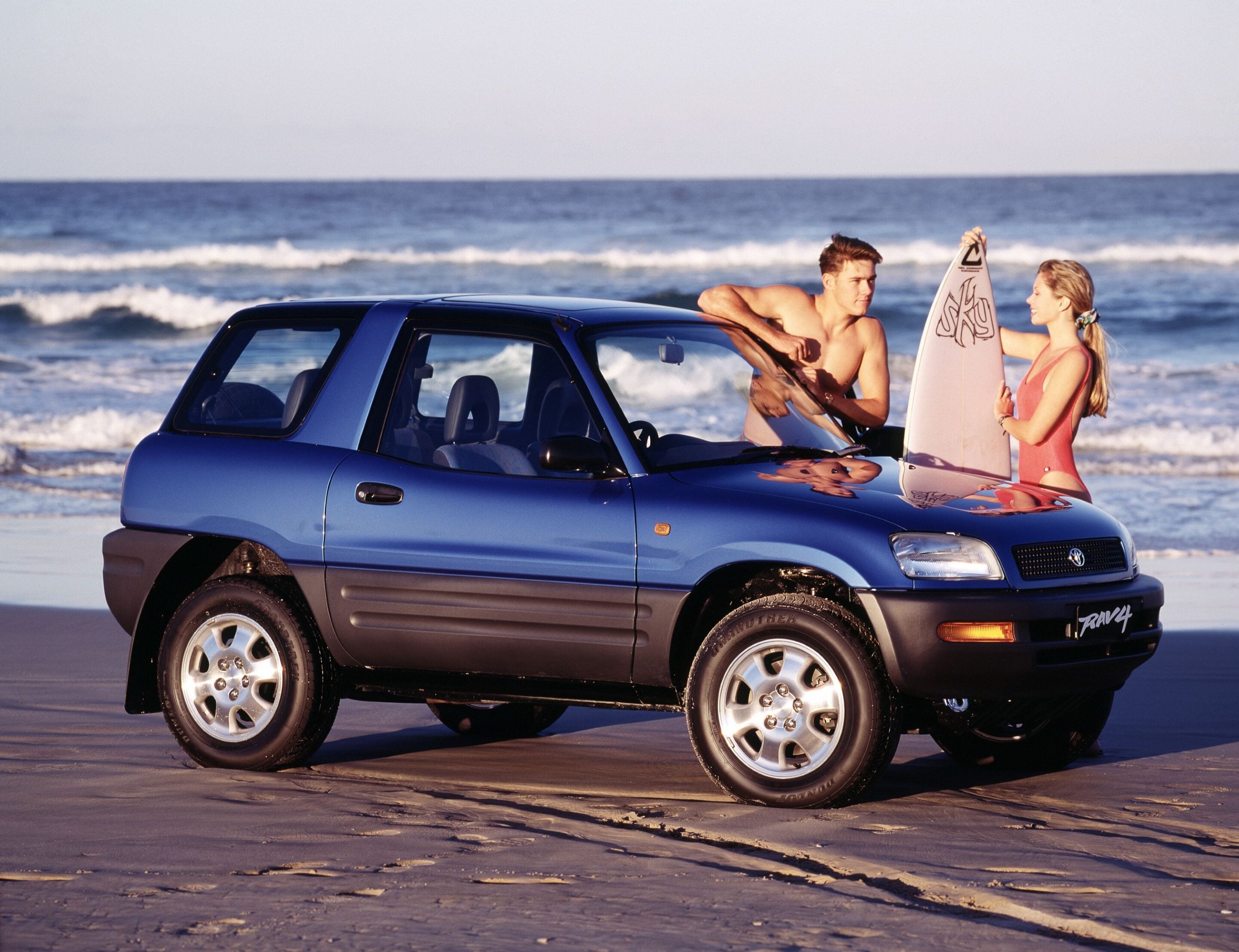
Then, Toyota opted to launch its new crossover on the Gold Coast, something we noted would become “the RAV4’s heartland”.
2
“Its Friday night crowds represent a microcosm of Australian youth culture, where Toyota expects to find the RAV4’s main market.”
And we were effusive in our praise, the RAV4 laying down markers in what was then still very much a nascent segment of compact, affordable crossover SUVs.
“Other compact 4WDs like Suzuki’s Vitara and Daihatsu’s Feroza might surpass the RAV4 in hard 4WD terrain, but in virtually every other department the mini Toyota has redefined the parameters by which this class of vehicle will be judged.”
Certainly a bold prediction at the time, but as the intervening decades have proved, the RAV4 has gone on to become not only a mainstay in driveways all over Australia, but the single biggest selling SUV in Australia of all time. Earlier this year, Toyota confirmed it had sold around 588,000 of its game-changing SUV since that first night on Cavill Avenue.
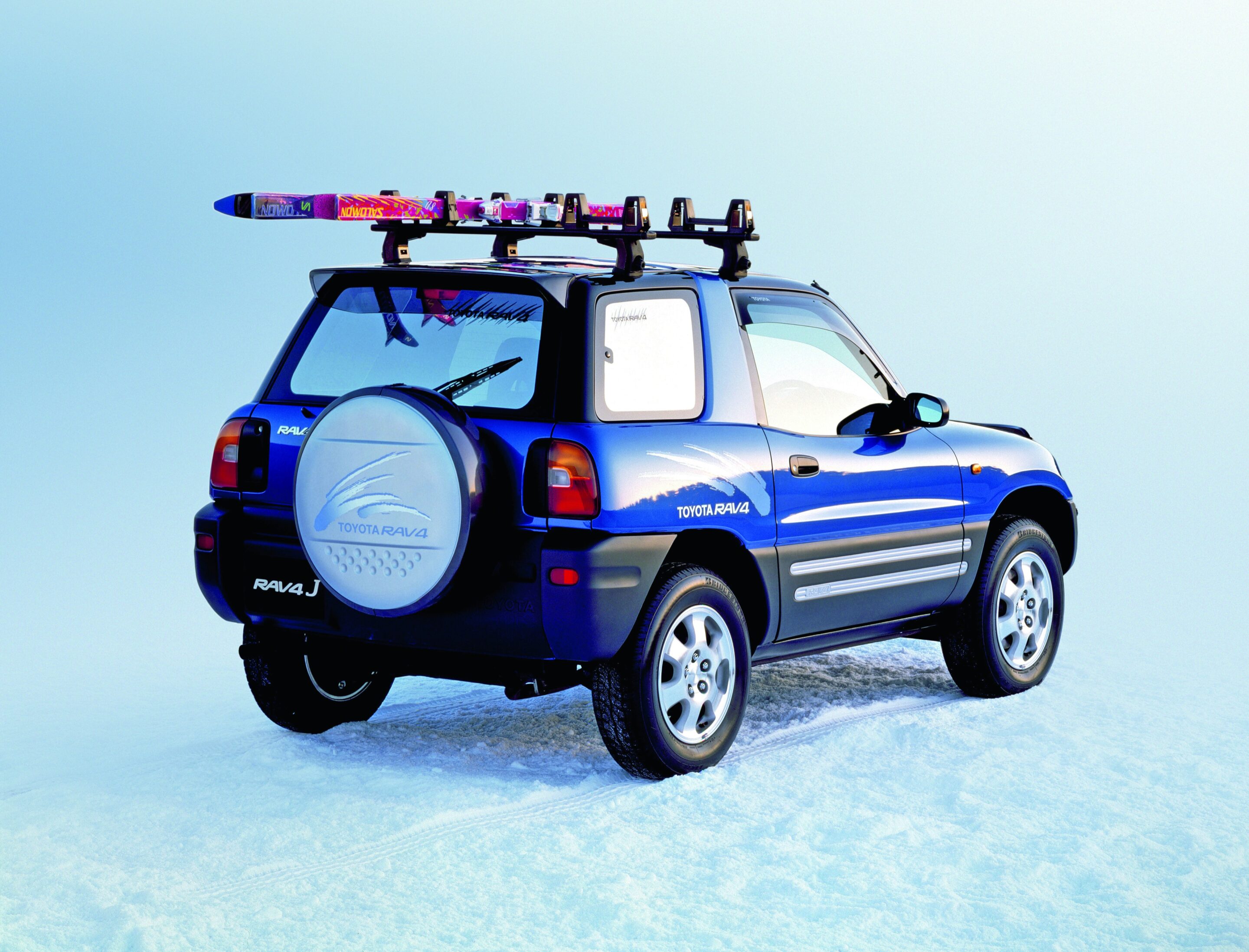
Those early “crowds of young revellers”, wrote Wheels in 1994, who had stopped to “ogle the cobalt blue RAV4” with “admiring eyes” caressing “its curvaceous lines”, would not recognise today’s RAV4. After all, that original crossover played into the then-zeitgeist of fun and funky two-door soft-roaders, more at home in Surfers Paradise, Chapel Street and Campbell Parade than exploring outback Australia.
2
Today’s trends are in stark contrast, demanding a family-sized SUV capable of ferrying five people and their belongings in comfort and with the kind of fuel efficiency 1994 buyers couldn’t even begin to imagine. It’s a modern automotive template pioneered by Toyota, a blueprint almost every automaker in the world has attempted to replicate.
It’s interesting to note just how much has changed over the decades, how a compact crossover Wheels once consigned to little more than a niche category, where ‘cool’ over-rode all other considerations, became the sales juggernaut beloved of families all over Australia – and the rest of the world – today.
Pricing
1
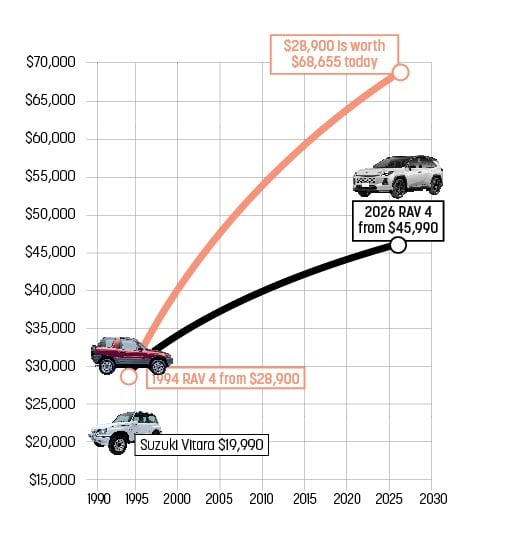
The OG RAV4 wasn’t exactly cheap when it hit Aussie showrooms in the middle of 1994. Perhaps dipping its toes in the water, Toyota brought only a single grade to Australia, available with either a five-speed manual gearbox or four-speed automatic transmission.
Pricing started at $28,900 (plus on-road costs) for the manual RAV4, with the automatic costing $2000 more. For context, a manual three-door Suzuki Vitara cost $19,990, closely matched by the entry-level Daihatsu Feroza ST which, in manual trim, asked for $20,852.
Fast forward three decades and with manual transmissions consigned to the RAV4 graveyard, the entry point has jumped to $45,990 for the GX front-wheel drive variant. Want all-wheel drive? That’ll drain your bank account to the tune of $49,340 for the base model GX AWD.
That’s not as steep a jump as one might expect after 32 years, with the Reserve Bank of Australia calculating that $28,900 in 1994 money is worth around $68,655 today.
Size
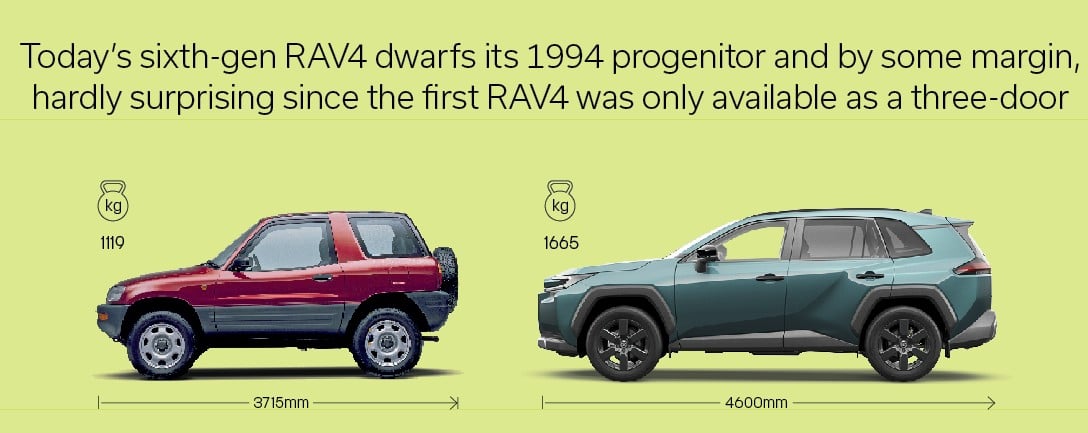
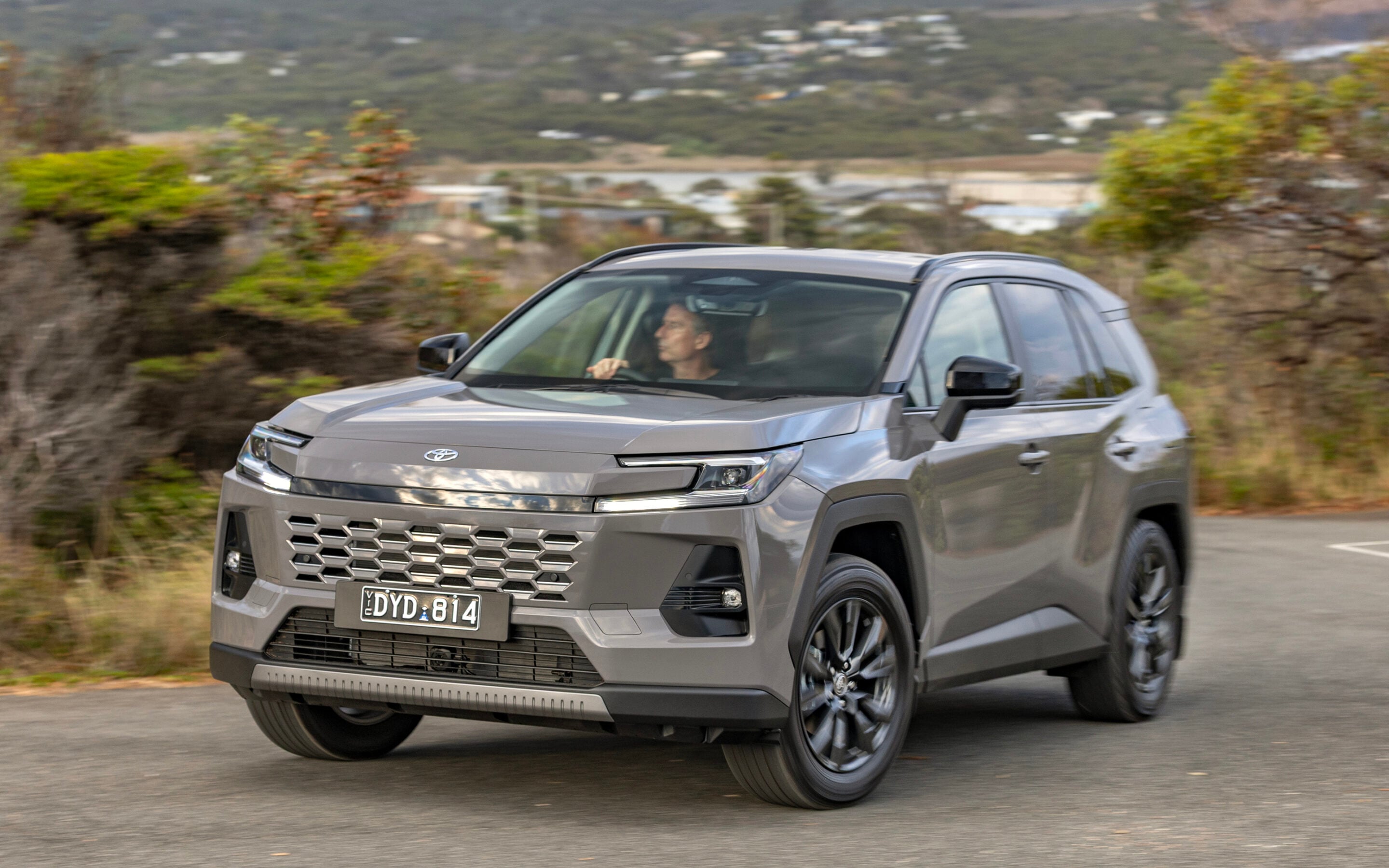
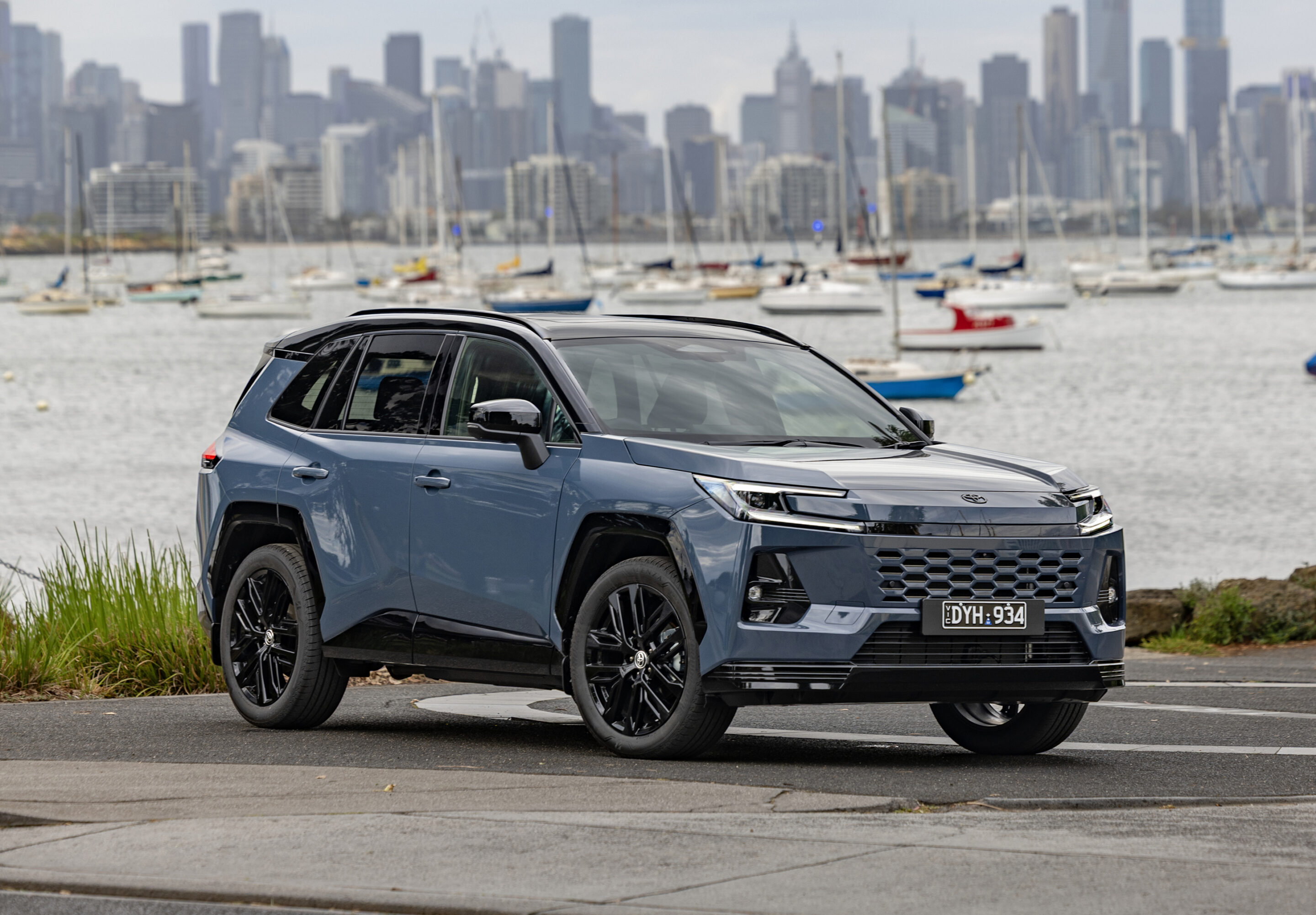
Today’s sixth-gen RAV4 dwarfs its 1994 progenitor and by some margin, hardly surprising since the first RAV4 was only available as a three-door (the five-door would arrive in 1995, kick-starting the medium SUV revolution that shows no sign of slowing down).
Stopping the tape at 3715mm long, 1994’s RAV4 is lost in the shadows of its 2026 counterpart which measures some 885mm longer, 160mm wider, 25mm taller and sitting on a 490mm longer wheelbase. It’s also – unsurprisingly – 546kg lighter than the current generation model.
1
“For its compact exterior dimensions the RAV4 has good levels of interior space and comfort,” we wrote in 1994. “Once in the back seat, there’s realistic accommodation for two people, with enough room between seat back and cargo door to cram a couple of overnight bags.”
That’s right, the 1994 three-door RAV4 was strictly a four-seater, and with minimal space for luggage,
a long way from the comfortable family wagon it has metamorphosed into today.
Equipment
Hailing from the strictly analogue age, the 1994 RAV4 was bereft of the standard kit featured today in even the most basic new cars on our roads.
A four-speaker AM/FM radio-cassette audio system provided the ‘infotainment’ while creature comforts ran to tinted glass, intermittent wipers front and rear, cupholders (still a novelty back then), a digital clock and remote opening for the fuel-filler cap.
The steadfastly analogue instrument cluster featured a speedometer, tacho, along with fuel and temperature gauges.
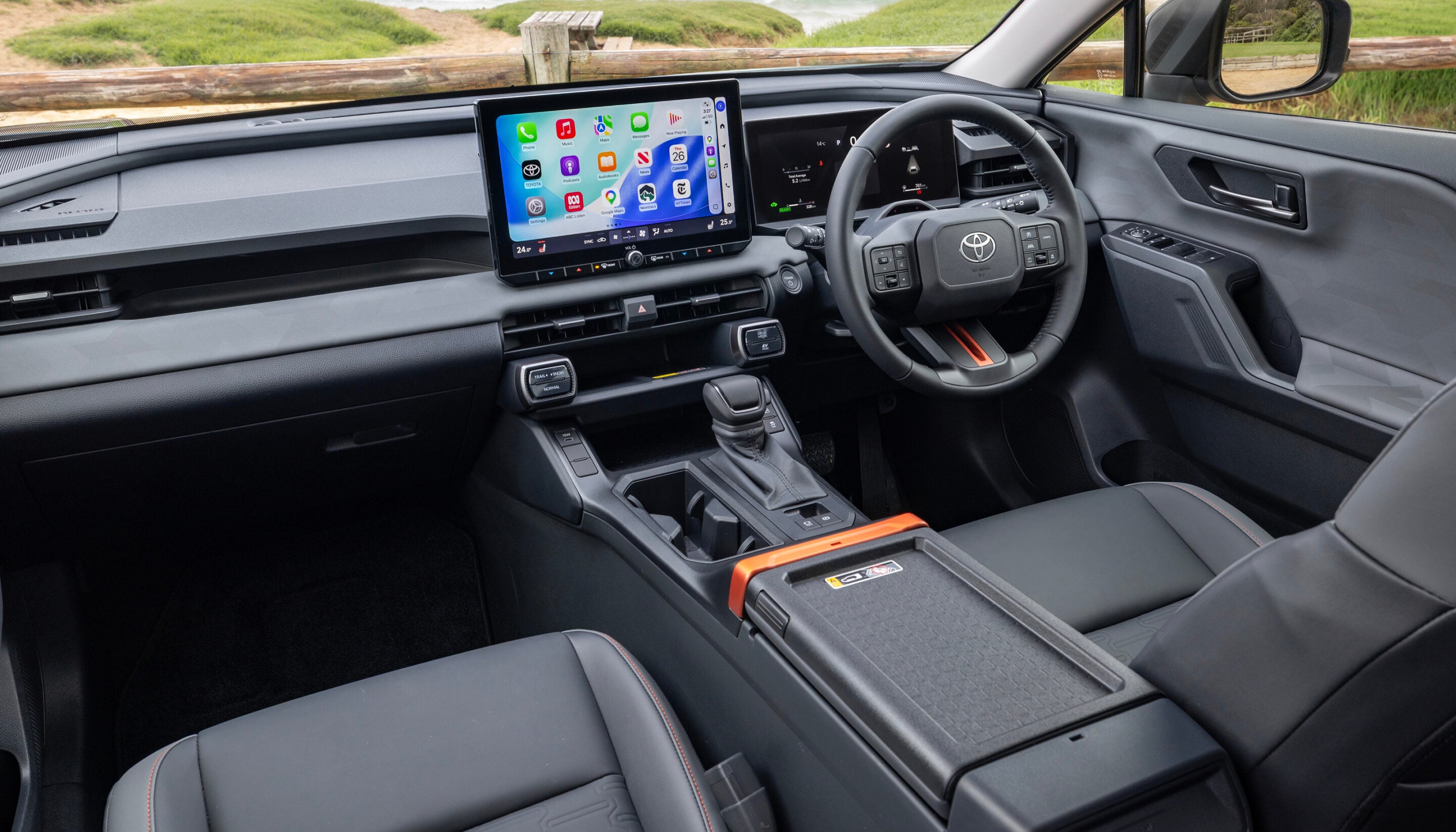
Today, of course, new car cabins are more akin to entertainment hubs than car interiors with big screens, phone integration, satellite navigation, and an endless choice of music streaming options played through, in the base model, a six-speaker stereo system.
4
One of the big selling points of the first RAV4 was its class-leading safety equipment. As Wheels noted, “Safety will be one of the RAV4’s major sales platforms: from its strong, lightweight, monocoque chassis, designed to incorporate collision impact absorbing structures (CIAS), to its four-wheel independent suspension and full-time 4WD system, through features like door side-intrusion beams, a collapsible steering column, child restraint anchorages, and a fuel tank forward of the rear wheels.
“The real heavy hitters in the safety package are the 45 litre driver’s airbag and antilock brakes, both options and both firsts for this class of vehicle.”
That seems positively quaint compared to the level of safety technologies bundled into today’s new cars, where airbag counts can run into double digits and where the car will offer all manner of warnings and interventions to keep you safely on the road, even if the efficacy of those various technologies can sometimes leave owners hankering for the ‘good old days’.
1
Powertrains
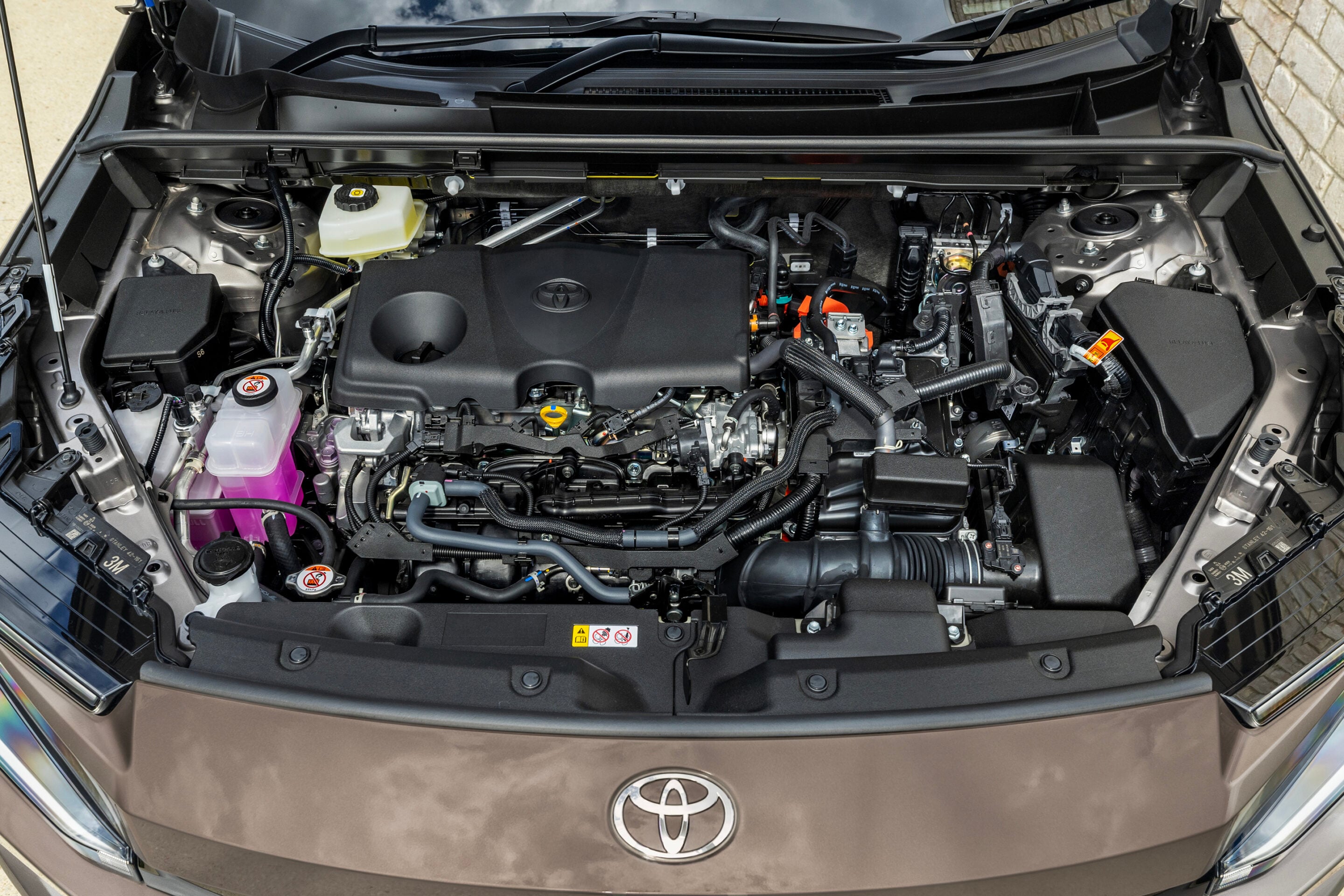
It’s here where Toyota stamped its authority on the compact SUV segment in 1994, with a transversely mounted 2.0-litre, fuel injected, twin cam tucked away under the RAV4’s short, stubby bonnet.
With outputs of 96kW and 180Nm transmitted to all four wheels, the RAV4 could, according to Wheels, “comfortably account for any 4WD competitors, but also give some sports coupes a run for their money”.
Fuel economy was a claimed 9.5L/100km of regular 91-octane unleaded. Contrast that to today where Toyota’s pioneering hybrid system underpins the entire RAV4 range. With a 2.5-litre petrol engine working in tandem with permanent magnet electric motors, Toyota claims today’s RAV4 makes a combined 143kW although stops short of offering a torque figure. Such a Toyota thing to do.
2
A continuously variable transmission sends drive to either the front wheels (in FWD models) or all four wheels, a departure from the torque converter automatic of old.
On paper, the new RAV4 offers less power than the fifth-generation model preceding it which was good for 160kW (front-wheel drive models) and 163kW for AWD. Toyota says the 2.5-litre’s detune is the result of needing to meet Australia’s ever more stringent emissions regulations.
The fettling has also improved fuel economy, now rated at 4.6L/100km against the previous model’s 4.8L.
Ambitions
While it might have seemed on the surface that Toyota was taking a risk investing in a compact SUV with seating for four and a price tag far in excess of its main rivals in the small but growing segment, someone at HQ had clearly been reading the tea leaves.
According to Toyota Australia at the time, the Japanese brand was confident “the RAV4 will be the largest single contributor to the growth in 4WD volume on the Australian market in the next 12 months”.
Wheels weighed in with “last year in Australia the compact segment accounted for only around 15 per cent of the overall 4WD wagon market, but Toyota believes this is set to grow steadily, with at least half of the estimated 4800 annual RAV4 sales expected to be incremental to the 4WD market.
2
“Despite a premium price tag that will see fully loaded versions retailing for somewhere around the $35,000 mark, the RAV4’s good all-round performance, its contemporary looks and Toyota’s marketing muscle should see it make major inroads on the Australian market this year.”
After a slow start (Toyota sold just 1350 of the little three-door in its first part-year on sale), it was the introduction – and popularity – of the five-door RAV4 in 1995 that emphatically announced its arrival on our roads. Australia’s SUV revolution was underway.
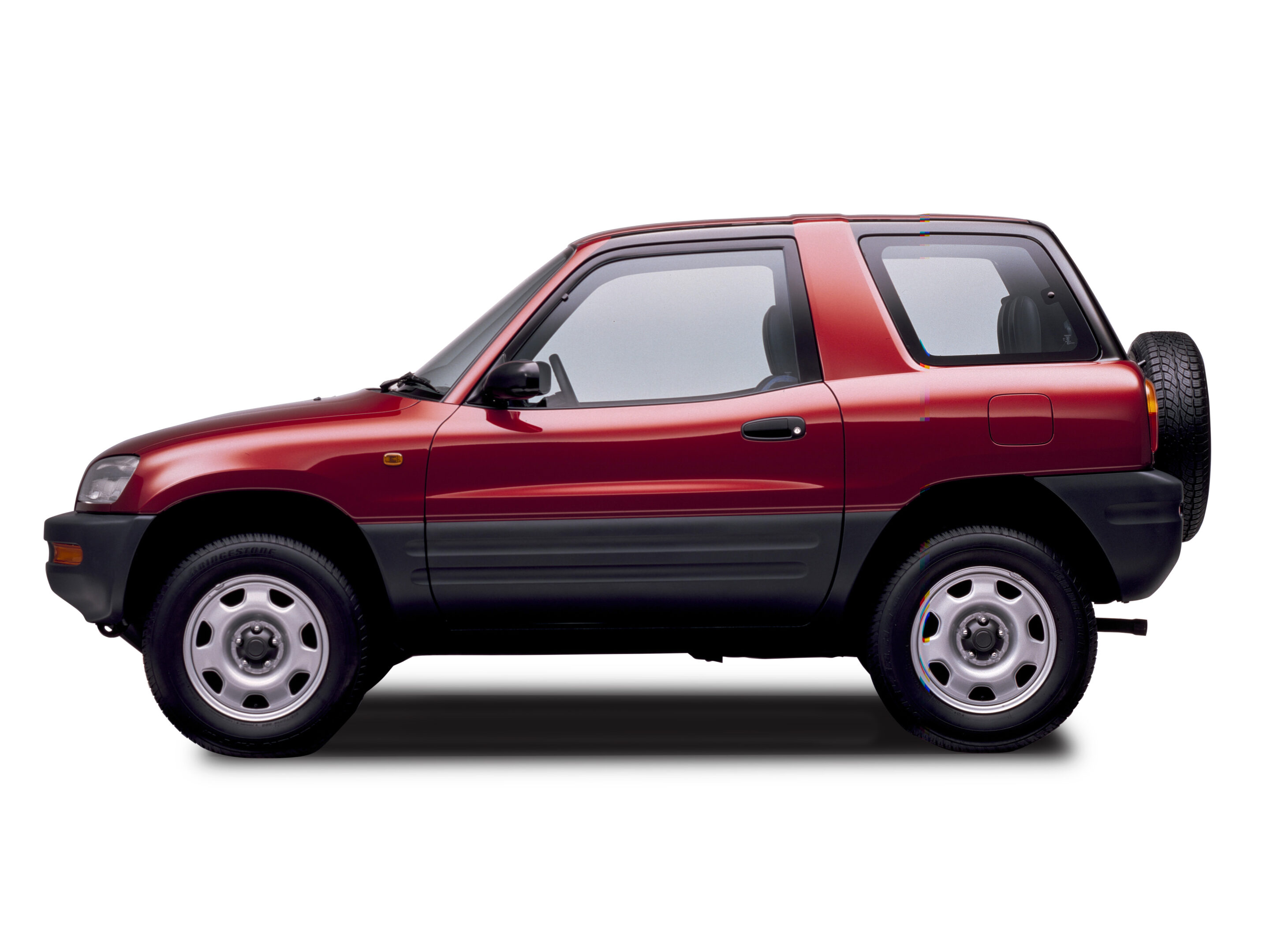
1994 RAV4 manual
1
| Price | $28,900 (manual) / $30,900 (automatic) |
|---|---|
| Engine | 2.0-litre inline-four cylinder petrol |
| Power | 96kW @ 5800rpm |
| Torque | 180Nm @ 4400rpm |
| Transmission | 5-speed manual / 4-speed automatic |
| Power-to-weight | 85.8 kW/t |
| Fuel consumption | 9.5L/100km |
| Dimensions (l/w/h/wb) | 3715/1695/1655/2200mm |
| Tare mass | 1119kg |
| Warranty | 3 years/100,000km |
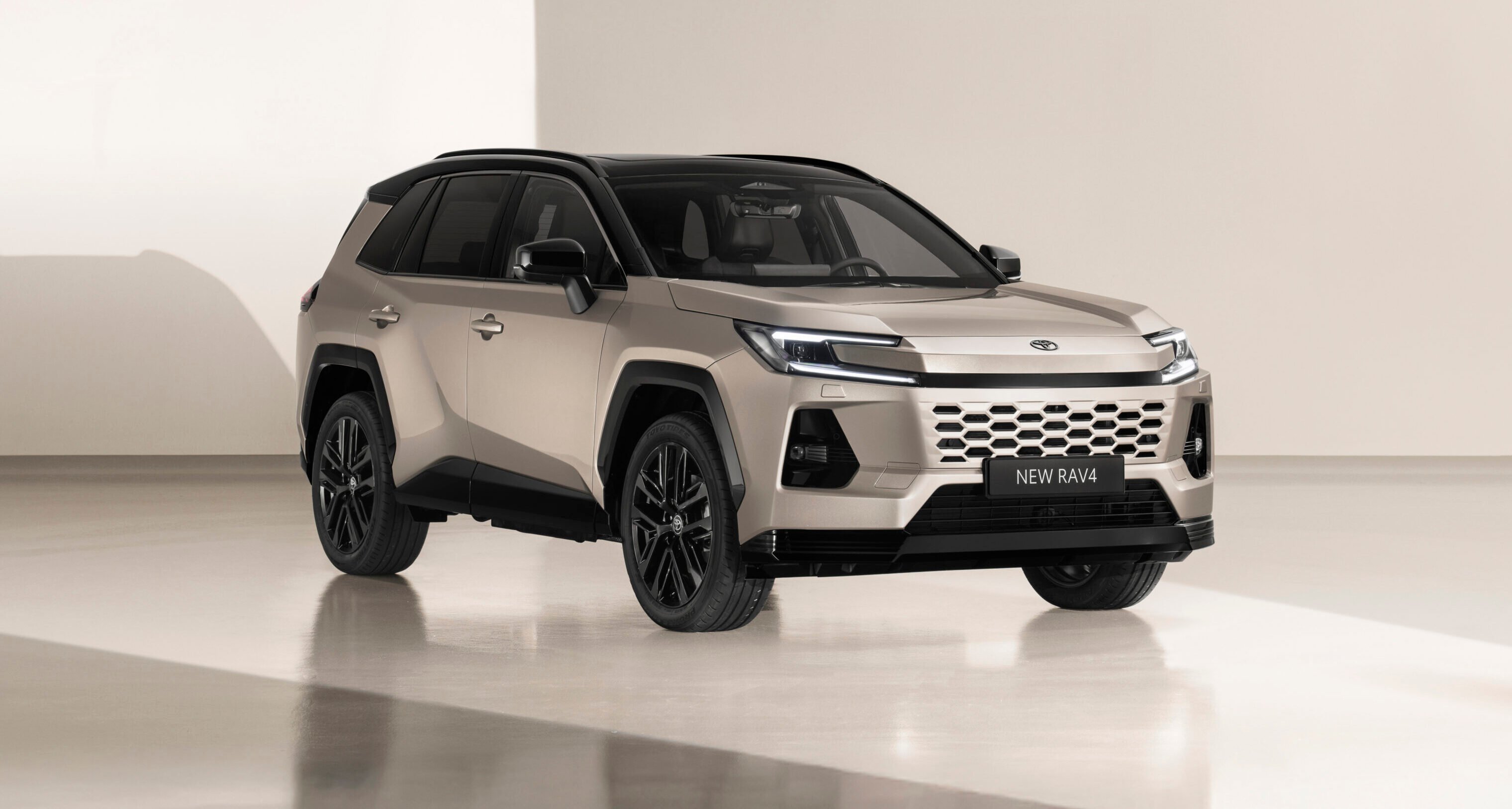
2026 RAV4 GX
1
| Price | $45,990 (FWD) / $49,340 (AWD) |
|---|---|
| Engine | 2.5-litre inline-four cylinder petrol-hybrid |
| Power | 143kW (combined) |
| Torque | NA |
| Transmission | Continuously variable |
| Power-to-weight | 85.9 kW/t |
| Fuel consumption | 4.6L/100km |
| Dimensions (l/w/h/wb) | 4600/1855/1680/2690mm |
| Tare mass | 1665kg |
| Warranty | 5 years/unlimited km |
This story first appeared in the May 2026 issue of Wheels magazine, now on sale. Subscribe here and gain access to 12 issues for $109 plus online access to every Wheels issue since 1953.
Follow WhichCar/Wheels on Google
Click the button below to make WhichCar by Wheels a preferred source for your news.

We recommend
-
 Reviews
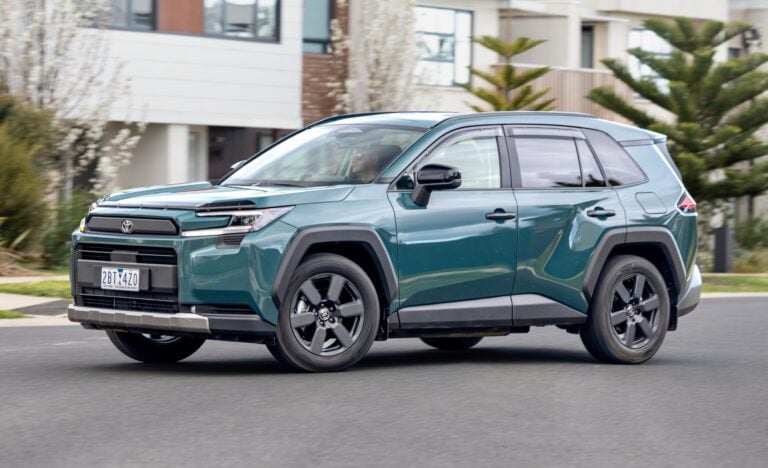
2026 Toyota RAV4: The Wheels’ verdict on the sales giant’s new model
Toyota’s sixth-generation RAV4 brings hybrid power across the range, a first-ever PHEV option and a major technology overhaul as the medium SUV icon fights back to the segment’s sharp end.
-
 Best Small SUVs
Best Small SUVs 2026: Hybrid
Hybrid small SUVs are drawing more attention from Australian new car buyers through a combination of improved efficiency, lower running costs and greater flexibility for everyday driving.
-
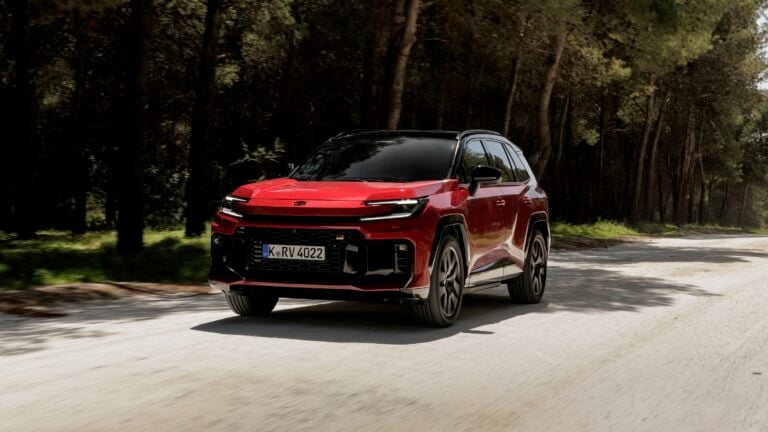 Features
Best hybrid models still to come in 2026
Looking for a new hybrid vehicle? There are plenty to choose from, but it might be worth waiting as these 10 new models are set to launch with a bang in what remains of 2026.