
GWM has revealed a plug-in hybrid version of its Cannon ute, broadening its electrified commercial vehicle range ahead of an Australian launch later this year.
The Cannon Hi4-T PHEV joins the larger Cannon Alpha Hi4-T as the second plug-in hybrid ute in GWM’s local line-up, making the Chinese brand the only manufacturer currently offering two PHEV utes in Australia.
While local pricing and final specifications are yet to be confirmed, GWM says the new model has been developed to bridge the gap between traditional diesel-powered work utes and fully electric vehicles by combining battery-electric driving with conventional four-wheel-drive capability.
Power comes from a 2.0-litre turbocharged petrol engine paired with an electric motor, producing a combined 310kW and 750Nm. The plug-in hybrid system is matched to GWM’s Hi4-T drivetrain, which retains a conventional transmission and mechanical four-wheel-drive system rather than relying solely on electric motors to drive one axle.
GWM claims combined fuel consumption of 2.4L/100km (NEDC).
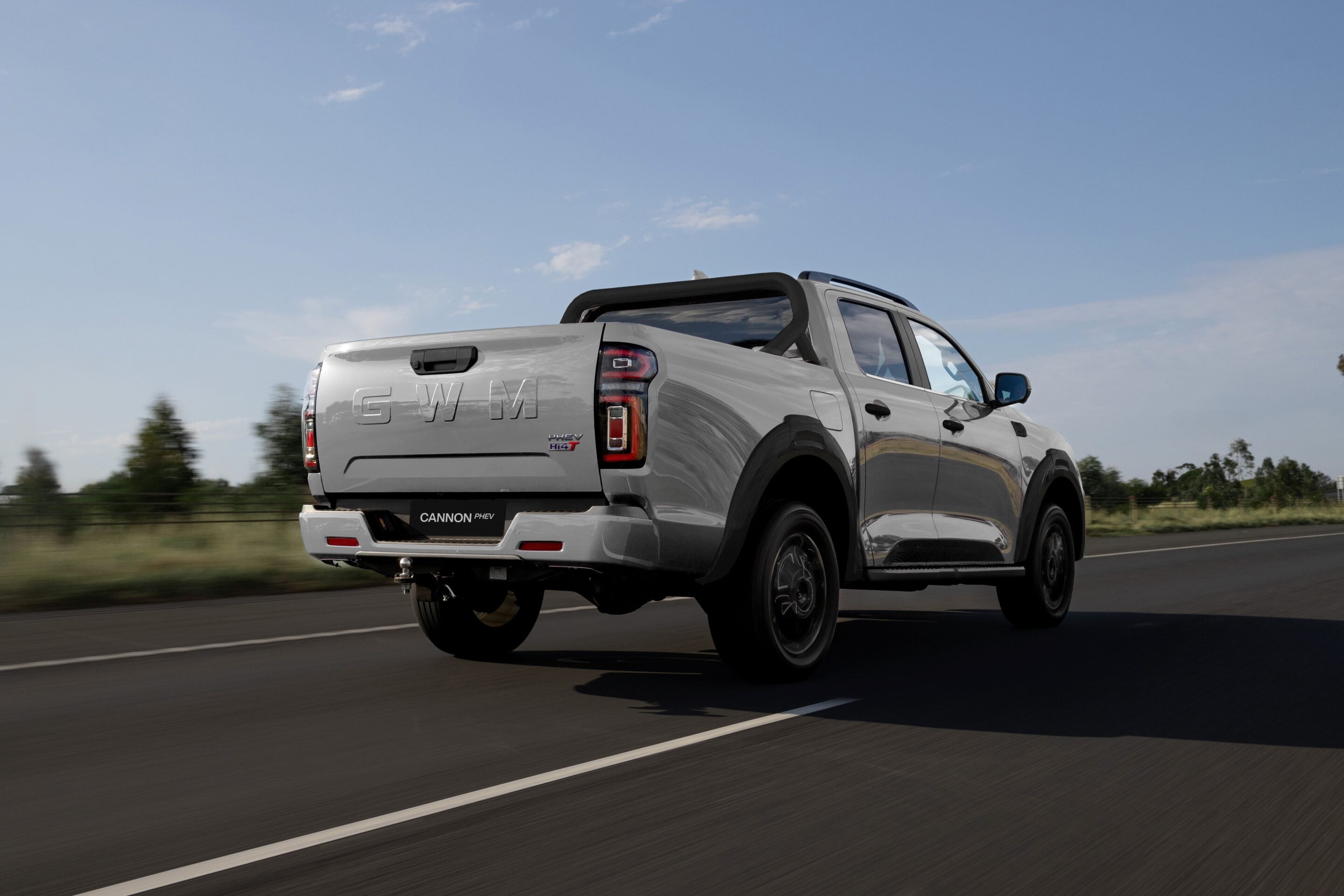
A 33.1kWh battery provides a claimed 115km of electric-only driving range (NEDC), allowing many owners to complete daily commuting without using the petrol engine. When both power sources are combined, the company claims a total driving range of 1037km (NEDC).
Unlike many electrified passenger vehicles, the Cannon Hi4-T has been engineered to retain its towing and off-road credentials. It offers a 3500kg braked towing capacity, while the traditional four-wheel-drive system is intended to preserve off-road capability in challenging terrain.
The new model also features Vehicle-to-Load (V2L) capability, including 230-volt power outlets integrated into the ute tub. The system allows the vehicle’s battery to power equipment such as tools, camping appliances or household devices when parked.
The Cannon Hi4-T expands what has become one of Australia’s broadest ute ranges. GWM now offers two Cannon model families across multiple body styles and four different powertrains, spanning petrol, diesel, hybrid and plug-in hybrid options.
GWM has not announced Australian pricing but says the Cannon Hi4-T will be positioned among the country’s more affordable plug-in hybrid utes when it arrives. Full specifications, pricing and local timing are expected closer to launch.
The humble Nissan Qashqai may not seem like the most remarkable SUV on the market, but it has proved looks can be deceiving by setting a Guinness World Record.
Nissan’s campaign to prove the effectiveness of its e-Power hybrid system has paid off as the Qashqai set the mark for ‘the longest journey completed by a non-plug-in extended-range electric vehicle SUV without external charging or refuelling’ by clocking up 1980km.
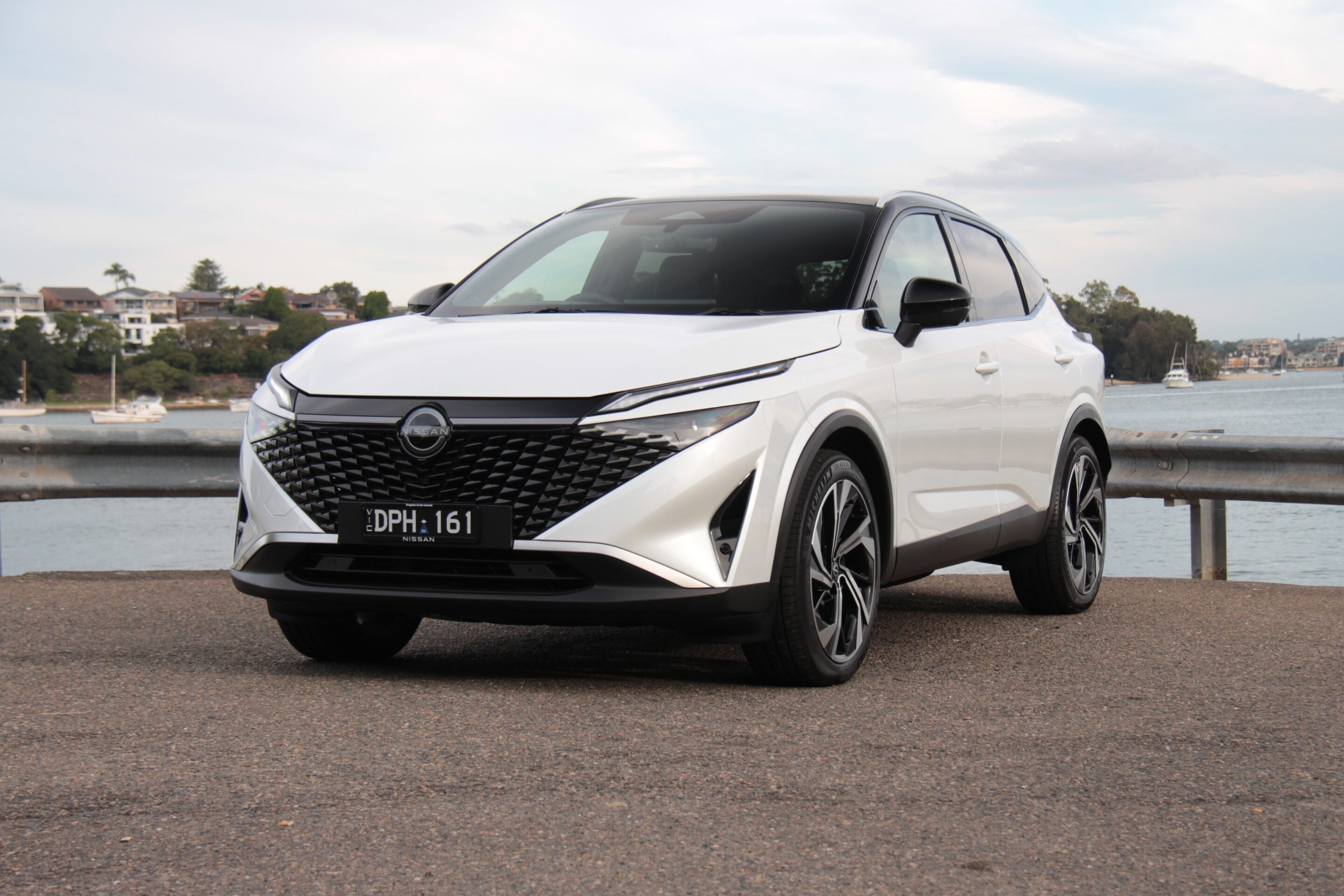
The SUV travelled from the Colombian capital of Bogotá to the country’s Caribbean coast, with the journey largely a downhill run that started around 2600 metres above sea level.
Nissan hasn’t released details of the route taken, nor the fuel consumption recorded, but with a 55-litre fuel tank, it should sit somewhere around 2.78L/100km. Official consumption is rated at 4.1L/100km in mixed driving, giving the Qashqai a range of 1341km from a single tank.
The Guinness World Record for the longest distance by a plug-in hybrid SUV is held by the Chinese Hongqi HS6 PHEV, covering 2327.34km across China. The longest distance covered by a non-hybrid vehicle is 2831km, set in a Skoda Superb diesel that made it from Poland to Paris and back.
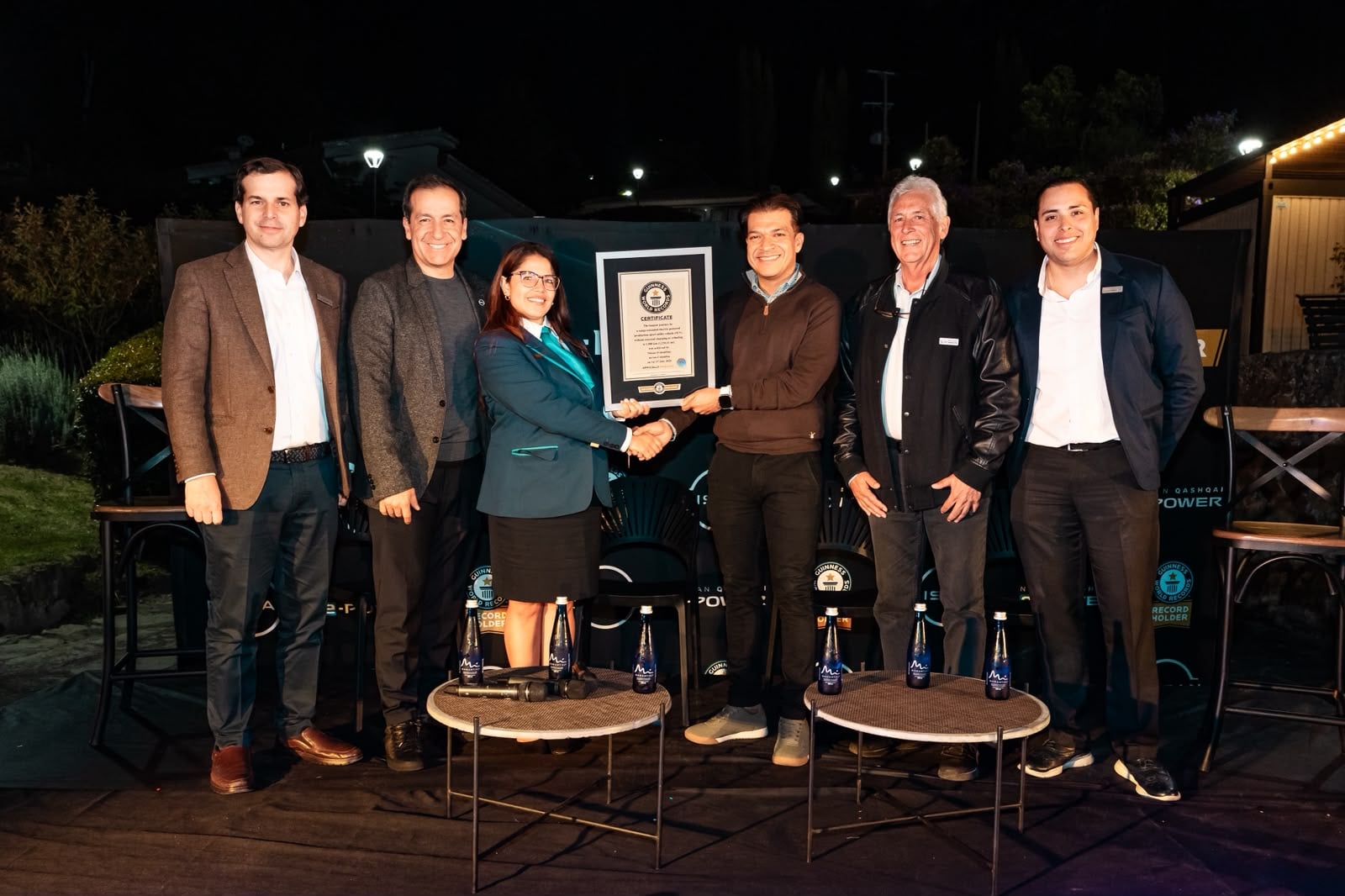
Nissan’s record attempt took place from July 14 to July 17 with Guinness verifying and publishing the mark on July 29.
“By proving that an electric-driven SUV can cover nearly 2000 kilometres without relying on external EV charging grids or mid-trip refuelling, the attempt directly addresses range anxiety for consumers in South America,” Guinness said in a promotional release.
Unlike parallel hybrids, which can use electric, petrol or combined power to drive their wheels, Nissan’s e-Power system operates as a series hybrid with the petrol engine used to charge a small on-board battery, which in turn powers the wheels via an electric motor, with no plug or external charging capability.
GWM has opted to go big on battery range as it attempts to stamp its authority on the plus-sized luxury SUV market with the new Haval H10.
As Chinese brands flood the segment with high-margin models, GWM has launched a multifaceted attack featuring strong levels of equipment and sharp pricing.
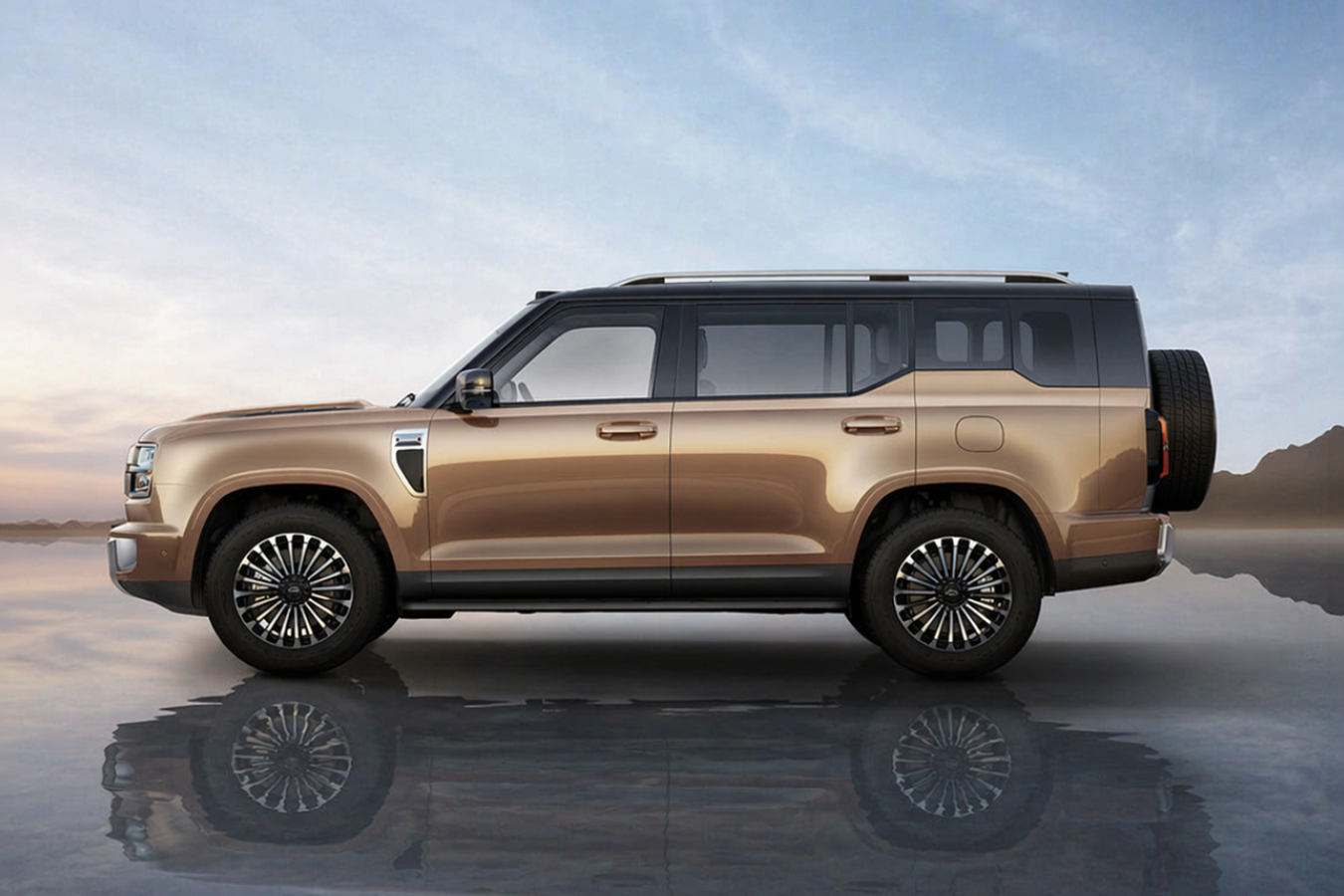
The Haval H10 adopts styling from GWM’s off-road Tank models, but unlike the body-on-frame Tank range, the new offering only looks tough, using a more on-road-friendly monocoque platform.
The GWM One platform that underpins the Haval H10 is multi-powertrain-compatible, allowing for internal combustion, hybrid, plug-in hybrid or fully electric propulsion. Initially, at least, the H10 will come with a PHEV powertrain.
CarNewsChina reports the H10 will launch with a 440kW/770Nm combined output drive system, comprising a 100kW front electric motor, 220kW rear electric motor and 132kW 1.5-litre four-cylinder petrol engine with a four-speed dedicated hybrid transmission. Acceleration from 0-100 km/h takes a claimed 4.9 seconds.
The 42.8kWh battery enables an electric-only range of up to 323km under CLTC testing (around 260km under WLTP conditions). Recharging at up to 120kW on a compatible DC charger is available, with GWM claiming a 126km top-up is possible in 15 minutes.
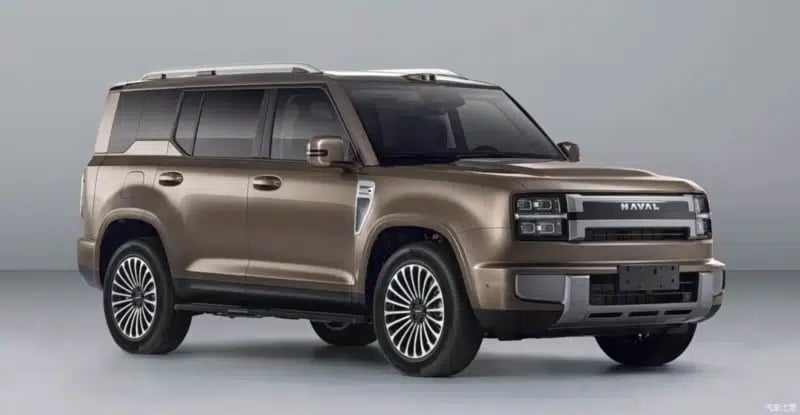
Fuel consumption is rated at 0.87L/100km in mixed driving conditions, or 6.6L/100km with a depleted battery.
Despite being based on a monocoque chassis, the Haval H10 includes a number of off-road-aligned features, including an electronically actuated mechanical rear differential lock, crawl control, a tailgate-mounted spare wheel, and 220mm of ground clearance.
Two versions of the H10 will be offered in China: a five-seat model with a 5138mm overall length and a seven-seat version with a longer rear compartment that stops the tape at 5299mm. Both versions keep the same 3000mm wheelbase.
Interior appointments include fully-reclining front seats, individual second-row captain’s chairs with leg rests, heated, ventilated and massaging seats, a dual-pane panoramic sunroof, a food cooler and warmer with a -6ºC to 50ºC range, and more.
The front infotainment screen measures 15.6 inches with a 17.3-inch roof-mounted rear infotainment screen. An in-house AI assistant, called Coffee AI (based on GWM’s Coffee OS), is available, and a 21-speaker premium audio can be optioned.
Driver-assist technology for the H10’s domestic market includes lidar-assisted autonomous driving capability, start-to-finish navigate-on-autopilot functionality, intelligent parking assist and intelligent torque vectoring.
In order to gain traction in its home market, the Haval H10 will launch with a starting price of 209,800 yuan (A$44,050). Its closest rival, the BYD Ti7 (sold as the Fangchenbao Titanium 7 in China), starts slightly lower at 206,880 yuan (A$43,425) but with a shorter 190km EV range.
Australian plans for the new model are yet to be locked in, with GWM’s ‘urban’ Haval division not currently offering a three-row SUV as the more rugged Tank 500 covers that segment down under.
The 2027 Mercedes-AMG GT53 4-door Coupé has been revealed, showcasing how Mercedes-Benz intend to handle the entry-level end of its flagship EV range.
Following on from the more powerful 600kW GT55 and 860kW GT63 flagship, the new entry point to the range comes with dual motors and offers peak power of 400kW. AMG claims the GT53 can sprint from 0-100km/h in 3.5 seconds with a one-foot rollout (3.9-sec standing start), 1.4 seconds slower than the GT63.
The AMG GT53 also sits lower on the performance pecking order than the cheaper CLA45 four-door coupé, with a 500kW claimed output and a 2.7-sec 0-100km/h time with a one-foot rollout (3.0-sec standing).
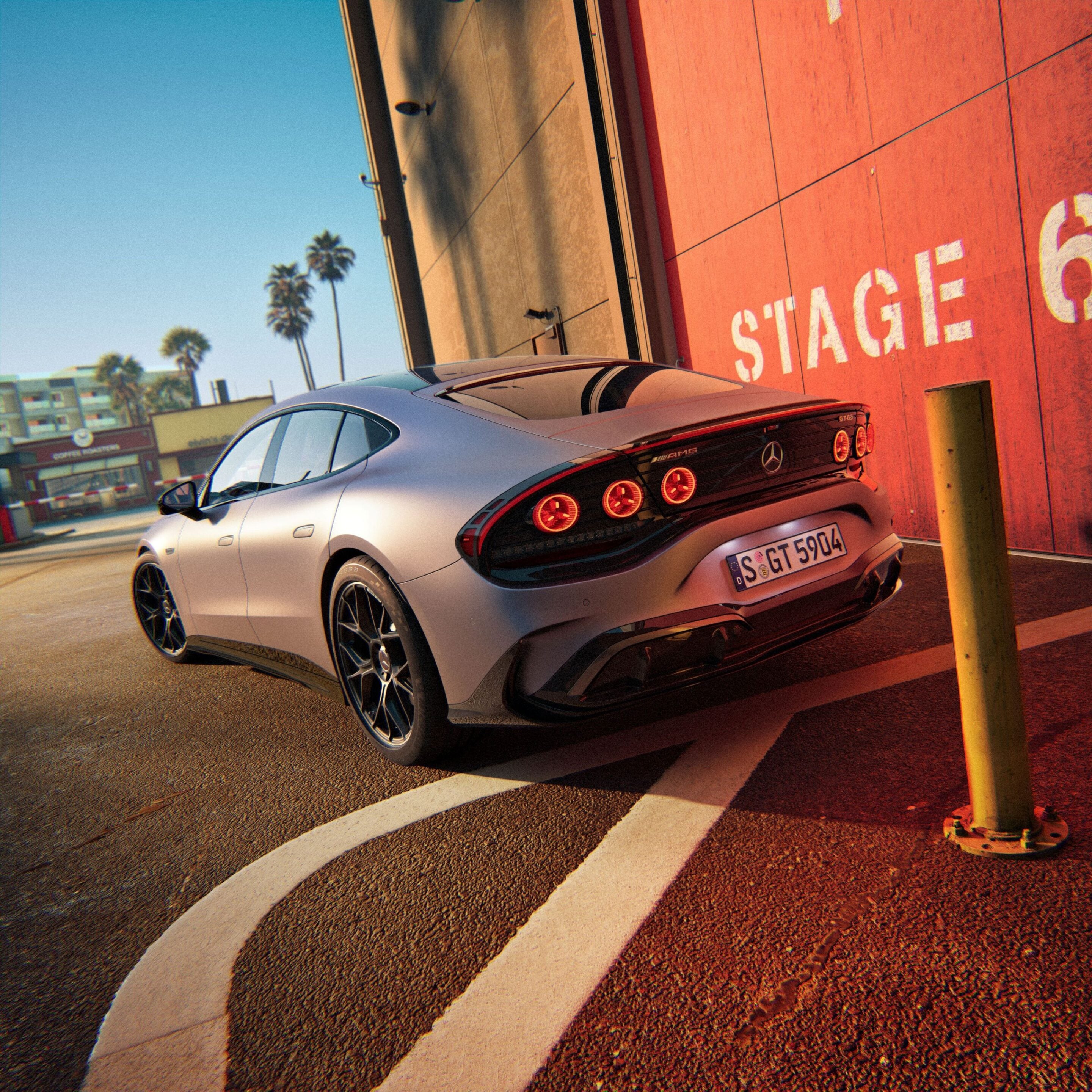
The drive system comprises a two-speed transmission for the rear axle motor, and single-speed drive on the front, moving away from the three-motor setup of the more powerful GT55 and GT63. The front motor works as a ‘boost’ motor when extreme acceleration is required, and is engaged via a disconnect unit when needed.
Continuous power is rated at a tamer 270kW, with an 800Nm peak torque figure claimed.
An 800-volt battery architecture is retained, with a peak charging rate of 600kW on a compatible charger, enabling a 10-80 per cent recharge in 11 minutes. A 10-minute top-up is enough to add 534km of range, but despite the impressive DC charging speeds, the GT53 4-door is only 11kW AC compatible.
Mercedes-Benz quotes a WLTP driving range of between 682km and 809km, depending on specifications, and an urban-only range of between 761km and 880km. Battery capacity is 106kWh, the same as that of more powerful versions of the AMG GT 4-door.
For drivers unwilling to let go of the emotional connection of AMG’s combustion-engined cars, the GT53 will offer a petrol engine soundtrack, based on the engine noise of the previous E53 Coupé. Switching to the AMGFORCE Sport+ drive mode activates this, along with simulated gear changes and a manual mode.
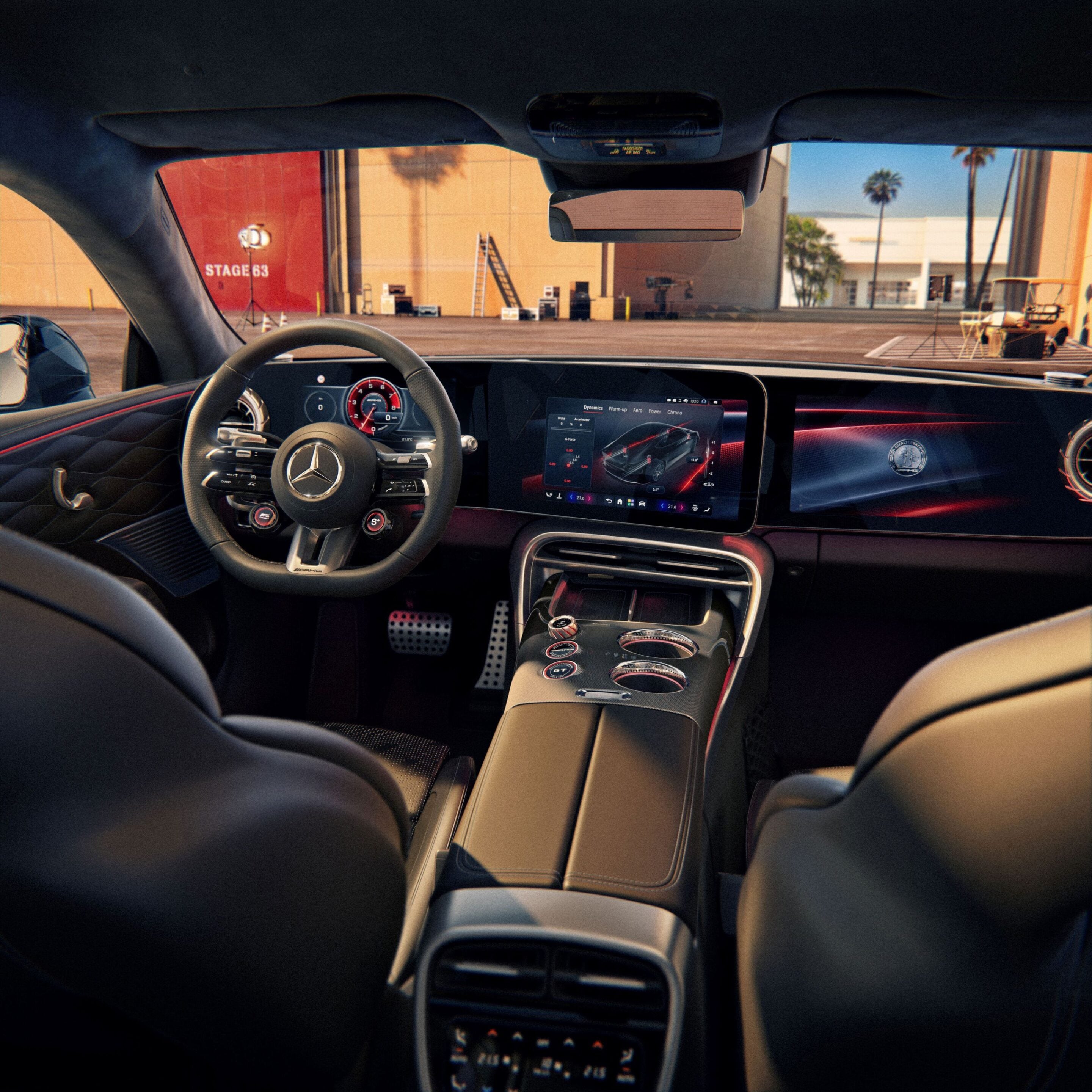
The AMG GT53 D-door will also be equipped with AMG Ride Control adaptive air suspension, ‘AeroKinetics’ adaptive aerodynamics, with a deployable rear wing and extending rear diffuser, and a six-mode drive control to toggle between Comfort, Sport, AMGFORCE Sport+, Slippery, Eco, and Individual modes.
The interior features separate instrument and driver-angled infotainment displays housed under a single frame, with a separate passenger display available. Sports front seats and individual rear seats, plus an AMG sports steering wheel with ‘Responsive Control’ drive mode adjustment and shift paddles are also included.
Australian pricing and availability are yet to be announced, but European sales start this month, with a starting price of €115,430 (A$189,170), expected to translate to a higher price locally once import costs and Luxury Car Tax are added. The previous generation GT 4-door Coupé, available in flagship GT63 S E Performance PHEV guise in Australia, was priced from $409,600.
Australian motorists are reportedly paying strangers to accept responsibility for traffic offences in an illegal attempt to avoid losing their licences, with the practice becoming increasingly visible online.
A report by Yahoo News Australia said social media platforms and online marketplaces are being used to advertise services in which people offer to accept demerit points in exchange for cash, allowing drivers facing licence suspension to falsely nominate someone else as the person behind the wheel.
The Canberra Times also reported drivers in the ACT are paying as much as $500 per demerit point, with some handing over more than $1000 to retain their driving privileges.

One provisional licence holder told the newspaper he paid $1200 for another person to accept responsibility for a mobile phone offence after he had already accumulated enough demerit points to be facing a mandatory three-month suspension.
The alleged transactions exploit the process that allows registered vehicle owners to nominate another driver for camera-detected offences through government infringement portals.
Figures provided to the newspaper show Access Canberra received 23,792 statutory declarations in the first six months of 2026 from registered owners claiming they were not driving at the time of an offence. That follows 42,308 declarations in 2025 and 40,677 in 2024.
An ACT Government spokesperson said suspicious declarations are referred to the Australian Federal Police for investigation where appropriate.
Reports about online advertisements for paid demerit point transfers were widely reported in 2023, with Yahoo reporting similar listings continue to appear on Facebook Marketplace, Messenger and community groups.
Among the advertisements identified by Yahoo were listings offering “demerit points” for sale, while another encouraged drivers to contact the seller if they wanted to avoid accumulating penalty points. Some posts included price lists for various traffic offences.
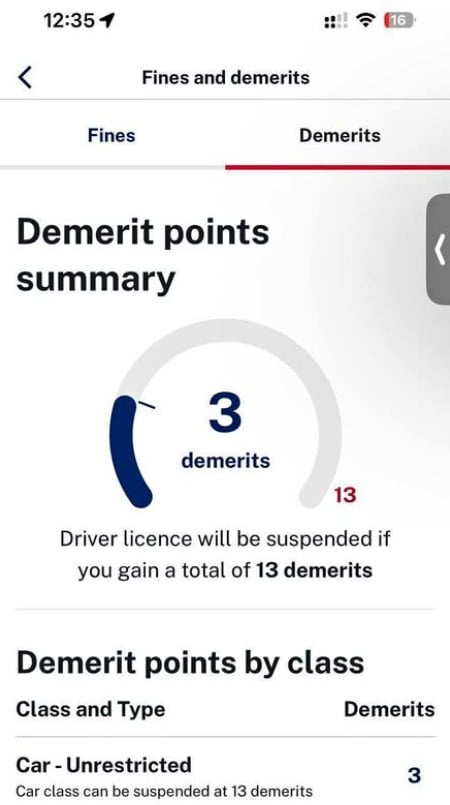
Authorities have warned motorists against participating in false nomination schemes.
In the ACT, making a false statutory declaration can attract fines of up to $55,000 for individuals. In New South Wales, falsely nominating another driver can also result in substantial financial penalties and additional licence sanctions.
Road safety authorities say the demerit point system is designed to identify repeat offenders, with licence suspensions intended to remove high-risk drivers from the road rather than provide a financial incentive for illegal point-swapping schemes.
Porsche has unveiled a unique Australian-themed 911 Turbo S to mark the company’s 75th anniversary in this country, showcasing the capabilities of its ultra-exclusive Sonderwunsch customisation division.
Known as the 911 Turbo S Land Down Under, the one-off commission was developed by Porsche Cars Australia, Porsche’s Sonderwunsch team, Style Porsche designers and Sydney-based contemporary artist Werner Bronkhorst. Rather than introducing any mechanical changes, the project concentrated on bespoke craftsmanship such as paint finishes, custom materials and Australian-inspired artwork throughout the vehicle.
The centrepiece is a hand-applied exterior finish developed specifically for the project. Two new Chromaflair colours transition from Terra Australis Red along the lower body to Southern Cross Blue across the upper surfaces, creating a colour gradient inspired by the changing tones of an Australian outback sunset. Depending on the light, the paint shifts between orange, blue, green and gold hues.
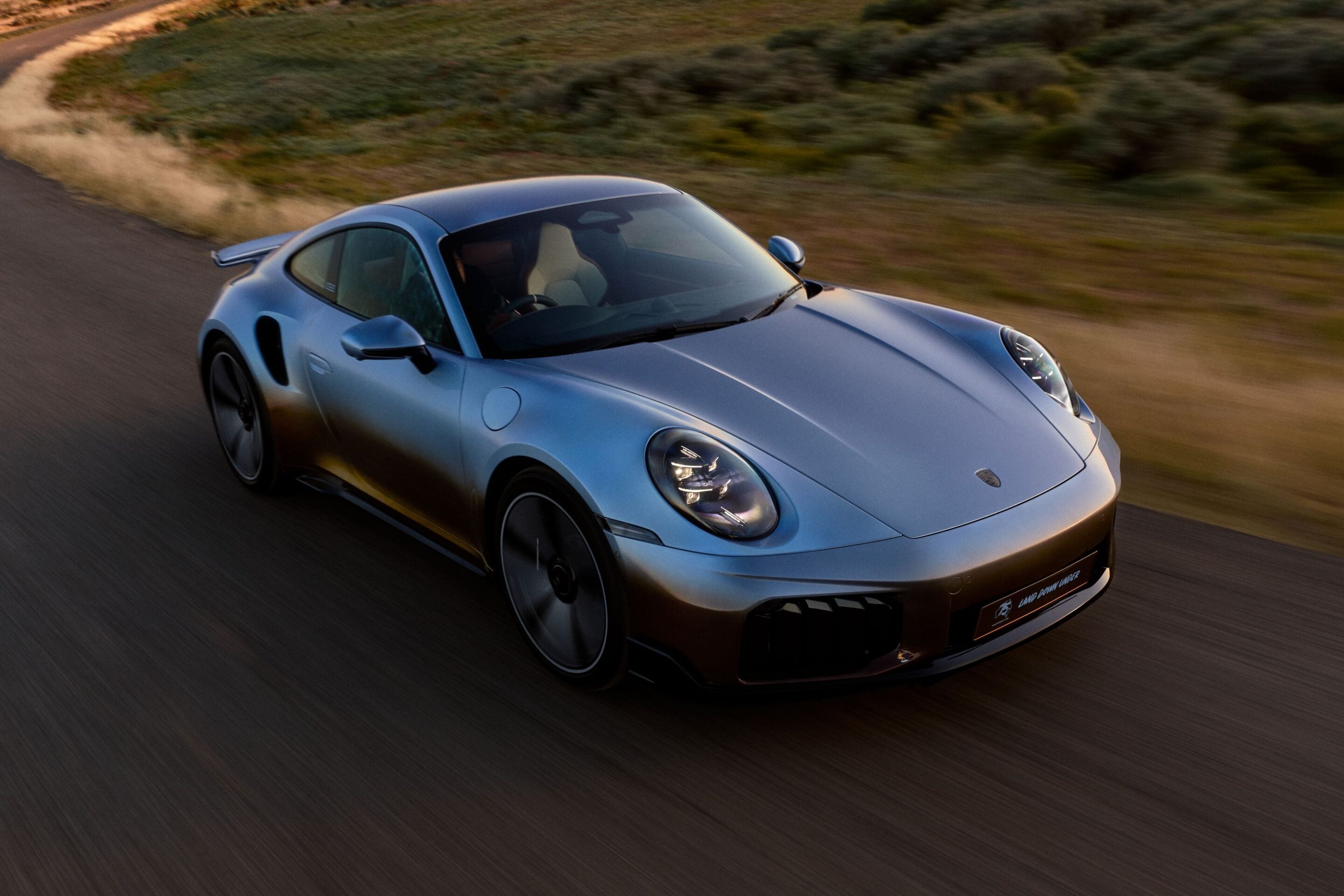
Porsche says the seven-layer finish required more than 300 hours of hand craftsmanship. Matching Southern Cross Blue 20- and 21-inch Turbo Exclusive wheels complete the exterior treatment.
The project also introduces several one-off details. A subtle “ghosted” 75 has been incorporated into the roof using Bronkhorst’s own typeface, while a hidden “See ya later mate” message appears beneath the rear wing when Sport Plus mode is selected or the spoiler automatically deploys at speed.
Inside, the cabin receives an equally extensive redesign. Dark Night Blue leather is paired with a bespoke Coolibah Brown finish developed specifically for the car, while the 18-way sports seats feature more than 14,000 individually positioned perforations arranged to replicate the artist’s brushstroke technique.
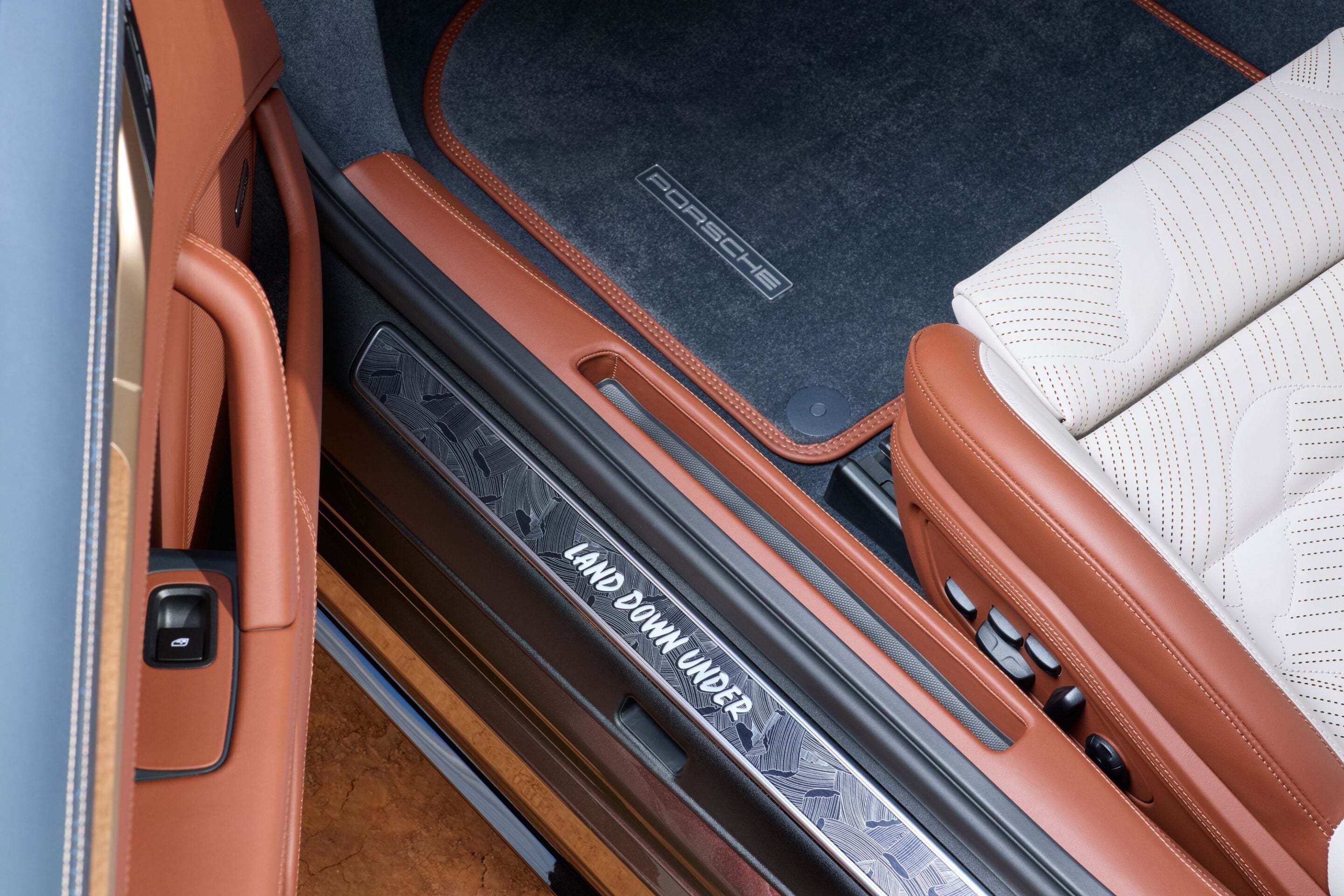
Australian Silky Oak timber trim, Blue Mountains topographical graphics across the dashboard and a roof lining embroidered with the Southern Hemisphere night sky as it appeared above Uluru in 1951 further reinforce the local theme. That year marked Porsche’s arrival in Australia.
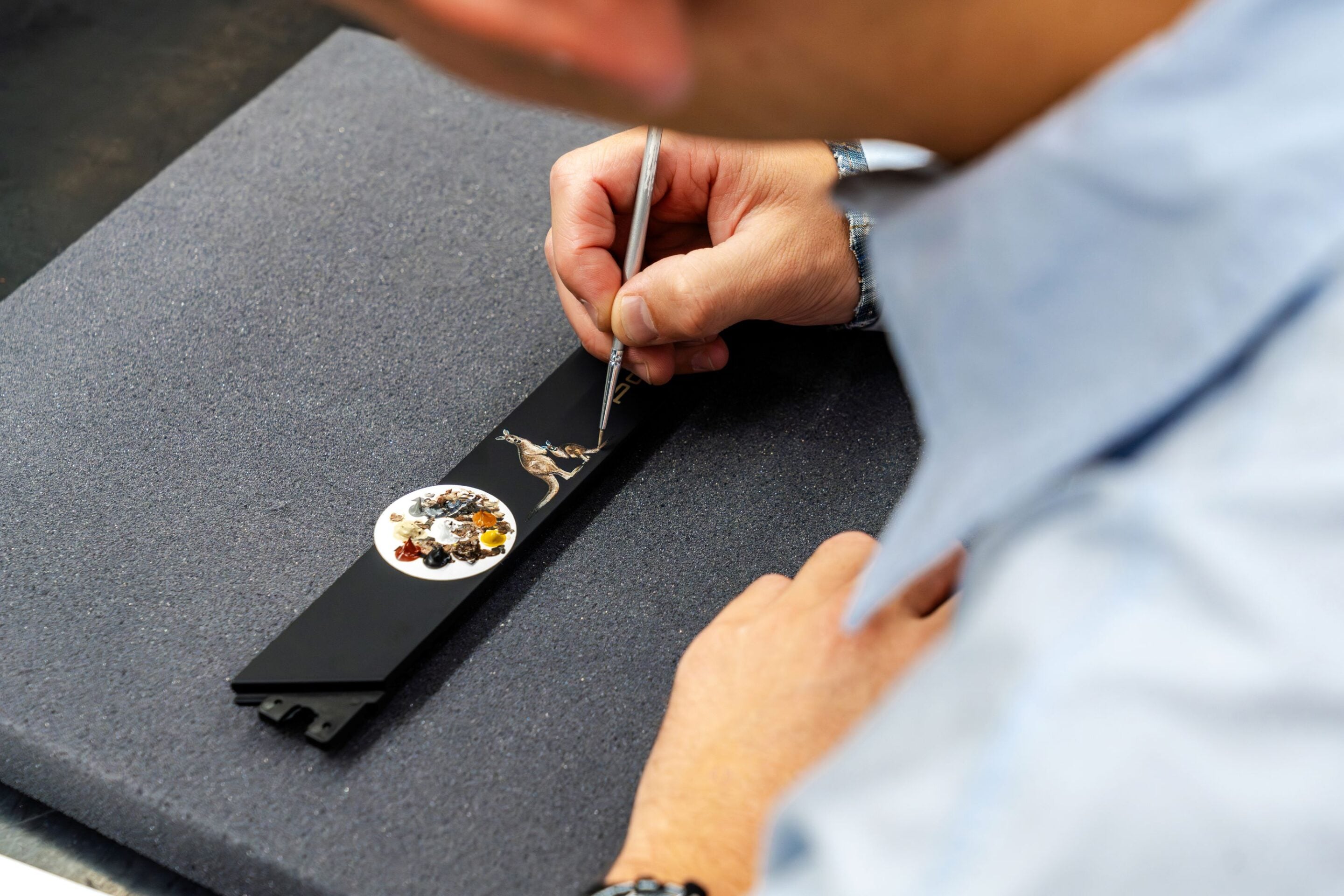
Bronkhorst also created a series of miniature artworks depicting Australian wildlife and human figures, which are integrated throughout the interior and exterior as hidden design elements.
Although visually transformed, the car remains mechanically identical to the production 911 Turbo S, retaining the model’s existing performance credentials while serving as a demonstration of Porsche’s Sonderwunsch personalisation program. The company says the vehicle will tour selected Australian locations following its global debut before continuing as a showcase for the bespoke commissioning service.
Heated seats and parking sensors topped the list of most-desired features for new car buyers, ahead of anything to do with safety or driver assistance.
Survey results from 19,000 participants reveal an interesting list of must-haves for new car intenders. That data, based on research conducted in the USA, was compiled by automotive research and analyst firm AutoPacific.
The survey asked buyers to indicate which features they were looking for in a new car, with the largest percentage nominating heated seats as being on their shopping list.

Almost half of those surveyed, 47 per cent, wanted a warm behind on a winter’s day. According to AutoPacific, heated seats didn’t even crack the top 15 in 2025’s survey.
Rather than prioritising features, the survey only accounts for the presence of features, so anything that tops the list was selected by more respondents, rather than being seen as more important.
Parking sensors took second place, with 45 per cent of buyers indicating it as a feature on their shopping list, followed by rear emergency braking, sought after by 44 per cent of those surveyed.
Features like lane-change assist, adaptive cruise control with lane-centring, and blind spot cameras also rated highly, sitting at 43 per cent. Interestingly, relatively uncommon night vision tech was also on the radar of 43 per cent of buyers.
Rear cross-traffic alert with AEB mattered to fewer buyers than simply having rear auto-braking (42 per cent), and an equal number of buyers (41 per cent) desired automated parking as those seeking wireless phone charging.
Trend analysis over the last three years also reveals that more buyers are coming around to automated assistance. In 2026, 56 per cent of people surveyed said they trusted safety systems that prevented accidents, up from 49 per cent in 2024.
Driver assist features, like lane-centring and automated parking, also saw an increase in acceptance, with 62 per cent trusting the technology, up from 57 per cent in 2024.
Although they didn’t crack the top 15 list, AutoPacific also noted increases in demand for driver assist systems like unresponsive driver stop assist, vehicle exit alert, and adaptive smart headlights.
Mercedes-Benz is calling it the most comprehensive update a new generation of its S-Class saloon has ever received, and judging by the stunning number of improvements the company has just announced, that’s anything but an empty boast.
The upcoming S 450 4MATIC and S 580L 4MATIC are due in Aussie showrooms on August 6, priced at $264,200 and $353,900 respectively, and they’ll arrive with a list of features that would rival the Australian tax code in length if we ran them all here.
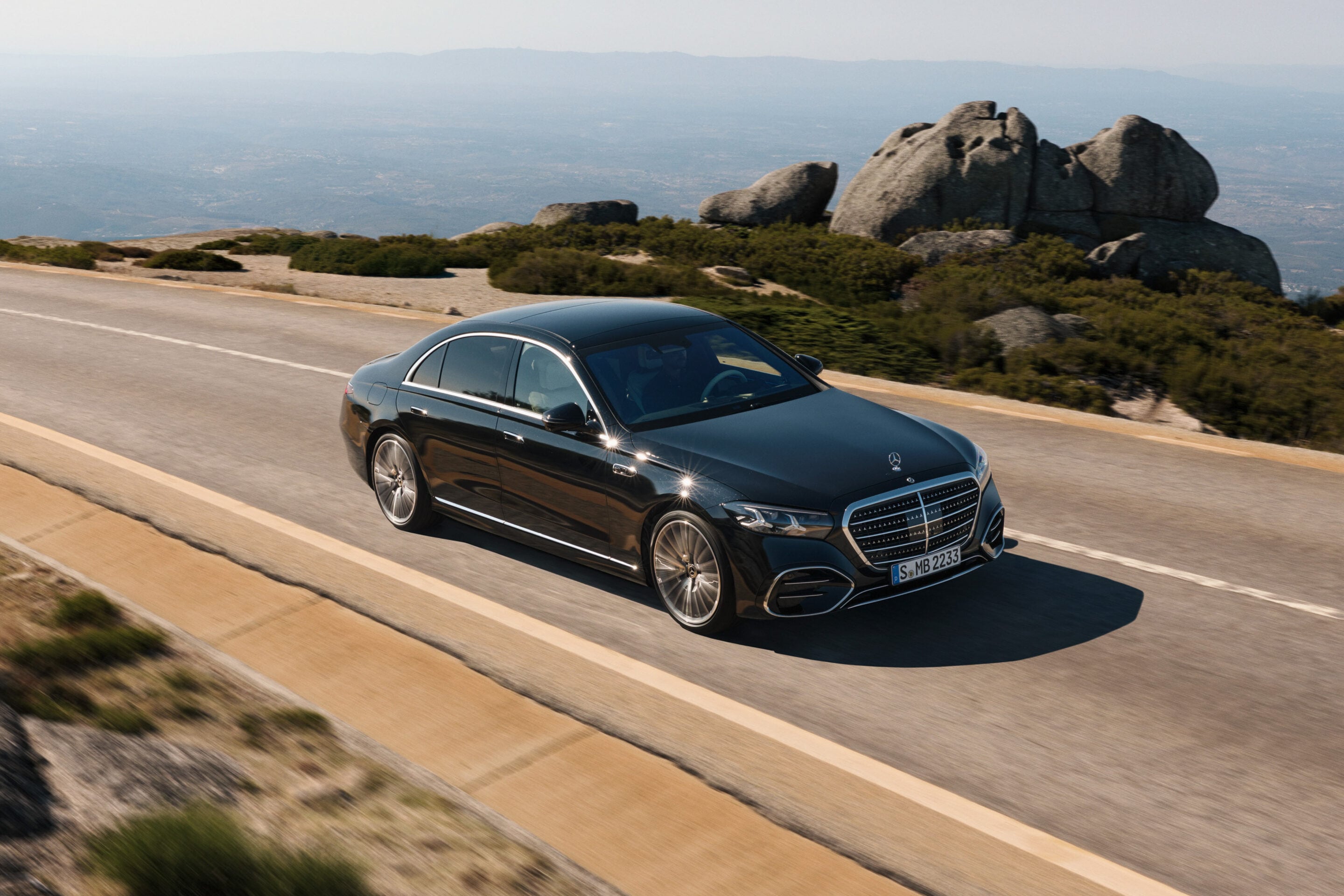
Mercedes says around 2700 components of the new models – or about 50 per cent of the vehicles – have been newly developed, updated or re-engineered, and the changes to the motors are among the most outstanding examples of that.
The S 450’s 3.0-litre turbocharged inline six has been heavily revised with optimised fuel injection and a higher compression ratio that keep power at 280kW, but up the torque to 560Nm, with an overboost function able to spike that to up to 600Nm for brief periods.
But the S 580L’s V8 has had the book thrown at it in terms of improvements. It gets a new-generation M177 EVO twin-turbo eight-pot with refined injection, a flat-plane crankshaft, revised intake camshaft, and changes to its intake and exhaust ports, turbo housing and compressor wheel.
That translates to 395kW, 750Nm, a 4.0-second 0-100km/h time – 0.4 of a second quicker than its predecessor – smoother power delivery, better throttle response and increased efficiency, with both models feeding the grunt through the 9G-TRONIC transmission.
Rear-axle steering is still standard, with the optional Airmatic suspension and E-Active Body Control now uprated to include intelligent damping tech that transforms bumpy roads into billiard tables by remembering where obstacles are and preparing the suspension in advance.
Mercedes’s most advanced driver assistance system, MB.DRIVE, gathers data from a host of integrated sensors to help the lucky motorist navigate lane changes, parking and reversing among a multitude of other functions, and the new Digital Light system produces an illumination field that’s been expanded by 40 per cent over the new models’ predecessors.
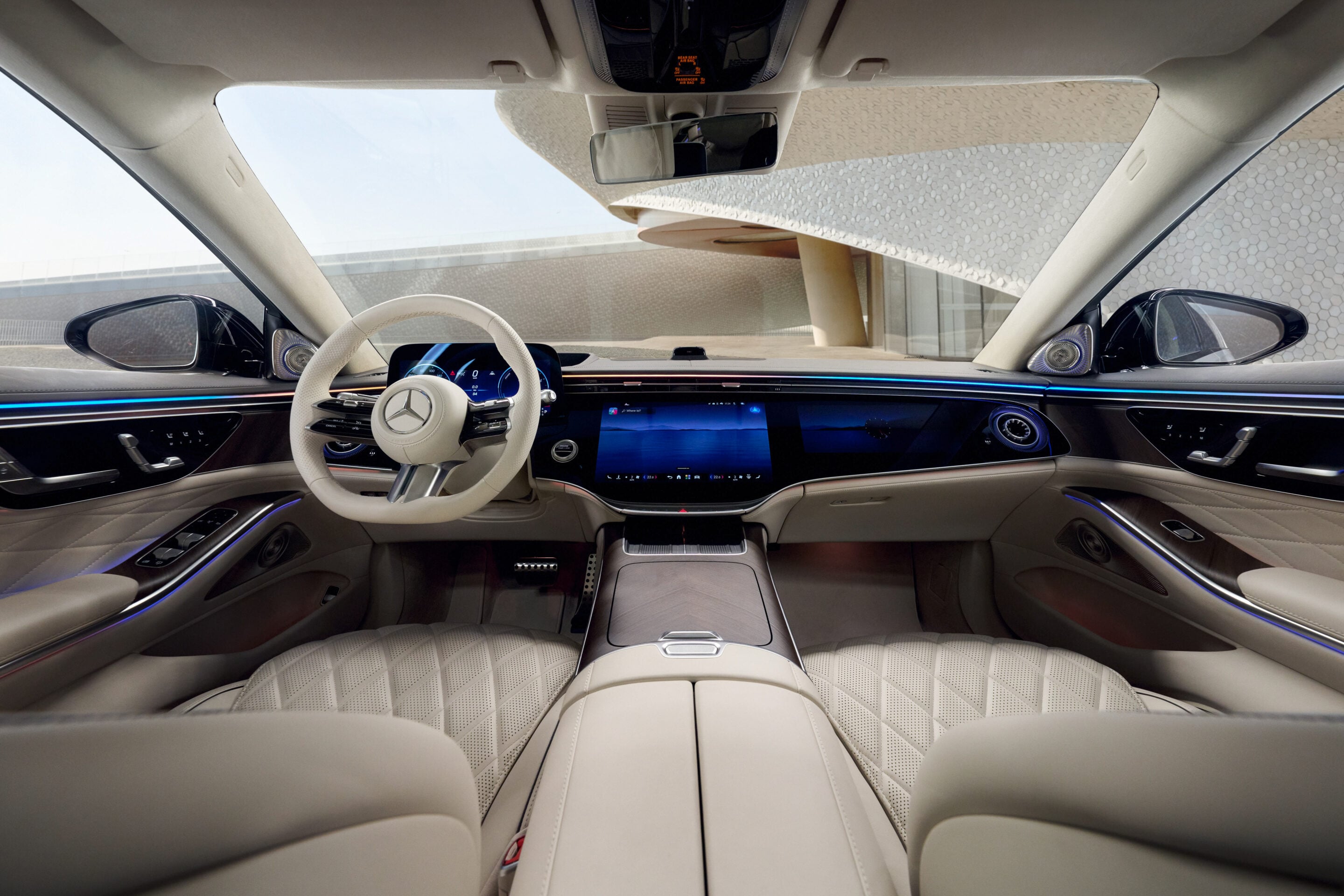
The interiors are everything you’d expect from one of the world’s benchmark limousines. Customers can choose from a standard Burmester 3D or optional High-End 4D surround sound system, and the overhauled climate control now refreshes and purifies the air in the cabin every 90 seconds. You can even get heated seat belts.
A 14.4-inch touchscreen is the cars’ digital centrepiece, along with the 12.3-inch instrument cluster, and an MBUX Superscreen is available for the front passenger. The MBUX High End Rear Seat entertainment system comes as an option, and buyers get a Virtual Assistant.
The exterior has been revamped with a radiator grille 20 per cent larger than the previous models’, complete with an illuminated surround and 3D detailing on the chrome star. The styling of the front and rear, plus the headlights and taillights, is new, and the AMG Line package is now standard, as are 20-inch AMG cross-spoke alloy wheels finished in Himalaya grey.
Naturally, the list of options is as luxurious and refined as it is comprehensive. You can get the Exterior Elegance Package for no extra cost, but the Comfort PLUS and Comfort Complete alternatives will hit the hip pocket nerve as they provide touches like a massage function for the rear seats and an augmented-reality heads-up display. The Business Class Package turns the rear seats into a high-tech office complete with temperature-controlled cup holders and folding tables.
Just a word of warning: the prices quoted at the start of the article include GST and luxury car tax, but not on-road costs… not that they’re likely to bother anyone with the sort of bank balance that lends itself to S-class ownership.
The Mazda2 is one of Australia’s oldest new cars, having been released in its current shape in 2014, yet it continues to prove that age alone doesn’t determine a car’s overall ability. While some rivals have grown larger, more expensive and increasingly electrified, Mazda‘s smallest model has stuck to a simple formula of sharp handling, efficient petrol power and lots of standard equipment. But in 2026, with fierce competition from newer and often cheaper rivals, does the veteran still deserve a place on your shortlist, or has time finally caught up with it?
How much does the Mazda2 cost?
Two model grades are available in the 2026 Mazda2 range: the entry-level Evolve and top-spec GT, the latter available in either five-door hatchback or, uniquely, four-door sedan form. Pricing starts at $27,290 plus on-road costs, and the GT is currently priced at $28,490 driveaway, nationwide.
2026 Mazda2 pricing (plus on-road costs):
| G15 Evolve hatchback: $27,290 | $36,900 |
|---|---|
| G15 GT hatchback or sedan: $28,490 | $37,400 |
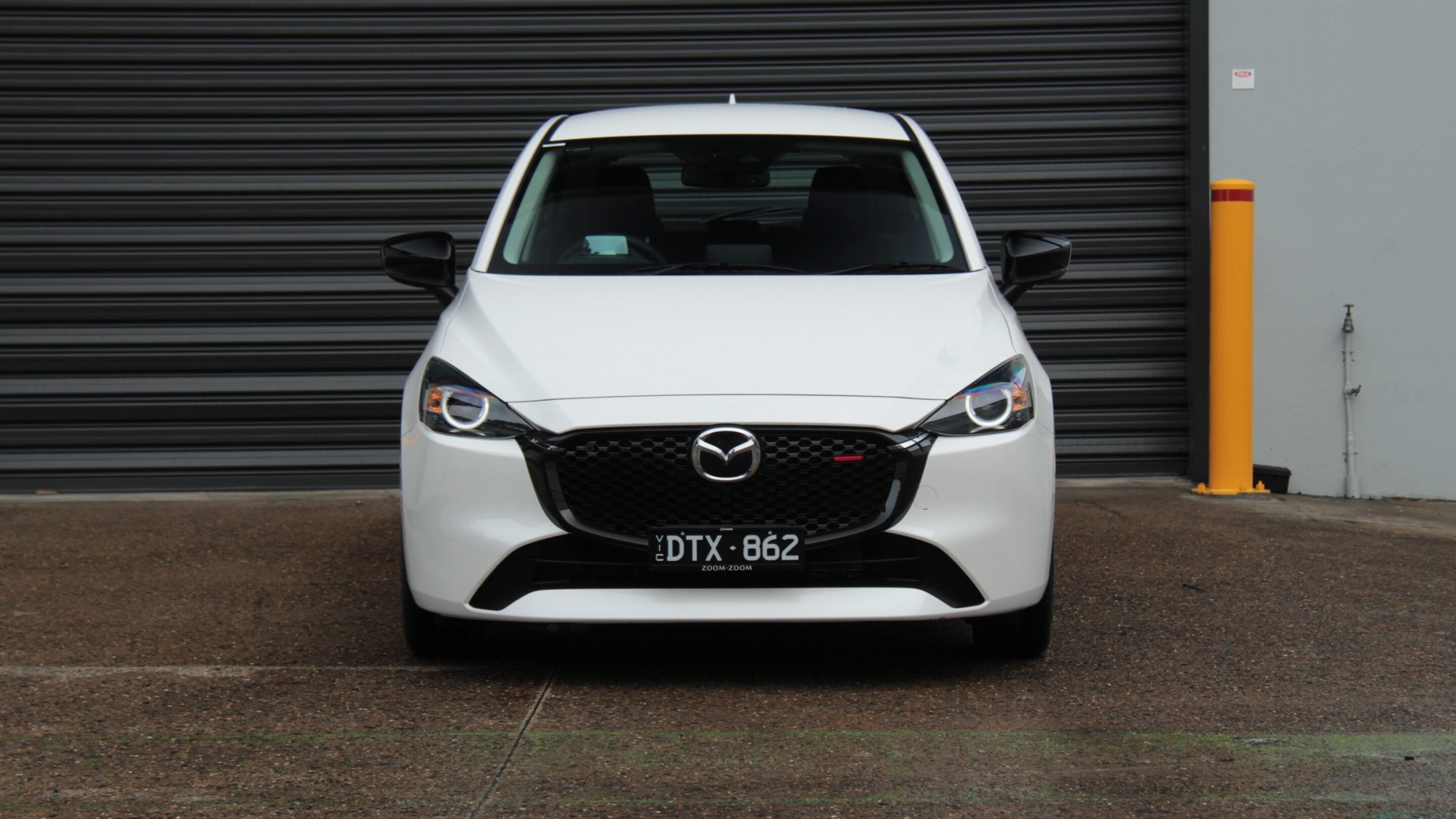
Those familiar with the model will note that when the current ‘DJ’ series Mazda2 was released way back in 2014, it was priced from just $14,990 plus on-road costs for the entry-level Neo manual (+$2000 for the automatic), and that price often included on-road costs. Even using the Reserve Bank of Australia’s inflation calculator for the $16,990 version, that equates to around $22,500 in 2025 money (the latest year available). Yes, the entry-level Mazda2 is much better equipped than it used to be, but paying significantly more for what amounts to a car released 12 years ago feels mean.
Standard features for the Mazda2 G15 Evolve include 16-inch alloy wheels, dusk-sensing automatic LED headlights, automatic rain-sensing wipers, single-zone automatic climate control, a 7.0-inch touchscreen, Apple CarPlay and Android Auto, a heads-up display, and safety features such as autonomous emergency braking, lane keeping assistance, adaptive cruise control and a reversing camera with rear parking sensors. A full list of features can be found at the bottom of the page.
If you’re after a bit more, the top-spec GT then adds part-synthetic leather/suede trim, front parking sensors, a 360-degree camera, different alloy wheels and keyless entry. It’s also available in the aforementioned sedan body style. That’s a pretty solid list of extra kit for only $1200 more, but we’d be more than happy in the Evolve.
Petrol competition for the Mazda2 is depressingly sparse in 2026 because many car makers simply no longer offer a light hatchback. However, cars such as the Kia Picanto, Suzuki Swift, Skoda Fabia, Toyota Yaris and Volkswagen Polo are still available, and if you include electric models, options swell significantly to include the BYD Atto 1, MG 4 Urban, GAC Aion UT and from October 2026, the Honda Super-One. Thankfully, the small, cheap car is not as scarce as some prospective buyers think.
How fuel efficient is the Mazda2?
As with any car, it depends on where it’s driven. Mazda claims 5.0L/100km on the combined cycle with emissions of 117g/km of CO2. We recorded 6.8L/100km in our driving, which skewed towards urban. Having said that, it will return around 4.5L/100km on highway journeys, and it uses 91 RON regular unleaded fuel to fill its 44-litre tank. You’ll note that number is still a lot higher than the hybrid Toyota Yaris, which can easily drop below 4L/100km in urban driving. However, the Yaris can cost significantly more.
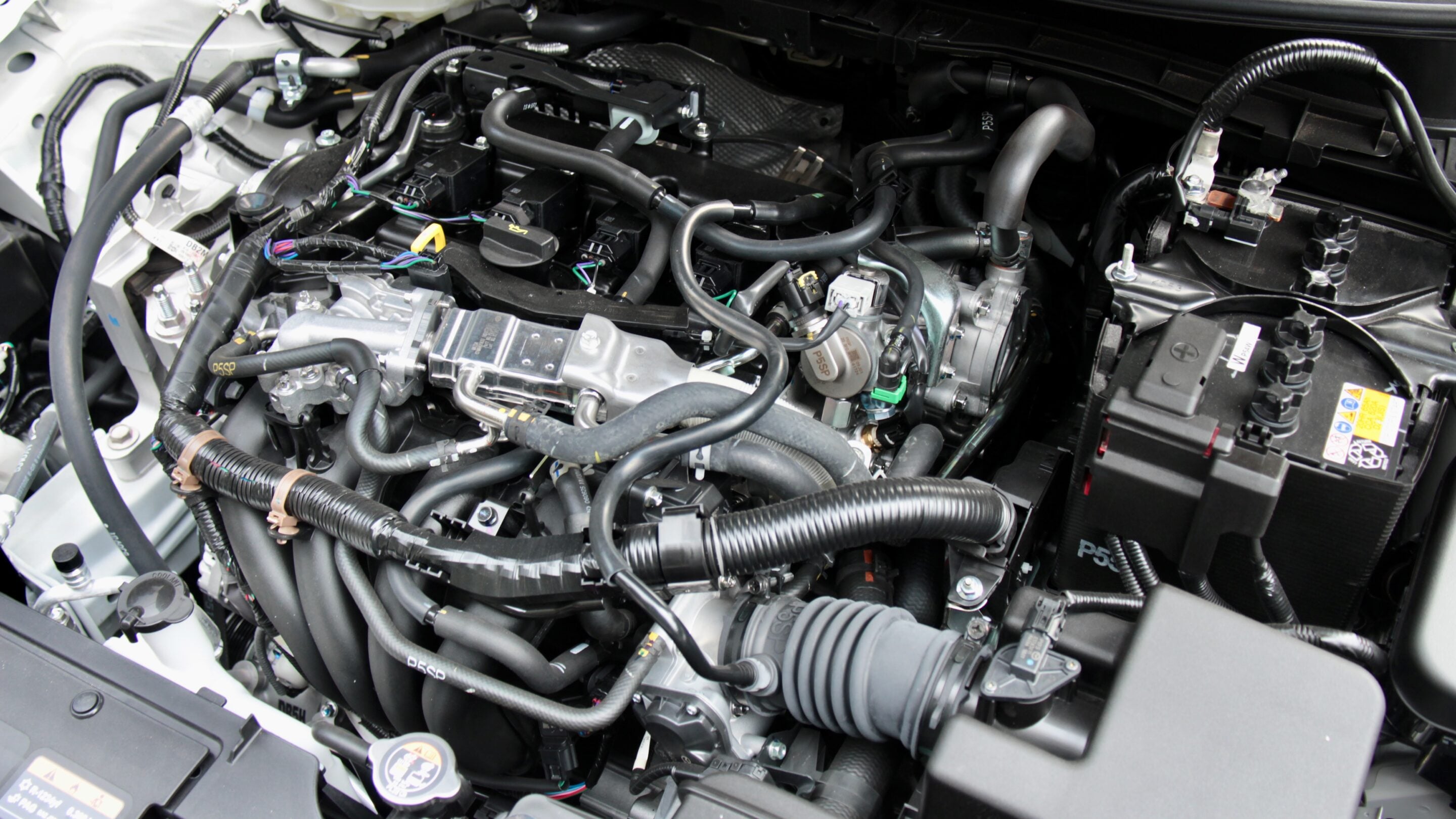
One of the first motors from Mazda’s then-new ‘SkyActiv’ engine family, the 1.5-litre naturally aspirated four-cylinder mill is no powerhouse, but it’s a fun little number that loves being revved to get the best out of it. Making 81kW and 142Nm of torque – the latter figure from 3500rpm so you don’t have to wring its neck to make swift progress – it’s tied to a responsive six-speed automatic transmission that is fun to use, especially the manual mode with the correct direction for changing gears (that is: pull down to shift up, push away to shift down).
Is the Mazda2 fun to drive?
Yes, quite, as you’d expect for a Mazda product. Ever since its release – and arguably the generations before that – the current-shape Mazda2 has offered more driving fun than many of its mainstream rivals thanks to its tight chassis, darty handling and sharp steering. Despite the lack of grunt from the engine, it’s possible to have a ball with the 2 on a good bit of road, and we love it for that. It also copes well with conditions no matter where it is, and overall it’s certainly one of the best Mazda products from a ride and handling point of view.
However, it’s not the most refined light car on the market. It’s quieter at speed than it used to be, but even at moderate velocities, road noise rears its head. Thankfully, its active safety features are well tuned and place trust the driver. We remember when even autonomous emergency braking was an optional feature on the 2 (at least you could purchase it, unlike many of its rivals), so it’s good to see features such as adaptive cruise featuring.
Is the Mazda2 practical?
The 2 is reasonably pragmatic for a light hatch, but a Skoda Fabia is noticeably more spacious and can fit a lot more into its boot. Still, there’s an air of quality in the Mazda2’s cabin that has been present since it launched, with solid materials and classy switchgear still used today. The leather on the steering wheel is one of the only soft-touch materials in the whole cabin, and it feels great in the hand. The plastics aren’t scratchy, however – just hard.
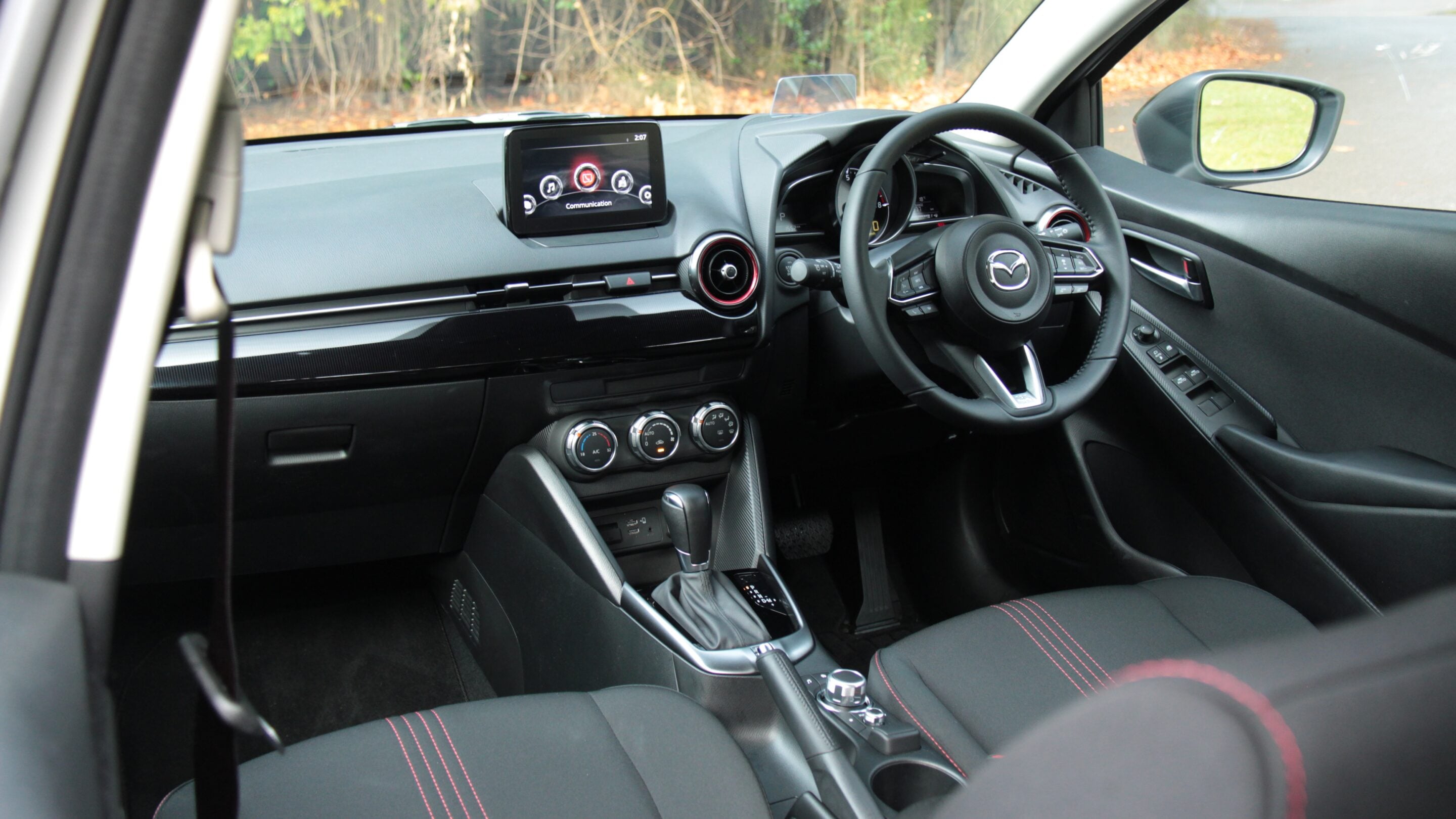
Infotainment duties are handled by a 7.0-inch touchscreen that still uses Mazda’s MZD Connect software from 2014. It’s a good feature for the price with sat nav, wired Apple CarPlay and Android Auto, AM/FM/DAB+ digital radio and Bluetooth calling and audio streaming
However, the screen is somewhat slow to use and feels a bit dated. We like the way it’s mostly controlled by the wheel on the centre console, which gives it a more expensive feel, but in Japanese Mazda2 models, the more recent Mazda Connect system features a larger 8.8-inch screen with wireless smartphone mirroring. Hopefully that gets added to the Australian models soon, as it would give the interior a far more modern feel.
Storage is severely lacking as it offers just a shallow cup holder section in the centre console, small bottle holders in the doors, an average-sized glovebox and a shallow tray underneath the climate control, where the two USB-A chargers and SD card holder lie. There’s no covered storage as standard, but a centre console armrest is available as a dealer-fit accessory for an extra $531. it does cover the cup holders, but we think it should be standard equipment.
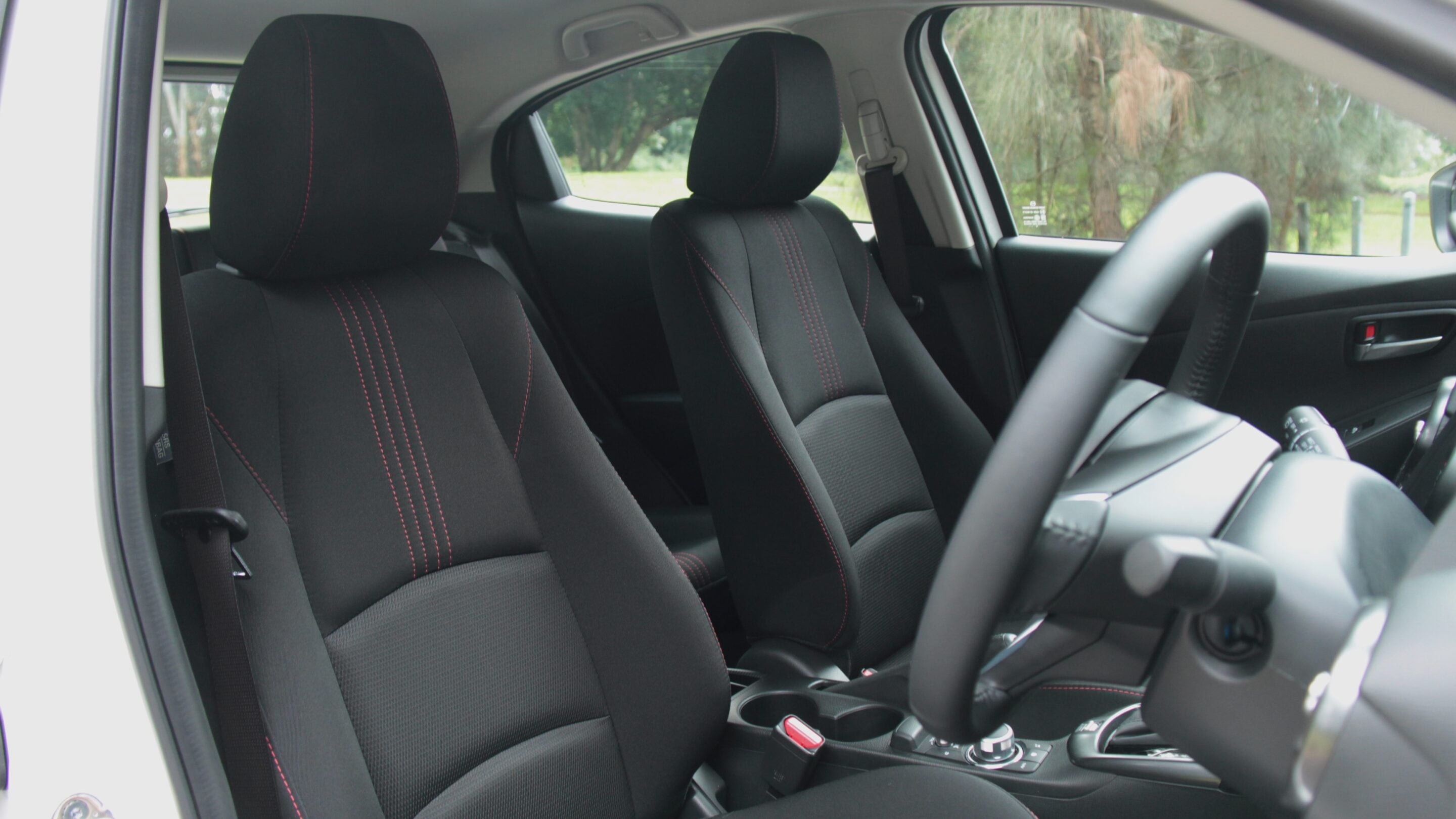
Two averaged-sized adults will be fine in the back seat, but if they’re any taller than six feet, they certainly won’t be very comfortable. There are also no amenities in the back pews, aside from a map pocket and a storage tray with no air vents, or even cup holders of any kind. It’s literally just a seat with two ISOFIX points.
The boot measures 250 litres with the rear seats up. Mazda doesn’t quote a figure with them folded, but around 1000 litres sounds about right. The boot itself is surprisingly deep with a large lip as a result, which could be annoying when loading and unloading heavy items. It has no features except for a light, and a space-saver spare lies underneath the floor. Some more clever features like hooks and nets, like the Fabia, would make it more practical.
How much does the Mazda2 cost to service?
Mazda covers its range with a five-year/unlimited-km warranty with five years of roadside assistance, which is the bare minimum in 2026. Volkswagen, Toyota and Suzuki all match this, though BYD adds a year, and Skoda, GAC and MG add two years.
The 2’s service intervals are once-yearly/every 15,000km (whichever comes first) and the cost for servicing it over five years/75,000km is $2290, or $458 per annum on average. That’s not what you’d call cheap, but it could be worse – the Volkswagen Polo, for example, costs $2957 to service over the same period.
Should I buy a Mazda2 G15 Evolve?
We had a good time during our week with the G15 Evolve. We miss the heyday of light cars and the 2 is a reminder of how great they can be. Sure, it’s feeling a bit dated as it approaches its 13th year on sale in Australia, and it’s a lot more expensive than it used to be, but it’s just a fun car to drive and is excellent for city trips, or even the occasional highway jaunt.
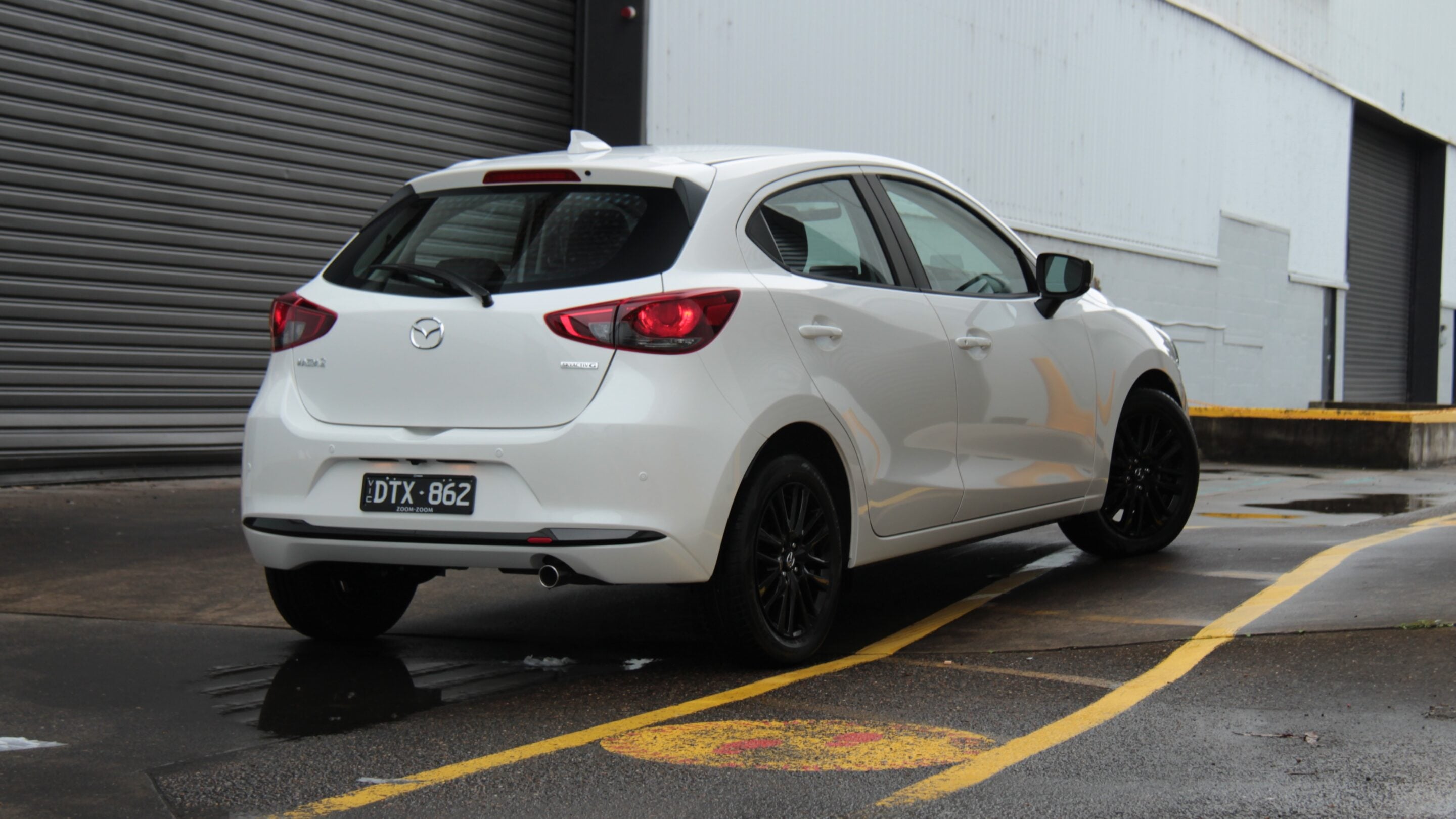
The engine lacks guts and isn’t that fuel efficient for urban driving, but it loves to rev, and the six-speed automatic is responsive and decisive. Yes, the cabin is tight and lacks storage, the infotainment system is feeling old and lacks wireless phone mirroring, and the five-year warranty is lacking. But despite its foibles, if you’re still interested in a light car, the Mazda2 is a good place to start your search.
Mazda2 G15 Evolve standard equipment:
- 16-inch alloy wheels (with a space-saver spare)
- Dusk-sensing automatic LED headlights
- LED frontal daytime running lights
- Rain-sensing automatic wipers
- Remote central locking with push-button start
- Auto-folding mirrors with black mirror caps
- Electric windows with automatic up/down front
- Black cloth trim with red highlights
- Manual height-adjustable driver’s seat
- Single-zone automatic climate control
- Leather-wrapped steering wheel, gearknob and handbrake
- 7.0-inch touchscreen with controller wheel in centre console
- Satellite navigation
- AM/FM/DAB+ digital radio
- Wired Apple CarPlay and Android Auto
- Bluetooth calling and audio streaming
- 2x USB-A ports
- Six-speaker sound system
- Heads-up display
- Auto-dimming rear mirror
- Six airbags
- Autonomous emergency braking with pedestrian detection
- Low-speed automatic braking in reverse
- Adaptive cruise control
- Lane-keeping assistance with lane departure warning
- Blind-spot monitoring with rear cross-traffic alert
- Traffic sign recognition
- Rear parking sensors
- Reversing camera
- Tyre pressure monitoring
Mazda2 G15 Evolve specifications:
| Price | $27,290 plus on-road costs |
|---|---|
| Engine | 1496cc four-cylinder DOHC petrol |
| Peak power | 81kW (@ 6000rpm) |
| Peak torque | 142Nm (@ 3500rpm) |
| Transmission | Six-speed automatic, front-wheel drive |
| Claimed fuel economy | 5.0L/100km |
| Claimed CO2 emissions | 117g/km |
| Fuel type | 91RON regular unleaded |
| Fuel tank | 44 litres |
| Dimensions (l/w/h/wb) | 4085/1695/1495/2570mm |
| Boot size | 250 litres (rear seats up) |
| Kerb weight | 1109kg |
| Warranty | Five-year/unlimited km |
| Five-year service cost | $2290 ($458 per year) |
| On sale | Now |
A new survey has revealed that despite a huge surge in interest in EV ownership down under, almost half of Aussie motorists don’t feel prepared or informed enough to move away from their current combustion-engined vehicle.
Data from Allianz Insurance reveals that EV policy inquiries have increased by 66 per cent compared to the same time last year, but new car buyers still harbour significant reservations about moving to an electric vehicle.
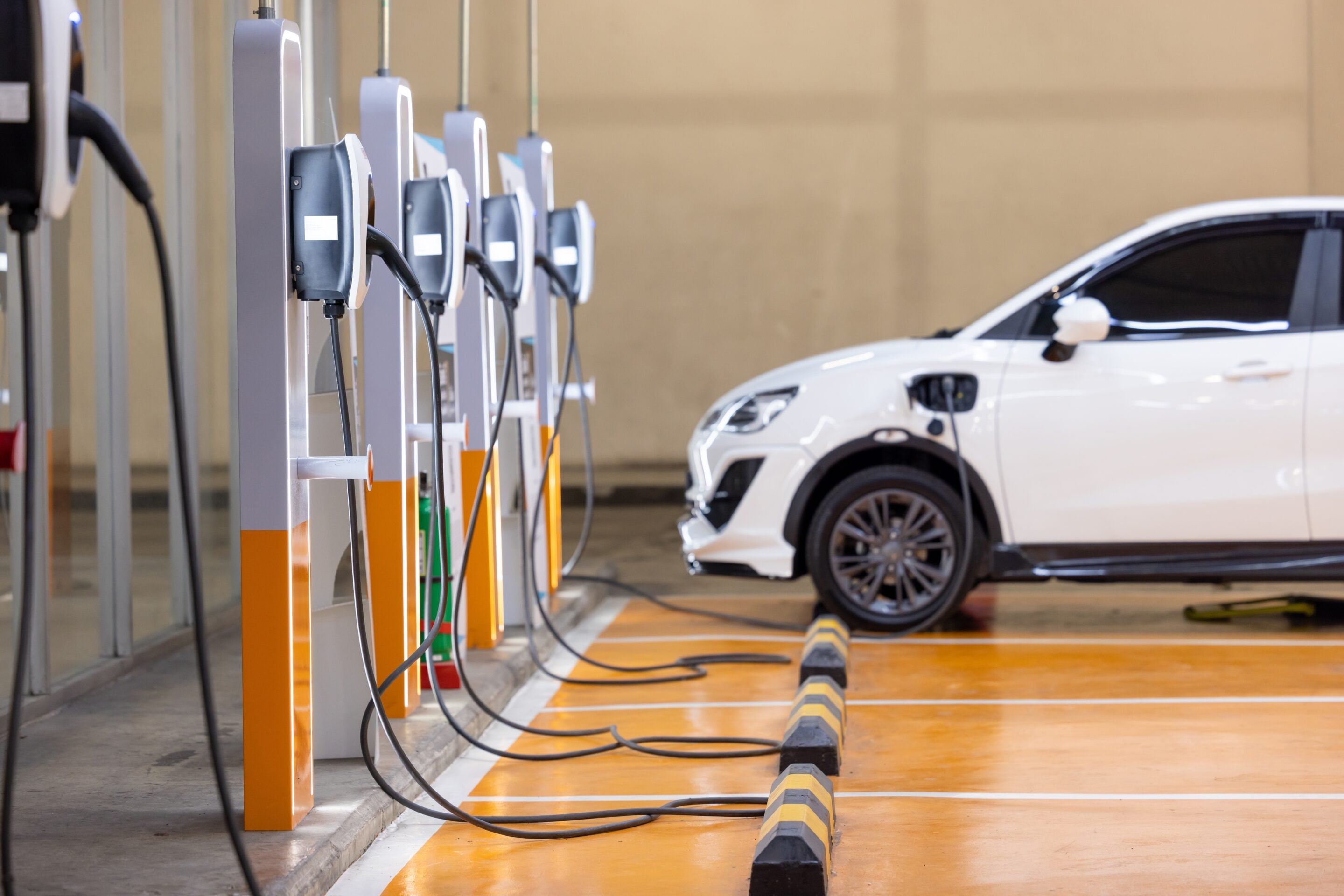
A significant 47 per cent of respondents who don’t own EVs said they didn’t feel prepared to make an immediate switch away from petrol or diesel power. A lack of information or education stood as one of the primary reasons.
On the flip side, among the EV owners surveyed, 68 per cent said they felt prepared when they made the change away from combustion.
Non-EV owners cited concerns including a lack of confidence about battery longevity (34 per cent), uncertainty about public charging infrastructure (29 per cent), and a lack of confidence in making the transition (26 per cent).
Of the non-EV owners surveyed, 26 per cent revealed that they could be lured to an EV due to the potential financial benefits, with 22 per cent citing sustainability as a motivating factor.
Safety concerns also played a role. Worries about pedestrian and cyclist safety, owing to the quietness of EVs, were flagged by 42 per cent of respondents, with 35 per cent expressing uneasiness about adjusting to the brisk acceleration offered by some EVs.
EV owners also reported less-than-perfect initial experiences when they made the switch. Charging issues were reported by 19 per cent, while 18 per cent experienced frustrations at falling short of the expected or advertised range.
Survey results were drawn from 178 EV owners and 918 non-EV owners nationally.
“While many drivers feel confident transitioning to an EV, our research shows there can still be a learning curve when it comes to understanding some of the unique features and requirements that come with driving an EV,” Allianz emerging risks manager Chris Wood said in a statement.
“Building knowledge and experience behind the wheel is what helps Australians get the most out of their EV safely.”
