Reviews



Gallery 1
8
/10
Score
Score breakdown
7.5
Safety, value and features
8.5
Comfort and space
8.5
Engine and gearbox
8.0
Ride and handling
7.5
Technology
Things we like
- Retains off-road chops
- Refinement takes a step ahead
- Better for the environment
Not so much
- Premium pricing will sting
- Offered in five-seat guise only
- Hybrid offering limited to ritzy GR Sport and Sahara ZX grades
Full disclosure – this isn’t your normal Wheels first drive. Most of the time, we get to spend a few hours with the vehicle in question in which to form our opinions. The Toyota LandCruiser 300 Hybrid? Mere minutes, on a closed circuit. Still, in that regard it’s probably not too different to the breathless first reports you’ll read on, say, a new Ferrari hypercar where drivers are strapped in and sent for a handful of laps around Fiorano.
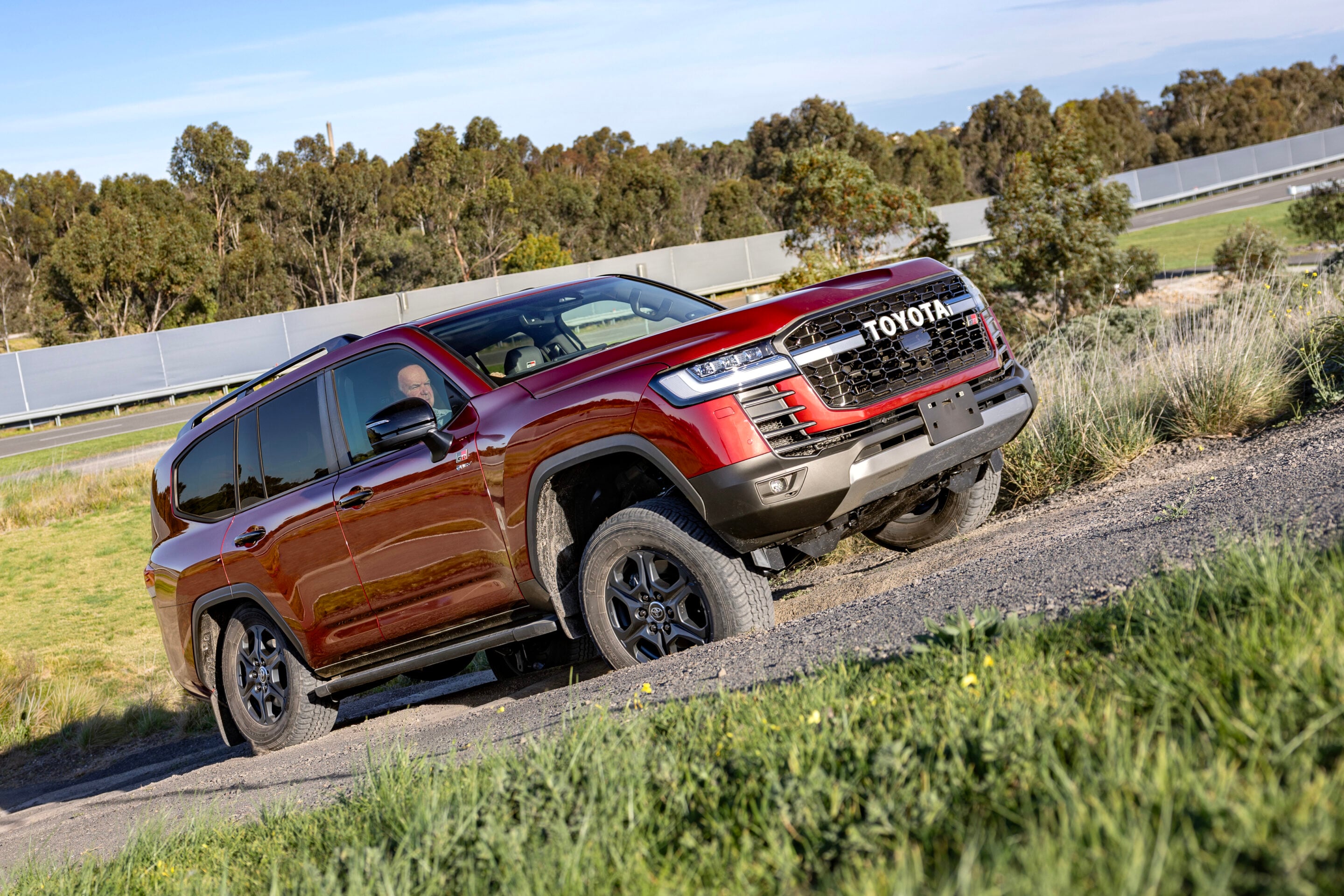
Breathless isn’t how you’d describe the experience in the new electrified LandCruiser. In fact, most of it was undertaken at little over walking pace, rock crawling and wading. The big takeaway you’ll need to know about this vehicle is that it’s been designed to offer the same level of off-road ability as the existing LC300 turbodiesel. In other key regards it effortlessly outshines the existing model.
1
Let’s rewind a moment. The dual effects of the COVID pandemic and the subsequent components shortage meant that sales of the LVC300, which was originally planned for late 2021, were slow to ramp up. Toyota registered 13,152 LandCruiser sales in 2022, as the model range transitioned from LC200 to LC300, stepping up to 15,035 in 2023 and plateauing at 15,257 in 2024. This year, it looks as if Toyota will struggle to match that figure, having registered 7722 sales by the end of August. Some added impetus to LandCruiser sales therefore wouldn’t go amiss.
With hybrid vehicles currently accounting for 48.9 per cent of Toyota Australia‘s output, and demand growing steadily, the answer presents itself. Although Toyota was very sparse on hard details on the Aussie market LC300 hybrid, providing no technical specifications, no pricing and no equipment specifics, here’s what we do know.
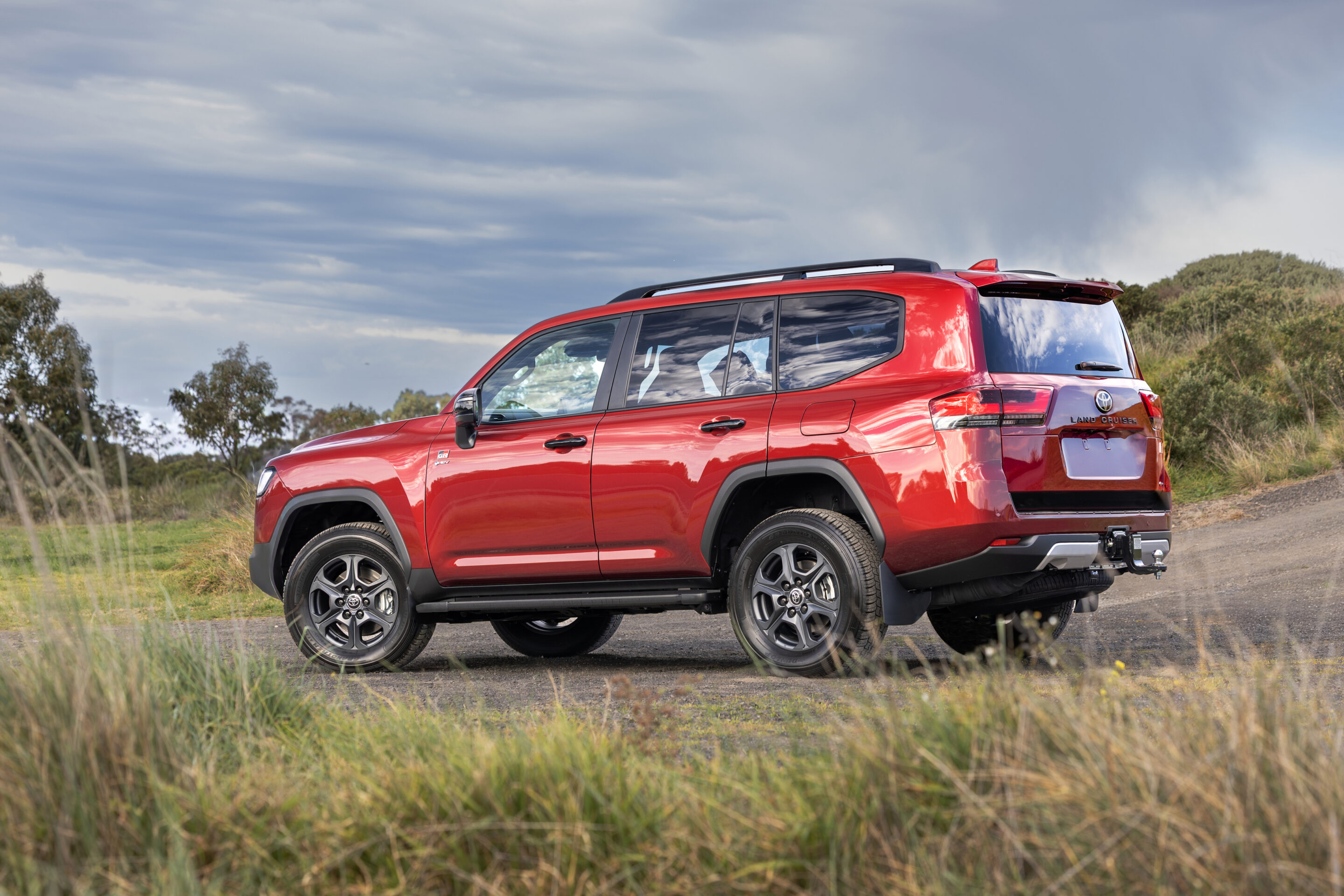
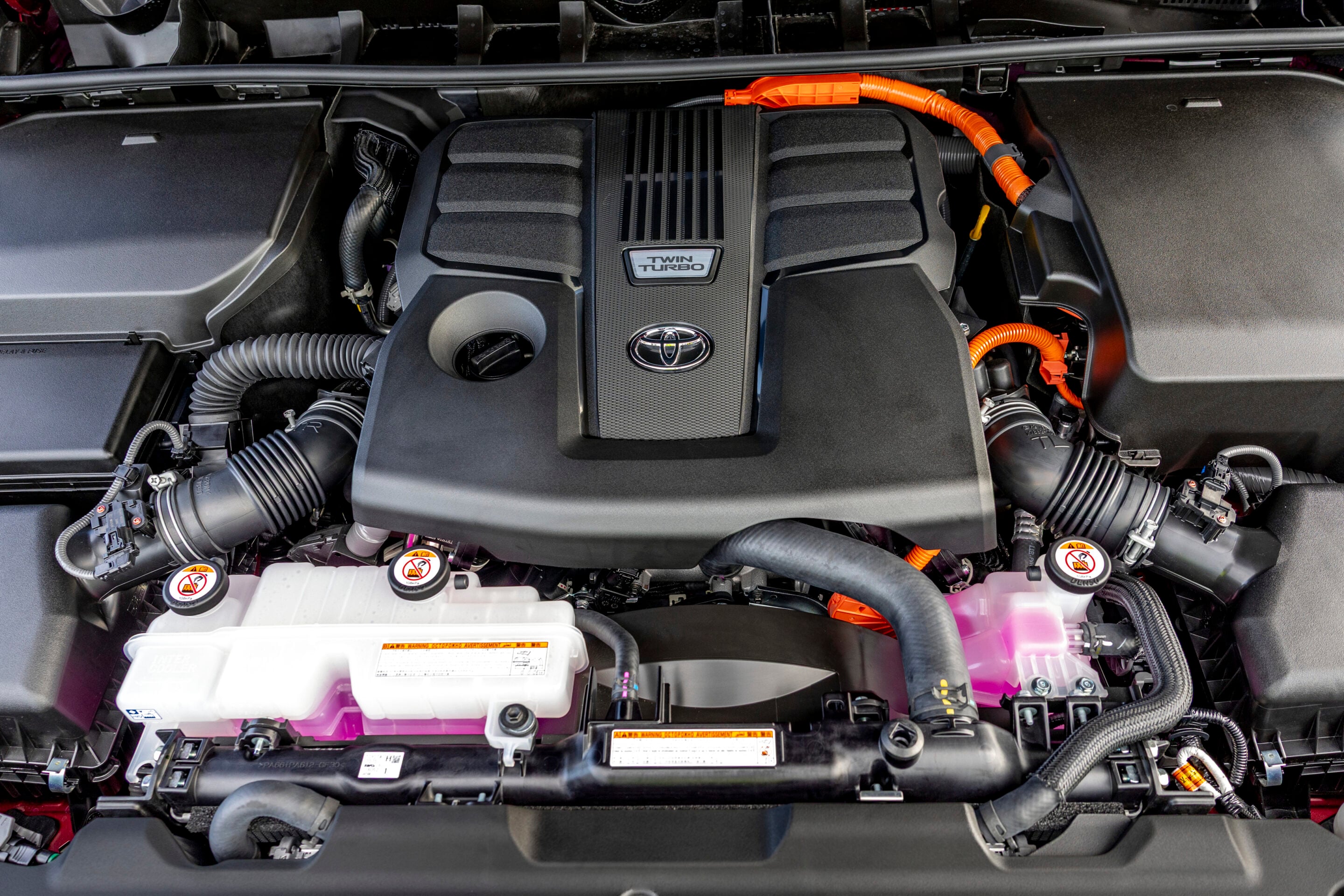
It’ll arrive Down Under in April 2026, it’ll be offered solely in top-spec GR Sport and Sahara ZX trim grades, and it’ll use much the same drivetrain that’s currently plumbed into the big Tundra ute. That means a 3.4-litre twin-turbo six driving through a 10-speed gearbox.
This marks a subtle but interesting divergence in Toyota’s policy regarding its hybrid cars. From now on, the company splits its hybrid offerings under two separate categories: Efficiency and Performance. The LandCruiser falls into the latter bucket, its drivetrain optimised for heavy payloads, towing and off-road ability.
1
“Coming on the Sahara ZX and GR Sport grades only, it is a parallel hybrid system with the petrol engine and the electric motor generator able to be used in parallel to provide maximum performance or individually to drive the wheels, depending on the load and the driver input,” explains Austin Ward, Senior Product Planning Specialist. “We call this our one motor hybrid, as it uses a single electric motor generator that is placed between the petrol engine and the automatic transmission, creating a linear hybrid system.”
Engine start-up, electric only driving, electric power assistance, a stop-start system and energy regeneration from recovered kinetic energy under braking are all managed via the single motor generator and hybrid battery. The single motor generator is connected to a clutch that marshals switching between the two power sources depending on the load and the driver input, with the petrol engine constantly in operation at speeds of over 30km/h. Below that speed, the LC300 Hybrid can operate on electric power alone, which is also used to boost acceleration at higher speeds or under heavy load. Drive torque, whether generated from the electric motor generator or petrol engine or both, is delivered to the driveline via that 10-speed gearbox with a lock-up torque converter.
Out on the test track, it feels exactly as you’d expect. Step-off is brisk, with a 0-100km/h sprint covered in around six seconds, accompanied by a modest flashing of the traction control light. Refinement is excellent, although as in many cars where you take one sound out of the aural landscape, you tend to notice another, in this case the slight singing of the A/T tyres on smooth bitumen.
According to Toyota’s presentation, peak engine torque arrives at 2400rpm, but peak electric motor torque starts at 0rpm and tails off at 1400rpm. This means that in terms of overall system torque, 2400rpm is your sweet spot, generating the full 790Nm quota. Beyond that, torque decreases gently, with 700Nm still available at 3800rpm. By way of comparison, 700Nm is the maximum amount of twist action you’ll see from a 3.3-litre turbodiesel LC300, so the hybrid version has it outmuscled across the rev range you’ll typically be using.
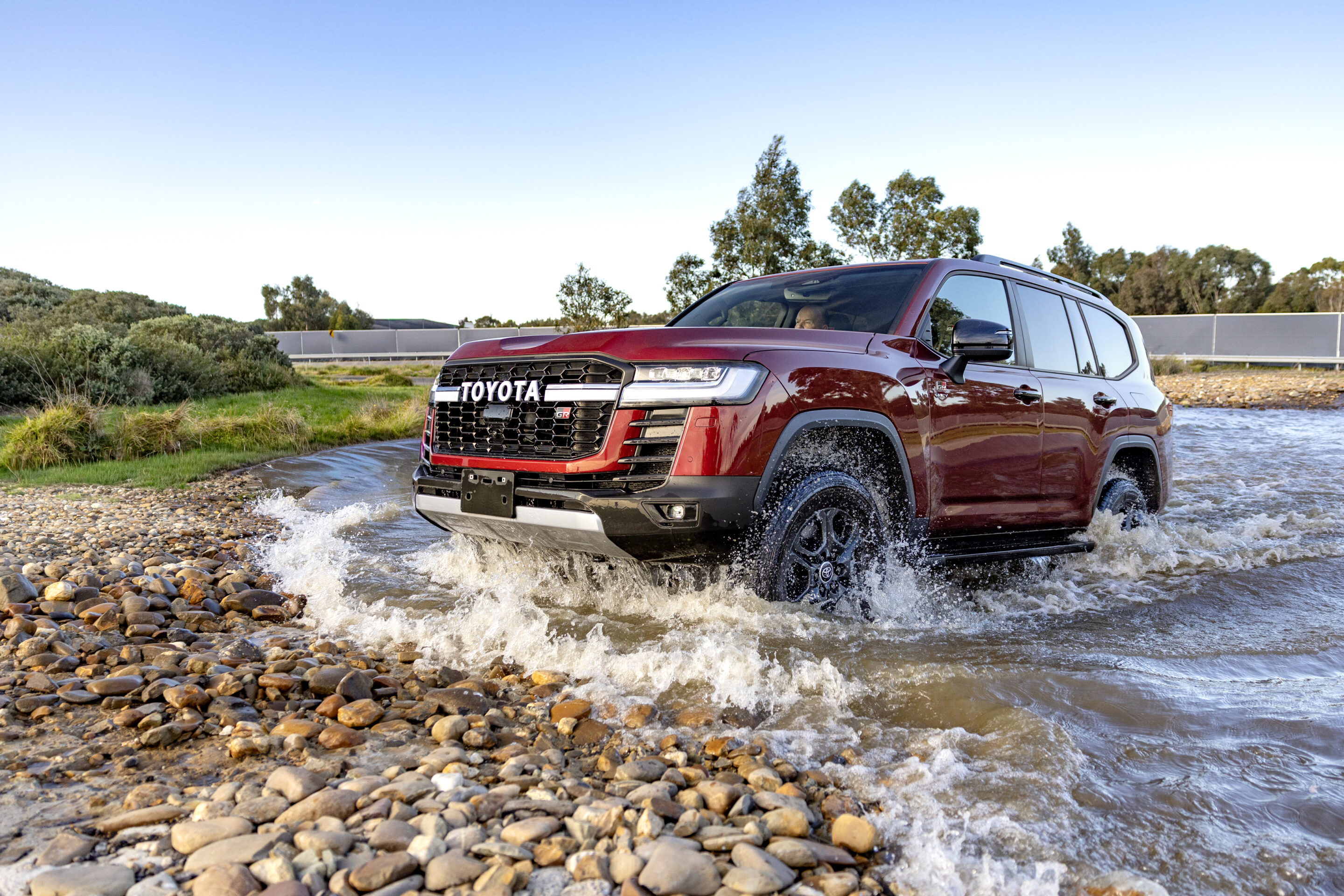
The wading depth is the same 700Nm figure as the diesel, and ground clearance and approach, breakover and departure angles are the same too. One area where the hybrid is slightly different is the fact that the 1.87kWh nickel-metal hydride battery pack sits beneath the luggage bay floor and has thus lifted the floor height, albeit only by a few millimetres. It also means that Toyota can’t package a third row of seats back there, so it’s a maximum of five-up.
1
Crawling over a rocky track showed how finely tuned the torque response of the electric motor is. Engaging the ‘crawl’ mode allows you to tailor the forward speed using a twist dial. Selecting one or two on the five-position dial will keep you below walking pace, and just when it feels as if the car is coming to a halt, just enough torque is applied to then clamber over the obstacle and no more. It’s impressive and this level of fine control will be a boon for those who are trying to tackle a particularly rocky part of a route without sitting the vehicle hard onto its side steps, a noted vulnerability of the stock LC300.
The hybridised LandCruiser has been on sale in the United Arab Emirates since June of this year, so we can make some reasoned assumptions based on that car. This 340kW version returns a fuel economy figure of 9.1L/100km, which remains in the same ballpark as the 8.9L/100km figure for the Aussie diesel models. It’s also supplied with a 1500W AC inverter that supplies 220v power. Given that Australia is the largest market for LC300, and had a huge hand in formalising the launch specifications of the vehicle, there’s not a lot of specific localisation required for the Hybrid. Nevertheless a pilot program has been instigated to assess whether any details need fine tuning.
Toyota still believes its planetary gear set architecture is the best solution for hybrids whether they’re efficiency focused or performance biased. “I think at the moment, it’s still the most efficient technology, and it’s proving to be very engaging to customers,” says Sean Hanley, Toyota Australia’s VP for Sales, Marketing and Technology. “We see no need to change, albeit you don’t ever stop. You can’t stop, you’ve got to keep developing.
3
“I often talk about speed to market being kind of yesterday’s hero, and people get very alarmed by that, but I think it’s really important that you have the quality, durability, reliability, (and the confidence in the technology,” he notes. “This is still superior in the eye of a customer. So whilst you can’t afford to stop developing, I’m not suggesting that for a moment, you don’t have to be first all the time, you’ve just got to get it right when you do launch it.”
Given that the existing GR Sport and Sahara ZX turbodiesel versions of the LandCruiser are priced at $146,160 and $146,910 respectively, charging a premium for the hybrid version is likely to make these versions of the LC300 the most expensive Toyota-badged cars ever sold in Australia. Will there be a ready market for them? We wouldn’t be against it.
8
/10
Score
Score breakdown
7.5
Safety, value and features
8.5
Comfort and space
8.5
Engine and gearbox
8.0
Ride and handling
7.5
Technology
Things we like
- Retains off-road chops
- Refinement takes a step ahead
- Better for the environment
Not so much
- Premium pricing will sting
- Offered in five-seat guise only
- Hybrid offering limited to ritzy GR Sport and Sahara ZX grades
Follow WhichCar/Wheels on Google
Click the button below to make WhichCar by Wheels a preferred source for your news.

We recommend
-
 Best Large SUVs
Best Large SUVs 2025: Off-road
Our Best Large SUVs 2025: Off-road combine power, space, and rugged capability, offering families and adventurers refined comfort, advanced technology, and confidence on any off-road terrain.
-
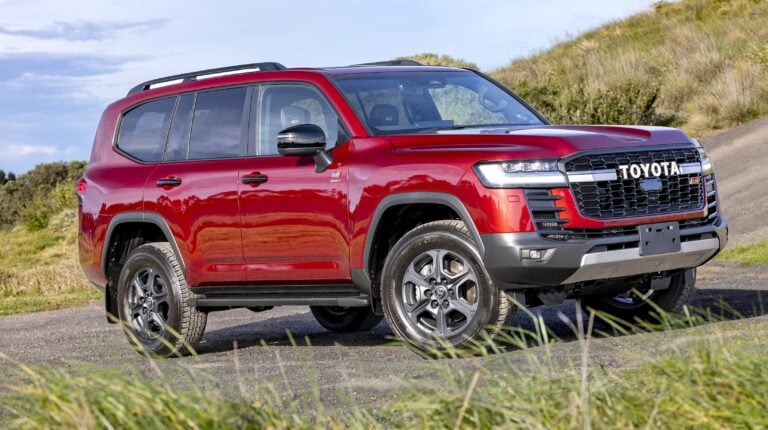 News
NewsToyota expands hybrid line-up starting with Landcruiser 300 Series
LandCruiser 300 Series to debut new performance hybrid in 2026.