
Say we blindfolded you. Could you guess a Wheels comparison test based on the sounds of the cars arriving? (Ignore the zip-tied wrists and pillowcase over your head. That’s just for added effect.)
A burbling V8 might suggest a Ford Mustang – taking on something like a Toyota Supra, if you also identified a bassy straight-six. The utilitarian thrum of turbodiesels might signal a coming together of dual-cab utes. But what if you heard a sound like someone holding down half a dozen random keys on a keyboard?
Electric vehicles (EVs) would be a good guess, but today, the cars arriving are hybrids. The eerie, synthesised hum you’re hearing is an Acoustic Vehicle Alerting System (AVAS for short).
Soon, Australian city streets will hum with various digitised tones from EVs and hybrid cars. From November 2025, they all must be fitted with this system, which installs external speakers beneath the bodywork, producing artificial sound up to 20km/h to warn pedestrians who are, in theory, a bit too used to the noise of an approaching combustion engine.
The car companies can use whatever track they like and for this test, there’s the unmistakeable din of different AVAS systems in the Wheels carpark as we bring together four different hybrid systems – a top-seller, and three in close pursuit.
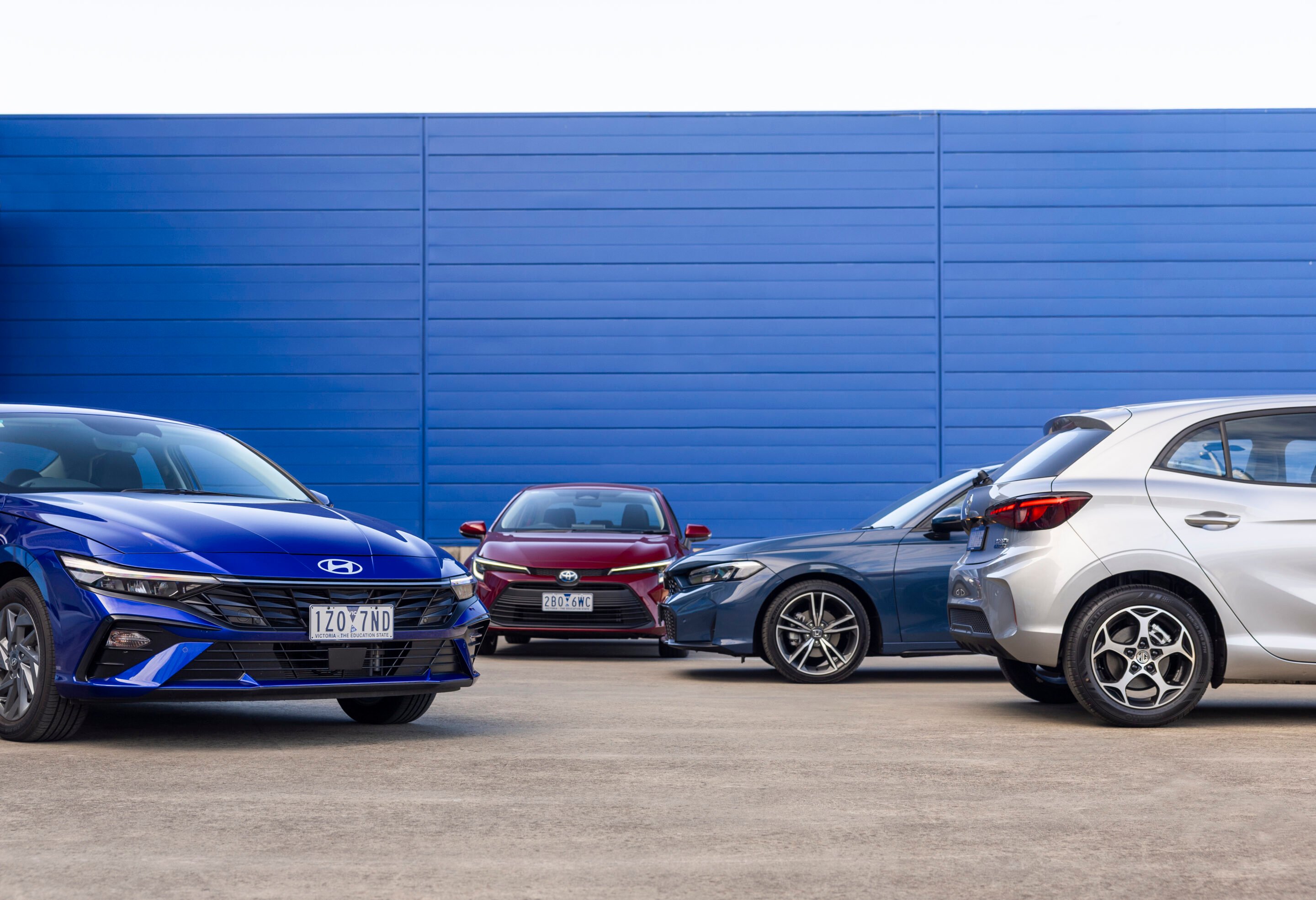
In 2025, hybrid is one of the hottest words in the Australian new car market, with sales of this type of vehicle up 80 per cent year-on-year in 2024. Australia’s top-selling non-ute was the eponymous Toyota RAV4 Hybrid. In a cost-of-living crisis, hybrids are luring Aussies with the promise of fuel bills cut almost in half, and strong resale values. That’s especially true of those still too nervous to go full EV, if not for range anxiety and having to deal with a still-fiddly public recharging network, but for residual values that haven’t quite found their footing.
The first hybrid on-test comes from the doyen of hybrids: Toyota. Between the RAV4, Corolla, Camry, Kluger and Yaris Cross hybrids, Toyota effectively owns the hybrid market in Australia.
Cars like the Toyota Corolla we have today can now only be purchased as a hybrid. Built on Toyota’s TNGA platform and having been around since 2018, the 12th-generation Corolla comes in hatch and sedan forms in Australia. We actually don’t mind the look of the sedan, especially given many hatch-based sedans of the past have resembled last-minute design studio rush-jobs.
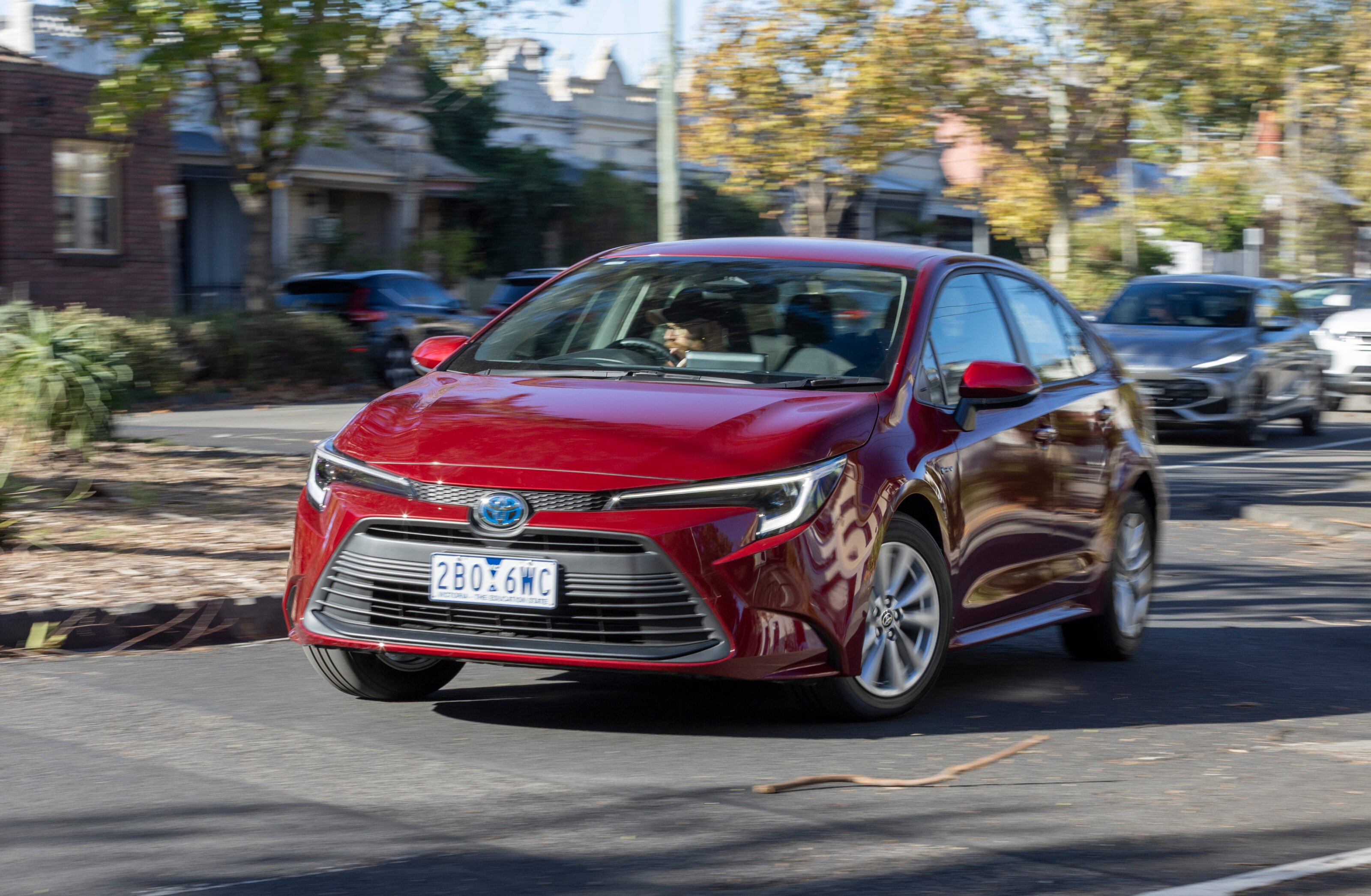
Behind its manga-inspired headlights, our Corolla Sedan Hybrid pairs a 72kW/142Nm, 1798cc Atkinson-cycle inline-four with two electric motors (with outputs of 70kW/185Nm) and an “eCVT” which uses planetary gears to achieve its infinite possible gear ratios, instead of the traditional belts. Driving the front wheels only, the Corolla Sedan Hybrid’s combined power is 103kW and claimed combined consumption is 3.9L/100km. The lithium-ion battery is 1.3kWh and the car we have is the Spartan, Uber-spec, base Ascent Sport with an MSRP of $32,320.
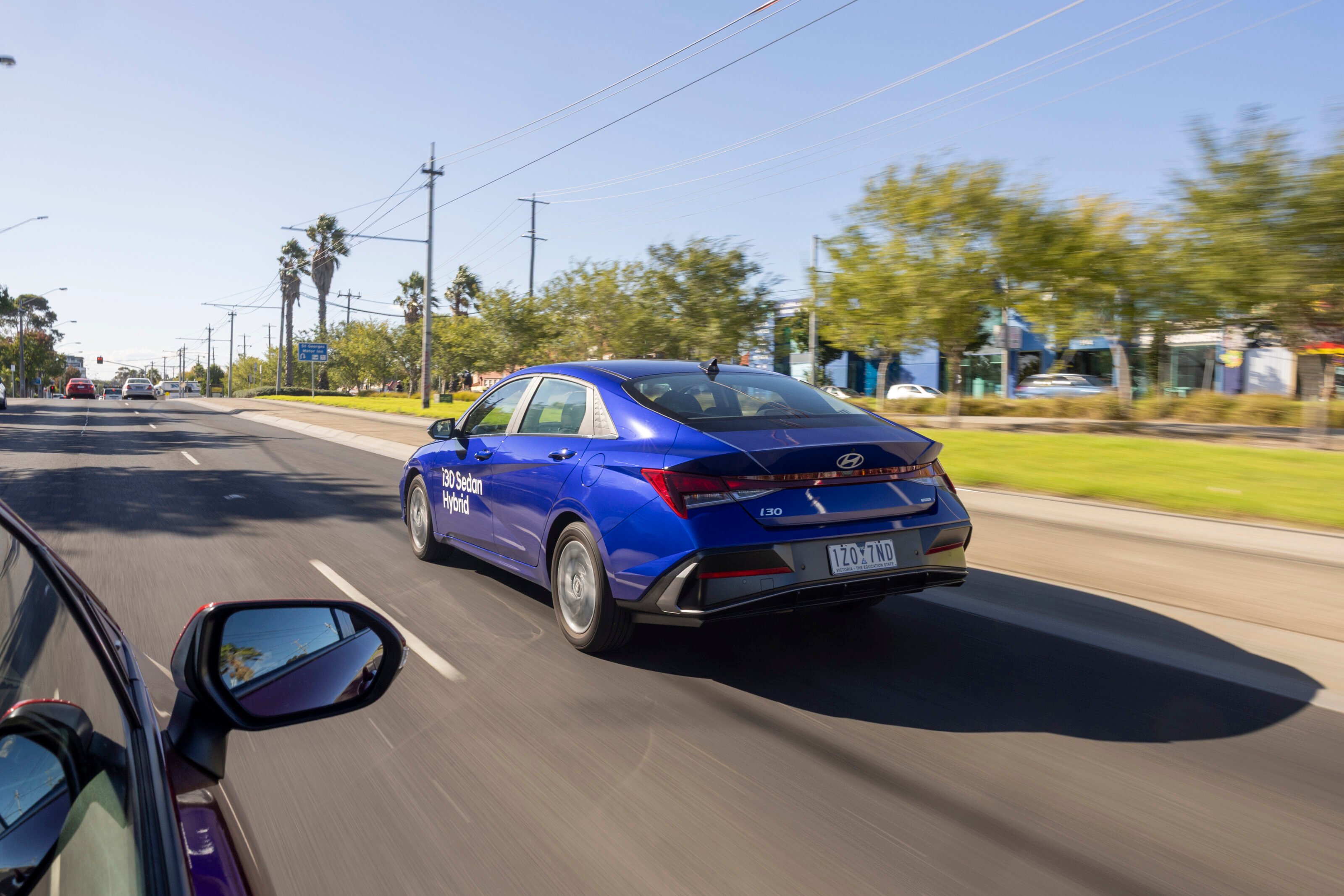
Just as Uber-ready, and looking like it’s narrowing its eyes and furrowing its brow like you’ve somehow offended it, is our first challenger: the Hyundai i30 Sedan Hybrid. Hyundai is leading efforts to dislodge Toyota’s hybrid hegemony, and has made amazing inroads with its own technology.
To just about everywhere outside of Australia, this car is called the Elantra, including its main market, the USA. The seventh-generation Elantra, or i30 Sedan Hybrid, does something the Toyota doesn’t – it fits a proper transmission. Its Atkinson-cycle, 1580cc inline-four produces 77kW/147Nm in isolation, but is then coupled with a single 32kW/170Nm electric motor. The system incorporates a six-speed dual-clutch transmission with a total output of 104kW, all going to the front wheels only. Storing recuperated energy otherwise lost to heat in the brakes is a 1.32kWh lithium-ion battery mounted under the rear seats.
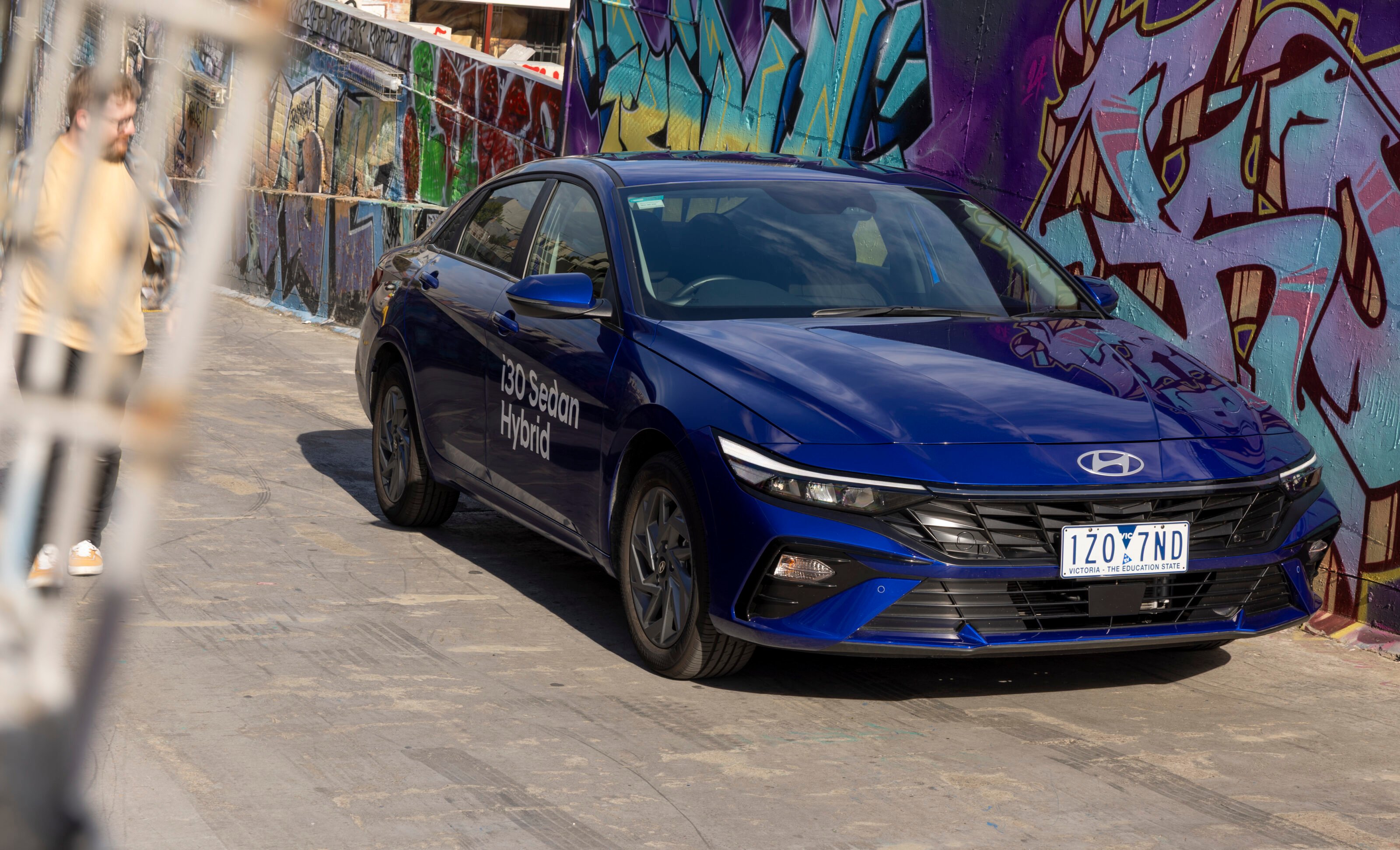
Claimed combined efficiency is 3.9L/100km while our long, swoopy test car is again cloth-upholstered inside and boggo, base-spec. It’s all yours for $33,000 MSRP.
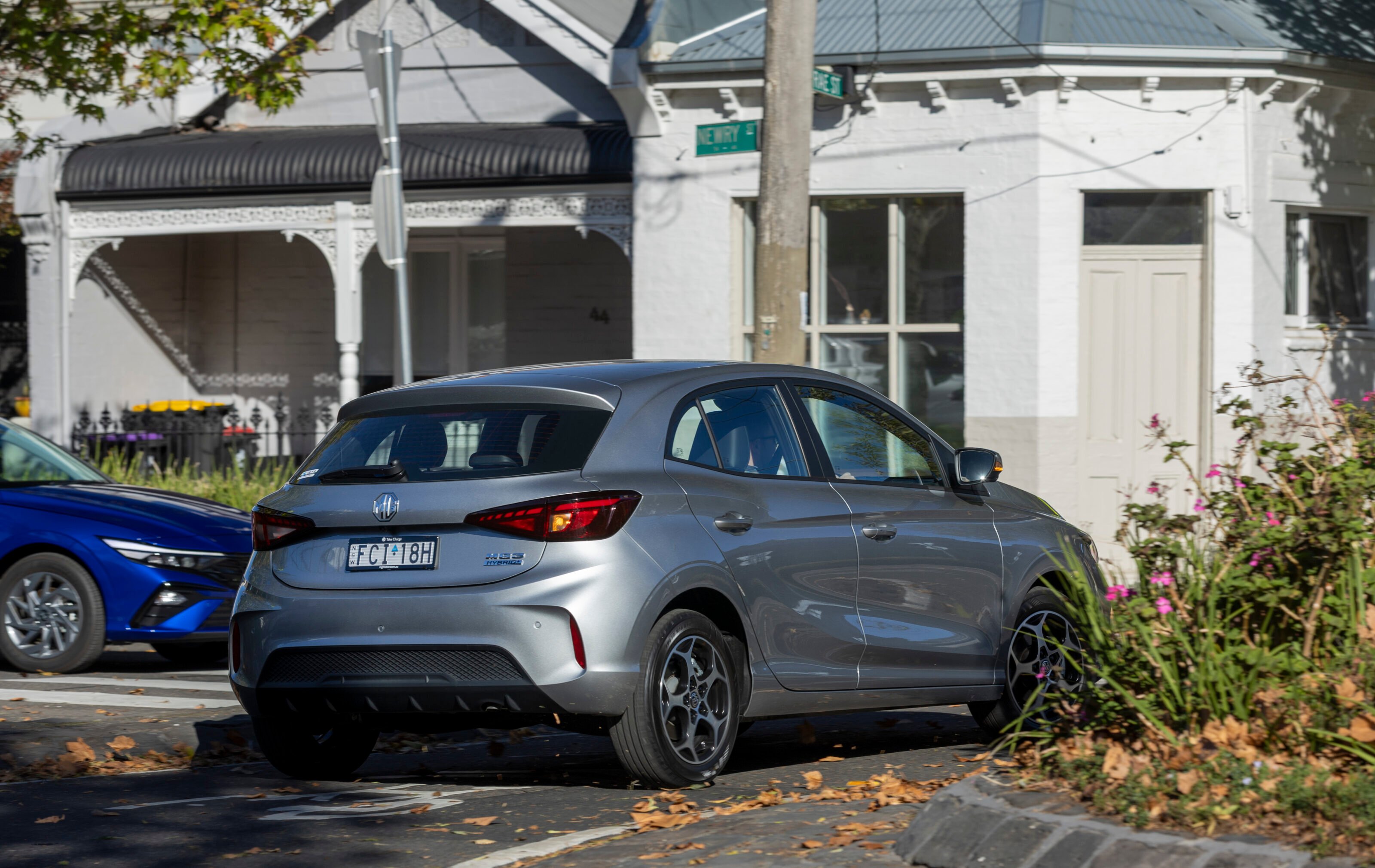
At $29,990 MSRP, undercutting both of them on price, and besting them on standard equipment, is a car Toyota and Hyundai would probably prefer didn’t get an invite to the party: the newly hybridised,
second-generation MG3 light hatch.
As the top-selling Chinese brand in Australia in 2024, MG also ranked number seven on the overall 2024 sales charts ahead of even Nissan. Like many of its compatriot brands, MG is hungrier for Aussie customers than a panda in want of a bamboo bush. The Chinese, with their own hybrids, are now muscling in on traditionally Japanese turf.
Australian consumers are the great winners here as Chinese cars rapidly improve. Sit in a MG3, much like its fully electric MG4 hatchback brethren, and for the price it’s asking, it’s impossible not to be impressed.
As for under the bonnet, the main claim-to-fame of MG’s new hybrid system – fitted to MG3 but also the recently launched all-new ZS small SUV and soon, the HS mid-size SUV – is a larger battery and more powerful electric motor than its hybrid rivals.
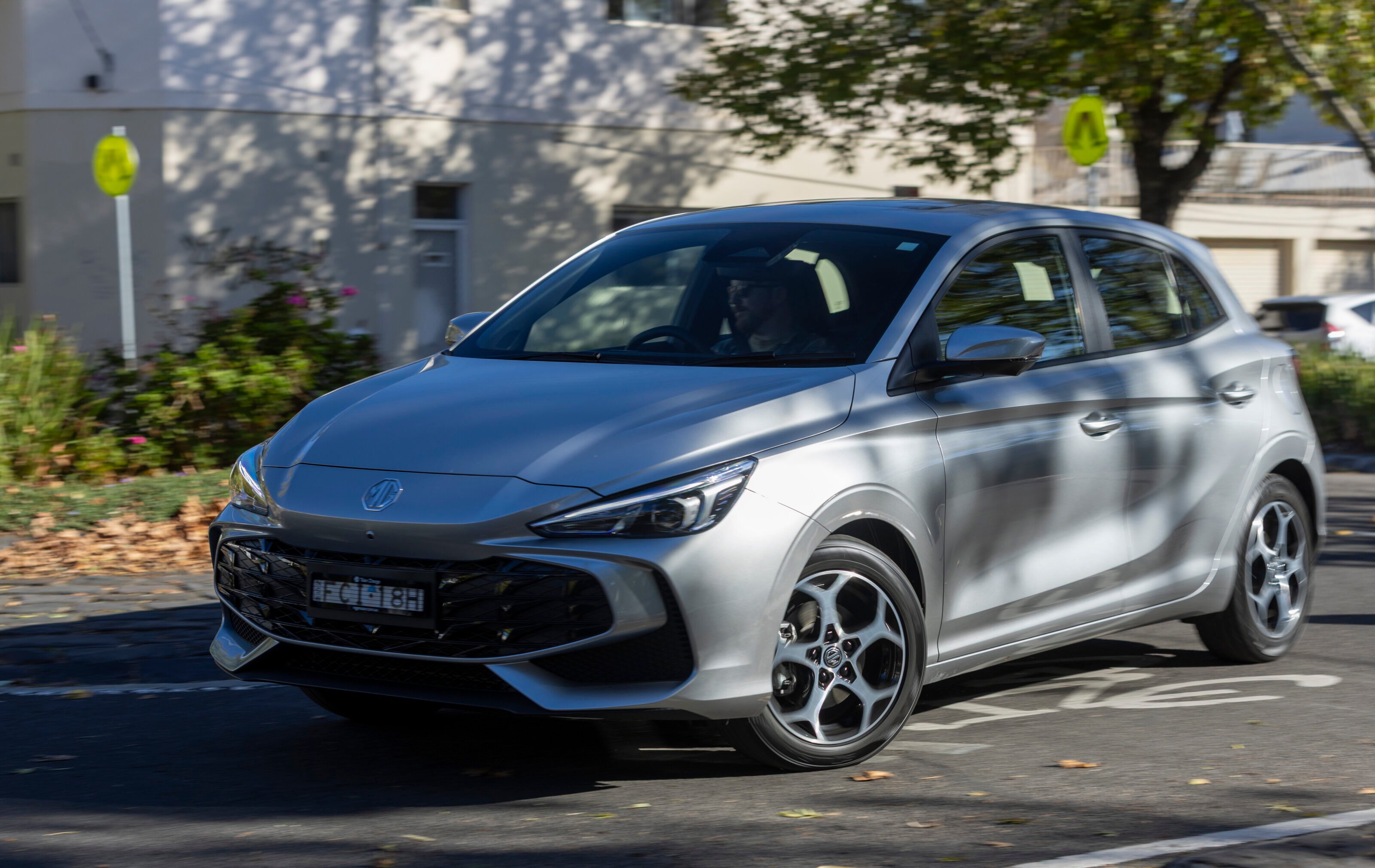
In the MG3 light hatch’s case, a 75kW/128Nm, 1498cc four-cylinder engine works with a grunty 100kW single electric motor and 1.83kWh lithium-ion battery for a combined power output of a slightly startling 155kW. That’s 50 per cent more power than the Corolla and i30, in a lighter vehicle. Interestingly, part of the MG’s front-drive, hybrid powertrain is a three-speed automatic transmission. Our MG3 HYBRID+ Essence test car claims combined consumption of 4.3L/100km.
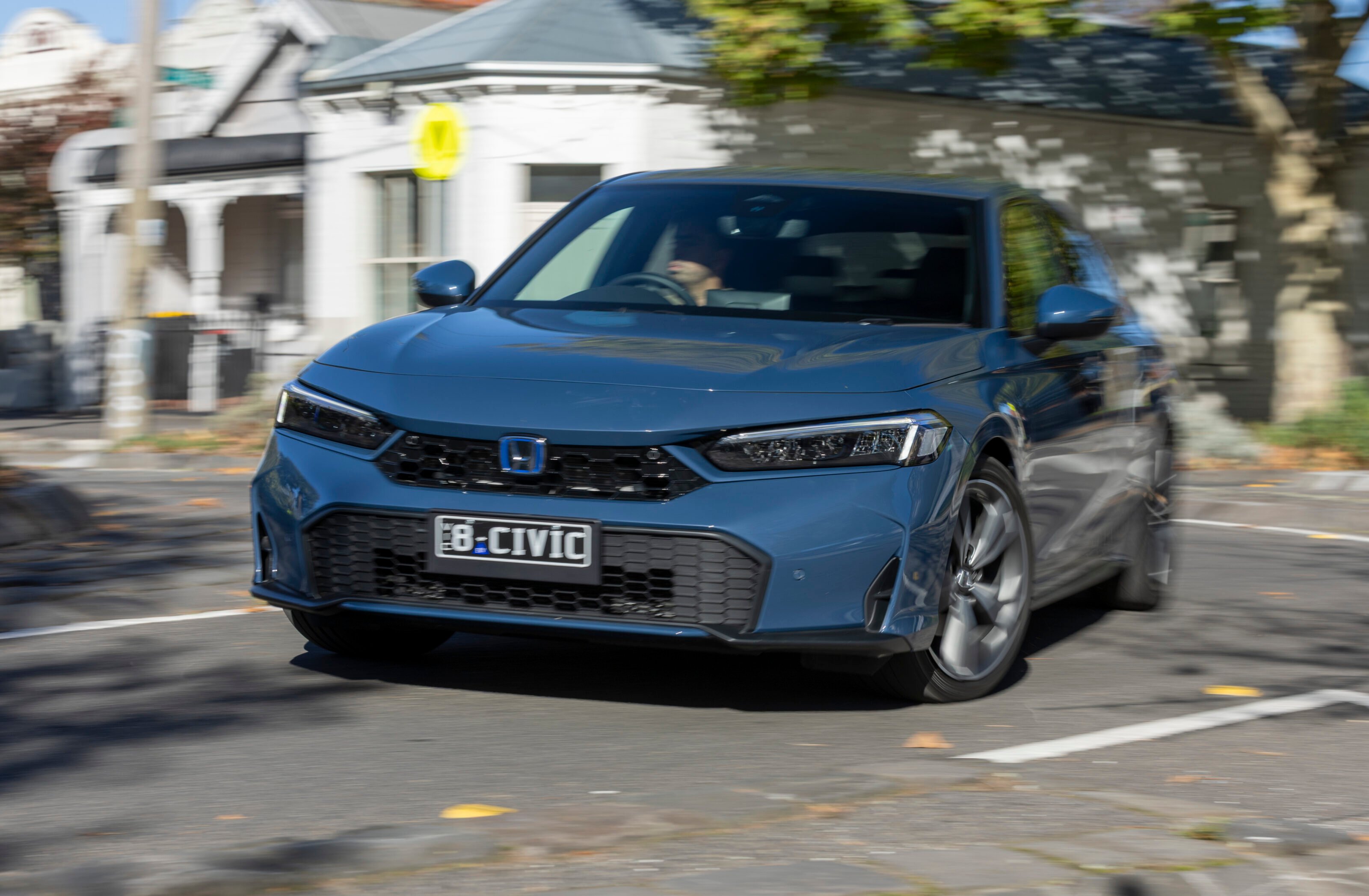
Our last competitor could claim similar hybrid heritage as Toyota. The slippery Honda Insight took on the Prius and made its mark, and now its hybrid DNA lives on in cars like the 11th-generation Civic hatchback.
With a price tag of $55,900 drive-away (quite a lot for a Civic), today’s eHEV LX tops a two-variant range and even the ‘base’ eHEV L is just shy of $50K drive-away. Both cars come loaded with standard equipment and represent efforts by Honda, locally, to extricate itself from the piranha pool of the low-cost market now dominated by the Chinese, and position itself as something more aspirational.
These days the size of a medium sedan from yesteryear, the Civic is, to my eyes at least, the best-looking car on-test. I love the classic, five-spoke, 18-inch wheels which sit beautifully at each corner.
The Civic is also the closest car here to a pure series-hybrid (which means the car is always powered by electric motors, and the combustion engine is just a ‘generator’) – but not fully.
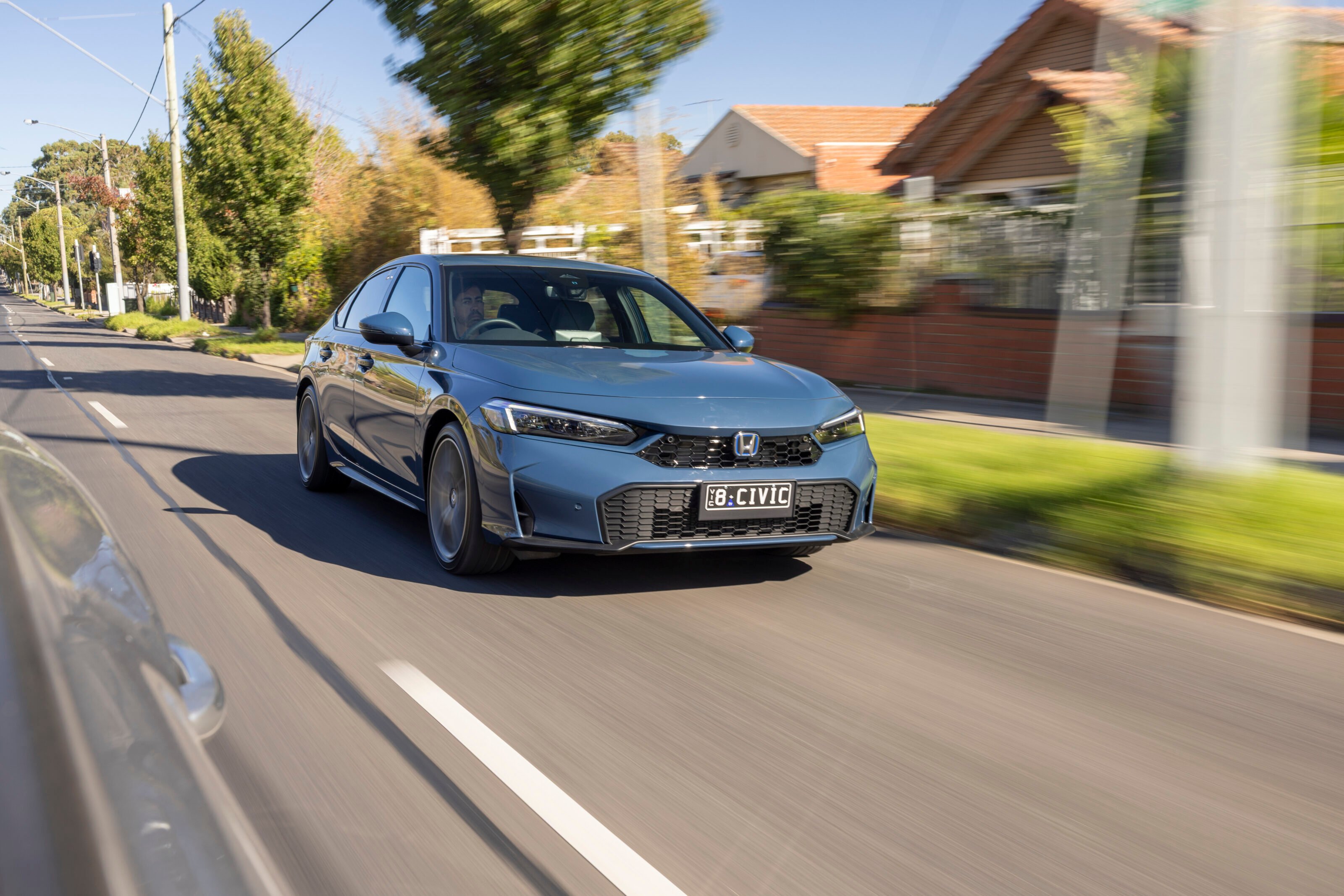
The Civic has the largest combustion engine present with a 1998cc inline-four, again running an Atkinson cycle (and a heady 13.9:1 compression ratio), producing 105kW/186Nm. Twin electric motors output 135kW/315Nm, driving the front wheels only. Honda says it has an “eCVT” but this car has no transmission at all – just a single gear with a 1:1 ratio and a lock-up clutch. At highway speeds, the clutch can connect the combustion engine directly to the wheels as needed. The battery, meanwhile, is the smallest here, a 1.05kWh unit. Honda claims combined economy of 4.2L/100km.
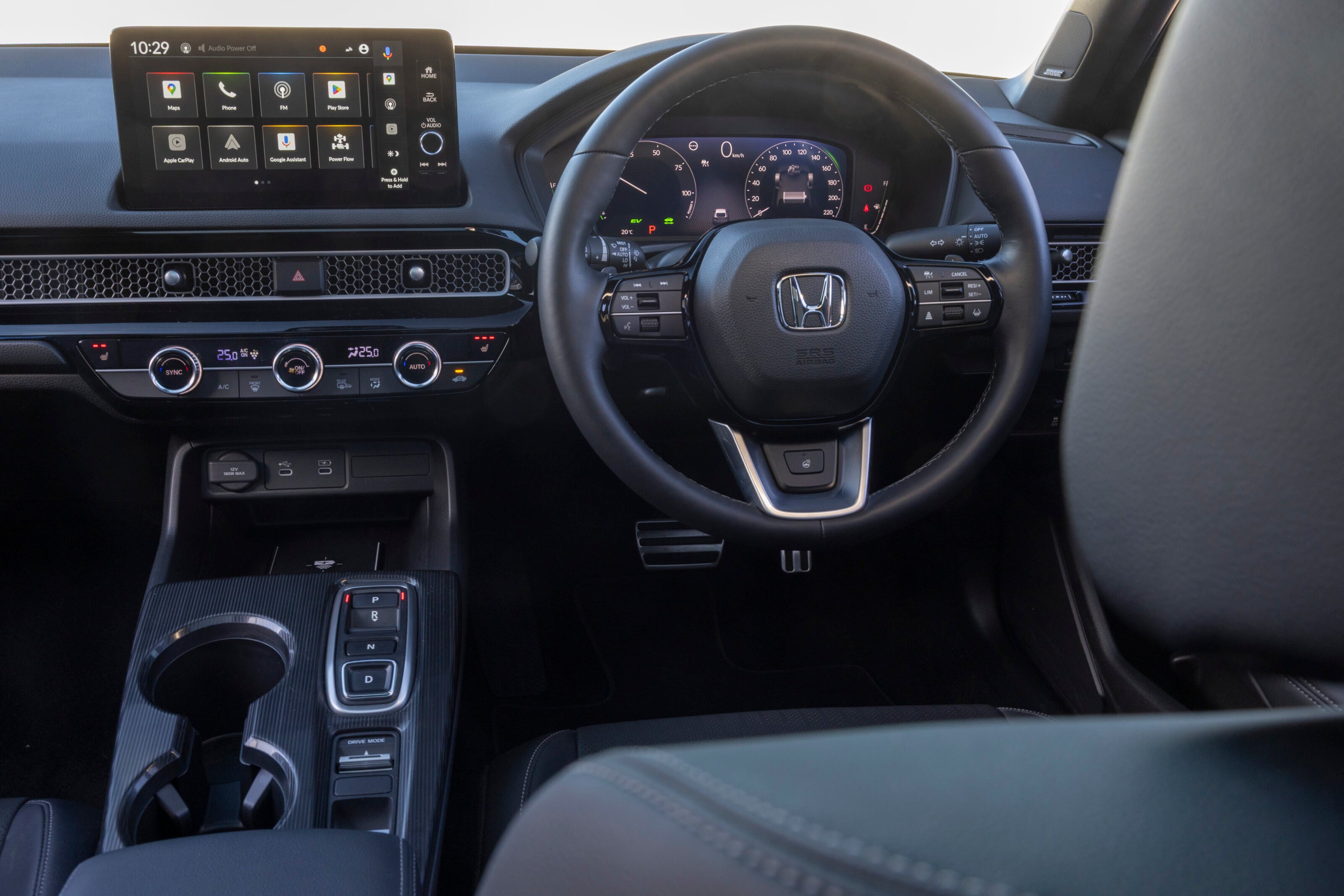
The brand that brought us the NSX and S2000 has very much delivered on interior quality with this Civic, as well. The first thing you notice is the seating position which is more rear-drive sports car than front-drive, five-door hatchback, mounting your hips low in figure-hugging seats. The leather steering wheel is the perfect diameter, perfect angle and is perfectly placed. And forget the Toyota and Hyundai (let alone the MG), the Honda’s cabin materials and build quality are in another league. This is a Japanese BMW.
With plenty of space and all the tech you could want, it’s the row of heating-cooling buttons and dials – which click mechanically and satisfyingly – that is novel. You’ll be tweaking the fan speed up and down just to enjoy the buttery click of the dial.
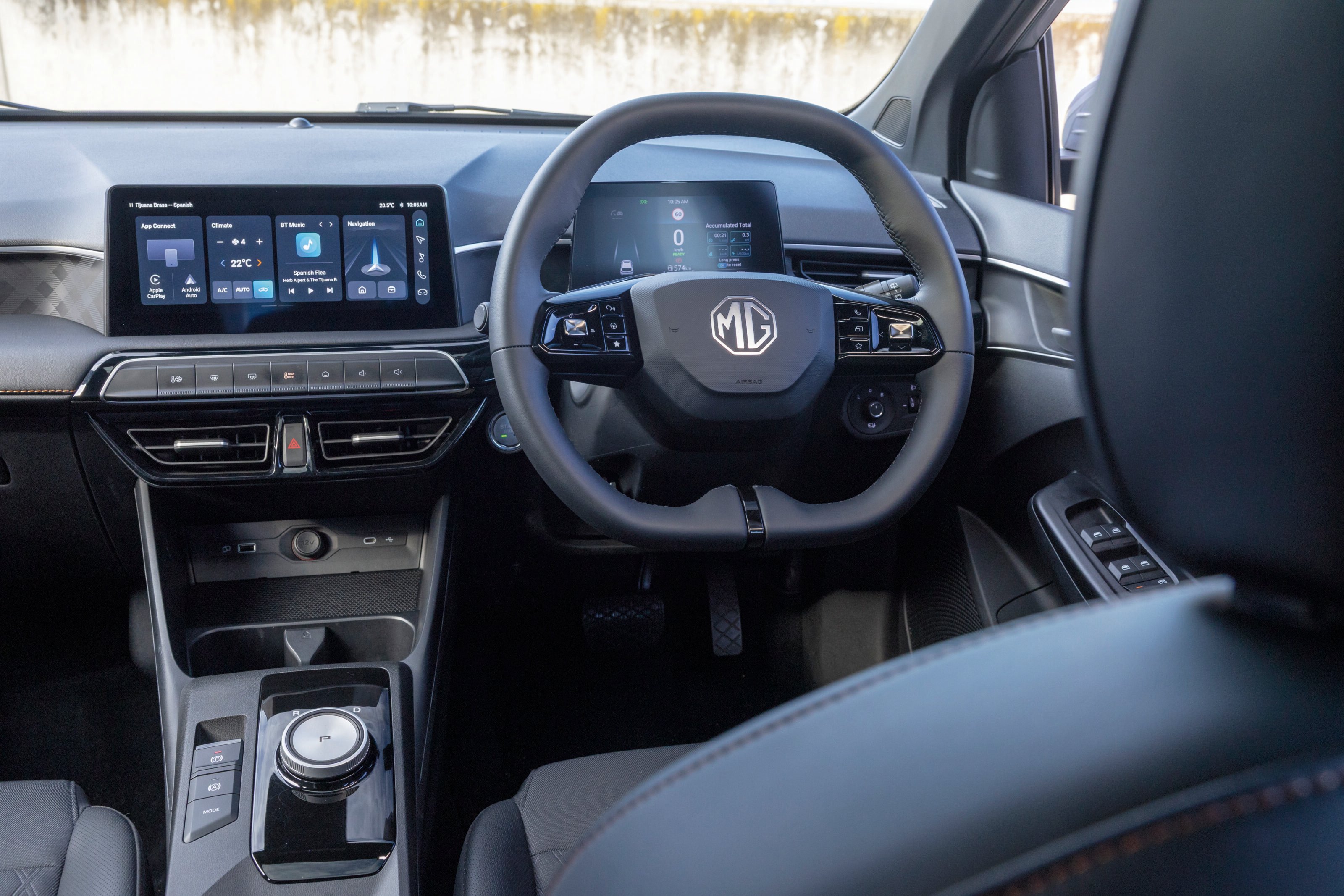
The Toyota and Hyundai continue to offer buttons for the heating and cooling, too, although they’re somewhat more functional. Still, it’s preferable to the MG which has migrated every function, including heating and cooling, regrettably into the central infotainment system.
Much like the Honda, the Hyundai has plenty of interior space and a funky, futuristic design, although given the spec and price difference, it’s a decidedly more austere experience. Same with the Corolla, with its polyurethane steering wheel, manual, cloth seats, and comparatively narrow cabin. The skinny centre console almost looks squeezed between the front seats. In fact, this is the narrowest car here. Even the MG is wider.
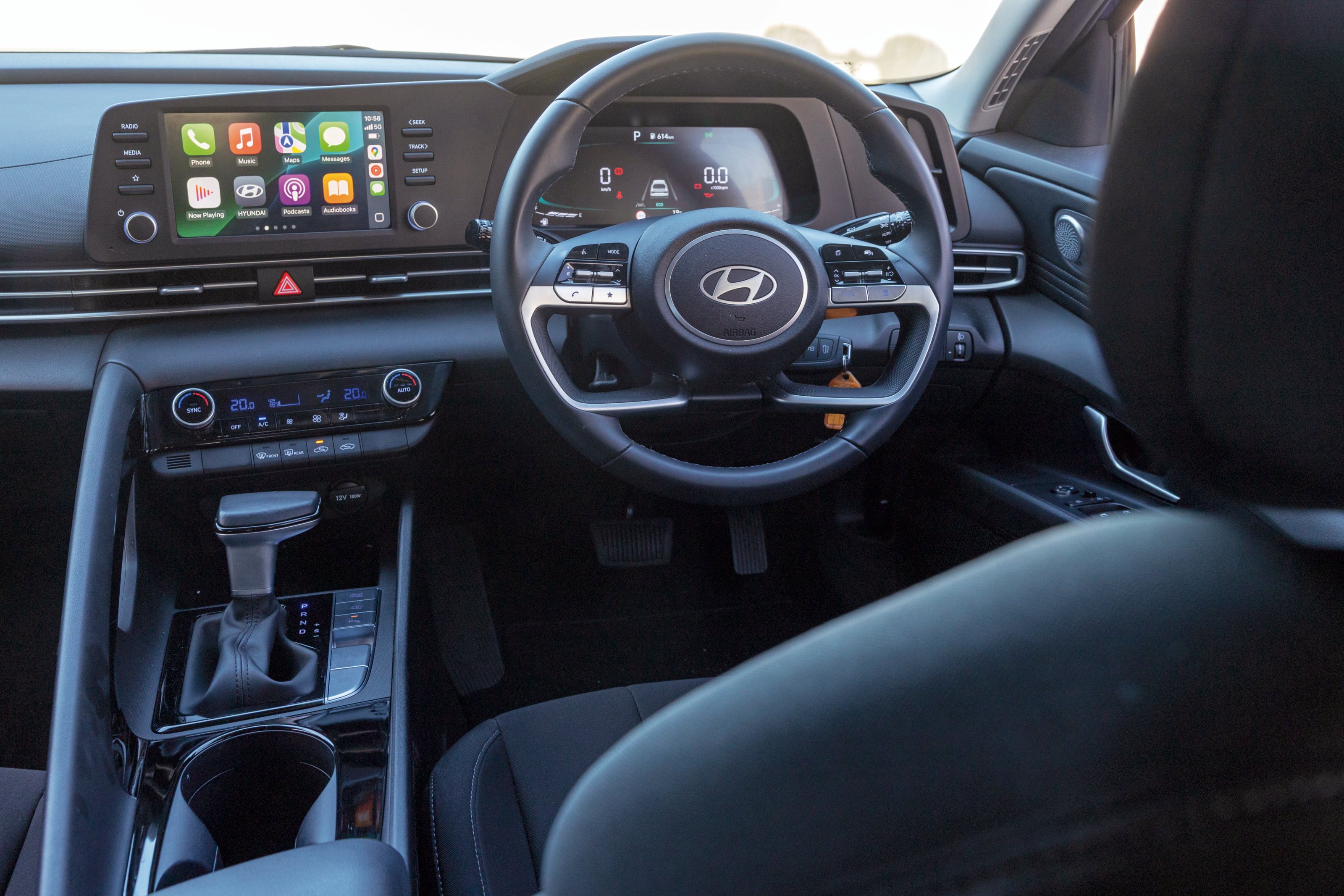
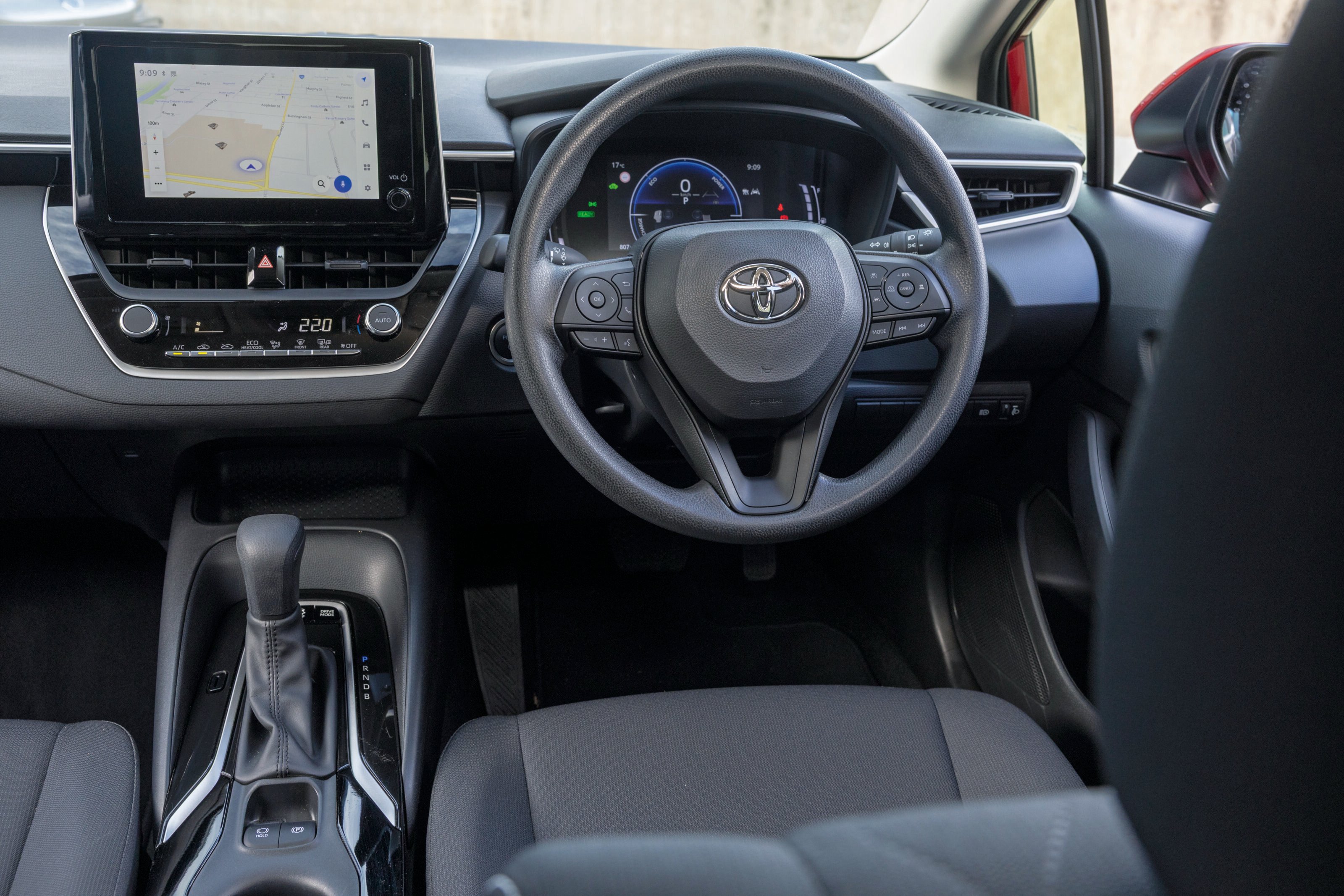
And the Corolla feels the oldest. That’s especially true jumping straight into the MG with its smart, contemporary interior design. Credit to MG, it tries a lot harder than Toyota to please its owner with little splashes of funky patterns and colour.
For space, too, it’s quite a large interior for a light hatch, although the lack of steering wheel reach adjustment means you can’t sit yourself quite as comfortably as the other cars. The interior also doesn’t feel as good as it looks, whereas the opposite is true of the Corolla.
But on the whole, for interior space, design, quality and technology, it’s Honda, then daylight to the rest.
Most of these cars will spend their lives huddled in the herd of everyday traffic, regularly stopping and starting in a perfect hybrid habitat. In the urban environment of inner-city Melbourne at least, there’s one car that initially stands out for its low-speed manners.
The Toyota is breathlessly easy to drive in the city. The controls feel great, and it might be made of plastic but there’s something about a thin-rimmed steering wheel. The steering itself is effortlessly light, the turning circle tight and U-turns are so easy, they’re almost executed using nothing but thought alone.
Just off throttle tip-in, the Corolla gives its driver a lovely vein of responsive, eager electric motor torque. The CVT powertrain is smooth, quiet, efficient and for the large part invisible – just as it should be. Sprung for ride quality, the suspension glides over most inner-city bumps. If you had to do thousands of inner-city kilometres each week as an Uber driver, the Corolla would be a fine companion.
It’s a similar story for the Hyundai although it loses some marks for ultimate smoothness because of its dual-clutch gearbox. We could be imagining it, but it almost feels like the electric motor is driving through the transmission, meaning the perceptible clacking of first to second gear when motoring off using only the electric motor. The car also seems to need a moment to think when selecting reverse. For the most part, however, the powertrain is smooth, the transition from electric motor to combustion engine minimally noticeable and the ride quality comfortable. Another car competently prepared for the Uber grind.
The MG3’s hybrid system works well and you’re aware you have a bit more electric muscularity under your right foot than some of the other cars here. That means looking down to see you’re shifting along using only the electric motor right up to speeds of 60km/h or more. Although compared with the other cars here, it somehow feels less refined – even using a supposedly inherently smooth and quiet electric motor. We don’t doubt MG has come a long way, and the MG3 is on another planet to the brand’s earlier cars, but when it comes to the driving details, it still feels a bit of a crude thing.
The Honda is the most grown-up city car here. It feels the largest but its major controls are also the best calibrated. Selecting drive takes a simple press of a button on the neat and compact shift-by-wire console. The well-weighted steering is a delight to use, as are the brakes. The recuperation is so imperceptible you’d assume an uninterrupted mechanical connection between your foot and the brake pads and discs. Honda has done a magic job of the software here.
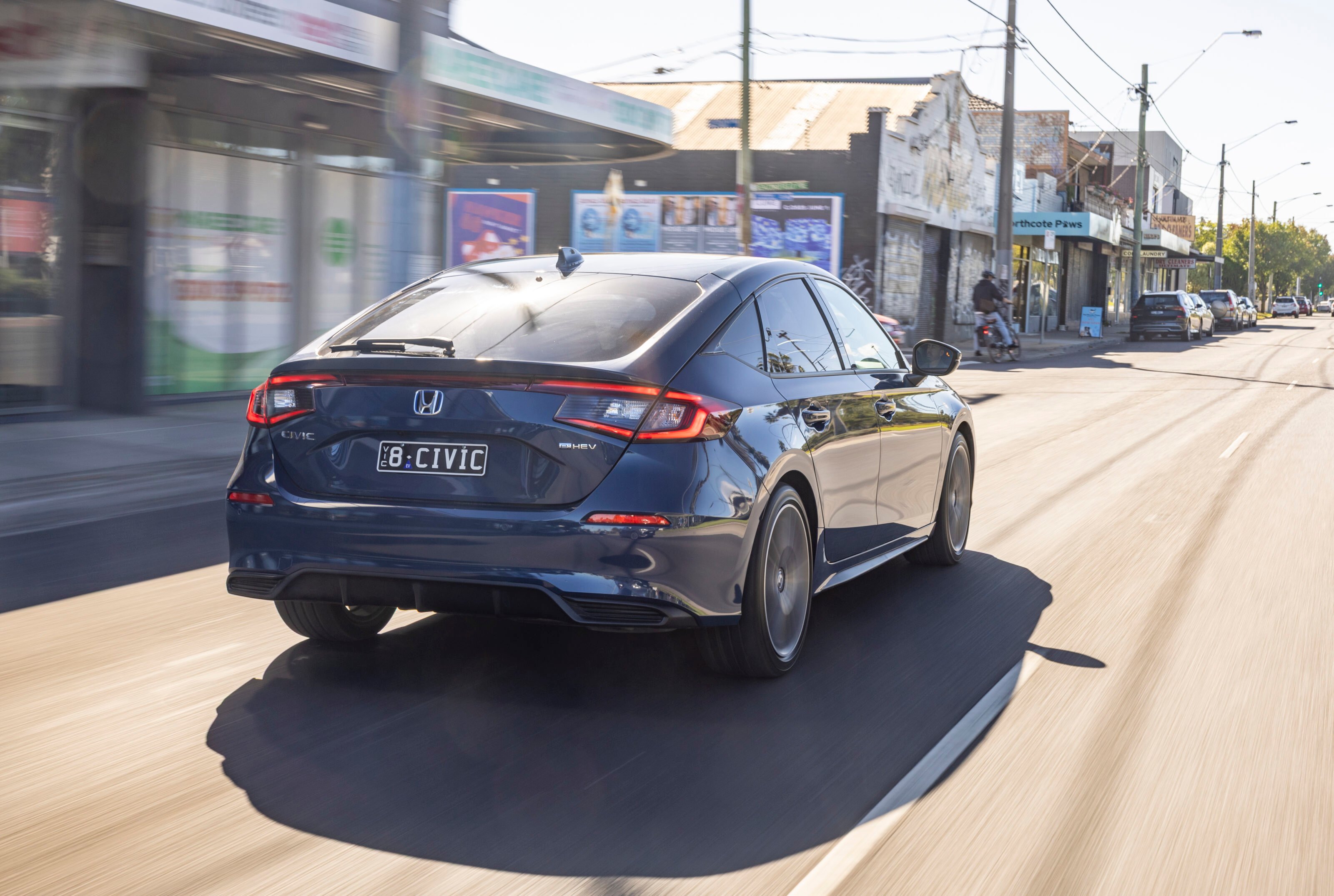
The Honda’s ride quality is the firmest with a bit of a sporting edge, but it’s never uncomfortable. The electric motors provide plenty of near-silent urge, making the Civic eHEV a joy to drive.
If we had to penalise the Civic for anything, it would be the 235-section Michelin Pilot Sport 4 tyres which can pump a surprising level of noise, vibration and harshness into the cabin. A quieter, less-sporty tyre may have been a more considered choice for this car. What the Michelin does hint at, however, is some serious dynamic ability. And that’s absolutely the case.
After a brief motorway stint, we find ourselves on a winding road to test the dynamics of these hybrids – and to see who’s hot, and who’s just flustered.
We start in the Civic. In its Sport mode, there’s decent acceleration – if nothing hair-raising – and it punches out of corners with eager torque from its electric motors, if never bothering traction. The brakes offer tremendous feel into corners, and the direct and tight steering allows the effortless aiming of an eager nose to the apex. The Civic sits flat through corners with a surprising amount of grip, partly courtesy of its independent rear suspension. Dynamically, this is a very competent car, and it feels fast. There’s depth that invites you to dig deeper and push harder. It’s begging for grippier tyres.
You can’t help but wonder if Honda created the current Civic around the Type R, and spun-off some hybrid, mass market variants below it – rather than the other way around.
Curiously, the powertrain simulates a transmission with gear changes and a bit of not-unappealing, rorty fake induction noise, to the point that you’d almost wonder if it’s been keeping a dual-clutch secret from you this entire time. (Sadly, the steering wheel paddles don’t simulate gear changes – they only adjust the brake regeneration levels. If only they did.)
Jumping into the Corolla after the Civic feels like giving it a hard act to follow, especially as we manually adjust the cloth driver’s seat and grip the plastic steering wheel. But the Corolla is a surprise. While it’s not as fast and grippy as the Civic, the steering rack is fast, the brakes feel good and it has more than enough acceleration to exploit the skinny, efficiency-focused tyres.
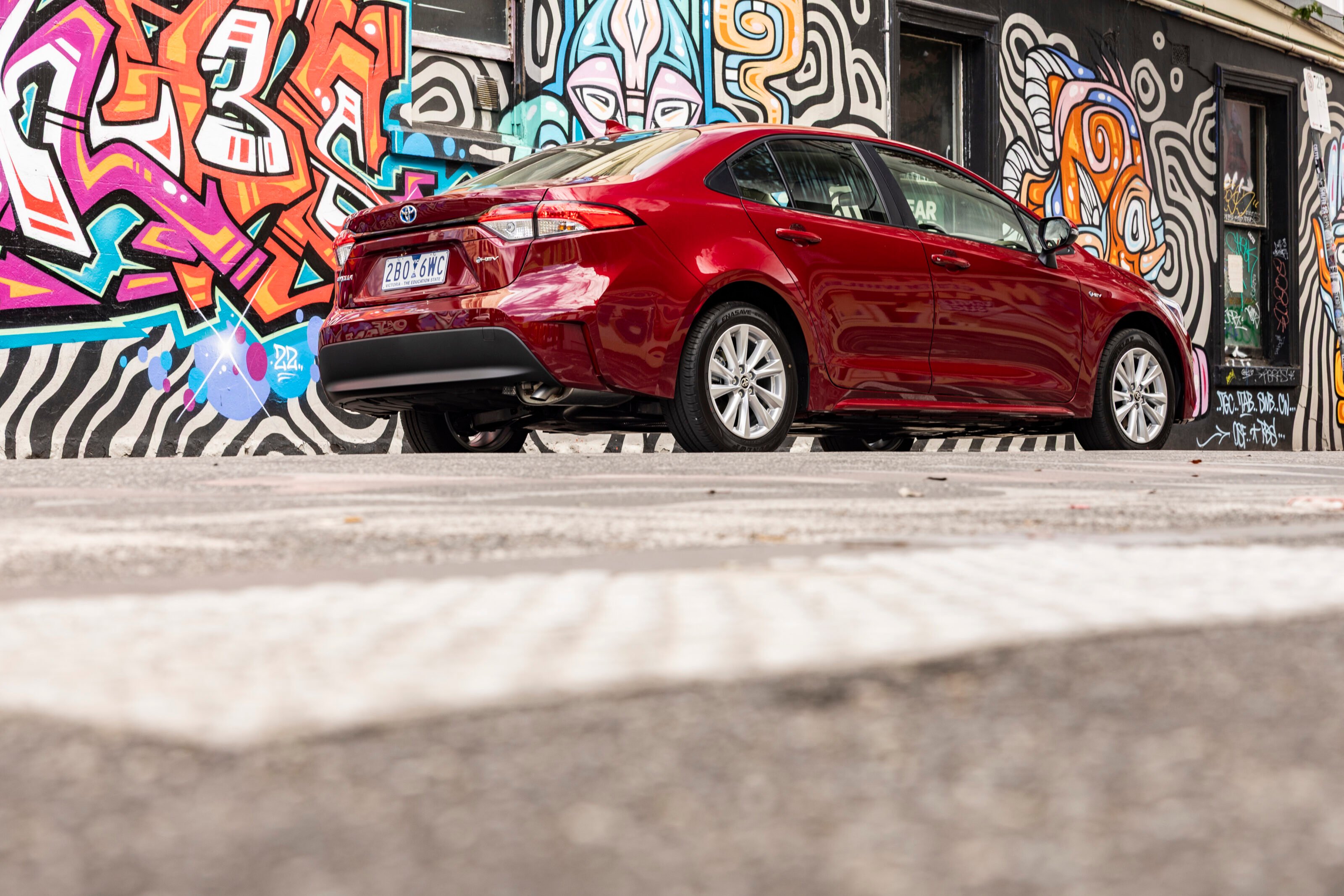
And there’s a bit of sparkle to the chassis, whose soft but never wayward suspension moves through elegant arcs. There’s almost a bit of ND Mazda MX-5 about it. It’s fun. The Corolla’s narrow dimensions also mean you can carve a bit of a line through your typical lane, one which the Civic filled.
It doesn’t sound as good as the Civic – under full throttle, the engine drones in higher revs courtesy of its soul-sapping CVT. But as a package, the 1430kg Corolla is surprisingly engaging. It’s no wonder it so successfully spawned a GR derivative.
It’s a similar story for the Hyundai, and at this point it’s not hard to tell the three cars here all with independent rear suspension that have all successfully underpinned performance variants.
The teetotaller baby brother of the i30 Sedan N, you can pop the Hyundai into manual mode and enjoy playing with some gears, although don’t expect a surprise DSG as economy still very much rules the day. Responsiveness is tepid at best.
The 1360kg Hyundai’s chassis doesn’t quite have the fizz of the Corolla’s, but it attacks corners with competence and zeal, enough to encourage you to push harder and harder. The engineering fundamentals clearly run deep, and there’s fun to be had – if you don’t roast the brakes.
Which leaves one last car. And of all the hybrids present, it was with a mix of curiosity and trepidation we jumped into the MG3. Its Torsion beam rear suspension has served generations of French hot hatches very well, but a French hot hatch the MG3 isn’t.
With a higher seating position and low scowl, there’s very much the sensation of sitting ‘on’ the MG3 rather than ‘in’ it. To its credit, however, if we held a drag race, there could be a massive upset in this crowd.
Put your foot to the floor and there’s a good moment as the car thinks about what you’re asking of it, shuffles to the lowest of its three gears and orchestrates a slightly unnerving coming together of hydrocarbons and electrons. In the MG3’s case, that’s 155kW and a healthy 425Nm – enough to make this little hatch plenty brisk in a straight line.
What it also does, along with the 1308kg kerb weight (quite portly for this size of car), is make the chassis feel easily overwhelmed. The handling is better than you might expect, but the large power, large weight and smaller footprint mean the MG3 feels nervous and twitchy on the way into, and in the middle of, corners. The steering is woolly and vacant, and there’s no way to manually change gears. The engine sounds like it’s not having fun, and ultimately to punt an MG3 hybrid hard is to feel like you’re making it do something it really doesn’t want to.
Of course, few owners of these cars will be taking them to a winding road and subjecting them to such misuse. Zero to 100km/h will matter much less than L/100km. On our test, the Hyundai recorded an average consumption of 5.3L/100km, while the Toyota was just ahead with 5.2L/100km. The MG crept in next with 5.05L/100km, although it loses a few marks here for needing 95RON premium unleaded fuel. All the others take 91RON.
The Honda, surprisingly, did 4.6L/100km over the test on average. Take it all with a modicum of sodium, however, as we’d want to do a much longer drive of each before drawing any solid efficiency conclusions.
All infotainment systems work as you’d hope and have Apple CarPlay and Android Auto. For safety, both the MG3 and i30 only scored three stars in ANCAP crash-testing, but under the newer, stricter 2024 regimen. The Honda scored five stars in 2022 but probably couldn’t again in 2024. The Corolla is so old now, its 2018 five-star rating has expired.
For back seats, all can fit two adults reasonably comfortably, although the i30 wins for outright space and the Honda for ambience. The Corolla gets some demerit points for the absence of rear air-vents and USB outlets. Dare we say, if the Corolla was a Chinese-made car, it’d get a bollocking for this.
For boots, predictably the MG’s comes in the smallest at 293 litres. No such concerns for the Corolla or i30 which, at 470 litres and 474 litres respectively, offer deep and truly Caprice-like luggage space for the size of car. The i30’s enormous boot opening resembles a giant mouth ready to swallow up several full-size suitcases. A tick for outright size, however no external button to open the boot, at all, seems extraordinary in 2025. And especially for a vehicle likely to pound the Uber pavement. The Honda one-ups them all, however, for its liftback granting easy, almost top-down access making the most of every one of its boot’s 409 litres.
For warranties, it’s an easy win for the MG which, with its 10-year, 250,000km offering, has twice the warranty of the rest. That also covers the battery. Honda is next, warranting your Civic for up to eight years provided you get it serviced to schedule and at a Honda dealership. Hyundai and Toyota offer standard five-year, unlimited kilometre policies. Hyundai will cover the hybrid battery for eight years or 160,000km. Toyota covers its hybrids’ traction battery for 10 years.
Proving, as ever, the financial devil can be in the detail, the Honda might be the priciest vehicle here but at $995 over five years, it’s the cheapest to service by a long way. The Toyota is next at a reasonable $1225, the Hyundai $2180 and the MG a surprisingly pricey $2423 over five years.
We said at the start of this story that this isn’t a direct comparison, and it isn’t. But we can leave today with a few final thoughts.
The MG3’s hybrid system is mighty impressive for what amounts to something of a first effort, and it will only get better, more refined and more efficient in time. The Japanese and Korean manufacturers can’t afford to rest on their laurels, sit still or not be hungry. And as a car, the MG3 shows just how far this brand has come in the last decade. It’s a pretty great little thing and it tries hard, especially for the price.
Hyundai has done a superb job creating a true, Toyota-rivalling hybrid system. In other comparison tests, we’ve found Hyundai’s hybrid system to match, or beat, the Toyota powertrain in a direct fight. Hyundai is doing exactly that across its range, from Kona to Tucson to Santa Fe – and i30 Sedan.
The Corolla, meanwhile, is incredibly frugal, and in a longer, more scientific test, we would still bet on it going the furthest for the least amount of fuel. The bigger surprise is just how well it drives. If only this grade didn’t make us feel like we had a stranger to pick-up.
Given it’s the priciest vehicle here, you’d hope it was the Honda we’d take home from this test – and it is. It’s a highly fuel efficient warm hatch. It’s the best driver’s car here by a mile, but it’s still lovely to drive around town. The interior quality is almost befitting a pricier car – that’s saying something given it already costs fifty-six grand. A Civic.
On the whole, the Civic eHEV removes the blindfold as to how complete, competent and even desirable a hybrid vehicle can be.
Specifications
MG3 HYBRID+ Essence
| Engine | 1498cc inline-4, DOHC, 16v |
|---|---|
| Power | 155kW |
| Torque | 425Nm |
| Battery | 1.83kWh |
| Transmission | 3-speed automatic |
| L/W/H/W-B | 4113/1797/1502/2570mm |
| Weight | 1308kg |
| Fuel consumption | 4.3L/100km (claimed) |
| CO2 emissions | 100g/km (claimed, combined) |
| Boot (L) | 293 |
| 0-100km/h | 4/5 |
| 0-100km/h | 8.0sec (claimed) |
| Warranty | 10-year/250,000km, 10-year roadside assistance |
| 5-year/50,000km service cost | $2423 |
| Price | $29,990 |
Hyundai i30 Sedan Hybrid
| Engine | 1580cc inline-4, DOHC, 16v |
|---|---|
| Power | 104kW |
| Torque | 265Nm |
| Battery | 1.32kWh |
| Transmission | 6-speed dual-clutch |
| L/W/H/W-B | 4710/1825/1420/2720mm |
| Weight | 1360kg |
| Fuel consumption | 3.9L/100km (claimed) |
| CO2 emissions | 92g/km (claimed, combined) |
| Boot (L) | 474 |
| 0-100km/h | 9.5sec (estimate) |
| Warranty | 5-year/unlimited km, 12-month roadside assistance |
| 5-year/75,000km service cost | $2180 |
| Price | $33,000 |
Toyota Corolla Sedan Hybrid Ascent Sport
| Engine | 1798cc inline-4, DOHC, 16v |
|---|---|
| Power | 103kW |
| Torque | 142Nm |
| Battery | 1.3kWh |
| Transmission | CVT |
| L/W/H/W-B | 4630/1780/1435/2700mm |
| Weight | 1430kg |
| Fuel consumption | 3.9L/100km (claimed) |
| CO2 emissions | 90g/km (claimed, combined) |
| Boot (L) | 470 |
| 0-100km/h | 8.1sec (estimate) |
| Warranty | 5-year/unlimited km, 5-year roadside assistance |
| 5-year/75,000km service cost | $1225 |
| Price | $32,320 |
Honda Civic eHEV LX
| Engine | 1993cc inline-4, DOHC, 16v |
|---|---|
| Power | 135kW |
| Torque | 315Nm |
| Battery | 1.05kWh |
| Transmission | 1-speed |
| L/W/H/W-B | 4569/1802/1415/2735mm |
| Weight | 1497kg |
| Fuel consumption | 4.2L/100km (claimed) |
| CO2 emissions | 96g/km (claimed, combined) |
| Boot (L) | 409 |
| 0-100km/h | 7.3sec (claimed) |
| Warranty | 8-year, unlimited km (conditional), 8-year roadside assistance |
| 5-year/50,000km service cost | $995 |
| Price | $55,900 (drive-away) |
The facelifted Genesis GV70 mid-size SUV went on sale in Australia in late 2024 and now, the electric Electrified GV70 has arrived. Priced from $132,800 plus on-road costs, the Electrified GV70 is again only available in one fully loaded Signature Performance trim level.
Like the petrol-powered GV70, the Electrified GV70 sports updated styling with new headlight designs, bumpers, wheels and front grille, while the inside has been gifted the same 27-inch OLED infotainment and digital driver’s display as the petrol GV70.
Under the skin of the Electrified GV70 is a new 84kWh high-density battery (up from 77.4kWh in the pre-updated model) giving a claimed WLTP-rated range of 462km – up from the pre-updated model’s 445km rating – with Genesis claiming that a 10 to 80 per cent charge takes just 19 minutes on a 350kW fast DC charger.
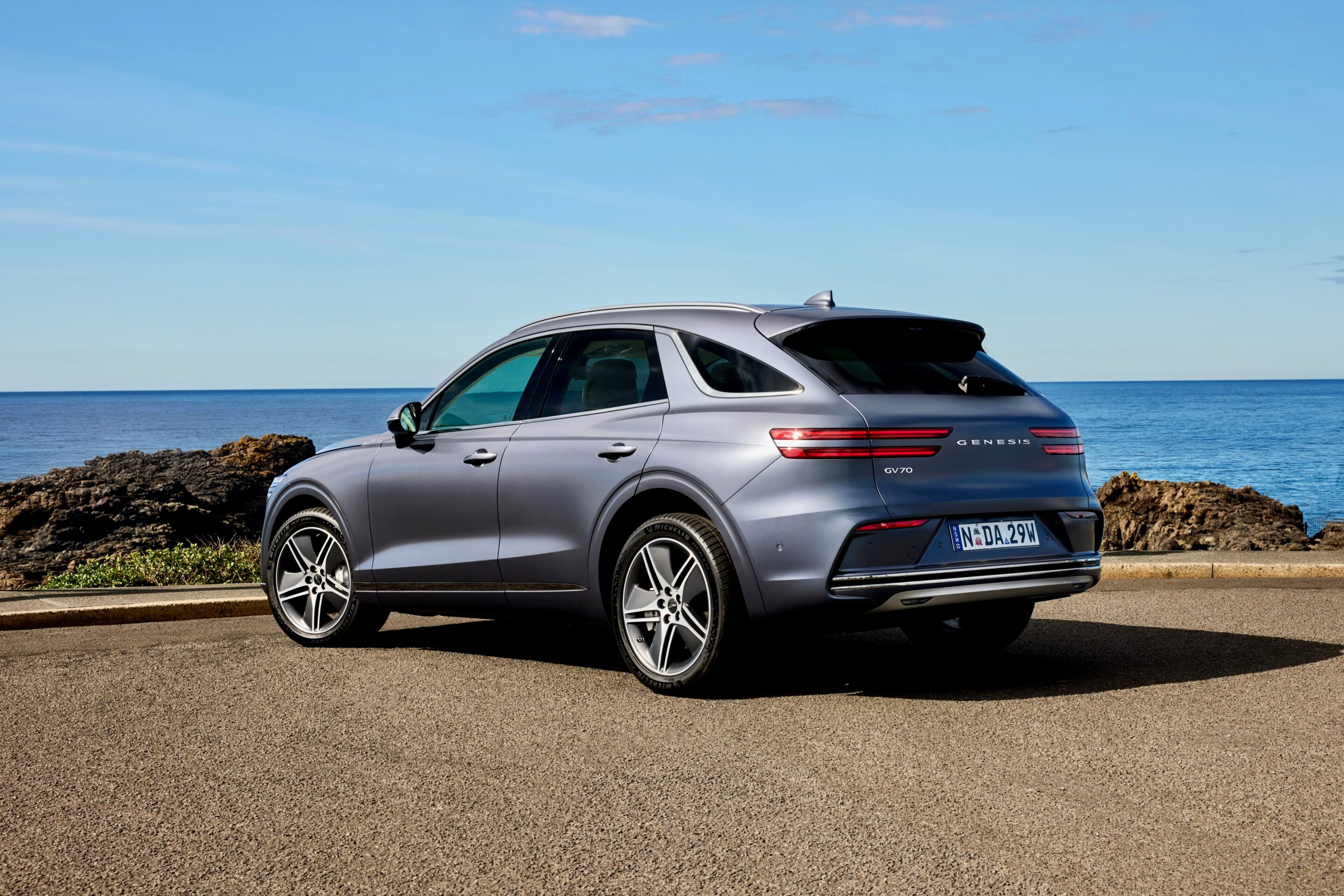
The dual-motor all-wheel drive drivetrain in the Electrified GV70 makes the same 320kW/700Nm outputs as before, giving it a claimed 4.2-second 0-100km/h sprint time.
Genesis has also updated the Electrified GV70’s active safety suite, with junction assist for the auto braking system, navigation-based adaptive cruise control, an updated lane centring function and new remote parking assistance.
Aside from the larger screen, the Electrified GV70 also now features wireless Apple CarPlay and Android Auto smartphone mirroring, a UV-C sanitiser in the centre console, a head-up display, Matrix adaptive high beam, an air aroma diffuser, live services and over-the-air updates and a 16-speaker Bang & Olufsen sound system.
Like the pre-updated model, the Electrified GV70 is equipped with not only a five-year service plan but also a five-year Chargefox charging subscription. The Signature Performance’s price is a nearly $7000 increase on the former model.
Electrified GV70 pricing (plus on-road costs):
| Signature Performance | $132,800 |
|---|
The updated Genesis Electrified GV70 is now available to order, with local deliveries due to
commence soon.
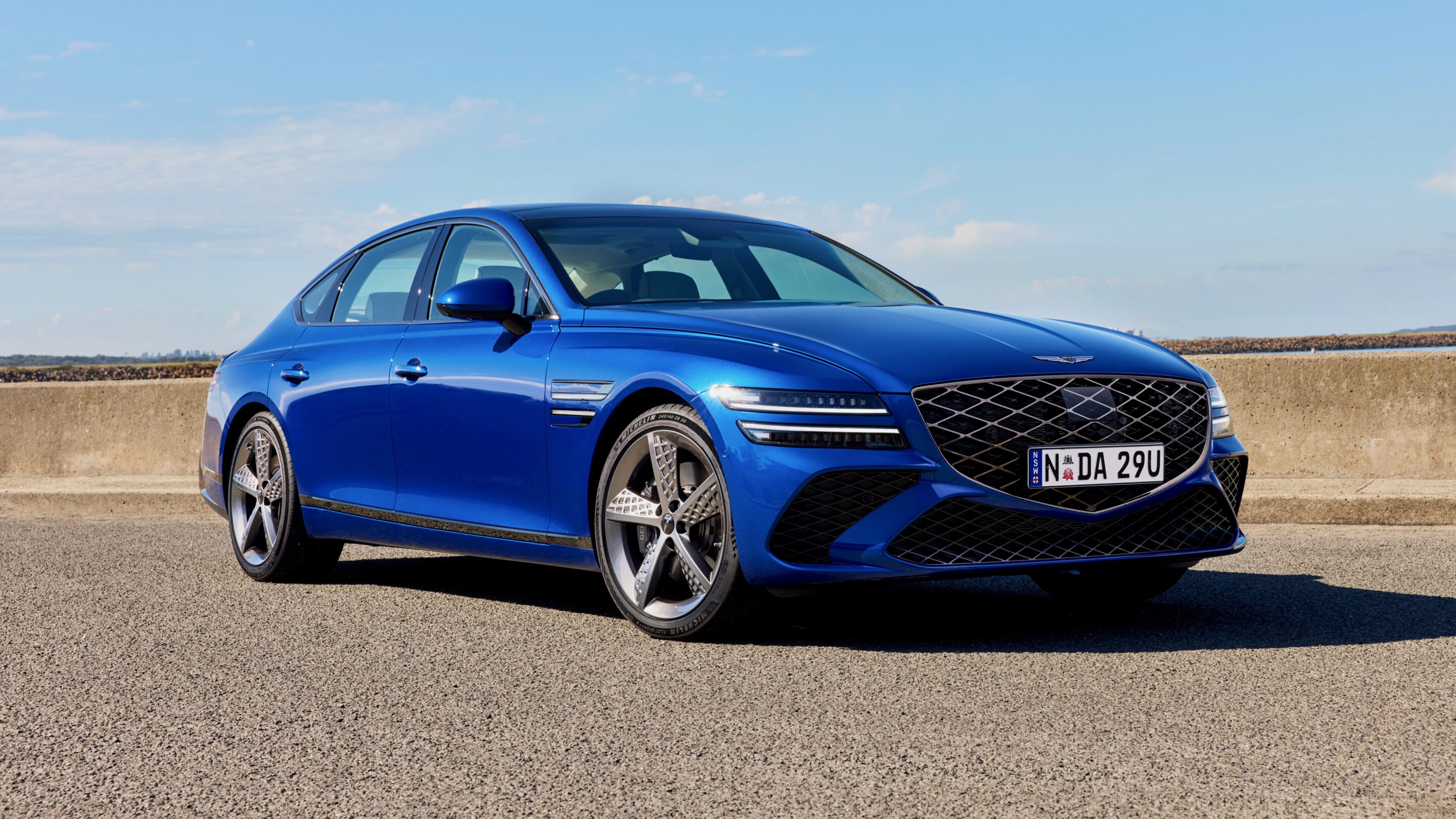
Genesis, the luxury arm of the Hyundai Group, has confirmed that it’s developing a range of new drivetrains for its future models, including hybrid, range-extender and full EVs in an interview with Hyundai Group’s Head of Vehicle Development Tech, Manfred Harrer.
Currently, Genesis offers no proper hybrid models globally despite Hyundai Group siblings Hyundai and Kia offering many across the globe. That’s something that is going to change dramatically, with the ‘chasm’ gap between EV early adopters and the market forcing car makers to offer hybrid models as a stepping stone to EVs for buyers.
“We cannot push so hard and bring only EVs to the market. It was a bold goal from us years ago, but we must adjust and face the reality of differences in our customers – that not every customer is ready to go there,” said Harrer.
“What we’re doing in the meantime is developing hybrid and other hybrid-similar technologies for our customers before we can really go 100-per cent EV, 100-percent zero emissions. We will soon offer a larger variety of new EV cars and updated or new Genesis models, with modern propulsion line-ups, like the hybrid I mentioned already, or even alternative technologies like the EREV.”
According to Herrer, the appeal of EREVs – or range-extender EVs – lies in combining EV driving characteristics with a longer range. They can be used as an EV on a daily basis, but also give drivers the range needed to drive from, say, Sydney to Melbourne, without planning your route around charging infrastructure.
But also according to Herrer, there’s more to EREVs than range: ample power for towing capacity – the energy to tow something like a horse trailer – which remains an unsolved issue with EVs.
When Genesis releases its EREV drivetrains, it’ll likely be the first brand to do so at the premium end of the market, though BMW is also believed to be developing the tech for its next-generation products also as a response to slow EV uptake.
But Genesis isn’t forgetting about EVs, and is developing a new platform to replace the current E-GMP architecture with an improvement in driving range. The new platform will also be compatible with its EREV drivetrains, and employ new engineering to offset the weight of the EV batteries, such as a more rear-biased power distribution and different front and rear tyres.
He also confirmed that the first of Genesis’ Magma performance sub-brand will be the GV60 Magma, which is still in development and likely to be revealed in production form soon. While Genesis is yet to reveal any technical details about it, the Magma brand will exist for the customer who “wants more horsepower, higher top speed, bold and sporty optics in each segment.”
Genesis is yet to confirm when its new drivetrains are to be released, though it’s likely to be at least 2026 at the earliest.
Jaguar Australia has detailed a new Australia-exclusive limited edition F-Pace dubbed the ‘575 Ultimate Edition’ to farewell local sales of both the F-Pace and its V8 engine. The 575 Ultimate Edition is limited to just 60 units and adds unique paintwork options and equipment.
Visually marking the F-Pace SVR 575 Ultimate Edition are four new paintwork finishes: Sorrento Yellow Gloss (five vehicles), British Racing Green Gloss (20 vehicles), Icy White Gloss (five vehicles) and Ligurian Black Satin (30 vehicles), each with a black exterior pack as standard.
The 575 Ultimate Edition also features Ultimate Edition fender badging, a unique bespoke car cover and a host of additional specifications, including 22-inch Forged diamond turned gloss black and grey alloy wheels, privacy glass, a sliding panoramic roof, gloss black roof rails, a head-up display and a 360-degree camera.
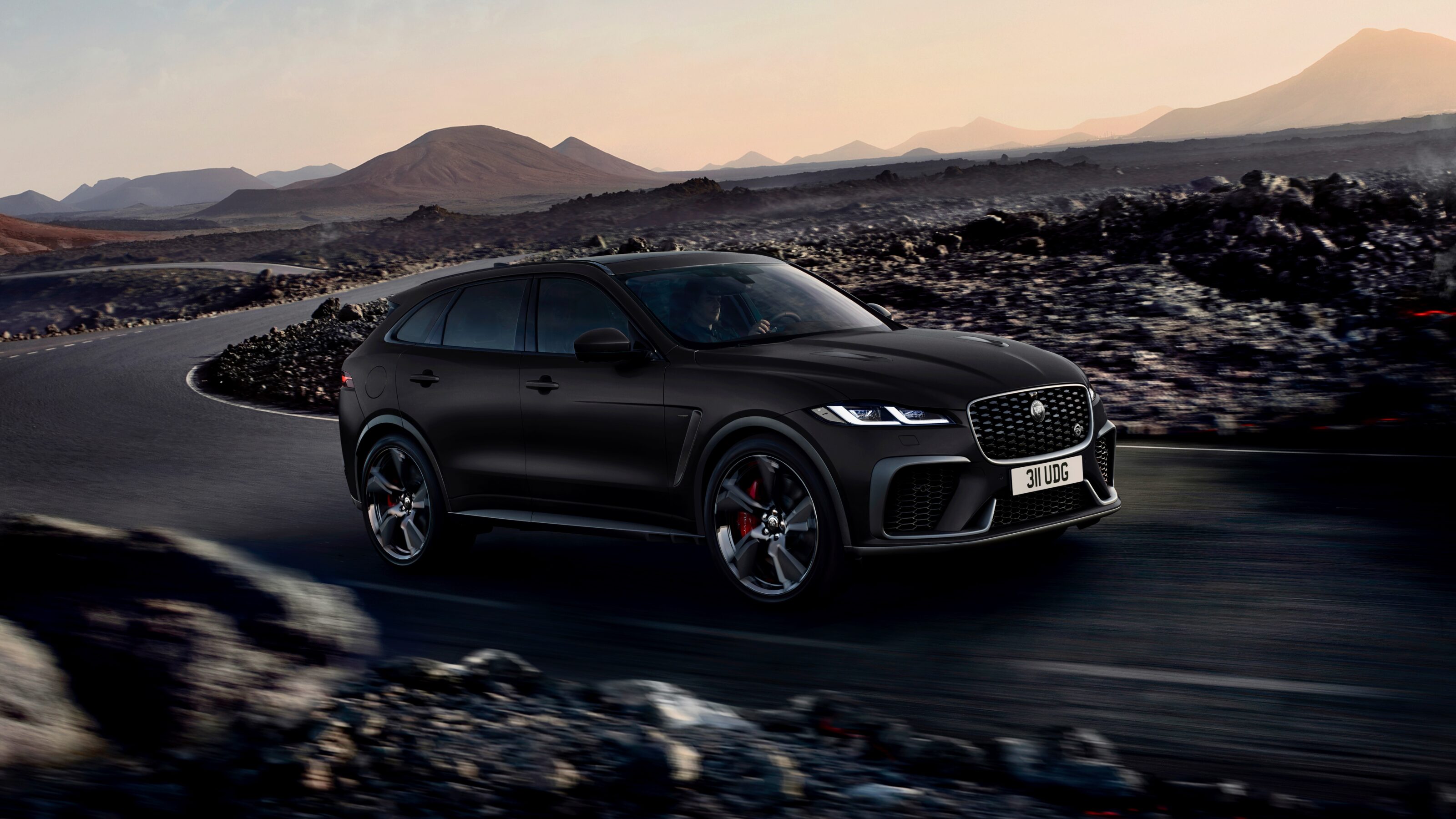
That’s on top of standard F-Pace SVR equipment such as a variable active exhaust system, 14-way heated and cooled performance front seats, semi-aniline leather upholstery, carbon fibre interior trim, wireless Apple CarPlay and Android Auto, Amazon Alexa integration and a wireless phone charger.
The F-Pace SVR’s powertrain is unchanged in the 575 Ultimate Edition, continuing with a 423kW 5.0-litre supercharged V8 engine sending power to all four wheels via an eight-speed automatic transmission. It launches to 100km/h in 4.0 seconds and on to a top speed of 286km/h.
Jaguar F-Pace pricing (plus on-road costs):
| P250 90th Anniversary | $90,830 |
| P400e 90th Anniversary plug-in hybrid | $115,265 |
| SVR 575 Ultimate Edition | $182,235 |
The Jaguar F-Pace SVR 575 Ultimate Edition is now available to order, with local deliveries due to
commence soon.
Toyota Chairman Akio Toyoda has raised concerns about the environmental benefits of battery electric vehicles (BEVs), suggesting that hybrids may offer a more practical path to reducing carbon emissions in certain regions.
In a recent interview with Automotive News, Toyoda emphasized that carbon neutrality remains Toyota’s top priority. He highlighted that the company has sold approximately 27 million hybrid vehicles, which he claims have had a similar carbon reduction impact as 9 million BEVs.
Toyoda argued that in regions like Japan, where electricity is largely generated from fossil fuels, producing and charging BEVs could lead to higher overall carbon emissions compared to hybrids.
“If we were to have made 9 million BEVs in Japan, it would have actually increased the carbon emissions, not reduced them. That is because Japan relies on thermal power plants for electricity,” Toyoda said.

Toyoda’s remarks underscore Toyota’s “multi-pathway” strategy, advocating for a diverse mix of powertrains – hybrids, plug-in hybrids, hydrogen fuel cells, and BEVs – tailored to local infrastructure and energy conditions. He also warned of economic risks, suggesting that an abrupt shift to EV-only production could endanger jobs, particularly in countries like Japan where engine manufacturing still dominates.
In Australia, where coal-fired power still contributes significantly to the electricity grid, Toyoda’s comments may resonate with consumers and policymakers.
According to the Federal Chamber of Automotive Industries (FCAI), for the year to date at the end of May 2025, 6,175 battery electric vehicles had been sold in Australia, compared with18,293 for the same period in 2024. However, hybrid vehicles – led by Toyota models such as the RAV4 and Corolla – account for 15,363 new car sales, down on the same period in 2024 when 18,246 hybrids were sold. By contrast, 40,696 petrol vehicles had been sold so far this year.
As Australia continues to develop its EV infrastructure and transition to cleaner energy sources, Toyota’s emphasis on a balanced approach to vehicle electrification highlights the complexities involved in achieving carbon neutrality across different regions.
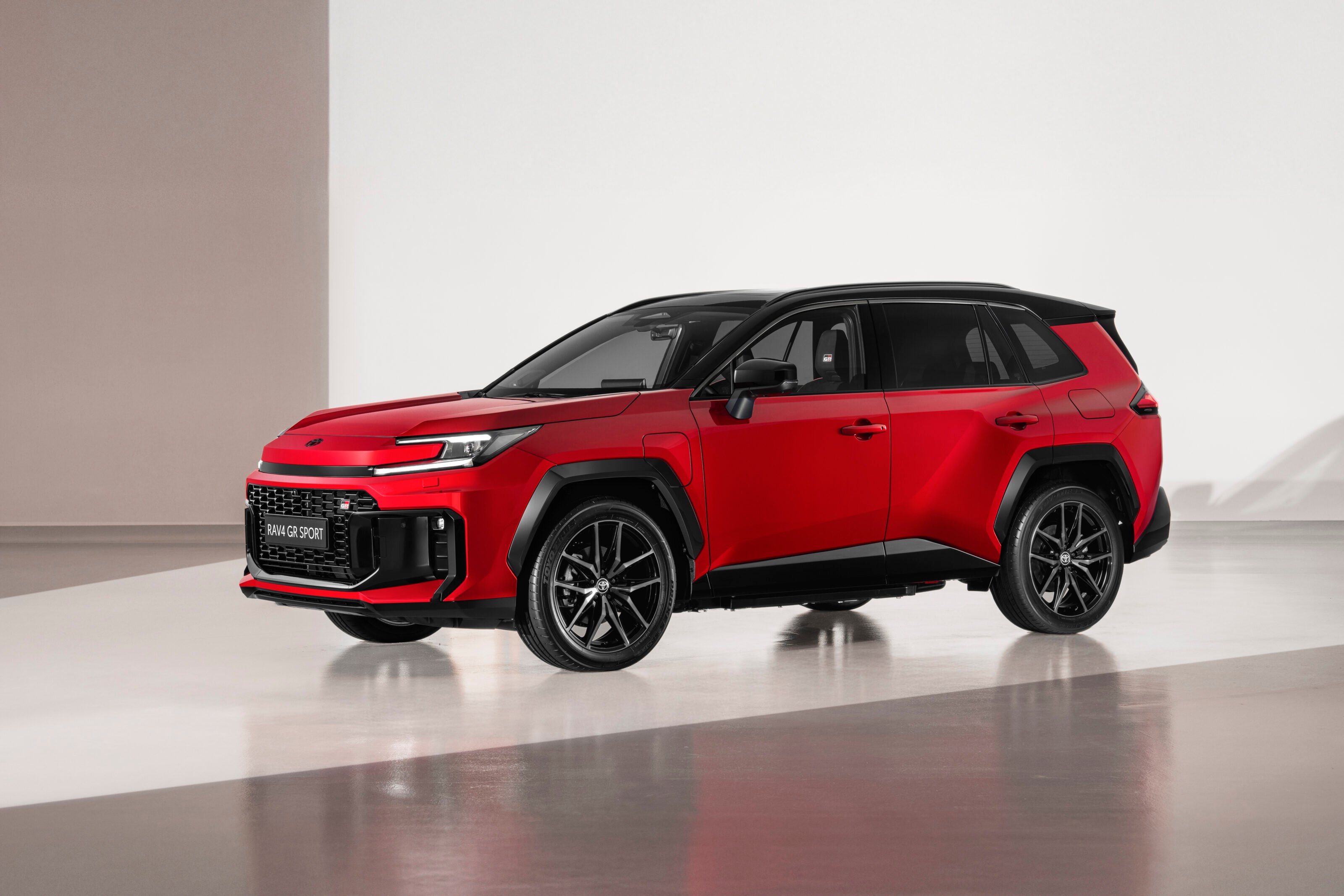
Toyota recently announced that the all-new sixth-generation Toyota RAV4 would arrive in Australia during the first half of 2026, featuring an all-hybrid line-up, a new range-topping GR Sport variant and the brand’s first-ever plug-in hybrid model offered in the Australian market.
Toyota says the new-generation RAV4 plug-in hybrid will feature a ‘sixth-generation’ hybrid system with a 22.7kWh lithium-ion battery – enabling a targeted EV driving range of up to 100km (WLTP).
Sliding sideways down a narrow gravel track, in a pitch-back forest with a battery of ice-white pencil beams pointing the way, is not the traditional path to a career in automotive engineering.
Then again, it quickly tells you what makes a car tick. Speed is one thing, but a successful competition car also needs to be reliable, trustworthy and, most of all, easy to drive. Those same basics are also essential for successful track laps at the daunting Nürburgring in super-quick Toyota Supras and a bunch of quick little Kia cars.
Graeme Gambold knows it better than anyone, because the Melbourne engineer has managed to translate a moderately successful run in rallying into some of the best driving cars in Australia today. What’s more, he did it without ever completing the engineering degree he began at Swinburne University of Technology, choosing very industry-specific training within the research-and-development areas of the automotive world. Instead of taking a broad-brush approach to his engineering career, he dived deeply into vehicle and production engineering with a hands-on approach to learning.
“So much of my career is not about university, or what I did with manufacturers. The ladders I’ve been offered to climb in the industry have all come from my rally and motorsport interest,” Gambold tells Wheels.
“And that’s a contrast to most others in the industry who are graduate corporates. Even today, that’s what I use, not what I learned from books. Everything I’ve done and achieved you can chase back to my rallying.”

Gambold might be old-school, but he is also bang-up-to-date and a worldwide authority on vehicle dynamics. He’s a 30-year veteran of the Society of Automotive Engineers and can crunch the numbers with the best in his business.
“I use my mathematics and engineering training every day. It’s vital to be able to relate it all back to the physics. You have to have the numbers, not just an opinion. Engineering means having the ability to relate what a vehicle is doing to the kinematics.”
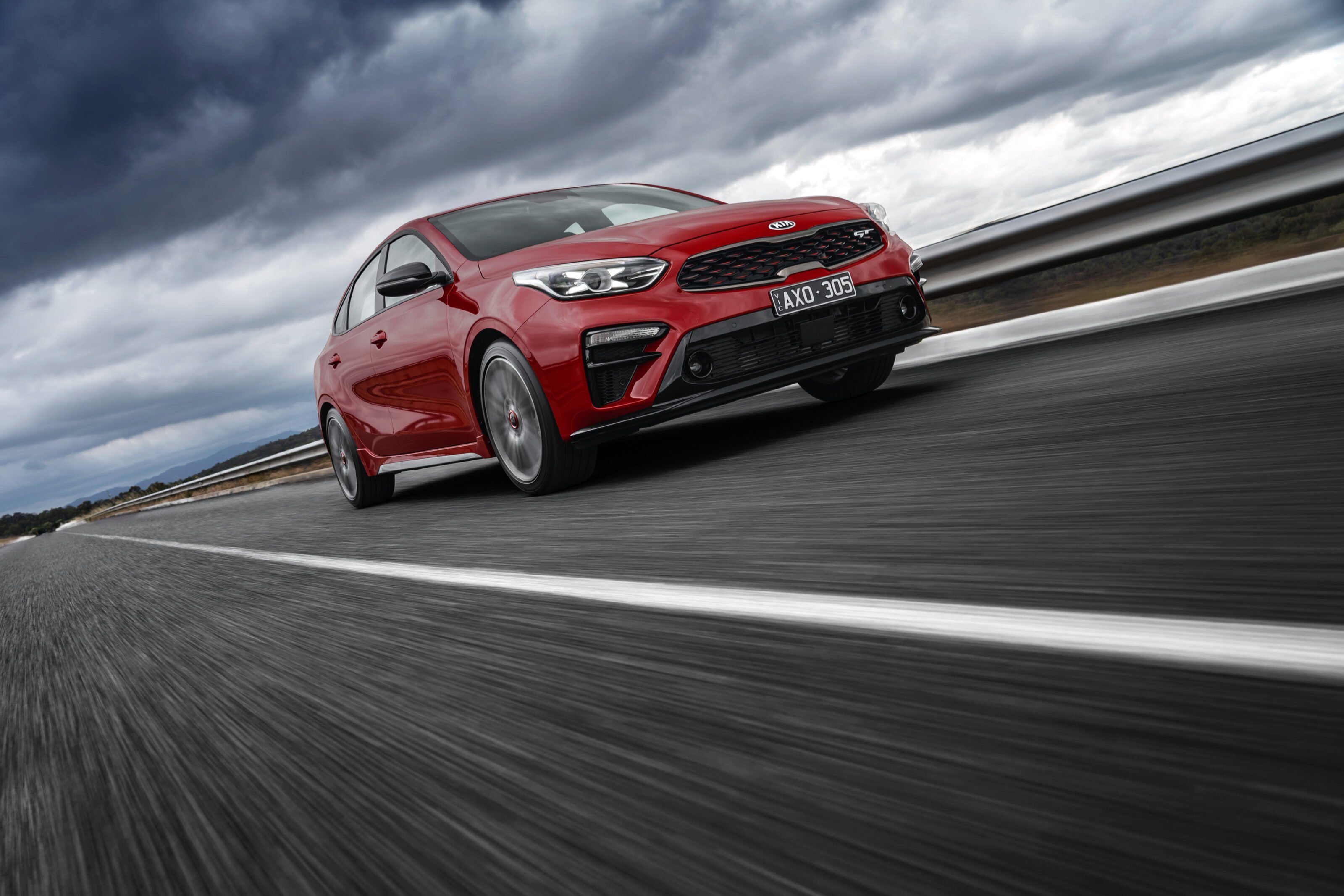
Other people might know what a good car feels like, but Gambold knows how to make it feel that way. He can even transform a humble Kia Cerato into a car he rates alongside a Lotus for driving enjoyment.
“Most people have no idea what the Cerato can do. But get it on a nice twisty road and you can find out,” he says.
People like Gambold are the real success story from the days of major car making programs in Australia, even if their numbers are thinning since the death of local development on cars like the Ford Falcon and Holden Commodore. They faced unique challenges on some of the world’s worst roads, with cars which could be tweaked and tuned for local drivers and conditions.
He began as a youngster at Nissan Australia, was then head-hunted for a global role at Toyota – as well as some basic development stuff on cars like the Camry for Australia – before earning a leadership role for Kia suspension development after a one-off commission in Australia. He has become a key player in South Korea and that includes the upcoming Kia Tasman pick-up. Even if he is not allowed to talk about it, it’s obvious he has been involved in the basic layout of the Tasman, then the in-the-field testing in Australia.
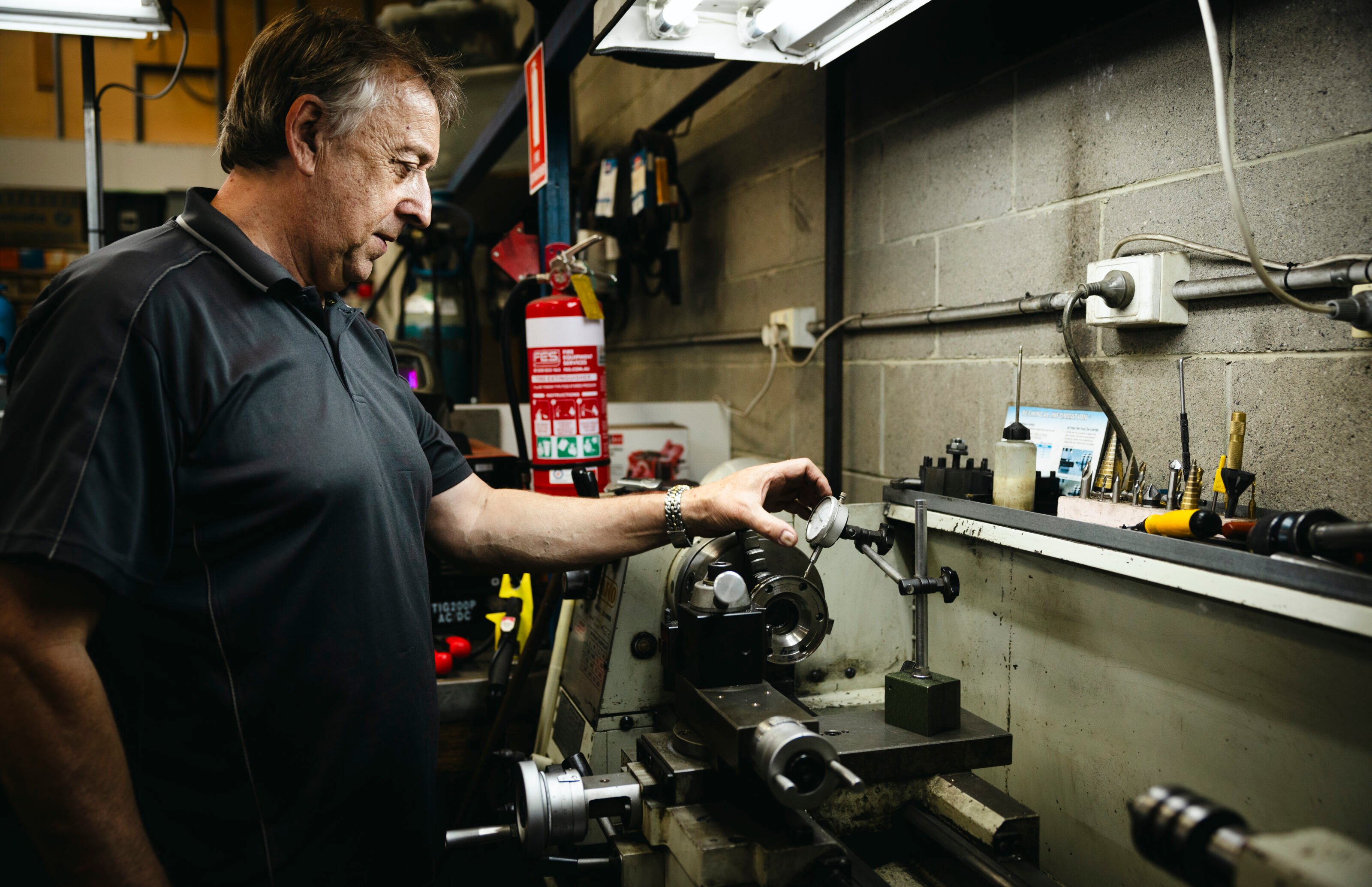
Gambold also has a prominent side hustle – although he might not call it that – as the chief engineer at the Southern Hemisphere Providing Ground. It’s a site that’s better known as the ‘Snow Farm’, outside Queenstown in New Zealand, and is used by many of the world’s major carmakers for cold-weather testing during the European summer. Luxury brands, including BMW and Mercedes-Benz, also take their owners to the Snow Farm to allow them to experience their cars on the limit in a safe and controlled environment.
Graeme Gambold was born into motoring, as his father Gordon ran a garage in Melbourne and he was hustled up to Bathurst before his first birthday. They went every year until he was in his teens.
“I grew up at Templestowe hillclimb, watching Peter Brock and Harry Firth do their stuff. I also have vivid memories of the London-to-Sydney marathon, visiting the service park and seeing the cars. I idolised (Australian rally champions) Geoff Portman and Ross Dunkerton.
“In 1983 I bought my first car, which was a Datsun 1600 that someone had rolled. Dad’s panel beater put a roof on it and I went out and won the Victorian clubman rally championship.”
But there was also education, as he started primary school close to home in Glen Waverley – where he still lives and operates Gambold Engineering Services with Helen, his wife of 40 years – before graduating to Swinburne. It was at Swinburne that his rally connections set his career path as one of his lecturers, Monty Suffern, was a national champion co-driver in a factory Nissan Stanza alongside George Fury. He sent Gambold to see some of his connections at Nissan Australia.
“They wanted me to be a vehicle dynamacist. They all said there were plenty of engineers but very few test drivers.”
Gambold would soon also be rubbing shoulders with Fred Gibson and Mark Skaife, working on the Nissan Skyline GTS which was developed by a Special Vehicles division at Clayton that eventually also turned the GT-R into the ‘Godzilla’ road version for Australia under the leadership of successful designer, Paul Beranger.
“I did a bit of testing with Mark Skaife at Winton on the GTS. They advised me not to get into motorsport because it was too fickle. They said ‘If you want a family and to buy a house, stay with an OEM (Original Equipment Manufacturer)’.”
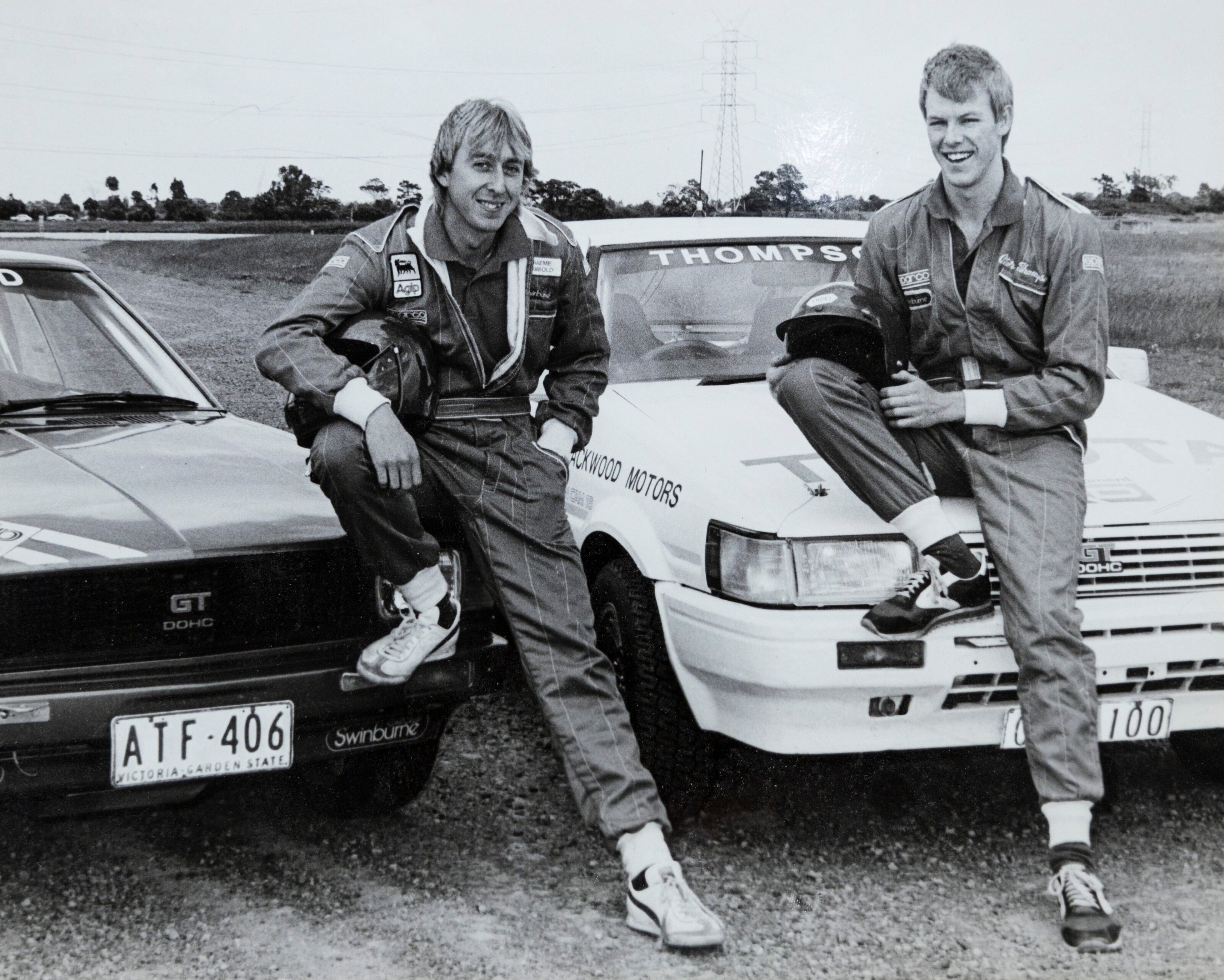
Even so, he had a ‘gap year’ to go rallying and also travelled to Indonesia and Europe, eventually adding a Toyota T-18 and also a four-wheel drive BMW 325ix – which is still in the workshop – to his resume.
His next career move was to Toyota Australia, in the early 1990s, with the chance to do some basic suspension development work.
“I hated it. It was work on the Corolla. Nissan was a real engineering company and Toyota was a white goods company. That culture just didn’t sit well with me.”
But Gambold’s reputation had reached some important people in Japan, and Toyota became his future – with a twist. “I got an approach from the Australian Representative Office, from the Japanese. They wanted me to go and work in vehicle dynamics on some new Lexus project. It was the original Lexus IS, to go head-to-head with the Germans.
“So I never really worked for Toyota Australia, I worked with Toyota Japan. My position was not working on Camry and Corolla, it was other projects.”
He clocked up plenty of frequent flyer points as he spent a lot of time at the Shibetsu proving ground, in the northern island of Hokkaido. His mentor was Hiromu Naruse, a legendary Toyota engineer who was sadly killed in an LF-A road crash close to the Nürburgring.
“I was just having the grandest old time. I was in the Lexus Vehicle Advanced Dynamic Group. It was basically a group of specialist test drivers who audited and screened cars before they went into production. We did all the cold-weather testing at Shibetsu with a lot of high-speed work and hot testing in Australia.”
Gambold travelled the world to proving grounds in Germany, the USA and Japan, focusing on vehicle dynamics. Lexus made him a regular at the Nürburgring, where he had to qualify for a special company high-speed driving license. Even so, he also found some time to get back to rallying, driving a Celica GT-4 which had done public relations work with Carlos Sainz Snr driving, before his money ran out.
There was also a side project with a Toyota twist in the 1980s, when he did a research study on laser profiling road textures in Australia, which led to the publishing of an SAE paper. It was the engineering equivalent of a doctoral thesis, and he is proud that his 12 months of work was recognised when he presented the road surface study paper to an international SAE conference in Tokyo.
Gambold also got involved on a sports car idea from Allan Hamilton, the long-time Porsche importer for Australia, in the 1990s. It was to have been a limited-edition road car and a prototype was built and demonstrated at the Australian Formula One Grand Prix.
“That was a good project. But, in the end, it had a compromised design with Camry parts. It took the Camry engine, turned around backwards, in the back.”
Now his Toyota time was running out, in one way.
“It all got a little bit complicated, because Toyota Australia didn’t know what to do with me. I was on their head count, but they didn’t have access to me.”
Gambold was also reluctant to get involved in the cars for Australia. “They have all got their compromises, because the script is set to feed the sausage machine. But there were some great people at Toyota Australia.”
So the new way forward was as a consultant, just after the start of the new century, for the Toyota Motor Corporation.
“Toyota Japan set me up in my own business. I was offered the chance to work in Belgium on Lexus vehicle dynamics or stay in Australia and do winter testing programs. I got cold feet and we stayed in Australia.”
This was also the start of his management role at Snow Farm, which has since taken him around the world. Then, another Toyota connection, Steve Watt, who had worked with Neal Bates on his rally team, brought him to the attention of Kia Australia, which had decided it likely needed help to improve its cars for local conditions.
“I went and drove a Cerato, then Hank Lee (who was vice-president of testing and development and would eventually become president of Kia Motors) asked me what they could do to sell better in Australia. I told him to improve the driving experience,” Gambold recalls.
So away he went, with a mandate to make the changes, developing unique dampers and springs for deliveries in Australia. He pulled things apart, created new pieces for production, helped select the right tyres, and also played a big role in the crucial area of noise-vibration-harshness across the Kia range.
His work helped to transform the appeal of Kia cars, giving them sharper responses with better comfort on tough local roads, and a similar program was also adopted by Hyundai Australia.
Gambold’s suspension tuning work was eventually adopted for key countries in Europe and he now has a significant role in all engineering development work at Kia in South Korea.
“I saw Hank Lee at the global launch of the Tasman Ute. He said the success and growth in Australia was directly related to my work, which was very satisfying. But my whole life just falls before me. I don’t chase anything. It just evolves. Vehicle dynamics is my true interest and career path, and that got me ahead of other engineers.”
Now 62, Gambold has driven countless thousands of cars, but he has a few favourites.
“I didn’t have a huge amount to do with the Lexus LF-A, but it was a fantastic car. Not really representative of what they put into mass production, though, because it was a hand-built special.
For me, the best car production car was the Supra RZ, with a twin-turbo engine and Brembo brakes. We used that a lot at the Nürburgring. We had a fleet of cars at Shibetsu which we could take out. A Lancia Integrale and Supras. The early Lexus IS was what a car should be – like a BMW E30 3-Series. Toyota make some really great cars, but the current GR Yaris is really a ‘skunkworks’ project, not mainstream.
“In terms of Kia, the Stinger is pretty memorable. I also loved working on the Cerato GT – it’s just a rally car. It drives better on a track or winding country road better than a production car should. But no-one knows its actual capability.”

Gambold also has some firm ideas on the decline of engineering talent in Australia, the standard of driving on Australian roads, and the sort of new cars which do best in our showrooms.
“I’m worried that we are becoming the dumb country,” he says.
Not surprisingly, he has engineering results to back his opinions on everything from traffic snarls to the rising road toll. He also worries about the loss of the car culture which has served Australia so well for more than 100 years.
“If you’re interested in cars in this country, you’re now seen as recalcitrant and noncomformist. You’re just seen as a hoon,” he sighs. “But my career is finishing, so it doesn’t matter.”
Even so, he has a clear view of his abilities and is happy with what he has achieved.
“I’m not necessarily the fastest driver, but I can drive and evaluate a vehicle very well. A lot of the really great drivers can tell you what’s wrong, but they don’t have the vaguest idea on how to fix it.
“My job is to make a car more stable. More responsive. Safer. I can do that.”
This article originally appeared in the February 2025 issue of Wheels magazine. Subscribe here.
There is an active plan to inject the sound and fury of old-school V10 combustion engines back into Formula One.
After more than a decade with high-tech V6 turbo hybrid powerplants, which have failed to excite fans while adding massively to the cost and complication of grand prix cars, the power players in F1 are looking at a new direction.
It won’t happen immediately because there are already rules for a simplified hybrid system for season 2026 that deletes energy recovery from the exhaust system.
But there have been some high-level meetings and quiet talks about a change for 2029, triggered by FIA president Mohammed Ben Sulayem.
Among those involved in discussions were Mercedes-Benz’s chairman Ola Kaellenius, Audi’s CEO Gernot Doellner and General Motors’ president Mark Reuss.
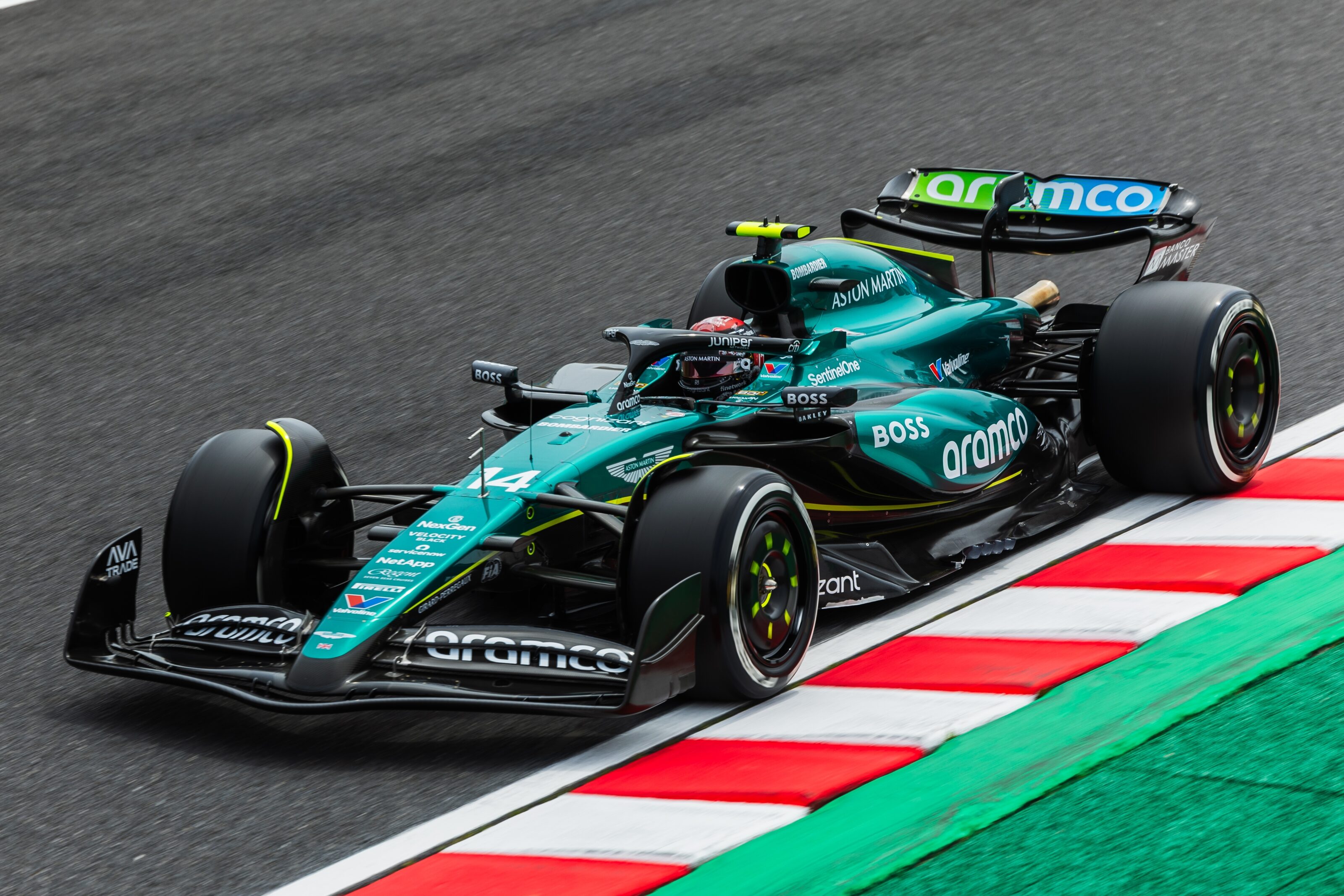
One of the key components of the new drive is synthetic and sustainable e-fuel, which is generating more and more interest as the second-stage move to full electrification of road cars stalls in many countries including Australia.
Howling V10s – which produced 520 kiloWatts and spun to 19,000 revs at their peak in 2005 – are being re-assessed as one way to boost the appeal of grand prix racing beyond the current surge from in interest from Drive to Survive television converts, as well as allowing carmakers to create a new technology link to showrooms.
“The romanticist in me is (saying that) a screaming V10 could be really attractive for F1, but it’s got to be done responsibly,” says Christian Horner, the boss of Red Bull Racing.
F1 hybrids arrived at a time when battery-electric cars were seen as the only workable path to future motoring and a way of fast-tracking motorsport experience into production cars.
Now there is serious support for e-fuel, which is completely synthetic and claimed to be fully sustainable. Unlike biofuels, it does not rely on the use of organic matter – such as sugar cane waste – or create a conflict between feeding people and powering their transport.
Motorsport is already leading the push for e-fuel, which is used in the World Rally Championship and MotoGP, and even powered some very old-timer cars – 1900 and 1903 Daimlers, a 1901 Mors and 1905 Cadillac – in last year’s London-to-Brighton veteran car run.
Porsche is a big backer, on both road and track, using an e-fuel pilot plant in Chile – which is driven by wind power – to supply fuel for its 911 Supercup racing competition. It also has plans for a larger-scale plant in Tasmania, although there has been no solid news since the original announcement of a collaboration with HIF Global from the USA in 2022.
Weaning the world from oil is a potential transportation end-game with e-fuel, according to Dr Karl Dums, senior project lead of e-fuels at Porsche.
“I am absolutely confident we can save the world,” he told me in early 2024.
“Everyone says we don’t need this because the cars will be electric. This is completely wrong.
“What we need is to make renewable energy available all over the world.”
It’s true that e-fuel is expensive, currently priced at around $8 a litre, but large-scale production could quickly reduce the cost and make it viable for road cars as well as motorsport.
Which brings us back to Formula One and one of its biggest partners, the Saudi Arabian oil company, Aramco.
Although Aramco is the world’s largest oil company, relying on its Middle East wells to turn a profit estimated at more than $500 billion a year, it has also become one of the biggest investors in e-fuels for a potential transition away from black gold to a sustainable fuel that will keep combustion engines alive.
Several well-known car models that have defined segments for decades are being retired as manufacturers pivot toward electrification and more sustainable platforms.
While many of these decisions are driven by global trends, they resonate strongly in Australia, where car culture and legacy models hold a special place. In the UK The Sun has paid tribute to some of the most notable vehicles being phased out in the UK and globally – with potential flow-on effects for Australian motorists.
Lexus LS: Luxury pioneer quietly retires
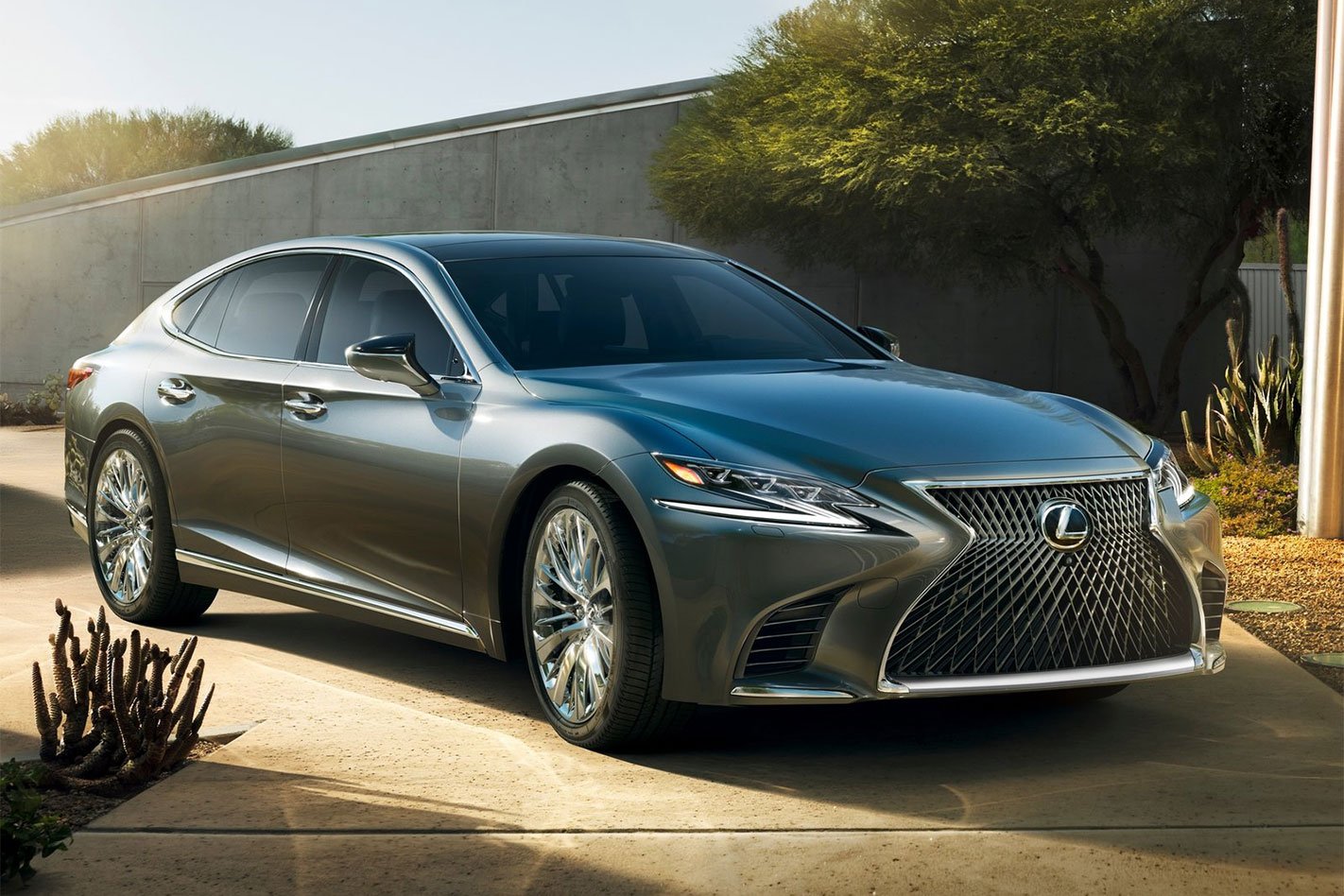
After 35 years of production, the Lexus LS saloon has been discontinued, marking the end of an era for Toyota’s luxury brand. First introduced in 1990, the LS played a pivotal role in establishing Lexus as a premium alternative to European giants.
Known for combining refinement and value, the LS evolved through five generations, with the final model – the LS 500 – launching in 2017 and updated in 2020. Priced from around A$194,000 to A$246,000, the luxury sedan struggled to remain relevant in a segment now dominated by SUVs. Just 39 units were sold in the UK since 2020 – only three of them in 2024 – signalling the end was inevitable.
Mazda2 and MX-30: Compact farewells from Mazda
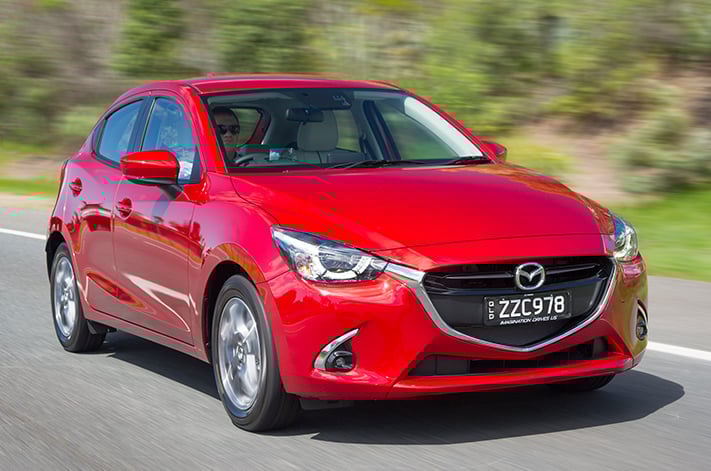
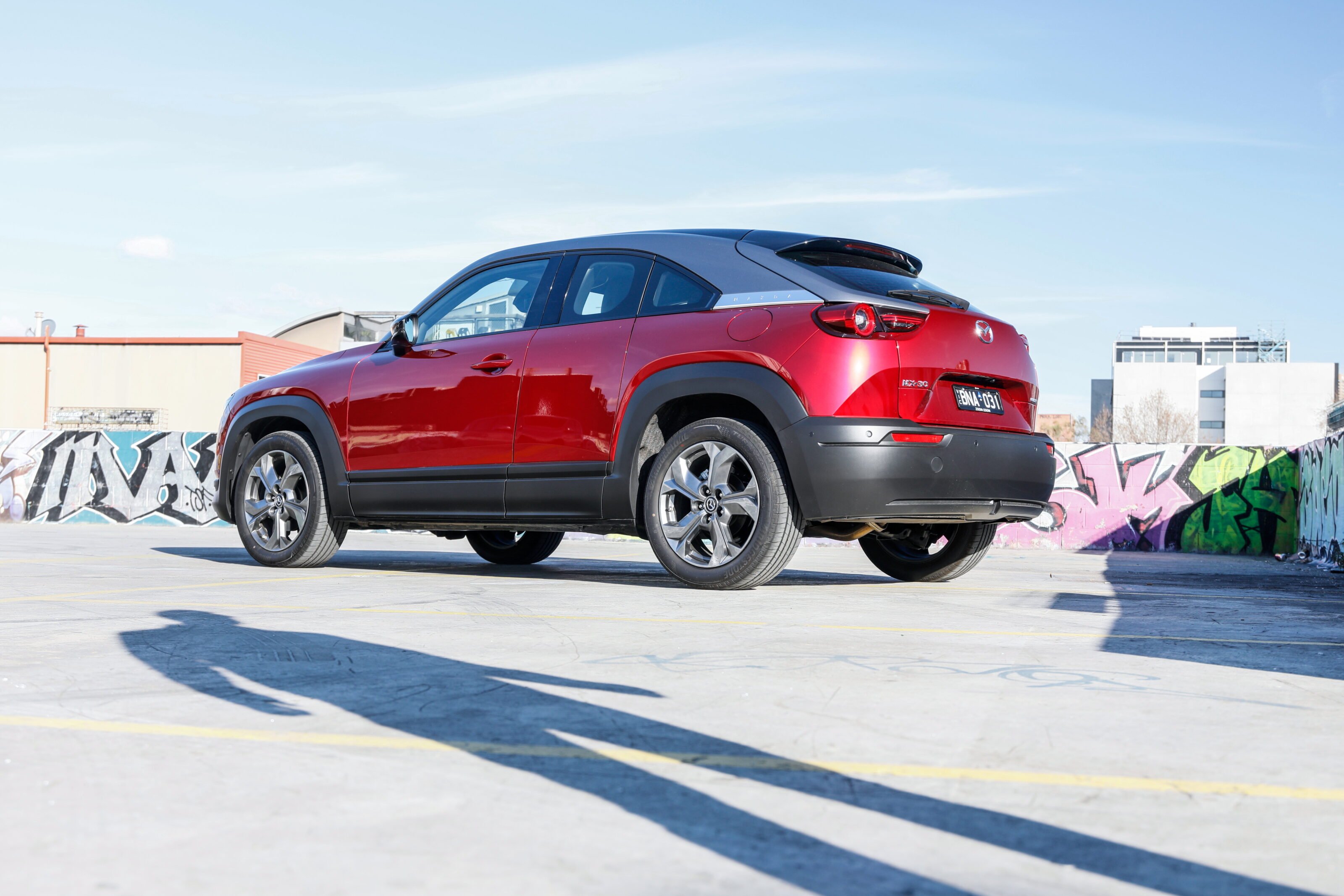
Mazda has confirmed the end of its Mazda2 supermini, which had a loyal following thanks to its fun handling and no-nonsense design. Although available for a decade, the petrol and mild-hybrid variants have been phased out in favour of the Mazda2 Hybrid – a rebadged Toyota Yaris currently not offered in Australia.
Mazda Australia ceased offering the fully electric MX-30 in 2023, the brand’s first EV, after sluggish global sales. With a driving range of just over 200 km and limited cabin space, the MX-30 never gained strong traction here either. However, the plug-in hybrid variant remains available in some international markets.
Porsche 718 Boxster and Cayman: Petrol era ending
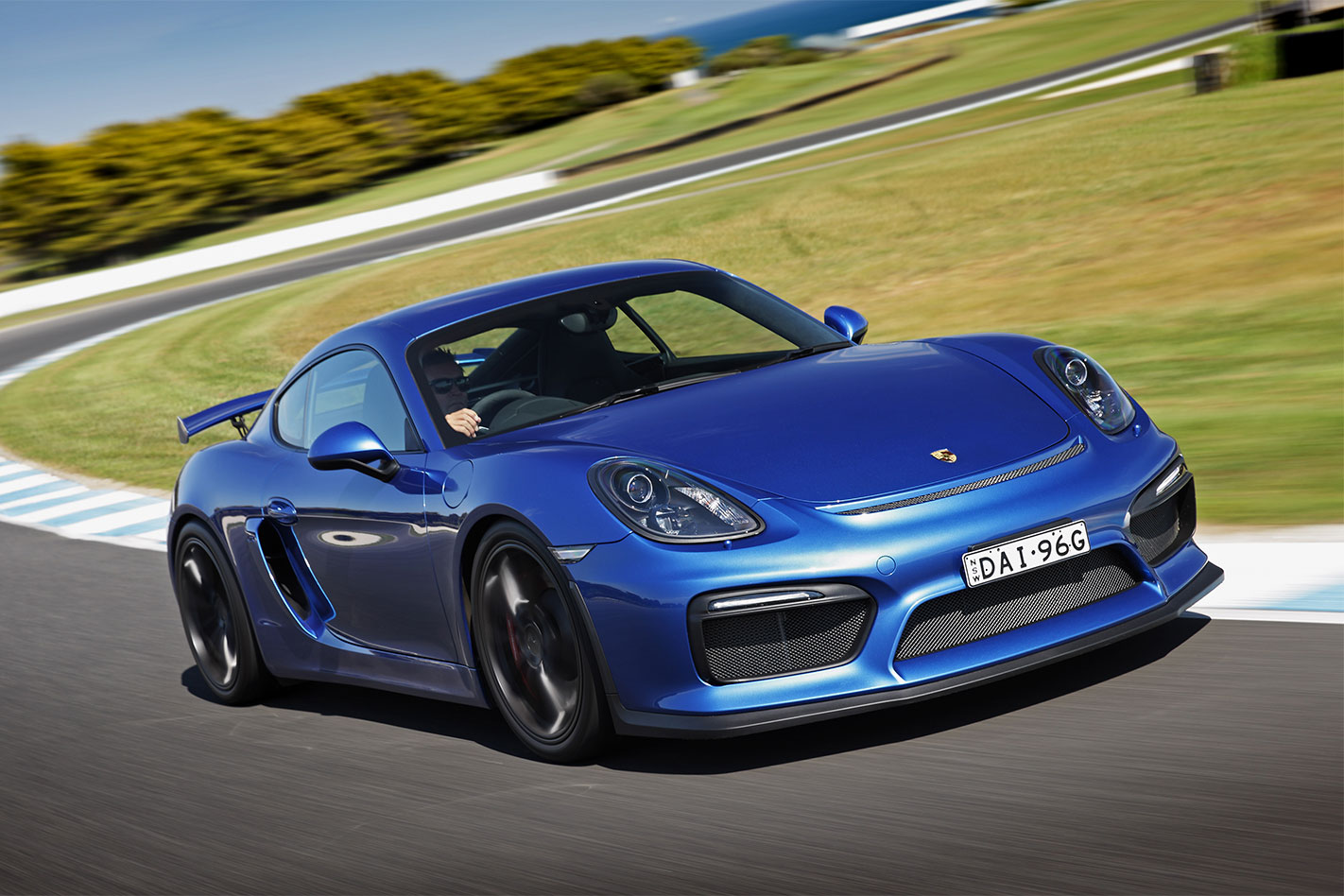
Production of Porsche’s iconic 718 Boxster and Cayman will officially cease in October 2025, with no immediate successor announced. These mid-engine sports cars have long been a favourite in Australia for offering premium driving thrills at a relatively attainable price point.
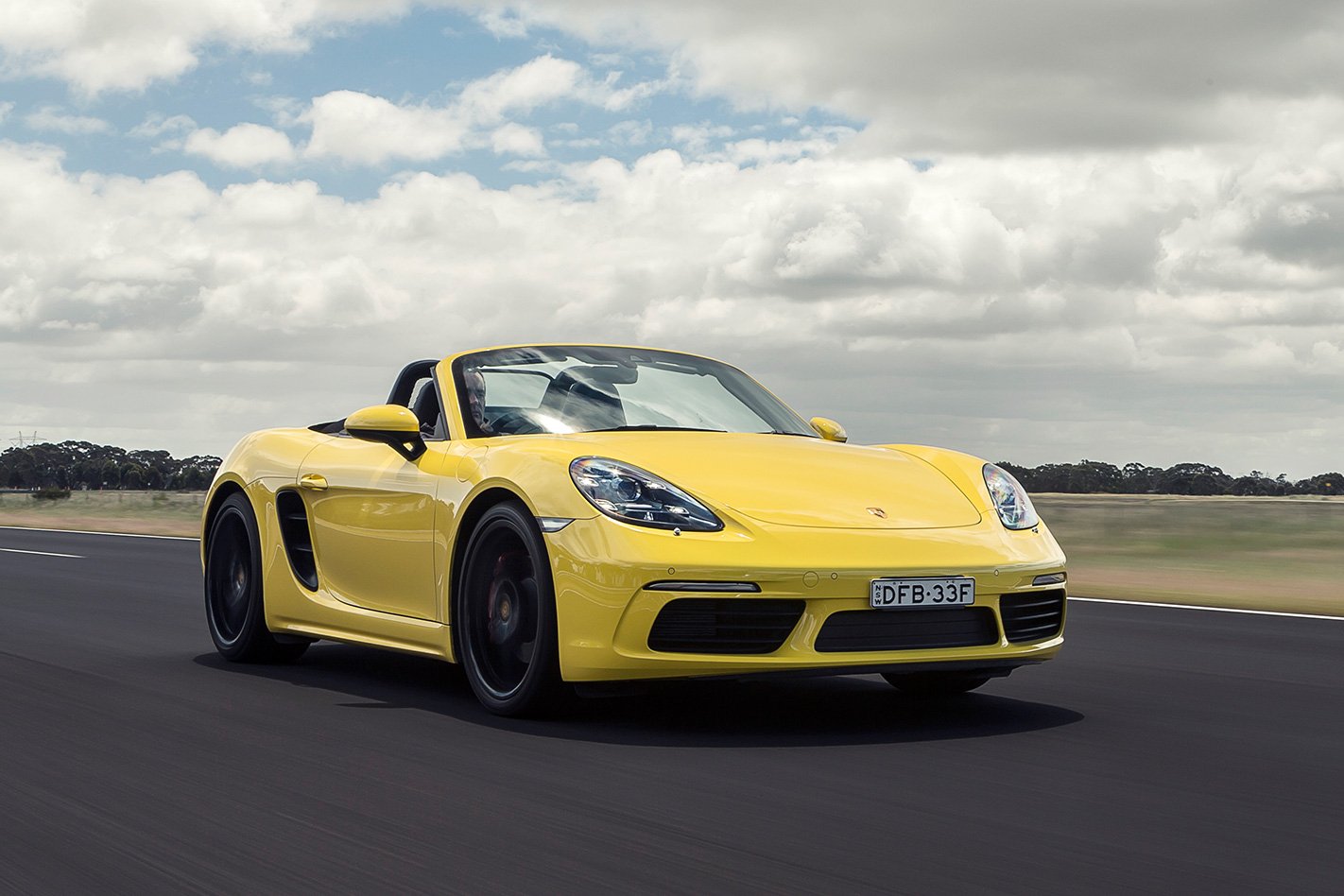
While new cybersecurity regulations forced an early exit in some European countries, Australia and the UK – unaffected by those rules – will continue to see availability until the global cutoff. A future electric version is expected but yet to be formally revealed.
Nissan GT-R: Aussie legend retires globally
The Nissan GT-R, affectionately known as “Godzilla” down under, is ending global production in 2025. While the R35 GT-R was pulled from Australian showrooms back in 2021 due to side-impact regulation changes, its recent retirement in Japan closes the final chapter of the 17-year-old performance icon.
Launched in 2007, the GT-R was a benchmark for bang-for-buck performance and held a cult status in Australia. While an electric replacement had been rumoured, Nissan’s financial constraints may delay those developments.

Audi A1 and Q2: Entry Audis being phased out
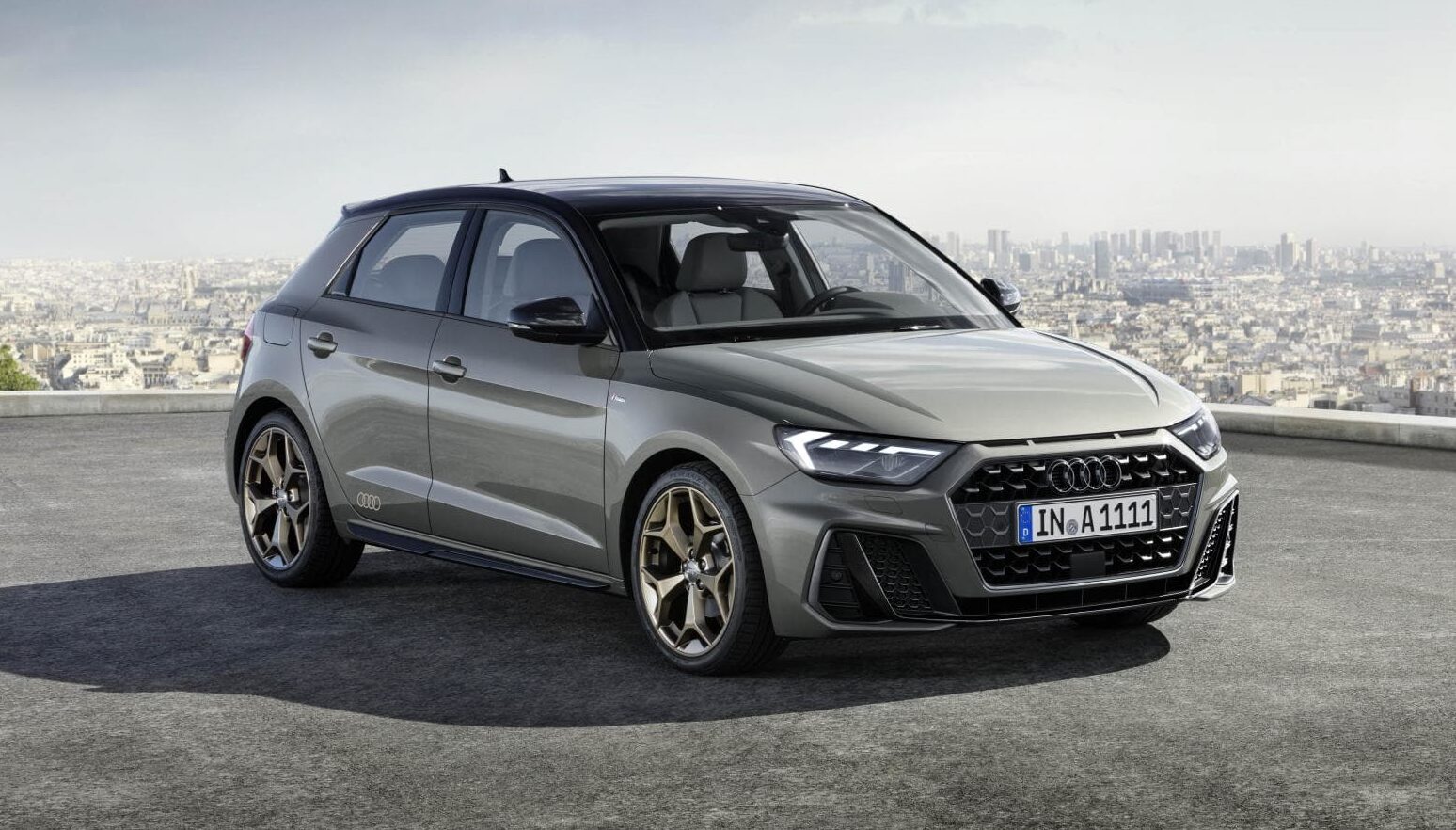
Audi has confirmed it will discontinue its smallest models – the A1 hatch and Q2 SUV – by 2026. Though not major volume sellers in Australia, they served as key entry points into the brand for younger buyers.
Audi says it will launch a new battery-electric vehicle to slot beneath the Q4 e-tron, targeting the compact segment with a focus on affordability and sustainability. Local availability will likely follow European production timelines, expected to begin in 2026.
Ford Focus ST: Hot hatch era winds down
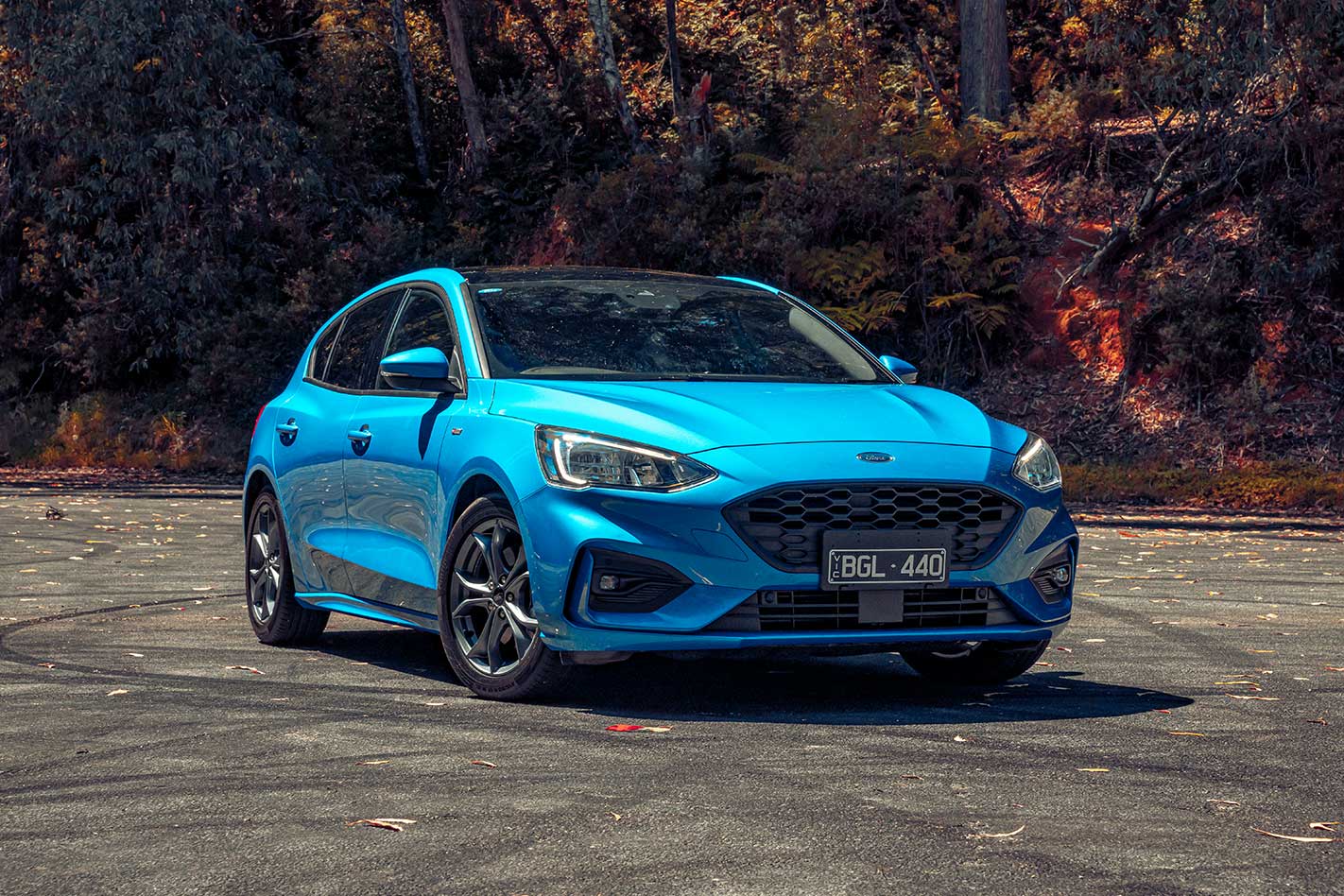
The Ford Focus ST, long revered by driving purists and performance hatchback fans, has been pulled from the UK market, with production ending in November 2025. Australian sales of the Focus ST were also wound down in recent years as Ford shifted focus to SUVs and commercial vehicles.
Though Ford still offers performance models like the Mustang and Ranger Raptor locally, the Focus ST’s departure signifies the broader decline of traditional hot hatches in favour of high-riding, electrified alternatives.
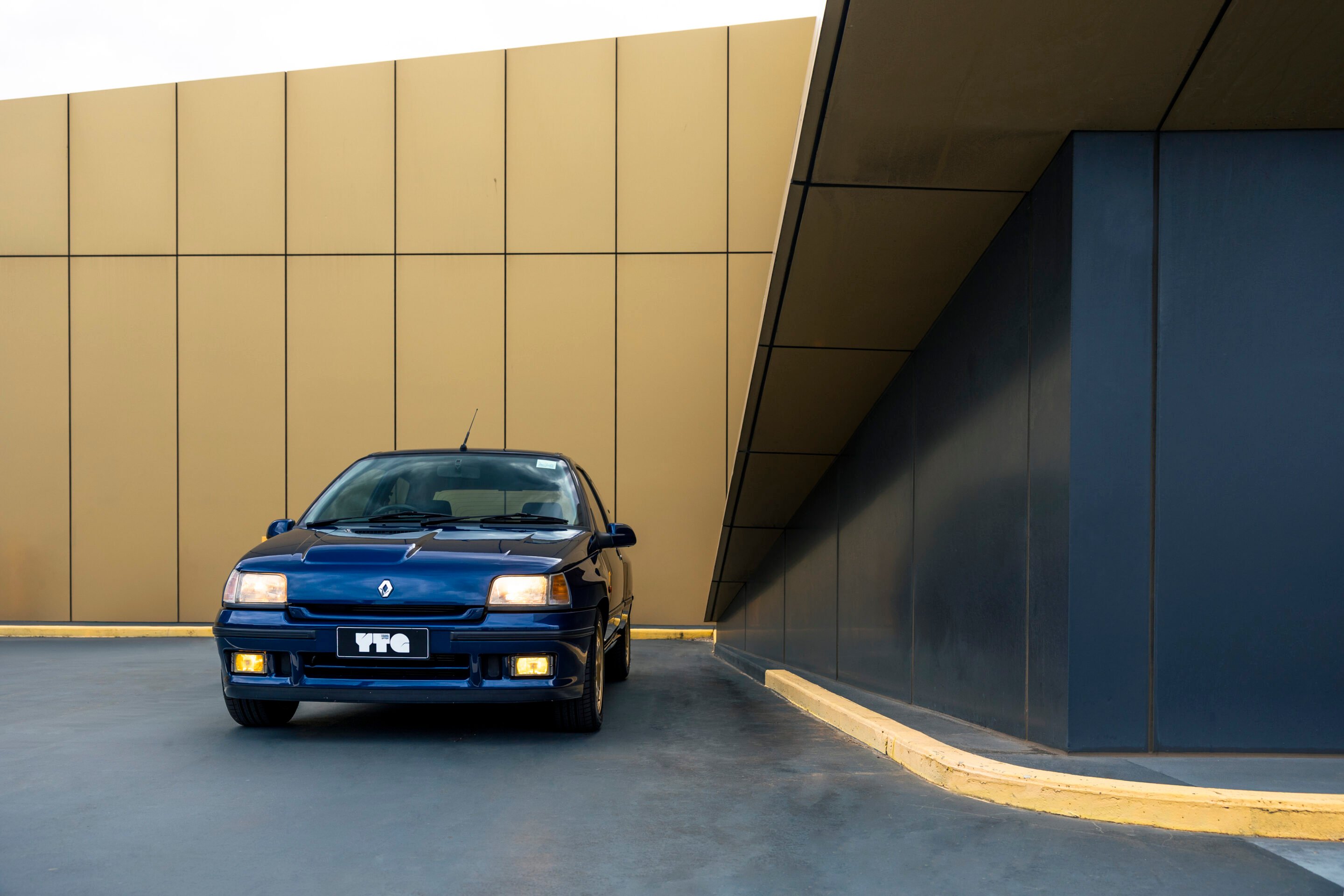
It has just 108kW. Hardly the numbers of a giant-killing legend. The Renault Clio Williams is something that can’t really be defined in numbers. Yes, we could point to the fact that its power-to-weight ratio of 110kW per tonne was similar to that of a Golf VR6 but that would be an irrelevance. The thing to know about the Clio Williams was that this was the car that finally moved the hot hatch game on beyond the Peugeot 205 GTI.
The 205 was a car that started its development in 1977, with the GTI first appearing in 1983. It was entirely apposite that, when it signed off in 1992, it would hand its mantle to another hot hatch. That car was supposed to be the 206 GTI, but that arrived late and proved to be an utterly dreadful contrivance that squandered any and all of the residual goodwill that Peugeot had worked so assiduously to construct.
So there was a moment, back in the early ’90s when an opportunity existed for a special vehicle to drive straight into. The Golf GTI couldn’t step up – remember, this was malaise-era Mk3 Golf – and Renault had established its bona fides with a long bloodline that stretched from the Renault 5 Gordini, through the ripsnorting 5 GT Turbo and on to the subtler but no less talented Mk1 Clio 16v (or 16S in mainland Europe). It appeared that the Clio was the heir apparent. It just needed something that would seal the deal.
The justification came via rallying. The Clio was the obvious platform with which to do so, but the Group A and Group N3 regulations (the dominant categories before the World Rally Car formula was established in 1997) stipulated a maximum engine size of 2000cc. What’s more, in 1993, the homologation requirement went down from 5000 identical models built in a 12-month period to a mere 2500. If Renault could bring a 2.0-litre Clio to market for 1993, it would only need to build a limited run of them, and could charge a premium price. See? The script almost writes itself.
Meeting of worlds
The result was the Renault Clio Williams, a car built as the bones of a rally car but which wore a name that was royalty in Formula One. It’s easy to forget quite what a nascent partnership that was at the time – Williams Racing signing with Renault for 1989, the same year that it brought on board a talented young designer called Adrian Newey to replace Frank Dernie.
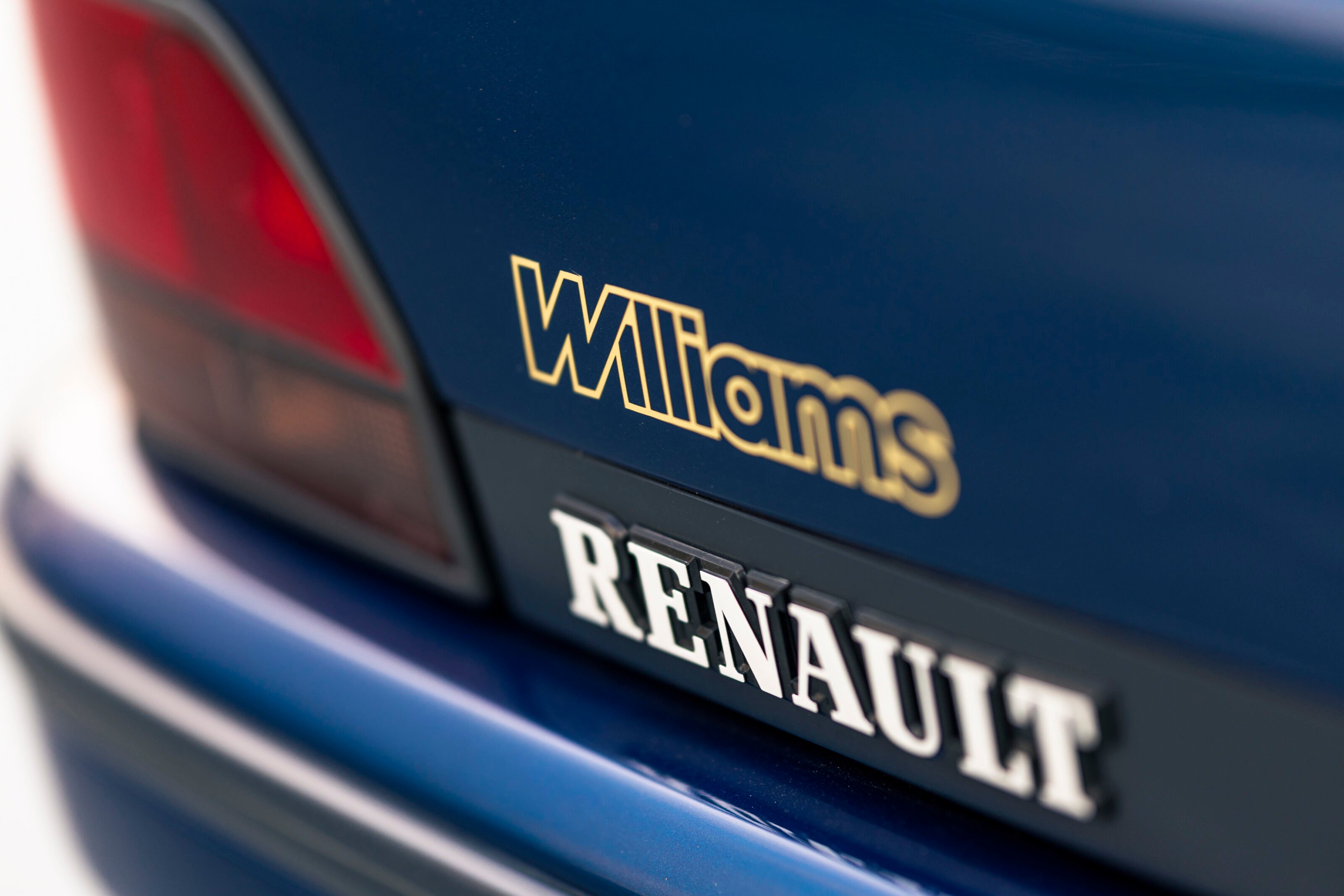
The first two years – with the driver pairing of Riccardo Patrese and Thierry Boutsen – yielded a second and a fourth in the constructor’s championship, but the return of Nigel Mansell from Ferrari for the 1991 campaign gave the partnership the impetus it required. In 1992, Mansell claimed the driver’s world championship and the Renault-powered Williams was crowned Constructors Champion. Renault was canny enough to appreciate the equity in the partnership, and the Clio Williams badge was developed to cash in on that buzz.
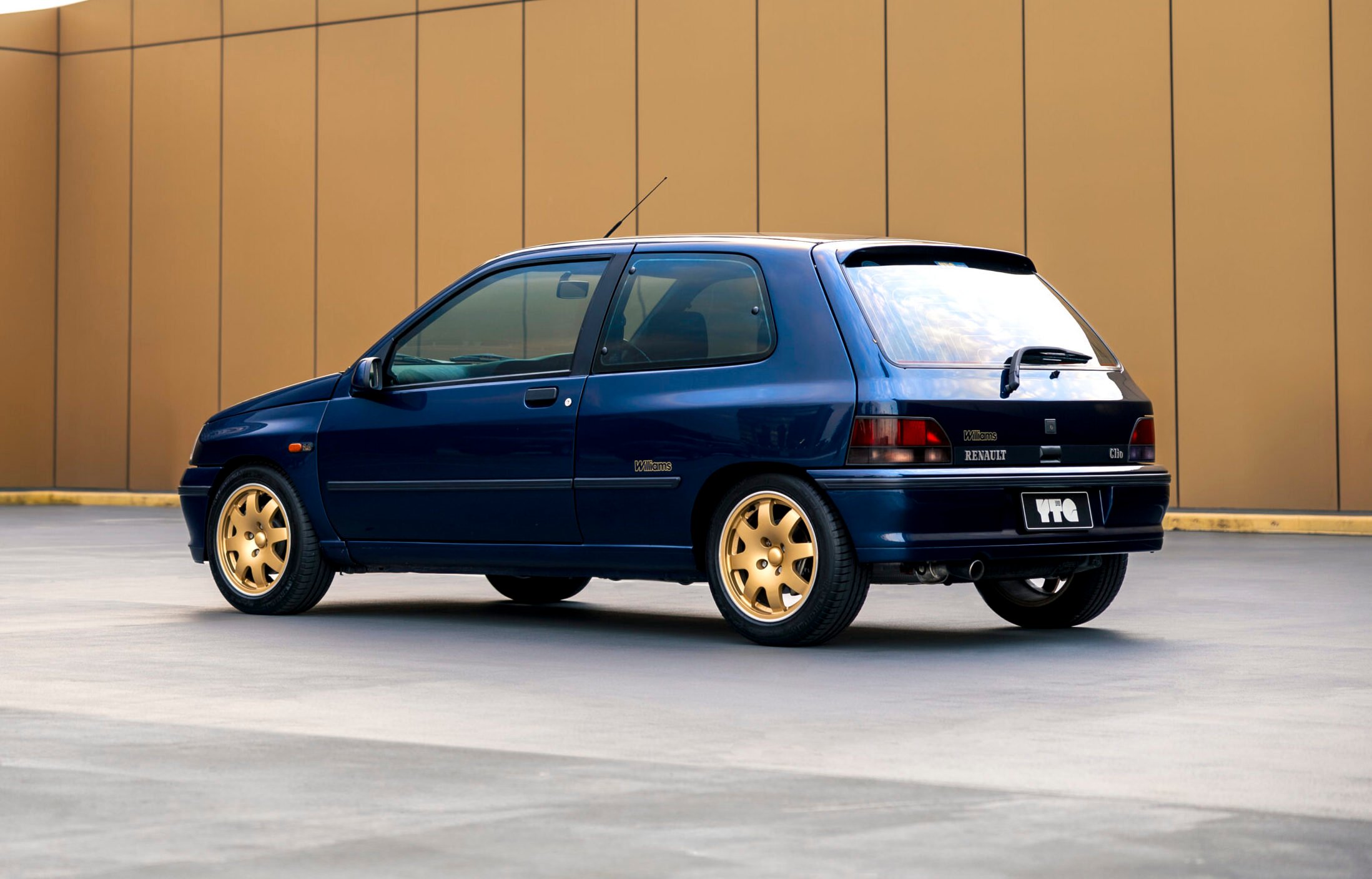
In truth, Williams had nothing to do with the engineering of this car. It was entirely an in-house endeavour by Renaultsport. Badge aside, the only tenuous link with Formula One was the fact that the Clio Williams was the sport’s safety car for the 1996 season. That’s not to say that Renault were entirely cynical about the engineering behind this car. A lot was changed from the 1.8-litre Clio 16v that preceded it.
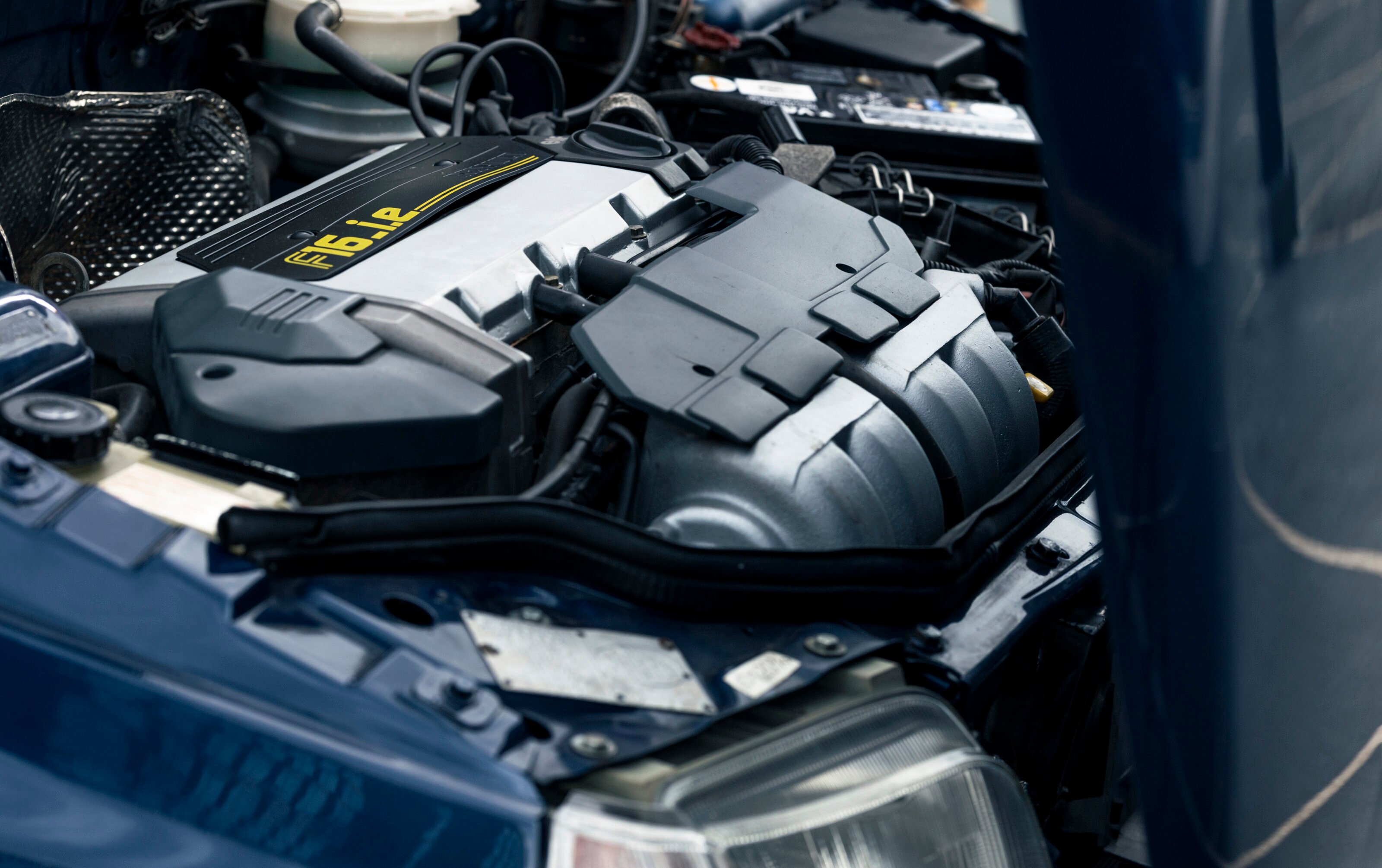
Take the engine. The easy way to meet the 2.0-litre capacity limit would have been a simple bore job on the existing F7P engine. But the Williams’ 2.0-litre F7R powerplant featured different valves, pistons, cams, a stronger crank (from the diesel Clio) and an uprated engine oil cooler. The exhaust breathed through an uprated four-to-one manifold, and power was deployed to the front treads via an uprated JC5 gearbox.
Naturally, the suspension also came in for some attention. Beefier wishbones that looked similar to those in the heavier Renault 19 16v were fitted, which widened the front track width by 34mm, helped by the car’s 12mm wider Speedline alloy wheels to give it a really planted, hunkered-down stance, with subtly bulging bodywork. A reinforced front subframe was purloined from the Clio Cup race car and the springs, dampers, torsion beam and rear anti-roll bar were uprated. Metallic Sports Blue (paint code 449) was your only option. Kerb weight? Just 981kg.
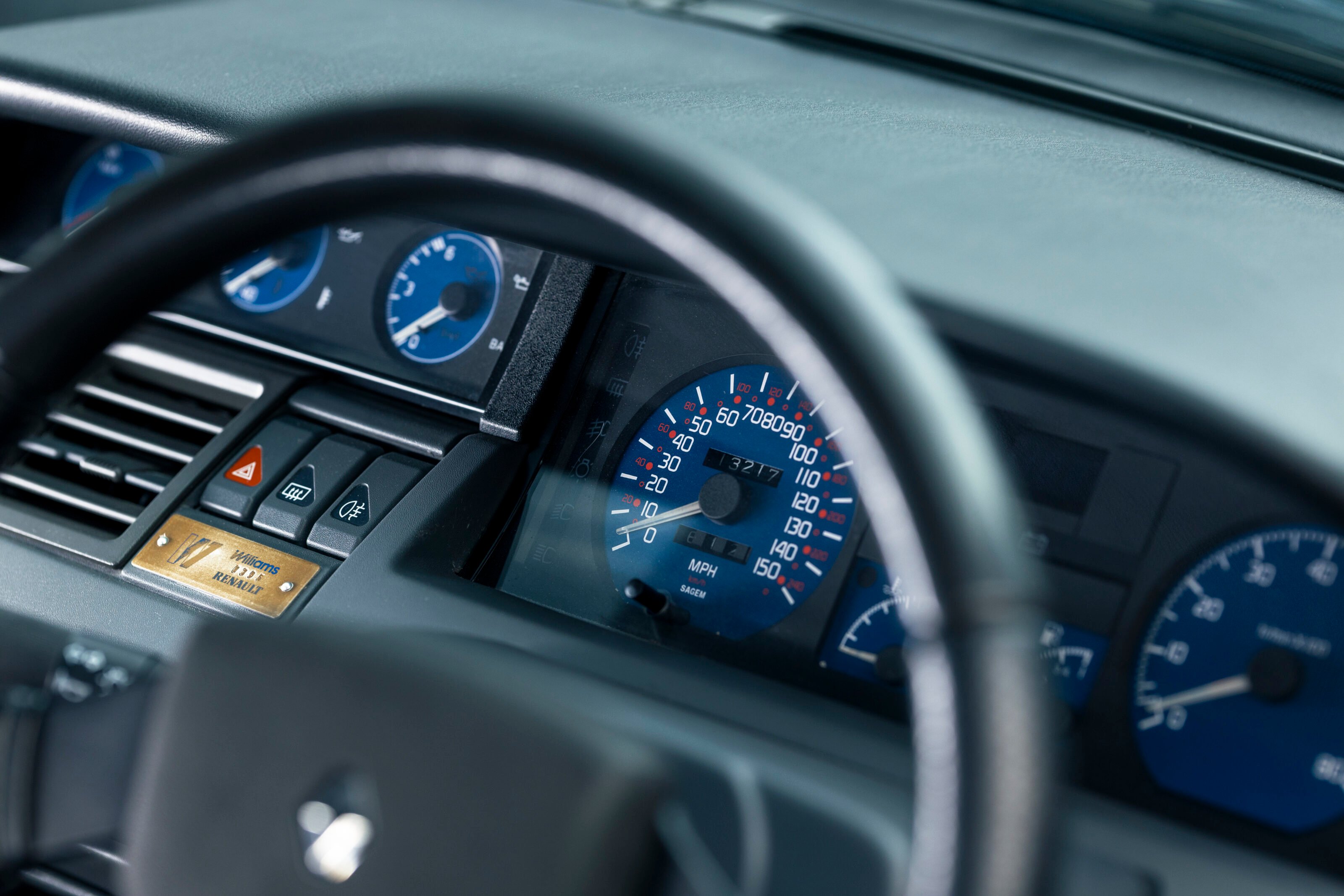
Renault fitted a numbered plaque to the dashboard of each car, giving the impression that this would be a very limited-run vehicle. A feeding frenzy ensued, helped by the fact that, in the UK, the price lifted from the Clio 16v’s £12,337 to £13,275 – a paltry 7.6 per cent impost for a car that was markedly more desirable.
Ah yes, the elephant in the room. The Clio Williams was never officially sold in Australia. No Clio Mk1s were. The car you see here is, however, for sale through Young Timers Garage in Melbourne and, given that this is one of the greatest hot hatches of all time and has never once been featured in the pages of this august publication, we thought it was well worth giving it its moment in the Aussie sun.
Down to detail
The car’s official launch was, aptly enough, in Corsica, on the same roads that Renault aimed to conquer with the competition version in the Tour de Corse tarmac rally. Initial press reports raved about the Williams’ poise, chuckability and added driveability brought about by a fatter and broader torque curve.
It’s exactly this torque that you notice when compared with its predecessor. With 175Nm on tap at 4500rpm, it has some guts, but 85 per cent of that figure arrives from just 2500rpm, giving it a feeling of real heft. It also defines the character of the Williams. Whereas many cars of its era were either turbocharged grunters or revvy screamers, the little Renault seems to combine the best of both worlds, with a deep well of low-down muscle and something to offer at the top end of the rev range.
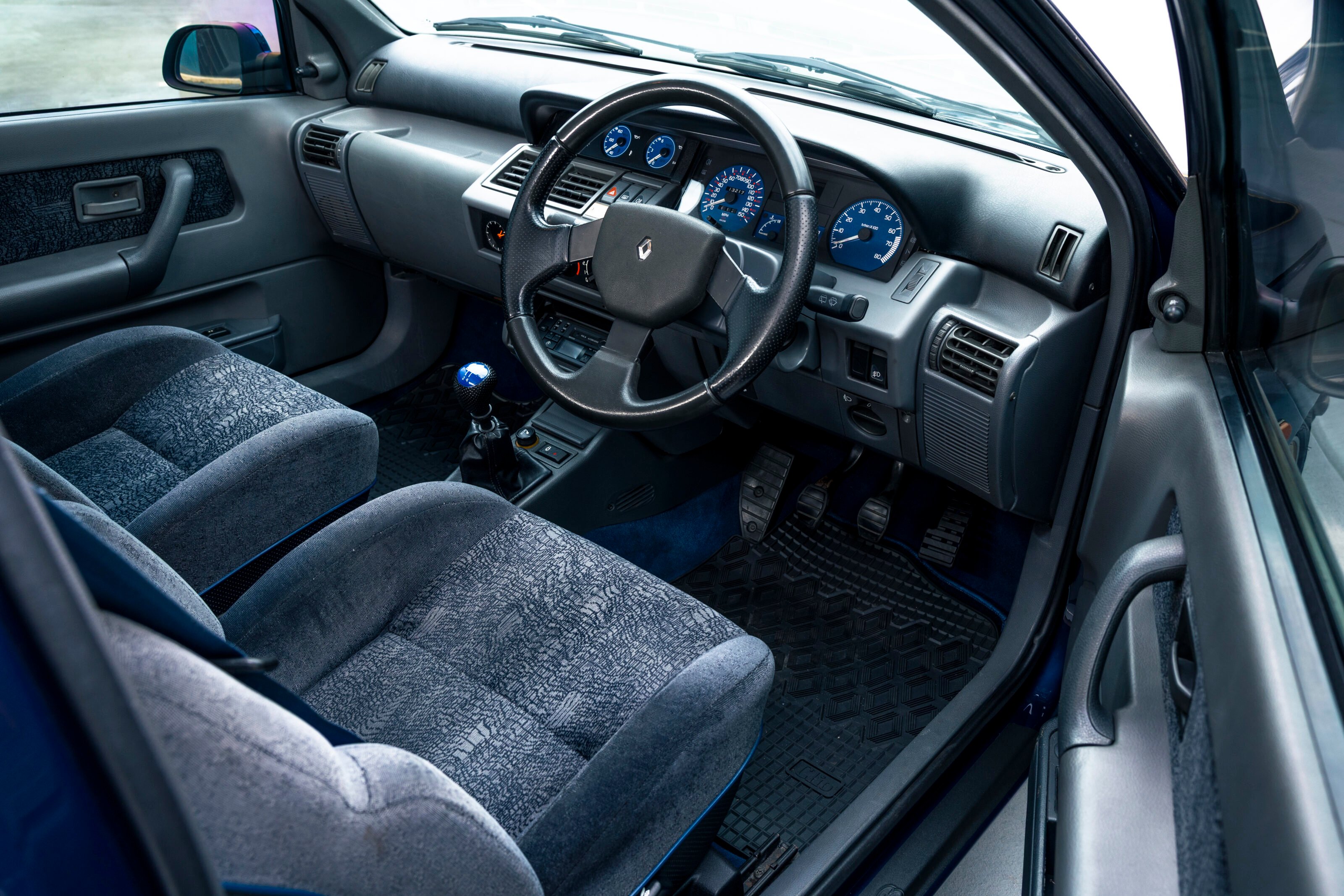
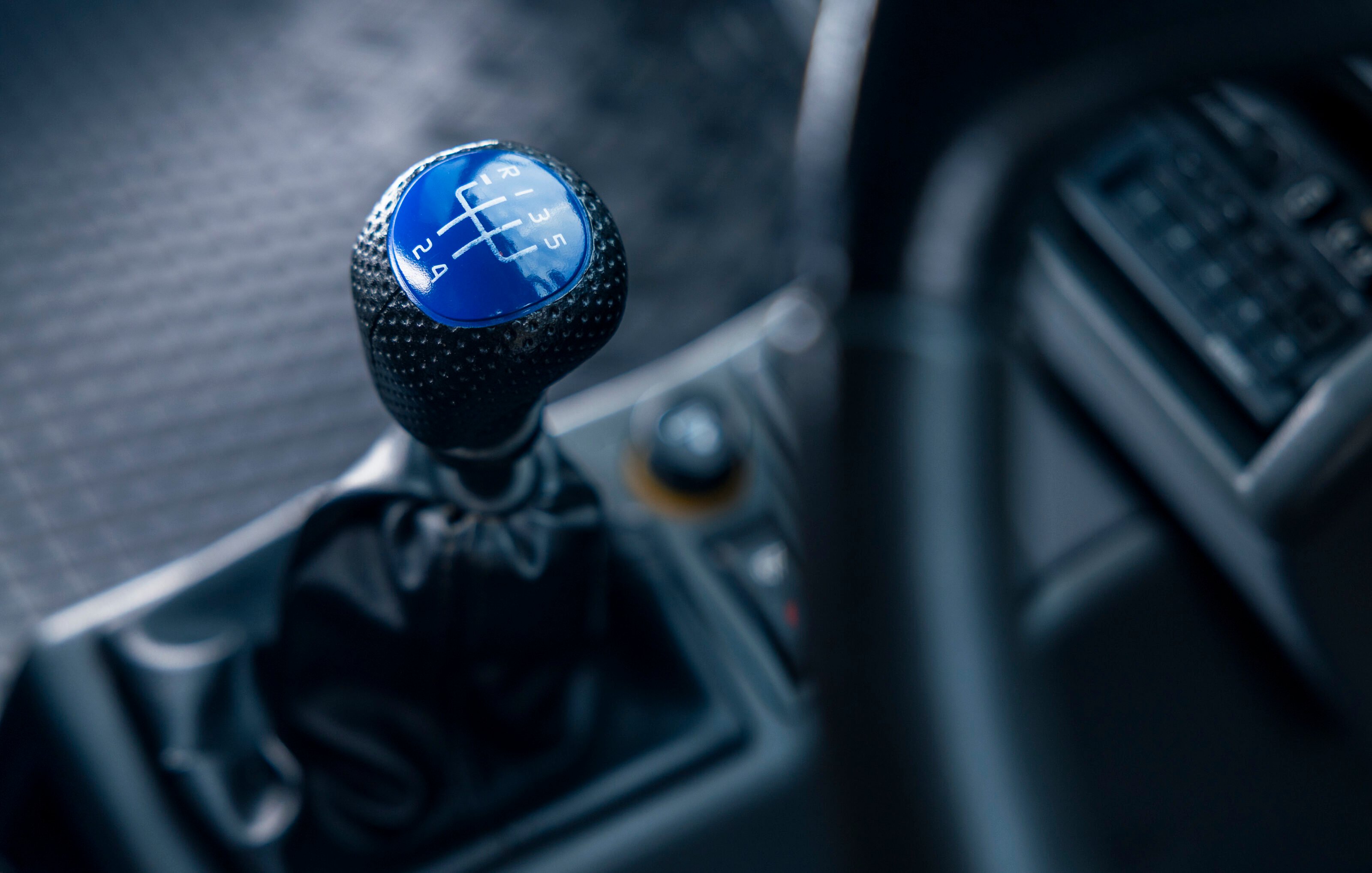
It feels tiny inside. At just 3712mm long, it’s within 12cm of a modern Kia Picanto from stem to stern and isn’t anything like as well packaged, having to house an engine that’s twice the cubic capacity. The cabin was designed in the late 1980s and it’s characteristically of the era, with hard grey plastics throughout, offset with a splash of colour from the blue-themed Sagem clocks, seat belts, seat piping and gear knob.
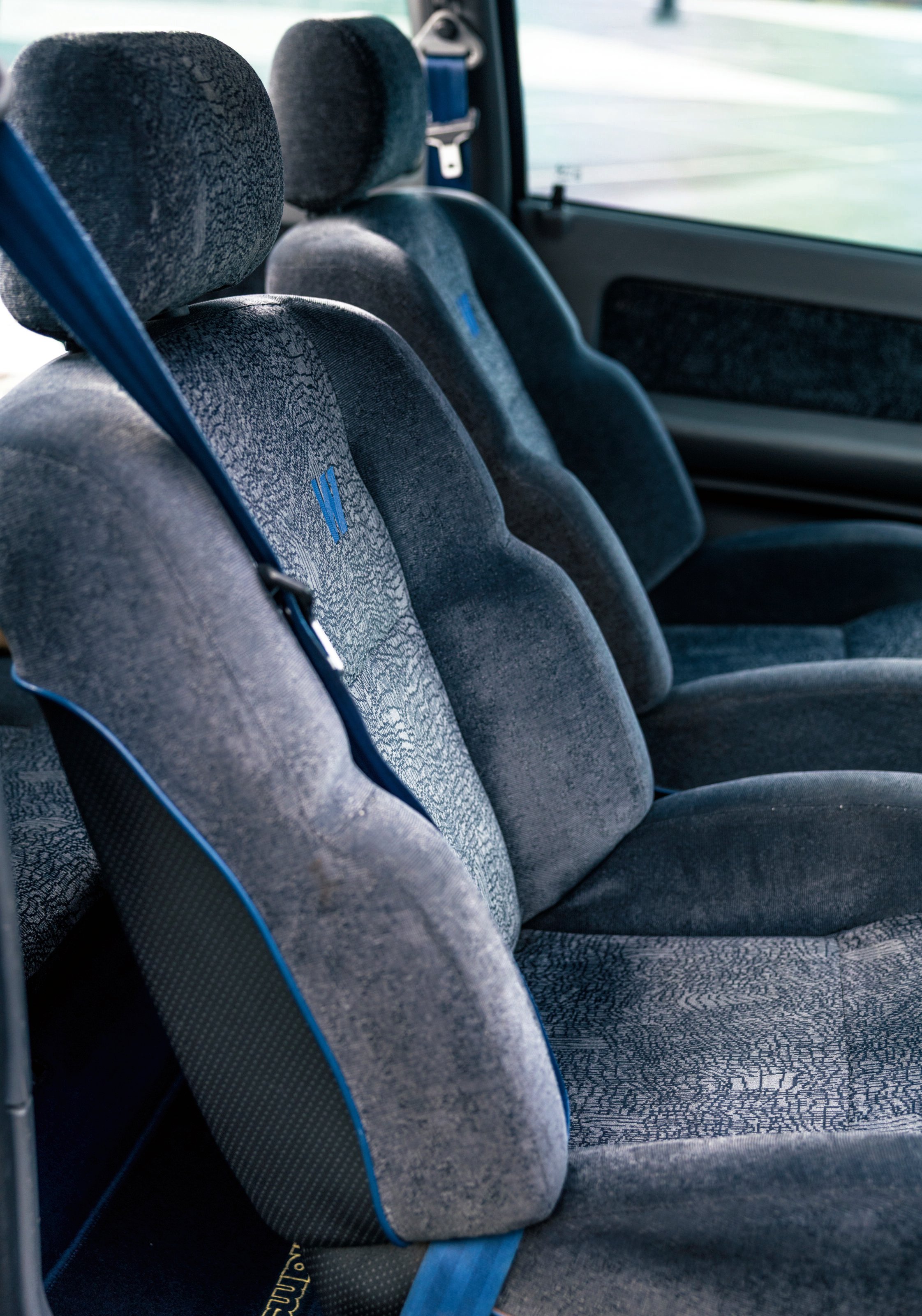
The seats are like nothing on sale today. The French always liked a seat with a reassuring measure of squish, but the Clio Williams blends that with a deeply-winged, monogrammed bucket featuring an upholstery material that I don’t think I’ve seen the like of since. It feels like suede and is printed with a random black pattern that is, amazingly, still offered by French fabric specialists Tissens. Apparently you need a four-metre reel of it if you want to entirely re-upholster your seats and door cards.
Fire up the engine and it has that instant, slightly lumpy thrum of a normally-aspirated Renaultsport engine that tacitly suggests that you’re not operating it in its happy window and that you need to rectify that forthwith. Anyone who has driven a Clio 182 here in Australia would instantly recognise its timbre.
Indeed, it’s possible to trace a bloodline of Renault engines with identical 82.7mm by 93mm bore and strokes from this F7R unit, all the way through to the F4RT powerplant (no sniggering at the back) that was used in the last of the 2017 Renaultsport Megane IIs. After that, the Renaultsport Megane was fitted with a less characterful rebranded Nissan MR18DDT 1.8-litre lump.
On the road, the Clio Williams still feels entertainingly brisk. The sprint to 100km/h from rest comes and goes in 7.7 seconds, and the chassis integrity feels a whole generation on from a Peugeot 205 GTI. Likewise, the power-assisted steering is a boon, providing welcome relief during low-speed manoeuvres, but bleeding back to almost nothing when you get travelling.
It feels an unambiguously organic driving experience. There’s no traction control or stability control and no anti-lock braking. This guides your inputs somewhat, but it provides a reassuringly direct feedback loop between what you’re doing and how the car responds. The gear lever vibrates, as do a few of the dash plastics, and you’ll feel the thrum of the engine through the thin-rimmed steering wheel. It feels alive. A big engine in a small car is a formula that’s never really gone beyond its sell-by date, and the Clio Williams revels in this quality.
Even without the benefit of variable valve timing, which would come later in the 1999 Clio II, there’s a very modern driveability about this powerplant. The five-speed shift could perhaps be a little shorter in its travel, and there’s noticeable driveline shunt if you’re not progressive with the clutch in slow-moving traffic. Likewise the steering isn’t as quick as contemporary hot hatches, where we’ve become spoiled by what an electrically-assisted rack can do. Nevertheless, it’s full of feel, a little torque-steer if you’re overly keen and features what we’d think of as an unsporting degree of rake.
What’s most surprising is the plushness of the ride. Despite featuring stiffer springs and dampers when compared with the Clio 16v, the Williams is by no means harsh. In fact, the amount of body roll and pitch encourages you to measure your inputs to give the car a chance to take a set on its springs, whereupon it’ll grip fiercely, even though it’s usually the case that only 75 per cent of the tyres are doing any work. The car communicates clearly what’s happening at its contact patches and there’s none of the spooky lift-off characteristic of a 205 GTI.
It also works well on Australian roads, largely because it has the ability to soak up the surface changes, lumps and bumps that typically afflict our most challenging cross-country routes. Indeed, this is where the Clio Williams gives its best, working with you in a way that’s reminiscent of a current Mazda MX-5, the skilled driver using its subtle weight shifts to nudge and cajole it with delicacy. Is it still fun? You bet.
The supply side
But what of the controversy that stalked this car? In short, Renault realised that demand was wildly outstripping its initial projections for supply and got a little greedy. A best-case scenario of 3800 cars was initially envisaged, but such was the hype surrounding this hot ticket that the Flins plant eventually built 4500 examples of the Clio Williams. That would be a transgression in the eyes of most who signed up on the basis of some guarantee of exclusivity, and remember, Renault only needed to build 2500 to satisfy homologation requirements.
But worse was to come. After the initial 4500 cars found owners, Renault unveiled the Clio Williams 2 in 1994, with the intention to build another 2500 units. Featuring updates to grille, side lettering and tail lights, the Clio Williams 2 had existing Williams’ owners up in arms, feeling that their residual values had been damaged by this dilution of the Williams pool. In fact, Renault had no problem finding 7100 buyers for the Clio Williams 2, with 500 additional vehicles as an end-of-run ‘Swiss Champion’ edition in 1995.
Then, to add insult to injury, Renault launched the Clio Williams 3 in 1995. This was painted a slightly brighter shade of blue (432 Monaco Blue) and came fitted with a sunroof as standard and the security blanket of anti-lock brakes. In all, 12,100 Clio Williams models were built, almost four times the initial promise, and the original owners attempted to organise themselves to launch a class action against Renault, which eventually came to nought. It was all a bit of a sorry end for a car that ought to have been remembered as a triumph.
In recent years, demand has firmed as the memory of Renault’s chicanery has faded and the reality of what the Clio Williams represents has solidified. More than any other, it set the foundation for years of front-drive excellence from Renaultsport. The highest values will always be commanded by the low numbered plaques of the original Clio Williams, but the Williams 2, like the car you see here, and the later Williams 3 are still in strong demand and there’s now not a great deal of price variance across the three generations.
They merit a bit of preventative maintenance, with oil changes recommended every 10,000km. Check wheel bearings and look for cracked front springs and noisy power steering pumps. All of the right-hook examples you’ll find in Australia will have hailed from the UK, so check for rust, especially around the rear arches, door frames and footwells. Electrics can be occasionally recalcitrant and ensure that any stereo fitment on a Williams or Williams 2 is professionally installed, as the standard cars came with no in-car audio. Thanks to soaring valuations, these cars tend to be looked after.
The Clio Williams remains the alpha and omega of early 1990s hot hatches. It’s a bona fide modern classic and one of the most significant small cars of its era. While it sits at the top table of iconic hot hatches, Group A rallying outgrew lightweight front-wheel drive competitors, even on tarmac events.
That said, the Williams absolutely deserves its place among the finest front-drivers of all time. Back in 2006, evo magazine set out to discover the greatest front drivers of all- time and the Clio Williams ended up on the podium alongside the Honda Integra Type R and the Clio 182 Trophy. Lightweight, efficient and fun, perhaps we’re missing a bit of their DNA today. Yes, the game has moved on but for the better?
Rallying To The Cause
The Clio Williams was a popular tarmac rally platform, especially in France, with drivers such as Jean Ragnotti, Philippe Bugalski and Alain Oreille all campaigning it. The basic Group N model made 121kW and featured a less restrictive exhaust, firmer suspension, different engine maps and a roll cage supplied by Matter France, with Sabelt bucket seats. The Group A car made up to 162kW from its more aggressive engine tune and larger extractors. 16-inch Speedline alloys were fitted and the front brakes were uprated to 323mm discs with four-pot Alcon calipers.

Specs
| Model | Renault Clio Williams 2 |
|---|---|
| Engine | 1988cc 4cyl, dohc, 16v |
| Max Power | 108kW @ 6100rpm |
| Max Torque | 175Nm @ 4500rpm |
| Transmission | 5-speed manual |
| Weight | 981kg |
| 0-100km/h | 7.7sec |
| Price (now) | c.$45k |
This article originally appeared in the June 2025 issue of Wheels magazine. Subscribe here.
Things we like
- Fantastic value for money
- Quite refined, even at speed
- Practical and good quality interior
Not so much
- Suspension is too soft
- Touchscreen requires a lot of familiarisation
- No faster-charging, longer or shorter-range versions
| Rating |
|---|
Wanting to sell more than just its sub brands such as Volvo, Polestar and Zeekr, huge Chinese company Geely has finally released its own product in Australia. Indeed, while there are tens of thousands of cars on our roads using Geely technology – mostly Volvos and also the second coming of the Smart brand – the brand itself was only very briefly sold in Western Australia in 2010, and is otherwise largely unfamiliar to us.
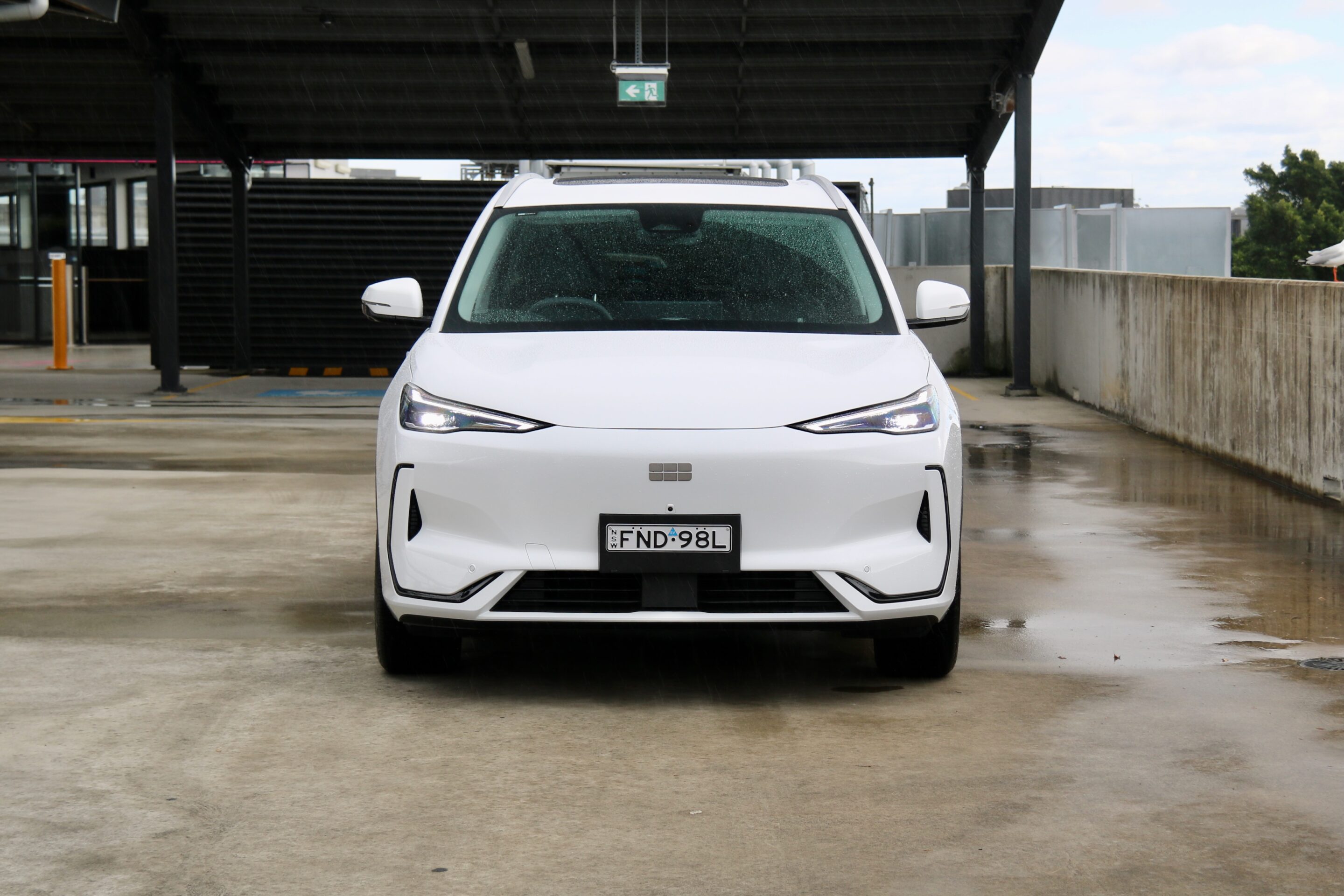
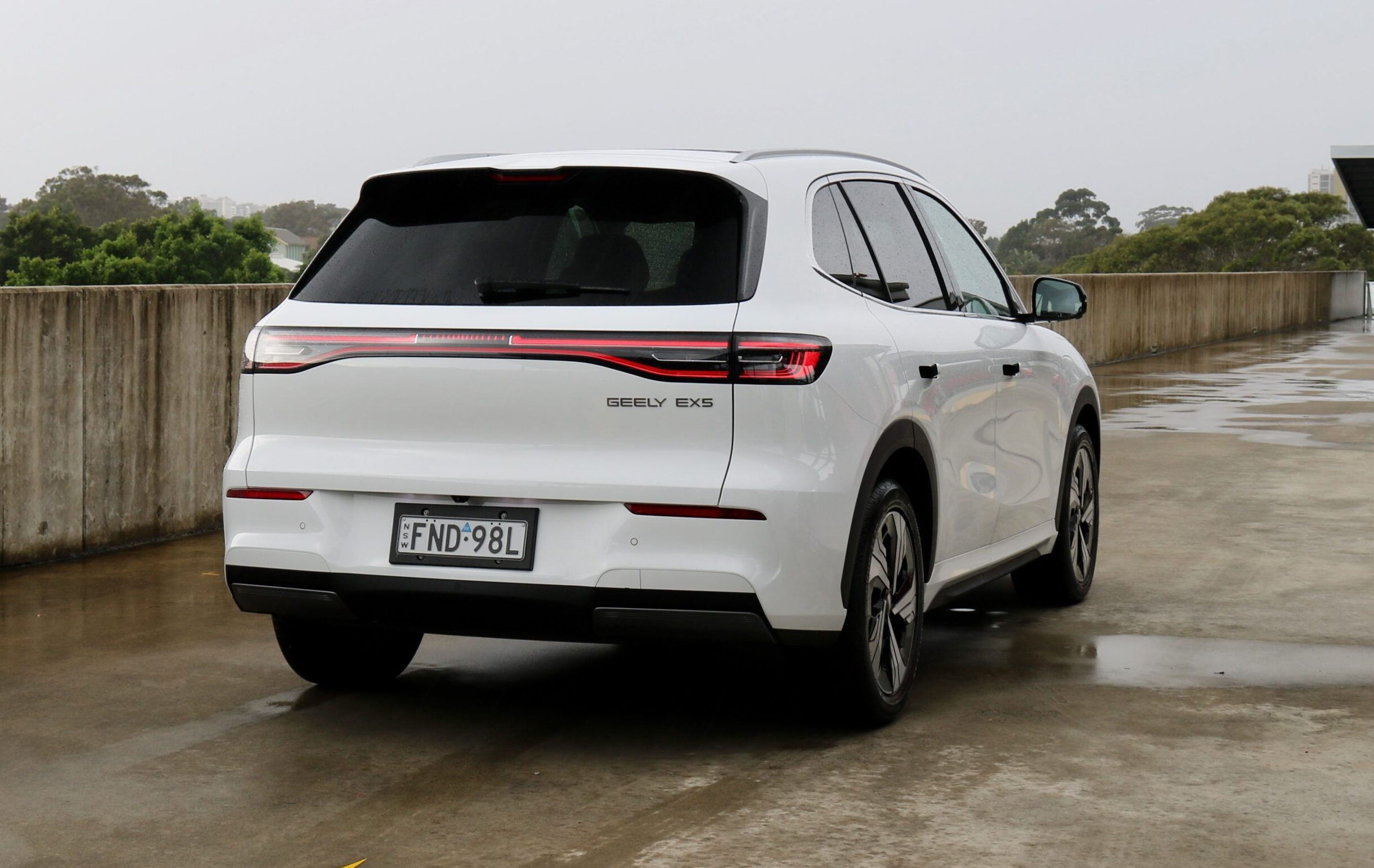
Its first proper Australian effort is spearheaded by the EX5 electric mid-size SUV. Competing against established models such as the Tesla Model Y, the EX5 is priced from just $40,990 plus on-road costs, clearly prioritising value as its unique selling point. But is the Geely EX5 more than just a value proposition?
Price and equipment:
For now, Geely is keeping it simple with the EX5 and there are just two models available locally:
entry-level Complete and upper-spec Inspire. Both use the same mechanicals so it’s really just
standard equipment that warrants spending the extra $4000 to get to the Inspire – but regardless,
the EX5 is priced well under its main rivals.
2025 Geely EX5 pricing (plus on-road costs):
| Complete | $40,990 |
|---|---|
| Inspire | $44,990 |
Geely EX5 Complete standard features:
- 18-inch alloy wheels with a tyre repair kit
- Dusk-sensing automatic LED exterior lighting
- LED front and rear daytime running lights (DRL)
- Rain-sensing automatic wipers
- Roof rails
- Heated and power-folding mirrors
- Rear privacy glass
- Keyless entry and push button start
- Leather steering wheel with
- Synthetic leather upholstery
- 6-way driver/4-way passenger electric front seat adjustment
- Heated front seats
- Automatic climate control with rear air vents
- Heat pump
- Vehicle-to-load (V2L) capability
- 10.2-inch digital driver’s display
- 15.4-inch touchscreen with inbuilt connected services
- Six-speaker sound system
- 15W wireless phone charger
- FM/DAB+ digital radio
- Satellite navigation with live traffic
- 4x USB ports
EX5 Complete safety equipment:
- Seven airbags (including a front central unit)
- Autonomous emergency braking (AEB)
- Lane keeping assistance with lane departure warning
- Auto high beam
- Traffic sign recognition
- Blind-spot monitoring
- Front and rear cross-traffic alert (rear with braking)
- Evasive manoeuvre assist
- Driver attention monitoring
- Adaptive cruise control
- Low-speed front and rear auto braking
- Door open warning
- Rear parking sensors
- 360-degree camera
The EX5 range earned a five-star ANCAP safety rating with scores of 87 per cent in adult
protection, 83 per cent in child protection, 68 per cent in road user protection and 85 per cent for
safety assistance.
EX5 Inspire model adds:
- Larger 19-inch alloy wheels
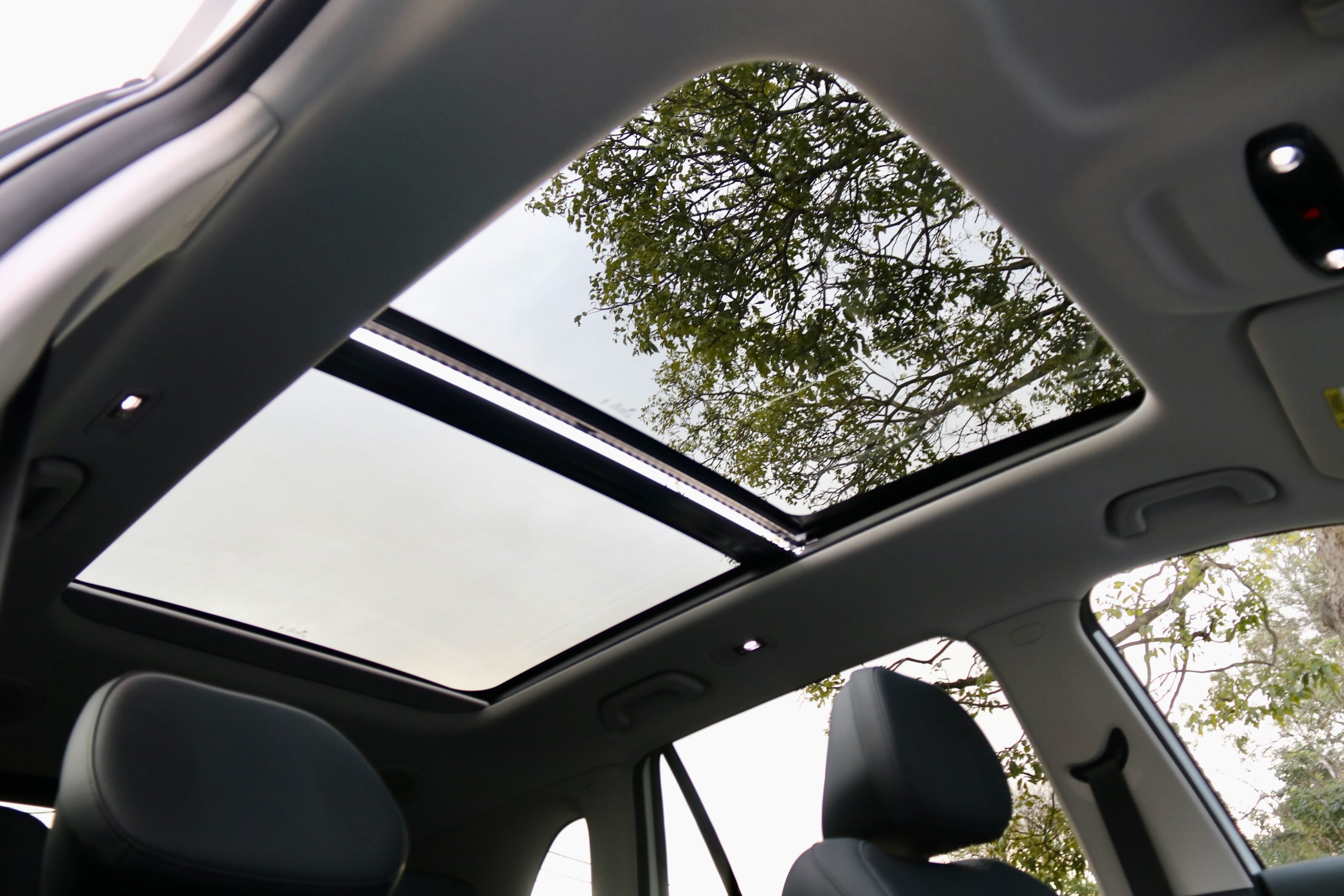
- Panoramic sunroof
- Ventilated and massaging front seats with driver’s memory and a front passenger electric foot
rest - Electric tailgate
- Front parking sensors
- Illuminated front vanity mirrors
- 256-colour ambient lighting
- 13.4-inch head-up display
- 1000-watt 16-speaker Flyme sound system
Interior comfort, practicality and bootspace
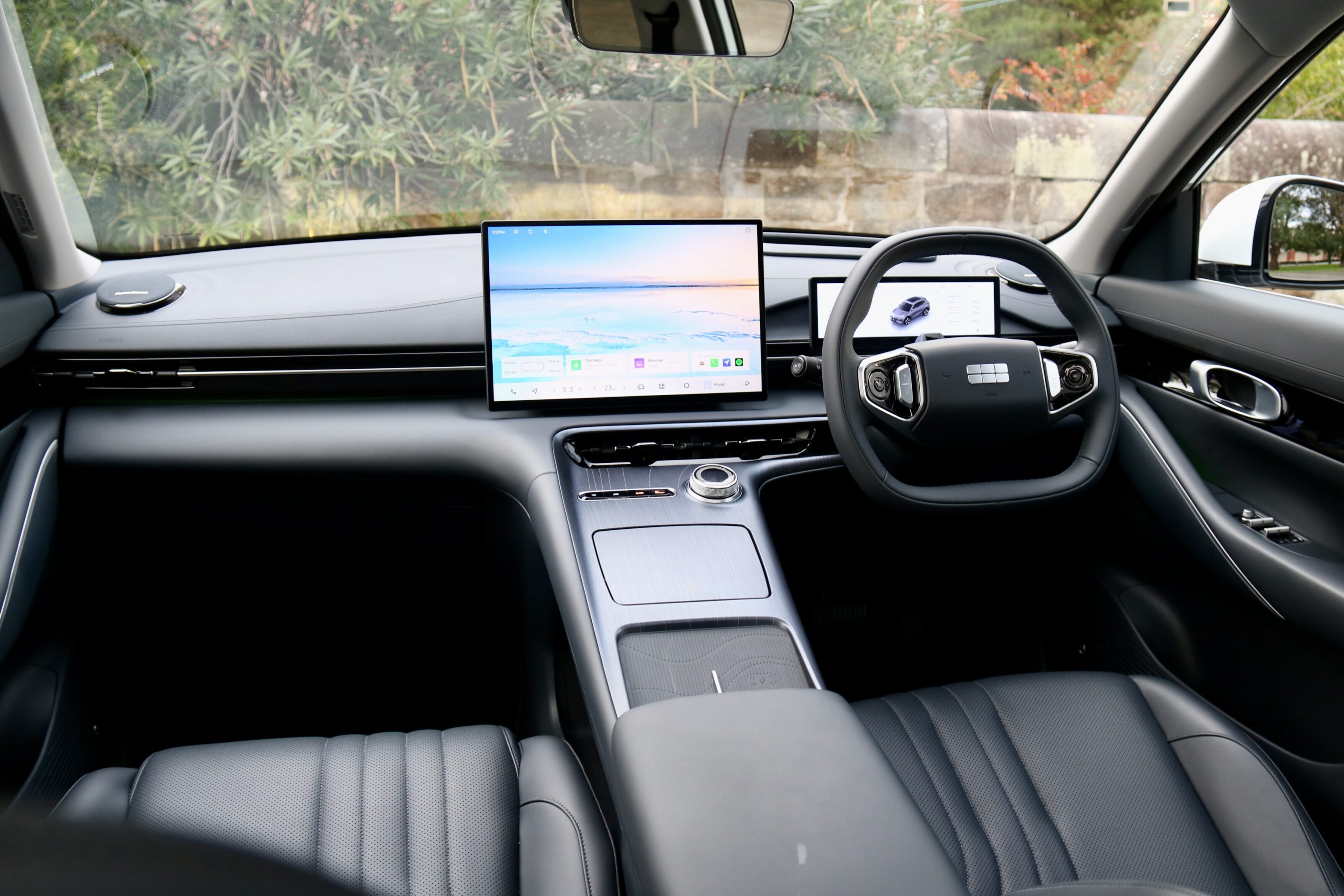
While we could wax lyrical about the design, put simply the interior of the Geely EX5 Inspire feels like it should cost significantly more than its $44,990 +ORC asking price. While the materials are generally solid quality and there’s a richness in its trims such as the wood-like trim on the centre console (which, thankfully, isn’t the sea of piano black that so many other cars use) the general ambience is one that feels like it should cost a lot more than it does. It makes the Kia EV5’s cabin feel austere by comparison.
The EX5’s cabin is nothing if not practical, with plenty of storage space – a huge rubberised under-centre console tray, a big bin underneath the central armrest, a tray with a wireless charger and big cup holders on the centre console.
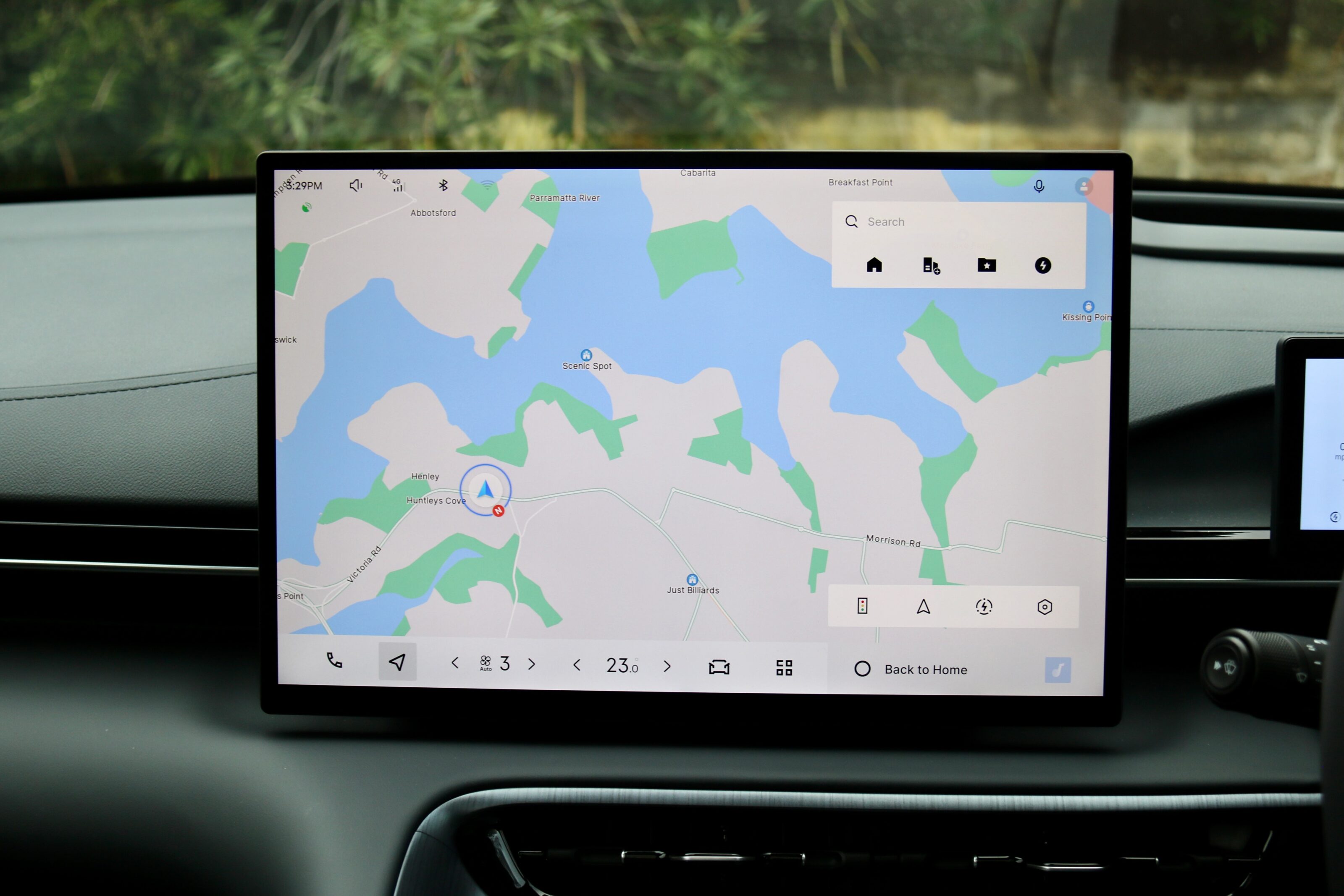
Centre of the EX5’s cabin – and the controller of pretty much every one of its every functions – is a huge 15.4-inch touchscreen with features such as sat-nav and digital radio, as well as an inbuilt SIM card for live services such as app downloads and useage, as well as access to a smartphone app. The screen quality is crisp, as is sound quality from the 1000-watt 16-speaker Flyme audio system, but Apple CarPlay and Android Auto smartphone mirroring aren’t yet available – they’re coming via an over-the-air update later in 2025.
As we’ve seen with a lot of other modern cars, there’s just too much functionality reliant on the touchscreen. While the menu structure is easy to understand and there’s a smattering of physical buttons for the HVAC system, many functions – such as operating the sunroof – are controlled through the screen. Add in some undersized icons on the screen and it can be a difficult system to use while driving.
One curious feature of the EX5 is the physical volume knob, which can also be pressed to control functions such as the temperature and even, oddly, switching the background on the touchscreen. But where’s the hazard lights button? In the roof, which is where the sunroof control should be.
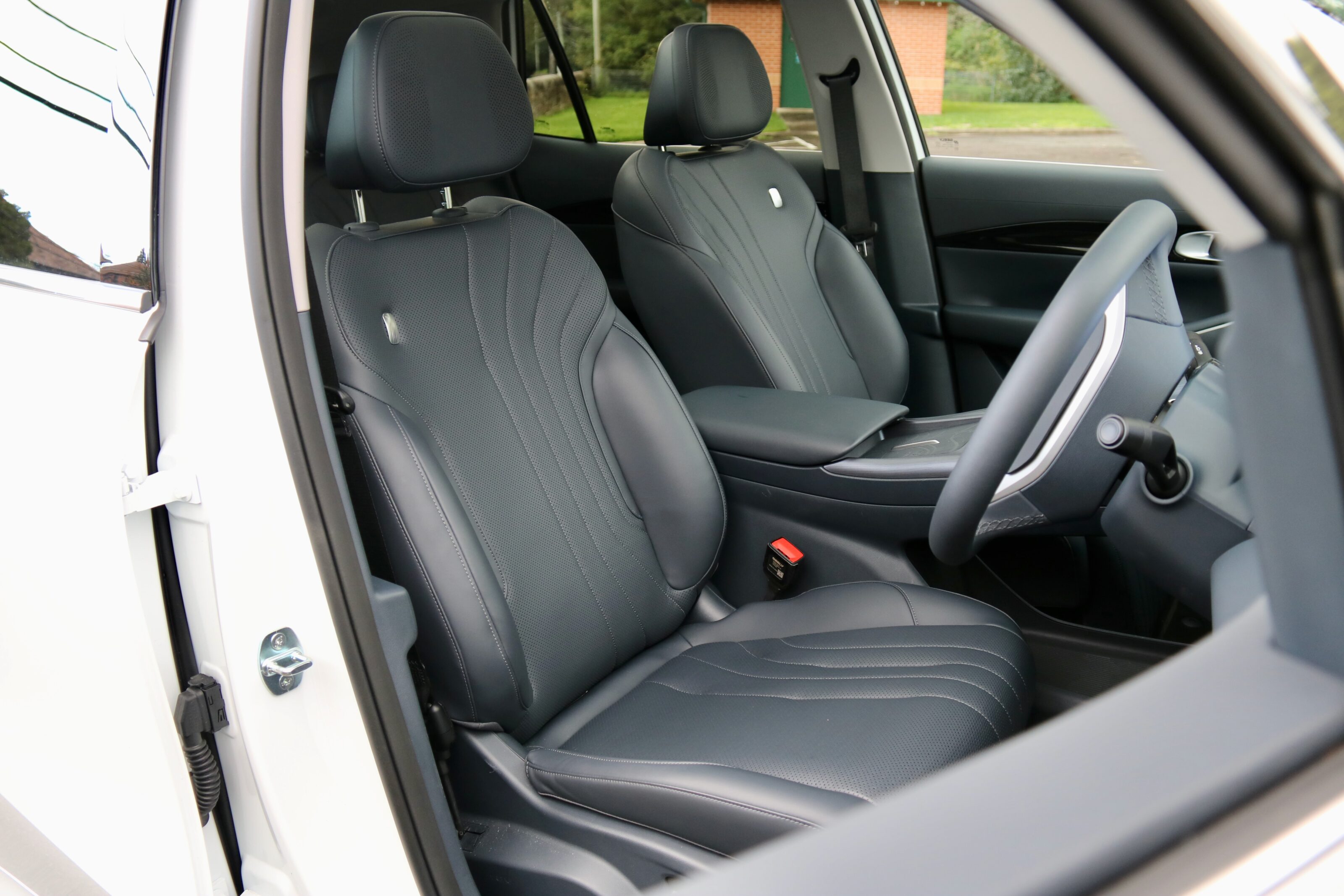
The front seats in the EX5 are comfortable, especially with the multi-stage massaging in the Inspire, though both under thigh and lumbar aren’t adjustable which reduces comfort and adjustability in the driving position. Visibility in the EX5, however, is excellent and it’s very quiet for road noise as well.
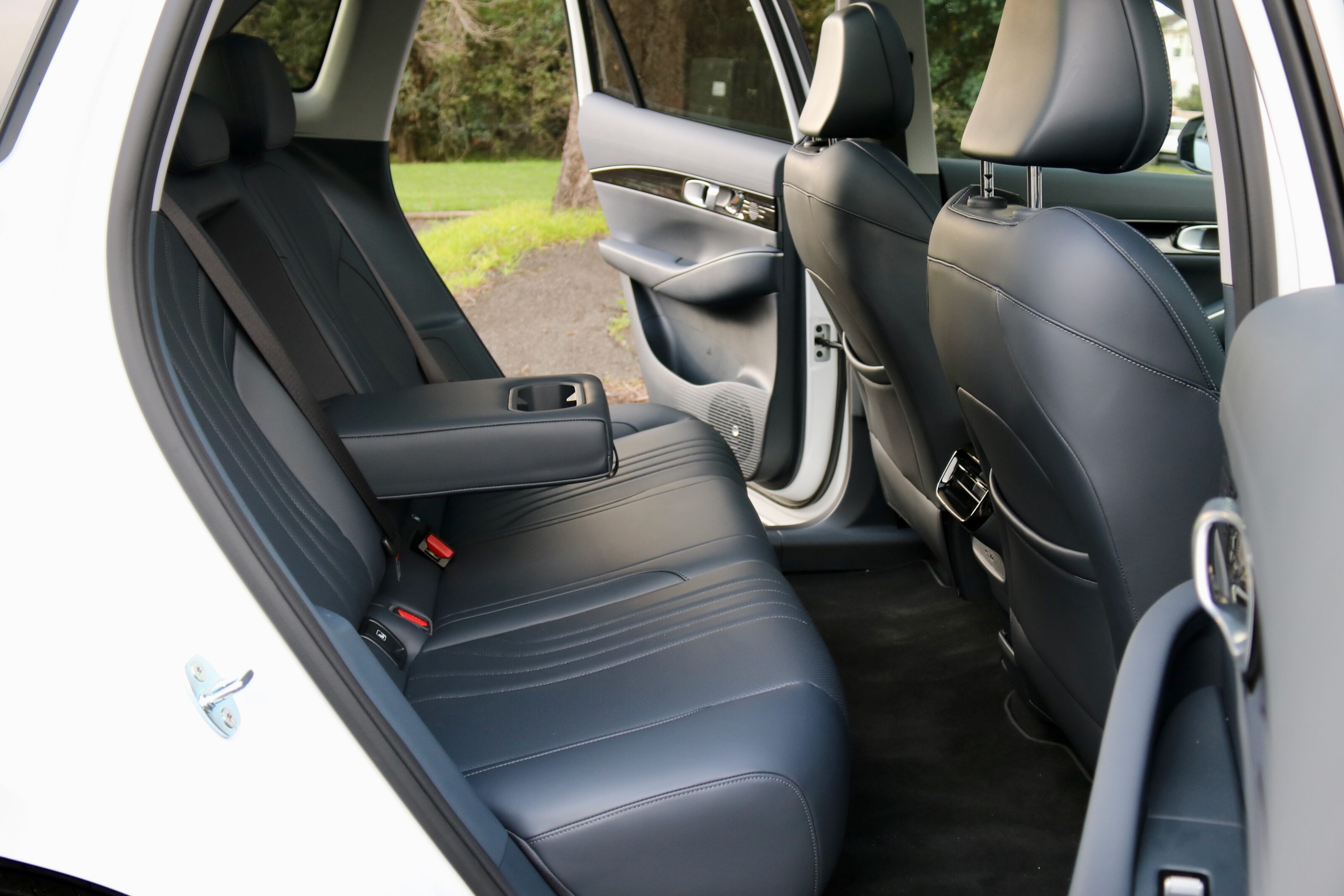
The rear seat of the EX5 is spacious thanks to ample space in all directions for taller adults, as well as a completely flat floor so that three adults will be able to fit. There are also some amenities such as door and map pockets, two USB charging ports, air vents and a central armrest with cup holders.
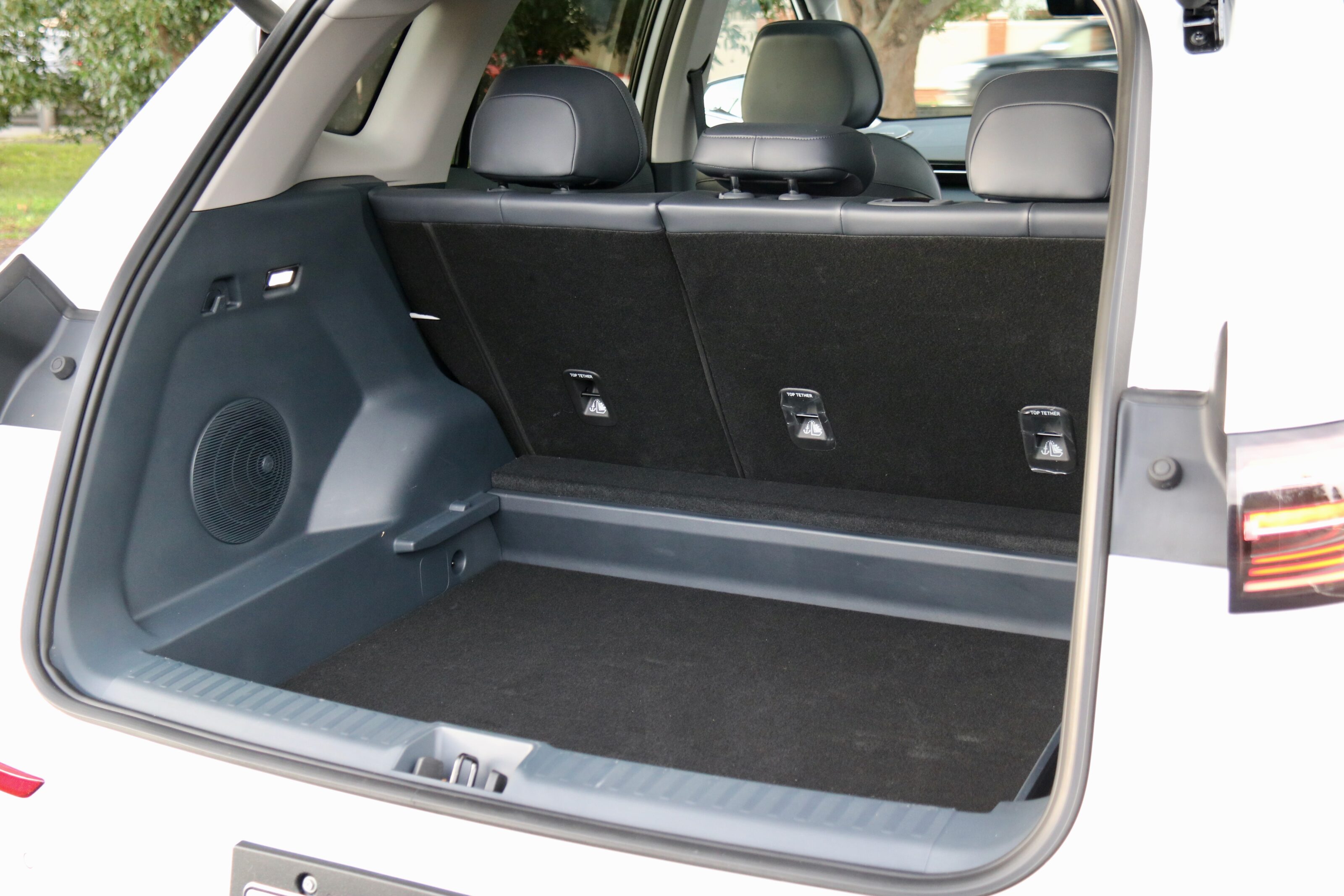
The boot of the EX5 measures a small 302 litres with the seats up, but it seems larger than that in real life. Practical touches include a dual-level floor, some hooks to hang bags and some side storage, plus a massive under-floor storage box that increases overall capacity to 410 litres, which is still behind the best but more than enough for everyday life. Fold the seats down an there’s a very healthy 1877 litres on offer – 163L more than a Kia EV5. Like a lot of EVs though, there’s no spare wheel in either EX5 model, nor is there a front boot.
Performance and range
Using Geely’s ‘GEA’ platform – that’s Geely Global Intelligent Electric Architecture – which is a cheaper version of the ‘SEA’ platform used in its sub brands, the EX5 features a 60.2kWh lithium ion phosphate (LFP) battery for up to 410km of claimed range (WLTP). A smaller 49.5kWh battery is also available in some markets with a range of around 300km, though no longer-range model exists yet.
Using a 400V architecture, the EX5 can be AC charged at up to 11kW and DC fast charged at up to 100kW for a 30 to 80 per cent charge in as little as 20 minutes. Geely claims energy consumption of 16.6kWh/100km for the heavier Inspire model, though we bettered that with a 14.9kWh/100km result.
On the road
Before the EX5 was launched in Australia, its maker boasted about its 12-month pre-launch local tuning program to ensure that it handles the worst that our roads can throw at it. While we aren’t able to drive a Chinese-spec EX5 – or Galaxy 5 as it’s called there – the EX5 handles our atrocious roads well and is quite smooth and comfortable, even over bigger bumps.
Sometimes, however, the suspension is too soft and takes too long to settle after some bumps. A quick succession of bigger bumps has the EX5 struggling to settle and its occupants feeling a bit off from motion sickness. Firmer dampers would improve the EX5’s driving experience markedly. It’s the same story with the handling.
While the EX5 is no sports car, nor is it marketed that way, it’s not really a fun car to drive. It’s surprisingly punchy, with a claimed 0-100km/h time of 7.1 seconds for the Inspire, and is more than quick enough for most buyers. But drive it remotely hard and it really doesn’t like it, nor is there much feedback from the steering as to what the front wheels are doing.
The local tuning of the EX5 also extends to the active safety systems, where the company underwent a 12-month program to ensure that its features are there to help and not hinder the driving experience, like so many cars do. In reality, aside from the hyperactive driver monitoring camera, they’re all appreciably more refined than a lot of other systems from car makers – the lane keeping assistance is relaxed compared to the Deepal S07, for example.
What would make the systems easier to use would be properly marked buttons on the steering wheel. For example, the cruise control buttons on the steering wheel have no markings to indicate their function so they’re difficult to understand. But importantly, because they’re not as intrusive as a lot of rivals, most people won’t need them to be switched off.
Service and warranty
The EX5 is covered by a seven-year/unlimited km warranty with 12 months of roadside assistance that is service-activated up to seven years in total. The battery is covered for eight years with no distance limit.
The EX5 features 12-month/20,000km service intervals and five years/100,000km of servicing costs a reasonable $1487 ($298 per year), though buyers can pre-pay for servicing at the time of purchase with a five-year plan costing a cheap $1190 ($238 per year).
Verdict: Should I buy a Geely EX5?
There’s no doubting that the Geely EX5 has a lot going for it and in some departments, is worthy of consideration over rivals. The price is an absolute knockout and its obvious unique selling point in the market. We thought the entry-level Kia EV5 Air was good value at $56,770 drive away, but here is a rival that’s better finished inside and offers comparable range and charging speed for more than $10,000 less.
However, there is also a lot to improve with the EX5: its suspension is too soft and its central touchscreen has far too much functionality, yet no smartphone mirroring for now. Plus, rivals like the aforementioned EV5 offer longer-range models higher up their model range, which we’d like to see Geely offer too. But with such sharp value, many brands will have been put on notice by the Geely EX5’s local arrival, one that we expect to create even more waves in the ever-changing EV market.
EX5 rivals
Specifications
| Model | Geely EX5 Inspire |
|---|---|
| Price | $44,990 plus on-road costs |
| Battery | 60.2kWh lithium ion phosphate (LFP) |
| Claimed range (WLTP) | 410km |
| Claimed energy consumption | 15.8kWh/100km |
| Max AC/DC charge rate | 11kW/100kW |
| Peak power | 160kW |
| Peak torque | 320Nm |
| Transmission | Single-speed automatic |
| 0-100km/h | 7.1 seconds |
| Top speed | 175km/h |
| Length/width/width/wheelbase | 4615/1901/1670/2750 mm |
| Boot (seats up/down) | 410/1877 litres |
| Tare weight | 1765kg |
| Warranty | 7-year/unlimited km |
| 5-year service cost | $1487 |
| On sale | Now |
