
Welcome to a close-up look at the world’s biggest car fest, the 2019 Frankfurt Motor Show! Start clicking in the pic above!
It’s another huge show in the German town of Frankfurt, where the pretzels are warm, the halls are enormous and the crowds are massive.
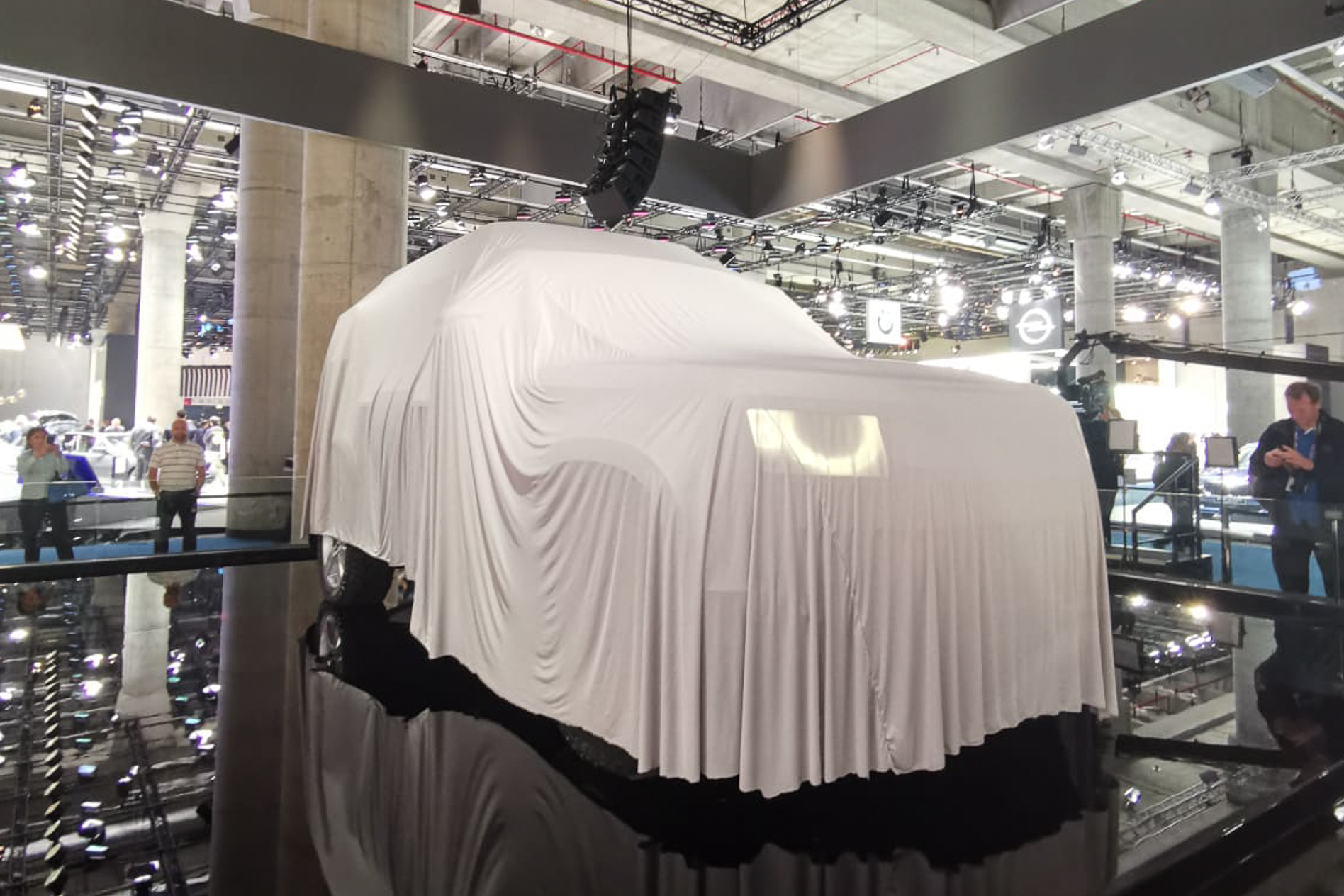
The Frankfurt show, along with the Paris Motor Show, has retained top-dog status for many years, with key car brands choosing to unveil their newest and brightest stars amongst its multiple halls.
This year, the Land Rover Defender undoubtedly stole the early limelight with a spectacular reveal, though Audi upped the ante with a sneaky reveal of its forthcoming e-Tron Sportback, as well as its cool AI:Trail electric concept.
Other brands to show the wares included Mercedes-Benz with the otherworldly EQS, Volkswagen’s charged-up ID3 range and much more besides.
Make sure you bookmark the gallery as we keep adding pics, and check out our huge Frankfurt Motor Show hub right here.
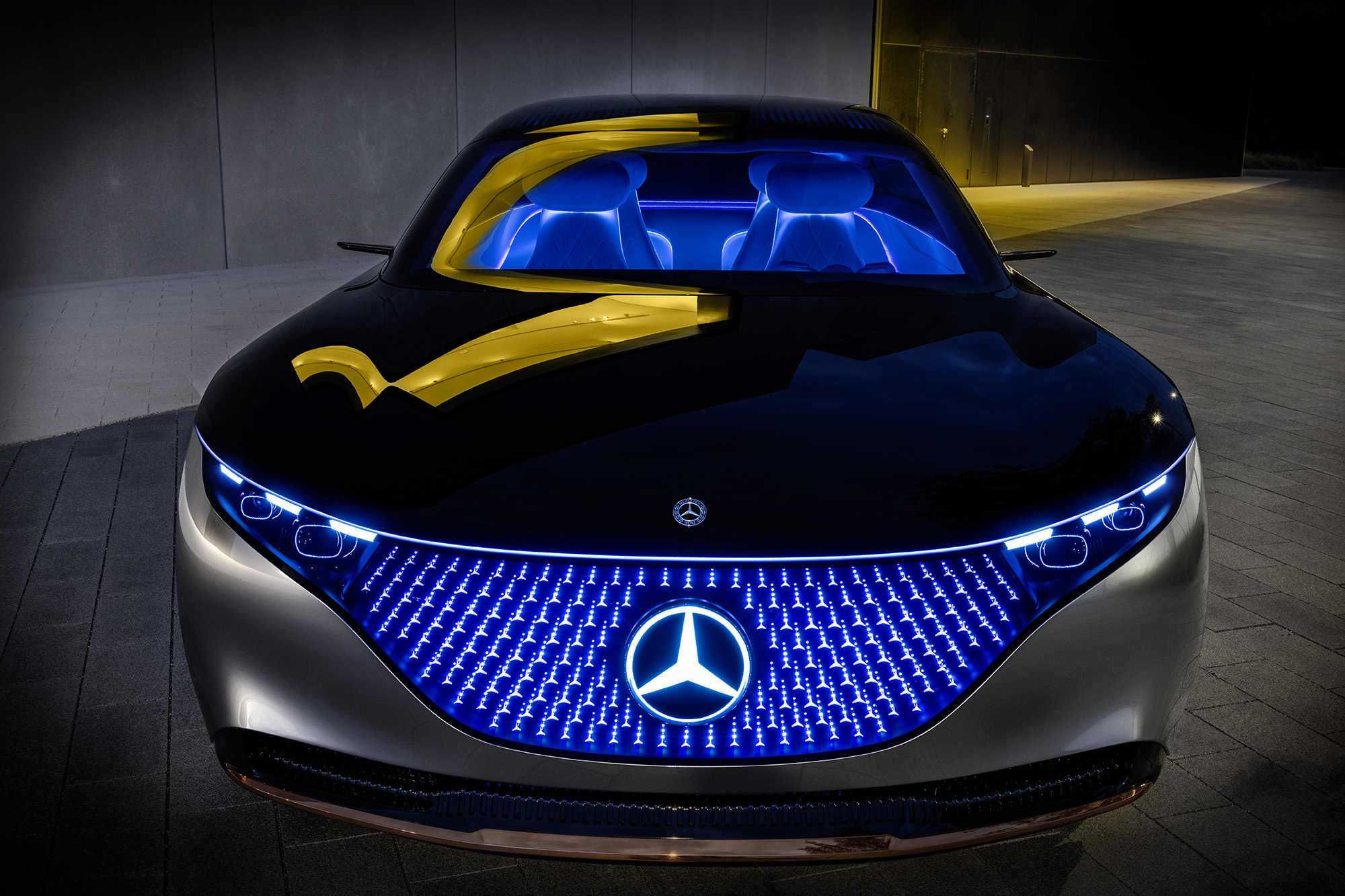
It’s all part of a plan for the marque to have its entire range carbon neutral within 20 years, or just three life cycles for most variants between now and 2039. It’s ambitious given that AMG is grouped within that target too.
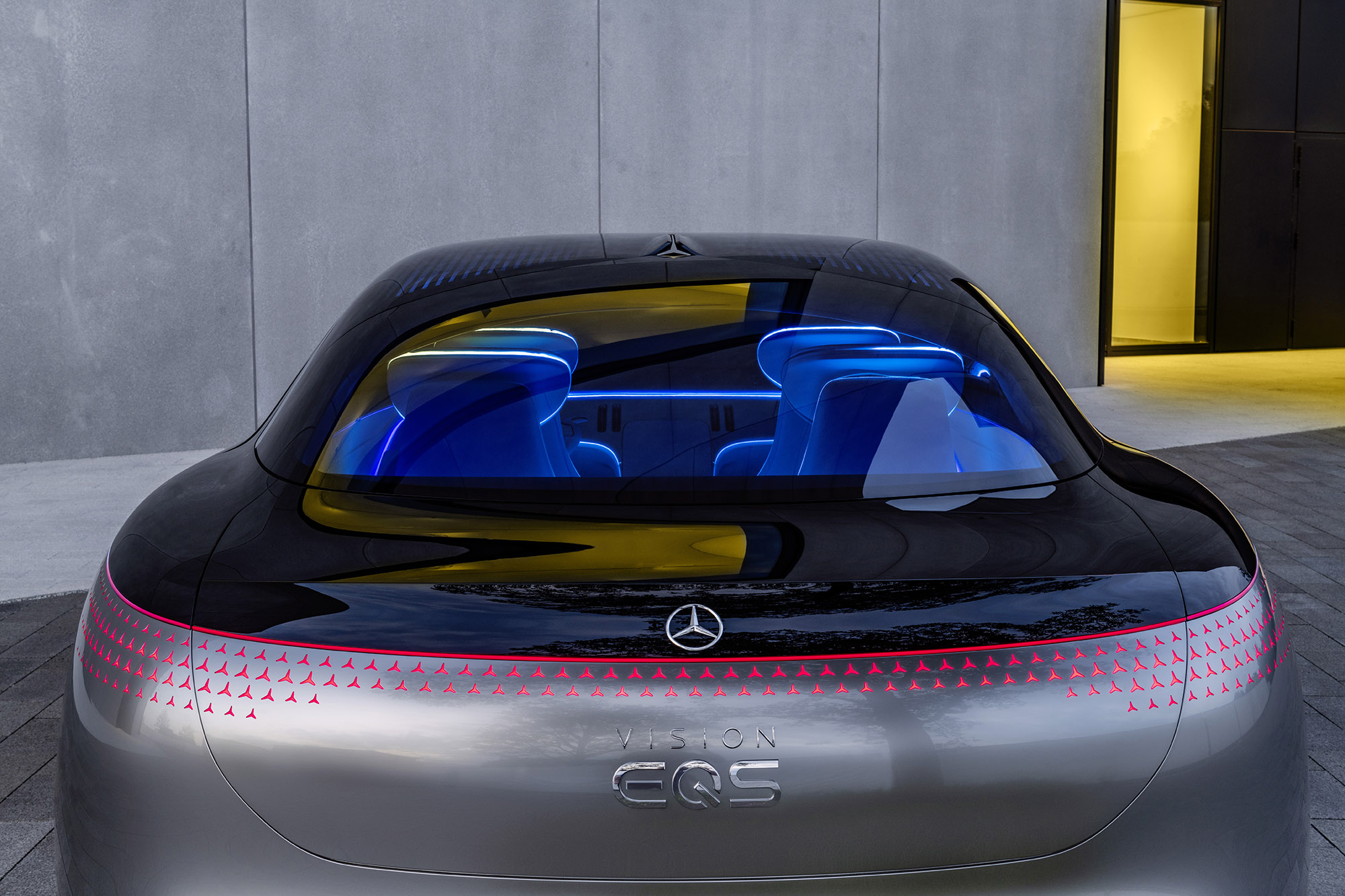
“We are here to define the future of the automobile … we say electric first.” Schafer said.
The Vision EQS’s importance is headline news, but the fact it has a recorded 700km range (in WLTP testing) is also noteworthy. Tailpipe emissions are, naturally, zero. Charging, based on 350kWh capabilities, is rapid, with 80 percent capacity achievable in “considerably less than 20 minutes”.
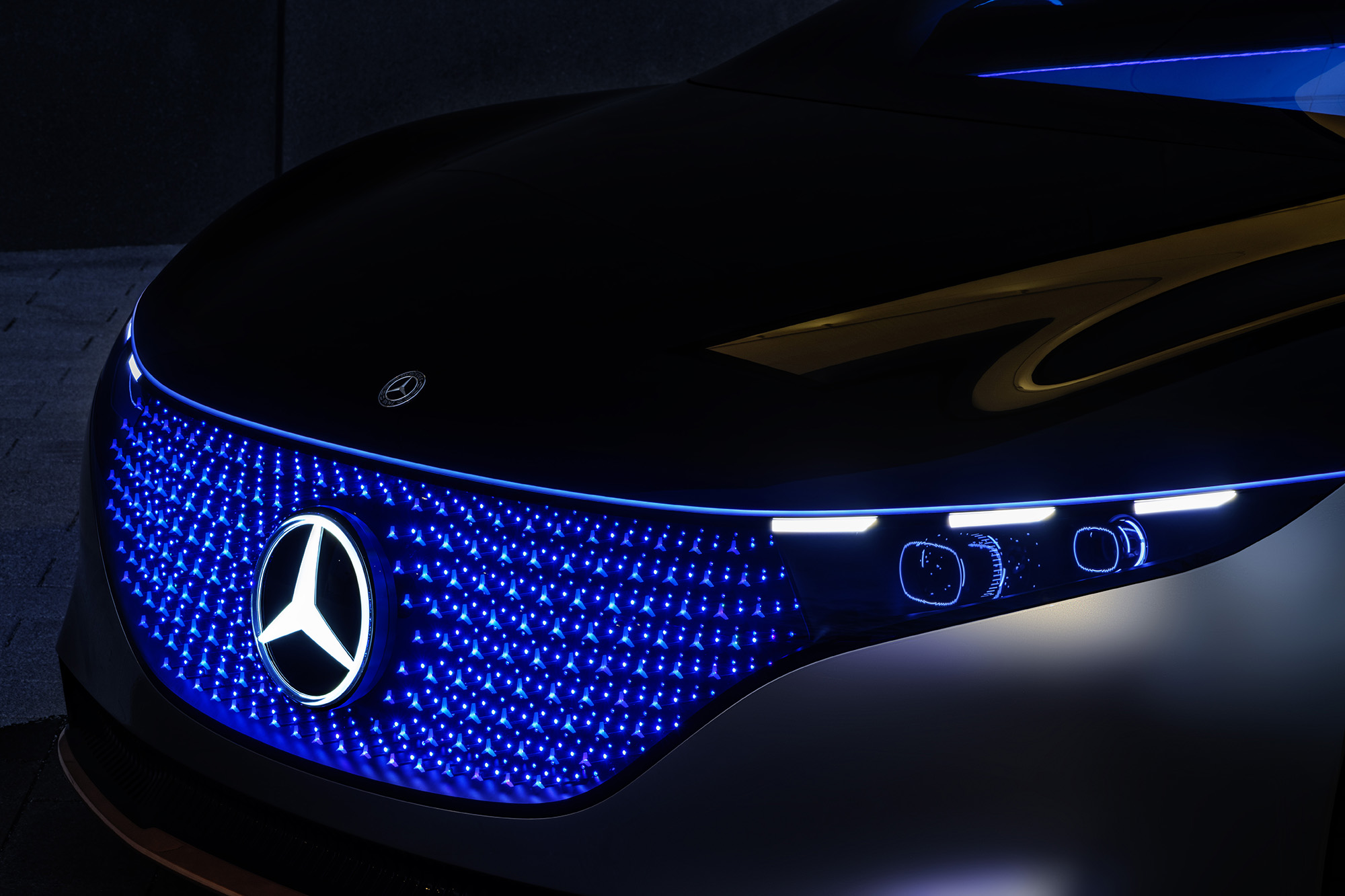
It achieves this pace via electric motors on the front and rear axles. Combined, the power output is 350kW, which is backed up by a significant 760Nm of torque from zero rpm. With axle-variable torque distribution and a low centre of gravity, the EQS isn’t all about going fast in a straight lines.
The concept’s structure comprises a mix of materials, including steel, aluminium and carbonfibre as well as “sustainable material made from recyclates”, according to a Mercedes statement. This ties in with the green theme and “optimally meets the requirements with respect to lightweight design, strength, cost efficiency and sustainability”.
The Vision EQS complies with Level 3 autonomy standards, meaning it can complete short highway journeys without needing inputs from a driver.
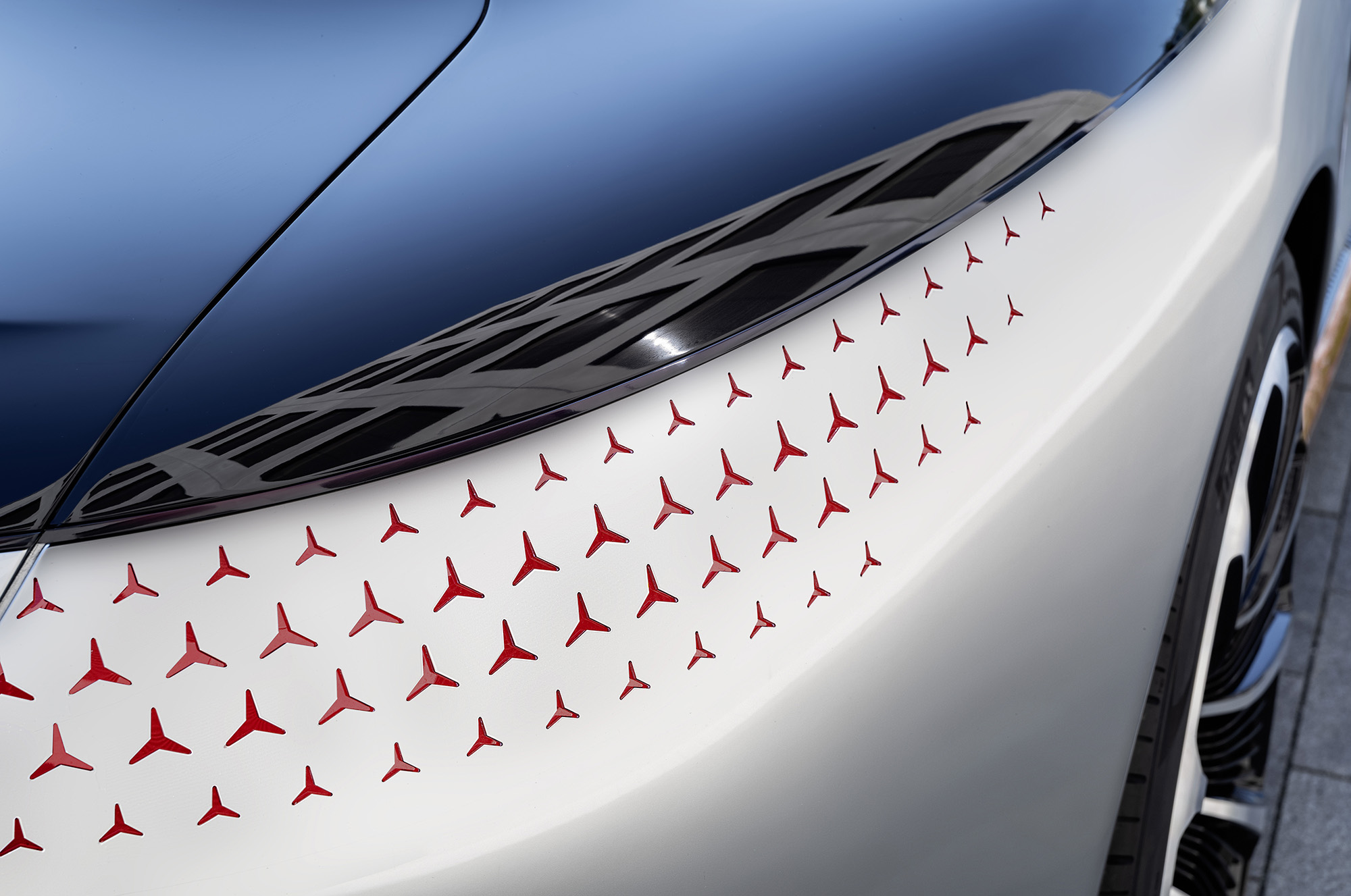
Inside, the Vision EQS gains the latest Mercedes-Benz User Experience (MBUX) artificial intelligence system, and the dashboard is clutter free and heavily touch screen based.
A new addition to the Land Rover Discovery family is on its way in the near future, according to the company’s design boss.
Land Rover’s Chief Design Officer Gerry McGovern dropped the bombshell during a presentation on the new Defender ahead of the Frankfurt Motor Show.
“Discovery sits in the world of versatility. There is more to come,” he told media. “For me, two doesn’t make a family.”
Offering no more information on what the third model would be, it leaves the door open for a range of new products.
“With the Defender coming, it gives us the opportunity to maybe rethink what the world of Discovery is going to be in the future. I am quite excited by that,” McGovern said.
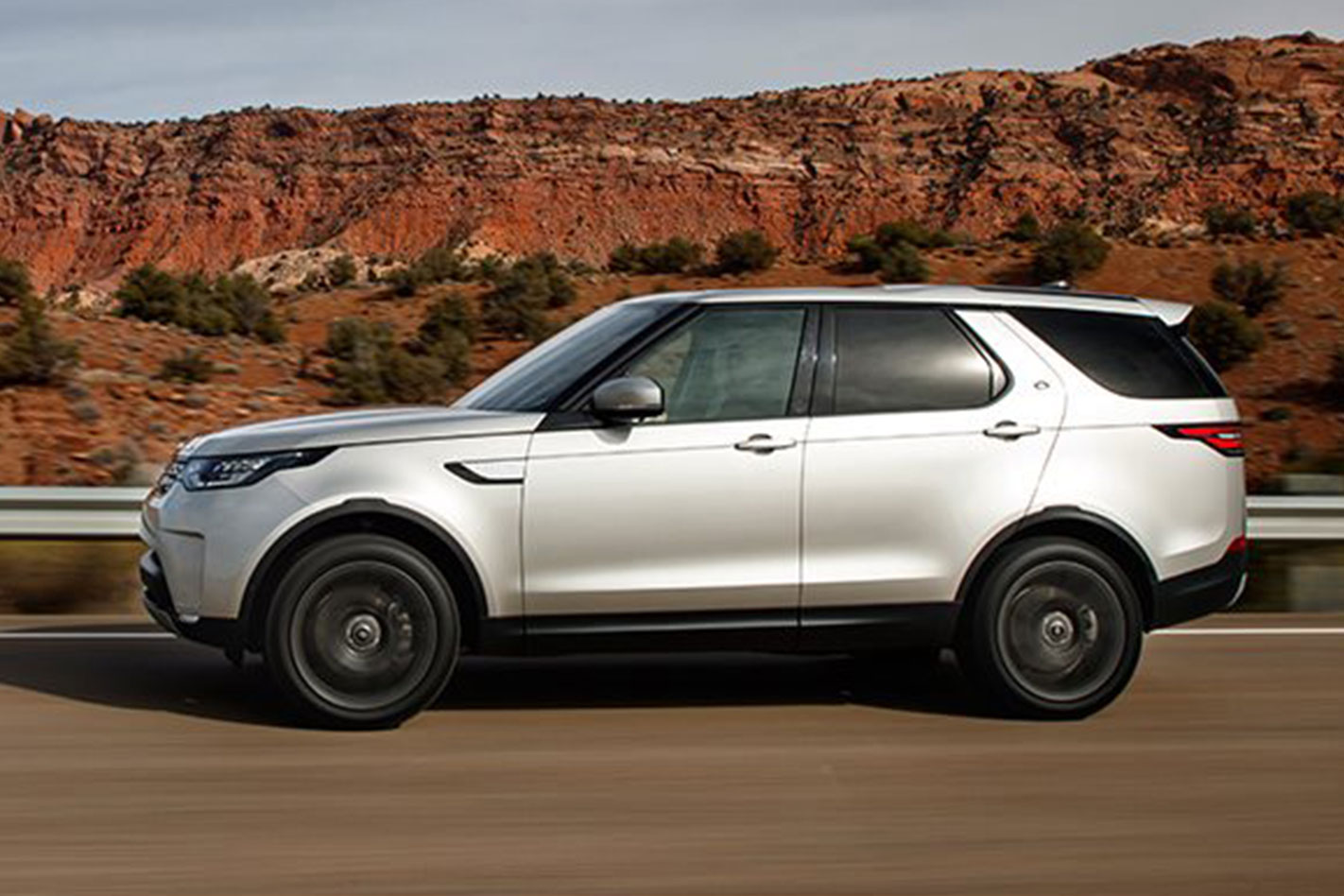
Land Rover offers a pair of Discovery models, first dating back to 1989. The current third-generation Discover was revealed in 2016, while a smaller Discovery Sport joined the family two years prior.
Wheels is in Europe this week to drive the L550 Discovery Sport’s mid-life update.
With a large SUV and medium SUV, it would make sense for Land Rover to add a smaller model to the Discovery range.
McGovern was keen to stress the Discovery family’s place within the wider Land Rover brand, and how its focus on versatility meant it sat between the Range Rover offerings, and the new Defender.
“Range Rover lives in the world of luxury where the expectations and standards are going up by the minute,” he said.
“We will continue to develop that [Range Rover] family of vehicles.”
After a lengthy gestation, and a number of leaks, Land Rover has revealed its all-new Defender to the world.
This is the first all-new update for the Defender nameplate since 1983, and just the third generation since it started production in 1948.
Initially, the Defender will be offered in two body styles, the three-door 90, and five-door 110, each available with a choice of four engines, two petrol and two diesels. In order to keep the engines breathing freely in dusty conditions, a side air intake is utilised for each.
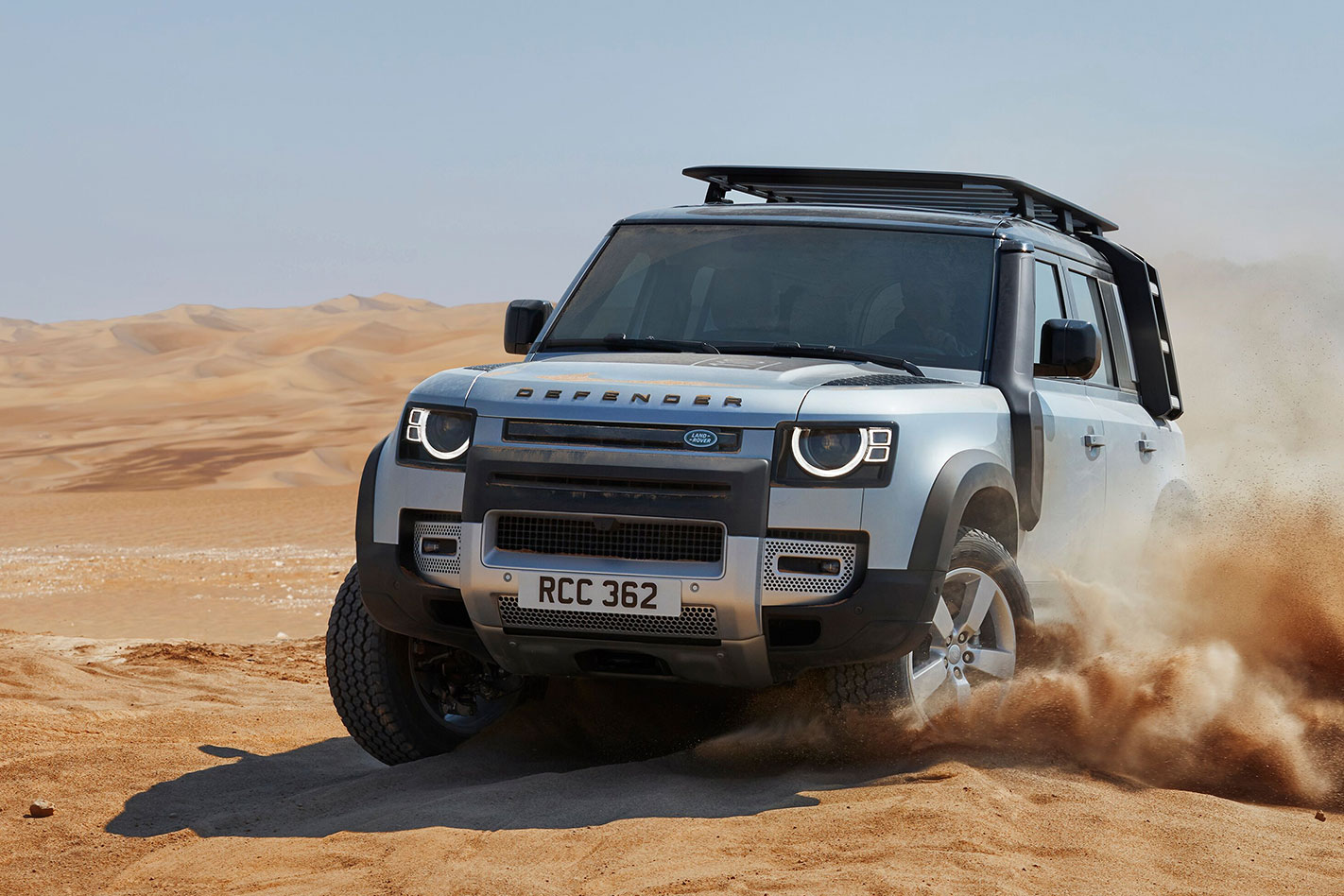
The only petrol option coming to Australia will be the P400 mild-hybrid turbocharged 3.0-litre straight-six producing 294kW/550Nm. Both four-cylinder diesel options, the D200 (147kW), and D240 (177kW) will be offered down under. A plug-in hybrid model is confirmed, and is expected to be revealed next year.
Power is sent to each corner of the vehicle via a permanent all-wheel drive set-up, with an eight-speed automatic transmission feeding power through a twin-speed transfer box, and locking differentials on each axle.
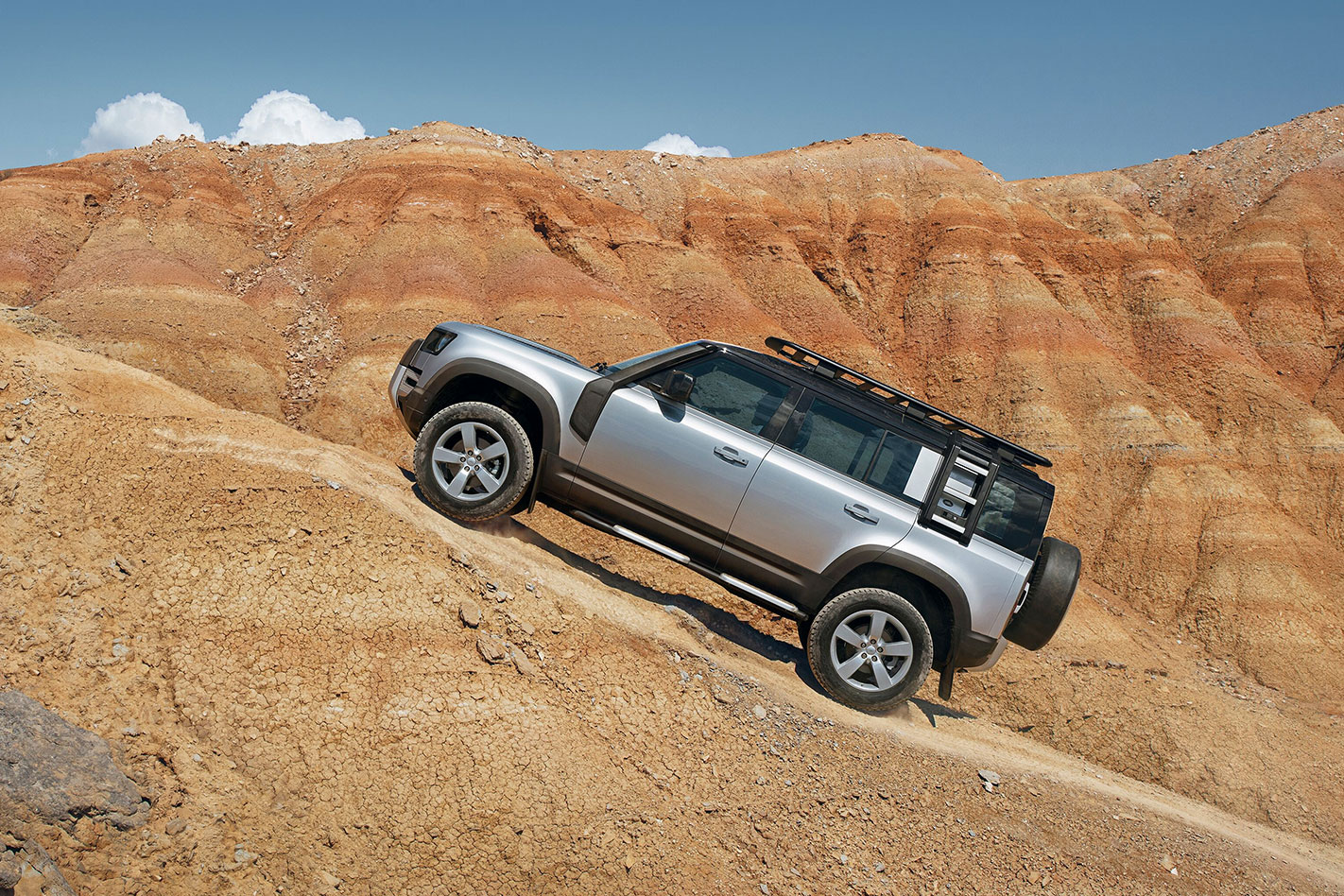
Now for the important information for the off-road enthusiasts. Both the 90 and 110 bodystyles have ground clearance of 291mm, an approach angle of 38 degrees, a departure angle of 40 degrees and a wading depth of 900mm. Land Rover claims it can conquer gradients of up to 45 degrees.
Gone is the body-on-frame design of old Defenders, with the L663 using an aluminium monocoque chassis. Land Rover named the platform D7x, with the x standing for extreme, apparently.
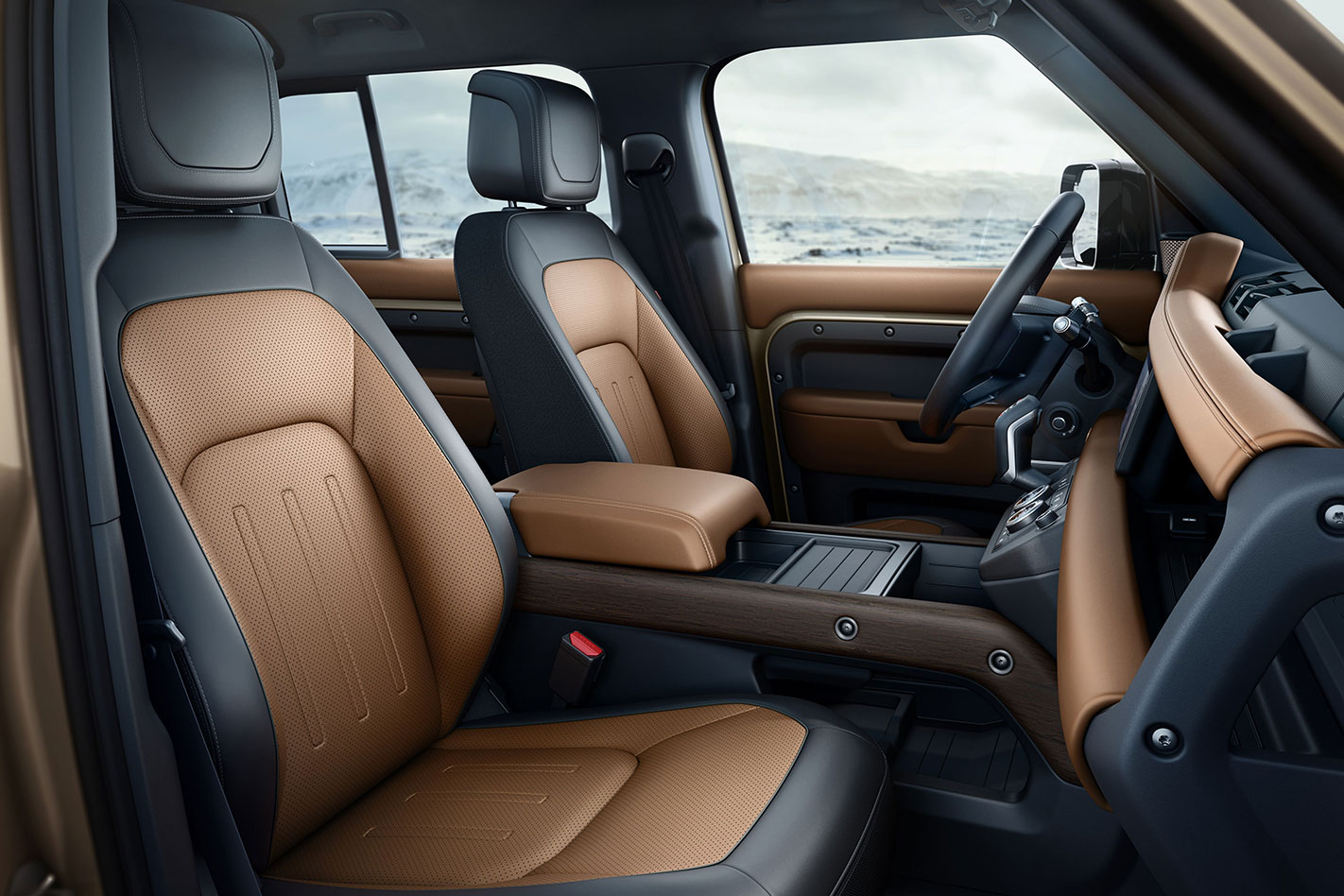
“A lot of people would say, ‘Oh, it needs to be body-on-frame’, but that would be a ridiculous thing to do, wouldn’t it?” Nick Rogers, the Executive Director for Product Engineering at Land Rover, told media at the car’s reveal in Frankfurt.
“Because whenever you have body-on-frame, you have always got a separate entity, which is the chassis, from the body, with mounts between the two. Which means every time you drive the car and want to change direction, you have phase lag.
“This monocoque is 10 times stiffer than a traditional body-on-frame, and three times stiffer than the best.”
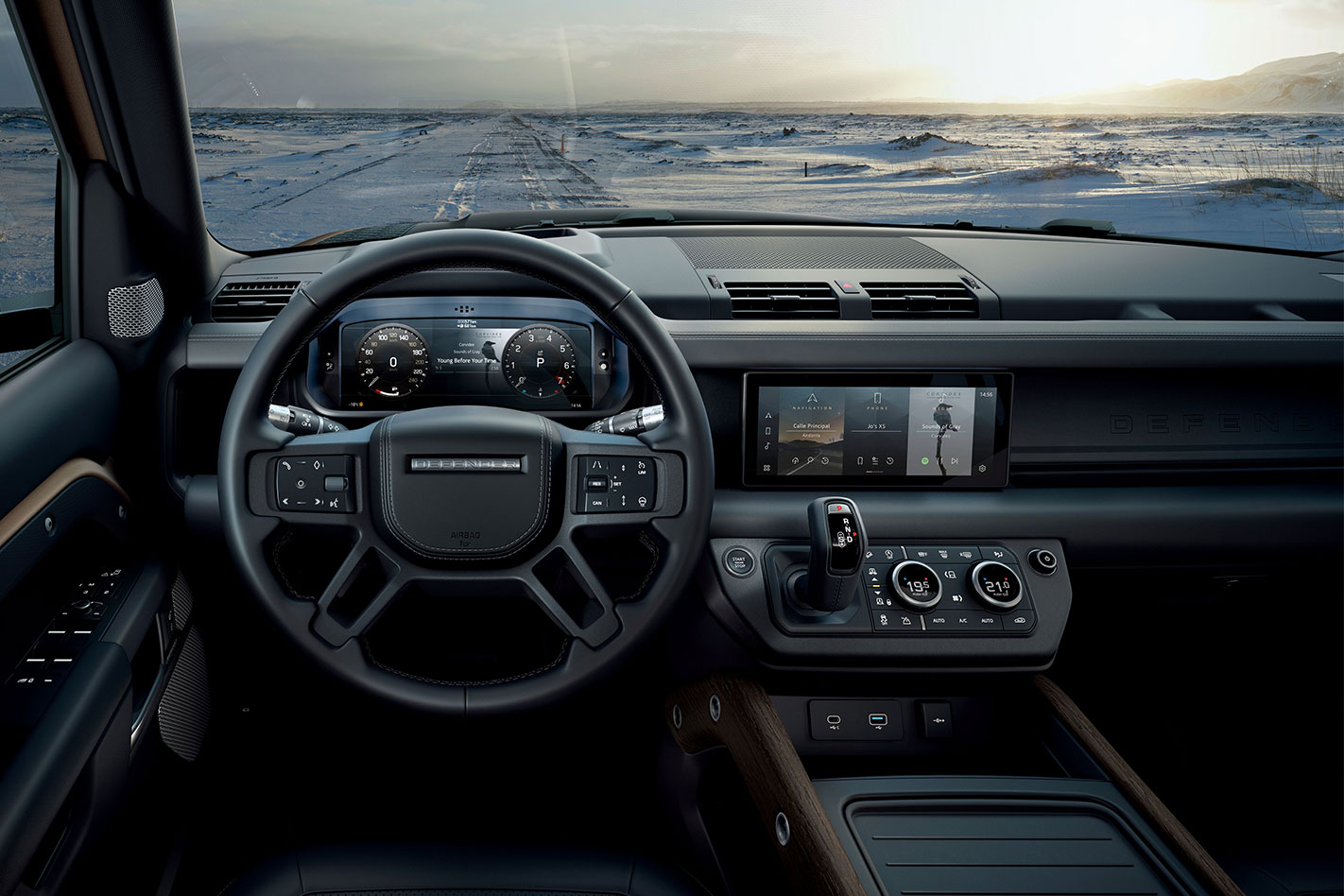
That strength means the Defender is rated to 6.5-tonnes of snatch recovery load, and claimed to be capable of 500mm of articulation. Oh, and it has the strongest driveshafts and half shafts in Land Rover history.
Every Defender has independent multi-link suspension, with double wishbone up front, and an integral link set-up in the rear. Optional air suspension is capable of raising the ride height by 135mm in the front, and 145mm at the rear.
Aware that the boxy design could hurt efficiency, Land Rover used a number of design tweaks, including a completely smooth underfloor, to give the car a drag coefficient of 0.38cd.
JLR’s standard trio of S, HS, and HSE variants will be available for both 90 and 110 body styles, while a new X specification will top the range. Both the 90 and 110 can be specced in either five- or six-seat configurations, thanks to an optional jump seat that fits between the driver and front passenger.
A quartet of option packs are available for each, utilising some of the 170 available accessories for the Defender to make the car more capable for your desired use – whether it be exploring the wilds or conquering the urban jungle.
Finbar McFall is the Product Marketing Director at Land Rover, and he believes that due to the reborn Defender’s day-to-day liveability and rugged capability, it has no natural rivals.
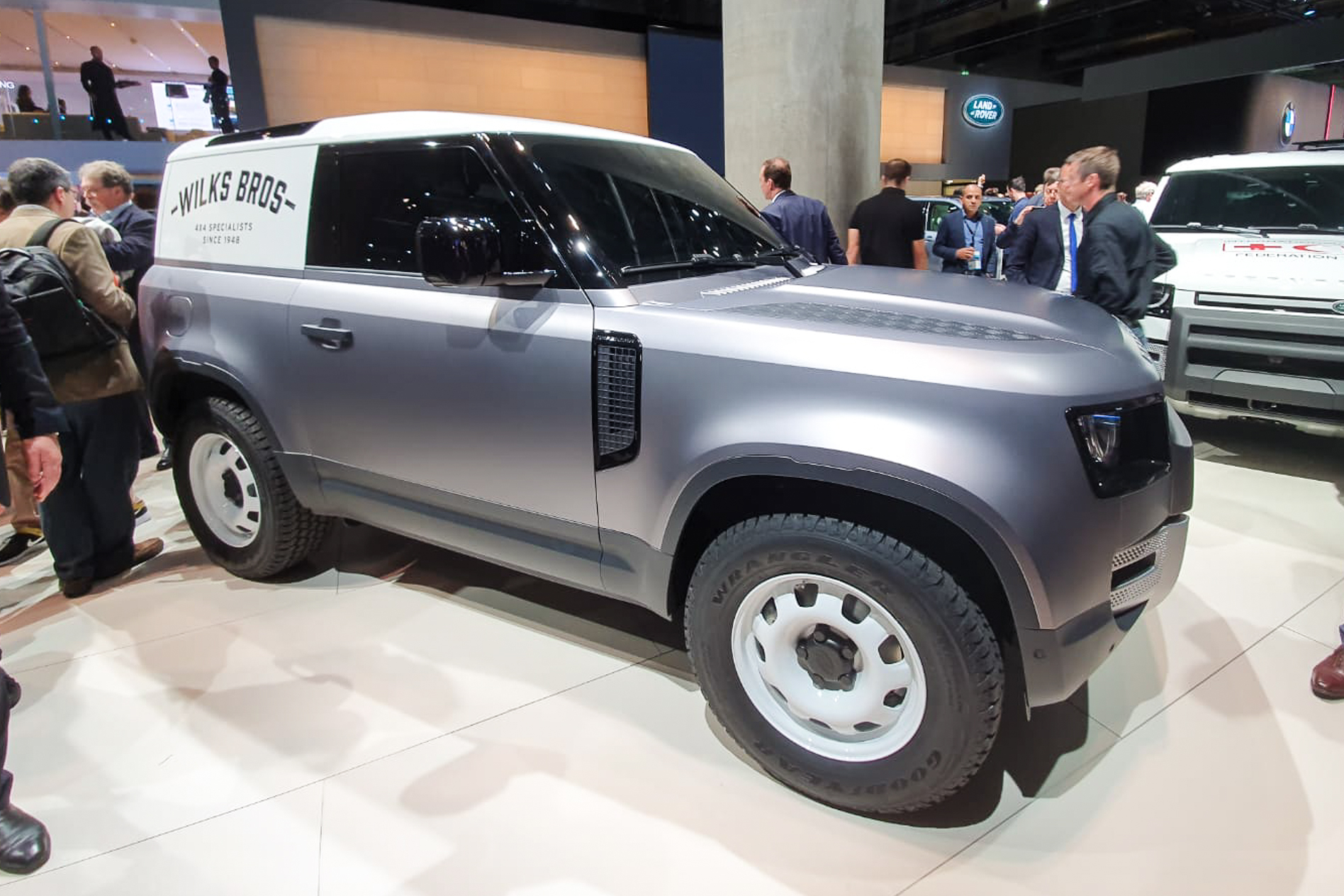
“This is a vehicle that has its own space,” he said. “Our whole mission was to ensure [the Defender] was in a category of one. There is nothing else like it in our line-up, and there is nothing else like it in the wider market place.”
Land Rover was clearly aware that scrutiny on the new Defender would be intense, as the previous generations have developed a significant cult following.
However, company executives defended their design choices, stating that this is a worthy successor for the nameplate.
“The new Defender has had to be designed for a world that has changed beyond recognition from when the original was created,” Gerry McGovern, Land Rover’s Chief Design Officer, told media.
“You can acknowledge [the original], but you cannot be harnessed by it. It has to appeal to a new generation of customers.
“These are the toughest, most capable, Land Rovers ever made. Period.”
We look forward to putting that statement to the test, Gerry.
Every L663 Defender will be built at JLR’s Nitra plant, in Slovakia, with A JLR spokesperson telling Australian media that the five-door 110 bodystyle is going to be the first to arrive locally, landing by June next year, and expected to start at $70,000. The range halo will be the X variant, with a rough estimation in the ballpark of $130,000-140,000.
Pricing for the two-door 90 can be marked into the calendar around Q2 2020, with an on-sale date of before next year’s end.
Keep up to date with all of the Frankfurt Motor show news
This is the new BMW Concept 4 and, you guessed it, it’s designed to give us a glimpse of the next-generation 4-series.
It has perfect proportions with a clear and precise design,’ according to BMW Group’ Design’s senior VP, Adrian van Hooydonk.
The Concept 4 is strewn with crisp lines and angular creases – a departure from BMW’s sculpted wheel arches, round-edged bonnet creases and tapered lights.
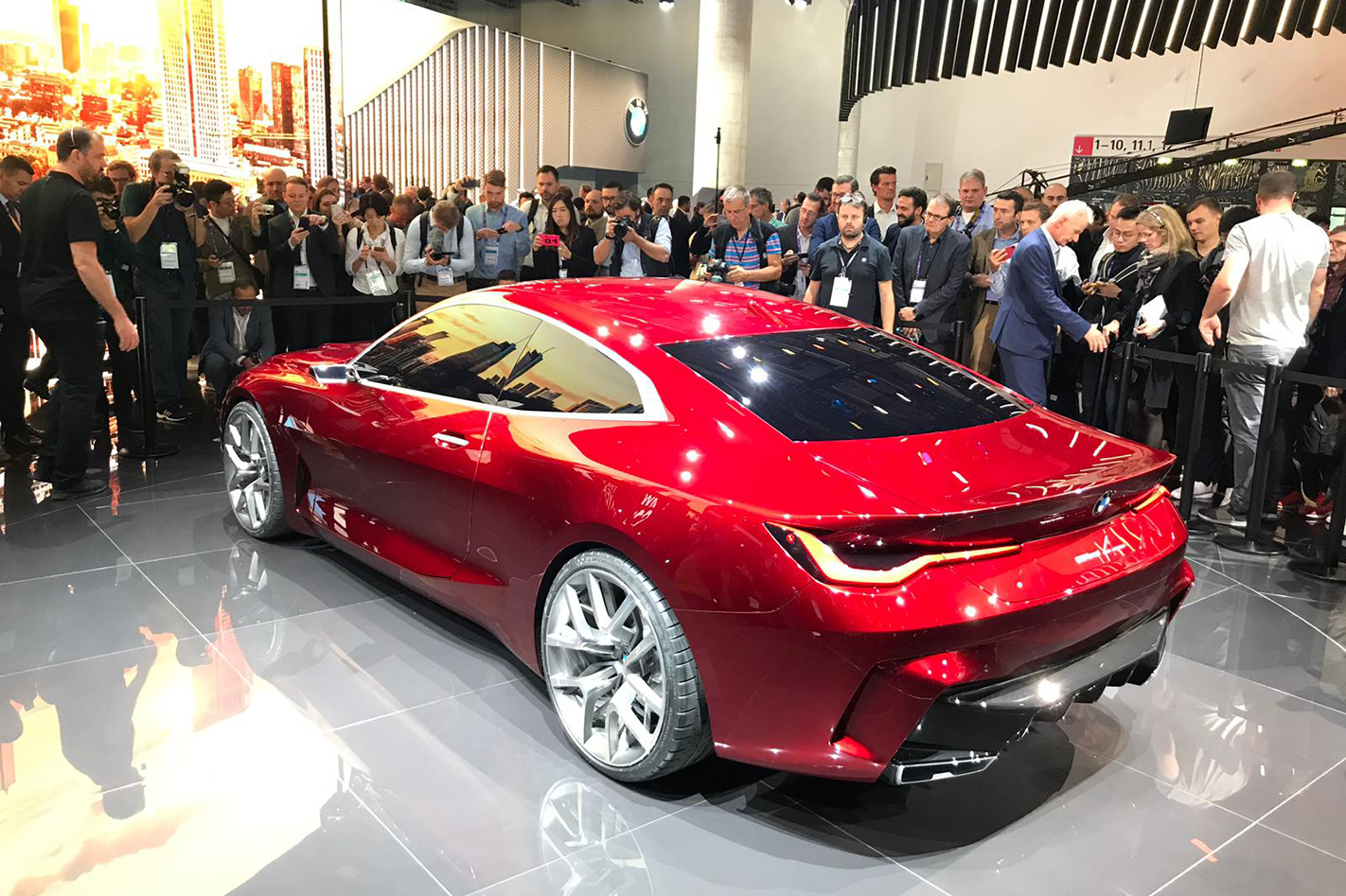
The bonnet is long, the cockpit glasshouse is shallow and the rear is stubby – all strong design cues for a coupe. Details like super-slim door mirrors, rear lights with one single fibre-optic light running through them and big, ‘dished’ alloy wheels are all present and correct.
FULL COVERAGE: 2019 Frankfurt Motor Show
All of the bodywork is finished in ‘Forbidden Red’ – a deep metallic colour that’s designed to emphasise the 4’s lines, shifting from a vivid red in the when light is projected on it to near-black.
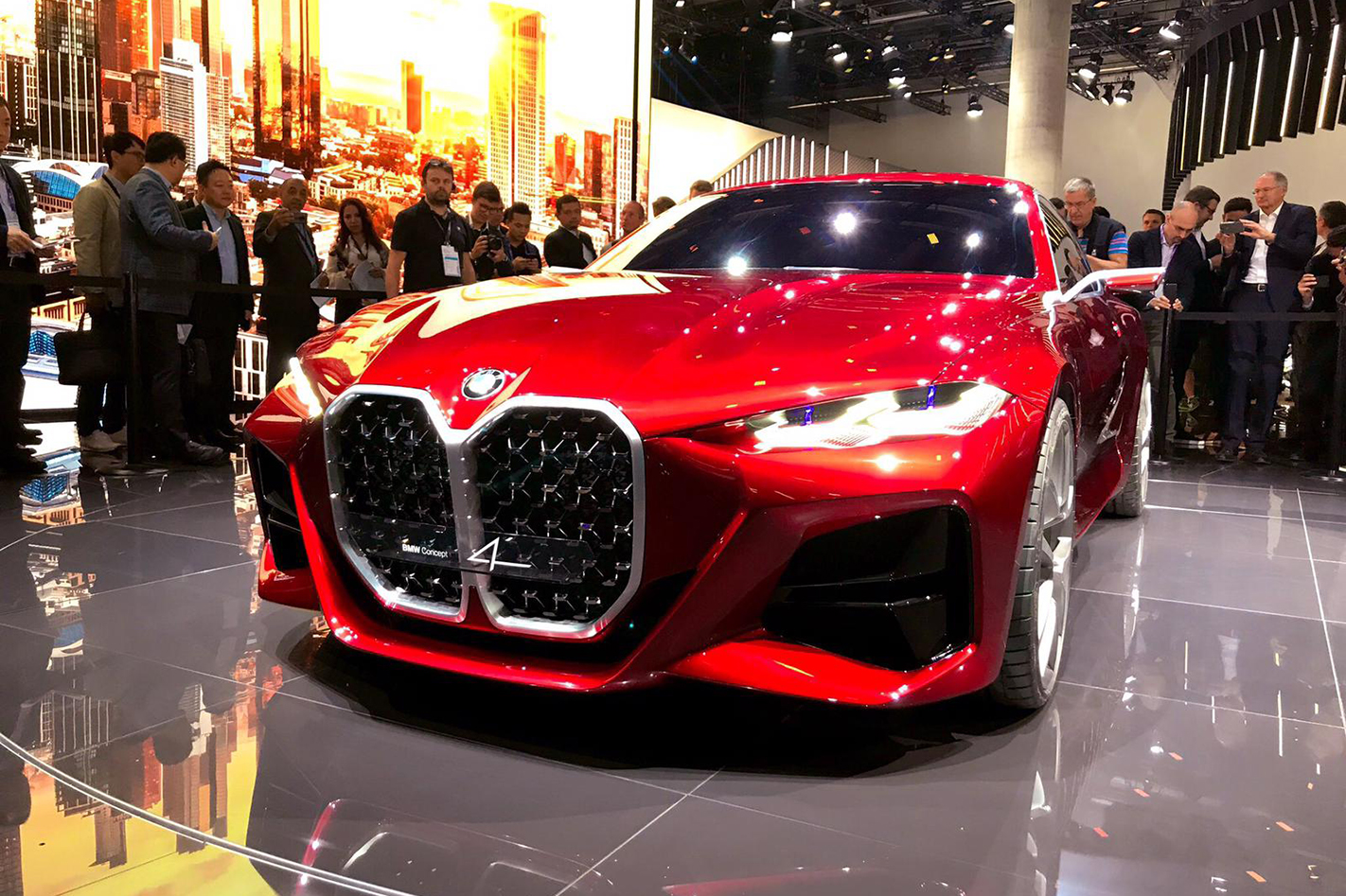
OK, now to address that grille. It seems BMW’s designers really are going to town with its famous kidney grille motif. Not content with making it large enough to suck in wildlife on the updated 7-series or new X7, Adrian van Hooydonk and his team have stretched its height as much as it can go now, too.
It’s not the first time we’ve seen a rat’s teeth-style kidney grille, with the i Vision Dynamics concept of two years ago also pointing to a slimmer but taller arrangement – albeit blanked off. BMW says it’s meant to point to earlier times when its trad design signature wasn’t as large as some cars, like the original 328 and 3.0 CSi.
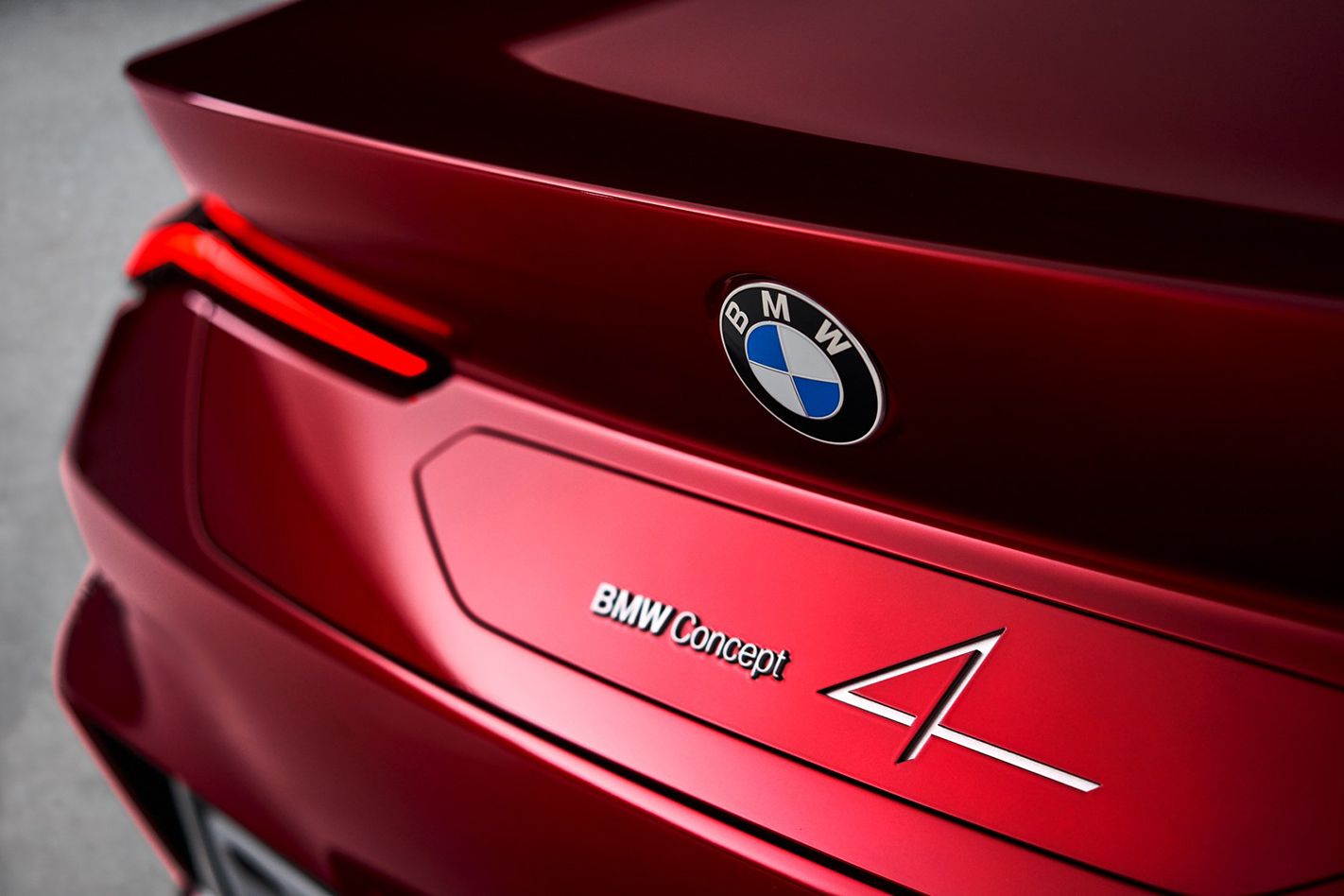
There are some 3D-effect details in it, too, with chromed hexagonal details in the forefront and grating shaped like a series of joined-up number fours in the background.
As usual the question is how much of this will make production?
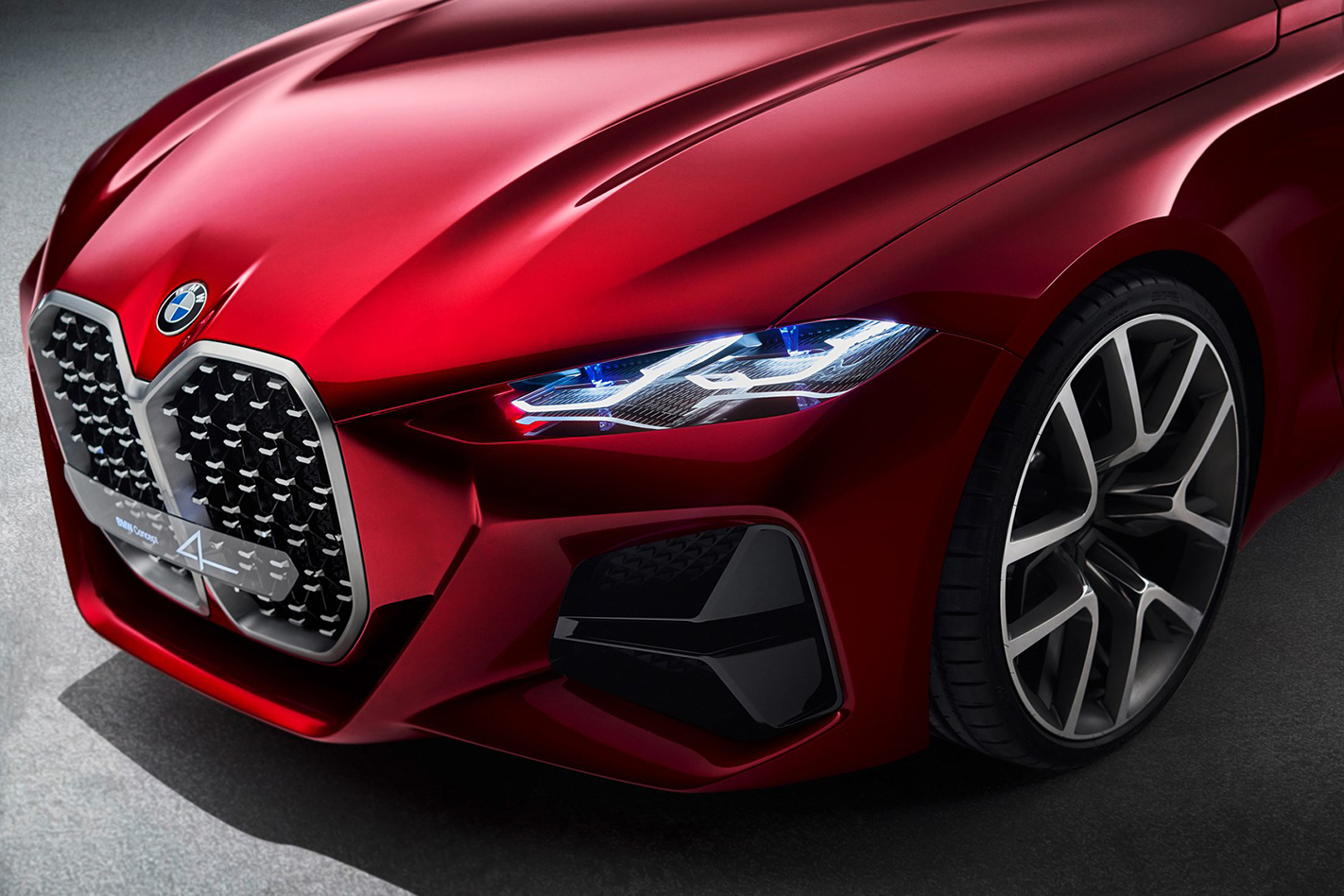
Don’t expect it to be a copy-and-paste job for the production car, but expect a lot of the design cues to be carried over. Think of the 8-series; many of the proportions stayed the same from the concept car, even if BMW made it look a little fussier than the Concept 8 of 2017.
Will the 4-series be more of a design departure from its 3-series sibling? We’ll have to wait and see.
This article was reprinted from Carmagazine.co.uk
Keep abreast of the 2019 Frankfurt Show right here
Porsche has injected more grip into its base 911 as a new Carrera 4 Coupe and Convertible join the 992 generation.
Strangely, an extra set of driveshafts have not improved the Carrera’s acceleration times, as it equals the two-wheel drive version for 0-100km/h.

Yep, option a Sport Chrono package and eight-speed PDK transmission and the new 4 will blast to 100km/h in four seconds flat. Just like the rear driver. However that’s a tenth faster than is predecessor, as is the case with the new 4 Cabriolet. It manages the feat in 4.2sec when similarly equipped.
The 992’s twin-turbo 3.0-litre flat-six, combined with model-specific turbochargers, produces 283kW and 450Nm, or only 11kW more than before.
At full velocity the coupe will hit 291km/h while the Cabriolet manages 289km/h.
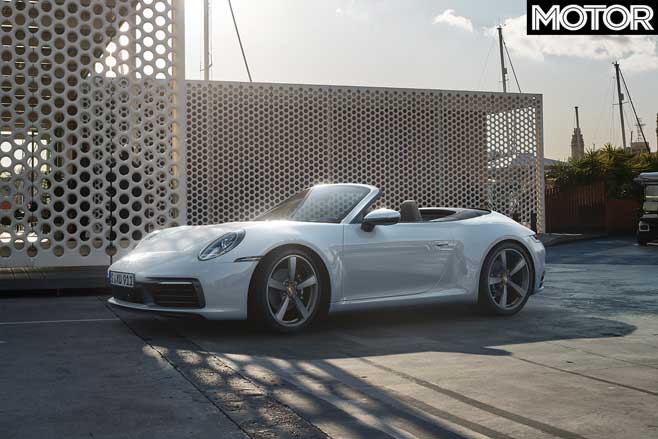
We’re hearing that both models will come with adaptive suspension as standard, along with Porsche’s fancy new Wet mode that primes the chassis and electronic systems for faster and safer reactions.
The rolling package comprises staggered diameter wheels of 19- and 20-inches, hiding steel brakes, that can be upgraded to 20- and 21-inch diameter wheels and a carbon ceramic brake system.
A redeveloped transfer case that splits power front to rear scores stronger internals and a higher locking power to better distribute power. The S and 4S’s fully-variable locking rear differential is also available as an option.

Since the new 992 has adopted a wider 911 body shell across all models, the four-wheel drive variants distinguish themselves on their exhaust tip style. Standard 4’s feature one rectangular single tubes on each side, while the 4S gets round tips. Option the Sports Exhaust on either and you’ll score oval shapes.
Deliveries are planned for the fourth quarter this year with prices starting at $245,600 for the Coupe and $267,100 for the Cabriolet. That’s before on roads. Australian cars also score a long list of standard options, including Bose sound, 14-way power front seats and digital radio.
As a continuation of its centenary celebrations, Bentley has announced that it will be producing just 12 examples of the iconic 1929 Bentley 4½-litre supercharged “Blower” racers, one for each race the original four “Team Blower” competed in.
To accurately reproduce the continuation models, Bentley will disassemble its one and only Team Blower – chassis no.HB3403.
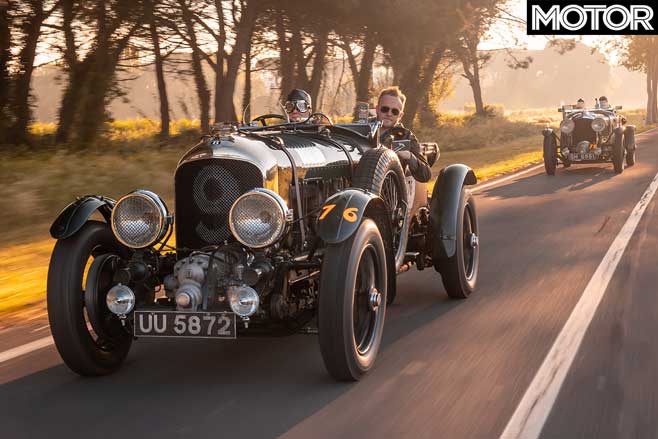
From there each part will be catalogued and digitally scanned, while the original moulds and jigs from the 1920s will be used to reforge 12 sets of new parts, all of which will be then hand-assembled into a new Blower by a team of heritage-technicians.
Bentley says that each continuation model will take two years to build, with pricing set as “on application”. As for the original no.HB3403, technicians will reassemble it, restore parts of it where necessary, and will be reinstated for demonstrations and display at official Bentley events.
Despite the Team Blower – or more popularly known as the Blower Bentley – being instrumental in establishing Bentley in popular culture, it being the car that Ettore Bugatti once referred to as “the world’s fastest lorries” and Ian Fleming using it as the ride of choice for his fictional spy, James Bond, it was never original products of the Bentley factory.
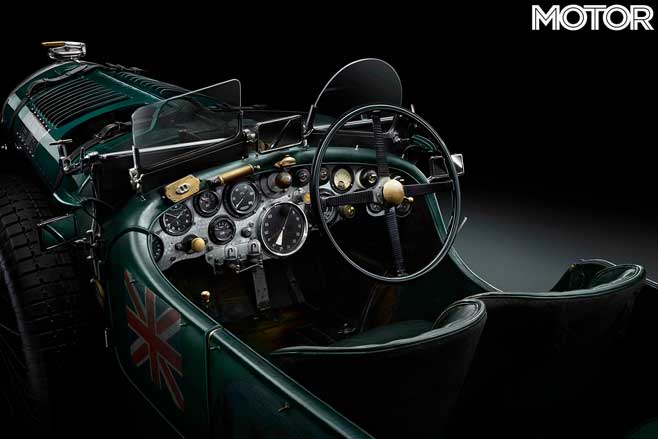
Instead the original Team Blowers were built by one of the original Bentley Boys, Sir “Tim” Birkin, who wanted a supercharged version of Bentley’s Le Mans-winning 4½-litre racers to stay ahead of the competition.
Unfortunately for Birkin, company founder Walter Owen Bentley, who wasn’t a big fan of force induction, was reluctant to give in to his demands. Rather it was Bentley chairman, Woolf Barnato, who sanctioned Birkin’s idea and provided 55 4½-litre examples for Birkin to work on independently.
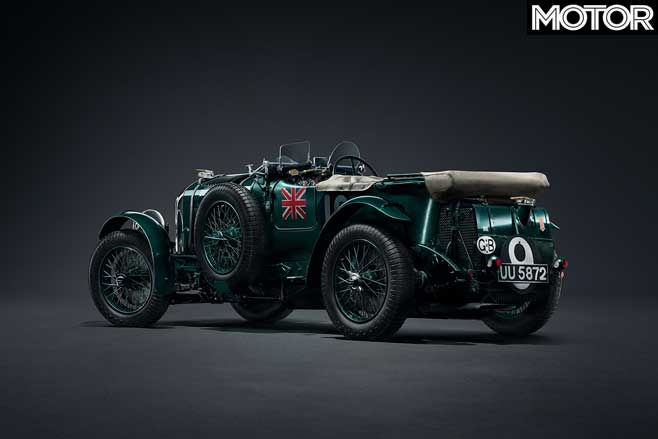
With Bentley’s blessing, Birkin, with a small team of ex-Bentley technicians worked on supercharging the five “Team Blower” race cars with the other 50 examples done for homologation purposes at Amherst Villiers’ workshop, makers of the superchargers fitted to the Team Blowers.
When Birkin’s Team Blowers hit the competitive circuit in 1930, it impressed with its remarkable turn of speed. A second place finish at the French Grand Prix is said to have annoyed Bugatti enough to illicit his inglorious truck comparison.
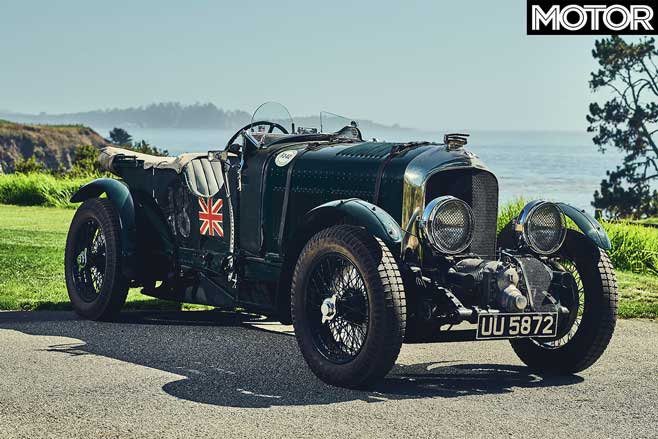
Despite the Team Blower’s pace, it failed to grasp Birkin’s ultimate prize at Le Mans as the supercharged donk’s combination of conspicuous consumption and unreliability saw all three cars failing to finish the race.
In an ironic twist, Bentley’s own Speed Six racers, with its bigger displacement naturally-aspirated engines that W.O. Bentley favoured, took the top honours.
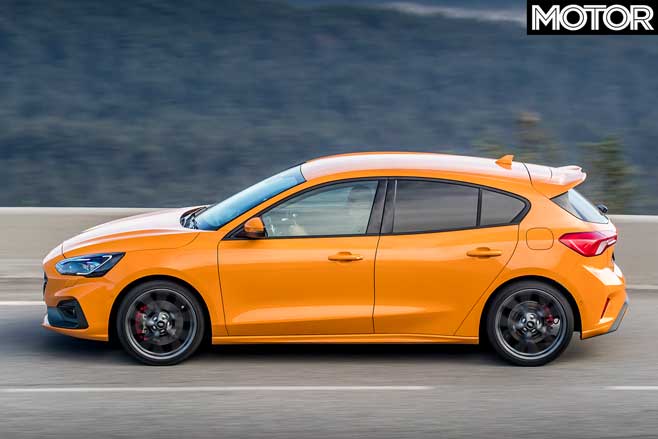
The Ford Focus ST will join its Fiesta little brother in Australian showrooms from Q1 2020 at a starting price of $44,690.
This is a significant hike over the $38,990 of the previous Focus ST, but the new generation model is a very different kettle of fish to its predecessor, embracing a raft of high technology to increase performance and connectivity.
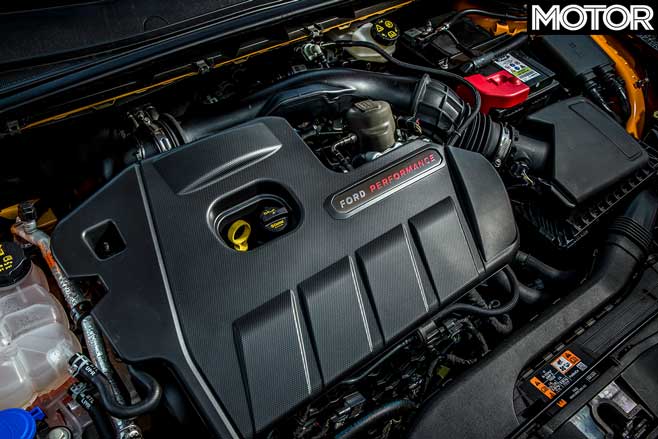
Power is provided to the front wheels by a 2.3-litre turbocharged four-cylinder engine producing 206kW/420Nm through either a six-speed manual or a seven-speed automatic, the latter available at no-cost.
The engine features anti-lag, which first appeared on the Ford GT supercar, while the manual incorporates rev-match technology for those unwilling or unable to heel-and-toe.
Harnessing this grunt is an electronically controlled limited-slip differential, which should somewhat tame the unruly nose of the previous Focus ST, and while Ford Australia doesn’t claim a 0-100km/h time, overseas specifications list it as 5.7sec.
Adaptive dampers make their Focus ST debut, monitoring suspension, body, steering and braking inputs every two milliseconds and adjusting the suspension accordingly. The steering is 15 per cent quicker than the standard Focus at just two turns lock-to-lock, while the whole show sits 10mm lower.
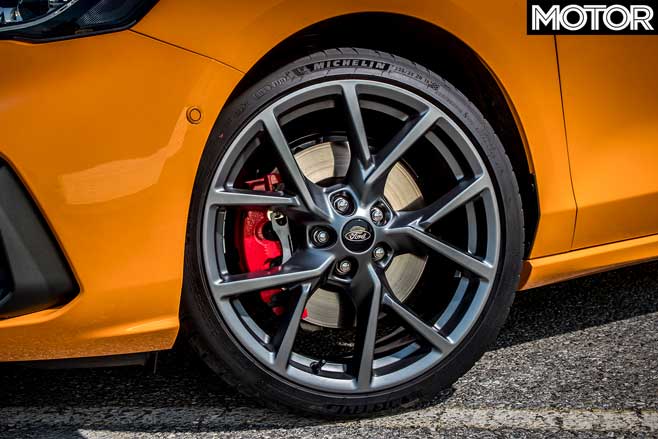
Michelin Pilot Sport 4 S tyres measuring 235/35 are standard with 330mm brake rotors up front and 302mm at the rear. Ford claims the new Focus ST has almost four times the fade resistance of its predecessor.
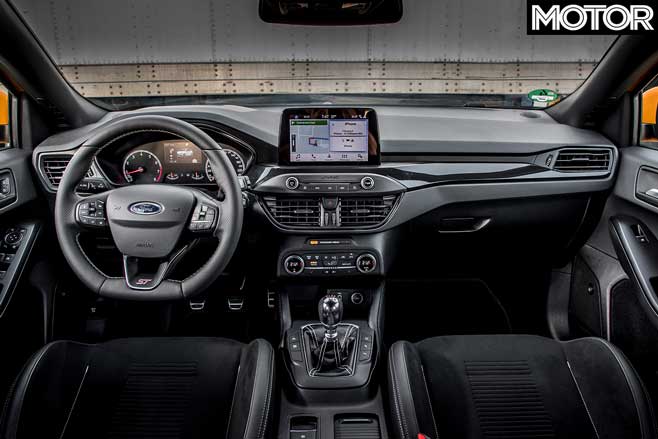
Seven colours will be available – Ford Performance Blue, Orange Fury, Frozen White, Magnetic Grey, Race Red, Ruby Red and Shadow Black – while inside the new Focus ST is not only roomier thanks to a 53mm wheelbase stretch over its predecessor but also includes an 8.0-inch touchscreen display incorporating SYNC3 as well as Apple CarPlay and Android Auto.
Standard equipment including a full suite of active safety gear (AEB, lane departure warning, lane keep assist, active cruise control and more), Recaro seats and a 10-speaker B&O sound system. The only options are prestige paint ($650) and a panoramic sunroof ($2500).
The Focus ST comes with a five-year, unlimited kilometre warranty and will land in showrooms in February/March 2020.
YOU MAY well have noticed that Volvo has won the past two Wheels Car of the Year awards. While the Volvo XC60 and XC40 products have generated little in the way of complaints, a persistent background grumble has been that Volvos are expensive to service.
The company disagreed, but perception is king in the marketplace and to try to stem that belief, Volvo today announced a fixed-price servicing plan at the Australian launch of its S60 sedan. This model, and its V60 wagon sibling, will be available with a three-year service and maintenance package for $1595. That price also applies to XC40 models.
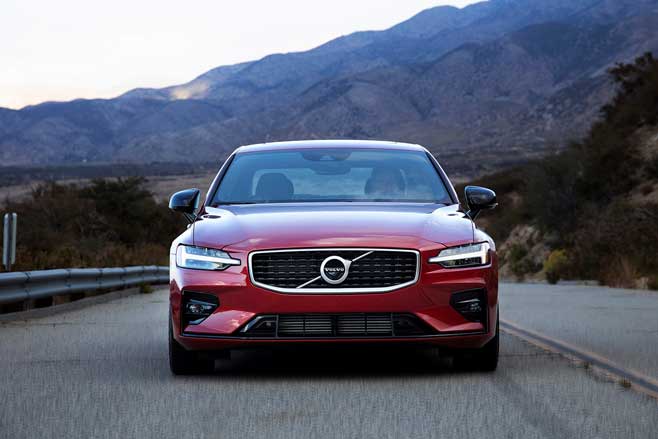
Nick Connor, Managing Director of Volvo Australia explained the broad approach. “The service plan will be launching across the range,” he said. “In order to meet that price, we’ve culled the price of parts margin rather than cutting service levels. I think we fit the world’s most expensive pollen filters to our cars. You told us we had a problem, we’ve responded as well as we can.”
While pricing for the popular SUV models is yet to be detailed, Connor suggested that the XC90 would be “a little bit more expensive.” Petrol versions sit in the second tier of pricing alongside petrol-engined XC60s at $1795, while diesel powered XC60, XC90 and V90 Cross Country models attract an $1895 ask.
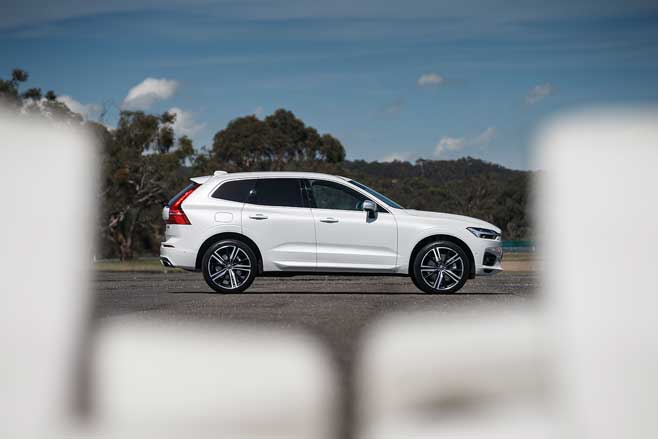
With sales up by 20 percent this year and improving by 40 percent the previous year, Volvo Australia is on a roll. With fresh new product and a more attractive servicing package, there’s scope for the company to kick on still further.
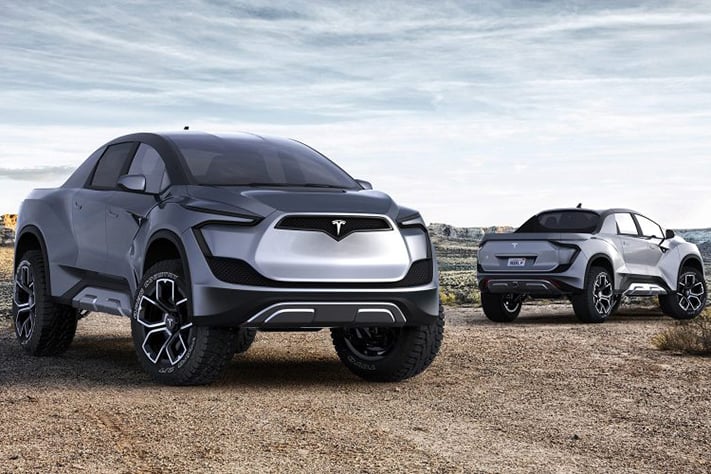
Tesla is set to reveal its futuristic all-electric pickup truck in November, according to the company’s founder and Elon Musk.
The Tesla ute, which Musk has previously described as “really futuristic-like cyberpunk, Blade Runner pickup truck,” was originally meant to unveiled in mid-2018.
That date was pushed back to October this year, however, Musk casually announced this will now mostly occur in November in response to a question on Twitter, which set the Tesla fandom into overload.
The enigmatic tech billionaire’s initial announcement of the all-electric ute in 2017 – again during a Twitter interaction – generated plenty of interest in Australia, according to Tesla Australia’s head of public relations, Heath Walker.
“It’s certainly exciting because I think this market is very similar to the US and there’s a huge [ute] uptake,” Walker told WhichCar at the time.
“All you need to do is look at the number-one selling car of the last twelve months – that’s the model type. It’s certainly a segment that we need to move into.
“The nice thing is, looking at our social media commentary; we actually get that request quite a bit.”
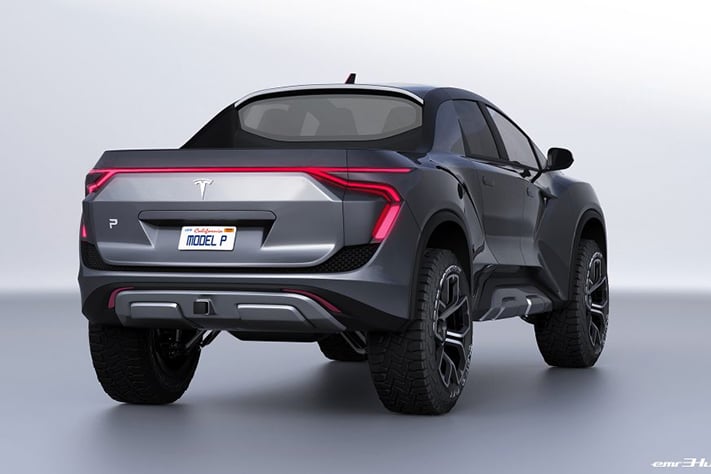
Musk has previously stated the Tesla pickup will be priced from about $A70,000, though if the Model 3 is any guide it’s way too soon to be talking pricing, let alone if or when it will be coming to Australia.
By the time it does come here it might already have competition from EV rival Rivian, which has plans to sell its R1T dual-cab here as soon as 2022.
Rivian has also received significant backing from Ford and is working on Blue Oval badged products that could include an electric F-150.
Meanwhile Chinese motoring giant Great Wall reckons its production-ready all-electric version of its new Model P ute could also be available in Australia within two years.
Even if it’s beaten to the punch, the Tesla ute will generate plenty of interest in the emerging segment, which unexpectedly became one of the big issues of the last Federal Election campaign when Prime Minister Scott Morrison declared that EVs represent a “war on the weekend” and that Australia’s favourite 4WDs including the Hilux “are out”.
